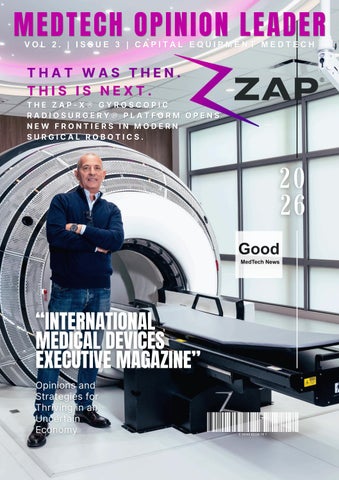
MEDTECH OPINION LEADER VOL 2. | ISSUE 3 | CAPITAL EQUIPMENT MEDTECH
THAT WAS THEN. THIS IS NEXT. THE ZAP-X® GYROSCOPIC RADIOSURGERY® PLATFORM OPENS NEW FRONTIERS IN MODERN SURGICAL ROBOTICS.
20 26
“INTERNATIONAL MEDICAL DEVICES EXECUTIVE MAGAZINE” Opinions and Strategies for Thriving in an Uncertain Economy
MEDTECH OPINION LEADER
20 26 “KASH FLOW IS NOW ON MEDTECH OPINION LEADER” Kashif Ikram presents KASH FLOW, exploring trends and innovations in surgical robotics and MedTech.
THIS ISSUE 05
Hakan Baraner talks about how ZAP Surgical’s ZAP-X technology enables precise, non-invasive brain tumor treatment, expands access to radiosurgery, and supports the adoption of advanced medical technologies in emerging markets.
12
Derek DeScioli talks about how ZAP Surgical’s ZAP-X technology aims to expand access to precise, noninvasive brain surgery and extend radiosurgery beyond brain tumors to neurological and psychiatric conditions.
20
Tomer Gabay talks about how Spectrum Dynamics’ digital CZT technology is advancing nuclear medicine through improved SPECT imaging, AI, and theranostics to enable more precise diagnoses, personalized treatment, and better patient outcomes.
28 Kashif Ikram talks about how surgical robotics is
transforming the MedTech industry, covering investment opportunities, strategic partnerships and acquisitions, market trends, and the potential of endovascular robotics to revolutionize stroke treatment through remote interventions.
32 Peter De Backer talks about how AI is transforming
surgical training and robotic urology through real-time surgical assistance, data-driven learning, and Mantyx’s AI co-pilot technology to improve surgical precision and patient outcomes.
37 Matthias Franz talks about how MedTech companies can successfully commercialize complex medical technologies, focusing on market strategy, customer adoption, international expansion, and the growing integration of imaging, AI, and radiotherapy.
THIS ISSUE
44
Xavier Franz talks about how MedTech companies can improve market access and reimbursement for advanced medical technologies, focusing on healthcare financing, economic value, AI-driven innovation, and getting new technologies to patients.
51
Remco Maljers talks about how MicroAire is expanding internationally and advancing plastic and reconstructive surgery through innovative surgical technologies, surgeon education, tissue-based therapies, and more consistent patient outcomes.
60
David Fischel talks about how Stereotaxis’ magnetic robotic technology improves precision and safety in minimally invasive procedures, and how combining robotics with AI and connectivity will transform interventional medicine into a more precise, datadriven, and widely accessible form of care.
66
Dr. Dylan Attard highlights Malta’s rise as a dynamic MedTech hub and how MedTech World serves as a global platform for collaboration, innovation, and patientfocused healthcare progress.
72
Stefano Pomati talks about how the future of robotic surgery is shifting from mechanical precision to AIdriven intelligence—using data and real-time decision support to augment surgeons, improve outcomes, and create integrated, workflow-friendly surgical ecosystems rather than fully autonomous systems.
77
Stan Kalinin explores how flexibility, data-driven hiring, and global talent strategies are redefining the MedTech workforce, enabling companies to stay agile and innovative in a shifting market.
FROM THE EDITOR
I would like to welcome you to our issue MedTech Opinion Leader. At MedTech Opinion Leader, we are dedicated to bringing you the latest insights from industry trailblazers, comprehensive analyses, and forward-thinking perspectives. Our mission is to empower you with the knowledge and insights needed to shape your own vision in the ever-evolving medical technology landscape. Through expert commentary and in-depth coverage, we strive to be your go-to source for staying ahead of the curve in this dynamic field. Editor in Chief Stan Kalinin
THIS EDITION OF MEDTECH OPINION LEADER EXPLORES ADVANCES IN RADIOSURGERY, DIGITAL IMAGING, AI, AND PERSONALIZED TREATMENT, WHILE HIGHLIGHTING THE IMPORTANCE OF CLINICAL EDUCATION, MARKET ACCESS, AND INTERNATIONAL COLLABORATION.
04
HAKAN BARANER MEDTECH OPINION LEADER: HAKAN BARANER TALKS ABOUT HOW ZAP SURGICAL’S ZAP-X TECHNOLOGY ENABLES PRECISE, NON-INVASIVE BRAIN TUMOR TREATMENT, EXPANDS ACCESS TO RADIOSURGERY, AND SUPPORTS THE ADOPTION OF ADVANCED MEDICAL TECHNOLOGIES IN EMERGING MARKETS. 05
Stan: What makes ZAP-X different, and how could it shape non-invasive brain tumor treatment?
Stan: What are the biggest challenges in introducing advanced medical technologies to new countries?
Hakan: What makes ZAP-X distinctive is the way it combines a modern linear accelerator with a gyroscopic design. The system can direct radiation toward a target from thousands of potential angles, helping the clinical team concentrate the dose while limiting exposure to surrounding healthy tissue. It is also a dedicated brain and head and neck radiosurgery platform, rather than a general purpose radiotherapy system.
Hakan: Every market has its own regulatory process, procurement practices, funding model and clinical priorities. The challenge is to understand those realities early and shape a plan that fits them. A strategy that works in one country may need to change in another.
Two practical differences are its self shielded, vault free design and its use of a linear accelerator instead of cobalt-60. That can remove the need for a conventional shielded bunker and radioactive source replacement, while giving hospitals more flexibility in where they place the treatment suite. The technology can help make radiosurgery available in more settings, provided each program has the clinical team, patient pathways and support needed to use it well.
I start by listening to local clinicians, hospital leaders and distributors. Then we work through the practical questions together: regulatory approval, training, service coverage, financing and how patients will be referred. After decades in international MedTech, I have learned that trust comes from understanding local needs and following through consistently.
Stan: How can ZAP-X help expand access where infrastructure and specialist expertise are limited? Hakan: A vault free design can reduce one significant infrastructure barrier and give hospitals more choice about where a radiosurgery service can be located. That may help bring treatment closer to patients who would otherwise need to travel to a large urban center. But access depends on more than the system. A sustainable program also needs trained clinicians and physicists, reliable imaging and referral pathways, funding, and long-term technical support. Our role is to work with local healthcare partners to develop those capabilities around the technology, so a new service can be supported over time.
I START BY LISTENING TO LOCAL CLINICIANS, HOSPITAL LEADERS AND DISTRIBUTORS. THEN WE WORK THROUGH THE PRACTICAL QUESTIONS TOGETHER: REGULATORY APPROVAL, TRAINING, SERVICE COVERAGE, FINANCING AND HOW PATIENTS WILL BE REFERRED.
06
ZAP X What makes ZAP-X distinctive is the way it combines a modern linear accelerator with a gyroscopic design. The system can direct radiation toward a target from thousands of potential angles, helping the clinical team concentrate the dose while limiting exposure to surrounding healthy tissue. It is also a dedicated brain and head and neck radiosurgery platform, rather than a general purpose radiotherapy system.
07
Stan: What does the 50-system milestone and the reported 80 orders mean? Hakan: It shows that interest in Gyroscopic Radiosurgery is moving beyond early adopters and reaching a broader range of healthcare organizations. Every delivery represents a substantial commitment by a hospital and a team choosing to build a radiosurgery program. The orders also signal confidence in the potential of the technology and in the work required to bring it to patients. It is useful to distinguish shipments, installations and systems treating patients: they are different stages of adoption. ZAP has reported shipping its 50th system, while the 80-order figure in the question points to broader demand.
We also reported nearly 10,000 patients treated worldwide in October 2026. Those milestones show growing experience and a wider global footprint, while the next measure of success is helping each site build a sustainable clinical program. Stan: How do you see ZAP Surgical’s potential in Indonesia? Hakan: Indonesia has a large and geographically dispersed population, so improving access means thinking beyond a single major city. A well positioned radiosurgery center could serve patients across a wider catchment area, but the right approach will depend on local referral networks, travel patterns, workforce and each institution’s
INDONESIA HAS A LARGE AND GEOGRAPHICALLY DISPERSED POPULATION, SO IMPROVING ACCESS MEANS THINKING BEYOND A SINGLE MAJOR CITY.
08
ZAP X ZAP has reported shipping its 50th system, while the 80order figure in the question points to broader demand. We also reported nearly 10,000 patients treated worldwide in October 2026. Those milestones show growing experience and a wider global footprint, while the next measure of success is helping each site build a sustainable clinical program
09
capacity to sustain the service. I see potential in working with established clinical and hospital partners to identify appropriate locations and build programs around local needs. That means supporting physician education, referral pathways and long term service, while carefully assessing regulatory and financing requirements. The aim should be to make advanced care more reachable and sustainable, not simply to place equipment in a new market.
Stan: What have you learned about leadership, and what advice would you give young MedTech professionals?
Stan: How do you assess the potential for ZAP Surgical in Malaysia?
MedTech brings together medicine, technology and business, so I encourage young professionals to keep learning across all three. Stay curious and adaptable, listen well, and look for ways to solve problems rather than waiting to be asked. Most of all, build a career connected to a meaningful impact on people’s lives.
Hakan: Malaysia’s public and private healthcare sectors offer different opportunities to develop radiosurgery programs. Private hospitals may have one path for investment and service development; public institutions may play a central role in extending access and strengthening clinical capability. The right approach needs to reflect each institution’s priorities and patient population.
Hakan: Every country has its own realities. Working across cultures has taught me to listen carefully, respect different communication styles and adapt without losing sight of the shared goal. Good international leadership means making space for different perspectives and helping teams work together.
Stan: How important are clinical champions, education, distributors and long-term support? Hakan: They are essential. A system alone does not create a radiosurgery program. Clinical champions help colleagues understand where the treatment fits; education prepares the team to plan and deliver it; and referring physicians need to know how patients can be assessed. Local distributor partnerships matter because they connect the manufacturer with the market’s language, clinical networks and operating environment. Long-term support matters just as much as installation. Teams need responsive service, continuing education and a partner who stays involved as the program grows. That is particularly important across Central Asia and Southeast Asia, where healthcare systems, infrastructure and resources vary considerably.
MEDTECH BRINGS TOGETHER MEDICINE, TECHNOLOGY AND BUSINESS, SO I ENCOURAGE YOUNG PROFESSIONALS TO KEEP LEARNING ACROSS ALL THREE. STAY CURIOUS AND ADAPTABLE, LISTEN WELL, AND LOOK FOR WAYS TO SOLVE PROBLEMS RATHER THAN WAITING TO BE ASKED. MOST OF ALL, BUILD A CAREER CONNECTED TO A MEANINGFUL IMPACT ON PEOPLE’S LIVES.
10
ZAP X A vault free design can reduce one significant infrastructure barrier and give hospitals more choice about where a radiosurgery service can be located. That may help bring treatment closer to patients who would otherwise need to travel to a large urban center. 11
DEREK DESCIOLI MEDTECH OPINION LEADER: DEREK DESCIOLI TALKS ABOUT HOW ZAP SURGICAL’S ZAP-X TECHNOLOGY AIMS TO EXPAND ACCESS TO PRECISE, NON-INVASIVE BRAIN SURGERY AND EXTEND RADIOSURGERY BEYOND BRAIN TUMORS TO NEUROLOGICAL AND PSYCHIATRIC CONDITIONS. 12
Stan: What is your long-term vision for ZAP Surgical, and how do you see the company shaping the future of stereotactic radiosurgery over the next five to ten years?
Having recently shipped our 50th system, ZAP-X will soon be treating patients across all six inhabited continents and more than 20 countries.
Derek: ZAP’s vision is to make non-invasive brain surgery ubiquitous. We do that by dismantling the historical barriers around stereotactic radiosurgery— drastically increasing clinical accessibility, automating workflows, and empowering clinicians with next-generation precision and insights. Eliminating the bunker does more than cut capital costs; it brings radiosurgery out from the hospital basement and directly into public consciousness, empowering patients to actively seek alternatives to open surgery and less precise, conventional radiotherapy. Radiosurgery is entering a renaissance similar to what modern engineering is bringing to electric vehicles and aerospace. Over the next five to ten years, as the field of neuroscience advances, ZAP will help pioneer the expansion of new clinical indications — expanding non-invasive care beyond oncology into functional and treatment-resistant neuro psychiatric disorders such as addiction, OCD, and depression. Stan: ZAP Surgical has reached an important stage in its global development. What do you see as the biggest opportunities for the company to accelerate its growth and expand its presence across US as well as worldwide? Derek: A few years ago, we made the unconventional decision for an early-stage medtech company to go global right out of the gate. While operationally demanding, it was vital to our mission of democratizing radiosurgery. Too many medical technologies optimize for a single domestic market, only to stumble later when they broaden their view to international markets.
OVER THE NEXT FIVE TO TEN YEARS, AS THE FIELD OF NEUROSCIENCE ADVANCES, ZAP WILL HELP PIONEER THE EXPANSION OF NEW CLINICAL INDICATIONS — EXPANDING NON-INVASIVE CARE BEYOND ONCOLOGY INTO FUNCTIONAL AND TREATMENT-RESISTANT NEURO PSYCHIATRIC DISORDERS SUCH AS ADDICTION, OCD, AND DEPRESSION.
13
ZAP X HAVING RECENTLY SHIPPED OUR 50TH SYSTEM, ZAP-X WILL SOON BE TREATING PATIENTS ACROSS ALL SIX INHABITED CONTINENTS AND MORE THAN 20 COUNTRIES. 14
Having established that global footprint, our primary growth accelerator is programmatic excellence at our existing sites demonstrated by high utilization. In medical capital equipment, sustained commercial success is driven by reference centers, peer-to-peer clinical validation, and proven economics. As these leading centers prove out the clinical and economic model, they will create a powerful flywheel that accelerates demand both regionally and globally.
When prioritizing tactics for entry into any specific market, we evaluate that market from two perspectives:
Stan: Which international markets offer the greatest growth potential for ZAP Surgical, and what factors determine the company’s priorities when entering new markets?
Stan: What role does the US market play in ZAP Surgical’s growth strategy, and what opportunities do you see to strengthen the company’s presence and accelerate the adoption of ZAP-X® across the United States?
Derek: As a high-growth company, our addressable market is genuinely global. However, when evaluating untapped markets, our primary barometer is the velocity and magnitude of middle-class growth.
As households enter the middle class, they become more aware of treatment options and actively demand higher quality care. Concurrently, regional hospital networks and clinical groups gain the financial strength and patient volume needed to invest in advanced technology. By that metric alone, high-growth emerging economies—such as India, China, Brazil, Mexico, and Vietnam—represent massive opportunities for disruptive medtech.
Economic & Regulatory Factors: including payer landscape, reimbursement and incentive alignment, and capital deployment; and Clinical Ecosystem: Current standards of care, KOL leadership with neurosurgery and radiation oncology, and patient referral infrastructure.
Derek: Early on, our priority was proving the technology globally. While the US is the world’s most coveted medtech market, commercial success here doesn’t automatically transfer abroad. Proving clinical efficacy and system performance and reliability across diverse international systems was the right initial proving ground given ZAP’s unique set of circumstances. That said, the US market is central to our longterm global leadership particularly as we look to expand radiosurgery beyond neuro-oncology. We are now increasing momentum in the US, including engagement with leading Academic Medical Centers (AMCs) and growing interest from community hospitals and outpatient centers seeking to expand access to radiosurgery. To accelerate US adoption, our strategy addresses two distinct market dynamics: Engaging AMCs as Clinical Pioneers: Achieving early placement for capital equipment in US AMCs is challenging as they have become increasingly bureaucratic and often expect subsidized capital and extensive research funding to pilot new technology. For these reasons, we waited for ZAP-X to
HAVING ESTABLISHED THAT GLOBAL FOOTPRINT, OUR PRIMARY GROWTH ACCELERATOR IS PROGRAMMATIC EXCELLENCE AT OUR EXISTING SITES DEMONSTRATED BY HIGH UTILIZATION. IN MEDICAL CAPITAL EQUIPMENT, SUSTAINED COMMERCIAL SUCCESS IS DRIVEN BY REFERENCE CENTERS, PEER-TO-PEER CLINICAL VALIDATION, AND PROVEN ECONOMICS.
15
ZAP X ZAP’S VISION IS TO MAKE NON-INVASIVE BRAIN SURGERY UBIQUITOUS. WE DO THAT BY DISMANTLING THE HISTORICAL BARRIERS AROUND STEREOTACTIC RADIOSURGERY— DRASTICALLY INCREASING CLINICAL ACCESSIBILITY, AUTOMATING WORKFLOWS, AND EMPOWERING CLINICIANS WITH NEXT-GENERATION PRECISION AND INSIGHTS. 16
demonstrate clinical and operational maturity before prioritizing broader engagement with these institutions. Now that our real-world treatment performance is beginning to outpace legacy platforms, we are better positioned to engage top-tier AMCs. More importantly, we are aligning with AMCs where they truly excel: mobilizing multidisciplinary research teams to generate the level-one evidence required to expand radiosurgical indications beyond neurooncology into functional disorders and neuropsychiatric conditions. Capitalizing on the shift to outpatient care: Beyond academic institutions, the largest near-term commercial opportunity in the US is the migration of surgical care to outpatient environments, ambulatory surgical centers (ASCs), and community health systems. Because ZAP-X eliminates the multi-million-dollar concrete radiation bunker, we can bring cranial radiosurgery directly into modern, patient-convenient care settings that
legacy platforms physically and economically cannot touch. By combining commercial deployment at community hospitals with targeted AMC research partnerships, we aim to solidify both our immediate revenue growth and the longterm clinical roadmap for the ZAP-X platform. Stan: What do you believe are the main barriers to wider adoption of ZAP-X globally, and how is ZAP Surgical working to overcome them? Derek: Radiosurgery has faced significant adoption barriers throughout its history. Despite robust real-world evidence and notable technical achievements, fewer than one in ten patients who could benefit from radiosurgery actually receive it today. While technological advancements like selfshielding and intelligent automation are part of the solution, the primary bottlenecks to wider
RADIOSURGERY HAS FACED SIGNIFICANT ADOPTION BARRIERS THROUGHOUT ITS HISTORY. DESPITE ROBUST REAL-WORLD EVIDENCE AND NOTABLE TECHNICAL ACHIEVEMENTS, FEWER THAN ONE IN TEN PATIENTS WHO COULD BENEFIT FROM RADIOSURGERY ACTUALLY RECEIVE IT TODAY.
17
global adoption are not rooted in technical performance, but rather in entrenched operational paradigms and misaligned incentives. We see this concentrated in two major areas: Multidisciplinary Ownership: Radiosurgery sits directly at the intersection of neurosurgery and radiation oncology. Adoption often stalls when there is friction between surgical and rad-onc departments over referral control, capital allocation, or differing clinical philosophies. ZAP-X was invented by a neurosurgeon, Dr. John Adler, specifically to serve as a bridge, born out of his deep appreciation for the power of therapeutic Xrays. Our platform, workflow, and software ecosystem were engineered from the ground up to eliminate that friction—fostering an intuitive, collaborative environment that empowers both neurosurgeons and radiation oncologists to comanage patients seamlessly. Misaligned Economic Incentives: Healthcare systems, clinicians, and patients do not always share aligned financial incentives. In many markets, hospital revenue models and surgeon reimbursement still heavily reward invasive open craniotomies or prolonged, fractionated radiation regimens over a single-session, non-invasive outpatient treatment. While radiosurgery often delivers superior quality of life, fewer complications, and lower net societal cost, traditional fee-for-service structures often penalize providers for selecting the faster, less invasive pathway. This type of institutional inertia cannot be dismantled through top-down policy alone but rather must be transformed by informed patients advocating for themselves. Today’s patients are more proactive than ever, researching their diagnoses and seeking out care that best suits their priorities. We plan to invest in comprehensive patient education and awareness initiatives—powered by modern AI—to ensure individuals diagnosed with brain tumors and neurological conditions are aware of the multidisciplinary guidelines supporting radiosurgery, while equipping them with the clinical context and questions needed to have informed discussions with their physicians.
When empowered patients discover that a painless, non-invasive, outpatient alternative exists and begin demanding it from their care providers, the economic calculation for health systems fundamentally flips. Stan: In an increasingly competitive radiosurgery market, what differentiates ZAP Surgical from established players, and how do you plan to strengthen the company’s competitive position in the coming years? Derek: Our greatest differentiation is rooted in our decision to remain completely and unapologetically focused on the brain. Steve Jobs famously said, “People think focus means saying yes to the thing you've got to focus on. But that's not what it means at all. It means saying no to the hundred other good ideas that there are... Innovation is saying no to 1,000 things.” By saying no to general-purpose body radiotherapy, we engineered solutions purposebuilt for cranial radiosurgery: • A Gyroscopic Gantry: Delivers non-coplanar beam angles from thousands of unique vantage points, providing steep dose fall-off and sparing healthy brain tissue better than broad-application platforms. • A 3MV Linear Accelerator: Specifically optimized to produce the sharpest beam profiles for cranial anatomy, while generating radiation energies low enough to make cost-effective selfshielding possible. • Agile, Indication-Specific Software: Because our architecture isn't compromised by the demands of multi-organ oncology, our software team can innovate rapidly—delivering tailored tools, automation, and clinical insights that streamline treatment planning. That said, enduring market leadership isn't achieved by fixating on legacy competitors—it is earned by obsessing over our customers. Our customers are the neurosurgeons, radiation oncologists, and health systems striving to elevate their neuroscience programs both
WHEN EMPOWERED PATIENTS DISCOVER THAT A PAINLESS, NON-INVASIVE, OUTPATIENT ALTERNATIVE EXISTS AND BEGIN DEMANDING IT FROM THEIR CARE PROVIDERS, THE ECONOMIC CALCULATION FOR HEALTH SYSTEMS FUNDAMENTALLY FLIPS.
18
clinically and economically. Ultimately, our market position won't be defined by what older platforms do, but by how well we solve the real-world operational and clinical hurdles facing modern brain surgery. Stan: How important are strategic partnerships with hospitals, healthcare providers and local distributors to ZAP Surgical’s international expansion, and what makes a market partnership successful in the long term? Derek: Deep, long-term partnerships across the entire value chain are essential to our global success. Commercially, we seek partners who share our values and complement our core competencies; they are key to accelerating market penetration cost-effectively. Meanwhile, our clinical partners serve as regional Centers of Excellence. They collaborate with us to optimize clinical workflows, train clinicians new to radiosurgery, and spearhead research to refine and expand radiosurgical indications. For a partnership to endure long term, it requires three key elements: • Shared Stakes: Clear short- and long-term milestones with skin in the game for both sides. • Top-to-Bottom Alignment: From the C-suite to the front lines, every stakeholder must understand the shared vision, goals, and mutual value of the relationship. • High Candor: Alliances are easy when everything runs smoothly, but lasting partnerships are proven when unexpected hurdles arise and both teams solve them shoulder-to-shoulder.
functional and neuropsychiatric indications— conditions where pharmaceuticals often fall short and open surgical intervention has historically been too invasive, risky, or cost-prohibitive. In the near term, our milestones center on three clear priorities: • Commercial Scale — The Three "100s": Achieving 100 clinical systems actively treating patients, surpassing $100M in annual revenue, and reaching 100,000 cumulative patients treated globally. • Platform Evolution: Continue advancing the ZAP-X platform with new configurations to meet a wide range of global needs from accessible solutions for low- and middle-income countries (LMICs) to advanced capabilities including dynamic spherical delivery for high volume premier centers of excellence. • Clinical Leadership — First Randomized Neuromodulation Trials: Supporting our clinical partners who have launched or are preparing investigator-initiated trials in severe depression and addiction, with the goal of advancing to multicenter, sham-controlled randomized trials in the near future. Delivering on these milestones brings us significantly closer to our founding ambition: a world where non-invasive brain surgery is universally accessible to every patient who needs it, regardless of geography or socioeconomic status.
Stan: Looking ahead, what are the most exciting opportunities for ZAP Surgical, and what milestones would you like the company to achieve to fulfil its ambition of expanding access to advanced radiosurgery worldwide? Derek: The most exciting frontier for ZAP Surgical is proving that non-invasive radiosurgery can move beyond neuro-oncology to become a mainstream therapeutic option for severe
THE MOST EXCITING FRONTIER FOR ZAP SURGICAL IS PROVING THAT NON-INVASIVE RADIOSURGERY CAN MOVE BEYOND NEUROONCOLOGY TO BECOME A MAINSTREAM THERAPEUTIC OPTION FOR SEVERE FUNCTIONAL AND NEUROPSYCHIATRIC INDICATIONS —CONDITIONS WHERE PHARMACEUTICALS OFTEN FALL SHORT AND OPEN SURGICAL INTERVENTION HAS HISTORICALLY BEEN TOO INVASIVE, RISKY, OR COST-PROHIBITIVE.
19
TOMER GABAY
MEDTECH OPINION LEADER: TOMER GABAY TALKS ABOUT HOW SPECTRUM DYNAMICS’ DIGITAL CZT TECHNOLOGY IS ADVANCING NUCLEAR MEDICINE THROUGH IMPROVED SPECT IMAGING, AI, AND THERANOSTICS TO ENABLE MORE PRECISE DIAGNOSES, PERSONALIZED TREATMENT, AND BETTER PATIENT OUTCOMES.
20
Stan: You moved from a financial leadership role to becoming CEO of Spectrum Dynamics Medical. How has that transition shaped your leadership philosophy, and how do you balance financial discipline with the ambition to transform nuclear medicine? Tomer: My financial background has shaped the way I lead, but it has never limited my ambition. I believe that financial discipline and innovation are not opposing forces. In fact, in medical technology, they must go hand in hand. Having held different financial leadership roles at Spectrum Dynamics over the years, I had the opportunity to see the company from multiple perspectives and gain a deep understanding of its different functions, operations, and challenges. This experience was invaluable when I stepped into the CEO role because it allowed me to assess the organization with a broad perspective, identify where changes were needed, and understand where we had the greatest opportunities to improve and grow. When I became CEO, my priority was to build a stronger foundation for Spectrum — strengthening the organization, bringing the right
people into key positions, improving operational discipline, and focusing our resources on the opportunities that could make the greatest difference. At the same time, I have always believed that Spectrum has a responsibility to think beyond the next quarter or the next product launch. We have spent years developing differentiated digital CZT technology, and our opportunity now is to translate that technological advantage into broader clinical adoption and global growth. For me, leadership is about combining a clear long-term vision with the discipline to execute it. You need to be ambitious enough to challenge the status quo, but disciplined enough to turn that ambition into measurable results. Ultimately, our success is not measured only by revenue or the number of systems we sell. It is measured by the impact we create for clinicians and patients, the value we deliver to our customers, and the strength of the company we build for the future. Stan: Digital SPECT and CZT technology are changing the possibilities of nuclear imaging. What do you believe will be the
MY FINANCIAL BACKGROUND HAS SHAPED THE WAY I LEAD, BUT IT HAS NEVER LIMITED MY AMBITION. I BELIEVE THAT FINANCIAL DISCIPLINE AND INNOVATION ARE NOT OPPOSING FORCES. IN FACT, IN MEDICAL TECHNOLOGY, THEY MUST GO HAND IN HAND.
21
SPECTRUM DYNAMICS Our VERITON-CT technology is designed to bring whole-body digital SPECT/CT capabilities to a broad range of clinical applications. With the VERITON-CT 400 All-Energy, we are extending those capabilities across low-, medium-, and highenergy imaging, including isotopes relevant to both diagnostic imaging and radionuclide therapy. 22
most significant advances in SPECT over the next five to ten years, particularly in diagnostic accuracy, quantitative imaging, and clinical decision-making?
enabling imaging across a broad range of clinically relevant isotopes, including those used in radionuclide therapy with all different energies ranges.
Tomer: I believe Spectrum Dynamics has been one of the companies redefining the world of nuclear medicine. We challenged the traditional limitations of the technology and helped demonstrate that nuclear imaging could deliver a very different level of performance. Looking ahead, I see three major transformations over the next five to ten years.
Ultimately, I believe these three transformations will fundamentally change the role of nuclear medicine. It will become more precise, more quantitative, and more closely integrated with treatment itself. At Spectrum Dynamics, our ambition is not simply to participate in this evolution, but to continue he
First, the transformation from conventional nuclear imaging to a fully digital, precise, and clear diagnostic discipline. Historically, nuclear medicine has faced limitations in image clarity and diagnostic precision. Digital CZT technology has changed what is possible, and I believe we are still at the beginning of this transformation. Our vision is to move from what was often perceived as an imaging modality with limited clarity toward one that provides physicians with highly precise, detailed, and clinically actionable information. This is not simply an improvement in image quality; it is a fundamental change in what nuclear medicine can deliver. Second, the continued evolution of quantitative imaging and AI. Better sensitivity, spatial resolution, and acquisition efficiency will enable us to extract more information from every scan. AI will further enhance our ability to reconstruct images, quantify disease, improve workflow, and support clinical decision-making. The objective is to give physicians greater confidence in their diagnoses and a more reliable way to monitor changes over time. Third, the transformation of nuclear medicine into an integral part of therapy. With the rapid growth of theranostics and radiopharmaceutical treatments, imaging is becoming much more than a tool for diagnosis. It is increasingly involved in identifying the right patients, guiding treatment decisions, and assessing therapeutic response. Our VERITON-CT 400 All-Energy platform, reflects our commitment to supporting this evolution by helping lead it.
Stan: As nuclear medicine expands beyond traditional applications into theranostics, oncology, and advanced cardiac imaging, where do you see the greatest opportunities to redefine clinical practice and improve patient outcomes? Tomer: The greatest opportunity is to move from imaging that primarily identifies disease toward imaging that helps guide the entire patient care pathway. Theranostics is a particularly powerful example. When we use molecular imaging to identify biological targets and then use a corresponding radiopharmaceutical to treat disease, imaging becomes an integral part of precision medicine. It helps determine which patients may benefit from a therapy, provides a baseline for evaluating disease, and can help assess treatment response. But to realize the full potential of theranostics, we need imaging technology that can do more than support a limited set of established protocols. We need platforms that can accommodate different isotopes, deliver reliable quantitative information, and integrate into routine clinical workflows. This is one of the areas where I believe Spectrum can make a meaningful contribution. Our VERITON-CT technology is designed to bring whole-body digital SPECT/CT capabilities to a broad range of clinical applications. With the VERITON-CT 400 All-Energy, we are extending those capabilities across low-, medium-, and high-energy imaging, including isotopes relevant
THE GREATEST OPPORTUNITY IS TO MOVE FROM IMAGING THAT PRIMARILY IDENTIFIES DISEASE TOWARD IMAGING THAT HELPS GUIDE THE ENTIRE PATIENT CARE PATHWAY.
23
to both diagnostic imaging and radionuclide therapy. Cardiology is another important opportunity. Cardiovascular disease remains a major global health challenge, and improvements in sensitivity, quantitative imaging, and workflow can help nuclear cardiology departments deliver more efficient and informative examinations. I also see significant potential in oncology and other areas where molecular imaging can provide information about disease biology that is difficult to obtain through anatomy alone. However, we must remain focused on the patient. Technology is valuable only when it helps clinicians make better-informed decisions, supports appropriate treatment, improves the patient experience, or makes high-quality care more accessible. Our ambition is to help make advanced nuclear medicine available to more patients, in more clinical settings, and across more stages of their care. Stan: Spectrum Dynamics has developed technologies spanning dedicated cardiac imaging with D-SPECT and whole-body imaging with VERITON-CT. How do you see the role of SPECT evolving relative to PET, and what will be required to expand its clinical relevance? Tomer: I believe we are entering a new era for nuclear medicine, and theranostics is one of the main reasons. For many years, SPECT was sometimes viewed as a mature technology, while PET attracted much of the attention in advanced molecular imaging. Today, the rapid growth of radiopharmaceutical therapies is changing that perception and bringing SPECT back into the spotlight. In many ways, SPECT is entering its prime time, and its role in modern medicine is becoming more important than ever. The reality is that we will need both SPECT and PET, and I believe demand for both modalities will grow significantly over the coming years. They have different strengths, different clinical applications, and complementary roles in the
nuclear medicine ecosystem. As new radiopharmaceuticals and therapies become available, the need for advanced imaging will expand rather than simply shift from one modality to another. SPECT is uniquely positioned to play a major role in this transformation. With its broad clinical foundation and the growing importance of radiopharmaceutical therapies, SPECT is becoming more relevant than ever. Even today, SPECT is more accessible than PET in many countries and healthcare systems, making it an essential modality for expanding access to nuclear medicine worldwide. Advances in digital CZT technology are breaking through the limitations of conventional SPECT, enabling a new level of image clarity, precision, and clinical capability. As theranostics continues to expand, SPECT will be an increasingly important part of the clinical pathway, from diagnosis and patient selection to treatment monitoring. I believe we are entering a new era in which SPECT will not simply maintain its place in nuclear medicine, but significantly expand its role. This is where Spectrum Dynamics has a unique role to play. Through our digital CZT technology, we have been working to redefine what SPECT can deliver. D-SPECT has transformed the approach to dedicated cardiac imaging, while VERITON-CT brings whole-body digital SPECT/CT capabilities to a broad range of clinical applications. The VERITON-CT 400 AllEnergy takes this further by expanding the capabilities of VERITON-CT across different photon energies, including those relevant to theranostics. However, technology alone will not determine the future. We need strong clinical evidence, reliable quantitative imaging, efficient workflows, and close collaboration with clinicians and pharmaceutical partners to translate these capabilities into routine clinical practice. I do not believe the future of nuclear medicine is about choosing between SPECT and PET. The future is about having both technologies evolve together, each contributing its strengths to a rapidly expanding field. As theranostics grows,
SPECT IS ENTERING ITS PRIME TIME, AND ITS ROLE IN MODERN MEDICINE IS BECOMING MORE IMPORTANT THAN EVER.
24
the demand for advanced nuclear imaging will increase, and both modalities will be needed more than ever to help physicians make betterinformed decisions and deliver more personalized care. Stan: One of the major challenges in healthcare is translating technological innovation into routine clinical adoption. How can the industry demonstrate the value of advanced SPECT/CT in terms of patient outcomes, workflow efficiency, access to care, and the total cost of delivering a diagnosis? Tomer: This is one of the most important questions facing our industry. We can develop outstanding technology, but if we cannot demonstrate its value in the real clinical environment, adoption will remain limited. I believe we need to move beyond measuring performance solely through technical specifications. Image quality, sensitivity, and resolution are important, but hospitals ultimately need to understand what those improvements mean for their patients, their staff, and their financial sustainability. There are several dimensions to this. The first is clinical value. We need robust clinical evidence demonstrating how advanced imaging can improve diagnostic confidence, provide more quantitative information, or help clinicians make better-informed decisions. The second is operational efficiency. Faster acquisitions, more efficient workflows, and the ability to perform a broader range of examinations on a single platform can help departments make better use of their capacity. In an environment where healthcare resources are under increasing pressure, this matters enormously. The third is economics. Healthcare providers must evaluate the total cost of delivering a diagnosis, not simply the purchase price of a scanner. That includes staffing, room utilization, throughput, maintenance, workflow complexity,
and the ability to support new clinical applications without investing in multiple separate systems. Finally, we must consider access. If technology enables more departments to offer advanced nuclear medicine examinations efficiently, it can help extend these capabilities beyond the largest academic medical centers. At Spectrum, we are focused on developing platforms that bring these dimensions together. VERITON-CT combines whole-body digital SPECT/CT with broad clinical versatility, while DSPECT is designed to deliver efficient, dedicated cardiac imaging. Our objective is to give customers technology that addresses today's clinical needs while creating opportunities for tomorrow. Ultimately, adoption will accelerate when we can demonstrate a compelling combination of clinical value, operational efficiency, and sustainable economics. That is how innovation moves from being interesting to becoming essential. Stan: With growing interest in radiopharmaceutical therapies and theranostics, how important will advanced imaging capabilities become in patient selection, treatment planning, and monitoring therapeutic response, and what barriers must the industry overcome to realize this potential? Tomer: Advanced imaging will be fundamental to the future of theranostics. The more personalized we make cancer treatment, the more important it becomes to understand the biology of the disease, select the right patients, and evaluate how they respond to treatment. Theranostics connects diagnosis and therapy in a particularly powerful way. Imaging can help identify whether a molecular target is present, characterize disease distribution, and support assessment of treatment response. As the field advances, quantitative imaging and patientspecific dosimetry may also play an increasingly important role in optimizing treatment strategies. However, realizing this potential requires more
OUR OBJECTIVE IS TO GIVE CUSTOMERS TECHNOLOGY THAT ADDRESSES TODAY'S CLINICAL NEEDS WHILE CREATING OPPORTUNITIES FOR TOMORROW.
25
than new radiopharmaceuticals. We need imaging platforms capable of supporting a broad range of isotopes, including those with different photon energies, while providing the image quality and quantitative reliability required for clinical use. This is an important part of Spectrum's strategy. With the VERITON-CT 400 All-Energy, we are extending the capabilities of a single digital SPECT/CT platform across a wider range of clinically relevant isotopes, including Tc-99m, I123, Lu-177, and I-131. Our aim is to help nuclear medicine departments manage diverse clinical requirements without the additional complexity of changing collimators between these applications. At the same time, we must recognize the barriers facing the industry. These include the availability and supply of radiopharmaceuticals, the cost and complexity of treatment delivery, access to specialized personnel, regulatory requirements, and the need for standardized quantitative methods and strong clinical evidence. We also need closer collaboration among equipment manufacturers, pharmaceutical companies, physicians, medical physicists, and healthcare providers. No single organization can build the entire theranostics ecosystem independently. I believe the opportunity is enormous. Our responsibility at Spectrum is to ensure that imaging technology evolves alongside therapeutic innovation, so that as new treatments become available, clinicians have the tools they need to use them effectively and confidently. Stan: Leading a global medical imaging company requires alignment across R&D, clinical applications, manufacturing, and commercial teams. How do you build a culture that combines innovation and entrepreneurial agility with disciplined execution, customer focus, and sustainable growth?
Tomer: For me, it all starts with people, teamwork, and a shared purpose. No CEO, no matter how experienced, can build a successful global medical technology company alone. Our success depends on bringing together talented people across R&D, engineering, clinical applications, manufacturing, service, and commercial teams, and ensuring that everyone is working toward the same goals. But beyond teamwork, what truly drives us all at Spectrum Dynamics is something much bigger than technology or business results. We are here to help people. Our purpose is to help physicians diagnose diseases faster and more accurately, make better-informed clinical decisions, and increasingly use advanced imaging to guide and monitor treatment. Ultimately, we want to make a real difference in patients' lives. When we remember that there is a patient behind every image and every clinical decision, our work takes on a much deeper meaning. At Spectrum Dynamics, we have outstanding technological capabilities, but technology alone is not enough. It takes close collaboration between teams to turn an idea into a product, a product into a clinical solution, and a clinical solution into real value for our customers and patients. My role as CEO is to establish a clear vision, build the right leadership team, and create an environment where people trust one another, share knowledge, challenge ideas constructively, and take collective ownership of our results. I believe that the best outcomes happen when teams work together across organizational boundaries rather than focusing only on their individual responsibilities. At the same time, teamwork must go hand in hand with accountability and execution. We need to encourage entrepreneurial thinking and innovation while maintaining the discipline, quality, and operational excellence required in the medical technology industry. As a global company, we also need to ensure that our teams across different countries and cultures feel connected to one another and to
AT SPECTRUM DYNAMICS, WE HAVE OUTSTANDING TECHNOLOGICAL CAPABILITIES, BUT TECHNOLOGY ALONE IS NOT ENOUGH. IT TAKES CLOSE COLLABORATION BETWEEN TEAMS TO TURN AN IDEA INTO A PRODUCT, A PRODUCT INTO A CLINICAL SOLUTION, AND A CLINICAL SOLUTION INTO REAL VALUE FOR OUR CUSTOMERS AND PATIENTS.
26
our common purpose. Every employee should understand how their contribution supports the company's success and, more importantly, how that contribution ultimately helps physicians and patients. I am a strong believer in the principle that we succeed together, and we fail together. Our achievements belong to the entire team, not to any one individual or department. When we combine individual talent with a shared vision, mutual trust, and a commitment to delivering results, we become much stronger than the sum of our parts. Ultimately, my ambition is to build a company where teamwork is not just a value written on a wall, but the way we operate every day. Because when we work together toward a purpose that truly matters — helping physicians deliver faster, more accurate diagnoses and better-guided treatments — we are not simply building a successful company. We are helping change patients' lives.
deliver across cardiac imaging, oncology, and theranostics. But for me, the future is not only about developing more advanced technology. It is about translating innovation into meaningful clinical value and making these capabilities accessible to more physicians and patients around the world. Our purpose is to help people. We aim to equip physicians with tools for faster, more accurate diagnoses, better treatment decisions, and improved patient care. Achieving this requires strong clinical evidence, collaboration across healthcare, accessible technology, and a culture of teamwork. As CEO, my priority is to empower our global teams, encourage innovation, and ensure we work together with a shared sense of purpose and accountability.
Stan: Looking ahead, what is your long-term vision for nuclear medicine, and what strategic milestones will determine whether the next generation of imaging technologies can move the field toward more personalized, precise, and accessible patient care?
Looking ahead, I want Spectrum Dynamics VERITON-CT 400 All-Energy to be recognized not only as a technology leader, but as a company that has helped shape the future of nuclear medicine and made a meaningful contribution to patient care worldwide. I want us to continue growing, expanding our global reach, and setting new standards for what digital SPECT can achieve, while remaining focused on the purpose that brings us together.
Tomer: My long-term vision for Spectrum Dynamics is to continue helping redefine nuclear medicine and expand its role in modern healthcare. I believe we are entering a new era in which advanced imaging, quantitative capabilities, artificial intelligence, and theranostics will increasingly come together to help physicians diagnose diseases earlier and more accurately, make better-informed clinical decisions, and guide and monitor treatment more effectively.
Ultimately, our ambition is bigger than building better imaging systems. It is about helping physicians make better decisions, helping patients receive the right care, and making a real difference in people's lives. If we continue to combine innovation, teamwork, and a clear sense of purpose, I am confident that Spectrum Dynamics will continue to lead innovation in nuclear medicine, advancing not only imaging technology, but also the practice of medicine itself.
At Spectrum Dynamics, we have already demonstrated that digital CZT technology can push beyond the traditional limitations of SPECT. With platforms such as D-SPECT and VERITON-CT and AI-enabled solutions, we are working to expand what nuclear medicine can
LOOKING AHEAD, I WANT SPECTRUM DYNAMICS TO BE RECOGNIZED NOT ONLY AS A TECHNOLOGY LEADER, BUT AS A COMPANY THAT HAS HELPED SHAPE THE FUTURE OF NUCLEAR MEDICINE AND MADE A MEANINGFUL CONTRIBUTION TO PATIENT CARE WORLDWIDE.
27
KASHIF IKRAM MEDTECH OPINION LEADER: KASHIF IKRAM PRESENTS KASH FLOW, A MEDTECH INDUSTRY INSIGHTS COLUMN EXPLORING SURGICAL ROBOTICS, INVESTMENT TRENDS, STRATEGIC PARTNERSHIPS, MARKET DEVELOPMENTS, AND EMERGING TECHNOLOGIES SHAPING THE FUTURE OF HEALTHCARE. 28
Medtronic commits approximately $700 million into a partnership with Cornerstone Robotics. Kash: Medtronic's announced on 1 September 2026 that they invested approximately $700 million in distribution rights for Cornerstone's Sentire system in selected markets outside the United States. Crucially, Medtronic intends to offer Sentire alongside it’s home-grown Hugo RAS, and not as its replacement. This sends a powerful strategic message: surgical robotics is no longer simply a medical device category; it is becoming a foundational technology platform for the future of surgery, and Medtronic wants a to be a leading player, in a crowded market that includes Intuitive Surgical, Johnson & Johnson, MicroPort MedBot and CMR Surgical and an increasing number of Chinese entrants. Chinese manufacturers are increasingly relevant because their abundant engineering capabilities, manufacturing scale, cost structures mean their domestic market opportunities are not sufficient, they must expert. As companies have discovered developing a surgical robotic platform requires substantial investment, regulatory approvals, clinical evidence and years of commercial development. Strategic partnerships with Chinese companies may allow established MedTech companies to access technology and engineering capabilities more rapidly than developing every component internally. Enovis agreed to acquire eCential Robotics for €155 million. Kash: The proposed acquisition of eCential Robotics by Enovis for €155 million upfront, also illustrates a fundamental change in how established MedTech companies approach surgical robotics – Speeding up time to market. As Medtronic understands, strategic value is not simply the robot itself. It is the years of engineering, intellectual property, regulatory development and clinical integration that Enovis can potentially acquire rather than recreate. eCential has spent more than 15 years developing computer-assisted surgery and
robotic technologies as well as contributions to multiple robotic platforms, including Johnson & Johnson's VELYS Spine system. This provides evidence of its ability to translate technology into surgical products, reducing some of the execution risk associated with building a platform from scratch. In fact, Enovis plans to introduce a knee robotics solution in late 2028, followed by a shoulder platform in 2029. Acquiring eCential provides an existing technological foundation to accelerate these developments. So, I believe Enovis is buying technological maturity and strategic flexibility, rather than merely manufacturing capacity. The €190 million maximum valuations will ultimately be justified only if those capabilities translate into commercially successful robotic platforms and sustainable returns.
THE PROPOSED ACQUISITION OF ECENTIAL ROBOTICS BY ENOVIS FOR €155 MILLION UPFRONT, ALSO ILLUSTRATES A FUNDAMENTAL CHANGE IN HOW ESTABLISHED MEDTECH COMPANIES APPROACH SURGICAL ROBOTICS – SPEEDING UP TIME TO MARKET.
29
With specialist robotics companies attracting fresh funding, which segments offer the strongest investment opportunities: orthopedics, soft-tissue surgery, microsurgery, or endovascular robotics? Kash: These are the four main segments of robots that are attractive but differ is size of opportunity, Challenges and growth velocity. Orthopedics offers a strong near-term commercial opportunity and can help to lock in long-term Hip, Knee and Spine implant revenue. However, competition is high and the quality and strength of your implant brand is huge factor. In addition, many healthcare systems will ask for the capital free of charge for the implant revenue. Soft-tissue Surgery is dominated but one large company, however, global penetration of the market is quite low. It’s the biggest segment with the biggest returns but requires large investments and customer reassurance to dislodge a reliable strong incumbent. Market segmentation and innovative technology enhancement (like Telesurgery) could be the key to success in this market. Microsurgery is a specialist niche market; it’s a smaller addressable market that still requires high investment. This specialist small group of customers may lack procurement savviness verses some of their other colleagues in the hospitals skilled at gaining funds and purchasing high-end capital equipment. Finally, endovascular and endoluminal have shown a lot of promise. Their non-invasive qualities, large potential market, speed and volumes of procedures and quick recovery times, make them very attractive. Combined with the latest imaging technology, automated navigational software and AI, this segment has the potential to grow extremely fast. One area that has great potential is the treatment of stroke.
THESE ARE THE FOUR MAIN SEGMENTS OF ROBOTS THAT ARE ATTRACTIVE BUT DIFFER IS SIZE OF OPPORTUNITY, CHALLENGES AND GROWTH VELOCITY.
30
Can endovascular robotics make remote stroke treatment commercially viable, and what evidence, infrastructure, and reimbursement changes are needed to unlock the market? Kash: Imagine having a stroke where short treatment time is essential to survival and recovery. What if the technology needed can be brough to you rather than you to it? Mobile (Vehicle loaded) Stroke endovascular robots, operated remotely by surgeons in hub centers, could become one of the most transformative applications of surgical robotics over the next decade. It will require a fundamental redesign of how patients suffering from an acute ischemic stroke could access the thrombectomy care ecosystem. I think the route the market is not simple to create the technology and hope its adopted but to build and provide the entire service around thrombectomy. Iin the USA there are 795,000 strokes per year, about one every 40 seconds. The estimated lifetime cost per ischemic stroke is $140k (source: Americal Stroke Association) resulting in an annual US economic burden of $56 Bn (Source CDC estimate 2019-202). The challenge is to bring all the stakeholders together to enhance care for the population. Although it’s a high investment initially, reducing the life-time costs of a stroke victim to any country’s healthcare system could be, perhaps, the next billion-dollar global robotic opportunity?
systems. So, investors should track, number of surgeons repeat utilization procedures per surgeon and expansion into additional surgical specialties. It’s preferable to have a faster growing (low COGS) Consumable Business than a (high COGS) Capital Business. In addition, other considerations should include market potential, adoption barriers and speed of scalability as well as the company’s leader’s understanding and ability to execute on the commercial model. It’s often preferable one the technology has been invented by brilliant engineers to bring in brilliant commercial teams to appropriately capitalize on innovation.
What metrics should investors examine when valuing a robotics company: installed systems, procedure volumes, recurring revenue, gross margins, or cash burn? Kash: All the above and more, installed base is the most visible measure of commercial progress, but not necessarily the best indicator of business value. The installed base is simply the foundation on which the recuring revenue is built. Procedure growth demonstrates whether surgeons are integrating the technology into clinical practice after all a company with 100 highly utilized robots could have a stronger business than one with 300 poorly utilized
IT’S PREFERABLE TO HAVE A FASTER GROWING (LOW COGS) CONSUMABLE BUSINESS THAN A (HIGH COGS) CAPITAL BUSINESS.
31
PIETER DE BACKER MEDTECH OPINION LEADER: PIETER DE BACKER TALKS ABOUT HOW AI IS TRANSFORMING SURGICAL TRAINING AND ROBOTIC UROLOGY THROUGH REAL-TIME SURGICAL ASSISTANCE, DATA-DRIVEN LEARNING, AND MANTYX’S AI CO-PILOT TECHNOLOGY TO IMPROVE SURGICAL PRECISION AND PATIENT OUTCOMES. 32
Stan: Can you tell us about your role at Orsi Innotech and how it supports the mission of Orsi Academy? Pieter: As a strategic advisor to the Orsi Innotech department, my focus is bridging the gap between engineering and medicine. Drawing on my background as both engineer and robotic surgeon, I help steer the department's work on real-time AI systems for surgical analysis. This work directly feeds into Orsi Academy’s mission to elevate the quality of minimally invasive surgery and to scale that mission globally. By bringing validated technologies into our proficiency-based training programs, we ensure surgeons are equipped with the safest, most advanced tools available to reach surgical proficiency in the most efficient way. When a technology proves its value beyond training, it moves into the operating room. For real-time surgical AI support, for example, this happens through our spin-off, Mantyx. In this way, innovation and surgical education keep reinforcing each other. Stan: Orsi Academy is known as a leading training center for minimally invasive surgery. What makes effective surgical training today? Pieter: Effective training today has moved far beyond the traditional, subjective "see one, do one, teach one" model. At Orsi Academy, the foundation is Proficiency-Based Progression (PBP). Effective training must be scientifically validated, objective, and measurable. It requires a controlled environment where surgeons can practice on validated models, ranging from digital simulators to highly accurate wet lab exercises, long before they operate on human patients. By establishing transparent metrics, we can shorten the learning curve while prioritizing patient safety above all else. In every trial we have run, PBP training reduced errors by more than 50%, which we expect to have a significant impact on healthcare.
EFFECTIVE TRAINING TODAY HAS MOVED FAR BEYOND THE TRADITIONAL, SUBJECTIVE "SEE ONE, DO ONE, TEACH ONE" MODEL. AT ORSI ACADEMY, THE FOUNDATION IS PROFICIENCY-BASED PROGRESSION (PBP)
33
PIETER DE BACKER As a strategic advisor to the Orsi Innotech department, my focus is bridging the gap between engineering and medicine. Drawing on my background as both engineer and robotic surgeon, I help steer the department's work on real-time AI systems for surgical analysis. This work directly feeds into Orsi Academy’s mission to elevate the quality of minimally invasive surgery globally. 34
Stan: How is artificial intelligence changing the way surgeons are trained? Pieter: PBP and AI are fundamentally shifting surgical training from an art to an objective science. Through surgical data science and computer vision, we can automatically analyze surgical video and recognize operative phases in real time. This allows AI algorithms to act as a continuous, objective feedback loop. It generates specific skill parameters that help trainees and proctors pinpoint exactly where an individual needs improvement, allowing for highly targeted and efficient skill development. Because training sessions are recorded together with the expert commentary that corrects them, we also learn which errors occur, when they occur and how they are avoided. Stan: What are the biggest challenges surgeons face when learning new minimally invasive or robotic techniques? Pieter: Surgeons aren't just learning physical maneuvers through the robotic interface; they are simultaneously synthesizing preoperative scans, intraoperative video feeds, and patient anatomy in real time. Without structured, metricbased training, it is incredibly difficult to confidently and safely transition these new technical skills from a learning environment into a high-stakes, live operating room. That transition is exactly where real-time support in the OR can make the difference.
surgeons are training on the exact technologies that will define the future standard of care, and that our technologies are more than wet-lab demonstrators. For me as a surgeon, it is crucial that our innovation translates into the ‘real OR’, but of course everything starts with proper training. Stan: What role do data and simulation play in improving surgical education? Pieter: They are the absolute core of modern surgical education. Data allows us to define what a "perfect" procedure actually looks like, and just as importantly, where procedures go wrong. By collecting and analyzing vast amounts of surgical data, including the errors made during training, we identify best practices and common pitfalls. Simulation provides the necessary sandbox. Whether in digital environments, tailored wet lab models or, increasingly, patient-specific digital twins, surgeons can rehearse complex anatomies repeatedly until they meet strict proficiency benchmarks.
Stan: How does Orsi Innotech help bring innovation from research into real surgical training programs? Pieter: We act as a direct translational hub. For example, our recent work integrating surgical copilots into the OR isn't just theoretical research. By collaborating closely with industry partners and clinical experts, we took computationally heavy concepts and optimized them for use with sub-second latency in live operations. Once a technology is proven in Orsi Academy's training curriculum, we test it in the OR, where it becomes a product. This ensures our visiting
SURGEONS AREN'T JUST LEARNING PHYSICAL MANEUVERS THROUGH THE ROBOTIC INTERFACE; THEY ARE SIMULTANEOUSLY SYNTHESIZING PREOPERATIVE SCANS, INTRAOPERATIVE VIDEO FEEDS, AND PATIENT ANATOMY IN REAL TIME.
35
Stan: Looking ahead, how do you see AI and digital technologies shaping the future of surgical training?
Stan: How does Mantyx’s AI support and empower surgical teams during robotic urology procedures?
Pieter: We are moving toward an era of highly personalized, continuous surgical education. I envision a future where AI monitors a surgeon's progress throughout their entire career, adapting training modules in real time to address specific weaknesses. Furthermore, the integration of AR and AI will blur the line between the training lab and the operating room. The same intelligent systems that guide a trainee in a simulator will seamlessly transition into an active co-pilot during live surgeries. In the longer term, that same real-time understanding of the surgical scene is the foundation for robotic assistance and, eventually, surgical autonomy.
Pieter: During a robotic procedure, the surgeon can use natural voice commands to pull up medical images, navigate scans, or highlight a patient's digital twin without ever breaking focus or leaving the robotic console. Because Mantyx is context-aware, meaning it recognizes the surgical phase in real time and knows what the surgeon is looking at, it automatically curates and presents the right information at the precise moment it is needed. This reduces the surgeon's cognitive load and keeps the whole team aligned: rotating staff know exactly what to do, the next patient can be called at the right time and all relevant surgical information is available on request, so the procedure is interrupted less.
Stan: What is Mantyx’s Surgical AI for Robotic Urology? Pieter: Mantyx, the spin-off from Orsi Academy that I co-founded alongside Prof. Alexandre Mottrie, aims to improve outcomes in robotic urology by helping prevent surgical errors, starting with radical prostatectomy and partial nephrectomy. Mantyx grew out of the surgical data infrastructure built at Orsi Academy: today it offers a co-pilot; tomorrow it should enable surgical autonomy. At its core is our real-time orchestrator engine that understands the surgical scene and its context with sub-second latency. Around it, multiple specialized AI models work together as a voice-controlled surgical intelligence layer that centralizes information from all sensors and data streams and assists the surgical team from preparation through execution. The symbiosis with Orsi Academy is what makes this possible: Orsi provides years of recorded surgical video, including errors annotated by expert instructors, as well as clinical expertise and a global network of surgeons who already use the platform during training. Mantyx brings that intelligence into the operating room, and what it learns there flows back into training.
Stan: In what ways can Mantyx’s Surgical AI contribute to improved surgical outcomes? Pieter: By providing real-time, context-aware assistance, Mantyx supports precision and decision-making when it matters most, with the goal of preventing errors before they happen. In robot-assisted radical prostatectomy, for example, we are investigating real-time feedback during neurovascular bundle dissection. In partial nephrectomy, Mantyx highlights key anatomical structures to facilitate dissection. Additionally, better team orchestration, fewer interruptions and accurate estimates of completion time shorten procedures and allow hospitals to optimize OR scheduling. Ultimately, it creates a safer, more streamlined procedure for the patient and a highly supported, focused environment for the surgeon. We are currently working towards FDA clearance and CE marking under the MDR and are onboarding our first hospitals in the United States and Europe, with more news to follow soon.
MANTYX, THE SPIN-OFF FROM ORSI ACADEMY THAT I COFOUNDED ALONGSIDE PROF. ALEXANDRE MOTTRIE, AIMS TO IMPROVE OUTCOMES IN ROBOTIC UROLOGY BY HELPING PREVENT SURGICAL ERRORS, STARTING WITH RADICAL PROSTATECTOMY AND PARTIAL NEPHRECTOMY.
36
MATTHIAS FRANZ MEDTECH OPINION LEADER: MATTHIAS FRANZ TALKS ABOUT HOW MEDTECH COMPANIES CAN SUCCESSFULLY COMMERCIALIZE COMPLEX MEDICAL TECHNOLOGIES, FOCUSING ON MARKET STRATEGY, CUSTOMER ADOPTION, INTERNATIONAL EXPANSION, AND THE GROWING INTEGRATION OF IMAGING, AI, AND RADIOTHERAPY. 37
Stan: Having spent much of your career in capital equipment sales, what have you learned about successfully commercializing complex medical technologies, and how do you see those lessons applying to today's evolving MedTech landscape?
interest from those that achieve sustained adoption across hospitals and healthcare systems?
Matthias: After many years in radiation technology, I have learned that selling complex medical equipment is as much about understanding people as it is about understanding technology.
It is relatively easy to create excitement around a new technology, particularly in a field like radiotherapy, where innovation can open up entirely new clinical possibilities. But excitement does not necessarily translate into investment, and an initial sale does not guarantee long-term adoption.
Coming from a clinical & technical background, I have always tried to look at new technology through the eyes of the people who will use it. What problem does it solve? Does it make their work better? And is the difference significant enough to justify changing established practice? During my career with companies such as Mirion, Elekta, IBA Dosimetry and Accuray, where I spent more than two decades leading the international business across EIMEA & APAC, I saw how important these questions become when an organization makes a major capital investment.
Matthias: The real test begins after the first successful demonstration.
I have seen how important it is to understand the difference between an early adopter and a customer who wants a proven solution. Some hospitals or private clinics are prepared to take a risk and help develop something new. Others need references, established workflows and confidence that the technology will deliver consistently. That difference matters enormously when a company wants to grow.
A technically excellent product is not enough. Customers need confidence in the company behind it, the people who will implement it and the support they will receive over the years. This is particularly relevant today. Technology is developing at an incredible pace, but healthcare systems cannot change at the same speed. Companies need to understand that gap and help customers navigate it.
Take a new treatment system or an improved dosimetry QA solution. The clinical team may be convinced by its capabilities, but they may not want to change present workflows and habits. In addition, the hospital still has to consider installation, training, staffing, service and the financial implications. If these issues have not been addressed, even a very promising technology can struggle.
That is also what motivates me in my work with XpeRay. I enjoy helping companies connect good technology with real market opportunities and turn ambitious ideas into viable businesses. For me, successful commercialization starts with a simple principle: understand what matters to the customer, then build your approach around it.
I also believe companies need to stay close to their first customers. Listen to their feedback, understand where implementation is difficult and be prepared to make changes. Early installations should be a learning opportunity, not simply a sales achievement.
Stan: From your experience selling advanced medical equipment, what separates technologies that generate initial clinical
Ultimately, adoption happens when customers stop seeing a technology as an interesting innovation and start seeing it as something they can confidently rely on in their daily work.
AFTER MANY YEARS IN RADIATION TECHNOLOGY, I HAVE LEARNED THAT SELLING COMPLEX MEDICAL EQUIPMENT IS AS MUCH ABOUT UNDERSTANDING PEOPLE AS IT IS ABOUT UNDERSTANDING TECHNOLOGY.
38
MATTHIAS FRANZ
I enjoy helping companies connect good technology with real market opportunities and turn ambitious ideas into viable businesses. For me, successful commercialization starts with a simple principle: understand what matters to the customer, then build your approach around it. 39
Stan: As you now advise MedTech companies, where do you see the biggest gaps between technological innovation and commercial execution, particularly when companies are bringing sophisticated imaging and therapy solutions to market? Matthias: One challenge I encounter is that companies sometimes fall in love with their technology before they have fully understood the market. Engineers and product developers naturally focus on what they can build. That is essential, but commercial success depends on a different question: why would a customer choose this solution over what they already have? In radiation technology, the answer is not always obvious. A new product may offer better performance on paper, but customers may be reluctant to change a familiar workflow unless the benefit is clear and meaningful. I often find that companies also underestimate the complexity of entering a new market. Having regulatory approval and a good product does not automatically provide access to customers. You still need the right positioning, clinical evidence, commercial relationships, local expertise, and a credible service model. Another common issue is a lack of focus. Companies want to enter multiple countries, address several applications, and approach every potential customer at once. Particularly for smaller businesses, this can consume resources without building a strong position anywhere. My advice is to be selective, to focus. Find the customers who have the strongest need, understand why they would buy, and make sure the organization can deliver what it promises. At XpeRay, I help businesses assess these opportunities and develop practical strategies for market entry and expansion. Sometimes that means accelerating a plan. Sometimes it means challenging assumptions or deciding not to pursue an opportunity. I believe that is an important part of good commercial advice: helping companies make better decisions, not simply encouraging them to move faster.
Stan: Oncology is moving toward increasingly personalized, image-guided and therapy-centric care. How do you see the relationship between diagnostic imaging, treatment planning and therapeutic technologies evolving, and what opportunities does this create for MedTech innovators? Matthias: What interests me most is the growing connection between imaging and treatment. We are moving toward a more integrated approach in which information can guide decisions throughout the treatment process, rather than being used only at a particular point in time. In radiotherapy, better imaging and more sophisticated planning can help clinicians respond to changes in a patient's anatomy and adapt treatment when appropriate. AI also has the potential to simplify tasks such as contouring, planning support and image processing. But I think we need to look beyond the technology itself. The real question is how these developments change the way a department works and, ultimately, how patients are treated. For example, a solution that improves precision but adds considerable complexity may not deliver the overall benefit expected. By contrast, a technology that combines clinical value with a practical workflow can make a meaningful difference to an entire department. We experienced this by introducing BluePhysics, a dedicated QA Dosimetry solution for small fields and ultra-fast commissioning. I also see considerable potential in closer integration between radiotherapy, diagnostic imaging, and other oncology disciplines. Cancer care is becoming increasingly personalized, and the technologies supporting it need to work together rather than operate in isolation. For innovators, this creates exciting opportunities, but it also requires a broader perspective. They need to involve clinicians, medical physicists and other stakeholders early enough to understand the practical requirements. The companies I find most interesting are those that look at the complete clinical problem and providing a complete solution, rather than trying to sell another piece of technology.
ONE CHALLENGE I ENCOUNTER IS THAT COMPANIES SOMETIMES FALL IN LOVE WITH THEIR TECHNOLOGY BEFORE THEY HAVE FULLY UNDERSTOOD THE MARKET.
40
Stan: With hospitals facing significant capital investment constraints, how should companies selling advanced imaging and oncology equipment demonstrate their value beyond technical performance, particularly in clinical outcomes, patient throughput, treatment capacity and long-term economics? Matthias: Hospital budgets are under pressure, and a major equipment purchase has to compete with many other priorities. A supplier who talks only about technical specifications is missing an important part of the conversation. Hospital management wants to know what the investment will deliver in practice. Will it support better treatment? Can it improve the use of existing resources? Will it help the department manage demand? And what will it cost to operate over the coming years? These are fair questions, and manufacturers need to be prepared to answer them with evidence rather than marketing claims. I would encourage companies to work with hospitals to build a realistic business case. That means understanding the current situation, identifying where improvements are possible and agreeing on how success could be measured. Treatment capacity is a good example. A faster workflow may create the potential to treat more patients, but that does not automatically happen. Staffing, patient demand and other steps in the treatment pathway all influence the result. The same applies to cost savings. It is important to distinguish between a theoretical efficiency gain and a benefit the hospital can actually realize. I have always believed that credibility and trust is one of the most valuable assets in capital equipment sales. Customers remember whether you understood their challenges and whether your promises matched reality. Sometimes the honest answer is that the investment makes sense only for certain types of hospitals or under specific conditions. That is perfectly acceptable. A strong commercial relationship is built when
the supplier helps the customer make the right decision, even when the conversation is more complicated and time consuming than a straightforward product pitch. Stan: Based on your experience in capital equipment sales and your current consulting work, how should MedTech companies adapt their go-to-market strategies when entering oncology-related markets, where purchasing decisions often involve multidisciplinary clinical teams, hospital management, procurement and finance? Matthias: Entering a new market requires more than identifying potential customers and hiring a sales team. You need to understand how decisions are made, what drives them and what might prevent a customer from moving forward. This is particularly important in oncology. A radiation oncologist may see the clinical potential of a new solution, while a medical physicist wants to understand its technical implications and hospital management needs to justify the investment. These perspectives have to come together before a purchase can happen. I would therefore encourage companies to spend time in the market before committing significant resources. Talk to customers, understand the competitive landscape and find out how the purchasing process actually works. What looks attractive from headquarters may be much less straightforward in practice. Geography matters as well. Europe is not one uniform market. Healthcare financing, procurement processes, clinical practices and established relationships differ between countries. A successful approach in one market cannot simply be copied into another. I also think companies should be realistic about their first commercial targets. Rather than trying to establish a presence everywhere, identify where the need is strongest and where the organization can deliver the best support. A successful initial installation can become a valuable reference and help establish credibility with similar customers. That experience can then guide further expansion.
CUSTOMERS REMEMBER WHETHER YOU UNDERSTOOD THEIR CHALLENGES AND WHETHER YOUR PROMISES MATCHED REALITY. SOMETIMES THE HONEST ANSWER IS THAT THE INVESTMENT MAKES SENSE ONLY FOR CERTAIN TYPES OF HOSPITALS OR UNDER SPECIFIC CONDITIONS. THAT IS PERFECTLY ACCEPTABLE.
41
This is where my experience in international business development becomes particularly relevant. Through XpeRay, I help companies evaluate markets, establish relationships and turn their international ambitions into plans that reflect commercial reality. The aim is not just to enter a market. It is to build a position that can be maintained and developed over time. Stan: When advising MedTech leaders, how do you help them determine whether to prioritize direct sales, distributor partnerships, strategic alliances, or broader ecosystem development to scale complex medical technologies across the US and Europe? Matthias: I usually start by looking at what the company needs to achieve and what it can realistically manage itself. Direct sales offer control and close customer relationships, but they require investment in people, infrastructure and local expertise. For complex technologies, that can be worthwhile, particularly when the company needs to remain closely involved in clinical discussions and implementation. Distributors can offer a faster route into a market. They may already know the customers, understand local purchasing practices and have established commercial relationships. However, choosing the wrong distributor can cost a company valuable time and market credibility. The important thing is to look beyond the size of a distributor's portfolio. Does the partner genuinely understand the technology? Is there a clear business incentive to develop it? Can it provide the necessary support? And will it give the product the attention it needs? Strategic partnerships can be equally valuable when a company needs complementary technology, broader market access or capabilities it does not possess internally. In some cases, collaboration is the most effective way to bring a solution to market without trying to build everything from scratch. I do not see these options as mutually exclusive.
A company might manage its most important customers directly, work with distributors in selected countries and develop partnerships to strengthen its offering. What matters is having clarity about responsibilities, customer ownership and commercial expectations. Partnerships need active management; they do not succeed simply because both sides have signed an agreement. For companies expanding across the US and Europe, the best model may also evolve as the business grows. What makes sense for the first few installations may not be appropriate once the company has an established customer base. My role is to help management look at these choices objectively and select an approach that fits the company's ambitions, resources and market position. Stan: Looking ahead, where do you see the most compelling opportunities at the intersection of medical imaging, oncology therapies, and capital equipment innovation, and what strategic capabilities will MedTech companies need to turn these opportunities into sustainable commercial success? Matthias: I am optimistic about the opportunities ahead, particularly in adaptive radiotherapy, AIsupported workflows and the closer integration of imaging, planning and treatment delivery. These developments have the potential to improve precision, support more personalized treatment and help clinical teams work more efficiently. I am also interested in technologies that make advanced treatment capabilities more accessible, rather than limiting them to a small number of highly specialized centers. At the same time, I think the industry needs to remain disciplined. Not every promising technology will become a successful business, and not every technical improvement will translate into a meaningful clinical benefit. The companies that succeed will understand where their technology makes a significant difference and build their business around that advantage. They will know their customers, establish the evidence needed to support
ONE CHALLENGE I ENCOUNTER IS THAT COMPANIES SOMETIMES FALL IN LOVE WITH THEIR TECHNOLOGY BEFORE THEY HAVE FULLY UNDERSTOOD THE MARKET.
42
adoption and develop the partnerships required to deliver a complete solution. Leadership will also make a difference. Markets change, customer expectations evolve and commercial strategies sometimes need to be adjusted. Companies need people who take responsibility, communicate openly and are willing to challenge assumptions when something is not working. I have found throughout my career that the best results come when people understand what they are trying to achieve and are trusted to contribute to the solution. That applies just as much to a commercial team as it does to a clinical or technical team. Through XpeRay, I want to help MedTech companies make the most of these opportunities, whether they are developing a new solution, entering a market or looking to expand internationally. For me, the most rewarding part is helping bridge the gap between a promising innovation and a business that can make a lasting contribution to healthcare. The future of MedTech will be shaped by technological progress, but its real impact will depend on the people behind it, the values they stand for, and the trust they build through the decisions they make.
THE FUTURE OF MEDTECH WILL BE SHAPED BY TECHNOLOGICAL PROGRESS, BUT ITS REAL IMPACT WILL DEPEND ON THE PEOPLE BEHIND IT, THE VALUES THEY STAND FOR, AND THE TRUST THEY BUILD THROUGH THE DECISIONS THEY MAKE.
43
XAVIER FRANZ MEDTECH OPINION LEADER: XAVIER FRANZ TALKS ABOUT HOW MEDTECH COMPANIES CAN IMPROVE MARKET ACCESS AND REIMBURSEMENT FOR ADVANCED MEDICAL TECHNOLOGIES, FOCUSING ON HEALTHCARE FINANCING, ECONOMIC VALUE, AI-DRIVEN INNOVATION, AND GETTING NEW TECHNOLOGIES TO PATIENTS. 44
Stan: What is your vision for the future of capital equipment in healthcare, particularly as hospitals face increasing pressure to control costs while continuing to invest in advanced technologies? Xavier: The future of capital equipment is not about selling machines. It is about selling access to capacity and outcomes, and paying for it differently. Hospitals are asked to modernize while their capital budgets stay frozen, and a purchase model that demands a large upfront outlay is increasingly at odds with that reality. Our industry cannot keep waiting for budgets to loosen. We have to bring other options to the table. That means developing alternative payment mechanisms that move spending from CAPEX to OPEX. Pay-per-use with an initial downpayment is the most obvious one, but it is only a starting point. What matters is that the model is not designed in a vacuum. It should come out of a business case built together with the hospital, based on its patient throughput, its case mix and its needs over the next five to ten years. When both sides look at the same projections, the discussion moves from "what does this machine cost?" to "what does this service need to deliver, and how do we share the risk?" There is a catch, and it is a policy one. In many public systems, CAPEX and OPEX sit in separate budget envelopes governed by different rules, and hospital finance teams are not always free to shift between them. Making these models work therefore requires government affairs as much as commercial creativity. We have to engage with those who set procurement and budgeting rules so that innovative financing is possible in practice, not just on paper. My advice to go-to-market teams: do not wait for your customers to ask. Build the financing offer into the product strategy from the start, and treat it as a commercial innovation in its own right.
Stan: Capital equipment often requires significant upfront investment. How can medical technology companies build a stronger economic case for their technologies with hospitals, payers and healthcare systems? Xavier: Stop selling the machine and start selling what it gives back to the hospital: time, capacity and certainty. The strongest economic case is not a list of features. It is a Value Proposition that shows, in the hospital's own terms, where the investment pays for itself. Radiotherapy offers a good illustration. Technologies that allow fewer fractions per treatment are better for patients, who spend less time in treatment. They are also better for the department, because each patient occupies fewer slots. If there is a waiting list, those freed slots translate directly into more patients treated. Higher uptime and shorter, less frequent maintenance translate into fewer schedule disruptions - supported by service teams you can confidently anchor your Value Proposition on. Automation and AI applied to software and treatment planning give time back to certain categories of staff, who can then treat more patients or take on other tasks in the hospital. Reducing the risk of errors, and of redoing the work, is a saving that rarely appears in a quote but is very real in a department's daily life. What makes the case credible is that it is built with the customer, not presented to the customer. Use the hospital's own data on throughput, waiting times and staffing. Quantify the effects conservatively. Show where the savings land: in the radiotherapy department, in other departments, or in the system as a whole. A finance director can challenge a generic brochure but has much more difficulty dismissing a model built on their own numbers. My advice to the Sales teams: before any negotiation, ask yourself whether your Value Proposition could be validated by the head of the department, the hospital CEO and CFO sitting at the same table. If not, it is not ready.
THE FUTURE OF CAPITAL EQUIPMENT IS NOT ABOUT SELLING MACHINES. IT IS ABOUT SELLING ACCESS TO CAPACITY AND OUTCOMES, AND PAYING FOR IT DIFFERENTLY.
45
Stan: Reimbursement can be a major factor in whether hospitals adopt new capital equipment. What do you believe needs to change in reimbursement models to better support the adoption of innovative technologies? Xavier: We should no longer require MedTech, particularly capital equipment, to meet evidence standards designed for pharmaceuticals. Most reimbursement frameworks, including in many developed markets, were inherited from the pharmaceutical world. They expect multicentric, prospective, randomized, multi-arm studies and meta-analyses, ideally generated in the very country where reimbursement is requested. For capital equipment, this is extremely hard to deliver.
The reason is structural. A drug trial can enroll large numbers of patients quickly. A single radiotherapy machine, for instance, treats on average 400 to 650 patients a year depending the country and case-mix. For any single indication, the patient pool is small and recruitment takes years. By the time a technology reaches the point where it can be reimbursed, which, in standard practices, often means between five to seven years, the market has moved on. Software in particular evolves so fast that the version evaluated is no longer the version patients receive. So, the question is not whether evidence matters. It does. The question is when and how it is generated. I would advocate a transitional reimbursement for new technologies, with a particular focus on software. It would give innovations a framework to reach patients, be tested in real conditions and demonstrate their benefits, while their effects are monitored. This closes the gap between innovation and patient access instead of leaving patients waiting for a model that was never designed for them. Then comes the second step. If the outcomes are positive, a long-term reimbursement should explicitly recognize those benefits, as, for instance, lower irradiation for cancer patients, better sparing of organs at risk, or better five-year survival. My advice to policymakers: make evidence generation a condition of the transition, not a barrier to entry. That is a better bargain for payers, patients and innovators alike. Stan: From your experience in companies such as Varian and Accuray, what have you learned about successfully demonstrating the clinical and economic value of high-cost medical technologies? Xavier: The first lesson is that you cannot win alone. I often say: you win as a team; you lose as a team. Without a demonstrated clinical and economic value, there is no better reimbursement and no reason for a hospital to choose your technology. And that value is never the work of a single function.
WE SHOULD NO LONGER REQUIRE MEDTECH, PARTICULARLY CAPITAL EQUIPMENT, TO MEET EVIDENCE STANDARDS DESIGNED FOR PHARMACEUTICALS. MOST REIMBURSEMENT FRAMEWORKS, INCLUDING IN MANY DEVELOPED MARKETS, WERE INHERITED FROM THE PHARMACEUTICAL WORLD.
46
As a Government Affairs, Market Access and Reimbursement leader, I depend on others. Medical and Clinical Affairs generate the studies that make the Value Proposition credible. Marketing sharpens the messaging so that it speaks to each audience. Sales brings the opportunity to the hospital’s C-suite, where the investment decision is ultimately made, and we prepare the discussion and the joint presentation in advance to ensure full alignment and impact. If one of these links is weak, the whole chain suffers. The second lesson is about timing. Roles like mine need to be involved early in R&D. Launching a technology without having planned the local strategy, especially for reimbursement, is a costly mistake. Too many products still reach the market with a clinical narrative that lacks any health-economic data and therefore fails to meet payer expectations: correcting that misalignment afterwards takes years. When access considerations shape the development plan, from endpoints to study design, the dossier is simply stronger.
The third lesson is to bring your clinical customers in early. Key opinion leaders and early adopters are not just ambassadors. Their feedback, gathered at the right moment, tells you what matters in real clinical practice and what will convince their peers. Their voice also carries weight with hospital management and with authorities in a way that no company message can. My advice to companies: build your Value Proposition as a cross-functional product, with shared ownership, and start it before the technology is launched, not after. Stan: How can health economic evidence and real-world outcomes help companies move the conversation beyond the purchase price of capital equipment and toward its long-term value? Xavier: Price is what you discuss when you have nothing else to discuss. Health economic evidence and real-world outcomes give you something better: a way to show why investing in your technology makes more sense than the alternatives, including your competitors' offers. The mechanism is simple. A powerful Value Proposition shows how the technology can change a department's workflow, where it optimizes the use of resources, and where it generates savings. It reframes the investment as an operating decision whose benefits accumulate year after year, not as a one-time expense. A hospital that sees the effect on its own throughput, staff time and error avoidance is no longer comparing purchase prices. It is comparing what each option will do for its department over the lifetime of the equipment. Real-world outcomes give this argument its credibility over time. Evidence from clinical practice, collected after installation, shows that the promised benefits materialize outside the controlled setting of a study. It also turns your installed base into an asset: every site becomes a source of data that can support your next discussion, with hospitals and with payers alike.
MY ADVICE TO COMPANIES: BUILD YOUR VALUE PROPOSITION AS A CROSS-FUNCTIONAL PRODUCT, WITH SHARED OWNERSHIP, AND START IT BEFORE THE TECHNOLOGY IS LAUNCHED, NOT AFTER.
47
Companies that plan this data collection from the start, with consistent definitions and agreed metrics, are a step ahead of those who try to reconstruct it when a payer asks. There is a discipline involved. The evidence must be honest, transparent and relevant to the person who reads it. A cost model that a hospital finance team cannot audit will not move the conversation. My advice to those responsible for shaping the Value Proposition: choose two or three metrics that matter to your customers, measure them systematically from the first installation, and make them the backbone of every value discussion that follows. Stan: Healthcare systems and reimbursement environments vary significantly from one country to another. What are the biggest challenges in developing effective market access strategies for capital equipment internationally?
Xavier: The biggest challenge is accepting that there is no global strategy, only a global method applied to local realities. Every country has its own logic, and capital equipment adds a further layer of complexity because the buyer, the budget holder and the payer are often different people. You need to understand each market in depth: how the healthcare system is organized, who the influencers and the payers are, where the roadblocks might come from, and which clinicians could support your devices. That mapping is never finished. Stakeholders change positions frequently, and elections or reorganizations can reshuffle the teams you have spent months convincing. Sometimes you have to restart from scratch in a given country. That is not a failure. It is part of the job. This requires an adaptable and nimble organization, and a willingness to invest in the right resources. Depending on the market and the stage of your business, that means a dedicated local team or external partners, such as consultants who know the stakeholders and speak the local language. Language is not a detail. It is often what separates a technical conversation from a trusted relationship. For people who are not familiar with this work, the process can look painfully slow. It is. But the timelines are rarely about resistance to your technology. They reflect how public decisions are made, through consultation, budget cycles and institutional processes you cannot accelerate, only anticipate. My advice to Advocacy and Market Access leaders: prioritize your markets according to realistic timelines, not just size, and build local credibility before you need it. And above all, be persistent. In this field, persistence is not only a soft skill. It is often what decides who gets access first. Stan: What role should industry leaders play in working with governments, payers and healthcare providers to create reimbursement and funding models that encourage innovation?
MY ADVICE TO THOSE RESPONSIBLE FOR SHAPING THE VALUE PROPOSITION: CHOOSE TWO OR THREE METRICS THAT MATTER TO YOUR CUSTOMERS, MEASURE THEM SYSTEMATICALLY FROM THE FIRST INSTALLATION, AND MAKE THEM THE BACKBONE OF EVERY VALUE DISCUSSION THAT FOLLOWS.
48
Xavier: Industry leaders need to be more vocal about a simple fact that decision-makers too often overlook: our industry is not the pharmaceutical industry. If we do not say it, nobody will, and frameworks designed for drugs will continue to be applied to technologies that behave nothing like drugs. MedTech covers an extraordinary range, from a simple plaster to a linear accelerator. Our innovations are incremental and iterative, driven by engineering and software, and heavily dependent on how they are used by trained teams. Product cycles are short. Evidence generation does not follow the same path as in drug development. Yet reimbursement and funding mechanisms often assume it does. As I mentioned earlier, when the evidence expected of capital equipment is modeled on pharmaceutical trials, we end up with a system that slows access for patients and discourages the very innovation it claims to want. So, what should leaders do? First, speak with one voice. Fragmented messages weaken the case, and decision-makers need to hear a coherent position from the sector, whether through associations or direct engagement. Second, come with solutions, not complaints. Governments and payers respond to concrete proposals, such as transitional reimbursement schemes, alternative payment models or adapted evidence requirements, much more than to general appeals for recognition. Third, engage early and continuously, not only when a product is facing a refusal. Relationships with policymakers and payers are built over years. Finally, be a credible partner. That means accepting transparency on outcomes and a share of the responsibility for demonstrating value. My advice to industry leaders: if you are a senior leader in this industry, put advocacy, market access and reimbursement on the executive agenda and make someone accountable for it. It is a strategic function, not a side activity.
Stan: Looking ahead, what changes in healthcare economics, reimbursement and market access do you believe will have the greatest impact on the capital equipment market, and how should companies prepare for them? Xavier: The change with the greatest impact will be the acceleration of AI, and in particular its effect on the software that increasingly defines what capital equipment can do. Nobody can say with confidence where this will be in even the near future. The pace is exponential, and anyone claiming certainty should be treated with caution. Two consequences matter for our field. The first is internal: AI is already helping teams make decisions faster, review large volumes of documents and shape strategies. Market Access and Government Affairs functions that learn to use it well will gain speed and depth. The second is external and more profound. Much of the coming innovation in capital equipment will not be in the hardware but in the software, in treatment planning, automation, image analysis and workflow optimization. The machine becomes a platform that improves through updates. Our reimbursement and market access systems are not ready for that. They were built to assess a physical device at a point in time, not software that evolves continuously. A few countries have started to address this. Belgium, for example, has begun to monitor software from a reimbursement standpoint (mHeathBelgium), but they remain the exception. For most markets, software value is either invisible or bundled into the price of the hardware, and that creates the wrong incentives for innovators and payers alike. How should companies prepare? First, make the value of software explicit: define what it changes in outcomes, time and cost, and be able to measure it. Second, design evidence plans that expect iteration rather than a single frozen version. Third, engage with authorities now, while the rules are still being written, so that our industry helps shape them rather than reacting to
MY ADVICE TO INDUSTRY LEADERS: IF YOU ARE A SENIOR LEADER IN THIS INDUSTRY, PUT ADVOCACY, MARKET ACCESS AND REIMBURSEMENT ON THE EXECUTIVE AGENDA AND MAKE SOMEONE ACCOUNTABLE FOR IT. IT IS A STRATEGIC FUNCTION, NOT A SIDE ACTIVITY.
49
them. My final advice: do not wait for the framework to arrive. Build the evidence and the dialogue that will make it possible. I would like to thank you for the opportunity to share my perspectives in your magazine, and leave you with this thought: “Innovation only matters when it reaches patients and changes lives. It demands every capability, including AI, and a collective effort from concept to lasting impact.”
“INNOVATION ONLY MATTERS WHEN IT REACHES PATIENTS AND CHANGES LIVES. IT DEMANDS EVERY CAPABILITY, INCLUDING AI, AND A COLLECTIVE EFFORT FROM CONCEPT TO LASTING IMPACT.”
50
REMCO MALJERS MEDTECH OPINION LEADER: REMCO MALJERS TALKS ABOUT HOW MICROAIRE IS EXPANDING INTERNATIONALLY AND ADVANCING PLASTIC AND RECONSTRUCTIVE SURGERY THROUGH INNOVATIVE SURGICAL TECHNOLOGIES, SURGEON EDUCATION, TISSUE-BASED THERAPIES, AND MORE CONSISTENT PATIENT OUTCOMES. 51
Stan: What does good leadership mean to you, especially when managing international teams across different markets and cultures? Remco: To me, good leadership starts with understanding people. When managing international teams, it is essential to recognise and respect cultural differences. People communicate differently, approach challenges from different perspectives, and have different expectations of leadership. There is no one-sizefits-all approach. As a leader, you need to be curious, adaptable, and willing to listen before making assumptions. Leading across international markets also means leading across time zones, often with significant distances between you and your team. That is why I believe in hiring people who are self-starters, take ownership, and can work independently. My role is to provide clarity on our objectives, ensure everyone understands the bigger picture, and then empower people to make decisions and get things done. I want my team to feel trusted rather than micromanaged. Of course, empowerment also comes with accountability. At the same time, independence should never come at the expense of connection. I make a conscious effort to stay in touch with my team, both through individual conversations and as a group. Regular one-on-ones help me understand each person's challenges, ambitions, and needs, while team meetings create alignment and strengthen our shared sense of purpose. And although technology makes it easier than ever to collaborate remotely, I believe face-to-face interaction remains invaluable. I aim to bring the team together in person at least once or twice a year, because those moments build relationships and trust in a way that virtual meetings rarely can. Another important part of leadership, for me, is helping people grow. I want team members to develop their skills, expand their responsibilities, and progress in their careers. That also means creating opportunities for them to shine in front of the wider organisation. People need more than encouragement behind the scenes; they need visibility, recognition, and the opportunity to
demonstrate what they can contribute. A leader should be willing to give others the stage rather than always being the person standing in the spotlight. Finally, I believe good international leadership is about creating a shared direction while allowing for local differences. We need common goals, consistent values, and a clear understanding of what success looks like, but the way we achieve those goals may differ from one market to another. The closer you are to a market, the better you understand its customers, culture, and business dynamics. I want to benefit from that local knowledge rather than impose a single approach everywhere.
TO ME, GOOD LEADERSHIP STARTS WITH UNDERSTANDING PEOPLE. WHEN MANAGING INTERNATIONAL TEAMS, IT IS ESSENTIAL TO RECOGNISE AND RESPECT CULTURAL DIFFERENCES. PEOPLE COMMUNICATE DIFFERENTLY, APPROACH CHALLENGES FROM DIFFERENT PERSPECTIVES, AND HAVE DIFFERENT EXPECTATIONS OF LEADERSHIP.
52
REMCO MALJERS I believe good international leadership is about creating a shared direction while allowing for local differences. We need common goals, consistent values, and a clear understanding of what success looks like, but the way we achieve those goals may differ from one market to another. 53
Ultimately, I measure my success as a leader not only by the business results we achieve, but also by the strength of the team behind them. If people feel trusted, connected, valued, and able to grow, they are more likely to take ownership, support one another, and deliver sustainable results. My job is to create the environment in which they can do exactly that.
Another major opportunity is medical education. As a medical technology company, we have a responsibility not only to develop innovative technologies, but also to ensure that surgeons know how to use them safely and effectively. We are building a regional network of experts who can train their peers and share best practices within their own markets.
Stan: What are the biggest opportunities for MicroAire in international markets today?
We have already started to see the impact. We recently conducted facelift courses in Thailand with the support Dr. Kunaporn, a local surgeon who has performed this procedure over 3.500 times. In Italy, we run Endoscopic Carpal Tunnel Release courses several times a year with Professor Pajardi who, together with his team, has used our system in more than 72,000 procedures. In Spain, we train plastic surgeons in high-definition liposuction under the guidance of the world-renowned Dr. Ahmad Saad. These initiatives all started this year, and we intend to expand our medical education network significantly over the coming years.
Remco: I see so many opportunities for MicroAire internationally that the real challenge is deciding where to focus first. The most obvious opportunity is geographical expansion. There are still many white spots on the map where we are not yet represented, and developing structured market access plans for these countries is a great starting point. For example, we are launching our liposuction technology in Japan only this year, despite it being the world's second-largest medical device market. We have also recently launched our full portfolio of technologies in Indonesia, the fourthmost populous country in the world, with approximately 287 million people. These are great examples of the potential that remains ahead of us. However, market access alone is not enough. One of the biggest steps forward has been building a team of people who understand the local markets, speak the languages, and are close to our customers and distribution partners. Before I joined MicroAire, we had very limited regional leadership presence in our international markets. We now have leaders in Asia, Europe, and South America, and that makes a real difference. Our partners feel seen, understood, and supported. When you invest in those relationships and provide the right local support, partners become more engaged with your products, which ultimately translates into business growth.
Finally, there is the opportunity to introduce new technologies and develop product offerings that address the specific needs of individual markets. International growth is not simply about taking an existing portfolio and selling it everywhere. It is about understanding where customer needs are evolving, identifying unmet clinical needs, and making sure we have the right solutions available at the right time. There are exciting developments in this area, although I cannot share the details just yet. Ultimately, I believe our greatest opportunity lies in combining innovative technology with local expertise, strong partnerships, and medical education. We have a strong brand and a long history in our markets, but there are still many surgeons we have not reached and many patients who could benefit from our technologies. My ambition is to close that gap and build a stronger, more sustainable international business for MicroAire.
MY AMBITION IS TO CLOSE THAT GAP AND BUILD A STRONGER, MORE SUSTAINABLE INTERNATIONAL BUSINESS FOR MICROAIRE.
54
Stan: How do you see medical technology changing plastic and reconstructive surgery in the coming years? Remco: I believe medical technology will play an increasingly important role in plastic and reconstructive surgery, particularly in making complex procedures simpler, more predictable, and more consistent. Many procedures in plastic surgery require a high level of surgical skill and experience. Technology can help simplify these procedures, standardise techniques, and reduce variability between surgeons. For me, consistency of outcomes is one of the most important factors that will determine which innovations truly move the specialty forward. A technology is valuable not just because it makes a procedure faster or easier, but because it helps surgeons achieve reliable results for their patients.
We are also seeing a growing emphasis on using the patient's own tissue to restore both form and function. This is particularly relevant in reconstructive surgery, but also in aesthetic surgery. The rise of GLP-1 medications has created new challenges, with significant weight loss leaving some patients with excess skin and changes in body contours. This is creating new needs and opportunities for plastic surgeons, and medical technology will be important in helping them address these challenges effectively. There is also considerable innovation around energy-based technologies, which can improve efficiency and simplify certain procedures. These developments are exciting, but I believe the real differentiator will be whether they deliver consistent, reproducible outcomes rather than simply offering another technological feature.
I BELIEVE MEDICAL TECHNOLOGY WILL PLAY AN INCREASINGLY IMPORTANT ROLE IN PLASTIC AND RECONSTRUCTIVE SURGERY, PARTICULARLY IN MAKING COMPLEX PROCEDURES SIMPLER, MORE PREDICTABLE, AND MORE CONSISTENT.
55
Artificial intelligence will add another important dimension. I expect AI to increasingly support preoperative planning, patient assessment, surgical simulation, and postoperative outcome analysis. It could help surgeons make betterinformed decisions, identify patterns across large numbers of cases, and personalise treatment plans to individual patients. Over time, AI may also help establish more objective ways to measure surgical outcomes and identify which techniques work best for particular patients. However, clinical judgement, surgical expertise, and patient safety will remain fundamental. At MicroAire, this focus on consistency is already reflected in how we approach innovation. AdiMate, for example, is designed to help standardise aspects of aesthetic surgery and make procedures more controlled and reproducible. The broader principle is that we should not rely solely on individual surgical experience to achieve excellent results; we should develop technologies that help more surgeons deliver those results consistently. Ultimately, I believe the future belongs to technologies that combine clinical effectiveness with simplicity and reproducibility. The most successful innovations will not necessarily be the most complicated ones, but those that make a meaningful difference in the operating room and, most importantly, improve outcomes for patients. Stan: How does MicroAire work with surgeons to develop products that meet their real clinical needs? Remco: At MicroAire, we believe product development should start with the surgeon, not the technology. It is easy to become excited about what engineering can achieve, but the most important question is whether an innovation solves a real clinical problem. We therefore spend time with surgeons to understand their challenges and, wherever possible, observe them at work. We want to see where a procedure becomes difficult, where time or efficiency is lost, and where outcomes may be unpredictable.
By understanding these challenges firsthand, we can identify opportunities where technology can make a meaningful difference. The next step is to bring those clinical insights to our Engineering and Innovation teams. Together with the surgeons, we explore whether a problem can be solved through a new technology, an improvement to an existing product, or a different approach to the procedure. The surgeon remains an important partner throughout this process, helping us assess and validate the solutions we develop. Their feedback is essential in determining whether an idea that looks promising on paper actually works in the operating room and delivers the intended clinical benefits. Our growing international presence has also created an important advantage. With regional leaders in Asia, Europe, and South America, we have access to a much broader network of surgeons and clinical perspectives. We recognise that the challenges faced by a surgeon in Asia may differ from those encountered in Latin America, Europe, or the United States. Differences in patient populations, surgical practices, healthcare systems, and local market needs all matter. By listening to surgeons across these regions, we can develop a more complete understanding of where innovation is needed and how products may need to evolve for different markets. Ultimately, successful product development is a partnership between clinical expertise and engineering capability. Surgeons understand the challenges they face every day, while our engineering and innovation teams have the expertise to translate those challenges into practical solutions. Our goal is not to develop technology simply because we can, but to develop technology because it makes a difference. When we get that right, we can help surgeons work more effectively, improve the consistency of outcomes, and ultimately deliver better care for patients.
AT MICROAIRE, WE BELIEVE PRODUCT DEVELOPMENT SHOULD START WITH THE SURGEON, NOT THE TECHNOLOGY. IT IS EASY TO BECOME EXCITED ABOUT WHAT ENGINEERING CAN ACHIEVE, BUT THE MOST IMPORTANT QUESTION IS WHETHER AN INNOVATION SOLVES A REAL CLINICAL PROBLEM.
56
Stan: What makes MicroAire different from other companies in the medical technology market? Remco: I think what makes MicroAire different is the combination of our close relationships with surgeons, our engineering expertise, and the strength of the organisation behind us. We want to partner with surgeons and listen very closely to their needs. Being a relatively focused medical technology company allows us to stay close to the clinical environment and respond to problems that might not receive the same attention in a much larger organisation. We can have direct conversations with surgeons, understand their challenges, and work together to develop practical solutions. For us, innovation starts with understanding the clinical problem, not with developing technology for technology's sake. Another differentiator is our extensive experience with electromechanical technology across a variety of surgical applications. We bring that expertise to plastic surgery, where procedures can be particularly complex and require a great deal of flexibility from the surgeon. Our ambition is to develop technologies that help surgeons work more efficiently and, above all, achieve more consistent and reproducible outcomes. We believe there is still significant potential to make complex procedures more predictable through the intelligent application of technology. At the same time, MicroAire benefits from being part of Berkshire Hathaway. While we operate with the focus and agility of a relatively small medical technology company, we have the financial backing of a strong parent organisation when strategic investments are needed. That gives us an interesting position in the market: we can remain close to our customers and clinical partners while having the resources to invest in future growth.
We are also continuously evaluating opportunities to expand our portfolio, including through mergers and acquisitions. We want to identify technologies and businesses that complement our existing capabilities, address unmet clinical needs, and create additional value for surgeons and patients. It is not simply about becoming bigger; it is about becoming more relevant to the markets we serve. I would describe our position as being 'small enough to care, and big enough to make a difference'. We have the ability to build close relationships, remain focused on clinical needs, and move with purpose, while having the financial strength and ambition to invest in the future. I believe that combination gives MicroAire a distinctive opportunity to continue growing and delivering meaningful innovations in plastic surgery and beyond. Stan: What are the biggest challenges facing the medical-device industry today, and how is MicroAire responding to them? Remco: One of the biggest challenges facing the medical-device industry today is balancing innovation with quality, safety, and regulatory rigour. These have always been fundamental requirements in our industry, but what has changed is the pace at which everything is moving. Technology is evolving rapidly, regulatory expectations continue to rise, supply chains are becoming more complex, and surgeons and patients rightly expect stronger clinical evidence to support the technologies they use. For companies operating in aesthetic surgery, there is an additional dimension: patient expectations and preferences are constantly changing. New trends, evolving beauty ideals, and advances in related fields such as weightloss medication are influencing the procedures patients seek. Medical technology companies need to understand these developments and respond with relevant solutions, without losing sight of clinical outcomes and patient safety. For MicroAire, this means being very deliberate about how we innovate. We need to listen
ONE OF THE BIGGEST CHALLENGES FACING THE MEDICAL-DEVICE INDUSTRY TODAY IS BALANCING INNOVATION WITH QUALITY, SAFETY, AND REGULATORY RIGOUR.
57
closely to surgeons, identify the clinical challenges that matter most, and translate those insights into technologies that make a meaningful difference. At the same time, we must ensure that our products meet the necessary quality and regulatory requirements and that surgeons receive the education and support they need to use them appropriately.
with greater speed and agility while maintaining the highest standards of quality, safety, and regulatory compliance. That is how we can continue to earn the trust of surgeons, respond to changing market needs, and deliver technologies that make a genuine difference for patients. Stan: What new technologies or areas of surgery do you see offering the greatest opportunities for MicroAire? Remco: I believe tissue-based therapies offer some of the greatest opportunities for MicroAire. In both aesthetic and reconstructive surgery, we are seeing growing interest in achieving more natural-looking results, and using a patient's own tissue is a logical way to support that goal. Rather than relying solely on synthetic materials or implants, surgeons can use the body's own tissue to restore volume, reconstruct structures, and improve form and function.
A key priority for us is building an organisation that can move faster without compromising rigour. Speed and quality should not be competing objectives. Achieving both requires the right people, clear processes, close collaboration between Engineering, Innovation, Quality and Regulatory Affairs, and a shared understanding that patient safety is nonnegotiable. Our international expansion also brings opportunities and challenges. Different markets have different regulatory pathways, clinical practices, and customer expectations. We need to understand these local differences while maintaining consistent standards across the organisation. Having people closer to our markets helps us identify opportunities earlier and respond more effectively. Ultimately, I believe the companies that succeed will be those that combine innovation with disciplined execution. At MicroAire, our ambition is to become an organisation that can innovate
Our opportunity is to work closely with surgeons to make these procedures as safe, efficient, and predictable as possible. Complex procedures can be technically demanding, so developing technologies that simplify the process and help surgeons achieve consistent outcomes is a key focus for us. What excites me even more, however, is the future of regenerative medicine. For decades, we have helped surgeons safely harvest and transfer tissue. I believe the next frontier is to go beyond simply moving tissue from one part of the body to another. There is tremendous potential in exploring how technology can help surgeons process, manipulate, and potentially preserve tissue so it can be used more effectively across an even broader range of applications. This could open up new possibilities in both reconstructive and aesthetic surgery, as well as other areas where the body's own tissue may play a role in restoring or regenerating structures. Of course, the clinical applications will
WHAT EXCITES ME EVEN MORE, HOWEVER, IS THE FUTURE OF REGENERATIVE MEDICINE. FOR DECADES, WE HAVE HELPED SURGEONS SAFELY HARVEST AND TRANSFER TISSUE.
58
need to be supported by appropriate research, validation, and regulatory approval, but the longterm potential is exciting. For MicroAire, the key is to approach these opportunities in partnership with surgeons and the wider scientific community. We do not need to pursue every new technology; we need to identify where our engineering expertise and experience can solve meaningful clinical problems. I see a future in which MicroAire evolves from helping surgeons harvest and transfer tissue to enabling them to use that tissue in increasingly sophisticated ways. That is an exciting direction for the company, and one that could create significant opportunities to improve surgical outcomes and benefit patients. Stan: Where do you see MicroAire in the next three to five years, and what are your priorities for international growth? Remco: Three to five years from now, I want MicroAire to be recognised not just as a great surgical-instrument company, but as one of the most trusted technology partners to plastic and reconstructive surgeons around the world. International growth will be a major part of achieving that ambition. Plastic surgery is an inherently global specialty, and some of the most exciting developments and fastest adoption of new techniques are happening outside the United States. There is a significant opportunity for MicroAire to build on its strong brand and established technologies to reach more surgeons and patients internationally. My priority is to grow strategically rather than simply expand our geographical footprint. We are not looking to bring MicroAire products into as many countries as possible just for the sake of being present. We want to identify the markets where we can make a meaningful difference, establish strong local partnerships, and build sustainable businesses for the long term. That means working with the right distribution partners, investing in people who understand
their markets, and ensuring our customers feel supported beyond the initial sale. Medical education will be another important pillar of our international strategy. We are building regional networks of experienced surgeons who can train their peers, share best practices, and help introduce new techniques responsibly. By bringing education closer to the surgeons and adapting it to local clinical practices, we can strengthen relationships, support the effective use of our technologies, and contribute to the development of the specialty itself. Innovation will also be central to our future. We want to continue introducing technologies that address genuine clinical needs, improve the consistency of surgical outcomes, and make complex procedures more manageable. Our international teams play an important role here, because they give us a better understanding of the challenges surgeons face in different parts of the world and help us identify opportunities that might otherwise be overlooked. Ultimately, sustainable international growth comes down to people, partnerships, and purpose. We need the right people on the ground, partners who share our ambitions, and technologies that genuinely benefit surgeons and their patients. My ambition is for MicroAire to become a more global company in how we think, how we operate, and how we serve surgeons—not simply in the number of countries in which we sell our products. We have significant opportunities outside the United States, and by approaching them with focus and a long-term perspective, I believe we can build a stronger international business while making a meaningful contribution to plastic and reconstructive surgery worldwide.
MY AMBITION IS FOR MICROAIRE TO BECOME A MORE GLOBAL COMPANY IN HOW WE THINK, HOW WE OPERATE, AND HOW WE SERVE SURGEONS—NOT SIMPLY IN THE NUMBER OF COUNTRIES IN WHICH WE SELL OUR PRODUCTS.
59
DAVID FISCHEL MEDTECH OPINION LEADER: DAVID FISCHEL TALKS ABOUT HOW STEREOTAXIS’ MAGNETIC ROBOTIC TECHNOLOGY IMPROVES PRECISION AND SAFETY IN MINIMALLY INVASIVE PROCEDURES, AND HOW COMBINING ROBOTICS WITH AI AND CONNECTIVITY WILL TRANSFORM INTERVENTIONAL MEDICINE INTO A MORE PRECISE, DATADRIVEN, AND WIDELY ACCESSIBLE FORM OF CARE. 60
Stan: How would you describe the core technological advantage of Stereotaxis’ robotic platform, and what differentiates it from other approaches in interventional robotics? David: Stereotaxis’ technology allows for an unprecedented level of robotic precision and safety during minimally invasive interventional procedures. Our robotic systems use precise computercontrolled magnetic fields to provide physicians with direct control of the tip of flexible catheters, addresses a core mechanistic challenge of tradition interventional catheters. In a typical endovascular procedure, small catheters are inserted into a patient’s blood vessels and then navigated through the challenging delicate tortuous anatomy. A physician only has control of the handle of the flexible catheter, but the procedure takes place a meter away at the other end, with all sorts of translational errors along that distance that limit catheter navigability, precision and stability.
Stereotaxis’ Robotic Magnetic Navigation technology bypasses these limitations with direct robotic control of the catheter tip. You can imagine the magnetic fields as a type of invisible finger allowing a physician to direct the tip specifically with millimeter precision. The magnetic catheter can also be designed with particularly atraumatic soft materials to help reduce adverse events. The ability to navigate interventional catheters beyond their typical limitations can not only improve care, but can enable treatment possibilities for patients with complex arrhythmia who might not otherwise be candidates for minimally invasive therapy. Robotics is designed to make difficult, high-risk procedures safer and more effective, while expanding access to minimally invasive therapy for patients who previously had limited options.
STEREOTAXIS’ TECHNOLOGY ALLOWS FOR AN UNPRECEDENTED LEVEL OF ROBOTIC PRECISION AND SAFETY DURING MINIMALLY INVASIVE INTERVENTIONAL PROCEDURES.
61
David Fischel: Stereotaxis At Stereotaxis, our AI efforts are geared toward augmenting, rather than replacing, the surgeon’s capabilities. We’re combining mechanical precision with cognitive support, so our platform can identify risks, guide navigation, and help deliver better patient outcomes. 62
Stan: Stereotaxis has built a strong reputation in cardiac ablation and catheterbased procedures. How do you see robotic systems transforming the future of electrophysiology and broader interventional cardiology? David: Over the last decade, robotic surgery systems have dramatically transformed fields like laparoscopic and orthopedic surgery. We have just started scratching the surface of what robotics can do in the cardiac ablation and broader interventional cardiology and neurointerventional fields. Our existing experience in cardiac ablation has been limited to over a hundred hospitals treating over 150,000 patients. As we look forward, we see several of our recent innovations – a much more accessible robot and a broader portfolio of robotically-steered devices for electrophysiology and interventional cardiology – allowing us to scale adoption of robotics in the field. We believe robotics will play a significant role in addressing the remaining unmet medical needs
in this field, and in overall streamlining and modernizing the interventional operating rooms. Looking ahead, AI integration will take robotic systems from being precise tools for a physician to intelligent partners of a physician, enhancing surgical awareness and supporting decisionmaking in real time. At Stereotaxis, our AI efforts are geared toward augmenting, rather than replacing, the surgeon’s capabilities. We’re combining mechanical precision with cognitive support, so our platform can identify risks, guide navigation, and help deliver better patient outcomes. In doing so, we’re not just improving procedures, we’re redefining what’s possible in the catheterization lab. Stan: Looking ahead, what emerging capabilities or applications of robotic navigation excite you most, and where do you see the greatest untapped potential for your technology? David: Looking ahead, what excites me most is our efforts to make the technology more powerful clinically, more accessible to hospitals and patients, and more applicable for a broader range of diseases. We are expanding our portfolio of devices across a broader range of procedures and integrating AI and advanced connectivity to fundamentally reshape how care is delivered. As these capabilities evolve, physicians can increasingly move from hands-on operators to strategic overseers, focusing more on decisionmaking, problem-solving, and personalized treatment design. In terms of untapped potential, one of the greatest opportunities lies in endovascular interventions, where navigating highly tortuous vasculatures is a significant challenge. Our technology is uniquely suited to address this, with its ability to control the tip of a device rather than relying on force transmission along its length. Combined with the system’s potential for remote connectivity, this opens the door to a more scalable, connected model of care. Ultimately, the greatest potential lies at the intersection of precision robotics, intelligent software, and global connectivity to transform both how procedures are performed and who can benefit from them.
OVER THE LAST DECADE, ROBOTIC SURGERY SYSTEMS HAVE DRAMATICALLY TRANSFORMED FIELDS LIKE LAPAROSCOPIC AND ORTHOPEDIC SURGERY. WE HAVE JUST STARTED SCRATCHING THE SURFACE OF WHAT ROBOTICS CAN DO IN THE CARDIAC ABLATION AND BROADER INTERVENTIONAL CARDIOLOGY AND NEUROINTERVENTIONAL FIELDS.
63
Stan: In what ways does robotic-assisted intervention improve patient outcomes and safety, and how is Stereotaxis ensuring that innovation remains aligned with patient needs? David: Robotic-assisted intervention brings a high level of precision, stability, and control to complex procedures. What we’ve seen from robust clinical experience is that this translates into reliable, reproducible results that show high success rates, low complication rates, and reduced radiation exposure for both patients and care teams. With more than 500 publications and multiple head-to-head studies comparing robotic and manual approaches, the evidence continues to reinforce that robotics can help standardize care and deliver safe, consistent outcomes. At the same time, when you’re building systems that patients quite literally trust with their lives, there’s no margin for error. At Stereotaxis, that means safety and security are embedded from day one. All our systems go through rigorous testing, resilient system architecture, and continuous monitoring for vulnerabilities. Ultimately, everything we do is grounded in patient needs, and using clinical evidence, physician feedback, and ongoing innovation we ensure we’re delivering technology that is not only advanced but truly makes care safe and effective.
Our general approach towards the topic of Digital Surgery is to identify opportunities that enhance, rather than replace, the physician during a procedure. We’re putting significant effort into combining the mechanical precision of our system with emerging AI-driven insights to give physicians better visibility into complex anatomy, help identify potential risks earlier, and support more confident navigation during procedures. A key component is creating a more connected and streamlined environment in the lab. Our recently began commercial launch of the Synchrony digital operating room technology, which consolidates and streamlines all information systems into a central cockpit for the operating room. This helps streamline the operating room environment and workflow, reducing cognitive load and simplifying decisionmaking. On top of that, we developed a connectivity app that enables remote monitoring, training, and collaboration, so physicians can leverage the Synchrony system to access remote support and expertise. Synchrony is also serving as the backbone for our AI efforts to introduce automate decision-support throughout the procedure to provide an early warning towards risks or guide physicians on potential best practices. Together, these capabilities are helping move the cath lab toward a more integrated, data-driven ecosystem that improves efficiency and expands what’s possible in procedural care.
Stan: Cath labs are evolving rapidly with increasing digitalisation and automation. How does your platform contribute to the modernisation of the cath lab environment and workflow efficiency? David: Robots have predominantly been adopted for their mechanistic benefits: precision, stability, and safety. As we look towards the coming years, robots will increasingly serve as a central platform within the operating room to provide cognitive benefits to a physician performing a procedure.
A KEY COMPONENT IS CREATING A MORE CONNECTED AND STREAMLINED ENVIRONMENT IN THE LAB. OUR RECENTLY BEGAN COMMERCIAL LAUNCH OF THE SYNCHRONY DIGITAL OPERATING ROOM TECHNOLOGY, WHICH CONSOLIDATES AND STREAMLINES ALL INFORMATION SYSTEMS INTO A CENTRAL COCKPIT FOR THE OPERATING ROOM.
64
Stan: What are the key barriers to broader adoption of robotic systems in interventional medicine, and how is Stereotaxis addressing them? David: Adoption of robotic systems in interventional medicine comes with a few real and understandable challenges. Healthcare tends to move more slowly than other industries for good reason—human biology is complex, and patient safety is critical. Physicians and hospitals naturally take a cautious, evidencebased approach when trying new technologies. While that cautious pace is important, it can also slow the broader benefits these innovations can bring. At Stereotaxis, we focus on building strong clinical evidence and working closely with physicians so they can see firsthand how our systems improve precision, safety, and outcomes, helping to bridge that gap. Another key consideration is making sure robotics technology is as accessible and affordable as possible for healthcare providers. The impact of even the most beneficial technologies are muted if they can only be accessed by a small percentage of hospitals. Much of our recent innovation efforts have been focused on developing our core robotic technology into a form factor that can easily be deployed at any hospital, without complex construction and leveraging infrastructure already available. This, combined with more flexible financial models that allow hospitals to access a robot without having to make long-term purchase commitments, should allow the benefits of our robotic technology to scale broadly throughout the field.
We are confident that over the coming decade endovascular surgery will be transformed be robotics in a similar fashion to how soft-tissue laparoscopic surgery has been transformed over the last decade. There are now over 10,000 laparoscopic robots treating patients around the world. We expect a similar trajectory for robotics becoming standard of care in endovascular surgery. Pioneering that effort is an exciting mission for us and we recognize the importance of our efforts for physicians, patients, and medical progress.
Stan: As CEO, what is your long-term vision for Stereotaxis and the role of robotics in shaping the future of minimally invasive medicine? David: With all of the exciting innovation taking place across medicine, there remains significant unmet medical need in the world. Stereotaxis’ mission is to improve outcomes of and enhance access to minimally-invasive endovascular surgery by pioneering advanced robotic technology.
STEREOTAXIS’ MISSION IS TO IMPROVE OUTCOMES OF AND ENHANCE ACCESS TO MINIMALLY-INVASIVE ENDOVASCULAR SURGERY BY PIONEERING ADVANCED ROBOTIC TECHNOLOGY.
65
DR. DYLAN ATTARD MEDTECH OPINION LEADER: DR. DYLAN ATTARD HIGHLIGHTS MALTA’S RISE AS A DYNAMIC MEDTECH HUB AND HOW MEDTECH WORLD SERVES AS A GLOBAL PLATFORM FOR COLLABORATION, INNOVATION, AND PATIENT-FOCUSED HEALTHCARE PROGRESS. 66
Stan: What makes this year’s MedTech World Forum different from other global events? Dylan: Every year, when we sit down to plan MedTech World, I ask myself a simple question: what would I want to experience if I were a founder, an investor, a policymaker, or even a doctor exploring the future of medicine? The answer is never just about size or scale; it’s about intimacy, focus, and impact. This year, we’ve taken that philosophy even further. Unlike many global events that feel transactional, our forum is built to spark genuine connections. Panels are not just discussions but working sessions where regulators, innovators, and clinicians wrestle with real problems together. We’ve curated private roundtables, invite-only forums for MedTech CEOs, investors, and commercial leaders, and hands-on workshops so that attendees leave with actionable insights and not just a stack of business cards. We’ve also raised the bar by becoming a CPDaccredited event. This means that by attending, you’ll not only gain fresh insights from global healthcare leaders, investors, and innovators but also earn CPD credits to advance your professional development. And because we believe great ideas can flourish anywhere, not just inside the conference hall, we’ve woven Malta’s rich culture into the programme. From guided tours through our UNESCO heritage sites to evenings celebrating Mediterranean cuisine and music, we want people to experience the island as much as the event.
But I believed Malta had a unique story to tell. Growing up here, I saw how this small island always served as a bridge between worlds— Europe and Africa, the West and the East. That same spirit of being a crossroads is what innovation thrives on.
Malta also gave us something other hubs couldn’t: agility. Larger ecosystems often move slowly because of bureaucracy. Here, you can bring together government, academia, and private enterprise around a table and make decisions quickly. Add to that Malta’s growing life sciences infrastructure, its reputation as a trusted regulatory environment, and its cultural warmth, and it becomes the natural home for MedTech World.
The Mediterranean setting adds something special too. Malta provides an environment where people are more open, less rushed, and ready to engage in meaningful conversations. Stan: Why was Malta chosen as the base for MedTech World? Dylan: When we started MedTech World, many people assumed we’d base it in a major financial hub.
EVERY YEAR, WHEN WE SIT DOWN TO PLAN MEDTECH WORLD, I ASK MYSELF A SIMPLE QUESTION: WHAT WOULD I WANT TO EXPERIENCE IF I WERE A FOUNDER, AN INVESTOR, A POLICYMAKER, OR EVEN A DOCTOR EXPLORING THE FUTURE OF MEDICINE? THE ANSWER IS NEVER JUST ABOUT SIZE OR SCALE; IT’S ABOUT INTIMACY, FOCUS, AND IMPACT.
67
MedTech World I believed Malta had a unique story to tell. Growing up here, I saw how this small island always served as a bridge between worlds—Europe and Africa, the West and the East. That same spirit of being a crossroads is what innovation thrives on. 68
Stan: How is Malta building its reputation as a hub for MedTech innovation and research? Dylan: It’s been remarkable to watch Malta lean into MedTech. Ten years ago, we wouldn’t have imagined this momentum. Today, you see government support translating into incentives for startups, collaborations with universities driving early research, and global companies beginning to look at Malta as a strategic base. But reputation isn’t built on infrastructure alone; it’s built on people. What I find inspiring is the community that’s forming here: clinicians eager to pilot new technologies, entrepreneurs willing to test bold ideas, and regulators who are curious instead of resistant. Malta is building its brand by showing that even a small country can become a testbed for innovation that scales globally.
Stan: Which new technologies, like AI or robotics, do you think will impact medical devices the most in the near future? Dylan: If you ask me, we’re standing at the start of a wave that will redefine how devices are designed, regulated, and used. AI is not just a buzzword; it’s becoming the backbone of diagnostics, surgical planning, and even drugdevice combinations. What excites me is its ability to make devices adaptive, learning from every use, rather than static tools. Robotics is another area where the ceiling keeps rising. But the real magic will happen when AI and robotics converge. Imagine surgical robots that not only assist but also learn from outcomes and improve precision over time. I’d also add another dimension: digital twins and bio-printing. The ability to simulate or even replicate human biology could change clinical trials and personalized medicine forever.
MALTA IS BUILDING ITS BRAND BY SHOWING THAT EVEN A SMALL COUNTRY CAN BECOME A TESTBED FOR INNOVATION THAT SCALES GLOBALLY.
69
Dr. Dylan Attard I often tell startups that MedTech World is built for them. When I was starting out in this industry, I saw how easy it was for early-stage companies to get lost at big conferences. You’re competing with multinational booths and endless agendas. So, we designed our forum to flip that script. 70
Stan: How does MedTech World help startups grow and connect with investors or partners?
Stan: Looking to the future, what role will Malta and MedTech World play in shaping healthcare worldwide?
Dylan: I often tell startups that MedTech World is built for them. When I was starting out in this industry, I saw how easy it was for early-stage companies to get lost at big conferences. You’re competing with multinational booths and endless agendas. So, we designed our forum to flip that script.
Dylan: I see Malta as a lighthouse, a small place casting a beam that reaches far beyond its shores. MedTech World’s role is to amplify that light, creating a platform where global voices come together, but also where local ideas can rise onto the world stage. As healthcare becomes more interconnected, the need for neutral, collaborative spaces will only grow. That’s the role we’re embracing. Malta may not have the scale of Silicon Valley or Singapore, but what it offers is agility, creativity, and a willingness to take bold steps. Our ambition is not just to host a conference, but to build a community that influences how MedTech is regulated, funded, and most importantly, delivered to patients worldwide.
Our startup pitch competitions are only the beginning. What matters is what happens after the pitch. We facilitate direct introductions to investors who are actually writing cheques, and we host closed-door meetings where startups can sit with potential partners in a setting that feels less like a sales pitch and more like a problem-solving session. Beyond the event itself, our year-round roadshows and network ensure that startups don’t just meet people once but build lasting relationships that carry them through their growth journey.
Stan: In what ways does the forum highlight patient-focused innovations in medical technology? Dylan: At the end of the day, MedTech exists for one reason: to improve patients’ lives. But in the rush of investment rounds and regulatory approvals, that focus can sometimes blur. At MedTech World, we keep patient outcomes at the heart of the conversation.
AT MEDTECH WORLD, WE KEEP PATIENT OUTCOMES AT THE HEART OF THE CONVERSATION.
71
STEFANO POMATI MEDTECH OPINION LEADER: STEFANO POMATI TALKS ABOUT HOW THE FUTURE OF ROBOTIC SURGERY IS SHIFTING FROM MECHANICAL PRECISION TO AI-DRIVEN INTELLIGENCE—USING DATA AND REAL-TIME DECISION SUPPORT TO AUGMENT SURGEONS, IMPROVE OUTCOMES, AND CREATE INTEGRATED, WORKFLOW-FRIENDLY SURGICAL ECOSYSTEMS RATHER THAN FULLY AUTONOMOUS SYSTEMS. 72
Stan: How is the integration of AI reshaping the future of robotic surgery beyond mechanical precision? Stefano: For many years, robotic surgery has been primarily about mechanical precision to improve both dexterity and stability. However, now that most major platforms are reaching similar levels of technical accuracy, precision by itself isn’t enough to set systems apart. What’s changing is the role of intelligence. AI is enabling surgical systems to interpret context: understanding anatomy, workflow, and potential risks in real time. Instead of robots that simply follow instructions, we’re beginning to see systems that can support the surgeon’s judgment and help with real-time decision making. Of course, this shift isn’t limited to robotics alone. The same types of AI driven insights could help in manual minimally invasive surgery as well. Whether robotic or manual, the future of surgery will be defined by how effectively systems can leverage data and intelligence to improve decision-making. In other words, the real frontier is moving from better mechanics to better understanding.
It’s in the ability to capture intra operative data, interpret it quickly, and use it to support better decisions. I believe that’s what will move surgery toward a more data driven discipline, where every procedure benefits from the knowledge gained in all the ones before it. Stan: How do you see decision-support systems evolving within robotic platforms over the next decade? Stefano: I believe decision support is going to become the real engine of value in robotic surgery over the next decade. People often jump straight to autonomy, but in reality, that’s still a long way off for a lot of technical, clinical, regulatory, and even ethical reasons. The bigger and more immediate opportunity is in augmentation, helping surgeons see more, reduce cognitive load, and make better decisions in the moment.
Stan: In what ways can intra-operative data be leveraged to enhance real-time surgical decision-making and patient outcomes? Stefano: Every surgical procedure generates a large amount of data, such as video, instrument interactions, anatomical context, and surgeon behavior. However, most of it is currently underutilized. The real opportunity is in turning it into something that can actually help while the surgery is still happening. AI can analyze patterns across thousands of procedures to identify critical structures, highlight potential risks, or provide context-aware guidance during surgery. It’s like having the collective experience of many surgeons and institutions at your fingertips, instead of relying only on what one person has seen in their own career. Ultimately, the real value isn’t just in the hardware.
FOR MANY YEARS, ROBOTIC SURGERY HAS BEEN PRIMARILY ABOUT MECHANICAL PRECISION TO IMPROVE BOTH DEXTERITY AND STABILITY. HOWEVER, NOW THAT MOST MAJOR PLATFORMS ARE REACHING SIMILAR LEVELS OF TECHNICAL ACCURACY, PRECISION BY ITSELF ISN’T ENOUGH TO SET SYSTEMS APART.
73
Stefano Pomati I believe decision support is going to become the real engine of value in robotic surgery over the next decade. People often jump straight to autonomy, but in reality, that’s still a long way off for a lot of technical, clinical, regulatory, and even ethical reasons. 74
Today, many systems are mostly descriptive, showing anatomy or providing simple alerts. Over time, we’ll naturally move toward predictive insights and eventually toward prescriptive guidance, where the system can suggest actions based on what it’s seeing. However, adoption will depend on trust: systems must be transparent, clinically validated, and seamlessly integrated into the workflow. This aligns closely with the broader idea of Performance Guided Surgery. The goal isn’t to replace surgeons. It’s to help them operate at their best by bringing data into the loop in a meaningful way. Instead of chasing full automation, the focus shifts to delivering measurable improvements in outcomes through smarter, more supportive decision making tools.
than what any individual component can deliver on its own.
Stan: What steps are necessary to ensure that technological innovation in robotic surgery translates into meaningful real-world adoption? Stefano: One of the main reasons why innovation fails to scale is that it focuses on technology rather than impact. For adoption to happen, three elements need to align. First, there has to be meaningful clinical value, such as better outcomes, fewer complications, or more consistent performance across different users. Without clear, measurable benefits, it’s hard to justify change. Second, the technology has to fit smoothly into the way teams already work. If a solution adds steps, slows things down, or complicates the workflow, even great ideas can fail to take hold. Surgeons and OR staff need tools that feel intuitive and actually make their day easier, not harder. And finally, there must be economic sustainability. Whether that’s shorter case times, reduced variability, or fewer adverse events, hospitals need to understand the return on investment. It’s also important to remember that no single device creates value on its own. Imaging, visualization, robotics, and data platforms all need to connect seamlessly. When these elements work together as part of a unified ecosystem, the overall impact is much greater
Stan: How can clinical workflows be redesigned to fully harness AI-driven insights during surgery? Stefano: Most surgical workflows weren’t built with real-time intelligence in mind, so simply layering AI onto the existing process usually doesn’t lead to meaningful use. To unlock value, workflows need to be rethought around decision support. This starts with how information is delivered, how the surgical team interacts with the system, and how insights are translated into action. For example, integrating visual guidance directly into the surgical field, providing contextaware alerts, or enabling better team communication can make AI outputs more
ONE OF THE MAIN REASONS WHY INNOVATION FAILS TO SCALE IS THAT IT FOCUSES ON TECHNOLOGY RATHER THAN IMPACT.
75
actionable. The key is to embed intelligence into the natural flow of surgery, both in robotic and manual procedures, rather than treating it as an external layer. The goal is to make AI guidance easy to understand and easy to act on, without interrupting the flow of the case. Stan: What role should medical affairs and clinical evidence generation play in accelerating the adoption of AI-enabled robotic systems? Stefano: Medical affairs is going to play a critical role in helping AI enabled robotic systems move from promising technology to everyday clinical practice. These systems bring new questions around validation, reproducibility, and trust, so strong clinical evidence becomes even more important. It’s not enough to show that the technology is safe and effective. We also need to understand how it impacts outcomes, reduces variability, and improves performance across different users and settings. At the same time, I believe the way we generate evidence has to evolve. Traditional study designs weren’t built for technologies that learn and adapt over time. We’ll need more flexible models that incorporate real world data, ongoing performance monitoring, and continuous assessment rather than one-time validation. Ultimately, the goal isn’t just to prove the system works; it’s to demonstrate that it consistently elevates surgical performance in real clinical environments. Medical affairs will be key in shaping that evidence, helping clinicians feel confident adopting these new capabilities.
time. This represents a shift from purely manual execution to meaningful cognitive support. Similar to other high-stakes industries, the combination of expert human judgment and data driven insights tends to produce the best outcomes. The most impactful systems won’t be the ones trying to take control away from the surgeon, but the ones that help the entire surgical team perform at their highest level consistently, with better patient outcomes.
Stan: Looking ahead, how do you envision the balance between surgeon autonomy and AI-guided decision support in the operating room? Stefano: Surgery is a highly complex, contextdependent activity, where full automation is unlikely to be the primary value driver in the foreseeable future. Instead, I believe the real opportunity over the next decade is augmentation: giving surgeons tools that expand their situational awareness, highlight risks, and help them make more informed decisions in real
SURGERY IS A HIGHLY COMPLEX, CONTEXT-DEPENDENT ACTIVITY, WHERE FULL AUTOMATION IS UNLIKELY TO BE THE PRIMARY VALUE DRIVER IN THE FORESEEABLE FUTURE.
76
STAN KALININ MEDTECH OPINION LEADER: STAN KALININ EXPLORES HOW FLEXIBILITY, DATA-DRIVEN HIRING, AND GLOBAL TALENT STRATEGIES ARE REDEFINING THE MEDTECH WORKFORCE, ENABLING COMPANIES TO STAY AGILE AND INNOVATIVE IN A SHIFTING MARKET. 77
Q: You’ve been recruiting in the MedTech sector for over seven years. What are the biggest challenges you see today when it comes to attracting and retaining talent in this highly specialized industry? A: Markets are getting more and more competitive. Larger corporations are pivoting at the moment, defining which devices and segments are performing well and bringing the required revenue to address their long-term growth objectives. Smaller and mid-sized players are fighting for market share while trying to bypass regulatory hurdles that directly affect their daily operations and cash flow. Startups, on the other hand, are challenged by limited funding, new market entry barriers, and an increasingly stringent regulatory environment. The main challenge for all remains the same — staying focused and aligned with their size, capabilities, and strategic objectives. We’re also witnessing growing appetite from private equity firms to step into the medical devices space, while venture capital investors are becoming far more selective with their investment choices. The European market, in particular, is still in what I would call a “winter mode” — the lingering effects of the MDR transition, supply chain disruptions, and strained healthcare budgets continue to weigh heavily on the sector. All these factors combine to make talent acquisition extremely challenging. The best professionals are not only in high demand but are also more cautious about career moves. MedTech companies must now sell more than just a job — they must communicate purpose, flexibility, and stability. In many cases, this means rethinking traditional hiring approaches and embracing flexible workforce strategies that allow them to remain agile and competitive despite ongoing uncertainty.
Q: How can contingent workforce solutions and flexible payrolling models help MedTech companies overcome their current hiring challenges? A: First of all, in such a fast-paced environment, companies are looking for faster decisionmaking processes. Contingent Workforce (CW) teams are expanding, and we can clearly see growing interest from larger corporations in identifying and engaging talent differently. Flexibility and the ability to adapt quickly to market conditions will only continue to increase the demand for these models. However, it’s not only large corporations that benefit. Smaller and mid-sized MedTech companies can also take advantage of flexible hiring and payrolling solutions — especially when hiring outside of their core markets in regions such as the EU, APAC, or the Middle East. These solutions simplify compliance, minimize risk, and accelerate time-to-hire, which is crucial for companies operating across multiple regulatory jurisdictions. Another important factor is cost efficiency and scalability. Through a flexible payrolling model, organizations can onboard specialists for critical projects — whether in regulatory affairs, clinical operations, or product development — without committing to permanent headcount until the market or funding environment stabilizes. This gives them the agility to innovate and expand without overextending resources. Finally, flexible workforce solutions empower MedTech companies to access a global pool of highly specialized professionals, including niche experts who might not be available locally. In an industry where innovation cycles are short and compliance requirements are complex, having the ability to engage the right expertise at the right time can make the difference between getting a product to market — or missing the window of opportunity.
THE BEST PROFESSIONALS ARE NOT ONLY IN HIGH DEMAND BUT ARE ALSO MORE CAUTIOUS ABOUT CAREER MOVES. MEDTECH COMPANIES MUST NOW SELL MORE THAN JUST A JOB — THEY MUST COMMUNICATE PURPOSE, FLEXIBILITY, AND STABILITY.
78
AWARD WINNING Global provider of complete workforce solutions
5000+ Employees
300+ Customers
www.infotreeglobal.com
150+ Countries
Q: In your experience as Country Manager at InfoTree Global Solutions, how does adopting a global and data-driven hiring approach give MedTech companies a competitive edge?
Q: There’s often a perception that flexible work arrangements can dilute company culture or commitment. How do you see MedTech organizations balancing flexibility with long-term engagement and innovation?
A: First of all, by adopting a global and datadriven hiring approach, MedTech companies benefit from a much wider and more diverse pool of talent. This is particularly important in an industry where specialized expertise — whether in R&D, regulatory affairs, or product engineering — is often concentrated in specific regions. A global strategy allows organizations to identify, engage, and onboard the right experts regardless of geographical boundaries, ensuring access to the best talent available rather than the best talent locally available.
A: We already learned during COVID-19 that many companies successfully transitioned from traditional, office-based setups to more flexible, hybrid, or fully remote models. For many professionals, this has now become the new norm — not just an emergency measure, but an expectation of how modern work should function.
Secondly, companies become far more adaptive and precise in their hiring strategies. Leveraging data and global insights enables them to anticipate market needs, identify skill gaps early, and make informed workforce decisions. This level of intelligence supports not only short-term project execution but also long-term workforce planning, something that’s essential in MedTech, where product lifecycles and compliance requirements can shift rapidly. Thirdly, a data-driven global model gives companies greater control over their cashflow and headcount expenditure. By working with a trusted global partner like InfoTree Global Solutions, organizations can deploy contingent or contract talent quickly and compliantly, while maintaining full visibility into costs, performance, and workforce distribution. Our global infrastructure and local expertise help clients navigate complex employment regulations, tax laws, and payrolling requirements — allowing them to stay focused on innovation rather than administration. Ultimately, this approach turns hiring from a reactive process into a strategic advantage. MedTech companies that embrace flexibility, backed by data and global reach, can scale operations efficiently, enter new markets faster, and remain competitive in an increasingly demanding and regulated industry.
Secondly, advancements in telecommunications and video conferencing tools have fundamentally changed the way we collaborate. Today, teams can work seamlessly across borders and time zones while still maintaining high levels of communication and connectivity. Technology has eliminated much of the friction that once made remote work feel isolating or inefficient. Third, the vast majority of teams in MedTech — particularly in global organizations — are already distributed in some form. What has shifted most is culture. We’ve moved away from a purely corporate, centralized culture toward something much more personalized, inclusive, and trustbased. The focus now is on outcomes rather than presence, and on empowerment rather than control. The key is to keep the right balance. Organizations must ensure that their teams understand the foundation of the company’s mission, values, and objectives, regardless of where they sit physically. This can be done through intentional communication, regular engagement initiatives, and leadership that models transparency and accountability. In MedTech, where innovation thrives on collaboration and precision, culture becomes the glue that holds a dispersed workforce together. I’ve seen companies successfully maintain strong engagement by combining flexibility with purpose — giving employees autonomy, but also connecting them to a shared goal: improving patient outcomes and advancing medical technology.
I’VE SEEN COMPANIES SUCCESSFULLY MAINTAIN STRONG ENGAGEMENT BY COMBINING FLEXIBILITY WITH PURPOSE — GIVING EMPLOYEES AUTONOMY, BUT ALSO CONNECTING THEM TO A SHARED GOAL: IMPROVING PATIENT OUTCOMES AND ADVANCING MEDICAL TECHNOLOGY.
80
Ultimately, flexibility doesn’t dilute culture — it reshapes it. It allows organizations to attract and retain top talent from anywhere in the world, while fostering a sense of trust and mutual respect. The companies that will thrive are those that build a culture of connection, not location. Q: As both a recruiter and publisher of MedTech Opinion Leader, what trends or innovations do you foresee shaping the future of MedTech talent acquisition and workforce strategy?
strategy are blurring. Talent strategies must reflect that — by embracing multidisciplinary thinking, promoting lifelong learning, and encouraging collaboration across borders and functions. The future of MedTech talent acquisition will not be about filling roles; it will be about building ecosystems of expertise. Organizations that recognize this early — and align their workforce strategies with purpose, flexibility, and creativity — will be the ones driving the industry forward.
A: I believe we are at a pivotal moment in time when many of the frameworks that defined the MedTech industry over the past decade are being questioned. The traditional models of hiring, working, and even leading teams are evolving rapidly. This brings a certain level of market uncertainty, but at the same time, it opens exciting new opportunities — especially for talent. We’re entering an era where professionals have far more autonomy over their careers. Whether you’re part of a global corporation or a small start-up, the ability to shape your own professional journey has never been greater. The democratization of information, access to global networks, and the rise of digital collaboration tools mean that geography and hierarchy are no longer the defining factors of success. Everyone truly has the potential to create their own fortune. Modern tools — from AI-driven talent analytics to virtual collaboration ecosystems — are changing how organizations identify, engage, and retain talent. But beyond technology, the real differentiator will be creativity and adaptability. Those who think outside the box, who can connect science, technology, and human insight, will lead the next generation of MedTech innovation. As a publisher of MedTech Opinion Leader, I see this shift reflected in the conversations we host every day. The lines between clinical expertise, digital innovation, and commercial
THE FUTURE OF MEDTECH TALENT ACQUISITION WILL NOT BE ABOUT FILLING ROLES; IT WILL BE ABOUT BUILDING ECOSYSTEMS OF EXPERTISE. ORGANIZATIONS THAT RECOGNIZE THIS EARLY — AND ALIGN THEIR WORKFORCE STRATEGIES WITH PURPOSE, FLEXIBILITY, AND CREATIVITY — WILL BE THE ONES DRIVING THE INDUSTRY FORWARD.
81
WHAT HAPPENED IN ROBOTICS SURGERY IN THE LAST 3 MONTHS: MAIN HEADLINES
Stryker’s $400M Funding In CMR Surgical ‘Gives It Another Potential Growth Vertical,’ Analysts Say Stryker will make an approximately $400 million (£300 million) preferred equity investment in CMR Surgical to support future innovation and global commercialization of the Versius portfolio, subject to customary closing conditions. The preferred equity investment also grants Stryker an exclusive option to acquire 100% of CMR Surgical’s outstanding equity in the future, subject to the agreement's terms. Stryker will serve as the exclusive U.S. sales agent for the Versius portfolio. Catalio Capital Leads $36M Funding Round for Robotic Brain Surgery Startup Zap Catalio Capital Management, a specialized life sciences and healthcare investor with roots in Baltimore, has led a $36 million funding round for San Carlos, Calif.-based Zap Surgical Systems, which has developed a non-invasive form of robotic brain surgery. Baheal, Zap’s strategic partner in China, also participated. Petal Surgical adds more funding for incisionless surgical robot Blue Pool Capital spearheaded the company’s latest funding round. The company previously emerged from stealth last fall with a $10 million Series A. The latest round also saw participation from Salience Capital, A&E Investments, TIME Ventures, and existing backers, including Actions Capital (formerly K50 Ventures).
82
Enovis Boosts Surgical Robotics Portfolio With eCential Acquisition Enovis Corporation ENOV recently entered into a binding agreement to acquire France-based eCential Robotics for an upfront enterprise value of 155 million euros, with up to 35 million euros in milestone-based payments. The deal, expected to close by the end of 2026, will add robotic automation capabilities to Enovis' ASTRA enabling technology platform and expand its surgical technology portfolio. MMI Raises $125M in Series D to Accelerate Commercial Growth of the Symani Surgical System Worldwide The round was led by existing investor BioStar Capital, with participation from new investors S3 Ventures, Angelini Ventures, and an undisclosed strategic corporate investor. MMI’s existing investors also contributed, reflecting strong conviction in the company’s opportunity for continued growth and the expanding adoption of robotic microsurgery globally. Medtronic Announces Strategic Partnership with Cornerstone Robotics to Further Expand Global Access to Robotic-Assisted Surgery Medtronic, a global leader in healthcare technology, today announced a strategic partnership with Cornerstone Robotics, an innovative surgical robotics company committed to advancing minimally invasive surgery and improving access to the latest surgical care worldwide. The approximately $700 million investment includes rights to distribute Cornerstone Robotics' Sentire™ surgical system in select markets outside the U.S. where the system is market approved.
WHAT HAPPENED IN ROBOTICS SURGERY IN THE LAST 3 MONTHS: MAIN HEADLINES
Startup bringing AI-powered robotics to the cath lab raises $160M from GE HealthCare, other investors California-based medtech company Laza Medical has secured up to $160 million in new Series B financing, led by GE HealthCare. The funding round also included participation from Unorthodox Ventures, PA MedTech, and AMED. Laza Medical is a privately held portfolio company of Shifamed, a California-based medical innovation hub founded by entrepreneur Amr Salahieh. Salahieh also founded Laza Medical and serves as its chairman of the board. Vexev raises $6M to support robotic ultrasound tech Australian medical robotics company Vexev today announced it has raised $6 million in new funding to accelerate the path to FDA 510(k) clearance and U.S. commercialization of VxWave, its robotic tomographic ultrasound platform, designed to improve access to standardized vascular imaging. The raise brings Vexev's total funding to date to $19 million. Stereotaxis completes major cardiology tech acquisition Stereotaxis, a St. Louis-based medtech company, has completed its acquisition of Robocath, a leading name in the field of robotic interventional cardiology technologies.
82
Deneb Medical raises €14,7m to robotise spinal surgery San Sebastián biotech Deneb Medical has closed a €14,7 million Series A led by the Spanish government, with participation from Kutxa Fundazioa. The money goes to Izar, a system combining robotics, photonics and artificial intelligence to automate spinal surgery. The pitch is not to assist the surgeon but to automate the procedure outright. Deneb claims “submillimetre” precision and argues that removing human intervention cuts surgical risk while allowing treatment to be tailored to each patient’s anatomy. Qubot raises $15M to advance magnetic surgical robot Chinese medical robotics company Qubot has raised US$13.8M in a Series A extension round. Noyu Capital led the round, with participation from Pudong Venture Capital, Pianzaihuang Yingke Fund, Tongyang Fund, and Taihu Aerospace Power Qimingxing. Aleph Surgical raises $7.5M to build fully autonomous surgery robots Aleph Surgical, a startup building fully autonomous surgery robots, has raised $7.5 million in a preseed round led by Andreessen Horowitz (a16z). BoxGroup, Reveille VC, Constellation, FDVC, Valkyrie Ventures, Discipulus Ventures, and Maniac Ventures also joined.
MEDTECH ROBOTICS FUNDING SURGES AS INVESTORS POUR MORE THAN $1.4 BILLION INTO THE SECTOR IN THE LAST 3 MONTHS
Medical technology and robotics companies attracted approximately $1.4 billion in disclosed financing and strategic investment over the past three months, from August to November 2026, highlighting growing investor interest in roboticassisted surgery, minimally invasive procedures and automated medical manufacturing. The funding activity was led by several large transactions, including strategic investments and financing rounds involving surgical robotics developers. The figures point to continued momentum in a sector where advances in automation, precision medicine and AI-assisted procedures are creating new opportunities for healthcare technology companies. Among the largest transactions was a $700 million investment involving Cornerstone Robotics, followed by a reported $400 million financing for CMR Surgical in October. Both companies are developing robotic platforms designed to support minimally invasive surgical procedures. Medical Microinstruments (MMI), which specializes in robotic microsurgery, also secured $125 million in a Series D financing. The investment underscores growing interest in technologies that enable surgeons to perform highly precise procedures, particularly in areas where traditional surgical techniques face limitations. Beyond surgical robotics, investment activity extended into medical manufacturing and specialized applications. Multiply Labs raised $75 million to advance its robotic manufacturing technology for cell therapies and other advanced medicines. Meanwhile, ZAP Surgical attracted $36 million for its robotic platform focused on noninvasive brain surgery.
83
European startups also featured in the funding landscape. Spanish medical robotics company Deneb Medical raised €14.7 million to advance its robotic spine surgery technology. Other companies attracting investment included Qubot, which raised approximately $14.9 million for interventional robotics, and Aleph Surgical, which secured $7.5 million to develop autonomous surgical robotics. Surgical robotics attracts the largest investments The concentration of capital in surgical robotics reflects the sector's potential to transform operating rooms through greater precision, improved visualization and enhanced procedural control. Robotic-assisted systems are increasingly being developed for complex procedures, including microsurgery, neurosurgery and spinal interventions. Investors are betting that these technologies can improve surgical capabilities while supporting more standardized and potentially less invasive treatment approaches. At the same time, robotic automation is expanding beyond the operating room. Companies such as Multiply Labs demonstrate how robotics can also address challenges in pharmaceutical production and the manufacturing of advanced therapies.
ZAPSURGICAL.COM