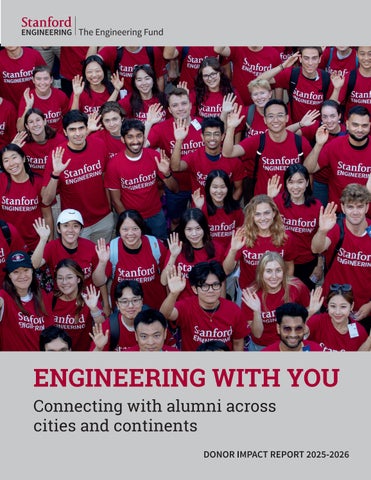
ENGINEERING WITH YOU Connecting with alumni across cities and continents DONOR IMPACT REPORT 2025-2026
OPEN MINDS, OPEN DOORS Front and inside cover photos: Saul Bromberger and H. Taghap
01
Live from New York. A special Future of Everything podcast episode was recorded at Stanford Open Minds New York. Host Russ Altman, PhD ’89, MD ’90, (far right) who is the Kenneth Fong Professor of Bioengineering & Genetics, spoke with three Stanford experts about the innovation economy, including Fei-Fei Li (second from right), the Sequoia Capital Professor in the Computer Science Department and a Founding Director and Senior Fellow of the Stanford Institute for Human-Centered AI.
Engineering has always been about connections—linking ideas, disciplines, and people to solve complex problems. Stanford Engineering is on tour with Open Minds, a university event series that is bringing the president and top faculty closer to you, our evercurious graduates. We are also crisscrossing the country and the world to meet engineering alumni where you are and celebrate the strength of our community at home and abroad.
02
Your impact is global. Wherever Stanford Engineers go, possibilities grow. You advance innovations to benefit us all, and you help us circle the world. Thank you for being part of our dynamic community of boundary pushers, problem solvers, and benefactors.
Photo: Christophe Wu
In 2025, the Stanford School of Engineering celebrated its first one hundred years. As I travel and meet alumni around the world, I know that our next century—like our last—will be shaped not only by groundbreaking discoveries, but by the people and partnerships that make them possible. Wherever I go, I see the ingenuity, curiosity, and generosity that define our alumni, and here on campus I see our faculty and students expanding the boundaries of human knowledge. Together, we share a commitment to leaving the world better than we found it.
Photo: Saul Bromberger
03
Stanford engineers will continue to shape our daily lives—from autonomous vehicles and renewable energy to breakthroughs in cancer treatment and artificial intelligence. Thanks to their discoveries and to your support, I’m excited and optimistic about the work ahead. Across Stanford Engineering, researchers are reimagining what’s possible. For example, at the intersection of engineering, biology, and artificial intelligence, our scientists are enabling earlier detection of deadly cancers through simple blood tests and training the immune system to fight tumors using bacteria that already live on our skin. They’re working toward 3D-printing transplantable human hearts and using AI to generate novel molecules to fight disease. They’re also designing flexible, wearable sensors, developing materials that turn human waste into valuable resources, and finding ways to make skin temporarily transparent so scientists can see inside living organisms. We are extending our reach into space while also rethinking the world around us. Origami-inspired designs will let massive structures unfold in orbit, while smart satellite networks will monitor wildfires, disasters, and climate change from above. Here on Earth, our researchers are weaving AI responsibly into how we work, build cities, navigate the physical world, and interact with intelligent machines—all grounded in our commitment to pushing boundaries safely, sustainably, and for the benefit of humanity. We can’t predict the next century, but we can foster the curiosity, determination, and appetite for problemsolving that drive our faculty, staff, and students. Stanford Engineering will continue to be a place where bold ideas are nurtured, where interdisciplinary collaboration thrives, and the pursuit of knowledge, discovery, and innovation never stops. Thank you for helping us create a lasting, purposeful impact on the world around us. Jennifer Widom Frederick Emmons Terman Dean Stanford School of Engineering
04
BRINGING STANFORD ENGINEERING TO YOU
Clockwise from top left: Attendees in Chicago; Big Apple views for NYC alumni; Willis Tower in Chicago; Stanford Engineering Centennial swag; Open Minds LA; Bay Bridge views from Pier 27 and alumni in SF. Photos: H. Taghap and Katrina Mullen
05
06
STANFORD ENGINEERING ON THE MOVE
Seattle 25 November 20
Taiwan January 2026
Singapore January 2026
Hong Kong January 2026
Photos: Christophe Wu; Adobe Stock Photography; Sawyer Bengtson, Venti Views, Patrick Tomasso, Maarten van den Heuvel | Unsplash
o San Francisc 5 2 0 2 June
07
From coast to coast and around the globe, Stanford Engineers from every discipline gathered to celebrate the School of Engineering’s 100th anniversary—honoring a century of transformative contributions and the future legacy of this remarkable community. In this report, we share thoughts from our distinguished faculty, alumni, and events that brought Stanford Engineers together.
Paris ch Mar 2026
New York September 2025 Stanford University
Chicago April 2025 Washington DC March 2026
Los Angeles 25 November 20
08
ALUMNI REFLECTIO
“The event left me feeling energized about Stanford’s role in this moment.” —Manchen Hu, MS ’23, PhD ’25, Electrical Engineering Co-Founder and CEO, LightXcelerate Open Minds San Francisco
“This was an incredible opportunity to reconnect with recent alumni in the area and meet earlier alumni generations. It was a great reminder of how global the Stanford community extends.” —Justin Moore, BS ’22, Computer Science Software Engineer, Chicago Trading Company Open Minds Chicago
“Connecting with alumni inspires me to dream bigger and exchange perspectives that can lead to meaningful collaborations. Stanford represents more than just an academic experience; it is a trusted community that I can access from almost anywhere in the world.” —Jesica González, MS ’24, Aeronautics & Astronautics Associate Researcher, Stanford Center for Design Research Stanford Engineering Seattle Alumni Event
“My biggest takeaway from Stanford’s Open Minds event was a simple reminder: Stay curious.” —Sophia Huard, BA ’18, Economics, Management Science & Engineering Founder and CEO, Ghost Social Open Minds Chicago
Photos: courtesy of alumni
NS FROM THE ROAD “I’m so proud to be a part of the Stanford Engineering alumni community in designing technologies to improve lives around the world. A+.” —Kim Chan, BS ’92, Industrial Engineering, MBA ’97 Board of Directors, Stanford Graduate School of Business Alumni Association Open Minds Los Angeles
“Attending Stanford’s Open Minds reminded me why I’m proud to be a Stanford alumnus. I feel more committed than ever to staying engaged with this community.” —Susheem Gupta, MS ’02, Electrical Engineering Strategy advisor and AI practitioner Open Minds Los Angeles
“The Open Minds event in NYC was a terrific program, well worth the drive up from Philadelphia and back, and a great opportunity to connect with other Stanford alums!” —Stuart Ockman, MS ’68, Civil Engineering President, Ockman & Borden Associates Open Minds New York City
“I felt genuinely honored that Stanford Engineering would send the Dean to connect with those of us far from campus. Dean Widom shares the innovative strides being made by the school, along with her energizing perspective on its future.” —Karen Corbitt, MS ’89, Electrical Engineering CEO, GenStory Tours Stanford Engineering Seattle Alumni Event
09
TEACHING LIFELONG LEARNERS
Tasking Robotics With Tough Jobs Professor Allison Okamura understands the intrigue of humanoid robots—after all, who hasn’t wished for a Rosie the Robot housekeeper from the Jetsons? But she’s far more interested in soft robots. “Instead I would like to think of robotic systems that are doing things that we want to happen in the world, but don’t try to exactly mimic or replace humans.” She directs the Collaborative Haptics and Robotics in Medicine Laboratory at Stanford. Her research on soft robots—such as a pneumatically powered design that expands like rapidly growing vines— could soon tackle tasks that are too dirty, dull, or dangerous for humans, such as scoping sewer pipes or inspecting nuclear contaminated sites.
Photo: Saul Bromberger
Together with her students and postdoctoral scholars, Okamura’s robot designs are exploring unknown spaces—from the maze of air ducts in the dropped ceiling above her lab, to the habitat of endangered salamanders in Lake Lagunita, to an archeological dig in Peru where, as she put it, “a GoPro on the end of a rigid stick just doesn’t do the job.”
Photo: L.A. Cicero
10
Allison Okamura in the CHARM Lab with her students in 2019.
Her team is also part of Stanford’s moonshot effort led by Mark Skylar-Scott, assistant professor of bioengineering, to 3D print a human heart in less than an hour. The 3D printer uses concentric tube robots that are less than 1 millimeter in diameter. The tubes are built from a pre-curved elastic material that is flexible and tentacle-like, allowing the unit to work in concert to print heart stem cells fast enough to potentially build a human organ. “You have to get smart about using novel materials, about using novel mechanical structures, and try to be really innovative and creative about creating robot bodies that are very different than what we have imagined before,” she says. Learn more: charm.stanford.edu
“One of the great things about being at Stanford is being at a place where as an engineer, I get to work with archeologists, conservation ecologists, and people throughout different fields.” —Allison Okamura, MS ’96, PhD ’00, Richard W. Weiland Professor, Department of Mechanical Engineering and, by courtesy, Computer Science Open Minds Chicago
11
Our faculty have been on the road to share with you about the future of human learning, computer vision, robotics, plants, and much more. Stanford Engineers have been in the spotlight at each and every Open Minds event.
Visualizing What’s Next for AI
Launched in 2009, the crowdsourced project took over 25,000 workers more than two years to complete. ImageNet became a critical training dataset and evaluation benchmark for machine learning, providing a foundational catalyst for new technological advances in the field of computer vision and the deep learning revolution. Today, her vision of training AI models with big data continues to be a critical pillar of the modern AI technology. “We’re really smack in the middle of an incredible explosive moment of language-based gen AI. But where are we going in the future?” Li likens this AI inflection point to more than 530 million years ago, when animals first developed the capacity for sight. Those early photosensitive cells were gamechangers, she says. “Zoologists have conjectured that it was the ability to see, the onset of vision, that set off the evolutionary arms race of animal evolution.” She explains how the fossil record in this epoch shows the highest density of new animal species. “Many people call that the big bang of evolution.”
“This kind of technology is pioneered in my lab and it can give back so much dignity and agency to people.” Learn more: svl.stanford.edu + hai.stanford.edu Photo: Drew Kelly
Nearly 20 years ago, Professor Fei-Fei Li realized that computer vision had hit a ceiling because training datasets were too small and narrow. Her response was to build ImageNet, a massive database of more than 14 million labeled images spanning more than 20,000 categories—dogs, chairs, birds, bicycles, volcanoes—all organized according to a semantic hierarchy.
She is currently focused on how robotics can integrate with computer vision—what she calls embodied spatial intelligence, where, for example, paralyzed patients can use their thoughts to drive robots to cook a meal or dance on a stage.
Fei-Fei Li at the Stanford Institute for Human-Centered Artificial Intelligence.
“We want to create a future for people, and we want to ground our technology for people. And this is why at Stanford, we believe so much in human-centered AI.” —Fei-Fei Li, Founding Director and Senior Fellow, Stanford Institute for Human-Centered Artificial Intelligence; Sequoia Capital Professor of Computer Science Open Minds San Francisco
Seeking Inspiration From Plants For the first time in history, more children are obese than underweight, according to a 2025 UNICEF report. At the same time, 30% of the world population is experiencing moderate to severe food insecurity. Changing our food system can solve both issues— feast and famine. But Associate Professor Elizabeth Sattely says venture capitalists routinely advise startup founders to target “food-adjacent spaces,” rather than the food system itself because it’s so complex and unwieldy. “I think big change really is possible, even in the food space and even with food systems. At Stanford, we have an incredibly deep bench of expertise to help us think about these issues,” she says. Sattely returned from a yearlong sabbatical in fall 2025 with a plan for a campuswide food initiative that would bring Stanford researchers into collaborations to look for solutions. Currently, she and three other researchers meet regularly to think more exactly about how they can define problems so researchers across Stanford can marshal resources to focus on them.
“We have all these people that don’t have food, then we have people who are eating the wrong kinds of food. It’s costing us a huge amount of money, we’re destroying the planet as we’re producing this food, and we’re just going to sit there and, like, let it happen? What we envision building is a Food 2.0 that is built on the pillars of sustainable farming, nutrition, and distribution.” —Elizabeth Sattely, Associate Professor, Chemical Engineering; Faculty Fellow, Sarafan ChEM-H Open Minds New York
Photo: LiPo Ching
12
Elizabeth Sattely in her home garden.
As a chemist who loves gardening, she is focused on the discovery and engineering of plant metabolic pathways to make molecules that can enhance human and plant health. Sometimes this has meant streamlining the synthesis of cancer drugs, as in her lab’s breakthrough with sequencing cells in the Pacific yew tree (Taxus brevifolia) for the chemotherapy drug Taxol (paclitaxel). “This has been like finding 22 needles in a 40,000gene haystack,” she says. Her team is now working on transferring these genes into yeast, which can be easily grown in lab vats commonly used to produce pharmaceuticals, perhaps opening a pathway for less expensive Taxol, a drug estimated to cost $20,000 per kilogram. Other times her lab has studied how certain plants, like rice, defend themselves against invasive weeds, in hopes of one day creating bioengineered crops that can free farmers from needing herbicides at all. She calls plants “the world’s best engineers,” and she teaches her students that humans have much to learn as collaborators with these master architects in the plant kingdom, from feeding the world to fighting cancer. Learn more: www.sattelylab.org
13
Opening Access to Coding Associate Professor Christopher Piech is best known as a devoted teacher of CS106A and cofounder of Code in Place, a free, six-week introduction to the fundamentals of Python that was first launched in 2020—making Stanford’s computer science education available online for eager students around the world. In 2025, with the meteoric rise of generative AI, he and his colleagues wondered what would happen with signups, bracing for a slowdown. Instead, they were surprised to see the largest enrollment yet. He says the secret sauce to Code in Place is their human mentors. The course is taught by thousands of volunteers from around the globe, including Stanford students, who meet online with coding rookies from more than 165 countries. More than 750,000 learners have been on the platform since it began, and this fall, Code in Place will launch a Probability for AI course in the same open style. “This isn’t just for getting a great education. It’s not just about plagiarism. It’s also about this moment in time when some students are feeling lonely and they’re looking for that mentorship,” he says, pointing to how students can be motivated as much by a sense of connection and community as by the problems they are solving. Students can sometimes learn more from older students, such as teaching assistants, than from formal professors. Code in Place focuses on accelerating these one-on-one interactions.
Photo: Rod Searcey
“Do you sleep? You never sleep,” asked Denise Pope, a Stanford senior lecturer in education, musing on the School’s In podcast about what it
“I want us to choose to seize this moment, not be so fearful of it. Let’s create that future that will support the Stanford students and the Photo: courtesy of Chris Piech learners abroad.” —Christopher Piech, ’10, MS ’11, PhD ’15, Associate Professor, Computer Science From a live taping of the School’s In podcast. Open Minds Los Angeles
must take to bring mentorship to thousands of students worldwide every year. Designing efficient systems can help. Juliette Woodrow, BS ’21, MS ’22, is a Stanford doctoral student who, together with another Code in Place cofounder, Ali Malik, PhD ’25, built TeachNow, a platform that supports the effort’s volunteer teachers. “The goal was to make it easier for volunteers to focus on the human side of teaching—connecting, encouraging, and explaining—while technology handles the logistics,” she says. But the tech never replaces the familiar faces of supportive teachers. “So isn’t that so ironic? We’ve been working on AI technology for so long,” says Piech. “But in this moment of AI and education, I’m putting my money on the human touch.” Learn more: codeinplace.stanford.edu piechlab.stanford.edu
“Great teachers notice patterns: who is struggling, how are students approaching a problem, when do they need encouragement. If we can design AI tools that make those patterns visible earlier and more clearly, we can make teaching and learning more effective while keeping the human connection at the center.” —Juliette Woodrow, PhD candidate, Computer Science
14
ADVANCING THE FUTURE
Photo: courtesy of Hannah Nabavi
Engineering for a Purpose When Hannah Nabavi was a little girl, she would stargaze with her father from their backyard, trying to memorize the constellations. “I was drawn to the sheer power of the cosmos,” she says. Now as a master’s student in Stanford’s Department of Aeronautics and Astronautics, she gravitates toward the realworld relevance of her curriculum.
“I came to Stanford because it’s a place where cutting-edge technology and industry come together,” she says. “There is really no better place for engineering if you have entrepreneurship aspirations because Stanford is a place where your impact won’t just be theoretical.” Research in space could have a powerful effect right back on Earth, from using satellites to monitor and detect wildfires, to experimenting with the low-gravity environment of space stations to devise life-saving drugs or grow new materials. “I was inspired when I first came because I saw that the courses aren’t just engineering—they’re engineering for a purpose, engineering for an impact greater than yourself.”
Photo: Rod Searcey
Experimenting With Change Have you ever watched a toddler move across a room? Every step forward is an endeavor, every object a taste test. Matt Strong, PhD ’29, is channeling that childlike curiosity to teach robots complex tasks. “Even the most advanced robots right now don’t have the spatial perception to fully understand how far away things are from them, and they still struggle with fine-grained tasks,” he says. How much pressure is needed to pick up a book versus a raspberry, for example? Or how much rotational force is needed to turn a doorknob?
15
Stanford Engineering is known for our academic rigor and pathbreaking research, where students in a variety of graduate programs are completing coursework while pursuing solutions to problems facing Earth—and beyond.
Discovering New Materials Through Play As a kid, Jay Sim, PhD ’27, gravitated to building toys like Legos and K’Nex, experimenting with shape and structure. “I’ve always loved working with my hands,” he says.
“With mechanical engineering specifically, the field is so broad that it allows me to incorporate that sense of play I love into myriad real-world constructions and to improve people’s lives with what I made.”
its shape or material property on demand, which could be used in civilian and defense applications. “We’re a device-driven lab, which naturally requires us to tinker more.” Sim says he spends 70 percent of his time Photo: courtesy of Jay Sim investigating how heat, magnets, and mechanical loads affect these materials, and the remaining 30 percent repeating his findings to see if they hold up in simulations.
When he first visited Professor Ruike Renee Zhao’s lab at Stanford, he knew he had found his academic home. The Soft Intelligent Materials Laboratory (SIMLab) develops material systems that can respond to external stimuli, with applications in soft robotics, flexible electronics, biomedical engineering, and sustainable energy. The lab works on a number of leading projects, such as electromagnetic armor that can change
Last year, he was honored with a 2025 Centennial Teaching Assistant Award. “I’ve found that teaching helps me with my own mastery of fundamental concepts. Whenever you’re trying to learn something, the best way to test yourself on whether you truly understand it or not is to make sure that you’re able to teach it effectively to others.”
“I’m interested in giving robots the ability to see in 3D like humans do, and to combine this with a sense of touch so they can do more complicated tasks and safely assist us.”
to develop robots that improve everyday life by anticipating and acting on the needs of human counterparts. He is co-advised by professors Monroe Kennedy, who leads the ARMLab, and Jeannette Bohg.
As a member of Stanford’s Assistive Robotics and Manipulation Lab (ARMLab), Strong is helping
“It’s one of the most nonjudgmental, kind, and open-minded labs I’ve ever been in. Our people are curious, and we do some of the most diverse work in robotics because Monroe tries to understand different ways to attack very fundamental problems.”
16
YOU ARE DRIVING US FORWARD
Seeing Stars Aligned
with VMware, to his latest role at the startup Stacklet.
When Parag Patel, ’89, became a Peace Corps volunteer, he was a recent electrical engineering graduate from Stanford, and there he was living in Mali in a mud hut—without any electricity. “That was the irony of the whole thing. It was all lanterns and fire at night, a world lit only by fire.”
“We’re in a very competitive industry. Things change very quickly, and that change is almost always driven by changes in the underlying technology.” He says his electrical engineering education has helped him to anticipate where the field is evolving.
Yet it was the most beautiful night sky he’d ever seen. “It was amazing. You could see every star. I had a hammock in my yard where I would fall asleep,” he says. “It was a hardship physically, but it was just so very rewarding work.” His impulse to give back, first through the Peace Corps and later through his philanthropy to Stanford, has been guided by gratitude. His father had arrived in the United States from India with $5 in his pocket. “He had debt, actually. He had to borrow the money for the plane ticket and school.” Patel says that his Stanford Engineering education has opened doors for him time and again, from his first job at National Semiconductor, to 14 years
“I’ve come a long way from where I started my journey, and those formative years at Stanford shaped me more than I realize, so giving back to Stanford is a way to express my gratitude and enable today’s students to be similarly transformed—paying it back and paying it forward.”
Parag Patel under a baobab tree with men of the Mali village where he served in the Peace Corps.
Photos: courtesy of Parag Patel
17
Crossing Disciplines, Building Futures When Samuel Kim, ’99, MS ’01, arrived at Stanford, he found a community of classmates whose talents ranged from launching startups to winning Olympic gold medals—and one student, Lucia Crump, BS ’99, MS ’01, whose influence would reshape his life. “Everyone who comes to Stanford has some crazy story or background, and I’ve made some amazing friends,” Kim says. “We still go camping and rafting together. Even after 25+ years, I see how rare it is to meet those types of people.” Kim was focused on mechanical engineering when he followed Crump—now his wife—into a management science and engineering class early in their time dating, a choice that opened a new way of thinking about technology and markets. “We decided to write a business plan together,” he recalls, and the pair went on to win business plan competitions at Stanford and the University of Washington. “That experience really changed how I thought about turning ideas into companies.” Kim built a career investing in hard science and engineering spinouts from universities, eventually founding Bandgap Ventures to back startups in advanced materials, semiconductors, photonics, and nanotechnology. He now serves as the chief innovation officer for the Texas A&M University System, embedding entrepreneurship into campus culture. “I love to learn and to do new things,” he says. “The combination of engineering and MS&E gave me a way to navigate between labs, investors, and industry and help translate research into realworld impact.”
Photo: courtesy of Samuel and Lucia Kim
Thanks to you, Stanford Engineers are busy solving both emerging and intractable problems. By giving back to the Engineering Fund, you help us train tomorrow’s leaders and build teams of experts who can tackle whatever lies ahead.
Alumni Samuel and Lucia Kim (center) in their backyard in Austin, Texas, with their four kids (l to r) Gideon, Samantha, Elizabeth, and Caleb.
For Crump Kim, management science and engineering provided a toolkit that allowed her to move fluidly across sectors and stages of life. “I could jump into management consulting or be a technical manager for an aerospace company. When I had kids and wanted to spend more time at home, I could find contract work—writing business plans or creating probabilistic models for everything from oil and gas to other industries.” That flexibility let her shape a career around both challenging analytical work and raising a family, while staying closely connected to what first drew her to MS&E. “We love Stanford’s spirit of innovation and entrepreneurship,” she says. “You can’t have a school like Stanford without students and faculty who embrace cross-disciplinary endeavors.”
“I’m proud to have gone to Stanford,” Kim adds. “I want Stanford to continue to be that opportunity for other people. That’s a large part of why we give.”
MAKING THE PIONEERS PLEDGE
Asking the Right Questions When Yang Cao was a first-year doctoral student, back in 1998, he wanted to impress his Stanford PhD advisor, so he arrived with stacks of thesis notes on improving the internet optical backbone. His advisor, Professor Fouad Tobagi, stopped him right away. “He said, ‘Let’s pause a moment. Before we dive into your awesome work, let’s first ask ourselves: What exactly do you want to accomplish?’” He advised Cao not to chase popular research threads. “He said that the best thing about Stanford Engineering is that there are a lot of very smart people. But the reason they are smart is because they’re choosing good problems to solve.” Tobagi coached him to ask better questions—and to find better answers. He encouraged Cao to “take a fresh look and constantly rethink: What is the nature of this?” To this day, Cao has a calendar date with himself every six months to revisit his goals and motivations. This approach has served him well in a field that pivots rapidly and in his role as head of AI platform for Camvi Technologies, a global leader in vision AI. “Twenty-five years after Stanford, I still use this kind of thinking to help myself double-check, hey, is this worth my time to dig in for another year.” With an eye toward the future, Cao was among the first to sign the Pioneers Pledge in 2023, a
Photos: courtesy of Yang Cao
14 18
Yang Cao, MS ’00, ENG ’01, Electrical Engineering, then and now.
growing community of entrepreneurs signaling their commitment to Stanford University. Giving back was a new idea for him when he arrived here decades ago, but in the intervening years, he has seen philanthropy fuel medical advances and a public safety net at a cancer institute where his family received care near Boston. He also saw his Stanford classmates benefit from university financial support, and now his daughter Joy, a second-year undergraduate, shares similar stories of the need for financial aid.
“Helping Stanford feels natural. On campus, there are so many brilliant kids with so much potential. I cannot wait to see what they will do. It’s truly amazing. Eventually philanthropy will benefit us all.”
19 15
Photos: courtesy of Max Mednik
Engineering alumni are joining a group of exceptional entrepreneurs, founding employees, and other innovators who have signaled their support for the university. By signing the Pioneers Pledge, they are incorporating philanthropy into their entrepreneurship, helping the school grow alongside their own endeavors, and inspiring others—maybe you?—to do the same.
Engineering Magic Max Mednik has a favorite saying from Sir Arthur C. Clarke, the science fiction writer of 2001: A Space Odyssey: “Any sufficiently advanced technology is indistinguishable from magic.” Pointing to various illusionists throughout history who were also inventors or engineers, Mednik says, “a lot of stuff in magic has to do with either math or a scientific trick that helps you do what seems impossible.” He lives in Los Angeles with his wife and children, and you might find him moonlighting at the Magic Castle, a private magic club in Hollywood that requires an audition for membership. His fascination with both magic and computer science traces back to growing up in Southern California, where middle school friends first introduced him to coding. Those same friends went on to enroll with him at Stanford Engineering. “Computer science wasn’t the most popular degree back when I was there,” says Mednik, BS/ MS ’06, though that soon changed after Facebook swept across American colleges during his junior year. The same year, he and his childhood pals started their first company together. From software development to entrepreneurship, he says the school provided technical skills that he uses daily, even referring back to class notes on occasion. Now a serial entrepreneur, Mednik has launched four companies across finance, legal technology, drone defense, and aerospace. His current venture, Epsilon3, builds AI-powered software for
Max Mednik (right) is CEO of Epsilon3 and an early signer of Stanford’s Pioneer’s Pledge, pictured with friends at Lake Lagunita, in the days when a boat could still float in it.
engineering operations that require meticulous workflows, serving customers from Blue Origin to NASA. In 2024, he signed the Stanford Pioneers Pledge, joining a group of entrepreneurs, founding employees, and other innovators who are signaling their support for the university.
“Stanford Engineering has played an important role throughout my career, introducing me to friends, professional contacts, advisors, mentors, and really positively impacted my trajectory,” he says, noting how three of his four startups emerged from campus ties. “If I have success in the future, a big part of that would be owed to Stanford, and it’s meaningful for me to be able to commit to that.” Learn more: giving.stanford.edu/get-involved/pioneers-pledge
14 20
THE JOURNEY
“You look at every technological advancement of the last 100 years, and you have to look at where those innovations were birthed and came to scale and fruition. A huge number of them were right here.” —Jonathan Levin, BA/BS ’94, University President and Bing Presidential Professor
“There are so many inventions and startups and big companies coming out of this place. The reason for this is because Stanford creates this place where people dare things and go for the big ideas.” —Jeannette Bohg, Associate Professor of Computer Science
“The commitment to doing work which improves the lives of people and makes things better around the world has been a deeply held tradition in Stanford Engineering.” —John Hennessy, President Emeritus; Shriram Family Director, Knight-Hennessy Scholars; James F. and Mary Lynn Gibbons Professor; and Professor of Electrical Engineering and of Computer Science
Quotes: Stanford Engineering at 100, Transformative Breakthroughs, Boundless Horizons and 60 Years of AI at Stanford videos.
21
CONTINUES
“Here at Stanford, we are working on bringing things that are thought of as science fiction to reality.” —Debbie Senesky, Associate Professor of Aeronautics and Astronautics and of Electrical Engineering; Senior Fellow, Precourt Institute for Energy
“Something I’ve really loved about this place is that if you can dream something, you can do it.” —Manu Prakash, Associate Professor of Bioengineering; Senior Fellow, Woods Institute for the Environment
“It’s remarkable how we’ve all been part of an amazing institution within this great university. We have a proud history, but that doesn’t define who we are. We have to define ourselves by what we will do and what we can do in the future.” —Jerry Yang, BS/MS ’90, Cofounder of Yahoo!
Photos: Andrew Brodhead, Rod Searcey, David Magnusson, L.A. Cicero, Micaela Go, David Gonzales
YOU MAKE THE FUTURE POSSIBLE
Photo: Andrew Brodhead