MY LIFE
The
Courage
to Ask
Why
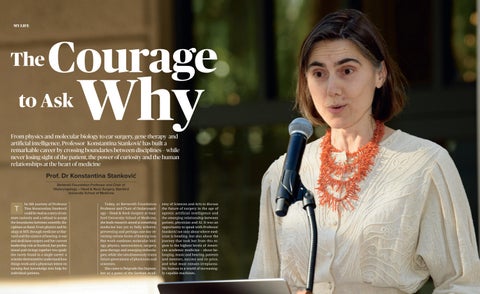
From physics and molecular biology to ear surgery, gene therapy and artificial intelligence, Professor Konstantina Stanković has built a remarkable career by crossing boundaries between disciplines – while never losing sight of the patient, the power of curiosity and the human relationships at the heart of medicine
Prof. Dr Konstantina Stanković Bertarelli Foundation Professor and Chair of Otolaryngology – Head & Neck Surgery, Stanford University School of Medicine he life journey of Professor Tina Konstantina Stanković could be read as a story of constant curiosity and a refusal to accept the boundaries between scientific disciplines as fixed. From physics and biology at MIT, through medicine at Harvard and the science of hearing, to ear and skull-base surgery and her current leadership role at Stanford, her professional path brings together two qualities rarely found in a single career: a scientist determined to understand how things work and a physician intent on turning that knowledge into help for individual patients.
T
50
october
Today, as Bertarelli Foundation Professor and Chair of Otolaryngology – Head & Neck Surgery at Stanford University School of Medicine, she leads research aimed at something medicine has yet to fully achieve: preventing and perhaps one day reversing certain forms of hearing loss. Her work combines molecular biology, physics, neuroscience, surgery, gene therapy and emerging technologies, while she simultaneously trains future generations of physicians and scientists. She came to Belgrade this September as a guest of the Serbian Acad-
emy of Sciences and Arts to discuss the future of surgery in the age of agentic artificial intelligence and the emerging relationship between patient, physician and AI. It was an opportunity to speak with Professor Stanković not only about where medicine is heading, but also about the journey that took her from this region to the highest levels of American academic medicine – about belonging, music and hearing, patients and mentors, success and its price, and what must remain irreplaceably human in a world of increasingly capable machines.
cordmagazine.com
51
When you look back beyond MIT, Harvard and Stanford, where did it all begin? — I was raised in a loving family of five – my parents, both physicians, and my two older brothers. As a child, I wanted to be just like my brothers. My psychiatrist father and stomatologist mother instilled in us a love of learning, optimism, and the courage to dream big. Growing up in Yugoslavia – a country that no longer exists – our hero was Nikola Tesla; his patient, sustained work and perseverance through setbacks helped electrify the world. You came to America alone at 17. How did that experience shape your path? — My early high school education at MIOC in Zagreb focused on mathematics, science, and informatics. At seventeen, I came to the United States on my own as an exchange student. I arrived in the small town of Adams in Western Massachusetts and graduated from Hoosac Valley High School. My tight-knit host family, the Roberts, welcomed me with open arms. The American school system was, of course, very different, and subjects like English Literature were both challenging and rewarding. I decided to apply to U.S. universities alongside my host sister, Rachel. Although the process initially felt hurried and uncertain, it ultimately shaped my path. At MIT, you studied both physics and biology. Was interdisciplinarity already part of your thinking? — My school trajectory, like that of many students, was shaped largely by serendipity. I began as a physics student, deeply interested in particle and quantum physics, and was fortunate to have Professors Earle Lomon and Felix Villars as my advisors. Both encouraged me to pursue my growing interest in molecular biology. This fascination was sparked by my work in Ron McKay’s neurobiology laboratory, which I joined out of a deep curiosity about the brain. Although my course load was demanding because my two majors had little overlap, it al-
52
october
lowed me to compare the distinct approaches of the two fields and discover the beauty and intellectual depth of each.
What did medicine offer you that pure science could not? — My first close exposure to surgery came while working on my undergraduate physics thesis, modelling auditory nerve responses to electrical stimula-
As factual knowledge becomes easier to obtain, the ability to ask new, deep questions becomes increasingly valuable. New questions can reframe the problem and lead to even better questions With collaborator Anantha Chandrakasan, current MIT Provost, after co-developing a prototype chip for a fully implantable cochlear implant
tion. I conducted this work under Professor Don Eddington at Massachusetts Eye and Ear, which would become my second – and sometimes first – home for the next thirty years. I fell in love with ear surgery during my early doctoral studies. A few years later, I found a clear explanation for this draw in the writings of psychologist Mihaly Csikszentmihalyi. He studied the mental state of absolute focus, full in-
The total volume of fluid in the human inner ear is about three teardrops. We have focused on developing tools and techniques to reveal its workings, with the ultimate goal of improving the diagnosis and treatment of sensorineural hearing loss.
volvement and enjoyment in a technically challenging, highly rewarding activity – a state he called flow. I enjoy microsurgery because of its technical demands, complete immersion, immediate feedback and its capacity to help people directly in real time. For me, combining surgery with fundamental research – which typically offers much more delayed gratification – is the most fulfilling career.
Is surgical courage really the ability to live with uncertainty? — Yes, it is. I remember a case from my neurotology fellowship when I assisted my surgical mentor, Professor Michael McKenna, with a particularly difficult cholesteatoma that had spread intracranially. A medical student entered the operating room and exclaimed, “I’m here to see the fearless surgeon!” My mentor replied, “Then you came to the wrong room. Courage is not the absence of fear but the resolve to act despite it.” These words left a deep impression on me because they echoed what I had heard from my mother growing up. When did you realise that hearing is about much more than sound? — I first came to understand sound’s power to connect us when I reflected on the music that had moved me most
deeply. Chopin’s Fantaisie-Impromptu, for instance, with its virtuosity and lyrical central melody, may seem to capture a private emotional world, yet it is ultimately shaped as communication with the listener. Sound likewise is essential to many religious traditions: in Hinduism, sound is understood as a primordial substance of the Universe; Al-Qur’an means “the recitation”; the Buddhist term for disciple translates as “one who hears”; and Genesis begins “And God said…”.
What do we actually lose when we begin to lose our hearing? — Most hearing loss originates in the inner ear. You can think of this organ as an exquisitely sensitive sensor that we sometimes mistreat. Hair cells are so sensitive that, at the thresholds of hearing, they can detect vibrations as
small as one-hundredth of an Angstrom, or about 1% of the diameter of a hydrogen atom. As hearing deteriorates, one’s emotional well-being and relationships can suffer, increasing the risk of social isolation and cognitive decline. Importantly, these effects may be reversible when hearing is improved, such as with a properly fitted hearing aid or cochlear implant.
The inner ear remains something of a “black box”. Is that frontier of knowledge what attracted you? — I was drawn to the inner ear’s remarkable anatomical, electrical, biochemical, physical and metabolic complexity and beauty – and to the challenge of studying properties that cannot yet be measured directly in living people because the inner ear is so small and encased in the hardest bone in the body.
With Victor Dzau, president of the US National Academy of Medicine
Will people alive today see some forms of lost hearing restored? — Yes, we have already entered that era! For example, the FDA recently approved the first gene therapy for sensorineural hearing loss caused by an otoferlin mutation. We helped advance this field by demonstrating that a synthetic adeno-associated virus can safely and effectively deliver genetic cargo to hair cells in mice and nonhuman primates. This viral vector, together with the surgical approach we developed to deliver gene therapy to the inner ear, is now being used in ongoing clinical trials. If physics and biology powered much of the 20th century – including the development of the cochlear implant, the most successful neural prosthesis – biology may be the defining science of the 21st century. Progress will encompass regenerative and stem cell biology, along with novel biologics designed to prevent, treat and perhaps even cure hearing loss, with precision tailored to each patient. For a great scientist, is knowledge more important than asking the right question? — Science, in many ways, aims to transcend the limits of what is currently known. Breakthroughs often arise from unexpected directions, which is why foundational knowledge remains essential, even in the current era of widely accessible artificial intelligence tools. As factual knowledge becomes easier to obtain, the ability to ask new, deep questions becomes increasingly valuable. New questions can reframe the problem and lead to even better questions, but they must be grounded in accumulated scientific knowledge to be relevant.
cordmagazine.com
53
After decades at Harvard, why start again at Stanford? — What attracted me was both the challenge and the opportunity, much like the pull of the unknown that brought me to the U.S. as a teenager. I certainly had not planned to leave – my Otology Division at Harvard was the largest in the country and included many respected and dear colleagues. Stanford presented a different challenge: helping a department, currently comprising 60 full-time faculty, including surgeons and scientists, realize its potential amid profound change in US healthcare and tectonic advances in technology. In a way, serendipity intervened again – ChatGPT was released publicly just a year after I moved to Stanford. After your election to the National Academy of Medicine, did you feel you had finally “arrived”? — I’ll answer that question by returning to my favourite psychologist, Csikszentmihalyi, who studied autotelic personalities – people who engage in an activity for its intrinsic rewards rather than to achieve external goals. His research identified curiosity, persistence and humility as defining traits of this personality. I would like to think I possess at least traces of them. As for having “arrived”, I am reminded of a story I heard about Michelangelo, to whom I bear no comparison. In his late eighties, after painting the Sistine Chapel and widely regarded as the greatest artist of all time, he supposedly said: “Ancora imparo,” meaning “I’m still learning.” That sentiment applies even more aptly to ordinary mortals like me. What do you teach young physicians and scientists that no textbook can? — One of the great rewards of my job is the privilege and responsibility of mentoring young scientists and physicians during their formative years. While technical skills are important and must be mastered, so is a broader sense of purpose and context.
54
october
When AI can analyse more data than any doctor, why will patients still need the human being sitting opposite them? — I think the roles of AI and physicians will continue to evolve. AI will increasingly handle large-scale data analysis, while physicians will continue to provide interpretation and meaning. This complementary partnership is also technically robust, because each brings distinct strengths and, importantly, different modes of failure. We are accustomed to being cared for by another person, a healer, and that relationship remains central to medicine; it has an aura.
At PhD graduation from MIT in 1998
Courage is not the absence of fear but the resolve to act despite it. These words left a deep impression on me because they echoed what I had heard from my mother growing up Among the many desirable traits for a future scientist or physician, I would single out kindness as the most important. Science and medicine are, and will remain, highly collaborative. Thus, the ability to listen, communicate openly, help eagerly, and engage others with honesty and respect is critical.
With family in Kyoto, Japan in 2023, practicing kendo
How do we prevent AI from “deskilling” future doctors? — It is important to integrate AI into medical education thoughtfully, not indiscriminately. If we rush to substitute AI for physicians in tasks it performs well, we risk both deskilling and mis-skilling future clinicians. AI performance depends on effective “prompt engineering” by the human in the loop – an ability grounded in a solid foundation of medical knowledge. If that foundation among physicians erodes, so may AI’s performance and usefulness. I would therefore preserve the core of preclinical medical education, while adding classes on the foundations of AI and using AI in a controlled, supervised manner in clinical training.
ed less in any particular state than in the culture of the region. Growing up among multiple ethnicities, languages and religions gave me, and many others like me, a framework for understanding and adapting to new environments anywhere in the world. America is an even richer tapestry of nationalities, languages and races. Yet, I have found it surprisingly familiar through the lens of mutual understanding and respect I carried with me from home.
You have also worked with Paul Simon. What did his experience teach you about hearing and identity? — Paul Simon is a treasure, both as an artist and as a person. To sell over 100 million records and continue touring the world well into his eighties is extraordinary. What sets Paul apart is his remarkable ability to connect, communicate and bond with his audience. His meticulous attention to detail, rooted in deep respect for that audience, has enabled him to maintain an exceptional level of performance despite hearing difficulties. It takes great generosity of spirit for a musician to speak openly about hearing impairment, and doing so encourages fellow artists and ordinary people alike who may be living with health challenges. In such a competitive academic world, what sustained you through setbacks and self-doubt? — Setbacks are an inevitable part of professional life. Rejected manuscripts and unfunded proposals are reminders of the competitive nature of scientific work. At such moments, it is natural to turn inward and draw on one’s intrinsic motivation. For me, that resilience comes from my children, my family and my faith.
I have received many blessings in my life, including a free education, for which I remain deeply grateful to my adopted country, the United States. I think the best way to repay that debt is to pay it forward – by caring well for my patients, teaching and mentoring my students, and being a thoughtful colleague.
When you return to Belgrade, where does your sense of belonging lie today? — Many changes have occurred since I left, carrying a passport from the Socialist Federal Republic of Yugoslavia, some precipitated by wars and tragic events. My sense of belonging is root-
With husband and sons Raphael, Gabriel and Michael at Michael’s high school graduation in 2020.
With brothers Siniša and Aleksa Trbović in 1987, months before coming to the US
How can countries like Serbia retain ties with their most talented young scientists? — I think one key idea is networking. That means encouraging young scientists to train and work at different institutions around the world, then spend some – possibly substantial – time back home, sharing and building on their experiences. Science is increasingly a global endeavour, spanning data, computing power, laboratory resources and education. The resources needed for cutting-edge work often exceed the capabilities of individual countries, and collaborative efforts require talented, motivated people from all corners of the world. What would you tell the young Tina who was just leaving for America? — I would tell her to internalise her parents’ motto without delay: “Everything will be fine.” I now repeat those same words to my own children and trainees. More often than not, reality is far kinder than our worst fears lead us to believe. Obstacles and setbacks are part of success; they are necessary for growth. You have devoted your professional life to preserving and restoring hearing. Which sound would you find hardest to lose? — It would be children’s joyful laughter. I think not only of my sons but also of the other children I’ve known. I feel that eternity speaks to us through their voices.
cordmagazine.com
55