RESIDENTHANDBOOK
2026-2027
STANFORDUNIVERSITY
SCHOOLOFMEDICINE
DepartmentofOtolaryngology Head&NeckSurgery
1. Introduction
TheStanfordDepartmentofOtolaryngology Head&NeckSurgeryisdedicatedtoproviding thehighestleveloftrainingto itsresidentsandfellows.
MISSIONANDPHILOSOPHY
• Providepatientcarewithbothexpertiseandcompassion
• Fosterdedicationtolife-longlearningandteaching
• Excelatstate-of-theartmedicalcareforpatientswithotolaryngologicaldiseases
• Takeaninvestigativeapproachtothescientificandpolicyquestionsinmedicine
• Inventnewapproachestodiagnosisandtherapy
• Implementandoptimizeemergingtechnologies
• Beactiveworldcitizensintheprovisionofhealthcaretothosemostinneed
ThishandbookdescribespoliciesandproceduresassociatedwiththeOtolaryngology Head &NeckSurgeryresidency,aswellastheexpectationsforsuccessfulcompletionofthe program.Itisupdatedannually.
TheGraduateMedicalEducationOffice’sHouse StaffHandbookisavailablefordownload at: https://med.stanford.edu/gme/policy.html
2. StanfordUniversityOtolaryngologyFacultyRoster
DepartmentChair
ViceChair
ResidencyProgramDirector
AssociateProgramDirector
Stanford
KonstantinaM.Stankovic,MD,PhD
PeterHwang,MD
C.KwangSung,MD,M.S.
JenniferAlyono,MD,M.S.
IramAhmad,MD,MME
NoelAyoub,MD,MBA
FredBaik,MD
KarthikBalakrishnan, MD,MPH
NikolasH.Blevins,MD
JacquelynCallander,MD
RobsonCapasso,MD
KayW.Chang,MD
MichaelChang,MD
AlanCheng,MD
MichelleChen,MD,MHS
EdwardJ.Damrose, MD
SethDavis,MD
ElizabethDiRenzo,PhD
VasuDivi,MD
AndreyFinegersh,MD,PhD
MatthewFitzgerald, PhD
NicolasGrillet,PhD
StefanHeller,PhD
KatieHohenberger,MD
FloydChristopherHolsinger, MD
PeterH.Hwang,MD
RobertK.Jackler, MD
NancyJiang,MD
MichaelJ.Kaplan,MD
GraceKim,MD
PeterJ.Koltai,MD
JakeLee,MD
JenniferLee,MD
WilliamLewis,MD
DáibhidÓMaoiléidigh,PhD,MS
PedroMartinsGomesdeOliveira,MD
I-Fan(Ted)Mau,MD,PhD
KaraMeister,MD
UchechukwuMegwalu,MD,MPH
LloydMinor,MD
SamP.Most,MD
EricNash,MD
JayakarNayak,MD,PhD
TeresaNicolson,PhD
BrianNuyen,MD
LisaOrloff,MD
ZaraPatel,MD
PeterPellionisz,MD,PhD
Jon-PaulPepper,MD
NathanReticker-Flynn,PhD,S.M.
AnthonyRicci,PhD
DouglasSidell,MD
DavudSirjani,MD
AlyssaSmith,MD
HeatherStarmer,MA
KristenSteenerson,MD
JohnSunwoo,MD
TristanTham,MD
MaiThyTruong,MD
TulioValdez,MD,MSc
NneomaWamkpah,MD
Fellows&ClinicalInstructors
Pediatrics–NadaAli,MD&PerlaVillamor,MD
FacialPlastic–StevenLosorelli,MD,MS&SheranSeneviratne,MBBS,MS
Laryngology–MaxwellScher,MD
Rhinology–LiritLevi,MD,MarnJoonPark,MD,JoshuaKaiXunTay, MBBS,MMed, MRCS,PhD&AllenZhou,MD
Sleep–AlaaAlanazi,MBBS&DorMaayan,MD
Head&Neck–AlyssaCivantos,MD,MS &ChrisChoi,MD
Otology-Neurotology–TracyCheng,MD,MS,AnaMarijaHalvorson,MD&Peter Pellionisz,MD,PhD
Research–NesrineBenkafadar,PhD
AffiliatedFaculty
SantaClaraValleyMedicalCenter
JuliaNoel,MD(Sectionchief)
KimberlyShepard, MD
MicahSaste,MD
AmandaMuñoz,MD
MishaAmoils,MD
HarishDharmarajan,MD
VeteransAdministrationPaloAlto
DavudSirjani,MD(Chief)
MichellChen,MD,MHS
AndreyFinegersh,MD,PhD
ElizabethLongino,MD
JayakarNayak,MD,PhD
BohdanMakarewycz,MD
HamedSajjadi,MD
C.KwangSung,MD,MS
KaiserPermanenteSantaClara
AliceChang,MD(Chief)
ToddDray,MD
ChristopherGouveia,MD
BrianHondorp,MD
ScottHong,MD
HarryHwang,MD
DongLee,MD
JonathanLin,MD,MBA
CaitlinPacheco,MD
SethPross,MD
AliRezaee,MD
3. OtolaryngologyResidencyApplicationRequirements
• TheStanfordDepartmentofOtolaryngology Head&NeckSurgerywelcomes qualifiedapplicantsforconsiderationforappointmenttoitsACGME-accredited residencyprogram.Pleaseseethe“Residenteligibility –recruitment”sectionof theStanfordHouseStaffPolicies&Proceduresfordetailsofeligibility.The departmentencouragesresidencyapplicationsfromallqualifiedindividuals regardlessofage,sex,ethnicbackground,religiousbeliefs,orsexualorientation withaninterestandaproventrackrecordofexcellenceinscholarlypursuits.
• StanfordparticipatesintheElectronicResidencyApplicationService(ERAS) for otolaryngology.Ranklistsaresubmittedbyboththeprogramandtheresident applicants,andamatchingalgorithmisapplied.
• AllapplicationsreceivedbyStanfordareindividuallyreviewed.Candidatesare selectedforinterviewsbasedonthisinitialreview. Onceinterviewsare conducted,decisionsaboutcandidateselectionaremadebyconsensusamong thefaculty. Approximately45invitationsforinterviewsareofferedfromamong morethan300applications.InterviewstakeplaceontwodaysinJanuary.
4. ResidentRotationSchedule
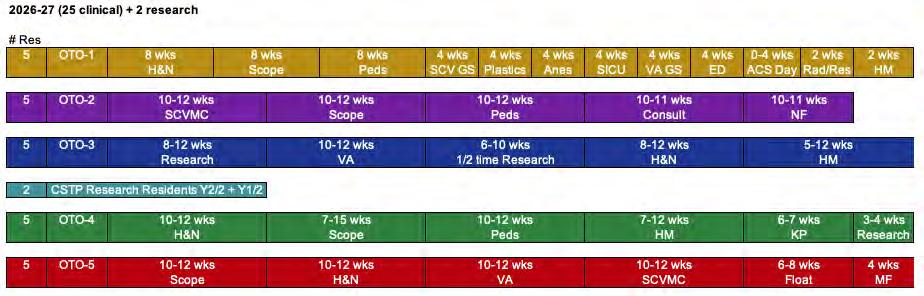
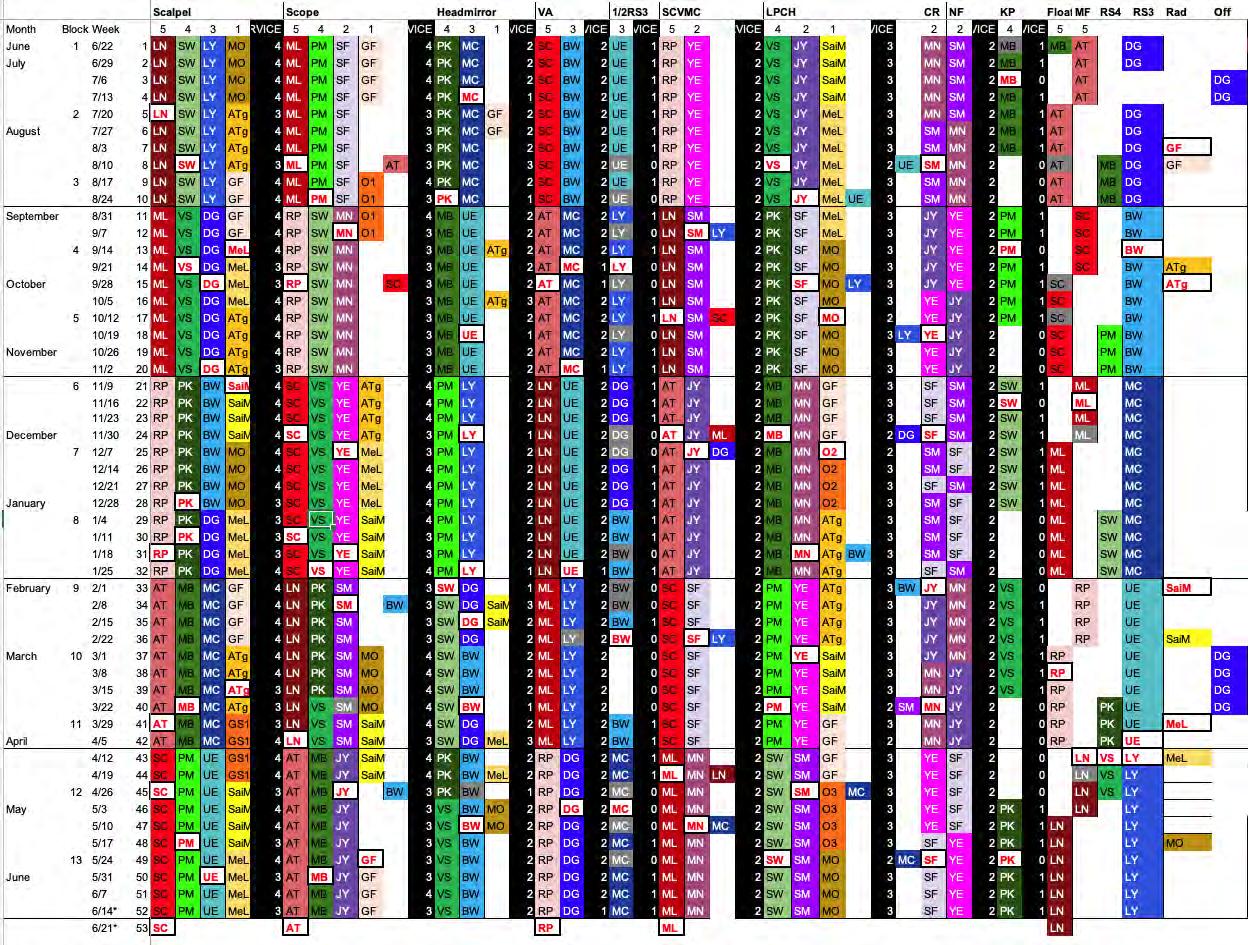
Key:
Scalpel: HeadandNeckSurgery
Scope: Specialties(Otology,Rhinology,FacialPlasticSurgery)
HM: Headmirror(Laryngology,SleepSurgery,ComprehensiveOtolaryngology)
Peds: PediatricOtolaryngology
NF: NightFloat
SCVMC: OtolaryngologydepartmentatSantaClaraValleyMedicalCenter
VA: OtolaryngologydepartmentatVeteransAffairsPaloAltoHealth CareSystem
KP: KaiserPermanenteSantaClara
MF: MiniFellowship
Float: Chiefresidentrotationtocoveradultservicesasneeded
Rad/Res: Radiology(neuroradiology)/Research/Headmirror
CR: ConsultrotationforPGY2residents
Anes*: Anesthesia,StanfordHealthCare
ED*: EmergencyDepartment,StanfordHealthCare
Plastics*: PlasticSurgery,StanfordHealthCare
SICU* StanfordHealthCareIntensiveCareUnit
SCV
GS*: GeneralSurgery,SantaClaraValleyMedicalCenter
VA
GS*: GeneralSurgery,VeteransAdministrationPaloAlto
ACSDay*: GeneralSurgery,StanfordHealthCare
*PGY1rotationswithGeneralSurgeryDepartment
2026-27OHNSResidentsRotationSchedule
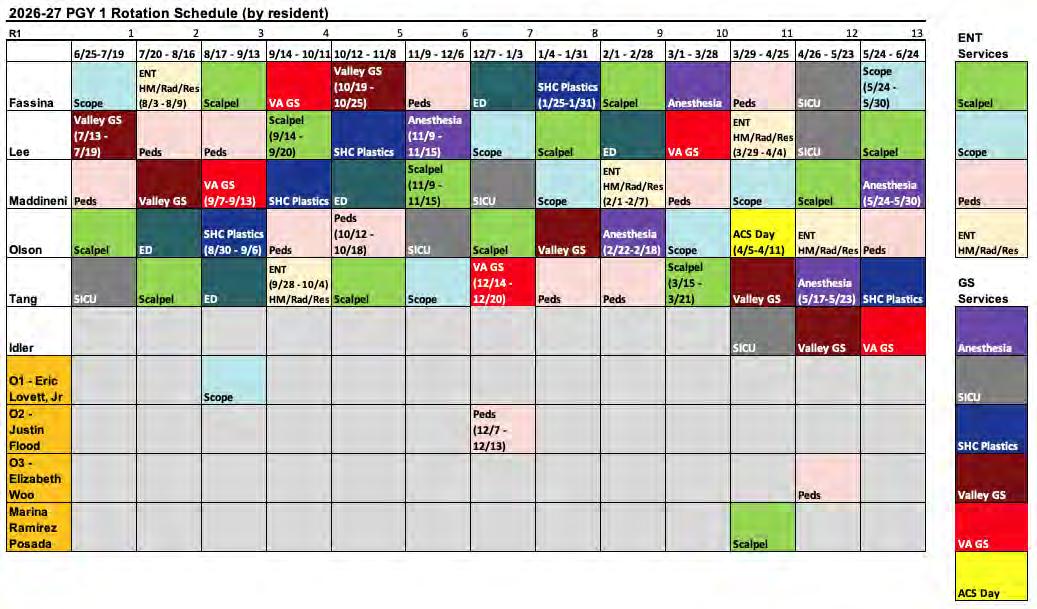
5. PolicyonResidentPromotion
Stanfordisfortunatetoattractthehighestcaliberofresidentsinthenation.Itisexpected thateachresidenthasthenecessaryskillsandintellecttobepromotedthroughtheresidency andgraduatesuccessfully.Priortocompletionoftheprogram,otolaryngologyresidentsare expectedtodemonstratecompetenceinpatientcare,medicalknowledge,professionalism, system-basedpractice,practice-basedlearningandimprovement,andinterpersonaland communicationskills. Theyarelikewiseexpectedtocompleteandexcelintheresearch requirementsoftheprogram.
Twiceayear,theprogramdirectorconductsameetingwitheachresidenttodiscussresident performanceandeducationaldevelopment. Atthesemeetings,evaluationsoftheresident (thathavebeencompletedbytheresident,faculty,nurses/adjunctpersonnel,andpatients) arediscussedatlength. Attendancerecordatconferences,residentresearchprojects, operativelogs,andplanned/completedportfolioprojectswillbereviewed.
6. PolicyonResidentDismissal
Residentsareexpectedtosatisfyatleastaminimumlevelofcompetenceinordertobe promoted.
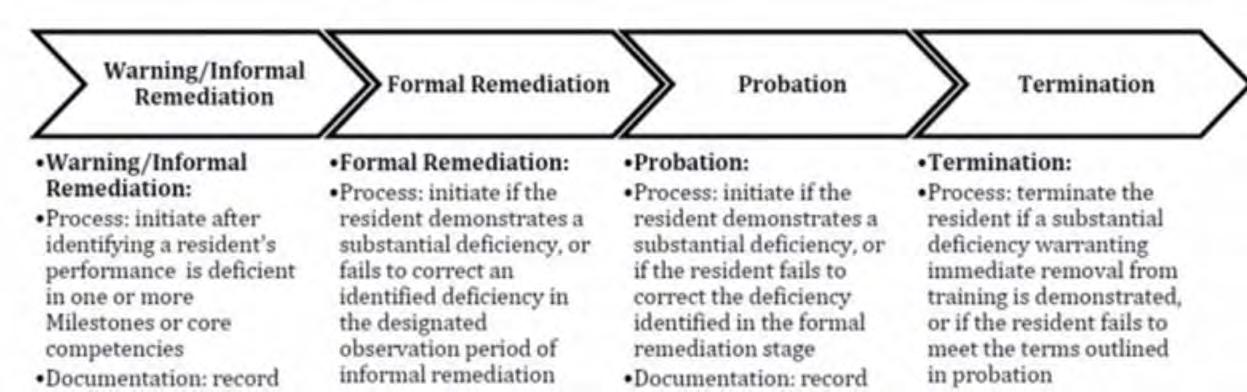
Ifaresident’sperformanceisidentifiedasdeficientinoneormoreMilestonesorCore Competencies,theymaybegivenawrittenwarningandstartedonaninformalremediation process.Iftheresidentdemonstratesasubstantialdeficiency,orfailstocorrectanidentified deficiency,theymaythenbeplacedonFormalRemediationforaperiodofatleastthree months.Aremediationplanwillbedevelopedtoaddressanydeficienciesintheresident’s performance.Resourceswillbegiventohelptheresident,whichmayincludementoring, coaching,counselling,alearningevaluation,and ameetingwiththeDesignatedInstitutional Official(DIO).Ifinsufficient progressismadeafterthreemonths,remediationmaycontinue ortheresidentmayenterProbation.Thisperiodofrobationwilllastatleastthreemonths
andwillbeaccompaniedbyadetailedplantoaddressanydeficienciesintheresident’s performance.
Residentswhoareonprobationforaminimumofthreemonthsandwhohavenot successfullyimprovedtheirperformancetomeetatleasttheminimallevelofcompetence maybedismissed.
7. 360°Evaluations
Performanceevaluationsarecompletedbyvariousmembersofthehealthcareteam includingfaculty,staff(nurses,MAs,physicians’assistants,nursepractitioners,technicians, anesthesiologists,etc),patientsandpeers. Theseevaluationsaddressperformanceinthe corecompetenciesandaresenttoevaluatorsaftereveryrotation,includingtheresearch block.Evaluationsareconductedon-lineviatheMedHub systemtoassureanonymity.Inan efforttoobtaina360-degreeevaluation,patientsarealsorandomlyaskedtocompete evaluationsbasedontheirinteractionswithresidents.
Peerevaluationsareheldfromresident-accessuntiltheendoftheyeartoprotectanonymity. However,atthesemi-annualreviewmeeting,theprogramdirectorwillshareaggregated feedbackoftheseevaluationsverbally.Resident(s)withthehighestpeer ratingsfor outstandingteachingwillbeawardedthe“ResidentTeacheroftheYear”awardattheendof theyear.Anawardwillalsobegivenfortheresidentratedhighestasanoutstandingteam playerbytheirpeers.
Meaningfulevaluationofthefacultyandtheprogramisacriticalaspectoftheresidency program;itisatoolforimprovingeducationalqualityandtheresidentlearningenvironment. Residentsarethereforeexpectedtocompletefacultyandrotationevaluationsinatimely fashionaftertheendofeachrotation.
Residentswillhaveaccesstotheirevaluationsbyfacultyuponcompletionoftheir faculty/rotationevaluations. Toassureanonymity, theevaluationsoffacultyandrotations willnotbecollatedormadeavailabletofacultyuntiltheendoftheacademic year. Evaluationsbyresidentsarealwaysanonymous.
8. PolicyonSupervision
SeeGMEhandbookforpolicies.
StanfordOHNS
SystemTriggersforAttendingCommunication
• Admission/discharge
• Transferin/outofICU
• Unplannedintubation
• Cardiacarrestorhemodynamicinstability
• Neurologicalchanges
• Woundcomplications
• Anymedicationortherapeuticerrorthatleadstoachangeinpatientmanagement
• Unplannedtransfusion
• Anyclinicalproblemrequiringaninvasiveprocedure
• ERvisit
• Anyconcernbyatraineethatasituationismorecomplicatedthanheorshecan manage
• Anyrequestthatanattendingsurgeonbecontacted
• Anysituationinwhichaparentrequestsattendingnotificationorfeelsthatanissue hasnotbeenadequatelyresolvedoraddressed
• Anynewonset/worseningofsymptomsoutofproportiontoexpectations
9. MentorshipProgram
Residentsareassignedtocohortsoffivetosixresidentsrepresentingeachpost-graduate year,andthesecohortsareassignedtoonefacultymember.Inaddition,atthebeginningof thePGY2year,residentswillbeassigneda1:1mentor.
Thementorshipcohortswillmeetatleastthreetimesayearforactivities(egdinner,outings) withtheirmentors.
Thegoalsofthisprogram aretoencouragemoreroutineinteractions,developclosergroup dynamicsandfriendships,andfostersupportive socialandprofessionalnetworks.
Theresidentmayconsultthe cohortfacultymentor or1:1mentor asneededonanyissues eitherprofessionalorpersonal.TheresidentshouldalsofeelfreetoconsulttheProgram Directorregardinganysuchsubjects.
Thefacultymentorswillfunctionasliaisonstotherestofthefacultyforissues regarding residentacademic,clinicalandoperative performanceaswellaswell-being.
MentorshipCohorts
ResidentMentors
Theotolaryngologypeer-mentoringprogramwasstartedin2009toprovideaformalized careerandpersonalsupportsystemtojuniorresidents.Incominginternsarepairedwith midlevelresidents,basedonconsiderationoftheircommoninterests. Seniorresidentshavean opportunitytoofferprofessionalguidance,moralsupport,processdecisionsandthelike. Notificationsofthesepairingsaremadeinthespringpriortoincominginterns’arrivalto Stanford.
Classbeginning2025
YasminEltawil–VarunSagi
SorayaFereydooni–MonicaBodd
SabrinaMaoz–ShannonWu
MarkNyaeme –PeterMoon
Hong-Ho(Jason)Yang–MichaeleFrancescoCorbisiero
Classbeginning2026
GraceFassina–LekhaYesantharo
BeauIdler–MichaelCorbisiero
MelissaLee–UcheEzeh
SaiMaddineni–PatrickKiessling
MadelineOlson–BrookeWarren
AnthonyTang–DavidGrimm
10. AcademicCurriculum
RequiredAssignments
Thefollowingisalistoftheprinciplerequiredprojectsandtalksduringthecourseofthe residency:
Allfiveyearsofresidency
❑ OtolaryngologyIn-trainingExam
❑ Temporalbonelab
PGY2
❑ Researchproposal,dueatsemi-annualmeetingwithprogramdirector orassociate programdirector inJanuary/FebruaryandreviewedwiththeResidentResearch Supervisor,Dr.Finegersh,inMarch.
❑ ResidencyResearchSymposiumPresentation
PGY3
❑ ResidencyResearchSymposiumPresentation
❑ AbstractsubmissiontotheBayAreaResidencyResearchSymposium
❑ QualityImprovementProject –submissiontotheGME’sAnnualQualityImprovement andPatientSafetySymposium
PGY4
❑ ResidencyResearchSymposiumPresentation
PGY5
❑ GrandRounds
❑ ResidencyResearchSymposiumPresentation
11. DescriptionofAcademicContent,Conferencesand Responsibilities
AsofJuly2024,theacademiccurriculum ontheAmericanAcademyofOtolaryngology–Head &NeckSurgery’sOtolaryngologyCoreCurriculum,astandardizedtwo-yearcurriculumthat willallow eachresidenttobeexposedtoeachtopicatleasttwiceduring theirresidency. WeeklyResidencyEducationconferencesareheldon Mondays8:00-10:00AM. Residentsare expectedtobeontimefor 75%ofsessions(exceptforcasesofpre-approvedexcused absences).ResidentsatSCVMCandVAPAwillbeexpectedtoparticipate inpersonwhen possible,or viaZoomvideoconference whennecessary.Attendancerecordswillbe tracked andwillbereviewedbyresidentsandfaculty.
AlsoonMondaymornings,GrandRoundsandQualityImprovementbeginat 7:00AM. In addition,therewillbeatleastonebookclub,andjournalclubsareheldonweekdayevenings fourtimesayear. Residentswillbeassignedtohelporganizethejournalclubs. Residentsare expected toparticipateintheformalTemporalBoneLabsessionsor practicedrillinginthe temporalbonelabontheirowntomeetrequiredcompetencies. Seeappendix(Temporal BoneLab) formoreinformation. TheQualityImprovementCurriculum,whichincorporatesa year-longgroupprojectisarequirementofallresidentsintheirPG3year.
TheuseoflaptopsisnotpermittedduringGrandRounds.
ThePGY5chiefresidentswillbeassignedtogiveonegrandroundssessionduringtheyear. Thetopicisofthechiefresident’schoosing,butthepresentationisexpected tocoveratopic indepth,aswouldbeexpectedforajobinterviewpresentation.
AllresidentsontheScalpelServicearerequiredtoattendtheHead&NeckResidentCase ConferenceeveryThursday4:00-4:30PM,followedbyHead&NeckTumorBoard4:30-5:00 PM.
Allresidentsarerequiredtocompleteanallergycourseeitheronlineorinpersonatsome pointduringtheirresidency.Inaddition,allresidentsmustspendaminimumof twohalfdaysintheAllergyClinictogainhands-onexperiencewithskintesting. ContactDr.Meng Chenatmengchen@stanford.eduatleastonemonthinadvancetoscheduleyourclinictime. TheserequirementscanbecompletedinanyPGYyear,butatriptoattendthe American AcademyofOtolaryngicAllergyBasicCourseinAllergy&Immunologyisorganizedforthe PGY3classeachyear.IfaresidentcannotattendduringthiscourseduringPGY3,the requirementsmaybecompletedonlinethroughtheWorldAllergyOrganizationwebsite: https://www.pathlms.com/wao/
Thefollowingallergysessionsshouldbecompleted:
https://www.pathlms.com/wao/courses/585
https://www.pathlms.com/wao/courses/4114
https://www.pathlms.com/wao/courses/1771
https://www.pathlms.com/wao/courses/572
https://www.pathlms.com/wao/courses/586
https://www.pathlms.com/wao/courses/576
https://www.pathlms.com/wao/courses/581
Allresidentsarerequiredtotakethein-trainingexameachyearofresidency,heldthefirst SaturdayofeachMarch,includingresidentsintheirdedicatedresearchyearsofthe CSTP track.
AttendancePolicy
Conferences
Attendancewillbetakenateachofthe Mondayconferencesat8:00AM,otherrequired conferences(egjournalclub,grandrounds,etc),andotherevents(residencymeetings, symposium,etc).
MandatoryEvents
Residentsarerequiredtobepresentforthefollowingannualevents.Vacationtimeshouldbe scheduledaccordingly:
• Residencygraduation
• ResidencyResearchSymposium
• In-trainingexam(firstSaturdayofMarch)
• AnnualEducationRetreat
• ResidencyAnnualProgramEvaluation/Retreat(firstMondayinJune)
AnnualIn-trainingExam
Allresidents,includingthePGY1residents andresidentsintheirdedicatedresearchyearsof theCSTPtrack,arerequiredtositforthein-trainingexam,administeredthefirstSaturdayof March. Residentswhoachievescoresinthe7th-9th groupstanineswillreceive aprizeof$500 foracademicpurposes.Thoseinthebottomthreestanineswillberequiredtosubmita writtenstudyplantotheprogramdirectorandtheirassignedmentor,andtomeetwiththeir mentoronaquarterlybasistodiscussprogress.
ResidencyResearchSymposium
Everyyear,ongraduationFriday,thedepartmenthostsaday-longsymposiumtoshowcase researchconductedbyresidentsoverthe year.PGY2-5arerequiredtogiveapresentation. Maximumtimeforthepresentationis7minutes(withanadditionalthreeminutesof
questionandanswertime).Presentationsarejudgedbyselectedfacultyandtheguestof honorusingacriterion-basedrubric.Agrandprizeof$500inacademicfundsisgiventothe bestoverallpresenter;therearetworunnersup,receiving$250inacademicfundseachinthe categoriesofpresentationandcontent,respectively.
Tobeeligiblefortheseprizes,thematerialpresentedmustconstitute originalresearch conductedbytheresident(whichhasalsonotbeenpreviouslypresentedinyearspast,but mayhavebeenpresentedatanationalconferenceortheBayAreaResidencyResearch Symposium).Anabstractofthetalkisduetwoweeksbeforethesymposiumdate.
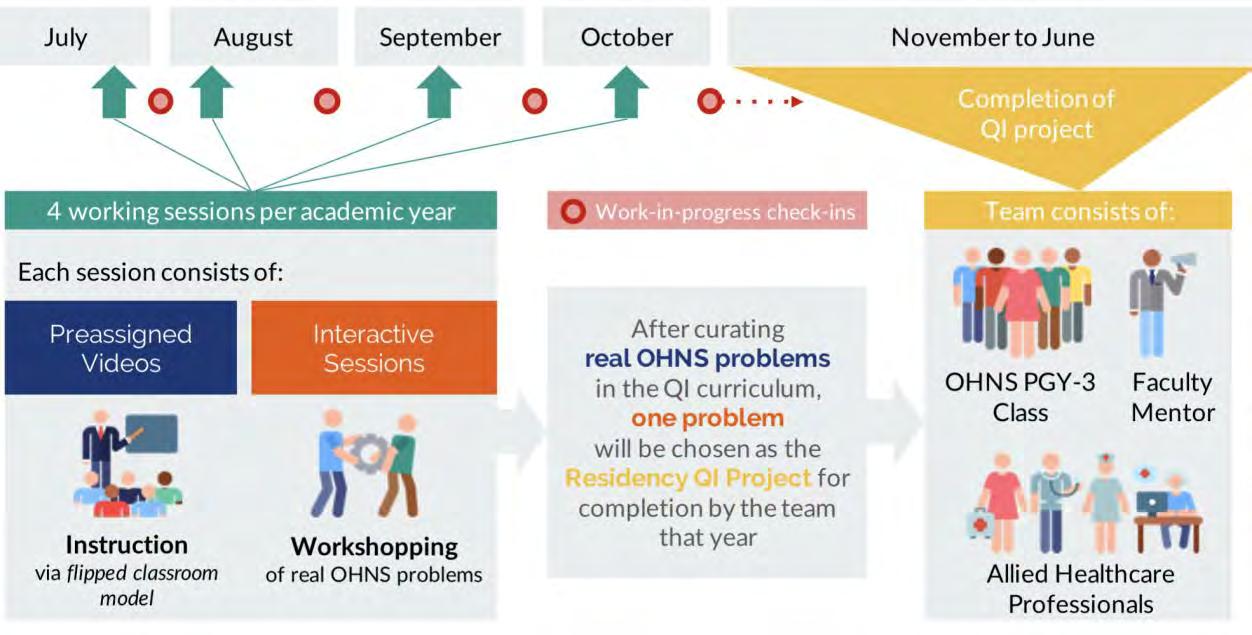
QualityImprovement(QI) Curriculum
EffectiveJuly1,2020,theQIcurriculumhasbeenrevamped. While itspurposeremainsthe same,thislearningrequirementhasbeenrestructured,isnowbeingoverseenbyDr.Lalakea andDr.Jiang,andisacollectiveratherthanindividualresidentprojectofPGY3’s.
TheaimoftheQIprojectistodevelopaplantosupportahospitalorclinicalperformance improvementorpatientsafetymeasureby:
• Reflectingonpracticeandpracticeanalysis
• Criticallyanalyzingthecurrentliterature
• Developingaplanforimplementationoftheproposedchange
• Developinganoutcomes’assessment(performancemeasure)
Itsoverallpurposeis tofosteranunderstandingofthecomplexitiesofhealthcaredelivery anddeveloptheskillstoaddressthemasisdescribedbythecorecompetency,SystemsBasedPractice.
Theprogramisillustratedintheimagebelow. Workingsessionswilltakeplaceonweekday evening,fourtimesayearbetweenJulyandOctober. Thereaftertheteamwillmeetonits ownforcompletionoftheprojectinthefollowingJune.
NationalAcademicConferences
EveryattemptwillbemadetorelievethePGY2orPGY3residentsfromtheirclinicaldutiesso thattheymayattendtheCombinedOtolaryngologySpringMeetingsponsoredbythe Departmentonetime
Inaddition,allresidentswhohaveabstractsacceptedfor podiumpresentationataregional ornationalmeetingwillberelievedoftheirclinicalresponsibilitiestoattendthemeetingand presenttheirdata.PGY1-3’swhohaveabstractsacceptedforposterpresentationata regionalornationalmeetingwillberelievedoftheirclinicalresponsibilities,ifpossible,to attendthemeeting.Theywillbeeligibletoreceivefundingtooffsetthecostsofthemeeting (currentlysetatamaximumof$1,400per domesticconference,and$1,600perinternational conference).Thereisnomaximumonthenumberofconferencesaresidentmayattend.See PolicyonResidentTravel.
FellowshipInterviews
Manyotolaryngologyresidentspursuefellowshipsinotolaryngologysubspecialtiesaftertheir residency.Thefacultyrecognizesthatresidentsneedtointerviewforthesefellowshipsand willmakeeveryefforttoreleaseresidentsfromtheirclinicaldutiessothattheymayattend theseinterviews.Fellowshipapplicantsareaskedtotrytominimizethedaysawayfromtheir rotationastheirabsenceplacesanundueburdenontheirfellowresidents.
12. ResidentTravelandConferenceFundingPolicy
Note:CheckthelatestupdatesonUniversity-sponsored travel
Residenttraveltothefollowingscientificmeetingswillgenerallybeapprovedfor departmentalsupport:AmericanAssociationforResearchinOtolaryngology(ARO), CombinedOtolaryngologicalSpringMeetings(COSM),AmericanAcademyofOtolaryngologyHead&NeckSurgeryAnnualMeeting(AAO-HNS),andSectionMeetingsoftheTriological Society.ResidenttraveltoAOCMFcourses(onceper academicyearperresident)willalsobe approvedwithadditionaldepartmentfundingiftheyareabletosecuregrantfundingto coverpartoftheexpenses.Traveltoothermeetingsmaybeapprovedonacase-by-case basisbytheprogramdirector.
Fundingapprovalwillrequirethatthefollowingthreecircumstancesexist:
Theresidentmustbethepodiumspeaker,courselecturer,orposterpresenter. Poster presentationsaregenerallyacceptableonlyforPGY1-3residents(atthetimeofthe presentation).IfaposterofaPGY4-PGY5residentisacceptedtheresidentmaybeeligiblefor travelfundingbutthismustbeapprovedbytheprogramdirectoraheadoftime.However, postersonlaboratorybasicsciencetopicsareacceptableatanytraininglevel.
Theworkmustbeoriginalandpresentedforthefirsttime and,thepresentationmustbe accompaniedbyamanuscriptthatissubmittedtoapeerreviewedjournalbeforethetimeof themeeting.
Inaddition,thedepartmentwillfundatriptoanacademicconferenceoftheresident’s choosingonceduringtheirresidencytenurewithouttherequirementofpresentingatthe meeting.
MajorExpenseGuidelines (Residentsarehighlyrecommendedtobooktheirtravel, includingflightandhotel(withexceptions),through theStanfordTravelprogram for sponsoredtrips):
Bookingtravel
Registertravelviatheitinerary forwardingservice
Flightand hotel Required (UnlessbookedthroughStanford Traveorconferencehotel)
Bookthroughoneofthe Stanford Travelbookingchannels
Highlyencouragedbecauseof automaticregistrationofitinerary aswellas anychangestotheitinerary
Carrental Notrequired Recommended
§ Roundtripairfarewillbereimbursedatthelowestavailablefare.Residentsareencouraged topurchasethroughEgenciaorotherStanfordTravelchannels: https://stanfordtravel.stanford.edu/ (usingyourSUNetIDandpw).Residentarerequiredto usetheitinerary-forwardingserviceifflightsarenotbookedthroughthe Stanford Travelprogram,andprovidecomparisonpricingviaEgencia.
§ HotellodgingshouldalsobeeitherbookedthroughEgencia(exceptforconferencehotels) orusetheitinerary-forwardingservice ifnotbookedthroughtheStanfordTravel program. Regardlessofthemodeofbookinghotels,travelersmustcontinuetoadhereto Stanford’slodgingpolicy.
§ Meetingregistrationreimbursementwillbebasedonearlypre-registration,notat-thedoorfees.
§ Allgroundtransportationreimbursementisbasedonactualexpensesandshouldbe reasonableand necessary.PerAGM5.4.2,itisrecommendedtouseStanfordTraveltobook rentalcars.
§ Mealswillnotbereimbursed.
§ Totaldepartmentalreimbursementforagivenmeetingwillbea maximumof$1,400per domestictrip,and$1,600perinternationaltrip
§ Posterexpensesarereimbursedupto$200. Thisisconsideredseparatefromthetravel expenses.
NOTE:Theultimateapprovalofallresidenttravelatdepartmentalexpenseisatthe discretionoftheprogramdirectoranddepartmentalchair.Approvalofreimbursementfor travelnotmeetingtheabovecriteriamaybepossibleundercertaincircumstances andwillbe evaluatedonacase-by-casebasis.
13. PersonalTime-off
PertheCBA,Housestaffarepermittedtotakeupto fourweeks(20days) ofpersonaltimeoff (PTO)withpayduringeachone-yearperiod.Vacationshouldbescheduledin1-weekblocks unlesspriorapprovalisobtainedfromtheprogramdirectorandtherotationdirector(for exampleif2weeksarerequestedtogetherorifapartialweekisrequested).Theexceptionto the1-weekblockruleis“terminalleave”attheendoftheacademicyearforthechief residents.Chiefresidentswhoaredepartingforfellowshipwillbeallowedtotake5personal days-offfromtheendofthecontract(June24)notcountinggraduationdayasaday-off. PersonaltimeoffmustberequestedandsubsequentlyapprovedthroughtheMedHub system.Additionally,Housestaffaregiven5SHCholidaysorfloatingholidayseachyear(at leasttwoofthedaysshouldbefromtheSHCholidaylist:New Year’sDay,MLKDay,Memorial Day,IndependenceDay,LaborDay,ThanksgivingDay,andChristmasDay). Stanford UniversityMedicalCenterbelievesthatpersonaltimeawayfromtheresidencyprogramis importanttothewelfareofhousestaff,sounusedpersonaltimeoffdoesnotaccumulate fromyeartoyearandthereisnoprovisiontopayinlieuoftimeoff.
Residentsshouldnotplanontakingvacationatthetimeofthein-trainingexam,duringthe timeoftheAnnualProgramEvaluation (ResidencyRetreat),orduringtheweekofthechief residents’graduationdinnerandtheannualResidentResearchSymposium.Ataminimum, rotationdirectorsandthePDshouldbenotifiednolessthan2weeksbeforetherotation starts. AlltimeoffmustberecordedinMedHub.
So-called“terminalleave,”vacation duringthefinal5working-daysofresidency,willbe granted forresidentswhowillbepursuingafellowship outsideofStanfordtoallowhelpease thetransitionperiod.These5dayscounttowardsthe20daytotalofPTOallowedeachyear. Aresidentwhoistakingterminalleaveshouldnottakeanadditionalweekofvacationduring thesamerotationblock.
Timeoffforfellowship/jobinterviews
Residentsarenotpermittedtotakevacationinanyquarterinwhichtheywillbegonefor morethanfivedaysduetointerviews,unlesstheyareusingvacationtimetointerview. Residentsmustreportthenumberofdaystheywillbetakingofftotheprogramdirector.To avoidpatientcarecoverageissues,PGY2’sshouldtrynottakevacationwhenaresidenton thesamerotationisinterviewing.
14. ResidentWorkHoursandCall
TheDepartmentofOtolaryngology Head&NeckSurgeryiscommittedtofollowingthe currentACGMEpoliciesondutyhours.SeeGMEhandbookforpolicy.
Theresidentcallschedulewillbedeterminedbythechiefresidents onScopeandVAPA.First callissharedamongjuniorresidents;thesecondcallisbythechiefresident orPGY4.Third callisstaffedbyafacultymember.Recognizingtheindividualresidentcircumstancesand needsandacknowledgingtheautonomyofthespecificsiteswithintheresidencyprogram,it isunderstoodthattheresidentswillbeallowedtodeterminetheirowncallschedule,tothe extentthatthisdoesnotcreateanyunduehardshipforanyindividualresidentanditfollows theaboveguidelines.Asmuchaspossible,noresidentshouldbeoncall2weekendsinarow. Residentworkhoursaremonitoredonaweeklybasis,andanypotentialissuesareaddressed immediately.
Thefollowingguidelineswereadopted startingthe2020-2021AcademicYeartoaddressduty hourconcerns:
AllResidents:
• Alldayresidentsshouldleavethehospitalby9:00pmweekdays.Residentsmay voluntarilyelecttostay(ifworkingwithin80hours/week,1in7daysoffguidelines):
– tocontinuetoprovidecaretoasingleseverelyillorunstablepatient
– humanisticattentiontotheneedsofapatientorfamily
– toattenduniqueeducationalevents
• Thenightfloatresidentshouldactivelytakeoverdayresidents’work(e.g.,intheOR) toallowthemtoleaveby9:00pm,iftherearenoactiveconsults.
• Theattendingorfellow aretodictatecaseswhenfinishingafter9:00pmwhentheday residenthasleft.
JuniorResidents
• Chiefsmayallowjuniorresidentsoncallfortheweekend(PGY2–3)toskipmorning roundsduringtheweek.
– Theseresidentsshouldalsoleavethehospitaleachdayassoonastheirclinical responsibilitiesarecompleted.
• PedsWeekendRounds:Thepost-callresidentroundingmustleavethehospitalby 10:00amtofinishtheirshiftwithinthe24hours+4hoursoftransitiontimeguidelines.
– TheSHCjuniorresidentorchiefshouldtakeoveranyremainingworktoallow fortheresidenttoleaveontime.
– Attendingsonweekendcallmustroundnolaterthan8:00am.
Interns
• SHCinternonfortheweekendcanworkamaximumof14.5hours/weekdayand7 hours/weekendday(6:00am–1:00pm)(86.5hourstotal.Thiswillbebalancedoutby weekswheretheyarenotoncalltoremainunderthe80hour/weekaverage).
• LPCHinterncanworkamaximumof14.5hours/weekdayand7hoursonSaturday (6:00am–1:00pm)(79.5hourstotal).
– LPCHinternisoneverySaturdayduringtherotation.
• Chiefsshouldensurethesehoursareadheredtobyschedulingclinicalresponsibilities accordinglyandreleasinginternsby7:30pmevenifPMroundshavenotbeen completed.
Valley/VANightandWeekendCall
• Full-timeresearchresidentswilltake1weekendofcallpermonth.Theymayalsotake upto1weeknightcallontheotherweeks.
• PGY4sonresearchtimemaytake1weeknightcallperweek
– Whentherearenofull-timePGY3residents,thePGY4onresearchwillfollow thecallscheduleforfull-timeresearchresidents.
• Frequencyofweeknightcallforresearchresidentsmayvarydependingonthe numberofresidentsonresearchatonetime.
On-callroomsareprovided.
AllresidentsarerequiredtoentertheirworkhoursintotheMedHubsystemonatleasta weeklybasis.
15. DepartmentalHand-overPolicy
Whenon-call,residentstypicallycoverpatientsatmorethanonehospital. Forthisreason,a verbalcheck-outprocedureviaphoneiscurrentlyusedbytheresidentstaff. Elementsofthis policyinclude:
Priortoleavingthehospitaleachday:
• Juniorresidentscheck-outtoon-calljuniorresidentortonightfloatresidentevery patientviaI-PASS(I:Illnessseverity;P:Patientsummary;A:Actionitems;S:Situation awarenessandcontingencyplanning;S:Synthesisbyreceiver).
• Aftercheckingout,theJuniorresident(s)withtheghostconsultandfloorpagerswill reassignthepagerstotheon-callresident. Inthemorningtheresidentassumingthe consultpagerwillreassigntheghostpager,andeachresidentcoveringthefloor ghost pagerswillreassignthepagers.
• Senior/chiefresidentscheckouttosenior/chiefresidentsregardingall unstable/concerningpatients.
• Facultymemberscheckoutallconcerningpatientstofacultymemberoncall.
16. OperativeCaseLogs
AllresidentsarerequiredtoenterdataontheirsurgicalcasesintotheACGMEsystemina timelymanner(everyweekrecommended,operativelogsmustbeup-to-dateatthetimeof thesemi-annualresidentmeetingwiththeprogramdirector orassociateprogramdirector.)
Residentsareresponsibleforkeepingtrackofthesurgicalcasesinwhichtheyparticipate.
AResidentSupervisorinstructs,andassistsasneeded,amorejuniorresidentduringa procedureduringwhichthejuniorresidentperformsgreaterthanorequalto50%ofthe operation,includingthekeyportion(s)oftheprocedure. Theattendingfunctionsasan assistantorobserver.
AResidentSurgeonperformsgreaterthanorequalto50%oftheoperationwiththe attendingsurgeon(andresidentsupervisor,ifapplicable),includingthekeyportion(s)ofthe procedure.
AnAssistantSurgeonperformslessthan50%oftheoperation,orgreaterthanorequalto 50%oftheoperationbutnotthekeyportions(s)oftheprocedure.
ResidentsareresponsibleforenteringalldataintotheACGMEdatabase. Accuracyinthis endeavoriscritical,bothforjustifyingaresident’ssuitabilityforsittingfortheboard examination,aswellasaccuratelyreflectingthevolumeofsurgerydone intheprogram.
TherequiredminimumnumberofkeyindicatorproceduresislistedinAppendixD.
Codingguidelinesarelistedat: https://medwiki.stanford.edu/display/ent/Protocols+and+Forms
17. Communication
Addresses:Theresidenthomeaddresses,emailaddresses,homephonenumbersandcell phonenumbersshouldbeprovidedtotheadministrativestaffwithinthedepartmentand updatedonMedhub.
E-mail: ResidentsarerequiredtomaintainanactiveStanforde-mailaddressthatischecked regularly(atleastevery48hours).Allclinicalandacademice-mailshouldbesentthrough thissystem.Alle-mailwithprotectedhealthinformation(PHI)mustbesentsecurely(thisis donebytyping“SECURE:”atthebeginningofthee-mailsubjectline).
18. GuidelinesforOnlineProfessionalorPersonalActivity
TheseguidelinesapplytoStanfordOHNSresidentsinsocialmedicalvenuessuchas professionalsocietyblogs,LinkedIn,Google+,Instagram,Twitter,and/orFacebook,etc.for deliberateprofessionalengagementorcasualconversation.
• ProtectedHealthInformation,includingphotographs,maynotbeplacedonsocial mediasites.
• Forthepurposesofeducation,descriptionsofpatientcasesandclinicalimagesmay bepostedtopasswordprotectedprofessionalsitesoncethedatahasbeendeidentified.
• ByvirtueofidentifyingoneselfasapartofStanfordinsocialmedia,residentsconnect themselvesto,andreflectupon,Stanfordcolleagues,Stanfordpatientsand supporters.
• Rememberthatallcontentcontributedonallplatformsbecomesimmediately searchableandcanbeshared.Thiscontentleavesthecontributingindividual’s controlforever.
19. PolicyandGuidelinesforInteractionswithIndustry
Theabovepolicymaybeaccessedat: https://med.stanford.edu/siip/home.html
Highlightsofthispolicyinclude:
1) Medicalstaff,faculty,students,andtraineesmaynotacceptgiftsfromIndustry anywhereattheStanfordSOM,SHC,LPCH,orotherclinicalfacilitiesoperatedbyeither hospital. ItisstronglyadvisedthatnoformofpersonalgiftfromIndustrybe acceptedunder anycircumstances.
2) FreedrugsamplesgivendirectlytomembersoftheSUMCareconsideredgiftsand maynotbeaccepted,exceptbythepharmacyforuseforneedypatients.
3) Giftsorcompensationmaynotbeaccepteda)atanyStanfordornon-Stanford facilitysuchasotherhospitalsandoutreachclinics,b)forlisteningtoasalestalkbyan industryrepresentative,c)forprescribingorchangingapatient’sprescription,d) forsimply attendingaCMEorotheractivityorconference,includingthedefrayingofcosts.
4) MealsorothertypesoffooddirectlyfundedbyIndustrymaynotbeprovidedat StanfordSOM,SHC,LPCH,orMenloClinic.
5) Salesandmarketingrepresentativesarenotpermittedinanypatientcareareas excepttoprovidein-servicetrainingondevicesandotherequipmentandthenonlyby appointment. Theyarepermittedinnon-patientcareareasbyappointmentonly.
6) IndustrysupportofstudentsandtraineesintheSOMeducationalprogramsshould befreeofanyactualorperceivedconflictofinterest,mustbespecificallyforthepurposeof educationandmustcomplywithseveralprovisions:a)TheDepartmentselectsthestudentor trainee,b)ThefundsareprovidedtotheSchool,department,program,division,orinstitute andnotdirectlytothestudentortraineeortoanindividualfacultymember;c)The department,program,division,orinstitutehasdetermined thatthefundedconferenceor programhaseducationalmerit,d)therecipientisnotsubjecttoanyimplicitorexplicit expectationofprovidingsomethinginreturnforthesupport.
SOMfaculty,students,staffandtraineesshouldevaluatecarefullytheirattendanceat meetingsandconferencesthatarefullyorpartiallysponsoredorrunbyIndustrybecauseof thepotentialforperceivedorrealconflictofinterest.
20. StanfordDepartmentofOHNSGuidelinesforConsultations
Generalguidelinesforallconsults:
◼ Otolaryngologyisaservice-oriented specialtywhererelationshipswithpractitioners ofotherservicesareestablishedandmaintained.
◼ ALLconsultsshouldbeseenthedaytheyarereceivedunlessitislateinthedayand thereferringproviderexpresslystatesthatitisfinetoseethenextday.Iftheconsultis receivedbutnotseenonthatday,pleaseseetheconsultyourselfonthe followingday soanotherresidentisnotleftwithyourwork.
◼ Ifaconsultisreceivedandyouthinkitistrulyaninappropriateconsult,anOHNSChief ResidentMUSThearabouttheconsultandgivepermissionfortheOHNSresidentto notseetheconsult.
◼ ConsultstakepriorityovertheOR.
◼ Allconsultsmustbestaffedwiththeoncallattendingthedayoftheconsult.
◼ Aconsultnotemustbeenteredonthedayoftheconsult(includingvocalfold consults).Thisincludesanyconsultyousee,evenonesthatareimmediatelysigned offon.
◼ Afullconsultnotemustbeenteredforeveryconsultpatient. ItisnotOKtoonlyenter aprocedurenotewithoutaconsultnote(forexample:afullconsultnoteneedstobe
enteredforapatientwithpossiblevocalfoldparalysis –notjustthelaryngoscopy note.)
◼ Duringtheday,theconsultnotemay(andshould)bestartedbutnotcompleted(i.e. don’tputtheassessmentandplan)untiltheconsulthasbeenseen/discussedwiththe attending.
◼ Alloutpatientcallsshouldbereturnedinatimelyfashionandhaveatelephone encounterdocumentedintheappropriateEPIC.
◼ Thenightfloatresidentsshouldseeanddocumentallconsults –evenonesthatare noturgent.
◼ Referringprovidersshouldbetreatedwithrespect –justaswewanttobetreated whenwecallinaconsult. Inevitably,wewillreceivesomeconsultsforconditionswe thinkare“silly”or“awasteoftime”. Rememberthatwesometimescallinthesetypes ofconsultstoo. Aconsultisarequestforhelp. BENICE.
EmergencyDepartmentConsultations:
◼ Shouldbeseenwithin1hourofreceivingthecall(obviously,quickerforurgent consults)
◼ AlwayscheckoutwiththeEDphysician –donotleavewithouttalkingtothem.
ConsultsatSHC:
◼ TheConsultPGY2(andoccasionally1)servesasthefront-lineconsultresident.
◼ Consultswillbeaddedtotheteamofthestaffingattending(i.e.aconsult staffedbyaScopeattendingwillgototheScopeservice.)
◼ Trachconsultswillgototheservice ofthestaffingattending.
◼ Vocalfoldconsultsgotothe Headmirrorservice.
◼ ExistingH&NpatientswithaH&NissuewillgotoScalpelevenifnotyetstaffed withtheH&Nattending(i.e.laryngealtumorpatientfollowedbyKaplaninthe pastbutstaffedwithrhinologyfellowwillgotoH&N)
◼ NewH&Npatientswillgototeamofstaffingattendingunlessdirected otherwisebythechief(i.e.newtongueSCCconsultstaffedbyFPRSfellowwill gotoScopeatfirst.)
◼ Ifyouwantaconsulttobeseeninafellow/instructorclinic(i.e.mandible fracturetobeseeninFPRSclinic)youmustemail,callortextthatattending. A STAFFMESSAGEALONEISNOTSUFFICIENT!
ConsultsatLPCH:
PleaserefertoPedsServiceGuidelinesprovidedbythedivision.
21. OtolaryngologyPost-GraduateEducationalProgram
GoalsandObjectivesPGY1-Non-OHNSrotations
Rotation Contacts and Scheduling Details
RotationDirector:KwangSung,MD,MS kwangs@stanford.edu
NOTE: Allresidents,includingthePGY1residents,willtakethein-trainingexamonthefirstSaturdayinMarch.
Rotationdetails:
Thedailyscheduleswillbedeterminedbythechiefresidents/facultyoneachindividualrotation. Whileonotherrotationsresidentsshouldattendtheresidenteducationsessionsforthatspecialty.Residentsshouldattend theOHNS educationsessionswhenfeasible.
Radiology/Research/LaryngologyRotation
This rotation is comprised of neuroradiology, audiology, neurology, laryngology, and research.
RotationContacts&Addresses
RotationDirectors:
ShwetaKumar,MD(Neuroradiology) shwetak1@stanford.edu
MattFitzgerald,PhD fitzmb@stanford.edu
Clinics:BesidesStanfordandLPCH,thelocationsforthisrotationinclude:
• 451ShermanAve
• Hoover2Pavilion(SNHC,StanfordNeurosciencesHealthCenter,213QuarryRd)
• VAPA
• StanfordEarInstitute(WatsonCourt)
RotationDetails:
• Oneweekbeforetherotation,residentistotouchbasewithDr. ShwetaKumar(shwetak1@stanford.edu)fororientation planandsharingofdocuments,includingupcomingfaculty/fellowschedulesandconferenceschedules.
• Atleastoneweekbeforetherotation,residentistomakeanappointmentwithDrs.KaraMeister (meister4@stanford.edu)orAndreyFinegersh(afinegersh@stanford.edu)residencyresearchcommitteefaculty,to discussresearchgoals.
• Twoweeksofthefour,theresidentwillbeassignedtotheHeadmirrorteamtoallowtheresidenttogainexperiencein flexiblelaryngoscopyintheVoiceandSwallowingClinic.
• Atleasttwohalf-daysaretobespentinneurologyclinic shadowingDr.KristenSteenerson(onMondays,Tuesdays, ThursdaysorFridays) andDr.RichardBaron(TuesdaysorThursdays).PleasecontactDr.Steenerson (ksteen@stanford.edu)andDr.Baron(rbaron2@stanford.edu)atleastonemonthinadvancetoarrange.
• ResidentswillattendOHNSconferencesonMondaymorningsandneuroradiologyconferences(seelist)asappropriate andaspossible.ThemorningswillgenerallybespentintheneuroradiologyreadingroomsatStanford, 300P,Sherman Aveand/orHoover.
• Oneafternoon(WednesdayorFriday)aweekwillbespentinaudiology,primarilyattheStanfordEarInstituteatWatson Court.
• Afternoonsnotspentinaudiologyorneurologyaretobeutilizedtodevelopresearchplans.
Conferences:InadditiontoattendingMondaymorningOHNSconferences, theresidentisencouragedtoattendthefollowing conferences,dependingonappropriatenessofcontent.CurrentschedulescanbeprovidedbyDr. Kumar orbyneuroradiology programcoordinatorMalikaCurry(mcurry18@stanford.edu).
Conference Time Locations
Tuesdays –NeuroradiologyFellows Conference 7:30AM
Tuesdays–NeurosurgerySkullBase Conference 5:30PM
Tuesday–ThirdTuesdayofmonth (usually):PedsENTRadiologyConference 5-6pm
Zoomatpresent(Zoominfoavailable onthemonthlyconferenceschedule)
Zoomatpresent(Zoominfoavailable onthemonthlyconferenceschedule)
LPCHConferenceRoom
Wednesday–NeuroradiologyFellows Conference 1:30PM
Thursdays–RadiologyResidentdidactic block Noon-5pm(ifNeurolectures, typicallyat12:30and1:30p.m.)
Thursdays–Head&NeckTumorBoard 4:30-6:30PM
Radiologyreadouts:
Zoomatpresent(Zoominfoavailable onthemonthlyconferenceschedule)
Zoomatpresent(Zoominfoavailable onthemonthlyconferenceschedule)
Zoomatpresent(Zoominfoavailable onthemonthlyconferenceschedule)
• 8:30amto11amislikelythebesttimeforaconsistentread-outexperience.
• Additionalone-on-oneRadiologyreviewtimeviaZoommightbeavailableduringpreparationoftheTuesdaySkullBase conference(Dr.Fischbein, fischbein@stanford.edu)ortheThursdayHeadandNeckTumorBoard(Dr.Fischbein,Dr. Kumar,orDr.NancyPham,nanpham@stanford.edu)
• Observationofimage-guidedbiopsyproceduresmightalsobepossible –touchbasewithDr.Phamforthisoption.
OtherResources:
• DiagnosticImaging:Head&Neck,3rd EditionbyKoch,etal
• ExpertDifferentialDiagnoses:Head&Neck,byHarnsberger
• FatPadsoftheHeadandNeck:Animagingreview,byPateletal., https://doi.org/10.3174/ng.9170238
• LearningHeadandNeck:https://www.learningheadandneck.com/
Competency-basedGoalsandObjectives
General&PlasticSurgeryrotations: Tobeabletoprovidepre-andpostoperativecaretothesurgicalpatient.
ResidentObjectives: ACGMECompetencyGoals
Beabletotakeadetailedsurgicalhistoryandreviewrelevantmedicalrecords. PatientCare
InterpersonalandCommunicationsSkills
Beabletoperformadetailedphysicalexamination. PatientCare
MedicalKnowledge
Beabletowrite/dictateathoroughandsuccincthistory&physical. PatientCare
Understandtheprocessofobtainingasurgicalinformedconsent.
Beabletocompleteathoroughclinicalnoteintheinpatientrecord.
UnderstandNPOguidelines.
UnderstandfluidmanagementintheNPOpatient.
Understandthebasiclaboratoryandradiologictestsperformedforthepre-operativeand post-operativepatient.
Understandthebasicsofnutritionalsupportforthesurgicalpatient.
Understandoperativesterilityprinciples.
Understandthediagnosisandbasicsofmanagementofsurgicalrelatedinfections.
Understandtheguidelinesanduseofprophylacticantibiotics.
Learnhowtoeffectivelyutilizethe“EPIC”computerizedmedicalrecord.
InterpersonalandCommunicationsSkills
PatientCare
Systems-BasedPractice
InterpersonalandCommunicationsSkills
PatientCare
MedicalKnowledge
PatientCare
MedicalKnowledge
PatientCare
MedicalKnowledge
PatientCare
MedicalKnowledge
PatientCare
MedicalKnowledge
PatientCare
MedicalKnowledge
PatientCare
MedicalKnowledge
PatientCare
Systems-BasedPractice
GoalforSurgicalIntensiveCareUnitrotation: Tounderstandthebasicsofcareforthecriticallyillsurgicalpatient.
ResidentObjectives:
Understandthedifferenttypesofshock.
Understandthevarioustypesofmonitoringcathetersandhowtointerpretthedata obtained
Understandthebasicprinciplesofmechanicalventilation.
Understandeffectivepreventivemeasuresfordeepveinthrombosisandpulmonary embolus.
UnderstandthebasicsofEKGinterpretation
Understandthebasicsofrenalphysiologyandelectrolytedisturbances.
ACGMECompetencyGoals
MedicalKnowledge
MedicalKnowledge
MedicalKnowledge
MedicalKnowledge
PatientCare
MedicalKnowledge
MedicalKnowledge
Understandthebasicsofpulmonaryphysiology
Beabletomanagethenutritionalneedsofthesurgicalpatient.
MedicalKnowledge
PatientCare
Learnaboutoptimalcommunicationbetweentheintensivistsandsurgicalteams. Professionalism
Systems-BasedPractice
GoalsofEmergencyMedicinerotation: Tounderstandthebasicsofcareintheemergencydepartment.
ResidentObjectives:
LearnabouttheprocessofE.D.triage.
KnowhowtoevaluatethemostcommondisordersseeninE.D.patients.
LearnhowtoworkwiththeE.D.personnelandothermedicalprofessionalstoevaluateand treatpatients.
Learnthebasicsoflacerationclosure.
GoalsforAnesthesiaRotation:Tobecomefamiliarwiththebasicsofanesthesiacare.
ResidentObjectives:
Knowbasiclaryngealanatomy.
Knowappropriateindicationsforgeneralversuslocalversusregionalanesthesia.
Knowtheimportantfeaturesofthemostcommonsurgicalanestheticsusedinthe operatingroom.
Understandappropriatepreoperativetestsforpatientsundergoinganesthesia.
Beabletointerprettheanesthesiarecord.
Befamiliarwithvarioustypesofintraoperativemonitoring.
Beabletoperformorotrachealintubation.
ACGMECompetencyGoals
MedicalKnowledge
PatientCare
Systems-BasedPractice
MedicalKnowledge
PatientCare
MedicalKnowledge
PatientCare
Systems-BasedPractice
PatientCare
MedicalKnowledge
ACGMECompetencyGoals
MedicalKnowledge
MedicalKnowledge
PatientCare
PatientCare
MedicalKnowledge
MedicalKnowledge
PatientCare
MedicalKnowledge
MedicalKnowledge
PatientCare
PatientCare
Learnaboutoptionalcommunicationbetweenanesthesiaandsurgicalteams. PatientCare
Professionalism
Systems-BasedPractice
Learnhowtoparticipateina“timeout”sessionandunderstandtheimportanceofsurgical checklists.
PatientCare
Systems-BasedPractice
GoalsofNeuroradiology/Audiology/Neurology/Laryngology/Researchrotation:Tobecomefacileatorderingandreadingimaging studiesoftheheadandneck,tounderstandthebasicsofaudiologyandvestibulartesting,becomefamiliarwithbasicneurological assessments,learntoperformbasiclaryngologicalexamandairwayassessment, andlearnthefundamentalsofconductingmedical research.
ResidentObjectives: ACGMECompetencyGoals
KnowtheanatomyoftheheadandneckasseenonCTandMRI.
Understandwhichtypeofimagingstudyisbestforwhichtypeofclinicaldisorder.
Understandtheappearanceofcommonheadandneckdisordersasseenonradiologic images.
Learnhowtobestinteractwithmembersoftheradiologydepartment.
SpendatleasttwosessionsobservingaCT/MRItechnologisttodevelopfamiliaritywith scanningprocesses,radiationdosingandsafety.
AttendOHNSandneuroradiologyeducationconferences
Project:Assemble10to15casesofinterest.TheseshouldbeinPowerPointformatand presentedasteachablecases.IntheirPGY2year,theresidentwillpresentthisat aresidency educationsession.
Spendtimeinaudiologyaminimumof oneafternoon/weeklearningaboutaudiologic testingforallages,hearingaidsandcochlearimplants.
Learnthebasicsofaudiologyevaluationinadults.Beabletoperformanaudiogram.
MedicalKnowledge
PatientCare
MedicalKnowledge
PatientCare
MedicalKnowledge
PatientCare
Systems-BasedPractice
MedicalKnowledge
PatientCare
MedicalKnowledge
PracticeBasedLearning
PatientCare
MedicalKnowledge
PatientCare
MedicalKnowledge
PatientCare
MedicalKnowledge
PatientCare
Learnandobservethetypesofaudiologictestinginchildren.
Understandthetypesofnewbornhearingscreensandtheassociatedlawsregarding screening.
Observethevarioustypesofvestibulartestingandunderstandwheneachtypeis indicated.
Learntotakeadetailedvertigo/dizzinesshistory.
Becomefamiliarwithhowtoconduct athoroughvestibularphysicalexam
Begintounderstand theworkupofavestibularpatient
Obtainexposuretohowtointerpretresultsofvestibular/balancetesting,includingVEMP, VHIT,VNG,rotarychair,CDP
Describevestibularpathologies,bothcentralandperipheral.
Learnmanagementoptionsinthetreatmentofpatientswithdizziness.
Attendorviewonlineresearchtrainingcourse
Learntoperformflexibleanddirectlaryngoscopy.Begintounderstandtheassessmentof theairwayandairwaymanagement.
MedicalKnowledge
PatientCare
MedicalKnowledge
MedicalKnowledge
MedicalKnowledge
PatientCare
MedicalKnowledge
PatientCare
MedicalKnowledge
PatientCare
Systems-BasedPractice
MedicalKnowledge
MedicalKnowledge
MedicalKnowledge
PatientCare
MedicalKnowledge
MedicalKnowledge
PatientCare
StanfordHealthCareHeadmirrorService
RotationDirectors: Laryngology SleepMedicine Comprehensive
C.KwangSung,MD,MS RobsonCapasso,MD UchechukwuMegwalu,MD,MPH kwangs@stanford.edu rcapasso@stanford.edu umegwalu@stanford.edu
WeeklySchedule
Monday Tuesday Wednesday Thursday Friday
MegwaluOR Capasso/OliveiraOR(RWC, 4th Mon)
Jiangclinic(RWC,2nd &4th Mon)
AM
JiangOR(1st ,3rd ,and5th Mon starting8/26)
Nuyenclinic(RWC)
Oliveiraclinic1st and5th
MauOR(1st ,2nd &4th Mon starting8/26)
Thamclinic
MegwaluOR Jiangclinic(RWC,2nd &4th Mon)
JiangOR(1st ,3rd ,and5th Mon starting8/26)
PM
Nuyenclinic(RWC)
MauOR(1st,2nd &4th Mon starting8/26)
MauOR(3rd Mon)
Thamclinic
SungORorprocedure clinic(RWC)
Mauclinic(RWC)
Capassoclinic(RWC)
Leeclinic(RWC)
Megwaluclinic
Sungclinic(RWC)
Mauclinic(RWC)
Oliveiraclinic(RWC)
CapassoOR Leeclinic
Thamclinic(southbay), OR5th Wed
LeeOR(alternateweeks)
JiangOR(300P5th Thur starting8/26)
Damroseclinic(RWC)
Capassoclinic(RWC)
Oliveiraclinic(RWC)
Megwaluclinic
Thamclinic(southbay, 2nd and4th Thur)
LeeOR(alternateweeks)
DamroseOR NuyenOR(1st Fri)
MauOR(3rd Fri)
SungOR(4th &5thFri)
ThamOR(3rd Fri)
OliveiraOR(2nd and5th Fri)
SungORorprocedure clinic(RWC)
Mauclinic(RWC)
Damroseclinic(RWC)
Capassoclinic(RWC)
Leeclinic(RWC)
Megwaluclinic
Sungclinic(RWC)
Mauclinic(RWC)
Oliveiraclinic(RWC)
CapassoOR Leeclinic
Thamclinic(southbay), OR5th Wed
LeeOR(alternateweeks)
JiangOR(300P5th Thur starting8/26)
Damroseclinic(RWC)
Capassoclinic(RWC)
Megwaluclinic
Oliveiraclinic(RWC)
Thamclinic(southbay, 2nd and4th Thur)
LeeOR(alternateweeks)
DamroseOR NuyenOR(1st Fri)
MauOR(3rd Fri)
SungOR(4th &5thFri)
OliveiraOR(2nd and5th Fri)
ThamOR(3rd Fri)
GoalsandObjectivesPGY1:SHCHeadmirrorService
ThePGY-1willparticipateinotolaryngologyroundsandunderthedirectionofthechief/seniorresidentwillberesponsibleforcare of inpatients.
Callduties:ThePGY1residentwilltakecallforin-housefloorpatientsfrom6:00amuntilafterroundsarecompleteandresidentsare releasedbythechiefresident.Onassignedweekends,theywilltakefloorcallduringtheday.PGY-1residentswillnottakeovernight call.
NOTE: Allresidents,includingthePGY1residents,willtakethein-trainingexamonthefirstSaturdayinMarch.
EvaluationandFeedback
TheOHNSFacultyontheHeadmirrorService(andselectedancillarymedicalpersonnel)willcompletewrittenevaluationsattheendof therotation.Selectedclinicpatientswillevaluatetheresidents.ResidentswillbeaskedtoevaluateeachFacultyMemberandthe rotation.Dailyfeedbackonphysicalfindings,assessment,plan,andsurgicaltechniquewilloccurthroughclinicalinteractions.
Competency-basedGoalsandObjectives
Goal1:Otolaryngology(“Headmirror”)Rotation:Tobeabletoprovidepre-andpost-operativecarefortheotolaryngologysurgical patient.
ResidentObjectives:
•Knowtheimportantaspectsofhistoryandphysicalexaminationoftheotolaryngology patient.
ACGMECompetencyGoals
PatientCare
MedicalKnowledge
•Begintounderstandthediagnosisandtreatmentofcommonotolaryngologicdisorders. PatientCare
MedicalKnowledge
•BecomefamiliarwiththeACGMEresidentcaselogsystem.
PatientCare
MedicalKnowledge
Systems-BasedPractice
•Demonstrateself-awarenessandtimemanagement/organizationalskills. Practice-BasedLearningandImprovement
Goal2:Otolaryngology(“Headmirror”)Rotation:Tobegintodevelopotolaryngologysurgical andprocedural skills.
ResidentObjectives:
ACGMECompetencyGoals
•Residentwillknowthenamesofcommonsurgicalinstruments. PatientCare
•Residentwilllearnbasicsuturingandknottyingtechniques.
•ResidentwillknowhowtosetuptheORforroutineotolaryngologycases.
•ResidentwilllearnthebasictechniquesofDirectlaryngoscopy,Esophagoscopy, Bronchoscopy.
•ResidentwilllearnthebasictechniquesofDISE/flexiblenasopharyngoscopy,inferior turbinatereduction,archbarremoval,tonsillectomy.
•Residentwillgainexperiencebyassistingwithsurgicalprocedures.
•Residentwillbeintroducedtoflexiblelaryngoscopy andvideostroboscopy.
•Residentwilllearnbasicsofdissectionofsofttissueofthefaceandneck. GoalsandObjectives
Rotation Contacts and Scheduling Details
PleasecoordinateschedulesandcarewithAttendingSurgeonsfromHeadandNeckSurgery(Capasso,Damrose,Lee, Jiang,Martins GomesdeOliveira,Mau, Megwalu,Nuyen,Sung,Tham)
RotationSpecifics
1. Roundingexpectations:teamistoroundtogetherinthemorningwiththechiefresidentleading. Allmembersoftheteamare expectedtoknowwhatisgoingonwitheachpatient. Ondischarge,patientsshouldhaveadateandtimeforfollow-up. The teamshouldestablishthispriortodischargebycallingtheclinicorcommunicatingwiththeP.A.Thechiefresidentisexpected tobeteachingthejuniorsonrounds.
2. Communicationwithfacultyregardingpatients afterrounds/weekends:
• Communicationofsomesortisexpectedeachdaywith each attending.Forsome,atextmessageisfine;forothers,aphone call. Atthestartoftheservice,thechiefshouldestablishthebestmodeofcommunicationwitheachattending.
• Whentalkingwithpatients,residentsshouldavoidrelayingcareplansifthereisuncertainty.Theyshouldtellthepatient that theywillcheckwiththeattending.
3. Communicationwithfacultyregarding night-timecontactwithpatients
Forseriousissues(e.g.shouldapatientgobacktotheOR),itisidealifcallsgoupthechainofcommand.R2sandR3son call shouldcalltheirchiefresidenttoevaluate,whoshouldnotifythefellow,andthentheattending.TheR2orR3shouldNOT bypassseniorresidentsandgodirectlytotheattending.Thisisforteachingpurposes.
4. Residentsareexpectedtomakeentriesintomedicalrecordsfornight-timepatientcontacts.AnoteshouldbeenteredintoEpic foreachcontactwithpatients.
5. Residentsshouldstrikeabalancebetweenlearningintheclinicandoperatingroom.However,thechiefresidentshould anticipateandplaninadvancesothatclinicscanbecoveredasmuchaspossible.Thismayrequireaskingresidentsfromother servicestohelp.ItmaybeadvisabletolimitvacationduringthemonthsofheavyR4interviews.
6. Abriefoperativenoteshouldbeenteredwithinanhourofcompletionofthesurgerybytheresident.Dictationofoperative reports:within24hours.
7. PreparationforOR:Decideapersonalgoaltoachieveineachcase. Discusscasewithattendingthedaybefore.Readaboutthe case.Knowthepatientandwhytheoperationisbeingperformed,thelabs,etc. Seekfeedbackfromfacultybydirectlyasking faculty.
8. Whenfacultyisoutoftown,continuetocommunicatewithattendingdailyifavailablebycellphone.Ifnot,then,communicate withthecoveringattendingorinstructor(designatedbytheattendingpriortoleaving).
EvaluationandFeedback
TheOHNSFacultyontheHeadmirrorService(andselectedancillarymedicalpersonnel)willcompletewrittenevaluationsattheendof therotation.Selectedclinicpatientswillevaluatetheresidents.ResidentswillbeaskedtoevaluateeachFacultyMemberandthe rotation. Dailyfeedbackonphysicalfindings,assessment,plan,andsurgicaltechniquewilloccurthroughclinicalinteractions.
Competency-basedGoalsandObjectives
Goal1. Consultsinanadulttertiarycarehospital. Learnaboutthemostcommonconsultsrequestedfromothermedicaland surgicalservicesregardinglaryngealandgeneralotolaryngologyproblemsinadults.
ResidentObjectives:
BetheinitialcontactpersonforallconsultsfromotherSHCservicesandtheemergency department.
Performinitialevaluationofallconsultpatientswhendesignatedandforalllaryngology consults.
ACGMECompetencyGoals
PatientCare
MedicalKnowledge
InterpersonalandCommunicationSkills
Professionalism
Systems-BasedPractice
PatientCare
MedicalKnowledge
PatientCare
BefamiliarwiththeSHCelectronicmedicalrecord(EPIC)andbeabletoaccess informationappropriately. Understandtheimportanceofconfidentialityinpatient medicalrecords.
Evaluateconsultpatientswithseniorresidentorfellowandfacultymemberand communicaterecommendationsandplantoprimaryteam.Consistentlydemonstrate courtesywheninteractingwithclinicalandnon-clinicalstaffmembers.
Performaliteraturesearchtolearnmoreaboutunusualpatientproblems.
Createacompleteandcoherentconsultationnoteanddictateitinatimelyfashion.This objectiveappliestoallpatientsseenintheclinicsettingaswellastheoutpatientsetting.
Utilizetranslationservicestocommunicatewithnon-Englishspeakingpatientsasneeded.
Demonstrateeffectivetime-managementskills.
Follow-uponconsultpatientsasneeded.
PrepareandpresentattheweeklyHeadandNeckCaseconference.
ResidentObjectives:
Beabletodescribetheanatomy,physiology,andpathophysiologyofthelarynx.
Takeahistorywithfocusedquestionsthatassistinthediagnosisofhoarseness.
Describetheuseofdiagnostictestsforassessinghoarseness(e.g.airwayfilms,sleep studies,laryngealendoscopy,videostroboscopy).
Beableonphysicalexaminationtoassessabnormalitiesofthevocalfolds(ie,paralysis, benignandmalignantlesions).
Professionalism
Systems-BasedPractice
PatientCare
MedicalKnowledge
Systems-BasedPractice
InterpersonalandCommunicationSkills
MedicalKnowledge
Practice-BasedLearningandImprovement
InterpersonalandCommunicationSkills
Professionalism
InterpersonalandCommunicationSkills
Systems-BasedPractice
Practice-BasedLearningandImprovement
Professionalism
PatientCare
Systems-BasedPractice
Professionalism
MedicalKnowledge
Systems-BasedPractice
MedicalKnowledge
PatientCare
PatientCare
MedicalKnowledge
PatientCare
Describehowtoidentifyaparalyzedvocalfold.
Beabletocounselpatients/parentsaboutthepathophysiologyofconditionsassociated withvocalfoldparalysis.
Understandtheindicationsformedialization(e.g.,injection,thyroplasty)andalternative therapies.
PatientCare
PatientCare
InterpersonalandCommunicationSkills
PatientCare
MedicalKnowledge
Beabletocounselparentsabouttherisksandbenefitsofvocalfoldmedialization. Professionalism
InterpersonalandCommunicationSkills
Knowtheperioperativemanagementandexpectedpostoperativecourseofpatientswho undergovocalfoldmedialization.
Beabletosafelyandefficientlyperformaflexiblenasolaryngoscopy and videostroboscopy.
Beabletodiscussthetreatmentofandprovidecaretopatientswithcomplicationsof laryngoscopy.
Goal3.Swallowing. Beabletoevaluateandtreatswallowingdisordersinadults.
ResidentObjectives:
Beabletodescribetheanatomy,physiology,andpathophysiologyofthepharynxand esophagus.
Beabletotakeahistoryrelatedtothepharynxandesophagusasregardsswallowing problems.
Understandtheavailabletreatmentsfordysphagia.
Beabletodiscusstheindications,risks,benefitsandalternativestodilationandto cricopharyngealmyotomy.
PatientCare
PatientCare
PatientCare
InterpersonalandCommunicationSkills
ACGMECompetencyGoals
MedicalKnowledge
PatientCare
InterpersonalandCommunicationSkills
PatientCare
MedicalKnowledge
PatientCare
MedicalKnowledge
BefamiliarwiththeendoscopicandopenmethodsoftreatingZenker’sdiverticulum. PatientCare
MedicalKnowledge
Understandtheavailablebedsideandradiographicmethodsofassessingswallowing. PatientCare
Beabletodiscussandtreatcomplicationsfromesophagoscopy.
Goal4.Expandabilitytoperformsurgicalprocedures
ResidentObjectives:
Beabletocompetentlyandefficientlyperformmid-levelprocedureswithattending assistance
PatientCare
ACGMECompetencyGoals
PatientCare
suchas:
• Microdirectlaryngoscopy
• FlexibleandrigidEsophagoscopy.
• Injectionlaryngoplasty
• Tonsillectomy
• Septoplasty
• Turbinatereduction
• Tracheostomy
• Panendoscopy
• Submandibularglandexcision
• Excisionofcongenitalcysts
• Eustachiantubedilation
• Resectionofsmallcarcinomas(e.g.tongue,floorofmouth)
Goal5.SleepMedicine. Knowaboutnormalsleep/wakeneurobiologyandrespiratoryphysiology
ResidentObjectives: ACGMECompetencyGoals
Befamiliarwiththesleep/wakeneuralcentersandconnectionsassociatedwithnormal sleep/wakecycles.
Knowthesleepstagesandarchitecture.
MedicalKnowledge
MedicalKnowledge
Understandoptionsfortreatmentofnasalseptaldeviationandturbinatehypertrophy.. MedicalKnowledge
Goal6.Knowaboutcommonsleepdisordersandtheirconsequences
ResidentObjectives:
Beabletodefineanddescribethefollowingsleepdisorders:
Sleeprelatedbreathingdisorders(SRBD)
Insomnia
Circadianrhythmsleepdisorders
Hypersomnias,parasomniasandsleeprelatedmovementdisorders
Insufficientsleepsyndrome.
PatientCare
ACGMECompetencyGoals
MedicalKnowledge
PatientCare
Goal7.Knowhowtoobtainasleephistoryandcomprehensivephysicalexaminationinpatientswithsleepcomplaints
ResidentObjectives:
ACGMECompetencyGoals
Beabletoobtainasleephistoryincludingtheabilitytoidentifyassociatedcomorbiditiesfrompoorsleep:moodandcognitivedysfunction,hypertension,atrial fibrillation,cerebrovascularaccidents.
PatientCare
InterpersonalandCommunicationSkills
KnowtheEpworthsleepinessscaleandbeabletoadministerandinterprettheresults. PatientCare
InterpersonalandCommunicationSkills
BeabletoidentifycraniofacialandsofttissueabnormalitiesassociatedwithSRBD. PatientCare
InterpersonalandCommunicationSkills
Goal8.Understandtheoptionsforevaluatingpatientswithsleepdisordersandhowtointerprettheappropriateclinicalstudies.
ResidentObjectives:
Understandtechnologicaltoolsinvolvedinpolysomnographicandhomemonitoring devices,includingEEG,EMG,EOG,EKG,airflowsensors,respiratoryeffortbelts, oximetry/gasmonitoring,esophagealpressure,arterialpletismography.
Beableonapolysomnogramtoidentifyrespiratoryeventsincludingapneas/hypopneas, andhypoventilation.
Understandtheindicationsandinterpretationof druginducedsleependoscopy.
Understandtheuseofimagingstudies forpre-operativeplanninginpatientswithsleep disorders.
Goal9.Improvegeneralotolaryngologyknowledge
ResidentObjectives:
Developcompetenceintheinterpretationofheadandneckimagingstudiesthrough regularreviewofallpatientimagingandattendanceatradiologyrounds.
Learntoset-upandusethefacialnerveintegritymonitor.
Demonstratecompetenceinthesafeandappropriateuseofvariouslasers.
Learnthenuancesofcorrectlycodingsurgicalprocedures,consultations,andoutpatient visits(CPTandICD-9).
Beabletoappropriatelydocumentpatientcaretosupportcodinglevelsandtocomply withinsurancepayorregulations(e.g.Medicare).
Developanunderstandingofandsensitivitytotheimpactofcultural,economicandethnic factorsinthedoctor-patientrelationshipandthedeliveryofhealthcare.
ACGMECompetencyGoals
MedicalKnowledge
MedicalKnowledge
MedicalKnowledge
MedicalKnowledge
ACGMECompetencyGoals
PatientCare
MedicalKnowledge
PatientCare
PatientCare
PatientCare
Systems-BasedPractice
PatientCare
Systems-BasedPractice
Professionalism
Systems-BasedPractice
Developanunderstandingofone’sownabilitiesandlimitationsincludingawarenessof signsoffatigue.
Becomeanintelligentuseroftheacademicliteratureinotolaryngology. Demonstratethe abilitytoapplyknowledgeofstudydesignsandstatisticalmethodstoappraiseclinical studies. Performliteraturesearchesasneededtocontinuouslyimprovethelevelof medicalknowledge.
HALF-TIMERESEARCHRESIDENT
• ResearchResidentmusthaveatleast2.5daysofresearchtimeperweekonaverage.
Professionalism
Professionalism
Practice-BasedLearningandImprovement
• DuringPGY2/3orPGY4’svacation/conference/interviewperiod,Half-timeResearchResidentusuallyworksasfulltime.
GoalsandObjectivesPGY4:SHCHeadmirrorService
Rotation Contacts and Scheduling Details
PleasecoordinateschedulesandcarewithAttendingSurgeons(Capasso,Damrose, Jiang,Lee,MartinsGomesdeOliveira,Mau, Megwalu, Nuyen,Sung,Tham)
Note:ifthereisnoO.R.goingon(e.g.,attendingphysicianisoutoftown),theresidentisexpectedtoattendclinic.
RotationSpecifics
1. Roundingexpectations:teamistoroundtogetherinthemorningwiththechiefresidentleading. Allmembersoftheteamare expectedtoknowwhatisgoingonwitheachpatient. Ondischarge,patientsshouldhaveadateandtimeforfollow-up. Theteam shouldestablishthispriortodischargebycallingtheclinicorcommunicatingwiththeP.A.Thechiefresidentisexpected tobe teachingthejuniorsonrounds.
2. Communicationwithfacultyregardingpatients afterrounds/weekends:
• Communicationofsomesortisexpectedeachdaywith each attending. Forsome,atextmessageisfine;forothers,aphonecall. Atthestartoftheservice,thechiefshouldestablishthebestmodeofcommunicationwitheachattending.
• Whentalkingwithpatients,residentsshouldavoidrelayingcareplansifthereisuncertainty. Theyshouldtellthepatient thatthey willcheckwiththeattending.
3. Communicationwithfacultyregarding night-timecontactwithpatients
Forseriousissues(e.g.shouldapatientgobacktotheOR),itisidealifcallsgoupthechainofcommand.R2soncallshouldcalltheir chiefresidenttoevaluate,whoshouldnotifythefellow,andthentheattending.TheR2shouldNOTbypassseniorresidentsandgo directlytotheattending.Thisisforteachingpurposes.
4. Residentsareexpectedtomakeentriesintomedicalrecordsfornight-timepatientcontacts.AnoteshouldbeenteredintoEpicfor eachcontactwithpatients.
5. Residentsshouldstrikeabalancebetweenlearningintheclinicandoperatingroom.However,thechiefresidentshouldanticipate andplaninadvancesothatcasescanbecoveredasmuchaspossible.Thismayrequireaskingresidentsfromotherservicestohelp. ItmaybeadvisabletolimitvacationduringthemonthsofheavyR4interviews.
6. Abriefoperativenoteshouldbeenteredwithinanhourofcompletionofthesurgerybytheresident.Dictationofoperative reports: within24hours.
7. PreparationforOR:Decideapersonalgoaltoachieveineachcase.Discusscasewithattendingthedaybefore.Readaboutthecase. Knowthepatientandwhytheoperationisbeingperformed,thelabs,etc. Seekfeedbackfromfacultybydirectlyaskingfaculty.
8. Whenfacultyisoutoftown,continuetocommunicatewithattendingdailyifavailablebycellphone.Ifnot,then,communicatewith thecoveringattendingorinstructor(designatedbytheattendingpriortoleaving).
EvaluationandFeedback
TheOHNSFacultyontheHeadmirrorService(andselectedancillarymedicalpersonnel)willcompletewrittenevaluationsattheendofthe rotation. Selectedclinicpatientswillevaluatetheresidents. ResidentswillbeaskedtoevaluateeachFacultyMemberandtherotation. Dailyfeedbackonphysicalfindings,assessment,plan,andsurgicaltechniquewilloccurthroughclinicalinteractions.
Competency-basedGoalsandObjectives
Goal1.Expandknowledgeintheareaoflaryngealoncology
ResidentObjectives:
Beabletoidentifyclinicallysuspiciouslesionsofthelarynxandesophagus,perform appropriatebiopsiesandimagingstudiestomakeadiagnosisinacosteffectiveand timeefficientmanner.
Understandriskfactorsforheadandneckcancer,beabletoassesspatientsforrisk factorsandbeabletocounselpatientsaboutmanagingtheriskfactors.
Beabletoacquireappropriateinformationtostagelaryngealcancers,topresentcases intheHeadandNeckTumorBoardandtodeterminethebesttreatmentmodalityor modalities.WhenpresentingthecasesinTumorBoard,up-to-dateliteraturewillbe usedtosupporttreatmentdecisions.
Beabletodiscussthetreatmentoptionswiththepatientandmaketheappropriate consultations(medicaloncology,radiationoncology,dentistry,speechpathology, physicaltherapy,nutrition,andorsocialwork)basedonthepatient’sneedsand wishes.Thiswillrequireconsiderationofthepatient’srightsandasensitivityto cultural,age,genderanddisabilityissues.
Administercareforthepost-operativeoncologypatient.
ACGMECompetencyGoals
PatientCare
MedicalKnowledge
Systems-BasedPractice
PatientCare
MedicalKnowledge
InterpersonalandCommunicationSkills
PatientCare
Professionalism
Systems-BasedPractice
Professionalism
Practice-BasedLearningandImprovement
InterpersonalandCommunicationSkills
PatientCare
MedicalKnowledge
Beabletodescribeprinciplesaboutandperforminterventionsforearlylaryngeal cancer.
Beabletoperforminterventionsforadvancedlaryngealcancer.
Goal2: Becompetentinevaluatingandmanagingotolaryngologypatients.
PatientCare
MedicalKnowledge
PatientCare
MedicalKnowledge
ResidentObjectives: ACGMECompetencyGoals
Expandandrefineevaluationandmanagementskillsofotolaryngologypatients. SuchknowledgeshouldallowtheR4residenttoconfidentlyandindependentlycare forotolaryngologypatientsbytheendoftheyear.
Expandparticipationtoincludealeadershiproleinteachingconferencesfacilitating thelearningofthejuniorresidentsandmedicalstudents.
ExpandknowledgeofOtolaryngologyliteraturefordiseasesanddisordersofthe larynxandsleepsurgery.
Understandthelimitsofsurgicalandmedicaltreatment.
Understandindicationsforurgentoperativedecisions,suchasaperformingasurgical airwayanddecompressinganexpandingneckhematoma
Recognizeandmanagesurgicalrisk-factors.
Administercareforthepost-operativepatient.
Expandthecapacitytorecognizeandtreatpost-surgicalcomplicationseffectively andlearntorecognizepreoperativeriskfactors.
Gainahealthyappreciationforthedangersinherentinmedicalintervention,and learnhowtobeappropriateinselectingpatientsforsurgery.
MedicalKnowledge
PatientCare
Practice-BasedLearningandImprovement
InterpersonalandCommunicationSkills
PatientCare
MedicalKnowledge
Practice-BasedLearningandImprovement
PatientCare
MedicalKnowledge
PatientCare
MedicalKnowledge
PatientCare
MedicalKnowledge
PatientCare
MedicalKnowledge
PatientCare
MedicalKnowledge
PatientCare
MedicalKnowledge
Practice-BasedLearningandImprovement
PatientCare
Assumealeadershiproleinpostoperativecareofcomplicationssuchassalivary fistula,woundinfection,hematoma,cerebrospinalfluidleak,airwaycompromise, andhemorrhage.Teachthejuniorresidentsandmedicalstudentstomanagethese complications.
Beabletosuccessfullytransitionfromsupervisionbyfacultytoprimarydecision makingwithfacultyoversight.
Supervisepresentationofcomplicationsontheserviceatmonthly Quality Improvementconference.
Demonstratecompetenceandorganizationalskills indirectingtheresidentteamin thedailymanagementofin-housepatientsandORactivities.
Demonstrateabilityandcommitmentintheday-to-dayinformalteachingand mentoringofstudentsandjuniorresidents.
Beabletocompetentlysupervise/assistjuniorresidentsperformingcommon OTO/HNSsurgicalprocedures.
Beabletodemonstrateexcellentinterpersonalskills,effectivelysettingthetonefor othermembersoftheresidentteam,clinicalandnon-clinicalstaff.
Practice-BasedLearningandImprovement
PatientCare
PatientCare
Practice-BasedLearningandImprovement
Practice-BasedLearningandImprovement
Practice-BasedLearningandImprovement
Practice-BasedLearningandImprovement
Professionalism
Goal3.Airway.Beabletoevaluateandformtreatmentplansforadultswithairwayobstructiondueupperairwayandtracheal lesions.
ResidentObjectives:
Beabletodescribetheanatomy,physiology,andpathophysiologyofthelarynx.
Beabletorecognize,describeandcategorizestridorinadults. Knowthemost commoncausesofstridoranddyspneainadults.
Beabletodescribethevariousmethodsformanagingacomplexairwaypatient(i.e. awakefiberopticintubation,hi-flownasalcannula, jetventilation,laryngealmask airway,rigidbronchoscopy,awaketracheostomy);theirindicationsandtheirpossible complications.
Beabletodiscussroutinecareofatracheostomyanddescribehowtorecognize tracheostomyobstructionordecannulation.Beabletoeducateapatientaboutthe
ACGMECompetencyGoals
MedicalKnowledge
PatientCare
MedicalKnowledge
PatientCare
PatientCare
MedicalKnowledge
InterpersonalandCommunicationSkills
risks/benefitsandcareofatracheostomy.Beknowledgeableabouthowtoobtainthe neededtracheostomyrelatedequipmentforpatientuseathome.
Befamiliarwiththeprincipallesionsthatcanaffectvocalfoldfunctioninadults(i.e. papilloma,polyp,nodule,cancer).
Beabletoidentifythevariousmethodsforlaryngealframeworksurgery(e.g. thyroplasty,arytenoidadduction);theirindicationsandtheirpossiblecomplications.
Knowtheinstrumentationusedtoresectlaryngeallesions(i.e.endoscopicscissors, graspers,laser).
Systems-BasedPractice
PatientCare
MedicalKnowledge
PatientCare
MedicalKnowledge
PatientCare
Goal4.Videostroboscopy. Beabletoutilizeandtointerpretvideostroboscopyinthediagnosisoflaryngealdisorders.
ResidentObjectives: ACGMECompetencyGoals
Befamiliarwiththesetupandtechniqueofvideostroboscopy.
Understandthevariouscomponentsoflaryngealfunctionwhichcanbeassessedwith videostroboscopy(i.e.,vocalfoldwaveform,amplitude,glotticgap,etc).
Recognizethecharacteristicfeaturesofvariousdisordersasdiagnosedby videostroboscopy(i.e.,nodules,polyps,cysts,granulomas,spasmodicdysphonia).
PatientCare
MedicalKnowledge
PatientCare
MedicalKnowledge
PatientCare
MedicalKnowledge
Goal5. SleepMedicine.Beabletoeffectivelyevaluateandtreatapatientwithasleeprelatedbreathingdisorder.
ResidentObjectives: ACGMECompetencyGoals
KnowtheindicationsforPAPtherapy,anddifferentmodalitiesincludingCPAP,auto PAP,BiPAP,AutoBIPAP,AVAPS,andASV.
EvaluateandstimulatePAPcompliancethroughclinicalhistoryanddatadownloaded fromPAPmachine.
UnderstandandbeabletorecommendmethodstoimprovePAPcomplianceincluding maskrefitting,useofEPR,referraltobehavioraldesensitization.
PatientCare
MedicalKnowledge
PatientCare
InterpersonalandCommunicationSkills
PatientCare
InterpersonalandCommunicationSkills
Systems-BasedPractice
PatientCare
Beabletointegratewithothermembersofasleepcenter,andknowhowto adequatelyreferpatientsformedical,dental,andbehavioralmanagementofsleep disorders.
Beabletoanalyzedatafromthehistory,physicalexamination,sleeptest,nasal endoscopy,druginducedsleependoscopy,andimagingtestsandidentifywhowill benefitfromsomesortoftherapyandwhichtherapyshouldberecommended.
Beabletoselectappropriatecandidatesfororaldevicetherapy.
Beabletoinformthepatientaboutweightloss,behavioralandpositional managementofSRBD.
Beabletoethicallyandthoroughlyprovideallavailabledatatopatientsandhelp him/hermakethebestpossibledecisiononsurgicalcareofOSA.
Understandtheindications,roleandrealisticgoalsofsurgery. Beabletoperforman adequatepsychosocialassessmentandexplainwhynosurgicalinterventionmaybe thebestchoiceforsomepatients.Beabletoformulateanindependentplanfor surgicalmanagementofobstructivesleepapnea.Performingseptoplasty,turbinate reduction,uvulopalatopharyngoplasty.
Understandtheindications,techniques,benefitsandrisksofsleepsurgeryinvolving thefacialskeleton(maxillomandibularadvancement,maxillaryexpansion/DOME, genioglossusadvancement). Performingcriticalpartsoftheprocedure.Incorporate virtualsurgicalplanning.
Understandtheinclusioncriteriaofhypoglossalnervestimulation.Performingcritical Partsoftheprocedure. Understandtheactivationprotocolafterimplantation.
UnderstandanddescriberisksandcomplicationsofOSAsurgery,includingvoiceand swallowingchanges,complexpainmanagement,facialparesthesias,infection,need forHGNSexplant,facialprofileandcosmeticchangesandneedforrevisionsurgery.Be abletoeffectivelyandcompassionatelycounselpatientsofthesedetails.
Effectivelyandcomprehensivelymanageprimaryinhouse,post-operativeandconsult patientswithobstructivesleepapneawiththejuniorandseniorresidents.
Systems-BasedPractice
PatientCare
MedicalKnowledge
PatientCare
MedicalKnowledge
PatientCare
InterpersonalandCommunicationSkills
PatientCare
InterpersonalandCommunicationSkills
Professionalism
PatientCare
InterpersonalandCommunicationSkills
Professionalism
MedicalKnowledge
PatientCare
MedicalKnowledge
PatientCare
MedicalKnowledge
PatientCare
MedicalKnowledge
InterpersonalandCommunicationSkills
Professionalism
PatientCare
MedicalKnowledge
Demonstrateappropriatesurgicaltechniqueforuvulopalatopharyngoplasty,beable toperformmostofthecervicalapproachinhypoglossalnervestimulationcases.Be abletoperformLefortosteotomiesduringmaxillomandibularadvancement
Systems-BasedPractice
PatientCare
MedicalKnowledge
Goal6.Improvecompetencyintheperformance oflaryngology,sleep,andgeneralotolaryngologysurgeries
ResidentObjectives: ACGMECompetencyGoals
Beadeptinperformingthefollowingprocedures:
· Diagnosticendoscopy
· Operativemicrolaryngoscopy
· Tracheotomy
· Submandibularglandexcision
. Sublingualglandexcision
· EndoscopicdilatationandCO2laserresectionforsubglotticstenosisand posteriorglotticstenosis
· Uvulopalatopharyngoplastyanditsmultiplemodifications
· Tonguesurgery-volumereductionand/ortonguesuspension/suture
Becomeincreasinglyskilledinperformingthefollowingprocedures:
· NeckDissection
· Laryngectomy(totalandpartial)
· Laryngopharyngectomy
· Parotidectomy
· Thyroidectomy
· Parathyroidectomy
· TypeIthyroplasty
· Arytenoidadduction
· Cricotrachealresection
· Trachealresection
· Maxillomandibularadvancement,maxillaryexpansion/DOME,genioglossus advancement
· Hypoglossalnervestimulatorimplant
PatientCare
PatientCare
Knowtheindications,perioperativecare,expectedoutcomesandpossible complicationsforallprocedureslistedabove.
PatientCare
Demonstratecompetenceinthesafeandappropriateuseofvariouslasers. PatientCare
Goal7. Beabletotakecareofpatientsinanethical,efficientandcaringmannerwithinthecurrentmedicalsystem
ResidentObjectives: ACGMECompetencyGoals
Developcompetenceintheinterpretationofheadandneckimagingstudiesthrough regularreviewofallpatientimagingandattendanceatradiologyrounds.
Learnthenuancesofcorrectlycodingsurgicalprocedures,consultations,and outpatientvisits(CPTandICD-9).
Beabletoappropriatelydocumentpatientcaretosupportcodinglevelsandto complywithinsurancepayorregulations(e.g.Medicare).
Developanunderstandingofandsensitivitytotheimpactofcultural,economicand ethnicfactorsinthedoctor-patientrelationshipandthedeliveryofhealthcare.
Developanunderstandingofone’sownabilitiesandlimitationsincludingawareness ofsignsoffatigue.
PrepareandguidejuniorresidentspresentationatweeklyHeadandNeckCase conference.
Becomeanintelligentuseroftheacademicliteratureinotolaryngology. Demonstrate theabilitytoapplyknowledgeofstudydesignsandstatisticalmethodstoappraise clinicalstudies. Performliteraturesearchesasneededtocontinuouslyimprovethe levelofmedicalknowledge.
PatientCare
Systems-BasedPractice
Professionalism
PatientCare
InterpersonalandCommunicationSkills
Systems-BasedPractice
Professionalism
Professionalism
InterpersonalandCommunicationSkills
Professionalism
Practice-BasedLearningandImprovement
MedicalKnowledge
Systems-BasedPractice
MedicalKnowledge
Practice-BasedLearningandImprovement
RotationDirector: FredBaik,MD fbaik@stanford.edu
StanfordHealthCareScalpelService
GoalsandObjectivesPGY1:SHCScalpelService
ThePGY-1willparticipateinotolaryngologyroundsandunderthedirectionofthechief/seniorresidentwillberesponsibleforcare of inpatients.
Callduties:ThePGY1residentwilltakecallforin-housefloorpatientsfrom6:00amuntilafterroundsarecompleteandresidentsare releasedbythechiefresident.Onassignedweekends,theywilltakefloorcallduringtheday.PGY-1residentswillnottakeovernight call.
NOTE: Allresidents,includingthePGY1residents,willtakethein-trainingexamonthefirstSaturdayinMarch.
EvaluationandFeedback
TheOHNSFacultyontheScalpelService(andselectedancillarymedicalpersonnel)willcompletewrittenevaluationsattheendofthe rotation.Selectedclinicpatientswillevaluatetheresidents.ResidentswillbeaskedtoevaluateeachFacultyMemberandtherotation. Dailyfeedbackonphysicalfindings,assessment,plan,andsurgicaltechniquewilloccurthroughclinicalinteractions.
Competency-basedGoalsandObjectives
Goal1:Otolaryngology(“Scalpel”)Rotation:Tobeabletoprovidepre-andpost-operativecarefortheotolaryngologysurgical patient.
ResidentObjectives:
•Knowtheimportantaspectsofhistoryandphysicalexaminationoftheotolaryngology patient.
ACGMECompetencyGoals
PatientCare
MedicalKnowledge
•Begintounderstandthediagnosisandtreatmentofcommonotolaryngologicdisorders. PatientCare
MedicalKnowledge
•Demonstrateproficiencyinmedicaldocumentation(progressnotes,dischargesummaries) withcomprehensivephysicalexaminations,assessmentsanddifferentialdiagnoses
PatientCare
MedicalKnowledge
Systems-basedpractice
•BecomefamiliarwiththeACGMEresidentcaselogsystem.
•Demonstrateself-awarenessandtimemanagement/organizationalskills.
•PrepareandpresentattheweeklyHeadandNeckCase Rounds
Goal2:Otolaryngology(“Scalpel”)Rotation: Tobegintodevelopotolaryngologysurgicalskills.
ResidentObjectives:
•Residentwillknowthenamesofcommonsurgicalinstruments.
•Residentwilllearnbasicsuturingandknottyingtechniques.
•ResidentwillknowhowtosetuptheORforroutineotolaryngologycases.
•ResidentwilllearnthebasictechniquesofDirectlaryngoscopy,Esophagoscopy, Bronchoscopy.
•Residentwillgainexperiencebyassistingwithsurgicalprocedures.
•Residentwillbeintroducedtoflexiblelaryngoscopy.
PatientCare
MedicalKnowledge
Systems-BasedPractice
Practice-BasedLearningandImprovement
MedicalKnowledge
Systems-BasedPractice
ACGMECompetencyGoals
PatientCare
Goal3:Otolaryngology(“Scalpel”)Rotation: Tobegintoorganizeaplanforaresearchprojectduringresidency.
ResidentObjectives:
•Meetwithatleasttwofacultymembersaboutpossibleresearchprojectsduringthe otolaryngologyresearchrotationinthePGY3year.
Rotation Contacts and Scheduling Details
ACGMECompetencyGoals
Professionalism
PleasecoordinateschedulesandcarewithAttendingSurgeonsfromHeadandNeckSurgery(Baik, Chen,Divi,Finegersh,Hohenberger, Holsinger,Lee,Orloff,Sirjani,Sunwoo)
RotationSpecifics
1. Roundingexpectations:teamistoroundtogetherinthemorningwiththechiefresidentleading. Allmembersoftheteamare expectedtoknowwhatisgoingonwitheachpatient. Ondischarge,patientsshouldhaveadateandtimeforfollow-up. The
GoalsandObjectivesPGY3:SHCScalpelService
teamshouldestablishthispriortodischargebycallingtheclinicorcommunicatingwiththeP.A.Thechiefresidentisexpected tobeteachingthejuniorsonrounds.
2. Communicationwithfacultyregardingpatients afterrounds/weekends:
3. Communicationofsomesortisexpectedeachdaywith each attending. Forsome,atextmessageisfine;forothers,aphonecall. Atthestartoftheservice,thechiefshouldestablishthebestmodeofcommunicationwitheachattending.
4. Whentalkingwithpatients,residentsshouldavoidrelayingcareplansifthereisuncertainty. Theyshouldtellthepatient that theywillcheckwiththeattending.
5. Communicationwithfacultyregarding night-timecontactwithpatients Forseriousissues(e.g.shouldapatientgobacktotheOR),itisidealifcallsgoupthechainofcommand. R2soncallshouldcall theirchiefresidenttoevaluate,whoshouldnotifythefellow,andthentheattending.TheR2shouldNOTbypasssenior residents andgodirectlytotheattending. Thisisforteachingpurposes.
6. Residentsareexpectedtomakeentriesintomedicalrecordsfornight-timepatientcontacts.AnoteshouldbeenteredintoEpic foreachcontactwithpatients.
7. Residentsshouldstrikeabalancebetweenlearningintheclinicandoperatingroom.However,thechiefresidentshould anticipateandplaninadvancesothatclinicscanbecoveredasmuchaspossible.Thismayrequireaskingresidentsfromother servicestohelp.ThereshouldneverbeachiefandtheR4goneatthesametime.Itmaybeadvisabletolimitvacationduringthe monthsofheavyR4interviews.
8. Abriefoperativenoteshouldbeenteredwithinanhourofcompletionofthesurgerybytheresident.Dictationofoperative reports:within24hours.
9. PreparationforOR:Discusscasewithattendingthedaybefore eitherverballyorbyemail.Readaboutthecase.Knowthe patientandwhytheoperationisbeingperformed,thelabs,etc.
10. Whenfacultyisoutoftown,continuetocommunicatewithattendingdailyifavailablebycellphone.Ifnot,then,communicate withthecoveringattendingorinstructor(designatedbytheattendingpriortoleaving).
11. Theresidentisrequiredtoattend weeklyattendingroundsonFridays.Atthisconference,thePGY-2willpresentacaseassigned bythechiefresidentandknowthetumorstageandbasicmanagementstrategies.
12. TheresidentwillalsoattendH&Ntumorboardinadditiontotheregularlyscheduledresidenteducationconferences. Each residentwillbeexpectedtopresentpatientstwiceatH&Ntumorboardduringtherotation.
EvaluationandFeedback
TheOHNSFacultyontheScalpelService(andselectedancillarymedicalpersonnel)willcompletewrittenevaluationsattheendofthe rotation. Selectedclinicpatientswillevaluatetheresidents. ResidentswillbeaskedtoevaluateeachFacultyMemberandthe rotation. Dailyfeedbackonphysicalfindings,assessment,plan,andsurgicaltechniquewilloccurthroughclinicalinteractions.
Competency-basedGoalsandObjectives
Goal1. Expandknowledgeinareaofheadandneckoncology.
ResidentObjectives:
Beabletoaccuratelystagecancersoftheheadandneck.
Developanunderstandingoftheroleofchemotherapy,radiationtherapy,and immunotherapyinthetreatmentofheadandneckcancer.
Begintobeabletoformulateatreatmentplanforheadandnecktumorswithsupervision, andbeabletoeffectivelycounselpatientsregardingtreatmentoptionsincludingrisks associatedwithsurgicaltreatment.
Adequatelyassessflapviabilityandrecognizevenouscongestionorarterialinsufficiency
Progressinabilitytocounselpatientsregardingheadandneckcancerriskfactors.
Developanunderstandingoftheroleofsurgeryinthetreatmentofsquamouscell carcinomaoftheheadandneck.
Begintounderstandtheappropriatesurgicalproceduresforthetreatmentofheadandneck cancers.
Beabletowork-upandtreatpatientswiththyroidandparathyroiddiseases.
Beabletowork-upandtreatpatientswithmelanomaoftheheadandneck.
Beabletowork-upandtreatpatientswithsalivaryglandtumors.
ACGMECompetencyGoals
MedicalKnowledge
PatientCare
MedicalKnowledge
PatientCare
MedicalKnowledge
InterpersonalandCommunicationSkills
Practice-BasedLearningandImprovement
PatientCare
MedicalKnowledge
PatientCare
MedicalKnowledge
InterpersonalandCommunicationSkills
Practice-BasedLearningandImprovement
PatientCare
MedicalKnowledge
PatientCare
MedicalKnowledge
PatientCare
MedicalKnowledge
PatientCare
MedicalKnowledge
PatientCare
Beabletorecognizethehistopathologicappearanceofcommonheadandneckneoplasms, includingparotidandthyroidpathology.
MedicalKnowledge
MedicalKnowledge
Goal2. Consultsinanadulttertiarycarehospital. Learnaboutthemostcommonconsultsrequestedfromothermedicaland surgicalservicesregardingotolaryngologyproblemsinadults.
ResidentObjectives:
BetheinitialcontactpersonforallconsultsfromotherSHCservicesandtheemergency department.
Performinitialevaluationofallconsultpatients.
BefamiliarwiththeSCHelectronicmedicalrecord(EPIC)andbeabletoaccessinformation appropriately. Understandtheimportanceofconfidentialityinpatientmedicalrecords.
Evaluateconsultpatientswithseniorresidentorfellowandfacultymemberand communicaterecommendationsandplantoprimaryteam.Consistentlydemonstrate courtesywheninteractingwithclinicalandnon-clinicalstaffmembers.
Performaliteraturesearchtolearnmoreaboutunusualpatientproblems.
Createacompleteandcoherentconsultationnoteanddictateitinatimelyfashion.This objectiveappliestoallpatientsseenintheclinicsettingaswellastheoutpatientsetting.
Utilizetranslationservicestocommunicatewithnon-Englishspeakingpatientsasneeded.
Demonstrateeffectivetime-managementskills.
ACGMECompetencyGoals
PatientCare
MedicalKnowledge
InterpersonalandCommunicationSkills
Professionalism
Systems-BasedPractice
PatientCare
MedicalKnowledge
PatientCare
Professionalism
Systems-BasedPractice
PatientCare
MedicalKnowledge
Systems-BasedPractice
InterpersonalandCommunicationSkills
MedicalKnowledge
Practice-BasedLearningandImprovement
InterpersonalandCommunicationSkills
Professionalism
InterpersonalandCommunicationSkills
Systems-BasedPractice
Practice-BasedLearningandImprovement
Professionalism
Follow-uponconsultpatientsasneeded.
PrepareandpresentattheweeklyHeadandNeckCaseconference orAttendingrounds.
Goal3.Expandabilitytoperformheadandnecksurgicalprocedures
ResidentObjectives:
PatientCare
Systems-BasedPractice
Professionalism
MedicalKnowledge
Systems-BasedPractice
ACGMECompetencyGoals
Beabletocompetentlyandefficientlyperformmid-levelprocedureswithattending assistance PatientCare suchas:
• Directlaryngoscopyandbiopsy
• Flexibleandrigidesophagoscopy.
• Tonsillectomy
• Tracheostomy
• Panendoscopy
• Submandibularglandexcision
• Excisionofcongenitalcysts
• Resectionofsmallcarcinomas(e.g.tongue,floorofmouth)
• Resectionofmelanomaoftheheadandneck
• Sentinellymphnodebiopsy
• Skingraftandflapreconstructionofheadandneckdefects
• Assistwithneckdissectionsandbegintounderstandtheanatomyandprinciples governingneckdissections
Goal4.Improvegeneralotolaryngologyknowledge
ResidentObjectives:
Developcompetenceintheinterpretationofheadandneckimagingstudiesthroughregular reviewofallpatientimagingandattendanceatradiologyrounds.
Learntoset-upandusethefacialnerveintegritymonitor.
Demonstratecompetenceinthesafeandappropriateuseofvariouslasers.
CompetencyGoals
PatientCare
MedicalKnowledge
PatientCare
PatientCare
PatientCare
Learnthenuancesofcorrectlycodingsurgicalprocedures,consultations,andoutpatient visits(CPTandICD-9).
Beabletoappropriatelydocumentpatientcaretosupportcodinglevelsandtocomplywith insurancepayorregulations(e.g.Medicare).
Developanunderstandingofandsensitivitytotheimpactofcultural,economicandethnic factorsinthedoctor-patientrelationshipandthedeliveryofhealthcare.
Developanunderstandingofone’sownabilitiesandlimitationsincludingawarenessof signsoffatigue.
Becomeanintelligentuseroftheacademicliteratureinotolaryngology. Demonstratethe abilitytoapplyknowledgeofstudydesignsandstatisticalmethodstoappraiseclinical studies. Performliteraturesearchesasneededtocontinuouslyimprovethelevelofmedical knowledge.
HALF-TIMERESEARCHRESIDENT
• ResearchResidentmusthaveatleast2.5daysofresearchtimeperweekonaverage.
Systems-BasedPractice
PatientCare
Systems-BasedPractice
Professionalism
Systems-BasedPractice
Professionalism
Professionalism
Practice-BasedLearningandImprovement
• DuringPGY2/3orPGY4’svacation/conference/interviewperiod,Half-timeResearchResidentusuallyworksasfulltime.
GoalsandObjectivesPGY4:SHCScalpelService
Rotation Contacts and Scheduling Details
PleasecoordinateschedulesandcarewithAttendingSurgeonsfromHeadandNeckSurgery(Baik, Chen,Divi,Finegersh,Hohenberger, Holsinger,Lee,Orloff,Sirjani,Sunwoo)
Note:ifthereisnoO.R.goingon(e.g.,attendingphysicianisoutoftown),theresidentisexpectedtoattendclinic.
RotationSpecifics
1. Roundingexpectations:teamistoroundtogetherinthemorningwiththechiefresidentleading. Allmembersoftheteamare expectedtoknowwhatisgoingonwitheachpatient. Ondischarge,patientsshouldhaveadateandtimeforfollow-up. Theteam shouldestablishthispriortodischargebycallingtheclinicorcommunicatingwiththeP.A.Thechiefresidentisexpected tobe teachingthejuniorsonrounds.
2. Communicationwithfacultyregardingpatients afterrounds/weekends:
3. Communicationofsomesortisexpectedeachdaywith each attending. Forsome,atextmessageisfine;forothers,aphonecall. At thestartoftheservice,thechiefshouldestablishthebestmodeofcommunicationwitheachattending.
4. Whentalkingwithpatients,residentsshouldavoidrelayingcareplansifthereisuncertainty. Theyshouldtellthepatient thatthey willcheckwiththeattending.
5. Communicationwithfacultyregarding night-timecontactwithpatients Forseriousissues(e.g.shouldapatientgobacktotheOR),itisidealifcallsgoupthechainofcommand. R2soncallshouldcalltheir chiefresidenttoevaluate,whoshouldnotifythefellow,andthentheattending.TheR2shouldNOTbypasssenior residentsandgo directlytotheattending. Thisisforteachingpurposes.
6. Residentsareexpectedtomakeentriesintomedicalrecordsfornight-timepatientcontacts.AnoteshouldbeenteredintoEpicfor eachcontactwithpatients.
7. Residentsshouldstrikeabalancebetweenlearningintheclinicandoperatingroom.However,thechiefresidentshouldanticipate andplaninadvancesothatclinicscanbecoveredasmuchaspossible. Thismayrequireaskingresidentsfromotherservicestohelp. ThereshouldneverbeachiefandtheR4goneatthesametime. ItmaybeadvisabletolimitvacationduringthemonthsofheavyR4 interviews.
8. Abriefoperativenoteshouldbeenteredwithinanhourofcompletionofthesurgerybytheresident.Dictationofoperative reports: within24hours.
9. PreparationforOR:Discusscasewithattendingthedaybefore. Readaboutthecase. Knowthepatientandwhytheoperationis beingperformed,thelabs,etc.
10. Whenfacultyisoutoftown,continuetocommunicatewithattendingdailyifavailablebycellphone. Ifnot,then,communicatewith thecoveringattendingorinstructor(designatedbytheattendingpriortoleaving).
11. ResidentarerequiredtoattendtheThursdayH&Nteachingconference(H&Nteam)andtumorboardinadditiontotheregularly scheduledresidenteducationconferences.EachresidentwillbeexpectedtopresentpatientstwiceatH&Ntumorboardduringthe rotation.
EvaluationandFeedback
TheOHNSFacultyontheScalpelService(andselectedancillarymedicalpersonnel)willcompletewrittenevaluationsattheendofthe rotation. Selectedclinicpatientswillevaluatetheresidents. ResidentswillbeaskedtoevaluateeachFacultyMemberandtherotation. Dailyfeedbackonphysicalfindings,assessment,plan,andsurgicaltechniquewilloccurthroughclinicalinteractions.
Competency-basedGoalsandObjectives
Goal1.Expandknowledgeintheareaofhead&necksurgery,aswellasgeneralconceptsinsurgicaloncology
ResidentObjectives:
Beabletoidentifyclinicallysuspiciouslesionsoftheheadandneck,performappropriate biopsiesandimagingstudiestomakeadiagnosisinacosteffectiveandtimeefficient manner.
Understandriskfactorsforheadandneckcancer,beabletoassesspatientsforriskfactors andbeabletocounselpatientsaboutmanagingtheriskfactors.
Beabletoacquireappropriateinformationtostageheadandneckcancers,topresent casesintheHeadandNeckTumorBoardandtodeterminethebesttreatmentmodalityor modalities. WhenpresentingthecasesinTumorBoard,up-to-dateliteraturewillbeused tosupporttreatmentdecisions.
Recognizeflapcomplications(flapfailure,salivaryfistula,hematoma)andinitiate appropriateintervention
ACGMECompetencyGoals
PatientCare
MedicalKnowledge
Systems-BasedPractice
PatientCare
MedicalKnowledge
InterpersonalandCommunicationSkills
PatientCare
Professionalism
Systems-BasedPractice
Patientcare
MedicalKnowledge
Systems-basedpractice
Professionalism
Beabletodiscussthetreatmentoptionswiththepatientandmaketheappropriate consultations(medicaloncology,radiationoncology,dentistry,speechpathology,physical therapy,nutrition,andorsocialwork)basedonthepatient’sneedsandwishes.Thiswill requireconsiderationofthepatient’srightsandasensitivitytocultural,age,genderand disabilityissues.
Becomemorefamiliarwithablativeandreconstructiveoptions.
Understandtheroleofadjuvant andneoadjuvanttherapy.
Beabletowork-upandtreatpatientswiththyroidandparathyroiddiseases. Become familiarwiththeendocrinologyofthesedisordersandhowtodecidewhen interventionisappropriate.
Learnthefundamentalsofneckultrasound,toincludeoptimizationofmachinesettings andaccurateidentificationofpathology.
Beabletowork-upandtreatpatientswithmelanomaoftheheadandneck.
Beabletowork-upandtreatpatientswithsalivaryglandtumors.
PrepareandpresentattheweeklyHeadandNeckCaseconference orAttendingrounds.
Administercareforthepost-operativeoncologypatient.
Goal2.Improvecompetencyintheperformance ofheadandnecksurgeries
Practice-BasedLearningandImprovement
InterpersonalandCommunicationSkills
PatientCare
MedicalKnowledge
PatientCare
MedicalKnowledge
Systems-BasedPractice
Practice-BasedLearningandImprovement
PatientCare
MedicalKnowledge
PatientCare
MedicalKnowledge
PatientCare
MedicalKnowledge
PatientCare
MedicalKnowledge
MedicalKnowledge
Systems-BasedPractice
PatientCare
MedicalKnowledge
ResidentObjectives: ACGMECompetencyGoals
Beadeptinperformingthefollowingprocedures:
· Diagnosticendoscopy
· Operativemicrolaryngoscopy
PatientCare
· Tracheotomy
· Oralcavitycancerresections
· Removalofskincancers
· Sentinellymphnodebiopsy
Becomeincreasinglyskilledinperformingthefollowingprocedures:
· NeckDissection
· Laryngectomy(totalandpartial)
· Laryngopharyngectomy
· Compositeresection
· Regionalflapsforreconstruction
· Maxillectomy
· Parotidectomy
· Thyroidectomy
· Parathyroidectomy
Knowtheindications,perioperativecare,expectedoutcomesandpossiblecomplications forallprocedureslistedabove.
Demonstratecompetenceinthesafeandappropriateuseofvariouslasers.
PatientCare
PatientCare
PatientCare
Goal4. Beabletotakecareofpatientsinanethical,efficientandcaringmannerwithinthecurrentmedicalsystem
ResidentObjectives:
Developcompetenceintheinterpretationofheadandneckimagingstudiesthrough regularreviewofallpatientimagingandattendanceatradiologyrounds.
Learnthenuancesofcorrectlycodingsurgicalprocedures,consultations,andoutpatient visits(CPTandICD-9).
Beabletoappropriatelydocumentpatientcaretosupportcodinglevelsandtocomply withinsurancepayorregulations(e.g.Medicare).
ACGMECompetencyGoals
PatientCare
Systems-BasedPractice
Professionalism
PatientCare
InterpersonalandCommunicationSkills
Systems-BasedPractice
Professionalism
Developanunderstandingofandsensitivitytotheimpactofcultural,economicandethnic factorsinthedoctor-patientrelationshipandthedeliveryofhealthcare.
Developanunderstandingofone’sownabilitiesandlimitationsincludingawarenessof signsoffatigue.
Professionalism
InterpersonalandCommunicationSkills
Professionalism
Practice-BasedLearningandImprovement
PrepareandguidejuniorresidentspresentationatweeklyHeadandNeckCaseconference orAttendingrounds.
Becomeanintelligentuseroftheacademicliteratureinotolaryngology. Demonstratethe abilitytoapplyknowledgeofstudydesignsandstatisticalmethodstoappraiseclinical studies. Performliteraturesearchesasneededtocontinuouslyimprovethelevelof medicalknowledge.
MedicalKnowledge
Systems-BasedPractice
MedicalKnowledge
Practice-BasedLearningandImprovement
Rotation Contacts and Scheduling Details
PleasecoordinateschedulesandcarewithAttendingSurgeonsfromHeadandNeckSurgery(Baik, Chen,Divi,Finegersh,Hohenberger, Holsinger,Lee,Orloff,Sirjani,Sunwoo)
Note: ifthereisnoO.R.goingon(e.g.,attendingphysicianisoutoftown)residentisexpectedtoattendclinic.
RotationSpecifics
1. Roundingexpectations:teamistoroundtogetherinthemorningwiththechiefresidentleading. Allmembersoftheteamare expectedtoknowwhatisgoingonwitheachpatient. Ondischarge,patientsshouldhaveadateandtimeforfollow-up. Theteam shouldestablishthispriortodischargebycallingtheclinicorcommunicatingwiththeP.A.Thechiefresidentisexpected tobe teachingthejuniorsonrounds.
2. Communicationwithfacultyregardingpatients afterrounds/weekends:
3. Communicationofsomesortisexpectedeachdaywith each attending. Forsome,atextmessageisfine;forothers,aphonecall. At thestartoftheservice,thechiefshouldestablishthebestmodeofcommunicationwitheachattending.
4. Whentalkingwithpatients,residentsshouldavoidrelayingcareplansifthereisuncertainty. Theyshouldtellthepatient thatthey willcheckwiththeattending.
5. Communicationwithfacultyregarding night-timecontactwithpatients Forseriousissues(e.g.shouldapatientgobacktotheOR),itisidealifcallsgoupthechainofcommand. R2soncallshouldcalltheir chiefresidenttoevaluate,whoshouldnotifythefellow,andthentheattending.TheR2shouldNOTbypasssenior residentsandgo directlytotheattending. Thisisforteachingpurposes.
6. Residentsareexpectedtomakeentriesintomedicalrecordsfornight-timepatientcontacts.AnoteshouldbeenteredintoEpicfor eachcontactwithpatients.
7. Residentsshouldstrikeabalancebetweenlearningintheclinicandoperatingroom.However,thechiefresidentshouldanticipate andplaninadvancesothatclinicscanbecoveredasmuchaspossible. Thismayrequireaskingresidentsfromotherservicestohelp. ThereshouldneverbeachiefandtheR4goneatthesametime. ItmaybeadvisabletolimitvacationduringthemonthsofheavyR4 interviews.
8. Abriefoperativenoteshouldbeenteredwithinanhourofcompletionofthesurgerybytheresident.Dictationofoperative reports: within24hours.
9. PreparationforOR:Discusscasewithattendingthedaybefore. Readaboutthecase. Knowthepatientandwhytheoperationis beingperformed,thelabs,etc.
10. Whenfacultyisoutoftown,continuetocommunicatewithattendingdailyifavailablebycellphone. Ifnot,then,communicatewith thecoveringattendingorinstructor(designatedbytheattendingpriortoleaving).
11. TheresidentisrequiredtoattendtheThursdayH&Nteachingconference(H&Nteam) ortheFridayAttendingrounds. Atthis conference,thechiefresidentwillassignupcomingcasestojuniorresidents.
12. Chiefresidentisexpectedtoattendthemonthlyfacultymeeting.
EvaluationandFeedback
TheOHNSFacultyontheScalpelService(andselectedancillarymedicalpersonnel)willcompletewrittenevaluationsattheendofthe rotation. Selectedclinicpatientswillevaluatetheresidents. Residentswillbeaskedtoevaluateeachfacultymemberandtherotation. Dailyfeedbackonphysicalfindings,assessment,plan,andsurgicaltechniquewilloccurthroughclinicalinteractions
Competency-basedGoalsandObjectives
Goal1: Becompetentinevaluatingandmanaginghead&neckotolaryngologypatients.
ResidentObjectives:
Expandandrefineevaluationandmanagementskillsofotolaryngologypatients.Such knowledgeshouldallowtheR5residenttoconfidentlyandindependentlycarefor otolaryngologypatientswithconditionsinvolvingheadandneckoncologybytheendof theyear.
Expandparticipationtoincludealeadershiproleinteachingconferencesfacilitatingthe learningofthejuniorresidentsandmedicalstudents.
ExpandknowledgeofOtolaryngologyliteraturefordiseasesanddisordersofthelarynx andcancersoftheheadandneck.
Beabletoidentifyclinicallysuspiciouslesionsoftheheadandneck,performappropriate biopsiesandimagingstudiestomaketomakeadiagnosisinacosteffectiveandtime efficientmanner.
Beabletoacquireappropriateinformationtostageheadandneckcancers,topresent casesintheHeadandNeckTumorBoardandtodeterminethebesttreatmentmodalityor modalities. WhenpresentingthecasesinTumorBoard,uptodateliteraturewillbeused
ACGMECompetencyGoals
MedicalKnowledge
PatientCare
Practice-BasedLearningandImprovement
InterpersonalandCommunicationSkills
PatientCare
MedicalKnowledge
Practice-BasedLearningandImprovement
PatientCare
MedicalKnowledge
Systems-BasedPractice
PatientCare
MedicalKnowledge
tosupporttreatmentdecisions.Beabletodiscussthetreatmentoptionswiththepatient andmaketheappropriateconsultations(medicaloncology,radiationoncology,dentistry, speechpathology,physicaltherapy,nutritionand/orsocialwork)basedonthepatient wishes.Thiswillrequireconsiderationofthepatient’srightsandasensitivitytocultural, age,gender,anddisabilityissues.
Demonstratecompetencyinperformingcomprehensiveneckultrasoundtoassistin diagnosis,surgicalplanning,andimageguidedprocedures.Beabletorecognizecommon pathologies(thyroidnodules/cysts,malignancy,normalandabnormallymphnodes, parathyroidadenoma,ranula,thyroglossalductcyst).
Developacomprehensiveunderstandingofthecommonablativeandreconstructive options.
Understandthelimitsofsurgicalandmedicaltreatment.
Understandtheroleofadjuvant andneoadjuvanttherapy.
Understandindicationsforurgentoperativedecisions,suchasaperformingasurgical airwayanddecompressinganexpandingneckhematoma
Recognizeandmanagesurgicalrisk-factors.
Administercareforthepost-operativeoncologypatient.
Expandthecapacitytorecognizeandtreatpost-surgicalcomplicationseffectively,and learntorecognizepreoperativeriskfactors.
Gainahealthyappreciationforthedangersinherentinmedicalintervention,andlearn howtobeappropriateinselectingpatientsforsurgery.
Practice-BasedLearningandImprovement
Systems-BasedPractice
InterpersonalandCommunicationSkills
Professionalism
PatientCare
MedicalKnowledge
PatientCare
MedicalKnowledge
PatientCare
MedicalKnowledge
PatientCare
MedicalKnowledge
PatientCare
MedicalKnowledge
PatientCare
MedicalKnowledge
PatientCare
MedicalKnowledge
PatientCare
MedicalKnowledge
PatientCare
MedicalKnowledge
Practice-BasedLearningandImprovement
Assumealeadershiproleinpostoperativecareofcomplicationssuchassalivaryfistula, woundinfection,hematoma,cerebrospinalfluidleak,airwaycompromise,and hemorrhage.Teachthejuniorresidentsandmedicalstudentstomanagethese complications.
PatientCare
Practice-BasedLearningandImprovement
Beabletoeffectivelyincorporateradiologicstudiesinassessingpatientswithheadand necktumorsinacosteffectiveandtimeefficientmanner.
Beabletosuccessfullytransitionfromsupervisionbyfacultytoprimarydecisionmaking withfacultyoversight.
SupervisepresentationofcomplicationsontheserviceatmonthlyMorbidityandMortality conference.
Demonstratecompetenceandorganizationalskills indirectingtheresidentteaminthe dailymanagementofin-housepatientsandORactivities.
Demonstrateabilityandcommitmentintheday-to-dayinformalteachingandmentoring ofstudentsandjuniorresidents.
Beabletocompetentlysupervise/assistjuniorresidentsperformingcommonOTO/HNS surgicalprocedures.
Beabletodemonstrateexcellentinterpersonalskills,effectivelysettingthetoneforother membersoftheresidentteam,clinicalandnon-clinicalstaff.
Goal2: Beabletosafelyandefficientlyperformadvancedhead&necksurgicalskills.
ResidentObjectives:
Refineoperativeskillsandgainexpertiseinadvancedsurgicalproceduresoftheheadand neck,aswellaslaryngology.TheR5Otolaryngologyresidentsareexpectedtoassumea graduatedresponsibilityinmorecomplexoperativecases.Throughtheirrotationthey shouldbecomecomfortablewithtakinganactiveroleinthetechnicalproceduressuchas:
• HeadandNeckSurgery
o NeckDissection
o Parotidectomy
o Maxillectomy
o Laryngectomy(totalandpartial)
o Laryngopharyngectomy
o Compositeresection
• EndocrineSurgery
o Thyroidectomy
o Parathyroidectomy
PatientCare
MedicalKnowledge
Systems-BasedPractice
PatientCare
PatientCare
Practice-BasedLearningandImprovement
Practice-BasedLearningandImprovement
Practice-BasedLearningandImprovement
Practice-BasedLearningandImprovement
Professionalism
ACGMECompetencyGoals
PatientCare
o Centralneckdissection
• ReconstructiveSurgery
o Regionalflapsforreconstruction
o
o Anteriorskullbaseresection
o
o Oralcavitycancerresections
o Melanomaoftheheadandneck
o Sentinellymphnodebiopsy
Learnthenuancesofcorrectlycodingsurgicalprocedures,consultations,andoutpatient visits(CPTandICD-9).
Beabletoappropriatelydocumentpatientcaretosupportcodinglevelsandtocomply withinsurancepayorregulations(e.g.Medicare).
Developanunderstandingofandsensitivitytotheimpactofcultural,economicand ethnicfactorsinthedoctor-patientrelationshipandthedeliveryofhealthcare.
Developanunderstandingofone’sownabilitiesandlimitationsincludingawarenessof signsoffatigue.
Becomeanintelligentuseroftheacademicliteratureinotolaryngology. Demonstratethe abilitytoapplyknowledgeofstudydesignsandstatisticalmethodstoappraiseclinical studies. Performliteraturesearchesasneededtocontinuouslyimprovethelevelof medicalknowledge.
PatientCare
Systems-BasedPractice
PatientCare
Systems-BasedPractice
Professionalism
Systems-BasedPractice
Practice-BasedLearningandImprovement
Practice-BasedLearningandImprovement
LucilePackardChildren’sHospitalStanford Goals
andObjectives
Welcome to the Pedi OHNS Rotation!
RotationDirector: IramAhmad,MD,MME ahmadin@stanford.edu
Faculty:Ahmad,Balakrishnan,Chang,Cheng,Kim,Meister,Sidell,Smith,Truong,Valdez
RotationSpecifics:PleaserefertoPedsServiceGuidelines(seeAppendixS)providedbytheservice.
GoalsandObjectivesPGY1: PEDIATRICOtolaryngology
NOTE: Allresidents,includingthePGY1residents,willtakethein-trainingexamonthefirstSaturdayinMarch.
Competency-basedGoalsandObjectives
Goal1. PediatricOtolaryngologyHospitalservice. Learnthecommonpediatricotolaryngologydisorderswhichrequirechildrento beinthehospital,thebasicsofhowtomanagethesepatients,andbasicsurgicalskills.
ResidentObjectives:
Roundwiththepediatricotolaryngologyteam2timesadayandknowthecommon entitiesthatrequireachildtobehospitalized.
Learnthebasicsofhowtoperformflexiblelaryngoscopyonachild. Learnhowto operatetheMachineryonthescopecart.
BefamiliarwiththeLPCHelectronicmedicalrecord(EPIC)andbeabletoaccess informationappropriately. Understandtheimportanceofconfidentialityinpatient medicalrecords.
Performaliteraturesearchtolearnmoreaboutunusualpatientproblems.
ACGMECompetencyGoals
PatientCare
MedicalKnowledge
InterpersonalandCommunicationSkills
Systems-BasedPractice
PatientCare
Systems-BasedPractice
PatientCare
Professionalism
Systems-BasedPractice
MedicalKnowledge
Createacompleteandcoherentconsultationnoteanddictateitinatimelyfashion.This objectiveappliestoallpatientsseeninthehospitalsettingaswellastheoutpatient setting.
Utilizetranslationservicestocommunicatewithnon-Englishspeakingpatientsas needed.
Demonstrateeffectivetime-managementskills.
Practice-BasedLearningandImprovement
InterpersonalandCommunicationSkills
Professionalism
InterpersonalandCommunicationSkills
Professionalism
Systems-BasedPractice
Practice-BasedLearningandImprovement
Begintoacquirethefollowingsurgicalskills: Suturingandknottyingtechniques. PatientCare
Microscopesetup.
Cerumenremoval.
TonsillectomyandAdenoidectomysteps.
Myringotomyandtubeplacementsteps.
Goal2. PediatricOtolaryngologyClinics. Learnthecommonpediatricotolaryngologydisordersseeninpediatricotolaryngology clinicsandhowtoevaluatethesepatients.
ResidentObjectives: ACGMECompetencyGoals
Learnhowtoevaluateachildwithsleep-disorderedbreathing.
Learnhowtoevaluateachildwithrecurrentearinfections.
Practicepneumaticotoscopy.
PatientCare
MedicalKnowledge
InterpersonalandCommunicationSkills
Learnhowtoevaluateapediatricneckmass,particularlycongenitalneckmasses. PatientCare
MedicalKnowledge
GoalsandObjectivesPGY2: PEDIATRICOtolaryngology
Competency-basedGoalsandObjectives
Goal1. Consultsinapediatrichospital. Learnaboutthemostcommonconsultsrequestedfromothermedicalandsurgicalservices regardingotolaryngologyproblemsinchildren.
ResidentObjectives: ACGMECompetencyGoals
BetheinitialcontactpersonforallconsultsfromotherLPCHservicesandtheemergency department.
Performinitialevaluationofallconsultpatients.
BefamiliarwiththeLPCHelectronicmedicalrecord(EPIC)andbeabletoaccess informationappropriately. Understandtheimportanceofconfidentialityinpatient medicalrecords.
Evaluateconsultpatientswithseniorresidentorfellowandfacultymemberand communicaterecommendationsandplantoprimaryteam.Consistentlydemonstrate courtesywheninteractingwithclinicalandnon-clinicalstaffmembers.
PatientCare
MedicalKnowledge
InterpersonalandCommunicationSkills
Systems-BasedPractice
PatientCare
MedicalKnowledge
PatientCare
Professionalism
Systems-BasedPractice
PatientCare
MedicalKnowledge
Systems-BasedPractice
InterpersonalandCommunicationSkills
Professionalism
Performaliteraturesearchtolearnmoreaboutunusualpatientproblems.
Createacompleteandcoherentconsultationnoteanddictateitinatimelyfashion.This objectiveappliestoallpatientsseenintheclinicsettingaswellastheoutpatientsetting.
Utilizetranslationservicestocommunicatewithnon-Englishspeakingpatientsas needed.
Demonstrateeffectivetime-managementskills.
Follow-uponconsultpatientsasneeded.
Attendatleastone“careconference”
MedicalKnowledge
Practice-BasedLearningandImprovement
InterpersonalandCommunicationSkills
Professionalism
InterpersonalandCommunicationSkills
Systems-BasedPractice
Professionalism
Practice-BasedLearningandImprovement
PatientCare
Systems-BasedPractice
Professionalism
Systems-BasedPractice
Goal2. TonsillarandAdenoidalHypertrophy. Screen,diagnoseandmanagepatientswithsymptomssecondarytotheirtonsils and adenoids
ResidentObjectives:
Beabletodescribetheanatomy,physiology,andpathophysiologyofthe tonsils/adenoids/eustachiantube.
ACGMECompetencyGoals
MedicalKnowledge
Takeasleephistorywithfocusedquestionsthatassistinthediagnosisofsleepapnea. PatientCare
InterpersonalandCommunicationSkills
Describetheuseofdiagnostictestsforassessingtonsilsandadenoids(e.g.airwayfilms, sleepstudies,nasalendoscopy).
Beableonphysicalexaminationtoassessobstructionbytonsils,adenoids,turbinates andnasalseptum.
Describehowtoidentifyasubmucouscleftpalate.
Beabletocounselparentsaboutthepathophysiologyofconditionsassociatedwith tonsillarandadenoidalhypertrophy,tonsillitisandadenoiditis.
Understandtheindicationsfortonsillectomyand/oradenoidectomyandalternative therapies.
Beabletocounselparentsabouttherisksandbenefitsoftonsillectomyand/or adenoidectomy.
Knowtheperioperativemanagementandexpectedpostoperativecourseofpatients whoundergotonsillectomyandadenoidectomy.
Beabletosafelyandefficientlyperformanadenoidectomyusingthefollowing techniques:microdebrider,coblation, curette.
Beabletosafelyandefficientlyperformatonsillectomyusingthefollowingtechniques: coldsnare,electrocautery,microdebrider,coblation.
Beabletodiscussthetreatmentofandprovidecaretopatientswithcomplicationsofa T&Aprocedure.
Goal3.Ears. Beabletoevaluateandtreateardiseaseinchildren.
ResidentObjectives:
Beabletodescribetheanatomy,physiology,andpathophysiologyoftheearand eustachiantube.
Beabletotakeahistoryrelatedtotheearsandhearing.
PatientCare
MedicalKnowledge
PatientCare
PatientCare
PatientCare
InterpersonalandCommunicationSkills
PatientCare
MedicalKnowledge
Professionalism
InterpersonalandCommunicationSkills
PatientCare
MedicalKnowledge
PatientCare
PatientCare
PatientCare
InterpersonalandCommunicationSkills
ACGMECompetencyGoals
MedicalKnowledge
PatientCare
InterpersonalandCommunicationSkills
Knowhowtoperformmicroscopicotoscopyandpneumaticotoscopy.
Understandtheavailabletreatmentsforacuteotitismediaandchronicserousotitis media.
Beabletodiscusstheindications,risks,benefits,andalternativestotympanostomy tubeplacement.
Beabletocounselparentsabouttherisksandbenefitsoftympanostomytube placement.
Beabletosafelyandefficientlyplacetympanostomytubes.
Beabletodiscussandtreatcomplicationsfromtympanostomytubeplacement.
Counselpatientsandfamiliesaboutpreventingnoiseexposureandhearinglossinthe wellchild/adolescentsetting(e.g.avoidingmusicandsoundsthatleadtohigh frequencyhearingloss,wearingearprotectorsfornoisytasks.)
Goal4.Airway. Beabletoevaluatechildrenwithbreathingproblems.
ResidentObjectives:
Beabletoobtainanappropriateairwayhistory.
Beabletorecognize,describeandcategorizestridorinchildren.
Knowthemostcommoncausesofstridorinchildren.
Beabletoperformandinterpretflexiblelaryngoscopyinachild.
Knowthemostcommoncauseofstridorandweakvoiceinachildwhohasundergone cardiacsurgery,andtheproceduresassociated.
Beabletoassembletheequipmentneededtoperformalaryngoscopy,bronchoscopy andesophagoscopy.
Begintoknowhowtoperformadirectlaryngoscopyandbronchoscopyinachild.
Discussroutinecareofatracheostomyanddescribehowtorecognizetracheostomy obstructionordecannulation.
Understandandbeabletodescribetoparentstherisksofatracheotomyinachild.
PatientCare
PatientCare
MedicalKnowledge
PatientCare
InterpersonalandCommunicationSkills
MedicalKnowledge
PatientCare
InterpersonalandCommunicationSkills
PatientCare
PatientCare
PatientCare
MedicalKnowledge
InterpersonalandCommunicationSkills
ACGMECompetencyGoals
PatientCare
InterpersonalandCommunicationSkills
PatientCare
MedicalKnowledge
PatientCare
MedicalKnowledge
PatientCare
PatientCare
MedicalKnowledge
PatientCare
PatientCare
PatientCare
PatientCare
Goal5. Nose. Diagnoseandmanagepediatricpatientswithnasalproblems.
ResidentObjectives:
Knowtheanatomy,physiology,andpathophysiologyofthenoseinchildren.
Beabletoobtainahistoryrelatedtothenoseandnasalproblems.
Understandthesigns,symptomsanddifferencesbetweenchronicadenoiditisand sinusitisinchildren.
Understandtheetiology,presentation,diagnosisandtherapyofsinusitisinchildren withcysticfibrosis.
Understandandbeabletorecommendandinterpretancillarytests(e.g.plainfilms,CT scans)toevaluatenasalproblemsinchildren.
Beabletoevaluateaneonatewithnasalobstruction,andunderstandthepossible causesofneonatalnasalobstruction.
Beabletodescribeandrecognizecomplicationsofacutesinusitisinchildren.
Identifythesignsandsymptomsofallergicrhinitis.
Beabletodescribeandcomparepharmacologicoptionsfortreatmentofacuteand chronicadenoiditis,andsinusitis,andallergicandnonallergicrhinitis.
MedicalKnowledge
InterpersonalandCommunicationSkills
ACGMECompetencyGoals
MedicalKnowledge
PatientCare
InterpersonalandCommunicationSkills
PatientCare
MedicalKnowledge
PatientCare
MedicalKnowledge
PatientCare
MedicalKnowledge
PatientCare
MedicalKnowledge
PatientCare
MedicalKnowledge
PatientCare
MedicalKnowledge
PatientCare
MedicalKnowledge
Goal6. PediatricAudiology. Understandthemethodsavailabletotestthehearinginchildren,andhowtointerpretthetests.
ResidentObjectives:
Befamiliarwiththeprincipalmethodsforscreeningthehearingofanewborn (automatedauditorybrainstemresponse,Otoacousticemissions).
Knowtheage-appropriatewaytobehaviorallytestthehearingofinfantsandchildren.
Beabletointerpretroutinetympanogramsandaudiograms.
ACGMECompetencyGoals
PatientCare
MedicalKnowledge
PatientCare
MedicalKnowledge
PatientCare
MedicalKnowledge
Describegeneralprinciplesaboutinterventionsforhearing-impairedchildren(speech training,signlanguage,amplificationdevices,communicationboards,cochlear implants).
Goal7.Neck. Beabletodiagnoseandtreatcommonproblemswhichoccurinthe neckinchildren.
ResidentObjectives:
Beabletodescribethenaturalhistory,clinicalpresentation,evaluationandtreatment optionsofneckabscesses(retropharyngeal,peritonsillar,parapharyngeal&lymph node)inchildren.
Knowthesymptoms,signs,andphysicalexaminationfindingsofathyroglossalductcyst andbranchialcleftcyst.
UnderstandthedifferentialdiagnosisofVascularanomaliesintheheadandneckin children,justasinfantilehemangiomas,lymphaticmalformations,andvenous malformations.
Goal8. GeneralPediatricOtolaryngology
ResidentObjectives:
PatientCare
MedicalKnowledge
ACGMECompetencyGoals
PatientCare
MedicalKnowledge
PatientCare
MedicalKnowledge
PatientCare
MedicalKnowledge
ACGMECompetencyGoals
Beabletoobtainanappropriatehistoryregardingpossibleforeignbodyingestion. PatientCare
InterpersonalandCommunicationSkills
Beabletodescribeandrecognizethesignsofsymptomsofear,nose,larynx,esophageal andbronchialforeignbodies.
Beabletodescribetherisksandbenefitsofforeignbodyremovalfromtheheadand neck.
Beabletodescribethesignsandsymptomsofankyloglossiaandtheindicationfor frenotomy.
Beabletocounselpatientsabouttheindications,risks,benefitsandalternativesto frenotomy.
Beabletosafelyandefficientlyperformafrenotomy.
PatientCare
MedicalKnowledge
PatientCare
MedicalKnowledge
InterpersonalandCommunicationSkills
PatientCare
MedicalKnowledge
PatientCare
MedicalKnowledge
InterpersonalandCommunicationSkills
PatientCare
Developanunderstandingofandsensitivitytotheimpactofcultural,economicand ethnicfactorsinthedoctor-patientrelationshipandthedeliveryofhealthcare.
Developanunderstandingofone’sownabilitiesandlimitationsincludingawarenessof signsoffatigue.
Continuetoparticipateinthequalityimprovementprocessandtofollow-up postoperativepatientswheneverpossible.
Becomeanintelligentuseroftheacademicliteratureinotolaryngology. Demonstrate theabilitytoapplyknowledgeofstudydesignsandstatisticalmethodstoappraise clinicalstudies. Performliteraturesearchesasneededtocontinuouslyimprovethelevel ofmedicalknowledge.
DevelopanunderstandingofOHNScodingandcomplianceissuesinpediatric otolaryngology.
Professionalism
Systems-BasedPractice
Professionalism
Professionalism
Practice-BasedLearningandImprovement
Systems-BasedPractice
Professionalism
Practice-BasedLearningandImprovement
Professionalism
Systems-BasedPractice
GoalsandObjectivesPGY4: PEDIATRICOtolaryngology
Competency-basedGoalsandObjectives
Goal1. Beabletoprovideathoroughevaluationandcreateatreatmentplanforconsultandotolaryngologypatientsinapediatric hospital.
ResidentObjectives:
Willprovideback-uptotheR2residentforallinpatientandemergencyroomconsults. IfR2residentisnotavailablewillbeinitialcontactpersonforallconsults. R4towork withtheR2inseeingtheconsultsandprovidingguidancereatreatmentplan. In conjunctionwiththeR2theR4willcommunicatewiththefellowandattending physicianretheconsult.
Willleadtwice-dailyroundsonallinpatientsontheotolaryngologyserviceandatleast once-dailyroundsonallconsultpatients. WillworktogetherwithpediatricOHNS fellowandattendingfacultytoprovideoptimumcare.
ACGMECompetencyGoals
PatientCare
MedicalKnowledge
InterpersonalandCommunicationSkills
Professionalism
Systems-BasedPractice
PatientCare
WillworktoeducatetheR2residentandmedicalstudentsrepatientproblems. (For example,discussingthedetailsofcarewiththemonmorningroundsandencouraging themtoreadaboutpertinentpatientissues.)
WillaidtheR2inperformingaliteraturesearchtolearnmoreaboutunusualpatient problems.
Attendatleastone“careconference”
InterpersonalandCommunicationSkills
Systems-BasedPractice
MedicalKnowledge
MedicalKnowledge
Practice-BasedLearningandImprovement
Systems-BasedPractice
Goal2. Beabletoevaluatepediatricpatientsintheclinicwithawiderangeofproblems.
ResidentObjectives:
Beabletotakeahistoryfrommorecomplicatedpediatricpatientssuchasthosewith multiplecongenitalanomaliesandmorecomplexotolaryngologyproblemssuchas thosewithairwayobstruction,tracheostomydependent,veloopharyngeal insufficiency,sensorineuralhearingloss.
Knowthefeaturesofcommonsequencesandsyndromesseeninpediatric otolaryngologypatientssuchas: Downsyndrome,velocardiofacialsyndrome, oculoauriculovertebralsyndrome,Treacher-Collins syndrome,Crouzonsyndrome, PierreRobinsequence,Usher’ssyndrome,Pendredsyndrome.
Knowthecommongeneticabnormalitiesfoundinchildrenwithsensorineuralhearing loss.Knowhowtoorderthesetestsandinterpretthem.
Beadeptinperformingnasalendoscopyandflexiblelaryngoscopyinneonates.
Beabletoinitiateanevaluationofachildwithhypernasality. Understandthe importanceofcoordinatingcarewithaspeechpathologistknowledgeableabout velopharyngealinsufficiency.
Knowthesurgicalandnon-surgicaloptionsfortreatmentofvelopharyngeal insufficiency. BeabletoassistwithVPIproceduresandtounderstandtheperioperative course.
Knowtheoptionsfortreatmentofdifferentvascularanomalies,includingsurgicaland medicalmanagementoptions.
ACGMECompetencyGoals
MedicalKnowledge
MedicalKnowledge
MedicalKnowledge
PatientCare
Systems-BasedPractice
PatientCare
MedicalKnowledge
PatientCare
MedicalKnowledge
Systems-BasedPractice
PatientCare
MedicalKnowledge
PatientCare
MedicalKnowledge
Goal3. Ears. Beabletoevaluateandtreateardiseaseinchildren.
ResidentObjectives:
Knowthecommonpresentingsymptomsandfindingsinpediatricpatientswitha tympanicmembraneperforation,severeatelectasis,cholesteatoma,microtiaand sensorineuralhearingloss.
Beabletoformulateappropriatetreatmentplansforallpatientswiththeaboveclinical conditions.
Knowtheindicationsforauralhabilitation(andrehabilitation)inchildrenwithhearing loss.Understandthetypesofhearingaidsavailableandthedifficultiesintreating childrenwiththesedevices.
Understandtheindicationsforbone-anchoredhearingaidsandcochlearimplantsin children.
Beabletocounselfamiliesofchildrenwitheardiseaseregardingappropriatesurgical andnon-surgicalmanagementoftheirchild’scondition.
Beabletoperformanunderlaytympanoplasty,andsimpleMastoidectomy.Beableto assistwithcanalatresiareconstruction. Understandtheexpectedperioperativecourse andpotentialcomplicationsoftheseprocedures.
Understandthetreatmentoptionsandtreatmenttimelineformicrotiaandcanal atresia.Beabletoassistinribcartilageharvestandauricularreconstruction.
Goal4. Beabletoevaluateandtreatchildrenwithbreathingproblems.
ResidentObjectives:
Knowthecommoncausesandtreatmentsforchildrenwhopresentwithacomplaintof chronicthroatclearingand/orcough. Beabletocounselfamiliesregardingthese treatments.
Beabletoformulateatreatmentrecommendationforchildrenwithairwayobstruction includingchildrenwithlaryngomalacia,subglotticstenosis,trachealstenosis,laryngeal cleft,subglottichemangioma,subglotticcysts.
Knowtheindications,risksandbenefitsforthefollowingproceduresincluding; microdirectlaryngoscopywithexcisionoflesion,supraglottoplasty,laryngotracheal reconstruction,slidetracheoplasty. Beabletocounselpatientsregardingthese procedures.
ACGMECompetencyGoals
MedicalKnowledge
PatientCare
PatientCare
InterpersonalandCommunicationSkills
MedicalKnowledge
PatientCare
MedicalKnowledge
PatientCare
InterpersonalandCommunicationSkills
MedicalKnowledge
PatientCare
MedicalKnowledge
PatientCare
MedicalKnowledge
ACGMECompetencyGoals
PatientCare
MedicalKnowledge
InterpersonalandCommunicationSkills
PatientCare
MedicalKnowledge
PatientCare
MedicalKnowledge
InterpersonalandCommunicationSkills
Beabletodiscussthepost-operativecare forthepatientwhohasundergonea Laryngotrachealreconstruction.
Knowthemostcommoncausesofacuteonsetofstridorandhowtotreatthem (eg croup,supraglottitis,foreignbodyaspiration,deepneckabscess.)
Knowtheetiologyofperioperativelaryngospasminchildrenandhowtotreatit.
Knowtheetiology,typicalpatient,andtreatmentoptionsforvocalfolddysfunction syndrome(paradoxicalvocalfoldmotion).
Goal5. Diagnoseandmanagepediatricpatients withnasalproblems.
ResidentObjectives:
Knowthepresentingsymptomsofachildwithchoanalatresia,nasaldermoid,nasal glioma,nasalencephalocele.
Knowthedifferentoptionsforrepairofchoanalatresiaandunderstandtheindications, timing,risksandbenefitsofrepair.
Understandthecausesofchronicsinusitisinchildrenandtheindicationsfor endoscopicsinussurgery.Beabletodiscusswithfamiliestheexpectedperioperative treatmentcourse. Beabletoperformendoscopic sinussurgeryunderdirect supervision.
Beabletosetupandutilizethesurgicalnavigation systemintheoperatingroom.
Goal6. Neck.Beabletodiagnoseand
treat
ResidentObjectives:
PatientCare
PatientCare
MedicalKnowledge
PatientCare
MedicalKnowledge
PatientCare
MedicalKnowledge
ACGMECompetencyGoals
PatientCare
MedicalKnowledge
PatientCare
InterpersonalandCommunicationSkills
PatientCare
MedicalKnowledge
InterpersonalandCommunicationSkills
PatientCare
Systems-BasedPractice
commonproblemswhichoccurintheneckinchildren.
ACGMECompetencyGoals
Beabletodescribethenaturalhistory,clinicalpresentation,evaluationandtreatment optionsofdifferenttypesofvascularmalformations.
Knowthepresentation,work-up,andtreatmentforcongenitaltorticollis(fibromatosis colli)inyoungchildren.
Beabletoformulateadifferentialdiagnosisforanytypeofneckmassinachild.
Goal7. GeneralPediatricOtolaryngology
ResidentObjectives:
PatientCare
MedicalKnowledge
PatientCare
MedicalKnowledge
PatientCare
MedicalKnowledge
ACGMECompetencyGoals
PatientCare
Beabletoperformamicrodirectlaryngoscopyandbronchoscopyinaneonate.Beable toperformaroutinebronchoscopywithforeignbodyremoval,andesophagoscopy withforeignbodyremoval.
Continuetodevelopanunderstandingofandsensitivitytotheimpactofcultural, economicandethnicfactorsinthedoctor-patientrelationshipandthedeliveryof healthcare.
Continuetodevelopanunderstandingofone’sownabilitiesandlimitationsincluding awarenessofsignsoffatigue.
Continuetoparticipateinthequalityimprovementprocessandtofollow-up postoperativepatientswheneverpossible.
Becomeanintelligentuseroftheacademicliteratureinotolaryngology. Demonstrate theabilitytoapplyknowledgeofstudydesignsandstatisticalmethodstoappraise clinicalstudies. Performliteraturesearchesasneededtocontinuouslyimprovethe levelofmedicalknowledge.
ContinuetodevelopanunderstandingofOHNScodingandcomplianceissuesin pediatricotolaryngology.
HALF-TIMERESEARCHRESIDENT
• ResearchResidentmusthaveatleast2.5daysofresearchtimeperweekonaverage.
InterpersonalandCommunicationSkills
Professionalism
Systems-BasedPractice
Professionalism
Practice-BasedLearningandImprovement
Professionalism
Professionalism
Practice-BasedLearningandImprovement
Professionalism
Systems-BasedPractice
• DuringPGY2orPGY4’svacation/conference/interviewperiod,Half-timeResearchResidentusuallyworksasfulltime.
Rotation Contacts and Scheduling Details
Veteran’sAdministrationPaloAlto
RotationDirector: DavudSirjani,MD,dsirjani@stanford.edu,314-537-0242(cell)
AttendingswhoneedResidentcliniccoverage: Chen,Finegersh,Sajjadi,Sirjani,Sung
PrivateAttendings-residentsdonotcover: Makarewycz
FellowsdonotneedResidentcliniccoverage: Facial-Plastics–Losorelli
ImportantContacts:Main#650-493-5000(dial1→1→ ext#)
Location:PAD,Bldg100,2nd FloorENTClinic.Mailstopcode112ENT
ENTfaxnumber:(650)496-2502.Sendfaxelectronicallyusingthislink:
• Dial1-(###)###-####.
• https://myecfax.va.gov/fax/sendFax
Administrators:
ENTAdminemail: v21palentadminpaloalto@va.gov
SurgicalOnboardingTeam:vhapalsuronboarding@va.gov
ChargeNurse:EllaBenadam-Lenrow:ext.64047 Ella.Benadam-Lenrow@va.gov
LVN:CrystalVo:ext.64046 Crystal.Vo@va.gov
“Bob”JoseAntonioSantos,RNP
ENTCRHProject Joseantonio.santos@va.gov
RubyReyes,RN Ruby.reyes@va.gov
Clinicrules
▪ Clinicstartspromptlyat9amand1pm
RNP:AnnieYuan:ext.65203 Annie.Yuan@va.gov
PA-C:LeslieChan:ext.65535 Leslie.Chan@va.gov
Admin:MichaelAllard650-485-9370 michael.allard@va.gov
▪ Pleasecompleteinpatientroundsandworkloadpriortostart ofclinic
▪ Alldocumentationmustbedoneaccuratelyandinatimely fashion(within24hours)
A- NON-OPERATIVE WEEK (starting 6/22/26)
**1 resident to scrub out PRN
Time Monday Tuesday Wednesday Thursday, OR 7:45am Friday, OR 7:45am AM
08001200
ChenClinic:PGY3,5, NP Mak
SirjaniClinic: PGY3,5,NP Mak Finegersh
SinusClinic:PGY3,5,PA Mak
ChenClinic:PGY3,5, NP
Team1-pre/postops Mak
SirjaniClinic: PGY3,5,NP
Team2-pre/postops
SinusClinic:PGY3,5,PA
Team3-pre/postops
**OR-Sajjadi:PGY3or5
SungMinor:PGY3or5,PA Mak OR-Sirjani/Chen:PGY3, 5
(RNP)
Team5-asneeded
OR-Sung:PGY3or5
SajjadiClinic:PGY3or5, PA
Team4-pre/postops Mak
OPERATIVE WEEK (starting 6/29/26)
**1 resident to scrub out PRN
-Sirjani/Chen:PGY3, 5
Time Monday, OR 8:45am Tuesday Wednesday, OR 7:45am Thursday, OR 7:45am Friday, OR 7:45am AM
08001200
OR-FPF:PGY3or5
Chenclinic:NP
SungClinic:PA, PGY 3 or 5 Mak
**OR-FPF:PGY3or5
ChenClinic:NP
SungClinic:PA, PGY 3 or 5 Mak
SirjaniClinic: PGY3,5,NP Mak Finegersh
SirjaniClinic: PGY3,5,NP
Team2-postops
**OR-Sinus:PGY3,5 Mak
**OR-Sinus:PGY3,5
**OR-Sajjadi: PGY3or5
SungMinor:PGY3or5,PA Mak
OR-Sung: PGY3or5
SajjadiClinic:PGY3or5, PA
Team4-pre/postops Mak
OR-Chen/Sirjani:PGY3, 5
Annieclinic(RNP)
Team5-asneeded
OR-Chen/Sirjani:PGY3, 5
AdditionalNotes:
• MondayOPERATIVEWEEK:check-inpatientat8AM,casestartsat 8:45AM
• Allother OPERATIVEWEEK:check-inpatientinat7AM,casestartsat 7:45AM
• ALLPATIENTS:SurgicalsiteMUSTbemarked,evenbilateralormidlinecasesneedawristbandstatingtheproceduretobedone.
RESEARCH
RESIDENT(R:RESEARCHRESIDENT)
• Ifclinicneedsextra-helpfromResearchResidentpleasegivethosedatesinadvance.
• ResearchResidentmusthaveatleast2.5daysofresearchtimeperweekonaverage.
• DuringPGY3orPGY5’svacation/conference/interviewperiod,Researchresidentusuallyworksasfulltime.
• ChecktoseeifhelpisneededforMondayproceduresin M.Chenclinictheweekbefore.
Non-OperativeWeekWednesdays:COCLIA
• COCLIAistheComprehensiveOtolaryngologicCurriculumLearningthroughInteractiveApproachprovidedbytheAmericanAcademy ofOtolaryngology–Head&NeckSurgeryFoundation.Itcanbefoundat: https://www.coclia.org.
• TheVAresidentsandallresidentsonfull-timeor½-timeresearchwillparticipateinthebi-weeklyCOCLIAsession.
• TheVAPGY5willpickatopicfromthecurriculumandassignquestionsforeachresidentcover.
• Eachresidentwillprovideahandoutsummarizingtheanswerstotheirassignedquestions.
• ResearchresidentsmayparticipateviaZoomiftheyarenotscheduledtobeattheVAthatday.
RotationSpecifics
SeeAPPENDIX T(VAPAHCSENTResidentHandbook)forcomprehensivedetails.
EvaluationandFeedback
TheVAPAHCSfacultyandselectedancillarymedicalpersonnelwillcompletewrittenevaluationsattheendoftherotation.Selected clinicpatientswillevaluatetheresidents.ResidentswillbeaskedtoevaluateeachFacultyMemberandtherotation.Daily feedback onphysicalfindings,assessment,plan,andsurgicaltechniquewilloccurthroughclinicalinteractions.
Competency-basedGoalsandObjectives
Goal1. Expandknowledgeinareaofheadandneckoncology.
ResidentObjectives:
Beabletoaccuratelystagecancersoftheheadandneck.
Developanunderstandingoftheroleofchemotherapyandradiationtherapyinthe treatmentofheadandneckcancer.
Begintobeabletoformulateatreatmentplanforheadandnecktumorswithsupervision, andbeabletoeffectivelycounselpatientsregardingtreatmentoptionsincludingrisks associatedwithsurgicaltreatment.
Progressinabilitytocounselpatientsregardingheadandneckcancerriskfactors.
Beabletowork-upandtreatpatientswiththyroidandparathyroiddiseases.
Beabletowork-upandtreatpatientswithsalivaryglandtumors.
Beabletorecognizethehistopathologicappearanceofcommonheadandneck neoplasms,includingparotidandthyroidpathology.
Goal2. Expandknowledgeofcommonotologiccomplaints.
ResidentObjectives:
Beabletooutlinetheassessment,work-up,andmanagementofsuddensensorineural hearingloss.
Progressintheabilitytosystematicallyevaluatethedizzypatient.
Beabletoformulateoperativeandnon-operativetreatmentplansforpatientswith chronicotitismedia.
ACGMECompetencyGoals
MedicalKnowledge
MedicalKnowledge
PatientCare
PatientCare
MedicalKnowledge
InterpersonalandCommunicationSkills
Practice-BasedLearningandImprovement
PatientCare
MedicalKnowledge
InterpersonalandCommunicationSkills
Practice-BasedLearningandImprovement
MedicalKnowledge
PatientCare
MedicalKnowledge
PatientCare
MedicalKnowledge
ACGMECompetencyGoals
MedicalKnowledge
PatientCare
MedicalKnowledge
PatientCare
MedicalKnowledge
PatientCare
Demonstratefacilitywithcounselingpatientsregardingtheexpectedrisksandbenefits associatedwithsurgeryforchroniceardisease.
Beabletodescribethepathophysiologyofcholesteatoma.
Developtheabilitytorecommend‘for’or‘against’hearingamplificationbasedon audiometricconsiderations,andbeabletoeffectivelyadvisepatientsregarding appropriateamplificationoptions.
Goal3.Expandknowledgeofcommonrhinologicdisorders.
ResidentObjectives:
Progressintheabilitytoevaluateandtreatpatientswithepistaxis,includingnonoperativeandoperativemanagementaswellascounselingpatientsregardingrisk reduction.
Beabletosuccessfullyevaluatepatientswithchronicsinusitis,andbeabletocounsel patientsregardingmedicalandsurgicaltreatmentoptions.
PatientCare
MedicalKnowledge
InterpersonalandCommunicationSkills
Practice-BasedLearningandImprovement
MedicalKnowledge
PatientCare
MedicalKnowledge
InterpersonalandCommunicationSkills
Practice-BasedLearningandImprovement
ACGMECompetencyGoals
PatientCare
MedicalKnowledge
Practice-BasedLearningandImprovement
PatientCare
MedicalKnowledge
InterpersonalandCommunicationSkills
Practice-BasedLearningandImprovement
Demonstrateincreasingfacilityanddiagnosticskillwithrigidnasalendoscopy.
Progressintheabilitytosuccessfullyinterpretsinusimagingstudies.
Beabletocompetentlycounselpatientsregardingtherisksassociatedwithsinonasal surgery.
Goal4.Expandknowledgeofvoiceandswallowingdisorders
ResidentObjectives:
Beabletodescribetheanatomy,physiology,andpathophysiologyofthelarynx.
PatientCare
PatientCare
MedicalKnowledge
PatientCare
MedicalKnowledge
InterpersonalandCommunicationSkills
Practice-BasedLearningandImprovement
ACGMECompetencyGoals
MedicalKnowledge
Takeahistorywithfocusedquestionsthatassistinthediagnosisofhoarsenessand dysphagia.
Beabletosubjectivelyassessanddescribehoarseness(i.e.GRBASscale)
Describetheuseofdiagnostictestsforassessinghoarseness(e.g.CTscans,laryngeal endoscopy,stroboscopy).
PatientCare
PatientCare
MedicalKnowledge
PatientCare
MedicalKnowledge
Beableonphysicalexaminationtoassessdysfunctionofvocalfolds(i.e.paralysis). PatientCare
Beabletocounselparentsaboutthepathophysiologyofconditionsassociatedwithvocal foldparalysis.
Understandtheindicationsforvocalfoldmedialization(e.g.injection,thyroplasty, arytenoidrepositioning)andalternativetherapies.
PatientCare
InterpersonalandCommunicationSkills
PatientCare
MedicalKnowledge
Beabletocounselparentsabouttherisksandbenefitsofvocalfoldmedialization. Professionalism
InterpersonalandCommunicationSkills
Beabletosafelyandefficientlyperformaflexiblefiberoptic nasolaryngoscopyand stroboscopy.
Befamiliarwiththeprincipallesionsthatcanaffectvocalfoldfunctioninadults(i.e. papilloma,polyp,nodule,cyst,cancer).
Beabletoidentifythevariousmethodsforlaryngealframeworksurgery(e.g.thyroplasty, arytenoidadduction);theirindicationsandtheirpossiblecomplications.
Knowtheinstrumentationusedtoresectlaryngeallesions(i.e.endoscopicscissors, graspers,lasers).
PatientCare
PatientCare
MedicalKnowledge
PatientCare
MedicalKnowledge
PatientCare
MedicalKnowledge
Understandtheavailableradiographicandendoscopicmethodsofassessingswallowing. PatientCare
Goal5.Increaseknowledgeofsleepmedicine.
ResidentObjectives:
Increasecompetenceintheassessmentofpatientswithsuspectedsleepapnea.
Progressintheabilitytointerpretpolysomnographicdatainadults.
ACGMECompetencyGoals
PatientCare
MedicalKnowledge
PatientCare
MedicalKnowledge
Beabletoeffectivelycounselpatientsregardingtheconsequencesofuntreatedsleep apnea,andregardingappropriatetreatmentoptions.
Goal6. Increaseknowledgeintheareaoffacialtraumaandreconstruction.
ResidentObjectives:
Beabletoperformathoroughphysicalexaminationinthefacialtraumaand reconstructionpatientwithacommandofpositivesignstobesoughtandtheir significance.
Beabletoeffectivelycounselfacialtraumaandreconstructionpatientsregarding treatmentoptions,potentialcomplications,andexpectedpost-operativecourse.
Goal7.Expandknowledgeofheadandneckinfectiousdisorders.
ResidentObjectives:
Beabletosuccessfullyevaluateandrecognizecasesofdeepneckinfection,andbeableto outlineanappropriatetreatmentplan.
Beabletodescribethepathophysiologyofnecrotizingfasciitis,andthetreatmentofthis disorder.
Demonstrateanunderstandingoftheclinicalpresentationofmycobacterialinfectionin theheadandneck,includingorganismsinvolvedandappropriatemanagement.
Beabletodescribethestagesoforbitalinfectionincomplicatedsinusitis,andoutline appropriatetreatmentoptions.
Goal8.Expandabilitytoperformsurgicalprocedures
ResidentObjectives:
Beabletocompetentlyandefficientlyperformmid-levelprocedureswithattending assistancesuchas:
o Laryngology
Microlaryngealexcisionofpapillomas,polyps,leukoplakia
Injectionlaryngoplasty
PatientCare
MedicalKnowledge
InterpersonalandCommunicationSkills
Practice-BasedLearningandImprovement
ACGMECompetencyGoals
PatientCare
MedicalKnowledge
PatientCare
MedicalKnowledge
InterpersonalandCommunicationSkills
Practice-BasedLearningandImprovement
ACGMECompetencyGoals
PatientCare
MedicalKnowledge
PatientCare
MedicalKnowledge
PatientCare
MedicalKnowledge
PatientCare
MedicalKnowledge
ACGMECompetencyGoals
PatientCare
o Otology/Neurotology
Tympanoplasty
Straightforwardsimplemastoidectomy
o HeadandNeck
Submandibularglandexcision
Excisionofcongenitalcysts
Resectionofsmallcarcinomas(e.g.tongue,floorofmouth)
Uvulopalatopharyngoplasty
o Rhinology
Septoplasty
Turbinatereduction
Selectedendoscopicsinussurgery(conchabullosa,polypectomy,partial ethmoidectomy,maxillary antrostomy)
o FacialPlasticandReconstructiveSurgery
Closednasalreduction
Opennasalreduction(straightforward)
Closureofcomplexfaciallacerations
Localflaps
Goal9.Generalknowledge
ResidentObjectives:
Developcompetenceintheinterpretationofheadandneckimagingstudiesthrough regularreviewofallpatientimagingandattendanceatradiologyrounds
Gainanunderstandingoftheset-upanduseoftheimage-guidancesystem.
Learntoset-upandusethefacialnerveintegritymonitor.
Demonstratecompetenceinthesafeandappropriateuseofvariouslasers.
Learnthenuancesofcorrectlycodingsurgicalprocedures,consultations,andoutpatient visits(CPTandICD-9).
Beabletoappropriatelydocumentpatientcaretosupportcodinglevelsandtocomply withinsurancepayorregulations(e.g.Medicare).
ACGMECompetencyGoals
PatientCare
MedicalKnowledge
PatientCare
PatientCare
PatientCare
PatientCare
Systems-BasedPractice
PatientCare
Systems-BasedPractice
Developanunderstandingofandsensitivitytotheimpactofcultural,economicand ethnicfactorsinthedoctor-patientrelationshipandthedeliveryofhealthcare.
Developanunderstandingofone’sownabilitiesandlimitationsincludingawarenessof signsoffatigue.
Becomeanintelligentuseroftheacademicliteratureinotolaryngology. Demonstratethe abilitytoapplyknowledgeofstudydesignsandstatisticalmethodstoappraiseclinical studies. Performliteraturesearchesasneededtocontinuouslyimprovethelevelof medicalknowledge.
Professionalism
Systems-BasedPractice
Professionalism
Professionalism
Practice-BasedLearningandImprovement
Competency-basedGoalsandObjectives
GoalsandObjectivesPGY5: VAPA
Goal1. Knowhowtocarefortheotolaryngologypatient.
ResidentObjectives:
TheR4/5willbeabletoefficientlyexecutetheevaluationofmostpatientswithoutmajor changesbeingsuggestedbysupervisingfaculty.
Demonstrateacommandofrelevantliteratureandbeabletoapplyitinthedevelopment ofanevaluationand(surgicaland/ornon-surgical)treatmentplanforthefullspectrumof OTO/HNSproblemssuchas:
o Headandneckmalignancy
o Complicatedsinonasaldisease
o Complexfacialreconstruction
o Complexoto-neurotologiccomplaints
o Advancedvoiceandswallowingdisorders
o Obstructivesleepapnea
ACGMECompetencyGoals
PatientCare
MedicalKnowledge
PatientCare
MedicalKnowledge
Practice-BasedLearningandImprovement
PatientCare
MedicalKnowledge
Practice-BasedLearningandImprovement
PatientCare
MedicalKnowledge
Practice-BasedLearningandImprovement
PatientCare
MedicalKnowledge
Practice-BasedLearningandImprovement
PatientCare
MedicalKnowledge
Practice-BasedLearningandImprovement
PatientCare
MedicalKnowledge
Practice-BasedLearningandImprovement
DemonstrateconfidenceandcompetenceinthemanagementofOTO/HNSemergencies.
PatientCare
MedicalKnowledge
Exhibitleadershipandclearthinkingwhileefficientlymobilizingappropriateresourcesto careforsuchproblemsasairwayemergencies,hemorrhage,andOTO/HNStrauma.
Demonstratetheabilitytothinkaheadandcontingencyplantoavoiderrorscausedbylack ofequipment,lackofstaff,orlackofappropriateattendingorspecialtyback-up.
PatientCare
MedicalKnowledge
Systems-BasedPractice
Systems-BasedPractice
Demonstrateproficiencyintherecognitionandmanagementofsurgicalriskfactors. PatientCare
MedicalKnowledge
Demonstrateproficiencyintherecognition,management,andavoidanceofsurgical complications.
Beabletosuccessfullytransitionfromsupervisionbyfacultytoprimarydecisionmaking withfacultyoversight.
SupervisepresentationofcomplicationsontheserviceatmonthlyQualityAssurance conference.
Demonstratecompetenceandorganizationalskills indirectingtheresidentteaminthe dailymanagementofin-housepatientsandORactivities.
Demonstrateabilityandcommitmentintheday-to-dayinformalteachingandmentoringof studentsandjuniorresidents.
Beabletocompetentlysupervise/assistjuniorresidentsperformingcommonOTO/HNS surgicalprocedures.
Beabletodemonstrateexcellentinterpersonalskills,effectivelysettingthetoneforother membersoftheresidentteam,clinicalandnon-clinicalstaff.
PatientCare
MedicalKnowledge
PatientCare
MedicalKnowledge
Practice-BasedLearningandImprovement
PatientCare
MedicalKnowledge
Practice-BasedLearningandImprovement
Practice-BasedLearningandImprovement
InterpersonalandCommunicationSkills
Goal2. Beabletoperformstandardotolaryngologyprocedures.
ResidentObjectives: ACGMECompetencyGoals
Beabletocompetentlyandefficientlyperformadvancedotolaryngologyproceduressuch as: PatientCare
o Otology/Neurotology
Tympanomastoidectomy
Ossicularchainreconstruction
Stapedotomy
o HeadandNeck
Maxillectomy
Partiallaryngealsurgery
Compositeresection
Totalparotidectomywithnervegrafting
Surgicalmanagementofaggressivethyroidmalignancy
o Rhinology
Revisionendoscopicsinussurgery
Orbitaldecompression
RepairofCSFleaks
o Laryngology
Microlaryngealexcisionofcancerwithlaser andcystswithmicroflaptechnique
EndoscopicandopencricopharyngeausandZenker’sdiverticulumsurgery
Thyroplastyandarytenoidrepositioningsurgery
Inofficeinjectionlaryngoplasty,lasersurgery,andtrans-nasalesophagoscopy
o General
Advancedtechniquesinobstructivesleepapneasurgery
o FacialPlasticandReconstructiveSurgery
Complexfacialtrauma,suchasLeFortfractures,naso-orbital-ethmoidfractures, andcomminutedmandibleandmidfacefractures
Functionalrhinoplasty
Repairofpost-traumaticandpost-ablativedefects
Skinresurfacingformalignancyprophylaxis
Goal3. Haveacomprehensiveotolaryngologyknowledgebase.
ResidentObjectives:
Developcompetenceintheinterpretationofheadandneckimagingstudiesthrough regularreviewofallpatientimagingandattendanceatradiologyrounds.
Learnthenuancesofcorrectlycodingsurgicalprocedures,consultations,andoutpatient visits(CPTandICD-9).
Beabletoappropriatelydocumentpatientcaretosupportcodinglevelsandtocomply withinsurancepayorregulations(e.g.Medicare).
Developanunderstandingofandsensitivitytotheimpactofcultural,economicandethnic factorsinthedoctor-patientrelationshipandthedeliveryofhealthcare.
Developanunderstandingofone’sownabilitiesandlimitationsincludingawarenessof signsoffatigue.
Becomeanintelligentuseroftheacademicliteratureinotolaryngology. Demonstratethe abilitytoapplyknowledgeofstudydesignsandstatisticalmethodstoappraiseclinical studies. Performliteraturesearchesasneededtocontinuouslyimprovethelevelof medicalknowledge.
ACGMECompetencyGoals
PatientCare MedicalKnowledge
PatientCare
Systems-BasedPractice
PatientCare
Systems-BasedPractice
Professionalism
Systems-BasedPractice
Professionalism
Professionalism
Practice-BasedLearningandImprovement
StanfordHealthCare: SpecialtiesTeam(Scope)
Rotation Contacts and Scheduling Details
RotationDirectors: Otology/Neurology
NikolasBlevins,MD
Rhinology
ZaraPatel,MD
FacialPlastics
SamMost,MD nblevins@stanford.edu zmpatel@stanford.edu smost@stanford.edu
Attendings:Alyono,Ayoub,Blevins,Chang,Callander,Davis,Hwang,Lewis,Moore,Most,Patel,Pepper,Stankovic,Steenerson, Wamkpah
WeeklySchedule(effectiveNov.2023)
BlevinsOR(1st,3rd,5th)
ChangOR(4th)
DavisOR/clinic
PepperOR(2nd Monday)
AM
Alyonoclinic
Hwangclinic
Mostclinic
Steenersonclinic
Moore(admin/OR/research)
HwangOR MostOR
StankovicOR Alyonoclinic
Changclinic(SB)
Davisclinic
Patelclinic
Steenersonclinic
Mooreclinic(SB)
DavisOR/SB/OSC
MostPSC
PatelOR Alyonoclinic(2nd/4th)
Blevinsclinic
Hwangclinic
Pepperclinic
ChangOR(500P)
Mooreclinic(1st atSB; 2nd-5th: admin/OR/research)
BlevinsOR HwangOR PepperOR Mostclinic
Patelclinic
Stankovicclinic
Steenersonclinic
FPfellowclinic
Moore(1st&5th:ORCCSB;2nd to4th:Clinicat SEI)
AlyonoOR ChangOR/clinic
DavisOR(4th/5th)
HwangOR(3rd Friday)
MostOR
PatelOR(2nd Friday)
Allergyclinic
Blevinsclinic
Steenersonclinic
O/Nfellowclinic(2nd/4th)
Moore (OR/admin/research)
PM
BlevinsOR(1st,3rd,5th)
ChangOR(4th Monday)
DavisOR/clinic
PepperOR (2nd Monday)
Alyonoclinic
Hwangclinic
Mostclinic
HwangOR MostOR
StankovicOR Alyonoclinic
Changclinic(SB)
Davisclinic
Patelclinic
Steenersonclinic
Mooreclinic(SB)
DavisOR/SB/OSC
MostPSC
PatelOR Alyonoclinic(2nd/4th)
Blevinsclinic
Hwangclinic
BlevinsOR HwangOR PepperOR Mostclinic
Patelclinic
Stankovicclinic
Steenersonclinic
AlyonoOR ChangOR/clinic
DavisOR(4th/5th)
HwangOR(3rd Friday)
MostOR
PatelOR(2nd Friday)
Blevinsclinic
Steenersonclinic
O/Nfellowclinic(2nd/4th)
Steenersonclinic
Moore(admin/OR/research)
Pepperclinic
ChangOR(500P)
O/Nfellowclinic
Mooreclinic(1st atSB; 2nd-5th: admin/OR/research)
Moore(1st&5th:ORCCSB;2nd to4th:Clinicat SEI)
Rhinologyfellowclinic
Moore (OR/admin/research)
NOTE:
Everyresidentisexpectedtoattend:
o Eachskullbase/rhinologyconferencewhileontheirrhinologyrotation(5:30-7:00PMTuesdays)
https://stanford.zoom.us/j/94650831254?pwd=ek9mSGkyY3d3VUFFU2RWZHVYdFBjdz09
Password:421499(MeetingID:94650831254)
o Otologycaseconference(2nd Tuesdayofthemonth5-6pm)whileonotology
https://stanford.zoom.us/j/94384835603?pwd=eEF6N1BaVEhyUC9IdjF1NGJ0QTNjZz09
Meeting ID: 943 8483 5603 Password: 801801
o CochlearImplantconference whileonotology(7:30-8:30amthe2nd and4th Wednesdaysofthemonth). https://stanford.zoom.us/j/389328364?pwd=WXg4WEJMMll4Y0xmbjh5VHVrNEpWZz09
o RotationSpecifics
1. Theteamisexpectedtoroundtogetheronallpatients. “Splitting”theteamtocoverroundsondifferentpatientsisnot acceptable.Roundsshouldoccurtwotimesdaily.
2. Duringtheweekaresidentshouldhaveaconversationwitheachattendingrehis/herpatients. Ontheweekendsomekindof formalnotification(phone,text,etc)isexpecteddaily.
3. Allphonecalls/patientcontactsshouldbeenteredintoEPIC. Contactattendingdirectlyifneeded.
4. TheR2residentistheinitialcontactpersonforallconsults. Allconsultsshouldbeseenbyanattending-presentedthesameday andsignedoffbythenextday. Discusstheconsultlistonroundsdaily.
5. Thereshouldbeacultureofteachingatalllevels.
6. ChiefscanassignappropriatecoverageofOR’s. WhenORiscompleteresidentsshouldgotoclinic. “Keyindicatorcases”should takeprecedence.Residentsshouldsee theirownpost-opcasesintheclinicwheneverpossible.
7. Residentsneedtogotoschedulededucationalsessionsandshouldbreakoutofcasesasneeded. Ontimeattendanceisexpected exceptforemergencies.
8. Residentsareexpectedtoreadaboutcasesinadvanceandcheckonimportantclinicalinfo(CT,MRI,Audio,Pathetc).
9. Whenfacultyareoutoftownresidentsshouldextendcoveragetootherclinics/OR’s. Chiefscanmakeassignmentforotherwise unassignedtime.
10. Rhinology-Specific
a. Fornoleak/nodrainpatients(whousuallyleavethehospitalPOD2-3anyway)-roundingfortwodayspost-opandthenchart checkingisok.Althoughrare,post-operativeleaksthatwerenotdetectedintra-operativelycanstilloccur.
b. Forleakandflap/nodrainpatients–wewouldlikeyoutoroundasateamfortwodayspost-operatively,andthencontinueto haveaseniorresidentseethepatientdailyuntildischarge.
c. Forleakandflap/+drainpatients–wewouldlikeyoutoroundasateamfortwodayspost-operatively,andthencontinueto haveaseniorresidentseethepatientthroughthedayafterthedrainisremoved,thenchartcheckingisok.
d. Pleasealertuswhenthetransitiontochartcheckingoccursoneachofourpatients.
e. Forpatientswhoremaininhouseovertheweekend,theyshouldbeseenbytheresidentteamforatleastoneofthosetwo weekenddays.
EvaluationandFeedback
Thefaculty,andselectedancillarymedicalpersonnelwillcompletewrittenevaluationsattheendoftherotation. Selected clinicpatients willevaluatetheresidents. ResidentswillbeaskedtoevaluateeachFacultyMemberandtherotation.Dailyfeedbackonphysicalfindings, assessment,plan,andsurgicaltechniquewilloccurthroughclinicalinteractions.
GoalsandObjectivesPGY1: SHCSpecialtyService
Competency-based
GoalsandObjectives
Goal1.OHNSspecialtyserviceinpatients. Learnaboutthemostcommonsurgeriesanddisordersrequiringadmissiontothehospital.
ResidentObjectives: ACGMECompetencyGoals
Roundwiththeinpatientteam2xdaily. LearnthemostcommonsurgeriesandOHNS disordersrequiringadmissiontothehospital.Understandtheexpectedhospitalcourse andrequirementsfordischarge.
BecomefamiliarwiththeStanfordEMR(EPIC)andhowtoinputorders.
PatientCare
MedicalKnowledge
InterpersonalandCommunicationSkills
Professionalism
Systems-BasedPractice
PatientCare
MedicalKnowledge
Systems-BasedPractice
Begintodevelopsurgicalskillsinthefollowingareas:
FacialPlasticsservice: suturing/softtissuehandling,squireknot-tying,patient positioning,identifyofcommonsurgicalinstrumentsandhandlingtechniques.
Sinus/rhinology: Inferiorturbinatereduction,zero-degreerigidnasalendoscopy, polypectomy.
Otology: in-clinicbinocularmicroscopy,cerumenremoval,mastoidbowlcleaning,basic audiologictestingandinterpretations.
Performaliteraturesearchtolearnmoreaboutunusualpatientproblems.
PatientCare
MedicalKnowledge
Createacompleteandcoherentconsultationnoteanddictateitinatimelyfashion.This objectiveappliestoallpatientsseenintheclinicsettingaswellastheoutpatientsetting.
Utilizetranslationservicestocommunicatewithnon-Englishspeakingpatientsasneeded.
Demonstrateeffectivetime-managementskills.
MedicalKnowledge
Practice-BasedLearningandImprovement
InterpersonalandCommunicationSkills
Professionalism
InterpersonalandCommunicationSkills
Systems-BasedPractice
Practice-BasedLearningandImprovement
Patient
MedicalKnowledge
InterpersonalandCommunicationSkills
Professionalism
Systems-BasedPractice
Performinitialevaluationofallconsultpatients.
Evaluateconsultpatientswithseniorresidentorfellowandfacultymemberand communicaterecommendationsandplantoprimaryteam.Consistentlydemonstrate courtesywheninteractingwithclinicalandnon-clinicalstaffmembers.
Performaliteraturesearchtolearnmoreaboutunusualpatientproblems.
Createacompleteandcoherentconsultationnoteanddictateitinatimelyfashion.This objectiveappliestoallpatientsseenintheclinicsettingaswellastheoutpatientsetting.
Utilizetranslationservicestocommunicatewithnon-Englishspeakingpatientsasneeded.
Demonstrateeffectivetime-managementskills.
PatientCare
MedicalKnowledge
PatientCare
MedicalKnowledge
Systems-BasedPractice
InterpersonalandCommunicationSkills
MedicalKnowledge
Practice-BasedLearningandImprovement
InterpersonalandCommunicationSkills
Professionalism
InterpersonalandCommunicationSkills
Systems-BasedPractice
Practice-BasedLearningandImprovement Follow-uponconsultpatientsasneeded.
PatientCare
Systems-BasedPractice
Professionalism
Goal2. Nasalcavityandsinuses. Diagnoseandmanagepatientswithnasalproblems.
ResidentObjectives:
BefamiliarwiththeEMRatStanford(EPIC)toconfidentiallyaccessappropriatepatient information,pastcultureresults,pathologyreportsandpastimagingstudies.
Evaluateconsultpatientswithsinonasaldisorderswiththeseniorresidentsandfaculty. Beabletodocumentandcommunicaterecommendationsandplanwiththeprimaryteam inaprofessionalandcourteousmanner.
Knowtheanatomy,pathophysiology,anddevelopmentofthenasalcavityandsinuses.
Performliteraturesearchestoinvestigatecommonandrarepatientpresentations,andto obtainevidenceforcurrentpracticeparadigmsinpatientcare.
ACGMECompetencyGoals
PatientCare
Professionalism
Systems-BasedPractice
PatientCare
MedicalKnowledge
Systems-BasedPractice
InterpersonalandCommunicationSkills
MedicalKnowledge
MedicalKnowledge
Practice-BasedLearningandImprovement
Professionalism
UnderstandprinciplesandutilityofCTversusMRIimagingofthesinuses.Understandand describeanatomicvariationsofthe4pairsofparanasalsinuses,patternsofuncinate processattachmentandsinusdrainagepatterns.
Beabletoobtainadetailedhistoryrelatedtothenoseandnasalproblemsrelatedtosinus diseaseandallergicrhinitis.
Performsafe,informativeroutineofficenasalendoscopywith0degreeand30degreerigid endoscopes.
AccessandunderstandAAOdescriptiveguidelinesforacute,subacuteandchronic sinusitis,andknowthemajorandminorsymptomsassociatedwithdiagnosisofsinusitis.
Evaluatepatientswithchronicsinusitiswithandwithoutpolyposis –anddistinguish whichpatientsmayrequiresurgeryormedicaltherapy.
Beabletodescribeandrecognizecomplicationsofacutesinusitis.
Identifythesignsandsymptomsanddifferencesbetweenallergicrhinitisand acute/chronicsinusitis.
Understandindicationsforsafeintranasalofficebiopsy.
Beproficientwiththeevaluationandmanagementalgorithmsfortreatingepistaxis.
Understandoptionsfortreatmentofnasalseptaldeviationandturbinatehypertrophy.
Learntheassemblyofequipmentneededtoperformnasalendoscopy,andintraoperative imageguidance.
Completebasicaspectsofendoscopicapproachestothenasalcavity –includinguseof zero-degreeand30degreeendoscopes,safelynavigatingthenasalcavitywithmucosal preservingtechnique,performingseptoplasty,turbinatereduction,maxillaryantrostomy, andanteriorethmoidectomy.
MedicalKnowledge
InterpersonalandCommunicationSkills
PatientCare
InterpersonalandCommunicationSkills
PatientCare
MedicalKnowledge
Systems-BasedPractice
PatientCare
MedicalKnowledge
Professionalism
PatientCare
MedicalKnowledge
PatientCare
MedicalKnowledge
PatientCare
MedicalKnowledge
PatientCare
MedicalKnowledge
PatientCare
MedicalKnowledge
PatientCare
MedicalKnowledge
PatientCare
MedicalKnowledge
Goal3. Allergy–ContactDr.MengChen(mengchen@stanford.edu)atleastonemonthpriortoyourvisit.
ResidentObjectives:
Properhistory/evaluationandassessmentoftheallergypatient
Knowledgeoftherapiesforthegeneralallergypatient,includingmedicationclasses, dosages,sideeffects,andcombinationtherapies
Properadministrationofaskin-pricktestx1
Properinterpretationofaskinpricktest,andhistoricendpointtitrationtest interpretation
Properdesignofanimmunotherapystrategybasedonpricktesting(Eachresidentwill receiveinstructioninimmunotherapydesignfromtheallergyteam).
Understandingthegoals,principlesandpracticeofASAdesensitizationtherapy,andhow
AERD/ASAintolerancediffersfromclassicallergicreactions.
Advantages/disadvantages/principlesofintradermalvs.sublingualimmunotherapy
Goal4.Understandthebasicsoftheaestheticpatientconsultation
ResidentObjectives:
Performinitialcontactwithoutpatientfacialplasticspatientconsultation.
Understandpathophysiologyofagingprocess.
Goal5.Understandtheapproachtotherhinoplastypatient
ResidentObjectives:
Performinitialcontactwithoutpatientconsultationfornasalobstructionand/oraesthetic rhinoplasty.
Understandpathophysiologyofnasalobstruction.
Goal6.Understandtheapproachtothefacialtraumapatient
ResidentObjectives:
Provideeffectivespecialistconsultservicestotraumateam/EDforfacialtrauma.
ACGMECompetencyGoals
PatientCare
MedicalKnowledge
PatientCare
MedicalKnowledge
PatientCare
MedicalKnowledge
MedicalKnowledge
PatientCare
MedicalKnowledge
MedicalKnowledge
ACGMECompetencyGoals
PatientCare
MedicalKnowledge
ACGMECompetencyGoals
PatientCare
MedicalKnowledge
ACGMECompetencyGoals
PatientCare
MedicalKnowledge
Professionalism
InterpersonalandCommunicationSkills
Understandwoundhealing.
MedicalKnowledge
Understandconceptsofocclusion.
Evaluatepatientswithfacialparalysis.
Understandpathophysiologyoffacialparalysis.
MedicalKnowledge
PatientCare
MedicalKnowledge
MedicalKnowledge
Goal7.ChronicOtitisMedia.Screen,diagnoseandmanagepatientswithsymptomssecondarytotheirchronicearinfections
ResidentObjectives:
Beabletodescribetheanatomy,physiology,andpathophysiologyofthemiddleearand mastoid.
ACGMECompetencyGoals
MedicalKnowledge
Takeadirectedhistoryfocusedonissuesrelatedtorecurrentandchronicearinfections. PatientCare
Describetheuseofdiagnostictestsforassessingotologicdisease(e.g.CTandMRI imaging,audiology,tympanometry).
Beabletoassesstheexternalandmiddleearonexam,includingtheuseofthebinocular microscope.
Differentiatemiddleearfromexternaleardisease
Beabletocounselparentsaboutthepathophysiologyofconditionsassociatedwith chronicotitis,itsrisks,andtreatmentoptions.
Understandtheindicationsforsurgicalintervention,itsrisksandpotentialcomplications
Beabletocounselparentsabouttherisksandbenefitsoftympanomastoidsurgery.
Knowtheperioperativemanagementandexpectedpostoperativecourseofpatientswho undergotympanomastoidsurgery.
Beabletosafelyandefficientlyperformtheapproachfortympanomastoidsurgery (postauricularincisions,canalincisions,harvestinggraftmaterials).
Becomfortablewithmastoidectomytechniques(bonylandmarks,useofdrillforcortical boneremoval,effectiveuseSuction-irrigationsystem).
Beabletodiscussthebasicsoftympanomastoidsurgerypatientsincludingpotential complicationsandpostoperativeexpectations.
Goal8.Vertigo. Beabletoevaluateandtreatperipheralvestibulardisease.
PatientCare
MedicalKnowledge
PatientCare
PatientCare
PatientCare
InterpersonalandCommunicationSkills
PatientCare
MedicalKnowledge
Professionalism
InterpersonalandCommunicationSkills
PatientCare
PatientCare
PatientCare
PatientCare
InterpersonalandCommunicationSkills
ResidentObjectives:
Beabletodescribetheanatomy,physiology,andpathophysiologyoftheperipheral vestibularsystem.
Beabletotakeahistoryrelatedtobalanceandvertigo.
ACGMECompetencyGoals
MedicalKnowledge
PatientCare
InterpersonalandCommunicationSkills
Knowhowtoperformclinicalexaminationofpatientswithvestibularcomplaints. PatientCare Understandtreatmentsavailableforacutevestibulardysfunctionintheclinicand emergencyroom.
Beabletodiscussfactorsinvolvedinvertigoandbalancedysfunctionwithpatientsand families.
Beabletocounselparentsaboutthevarioustreatmentoptionsavailableformanagement ofMeniere’sdisease,paroxysmalpositioningvertigo,andvestibularneuronitis,superior semicircularcanaldehiscence,etc
Beabletointerpretthebasicsofvestibularfunctiontests.
Beabletodiscusscareofvertigopatientswithprovidersfromotherspecialtiesto formulateacareplaninvolvinganumberofdisciplines.
Counselpatientsandfamiliesaboutcompensatorystrategiesforminimizingrisksin chronicvestibulopathyincludingtheroleofvestibularrehabilitationandphysicaltherapy.
Goal9.HearingLoss
ResidentObjectives:
Beabletoobtainanappropriatehearinglosshistory.
PatientCare
MedicalKnowledge
PatientCare
InterpersonalandCommunicationSkills
MedicalKnowledge
PatientCare
InterpersonalandCommunicationSkills
PatientCare
MedicalKnowledge
PatientCare
InterpersonalandCommunicationSkills
PatientCare
MedicalKnowledge
InterpersonalandCommunicationSkills
ACGMECompetencyGoals
PatientCare
Beabletorecognize,describeandcategorizeacquiredandcongenitalhearingloss. PatientCare
MedicalKnowledge
Knowthemostcommoncausesofsensorineuralvsconductivehearingloss.
PatientCare
MedicalKnowledge
Beabletoperformandinterpretappropriatephysicalexaminationforhearingloss, includingtuningforkexam,otomicroscopy,cranialnerveexam,pneumo-otoscopy.
PatientCare
Understandthebasicsofaudiometry,andhowtointerpretcommonaudiometrictests. PatientCare
MedicalKnowledge
Beabletocounselpatientsabouthearingaidsandassistivelisteningdevices.
Understandthebasicoptionsinvolvedinthesurgicalcorrectionofconductivehearing loss(stapedectomy,ossiculoplasty).
Gainbasiccapacityforevaluatingossicularchainmobilityintraoperatively,andgaina foundationforbimanualmanipulationofprosthesesunderthesurgicalmicroscope.
Beabletodiscussthebasicsofcochlearimplantationwithpatientsandfamilies,including thebasicsofsurgery,postoperativeexpectations,andneedforrehabilitationservices.
Goal10. Neurotology. Diagnoseandmanagepatientswithskullbasedisease
ResidentObjectives:
Knowthebasicanatomy,physiology,andpathophysiologyoftheskullbase.
Beabletoobtainahistoryrelatedtoextra-axialneoplasmsandotherlesionsofthe internalauditorycanal,cerebello-pontineangle,temporalboneandposteriorfossa.
Understandthebasicanatomy,signs,symptomsandclinicaldiagnosisoflesionsofthe petrousapex.
Understandthebasicsofradiologicstudiesusedtodiagnoselesionsoftheposterolateral skullbase.
Understandtheindicationsofancillarytests(e.g.angiography,electrodiagnosticstudies) toevaluateskullbaselesions.
Beabletoevaluateapatientwithvestibularschwannomaintheclinic,includinghistory, physicalexamination,audiometricdata,andradiologicstudies.
Beabletodescribeandrecognizecomplicationsofcranialbasesurgery.
PatientCare
MedicalKnowledge
PatientCare
PatientCare
PatientCare
MedicalKnowledge
InterpersonalandCommunicationSkills
ACGMECompetencyGoals
MedicalKnowledge
PatientCare
InterpersonalandCommunicationSkills
PatientCare
MedicalKnowledge
PatientCare
MedicalKnowledge
PatientCare
MedicalKnowledge
PatientCare
MedicalKnowledge
PatientCare
MedicalKnowledge
PatientCare
Beabletocollaboratewithamultidisciplinaryteamtoprovidecomprehensivecarefor patientswithskullbaselesions.
Understandthebasicmanagementoptionsforbenignlesionsoftheposterio-lateralskull baseincludingwatchfulwaiting,focusedradiation,andmicrosurgicalresection.
MedicalKnowledge
InterpersonalandCommunicationSkills
PatientCare
MedicalKnowledge
Goal11.Audiology. Understandthemethodsavailabletotestthehearing,andhowtointerpret thetests.
ResidentObjectives:
Befamiliarwiththeprincipalmethodsandindicationsforvariousaudiometrictests includingpure-tonetesting,wordrecognitionsscores,reflextesting,tympanometry).
Befamiliarwiththebasicsofassessingreliabilityinaudiometrictesting.
Beabletointerpretroutinetympanogramsandaudiograms.
Understandthebasicsofmostspecializedelectrodiagnosticstudiesandtheirindications (includingABR,ECOG,VEMP,rotationalchair,posturographytesting,VNG,etc).
Goal12.Facialnerve. Beabletodiagnoseandtreatcommonfacialnerveproblems.
ResidentObjectives:
Beabletodescribethebasicanatomyofthefacialnerveanditscommondisorders, includingtheirnaturalhistory,clinicalpresentation,evaluationandtreatment.
Understandthemanagementofacutefacialparalysis,especiallyasitappliestothe postoperativepatient.
Goal13. GeneralOtology
ResidentObjectives
Beabletoobtainanappropriatehistoryregardingexternaleardisease,includingacute andchronicotitisexternaandcerumenimpaction.
Becomecomfortablewithotoscopicexaminationandproceduresinvolvingtheexternal auditorycanalincludingcanaldebridementandcerumenremoval.
Beabletodiscusstheprocedure,risks,benefits,andexpectationsofmyringotomywith aspiration,andmyringotomywithtubeplacement.
ACGMEcompetencygoals
PatientCare
MedicalKnowledge
PatientCare
MedicalKnowledge
PatientCare
MedicalKnowledge
PatientCare
MedicalKnowledge
ACGMEcompetencygoals
PatientCare
MedicalKnowledge
PatientCare
MedicalKnowledge
ACGMEcompetencygoals
PatientCare
InterpersonalandCommunicationSkills
PatientCare
MedicalKnowledge
PatientCare
MedicalKnowledge
InterpersonalandCommunicationSkills
Beabletodiscussthebasicsoftinnitusdiagnosisandmanagement.
Beabletoperformadirectedhistoryandphysicalexaminationforpatientswithotalgia.
Knowhowtoobtainconsultationfromotherrelatedservicesforpatientswithotologic disorders.
Developanunderstandingofandsensitivitytotheimpactofcultural,economicand ethnicfactorsinthedoctor-patientrelationshipandthedeliveryofotologiccare.
Developanunderstandingofone’sownabilitiesandlimitationsincludingawarenessof signsoffatigue.
Becomeanintelligentuseroftheacademicliteratureinotolaryngology. Demonstratethe abilitytoapplyknowledgeofstudydesignsandstatisticalmethodstoappraiseclinical studies. Performliteraturesearchesasneededtocontinuouslyimprovethelevelof medicalknowledge.
DevelopanunderstandingofOHNScodingandcomplianceissuesinotology/ neurotology.
PatientCare
MedicalKnowledge
PatientCare
MedicalKnowledge
PatientCare
InterpersonalandCommunicationSkills
Professionalism
Systems-BasedPractice
Professionalism
Professionalism
Practice-BasedLearningandImprovement
Professionalism
Systems-BasedPractice
Competency-basedGoalsandObjectives
GoalsandObjectivesPGY4: SHCSpecialtyService
Goal1. Consultsinanadulthospital. Continuetolearnaboutconsultsrequestedregardingotologicproblems.
ResidentObjectives:
BethebackuporinitialcontactpersonforconsultsfromotherSHCservicesandthe emergencydepartment.
Performinitialorbackupevaluationforconsultpatients.
BefamiliarwiththesubtletiesoftheSHCelectronicmedicalrecord(Epic)andbeableto accessinformationappropriately. Understandtheimportanceofconfidentialityinpatient medicalrecords.
Evaluateconsultpatientswithchiefresident,fellow,andfacultymemberand communicaterecommendationsandplantoprimaryteam.Consistentlydemonstrate courtesywheninteractingwithclinicalandnon-clinicalstaffmembers.
Performaliteraturesearchtolearnmoreaboutunusualpatientproblems,andteachother residents,andmedicalstudents.
Createorreviewacompleteandcoherentconsultationnoteanddictateitinatimely fashion.Thisobjectiveappliestoallpatientsseenintheclinicsettingaswellasthe outpatientsetting.
Utilizetranslationservicestocommunicatewithnon-Englishspeakingpatientsasneeded.
ACGMECompetencyGoals
PatientCare
MedicalKnowledge
InterpersonalandCommunicationSkills
Professionalism
Systems-BasedPractice
PatientCare
MedicalKnowledge
PatientCare
Professionalism
Systems-BasedPractice
PatientCare
MedicalKnowledge
Systems-BasedPractice
InterpersonalandCommunicationSkills
MedicalKnowledge
Practice-BasedLearningandImprovement
InterpersonalandCommunicationSkills
Professionalism
InterpersonalandCommunicationSkills
Demonstrateeffectivetime-managementskills.
Follow-uponconsultpatientsasneeded.
AttendmultidisciplinarySkullBaseTumorrounds.
Goal2. ChronicOtitisMedia.
ResidentObjectives:
Systems-BasedPractice
Practice-BasedLearningandImprovement
PatientCare
Systems-BasedPractice
Professionalism
Systems-BasedPractice
Screen,diagnoseandmanagepatientswithsymptomssecondarytotheirchronicearinfections
ACGMECompetencyGoals
Beabletodescribetheanatomy,physiology,andpathophysiologyofthemiddleearand mastoid,andthevariationsseenthatmayinfluenceoptimaltreatmentoptions.
MedicalKnowledge
Takearefinedhistoryfocusedonissuesrelatedtorecurrentandchronicearinfections. PatientCare
Describeandassesstheuseofdiagnostictestsforassessingotologicdisease(e.g.CTand MRIimaging,audiology,tympanometry). Refineefficiencyinorderingtests.
Beabletoassesstheexternalandmiddleearonexam,includingtheuseofthebinocular microscopeandotoendoscopy. Refinetheinterpretationofclinicalfindingstoformulatea treatmentplan.
Differentiatemiddleearfromexternaleardisease.
Beabletocounselparentsaboutthepathophysiologyofconditionsassociatedwith chronicotitis,itsrisks,andtreatmentoptions.
Understandtheindicationsforsurgicalintervention,itsrisksandpotentialcomplications. Understandhowhistoryandanatomyinfluencesurgicaltreatmentplanning.
Beabletocounselparentsabouttherisksandbenefitsoftympanomastoidsurgery,and obtaininformedconsentforplannedprocedure.
PatientCare
MedicalKnowledge
Systems-BasedPractice
PatientCare
PatientCare
PatientCare
InterpersonalandCommunicationSkills
PatientCare
MedicalKnowledge
Professionalism
InterpersonalandCommunicationSkills
Knowtheperioperativemanagementandexpectedpostoperativecourseofpatientswho undergotympanomastoidsurgery. Beabletoanswerthemajorityofpostoperative questions/concerns.
Beabletosafelyandefficientlyperformthemajorityof tympanomastoidsurgeryincluding mastoidectomy,transcanalprocedures,ossiculoplasty,etc.
Refinecomfortwithmastoidectomyandboneremovaltechniques;increasesafetyand efficiency.
Beabletoassessoutcomesovertimeandformulateplansbasedontheevolutionofthe underlyingdisease.
Goal3.Vertigo. Beabletoevaluateandtreatperipheralvestibulardisease.
ResidentObjectives:
Beabletodescribetheanatomy,physiology,andpathophysiologyoftheperipheral vestibularsystem,andhowitimpactsclinicalpresentation.
Beabletotakeahistoryrelatedtobalanceandvertigo. Formulateadirectedandpractical differentialdiagnosis.
Knowhowtoperformclinicalexaminationofpatientswithvestibularcomplaints.
Differentiateperipheralfromcentralpathology.
Understandtreatmentsavailableforacutevestibulardysfunctionintheclinicand emergencyroom.
Refineabilitytodiscussfactorsinvolvedinvertigoandbalancedysfunctionwithpatients andfamilies.
Beabletocounselparentsaboutthevarioustreatmentoptionsavailableformanagement ofMeniere’sdisease,paroxysmalpositioningvertigo,andvestibularneuronitis,superior semicircularcanaldehiscence,etc.Discussmedicalvssurgicalapproaches,andformulate anunderstandingoftheroleofsurgeryinthesedisorders.
PatientCare
PatientCare
PatientCare
PatientCare
ACGMECompetencyGoals
MedicalKnowledge
PatientCare
InterpersonalandCommunicationSkills
PatientCare
PatientCare
MedicalKnowledge
PatientCare
MedicalKnowledge
InterpersonalandCommunicationSkills
PatientCare
InterpersonalandCommunicationSkills
Beabletointerpretvestibularfunctiontests,andusetheminformingatreatmentplan. PatientCare
MedicalKnowledge
Beabletodiscusscareofvertigopatientswithprovidersfromotherspecialtiesto formulateacareplaninvolvinganumberofdisciplines. Understandtheroleof otolaryngologistandotherspecialistsinthemanagementofvestibulardisorders.
Befamiliarwiththesurgicalmanagementofperipheralvestibulardisease,andbeableto performthemajorityofthestepsnecessaryfortheirsuccessfulcompletion.
Goal4.HearingLoss
ResidentObjectives:
PatientCare
InterpersonalandCommunicationSkills
PatientCare
MedicalKnowledge
InterpersonalandCommunicationSkills
ACGMEcompetencygoals
Beabletoobtainacomprehensivehearinglosshistoryandformulateatreatmentplan. PatientCare
Refinetheabilitytorecognize,describeandcategorizeacquiredandcongenitalhearing loss.
Knowthemostcommoncausesofsensorineuralvsconductivehearingloss.
Performanefficientphysicalexaminationforhearingloss,includingtuningforkexam, otomicroscopy,cranialnerveexam,pneumo-otoscopy,andknowwhnadditionaltestingis needed
Understandaudiometrictesting,andhowtofullyinterprettheirfindingstodirectcare.
Refinetheabilitytodiscusspatientdatawithaudiologiststooptimizecare.
Understandthebasicsofhearingaidtypes,styles,limitations,andthefittingprocess.
Understandtheoptionsofsurgicalcorrectionofconductivehearingloss(stapedectomy, ossiculoplasty)includingtheirindications,limitations,andtherelevantanatomic variationsthatcouldbeencounteredintraoperatively.
Gainadditionalfamiliaritywithintraoperativeevaluationofossicularchainmobility,and understandthereconstructiveoptionsthatareavailableforagivenpatient. Beableto placethemajorityofossicularprostheses.
PatientCare
MedicalKnowledge
PatientCare
MedicalKnowledge
PatientCare
PatientCare
MedicalKnowledge
PatientCare
MedicalKnowledge
PatientCare
PatientCare
Beabletoassesspatientsforpossiblecochlearimplantation. Beabletodiscussthe indications,surgery,postoperativeexpectations,andneedforrehabilitationservices. Be abletoperformthemajorityofcochlearimplantationwithintraoperativesupervision.
Goal5. Neurotology. Diagnoseandmanagepatientswithskullbasedisease
ResidentObjectives:
Refinetheunderstandingofskullbaseanatomytounderstandtheinfluenceofanatomic andpathologicvariabilityontreatmentoptionsandpatientcare.
Beabletoobtainadetailedhistoryrelatedtoextra-axialneoplasmsandotherlesionsof theinternalauditorycanal,cerebellopontineangle,temporalboneandposteriorfossa. Incorporaterelevantpatientdataintoanefficientandoptimizedcareplan.
Understandthesurgicalanatomy,signs,symptomsandclinicaldiagnosisoflesionsofthe petrousapex. Refineanunderstandingforwhichlesionsrequireimmediatetreatment,and whichdonot.
Understandtheinterpretationofradiologicstudiesusedtodiagnoselesionsofthe posterolateralskullbase. Beabletocombinedifferentmodalitiesinformulatinga diagnosis.
Beabletoeffectivelyuseancillarytests(e.g.angiography,electrodiagnosticstudies, nuclearstudies)toevaluateskullbaselesions.
Beabletoevaluateapatientwithvestibularschwannomaintheclinic,andformulatea reasonabletreatmentplanbasedonfindings,radiology,andpatientpreferences.
Beabletorecognizecomplicationsofcranialbasesurgery,includingvascularinjury,spinal fluidleak,cranialneuropathy,infection,andCNSinjury. Recognizethecausativefactors, andformulateabasicmanagementplan.
Refinetheabilitytocollaborateatahighlevelwithamultidisciplinaryteamtoprovide comprehensivecareforpatientswithskullbaselesions.
PatientCare
MedicalKnowledge
InterpersonalandCommunicationSkills
ACGMECompetencyGoals
MedicalKnowledge
PatientCare
InterpersonalandCommunicationSkills
PatientCare
MedicalKnowledge
PatientCare
MedicalKnowledge
PatientCare
MedicalKnowledge
PatientCare
MedicalKnowledge
PatientCare
MedicalKnowledge
PatientCare
MedicalKnowledge
InterpersonalandCommunicationSkills
Understandtheoptionsforbenignlesionsofthepostero-lateralskullbaseincluding watchfulwaiting,focusedradiation,andmicrosurgicalresection. Haveabasic understandingoftreatmentplanningforstereotacticradiosurgery.
Goal6.Audiology. Understand
ResidentObjectives:
PatientCare
MedicalKnowledge
themethodsavailabletotestthehearing,andhowtointerpretthetests.
Befamiliarwiththeindicationsforvariousaudiometrictestsincludingpure-tonetesting, wordrecognitionsscores,reflextesting,tympanometry). Understandhowtousethese testsefficientlyinthecontextofclinicalfindings.
Befamiliarwithinterpretingaudiometrictesting,includingtheiraccuracy,reliability,and impactonclinicalcare.
Beabletoperformroutinetympanogramsandaudiograms.
Understandspecializedelectodiagnosticstudiesandtheirindications(includingABR, ECOG,VEMP,rotationalchair,posturographytesting,VNG,etc). Understandhowtheycan guidefurthertreatment.
Goal7.FacialNerve
ResidentObjectives:
Understandthesurgicalanatomyofthefacialnerveanditscommondisorders,including theirnaturalhistory,clinicalpresentation,evaluationandtreatment.
Beabletoidentifyanddecompresstheintratemporalfacialnervewithsupervisionas clinicallyindicated. Beabletoperformthemajorityoffacialnerveneurorrhaphy,including donorgraftharvest.
Goal8. GeneralOtology
ResidentObjectives
Beabletoobtainanappropriatehistoryregardingexternaleardisease. Understand cutaneousdisordersthatmayberelatedandtheindicationsforbiopsy.
ACGMEcompetencygoals
PatientCare
MedicalKnowledge
PatientCare
MedicalKnowledge
PatientCare
MedicalKnowledge
PatientCare
MedicalKnowledge
ACGMEcompetencygoals
PatientCare
MedicalKnowledge
PatientCare
MedicalKnowledge
ACGMECompetencyGoals
PatientCare
InterpersonalandCommunicationSkills
Becomemorecomfortablewithclinicalotologicproceduresincludingmyringotomy,and intratympanicinjections. Befamiliarwithlocalanestheticusedforoutpatientotologic procedures.
Beabletodiscussthebasicsofintratympanictreatment,includingtheprocedure,itsrisks, benefits,andexpectations.
PatientCare
MedicalKnowledge
PatientCare
MedicalKnowledge
InterpersonalandCommunicationSkills
Beabletoeffectivelyevaluateandtreatthemajorityofpatientscomplainingoftinnitus. PatientCare
MedicalKnowledge
Refinetheapproachtopatientswithotalgia,includinganunderstandingofwhentoinvolve consultationfornon-otologicetiologies.
Refinetheinteractionwithotherrelatedconsultservicesforpatientswithotologic complaints.
Furtherdevelopanunderstandingofandsensitivitytotheimpactofcultural,economic andethnicfactorsinthedoctor-patientrelationshipandthedeliveryofotologiccare.
Developanimprovedunderstandingofone’sownabilitiesandlimitationsincluding awarenessofsignsoffatigue.
Becomeamoreintelligentuseroftheacademicliteratureinotolaryngology. Demonstrate theabilitytoapplyknowledgeofstudydesignsandstatisticalmethodstoappraiseclinical studies. Performliteraturesearchesasneededtocontinuouslyimprovethelevelof medicalknowledge.
DevelopanunderstandingofOHNScodingandcomplianceissuesinotology/neurotology.
PatientCare
MedicalKnowledge
PatientCare
InterpersonalandCommunicationSkills
Professionalism
Systems-BasedPractice
Professionalism
Professionalism
Practice-BasedLearningandImprovement
ResidentObjectives
BefamiliarwiththeEMRatStanford(EPIC)toconfidentiallyaccessappropriatepatient information,pastcultureresults,pathologyreportsandpastimagingstudies.
Professionalism
Systems-BasedPractice
ACGMECompetencyGoals
PatientCare
Professionalism
Systems-BasedPractice
Goal9. Nasalcavityandsinuses. Diagnoseandmanagepatientswithnasalproblems.
Evaluateconsultpatientswithsinonasaldisorderswiththeseniorresidentsandfaculty.Be abletodocumentandcommunicaterecommendationsandplanwiththeprimaryteamin aprofessionalandcourteousmanner.
Knowtheanatomy,pathophysiology,anddevelopmentofthenasalcavityandsinuses.
Performliteraturesearchestoinvestigatecommonandrarepatientpresentations,andto obtainevidenceforcurrentpracticeparadigmsinpatientcare.
UnderstandprinciplesandutilityofCTversusMRIimagingofthesinuses.Understandand describeanatomicvariationsofthe4pairsofparanasalsinuses,patternsofuncinate processattachmentandsinusdrainagepatterns.
Beabletoobtainadetailedhistoryrelatedtothenoseandnasalproblemsrelatedtosinus diseaseandallergicrhinitis.
Performsafe,informativeroutineofficenasalendoscopywith0degreeand30degreerigid endoscopes.
AccessandunderstandAAOdescriptiveguidelinesforacute,subacuteandchronic sinusitis,andknowthemajorandminorsymptomsassociatedwithdiagnosisofsinusitis.
Evaluatepatientswithchronicsinusitiswithandwithoutpolyposis –anddistinguishwhich patientsmayrequiresurgeryormedicaltherapy.
Beabletodescribeandrecognizecomplicationsofacutesinusitis.
Identifythesignsandsymptomsanddifferencesbetweenallergicrhinitisand acute/chronicsinusitis.
Understandindicationsforsafeintranasalofficebiopsy.
PatientCare
MedicalKnowledge
Systems-BasedPractice
InterpersonalandCommunicationSkills
MedicalKnowledge
MedicalKnowledge
Practice-BasedLearningandImprovement
Professionalism
MedicalKnowledge
InterpersonalandCommunicationSkills
PatientCare
InterpersonalandCommunicationSkills
PatientCare
MedicalKnowledge
Systems-BasedPractice
PatientCare
MedicalKnowledge
Professionalism
PatientCare
MedicalKnowledge
PatientCare
MedicalKnowledge
PatientCare
MedicalKnowledge
Beproficientwiththeevaluationandmanagementalgorithmsfortreatingepistaxis. PatientCare
MedicalKnowledge
Understandoptionsfortreatmentofnasalseptaldeviationandturbinatehypertrophy. PatientCare
MedicalKnowledge
Learntheassemblyofequipmentneededtoperformnasalendoscopy,andintraoperative imageguidance.
Completebasicaspectsofendoscopicapproachestothenasalcavity –includinguseof zero-degreeand30degreeendoscopes,safelynavigatingthenasalcavitywithmucosal preservingtechnique,performingseptoplasty,turbinatereduction,maxillaryantrostomy, andanteriorethmoidectomy.
Goal10.Understandthebasicsoftheaestheticpatientconsultation
ResidentObjectives:
Understandandbeabletoperformpsychologicalassessmentforpotentialaesthetic surgerypatients.
Describehowtoperformoutpatientfillerorbotulinumtoxininjections.
Knowliteratureregardingefficacyoffacialrejuvenationprocedures.
Understandbasicmedicalphotography.
Goal11.Understandtheapproachtotherhinoplastypatient
ResidentObjectives:
Understandandprovidepsychologicalassessmentforpotentialrhinoplastypatients.
Understandanatomyoftheinternalandexternalnasalvalveandrepair.
Knowliteratureregardingefficacyofnasalsurgicalprocedures.
Understandbasicaestheticnasalanalysis.
Goal12.Understandtheapproachtothefacialtraumapatient
ResidentObjectives:
PatientCare
MedicalKnowledge
PatientCare
MedicalKnowledge
ACGMECompetencyGoals
MedicalKnowledge
PatientCare
MedicalKnowledge
MedicalKnowledge
MedicalKnowledge
ACGMECompetencyGoals
MedicalKnowledge
PatientCare
MedicalKnowledge
MedicalKnowledge
MedicalKnowledge
ACGMEcompetencygoals
Beabletoassessandperformsofttissuerepair.
Understandpathophysiologyoffacialfracturesandprovideeffectiveplanofcare.
Understandthebiomechanicsoffixationforfractures
Knowliteratureregardingfacialtrauma.
Goal13.Understandtheapproachtothefacial nervetraumapatient
ResidentObjectives:
Beabletoexploretheextratemporalfacialnerve.
Beabletodiscussoptionsfortreatmentoffacialnerveparalysis.
MedicalKnowledge
PatientCare
MedicalKnowledge
PatientCare
MedicalKnowledge
PatientCare
MedicalKnowledge
PatientCare
ACGMECompetencyGoals
MedicalKnowledge
MedicalKnowledge
PatientCare
InterpersonalandCommunicationSkills
Competency-basedGoalsandObjectives
GoalsandObjectivesPGY5: SHCSpecialtyService
Goal1. Consultsinanadulthospital. Continuetolearnaboutconsultsrequestedregardingotologicproblems.
ResidentObjectives:
ProvidebackupresidentevaluationforallconsultsfromotherSHCservicesandthe emergencydepartment. Effectivelyoverseethediscussionofallconsultsondailyrounds.
Seeconsultpatientsasindicated,andformulateaplanforcare. Discusswithattending staffasneeded. Overseetheimplementationofallclinicalplans.
DevelopacomprehensiveunderstandingoftheSHCelectronicmedicalrecord(Epic)and beabletoaccessinformationappropriately. Understandtheimportanceofconfidentiality inpatientmedicalrecords.Providebackupandinstructionfortheotherresidentteam membersforitsuse.
Learntoeffectivelyrunaninpatientservice. Understandhowtoassigndutiesappropriate foreachresident’sleveloftraining. Provideadministrativeleadershiptocoverconsults, operativecases,andoutpatientclinic.
Establishcompetencyasaleaderforteachingonroundsandassigningacademicdutiesto theresidentteam.
Understandhowtooverseeallcommunicationsbetweentheresidentserviceandother serviceswhosharecommonpatients. Learnhowtobeaccurate,professional,andefficient intheseinteractions.
ACGMECompetencyGoals
PatientCare
MedicalKnowledge
InterpersonalandCommunicationSkills
Professionalism
Systems-BasedPractice
PatientCare
MedicalKnowledge
PatientCare
Professionalism
Systems-BasedPractice
PatientCare
MedicalKnowledge
Systems-BasedPractice
InterpersonalandCommunicationSkills
MedicalKnowledge
Practice-BasedLearningandImprovement
InterpersonalandCommunicationSkills
Professionalism
Establishleadershipskillsinplanningacademicmeetings,conferences,andschedules.
InterpersonalandCommunicationSkills
Systems-BasedPractice
Refineeffectivetime-managementskillsgivenexpectedadditionaltimeconstraints imposedbyacademicduties.
Learntointegratevariedpatientcarestylesfromdifferentattendings,andusetheseto developpersonalpreferences.
LeadSkullBaseTumorroundsdiscussions,understandissuesexamined,andimplement decisionsasrequired.
Practice-BasedLearningandImprovement
PatientCare
Systems-BasedPractice
Professionalism
Systems-BasedPractice
Goal2. ChronicOtitisMedia. Screen,diagnoseandmanagepatientswithsymptomssecondarytotheirchronicearinfections.
ResidentObjectives:
Developacomprehensiveunderstandingofthesurgicalanatomy,physiology,and pathophysiologyofthemiddleearandmastoid. Thedepthofunderstandingshouldallow theresidenttooperateindependentlyinthegreatmajorityofchronicearprocedures.
Takearefinedhistoryfocusedonissuesrelatedtorecurrentandchronicearinfections,and formulateanoptimizedplanofcare.
Orderandinterpretdiagnostictestsforassessingotologicdisease(e.g.CTandMRI imaging,audiology,tympanometry). Refineefficiencyinorderingtestsandestablish individualizedprotocolsformanagingchroniceardisease.
Beabletoassesstheearonexam. Developmasteryofthebinocularmicroscopeand otoendoscopy. Understandwhatfindingsnecessitateoperativeintervention,andwhich canbetreatedintheoutpatientclinic.
Beabletoteachjuniorresidentsandmedicalstudentsthebasicsofmiddleeardisease.
Refinetheabilitytocounselparentsregardingthepathophysiologyofconditions associatedwithchronicotitis,itsrisks,andtreatmentoptions.
ACGMECompetencyGoals
MedicalKnowledge
PatientCare
PatientCare
MedicalKnowledge
Systems-BasedPractice
PatientCare
PatientCare
PatientCare
InterpersonalandCommunicationSkills
Understandtheindicationsforsurgicalintervention,itsrisksandpotentialcomplications. Understandhowhistoryandanatomyinfluencesurgicaltreatmentplanning. Beableto formulateanindependentplanformanagementofbroadcategoriesofmiddleeardisease.
Beabletoappropriatelymanipulateevendifficultearsintheclinicwithaminimumof patientdiscomfort.Developtheconfidenceandreassuringtonetoenablethis.
Knowthemanagementandexpectedpostoperativecourseofpatientswhoundergo tympanomastoidsurgery.Beabletoanswerthepostoperativequestions/concerns,and arrangeforappropriatefollow-upcare.
Beabletosafelyandefficientlyperformthemajorityoftympanomastoidsurgeryincluding mastoidectomy,transcanalprocedures,ossiculoplasty,etc.
Beabletosafelyworkinanatomicallychallengingmiddleearswithunconventional anatomy.
Beabletotakejuniorresidentsthroughthebasicstepsoftympanomastoidsurgery.
Developacomprehensiveunderstandingofthenaturalhistoryofchroniceardiseaseand itsresponsetotreatment.
Goal3.Vertigo. Beabletoevaluateandtreatperipheralvestibulardisease.
ResidentObjectives:
Refinetheunderstandingoftheanatomy,physiology,andpathophysiologyofthe vestibularsystem(bothperipheralandcentral),andhowitimpactsclinicalpresentation.
Beabletotakeahistoryrelatedtobalanceandvertigo. Formulateadirectedandpractical differentialdiagnosis.
Knowhowtoperformclinicalexaminationofpatientswithvestibularcomplaints. Differentiateperipheralfromcentralpathology.Incorporatetheinterpretationof specializedvestibulartests.
Beabletoformulate,presentandcarryoutanincrementalapproachtotreatingperipheral vestibulopathy.
PatientCare
MedicalKnowledge
InterpersonalandCommunicationSkills
PatientCare
PatientCare
PatientCare
PatientCare
PatientCare
PatientCare
ACGMEcompetencygoals
MedicalKnowledge
PatientCare
InterpersonalandCommunicationSkills
PatientCare
PatientCare
MedicalKnowledge
Refinetheabilitytodiscussfactorsinvolvedinvertigoandbalancedysfunctionwith patientsandfamilies.
Beabletocounselparentsaboutthevarioustreatmentoptionsavailableformanagement ofMeniere’sdisease,paroxysmalpositioningvertigo,andvestibularneuronitis,superior semicircularcanaldehiscence,etc. Discussmedicalvssurgicalapproaches,andformulate anunderstandingoftheroleofsurgeryinthesedisorders.
Beabletointerpretthesubtletiesofvestibularfunctiontests(VNG,VEMP,ECOG,etc),and usetheminformingatreatmentplan.
Beabletodiscusscareofvertigopatientswithprovidersfromotherspecialtiesto formulateacareplaninvolvinganumberofdisciplines. Understandtheroleof otolaryngologistandotherspecialistsinthemanagementofvestibulardisorders.
Befamiliarwiththesurgicalmanagementofperipheralvestibulardisease,andbeableto performthemajorityofthestepsnecessaryfortheirsuccessfulcompletion –including selectivecanalplugging,vestibularneurectomy,andlabyrinthectomy.
Goal4.HearingLoss
ResidentObjectives:
Beabletoobtainacomprehensivehearinglosshistoryandformulateatreatmentplan.
Refinetheabilitytorecognize,describeandcategorizeacquiredandcongenitalhearing loss.
Beabletoformulateanappropriateandcost-effectivework-upforretrocochleardiagnosis, andevaluationofcongenitalhearingloss.
Performanefficientphysicalexaminationforhearingloss,includingtuningforkexam, otomicroscopy,cranialnerveexam,pneumo-otoscopy,andknowwhenadditionaltesting isneeded.
Understandaudiometrictesting,andhowtofullyinterprettheirfindingstodirectcare. Refinetheabilitytodiscusspatientdatawithaudiologiststooptimizecare.
PatientCare
InterpersonalandCommunicationSkills
MedicalKnowledge
PatientCare
InterpersonalandCommunicationSkills
PatientCare
MedicalKnowledge
PatientCare
InterpersonalandCommunicationSkills
PatientCare
MedicalKnowledge
InterpersonalandCommunicationSkills
ACGMEcompetencygoals
PatientCare
PatientCare
MedicalKnowledge
PatientCare
Systems-BasedPractice
PatientCare
PatientCare
MedicalKnowledge
Understandthebasicsofhearingaidtypes,styles,limitations,andthefittingprocess. Have abasicunderstandingofhowtoincorporatehearingaiddispensingintoanotolaryngologic practice.
Understandtheoptionsofsurgicalcorrectionofconductivehearingloss(stapedectomy, ossiculoplasty)includingtheirindications,limitations,andtherelevantanatomic variationsthatcouldbeencounteredintraoperatively.
Gainclinicalcompetenceintheintraoperativeevaluationofossicularchainmobility,and understandthereconstructiveoptionsareavailableforagivenpatient. Beabletoplace theossicularprostheses. Beabletoperformthemajorityofuncomplicatedstapessurgery.
Becomfortableinevaluatingcochlearimplantcandidates. Beabletodiscussthe indications,surgery,postoperativeexpectations,andneedforrehabilitationservices. Presentthedifferenttypeofdevicesavailable,andunderstandcurrentareasofclinical researchthatmayimplantcare. Beabletoperformthemajorityofcochlearimplantation.
Goal5. Neurotology. Diagnoseandmanagepatientswithskullbasedisease
ResidentObjectives:
Refinetheunderstandingofskullbaseanatomytounderstandtheinfluenceofanatomic andpathologicvariabilityontreatmentoptionsandpatientcare. Beabletolisttheclinical andradiographicpresentationofskullbaselesions.
Refinetheabilitytoobtainadetailedhistoryrelatedtoextra-axialneoplasmsandother lesionsoftheinternalauditorycanal,cerebellopontineangle,temporalboneandposterior fossa. Incorporaterelevantpatientdataintoanefficientandoptimized careplan.
Understandthesurgicalanatomy,signs,symptomsandclinicaldiagnosisoflesionsofthe petrousapex,clivus,andjugularforamen. Refineanunderstandingforwhichlesions requireimmediatetreatment,andwhichdonot.
Understandtheinterpretationofradiologicstudiesusedtodiagnoselesionsofthe posterolateralskullbase. Beabletocombinedifferentmodalitiesinformulatinga diagnosisandappropriatetreatmentplan.
PatientCare
MedicalKnowledge
PatientCare
PatientCare
PatientCare
MedicalKnowledge
InterpersonalandCommunicationSkills
ACGMECompetencyGoals
MedicalKnowledge
PatientCare
InterpersonalandCommunicationSkills
PatientCare
MedicalKnowledge
PatientCare
MedicalKnowledge
Beabletoeffectivelyorderandinterpretancillarytests(e.g.angiography,electrodiagnostic studies,nuclearstudies)toevaluateskullbaselesions. Discussthefindingseffectivelywith radiologists.
Beabletoevaluateapatientwithvestibularschwannomaandsimilarlesions,and formulateareasonabletreatmentplanbasedonfindings,radiology,andpatient preferences. Formulateawork-upandtreatmentplanforpatientswithNF-2.
Beabletorecognizecomplicationsofcranialbasesurgery,includingvascularinjury,spinal fluidleak,cranialneuropathy,infection,andCNSinjury. Recognizethecausativefactors, andformulateabasicmanagementplan. Understandmethodsandtehniquestoavoid suchcomplications.
Refinetheabilitytocollaborateatahighlevelwithamultidisciplinaryteamtoprovide comprehensivecareforpatientswithskullbaselesions.
Understandtheoptionsforbenignlesionsofthepostero-lateralskullbaseincluding watchfulwaiting,focusedradiation,andmicrosurgicalresection. Befamiliarwith treatmentplanningforstereotacticradiosurgeryforuncomplicatedlesionsofthecranial base.
Beabletoperformthemajorityofsurgicalapproachestothecranialbaseincluding transmastoidapproachestothejugularforamen,petrousapicectomy,translabyrinthine approaches,andmiddlefossacraniotomy.
PatientCare
MedicalKnowledge
PatientCare
MedicalKnowledge
PatientCare
MedicalKnowledge
PatientCare
MedicalKnowledge
InterpersonalandCommunicationSkills
PatientCare
MedicalKnowledge
PatientCare
Goal6.Audiology. Understandthemethodsavailabletotestthehearing,andhowtointerpretthetests.
ResidentObjectives:
Befamiliarwiththeindicationsforallusedaudiometrictestsincludingpure-tonetesting, wordrecognitionsscores,sentencetesting,reflextesting,tympanometry). Understand howtousethesetestsefficientlyinthecontextofclinicalfindings.
Befamiliarwithinterpretingaudiometrictesting,includingtheiraccuracy,reliability,and impactonclinicalcare.
Beabletoperformroutinetympanogramsandaudiograms.
ACGMECompetencyGoals
PatientCare
MedicalKnowledge
PatientCare
MedicalKnowledge
PatientCare
MedicalKnowledge
Understandspecializedelectodiagnosticstudiesandevokesresponsesandtheir indications(includingABR,ECOG,VEMP,rotationalchair,posturographytesting,VNG,etc). Understandhowtheycanguidefurthertreatment.
Goal
7.FacialNerve
ResidentObjectives:
Understandthesurgicalanatomyofthefacialnerveanditscommondisorders,including theirnaturalhistory,clinicalpresentation,evaluationandtreatment.
Beabletofindanddecompresstheintratemporalfacialnervewithsupervisionasclinically indicated. Beabletoperformthemajorityoffacialnerveneurorrhaphy,includingdonor graftharvest. Becomfortablewithtechniquesoffacialnervere-routing.
Goal8. GeneralOtology
ResidentObjectives:
Beabletoindependentlymanageuncomplicatedcutaneouslesionsoftheexternalear canalandpinna. Beabletocommunicatethetreatmentoptionsandexpectationswiththe patient.
Beabletoperformclinic-basedotologicproceduresincludingmyringotomy,and intratympanicinjections. Befamiliarwithlocalanestheticusedforoutpatientotologic procedures.
Beabletodiscussthebasicsofintratympanictreatment,includingtheprocedure,itsrisks, benefits,andexpectations.
Beabletoeffectivelyevaluateandtreatthemajorityofpatientscomplainingoftinnitus andthespectrumofothernon-surgicalotologiccomplaints.
PatientCare
MedicalKnowledge
ACGMECompetencyGoals
PatientCare
MedicalKnowledge
PatientCare
MedicalKnowledge
ACGMECompetencyGoals
PatientCare
InterpersonalandCommunicationSkills
PatientCare
MedicalKnowledge
PatientCare
MedicalKnowledge
InterpersonalandCommunicationSkills
PatientCare
PatientCare
MedicalKnowledge Furtherrefinethecareofotalgia,includinganunderstandingofwhentoinvolve consultationfornon-otologicetiologiesandwhentoconsultotherspecialists(painservice, oralsurgery,laryngology,etc).
Beabletoteachjuniorresidentsandmedicalstudentsintheapproachtooutpatient otology.
MedicalKnowledge
PatientCare
InterpersonalandCommunicationSkills
Furtherdevelopanunderstandingofandsensitivitytotheimpactofcultural,economic andethnicfactorsinthedoctor-patientrelationshipandthedeliveryofotologiccare.
Developanimprovedunderstandingofone’sownabilitiesandlimitationsincluding awarenessofsignsoffatigue.
Becomeamoreintelligentuseroftheacademicliteratureinotolaryngology. Demonstrate theabilitytoapplyknowledgeofstudydesignsandstatisticalmethodstoappraiseclinical studies. Performliteraturesearchesasneededtocontinuouslyimprovethelevelof medicalknowledge.
DevelopanunderstandingofOHNScodingandcomplianceissuesinotology/neurotology.
Goal9.Understandthebasicsoftheaestheticpatientconsultation
ResidentObjectives:
Beabletoperformablepharoplasty(upperorlower).
Goal10.Understandtheapproachtotherhinoplastypatient
ResidentObjectives:
Beabletoperformaneffectivefunctionaloraestheticseptorhinoplasty.
Goal11.Understandtheapproachtothefacialtraumapatient
ResidentObjectives:
Beabletoperformrepairof frontalsinus,naso-orbito-ethmoidal,maxillary,orbital,and mandibularfractures.
Goal12.Understandtheapproachtothefacialtraumapatient
ResidentObjectives:
Beabletoperformacanthoplastyandgoldweightprocedure.
Goal13. Nasalcavityandsinuses. Diagnoseandmanagepatientswithnasalproblems.
ResidentObjectives:
Professionalism
Systems-BasedPractice
Professionalism
Professionalism
Practice-BasedLearningandImprovement
Professionalism
Systems-BasedPractice
ACGMECompetencyGoals
MedicalKnowledge
PatientCare
ACGMECompetencyGoals
PatientCare
MedicalKnowledge
ACGMEcompetencygoals
PatientCare
MedicalKnowledge
ACGMEcompetencygoals
MedicalKnowledge
PatientCare
ACGMECompetencyGoals
BefamiliarwiththeEMRatStanford(EPIC)toconfidentiallyaccessappropriatepatient information,pastcultureresults,pathologyreportsandpastimagingstudies.
Effectivelycomprehensivelymanageprimaryinhouse,post-operativeandconsultpatients withsinonasaldisorderswiththejuniorandseniorresidents.
PatientCare
Professionalism
Systems-BasedPractice
PatientCare
MedicalKnowledge
Systems-BasedPractice
InterpersonalandCommunicationSkills
Knowtheendoscopicanatomyandpathophysiologyofthesinuses,paranasalskullbase, andextendedskullbaseincludingpterygopalatinefossa,infratemporalfossa,orbit,sella, lateralsphenoidrecess,clivusandanteriorskullbase.
Performliteraturesearchestoprepareforpublicpresentationsonrhinologytopics,and effectivelypresentinqualityassuranceconferencesinaprofessionalandcomposed manner.
UnderstandradiographicnuancesofsinonasaldiseaseprocessesusingbothCTversusMRI imaging–sinonasalneoplasms,intraorbitalpathology,pneumocephalus,suprasellar intracranialdisease.
Understandtheposterior,lateral,inferior,andsuperiorlimitsofendoscopicapproachesto theskullbase
Understandfungalsinusitis,includingfungalballversusallergicfungalsinusdiseaseversus invasivefungalsinusitis.
Evaluatepatientswithchronicsinusitiswithandwithoutpolyposis –anddistinguishwhich patientsmayrequiresurgeryormedicaltherapy.
Evaluatepatientswithchronicsinusitiswhohavereceivedpriorsurgery.Understand indicationsforrevisionsurgicalproceduresversususeofmedicaltherapies.
Performproperofficedebridementofthemaxillary,ethmoid,sphenoidandfrontalsinuses intheimmediatepost-operativesettingwithminimalpatientdiscomfort.
MedicalKnowledge
MedicalKnowledge
Practice-BasedLearningandImprovement
Professionalism
MedicalKnowledge
InterpersonalandCommunicationSkills
PatientCare
MedicalKnowledge
MedicalKnowledge
Systems-BasedPractice
PatientCare
MedicalKnowledge
Professionalism
PatientCare
MedicalKnowledge
Professionalism
PatientCare
MedicalKnowledge
Professionalism
Understandtheetiologyofsinusitisinthesettingofimmunosuppression,andsurgically managepatientswithinvasivefungalsinusdisease.
Identifythesignsandsymptomsofmorerareintranasalpathology,suchasautoimmune disease(Wegener’s)andgranulomatous(Churg-Strauss)disease.
Understandanddescribecomplicationsofendoscopicsinussurgery,includingorbital injury,CSFleak,synechiaeformation,middleturbinatelateralizationandneedforrevision surgery.Beabletoeffectivelyandcompassionatelycounselpatientsofthese details.
Utilizemoreadvancedequipmentandinstrumentationtoaccessthenasalcavity –includinguseof30,45,and70degreeendoscopestoaccessareasofthenasalcavity,useof handinstrumentationandpoweredinstrumentssuchasmicrodebridersanddrills,and endoscopiccauterytools.
Performsafeandmethodicalendoscopicsinussurgery,includingskullbasedissection, frontalsinusotomy,modifiedLothropprocedure,andrevisionendoscopicsinussurgery.
Understandprinciplesandtechniquesforperformingopenskullbasesurgery,including frontalsinusobliteration,cranialization,andReidelprocedures.
Demonstrateappropriatesurgicaltechniqueforadvancedendoscopicorbitalsurgery, includingendoscopicdacrocystorhinostomy(DCR)andorbitaldecompression.Work effectivelywiththeOpthalmologyservicetocoordinatepatientintraoperativelyandonthe floors.
Understandandappropriatelyusereconstructiveladdersforintranasalandskullbase lesions,includingfreetissuegrafts,pedicledmucosaltissueflaps,pericranialflaps,and freeflaps.
Performsafeandefficientendoscopicresectionofanteriormidlineskullbasepathology withreconstruction.Workcloselyandeffectivelywithaneurosurgicalservicein coordinatedsurgicaleffortswhenrequired.
PatientCare
MedicalKnowledge
PatientCare
MedicalKnowledge
PatientCare
MedicalKnowledge
InterpersonalandCommunicationSkills
PatientCare
MedicalKnowledge
PatientCare
MedicalKnowledge
PatientCare
MedicalKnowledge
PatientCare
MedicalKnowledge
InterpersonalandCommunicationSkills
PatientCare
MedicalKnowledge
PatientCare
MedicalKnowledge
InterpersonalandCommunicationSkills
Rotation Contacts and Scheduling Details
RotationDirector: MishaAmoils,MD
SantaClaraValleyMedicalCenter
Misha.Amoils@hhs.sccgov.org
Attendings:Amoils,Dharmarajan,Munoz,Noel,Saste,Shepard
Introduction
SantaClaraValleyMedicalCenterislocated25minutessouthofStanfordUniversityandisacountyhospitalfacility.Rotationsatthisfacility complementtheresidencyexperiencebyprovidingexposuretoaculturallydiverse,medicallyindigentpopulationwithabroadrangeof OTO/HNSpathology.
TheR2residentshouldreviewtheR3ResearchRotationGoalsandObjectives. Theresearchplanmustbecompletedduringthe R2year.
AdditionalRequiredConferences:
o AllVMCOTO/HNSTeachingConferences:
o OTO/HNSRadiologyConference(oncemonthly).
o MondayAMStanfordteachingconferences
WeeklySchedule
Time
6:00-7:00 Rounds Rounds Rounds Rounds Rounds
7:00-10:00 GR/ResEdatStanford
AllDay
6:00-18:00 InpatientconsultsforR2andR5residents
8:00-12:00
GenClinic GenClinic GenClinic GenClinic GenClinic Amoils,Saste Noel, Dharmarajan
Noel,Munoz (2,4,5); Dharmarajan (1,3) Munoz,Noel; Saste(1,3) Amoils,Munoz
OR
12:00-16:00
12:00-13:00
GenClinic GenClinic GenClinic GenClinic GenClinic Saste,Amoils
Dharmarajan, Shepard Noel/Amoils (1,3)
Noel,Amoils, Munoz(2,4,5) Munoz/Saste(1,3); Dharmarajn(2,4,5) Dharmarajan
Radiologyconference (Every4th Thursday)
8:30-17:30 ORShepard(/Saste2/4)
7:30-17:30 ORAmoils
7:30-17:30 ORMunoz /Dharmarajan
7:30-17:30
7:30-17:30 OR/Noel
18:00-19:00
2nd residenttoassistinORM,T,W,Th,Fafternoonsatconclusionofclinic.
RotationSpecifics
1. Rounding:ResidentsareexpectedtorounddailybeforeO.R.anddailyafterclinic/OR. Residentsareexpectedtorounddaily on weekendsintheAM.Thechiefresidentisexpectedtoteachjuniorresidentswhileonrounds.
2. Theattendingoncallshouldbecontactedafterroundsandgiventhepatientupdate. Callotherattendingsasneededforspecific patientissues.
3. Theattendingoncallshouldbecalledaboutalladmissionstothehospitals,allpatientsgoingtotheoperatingroomandall complicatedeveningornighttimeconsults.
4. Consultpatientsshouldbeseenandevaluatedwithin½dayofreceivingtheconsultanddiscussedwiththeattending. Attending willsignoffwithin24hours.
5. ORcasesshouldbecoveredbytheappropriatelevelresidentswithattendingfacultypresent. Residentsareexpectedtohand downcasesasappropriate.Operativereportsshouldbedictated/typedthedayoftheprocedure.
6. Casesgoingonafter 6pmshouldbecoveredbytheon-callresidentiflocaltoValley,otherwisetheappropriatelevelresident. Ifa seniorlevelcaseisgoingonandnoclinicsareinprocessthenajuniorresidentisencouragedtoscrubinandassistwith case.
7. Pre-opsshouldbereviewedtheweekprior. Residentsareexpectedtoknowthepatientinformation.
8. Residentsarereleasedfromdutywhentheworkisdonewithattentiontoresidentworkhoursandpatientcare.
EvaluationandFeedback
TheSantaClaraValleyMedicalCenterfaculty,andselectedancillarymedicalpersonnelwillcompletewrittenevaluationsat theendofthe rotation. Selectedclinicpatientswillevaluatetheresidents.ResidentswillbeaskedtoevaluateeachFacultyMemberandtherotation. Daily feedbackonphysicalfindings,assessment,plan,andsurgicaltechniquewilloccurthroughclinicalinteractions.
GoalsandObjectivesPGY2: SCVMC
Competency-basedGoalsandObjectives
Goal1: Learnhowtoevaluateandcounselotolaryngologypatientswithcommonconditionsrelatedtotheheadandneck.
ResidentObjectives:
Regularlyattendoutpatientclinicsandlearnacompleteheadandneckhistoryand examinationonadultandpediatricpatientswithattendingsupervision/verificationof positive/negativefindings.
Begintoattainanunderstandingofappropriatework-upandavailablemedicaland surgicaltreatmentoptionsforadultswithcommonconditionssuchaschronicotitis media,nasalobstruction,sleepapnea,chronicsinusitis,gastroesophagealreflux, asymmetricsensorineuralhearingloss,vocalcordparalysis,epistaxis,headandneck malignancy,andotitisexterna.
Beabletoeffectivelycounselpatientsregardingthetreatmentalternatives,indications, risks,benefits,andexpectedpost-operativecourseofbasicsurgicalproceduressuchas:
o Uvulopalatopharyngoplasty
o Septoplasty
o Turbinatereduction
o Tracheotomy
o Tympanostomytubeplacement
o Intracapsularversustotaltonsillectomy
o Excisionalbiopsyofneckmass
o Laryngoscopy,esophagoscopy,andbronchoscopy
BeabletoeffectivelycounselpatientsregardingmedicalENTtopicssuchaspresbycusis, tinnitus,controlofseasonalallergies,headandneckcancerriskfactors,andsmoking cessation.
Learnbasicaudiologicprinciplesandunderstandtheinterpretationofaudiologictests.
Begintodevelopapracticalandcost-effectiveapproachtoprovidingexcellentcarewithin theconstraintsofresourcesavailabletouninsured/under-insuredpatients.
ACGMECompetencyGoals
PatientCare
MedicalKnowledge
PatientCare
MedicalKnowledge
PatientCare
MedicalKnowledge
InterpersonalandCommunicationSkills
PatientCare
MedicalKnowledge
InterpersonalandCommunicationSkills
MedicalKnowledge
Systems-BasedPractice
PatientCare
Begintodevelopcompetencyinrecognizingemergenciesintheadultandpediatric patient,includingairwayemergencies.
PatientCare
Learnthenuancesofperformingfiberopticnasopharyngoscopyandlaryngoscopy. PatientCare
Learntoperformpneumaticotoscopytoimproveaccuracyinthediagnosisofmiddleear effusion.
Learnthewaysinwhichnormalpediatricanatomymaydifferfromadultanatomy,andthe appearanceofcommonpediatricdisorders.
Learntoobtainadirectedhistoryandexamforcommonpediatricproblemssuchassleep apnea,hearingloss,speechdelay,epistaxis,andstridor.
Beabletodiscussappropriatework-upandmanagementforpediatricconditionssuchas otitismedia,sleepdisorders,sinusitis,laryngomalacia,recurrentrespiratory papillomatosis,andneckmasses.
Beabletoeffectivelycounselpatients/familiesregardingthetreatmentalternatives, indications,risks,benefits,andexpectedpostoprecoveryofthefollowingprocedures:
o Pressureequalizingtubeplacement
o Tonsillectomy
o Adenoidectomy
o Laryngoscopyandbronchoscopy
o Excisionofneckmass(e.g.thyroglossalductcyst)
o Tracheostomy
o Tympanoplasty
Beabletoeffectivelycounselpatients/familiesregardingmedicalENTtopicssuchas congenitalhearingloss,riskfactorsforotitismedia,second-handsmokerisks,epistaxis prevention.
Developasenseofempathyregardingthebarriersthatconspiretopreventpatientsfrom receivingoptimalhealthcare(lackoftransportation,languagebarriers,socioeconomic status,culturaldifferences,educationlevel,familysupport,etc.).
Understandtheimportanceofconfidentialityinpatientmedicalrecords,patientcare,and patientrelatedcommunications.
PatientCare
MedicalKnowledge
PatientCare
InterpersonalandCommunicationSkills
PatientCare
MedicalKnowledge
PatientCare
InterpersonalandCommunicationSkills
PatientCare
InterpersonalandCommunicationSkills
PatientCare
InterpersonalandCommunicationSkills
Professionalism
Professionalism
InterpersonalandCommunicationSkills
Begintodevelopanunderstandingofone'sownabilitiesandlimitations,including fatigue-management,andacommitmenttolife-longlearningandimprovement.
Becomeacompetentuseroftheliteratureinotolaryngology,throughtargetedliterature searchesandcriticalreviewofliterature,todirectpatientcareandimprovemedical knowledge.
DevelopanunderstandingofOHNSdocumentation,codingandcomplianceissues.
Goal#2: Learntoperformbasicotolaryngologyprocedures
ResidentObjectives:
Beabletocompetentlyperformthefollowingprocedureswithdirectattending supervision:
o Tympanostomytubeplacement
o Tonsillectomyandadenoidectomy,bothtotalandintracapsular
o Endoscopy,includingdirectlaryngoscopy,suspensionlaryngoscopy,esophagoscopy, andbronchoscopyinchildrenandadults
o Routinetracheotomy
o Removalofsimpleneckmasses/cysts
o Repairofcomplexfaciallacerations
o Removalofuncomplicatedesophagealforeignbodies
o Incisionanddrainageofneckabscess
o Inferiorturbinatereduction
o Nasalfracturereduction
Beabletoassembletheequipmentneededtoperformalaryngoscopy,bronchoscopyand esophagoscopy.
Practice-BasedLearningandImprovement Professionalism
Practice-BasedLearningandImprovement
Systems-BasedPractice Professionalism
ACGMECompetencyGoals
PatientCare
PatientCare
Goal#3: Begintoappreciatesystems-basedunderstandingofotolaryngologypracticeandgeneralOHNSissues
ResidentObjectives:
BegintoappreciateimportanceofE&Mandprocedurecoding,surgicalprocedures, consultations,andoutpatientvisits(CPTandICD-10).
Begintounderstandtheimportanceofdocumentationtosupportcodinglevelsandto complywithinsurancepayorregulations(e.g.Medicare).
ACGMECompetencyGoals
Systems-BasedPractice
Professionalism
Systems-BasedPractice
Professionalism
PatientCare
Begintodevelopsenseofempathyregardingthebarriersthatconspiretoprevent patientsfromreceivingoptimalhealthcare(lackoftransportation,languagebarriers, socioeconomicstatus,culturaldifferences,educationlevel,familysupport,etc.)
Understandtheimportanceofmaintainingconfidentialityinpatientmedicalrecords, patientcare,andpatientrelatedcommunications.
InterpersonalandCommunicationSkills
Professionalism
Professionalism
InterpersonalandCommunicationSkills
GoalsandObjectivesPGY5: SCVMC
Competency-basedGoalsandObjectives
Goal#1: Knowhowtoevaluate,counselandtreatotolaryngologypatients.
ResidentObjectives:
Exhibitconfidenceandindependencewhilepursuingawell-reasonedapproachtothe evaluationandmanagementofthefullspectrumofOTO/HNSpatients.
TheR5willbeabletoefficientlyexecutetheevaluationofmostpatientswithoutmajor changesbeingsuggestedbysupervisingfaculty.
Demonstrateacommandofrelevantcurrent literatureandbeabletoapplyitinthe developmentofanevaluationand(surgicaland/ornon-surgical)treatmentplanforthe fullspectrumofOTO/HNSproblemssuchas:
o Headandneckmalignancy
o Complicatedsinonasaldisease
o Complexfacialtrauma
o Complexoto-neurotologiccomplaints
o Structuralandfunctionalvoice/swallowingdisorders
o Thyroidandparathyroiddisorders
DemonstrateconfidenceandcompetenceinthemanagementofOTO/HNSemergencies, alongwiththeskillsneededtoeffectivelyleadthepatientcareteam.
ACGMECompetencyGoals
Professionalism
MedicalKnowledge
PatientCare
MedicalKnowledge
PatientCare
MedicalKnowledge
PatientCare
Practice-BasedLearningandImprovement
Demonstratetheabilitytothinkaheadandcontingencyplantoavoiderrorscausedby lackofequipment,lackofstaff,orlackofappropriateattendingorspecialtyback-up,and tocommunicateeffectivelywhileleadingthepatient-careteam.
PatientCare
MedicalKnowledge
Professionalism
InterpersonalandCommunicationSkills
Systems-BasedPractice
MedicalKnowledge
InterpersonalandCommunicationSkills
Professionalism
Recognizeandanticipatecomplicationssuchasairwaycompromise,hemorrhage, hematoma,infection,CSFleak,andfistula.
Developandexecuteatreatmentplantomanagesuchcomplications,whiletaking responsibilityasappropriate,andusingsuchexperiencestoimprovepatientcare.
Beabletoapplyinformationgainedfromradiographicstudiesintheassessmentofhead andnecklesions,congenitalanomalies,paranasalsinuspathologyandtemporalbone pathology,andunderstandtheappropriateuse,overuse,andlimitationofthesestudies.
Demonstratecompetenceintheinterpretationofthefullrangeofaudiologicstudies includingABR,Enog,andOAEs.
Beabletosuccessfullytransitionfromsupervisionbyfacultytoprimarydecision-making withfacultyoversight.
Takeprimaryresponsibilityforco-directingmonthlypathologyandradiologyteaching conferenceswiththePathologyandRadiologyDepartments.
SupervisepresentationofcomplicationsontheserviceatmonthlyQualityImprovement conference,includingreviewofrelevantliterature.
Developtheresidentcallschedule andweeklyORschedule.
Demonstratecompetenceandorganizationalskills indirectingtheresidentteaminthe dailymanagementofin-housepatientsandORactivities.
Demonstrateabilityandcommitmentintheday-to-dayinformalteachingandmentoring ofstudentsandjuniorresidents.
Beabletocompetentlysupervise/assistjuniorresidentsperformingcommonOTO/HNS surgicalprocedures.
PatientCare
Medicalknowledge
PatientCare
MedicalKnowledge
Professionalism
Practice-BasedLearningandImprovement
Systems-BasedPractice
MedicalKnowledge
PatientCare
MedicalKnowledge
Professionalism
MedicalKnowledge
PatientCare
InterpersonalandCommunicationSkills
InterpersonalandCommunicationSkills
Practice-BasedLearningandImprovement
MedicalKnowledge
InterpersonalandCommunicationSkills
PatientCare
Professionalism
InterpersonalandCommunicationSkills
InterpersonalandCommunicationSkills
MedicalKnowledge
InterpersonalandCommunicationSkills
MedicalKnowledge
Successfullydemonstrateexcellentinterpersonalskills,effectivelysettingthetonefor othermembersoftheresidentteam,clinicalandnon-clinicalstaff.
DemonstratecompetenceinOHNScoding,compliance,documentationand confidentialityissues.
Demonstrateahigh-levelofempathyand'culturalcompetence'regardingthosefactors thatconspiretopreventpatientsfromreceivingoptimalhealthcare(lackof transportation,languagebarriers,socioeconomicstatus,culturaldifferences,education level,familysupport,etc.),andanunderstandingofresourcesthatcanbeutilizedto improvecareinthesesituations
Demonstrateahighdegreeofself-knowledge,includingpersonalstrengthsand weaknesses,includingtheabilitytoexpandmedicalknowledgethroughliteraturereview, tobeappropriatelyself-critical,andtorequestassistanceand/orconsultationasneeded.
Goal#2: Beabletosafelyandefficientlyperformadvancedotolaryngologyprocedures
ResidentObjectives:
Beabletocompetentlyandefficientlyperformadvancedotolaryngologyprocedureswith attendingsupervisionsuchas:
o Laryngology
• Microdirectlaryngoscopywithendoscopicintervention
o Otology/Neurotology
• Tympanomastoidectomy
• Ossicularchainreconstruction
• Stapedotomy
o HeadandNeck
• Partialmaxillectomy
• Modifiedradicalneckdissection
• Compositeresection
• Partialglossectomy
• Totalorsuperficialparotidectomy
• Surgicalmanagementofaggressivethyroidmalignancy
InterpersonalandCommunicationSkills
Professionalism
Professionalism
Systems-BasedPractice
PatientCare
InterpersonalandCommunicationSkills
Professionalism
Systems-BasedPractice
Professionalism
Practice-basedLearningandImprovement
ACGMECompetencyGoals
PatientCare
• Parathyroidectomy
o Rhinology
• Revisionendoscopicsinussurgery
• Orbitaldecompression
• RepairofCSFleaks
• SPAligation
o FacialPlasticandReconstructiveSurgery
• Complexfacialtrauma,suchasLeFortfracturesandcomminutedmandibleand midfacefractures,orbitalfractures
• Functionalrhinoplasty
• Repairofpost-traumaticandpost-ablativedefects
Goal#3: Developsystems-basedunderstandingofotolaryngologypractice
ResidentObjectives:
Demonstratecompetenceincorrectlycodingsurgicalprocedures,consultations,and outpatientvisits(CPTandICD-10).
Demonstratecompetenceinappropriatelydocumentingpatientcaretosupportcoding levelsandtocomplywithinsurancepayorregulations(e.g.Medicare).
Demonstratesenseofempathyregardingthebarriersthatconspiretopreventpatients fromreceivingoptimalhealthcare(lackoftransportation,languagebarriers, socioeconomicstatus,culturaldifferences,educationlevel,familysupport,etc.)
Continuetodevelopanunderstandingofone'sownabilitiesandlimitations,anda commitmenttolife-longlearningandimprovement,throughactivitiessuchascase presentationatMorbidityandMortalityconference,includingdirectedliteraturereview anddiscussionofsystemsimprovementsasappropriate.
ACGMECompetencyGoals
Systems-BasedPractice
Professionalism
Systems-BasedPractice
Professionalism
PatientCare
InterpersonalandCommunicationSkills
Professionalism
Practice-BasedLearningandImprovement
Professionalism
Systems-BasedPractice
KaiserPermanenteSantaClara
Rotation Contacts and Scheduling Details
RotationDirector: BrianHondorp,MD,brian.m.hondorp@kp.org,(408)598-6437(workcell)
Attendings: AliceChang(Chief,GeneralENT)
ToddDray(Laryngology)
ChristopherGouveia(Sleep,GeneralENT)
BrianHondorp(HeadandNeck)
ScottHong(HeadandNeck)
HarryHwang(FacialPlastics,GeneralENT)
DongLee(PediatricENT)
JonathanLin(GeneralENT)
CaitlinPacheco(Laryngology)
SethPross(Otology/Neurotology)
AliRezaee(FacialPlastics)
PhysicianAssistants: MarcieMofid
JessicaLe
NursePractitioner: SolandeLouisXVI
Introduction: KaiserPermanenteisthepremiervalue-based,non-profitintegratedhealthcaresysteminthenation.Through physician-ledinnovationandintegratingevidence-basedmedicine,KaiserPermanentedeliversworldclasshealthcarewithan exceptionalpatientcareexperience.KaiserSantaClaraisatertiarycareteachinghospital,providingadvancedcareforpatientswith complexmedicalneeds.Weserveadiversepatientpopulationintermsofoverallhealth,culturalbackgrounds,andeducation levels. Ourdepartmentishighlysubspecialized,yetwemanagemanycommonotolaryngologiccomplaints.Ouroverarchinggoalforthis rotationistoprovideaseniorresidentanopportunitytoexperiencethebreadthofthespecialtyinacommunitysetting,andallowfor increasedindependenceasappropriate,bothintheclinicandtheOR.
RequiredConferences:
-MondayAMStanfordteachingconferences,GrandRounds
-Every3rd Thursday8-9am,KPHNSDepartmentMeetingandNeuroradiologyrounds
WeeklySchedule:
6:30-7:30 Rounds Rounds Rounds Rounds Rounds
8:00-10:00 ResEdatStanford
AllDay
8:30-17:00
AdditionalNotes:
8-9amKPDeptMeeting, Radiologyrounds(3rd Thursday)
Clinic(afterreturning fromStanford),11am –5pm OR Clinic OR OR
• BecauseAttendingsoperateondifferentdayseveryweek,theORscheduleisnotalwaysknownmorethan1monthinadvance. YouwillmeetwithDr.Hondorpatthebeginningoftherotationtosetyourscheduleforthefirstmonth,andthena2nd time duringthatfirstmonthtosetyourscheduleforthe2nd ½oftherotation.
• Wewillalsoarrangefor2clinicstobespentintheAllergyDepartmentperrotation.TheAllergyDepartmentislocatedat: 1263EArquesAvenue,1st Floor SunnyvaleCA,94085
Contact:Dr.DanielCerrone(Daniel.A.Cerrone@kp.org;408-530-2731)
• TheMainORhasastarttimeof7:30am,theASU(samedaysurgery)hasastarttimeof8:00am.
• Youareexpectedtoroundonpatientsthatyouoperatedon.Theinpatientcensusisgenerallylow,so roundingisnotnecessary everyday.
• PleaseinformDr.HondorporDr.Changatthebeginningofyourrotationifyouhaveanyvacationortimeoffplannedduring the rotation.
• Youareexpectedtotakecall2weeknightsand1weekendpermonth.Wewilldeterminethecallscheduleonceyoustartyour rotation.
• Theattendingoncallshouldbephonedafterroundsandgiventhepatientupdate.Callotherattendingsasneededforspecific patientissues.
• Theattendingoncallshouldbecalledaboutalladmissionstothehospitals,allpatientsgoingtotheoperatingroomandall complicatedeveningornighttimeconsults.
• Operativereportsshouldbecompletedthedayoftheprocedure.
• Residentsareexpectedtohavereviewedpatient’sbackgroundandworkuppriortotheOR.
• AllNotes(OperativeNotes,ProgressNotes,ClinicNotes,ConsultNotes)willneedtobeco-signedbytheAttendingyouare workingwith.
• Whenyouaredonewithyourday,youareexpectedtocheckinwiththeOnCallDoctortoseeiftheyneedhelp,aswellasseeif therearestillcasesgoingonintheORandiftheyneedhelp.
• Youwillhaveanofficespacetouseandcanstoreyourbelongingsthere.IfyouwanttousealockerintheORlockerroom, you willneedtobringyourownlockandusea“DayUse”locker.
• Onyourfirstday,cometo710LawrenceExpresswayintheMedicalOfficeBuilding(MOB).SusanKrausewillemailyoubeforethe rotationwithinstructionsonwhenandwheretoarrive.ShewillthenbringyoutotheHeadandNeckSurgerydepartment (Department296)tomeetwithDr.Changand/orHondorponyourfirstday.
• Pleasedo not inPatientParkingLotsA-E.YoucanparkneartheJWHouse,theGravelLotorintheParkingGarages(690or680).
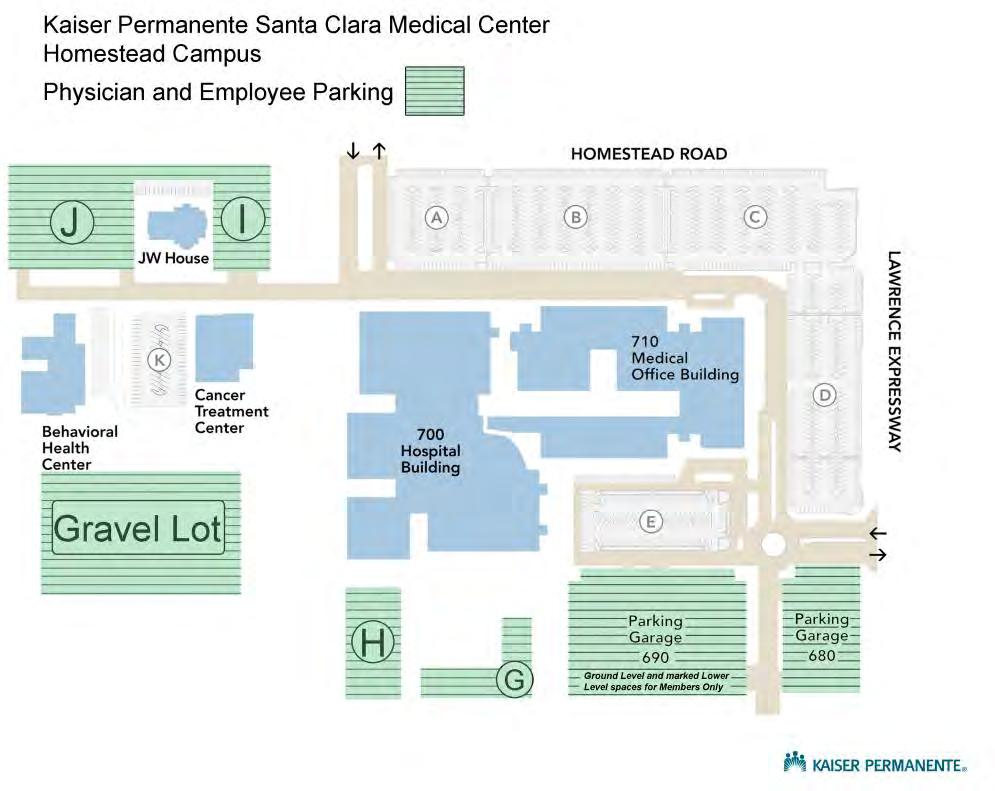
EvaluationandFeedback:
TheKaiserSantaClarafacultyandselectedancillarymedicalpersonnelwillcompletewrittenevaluationsattheendoftherotation. Selectedclinicpatientswillevaluatetheresidents.ResidentswillbeaskedtoevaluateeachFacultyMemberandtherotation.Daily feedbackonphysicalfindings,assessment,plan,andsurgicaltechniquewilloccurthroughclinicalinteractions.
ImportantContactInformation:
SusanKrause(AdministratorGMEOffice):Department384;408-851-3836.Susan.Krause@kp.org
AndreaMortley(GMEManager):408-851-3837Andrea.X.Mortley@kp.org
DianeParedes(HNSClinicManager):408-510-8817(cell),408-8412892(office).Diane.Paredes@kp.org
HNSClinicBackLine:408-851-2950
WhendialingintoaninternalextensionfromoutsideKP,dial(408)851-xxxx(4digitextension)
WhendialingoutfromKPtoanexternalnumber,dial9-1-areacode-number.
MORLockerRoomCode:1518,ASULockerRoomCode:9972.ASUScrubroomcode:15277
Goals and Objectives PGY 4: KPSC
Competency-based Goals and Objectives
Goal1. Expandknowledgeinareaofheadandneckoncology.
ResidentObjectives:
Beabletoevaluateandcreateatreatmentplanforpatientswith tumorsoftheheadand neck: particularlythosewithneoplasmsofthethyroidandparathyroidglands.
Beabletocounselandprovideappropriatecareforoperativeoncologypatientsinthe perioperativeperiod.
ACGMECompetencyGoals
MedicalKnowledge
PatientCare
PatientCare
Interpersonalandcommunicationskills
Goal2.Otology/Neurotology.Screen,diagnoseandmanagecomplaintsoftheearandvestibularsystem
ResidentObjectives:
Diagnose,manageanddeterminesurgicalcandidatesforcommondisordersaffectingthe earinanoutpatientsettingforotologicpathologyincluding:cerumenimpaction,acuteand recurrentotitismedia,otitisexterna,perforationofthetympanicmembrane, eustachian tubedisfunction,cholesteatoma,suddensensorineuralhearingloss,andpresbyacuisis.
ACGMECompetencyGoals
MedicalKnowledge
PatientCare
Diagnose,manageanddeterminesurgicalcandidatesforcommondisordersofthe vestibularsystem including;Benignpositionalvertigo,Meniere’sdisease,andmigraine variantvertigo
Refinetheuseofancillarytestingtoassistindiagnosisandmanagementofdisordersear andvestibularsystemincludingpuretoneaudiology,ABR(auditorybrainstemresponse), vestibulartesting.
Provideappropriatecareforperioperativeotologypatients.
MedicalKnowledge
PatientCare
MedicalKnowledge PatientCare
PatientCare
MedicalKnowledge
InterpersonalandCommunicationSkills
Goal3.Rhinology.Diagnose,manageanddeterminesurgicalcandidatesfornasalobstructionandsinusitis.
ResidentObjectives:
Identifyandmanagethesymptomsrelatedtoallergicrhinitis.
Determinecandidatesforfunctionalrhinoplastytoimprovethenasalairway:ie,external valvecollapse.
Differentiateandbeabletoexplainthemedicaltreatmentalgorithmsforacuteandchronic sinusitis.
Understandandbeabletoexplainthedifferencesinpediatricandadult“sinusitis.”
Determinecandidatesforendoscopicsinussurgery,andforimageguidedendoscopicsinus surgery.
ACGMEcompetencygoals
PatientCare
MedicalKnowledge
MedicalKnowledge
PatientCare
MedicalKnowledge
PatientCare
InterpersonalandCommunicationsSkills
MedicalKnowledge
InterpersonalandCommunicationsSkills
PatientCare
InterpersonalandCommunicationSkills
Goal4.PediatricOtolaryngology.Developcompetenceinpatientcareofpediatricpatientswithotolaryngologicpathology
ResidentObjectives:
Diagnose,manageanddeterminesurgicalcandidatesforobstructivesleepapneain children.
Diagnose,manageanddeterminesurgicalcandidatesforrecurrentotitismediaandchronic seriousotitismediainchildren.
ACGMECompetencyGoals
MedicalKnowledge
PatientCare
MedicalKnowledge
PatientCare
Diagnose,manageanddeterminesurgicalcandidatesforbreathingproblemsinchildren including:stridor,laryngomalacia,foreignbodyaspiration,respiratoryfailurerequiring tracheostomy.
Diagnose,manageanddeterminesurgicalcandidatesfornasalobstructioninchildren includinginferiorturbinatehypertrophy,adenoidhypertrophy.
Diagnose,manageanddeterminesurgicalcandidatesforcommonmassesintheheadand neckincluding:preauricularpitsandcysts,brachialcleftcysts,thyroglossalductcysts,and mucoceles.
Goal5. Beabletocompetentlyperformcommonotolaryngologyprocedures
ResidentObjectives:Forthefollowingoperativeprocedures:
• Beabletodiscusstherisks,benefitsandalternativesofeachprocedurewiththepatient
• Understandthepertinentanatomy
• Identifykeycriticalsurgicalsteps,understandintraoperativedecisionmaking
• UnderstandtheimpactofpathologyonPostopcareandtreatmentplan
A.HeadandNeckOncologyKeySurgicalCases
1. Thyroidectomy
2. Parathyroidectomy
B. OtologyKeySurgicalcases
1. Tympanoplastywithandwithoutossicularchainreconstruction
C. RhinologyKeySurgicalCases
1. Endoscopicsinussurgery
2. Septoplasty
3. Turbinatereduction
MedicalKnowledge PatientCare
MedicalKnowledge PatientCare
MedicalKnowledge PatientCare
MedicalKnowledge PatientCare
MedicalKnowledge PatientCare
MedicalKnowledge PatientCare
MedicalKnowledge PatientCare
MedicalKnowledge PatientCare
MedicalKnowledge PatientCare
4. Functionalandcosmeticrhinoplasty
D. PediatricOtolaryngology
1. Tonsillectomy,adenoidectomy
2.Myringotomyandtubeplacement
Goal6. ExpandpracticeofgeneralOHNSandmedicalcareissues
ResidentObjectives:
Expandsenseofempathyregardingthebarriersthatconspiretopreventpatientsfrom receivingoptimalhealthcare(lackoftransportation,languagebarriers,socioeconomic status,culturaldifferences,educationlevel,familysupport,etc.).
Demonstratecompetenceinmaintainingconfidentialityinpatientmedicalrecords,patient care,andpatientrelatedcommunications.
Continuetodevelopanunderstandingofone'sownabilitiesandlimitations,anda commitmenttolife-longlearningandimprovement,throughactivitiessuchascase presentationatMorbidityandMortalityconference,includingdirectedliteraturereviewand discussionofsystemsimprovementsasappropriate.
MedicalKnowledge
PatientCare
MedicalKnowledge
PatientCare
MedicalKnowledge
PatientCare
ACGMECompetencyGoals
PatientCare
InterpersonalandCommunicationSkills
Professionalism
Professionalism
InterpersonalandCommunicationSkills
Practice-BasedLearningandImprovement
Professionalism
Systems-BasedPractice
Evaluateandtreatpediatricandadultoutpatientsandinpatients inamanagedcaresetting. PatientCare
MedicalKnowledge
Systems-BasedPractice
Understandtheimportanceofconfidentialityinpatientmedicalrecords.
Knowhowtouse theKaiserelectronicmedicalrecordsystem(EPIC),complete consultations,clinicnotesinatimelyfashion.
Knowhowtousethesecuremessagesystemtocommunicatewithreferringphysiciansand patientsforpatientemails,answerquestionsandcommunicatelabandbiopsyresults.
KnowhowtousetheECONSULTsystem,consultspecialistsinaresponsiblemannerand maintainacommunicationwithconsultingphysicians.
Professionalism
Professionalism
InterpersonalandCommunicationsSkills
Professionalism
Systems-BasedPractice
InterpersonalandCommunicationsSkills
Professionalism
KnowhowtoorderandreviewradiologicalstudiesthroughtheSTENTORsysteminan effectivemanner.
Systems-BasedPractice
MedicalKnowledge
Systems-BasedPractice
StanfordHealthCareandLucilePackardChildren’sHospitalNightFloatRotation
RotationSpecifics:
1. NightfloatisonSunday-Thursdaynightsfrom6pmto6am.
2. Allcallisin-house.
3. Thenightfloatresidentwillseeallconsultsandtakealloutsidecallswhichcomeinafter5pm;betheoperativeresidentonanycases whichstartafter8:00pmandwillbegintakingthefloorcallsoncethehand-offfromthatteamhasoccurred.
4. Beginningat7:30pmthenightfloatresidentwilltakeoverinanyrunningORs.
Goal1. Consults. Knowhowtoevaluateandtreatinpatientandemergencydepartmentconsultpatients.
ResidentObjectives:
Betheinitialcontactresidentforallconsultsat SHCandLPCHservicesincludingthe emergencydepartment.
Performinitialevaluationofallconsultpatients.
BefamiliarwiththeEPICmedicalrecordsystemsandbeabletoaccessinformation appropriately. Understandtheimportanceofconfidentialityinpatientmedicalrecords.
Consistentlydemonstratecourtesywheninteractingwithclinicalandnon-clinicalstaff members.
Performaliteraturesearchtolearnmoreaboutunusualpatientproblems.
Createacompleteandcoherentconsultationnoteinatimelyfashion.
Utilizetranslationservicestocommunicatewithnon-Englishspeakingpatientsasneeded.
ACGMECompetencyGoals
PatientCare
MedicalKnowledge
InterpersonalandCommunicationSkills
Systems-BasedPractice
PatientCare
MedicalKnowledge
PatientCare
Professionalism
Systems-BasedPractice
InterpersonalandCommunicationSkills
Professionalism
MedicalKnowledge
Practice-BasedLearningandImprovement
InterpersonalandCommunicationSkills
Professionalism
InterpersonalandCommunicationSkills
Systems-BasedPractice
Demonstrateeffectivetime-managementskills.
Follow-uponconsultpatientsasneeded.
Goal2. Hand-offs. Knowhowtoreceiveandgivehand-offs.
ResidentObjectives:
Receiveandgivehand-offsinathoroughandefficientmanner.
Demonstrateeffectivenessinfollowingupallto-doitemscommunicatedthroughthehandoffprocess.
Professionalism
Practice-BasedLearningandImprovement
PatientCare
Systems-BasedPractice
Professionalism
CompetencyGoals
PatientCare
InterpersonalandCommunicationSkills
Professionalism
PatientCare
Goal3.Patientphonecalls. Knowhowtoappropriatelycommunicatewithpatientsviathephone.
ResidentObjectives:
Beabletoobtainanappropriatehistoryfrompatientswhocallinthroughthehospital operators.
Beabletodirectoutsidepatientsappropriately.
Beabletoappropriatelydocumentpatientphonecallsinthemedicalrecord.
CompetencyGoals
PatientCare
InterpersonalandCommunicationSkills
PatientCare
InterpersonalandCommunicationSkills
PatientCare
Systems-BasedPractice
Goal4. Operativeexperience. Knowhowtoperformsurgicalproceduresintheafterbusiness-hourssetting.
ResidentObjectives:
Beabletoperformprocedureswhichmustbedoneonanurgentbasisafternormal businesshours.
Beabletorapidlylearnapatient’shistoryandstepintoassistinsurgerywhichison-going.
CompetencyGoals
PatientCare
PatientCare
MedicalKnowledge
OHNSResidentResearchProgram
Introduction:Protectedresearchtimewillbeallottedtoresidentsthroughoutthecourseoftheirtraining.Asthe mainfocalpointofthe researchprogram, R3residentwillhaveonethree-monthblockofdedicatedresearchtimetoengageinoneormoreprojects. Inaddition,there willbethree-monthsofhalf-timeresearchtimeduringtheR3year.Eachresidentmusthaveafull-timeStanfordfacultyadvisorandmayhave anadditionaldirectresearchadvisoriftheresearchisperformedoutsidetheOtolaryngologydepartment.Thisrotationisintendedtogivethe residentmaximumflexibilityregardingthesubjectmatteroftheresearchproject.Eachresidentisexpectedtopublishatleastonemanuscript inapeer-reviewedjournalduringtheirresidency.
PGY1/PGY2
DuringthePGY1rotationsonOtolaryngologyandthefirstfewPGY2rotations,theresidentshouldinvestigatedepartmentalprojectsand arrangetomeetwithatleastthreeOtolaryngologyfacultymemberstodiscusspossibleresearchprojectsfortheresearchrotation.ThePGY1 residentshaveatwo-weekblockofRadiology/Researchto gettounderstandthebasicsofresearchandto facilitatetheirexplorationofresearch opportunities.(SeetheGoalsandObjectivesfor thePGY1Radiology/Researchrotation)
PGY2 Winter
Deadline:January/FebruaryofPGY2year(bepreparedtodiscussatthetimeofsemiannualmeetingwithprogramdirector orassociateprogram directorand reviewedwiththeResidentResearchSupervisor,Dr.Finegersh,inMarch.) Afterreviewanddiscussion,theresidentselectsaprojectandwiththehelpoftheiradvisorwritesatwo-pageproposaldetailinghowthe researchblockwillbespent(seebelowfordetails). TheproposalshouldbepreparedforsubmissionfortheAmericanAcademyof Otolaryngology–Head&NeckSurgeryFoundationCOREGrant.
Theresearchproposalshouldconsistof:
▪ Yourfacultyadvisor’sname(mustbeStanfordfull-timefaculty).Youmayhaveanadjunctclinicalfacultymemberornon-faculty memberasyourdirectresearchadvisor,withtheapprovalofyourfacultyadvisor.Submitbothnames,ifappropriate.
▪ Writtenproposal:
o Specific Aims and Significance.Whatquestionareyoutryingtoanswerandwhatisthesignificanceofthatquestion?
o Background and Literature Search.Summarizepreviousrelevantworkinthearea;demonstratethatyouhavedoneyour homeworkwithanannotatedbibliographyandexplainhowotherstudieshavebeenlacking.
o Methodology.Howdoyouplantoansweryourquestionorquestions?Howmanyanimalsandwhattypeandhowdidyourchoose thatanimal?Whattypeoflabequipmentwillyoubeusing?Forthosestudiesrequiringaclinicalchartreview,howmanycharts doyouintendtoreview,where,andhowwillyougetthecharts?Whatproblemsdoyouanticipateandhowdoyouthinkthese canbeovercome?
o Data.Forallproposals,howwillthedatabeanalyzed?Whatstatisticalmethodswillbeused?
o Budget.Thismustbedetailedandappropriatelyjustified.Roughestimatesarenotacceptable.
o Bibliography.
PGY3
TheR3willcarryouttheresearchproposalsubmittedduringthePGY2year utilizingthededicatedfull-timeandhalf-timeresearchblocks.
PGY4/5
DuringtheR4year,therewillbeallotted3-6weeksoffull-timeresearchtimetocompleteprojectsfromtheR3yearor workonnewprojects.The R5willhaveone5-weekblockoffull-timeresearchorelectivetime.
Thegoalsandobjectivesoftheresearchprogramareoutlinedinthe followingtable.
Competency-basedGoalsandObjectives:
Goal1. Beabletoconstructaplanforresearch
ResidentObjectives:
Constructaresearchplanandcreatearesearchproposal(includingSpecificAimsand significance,Backgroundandliteraturesearch,methodology,Dataanalysisplan, Budget,Bibliography). ThisshouldbedoneduringtheR1andR2years.
ACGMECompetencyGoals
Systems-BasedPractice
Completethemandatoryeducationprogramsforinvestigatorsinvolvedinhuman and/oranimalresearch. Professionalism Systems-BasedPractice
CompletetheHumanSubjectsand/orAnimalsubjectsapplicationsandsubmitina timelyfashion. Professionalism Systems-BasedPractice
Presentyourresearchplantwomonthsbeforetheofficialresearchrotationbegins. InterpersonalandCommunicationSkills
Goal2. Knowhowtocarryoutaresearchproject
ResidentObjectives:
Completethedataacquisitionportionoftheresearchplan.
Demonstrateanabilitytoadapttheresearchplan(“troubleshoot”)basedon unexpectedresultsordifficulties.
Demonstrateanunderstandingofthevariouspersonnelwhocontributetothe researchprocess. Coordinateandperformtheresearchthroughcooperationand respectfulcommunicationwithallmembersoftheresearchteam.
Demonstrateacommitmenttoresearchintegrityincludingthehighestethical standardsingathering, analyzing,andreportingdata.
Goal3.Analysisanddisseminationofresultsofresearchproject
ResidentObjectives:
Demonstrateanabilitytoanalyzethedataobtainedintheresearchstudyand understandthestatisticalmethodsinvolved.
Writeamanuscripttothespecificationsofthejournalproposedforsubmission.Revise themanuscriptbasedoncommentaryfromadvisoryfaculty. Submitthemanuscript forpossiblepublication.
Presenttheresultsofyourresearchattheyear-endresearchsymposium.Talkswillbe 7minuteslongwith3minutesofQ&A. Residentsareexpectedtopresentaprojectat theendoftheir R2,R3,R4andR5years. PresentationattheendoftheR2yearduring theresidentresearchsymposium maybeacasereport.
PresentaresearchprojectattheBayAreaResidentResearchSymposiumonetime duringyourresidency.
Atthecompletionoftherotation,beabletoreflectanddescribeintra/interpersonal andprofessionalchallengesandsuccessesoftheresearchproject.
ACGMECompetencyGoals
Systems-BasedPractice
Professionalism
InterpersonalandCommunicationSkills
InterpersonalandCommunicationSkills
Professionalism
ACGMECompetencyGoals
Systems-BasedPractice
Systems-BasedPractice
InterpersonalandCommunicationSkills
InterpersonalandCommunicationSkills
InterpersonalandCommunicationSkills
Practice-BasedLearningandImprovement
ChiefResidentMini-FellowshipandElectiveRotations
Rotation Contact and Scheduling Details
RotationDirector: C.KwangSung,MD,MS kwangs@stanford.edu
Introduction
TheMini-Fellowshiprotationwascreatedin2021-2022asawayforthechiefresidentstotakeadeep-diveintoasub-specialtyat Stanfordpriortograduationandembarkingonafellowshiporacomprehensiveotolaryngologypractice.Thechiefresidentshould identifyoneortwoattendingsinthechosensub-specialtytoserveasmentors.Theresidentshouldplanonspendingasignificant amountoftimeinclinic,aswellastheoperatingroomwiththementor.Therotationisalsoachanceforexposuretosomeofthe ancillaryspecialtiesorservicesthatmighthaveoverlapwiththechosen sub-specialty.Theresidentshouldplaninadvancetospend timewiththeseservicesforhands-onexposure,suchas:
• Neurosurgery
• Neurology
• PlasticSurgery
• Ophthalmology
• Oncology
• RadiationOncology
• PalliativeCare
• PainMedicine
• Gastroenterology
• InterventionalPulmonology
• SleepMedicine
• Neuroradiology
• Pathology
• Allergy
• Dermatology
• Endocrinology
• Geriatrics
• Dentistry/OralSurgery
• Audiology
• SpeechLanguagePathology
Thechiefresidentelectiverotationisa5-weekblockthatcanbeutilizedforwrappingupresearchprojectsorschedulingformal electiverotations,suchasmedicalmissionsorvisitingrotationsatotherinstitutions. Themaximumamountoftimespentawayfrom campusonmissiontripsis2weeksperyear sincethemaximumtotaltimeawayallowedbythe AmericanBoardofOtolaryngology–Head&NeckSurgeryis6weeksperyear(unlessvacationtimeisutilizedforthemissiontrip)sincemissiontripscounttowardthe yearlytimeawayallotment.
ThechiefresidentshouldsubmitawrittenplanfortheMiniFellowshipanduseoftheelective/researchblock atleasttwomonthsprior tothestartoftherotation.
Competency-basedGoalsandObjectives: PGY5–Mini-FellowshipandElective
Goal1. Gainin-depthknowledgeinasub-specialty
ResidentObjectives:
Spendtimeinclinicandtheoperatingroomwithasub-specialtymentorto increaseknowledgeandlearnnuancesofthesubjectmatter.
Obtainin-personexperiencewithancillaryservicesanddepartmentsrelatedto thechosensub-specialty.
ACGMECompetencyGoals
PatientCare
MedicalKnowledge
InterpersonalandCommunicationSkills
Professionalism
Systems-BasedPractice
PatientCare
MedicalKnowledge
Practice-BasedLearningandImprovement
22.Appendices
AppendixA–ConferenceDates
Date
Oct.17–Oct.20,2026
Jan21-23,2027
April7-11,2027
June18,2027
Event
AAO-HNSAnnualMeeting
TriologicalSociety: CombinedSections Meeting
CombinedOtolaryngology SpringMeetings(COSM)
StanfordOHNSResidency ResearchSymposium
Location AbstractDue
LosAngeles,CA June9,2026
HuntingtonBeach, CA August1,2026
Seattle,WA July1–Oct.15, 2026
Stanford,CA June1,2027
AppendixB–KeyIndicators
RequiredMinimumNumberofKeyIndicatorProcedures ForGraduatingResidents
Note:Caselogsfor2027programgraduateswillbereviewedforcompliancewithminimum numbersbutnocitationswillbegiven.Residentsgraduatingin2027areexpectedtoachieve therequiredminimumnumbersforallKeyIndicatorProcedures.Achievementoftherequired minimumnumbersisanindicatorofexperiencebutisnotconsideredanindicatorof competence.Programsshouldcontinuetoevaluateproceduralcompetenceinorderto ensurethatgraduatesarecompetenttoenterpracticewithoutdirectsupervision.
Category Procedure
AppendixC–HandoverEvaluationForm
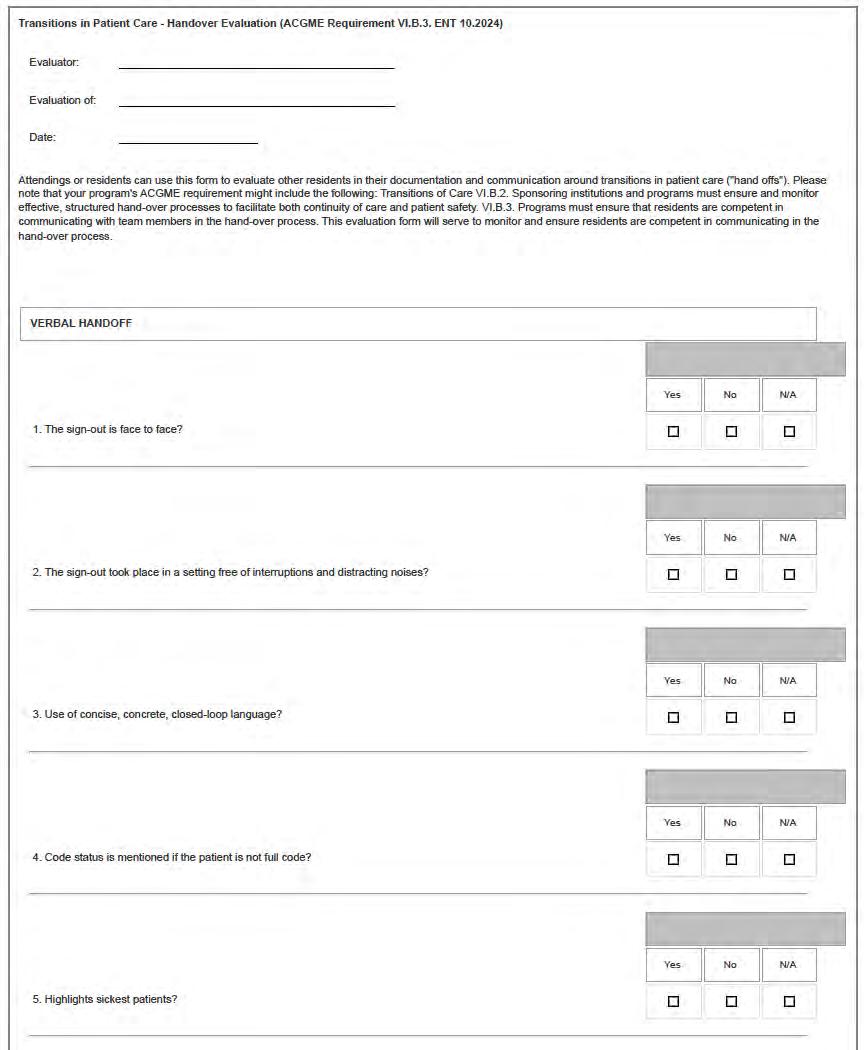
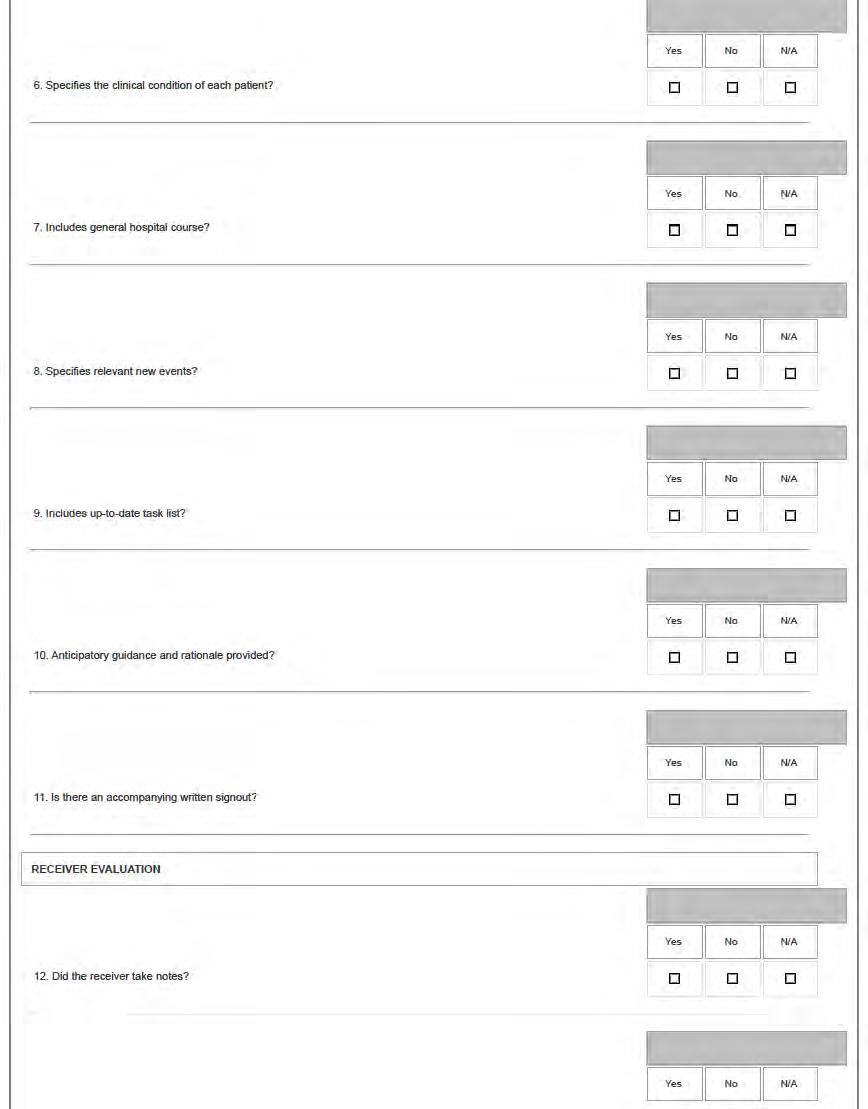
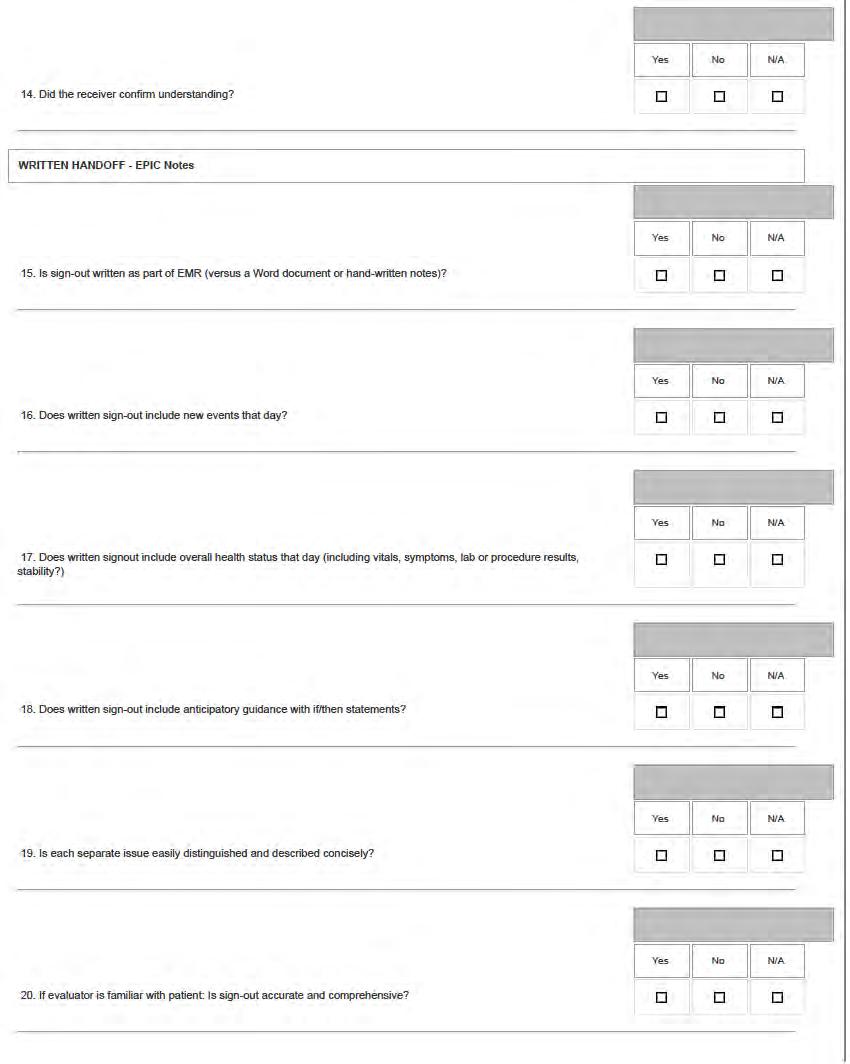
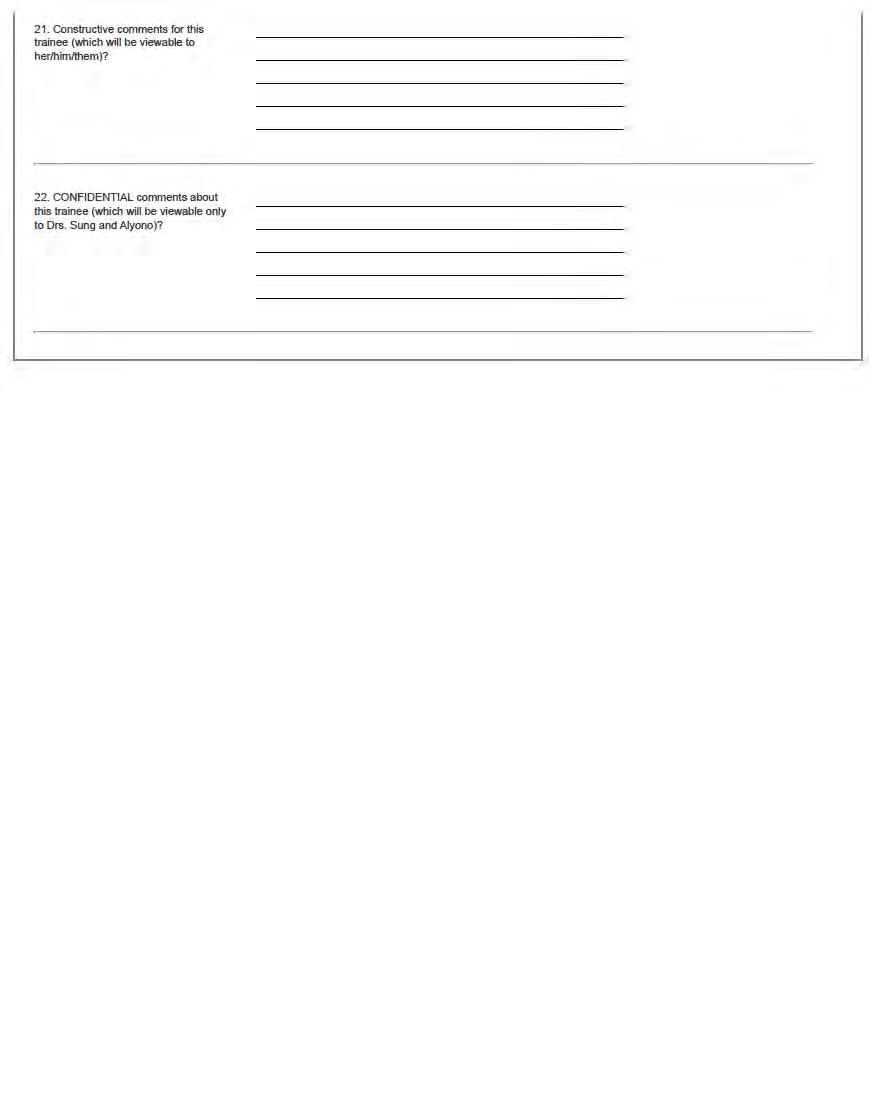
Appendix
D–EvaluationFormofFaculty byResident
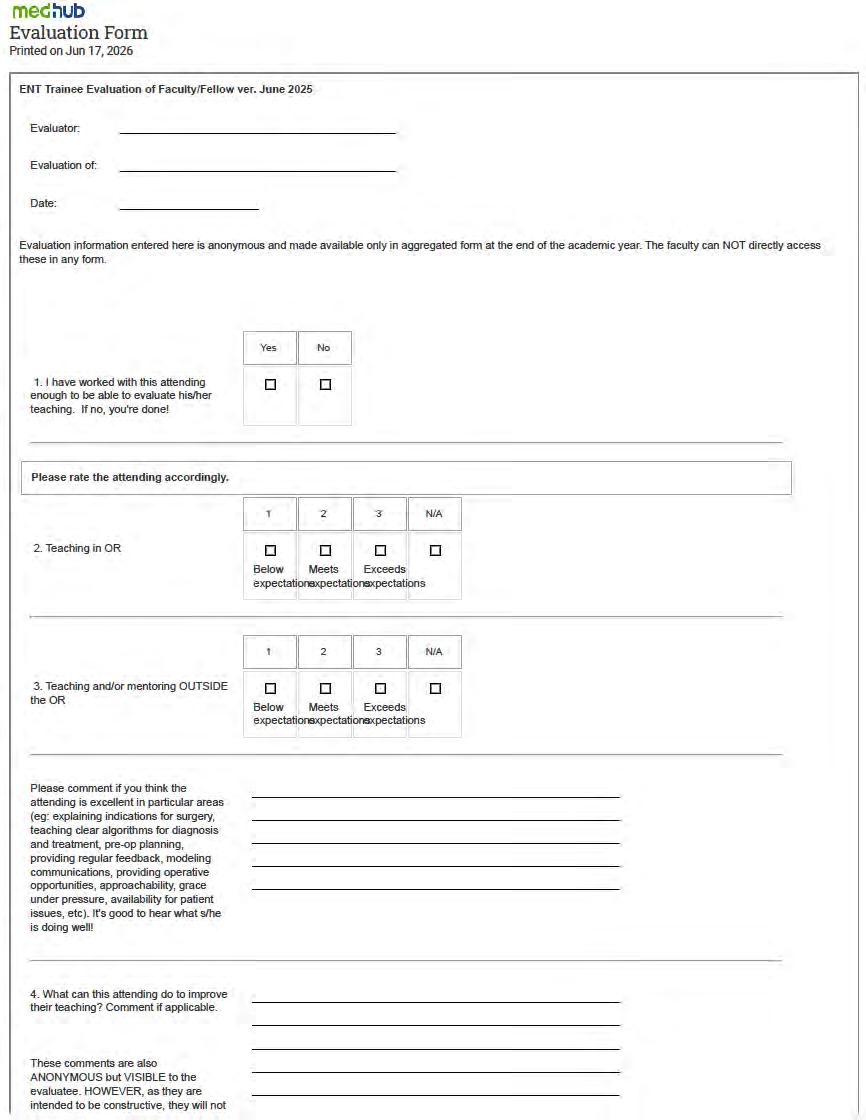
AppendixE–EvaluationFormofResidentbyFaculty
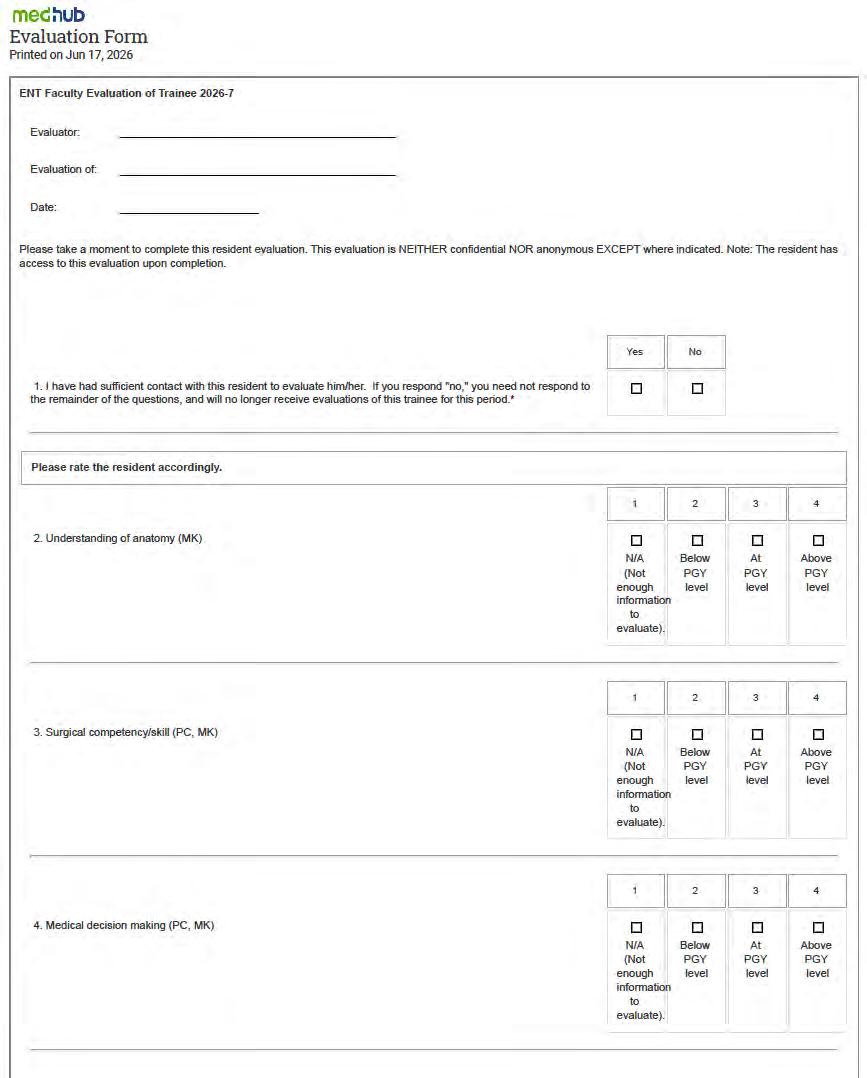
Appendix
F–EvaluationFormofService/RotationbyResident
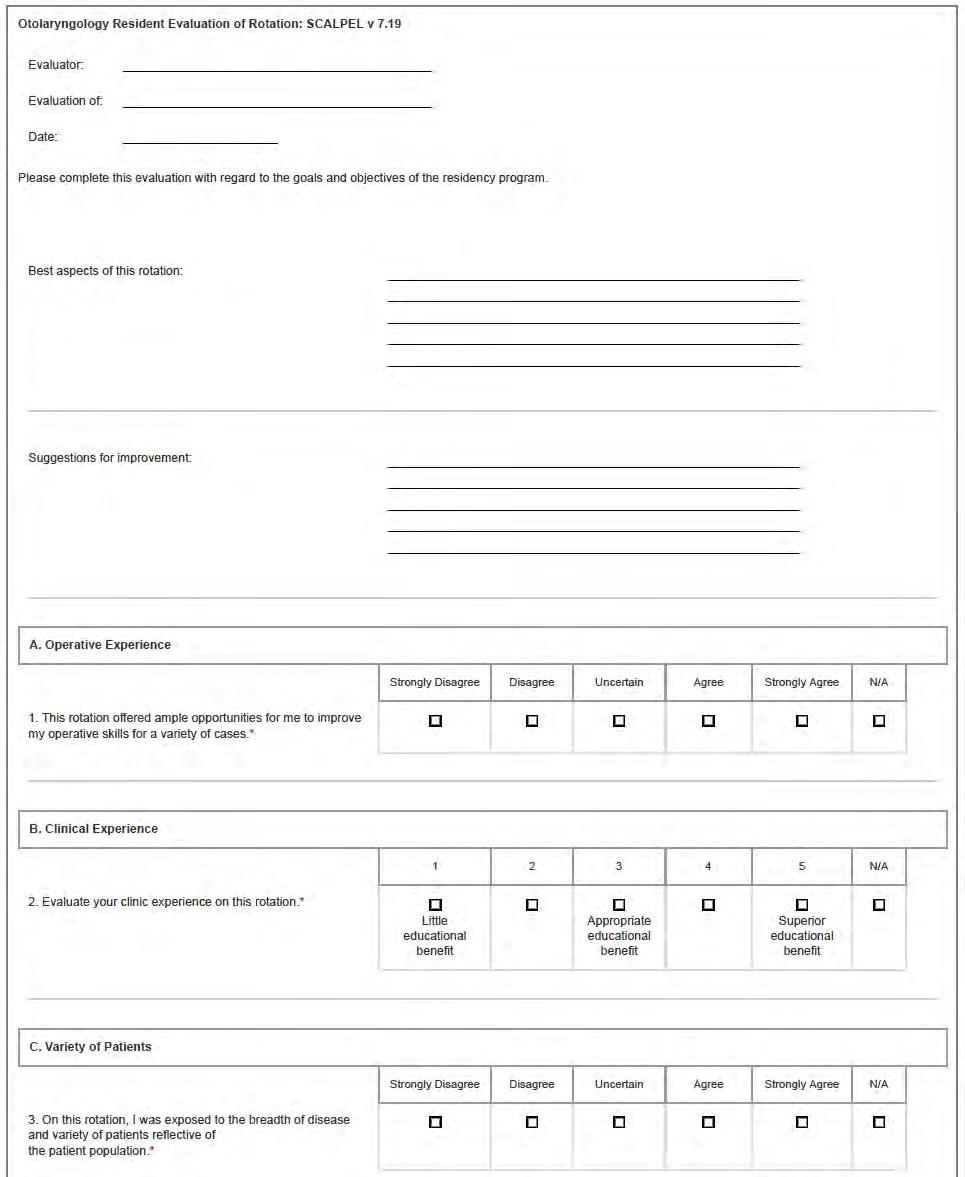
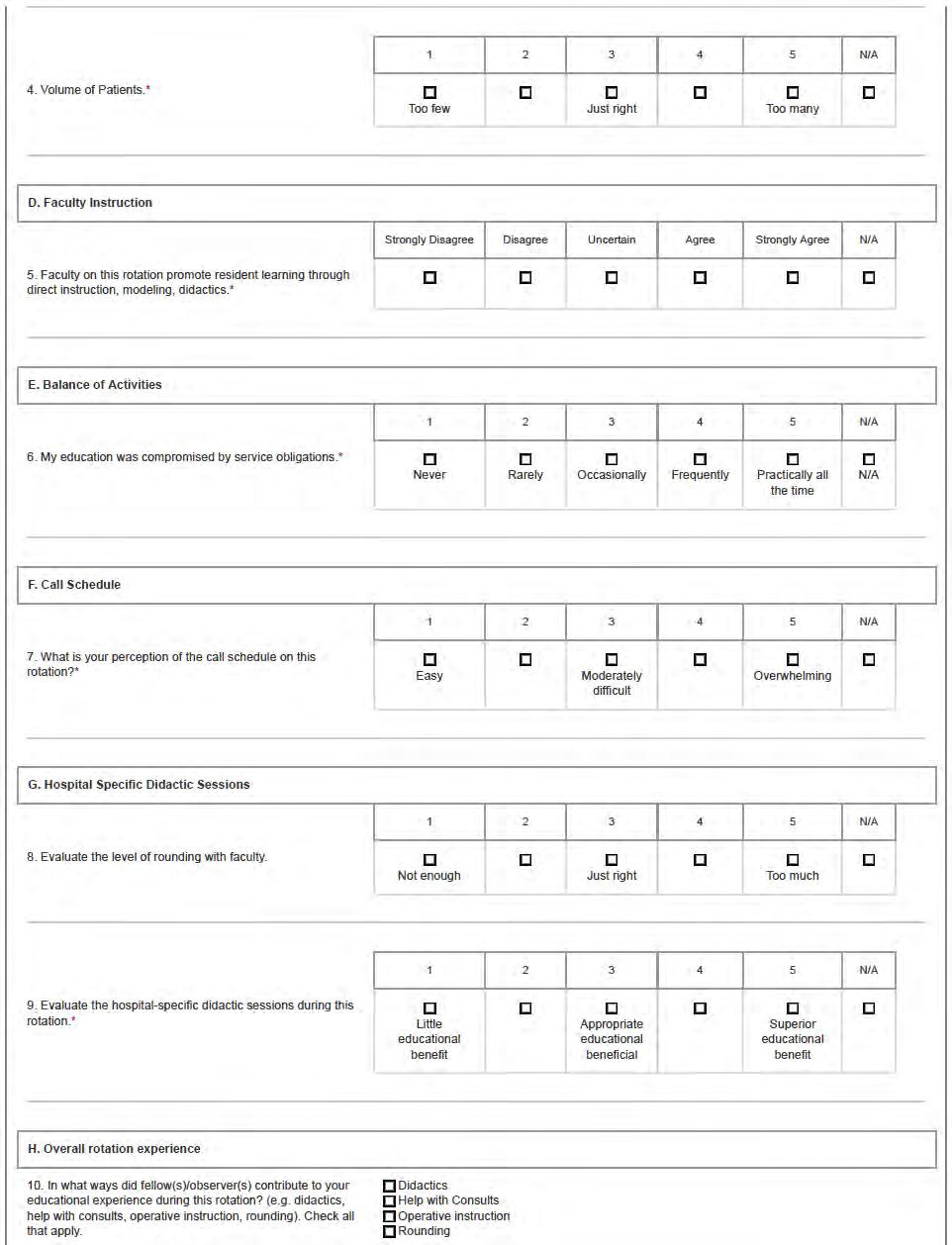
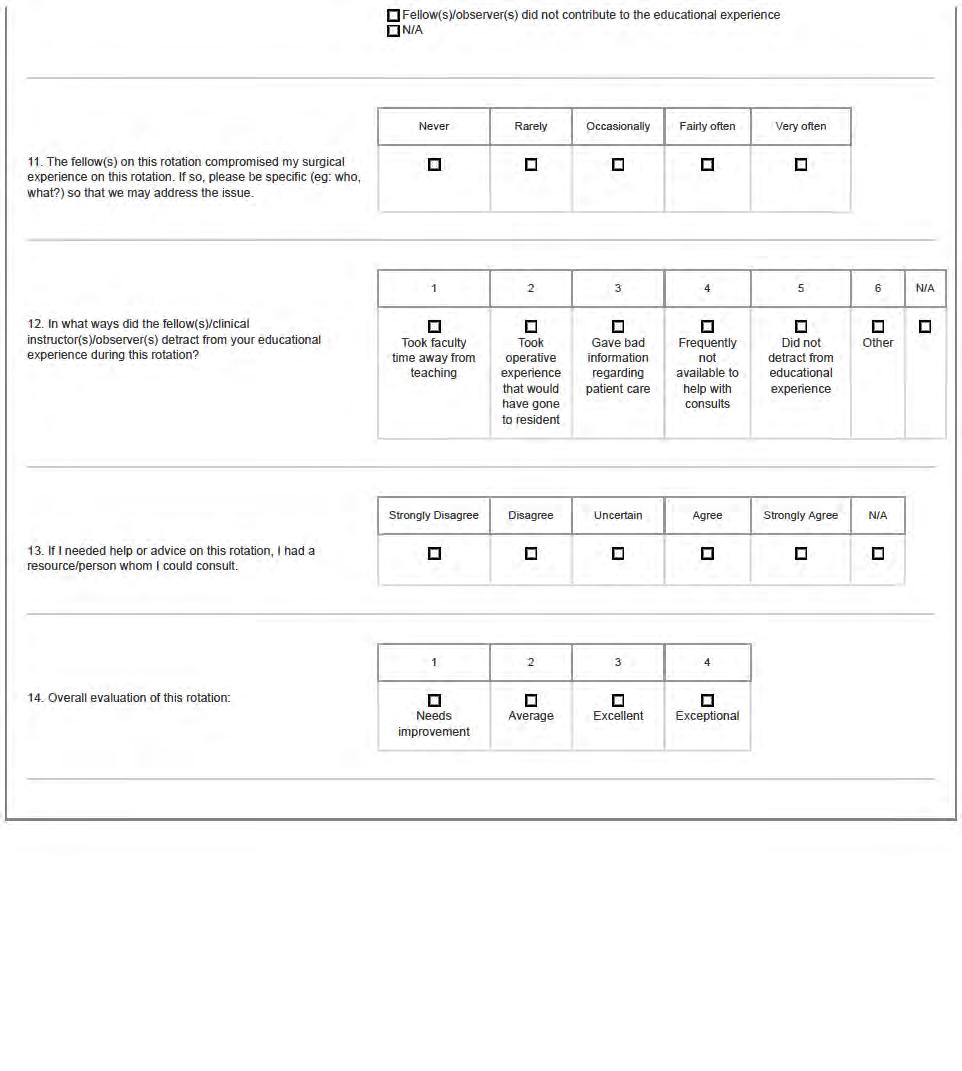
AppendixG–ResidentPeerEvaluationForm
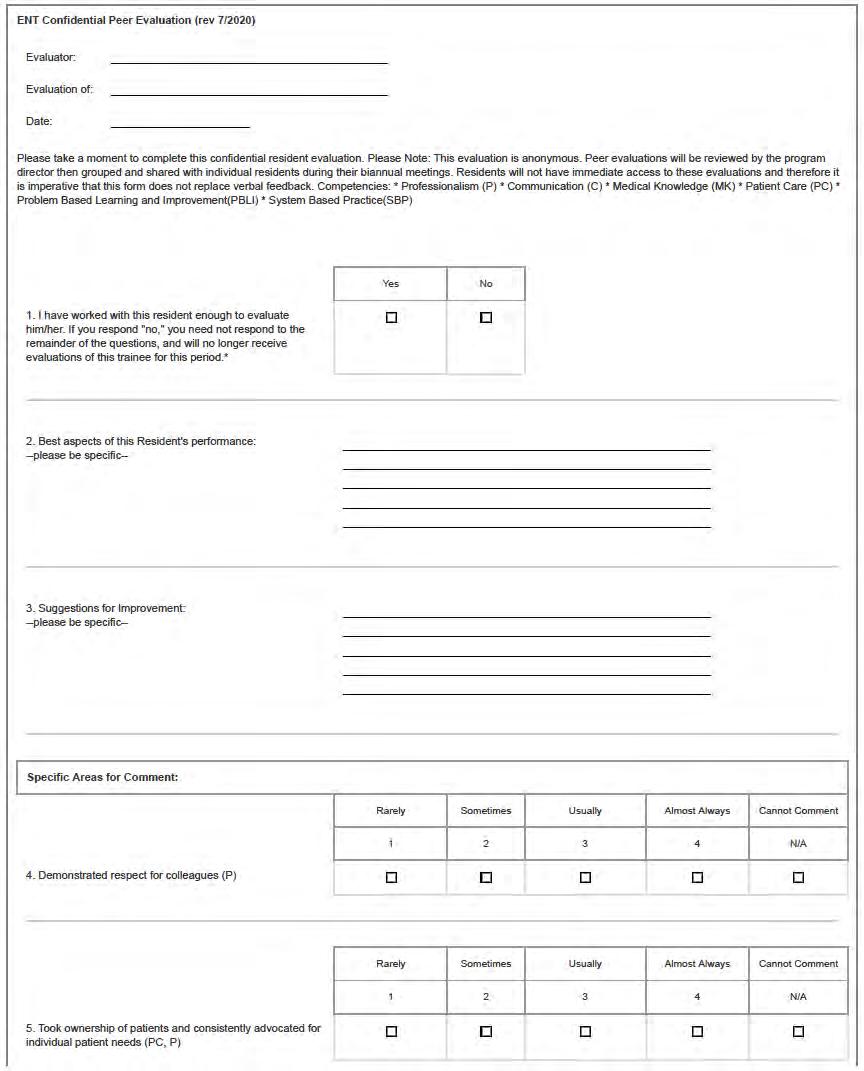
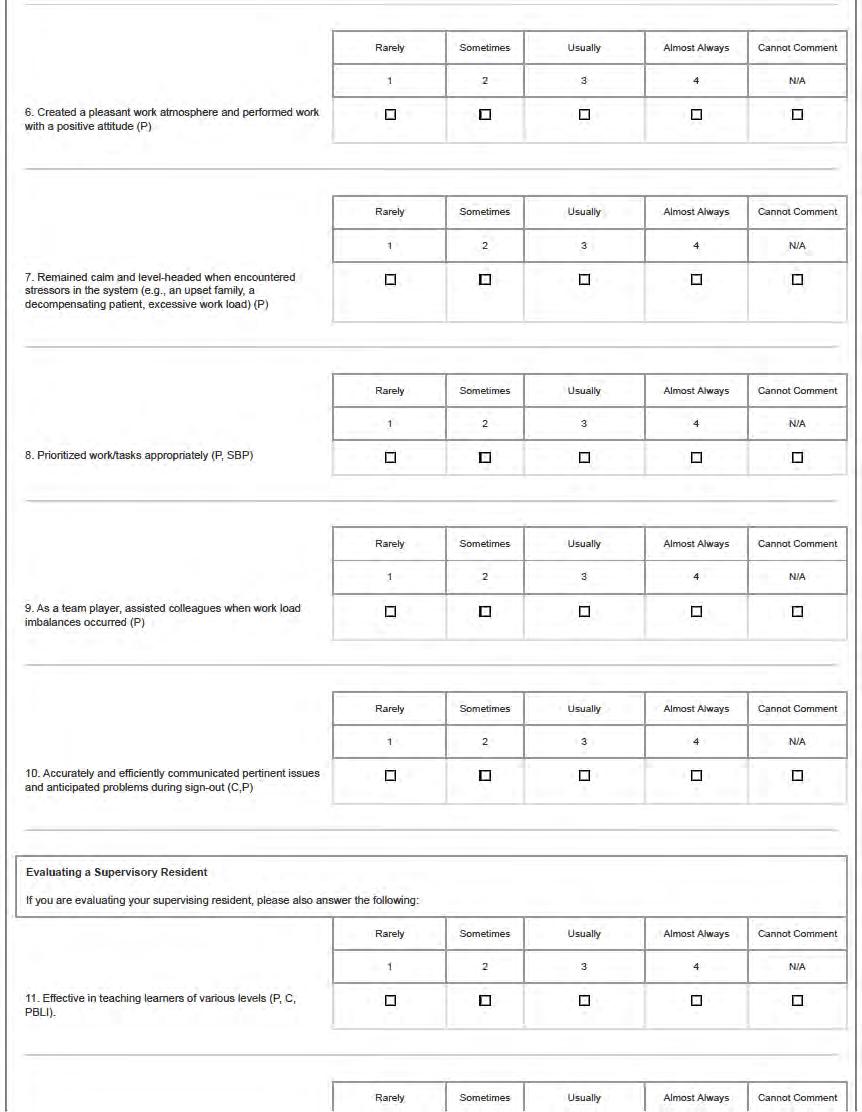
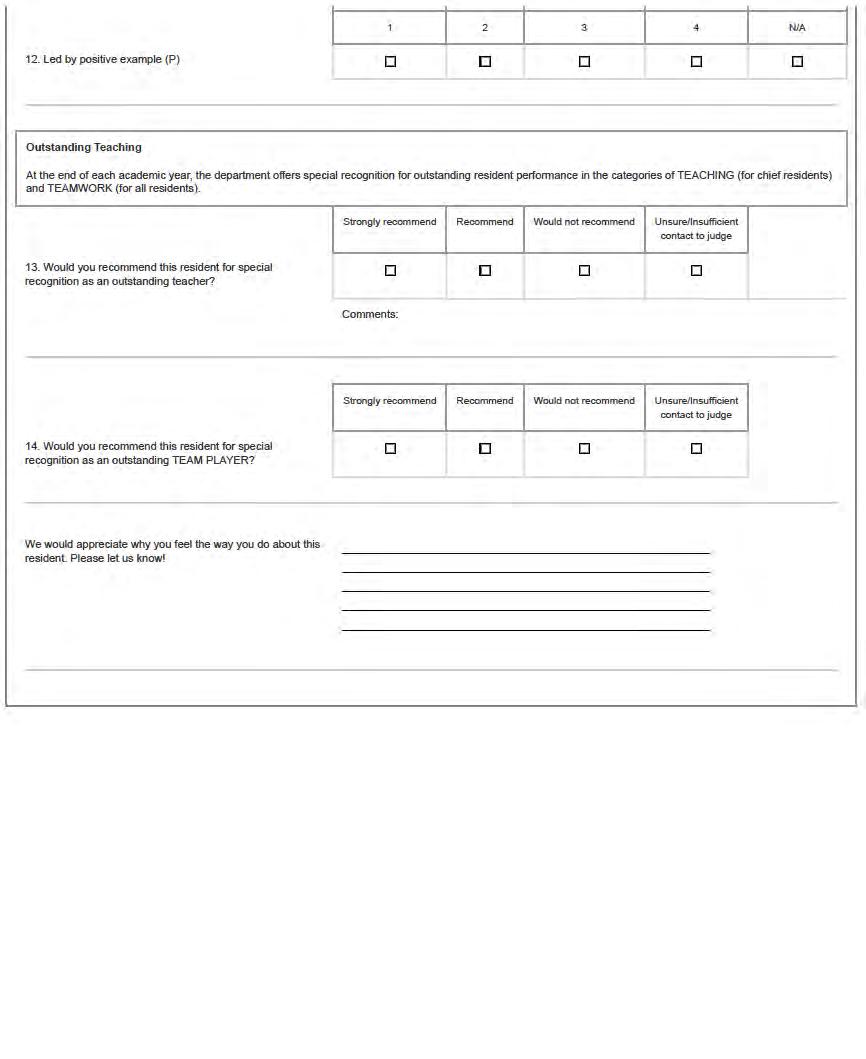
AppendixH–EvaluationFormofResidentbyStaff
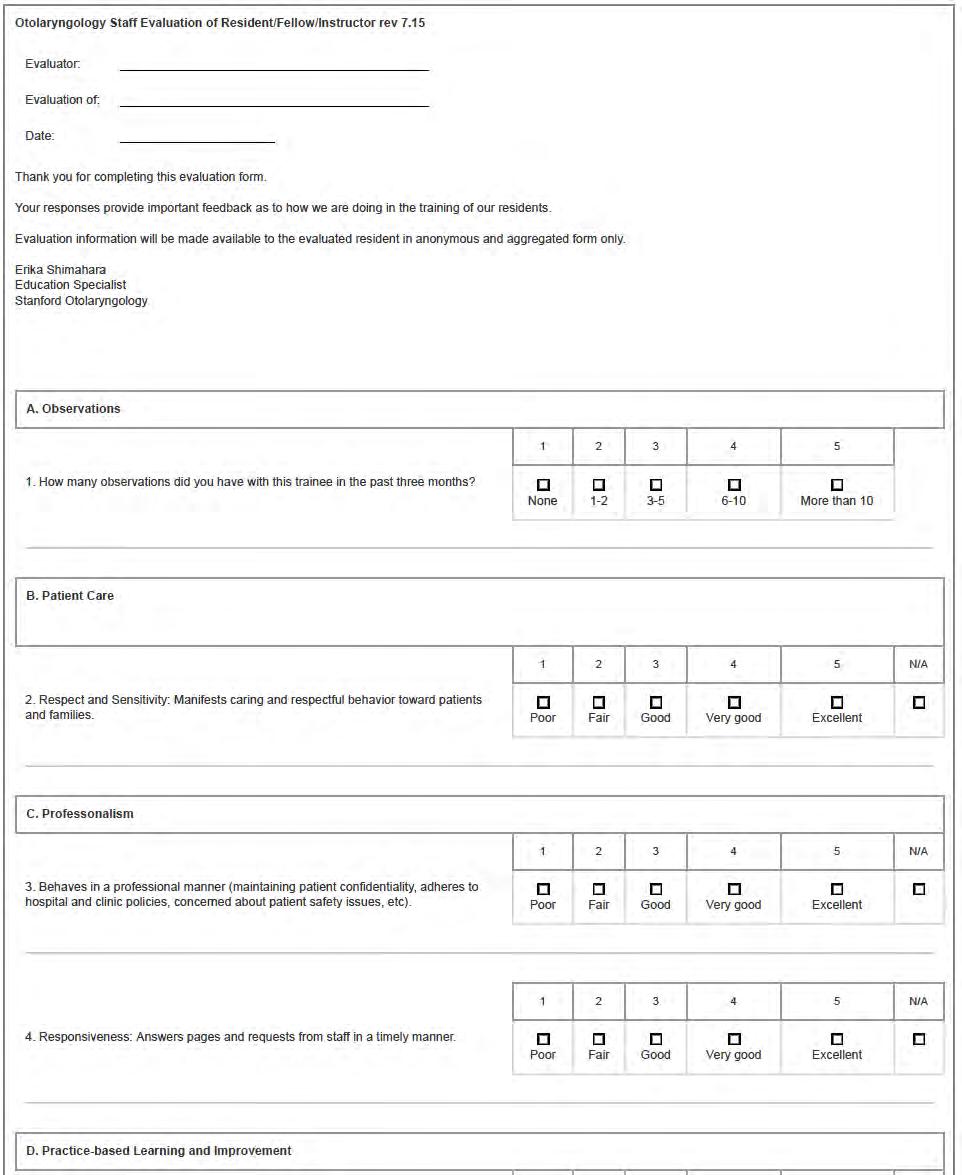
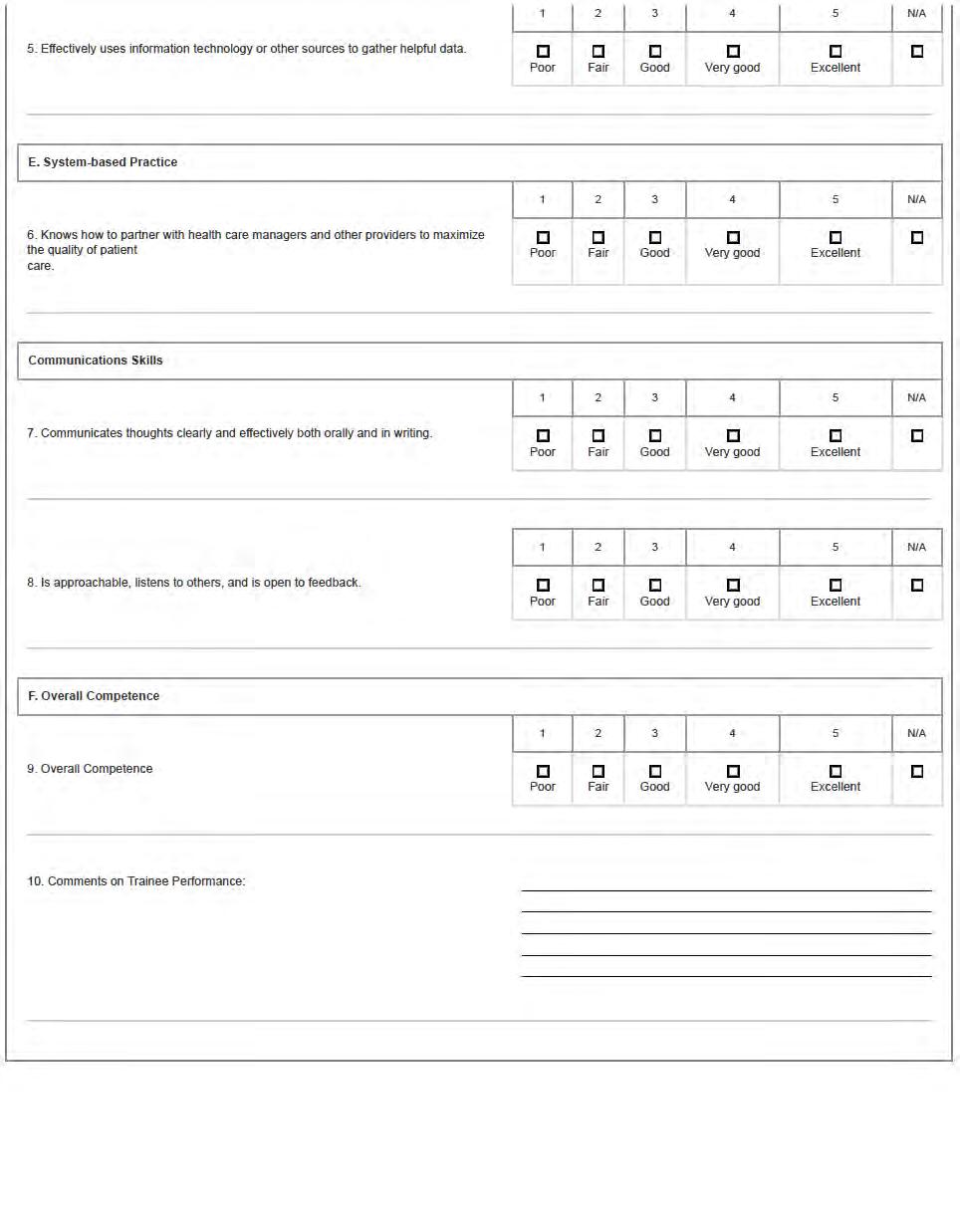
AppendixI–EvaluationFormofResident byPatient
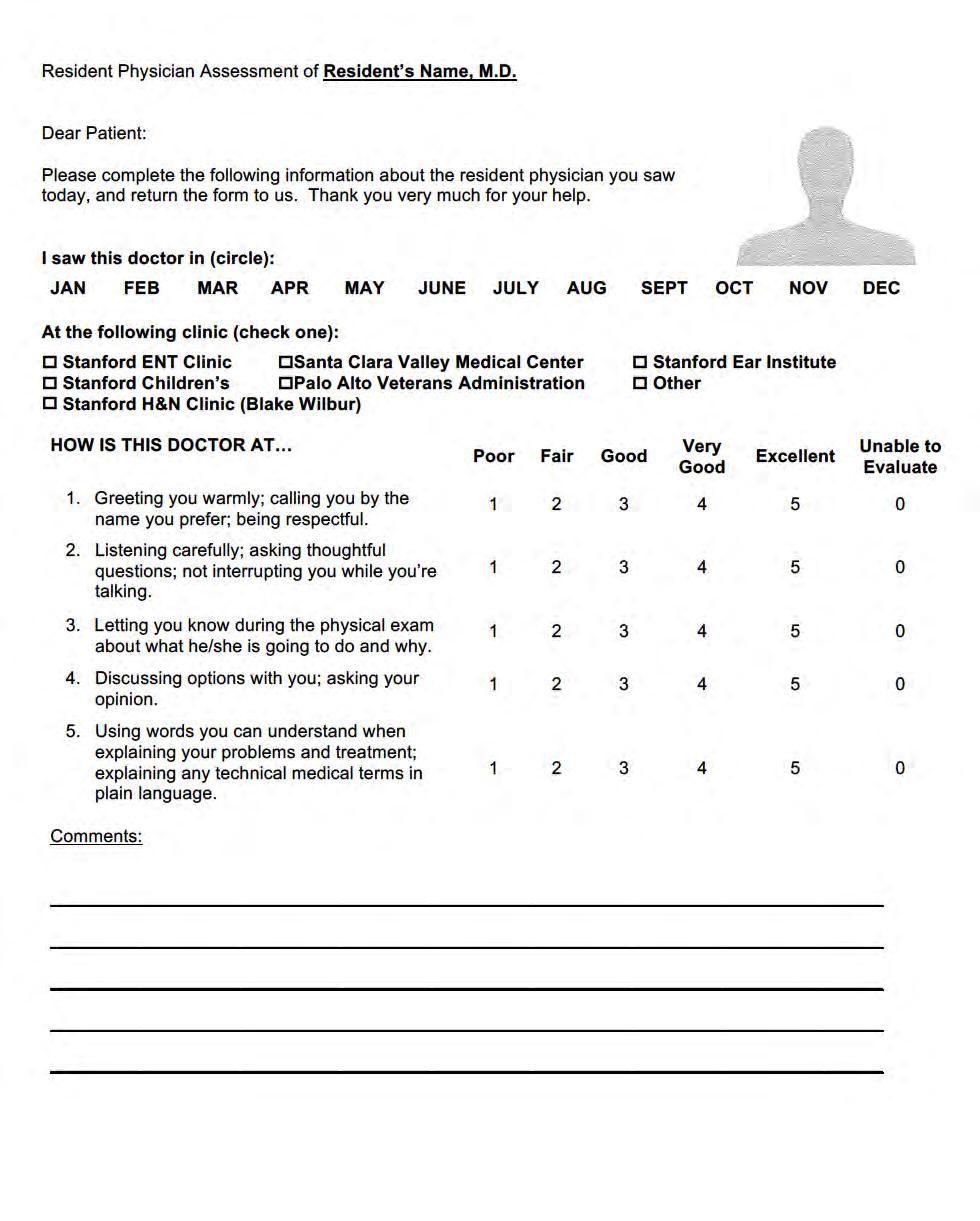
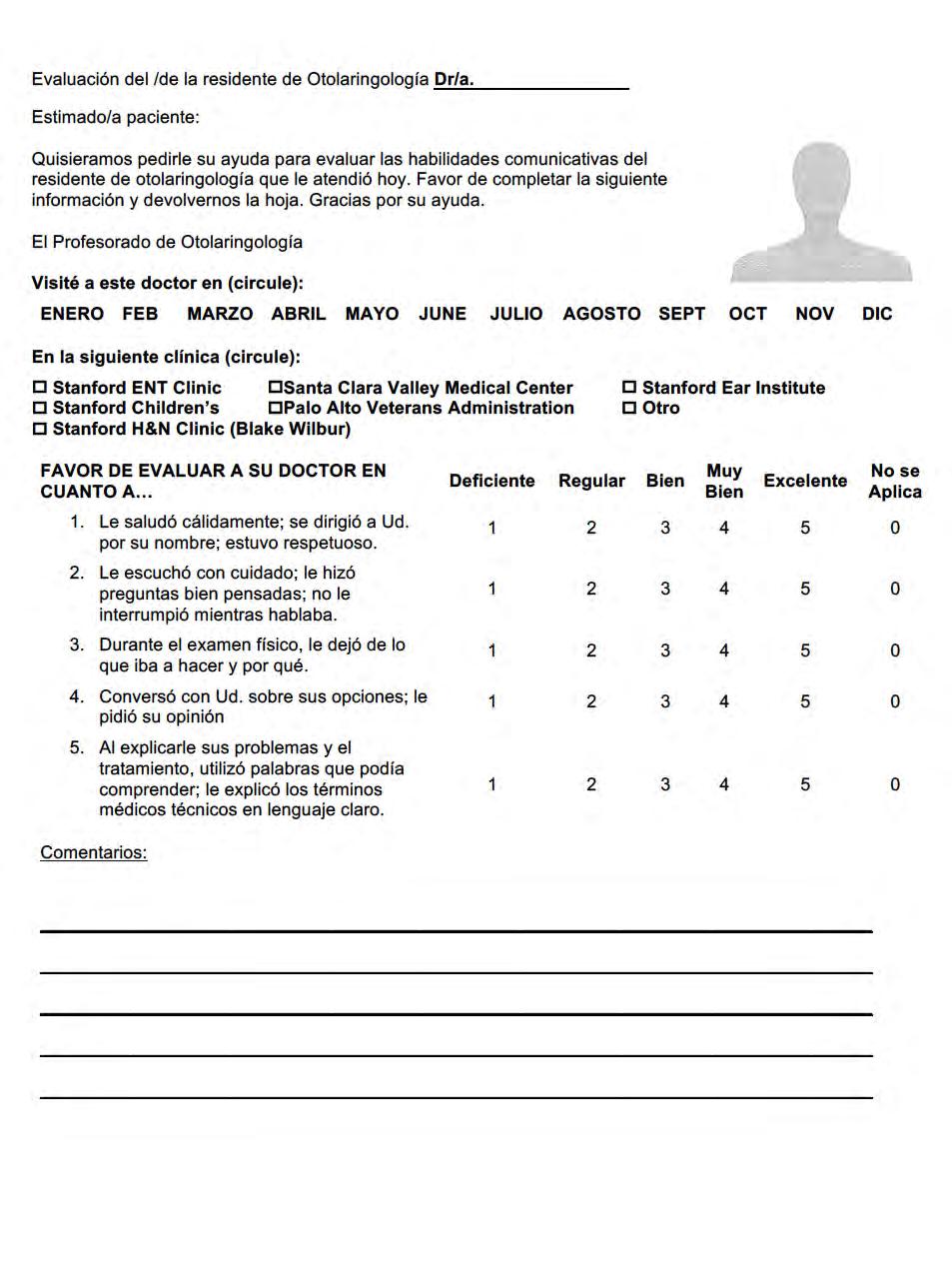


documentat:https://www.acgme.org/Portals/0/PDFs/Milestones/OtolaryngologyMilestones.pdf
AppendixK–FacialTraumaCallPolicy
CraniofacialTrauma&OralMedicine(Dental)CallPolicy
StanfordHospital&LucilePackardChildren’sHospital
ThePlasticSurgeryDivisionandOtolaryngology/Head&NeckSurgeryDepartmentprovidesStanford EmergencyDepartmentcallcoverageforMaxillofacial TraumaandDentalrelatedproblems.
1. Stanford:Otolaryngology(ENT)takescallonevendays. Plasticstakescallonodddays.
a. SCVMC:ENTtakescallonodddays. Plasticstakescallonevendays.
b. VAPA:ENTtakescallonevenmonths. Plasticstakescallonoddmonths.
2. Callswitchesat6amatSHC.
3. Consultisassignedatthetimetheserviceisinitiallypaged(notwhenthepatientarrivesintheER/ICUor whentheresidentanswersthepage).
4. DAYTIMEOralMedicine&MaxillofacialSurgeryConsults:Theservicewillseealldental/OMFSconsults duringnormalbusinesshours(8a-5p,M-F);theplastics/ENTresidentshoulddirectreferralsandcallsto OMFSduringthistime. Thesmartpagescheduledesignatesthedaytimedentalresident(ifavailable) anddentalattendingwithcontactinformation.
5. NIGHTIMERegardingdentaltrauma(toothluxations/avulsionswithisolatedalveolarbonefractures)or odontogenicinfections: theEDshouldconsultsmartpagetodetermineifadentalresidentisoncall (dentalresidentisoncallapproximately20%ofthetime.) Ifnodentalresidentisoncallthenthe designatedplasticsurgeryorENTresidentshouldbepaged. Theback-upattendingdentistwillbe contactedbythePlasticSurgery/ENT/Dentaldesignatedresidentasneededforconsultation.
6. Ontheirdesignatedcalldays,ENTorPlasticswillconsultforcutaneousfacialinfections,TMJ dislocations,andearlacerations.PlasticsmaydefertoENTforfacialinfectionsthataresalivarygland, sinus-orear-related.
7. Non-surgicalinfectionadmissionsmaybeadmittedtoInternalMedicine,andENTorPlasticswillfollow asneeded. Ifinternalmedicinewillnotadmitthepatientwithaninfectionofdentalorpossibledental originthenthepatientshouldbeadmittedto theENTorPlasticsurgeryservicewhoisonforcraniofacial trauma/dentalforthatday.
8. ENTistoseealldeepspaceinfections,earhematomas,andtemporalbonetrauma. Ifatemporalbone traumapatienthasotherfacialtraumaandPlasticsisoncall,thenPlasticsistoaddresstheotherfacial trauma.
9. ENTorPlasticsmayrepaireyelidlacerationsorretaintheoptiontoconsultOphthalmologyforcomplex eyelidlacerations.
10. Consultsthatcanbesafelymanagedasanoutpatient:nasalfractures(openorclosed),mandible fractures(withoutairwayconcern),orbitalfloorfractureswithoutentrapmentorvisionchanges, maxillarysinusfractures. Ifpatientsareadmittedforanotherreasonwiththeseinjuriestheycanbe seenonanon-urgentbasisduringtheday.
11. IftheERorthepatienthasaspecificrequestforPlasticSurgeryanditisanEVENday(ENT);orifthereis aspecificrequestforENTonanODDday(plasticsurgery)theresidentwhoiscalledcanrespondby indicatingthattheotherserviceison-callforfacialtrauma;Facialplasticsurgeryisincludedwithinthe ENTcallcoverage.HOWEVER,iftheERorpatientspecificallyrequests/insiststhatthenatureofthe problemrequiresaspecificservice(eventhoughthatserviceisnotofficiallyoncall thatday)thenyou shouldbeavailabletoseethepatient,regardless.
12. ORBITALFLOORFRACTURES:
a. Days1-10ofmonth:
i. Forisolated orbitalfloorfractures(ie.,nootherfacialtraumaissues):oculoplasticswillbe theleadteamforrepairoforbitfractures-noneedtoinvolveplasticsorENT.
ii. Fororbitalfloorfractureswithotherfacialtrauma: ENT/Plasticswillbetheleadteamfor otherfacialtraumaandwillcoordinatethecareofthefloorfracturewithOphthalmology.In thesecases,Ophthalmologywillberesponsiblefortheorbitalfloor fractureandanyrepair willbeperformedasajointcase.
b. Days11-monthend: ENTandplasticswillbetheleadteamonanyorbitfracturewith ophthalmologyhelptocleartheglobe.Ifthereisocularcompromise(globenotcleared)the patientwillbemanagedbyOphthalmologyandtheorbitalfloorfracturerepairwillbedecided aftertheeyepathologyisappropriatelyaddressed. Orbitalfloorfracturesshouldbereferredto theENTandplasticsservices,whileOphthalmologyconsultsareobtainedforvisionandglobe assessmentonly.
RevApril2018
Medicine/ENT/FACE/EDInter-ServiceAgreement (Revised February2024)
Admissions
PatientswithanENTissuewillbeadmittedtoENTservice,UNLESSthepatienthasoneofthefollowing medicalconditions,inwhichcasetheywillbeadmittedtoamedicalservice:1,2,3,4,5
1. AcutechestpainorEKG/enzymeevidenceofischemia(includingtroponinaboveupperlimitof normal)
2. Dyspnea,orsigns/symptomsofpulmonaryedema,or>2liternewO2requirement(Ifthesesignsor symptomsareduetoanupperairwayobstructionthenadmittoENTorasappropriate,ICU)
3. DecompensatedHeartFailure
4. Uncontrolledarrhythmiaornewarrhythmiawithpersistent/recurrentHR>110
5. Newsymptomaticbradycardiaorhigh-gradeatrioventricularblock
6. DKAorHHS
7. Untreatedseverevalvularheartdisease
8. EF<30%orRVSP>60mmHgonmostrecentECHO
9. Sepsisoranycomplicatedactiveinfections(e.g.diverticulitisorpneumoniabutnotbronchitis/URI oruncomplicatedUTI).InfectionsoftheEar/Mastoid/Nose/Throat/Epiglottiswithsepsisbut hemodynamicallystablewouldbeadmittedtoENTwithsurgicalcomanagement(SCM)andID consultasneeded.ICUconsultrecommendedifsepsiswithhemodynamicinstability.
10. Acutekidneyinjury(eGFRdecreaseby25%)
11. Persistent/RecurrentsystolicBP>180ordiastolic>100
12. Persistent/RecurrentsystolicBP<90despiteappropriatefluidchallenge(ICUconsult recommended)
13. Anysignsofactiveinternalbleeding(e.g.,GIbleed.Exception:Epistaxis/pharyngealbleedina hemodynamicallystablepatientwithnoknownhematologicaldisorderwouldbeadmittedtoENT. EpistaxisduetohematologicdisorderwouldbeadmittedtoHematology.ICUconsultrecommended ifhemodynamicinstability)
1 Admitting medical service is dependent on active medical issues (e.g., decompensated heart failure to CCU/CSU instead of general medicine) and will be determined as per the Eolas ED Admissions Grid.
2 Patients with an active issue that is more appropriate for a non-ENT medicine service will be admitted as per the ED Admission Grid (e.g., a patient with facial cellulitis, elevated creatinine, and acute appendicitis would go to general surgery).
3 Uncertainty regarding the appropriate primary admitting team should be resolved through a discussion between the ENT and general medicine admitting residents. If after discussion uncertainty persists, it should be resolved through discussion between ENT attending and general medicine attending, initiated by the service initially called by the ED for admission. (ED Decides on admit service; if a different service is felt to be more appropriate then a transfer to that service can be done per the workflow in this agreement after the admit order)
4 Patients with invasive fungal sinusitis will be admitted to the general medicine, Med 7, or medicine surge teams with ENT consulting.
5 Patients requiring direct admission after an elective ENT surgery or directly from ENT clinic are subject to this agreement.
14. Acutealcohol/drugintoxicationwithsignificantbehavioraldisturbanceoracutealcohol/drug withdrawal
15. Decompensatedliverdiseaseincludinganyof:hepaticencephalopathy,INR>1.7,newonset jaundice,volumeoverload/ascites,varicealbleed
16. FocalcentralneurologicchangesincludingstrokeandTIA(admittoneurology;forhemorrhagic stroke,useIntracranialhemorrhageEolasEDAdmissionGrid)
17. Patientscurrentlyonhospiceorrequiringcomfortcarewhowillbemanagednonoperatively
18. Patientsinneedofvulnerableadultorelderabuseevaluation
19. Syncope
20. Hyponatremia(serumsodium<128meq/Landa5-pointdecreasefrombaseline)
21. Hypernatremia(serumsodium>150meq/L)
22. Newalteredmentalstatus
Consults
SurgicalCo-ManagementAttending/Nocturnist/MedicineResidentConsultRole
1. IfSCMserviceisconsultedonapatientadmittedtotheENTservicebetween8AM-5PM,theywillsee thepatientwithin3hours(ifcalledSTATwithin1hour).
a. TheconsultedSCMattendingwillwritedailynotesandordersforevaluationand managementofmedicalissues(e.g.,labs,medications,etc.).Noteswillincludeperioperative riskstratificationwhenrequestedandrecommendationsonadditionalconsultswhen appropriate.TheSCMattendingwillcommunicatetheirrecommendationswiththeENT team.TheENTteamwillcommunicatewiththeappropriateconsultants.
2. ForpatientsbeingfollowedbytheSCMservice,theconsultedSCMattendingcanbepageddirectly regardingmedicalissuesfrom8AM -5PM.After5PM,the1st pageformedicalissuesistotheENT team,whoafterevaluatingthepatientmaythencontacttheon-callSCMattending(p24311)if needed.
3. Foracutenon-emergentmedicalissuesthatdevelopbetween5PMand8AMforpatientsbeing followedbySCMservicethatadmission(Figure1):
a. ENTteamwillevaluatethepatientatthebedside.Iftheacutemedicalissuewouldbebest managedbyanon-SCMservice(e.g.,cardiology,endocrinology,hematology,neurology),ENT teamwillconsultandcommunicatewiththeappropriateconsultants.
b. ENTteamcancontacttheon-callSCMattending(p24311)asneeded.TheoncallSCM attendingwillthenreviewthepatient’schartremotely,enteranyordersorprovide recommendationsasnecessaryandworkincollaborationwiththeENTteam.Between7PM and7AM,theoncallSCMattendingmaycontacttheinhousenocturnist(N1;p12012)to performbedsideevaluation/treatmentifneeded.
c. Ifacutemedicalissueswillrequiremorefrequentmonitoring/treatmentdecisionsthat cannotbesafelymanagedontheENTservice,thenatransferrequestmaybeconsidered(see belowTransferRequests).
4. Foracutenon-emergentmedicalissuesthatariseafter5PMandcannotbedeferredtillafter8AM thefollowingdayandthepatienthadnotbeenfollowedbySCMservicethatadmission(Figure1):
a. ENTteamshouldcontacttheon-callgeneralmedicineconsultresident(p26101)whothen seesthepatientatthebedside,writesanote,staffstheconsultwiththeon-callSCM attending(p24311),communicatestherecommendationstotheENTteam,andworks in collaborationwiththeENTteamandtheon-callSCMattendingforongoingbedside monitoring/managementofthepatientasneededontheirshift.Thegeneralmedicine consultresidentshouldnotstaffthispatientwiththegeneralmedicineconsultattending.
b. Ifacutemedicalissueswillrequiremorefrequentmonitoring/treatmentdecisionsthat cannotbesafelymanagedontheENTservice,thenatransferrequestmaybeconsidered(see belowTransferRequests).IfthepatientcanbesafelymanagedontheENTservice,the patientwillbeseenbySCMserviceduringdaytime(8AM –5PM).
5. Foremergentmedicalissues,asappropriate,theICUtriagefellowshouldbecontacteddirectlyby theENTteam(Figure1).
6. ForstablepatientsadmittedtoENTservicebetween5PMand8AMwhoneedSCMserviceconsultor foranynon-urgentquestionsforSCMservice,theENTteamwillcontactthedaytimeSCMattending between8-10AM.
7. Forallpatientswithinsulinpumps,ENTteamshouldconsultEndocrinologyforinpatient management.
Figure1:Workflowformedicalissuesthatariseafter-hours(between5PMand8AM)
Medicalissueafter-hours(5PMto8AM)
Acutenon-emergentissuethatcannotwaittill8AMthenextday
Emergentissue
Non-urgent/Stablepatient
PatientbeingfollowedbySCM servicethatadmission
Patientnotbeingfollowed bySCMthatadmission
ENTteamshould contactICUtriage fellow
ENTteamwillcontact daytimeSCMattending between8-10AM
1. ENTteamwillevaluatethe patient.
2. Ifpatientisbestmanaged bynon-SCMservice(e.g., cardiology,hematology), ENTteamwillcontactthat service.
3. ENTteamcancontactthe on-callSCMattending (p24311).
1. ENTteamwillcontact theon-callgeneral medicineconsult resident(p26101).
2. Generalmedicine consultresidentwill evaluatethepatient andstaffthepatient withtheon-callSCM attending(p24311).
ENTConsultRole
1. IfENTisconsultedonapatientadmittedtoamedicalservice,theywillseethepatientwithinthat day(ifcalledSTATforanairway,theywillbeseenimmediately).
2. ENTconsultswillwritedailynotesandwillwriterecommendationspertainingtoevaluationofthe chiefconcern,anesthesiaevaluation,ORscheduling,NPOstatus,equipmentorders,PT/OT, perioperativeantibiotics,woundcare,andactivitylevel.
TransferRequests
FromENTtoaMedicalService
1. PatientsontheENTservicemaybeconsideredfortransfertoamedicalserviceifeitherofthe followingoccur:
i. Oneormoreofthefollowingmedicalconditionsdevelopthatarerequiringfrequentbedside monitoringandmanagementbeyondtheset-upoftheSCMservice/Nocturnist/Consultants:
i. Acutemyocardialinfarctionrequiringcoronarystentplacement
ii. Acuterespiratoryfailure(ExcludesupperairwayobstructionmanagedbyENT) –transferrequesttomedicineifICUhasevaluatedanddidnotacceptthetransfer
iii. DecompensatedHeartFailure
iv. Uncontrolledarrhythmiaornewarrhythmiawithpersistent/recurrentHR>110
v. Newsymptomaticbradycardiaorhigh-gradeatrioventricularblock
vi. DKAorHHS
vii. Worseningacutekidneyinjurywithpersistentoliguriaorfluidoverload
viii. Persistent/RecurrentsystolicBP>180ordiastolic>100
ix. Persistent/RecurrentsystolicBP<90despiteappropriatefluidchallengeortransfusion (ifICUhasevaluatedanddidnotacceptthetransfer)
x. Anysignsofactiveinternalbleeding(transferrequesttomedicineifICUhasevaluated anddidnotacceptthetransfer)
xi. Acutealcohol/drugintoxicationwithsignificantbehavioraldisturbanceoracute alcohol/drugwithdrawal
xii. Decompensatedliverdiseaseincludinganyofthefollowing:hepaticencephalopathy, INR>1.7,newonsetjaundice,volumeoverload/ascites,varicealbleed
xiii. FocalcentralneurologicchangesincludingstrokeandTIA(transferrequestto neurology)
xiv. Acutehyponatremia(serumsodium<128meq/Landa5-pointdecreasefrom baseline)
xv. Acutehypernatremia(serumsodium>150meq/L)
ii. ConsultedSCMattendingdeemsthepatientisrequiringfrequentbedsidemonitoringand managementforacutemedicalissuesbeyondtheset-upoftheSCM service/Nocturnist/Consultants
2. Fortransferrequeststogeneralmedicine,Med7,ormedicinesurgeteamsforpatientsbeing followedbySCMservicethatadmission(Figure2):
i. ENTserviceshouldfirstdiscusswiththeconsultedSCMattendingifthepatientiseligiblefor transfertogeneralmedicine,Med7,ormedicinesurgeteam.
ii. IftheSCMattendingdeemsthepatientiseligiblefortransfer,theSCMattendingwillcontact thegeneralmedicinesectionchief(viavoalte)withthepatient’sMRNandreasonfortransfer request.
iii. Ifthetransferrequestisapproved:
i. ENTservicewillcontactthegeneralmedicineadmittingteam(p27111)tonotifythem oftheapprovedtransferrequestanddoahand-off.Ifthereisanyconfusionregarding thetransferrequest,agroupvoaltetextwillbesentbySCMattendingtothegeneral medicineadmittingteam(p27111),generalmedicinesectionchief,andENTteam.
ii. Asneeded,theacceptinggeneralmedicine,Med7,ormedicinesurgeteamcan directlycontacttheSCMattendingforanyclarifyingquestionsorconcerns.
iii. Ifthetransferisapprovedbutnotpossibleonthedayoftheinitialtransferrequest giventhegeneralmedicine,Med7,ormedicinesurgeteam’scapacity,SCMattending willcontinuetoreachouttothegeneralmedicinesectionchieftoascertainwhena generalmedicine,Med7,ormedicinesurgeteamcanacceptthetransfer.
iv. Ingeneral,transferrequestsshouldbeinitiatedbetween8AMand4:30PM,unlesstheclinical conditionwarrantsanurgenttransferrequestafter-hours.
3. Forurgenttransferrequeststogeneralmedicine,Med7,ormedicinesurgeteamsforpatientsnot seenbySCMservicethatadmission(Figure2):
i. ENTservicewillcontactthegeneralmedicineconsultattending(p23327).Thegeneral medicineconsultattendingwillreviewthepatient’schart.Thegeneralmedicineconsult attendingwillnotifytheENTserviceofthedecisiontotransferornotwithin2 hours.
ii. ItistheresponsibilityofthegeneralmedicineconsultattendingtoassignthepagerID23327 tothemselvesthroughouttheirshift.Ifthegeneralmedicineconsultattendinghasnot assignedthispagertothemselves,theENTteamwillreachouttothegeneralmedicine consultresident(p26101)toidentifythegeneralmedicineconsultattendingon-call.TheENT servicewillthencontactthegeneralmedicineconsultattendingviatheirpersonalpageror Voalte.Ifthegeneralmedicineconsultattendingisstillnotreachable,thetransferrequest willbeescalatedtothedirectorforgeneralmedicineconsults(p12744)after30minutes.
iii. Ifthetransferisapprovedbutnotpossibleonthedayoftheinitialtransferrequestgiventhe generalmedicine,Med7,ormedicinesurgeteam’scapacity:
i. Thegeneralmedicineconsultattendingshouldsignouttheapprovedtransferandthe relevantclinicalinformationtotheincominggeneralmedicineconsultattending.
ii. TheENTteamwillcontinuetoreachouttothegeneralmedicineconsultattendingto ascertainwhenageneralmedicine,Med7,ormedicinesurgeteamcanacceptthe transfer,withouthavingtorepeatthetransferrequestprocessortheclinical information.
iv. Ifthetransferisapproved:Thegeneralmedicineconsultattendingwillrelaytheclinical informationtotheacceptinggeneralmedicine,Med7,ormedicinesurgeteam.Theaccepting generalmedicine,Med7,ormedicinesurgeteamcanreachouttotheENT teamorSCM attending,asappropriate,foranyadditionalclarifications.
4. WhilethepatientisonENTserviceastheprimaryteam,generalmedicine,Med7,ormedicinesurge teamscannotprovideconsultationinadditiontotheSCMservice.
5. ENTserviceshouldinitiateanytransferrequeststosub-specialtymedicalservices(e.g.,general cardiology,neurology,oncology,MICU/CCU/CSU)andtheserequestsarereviewed/approvedbythe respectiveservice’sattending(Figure2).
6. Duringtransferrequests,thepatient’ssafetyandneedsshouldremainatthecenterofthe discussion.Itisanexpectationthattransferrequestsanddeterminationoftheappropriateprimary serviceforthepatientbedoneinacollaborativeandprofessionalmanner.Anyuncertainty regardingtheappropriateprimaryadmittingteamshouldberesolvedthroughadiscussionbetween ENTteamandgeneralmedicineconsultattendingorsectionchief.Ifafterdiscussion,uncertaintyor disagreementpersists,itshouldberesolvedthroughdiscussionbetweenENTattendingandgeneral medicineconsultattendingorsectionchief,initiatedbytheENTattending.
Figure2:WorkflowfortransferrequestsfromENTtoamedicalservice
Transferrequesttoamedicalserviceisbeingconsidered
Transferrequesttogeneralmedicine,Med7,ormedicinesurgeteam
PatientbeingfollowedbySCMservice thatadmission
1. ENTteamwilldiscusseligibility fortransferwithconsultedSCM attending.
2. Ifpatientiseligiblefortransfer, SCMattendingwillvoalte generalmedicinesectionchief.
3. Iftransferisapproved,ENTteam willgivehandofftogeneral medicineadmittingteam (p27111).
Urgentrequest(Patientnotseenby SCMservicethatadmission)
ENTteamwillcontacttheon-call generalmedicineconsultattending (p23327)
Transferrequesttosubspecialtymedicalservice
ENTteamwillcontactthe sub-specialtyservice
TransfersFromaMedicalServicetoENT
1. PatientswhosemedicalissuesarestableshouldbeconsideredfortransfertotheENT serviceinthepost-operativeperiod.
2. PatientsoriginallyadmittedtotheENTservice,whoweretransferredtoamedicalservice foranactivemedicalissue,shouldbeconsideredfortransferbacktotheENTserviceafter stabilizationofthemedicalissue.
3. Forpatientsatriskofacutefluidshifts,delirium,aspirationorotherseriousmedicaladverse events,transfershouldoccurduringdaytimehours12-24hourspostoperativelyafter medicalstabilizationonthefloor.Otherwise,medicallystablepatients maybetransferred immediatelypostoperativelyifmutuallyagreeduponbetweenservices.
4. IftransferfromICUtoprimaryENTserviceisanticipated,ENTteamshoulddiscusswiththe daytimeSCMattendinganddeterminestabilityoftransferofthepatienttothefloorpriorto acceptingthetransfer.
EmergencyDepartmentRole
1. TheEmergencydepartment(ED)willpagetheappropriateadmissionservicebasedonthe abovecriteria.
2. TheEDwillnotdeterminetheappropriateadmissionserviceuntilanadequateworkupis obtainedtoassessfortheabovecriteria.
3. TheserviceinitiallypagedbytheEDisresponsibleforadmittingthepatientiftheabove processhasbeenfollowed.
C.KwangSung,MD
ProgramDirector,Otolaryngology
CharlesLiao,MD
MedicalDirector,GeneralInpatientMedicine
SamShen,MD
NeeraAhuja,MD
MedicalDirector,AdultEmergencyMedicine DivisionChief,HospitalMedicine
AppendixM–AfterhoursOutpatientMedicalAdvice
• PGY1sarenottotakethistypeofcall.
• Patientsmustreceiveacallbackwithin 30minutesoftheircontactingthe hospital.
• Iftheresidentdoesnotrespondorisunabletohandlethecallpromptly (e.g.,scrubbedinsurgery)thenthecallgoestotheattendingphysician oncall(2nd call);afterthattheClinicChief/DivisionChief(3rd call).
• AnymedicaladvicegivenduringthesecallsmustbedocumentedinEPIC.
AppendixN–PagingSystem
EffectiveJune2021
1.SmartPagenowshowsour 3adultfloorpagers(#27082, #27083and#27085)asseparateentries. (Thisshouldhopefullyminimizethenumberoferrantfloorandconsultpagesgoingtothewrong intern.)
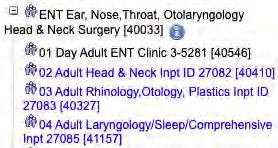
2.Basedonresidentfeedback,asecondPedspagernumberhasbeenaddedtodistinguish betweenfloorandconsults.
#25668willremainthepagerIDfor floorissuesand existingconsults #25670isthenewpagerIDfornewconsultsandSTATairways.Thiswillalsobethepagerthat getsoutpatientphonecalls.
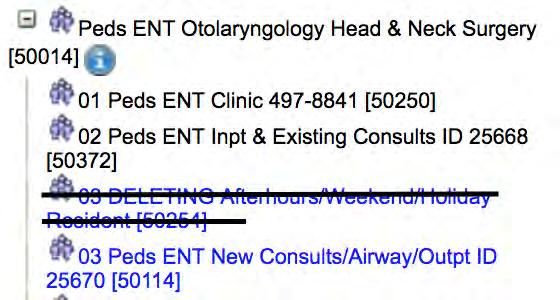
Theovernightresidentshouldtakethetwoconsultpagers:#27087foradultsand#25670for Peds—at6:00pm.ThePedsfloorpager(#25668)canremainassignedtothedayteamuntil theyarereadytosignout.
AppendixO–VerbalOrdersProcessClarificationsforNursesandPhysicians
VerbalOrdersProcessClarificationsforNursesandPhysicians(Attendings&Housestaff)
Verbalorders(VOs)haveaninherentdegreeofriskoferror.WhileVOsaresometimesneeded,itis importantthattheprocessbuildinsafeguardstoreducerisk.Optimalverbalorderprocessesare builtonmutualtrustandrespectbetweennursesandphysicians.Acollaborativeprocesswithbuilt inchecksandprecautionsisimportant.
VOsshouldbelimitedtourgentsituationswhereimmediateentryofordersintoEpicisnot feasible.
MD RN
Whentouse:
• Shouldusesoundjudgmentabout whetheritisimpractical(perpolicy)to enterorderintoEpic.(e.g.,ina procedure,tiedupinanemergency,on calloutofhospital.)
• NOTforsimpleconvenience
• ExplainwhyaVOisneeded.
Remainonthephonelongenoughfor“read back”tobecompleted
Epicgeneratedalertsmayresultinpage backtoclarify
VerbalOrdersshouldnotbeusedfor:
• Bloodtransfusions(Typeandholdand MassiveBloodTransfusionProtocolOK)
• NewPCAorder
• Admissionorders
• Ordersets
• Chemotherapeuticagents
Usesafetypracticeswhengivingorder:
• DoubleIDofpatient:name,MR#
• Allpartsofdrugorder(name,form, dose,frequency,route,duration)
• Spelloutnamesofdrugs
• Sayunits,notabbreviations(e.g., milligrams,notmgs)
Willacceptverbalorderingoodfaiththat thereiscompliancewiththeHospital policy/procedure.
Alwaysperforma“readback”
EnterorderintoEpicassoonaspossible; clarifyanyEpicgeneratedquestionswith MD
VerbalOrdersshouldnotbeusedfor:
• Bloodtransfusions(Typeandhold,MTP OK)
• New PCAorder
• Admissionorders
• Ordersets
• Chemotherapeuticagents
Usesafetypracticeswith“read-back”:
• DoubleIDofpatient:name,MR#
• Allpartsofdrugorder(name,form, dose,frequency,route,duration)
• Spelloutnamesofdrugs
• Sayunits,notabbreviation(e.g., milligrams,notmgs)
• Saynumberdigits(e.g.,“fifty”becomes “Fifty-fivezero”)
• Avoidabbreviations(e.g.,everysix hours-notq6hours)
AllVOsmustbecosigned:
• Cosignwithin48hours–bestonsame day
• TeammembershouldsignifMDoff service,orotherwisenotavailable
EducationbyMDleaders:
• WhenVOappropriate
• Name&SIDrequired
• Readbackrequired
• Ordersnotallowedasverbal
• Safetypractices
• Cosignw/in48hours;samedaycosignis bestpractice
• Anymemberofteamshouldcosign
• Usecautiontoavoiderrors
Cosigncompliancemanagement:
• Regulardatareportsatspecialtyand individuallevel
• Physicianleaders/programdirectors improvementstrategies
V610/19/18
• Saynumberdigits(e.g.,“fifty”becomes “fifty-fivezero”)
• Avoidabbreviations(e.g.,everysixhours -notq6hours)
EducationbyRNleaders:
• Name&SIDrequired
• Performreadback
• Ordersnotallowedasverbal
• Safetypractices
• Onlyifimmediateneed
• Usecautiontoavoiderrors
Cosigncompliancemanagement:
• NotRNmanagementresponsibility
(This table does not apply to pharmacists who have their own standard work.)
These changes were created by a joint GME, nursing and physician work group with pharmacy input:
NeeraAhuja,MD,HospitalMedicineDivisionChief
GretchenBrown,RN,NursingDirector
JanjriDesai,PharmD,AssistDirPharmacy
SharronHampton,RN,NursingDirector
JoeHopkins,MD,AssocCMO
LarryKatznelson,MD,AssocDeanGME
MarcMelcher,MD,GeneralSurgeryResidencyProgramDirector
ElisaNguyen,RN,PCMG1 –H1
TopherSharp,MD,CMIO
JulieTisnado,RN,NursingDirector
HirutTruneh,RN,NursingDirector
AppendixP–TemporalBoneLab
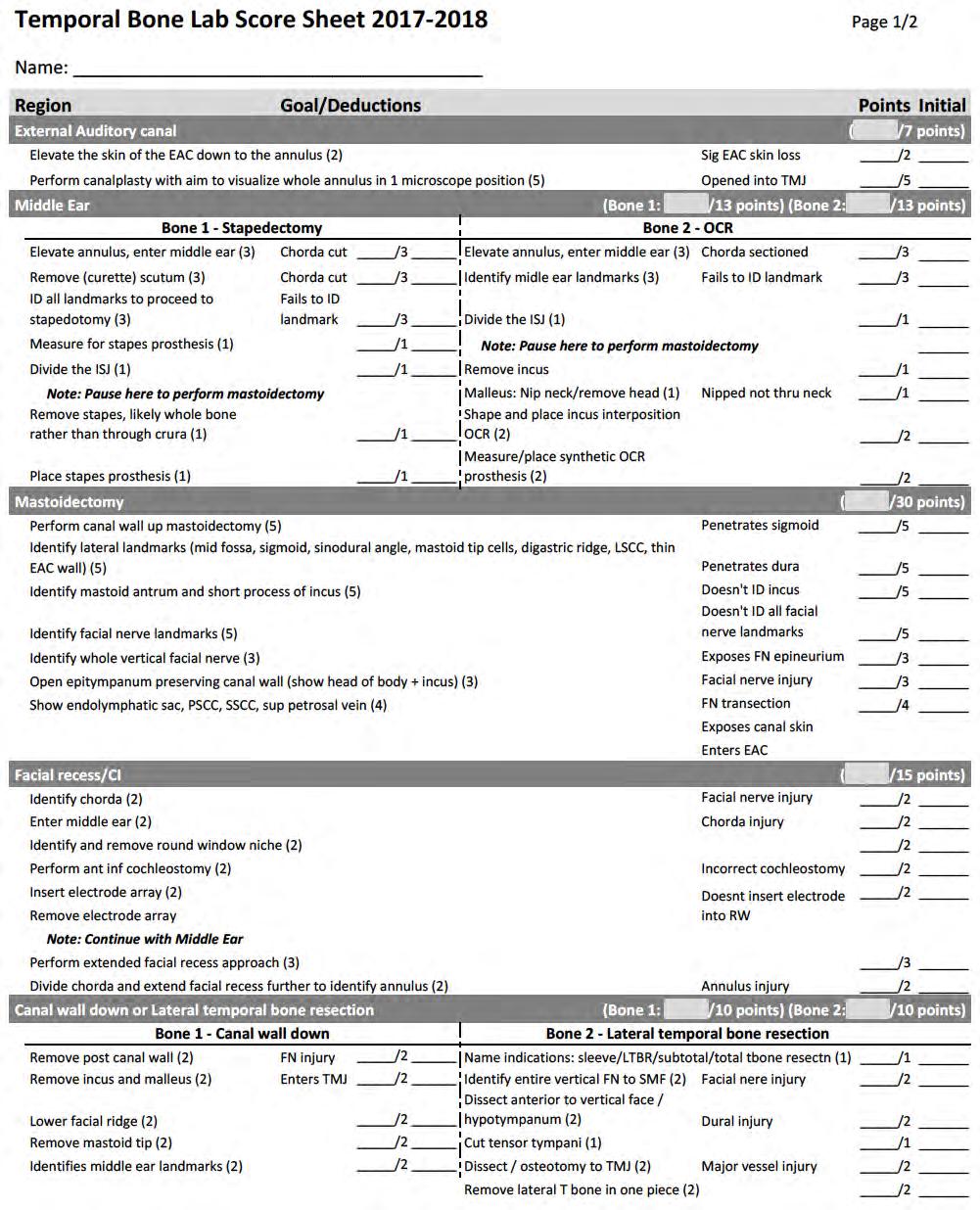
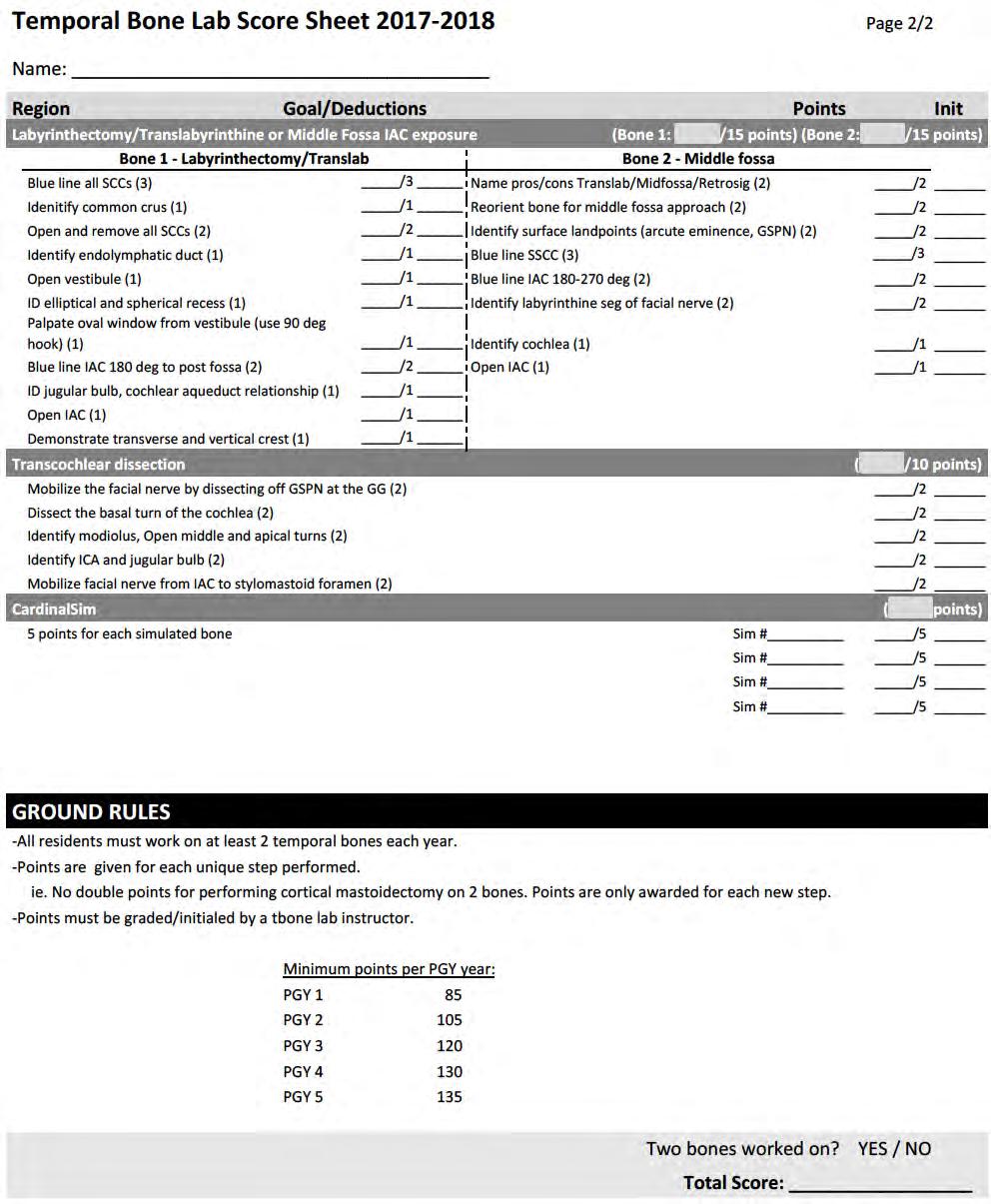
AppendixQ–SHCInfectionControl
GoalsandObjectivesforSHCInfection
PreventionandControlDepartment
1.UnderstandandperformnecessaryprecleaningofusedENTendoscopespriortoreprocessingby SterileProcessingDepartment(SPD)ordisposal (https://stanfordhealthcare.policytech.com/dotNet/documents/?docid=13566)
2.FollowStanfordHealthcareInfectionPreventionandControl‘QuickReferenceGuidefor InfectiousDiseasesConditionsandRequiredPrecautions’whenprovidingcaretobothinpatient andambulatorycarepatients (https://stanfordhealthcare.policytech.com/dotNet/documents/?docid=10907)
AppendixR–UniversalProtocolClinicalProcedureGuidance
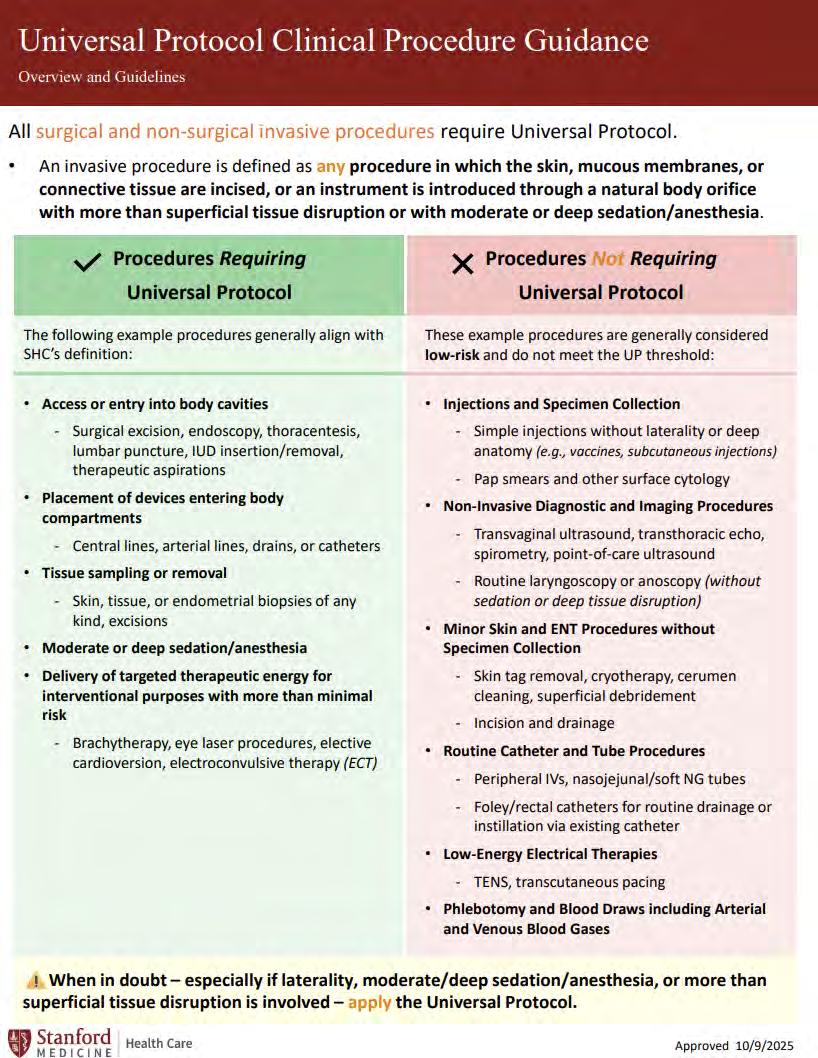
AppendixS–PedsService
Welcome to the Pedi OHNS Rotation!!
RotationSpecifics
A.WeeklySchedule
1. R1&R2areexpectedtospend50%oftimeinclinicand50%oftimeintheOR. (5half-days ofclinic/week).
2. R1responsibilityisfloorworkand50%oftheprogressnotes sharedwithinpatientNP.
a. InpatientNPtoorientR1onrotationparticularsonthefirstweekoftherotation (preferablyMondayorTuesday).
3. R1&R2shouldspendnomorethan 3days/weekintheOR.
4. R2takestheconsultpager andisresponsibleforreceivingcallsfromreferringservicesfor consults.TheconsultspatientshouldbereviewedwiththeR4orFellowbeforepresentingtothe attending.
• Ghostpager25670newandairwayconsults,25668floorpatients
• R2maybeassignedtoWatsonclinic,butwillnotbeaskedtocoverSouthBayclinics.
5. R4shouldspendapproximately80%oftimeintheORand20%ofhis/hertimeintheclinic. Thismeanseachpersonneedsonedayaweekofclinic.
6. R4andfellowareresponsibleforPMrounds. OnemustbefreedfromORby5pmtoprepare forPMrounds.
7. IfnoORcasesaregoing,residentsareexpectedintheclinic.
8. AttendingcallisfortheentireweekorM-Fandadifferentattendingfortheweekend.That attendingwillhaveacancelledorshortclinicandshortORdaytoallowforconsultsandurgent clinicappointments.
9. Fellow/Attendingrounds arefrom5-6:00pmonTuesdayandwillconsistof(1st tues)airway rounds,(2nd tues)otologyrounds,(3rd tues)radiologyrounds,(4th tues)[Charlierounds,QI rounds,interestingcases].
a. Pleaseprioritizeattendanceandparticipationatteachingroundsasthisisateameffort tooptimizelearningopportunities!
b. Fellowsandthechiefresidentmustworktogethertopresentcasesduringrounds.
c. Casesmustbeorganized1weekbeforescheduledrounds.
i. Fellowswillmessageattendingfacultytheweekbeforescheduledroundswith plannedcases.
10. Radiologyrounds:Areheldonceamonth,thirdTuesofthemonth. Pleasecontact Hisham Dahmoush,MarkHalverson,AnaCouceiro,and/orBrunoSoares (ENTfellowtocontact them).AddpatientstothelistonEPICtobepresented.
a. Fellowsandthechiefresidentmustcompilethelistofcasesplannedfordiscussion1 weekbeforeroundsandmessagecorrespondingattendingfaculty.
11. AirwayConference:PleasediscusswithDrSidellandDrBalakrishnanatthestartoftherotation thedateofthenextairwayconference,withthegoalofoneconferenceamonth
12. CochlearImplantmeeting:iseveryotherThursdayfrom745am-815am.Theresidentthatis assignedtoWatsonclinic,ortheR4inclinicthatday(chief)thatdayistoparticipateinCIteam meetingandpresentanypatienttheyhaveseeninclinic.
13. Vacations:onlyoneresident/fellowcanbegoneatanygiventime. These away dates and also those to attend meetings/interviews should be given out to the attendings ASAP to avoid scheduling conflicts.
14. Itisokayifnotallsurgicalcasesarecoveredbyresidentsorfellowstooptimize educationalopportunitiestobalanceORsandclinic.Thisismorerelevantwhenthereare multiplefirststarts.
B. Rounding
1.Responsibilities:ProposedPGY4/Fellowresponsibilities:
• Rounds: Entireteam(juniors,PGY4,fellow)roundonICUs(NICU,PICU,CVICU).
Residentteamroundsonthefloorwithfellowtoaccompanyteamonateam-by-teambasis asthePGY4determines(thefellowshouldusesomecommonsense,suchasseeingthe microtiapatients,pre-oppatients,ICUtransfers,etc)
• PGY4willupdateeachpedsotoattendingpriortofirstORbyeitherphonecallortext
• Pointperson: Beingthepointpersonentailsthefollowing: morningupdatetotheprimary teambeforefirstORcase,answeranyquestionsthatcomeupduringday,attendcare conferences(oralertingattendingaboutconferences),inpatientsurgicalscheduling, coordinatinginpatientproceduresandperformingthoseproceduresifpossible.
▪ CVICU: fellow
▪ PICU/NICU:PGY4
▪ Floor patients: juniorresident
2.Roundingparticulars
1. AprogressorconsultnoteshouldbeinputtedintoEPIConallactivepatientsonadaily basis. EachnoteMUSTbeforwardedtotheappropriateattending. The“appropriate” attendingistheattendingwhooperatedonthepatientand/orwhosawthepatient in consultation. Theexceptioniswhentheattendingisoutoftown-inthiscasepleasetextthe outoftownattendingANDtheattendingwhoisoncallfortheday.
2. Allpatientsshouldbeevaluatedforpainandthisshouldbereportedinthe consult/progressnote.Whenroundingeachpatientshouldbequestionedaboutpain.
3. InpatientNotes: Do not cut and paste these notes.Cuttingandpastingthenotesisa dangerouspracticethatcanleadtomedicalerror.Pleasealsoavoidunnecessaryorvague terminology.Forexample,“thelungsaresomewhatclear”eithermeansthatyoudidn’tlisten oryoudon'tknowwhatyouheard.“Earexamgrosslynormal”usuallytranslatesto“Idon’t haveanotoscopebutthepinnaarepresent”and“hearinggrosslynormal”means“Idon'thave atuningfork”.Errorsinthenotesduetocuttingandpastingorbecauseanexamwasnot performedwillbe recognized,andwillnotbetolerated.Donotwritethingsinthenotethatyou donotunderstand.Thisincludesventsettings,bloodgases,etc.Forexample,“Ventsettings: 50/8”isnotaccurate,andtheconsultingteamslosefaithinourcompetencewhen thesethings arewritten.Ifyouhaveaquestionaboutyourexamfindingsoranyofthegizmosatthe bedside,pleaseasktoseethepatientwithyourfelloworattending. Pleaseusedatesinstead ofdescriptors. Forexample,"Patientpresentedon5/3/2020"isalwaysaccurate,whereas "Patientpresentedyesterday"isasetuptobecarriedforwardinaccurately.
4. Orders:Whenwritingordersformeds/x-rays/studies,ifyouclickontheNewOrder(listicon) buttonratherthansearchingforanorder,theENTPreferenceListwithprepopulateddosing informationandENTspecificradiology/labstudieswillcomeup.
5. Inpatientdischargephonecalls. Theprimarycarephysicianofeachpatientonourservice whoisdischargedneedstobecalledforanupdateandthecallmustbedocumentedinEPIC. (notethisdoesnotapplytoSSUpatients) Goto:1)ADTnavigatororroundingnavigator.2) Press“PCPfollowup”button3)Calland speaktoPCPorleavevoicemail. 4.Markthattheproviderwasspokentooramessagewas left. Note:thisneedstobedone1timeduringtheadmission.
6. Signout:residentshouldsignoutinpersonorviaphonewiththenightfloatresident.(nosign outsviatext).Dayteam:PICUsignoutshouldtakeplacebetweenthePICUfellowandthePed OHNSPGY4(seeotherPointPersonsinB.1above). ThisisdonepriortothefirstORstartofthe day.
7. TracheostomyPatients:Alltracheostomypatientsage3andolderwillfollowthe TracheostomyMobilizationPathway.
a. Thedotphraseis:.ENTTRACHMOBILITYREADINESS.Thisrequiresthatyouaddthis dotphrasetoyournotesbeginningonPOD3throughPOD6.Ifyouhavequestions,ask DougSidellforadditionaldetails.
8. NICUInfectionControlPolicy: UponenteringtheNICU(whetherornotyouplantotoucha patient)pleasefollowtheexistinghousewideinfectioncontrolpolicies:
a. Ensurethatallringswithstones,watches,bracelets,etc.areremovedsuchthatyour armsandfingersarebareuptoyourelbow.
b. Ensurethatallsleevesarerolleduptotheelbow.
c. Allhairlongerthanthechinshouldbepulledbackina hairtie.
d. Washyourhandsbeforeandaftertouchingapatientorapatientcarearea(i.e., isolette,monitor,pump).
e. UponentryintotheNICU,washyourhandsandarmsuptotheelbowforoneminute.
f. Eitherplaceyourphoneinaplasticbag,ordonotusephoneduringtimeinNICU.
9. PMRounds –Allpatientsadmittedpostoperatively(includingtympanostomytubesplacedin childrenundergoingpalatoplasty)shouldberoundedon 4-6hoursaftertheirprocedure bya memberoftheinpatientteam(dayteamornightfloat).Theinternshouldreviewthe scheduledcasesforthedayandchecktomakesurethatnopatientwassubsequentlyadmitted unexpectedly beforesignoutandleavefortheday.Documentpostoperativeroundnotesto include:
a. Namesurgery
b. Immediatepostoperativeevents
c. Focusedphysicalexamination
d. Planduringadmissionandfordischarge
C.OperatingRoom
1. Residentsmustsigninthefirstpatientby7:10am,exceptonMondays,by8:10am.Ifthefirstcaseisa tonsillectomy,theattendingwilldotheproceduresolo.
2. PreopordersaredonebytheR1theweekendBEFOREcases. Thishasbeenmissedafewtimes themonthofJune2021andisametricthehospitalkeepstrackof.Pleaseconfirmtheordersarein place.
3. OR:HuddlewiththeRN,Anesthesia,andtheFelloweverydaybeforethestartofOR.Discussyour equipmentneedsandyourpotentialconcernsaboutthepatientswiththeattending/fellowtheday beforesurgery.Thisensuresthatequipmentconflictsarerecognizedearly,potentialcomplications areavoided,anddifferencesinattendingpreferencearebroughttolight.
4. Forallairwaycases,includingMLBs:Besetupandreadytogo with the appropriate equipment whenthepatientgetstotheroom.Donotplaceunnecessaryequipmentonthebronchtable. AnythingthatleavesthebronchcartMUSTgotoSPDtoberesterilized.Thistakesourscopesoutof serviceduringthattimeperiod.
5. Operativereportsshouldbedictated/writtenonthedayofsurgerybytheresidentwhoisthe primarysurgeon.Ifunclearwhodictates,thenclarifywithattendingsurgeonpriortoleavingOR.
6. AirwayProcedureNotes:Allmicrolaryngoscopy/bronchoscopyproceduresrequireaseparate procedurenote.
• HOW:AftertheMDLB,clickthe“procedures”tabintheleft-handcolumnofthescreen beneath“orders”.Thenclick“ProcedureNotes”.Thenclick“ENTAIRWAY”atthetopofthe screen.Theseinstructionsarelistedatthebottomofthe.DRSMDLBopnote.This informationallowsthepatientsmostrecentairwayinformationtobepopulatedinthe “AIRWAY”tabbeneath“Allergies”intheEPICheader.Likewise,ifyouneedairway informationaboutapatient,thisiswhereyoushouldstart.
7. OPNOTEACCURACY: Ifyouusethe.ENTOPNOTEdotphraseabunchofthingswillpre-populate, howeverfrequentlysomeofthedetails(suchasprocedureperformed)willbeinaccurate. Please checkallopnotesandeditforaccuracy.
8. ForallOpNotes,makesuretheoperativedateisnotarange (eg6/21/17-6/27/17).
9. MANDATORYRULESREGARDINGAIRWAYSCOPEPROCEDURENOTES
FormicrolaryngoscopyCPT31526,whetherperformedbymicroscopeorzerodegreetelescopethe followingwordsABSOLUTELYMUSTbeinthenote“Amagnifiedviewofthelarynxdemonstrated...” ForbronchoscopyCPT31622,thefollowingwords ABSOLUTELYMUST beinthenote“Therightand leftbronchiwereviewedwiththescopeaswellasmainstemandsegmentalbronchiand...” (some choicephrasesthatwouldfollowcouldbe“foundtobenormal”,“nopapillomalesionswereseen”, “somebronchomalaciawasseen”)
10. MANDATORYRULESREGARDINGDISEPROCEDURENOTES
Forpatientsundergoingdrug-inducedsleependoscopy,pleaseusethedotphrase .TAVVDISE.
11. Bilateralprocedures:Forcomplexprocedures,alwaysdictateeachsideseparately(i.e.for turbinates).Fortonsilsandeartubes,askthespecificattending.
12. Theresidentisexpectedtohave readallpertinentclinicalnotes andreadabouttheprocedure priortothesurgery.
13. Evenifitissomethingassimple/repetitiveastubes,theclinicreportsmayindicatewearedoingTtubevsReuterBobbinandifyouputinthewrongtubetheparentswillnotbehappy. Wedoall kindsoftonsillectomiesonservice,intracapsularCoblation,intracapsularmicrodebrider,Bovie, cold,Coblationtotal,PEAKplasmablade,andsometimestheclinicnoteswillspecifywhattypethe parentsrequestedandifwedothewrongtype,itsaMAJORproblem(andthishashappened).Ifan attendingasksyouaboutthehistoryofthepatientandyoudon'tknowit,beforewarnedthatwe maythenperformthesurgeriesourselves,ratherthantakingyouthroughit.
14. Thefollowingisthe posttonsillectomypainmedicationplan:
a. AlternateTylenolandmotrinevery3hours,continueforthefirst48hoursaroundtheclock.
➢ Tylenol15mg/kgperdosetomaxof650mgperdose
➢ Motrin7.5mg/kgperdosetomaxof400mgperdose(Ahmad5mg/kg)
*Besuretocheckmaxanddonotexceedforobeseorolderchildren
b. *OXYCODONEISFDAAPPROVEDFOR11YRSOROLDER
➢ Pleaseasktheattendingiftheywouldlikeitgiven,espforkids8yearsandolderOFF LABEL.
➢ Oxycodoneelixir(5mg/5ml)plainq6hoursforbreakthrough
➢ GiveOxycodone0.05mg/kgperdose(thisisNOTwhatauto-populates.Please checktheMAXdoseisnomorethan5mgperdose!)
*do not choose the 0.1mg/kg which is automatically populated for you unless requested by the attending!!
➢ Forchildrenunder11,asktheattendingfornumberofdoses.
➢ Giveages11andup,20dosestogohome
➢ Thesepatientsarelikelyenrolledinouropioidstudy
➢ OxycodoneelixirisNOTavailableinmostoutsidepharmacies. ITISALWAYSBEST TOFILLITHEREATPACKARD
1. Dischargeinstructions
➢ UseprewrittenENTinstructionsunderD/Cinstructions.
➢ Formultipleprocedures(T+AandEartubes),copyF2andyouwillgettheoptionto have2setsofinstructions.
2. Preopordersmustbeplacedthenightpriortosurgery.Thisisatrackedmetricbythe administration.
3. ForOR,Prescriptionsshouldgoinatthetimeofcheckinginthepatient.Goahead andsendtheTylenol,Motrin,eardrops,etcpriortothepatientleavingintake.This isalsotrackedbythebeancounters.
D.CONSULTS
1. Alladmittedconsultsneedtobestaffedbyanattendingbeforethepatientleavesthehospital.
*For example: a patient comes in through ED overnight with a phlegmon, discussed with peds attending X via phone, pt admitted, attending X is in South Bay or Watson Court the next day so has not seen the patient, patient is ready to go home- peds attending (another one if necessary) should SEE patient before he/she goes home. The note should be sent to the attending who physically sees the patient.
2. Daytimeconsultscoveredby R2shouldbestaffedwithPGY4orattendingBEFOREnoteisputin chart.
• R2istoruntheconsultbytheR4unlessitisaCVICUconsult,thentheR2shouldrun itbythefellow.
o R2willreachouttotheon-callattendingeachMondayregardingthetimingand handlingofconsultsfortheweek
o Ifattendingcallissplitduringtheweek,R2willreachouttotheon-callattending inthemorningtodiscussthetimingandhandlingofconsultsfortheday
• R1/R2istoseetheconsultBEFOREstaffingwithattendingunlessitisanURGENT CONSULT
• ForUrgentconsultsorAirway,justgrabtheattending
• Ifapatientwas previously seenbyanENTattendingfora similarcomplaint,please staff/discusspatientwith originalENT.
• IfapatientwaspreviouslyseenbyanENTattending,butnowhasa newchief complaint,pleasestaff/discusspatientwiththe on-callENT.Theon-callattendinghas thedecisiontotransfercareofthepatienttoadifferentattending.
• IfapatientwasdiscussedintheAerodigestivegroupthread,pleaseclosetheloopand identifywhichattendingwillserveastheprimaryattending fordecision-making purposes.
•
3. ERNOTES:AllERconsultnotesmustbewrittenintotheLPCHEpicsystemandsenttothe attendingoncallforco-signature.
4. Consultcart:ThisistheOlympusTowerthatlivesinthehallwayoutsideofOR6.Youare responsibleforthisequipment.ItmustbereturnedtothemainORAFTEREACHCONSULT.It mustbeshutdownbygoingtothe“START”menuandselectingShutDown.Donotunplugthe machinebeforedoingthis.DONOTleavethisatthepatient’sbedside.Itmustbewipeddown.
- DirtyscopesarecoveredwithRedBag
• Benicetothescopes.Wedonothavemanyandtheoneswehavearelimping along.Ifourequipmentbreaks,wehavenothing.Eachdistalchipscopecosts $30,000-$50,000
E.Clinic
• PickscopesupfromSPDbycallingthem(x12363): Fillouttheform-putyourname (ortheattendingname,eitherisfine),checktheENTbox,andwritethedate, thescopemodel/serialnumberontheformifpossible. Forthepulmonary bronchoscopes,themodelandserialnumberareengravedonthefatroundpart thatsticksintothetower(e.g.XP190;10096956).Forthelittlescopes,write somethinglike(pentaxfiberoptic,2.4mm).
• Scopingconsultpatients:checkwhentheattendingoncallisavailableforthe scopeexam.Weonlywanttoscopeeachpatient1time-parentsdonottolerate multiplescopeexams.
• Inpatientconsults-itisexpectedthattheresidentknowsthefullhistoryandhas donethecompleteheadandneck/heart/lungexamexceptthelaryngoscopybefore bringingtheattendingphysicianby.PleasequeryEpictoseeifapatienthasbeen seenbyourservicepreviouslyatanypoint.
• ORequipment: IfyoutakeequipmentfromthemainOR,youareresponsiblefor checkingthisout asdescribedabove andforreturningit.Donotleaveequipment atthebedsidewithoutapprovalfromyourconsultattending.Allequipmenttaken fromthemainORmustbe returnedinared“contaminated”binthatisbroughtup fromORwiththeequipment.NOEXCEPTIONS.
• FlexibleBronchoscopies.UsuallyforcasesintheCVICUorCardiacOR.
• CallRTLeadat721-9613iftheattendingwantsRTpresent(asktheattending). The attendingorfellowwillgetthebronchoscope,endolube,Bodaiadaptor,sliptipsyringes, cleaningenzyme,and2grayadaptorsfromthe4th floorRToffice(RainbowRoom).Under manycircumstances,RTcanbringthescopestoyourlocation.Coverwithgreencoverwhen clean,redcoverwhendirty.ReturntoORdirtyprocessingroomwhendirtyanddone.Please flushthesuctionchannelwithsalineandenzyme.Bronchflexiblescopesareonthe4thfloor closetotheSouthelevators:nearMosaicCow. FelloworAttendingareresponsiblefor gettingthesescopes,however,theresidentteamshouldbeawareofwheretheseareincase ofemergencies.
• CongenitalCardiacbronchsandlaryngoscopy: PleasealerttheCVICUteamandthe RTpriortoperformingbronchoscopy or flex laryngoscopy. Thesepatientsarefragile andthestressofscopingcan promptacardiopulmonaryevent. Patientsbeingscoped forvocalfoldevaluationfollowingsurgeryaroundtheaorticarch,includingPDA,who are>36wkGAandlessthan1yearofageshouldundergoscopewithintherealmofthe "ArchProtocol". Pleaseusethe".drsarch"documentation.Thesepatientsneedtobe seeninfollowup,4-6weeksinaeroclinic.
• NOTE:Flexiblelaryngoscopes(nasopharyngoscopes)arelocatedinthesubsterile roombetweenOR2andOR4.CallSPDforreplacementsiftherearenomorescopes
• Bronchoscopiesaretobeperformedbyattending,fellow,andoccasionallytheR4.
1. Clinicnotes: ReviewwithanattendingMDorNPthestepswhichmustbeperformedonEPICfor aclinicvisit.Whileinclinicwepreferyouusethebuilt-intemplatesforENTratherthanyourown templates. Youcanaccessthemfromthedropdownmenu(LPCHAMBENTDETAILEDCLINIC NOTEfornewpatientsandLPCHAMBENTBRIEFCLINICNOTE forf/upatients)
2. DiscusstheuseofAI/DAXwiththeattendingwhenapplicable.
F. Importantcontactsforscheduling
1. ForsurgeryschedulingconcernsonEPICyou cancontactthesurgeryschedulerPOOL(CLPCH ENTPXPSURGERYSCHEDULERSAMB).Donotcontacttheschedulersindividually.
NOTE:
• ReyesNoriegadirectlyonEPICorbyphone650-723-2330forDr.SidellandBalakrishnan
• JanelleRuizat650-497-7754forDr.ChangandTruong
• StefannySalgadoat408-520-8831forDr.Valdez,Meister,Kim
• RocioRamirezat510-274-3862forDr.Cheng,Ahmad,Smith
a. Allpost-operativefollow-upappointmentsaremadethroughthesurgeryscheduler.Please checktheencountersfirsttomakesurethepatientdoesnotalreadyhaveafollowup appointment.
b. Ifappointmentsareurgent,markasHIGHPRIORITY.
c. Allfollow-upappointmentsfornon-operativestandardadmissionsaremadethroughthe clinicschedulingpoolinEpicwiththePROVIDERWHOSAWTHEPATIENTinthehospital.
d. AllAERODIGESTIVEpatientsandSwallowandVoiceClinicappointmentsforSIDELLare madethroughthe Aerodigestive Scheduler: Nichole Sisior (nsisior@stanfordchildrens.org) via Epic. Please include Janet Ceniza, RN (jroach@stanfordchildrens.org), Jennifer Kha, PA and Najmeh Zadeh,NP(Nasim).
e. ForVoice/Swallow,VCD/ILO,orVPIclinics,pleasecopy CarlosRuiz.
2. The730WelchRdMA’sareYoselinReyesandAlissaTaitague andcanbereachedat650-4982729
3. ForanySOUTHBAYclinic schedulingwithTRUONG/AHMAD/VALDEZ/MEISTERyoucancallthe MAMelissaCoronaandFlorentinaVazquez-Diazat408-912-2064
4. ForWATSONCOURTyoucancontacttheMAsStephanieEsquiviasandSteffanieNEscobar at 650-497-7754
5. Schedulingpoolis:LPCHENTALLCLINICSPOOL(orsitespecific)
a. Welch:PLPCHENTWLCHAMB
b. Watson:PLPCHENTWTSNAMB
c. SouthBay:PLPCHENTSBYAMB
6. Toschedulenonurgentappts(>2weeks),youcanemailthePOOLinEPICcalled: LPCHPASCSCHEDULINGREQUEST
G.Antibioticprescribing
1. Whenprescribingantibiotics,pleaseconfirmthedoseanddurationwiththeattending.May alsoreferencingthe ASP_ENTPeri-opprophylaxisguidancedocument.pdf.

a. WhenprescribingAugmentin,alsoconsiderreferencing Augmentindosingguide
b. Forprescribedmedications,consider referencingLPCHHousestaffManualwithinthe order.
KeyRotationHighlights
1. GOAL-Wewanttoworkasateamtoimprovethisrotationwhileprovidingexcellent educationtoourresidentteamandthebestpossiblepatientcare.Thismeansmeeting andcommunicatingtolearnaboutwhatisworking.Thisisatwo-waystreet.Speakup!
2. Setrolesandexpectations:ClinicandORweeklyassignmentsaremadebyseniorresident,but thenreviewedwithFellowshipdirector(Dr.Truong)andPedsDivisionResidentRotation director(Dr.Ahmad)everyweekend.
a. Thecaseandclinicdistributionshouldbereviewedand/orimplementedbythePeds DivisionResidentRotationdirector.
b. ResidentteamtomeetwithRotationdirectoratthebeginningandendofthechief rotation,aswellasforanyurgentissues.
c. Anyissuesarisingpleasefeelfreetotextanytime
3. InternandCharliesplitnotes~50/50.Internneedstoprioritizenotes,floordutiesoverOR andclinic.
a. NotesneedtobecompletepriortoORfirststart;thiscanincludeworkingthrough thefirstcaseforprovidersperformingbasiccasessuchasT/A,tubes,orsimple MDLB’s,duringwhichtheattendingmayoperatealone.
4. Inptbronchs:Chiefresidentsmayperformlowriskbronchsiftheyconsented,setup,andatthe discretionoftheattendingperformingtheprocedure.High-riskbronchoscopieswhereinthe residentdoesnotneedtobepresentdoNOTrequiretheresidenttosetuporconsentforthe procedure.Thiswillbedonebytheattendingalone.
5. Consultresidentisfreedat3pmeverydayifthereareconsultswaiting.
6. Oneresidentisfreed(R4orfellow)toroundby5pm.
7. Oncallattendingmakesaprioritytobeavailable(asidefromemergencies)toseeconsultswith residentsat3pm.Residentsmustkeepattendinginformedwitheachnewconsultastheyarrive (evenifnotyetstaffed),sothattheyhaveasenseoftheconsultburdenthroughouttheday.
8. ResidentsshouldleavetheORby8pmandcasewillthenbecoveredbynightfloat.Thisis mandatoryforallresidents.
9. Tuesdayconferencewillincludeairwayrounds,otologyrounds,andothercomplexcasestobe submittedtofellows.PCHAattendingsandAPPsareinvitedtotheserounds.
10. Dualattendingpatientsneedtobediscussedwithatextthreadwithbothattendingsso everyoneisabletocommunicateandpromptlyagreeonaplan.
11. Allairwaypatients(oranypatientwithmultipleattendings)progressnotecosignerneedstobe clearlydefinedtotheteam.Residentswillnotdecidewhonotegoesto.
12. Anyconcernsaboutwhatroomsarestaffedmayleadtoresidentfromassignment.Staffing concernswillberunbyDr.AhmadwiththeresidentsanddiscussedwithDr.Cheng.Any concernswillbebroughtupatdivisionmeetingtobeaddressedasagroup.
13. Residentsmaysplitroundswhenroundingonover12patients.FellowleadsoneteamandR4 leadstheother.Residentsmustrunthelistattheconclusionofsplitrounds.Whenthelistis under12patients,residentsshouldbeencouragedtoroundasonegroup.
InpatientNP -Charlie
1. CharlietobeinMicrotiaORandassistwithinpatientmanagementofthoseadmitted patients.
2. Charliewillparticipateincaseswhennoresidentsareavailable.
3. Charlieisresponsibleforinpatienttrachserviceandparticipateinpresentingtrachissues duringTuesdayconference.
Airwayvideos/equipmentoverviewbyJocelynKohn: https://youtu.be/5dnSZPO0ZT0
AppendixT–ParkingatStanfordEarInstitute
Duetolackofpatientparking,Byershasstartedenforcingparkingintheparkinglotsrightnextto SEI,unlessyouhaveapermit. Theyarerecommendingstaff(includingresidents)parkintheyellow highlightedareas(seemapbelow) toavoidaparkingticket.
Overflowlot1andlot2(highlightedinyellow)iswheretheycanparkwithoutpermit (Lot1hasSHC parkingsigns;Lot2doesnothavesignsbutokaytoparkthere).
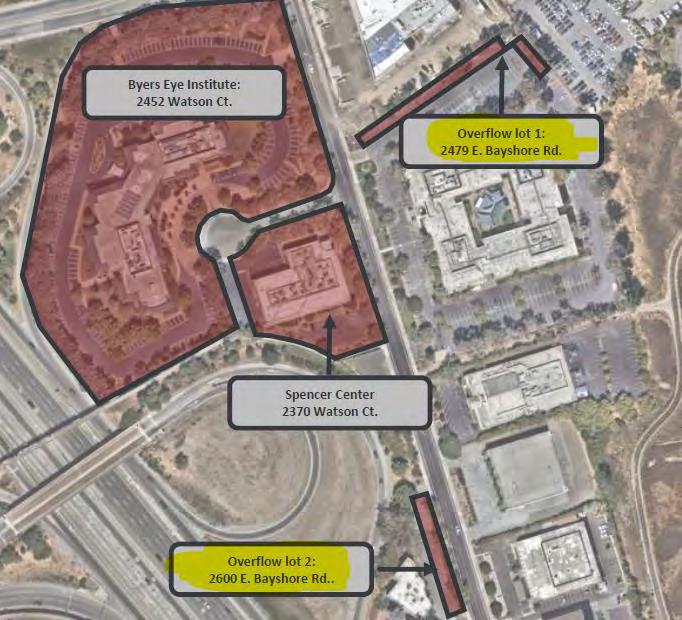
VA PALO ALTO HEALTHCARE SYSTEM (VAPAHCS)
VA PALO ALTO HEALTHCARE SYSTEM

MUST HAVE INFORMATION
Rotation Contacts and Scheduling Details
Rotation Director: Davud Sirjani, MD, dsirjani@stanford.edu
Attendings who need Resident clinic coverage:
o Michelle Chen; michelle.chen@stanford.edu
o Andrey Finegersh: afinegersh@stanford.edu
o Hamed Sajjadi: hsajjadi@stanford.edu
o Davud Sirjani: dsirjani@stanford.edu,
o Chih-Kwang Sung: kwangs@stanford.edu
Private Attendings- residents do not cover:
• Bohdan Makarewycz: bohdan.makarewycz@va.gov
Fellows- do not need Resident clinic coverage: Facial-Plastics-Fellow
• Steven Losorelli
Important ENT Contacts: Main # 650-493-5000 (dial 1à1à ext#)
Location: PAD, Bldg 100, 2nd Floor ENT Clinic. Mailstop code 112ENT ENT fax number: (650) 496-2502. If you need to send a fax, send through efax:
• https://myecfax.va.gov/fax/sendFax , 1-(###) ###-####
Administrators:
ENT Admin email: v21palentadminpaloalto@va.gov Surgical Onboarding Team: vhapalsuronboarding@va.gov
Charge Nurse: Ella Benadam-Lenrow: ext 64047
Ella.Benadam-Lenrow@va.gov
LVN: Crystal Vo: ext. 64046 Crystal.Vo@va.gov
“ Bob” Jose Antonio Santos, RNP ENT CRH Project Joseantonio.santos@va.gov
Ruby Reyes, RN Ruby.reyes@va.gov
Additional Required Conferences
RNP: Annie Yuan: ext. 65203 Annie.Yuan@va.gov
PA-C: Leslie Chan: ext. 65535 Leslie.Chan@va.gov
Admin: Michael Allard 650-485-9370 michael.allard@va.gov
Clinic rules and expectations
§ Clinic starts promptly at 9am and 1pm
§ Please complete inpatient rounds and workload prior to start of clinic
§ All documentation must be done accurately and in a timely fashion (within 24 hours)
§ Please see PAVAPGY3andPGY5.pdf for details on specific rotation goals and objectives.
VA Checklist before you start
Rev: 7/22/2026
Checklist PRIOR to your VA rotation: Otherwise you will not be able to start
PIV Badges (personal identification verification), IE= VA Badge
Check expiration date 1 month prior to start date
o If expired, email the VA Surgical Onboarding Team at vhapalsuronboarding@va.gov You will need to re-do the entire registration process (i.e., fingerprinting, background check, be sponsored, make appointment with HR to get new badge, etc.)
o Fingerprints are valid for 120 days.
o If you have lost your badge, please contact your ENT Admin. for assistance. You will need to complete a VA Police Report before you can be sponsored for a replacement badge.
o To be sponsored, you need to contact an ADPAC; your ENT Admin can help you with this.
o To make an HR appointment, contact your ENT admin. to help set up an appointment.
PIV Badge PIN number
o If you do not have a 6-digit PIN number associated with your PIV badge, or if you have forgotten it, contact any ENT Admin. ASAP. They can reset the pin for you.
o PIN # is REQUIRED in order to prescribe narcotics (see below) Surgical Service has numerous pin re-setters who can reset your pin. Listed below are some names:
§ Email: VA Surgical Onboarding Team at vhapalsuronboarding@va.gov
Computer Login Codes and Password
You can use your PIV card to log into the VA computer. You, as providers, also have a Windows login name- you need this to login to any computer. This starts with vhapal + part of your name. You must set up a 14-character password.
o FYI. ENCRYPTION for VA EMAILS is through the use of your VA PIV card. If you have any issues with encryption, please contact any of the ENT Admins.
o ENCRYPTION with Stanford email. Feel free to send encrypted emails using your Stanford email.
CPRS- VA version of electronic medical records
o These (known as Verify and Access codes) were given to you when you received your badge § Password MUST be updated EVERY 90 days. DO NOT LET YOUR PASSWORD EXPIRE. If you link your CPRS to your PIV badge, you can access CPRS with your PIV badge. Please note that your VA accounts will automatically be discontinued if you do NOT use them for 180 days. If this does happen, contact ANY ENT Admin. ASAP. EXPECT a 48-hour – 10 business days delay in workflow as a request must be submitted through the Office of Information & Technology TIP! You can update password via remote access! https://citrixaccess.va.gov
o Contact ENT Admin. for more information on how to get remote access.
TMS: When you were first boarded, you completed a couple of TMS classes that were assigned to you. Please note that the Privacy TMS course MUST be completed ANNUALLY. This course is VERY IMPORTANT to complete. If you do not, your NETWORK ACCESS WILL BE PROMPTLY AND AUTOMATICALLY discontinued on the due date! Once you lose your access it may take up to 24 hours to restore your access after you complete the Privacy TMS. DO NOT LET THIS HAPPEN.
ENT Office Keys
If you don’t have one, please contact any of the ENT Admin. ahead of time (it can take up to 2 months to get new keys). Please return all keys at the end of your residency. If you give your key to another
Resident (should not do so as each key is tracked to the person the key was originally assigned to), please inform an admin If you lose a key, there is a fine by the VA to get a replacement key.
Important Contacts:
Administrative Support (aka: ADPAC/PSA/Admin.)
- BEST METHOD is to send an email to the ENT group Admin. email alias: v21palentadminpaloalto@va.gov
Everyone listed below are in above mentioned group alias. So you do not need to send individual emails.
- Email VA Surgical Onboarding Team at vhapalsuronboarding@va.gov
CPRS helpline 650-493-5000 (62777)
Business hours (8:00AM – 4:30PM Monday - Friday): ext. 62777
After hours:
o You can contact the Administrative Officer on Duty (AOD) (ext. 60462) or ER Clerks (ext. 65470)
o OR for IT related issues, call Help Desk (ext. 64767) or 1-855-673-4357
Ordering controlled substances
You must use your PIV card and PIN to enter prescriptions for controlled substances (schedule 2-5). If you are unable to order controlled substance, please contact any of the ENT Admin. They can check to make sure that your access in CPRS is enabled.
If there is a problem with the ePCS program affecting the ordering of outpatient prescriptions, choose from one of the contingency plan options:
• Urgently needed controlled substances (C2-5) may be handwritten on form 10-2577f and turned into the Outpatient Pharmacy for immediate filling. Outpatient Pharmacy is located in Bldg 100, 1st Floor, Room E1-100. The hours are M – F: 9AM -7PM; Weekends and Holidays: 9AM -1PM & 1:30 – 5:30PM.
• If you do not have your own prescription pad, you can sign one out from the Outpatient Pharmacy.
• You can wait to enter all other controlled substance orders (for subsequent day pick up or mail) until the system is functioning.
ENT Nursing Staff and Administrative Staff
• Ella Benadam-Lenrow (Charge Nurse) and Crystal Vo (LVN)
o Ella (ext. 64047), Ella.Benadam-Lenrow@va.gov
o Crystal (ext 64046), Crystal.Vo@va.gov
o Duties:
§ Urgent/Specific ENT or OSS appointment scheduling
§ Post-op follow-ups or ED consult follow up scheduling
§ Post-op/Clinic visits/Consult planning
§ Defender’s Lodge consult needs to be made
§ Location of ENT supplies
§ Patient who need imaging appointments or numbers
• Ruby Reyes, RN
o Ruby (ext. 60264), ruby.reyes@va.gov
Rev: 7/22/2026
o Duties:
§ Surgery Scheduling
§ Pre/post op appointments, lodging and transpo related to surgery
• Leslie Chan, PA
o Contact: (ext. 65535), leslie.chan@va.gov
o Staffs Dr. Nayak’s, Dr. Sung’s, and Dr. Sajjadi’s clinics
o Non-Cancer patients: pathology/imaging follow-ups, medical clearances
• Annie Yuan (RNP)
o Contact: (ext 65203), Annie.Yuan@va.gov
o Manages all Cancer cases
o Surgery scheduling
o Staffs Dr. M. Chen and Dr. Sirjani’s clinic and NP Clinics (Op-Wed, Fridays)
o Cancer patients: pathology/imaging follow-ups, medical clearances
o Coordinate TB patients
• Administrative Staff: Michael Allard: michael.allard@va.gov, 650-493-5000 ext 69846
o Contacts:
§ ENT staff: v21palentadminpaloalto@va.gov
§ Administrative/Badging issues: vhapalsuronboarding@va.gov
o Duties
§ On-Call schedule- AMION
§ Manages on-boarding information, log-in issues, PIV badging, TMS
7/22/2026
Clinic and OR Schedule
A- NON-OPERATIVE WEEK (starting 6/22/26)
**1 resident to scrub out PRN Time
0800-1200
Chen Clinic: PGY 3,5,NP Mak
Sirjani Clinic: PGY 3,5,NP
Mak Finegersh
Sinus Clinic: PGY 3,5,PA Mak
OR 7:45am
**OR- Sajjadi: PGY 3or5
Sung Minor: PGY 3or5, PA Mak
OR 7:45am
OR- Sirjani/Chen: PGY 3, 5 FPF clinic
Annie clinic (RNP)
Team5- as needed PM
1200-1700
Chen Clinic: PGY 3,5, NP
Team1- pre/postops Mak
Sirjani Clinic: PGY 3, 5, NP
Team2-pre/postops
Sinus Clinic: PGY 3,5,PA
Team3- pre/postops
OR- Sung: PGY 3or5
Sajjadi Clinic: PGY 3or5, PA
Team4- pre/postops Mak
B- OPERATIVE WEEK (starting 6/29/26)
**1 resident to scrub out PRN Time Monday, OR 8:45am
OR- FPF: PGY 3or5
Chen clinic: NP
Sung Clinic: PGY 3or5, PA
Mak
**OR- FPF: PGY 3or5
Chen clinic: NP
Sung Clinic: PGY 3or5, PA
Mak
Sirjani Clinic: PGY 3,5,NP
Mak
Finegersh
Sirjani Clinic: PGY 3,5,NP
Team2- postops
**OR- Sinus: PGY 3, 5
Resident clinic: R Mak
**OR- Sinus: PGY 3, 5
Resident clinic: R
**OR- Sajjadi: PGY 3or5
Sung Minor: PGY 3or5, PA
Mak
OR- Sung: PGY 3or5
Sajjadi Clinic:PGY3or5, PA
Team4- pre/postops
Mak
OR- Sirjani/Chen: PGY 3, 5
FPF clinic
Rev: 7/22/2026
OR- Chen/Sirjani: PGY 3, 5
Annie clinic (RNP)
Team5- as needed
OR- Chen/Sirjani: PGY 3, 5
Additional Notes:
• Monday OPERATIVE WEEK: check-in patient at 8AM, case starts at 8:45AM
• All other OPERATIVE WEEK: check-in patient in at 7AM, case starts at 7:45AM
• ALL PATIENTS: Surgical site MUST be marked, even bilateral or midline cases need a wrist band stating the procedure to be done.
H&N Tumor Board/Radiology Rounds
• When: First Wednesday of the month: Virtual on Teams 8:30-9:00am
• Annie will manage the list
ED/Consult Calls
• ENT covers facial trauma (including TMJ) on EVEN months
o ENT for Even months
o Plastics on Odd months
• Staffing:
o Day consults staffed with attending who is in-house that day
o Night consults staffed with on-call attending
• Ask the person to place “consult to ENT” for us to write a consult note
• Rehab/TBI/Spinal cord unit consults: do not delay or ignore the consults. YOU MUST SEE THOSE CONSULTS NO MATTER WHAT! Please be courteous.
• Dental: Vet is only eligible if: 1- it is an emergency, 2- if treatment is related to H&N Cancer, or 30- 100% service connected
o H&N Cancer related- place consult under “Dental Adjunct Medical Need Outpatient”.
o Dental DOES NOT provide dentures or prosthetics. This is all out of pocket for the patient. EVEN if the defect is related to H&N cancer or our surgery. Dental will only do the BARE minimum to get them ready for XRT or surgery. They extract teeth but do not replace. Please make sure the patients know this ahead of time.
• Usually patient can come to clinic if they are safe to transfer to clinic
• For Night Consult ENT Resident: Please do not tell ED that Patient should come to ENT clinic at 8 or 9AM next day. Sometimes there is no clinic especially if it is an Operation week (Two ORs going at the same time on Friday). If patient needs to be seen urgently in the clinic at night, get the phone number of the patient and tell the ED that our clinic will contact the patient next morning and will see the patient next day (AM or PM). And please send the email to the VA ENT team (v21palentadminpaloalto@va.gov) and our Clinic nurses; Ella and Crystal. Ella.BenadamLenrow@va.gov or Crystal.Vo@va.gov
SURGICAL PROTOCOLS & SCHEDULING
OR Attire Guidelines
Please note the following regarding Operating Room attire:
• Scrubs and hats worn during dirty or contaminated cases should be changed prior to subsequent cases even if not visibly soiled.
• Operating room (OR) scrubs should not be worn in the hospital facility outside of the OR area without a clean lab coat or appropriate cover up over them.
• OR scrubs should not be worn at any time outside of the hospital perimeter.
• OR scrubs should be changed at least daily.
• Like OR scrubs, cloth skull caps should be cleaned and changed daily.
The American College of Surgeons statement on OR attire guidelines https://www.facs.org/aboutacs/statements/87-surgical-attire also supports the items above.
OR Scheduling Procedure
Below are steps to take for OR scheduling once patient is deemed a surgical candidate
1. Fill out OR Booking Sheet completely (and legibly!). This sheet is in every exam room and Resident rooms
a. Any changes to OR schedule, you must email the entire ENT Team v21palentadminpaloalto@va.gov
b. OR booking sheets- fill out and give to Ruby Reyes
2. Resident, Attending, and patient should agree on surgery date together. Look in OUTLOOK ENT OR calendar (if you need access to this calendar, contact Maria). Check with RNP/PA/RN if you are unsure about availability.
a. SINUS CASES: Do not schedule OR date unless you have followed the algorithm and cleared the date with PA first.
3. Scheduling OR date on same clinic visit day:
a. Surgery within 30 days of clinic visit, these elements must be completed:
i. ENT Pre-op and H&P appointment (valid for 30 days)
ii. Consent (obtained during ENT Pre-op appointment, valid for 60 days)
iii. Anesthesia (OSS) appointment (preoperative medical clearance)
iv. Any other medical clearances, lab work, and x-rays
b. Surgery less than 72 hours:
i. URGENT CASES need a “Request to Add-On” slip (aka PINK SLIP; see OR Pink SlipRequest to Add-On Form-Orginal.docx found in the Resident Handbook Folder within the ENT S drive)
ii. Look into SHAREPONT OR Calendar and coordinate with RNP/PA to schedule (talk to Ella if RNP/PA not available)
iii. Turn copy of PINK SLIP in person to OR (Building 100, 3rd fl., E3-100)
iv. For any OR communication during work hours, please let either Leslie or Annie know of any add-ons or changes (i.e pink slips).
v. After hour pink-slips or OR add-ons, you can communicate directly with the OR.
4. Scheduling OR date on another date:
a. If more than 72 hours:
i. ENT RN/RNP/PA will notify patient once surgery is scheduled
ii. Confirmed ENT Pre-op and OSS appointments
iii. Surgery package sent
1. Contains surgery letter, surgeons credentialing information, any relevant information
2. FYI that credential information is also available online
5. FOR COMPLEX OR CASES: email OR team and Attending the plan the day prior to surgery: Cristobal, Christine C. Christine.Cristobal@va.gov; Le, Lan Th LanTh.Le@va.gov; Harris, Valerie C. Valerie.Harris2@va.gov; Yanokodani, Colleen E. Colleen.Yanokodani@va.gov; Indiarto, Arif Arif.Indiarto@va.gov; Coffman, Clarity Clarity.Coffman@va.gov; VA ENT V21PALENTADMINPaloAlto@va.gov, CC the Attending on the case, and CC the Chief Anesthesia resident.
Admitting Floors
• 23-hour Observation: EDOU (emergency department obs unit)- 1st floor, back of ED
o only if they will be here <23 hours; no discharge summaries necessary
o 4 beds available
o For patients who take shuttle or don’t have driver
• 47-hour observation: beds available on 3C/2A/4C1
o Only if they will be here <48 hours; no d/c summaries necessary
o 3C- +tele and +continuous pulse oximetry, q4h monitoring
o 2A- +tele and +continuous pulse oximetry, q8h monitoring
o 4C1- medicine room, no TELE, no continuous pulse ox, q8h monitoring
• 3C: Surgical Floor, 1:5-6 ratio,
o +continuous pulse oximetry monitoring (up to 10 beds)
o +telemetry (up to 8 beds)
o Q4h monitoring
• 3C-SDU: 1:4 ratio, 4 PRIVATE rooms close to nurses’ station
o Would NOT recommend for someone who needs close monitoring
o +Telemetry, +continuous O2 monitoring
o + trach care or patients who just comes out of ICU
o q2h suctioning
• IICU: Can use as female SDU (as female usually cannot go SDU at 3C)
o less acute than MSICU
o q1h suctioning
• MSICU:
• 4C:
o Free flap or Acute airway issues
o Usually medicine primary/Acute Rehab. Usually send patient who requires long hospital stays ex IV ABX, palliative care etc.
• Extended Recovery- for patient’s who do not have a driver and not on narcotics
o Requires referral- Ruby will do this in advance
o bed in a shared hospital room
o NO nursing care
o Patient is responsible for bringing and administering own medications
o Pack an overnight bag with toiletries, there is a bathroom and shower available.
o Meals are provided.
o Leave the room by 6am.
Rev: 7/22/2026
ENT Outlook Calendar
• Surgeries, minor procedures, and staff schedules are posted here. If you need access, contact any ENT Admin. Link below, bookmark to your EDGE browser https://dvagov.sharepoint.com/sites/ENTCalendarTest/Lists/ENT%20Calendar/ENT%20Calendar.aspx?O R=Teams%2DHL&CT=1733165246538&clickparams=eyJBcHBOYW1lIjoiVGVhbXMtRGVza3RvcCIsIkFwcFZl cnNpb24iOiI0OS8yNDEwMjAwMTMxOCJ9
Adding patient to Outlook OR Calendar
RN/RNP/PA will do this once they receive a completed OR Booking Sheet.
Outlook OR Calendar Color Legend
Below is the color-coding system for the OUTLOOK OR Calendar and the elements they include in order to be that color
• Gray – NO CATEGORY- Clear selection
o Surgery placeholder; date usually not confirmed with patient and/or RN/RNP/PA coordinator
• Blue
o In-Clinic Procedure that Ella and Crystal handle
• Purple
o Surgery date agreed upon
o OR booking sheet filled out completely
o NOT in vista
o Pre-op appointments scheduled
• Yellow
o Entered into VISTA
o All set
• Red
o Cancelled surgery cases
o Away dates
• Orange
o REMINDERS
Surgical Equipment Requests and Locations
All surgical equipment and tools should be requested via the Surgical Request Form (AKA OR Booking Sheet) that is completed for all cases. These sheets are located in many rooms in the ENT clinic. Please circle the equipment needed and write in anything that is not already listed. Admin., then enters the request into CPRS, and Colleen Yanokodani, RN, in OR (Bldg 100, 3rd Fl., Room F3-102) makes sure that the equipment is brought to the operating room from the various surgical storage areas upstairs (P&P room, Omnicells in old holding area, C locker, etc.). If you need something while in the OR, you can ask the circulating nurse to get it for you.
If there is something that you want to use that we normally do not stock, be prepared to wait at least 2 months, if not more. The VA has a specific request process that needs to be followed, and you need to talk to Colleen. The attending will need to complete and submit an Operating Room Procurement Committee Request Form (AKA the “gold form”) and begin the process of procuring the new equipment. This can take anywhere between 2 months and 1 year. Click the link (OR Request form (gold form).pdf) to see for an example of the gold form. Maria Tham can also provide you with more information.
Surgical Algorithms
Due to backlogs with surgery date availability, we are creating algorithms based on standards of care to simplify when a patient is a candidate for surgery. Currently, we have one algorithm completed for sinus surgery scheduling. The algorithm can be found in the document entitled “Sinus Scheduling algorithm.” Please contact RNP/PA/RN for more information.
VA DOCUMENTATION DETAILS
The VA has an online Physician Reference Guide that contains everything you need to know about CPRS, the computer system used to document patient care. To access it from the Intranet, go to the VA home page (https://vaww.paloalto.va.gov), then under the Patient Care tab, choose CPRS Physician Reference Guide
The CPRS team also created videos that you can review. Please click on below link. Clinical Informatics - CPRS Training Videos - All Documents (sharepoint.com)
Notes
Create documentation by using the notes tab in CPRS, then “new note”. You can then go to the template tab and select a template from the “ENT” section through “Shared templates”
• Admission H&P: within 24hr of admission
• Preop H&P: 30 days prior to procedure – Must contain
1. Diagnosis
2. PE findings (including Lung and Heart)
3. Procedure to be performed
4. Alternate treatment plans discussed
5. DC/anticoagulation
• Updated Pre-op: Within 24hours of surgery (By Attending) – Must contain
1. No changes in condition
2. Proceed with scheduled operation
• Brief OP NOTE: Before patient changes level of care (Before leaves the OR)
• OP report: You can either dictate or write (if you write then you cannot go and edit: have to write just once, that’s it)
• Discharge summary: Entered or dictated within 24hrs to DC
• Life-Sustaining Treatment – used to document CODE status (if not a full code, orders are entered)
• POLST
• Informed Consent: 60days of surgery
Encounters
Every note you write must be associated with the correct VISIT TYPE, VISIT LOCATION, NOTE TITLE and ENCOUNTER in order for ENT to get payment/credit for the visit, whether that visit is in-patient, in the ED, or in clinic. See “inpatient and ed consults documentation.”
The six most important things you need to know about encounters:
1) Attendings must be selected as “Primary Provider.” Residents are not primary providers.
2) In the “Visit related to” box, you must choose YES or NO if the issue is service connected. If you are not sure, click on the patient’s name in CPRS to pull up the “patient inquiry box.” It will tell you if a condition is service related.
3) You must complete the diagnosis and procedure tabs
4) If the note is a consult, please link the note to the consult
5) For inpatients who are being seen in the ENT clinic and have a scheduled appt, change the “clinic” location to reflect that you are seeing them in the ENT clinic
6) For patients you are seeing as a consult in the ED or on the unit, in order for ENT to get credit for it, first make sure the consulting team places an ENT CONSULT, then:
Clinic location boxànew visit tabàENT-STAFF (PAD)à start new consult note like in #5
For more details about entering encounters, please ENT encounters details.docx
For more details about Evaluation and Management Coding Guidelines, please see Coding sheet, Evaluation & Management Coding Guidelines 1995.docx and Time Based Coding Guidelines.docx, both found in the Resident Handbook folder within the ENT folder of the S drive.
Computer Programs
There are 3 main computer programs you need to know about for patient care.
CPRS (Computerized Patient Record System)
Main program for all patient notes, imaging reports, etc. See also the previous page on VA Documentation.
o Finding a patient:
§ Entering First initial of last name and last 4 of SSN#
§ Find through floor or clinic (i.e., PAD-ENT-HEAD-NECK-TEAM2)
o Entering notes and encounters for each clinic visit
§ Inputting type of visit, diagnosis, procedures, etc
o Inpatient/Outpatient ordering on left side menu
o Inpatients going to OR
§ Helpful to select all current orders and enter them in as delayed orders before the case
o Consult requests
§ Consults to other services, palliative care, transfer to 4C, Defender’s Lodge, nonformulary medications, speech, physical therapy, radiation therapy, oncology, etc.
§ See next page for how to enter specific consults
o Set-up Clinic List
§ Reason: list of patients for the current day and clinic automatically populates
§ Steps:
1. Select “zztest,Andrew” patient
2. Select TOOLS tab, scroll down and select OPTIONS
o Select LIST/TEAMS tab, select PATIENT SELECTION DEFAULTS
§ Under LIST SOURCE, select COMBINATION
§ Under SORT ORDER, select either ALPHABETICAL or APPOINTMENT DATE (depending on your preference)
§ Clear all selections in the dropdown menus on the right
§ Select: OK
o Select SOURCE COMBINATIONS
§ Select source by
§ CLINIC and select and ADD all ENT specific clinics that you staff (ALSO DO PAD-PH-ENT-XXX AND PAD-VVC-ENT-XXX)
PAD-ENT-EAR PAD-VVC-ENT-EAR PAD-PH-ENT-EAR
PAD-ENT-HEADNECK-TEAM1 PAD-VVC-ENTHEAD-NECK-TEAM2
PAD-PH-ENT-HEADNECK-TEAM2
PAD-ENT-HEADNECK-TEAM2 PAD-VVC-ENT-SINUS PAD-PH-ENT-SINUS
PAD-ENT-NEWVOICE
PAD-VVC-ENTTEAM1
PAD-PH-ENT-STAFF
PAD-ENT-SINUS PAD-VVC-ENT-VOICE PAD-PH-ENT-TEAM1
PAD-ENT-STAFF PAD-VVC-ENT-EAR PAD-PH-ENT-VOICE
PAD-ENT-TEAM1
PAD-ENT-TEAM2
PAD-ENT-TEAM3
PAD-ENT-TEAM4
PAD-ENT-TEAM5
PAD-ENT-VOICE
PAD-ENT-VOICE-PD
§ Select SPECIALTY and select and ADD all ENT specific Wards (ENT-IICU, ENT-OBS, ENT-SMICU, ENT-WARD)
• Hit OK
o Select NOTES tab, select DOCUMENT TITLES
§ Remove your old lists
§ Search Document Titles starting with ENT and select and ADD all titled notes that are appropriate for your work
§ Save changes and OK
3. Click OK to save everything
o Set-Up ENT Note Templates- while still in the same patient’s chart:
1. Select NOTES tab (on the bottom), select TEMPLATES (bottom left)
2. Right click SHARED TEMPLATES, scroll down and select EDIT TEMPLATES
3. Expand SHARED TEMPLATES, scroll down and click on ENT Folder and click on RIGHT ARROW à to copy to my templates
4. Select OK to save everything
VISTA Imaging Display
1. Reason: Useful for outside medical records, sleep studies or wound photos. Access through CPRS, click on TOOLS tab, scroll down and select VISTA Imaging Display
2. If you are unable to view images through Vista Imaging Display, please contact any ENT Admin. They will check your access.
RADIOLOGY: To view CT/MRI/Xrays/swallow studies:
ii. Go to CPRS, click TOOLS, scroll down and click on RADIOLOGY(INTELLISPACE/PAL-STENTOR) and select either PAD for PAD images or Other Sites for other sites
iii. You can also access Intellispace through the desktop. Currently, access is through the VA PIV card. If you cannot access Intellispace, please contact any ENT Admin.
Audiograms: Click here for instructions to view audiograms.
Report or Result look-up: Joint Legacy Viewer (JLV), Labs, Predefined Lab Worksheet, Clinical Reports
• Must click on blue “Remote Data” in upper right corner of CPRS to pull in Data from Other VAs
• PICIS – flowsheet for ICUs Need to access via Tools>Specialty Applications> PICIS Remote Application
§ Change to Option to “RDP”: Use Window’s username (vhapal…) & PIV card password
• Vista Imaging (used mostly for ECGs, procedure documentation, advance directives, IMED Consents, etc.)
• Joint Legacy Viewer (JLV) used for most current outpatient meds for patients from other sites: SharePoint Resource: https://dvagov.sharepoint.com/sites/VACOVE2/JLV/Resources/Forms/AllItems.aspx?viewpath=%2F sites%2FVACOVE2%2FJLV%2FResources%2FForms%2FAllItems.aspx
iMed Consent
1. Defined: Digital consent platform.
2. All procedures require an electronic informed consent documented in the medical record
3. Access through CPRS, click on TOOLS tab, scroll down and select iMed Consent and follow instructions. Include any Attending that may be participating in the case.
4. There have been many issues with access with IMED CONSENT due to software upgrades. If you have any issues accessing your IMED Consent, please contact any ENT Admin. to resolve for you.
5. If the electronic consent is not working, you can fill out a hardcopy with signature and request an Admin to upload it to Vista Imaging in CPRS
Rev: 7/22/2026
ENT Scope exam: Standard Work
Last updated: 6/18/2025 Owner: ENT
Version: 1.0
Revised by: Annie Yuan
Performed by: ENT Clinic and SLP Clinic
Trigger: Decision made that a patient needs scope exam
VA Palo Alto Mission: Honor America's Veterans by providing exceptional health care that improves their health and well-being
Standard Work Applicability: Process for recording and storing scope exams for the Otolaryngology(ENT) Surgical Department
Standard Work
Provider seeing the patient
Provider seeing the patient
Place NEW CONSULT à ENT Scope image à accept order à sign
As soon as decision made to scope a patient, provider
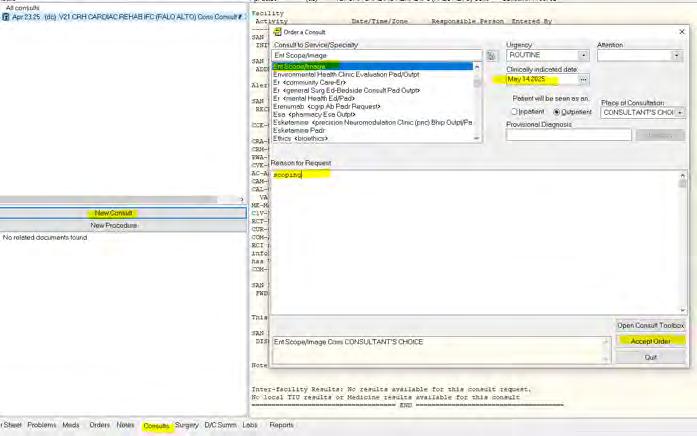
Go to Olympus tower à sign-in à “capture”, “search”, then “search”, then select your patient from list
Provider seeing the patient Record scope exam and save (bottom right “flag” to save.
CPRS à notesà new note à ENT scope/image consult à connect to consult à Enter in the same information as you would the Endoscope tracking note
Place consult AS soon as decision is made to perform scope exam.
At this point, unneeded videos or photos should be deleted prior to saving.
New consult assigns an accession # for the exam to allow video to upload into Vaultstream and photo to Vista imaging.
This note will replace the endoscope tracking note
Accession number is now associated with the patient and the scope exam.
This saves the video and photos onto Vaultstream and photos onto Vista imaging.
This completes the consult loop and also records what scope was used where and how to access the exams
Rev: 7/22/2026
Missing consents for procedure reminder
This is a reminder that almost anything you do that require an injection needs a consent (and a minor procedure note because it has certain required wording on that document i.e. timeout was done, consent obtained, etc. etc.).
The only thing(s) so far that doesn’t require consent are:
• Scope exams
• Sinus debridements (though this is somewhat arguable… safe to just get consent)
• Treatment of epistaxis
• Drain/suture/staple removal
Adjuvant consults
1. Dental
a. To place the dental consult in CPRS:
i. Choose New consult
ii. choose last ENT clinic cancer visit (Sirjani, Sung, M. Chen)
iii. under “consult to service” type “dental” (“dental adjunct to medical need outpatient” will populate), hit ENTER
iv. Select “head and neck cancer care”
v. Submit order (must be signed)
2. Radiation
a. To place the radiation consult in CPRS:à Ask Annie/Leslie/Ella
i. Choose New consult
ii. choose last ENT clinic cancer visit (Sirjani, Sung, M. Chen)
iii. under “consult to service” type “Community care – Radiation therapy” and hit ENTER
iv. Justification for Community Care-Radiation Therapy: VA does not provide
v. Type: choose “Evaluation and Treatment”
vi. Enter relevant information
1. Please paste into consult: initial eval + 1 office visit before treatment, diagnostic tests, tx, post tx follow-up visits x4 over 12 months from date of initial eval.
vii. Most radiation consults go to Stanford
viii. Submit order
3. Oncology
a. To place the oncology consult in CPRS:
i. Choose New consult
ii. choose last ENT clinic cancer visit (Sirjani, Sung, M. Chen)
iii. under “consult to service” type “oncology” and then choose the correct service and location
iv. Choose e-consult or Face-to-face
4. Cancer Survivorship Care plan (see below for details)
a. To place a cancer survivorship consult in CPRS:
i. Choose New consult à choose last ENT clinic oncology visit (Sirjani, Sung, M. Chen) à under “consult to service” type “cancer” (“cancer survivorship/PAD Outpt” will populate), hit ENTER
ii. Fill in the associated fields (Cancer diagnosis, date of diagnosis, Date of last treatment)
iii. Under “reason”, check “survivorship care plan.”
The American College of Surgeons Commission on Cancer requires accredited programs like VA Palo Alto to implement treatment summaries and survivorship care plans to help improve communication, quality, and coordination of care for cancer survivors. The timing of delivery of the survivorship care plans is within one year of the diagnosis of cancer and no later than six months after completion of adjuvant therapy (other than long-term hormonal therapy). The “one year from diagnosis” requirement to have a care plan delivered is extended to 18 months for patients receiving long-term hormonal therapy. Care plans are given to patients Stages I-III who are treated with curative intent. We are asking providers to place a survivorship consult on the date of the patient’s last chemotherapy or radiation treatment. For those patients who only get surgery as treatment, the survivorship consult can be placed on the day you see the patient back for his/her first follow up visit. The consult will alert Lakedia Bank (Oncology RNP) and they will either complete the care plan or provide assistance to the various departments on how to complete the care plan. The Accreditation Committee made the following changes to the established time frame and scope of implementation.
January 1, 2015 – implementation of pilot survivorship care plan process involving 10% of eligible patients.
January 1, 2016 – Provide survivorship care plans to 25% of eligible patients.
January 1, 2017 – Provide survivorship care plans to 50% of eligible patients.
January 1, 2018 – Provide survivorship care plans to 75% of eligible patients.
January 1, 2019 – Provide survivorship care plans to all eligible patients.
For more information about the care plans, contact Lakedia Banks at x65848/64169.
Non-VA Consult Contacts
Community care consultsà ask Annie or Leslie
Return to Clinic Order
All follow-up appointments need to be entered into CPRS as a “return to clinic” order.
Three (3) Month Follow-up Rule:
• Within 3 months:
o Enter order for appropriate Attending clinic and time frame
§ E.g. +6w (for 6 weeks) or +2m(for 2 months)
• After 3 months:
o Place into recall. Recall is a waitlist.
o No appointment will be made, and patients will be mailed a postcard 2 weeks prior to intended appointment
o If patient in recall and needs imaging prior to their 1-year follow-up, please note in special instructions
§ E.g Patient to schedule MRI prior to ENT appointment
o CANCER PATIENTS DO NOT GO INTO RECALL
§ In special instructions, write “NO RECALL” and state reason
• Reason example: Cancer surveillance, needs MRI/audio/PETCT arranged at the same time
Coding
If there are multiple surgeons scrubbed from the same service, the operative report must reflect the role of each person in the operative report to get the RVU credits. Please dictate accordingly:
Please look at these definitions below and dictate accordingly.
Rev: 7/22/2026
80 Assistant Surgeon
• Provides full assistance to the primary surgeon
• Capable of taking over the surgery should the primary surgeon become incapacitated.
• If an assistant surgeon assists a primary surgeon and is present for the entire operation, or a substantial portion of the operation, then the assisting physician reports the same surgical procedure as the operating surgeon.
• The surgeon is required to specify in the body of the operative report what the assistant does. It is not sufficient evidence of participation to list the assistant’s name in the heading of the operative report.
• It may be helpful to mention in the indications paragraph why there is a need for an assistant.
• Only one operative report is required.
81 Minimum Assistant Surgeon
• An assistant who does not participate in the entire procedure but provides minimal assistance to the primary surgeon.
• The surgeon is required to specify in the body of the operative report what the assistant does. It is not sufficient evidence of participation to list the assistant’s name in the heading of the operative report.
• It is a good idea to mention in the indications paragraph why there is a need for an assistant.
• Only one operative report is required.
82 Assistant Surgeon (When Qualified Resident Surgeon is not Available)
• Used primarily in teaching hospitals to indicate that a qualified resident surgeon is unavailable.
62 Two Surgeons with Different Skill Sets
• Each provider should document their own portion of the procedure.
• Two separate operative reports.
MRSA Procedures
Asymptomatic surgical patients with a positive swab are not required to be treated for MRSA unless they have an active MRSA infection, such as our cancer patient going for surgery on Friday. Then the recommended protocol is to collaborate with infectious disease (ID) to make sure that the Vancomycin (or other abx) blood levels remain between peak and trough and that any other required measures are taken. (This is something that needs to go into the resident handbook, so the residents are aware to coordinate with ID pre-op.)
Patients with a positive MRSA swab are on contact precautions while in-patient, but they are not kept isolated, i.e., they can still go down to get a cup of coffee from Starbucks. (Yes, you’re right, not logical.)
Asymptomatic veterans who are out-patient are not monitored or followed.
There is some controversy about the benefits of completing the nares swabs. Some hospitals no longer do them, since MRSA is now considered a “normal” part of most people’s microbiome.
CODE X - System for bleeding emergencies
In collaboration with nursing, VA has now developed a new system for bleeding emergencies that need to go to the OR off hours. When the nursing supervisor is called to get the OR team in, you/your resident-fellow needs to tell them it is a CODE X situation. This means that the nursing supervisor will call in 3 nurses to have adequate staff in the OR and arrange for extra resources such as blood runners. It is also a sign that the Massive transfusion Protocol should have been activated. If you think you require the cell saver or bypass machine please make sure to also have them call in a perfusionist. This status will be communicated to all of the nurses as they are called so they know they are coming into a critical situation and get set up ASAP.
Remote Access Set-Up
To obtain a Remote Access Account use this link: https://vaww.ramp.vansoc.va.gov/SelfService/
• (ONLY accessible within the VA network. YOU CAN ONLY PUT IN A REMOTE ACCESS request on a VA networked computer). You will be notified (by VA outlook email and/or the email you enter) when your account has been approved and activated.
o Justification for Remote Access: Provide clinical care, need to be on-call, and require remote access. Work in a sterile environment
o Supervisor: Mehgan Sobejana
• If you are unable to be onsite to put in this request, please contact your ENT Admin. (v21palentadmin paloalto@va.gov ) or someone from the Surgical onboarding team for assistance (vhapalsuronboarding@va.gov)
• Access remote access using the follow link: https://citrixaccess.va.gov
• If you have any further questions regarding Citrix Remote Access and associated resources, please contact the VA Service Desk/Help Desk (ext. 64767) or 1-855-673-4357
• If you are using your PIV card, you will need a PIV card reader. Ask your Admin for one.
• If you will be accessing with Mobile Pass, contact an ENT Admin. for details.
• Please remember that you must use your remote access at least once every 90 days. If you do not, your remote access will automatically be disconnected, and you will need to apply again.
• For a copy of the VA Remote Access “handbook,” contact any of the ENT Admins. It is also located on the ENT drive, which you have access to. S:\ENT\ Resident Handbook
To set up:
2 WAYS:

1. Go to VA shortcuts, STAR icon on desktop à PAL shortcuts folder à XEROX print server à top right search box type in à pal-dp201212 à ENTER à Double click on it and done
2. pal-dp201212 for the printer by annie
3. pal-dp194511 for the printer in front lobby
OR :

1. FOR printer by ANNIE: Type in the SEARCH box (bottom left of your screen): \\VHAPALAPPOM01\pal-dp201212 > OK It will start connecting and you are done.
2. FOR printer in ENT lobby: Type in SEARCH box (bottom left of your screen) \\vhapalappom01\pal-dp194511 and hit OK. It will start connecting and you are done.
VETERAN SUPPORT
Case Manager/Social Worker
• We will add you to an inpatient group with CM and Sw’s.
• Erin Cummings, Outpatient SW 65986
Housing & Transportation
Defender’s Lodge
o Criteria for requesting Defender’s Lodge Consult:
§ Veteran is traveling 50> miles away
§ Veteran has significant travel difficulties
o Veteran usually needs a driver with them
o Note that there has been numerous policy changes due to COVID-19. Double check with any ENT staff.
o Entering consult
§ Click “CONSULT” tab, click “NEW CONSULT, select own name and clinic appointment
§ Enter “DEFENDER’S LODGE” in Consult to Service/Specialty
Fischer House
o Housing for family and not Veteran/patient, has to be inpatient >3days, i.e., when patient is admitted for chemo/XRT, or prolonged hospitalization
Shuttle Bus
o Click link for Shuttle bus schedule: https://www.paloalto.va.gov/shuttleschedule.asp
o SHUTTLE BUS DOES NOT TAKE ANY PATIENTS AFTER GENERAL ANESTHESIA. LOCAL is fine but not GETA. So those patients can go to Defender’s Lodge if they have a significant other or family member with them, if not we have to admit as Observation at C3 or EDOU.
First Day Checklist
On first day of rotation:
• Window’s sign-in
• PIV card encryption
• CPRS sign-in
• IntelliSpace sign-in
• PIV PIN to order narcotics
• Put in your away dates in our calendar and confirm on-call schedules
Set-up:
• Scrub card
• Clinic keys
• Dictation code
• ENT Admin. to add you to Outlook calendar
• Set-up printer
• Remote access
• CPRS: set note titles, clinics and templates
End of Residency Checkout list
At the end of your residency, please make an appointment with an ENT Admin to check out. These are the items you should bring
1. PIV Card
2. Clinic keys
3. VA sponsored electronics if any
4. ScrubX card
5. Any other item provided to you by the VA
Please do not turn in items and sign out until you have completed all of your on-call duties. Please remember to complete and sign any outstanding notes/consults/encounters BEFORE YOU LEAVE.
VA PALO ALTO ENT CONTACT LIST
PAD 3801 MIRANDA AVE, PALO ALTO CA 94304
ENT Mailcode: 112ENT
ENT mainline (thru operator): 63924, 65751 (front desk)
Pre-fix #’s to dial out: PAD=56: SJC=57: MOD=54: MPD=52
FAX: (650) 496-2502
ENT mainline: x60264; Direct #: 650-849-0264
To PAGE, go to: https://smartpage.stanford.edu/ or dial 65970 (live operator will connect you)
Last First Ext: Pager Room # email address (preferred)
Benadam-Lenrow Ella 64047
Chan Leslie 65535
Chen Michelle 65240
Finegersh Andrey 65240
Longino Elizabeth 64047
E2-241 ella.benadam-lenrow@va.gov
E2-246 leslie.chan@va.gov
E2-256 michelle.chen@stanford.edu
E2-256 afinegersh@stanford.edu
E2-236
Makarewycz Bohdan 64622 none bohdan.makarewycz@va.gov
Nayak Jayakar 61122 23098
Reyes Ruby 60264
Sajjadi Hamed 63166 13199
E2-236 jnayak@stanford.edu
E2-246 Ruby.reyes@va.gov
E2-236 hsajjadi@stanford.edu
Santos “Bob” 6508583906 Remote Joseantonio.santos@va.gov
Sirjani Davud 67145 23350
Sobejana Mehgan 60596
E2-248 dsirjani@stanford.edu
3rd fl. mehgan.sobejana@va.gov
Sung* C. Kwang 61122 23479 E2-236 kwangs@stanford.edu
Vo Crystal 64046 E2-241 crystal.vo@va.gov
Yanokodani Colleen 66022
3rd fl. colleen.yanokodani@va.gov
Yuan Annie 65203 11671 E2-246 annie.yuan@va.gov Work cell for patients: 650-388-6675
ENT Chief Resident 64049 E2-254
ENT Exam Room 1 65193 E2-244
ENT Exam Room 2 65348 E2-243
ENT Exam Room 3 64622 E2-242
ENT Exam Room 4 66214 E2-252
ENT Jr. Resident 64048 E2-253
ENT Main line 60264
ENT Minor Room 63322
EYE/ENT Conference Room 65353
Rev: 7/22/2026
3A/OSS 64877
Audiology/Speech Path. (PAD) 65597
Bed Control
CDs/Radiology file room
Community Care
Useful Numbers
66969, 65495 63905- Nursing supervisor
61548- Saman Heng
65050- Paul Brandon
650-852-3396
MPD x22066
LVD x36449
SJC x72057
MONT x43861
V21PALFloatPool-HealthTechs@va.gov; V21PALNursingSupervisor@va.gov; VHAPALFlowCoordinators@va.gov
65956- Michael Stephenson 67393- Henok Atnafe v21palradiologyfileroom@va.gov
650-617-2732
CPRS Help hotline 62777
Crisis Line
CT/MRI/Ultrasound/Barium swallow
1-800-273-8255, then press 1
650-858-3949
Decedent Affairs 65432
Defenders Lodge 61333
Dental 65621
CC mailstop: 136C office of CC v21palcommunitycare@va.gov
Ext. 63824
Harold Rucker Supervisor x62824
Dr. Sara Ceglio x62154
ECHO 64167 64621- echo lab, 64167 to schedule
Fisher House 61630
Golf Cart request (volunteer services) 65800, 60026
GT Removal 68800
Tracy Marino Supervisor x69914
David Cleveland NP, pager11916
Helpdesk (IT) 64767 1-855-673-4357 YOURIT icon à submit ticket
Interventional Radiology 68800 61383 ?scheduler?, 69108- thyroid bx sch
Navarre Transport
833-628-2773
Nuclear Medicine 65520 (PET)
Nursing Supervisor
650-485-5092- Vocera
Occupational Health 65480
Oncology 64948- sch, 65862/65844- front desk
OR Front desk 66024
OR Flow Coordinator 68400
ask for nursing supervisor x65960
Lakedia Banks NP x65848
Leticia Perez
OSS RNP – Robin Boselli 64154/62049 62655
PFTs/Pulm 64207
Pharmacy- Refill line 1-800-311-251
Radiology reading room 63471
Risk manager
ROI- VA Palo Alto Health Care System 3801 Miranda Ave., Release of Information (11 MR), Palo Alto, CA 94304
650-493-5000 x66567
67655 (pts) 67298 (Elvie) 62655 (Aishah)
Secure messaging/ My Health-e Vet 69321
SPD 64212
Telephone Care program 800-455-0057
Transfer Coordinator
Transport
650-496-2591
650-485-5092- Vocera
Sharon Squires
FAX: 650-849-1270
Building 100, 1st floor, by DERM
Katherine Domingicil
ask for transport VA travel 65686
VOCERA
Rev: 7/22/2026
650-485-5092- Vocera
To contact nursing supervisor, nurses