Fa ll
global 202
6 New
INTERNSHIPS
sletter from the Stanford Global Studies Internship Program
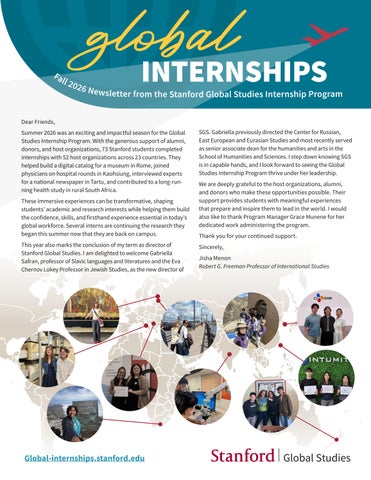
Dear Friends, Summer 2026 was an exciting and impactful season for the Global Studies Internship Program. With the generous support of alumni, donors, and host organizations, 73 Stanford students completed internships with 52 host organizations across 23 countries. They helped build a digital catalog for a museum in Rome, joined physicians on hospital rounds in Kaohsiung, interviewed experts for a national newspaper in Tartu, and contributed to a long-running health study in rural South Africa. These immersive experiences can be transformative, shaping students’ academic and research interests while helping them build the confidence, skills, and firsthand experience essential in today’s global workforce. Several interns are continuing the research they began this summer now that they are back on campus. This year also marks the conclusion of my term as director of Stanford Global Studies. I am delighted to welcome Gabriella Safran, professor of Slavic languages and literatures and the Eva Chernov Lokey Professor in Jewish Studies, as the new director of
Global-internships.stanford.edu
SGS. Gabriella previously directed the Center for Russian, East European and Eurasian Studies and most recently served as senior associate dean for the humanities and arts in the School of Humanities and Sciences. I step down knowing SGS is in capable hands, and I look forward to seeing the Global Studies Internship Program thrive under her leadership. We are deeply grateful to the host organizations, alumni, and donors who make these opportunities possible. Their support provides students with meaningful experiences that prepare and inspire them to lead in the world. I would also like to thank Program Manager Grace Munene for her dedicated work administering the program. Thank you for your continued support. Sincerely, Jisha Menon Robert G. Freeman Professor of International Studies
2026 Internship Facts The Global Studies Internship Program hosted 73 students in 23 different countries. Educational standing:
24 majors were represented:
• 23 sophomores
• 28 undeclared
• 22 juniors
• 4 each: East Asian studies, economics, international relations
• 17 frosh
• 3 each: computer science, electrical engineering, human biology
• 7 seniors
• 2 each: biomedical computation, design, earth systems, English, political science, public policy, symbolic systems
• 4 M.A. students
• 1 each: art history; bioengineering; biology; biomechanical engineering; history; individually designed major in engineering; policy, organization, and leadership studies; science, technology and society; sustainable architecture and engineering; urban studies
AUSTRIA
BELGIUM
Centre for European Policy Studies • The Lisbon Council • Renew Europe Group • European Environmental Policy (IEEP)
USA
Carnegie Endowment for International Peace
University of Salzburg • Research Center for the History of Transformations (RECET), University of Vienna • CeMM Research Center for Molecular Medicine of the Austrian Academy of Sciences • Medical University of Vienna
GERMANY Cellu GmbH
DENMARK Alchemist
LATVIA
Riga Stradiņš University • Latvian Strategy and Economic Research (LaSER)
FRANCE
UNESCO • University of Montpellier • Sorbonne University • FAST Laboratory, Université Paris-Saclay • Paris Brain Institute
ARMENIA Synopsys
JORDAN
ITALY
Galleria Borghese • European Space Agency
CHILE
Good Neighbors
ESTONIA
Johan Skytte Institute of Political Studies, University of Tartu • Vabamu Museum of Occupations and Freedom • NATO Cooperative Cyber Defence Centre of Excellence • TalTech
University of Jordan
BOSNIA AND HERZEGOVINA Post-Conflict Research Center
SOUTH AFRICA
Lalela • University of the Witwatersrand
UKRAINE
Center for Civil Liberties • VoxUkraine
KENYA
LAM Sisterhood
JAPAN
Rogers Investment Advisors • Mitsubishi Research Institute • Urban Connections
SOUTH KOREA
Simone • Mirae Asset • CJ Cultural Foundation • Amorepacific • Seoul Museum of History • Singing Beetle
CHINA
Keru • Li Po Chun UWC
TAIWAN
Taiwan Institute of Economic Research • Intumit Inc. • Kaohsiung Medical University Chung-Ho Memorial Hospital • International Climate Development Institute
INDIA
Magic Bus India Foundation • Lions Aravind Institute of Community Ophthalmology
PHILIPPINES Philippine Heart Center
NEW ZEALAND NZPC
2
Arts & Culture Internships Creagh Factor, English and Data Science Galleria Borghese, Italy
At the Galleria Borghese, I’ve had the chance to create programs and systems across so many areas of museum research. I spent much of the summer enriching the museum’s digital catalog: designing new systems for recording iconography, restoration history, exhibition history, and provenance; building visualizations of the collection, including an artist timeline that shows the holdings distributed across centuries rather than as a list; and linking our records to external databases and international standards so that scholars anywhere can find and use them. For the Borghese’s joint projects with the Vatican Apostolic Archive, I developed tools for provenance research to help researchers match works in the collection to historical inventories and collate mentions of a single artwork across documents. The photo is of me and the other Stanford intern, Sara, at the Vatican Apostolic Archive, where we got to know the Borghese team working on the project! It’s been so helpful to see the archives and art I’ve learned about directly and to work with scholars at the museum to create tools to aid their research. I’ve learned so much from my time at the Borghese. I’ve become much more confident in applying my data science skills to digital humanities work, pursuing a career in museums or archives, and experiencing Italian culture. Thank you so much for making this possible.
Ryan Lee, Design
Simone Accessory Collection, South Korea This internship was better than I could have ever imagined. At Simone Accessory Collection, I was able to work with teams from various luxury designer brands, from Tory Burch to Michael Kors to even 0914, Simone’s in-house design division. The president of the company gave me an analogy that really resonated with me: in working with sales, design, and manufacturing teams, I didn’t just become familiar with a single tree — I came to know the whole forest. The attached image shows my co-intern and our Michael Kors team during one of the many reviews we attended for the upcoming Fall/Winter 2027 Mainline collection. We really got to see deeply into the details of this industry. In the company’s generous hospitality, I was mentored by some of the most inspiring role models in each of their respective fields and learned not only the intricacies of the entire design and manufacturing process for a single product, but also the precise role that I have as a designer and all of the considerations I need to make in order to create the best product possible as well as the best experience for all of the people involved. Because of all of this, I will be able to make a much more deeply informed decision about my future. I am much more sure that I want to be a designer. At this company, I also gained many friends and relationships that I will remember and cherish forever. I have stayed in touch with many of them to this day! On a more personal note, I believe that I am emerging from this experience a completely different, far improved person.
Initially, I struggled with being independent in a foreign country, but as I became more familiar with the customs and amenities in my area, as well as with Seoul in its entirety, I became much more comfortable, not just with living, but with myself. Being apart from so many of the people that influence my life allowed me to truly discover who I am on my own and build confidence in that identity. I have made the most significant leap of my life in knowing what I want to do, who I am, and who I want to be. I could not be more grateful. 3
Zachary Guo, Electrical Engineering and Music CJ Cultural Foundation, South Korea
Through this extremely unique experience, I was thrust right into Seoul’s bustling music scenes, in all their different branches, from indie pop/pop rock to avant-garde jazz and even traditional Korean music. I came in with a simple goal of learning more about the Korean arts industries, but I came out with a changed perspective on my future goals. Witnessing Korean office life up close was quite intense and helped me really understand the difference between working in East Asia versus the United States. At the same time, getting to meet the artists incubated by the Cultural Foundation was much more of an opportunity to receive mentorship than I originally expected. I received so much advice from all sorts of musicians and got to see all the different processes behind making a musician successful. The sheer energy that all these artists exuded was truly inspirational, and I hope to carry that over into my musical journey here at Stanford.
Bridget Phillips, Art History and Comparative Literature Vabamu Museum of Occupations and Freedom, Estonia
This summer, I had the distinct privilege of working at the Vabamu Museum of Occupations and Freedom in Tallinn, Estonia, where I honed my skills in curation, education, and museum administration. Estonia has endured 50 years of occupation and over six centuries of foreign rule. As a queer student hoping to become an art curator, I strive to preserve the memories of those who have been exploited and marginalized globally. For this reason, it was exciting to learn from the brilliant museum professionals at Vabamu and the Estonian people themselves, who have excelled at preserving the memories of their ancestors. Thank you for this tremendous honor; I will not soon forget my summer in Tallinn.
4
Business, Energy & Technology Internships Anna Roth, Economics and Political Science Mirae Asset Securities, South Korea
This experience has been incredible, and I am especially grateful for the opportunity to work in my mother’s home country, learning her culture, language, and work ethic. Since arriving in June, I’ve had the chance to become an expert in the Japanese securities industry, while making countless friends and coworkers, and
meeting excellent mentors along the way. These experiences have shaped how I think about working in a new country in ways I couldn’t have anticipated before I left. My favorite part of the internship was having lunch with all my teammates, which reminded me why opportunities like this matter. Everyone I met was so nice and welcoming, and despite being in an unfamiliar country, I felt right at home. I even got a surprise birthday party! I hope to carry the lessons from this experience with me long after the program ends and continue to dream about my favorite foods I found in Seoul to this day.
Sydney Dever-Mendenhall , Sustainable Architecture and Engineering FinEst Center for Smart Cities, TalTech, Estonia This was my first time working abroad, and it was absolutely amazing! The people at the FinEst Center were so friendly and encouraged me to join any and all of their research initiatives, which was very exciting to me. In fact, even though my internship has ended, I am continuing my research with the FinEst Center, and we will be publishing a conference paper soon. Estonia is a beautiful country, and Tallinn is an incredible city with a long and fascinating history. I loved walking through all of the enchanting streets in the Old Town and conversing with the locals there. Similarly, the Stanfordorganized trips to the other Baltic countries were fantastic, and I loved getting to learn more about the history of this region.
5
Healthcare & Science Internships Amelia Everett , Human Biology
MRC/Wits Agincourt Research Unit, South Africa This summer, I had the incredible opportunity to spend eight weeks in rural South Africa working with the MRC/Wits Rural Public Health and Health Transitions Research Unit in Agincourt. This research unit is northeast of Johannesburg, near Kruger National Park. Your support made it possible for me to travel across the world (I had never been to Africa before) and immerse myself in a research environment and community that has had a lasting impact on both my personal and professional goals. The research unit is doing really remarkable work. Rural South Africa remains largely under-researched, and findings from urban areas cannot always be generalized to these communities, where lifestyles and living conditions can be vastly different. There is significant poverty and a high prevalence of chronic disease, often without adequate access to healthcare or understanding of these diseases within the communities. Agincourt began as a demographic surveillance system and now follows approximately 125,000 people across 31 villages. It has not only created many jobs for people in the area but has also provided the infrastructure and opportunity for numerous other studies and health initiatives to be implemented. HAALSI (Health and Aging in Africa: A Longitudinal Study of an INDEPTH Community), for example, is a collaboration between Harvard University and the University of the Witwatersrand and is one of the first and longest-running in-depth longitudinal studies of health and aging conducted in sub-Saharan Africa. It was amazing to experience this research community where everyone is really dedicated to their work, but also to experience what rural health research is like. During my internship, I worked primarily with HAALSI, though I had the opportunity to learn about and observe many of the other projects happening out of the unit. My primary project involved linking laboratory data with a large biospecimen inventory and developing reproducible workflows that the team could continue using after I returned home. I also initiated an independent project characterizing physical activity within the HAALSI cohort and examining its relationship with chronic disease, specifically hypertension, dementia, and HIV, all of which are extremely prevalent in this rural cohort. Since returning to Stanford, I have continued this work with my mentors and am working toward developing the research into a publication.
Some of my most meaningful experiences happened outside of my computer and the laboratory. I accompanied researchers into surrounding villages to observe fieldwork, spent time at Tintswalo Hospital, and volunteered with a local NGO. I also made a deliberate effort to become part of the community outside of work. After realizing that running alone was not particularly safe (I encountered a hyena on my first run... quite something) I joined a local gym, where I became friends with the owner, an ex-Olympian. We shared stories about our different athletic experiences, and I really enjoyed hearing what it was like to be a competitive athlete in South Africa. My colleagues introduced me to local foods and traditions, taught me pieces of the local language, invited me to a braai, and shared their lives and stories with me. These relationships became some of the most memorable parts of my summer and taught me incredibly important things about adjusting to life in a new culture, asking for help, and open-mindedness. Living and working independently in South Africa challenged me to become more resourceful, adaptable, and willing to ask for help. More importantly, it taught me the value of entering a new community with curiosity and humility and of listening before assuming I understood how things worked. My experience also strengthened my interest in becoming a physician-scientist and showed me how medicine, public health, research, and strong community partnerships can work together to improve health. I now hope to pursue a Master of Public Health in addition to medical training and to continue working internationally throughout my career.
6
Audrey Jung , Bioengineering
Aspen Singh, Human Biology
Listening to my mother’s stories about growing up in Taiwan sparked my curiosity about my heritage from an early age. Later, caring for Asian immigrant patients at an underserved community health center deepened my desire to understand how culture and experiences with different healthcare systems shape the ways patients approach illness. These motivations led me to apply for the internship at KMUH.
It was my first time completing an internship abroad, and while I was very nervous, I feel that ultimately by going beyond my comfort zone, I was able to meet so many amazing new people and increase my ability to confidently navigate new environments.
Kaohsiung Medical University Hospital, Taiwan
During my internship, I rotated through infectious diseases, geriatrics, hematology-oncology, and psychiatry. Each rotation broadened my understanding that physicians care not only for the biological aspects of disease, but also for the social, cultural, and personal factors that influence a patient’s health. Two experiences were particularly meaningful.
Aravind Eye Hospital, India
In infectious diseases, I learned how Taiwan dramatically reduced tuberculosis incidence over the past two decades through early diagnosis and strong treatment adherence programs. This experience was especially meaningful because my great-grandfather died of tuberculosis in Taiwan decades ago. Seeing how the country’s approach to the disease had transformed within a generation gave me a new appreciation for the impact of public health and coordinated healthcare systems. During my psychiatry rotation, I was assigned to follow a patient closely throughout his hospitalization. By interviewing him before ward rounds and reviewing his chart each morning, I came to understand how he had lived with schizophrenia and obsessive-compulsive disorder for decades. While these illnesses had profoundly affected his quality of life, it was encouraging to watch his symptoms improve during his admission. By the end of my rotation, he was exploring rehabilitation facilities as he prepared for discharge, reminding me of the hope that thoughtful, longitudinal psychiatric care can provide. Outside of the hospital, living in Kaohsiung also deepened my connection to Taiwan, which I had previously known primarily through family visits. I had the opportunity to visit Taipei, Pingtung County, and Qijin Island, while also forming lasting friendships with fellow international students interning at KMUH. I returned to Stanford with a broader perspective on the many factors that shape patients’ health and healthcare experiences. These lessons will remain with me as I pursue a career as a physician, and I am grateful that your generosity made them possible.
At Aravind Eye Hospital, I spent part of my time shadowing the doctors who staffed the hospital. As a pre-med student, this was invaluable for me. I was really amazed at the high volume of patients the doctors see every day, as well as how the Aravind system ensures that everyone can be seen and treated regardless of their ability to pay. I was inspired by the passion and care the doctors exhibited to each and every one of their patients. I also spent my time helping with a research project which aimed to understand the factors that increase a woman’s cataract risk. I’m very passionate about women’s health, so having the opportunity to work on a research project devoted to further
7
understanding how we can improve eyesight for women was very fulfilling. My main job on the research team was to analyze previously collected data in R. I appreciated how the data not only considered biological information about the women, such as their hormone levels and menopausal status, but also their socioeconomic information, such as their career, income, and place of residence. I gained a fuller appreciation for how doctors and researchers can view patients as a whole person when considering all parts of their lives, rather than just focusing solely on their biology. By living in Coimbatore for two months, I learned so much about the incredibly welcoming and kind culture of the people in Tamil Nadu. I learned how there are so many differences, yet also so many similarities, between the doctors and healthcare systems of India and the United States. This experience has reinforced my belief that we can learn so much by immersing ourselves in the cultures of others, and I hope to continue to learn to be a global citizen through future similar experiences.
Policy & Research Internships Grace Pratt , International Relations
Johan Skytte Institute of Political Studies, University of Tartu, Estonia At the Skytte Institute, I had the opportunity to pursue a wide range of interests under the mentorship of Piret Ehin and Dmytro Khutkyy. For my article in the political science column of the Estonian national newspaper Rus.Postimees, I interviewed China scholars from Stanford and the University of Tartu, examining how perceptions of China differ between Estonia and the United States, shaped by factors such as Taiwan, economic and technological competition, and Beijing’s relationship with Moscow. I also analyzed Ukraine’s proposed Civil Code and its implications for the nation’s EU accession process for the Ukrainian Analytical Digest, which gave me valuable insight into comparative politics, Ukrainian domestic reform, and EU integration. While I spent many hours working on my articles for Rus.Postimees and the Ukrainian Analytical Digest, my experience was more than that. It was living on my own for the first time, spending hours in the kitchen trying new recipes using Estonian ingredients that may or may not have been what I intended to buy (after my first week, my Estonian friend kindly informed me that the “yogurt” I was eating was actually a dessert curd!). It was taking long walks along the Emajõgi River, basking in the summer sun that never seemed to set (you can see me standing alongside the river in my attached picture). It was cafes, museums, and dancing next to a roaring bonfire at the Jaanipäev celebration while wearing a flower crown. I did not just get to live and work in Estonia; I immersed myself in the Baltic region. Through excursions organized by Kadri Paju and Vabamu, I had the opportunity to explore Tallinn, Riga, and Vilnius, hearing from diplomats at the Ministries of Foreign Affairs, walking around their Old Towns, and visiting museums. In Estonia, I picked wild blueberries in the forests of Taevaskoja, tanned at the beach in Pärnu, and saw Russia with my own eyes at the border town of Narva. More than anything, I was able to learn about Estonia and its history. The stories of resilience that I heard here will stay with me for the rest of my life. I understand now that freedom, independence, and democracy are not abstract ideals; they are hard-won achievements that must be fought for and preserved. Thank you for making this experience possible and investing in students like me. Because of your generosity, I was able to expand my worldview through the people I met, the places I explored, and the work I was fortunate enough to do. I will carry the lessons I’ve learned in Estonia with me, both at Stanford and in my future career in international affairs. Thank you again for your kindness and support.
8
Sinead Kiley, History
Rīga Stradiņš University China Studies Center, Latvia
Sia Liu, Economics and Symbolic Systems
Taiwan Institute of Economic Research, Taiwan
Before I left, my peers and family kept asking the same two questions: Why the Baltics? Why Latvia? And while the uniqueness of this corner of the world spoke to me long before my plane touched down, now, looking back on my eight weeks in Riga, Latvia, I know my why. Walking through the old towns of Riga, Tallinn, and Vilnius, trying foods I never knew I could love, and immersing myself in the region’s academic and cultural life has been beyond what I could have imagined. At the China Studies Center, I researched the foreign and economic policy of small states like Latvia, which, caught in a web of bilateral relations, are constantly balancing moral and economic considerations on the global stage. With the guidance of my mentor, Una Berzina-Cerenkova, I was able to attend an EU-China relations conference in Brussels, publish an essay on the state of EU-China relations, sit in on talks with EU officials and China experts, and contribute research to several annual think tank reports. This is all beyond the scope of anything I thought I could ever participate in as an undergraduate, affecting real people across an international web of academics and politicians. After so much research, exploration, and learning, I could not help but become deeply appreciative of the delicate culture of Latvia and the Baltics as a whole. Riga was an incredibly warm, bustling city, filled with park benches I read on and cafés I typed in. It is a city, and a country, I will carry with me long after I’ve left — not just for what I learned within it, but for how it taught me to see the whole world a little differently. The photo I’ve included shows my fellow interns and me crossing a bridge into Riga, on our way to the National Library (Biblioteka), where I spent many afternoons working and researching. The city skyline in the background still feels deeply nostalgic to me — I’d cross that bridge again in a heartbeat. Every day I miss my favorite cinnamon roll (at Livi), my Latvian friends, and especially the Latvia Museum of Art. None of this would have been possible without your generosity, and I am endlessly grateful for the doors you have opened for me. Thank you again for making this summer possible.
As someone who wants to go into academia and eventually become a professor, the opportunity to do research in a foreign country—to experience the culture, experience living by myself for two months, meet so many interesting people, and learn about the complex institutions that make up an economic system—is invaluable. I am currently in the exploratory stage of my academic career, in which I am still trying to figure out what level of research question I am interested in. My work this summer gave me experience in policy research tied to economic material flows, and I think I now have more of an idea of what specific research I want to do in the future. I’m incredibly grateful for the opportunity to have studied abroad, and I know that I will carry this past summer’s experience into my coursework and whatever comes next. Thank you for making this experience possible.
9
Nonprofit & Social Impact Internships Agnes Agoh, Biomechanical Engineering Lalela, South Africa
As I settle into fall quarter, I am reflecting on the incredible summer I spent interning with Lalela in Cape Town, South Africa. This transformative experience was made possible by your amazing generosity.
Outside of the classroom, I was able to fully immerse myself in the vibrant local culture, from taking in the breathtaking views at the top of Table Mountain to exploring the stalls and local crafts at Greenmarket Square. On my first day at Lalela, I joined a high school group sewing clothes from fabric scraps, which instantly reignited my creativity. Coming from a low-income community myself, I quickly realized my role was about more than facilitating art; it was about becoming a mentor. I primarily worked with the female empowerment classes, leading discussions on reproductive health and tackling the stigmas surrounding period poverty. For South Africa’s Women’s Day, we decorated tote bags filled with journals and reusable pads and talked to the students about helping each other feel secure and dignified in their schools. The most rewarding part of my time at Lalela wasn’t just seeing my students’ artwork flourish, but feeling their trust in me grow during the quiet, unexpected moments between projects. Walking into class and being greeted with hugs during my final weeks really showed me the profound impact of this community. Thank you once again for your incredible generosity and for making this unforgettable chapter of my education possible.
Lianna Leung , International Relations
Post-Conflict Research Center, Bosnia and Herzegovina I am incredibly grateful for your support, which made it possible for me to spend the summer learning about post-conflict recovery not from a classroom, but on the ground in a society still grappling with the legacy of war. The most significant part of this experience was the opportunity to engage directly with Bosnians whose lives have been shaped by the country’s post-war recovery. Over the course of my internship, I wrote three articles: one on the Srebrenica Youth School, one on Bosnian youth perceptions of the United States, and one on refugees and returnees in Srebrenica. Through my organization’s network of local contacts, I was able to interview genocide survivors and returnees and hear firsthand about their experiences. One of the highlights of my summer was participating in the Srebrenica Youth School, a conference bringing together young people to learn about the Srebrenica genocide and broader questions of transitional justice and reconciliation. We visited memorials and museums, listened to survivors, and heard from experts working to rebuild communities divided by war. My time in Bosnia challenged me to think more critically about my own position as an American working in a post-conflict
society—grappling with that question has been one of the most valuable lessons of my summer and will continue to shape the kind of work I hope to pursue. Thank you once again for making this experience possible and allowing me to learn from the people and communities at the heart of my academic interests. 10
Armaan Sharma, Feminist, Gender, and Sexuality Studies and Political Science Aotearoa New Zealand Sex Workers Collective, New Zealand This past summer, I interned in Auckland and Wellington in New Zealand with NZPC, or the Aotearoa New Zealand Sex Workers Collective. This experience was something that I would not trade for anything, and it would not have been possible without your funding, especially considering the state of criminalization of sex work in the U.S. Over two months, I engaged with sex workers one-on-one, gathered their perspectives on decriminalization in New Zealand, analyzed what policies reduce exploitation and facilitate safe environments for workers, and more. Additionally, by touring brothels, needle exchanges, and understanding the various overlaps between sex worker advocacy and practices like harm reduction, I have gained invaluable knowledge that will serve me well in my future work in policymaking with an emphasis on advancing justice for the most marginalized in our society. Most individuals—lay people and scholars alike—in the U.S. have very rudimentary understandings of sex work due to the lack of direct engagement with workers. Even the most advanced understandings are usually limited to academia, which is detached from lived experiences and often poses sex work as something that is inherently anti-feminist. My time in New Zealand has helped me realize that most of these understandings are actually incredibly misleading or blatantly wrong, and I thank you once again for helping me bridge the gap between theory and real-life experiences.
11
m ers fro olunte v r g o f ing ortin is look d supp n m a rns a r s g n , r i o nte mn er, inte h i p Pr u i l m g h A n s m i r r n u a r De t eac s Inte mento untr y. This s onnec Studie c p with o l l c o e a t h b n i e o o l v t ork ey are The G uld lo e. ni netw ing while th erienc we wo p m d x u n l e a a e , r ou or th ents, ntries l learn g stud e place ultura 23 cou n h i n t i m s s o e w c i their c cit kno for in nnect d in 32 meone who source is area or co t e r l worke u o f s r in th with onde ontac are a w the program ted, please c of them s t n a ng cip eres r parti der supporti are int u o y Forme i s f I n ase co alumni club. anford.edu. so, ple l st o l ur ca gmunene@ o y o t us e at Munen Grace es ely, Sincer Global Studi rd Stanfo
Abby Grace Medin with fellow interns from the Post-Conflict Research Center at City Hall in Sarajevo, Bosnia and Herzegovina.
A big thank you to our donors! The invaluable experience gained by our interns relies on the financial support of our donors, host organizations, and the Office of the Vice Provost for Undergraduate Education.
On behalf of each participant — a heartfelt thank you! Since the bulk of our funding comes from donors, we continue to seek your help to support student internships. Expendable gifts of any size are welcome and help keep this program moving forward.
Global-internships.stanford.edu
For opportunities to support the program, please contact: Tamar Sofer-Geri Senior Associate Director, Development Programs, School of Humanities and Sciences tamars@stanford.edu
For more information about the program or to propose an internship opportunity, please contact: Grace Munene Manager, Stanford Global Studies Internship Program gmunene@stanford.edu