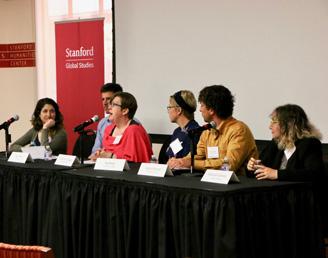
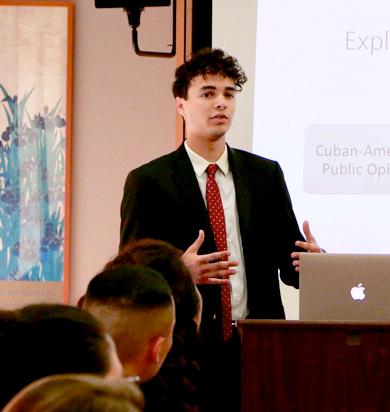
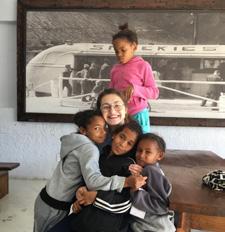
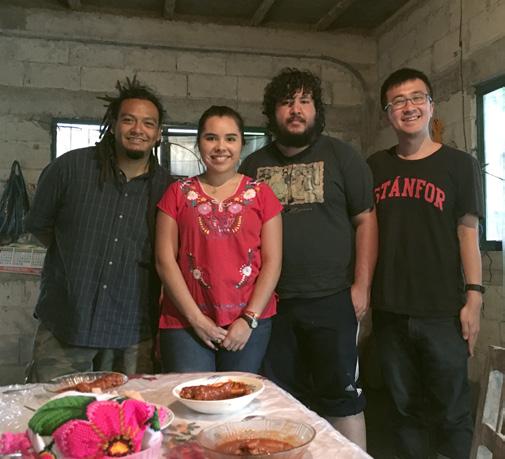
The student photos included in this annual report were submissions from the annual SGS student photo contest.
The Stanford Global Studies (SGS) Division is the university’s hub for education, research, and community engagement centered on exploring issues, societies, and cultures in regional and global perspective.
Advisory Committee
Alberto Diaz-Cayeros
Director, Center for Latin American Studies; Associate Professor (by courtesy) of Political Science
Pavle Levi
Director, Center for Russian, East European & Eurasian Studies; Associate Professor of Art and Art History
Michael Tomz
Director, Program in International Relations; Professor of Political Science
Jun Uchida
Director, Center for East Asian Studies; Associate Professor of History
Administration
Jeremy M. Weinstein
The Sakurako and William Fisher
Family Director of the Stanford Global Studies Division; Professor of Political Science
Katherine Kuhns Executive Director
Megan Amaral
Financial Assistant
Kendra Gladych Communications Manager
Denise Geraci Outreach Coordinator
Jane Stahl Office Manager
Julie Tatsukawa Communications Coordinator
Tamara Winston Finance Manager
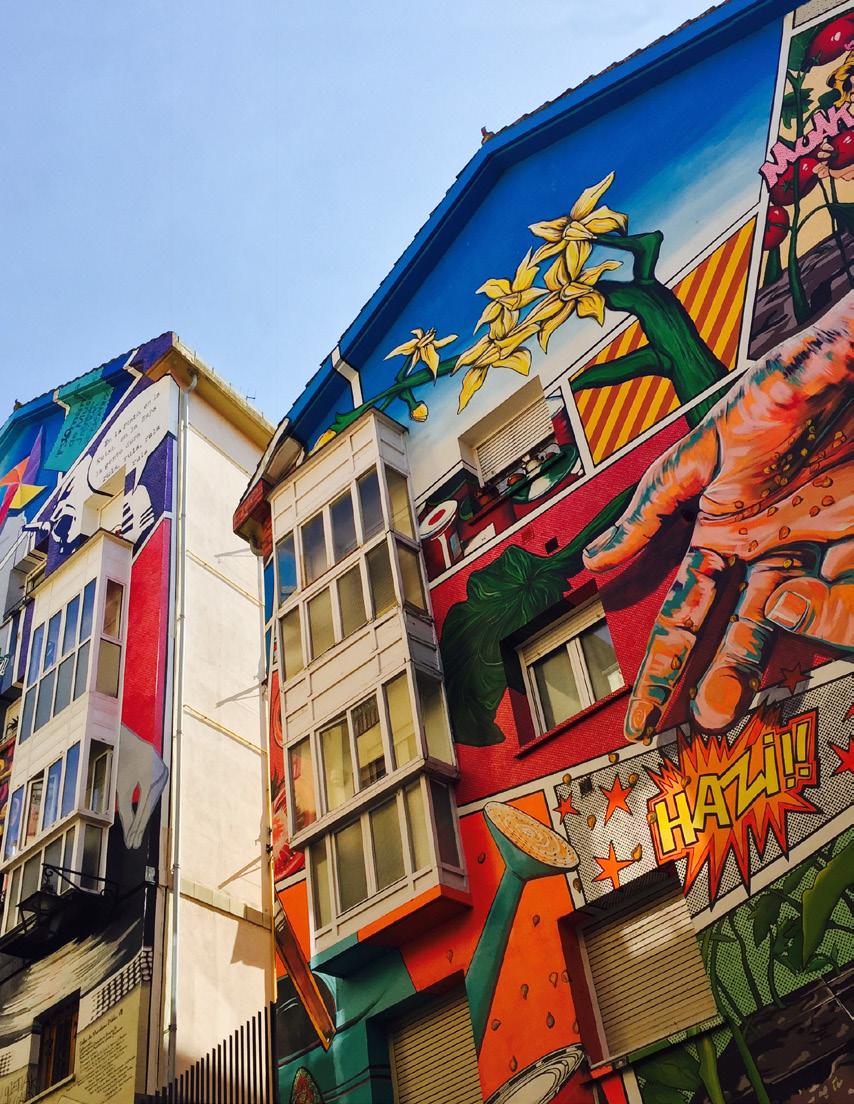
The cover photo, “Grow!” was taken by Stanford student Katherine Irajpanah (International Relations, ’19) in VitoriaGasteiz, El País Vasco, while she was studying abroad in Spain.
Right, Jack Gartland (Global Studies Internship Program, ’20) took this photo, “Cityscape” from the the observation deck of the Shanghai Tower during his internship in Shanghai.
Director’s Message
Dear Friends,
It has been another exciting year at Stanford Global Studies as we continue to support teaching and research that engages issues, societies, and cultures in regional and global perspective. We cannot achieve our mission without an engaged faculty, and we are pleased at the enormous progress we have made in bringing new faculty with global expertise to Stanford.
With critical leadership from the outgoing Dean of Humanities & Sciences, Richard Saller, we have made substantial strides in growing our intellectual communities in South Asian and Islamic studies. In recent years, we have been joined by seven new faculty:
• Usha Iyer, Assistant Professor, Film and Media Studies
• Saad Gulzar, Assistant Professor, Political Science
• Elaine Fisher, Assistant Professor, Religious Studies
• Soledad Prillaman, Assistant Professor, Political Science
• Denise Gill, Assistant Professor, Music
• Samer Al Saber, Assistant Professor, Theater and Performance Studies
• Michael Penn, Teresa Hihn Moore Professor of Religious Studies and (by courtesy) of Classics
Faculty are integral to our efforts to reach undergraduates through engaging courses and to train graduate students who seek to pair their disciplinary expertise with in-depth knowledge of particular regions and cultures. These new faculty are already making significant contributions to the university. For example, Usha Iyer is teaching new courses on Gender & Performance, and Exploring South Asia through Cinema. Iyer, whose research interests include transnational media, cinema, performance, and gender studies, has also presented her work at a number of campus events and conferences, including SGS’s annual symposium for community college teachers and administrators. Saad Gulzar, who studies the political economy of development and comparative politics, teaches undergraduate data science courses and has created a new Ph.D. seminar on the use of field experiments in the study of political economy. In his own research, Gulzar is working directly with policymakers to study how politics can be made more inclusive in South Asia. In addition, two new faculty in Islamic studies join us in the fall of 2018-19: Denise Gill, an ethnomusicologist, and Samer Al Saber, a scholar of theater history and performance of the Middle East. Saber will teach two courses: Performing Identities and Theater History, and Gill will teach Musics and Appropriation Throughout the World and Spiritual Sound of Central Asia, as well as a seminar in ethnomusicology. In addition to these courses, we look forward to their participation in the wider campus community.
More broadly, as the university’s long-range planning process enters its next stage, we remain actively involved in developing the vision for Stanford’s role in the world. We are especially focused on efforts to ensure that exposure to global issues is a critical part of the undergraduate education, whether through curricular or co-curricular activities or some combination of the two. We are also
Jeremy M. Weinstein
The Sakurako and William Fisher Family Director of the Stanford Global Studies Division; Professor of Political Science; Senior Fellow, Freeman Spogli Institute for International Studies
committed to ensuring that graduate students have access to the resources they need to develop their language abilities and carry out the fieldwork that is essential to a successful dissertation.
In support of these priorities, we continue to expand our programming in a number of areas. For example, in our efforts to promote opportunities for undergraduates to explore global issues, we continue to grow our two new minor programs. The Global Studies Minor has 27 enrolled students, and the Minor in Human Rights is also flourishing with 40 students enrolled in the program. We have also supported curricular innovations including new undergraduate courses on human rights in comparative perspective, global populism, capital cities, and exploring the world through ten films.
We are also working hard with partners around campus to increase the diversity and accessibility of global experiences. For example, we are working closely with the Bing Overseas Studies Program (BOSP) on the launch of the new undergraduate study abroad program in Hong Kong, and our centers on Islamic Studies and South Asia are engaged in thinking about programs that might enable Stanford students to study in the Arab world and South Asia. One additional outgrowth of these discussions is a joint venture to support a course entitled Innovation in Technology and Human Rights Institutions, which will be offered in spring 2019 and include a travel component to Bogotà, Colombia.
The Global Studies Internship Program (GSIP) remains the linchpin of our efforts to get students abroad during the summer. The GSIP continues to thrive, attracting 574 applications for 91 positions this year (a 40 percent increase from the previous year), and we now place students on six continents.
Finally, SGS continues to support high-quality faculty and graduate student research that advances our understanding of regional or global issues. Last year, we provided over $650,000 to support 147 students from across the university who conducted research in over 90 locations around the world. For example, Latin American studies master’s student Yongjian Si traveled to indigenous communities in Veracruz, Mexico, to study Nàhuatl language education and revitalization efforts.
Anna Zhang, a Ph.D. student in political science, also received funding to conduct fieldwork in China and Kazakhstan. Her thesis, which examines the relationship between local states and banks in China’s northwestern frontiers to explain variations in infrastructure across localities, will have important implications for our understanding of China’s ongoing One Belt One Road initiative.
These are just a few of the many highlights from the past year. We look forward to another exciting year in 2018-2019.
Sincerely,
Jeremy M. Weinstein
PREPARING STANFORD STUDENTS TO LEAD IN THE WORLD
237
Enrolled Undergraduates
DEEPENING
UNDERSTANDING OF GLOBAL ISSUES
$3M For Courses, Fellowships, Language Study & Research for Students, Faculty and Visitors
567 Events
$650K For Teacher Professional Development
ANNUAL STUDENT DINNER
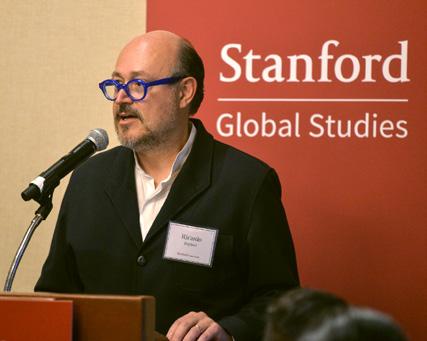
Prominent Mexican journalist and academic Ricardo Raphael spoke about media suppression in Mexico at the annual SGS student dinner.
“I want to think that we are living the middle ages of journalism and we are entering the Renaissance. It’s not an easy path; it’s difficult — but we need to build a society with fearless speech.”
Faculty are integral to the division’s efforts to grow international awareness and understanding at Stanford and beyond. The 364 faculty affiliated with SGS centers and programs represent every school at Stanford—business, earth sciences, education, engineering, law, medicine, and humanities and sciences—as well as many of Stanford’s centers and institutes.
NEW SGS-AFFILIATED FACULTY IN 2017-18
POSTDOCTORAL AND VISITING SCHOLARS
This past year, SGS centers and programs hosted 38 visiting scholars from different countries to build global expertise on campus. These visitors strengthen the university’s intellectual and educational environment by delivering lectures, conducting research, mentoring students and teaching courses.
PERCENT OF SGS-AFFILIATED FACULTY BY SCHOOL
Halil Yenigun was a visiting postdoctoral scholar at Stanford’s Abbasi Program in Islamic Studies in 2017-18. Yenigun, who came to Stanford through the Scholar Rescue Fund, studies Muslim political theory and fled Turkey in 2016 amidst a government crackdown on dissenting academics.
Freeman Spogli Institute for International Studies
Hoover Institute
International Policy Studies
Stanford University Libraries
Stanford Institute for Economic and Policy Research
Bing Overseas Study Program
Usha Iyer, Assistant Professor, Film and Media Studies
Saad Gulzar, Assistant Professor, Political Science
Elaine Fisher, Assistant Professor, Religious Studies
Michael Penn, Teresa Hihn Moore Professor of Religious Studies and (by courtesy) of Classics
UNDERGRADUATE PROGRAMS
SGS supports undergraduate interdisciplinary majors, minors, certificates and honors programs. Over 237 students were enrolled in the division’s undergraduate programs in 2017–18. Most SGS undergraduate students study overseas and acquire fluency in a second language as part of their degree requirements.
Within SGS, undergraduate students can major in international relations or Jewish studies. Minors are available in human rights, international relations, Jewish studies, and global studies, with specializations in African studies, European studies, Iranian studies, Islamic studies, Latin American studies, and South Asian studies. Honors options are available in international relations and Jewish studies. Certificates are also offered in Iranian studies and African studies.
Academic Programs
DEGREES GRANTED
BACHELOR OF ARTS
54 International Relations
HONORS
10 International Relations
UNDERGRADUATE MINOR
12 Global Studies
8 Human Rights
7 International Relations
1 Jewish Studies
CERTIFICATE
4 African Studies
1 Iranian Studies
GRADUATE PROGRAMS
SGS hosts four, one-year master’s degree programs in African studies, East Asian studies, Latin American studies and Russian, East European and Eurasian studies. A graduate certificate in African studies is also available. Each aims to provide students with training and in-depth exposure to regional affairs, and offers collaborative student cohorts, involved and supportive faculty, small class sizes, individualized advising, and competitive internship, fellowship, research and travel opportunities. In 2017–18, a total of 63 students pursued master’s programs in SGS.
DEGREES GRANTED
MASTER OF ARTS
4 African Studies
19 East Asian Studies
5 Latin American Studies
8 Russian, East European and Eurasian Studies
GRADUATE CERTIFICATE
4 African Studies
Thomas Churchill, International Relations ’18
“After studying international relations (IR), I understand our world’s geopolitical context much more thoroughly and feel prepared to tackle and solve complex, multinational issues. My IR experience was incredibly diverse — in the courses I took, the people I met, and the activities I became involved in — and I have a profound value for all types of diversity after finishing the degree. I know that I want to be engaged in work where I feel like I am thinking about the global context of my actions, putting opposing ideas in conversation, and appreciating interpersonal diversity, just as I did in my studies.”
Events are at the heart of building the Stanford Global Studies community. By inviting scholars, performers, and other luminaries to speak and collaborate with our faculty and students, SGS events instill deep curiosity and knowledge about other peoples and cultures. In 2017–18, SGS programs and centers brought together over 80,000 attendees, who enjoyed over 550 events. Lectures, conferences, workshops, films, concerts, plays, and other events connected faculty, students and the general public.
Total Events
A scene from the play “Crossroads,” written and directed by Iranian studies professor Bahram Beyzaie. Until this year, the play had never been published or performed. Photo by Vahid Zamani.
National Resource Centers
The U.S. Department of Education has designated three SGS centers as National Resource Centers (NRCs): the Center for East Asian Studies, the Center for Latin American Studies, and the Center for Russian, East European and Eurasian Studies.
Supported by Title VI of the Higher Education Act, NRCs strengthen access to training in the major languages of their respective regions, broaden area studies training across all disciplines, and pursue innovative collaborations with other educational organizations and local communities.
2017-18 PROGRAMS FOR LOCAL EDUCATORS
• Institute on Islam
• Course on Global Migration in the Past and Present
• Course on The Russian Revolution
• Nuclear Risk and Nonproliferation Workshop
• North Korea Workshop
• Latin American Literature Workshop
• Library Access Grants
• Indigenous Language Courses
• Teacher Institute Abroad: the Mexican Revolution
• Community College Fellowship Program
• Heritage Spanish Teachers Seminar Series
• Annual Symposium for Community College Instructors
FOREIGN LANGUAGE AND AREA STUDIES (FLAS)
In 2017-18, the NRCs provided 37 students with more than $1.1 million in funding to pursue fellowships for area and language studies, including Albanian, Chinese, Japanese, Kazakh, Korean, Nàhuatl, Portuguese, Quechua, and Russian.
COMMUNITY COLLEGE FELLOWSHIP PROGRAM
This past year, the NRC’s hosted a third cohort of community college fellows from three Bay Area schools to incorporate global themes into their course materials. The culmination of the fellowship was a symposium in May, which drew over 80 California community college faculty and administrators, and featured presentations from the fellows, as well as keynote presentations by Mitchell L. Stevens, Associate Professor at the Graduate School of Education, and Usha Iyer, Assistant Professor of Film and Media Studies.
10 Community College Fellows
37 Students Received FLAS Fellowships
4,316 Teachers/Participants
$650K
Total Funding for Outreach Programming
$1M For FLAS Fellowships
The 2017-18 community college fellows present their projects at the annual symposium.
SGS facilitates research and data collection across fields and national boundaries to advance our understanding of the world. In addition to providing research fellowships, SGS programs and centers host collaborative research initiatives, publish research reports, and facilitate student research.
$1M Research Funding
HIGHLIGHTS
171
Students Funded
17 Faculty Funded
94 Cities Around the World
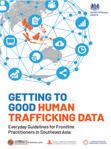
In order to improve anti-human trafficking efforts, the Handa Center created a set of resources to help NGOs and government agencies gather data that can better inform policymakers and practitioners about the nature and scope of the problem they face. The resources include guidelines for frontline practitioners as well as a white paper offering policy recommendations for gathering information about a hidden and vulnerable population.
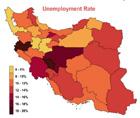
In 2017-18, the Iran 2040 Project, which serves as a hub for researchers around the world to conduct research on issues related to the future of the Iranian economy, published four new reports that focused on water scarcity, central banking, international sanctions, and population dynamics. Left, a graphic depicting the unemployment rate in Iran; darker areas have higher rates of unemployment.
Anna Zhang, a Ph.D. candidate in political science, received funding through the Center for Russian, East European, and Eurasian Studies to travel to China and Kazakhstan to conduct research for her thesis. Her project “Why Does Investment Fail? Redistribution and Ethnic Integration in Xinjiang” examines the relationship between local states and banks in China’s northwestern frontiers in order to explain variations in development across localities. Her research will have important implications for our understanding of China’s One Belt One Road initiative.
UNDERGRADUATE RESEARCH
Ten undergraduate students pursued honors theses through the Program in International Relations. Samuel Garcia ’18, received the prestigious Firestone Medal for excellence in undergraduate research for his honors thesis “Diplomatic Breakthrough: Politics, Reform, and Trust in the Restoration of U.S.-Cuba Relations.”
Global internships provide Stanford students with unique opportunities to extend classroom learning to immersive, cultural and professional experiences around the world. The Global Studies Internship Program (GSIP) collaborates with SGS centers and programs to facilitate and fund 90 internship placements in 23 locations around the world. The Handa Center, the Center for Latin American Studies, and the Taube Center for Jewish Studies provided 14 additional opportunities, bringing the total to 104 internships funded across the division in 41 locations this past year: 90 for undergraduates, 12 for M.A. students, and 2 for Ph.D. students.
Demand for internships continues to grow: in 2018 the GSIP received 910 applications from 574 students—a 40% increase from last year. This past summer, the program inaugurated service internships in Hong Kong, where 3 students contributed to the Creative Coding for Change Project for local youth. The most popular position continues to be the arts internship at Lalela, which provides educational arts programming for at-risk youth in South Africa.
90
Global Studies Internship Program Placements
14
Additional Center/Program Internships
104 Total Internships
41 Cities Around the World
Jamie Seney, African and African American Studies ‘21, Lalela, South Africa
“Combining art and activism, as Lalela does on a daily basis, is exactly how I hope to spend my life. I was able to develop arts curriculum, to research music programs, and I was able to form relationships with some amazing kids. My understanding of South African history, culture, and politics has deepened significantly from this experience. Everywhere I went I learned something new. And for once, as a first-generation, low-income student, I did not have to worry so much about affording the adventure!”
2017–18 INTERNSHIP LOCATIONS
Australia
• Art Gallery NSW
Belgium
• Alliance of Liberals and Democrats for Europe Group
• Bruegel
• Carnegie Europe
• Center for European Policy Studies
Bosnia and Herzegovina
• Post-conflict Research Centre
Brazil
• Bionexo
• Canal Futura
China
• 6Connex
• Caixin Global
• Christie
• Gap
• GoPro
• IoT ONE
• Lenovo
• LMN Consulting
• Time Out Shanghai
• VIP
Estonia
• Museum of Occupations
Ethiopia
• UN World Food Programme
France
• Banijay Group Paris
• Ecole Centrale
Paris
• French National Institute of Health and Medical Research
• University Pierre & Marie Curie
Germany
• German Aerospace Center
• Infineon Technologies
• Hamburg University Institute of Laser Physics
• Heinrich Heine University
• Telespazio VEGA
Deutschland
• ZKM Center for Art & Media
Greece
• Samos Volunteers
Hong Kong
• Arbor Ventures
• Creative Coding for Change
• Well Being Digital Limited
India
• Forbes Marshall
• GVK Emergency Management and Research Institute Indonesia
• Institute for an Independent Judiciary
• Filantropi Indonesia
Japan
• Institution for a Global Society
• Kozo Keikaku Engineering Inc.
• Mitsubishi Electric Co.
• Mitsubishi Research Institute
• Orb Inc.
• Rogers Investment Advisors
• Venture Republic
Kenya
• Branch International
Korea
• Asia-Pacific Centre of Education for International Understanding under the auspices of UNESCO
• NCSOFT Corporation
• The Korea Herald
• U.S. Embassy
Latvia
• TechHub Riga
Rwanda
• EarthEnable
Singapore
• University of Singapore
• Grab Singapore
• Latitute Venture Partners
Slovenia
• Slovenian Marine Mammal Society
Spain
• TZG Partners Madrid
South Africa
• Lalela
Taiwan
• China Medical University
• Fulbright Taiwan
• International Climate Development Institute
• Taiwan Institute of Economic Research
Thailand
• International Organization for Migration
United Kingdom
• Scene & Heard
United States
• Advocates for Youth
• College of San Mateo
• Esperanza Immigrant Rights Project
• Hope Border Institute
• PEN America
• San Francisco District Attorney’s Office
• Senate Foreign Relations Committee
• Sharsheret
• U.S. Institute of Peace
• Woodrow Wilson International Center for Scholars
Funding
SGS programs offer research grants and fellowships, internships, language study opportunities, and other funding options to students, faculty, and visiting scholars both in the U.S. and abroad. Below is a visual representation of student research, study, and internship locations around the world.
LOCATIONS OF INTERNSHIPS, LANGUAGE STUDY, AND/OR RESEARCH
• Australia
• Austria
• Bangladesh
• Belgium
• Bosnia and Herzegovina
• Brazil
• Canada
• Chile
• China
• Colombia
• Cuba
• Egypt
• Estonia
• Ethiopia
• Finland
• France
• Germany
• Greece
• Guatemala
• Hong Kong
• India
• Indonesia
• Israel
• Italy
• Japan
• Jordan
• Kazakhstan
• Kenya
• Latvia
• Lebanon
• Lithuania
• Malaysia
• Mexico
• Myanmar
• Netherlands
• Northern Ireland
• Pakistan
• Peru
• Poland
• Portugal
• Romania
• Russia
• Rwanda
• Singapore
• Slovenia
• Spain
• South Africa
• South Korea
• Switzerland • Taiwan • Tanzania
Thailand
Tunisia • Turkey • Uganda • Ukraine
United Kingdom • United States
RESEARCH
GLOBAL INTERNSHIPS
LANGUAGE STUDY
Language
Foreign language skills are critical for enabling Stanford students to conduct research and lead in a global context. SGS centers and programs expand access to less commonly taught languages and support language learning by funding language courses and instructors, and also through language study fellowships.
LANGUAGE STUDY SUPPORTED BY SGS
• Afrikaans
• Albanian
• Arabic
• Chinese
• German
• Hebrew
• Hungarian
• Japanese
• Kazakh
• Korean
• Kurdish
• Nàhuatl
• Persian
• Polish
• Portuguese
• Quechua
• Romanian
• Russian
$1M
For Language Courses & Fellowships
43
Language Courses
48
Students Received Language Fellowships
• Serbo-Croatian
• Ukranian
• Wolof
• Yiddish
22 Languages
During winter and spring breaks, Yongjian Si (M.A. Latin American Studies ’18) received funding to travel to indigenous communities in Veracruz, Mexico, to study Nà huatl language education and revitalization efforts. Nà huatl was the indigenous language of the Aztecs and is still spoken by 1.5 million Nà hua peoples in central Mexico.
“Hearing that the language is still spoken by community members and seeing that traditional culture is still being practiced brought tears of joy to my eyes,” he said. “The trip allowed me to learn more about the traditional Nà hua culture and further convinced me of the importance of language education and revitalization.”
Centers & Programs
Center for African Studies
Director: James Ferguson
Associate Director: Laura Hubbard africanstudies.stanford.edu
Center for East Asian Studies
Director: Jun Uchida
Associate Director: John Groschwitz ceas.stanford.edu
Center for Latin American Studies
Director: Alberto Diaz-Cayeros
Associate Director: Elizabeth Sáenz-Ackermann clas.stanford.edu
Center for Russian, East European and Eurasian Studies
Center Manager: Linda Huynh jewishstudies.stanford.edu
WSD Handa Center for Human Rights and International Justice
Director: David Cohen
Associate Director: Penelope Van Tuyl handacenter.stanford.edu
CENTER FOR EAST ASIAN
In November of 2017, the Center for East Asian Studies (CEAS), in partnership with the Shorenstein Asia Pacific Research Center and the Center on Democracy, Development, and Rule of Law, hosted a conference about Hong Kong called “China’s HKSAR at 20: Interdisciplinary Perspectives.” Two decades after its transformation from a British colony to become China’s Special Administrative Region (SAR), Hong Kong (HK) is an arena of tensions punctuated by local-mainland discord and mutual distrust. CEAS, with the direction of Professor Ming K. Chan, invited four political leaders and six academics from Hong Kong to discuss the dynamics shaping their city of 7.2 million people amid a contest between local liberal values and its party-state
STUDIES
sovereign’s authoritarian orthodoxy, highlighting the HKSAR’s “One Country, Two Systems” actualization challenges. Anchored in multidisciplinary
approaches with divergent ideo-political perspectives, this one-day event engaged the Stanford community with Hong Kong front-liners.
CENTER FOR L ATIN AMERICAN STUDIES
This year, the Center for Latin America n Studies (CLAS) further strengthened the teaching of Latin America and its indigenous languages in the United States. CLAS partnered with De Anza Community College to offer Nàhuatl language courses at their
campus and awarded a Foreign Language and Area Studies fellowship to a De Anza student to attend the University of Utah’s intensive summer Nàhuatl program. In addition, CLAS began offering Saturday Nàhuatl classes to the local community and built a Latin
American Indigenous Language Learning Community, currently composed of Aymara, K’iche, Nàhuatl, and Quechua/Kichwa language instructors, who meet annually at Stanford and virtually throughout the year to develop and share pedagogical approaches and resources. CLAS, the Stanford Graduate School of Education, and Colegio de México also co-organized a summer institute abroad in Mexico City about the Mexican revolution and nation-building. Tapping into the content expertise of Colegio de México scholars, the program immersed 25 secondary and community college educators in the subject matter, equipping them with pedagogical content knowledge to effectively teach in accordance with the new 2016 California Board of Education HistorySocial Science Framework.
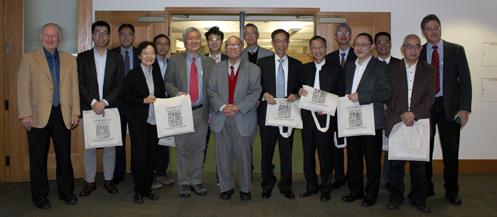
Conference visionary Prof. Ming K. Chan (center) stands with the academic and political leaders who were invited to speak at the event. L to R: Lynn White, Heiwai Tang, Lawrence Ho, Nicole Kwan, Allan Au, Chaofen Sun, Vic Y. W. Li, Ming K. Chan, Gordon Chang, Martin Lee, Jasper Tsang, Ngok Ma, Benny Tai, Sonny Lo, Cheong Ching, Larry Diamond
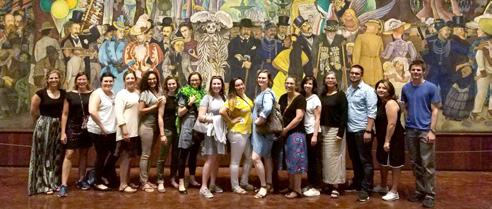
Participants and instructors of the “History of the Americas: The Mexican Revolution & NationBuilding” Summer Teacher Institute Abroad gather at the Diego Rivera Mural Museum in Mexico City, Mexico.
CENTER FOR AFRICAN STUDIES
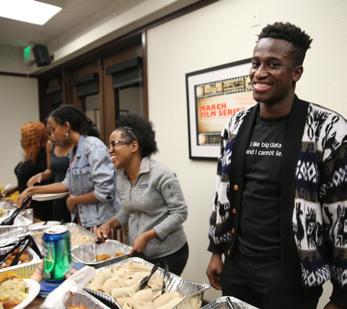
The Center for African Studies (CAS) hosted its fourth annual cooking event in winter 2018. Over 20 different groups of students cooked in multiple kitchens across campus to come together to feed more than 150 people on a Saturday evening. This event, one of the center’s largest, with the most complex logistics, is also the cornerstone of its community making. As one organizer, Valdes Tita, said of the event, “I am forever grateful to CAS and the African community at Stanford for making me believe in a large family that eats together and sticks together.”
Another organizer, Claus Omolo, shared of the event, “The annual cooking event was indubitably my favorite event of the year. Not simply did I cook my favorite meal, a Kenyan staple, but I participated in the embodiment of family in the CAS community. I was reminded of the virtues that continue to make CAS a home for me: the tireless efforts to obtain ingredients from our respective nations, the selfless individuals spending their whole day preparing their special cuisines for the community, and the openness to those at Stanford who are unfamiliar with these dishes. Such generosity reminds me that I truly do have a family here.”
At the CAS cooking event, all are welcome to eat together, stick together, and come together.
ABBASI PROGRAM FOR ISLAMIC STUDIES & MEDITERRANEAN STUDIES FORUM
During winter quarter, the Abbasi program hosted a screening of Muslims of France, a three-part documentary created for French television by Karim Miské. Miské is a French-Mauritanian filmmaker and novelist who visited Stanford as the Aron Rodrigue International Visitor at the Stanford Humanities Center. The documentary tells the history of Muslims in France, starting with the 1904 arrival of North African immigrants to the 2007 election of Muslim candidates to government offices. The screening concluded with a Q&A and a lively discussion on what it means to be a Muslim in France today and how Islam became the second religion in France. Miské has made a number of documentaries on a wide range of issues including colonial legacies, hip hop culture, informal economy, freedom of the press, and bioethics. His widely-acclaimed debut novel Arab Jazz won the English PEN Award. During his time at Stanford, the Abbasi program and the Center for African Studies also hosted a joint discussion on Miské’s recent autobiographical graphical novels N’appartenir (Unbelonging) and S’appartenir (Belonging).
Students at the annual CAS cooking event.
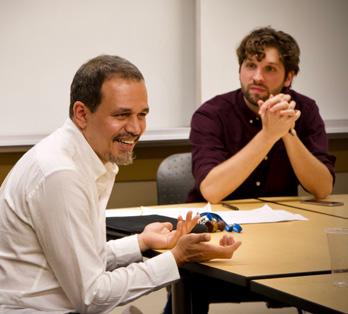
Karim Miské visits African Studies lecturer Toussaint Nothias’s class Media Representation of Africa.
CENTER FOR SOUTH ASIA
THE EUROPE CENTER Highlights
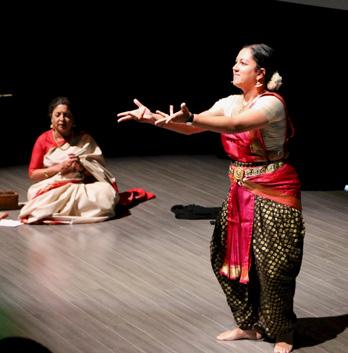
In April, the Center for South Asia co-sponsored the performance “Dancing through Diaspora” in collaboration with Stanford’s Departments of Art & Art History and Theater & Performance Studies. An interactive multimedia duet, the piece brought together the work of choreographer Ramya Harishankar and performance studies scholar Dr. Priya Srinivasan to explore how research can come alive through performance. “Dancing through Diaspora” was based on Dr. Srinivasan’s book Sweating Saris: Indian Dance as Transnational Labor, which examines the history of Indian dance in the U.S. from 1880 to the present. Tackling issues of anti-Asian immigration policies in the U.S., the performance examined historical forms of power through a combination of choreography and multimedia. The performance employed postmodern frameworks and structured improvisation (which is part of both Indian and contemporary dance) to unpack what is often unsaid, unseen, and invisible, as well as to foreground the “behind the scenes.” Harishankar and Srinivasan questioned the interpretation of dance as merely an aesthetic form and suggested to explore its relationship to socio-political, historical, cultural, racialized, and gendered forms of power.
understand
Student programming, including the support of substantive student research in Europe, is a major focus of The Europe Center. For the past five years, the center has placed undergraduate summer interns at leading Belgium-based, European think-tanks and transnational organizations such as Bruegel, the Centre for European Policy Studies, Carnegie Europe, and the Alliance of Liberals and Democrats for Europe at the European Parliament.
This year, The Europe Center expanded its internship offerings. In partnership with the Stanford Club of Germany and the Bing Overseas Studies Program in Berlin, the center launched the Graduate Internship and Research Program in Germany, matching top caliber Ph.D. and master’s students with German companies known for technological research and innovation. In this inaugural year, placements were made with the music and media innovator ZKM, the German Aerospace Center, European spaceflight services company Telespazio, and the semiconductor manufacturer Infineon.
Choreographer Ramya Harishankar (left) and performance studies scholar Dr. Priya Srinivasan (right) perform “Dancing through Diaspora.”
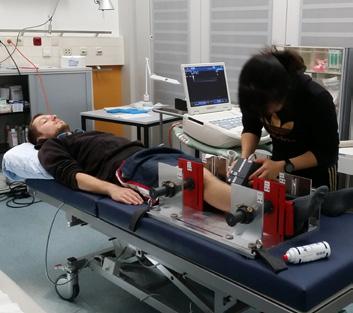
In an effort to
the tissue swelling problems astronauts encounter in extreme environments, Ph.D. student Monica Hew conducts a tissue thickness ultrasound measurement for healthy subjects under hypoxia or high-altitude conditions, as part of her internship at the German Aerospace Center.
FRANCE-STANFORD CENTER FOR INTERDISCIPLNARY STUDIES
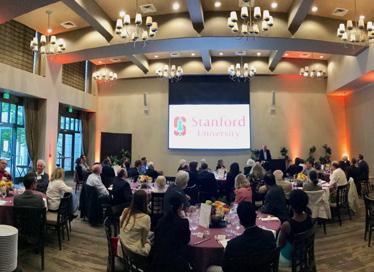
In May 2018, the France-Stanford Center celebrated 15 years of facilitating interdisciplinary research and collaboration between French and Stanford scholars. The anniversary event convened former and current grant recipients, as well as members of the French government and the broader Stanford community. Three past grant recipients presented their research on robotics, archeological exploration, and philosophy. The France-Stanford Center also had the honor of welcoming Jean Tirole, President of the Toulouse School of Economics and Nobel Prize Winner in Economics, who gave a lecture titled “Science in the Age of Skepticism Toward Expertise.”
Since its founding in 2003, the France-Stanford Center has funded 26 collaborative research projects, 21 conferences, 25 events, and 42 fellowships across the humanities and sciences.
HAMID AND CHRISTINA MOGHADAM PROGRAM IN IRANIAN STUDIES
In March 2018, the Hamid and Christina Moghadam Program in Iranian Studies and the Freeman Spogli Institute co-hosted a conference titled “The Islamic Republic of Iran: Continuity or Change?” Moderated by Stanford experts Larry Diamond,
Abbas Milani, Francis Fukuyama, and Michael McFaul, the conference featured scholars and practitioners from the U.S. and abroad. The four panels included presentations on Iran’s changing demographics, issues of succession, technology and media
control, women’s rights, economic challenges, and relations with the U.S. and Europe.
Increasing political and economic changes relating to Iran highlight the need for rigorous scholarly work to understand Iran’s future trajectory. In line with a core component of the Stanford Iran 2040 Project, Dr. Pooya Azadi and his collaborators published new research on Iran’s changing demographics, the central bank and monetary policy, and the increasing water crisis.
In June, the program also celebrated the graduation of six students who specialized in Iranian studies through the Global Studies Minor. The minor students came from a number of different disciplines, including computer science and symbolic systems, and will continue their careers in graduate programs, consulting firms, and tech companies, among other areas.
Ladan Baroumand, co-founder of the Abdorrahman Boroumand Foundation, presented on the democracy movement in Iran.
The France-Stanford Center anniversary event in May.
Highlights
PROGRAM IN INTERNATIONAL RELATIONS
In October of 2017, the Program in International Relations hosted its first-ever annual alumni homecoming reunion event. The event featured a panel of Stanford experts who
discussed contemporary issues in international affairs, including U.S. policy in Asia, U.S.-Russia relations, and U.S. policy in the Middle East. Speakers included Karl Eikenberry,
CENTER FOR RUSSIAN, EAST EUROPEAN & EURASIAN STUDIES
In spring quarter, the Center for Russian, East European and Eurasian Studies (CREEES) hosted three Visiting Student Researchers from the European University at St. Petersburg (EUSP), one of the leading private universities in Russia, whose license had been revoked by the Russian government in March 2017. With the support of SGS and CREEES, Ivan Asseev, an M.A. candidate studying Russian imperial history and the history of science, Vitaliy Bovar, a Master’s student researching the history of mental health in 19th century Russia, and Georgii Sherstnev, a Ph.D. candidate in art and art history studying Soviet film in the 1920s and 1930s, spent three productive months working on their projects while immersed in the intellectual community at Stanford.
The three visitors noted how their active engagement with faculty and other students allowed them to deepen their projects theoretically and develop methodological skills, as well as to network with other scholars in their fields. Stanford CREEES was proud to provide a temporary intellectual home to these students, who returned to their studies at EUSP (which, after a long struggle, regained its accredidation in August 2018).
CREEES and Stanford also look forward to continued institutional collaboration with EUSP through visiting professorships and study abroad opportunities for Stanford students, both of which are planned for the near future.
Director of Stanford’s U.S.-Asia Security Initiative and former U.S. Ambassador to Afghanistan; Michael McFaul (’86), Director of the Freeman Spogli Institute for International Studies and former U.S. Ambassador to Russia; and Kori Schake (’84), a Hoover Institution Distinguished Research Fellow who has served in various policy roles at the National Security Council, the Department of Defense, and the State Department.
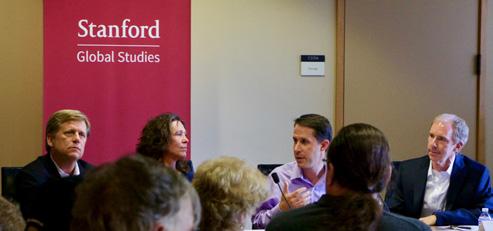
Over 150 alumni attended the discussion, which was moderated by International Relations Faculty Director Michael Tomz and Stanford Global Studies Director Jeremy M. Weinstein.
From left: Michael McFaul, Kori Schake, Jeremy Weinstein, Michael Tomz
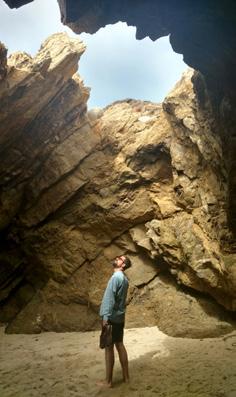
Ivan Asseev, a visiting student researcher at CREEES, investigates a sea cave at Big Sur, CA.
TAUBE CENTER FOR JEWISH STUDIES
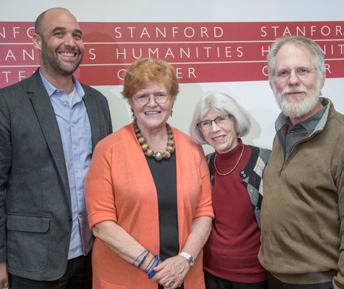
Among all of the claims of “fake news,” twitter-bots, virtual reality and artificial intelligence, it seemed that the Taube Center for Jewish Studies could make a powerful contribution to that discussion by bringing Professor Deborah E. Lipstadt (Emory University) to campus for this year’s Aaron Roland Endowed Lecture on April 30. Her talk was entitled “Denial, History on Trial: My Day in Court with David Irving.” Denial is a 2016 historical drama film based on Lipstadt’s book starring Rachel Weisz and Tom Wilkinson.
In 1996, Professor Lipstadt, a historian of the Holocaust, found herself on the receiving end of a libel suit brought by one David Irving. As Professor Lipstadt explained in her talk about the trial that followed (which she won, handily), the central issue in the trial was not libel, but the very practice of history, and the responsibility of historians to document and interpret historical data with fidelity to facts. Her talk was at times chilling, humorous, and horrifying, and could not have been a timelier reflection on the place of Jewish Studies in contemporary affairs.
WSD HANDA CENTER FOR HUMAN RIGHTS & INTERNATIONAL JUSTICE
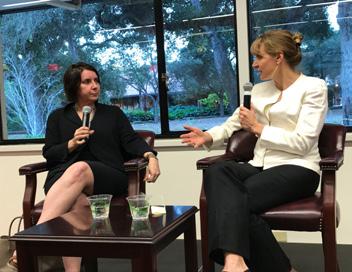
In response to the Syrian conflict and the lack of war crimes accountability to date, the Handa Center hosted two events during winter quarter highlighting the intersection of technology and justice in the Syrian conflict. In February, Catherine Marchi-Uhel, head of the International, Independent and Impartial Mechanism for Syria (IIIM), delivered the center’s annual lecture on international justice about the IIIM’s mandate to bridge the gap between human rights fact-finding and criminal justice processes. The following day, the center convened a panel, “Technology, Syria, and Human Rights: How a Tech ‘Connected’ Civil Society Might Hold Governments Accountable,” to discuss the role of technology in war crimes accountability given that the Syrian civil war is the most documented conflict in history. The Handa Center and its partners remain engaged with questions of how to organize and apply this voluminous and unstructured body of potential evidence to be useful for criminal justice processes. These issues will also be considered by the center’s newly convened Tech Advisory Group as well as in a new course supported by SGS: Innovations in Technology and Human Rights Institutions, taught by Professor Beth Van Schaack.
From left: Taube Center Director Ari Y. Kelman, guest speaker Deborah E. Lipstadt, and donors Miriam Roland and Aaron Roland.
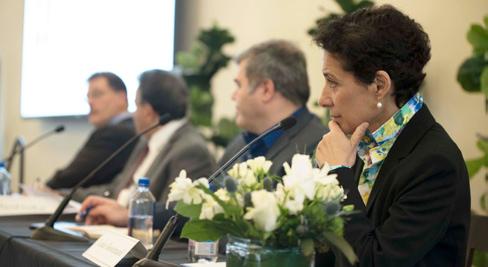
Professor Beth Van Schaack moderates a discussion with Catherine Marchi-Uhel, head of the International, Independent, and Impartial Mechanism for Syria, who delivered the Handa Center’s annual lecture on international justice.
Alumni
The international area centers and programs that make up SGS have influenced the career decisions of thousands of students. Our alumni are truly global. They have built careers around a diverse range of interests and value many aspects of their global education since leaving Stanford. SGS provided many of them with the skills needed to be policymakers, diplomats, entrepreneurs, journalists, politicians, researchers, teachers, scholars, and global leaders. They reflect on their academic and professional experiences below.
Cooper Williams, Senior Manager, Business Solutions, Alibaba Group Global Studies Internship Program ’13
“This program was essential in launching my career in China. My first internship led to a job offer and an opportunity to immerse myself in the Chinese startup/ tech scene. From there, I was able to join Alibaba Group where I have a front row seat to the internationalization of one of China’s most important companies. I’ve since transferred to Alibaba’s New York office where I can leverage the knowledge I developed from my years in China to help North American brands and businesses succeed in the world’s largest consumer market. I am grateful to Stanford and to the Global Studies Internship Program for providing me the resources to take this path.”
In addition to the first-ever international relations program reunion event during Stanford’s reunion weekend, SGS hosted two career panels this past year for current students featuring alumni from various programs. The first, “Careers in Technology,” featured Director of International Development at wikiHow Adriana Baird (International Relations ’15, Latin American Studies ’16), Equity Administrator at Palantir Technologies Inc. Sanaa Yasmin Hafeez (East Asian Studies ’13), and Senior Product Manager of Innovation Programs at NCR Corporation Sean Loosli (Russian, East European and Eurasian Studies ’10).
The second event, “Careers in Washington DC,” highlighted alumni who work in various fields in the nation’s capital, including Senior Program Officer at Results for Development Michael Chaitkin (International Relations, ’09), Senior Editor at ChinaFile Jessica Batke (M.A. East Asian Studies, ’08), and International Program Specialist at NASA Jacob Parsley (M.A. Russian, East European, and Eurasian Studies, ’14).
From left to right: Jacob Parsley, Michael Chaitkin, Jessica Batke, Associate Director of the Center for East Asian Studies John Groschwitz.
EXPENSES
Student Aid & Tuition Allowance
Salaries: Staff & Student Workers
$2,664,447
$ 2,825,561
Salaries: Academic $1,503,552
Programming & Operating Expenses
$2,565,681
Benefits $1,115,936
Commitment for FY 2017–18 Activities $235,184
Total $10,910,362
FUNDING
H&S Dean’s Office
$3,187,696
Gifts & Support
The Stanford Global Studies Division extends sincere appreciation to our contributing alumni, parents, students, and friends for their generous support. Financial support provides core funding to strengthen our existing programs and help create new ones where needed, enhance interaction among faculty and students, and facilitate collaboration with other university programs. Funds are focused on activities that impact the broadest range of faculty and students and offer high leverage by encouraging communication and collaboration. Such activities include curriculum development; seminars, symposia, and conferences; visiting scholar programs; development of research networks linking internal and external faculty and students; research initiatives on key topics; and direct financial support for our students — the next generation of outstanding leaders, scholars, and policymakers.
For more information about working with us to enhance global studies initiatives at Stanford, please contact Scott Sugiura, Associate Director of Development at: ssugiura@stanford.edu or (650) 723-1208.