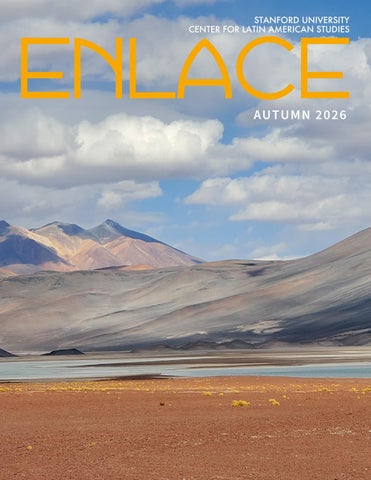
AUTUMN 2026
1
TABLE OF CONTENTS 3 Letter from the Director 4
The Year Ahead
6
Bolívar House Visitors
10 Event Highlights 17 Sponsored Research & Learning Opportunities 24 Public Engagement 27 Library Report 28 Faculty & Academic Affiliate News & Publications 29 Alumni Updates 30 Commencement 2026
CENTER FOR LATIN AMERICAN STUDIES Director Professor Héctor Hoyos Associate Director Elizabeth Sáenz-Ackermann Director of Graduate Studies Rebecca Tarlau Academic and Student Services Officer Joaquín-Emiliano Chávez Events and Communications Officer Samantha Cosentino Academic Grants and Outreach Coordinator Molly Aufdermauer
Cover: Atacama Desert, Chile, 2024, by Sergio Sánchez Above: Pox, Mexico, 2026, by Víctor Manuel Márquez Padreñan The photos from Latin America featured in Enlace were submissions to the annual Stanford Global Studies photo contests, unless otherwise specified.
Curator for Latin American, Iberian and Mexican American Collections Adán Griego
LETTER FROM THE DIRECTOR Dear Stanford Latin Americanists, dear all, There is nothing I enjoy more than learning. Research, teaching, and administration cannot shine a light on the simple pleasure of finding out about something for the first time, or deepening one’s familiarity with a skill, a problem, a topic, a region, a language, and so on. As the faculty director of the center, not a day goes by without learning. I am grateful for this. This past year I learned a ton from our M.A. students, whose outstanding research is available through the Stanford library. They probed community-engaged scholarship, language revitalization with digital platforms, transnational migration, indigenous thought, traditional agricultural systems, and more. Student curiosity matched the good counsel of generous colleagues who stepped up to serve as their mentors. Everyone in the CLAS team cheered them on and provided the structure needed for their success. A first-rate lecture series, integrated via activities and assignments, made our M.A. students conversant with a number of disciplines while at the same time serving multiple communities on campus. I learned from the CLAS team, too, whose administrative efficiency, collaboration, and care stem from a
solid understanding of the bigger mission. I witnessed as they rose to the occasion countless times, especially in today’s quicksand academic landscape. I worked closely with our subject librarian to continue developing our collections. I learned from our visitors and community members about the multiscalar, multidisciplinary complexity of Latin America. I learned from our dissertation writing fellows and postdoc about the next generation of area studies research. This letter emphasizes learning and joy because they are essential. I would hate to sound pollyannaish. While our Center remains as strong as ever, this is an increasingly rare situation among kindred institutions of higher learning. Joy and learning are worth our efforts. Curiosity, internationalism, and rigorous knowledge production remain as important as ever. Latin America represents about a quarter of the world population and about a quarter of its territory. There is need for area specialists in every discipline—the sheer richness of the object of study, and its obvious relevance, warrants it. CLAS welcomes the opportunity to coordinate with all departments and programs to secure the next sixty years and grow our community. Imagine the many research agendas relevant to Latin American
Héctor Hoyos
studies, the multiple monographs, dissertations and M.A. projects that could flourish at Stanford during that period. We are appreciative of the private foundations that offer their steadfast support and extend an invitation for others to join. The present edition of Enlace speaks of a truly vibrant, one-of-a-kind Latin Americanist community at Stanford, situated, in turn, in a vast academic network. We are both frugal and well-resourced, ecumenic and focused. In the months ahead, we look forward to a collaboration with the Uruguayan Consulate in San Francisco, book events on Latin American economics and the great poet César Vallejo, a panel on lithium in Chile, and a new film series, inter alia. A warm welcome to our incoming M.A. students, dissertation writers, postdoc, and visitors! As you peruse these pages, remember all this bounty of learning happened one day at a time. It might seem daunting that so much, at such a high level, takes place in Bolívar House. Be confident that, for you, too, the pieces will come together. Con saludos cordiales,
The 2025-26 CLAS team: Elizabeth Sáenz-Ackermann, Molly Aufdermauer, Héctor Hoyos, Joaquín-Emiliano Chávez, and Samantha Cosentino
Héctor Hoyos, Stanford University Professor of Iberian and Latin American Cultures; Professor, by courtesy, of Comparative Literature and English
3
THE YEAR AHEAD CLAS WELCOMES THE CLASS OF 2027 LAS M.A. Students Daniel Astilla comes from Colima, Mexico, and holds a bachelor’s degree in Political Science and Public Administration from the Universidad de Colima and a second degree in Software Engineering—a combination he sees not as two separate paths, but as a single vocation: using technology to understand and address the governance challenges that affect Latin America’s most vulnerable communities. At Stanford, he works as a research assistant at the Poverty, Violence and Governance Lab and collaborates with LAPSO (Laboratorio por la Paz y Justicia Social) in Colima, where he has helped develop data-driven tools to map and monitor violence at the community level. Sebastián Francisco Cantú Ramirez grew up on the U.S.-Mexico border, both in Mission, Texas, and Reynosa, Tamaulipas, with personal experience on cartel presence and militarization. Sebastián earned a B.A. in Political Science from Stanford University, with focuses in Justice and Law as well as Elections, Representation, and Governance, while minoring in Creative Writing. As an undergraduate, Sebastián worked with sectors of these communities focusing on community-based research and care. Sebastián’s interests included those labeled “undesirables” in cultural and political contexts and the forms in which survival comes from their communities, as well as transsexual politics through a Latin American lens. Sebastián plans to examine the analysis and development of queer and transgressive communities through history, indigeneity, and criminal economics. Henry J. Kaye was born and raised in Rockville, Maryland, and earned his B.S. in International Affairs and Spanish at the United States Military Academy at West Point. He is committed to representing and serving the United States in Latin America and across the world. During his time at West Point, he traveled with the Army to Puerto Rico, Peru, El Salvador, Israel, and Mexico, and completed a semester abroad at the Escuela Militar del Libertador Bernardo O’Higgins in 4
Santiago, Chile. He has also completed Air Assault School and the Combat Diver Qualification Course. Within the Corps of Cadets, Henry served as the Cadet Field Training Regimental Commander, leading approximately 1,500 cadets through military training exercises, and served as a Cadet Regimental Command Sergeant Major, enforcing standards and discipline across a regiment of 1,000 cadets. Henry commissioned as an Infantry Officer and is a Knight-Hennessy Scholar at Stanford.
Jessica L. Hernandez was born and raised in San Francisco, California, and attended City College of San Francisco before transferring to University of California, Berkeley, where she earned her B.A. in Political Science with a minor in Public Policy. Coming from a family with Nicaraguan and Mexican roots, Jessica developed an early interest in immigration and the experiences of immigrant communities in California. Her academic interests focus on immigration policy, particularly issues related to asylum seekers and refugees from Central America. Jessica has supported immigrant communities by helping individuals navigate important legal and administrative processes. Lauren Marshall is an environmental scientist who explores the connections between ecology, language, and community impact. Her work has taken her across diverse landscapes, from tagging and tracking Coho salmon on Alaska’s Kenai Peninsula to surveying and studying native trout, beaver, and bat populations in remote regions of Montana, Wyoming, and Nevada. Lauren earned her B.S. in Environmental Science, Technology & Policy with a concentration in Applied Ecology from California State University, Monterey Bay. Her research in Costa Rica, along with her work in watershed ecology and California’s agricultural industry, strengthened her commitment to conservation that bridges scientific knowledge with meaningful communication. Her research interests focus on the relationship between human communities and vulnerable ecosystems, particularly where wildlife conservation, resource management, and local knowledge intersect.
Tadea Martin-Gonzalez was born and raised in Western Massachusetts and earned a B.A. in American Studies with an intensive concentration in Education Studies from Yale University. Her work there focused on performance studies, environmental policies, and geography. Supported by a Mellon grant, her thesis, “Remembering Pura Vida,” chronicled how city planning, erasure of local Indigenous ties to the land, and altering of community history enabled the replication of colonial hierarchies in Costa Rica in the 21st century. Much of this research focused on the impacts of the United Fruit Company and modern-day ecotourism on gentrification. Centered in creative methodologies, her work is deeply informed by her positionality as a Costa Rican American. The invaluable knowledge and resources that she has gained from her community, family, and lived experience provide critical foundations for her academic work. As a dancer and circus artist, she is interested in the arts as a nontraditional source of community and resistance. Tadea has worked with organizations such as the Latinx Dance Educators Alliance to share curriculum she has developed around dance in the K-12 classroom. Thomas Joseph Martynowicz holds a B.A. in International Relations and a Master of Studies in Law from the University of Southern California. His honors thesis, “Revitalization, Co-optation, and Self-Determination: Indigenous Language Policy in Contemporary Latin America,” identified the social, cultural, and political factors driving the institutionalization of Indigenous languages at the state level. His subsequent research has focused on Indigenous rights, environmental governance, and state policy in Latin America,
Mavecure, Colombia, 2026, by Sergio Sanchez
with particular attention to community participation in natural resource governance; free, prior, and informed consent; and the legal recognition of Indigenous knowledge systems. His research has been supported by several grants, including the John M. Cluff Scholarship in Energy and International Relations, and has been presented at academic conferences across the United States and Europe, including the 11th International Conference on Sustainable Development in Rome and the 5th Thinking Andean Studies Interdisciplinary Conference at Northwestern University. Thomas is also a recipient of the U.S. Department of State’s Critical Language Scholarship for Portuguese and the David L. Boren Scholarship for Quechua.
Rachelle Monique Zavalza-Arellano was born in Portland, Oregon, and raised in Salem by her mother who helped her understand her MexicanAmerican identity. Rachelle has had the privilege of visiting family in Tepic, Nayarit, Mexico, while studying in the U.S. This experience led her to Stanford, where she earned her B.A. with Honors in Sociology, with a focus in Race and Immigration. Rachelle interned with the Immigration Institute of the Bay Area, the Congressional Hispanic Caucus Institute, and the League of United Latin American Citizens, experiences that sparked her interest in policy work. Rachelle supported Dr. Vivian Brates’ courses as a Community Engaged Learning Coordinator while an undergraduate student completing an honors thesis titled “Amplifying the Voices of the Invisible: Experiences of Subcontracted, Contracted, and Directly Hired Service Workers at an Elite University in the Bay Area.” While an undergraduate student, she was granted fellowships from the Community-Engaged Scholars Program and the Hume Fellows Program; funding from VPUE; and the 2026 Jones-Feliciano Innovation & Justice Award from El Centro Chicano y Latino.
5
BOLÍVAR HOUSE VISITORS 2026-27 Tinker Visiting Professors Ana Figueiredo
Universidad de O’Higgins; Millenium Institute for Authority and Social Regulation, Chile Ana Figueiredo holds a Ph.D. in Social Psychology from the Universidade de Coimbra. A principal investigator at the Millennium Institute for Authority and Social Regulation, she is a psychologist and an associate professor at Universidad de O’Higgins. Her research involves police-minority group interactions, focused on the experiences and perceptions of Mapuche and migrant communities as well as youth from low socioeconomic backgrounds in Chile. Ana is co-EIC at the Journal of Social and Political Psychology, member of the editorial board of the journal Analyses of Social Issues and Public Policy, and a co-founder of the Ibero-American Journal of Psychology and Public Policy, where she serves on the editorial council. She is the director of the Observatory of Violence and Social Legitimacy. Ana was nominated by Steven O. Roberts and Jonathan Rosa. She will be teaching courses in the Department of Comparative Studies in Race and Ethnicity in autumn quarter 2026 and winter quarter 2027.
Ernesto Pastén
Central Bank of Chile Ernesto Pastén is a senior research economist at the Central Bank of Chile. He received his Ph.D. from Boston University. Ernesto is interested in everything within or beyond economics and is specialized in macroeconomics, monetary economics, and fiscal policy. He is currently working on environmental policy, namely, carbon taxes, productivity, and adaptation to climate change. Ernesto was nominated by Pete Klenow and will be teaching a course in the Department of Economics in winter quarter 2027.
Alexandre Street
(since AY 2025-26) Pontifícia Universidade Católica do Rio de Janeiro Alexandre Street holds an M.S. and a doctoral degree in Electrical Engineering (with an emphasis in operations research) from the Pontifical Catholic University of Rio de Janeiro (PUC-Rio), Brazil. He teaches Energy Economics for graduate students and Optimization and Statistics. He founded the Laboratory of Applied Mathematical Programming and Statistics at PUC-Rio; the Renewable Storage and Flexibility Research Group for Power 6
Systems Sustainability; and Lamps Co, an energy-tech startup. Street is a senior member of the IEEE Power and Energy Society and a CNPq and FAPERJ research fellow. Alexandre was nominated by Frank A. Wolak and will teach a course in fall quarter 2026.
Luksic Visiting Scholars Rodrigo Contreras-Arratia
Universidad Católica de Temuco, Chile Rodrigo Contreras-Arratia is an assistant professor at the Universidad Católica de Temuco. He earned his Ph.D. from the School of Earth and Environment at the University of Leeds, where his research focused on complex volcanic seismic sources and their application to explosive volcanism and caldera-collapse events. He has taught Programming, Geophysics, and Geostatistics while developing research on volcano seismology, eruption forecasting, and physics-based numerical models of volcanic processes. Rodrigo served as Lead Seismologist at the Seismic Research Centre in Trinidad and Tobago, where his work combined research on volcanic processes with the implementation of a monitoring system designed to strengthen the operational capabilities of a regional volcano observatory. He leads a National Research and Developing Agency project investigating volcanic earthquakes and participates in a national collaborative initiative examining the influence of large earthquakes on volcanic activity in Chile.
Antonia Mardones Marshall Universidad de Tarapacá, Chile
Antonia Mardones Marshall is an assistant professor in the Department of Education at the Universidad de Tarapacá and a principal investigator at the Millennium Nucleus on Perceptions and Consequences of Immigration. She is a sociologist and anthropologist whose research examines how states produce and regulate racial, ethnic, and national boundaries through processes of classification, migration governance, and legal recognition. Her work focuses on Latin America’s Southern Cone, where projects of nation-building have historically relied on narratives of whiteness and racial erasure. Mardones Marshall received an M.A. and a Ph.D. in Sociology from the University of California, Berkeley, an M.A. in Anthropology from Columbia University, and a B.A. in Social Anthropology from Escuela Nacional de Antropología e Historia. Her scholarship combines ethnographic fieldwork and comparative historical analysis to investigate the politics of race, migration, and belonging in Latin America.
Nabuco Brazilian Studies Visiting Scholar Marcos Cueto
Casa de Oswaldo Cruz, Oswaldo Cruz Institute, Fiocruz, Brazil Marcos Cueto is a historian of science and medicine specializing in Latin America and global health and a professor at the Casa de Oswaldo Cruz of the Oswaldo Cruz Foundation, Fiocruz, in Rio de Janeiro. He received a Ph.D. from Columbia University and has held visiting professorships at the University of Chicago, Harvard University, Princeton University, and Shanghai University. His co‑authored book History of Medicine and Public Health in Latin America (with S. Palmer) received the George Rosen Prize from the American Association for the History of Medicine. Marcos has served as President of the Division of History of Science and Technology.
Latin American Perspectives Distinguished Lecturer Lia Pinheiro Barbosa
State University of Ceará (UECE), Brazil Dr. Lia Pinheiro Barbosa is a sociologist with a Ph.D. in Latin American Studies from the National Autonomous University of Mexico. She is a senior professor at the State University of Ceará. She was formerly the Chair of Sociology and Vice Chair of Pedagogy positions. She is a scholar-activist who works with the Landless Workers Movement of Brazil and writes on Indigenous and peasant movements and women in Latin America, with emphasis on the Zapatistas in Mexico, the MST in Brazil, and the CLOC/Via Campesinan. Her most recent book is Lessons from the Zapatistas: From Armed Insurgency to People’s Autonomy. She is an Invited Researcher with the Human Security and Equity Research Unit at the Social Research Institute of Chulalongkorn University, Thailand.
Tinker Postdoctoral Fellow Emily Fjaellen Thompson Emily Fjaellen Thompson earned her Ph.D. in Sociocultural Anthropology from the University of California, Berkeley. Her research works at the intersection of visual anthropology, memory studies, and critical archival practices in post-conflict Perú. Through participatory, multimodal ethnographic fieldwork, she investigates how occult
archives and hidden photographs reveal alternative forms of historical testimony, considering visual materials as sites of resistance, survival, and ongoing negotiations of traumatic pasts. Her current project examines the use and social lives of images in the wake of the Peruvian internal armed conflict.
Tinker Dissertation Completion Fellows Mariana Calvo Mariana Calvo is a fifth-year Ph.D. candidate from Mexico City in the Transnational, International, and Global History field. Her dissertation, tentatively titled “Wild Ventures: Private Sovereignty and Imperial Capital in the Scramble for Impenetrable Forests,” examines the role of private corporations as agents of colonialism in tropical and subtropical forests in Latin America and Africa. Her project is inspired by her previous work as a journalist in Colombia, where she covered a wide range of issues including the implementation of the 2016 peace agreement between FARC and the Colombian government and the environmental and humanitarian impacts created by the construction of Hidroituango, Colombia’s largest hydroelectric dam project. This work sparked her interest in environmental history, particularly in how challenging environments make it difficult for states to exert sovereignty, leading to the proliferation of semi-sovereign non-state actors that include armed groups and private corporations.
Zaith Lopez Zaith Lopez is a Ph.D. candidate in the Department of Anthropology. His research interests include drug addiction, recovery, gender, and sexuality with a focus on masculinities, cultural productions, and group dynamics in institutional daily life. His research examines the formation and socialization of masculinities and therapeutics in the border city of Tijuana, Mexico, particularly in private, residential recovery centers otherwise known as “anexos.” His dissertation, tentatively titled, “Rajándose: Institutional Drug Recovery in the US-Mexico Borderlands,” draws from 15 months of fieldwork, semi-structured interviews, life histories, and Mexican cultural productions to explore two main themes in such drug recovery institutions: how drug addicts organize to heal from drug addiction and establish an institution to do so; and how masculinity intersects and shapes experiences of drug addiction and healing.
7
BOLÍVAR HOUSE VISITORS 2025-26 Tinker Visiting Professor Mónica Szurmuk
Universidad Nacional de San Martín; National Scientific and Technical Research Council of Argentina Mónica Szurmuk is a senior researcher at the National Scientific and Technical Research Council of Argentina, and a professor of Latin American Literature at the Universidad Nacional de San Martín where she chairs the M.A. program in Latin American Literatures. She is the author of Women in Argentina: Early Travel Narratives and La vocación desmesurada: Una biografía de Alberto Gerchunoff; the editor of the series Latin American Literature in Transition for Cambridge University Press; and the lead investigator of the collective research-intervention project Intimate Cartographies in Community, which seeks to develop alternative, localized experiences of memory, trauma, and community in marginalized suburbs of Buenos Aires.
Tinker Postdoctoral Fellow Clara Bicalho
University of California, Berkeley Clara Bicalho (she/ela/ella) received her Ph.D. in Political Science from University of California, Berkeley. Her research examines topics in comparative politics, land governance, and political participation. Specifically, she is interested in understanding what leads to greater political inclusion in Latin America. Focusing on afrodescendent communities known as quilombos in Brazil, her dissertation work draws on original survey data and in-depth interviews to study the social and political factors that explain why and how some communities succeed in formalizing their rights to collective land. Clara is a non-resident research associate at the Center on the Politics of Development at UC Berkeley.
Parrot Snake, Latin America, 2014, by Catherine Hsieh
8
Luksic Visiting Scholars Mayra Feddersen
Universidad Adolfo Ibáñez Mayra Feddersen is an associate professor of Law at Universidad Adolfo Ibáñez in Santiago, Chile. She earned her Ph.D. in 2017 from the Jurisprudence and Social Policy Program at UC Berkeley School of Law, where she specialized in sociolegal studies and the governance of migration. Her research sits at the intersection of immigration policy, labor market integration, and the operation of legal and bureaucratic institutions, with a strong emphasis on South-South migration. She is a principal researcher at the MIGRA Millennium Nucleus, an interdisciplinary research center focused on the governance of migration in South America. She also serves as deputy director of the Center for the Study of Law and Society in Chile and board president of the Center for Migration Policy, where she helps foster dialogue between academic research and public policy.
Carlos Manzano
Universidad de Chile Carlos Manzano was born in Quito, Ecuador, and is currently an assistant professor in the Department of Chemistry at the University of Chile. Carlos earned a bachelor’s degree in Chemistry from San Francisco University in Quito and completed a Ph.D. in Chemistry at Oregon State University, where he developed novel analytical approaches for processing environmental samples from highly polluted sites in the United States. His research focuses on the analysis of organic and inorganic trace contaminants. Manzano is particularly interested in investigating the chemical factors that shape the exposome of individuals living in urban and rural areas across Chile’s diverse and extreme environments, including the Atacama Desert, Patagonia, and Antarctica. He currently serves as president of the Chilean Society of Environmental Chemistry.
HOW HAS LATIN AMERICAN STUDIES EVOLVED? We surveyed our Tinker Visiting Professors. Field: Economics | Country: Chile A major development has been the significant improvement in the research capabilities of many universities in Latin America. When I arrived at my department in 2000, hardly anyone was conducting research aimed at the international community. Research was very limited and usually intended for local consumption. Today, almost everyone on our full-time faculty is doing research, often of very high quality. I believe this reality is shared by many departments in the region. This has also improved our teaching and better prepared our students for academic careers. With the massive increase in the availability of data, many fields in economics—such as industrial organization, energy markets, environmental policy, and competition policy—have moved toward more empirical work. This has been a desirable development, although it has come at the cost of relegating theoretical work to a less central role. This more empirical orientation has allowed researchers and graduate students to connect their work more closely to policy-relevant questions.
the arrival of our predecessors to the Americas about 15,000 years ago. This vision makes evident the links that historians should have with paleontologists, historical ecologists, and other specialists in deeper pasts. This is a very difficult moment for part of the social sciences and the humanities around the world. Universities are changing, AI is transforming how we think and work, and knowledge that is not practical or amenable to get a job is being devalued. In this context, we need to be self-critical, imaginative, and proactive. A world in crisis needs the humanities and the social sciences, not just as disciplines that stand on their own, but as part of everyone’s toolkit to grasp current dilemmas. Rather than building worlds apart, we need to be present in other domains, for instance through general education programs. It is not easy; the times can be very discouraging. But those of us working in these areas love what we do, and that passion will keep us going and contributing to understand and navigate our convoluted present. - Claudia María Leal León (Tinker Visiting Professor AY 2017-18)
- Juan Pablo Montero (Tinker Visiting Professor AY 2013-14)
Field: Geography | Country: Colombia I work in environmental history, a field that took off in Latin America at the turn of the century when it was already well established in North America. In two decades, it has gone from being a marginal area of research in the region to becoming well-known and accepted. It has grown in output, variety, and influence, and is making inroads in its broader aspiration: to reshape the general way in which the region’s past is conceived, as a web of social processes inseparable from natural ones. Two trends are generating a significant transformation in how we think about human history. The first is the more-thanhuman approach, which not only highlights the relationships between human societies and what we call nature, but also emphasizes the role that natural forces and elements play in forging history. From this perspective, understanding colonialism requires placing at the center of analysis not only the chickens, pigs, cattle and other domestic animals introduced by the colonizers, but also the silver and gold deposits found in the subsoil—all of which played key roles in shaping the region’s trajectories. The second is the capacity of environmental history to expand historical time. In Latin America we typically understand history as starting in 1492; what came earlier is archaeology or the domain of the natural sciences. But if history is about the human past, it starts with
Field: Literature | Country: Argentina The idea of Latin America had been a horizon for the revolutionary movements of the 1970s; it was therefore seen as suspect by the authoritarian régimes. Latin American Studies flourished when the intellectuals who had been in exile in Mexico, Venezuela, the United States, and Europe returned. But there was still little funding for establishing centers, buying books, and making sure there were open debates. Since then, the participation of organizations such as the Latin American Studies Association and the Latin American Council of Social Sciences have done much to foster dialogue and to establish possibilities of communication. The major change in Latin American Studies as a practice is the centers across the region that study Latin America and exciting debates between different programs, made possible often through videoconferencing since the Covid19 pandemic. Tinker Visiting Professorship programs and these centers in the global north are commited to collaboration with Latin American scholars and provide essential spaces for new ideas to emerge. I am excited about the work on Indigenous languages and cultures and Afro-Latin American cultures. Students who work in literature are working with Indigenous languages. The fields of sexuality and environmental humanities have exploded and are producing interrogations of the human, and of the sensible. I am in awe of my students who, in spite of major funding cuts, are still passionate about working in literature and the arts. - Mónica Szurmuk (Tinker Visiting Professor AY 2025-26) 9
EVENT HIGHLIGHTS FRIDAY LECTURE SERIES CLAS’s Friday Lecture Series is a space for scholars and the general public to learn about cultural, educational, artistic, and scientific developments in Latin America. Some lectures are livestreamed and available on the CLAS YouTube channel.
Ayotzinapa: An Open Wound Covered by Impunity A Latin American Perspectives panel November 21, 2025
Claudia Paz y Paz Edwin Ackerman
Syracuse University September 26, 2025 “The Contemporary Left in Mexico and the Class Politics of Anti-corruption”
Center for Justice and International Law
Alexandre Street
PUC Rio January 23, 2026 “Long-Term Forward Contracting and Renewable Integration in Brazil: Lessons Between the U.S. and Latin America”
Emory University April 17, 2026 “The Price of Virginity: Enslaved Women’s Property Claims, Sexuality, and the Law in Nineteenth-Century Cuba”
Omar Gómez
Center for Latin American and Caribbean Studies, UC Berkeley
John Gibler
MIT October 3, 2025 “Mediascapes of Postsocialism in Cuba: Alternative and Apocalypse after the End of History”
CLAS 60th Anniversary Conference
Stanford Humanities Center December 5, 2025 Panels, talks, and celebration of scholarship
Orçun Selçuk
Universidad de Chile January 30, 2026 “The Chemistry of Inequality: Tracing Complex Contaminant Mixtures Across Chile”
Migrant Realities of Work and Care
Latin American Studies Consortium of Northern California Conference May 1, 2026 Panels, student research poster session, and artistic poetry performance.
University of New Mexico February 6, 2026 “Constitutive Illegalities: Outlaw Economies and Global Capitalism via the Paraguay-Brazil Border”
Mónica Szurmuk
Universidad Nacional de San Martín January 9, 2026 “Cartographies of Memory in Buenos Aires: Hospitality, Archive, Ecology”
Ignacio Sánchez Prado
10
Carlos Manzano
Jennifer Tucker
Luther College October 17, 2025 “Afro-Asian Solidarity and The Authoritarian Divide: Populism, Propaganda and Polarization in Latin America and Turkey”
Washington University in St. Louis October 31, 2025 “Every Taco Everywhere All at Once”
Penn State April 10, 2026 “Varieties of Rifts across Cuban Agriculture’s Longue Durée” | A Latin American Perspectives Distinguished Lectureship
Adriana Chira
Journalist/Writer
Paloma Duong
Andrew Smolski
Juan Pablo Montero
Pontificia Universidad Católica de Chile January 16, 2026 “Vehicle-Inspection Markets in Chile and Abroad: A Case for Monopoly Delegation”
Lauren (Robin) Derby
UCLA February 13, 2026 “Bêtes Noires: Sorcery as History in the HaitianDominican Borderlands”
Mayra Feddersen
Universidad Adolfo Ibáñez, Chile April 3, 2026 “Immigration Regimes and Labor Market Integration: The Case of South American Immigrants to Chile”
Marcela Fuentes
Northwestern University May 8, 2026 “A Poetics of the Collective: Latin American Performance and its Constellative Dramaturgies”
Alejandro Madrazo
Universidad Regiomontana, Mexico May 29, 2026 “Popular Sovereignty vs. the Rule of Law: How Mexico’s Incipient Rule of Law Caved under the Inertia of Narrative”
Below are a few of the diverse events that CLAS organized, sponsored, co-sponsored, and/or funded during the 2025-26 year.
September 25, 2025
CLAS Opening Reception
Following the first Friday Lecture of the Autumn 2025 quarter, which launched CLAS’s 60th year of leading programming in Latin American Studies, students, faculty, and friends of the center gathered in the Bolívar House garden to meet new students and visiting scholars and enjoy appetizers with live Brazilian guitar music by Ian Faquini.
October 8, 2025
Madres que luchan: Lorena Gutiérrez’s Fight to End Femicide in México
This film screening included a conversation with Lorena Gutiérrez, who shared her story of losing her daughter Fátima, victim of a feminicide at age 12, and her ongoing fight for justice to bring an end to gender violence in Mexico. Co-sponsored by CLAS; the Center for Comparative Studies in Race and Ethnicity; the Division of Literatures, Cultures, and Languages; and the Department of Iberian and Latin American Cultures.
November 21, 2025
Latin American Perspectives Panel | Ayotzinapa: An Open Wound Covered by Impunity
Guatemala’s first female Attorney General Claudia Paz y Paz, Mexican special prosecutor Professor Omar Gómez Trejo, and journalist/author John Gibler discuss the disappeared of Ayotzinapa and their approaches to this historical political event.
Photo: CC BY-NC 2.0 Fernando García
March 11, 2026
Environmental Legislation and Policy in Argentina under Milei: Rupture or Continuity?
Professor of Law and Politics of Natural Resources and the Environment at the National University of Buenos Aires Claudia Valls visited Thomas O’Keefe’s course Political Economy of the Southern Cone Countries of South America to lecture on current environmental policy and legislation in Argentina, seeking to convey the country’s position on specific issues throughout political changes. 11
EVENT HIGHLIGHTS April 10, 2026
Latin American Perspectives Distinguished Lecturer Andrew Smolski
In the lecture “Varieties of Rifts across Cuban Agriculture’s Longue Durée,” Professor Smolski centered Cuba as a case for comparison across four distinct periods from the 1800s to the present. Through this analysis, he interrogates the theoretical contingency of rift-making within the capitalist world-economy. This event was also co-sponsored by The Cuba Observatory. Dr. Andrew Smolski is an assistant professor of Rural Sociology in the Department of Agricultural Economics, Sociology, and Education at Penn State. .
April 17, 2026
Latin American Coffee Tasting
Students, faculty, staff, and visitors voted blind for the best Latin American coffee, an energetic event spearheaded by Tinker Postdoctoral Fellow Clara Bicalho and Peer Mentor Christian Robles Baez. The choices were Mexican, Colombian, and Guatemalan. Which gets your vote?
May 1, 2026
Latin American Studies Consortium of Northern California Conference (LASC-NORCAL)
The LASC-NORCAL 2026 conference “Migrant Realities of Work and Care” was hosted by CLAS and included a full day of panels on the underpinnings of migration, the essential yet undervalued labor performed by Latin American communities, and contemporary challenges of migrant labor. Attendees also enjoyed a poetry reading by Leticia HernándezLinares and a student research poster session. May 1, 2026
CLAS Spring Fiesta
Each year, CLAS hosts a Spring Fiesta with good company, Latin American fare, and live music. This year’s garden party capped off a day of scholarship at the close of the LASC-NORCAL 2026 conference. The Nicaraguan band Carlos Mejía Godoy & Los Embajadores filled the evening with favorite songs in an event co-sponsored with UC Davis and SJSU.
May 11, 2026
Embroidering Landscapes of Affect: A Photo-Embroidery Workshop
Attendees reflected on spaces they call home and discussed experiences and perceptions of a personally important place through the process of embroidering a photo at this joint Tinker-CLAS Narratives of Violence and Resistance in Latin America Student Working Group workshop. 12
May 4, 2026
Spotlight on Social Sciences in Latin America
Tinker Postdoctoral Fellow Clara Bicalho and Professor Marcelo Bergman, Director of the Center for Latin American Studies on Crime and Violence at the National University of Tres de Febrero (Argentina), offered a double-header lecture on pressing topics in the Latin American landscape: “Collective Land Rights Among Brazil’s Quilombos” by Clara Bicalho and “Illegal Markets and Organized Crime in Latin America” by Professor Bergman. The hybrid event was cosponsored by the Poverty, Violence, and Governance Lab of the Center on Democracy, Development and the Rule of Law.
May 26, 2026
LASA Congress 2026 CLAS Reception
Stanford CLAS hosted an evening soiree for 60 conference presenters and attendees at Solera Paris cocktail bar to gather friends and scholars from far and wide in the city of lights during the Latin American Studies Association annual event held in France this year. May 26, 2026
Quechua Night 2026
During its annual celebration of Quechua culture and language, the Cafecito Quechua working group organized an evening of Andean food, live music, and Quechua language with close to 100 guests from Stanford and the local Quechua language community.
The chart to the left illustrates the primary disciplinary affiliations of event speakers during the 2025-26 academic year. 1. Agricultural Economics
9. Environmental Law
19. Migration and Law
2. Anthropology
10. Genetics
20. Music
3. Chemistry
11. History
21. Performance
4. Comparative Media Studies
12. Human Biology
22. Philosophy
5. Cultural and Gender Studies
13. Human Rights Law
23. Political Economy
14. Indigenous Studies
24. Political Science
15. Journalism
25. Political Sociology
16. Latinx Studies
26. Sociology
17. Law
27. World Languages
6. Economics 7. Education 8. Electrical Engineering
18. Literature
The chart to the left illustrates the regions and communities discussed in events during the 2025-26 academic year. 1. Argentina
9. Guatemala
15. Paraguay
2. Brazil
10. Haiti
16. Quechua
3. Caribbean
11. Latin America
17. South America
4. Chile
12. Latin American Diaspora, U.S.A
18. Turkey
13. Mesoamerica (Maya Mam and K’iche’)
20. Venezuela
5. Colombia 6. Cuba 7. Dominican Republic 8. Ecuador
19. U.S./Mexico Border
14. Mexico
13
EVENT HIGHLIGHTS CLAS CO-SPONSORED ACTIVITIES Over the years, CLAS has co-sponsored conferences, performances, and events spearheaded by students and faculty from departments and programs across campus. CLAS is pleased to provide support for a number of activities each year.
Faculty-Led Events October 15, 2025
November 18, 2025
Thiago H. Mota discussed his book Global Islam from Africa: Islamic political culture in Senegambia and its reverberations in the Atlantic World (1400–1850), which traces a social history of Islam in West Africa, highlighting how and why people turned toward Islam, and connects it to African diasporas across the Americas. This was a Global Studies Oceanic Imaginaries event, part of a multiyear initiative that adopts the world’s oceans as an analytical framework for advancing cross-regional, interdisciplinary research and activities addressing timely global topics, co-sponsored with the Slavery and Freedom Workshop of the Department of History.
Jelena Vesić explored the images of history in contemporary art, engaging with the questions of how to think of history in the present moment, beyond teleological and linear understanding of time or apologetic-nostalgic returns to a “better past.” Vesić reconstructed the story on the faded mural “Solidarity of the Yugoslav People with the People of Latin America” through a spiral montage of archival and contemporary voices. This lecture was co-sponsored with the Department of Art & Art History and the Center for Russian, East European and Eurasian Studies
The Islamic Atlantic is Black: African Muslims and the Building of a Global Islam
November 15, 2025; March 7, 2026; May 20, 2026
Stanford Afro-Latin Jazz Ensemble Concerts
The Department of Music’s Stanford Afro-Latin Jazz Ensemble, directed by Murray Low, held three performances in the 25-26 academic year with music spanning the full breadth of Afro-Latin jazz—from its Afro-folkloric roots through Cuban son to classic and modern salsa and Brazilian music. A “Tribute to the Mambo” featured special guest saxophonist/flautist Mitch Frohman.
Jelena Vesić | Trajectories of Solidarity in Time: The Week of Latin America, Student Cultural Centre, Belgrade, 1977
January 21, 2026
Sanctuary and Accompaniment in Moments of Crisis Gina Pérez explored the ways activists, service providers, faith leaders, and religious communities draw on long histories of faith-based and secular organizing to mobilize and respond to immigrant precarity among Latina/o communities in this talk co-sponsored with the Chicana/o-Latina/o Studies Program, the Center for Comparative Studies in Race and Ethnicity, the Department of Religious Studies, and the Department of Anthropology.
April 23, 2026
P FKN R: How Bad Bunny Became the Global Voice of Puerto Rican Resistance
In this talk co-sponsored with the Chicana/o-Latina/o Studies Program, Center for Comparative Studies in Race and Ethnicity, Department of Music, Program in Modern Thought and Literature, and Department of Theater & Performance Studies, authors Vanessa Díaz and Petra R. RiveraRideau discussed their research and interviews with journalists, politicians, and Bad Bunny’s close collaborators to set the star and Puerto Rican resistance in a historical, political, and cultural context.
February 23, 2026
The Novel as Philosophy
This lecture on Iris Murduch, Simone de Beauvoir, and a century of women thinkers with Argentine author and critic Mariana Dimópulos was a Center for the Novel initiative co-sponsored with the Department of Comparative Literature. A podcast with the author can be found on their website. March 3, 2026
Haiti as Global Nexus: A reading from the novel Village Weavers by author Myriam Chancy
Myriam J. A. Chancy, an award-winning 14
writer, Guggenheim Fellow, and HBA Chair of Humanities at Scripps College, offered a reading from her novel and outlined how its stories pertain to important themes in Haitian society and international affairs in a talk co-sponsored with the Department of History and Department of African & African American Studies.
May 16, 2026
Barbecue Without Borders: Stanford Community Barbecue
Affiliates passionate about supporting immigrants, refugees, and displaced people joined to build community, enjoy a delicious meal, and share informative resources hosted by Stanford Center for Innovation in Global Health and co-sponsored by CLAS.
Student-Led Events January 20, 2026
Time & Continuity*
A conversation with Maya K’iche’ Willy Barreno and Kaqchikel Maya ajq’ijab’ Jose Mucia Batz Lem brought Indigenous knowledge on Cholq’ij (the order of the days) and relevant readings to students and workshop attendees. March 5, 2026
The Graphic Novel as Personal and Local Memory+
Author and illustrator Stephanie Rodriguez, a Dominican writer, illustrator, and graphic novelist originally from the Bronx and a 2025 fellow of the Fred Rogers Productions Writers’ Neighborhood who works to represent the diverse backgrounds of the community in which she grew up, presented her generative experience. March 6-7, 2026
Nombrarles a Todxs§
In a two-day interactive memory workshop, Mexican artist Fabiola Rayas shared the intervention of her textile piece which aims to name the more than 140,000 people forcibly disappeared in Mexico. Participants embroidered the names of victims violently taken from their homes and public places onto fabric with their photos, part of a larger artistic piece of collective remembering.
April 20, 2026
Maya Knowledge as Living Practice: Ixquik Poz Salanic on Maya Textiles, the Cholq’ij, and Being a Maya Woman in Law*
This lecture allowed students to build community with Maya conceptions of reality, time, and story. Ixquik shared several textiles from Maya communities and the meanings within the huipiles. April 21, 2026
Between Life and Fiction+
Dominican-American poet JP Infante visited campus from the Bronx to share his poetry and essay-writing and to discuss the craft of writing and representation of memory and real life. April 27, 2026
On Borders, Movement, and Visual Art+
Mexican curator Adrian Melchor Betancourt led an online panel discussion with Alejandro Morales and Antonia Alarcón (in Arizona and Chile, respectively) on the visual arts as a medium with which to encounter, represent, and critique border politics. May 5, 2026
May 6, 2026
Maya Food Workshop*
Mam chef and president of Desarollo Sostenible Para Guatemala Ramona Guzmán taught students how to make chipilín and cambray tamales in a tasty event co-sponsored with El Centro Chicano y Latino, Chicana/o -Latina/o Studies Program, Stanford Native American Graduate Students, Stanford American Indian Organization, and Native American Studies. May 20, 2026
In Search of our Mothers’ Voices+
Dr. Daisy Guzman from UMass-Amherst presented her work on autoethnography and the archival silences that Garifuna women encounter in this online lecture. May 27, 2026
Echando pa’lante: Popular Rhythms in Music and Media+
Award winning journalist Dr. Carina Valle-Shorske elaborated on the gendered dynamics of Latino music journalism and the limits of representation through a discussion of her published work on Eddie Palmieri. May 29-31, 2026
What is Science?
‡
Cafecito Quechua hosted a workshop led by bioengineering student Annel Andrea Leon Tenorio exploring what science is and who can be a scientist, with reflections on Indigenous forms of science. Participants painted their own visions of a laboratory for the community, rooting science in Andean landscapes, agriculture, and local knowledge.
Port-Pourri: An Immersive Samba Musical
This original TAPS production set in a fictional Latin American port follows a handful of port residents across their final night in town as songs pass from one voice to the next the way a cavaquinho passes hands in a good roda. The music includes samba, pagode, choro, and Afro-Latin percussion in dialogue with one another. Multiple shows drew over 200 guests.
* Indigenous Futurisms April 14, 2026
Tejiendo Raíces: Palm Weaving Workshop*
Oaxacan artist and designer Mónica Martínez Díaz brought a palm weaving tradition from the Zapotec pueblo of Villa de Zaachila, where its people continue the tradition, and shared what meaning it holds within everyday life.
+ Latinidades and the Word § Narratives of Violence and Resistance in Latin America ‡ Cafecito Quechua See page 20 for more on Working Group.
15
EVENT HIGHLIGHTS CLAS 60TH ANNIVERSARY CONFERENCE The Center for Latin American Studies celebrated its 60th year of leading regional studies and programming with an all-day conference of panels and scholarship on December 5, 2025, at the Stanford Humanities Center. The milestone event brought together Latin American scholars, students, professors, diplomats, field experts, and a handful of former CLAS directors. Over 100 guests attended throughout the day, and a wine reception with live Latin jazz music topped off the social evening.
CLAS Director Héctor Hoyos delivers his opening remarks.
Former CLAS directors speak to long-time affiliates at the evening reception.
Engaged conference audience members included Stanford faculty across disciplines.
CLAS 60th ANNIVERSARY CONFERENCE December 5, 2025 | Stanford Humanities Center 8:30-9:15am - Opening remarks Héctor Hoyos, Stanford University, Director of the Center for Latin American Studies Jisha Menon, Stanford University, Director of Global Studies Daniel García-Peña, Ambassador of Colombia to the United States
Guest speaker Alejandra Echeverri shares her research.
9:30-10:50am - Panel 1: “Current trends in historical research on Latin America” José Alejandro Peres Cajias, University of Barcelona Moramay Lopez-Alonso, Rice University Luisa Schwartzman, University of Toronto Chair: Herb Klein, Stanford University, CLAS Director 2004-2010 11:05am-12:25pm - Panel 2: “Approaches to Latin American biocultural diversity” John Rick, Stanford University Andrés Moreno-Estrada, Cinvestav, Mexico Alejandra Echeverri, University of California, Berkeley Chair: Rodolfo Dirzo, Stanford University, CLAS Director 2010-2016 1:15-2:35pm - Panel 3: “Community-academic partnership: the paradox of plenty” Abby Reyes, author of Truth Demands: A Memoir of Murder, Oil Wars, and the Rise of Climate Justice
LAS M.A. students and CLAS affiliated Ph.D. students enjoyed lunch together between panels.
Chair: Terry Karl, Stanford University, CLAS Director 1990-2001 2:50-3:50pm - Keynote address Mary Louise Pratt, New York University & Stanford University, Professor Emerita Chair: Alberto Díaz-Cayeros, Stanford University, CLAS Director 2016-2023 3:50-4:00pm - Closing remarks: Héctor Hoyos 4:00-5:30pm - Reception: live music by the Stanford Afro-Latin Jazz Ensemble
Keynote Speaker Mary-Louise Pratt addresses questions with Alberto Díaz-Cayeros moderating.
16
SPONSORED RESEARCH & LEARNING OPPORTUNITIES THE CUBA OBSERVATORY The Cuba Observatory is a CLAS initiative to further the interdisciplinary study of the eponymous island nation, a hemispheric linchpin. Among a number of CLAS Friday Lectures, The Cuba Observatory co-sponsored or initiated the following public events:
September 30, 2025 Chronicles of the Absurd: Documenting Cuban Censorship A screening of the 2024 award-winning Cuban documentary Crónicas del absurdo (Chronicles of the Absurd) on censorship and a Q&A with its director Miguel Coyula and its star Lynn Cruz was co-sponsored with the Department of Art & Art History; Division of Literatures, Cultures, and Languages; and Department of Iberian and Latin American Cultures. February 25, 2026 Venezuela and Cuba under the “Donroe Doctrine”: Context and Prospects Dr. Gabriel Hetland, an associate professor of Africana, Latin American, Caribbean and Latinx Studies at SUNY Albany, examined the political and economic contradictions of the January 3rd U.S. attack on Venezuela and its implications for Latin America and Cuba, in particular, where the Trump administration is ratcheting up its efforts at regime change, a long-standing bipartisan goal since the 1959 Cuban Revolution, now rebranded as the “Donroe Doctrine.” May 29, 2026 Salsa Night The Latin American Studies graduate students hosted an end-of-the-academicyear social event with a Son Cubano DJ and refreshments at Casa Bolívar.
Director 2025-26 Lisa Surwillo, Associate Professor, Iberian and Latin American Cultures Student Coordinator 2025-26 Kimberly Arriaga-Gonzalez, M.A., Latin American Studies, ’26
Dance practice in Matanzas, Cuba, 2018, by Héctor Hoyos
17
SPONSORED RESEARCH & LEARNING OPPORTUNITIES CLAS offers research grants and fellowships, internships, scholarships, language study programs, and other funding options to students, faculty, and visiting scholars both in the United States and abroad. The map below is a visual representation of the student research, study, and internships carried out in the U.S., Latin America, and the Caribbean.
Luca DeCola
United States
Bryn Evans, Myrka Odalis Cruz Aracen, Lyzet Montañez Hurtado, Kimberly Arriaga-Gonzalez, Arantza Caudillo Álvarez, Lucía Huerta
Mexico
Diana Sarai Cisneros, Kristen Jackson
Guatamala eli melgar
El Salvador Ethan VanValkenburg,
Juan David Torres, Luca DeCola
Colombia
Edgar Francisco, Daviana Berkowitz-Sklar
Costa Rica
Daviana Berkowitz-Sklar
Tomás Guarna,
Ecuador
Brazil
Jillian Lyles
Víctor Manuel Márquez Padreñan, Kenneth Pilco
Chile
18
STUDENT FUNDING RECIPIENTS Fellowships
CLAS Internship Grants
Ayacucho Fellowship
Monica Miller Walsh Internship Grant
The Ayacucho Fund was established with a generous gift from the Gran Mariscal de Ayacucho Foundation to award fellowships to graduate students at Stanford University.
Thanks to the renewed generosity of Stanford alumna Monica Miller Walsh and her husband David Walsh, CLAS has been transforming undergraduate experiences through immersive internships across Latin America since 2004.
• Luca DeCola, M.A., Latin American Studies, ’26 • Lyzet Montañez Hurtado, M.A., Latin American Studies, ’26
Santiago, Chile • Kenneth Pilco, B.A., International Relations, ’27
Foreign Language and Area Studies (FLAS) Fellowship CLAS administers FLAS fellowships for graduate and undergraduate students pursuing language training in less commonly taught languages of Latin America. FLAS fellowships are made possible with funding from the U.S. Department of Education under the auspices of Title VI of the Higher Education Act of 1965.
Nahuatl, Stanford University • Lyzet Montañez Hurtado, M.A., Latin American Studies, ’26 Portuguese, Stanford University • Luca DeCola, M.A., Latin American Studies, ’26
The Hugh and Josephine Knotts Knowles Fellowship The Knotts Knowles Fellowship Fund was established with a generous gift from Josephine Knotts Knowles and Hugh Knowles to provide fellowships to Latin American Studies graduate students at Stanford University. • Kimberly Arriaga-Gonzalez, M.A., Latin American Studies, ’26 • Arantza Caudillo Álvarez, M.A., Latin American Studies, ’26 • Paola Parra, M.A., Latin American Studies, ’25 • Enru Zhang, M.A., Latin American Studies, ’25
Soares Fellowship The Soares Fund was established with a generous gift from Edward J. and Margaret S. Soares to provide fellowships to Latin American Studies graduate students at Stanford University.
Photo by Lyzet Montañez Hurtado, LAS M.A. student and Tinker Graduate Field Research Grant recipient, who examined preservation of culture and community amid rural depopulation in Michoacán, Mexico.
Your Gift Matters Support from alumni, affiliates, families, and friends advances our academic community and ensures continued leadership in Latin American Studies. Scan this QR code to learn how you can contribute.
• Diana Sarai Cisneros, M.A., Latin American Studies, ’26 • Myrka Odalis Cruz Aracen, M.A., Latin American Studies, ’26 • Lucía Huerta, M.A., Latin American Studies, ’26
19
SPONSORED RESEARCH & LEARNING OPPORTUNITIES Student-Led Working Group Grants CLAS supports dynamic student-led working groups through competitive grants that bring together graduate students and faculty sponsors to create impactful events—lectures, speaker series, symposia, collaborative research projects, and scholarly exchanges. For the 2025-26 academic year, CLAS awarded four working groups grants for in-person and hybrid programming.
Cafecito Quechua Cafecito Quechua promotes the learning of the Quechua language and builds community at Stanford University and its surroundings. Cafecito Quechua promotes Andean issues and cultures, inviting members to share their experiences with the region.
Narratives of Violence and Resistance in Latin America
Faculty Sponsor: • Marisol Necochea, Quechua Instructor, Stanford Language Center
Narratives of Violence and Resistance in Latin America proposes a multidisciplinary examination on how historical violence is presently reflected and perpetuated and how communities respond through creative means. The violence the group examines is an active force of social inequality, forced displacement, and state impunity. Students seek to understand how historical violence is analyzed and reflected in philosophies, memories, and acts of resistance as advancing toward justice requires understanding not only the magnitude of the facts but also exploring the practices of liberation that emerge from the experience of violence.
Indigenous Futurisms
Student Coordinators: • Lucía Huerta, M.A., Latin American Studies, ’26
Student Coordinators: • Caroline Bailey, Ph.D., English, ’27 • Peter Taylor, Ph.D., Comparative Literature, ’30
Indigenous Futurisms challenges the continuous framing of Indigenous culture and peoples as existing in the past and critiques the narrative of conquest by bringing in and centering Indigenous voices of Latin America. The working group explores liberatory narratives, shares Indigenous knowledge, and creates space for events that generate intercultural knowledge about Indigenous languages through collaborative work with K’iche’ and Kaqchikel Maya knowledge keepers with ties to Indigenous communities. Student Coordinators: • Diana Sarai Cisneros, M.A., Latin American Studies, ’26 • Kimberly Arriaga-Gonzalez, M.A., Latin American Studies, ’26 • Myrka Odalis Cruz Aracen, M.A., Latin American Studies, ’26 Faculty Sponsor: • Marisol Necochea, Quechua Instructor, Stanford Language Center
• Kimberly Arriaga-Gonzalez, M.A., Latin American Studies, ’26 • Luca DeCola, M.A., Latin American Studies, ’26 Faculty Sponsor: • Rebecca Tarlau, Associate Professor, Graduate School of Education
Latinidades and the Word Latinidades and the Word engages interdisciplinary scholars, writers, and artists in critical discussions, readings, and workshops on the making, remaking, and representation of Latine life across the hemisphere through the written and spoken word, broadly construed. Events cultivate discussions with writers of fiction, poetry, and cultural criticism from Latine communities in the U.S. and beyond to consider how life is lived amidst local, national, and global currents. Student Coordinators: • Alexandros Orphanides, Ph.D., Education, ’27 Faculty Sponsor: • Pedro Regalado, Assistant Professor, History
Field research in Colombia, 2026, by Edgar Francisco, Ph.D., Earth System Science, ’28
20
Conference Travel Grants CLAS provides funding to Stanford graduate students to present their Latin America-focused research at professional meetings and conferences. These grants help emerging scholars share their work, build professional networks, and advance their careers through academic exchange.
Chu Pam Witz’: Between Mountains Bi-National Summit 2026, Quetzaltenango, Guatemala
Society for Medical Decision Making, Oslo, Norway
• Diana Sarai Cisneros, M.A., Latin American Studies, ’26
• Eliza Ennis, Ph.D., Health Policy, ’27
ICON•S: The International Society of Public Law, Dublin, Ireland
The Latin American Studies Association Congress 2026, Paris, France
• Laise Barbosa, J.S.D., Law, ’30
• Rita Kamani-Renedo, Ph.D., Education, ’27
Ocean Sciences Meeting, Glasgow, Scotland
• Christian Robles-Baez, Ph.D., History, ’27
• Sydney Hampton, Ph.D., Oceans, ’28
Oceans Ph.D. student Sydney Hampton presented her research on Magellanic penguins at the Ocean Sciences Meeting 2026.
LAS M.A. student and CLAS Research Grant recipient Lucía Huerta completed field research in Mexico on textiles and memory.
Scan this QR code to learn about CLAS funding opportunities for students. 21
SPONSORED RESEARCH & LEARNING OPPORTUNITIES GRADUATE FIELD RESEARCH GRANTS Fueled by endowments including the Tinker Foundation, CLAS offers two distinct graduate research opportunities: Tinker Graduate Field Research Grants support preliminary field exploration across Latin America, and CLAS Graduate Field Research Grants enable advanced fieldwork for deeper academic investigation. Together, these programs empower students to conduct transformative research through cultural immersion and hands-on discovery in the region.
Tinker Graduate Field Research Grants
Colombia & United States
Brazil
• Luca DeCola, M.A., Latin American Studies, ’26 “Archival Research on the Unión Patriótica” “An Interview with Iván Cepeda Castro”
• Jillian Lyles, Ph.D., Environment and Resource, ’28 “Ocean Ritual and Afro-Diasporic Identity in Bahia”
Colombia • Juan David Torres, Ph.D., Economics, ’28 “Learning to Navigate Markets: Lessons from Past SupplierBuyer Relationships”
Costa Rica
• Edgar Francisco, Ph.D., Earth System Science, ’28 “Strategically Diversifying Farms Benefits Wildlife and Smallholders in Costa Rica”
Costa Rica & Ecuador
• Ethan VanValkenburg, Ph.D., Biology, ’29 “Resilience of Bee Communities in a Tropical Countryside”
• Daviana Berkowitz-Sklar, Ph.D., Oceans, ’29 “Investigating Human-Wildlife Interactions in the Costa Rican Billfish Fishery to Support Social-Ecological Resilience”
Guatemala
El Salvador
• Diana Sarai Cisneros, M.A., Latin American Studies, ’26 “Archivo comunitario k’iche’: Recuperando la memoria cultural del pueblo maya k’iche’ a través de la comida, la medicina, la cartografía y la toponimia”
Mexico • Kimberly Arriaga-Gonzalez, M.A., Latin American Studies, ’26 “Relational Ethics in 16th-Century Nahuatl Literature” • Lyzet Montañez Hurtado, M.A., Latin American Studies, ’26 “Community-Driven Digital Archiving and Local Systems of Support in Patzímaro de Aviña and El Fuerte: Preserving Culture and Community amid Rural Depopulation” • Myrka Odalis Cruz Aracen, M.A., Latin American Studies, ’26 “A Return to el Pueblo: Rematriation and Migrations Back to Oaxaca”
CLAS Graduate Field Research Grants Brazil • Tomás Guarna, Ph.D., Communication, ’26 “Cultures of AI in Latin America”
Chile • Víctor Manuel Márquez Padreñan, Ph.D., Anthropology, ’29 “The Methodist Mission: Archival Research of US Missionaries in Wallmapu (1940-1970)” 22
Costa Rica
• eli melgar, Ph.D., Theater & Performance Studies, ’28 “War’s Waste: Verónica Vides and the Inorganic to Come”
Guatemala • Diana Sarai Cisneros, M.A., Latin American Studies, ’26 “Maya Community Archive: Community-Based Documentation of Maya Knowledge Systems” • Kristen Jackson, Ph.D., Education, ’27 “Storying Black History Teaching Across the Diaspora”
Mexico • Arantza Caudillo Álvarez, M.A., Latin American Studies, ’26 “Indigenous Ñuhu and Ma’alh’ama’ Women’s Experiences With Deagrarianization in the Eastern Highlands of Hidalgo, Mexico” • Bryn Evans, Ph.D., Art History, ’28 “‘We create out of what is in us / intuitively’: Elizabeth CatlettMora at Taller de Gráfica Popular (People’s Graphic Arts Workshop)” • Lucía Huerta, M.A., Latin American Studies, ’26 “Hilos de lucha: Denouncing Mexico’s Disappeared through Textile”
TINKER DISSERTATION COMPLETION FELLOWSHIPS J. Rubén Díaz Vásquez During the 2025-26 academic year, J. Rubén Díaz Vásquez finished his dissertation titled “Between Tenochtitlan and CalifAztlan: Making Mexicanidad and the Poetics of Indigeneity, Performance, and Culture.” His dissertation offers contributions to the study of race, culture, and Indigeneity within Chicanx, Latinx, and Latin American studies and theorizes reclamations of Indigeneity as important grassroots movements of world-building while proposing a decolonial, interdisciplinary mode of analysis to study such reclamations as they take place in their context. By attuning to questions of embodiment, orality, poetics, and communality through community-based ethnography and literary analysis, his dissertation offers avenues for the study of Indigeneity within Chicanx and Mexican communities that account for the complex racial geographies across México and the U.S. In September, he will begin a new position as Lecturer in Latinx Studies at Harvard University. Both of these accomplishments were made possible by the support of the Tinker Dissertation Completion Fellowship awarded by the Tinker Foundation through CLAS. In his CLAS fellowship year, Rubén worked with Latin American Studies M.A. students interested in questions involving philosophy, Indigenous knowledges, Indigenous language revitalization, grassroots resistance movements, feminism, and ethnography. Their intellectual projects push the field of Latin American studies to re-envision research from the perspective of communities whose practices are often discarded and understudied. Rubén co-led a workshop, along with postdoctoral fellow Mario Gómez Zamora, titled “Indigenous Epistemologies,” which focused on teaching skills to develop projects from decolonial and interdisciplinary approaches. In particular, the workshop examined how Indigenous epistemologies demand re-working conventional academic standards in order to design research projects that honor those communities that a researcher works with.
Olavo Passo de Souza During the 2025-26 academic year, Olavo Passos de Souza advanced his dissertation project “Imagining an Empire: Constitutional Government and Federalism in Brazil, 18221842” with the support of the Tinker Dissertation Completion Fellowship awarded by the Tinker Foundation through CLAS. His research focuses on Brazil’s Liberal movement, and its previously underexplored attempts, in the decades following Independence, at nation building through a series of ambitious projects that varied from creating a federal monarchy, to gradual abolition and experimenting with republicanism. A deeply transnational work, the dissertation explores how liberalism operated as a vanguard movement in the early 19th century throughout the Atlantic World, and how a network of thinkers in Europe, the United States, and Latin America helped shape their mutual understandings of what Liberal society should look like. Olavo’s CLAS fellowship year benefited from engaging conversations and interdisciplinary partnerships formed with both Visiting and Stanford Scholars. In CLAS’s weekly presentations, Olavo made multiple lasting connections with professors from wide ranging topics. CLAS proved more than happy to co-sponsor and help spread interest in the Latin American and Caribbean History Workshop (LACH), founded by Olavo through Stanford’s History Department. The LACH-CLAS partnership allowed for scholars such as Amy Chazkel from Columbia University and Fernando Pérez Montesinos from UCLA to come and present their work and upcoming books at the workshop, which featured numerous CLAS students in attendance. During his fellowship at CLAS, Olavo became acquainted with many of the Latin American Studies master’s program students and their research. He was happy to advise and counsel them on not only content but also on research method, archival experience, and writing methodology.
Throughout the academic year, Rubén presented at several conferences including the Modern Languages Association and the American Studies Association. He is deeply grateful for the colleagues and communities at CLAS.
23
PUBLIC ENGAGEMENT The academic year 2025-26 marked the culmination of CLAS’s 2022-2026 U.S. Department of Education Title VI National Resource Center grant, which has provided funding to further Latin American language and area studies at Stanford as well as in K-12 and community college education since 1965. Meaningful collaborations with other Stanford departments and institutions contributed greatly to the success of CLAS’s 2025-26 public engagement programming. We extend gratitude to our partners in this endeavor: Stanford Global Studies (SGS) programs and centers; Stanford Graduate School of Education (GSE) Center to Support Excellence in Teaching (CSET), Stanford World Language Project (SWLP), and Stanford Teacher Education Program (STEP); The Stanford Program on International and Cross-Cultural Education (SPICE, Freeman Spogli Institute for International Studies); Stanford University Libraries; Stanford Language Center; Center for Spatial and Textual Analysis (CESTA); Consortium of Latin American Studies Programs (CLASP); San José State University (SJSU) Department of World Languages and Literatures; University of California, Berkeley, Center for Latin American and Caribbean Studies; University of California, Davis, Hemispheric Institute on the Americas; University of California, Los Angeles, Latin American Institute; University of New Mexico Latin American & Iberian Institute; University of Utah Center for Latin American Studies; and the Jhumki Basu Foundation.
Educator Participation K-12:
The following professional development opportunities were offered throughout the 2025-26 academic year to educators from K-12 and higher education institutions:
Education Partnership for Internationalizing Curriculum
Since 2015, the Education Partnership for Internationalizing Curriculum (EPIC) has offered an annual series of outreach programs focused on strengthening the internationalization of curricula at community colleges and K-12 institutions through partnerships between SGS area centers and CSET, STEP, SPICE, and CESTA. In 2025-26, EPIC welcomed 10 community college educators into the EPIC Faculty Fellowship Program and another six into the EPIC Leadership Program, which ran throughout the academic year. The programs kicked off with a summer intensive workshop and culminated in a symposium to highlight the work being done in community colleges to reimagine courses with a focus on global competencies, create study abroad programs, and redefine institutional priorities on campus through a global lens. August 11-13, 2025; May 20, 2026
185
Community College:
University:
24
PROFESSIONAL DEVELOPMENT
37
79
EPIC fellows from the 2025-26 cohort.
Indigenous Languages of Latin America Fellowship and Symposium
CLAS and the Latin American Indigenous Studies Alliance (Stanford, UC Berkeley, UCLA, the University of New Mexico, and the University of Utah) hosted the second annual Programa de Fellows en Pedagogías de Lenguas Indígenas for university-level instructors of Indigenous languages. This yearlong initiative supported a cohort of three fellows—Marisol Necochea
Estacio, Silvia Carrillo Godínez, and Pascual Roberto Tahay Tzaj—working collaboratively on self-designed projects related to curriculum design, Indigenous pedagogies, and language research in Quechua, Maya Mam, and Maya K’iche’, respectively. The program began with two days of pedagogy training with program lead Adriana Roque Corona, followed by monthly virtual meetings throughout the academic year. Throughout the year, fellows explored Indigenous approaches to teaching and learning while developing curricular materials and instructional strategies for use in classrooms across the U.S. and Latin America. The fellowship culminated in a virtual symposium, which brought together educators of Indigenous languages from across the U.S. and Latin America to share their work, build community, and exchange ideas on teaching, revitalization, and institutional sustainability.
Matias and Silenced Voices: Reclaiming Memories from the Guatemalan Genocide: A Graphic Novel by Pablo Leon. This year’s award activities included readalouds by Bessie Flores Zaldívar, author of 2025 award winner Libertad, and Belen Medina, author of 2025 award winner Daughter of the Light-Footed People: The Story of Indigenous Marathon Champion Lorena Ramírez, and a webinar with Nadine Pinede, author of 2025 honored book When the Mapou Sings, as part of the 2026 Global Read Webinar Series.
September 11-12, 2025; April 24, 2026
CLAS was pleased to host the 2026 Jhumki Basu Summer Institute on STEM Education, made possible with a generous donation from the Jhumki Basu Foundation, which aims to discover, nurture, and spread innovative and sustainable programs to carry on the late Professor Jhumki Basu’s (Stanford ‘98) vision of democratizing science education. Drawing on CLAS’s impactful, community-centered summer educator programs and the Jhumki Basu Foundation’s mission to democratize and advance equitable science education, this unique institute brought together community college and secondary education educators to explore STEM themes through the lens of Latin America. Accompanied by Stanford Professor Emeritus Bill Durham and Professor Carter Hunt from Penn State, a cohort of 24 educators from across the U.S. traveled to the Galápagos Islands for hands-on learning about biodiversity, evolution, and conservation, with a focus on democratic science pedagogy.
SWLP Spanish Teachers Seminars
This academic-year professional development course is tailored to the pedagogical needs of the Spanishlanguage classroom in secondary education. The 2025-26 course featured scholars Ximena Briceño, Jorge Ramón González-Ponciano, Sonia Bustos, César Valenzuela, and Adán Griego. The course was led by SWLP instructor leaders Antonio Tunzi and Michael Silva. October 25, 2025; December 6, 2025; January 24, 2026; March 7, 2026; March 28, 2026
December 4 and 8, 2025; January 24, 2026
Jhumki Basu Summer Institute on STEM Education
July 21-28, 2026
Professor Sonia Bustos presents at the SWLP Spanish Teachers Seminar 2025-26.
Américas Book Award Author Workshops
CLAS co-sponsored the 2026 CLASP Américas Book Award, awarded to Popo the Xolo/Popo el xolo written by Paloma Angelina Lopez and illustrated by Abraham
Jhumki Basu Summer Institute 2026 group in the Galápagos.
25
PUBLIC ENGAGEMENT SPOTLIGHT INDIGENOUS LANGUAGE STUDIES In partnership with the Stanford Language Center, the Center for Latin American Studies offers courses to support the study of these indigenous languages: Nahuatl, Quechua, and Haitian Creole. Whether students entering CLAS’s M.A. program come with previous knowledge or none at all, many benefit from learning an indigenous language that brings them closer to a heritage culture or go on to apply their studies to research topics ranging from land use in Mexico to Mesoamerican literature.
On studying Nahuatl
On studying Quechua
“I grew up in Puebla, Mexico, where Nahua culture shaped much of our cultural identity. In elementary school, I learned some basic vocabulary in Nahuatl, but that was about the extent of my fluency before immersing myself in the language due to the Foreign Language and Area Studies Fellowship. This experience provided me with another way of understanding the world as many Nahuatl concepts lack a literal translation into Spanish or English. My favorite lesson was learning the different terms for the sowing and harvesting seasons and the activities these entail, particularly because they relate to my research in agricultural abandonment. For my master’s thesis, I conducted ethnographic fieldwork in the Eastern Highlands of Hidalgo, Mexico to understand agricultural abandonment through a gendered lens. Even though the Otomí and the Tepehua peoples are the largest Indigenous communities in this region, Nahua words are widely used by locals to describe amounts, agricultural labor practices, and seasons. Knowing some Nahuatl enhanced my ability to better understand my local collaborators.”
“Learning Quechua Chanka this year, having some Kichwa background, helped more than I expected. The verbs felt familiar right away, as the two languages are in the same family. What I found more interesting were the differences: Quechua Chanka has a lot more glottal sounds than Kichwa. My master’s research focused on Maya K’iche’, as well as other Maya languages from Guatemala; holding multiple Indigenous languages at once has sharpened how I listen. It has taught me how I notice patterns and how to be patient with not understanding everything right away. The Inka Shimi team was invited by the Universidad de Nariño, Colombia, which I was happy to be part of. I was more able to hold small conversations and pick up a lot more of what’s being said around me.” - Diana Sarai Cisneros, LAS M.A., Class of ‘26
- Arantza Caudillo Álvarez, LAS M.A., Class of ‘26
1.6 million
An estimated people speak Nahuatl, a language that has been spoken in central Mexico for over 13 centuries.
9 million
The circa native Quechua speakers span at least six different Latin American countries: Peru, Ecuador, Bolivia, Chile, Colombia, and Argentina.
13 million
Over people speak Haitian Creole, making it the most widely spoken creole language in the world. Sources: Wikipedia, ResearchGate, FIU Department of Modern Languages. Amounts are averages.
26
LIBRARY REPORT DISPATCH FROM GREEN LIBRARY In summer of 2025, the library conducted a comprehensive review of journal subscriptions and approval plans to address significant internal budget cuts. Even in challenging budgetary times, Stanford’s Latin American collections continue to thrive, providing a dynamic space for in-depth research with extensive resources available in both print and online formats.
A key highlight has been showcasing the library’s Latin American resources not only to Stanford classes but also to external communities. Curator Adán Griego has welcomed groups from the Oakland Military Institute and high schools in East Palo Alto and Watsonville, a rewarding experience for first-generation students engaging with primary sources that reflect their own immigration stories. Adán’s presentation on incorporating library resources into the high school curriculum remains a popular session at the SWLP Spanish Teachers Seminar hosted by CLAS during the Spring quarter. Another way to promote the library’s special resources is through curated exhibits. This year, Adán prepared a special display for the CLAS-sponsored panel Ayotzinapa: An Open Wound Covered by Impunity, which featured unique artists’ books alongside materials from the circulating collection. The Humanities & Area Studies group has also hosted similar pop-up exhibits, with Adán’s selections consistently drawing positive comments.
The limited edition book Nueve epigramas y un salmo [Nine Epigrams and a Psalm] by poet Ernesto Cardenal, illustrated by Nicaraguan artist Pablo Pupiro Mercado, was part of a pop-up exhibit on translation.
This year the library added one of the most requested resources: El País, Spain’s daily newspaper. It includes several regional editions focusing on Argentina, Chile, Colombia, Mexico, and Spain, along with a bilingual edition that addresses U.S.-related issues. Stanford researchers can now log in through the Searchworks record titled “El País: el periódico global” to access the newspaper’s site with the appropriate authentication.
In the summer of 2026, Adán led a well-attended workshop on library collection development for beginning information professionals held during the 71st annual conference of the Seminar on the Acquisition of Latin American Library Materials at the University of Wisconsin-Madison.
Ayotzinap a: An Open Wound Covered by Impunity
CLAS’s Adán Griego with La Raya publisher Santiago Escobar Jaramillo at the International Book Fair of Bogotá.
Special Libra ry Exh ibit. Hohbach Hall 123 - Green Librar y Friday, November 21, 2025. Noon - 3:30 pm.
Adán also participated in book fairs in Madrid, Guadalajara, and Bogotá, which provided opportunities to acquire research materials within and beyond the exhibit halls and, at the same time, to explore local bookstores for items with limited commercial distribution.
Poster for the special library exhibit alongside a CLAS Latin American Perspectives panel.
27
FACULTY & ACADEMIC AFFILIATE NEWS & PUBLICATIONS Stanford faculty continue to shape the field of Latin American Studies through groundbreaking scholarship that addresses the region’s most pressing challenges and opportunities. Here are some of their latest updates:
Nicole Ardoin was appointed Professor of Environmental Social Sciences, effective September 1, 2026. Fernando Alarid-Escudero, Assistant Professor of Health Policy—whose colorectal cancer screening work earned him last year’s Rosenkranz Prize— co-authored a recently published study in the Journal of Medical Screening, with SHP Software Developer Associate Claudia Seguin, which asked the question: What would a cost-effective, evidence-based colorectal cancer screening program look like for Mexico City? Using a computer simulation model adapted for Mexico City, the researchers tested 90 FIT screening strategies, varying age range, screening frequency, and the threshold for triggering a follow-up colonoscopy. They found that FIT screening every two years from ages 50–70 is cost-effective for Mexico and could cut colorectal cancer cases by 15% and colorectal cancer deaths by 22%. Asad L. Asad was promoted to Associate Professor of Sociology at Stanford University. He had three articles recently published or accepted for publication: • “Weather Extremes in Indigenous Communities in Mexico and Undocumented U.S. Migration and Its Duration.” RSF: The Russell Sage Foundation Journal of the Social Sciences 12(4): 102-132. • “A Framework for Bridging Conventional and Critical Perspectives on Immigrant Assimilation.” Ethnic and Racial Studies. • “Reconsideration of Secure Communities Rollout Reveals Preemptive Local-Federal Cooperation in Immigration Enforcement.” Proceedings of the National Academy of Sciences 123 (15): e2510928123.
Rodolfo Dirzo was awarded the Medal for Outstanding Contributions in Zoology by the International Society of Ecological Sciences, presented at the 28
24th International Congress of Zoology in Beijing, China, and also elected to the Board of Trustees of the California Academy of Sciences. He was featured in two Stanford articles: the first in The Stanford Daily on his career path—“Biology professor Rodolfo Dirzo bridges cultures while preserving species”—and the second on his course Conservations Science: A Latin American Perspective in the newsletter HumBio Highlights— “Beyond Species Counts: Connecting Human Biology to Global Conservation.”
Angela Garcia, Roger and Cynthia Lang Professor of Environmental Anthropology, whose work engages historical and institutional processes through which violence and suffering are produced and lived, was awarded a 2026 Guggenheim Fellowship. Héctor Hoyos received a Fulbright U.S. Scholar Award toward developing the project “Unconstitutional Fictions: Law, Culture, and State (Re-)Formation in Latin America” at Universidade Federal Fluminense in Rio de Janeiro during the summer of 2027. Rachel Jean-Baptiste was awarded the 2026 Judith Lee Ridge Award of the Western Association of Women Historians (WAWH) for her article “‘To Be Worthy of the Name of My Father’: Métis, Paternity and Belonging in Twentieth and Twenty-first Century Colonial and Postcolonial French Africa and France,” published in Gender and History 37, no. 2 (July 2025). The award recognizes the best article in the field of history in English published by a WAWH member in one of the two years preceding the award year. Terry Karl received the Jon Cortina Human Rights Prize in 2025 and recently gave the keynote speech “Oil, War and Global Crises”at the Kongsberg Agenda 2026 technology festival in Norway. At the Latin American Studies Association 2026 Congress in Paris, Karl participated
in two panels and the Guillermo O’Donnell Prize, which went to Professor Emeritus in Political Science Philippe Schmitter (Karl’s husband).
Ramón Saldívar’s latest publication titled “Américo Paredes in Asia and the Borderlands: Race & Culture in the Trans-Pacific Dawning of the Cold War, 1945-1950,” in Making Their Mark: Selected History of Latinos at UT by Maggie Rivas-Rodriguez (University of Texas Press), is forthcoming this autumn. He received the 2025 Modern Language Association Award for Lifetime Scholarly Achievement and was elected to the American Academy of Arts and Sciences. Rose Salseda’s scholarship and leadership have been recognized with a 2026-27 Mellon Emerging Faculty Leaders Award. Her book Unrest: Art in the Aftermath of the 1992 Los Angeles Riots (University of Chicago Press, 2026) examines the history’s visual art legacy and frames unrest as an act of the bereaved that makes visible the unrelenting experiences of injustice and provides insights into how violence is processed through imagery and how the criminal justice system visualizes race and tolerates xenophobic violence. Salseda presented her mural research and documentary film Ándale: The Chicano Mural Movement at Stanford at Reunion Homecoming. She successfully advocated for the restoration of a fourth mural at Stanford, completed in collaboration with Public Art Manager Mark Shunney, the original artist Malaquias Montoya, and Greta McLain, who remastered the 52-foot-long work located on the façade of El Centro Chicano y Latino. With a Stanford Humanities Center Fellowship, Salseda will transform her mural research into her second book, A Cry for Justice: Chicano Art and the Cultivation of Humanity at Stanford University.
ALUMNI UPDATES Julian Acevedo (M.A. ’22) is leaving his full-time Administrative Assistant position in August 2026, after nearly four years with Rutgers Statewide, to pursue a J.D. at Temple University’s Beasely School of Law. He was given this opportunity thanks to Temple’s Conwell Scholarship, which will minimize debt load, as he works towards a career in public interest law. His niece, first one in the family, turned a year old and is already shaping up to be spoiled rotten by Julian and her grandparents! Monisha Bajaj (M.A. ’98) is a professor and Chair of the Department of International and Multicultural Education at the University of San Francisco. She has published her first children’s book on the kite flying traditions around the world: A Year of Kites. Anakaren Cervantes Ramirez (M.A. ‘18) has joined Loula (YC W23) as a Senior Operations Manager and moved to New York for the role after years with Cause Strategy Partners in the UK. She recently completed her fourth Camino de Santiago and ran a half marathon in Vienna. Gabrielle Fulco (M.A. ’15) excitedly stepped into a new chapter in 2026 as the Engagement Management & Org Strategy Lead at Verge Talent Partners, feeling especially aligned with the organization’s principle of staying present with conflict. Yangran Gao (M.A. ’22) has passed his comprehensive exam and advanced to Ph.D. candidacy at USC, focusing on the
Brazil, 2016, by Alexandra Ballesteros
international political economy of East Asia and Latin America. He also traveled to Paris to present preliminary research findings on the expansion of Chinese electric vehicle firms in Latin America at the 2026 Latin American Studies Association Congress.
Brandon Rubio (M.A. ’25) is starting a Ph.D. at the University of California, Davis in Cultural Studies in the fall and was lucky enough to receive the Provost’s Fellowship for emerging scholarship.
Lupita Garcia-Reilley (M.A. ’03) has a 16-year-old son and a 12-year-old daughter. Garcia-Reilley retired from Apple Inc. in the summer of 2026 and is looking for opportunities to give back to Stanford and to get involved in academic research around diversity, equity, and inclusion.
Hari Seshasayee (M.A. ’15), co-founder of the Consilium Group, continues to write on Latin America and India about politics, elections, trade, and energy security for newspapers and think tanks.
Andrea Hale (M.A. ’17) joined the Department of State and is at her first tour overseas as a Consular Officer in Bogota, Colombia. Maya Návar (M.A. ’23) returned to the National Hispanic Institute (NHI) to serve as Assistant Educational Director for the 2026 Texas Great Debate. The NHI team welcomed over 225 students and 100 volunteers from across Texas and Mexico to Austin College for passionate debates and thoughtful conversations about the future of Latino leadership. Maya became an NHIer on the same campus at the same program 11 years ago. She felt honored to return as a young professional and support the next generation of leaders. Peter Prengaman (M.A. ’00) is the Global Climate and Environment News Director for The Associated Press. Alicia Riley (M.A. ’08) is an Associate Professor of Sociology at UC Santa Cruz.
Solange Melissa Severino de Oliveira (M.A. ’25) recently finished her first year of the Ph.D. program in Public Policy at the Harvard Kennedy School and is conducting fieldwork in Brazil during the summer. She has also presented her work at the European Conference on Politics and Gender. Jessica Uno (M.A. ’12) is in her first year with Sutter East Bay in Berkeley and launched their first outpatient psychiatry clinic serving children, teens, and adults to provide specialty mental health services to a large demographic that previously had no access to in-house psychiatry services. Uno’s two-year-old son is excited to welcome a baby sister this summer. Dalia Wassner (M.A. ’02) is the Director of Jews of the Americas at Brandeis University leading an Artist-Scholar Fellowship called The Spine, which brings together artists and scholars working on themes of Latin American Jewish Diaspora.
29
COMMENCEMENT 2026 CONGRATULATIONS TO THE CLASS OF 2026! JUNE 14, 2026
Left to Right: Diana Sarai Cisneros, Lyzet Montañez Hurtado, Arantza Caudillo Álvarez, Héctor Hoyos, Myrka Odalis Cruz Aracen, Kimberly Arriaga-Gonzalez, Lucía Huerta Torres, and Luca DeCola.
Keynote Speaker Dr. Tianna S. Paschel, Associate Professor in African American Studies and Sociology at the University of California, Berkeley.
CLAS M.A. Students | Theses and Capstones Kimberly Arriaga-Gonzalez
“The Relational Ethics of Sixteenth Century Nahuatl Literature” Faculty Advisor: Regina Pieck
Arantza Caudillo Álvarez
“From Milpa to Tenangos: The Role of Gendered Labor and Patrilineal Land Tenure in Agricultural Abandonment in Hidalgo, Mexico” Faculty Advisors: Aidee Guzman, Xavier Basurto
Diana Sarai Cisneros
“Qatzalijem pa ri Qaxeta’il Qab’antajikil: Retomando nuestras raíces y nuestra memoria cultural” Faculty Advisors: Jonathan Rosa, Rebecca Tarlau
Myrka Odalis Cruz Aracen
Lyzet Montañez Hurtado
Faculty Advisors: Ramón Martínez, Margaret Marietta Ramírez
Faculty Advisor: Rose Salseda
“A Return to El Pueblo: Rematriation and Indigenous Migrations Back to Oaxaca”
Luca DeCola
“If Enough UP Leaders are Murdered”: The Mass Murder of the Patriotic Union in Colombia” Faculty Advisors: Emma Shaw Crane, Mikael Wolfe
“Sustaining Rural Communities Amid Depopulation: Transnational Migration and Systems of Support in Patzímaro de Aviña and Neighboring Towns”
Peer Mentors: J. Rubén Díaz Vásquez Valeria Gracia Olvera Christian Robles-Baez
Lucía Huerta Torres
“Threads of Absence: Temporality, Pedagogy, and Affect in Mexico’s Textile Archives of the Disappeared” Faculty Advisor: Rebecca Tarlau
CLAS extends heartfelt gratitude to our faculty advisors and peer mentors who devoted their time, care, and attention in support of Latin American Studies M.A. student projects, research, and endeavors. 30
31
Connect with us stanfordclas StanfordCLAS @StanfordCLAS youtube.com/@StanfordCLAS latinamerica@stanford.edu clas.stanford.edu
Center for Latin American Studies Stanford University 582 Alvarado Row Stanford, California 94305