2016–17
1
TABLE OF CONTENTS 3
From the Director
5
Bolivar House Visitors
7
Library Report
9
Event Highlights
12 Commencement 2016 13 Student Funding Opportunities 18 Faculty 20 Public Engagement 22 Alumni Update
CENTER FOR LATIN AMERICAN STUDIES (CLAS) STAFF Director Alberto Díaz-Cayeros Associate Director Elizabeth Sáenz-Ackermann Program Coordinator Laura Schilling Business Administrator Laura Quirarte Denise Geraci (Interim) Public Engagement Coordinator Molly Aufdermauer
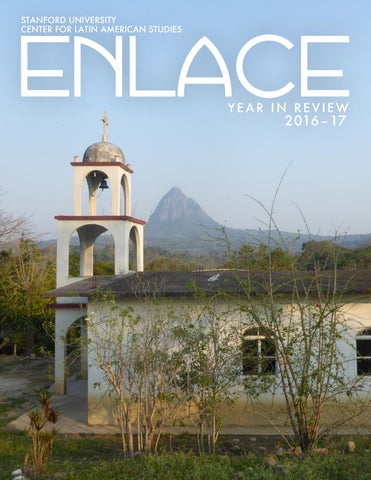
Cover Photo: CLAS student Jessica Sánchez Flores, took this photo “Synctretism,” in the town of Tepozteco. “This photo was taken during my spring break (2017) in the Huasteca region of Veracruz, Mexico. I was staying with a local community studying and practicing Nahuatl, as well as collecting local stories from the older women.” Above: CLAS student Marie Lefebvre took this photo “Dusk in Rio” in Rio de Janeiro, Brazil.
FROM THE DIRECTOR Dear Latin Americanist Community, So much has happened since I started as Director of the Center for Latin American Studies a year and a half ago. Our responsibility as a meeting point on campus for all who are interested and engaged in Latin America now has an added sense of urgency for relevance. With the help of our advisory board, the Center for Latin American Studies has redrafted its mission statement (even though, I must say, it remains in spirit the same as in the past) in the following terms: Our mission is to foster an academic community that serves as a multidisciplinary platform to enable learning from and engaging with the Americas, understood as the diverse ethnic, linguistic, cultural, biological and historical geography shared with the Western Hemisphere. We are committed to “promote the public welfare by exercising an influence on behalf of humanity and civilization� (Stanford University founding grant) and to advance scientific knowledge that strengthens social, economic and environmental justice, sustainability, inclusion and democracy in our hemisphere.
Alberto DĂaz-Cayeros
We wanted to have a clearer statement of our mission, because it seems to me that one of the most challenging problems for a center with a long history of achievements and engagement is to figure out how to adjust its mission to a fast changing reality, while remaining rooted in its core strengths and traditions. We wanted to highlight that our learning and engaging with our hemisphere goes in both directions, with countless contributions from Latin Americans and Caribbean origin peoples both abroad and in the United States being made to North American culture and society. We wanted to also note that our mission is oriented towards humanity and public service, well aligned with the founding grant of the university. Our mission statement notes the enormous diversity of our region, compelling us to keep CLAS as diverse and open as possible to multiple identities, approaches and epistemic communities. We wanted to also make sure to highlight our quest for justice, including the environmental dimension, as well as the looming challenges of democracy and social inclusion in our region. If the activities we do at CLAS seem to not be serving this mission, I invite you to reach out and let me know, thus helping to steer us in the right direction. The way to achieve such an ambitious mission is to engage with all of you, because without your help it is impossible to keep Bolivar House a vibrant and socially engaged intellectual community. Our programmatic activity has brought to campus many speakers, conferences and events. We have tried to reach out to colleagues in universities across California, bringing, with the help of our faculty associates, fabulous speakers from most of our peer UC campuses: Berkeley, Davis, Merced, San Diego, San Francisco and Santa Cruz. We also have had the privilege of learning from and listening to voices of human rights advocates, journalists, family members of desaparecidos, migrant activists, (Continued on next page)
33
FROM THE DIRECTOR musicians, writers and artists. We have hosted a wide range of people devoting their lives to public service: from Amazonian indigenous leaders to the former president of Mexico. Our Tinker Visiting Professors have offered eye opening lectures, courses and conferences that have allowed many of us to learn in accelerated immersive experiences. Throughout the year we have examined processes in a large number of countries, including talks on Argentina, Bolivia, Brazil, Colombia, Cuba, Guatemala, Mexico, Peru and Venezuela; topics ranging from genetics and biodiversity, passing through the nipponization of Brazil, the science of emerging arboviruses like Zika and dengue, the Colombian peace process, skin color, discrimination and race, social mobility and drug traffic violence. We have continued our student run film series and various working groups, our occasional tertulias, and the traditional Spring Fiesta that brought a group of jaraneros last year. I want to highlight two events that left a particularly strong impression in my memory of the past year and a half. The first was an effort we spearheaded in collaboration with other areas of the university, to reflect on and comfort our community, in the aftermath of the November elections. The event involved a panel discussion by three of our faculty and one of our M.A. students. Participants were all women. I co-moderated the event together with the representative of the union of service workers on campus. The event was cathartic in making us aware that we were not alone in our feelings of disempowerment and disappointment, and that there were positive ways to move forward. As director of CLAS I have strived to uphold what I believe is an ethical position, rather than a political one, regarding the Dreamers, our responsibility to facilitate community resources for immigrants and their advocates, and in general our duty to give a voice to all those who uphold the values of tolerance and human dignity. I think we remain with a responsibility to provide a safe haven and a scholarly space that promotes the understanding and embracing of difference and sympathy towards the plight of humanity that has been less fortunate than us in the United States throughout Latin America and the Caribbean.
4
The second event was our Open House with tamales and coffee for our service workers throughout campus. Stanford’s gardens and grounds are tended; dining halls, dorms and classrooms kept clean; and delicious food prepared, thanks to the hard work of our service workers, a large number of them from Latin America and the Caribbean. They deserve our gratitude and respect. They often remain in the background, invisible, while we engage with students, faculty, visitors and the general public. Our house is named after the liberator Simon Bolivar, who said in the Discurso de Angostura in 1809 something truly profound about who we are: Tengamos presente que nuestro pueblo no es el europeo, ni el americano del Norte, que más bien es un compuesto de África y de América, que una emanación de la Europa; pues que hasta la España misma deja de ser europea por su sangre africana, por sus instituciones y por su carácter. Es imposible asignar con propiedad a qué familia humana pertenecemos. La mayor parte del indígena se ha aniquilado, el europeo se ha mezclado con el americano y con el africano, y éste se ha mezclado con el indio y con el europeo. Nacidos todos del seno de una misma madre, nuestros padres, diferentes en origen y en sangre, son extranjeros, y todos difieren visiblemente en la epidermis; esta desemejanza trae un reato de la mayor trascendencia. Bolivar then goes on to explain the reato (a word which means a pending atonement, even after a prison sentence has been paid): this difference can only be addressed through equality, the social and political equality that has remained so elusive, both in Latin America and our own United States. I hope you can all think of Bolivar House as the open house that belong to us all, all of us equal, where we strive to break all barriers, divisions and walls.
Sincerely, Alberto Díaz-Cayeros Stanford CLAS Director
BOLIVAR HOUSE VISITORS Tinker Visiting Professors Under this program, the Center for Latin American Studies invites leading Latin/Ibero American scholars to Stanford University to teach, conduct research, and interact with Stanford faculty and students. CLAS hosted five prominent scholars during the 2016-2017 academic year. Andrés Moreno Estrada
Jorge González-Jácome
Andrés Moreno Estrada is a Mexican population geneticist. He is interested in human genetic diversity and its implications in population history and medical genomics. Since 2015, he has been the principal investigator of the Human Evolutionary and Population Genomics Laboratory and head of the Genome Core Facility at the National Laboratory of Genomics for Biodiversity (LANGEBIO) in Irapuato, Mexico. In spring 2017, he taught The Genetic Footprint of Latin America and its Impact in a Multicultural Society.
Jorge González-Jácome obtained a bachelor’s degree in laws from Universidad Javeriana in Bogota, a master’s degree in laws from Universidad de los Andes in Bogota, and a doctorate in juridical science from Harvard Law School. He is currently an assistant professor at the School of Law of Universidad de los Andes. His research focuses in the history of law and democracy in twentieth century Latin America. Currently, he is interested in the intellectual history of the human rights movement in Colombia in the late 1970s and the relation of that movement to the peace agenda and constitutional law at large. In spring 2017, he taught Critical Issues of Human Rights through Literature.
Jesús Manuel González Pérez Jesús M. González Pérez has a doctorate in geography from the University of Santiago de Compostela (Spain), is associate professor at the University of the Balearic Islands (Spain), and has been a visiting researcher at thirteen European and American universities. Urban geography and urban planning are González Pérez’s main fields of expertise, conducting research on urbanization processes, social segregation and polarization in the inner city, and the methodological analysis of urban politics devoted to the rehabilitation of slum neighborhoods. In autumn 2016, he taught Cities, Urbanisation Processes and Urban Policies in Latin America and the Caribbean.
Henrique M. Pereira Henrique Pereira received a master’s in biophysics from the University of Lisbon in 1997 and a Ph.D. in biological sciences from Stanford University in 2002. Since 2013, he has been a professor of biodiversity conservation at iDiv — German Center for Integrative Biodiversity Research Halle-Jena-Leipzig and Martin Luther University Halle-Wittenberg and an invited professor at InBio, Universidade do Porto (Portugal). His research interests revolve around global biodiversity change, including monitoring schemes for biodiversity, spatially explicit and species-area models for biodiversity scenarios, and empirical studies of the consequences of rewilding abandoned farmland for biodiversity and ecosystem services. In winter 2017, he taught Managing Biodiversity Change: from Science to Policy.
Juan Antonio Suárez Juan Antonio Suárez (M.A., Ph.D. in comparative literature and film studies, Indiana University) teaches American Studies at the University of Murcia, Spain. His main academic interests are modernist literature, independent and experimental cinema, contemporary art, and sound studies. In spring 2017, he taught Iberian and Latin American Experimental Cinemas: 1960’s to the Present.
5
BOLIVAR HOUSE VISITORS Student Researcher Guillermo Ruíz Pava Guillermo Ruíz Pava is currently an assistant professor at Colegio de Estudios Superiores en Administración in Bogota, Colombia, and a Ph.D. candidate at the Universidad de los Andes. He holds bachelor and master degrees in economics from Universidad Externado de Colombia. His current research focuses on the relationship between innovation and social media, particularly how certain social structures bolster or hinder innovation. Other interests include economic theory of entrepreneurship, organizational theory, and political economy. He has co-authored a number of publications including a book about economic geography and varous articles, and has presented work related to social networks and intangible assets at international conferences.
Research Affiliates Roland Benedikter
Jorge Ramón González Ponciano
Roland Benedikter is a research professor of multidisciplinary political analysis in residence at the Willy Brandt Center of the University of Wroclaw/ Breslau; senior research scholar of the Council on Hemispheric Affairs specializing in Chile; trustee of the Toynbee Prize Foundation; and full member of the Club of Rome. Benedikter was active in European politics for over eight years (1995-2003) and holds three German and Austrian doctorates in applied political science, political sociology, and educational politics as well as an Italian four-year degree in foreign politics, languages, and cultures.
Jorge Ramón González Ponciano holds degrees in anthropology from Stanford University (M.A.) and the University of Texas at Austin (Ph.D.), and is a tenured professor at the Center for Multidisciplinary Research of Chiapas and the South Border of the Universidad Nacional Autónoma de México. His current research focuses on human rights, genocide, racism, humor, borderlands, and the history of tourism and the construction of the exotic in the Mayan region. González Ponciano was a CLAS Visiting Scholar from 2013 to 2015 and was a CLAS Tinker Visiting Professor during spring quarter 2015.
Eliane Cavalleiro Eliane Cavalleiro holds a Ph.D. in education, having acquired her master’s degree in 1988 and her doctoral degree in 2003 through the School of Education of the University of Sao Paulo. She worked as the general coordinator of diversity and educational inclusion, in the secretariat of continuing education, literacy, and diversity of the Ministry of Education (2004-2006). Before moving to the U.S., she was a faculty member at the School of Education and a tutor of the Tutorial Education Program of the University of Brasilia –UNB (2006-2010). She is the former president of the Brazilian Association of Black Researchers (2008-2010). In spring 2017, Cavalleiro taught Racial and Gender Inequalities in Latin America.
6
Eliane Karp-Toledo Eliane Karp-Toledo holds a Ph.D. in Anthropology from Stanford University. She is the director for projects and policies of social inclusion at the Global Center for Development and Democracy and member of the Indigenist Chair “José María Arguedas” at the Ibero American Institute, University of Salamanca, Spain. She is preparing a new project about the impact of climate change on indigenous and campesino communities in the Andean Highlands.
LIBRARY REPORT Resources The libraries at Stanford continue to be an integral component for engaged scholarly activity on campus with a variety of teaching and research materials. Searchworks, the library’s catalog, links to an ever-growing collection of resources in Spanish (420,000+) and Portuguese (96,000+). This year some databases were added to enhance that library experience:
Confidential Print: Latin America, 1833-1969, provides a wealth of primary sources (diplomatic dispatches, correspondence, statistical reports) on political/social movements and economic development in multiple areas of Latin America. Kanopy has become the platform of choice for documentaries and independent feature films on human rights, immigration, the environment, and other similar topics of interest to Stanford users. OpenEdition Books with more than 300 ebooks in Spanish offers a variety of peerreviewed titles in various disciplines.
Library Access Grants
Outreach Linking users to a variety of teaching and research tools has been a central mission of the libraries. This year the library was introduced to participants of a seminar for Spanish language teachers and a course entitled the History of the Americas: Mexican Revolution and Nation-Building. Stanford’s curator for Latin American collections, Adán Griego, presented ways to integrate primary source materials (photos, posters, flyers, and other ephemera) into a more dynamic curriculum. These rich resources were also showcased to visiting students from community colleges in Southern California (Cerritos College) and the Bay Area as a continued effort to include the libraries in the overall experience of first-generation students. Finally, this year the libraries and CLAS hosted four scholars from Serving Institutions through the CLAS-Stanford Libraries’ Library Access Grants Program. Funded by CLAS, the group received instruction on how to access the multiplicity of Latin American studies resources available to them during their tenure as short-term visiting scholars. In addition, Griego has chronicled acquisition trips to Guadalajara and Santiago-Buenos Aires, both book fairs partially funded by CLAS. A social media photo album gives an idea of the type of materials soon to be available at the libraries. Adán continues to be active in orienting new professionals to Latin American studies librarianship at both the Reforma and SALALM library groups.
CLAS offered four library access grants for scholars from qualified Minority Serving Institutions and community colleges across the U.S. to conduct research at the Stanford University Libraries.
Greg Landau, City College of San Francisco During spring 2017, Landau made several visits to the Stanford Libraries and used the vast facilities there to prepare a new class for San Francisco City College’s Latino/a and Latin American Studies Department. He also used the online databases to access hard-to-find periodicals and articles. Landau used this opportunity to create an outline for the class “Culture and Revolution in Latin America,” a survey of the cultural movements that emerged in Cuba, Nicaragua, Mexico, Chile, Argentina, and the Latino communities of the United States. The course looks at examples of literature, film, music, art, and dance to understand the ways that Latin Americans used cultural expression to express their own political realities and cultural identity. Landau said “I am grateful for this opportunity and the help of Stanford staff and the Latin American Studies department.”
7
LIBRARY REPORT Library Access Grants Bernadine Hernández, University of New Mexico
Erica Vogel, Saddleback Community College
Hernández visited the Stanford Libraries during summer 2017. While in the archives, Hernández consulted the Victor Salandini Papers, the James Vizzard Papers, the Frank Bardacke Papers, the Latino Comic book collection, the Arturo Islas papers, and the Mexican American Legal Defense and Education Fund. These collections contributed to four projects: first is Hernández’s book manuscript examining gender and sexual violence in California, New Mexico, Arizona, and Texas during the nineteenth century. Second, an article on farmworker masculinity and violence, titled “Silent Summers: ‘Masculinity’ and the Sexual Structural Violence of Farm Work.” Third, a project considering how the archive hides while simultaneously making visible the spectrum of oppression, colonialism, racism, and sexual violence in the Americas through the contemporary moment of the forced sterilization of Chicana women in Los Angeles in the 1960s and 70s. Fourth, an article on Arturo Islas’ papers in relation to The Rain God.
Vogel visited Stanford in July 2017 and was able to enhance two central projects related to her research and teaching. First, she was able to gather primary sources for courses on the anthropology of Latin America and globalization that she teaches at Saddleback Community College in Mission Viejo, California. She found numerous rich materials in the special collections, including an archive of posters about HIV prevention and awareness from Latin America. One poster in particular, created for World AIDS Day 2004, stood out as ideal for teaching students about topics such as gender, sexuality, and understandings of health in Mexico. Vogel discussed the poster’s context and origins with Adán Griego, and plans to create an assignment for her anthropology students using readings such as Matthew Gutmann’s Seed of the Nation: Men’s Sex and Potency in Mexico. In addition, Vogel found excellent posters from San Francisco-based protests of U.S. involvement in El Salvador and Nicaragua as well as an extensive collection of magazines and comic books made by both professional and amateur Latino artists. She also plans to incorporate these in her lectures and assignments. Second, she was able to conduct research for a book manuscript tentatively titled Cosmopolitan Conversions; Peruvian Migration to South Korea. With a focus on religious, labor, and migration experiences, this ethnography examines how Peruvians—a small and yet resilient group of “temporary” laborers in Korea—live unauthorized lives and refashion their identities as they are permanently in transit in global labor and religious circuits.
Hernández described her time at Stanford as a “fruitful work experience” that will benefit her research on gender and sexual violence on the borderlands.
Ane González Lara, University of New Mexico González Lara visited Stanford in spring 2017, and accessed a vast array of books, special collections, articles, documentaries, and magazines related to Brazilian history, politics, architecture, art, and culture. In addition, the grant provided opportunities for González Lara to meet individuals who provided important information and who may collaborate with her on future projects, such as Adán Griego, who introduced González Lara to Stanford’s Humanities Fellowship program and multiple scholars across campus with similar research interests, and John Barton, director of Stanford’s architecture program, who expressed willingness to collaborate. González Lara and Barton are drafting a paper to co-present at the upcoming Association of Collegiate Schools of Architecture annual conference in Denver, and they also discussed co-teaching an online class for Stanford and UNM students during the spring semester. González Lara commented that “being surrounded by talented and highly competitive people at Stanford has been very inspiring. I am looking forward to continuing this research at the University of New Mexico, and to generating publications using the material I have gathered through this grant. I am very grateful to Stanford’s Center for Latin American Studies for providing access to faculty from minority serving institutions to Stanford University Libraries.”
8
Vogel said that receiving this grant was a wonderful experience, making it possible to gather source material not available in the Saddleback Library, thus allowing her to include more primary sources in her courses, and also inspiring her to enhance her own writing projects. She added, “By far though, my favorite part of the grant was the chance to visit the campus and talk about my work with the wonderful people in the Center for Latin American Studies.”
EVENT HIGHLIGHTS Omar García-Ponce
Weekly Lecture Series CLAS’s lecture series continues to be an iconic program of the institution and a useful window for the general public to become aware of the various cultural, educational, artistic, and scientific developments in the region.
March 17, 2017 Women’s Political Participation After Civil War: Evidence from Peru
Santiago Tobón
December 2, 2016 Prison Conditions and Recidivism: Evidence from an Expansion in Prison Capacity
Blanca Heredia and Sandra Ley Alain de Janvry
October 7, 2016 Land Privatization in Mexico: Politics, Migration, and Structural Transformation
Ignacio López-Calvo
October 14, 2016 Contested Modernities: Representations of the Brazilian Dekasegi and the Nipponization of Brazil in Nikkei Cultural Production
Silvia Giorguli
October 28, 2016 A Migration System in the Making: Demography and Human Mobility in Northern America and the Northern Triangle of Central America
Jesús M. González-Pérez
November 4, 2016 La urbanización en la burbuja inmobiliaria y políticas urbanas post-crisis en la ciudad española (1996-2016)
Ignacio Chapela
November 11, 2016 Transgenesis in Latin American: Forty Years of GMOs, their Social and Biological Past, Present and Future
Lisseth Boon
November 18, 2016 A Conversation with Lisseth Boon/Una conversación con Lisseth Boon
December 9, 2016 Education in Mexico
Raul Andino
January 13, 2017 Zika, Dengue, and Other Arboviruses, Insect Vectors and How to Control Them
José de Jesús Orozco Henríquez, Paulo Vannuchi, Esmeralda Arosemena de Troitiño, Francisco José Eguiguren Praeli, and Enrique Gil Botero January 27, 2017 The Future of the Inter-American Human Rights System
Tianna S. Paschel
February 3, 2017 Becoming Black Political Subjects: Movements and Ethno-Racial Rights in Colombia and Brazil
Henrique Pereira
February 10, 2017 Chasing the Biodiversity Crisis
Eva O. Arceo-Gómez
February 24, 2017 Double Discrimination: Do Discriminating Job Ads Discriminate in Callbacks?
Margarita López Maya
March 3, 2017 Legacies and Challenges of a Venezuela Post Chavism
Raymundo M. Campos Vázquez
March 10, 2017 Skin Color and Social Mobility: Evidence from Mexico
Beatriz Magaloni
April 7, 2017 Criminal Violence in Latin America
Christopher Blattman
April 14, 2017 State Building in the City: The Effects of Public Security and Services on Crime, Violence, and State Legitimacy
Jorge González-Jácome
April 21, 2017 Between Democracy and Revolution: The Emergence of Human Rights Activism in Colombia (1974-1980)
Jean-Paul Faguet
May 5, 2017 Revolution From Below: The Rise of Local Politics and the Fall of Bolivia’s Party Systems
Andrés Moreno Estrada
May 12, 2017 Genetic Diversity in Latin America and the Pacific: Lessons from Understudied Human Populations
Juan Antonio Suárez
May 19, 2017 Spanish and Latin American Undergrounds: Another Politics of Latin Cinemas
Liliana Guerra
June 2, 2017 “Feeling like Fidel”: Legacies, Memory, and Official Amnesia in Today’s Cuba 9
EVENT HIGHLIGHTS The following are a few additional highlights of events organized, sponsored, cosponsored, or financed by CLAS during the 2016-17 year. For a complete list of events, please visit clas.stanford.edu/events.
Conference on Long Range Development in Latin America
Ayotzinapa 2 Years Later: Family Members of the Disappeared Students Share Stories of Their Fight for Justice
May 11 – 12, 2017
November 18, 2016
50th Anniversary of the Campaign of Che Guevara in Bolivia/Quincuagésimo aniversario de la campaña del Che en Bolivia March 16, 2017
Environment, Indigenous Cultures, and Land Rights in the Amazon
Both Sides of the Border: What the Election Means for Latinos/as and Latin Americans
May 24 – 16, 2017
November 28, 2016
Post-Genocidal Guatemala Between Impunity and Institutional Reconstruction May 26, 2017
Photo credit: José Manuel Vieira Fragoso
10
EVENT HIGHLIGHTS Spring Fiesta CLAS hosted its annual spring fiesta at the Bolivar House gardens. This year’s fiesta showcased Mexican culture, food, drinks, and traditions. Musical group DíaPaSon performed son jarocho, a regional folk musical style of Mexican Son from Veracruz, a Mexican state along the Gulf of Mexico. DíaPaSon is a collective of Bay Area artists who promote and preserve Mexican folk music and dance, particularly son jarocho, through practice and performance.
Both Sides of the Border: What the Election Means for Latinos/as and Latin Americans November 28, 2016
Former Mexican President Vicente Fox: The Future of U.S.–Mexican Relations April 18, 2017 Library Curator Adán Griego, CLAS Associate Director Elizabeth SáenzAckermann, and CLAS Interim Business Administrator Denise Geraci
M.A. students Vanessa Melo and Sandra Oseguera
CLAS Open House for Stanford Service Employees and Contractors September 30, 2016
DíaPaSon musical group
11
COMMENCEMENT 2O17 Congratulations to the Class of 2017 The 126th Commencement of Stanford University was held on Sunday, June 18, 2017. The Center for Latin American Studies recognized fourteen graduates of the Master of Arts degree in Latin American Studies. Joy Olson, human rights advocate and former director of the Washington Office on Latin America provided the keynote address for the ceremony, inspiring our graduates to find their own paths and use their experiences to effect change. Graduates Sandra Oseguera Sotomayor and Gustavo Lisbôa Empinotti also provided heart-felt speeches to commemorate the occasion. Families and friends joined CLAS in the Bolivar House garden to celebrate with tthe graduates. Video recordings of commencement can be found on the CLAS Vimeo Channel at vimeo.com/album/3476408.
Left to right: Graciela Gómez, Karen Camacho, Jessica Sánchez Flores, Andrea Hale, Marie Lefebvre, Gustavo Empinotti, Vanessa Melo, CLAS Director Alberto Díaz-Cayeros, Lenica MoralesValenzuela, Holly Moulton, Sandra Oseguera Sotomayor, Andrea Garza Erdmann, Maria Walker, and Marjory Ruíz Hidalgo
Gustavo Empinotti
Sandra Oseguera Sotomayor
Joy Olson
CLAS M.A. students and their capstone projects: Karen Camacho Why Put a Face to the Movement?: An Analysis of the Ejército Zapatista de Liberación Nacional’s Changing Mobilization Strategies Advisor: Ana Minian
Gustavo Lisbôa Empinotti Dangerous Deals: Can Pacts with Criminal Organizations be a Violence-Reducing Policy in Latin America? Advisor: Beatriz Magaloni
Holly Moulton Strategies for Resilience: A Socioecological Analysis of Climate Change Adaptation in the Peruvian Cordillera Blanca Advisor: William (Bill) Durham
Andrea Garza Erdmann The Human Abroad: Legal and Social Challenges Advisor: Alberto Díaz-Cayeros
Kai Medeiros Importing Poisonous Fruits: The Ninth Circuit in Munoz Santos Fails to Fully Resolve U.S. Incompliance with the Convention Against Torture Resulting from the Rule of Non-Contradiction Advisor: James Cavallaro
Sandra Oseguera Sotomayor Participatory Governance and Water Security: The Case of Thirteen Indigenous Communities in Defense of Water in Morelos Advisor: Mikael Wolfe
Graciela Milagros Gómez Silencing the Taíno: Narrative and Resistance Movements in the 16th Century Advisor: Mikael Wolfe Andrea Hale The Roots of Racial Inequality: An Intellectual History of Scientific Racism in Brazil Advisor: Tomás Jiménez Marie Luisa Lefebvre The Journey Stops Here: Treatment of Haitians in Mexico at the United States Border in Tijuana Advisor: Alberto Díaz-Cayeros 12
Vanessa Melo The Violent Arm of the State: The Origins of Police Violence in Rio De Janeiro Advisor: Beatriz Magaloni Lenica J. MoralesValenzuela Responding to Terror Tactics in the Era of Transitional Justice: Lessons from Los Desaparecidos of Guatemala and Argentina Advisor: James Cavallaro
Marjory Ruíz Hidalgo Oil Entanglements, Indigenous Peoples, and Human Rights in the Ecuadorian Amazon Advisor: James Cavallaro Jessica Linet Sánchez Flores The Feminicides of Juárez: A Multi-Faceted Violence Advisor: Marilia Librandi-Rocha María Elizabeth Mendoza Walker Women and Violence in Peru During the Internal Conflict, 1980-2000 Advisor: Ana Minian
STUDENT FUNDING OPPORTUNITIES Monica Miller Walsh Grant Recipients for Summer Internships
Pessoa-Trejos Grant Recipients for Summer Internships in Brazil
Thanks to a generous gift renewal from Stanford alumna Monica Miller Walsh and her husband, David Walsh, CLAS was able, for the twelfth year in a row, to award Monica Miller Walsh Grants to support Stanford undergraduates in summer internships in Latin America.
Thanks to a generous gift renewal from Stanford alumna Ana Pessoa-Trejos and her husband, Raul Trejos, CLAS was able, for the eighth year in a row, to award Pessoa-Trejos Grants to support Stanford undergraduates in summer internships and graduate field research in Latin America.
Internship: Centro para la Apertura y el Desarrollo de América Latina in Buenos Aires, Argentina
Internship: Marinho in Rio de Janeiro, Brazil
Eric Cuevas, Political Science, ’18
The Center for the Opening and Development of Latin America (CADAL) is a private, non-profit and non-partisan foundation, with a mission of research, dissemination, and support of civic, political, and economic liberties.
Internship: D’or in Rio de Janeiro, Brazil Logan Posey, Undeclared, ’20
The D’Or Institute for Research and Education is a nonprofit organization whose aim is to promote scientific and technological progress in healthcare.
Internship: Asociación por los Derechos Civiles (ADC) in Buenos Aires, Argentina Sarah Goodman, Undeclared, ’20 ADC is a nongovernmental, non-partisan, and non-profit organization whose objective is to secure a legal and institutional culture that guarantees the fundamental rights of individuals, and that is sustained by the democratic values of Argentina’s National Constitution.
Noam Shemtov, Undeclared, ’20 The Roberto Marinho Foundation was created by the founder of Globo, on the premise that communication can be a tool for social change. The foundation promotes the right to education and works to preserve the environment and cultural heritage of Brazil.
FLAS Fellowship Recipients CLAS administers Foreign Language and Area Studies (FLAS) fellowships for graduate and undergraduate students pursuing language training in less commonly taught languages of Latin America.
Academic Year 2016-2017 Karen Camacho, Graduate, Latin American Studies, Nahuatl Marie Lefebvre, Graduate, Latin American Studies, Portuguese Andrea Hale, Graduate, Latin American Studies, Portuguese Kai Medeiros, Graduate, Latin American Studies and Law, Portuguese Holly Moulton, Graduate, Latin American Studies, Quechua Michelle Reddy, Graduate, Education, Portuguese Victoria Sáenz, Undergraduate, Iberian and Latin American Cultures, Portuguese Jessica L. Sánchez Flores, Graduate, Latin American Studies, Nahuatl
Summer 2016 David Albán Hidalgo, Graduate, Latin American Studies, Quechua, Peru Alexis Pearce, Graduate, Iberian and Latin American Cultures, Portuguese, Brazil Jessica L. Sánchez Flores, Graduate, Latin American Studies, Nahuatl, Yale Yongjian Si, Graduate, Latin American Studies, Nahuatl, Yale
13
STUDENT FUNDING OPPORTUNITIES Soares Fellowship Recipient The Soares Fund was established with a generous gift from Edward J. and Margaret S. Soares to provide full fellowships to Latin American Studies graduate students at Stanford University. Lenica Morales-Valenzuela, Graduate, Latin American Studies
Ayacucho Fellowship Recipient The Ayacucho Fund was established with a generous gift from the Gran Mariscal de Ayacucho Foundation to award fellowships to Latin American graduate students at Stanford University.
Graduate Research Travel Grant Recipients CLAS supports Stanford graduate field research in Latin America. Elinor Benami, Emmett Interdisciplinary Program in Environment and Resources; Brazilian Coffee Famers and Drought: Effects of Eco-Certification on Farmer Resilience, Brazil Marguerite DeLoney, Anthropology; Cartographies of Belonging: Decolonial Explorations into the Making of Place with the Community of Portobelo, Panama
Andrea Garza Erdmann, Graduate, Latin American Studies
Claire Maass, Anthropology; History of African Diaspora in Peru from an Archeological Perspective, Peru
Conference Travel Grant Recipients
David McMahon, Earth System Science; Soil Nutrients and Sustainability in Brazilian Eucalyptus Forestry, Brazil
CLAS supports Stanford graduate students to attend and present on topics related to Latin America at professional meetings and conferences.
Grace Ocana, Anthropology; Contested Metropolis: Lima’s Urban Heritage as the Perpetuation of Historical Structural Violence, Peru
John Schroeder, Biology; Smithsonian Tropical Research Institute, Panama
Jeffery Smith, Biology; Impacts of Tropical Land Use on Anthropod Biodiversity: Implications for Food Webs and Ecosystems, Costa Rica
Pablo Seward, Anthropology; Drugs, Politics, and Society in the Global South Symposium, UK Anna Castillo, Iberian and Latin American Cultures; Latin American Studies Association (LASA) 2017 Congress, Peru Kai Medeiros, Latin American Studies; 57th Special Session of the Inter-American Court of Human Rights, Guatemala Raquel Coelho, Graduate School of Education; Comparative and International Education Society 61st Annual Conference: Equity in Educational Opportunities in Latin America, Atlanta, Georgia Edgar Franco Vivanco, Political Science; Latin American Studies Association (LASA) 2017 Congress, Peru Yuki Bailey, Latin American Studies; Global South Beyond Developmentalism, South Korea
Intensive Nahuatl Language Training in Mexico Karen Camacho, Graduate, Latin American Studies Lenica Morales-Valenzuela, Graduate, Latin American Studies Jessica L. Sánchez Flores, Graduate, Latin American Studies During winter 2016, these three students studied and researched Nahuatl language and culture at IDIEZ (Instituto de Docencia e Investigación Etológica de Zacatecas) in Zacatecas, Mexico, a Mexican nonprofit dedicated to teaching, research, and the revitalization of indigenous languages and cultures in Mexico.
Nicolás Torres-Echeverry, Stanford Law School; International Meeting on Law and Society, Mexico Mariana de Heredia, Iberian and Latin American Cultures; International Symposium on Cultural Diplomacy, Germany Claire Maass, Anthropology; Society for American Archaeology Annual Meeting, Canada Silvana Freire, Graduate School of Education; Comparative and International Education Society 61st Annual Conference: Equity in Educational Opportunities in Latin America, Atlanta, Georgia
14
M.A. students Jessica Sánchez Flores and Lenica Morales-Valenzuela.
STUDENT FUNDING OPPORTUNITIES SGS Global Perspectives Grant Recipients
CLAS Student Working Groups
The Stanford Global Studies Division provides funding to support summer internships, research abroad, language training or other activities that help graduate students address global and international concerns in their research, made possible by a generous gift from the Friends of Stanford University Foundation in Taiwan. Eight CLAS students received grants in 2016-17:
Student working groups collaborate with a faculty advisor to organize events such as lectures, speaker series, symposia, exchange of working papers, and collaborative research efforts. CLAS awarded grants to the following three student-led working groups during the 2016-17 academic year:
Yuki Bailey, Puerto Rico Yuki conducted research with Dr. Nuria Sabaté at Ponce Health Sciences University in Ponce, Puerto Rico.
Anakaren Cervantes, Vermont, USA Anakaren received a grant to study Portuguese during summer 2017 at Middlebury College Language Schools.
Graciela Gómez, Spain Graciela visited the Archivo General de Indias to study the Taíno natives that inhabited the Caribbean prior to the Encounter.
Marie Lefebvre, Brazil arie worked with the Brazilian NGO M Viva Rio and researched Haitian migration to Brazil, used often as a stepping-stone for further migration to Mexico and the United States, in order to understand the push factors on the Brazilian side. Holly Moulton, Colombia and Peru Holly received two grants related to the effects of climate change on the indigenous communities, rural villages, and farmers of the Andes, presenting her research at the Winter School 2017 in Cusco, Peru, and visiting several national parks and agricultural regions in Colombia.
The African Diaspora in Latin America: Experiences and Perspectives This working group organized five very successful events during winter quarter that attracted a varied mix of students, faculty, and members of the community: • January 19, 2017: Afro Latin Music Dance Night and Festejo Workshop, featuring live music and an Afro-Peruvian dance workshop with instructor Luis Muro, a collaborator with the Brisas del Titicaca Cultural Association. • January 26, 2017: Afro Brazil: Oral Culture, Literature and Digital Media, with Stanford Assistant Professor Marilia Librandi-Rocha, Luso-Brazilian and Latin American Literature and Culture. Professor Librandi-Rocha discussed the AfroBrazilian population in the state of Minas Gerais, Brazil. • February 9, 2017: Brazil: A Racial Paradise?, a documentary screening about carnival and the reality of Brazil’s legacy as the world’s largest slave economy. • March 9, 2017: Haiti & the Dominican Republic: An Island Divided, a documentary screening that explored race and identity in the island of Hispaniola. • March 10, 2017: Tertulia with Tiana Paschel, an informal discussion about Paschel’s recent book Becoming Black Political Subjects: Movements and EthnoRacial Rights in Colombia and Brazil and her journey through academia. Student Coordinators: Andrea Garza Erdmann, Graduate Student, Latin American Studies Andrea Hale, Graduate Student, Latin American Studies Lenica Morales-Valenzuela, Graduate Student, Latin American Studies Jessica L. Sánchez Flores, Graduate Student, Latin American Studies Faculty Sponsor: Marília Librandi-Rocha, Assistant Professor of Luso-Brazilian and Latin American Literature and Culture 15
STUDENT FUNDING OPPORTUNITIES CLAS Student Working Groups Stanford Interdisciplinary Research Group on Latin American Studies
This working group provided a forum for graduate students working on Latin America to share their research with one another during monthly meetings. Seven dinner seminars were held from November 2016 to May 2017, in which two to three students presented their original research. The primary goal of this working group was to encourage more interdisciplinary research on Latin America and to connect graduate students from various disciplines who may not normally connect with each other. Student Coordinators: Jane Esberg, Graduate Student, Political Science Edgar Franco Vivanco, Graduate Student, Political Science Faculty Sponsor: Beatriz Magaloni, Associate Professor of Political Science
Immigration, Human Rights, and Social Movements
This working group provided a forum for students and community members to discuss and learn about the dynamics of Central American migration and the roots behind it. It was also a space for Stanford students to discuss their experiences or their family’s migration experiences. Two films were screened: • January 13, 2017: La Jaula de Oro, a fictional movie about Central American migration to the United States. It was followed by a discussion with graduate students Lenica Morales Valenzuela, Karen Camacho, and Marjory Ruiz. • February 10, 2017: Crossing Mexico’s Other Border, a documentary about the journey of Central American migrants on their way north to the United States. It was followed by a discussion with graduate students Lenica Morales Valenzuela, Karen Camacho, and Marjory Ruiz.
Student Coordinators: Karen Camacho, Graduate Student, Latin American Studies Lenica Morales-Valenzuela, Graduate Student, Latin American Studies Marjory Ruíz Hidalgo, Graduate Student, Latin American Studies Faculty Sponsor: Ana Raquel Minian, Assistant Professor of History and of Comparative Studies in Race and Ethnicity 16
Venezuela’s Institutional Crisis
This working group strove to situate Venezuela at the center of Stanford students’ wide-ranging concerns through four events with the following objectives: to raise awareness about Venezuela’s dire socioeconomic and institutional crisis; to encourage thoughtful and informed inquiries, reflections, and discussions about the possible political, economic, and social outcomes of the country; and to advance serious and useful research evaluating the Venezuelan situation from rigorous and varied scholarly perspectives. • October 26, 2016: Conversation with Leopoldo López Gil, father of jailed Venezuelan opposition leader Leopoldo López. López Gil presented the Venezuelan opposition leader’s book Preso pero libre (Imprisoned but Free), which details the national tragedy overcoming Venezuela, and the personal accounts López has lived while incarcerated in the Ramo Verde military prison outside of Caracas. • November 28, 2016: Escenarios políticos en Venezuela: trancisión vs. autocratización, a lecture in Spanish with Professor Benigno Alarcón (Universidad Católica Andrés Bello) on the possible political scenarios in Venezuela following its latest political developments. The talk was moderated by Professor Harold Trinkunas, Associate Director for Research at CISAC, Stanford University. • March 4, 2017: Venezuela at a Crossroads: An Academic Perspective, a one-day conference on the political, economic, and social aspects of the current Venezuelan crisis with Stanford professors Larry Diamond, Margarita López Maya, Colette Capriles, Javier Corrales, Francisco Monaldi, and Miguel Angel Santos. • April 17, 2017: Fighting for LGBT Rights in Latin America, a lecture and discussion with Tamara Adrián and Javier Corrales. Tamara Adrián is the second transgender person elected to a national legislature in the Americas, and among many leadership positions, she currently holds the presidency for the Committee of the International Day Against Homophobia and Transphobia (IDAHO-T). The event focused on Adrián’s life as a human rights activist and her fight for legal reforms in her native Venezuela. It also included an opening lecture on LGBT rights in Latin America by Javier Corrales, Dwight W. Morrow 1895 Professor of Political Science at Amherst College. Student Coordinators: Ana C. Nuñez Machado, Graduate Student, Law Carlos A. Sánchez-Martínez, Graduate Student, Business Faculty Sponsor: Larry Diamond, Senior Fellow, Hoover Institution, and Professor, Political Science and Sociology
STUDENT FUNDING OPPORTUNITIES CLAS programs offer research grants and fellowships, internships, scholarships, language study opportunities, and other funding options to students and visiting scholars both in the United States and abroad. Below is a visual representation of student research, study, and internship locations in the U.S. and Latin America.
Claire Maass Canada Yuki Bailey South Korea
Karen Camacho, Marie Lefebvre, Andrea Hale, Kai Medeiros, Holly Moulton, Michelle Reddy, Victoria Sáenz, Jessica L. Sánchez Flores Stanford, CA
Karen Camacho, Jessica Sánchez Flores, Nicolás TorresEcheverry, Lenica Morales-Valenzuela Mexico
Anakaren Cervantes Vermont
Raquel Coelho, Silvana Freire Atlanta, Georgia
Jessica Sánchez Flores, Yongjian Si New Haven, CT
Jeffery Smith Costa Rica
Kai Medeiros Guatemala
“Coming back to Stanford, I feel even more empowered and motivated to continue my Náhuatl studies. I also feel a deeper understanding and sense of purpose for the work I am doing.” — Karen Camacho M.A. Latin American Studies ’17
Pablo Seward United Kingdom
Mariana de Heredia Germany
Graciela Gómez Spain
Marguerite DeLoney, John Schroeder Panama
Holly Moulton Columbia
Yuki Bailey, Elinor Benami, Marie Lefebvre, David McMahon, Alexis Pearce, Logan Posey, Noam Shemtov Brazil
David Albán Hidalgo, Anna Castillo, Claire Maass, Holly Moulton, Grace Ocana, Edgar Franco Vivanco Peru
Eric Cuevas, Sarah Goodman Argentina
17
FACULTY Faculty Conferences Education: Equalizer or Reproducer of Social Inequality? December 8-9, 2016 Faculty Chair: Martin Carnoy, Vida Jacks Professor of Education This two-day workshop addressed the relationship between social inequality and education, exploring international research, public policy, and practices on the matter, with a special focus on Mexico. The conference brought together economists, sociologists, political scientists, and psychologists, to cover a range of topics impinging on how the educational system and knowledge transfer interact with the socioeconomic context to produce future distributions of socioeconomic outcomes. This conference also served to strengthen linkages between various parts of the Stanford research community—namely, the Graduate School of Education, CLAS, and the Freeman Spogli Institute—with Programa Interdisciplinario sobre Política y Prácticas Educativas (PIPE), an important research center of Centro de Investigación y Docencia Económicas (CIDE) in Mexico City. Cosponsored with the Graduate School of Education at Stanford in collaboration with PIPE/CIDE.
Reconciliation and Resistance: Literatures and Cultures of Human Rights May 12, 2017 Faculty Chair: Héctor Hoyos, Associate Professor, Department of Iberian and Latin American Cultures Jorge González-Jácome, Edward Laroque Tinker Visiting Professor in Latin American Studies This symposium explored the aftermath of human rights violations in culture, as well as the effects of cultural production on law and policy. With a non-exclusive emphasis on Latin America and an interdisciplinary law and literature focus, the symposium brought together a distinguished group of authors and scholars. The symposium was cosponsored with the Department of Iberian and Latin American Cultures; the Division of Literatures, Cultures, and Languages; the Law School; the Dean’s Office; the Program in Modern Thought and Literature; and the Taube Center for Jewish Studies. 18
The Future of the Inter-American Human Rights System January 27, 2017 Faculty Chair: James L. Cavallaro, Professor of Law, Director of the International Human Rights and Conflict Resolution Clinic, Director of the Human Rights Center, and President of the Inter-American Commission on Human Rights This conference asked the question: Amidst the human rights crisis in the Americas, what role can and should the Inter-American Commission on Human Rights (IACHR) play? Attendees joined the discussion with current members of the IACHR, an autonomous organ of the Organization of American States (OAS) that promotes and protects human rights in the Americas. The IACHR also exercises oversight over the United States, since the U.S. is a member of the OAS. Current members include Commissioners José de Jesús Orozco Henríquez, Paulo Vannuchi, Esmeralda Arosemena de Troitiño, Francisco José Eguiguren Praeli, and Enrique Gil Botero. Cavallaro provided the introductory remarks, and the discussion was moderated by Law School Fellow Mirte Postema. Cosponsored with the Stanford Human Rights Center.
Histories of Illegality and Violence in Latin America March 24, 2017 Faculty Chair: Ana Raquel Minian, Assistant Professor of History and of Comparative Studies in Race and Ethnicity Latin America is often portrayed as a land overridden with violence. This symposium, brought together scholars who studied the development of multiple understandings of illegality and violence through three different lenses: cultural understandings of illegality and violence; state-perpetuated violence and illegality; and the formation of Latin Americans’ association with these concepts from a transnational perspective. The scholars who presented at this symposium showed how the precise understandings and consequences of illegality within Latin America itself are vague, in part because of multiple relationships that Latin Americans have long had with this concept. While it is undeniable that the narco states have produced havoc among the population, many people also have other associations with illegality: the black market provides many with access to the goods they need and a source of income; in the U.S. they are often considered “illegal” themselves; and state officials have long been considered to be promoters of violence. Equally important: violence often manifests itself in everyday actions, such as small and big acts of discrimination, and even through state spending. Cosponsored with the Humanities Center.
FACULTY Publications Roland Greene (Co-editor) Princeton Handbook of World Poetics. (Princeton University Press, 2017)
Hans Gumbrecht (Contributor) Aidoo, Lamonte, and Daniel F. Silva. Emerging Dialogues on Machado de Assis. (Palgrave Macmillan, 2016) Herbert S. Klein (Co-author) Brazil, 1964-1985: The Military Regimes of Latin America in the Cold War. (Yale University Press, 2017)
Alice A. Milano (Co-author) Exploring the Effects of a Short-Term Spanish Immersion Program in a Postsecondary Setting. Foreign Language Annals, 49: 287–301. (2016) Paula Moya (Contributor) Orchard, William, and Yolanda Padilla. Bridges, Borders, and Breaks: History, Narrative, and Nation in Twenty-FirstCentury Chicana/o Literary Criticism. (University of Pittsburgh Press, 2016) Amado Padilla (Co-author) The Hispanic Stress Inventory Version 2: Improving the Assessment of Acculturation Stress. Psychological Assessment, 28(5), 509-522. (2016)
Joan Ramón Resina The Ghost in the Constitution: Historical Memory and Denial in Spanish Society. (Liverpool, 2017) Josep Pla: Seeing the World in the Form of Articles. (Toronto, 2017) Guadalupe Valdés (Contributor) Mayorga-Gallo, Sarah. Mi Padre: Mexican Immigrant Fathers and Their Children’s Education. (Teacher’s College Press, 2017) Mikael Wolfe Watering the Revolution: An Environmental and Technological History of Agrarian Reform in Mexico. (Duke, 2017)
(Co-editor) El exilio de Perón. (Sudamericana, 2016)
Faculty Updates Héctor Hoyos was promoted to associate professor with tenure. Joan Ramón Resina received a fellowship to the Internationales Kolleg Morphomata, University of Cologne (spring 2017). Herbert S. Klein was awarded the “Distinguished Service Award” of the Conference of Latin American Historians 2015 (awarded at the 2016 American Historical Association Annual Meeting in Atlanta) and was named corresponding member of the Academia Nacional de Historia de Argentina. Thomas Sheehan was invited to lecture on Heidegger’s Being and Time at Tsingua University, Beijing (April/May 2016).
Lyris Wiedemann organized a session for the American Portuguese Studies Association October 2016 Conference: “An Exceptionally Diverse Community: Portuguese Teaching Challenges and Solutions” (with Agripino Silveria). Her paper was also accepted for the American Council on the Teaching of Foreign Languages meeting: “From Intermediate to Advanced: Reading the Right Way to Impact Production,” in November 2016. She also renewed her certification as a writing proficiency test rater, for the period June 2016 – June 2020. Zephyr Frank was a fellow at the Center for Advanced Study in the Behavioral Sciences (2016-17).
A complete list of CLAS-affiliated faculty can be found at clas.stanford.edu.
19
PUBLIC ENGAGEMENT CLAS is a U.S. Department of Education Title VI National Resource Center, receiving funding to further Latin American language and area studies at Stanford as well as in K-12 and community college education. The 2016-17 year marked the third year of the 2014-17 grant cycle, during which CLAS collaboratedwith the Stanford Graduate School of Education’s Center to Support Excellence in Teaching (CSET) and Stanford World Language Project (SWLP), the Freeman Spogli Institute’s Stanford Program on International and Cross-Cultural Education (SPICE), The Stanford University Libraries(SUL), The Stanford Language Center(SCL), Lacuna Stories at the Center for Spatial and Textual Analysis (CESTA), SGS Area Studies Centers, local community colleges, and universities across the US to develop and offer professional development for K-12 and community college educators, including the following:
Heritage Spanish Teachers Seminar Series CLAS partners with SWLP and CSET to offer a K – 12 year-round professional development course tailored to the pedagogical needs of the Heritage Spanish classroom. During this year’s program, teachers attended five full-day seminars taught by SWLP lead teachers Marcelo Leal, Yolanda Mercado, and Antonio Tunzi, with guest presentations by Stanford’s Ramón González, Ximena Briceño, Mirte Postema, and Adán Griego, as well as UC Berkeley’s Ignacio Chapela. The SWLP lead teachers worked with CSET to provide additional individualized pedagogy support and feedback to participating teachers. Local Spanish language teachers participate in a Saturday seminar.
Américas Book Award Workshop In May 2017, CLAS, in collaboration with SPICE hosted a Consortium of Latin American Studies Programs (CLASP) Américas Award workshop for K-12 educators with award-winning author and poet Jorge Argueta. Argueta is a celebrated Salvadoran poet and writer whose bilingual children’s books have received numerous awards, including the CLASP Américas Award. During the workshop, participants enjoyed a reading by Argueta from his latest book, En carne propia / Flesh Wounds: Memoria poética /A Poetic Memoir, and discussed the incorporation of his books and themes into K-12 Author Jorge Argueta (right) and local teachers classrooms. Carmen Gonzalez (left) and Carolina Martinez (center)
20
Indigenous Languages of Latin America Workshop In March 2017, CLAS, in collaboration with SLC, the University of California Los Angeles, and the University of Utah, held its first workshop on the indigenous languages of Latin America, bringing together of indigenous language instructors from universities across the U.S. and Mexico to discuss curriculum design, pedagogy, and the use of technology in the classroom. Attendees also participated in an intensive, two-day American Council on the Teaching of Foreign Languages (ACTFL) Modified Oral Proficiency Interview Assessment Workshop, conducted by an ACTFL certified trainer.
L to R: Judith Liskin-Gasparro, ACTFL Trainer; Marisol Necochea, Stanford Quechua Instructor; Armando Muyulema, University of Wisconsin, Madison, Kichwa/ Quechua Instructor; Elvia Andia Grageda, Ohio State University Quechua Instructor; and Bethany Bateman, University of Georgia Doctoral Student and Quechua Instructor
PUBLIC ENGAGEMENT History of the Americas Workshop: Mexican Revolution & Nation-Building In summer 2017, CLAS and the CSET offered a five-day course for middle and high school history and social science teachers. The course, led by CSET’s Angela Garcia, was developed to support teachers in incorporating themes introduced in the July 2016 revisions to the California State Board of Education history-social science curriculum framework for grades K-12, including the struggles and progress of Chicanos and Latinos in the U.S. and major historical events in Latin America, such as a focus on Mexico and the Mexican Revolution. Historians from one of Mexico’s leading universities, El Colegio de México, and from San Francisco State University provided rich content knowledge on the Mexican Revolution and nation-building. The success of this course led to the development of a Teacher Institute Abroad in Mexico City on the same topic, to be offered summer 2018.
Library Access Grants CLAS and SUL awarded four Stanford Libraries Access Grants for scholars from qualified minority serving institutions and community colleges across the U.S. to conduct research at SUL. More information about these scholars and their projects can be found on page 8.
Education Partnership for Internationalizing Curriculum (EPIC) 2016-17 marked the second year of the EPIC community college fellowship program, symposium, and academic-year institutes and the third academic year of EPIC workshops and the summer institute. EPIC is a partnership comprised of SGS Area Centers, CESTA, CSET, SPICE, and local community colleges.
“Everything about my week at Stanford was wonderful. Angela was awesome. She was very talented and always on task. The presenters were all impressive. I especially enjoyed getting to host Érika Pani at lunch. I have since come upon one of Érika’s videos on YouTube.” — Mel Sullivan, Spanish teacher, New Orleans, LA
Colegio de México Professor of History Erika Pani
Course participants Benjamin Bolaños and Sammy Frazer
L to R: 2016-17 EPIC Fellows Carrie Hunter, Foothill College; Clara Lam, De Anza College; Danni Redding Lapuz, College of San Mateo; Patricia Gibbs Stayte, Foothill College; Susan Thomas, De Anza College; Anne Argyriou, De Anza College; Judith Hunt, College of San Mateo; Anthony Santa Ana, De Anza College; Monika Thomas, De Anza College; and Laura Woltag, College of San Mateo
To learn more about opportunities for K-12 and community college educators, visit “For Educators” at clas.stanford.edu.
L to R: CLAS Public Engagement Coordinator Molly Aufdermauer, Library Curator Adán Griego, participants Frank Perez and Bill Crabb, Colegio de México professor Erika Pani, participants Mary Sano, Ruben Quezada, Sammy Frazer, Andres Quintero, and Elena Solis, CSET Instructor Angela Estrella, and participants Charlotte Hinrichs and Mel Sullivanin the Stanford Libraries Special Collections
21
ALUMNI UPDATE Colomba Alcalde (M.A. ’14) is now a communications leader at Desafío Levantemos Chile (NGO). James Bennett (M.A. ’12) is once again enjoying the comforts of the academy as a law student at USC’s Gould School of Law, after working for a few years in an import/export business doing business with various Latin American countries. Mary Boyer (M.A. ’16) is the outreach program manager at Stanford Precourt Institute for Energy. Kathleen Bruhn (M.A. ’87) continues as professor of political science at UCSB. She recently published “Competition, Decentralization, and Candidate Selection in Mexico.” with Steven Wuhs (American Behavioral Scientist, 2016). DOI: 10.1177/0002764216632821 Julia Byrd (M.A. ’16) is the interim vice chair of UC Berkeley’s Center for Latin American Studies. Austin Cruz (M.A. ’13) is a Ph.D. student of environmental and science education at the University of Arizona. He recently co-published: (2017) “Place-Based Education for Environmental Behavior: A ‘Funds of Knowledge’ and Social Capital Approach” (Environmental Education Research, 2017). DOI: 10.1080/13504622.2017.1311842 Andrea da Motta Calvo (M.A. ’13) is a contract administrator for Olympic Broadcasting Services. Mariana de Heredia (M.A. ’12) is a Ph.D. candidate in Iberian and Latin American cultures at Stanford. She was recently selected as a recipient of the 2017-2018 Doctoral Dissertation Grant from the Center for Public Diplomacy at USC’s Annenberg School. Amelia Farber (M.A. ’16) is Director of Latin America at Darktrace. After graduating from the M.A. program, she began working as a marketing executive for Latin America at Darktrace, a UK-based cyber security company. She then progressed to regional manager of Latin America to support the sales team, marketing, and all reseller partners in Mexico, Panama, Colombia, Peru, Chile, Argentina, and Brazil. She is grateful to now be the director of Latin America, having built out two sales teams, a marketing team, and supporting technical teams. She adds, “Our LATAM team is made of incredible people, who challenge me every day to use the understanding, knowledge, and language skills I gained in the M.A. program.” Lynda Freshman (M.A. ’09) is assistant attorney general at the Massachusetts Attorney General’s Office. Gabrielle Fulco (M.A. ’15) is a product portfolio coordinator at IDEO, a global design and innovation company.
22
Bernabe García (M.A. ’02) is an instructor of Adult Basic Education (ABE) at Rio Salado College - College Bridge Pathways. Currently enrolled in an M.Ed. at Northern Arizona University in educational leadership with an emphasis in community colleges and higher education. Concurrently completing a graduate certificate in rhetoric, writing, and digital media studies. Libby Glass (M.A. ’13) is an immigration paralegal at Quarles & Brady LLP. She is currently studying for the LSAT and plans to apply to law school to start fall 2018. She intends to focus her studies and career on immigration law. Alejandro Gomez (M.A. ’80) is now happily retired and going along for the ride after passing the torch of owner and general manager at A. Gomez K y Cia. to his oldest son. Megan Goulding (M.A. ’13) was promoted to associate solicitor at Herbert Smith Freehills LLP. Merlin Greuel (M.A. ’12) is entering his fourth year of medical school in Heidelberg, Germany, with a goal to get involved in public health issues affecting Latin America. In addition to his CLAS M.A., he holds a master’s degree in global health from the University of Barcelona. In his master’s thesis, he examined the impact of the Mexican drug war on public health in Mexico. This summer, he will be doing a clinical rotation in San Luis Potosí, Mexico. Benita Herreros (M.A. ’12) is a postdoctoral fellow of the Portuguese Foundation for Science and Technology at CHAMCenter for the Humanities (Universidade Nova de Lisboa) researching on frontiers, cross-cultural interactions, indigenous resistance, and ethnogenesis in 18th century Mato Grosso (Brazil). In 2016, she received the Juan María Parés Dissertation Prize from the Consejo Social of the University of Cantabria for her thesis titled “The Chaco during the 18th century: Frontiers and Peoples in an Empire’s Borderlands.” Before moving to Lisbon, she was a researcher at Henley Business School (University of Reading, UK), participating in a project to strengthen science, technology, and innovation in Colombia. Ricardo G. Huerta Niño (M.A. ’96) is the director of collective impact initiatives in the mayor’s office of the city of Oakland. He leads efforts on the “My Brother’s Keeper” program and “Education By All Means” project. Both projects aim to close the achievement gap among chldren and youth in Oakland using a collective impact approach. He received his Ph.D. from the Department of City and Regional Planning at UC Berkeley in 2013. Alejandra Kramer (M.A. ’89) is a Lecturer in Anthropology at UC Santa Cruz. Roger Lang (M.A. ’85) is CEO and co-founder of predicta.com.
ALUMNI UPDATE Marie Lefebvre (M.A. ’17) is a venture and fellowship Coordinator at Ashoka Mexico & Central America. She is currently on a Fulbright grant in Mexico City to work at Ashoka and is also taking M..BA. classes at ITAM.
CLAS WELCOMES THE CLASS OF 2018
Andrew Maiman (M.A. ’88) is director of Blueberry Business Development, at Camposol Fresh USA. Ellen Moore (M.A. ’12) is international program coordinator at Earthworks. Lenica Morales-Valencia (M.A. 17) is an analyst at Wicks Group.
David Albán Hidalgo
Anakaren Cervantes
Sara Clemente
Ryan Kertis
Holly Moulton (M.A. ’17) is a Ph.D. student in environmental sciences, studies and policy at the University of Oregon. Julie Padilla (M.A. ’90) is a senior team lead/teacher in the Denver Public School system. Guadalupe Rojo (M.A. ’10) is a professor at Di Tella University in Chile. She received her Ph.D. in political science (2017) and a second M.A. in economics (2014) from Duke University. Hari Seshasayee (M.A. ’15) has accepted a position as Advisor for ProColombia’s India Office. Rick Solway (M.A. ’83) is a partner in the national tax team of Ernst & Young LLP. Haynes Winkler (M.A. ’14) is head of operations at MTailor.
A list of Latin American Studies alumni can be found at clas.stanford.edu.
Yongjian Si
CLAS THANKS OUR GENEROUS DONORS The Center for Latin American Studies extends its sincere appreciation to our contributing alumni, parents, students, and friends for their generous support. Financial support provides core funding to strengthen our existing programs and help create new ones where needed. CLAS is expanding its student support and has recently developed some exciting initiatives, such as the Human Rights in Latin America Certificate, which includes an externship component and aims to develop advocates of human rights in the Americas. To learn more about this and other initiatives and for further information about working with us to enhance Latin American Studies programming at Stanford, please contact Elizabeth Sáenz-Ackermann, CLAS Associate Director at: esaenz@stanford.edu or (650) 725-0502.
23
23
Connect with us: @StanfordCLAS StanfordCLAS latinamerica@stanford.edu clas.stanford.edu vimeo.com/clas
Center for Latin American Studies Stanford University 582 Alvarado Row Stanford, California 94305 clas.stanford.edu