Issue 17
Fall 2019
T H E VO I C E O F C A M P TA M A K WA • A LG O N Q U I N PA R K
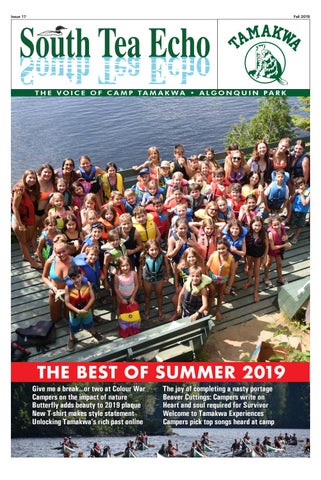
THE BEST OF SUMMER 2019
Give me a break…or two at Colour War Campers on the impact of nature Butterfly adds beauty to 2019 plaque New T-shirt makes style statement Unlocking Tamakwa’s rich past online
The joy of completing a nasty portage Beaver Cuttings: Campers write on Heart and soul required for Survivor Welcome to Tamakwa Experiences Campers pick top songs heard at camp
Fall 2019
South Tea Echo
THE VIEW FROM SOUTH TEA
CELEBRATING A MILESTONE
After another wonderful summer on the sunny shores of South Tea Lake, we are excited about Tamakwa’s upcoming 85th anniversary and recent developments that bode well for the camp’s future by diane bald and michael budman
W
hile every summer is special on the sunny shores of South Tea Lake – indeed, the 2019 season was one for the ages as seen in this issue of the South Tea Echo – we are now focused on Tamakwa’s 85th anniversary summer in 2020 and making it the best one ever. As we write this, various camp improvements are now in full swing, with other positive changes in the cards. Since its inception, Tamakwa has been led by iconic Camp Directors including co-founders Unca Lou Handler and Omer Stringer, followed a generation later by Vic Norris and Dave Bale. Since 2003, that torch was carried by Craig and Margot Perlmutter who ran the camp as CoDirectors alongside Senior Director Vic, who recently celebrated a half-century at Tamakwa. Over the past 16 years, they instilled a love of camp into thousands of campers and staff, sharing with them Tamakwa’s core values and great heritage. They worked diligently and served camp well in so many ways. This fall, the torch passed once again as Craig
Editor and Project Manager ROBERT SARNER Assistant Editor ANNABEL WRIGHT Design/Production DAVID STAMBLER Photography LIBBY SADICK VON NEUMANN Proofreading JULIE GREENSPOON Senior Camp Director VIC NORRIS Camp Director LESLIE HARTSMAN Assistant Camp Director JAMIE KUDLATS Associate Director DAVID STRINGER Heritage Director DON STANDFIELD Business Manager VANESSA BAIN Owners DIANE BALD & MICHAEL BUDMAN The South Tea Echo is published every year by Camp Tamakwa. SUMMER ADDRESS: P.O. Box 10008, Huntsville, Ontario, Canada P1H 2H3. Tel: (705) 6335561. MICHIGAN: 1760 South Telegraph, Suite 300, Bloomfield Hills, MI. 483020183. Tel: (248) 335-6400. Fax: (248) 3352540. TORONTO : 55 Wingold Ave., Toronto, Ontario M6B 1P8. Tel: (416) 924-7433. Email: howhow@tamakwa.com Website: www.tamakwa.com
2
and Margot moved on to pursue other opportunities. We appreciate all the hard work, dedication and passion they put into Tamakwa and wish them much continued success in their future endeavours. Each transition ushers in new energy and new opportunities. That’s certainly the case with the return of two great Tamakwans, Leslie Hartsman and Jamie Kudlats. Joining Vic and us, they are now playing key roles respectively as Camp Director and Assistant Camp Director. Camp Director Les is a life-long ‘camp guy,’ having spent part or all of the past 40 summers at overnight camps, including his legendary nine-year run as Program Director at Tamakwa. Affectionately known as Hartsy, his passion for Tamakwa and Algonquin Park is boundless. During his time at camp, his warmth, enthusiasm and positivity endeared him to everyone. He has a way with campers and staff that earns their respect and affinity. Les proved one of Tamakwa’s most creative and popular Program Directors of all time, not to mention an engaging camp personality. He’s perfect for his new full-time role – a great leader, astute, responsible, creative, fun-loving and a dependable source of camp shtick. He understands all the ingredients that go into a successful camp. Les is over the moon to be back at Tamakwa for his 13th summer. In recent years, when he wasn’t dreaming about camp, he owned and operated Hooplah, a digital media agency in Toronto. Les is responsible for camper recruitment, hiring of staff and programming. His wife Julie and their son Austen are equally excited about the Tamakwa adventure ahead. In his own way, Jamie Kudlats, during his many years at Tamakwa, starting with his first summer in 1985, established himself as a beloved figure at camp, initially as a camper, then as a caring counselor and section head and as Assistant Program Director
with many diverse talents. Last summer, after several years away, Jamie returned to camp to help with the production of The Sound of Music. Kids who were involved with the musical loved working with him. A former school teacher and principal, Jamie lives in Durham, North Caro-
lina with his wife, Ari, and their 3-year-old son, Toby. Having recently received his PhD in education, he’s a professor of educational leadership at the University of North Carolina at Charlotte and serves on the Board of the Centre for Relationship-Based Education with fellow Tamakwan
Nancy Steinhauer. Jamie has spent over 20 years working with kids and teachers. He’s elated to return to Tamakwa, combining his love of camp with his rich professional experience to support and mentor campers, counselors, section heads and administrative staff. Since joining our team in their new roles, Les and Jamie have made their presence – and commitment to Tamakwa’s future – keenly felt. It has added an extra level of excitement about camp in 2020 and far beyond. We’re also excited to
announce Vanessa Bain has joined the Tamakwa family as Business Manager. A veteran Tamakwan whose children attended camp, a seasoned outdoor enthusiast and career administrator, Vanessa is a great addition to our team. She’ll also be up at camp during the summer. As always, we greatly appreciate your continuing support of and trust in Tamakwa. To those of you who have campers at Tamakwa, thank you for allowing us to partner with you in the development of your children. Diane and Michael Owners, Camp Tamakwa
WELCOME TO TAMAKWA EXPERIENCES
Introducing an exciting initiative to extend the reach of camp while staying true to the core values and rich history of Tamakwa by diane bald and michael budman
A
t the heart of Tamakwa is the wonderful, time-honoured summer camp that every year is the source of countless positive experiences for campers and staff in such an idyllic setting. Building on this incredible heritage and camp’s inspiring surroundings, we are seeking to extend Tamakwa’s reach to people who can enjoy our spectacular South Tea Lake site before campers arrive in late June and after they depart in mid-August. Camp will continue to host a wide range of great activities and events – weddings, family reunions, wellness and corporate retreats, school outdoor education groups, adult camp and guided canoe trips as well as sports, music and culinary groups – under a new banner, Tamakwa Experiences, for which we’re excited to be partnering with Tara and Matt Soloway. This fall, we were delighted to welcome Tara and Matt to the Tamakwa family. Having recently sold their successful travel and event company, Luxe Destination Weddings and Family Vacations, they are well suited to develop and oversee Tamakwa Experiences. Their two children, Layla and Lucas, both attend Tamakwa, and Matt has a history in Algonquin Park, having attended Camp Ahmek as a child. Tara
and Matt are working closely with Camp Director Leslie Hartsman and the rest of our camp team to ensure each event honours the illustrious history of Tamakwa. In 2020, Tamakwa Experiences will also be launching an expanded and revamped Tamakwa Tuck Shop, both online and at camp, born out of a passion for Algonquin Park and all things camp. This will include pop-up shops and curated capsule collections. In addition, Tamakwa Experiences will offer niche curated travel packages so members of our community can enjoy trips with Tamakwa families and friends to destinations consistent with the ethos of camp. We are already planning March Break Camp 2021 in Jamaica. Stay tuned for details! Please don’t hesitate to reach out to Tara and Matt with your queries, suggestions and/or requests to hold your next family or corporate event at Tamakwa. Contact them at tara@ tamakwaexperiences.com and matt@tamakwaexperiences.com. The Instagram handle is @tamakwaexperiences. We look forward to welcoming you to Tamakwa Experiences in 2020.
South Tea Echo
Fall 2019
SUMMER 2019
THE SUMMER AT A GLANCE A selective listing of major events and other memorable highlights from the 2019 season
J U N E Fri. – Head Staff arrive for Pre-Pre-Pre-Camp Sat. – Head Staff training Sun. – Head Staff training Mon. - Activity Leaders and Canoe Trip Leaders arrive for Pre-Pre Camp Tues. – Activity Leaders and Trip Staff do White Caps Wed. – Canoe Trip Leaders trip departs; Activity Leaders cookout Thurs. – General Staff arrive for Pre-Camp; Staff camp Fri. – Staff White Caps; Training sessions Sat. – Canoe Trip Leaders trip returns; Directors Block Party Sun. – Staff Night at the Portage Store Mon. – Section Staff cookouts; Activity Staff meetings Tues. – Video retrospective and Canoe Bay boardroom meeting with all staff Wed. – First Session campers arrive; Cabin night Thurs. – Block Schedule Day 1; White Caps; The Staff Show Fri. – Block Schedule Day 2; Individual Choice sign-up; Beaver Council speeches and elections; Friday night speeches; Hobby Hubs; Survivor Break 29 Sat. – Survivor all-day program 30 Sun. – First canoe trips depart; Forester canoe trip skills; Let’s Make a Deal evening program 14 15 16 17 18 19 20 21 22 23 24 25 26 27 28
J U L Y 1 2 3 4 5 6 7 8 9 10 11 12 13 14 15 16 17 18 19 20 21 22 23 24 25 26 27 28 29 30 31
Mon. – Canada Day; Trail Blazer canoe trip skills; Section Program Night Tues. – Buffet brunch; Cabin cookouts; Campfire at the Beachers Wed. – Tamakwa Stock Exchange evening program Thurs. – USA Independence Day; Can-Am baseball game and ballfield lunch; Reverse Scavenger Hunt evening program Fri. – Voyageur Class Cookout; 15-day trips depart; Individual choice sign-up; Camp Bar Mitzvah for Mitchell Shecter and Eli Winer Sat. – Alumni Hockey Game; Dance Day with Bounce Sun. – 12U Intercamp@Tamakwa against Camp Manitou; 13-day trips depart; Temagami girls depart; Cabin Program Night Mon. – Buffet brunch; Cabin cookouts; Campfire at the Beachers Tues. – Camp musical production of Annie; CIT Fashion Show on the Slope; All-day program break Wed. – 10-day trips depart; All-day program: Tamakwa’s New Summer Line: Guccimutter, Varnisace, Donald Standfield and Onga Goblogian Thurs. – Voyageur class cookout; Counselor Hunt evening program Fri. – Tamakwa Teaser Day; Intercamp tournament at Walden; Friday night speeches; Hobby Hubs; JT bedtime stories Sat. – Individual Choice sign-up; JT Triathlon; Untalent Show evening program Sun. – 16U Intercamp@Manitou; Staff Windsurf; JT trip to the Logging Museum; Cabin program night Mon. – Buffet brunch; Cabin cookouts; Campfire at the Beachers Tues. – All-Day Sail; Treasure Swim Wed. – Harvey Deutch Camper Triathlon; Beaver Council evening program Thurs. – Basketball Tournament@Northland; Staff Kayak; Cabin program night Fri. – Long trip returns; Friday night speeches; Air Bands evening program; Mini-Colour War break Sat. – Mini-Colour War: The Land of Trenzalore: Borrowers, Ascenders, Swampers and Riders Sun. – Packing and cleaning day; Ride or Die NASCAR with the Senior Girls Mini-Banquet; Camp musical production of Legally Blonde; Session-ending video presentation; Extended campfires Mon. – First Session camper departures; Visiting Day; Staff BBQ Tues. – Second Session campers arrive; Cabin night Wed. – Block Schedule Day 2; Individual Choice sign-up; Who Done It? evening program Thurs. – Tamakwa World Records evening program Fri. – Forester Canoe Trip skills; Camp Bat Mitzvah for Rachael Pape, Nicky Kriegel, Arlyn Goldstein and Zoe Friedman Sat. – Trailblazer canoe trip skills; Section program night Sun. – Cabin program night Mon. – Buffet brunch; Cabin cookouts; Campfire in Loon Lodge Tues. – Boys’ 15-day trip departs; Individual Choice sign-up; Shark Tank evening program Wed. – All-day program: Toronto Sports League: Shpoople, Baseketball, Flonkerton or Beltensquatten
A U G U ST 1 2 3 4 5 6 7 8 9 10 11 12 13 14 15 16 17
Thurs. – All-Day Surf; Individual Choice sign-up; Evening program Fri. – 12U and 16U Intercamp@Manitou; Friday night speeches; Hobby Hubs; JT bedtime stories Sat. – JT Triathlon; Saturday Night Live evening program Sun. – CanAm Hockey and Platforum lunch; Section program night Mon. – Camp musical production of The Sound of Music Tues. – Two-week and six-week campers depart; Casino Night evening program Wed. – Buffet brunch; Cabin cookouts; Campfire at the Beachers Thurs. – Tamakwa vs. Arowhon Staff Basketball Game; Individual Choice sign-up; Colour Run evening program Fri. – Water sports Intercamp with Arowhon@Tamakwa; Weekend mini-session campers arrive; Friday night speeches; Hobby Hubs; JT bedtime stories Sat. – Three-week and seven-week campers depart; All-Day Sail; Treasure Swim Tamakwa-Stock evening program Sun. – Weekend mini-session campers depart Mon. – Harvey Deutch Staff and Camper Triathlon; Diner Night; Cabin program night Tues. – Final canoe trip returns; Camp musical production of A Night at the Theater; late night Colour War break Wed. – Voyageur Canoe test; Colour War - Heaven vs. Hell: Archangels, Demi-Gods, Fallen Saints and Demons, Day 1 Thurs. – Heaven vs Hell Colour War Day 2; Final Creatives evening program; Final staff BBQ Fri. – Packing and cleaning day; CITs present There’s No Place Like Home: Wizard of Oz Final Banquet; Friday night speeches; Final video presentations; Extended campfires Sat. – Summer of 2019 ends as Tamakwans leave for home
3
Fall 2019
South Tea Echo
A GREAT JOURNEY WORTHY OF CELEBRATION A
This summer, in keeping with its Bar/Bat Mitzvah tradition, Tamakwa showed its appreciation to those marking 13 years at camp
ll campers and staff can cite many memorable moments in their time on the sunny shores. For veteran Tamakwans who make it to their 13th summer at camp, a highpoint, if not the pinnacle, of their Tamakwa careers is the special ceremony on the Slope
honouring their Tamakwa Bar or Bat Mitzvah. Part of a storied tradition, the celebration takes place on a Friday evening in the presence of the entire camp and family members and friends of the honourees who come to camp for the occasion. The culmination is the
presentation of a customized Roots Tamakwa jacket to each of those in the spotlight. This summer, Tamakwa paid tribute to six young men and women who have contributed mightily to camp, first as campers and then as exceptional counselors in
by robert sarner
the cabin, athletes on the courts and in and on the water, strong on trip and creative in the programming world. Zoe Friedman, Arlyn Goldstein, Nicky Kriegel, Rachel Pape, Mitchell Shecter and Eli Winer each received recognition for their 13 years at camp. Together they exude Tamakwa spirit at its best. During this milestone summer, Zoe and Rachel were respectively Senior Girls and 49er counselors and worked on swim. Arlyn was a 49er counselor and worked at sail. Nicky was a Pioneer counselor and worked at landsports with Mitchell, a Senior Boys counselor, and Eli served as Assistant Program Director. Together they have spent a combined 78 summers at Tamakwa. It would be camp’s good fortune to have that number increase next summer with the return of the latest Bar/ Bat Mitzvah inductees for another season on staff.
BUTTERFLY EFFECT SUITABLE FOR FRAMING In a winning, artistic partnership, April Holmes and Sophie Linden combine their ideas and talents to create a memorable, eye-catching plaque to represent the 2019 summer by annabel wright
C
ombining the different styles of April Holmes, Tamakwa’s 2019 Art Director, and the creative talents of Sophie Linden, a senior counselor and longstanding Tamakwan, presented an interesting challenge. April’s monochromatic, fine line, detailed sketching and Sophie’s intricate, colourful painting skills raised questions among some staff as to how, or even if, the two mediums would work together. Ultimately, in an auspicious meeting of minds, April and Sophie found common ground while discussing ideas for this year’s plaque. “We kept getting so excited and bouncing ideas off each other,” says Sophie. “It was so nice to see our concept come together and by the time we finished the plaque, we couldn’t wait to present it to the camp.” Both girls had noticed yellow Swallowtail butterflies fluttering around camp which they believed could make for a strong visual element rife with positive association. “We had both seen these butterflies a lot during the beginning of the summer and felt it was a unique, original idea for 4
the plaque,” says Sophie. “We also liked the fact that none of the other plaques done in previous years at Tamakwa had used a butterfly before.” Not only do butterflies
symbolize transformation and new beginnings, April felt a personal connection to using this figure of beauty in the plaque as she had arrived at Tamakwa for the first time this sum-
mer with new visions and fresh ideas. When it came to translating their plan into reality, April and Sophie used the perspective of sitting on the Slope looking
out across South Tea Lake. They saw it being a source of togetherness for the camp for such activities as Friday Night Speeches and Taps. Lying down on the top of the Slope offered an eye-catching depth of field, with the hanging birch tree above to the fire-pit on the dock, to the three islands on the lake in the distance. From this perspective on the Slope, it sparked the idea that the butterfly could be sitting on the steps creating a striking visual. Once their ideas came together, they wanted the plaque to be relatable and meaningful for every Tamakwan. To that end, the use of their different mediums clicked as they decided to paint wash the pictorial, then go over with a fine black liner pen to outline the detailing, creating layers with lighter lining and strokes to define the depth. “Since we have different artistic styles, my portion of the painting needed to be done first before April could begin to do her part but we talked often throughout the whole process,” says Sophie. “We came together toward the end to finalize details and make sure everything was ready in time for the ban-
quet which was really nice. We got along really well and agreed on everything which made the process super easy.” The partnership between the two proved smooth and fruitful. “It was such a nice process for me to work with Sophie on the plaque,” says April. “She did an amazing job of bringing the highlights out in her painting so when I went into detailing with a fine liner, it almost pops.” April used Chinese black ink with a paint brush for the details on the butterfly and used a fine liner beyond the butterfly to create the desired depth. Sophie’s keen eye for colour ensured a strong visual aesthetic. “I wanted to use watered-down acrylic to give a more water-coloured effect,” says Sophie. “Also, it would make the plaque longer-lasting for the years it’s displayed in the Dining Hall.” True to the timehonoured tradition at Tamakwa, the plaque was unveiled for the first time at the final banquet hosted by the CITs, alongside each activity plaque, to celebrate the end of another incredible summer on the sunny shores.
South Tea Echo
Fall 2019
MAKING A STATEMENT IN STYLE
A different approach to designing Tamakwa’s annual T-shirt results in a fresh look at camp this past summer that campers and staff showed off proudly. by annabel wright
I
f something has pride of place in the wardrobes of Tamakwans, it’s the camp-branded apparel produced every year. For 2019, camp adopted a new perspective on designing its line of clothing, especially the all-important, much coveted T-shirt. In collaboration with the Los Angeles-based streetwear label Madhappy and Canada’s iconic lifestyle brand Roots, Tamakwa created a T-shirt unlike anything it had done previously. On the front of the off-white cotton T-shirt, an illustration features a deep orange sunset above three canoeists paddling across a wonderful blue lake. Beneath the image is a quote from a letter Unca Lou wrote to Omer Stringer during World War 2 when the latter was serving overseas in the Canadian army. To bring a different approach to this year’s T-shirt, Tamakwa owners Michael Budman and Diane Bald enlisted the
co-founder of Madhappy, Mason Spector. “Mason is a Tamakwa alum,” says Diane. “We really like to promote our alumni any way we can, connecting people who’ve been Tamakwans. We thought Roots and Madhappy would make for a fantastic collaboration as we’ve been impressed by what we had seen from Madhappy. We gave Mason free reign and his design gave a wonderful feeling of Algonquin. We love that he dug into Tamakwa’s archives while working on the T-shirt.” Mason has a strong connection to Tamakwa, having spent 11 summers at camp until 2014 as a camper and staff member. In creating the T-shirt, he worked closely with Madhappy’s head designer, first preparing a mood board to capture the spirit and ethos of Tamakwa and Algonquin Park. “My plan throughout the whole design process was to get the kids excited
and allow them to experience so much more of the Park through the clothing,” says Mason. “Madhappy uses a lot of colour as a brand. It’s a great way for people to express themselves and step out of their comfort zone, which is why we chose the colour palette we did for the Tamakwa T-shirt.” To add the vintage feel Mason was seeking, he consulted the Tamakwa archive David Stringer was putting together. While reading a letter Unca Lou sent to Omer Stringer during World War 2, a particular quote resonated with him – ‘A good year and a healthy one to each of you and may all of our wishes come true. Above all, may the Great Camper be always with us until we meet again. Yours, Unca Lou.’ For Mason, it represented the essence of what camp is about and included the last sentence of Taps which he said every evening while attending Tamakwa, and which is still recited to this
day every evening at camp. The excerpt from the letter was also a great homage to Unca Lou. Clearly, the T-shirt was well received by both campers and staff alike, based on how frequently they were seen weating it at camp. “The 2019 T-shirt is different from other Tamakwa clothing I’ve seen over the years,” says Windsurf Director Alanah Bratley, a long-time Tamakwan who’s been on the shores for 14 years. “Normally, I’d expect the clothing to be green, white or yellow whereas this one has a multitude of colours. I like how there’s an illustration instead of just the Tamakwa logo.” Now, of course, there’s the challenge of building on the success of the 2019 T-shirt and coming up with another winning design for Summer 2020, which also happens to be a milestone year for Tamakwa as it marks the camp’s 85th anniversary.
NEW/OLD LOOK FOR VINTAGE WORKHORSE
One of Tamakwa’s venerable pointer boats sports a radically different appearance that’s not so new after all
I
n wondering about Tamakwa’s long, storied history, many thoughts abound. One is the incalculable number of journeys made by campers, staff and visitors round the bend since camp began – and what made it possible. Such a realization makes for an even greater appreciation for Tamkawa’s three hardworking, beloved pointer boats – Unca, Daisy and Stringer. This summer, these sturdy wooden vessels again proved indispensable to the daily life of camp, albeit with a new/old look for one of them. Thanks to their distinct design, these 36-foot long boats can carry heavy loads while floating on water so shallow that veteran Tamakwan and Associate Director David Stringer says they’ve been described as “able to float on dew.” Typically, each pointer has a long life. For example, both Unca and Daisy have been serving camp for nearly 40 years. To prolong the life of the pointers, camp uses lacquer and paint to protect their wooden exteriors every year or two. In recent decades, Tamakwa’s pointers have always sported a natural look, highlighting the golden-brown tone of their
cedar wood construction. As a result, last June, when camp began, many Tamakwans did a doubletake on seeing one of the pointers, Unca, painted in black. Current campers and most of the staff are too young to have ever seen a Tamakwa pointer in that colour. David knows Unca is not the first pointer at camp painted black. He cites a late, lamented black pointer destroyed by fire in 1977. “That black pointer was special,” David fondly remembers. “It had an inboard engine with a large propeller and a towing post that could pull out stumps. It had lots of power. It was painted black with a white stripe which matched the paint scheme on all of Tamakwa’s canoes at the time.” Pointers have always had pride of place at Tamakwa where they’ve played a vital role in shuttling people and supplies between the water-access only camp and the landing. It’s hard to imagine Tamakwa without them. According to David, Tamakwa has had a total of seven pointers, starting with the first in the 1930s. In the early years, there was only one in service but
for most of camp’s history there were two in use. In 2009, the flotilla grew to three after Ken Elder, Ric and Libby von Neumann and Len Giblin built a pointer in Tamakwa’s woodshop in the offseason. Pointers date back to the 1850s when they were introduced for use in the logging trade in Algonquin Park. Designed by John Cockburn as part of his Pembroke, Ontario boatbuilding business, their
long-pointed bow (and originally the stern, too) allowed loggers to work easily in the log booms (a barrier placed in the river that collected logs) and to walk the entire length of the pointer, freeing up jams. Today’s black coat on Unca covers a brown one. Last spring, camp owners Michael and Diane suggested a change to black. “Michael and Diane saw me painting the point-
by april hassal
er and asked if it had to be brown?” Libby recalls. “I shrugged my shoulders and said, ‘I don’t think so.’ They asked if I could paint it black like the old black pointer and voilà, I gave it its current look.” After the initial surprise, campers and staff responded positively to the new incarnation of Unca. “I like the look of it because it’s similar to the black and white cedar strip canoes and that’s what
Tamakwa was known for on trip back in the day,” says Libby. “I hope that next year we actually paint it like the old one was with the white stripe below the gunwales. That looked really great.” Next summer, when you take your first ride around the bend, be sure to check if Unca underwent a bit of cosmetic work during the offseason to include a white stripe in its appearance. 5
Fall 2019
UNLOCKING TAMAKWA’S PAST Thanks to camp’s resident historian, David Stringer, there’s now an online archive showcasing 85 years of events, people and other memorable moments at Tamakwa by ariel golnick
A
fter being at Tamakwa for many summers during which I often looked at the hundreds of plaques in the Dining Hall dating back decades, I knew camp had a storied past. But little did I realize just how rich that history was until I interviewed David Stringer about the online archives he’s been developing for camp. Last winter, after Tamakwa owners Michael and Diane asked David if he could create a comprehensive, accessible repository of Tamakwa’s 85-year history, he leapt at the chance. He was well suited for the assignment, given his father, Omer Stringer, cofounded Tamakwa and the
fact that David has spent almost every summer of his life at camp. Despite his encyclopedic knowledge of all things Tamakwa, this was no simple project. David had to go through countless boxes of photos, documents, films and video, along with existing scanned and online material, and bring a sense of order to it all. “When I started working on this project, I quickly discovered that there are so many things from the past that don’t have any information, dates or labels, and worst of all no names,” says David. “I had to track down the missing information by recognizing people in the pictures and videos and then look for them
on plaques in the Dining Hall. It’s a long, laborious process but it works.” Today, after months and untold hours of meticulous work, Tamakwa now has its own online, user-friendly archive. That was one of David’s main goals: to have an informative, easy-to-understand archive for people of any age to use.
Named officially The Tamakwa Archive and found at www.tamakwaarchive.ca, it’s a treasure trove of content. With helpful search tips on the home page, you can search by year and/or by type of content desired, such as photos, printed material, video, audio (Camp Radio) and plaques. Also, included for good measure is a Tam-
South Tea Echo akwa timeline. Not surprisingly, in view of the magnitude of material and the number of years covered by the archive, it’s still a work in progress. With around 500 individual entries so far, David is continuing to add new items to make it more complete. As I searched through the archive, it quickly became apparent how little I knew about Tamakwa. Coming across interesting historical nuggets about life on the shores of South Tea Lake, I was in awe of what I learned thanks to the archive, including these discoveries: - In 1946, Omer Stringer drew the first plan for the Dining Hall. Its best feature was the fireplace due to its intricate details and location. - Taken from a 1944 newsletter, when Tamakwa was closed due to World War
Two: “…But Omer, you’ll want to know something of our future plans for Tamakwa – something of the ideas which have come to me, through my experience of the past years and through the jobs I’ve held as an Officer of the US Army...” This quote is from a passage that talks about future plans for camp. - In 1949, girls camp was finally introduced. - In 1963, two summer plaques were created but there’s no record as to why. - Camp had a horseback riding range before Girls Hill was introduced. What’s wonderful about the archive is that veteran and new Tamakwans alike will learn something about camp when they visit it. As David continues to add to the collection, it will become an even more valuable and captivating resource for the Tamakwa community.
BREAKING BREAD WITH A SPECIAL INGREDIENT
Tamakwans may not live by bread alone, but thanks to the arrival of Brodflour at camp this year, they’re enjoying a healthier, tastier form of this staple in the Dining Hall by kaitlyn luckoff
O
ver its 85-year existence, Tamakwa has stayed true to its traditions while being open to changes consistent with its core values that make camp even better. This summer, as part of that ongoing evolution, Tamakwa improved its bread by using flour from Brodflour, a Toronto-based company started by a Tamakwa alum. Founded in 2017 by Dara Gallinger, Brodflour uses organic, fresh stonemilled whole-grain flour, which ensures an enhanced nutritional value to its bread. Tamakwa co-owner Diane Bald was immediately
interested in Brodflour when she heard about it. “Soon after we opened, Diane came by for a visit,” says Dara, 35, who attended Tamakwa for 11
years. “She’s so passionate about good food that she immediately loved what we were doing and wanted to know if it would be possible to bring better flour to
camp for the 2019 summer to make better bread.” The decision to use a higher quality ingredient for one of camp’s main staples reflected Tamakwa’s
MIRROR, MIRROR ON THE WALL… The iconic fixture on the exterior of the Dining Hall, long popular with campers, becomes better known outside camp as Tamakwa creates small replicas for purchase by annabel wright
H
ave you ever walked past the venerable mirror on the west side of the Dining Hall and used it to check yourself out? Have you wondered about the origin of the small sign above it that reads: ‘This mirror is clean… are you?’ Are you as clean as the mirror, even with the longstanding joke that it’s only cleaned once a summer? You may not realize that mirror has decades of history looking back at you. Long a fixture on the outside of the Dining Hall, it has evolved since its unknown beginnings. It was originally much smaller 6
– a standard 8 by 10-inch mirror – with a sign above it saying, ‘Hey, take a look at you, would your mother let you eat looking like this?’ More than 60 years ago, someone – nobody seems to know who – decided to change the quote above the mirror to its current, shorter version. Campers and staff interact with the mirror in many ways, whether it be taking funny group photos or checking their cleanliness. Back when the Clinic was where Loon Lodge is today near the Dining Hall, a hidden camera was placed in one of the windows to capture all kinds
of hilarious exchanges between Tamakwans and the mirror, including pimple popping, preening and posing. Last winter, camp launched an initiative in tribute to the timehonoured mirror. Camp owners Michael and Diane asked Woodshop Director Ric von Neumann to create a miniature souvenir incarnation of the mirror for old and new Tamakwans to purchase. Ric designed two models – the iconic, 9 x 14½ inch small mirror priced at $40, conceived as a great addition to a college dorm room for Tamakwans attending
university and a larger 26 by 36 inch mirror. Ric first made 10 smaller mirrors at his home studio which were sold last January at Tamakwa Winterfest at Michael and Diane’s Toronto home where a sign promoted the mirrors. The production line then shifted to the Tamakwa woodshop. On Visiting Day, many people ordered a mirror. Once the Tuck Shop is open on the official Tamakwa.com webpage, all Tamakwans will be able to order the smaller version of this much-loved piece of camp lore.
commitment in recent years to making its food healthier. Each season, the camp focused on different areas. Several years ago, for the small proportion of its bread not made at camp, Tamakwa began working with Toronto all-natural, vegan bakery Sweets from the Earth for buns and some sliced bread. Now, with the introduction of Brodflour and improved camp-made bread, camp food has taken a further step forward. Flour wasn’t actually on the agenda until Diane learned about Brodflour. The fact it was run by a former Tamakwan made it all the more appealing.
Like most alumni, Dara always longed to spend time again on the sunny shores of Tamakwa. This summer, thanks to Brodflour, she had the opportunity to visit camp several times when personally bringing the flour from Toronto. “The opportunity to reconnect with camp after so many years away from it, and to be a part of bringing better food to campers was something I jumped on immediately,” says Dara. “It was so special for me to drive the flour to camp and spend time up in the Park with the campers, making bannock beaver tails over the fire.”
South Tea Echo
Fall 2019
TAMAKWA CIVILIZATION ON VIEW A
To better understand life as first set forth by Unca Lou, the Tamakwa Museum, including additions from Summer 2019, provides a deep dive mid a summer’s flotsam and jetsam at camp, certain items stand out in helping define the season for campers and staff. Each year, the Tamakwa Museum’s senior management confer on what to add to the permanent collection. Rightfully, they’re always on the lookout for things that shed light on Tamakwa civilization as
lived each summer on the shores of South Tea Lake. They’re committed to making such artefacts available for viewing by all anthropological students in good standing. After decades of accumulating literally tons of material and contending with limited storage space, discussions continue about possibly finding larger premises elsewhere. For
1. Adrian’s 50 pounds 2. A red TAMAKWA SECURITY hoody 3. A schtick stick 4. A new mattress 5. A piece of Jenga from Let’s Make a Deal 6. A turtle egg with a photo of Turtle 7. An electric fly swatter 8. An inflatable beaver 9. Michael’s Girl’s Hill photo shorts 10. Alex’s dirty feet
now, curators are doing their best to maximize the museum’s current exhibition facility in its underground shelter on Adventure Island. As always, they’re offering tours every day except Good Friday and Schlect Tuesday. Here’s what’s been added in recent months and is now on view at the museum under tight security:
11. A lousy letter 12. Sammy Koolik’s shoe for measuring horseshoes 13. A chunk of wood from Brendan’s eye 14. A Tamakwa 2019 buff 15. A container of Senior Girls’ tears with Jesse Gold 16. A set of Tamakwa’s new sports uniforms 17. Macie’s cough 18. The stopwatch used to clock 21:07 for the new Triathlon record 19. Extra goggles for the swim dock
20. A plate of ginger beef 21. Eli’s half day off 22. A piece of the new and improved garlic bread 23. A printed copy of the 2018 South Tea Echo 24. A gluten free brownie 25. Matt Transpo’s matching orange hat 26. A pink track suit 27. A Belten Squatten pen on a string 28. A big bowl of popcorn 29. The new orange Kubota tractor
HIGH FIVE
Four veteran staff members recognized for their half-decade of devoted service to Tamakwa now have something to show for it by robert sarner
A
ll staff members, each in his or her own way, contribute to making summers at Tamakwa so memorable for campers. While first-time counselors and activity leaders, in addition to their respective skills and knowledge, bring a new energy and fresh perspective to camp, it’s returning staff who, among other things, help ensure a sense of continuity and venerable tradition on the shores of South Tea.
That’s one of the reasons that in 2010 Tamakwa introduced a way of paying tribute to Tamakwans in their fifth year on staff. In a special presentation as part of Friday night services on the Slope, the camp recognizes staffers who have joined the five-year club. Each one receives a customized Tamakwa Swiss Army pocket knife as a token of Tamakwa’s appreciation of their hard work and dedication.
This summer, in honour of their half-decade staff milestone, Tamakwa presented (L-R in the adjacent photo) Minh the baker, Canoe Trip Leader Kara Tessier, CIT Director Rachel Kestenberg and counselor Mitchell Shecter the commemorative keepsake for their devotion to camp. Amid hearty cheers of How-How, the four veterans stood proud at the bottom of the Slope, savouring the moment.
HEART AND SOUL REQUIRED
It takes much more than just great physical exertion to make the finals in the all-day Survivor program at Tamakwa by matthew august
M
y legs won’t move and my head is dizzy. I can feel my heartbeat in my mouth. I can hear my body begging for rest. No, I must push on. I must keep trying my hardest. Everyone is watching me. My campers are cheering my name. I can’t lose now. My cabin has come so far and… I lost… At home, Survivor is
a reality TV show I watch with my family. At camp, Survivor is an all-day program I put my entire heart and soul into. From the very moment the Survivor theme tune plays over the speakers during the break, I’m completely invested in winning it all. Some other cabins have different goals – some want to win while others just don’t want to leave camp
before lunch. I will not settle for anything besides the finals. The constant positive spirit and cheering can sometimes get tiring but if it’s what gets me the furthest in the competition, then I will do it. This year, I made it to the finals and got to participate in rope-burning for the first time. I was exhausted from the previous semi-final rounds and yet I gave it my full energy. By the end of the event, I couldn’t even stand up without falling back to the
ground. Even killing my body was not enough as the other team won by six seconds. I lost… And yet I was not upset. Even though I lost and had wanted so badly to win, the only feeling I felt was an overwhelming sense of accomplishment. The beauty of Survivor is not about making it to the finals but getting that taste of achievement. That taste is what I love about Survivor and who knows, maybe next year I will taste victory, too. 7
Fall 2019
NAME THAT TUNE
South Tea Echo
HEARD IN MAIN CAMP
Music has always been an important part of Tamakwa life. When asked what song they liked most to sing or listen to this summer, campers had no trouble citing their favourite ones interviews by robert sarner the game. It reflects the essence of camp which is one, knowing cheers, two, Boys Camp vs Girls Camp and three, different parts of camp competing against each other but not in a serious manner but to have fun and show who’s more spirited.”
CAITLIN HILLMAN, 13, Cleveland, OH, 49er, 7th year at camp “If I had to choose my favourite, it would be the Tamakwa Song because every time I hear it, I know I’m at camp and it reminds me I’m with all my best friends. Every time I hear that song, it reminds me of how lucky I am to be here and helps me understand how grateful I am that I’m at camp with my friends, who are like family.”
ANNA GOLDING, 14, Chicago, IL, 49er, 7th year “This summer, like in the past, my favourite song is Young Folks, Old Folks because it allows campers to add their own spin on it based on their trip experiences. Each verse is based on their trip experience. This year, I went on 13-day and we wrote our own verse about our trip and it’s really cool to be able to let the whole camp hear about your experience and also hear about everyone else’s experience. It makes me really happy when I sing or hear this song. I get excited to learn about what everybody else has done on their trips. It also makes me thankful because I know we’re so lucky to be able to go on trips like these.”
ELLA FELSOT, 10, Newport Beach, CA, Pioneer, 3rd year “I especially like to play on my playlist Waving Through A Window. It’s from a Broadway play. It’s stuck in my head. Another song I like that people play a lot is Mostly Shallow by Lady Gaga and Bradley Cooper. It’s a really good song and Lady Gaga is a great singer. I hear it on other people’s playlists and people often sing it. I’ve heard it in my cabin and in other people’s cabins, too.” LARS GOODRICH, 9, New York, NY, Forester, 1st year “It’s a K-pop type of song but I’m not sure of its name. I don’t usually listen to K-pop but I really like this song. It’s in Korean but it seems if I could understand it, it would seem funny. It’s very vibrant and colourful. I first heard it when the staff put on a play and then on the 4th of July in the Dining Hall when they played a bunch of songs.” HENRY LEVITT, 11, Toronto, ON, Ranger, 5th year “My favourite song is probably the Tamakwa Song. It’s iconic at camp, you hear it a lot. I like the words. It’s truthful, ‘Tamakwa, Tamakwa, what a wonderful spot, what a camp.’ Whenever I hear it, it makes me happy because it means I’m at camp.” NYLA STARR, 13, Montreal, QC, 49er, 4th year “I like to hear the song Doctor Jones by Aqua because we often dance to it. For example, we go in the Dining Hall, pick a partner and dance to it which is really fun. I like that when we’re all dancing to the song, it helps bring us together.” MAX ZAMIR, 12, Toronto, ON, Ranger, 5th year “My favourite song I’ve heard at camp is Old Town Road by Lil Nas X because it’s fun to dance to. You hear it often at camp because it’s a popular song. Kids play it a lot in the 8
cabin. When I hear it, I feel excited and energized.” RACHEL STOLBERG, 10, Chicago, IL, Pioneer, 3rd year “I like Old Town Road, by Billy Ray Cyrus and Lil Nas X. It’s a fun song and I feel everyone likes it. We also sing it a lot back home.” ANDREW GLASSER, 16, Los Angele, CA, CIT, 9th year “I especially like the Tamakwa Song, where T is for the terrific laundry service, because it gets everybody up and singing it and having fun enjoying the song. I like the energy it brings to all the campers.” NOAH GUREVITZ, 12, Toronto, ON, Ranger, 5th year “I like the songs that are played at Tootsie Frootsie, like Chlorine by Twenty One Pilots. I like alternative rock and the way it sounds. They play it a lot at Tootsie Frootsie but I’ve also heard it in the cabin.” SAM ZAMIR, 14, Toronto,
ON, Voyageur, 7th year “I love Tamakwa’s Welcome Song and how we welcome guests in the Dining Hall. But it’s the best when you’re rounding the bend on the pointer on the first day of camp and you hear the Welcome Song and then you see your counselors waiting for you. It’s the perfect beginning to a magical summer. At camp, when I hear the song, I feel good. I like its effect, not specifically its words or melody, but just how welcoming the song is.” EDDIE SEGAL, 11, Toronto, ON, Ranger, 4th year “The song I like most is called Going Bad by Meek Mill featuring Drake. I like how they sing it, the beat and lyrics. I knew it before I came to camp but I sometimes hear it in our cabin. When I hear it, I feel good. It makes me feel excited for stuff.” NATALIE FREE, 15, Dallas, TX, 49er, 7th year
“Every year, my favourite song is the same one – the Tamakwa Song the whole camp sings together because it brings us together as one. The song reflects how much we all love camp and how together we are. I like that there’s a dance to it which everybody seems to know, which brings us together.” AVA POIRER, 14, Toronto, ON, 49er, 4th year “My favourites are the songs from the 2014 Colour War. We sing them on trip and at other times. All the songs people created that year are really special. It’s really nice to hear them. Our cabin and friends sing them. Even though they’re from five years ago, so many people still know the words. When I hear them, it makes me feel proud that this year we’re the ones writing the songs for Colour War, singing those songs that will be passed down through the years and that people will know
and enjoy them.” CAMERON ARVIV-MOREAU, 11, Toronto, ON, Ranger, 1st year “My favourite is Taps which we do almost every night. The whole camp links arms and sings it together. I really like it because of the way it talks about camp. It also has a nice tune. Whenever I hear the song, it makes me feel very happy and joyful.” SAM WEISS, 16, Toronto, ON, CIT, 8th year “My favourite is probably the State Song because it really pits both sides of camp against each other. That’s really the essence of the Dining Hall to me, competing with other cabins to see who’s the most spirited. I actually don’t know the lyrics that well but basically there’s a different verse for each state, and Girls Camp says a verse and then Boys Camp says one and you can’t repeat it or you lose
MIA JACOBSON, 13, Bloomfield Hills, MI, 49er, 8th year “In addition to the classic Tamakwa Song, I like Cotton Eye Joe, or the State Song because the whole camp is singing and having so much fun. We’re all cheering so loud and standing on the benches and it reminds me so much of camp when I’m home. With Cotton Eye Joe, you get a partner, kick your feet and sing along and everybody goes into the middle of the Dining Hall to do a special dance. I just get excited because all my friends are jumping up and dancing and it’s so much fun. I’ve been hearing it at camp for years.” MADDEN GUNSBERG, 12, Bloomfield Hills, MI, Voyageur, 6th year “Mr. Brightside [by The Killers] is played a lot in the Dining Hall and it’s stuck inside my head. It’s catchy and I like it. It’s fun to dance to with my friend and I like the tune.” JOSIE FISHER, 14, Westchester, NY, 49er, 8th year “My favourite song is the Tamakwa Song because it really shows our camp spirit and when everyone comes together to sing it, it’s such an incredible camp moment. It just makes everyone so happy and puts a smile on their faces. I like the words because they represent so much about Tamakwa and they’re true.”
South Tea Echo
VISITING DAY 2019
MAKING THE TREK FROM FAR AND WIDE
Fall 2019
Family and friends of this year’s Tamakwans converge on the shores of South Tea for the annual Visiting Day festivities at camp
9
Fall 2019
South Tea Echo
GIVE ME A BREAK... OR TWO
Tamakwa’s 2019 Assistant Program Director provides a behind-the-scenes account of this year’s extraordinary kick-off to the annual Colour War by eli winer
W
ell before the summer began, Program Director Mike Klassen and I focused on plans for the 2019 Colour War. We wanted to do something never seen before at Tamakwa. After much deliberation, we decided on the epic battle of Heaven vs Hell as the theme (paying homage to one of the greatest breaks of all time, Evil vs Evil, by former Program Director and now Camp Director Les Hartsman). The premise was that during a banter-filled chess game for the fate of humanity, God and the Devil were overthrown by their servants in order to cause the final war to decide the ruler of everything. But both Heaven and Hell disagreed on who would lead them to victory over the other. For Colour War, the two teams from Heaven were Demigods (blue) and
ArchAngels (yellow), while the two teams from Hell were Demons (red) and Fallen Saints (green). In a monumental battle to end all battles, who would be victorious? A theme this grand needed a break equally big and unforgettable. Late at night on the break, campers were woken up and led from their cabins by torchlight into Main Camp. Section by section, they filed into the Dining Hall through a giant maze depicting scenes of the world falling apart. They included a Garden of Eden scene gone wrong with a roaring fire and a feral Adam and Eve feasting on apples; someone preaching to a crowd about the end of the world, and a dark, mystical ritual with candles and feathers. Of course, this was just the lead-up. From the Dining Hall,
everyone was led around the Tuck Shop to the seating area for the break on the Rec Hall porch, covered above with blue fabric and clouds, and below with red fabric and spiky wooden structures. The God and Devil characters emerged followed by robed servants, making their way to a table and chairs where a chess game was set up. They poked fun at each other, ordering around their servants while talking about camp-themed miracles and plagues that each chess move would cause, like a tail-wind on Canoe Lake or wet firewood. While they played and bickered, the servants captured God and the Devil and tied them up. The four servants from Heaven and Hell told the audience about their plan for the final battle, but soon realized those from Heaven disagreed on who should
lead them against Hell, and those from Hell disagreed on who should lead them against Heaven. Demons in armor and painted head-to-toe in red emerged from under the Rec Hall porch. Demigods emerged from the right Rec Hall doors with robes, ivy and blue-handled swords. At the sound of lightning striking, the Fallen Saints emerged from the shadows in torn green robes and
DEAR PARENTS
carrying staffs adorned with black feathers, antlers and clay skulls. Lastly, the ArchAngel emerged from the left doors of the Rec Hall, dressed in gold, with a giant silver sword and large white-feathered angel wings. Each team made its case for why they should lead their side in battle and everyone cheered as the Senior Camper captains were announced. Concluding the break, the servants lit two torches and placed them in front of the staging area, igniting a dancing wall of fire. The fire subsided as the Heaven vs Hell sign was revealed on stage and the audience went nuts. The epic theme, new location, lead-up maze and pyrotechnics were not all. We wanted to knock people’s socks off with a wildly unique, big production so nobody would expect other surprises in the cards. The next morning, Colour War was in full swing with campers and staff dressed in their colours and cheering their hearts out as they competed against other teams. What better distraction than a whole day of Colour War to allow me and the program team to spend the day at the Ballfield… setting up
A first-time Tamakwa counselor reaches out to the mothers and fathers of her campers by way of an open letter
A
fter flying to Canada all the way from the UK, this was my first summer at Tamakwa. Throughout my time at camp, I felt there was never enough time to express to the parents of my campers how awesome this job is. So, I wrote the following letter, in the hopes that it will say all that I wanted: •••••• Dear Parents of my Camper, Hi! I’m your child’s counselor. We’ve never met but I’m going to be doing my best to be you, starting about five minutes after you dropped off your children at the airport, bus point or at camp. You may or may not have ever been to camp before, so I can well imagine it must be nerve-wracking to send the apple of your 10
eye into the care of an unknown young adult. In order for you to have a better idea of what’s going on through our heads during the summer, this letter should allow you to understand how we be-
come parents-in-training. There is no denying it’s a hard job. If we have the Junior Tamakwans, they run us ragged and sometimes make us question why we find their belongings in random places but
they’re always the first to run down to Robbie’s Point for a bath. The older ones, too, present challenges. A cabin full of teenage hormones, boyfriend-girlfriend drama and end-of-the-world friendship fights can be hectic (fun?). But despite the stress, tears and potentially being thrown up on, the reason I’m writing to you is to tell you that our job is the best one in the world. Every counselor calls her cabin “my kids,” and it’s true. Your children become ours as soon as they step into camp and we love them dearly. During the two months of summer, we learn everything about them – their likes, dislikes, meds, friendships, fears and hopes. We hold their hands through the
the Break: Part 2. Evening program that night ended with teams gathering in Loon Lodge to tally results. Fun was had, Taps began, and nobody was the wiser… until the lights went out and four torches approached the back of Loon Lodge. Mike called the teams out one by one to follow a torch to the Ballfield. Nobody had any idea what was going on. It was already Colour War! A stage and backdrop were set up on the baseball diamond, with the whole scene lit only by the fire of eight torches held by cloaked figures. A choreographed battle scene took place between the characters from the break in full costume as dramatic music rang out and a voice narrated the saga. The battle scene showed the teams from Heaven joining forces and the teams from Hell joining forces to take each other on. For the final day of Colour War, the teams would combine, doubling the number of people who could triumph. Something of this magnitude could only have been achieved with the help of an unbelievable team (Arlyn Goldstein, Kirsty Scott, Sam “Turtle” Hoffman and Maddie Clay), the outstanding support of David Stringer, Andrew Shelberg Miller, and the Transpo team, a talented and dedicated break cast, and all the advice and attention to logistics from Craig Perlmutter. Mike and I couldn’t have made something this spectacularly mind-blowing without all these people and many more who gave their free time to produce an unforgettable event that will long be remembered by campers and staff.
by maddie lord
nightmares and tears, and get to cheer them on during games, plays, zip lining and even perfecting their dive in swimming. In the real world, we barely feel older than “our kids” ourselves but your kids make us feel like superheroes each day. It’s something to walk in the cabin and be pelted with hugs and exclamations that I must hear a 15-minute account of how a camper finally made the jump off the tower. Nothing is better than that feeling. When the end of camp is near, we worry about sending them home, back to school and real life. We will miss them dearly. When the last day of camp comes around, there wasn’t a dry eye in camp. So, what I’m writing today is a thank you letter.
Thank you for sending your children to Tamakwa and allowing us to get to know them. They are pretty great human beings. I know that whether we are in the same country or on the other side of the world, we will always treasure the memories we have with your children. Yours truly, Maddie
South Tea Echo
GETTING THROUGH THAT NASTY PORTAGE
Fall 2019
A former tripper at Tamakwa reflects on why canoe tripping is such a good metaphor for life and why weathering the storm and pushing on pays such big dividends for those who go the distance by stuart farber
W
hen I was a tripper at Tamakwa, many of my city friends would ask, “Why do you like to go on canoe trips?” Or, “Why do the kids at camp want to go on canoe trips?” Who wants to do that? Who wants to paddle a canoe all day, carry heavy packs over rocky, buginfested portages, sleep on the ground and, well, use biffy boxes? For three, five, ten, even 15 days? They just didn’t understand. We are all familiar with the different activities at Tamakwa. They are what make camp “camp,” in addition to living in a cabin with your best friends for weeks or months. Whereas almost every activity camp offers can be found back home in the real world, canoe tripping is the only one that can’t be done in the concrete forest. Canoe tripping is a metaphor for life. Although well planned, canoe trips always throw you curve balls. Sometimes, the wind is at your back and you
cruise right across a lake. Other times, the wind is in your face and it feels like you’re going nowhere, if not backward. The lake can be smooth as glass one minute and blow up like the ocean moments later. Some days, the breeze is just enough to keep the mosquitoes and biting flies at bay while on others, there isn’t enough
Deet on the planet to keep you from being eaten alive. Just like the changing weather and challenges of a canoe trip, life is unpredictable. Thinking back, we recall – though not always fondly – the rainy days and quickly forget the sunny ones. We remember the bug bites but they soon fade away.
When it rains in our lives or we’re bugged by so many little things, we must weather the storm and push on. And then, when the storm has passed and the bugs have petered out, we look back with satisfaction at what we accomplished and we’re proud of our perseverance. Yes, paddling lakes
and portaging over rugged trails – sometimes muddy, slippery and relentlessly uphill – can be difficult but it offers many rewards. Perhaps the most important of which is the lesson that we’re capable of doing things we never thought we could do. Since I was last a tripper at camp, I’ve run into
many people who remind me I was their tripper. It’s not unusual for them to recount a specific event that happened decades earlier. Invariably, they recall a day of hardship where they were miserable because of the mosquitoes, deer flies, horse flies, rain, wind or fatigue. It’s most interesting that they recall these memories fondly and with a sense of pride that only results from overcoming hardship. They rarely, if ever, recall the days when the sun was shining, the wind was calm and the water smooth as glass. So, “why a canoe trip?” Because it teaches the most important lesson in life: When the struggles and trials seem too much, just like on that nasty portage or wind-blown lake, and you wonder if you can go on, you reach deep inside, look ahead and persist. And you say to yourself, “Yes, I can!” using the phrase Senior Director Vic Norris has often so aptly applied to this context.
ANSWERING THE CULINARY CALL New Head Chef Phil Cowley brings a fresh approach to the all-important food operations at camp
A
mid the various changes in the Tamakwa kitchen in 2019, the most significant was the arrival of new Head Chef, Phil Cowley. Phil has worked in the food industry for almost 25 years, starting at his high school where he took cooking and cafeteria classes. His cousin, also a chef, encouraged Phil to consider working in the culinary field. He made a good case for its fringe benefits, saying the work often included travel and seeing the world. This year was Phil’s second summer at Tam-
akwa, but his first at the culinary helm after working alongside Chef Guy Tetreault in 2018. Taking on the new role, Phil’s ultimate plan was to make the camp’s menu healthier and fresher. One of his favourite dishes on offer to the camp this past summer was a pesto Tortellini, a recipe his wife found in a magazine and had made in their family home. They felt it would be loved by everyone at camp. “My favourite part about working at Tamakwa is that my kids and wife also get to experience the
by veronica hitchlock
beauty of Algonquin Park,” says Phil. “In addition, I’ve greatly enjoyed getting to meet people from around the world. Everyone has been so welcoming.” Born in Sheffield, England and raised near Vancouver, Phil is accustomed to adapting to new places, having lived in the mountains of Alberta and the Artic before settling in Bracebridge, Ontario to work for Delta Hotels for a few years. Ontario is where Phil, along with his wife, Tanya, are bringing up their two children, Hayden, 7, and Morgan, 4.
A WORKHORSE ON WHEELS
Associated more with farms than summer camps, Tamakwa’s new tractor quickly made its presence felt at camp where it’s the only such piece of machinery performing many tasks by annabel wright
S
ome changes at camp are more noticeable than others. This summer, one of the most visible new additions to Tamakwa was the bright orange Kubota Tractor, which the maintenance team deployed daily around camp performing multiple duties. At a place like Tamakwa, which is water-access only and where blissfully no other motorized vehicles operate, such a piece of machinery really stands out. Its predecessor, the
old Massey Ferguson 75, ended its Tamakwa career last spring after 20 years of loyal service of hauling laundry, food deliveries and doing other vital tasks that help camp life run smoothly. Christened ‘Nemo’ by the transportation team and ‘Kuboata’ by a group of Pioneer girls, the new tractor added a fresh presence at camp, with its vibrant orange body contrasting with Tamakwa’s green buildings and trees. Purchased during
the off-season in Gravenhurst, Ontario, it took on an expanded workload compared to its predecessor, including cutting the grass, transporting greater quantities of materials and having a larger bucket for clearing roads of snow in the winter. “The original tractor felt like a horse and buggy to drive around camp compared to what we have now,” says Mike Cunnington, Head of Maintenance at Tamakwa since 2018. “The new tractor is more
like driving a Cadillac, which is a big difference.” Last June, from the moment it rolled off the barge onto the shores of Tamakwa, it made life easier for Mike and the Transportation team – Matt Holland and Mike Tremblay – for whom the tractor was a tireless workhorse. After serving Tamakwa well in the summer and fall, it will spend the winter indoors, hibernating in the Shutter Shack next to the trail to the ballfield.
11
Fall 2019
12
HIGHLIGH
HTS 2019
Fall 2019
13
Fall 2019
NATURE’S WAY
South Tea Echo
HEARD IN MAIN CAMP
Campers reflect on the positive impact of going from an urban reality to living, albeit temporarily, in the unspoiled natural environment of camp and Algonquin Park. interviews by robert sarner HENRY LEVITT, 11, Toronto, ON, Ranger, 5th year at camp “Seeing the lake and trees has such a calming influence on me. It makes me feel a lot better just to be calm and relaxed and not be pressured like in the city. It makes me appreciate nature more. At camp, you’re more sensitive to the natural surroundings because you wouldn’t want to ruin a place like this.” MIA JACOBSON, 13, Bloomfield Hills, MI, 49er, 8th year “At camp, I’m so happy to be surrounded by nature. There’s no technology but so much human interaction which sometimes I’m not used to because in the city everybody is using their phone instead. Nature makes camp such a good environment to be in instead of being in a building every day staring at a screen. You’re looking at the beautiful trees, the lake and sky. It’s so pretty. I just got back from a 13-day canoe trip and the sites I saw were so beautiful. I will forever remember them. Being in nature changes your attitude. It definitely makes me much more peaceful and relaxed.” ELLA FELSOT, 10, Newport Beach, CA, Pioneer, 3rd year “I live in California where there’s trash wherever I look but at camp no one litters and everyone is way nicer. There’s no pollution. I don’t know how to explain it but the air is way cleaner at camp. The nature makes me feel better, more peaceful and relaxed. In California, we don’t really have lakes, but I see all this trash in the ocean. At camp, there’s no trash in the water which makes me happy. Also, there are way more trees than back home because at camp people don’t cut them down. In Algonquin Park, people seem more respectful of nature and aren’t doing all that bad stuff to nature like back home.” CAITLIN HILLMAN, 13, Cleveland, OH, 49er, 7th year “Being in such beautiful nature is a privilege. It makes me appreciate my surroundings even more. When I’m back home and it’s cloudy and grey and disgusting, I think about Algonquin Park, the trees and water. I think about all the views I’m fortunate enough to see and experience at camp. When we’re at camp, looking at all the trees and stuff, we kind of take it for granted because 14
incredible sunsets we have at camp. On 13-day, we got to see the most amazing scenes of nature. It’s life-changing. Being in this kind of nature makes you more appreciative of it and gives you a different perspective.” SAM WEISS, 16, Toronto, ON, CIT, 8th year “Being here in nature really helps me focus on what’s important. Instead of social media or whatever, I can focus on myself more and my own mental and physical health. Because of the nature and the way camp strips things down to the basics, with no technology, you pay much more attention to what’s around you. The nature helps that even more because it’s just so beautiful it gives you something you want to pay attention to. Seeing the lake and trees helps you become a calmer and more collected person. It also lets you think in a deeper, more meaningful fashion.”
it’s just a part of camp. We don’t focus on it enough because we’re in the best place in the world. For me, the lake is a big part of it. Just jumping in is one of the best feelings at camp, especially because it’s not a chlorine-filled pool.” AVA POIRER, 14, Toronto, ON, 49er, 4th year “It’s really relaxing to be in nature and get away from the city and understand better how nature works. It’s so quiet and calm and being away from the noise and pollution of the city lets you be more in tune with yourself and with nature. It really helps you to find yourself and relax. When I look at the lake and forest, I just think of the beauty of how untouched the nature is. At camp, I learn to be more conscious of waste and pollution and to understand its impact on the world. You get to see firsthand where it’s so beautiful and clean but if the world changes, that could change very fast, so we want to keep this space as clean as possible.” LARS GOODRICH, 9, New York, NY, Forester, 1st year “Being in nature, like at Tamakwa, changes the way you look at the world. I can think, wow, that tree is so pretty and the birds are amazing. In New York, you don’t typically hear birds but rather cars and trucks. The nature makes me feel calmer, more relaxed. I was homesick the first few days but the nature made me feel better. What I like most are the trees and the cool things you can do in the lake, like sailing,
kayaking, canoeing and windsurfing and jumping off the tower or on the water trampoline.” MAX ZAMIR, 12, Toronto, ON, Ranger, 5th year “The nature makes me feel more alive. It’s so much different from the city and makes me feel like a different person. It’s so beautiful and I’m not used to living in this kind of environment. I love the water and the trees which increase my appreciation of nature.” NYLA STARR, 13, Montreal, QC, 49er, 4th year “The nature aspect and getting off of technology are an important part of Tamakwa for me. It’s so pretty at camp and the views are incredible. I like being surrounded by trees and all the green. It’s not like the city where there’s garbage all around on the ground. Here people actually care about the environment, which is nice. To be with your friends in such a natural setting makes the experience even more special.” NOAH GUREVITZ, 12, Toronto, ON, Ranger, 5th year “Being in all this nature makes me feel relaxed, sometimes even a bit overwhelmed. I forget about all the technology I have in the city. It makes me more peaceful, especially in the morning when I look at the lake and it’s so calm and there are no waves. Sometimes I just look at the lake and the islands and say, ‘wow.’ It makes me more appreciative of nature. I want to keep this place clean. I don’t want to ruin
it. I want it to stay like this for a very long time.” NATALIE FREE, 15, Dallas, TX, 49er, 7th year “Camp makes me feel a lot better because especially with the nature, you can get away from phones and technology. To be surrounded by such a beautiful environment makes me more relaxed and happy. It gives me a different perspective on nature and I realize how grateful I am to be able to be in a place like Algonquin Park. It makes me feel more uplifted and realize more about my surroundings. In the city, there’s always trash around and I know you never want to leave trash, but at camp I even pick up other people’s trash because you want to leave the campsite better than you found it.” RACHEL STOLBERG, 10, Chicago, IL, Pioneer, 3rd year “The physical setting makes me feel happy because wherever you stand at camp, it’s always a pretty view when you look around. It makes you appreciate nature a lot and how lucky you are to go to this camp in such beautiful surroundings. What makes the most impact on me is the lake because whether you like paddle boarding or going on trip, it’s always fun and you’ll always have a memory of that. The sky is so blue and it’s not usually raining that much. It puts me in a good mood and generally makes me feel better.” ANDREW GLASSER, 16, Los Angeles, CA, CIT, 9th year “As we use nature as part
of many of our activities, it’s pretty much integrated into camp life. We pretty much live in nature, we’re surrounded by it. It has more of an impact here than it does in the city. Algonquin Park gives me a sense of peace because you don’t have all the noises of the city and all that. You just have the sounds of nature which are so calming. It makes me enjoy and appreciate nature because back home I don’t really have much nature.” EDDIE SEGAL, 11, Toronto, ON, Ranger, 4th year “I love being in the nature at camp. It’s a nice, peaceful reality that makes me feel more relaxed. It makes me feel good, like it’s a safe place. Not a lot of bad things happen here like in the city. My favourite part of the nature is probably the sky because of the clouds.” ANNA GOLDING, 14, Chicago, IL, 49er, 7th year “At first, the transition to living in nature is interesting because at home, life is so fast and you’re going, going, going while at camp it really slows down and you’re able to take in every moment. Like on Friday night, on the Slope, having the minute of silence to look out on the lake, you realize how fortunate we are. Even on a sailboat, you look out on the lake and see the water, trees and sky, and you feel more relaxed and comfortable. We’re so incredibly lucky to be in nature, like at Tamakwa. At home, in the city, you don’t get to see trees like in Algonquin Park and the
JENNA YAPHE, 12, Montreal, QC, 49er, 4th year “Being away from the noise and technology allows you to see the beauty of the world and to better enjoy the presence of other people. Looking at the nature makes me feel relaxed and peaceful. It helps you open your eyes. In the city, we have so many distractions with our phones, school work, worries and stress. At camp, the nature helps you forget about all of that. It certainly makes me look at nature differently and appreciate it more.” SIMON HORWITZ, 14, Toronto, ON, Voyageur, 1st year “It’s nice to get away from everything in the city, like the technology. I miss my friends but I like being in the wilderness, even though there are a lot of bugs and animals. It definitely makes me more relaxed. I like looking out on the lake because it’s a great view and makes me calm and think about stuff.” IZZY FRIEDMAN, 13, Toronto, ON, 49er, 7th year “Being in such a beautiful place makes me aware of how lucky I am to be at camp. The scenery is amazing. I feel more earthy and part of nature. I feel as if I’m living in nature, especially on canoe trip. I like the lake a lot. It’s so beautiful and has a calming influence.” JOSIE FISHER, 14, Westchester, NY, 49er, 8th year “It makes you so much calmer and helps you realize who you are as a person. It really makes you feel so much better. It makes you appreciate nature more because you realize how much you don’t see this back home.”
South Tea Echo
Fall 2019
READY, STEADY, PLAY!
Tamakwa’s fitness director explains how she changed the attitude of many campers toward physical activity
W
e have all heard the words “ready, steady, go!” followed immediately by a flood of emotions. These include anxiety, stress and an overall daunting sensation, enough to make anyone run the opposite way screaming. With the mental pressure of physical activity, children of all ages struggle with the fact that fitness is good for the body and mind.
As Tamakwa’s fitness director for 2019, I came to camp with the vision of a bigger picture that we need to work with kids to make them fit and healthy. Also, just as importantly, looking at the smaller picture, we need to change the negative attitude and mindset kids have about fitness so as to promote a positive outlook on physical activity. Once having achieved the smaller picture, not
only will the bigger picture follow suit, it will also open up a window that will minimize the risk of future health issues for children. Solving the current problem will also solve the future problem. Now, you may ask, “How do we change kids’ negative outlook on fitness?” While not necessarily a piece of cake, there is a way. We take the idea of fitness and transform
it, giving physical activity a new face, re-inventing fitness for kids, turning workouts into games. By doing this kind of initiative, children are usually unaware that they are getting a workout in. Turning workouts into fun games has proven successful, not only in my past experiences working with children back in my homeland of Australia, but also at Tamakwa.
by chelsea-lee mckenna
Campers who sign up for fitness are delighted when they find out they’ve signed up for a fun period full of “games.” By far, one of the most popular games is Captain’s Coming, which involves running, and abs, arms, legs and chest workouts. Running, jumping, dancing and moving – anything that gets the heart rate going is considered physical activity.
Playing a game that involves running is just as good and rewarding as a workout that involves running. Kids are more inclined to participate in a “game” rather than an actual workout. It may look odd to have the words ‘fitness’ and ‘fun’ next to each other but by giving physical activity a new face, children of all ages will have fun in fitness.
15
Fall 2019
WONDERING IF I’D EVER SEE CAMP AGAIN
South Tea Echo
A former Tamakwan is unexpectedly asked to help on the canoe dock this summer and in the process discovers camp doesn’t let go of you that easily, and vice versa by peter lipson
I
filled my water bottle from the Main Camp fountain the morning I left camp. During the entire drive home, I carefully sipped at the cool, sweet spring water, savouring every sip. By the time I got home, it was gone and I wondered, as I often do, will I ever be back at camp? My fellow Tamakwans, I can pretty much guarantee I’m older than almost all of you. I’ve had many jobs at camp over the years. After running the canoe dock for four summers and spending another as a Senior Counselor, I spent my final summer at the best job, tripper. After airing out the tents and storing the gear one last time, I rounded the bend, headed home and wondered if I would ever see camp again. Since you are reading this, you know what that felt like, seeing Lone Pine fade behind you, the dusty parking lot ahead. Maybe you took a last drink from your water bottle filled at the Main Camp fountain or reached down to the lake from the dock and splashed cool South Tea Lake water on your face. And then, it
was back to life in the city. That life took me on further adventures, as it will you. And one of those adventures –medical school – led me back to my Algonquin home. I returned as camp doctor for the first time 12 years ago, carrying along the cutest little toddler named Ali. She took to camp immediately and now, after her Senior Girl summer, has stories every bit as enduring as my own. But years pass, things change and last year, I rounded that bend again, looking back with a sense of loss, wondering if I’d ever see camp again. The need for my medical expertise at Tamakwa was fading as a new generation of camp doctors settled into the clinic. But camp doesn’t let go of you that easily. This past summer, an odd set of circumstances created an opening at the canoe dock. Stephanie Judd, the longtime canoeing director, was needed at the swim dock. (She’s not only an expert canoeist but also a professional swimming instructor and could only be in one place at a time.)
So, I grabbed my paddles, packed a duffel and drove up to South Tea Lake to help out at the canoe dock, the place at camp where I’m most at home. When I arrived, I found a dock being run by some very young, very talented staff. Jake Godfrey, whose parents had been campers and staff with me, was running the dock. His partner for the job, Eli Offman, was off on long trip. Jake is young, but so was I when I was canoeing director, and I was blown away by how he and the other staff had stepped up to take over a job they hadn’t expected.
THE BEST OF TAMAKWA FROM COVER TO COVER
The weather that week was not exactly made for paddling (the windsurfing, however, was great). Jake and the crew worked their butts off helping younger campers learn to paddle, sometimes plucking them out of the vortex at the foot of the bay, over and over again. It was tough paddling but the campers really learned, really gained confidence under difficult conditions. And the staff and I spent our down time practicing old tricks, like handstands and running starts (not for me anymore, unfortunately).
As much as I loved paddling, even more fun was watching campers come down to the dock not knowing a thwart from a gunwhale and leaving with a canoeing award and a look of surprise and pride on their faces. As all good things must, my time came to an end and I packed up to head back to the city, but not before I got to see my little girl – the toddler whose diapers I changed in the doctor’s cabin – return from her third long trip. The look of pride and accomplishment on her face was worth every impossible portage either of us had ever endured. And while in past years she was excited to see her dad at the dock welcoming her back, this time it was all about her friends, as it should be. After a shower though, she stopped by my cabin and talked my ear off with stories of the trip, stories so familiar to me but uniquely her own. I first put Ali in a Beaver Canoe more than a decade ago. When she stepped off the bus in Michigan after camp ended, she was holding the Cherrywood
paddle of a Voyageur canoeist. The talented and energetic staff had helped her along, but her dad was far away in the city. It was a victory all her own. And that’s ultimately what camp is about. Along with lifelong friendships, campers grow and take on new – and sometimes unexpected – responsibilities as Jake and Eli did. They find out just how capable they are when they rise to challenges. I had no way of knowing, all those years ago, that my little girl would go on 15-day and get her Voyageur. And she may not have known either. That sense of accomplishment and competence can follow a camper their whole lives and drive them to successes they hadn’t imagined. It certainly did for me. My experiences as a canoeing director and tripper gave me the confidence to go to medical school and survive the rigors of medical training. If it wasn’t for camp, I wouldn’t be a doctor. Who knows what Jake, Eli, Ali and hundreds of others will achieve because of the confidence earned at camp?
STANDING TALL
Victory in basketball tournament the focus of new Roots jackets for members of undefeated Tamakwa team by robert sarner
The South Tea Echo presents Tamakwa like you won’t find it anywhere else. Since 2002, it has been capturing the best of Tamakwa life through an engaging mix of words and photos. Highly informative and entertaining, each issue showcases the summer’s greatest moments as seen by campers and staff.
T
Find every issue of the South Tea Echo at www.tamakwa.com. Click on “The Slope,” go to “Archive.”
THE SOUTH TEA ECHO
Telling the Tamakwa story since 2002 16
he five CIT members of Tamakwa’s U16 boys basketball team in 2018 reunited recently in Michigan, wearing their new custom-designed jackets that honour their memorable sports achievement for camp. Brad Zousmer, Ethan Purther, Seth Hysni, Isaiah Rubin, and Ross Hysni reminisced fondly about what they helped pull off as part of Tamakwa’s Tuff Beavers in last year’s Camp Northland Basketball Tournament. Held at Northland,
nine major Ontario camps compete for the championship which has been taking place annually for two decades. In mid-July 2018, for the first time in recent memory, the Tamakwa boys team captured the tournament, winning every game in the process. They beat the perennial winner and favoured team, Camp Timberlane, in dramatic fashion. In a hard-fought, evenly-matched final game, Tamakwa was up by one point with 15 seconds left when Timberlane gained
possession of the ball. Tamakwa’s defense made a big steal and held on as the clock expired. The beautiful black commemorative jackets were made by Roots at the company’s Toronto leather factory, at the initiative of Tamakwa owner Michael Budman, who co-founded the celebrated lifestyle brand in 1973. He felt the jackets would be a stylish way to honour the 2018 team’s impressive performance on the basketball court.
South Tea Echo
NOTES FROM THE NORTH I Just imagine the stories that Lone Pine could tell if only we would listen
t’s almost two months since we took off our running shoes and put on snowshoes here on the Canadian Shield. Our home in Huntsville is buried deep in fresh snow this morning. We’ve been drinking coffee and eating toast with homemade jam made from blueberries that were picked in Algonquin Park from a ‘secret patch’ that we go to every year. I’ve been looking through old journal entries in the hopes of finding some route information for an upcoming trip and found this one that I wrote nearly 22 years ago, dated February 20, 1998. “… Here I am, in a small cabin, on the shores of Algonquin Park. We’ve been awake since 1 o’clock this morning, both of us stumbling around in old moccasins and listening to a ferocious winter storm
outside. The sun is now just rising above the horizon. The wind has moved to another shoreline and the snow is softly falling. The wood stove has kept us warm and fills the room with the sweet smell of wood-smoke each time I open the door to stoke the fire. “The storm has brought back many memories of storms in the past. Those beautiful summer thunderstorms when we huddle together in a small tent while on canoe trip and of the days when we’re on our winter trips and hoping the strong north winds don’t send us tumbling down the frozen lakes. I always enjoy the frightening times when Mother Nature lets us know she’s still in control, but always thankful, like this morning, for the silence that a storm leaves behind.
Fall 2019
by don standfield
“Lecko has fallen back asleep and is dreaming sweet dreams under the warm Hudson Bay blanket. I’m going to put our favourite blackened ‘trip kettle’ on the wood stove and make the first of many pots of tea. There is a magic for me in the simplicity of basic needs here in the
wilderness that continues to enrich my life…” That night, so many years ago, is a great memory now. Our lives, young and old, are made up of stories about our past. The natural landscapes are beautiful and inspirational but it’s the people we live and travel with who bring
all these experiences to life. Just a few days ago, Lecko and myself and my brother were walking on the ice on Canoe Lake and happened upon a story that we’ll be able to tell others around a campfire this summer. Our eyes were looking down for thin spots, our hands holding coat collars tight around our necks, and our faces were being scratched clean by the wind in the freezing temperatures. And then, there they were. Four wolves watching us from Wapomeo Island. They stood motionless, with breath coming from their wet mouths into the cold like steam from a kettle. Then, quietly and in single file, they rounded the island and headed toward the far shoreline. It’s a common sight in the
Algonquin winter to see wolves but we felt fortunate we had experienced it together and were now all part of the wolf story. Before we reached the end of the lake, we heard the beautiful harmonies of wolf howls in the forest and listened to the four of them tell their story about us. Just think about the campfires that we have all sat around, with wide eyes, listening to the past adventures of others. There are many stories about the old Park Rangers who travelled through Algonquin in all four seasons. And 85 years of stories from the people at Tamakwa about their experiences out on the trail and in camp on Tea Lake, with new ones to be added about your friends at camp this summer. Just imagine the stories that Lone Pine could tell if only we would listen.
HIGHLIGHTS 2019
17
Fall 2019
LEAVING HER MARK, ARTISTICALLY
South Tea Echo
With a paint brush in hand and a creative vision, Sophie Linden transformed the appearance of one of Tamakwa’s buildings with a colourful mural by robert sarner
E
ach year, campers and staff make their presence felt at Tamakwa in a myriad of ways. In some cases, they leave behind a lasting contribution to camp that adds to its appearance. Such was the case this past summer with Sophie Linden who painted a beautiful mural on the outside of the Girls Laundry Shed. A longtime Tamakwan, Sophie spent much of her available time during the July session planning and then executing her largesize artistic creation. In choosing the subject matter, she was inspired by a photograph her father took at camp in the 1980s during an All-Day Sail when he was Tamakwa’s Sail Director. “The image of sailboats felt most fitting because the mural is located right by the sail docks where
you can see all the boats,” says Sophie, who first did several sketches before beginning to execute the large-scale artwork. “I
painted with acrylic paints and coated it in a UV protective varnish in order to protect it from sun and weathering.”
Sophie has long been passionate about painting. In addition to working as a Senior Counselor, she was also the co-creator of the
2019 summer plaque. (See article on page 4.) “I’m very proud of the mural,” adds Sophie. “It’s extremely heartwarming
to know that I have left behind a mark that will last for generations, hopefully until my own kids come to Tamakwa one day.”
TAMAKWA WAS HIS LIFE’S WORK
A much-merited tribute to camp’s recently retired Chief Engineer Ken Elder who, far from the spotlight during four decades, made a lasting impact on Tamakwa’s physical state by vic norris, senior director
M
VP is most often associated with being the most valuable player in sports. As to Ken Elder and his role at Tamakwa, MVP also means most valuable person, and most venerable person, one accorded great respect because of one’s wisdom and character. A Tamakwa MVP for the ages? Without a doubt. Given what Ken contributed to camp’s physical reality for 40 years until recently, he deserves a Tamakwa lifetime achievement award. In the late 1970s, David Stringer and Marilyn Mendelson (then Associate Camp Directors), were introduced to Ken by Pete Ward, an Algonquin Park Warden for Ontario’s Ministry of Natural Resources. Ken was working for the Ministry in the Park and knew it intimately. Ken and Pete resided in cottages on Canoe Lake and, when not working, hosted frequent “social gatherings” where David and Marilyn met Ken. Pete told Marilyn and David that Tamakwa should hire Ken “because he can do anything and everything.” No truer words have ever been spoken. Soon after, Ken took a part-time position at Tamakwa which became full-time in 1979 when I became Camp Director. In short order, with his immense, diverse skills and projects he initiated, Ken’s title changed from Head 18
of Maintenance to Chief Engineer. Ken could design and engineer all projects, was an expert at rough and finished carpentry and proficient at plumbing, electrical, refrigeration, motors, roofing and everything needed to accomplish projects however small, grandiose and complex. He could fix anything. As young camp directors, although Dave Bale and I had been on staff for many years, we were naïve as to the state of camp’s facilities and infrastructure. While Ken executed many repair projects and maintained existing systems, he educated us on the magnitude of the overhaul camp needed. There was rotted wood in every structure, foundations needed to be re-built, and cabins needed renovation or replacement. We developed a master plan which began in 1981. Making it happen, Ken oversaw our hardworking, dedicated building team that for the longest while consisted primarily of Len Giblin, and Libby and Ric von Neumann. No matter the weather or conditions, bringing all materials in on barges, structures began being torn down, renovated, newly built, all designed and engineered by Ken. For these capital expenditures, we planned far in advance the funding over many years. Unlike most camps, we almost never brought in outside contractors. Ken
and the team did everything themselves with a passion, making sure all was done just right. The first project was refurbishing the Dining Hall inside and out, top to bottom. A beautiful natural log porch was built on both the Dining Hall and office. The first new cabin erected was Club Med, intended for the Senior Girls. Then, the infamous Bayview for the Senior Boys. Every cabin was replaced or completely refurbished inside and out. Certain iconic structures changed the face of camp, offering new, state-of-the-art activities or unique additions. Most notable was Loon Lodge, an outdoor but weatherprotected rec hall. For the first time, the Park Superintendent required certified architectural drawings which we had submitted. Once approved, Ken put them aside and said, “not to worry… I got this”! With no
motorized lifts but manually placed scaffolding, huge wooden beams were built, the structure erected and Loon Lodge became a game-changing facility. It’s difficult to imagine camp without it. The new Health Center, designed and built by Ken and the team, housed under one roof for the firsttime the triage and exam rooms, infirmary, physician’s residence and nurses’ quarters. Maybe not the most fun place to be but it has served camp and our medical program well, and like Loon Lodge, is the envy of many camps. Lest we forget another challenging project Ken organized, the Platforum. After watching the original tennis and then basketball court surface decay and become “unbuildable,” we decided to build over it with a raised platform, creating a state-of-the-art basketball court and roller hockey rink.
Other honourable mentions include the half-court center. It might look simple but underneath the green sport carpet surface are tons of limestone used to level the surface and provide drainage. Or how about Ken’s masterminding of Tamakwa building its own pointer, with the skilled detail work of Ric. Built in the woodshop during the winter, it added a third pointer to our fleet. In addition to maintaining Tamakwa on a daily basis, Ken and our team renovated every structure in camp and was responsible for countless buildings and projects. They include Happy Isle, Sunbeam, Big Trout, Radiant, Tom Thomson, Roadhouse and four camp director cabins. All told, he built some 50 structures, inclusive of cabins, other buildings, activity areas and novel projects. Among them: the Woodshop, Clay-Pottery Shop, Eyeful Tower, the Beachers and fire pit, Main Camp fireplace; Main Camp boys shower and biffy; new Kitchen Pantry, Staff Dining Hall and Porch; designing and installing a new underground septic system; and creating a water treatment and filtration centre equivalent to that required for small municipalities. And let’s not forget Marge the Barge or the new Ball Field dugouts. Quite the list, even if not complete. Quite the
legacy Ken has left us to use and enjoy. Ken loved Tamakwa. He was vested in everything about the facility, its systems and its 75 or so buildings. He did it for the kids. Tamakwa was his life’s work. Most think Ken was quiet and didn’t speak much. Those of us who were close to him know him to be an engaging conversationalist. With a wry sense of humour, I might say. And a principled man with righteous core values. I was and remain proud to be his friend. Ken and his wife June will be missed but will hopefully stay connected to camp and will forever be part of our Tamakwa family. So, now what does the future hold? Well, first to quote Unca Lou, “The building of Tamakwa started in 1936 and hasn’t stopped since.” A new era has already begun for substantial upgrades and new facilities and activity equipment, with a renewed focus on aesthetic details since Michael Budman and Diane Bald purchased camp in 2017. Camp is also lucky to have Mike Cunnington as its new Head of Maintenance who, with others in the off-season, such as Libby and Ric, and Don Standfield (camp’s Heritage Director), are part of the building and improvement team in addition to their summer roles. All to say, the best is still to come.
South Tea Echo
HIGHLIGHTS 2019
Fall 2019
19
Fall 2019
South Tea Echo
PADDLING IN THE RIGHT DIRECTION I
Staff volunteer for Team Tamakwa in the 2019 Canoe Heads for Kids charity event to send disadvantaged children to summer camps. by robert sarner n early June, on a windy, overcast afternoon, more than 250 camp enthusiasts (most of them paddlers, along with dozens of volunteers) from across Ontario gathered at Toronto’s Harbourfront to embark on an urban canoe trip through the city’s downtown. Among the paddlers was Tamakwa’s nine-member team, Freeze! You’re Busted! that, for the fifth year in a row, participated in this charitable initiative known as Canoe Heads for Kids. Though all the participants would have rather been paddling through the pristine lakes of Algonquin Park instead of along the shores of Lake Ontario and portaging through the streets of Toronto, they agreed the outing served a great cause: Raising funds to send children from low income families to summer camp. For many families, even if they understand camp’s lasting benefit for children, it’s just not an option due to financial reasons. Fortunately, a wonderful Toronto-based organization called Amici
Camping Charity provides assistance in such situations. Established in 1966 by staff from Camp Kilcoo, Amici began as a way to subsidize a few children to attend Kilcoo whose parents couldn’t otherwise afford it. Amici’s founders wanted to share with others what they had
gained from their positive, life-changing experiences at camp. Today, more than a half-century later, Amici sends 275 children to 42 partner camps across Ontario every year. Together with participating camps, the charity funds eligible campers to attend the
camps of their choosing. For the Canoe Heads paddle and portage in Toronto, each “canoe head” turns to his/her families, friends and local businesses for donations with all proceeds supporting Amici campers. This year, Amici sought to raise $250,000 for their philanthropic efforts. With
the support of Tamakwans and other camp enthusiasts, the organization, through its Canoe Heads project, surpassed its objective, raising $260,347 to provide kids in need incredible camp memories. A huge How!How! to the staff who gave of their time to join Tamakwa’s
2019 team and thank you to all Tamakwans who supported Canoe Heads. If you’re interested in being a part of the next #CanoeHeads2020, either as a volunteer or a member of Team Tamakwa: Freeze! You’re Busted!, please reach out to the camp office at howhow@tamakwa.com.
WATCH OUT FOR THE TREES With a unique perspective on camp due to his role, Tamakwa’s night watchman waxes poetic about his nocturnal duties poem by joey sifen The trails of Tamakwa, Are mine in the night, No campers are stirring, None at least in my sight. With no one for company, But the man on the moon, Or the hair-raising musical, Call of the Loon.
Scenes from the 2019 Senior/JT Twin Day: True to an annual tradition, Senior Girls partnered with their JT counterparts for a day of fun in a big sister initiative. Dressing up and doing their hair in a similar way, the little ones and big ones felt much closer to one another by the end of the day.
In the distance the darkness, Is pierced by a torch, Could it be someone looking to sit on the porch? The Watchman is watching, So do as you please, But beware of the shadows, And watch out for the trees.
DEJA VU?
Is it possible you’ve seen any of these people before? If so, help us place a face
N
othing like a time-honoured group photo to trigger distant memories of former Tamakwans, some more vividly remembered than others. Indeed, who are they? Can you name any of them? Perhaps you’re actually one of them. Here’s a hint: These two pictures date back to 1979 on the left and 1983 on the right. Help us identify the campers and staffers in these vintage photos for the next issue of the South Tea Echo. We want names. We’d especially like to hear from anyone who recognizes himself or herself in these two distinguished groups. If you appear in either of these photos, please share with us your recollections along with any related anecdotes about your fellow cabin mates and other Tamakwans. ● Please write echo@tamakwa.com
20
South Tea Echo
Fall 2019
HEARD IN MAIN CAMP
BUILDING ALLEGIANCE
Like in any community, certain buildings at Tamakwa are more popular than others. We asked campers to name their favourite structure at camp and explain why. interviews by robert sarner Deco to the stage and then you can go straight to Staff Rec or you can go in the hallway behind. It’s a wellmade building.”
NOAH GUREVITZ, 12, Toronto, ON, Ranger, 5th year at camp “My favourite building is the Dining Hall because that’s where so many memories are with all the plaques there. I also like my cabin, but that’s not as sentimental because each summer I’m in a different one. I like how all my friends are there and I get to talk to them and it’s more private. I like how it’s smaller than the main buildings at camp and how it’s just my place.” RACHEL STOLBERG, 10, Chicago, IL, Pioneer, 3rd year “My cabin, Burt, is my favourite because it’s where you’re living with your friends all the time. I like its design. It’s not too small or too big. I like our porch, which is really nice because you can go out on it and have a wonderful view.” ANNA GOLDING, 14, Chicago, IL, 49er, 7th year “My favourite building at camp is probably Pulled Porch even though it’s not a full building. It’s nice you can go there in any weather because there’s a roof and it’s kind of built up on the sides, so whether it’s raining or sunny you can go there and talk with your friends. It’s in a perfect location and setting. It’s not right in the middle of camp so you get a bit away from everyone. When you see it, you realize this is such a nice place to sit and talk. I think it’s underrated and not many campers go there so it’s not usually too busy. It’s a great place.” NYLA STARR, 13, Montreal, QC, 49er, 4th year “My favourite structure at camp is the Dining Hall because we’re all in it at the same time. It’s really fun to be with your cabin eating and talking and stuff like that. I like how all the plaques are there and the building’s wooden aspect.” HENRY LEVITT, 11, Toronto, ON, Ranger, 5th year “Probably my cabin because that’s where you live with all your friends and your stuff. It’s very different from most people’s normal houses at home. Not many people live in a wooden house. It’s pretty cool.” MAX ZAMIR, 12, Toronto, ON, Ranger, 5th year “I really like the Rec Hall because usually when you go there, the whole camp is gathered together and you’re all one big happy family. I like the stage and how it’s used for a lot of different things.”
SABRINA HAUSMAN, 10, Los Angeles, CA, Pioneer, 1st year “My favourite building is the Arts and Crafts building because back home when I was little, I loved art and always made stuff. I like that you can get messy inside. It’s actually very colourful, and I love the sign but someone needs to put an “and” on it.” MIA JACOBSON, 13, Bloomfield Hills, MI, 49er, 8th year “I don’t know if it’s a building, but the Pulled Porch is my favourite. Whenever I think of it, I think of all my friends hanging out and being at camp and so many memories we’ve made there and laughing and making stupid jokes. It’s so chill and open and you can still see what’s around you, but you still have something over you and it feels like a building. I like the benches and the big table. We go there almost every Twilight.” ANDREW GLASSER, 16, Los Angeles, CA, CIT, 9th year “I guess it’s whatever is my cabin for the summer because it’s the place for all my cabinmates to connect and bond. For me, this summer it’s the Natch. It’s kind of secluded so we have more freedom. My next favourite would be the Dining Hall because it’s a place for gathering for the whole camp. Loon Lodge is the building I find most attractive physically because it’s pretty open and you get to see all the nature around you and you’re not trapped inside.”
really special to see all the plaques because sometimes your own name is on there. I have a lot of family history at camp so it’s always cool when I discover a plaque with my dad’s name on it, or my grandpa or great-grandpa’s name on it. It’s very rustic and you feel like you’re at camp when you’re in there.” SAM ZAMIR, 14, Toronto, ON, Voyageur, 7th year “This summer, it’s Roadhouse. Every year, my favourite building is my cabin, even though it’s a different one each summer. When I’m in my cabin, I’m with my cabinmates and having fun and hanging out. We’re always doing something and having fun. This summer, my cabin is much bigger than usual, 14 beds. I like the size. We have a porch which is rare for Boys Camp which I really like. There’s a little room at the back where nobody sleeps and we set up a couch there. We play cards there and it’s really fun.” ELLA FELSOT, 10, Newport Beach, CA, Pioneer, 3rd year “My favourite building is the Tuck Shop because that’s where everybody gets candy and you put the mail. I like that it’s an old building which means it’s been at camp for a long time. I like the way it
looks, with lots of history. It shouldn’t be torn down because it’s very pretty.” LARS GOODRICH, 9, New York, NY, Forester, 1st year “I’d have to say the Rec Hall because all the plays are there, drama is there, and a bunch of funny things take place there, like the staff play. Physically, I especially like my cabin because that’s where I lie down and sleep. The most beautiful building is the Dining Hall because of all the plaques inside that show you so much of Tamakwa’s history.” SAM WEISS, 16, Toronto, ON, CIT, 8th year “I love the Rec Hall because it has something for everyone. It has Arts and Crafts if you are artistically inclined. It obviously has the stage and seating for plays and music, whatever. Then, it also has Staff Rec which is a place for the staff to have a good time at night or just relax during the day. It has ping pong tables if you don’t like anything else the building has to offer. I also like that there are so many doors to enter it so you can get into it from many locations and that no matter where you are in camp, there’s a straight path to the Rec Hall. Each part of the Rec Hall is interconnected so you can get from the Art
CAMERON ARVIV-MOREAU, 11, Toronto, ON, Ranger, 1st year “As this is my first summer, I don’t yet know all the buildings very well. So far, my favourite is the Rec Hall. There’ve been big concert events and also there’s been plays. There are all kind of activities, like Air Bands, that take place there that are really fun. I like its structure and the look of it, including the outside. I like that it’s one of the older buildings.” NATALIE FREE, 15, Dallas, TX, 49er, 7th year “Mine is the Tuck Shop because of the candy but also it’s one of the oldest buildings at camp and it shows how we take care of this camp and how we preserve things because we want to keep them as long as we can. It’s just great to see such a long-lasting building at camp. I also like how it’s tiny.” AVA POIRER, 14, Toronto, ON, 49er, 4th year “My favourite building is the Dining Hall because that’s where everyone meets three times a day to cheer, eat and be together as a family. I really love the feeling of being surrounded by all the plaques. You can look at them and see things from every year. For example, at my table, I see plaques from the 13day from the 1970s and to know that I went on these trips 30 or 40 years later is really special for me. I like the building, even its red roof. I like where it stands, looking over the water and how it’s connected to camp and how central it is. I love the fireplace and how it’s a little gathering spot. Fireplaces for me always are such a positive symbol of home and being together.”
JENNA YAPHE, 12, Montreal, QC, 49er, 4th year “My favourite building is the Dining Hall because that’s where we create so many memories. Talking, being with your friends, getting to know them better. I like that it can hold so many people and makes everyone feel included and all together. It looks rustic but also beautiful and clean. It’s really the inside I like the most, especially the plaques and all the memories. ” SIMON HORWITZ, 14, Toronto, ON, Voyageur, 1st year “I love our cabin, Roadhouse, because it’s nice and that’s where I spend so much of my time, like reading and stuff. Also, it has a side cabin which we made into a lounge area with chairs. It’s pretty cool. I like the way it looks, that it has an upstairs for the counselors and we’re downstairs, and that it’s surrounded by trees.” IZZY FRIEDMAN, 13, Toronto, ON, 49er, 7th year “I really like our cabin which is Club Med. It’s where I’ve made really good friendships this summer. It’s where I have my closest friends. Club Med is one of the biggest cabins. It’s different from others as it has two sides which you might think would divide the cabin spirit but it doesn’t. It actually makes you closer with people on your side.” MADDEN GUNSBERG, 12, Bloomfield Hills, MI, Voyageur, 6th year “The building I like the most is the Dining Hall because it unites everyone at camp and we get to eat all our meals there three times a day. It’s a pretty building and I love all the plaques and signs with the year and the campers’ names on them. I like that it’s large and has a set of windows above the lower part of the front.”
CAITLIN HILLMAN, 13, Cleveland, OH, 49er, 7th year “The Dining Hall is my favourite because it’s where I’m able to be with the entire camp and I know that we’re all together, except for who’s on trip. It’s just a cool building. I like the outside, especially what they’ve done to it, such as the diamond things on the doors. I also think it’s
21
Fall 2019
South Tea Echo
BEAVER CUTTINGS Writing By Campers
THE PLOT THICKENS
With flair and imagination, a camper writes the next instalment in her short story whose first chapter she published in last year’s South Tea Echo. by dahlia turner
A
s Queen Lavender explained what was happening, Ivy’s jaw dropped. The Darks were invading the nature realm and she didn’t know about it. How could this be? Oceana was just as surprised as Ivy was. “Ivy,” said Queen Lavender, “I’d like it if you brought Oceana to your room. This is something you shouldn’t concern yourself with.” Ivy turned pale. “But this is my realm, too!” snapped Ivy. “I also want to protect it, especially from the Parks.” “I know, honey bee, but not right now,” Queen Lavender replied. “If you don’t mind, I still want you to take Oceana to your room. Now, please go.” Ivy sunk, “OK, Mom.” Oceana looked worried. “Be a good girl for Ivy, OK, sweetie?” said Queen Pearl. “OK,” said Oceana.
After a while, Ivy opened the door to her room and Oceana walked in. “I like your room,” said Oceana. “Thanks,” Ivy answered. For a few seconds, there was complete silence. Then, Oceana asked, “What can you do with your powers?” That did it. Ivy finally got up and said, “This” waving her hands in the air as vines with orchids started to grow on the walls of the room. Ivy got picked up by the vines and a white rose coiled up her right arm. Oceana was speechless. Luckily, Ivy cut in, “Now, what can you do?” That made Oceana smile. “This,” she said. Oceana closed her eyes and water droplets formed in the room. She got picked up by a vortex of water and coral curled up her left arm. It was now Ivy’s turn to be speechless.
After that, they just talked about the usual – powers, clothing, boys and funny stories about their parents and siblings – until they heard a knock on the door. “Come in,” said Ivy. To their surprise, another girl walked in, her hair red as fire, eyes as artistic as a painting and a smile as cheerful as a laugh. “Hi, my name is Ember, Ivy’s parents called my parents for help against the Darks?” Ivy was confused, “but I thought that the Fires were fighting their own war against the Darks?” Before anyone could say anything, Queen Lavender walked in. “They were,” she exclaimed, “but for some reason, they defeated them or at least that’s what Queen Flare said.” Queen Lavender left, which made Ivy shiver. Dark clouds entered
the room and Ember’s cheerful smile turned into an evil grin. It turned out Ember wasn’t Ember at all. She was actually a male, the dark king, King Darkar! “Hello, ladies” he said. “Now that I’ve gotten inside the palace, I will destroy the Nature Realm, mwa haha!” Ivy was angrier than ever. “Where’s the real Ember?” she demanded. “The real Ember is still fighting her own war,” King Darkar said, with an evil grin on his face. Before Ivy could react, Oceana spoke, “We will not let you destroy the Nature Realm! I am Oceana, Princess of the Water Realm.” Ivy chimed in, “And I am Ivy, Princess of the Nature Realm.” King Darkar laughed. “You think you can defeat me, haha! Let’s see if you even have the guts to!” After a long battle, Oceana and Ivy eventually
won and King Darkar was banished from the Realm forever. Oceana and Ivy
NOTHING LIKE A CANOE TRIP
Despite her initial trepidation, a Pioneer camper returns from her three days in the wilderness excited about her next trip.
Y
ou know that feeling before your canoe trip when you’re excited but nervous? Even though my canoe trip was going to be only three days long, I felt those feelings a lot, which is common to most campers. Along with seven other campers – Laura Ellenbogen, Tatum Goldfein, Janie Grosfeld, Morgan Hillman, Ella Rich, Dahlia Turner, and Audra Yaphe – we left Tamakwa on July 11. We were joined by our tripper, Stefan, and three other staff – Nicky Kriegel, Jenn Miller and Sydney
Schacter. I was so sad to leave my friends at camp but knowing that I was leaving only for a relatively short time motivated and excited me. After a really long paddle to the first campsite, we collected wood for the fire so we could make dinner. Our first meal was a delicious vegetable soup which included carrots, potatoes, onions and many other great ingredients. For dessert, we had an amazing mix of marshmallows and chocolate. I can’t begin to list all the funny jokes my friends and I told each
became legends and finally the realms lived in peace, or did they?
by noa rouhi
other in the evening. The following day, we paddled to Big Porky Lake and had to portage through Devil’s Staircase to our lunch location on an island. During lunch, we all swam in the lake but some of the campers ran out of the lake when they saw leeches! We then carried on paddling to our next campsite for the second evening and after arriving, we collected wood to make a fire for dinner. We were all excited as we had fajitas, followed by chocolate cake for dessert. It was all incredible. The next morning, we
had to get up super early as we were returning to camp that day. On our paddle home, we stopped at a beach and ate lunch. There were so many white caps on our final paddle back to camp that it took my canoe 20 minutes to reach Lone Pine which was a very scary experience. We waited at Lone Pine until we could hear the ring of the bell at camp and once it rang, everyone rushed as quickly as possible to the trip docks. I had missed my friends at camp but this canoe trip made me so excited for my next one.
TAMAKWA IS THE ONLY PLACE FOR YOU AND ME The full gamut of activities on the shores of South Tea inspires a Pioneer camper to wax poetic Tamakwa is the only place for you and me, With fun activities like canoe, windsurf and Camp TV. Hear the ringing bell and get out of bed, Watch the sun coming up in the sky over your head. Appreciate the friendships you make, And the canoe trips you take. Scream your cheer and when you’re loud, have no fear. Work with your cabin to win evening programs, Survivor and more, But remember to never lose poor. Cheer on Intercamp days, and win all the games, When you hop off the pointer for the very first time, Look at the beautiful Tamakwa sign. Tamakwa is your home away from home, And the only place for you and me.
22
by morgan hillman
South Tea Echo
Fall 2019
BEAVER CUTTINGS
ON ASSIGNMENT
Writing By Campers
A Pioneer camper takes it upon herself to survey junior and senior Tamakwans about how they feel about certain aspects of camp. by ella rich
H
ow do you feel when standing at the top of the tower about to jump off? (TB = Trailblazer; F = Forester; SB = Senior Boy; SG = Senior Girl) Sophie Greenspan, TB: “Happy I accomplished getting up the tower and overcame my big fear of heights.” Gemma Roberts, TB: “Nervous but excited that I’m about to achieve something big.” Ronnie Sayegh, TB: “Scared but also excited.” Nicki Zeltzer, TB: “Happy but scared.” Sophie Krelstein, TB: “Happy but scared.” Henry Datz, F: “Excited.” Amit ShahakBroder, F: “Very scared.” Jonah Buntman, F: “Scared but excited to jump off.” Elijah DinovitzerLevi, F: “Scared and excited.” Isaac Turner, F: “Nervous but excited.” Ben Smith, SB: “Kind of nervous.” Logan Edelheit, SB: “Clear minded and braced for impact.” Dex Frank, SB: “Like I’m the king of the world.” Jacob Coburn, SB: “I feel like I have a pit in my stomach.” Cooper Schoenberg, SB: “Nervous but it’s awesome when I jump off.” Charlie Finsilver, SB: “Scared of heights but when I jump it’s very fun.” Charlotte Brown, SB: “Nervous.”
Kyra Ariker, SG: “Only jumped off once when I was in P1 but enjoyed it as it was a fear I overcame.” Julia Metas, SG: “Scared.” Talia Rubin, SG: “Nervous but I felt accomplished after I had done it.” Raynah Jacobs, SG: “Tried to talk myself out of it but right before I jumped I felt confident and excited.” How do you feel when you win awards in activities at camp? Sophie Greenspan, TB: “Excited and surprised because for one award I didn’t know I was receiving it.” Gemma Roberts, TB: “I’m happy that I worked so hard to achieve them.” Ronnie Sayegh, TB: “A very exciting feeling.” Nicki Zeltzer, TB: “Very proud and happy.” Sophie Krelstein, TB: “Proud and happy with myself.” Henry Datz, F: “Accomplished and proud of myself.” Amit ShahakBroder, F: “Very good and proud of myself.” Jonah Buntman, F: “Proud of myself.” Elijah DinovitzerLevi, F: “Happy and proud of myself.” Isaac Turner, F: “Happy and really accomplished.” Ben Smith, SB: “Accomplished and really happy with myself.”
Logan Edelheit, SB: “Very accomplished.” Cooper Schoenberg, SB: “Ecstatic and proud.” Jonah Buntman, F: “Very accomplished.” Dex Frank, SB: “Very spirited.” Charlie Finsilver, SB: “Very proud of myself.” Charlotte Brown, SB: “Accomplished and proud of myself.” Kyra Ariker, SG: “Satisfied and accomplished.” Julia Metas, SG: “Really good and happy with myself.” Talia Rubin, SG: “Proud of myself.” Raynah Jacobs, SG: “Accomplished.” H0w do you feel when you leave camp at the end of your session? Sophie Greenspan, TB: “I have mixed emotions, happy but sad to leave all my friends.” Gemma Roberts, TB: “Really sad and want to stay longer.” Ronnie Sayegh, TB: “It’s my first year at camp so I can imagine it’s going to be really sad.” Nicki Zeltzer, TB: “Very sad.” Sophie Krelstein, TB: “Sad and I miss my friends.” Henry Datz, F: “Happy because I can see my family but sad to be leaving my camp friends.” Amit ShahakBroder, F: “Pretty sad because I love camp.” Jonah Buntman, F: “Sad but happy that I will
be seeing my parents.” Elijah DinovitzerLevi, F: “Sad because I love Tamakwa.” Isaac Turner, F: “Really sad because I’m leaving Tamakwa.” Ben Smith, SB: “Sad and happy all at the same time .” Logan Edelheit, SB: “Devastated because this is my last summer as a camper.” Dex Frank, SB: “It’s a very emotional experience.” Jacob Coburn, SB: “I cried a lot.” Cooper Schoenberg, SB: “Very sad as I’m leaving my best friends.” Charlie Finsilver, SB: “Very sad because I don’t get to see my friends who live close to me at
home.” Charlotte Brown, SB: “Very, very sad because I’ve lived with the other Senior girls for so long.” Kyra Ariker, SG: “Sad but also excited to be a Senior girl this year.” Julia Metas, SG: “Really sad and wanting to come back.” Talia Rubin, SG: “So sad because I miss all my friends.” Raynah Jacobs, SG: “Terrible and sad as camp is one of my favourite places.” ..... Many campers said they can feel scared when they stood at the top of the tower which is understandable but when they eventually jump off, they over-
come their fears and feel confident and excited. When campers win awards, they feel very happy and accomplished because they feel like they’re achieving and learning as well as enjoying the summer on the sunny shores. As for leaving camp, it’s one of the saddest feelings campers experience. Whether they’re staying for four, six or eight weeks, campers don’t want to leave Tamakwa because they know that they will miss their friends. The Seniors also find it really sad because they are in their last year as a camper, and are not going to see their friends that live a long way away from them when they are not at camp.
A MOMENT NEVER TO FORGET
In her second summer at Tamakwa, a Pioneer camper reflects fondly on what she experienced the first time she set eyes on the sunny shores as the pointer rounded the bend. by audra yaphe
A
fter waiting for such a long time, when the moment finally arrived that I was on the pointer turning the corner at Lone Pine and seeing Tamakwa for the first time as a camper, it made a big impact on me. Two years earlier, my sister Jenna got to experience this feeling but now we both got to feel it. I have a mix of feelings when I think back to seeing Tamakwa for the first time as a camper. I have feelings of nerves, joy and gratitude. The feeling of nerves is because I was leaving my parents and sometimes it’s hard to make new friends and try new things. The feeling of joy is because
camp is now my home away from home and I can’t go a day without thinking of it. The feeling of gratitude is because I’m thankful to be able to wake up every morning, go outside my cabin and see the fog rising from the lake. As my parents say, camp is not a punishment, it’s a privilege, and I’m so lucky to be at Tamakwa. Seeing South Tea Lake for the first time and then arriving at camp with all the staff greeting you with the special welcome song gave me such a feeling of comfort. It made me feel I was going to have the most memorable summer of my life. Which is exactly what happened. 23
Fall 2019
SPORTS 2019
GREEN MACHINE IN ACTION Tamakwa’s sports teams rise to the occasion in intercamp events against Arowhon, Manitou, Northland and Walden
24
South Tea Echo