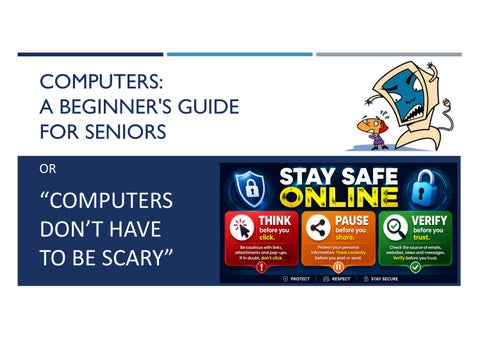
COMPUTERS: A BEGINNER'S GUIDE FOR SENIORS OR
“COMPUTERS DON’T HAVE TO BE SCARY”
AI vs Humans
AI
WELCOME & INTRODUCTION Reassuring Pace: The format is very friendly, and you will be encouraged to progress at your own speed, throughout this journey. Supportive Learning Environment: We meet here in a warm nonintimidating space where questions are welcomed, and mistakes are part of learning. Building Confidence: I especially want to boost your confidence in navigating IT, making it accessible and enjoyable for you. To foster a can, do attitude towards technology. Jargon Free: Getting the most from your devices in plain English
TOPICS WE WILL BE COVERING Can I just Ignore it all ! Anti-Virus Malware Passwords & Security Apps Advertising Social Media
AI – Will it affect me? Is big brother watching me Keeping Safe Online What’s True Anymore? Bots Online banking Google / Microsoft
Email me if you would like to receive notes following these sessions (pdf) petersmerdon@blueyonder.co.uk
SESSION NOTES
Make a note Our next session will be (third) Thursday 17th September 2026 petersmerdon@blueyonder.co.uk
NEXT SESSION
Xbox Series X price hiked by £170 The last couple of months has seen the biggest rises in the cost of tech for three years due to the worldwide shortage of chips especially memory
* ChatGPT - Graphic to illustrate in my PP slide the rise in silicon chip prices since 2020
RISING CHIP PRICES
New Chrome Split View Simply right click on a tab and select split view (desktop only)
CHROME NEW SPLIT VIEW
How AI is helping the French battle against wildfires The big change, especially in my département, is that now we've got cameras assisted by artificial intelligence to watch the forest and see where fires are starting. They have an impressive range as well, detecting fires up to 20km (12 miles) away. Real-time video shows a map with the exact location of the fire, the position of any nearby houses and a simulation of how, given the weather, the level of humidity and so on, it is expected to spread from minute to minute. The switch has reduced false alarms. An AI-assisted camera can distinguish with almost total certainty between smoke and dust thrown up by a tractor in a field. And every minute is vital. For the past 10 days, for example, we have the feedback from our firefighters that our AI detected seven fires 15 minutes before the first phone call.
AI FIGHTING FIRES
More Phishing Emails Scams or Not? In this instance are the baddies are pretending to be reputable companies looking to match your donations from their charity pot Or will your donation simply go into their charity box !!
Use AI to test Upload letter to ChatGPT – Ask is this a scam? Result =
PHISHING EMAILS
Photo Tidy Up
AI
IOS Call Screening Settings> Apps> Phone Screen Unknown Callers • Never • Reason for calling • Silenced Google / Android / Samsung phones also have a similar option
CALL SCREENING
Public Wifi Slide: Public Wi-Fi — What NOT to Do Don’t access online banking or other highly sensitive accounts on public Wi-Fi. Don’t enter passwords or card details unless you’re confident the connection is secure. Don’t connect automatically to open Wi-Fi networks — your device could connect to a malicious hotspot. Don’t assume a network is genuine just because it has a familiar name such as “Hotel Wi-Fi” or “Free Airport Wi-Fi.” Don’t leave Wi-Fi and Bluetooth switched on when you aren't using them. Don’t ignore security warnings about certificates, websites or connections. Best rule to remember If you wouldn't want someone sitting next to you to see it, don't do it on public Wi-Fi. Safer option: Use your mobile phone's hotspot for banking, shopping, work or anything involving sensitive information.
PUBLIC WIFI
NEVER NEVER NEVER
Install an app on your phone / tablet / PC when directed to by an agent over the phone who called you. No exceptions ! EVER *Except if you initiated a call to a support desk requesting remote support when you may be directed to a web page but you will never be asked to download an app.
NEVER
PDF Annotation - Chrome Sign and annotate your PDFs Skip downloading and printing when it’s time to sign a PDF. Use the annotation tool to handdraw your personal signature, complete forms, and highlight lines. Open a PDF and click Annotations . Choose your pen or highlighter style and color. Draw your annotation or signature, and click Save . Tip: To make it easier to draw on a small line, Zoom
GOOGLE CHROME
Low Cloud Space Warnings I have noticed that an increasing number of cloud storage companies are issuing low space warnings much earlier to get you to buy more space before you need it.
You can normally wait until you are 97% full and most will still give you 60 days before deleting anything.
NOT A SCAM BUT…
Storage Full Emails Scams In this instance the baddies are pretending to be reputable companies in this case Microsoft One Drive to imply that you are almost out of storage and that immediate action is required or some / all of your precious data may be lost. Note the use of big call to action buttons to entice you to click on them. Lack of personalised name or any mention of your account details hints that this is rogue
PHISHING EMAILS
Spoof emails – Have I been hacked? • A spoof email is a fraudulent email that is deliberately crafted to look like it came from a trusted or legitimate source when it didn’t. The goal is usually to trick the recipient into: • Clicking malicious links • Giving away personal or financial information • Downloading harmful attachments • Trusting instructions from someone impersonated (e.g., a boss, bank, or friend) Signs an email may be spoofed • The “From” name looks right, but the actual email address is slightly off. • Unexpected requests for money, passwords, or personal info. • Urgent or threatening language (“Act now or your account will be closed!”). • Suspicious links (hover to check the real URL). Poor grammar or odd phrasing.
SPOOF EMAILS
Confirm it is spoofing (not a hack) Your email was spoofed if: • People receive emails “from you” that you did not send • Nothing appears in your Sent Items folder • You can log in normally • Your email service shows no unusual sign-ins If all that is true → your PC and email has not been hacked Emails are just being sent from another spoof account What should I do (as a precaution) • Change your email account password Even if spoofed messages don’t require access, it’s a good idea to change your password to prevent real compromise. Use a strong password (at least 12–16 chars, mixed types).
SPOOF EMAILS
Secondhand book sales are booming ! Something mysterious has been happening in the world of secondhand books in the USA Over the last few months independent booksellers have been observing a strange pattern of purchases which have seen scores of their novels being shipped to far-off warehouses. In 2025, a judge ruled using books purchased in this way to train AI software was not a violation of US copyright law. It's difficult to account for the sales, which appear random with "no rhyme or reason.“ The starting point in the UK is that all these acts of copying creating the training library and doing the training – require the permission of the copyright owner.
SECOND HAND BOOKS
ChatGPT Study Mode Personalised learning: ChatGPT Study Mode guides students through problems step-by-step rather than simply giving them the answer. Socratic questioning: It uses questions and prompts to encourage students to explain their reasoning and develop deeper understanding. UK education context: It can support learning across GCSE, Alevel, university and other UK study programmes, although it should complement—not replace—teachers and course materials. Interactive support: Students can ask follow-up questions, request explanations in simpler terms, and work through difficult topics at their own pace. Independent study: Study Mode can help students revise, practise questions, identify gaps in their knowledge and receive immediate feedback.
ChatGPT STUDY MODE
Mobile payments rise but cash decline slows Two-thirds of adults in the UK were registered with at least one mobile payment service last year, Nine in 10 users of mobile wallets have their debit card loaded as their default payment method on their phone More than 80% of 16 to 34-year-olds make mobile payments on a regular basis, compared with 22% of the over 65s. 54% of all payments in made in 2025. Some 39% of payments were contactless. Cheques account for just 0.2% of payments made in the UK “Rather than the UK becoming a cash-free society over the next decade, the UK will transition to an economy where cash is less important than it once was but remains widely valued and still preferred by some. “ (UK Payments Market Report) Nearly 50 million people used a cash machines last year.
CARD vs CASH
France Announce Social Media Ban • France's parliament has approved a law to ban social media for under-15s from January 2027, making it the first European country to block young people from the platforms. • The law will mean everyone in France must verify their age to access social media and comes as the UK and EU are developing their own limits in response to concerns for children's mental health. • From September, people under 15 will not be able to open accounts and age verification will be required on all new accounts • In January 2027, this rule will apply to all existing accounts meaning everyone in France will have to prove they are over 15 to use social media
SOCIAL MEDIA BANS
France Announce Social Media Ban Country
Current status
Minimum age
Australia
In force (Dec 2025) Under 16
Indonesia
In force (2026)
Under 16
Malaysia
In force (2026)
Under 16
France
Passed 21 July 2026, Under 15 effective Sept 2026
SOCIAL MEDIA BANS
Future Social Media Bans Country
Proposed minimum age
Status
United Kingdom
Under 16
Ban announced, implementation planned for Spring 2027
Denmark
Under 15
Government committed to introducing ban with age verification
Norway
Under 16
Bill to Parliament by end of 2026
Spain
Under 16
Government proposal under development
Greece
Under 15
Proposal announced; legislation expected
Turkey
Under 15
Law passed; implementation due later in 2026
Austria
Under 14
Draft legislation in preparation
Netherlands
Under 15
Government considering legislation and EU-wide approach
Countries currently discussing or investigating restrictions: Germany, Slovenia, Portugal China (already has extensive restrictions on minors' online activity and screen time, but uses a different regulatory model rather than a simple age-based social media ban)
SOCIAL MEDIA BANS
China’s ‘Minor Mode’ China requires smartphones, apps, and many online platforms to provide a "Minor Mode" (also called Youth Mode) that is automatically available for children and gives parents extensive control. Rather than banning access outright, the system limits what children can do and for how long. Screen time limits - Depending on the child's age, recommended daily usage limits apply: • Under 8: up to 40 minutes/day • 8–15 years: increasing limits based on age • 16–17 years: default recommendation of 2 hours/day • Parents can override some of these settings. Curfew Minors - are generally prevented from using apps during overnight hours (typically between 10:00 pm and 6:00 am unless a parent changes the settings). Mandatory break reminders - Children receive reminders after 30 minutes of continuous use, encouraging them to take a break.
SOCIAL MEDIA BANS
China’s Minor Mode Content filtering - Platforms must: block harmful or age-inappropriate material, reduce addictive recommendation algorithms, prioritise educational and age-appropriate content, provide stronger privacy protections for minors. Parental controls - Parents can: • monitor usage, • approve or deny access, • receive activity reports, • control purchases, • manage contacts and app permissions. Gaming restrictions - China is even stricter with online games. Since 2021, minors have generally been limited to one hour of online gaming on Friday, Saturday, Sunday and public holidays, with real-name verification required to enforce the rules.
SOCIAL MEDIA BANS
AI What We Know So Far AI tools and chatbots still do not make much money None of the chatbots or the related tools in and of themselves clearly provide a meaningful amount of revenue for the companies, despite being costly to create. Wall Street wants results, not more ideas Look no further than Wall Street's reaction to Meta's quarterly results to see that investors are no longer placated with executive's claims that AI investment will turn out to be worth it at some unknown point in the future. There is still huge demand for new tech Google said last week that 950 million people are using its Gemini chatbot at least once a month, three times the users it had a year ago.
AI NEWS
AI vs Humans
AI
AI vs Nuclear The Nuclear Age:The Promise Post-war optimism: Nuclear energy was presented as a technology that could transform society. “Energy too cheap to meter”: Early advocates suggested nuclear power could make electricity extraordinarily cheap and abundant. Limitless energy: Nuclear power was associated with energy security and freedom from dependence on fossil fuels. Peaceful atom: Nuclear technology was promoted as benefiting medicine, agriculture, industry and scientific research. Rapid technological progress: Early successes created confidence that nuclear technology would continue advancing quickly. Huge government investment: Governments were willing to fund projects on a scale that private industry could not initially match. Reality: Nuclear power became a major source of low-carbon electricity, but construction costs, regulation, safety, waste and timescales proved much more challenging than early predictions suggested.
AI vs NUCLEAR
Vs
AI vs Nuclear The AI Age:The Promise A new general-purpose technology: AI is being presented as potentially transforming almost every industry. Massive productivity gains: Claims that AI will automate routine work and dramatically increase employee productivity. Scientific breakthroughs: AI could accelerate drug discovery, materials science, engineering and climate research. Personalised intelligence: AI assistants potentially available to everyone — effectively putting expert-level capabilities in people's hands. Economic growth: Major increases in productivity and national economic competitiveness are being forecast. Automation of knowledge work: Unlike earlier automation, AI is increasingly aimed at professional and creative work. Potentially transformative: Some advocates predict AI could eventually achieve capabilities exceeding human intelligence. Reality so far: AI is already delivering significant benefits, but reliability, hallucinations, copyright, energy consumption, employment disruption and the economics of large-scale AI remain unresolved.
AI vs NUCLEAR
Vs
AI vs Nuclear Nuclear
AI
Promised almost limitless cheap energy
Promises almost limitless cheap intelligence
Physical infrastructure was the bottleneck
Computing, chips and electricity are major bottlenecks
Enormous government investment
Enormous private + government investment
Benefits were genuine but arrived more slowly than expected
Benefits are genuine but future capabilities are uncertain
Safety risks became a central issue
AI safety and control are becoming central issues
Waste and environmental consequences were underestimated
Energy use, data and environmental costs are concerns
Regulation became increasingly important
Regulation is already becoming increasingly important
Few organisations could build nuclear plants
AI is becoming increasingly accessible to individuals and businesses
Nuclear transformed electricity generation
AI could transform knowledge and information work
We have come through Nuclear age , so far, will we come through AI ?
AI vs NUCLEAR
Vs
AI vs Nuclear Bottom line:
AI vs NUCLEAR
Both technologies inspired extraordinary promises before their full consequences were understood. •The lesson from nuclear isn't that the promises were necessarily wrong. •Rather, technological capability does not automatically translate into cheap, widespread or rapid deployment. •The biggest question for AI may therefore be not “Can it do extraordinary things?” but “How quickly, cheaply, safely and reliably can society actually deploy them?” •The nuclear analogy is useful — but AI is fundamentally different because software can spread globally far faster than physical infrastructure.
Vs
AI vs Humans
AI
AI vs Humans Artificial intelligence (AI) has become a powerful tool for generating text, images, music, and videos. While AI can produce content quickly and efficiently, it is humans who provide the creativity, purpose, and direction behind its use. AI generates content by analysing large amounts of data and identifying patterns. It can write essays, design graphics, compose music, or answer questions in seconds. However, AI does not possess emotions, personal experiences, or genuine imagination. Its outputs are based on existing information rather than original thought.
AI
AI vs Humans Humans, on the other hand, create by using imagination, critical thinking, and personal experiences. Creativity involves expressing ideas, solving problems, and making ethical decisions. For example, an artist uses emotions and life experiences to create meaningful artwork, while a writer develops unique stories that reflect human values and perspectives. The most effective approach is collaboration between AI and humans. AI can automate repetitive tasks, suggest ideas, and improve productivity, allowing people to focus on innovation and higher-level thinking. Designers should use AI to generate concepts, while they refine and personalise the final product. Similarly, students can use AI to brainstorm ideas, but they should still conduct research, think critically, and produce their own original work.
AI
AI vs Humans AI has the potential to reduce barriers to education and expertise. A student in a rural area could receive tutoring comparable to that available in major cities. Small businesses could access advice that was once only affordable for large companies. Healthcare workers, researchers, and entrepreneurs could use AI to solve problems more efficiently, increasing productivity and innovation. But to be fair: • AI tools need to be affordable and widely accessible. • Digital skills training made available to everyone. • The systems are transparent, fair, and regularly audited for bias. • People use AI to support, rather than replace, critical thinking.
AI
ChatGPT In Action
ChatGPT
From the photo, it looks like a hearty cooked breakfast consisting of: • • • • • • •
Scrambled eggs Streaky bacon Chipolata sausages A thick pork sausage Hash brown Grilled mushrooms (partly hidden under the eggs) Grilled tomato (partly visible at the back)
Here's a recipe that should get you very close to what's on the plate.
ChatGPT Examples Hotel-Style Full English Breakfast (Serves 2) Ingredients Scrambled Eggs 6 large eggs 40 g butter 2 tbsp whole milk or double cream (optional) Salt and black pepper Meat 4 rashers streaky bacon 2 thick pork sausages 6 chipolata sausages Vegetables 4 chestnut mushrooms, halved 2 tomato halves Potato 2 hash browns (frozen or homemade)
ChatGPT
ChatGPT Examples Method 1. Cook the sausages Heat the oven to 190°C (170°C fan). Cook both the pork sausages and chipolatas for 20–25 minutes, turning halfway until browned and cooked through. 2. Bake the hash browns Cook according to the packet instructions, usually 18–20 minutes, turning once. 3. Fry the bacon Heat a frying pan over medium heat. Cook the streaky bacon for 3–5 minutes per side until crisp around the edges. 4. Cook the mushrooms and tomatoes Using the bacon fat in the pan: Fry the mushrooms cut-side down for 3–4 minutes. Turn and cook another 2 minutes. Add the tomato halves cut-side down for 2–3 minutes until lightly caramelised and Season with salt and pepper.
ChatGPT
ChatGPT Examples 5. Make creamy scrambled eggs Whisk together the eggs with a pinch of salt. Melt the butter in a non-stick saucepan over low heat. Add the eggs and stir continuously with a silicone spatula, scraping the bottom of the pan. Remove from the heat for about 20 seconds whenever they begin to thicken, then return to the heat, repeating until the eggs are soft, creamy and just set. Stir in a splash of milk or cream if desired and season with black pepper.
ChatGPT
ChatGPT Examples Assemble Pile the scrambled eggs in the centre of the plate, then arrange: Bacon - Pork sausage - Chipolatas - Hash brown Mushrooms - Grilled tomato Serve immediately with: Buttered toast Brown sauce or tomato ketchup A mug of tea or freshly brewed coffee Tips for matching the photo Cook the bacon until it's crispy but still slightly chewy. Keep the scrambled eggs soft and glossy rather than dry. Use good-quality butcher's sausages if possible—the thick sausage in the photo appears to be a traditional pork sausage rather than a supermarket economy variety. Don't overcook the mushrooms; they should be browned but still juicy. This should give you a breakfast that's very similar in appearance and style to the one your friend shared.
ChatGPT
ChatGPT Examples Air Fryer Method 1. Cook the sausages and hash browns Preheat the air fryer to 190°C for 3 minutes. Place the pork sausages, chipolatas and hash browns in the basket in a single layer. Cook for 18–20 minutes, turning everything halfway through. 2. Add the bacon After about 10 minutes, add the bacon rashers to the basket. Cook for the remaining 8–10 minutes until crisp to your liking. 3. Add the mushrooms and tomatoes During the final 6–8 minutes of cooking: Place the mushroom halves in the basket, cut side up. Add the tomato halves, cut side up. Spray lightly with olive oil and season with salt and pepper. Everything should finish at roughly the same time.
ChatGPT
More ChatGPT Examples
ChatGPT
More ChatGPT Examples I will be in Cambridge 13th & 14th September what free activities / sights should i look out for. I am 70 plus but mobile. Can you suggest a wet and dry literary Answer Absolutely. Since you are in Cambridge on Sunday 13 and Monday 14 September 2026, I'd plan around the fact that quite a few university museums close on Mondays. I've checked the current 2026 listings, and there are some particularly good free options. For someone 70+ but mobile, I'd avoid trying to cram too much in. Cambridge is very walkable, but the historic centre involves cobbles and quite a lot of standing.
Travel
More ChatGPT Examples If it's dry — my suggested itinerary Sunday 13 September — historic Cambridge + river 10:00 – 11:30 — Historic centre walk Start around Market Square and walk: Market Square → King's Parade → Senate House → Trinity Street → St John's → Bridge of Sighs You don't need to pay to enjoy the outside of the colleges. The architecture and atmosphere are the attraction. I'd particularly look at: King's College Chapel from King's Parade Senate House Trinity College frontage St John's College frontage The Mathematical Bridge The River Cam and punts If you happen to be near King's College Chapel at a service time, services are free and open to everyone. (King's College Cambridge) 11:30 – 12:30 — The Backs Walk along the river towards The Backs. This is one of the nicest completely free things to do in Cambridge. You get the classic views of the backs of King's, Clare, Trinity and St John's without paying for college admission. Don't try to walk the whole length if you're getting tired. Turn back when you've had enough. 12:30 – 2:00 — Lunch There are plenty of cafés around the city centre. I'd allow yourself a proper sit-down lunch rather than trying to eat on the move.
Travel
More ChatGPT Examples 2:00 – 4:00 — Fitzwilliam Museum This would be my number-one recommendation if you're interested in art and history. The Fitzwilliam Museum is free to enter, and on Sundays it's open 12–5pm. No booking is required for the general collection. (The Fitzwilliam Museum) There's a particularly interesting exhibition starting 8 September 2026, A Mughal Songbook: Art, Music and Empire, which is free. (University of Cambridge Museums) It's also a good choice for you because you can sit down periodically and don't have to walk around the whole museum. 4:00 onwards — easy evening I'd finish with a gentle walk back through the centre and perhaps King's Parade around sunset. If Sunday is wet I'd actually make the day better, rather than worse! 10:30 – 12:00 Start at the Museum of Archaeology and Anthropology. It's an interesting, manageable-sized museum rather than somewhere enormous where you feel you have to see everything. 12:00 – 1:00 Lunch. 1:00 – 3:00 Fitzwilliam Museum Take your time rather than trying to see the whole collection. 3:00 – 4:00 Walk over to the Museum of Zoology if you still have energy. It's a surprisingly good museum, particularly if you like natural history. There are some wonderful specimens, including the famous dodo.
Travel
More ChatGPT Examples Monday 14 September — I'd do something different Monday is slightly awkward because the Fitzwilliam is closed on Mondays. (The Fitzwilliam Museum) However, one very useful museum is open: Museum of Cambridge The Museum of Cambridge is open Monday 10am–5pm, and Sunday 11am–4pm. (University of Cambridge Museums) It's particularly appropriate if you want to understand Cambridge itself rather than just the University. I'd combine it with: Castle Mound → Castle Street → Jesus Green → River Cam That's a pleasant, relatively relaxed walk. Monday wet-weather plan I'd do: 10:00 – 11:30 Museum of Cambridge 11:30 – 12:00 Coffee 12:00 – 1:00 Walk/short bus ride towards the centre 1:00 – 2:00 Lunch 2:00 – 3:00 The Polar Museum The Polar Museum is a relatively small museum, so it doesn't require the stamina of a huge museum. It also has a current free exhibition, Polar Panoramas, running until January 2027. (University of Cambridge Museums) 3:15 – 4:30 Coffee/tea and perhaps browse the city centre shops.
Travel
More ChatGPT Examples Three things I'd particularly put on your list If you don't want a rigid itinerary, I'd prioritise: 1. The Backs and River Cam — FREE Probably the best outdoor Cambridge experience. 2. Fitzwilliam Museum — FREE Definitely worth 1½–2 hours. 3. King's College Chapel Even if you don't pay for a sightseeing visit, check the service times because attending a service is free. (King's College Cambridge) One thing I'd not prioritise Don't feel you have to pay to go into lots of individual colleges. You can see an enormous amount of the historic architecture simply walking around the centre and along the Backs. And although punting is the classic Cambridge experience, it obviously isn't free. If you're happy to spend some money on one thing, I'd consider a punt rather than paying admission to several colleges. My personal choice for you would be: Sunday: King's Parade → The Backs → lunch → Fitzwilliam Museum → gentle evening walk. Monday: Museum of Cambridge → Castle Mound/Jesus Green → lunch → Polar Museum → relaxed afternoon. That gives you quite a lot of Cambridge without turning the two days into a marathon. If you tell me where you're staying in Cambridge (hotel or approximate area), I can turn this into a very practical two-day walking itinerary with distances, estimated walking times, places to sit/stop for coffee and toilets, and a wet-weather alternative for each section.
Travel
QUESTION TIME
THIS TIME SOCIAL MEDIA
“Nothing vast enters the life of mortals without a curse.” Sophocles
The Pro’s & Cons of Social Media Global Connectivity Social media connects people across continents instantly — keeping families, friends, and communities in touch regardless of distance. Example: WhatsApp and Facebook Messenger help millions of expats and migrant workers stay in daily contact with loved ones back home. Information and Awareness It spreads information faster than any previous medium — from breaking news to public health updates. Example: During crises (like natural disasters or health emergencies), platforms can alert communities and coordinate help in real time. Education and Learning You can access tutorials, online classes, and expert knowledge freely. Platforms like YouTube, Reddit, and LinkedIn Learning have become major educational hubs.
SOCIAL MEDIA
The Pro’s & Cons of Social Media Freedom of Expression and Voice Social media gives individuals and marginalized groups a platform to share their perspectives and be heard. Movements like #MeToo and #BlackLivesMatter gained global visibility through social platforms. Business Growth and Entrepreneurship Small businesses can reach customers directly without huge marketing budgets. Instagram shops, TikTok creators, and Facebook Marketplace have helped many people start careers or side hustles. Community and Support Networks People find like-minded communities — for hobbies, parenting, health conditions, or mental health support. Online groups reduce isolation and build solidarity, especially for those in niche or marginalized situations.
SOCIAL MEDIA
The Pro’s & Cons of Social Media Creativity and Self-Expression It’s a free stage for artists, musicians, writers, and photographers to share work and get feedback. TikTok,YouTube, and Deviant Art have launched creative careers that wouldn’t exist otherwise. Civic Engagement and Social Change Social media enables civic participation — from petitions to fundraising to voter awareness campaigns. Non-profits and activists use these platforms to mobilize people and raise awareness quickly. Entertainment and Relaxation Humour, music, and memes can boost mood and provide relief from stress. Studies show moderate use of enjoyable content can improve wellbeing when balanced with offline life.
SOCIAL MEDIA
The Pro’s & Cons of Social Media [Tim Kendall] President of Pinterest ‘It’s easy today to lose sight of the fact that these tools actually have created some wonderful things in the world. They’ve reunited lost family members.They’ve found organ donors. I mean, there were meaningful, systemic changes happening around the world because of these platforms that were positive! But I think we were naive about the flip side of that coin’. [Alex Roetter] Senior vice president of engineering at Twitter. ‘When I was there, I always felt like, fundamentally, it was a force for good. I don’t know if I feel that way anymore.Yeah, these things, you release them, and they take on a life of their own. And how they’re used is pretty different than how you expected.’. [Justin Rosenstein] Co-inventor of Google Drive, Gmail Chat, Facebook Pages, and the Facebook like button. ‘I’m very concerned. I’m very concerned’.
SOCIAL MEDIA
The Pro’s & Cons of Social Media Tens of millions of people across the world are hopelessly addicted to their electronic devices. It’s exacerbated by the fact that you can literally isolate yourself now in a bubble, thanks to technology. • It’s not just fake news; it’s fake news with consequences. • We have gone from the information age into the disinformation age. • Some even question is democracy is under assault ? • Never before in history have 50 designers - 20 to 35 year old white guys in California made decisions that would have an impact on two billion people. (1/4 of the worlds population) • Facebook, Snapchat, Twitter, Instagram,YouTube, companies like this, their business model is to keep people engaged on the screen. • Your attention is the product being sold to advertisers.
SOCIAL MEDIA
The Pro’s & Cons of Social Media [Shoshana Zuboff, PhD] “This is what every business has always dreamt of to have a guarantee that if it places an ad, it will be successful. That’s their business. They sell certainty. In order to be successful in that business, you have to have great predictions. Great predictions begin with one imperative; you need a lot of data”. People have the misconception it’s our data that is being sold. But it is not in Facebook’s business interest to give up the data. It’s what do they do with that data that makes them money. At a lot of technology companies, there’s three main goals. There’s the The engagement goal: to drive up your usage, to keep you scrolling. The growth goal: to keep you coming back and inviting as many friends and getting them to invite more friends. The advertising goal: to make sure that, as all that’s happening, we’re making as much money as possible from advertising.
SOCIAL MEDIA
The Pro’s & Cons of Social Media Activating ellipsis. let the user know that the other person is typing so we don’t lose him.
“There are only two industries that call their customers ‘users’: illegal drugs and software.” [Edward Tufte] We evolved to care about whether other people in our tribe… think well of us or not because it matters. But were we evolved to be aware of what 10,000 people think of us? We were not evolved to have social approval being dosed to us every five minutes by millions.
SOCIAL MEDIA
The Pro’s & Cons of Social Media We were all looking for the moment when technology would overwhelm human strengths and intelligence. When is it going to replace our jobs, be smarter than humans? But there’s this much earlier moment… when technology exceeds and overwhelms human weaknesses. This point being crossed is at the root of addiction, polarization, radicalization, outrage. This is overpowering human nature and is this checkmate on humanity. When you go to a page like Wikipedia, you’re seeing the same thing as other people. So, it’s one of the few things online that we at least hold in common. Now, just imagine for a second that Wikipedia said, “We’re going to give each person a different customized definition, and we’re going to be paid by people for that.” So, Wikipedia would be spying on you. Wikipedia would calculate, “What’s the thing I can do to get this person to change a little bit on behalf of some commercial interest?” Right? And then it would change the entry. Can you imagine that? Well, you should be able to, because that’s exactly what’s happening on Facebook. It’s exactly what’s happening in your YouTube feed.
SOCIAL MEDIA
The Pro’s & Cons of Social Media When you go to Google and type in “Climate change is,” you’re going to see different results depending on where you live. In certain cities, you’re going see it autocomplete with “climate change is a hoax.” In other cases, you’re going see “climate change is causing the destruction of nature.” And that’s a function not of what the truth is about climate change, but about where you happen to be Googling from and all the things Google knows about your interests to keep you engaged. People think the algorithm is designed to give them what they really want, only it’s not. The algorithm is actually trying to find a few rabbit holes that are very powerful, trying to find which rabbit hole is the closest to your interest. Then if you start watching one of those videos, then it will recommend it and similar over and over again.
SOCIAL MEDIA
The Pro’s & Cons of Social Media An MIT study, showed that fake news on Twitter spreads six times faster than true news. What is that world going to look like when one has a six-times advantage to the other one? We’ve created a system that biases towards false information. Not because we want to, but because false information makes the companies more money than the truth. The truth is boring. Good news newspapers don’t sell as many copies. Imagine a world where no one believes anything true. Everyone believes the government’s lying to them. Everything is a conspiracy theory. “I shouldn’t trust anyone. I hate the other side.” Is that where all this is heading. Is it’s about making two sides who couldn’t hear each other anymore, who didn’t want to hear each other anymore, who didn’t trust each other anymore.
SOCIAL MEDIA
The Pro’s & Cons of Social Media It’s not about the technology being the existential threat. It’s the technology’s ability to bring out the worst in society. So if technology creates… mass chaos, outrage, incivility, lack of trust in each other, loneliness, alienation, more polarization, more election hacking, more populism, more distraction and inability to focus on the real issues… that’s just society. Are we heading for a society that is incapable of healing itself and just devolving into a kind of chaos. The race to keep people’s attention isn’t going away. Our technology’s is going to become more integrated into our lives, not less. The AI’s are going to get better at predicting what keeps us on the screen, not worse.
SOCIAL MEDIA
The Pro’s & Cons of Social Media [Justin Rosenstein] – Inventor of the Like button “When we were making the like button, our entire motivation was, “Can we spread positivity and love in the world?”The idea that, fast-forward to today, and teens would be getting depressed when they don’t have enough likes, or it could be leading to political polarization that was nowhere on our radar.” “I don’t think these guys set out to be evil. It’s just the business model that has a problem.” Have we created a bunch of people who are trapped by a business model, an economic incentive, and shareholder pressure that makes it almost impossible to do something else. What’s not okay is when there’s no regulation, no rules, and no competition, and the companies are acting as sort of de facto governments.
SOCIAL MEDIA
The Pro’s & Cons of Social Media We live in a world now in which a tree is worth more, financially, dead than alive, in a world where a whale is worth more dead than alive, to mine the earth, and to continue to pull oil out of the ground, even though we know it is destroying the planet, and we know that it’s going to leave a worse world for future generations. This has always been the case through humans time on the planet but never at this scale and rate of change Our attention can be mined. We are more profitable to a corporation if we’re spending time staring at a screen, staring at an ad, than if we’re spending that time living our life in a rich way. At the end of the day, this machine isn’t going to turn around until there’s massive public pressure. We need to start having these conversations and… and voicing your opinion, in some cases through these very technologies, we can start to change the tide. We can start to change the conversation.
SOCIAL MEDIA
So Where Do I Start? • Turn off notifications or at least reduce them • Use Duck Duck Go rather than Google which does not store your search history • Never just accept a video recommended to you on YouTube. Always choose. • Before you share, fact-check, consider the source, do that extra Google. If it seems like it’s something designed to really push your emotional buttons then it probably is • Essentially, you vote with your clicks. If you click on clickbait, you’re creating a financial incentive that perpetuates this existing system. • Make sure that you get lots of different kinds of information in your own life. • Follow people on Twitter that you disagree with because you want to be exposed to different points of view. • Finally notice that many people in the tech industry don’t give these devices to their own children!!
SOCIAL MEDIA
So Where Do Families Start? • All devices out of the bedroom at a fixed time every night. Whatever the time is, half an hour before bedtime, all devices out. • No social media until secondary school. Personally, I think the age should be 16 • Work out a time budget with your children. Talk with them and say, “Well, how many hours a day do you want to spend on your device? What do you think is a good amount?” they’ll often say something pretty reasonable. • Most devices now log the number of user hours per day • You're not going to get everybody to delete their social media accounts, but just getting a few people to delete their accounts matters a lot, and the reason why is that that creates the space for a conversation because there needs to be enough people out in the society who are free of the manipulation engines to have a real conversation that isn’t bounded by the manipulation engines. • So - Get out of the system. Get off the stupid stuff. The world’s a beautiful. Place, Get out there! – Your choice….
SOCIAL MEDIA
The Social Dilemma (2020) Netflix October 3, 2020 This documentary-drama hybrid explores the dangerous human impact of social networking, with tech experts sounding the alarm on their own creations. The film features interviews with many former employees, executives and other professionals from top tech companies and social media platforms, who provide their first-hand experiences of working in and around the tech industry.
SOCIAL MEDIA
Social Media on Trial Meta will once again defend itself in court this week over allegations that it has deliberately designed Instagram and Facebook to be addictive to young users. The one trillion-dollar lawsuit has been brought by 30 US states which claim violations of child privacy laws and want the tech giant to change how its platforms operate. Ultimately, it is cases brought with the considerable firepower of states like California that could have the most impact on the rest of us. Big Tech has already lost the last 3 major trials against them in the last year resulting in damages of almost 500 million dollars. So the tide may be turning against them
SOCIAL MEDIA
QUESTION TIME
Make a note Our next session will be (third) Thursday 17th September 2026 petersmerdon@blueyonder.co.uk
NEXT SESSION