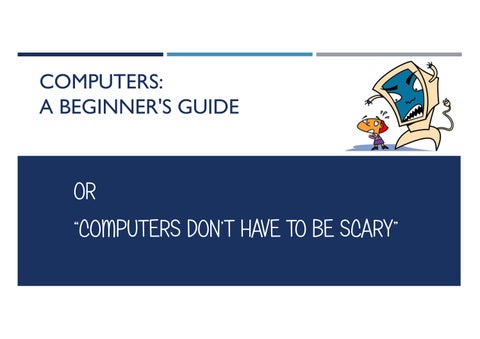
COMPUTERS: A BEGINNER'S GUIDE
OR “COMPUTERS DON’T HAVE TO BE SCARY”
WELCOME & INTRODUCTION Reassuring Pace: The format is very friendly, and you will be encouraged to progress at your own speed, throughout this journey. Supportive Learning Environment: We meet here in a warm nonintimidating space where questions are welcomed, and mistakes are part of learning. Building Confidence: I especially want to boost your confidence in navigating IT, making it accessible and enjoyable for you. To foster a can, do attitude towards technology. Jargon Free: Getting the most from your devices in plain English
TOPICS WE WILL BE COVERING Can I just Ignore it all ! Anti-Virus Malware Passwords & Security Apps Advertising Social Media
AI – Will it affect me? Is big brother watching me Keeping Safe Online What’s True Anymore? Bots Online banking Google / Microsoft
SESSION NOTES Email me if you would like to receive notes following these sessions (pdf) petersmerdon@blueyonder.co.uk
Adrian W Caroline C Chris G Janet S Jenny T Katrina C Mary T Richard C Rosemary S Sara R Shirley P Sue C Susie F Tessa T Wendy F
OTHER TOPICS
This is your time so are there any other areas you would like me to cover over the coming sessions ?
Trackballs NEXT Would a trackball help? Why a trackball can help SESSION A trackball: Keeps your hand stationary Makes the cursor movement feel more direct and anchored Reduces spatial remapping (no arm movement across the desk) Often improves where-is-the-cursor awareness People who benefit most: Lose the pointer visually Overshoot targets Prefer fine motor control over gross movement For many users, the cursor feels more like it’s “attached” to the hand.
DATA FARMS
STAYING SAFE ONLINE
COMMON TYPES OF COMPUTER FRAUD • • • • • • • • • • •
STAYING SAFE WEB ADDRESSES
Phishing - Fraudulent emails or messages that trick users into revealing sensitive information. Hacking - Unauthorized access to computer systems to steal, alter, or destroy data. Spoofing – Where your email is used to send out malicious emails from another device Malware & Spyware - Malicious software used to monitor, steal, or damage data and systems. Identity Theft - Using stolen personal data (often from breaches or phishing) to impersonate someone. Online Scams - Fake websites, auctions, or services designed to steal money or information. Ransomware - Malware that locks data or systems until a ransom is paid. Social Engineering - Manipulating people into giving up confidential information or access. Data Mining Fraud - Illegally collecting and using data via spyware or deceptive apps Hoax Emails - False messages that spread misinformation or trick users into harmful actions. Denial-of-Service (DoS) - Overloading systems to disrupt services, sometimes used as a smokescreen for theft. These are just some of the modern-day equivalents of the highwayman robbing the stagecoach
Criminality is nothing new only the methods
SPAM EXAMPLE
Parking Penalty Charge Notice: Please Pay a parking penalty charge notice (PCN) issued by a local council. If you do not pay a PCN within 28 days, you’ll get a ‘charge certificate’ and you’ll have 14 days to pay the original fine plus 50% more. https://gov.comsitbnmm.live/GOV If you don’t pay you’ll be prosecuted – you may have to pay a bigger fine as well as court costs.
TEXT SCAM EXAMPLE
https://gov.comsitbnmm.live/GOV https://www.tax.service.gov.uk/etc/etc
BENEFIT OF ANTI MALWARE PROTECTION
Deep Fakes Which is the real image ?
COMPUTER NEWS
IMPROVING LIVES PLYMOUTH
DATA FARMS
THIS MONTHS NEWS ROUNDUP
ChatGTP - Advertising Adverts will soon appear at the top of the AI tool ChatGPT for some users, the company OpenAI has announced. Traditional advertising is suffering as more users are using AI as opposed to traditional Google searches Google denies reports that it had approached advertisers about bringing ads to its Gemini AI tool in 2026. Advert free subscriptions will become the norm soon e.g. the new Go subscription tier, it already has Plus and Pro tiers, which cost $20 and $200 respectively per month in the US.
CHATGTP
DROP – A sign of the times California residents now have a centralized way to request deletion of personal data held by data brokers. The new Delete Requests and Opt-Out Platform (DROP), created under the 2023 Delete Act, allows verified residents to submit a single request that applies to more than 500 registered data brokers, instead of contacting each company individually. Brokers will begin processing requests in August 2026 and have 90 days to comply.
DROP
School Phone Bans YONDR Bags Schools – Concerts – Work – Weddings !!
YONDR BAGS
Social media's 'third phase' Phase One: Content was from friends, family, and accounts that you followed directly. Phase Two: When we added all of the creator content. Phase Three: AI generated content (“AI slop”) "Soon we'll see an explosion of new media formats that are more immersive and interactive, and only possible because of advances in AI," Zuckerberg said. “Open Claw” Virtual Assistants – Ai that does it all in one command e.g Message Jim to say I will meet him at the cinema at 2.00 on Thursday
SOCIAL MEDIA
Tesla to make robots Musk announces that Tesla will be stopping the manufacture of two car models in favour of producing robots - one of the most significant pivots the company has made. Space X and xAI to merge into a single company Elon Musk's SpaceX has applied to launch one million low orbital data centres (satellites) into Earth's orbit to power artificial intelligence (AI). Being solar powered they would be self sufficient using solar panels reducing the need to expensive to run terrestrial data centres Paving the way for the Earth to become a Kardashev II-level civilisation - one that can harness the Sun's full power
X NEWS
YouTube's $60bn revenue revealed Google has revealed YouTube brought in more than $60bn in revenue in 2025 as the firm targets more subscribers. (Netflix $45b)
£43,962,968,520 "YouTube is one of – if not the – most-used of all digital offerings, with over 70% of international consumers using it weekly, and over 50% using it daily," she told the BBC, citing Midia consumer survey data. At the same time, Shorts,YouTube's TikTok-style short videos, was also said to be averaging more than 200 billion daily views. Ofcom reveals that YouTube is used by 94% of UK adult internet population, with time spent on it growing to reach an average of 51 minutes a day per person. Individual plan: £12–£12.99 per month - Student plan: £7 per month Family plan (multiple users): £20 per month
YOUTUBE
Good News - Brave Browser Blocks most YouTube and web page adverts Available for PC’s Macs Tablets & Phones Import & Sync your Settings Settings> Shields> Aggressive https://brave.com/download/
BRAVE BROWSER
DATA FARMS
ANY QUESTIONS
DATA FARMS
THIS MONTH DATA FARMS
DOUGLAS ADAMS FAMOUSLY SAID
“Space is big. Really big. You just won't believe how vastly, hugely, mind-bogglingly big it is. I mean, you may think it's a long way down the road to the chemist, but that's just peanuts to space.”
Douglas Adams captured the absurd vastness of the cosmos with this gem from The Hitchhiker’s Guide to the Galaxy:
DATA FARMS ARE BIG
ON THE OUTSIDE AND WITHIN
AND THERE ARE LOTS OF THEM WITH MORE ON THE WAY To send a bit of data through 30 servers takes between 30 to 150 milliseconds Reach 85% of the world’s internet population in approximately 25 milliseconds.
THE UK PUNCHES ABOVE ITS WEIGHT
TOP 10 DID YOU KNOW FACTS ABOUT DATA CENTRES • There are over 7 million data centres worldwide, ranging from small server rooms to sprawling hyperscale facilities. • The largest data centre in the world, located in Langfang, China, spans a staggering 6.3 million square feet — that’s nearly the size of the Pentagon. • Data centres consume about 3% of global electricity, with some estimates suggesting this could rise significantly as digital demand grows. (Russia or Japan or Germany) • A single large data centre can use as much power as a small town, and cooling alone can account for up to 40% of its energy bill. • Currently China uses 33% of all the electricity generated in the world
TOP 10 DID YOU KNOW FACTS ABOUT DATA CENTRES • London has the highest concentration of data centres of any city, with over 300 facilities — a testament to the UK’s digital infrastructure leadership. • The global data centre market is projected to exceed $500 billion by 2030, up from around $190 billion in 2020 — that’s more than double in just a decade. • Every time you stream a video, send an email, or use cloud storage, you’re tapping into a data centre — they’re the invisible backbone of modern life. • The big tech companies have already announced that they will be spending around $650 billion on AI projects in 2026 between them. That’s x10 HS2’s !
AND THERE ARE A LOT OF COMPUTERS IN THE WORLD AS WELL As of 2025, there are an estimated 2 to 2.5 billion computers in use globally. This includes desktops, laptops, and servers—but not smartphones or tablets There are currently around 6.8 to 7.2 billion smartphones in use globally, which is nearly one for every person on the planet. In contrast, the total number of cars worldwide is estimated to be around 1.5 to 1.6 billion. So, smartphones outnumber cars by more than four to one.
THE BIGGEST COMPUTERS ON THE PLANET Traditional weather forecasts are produced on some of the biggest supercomputers on the planet; the Met Office super computing contract is worth £1.2bn. That huge sum of money buys you a machine that can perform 60 quadrillion calculations per second, running a model containing the understood physics, with over a million lines of code and using 215 billion weather observations.
60,000,000,000,000,000 200 times the number of stars in the Milky Way
THEY ARE FAST A petaflop (sometimes spelled "pentaflop" in error) is a unit of computing speed that equals one quadrillion—that’s 1,000,000,000,000,000—floatingpoint operations per second (FLOPS). It’s a benchmark used to measure the performance of supercomputers, especially in tasks that require massive numerical calculations like climate modelling, nuclear simulations, or AI training. To give it some scale: if every person on Earth did one calculation per second, it would take over 240 days to match what these computers can do in just one second - Perhaps computers are SCARY after all!
GOOGLE WILLOW QUANTUM COMPUTER In operation it is lowered into a liquid helium bath to within one thousandth of a degree above absolute zero Willow solved a benchmark problem in 5 minutes that would have taken the best computer in the world 10 septillion years, so more than a trillion trillion, or one with 25 zeros on the end, more than the age of the universe. The Willow chip has 105 qubits. Microsoft's quantum effort has just 8 qubits but uses a different approach. All this in just 25 years of reaserch
COMPUTER NEWS
How Does It Work
COMPUTER Imagine trying to find a tennis ball in one of a millon closed drawers. A classical NEWS computer opens each one in order. A quantum computer opens all of them at the same time. Or similarly, instead of having to need a 10,000 keys to open 10,000 drawers in normal computing, quantum enables you to open all 10,000, with one key, instantly. At around $15bn (£11bn), the total resource committed to quantum technology in China is possibly of the order of all the rest of the world's government programmes put together
QUIZ - TOP 10 MOST VALUABLE COMPANIES Nvidia has become the first company in the world to reach a market value of $4tn. $4,000,000,000,000 or £2,936,000,000,000
QUIZ - TOP 10 MOST VALUABLE COMPANIES ‘The Big Seven’ as they are called are valued at more than the gross domestic product of the whole of Europe !
THE FUTURE AI vs Traditional Computers – In weather forecasting
EARLY COMPUTERS • First commercial computer the UNIVAC 1 was used in the U.S. Census in June 1951 – 1905 • 1905 instructions per second • 5000 vacuum tubes • 7.5 tons or two adult elephants
MOORE’S LAW Moore’s Law states that the number of transistors on a microchip doubles approximately every two years, while the cost of computers is halved. This trend was first noted by Gordon Moore, co-founder of Intel, in 1965. It’s not a physical law, but rather a prediction that’s held remarkably true for decades, driving exponential growth in computing power. This doubling effect is why your phone today is more powerful than a room-sized computer from the 1960s. It’s also why we’ve seen such rapid advances in everything from AI to gaming to space exploration.
THE FUTURE While the law held strong for much of the late 20th century, experts now say it’s slowing down or even ending. Transistors are approaching atomic scales—some are just 2–3 nanometers wide, barely larger than strands of DNA. Shrinking them further is becoming exponentially more difficult and expensive, and the performance gains are no longer doubling every two years as they once did. So what is likely to happen in the future?
NEW BRANCHES OF COMPUTING • New architectures: Instead of just making chips smaller, engineers are exploring 3D chip stacking, chiplets, and neuromorphic computing—designs inspired by the human brain. • Quantum computing: Though still in its early days, it promises exponential speedups for specific problems. • Software optimization: Smarter algorithms and better code can squeeze more performance from existing hardware. • Specialized processors: GPUs, TPUs, and AI accelerators are taking over tasks that CPUs used to handle alone.
OTHER TECHNOLOGY - ROADS
OTHER TECHNOLOGY – AIR TRAVEL
Today, at any given moment, there are typically 8,000 to 14,000 aircraft in the sky globally (over 1 million people!)
OTHER TECHNOLOGY – MEDICINE 1950s – The Antibiotic Era Expands - Widespread use of penicillin and discovery of other antibiotics like tetracycline revolutionized infection treatment. - Polio vaccine by Jonas Salk introduced in 1955, drastically reducing global cases. 1960s – Vaccines and Transplants - First successful heart transplant (1967, Dr. Christiaan Barnard). - Measles and mumps vaccines developed, expanding childhood immunization. 1970s – Imaging and IVF - CT (computed tomography) scans introduced, transforming diagnostics. - First successful in vitro fertilization (IVF) birth in 1978 (Louise Brown, UK).
OTHER TECHNOLOGY – MEDICINE 1980s – Genetics and HIV Awareness - HIV/AIDS identified, leading to global awareness and early treatments. - MRI (magnetic resonance imaging) became widely available. 1990s – Genomics and Minimally Invasive Surgery - Human Genome Project launched (1990), mapping human DNA. - Laparoscopic (keyhole) surgery became common, reducing recovery times. 2000s – Targeted Therapies and Digital Records - Targeted cancer therapies like Gleevec changed oncology. - Electronic health records (EHRs) began replacing paper charts. - HPV vaccine introduced, preventing cervical and other cancers.
OTHER TECHNOLOGY – MEDICINE 2010s – CRISPR and Immunotherapy - CRISPR gene-editing emerged, enabling precise DNA modifications. - Immunotherapy (e.g., CAR-T cells) offered new hope for cancer patients. - Wearable health tech (like smartwatches) began monitoring heart rate, sleep, and more. 2020s – mRNA Vaccines and AI in Medicine - mRNA vaccines (Pfizer-BioNTech, Moderna) rapidly developed for COVID-19. - Telemedicine exploded due to the pandemic, reshaping healthcare delivery. - AI in diagnostics (e.g., detecting cancers, retinal disease) gained traction. - Bionic limbs and brain-computer interfaces advanced significantly.
THE FUTURE
In short, Moore’s Law may be fading, but innovation isn’t. We’re shifting from raw transistor counts to clever engineering across the entire computing stack Expect computers to double in both capacity and quantity by 2030 and quadruple by 2040
THE FUTURE • So we have been here before with other technologies • Seniors are a silent majority • By voicing our requirements to developers our needs are more likely to be met. • The ‘Senior’ agencies should be encouraged to work more on our behalf (my personal view)
THE FUTURE Everyone in this room has benefited from these technological advances in their lifetime both in quality of life and in many cases length of life There is no reason to believe that future technological advances will not prove to be as beneficial in the future The concern should be centred around the pace of that change and the role of Social Media rather than change itself. (again my personal view)
THE FUTURE
Maybe we will get that promised flying car in our lifetime !
DATA FARMS
ANY QUESTIONS
DATA FARMS
FILES & FOLDERS
FILE TYPES Local PC C:\PGS Stuff\Test\Filename.ext Cloudhttps://docs.google.com/spreadsheets/d/1c9QOcyNK cL2iiA1U0giJ9KZEk/edit?gid=20632#gid=2069063
DRIVES / FOLDERS / FILES Local PC C:\PGS Stuff\Test\Filename.ext USB Stick F:\PGS Stick\Test\Filename.ext Cloud https://docs.google.com/spreadsheets/d/1c9QOcyNKcL2iiA1U 0giJ9KZEk/edit?gid=20632#gid=2069063
DRIVES / FOLDERS / FILES
ENCRYPTION A typical encrypted file doesn’t “look” like much to the human eye—it’s usually a jumble of unreadable characters or binary data. That’s the point! Encryption transforms the original content (plaintext) into ciphertext, which appears as gibberish unless you have the correct decryption key.
DATA FARMS
ANY QUESTIONS
Browsers
NEXT TIME
Thursday 12th March (2nd Thursday)
NEXT 2.00pm to 4.00pm SESSION If you found this helpful tell others New Pay on the Day ticket www.theppl.org.uk
NEXT TIME
SESSION NOTES Email me if you would like to receive notes following these sessions (pdf) petersmerdon@blueyonder.co.uk
COMPUTERS: A BEGINNER'S GUIDE
OR “COMPUTERS DON’T HAVE TO BE SCARY”