~ NEWSLETTER
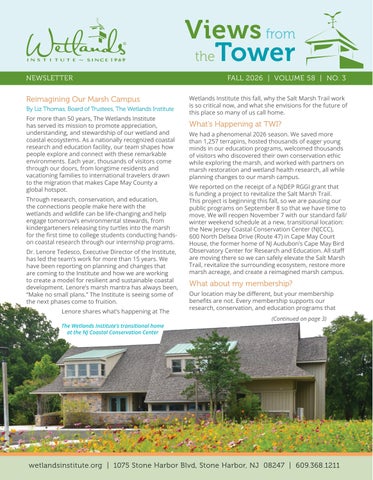
Reimagining Our Marsh Campus By Liz Thomas, Board of Trustees, The Wetlands Institute For more than 50 years, The Wetlands Institute has served its mission to promote appreciation, understanding, and stewardship of our wetland and coastal ecosystems. As a nationally recognized coastal research and education facility, our team shapes how people explore and connect with these remarkable environments. Each year, thousands of visitors come through our doors, from longtime residents and vacationing families to international travelers drawn to the migration that makes Cape May County a global hotspot. Through research, conservation, and education, the connections people make here with the wetlands and wildlife can be life-changing and help engage tomorrow’s environmental stewards, from kindergarteners releasing tiny turtles into the marsh for the first time to college students conducting handson coastal research through our internship programs. Dr. Lenore Tedesco, Executive Director of the Institute, has led the team’s work for more than 15 years. We have been reporting on planning and changes that are coming to the Institute and how we are working to create a model for resilient and sustainable coastal development. Lenore’s marsh mantra has always been, “Make no small plans.” The Institute is seeing some of the next phases come to fruition. Lenore shares what’s happening at The The Wetlands Institute’s transitional home at the NJ Coastal Conservation Center
Views from theTower FALL 2026 | VOLUME 58 | NO. 3 Wetlands Institute this fall, why the Salt Marsh Trail work is so critical now, and what she envisions for the future of this place so many of us call home.
What’s Happening at TWI? We had a phenomenal 2026 season. We saved more than 1,257 terrapins, hosted thousands of eager young minds in our education programs, welcomed thousands of visitors who discovered their own conservation ethic while exploring the marsh, and worked with partners on marsh restoration and wetland health research, all while planning changes to our marsh campus. We reported on the receipt of a NJDEP RGGI grant that is funding a project to revitalize the Salt Marsh Trail. This project is beginning this fall, so we are pausing our public programs on September 8 so that we have time to move. We will reopen November 7 with our standard fall/ winter weekend schedule at a new, transitional location: the New Jersey Coastal Conservation Center (NJCCC), 600 North Delsea Drive (Route 47) in Cape May Court House, the former home of NJ Audubon’s Cape May Bird Observatory Center for Research and Education. All staff are moving there so we can safely elevate the Salt Marsh Trail, revitalize the surrounding ecosystem, restore more marsh acreage, and create a reimagined marsh campus.
What about my membership? Our location may be different, but your membership benefits are not. Every membership supports our research, conservation, and education programs that (Continued on page 3)
wetlandsinstitute.org | 1075 Stone Harbor Blvd, Stone Harbor, NJ 08247 | 609.368.1211 A324385_NJ_KM1_19x25_Wetlands Fall 2026 Newsletter-NoIndicia_8.5x11.indd 1
9/4/26 12:59 PM
A non-profit organization studying, preserving, and protecting wetlands and coastal ecosystems. Founded in 1969 by Herbert Mills, Executive Director of the World Wildlife Fund.
Marsh Musings: A Community on the Move By Dr. Lenore Tedesco, Executive Director
Annie Ulichney, Chair Deborah A. Hays, Vice Chair Bill Hankowsky, Treasurer William Wermuth, Secretary Raymond Burke Timothy Jon Clay James Donohue John Flynn Linda Littenberg Margaret McAllister
John Millar Jeannie Morris Liz Thomas Jon Tullis Amy Welsh Francis J. White III
Staff Leadership
Dr. Lenore Tedesco, Executive Director Dr. Lisa Ferguson, Director of Research and Conservation Jim Frick, Director of Finance and Operations Brooke Knapick, Director of Educational Program Development
Research & Conservation
Julie Blum, Research Scientist Samantha Collins, Research Scientist Meghan Kolk, Conservation Scientist Bailey Sanders, Research & Conservation Coordinator Brian Williamson, Research Scientist
Education
Francesca Jacobs, Environmental Educator Abbygayle Liles, Aquarist/Environmental Educator Erin Rawls, Outreach Coordinator
Development & Communications Leah Satterfield, Development Associate
The marsh in fall always reminds me that we are stronger together. Cordgrass turns from green to gold and holds the soil in place against the tide. Diamondback terrapin hatchlings, emerging from their sandy summer nests, disappear into the grass, hidden from predators. Blue crabs settle into the mud, and the last shorebirds of the season feed along the edges before continuing on their journeys south. The parts of the marsh need one another. The grass needs the mud; the hatchlings need the grass; the whole system holds together because every part plays its role through each changing season. Our community works the same way. For more than 50 years, you have inspired us, joined us in conservation, participated in our education programs, and supported our research. And now, as we move to our transitional home at the NJ Coastal Conservation Center, we are reminded that The Wetlands Institute has never been about a building, but about the families who show up and share their stories. It is about the interns who discover, in a single season, how much their work matters. It is about the neighbors, sponsors, and longtime friends who simply ask, “How can I help?” Change like this can feel uncomfortable at first, but fall is a good reminder that this is a change we saw coming. Our research team will keep tracking wading birds and terrapins; our educators will keep welcoming schoolchildren. And our community, you, will keep showing up. A transitional home is just that: transitional. What stays in place is the people who have always gathered here for the marsh, for the wildlife that depend on it, and for each other. So as the marsh turns amber and the birds begin their journey south, I hope you'll think of this fall as another kind of migration. A shared one, toward a stronger, more resilient future for this place we love. We are making no small plans, and it continues to make all the difference.
Finance
Terrie Campbell, Finance Administrator Christine Whaley, Finance Analyst
Administration
Mary Beth Ciccarone, Administrative Coordinator Kimberly Dmytro, Tidepool Shop Manager Michael Fridmann, Facilities Manager
Visit Us Hours: Starting November 7, open Saturdays & Sundays 9:30 to 4:30. Check our website for Holiday Hours. General Admission: Members: Free. Non-members: $10 Adults, $8 Children 4-12. Views From the Tower is the quarterly newsletter of The Wetlands Institute and can also be found on our website.
A324385_NJ_KM1_19x25_Wetlands Fall 2026 Newsletter-NoIndicia_8.5x11.indd 2
9/4/26 12:59 PM
(Continued from page 1)
create impact for generations to come. Your membership will continue to provide you with free access to trails and gardens, year-round programs, our quarterly newsletter, and discounts at our Tidepool gift shop. All programs offered at the NJCCC will be free to members, and admission for non-members will be $10.00 for ages 13 and up and $8.00 for ages 4-12.
What Programs Will You Offer at the NJ Coastal Conservation Center? Beginning November 7, we will be open Saturdays and Sundays, 9:30 AM to 4:30 PM, with Seasonal Science Activities, our Marine Teaching and Touch Tank, Creature Feature and Craft, Seashell Sunday, and special Science Features.
Tell us more about the Salt Marsh Trail project. We will raise the elevation of the Salt Marsh Trail by two to three feet. We’ll also widen the trail. This will help us better accommodate school groups and guided tours, and create new high marsh and transitional upland habitat specifically designed for diamondback terrapin nesting and coastal birds. We will replace the boat house with a modest structure and replant the trail with native plants intentionally designed to maximize the benefit to the marsh ecosystem and the plants and animals that depend on it. When it is completed, we will have restored more than five acres of drowning marsh and created an important barrier to storm waves, conferring additional resilience to the Institute campus.
What is the project timeline for the Salt Marsh Trail? Construction is expected to begin in October 2026 and continue through spring 2027, with a goal of completing the elevation work before sensitive wildlife return. Trailside areas will be planted in spring; other areas will need a season to settle before additional plantings occur. We will conduct research and monitoring from before construction begins through September 2029 to evaluate the project’s effectiveness.
How will TWI programs continue during this time of transition? We will continue our research, conservation, and education work in a transitional space while we are away from our home. The NJ Coastal Conservation Center is newly renovated and includes office space, education spaces, and our Tidepool Shop. The research and conservation teams will be unaffected in their work. We will continue to provide public programming and education programs from the NJCCC. Our education programs will be modified somewhat, and we will continue to work with partners for school field trips, homeschool and scout programs. The NJCCC has trails and native plant gardens for exploration as well.
Illustrative rendering, by DIGSAU, of the Reimagined Wetlands Institute, designed using mass-timber construction to fit into the landscape.
What will happen to the animals in the aquarium? We will move the aquarium animals to a temporary location at the Aquaculture Innovation Center, in partnership with Rutgers University. The Center’s circulating seawater systems are uniquely capable of housing our animals that many of our education and visitor programs feature.
Will this impact the work done at Scotch Bonnet? No. Scotch Bonnet and the Salt Marsh Trail are the first two phases of our three-phase plan to reimagine our marsh campus. We’re continuing work that began three years ago, staying connected to our core mission: research informing best-practice conservation, which inspires thoughtful environmental education. This project is about more than a trail or a building. It is about creating a healthy, resilient marsh and a gateway to discovery through research, conservation, and education.
Why are you reimagining your marsh campus? Our campus is experiencing more frequent and severe flooding as a result of higher sea levels. This is limiting access for our education programs and visitors, and it is damaging the delicate marsh environment. These higher water events are killing mature trees, and flooding habitat, including terrapin and coastal bird nesting areas. We’ve seen unprecedented growth in our research, education and visitor programs, but the age and size of our original building are holding us back. That led us to reimagine The Wetlands Institute with a state-of-the-art, purpose-built facility to support our work for the next 50 years, and a campus transformed into a living ecosystem.
What are your plans for your building and current marsh campus? We are beginning with the Salt Marsh Trail Revitalization project this fall while we continue to work on planning and fundraising for our Reimagining Campaign that will create a climate-resilient, (Continued next page)
A324385_NJ_KM1_19x25_Wetlands Fall 2026 Newsletter-NoIndicia_8.5x11.indd 3
9/4/26 12:59 PM
sustainable home. We have completed the design phase, have submitted the requisite environmental permits, and have received the requisite state permits. We received zoning board approvals from the Middle Township Zoning Board. We continue to fundraise for the building and are working toward starting this building phase in late fall of 2026.
How will the new building be different? In addition to incorporating the latest in LEED sustainable and resilient building technologies, the new building will provide the additional space and resources to support our mission into the future: •
Adding four dedicated classrooms (three outdoor, one indoor) where at present we have none
•
Elevating the building and grounds for resilience
•
A 50% increase in the aquarium with state-of-the-art life-support systems for enhanced animal care and all new exhibits.
•
Modernizing and more than doubling the lab space.
•
All spaces are ADA accessible.
Our reimagined marsh campus includes native plants and landscaping plan that creates a biodiverse and beautiful ecosystem. Our site plan also shows our building footprint and parking area.
How do you plan to protect wildlife during the construction phases? The Institute’s marsh campus is an important place for wildlife and our planning has carefully considered the best ways to minimize impacts to wildlife while ultimately improving habitat and conditions for wildlife. We timed construction for the late fall, after most wildlife leaves the area. Over the summer, we relocated terrapin nests from The Wetlands Institute’s property Illustrative rendering, by DIGSAU, of one of the three outdoor classrooms.
to a series of safe enclosures. This included constructing and installing a series of nest boxes to relocate terrapin nests. Each nest box has space to mimic conditions for eggs from about 50 terrapin nests to develop. This method has been used successfully by our team and other researchers and was carefully planned with other leading researchers.
What more do we need to know? What we are doing to improve the Salt Marsh Trail and potentially build a new structure on the property embodies a combination of vision and action for the future, to do better and to build resilience for The Wetlands Institute for generations to come. It will enhance our ability to serve our constituents. We are grateful for the community that has inspired us, joined us in conservation, participated in our education programs, and supported our research. The Wetlands Institute has never been about a building. It is about research and discovery. It is about connecting with nature and one another. As we embark on this work, we look forward to continuing our public programming. Follow, visit, and continue to support us as we tackle this innovative, ecosystem-based approach to reimagining the wetlands. For information about exhibits and programming, visit https://wetlandsinstitute.org/visit-us/ or call 609-368-1211.
A324385_NJ_KM1_19x25_Wetlands Fall 2026 Newsletter-NoIndicia_8.5x11.indd 4
9/4/26 12:59 PM
Autumn Happenings After a brief period of transition, The Wetlands Institute's autumn activities begin on November 7, 2026, at our transitional location at 600 North Delsea Drive (Route 47), Cape May Court House, NJ 08210. Starting then, The Wetlands Institute will be open on Saturday and Sunday, 9:30am - 4:30pm. Please check our website calendar for programming updates as we transition to our new hours and location.
Seasonal Science Activities
Creature Feature & Craft 2:00PM
Saturday
During this live animal presentation, get up close with turtles, fish, crabs, sea stars and urchins, plankton, mollusks, horseshoe crabs, or the popular animals of Finding Nemo. After the presentation, create your very own take-home craft.
Seashell Sunday
10:00AM — 4:00PM Saturday and Sunday
11:00AM
Each month we will offer a new self-guided science activity related to seasonal changes in nature. We provide the supplies, and you create the learning!
Seashells at the seashore! Join us to learn all about seashells, how to collect them without harming the environment and touch an assortment of live mollusks and cool artifacts.
Marine Teaching & Touch Tank 11:00AM
Saturday
Science Feature 2:00PM
Learn about local creatures found in the salty waters of the ocean or back-bay! Join an Institute educator for a unique, interactive learning experience as they teach about whelk, sea urchins, sea stars, mud snails, horseshoe crabs, and more!
Sunday
Sunday
Join us as we explore conservation issues ranging from Bats to Seafood to Terrapins, or dive deeper into the lives of the Lenni-Lenape and the unseen world of Ultravioletinduced Visible Fluorescence and Plankton or uncover the hidden dangers of Marine Debris and Climate Change.
Our Tidepool Shop will be temporarily closed for in-person shopping until November 7. We are always open online, and you can still enjoy perusing some classic offerings as well as new books, tees and gift items. Visit our online shop for some retail therapy and to support education, research and conservation efforts while doing so!
https://tidepool-shop. myshopify.com/
wetlandsinstitute.org A324385_NJ_KM1_19x25_Wetlands Fall 2026 Newsletter-NoIndicia_8.5x11.indd 5
find us on 9/4/26 12:59 PM
Reflections of a Seasonal Naturalist By Stephanie Stefanik In a time when it feels like humanity drifts a little farther from the natural world each day, being connected to The Wetlands Institute is a gift. On days when I am away from the marsh, I often find myself transported back there— imagining the staff bike beneath me, the crunch of gravel under my tires and the salt air in my hair on the ride out to the boathouse. At the end of that trail, I enter a world entirely its own—a place where plants and wildlife live as they should, undisturbed and at home. There, you can watch laughing gulls nesting on Gull Island, spot horseshoe crabs along the water’s edge, hear the call of an Eastern Willet, and glimpse fiddler crabs scuttling in and out of their marshy homes. Around every bend, there is another small wonder waiting to be discovered. Out on the marsh, you are reminded of something essential: the natural world is not separate from us. It is alive, resilient, and extraordinary. To spend time there is to witness the quiet miracle of this beautiful world. As a Seasonal Naturalist, one of the greatest joys of my work is sharing that sense of wonder with others, especially children. There is something magical about watching a young person hold a horseshoe crab for the first time, discover a fiddler crab in the mud, or realize that the marsh is teeming with life. Those moments of curiosity often grow into appreciation, stewardship, and a lifelong connection to nature. Every program is an opportunity to help nurture the next generation of environmental advocates, conservationists, and nature lovers. Each visit serves as a reminder that despite the challenges facing our environment, there is still so much beauty worth protecting. The marsh is more than a place—it is a living classroom, a refuge, and a source of wonder that continues to inspire me every time I return.
A Summer of Knowledge By Brooke Knapick, Director of Educational Program Development The Wetlands Institute’s Luing Family Internship Program Environmental Education Interns spent 12 weeks leading public education programs, while immersing themselves in the unique environment of the surrounding salt marsh and barrier islands. They worked hard and through it all developed the skills needed to continue their careers in environmental education. Each year, interns are asked to develop and implement an education project of their choosing that is personally and/or institutionally beneficial. The deliverables from their projects leave a lasting impact on The Wetlands Institute. Fiona Buffington (West Chester University) redesigned the Fish Creature Feature to include a new table-top display tank and updated content that addresses three common myths: that sharks are inherently dangerous, that fish are unintelligent, and that fish populations are endlessly abundant. This project encourages the public to be more engaged, better informed, and less influenced by popculture fictionalizations. Grace McHugh (Rutgers University) designed a tripanel poster set and interactive display focused on
Meet the Coastal Conservation Research Interns By Bailey Sanders, Research & Conservation Coordinator
the differences between jellyfish and jellies, identifying species commonly seen in New Jersey, and discussing the important role that these animals play in the food chain, while also addressing common misconceptions, including the purpose and mechanics of jellyfish stings, and proper treatment when stung. Connor Robinson (Rowan University) developed a 4’x4’ educational poster demonstrating how organic carbon is captured by the world's oceans and coastal ecosystems. The poster features a photo of the salt marsh overlaid with arrows leading from one step of the carbon sequestration process to the next. Accompanying the poster is a brief explanation of the importance of the process. Lillian Zimmerman (Montclair State University) created a new Science Feature presentation on the common invasive, naturalized and native species that can be found in the marsh and wetlands. It focuses on how to identify invasive species, where they came from, why they are impactful to the environment, and how they are outcompeting native species.
Maxwell Ferrelli examined whether juvenile American Oystercatchers tended to return to their natal habitat type for breeding and how far they were traveling to find suitable nesting habitat. His work expands on our knowledge of nest site preferences of American Oystercatchers, which can help inform habitat management and protection efforts. Emma Healey investigated the predators found on TWI property during the diamondback terrapin nesting season and whether the predators were using nest exclosures as visual cues for nest location. Understanding predator composition on our property can improve our approach to terrapin conservation in the future.
This year, six Coastal Conservation Research Program (CCRP) interns expanded their knowledge of our coastal ecosystem and the organisms that call it home. Throughout the summer, they participated in the longterm monitoring of diamondback terrapins and coastal birds, honing their field and lab skills while simultaneously conducting their own independent research project. We were especially fortunate to welcome back two secondyear interns who helped mentor the new members of the CCRP team. Returning intern Joey Brace explored repeat nesting behavior in diamondback terrapins at TWI from 2014 to 2026 at both an individual and population level, helping us build a clearer picture of nesting patterns and site fidelity over time.
A324385_NJ_KM1_19x25_Wetlands Fall 2026 Newsletter-NoIndicia_8.5x11.indd 6
Returning intern Kristen Kallok analyzed the influence of maternal body size on diamondback terrapin clutch size and egg traits. Her findings contribute to our understanding of reproductive characteristics in terrapins and can help determine how anthropogenic threats are affecting their reproductive potential. Lillian MacDonald created a habitat suitability index model to predict areas that have high potential to be nest sites for American Oystercatchers on the Delaware Bay. Her work offers valuable initial insight into American Oystercatcher habitat selection, particularly in highlighting optimal areas for restoration or land management. Peyton Munroe pioneered a technique new to TWI, candling eggs to compare development and viability in eggs recovered from roadkill terrapins and eggs relocated from our property into our incubators. His research has reaffirmed our husbandry practices and contributed to our wider understanding of terrapin development.
9/4/26 12:59 PM
Secret Lives of Marsh Nesting
Oystercatchers
By Samantha Collins, Research Scientist For more than 50 years, The Wetlands Institute has dedicated its efforts to promote appreciation, understanding, and stewardship of wetlands and coastal ecosystems through research, conservation, and education. As part of that mission, Wetlands Institute Research and Conservation staff have long monitored coastal birds in local salt marshes, helping document how these species use marsh habitats and how changing coastal conditions affect their survival. With increasing concerns for salt marsh loss associated with sea level rise, coastal storms, and flooding, this work has become increasingly urgent. Salt marshes provide important nesting, foraging, and roosting habitat for a variety of shorebird species, including the charismatic American oystercatcher. Understanding the success of oystercatchers in salt marshes is crucial because their success reflects the quality of the habitats they occupy. Oystercatchers have specially adapted bills to eat bivalves, like the ribbed mussel, which help protect shorelines from erosion, filter pollutants, and fertilize marsh grasses. Changes in the number and location of oystercatchers may indicate changes in prey availability within salt marshes. Research on oystercatcher habitat selection, survival, or reproductive success can help us understand the overall health of our coastal ecosystems and make informed management decisions that can promote productive habitats for a variety of wildlife species.
In response to low and declining oystercatcher population estimates in the early 2000s, devoted efforts to identify threats and protect nesting areas on barrier beach sites over the past two decades have resulted in a gradual population increase; a conservation success story. Here in New Jersey, variable and often low reproductive success for oystercatchers at monitored beach sites suggests the need for additional efforts to fully understand population trends and threats within all nesting habitats used statewide. Limited information currently exists for nesting pairs within salt marsh habitats due to the challenges associated with surveying and monitoring these areas, but previous research estimates that more than 75% of New Jersey’s breeding population nests in salt marshes. Following Superstorm Sandy in 2012, sediments from dredging projects began to be used to help restore local salt marshes to benefit coastal communities and we were able to study wildlife uses associated with these restoration projects. Oystercatchers are documented to be among the first species to adopt and nest on newly created or enhanced habitat. Research and monitoring efforts within natural and enhanced salt marsh habitats contribute to our understanding of the evolution of these sites as well as habitat selection, reproductive success, and threats for nesting species. Within monitored salt marsh areas with dredged material placement, information gathered suggests that nesting success for oystercatchers is variable within and between years, with enhanced marsh sites more
prone to predation but natural marsh areas having higher rates of nest failure due to flooding, which appears to be increasing in recent years. Without support to comprehensively survey and monitor breeding pairs throughout these salt marsh systems, there is limited information to evaluate reproductive success for breeding pairs that would help inform population trends statewide. Fortunately, with funding from the Atlantic Flyway Shorebird Initiative through the National Fish and Wildlife Foundation, The Wetlands Institute and partner organizations Conserve Wildlife Foundation of New Jersey and Stockton University are now able to conduct the necessary work to give oystercatcher populations nesting in the salt marshes of New Jersey the attention they deserve. Last fall, researchers from these organizations, as well as a suite of volunteers (including students from the Cape May Technical High School Marine Science program), conducted comprehensive surveys of both marsh and beach habitats throughout two study areas: Seven Mile Beach and an area in Ocean County surrounding the Rutgers University Marine Field Station. Prior to migration, shorebirds congregate in large flocks to forage and roost to prepare for the migration south. This provided researchers with an opportunity to document habitat preferences for oystercatchers and other shorebird species throughout these areas. With the start of the nesting season in 2026, researchers began their work to study the distribution of breeding oystercatchers within salt marsh habitats. They will survey the entire marsh study area three times throughout the nesting season to estimate the breeding population. The first two census surveys have been completed, and it’s estimated that more than 40 breeding pairs are nesting in salt marsh habitats throughout the Seven Mile Beach area. Monitoring efforts will also help identify threats and understand habitat requirements for oystercatchers nesting in marsh habitats. Researchers have already identified areas where nests may be more at risk of loss to mammalian nest predators and flooding events. Efforts to capture and band adults or chicks at marsh nest sites provide information on survival, habitat selection, and movement patterns. You can play a role in this effort. If you see a banded oystercatcher and can read its unique code with a spotting scope or camera, please report it to the American Oystercatcher Working Group at amoywg.org. Your observations of banded oystercatchers can help with the ongoing research and conservation efforts for these special birds that need our help. Disclaimers: The views and conclusions contained in this document are those of the authors and should not be interpreted as representing the opinions or policies of the U.S. Government or the National Fish and Wildlife Foundation and its funding sources. Mention of trade names or commercial products does not constitute their endorsement by the U.S. Government, or the National Fish and Wildlife Foundation or its funding sources. This (report, publication, or video, etc.) was funded with support from the U.S. Fish and Wildlife Service grant F24AP01455.
Thanks to everyone who helped make this event a success!
Hosted by
- Presenting Sponsor THE DILLER FAMILY AND FOUNDATION - Platinum Sponsors BILL & ROSEMARY HANKOWSKY
LINDA & ABE LITTENBERG
LARRY L. LUING FAMILY FOUNDATION
THE MEZZANOTTE FAMILY
ANNIE & DREW ULICHNEY
THE WARD FAMILY
- Gold Sponsors HILARY BUDNY & JOSEPH TAYLOR
GLENMEDE
ICONA AVALON
RJ SOENS GROUP/ COMPASS RE
THE WERMUTH FAMILY
ERIC & SUSAN WISEMAN
- Silver Sponsors Free-est Hays Sheet Metal PSEG Seven Mile Times
Archer & Greiner P.C. Avalon Flooring Burke Subaru DIGSAU
John & Amy Swanson Jon Tullis Washington Inn
- Bronze Sponsors AKRF Avalon Home and Land Owners Assn. Bancroft Construction Brandywine Developers, Inc. Brown & Brown Insurance Ray & Ellen Burke Drs. Timothy & Rosemary Clay Concentus Wealth Advisors CrossCountry Home & Auto
D.L. Miner James J. Donohue & Carol A. Mager Hafetz & Associates Halliday Financial Lois & Barry Hamilton
Hank & Julie Schellenger Schultz & Williams ShopRite of Hunterdon County Sturdy Bank Lenore Tedesco & Nancy Fribley
Deborah & Michael Hays RBC Wealth Management / The Boland Investment Group Rockwell Coastal Development Group Scarborough Marine Group
Thomas/Boyd Communications Amy & Philip Welsh Westside Meats Vicki Wilkinson & Phyllis Beidler Laura Wilson & Mark Menting
For a complete list of sponsors visit wetlandsinstitute.org/sc2026
A324385_NJ_KM1_19x25_Wetlands Fall 2026 Newsletter-NoIndicia_8.5x11.indd 7
9/4/26 12:59 PM
r
1075 Stone Harbor Blvd. Stone Harbor, NJ 08247-1424
~
A non-profit organization studying, preserving, and protecting wetlands and coastal ecosystems
a
As a conservation organization, we have a special responsibility to address the global challenges of climate change and sustainability. We are committed to minimizing environmental impacts in all aspects of our operations. Visit our website at wetlandsinstitute.org/about-us/ sustainability/ for more on our sustainability initiatives.
~
Views from theTower
The Wetlands Institute’s
The
Call 609.368.1211 or stop in to buy tickets.
Call
Drawing: December 10, 2025 at The Wetlands Institute
Only 240 tickets being sold... Get yours today!
Only
*$12,000 if all 240 tickets are sold. No substitution of the offered prize may be made. Winner does not need to be present to win. Must be 18 years of age or older to participate. If you or someone you know has a gambling problem, call toll-free 1-800-GAMBLER (1-800-426-2537). Net proceeds will be used to further environmental education and conservation programs at The Wetlands Institute. RA# 08-25 481-5-25895 Middle Township.
*$12,000 if a to be prese gambling pr environmen Middle Tow
A324385_NJ_KM1_19x25_Wetlands Fall 2026 Newsletter-NoIndicia_8.5x11.indd 8
9/4/26 12:59 PM