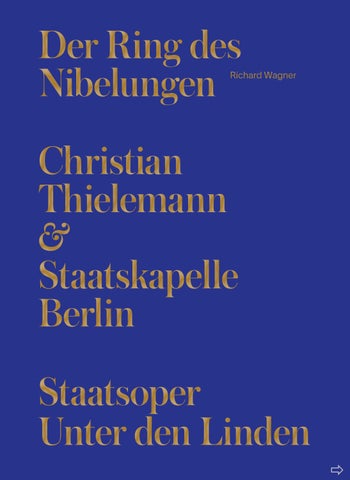
Festtage 2028 Der Ring des Nibelungen A Theatre Festival Play for Three Days and a Preliminary Evening Richard Wagner Christian Thielemann & Staatskapelle Berlin With Camilla Nylund, Klaus Florian Vogt, Christopher Maltman, Vida Miknevičiūtė, Stanislas de Barbeyrac, René Pape, Mika Kares, Sebastian Kohlhepp and many others Cycle 1 3 April 2028 4 April 2028 6 April 2028 9 April 2028
Das Rheingold Die Walküre Siegfried Götterdämmerung
Cycle 2 12 April 2028 Das Rheingold 13 April 2028 Die Walküre 15 April 2028 Siegfried 17 April 2028 Götterdämmerung
B
3 10 17 18 24 34
Editorial Wagner’s Ring at Staatsoper Unter den Linden Cast Voices from the Press Der Ring des Nibelungen at Berlin’s Opera House Unter den Linden — a Chronicle Booking Information
Welcome to Berlin, to the Ring at Staatsoper Unter den Linden! To experience Richard Wagner’s Ring des Nibelungen live in the opera house is always something special. The action unfolds over four parts, comprising three days and a preliminary evening, with a multilayered plot, a complex world of ideas and concepts, and remarkably impressive music. Wagner’s tetralogy is an unusual work, even a non plus ultra, a myth, a heroic epic, a family saga, and so much more. A monumental panorama of figures, situations, and events unfolds, borne by the truly profound subjects love and hate, trust and disappointment, envy and empathy, power and powerlessness, life and death, explored in ever new constellations. A great tale is brought to life, with many moments and developments that focus on the human, all too human, but always refer to spheres of nature, history, and the cosmos. In the spring of 2028, Wagner’s Ring will return to the stage of Staatsoper Unter den Linden for the Festtage in a production by Dmitri Tcherniakov, which had its successful premiere in 2022. Once again, Christian Thielemann will conduct Staatskapelle Berlin and an excellent ensemble of outstanding Wagner singers. This new Staatsoper Ring was celebrated by audiences and critics alike, and you can once again expect special evenings of outstanding artistry presented in two cycles, each performed within just one week: the poet-composer’s opus magnus in words, music, and staging. We look forward to this highlight of the Berlin opera season and a true celebration of opera itself. Yours sincerely,
Elisabeth Sobotka, Intendant Staatsoper Unter den Linden staatsoper-berlin.de/ring-2028
Christian Thielemann, General Music Director 3
4
Das Rheingold
5
6
Das Rheingold
7
8
Das Rheingold
9
Wagner’s Ring at Staatsoper Unter den Linden Conducted by Christian Thielemann, Staged by Dmitri Tcherniakov 10
The current Ring in the repertoire at Staatsoper Unter den Linden in the heart of Berlin first came to the stage in October 2022. From the very beginning, the decision was made to present the tetralogy in its entirety, with four premieres in just one week. This approach was inspired by the model of the Bayreuth Festival, while for repertoire opera companies, like Staatsoper Unter den Linden, it is standard to present the individual parts of the Ring successively, one after another. For example, the prior production of the Ring cycle was presented gradually over several years and finished in 2013, the bicentennial of Wagner’s birth. But this time was to be different, with notable challenges for the institution and its entire team. All available resources had to be mobilized to enable this undertaking; the daring attempt was then rewarded with great public success. A key intention of the new production was to amplify the cyclical aspect of the four parts of the Ring, emphasizing them accordingly. Dmitri Tcherniakov, who first staged an opera at Staatsoper in 2005 and since then has made a name for himself internationally with high profile, conceptually incisive works, was selected as the director and set designer. His characters always have to do with the here and now, as if they leapt out of the immediate present (or the recent past), with all their needs and fears, joy and suffering, and last but not least, with humor and irony. Dmitri Tcherniakov intensely investigates the subtexts of the libretti and the music, often arriving at surprising solutions that might not seem plausible at first glance, but are ultimately convincing. He developed the Ring cycle as a story that spans several generations, bearing traits of a family saga, but going far beyond that. The setting is a sprawling research institute populated by various people with the name E.S.C.H.E. (“Experimental Scientific Centre for Human Evolution”), where they work on nothing other but the future of humanity. It is a world of its own, hermetically sealed off from the outside, that serves as a playing field and surface for projection, with temporal spaces that continuously change over a period of several decades, just like the active and reflecting individuals, who age over the course of the four parts and often take on new characteristics. Events begin in the 1960s with Rheingold, continue in the 1990s with Walküre, then ending with Siegfried and Götterdämmerung in a time that is quite closely based on our present, but already lies in the past. Key here are the rich relationships between the figures that are explored 11
intensely, but also the mutual processes of attraction and rejection; Dmitri Tcherniakov’s self-conception and his practice as a director involve departing from standard conceptions and stagings in favor of unexpected, but quite insightful interpretations. The audience is invited to actively accompany and undergo the transformation processes of the stage design presented to their eyes and ears, the constellations of characters, and, of course, the Wagnerian music. After collaborating with Dmitri Tcherniakov on the great Wagner works Parsifal (2015) and Tristan und Isolde (2018) at Staatsoper Unter den Linden — in addition they had already worked together on several Russian language operas by Mussorgsky, Rimsky-Korsakov, and Prokofiev — Daniel Barenboim, who conducted the two prior Ring productions, suggested taking on the Ring as an especially ambitious project. For health reasons, Daniel Barenboim was forced to abandon the project in late summer 2022. With Christian Thielemann, a conductor was found who is certainly one of the best experts in the Wagnerian oeuvre and is considered one of the leading Wagner conductors of our time, not least due to his many years working with the Bayreuth Festival. The young conductor Thomas Guggeis (since 2023 General Music Director at Oper Frankfurt) took on a large part of the musical rehearsing, and he was entrusted with conducting the second cycle, while Christian Thielemann conducted the premiere series and the third cycle. The eagerly awaited performance was enthusiastically received by both the audience and the press. A highly motivated ensemble of outstanding Wagner singers, the excellent Staatskapelle Berlin and a conductor of the greatest competence and inspiration combined with an innovative and original production created a very special musical and theatrical experience. After the success of this new Staatsoper Ring, which was immediately recorded on DVD, an important artistic decision was made: Christian Thielemann, who had just a few months before conducted Staatskapelle Berlin for the first time, when he at very short notice stood in for Herbert Blomstedt, who had taken ill, to conduct Bruckner’s Seventh Symphony, was named Daniel Barenboim’s successor as GMD at Staatsoper Unter den Linden. In the fall of 2025, the start of his second season as GMD, he once again turned to Wagner’s Ring, an exceptional work that has a long and rich history at Berlin’s Staatsoper, that now has taken on new inspirations and will continue. 12
General Music Director Christian Thielemann
13
14
Die Walküre
15
Der Ring des Nibelungen Das Rheingold, Die Walküre, Sieg fried, Götterdämmerung
Text and music by Richard Wagner Conducted by Christian Thielemann Staged by Dmitri Tcherniakov With Camilla Nylund, Klaus Florian Vogt, Christopher Maltman, Vida Miknevičiūtė, Stanislas de Barbeyrac, Anna Kissjudit, René Pape, Mika Kares, Sebastian Kohlhepp, Stephan Rügamer and many others Staatskapelle Berlin Staatsopernchor Cycle 1 3 4 6 9 April 2028 Cycle 2 12 13 15 17 April 2028 Staatsoper Unter den Linden
staatsoper-berlin.de/ring-2028 16
Staatsoper Unter den Linden
17
Voices from the Press on Der Ring des Nibelungen Staatsoper Unter den Linden
A very exciting production! A triumph for the Staatsoper!
Neue Züricher Zeitung, 13 October 2022
Christian Thielemann conveys the listeners through the works as if on wings and soft mattresses. Berliner Zeitung, 5 October 2025
Electrified, I listened to the Staatskapelle, which under Christian Thielemann’s fierce conducting played in a simply enchanting way: with virtuosity and sensuality, charged with energy, beautiful in tone, emitting sparks. Tagesspiegel, 6 October 2025
Dmitri Tcherniakov’s production already met with “bravos” when the curtain fell. dpa, 3 October 2022
Tcherniakov, as usual, manages details on a level rarely seen in opera. The New York Times Online, 10 October 2022
Staatsoper Berlin’s Der Ring des Nibelungen will go down in history. The outcome is breathtaking. Financial Times Online, 11 October 2022
For a miracle has taken place at the Staatsoper. Süddeutsche Zeitung, 11 October 2022
18
19
20
Siegfried
21
22
Siegfried
23
Richard Wagner in Berlin & Der Ring des Nibelungen at Berlin’s Opera House Unter den Linden A Chronicle
24
1836 Richard Wagner comes to Berlin for the first time for negotiations on a possible performance of his opera Das Liebesverbot, but without success. 1842 After an extended stay in Paris, where he wrote both the libretto and music for Der fliegende Holländer, Wagner makes contact with Friedrich Wilhelm Graf von Redern, the artistic director at Berlin’s Court Opera Unter den Linden. Redern offers Wagner the opportunity to premiere his new romantic opera, but negotiations end without success, as do several talks with Redern’s successor Theodor von Küstner. 1844 After the successful world premiere of Der fliegende Holländer during the prior year in Dresden, the work now comes to the stage in Berlin as well. The venue is the Royal National Theater on Gendarmenmarkt: Wagner himself takes on the rehearsals and conducts four performances. Attendees
include Prussian King Friedrich Wilhelm IV and Felix Mendelssohn Bartholdy. 1847 Wagner conducts for the first time at the Berlin Royal Court Opera Unter den Linden. But his otherwise successful work Rienzi, which includes many elements of the grand opéra, meets with little response in Berlin, not unlike Der fliegende Holländer three years before. 1856 An additional Wagner opera is performed at Berlin’s Court Opera: Tannhäuser und der Sängerkrieg auf Wartburg. Since Wagner is exiled to Switzerland, he is unable to conduct himself. 1859 With the world premiere of Lohengrin, the trio of Wagner’s romantic operas in Berlin is complete. But the Prussian capital is still not a Wagnerian city. 1870 Just after the Munich world premiere, Die Meistersinger von Nürnberg is presented for the first time in Berlin, and 25
meets with a quite divided reception among the musical audience. Wagner attends the rehearsals: the performances are conducted by Carl Eckert, a conductor he holds in high esteem. 1876 The premiere of Wagner’s Tristan und Isolde in the spring is a great artistic and social event, again conducted by Carl Eckert. For the first time, Berliners now realize that Wagner’s operas and music dramas are quite epochal in significance. Wagner is received by Emperor Wilhelm I: he had honored him just beforehand with a Grand Festival March. In mid-August, the first Bayreuth Festival is opened with a cyclical performance of the complete, four-part Ring des Nibelungen. Hans Richter conducts, the overall artistic direction is placed in Wagner’s own hands. 1881 Wagner’s complete Ring tetralogy is performed for the first time in Berlin. In May, Prague theater director Angelo Neumann brings the complete opus to the stage 26
at the private Victoria Theater on Münzstraße near Alexanderplatz. Wagner and high-ranking representatives of the court are present. 1884 Die Walküre is the first part of the Ring to be performed at the Berlin Court Opera Unter den Linden. Botho von Hülsen, who had already served for thirty years as artistic director, does not dare a complete performance of the entire cycle, although he is convinced of Wagner’s extraordinary artistry. 1885 Siegfried, a second opera from the Ring, is rehearsed and performed at Berlin’s Court Opera Unter den Linden. 1888 After four years, the first performance of the Ring at the Court Opera is complete: After Das Rheingold makes it to the stage in April, Götterdämmerung follows in September. The conductor is the Wagner enthusiast Joseph Sucher, the first of an impressive series of conductors who have
dedicated themselves especially to the Wagnerian oeuvre. 1905 In late September, Karl Muck, the judicious and competent conductor of Parsifal in Bayreuth since 1901, conducts the premiere of a new production of Rheingold at Berlin’s Court Opera. In less than three weeks, premieres of the three other operas in the Ring cycle are performed. 1912/13 Leo Blech conducts a new Ring production with the forces of the Berlin Court Opera. Beginning with Rheingold in December 1912, performances of Die Walküre, Siegfried and Götterdämmerung take place on a monthly basis as of April the next year, and the tetralogy is completed by mid-June. 1928/29 Erich Kleiber and Leo Blech conduct the premieres of Wagner’s Ring alternately. Kleiber, who had been named General Music Director of the opera house Unter den
Linden, now renamed Staatsoper, in 1923, is responsible for performances of Das Rheingold and Siegfried, while Blech, who had been the conductor and general music director at the opera house for many years, conducts Die Walküre and Götterdämmerung. The productions are staged by theatrical director Franz Ludwig Hörth. 1933/34 With the newly appointed opera director Wilhelm Furtwängler at the podium, in November 1933 a new Berlin Ring cycle begins in chronological order, staged by Heinz Tietjen, the artistic director at the Staatsoper. A day after Rheingold, Walküre follows. Götterdämmerung premieres in October 1934, just a few days after Siegfried. These performances are a key contribution to Furtwängler’s reputation as the leading Wagner conductor of his time. 1956/57 The second season at the Staatsoper, now rebuilt after serious wartime damage, offers a new Ring production, staged by the well-known 27
Wagner singer Erich Witte. In November 1956 first Die Walküre is performed, conducted by general music director Franz Konwitschny. Das Rheingold, Siegfried and Götterdämmerung follow in the months from April to June the following year. As the season comes to a close, the first post-war Ring cycle is completed as an especially ambitious project.
The Ring cycle is completed with a production of Das Rheingold on March 28, 1996; the completed tetralogy is performed for the first time to mark the spring Festtage, newly established by Daniel Barenboim in 1996. Before this, both conductor and director had already collaborated at the Bayreuth Festival, where their joint Ring was shown from 1988 bis 1994.
1979 With Otmar Suitner as conductor and Ruth Berghaus as director, a new Ring cycle is begun. Ultimately, only Das Rheingold makes it to the stage, and is cancelled after just two performances. A complete Ring cycle does not take place because the production was vehemently criticized by cultural functionaries.
2002 The Berlin Barenboim-Kupfer Ring is part of a large cycle of Wagner’s ten major works, produced from the fall of 1992, starting with Parsifal (Barenboim’s very first opera at the Staatsoper), until 2001: for the Festtage in 2002, the entire cycle is presented twice in its entirety, an extraordinary undertaking that was extraordinarily successful.
1993–1996 Die Walküre premiere in December 1993 marks the start of the first Berlin Ring production conducted by Daniel Barenboim, directed by Harry Kupfer. In March 1993, Siegfried follows, Götterdämmerung is premiered in December 1995.
2010–2013 In the fall of 2010, a new Ring starts at the Staatsoper. A coproduction with Teatro alla Scala di Milano, the premieres take place in Milan and Berlin. The Berlin performances take place at Schiller Theater, the interim home of Staatsoper Unter
28
den Linden during general renovations. All four parts are produced and performed over three years, with the premieres of Siegfried and Götterdämmerung taking place in Berlin. The performances are once again conducted by Daniel Barenboim, the productions are staged by the Belgian director Guy Cassiers, who together with his artistic team from Toneelhuis Antwerpen takes on the scenic conception and design. For the Festtage in spring of 2013, the new Ring is performed for the first time as a cycle to mark the bicentennial of Wagner’s birth. In 2019/20, the production is then performed for the first time at the renovated new/old Staatsoper Unter den Linden. 2022 A new Ring cycle is prepared at Staatsoper Unter den Linden, conceived in such a way so that the four premieres can take place within just one week. The rehearsal process with director Dmitri Tcherniakov stretches across nine months. Stepping in for the indisposed GMD Daniel Barenboim, Christian Thielemann
conducts the premieres, while the young Staatsoper conductor Thomas Guggeis, primarily responsible for rehearsals, conducts the second performance of the cycle. The new production is performed four times during the season, and is featured at the Festtage in 2023. 2025 To open the 2025/26 season, Christian Thielemann, who had been named the new GMD at Staatsoper Unter den Linden the past year, conducts two cycles of the current Ring production directed by Dmitri Tcherniakov. With the ensemble of singers and Staatskapelle Berlin, which again displays its excellence as an ensemble that specializes in the Wagnerian sound, the scores are again rehearsed intensely, the same is true of the staging. 2028 Wagner’s Ring cycle will be presented once again to mark the Spring Festtage at Staatsoper Unter den Linden, once more conducted by GMD Christian Thielemann, with leading Wagner performers of our day. 29
30
Götterdämmerung
31
32
Götterdämmerung
33
Ring Cycles at the Festtage 2028 Cycle 1 Mon 3 April 2028 Tue 4 April 2028 Thu 6 April 2028 Sun 9 April 2028
Das Rheingold Die Walküre Siegfried Götterdämmerung
Fri
12 February 2027
Start of early advance sales
for members of the Friends & Supporters of the Staatsoper Unter den Linden, subscribers, and holders of a 2026/27 Staatsopern(Partner)Card Tue 9 February 2027
Advance bookings
E-Mail tickets@staatsoper-berlin.de Telephone ticket service +49 ( 0 ) 30 – 20 35 45 55 Mon – Fri 10 am – 6 pm (CET) Sat, Sun and public holidays 12 – 4 pm (CET)
Cycle 2 Wed 12 April 2028 Thu 13 April 2028 Sat 15 April 2028 Mon 17 April 2028
Price group* Prices in Euro
Start of regular advance sales
Das Rheingold Die Walküre Siegfried Götterdämmerung
I II III IV V VI VII VIII 1.200 1.000 840 600 400 240 160 100
The Ring performances can only be booked as a cycle. Ticket sales for individual events will begin at a later date. staatsoper-berlin.de/ring-2028
Offer for Travel Agencies
Please send us your booking requests for group reservations before the start of sales on 9 February 2027 to group-booking@staatsoper-berlin.de. Ring performances can only be booked as a cycle. The number of tickets is limited. Booking requests will be processed in the order in which they are received. We wil hold the tickets until 15 June 2027. The reservation period may be extended until 31 October 2027 for a 20% ticket surcharge.
* The general terms and conditions apply: staatsoper-berlin.de/en/extra/terms-and-conditions/. The organizer reserves the right to change its prices.
34
35
36
Staatsoper Unter den Linden
37
38
Staatskapelle Berlin
39
Edited by Staatsoper Unter den Linden, Berlin Intendant: Elisabeth Sobotka General Music Director: Christian Thielemann Managing Director: Ronny Unganz Texts by Detlef Giese / Dramaturgy, Staatsoper Unter den Linden, Berlin English translations by Brian Currid Photos by Monika Ritterhaus (production), Marcus Ebener (Staatsoper Unter den Linden) and Peter Adamik (applause), 2022, 2018 and 2025 Editorial deadline: October 2026 Layout: Vivien Roidinger, according to Herburg Weiland, München Print: Katalogdruck Berlin Staatsoper Unter den Linden Unter den Linden 7 10117 Berlin Germany marketing@staatsoper-berlin.de www.staatsoper-berlin.de
40