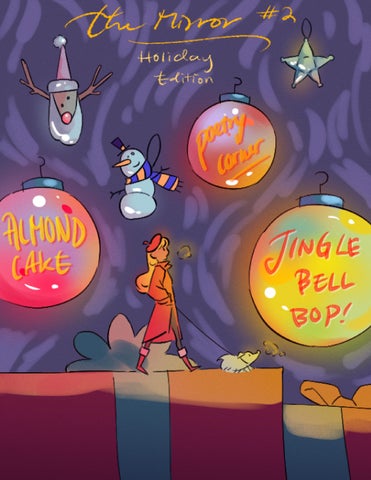
Christmas: Sacred Reverence or Cultural Sensation? By: Dominic Chan
Christmas is a time of joy and celebration that holds significant cultural and religious importance for people all around the world. This annual holiday has become a cultural phenomenon, observed by both the religious and non-religious alike. It is essential to delve into the multifaceted nature of Christmas, understanding its cultural and religious aspects, in order to grasp the full depth and meaning of this beloved holiday. By exploring both dimensions, we can appreciate how Christmas has evolved over time and recognize its diverse interpretations across different communities and beliefs. Christmas has gradually transformed into a secularized holiday in modern society. While its religious roots still remain prominent for many, the cultural aspects of Christmas have taken center stage. One significant figure that symbolizes Christmas in contemporary times is Santa Claus. This jolly, redsuited character has become synonymous with the holiday season, representing the spirit of giving and spreading joy. However, the secularization of Christmas is not solely attributed to Santa Claus. The holiday has also been heavily influenced by commercialization and consumerism. In today's society, Christmas has become intertwined with a flurry of shopping, gift exchanges, and extravagant decorations, oftentimes overshadowing its religious significance. The increasing focus on gift exchanges during Christmas has become a prevalent cultural tradition. This tradition carries a significant meaning, as it symbolizes love, generosity, and the spirit of giving. While gift-giving has always held importance during Christmas, its historical religious significance has taken on new dimensions in modern times. In religious contexts, gift-giving during Christmas reflects the offering of gifts to commemorate the birth of Jesus Christ and the presents brought by the three wise men.
2
However, the cultural aspect of gift exchanges has expanded beyond religious origins, becoming a cherished tradition that brings families and friends together to share joy and appreciation during the holiday season. Festive decorations play a prominent role in modern Christmas celebrations, creating a vibrant and joyful atmosphere. One of the most beloved and recognizable symbols of Christmas is the Christmas tree. Adorned with lights, ornaments, and garlands, the Christmas tree stands tall as a centerpiece in many homes during the holiday season. Alongside the tree, colorful lights illuminate neighborhoods, bringing an enchanting glow to the streets. These decorations have become integral components of the Christmas experience, captivating both young and old alike. The adoption of these traditions is influenced by a combination of cultural customs and commercialization. They have been embraced and popularized through various cultural influences and have become deeply embedded in our collective Christmas traditions. In conclusion, Christmas has undergone a significant secularization, shifting from its religious origins towards a more culturally-focused celebration. While its religious significance remains important to many, the cultural aspects of Christmas have become increasingly prominent in modern society. The ongoing debate between the cultural and religious significance of Christmas highlights the diverse interpretations and meanings attributed to this holiday. It is crucial to recognize and respect these different perspectives, as Christmas holds personal and communal significance for individuals from various backgrounds. Whether one celebrates Christmas as a religious observance or as a cultural tradition, the essence of this holiday lies in spreading love, joy, and compassion to others, fostering a spirit of unity and goodwill that transcends religious boundaries.
Welcome to the
Poetry Corner
Bloodied Blankets By: Mira Douglas
She wraps them in blankets of white, As the sirens pause for the night. Tears come down her face, As the media continues to neglect her case. The blankets soak in crimson blood, But the blood is on someone else’s hands. She stands up and wipes the dirt from her knees, For she will not let them take her dignity. One day the world will know the truth, But until then, they continue to steal her youth.
3
Memory Loss by: Rita Bhowmik
I was suddenly wishing For the absence Of things. I obsessively wanted Less and less, less things, and The more something reminded me of the past The more viciously I threw it away. Sentimentality became my most distressing enemy Instead of an old friend You had kept tolerating for a long time, for the sake of friendship I had filled up thousands of Plastic bags with old clothes I was going to throw away, lighters, notebooks I’ll burn every picture of you If it means I can forget forever But I could give away everything I owned The shirt I wore when I first met you, and The sheets of the bed we slept in, But I could not give away The city we lived in Every morning I have to wait behind the bus stop we kissed behind, and Sometimes I stare at the crumpled seats in the library and Flashes of you come back And only for a moment, in those flashes, you are still in love with me
4
I wait downstairs to open the apartment door for guests, sometimes my mind plays tricks on me, And I end up sitting on the bench outside for hours waiting for you. Old women with grayed hair are smoking cigarettes beside me They ask me who I am waiting for I so badly wanted to tell them your name, but for the life of me I couldn’t remember it The sun has set and it has been hours My father shakes me to consciousness, yelling, I don’t hear him He’s walking me back to the elevator By the shoulders like a patient, or an old woman I asked him where you are, and he told me, in Europe And then he told me that the doctor said that The grief my bones carry is unimaginable, unnatural, for a girl of my age And my memory, it gets worse by the day It seems I had the bones of an old woman, who has gone through all of life already At only sixteen you had ruined me to the point of decay Don’t you remember, you always used to tease me About having a short memory?
5
Almond Cake
BeBloelnogngs s ithnethe H in Hall alol f Foavf eFsaves!
Recipe by Azka Siddiqui
Ingredients Vegetable oil (½ cup) Butter - melted (6 tbsp) ¾ cup sugar 3 eggs - room temperature Buttermilk (½ cup) Flour (1 cup) Baking powder (1 ½ tsp) Vanilla extract (1 tsp) Almonds - chopped (½ cup)
Pan Prep: 8 Inch cake pan, parchment paper, 2 tbsp butter, half cup almonds chopped
Preparation 1. Preheat the oven to 360 degrees Fahrenheit and butter and flour a cake pan for the prepared batter 2. In a bowl beat together the oil and sugar, then add eggs and beat well. Add buttermilk and mix. Then add the sifted flour, mix, add baking powder, mix 3. Add vanilla extract and the chopped almonds, and mix until incorporated. Pour the batter into the prepared pan, add sliced almonds, and press a bit with a spatula. 4. Tap the pan twice to get rid of air bubbles. Bake at 350 for 35-40 minutes till a skewer comes out clean. 5. Take it out, and let it cool completely. Cut into slices and enjoy!
6
Christmas Truce of 1914 One of the things World War I was known for was the trench warfare. Armies would dig deep ditches and live out of them while simultaneously shooting at the enemy for months on end. There was always a shortage of food, and water would pool up in the trenches, making it impossible to stay dry. The conditions were inhumane. It had only been four months since the start of the First World War, and as December of 1914 rolled around, many people realized the war would not be over before Christmas. The soldiers soon accepted that they were going to spend the holidays in the trenches, away from their families. On December 7th of 1914, Pope Benedict XV suggested a temporary pause in the war to celebrate Christmas, but the military leaders refused this idea. Despite the encouragement from their leaders to continue fighting, the soldiers in the trenches decided that they were going to have their own unofficial Christmas truce. On Christmas Eve, the German and British troops along the Western Front began singing Christmas carols and shouting messages across the battlefield to one another. The British could see German soldiers rising from their trenches to put up Christmas trees, and these German soldiers also had a band to play music. December 25th, 1914 was the day of Christmas. German soldiers emerged from the trenches and walked into the middle of the battlefield. British and German troops met in No Man’s Land and began exchanging gifts with each other. They took photographs and exchanged cigarettes, British candies, German beer, and French wine. Some even played games of football. Both sides also took this opportunity to properly bury their casualties and repair the trenches.
By Isabella Bian The Christmas spirit was not just at this one battlefield. Word spread and several other truces sprang up across the Western Front in Europe.
British and German Soldiers Exchanging Conversations Not everyone wanted to participate in the truce, however. The fighting continued and casualties did occur on Christmas Day in other places. The Generals and World Leaders were extremely upset at this unofficial truce. War was expensive and they were worried the soldiers would become soft by making friends with the enemy. They feared the soldiers would not want to continue fighting after this. One German soldier, known as Adolf Hitler, said, “Such a thing should not happen in wartime. Have you no German sense of honor left at all?” in response to the Christmas truce. On December 26th, 1914, the Christmas truce officially ended, and the meetings in No Man’s Land dwindled down. Following 1914, the leaders made an effort to stop such truces from occurring again. Despite their efforts, there were a few rare instances of soldiers declaring temporary truces at other times during the war besides Christmas. 7
Best Christmas Activities to Do with Your Friends By: Gurnoor Bassi
Some A bsolute Must-T ries!
1. Christmas Movie Marathon! It wouldn’t be Christmas without watching classic movies like Home Alone. Grab some blankets and hot chocolate and start the marathon with classics like Home Alone, Christmas with the Kranks, Elf, The Nightmare Before Christmas, Home Alone 2: Lost in New York, and Good Luck Charlie: It’s Christmas!
2. Gingerbread House Decorating Competition! Visit your local superstore (ex. Walmart) and pick up a Gingerbread House of your interest. To make the competition entertaining grab some decorations like gummy bears, sprinkles, M&M’s, frosting, candy canes, Hershey's Kisses, marshmallows, etc. Split up into teams and whoever has the best-looking Gingerbread House wins!
3. Secret Santa!
8
Draw your names on separate pieces of paper and mix it up. Then, place the names in a container and have your friends randomly select a name. Whatever name you get you must buy a present for them. Create a budget and think of your secret santa’s favourite things. Wrap the gift up with bows and exchange them. The best activity to do!
4. Go Sledding! Another fun activity is sledding. Visit a local big box store (ex. Costco) and pick up a sled. Find a hill preferably with a lot of snow and start sledding! You can mix it up by who can go down the hill quickest, in partners, or individually. It is a fun Christmas activity accompanied by a lot of laughs!
5. Decorate a Christmas tree! Grab some decorations from a local Dollarama and start decorating! Listen to a Christmas playlist and start decorating with ornaments, an angel, colourful lights, ribbons, a star, etc. After, you can put your presents underneath the tree!
6. Christmas Karaoke! A great way to celebrate Christmas is karaoke. You can choose some of your favourite Christmas songs and sing! You can do duets and have a drink in your hands. It’s a great stress reliever and you get to show your talent! 9
Jingle Bell Bop! Why are Christmas Songs so Successful? By Hiba Muhammad
As the days get shorter and the nights get colder, the smell of cinnamon, cloves, and hot chocolate begin to waft through the air. This warm embrace announces to all that Christmas time is here! With the coming of yule-tide cheer, comes Mariah Carey’s discography in every department store known to man. No matter how many times we hear that same tune play, whether it’s “All I Want for Christmas Is You” or “Jingle Bell Rock”, we always manage to sing along to the inescapable lyrics. This is one Christmas miracle that leaves all of us rather vexed, leaving people thinking. Why is it that Christmas music is so ingrained into every one’s minds, regardless of their faith and beliefs? Why is it that Christmas music is so successful? Well to answer these questions, we will have to delve deeper into the history of Christmas, Christianity, and America. During his reign over the Roman Empire, the Emperor Constantine made Christianity the primary religion of the Empire. This decision conflicted with the centuries-long history of a pre-existing paganistic culture that once ruled the Empire. Christianity overshadowed this culture and positioned Christianity as a new, powerful religion. As the prominent power of the time, Rome’s religious change led to the spread of Christianity across the empire and past its borders, subsequently leading to different
10
Christian denominations to form all across the map. Roman Catholicism and Puritanism were the denominations which first introduced Christianity to the Americas during the colonisation of Native American lands. The melting pot of cultures which then boiled in the Americas led to an amalgamation of several Christian traditions anywhere from those in the Netherlands to those in France. Over the years, the traditions celebrated in North America today such as that of Santa Claus, and of neatly wrapped gifts under adorned evergreen trees, have been adapted from these many cultures. Christmas was not a particularly popular holiday at first, due to the conservative population of the U.S, but slowly Christmas traditions became integral to the Christian identity in America. This implementation of a new culture became a necessity since the pre-existing traditions of the land had been totally assimilated by the colonisers of the land, leaving no unique knowledge to pass on to the new generation of Americans being born. This meant Americans had to create their own culture and tradition. American culture centred around two things: individualism and freedom. Following the industrial revolution in the States, the opportunity for a prospering sense of freedom, specifically economic freedom, as an American became assured. During World War I, when the U.S.A’s economy boomed, the grandiosity of this individualism and freedom became inflated.
This set the stage for the U.S as the world power of the time. Then with the rise of globalisation at the turn into the 21st century, the U.S.A’s influence became internationally propagated through cinema, music, and other media. Although all of this history may be quite interesting to some, it had nothing to do with Mariah Carey, or whoever your favourite pop star is, until the world was in the era of WWII.
At the beginning of the 20th century up until after the second World War, antisemitism remained lingering in society, and Jewish people had trouble finding jobs where they were not the victims of discrimination. The music industry was not as restrictive and many Jewish people found their way to creating music. Ironically enough, many Jewish musicians wrote some of the most commercial Christmas songs in the world. Songs such as “Have Yourself a Merry Little Christmas”, “Rudolph the Red-Nosed Reindeer”, “Rockin' Around the Christmas Tree” along with plenty others were all written by Jews. At this point in time during the history of the West, the sense of an American identity had become strong, and like any strong nation, it projected its pride through nationalism. Taking this novel, wavering, American identity and
fortifying it through the sacred and knowledgeable power of religion, birthed the gleaming essence of patriotism. It is exactly this patriotism which runs through the veins of every Christmas song. Each song is also embellished with an additional flair of opulence and beauty. An example of this is in “Have Yourself a Merry Little Christmas” where the lyrics sing, “Once again, as in olden days / Happy golden days of yore / Faithful friends who are dear to us / Will be near to us once more”. The song uses golden imagery and describes faithfulness, connoting spirituality and wisdom offering the idea of an all-encompassing warmth found in other Christmas classics as well. This loving feeling creates one thing other than pride; it creates profit. By positioning the concept of an enlightened and gleaming world through a decadent American Christmas, patriotism is sold to the American public. It suggests that to be American is to be precious, free, unique, and knowledgeable. It denotes that the one thing that can truly unite people is that they are all American. This concept was especially enticing to marginalised communities of the time, including the Jews who wrote most of these memorable tunes. Nowadays, Christmas music is associated with nostalgic memories due to the connection to tradition which holds a velvet-like feeling in our minds. American patriotism is ingrained within Christmas media and is sealed, signed, and delivered through the world’s immense interconnection. By associating themselves with this patriotic and glamorous feeling, people from any background are united because they feel equally esteemed, free, and independent. They feel equally American. The entire success of Christmas music stems from three P’s. The three P’s being Power, Profit, and Patriotism. Flip to continue reading “Jingle Bell Bop!” 11
Power is the root of all motivation, because without the push from greed for power, there would be no one jumping to get to a higher prestige or a higher standard of society. Without a change in power, the Christianity could never have spread out of the Middle-East, nor could Christmas become the world-wide celebration it is today. Profit is another root branching off of the weeds of greed. Without profiting off of the need for an American culture, the traditions of Christmas would look very different and we would not have the Christmas music we listen to today. Lastly, patriotism is a core aspect of the success of Christmas music because it perpetuates patriotism, and builds pride and unity among a community. The three P’s are certainly interdependent. Without patriotism we would not be able to display a nation’s esteem, and without power there is no way to create profit, but without patriotism there is nothing to profit off of. Christmas music has become so iconic, full of so many successful bops that would never have influenced musicians and societies today if it weren’t for these three P’s. As the sun goes down earlier, day by day, and nutmeg scented candles fill homes with a sweet scent, Christmas time calls for some ambiance. Next time the sounds of Brenda Lee and Michael Bublé fill your home in December, think of how their voices sing the American identity into actualisation, and consider how we as Canadians fit into that picture. As Canadians, much of our society’s mindset and our nation’s identity is influenced heavily by the American identity. How does this correlate with our power as a nation? How can we, as Canadians, work to increase our own influence as a Western power, and how is this relevant to religion? Perhaps the cohesion of church and state was able to kickstart a power advantage for the U.S.A, but how can the connection between church and state affect North America in this modern age? 12
“The entire success of Christmas music stems from three P’s. The three P’s being Power, Profit, and Patriotism.”
Over the winter holidays, perhaps Santa could leave us some wisdom stuffed inside our Christmas stockings alongside some candy canes.
Cranberry Citrus Soap By Rebecca Field The rolling pin glides over the dough, smoothing it into a rough circle on my grandmother’s familiar countertops. I dip my fingertips into the small mountain of flour on the counter and brush the pads of my fingers lightly over the rolling pin, dusting the wood with the pale flour. Pressing the rolling pin back into the dough, I roll the pin steadily back and forth in every direction, just like my grandma taught me, until the dough forms a thin circle. “Is that good enough?” I ask, looking up at her for approval. She examines the dough, her eyes crinkling at the creases as she squints before smiling and nodding. “Perfect,” she beams, admiring my work. “Looks like all those afternoons we spent baking when you were little did teach you something.” “Maybe. But I think back then, I ate more chocolate chips than I actually helped,” I remark, a grin spreading across my face. I peer over my shoulder and gaze out the kitchen window for a brief moment. Snow falls in delicate, fluffy flakes outside the window sill in a graceful dance, bejeweling the branches of tired pine trees as they gently coat their canopies in a dazzling blanket. Just by looking at the thick layer of snow covering every inch of the backyard, I know it's the perfect kind—the fluffy packing snow that every kid always hoped for. The wooden drawer of my grandma’s quaint kitchen creaks as she slides it open and rummages through her collection of cookie cutters. She whips out her favorite Christmas tree cookie cutter and her face parts into a wide grin, her eyes twinkling with excitement as she bestows her prized possession before me. “Now, make sure you start at the edges of the dough and work your way inward,” she instructs me, motioning to the dough. I nod and press the familiar shape of the cookie cutter into the shortbread dough, wiggling the cookie cutter in place before gingerly transporting the first tree to the baking tray. As I methodically cut out the cookies, filling the tray with uniform rows of sugary Christmas trees, my grandma shuffles into Flip to continue reading “Cranberry Citrus Soap” 13
Cranberry Citrus Soap Continued...
the living room, her slippers squeaking against the hardwood floors. I hear the flick of a switch behind me, and in an instant, the room is filled with Michael Bublé’s voice singing “Holly Jolly Christmas” as she powers on the radio. We cut the cookies out together in a comfortable silence, the harmony of childhood Christmas songs and our soft humming the only sounds in the room. When we slide the tray into the oven, we both sigh in contentment as we watch our hard work bake in the oven. I look down, and notice I am completely covered in flour—from my hands to the hems of my jeans. My grandma gasps dramatically and I giggle at the powdery mess I’ve made. I wander into the bathroom to clean up and immediately notice the special Christmas soap my grandma always buys sitting by the marble bathroom sink. As the fragrance of cranberry-citrus scented soap fills the bathroom, I can’t help but smile to myself. For some time, Christmas hasn’t always felt like it did when I was a kid. Sometime during the turbulence of growing up, the magic of writing letters to Santa Claus, the uncontainable anticipation the night before Christmas, and the comfort of sipping hot chocolate heaped with marshmallows by the fireplace as I told my cousins about what Santa had left under the Christmas tree slipped away. Somehow, the magic of Christmas was replaced with the monotony of finishing assignments over the Christmas break, decorating the Christmas tree became a repetitive chore, and the shining allure of the holiday season dulled. Somehow, the once eagerly awaited holiday traditions became routine and the buzz of the Christmas spirit lost its charm. But as I wash my flour-coated hands under the warm tap water, the aroma of fresh shortbread cookies wafting under the bathroom door, I can’t help but feel the spark of the Christmas spirit I once felt reignite. I hear the clanging of pans rise from the kitchen and I know my grandma is pulling out her special cookie tin where, without a doubt, she will store away the shortbread cookies until Christmas morning in some concealed corner of her kitchen. And I’m hit with the feeling that maybe, just maybe, this Christmas really will feel like the ones from distant childhood memories.
14
Book Review: The Holiday Switch
By Riya Vachhani
Title: The Holiday Switch Author: Tif Marcelo Trope: enemies to lovers Rating:
Meet the Characters! Lila: hardworking, oldest sister, has a book review blog (Can you tell she’s my favourite character already?) Teddy: Ms. Velasco’s (Lila’s boss) nephew, rock climber Carmela/Carm: Lila’s best friend Plot Summary: While working at Bookworm Inn, Lila learns that Teddy will be taking her hours at the Inn (For context: Lila had picked up many hours during the winter break to pay for her tuition at her dream school). This taints Lila’s first impression of Teddy, and understandably so. The Holiday Switch follows the typical enemies to friends to lovers trope. Eventually the pair get to know the other better, and develop a romantic relationship. Review/Opinions: The plot itself was very predictable, but sweet— sometimes you just need a basic storyline. The characters all had their annoying moments, but they were overall lovable, with the exception of Carmela (Lila’s best friend). An incident at the very beginning of the book left me with a sour impression of Carm. Lila is struggling to make ends meet, all the white Carmela is pressuring her to go out and spend a bizarre amount of money on tickets to complete everything on their itinerary. Although I can understand where Carm was coming from, the constant nagging and guilt tripping was a bit much. Despite the book’s minor flaws, it was an enjoyable read as a whole. 15
Book Recommendations: 5 Novels that will Change the Way you View the World By Manuela D’Cunha
1. Tender is the Flesh - Agustina Bazterrica Originally published in Spanish in 2017 by Argentinian author, Agustina Bazzterica, ‘Tender is the Flesh,’ is a disturbing dystopian novel. It follows Marcos, a human slaughterhouse operator. Cannibalism is an institutionalized practice following the spread of animal viruses which led to the massacre of many animals. The book lays out a social hierarchy which separates the humans from the “head,” humans bred for consumption, raising a profound message about the social hierarchies that permeate our world today.
2. Travelers - Helon Habila ‘Travelers,’ a fictional novel by Nigerian author and professor Helon Habila, follows six interconnected journeys of Africans refugees and asylum seekers in or migrating to Europe. Habila recounts their challenges and triumphs as well as their reception in European society. All six stories are told through the eyes of an unmanned Nigerian protagonist who is a Phd candidate. The novel examines how race, class, and gender affect the ways individuals interact with European society.
3. Invisible Women: Exposing Data Bias in a World Designed for Men Caroline Criado Perez British feminist Caroline Criado Perez’s book, ‘Invisible Women: Exposing Data Bias in a World Designed for Men,’ Perez investigates the manner in which women and the world interact with each other in comparison to men. The book traverses inequalities in areas such as urban planning and design, automobile manufacturing, childcare, parental leave, medical care, pharmaceutical research and much more. 16
4. Piranesi - Susan Clark ‘Piranesi,’ a fantasy novel by English author Sussana Clarke follows the protagonist Piranesi who lives in a caved labyrinth. There is only one other individual who resides in the cave called ‘The Other.’ The Other visits Piranesi twice a week, enlisting his help in research on “A Great and Secret Knowledge.” Piranesi is a novel seeping with imagery and is best read with a shroud of mystery. I promise it’s worth the initial disorientation!
5. Earthlings - Sayaka Murata ‘Earthlings,’ a novel by Japanese author Sayaka Murata, follows the protagonist, Natsuki, throughout her life, starting at the age of 11. The jarring book explores the expectations placed upon children and the way that they grow into adults. Beware that this book navigates heavy subject matter and the plot often twists in unexpected directions.
17
from
18