L I B R A R Y N E W S L E T T E R

L I B R A R Y N E W S L E T T E R
Our new catalogue for manuscripts and archival material is now live online at https://archives.joh.cam.ac.uk. The catalogue provides access to descriptions and records for five main collections:
College archives, including the records of St John’s Hospital, Lady Margaret Beaufort, and the College’s institutional archives;
Personal papers, featuring documents, letters and research papers relating to over 130 Johnians, from William Wordsworth, Brook Taylor and William Selwyn to Fred Hoyle, Samuel Butler and Paul Dirac, as well as thematic collections such as the Napoleonic War and the Slavery Abolition Movement;
The Eagle, offering access to digital scans of the printed issues of the College magazine from 1858 to the present day; Art and artefacts, with entries for paintings and objects belonging to the College;
Medieval and post-medieval manuscripts, including detailed records of nearly 280
medieval manuscripts in the Library’s collection, 500 post-medieval manuscripts, and 50 nonWestern manuscripts written in a variety of languages and scripts (including Arabic, Hebrew, Coptic and Greek).
The Library and Archives team has started to upload digital scans of its treasures, and while this is definitely still work in progress, if you browse the Art and artefacts and Medieval manuscripts sections you will find a few images of oil paintings, and three manuscripts that are fully available to browse: the Book of Hours of Lady Margaret Beaufort (MS N.24), Christine de Pisan’s Epistle of Othea (MS H.5), and the Holland Psalter (MS K.26). Make sure you set some time aside to immerse yourself in the beauty of their illuminations! Over the coming months, we will continue to expand the catalogue by adding records, linking images, and enhancing descriptions. We hope you will find the new catalogue a useful resource for both academic research and wider intellectual curiosity.
Maria Giovanna De Simone, Special Collections Librarian (maternity cover)
On a chilly day in early May I said goodbye to Trinity College Library and joined the Library and Archives team here at St John’s, where I will spend a year covering for Lucille Munoz’s maternity leave before returning to my previous post. Although it still feels a bit odd and I occasionally still talk about Trinity in terms of ‘ we ’ , my allegiance is swiftly changing, and I am becoming more Johnian by the day. The special collections here have no reason to feel any less than others, as the Old Library is rich with treasures, from medieval manuscripts to printed books to personal papers, which I feel very privileged to care for.
My love for libraries stems from an encounter with a French medieval manuscript during my undergraduate studies in Italy, and a subsequent desire to work closely with this kind of material; something I had the chance to do in my work for Trinity, where I also developed the strong interest for early printed books that allowed me to become the Wren Library’s Rare Books Cataloguer four years ago.
With the help of Adam, the Special Collections Assistant, and Clarck Drieshen, who will join us in early July when Adam goes on parental leave, my role is to manage the St John’s special collections and a reading room which welcomes researchers from Cambridge and beyond. It is an incredibly varied role, encompasssing conservation, access,
promotion, digitisation, exhibition work and more, where no day feels the same. A lot of exciting projects have been started by the team here, and I am very keen to make sure they continue to develop so that we can offer our readers and scholars the best possible access to our collections. I am looking forward to what the next months will bring. In fact, this is already an amazing opportunity for me, and I am already enjoying working with such a knowledgeable and committed team and a beautiful collection.
Maria Giovanna De Simone, Special Collections Librarian (maternity cover)
In 1552 Katherine Brandon (née Willoughby), Duchess of Suffolk, donated land in Suffolk to St John’s, the profits from which were to be used to fund four exhibitions for poor scholars. Original documents relating to this benefaction are preserved in the College Archives in the School of Pythagoras, as is a small amount of correspondence between Katherine and the College.
The only surviving child of the Baron Willoughby de Eresby, Katherine inherited her father’s title and lands when she was only seven, and her wardship was sold by the King to Charles Brandon, Duke of Suffolk. A popular history podcast halfjokingly sounds a ‘problematic marriage klaxon’ when events like the following inevitably occur: aged 14, she was married to the 49-year-old Duke, a month after the death of his previous wife, King Henry VIII’s sister.
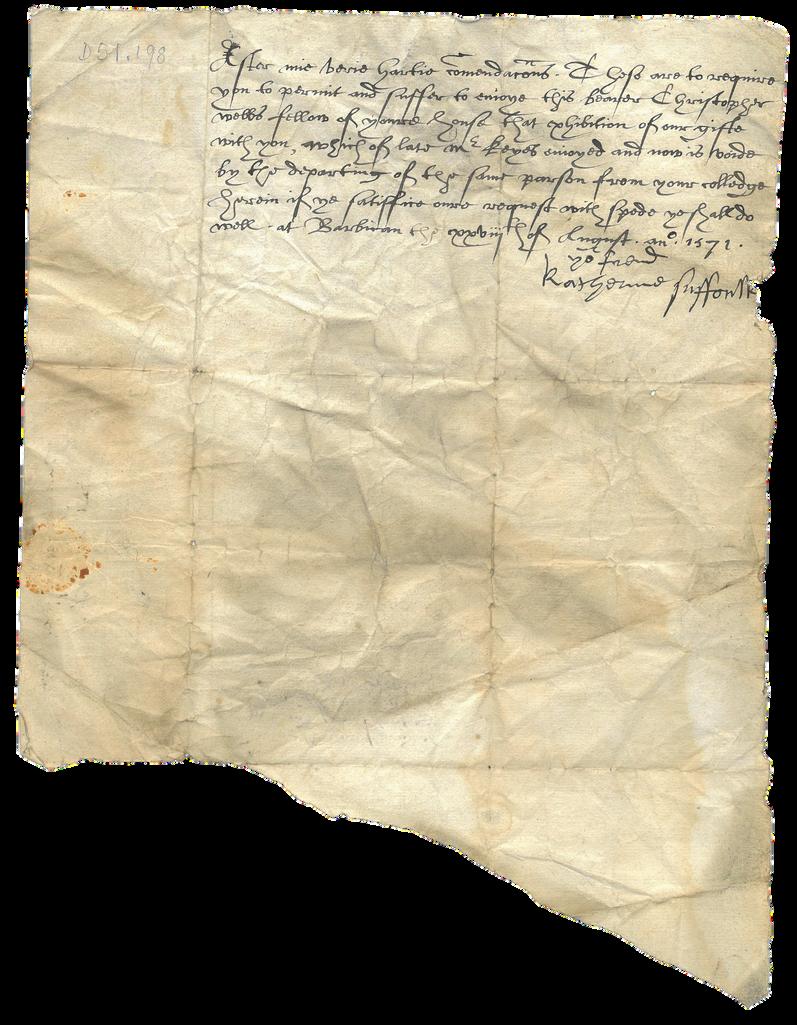
Letter from Katherine, Duchess of Suffolk, to the Master and Seniors of St John's, requiring them to award one of her exhibitions to Christopher Webb, Fellow of the College. 1571.
Both Katherine´s sons by this marriage attended St John’s, but extremely sadly they died, of the sweating sickness, within an hour of each other in 1551. Her donation to the College the following year was in their memory. Katherine’s connection with St John’s began years before her sons entered the College. In the archives there is a letter from the Master, John Taylor, written at some point between 1539 and 1545, in which he asked that she exercise her influence with her husband to procure a church living for him.
Also in the archives are letters from Katherine written in the 1570s. Two are to John Hatcher, a distinguished Fellow who in 1579 became ViceChancellor of the University. A third looks as though it was scrunched into a ball, then smoothed out: it’s remarkable it survived at all. This instructs the College to grant one of the exhibitions to a Fellow, who had graduated the year before. Those few Tudor women who were wealthy enough to exercise patronage would inevitably have had a mixture of motives. The tragic circumstances that led to Katherine’s gift highlight the heartfelt and personal aspect of Early Modern gift-giving, but as this letter shows, benefactors at the time would always have used their donation as a means to wield influence.
Lynsey Darby, Archivist
After more than a decade, the Library’s Sponsor a Shelf scheme is coming to a close. As we look towards the future of the Library and its collections, we wanted to take a moment to reflect on the extraordinary generosity that has sustained the scheme over the years, and to express our sincere gratitude to all those who have contributed to it.
The Sponsor a Shelf scheme was created as a way for Johnians and supporters to contribute directly to the growth of the Library’s collections by symbolically sponsoring a shelf, or “adopting” books in subjects close to their interests. Throughout the years, donors contributed to the scheme through monthly, quarterly, or annual gifts, helping the Library continue to develop its collections for both teaching and research.
Thanks to this generosity, the scheme has helped us strengthen and enrich the Library’s collections across a remarkable range of subjects. New acquisitions supported through Sponsor a Shelf have included books in Medicine, Literature, History, History of Art, Engineering, Chemistry, Biochemistry, Computer Science, Linguistics and Languages, Human Geography, Modern History, Political Economy, Law, Music, Plant Biology, Classical Archaeology, Physics, Mathematics, and many others.
Among the many titles acquired through the scheme are works such as The Painter’s Touch, Epic Iran: 5000 Years of Culture, The Silk Roads, Modern Operating Systems, Atkins’ Physical Chemistry, An Introduction to Middle High German, and Her Secret Service: The Forgotten Women of British Intelligence
The scheme has supported a wide range of materials, from core undergraduate texts and language resources to a broad range of academic works and interdisciplinary studies.
Just as importantly, Sponsor a Shelf has represented a meaningful connection between current and past Johnians, the wider St John’s community, and the life of the Library itself, helping generations of readers remain connected to the collections and to the College.
Many donors remained committed to the scheme from its beginning in 2015, continuing their generosity faithfully until the very end. In some cases, involvement in the scheme became deeply personal and intergenerational, continuing across families and in memory of loved ones. This longstanding affection for the Library has helped generations of students and researchers benefit from new resources and collections.
As the needs of the Library continue to evolve, we have taken the decision to bring the scheme to a close and move instead towards
more flexible forms of support. Future donations to the Library Fund will allow us to respond more directly to changing priorities across all three areas of the Library: the Working Library, Old Library and Archives. This includes enhancing our collections and research materials, improving student study spaces and facilities, investing in equipment and resources, and supporting outreach work through the Old Library.
We would like to offer our heartfelt thanks to everyone who has contributed to the Sponsor a Shelf scheme over the past 10 years. Whether you have been with us for a single year or for more than a decade, the scheme has been shaped by your generosity and belief in the importance of libraries and learning. While the structure of the scheme may now be changing, its impact on the life of the Library will remain. Your generosity has supported a vital space at the heart of College life, serving students, researchers, Fellows, and visitors. Your contribution has left a lasting and tangible mark on our shelves and our readers, and we are deeply grateful for the role you have played in supporting this community.
Chiara Avagliano, Library Assistant
Josie Fairley Keast, Early Career Librarian