Volume 55.7 October 2026
The State School Teachers’ Union of W.A.
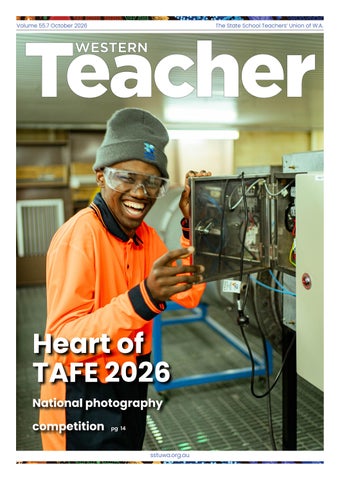
Heart of TAFE 2026 National photography competition pg 14 sstuwa.org.au
SSTUWA app
Know Your Rights, tax statement, membership card and more Introducing the SSTUWA super app
Get the app
2
Western Teacher
October 2026
In this edition
Volume 55.7 October 2026
In this edition Correspondence:
The Editor, PO Box 212, West Perth WA 6872 editor@sstuwa.org.au | Ph: 9210 6000
Member Assist:
Ph: 9210 6060 memberassist@sstuwa.org.au Print post publication 100004470 | $4.95 ABN: 544 780 946 35 Authorised by the State School Teachers’ Union of W.A., 1 West Street, West Perth WA. Printed by Vanguard Press, 26 John Street, Northbridge WA. October 2026.
Cover: The WA winner of the Heart of TAFE National Photography Competition, Never a Dull Moment by Nissi Chapfika, from South Metropolitan TAFE in Carlisle. Read more on page 14. To access the digital copy of Western Teacher, visit: sstuwa.org.au/westernteacher
Connect with us: @sstuwa
Features
Edition
Deadline
February
8 December
March
2 February
April
9 March
May
7 April
Facing the Facts about professional learning for school leaders and teachers - Part One...................................9 Don’t swim alone.................................................... 10 PISA results show deep inequality for Australian schools.......................................... 11 Recognising National TAFE Day.................12 TAFE Know Your Rights: Bulk leave, Christmas closedown and LWOP............13 2026 Heart of TAFE national photography competition............................ 14 District Councils meet across the State...........................................................................17 The standard you walk past is the one you accept............................................. 18 A day in the life of a teacher in Ukraine.......................................................................20 WA private schools funding advantage over public schools.............22
July
2 June
Regulars
August
6 July
September
10 August
October
14 September
December
2 November
2026 Western Teacher dates
Dates are subject to change
From the President..................................................5 From the Senior Vice President..................6 From the Vice President.................................... 7 From the General Secretary..........................8 Education and Training...................................28 Member Benefits....................................................30 Classifieds....................................................................32 Noticeboard................................................................34
Advertisements in Western Teacher are the responsibility of advertisers. While Western Teacher makes reasonable efforts to ensure that no misleading claims are made by advertisers, responsibility is not accepted by The State School Teachers’ Union of W.A. for statements made or the failure of any product or service to give satisfaction. Inclusion of a product or service should not be construed as an endorsement or recommendation by The State School Teachers’ Union of W.A.
Western Teacher is the official publication of The State School Teachers’ Union of W.A.
Acknowledgement of Country: We wish to acknowledge the traditional custodians of the land on which we live and work. We wish to pay respect to their Elders – past, present and future – and acknowledge the important role all Aboriginal and Torres Strait Islander people continue to play within Australia. We stand in solidarity. Artwork: This design was created for the SSTUWA by Tyrown Waigana, a Wandandi Noongar and Ait Koedal artist/designer and former WA public school student. Read more about the artist and the artwork at sstuwa.org.au/connections
Now available for SSTUWA members:
Union Shopper A four-person household can save over $2,500 a year just by using Union Shopper. Register today to start saving! Register today
sstuwa.org.au/UnionShopper
Free access with your SSTUWA membership
Western Teacher
October 2026
3
Frida y 30 October wtd.edu.au
From the President
Teachers deserve trust, respect and recognition By Matt Jarman President
Teachers deserve trust, respect and recognition. They are highly skilled professionals who are committed to giving every child the best possible start in life. Yet in Australia recently, teachers have instead found themselves targeted by several conservative politicians. First, the controversial Far Right politician Pauline Hanson called for parents to confront teachers in schools over unfounded and ignorant claims that our education system is brainwashing students. Next, the Nationals Party leader Matt Canavan claimed there is a “feminisation” of the curriculum and that boys are not given any instruction or leadership. Then, the Leader of the Opposition Angus Taylor claimed there is a political agenda and politicisation of the Australian curriculum. These comments are either a malevolent mischaracterisation of Australia’s education system for political gain, or a display of complete ignorance of how the teaching profession operates. They show a fundamentally incorrect portrayal of how the Australian curriculum is delivered. Australia’s curriculum is designed and reviewed by the statutory authority ACARA, based on broad consultation with the sector and the public, and requires approval from Education ministers from all jurisdictions. For a prominent politician to urge parents to go into schools and confront teachers and principals, undermines the important partnership between parents and their children’s school. Further, it could actually place teachers in a dangerous situation where conflict and aggression may be exhibited by parents. It is disappointing and concerning to hear a senior politician suggest that the “feminisation” of schools is the cause of the challenges young male
students are facing today, which is not based in any fact or evidence. Boys are increasingly being exposed to misogynistic content online, and some of those attitudes are showing up in our schools in disturbing views about male superiority. Young men are being targeted by algorithms with hateful content towards women and girls. The Australian Government has introduced a world’s-first Digital Duty of Care legislation, which will include the ability to turn these algorithms off. This is an important next step in the process of keeping our children safe online. This joins the Australian social media ban for under16s introduced last year. But children are also dealing with cyberbullying, online harassment, sexualised content, body image pressures, mis and dis-information, extremist material and a constant algorithmdriven distraction that is creating device addiction in children. Greater restrictions on algorithms are necessary. The AEU supports strong, enforceable obligations on tech companies to prevent foreseeable online harm to our children and young people. Australian teachers are dealing with more than just political attacks and algorithms poisoning the minds of students. They are dealing with increasing complexity in classrooms, with growth in inequity and students with diverse needs requiring additional supports. They are managing increasing administrative demands, behaviour and wellbeing issues, alongside their core job of teaching. Australian teachers are doing this against a backdrop of rising aggression from students and parents, and an increasing lack of respect. It is clear that political attacks and algorithm-fuelled hate is making these
matters worse. They weaken trust in teaching, make it harder to recruit and retain teachers, and undermine the education system as a whole. Australia has an unacceptably large gap between socio-economically advantaged and disadvantaged students, with a higher proportion of students from lower socioeconomic backgrounds attending public schools. All governments must ensure that public school investment is properly targeted, students get the teaching and learning support they need and teachers get the support and respect they deserve. Teachers don’t need lectures from politicians about how to do their jobs. They need respect, they need trust, and they need governments to recognise that investing in teachers is an investment in every child and in the future.
Log of Claims update
At the time of writing, the SSTUWA Schools bargaining team has completely presented the 2026 Log of Claims. The negotiating team of the President, Vice President and General Secretary have not been called back for further discussion and so we await an offer from the employer. Since the Log was first presented, cost of living pressures have in no way abated for most West Australians. In many ways they have become worse, as evidenced by another increase in official interest rates. This, at the same time that the state government recorded a better-thanexpected increase in the budget surplus of an additional $684m windfall, taking the surplus from an expected $3.5b to $4.2b. Of equal importance is the improved state debt position, which is also lower than expected by $1.1b. When an offer is received, members will be informed through eNews.
Western Teacher
October 2026
5
From the Senior Vice President
Misogyny is not part of the job By Jonelle Rafols Senior Vice President
Every SSTUWA member has the right to feel safe, respected and valued at work whether in a school classroom, a TAFE workshop, an office or a leadership position.
communication. Casual, fixed-term and part-time members may be reluctant to report incidents because they fear being labelled difficult, losing future work or damaging opportunities for permanency.
Reporting an incident, seeking support
Yet members across schools and TAFE are encountering sexist attitudes, gendered abuse, sexualised behaviour and intimidation. While women are disproportionately targeted by misogyny, its effects are felt across entire workplaces and students.
No member should have to choose between challenging unacceptable conduct and protecting their employment.
or lecturer be expected to remain in
We must be unequivocal: misogyny is not poor behaviour that educators should be expected to manage. It is not harmless banter and must never be dismissed as “part of the job”. When misogyny enters our schools and TAFEs, it becomes an industrial and work health and safety issue. In schools, members may encounter sexist comments, sexualised language and challenges to women’s authority from students, parents or colleagues. The influence of the online “manosphere” has added another dimension. Attitudes promoted online do not remain behind a screen. They enter classrooms and shape how some young people view women, authority, relationships and power. TAFE members face many of the same issues. Women teaching in maledominated industries may have their expertise questioned or feel required to prove that they belong. Experienced lecturers can face assumptions about their knowledge and capability that are not directed at male colleagues. Sexist language, harassment and inappropriate conduct may come from students, colleagues, managers or people connected with industry. It can occur in classrooms, workshops, offices, during placements or through online 6
Western Teacher
October 2026
Addressing misogyny is everyone’s responsibility. Male members are important allies in challenging sexist behaviour, supporting colleagues and helping create respectful workplaces. However, responsibility for preventing and responding to workplace misogyny ultimately rests with the employer, not with individual members experiencing or witnessing it. Employers must identify psychosocial hazards, assess the risks and take practical steps to eliminate or minimise them. Waiting until a member has been seriously harmed is not prevention. Every education workplace should have clear processes for reporting gendered abuse, harassment and aggression. Members must be confident that reports will be recorded, investigated and acted upon, and that they will be supported and protected from victimisation. This requires clear behavioural standards for students, parents, industry representatives and others entering our workplaces; consistent consequences for serious or repeated misconduct; confidential reporting processes; training for managers; and protections for insecure workers. Employers must also consult workers and health and safety representatives, and record incidents so emerging patterns cannot be ignored. Workload must also be considered.
and participating in an investigation
take time. This work cannot simply be added to an already unmanageable
workload. Nor should an affected teacher unsafe circumstances while a matter is considered.
These issues are relevant as the SSTUWA negotiates new General Agreements for schools and TAFE. Bargaining is not only about salary. It is also about securing
conditions that allow members to work safely, professionally and with dignity. Workload protections, appropriate staffing, job security, consultation,
effective reporting systems and employer accountability all contribute to safer workplaces.
We need to hear from members. If you
experience or witness sexism, misogyny, sexual harassment or gendered
aggression at work, or believe an incident has not been handled appropriately,
contact Member Assist. You can also
make a report to the union by completing a violent incident form at sstuwa.org.au/
member-groups/workplace-health-andsafety/violent-incident-report-form
Members’ experiences help the SSTUWA identify systemic problems, advocate
for safer workplaces and strengthen our position at the bargaining table.
No member should be left to manage these risks alone. Misogyny requires
employer accountability, strong industrial protections and collective action. Misogyny is not part of the job.
From the Vice President
Gender-based violence is a
responsibility for all By Sharmila Nagar Vice President
In December 2022, “positive duty” was introduced into the Sex Discrimination Act 1984 (Cth). But what is positive duty? It is the duty by the “persons conducting business or undertaking” to eliminate unlawful sex discrimination in a workplace. As outlined by the Australian Human Right Commission (AHRC), this includes:
•
Discrimination on the ground of sex in a work context.
•
Sexual harassment in connection with work.
•
Sex-based harassment in connection with work.
•
Conduct creating a workplace environment that is hostile on the ground of sex.
•
Related acts of victimisation.
In their fact sheet on positive duties, the AHRC also summarises whose behaviours the positive duty covers:
•
Employers or people running an organisation or business.
•
Employees, workers and agents.
•
Some third parties - such as customers, clients, patients, students, members of the public and others towards employees and workers in connection with their work.
Furthermore, these unlawful behaviours may happen during or after work hours, working remotely, at staff social functions, during breaks, between workers outside the workplace or hours and also during work-related travel. It is crucial to know that these incidences are not guaranteed just to work colleagues but can include (as stated above) students too. The SSTUWA has raised positive duty
requirements on several occasions with the Department of Education (DoE) and also our ongoing concerns regarding gender-based violence. Gender-based violence disproportionately impacts female teachers and girls in schools. It is not the responsibility of our women members to advocate for change, but a collective societal responsibility. This is a work health and safety issue, as is any form of violence, and that is the way the SSTUWA will continue to raise gendered violence in this context. We know that the rise in online misogyny and the manosphere has impacted the safety of women, girls and LGBTIQ+ people in schools. Manosphere refers to online content targeted to men and boys, promoting negative views about feminism. Homophobic views often based on farright ideology. Alarmingly, this content is infiltrating our school yards and classrooms. The Australian Education Union’s (AEU) commissioned research Duty of Care – Teachers’ experiences of sexism, misogyny and sexual harassment in Australian schools (bit.ly/4y7snjw) is a sobering report stating that “sexism, misogyny and sexual harassment are entrenched features of Australian school workplaces and classrooms.” Approximately 2,700 AEU members, including SSTUWA members, participated in this research; making it the largest study of gender-based violence in Australian schools. The SSTUWA supports all six recommendations in the report: 1.
2.
That Australian Governments urgently address workplace health and safety (WHS) requirements and establish effective policy and protocols to support the education system. That Australian Governments act to strengthen the gender safety of the teaching profession by addressing structural sexism through fair pay and conditions, secure and flexible
employment and greater gender equity in leadership. 3.
That Australian Governments strengthen the regulatory response to psychosocial hazards.
4.
That Australian Governments ensure adequate access to workers’ compensation for teachers who have experienced workplace sexual and gender-based harassment and other forms of gendered occupational violence.
5.
That Australian Governments adequately resource whole-school implementation of Respectful Relationships Education (RRE) that is embedded across curriculum, leadership, policy, professional learning and school culture.
6.
That Australian Governments must urgently and effectively regulate social media platforms to intervene in the significant harm that occurs as a result of their business models. This work should be undertaken in collaboration with the eSafety Commissioner to provide best practice advice and implementation tools to ensure online safety.
Currently in schools, consent education is covered in Health and Physical Education and some schools in WA participate in the Respectful Relationships teaching support program. The union knows this is not enough to combat gender-based violence and safety. A start would be for the DoE to establish its positive duties policies and procedures. Positive duty procedures will be essential in schools by replacing a reactive approach to gendered violence with a proactive commitment to prevent it, thus protecting staff, strengthening school culture, and creating safer workplaces before harm occurs.
Western Teacher
October 2026
7
From the General Secretary
Unpaid work hides the workload crisis By Sally Dennis General Secretary
Across our schools and TAFE colleges, members consistently identify workload as one of the greatest challenges facing public education.
workload is manageable. The work gets done, the deadline is met and the system continues while the personal cost to members remains largely invisible.
School leaders, teachers, TAFE lecturers and other education professionals are working under increasing pressure. Administrative and compliance demands continue to grow, student needs are becoming more complex, and members are expected to introduce new programs and systems often without sufficient time, staffing or resources.
This makes it more difficult for the union to demonstrate the extent of the problem and negotiate meaningful improvements.
Too often, members respond by working longer hours. Work is taken home at night. Weekends are spent planning, preparing, assessing and responding to emails. Meal breaks disappear and leave periods become opportunities to catch up on tasks that could not be completed during paid working time. This reflects our members’ extraordinary commitment to their students and public education. However, that commitment must never be taken for granted or exploited. Unpaid work hides the true extent of the workload crisis. When additional work is completed quietly and outside paid hours, the Department of Education, TAFE colleges and government do not see the full impact of their decisions. Unpaid work conceals understaffing, inadequate resources, unrealistic deadlines and excessive administrative demands. It allows an unsustainable system to appear as though it is functioning. If members continually absorb extra work, employers may assume that the 8
Western Teacher
October 2026
We need employers to see the work that is not being properly recognised, resourced or paid. We need evidence of where workload pressures are occurring, what is causing them and how much additional time members are being expected to contribute. If your workload cannot reasonably be completed within your paid hours, record it. Note the additional duties involved, the time they require and the impact on your teaching, your students and your wellbeing. Raise the issue in your workplace and discuss it with your union representative. Most importantly, contact your SSTUWA Organiser. Organisers need to hear directly from members about what is happening in schools and TAFE colleges. They can provide industrial advice, help members raise concerns appropriately and identify patterns occurring across multiple workplaces. One member’s experience may reveal a much broader problem. When members report similar concerns, the union can build the evidence needed to pursue workload issues with employers and strengthen our position in negotiations. Providing this information is not complaining. It is an essential part of protecting your rights and supporting your colleagues. What may feel like an
individual struggle is often a systemic industrial issue that should not be carried alone. Members should not be expected to compensate indefinitely for systemic failures through their goodwill and personal time. This does not mean abandoning our commitment to students or leaving essential work undone without explanation. It means being honest about what can reasonably be achieved within the time and resources provided. It means raising concerns before an unreasonable expectation becomes an accepted practice. It also means seeking union advice when you are uncertain about your rights, responsibilities or how to respond. There is strength in members acting collectively. It is much easier for an employer to dismiss an isolated concern than consistent evidence from members across schools and TAFE colleges. As negotiations for our school and TAFE agreements continue, your experiences matter. Workload claims must be supported by clear evidence of what members are being required to do and the unpaid hours being used to keep the system operating. Please tell us what is happening in your workplace. Keep a record of excessive workload, speak with your union representative and contact your SSTUWA Organiser. Your time has value. Your work has value. Protecting both begins by making unpaid work visible.
Issues
Facing the Facts about professional learning for school leaders and teachers Part One By Lindsay Hale School leaders’ consultant
Facing the Facts told us that “WA teachers’ workload and workload complexity would be improved by free, WA based and high-quality shared curriculum resources and well-supported professional development.” Dr Lawrence and her panel reported that teachers “are critical of the widespread use of costly commercial curriculum support materials” and found that “appropriate programs of professional learning about curriculum and pedagogy for teachers at all stages of their careers … should be made available by the WA Department of Education in face-to-face settings at a local level.” These noble goals remain distant. Meanwhile, school leaders need to make the best decisions they can about dedicating scarce resources to muchneeded professional learning and support in their context. We need to face the facts about what sound and effective professional learning looks like. The best professional learning is: •
Aligned with ethical purpose and vision.
standards and implement a shared vision for student success.
improving student learning, engagement
This starts with compliance with the Schools General Agreement 2023, including requirements that professional learning develops the capability of school leaders and teachers to deliver curriculum and pedagogy to suit the needs of students and that it includes an element of staff member choice.
Evidence-Based, DataInformed and Measurable
Professional learning should address equity, cultural responsiveness and inclusion, advancing strategies to ensure fair, culturally responsive and trauma informed practices that close gaps for students and for staff.
and review.
Professional learning should be aligned to national standards, ensuring coherence with nationally agreed expectations for leadership and teaching practice and support teacher registration and career progression. All professional learning must be consistent with the system-level objectives of public education as well as individual school improvement strategies, school plans and positive school culture.
•
Focused on teaching and learning.
Professional learning must, in turn, be supported by strategic change management, operations and culture.
•
Evidence-based, data-informed and measurable.
Focus on Teaching and Learning
•
Consistent with principles of effective adult learning.
•
Sustainable and supported by leadership.
Ethical Purpose and Vision
Professional learning must strengthen the ability to act ethically, uphold professional
Professional learning should deepen understanding of curriculum, pedagogy and assessment, focused on the real instructional priorities of the school and classroom to improve student achievement and promote both excellence and equity. All professional learning must be consistent with school improvement and
and wellbeing.
Professional learning must be consistent with the evidence-based strategies articulated in collaborative school
improvement planning that is based on
school and system data, self-assessment Professional learning should use
research-based strategies and include mechanisms to measure impact on leadership, teaching and student outcomes.
Evaluation of implementation fidelity and impact on student outcomes must be built in and monitored from the start.
Facing the Facts Professional learning is often devalued;
sometimes much maligned. It is perfectly reasonable to critique professional
learning, but when it fails because it is
poorly designed, capriciously selected, unfit for purpose, poorly delivered or
implemented without fidelity, it is the
human decisions behind design, selection and execution that have really failed.
Professional learning is too important to capability and wellbeing to be approached lightly.
It is too important to be thoughtlessly
plucked from the shelf. It can drive real improvement.
We will explore this further in the next edition of Western Teacher. Western Teacher
October 2026
9
New educators
Don’t
swim alone
By Chloe Hosking Growth Team coordinator
Have you ever wondered why the symbol for the New Educator Network is a school of fish? Teaching can be deeply rewarding—but it can also be overwhelming, especially in the early years. New systems, new expectations and new challenges can make it feel like you’re struggling to keep your head above water. The good news is that union membership means you don’t have to swim alone. One of the simplest ways to access support is by staying informed. Western Teacher is designed to keep you up to date with what’s happening in education and within your union, without adding anything extra to your workload. A quick read can help you make sense of broader issues affecting your classroom and profession and reassure you that others are navigating the same challenges. Connection is another powerful form of support. The New Educator Network – WA private Facebook group brings advice, encouragement and the occasional meme straight to your feed.
10
Western Teacher
October 2026
Whether you’re looking for practical tips, industrial information or just a reminder that you’re not alone, it’s an easy way to stay connected in a space created specifically for early career teachers. Your membership also comes with practical benefits that support your wellbeing outside the classroom. Member benefits and discounts can help ease financial pressure, offering savings on everyday essentials and services, from groceries to fuel. Make sure you sign up to Union Shopper to access the full range of discounts. Sometimes, the most important support is knowing who to talk to when you need help. Introducing yourself to your school union representative, or contacting Member Assist, gives you a clear point of contact if questions or concerns arise. Teaching is a team effort. By staying connected to your union and making use of the support already available, you give yourself permission to ask for help, stay informed and focus on what matters most: your students and your wellbeing.
Issues
PISA results show deep inequality for Australian schools The latest Organisation for Economic Co-operation and Development (OECD) Programme for International Student Assessment (PISA) results have provided a stark picture of the inequality present in Australia’s education system.
per cent) and independent schools (13 per cent). •
The OECD’s PISA assessment measures the ability of 15-year-olds to apply their knowledge and skills in reading, mathematics and science to real-world challenges. Australia continues to perform above the OECD average, however AEU Federal President Correna Haythorpe said inequity in learning environments and infrastructure, teacher workforce shortages and diversity are creating barriers for some students. “It’s important to look beyond simplistic rankings with PISA,” Ms Haythorpe said. “It is a significant data set that shows the strong connection between prioritising equity in education and its link to educational outcomes for students. “These figures show Australia has an unacceptably large gap between socio-economically advantaged and disadvantaged students, with a higher proportion of students from lower socioeconomic backgrounds attending public schools.” The Australian Council for Educational Research, who manages PISA in Australia, has reported that differences between school sectors become substantially smaller when taking differences in socioeconomic background into account. PISA key findings: Inequity in learning environments and
14 per cent of Australian students are first generation immigrants, compared to eight per cent across the OECD on average.
AI and Chatbot tools
infrastructure. •
24 per cent of students were in schools where a lack of physical infrastructure was perceived to hinder instruction.
•
Nine per cent of students in Australia attended schools whose principals reported that a lack of educational material.
Teacher workforce shortages •
49 per cent of students in Australia were in schools whose principals reported that instruction was hindered by a lack of teaching staff (OECD average 39 per cent).
•
Teacher shortages are more than three times higher in public low SES schools (74 per cent) compared to high SES schools (20 per cent).
Diversity of student cohort •
A higher proportion of students from lower socioeconomic backgrounds attended public schools (34 per cent) compared with Catholic schools (17
•
Australian students are more likely to be learning to assess AI content in class (88 per cent) compared to the OECD average of 63 per cent.
•
In Australia, 50 per cent of students reported using AI chatbots to help them learn at least once a week.
Ms Haythorpe said the PISA results demonstrate why investment must be directed towards measures that improve educational equity, teacher and student wellbeing and student outcomes. “Teachers are dealing with increasing complexity in classrooms, with growth in inequity and students with diverse needs requiring additional supports,” she said. “We see countries like Estonia that prioritise school funding, respect teachers and teaching as a profession, and show a strong commitment to public education, have made significant advances in their results. “Australia’s education system must meet the needs of every child regardless of their background or circumstances. “All governments must ensure that public school investment is properly targeted, students get the teaching and learning support they need and teachers get the support and respect they deserve.” Western Teacher
October 2026
11
TAFE
Recognising National TAFE Day The Australian Education Union (AEU) marked National TAFE Day 2026 last month by celebrating the incredible impact of Australia’s strong, trusted public TAFE system and the extraordinary educators who make it possible. Fee-Free TAFE has opened the door to education for hundreds of thousands of Australians, helping people gain qualifications, change careers, enter the workforce and build the skills Australia urgently needs. New national figures show there have been more than 850,000 Fee-Free TAFE enrolments since the program began in January 2023. AEU Federal President Correna Haythorpe said the figures demonstrate the enormous value of investing in a strong, accessible public TAFE system. “National TAFE Day [9 September] is an opportunity to celebrate what happens when we invest in public education and make it accessible to everyone. Most importantly, National TAFE Day is a chance to acknowledge and thank our TAFE teachers,” she said.
•
Care has recorded more than 236,000 enrolments.
support it needs to continue delivering
•
Construction has recorded more than 78,000 enrolments.
“We know the social and economic
•
Technology and Digital has recorded more than 75,000 enrolments.
•
Early Childhood Education and Care has recorded more than 68,000 enrolments.
Fee-Free TAFE is also providing opportunities for people who have historically faced barriers to education and training including: •
209,000 job seekers and income support recipients;
•
76,000 people with disability; and
•
53,000 First Nations Australians enrolled in Fee-Free TAFE.
Ms Haythorpe said Australia must now ensure the TAFE workforce has the
“Behind every enrolment, every qualification and every graduate is a highly skilled TAFE teacher who makes that learning possible. “TAFE teachers are highly qualified professionals who bring industry expertise, teaching skills and a commitment to their students into classrooms, workshops and training environments every day. They are supporting students from all walks of life, delivering high-quality education, and preparing Australians for the jobs and industries our country needs.” The latest Fee-Free TAFE data shows strong participation across the country, in areas of need: 12
Western Teacher
October 2026
Photo: Facebook/AEU
these outcomes.
returns of a strong, public TAFE
system are immense. Properly funded
vocational education doesn’t just train
workers, it transforms lives, strengthens
communities, and builds industries,” she said.
“If we want Fee-Free TAFE to continue
transforming lives and meeting Australia’s skills needs, we need to invest in the
people delivering it. We need to reduce the load of administrative duties, treat
staff with respect, and provide fair and
competitive pay so our TAFE teachers can deliver the courses our country needs. “On National TAFE Day, we thank every
TAFE teacher and support staff member for the work they do, and maintain our
commitment to a strong, accessible and properly funded public TAFE system.”
TAFE
TAFE Know Your Rights:
Bulk leave, Christmas closedown and Leave Without Pay Bulk leave booking, Christmas closedown and Leave Without Pay (LWOP)
Colleges sometimes bulk book leave periods for lecturing staff. The Western Australian TAFE Lecturers’ General Agreement 2023 requires lecturers to apply for leave as per Part 6 – Leave of Absence and Public Holidays. Main clauses and documents •
All leave clauses are contained in Part 6 – Leave of Absence and Public Holidays of the Western Australian TAFE Lecturers’ General Agreement 2023.
•
Clause 45 – Annual leave.
•
Clause 60 – Professional allowance leave entitlements.
leave to cover the full leave period suggested by the employer - that lecturer cannot be placed on leave for that full leave period and cannot be required to take LWOP.
Key guidance •
•
•
•
Annual leave must be taken at a time agreed to between an employer and employee and the employer cannot direct a lecturer to take annual leave at a particular time. You should not work while on leave, yet many lecturers take leave and then work on preparing for the next semester or term. You can change the leave pre-booked by your employer and instead work some, or all, of the suggested leave period. A lecturer can opt to take less leave during suggested leave periods during the year to, for example, deal with workload, accommodate personal leave preferences, or to ensure leave to cover other suggested leave periods. If a lecturer does not have sufficient
•
•
•
When a lecturer does not have sufficient leave to cover the full leave period suggested by the employer - that lecturer must be allowed to attend work, or an alternative place of work, or work from home must be negotiated. Under no circumstances can a lecturer be placed on leave without pay (LWOP) during a bulk leave period, suggested college leave period, or Christmas closedown, without the express permission of the lecturer. All non-accrued entitlements should be utilised prior to taking annual leave. Professional allowance leave, Easter Tuesday, accrued professional development time and time off in lieu (TOIL) hours should be taken prior to any annual leave being booked.
•
A lecturer should check any leave booking made on their behalf to
ensure that the leave period, and the type of leave booked, is correct and according to the lecturer’s wishes. •
If a lecturer has not put in place an
Accrued Professional Development Time Plan for the year they should
do so without delay (see Clause 42 Accrued Professional Development Time of the Agreement and STERC
Policy). A lecturer can accrue up to
37.5 hours of time this way and these accrued hours must be taken by the
end of the year. Make sure you apply to take these accrued hours prior to using Annual Leave.
As an SSTUWA member, you can contact Member Assist for industrial advice on: (08) 9210 6060 | 1800 106 683 memberassist@sstuwa.org.au
Western Teacher
October 2026
13
TAFE
2026 Heart of TAFE photography competition The Australian Education Union’s annual national TAFE photography competition invited TAFE students to take photos that depicted “The Heart of TAFE”, and at the same time become part of telling a powerful visual story about the lifechanging role of Australia’s world-class TAFE system.
the national winner on 28 October in
Whether it was the learning facilities, student diversity or the expert handson training, natural snaps, selfies or fully staged shots, entrants were given the creative freedom to impress us with their vision about the life-changing opportunity that TAFE brings.
The WA runner up was Gabrielle Jackson,
The winners from each state and territory have been named and have won $1,000 each. They will vie for the chance to be crowned
Nissi Chapfika, Never a Dull Moment.
14
Western Teacher
October 2026
Canberra. The national winner will receive an additional $5,000.
The WA winner was Nissi Chapfika, from South Metropolitan TAFE in Carlisle, with the entry Never a Dull Moment.
from South Regional TAFE, with Proud Desserts, while Christopher Dalitso
Namathika, from South Metropolitan TAFE in Bentley was highly commended for his entry, Even Angels Cast Shadows.
To see all of the finalists’ images visit
aeufederal.org.au/photography-comp Entries for the 2027 competition will open in Spring next year.
Christopher Dalitso Namathika, Even Angels Cast Shadows.
Gabrielle Jackson, Proud Desserts.
TAFE
Lachlan Ellis, The Welder’s Spark.
Eoin Godley, Passion.
Jason Andrean Laismana, Good Food Takes Time.
Nancy Peck, My First Patient.
Western Teacher
October 2026
15
TAFE
Heidi Clark, More Than An Ant.
Angus Olding Tough Day at the Office.
Daniel Carter, Forged in Blue.
Jessica Anderson, Women in Culinary Arts.
16
Western Teacher
October 2026
Industrial
District Councils meet across the State SSTUWA staff and industrial organisers have recently travelled near and far across WA for scheduled District Council (DC) meetings. They visited regional centres such as Bunbury, Broome (Kimberley-Pilbara District Council) and Esperance (Goldfields-Roe District Council), as well as local DCs such as Butler/Hillarys/ Morley/Scarborough. District Councils are an integral part of the SSTUWA structure. WA is divided into districts, with each district entitled to representation at District Council level. These councils then have a range of powers including formulating a district position on local issues and making recommendations to Executive and State Council about union policy. State Council is the governing body of the SSTUWA and its supreme decisionmaking authority, with policy directives issued by State Council to be adhered to by all members.
Bunbury District Council
Bunbury District Council Meeting twice a year, State Council considers motions put forward by branches and district councils. These decisions guide the policies and processes of the union, giving members a direct say in the union’s direction and
governance. State Council comprises the senior officers, ordinary executive members, general secretary and delegates elected from each district. The next State Council meeting will take place next month.
Broome District Council and organiser Ian Dawe (back right)
Western Teacher
October 2026
17
Issues
The standard you walk past is the one you accept By Ruth Ellis
After 48 years of continuous employment, including 23 as a specialist English Language Teacher and English teacher in state schools, I am retiring. I have been a member of the teachers’ union for longer, since 1997 when I was an organiser and women’s officer. It has been a rocky relationship. I have remained a member not because I support every decision, and not only because it is my work insurance policy, but because I believe in the collective power of working people as the only way to achieve fair work and social justice. I also believe the union is the only way teachers can have control of our profession, advocate for public education, and defend every child’s right to the highest standard of education and the chance to reach their fullest potential. Many of us senior teachers are inspired by younger generations, but we also carry hard-won wisdom from classrooms,
union activism and life. Who else has worked through at least four major curriculum changes? I was seven when laws barring married women teachers from working were amended, 10 when women teachers won equal pay, 13 when women were still forced to resign at 60, and 14 when women still could not be principals. I was 24 when women no longer needed a male guarantor to get a loan, and 28 when women finally did not have to give up teaching when they had a baby and were allowed to job share. That sexism led to successful SSTUWA legal cases against the Department for forcing temporary teachers to resign upon marriage and motherhood, breaking service and denying permanency, security and promotion. In the 1990s I helped prepare those cases and support the courageous women who took on a hostile employer and minister.
My current school is unique: a senior campus where most students are young adults. Alongside complex neurodivergent needs, or the experience of not surviving their local school, over half are from culturally and linguistically diverse backgrounds, including many refugee families and families on visas. These young people are establishing their identities while navigating trauma, cultural difference, gender roles and expectations. At the same time, we hear weekly reports of women dead or fighting for life after violent attacks. Police tell us the stabbing, shooting, bashing, sexual assault, burning or running down was “targeted” and there is “no ongoing risk to public safety”. I beg to differ. Women’s and girls’ safety is public safety, and it is in crisis. Yet blame for rising misogyny is increasingly shifted onto the teaching profession. As of 26 June, 24 women had been killed because of their gender. On average, one woman is killed by a current or former partner every nine days; 13 women are hospitalised daily with assault injuries inflicted by a partner; family violence is the leading driver of homelessness for women; and four in five family violence offenders are men. The effects of gendered violence impacts our classrooms. Teachers are working hard to teach respectful relationships and no tolerance for violence, bullying and intimidation. Students are asking for guidance about consent, relationships and pornography. But like the National Anti-Racism Framework and our Aboriginal Cultural Standards Framework, the Respectful Relationships rollout is slow, underfunded,
18
Western Teacher
October 2026
Issues under-supported and leaving teachers unprepared. The Federal Government’s action plan identifies strong links between masculinity, sexist attitudes and violence against women. It sickens me to see misogyny in classrooms and read of incidents in wealthy private boys’ schools. Too often, public stories centre reputations and “situations” rather than women’s experiences. Our students see these behaviours and attitudes. Teachers continue to model and demand respectful relationships in our classrooms and workplaces. Around 40 per cent of students at my school come from conflict zones. We have no program teaching peace and conflict resolution, although we do have a strong focus on trauma-informed teaching. Ironically, we have also received funding under the Australian Government Defence Industry Schools Pathway program, where millions flow freely. Like many teachers and parents, I am afraid of the growing militarisation of state schools. In answers to parliamentary Estimates questions, we know 5,976 students aged 11 to 18 participated in defence initiatives between 1 July 2025 and 30 April 2026, with $836,693 allocated. Schools involved span the state. A recent Ed-eNews showed we can promote foreign governments, militaries and weapons companies in schools — even primary schools — while being told we cannot talk about our own democratic elections or the “controversial international conflicts” these same
powers initiate, fund or support, and from which weapons companies profit. There seems to be unlimited money for militarising schools, but not for respectful relationships or peace education.
choose which external providers, sponsors
There is no equivalent intervention in education by other industries, apart from fossil fuel and mining, and little scrutiny of the influence weapons companies have on children or society. Most school communities are likely unaware of the core, lethal business of companies sponsoring STEM programs. Children become the conduit for social licence.
informed and able to make choices about
We have a duty of care to protect children from harmful industries. Schools already limit exposure to junk food, alcohol, smoking, vaping and gambling, and can
and programs they accept. There are
many positive STEM opportunities without these associations. As teachers and
parents, we must ensure students are the influences they encounter.
We are the teaching profession. We
know the behaviour and standards we walk past become the behaviour and standards we accept.
Ruth Ellis is an SSTUWA member. The
opinions expressed in this article are
that of the author and do not necessarily reflect any official policies or positions of the AEU or SSTUWA.
Western Teacher
October 2026
19
International education
A day in the life of a teacher in Ukraine By Natalia Tereshchenko
My name is Natalia Tereshchenko. I am a teacher of world literature and the Ukrainian language in the town of Kamyanske, Kryvyi Rih region. I work with students in grades 5–11. I have 36 years of teaching experience. I’ve always wanted to be a teacher. I never doubted my choice of profession, because I grew up in a family of teachers. My grandparents worked at a school their whole lives and from an early age I saw how much heart they put into their work. What I remember most isn’t how they prepared for lessons or checked homework, but their meetings with former students. Already grown-up and successful, these people would greet them warmly, thank them and recall their school days. It was then that I realised a true teacher remains an important person in their students’ lives even many years later. This became the main reason for me to choose this profession. I teach world literature because I believe that books help us better understand not only the world but also ourselves. Today, when our children are living amid war, air raid alerts and constant uncertainty, literature classes often become a place where we can speak honestly about fear, choice, responsibility and humanity. My students inspire me deeply. They aren’t afraid to ask uncomfortable questions or stand up for their own opinions. That’s what reminds me time and again why I stay in this profession. I want my students to leave my classes not only with knowledge about books, but also with the ability to think, empathise and remain human under any circumstances.
Teaching in wartime
Being a teacher today isn’t just about teaching a subject, it’s a daily act of flexibility, resilience and emotional control. A workday in a hybrid learning environment, amid air raid alerts and power outages, is an exhausting 20
Western Teacher
October 2026
whiteboard is cancelled, so we return to the usual chalk and textbooks. The children are nervous and anxious from lack of sleep (because the sirens were wailing all night, too). Instead of teaching, the first 15 minutes are spent simply calming the class down, getting their attention and giving them at least some sense of stability.
Natalia Tereshchenko marathon where plans fall apart every minute. Here’s what a day looks like: 7:30am: The day begins with checking power outage schedules, news channels and chat groups. The power is out. I need to think quickly which group is in school today, who’s staying online and are my power banks, laptop and phone charged? The main question of the morning: “Will I manage to teach the online class before the connection drops?” 8:30am: We connect to the lesson via mobile internet, which is barely holding up. The screen shows black squares instead of the students’ cameras, because they don’t have any light either. I try to explain the topic in an engaging and interesting way, but the connection keeps cutting out. Every five minutes, someone “gets kicked out” of the conference. I’m talking into the emptiness, not knowing if the kids can hear me. This triggers the first wave of mental exhaustion, a feeling of helplessness and futility. 10:00am: I switch to working with the children who have come to school. The classroom is dark; it’s gloomy outside. I have to adapt very quickly. The presentation on the interactive
11:15am: Siren. Heading to the shelter. A long, shrill air-raid siren sounds. My heart sinks, but as a teacher, I mustn’t show my fear. We begin the evacuation. Quickly but calmly, without panic, I organise the children, check to make sure everyone has their emergency backpack (which should contain water, some food and warm clothes) and we head down to the shelter. It’s stuffy and noisy in here, since the whole school has gathered. The emotional tension is off the charts. Some of the children start crying, some withdraw into themselves and others, on the contrary, become hyperactive from stress. Teachers turn on the flashlights on their phone and try to continue the lesson or simply distract the children with stories, games and songs. Psychologically, this is the hardest moment. We have to be a rock for these children, when inside we are trembling with anxiety for our own families and the future. 2:00pm: Exhausted parents pick up their children. We return to an empty, cold classroom. The moment of the so-called “crash” sets in. My energy is drained. I need to check a pile of homework, some of it sent via messaging apps as blurry photos, some written by hand. My eyes ache from constant strain and poor lighting. 6:00pm: I return home, where the power might also be out. Since blended learning requires double the work (preparing for both those in the classroom and those online), I write out plans for if the power
International education
Photo: Education International comes back on and if there’s another emergency alert. This day leaves me with a deep sense of guilt: “I didn’t have time to cover all the material”, “I couldn’t give everyone my full attention”. I go to bed with a headache from the constant noise, tension and staring at screens. But the strangest thing is, as I fall asleep, I think: “The main thing is that the children are safe, we’ll catch up on the lesson later.” This is a day when you work not only as a teacher, but also as a psychologist, a guiding light, a protector and a source of comfort. And this work is sustained solely by boundless love for the children and incredible inner strength.
Our solidarity is our strength
At our high school, the union plays a major role. It currently has 25 members. Each of us feels the support, mutual aid and solidarity of the team. We constantly support our colleagues during difficult and joyful moments, we volunteer together and celebrate happy moments. Moral support from everyone is especially valuable during this difficult time for our country. For me, the past year has been incredibly difficult. I was exhausted by the constant attacks. One of the airstrikes damaged my home. On top of that, I unexpectedly learned of my own diagnosis - cancer. The union leader was the first to call me and offer support. I received financial assistance from the union. Later, I learned that this was financial aid from Education International (EI).
At times like these, you realise the importance of teamwork, the union, unity, humanity and solidarity, because these are difficult times for everyone and it’s very important to feel supported and to know that you’re needed.
the darkest of times. Today we work in
Thanks to this kind of cooperation, every teacher and staff member gains selfconfidence and a sense of security, which boosts their motivation to work.
children not to lose their faith in goodness,
In EI we are not alone
again wake up to the sound of a siren.
In the hardest moments, it’s especially valuable to feel that you’re not alone. For me, international solidarity isn’t just big words, it’s people who reached out to help us when we needed it most. It’s support that wasn’t just practical - it also gave us the feeling that Ukrainian teachers and our children are not forgotten. Thanks to joint union initiatives, our teachers participated in trainings and workshops, had the opportunity to take a break from the difficult realities of the present and continue their professional development. Our students also had the chance to take part in projects that taught them to believe in themselves and never lose hope. I am sincerely grateful to everyone who stood by us. At a time when the war tests our resilience every day, it is precisely these acts of international solidarity that restore our faith in people, in the power of education and in the fact that even from a distance, it is possible to give others a sense of support and hope. Dear colleagues, thank you for standing with us, with Ukraine, during
different countries and under different circumstances, but we are united by a single goal—to protect children. While the war continues, please help in people and in the power of knowledge. After all, they are the ones who will one day build a world where no child will ever
Thank you for being here. It means so much more than words can express. Natalia Tereshchenko is a teacher of foreign literature and a teachermethodologist with more than three decades of experience in education. She began her teaching career in 1989 at her local school. Over the years, she became a deputy principal and later served as school principal from 2003 to 2011. Today, she continues to teach and inspire students through literature. In recognition of her long-standing contribution to education and the development of Ukrainian schooling, Natalia was awarded a Certificate of Honour by Ukraine’s Ministry of Education and Science in 2011. The opinions expressed in this article are that of the author and do not necessarily reflect any official policies or positions of the AEU, SSTUWA or EI. This article was first published on the Education International website and has been reproduced here with permission. Western Teacher
October 2026
21
Issues
WA private schools funding
advantage over public schools By Trevor Cobbold
Figures published earlier this year show that private schools in Western Australia have a major resource advantage over public schools. Private schools have received large increases in government funding while funding for public schools has been cut since 2009. Public schools remain massively underfunded, especially given the challenges they face while Independent and Catholic schools are overfunded. The favourable funding for private schools is a key factor behind the enrolment shift to these schools. Updated figures published by the Australian Curriculum Assessment and Reporting Authority (ACARA) show that the total income per student in WA public schools in 2024 was $20,154 compared to $25,270 per student in Independent schools and $21,005 in Catholic schools [see Chart 1]. The total income per student in Independent schools is 25 per cent more than that of public schools and four
per cent higher in the case of Catholic schools. Government funding accounts for 74 per cent of the income of WA Catholic schools and 56 per cent of the
income of Independent schools. In 2024, Catholic schools received $15,501 per student from the Commonwealth and WA governments and Independent schools $14,076. Between 2009 and 2024, Commonwealth and WA government funding for private schools, adjusted for wage and price increases to estimate the real increase in human and material resources, increased significantly but was actually cut in public schools. It increased by $1,987 per student in Catholic schools and by $2,416 per student in Independent schools, while being cut by $397 per student in public schools [see Chart 2]. Government funding per student for Independent schools increased by 35.6 per cent and by 24.4 per cent in Catholic schools compared to a cut of three per cent in public schools. Commonwealth Government funding for Catholic schools increased by $2,538 per student and by $2,654 for Independent schools, compared to only $1,095 for
22
Western Teacher
October 2026
Issues public schools. WA Government funding for public schools was cut by $1,492 per student, by $551 per Catholic student and by $238 per student in Independent schools. Total income per student in Catholic schools increased by $2,401 and by $2,211 in Independent schools but fell by $474 in public schools. It is disgraceful that governments continue to give Independent schools a huge resource advantage over public schools when it is public schools that do the heavy lifting in overcoming socioeconomic disadvantage to improve equity in education, increase work force skills and strengthen social cohesion. Income per student in WA Independent schools is 25 per cent higher than in public schools. Government funding provides a significant proportion of this resource advantage. Yet research by Save Our Schools shows that only 14 per cent of Independent school students in WA are from low income families compared to 30 per cent of public school students (2023 figures). Independent schools enrol only 10 per cent of all low income students in WA while public schools account for 80 per cent of these students. Moreover, only 14 per cent of Independent schools in WA are disadvantaged schools (defined as having over 50 per cent of students from the lowest socioeducationally advantage quartile)
compared to 24 per cent of public schools. Independent schools account for only 10 per cent of all disadvantaged schools in WA, while public schools account for 83 per cent. Total income per student in Catholic schools was four per cent higher than in public schools in 2024. However, only 16 per cent of Catholic school students were from low-income families compared to 30 per cent in public schools in 2023. Catholic schools enrol
only 10 per cent of all disadvantaged students in WA compared to 80 per cent of these students by public schools. In addition, only 10 per cent of Catholic schools are disadvantaged (over 50 per cent of students from the lowest socio-educationally advantage quartile) compared to 24 per cent of public schools. Catholic schools account for only six per cent of all WA disadvantaged schools, compared to 89 per cent by public schools. The Report on Government Services 2026 shows that 79 per cent of students from low socio-educational families in WA, 83 per cent of Indigenous students and 85 per cent of remote and very remote area students are enrolled in public schools. Private schools have an additional resource advantage because they educate a much smaller proportion of socially disadvantaged students than do public schools. This means that a lower proportion of private school income is absorbed by disadvantaged students and more is available for less disadvantaged students. Clearly, government funding in WA is not being directed at the students and schools most in need.
Historical trends
The pattern of government funding, fees and other income and total income per student have varied between school (continued on page 24)
Western Teacher
October 2026
23
Issues (continued from page 23) sectors over the period of 2009 to 2024. Government funding Real government (Commonwealth and WA government) funding for public schools in 2024 was $397 per student less than 15 years previously. It fell by $1,327 per student between 2009 and 2015, apart from a one-off increase in 2012 [see Chart 3]. It increased by $1,130 per student between 2019 and 2024. There was little change in Commonwealth Government funding for public schools between 2009 and 2014 but it slowly increased thereafter. It increased from $1,691 per student in 2014 to $2,720 in 2024. In 2024, Commonwealth funding was $1,095 per student higher than in 2009. WA Government funding of public schools fell by $1,987 per student over the ten years from 2009 to 2019 and increased from then to 2024 by $495 per student. In 2024, state government funding was $1,492 per student less than it was in 2009. By contrast, government funding for Catholic and Independent schools increased steadily since 2009. Government funding for Catholic schools increased from $8,144 per student in 2009 to a peak of $10,183 in 2023 and a slight decline of $52 per student in 2024. The increase in funding was entirely due to increased Commonwealth Government funding as WA Government funding increased by $246 per student from 2009 to 2013 but has fallen by $797 since then. Government funding for Independent schools increased from $6,784 per student in 2009 to $9,200 in 2024. In 2020, 46 Independent schools received generous Commonwealth financial assistance funder the JobKeeper scheme amounted to $115 million, an average of $2.5 million per school. Many other schools received the cash flow stimulus payments. Funding increased by $1,478 per student during Covid-19. The overall government funding increase for Independent schools from 2009 was primarily due to Commonwealth Government increases. WA Government funding increased by $335 per student between 2009 and 2014 and then fell by $574 to 2024. Government funding for Catholic schools as a proportion of funding for public schools increased from 62 per cent in 2009 to 86 per cent in 2020 and reduced to 80 per cent in 2024. 24
Western Teacher
October 2026
The Independent school proportion increased from 52 per cent to 75 per cent in 2020 and has fallen to 72 per cent in 2024. Fees, charges and other income The trend in income from fees, charges, donations, investments and other sources has varied between Catholic and Independent schools. It has increased by more than wage and price increases in Catholic schools since 2009 and declined in Independent schools. Adjusting for wage and price increases, this source of income increased by $412 per student in Catholic schools and fell by $204 per student in Independent schools between 2009 and 2024 [see Chart 4]. Income from these sources fell by $77 per student in public schools. Over the period, there was a large fluctuation in income from fees and other private sources in Independent schools and a lesser one in Catholic schools, while income from private sources steadily declined in public schools. Between 2009 and 2015, private income in Independent schools increased from $2,521 per student to $8,513 and then declined to $7,060 in 2022 before increasing to $7,317 in 2024. Private income in Catholic schools increased from $3,185 per student in 2009 to $3,609 in 2016 and then declined to $2,402 in 2021, after which it increased to $3,597 per student.
Total income The combination of increasing government funding and income from fees and other private sources has enabled private schools to build a substantial resource advantage over public schools since 2009. In 2009, total income per student, adjusted for inflation, in Catholic schools was $2,267 per student less than in public schools. By 2014, Catholic schools had an income advantage of $414 per student and increased to $608 per student in 2024 [see Chart 5]. Increased government funding and private income, together with the cut in funding for public schools, has magnified the resource advantage of Independent schools. In 2009, the total income per student in Independent schools was $710 higher than in public schools. By 2024, this had increased to $3,395 and their total income per student was 126 per cent of that of public schools. The resource advantage of Independent schools has declined slightly in recent years because of increased government funding for public schools.
Underfunding of public schools
Public schools remain vastly underfunded for the task they face in educating the large majority of low socio-economic status (SES), Indigenous, remote, very remote and high disability students. As noted above, public schools do the heavy
Issues lifting in education but are not funded to do the job. In 2026, public schools in WA are funded at 95.6 per cent of their Schooling Resource Standard (SRS) [see Chart 6]. The total underfunding for the year is estimated at $302 million. Under the terms of the new bilateral funding agreements, public schools will remain under-funded to 2034 and beyond, although the extent of the underfunding will gradually decline to about $192 million in 2034. By contrast, Catholic and Independent schools in WA are overfunded at 102 per cent of their SRS as revealed in figures supplied to Senate Estimates and in the bilateral funding agreement. Public schools will remain underfunded until at least 2034 because the new bilateral funding agreement between the Commonwealth and WA governments allow the WA Government to continue to claim non-SRS expenditures as part of its share of funding public schools.
It can claim capital depreciation up to four per cent of the SRS as part of its share of funding public schools but the percentage share allowed will be reduced annually by small amounts until it is eliminated in 2034.
will spend their whole school career underfunded if they remain in the public system. The failure to fully fund public schools maintains inequity in education, increases social segregation and restricts national prosperity and social cohesion.
The WA Government is also allowed to claim other non-SRS expenditure as part of its share of funding public schools. It can continue to claim expenditure on the WA School Curriculum and Standards Authority and the Department of Education’s regulatory functions as part of its share of funding public schools. It can also claim up to 1.5 per cent of the SRS for what the agreement admits area “non-standard inclusions” of direct school transport for public school students.
The Commonwealth and WA governments should accelerate the transition to genuine full funding of all public schools. The funding agreements must be revised to give public schools better and fairer funding. The Commonwealth should accelerate the increase in its funding share of the SRS public schools to achieve 25 per cent by 2029 and the WA Government should remove the existing four per cent and regulatory expenditure allowances by 2029.
These concessions ensure that public schools in WA will still be underfunded in 2034 even though the four per cent allowance will end in 2034. The Commonwealth and the WA governments stand condemned for their refusal to fully fund public schools by 2034. It means that children starting school this year will not be fully funded by Year 8 and, possibly,
Trevor Cobbold is the convenor of Save our Schools Australia. The opinions expressed in this article are that of the author and do not necessarily reflect any official policies or positions of the AEU or SSTUWA. This article was first published on the Save our Schools website and has been reproduced here with permission.
Western Teacher
October 2026
25
National education and union news
National education and union news Another report on misogyny in schools
The Australian Education Union (AEU) has welcomed the release of a new study into misogyny in schools by Monash University that outlines the increasing problem of persistent sexism and gendered violence faced by teachers.
misogyny, sexual harassment and a lack of respect from some male students,
including language and behaviour that reflects disturbing beliefs about male superiority.
“This report highlights the significant
The report, Duty of Care: Teachers’ experiences of sexism, misogyny and sexual harassment in Australian schools, (bit.ly/4y7snjw) was commissioned by the AEU and surveyed 2,668 AEU members and is Australia’s largest study of misogyny and gendered violence in Australian schools. The findings highlight the depth of the issue, including the growing influence of the manosphere on students and the significant risk of teachers leaving the professions due to misogyny and gendered violence. The September issue of Western Teacher also reported on similar recent research from Adelaide University, which found that sexism and misogyny was on the rise in Australian schools. AEU Federal President Correna Haythorpe (pictured above right) said the Monash report was a sobering read that
impact this misogynistic behaviour
is having, and the risks it poses to the
teaching profession as a whole if it is not addressed by Governments.
“This behaviour is disrupting girls’
education and driving teachers out of
the profession at a time when Australia is highlights the urgent need for actions by Governments to address this growing problem. “This research confirms what we know anecdotally, that there has been a disturbing rise in boys displaying misogynistic attitudes in schools, often fuelled by the manosphere, with increasing reports of sexism and gendered disrespect towards female students and teachers,” she said. “Female teachers are reporting persistent
already facing a teacher shortage.
“These issues cannot continue to be
dismissed or ignored. Schools and school leaders should not be expected to deal
with these issues alone. This is a systems issue that requires a systems solution. “Schools need strong support from
Governments and Education departments with clear policies, proper resourcing and strong leadership to challenge misogyny and support safe workplaces and learning environments.”
Medicare breach shows urgent need for AI regulation Working Australians are rightly outraged by the revelations that an OpenAI Agent has breached the Medicare system.
This is a point of no return for artificial
intelligence (AI) regulation in Australia. Unions have been warning since
2024 that more effective regulation is
necessary to keep Australians safe from the capabilities of these large frontier
models, developed mostly by large USbased tech firms. 26
Western Teacher
October 2026
The Prime Minister has advised that the incident occurred on 18 June. OpenAI reportedly became aware of it in August but did not notify Services Australia until 10 September, nearly three months after the incident. This breach is not just a cybersecurity risk; it is a fundamental attack on Australia’s sovereignty in the AI age. The Prime Minister was right to callout OpenAI CEO Sam Altman for this
irresponsible behaviour from his company. But taking the company to task is not enough. We urgently need genuine regulatory powers to keep Australians safe. Unions have been calling for the Artificial Intelligence Safety Institute to be given proper powers to keep Aussies safe through a mandatory licencing regime for frontier AI models.
National education and union news OpenAI has just made the case for such a scheme irrefutable. ACTU Assistant Secretary, Joseph Mitchell said: “Medicare is a fundamental union accomplishment and vital to the lives and wellbeing of all Australians.” “Unions have warned for years that we need appropriate regulations to keep Australians safe from the emerging capabilities of these powerful AI models, being developed by large and powerful tech companies in the United States and China,” he continued. “This is a turning point for AI regulation. That this is the first disclosure does not mean it is the only instance. “The AI companies have shown us that they cannot be trusted to properly manage the risks of their own powerful models.
Intelligence Safety Institute to keep Aussies safe.
Australian institutions that uphold our quality of life.
“Australian Unions reiterate our call on the Australian Government to create a licencing regime for powerful frontier AI models to be regulated by the Artificial
“We need to regulate these companies. We need to protect against the dangers of their products. And we need to make sure they are not undermining the
“If you want to know why AI has no social licence in Australia, look no further than this appalling infiltration of Medicare by an AI agent.”
Gender pay gap at its lowest ever Australia’s gender pay gap is at its lowest on record, according to new Australian Bureau of Statistics data.
“But if the previous slow progress under the
The data shows the national gender pay gap has fallen from 11.5 per cent to 11.3 per cent over the past six months, driven by wage gains for women in lower paid work, including in the health care sector off the back of key reforms to end the historic practice of undervaluing the work in female dominated occupations.
was 31 years old to come anywhere near
From early 2026, significant pay increases began being phased in for occupations with majority-women workforce, including dental assistants, pathology collectors and other health professionals. This follows the significant increases for aged care workers and early childhood education and care workers. Workplace reforms won by unions, such as paid parental leave and paid family and domestic violence leave, are also boosting women’s wages, by supporting women to stay in their jobs and to win higher pay. Albanese Government reforms banning pay secrecy and expanding access to collective bargaining are among other significant reforms impacting the gender
last Coalition government had continued, a girl born today would need to wait until she achieving equal pay,” she continued. “This is happening because new gender equity laws and record pay rises for workers in undervalued sectors won by unions are having an impact – and not before time. “Hundreds of thousands of underpaid childhood education and care workers are now being valued properly and getting the first phased historic wage rises as a result. pay gap. The increase of 4.75 per cent
won by unions in this year’s Annual Wage
Review will also help close the gender pay
“Health professionals, like dental assistants and workers in pathology clinics are also beginning to get the wages that they
gap because women make up 60 per cent
deserve, after a Fair Work Commission
of Australia’s minimum wage and award-
ruling late last year, in a landmark case
reliant workers.
brought by unions.
ACTU President Michele O’Neil (pictured
“Sixty per cent of workers that rely on
born today could expect the gender pay
and this year’s 4.75 per cent increase
years-old and perhaps looking for her first
packets from 1 July and will help to close
above) said: “At this rate of progress, a girl
minimum and award wages are women,
gap to be eliminated by the time she is 16
won by unions started reaching their pay
job.”
the gender pay gap.”
Western Teacher
October 2026
27
Education and Training Centre
Education Education& & Training TrainingCentre Centre The Little People, Big Feelings Early Childhood Educators (ECE) Conference, held at the SSTUWA on Friday 21 August, was both timely and relevant. Eighty-seven ECE educators came together with energy and enthusiasm to support each other and respond to the increasingly complex emotional and behavioural needs of young children. Members were inspired by outstanding speakers and workshop providers throughout the day. Education Minister Sabine Winton started the day celebrating the amazing work of early childhood teachers and the difference they make in the lives of our youngest learners. She acknowledged that even though the work is becoming more complex, ECE teachers continue to show incredible professionalism, adaptability and dedication. Minister Winton highlighted the importance of play and how it sits at the heart of rich meaningful learning. Tarun Stevenson from Calmer Classrooms, Queensland, provided a practical workshop that explored how challenging behaviour is rarely random and how it usually serves a purpose for the student. The workshop explored the common functions of behaviour and the motivations that drive student responses. Participants discussed how to look beyond what a student is doing, identify what the behaviour may be communicating or achieving and how to select appropriate strategies to support the student.
Dr Andrew Leech, the Director of The Garden Family Medical Clinic and an award-winning GP, provided a great perspective about what often lies underneath a child’s behaviour and how we might approach it in different ways. Dr Leech talked about what might sit behind behaviour and how it might present in different children. When assessing the “whole child” he recommended considering all aspects such as sleep, hunger, sensory overload, learning difficulties, hearing problems, pain, family stress, trauma, friendship problems and anxiety.
28
Western Teacher
October 2026
Education and Training Centre
Little People, Big Feelings ECE Conference Hits the Mark! Conference delegates ended their day attending a workshop of choice – each workshop providing further opportunity for discussions and strategies for supporting behaviour through regulation, coaching and warm authority. The following workshops were on offer:
Leading Behaviour with Warm Authority: Supporting Behaviour Without Punishment, Permissiveness or Panic - Danica See, Mentor, Consultant, and ECE Teacher. Connect, Emotion Coach and Still Have Time to Teach - Brad Williams, Behaviour Tonics. The Power of Peace Pauses: Supporting Big Feelings Without Burning Out - Beth Borowsky, Founder and Head of Wellbeing Education at The Karma Class.
What our amazing participants said about the conference… “Excellent topic again this year! So relevant to current classrooms/students.”
“Great mix of speakers and informative sessions.” “Thanks for another wonderful conference. Much appreciated!” “Fabulous day, so many takeaways. Felt very welcome and well looked after.”
“Great to come together and have great quality presentations. Enjoyed it very much … I’ll be back!”
Western Teacher
October 2026
29
Member Benefits
Member benefits Accountants and
Financial Advisers Aston Accountants
10% discount on personal income tax returns for members. sstuwa.org.au/aston
Industry Fund Services
Specialist financial products for union members.
LIFE Financial Planners
$1,200 off your statement of advice fee plus a free financial health check for members. sstuwa.org.au/lifefinancial
TIPS Financial Services
$1,100 discount on your TIPS Transition to Retirement strategy or Retirement plan. Exclusive to members. sstuwa.org.au/tipsfs
Banking
AutoBahn
Mechanical and electrical services. Members receive 10% off any AutoBahn service or repair, capped at $100. sstuwa.org.au/autobahn
Bayswater Mazda
Exclusive offer including fuel card, servicing and more. sstuwa.org.au/bayswatermazda National fleet pricing on a range of products and services. sstuwa.org.au/bobjane
easifleet
$250 Magic Hand Carwash voucher with any easifleet procured novated lease. sstuwa.org.au/easifleet
Europcar
10% discount on vehicle hire in Australia. sstuwa.org.au/europcar
Paywise
ME Bank
Special offers throughout the year for members. A bank built by, and for, union members. sstuwa.org.au/mebank
Mortgages, Money and Me
Complimentary advice, property reports, finance tools and more for SSTUWA members. sstuwa.org.au/mmme
OFX Money Transfers
When it matters, OFX it. Save with the experts in international money transfers.
Teachers Mutual Bank
Banking exclusively for the education community. sstuwa.org.au/tmbank
October 2026
HP Computers Huge savings for members on laptops, accessories, printers and more. sstuwa.org.au/hp
PLE Computers Save on your IT with access to the PLE Computers academic portal. sstuwa.org.au/ple
Educational Resources Effective Group Work Beyond Cooperative Learning. By Barrie Bennett. sstuwa.org.au/effectivegroupwork
Instructional Intelligence Building Instructional Expertise for the Classroom. An SSTUWA project in collaboration with Barrie Bennett. sstuwa.org.au/instructionalintelligence
Fleet Network is now Paywise. Package your next car and save on tax. Bonus gift with vehicle delivery. sstuwa.org.au/paywise
Teacher Superstore
Western Motor Vehicle Consultants
Entertainment
5-10% discount, in store and online. sstuwa.org.au/teachersuperstore
We’ll find a car you’ll love. Save time and money when sourcing your next vehicle. sstuwa.org.au/westernmotors
Movie tickets
Computers
Outback Splash
Altronics
Featuring both water and year-round
Build it yourself electronics centre. VIP trade discount in store and online. sstuwa.org.au/altronics
Apple on Campus
sstuwa.org.au/ofx
Western Teacher
Cars
Bob Jane T-Marts
sstuwa.org.au/ifs
30
Massive discounts on products and services for SSTUWA members
For details visit: sstuwa.org.au/apple
Dell
Save up to 5% off selected items. sstuwa.org.au/dell
Pre-order your movie tickets and save. sstuwa.org.au/movietickets
attractions. Discounted tickets for members. sstuwa.org.au/outbacksplash
Rockface Indoor rock climbing in Balcatta. $15 all day climbing pass with harness hire. sstuwa.org.au/rockface
Member Benefits
*Terms & conditions apply. Please visit our website for full details.
For more information visit sstuwa.org.au/benefits and the benefits tab of the SSTUWA App Food and Wine Campbells
Access wholesale prices with a complimentary day pass.
sstuwa.org.au/campbells
Cellar d’Or
Best value winery tour in the Margaret River Region. 10% discount for members.
sstuwa.org.au/cellardor
Taste Bud Tours
Swan Valley “Speed Grazing” – 20% discount. Good Food, Wine & Cider (am) or Good Food, Wine & Beer (pm). sstuwa.org.au/tastebudtours
Health and Wellbeing Teachers Health Fund
Join the thousands of teachers who have already made the switch.
sstuwa.org.au/teachershealth
WA Opticians
20% discount on spectacle frames and lenses. Perth and East Perth.
sstuwa.org.au/waopticians
Housing Houspect
Buy, build and invest with confidence. $50 discount on prepurchase building inspections.
sstuwa.org.au/houspect
Johns Building Supplies
Trade prices on paint and painters’ hardware. Builders prices on all other hardware lines.
Insurance and Legal
Journey Cover insurance
For details visit: sstuwa.org.au/journeycover
SSTUWA Legal Services
Access to quality legal services for both work-related and personal matters. sstuwa.org.au/legal
Teachers Health Fund
Join the thousands of teachers who have already made the switch. sstuwa.org.au/teachershealth
Teachers Health – Travel
sstuwa.org.au/accorhotels
Choice Hotels Choice Hotels welcomes SSTUWA members with exclusive rates at locations in Australia and NZ. sstuwa.org.au/choicehotels
Experience Oz
Forest retreat, 4-star, with indoor
Members can access a complimentary simple will, where appropriate. For more information or details about a complex will, visit: sstuwa.org.au/wills
Shopping isubscribe
Up to an extra 10% off any print and digital magazine subscription; over 4,000 titles. sstuwa.org.au/isubscribe
Jackson’s Drawing Supplies
10% discount in Jackson’s 12 shops and online. sstuwa.org.au/jacksons
Petals Flowers & Gifts
across Oz + NZ. sstuwa.org.au/experienceoz
Inn the Tuarts Guest Lodge pool, Jacuzzi, sauna and BBQ. Adults (12 years+) only. Five minutes to Busselton. Studios and rooms. 22.5% off rack rate or best available rate. sstuwa.org.au/innthetuarts
Jarrah Grove Forest Retreat Luxurious, self-contained accommodation in Margaret River. Discounted rates for members. sstuwa.org.au/jarrahgrove
Mandurah Houseboats 10% discount on houseboat holidays. sstuwa.org.au/houseboats
20% off flowers and gifts. World-wide delivery available. sstuwa.org.au/petals
Metro Hotel Perth City
Teacher Superstore
rate. Located in East Perth near the
Union Shopper
sstuwa.org.au/wattyl
Hotels in the Asia Pacific region.
Wills for members
Wattyl
in WA.
Great savings for teachers at Accor
Save 10% on over 3,000 experiences
sstuwa.org.au/jbs
accessories at Wattyl Paint Centres
Accor Hotels
For Teachers Health members who are planning a trip away, Teachers Health travel insurance offers comprehensive cover at competitive rates. sstuwa.org.au/travelinsurance
5-10% discount, in store and online. sstuwa.org.au/teachersuperstore
15% off Wattyl paints, stains and
Travel and Accommodation
Save on cost-of-living expenses with some of Australia’s biggest brands. Free access with your SSTUWA membership. sstuwa.org.au/unionshopper
15% discount on the best available WACA and Gloucester Park. sstuwa.org.au/metroperth
Rottnest ferry tickets Save up to $15 on Rottnest ferry tickets with WestClub. sstuwa.org.au/rottnest
Western Teacher
October 2026
31
Classifieds
Classifieds Dunsborough (Quindalup)
Large 4x2 holiday home on Geographe Bay Rd. Swimming beach 30m away. Free use of private boat mooring. Room to park boats with boat ramp a minute away. Slow combustion wood heater and reverse-cycle air-con. Available all year except for leavers’ vacation. No pets. 0419 943 203 a_r_moore@bigpond.com
Dwellingup
Après Huit and Dwell Cottage provide luxury self-contained accommodation set in beautifully landscaped gardens. Can be rented separately or together. Après Huit: 2x2, main house. Dwell Cottage: 1x1, furnished in a French theme. Robert: 0419 954 079 dwellcottage.com.au
Dwellingup
In need of a tree change? Time out to reconnect with nature? Time for a vacation in Dwellingup’s Jarrah forest, 90 minutes from Perth. Chuditch Holiday Home is perfect for couples, groups and families. It’s centrally located and sleeps up to eight people. Shani: 0402 615 235 shanivore@hotmail.com
Fremantle
Short term accommodation in central Fremantle. Recently refurbished with all conveniences for modern living. Townhouse has three queen-sized bedrooms plus provision for two singles. Enjoy time in the rear garden, complete with BBQ. Secure parking for two cars, access controlled by electric gates. 9430 4458 | 0407 083 174 info@westerley.com.au
Fremantle
Staycation? Attending a function? Cosmopolitan getaway? Fremantle is the place. Cafes, restaurants and breweries. Markets, beach, art galleries, museums, theatre, events, shopping, skate park, Ferris wheel, whale watching... What more could you want? Eco-Gallery Apartment is stylish, centrally located, sleeps three and has secure parking. (08) 6323 2339 admin@smartstaywa.com.au
Kallaroo
Serenity Escape is a 2x1 apartment with full kitchen, offering comfort and convenience. 20 min walk to beach, 5 min drive to train station, walking distance to Whitfords Brewing Co, cinema and shops. Toiletries, slippers and coffee machine provided. Min two nights. Sleeps four, or five with mattress. No pets. $125/night for 3 people; $10/night per extra person.
Molly: 0428 166 559 mollysletters@gmail.com
Kalbarri
Clean, tidy, self-contained family-friendly 3x1 brick house at the top end of a quiet cul-de-sac. Sleeps eight: two x queen beds and two x bunk beds. Close to Blue Holes Beach, 15 min walk to town. kalbarriwa.net.au | 0435 845 504
Margaret River
Two bedrooms, private, comfortable, fully equipped stone cottage with fireplace, located amongst the forest opposite Boranup National Park, 17km south of Margaret River on Caves Road. Close to beaches, wineries, caves and galleries. $150 per night for two people, or provide own linen and towels for $120 per night. Russell: 0418 933 270
Nannup
Seraphim Retreat is a pet friendly 3x1 character farm cottage, five minutes from friendly Nannup. Set in acreage, with established gardens and stunning valley views. Air conditioned and wood heater. Horse riders can bring their horses to access our arena and trails. Teacher discount: $159 weekends, $149 midweek. See website for details. seraphimretreatnannup.com SMS 0420 832 510
Safety Bay
Very clean and tidy, traditional style 3x1 duplex in Safety Bay. Fully furnished and equipped. One street from beach. Presently a minimum stay requirement (this may change). cnjn@aapt.net.au
Trigg
Self contained accommodation. Kitchen, laundry, queen sized bed plus fold out double couch in lounge. Free WiFi and Netflix. Own entrance. Find us on Facebook. Kerry: 0409 884 330 | FB: @justriggin
67justriggin@gmail.com
Yallingup
Rammed earth cottage, 2x1, nestled amongst bushland. Well located, short walk to Studio Gallery Bistro, two-minute drive to Caves House. Beaches, galleries, wineries and restaurants close by. Sleeps six. No dogs. stayz.com.au (property 136151) Kirsty: 0419 927 660
Tranquillity Counselling, Psychotherapy and Career Development
I provide holistic, confidential practical counselling to help you deal with an array of issues, some being: general relationship, mental health, anger issues/management, anxiety, depression, self-harm, grief and trauma, addiction, abuse, palliative care. Milica Robinson, MCnsig&Psychthpy, GradCertCareerDev, BEd. 0422 358 187
Retirement coach
Are you recently retired or retiring soon? You probably have a financial plan in place but developing a plan for the non-financial side of retirement can be as important as preparing financially. I offer support and guidance for the transition from work to retirement, helping you to find purpose and meaning in retirement. Contact me to arrange an obligation free chat. retirementcoaching01@gmail.com
Marriage celebrant
Marriage celebrant with 12 years of experience, working in the Peel, South West and Perth areas. Specialising in creating personalised ceremonies for couples at their chosen wedding location. I’d love to help you plan your special day! Meridith: 0400 312 535 meri.lake4@gmail.com
Marriage celebrant
Heart Centered Ceremonies for couples wanting a personalised wedding. Lee will help you design your dream wedding – a
Email 50 words or fewer to editor@sstuwa.org.au along with your union membership number. Free for members. 32
Western Teacher
October 2026
Classifieds memorable occasion. Mention this ad to receive a discount. Lee: 0404 655 567
leehalligancelebrant.com.au
Marriage celebrant
Experienced professional celebrant available, all areas. Formal or informal, large or small weddings. A Beautiful Ceremony will help you design an unforgettable and uniquely personal ceremony.
Mary: 0418 906 391
maryburke40@hotmail.com
Funeral celebrant
I am an experienced funeral celebrant. It will be my honour to assist you in the cocreation and presentation of a ceremony that serves to honour your loved one, by revealing their essence through a uniquely constructed and presented combination of spoken word, rituals, symbols, audio and visual displays. 0449 075 001
Kc.fcelebrant@gmail.com
Middle Leader Self Assessment
Thinking about your first middle leadership role, or already there and wondering how you’re tracking? Try a free self-
assessment tool, mapped to the AITSL
Middle Leader Standards, to see where you stand.
middleleadersproject.com.au/sat
First aid training for students
St John Ambulance WA offers free first aid training to all school aged students, ranging from Triple 000 Hero for Kindergarten students to Road Trauma
First Aid for secondary school students. Courses are curriculum mapped. (08) 9334 1259 youth@stjohnambulance.com.au
Learn to social dance
Learn jive, waltz, rumba, samba, tango and other dances for social events (ball, wedding, cruise, etc). A fun and easy course with quality instruction. Join with or without a partner. Melville (LeisureFit) Recreation Centre. Mondays 7.30-9pm. $118/8 weeks. Beginners’ course held every term. Term 4 2026 started Monday 19 October. Stan: 9330 6737 | stan@stansdancing.com
Messines Bee Farm Incursions
Four bee/sustainability themed incursions for primary, K - 6. Play based, engaging, hands on, live bees, honey tasting. messines.com.au workshops@messines.com.au
Road safety education for schools
RAC offers free curriculum aligned road safety workshops and online resources for primary schools (pre-primary to Year 6) and secondary schools (Years 10 to 12), covering a range of road safety topics designed to keep young people safe on and around the roads. (08) 9436 4471 | rac.com.au/education communityeducation@rac.com.au
Jump Rope for Heart
Looking for a ready-to-use program for your health and physical education plan? The Heart Foundation’s five-week Jump Rope for Heart program is just what you need! This easy-to-run primary school program, supported by an online teacher portal full of helpful resources, makes incorporating skipping into your school’s activities a breeze. It inspires kids to move more, have fun and develop heart-healthy habits, all while raising funds to save Aussie hearts. Discover how you can support your students in becoming Heart Heroes at jumprope.org.au
Classifieds
Mathematical Association of WA
MAWA offers professional learning opportunities, conferences and consultancy services to teachers and schools and networks. MAWA members receive 10 per cent discount on MAWA shop resources. For more information: mawainc.org.au 9345 0388 | eo@mawainc.org.au
Macramé is the new yoga
I'm a teacher running small group macramé classes in a cosy home studio. Join me and discover the power of mindfulness in a fun supportive environment. A powerful way to calm a busy mind. marcia@knotinlove.com.au
Rainbow Reading (New Heights)
Rainbow Reading supports struggling readers, including neurodiverse, delayed, or new English learners. Need support with group work or extra reading mileage? Rainbow Reading has effective solutions. rainbowreading.com.au | Di: 0407 490 253
Teaching resources
From a retired teacher, the following resources are available: English, media, literature (Years 7 -12); ESL: primary and secondary; Aboriginal education: DHS; First Steps presenter books; science upper primary and lower secondary. Dave: 0438 579 689
Primary school resources
Retired teacher with valuable primary school resources for most year levels. Phone Susanne and leave a voice message please. 0417904043
Calling all retired teachers!
Are you a retired teacher with a spirit of adventure and time to spare? Would you like to assist families in remote areas of WA? Join REVISE WA as a tutor. For more info, visit www.revisewa.com.au
Now available for SSTUWA members:
Union Shopper A four-person household can save over $2,500 a year just by using Union Shopper. Register today to start saving! Register today
sstuwa.org.au/UnionShopper
Free access with your SSTUWA membership
Western Teacher
October 2026
33
Noticeboard
Noticeboard
Email to editor@sstuwa.org.au
Retired teachers Christmas Lunch
State Council Conference
SSTUWA Student Scholarship
Join us at the SSTUWA for the annual Retired Teachers Christmas Lunch at 11.30am on Monday 7 December. RSVPs to 9210 6035 or training@sstuwa.org.au
November 2026 State Council Conference will be held on 6-7 November 2026.
Stay in touch: Join the RTA Facebook Group – search “Retired Teachers’ Association of the SSTUWA”.
Visit sstuwa.org.au/ statecouncilconference for further information.
Every registered SSTUWA school branch can nominate a deserving student for an SSTUWA Student Scholarship of up to $150 per student. Applications close 30 October. For more information, visit sstuwa.org.au/scholarships
World Teachers’ Day
16 Days in WA campaign
World Teachers’ Day will be marked in Australia on 30 October. Let’s celebrate the amazing teachers across Australia who inspire, support and empower our children and young people every single day. Whether it’s a classroom shout out, sending a heartfelt message using our thank you card, there are many simple ways to show your appreciation.
The 16 Days in WA campaign runs from 25 November (International Day for the Elimination of Violence Against Women) through to 10 December (Human Rights Day) each year. Violence against women and girls is one of the most pervasive and widespread human rights violations globally and the fight against it must remain steadfast.
Visit aitsl.edu.au/worldteachersday for more.
For more information visit bit.ly/3BKxkXq
International Day of People with a Disability
International Volunteer Day International Volunteer Day (IVD) is held each year on 5 December. It is viewed as a unique chance for volunteers and organisations to celebrate their efforts, to share their values and to promote their work among their communities, nongovernmental organisations (NGOs), United Nations agencies, government authorities and the private sector. For more visit: un.org/en/observances/volunteer-day
Held annually on 3 December, this day aims to increase public awareness, understanding and acceptance of people with disability, all the while celebrating their achievements and contributions. For more information visit: idpwd.com.au and idpwd.org
SSTUWA committee meeting dates: Venue: SSTUWA office | Contact: (08) 9210 6000 or contact@sstuwa.org.au Videoconference facilities are available
New Educators Committee
School Leaders Committee
TAFE Committee
Time: TBC.
Aboriginal and Torres Strait Islander Committee Time: 4pm.
Dates: 19 Oct.
Dates: TBC
Dates: 29 Oct.
Women’s Committee
LGBTIQ+ Committee
International Committee Time: 4.30pm.
Time: 3.45pm.
Education Committee Time: 4pm.
Dates: 24 Nov.
Dates: 21 Nov.
Dates: 20 Oct.
Time: 4.30pm.
Time: 4pm.
34
Western Teacher
October 2026
Time: 5pm.
Dates: 22 Oct, 12 Nov, 3 Dec.
Dates: 13 Oct.
All dates and times are subject to change.
Industrial
Access the Red eBook
Red eBook now available The famous Red eBooks are available for both The famous Red eBooks are now available! schools and TAFE. Find all your rights, entitlements and Findconditions all your rights, entitlements and conditions in in this handy, searchable this compilation. handy, searchable compilation. now for–schools, with the TAFE book PDF,Available eBook or app you choose!
coming soon, the Red eBook can be The Red eBook can be accessed in both PDF accessed in both PDF and e-reader forms, on and e-reader formats on your device of choice, mobile, tablet and computer, as well as including mobile, tablet and computer, as well as through the SSTUWA Boththe versions are through the SSTUWA app.app. Choose options that fully searchable, so all the information you work best for you! need is available at the tap of a button.
Fully searchable
The Red eBook is linked and fully searchable, so all the information you need is available with a quick tap or a keyword search.
General Agreements 2023 Schools and TAFE
Environmentally sustainable
By prioritising use of the Red eBook, we’re saving thousands of sheets of paper and significantly reducing the amount of books that need to be posted. That’s a lot of trees saved, and we’re reducing our carbon footprint.
Accessing the eBook
Visit the Schools Hub or TAFE Hub on the SSTUWA website. Type sstuwa.org.au/redbook into your browser. Tap Know Your Rights (Schools) or Know Your Rights (TAFE) on the app. Scan the QR code above. Western Teacher
October 2026
35
#GoPublic #FundEducation