Authorised by Mary Franklyn, General Secretary, The State School Teachers’ Union of W.A., 1 West Street, West Perth WA. Printed by Vanguard Press, 26 John Street, Northbridge WA. December 2025.
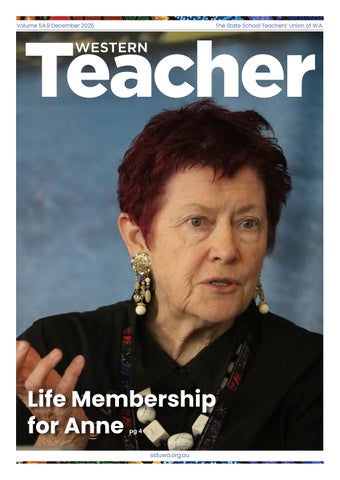
Cover: Former SSTUWA President Anne Gisborne was conferred Life Membership of the union at Novermber State Council Conference. Read more on page 4.
Legacy of leader seen in strength of today’s union
By Matt Jarman President
It was my great pleasure at November State Council Conference to successfully seek support for the conferral of life membership on Anne Gisborne. This is part of what I said:
I feel it is accurate to say that each president of the SSTUWA will endure a variety of unforeseen uncertainties throughout their time in the role. These may come in the form of school systemic changes, government funding fluctuations – normally in reverse, changes to community attitudes, of course industrial unrest, changes across the federal landscape, internal challenges and changes, the impact of cost of living pressures on members all whilst trying their very best to provide protection for the membership and for the good of our public school profession.
And throughout Anne Gisborne’s time as senior vice president [from] 2006-07 and then as president [from] 2008 to 2013, that was most certainly Anne’s experience. It seems to me in the time I have been fortunate to know Anne that she has always had something to say and that this voice is always grounded in what is right, particularly what is right for this union, the union movement and the needs of public school educators.
I am speculating now but I would think that it was these many voices that were the reason why Anne joined the SSTUWA on the 10th September 1984, some 41 years ago.
Anne has been a member of the UnionsWA Council for many years, a former president of UnionsWA, Executive member of the Australian Education Union and remains a member of the GESB Board of Directors, recently re-elected unopposed. Anne is still providing support to new and graduate teachers amongst many other pursuits still aligned to the profession and this union.
In 2004-2007 we saw attacks from the federal government – we had Brendan Nelson and Julie Bishop as Education Ministers at the time; Nelson gave us flagpoles and Bishop tried to give us merit pay.
For us this was not new – the SSTUWA had weathered similar attacks in the 90s in the Court-Kierath era and had built on the Advanced Skill Teacher (AST) category to develop the first iteration of the Level 3 Classroom Teacher.
Ultimately WA became the first state in the country to introduce an expert teacher salary grade that we still know as the Level 3 Classroom Teacher. This and the AST were both strategies designed to prevent the imposition of a merit pay regime.
As senior vice president Anne worked tirelessly with president Mike Keely to again stop that push and in the process build on what we already had. That struggle saw the establishment of the Senior Teacher category, as well as retaining the Level 3 Classroom Teacher position, an outcome for members that we still benefit from today.
Anne is known for her stamina; past colleagues have often commented to me they are not sure if Anne ever really sleeps. Anne was elected in 2007, began as president on 1 January 2008 and on the 27th February a stop work action was called – 6,000 members assembled at Langley Park and approximately 2,000 in rural areas around WA.
In her very first Western Teacher article Anne declared we were going to be at least 600 teachers short, leaving around 19,200 WA students without a teacher at the start of the year and that class sizes were unacceptable. Anne had clearly hit the ground running.
The government responded by immediately placing adverts in local
papers, prompting members to write back and in many cases directly to government.
Anne and the Executive placed their own ads, often pointing out to the WA community how misleading the government advertising was! In capital letters Anne wrote to members in the April edition of the Western Teacher stating there is much that can and must be done by each and every member.
Strong, clear lines had been drawn. Alan Carpenter was Premier of WA at the time and remained so until Labor lost government to Colin Barnett in September that year. Now I have heard some Laborites blame the teachers for the 2008 election loss, and that may have been the case.
By June 2008 the Department of Education had advised that WAIRC arbitration was the next step, leaving Anne and the leadership to work tirelessly in preparation. Strike action was called for 27 November but was called off by Anne and the leadership as an offer of six per cent, five per cent and four per cent was received, including new salary grades and the previously mentioned Senior Teacher and Level 3 Teacher salary offers.
The year 2009 seems to have started with some optimism, until very quickly the Twomey report landed, highlighting country housing issues and the first iteration of the Rudd Government revealed that public schools were underfunded by approximately $2.9 billion across the country.
The Rudd/Gillard federal government undertook the first Gonski review, which revolutionised the schools’ funding model initiated by John Howard, only to fall at the hurdle of implementation, a failing from which we are just beginning to recover.
A report from the Australian Education
Union indicated that funding per public school student had decreased by 10.6 per cent between 2009 and 2014, while funding to private schools had increased by much more – sound familiar? The public education campaign – For Our Future by Federal Executive was launched and it was against that background that Anne faced the two biggest battles of her presidency.
The SSTUWA vs IPS battle began in 2009, with the Barnett Government aiming to “create an alternative system within a system with an intention to drive an ideological shift.” Anne, I suspect, called it many things during this time, one of the more polite ones was “the privatisation of the government schooling system.”
This was facilitated by significant early changes to the transfer system, which ultimately led to its almost complete abolition. The half cohort shift also was underway and labelled by Anne as abysmal and short-sighted in the face of the teacher shortages. This was followed by the delayed budget announcement in August 2013 in which the Barnett Government dropped a completely new funding model on schools – one straight out of the neo-liberal playbook –massive cutbacks accompanied by the devolution of central functions to schools. In the name of “equity” and “student need” we saw:
• Some large secondary schools lose more than $1 million from their budgets.
• Approximately 1,000 EA positions were lost.
• AIEOs all but disappeared.
• A huge loss of teaching positions –some schools lost 10 or more teachers; specialist programs were lost.
• Professional learning became how to manage a budget (for principals only).
• Basically, whatever “fat” was in the system was stripped.
Budgets were slashed by millions, teacher numbers ravaged and Aboriginal Education Officer and EA positions disappeared.
We maintained class sizes and DOTT. The government tried to stop further L3CT positions from being filled but withdrew from that under threat from the WAIRC. They took the 0.1 time though and have consistently refused to restore it in any meaningful way.
We had a statewide stop work meeting in October 2013 as local communities rallied. In this fight, we established unprecedented close relationships with both the CSA and United Voice.
Toni Walkington, Carolyn Smith and
Anne collaborated on information and strategies to an extent not previously seen and I am not exaggerating when I say this was the foundation of what we now know as the UnionsWA Public Sector Alliance – the grouping which led to the end of McGowan’s salary cap, which had been in place since 2017.
Anne Gisborne’s leadership was fierce, intelligent, principled and deeply grounded in her love of the profession and her respect for the members she represented.
Her legacy is visible not only in our pay scales and structures, but in the very strength and identity of this union today.
Inspiration, cooperation and salutations
By Minh Lam
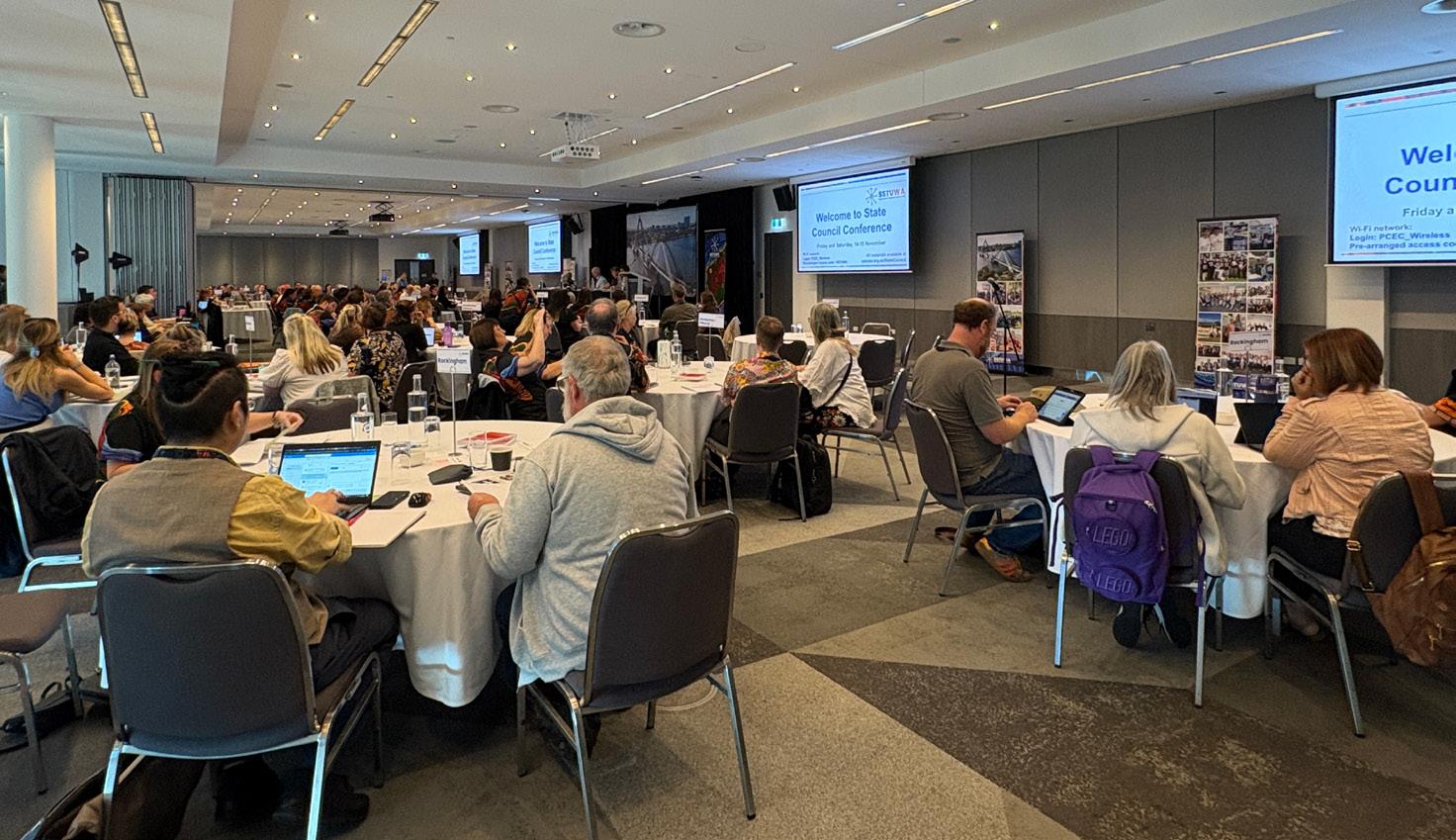
The backstories and legacies of being part of the union movement were a major highlight of the November State Council Conference, held recently at the Perth Convention and Exhibition Centre.
The two-day conference, which facilitates the meeting of the highest decisionmaking body of the SSTUWA, saw a former union president conferred with life membership, as well as outgoing senior officers being acknowledged for their tireless contributions to the union.
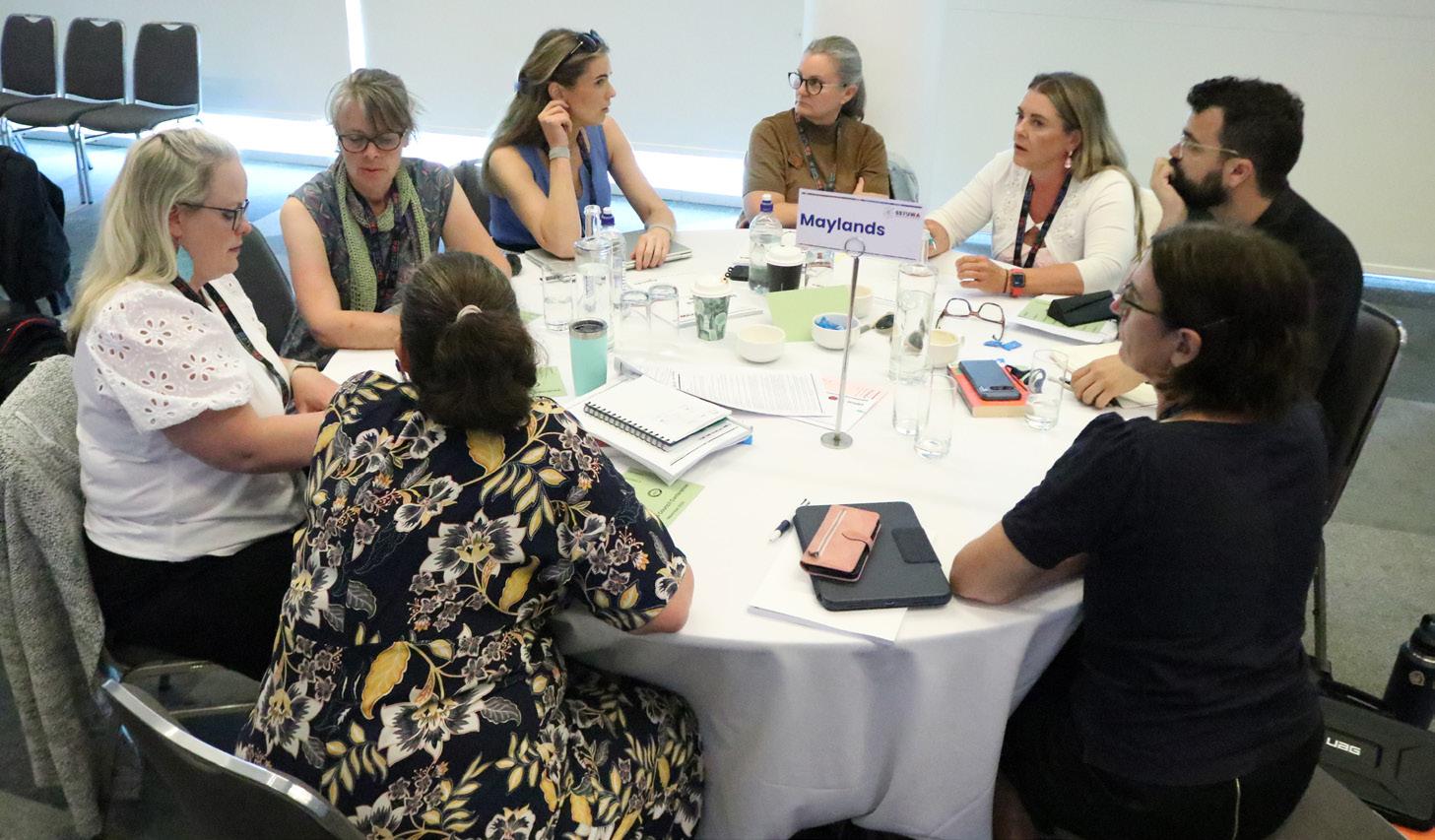
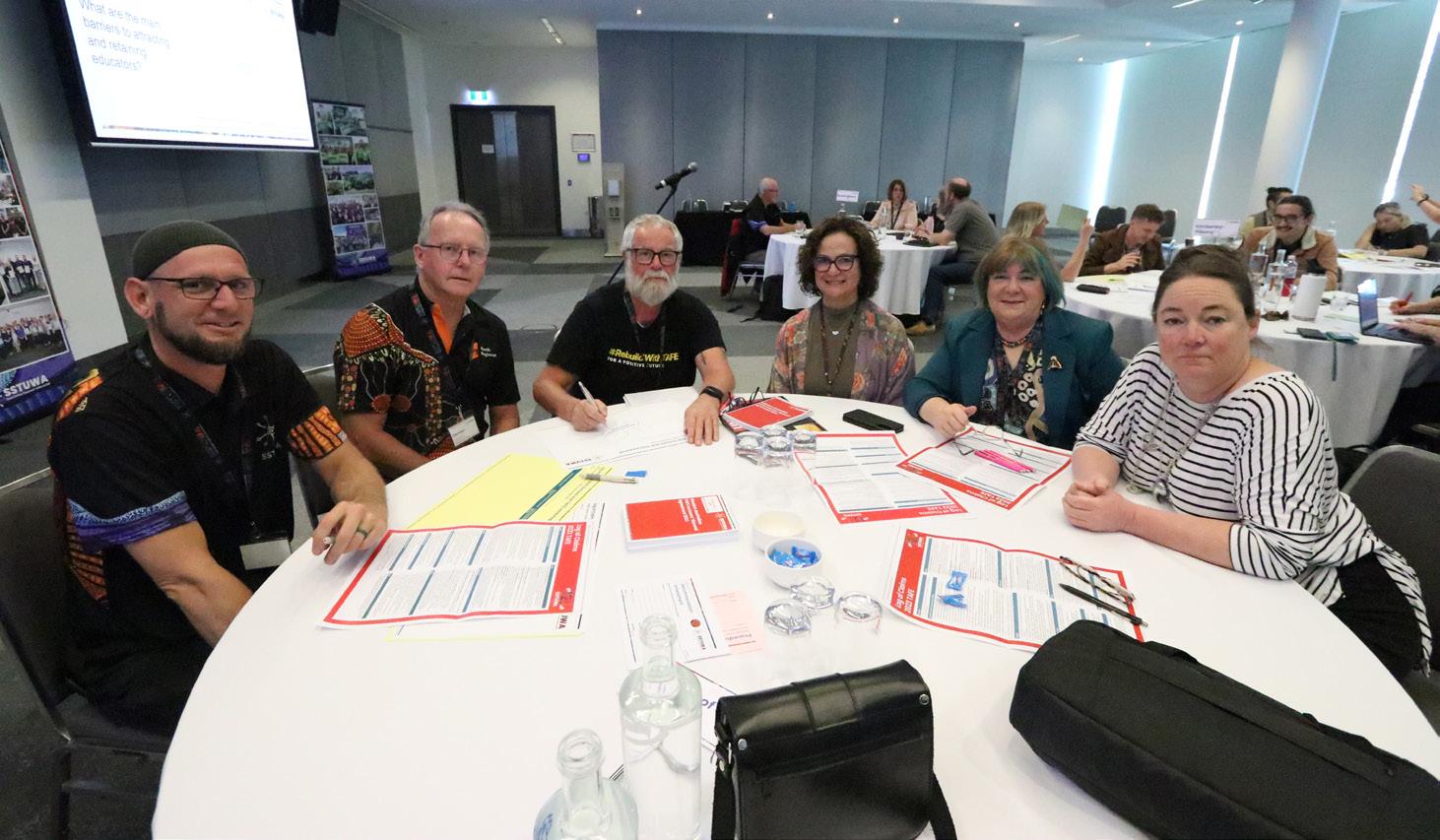
Conference delegates also started working on the SSTUWA’s Log of Claims for the next General Agreement (2026) by participating in two workshops to provide ideas and feedback for the next Log.
Delegates also heard updates from the AEU Tasmanian branch, as well as the Queensland Teachers’ Union about their EBA negotiations, with both unions fighting for improved pay and working conditions on issues similar to those in WA.
State Council Conference is held twice a year, in June and November and is the SSTUWA’s highest decision-making body. Elected delegates meet to discuss, debate and vote on motions that determine the direction and activities of the union.
For November State Council Conference, more than 125 delegates were in attendance, in addition to seven SSTUWA life members.
UnionsWA Secretary Rikki Hendon (seen top right) was a keynote speaker at the conference and shared her story about how she joined the union movement.
Ms Hendon said she was inspired as a high school student to campaign for human rights during the Tampa refugee crisis in 2001, attending protest rallies –and her personal values about social
justice influenced her decision to pursue social work as a vocation.
She encouraged all those present to reflect and share their motivations for being involved with unions.
“I’ve not yet met a union leader who intended to become a union leader,” Ms Hendon said.
“I’ve often reflected on how the heck did this happen and the short answer is, I got here by saying, ‘yes’.”
“I’m sure this is a familiar scenario to anybody who’s in this room. Because I’m sure you said yes too, at some point … yes to standing up and being active in your union.”
“For you all in the room today, you’re all union leaders in your workplaces.”
November State Council Conference honoured many contributors to the SSTUWA and the union movement.
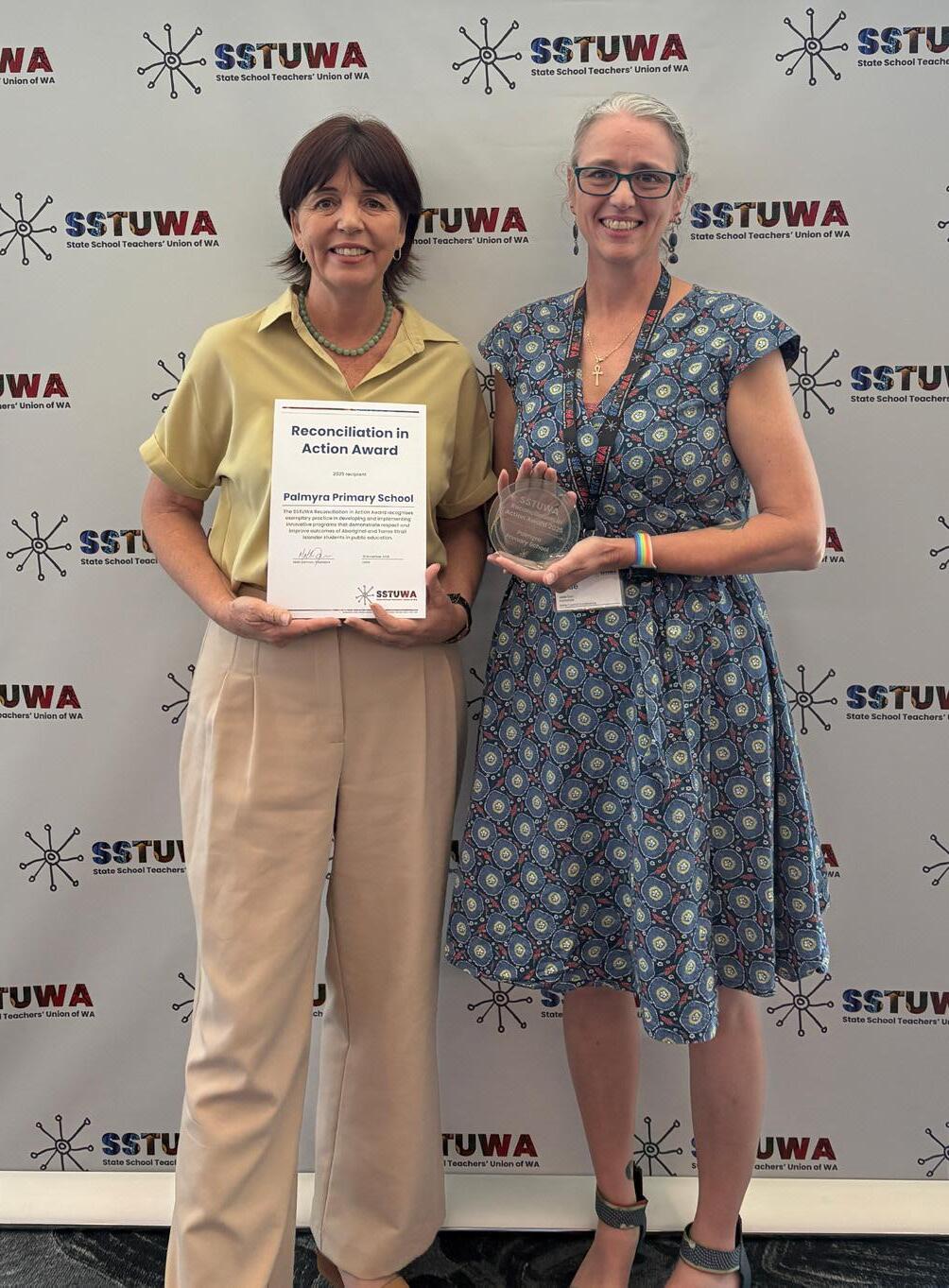
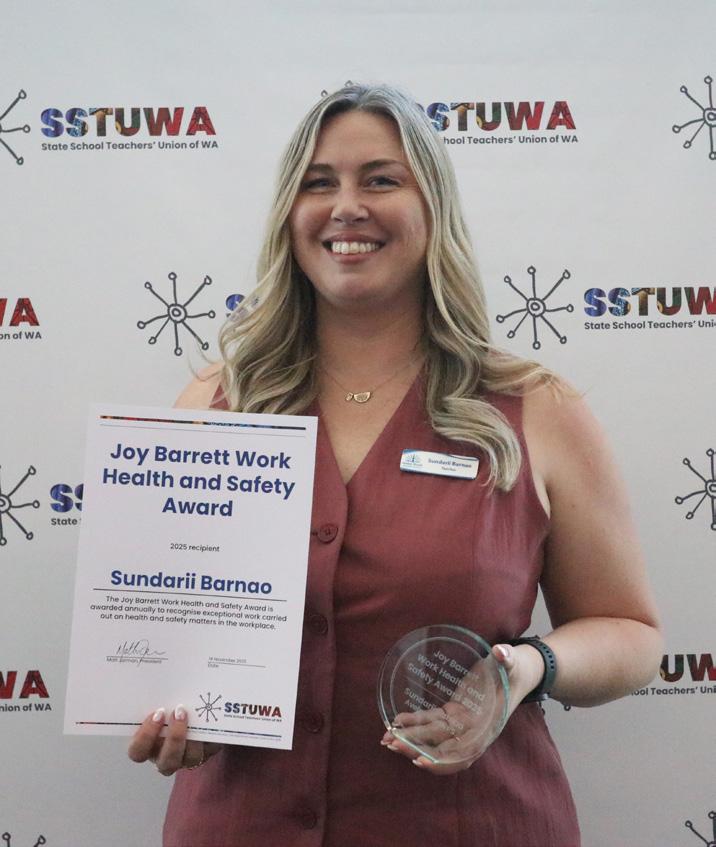
Palmyra Primary School was awarded the SSTUWA’s Reconciliation in Action award (seen top right on page 7), while the Joy Barrett Work Health and Safety (WHS)
Award, named in memoriam after the union’s longstanding WSH organiser, was presented to member Sundarii Barnao, from Aveley North Primary School. (seen top left on page 8).
Sundarii has demonstrated outstanding leadership in advocating for WHS at her school, whilst driving initiatives that have been recognised across the Department of Education and statewide.
“Our schools should always be safe places, safe for our students, and equally safe for the people who dedicate their lives to teaching and supporting them,” she said in accepting the award.
“Because of the work of everyone in this room, and all those who work alongside the State School Teachers’ Union of WA, our schools are safe places.
“The commitment, care and leadership shown across our education system ensures that safety isn’t just a policy, it’s a culture. And that culture protects not only those who need it most, but every single person who walks through our school gates.”
Acknowledgements and thanks were given to General Secretary Mary Franklyn and Senior Vice President Natalie Blewitt, who will both finish in their roles at the end of 2025 (see story below).
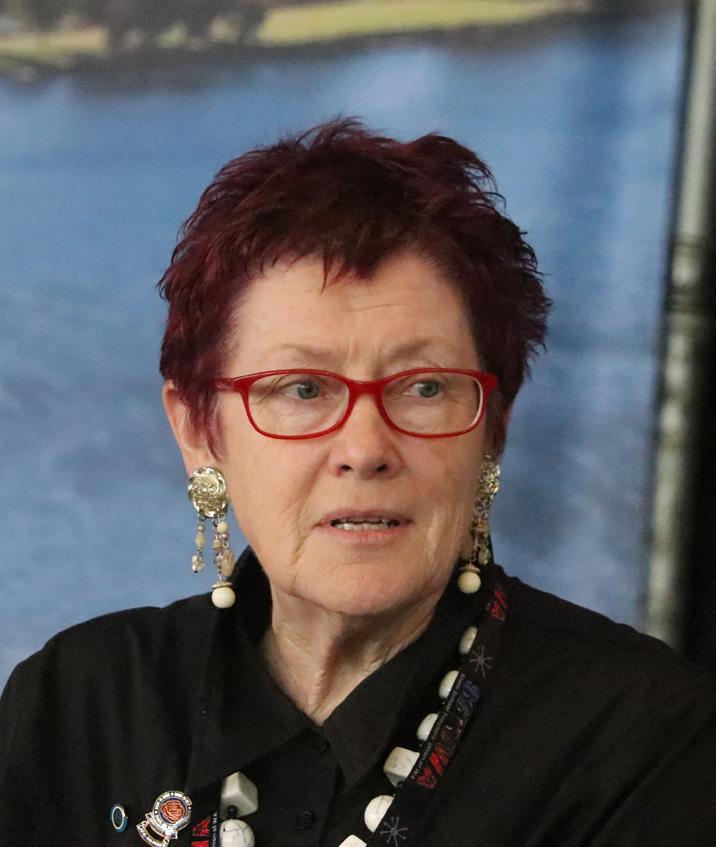
Former SSTUWA President Anne Gisborne (seen bottom right on page 8)was also
recognised for her giant contribution to the union and the wider trade union movement by being conferred life membership of the SSTUWA.
“It’s a huge privilege to accept such an honour from an organisation, such as ours,” she said.
“A union, a collective body for workers in our public schools and TAFEs, teachers and leaders, lecturers … birthed 127 years ago. And still wedded to promoting public education as a common good.
“[We are] joined in solidarity with unions across the nation and the globe to fight for fair treatment, access to education, equity and
(continues on page 8)
Farewell and thanks to departing senior officers
During State Council Conference SSTUWA President Matt Jarman paid tribute to outgoing senior officers, General Secretary Mary Franklyn and Senior Vice President Natalie Blewitt, who will finish in their roles at the end of this year.
Mr Jarman said Mary, as general secretary, had set the SSTUWA on the road to financial security and the SSTUWA had an organisational structure which was the envy of other unions in WA and across the country.
“From the delivery of professional development via the Education and Training Centre, to the financial management of the union, to a bespoke database system, online security and the constant evolution of member services, Mary has led the way on every issue,” he said.
“Whenever major decisions have been required Mary is always the one to say, ‘how will this help our members?’.
“The work she has begun on recruitment and retention will be a lasting legacy.
“Mary is also a fearsome negotiator and without her presence and support on those vital moments many of the wins we have achieved for our members would not have happened.”
Mr Jarman said Mary’s time as general secretary began just after the horrendous cuts inflicted on public education by the Barnett Government, which left both schools and TAFEs reeling from those devastating decisions.
“Fortunately, in the toughest of times we had just the right person for the job. Someone who would guide the union and establish it as a body that governments would come to respect and listen to,” he said.
“In supporting, with her fellow senior officers, the Putting Our Kids First and TAFE Works campaigns, Mary set the SSTUWA up to start the fight back.
“TAFE Works, in particular, was a huge influence on the incoming government. While other states saw TAFE virtually
destroyed, WA TAFE was saved for future generations.
“Mary’s passion, leadership and principles have been essential to the SSTUWA as a whole, especially to me personally and set much needed, at times, examples to many government senior leaders.”
Mr Jarman said Natalie was admired across the public education system and the AEU in her time as senior vice president and was regarded as the goto person on new educator issues at a global level.
He passed on a message from AEU Federal President Correna Haythorpe and Federal Secretary Nicole Calnan: “‘Natalie, thank you for all of your efforts nationally with the AEU but also on behalf of all of our members who have benefitted from your detailed analysis and work and extremely long hours as senior vice president over the last three years.”
the fundamentals of democratic society.
Sometimes I think when we’re in our schools, we forget how far and deep our range is.
“So we need to remember that, and to be proud of it.
“It’s a profession to be proud of. It’s a public system that, despite the neglect, people like you cherish and breathe life into, an organisation, the SSTU, which has fought, and does fight, and will continue to fight on behalf of better conditions and dollars, as well as the institutions themselves.
“I thank you for the privilege that is being offered to me, and the opportunities to walk alongside many of you.”
SSTUWA Life Member Edd Black, former Vice President Samantha Schofield and Natalie Blewitt all spoke in support of life membership conferral for Anne, paying tribute to an astonishing contribution to the union.
To read more about Anne’s influence and legacy to the SSTUWA, turn to page 4 of this issue of Western Teacher
Thank you to Anne, Sundarii, Mary, Natalie and all of the dedicated union members whose contributions to the SSTUWA have made it the peak body that it is today.
SSTUWA President Matt Jarman, in his opening address, reported that the union’s Member Assist Team had so far taken over 10,000 calls in 2025 from members seeking support or advice (not including emails).
“There have been more than 750 school site visits by organisers to date in 2025 and thousands of phone calls and online meetings between organisers and members,” he said.
“TAFE reps and staff have attended meetings and shared information with members across WA.
“Up until September the Growth Team alone had visited 240 different schools reaping 85 financial new joins and 55 student joins.
“That is in addition to the 1,500 or so members who every month use the Know Your Rights sheets on the SSTUWA website and the many more who are helped faceto-face by reps and organisers.
“This union is no passing fad but an established and vital feature in the public education system.
“From an individual member’s issues to broader political strategies and aims, we cover a lot of ground. We never stand still.”
Mr Jarman also noted the ongoing impact of the Facing the Facts report on the future direction of public education in WA.
“Of the 46 recommendations made in Facing the Facts we have seen significant progress on eight and progress on a further 24,” he said.
“It has become the blueprint for reforming public education in Western Australia.”
For a full transcript of Mr Jarman’s address to November State Council, visit bit.ly/3LQ1Ioj
(continued from page 7)
Union service has been a privilege
By Natalie Blewitt Senior Vice President
The work of an SSTUWA senior officer is varied and all-encompassing. We directly manage multiple portfolios, participate proactively in a wide range of meetings, including with Department of Education executives and government ministers, and of course, we work directly with and for members.
Working with, and for, members has been an absolute privilege and whether that has included robust discussions and debates, resolving member issues, addressing member concerns, attending branch meetings, writing reports, chairing meetings, leading member delegations or actively contributing to EBA negotiations, my commitment to members has never wavered.
The SSTUWA has gone from strength to strength with membership numbers, at the time of writing, being at near record levels. Contributing to our membership growth has been extremely rewarding as has the all-important conversations I have undertaken with members.
Advocating for members and resolving member issues has always been an important part of my work.
Over the course of this year, my columns have been shining a spotlight on some of the portfolio responsibilities I have held. These include early childhood education, education support, early career teachers, information communication technology (ICT) in education and oversight of the work of the Growth Team. In addition, other portfolio responsibilities have included Level 3 Classroom Teachers and internally, oversight of the Communications Team.
Education and Training Centre module delivery during union rep, women’s contact officer and school leader trade union training (TUT) courses, as well as presentations at other internal and external events, has also been part of my work across the past few years.
Media interviews, podcasts, writing Western Teacher articles, addressing delegates at District Council, State Council and at meetings both nationally and internationally - I have proudly represented the voices of our members. Keeping members updated and informed has been my top priority.
There have been many highlights for me over
the course of working for the SSTUWA. These include being part of the team that commissioned and landed Facing the Facts. This independent report has fundamentally changed the landscape of public education in this state.
Being part of the Log of Claims process from conception, through negotiations, to a registered EBA and finally to implementing the wins, has absolutely been a standout for me. And who can forget the member day of action on 23 April 2024.
The images of our members, attending in the thousands, marching across the Matagarup Bridge and gathering in venues across the state, will stay with me forever. Knowing my involvement in this process has assisted in the improvements to wages and conditions for public education is something I will always be proud of.
To all the members I have met along my union journey since joining the SSTUWA as a first-year teacher way back in 2000, I would like to say thank you. Thank you for the privilege of being able to work with and for you, our members.
Thank you also to my fellow senior officers, Matt, Sharmila and Mary and the whole Executive team who I have had the opportunity to work so closely with in this role, for the past three years. And finally, thank you to the SSTUWA clerical and industrial staff for all you do.
At the time of writing, it remains unclear as to exactly what I will be doing from next year but wherever my journey takes me next, I am sure, public education will be at the core. I would like to wish the incoming senior officers and Executive team all the best and I look forward to watching from afar the next chapter of our mighty union.
Campaign is for everybody
By Sharmila Nagar Vice President
UnionsWA, including the SSTUWA, has joined the union movement and ACTU in the It’s For Everybody campaign.
The union movement is advocating for 10 days of paid reproductive health leave and flexible work rights into the National Employment Standards. We hope to do this at our next bargaining round, too.
All workers, regardless of sex or gender, will experience reproductive health issues at some point throughout their working lives. That’s why Australian unions are calling for 10 days of paid reproductive health leave and flexible work rights to be included in the National Employment Standards.
The proposed leave entitlement would target a range of issues, including, but not limited to:
• Menstruation.
• Pregnancy.
• Breastfeeding and lactation.
• Contraception.
• Miscarriage and pregnancy loss.
• Perimenopause and menopause.
• Chronic conditions such as polycystic ovarian syndrome and endometriosis.
• Hormone therapy.
• Fertility treatments, IVF and assisted reproductive health services.
• Hysterectomy.
• Termination.
• Preventative health care such as screenings for breast, cervical and prostate cancer.
The impact of winning this entitlement will be significant in managing reproductive health issues and enabling women in particular to remain in the workforce.
While we know this leave is for everybody, it will be of no surprise to you that disproportionately women are more likely to use this leave.
Any further entitlement that quarantines personal leave is a win for our members. We know that our women members have more caring responsibilities, hence end up using more of their leave entitlements for other than their own needs.
According to the Australian Bureau of Statistics, 26.8 per cent of working women retire under the age of 55, and on average, women are retiring seven years before men – also alarmingly, 12 years before their desired age of retirement due to menopause symptoms.
The Australian Institute of Superannuation Trustees estimated in 2023 that menopause likely cost women in the 5054 age group more than $15 billion per year in lost earnings and superannuation for every year of early retirement.
The value of lost productivity cost from reproductive health conditions is estimated at $21.3 billion per year.
Millions of Australian women are impacted by chronic conditions such as endometriosis and polycystic ovary
syndrome, with the economic cost of absenteeism and reduced workforce participation estimated to be several billion dollars.
To help address the gender pay gap, reduce reproductive health stigma, support workers’ health and wellbeing, and create more inclusive workplaces across the country, workers need access to paid reproductive health leave.
So, what will paid reproductive health leave
do?
The benefits to employees from access to this paid leave entitlement will be wide-ranging.
For example, allocated time and flexible work options to manage issues arising from reproductive health and access to preventative health screening mean increased wellbeing, workforce participation and economic security, a better quality of life and increased early detection of health issues for workers and their families.
The benefits to community include breaking down stigma related to reproductive health, increased gender equality, closing the gender pay gap between men and women workers and increased participation of women in the workforce and in leadership positions.
For more information visit itsforeverybody.au
Inside the 2025 New Educator Internship
By Chloe Hosking Growth Team coordinator
For Simon Joachim and Ellie Aldred (seen to the right with SSTUWA Growth Team coordinator Chloe Hosking on the left), 2025 has been a busy year. As the inaugural participants in the union’s Growth Team New Educator Internship, they’ve spent 12 months working alongside SSTUWA staff, visiting schools, attending graduate and university events and taking part in professional and industrial training — all while learning more about what it means to be both a public school teacher and unionist.
Reflecting on the experience, Simon said: “The Growth Team New Educator Internship has provided an opportunity to develop both industrially and professionally. By engaging with members in their workplaces, teachers at graduate events and pre-service teachers at universities, I have gained valuable insight into the strength of our union beyond my own immediate context.”
A year out of the classroom
The internship is designed for early career teachers to gain experience working within the SSTUWA office while continuing their professional development. Over the year, Simon and Ellie became part of the Growth Team, responsible for recruitment, retention and engagement of new and early career members. Their days were varied – from speaking to teachers on school visits, to writing new educator communications, attending training sessions and contributing to union events and conferences.
“My role is to empower members and encourage all educators to engage with their union,” Ellie said.
“Being able to work with educators across the state to help access support to
improve conditions for their colleagues, their students and themselves, has been extremely rewarding. By the end of the year we will have visited almost 400 schools and interacted with thousands of members.”
The internship also gave them the chance to connect with different teams across the organisation. Time spent with organisers and industrial officers provided a practical understanding of
the many ways the SSTUWA supports and empowers all members.
On the road: recruitment, retention and engagement
A major goal of the year was the recruitment of early career and other educators. As early career teachers themselves, Simon and Ellie enjoyed connecting with graduates and new members, particularly through university visits, graduate modules and onsite school visits.
They attended modules and visited schools from Derby to Esperance and everywhere in between. This peer-to-peer recruitment approach helped deliver the strongest recruitment results the Growth Team has ever achieved.
Beyond recruitment, the interns supported a range of engagement programs, promoting participation in initiatives such as the State Council Guest Program, the New Educator Committee and the National New Educators Conference.
They also played a key role in developing communications and social media content, using their recent classroom experience to shape messages that spoke directly to early career teachers.
“Having just navigated the challenges of being a new educator gave me a lot of perspective and experience in supporting other new educators,” Ellie said.
“From information about graduate entitlements to snippets of information through social media, we have been able to dissect some of the General Agreement and Award into new educator friendly resources so that all our new colleagues have access to knowledge about their entitlements and where to go to access support.”
Taking it back to school
Alongside their practical work, both interns took part in a structured professional learning program. This included industrial and public speaking training, growth coaching and courses through the Education and Training Centre. As the year draws to a close, Simon and Ellie are preparing to return to their schools with new insights and skills.
“My work with the SSTUWA this year will undoubtedly make me a better teacher and colleague,” Ellie said.
“I am excited to return to Carine Senior High School with so much more industrial and professional knowledge and experience.
“I will be using the knowledge and skills from this year to continue supporting colleagues at a branch level and to advocate for public education.”
At the start of the year, both Simon and Ellie recorded their confidence levels across a range of skills. By the end, they reported growth in every area: from engaging non-members in union discussions to working collaboratively with colleagues and school leaders.
Each intern also had the opportunity to design and deliver an individual project. Simon focused on improving the union’s engagement with pre-service teachers, building stronger links with Edith Cowan, Notre Dame and Murdoch universities, while Ellie created a handbook for future interns to support the continuation of the program.
“I am really motivated to go back to my role as a teacher at Seaforth Primary School,” Simon said.
“Whilst I have thoroughly enjoyed my time working for the SSTUWA this year, I
am excited to apply the industrial and professional knowledge I have obtained into my work as a teacher and unionist.
“I look forward to putting this into practice at my branch and sharing my experiences with my broader networks.”
The inaugural Growth Team New Educator Internship has not only delivered strong recruitment outcomes and meaningful engagement strategies; it has also equipped two early career teachers with the skills, knowledge and confidence that will continue to benefit their schools, their colleagues and the union for years to come.
TAFE Know Your Rights: Activities Related to Delivery Time
Main clauses and documents
• Clause 37 – Hours of the Western Australian TAFE Lecturers’ General Agreement 2023 stipulates how Activities Related to Delivery (ARD) is allocated.
• Schedule L – Hours chart of the Western Australian TAFE Lecturers’ General Agreement 2023 breaks down the weekly working hours into teaching hours (TH), ARD and Professional Activities (PA), for each of the fractions.
• Western Australian TAFE Lecturers’ General Agreement 2023 –Implementation Guidelines – 2023, specifically clause 37 – Hours.
Key issues
Full time TAFE lecturers are expected to undertake ARD for 4.5 hours on site and 7.5 hours off site – a total of 12 hours ARD per week.
• Lecturers on averaging arrangements are still expected to carry out the full 12 hours of ARD each week of the averaging period regardless of the number of teaching hours scheduled.
• It is at the discretion of the lecturer as to when and where they do the 7.5 hours of ARD off site.
• The first 7.5 hours of ARD is off campus at the lecturer’s discretion. This means that for lecturers teaching 13 hours or less per week, all of the ARD time is off campus at the lecturer’s discretion as per clause 37.12 of the Western Australia TAFE Lecturers’ General Agreement 2023, which states:
37.12 A maximum of 7.5 hours nonlecturing ARD time per week
may be carried out off-campus at the discretion of the lecturer. This applies to both full-time and part-time lecturers. The maximum 7.5 hours of ARD is not to be applied pro rata to parttime lecturers.
• Part-time contract or permanent lecturers must have their fraction adjusted if they take on any extra teaching in any given fortnightly pay period. This means they also get paid for extra ARD and professional duties (PD) time. Refer to clause 37.2, which states:
37.2 Where a part-time lecturer agrees to lecture beyond their regular part-time hours, the additional hours will be ordinary hours up to the maximum lecturing hours prescribed for a full-time lecturer and the fraction will alter accordingly.
Professional Duties time and ARD will be allocated in accordance with Schedule L – Hours Chart.
• Lecturers do not have to be contactable by management or students when carrying out off campus ARD. ARD is professional time to plan, prepare, mark and make professional decisions associated with the delivery and assessment of modules within a lecturer’s own current teaching program.
• For a full description of ARD duties refer to Appendix A – Role Description and Duty Statement for Lecturers of the Western Australia TAFE Lecturers’ General Agreement 2023
• Some of the ARD provisions differ for lecturers on a flexible hours arrangement. Refer to Clause 40 – Flexible hours arrangement for details.
From the Western Australian TAFE Lecturers’ General Agreement 2023 – Implementation Guidelines – 2023, specifically Clause 37 – Hours:
Clause 37.1 outlines that a full-time lecturer will work their ordinary hours of 37.5 hours per week between 7.30am to 8pm Monday to Friday. Different lecturers will have different configurations of hours depending on course delivery, however all lecturing duties and on-campus ARD will be worked at some time in the span of hours, from 7.30am to 8.00pm Monday to Friday, with PA time to be worked between 8am and 5pm Monday to Friday (Clause 37.17).
Where a lecturer is authorised by the employer to work outside of these hours overtime provisions apply. However, if a lecturer chooses to work ARD off-campus, outside of these hours, no overtime provisions apply.
Clause 37.12 confirms that lecturers can work up to 7.5 hours of ARD off-site, at their discretion. A part-time lecturer can also work up to 7.5 hours of ARD off-site. The 7.5 hours of ARD for a part-time lecturer is not pro-rated. A lecturer with additional duties or roles, who may be teaching less than the teaching hours allocated for their fraction, is still entitled to off-campus ARD in accordance with their teaching load and Schedule L – Hours Chart
Schedule L – Hours Chart
The chart below is an expansion of the chart found in the Agreement – Schedule L – Hour Chart of the Western Australian TAFE Lecturers’ General Agreement 2023
The chart breaks down the weekly working hours into teaching hours, on and off campus Activities Related to Delivery and Professional Activities, for each of the fractions expressed in the second column.
As an SSTUWA member, you can contact Member Assist for industrial advice on: (08) 9210 6060 | 1800 106 683 memberassist@sstuwa.org.au
Targeted investment in WA public schools needed
The Australian Education Union (AEU) has released the Investing in Australia’s Future (2025) report, alongside new WA specific findings from the AEU State of Our Schools survey, revealing increasing student complexity, escalating workloads and critical shortages of counsellors and wellbeing staff across WA public schools.
AEU Federal President Correna Haythorpe said the survey shows that while WA teachers and principals are deeply committed to their students, the system is at breaking point without urgent and targeted investment.
“Western Australian teachers are facing rising levels of student complexity without the support and resources they need,” she said.
“The evidence is clear that smaller classes, more wellbeing and specialist staff and targeted tutoring programs are essential to meet every child’s needs and to retain our experienced teachers.”
SSTUWA President Matt Jarman said the findings confirm what public school staff have been reporting for years, that classrooms are becoming more complex while resources fail to keep pace.
“Teachers are working longer hours, managing more complex classrooms and seeing growing numbers of students needing wellbeing support. This is all contributing to WA’s teacher shortage crisis,” he said.
“We need smaller class sizes, specialist support teaching staff and targeted literacy and numeracy programs to help address these issues.”
Key findings for Western Australia include:
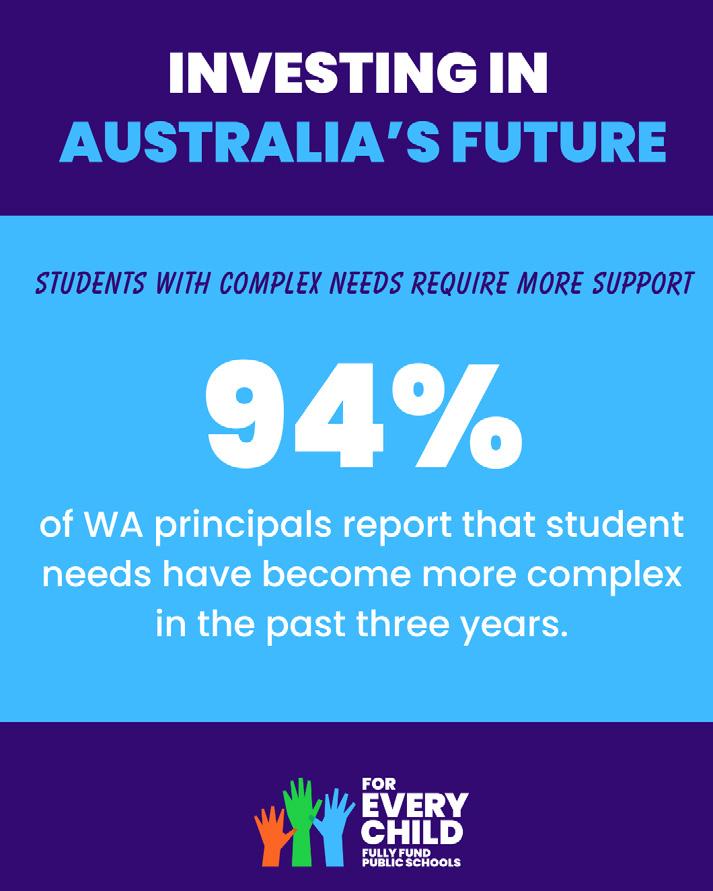
• Student needs rising: 94 per cent of principals report that student needs have become more complex in the past three years, with 100 per cent citing increasing mental health and wellbeing issues as the key driver.
• Growing behavioural and learning challenges: 93 per cent of teachers say student behaviour has become more complex and 83 per cent report an increase in learning difficulties.
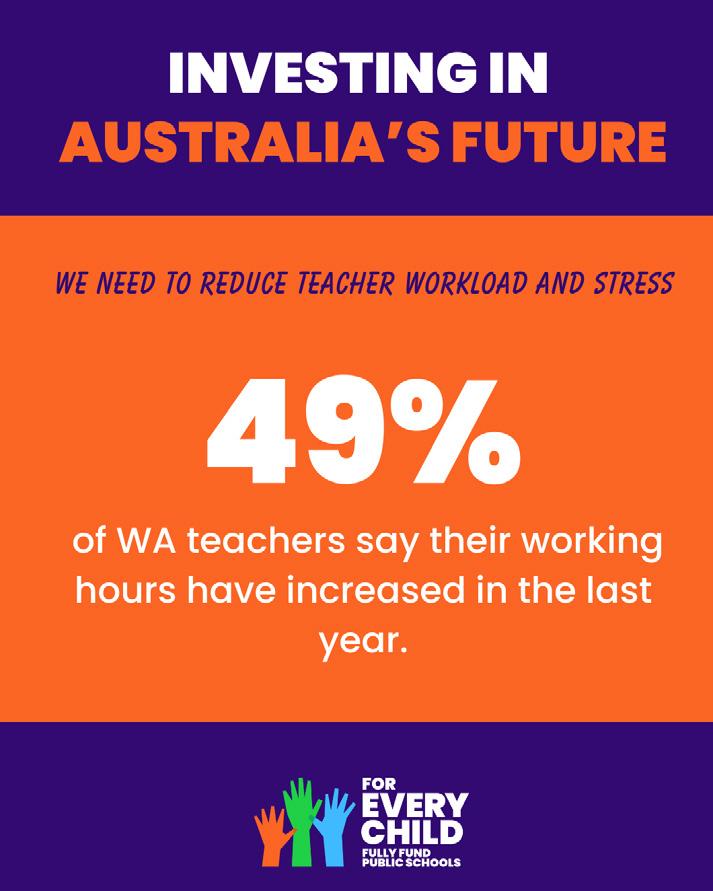
• Workloads escalating: 49 per cent of teachers say their working hours have increased in the last year and 86 per cent say they are spending too much time on administration.
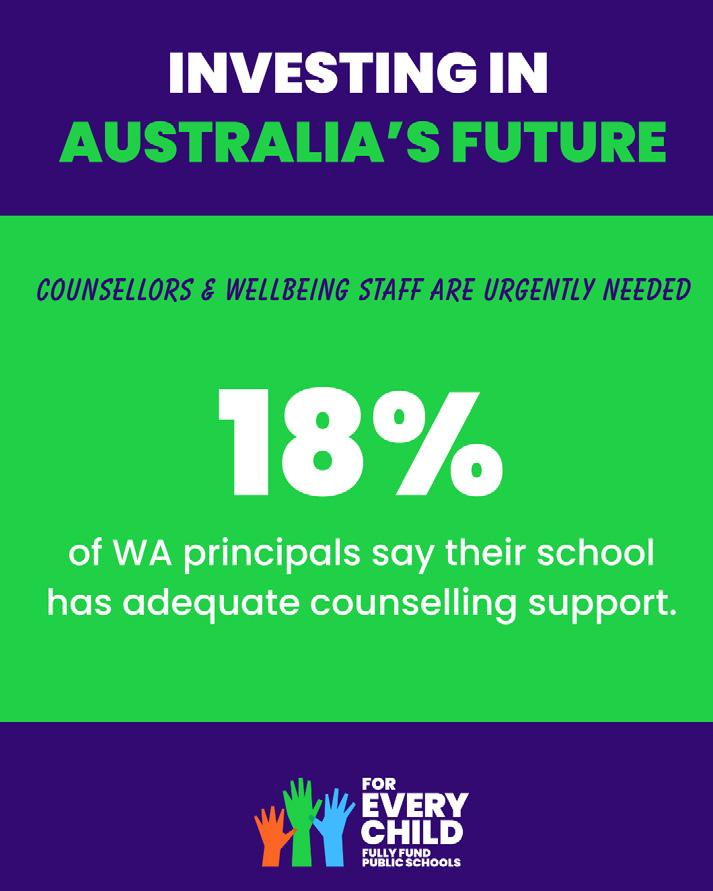
• Severe counsellor shortages: Only 18 per cent of WA principals say their school has adequate counselling support. Over one-third (35 per cent) of students who need help wait more than a month to see a school counsellor and 15 per cent wait longer than six months.
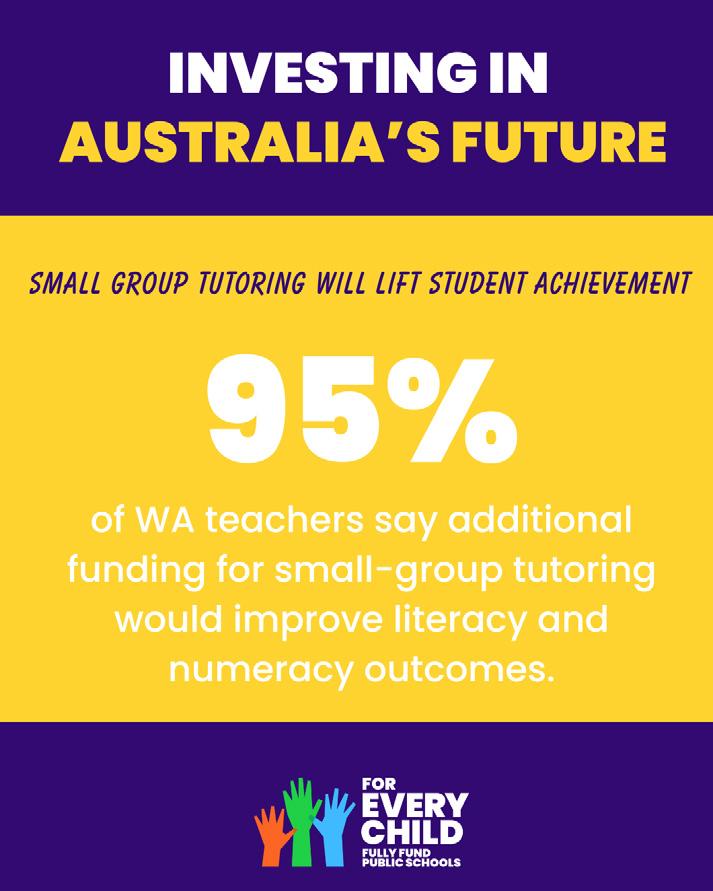
• Tutoring makes a difference: 95 per cent of teachers say additional funding for small-group tutoring would improve literacy and numeracy outcomes – yet only 67 per cent report having literacy support programs and just 32 per cent have equivalent numeracy programs.
The AEU has outlined a suite of solutions for governments to act on these critical issues including:
• Permanent small group tutoring and smaller class sizes (to the Organisation for Economic Cooperation and Development average of 21), with more education support staff.
• 150 full-service schools in disadvantaged communities offering integrated health and family services.
• More Aboriginal teachers and Torres Strait Islander teachers and culturally responsive teaching practices.
• Two extra hours a week for planning and collaboration, more admin staff and a national early career guarantee.
• More school counsellors, social workers and system-wide support for evidence-based wellbeing programs.
• A permanent Commonwealth capital fund to ensure every public school has modern, inclusive and accessible facilities.
“Thanks to AEU members ongoing campaigning, governments have committed more than $20 billion to public schools nationally,”
Ms Haythorpe said.
“This report makes clear that to lift outcomes for all students, we must use that investment to reduce class sizes, increase one-on-one support for students and cut the unsustainable workloads driving teacher shortages.”
You can read the report at bit.ly/4nEcafN
AEU 2025 State of Our Schools survey: WA findings
The 2025 State of Our Schools survey was conducted throughout August and September. A total of 561 surveys were completed by 34 principals, 495 teachers and 32 support staff across Western Australia.
Student needs are more complex than ever
• 94 per cent of principals said the complexity of student needs in their school had increased in the last three years.
• 100 per cent of principals identified increasing wellbeing and mental health issues as adding to the complexity of student needs at their school.
• 94 per cent of teachers said that additional targeted funding for more wellbeing support for students would help to improve student outcomes.
• 95 per cent of teachers said that the diversity and complexity of student need within their classroom have increased in the last three years.
◦ Student behaviour was most frequently cited by teachers as an area of increased complexity (93 per cent).
◦ Student wellbeing and mental health was cited by 85 per cent of teachers.
◦ An increase in students with learning difficulties was cited by 83 per cent of teachers.
More resources are needed to address classroom complexity and support students
• 85 per cent of teachers said that additional targeted funding for additional teacher support for students with behavioural issues would be “very helpful” in improving student outcomes and a further 13 per cent said it would be “helpful”.
• Smaller class sizes (82 per cent “very helpful” and 15 per cent “helpful”) and more expert classroom assistance for students with disability (71 per cent “very helpful” and 25 per cent “helpful”) were considered the next most important use of targeted additional funding.
Admin demands drive increasing teacher workloads
• 49 per cent of teachers say their working hours have increased in the
last year; only seven per cent say they have reduced.
• 86 per cent of teachers say they are being asked to spend too much time on admin and 93 per cent say additional admin staff support would improve student outcomes.
Teacher shortages remain at unacceptable levels
• 76 per cent of principals said that their school had experienced teacher shortages in the last year, with 86 per cent saying they currently have unfilled positions.
More counsellors and wellbeing staff are urgently needed in public schools
• Only 18 per cent of principals across Western Australia said the level of counselling support at their school was adequate.
• 35 per cent of students who need help are waiting more than a month to see a school counsellor and 15 per cent are waiting longer than six months.
Small group tutoring lifts student achievement
The benefits of small group and one-to-one intervention programs have been well established for students with learning difficulties and those who have fallen behind in literacy and numeracy.
• 95 per cent of teachers say additional funding for small group tutoring would help improve literacy and numeracy outcomes.
• 67 per cent of teachers said small group or individual tutoring was available at their public school for children identified as needing additional support in literacy.
• Only 32 per cent said similar intervention programs were available for children identified as needing additional support in numeracy.
Global survey shows high use of AI by Australian teachers
By Robyn Shields
Australian teachers are more likely to be using artificial intelligence (AI) than their counterparts around the world, according to a new international survey.
The Organisation for Economic Cooperation and Development’s (OECD) latest teaching and learning international survey also shows Australian teachers are reporting high levels of stress and not enough training to manage student behaviour.
What is this survey? And what else does it tell us about Australian teachers?
What is the survey?
The Teaching and Learning Survey (also known as TALIS) is a large-scale survey of 280,000 teachers in 55 education systems around the world, including Australia.
Most of the teachers surveyed came from primary schools and lower secondary schools (typically up to Year 10 in Australia).
This is the fourth round of TALIS since it began in 2008 and the first since 2018.
Use of AI
Amid ongoing debate about the use of AI in education, many Australian teachers report they are using this emerging technology in their work.
About two-thirds (66 per cent) of lower secondary teachers reported using AI in the past year. This puts Australia as the fourth highest country within the OECD and far above the OECD average of 36 per cent.
Of Australian teachers who used AI, the most common purposes were brainstorming lesson plans and learning
about and summarising content. This was happening for 71 per cent of Australian teachers who used AI.
Australian teachers were unlikely to use AI to review data on student performance (nine per cent of those who use AI, compared to 28 per cent across the OECD) and to assess student work (15 per cent, compared to 30 per cent across the OECD).
These results suggest many Australian teachers are using AI to improve their approach to teaching. But their hesitancy to use it in certain situations suggests there is awareness of concerns around
privacy (if student data is uploaded to large language models) and the need to keep using professional judgement (such as when assessing work).
Teacher stress
In Australia, these survey results also arrive at a time of continued concerns about teacher shortages, burnout and dissatisfaction.
Results show a marked increase in reported stress among Australian teachers, who reported the third highest levels of stress among all OECD countries, up from a ranking of 15th in 2018.
Among lower secondary teachers, Australia ranked highest among all countries where teachers reported experiencing stress frequently at work (34 per cent in Australia compared to 19 per cent across the OECD).
The top sources of stress were “too much administrative work,” “too much marking,” and “keeping up with curriculum changes”.
These results support research showing a drastic decrease in Australian teachers’ professional satisfaction since 2015, particularly in the first 10 years of their careers.
Teacher education
In recent years, Australian policy makers have increasingly focused on teacher education programs – the university degrees that train teachers for the classroom. Following a 2023 report, teacher education programs are required to include topics such as the brain and learning, teaching methods and classroom management.
Australian teachers in the TALIS survey appeared, on the whole, happy with their university education. Some 70 per cent of respondents indicated that overall the quality of their teacher education was high, on par with 75 per cent of teachers across the OECD.
While Australian teachers say their training provided sufficient curriculum knowledge, they were less positive about preparation for managing classroom behaviour.
According to my analysis of the survey data, approximately 50 per cent of Australian teachers were positive about their behaviour training, compared to 63 per cent across the OECD. This matches media reports of teachers struggling with poor student behaviour in their classrooms.
What now?
This survey provides high-quality data to understand our education system at a time of rapid change.
It suggests Australian teachers are global leaders in their use of AI. However, much work needs to be done to improve teachers’ wellbeing at work.
Sustaining the teaching profession and the quality of teachers’ work is a key national priority, more careful analysis of these results can help guide this work.
Robin Shields is a professor of education and head of school at the University of Queensland. The opinions expressed in this article are that of the author and do not necessarily reflect any
official policies or positions of the AEU or SSTUWA. This article was first published on The Conversation website and has been reproduced here with permission.
Novice teachers under pressure
By Heewoon Bae
Reports of teacher shortages in many countries around the world raise questions about teachers’ wellbeing and job satisfaction. Which teachers are thriving? Which ones are struggling? What might make teachers more likely to leave the profession? What could support teachers to stay? Data from the fourth cycle of the Organisation for Economic Cooperation and Development’s (OECD) Teaching and Learning International Survey (TALIS 2024) help to shed light on common areas of concern and potential policy levers moving forward.
Teachers are generally satisfied with their jobs
Although teaching can be a highly demanding profession, teachers reporting “a lot” of stress in their work are in the minority (19 per cent on average across the OECD). It is also uncommon for teachers to report that their job negatively impacts their physical (eight per cent of teachers) or mental (10 per cent of teachers) health “a lot” across the OECD.
years? Is the investment (both public and personal) into initial teacher training likely to last?
Furthermore, the majority of teachers respond positively to questions about their job satisfaction and work environment: 89 per cent of teachers are satisfied with their jobs all in all and 90 per cent enjoy working at their schools on average.
For education systems concerned about teacher shortages, the experience of newcomers to the profession is of particular interest. Are novice teachers being set up for success in their early
In terms of their general wellbeing and job satisfaction, TALIS data suggest that novice teachers are faring just as well as their more experienced counterparts. In most education systems, there is no statistically significant difference between novices and experienced teachers in the share of teachers who are satisfied with their jobs, nor in the share of teachers who experience “a lot” of stress overall.
Novice teachers are more stressed about maintaining classroom discipline
However, novice teachers are affected by certain sources of stress more frequently than experienced colleagues, namely:
• Maintaining classroom discipline (55 per cent of novices on average; 41 per cent of experienced teachers).
• Having too much lesson preparation (38 per cent of novices on average; 33 per cent of experienced teachers).
• Keeping up with professional learning (26 per cent of novices on average; 24 per cent of experienced teachers).
• Being intimidated or verbally abused by students (19 per cent of novices on average; 17 per cent of experienced teachers).
The prevalence of novice teachers’ stress related to classroom discipline is a particular concern. When teachers struggle with student behaviour and classroom management, student learning suffers as teachers lose class time to interruptions.
Furthermore, stress from classroom discipline is especially harmful to teachers’ job satisfaction and retention. On average, teachers who find maintaining classroom discipline stressful are twice as likely to want to leave teaching within five years.
Supporting novice teachers with classroom management should therefore be a key priority for policymakers and school leaders looking to boost teacher retention. Although teacher shortages are not universal, TALIS suggests that this concerns many education systems, with more than 20 per cent of novice teachers intending to leave teaching within the next five years in nearly one-third of participating education systems.
Tackling stress from classroom discipline – where to start?
It may not be surprising to hear that novice teachers struggle more often with classroom discipline than experienced teachers. Novice teachers may lack some of the practical knowledge that comes with experience and discovering which approaches suit them – and their students – best. One might therefore expect some accommodations to be made for novices to be in somewhat less challenging environments whilst they develop their skills in this area.
However, it is not uncommon for novice teachers to be allocated to more difficult classroom environments. For example, novice teachers are more likely to have a higher share of students with difficulties understanding the language of instruction in numerous education systems – even though teachers are more likely to report stress from classroom discipline when their class groups are more diverse (including a broad range of behavioural, linguistic and special education needs).
Professional learning activities focused on classroom management can help teachers with maintaining classroom discipline – and novice teachers tend to participate in such training more frequently than their more experienced colleagues.
However, there is a gap between participation and access to such training. In Austria, more than a quarter of novice teachers have a high need for professional learning in classroom management for student behaviour
but did not participate in any relevant development activities in the past year.
Teachers – and especially novices – can also benefit from regular feedback on their classroom practice. On average, three-quarters of novice teachers, who received feedback on their teaching, consider that it had a positive impact on their management of student behaviour in the classroom. This paints a generally positive picture.
We might wonder, though, about how to better support the quarter of novice teachers who do not receive impactful feedback, as well as those who do not receive feedback at all. On average, about 20 per cent of teachers report that they have never received feedback based on observations of their classroom teaching in their schools.
One approach could be to improve mentoring programs, whereby novice teachers can receive (impactful) feedback and advice from their more experienced peers. Indeed, TALIS data confirm that there are positive relationships between having an assigned mentor and higher levels of job satisfaction and wellbeing.
There have been modest increases (six percentage points on average) in the share of novice teachers who currently have an assigned mentor since 2018. However, most novice teachers (75 per cent on average) do not currently have an assigned mentor.
Key takeaways
The vast majority of teachers are satisfied in their jobs and report doing well on occupational wellbeing indicators. However, novice teachers are particularly affected by stress from classroom discipline. The prevalence of this stressor needs careful monitoring given its negative association with both student and teacher outcomes.
For education systems concerned, there are several areas for review. For one, novice teachers are often more likely to be allocated to teach diverse student groups, although experienced teachers are more likely to have developed the classroom management skills needed to thrive in such environments.
Furthermore, some novice teachers are falling through the cracks when it comes to improving their practices in classroom management, regarding access to mentorship, professional learning activities and impactful feedback.
Heewoon Bae is an analyst working on the Teaching and Learning International Survey at the OECD, where she is currently focusing on the Teacher Knowledge Survey. She previously trained as a history teacher through the Teach First program in the U.K. and taught for several years in secondary schools in England and France. The opinions expressed in this article are that of the author and do not necessarily reflect any official policies or positions of the AEU or SSTUWA. This article was first published on the Education International website and has been reproduced here with permission.
Review on school bullying provides possible solutions
By Matthew White and Paul Kidson
In October this year, the federal government released its rapid review into school bullying.
Authored by clinical psychologist Charlotte Keating and suicide prevention expert Jo Robinson, the review received more than 1,700 submissions from parents, students, teachers and school staff. The majority were from parents. Amid ongoing community concerns about the devastating impacts of bullying, what does the review get right? Where are the weak spots?
And is a call for schools to respond to a complaint of bullying in two days reasonable?
What did the review find?
The review acknowledges bullying is not a single issue with a single fix. Bullying sits on a continuum of harmful behaviours that cuts across wellbeing, behaviour, attendance, engagement and family functioning.
It also notes students are not the only ones who bully. Sometimes staff and parents are the perpetrators.
The review calls for school cultures that prioritise empathy and kindness – two of the key priorities in our current national education declaration.
The review recommends clear policies and procedures around bullying, simple reporting pathways and more training for teachers to help them manage their classrooms and deal with bullying.
Is it reasonable for schools to act within two days?
Many caregivers during the review said they felt nothing happened after reporting concerns to their child’s school. The first casualty of many bullying incidents is the relationship and trust between families and the school.
One of the most prominent recommendations is schools should respond within two school days to a complaint or incidence of bullying.
This requires schools to show they have provided immediate safety measures and started an unbiased investigation. It recognises more complex cases may take longer to resolve, but this initial action is essential.
Setting a predictable two-day clock signals harmful behaviour will be taken seriously and the school will keep people informed as the process unfolds. This is realistic for schools – noting complex cases will take longer to properly resolve.
As the review noted, schools that already do this well have a simple reporting pathway and communication templates. Time is provided for staff to see students outside of class and there are clear escalation routes if concerns are not resolved. There is visible early action so students feel protected and families know what will happen next.
What does the review get right?
The review is grounded in research evidence.
It acknowledges the multifaceted nature of bullying, puts respectful relationships at the centre and treats bullying as a whole school community issue. This is what current research suggests is the best way to approach this damaging issue.
It also calls for visible leadership and early action from the school, so trust does not erode while families wait for updates. It backs practical approaches to enable students to support peers and report concerns if they see something wrong.
approaches to students’ wellbeing, behaviour and attendance.
Importantly, it allows schools to tailor how they work. This is especially important in rural and remote areas where staffing, services and community relationships differ.
Are there risks or weak spots?
There is a risk of a “policy pile-on”. Schools are already dealing with a crowded landscape of bullying guidelines and programs. Adding more without pruning or aligning could create confusion and unnecessary extra work for schools, who are already stretched and short on time.
The review notes how data collection could help research and further responses to bullying. But more work is needed here. Tracking and reporting only work if there are shared definitions, data collection infrastructures and clear privacy rules.
Meanwhile, the digital landscape is moving at a rapid pace. Schools also need more guidance on image-based abuse and deepfakes.
What’s missing?
We did not hear much about how bullying prevention interacts with existing
The review could have said more about the tensions between keeping students safe and making sure all students have access to education. Restorative justice approaches within schools, if done well, can help young people understand the impact of their actions.
Families of bullying victims may want to see a perpetrator “expelled” or “suspended”. But research shows this is a damaging approach.
More is needed to spell out what should happen when a matter moves beyond the classroom to school leadership and when it involves external agencies, such as police.
$10 million isn’t much
The government has announced $10 million for a national awareness campaign and new resources for teachers, students and parents.
But awareness alone is not enough. Schools need time, coaching and systems that support teachers and professional staff to do the work. So, the $10 million is a limited beginning.
More commitment is needed to encourage states and other school sectors to increase funding for dedicated
wellbeing roles within schools, data capability, coaching and time for teachers, so any new expectations become routine.
Ultimately, the states and territories are responsible for schools, so let’s hope the joint commitment to address bullying – expressed by all education ministers on 18 October – remains central to their planning and funding decisions.
[Editor’s note: As reported in November Western Teacher, the Australian Education Union said the $10 million antibullying package was an important step forward but meaningful systemic support for teachers was needed to address the issue without adding further to teacher workload.]
Matthew White is a lecturer and researcher in inclusive education at the Australian Catholic University. Paul Kidson is an associate professor in educational leadership at the Australian Catholic University. The opinions expressed in this article are that of the authors and do not necessarily reflect any official policies or positions of the AEU or SSTUWA. This article was first published on The Conversation website and has been reproduced here with permission.
Seen around the SSTUWA
November State Council Conference was held again at the Perth Convention and Exhibition Centre last month.
State Council is the highest decision making body for the SSTUWA and more than 125 delegates met for two days to discuss union activities and direction.
Delegates also heard from keynote speaker UnionsWA Secretary Rikki Hendon, and life membership of the SSTUWA was conferred onto former union president Anne Gisborne (read more about this on page 4).
During State Council Conference, Palmyra Primary School was named as this year’s winner of the SSTUWA Reconciliation in Action Award.
Sundarii Barnao, from Aveley North Primary School, was the recipient of the Joy Barrett Work Health and Safety (WHS)
Award, named in honour of the union’s legendary WHS organiser for more than three decades.
The award acknowledges the exceptional work carried out by a WHS/health and safety representative on matters regarding health and safety at their workplace. Congratulations to the award recipients.
To read more about November State Council Conference go to page 6 of this issue of Western Teacher
Many thanks to all those delegates who committed their time towards another successful State Council Conference.
The SSTUWA would also like to thank all of its members for their commitment and contributions to public education and the union movement this year and wishes them a safe and relaxing holiday break.
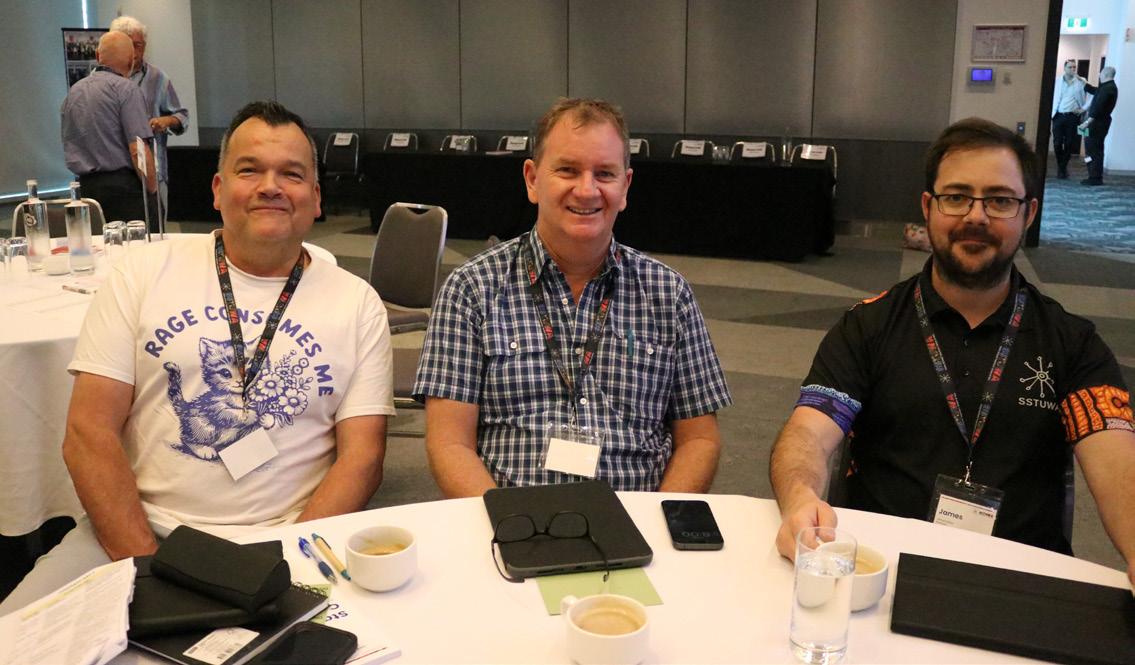
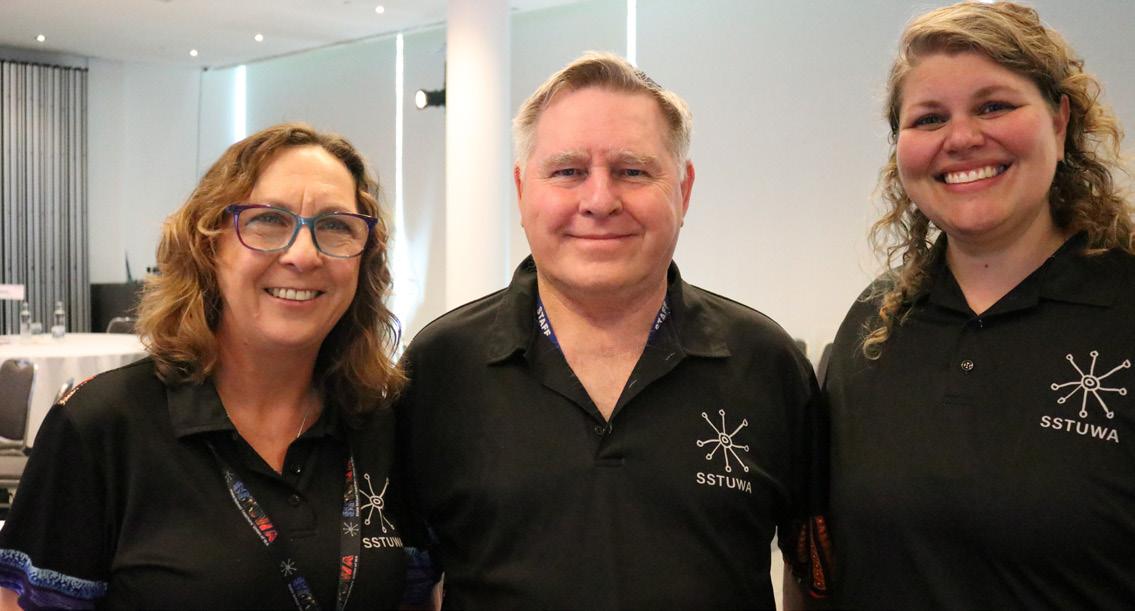
Paul Reynolds, Craig Bourne and James Keillor.
Stephanie Hughes, Peter O’Neill and Marie Klein.
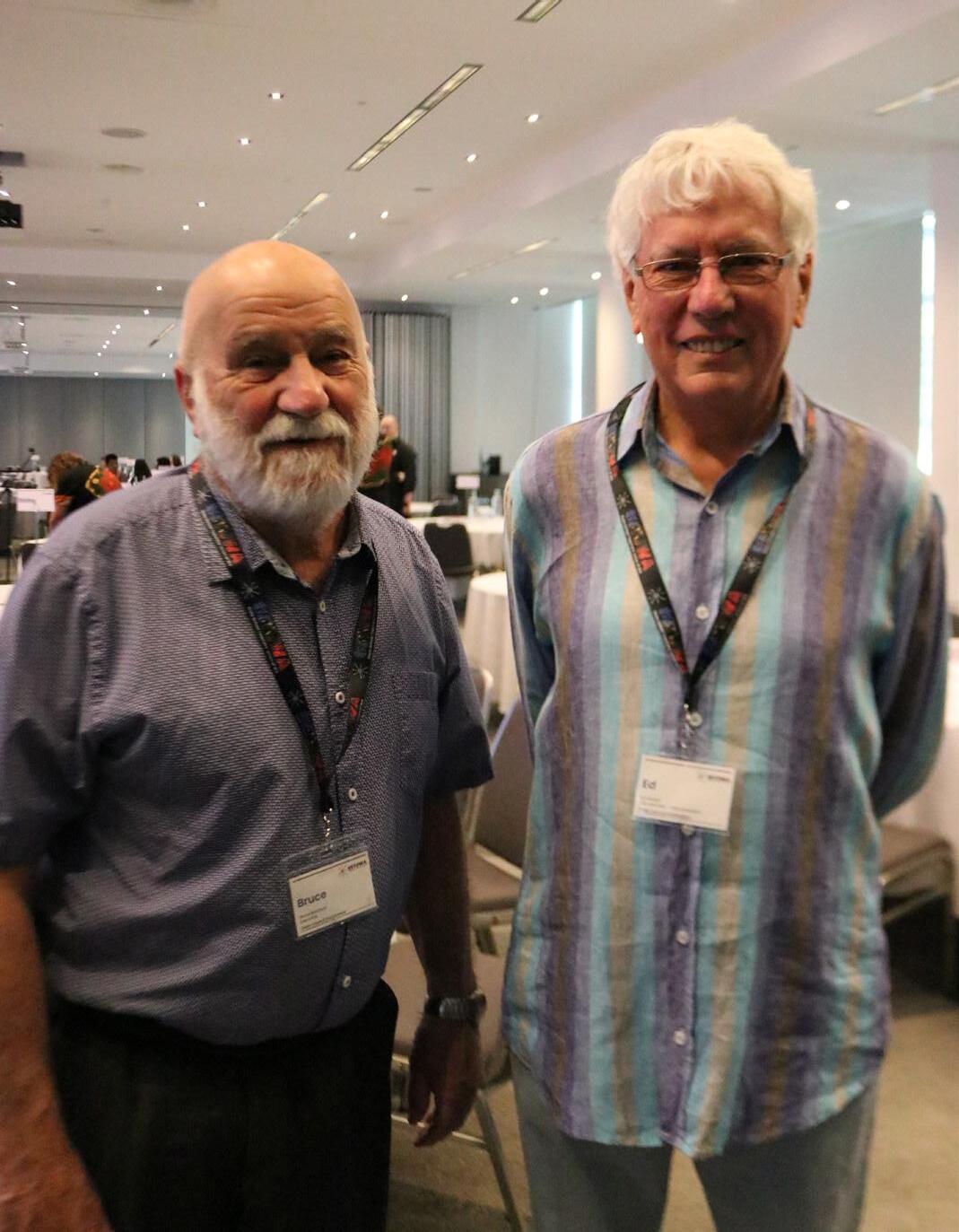
Bruce Banyard and Ed Harken.
Edd Black speaks in support of Anne Gisborne’s life membership conferral.
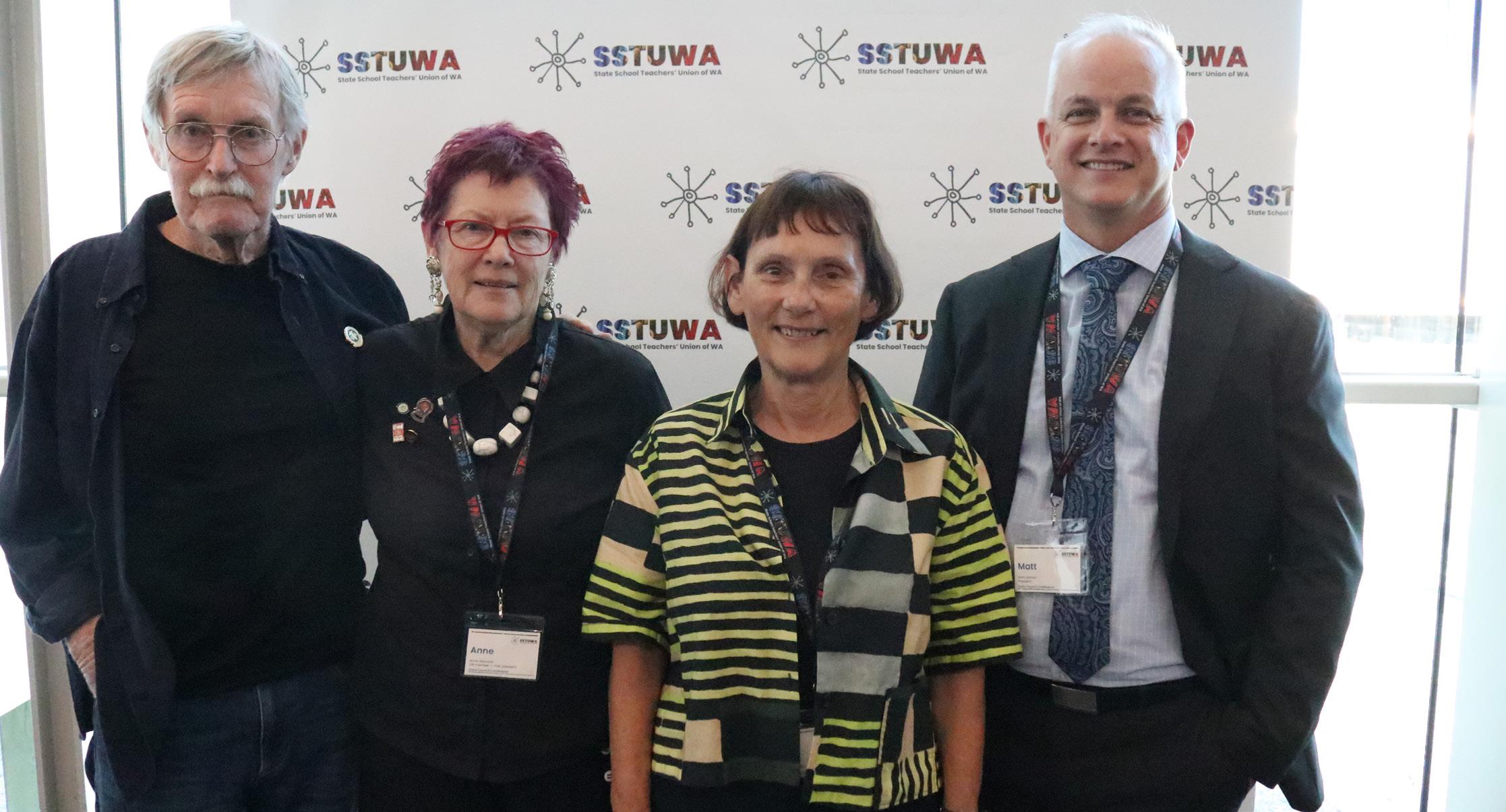
Mike Keely, Anne Gisborne, Pat Byrne and Matt Jarman.
Tom James, Heather Riseberry and John Elliman.
Ngaire Lowry and Kai Griffiths.
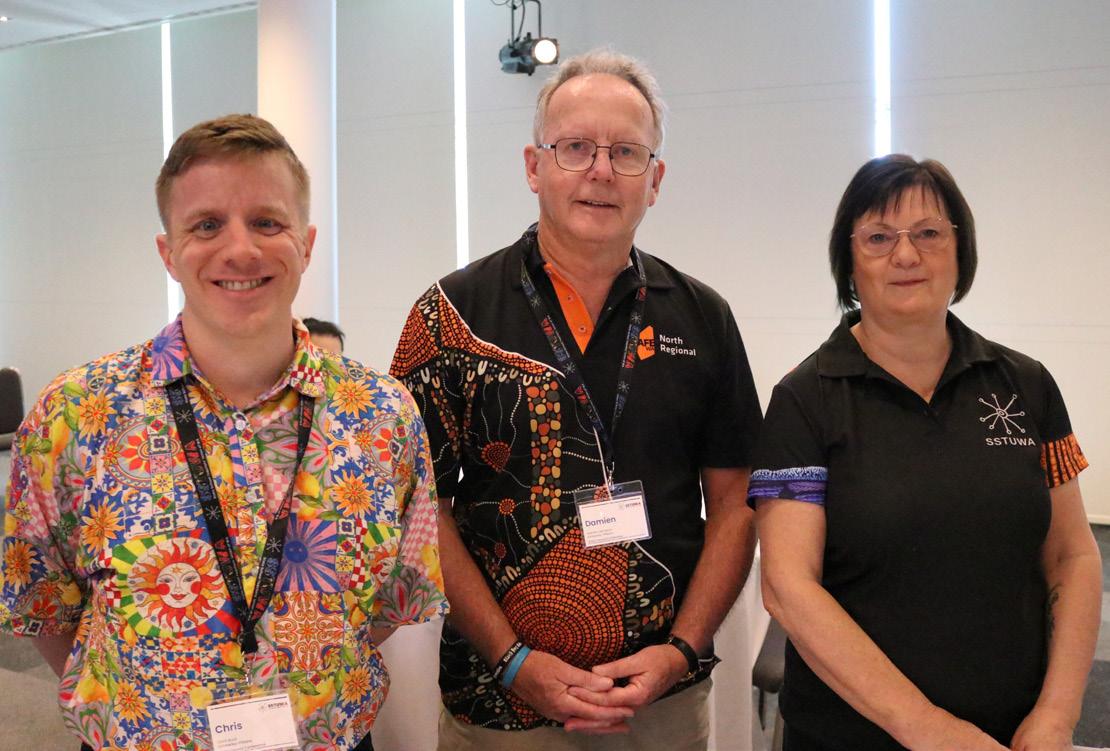
Chris Buck, Damien Jameson and Trisha Chapman.
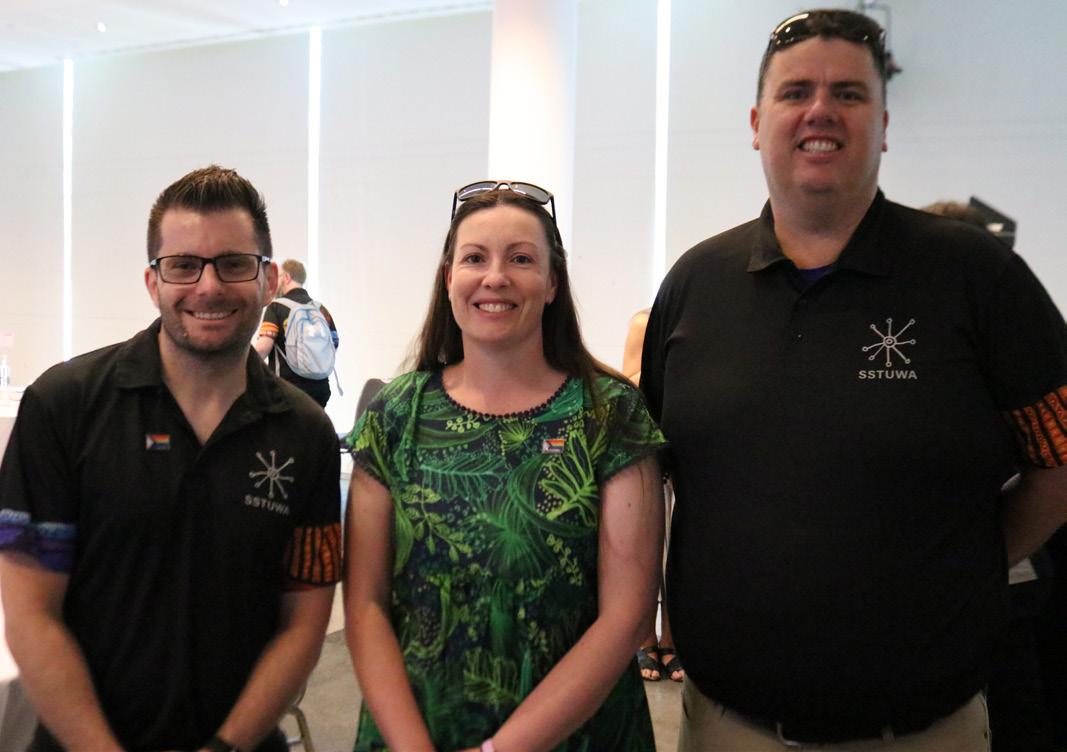
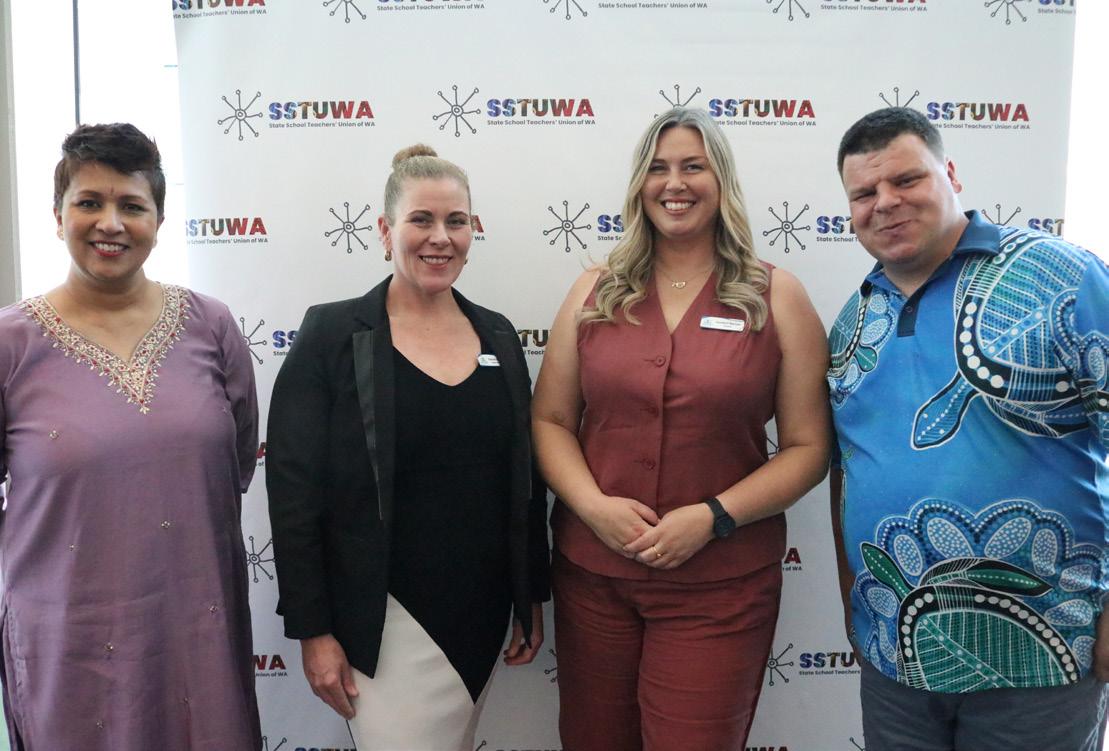
Sharmila Nagar, Yolande Stewart, Sundarii Barnao and Antony Pearson.
National education and union news
Safety rules failing to tackle climate change risk to workers
Unions are calling for new work health and safety (WHS) laws to better protect workers from climate change, including extreme heat, natural disasters and air pollution.
A delegation of union leaders and workers, including nurses, firefighters and teachers, travelled to Canberra last month to launch a new report – Work Health and Safety in the Era of Climate Crisis – laying out the extreme safety risks to workers and reforms needed in the face of rising temperatures.
Australia’s current WHS regime does not enforce mandatory thresholds for safe temperature or indoor and outdoor air quality, heat stress protocols, codeveloped emergency plans or any other binding climate adaptation measures.
The first National Climate Risk Assessment, released in September, confirms that Australia is likely to experience more frequent and extreme climate hazards.
Unions are concerned that most workplaces are already becoming more dangerous, leaving workers exposed to ever increasing climate hazards.
According to the National Climate Risk Assessment, Australia is on track to experience a 350 per cent increase in extreme heat days if three degrees of warming occurs, leaving outdoor workers in agriculture, construction and transport at higher risk of everything from heat exhaustion to cardiac arrest.
Indoor workplaces that already generate heat, including bakeries, foundries and commercial laundries will also face greater risks.
Under current forecasts, heat deaths are predicted to spike 444 per cent in Sydney, 423 per cent in Darwin and 312 per cent in
Perth if three degrees of warming takes place.
Climate change-driven bushfires and heatwaves increase concentrations of ground level ozone, nitrogen dioxide and particulate pollution, which can cause cancer, stroke and respiratory illness in indoor and outdoor workers.
Worsening natural disasters add to the strain on healthcare and emergency service workers, who are required to work longer hours in more hazardous conditions, risking exposure to contaminants from fires and floods.
Warming temperatures are also increasing the spread of disease-carrying insects, exposing farmers, foresters, gardeners and construction workers to illnesses like Japanese encephalitis, which has spread from far north Queensland to Victoria, New South Wales and South Australia.
“Australia must also lift its ambition to decarbonise to exceed 70 per cent emissions reduction by 2035.
The WHS report was released as part of a broader campaign by Renew Australia for All, an alliance of 80 unions, clean industry, climate and community groups calling for more Commonwealth investment in climate resilience measures across healthcare, local government, housing, agriculture and our emergency responses.
ACTU President Michele O’Neil said Australian workers and communities have to be kept safe from the impacts of climate change.
“The current 2035 emissions target has us on a path toward warming above two degrees, an unacceptable outcome that we all need to work harder to prevent,” she said.
“At the same time, our work health and safety regime needs urgent improvement to protect workers from the climate impacts we’re already witnessing, let alone what we’ll see in the 2030s and 2040s.
“Safe Work Australia must urgently develop binding regulations to protect workers from extreme heat, natural disasters, insect-borne diseases and poor indoor and outdoor air quality – all hazards made significantly worse by climate change.
“Countries like South Africa, Brazil, Qatar and Japan have strong laws to protect workers from extreme heat and Australia needs a much stricter regime to meet those international benchmarks.”
New data reveals a third of jobs driving Australia’s serious injury claims
A third of jobs accounted for over half of all serious work injury claims over the past year, with healthcare and social assistance the most common industries, according to new data released by Safe Work Australia.
The Key Work Health and Safety Statistics 2025 report shows that Australia recorded 146,700 serious workers’ compensation claims over the past 12 months. Of those claims, the four most common industries were healthcare and social assistance (19.9 per cent), construction (12 per cent), manufacturing (10.1 per cent) and public administration and safety (9.2 per cent).
Collectively, the four sectors made up over half of all serious claims – despite only representing just 36.3 per cent of filled jobs covered by a workers’ compensation scheme.
According to Safe Work Australia’s report, in 2024, 188 workers lost their lives to traumatic injuries – a rate of 1.3 deaths per 100,000 workers, down 24 per cent since 2014, but still far too high. Vehicle incidents remain the leading cause of death.
Concerningly, the data exposes a large gap between injury and compensation. Only three in 10 injured workers report receiving workers’ compensation, meaning seven in 10 do not lodge or receive a claim – commonly because the injury is seen as minor or “not necessary”, but uncertainty about eligibility and lack of awareness also play a significant role. However, 40 per cent of workers who did not make a workers’ compensation claim needed time off work, highlighting that many unclaimed injuries have a real impact on workers’ lives and livelihoods.
Over the past decade, serious claims for mental health conditions experienced the largest change of any major injury group, up by 161 per cent. Mental stress is now the fourth most common mechanism behind serious claims at 11.5 per cent of all serious claims, after body stressing (musculoskeletal disorders), falls, trips and slips and being hit by moving objects. The median time lost from mental health serious claims is about five times the median time lost across all serious claims. Mental health claims represent the costliest form of workplace injury, leading to significantly more time off work and more than four times the median compensation paid across all serious claims.
ACTU Assistant Secretary Liam O’Brien said these new figures showed exactly where prevention, enforcement and resourcing would save the most injuries and lives.
“Health and care workers, tradies, factory workers and the people who keep our communities safe are at the greatest risk,” he said.
Safe Work Australia is currently undertaking a review of Australia’s model work health and safety laws. In response, unions are advocating for stronger legislative protections for workers exposed to psychosocial hazards, including violence and aggression, sexual harassment and discrimination. These calls reflect growing concern about the need for clear, enforceable standards to safeguard mental health and wellbeing at work.
“A 24 per cent fall in the fatality rate since 2014 is welcome, but 188 families lost a loved one last year. One death at work is one too many and our job is far from done.
“Unions are alarmed that seven in 10 injured workers don’t receive workers’ compensation. That points to barriers and under-reporting that hide the real cost of workplace injuries on Australian workers.
“Mental stress is now the fourth biggest cause of serious injury. Employers must treat work stress and intensification with the same seriousness as any other health and safety consideration.”
AEU Victorian branch welcomes statewide treaty
The Australian Education Union Victorian Branch has welcomed the historic passage of the Victorian Statewide Treaty Bill, including the move to embed truth-telling in the Victorian curriculum.
“The passage of this legislation is a defining moment for Victoria,” President Justin Mullaly said.
“With this Treaty Bill, we all have the opportunity to work together to build our future, properly acknowledge the past and ensure Aboriginal communities are the centre of decision making that affects them.
“Importantly, embedding truth-telling into the school curriculum ensures the truth of our history and the realities of the impacts
of colonisation on First Peoples are taught to Victorian children and young people.
“Every Victorian student should have the opportunity to develop an understanding of our shared history, including the histories of massacres and genocide and to learn about First Peoples’ deep knowledge and understanding of, and enduring connection to, Country.”
Education & Training Centre
With thanks for 2025
The Education and Training Centre was delighted to provide 140 learning opportunities for members during 2025. We welcomed over 1,750 participants during the year for both online and face-to-face events. We thank you for your participation, your commitment to ongoing learning and your gift of time to attend industrial, professional and conference events at the SSTUWA. We look forward to welcoming you back to the Education and Training Centre in 2026 with some very exciting new projects. Visit the SSTUWA website to keep up to date with what’s on offer.
January 2026 events
Join us from 15 January for some powerful personal and professional learning events at the SSTUWA. Register today! sstuwa.org.au/training
Building Strong Foundations for New Teachers in Public Education
Chloe Hosking and Simon Jochaim
Audience: Pre-service teacherscurrently studying or teaching in schools under Limited Registration
Thursday 15 January
9am-1pm
If you are currently studying education and/or working in a school under the TRBWA Limited Registration category, then this course is for you. Build your understanding and knowledge of important working conditions that may impact your success and wellbeing in a school. Join this half-day event to learn about key clauses including:
• DOTT entitlements.
• Staff meeting requirements.
• Class sizes.
• Face-to-face teaching loads.
• Salary grades.
• Incentives to go regional.
Fostering Growth Mindsets in the Early Years
Dr Fiona Boylan
Audience: K-3 educators
Tuesday 20 January
9am-12.30pm
Don’t miss this chance to engage with Dr Fiona Boylan for a great half-day session. You will unravel the principles of growth mindset theory. Learn how you can foster growth mindsets in children from birth up to eight years of age. Explore nine design principles for positive change and some practical strategies for integrating each one into your setting. Aligned with the updated EYLF, you will discover practical ideas to support children to embrace challenges, learn from mistakes and thrive in a positive, supportive learning environment.
Mastering Perimenopause and Menopause (K-TAFE)
Bo Youn Kim
Audience: Primary, Secondary and TAFE
Friday 16 January
9.30am-12pm
Don’t miss out on this one! A morning full of wonderful, relevant information and support for women of all ages. This engaging session will include the diverse perimenopause and menopause symptoms and outline evidence-based treatment options. Bo will debunk the myths and misunderstandings of hormone replacement therapy. She will also present a holistic approach to learning how to navigate the midlife healthier and happier and to thrive beyond menopause. Bo will share in-depth knowledge on diet, sleep, exercise and stress management in midlife and beyond.
Wellbeing for Teachers-Maximise your Mental and Physical Health Using a Mind-Brain Approach (K-TAFE)
Tammy-Anne Caldwell & Todd Budden
Audience: Primary, Secondary and TAFE
Wednesday 21 January 9am-1pm
We welcome back Tammy-Anne and Todd to focus on you. Discover the mindbrain-heart science behind why we need to nurture ourselves to be able to nurture our students. Stress happens to us all; but if we have a toolkit of techniques to boost our emotional and mental health, we can cope so much better. This half-day session will be fun and practical – with tools and techniques to use immediately and daily. Finish with an amazing, guided mediation and sound session with Todd.
Creating Spaces Where Kids Thrive (K-3)
Amy Cox
Audience: K-3 educators
Monday 19 January
9am-12.30pm
With rising diagnoses of ADHD, Autism and other learning differences, classrooms are more neurodiverse than ever – yet many expectations still centre around neurotypical norms, creating unintentional barriers to learning and inclusion. This session offers a neuro-affirming framework aligned with the Early Years Learning Framework (EYLF) principles of belonging, being and becoming. You’ll explore practical, strengthsbased strategies to support regulation, engagement and executive functionensuring your learning environment is inclusive, adaptable and responsive to all children.
Four Ways to Support Behaviour and Self-Regulation (K-6)
Brad Williams
Audience: Primary teachers K-6
Thursday 22 January 9am-3pm
The Four Ways program equips teachers with the knowledge and practical skills to respond consistently and effectively to guide behaviour, improve self-regulation and build relationships. You will learn the Four Ways to respond; the option you choose dependent on the behaviour. The menu includes emotion coaching, signalling, prompting and monitoring. The course will dive deeply into each of these areas providing practical activities, information and great resources to use in your classroom to help start your year off successfully.
Member benefits
Accountants and Financial Advisers
Aston Accountants
10% discount on personal income tax returns for members.
sstuwa.org.au/aston
Industry Fund Services
Specialist financial products for union members.
sstuwa.org.au/ifs
LIFE Financial Planners
$1,200 off your statement of advice fee plus a free financial health check for members.
sstuwa.org.au/lifefinancial
TIPS Financial Services
$1,100 discount on your TIPS Transition to Retirement strategy or Retirement plan. Exclusive to members. sstuwa.org.au/tipsfs
Banking
ME Bank
Special offers throughout the year for members. A bank built by, and for, union members.
sstuwa.org.au/mebank
Mortgages, Money and Me
Complimentary advice, property reports, finance tools and more for SSTUWA members.
sstuwa.org.au/mmme
OFX Money Transfers
When it matters, OFX it. Save with the experts in international money transfers.
sstuwa.org.au/ofx
Teachers Mutual Bank
Banking exclusively for the education community.
sstuwa.org.au/tmbank
Massive discounts on products and services for SSTUWA members
Cars
AutoBahn
Mechanical and electrical services. Members receive 10% off any AutoBahn service or repair, capped at $100. sstuwa.org.au/autobahn
Bayswater Mazda
Exclusive offer including fuel card, servicing and more. sstuwa.org.au/bayswatermazda
Bob Jane T-Marts
National fleet pricing on a range of products and services. sstuwa.org.au/bobjane
easifleet
$250 Magic Hand Carwash voucher with any easifleet procured novated lease.
sstuwa.org.au/easifleet
Europcar
10% discount on vehicle hire in Australia. sstuwa.org.au/europcar
Paywise
Fleet Network is now Paywise. Package your next car and save on tax. Bonus gift with vehicle delivery. sstuwa.org.au/paywise
Western Motor Vehicle Consultants
We’ll find a car you’ll love. Save time and money when sourcing your next vehicle. sstuwa.org.au/westernmotors
Computers
Altronics
Build it yourself electronics centre. VIP trade discount in store and online. sstuwa.org.au/altronics
Apple on Campus
For details visit: sstuwa.org.au/apple
Dell
Save up to 5% off selected items. sstuwa.org.au/dell
HP Computers
Huge savings for members on laptops, accessories, printers and more. sstuwa.org.au/hp
PLE Computers
Save on your IT with access to the PLE Computers academic portal. sstuwa.org.au/ple
Educational Resources
Effective Group Work
Beyond Cooperative Learning. By Barrie Bennett. sstuwa.org.au/effectivegroupwork
Graphic Intelligence
Possibilities for Assessment and Instruction. By Barrie Bennett. sstuwa.org.au/graphicintelligence
Instructional Intelligence
Building Instructional Expertise for the Classroom. An SSTUWA project in collaboration with Barrie Bennett. sstuwa.org.au/instructionalintelligence
Teacher Superstore
5-10% discount, in store and online. sstuwa.org.au/teachersuperstore
Entertainment
Movie tickets
Pre-order your movie tickets and save. sstuwa.org.au/movietickets
Outback Splash
Featuring both water and year-round attractions. Discounted tickets for members. sstuwa.org.au/outbacksplash
Rockface
Indoor rock climbing in Balcatta. $15 all day climbing pass with harness hire. sstuwa.org.au/rockface
For more information visit sstuwa.org.au/benefits and the benefits tab of the SSTUWA App
Food and Wine
Campbells
Access wholesale prices with a complimentary day pass. sstuwa.org.au/campbells
Cellar d’Or
Best value winery tour in the Margaret River Region. 10% discount for members. sstuwa.org.au/cellardor
Taste Bud Tours
Swan Valley “Speed Grazing” – 20% discount. Good Food, Wine & Cider (am) or Good Food, Wine & Beer (pm). sstuwa.org.au/tastebudtours
Health and Wellbeing
Teachers Health Fund
Join the thousands of teachers who have already made the switch. sstuwa.org.au/teachershealth
WA Opticians
20% discount on spectacle frames and lenses. Perth and East Perth. sstuwa.org.au/waopticians
Housing
Houspect
Buy, build and invest with confidence. $50 discount on prepurchase building inspections. sstuwa.org.au/houspect
Johns Building Supplies
Trade prices on paint and painters’ hardware. Builders prices on all other hardware lines. sstuwa.org.au/jbs
SkylightsWA
Specialising in skylights and roof ventilation, servicing all regions of WA. 7% discount off selected products. sstuwa.org.au/skylightswa
Wattyl
15% off Wattyl paints, stains and accessories at Wattyl Paint Centres in WA.
sstuwa.org.au/wattyl
Insurance and Legal
Journey Cover insurance
For details visit: sstuwa.org.au/journeycover
SSTUWA Legal Services
Access to quality legal services for both work-related and personal matters. sstuwa.org.au/legal
Teachers Health Fund
Join the thousands of teachers who have already made the switch. sstuwa.org.au/teachershealth
Teachers Health – Travel
For Teachers Health members who are planning a trip away, Teachers Health travel insurance offers comprehensive cover at competitive rates. sstuwa.org.au/travelinsurance
Wills for members
Members can access a complimentary simple will, where appropriate. For more information or details about a complex will, visit: sstuwa.org.au/wills
Shopping
isubscribe
Up to an extra 10% off any print and digital magazine subscription; over 4,000 titles. sstuwa.org.au/isubscribe
Jackson’s Drawing Supplies
10% discount in Jackson’s 12 shops and online. sstuwa.org.au/jacksons
Petals Flowers & Gifts
20% off flowers and gifts. World-wide delivery available. sstuwa.org.au/petals
Teacher Superstore
5-10% discount, in store and online. sstuwa.org.au/teachersuperstore
Union Shopper
Save on cost-of-living expenses with some of Australia’s biggest brands. Free access with your SSTUWA membership. sstuwa.org.au/unionshopper
Travel and Accommodation
Accor Hotels
Great savings for teachers at Accor Hotels in the Asia Pacific region. sstuwa.org.au/accorhotels
Choice Hotels
Choice Hotels welcomes SSTUWA members with exclusive rates at locations in Australia and NZ. sstuwa.org.au/choicehotels
Experience Oz
Save 10% on over 3,000 experiences across Oz + NZ. sstuwa.org.au/experienceoz
Inn the Tuarts Guest Lodge
Forest retreat, 4-star, with indoor pool, Jacuzzi, sauna and BBQ. Adults (12 years+) only. Five minutes to Busselton. Studios and rooms. 22.5% off rack rate or best available rate. sstuwa.org.au/innthetuarts
Jarrah Grove Forest Retreat
Luxurious, self-contained accommodation in Margaret River. Discounted rates for members. sstuwa.org.au/jarrahgrove
Mandurah Houseboats
10% discount on houseboat holidays. sstuwa.org.au/houseboats
Metro Hotel Perth City
15% discount on the best available rate. Located in East Perth near the WACA and Gloucester Park. sstuwa.org.au/metroperth
Rottnest ferry tickets
Save up to $15 on Rottnest ferry tickets with WestClub. sstuwa.org.au/rottnest
Classifieds
Dunsborough (Quindalup)
Large 4x2 holiday home on Geographe Bay Rd. Swimming beach 30m away. Free use of private boat mooring. Room to park boats with boat ramp a minute away. Slow combustion wood heater and reverse-cycle air-con. Available all year except for leavers’ vacation. No pets. 0419 943 203 a_r_moore@bigpond.com
Dwellingup
Après Huit and Dwell Cottage provide luxury self-contained accommodation set in beautifully landscaped gardens. Can be rented separately or together. Après Huit: 2x2, main house. Dwell Cottage: 1x1, furnished in a French theme. Robert: 0419 954 079 dwellcottage.com.au
Dwellingup
In need of a tree change? Time out to reconnect with nature? Time for a vacation in Dwellingup’s Jarrah forest, 90 minutes from Perth. Chuditch Holiday Home is perfect for couples, groups and families. It’s centrally located and sleeps up to eight people.
Shani: 0402 615 235 shanivore@hotmail.com
Frankland River
Private secluded retreat. Choose from three different types of separate accommodation. Three bedroom homestead: two king beds, two single beds – sleeps six (no pets). Two adults $195/night, children under 13 $25/night, extra adult guests $50/night. One bedroom chalet: one queen bed – sleeps two. $139/night, adults only. One bedroom cabin: one queen bed – sleeps two. $169/night, adults only. franklandriver.com.au
Jade: 0430 450 093 | Sam: 0413 160 093
Fremantle
Short term accommodation in central Fremantle. Recently refurbished with all conveniences for modern living. Townhouse has three queen-sized bedrooms plus provision for two singles. Enjoy time in the rear garden, complete with BBQ. Secure parking for two cars, access controlled by electric gates. 9430 4458 | 0407 083 174 info@westerley.com.au
Fremantle
Staycation? Attending a function? Cosmopolitan getaway? Fremantle is the place. Cafes, restaurants and breweries. Markets, beach, art galleries, museums, theatre, events, shopping, skate park, Ferris wheel, whale watching... What more could you want? Eco-Gallery Apartment is stylish, centrally located, sleeps three and has secure parking. (08) 6323 2339 admin@smartstaywa.com.au
Kallaroo
Serenity Escape is a 2x1 apartment with full kitchen, offering comfort and convenience. 20 min walk to beach, 5 min drive to train station, walking distance to Whitfords Brewing Co, cinema and shops. Toiletries, slippers and coffee machine provided. Min two nights. Sleeps four, or five with mattress. No pets. $125/night for 3 people; $10/night per extra person. Molly: 0428 166 559 mollysletters@gmail.com
Kalbarri
Clean, tidy, self-contained family-friendly 3x1 brick house at the top end of a quiet cul-de-sac. Sleeps eight: two x queen beds and two x bunk beds. Close to Blue Holes Beach, 15 min walk to town. kalbarriwa.net.au | 0435 845 504
Margaret River
Two bedrooms, private, comfortable, fully equipped stone cottage with fireplace, located amongst the forest opposite Boranup National Park, 17km south of Margaret River on Caves Road. Close to beaches, wineries, caves and galleries. $150 per night for two people, or provide own linen and towels for $120 per night. Russell: 0418 933 270
Nannup
Seraphim Retreat is a pet friendly 3x1 character farm cottage, five minutes from friendly Nannup. Set in acreage, with established gardens and stunning valley views. Air conditioned and wood
heater. Horse riders can bring their horses to access our arena and trails. Teacher discount: $159 weekends, $149 midweek. See website for details. seraphimretreatnannup.com SMS 0420 832 510
Safety Bay
Very clean and tidy, traditional style 3x1 duplex in Safety Bay. Fully furnished and equipped. One street from beach. Presently a minimum stay requirement (this may change).
cnjn@aapt.net.au
Trigg
Self contained accommodation. Kitchen, laundry, queen sized bed plus fold out double couch in lounge. Free WiFi and Netflix. Own entrance. Find us on Facebook.
Rammed earth cottage, 2x1, nestled amongst bushland. Well located, short walk to Studio Gallery Bistro, two-minute drive to Caves House. Beaches, galleries, wineries and restaurants close by. Sleeps six. No dogs. stayz.com.au (property 136151)
Kirsty: 0419 927 660
Tranquillity Counselling, Psychotherapy and Career Development
I provide holistic, confidential practical counselling to help you deal with an array of issues, some being: general relationship, mental health, anger issues/management, anxiety, depression, self-harm, grief and trauma, addiction, abuse, palliative care. Milica Robinson, MCnsig&Psychthpy, GradCertCareerDev, BEd. 0422 358 187
Retirement coach
Are you recently retired or retiring soon? You probably have a financial plan in place but developing a plan for the non-financial side of retirement can be as important as preparing financially. I offer support and guidance for the transition from work to
Email 50 words or fewer to editor@sstuwa.org.au along with your union membership number. Free for members.
Classifieds
retirement, helping you to find purpose and meaning in retirement. Contact me to arrange an obligation free chat. retirementcoaching01@gmail.com
Marriage celebrant
Marriage celebrant with 12 years of experience, working in the Peel, South West and Perth areas. Specialising in creating personalised ceremonies for couples at their chosen wedding location. I’d love to help you plan your special day!
Meridith: 0400 312 535 meri.lake4@gmail.com
Marriage celebrant
Heart Centered Ceremonies for couples wanting a personalised wedding. Lee will help you design your dream wedding – a memorable occasion. Mention this ad to receive a discount.
Lee: 0404 655 567 leehalligancelebrant.com.au
Marriage celebrant
Experienced professional celebrant available, all areas. Formal or informal, large or small weddings. A Beautiful Ceremony will help you design an unforgettable and uniquely personal ceremony.
Mary: 0418 906 391 maryburke40@hotmail.com
Funeral celebrant
I am an experienced funeral celebrant. It will be my honour to assist you in the cocreation and presentation of a ceremony that serves to honour your loved one, by revealing their essence through a uniquely constructed and presented combination of spoken word, rituals, symbols, audio and visual displays.
0449 075 001
Kc.fcelebrant@gmail.com
First aid training for students
St John Ambulance WA offers free first aid training to all school aged students, ranging from Triple 000 Hero for Kindergarten students to Road Trauma
First Aid for secondary school students. Courses are curriculum mapped. (08) 9334 1259 youth@stjohnambulance.com.au
Learn to social dance
Learn jive, waltz, rumba, samba, tango and other dances for social events (ball, wedding, cruise, etc). A fun and easy course with quality instruction. Join with or without a partner. Melville (LeisureFit) Recreation Centre. Mondays 7.30-9pm. $118/8 weeks. Beginners’ course held every term. Term 1 2026 starts Monday 9 February. Stan: 9330 6737 | stan@stansdancing.com
Messines Bee Farm Incursions
Four bee/sustainability themed incursions for primary, K - 6. Play based, engaging, hands on, live bees, honey tasting. messines.com.au workshops@messines.com.au
Road safety education for schools
RAC offers free curriculum aligned road safety workshops and online resources for primary schools (pre-primary to Year 6) and secondary schools (Years 10 to 12), covering a range of road safety topics designed to keep young people safe on and around the roads. (08) 9436 4471 | rac.com.au/education communityeducation@rac.com.au
Jump Rope for Heart
Looking for a ready-to-use program for your health and physical education plan? The Heart Foundation’s five-week Jump Rope for Heart program is just what you need! This easy-to-run primary school program, supported by an online teacher portal full of helpful resources, makes incorporating skipping into your school’s activities a breeze. It inspires kids to move more, have fun and develop heart-healthy habits, all while raising funds to save Aussie hearts. Discover how you can support your students in becoming Heart Heroes at jumprope.org.au
MAWA
The Mathematical Association of Western Australia offers professional learning opportunities, conferences and consultancy services to teachers and schools and networks. MAWA members receive 10 per cent discount on MAWA shop resources. For more information: mawainc.org.au 9345 0388 | eo@mawainc.org.au
Macramé is the new yoga
I'm a teacher running small group macramé classes in a cosy home studio. Join me and discover the power of mindfulness as you learn to engage your mind and your hands in a fun supportive environment. It's a powerful way to calm a busy mind.
marcia@knotinlove.com.au
Rainbow Reading (New Heights)
Rainbow Reading supports struggling readers, including neurodiverse, delayed, or new English learners, without changing school programs, instead, adding to support. The Reading pen motivates, while activities help students catch up on missed reading and comprehension. Need support with group work or extra reading mileage? Rainbow Reading has effective solutions.
rainbowreading.com.au | Di: 0407 490 253
Teaching resources
From a retired teacher, the following resources are available: English, media, literature (Years 7 -12); ESL: primary and secondary; Aboriginal education: DHS; First Steps presenter books; science upper primary and lower secondary. Dave: 0438 579 689
Calling all retired teachers!
Are you a retired teacher with a spirit of adventure and time to spare? Would you like to assist families in remote areas of WA? You may like to join REVISE WA as a tutor. For more info, visit www.revisewa.com.au
Noticeboard
Retired teachers
Thank you to all the retired teacher members who joined us at the Christmas function on 1 December. Find the photos at sstuwa.org.au/RetiredTeachers and in the RTA Facebook group. Wishing you an enjoyable festive season!
Stay in touch: Join the RTA Facebook Group – search “Retired Teachers’ Association of the SSTUWA”.
New website and app security
While we don’t store credit card details or other financial data on our website or app, we are always conscious of making our online home as secure as possible, so we have updated our password protocols and introduced twofactor authentication. If you haven’t reset your password yet, you will need to do so next time you visit the website or app, so please allow a little longer for the log-in process. For more information visit bit.ly/4f4TlQa
Human Rights Day
Festive season office closure dates
The SSTUWA office will close at 4.30pm on Wednesday 24 December and reopen at 8am on Monday 5 January 2026.
Have a happy, safe and enjoyable holiday season.
2026 wall planner
The 2026 wall planner was distributed with the print version of the November Western Teacher
Digital edition subscribers can order a planner at sstuwa.org.au/wall-planner
Human Rights Day is observed every year on 10 December — the day the United Nations General Assembly adopted, in 1948, the Universal Declaration of Human Rights (UDHR). Human Rights Day is an opportunity to reaffirm the importance of human rights in re-building the world we want, the need for global solidarity, as well as our interconnectedness and shared humanity. For more visit: un.org/en/observances/human-rights-day
State Council Conference
June 2026 State Council Conference will be held on 12-13 June 2026. Items must be received by 24 April 2026.
Visit sstuwa.org.au/ statecouncilconference for further information.
Research and studies
Did you know we have an extensive collection of research and studies on our website?
To view these, visit sstuwa.org.au/research
SSTUWA committee meeting dates: Venue: SSTUWA office | Contact: (08) 9210 6000 or contact@sstuwa.org.au Videoconference facilities are available
New Educators Committee
Time: 4pm
2026 dates TBC
Women’s Committee
Time: 4pm
2026 dates TBC
Early Childhood Educators Committee Time: 4pm
2026 dates TBC
LGBTIQ+ Committee
Time: 3.45pm
2026 dates TBC
Aboriginal and Torres Strait Islander Committee Time: 4pm