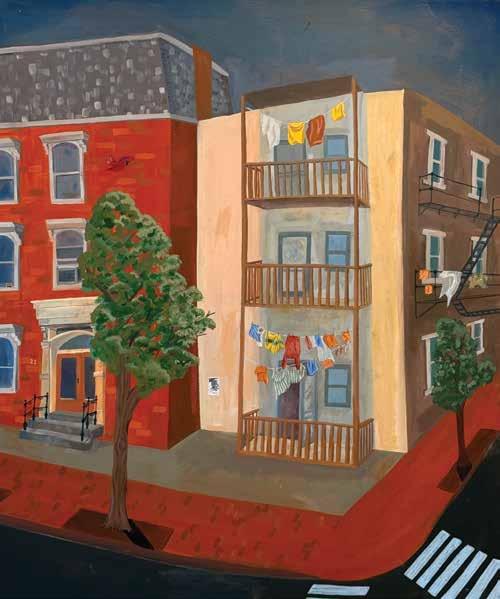
“The Little Things” is a very large oil painting I created as the capstone of my Fine Arts Certificate. The idea for this piece started towards the end of my junior year through the lens of observing the mundane qualities of everyday life. However, as I put countless hours into this painting and developed this idea through my time in AP 2D Art, I realized this no longer fully encapsulated what I wanted this painting to signify. Through this revision process and completely painting over this piece, I found what I truly wanted this piece to show: the beauty and uniqueness of ordinary life. It took my numerous late night painting sessions and trips to Northeast DC neighborhoods for inspiration to find that the things in life that I viewed as mundane were only portrayed that way because I had not bothered to stop and admire them. In the vastness of “The Little Things,” I included many small details that hold significance to me in my life, like the 22 affixed as the building number on the left building, a cardinal, which was my favorite bird as a child, flying across the scene, my “painting shirt” which I used as my apron everytime I painted this piece hanging from the fire escape, and countless others.
Authors and artists hold rights to their individual works.
Fire & Stones literary and art magazine is published bi-annually in the winter and spring and is distributed free of charge.
Submissions:
Submissions for Fire & Stones are open to all St. Stephen’s and St. Agnes Upper School students. Submissions must be emailed to fireandstones@sssas.org. We only consider material offered for first time publication. Artists and writers may submit 1-3 pieces per issue. Literary entries accepted: short fiction, essays, poetry, plays, and excerpts. We do not have length limits; however, try to keep submissions under 1000 words. Include names on the files: firstinitial_lastname .doc or Google docs permitted. Visual art accepted: photography, illustration, painting, collage, mixed media, cartoon, graphic design, and photographed sculpture. Please submit visual art as high-resolution, jpeg files. For this issue, Art and literature had to be submitted to our faculty advisors by April 3, 2026. We have a blind judging process for art and literature. This format ensures that the staff members’ votes cannot be swayed by the votes of other staff members.
Advertising:
Students interested in learning about marketing lead the charge in promoting the issue. They write the call for entries and create posters and social media content to spread the word. It’s a hands-on learning experience that lets them gain practical marketing skills.
Distribution:
The submission window and distribution are bookended by our Fall and Winter Coffeehouses. Like our magazine, Coffeehouse is a bi-annual event with one in the fall and one in the winter. Coffeehouse is a Fire & Stones-run event where the students gather to share poetry, dramatic readings, and music with their peers. Additionally, select copies will be made available to the Lower and Middle School campuses and the Archivist, extending the reach of our publication beyond the upper school.
Permissions:
By submitting their work to Fire & Stones, contributors grant us permission to publish their work in both print and digital formats. We respect the rights of our contributors and will ensure proper attribution for all works included in the magazine. Any inquiries regarding permissions or usage rights should be directed to the editorial team.
Digital versions are posted to our website: fireandstones.org For additional information or how to obtain hard copies please email faculty advisors Kate Elkins (kelkins@sssas.org) or Jill McElroy (jmcelroy@sssas.org.)
We extend our heartfelt thanks to everyone who contributed to the creation of Fire & Stones whether as writers, artists, editors, or supporters. Your passion and creativity have made this publication possible, and we are grateful for your contributions.
For inquiries, feedback, or to get involved in future editions, please email faculty advisors Kate Elkins (kelkins@sssas.org) or Jill McElroy (jmcelroy@sssas.org.)
SSSAS, 1000 St. Stephen’s Rd, Alexandria, VA 22304, www.fireandstones.org @fireandstoneslitmag!
Senior Editors
Vera Barker ’26
Dava Boyce ’26
Lilly Purtill ’26
Junior Editors
Caeli Boris ’27
Grace Laha ’27
Willa Johnson ’27
Jackson Sipple-Asher ’27
Editing Team
Mika Aquino ’28
M.E. Call ’28
Janney Cooper ’26
Kaia Corens ’27
Cecil Gregg ’27
Ariya Harrington ’26
Raine Patterson ’27
Katie Pilcher ’29
Charlotte Reynolds ’27
Sydney Wallis ’29
Linden York-Simmons ’27
Faculty Advisors
Kate Elkins
Jill McElroy
Dear Reader,
From the comforts of home to the great outdoors, this issue covers the journey from home to a new adventure. Through rain or shine, across mountains and deserts, during night or day, we hope you consider your own journey through the world—how you have changed, and what you look to next. We have had a great time working on Fire and Stones, wandering through many beautiful pieces of art and literature, and taking a journey with such a wonderful team.
Sincerely,
Senior Editors, Vera Barker, Dava Boyce, and Lilly Purtill
Brand New Chapter
—Georgia Neaderland ’26
Literature
6 - My Helping Hand - Poem by Téa Cragin-Padilla ’29
8 - forgiveness - Poem by Janney Cooper ’26
12 - Fever Dream - Poem by Cecil Gregg ’27
18 - A girl and her wishes - Poem by Janney Cooper ’26
22 - A Chapel Talk - by Lucas Kalo ’26
2
6 - They’re Building a New Lodge - Poem by Freya Greene ’29
30 - The Good Place - Poem by Ness Boampong ’29
32 - Summer Storm - Poem by Ella Schneider ’27
34 - Mosquitos - Poem by Janney Cooper ’26
38 - The Murder of Froggy - Story by Georgia Neaderland ’26
43 - Mosaic - Poem by Mia Klock ’27
44 - April, Midnight - Poem by Ella Schneider ’27
47 - Memories - Poem by Charlotte Reynolds ’27
48 - The Hewer of Wood, a fragment - Story by Jackson Sipple-Asher ’27
52 - Describe Yourself In Three Words - Poem by Annabelle Bremner ’27
7 - A Quiet Breakfast - Painting by Margaret Gangi ’28
11 - Culture in a Bottle - Illustration by Vera Barker ’26
17 - Unwind - Drawing by Caeli Boris ’27
19 - Proportions - Drawing by Karen Lamson ’26
20 - Sets Over the Years - Drawing by Grace Laha ’27
25 - The Corner of Columbus Street at Dawn - Illustration by Dava Boyce ’26
29 - Classic Car Show - Advertisement by Linden York-Simmons ’27
33 - Upside Down Horizons - Photomontage by Caeli Boris ’27
36 - En Route - Painting by Dava Boyce ’26
41 - Stationed - Painting by Dava Boyce ’26
42 - Figure Skater in Motion - Drawing by Willa Johnson ’27
45 - Stars and Sky - Drawing by Grace Laha ’27
46 - Lemons - Painting by Kaia Corens ’27
55 - Desert View - Illustration by Linden York-Simmons ’27
56 - Baking Day - Drawing by Mia Reinke ’28
(An Homage to Emily Dickinson)
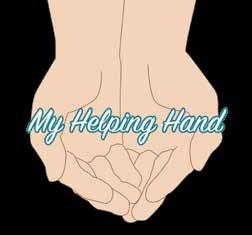
My life is not a fantasy, My hope is not a dream, I am not that fairytale, but nor as I seem.
I know I’m not some Savior, My Touch will never Heal, I only seek to stem the pain of one Life’s great ordeal.
I relish in humanity, my greatest love is love So I’ll lend my hand till Death’s deep door, And choose to help; as I was born for.
—Téa Cragin-Padilla ’29
A Quiet Breakfast
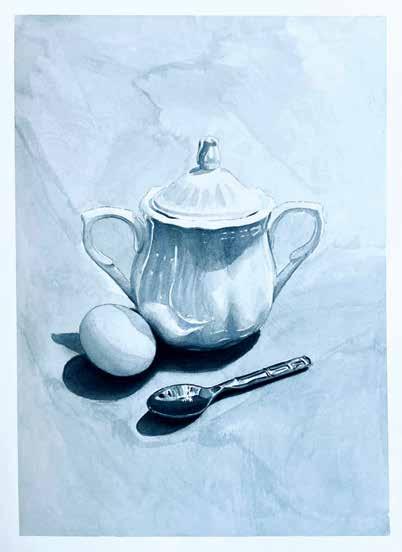
The reference image for this piece includes utensils and ingredients for a quiet breakfast. Before this image was captured, the items were laid out with a morning routine in mind. The spoon and sugar bowl are for tea and pair with the egg for a light breakfast. I picked these materials to show not just the breakfast itself, but the utensils that make it possible, as they often go unnoticed or are so ingrained in our routines that we don’t appreciate them.
—Margaret Gangi ’28
forgive me, Father, for i have sinned i have deigned to exist a woman
forgive me, for i descend from Eve who was too weak to resist temptation so i must bear the burden of her miscalculation
forgive me, for i dared to develop breasts that selfishly draw the attention of dandies who’d otherwise be gentlemen
forgive me, for i make the mistake of menstruating— how callous of me to let my precious eggs go to waste when i could use them to multiply, reproduce
forgive me, for i have a mouth that won’t permit me to speak only when spoken to, with lips that have a habit of indelicately spilling opinionated assertions and vulgar vernacular like water droplets from a leaky faucet
forgive me, for i have legs that like to rest in an unladylike spread rather than a dainty, deferential fold, legs that strive to walk, run, soar greater distances than the scope of staying in the kitchen would allow
forgive me, for i have hands with higher potential than idly wasting away at needlepoint and disposing of soiled diapers, for i hope when the time comes that the now-smooth and supple skin of my palms is withered and wrinkled, that the calluses have arisen not from mundane chores but from years of joy-filled, laborious work and relentless fighting through rewarding struggles
have mercy on me, for i have a mind that refuses to submit to the will of entitled husbands or ludicrous world leaders
forgive me, for my uterus knows its worth beyond serving as a baby-making machine
forgive me, for my body craves connection, satisfaction of longings aside from simply pleasing my lover, for it finds the concept of waiting until marriage to be rooted in the selfish male desires for dominance
forgive me, Father, for i have sinned— i am a woman, so i will never win.
i am a woman, therefore only when my flesh is reunited with the earth, when my impure blood has dried up and my bones decayed to dust and my rebellious spirit flown to whatever realm awaits me and my once feminine features are indistinguishable in my remains for good, will i sin no longer.
—Janney Cooper ’26
Culture
in a Bottle
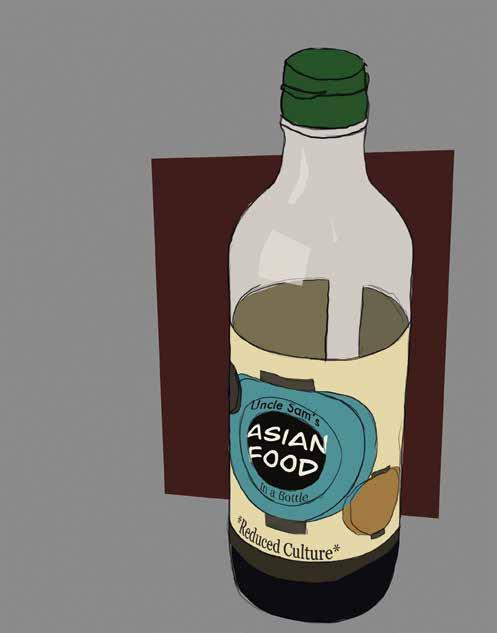
This piece was created for my Asian American History and Literature class. It is showcasing how Americans generalize and “Americanize” Asian foods, in this case soy sauce being seen as the whole culture of Asian food instead of recognizing the food genre’s huge diversity. This piece was created for a fake Instagram post, with the caption saying “I love Asian food,” showing how some Americans also lack knowledge or perspective of how much is encompassed by the term “Asian food” without trying to become more educated.
—Vera Barker ’26
Thump
I wake up, dreaming
Fever gone?
Heart still beating
Flat
Cheek pressed with hardwood floor
Head wedged between,
The leaning tower of fitted suits, One collapsed shoe, And the white-sealed door,
Head throbbing
Thump
Thump
My pulse late to rehearse something urgent
wake up
Wake up
My brain says it’s a prank
She’s Dead?
My heart lying under oath, prepares a headline
I call anyway
Thump
I always call
She always picks up
So pick up?
She answers: soft, tiring, Slow,
Pick up?
Why Won’t You?
As if the words have to climb stairs to reach me.
“I won’t believe you” I hum “I’m not sorry”
“I can’t let you go”
Thump
“I have to leave now” She whistles
Of course she does. All exits are symbolic in dreams.
And suddenly I can’t find my trumpet Where did I set my bag? I need my wallet Who has the remote I can’t find the words And,
I can’t find
I can’t find
Have you seen my tears? They were here a minute ago, rolling obediently down my face, now misplaced behind the couch
With, what is this? Ah ha!
I can’t find
I found the remote, some spare change and last year’s resolutions.
Thump
The privilege, The honor, Angelic motherly love. I say, Molten.
Because it feels correct
Something golden and dangerous that cools forever hot to the eyes but softly molded into statues you’re afraid to touch. Because grief needs a metaphor and apparently, I brought a thesaurus to the floor
Thump
Hear this is for you,
My last, Pale Blue Elephant Is waiting in the Crape Myrtle trees outside, bending at his polite knees to peer through my window.
This might take a second He squints into my chest
“Still throbbing,” he reports.
Thump
What floor are we on?
“On your floor”
The man, in hollow dark crested purple replies A smile slowly lifting off the lips
This elevator must be broken Why are the ceiling lights beaming down to abduct us?
Thump
Daddy
Wake up
The pirates killed you. It’s back They’re back
You’ll be back
Time will tell
You’ll remember that I served you well
The ship is still rocking We are still at sea
wake up
The ceiling fan rotates like a tired compass. Hand me a key of the Steinway Pry them of the- uh
Well, that sentence dissolves like sugar in tea.
Where was I
Sugar coated walls
My profusely warm sweating body peels back
The sugar-coated wallpaper
The wallpaper curling inwards awaiting my embrace
Is it morning or is the sun just practicing? Is he still mourning is this rehearsed or is that simply what gravity feels like now?
The elephant clears his throat. “You’re being dramatic,” he says, which is rich, coming from a blue elephant in a tree.
Make up your dreaming wake up he’s dreaming
Is it morning Is he still! Mourning
Stop eating that It’s not for you-
I spill vomit on my sweater Mom’s spaghetti
I look away because I am still chewing on tomorrow
Morning arrives calm and quaint
like none of this required explanation. I am still on the hardwood floor. Fever gone?
My heart answers first. Thump.
—Cecil Gregg ’27
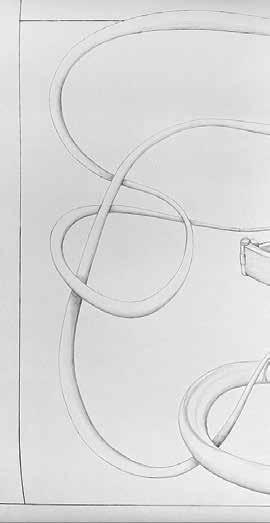
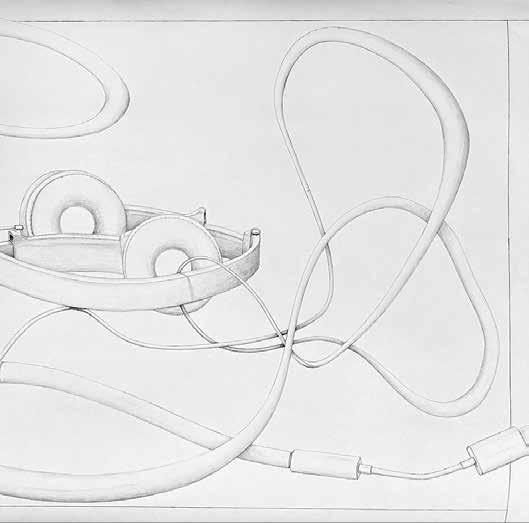
I used the space provided to play with scale and how that affects perspective and distance. I wanted to take a normal object like a pair of headphones and manipulate it to interact with the picture plane and give it some movement. I did this through manipulating the cord, winding it around, and playing with its size to give the sense that the cord was closer or farther away. This also allowed the main part of the headphones to look like it was farther away, adding a sense of depth to the piece. I also made the cord break the boundaries of the frame to enhance the interactiveness of the piece with the paper.
—Caeli Boris ’27
Unwind
As a child she was taught
As so many children are
To dream big dreams
And shoot for the stars
And so every year on the day of her birth
She fills her cheeks with air until they almost burst
Then releases the breath in one fell swoop
To put out the flames chained to her sickly sweet cake that’s beginning to droop
And the smoke that results is attached to a wish, Big and starry,
A confession of a desire unspoken, An ambition too ambitious to utter
So away with the smoke it flutters
And every year the candles grow more numerous Yet the power of her wishes begins to diminish
For the smoke from her precious candles has repeatedly failed her, No longer the cozy embers of a fireplace, They now seem more to her like the remains of a forest fire
The ritualistic blowing more a chore than a reward
And yet she continues wishing Not just on birthdays—
At 11:11 each evening
On eyelashes blown from the back of her hand
4-leaf clovers, dandelions, pennies, Anything that may have the power to
Make a difference
Before the wax all melts
And her time is up.
—Janney
Cooper ’26
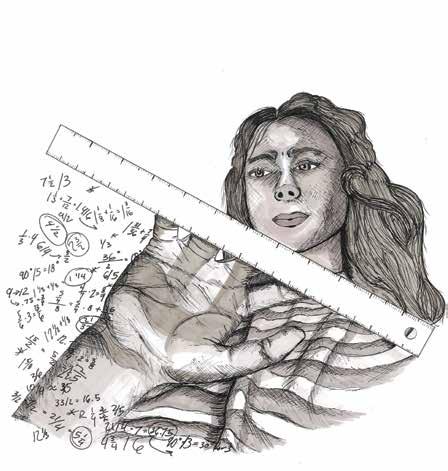
Proportions
“Proportions” is an alcohol marker and ink piece I made during the second semester of AP 2D Art, when I was both examining what I wanted my year-long portfolio—sustained investigation—to look like and grappling with the workload that the class demanded. My typical process of making a piece begins with sketching until I come up with a solid enough idea that I can transfer it to the paper or canvas I will be working on. This is done by taking lots of measurements and scaling the proportions to the size that I need it to be as well as altering certain aspects of the sketch to be more visually appealing (like center major elements using the thirds or halves of the page). “Proportions” is meant to reflect this tedious role in my personal process of creating a piece through the abnormal downwards perspective of the paper.
—Karen Lamson ’26
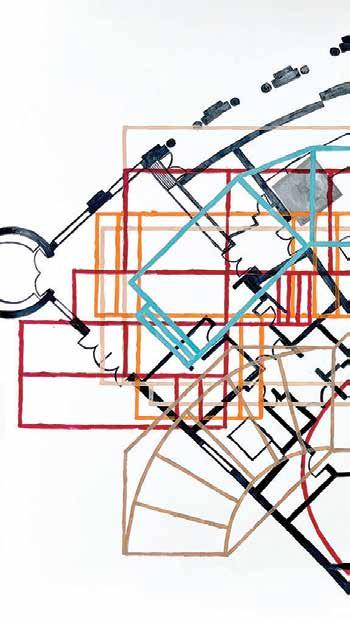
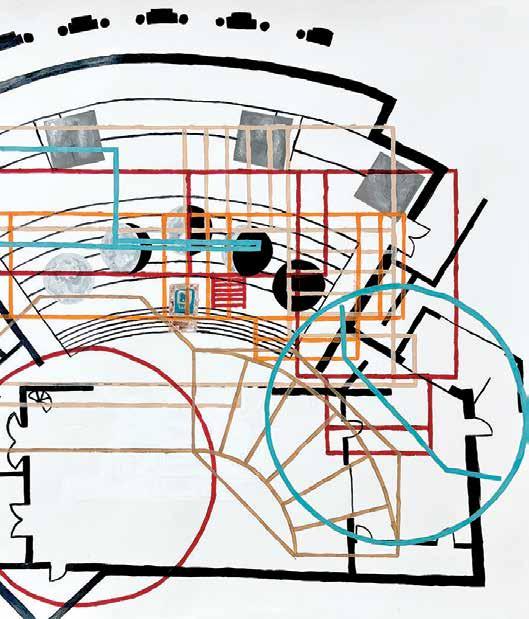
Sets Over the Years
This piece is dedicated to all the Stage One shows I’ve worked on thus far, from The Sound of Music through Footloose, and I plan on adding the next play and musical as well. It features the ground plans of all those sets, as well as the ground plan of CPAC, and a couple of extra nods to several of the shows.
—Grace Laha ’27
Hello my name is: Lucas Kalo I am a senior.
And I am afraid of public speaking so I can’t wait to see how this turns out. Some of you may know me, most of you probably don’t, but something that only a few of you know is that I have an eating disorder. Unlike a lot of eating disorders, mine is not based on my appearance or how I want to look, it is based on control. It all started back in middle school, specifically eighth grade. I don’t really think anyone has a fun time in middle school but I really hated it. I had been going to the same school since I was three years old and desperately wanted out, I wasn’t particularly liked by my classmates and looking back on it I understand why, I didn’t like who I was as a person, and I felt as though my entire life was crumbling before my eyes.
My home life was not going great to say the least. My older sister was making some very poor decisions for herself, forcing my parents to divert all their attention to her in order to keep her safe and out of trouble. This caused them to not really notice the struggles I was going through. I was going through a lot at the time, too much to go into in a single chapel talk, and I felt so alone and like I couldn’t control anything in my life. All of this, along with so much more, led to me developing my eating disorder.
I didn’t really even notice it at first, I simply started to eat less. Eating was the only thing in my life that I could control. I started to tell myself that “I was full” or that “I was eating too much”. I just needed something that I could have power over. Things got better when I got to high school. I was able to find some of the best friends ever and finally start to be the person I wanted to be, along with my home life getting better. Everything was getting better, but for some reason my eating disorder didn’t go away.
Throughout my freshman and sophomore year eating was still a struggle, but it was nowhere near as bad as it was back in eighth grade. That is until about halfway through my junior year. Around that time my life started to get really bad again. My grades were slipping and I was missing assignments, forgetting to turn them in, and in the case of one particular English essay, I wrote the essay on a plane then fell asleep and had a dream that I turned in the essay. I was also prepping for the SAT and feeling stressed about college in general. Those are just some of the issues I was facing at the time because if I told you all of them, we would be here forever, so you’re welcome. It was also around this time that my therapist finally discovered and told me that I have an eating disorder. However,
by the time she realized this, it was already too late. I had lost so much weight that I could have died. My body, more specifically my heart, was in such a bad place that doctors were recommending that I go to treatment, and potentially I could have been hospitalized. This was simply not an option for me. I was already falling behind in school and I had other things I couldn’t afford to miss. For a few weeks I had to go into the doctors a lot to be weighed. And then I started to see a nutritionist. We have done wonderful work together and I was able to get out of the “deadly zone” and eventually get myself to be what doctors deem to be my recommended weight.
I wish I could end this chapel talk by saying that I am perfect now. That my eating disorder has fully vanished and I am living a perfect life, but I can’t. Healing is not linear, and it’s also really difficult. There have been times where I have relapsed and have lost weight. However, I know deep down that I am in a better place now. You never know where you are going to end up in terms of change and growth. For all I know the future could get worse for me, but I do know that with the people around me, and with my own willpower and perseverance, I will be okay. If you or somebody you know is struggling with anything like this, do not be ashamed to get help. Things will get better; you will be okay. Thank you.
—Lucas Kalo ’26
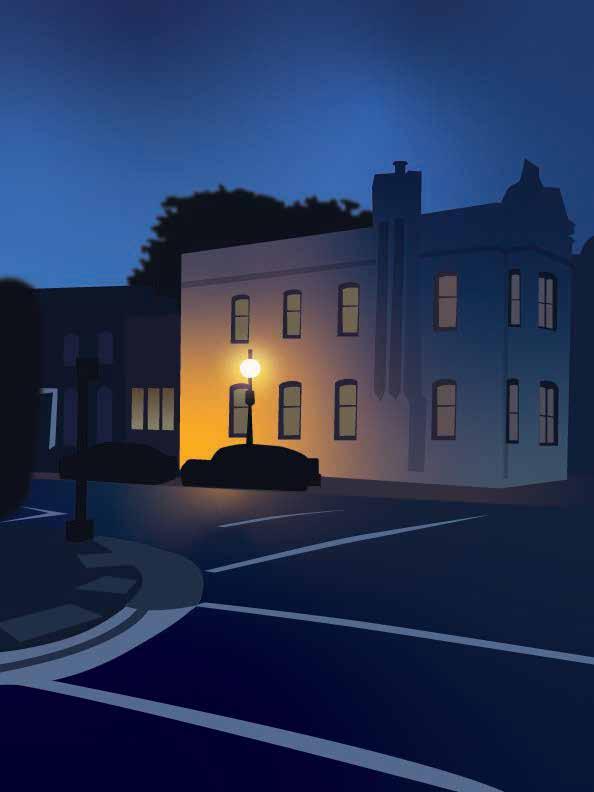
The
My reference for this piece came from a photo I took on the bus near dawn. It was a rainy day in March, and I had been dozing off for the whole ride. The image captures the sleepiness I felt that morning.
Corner of Columbus Street at Dawn
—Dava Boyce ’26
TThey’re Building a New Lodge
And one day the remains of the old one will consist of nothing more than the stone fireplace. by then the book shelves, and the couch cushions, and the rickety chairs will have been relocated or relinquished to the soft earth.
Overheard at folklore night; If you travel these mountains chances are you’ll come across a lone stone chimney; where the home has rotten and fallen away, the hearth remains.
Place a hand against weathered rocks: It’s said laughter can still be heard, lingering smoke can still be seen, as if a fire was just lit there, and will be lit there again.
Walk away from the lodge and around the pond. You’ll find a brick chimney where long ago was a farmhouse and behind it, her garden which is overgrown with disuse; Its wooden fence follows suit to the farmhouse.
One day soon the old lodge porch will crumble. She taught us there, how to grow gardens. We’ll place our hands on the cold stone and watch the smoke reach up to heaven.
—Freya Greene ’29
Classic Car Show is a poster for a fictional event. The whole piece is graphically designed in illustrator and was designed to be as simplistic and stylized as possible. I used a brightly colored 1960’s Alpha Romeo as my focal point to draw attention to the center of the piece.
—Linden York-Simmons ’27
I would like to say I’m a good person
I mean don’t we all want to be able to say that, and for it to be true
I don’t know why I’m thinking about this right now Well yes I do.
I know that I’m dying and all
And that people think about random things before they die but
Shouldn’t I be thinking about something more important?
Like: What will happen to me?
Will I be reincarnated like my religion says?
Will I go to the afterlife?
Were we all wrong, and after death there’s
Nothing?
No light to go towards
No goddess to guide your soul
No peace, just
Emptiness.
Is there some sort of paradise where only good people go? Maybe that’s why I’m so worried about morality
As my vision goes dark, I realize that no matter what happens I’m not scared
I close my eyes and await death with open arms-
Okay wait, was I really a good person or do I just think that because I’m dying?
I know for damn sure I wasn’t a good parent. Will that keep me from “The Good Place”?
I’m sorry, I plead to my daughter
She stands at my bedside with tears in her eyes
Lips quivering and brows furrowed.
I’m sorry I couldn’t give you the life you always wanted
One with shoes the right size
Clothes without holes
Gifts on your birthday Parents who didn’t fight.
We never had money But we had love And I hope to whoever’s out there watching over us
That if nothing else I was at least a good enough person to make you feel like it was enough.
Death came at dawn.
—Ness Boampong ’29
SummerStorm
The sky is swelling
Like something about to break
And I want to be more than A fresh bruise
Or a fear of endings
Some days I think only the hammer of rain
Could erode me back
To some previous tenderness
Only the hammer of rain
I have never broken a bone but
In the seventh grade, a girl once told me
That my heart was more beat up than my shoes
I did not tell her that the love
Was in the silver duct tape
Gathered from within garage doors
Displaying every license plate
Of every state my parents have ever lived in
I did not tell her that the love
Was in my fear of letting go
A fear of forgetting, really
Like how the thunder must echo back
What the lightning strike cannot speak of
I did not tell her that the ribs are a cage
Our body knows how to build from scratch
Or that a cage itself could be both a love and a prison
Or that love and prison could be synonymous
Or that I knew I was trembling on some precipice
But to call it by name would be to fall
And I do not remember how I replied
Only that I was beginning to correlate hugs
With the sensation of being gutted
—Ella Schneider ’27
Upside Down Horizons
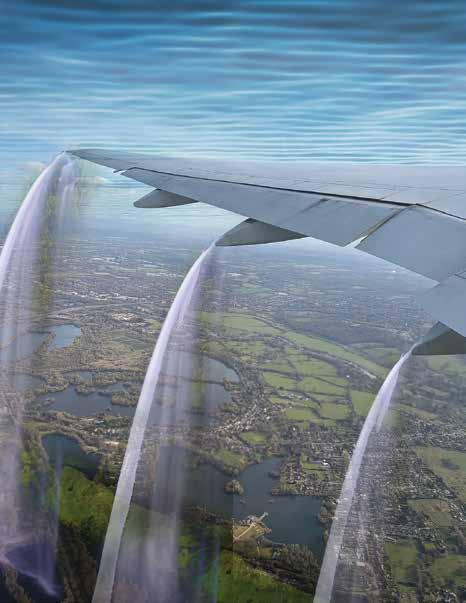
For this piece, I wanted to play with inverting expectations. I took the water and flipped it in the sky instead of on the ground and added the waterfalls off of the wing to represent the trail left behind by planes in the sky, but instead of a trail of vapor, it is a stream of water.
—Caeli Boris ’27
And glide around your face
Then
Before you know it
Before you can react or retaliate
They are upon you
Ravaging you
Defiling your flesh
And pilfering your DNA
One prick
At a time
Try as you might
To swat them away
But these beastly creatures
Are cunning
Cunning
Cunning
Gunning to sink their teeth
Into your porcelain skin
To mar it with their malicious means
Of sustenance
A sacrificial supper
Of an unsuspecting subject
All they want
All they want
All they want
Is your blood,
Not caring
That you need it to survive
They’ll
Drink
Drink
Drink
Until they are satisfied
Even if it takes depleting your entire blood supply
For their thirst to be quenched
Even if you’re left a hollow husk
A shell of the person you once were Their satiation matters more to them
Than your dignity
You are the opulent object of their desires
With whom they can fulfill
Their famished fantasies
But that is just it—
An object you will always be
They don’t care who you are
Not really
What matters is what You offer up
You are not a person to them
If they discover you’ve built a barrier
A boundary of bug repellent spray
That cannot be broken through
Still
Try they will
To get a taste of your tender flesh
A lick of your life force
And if you deny them this gift
This piece of your body to be used for their benefit
They may beat their tiny wings in protest
Buzz dissonant notes of detestation in your ear
Notes that seem to say “come on, one drop won’t hurt” and “I want you because you’re so beautiful”
But the infestation that is their presence
Will eventually recede
Once they realize your wall is too sturdy or too tall
To be cracked
And away they will fly in search of their next prey
And the more bite marks you’ve acquired
The less smooth and supple your skin
The more likely are they to dismiss you
In disgust
Trusting your blood is less sweet
Less delectable
The more times it is sucked
But sometimes
When they fly away It hurts worse
Than when they bite
At least when they attack
You know
You are wanted.
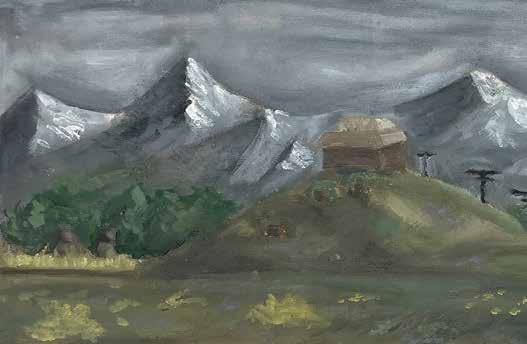
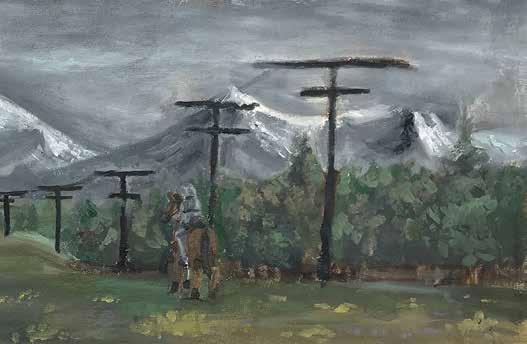
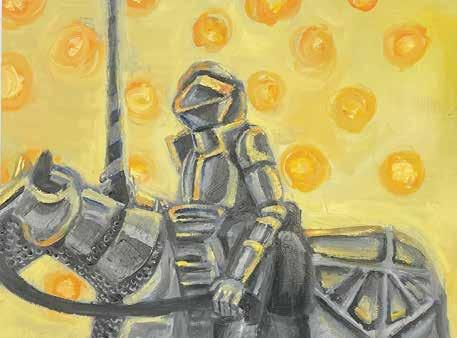
En Route
For this painting, I used a 3-foot long canvas to create an almost panoramic image of a knight traveling through a semi-surreal landscape.
—Dava Boyce ’26
All was quiet in the cabin when I woke up before the bugle. I was prepared to carry out my daily routine of braiding my hair, changing out of my pajamas, and mentally preparing for the day before my campers woke up. This was one of my favorite parts of the day, the North Carolina August heat had yet to set in, and there were no petty disputes for me to settle. As I walked into the bathroom, I saw a fat, green frog sitting on the floor. At this point he and I were old friends, as he had developed the habit of hopping into the cabin through the hole in the screen door. I went to grab the dustpan to shoo him outside, but to my confusion and alarm, as I loomed over him, brandishing the pan, he broke from our usual routine of hopping away and hiding behind the toilet. The frog, lovingly referred to as “Froggy” by my campers, remained still. A shadow fell across his unmoving body as my co-counselor Rachel moved to join me. “I think Froggy died”, I whispered to her, trying to make sure none of the potentially early risers in the cabin could hear me. “I can take care of it”, she assured, seeing my clear anxiety at the idea of having to move the dead frog.
Rachel was a nineteen-year-old rising college sophomore from Ohio, with long wavy blonde hair and a glinting nose ring. She and I had become close that summer when I had found her crying in this very same bathroom after the campers went to sleep because her long-distance boyfriend had broken up with her over text message. After consoling her and assuring her she deserved better, we became fast friends, and she always could tell when I was overwhelmed with unexpected situations that arose as a first-year counselor. So, I let her take Froggy’s lifeless body outside and continued my routine, but I was plagued by the mystery of Froggy’s death.
Realistically, I knew that sometimes animals die, and maybe he came inside because he wasn’t feeling well and inside the cabin was more comfortable. But his corpse being in the middle of the floor seemed weird to me, why would he not have picked a more secluded corner. Additionally, while I had spent the past three weeks chiding my campers not to touch him, two of them in particular had a hard time with that.
Katie was tall for her age and always outgoing. She loved nature and was the first to try to volunteer to help me get Froggy out of the cabin in the mornings, enthused by the possibility of getting to pick him up. Meredith was one of my more difficult campers, and delighted in breaking the rules that had just been set in place. When we had been playing with bubbles earlier in the week, I had told the girls that they weren’t allowed to try to catch them on their tongues, after seeing it happen repeatedly. Immediately after saying that Meredith ran up to and ate a bubble half as big as her face, giggling and joking that it tasted like soap.
Both girls had needed several reminders not to touch Froggy, but where Katie seemed to disregard instructions to try to prove her responsibility, Meredith’s motives were not the same. Her strawberry blonde corkscrew curls would bounce as she chased Froggy around the bathroom. Outstretched tiny 10-year-old hands bedazzled with pointed glittery orange acrylic nails. While I trusted that if Katie ever caught Froggy, she would immediately bring him outside, I remained skeptical that Meredith would do the same if her chase ever ended in victory.
Once the girls were awake and dressed for breakfast, Rachel and I gathered them into a circle to explain that Froggy had died and that we would bury him behind the cabin that night, so if anyone wanted to prepare some words to say about him, they should work on that during the day. As I looked around the circle some girls seemed bored, others were on the verge of tears, and others still were giggling at the idea of a frog funeral.
That night the twilight sat almost as heavily on us as the humidity when we gathered behind the cabin. Rachel had buried Froggy and I was standing in the circle staring intently at the newly disturbed patch of dirt. Katie went first, reading a poem she had written about the beauty of the earth and the peace she hoped Froggy would find now that he was returned to it. As other girls stepped into the circle to sing hymns or pray, I kept finding my eyes drawn to Meredith. While she was always energetic, she seemed practically buzzing for her turn. She was bouncing on the balls of her feet, constantly checking the list of names to see how much longer she had to wait before she got to speak. When she finally stepped up and opened her mouth, nothing could prepare me for what happened next.
“We will miss you, Froggy, and I’m so sorry I threw you into the rafters.” Meredith blurted out. “You what?” I responded in shock. “He was in the cabin, so I picked him up to take him outside, and I tried to throw him out the door but instead I threw him into the ceiling.” She explained with a laugh. My stomach churned hearing her so casually talk about what happened. Poor Froggy, thrown into the wooden ceiling, crashing back to the floor and laying there, slowly dying the night before as the cabin chattered away in the next room, unaware of his fate.
I lurched away from the circle, the dark too oppressive, the unrelenting humidity filling my throat, I was outside but yet I felt like I couldn’t inhale any air. I wondered if this was how Froggy felt, being betrayed by his own organs which were slowly shutting down. How could my camper have killed a frog and then be laughing about it. The frog everyone in the cabin loved so much they had named it. Weeks of sleep deprivation and working in the sun caught up to me as I stumbled back into the cabin, splashing cold water on my face in a desperate attempt to collect myself. I didn’t hear the door open, but I felt Rachel’s hand on my shoulder and looked up to meet her eyes. “Are you okay?” She asked, her pale blue eyes wide with concern as they gazed into mine. “Yeah, I think today was just a lot.” I responded, taking a steadying breath. “At least we know how Froggy died” I choked out with a forced laugh, trying to lighten the mood. “Yeah, I guess so” she agreed, but the concern hadn’t left her eyes.
—Georgia Neaderland ’26
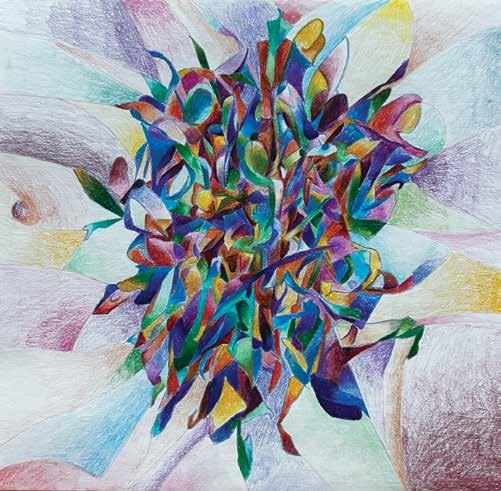
This piece is based off of Umberto Boccioni’s painting, “Dynamism of a Soccer Player.” The painting and art are based off Dynamism art movement, whose goal was to represent motion in a fluid, abstract way. I used colored pencils to complete this piece to give it a blended texture and vivid color.
—Willa
Johnson ’27
Figure Skater in Motion
Between my mother’s ocean eyes and my father’s crowded teeth, my grandmother’s cheekbones
Surfacing where mine should be.
A mathematical average of my friend’s jokes
My sister’s clothes
And my aunt’s soft laughter, All of which shows In the stolen words on my tongue
The armor I never chose, But somehow wore Until it fit my bones.
Even my breath is not my own, But rather an echo pressed between my ribs, The space of my diaphragm copying another rhythm Following another heartbeat Of another body that does not belong to me But once came by and decided to stay.
A sentence about me can never be finished alone
It needs people-shaped commas
Periods built from shared thoughts
Capital letters at the beginning of each sentence Emphasizing what we share together And borrowed meaning like a hand me down From every life that has touched mine And left a mark.
I am a mosaic of everyone and everything I have ever loved Warm and cold colors
Slipping across the wet page
Smushed together into a Mosaic
A beautiful one, Because the reused shades work together to create something new.
—Mia Klock ’27
Nighttime air sweet and floral and aching
Filters through the cracked window
Revealing a sky satiny as youth, dotted by Half-lidded stars craning their cygnine necks
To gaze unto the Earth
At fruit flies buzzing beneath glass domes
Come morning, the nights aberrations
Will be erased, sunlight
Making a palimpsest of time
As I catch only glimpses
Of the moon’s pale face between my teeth
Barefootedly stepping out
Into selenite-blessed dew
I meet the mighty gardener:
Spring tills the soil of Winter’s graves
Sinking fingers just down to the lunula
But the flower petals twisting in the wind
Still look like ash—
The season is building a body to leave behind
—Ella Schneider ’27
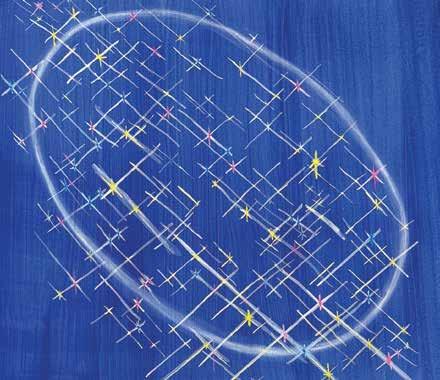
Stars and Sky
This piece was inspired by Mondrian’s “Pier and Ocean” series; however, it breaks one of his cardinal rules by including diagonals.
—Grace Laha ’27
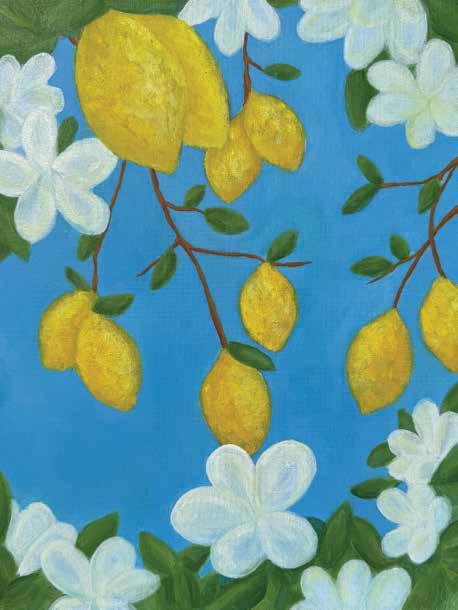
Lemons
This piece represents a surrealist representation of nature. The flowers are semi-transparent, and the lemons have a unique built-up texture compared to the leaves. I chose to do this to see how I could mix textures and techniques cohesively in one artwork.
—Kaia Corens ’27
Memories
Whenever I think of my childhood bedroom, I see pink walls drenched in sunlight and my stuffed animals, together on my bed, ensuring that none would feel “left out.” Days filled with discovery. It hasn’t been long since I was a chubby child, always grinning and buzzing with excitement; golden hair like coiled springs And yet, the videos of my first steps, first syllables, first ice cream cone are grainy and unfocused, memories lost to time, pixels on a screen. In my bedroom, now blue, I dance to songs that I know by heart. I get excited when someone knows a minor fact about me, as if I needed confirmation that they care enough to remember. I take pictures to preserve moments too precious to let slip away. I long to see the pyramids, the Taj Mahal, the Colosseum the families strolling after dinner, sharing words I don’t understand, the friends laughing together, their cheer fogging the glass of a cafe window, the strangers twirling in the streets to music spilling from a balcony. All of the wonders of the world. I love rollercoasters, that weightless feeling that settles deep in my chest. When I’m suspended hundreds of feet in the air, I can’t think of stress, or loss, or anything but adrenaline. I love when my letters fit within the little boxes on graph paper, and when I see a shining 100 glittering on an assignment, a physical reminder of value; of perfection.
I am an unfathomable number of cells, atoms, protons. In biology, I learn about the unfeeling chemicals that somehow coalesce into me. Living, breathing, loving, dreaming, and I wonder, if my heart and brain are just organs and my body just a vessel, how do I know deep in my soul that I love public speaking, while others would rather die; why do I love planes, and the color blue, and mystery movies? I have water coursing through my veins and I love the look of the ocean when the sky is golden and the waves sparkle like the pixie dust, I used to wish would make me fly. I have arms to hug my loved ones; I have eyes to see sunsets; I have legs to dance. And maybe I am not the equations or the chemicals, but the people that I love, the memories I come back to, and the water running through me.
—Charlotte Reynolds ’27
All by the shore the waves broke themselves on the sand like fissile lightningbolts that strike the earth irradiantly and shatter into a million lurid pixels and in their strawbuilt huts the people could hear the drumbeat of water and earth a mile away. They dozed through the night and the stars carved lightshaped holes in the darkness, and the moon, larger than them all, shone like a paper cutout of luminosity in an inkpot sky. Small beads of dew glowed soft upon the drooping fernstalks, embrightened by the skylights to be like little pearls. Rainslicked serpents traced Zs in the underbrush and high above their whitened scales thunderhewn oaks bedrenched in rain and white under the moon stood like marmoreus totems of a now inhumed history.
The men woke by sunlight on the following day and they toiled in the dewy grass and soil with hoes and shears and axes for felling timber. In that yellow humidity the sun defined the veins in their backs and arms and every heave of their bodies vindicated the observant boys of their belief in the carnal power that existed in these men. Worms and beetles cooked in the sunbaked river sleech while fishermen canoed into the river to cast their wives’ handcrafted nets. Old men sat on logs around great fires that created whole trees of smoke and the incessant vibrato of dor flies persisted at the ears of men and beasts alike. Wives and daughters alone remained indoors save the few who sat on logs with the old men and wove baskets and raiments from grass and felled animals, and the sun loomed golden above them all like an alien blot in the blue sky.
A man was hewing wood a mile inland from the settlement. An empty waterpail lay overturned in the grass and by his feet the axed timberwood of that morning was already more than he could return with. The man knelt on one untrousered leg and picked up a riveled log. He sat it on a leveled treestump whose face had been scarred a thousandfold by his axhead and regripped the sweaty helve. The log sat motionless in the breezeless hot as the man reared the ax aloft and drove the shimmering iron blade through the timberwood in a thundersome hemisection. The halved pieces yawned away from each other very slowly as if they were skeptical of the growing distance between them until both toppled off the treestump and fell noiseless in the muffling grass.
The man absolved his left hand of its grip on the axhandle and let his unstretched fingers writhe like snakeheads in their tense joints. With his forefinger he peeled a brown paintstroke of sweat from his high brow. The man was barechested. Ratty wool shorts were all that clothed him besides the trenchcoat of sweat and sunglare. He had toiled since morning to hew wood and fetch water as the sun meanwhile festered in the unshorn dags of his black hair and his boiling
scalp. His throat itched with thirst, and as he crouched down to rest his ax on the treestump there came a static crackle of twigs from behind him. The man levied his ax with both hands as a grayhaired skeleton of a man appeared between two ashen treetrunks.
“They say you don’t speak Pasmanoi.”
The skeleton wore a chiton of sorts dabbed in orange and purple, colors obtained from seasnails and coral. He was hardly toothed, and his stubbled jaw twitched uncontrollably as he spoke and as he smiled at the man. His sunbeat hand gripped one of the white trees for support and the man could tell that he was in no condition to have traveled so far from the settlement.
“Not well.”
The old man’s grip on the tree was shifting downwards and the man dropped his ax in the grass and jogged towards him. He had his arms around the old man’s torso before he could fall.
“Oh, thank you. I came out here to speak with you. And it’s quite alright, I can stand.”
The hewer of wood released the old man who began to wheeze like a horse and then lean his full body against the white tree.
“No, no–quite alright–thank you.”
“You’re in no condition to have traveled so far in your age.” The old man spat into the grass.
“That–that is for me to decide. I have survived more than you have. A walk in the sun will not be what kills me.” The old man coughed thrice into his chiton and rattled his bony hand in the air to show he wanted no help. “It has been seven sunrises since you were found beached upon our shores. I had been recovering from an ailment, which is why I had not been there to greet you at once. When I heard that you spoke Oranic I began looking forward to meeting you. Where are you from?”
A cold breeze came at last through the trees. The papershaped sun beat fiery on the treetops, creating shadows out of chiseled branches that were as thorned and detailed as gargoyles on the devouring grass. The old man slowly crouched down to sit in the grass which swallowed him in green up to his chest. The hewer of wood did the same.
“My name is Jalius. I was shipwrecked here not long ago. My home was in Rhoud Imperium, but it has been quite some time since I have been there. I have been sailing back for five years.”
“For five years?” Something in the diluted eyes of the old man sparkled. “You must have moved away quite long ago then, seeing how young you are now. How does it take you five years to sail to Rhoud Imerium? You must have moved away very remotely.”
“I did.” Jalius’ brow grew darksome as his awareness of the surrounding world–the heat, the air, the grass, the sun–receded in lieu of his thoughts. His eyeline was enforced on a beetle, a species he had never seen before with a bright yellow and red striped carapace, waddling through the great trees of grass. The old man spoke truly, for indeed Jalius was a young man, but as he patrolled the beetle’s pilgrimage as it wriggled its legs up and down in the soil bound to an unknown locus of rest, the red cheeriness of youth drained from his face. He was watching the beetle, but now he was not seeing its movements, seeing it kick over grains of earth with its canelike legs, and his eyesight became purposeless and dull as he relapsed further and further into his own consciousness. With the man’s youthful handsomeness coupled with his blank and haunted eyes, the old man thought he looked familiar, but not in a personal sense. Rather, the hewer of wood gave him a feeling of nostalgia from when he was a child hearing the griots and itinerant bards sing epics of wearied and ruinous kings and heroes, men who were more than man, men who had seen more.
“I was born in Rhoud Imperium, but as an infant I was forced to leave. I was sent to the other side of the world with my mother, who nurtured and cared for me during the whole journey. However, she took to fever as we sailed, and was dead as soon as the boat beached on our new homes. I buried her for all the ration money I had, poured libations from soured wine and incense that smelt of burning hair. It rained–it rained so long on the days that followed that I thought God was weeping with me, mourning with me.”
Jalius looked at the old man whose face was alert and nigh afraid. The beetle had long vanished into another region of anonymous grassland.
“My story is long, and there is much of it to tell. But all that matters is that I have been sailing back there for five years to take something that was stolen from me. Stolen from birth and corrupted in the hands of evil and villainous men. And I have, as you know, agreed to remain here for fourteen more days to help this community and repay the debt of my life, but after those fourteen days I must take one of your canoes and set sail again. I must return to my homeland.”
The old man beamed at Jalius, gaping with awe and fear. Jalius was impassioned, blinded by his own thoughts and words, but he could see that there were emotions wrestling in the old man’s complexion.
“And who are you, old man? How did you come to speak Oranic? I thought the Pasmanii were opposed to trade and exploration; they have no interactions with Rhoudisians. Who are you?”
“You,” the old man blurted. “You are Jalius Lanjax the First.”
Jalius’ color rose. But no sooner did it rise than it came down again, as if checked by himself. An icy sternness then took shape in Jalius’ eyes, and he rose from the earth. The old man remained in the grass, trembling and with drool beginning from the creases of his mouth.
“And what, old man, was stolen from me? What is mine to reclaim?”
The old man snapped his jaw together, bruxing his teeth in a clamshell tightness. He looked up at Jalius and saw the sun from behind his forehead casting down asteroids of starlight from a million footsteps away. The sun itself burning copperish red and languishing into a bleeding halo around the head of the hewer of wood. And the old man knew he was not looking at a being of flesh and blood, but at the apotheosis of human impossibilities. He was looking at the thousand tales of the bards and griots, the black and white whatifs of cavedwellers and primal man that bestowed an autotrophic purpose upon themselves. And, all at once, he understood it all.
“Rhoud Imperium. That is yours to claim.”
—Jackson Sipple-Asher ’27
“Always busy, always moving. Splishing and splashing still, while dreaming.”
Moving but not quite improving. Holding back, letting go, It’s a fine line that I wish I didn’t know.
“Nearly successful, needing self-approval. Sad and frightful, fearing of removal.”
Uncontrollable and uncomfortable, the strength of a giant could never control. The dark night falls like a comforter of thorns, poking awake an angry troll.
“Try to get away, but still I remain. Fight to escape, but still I hide. I slip and I rise.” Fall.
Yet still, I
Sometimes, I speak softly at the sky, Why? Why? Why?
Neurons fire department called. Thunder cracks and my Jetta stalls. Not even Al could know, How to climb out of this hole?
When will it end?
I want to understand. Years of work and pain sinking with the seine.
Smiles still shining, Fish left to catch. New road ahead, Sign says not to look back.
Pages still gaining their letters, notebooks sit empty on the shelves. Lessons, laughter, love, and learning Paper sits patiently, waiting, burning.
Like a flower in the spring, The winds have gone and the birds will sing. Still I am falling, yet still I am rising.
Again I am asked, “Describe yourself in three words”:
Things I’ve learned, things that hurt. People I love, and that
“Oh!
I’m an extrovert!”
—Annabelle Bremner ’27
Oh Beautiful, Beautiful Beasts!
Let us sing songs of your great feats!
You, whose cries once marched far over the horizon! You, whose wings once propelled you far into Heaven! You, whose fins once soared through the impenetrable deep! You, whose footsteps once shook the very Earth into chorus! Oh, how foolish humankind is forever trying to emulate your glory!
Oh Beautiful, Beautiful Beasts,
Where could you have possibly gone?
I found your remains lying patiently in wait, Deep in unmarked tombs you shall never escape, Your memories forever lost within Earth’s vast estate. Could humankind one day share your fate?
Oh Beautiful, Beautiful Beasts!
You, who once dominated all under Heaven! You, who once dominated Heaven itself! You, who lost it all in the span of a single, tragic night! You, who lost it all as the end took you without chance of flight! Oh, how foolish humankind is forever trying to judge your fall!
Oh Beautiful, Beautiful Beasts,
For how could you have possibly known better? For when you stared into the night sky of the end times, You saw nothing but the glory of paradise, Reflected in Gaia’s ephemeral, immaculate eyes. Could humankind really avert your demise?
You Beautiful, Beautiful Beasts. One day we will join you in your silent, everlasting peace.
—Warren Harper ’27
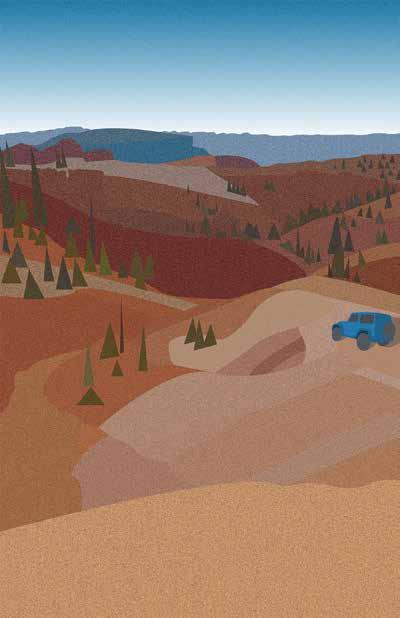
Inspired by the work of Ryo Takemasa, who typically designs landscapebased scenes with a grainy effect, I wanted to reflect the idea of large areas of land through this project with a brightly colored car to emphasize the scale of the piece.
—Linden York-Simmons ’27
Desert View
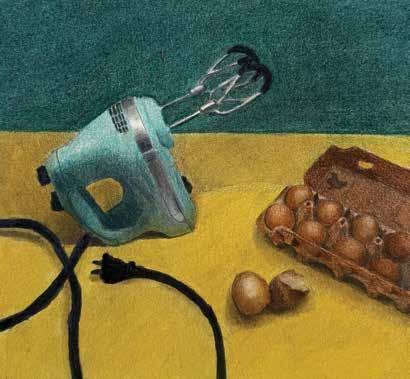
Baking Day
In this snapshot (drawing) I had just mixed the wet ingredients for my “one-of-kind chocolate chip cookies”, a family favorite. The hand-mixer was passed down from my grandmother. Apparently, I inherited her passion for baking and art.
—Mia Rienke ’28
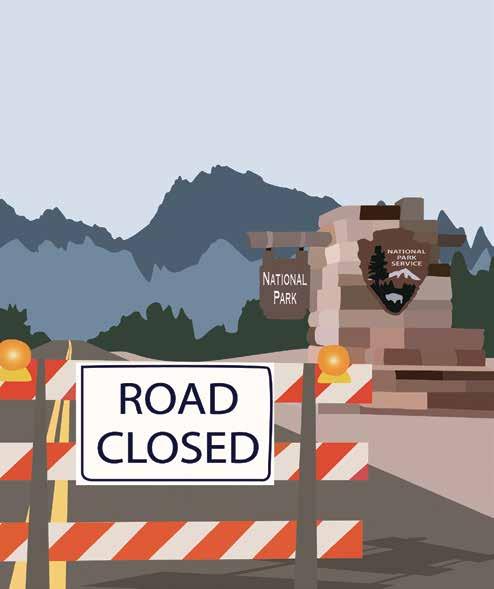
Back cover illustration: Road Closed —Linden York-Simmons