MUSSORGSKY Night on Bald Mountain (arr. Rimsky-Korsakov) 12 mins
TCHAIKOVSKY Excerpts from The Nutcracker Suite 10 mins Dance of the Sugar-Plum Fairy Russian Dance Waltz of the Flowers
SIBELIUS Karelia Overture 9 mins
Intermission 20 mins
TCHAIKOVSKY Symphony No. 2 in C minor, Op. 17 32 mins
Concert duration: 1 hr 30 mins (including 20 mins intermission)
Singapore National Youth Sinfonia
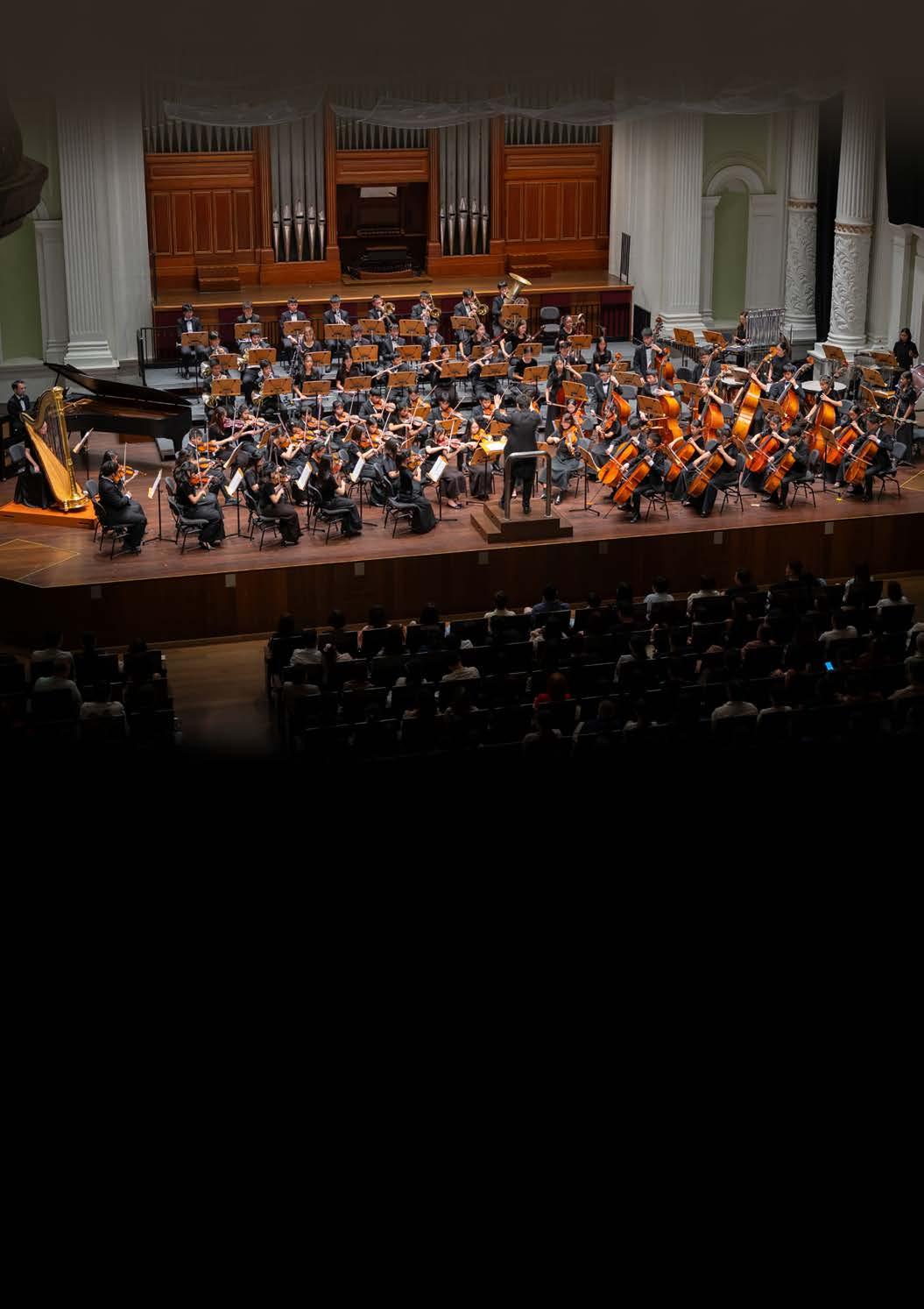
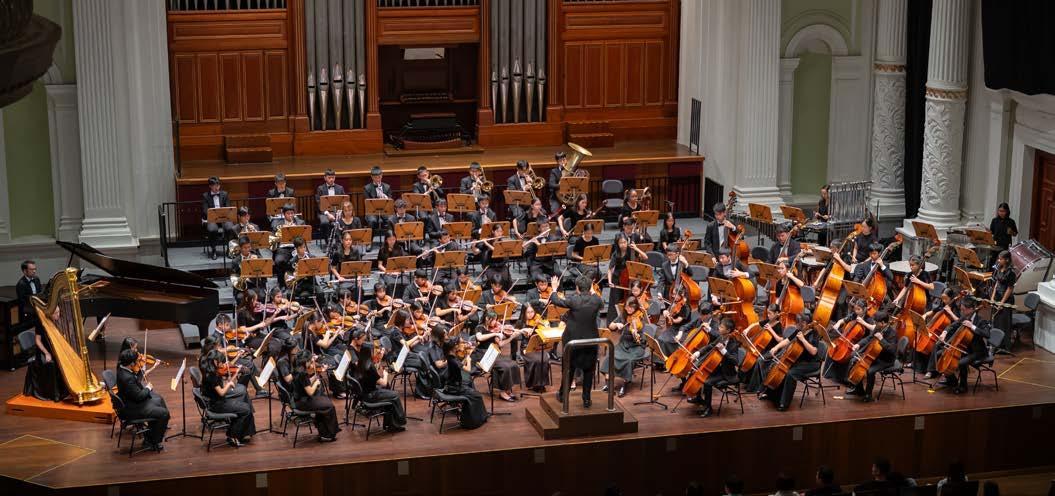
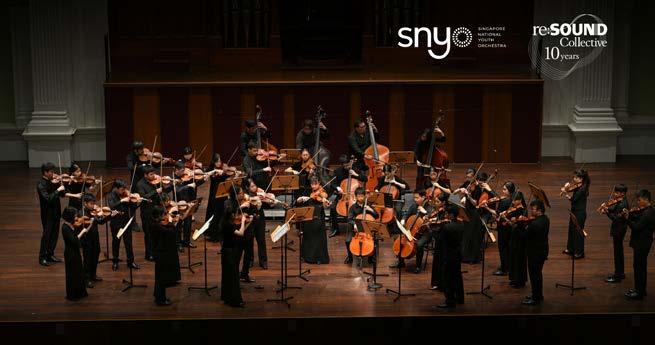
The Singapore National Youth Sinfonia (SNYS), which is a part of the Singapore National Youth Orchestra (SNYO), showcases the extraordinary capability of our youth. It inspires them towards artistic excellence, nurtures them to reach beyond their potential and develops them through rigorous training within a vibrant, supportive, and diverse environment. Established formally in 1980, the Singapore National Youth Orchestra (SNYO) has welcomed generations of youths into the transformative world of orchestral music, performing locally and representing Singapore on prestigious international stages.
The SNYS was formed from the rich heritage of the SNYO. Under the guidance of the Singapore Symphony Group (SSG), the orchestra was transformed, and the ensemble emerged as the Youth Sinfonia in 2016.
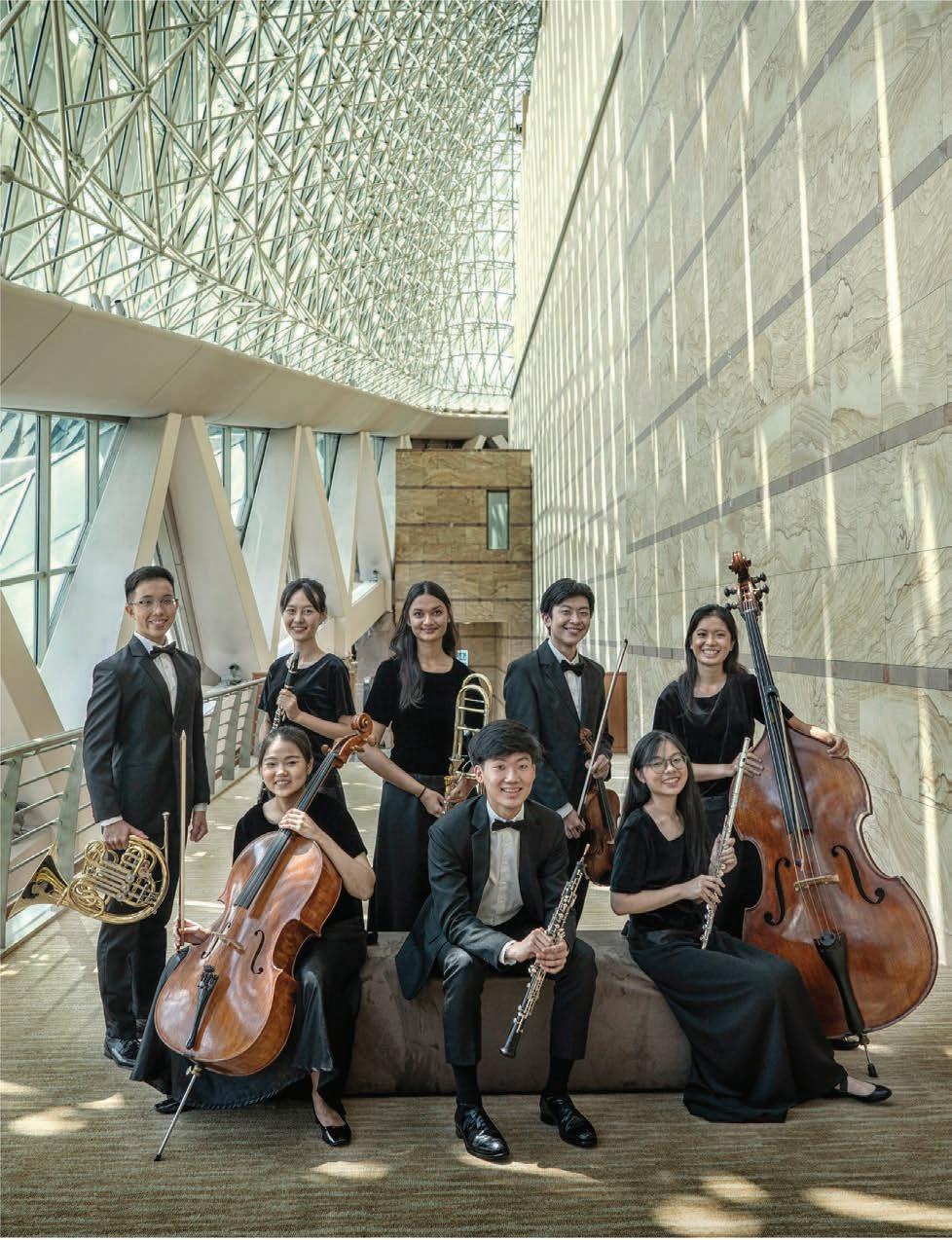
The SNYS consists of over 70 members aged 10 to 18 from more than 50 schools across Singapore, guided by professional musicians in rehearsals, sectionals, and masterclasses. Recognised by the Ministry of Education as a National Project of Excellence, members of the SNYO have their participation in the orchestra recognised as a Co-Curricular Activity and is led by SNYO’s Associate Conductor, Mr Seow Yibin.
The SNYS actively engages in educational outreach initiatives to inspire the next generation of musicians through outreach concerts, and is dedicated to nurturing the next generation of musical talent, providing aspiring young musicians with a platform to hone their skills and express their creativity.
Seow Yibin
SNYO Associate Conductor
Seow Yibin is a Singaporean oboist and conductor. Since January 2022, he has been appointed as the Associate Conductor of Singapore National Youth Orchestra. He is also the Associate Conductor of the Orchestra of the Music Makers, and conducts the Nanyang Academy of Fine Arts Wind Orchestra, as well as the concert bands of National Junior College and Raffles Girls’ School (Secondary). Whilst based in Europe, he was the Conductor of the Junior Royal Northern College of Music (RNCM), UK, Principal Guest Conductor of North Cheshire Wind Orchestra, UK and Conductor of the Musikgesellschaft Harmonie Büsserach, Switzerland.
Yibin has conducted at the Southbank Centre’s The Rest is Noise festival, at BBC Radio 3 live broadcast and guest conducted bands, including the Blasorchester Südwind, Germany, Zürcher Jugendblasorchester u25, Switzerland and the Sociedade Filarmonica Palmelense “Loureiros”, Portugal. He also worked extensively with British Orchestras such as Chester Philharmonic Orchestra, Stockport Symphony Orchestra and the Manchester Camerata.
In Singapore, he has conducted prominent musical groups such as the The Philharmonic Winds, Orchestra Collective and the Windstars Ensemble. As a keen educator, he also presented an eight-week radio series, The Concert Band Programme, which was broadcast on Symphony 924, led workshops at the Singapore Woodwind Festival and given conducting masterclasses at School of the Arts and National Junior College. He currently authors articles for The Band Post
Yibin began oboe studies at the Yong Siew Toh Conservatory of Music, Singapore before furthering them with Emanuel Abbühl at Musik-Akademie Basel, Switzerland, where he also pursued Wind Band Conducting studies with Felix Hauswirth. He subsequently joined the RNCM, studying Orchestral Conducting under Clark Rundell and Mark Heron. He has also participated in conducting masterclasses with Juanjo Mena, Jac van Steen, Tim Reynish, Stanislaw Skrowaczewski and Manuel Nawri.
Singapore National Youth Sinfonia
FIRST VIOLIN
LeeAnn Tan Concertmaster
Giselle Ang
Cathy Chen
Audrey Choo
Sophie Gu
Leng Yijing
Stasia Lew
Claire Li
Elliot Lim
Ng Rui-Yi
Charlotte Ong
Scarlette Ong
Julia Sheu
Genevieve Tan
Jonathan Tan
SECOND VIOLIN
Lauren Chng
Audrey Foo
Phoebe Hamdani
Tason Hang
Hwang Taehyun
Sofie Lee
Kate Lim
Alyssa Low
Rebecca Oh
Quek Chong En
Anastasha Suchin
Rhy-Anne Tan
Stella Tan
Sonya Yen
VIOLA
Cai Liang
Chen Yuchen
John Foo
Fu Shihan
Vera Goh
Saw Eh Ywa Say Wah
Kobe Wei
Zhang Yunhao
CELLO
Grace Chee
Daryl Heng
Hou Jiayi
Ji Yuanjun
Li Siyun
Camilla Song
Carey Song
Keefe Toh
Zhu Jun Xi
DOUBLE BASS
Analyn Chow
Ian Lim
Ryan Sam
Zejin Wang
Denzel Wong
Felix Zhang
FLUTE
Hu Xinyue
Yoki Leung
Tay Yu Jin
PICCOLO
Yoki Leung
Tay Yu Jin
OBOE
Katherine Gao
Ariel Tan
Benny Zhu
COR ANGLAIS
Ariel Tan
CLARINET
Kayden Kong
Carson Rafiuly
Javan Tsang
Xiong Haoxuan
Isabelle Zhang
BASS CLARINET
Kayden Kong
* Guest musician
BASSOON
Aurum Chen
Connor Chew
Claire Goh
HORN
Leon Kwon
Liu Mingwei
Marc-Antoine Robillard*
Aloysius Sin
TRUMPET
Kiriel Lim
Khayri Rayyan
Joshua Woodhead
TROMBONE
Avidan Koh
Davina Long
Noah Tan
Ethan Wong
BASS TROMBONE
Chng Yu Ho
TUBA
Warren Chang
Edarius Latif
TIMPANI
Alon Simons
Yuan Bo Xu
PERCUSSION
Kanushi Ghuwalewala
Sean Ling
Alon Simons
HARP
Charlotte Sheum
CELESTA
Yuan Bo Xu
Programme Notes
MODEST MUSSORGSKY (1839 – 1881)
Night on Bald Mountain (arr. Rimsky-Korsakov, 1886)
United by their aim to develop a distinctly Russian musical style based on folk traditions and music, the 19th-century composers Mily Balakirev, César Cui, Alexander Borodin, Nikolai Rimsky-Korsakov and Modest Mussorgsky were known as “The Five” or “The Mighty Handful”. Although Mussorgsky displayed great musical talent as a child, his father insisted that he continued the family’s military tradition. Thus, Mussorgsky entered the Imperial Guard’s cadet school at the age of 13 and joined the elite Preobrazhensky Regiment after graduation. Through Borodin, Mussorgsky met and later studied with Balakirev for a period until their relationship soured due to Mussorgsky’s impatience and his refusal to adhere to Balakirev’s orders. He then struck out on his own and started experimenting with his musical style. His first breakthrough from this period was the orchestral tone poem Night on Bald Mountain.
Written in 1867 while Mussorgsky was working as a civil servant, Night on Bald Mountain is a programmatic piece based on the Russian writer Nikolai Gogol’s short story about a witches’ Sabbath (a gathering of witches) on Bald Mountain, located near Kyiv in modern-day Ukraine, on St John’s Eve (the eve of the feast day commemorating the birth of St John the Baptist). Balakirev refused to conduct it, and the piece was unfortunately never performed during Mussorgsky’s lifetime. However, Rimsky-Korsakov’s arrangement propelled the tone poem to fame upon its successful premiere five years after Mussorgsky’s death, and this is the version that is most often heard today. A frenzied and threatening atmosphere dominates most of the work, depicting the witches partying through the night. Suddenly, the darkness dissipates with the tolling of bells signifying daybreak. A calm and pastoral mood takes over and the piece concludes on a quiet note.
Amongst Mussorgsky’s works, he is best remembered for Night on Bald Mountain, the opera Boris Godunov and piano suite Pictures at an Exhibition (famously orchestrated by Ravel).
Excerpts from The Nutcracker Suite, Op. 71a (1892)
Dance of the Sugar-Plum Fairy (Danse de la fée Dragée)
Russian Dance (Trepak)
Waltz of the Flowers (Valse des fleurs)
A contemporary of “The Five” and a household name today, Pyotr Ilyich Tchaikovsky studied at the St Petersburg Conservatory in 1863, a year after its founding by the composer-pianist Anton Rubinstein. There, he developed a musical style that synthesised both Russian influences and European compositional techniques.
Following Swan Lake and Sleeping Beauty, The Nutcracker Suite, Op. 71a was Tchaikovsky’s final ballet. A Christmas classic, it is based on a story by the German writer E.T.A. Hoffmann, which begins with young Clara receiving a toy nutcracker soldier as a present from her toymaker godfather, Drosselmeyer, on Christmas Eve. Her brother accidentally breaks the nutcracker, devastating Clara, but Drosselmeyer manages to repair it. After everyone is asleep, Clara goes to check on the nutcracker at midnight, when an army of mice suddenly appear. All the toys come to life and start battling the mice, and with Clara’s timely distraction, the Nutcracker defeats the Mouse King. He transforms into a human prince and brings Clara to his kingdom, the Land of Sweets, where the Sugar Plum Fairy has been ruling in his stead. After a celebration in Clara’s honour, the Prince and the Fairy bid Clara farewell, and she returns to her world.
The enchanting Danse de la fée Dragée (“Dance of the Sugar Plum Fairy” ), with its signature bell-like sound provided by the celesta, takes place in the Land of Sweets. Tchaikovsky encountered this new instrument whilst in Paris and was so taken with it that he had his publisher Pyotr Jurgenson secretly ship one to St Petersburg to ensure that he would edge out rival composers (Rimsky-Korsakov and Glazunov in particular) to be the first to write for it. The celesta was shrouded in such secrecy that Tchaikovsky initially refused to make it available for practice, although he did stipulate that the musician needed to be a very good pianist.
A parade of national dances during the festivities in the Land of Sweets includes the lively Trepak or Danse russe (“Russian Dance” ), which is based on a traditional dance typically performed by men kicking their legs out from a squatting position. The propulsive dance continuously accelerates, hurtling towards its exciting conclusion. Performed by a string of beautiful flowers, the lush and romantic Valse des fleurs (“Waltz of the Flowers” ) is possibly Tchaikovsky’s most famous waltz.
The Finnish composer Jean Sibelius was hailed as a national hero because of several extremely popular nationalist pieces of his, amongst them the rousing orchestral tone poem Finlandia. He wrote across many genres but is best remembered for his orchestral works, amongst them seven completed symphonies, a violin concerto and several tone poems.
Born into a middle-class Swedish-speaking family in 1865, Sibelius grew up in an era where Finland was struggling for its independence, having been under foreign rule for centuries, first by Sweden since the 13th century, then the Russian Empire from 1809. By the late 19th century, many Finnish artists like Sibelius were greatly motivated to express Finnish cultural identity through their work. Consequently, Sibelius’s nationalist sentiments found expression in his compositional output, with some pieces inspired by the Finnish epic poem Kalevala as well as others drawing on historical events such as Finlandia and Karelia Overture, Op. 10.
In 1893, Sibelius was invited by the Vyborg Student Association of the University of Helsinki to compose incidental music for a historical tableau at a fundraiser to promote “popular education” (namely Finnish culture) in the province of Vyborg. The historical tableau was inspired by events in Karelian history from 1293 to 1811 and included a portrayal of the Karelians revolting against their Lithuanian oppressors. Karelia (which includes Vyborg) straddles modern-day Russia and Finland. It was viewed by Finns in the 19th Century as a bastion of authentic Finnish culture, having preserved it over centuries of imperial rule, and it consequently provided much inspiration to many artists during their search for a national identity. Coincidentally, Sibelius toured Karelia during his honeymoon the year before, with his wife Aino Järnefelt, the daughter of a Finnish governor.
Sibelius conducted the premiere of the musical vignettes, which comprised an overture, eight tableaux and two intermezzi. According to a letter to his brother, it was well-received – “not a note of the music could be heard – everyone was on their feet, applauding with deafening shouts”. Subsequently, Sibelius selected the overture and three movements for performance at a popular concert, and he eventually published them in 1899 as Karelia Overture, Op. 10 and Karelia Suite, Op. 11.
In the summer of 1872, during his month-long visit to his sister who lived in Kamianka, Ukraine, Tchaikovsky began composing Symphony No. 2, quoting three Ukrainian folk tunes in this work. Despite differing approaches towards creating a Russian musical style, the group of composers known as “The Five” admired this symphony for its usage and ingenious presentation of folk material. Interestingly, Tchaikovsky never incorporated folk music as extensively into his orchestral works.
Despite being well-received at its premiere in 1873, Tchaikovsky remained unsatisfied with the piece and wanted to “turn this immature and mediocre symphony into a good one”. He started revising it in 1879, and this reworked version is the one commonly performed today.
The first movement begins with a dignified statement of the folksong “Down along the Volga” by solo horn then echoed by solo bassoon. Thereafter, the theme and its derived motifs are accompanied by increasingly florid figurations and dense textures. The contrasting second subject is spirited and drives the music forward. The movement concludes contemplatively with the solo horn and bassoon reprising the folksong.
The outer sections of the second movement borrow the wedding march from Tchaikovsky’s early unproduced opera Undina, while the central section sets the folk tune “Spin O My Spinner” against various accompaniments. The energetic scherzo third movement does not have explicit folksong quotations, but the central trio evokes a folk-like atmosphere with its simple and catchy theme.
The finale kicks off with a triumphant fanfare, after which the lively folksong “The Crane” is introduced by the violins. The tune, which forms the basis of 24 variations, was often hummed by Tchaikovsky’s butler while Tchaikovsky worked during his sojourn in Kamianka. A contrasting lyrical string melody is subsequently introduced, and the movement builds up to a grand conclusion.