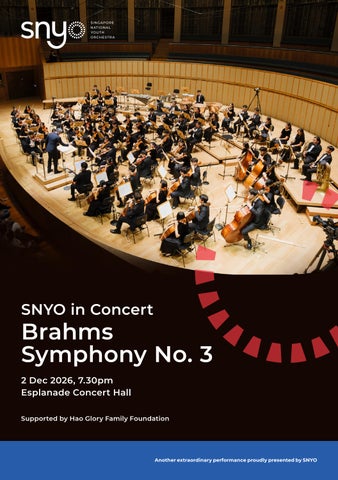
SNYO in Concert
Brahms Symphony No. 3 2 Dec 2026, 7.30pm Esplanade Concert Hall Supported by Hao Glory Family Foundation
Another extraordinary performance proudly presented by SNYO
2 Dec 2026 Esplanade Concert Hall
SNYO in Concert
Brahms Symphony No. 3 Singapore National Youth Orchestra Joshua Tan conductor Cathy Chen Xi violin*
MENDELSSOHN
The Hebrides 10 mins
MENDELSSOHN
Violin Concerto in E minor, Op. 64* 26 mins
Intermission 20 mins
BRAHMS
Symphony No. 3 in F major, Op. 90 33 mins
Concert duration: 2 hrs (including 20 mins intermission)
Singapore National Youth Orchestra The Singapore National Youth Orchestra showcases the extraordinary capability of our youth. It inspires them towards artistic excellence, nurtures them to reach beyond their potential and develops them through rigorous training within a vibrant, supportive, and diverse environment. Established formally in 1980, the Singapore National Youth Orchestra (SNYO) has welcomed generations of youths into the transformative world of orchestral music, performing locally and representing Singapore on prestigious international stages. The SNYO family comprises two orchestras: the Singapore National Youth Orchestra and Singapore National Youth Sinfonia, with over 180 members aged 10 to 24 from more than 70 schools across Singapore, guided by professional musicians in rehearsals, sectionals, and masterclasses. Recognised by the Ministry of Education as a National Project of Excellence, members of the SNYO have their participation in the orchestra recognised as a Co-Curricular Activity. Music Director Joshua Tan has been leading the SNYO since 2018 while Associate Conductor Seow Yibin has been in position since 2022. Over the years, the SNYO has performed in concert venues and music festivals across Australia, Austria, China, Germany, Italy, Japan, Malaysia, and the United Kingdom. Other musical endeavours include collaborations with the Singapore Ballet, TwoSet Violin and side-by-side concerts with the Singapore Symphony Orchestra. The SNYO is part of the Singapore Symphony Group, which also manages the Singapore Symphony Orchestra and Singapore Symphony Choruses, as well as the Singapore International Piano Festival and the biennial National Piano & Violin Competition.
1
Joshua Tan conductor Singaporean conductor Joshua Tan, 2nd Prize winner of the 2008 Dimitri Mitropoulos International Competition, has built an international career marked by successful debuts at Carnegie Hall, Philharmonie Berlin, Mariinsky Hall and Bunkamura. A graduate of The Juilliard School and the Eastman School of Music (High Distinction), he is the recipient of numerous awards including Singapore’s Young Artist Award, the Bruno Walter Memorial Foundation Award, the NACShell Scholarship and the SSO/MOE Scholarship. Joshua has conducted orchestras worldwide, including the Mariinsky Theatre Orchestra, Sydney Symphony Orchestra, Melbourne Symphony Orchestra, Tokyo Philharmonic Orchestra, Hong Kong Philharmonic Orchestra, Shanghai Symphony Orchestra and China Philharmonic Orchestra. He has studied with James DePreist, Charles Dutoit, David Zinman and Kurt Masur. Known for his versatility in symphonic, operatic and multimedia repertoire, Joshua currently serves as Music Director of the Singapore National Youth Orchestra and Asia Virtuosi, and previously held posts with the Singapore Symphony Orchestra, Guiyang Symphony Orchestra, and the National Centre for the Performing Arts Orchestra in Beijing.
2
Cathy Chen Xi violin Cathy began her violin studies at the age of five at the Nanyang Academy of Fine Arts School of Young Talents under Ms. Ye Lin. She has since earned recognition through numerous national and international competitions. In 2025, she was awarded First Prize (Violin Category A) and the Young Jury Prize at the Hengqin International Mozart Competition for Young Musicians, as well as First Prize (Violin Intermediate Category) at the National Piano & Violin Competition. Her earlier achievements include Third Prize at the 15th Arthur Grumiaux International Violin Competition (2023), Second Prize at the Singapore National Piano and Violin Competition (2023), and First Prize at the Christopher & Rosy Ho Music Competition (2023). A member of the Singapore National Youth Orchestra (SNYO) since 2024, Cathy is an active orchestral musician with a keen interest in chamber music. She has participated in the Singapore Chamber Music Festival and won the SNYO Concerto Competition 2026. Most recently, in May 2026, Cathy appeared as soloist with re:Sound Collective in a performance of Mozart’s Violin Concerto No. 4, earning critical acclaim for her performance. Her solo appearances have also included collaborations with the Salzburg Chamber Soloists at the Hengqin Mozart Competition, the Accademia d’Archi Arrigoni at the Piccolo Violino Magico International Competition in Italy, and the Kids Philharmonic Elite Soloist Ensemble. Cathy is grateful to the Rin Collection for the generous loan of a violin for this concert. She is proudly endorsed by Thomastik-Infeld and performs on Dynamo Solo strings.
3
Programme Notes FELIX MENDELSSOHN (1809 – 1847) The Hebrides (Fingal’s Cave), Op. 26 (1830) Mendelssohn was a polymath and a genius. He made his performance debut at 9, and wrote his string symphonies, which are performed by many secondary school orchestras today, between the ages of 12 and 14. He wrote his first symphony for full orchestra at 15, and the Overture to A Midsummer Night’s Dream at 17. In 1829, the 20-year-old Mendelssohn embarked on a grand tour of Europe, then a customary rite of passage for privileged young men. During the tour, Mendelssohn visited Scotland and the Hebrides, an island chain off its west coast. On 7 August, while on the Isle of Mull, he sketched the overture’s opening 20 bars and sent them to a friend, writing: “In order to make you understand how extraordinarily the Hebrides affected me, the following came into my mind there.” The Hebrides Overture was an early example of the Romantic tone poem, a selfcontained orchestral work that evokes a landscape and its moods rather than a piece introducing an opera. It opens amid swirling waters and rolling seas, anticipating the nautical music of later composers. Donald Francis Tovey called its soaring second theme “the greatest melody Mendelssohn ever wrote”. After several jaunty contrasting episodes, the clarinet recalls this theme and leads the work towards the close of its remarkable aural seascape. Instrumentation: 2 flutes, 2 oboes, 2 clarinets, 2 bassoons, 2 horns, 2 trumpets, timpani, strings
FELIX MENDELSSOHN Violin Concerto in E minor, Op. 64 (1844) I. Allegro molto appassionato II. Andante III. Allegretto non troppo – Allegro molto vivace Mendelssohn’s Violin Concerto grew from his friendship with Ferdinand David (1810–1873), whom he had known since their teens. Mendelssohn later appointed the celebrated violinist concertmaster of the Leipzig Gewandhaus Orchestra and to the faculty of the Leipzig Conservatory. Mendelssohn wrote to David in 1838, “I would like to write a violin concerto for you next winter, there’s one in E minor in my head, and its opening won’t leave me in peace”, but it took Mendelssohn until 1844 to find the time and inspiration to 4
complete the concerto. He completed it in 1844, working closely with David on the playability of the solo part and its balance with the orchestra, a collaboration later echoed by composers including Brahms, Elgar, Stravinsky, Bartók and Shostakovich. After just one and a half bars of E minor, underpinned by pulsating timpani and bass, the solo violin enters with the passionate main theme of the first movement. It then descends three octaves to its lowest note, G, preparing the tranquil second subject in the flutes and clarinets. Unusually, Mendelssohn places the cadenza before the recapitulation, allowing the violin’s arpeggios to continue beneath the orchestra’s returning theme. Mendelssohn links the first two movements: a bassoon sustains a note from the first movement’s final chord as other instruments join, and the music coalesces into the second movement’s “song without words”. A passionate middle section recalls the preceding movement before the song returns for an almost religious close. A bridge recalling the second movement’s middle section leads to a fanfare and the finale. The fairy lights and puckish music of A Midsummer Night’s Dream are recalled in a delightful and sparkling dance for the violin. There is still space for Mendelssohn’s trademark broad, swinging tunes before the concerto’s spirited close. Notes by Christopher Cheong
Instrumentation: solo violin, 2 flutes, 2 oboes, 2 clarinets, 2 bassoons, 2 horns, 2 trumpets, timpani, strings
JOHANNES BRAHMS (1833 – 1897) Symphony No. 3 in F major, Op. 90 (1883) I. II. III. IV.
Allegro con brio Andante Poco allegretto Allegro
When Brahms wrote his Third Symphony, in F major, Op. 90, in 1883, he was a middle-aged man of 50, with two symphonies behind him and one more to come. It had been six years since his second symphony, but a summer in Wiesbaden, the capital of the German state of Hesse, seems to have inspired something in him, resulting in the creation of the Third Symphony in a relatively short space of time. Now at the height of his career, he no longer had to follow anyone else’s path in order to gain fame, and Brahms could now ‘be himself’. Despite his newly acquired beard and reputation for seriousness, he looked back on his time of carefree youth and made it clear with the opening F A (flat) F motif that appears right at the start and carries on throughout, whether in the bass or melody. An inside joke, FAF was meant to stand for ‘Frei aber Froh’ (“Free but happy”),
5
Brahms’s reply to ‘Frei aber eisam’ (“Free but lonely”), the motto of his violinist friend Joseph Joachim. The opening Allegro con brio is in waltz time, with a distinctive unsettled quality due to the alternation between A and A-flat, making for a tension between F major and minor. A brief quote from Wagner’s Sirens’ Chorus from Tannhäuser may be a reference to the Lorelei rock, a famous cliff along the Rhine, near Wiesbaden where the symphony was composed. Dark clouds and shafts of sunlight appear all through the movement. The second movement, in which the main theme is introduced and carried by a solo clarinet, is a masterpiece of misty evocative landscaping, an Andante tinged with bittersweet melancholy and regret. Clara Schumann said it was ‘a rapture and a whispering, so that one feels completely enwrapped in all the bliss of nature’. This is followed by a Poco allegretto which continues the bittersweet wistful mood with one of Brahms’s most famous melodies, shifting again between major and minor, tension and relaxation. Clara Schumann’s description was of ‘a pearl, but it is a grey one dipped in a tear of woe’. The final Allegro movement begins deep and low, but with all the dammed-up tension and unease of the previous movements being let loose in a flood that carries everything away. In the turbulence we hear snatches of modal melodies, gypsy-like themes, snippets of material from the previous movements, and much more. Yet despite the great momentum, it all eventually quietens down as the flood waters dissipate to reveal the FAF motif once again, and the Rhine theme from earlier emerges shining, as the work ends pianissimo with a moment of magic. This ending surprised his contemporaries greatly, as no composer had ended a symphony quietly since the 18th century. In modern British slang, to ‘faff about’ means to waste time and energy on trivial, unproductive things in a disorganized way. Brahms’s genius showed us that he could FAF about and managed to come up with something absolutely sublime. Notes by Edward C. Yong
Instrumentation: 2 flutes, 2 oboes, 2 clarinets, 2 bassoons, contrabassoon, 4 horns, 2 trumpets, 3 trombones, timpani, strings
6
Singapore National Youth Orchestra FIRST VIOLIN Sophia Fang CONCERTMASTER Asher Ng CONCERTMASTER Allison Chng Lauren Chng Ethan Gu Josephine In Zoe Lam Shannon Ong Aubrey Tan Jonathan Tan Sonya Yen SECOND VIOLIN Kaden Khew PRINCIPAL Annie Liu PRINCIPAL Giselle Ang Matthew Chiu Kate Lim Lim Jing Rui Hwang Taehyun Ng Rui-Yi Rebecca Oh Amelia Phuah Julia Sheu VIOLA Jayden Kwan PRINCIPAL Khoo Shu Min Chloe Lee Saw Eh Ywa Janice Tsai* Dandan Wang* Zhang Yunhao
DOUBLE BASS Gideon Yen PRINCIPAL Samantha Ang Lee Yan Yu Tay Si En Joleigh Tjhin Zejin Wang Zhang Xin FLUTE Ian Lee PRINCIPAL Chloe Tan Grace Zhang OBOE Matthew Chen PRINCIPAL Lucas Chan Gao Chenze CLARINET Xiong Haoxuan PRINCIPAL Kayden Kong BASSOON Li Ruidan PRINCIPAL Dana Cervantes William Jiang CONTRABASSOON Dana Cervantes
CELLO Charlotte Tseng PRINCIPAL Ji Yuanjun Koh Liong Tiek Li Peilin Lloyd Loh Jayden Qin Christoph Yang Yu Yikang
* Guest musician
7
HORN Andrew Lee PRINCIPAL Bryan Chong* Marcus Robins Aloysius Sin TRUMPET Khayri Rayyan PRINCIPAL Kiriel Lim Joshua Woodhead TROMBONE Avidan Koh PRINCIPAL Annalise Cheung BASS TROMBONE Chng Yu Ho TIMPANI Alon Simons Christian Tan
Schools represented in the Singapore National Youth Orchestra Ai Tong School
Nanyang Academy of Fine Arts
Anderson Serangoon Junior College
Nanyang Girls' High School
Ang Mo Kio Secondary School
Nanyang Junior College
Anglo-Chinese Junior College
Nanyang Polytechnic
Anglo-Chinese School (Independent) (Junior College)
Nanyang Technological University
Anglo-Chinese School (Independent) (Secondary)
National University of Singapore
National Junior College (Secondary) North London Collegiate School
Anglo-Chinese School (Primary)
NUS High School of Mathematics and Science
Bedok View Secondary School
Pei Chun Public School
Broadrick Secondary School
Raffles Girls' Primary School
Bukit Panjang Government High School
Raffles Girls' School (Secondary)
Bukit Timah Primary School
Raffles Institution (Junior College)
Canadian International School
Raffles Institution (Secondary)
Catholic High School (Secondary)
River Valley High School (Junior College)
CHIJ Secondary (Toa Payoh)
River Valley Primary School
CHIJ St. Nicholas Girls' School (Primary)
School of the Arts, Singapore
Chung Cheng High School (Main)
Singapore American School
Chung Cheng High School (Yishun)
Singapore Chinese Girls' School
Clementi Town Secondary School
Singapore Management University
Crescent Girls’ School
Singapore Polytechnic
Dover Court International School
St Andrew's School (Secondary)
Dulwich College (Singapore)
St. Gabriel's Secondary School
Dunearn Secondary School
St. Joseph's Institution (Secondary)
Dunman High School (Junior College)
St. Margaret's School (Secondary)
Dunman High School (Secondary)
Tanglin Trust School
Dunman Secondary School
Tanjong Katong Girls' School
Edgefield Secondary School
Tao Nan School
Eunoia Junior College
Temasek Junior College (Secondary)
Fairfield Methodist School (Primary)
United World College of South East Asia
Fairfield Methodist School (Secondary)
Victoria Junior College
Gan Eng Seng Primary School
Victoria School
German European School Singapore
Whitley Secondary School
Hai Sing Catholic School
Yishun Innova Junior College
Hong Wen School
Zhonghua Secondary School
Hwa Chong Institution (Secondary) Maha Bodhi School Mayflower Secondary School Meridian Primary School Methodist Girls' School (Primary) Methodist Girls' School (Secondary) Millenia Institute
8
Acknowledgements WITH SUPPORT FROM MINISTRY OF EDUCATION, ARTS EDUCATION BRANCH Mrs Clara Lim-Tan Director, Arts Education Ms Lynne Huang Deputy Director (Music & Dance) Ms Chek Yui Hong Assistant Director, Visual and Performing Arts CCA & Singapore Youth Festival Mr Lee Ji Heng Arts Education Officer (Music) THE SINGAPORE NATIONAL YOUTH ORCHESTRA WISHES TO THANK National Arts Council Tutors of the Singapore National Youth Orchestra Parents of the Singapore National Youth Orchestra members Principals of the participating schools
SNYO AUDITIONS
Photo by Chris P . Lim
sso.org.sg/snyo/join-us/audition
Managed by
SNYO.SG
SINGAPORE NATIONAL YOUTH ORCHESTRA CREATING THE EXTRAORDINARY
Recognised by
Upcoming Concerts You May Be Interested In SNYO presents: Australian Youth Orchestra Symphonists in Concert Thu, 11 Mar 2027, 7.30pm Esplanade Concert Hall Featuring Australian Youth Orchestra Symphonists Christoph Altstaedt conductor Ng Pei-Sian cello* Abigail Lui Aerial Dances Dvořák Symphony No. 5 in F major, Op. 76 Tchaikovsky Variations on a Rococo Theme, Op. 33 (1877 version) * In Partnership with New Zealand Symphony Orchestra National Youth Orchestra
SNYO × Australian Youth Orchestra Symphonists: Joshua Tan & Christoph Altstaedt Sat, 13 Mar 2027, 7.30pm Esplanade Concert Hall Featuring Singapore National Youth Orchestra Australian Youth Orchestra Symphonists Joshua Tan conductor Christoph Altstaedt conductor Khachaturian Excerpts from Spartacus Suites No. 1 & 2 Liszt Hungarian Rhapsody No. 2 Bernstein Symphonic Dances from West Side Story
Tickets from $20 25% off Concert Bundles & Packages from SSO.ORG.SG/SNYO
MEMBER OF SINGAPORE SYMPHONY GROUP @SNYO.sg
Patron Sponsor
Supported By
Recognised By