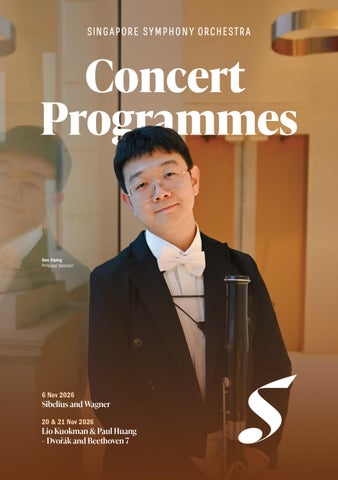
Concert Programmes Guo Siping Principal Bassoon
6 Nov 2026
Sibelius and Wagner 20 & 21 Nov 2026
Lio Kuokman & Paul Huang – Dvořák and Beethoven 7
SSO Year-End Appeal 2026
Journey into a New Era with Us With Maestro Hannu Lintu at the helm, we’re excited for what lies ahead: ambitious programmes, greater community impact and more opportunities for SSO and its affiliated performing groups. Join us in shaping the next chapter as we look towards SSO’s 50th anniversary. Your support plays an instrumental role in securing a future full of new creative possibilities.
Make a Gift: Scan in your mobile banking app to donate via PayLah! or PayNow* You can also make an online donation via the Singapore Symphony app or ssoperfor.ms/YEA2026 Every donation is matched dollar-for-dollar and may be eligible for 250% tax deduction. *For Singapore taxpayers, please submit your name and NRIC to development@sso.org.sg to apply for tax deduction.
Nov
2026 18 Sibelius and Wagner Fri, 6 Nov 2026 Esplanade Concert Hall
Kuokman & Paul Huang 29 Lio – Dvořák and Beethoven 7 Fri & Sat, 20 & 21 Nov 2026 Victoria Concert Hall
For the enjoyment of all patrons during the concert: Please switch off or silence all electronic devices.
No photography, video or audio recording is allowed when artists are performing.
Please minimise noises during performance. If unavoidable, wait for a loud section in the music.
Non-flash photography is allowed only during bows and applause when no performance is taking place.
Go green. Digital programme books are available on www.sso.org.sg. Photographs and videos will be taken at these events, in which you may appear. These may be published on the SSO’s publicity channels and materials. By attending the event, you consent to the use of these photographs and videos for the foregoing purposes.
Cover photo: Guo Siping © Clive Choo
1
© JACK YAM
Singapore Symphony Orchestra 2
Since its founding in 1979, the Singapore Symphony Orchestra (SSO) has been Singapore’s flagship orchestra, touching lives through classical music and providing the heartbeat of the cultural scene with its calendar of events. In addition to its subscription series concerts, the orchestra is well-loved for its outdoor and community appearances, and its significant role educating the young people of Singapore through its school programmes. The SSO has also earned an international reputation for its orchestral virtuosity, having garnered sterling reviews for its overseas tours and many successful recordings. In 2021, the SSO clinched third place in the prestigious Orchestra of the Year Award by Gramophone. In 2022, BBC Music Magazine named the SSO as one of the 23 best orchestras in the world. The SSO is led by Finnish conductor Hannu Lintu, the fourth Music Director in the orchestra’s history after Choo Hoey (1979–1996), Lan Shui (1997–2019) and Hans Graf (2020–2026). The orchestra performs over 60 concerts a year, and its versatile repertoire spans all-time favourites and orchestral masterpieces to exciting cutting-edge premieres. Bridging the musical traditions of East and West, Singaporean and Asian musicians and composers are regularly showcased in the concert season. The SSO makes its performing home at the 1,800-seat state-ofthe-art Esplanade Concert Hall. More intimate works, as well as community performances take place at the 673-seat Victoria Concert Hall, the Home of the SSO. Beyond Singapore, the SSO has performed in Europe, Asia, Australia and the United States. In the 2024/25 season, the SSO performed to full houses at Asia Orchestra Week in Kyoto, Japan, and made its “dazzling – and true-blue – Down Under debut” (Limelight) in Sydney, Melbourne and Brisbane. In May 2016, the SSO was invited
to perform at the Dresden Music Festival and the Prague Spring International Music Festival. This successful five-city tour of Germany and Prague also included the SSO’s second performance at the Berlin Philharmonie. In 2014, the SSO’s debut at the 120th BBC Proms in London received praise in major UK newspapers The Guardian and The Telegraph. The SSO has also performed in China on multiple occasions. The SSO has released more than 50 recordings, with over 30 on the BIS label. Recent critically acclaimed albums include A Hero’s Life (OUR Recordings), Symbiosis – Tribute to Bill Evans (Pentatone) and a complete Mozart Violin Concerto cycle with Singaporean violinist Chloe Chua conducted by Hans Graf (Pentatone). The SSO also leads the revival and recording of significant works such as Kozłowski’s Requiem and violin concertos by Robert Russell Bennett and Vernon Duke. The SSO has collaborated with such great artists as Vladimir Ashkenazy, Gustavo Dudamel, Charles Dutoit, Joe Hisaishi, Neeme Järvi, Lorin Maazel, Martha Argerich, Diana Damrau, Janine Jansen, Leonidas Kavakos, Lang Lang, Yo-Yo Ma, Mischa Maisky, Gil Shaham, Daniil Trifonov and Krystian Zimerman. The SSO is part of the Singapore Symphony Group, which also manages the Singapore Symphony Choruses, the Singapore National Youth Orchestra, the Singapore International Piano Festival and the biennial National Piano & Violin Competition. The Group’s vision is to be a leading arts organisation that engages, inspires and reflects Singapore through musical excellence. Our mission is to create memorable shared experiences with music. Through the SSO and its affiliated performing groups, we spread the love for music, nurture talent and enrich our diverse communities.
3
The Orchestra Hannu Lintu
Quantedge Music Director
Nathanaël Iselin Associate Conductor
Lan Shui
Conductor Laureate
Hans Graf
Conductor Laureate
Eudenice Palaruan Choral Director
Wong Lai Foon Choirmaster
Ellissa Sayampanathan Assistant Choral Conductor
First Violin
Andrew Beer1 Concertmaster, GK Goh Chair Chan Yoong-Han2 Acting Associate Concertmaster Cao Can* Duan Yu Ling Foo Say Ming Jin Li Kong Xianlong Cindy Lee Renyu Martin Peh Karen Tan William Tan Wei Zhe Ye Lin* Zhang Si Jing 4
Second Violin
Markus Gundermann Co-Principal (Guest) Qing Li Co-Principal (Guest) Sayuri Kuru Associate Principal Bobur Eshpulatov Nikolai Koval* Hai-Won Kwok Margit Saur Shao Tao Tao Reina Teo Wu Man Yun* Xu Jueyi* Yin Shu Zhan* Zhao Tian
Viola
Manchin Zhang Principal, Tan Jiew Cheng Chair Guan Qi Associate Principal Gu Bing Jie* Assistant Principal Chen Li Marietta Ku Luo Biao Julia Park Shui Bing Janice Tsai Dandan Wang Yang Shi Li
Cello
Ng Pei-Sian Principal, The HEAD Foundation Chair Yu Jing Associate Principal Guo Hao Assistant Principal Chan Wei Shing Christopher Mui Jamshid Saydikarimov Song Woon Teng Wang Yan Wu Dai Dai Zhao Yu Er
Double Bass
Joan Perarnau Garriga Principal (Visiting) Yang Zheng Yi Associate Principal Karen Yeo Assistant Principal Po-Yu Fang Victor Lee Jacek Mirucki Wang Xu
Flute
Jin Ta Principal, Stephen Riady Chair Evgueni Brokmiller Associate Principal Roberto Alvarez Miao Shanshan
Piccolo
Roberto Alvarez Assistant Principal
Oboe
Rachel Walker Principal Simon Emes^ Acting Principal Hu Qiuzi Associate Principal Pan Yun Associate Principal Carolyn Hollier Elaine Yeo
Cor Anglais
Elaine Yeo Associate Principal
Clarinet
Chiang Yung-Yuan Principal Li Xin Associate Principal Liu Yoko Tang Xiao Ping
Bass Clarinet
Horn
Austin Larson Principal Marc-Antoine Robillard Associate Principal Thossaporn Sombat^ Associate Principal Bryan Chong Gao Jian Hoang Van Hoc
Trumpet
Jon Paul Dante Principal David Smith Associate Principal Lau Wen Rong Nuttakamon Supattranont
Trombone
Allen Meek Principal Damian Patti Associate Principal Samuel Armstrong
Bass Trombone
Wang Wei Assistant Principal
Tuba
Tomoki Natsume Principal
Timpani
Tang Xiao Ping Assistant Principal
Christian Schiøler Principal Mario Choo
Bassoon
Percussion
Guo Siping Principal Liu Chang Associate Principal Christoph Wichert Zhao Ying Xue
Contrabassoon
Jonathan Fox Principal Mark Suter Associate Principal Mario Choo
Harp
Gulnara Mashurova Principal
Zhao Ying Xue Assistant Principal
* With deep appreciation to the Rin Collection for their generous loan of string instruments. ^ Musician on annual contract. 1
2
Andrew Beer performs on a J.B. Guadagnini of Milan, c. 1750, donated by the National Arts Council, Singapore, with the support of Far East Organization and Lee Foundation. Chan Yoong-Han performs on a David Tecchler, Fecit Roma An. D. 1700, courtesy of Mr G K Goh. Musicians listed alphabetically by family name rotate their seats on a per programme basis. Details correct at the time of printing and subject to change. 5
Guest Musicians Sibelius and Wagner 6 Nov 2026 First Violin
Cello
Trumpet
Wilford Goh Lee Shi Mei Lim Shue Churn
Khachatur Khachatryan Lin Juan
Lee Jinjun
Second Violin Zhao Yi Guest Principal Li Liu Syu Cheng-Yi Edward Tan Tian Ye Wan Fangyuan
Viola
Double Bass Guennadi Mouzyka
Horn Luke Chong Grzegorz Curyla Marnie Sebire
Bass Trumpet Kang Chun Meng
Percussion Tan Pei Jie
Harp Nigel Foo Charity Kiew Charmaine Teo
Ho Qian Hui Yeo Jan Wea
Lio Kuokman & Paul Huang – Dvořák and Beethoven 7 20 & 21 Nov 2026 Piano Beatrice Lin
6
Sibelius and Wagner | 6 Nov 2026
Pietari Inkinen conductor
Pietari Inkinen is one of the leading conductors of his generation. The Finnish conductor has gained international recognition and has led major orchestras such as the Royal Concertgebouw Orchestra, Budapest Festival Orchestra, Bavarian Radio Symphony Orchestra, Gewandhausorchester Leipzig, Accademia Nazionale di Santa Cecilia, Orchestre Philharmonique de Radio France, Sydney Symphony, Los Angeles Philharmonic, the Cleveland Orchestra and many others. In April 2025, he made a highly successful debut at the National Centre for the Performing Arts (NCPA) in Beijing, conducting Die Walküre in a new production by Davide Livermore. Richard Wagner’s music holds a central place in Pietari Inkinen’s artistic work. In 2023, he led the new production of Der Ring des Nibelungen at the Bayreuth Festival (directed by Valentin Schwarz). In the summer of 2021, he conducted Hermann Nitsch’s production of Die Walküre at the Green Hill. His operatic engagements have also taken him to the Finnish National Opera, Théâtre de la Monnaie, Staatsoper Unter den Linden, the Bavarian State Opera, and the Semperoper Dresden, where he conducted a highly successful new production of Eugene Onegin. Pietari Inkinen served as Chief Conductor of the Deutsche Radio Philharmonie Saarbrücken Kaiserslautern until the end of the 2024/25 season. Previously, he held chief positions with the Japan Philharmonic Orchestra, the Prague Symphony Orchestra, the KBS Symphony Orchestra in Seoul, the Ludwigsburg Festival Orchestra, and was also Music Director of the New Zealand Symphony Orchestra.
© KAUPO KIKKAS
In addition to his conducting career, Pietari Inkinen is also an accomplished violinist. He studied with Zakhar Bron at the Cologne University of Music before continuing his conducting studies at the Sibelius Academy in Helsinki.
8
Sibelius and Wagner | 6 Nov 2026
Finnish dramatic soprano Johanna Rusanen was born into a musical family in Kuopio. She earned her Master’s degree in Music at the Sibelius Academy under Anita Välkki, completed further studies in Berlin and Vienna, and spent two years in the young artist program at Deutsche Oper Berlin. Today, Rusanen is one of the most compelling Finnish dramatic sopranos of her generation. Her notable role debuts include Venus (Tannhäuser) at the Tampere Opera (2012) and Old Aliide in the world premiere of Jüri Reinvere’s Purge. She has achieved international acclaim for her portrayal of Turandot at the Finnish National Opera, Teatro Regio in Turin, and Deutsche Oper am Rhein. Other career highlights include Tosca at the Savonlinna Opera Festival, Ortrud (Lohengrin) in São Paulo, and Isolde at the Finnish National Opera. She received enthusiastic international reviews for her performance as Brünnhilde in the National Opera’s Ring cycle under Hannu Lintu. Rusanen is also celebrated for strong female roles in Finnish operas, such as The Last Temptations, Ratsumies, and The Wolf’s Bride.
Johanna Rusanen soprano
An accomplished concert and lieder singer, Rusanen has performed across Europe, Japan, Chile, the United States, and North Korea. The soprano role in Jean Sibelius’s Kullervo Symphony has become her trademark, with performances in Prague, Tokyo, and Chicago. In 2017, she was awarded a Grammy Award for her performance in Krzysztof Penderecki’s Polish Requiem, conducted by the composer.
9
Sibelius and Wagner | 6 Nov 2026
Eudenice Palaruan studied at the University of the Philippines College of Music, majoring in composition and choral conducting. He took further training in choral conducting at the Berliner Kirchenmusikschule, Germany. He graduated doctor of musical arts at St. Paul University Manila.
Eudenice Palaruan Choral Director
He was a singer, resident composer/arranger, and assistant choirmaster of the Philippine Madrigal Singers. In addition, he performed with the Berlin Spandauer Kantorei, the World Youth Choir, and sang countertenor with the Berlin Monteverdichor. In addition, he was the principal conductor of the San Miguel Master Chorale. For years, he has been the resident conductor of the International Bamboo Organ Festival, where he performed and recorded significant selections of Latin-American baroque music. With his active involvement in the choralization of Philippine and other Asian indigenous music, he premiered a substantial volume of new Asian choral works. In addition, he was often invited to give lectures on non-Western vocal aesthetics. Eudenice also arranges for the SSO choruses and the SSC community outreach programmes. In addition, the SSO choruses have premiered new choral works written by local composers and arrangers in Singapore under his direction.
© JUANMOLEY FOTOLOGUE
He taught composition and choral conducting in institutions such as the University of the Philippines College of Music, the Asian Institute for Liturgy and Music, and St. Paul University College of Music and the Performing Arts. In addition, he teaches at the Singapore Bible College School of Church Music and directs the SBC Chorale. Eudenice is often invited to adjudicate in international composition competitions and give masterclasses in choral conducting.
10
Sibelius and Wagner | 6 Nov 2026
Armed with a passion and mission to nurture young voices and inspire choral excellence, Wong Lai Foon has been instrumental in developing and growing the Singapore Symphony Children’s Choir (SSCC) and the Singapore Symphony Youth Choir (SSYC) to the ensembles that they are today. As founding conductor of both ensembles, this season marks her 20th year with the SSCC and her 10th with the SSYC, during which time she has inspired generations of singers through the study of the choral art. With musical styles ranging from Baroque to opera to contemporary and popular music, as well as repertoire that spans diverse cultures and languages, she has directed the SSCC and SSYC in a wide array of concerts, often receiving praise for the choirs’ beautiful tone and sensitivity. She has prepared the choirs for overseas tours, recordings and collaborations with renowned conductors and performers such as Stephen Layton, The King’s Singers, and Sofi Jeanin. The SSCC has also had the distinction of being invited to perform at various state functions.
Wong Lai Foon
Choirmaster
© JUANMOLEY FOTOLOGUE
Wong has commissioned and premiered treble choir works by local composers and has also arranged for the SSCC and SSYC. Her efforts to educate and inspire singers extend into the community through workshops, talks, as well as adjudicator, chorus-master and guest-conductor roles. Some ensembles that she has worked with include The Philharmonic Chamber Choir, Singapore Symphony Chorus, Singapore Lyric Opera, Hallelujah Singers, and Methodist Festival Choir. She holds a master’s degree in choral conducting from Westminster Choir College, USA.
11
© JACK YAM
Sibelius and Wagner | 6 Nov 2026
Singapore Symphony Chorus
Celebrating Choral Excellence
Eudenice Palaruan Choral Director Ellissa Sayampanathan Assistant Choral Conductor Wong Yang Kai Choral Associate Shane Thio rehearsal pianist
For over 45 years, the Singapore Symphony Chorus (SSC) has brought together passionate choristers from varied backgrounds to create stirring symphonic music that transcends language and culture. More than a choir, the SSC is a vibrant community where lasting bonds are forged beyond the stage. Committed to artistic excellence, its dedicated members rehearse weekly, performing at celebrated venues like the Esplanade and Victoria Concert Halls. Under the baton of world-class conductors such as Okko Kamu, Lan Shui, Lim Yau, Masaaki Suzuki, and Sofi Jeannin, the SSC has built a rich repertoire featuring masterpieces like Tippett’s A Child of Our Time, Arvo Pärt’s Te Deum, Britten’s War Requiem, and Bach’s St John Passion. The chorus’s unwavering dedication to delivering outstanding performances makes the SSC a leading choral ensemble – a shining example of music’s power to unite people across generations and cultures.
12
© JACK YAM
Sibelius and Wagner | 6 Nov 2026
Bursting with energy and passion, the Singapore Symphony Youth Choir (SSYC) is a vibrant ensemble of singers aged 17 to 28 who thrive on pushing artistic boundaries and growing together. Celebrating its 10th anniversary, the SSYC has become a dynamic community where young voices unite to embark on symphonic choral adventures with the Singapore Symphony Orchestra. Performing regularly at the Esplanade and Victoria Concert Halls, the SSYC tackles some of the most exciting and challenging choral works across diverse styles and genres. The SSYC regularly collaborates with visionary conductors including Lan Shui, Hans Graf, and Stephen Layton. Their impressive repertoire features highlights like Scriabin’s Prometheus, Puccini’s La Bohème, Tallis’s Why Fumeth in Fight, and Faure’s Requiem, along with recordings of Borodin’s Polovtsian Dances and Mahler’s Symphony No. 2.
Singapore Symphony Youth Choir Inspiring Choral Passion
Wong Lai Foon Choirmaster Ellissa Sayampanathan Assistant Choral Conductor Evelyn Handrisanto rehearsal pianist
The SSYC offers an unparalleled chance to learn and create memories with the seasoned professionals – setting the stage for the future of symphonic choral music. 13
Sibelius and Wagner | 6 Nov 2026
The Choruses Sibelius and Wagner 6 Nov 2026
Singapore Symphony Chorus Soprano
Karen Aw Aileen Bekki Cham Li Teng Janice Chee Alexis Chen Chia Gin Gin Agnes Chin Elizabeth Daniel Julie Demange Wodtke Grace Goh Vivien Heng Selina Kwek Kwong Jie Bao Kurnia Kusumaningrum Rachel Lam Grace Lau Lee Shei Gee Sun Lee Liang Xinyu Jacqueline Liew Aidah Lim Lin Wei Cathy Low Ke Khoon Ng Bee Kay Ng Wing Kei Tracy Shireen Sanbhnani Sarah Santhana Bessie Segarra Andrea Yenny Sjah Nelia Soelistia Sisi Wang Sun Yinglun Vivienne Tan Sachiko Tomimori Gladys Casacop Torrado Cheyenne Tso Wang Yu-Ann 14
Alto
Grace Angel Chan Mei Yoke Joy Chen Joanna Deakin Dieh Xin Xin Giovani Sarah Goh Truly Hutapea Susan Kurniawati Dorothy Lee-Teh Wendy Lim Joanna Loh Sharon Low Shoumin Low H. Debbie Min Sylwia Mirucka Ng Beng Choo Grace M Natividad Solaguren Ena Su Ratna Sutantio Elsie Tan Tan Seow Yen Rina Ushioda Jael Uson Wang Jiunwen Nadine Yap Elizabeth Yeo
Tenor
Jean-Michel Bardin Chong Wei Sheng Ivan De Jesus Jonathan Halliwell Adrian Lim Jeroven Marquez Ronald Ooi Samuel Pažický Rac Roldan Ian Tan Ben Wong Y. Kwan
Bass
JZ Ang Glenn Au Arthur Davis Andy Jatmiko Ethan Jerzak Justin Lee Ezra Phang Jared Robertson Leo Teo Michael Walsh Wong Hin Yan Wong Yang Kai* Joseph Yip
*Choral Associate
Sibelius and Wagner | 6 Nov 2026
Singapore Symphony Youth Choir Soprano
Halyn Cho Chong Zann Dylan Goh Chen Xi Jingyi Jocelyne Harefa Emily Hia Rachael Jong Cassandra Leau Emma Joy Lee-Goh Melina Leong Giselle Lim Ng Yi Poh Teryn Rim Desiree Seng Samyukta Sounderamann Tan Caewyn Carine Tan Christabelle Tan Janelle Tan Anya Teo Jasmine Towndrow Raeanne Wong
Alto
Megan Fung Elizabeth Goh Jolyne Jue Yie Goh Trinetra Kumarasan Zoe Li Alexandra Lim Zachary Lim Riann Ong Ong Sherlyn Suri Rao Emily Tan Tan Yulin Tan Yuqing
Tenor
Andre Ang Chin Yi Hao Alfonso Yuji Cortez Jayden Moktan Amos Pan Stanley Yuan
Bass
Chai Chang Kai Matthew Lui Liu Felix Loy Sheng Rui Kai Sung Tan Hee Joshua Tan Wong Zhen Wei Alex Zhang
15
Lio Kuokman & Paul Huang – Dvořák and Beethoven 7 | 20 & 21 Nov 2026
Lio Kuokman conductor
Praised by the Philadelphia Inquirer as “a startling conducting talent,” Lio Kuokman has established himself as one of the leading conductors of his generation, holding prominent artistic leadership positions across Asia and Europe. He currently serves as Music Director and Principal Conductor of the Macao Orchestra, Programme Director of the Macao International Music Festival, Resident Conductor of the Hong Kong Philharmonic Orchestra, Artistic Partner of the Kansai Philharmonic Orchestra, and Chief Conductor of the RTV Slovenia Symphony Orchestra. In the 2026/27 season, Lio leads the Macao Orchestra in a season-long celebration of Beethoven, culminating in a performance of the Ninth Symphony, while also conducting late masterpieces by Mahler, Mozart, and Bruckner. With the RTV Slovenia Symphony Orchestra, he continues to champion the core Romantic repertoire while promoting the music of Slovenian composers through both concerts and recordings. His sixth season as Resident Conductor of the Hong Kong Philharmonic Orchestra features a wide-ranging programme including contemporary works, world premieres, Stravinsky’s The Firebird, and American classics by John Adams and Philip Glass. International guest engagements this season include appearances with the Orchestre National du Capitole de Toulouse, the Monte-Carlo Philharmonic Orchestra in several projects across the season, the Galicia Symphony Orchestra, the Orquesta Sinfónica de Castilla y León, the Orquestra Sinfónica do Porto Casa da Música, the Stuttgart Philharmonic Orchestra, the Tokyo Philharmonic Orchestra, and the Singapore Symphony Orchestra.
© TEY TAT KENG
A prize winner at the Svetlanov International Conducting Competition and former Assistant Conductor to Yannick Nézet-Séguin at the Philadelphia Orchestra, Lio studied at the Hong Kong Academy for Performing Arts, The Juilliard School, the Curtis Institute of Music, and the New England Conservatory.
16
Lio Kuokman & Paul Huang – Dvořák and Beethoven 7 | 20 & 21 Nov 2026
Recipient of the prestigious 2015 Avery Fisher Career Grant and the 2017 Lincoln Center Award for Emerging Artists, violinist Paul Huang is considered to be one of the most distinctive artists of his generation. Known for his “unfailing attractive, golden, and resonant tone” (The Strad), Huang’s recent highlights have included acclaim debut at Bravo!Vail Music Festival stepping in for violinist Anne-Sophie Mutter in Mozart’s Violin Concerto No. 4 with Chamber Orchestra Vienna-Berlin, Rotterdam Philharmonic with Lahav Shani, BBC Symphony Orchestra with Marie Jacquot, Detroit Symphony with Leonard Slatkin, Houston Symphony with Andres Orozco-Estrada, NHK and Dallas Symphonies with Fabio Luisi, Mariinsky Orchestra with Valery Gergiev, Baltimore Symphony and Seoul Philharmonic with Markus Stenz, San Francisco Symphony with Mei-Ann Chen, and recital debuts at the Lucerne Festival in Switzerland and Aspen Music Festival.
Paul Huang
violin
Highlights of the 2026/27 season will include Huang’s Carnegie Hall debut with Orpheus Chamber Orchestra, subscription debut with The Cleveland Orchestra, George Enescu Philharmonic, Singapore Symphony, China Philharmonic, Guangzhou Symphony, Pasadena Symphony, as well as returns to Rotterdam Philharmonic, San Francisco Symphony, Detroit Symphony, Residentie Orkest Den Haag, Buffalo Philharmonic, Tucson Symphony, and National Symphony Orchestra of Taiwan (both in Taiwan and on a U.K. and Germany Tour).
© MARCO BORGGREVE
Born in Taiwan, Paul Huang began violin lessons at the age of seven. He is a recipient of the inaugural Kovner Fellowship at The Juilliard School, where he earned his Bachelor’s and Master’s degrees under Hyo Kang and I-Hao Lee. He plays on the legendary 1742 “ex-Wieniawski” Guarneri del Gesù on extended loan through the Stradivari Society of Chicago and is on the faculty of Taipei National University of the Arts.
17
Fri, 6 Nov 2026 Esplanade Concert Hall
Sibelius and Wagner Singapore Symphony Orchestra Singapore Symphony Chorus Singapore Symphony Youth Choir Pietari Inkinen conductor Johanna Rusanen soprano* Eudenice Palaruan choral director Wong Lai Foon choirmaster Terrence Wong surtitles Kädy Plaas-Kala language coach (for Finlandia) Andrew Beer concertmaster
Sibelius Finlandia, Op. 26 (with chorus) 8 mins Selection of songs for soprano and orchestra* - Illalle, Op. 17, No. 6 - Lastu lainehilla, Op. 17, No. 7 - Kaiutar, Op. 72, No. 4 - Våren flyktar hastigt, Op. 13, No. 4 - Flickan kom ifrån sin älsklings mote, Op. 37, No. 5 - Var det en dröm?, Op. 37, No. 4
16 mins Lemminkäinen’s Return 7 mins
Intermission 20 mins
Wagner Scenes from Götterdämmerung* (arr. Inkinen) 50 mins
Concert Duration: approximately 2 hrs (including 20 mins intermission) Check-in to tonight’s concert Scan this QR code with the Singapore Symphony Mobile App.
18
Sibelius and Wagner | 6 Nov 2026
Jean Sibelius 1865 – 1957
Finlandia, Op. 26 (1899) “Impromptu” to an unpretentious “A Scandinavian Choral March” to the frivolous “Happy Feelings at the awakening of Finnish Spring”. In 1901, it was performed under its final name, Finlandia. Finlandia became a world favourite, much to the surprise of the composer, as he did not consider it representative of his art. It became so widespread that wind bands, choirs and all manner of ensembles have made their own arrangements of it. The central hymn-like theme soon inspired numerous settings with words. “It is not intended to be sung,” Sibelius lamented. “It is written for an orchestra. But if the world wants to sing it, it can’t be helped.” The 1940 text by Veikko Antero Koskenniemi (1885 – 1962) is most often sung today.
Jean Sibelius, portrait by Eero Järnefelt, 1892
Oi Suomi, katso, sinun päiväs koittaa. Finland, behold - your day is dawning. The heartfelt and mighty “Finlandia Hymn” from the tone poem Finlandia is widely acknowledged as Finland’s second national anthem. In its original form, Finlandia was called “Finland Awakes”, the finale of seven pieces performed as a musical backdrop to a series of tableaux depicting scenes from Finnish history. These were part of a “Press Celebrations” event in 1899 – in fact, a thinly disguised nationalistic protest against increasingly authoritarian control from the Russian Empire, which Finland was subject to until her independence in 1917. With slight revisions and subsequent performances, this finale quickly became the musical paean of Finnish nationalism. To avoid Russian crackdown, it was performed under alternative names, from the inconspicuous
A threatening chorale of brass opens the work. Strings and woodwinds toil poignantly under the yoke of domination. But Finnish sisu – resilience, stoic determination, courage and grit – soon surge to the surface. The Finns cast aside their chains and Finlandia is born. The inspirational ardour of this galvanising music coupled with its magnificent hymn ensured Sibelius’s fame for posterity, and his role as a beacon of Finnish musical identity.
Instrumentation chorus, 2 flutes, 2 oboes, 2 clarinets, 2 bassoons, 4 horns, 3 trumpets, 3 trombones, tuba, timpani, percussion (triangle, cymbals, bass drum), strings World Premiere 2 Jul 1900, Helsinki First performed by SSO 23 Aug 1979
19
Sibelius and Wagner | 6 Nov 2026
Jean Sibelius 1865 – 1957
Selection of songs for soprano and orchestra Illalle (“To Evening”), Op. 17, No. 6 (1898, orch. Colin Matthews) Set to a sonnet by contemporaneous Finnish educator, language and literature researcher, writer and poet August Valdemar Koskimies (born 1856 as A.V. Forsman, died 1929), Illale is one of Sibelius’s rare solo songs in Finnish. The title has a double meaning which can mean “To Evening” or “To Ilta”, the poet’s wife. Typical of Sibelius, the song encapsulates its message in fleeting brevity. The opening line “Oi, terve! tumma, vieno tähti-ilta” (“Come, gentle evening, come in starlit splendour”) is sung to a phrase that repeats in variations, as the words wrap the poet’s love in the gleam of golden hour. Tonight’s version is orchestrated by renowned English composer Colin Matthews (b. 1946).
Lake View by Akseli Gallen-Kallela, 1901.
Lastu lainehilla (“Driftwood”), Op. 17, No. 7 (1902, orch. Jussi Jalas) Another glimpse and evocation of nature, nostalgia and romance, all wrapped up in tender music just a minute long. Set to a Finnish poem by Ilmari Kianto (1879 – 1970, also known as Calamnius) and orchestrated by Sibelius’s sonin-law, the conductor Jussi Jalas. Once again in characteristic Sibelian manner, it is over before the listener can fully savour its beauty – leaving one with the tantalising aftertaste of longing. Kaiutar (“The Echo Nymph”), Op. 72, No. 4 (1915, orch. Colin Matthews) Kaiutar was written in 1915, in the time of the First World War, a difficult period of financial hardship for the Sibelius family. Even though the entire country came out in force to celebrate the composer’s 50th birthday, he knew he had work to do to pay his debts. (Creditors even attempted to seize the grand piano Steinway gave him as a birthday gift).
20
Sibelius and Wagner | 6 Nov 2026
The Finnish text is by poet Larin-Kyösti (1873 – 1948). Sibelius’s shimmering piano part with its opening 3-note “echo” figure is transformed by Colin Matthews into a lush orchestral scene complete with harp. The Echo Nymph pines for her missing lover – her forlorn hopes, tears and the music gradually wither away. Disappointed but with newfound purpose, she decides to become just like her wayward lover – to lead travellers astray. Våren flyktar hastigt (“Spring is flying”), Op. 13, No. 4 (1892, orch. Sibelius) For Finland, Johan Ludvig Runeberg (1804 – 1877) is to poetry as Sibelius is to music. The national poet of Finland is also Sibelius’s favourite muse, whose poetry is the basis of a quarter of all the composer’s song output. Sibelius’s setting of Våren flyktar hastigt (“Spring is flying”, in Swedish) captures the ephemeral moment of a couple casually musing on the transience of the seasons, time and beauty. But for now, let us just kiss. Flickan kom ifrån sin älsklings mote (“The Tryst”), Op. 37, No. 5 (1901, orch. Jussi Jalas) “The girl came from her lovers’ tryst” or simply “The Tryst” is a song of expressive simplicity, written in Berlin at the beginning of 1901. Based on a poem by Runeberg, the Swedish text depicts a girl’s responses to her mother asking why her hands and lips are all red. She lies, saying she had been picking roses and eating raspberries. But she comes home one day with pale cheeks. To her mother’s query, she asks for a grave to be dug, and the gravestone to say that her lover has betrayed her. Jussi Jalas’s orchestration for a full orchestra with timpani adds dramatic weight but also romantic lilt and emotional sweep to this popular Sibelius song. The girl’s flushed excitement and final lament are over in less than four minutes.
Var det en dröm? (“Was it a dream”), Op. 37, No. 4 (1902, orch. Jussi Jalas) With its soaring, full-on Romantic melody, this is also one of Sibelius’s most admired art songs. Based on a poem by Finnish poet Josef Julius Wecksell (1838 – 1907), the Swedish text is steeped in nostalgic bliss, questioning if the memories of a gift of rose, a shy glance and a glistening tear are real. Or was it all a dream as brief as a flower’s life? If it was, it was the finest dream. The original piano part’s rippling opening is replaced by the splendour of Jussi Jalas’s soaring orchestral soundscape, lifted to its emotional peak as the singer remembers a farewell tear and of memories deep within her heart.
If you visit Finland, you may notice that many places and things, and even people have Finnish as well as Swedish names. Today, both are official languages in Finland. Prior to modern times, Finland lived under Swedish authority, with Swedish as the main language of administration and higher education in Finland. In 1809, when Finland was ruled by the Russian empire, Swedish became its only official language. The Finnish people’s struggle to gain independence is synonymous with their efforts to revive their own language. To this end, the use of Finnish text in works like Finlandia and Sibelius’s pioneering Kullervo choral symphony were also important musical milestones in the formation of modern Finnish national and musical identity. Sibelius, like many of his generation and time, spoke both Swedish and Finnish. While the majority of his choral music is in Finnish, most of his solo songs are set to poetry written in Swedish, his first language as well as that of Finnish national poet Runeberg. Tonight’s programme presents a selection showcasing both languages.
21
Sibelius and Wagner | 6 Nov 2026
Jean Sibelius 1865 – 1957
Lemminkäinen’s Return from Four Legends from the Kalevala, Op. 22 (1896) Lemminkäinen is one of the many protagonists of the Finnish national epic, Kalevala. Among his adventures and mishaps, he travels to Tuonela, the land of the dead, intent on killing its mystical swan. This is none other than the Swan of Tuonela, the most famous movement of Sibelius’s Four Legends from the Kalevala. These tales are among the ancient runic songs and poetry in oral tradition that the Kalevala is sourced from, collected and edited by pioneering Finnish doctor/botanist/ linguist/journalist Elias Lönnrot in the early 19th century. Comprising 50 cantos, the tales of the Kalevala went on to inspire and unify generations of Finnish personalities, including Sibelius, just as the Nibelungenlied inspired Wagner’s Ring. J.R.R. Tolkien also famously emulated the style, language and mythic atmosphere of the Kalevala in creating Middle Earth. In the 1890s, the young Sibelius conceived an opera, The Building of the Boat. He was both inspired and overwhelmed by Wagner’s Ring, which was all the rage in Europe then. Sibelius ultimately abandoned this plan but produced a four-movement suite with the completed material in 1896, titled Four Legends from the Kalevala – also known as the Lemminkäinen Suite. The music of the suite is less narrative than it is atmosphere. Lemminkäinen’s encounters range from the ill-advised to the ill-of-fortune, from seduction to battle, to his own death and the ordeals his mother takes on to restore him to life. In the finale, Lemminkäinen's Return evokes the thrill of a journey home
across tundra and taiga on horseback, not unlike Sibelius’s other tone poems En Saga (1892) and Night Ride and Sunrise (1908). Beginning in a foreboding C minor, shifts in gear across different terrain abound in this short 7-minute work. Just after the halfway point, listen as the woodwinds skim over strings skittering across the landscape under quietly syncopated cymbals, with brass punctuating the air heroically. The steadfast pulse oscillating in a swirl of anticipation is a hallmark of Sibelius’s writing. As familiar vistas appear over the horizon, the final pages slow to a trot on the lower strings, before Lemminkäinen concludes his journey in triumphant E-flat major.
Instrumentation 2 piccolos, 2 oboes, 2 clarinets, 2 bassoons, 4 horns, 3 trumpets, 3 trombones, tuba, timpani, percussion (triangle, cymbals, suspended cymbal, bass drum, glockenspiel, tambourine), strings World Premiere 13 Apr 1896, Helsinki First performed by SSO 18 Apr 2010
Notes by Chia Han-Leon | Leon handles album and video post-production in the Singapore Symphony Group and is an occasional visitor at Ainola, Sibelius’s home. 22
Sibelius and Wagner | 6 Nov 2026
Wilhelm Richard Wagner 1813 – 1883
Scenes from Götterdämmerung (1874) (arr. Pietari Inkinen) Valkyrie) have fallen deeply in love, and Siegfried has the magic ring. But alas, in a series of intrigues involving blood-pacts and memorywiping potions, Siegfried is stabbed in the back and dies. Brünnhilde, in an act of self-sacrificing love, throws herself onto his funeral pyre. By doing so, she seals the destruction of the oldworld order. The ring is returned to the river, and Valhalla, the home of the gods, is consumed by flames. The ending of Götterdämmerung is apocalyptic, but also purifying and redemptive.
Brünnhilde leaps into the funeral pyre of Siegfried, illustration by Arthur Rackham, 1911
In 1848, Wagner’s imagination was captured by the old Norse myths about the hero Siegfried. Twenty years (and several drafts) later, his re-telling of the tale ballooned into a sprawling mythos spread across four whole operas: the Ring cycle. Wagner’s story begins in the depths of the River Rhine, where a dwarf renounces love to forge an all-powerful ring. The ring, cursed to bring death to its bearer, becomes the object of a destructive struggle across generations of gods, giants, dwarves, and men. Götterdämmerung (The Twilight of the Gods, or in the original Norse, Ragnarök) forms the fourth and final chapter. Siegfried and Brünnhilde (a
Across the four operas, Wagner wove a great tapestry of musical themes, using them to represent characters, concepts and feelings. This “leitmotif” technique is still used heavily by film composers today (think of iconic themes by John Williams or Howard Shore, for example). The arrangement of Götterdämmerung presented today offers a glimpse into the opera. Even without all the singing parts present, Wagner’s orchestral writing paints a distinct picture of each scene. We begin with a series of stark chords — an awakening. The chords are clothed in an arpeggiated figure, harkening to the flow of nature. Dawn breaks, and the sun rises. Brünnhilde bids a tender farewell to Siegfried. He is beginning a new adventure: a journey down the River Rhine. His iconic horn call rings out, he sets off joyfully. Amidst the jubilant music, we hear the arpeggios of nature; this time it is the music of the river. The music sours, with tense harmonies representing the cursed ring. Through a dark transition, we skip to the moment of betrayal: Siegfried’s Death. As Siegfried lies dying, we hear the opening chords again — a re-awakening of his memories of Brünnhilde. A thudding rhythm begins Siegfried’s Funeral March. The procession 23
Sibelius and Wagner | 6 Nov 2026
marches through musical themes from Siegfried’s life. It starts out menacing and tragic, but morphs into a heroic celebration (including a version of his horn call). Strains of Brünnhilde’s tender farewell from the beginning float in, segueing to the conclusion of the whole cycle: Brünnhilde’s Immolation Scene. Devastated, Brünnhilde orders that a funeral pyre be piled up. Deep in thought, she mourns her lover, before directing her fury to the gods. She quietly resolves to return the cursed ring to the river. With a flash, Brünnhilde springs into action. Accompanied by the feverish music of fire, she sends the ravens away to torch Valhalla while she lights Siegfried’s funeral pyre herself. Transfigured, her song swells with the motif of redemption. Bearing the ring, the Valkyrie rides into the flames, and a swirling, glorious, apocalypse ensues. The arpeggios of nature flood back in as the river reclaims the ring. The stately Valhalla disintegrates, and the new world emerges, redeemed by Brünnhilde’s love.
Instrumentation soprano, 3 flutes, piccolo, 3 oboes, cor anglais, 3 clarinets, bass clarinet, 3 bassoons, 8 horns (4 doubling on Wagner tuba), 3 trumpets, 3 trombones, contrabass trombone, bass trumpet, tuba, timpani, percussion (triangle, cymbals, suspended cymbal, tam-tam, snare drum, glockenspiel), 4 harps, strings World Premiere (Opera) 17 Aug 1876, Bayreuth First performed by SSO 21 Mar 1987
Notes by Isaac Tah | When not distracted by music and the occasional arts-and-crafts project, Isaac is cheerfully making some progress on a law degree. 24
A WORLD OF ELEGANCE & enchanted GLAMOUR
RAFFLES.COM/SINGAPORE
Fri & Sat, 20 & 21 Nov 2026 Victoria Concert Hall
Lio Kuokman & Paul Huang – Dvořák and Beethoven 7 Singapore Symphony Orchestra Lio Kuokman conductor Paul Huang violin* Andrew Beer concertmaster
SSO PREMIERE
Unsuk Chin subito con forza 4 mins
Dvořák Violin Concerto in A minor, Op. 53* 32 mins
Intermission 20 mins
Beethoven Symphony No. 7 in A major, Op. 92 36 mins
Concert Duration: approximately 1 hr 50 mins (including 20 mins intermission)
Check-in to tonight’s concert Scan this QR code with the Singapore Symphony Mobile App.
29
Lio Kuokman & Paul Huang – Dvořák and Beethoven 7 | 20 & 21 Nov 2026
SSO PREMIERE
Unsuk Chin b. 1961
subito con forza (2020) Born in Seoul, Unsuk Chin studied composition with György Ligeti in Hamburg from 1985 to 1988 before settling in Berlin. Winner of the 2004 Grawemeyer Award for her Violin Concerto (2001), she has composed for both electronic and acoustic media. Her music conjures vivid, often fantastical soundworlds, where finely wrought textures, unexpected timbres and kinetic energy continually transform one another. Written to mark Beethoven’s 250th anniversary, subito con forza has become one of Chin’s most frequently performed works. Its title takes its cue from a marking that appears frequently in Beethoven’s scores: subito con forza (suddenly, with force). Its relatively tonal language and recognisable allusions offer an immediate window into Chin’s music, even as she transforms the material through sharply contrasting timbres, restless textures and an unusually expansive percussion battery. The work snaps into being with the opening gesture of Beethoven’s Coriolan Overture, Op. 62 (1807), but the harmonious strings are quickly displaced by squeaky harmonics and rattling percussion. From there, the music hurtles into a volatile dance that veers between savagery and sweet serenity. Fleeting references to the Emperor Concerto and the ‘fate’ motif of the Fifth Symphony surface in the piano and brass, respectively. Beyond these allusions, Chin channels something of Beethoven’s defiance in the face of life’s challenges, as well as his modernist ambition to push the boundaries of musical language. Chin was especially inspired by this line from Beethoven’s conversation books: “Dur und Moll. Ich bin ein Gewinner.” (“Major and minor. I am a winner.”)
Instrumentation 2 flutes, 2 oboes, 2 clarinets, 2 bassoons, 2 horns, 2 trumpets, timpani, percussion (crotales bowed, triangle, chimes, suspended cymbal, tam-tam, gong, snare drum, güiro, marimba, tambourine, vibraphone with bow, whip, xylophone), piano, strings World Premiere 24 Sep 2020, Amsterdam
Notes by See Ning Hui | See Ning Hui is a pianist, researcher, and lecturer passionate about integrating music by lesser-known composers. www.ninghuisee.com 30
Lio Kuokman & Paul Huang – Dvořák and Beethoven 7 | 20 & 21 Nov 2026
Antonín Dvořák 1841 – 1904
Violin Concerto in A minor, Op. 53 (1880) Allegro, ma non troppo Adagio, ma non troppo lll Finale: Allegro giocoso, ma non troppo I
II
Czech composer Antonín Dvořák began his musical life on the violin, which may explain why so much of his heart and soul seem vested in his works for the violin family. Immensely interested in traditional folk music, he utilised the melodies and rhythms of Moravia and his native Bohemia, absorbing them into the symphonic tradition, as a local manifestation of a wider trend across Europe, that of composers emphasising nationalistic elements. This phase of his compositional life is often termed his Slavic phase, birthing works such as his Moravian Dances and Slavonic Dances. Dvořák’s Violin Concerto in A minor began life when the Jewish-Hungarian violinist Joseph Joachim heard one of Dvořák’s string quartets, took a shine to the music, and began communicating with Dvořák. Joachim was something of a big deal, having made his debut in London in 1844 playing Beethoven’s Violin Concerto, with Felix Mendelssohn conducting. It was with him in mind that Brahms, Bruch, and Schumann wrote violin concerti. So it was that on the urging of Joachim (and Dvořák’s publisher Simrock), Dvořák began work on a violin concerto in 1879, with frequent input from Joachim until it was completed. Although Joachim played it for Dvořák in a private rehearsal in November 1882, he never performed it publicly, and the world premiere happened in October 1883 in Prague with a young Czech violinist František Ondřiček as soloist. The Allegro, ma non troppo opens boldly with the orchestra before the violin steps in brashly, pitting itself against the world. The key of A
Violinist Joseph Joachim, circa 1880
minor, stereotypically as with all minors, may initially strike the listener as sad, but once the ear has adapted to the Central and Eastern European sound world in which minor-key music can be happy, one starts noticing the threads of graceful joy woven throughout. The development is loose, giving the entire movement a feel of improvised fantasy. The flowing Adagio, ma non troppo follows immediately, its lyrical expressiveness 31
Lio Kuokman & Paul Huang – Dvořák and Beethoven 7 | 20 & 21 Nov 2026
contrasting with the strong, broad strokes of the previous movement. The violin here carries a sweeping melody that carries above and through some rather dramatic interjections by the brass, normally silent during slow movements. The final Allegro giocoso, ma non troppo brings us a combination of two Bohemian dances: the introspective dumka and the fiery, rapid furiant, in one of Dvořak’s most carefree and joyful musical creations.
Instrumentation solo violin, 2 flutes, 2 oboes, 2 clarinets, 2 bassoons, 4 horns, 2 trumpets, timpani, strings World Premiere 14 Oct 1883, Prague First performed by SSO 28 Nov 1980 (Bohuslav Matousek, violin)
Notes by Edward C. Yong | A writer, editor, and teacher of dead languages, Edward plays lute and early guitars, sings bass, and runs an early music group. Like his dog, he is very much food-motivated. 32
Lio Kuokman & Paul Huang – Dvořák and Beethoven 7 | 20 & 21 Nov 2026
Ludwig Van Beethoven 1770 – 1827
Symphony No. 7 in A major, Op. 92 (1812) Poco sostenuto – Vivace Allegretto III Presto IV Allegro con brio I
II
Beethoven’s Symphony No. 7 in A major, Op. 92 was completed in April 1812, but the premiere only came a year and a half later, on 8 Dec 1813, together with his Op. 91 Wellington’s Victory at a concert held as a benefit for Austrian and Bavarian soldiers. It had been five years since the Viennese public had heard a new symphony by Beethoven. The last two were premiered together: the Fifth had a clear trajectory of fate and the triumph over it, and the Sixth was explicitly programmatic. What would this new Seventh Symphony be? For mid-19th century listeners, who tried to find meaning in all they heard, this symphony was “a procession in an old cathedral”, a tale of Moorish knighthood, or even more absurdly, a political revolution from beginning to end. Fellow composers too, tried to put a meaning to the music. To Richard Wagner, this symphony was “the apotheosis of the dance”, Schumann thought of a peasant wedding, and Berlioz heard a ronde des paysans or a barn dance in the first movement. But Beethoven was disgusted and enraged by their speculations. He wrote a letter in 1819 to a friend and amateur musician Dr. W.C. Müller, protesting “energetically against such interpretations of his music.” Arguably, that is where Beethoven might just have succeeded because his music inspired a multitude of diverse and personal interpretations. The secret to unlock the meaning in his music may just lie in the very basic building blocks – Beethoven’s distinctive use of rhythm and innovative harmonic relationships. Unlike the Fifth
“each movement in the Seventh Symphony has its own distinctive rhythm” Symphony where a single rhythmic motif binds the symphony together, each movement in the Seventh Symphony has its own distinctive rhythm. The first movement begins with an expansive introduction marked Poco sostenuto, one of the longest introductions to a symphony in history up till then (64 bars, or approximately 3 minutes!), meandering to distant, different keys such as C and F major and yet making them sound as comfortably at home as the original key of A major. This sets the harmonic stage for the rest of the first movement, which gains momentum from unison E notes, repeated, echoed, and then as though catching fire, launches into the joyous Vivace section where the allusions to dance stemmed from, with repeated dotted notes. The second movement Allegretto was a roaring success from its premiere, that the public demanded an encore of it. It is also the most well-known movement played independently of the symphony and used in the entertainment scene, such as the soundtrack of the films Knowing and The King’s Speech. Coupling nostalgia and mystery, the music begins with a minor chord, and the low strings follow with the melody that we first hear: an astounding example of how Beethoven could fashion a vast world from the humblest of materials. The solemn intensity 33
Lio Kuokman & Paul Huang – Dvořák and Beethoven 7 | 20 & 21 Nov 2026
is built up slowly and beautifully, each voice entering and forming a layer above the previous by counterpoint. The blazingly fast third movement Presto takes place in the key of F major, one of the ‘foreign’ keys introduced in the first movement, now brought back with an upgraded status. As if a reminder not to take life too seriously, Beethoven writes in musical jokes by reversing the dynamics and playing with the orchestration. To come full circle by the end, Beethoven punctuates the opening of the Allegro con brio with two big chords, and creates a dynamic whirlwind in the home key of A major. Of course, the keys of C and F majors make an appearance and settle for a while but are soon chased away as the music spins to a jubilant close, mirroring the energy of the first movement.
Instrumentation 2 flutes, 2 oboes, 2 clarinets, 2 bassoons, 2 horns, 2 trumpets, timpani, strings World Premiere 8 Dec 1813, Vienna First performed by SSO 11 Feb 1980
Notes by Natalie Ng | Natalie Ng is a music history geek who plays music, dances to music, and tells stories about composers and their music in her writing. 34
Our Heartfelt Thanks
To Our
Donors We would like to express our deepest appreciation to the following individuals and organisations who support our mission to create memorable shared experiences with music in the past year. Without your support, it would be impossible for the SSO to continue to strive for artistic excellence and touch the hearts of audiences.
Patron Sponsor
Tote Board Group (Tote Board, Singapore Pools & Singapore Turf Club)
Maestro Circle
Estate of Tan Jiew Cheng Mr & Mrs Goh Yew Lin Stephen Riady Foundation Temasek Foundation The HEAD Foundation Anonymous
Concertmaster Circle
Andreas & Doris Sohmen-Pao Dr & Mrs Antoine & Christina Firmenich Elaine and Eduardo Saverin Foundation Ltd Kris Foundation Mr Christopher & Mrs Rosy Ho Anonymous (2)
Symphony Circle
DBS Bank Ltd De Miguel Solaguren Family Dr Thomas & Mrs Mary Zuellig Hao Glory Family Foundation Indosuez Wealth Management Madeleine Cheok & Wong Hong Ching Ms Paige Parker & Mr Jim Rogers Anonymous
36
Concerto Circle
Andrew & Stephanie Vigar Andy, Raymond, Bubble & Breton Tan Bernard Ryan & Michael Rowe Cara & Tamara Chang Colin Lee Dr Geh Min Far East Organization Farhana Sharmeen Geoffrey & Ai Ai Wong Geraldine Choong & Dennis Au Mavis Lim Geck Chin Miriam & Merle Hinrich Neo Group Limited Patek Philippe Southeast Asia Paul & Lena Ng Priscylla Shaw Prof Chan Heng Chee UOB Yao Hsiao Tung Yong Ying-I Anonymous
Overture Donors
Adsec Singapore Pte Ltd Alan Chan Ayesha Aziz Khan Azeeza Aziz Khan Bernhard Michael Steiner BinjaiTree Blossom Hing Bowen Enterprises Pte Ltd C & L Fund Cavazos Tinajero Family Chen Xiaoyan Chloe Lee En Yi & Family Chuin Wei Yap Colin & Janet Leong Daniel Choo & Family Devika & Sanjiv Misra Dorian Goh & Rathi Ho Dr & Mrs Adrian Koh Dr & Mrs Choy Khai Meng Dr June & Peter Sheren Dr Karen Soh Dr Kevin T Yap Dr Kieron Lim Eva & Nilay Patel Frans & Marie-Pierre Mol Geraldine Lim & Lim Him Chuan Goh Swee Chen Guy Hentsch & Geoffrey Yu Hemal & Paritosh Thakore Hong Leong Foundation JCCI Singapore Foundation Jonathan Stona
Joy & Han Li Toh Julien Willeme Kae Fujii & Laurent Proutiere Karen Fawcett Kenneth Kwok Kris Foundation - Lim Kang Ning Krishnan Family Lee Hsien Loong Leong Wai Leng Liew Wei Li Lito & Kim Camacho Marina Bay Sands Matthew L & Kenneth K Mr & Mrs Choo Chiau Beng Mr Tony & Mrs Melanie Chew NSL Ltd Pavilion Capital Prima Limited Prof Gralf & Silvia Sieghold Robert & Vivian Chandran Sameer Sain Shanghai Tunnel Engineering (Singapore) Pte Ltd Sing Lun Group Tan Chin Tuan Foundation Tan Meng Cheng Ivan Tania Wee Tiffany Lim Timothy & Selena Hia Tower Capital Asia Vanessa & Darren Iloste Wendy Yap Anonymous (6)
37
Serenade Donors
Aadarsh Baijal Adrian Chua Ang Jian Zhong Anthony & Chloe Tan from ACE Team Foundation Anthony Tay Brown-Forman Chloé & Romain de Laubier Clarissa Chow Cubeassociate Pte Ltd Dr Victor Lim D-Y Lin Francoise Mei Grace Fu Hartley & Hong Lynn Clay Isaiah & Suwei K Jesher Loi John & Eliza Bittleston John & Pauline Foo Kenneth Kan Kim Hae Hyun & Heo Soomin Lai Siu Chiu Lee Yeow Wee David
Rhapsody Donors
Adeline Ang Aileen Tang Amy Lin Belinda Koh Benedict Teo Benito Ting Benjamin Ma Bettina Lieske Bloomberg Singapore Pte Ltd Cathay & Arlo Chan Ah Khim Charles Robertson Charmaine Lim Cheng Eng Aun Clara Lim-Tan Claudia & Henning Figge Craig McTurk David Chan & Sarah Chan David Leung Dr June Goh Dr Peter Chew Evelyn Chin Faith Chia Hwang Chih Ming Ian & Freda Rickword In Memory of Timothy Kok Tse En 38
Lilian Loke Liwen & Steven Holmes Lorinne Kon Madeleine Lee Maisy Koh Marcelo V Achoa & Silvia Bordoni Meng Michael Brenninkmeijer Mr & Mrs Ong Kong Hong Patricia Lim Pierre Colignon Prof Arnoud De Meyer Prof Cham Tao Soon Ruyters Audrey Suzanne Lim Tan Wan Chi Tantallon Capital Advisors Pte Ltd The Linh Tinh Family Wayne & Kim Giap Khoo Winston Hauw Xinyi Ong Anonymous (7)
Jazz Chong & Edmund Ng Jennifer Lee Jerry Gwee Jinny Wong Julian & Jane Tan Julian & Sandra Chang Julien Brousseau Kirk Tay Kok Leong Lim Kris Wiluan Lawrence & Celeste Basapa Lily Martin Siah & Wendy Long Michael & Katherin Puhaindran Mr & Mrs Tan Soo Nan Naserah Tyebally Ren QiMei Ronald & Janet Stride Sam & Claire Loh Soh Leng Wan Tang See Chim Wang Pei Zhong Warburg Pincus Singapore Pte Ltd Zheng Hongbo Anonymous (10)
Prelude Donors
A T Teo A.R. Adi F & Hui Shi Ahn Sehwan Aileen Teo Alvin Lim Cheng Hin Alwyn Loy Suan Mao Andre Francis Maniam Andrew & Jacqueline Tan Andrew Cheong Ang Hui Tiong Eugene Ang Quek Kaifeng Ang Seow Long April Mak Aw Jia Yu Bella Gan Brenda Ang Bryan Carmichael Casey Tan Khai Hee Cham Gee Len Chan Ying Yuk Chang Chee Pey Chen H W Cheng Sok Theng Chng Hak-Peng Chong David Chong Mi-Li Pamela Chong Sien Thye Albert Chong, Wai Ying Ruby Christopher Chen Li Hsian Chua Saw Lan Colin Lang Cynthia Chee D.N.C.H Daniel Yong DCP Denis Tenchurin Denise Wong Derek Lim HK Diancheng Hu Dr & Mrs Winson Lay Dr Chong Shin Min Dr Lien Boon Hua Dr Norman Lee Dr Tan Lay Kok Dr Tashiya Mirando Dr Teo Kien Boon Dr Wong Hin Yan Edith & Sean Lim Emma Lexi Ng Ernest Khoo Esther Fang Gallery NaWei Pte Ltd Gan Chee Yen
Gao Wei Ghislain Olagne Giles Tan Ming Yee Goh Chiu Gak Goh Jun Yi Hans Michael Brandes Heinrich Grafe Henry & Tiffany Ho Jun Yi & Family In loving memory of Jasper Irina Piano James Tan Teng Chuan JAR Wealth Management Pte Ltd Jason & Jennifer Chew Jay Ganapathy Jeanie Cheah Jeanne Lee Jean-Pierre Felenbok Jennifer S Wu Jiang Wenzhu Jiyeon Kang Joanne Lim Joseph Wolpin Joseph Yoong K Goh & Family Keith Goh Kelvin Ho Kelvin Wong Khoo Ken Hui Khor Cheng Kian Kianyew Koh Ruizhi Kyra Teo Laurent Ye Lee Sian Ching Lei Wang & Bo Gao Leonard Augustine Choo & Jamie Smith Leonard Law Yong Da Li Danqi & Liu Yi Lily Low Lim Boon Kong Andrew Lim Shue Churn Lim Yin Yin, Jaime Lim Yuin Wen Low Boon Hon Low Eng Huat Peter Maggie Dong Manski-Nankervis Jo-Anne Elizabeth Marcel Smit & Hanneke Verbeek Marian Goh Mark Cranfield Mark Wang & Gloria Guo Marketa Dvorak Maxim Yanchenko 39
Michael Haefliger Michelle Loh Michelle Tan & Soo Yixin Michelle Tay Min Tan Minwei Mr & Mrs Kevin Mr & Mrs Pont Mr Gareth Tan & Dr Roweena Yip Mr Xu & Mrs Cairong Ren msm-productions Ng Shien Ngiam Shih Chun Nicolas Fanchon Nicolas Langlois Nicolas Pascale Rouveyre Nikki Padilla & Sebastian L. Sohn Nishioka Hiroyuki Nomura Singapore Limited Nurture With Love Suzuki Music School Ong Chee Siong Ong Wee Shiang Park Chul Park Nayeong Patricia Ho Pauline Ang Prof Goh Suat Hong Prof Gungwu Wang Robert Khan & Co Pte Ltd Russell Andrew Dreisenstock Ryan Tan Sangeeta Razu See Chai Geok Seo Miju & Lee Sung Uk Serene Yeo Sim Sze Lin
Siveraman K Pillai Stella Ahn & Maxime Hamonic Stephanie Hsiao Yu Lee Tan Kok Huan Tan Yi Bin Teo Eng Chai Terence Wu and Cheryl Lim The McCann Family Tiffany Choong & Shang Thong Kai Timothy Leong Tom Szetu Trina Liang TseTsean Tsou Lei Shirley Victor Huang Kuan Kai Victor Ow Viktor & Sonja Leendertz Virna Machado-Ashish Goyal Voon S Leong Wendy Leong Marnyi Wennie Wong Wicky Wong Wong Lai Foon Xiao Li Xu Yixin Yang Tian YC Chen Yee Deng Tan Yong Chuk Kwin Yong Ning & Candice Foo Yong Seow Kin Zhai, Yuxiang Zhihong Chen Zhu Yulin Anonymous (41)
This list reflects donations that were made from 1 Oct 2025 to 30 Sep 2026. We would like to express our sincere thanks to donors whose names were inadvertently left out at print time. The Singapore Symphony Group is a charity and a not-for-profit organisation. Singapore tax-payers may qualify for 250% tax deduction for donations made. You can support us by donating at www.sso.org.sg/donate or www.giving.sg/sso.
40
THIS AD IS USING AN AI-GENERATED BACKGROUND.
SUPPORT THE SSO
12 tickets
16 tickets
20 tickets
Gala /Christmas/Pops
–
–
2 tickets
4 tickets
6 tickets
SSO Special Gala Concerts
–
–
–
–
2 tickets
–
–
–
$2,500 - $4,999
Serenade
Rhapsody
Prelude
$25,000 - $49,999
Concerto Circle
10 tickets
$10,000 - $24,999
6 tickets
$5,000 - $9,999
Subscription /Chamber and Organ / Family /SIPF
$1,000 - $2,499
Overture
With you, we can build the future of music.
COMPLIMENTARY TICKETS1 TO THE FOLLOWING CONCERT TYPES
Alternative corporate packages are available for discussion
DONOR RECOGNITION & PUBLIC ACKNOWLEDGEMENT Concert booklets and website
Patron of the Arts Nomination
–
–
–
Donors’ Wall at Victoria Concert Hall
–
–
–
–
OTHER BENEFITS Invitation to special events
Donations of $250 and above will entitle you to priority bookings, and discounts2 on SSG Concerts. For tax residents of Singapore, donations may be entitled to a tax deduction of 2.5 times the value of your donation. Donations are non-refundable. Complimentary ticket benefits do not apply to fundraising seats, Esplanade Box seats, Premier Box seats, or to supporters who gave through a fundraising event. Discounts are not applicable for the purchase of fundraising seats, Esplanade Box seats or Premier Box seats.
1 2
Through the SSO and its affiliated performing groups, we spread the love for music, nurture talent and enrich our diverse communities. The Singapore Symphony Orchestra is a charity and not-for-profit organisation. Scan to find out more, or write to Nikki Chuang at nikki@sso.org.sg.
42
4 tickets to every concert upon request
4 tickets
4 tickets to every concert upon request
$500,000 & above
Maestro Circle
20 tickets
$100,000 & above
Concertmaster Circle
4 tickets to every concert upon request
$50,000 & above
Symphony Circle
40 tickets
How can you help? While SSO is supported partially by funding from the Singapore government, a significant part can only be unlocked as matching grants when we receive donations from the public. If you are in a position to do so, please consider making a donation to support your orchestra – Build the future by giving in the present. As a valued donor of the SSO, you will receive many benefits.
Corporate Giving
We provide our Corporate Donors with impressive entertainment and significant branding opportunities. Through our tailored packages, corporates may benefit from: • Publicity and hospitality opportunities at an SSO concert or your private event, • Acknowledgement and mentions in SSO’s key publicity channels, • National Arts Council (NAC) Patron of the Arts nominations, • Tax benefits. Packages start at $10,000 and can be tailored to your company’s branding needs.
Partnership
We partner with various corporates through tailored in-kind sponsorship and exchange of services. Current and recent partnerships include Official Hotel, Official Airline, and we offer other exciting titles. For more details, please write to Sarah Wee at sarah.wee@sso.org.sg.
Scan for more information of our alternative corporate packages
43
SPECIAL RECOGNITION
A Standing Ovation
We recognise major gifts that help sustain the future of the Singapore Symphony Group. The recognition includes naming of a position in the SSO or in our affiliated performing groups such as the Singapore National Youth Orchestra and the Singapore Symphony Choruses. For more information, please write to Chelsea Zhao at chelsea.zhao@sso.org.sg.
Quantedge Music Director In January 2025, the SSO Quantedge Music Director position was named in recognition of a major donation by an anonymous donor. The position is held SPECIAL RECOGNITION HLby Maestro Hannu Lintu.
SSO Concertmaster
GK Goh Chair Established in July 2017, the SSO Concertmaster, GK Goh Chair honours Mr Goh Geok Khim, and celebrates his enduring contribution to Singapore’s cultural landscape. We extend our gratitude to the Family and Friends of Mr Goh, and especially to Mr and Mrs Goh Yew Lin, for their generosity. The position is held by Andrew Beer.
44
SSO Principal Cello The HEAD Foundation Chair In recognition of a generous gift from The HEAD Foundation, we announced the naming of our Principal Cello, The HEAD Foundation Chair in November 2019. The position is currently held by Principal Cellist Ng Pei-Sian.
SSO Principal Flute Stephen Riady Chair In recognition of a generous gift from Dr Stephen Riady, we announced in May 2022 the naming of our Principal Flute, Stephen Riady Chair. The position is currently held by our Principal Flutist Jin Ta.
SSO Principal Viola Tan Jiew Cheng Chair In recognition of a generous gift from the Estate of Tan Jiew Cheng, we announced in February 2024 the naming of our Principal Viola, Tan Jiew Cheng Chair. The position is currently held by our Principal Violist Manchin Zhang.
45
Board of Directors & Committees Chair Goh Yew Lin
Board of Directors Chang Chee Pey Chng Kai Fong Andress Goh Kenneth Kwok Clara Lim-Tan Jesher Loi Lynette Pang Prof Qin Li-Wei Jovi Seet Farhana Sharmeen Doris Sohmen-Pao Prof Peter Tornquist Geoffrey Wong Andrew Yeo Khirn Hin
Human Resources Committee
Audit & Risk Committee
Doris Sohmen-Pao (Chair) Jesher Loi Prof Qin Li-Wei Heinrich Grafe* Carmen Wee*
Jovi Seet (Chair) Prof Peter Tornquist Andrew Yeo Khirn Hin Ryan Siek*
Finance & Investment Committee Geoffrey Wong (Chair) Andress Goh Chua Keng Hong* Alex Lee*
Executive & Nominating Committee
Community & Youth Engagement Committee Clara Lim-Tan (Chair) Chang Chee Pey Farhana Sharmeen Asst Prof Kat Agres* Cecilia Pang*
*co-opted member
Goh Yew Lin (Chair) Chng Kai Fong Lynette Pang Geoffrey Wong
Symphony Ball Committee
SSO Council Alan Chan (Chair) Odile Benjamin Prof Chan Heng Chee Prof Arnoud De Meyer Dr Geh Min Heinrich Grafe Khoo Boon Hui Liew Wei Li Lim Mei Sanjiv Misra Paige Parker Dr Stephen Riady Priscylla Shaw Prof Gralf Sieghold Prof Bernard Tan Dr Tan Chin Nam Wee Ee Cheong Yong Ying-I
46
Development Committee Prof Chan Heng Chee (Chair) Odile Benjamin Dr Geh Min Heinrich Grafe Khoo Boon Hui Lim Mei Leonard Ong Paige Parker Priscylla Shaw Dr Tan Chin Nam
Paige Parker (Chair) Celeste Basapa Geoffrey Wong Kris Tan Joy Tan Dr Karen Soh Kim Camacho Lim Kang Ning Farhana Sharmeen
SSO Musicians’ Committee Hoang Van Hoc Austin Larson Li Xin Christopher Mui David Smith Elaine Yeo Zhao Tian
Singapore Symphony Group Administration Chief Executive Officer Kenneth Kwok
Deputy CEO
Deputy CEO
Programmes & Production Kok Tse Wei
Patrons & Corporate Services Jenny Ang
CEO Office
Community Impact Community Engagement
Patrons Development
Kua Li Leng (Head) Whitney Tan Lynnette Chng Chua Xu Yang Darren Siah
Chelsea Zhao (Head) Nikki Chuang Sarah Wee Samantha Lim Eunice Salanga Kevin Yeoh
Shirin Foo Musriah Bte Md Salleh
Organisation Development Lillian Yin
Artistic Planning Christopher Cheong (Head)
Artistic Administration Jodie Chiang Terrence Wong Jocelyn Cheng Michelle Yeo
Operations Ernest Khoo (Head)
Library Wong Yi Wen Cheng Yee Ki Ng Yi Xiu
Orchestra Management Chia Jit Min (Head) Kelvin Chua Charlotte Tan
Production Management Noraihan Bte Nordin Nazem Redzuan Leong Shan Yi Asyiq Iqmal Khairi Edzhairee Benjamin Chiau Syed Muhammad Idris Bin Ramli
Choral Programmes Kua Li Leng (Head) Lu Heng Chang Hai Wen Mimi Syaahira Jasmine Khaliesah Bte Yuraimi
Singapore National Youth Orchestra Ramu Thiruyanam (Head) Tang Ya Yun Tan Sing Yee Ridha Ridza
ABRSM Patricia Yee Lai Li-Yng Joong Siow Chong Freddie Loh
Corporate Services Finance, IT & Facilities Rick Ong (Head) Alan Ong Goh Hoey Fen Loh Chin Huat Md Zailani Bin Md Said
Human Resources & Administration
Audience & Communications Cindy Lim (Head) COMMUNICATIONS
Ong Shu Chen Elizabeth Low Tan Li Ying SOCIAL MEDIA & CONTENT
Nikki Loke Jana Loh Iylia Jamaludin Hong Shu Hui Kashmira Kasmuri MARKETING
Myrtle Lee Carrie Woo DATA & DIGITAL PROJECTS
Calista Lee CUSTOMER EXPERIENCE
Randy Teo Dacia Cheang Joy Tagore
Valeria Tan (Head) Janice Yeo Fionn Tan Netty Diyanah Bte Osman 47
Experience the Singapore Symphony’s concerts Anytime, anywhere.
Tchaikovsky’s Violin Concerto with Chloe Chua
Berlioz’s Symphonie fantastique with Pierre Bleuse
Four Seasons with Chloe Chua
Hans Graf Farewell Series: Scheherazade
Scan the QR code to join singaporesymphony
Join us as a Singapore Symphony YouTube channel member and get early access today.
8 & 9 Jan 2027 Esplanade Concert Hall
© CRISPIAN CHAN
Hannu Lintu & Inmo Yang – Sibelius Violin Concerto Lera Auerbach Icarus (Singapore Premiere) Sibelius Violin Concerto in D minor, Op. 47 Tchaikovsky Romeo & Juliet Fantasy Overture Scriabin The Poem of Ecstasy, Op. 54
© SANGWOOK LEE
Dedicated to
Tickets from $15
15 Jan 2027 Esplanade Concert Hall
© CRISPIAN CHAN
Haochen Zhang & Hannu Lintu – Prokofiev Piano Concerto 2
© BENJAMIN EALOVEGA
Tickets from $15
www.sso.org.sg/whats-on
UPCOMING CONCERTS
Donghoon Shin Upon His Ghostly Solitude (Singapore Premiere) Prokofiev Piano Concerto No. 2 in G minor, Op. 16 Stravinsky Song of the Nightingale John Adams Slonimsky’s Earbox (Singapore Premiere)
Anonymous