PSG
Rumblings WINTER 2026
WINTER 2023
PENNSYLVANIA SOCIETY OF GASTROENTEROLOGY / NEWSLETTER
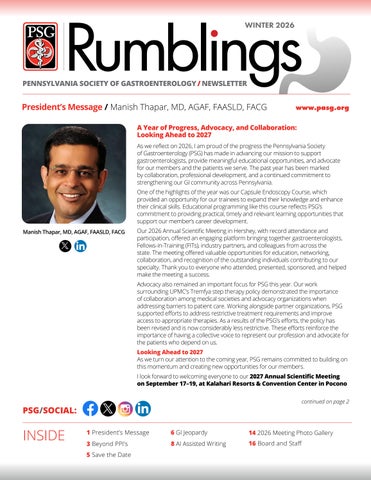
President’s Message / Manish Thapar, MD, AGAF, FAASLD, FACG
President’s Message / David L. Diehl, MD, FACP, FASGE
www.pasg.org
www.pasg.org
A Year of Progress, Advocacy, and Collaboration: Looking Ahead to 2027
The Importance of Mentoring
As we reflect on 2026, I am proud of the progress the Pennsylvania Society
attending physicians at one’s of Gastroenterology (PSG) hasamade in advancing our mission to support The PSG is launching own training program work very gastroenterologists, provide meaningful advocate mentorship program for GI educational opportunities, and hard to train GI fellows, but this is for our members and the patients we serve. The past year has been marked Fellows and early career generally different from a mentoring by collaboration, professional development, and a continued commitment to GI physicians. will across Pennsylvania. relationship. strengthening our GIWe community be reaching out to those One of the highlights of the year was our Capsule Endoscopy Course, which I have been lucky enough have of you who would for like provided an opportunity ourto trainees to expand their knowledge andto enhance some important mentors in my participate inEducational this project. their clinical skills. programming like this course reflects PSG’s
medical career. The first was that commitment to providing practical, timely and relevant learning opportunities assigned to me when I was a firstMany of our us have benefitted support member’s careerfrom development. year medical student. His name mentors. Perhaps some of us have Our 2026 Annual Scientific Meeting in Hershey, with record attendance and Manish Thapar, MD, AGAF, FAASLD, FACG was Eugene “Skip” Felmar, MD and suffered for the lack of mentor platform bringing together gastroenterologists, participation, offered an aengaging he was a Family Practice attending during our education or industry training.partners, and colleagues from across the Fellows-in-Training (FITs), in the San Fernando Valley area of Mentors can have a lifelong impactopportunities state. The meeting offered valuable for education, Southern California.networking, I enjoyed going @DavidDiehlMD on their trainees, the relationship collaboration, and but recognition of the outstanding individuals contributing to our out to his office and shadowing him does not go in only direction. specialty. Thank you one to everyone who attended, presented, sponsored, and helped closely while he saw outpatients, Mentors get asa much benefit and make thecan meeting success. rounded on inpatients, and did office satisfaction as their mentees can. Beyond gaining valuable Advocacy also remained an important for PSG this year. Our work Gastroenterology, like other areas offocus procedures. insight into the practice of medicine, surrounding UPMC’s Tremfya step therapy policy demonstrated the importance medical training is akin to a “guild”, I found out why his nickname of collaboration among medical societies and advocacy organizations when was where the experienced take the afterpartner he took me out on his addressing barriers to patient care. Working“Skip” alongside organizations, PSG novice under their wing to train sailboat which he kept docked at supported efforts to address restrictive treatment requirements and improve them in the arts of their chosen LosPSG’s Angeles harbor. Skip has Felmar access therapies. of the efforts, the policy field. AlltoGIappropriate fellows, including us As a resultsthe became a role model for me, beenback revised andhad is now considerably the way when, trainers and less restrictive. These efforts reinforceand the mentor-mentee relationship was importance of having a collective voice to represent our profession and advocate for coaches that typically were staff mutually rewarding. the patients who depend on us. gastroenterologists at our program. Many medical schools provide for Looking Ahead to 2027 highly impactfultomentor mentor relationships, but is less year,Another As we turn our attention to this the coming PSG remains committed building on that I had was someone that I chose common in GI training. Certainly, this momentum and creating new opportunities for our members. myself. Dick Kozarek, MD was (and I look forward to welcoming everyone to our 2027 Annual Scientific Meeting on September 17–19, at Kalahari Resorts & Convention Center in Pocono continued on page 2 @PAGastroSoc
PSG/SOCIAL:
INSIDE:
continued on page 2
PSG/SOCIAL:
INSIDE
1 President’s Message
1 President’s Message 3 Practice Management 3 Beyond PPI’s 4 GI Supergroups 5 Save the Date
6 Venue Shopping 6 GI Jeopardy 8 EMR or ESD? 8 AI Assisted Writing 11 Roulette
13 Jeopardy Winners 14 2026 Meeting Photo Gallery 14 Annual Meeting Highlights 16 Board and Staff 16 Board and Staff
President’s Message continued from page 1
Manor, Pennsylvania. Please mark you calendars if you have not done so, I look forward to another weekend of education, networking, and professional collaboration. Supporting our Fellows-in-Training also remains a priority. Through the work of our Training Task Force, PSG is exploring educational initiatives and opportunities to help fellows develop their skills, connect with colleagues, and prepare for the transition from fellowship to independent practice. Investing in the next generation of gastroenterologists is essential to the future of our specialty, and we look forward to continuing this work in 2027. I want to encourage members to consider becoming more involved in PSG’s committees and initiatives. Whether you are interested in education, research, advocacy, or supporting trainees, your experience
and perspective can make a meaningful difference. Member engagement is what allows our Society to grow, adapt, and respond to the evolving needs of our profession. Finally, I want to extend my sincere appreciation to our Board of Directors and committee members for their continued service, leadership, and dedication to PSG. Our Society depends on the time, expertise, and commitment of volunteers who are willing to contribute beyond their busy clinical and professional responsibilities. I am grateful for all that you do to support our members and advance our shared goals. Thank you to all our members, partners, and supporters for being part of PSG. I look forward to what we will accomplish together in 2027 and encourage each of you to stay connected, get involved, and help shape the future of gastroenterology in Pennsylvania. Warm regards, Manish Thapar, MD, AGAF, FAASLD, FACG PSG President
2
Beyond PPI’s: What to Know About Potassium-Competitive Acid Blockers (P-CABs) By Shaun T. Ranade, DO MS | Internal Medicine, Geisinger For more than three decades, proton pump inhibitors (PPIs) have been the mainstay of pharmacologic acid suppression. They are effective, inexpensive, and generally safe. Yet PPIs have limitations: they are prodrugs that require activation in an acidic environment, generally work best when timed before meals, and their onset and degree of acid suppression can vary between patients. Potassium-competitive acid blockers, or P-CABs, represent a mechanistically distinct approach. Vonoprazan, currently marketed in the United States as Voquezna, is the first P-CAB approved in the U.S. and has generated interest for treatment of gastroesophageal reflux disease (GERD) and Helicobacter pylori eradication [4]. How do P-CABs work? Both PPIs and P-CABs ultimately target the gastric parietal-cell H+/ K+-ATPase proton pump, but they do so differently. PPIs require aciddependent activation and irreversibly bind active proton pumps. In contrast, vonoprazan reversibly and competitively blocks potassium binding to the H+/K+-ATPase. It is acid stable, accumulates within the acidic canaliculi of parietal cells, and can produce rapid and sustained inhibition of gastric acid secretion. For clinicians, this translates into several practical differences: vonoprazan has a faster onset, provides potent acid suppression throughout the day and night, and can be taken with or without food. Additionally, its pharmacologic effect also appears less dependent on CYP2C19 variation than that of many traditional PPIs [7].
A decade of experience in Japan Vonoprazan is relatively new to many American clinicians, but it is not a new drug internationally. Developed by the pharmaceutical giant Takeda, it was approved in Japan in 2014 and became commercially available in February 2015 under the trade name Takecab. Japanese indications have included reflux esophagitis, gastric and duodenal ulcers, prevention of recurrent ulcers in selected patients taking aspirin or NSAIDs, and use as part of H. pylori eradication therapy [8]. A recent prospective post-marketing study involving more than 1,100 Japanese patients treated with vonoprazan for maintenance of healed reflux esophagitis found
a low rate of reported adverse drug reactions and an endoscopic recurrence rate of approximately 4% among patients with follow-up endoscopy. No new safety signal was identified during 12 months of treatment [5]. That said, long-term surveillance remains important, given that the three-year data from the Japanese VISION study demonstrated more frequent parietal-cell, foveolarcell, and G-cell hyperplasia with vonoprazan than with lansoprazole, reflecting the physiologic consequences of profound chronic acid suppression. The clinical significance of these changes continues to be studied [9].
Image: 7-day Japanese H. pylori eradication blister pack containing vonoprazan + clarithromycin + amoxicillin.
3
When did vonoprazan reach the United States?
The FDA initially approved vonoprazan-based dual and triple regimens for H. pylori on May 3, 2022. Its indications subsequently expanded to include healing and maintenance of erosive esophagitis and relief of associated heartburn. In July 2024, the FDA added an indication for relief of heartburn associated with nonerosive GERD. Is a P-CAB better than a PPI? In a large randomized trial of 1,024 patients with erosive esophagitis, vonoprazan was noninferior to lansoprazole for healing at eight weeks and showed higher overall healing rates in a prespecified exploratory superiority analysis: 92.9% versus 84.6%. The clinical advantage appeared particularly relevant among patients with more severe erosive disease [2]. That distinction matters. The AGA does not recommend replacing PPIs with P-CABs across the board. For uncomplicated heartburn, nonerosive reflux disease, or mild LA grade A/B erosive esophagitis, inexpensive and well-studied PPIs generally remain appropriate firstline therapy. Conversely, P-CABs may be particularly attractive in patients with LA grade C/D esophagitis or objectively documented acid reflux despite twice-daily PPI therapy [10] . In other words, stronger acid suppression does not automatically mean that every patient needs a stronger drug. Most compelling use: H. pylori The H. pylori story may be where P-CABs have their greatest immediate impact. In the PHALCONHP randomized trial conducted in the United States and Europe, both vonoprazan-amoxicillin dual therapy and vonoprazan-based triple therapy were noninferior to lansoprazole-based triple therapy in patients with antibiotic-susceptible organisms. Importantly, among
patients with clarithromycin-resistant strains, eradication rates were substantially higher with vonoprazan triple therapy and vonoprazan dual therapy than with lansoprazole triple therapy (65.8%, 69.6%, and 31.9%, respectively) [3]. This is especially clinically relevant as antimicrobial resistance continues to complicate eradication strategies. A recently published case described a 67-year-old woman with persistent H. pylori despite multiple prior treatment regimens. After susceptibility testing and continued treatment failure, a vonoprazan-amoxicillin salvage regimen successfully eradicated the infection. Although a single case cannot establish efficacy, it illustrates a practical example for more potent acid suppression in difficult toeradicate infection [11]. Will insurance cover it? Vonoprazan is now included on a number of U.S. commercial formularies, but prior authorization and requirement for step therapy remain common. Therefore, when prescribing a P-CAB, documenting the indication, previous PPI exposure, treatment response, endoscopic findings when applicable, and rationale for switching may make the authorization process considerably easier. Coverage varies by insurer and individual pharmacy benefit. What should the GI clinician remember? P-CABs are not simply stronger PPIs and after roughly a decade of use in Japan, P-CABs are no longer an experimental concept. They represent a different pharmacologic approach to acid suppression. Their practical advantages like rapid onset, sustained acid control, lack of mealtiming requirements, and efficacy in selected difficult-to-treat patients are compelling. The strongest reasons to specify vonoprazan appear to be H. pylori eradication, severe erosive esophagitis, and carefully selected patients with objectively documented PPI-refractory acid-mediated disease.
4
Selected References 1. P atel A, Laine L, Moayyedi P, Wu JCY. AGA Clinical Practice Update on integrating potassiumcompetitive acid blockers into clinical practice. Gastroenterology. 2024. Gastroenterology Association 2. L aine L, DeVault K, Katz P, et al. Vonoprazan versus lansoprazole for healing and maintenance of healing of erosive esophagitis. Gastroenterology. 2023;164:6171. PubMed 3. C hey WD, Mégraud F, Laine L, et al. Vonoprazan triple and dual therapy for Helicobacter pylori infection in the United States and Europe. Gastroenterology. 2022;163:608-619. PubMed 4. U .S. Food and Drug Administration. Voquezna prescribing information. DailyMed 5. M anabe N, Matsuo M, Suzuki C. Long-term safety and effectiveness of vonoprazan as maintenance therapy for reflux esophagitis in Japan. Expert Opin Drug Saf. 2026. PubMed 6. A shida K, Sakurai Y, Nishimura A, et al. Vonoprazan versus lansoprazole for healing erosive esophagitis. Aliment Pharmacol Ther. 2016. PubMed 7. E chizen H. The First-in-Class PotassiumCompetitive Acid Blocker, Vonoprazan Fumarate: Pharmacokinetic and Pharmacodynamic Considerations. Clin Pharmacokinet. 2016 Apr;55(4):40918. doi: 10.1007/s40262-015-0326-7. PMID: 26369775. https://pubmed.ncbi.nlm.nih. gov/26369775/ 8. P harmaceuticals and Medical Devices Agency. Review reports: drugs. PMDA. Accessed October 9, 2026. https://www. pmda.go.jp/english/review-services/reviews/ approvedinformation/drugs/0001.html 9. H aruma K, Kinoshita Y, Yao T, Kushima R, Akiyama J, Aoyama N, Kanoo T, Miyata K, Kusumoto N, Uemura N. Randomised clinical trial: 3-year interim analysis results of the VISION trial to evaluate the long-term safety of vonoprazan as maintenance treatment in patients with erosive oesophagitis. BMC Gastroenterol. 2023 May 1;23(1):139. doi: 10.1186/s12876-023-02772-w. PMID: 37127558; PMCID: PMC10152792. 10. A merican Gastroenterological Association. Integrating potassium-competitive acid blockers into clinical practice. AGA. Accessed October 9, 2026. https://gastro. org/clinical-guidance/integratingpotassiumcompetitive-acid-blockers-into-clinicalpractice/ 11. F ernandez AC, Rux CE, Clark NM. Successful treatment of refractory Helicobacter pylori infection with a potassium-competitive acid blocker-based regimen: A case report. Int J Infect Dis. 2026 Feb;163:108207. doi: 10.1016/j. ijid.2025.108207. Epub 2025 Nov 12. PMID: 41238174.
SAVE THE DATE!
PSG Annual Scientific Meeting September 17-19, 2027 Kalahari Resorts & Conventions, Pocono Manor, PA
5
Beyond the Endoscope: GI Jeopardy, Friendships, and a National Top-Five Finish By: Rewanth Katamreddy, MD
When I first participated in the Pennsylvania Society of Gastroenterology (PSG) Jeopardy competition in September 2025, during my second year of gastroenterology fellowship, I had little idea how much fun it would be. What started as an opportunity to test my GI knowledge quickly became one of the most enjoyable experiences of fellowship. The excitement of the competition, challenging questions, and enthusiasm of fellow participants reminded me that learning gastroenterology could be just as entertaining as it was intellectually stimulating. That first experience sparked a curiosity that extended beyond the competition. I found myself exploring unusual clinical presentations, historical discoveries, and fascinating aspects of gastroenterology that I might not otherwise have encountered. The more I learned, the more curious I became. What began as preparation for a friendly competition gradually evolved into a genuine passion for learning. It reminded me that curiosity and enjoyment can be powerful motivators for professional growth. When I returned to PSG Jeopardy in September 2026 as a third-year fellow, I was more confident, engaged, and excited to participate. This time, I was looking forward not only to the competition but also to reconnecting with familiar faces. Dr. Khara’s enthusiasm and encouragement at each meeting made the experience particularly welcoming. The atmosphere was filled with friendly rivalry, laughter, and camaraderie. One memorable moment was seeing
Geisinger emerge victorious with a little help from Guthrie along the way! It was a wonderful reminder that although we represented different institutions, we could still celebrate one another’s success. Fellows we initially met as competitors gradually became friends, making each subsequent meeting feel like a reunion. This sense of connection continued at the national level. At ACG GI Jeopardy, I reconnected with a chief fellow from the University of Missouri–Kansas City (UMKC) team whom I had first met at the ACG Chief Fellows Course in May. Seeing a familiar face months later, this time on a competing team, reminded me how friendships in medicine grow stronger each time our paths cross at conferences and educational events. Another memorable part of this journey was the unwavering support of our Program Director, Dr. Georgetson, along with Dr. Bernshteyn and our other faculty members. Dr. Georgetson’s enthusiasm reminded me of a proud father taking his kids to a big game, cheering us on and sharing in every moment of excitement. Their encouragement, whether we answered correctly or missed a question, made the journey even more special. Our participation in ACG National GI Jeopardy was the culmination of this growing enthusiasm. Competing against talented fellows from across the country was exciting, challenging, and occasionally nerve-racking. Eventually, our team earned a place
6
among the top five teams nationally, a proud moment for us and for Guthrie. Looking back at my first PSG Jeopardy experience in September 2025, I could never have imagined that a year later, the same curiosity and excitement would take us to the national stage. What surprised me most was the recognition that followed. Throughout the ACG conference, numerous fellows, faculty, and attendees approached us to congratulate our team and discuss the competition. Conversations that began with GI Jeopardy often evolved into discussions about fellowship, career aspirations, and future opportunities. These interactions reminded me that competitions provide not only a platform to demonstrate knowledge but also an opportunity to represent our institutions and become more connected with the broader gastroenterology community. I strongly encourage other GI fellows to explore these opportunities. Competitions such as PSG Jeopardy at its annual September meeting, ACG National GI Jeopardy, ACG EndoTitans, and the ASGE Golden Scope competition offer different ways to challenge ourselves, develop our knowledge and skills, and connect with fellow trainees. You do not need to know every answer or be the most knowledgeable person in the room. Sometimes, all it takes is a little curiosity, a willingness to participate, and a desire to have fun.
GI Jeopardy Continued As fellows, we spend countless hours caring for patients, performing procedures, preparing for boards, and developing our clinical skills. GI Jeopardy reminded me that learning does not always have to be driven by obligation. Sometimes, the excitement of competition, the curiosity sparked by an unfamiliar question, or the encouragement of friends can inspire us to learn more than we ever expected. My advice to fellow trainees is simple: Form a team, participate, and enjoy the experience. You might make lifelong friends, discover new interests, and create memories that last well beyond fellowship. After all, some of the best experiences in fellowship happen outside the endoscopy suite.
Celebrating PSG’s First-Place Poster Award Winner Congratulations to Dr. Syeda Kanza Kazmi of Penn State, the 2026 FirstPlace Poster winner at Annual Scientific Meeting! Her research, “Cardiometabolic Therapies and Colectomy Risk in Ulcerative Colitis: A Comparative Propensity-Matched Study of GLP-1 Receptor Agonists and SGLT2 Inhibitors,” highlights important research at the intersection of gastroenterology and metabolic health. Below is a summary of her prize-winning abstract. This retrospective propensitymatched cohort study used the TriNetX Global Collaborative Network toevaluate the association between GLP-1 receptor agonists (GLP-1RAs) and SGLT2 inhibitors (SGLT2is)with colectomy risk in adults with ulcerative colitis (UC) and cardiometabolic
Starting from the left: Anthony Gallo, Ani Damughatla, Swapnil Patel, Kojo Awuah, Cydney Nguyen, Erin Tonzi, Sonia Samuel, Allison Leisgang.
PSG Pizza Party!
Congratulations to Penn State for winning PSG’s Resident and Fellow Membership Drive for the second consecutive year! As the first program to submit its resident and fellow list, they earned a well-deserved pizza party. Thank you to all participating programs for helping PSG welcome and engage the next generation of gastroenterologists!
comorbidities, including type 2 diabetes, chronic kidney disease, or heart failure. Patients receiving either medication class werecompared with non-exposed controls, with propensity-score matching to account for demographic characteristics and relevant comorbidities. The primary outcome was colectomy. In the headto-head comparison, no statistically significant difference in colectomy risk was observed between GLP-1RA and SGLT2i users. However, compared with non-exposed patients, GLP-1RA users had approximately 67% lower relative risk of colectomy (RR 3.00, 95% CI 1.67–5.38, for non-exposed versus GLP-1RA users),while SGLT2i users had approximately 56% lower relative risk (RR 2.28, 95% CI 1.31–3.96, for non-exposed versus SGLT2i users). These findings suggest that both medication classes may be associated with lower colectomy risk among patients with UC and
7
cardiometabolic comorbidities however results are hypothesisgenerating and support further prospective studies to clarify whether cardiometabolic therapies influence UC-related surgical outcomes.
The Fine Print on AI-Assisted Writing By Vishali Moond, MD
AI writing tools have become a habit for many residents and fellows drafting at 11 p.m. between consults, whether the project is a case report, a retrospective cohort study, a review article, or a grant. In the American Medical Association’s 2026 physician survey, 81% of respondents said they use AI in their practice, more than double the 38% who reported using it in 2023.¹ The guidance below applies to every manuscript type; where a risk is greater for one type, that is noted.
Where AI helps Large language models handle the mechanical parts of writing reasonably well: tightening a clunky sentence, checking grammar, reformatting references to a journal’s style, or suggesting an outline for a discussion section. Used this way, an AI tool works like a fast copyeditor rather than a co-author. Problems start when it is asked to supply content: facts, citations, or interpretation. Verify every citation and figure Fabricated references are the bestdocumented failure. In a 2025 Deakin University experiment, researchers asked GPT-4o to write six literature reviews on mental health topics, then checked all 176 citations it produced against Google Scholar, Scopus, PubMed, and other databases.² Thirtyfive (19.9%) did not exist. Of the 141 real citations, 64 (45.4%) contained errors, most often an incorrect or invalid DOI. Fabrication was more common for less-studied topics: 6% of citations for major depressive disorder, compared with 28% for binge eating disorder and 29% for body dysmorphic disorder. These errors are reaching the published literature. A Lancet audit of about 2.5 million open-access biomedical papers published between January 2023 and February 2026
found that the share containing at least one fabricated reference rose from about 1 in 2,828 papers in 2023 to 1 in 458 in 2025, a sixfold increase, and reached 1 in 277 in the first seven weeks of 2026.³ Before submission, check every reference, statistic, and quotation against its primary source. That includes references you found yourself and only asked an AI tool to reformat, because reformatting can change an author list, a year, or a DOI. News coverage and summaries of a study are not a substitute for the study itself.
Keep the reasoning yours A manuscript’s value comes from the authors’ clinical observation and judgment: the reasoning in a case report’s discussion, the interpretation of a cohort study’s results, the synthesis in a review. When an AI tool drafts those sections, the text drifts toward generic, textbook-sounding language, and errors are hard to catch because the prose reads fluently. Write your own analysis first, then use AI to tighten it, not the other way around. One test before you submit: if you could not defend a sentence in front of a reviewer or your program director, rewrite it or cut it. Reading the final draft aloud also helps; if it doesn’t sound like you, keep revising. Keep patient information out of public tools
Never paste identifiable patient information, or a full clinical note, into a public AI chatbot. Most consumer AI tools are not covered by a HIPAA business associate agreement, and de-identification is harder than it looks: a rare diagnosis, an unusual combination of age and location, or a specific date can be enough to reidentify someone. The risk is highest in case reports, which describe one patient in detail, but data abstracted for a cohort study carries it too. If your institution offers an approved, secure AI platform, that is the only place patient details belong.
Disclose, and don’t list AI as an author The ICMJE Recommendations, most recently updated in January 2026, state that journals “should require authors to disclose at submission whether they used AI-assisted technologies (such as LLMs, chatbots, or image creators) in the production of submitted work.” They also state that “Chatbots (such as ChatGPT) and other AI-assisted tools should not be listed as authors because they cannot be responsible for the accuracy, integrity, and originality of the work,” and that “Nondisclosure of AI use may require corrective action and may be construed as misconduct in some circumstances.”⁴ Journals differ on where the statement goes and how much detail it needs, so read your target journal’s instructions for authors before you start writing, not at submission. A useful disclosure names the tool, says what it was used for, and states that the authors reviewed the output and take responsibility for the content. The statement for this article appears below.
8
AI-use statement In preparing the original submission, the author used Grammarly (Grammarly Inc.) for language verification, including grammar, spelling, and punctuation checks. The author reviewed and edited all AI-assisted text and takes full responsibility for the content of this article.
References 1. A merican Medical Association. AMA: AI usage among doctors doubles as confidence in technology grows [press release]. March 12, 2026. Accessed October 20, 2026. https:// www.ama-assn.org/press-center/ ama-press-releases/ama-ai-usageamong-doctors-doubles-confidencetechnology-grows. Full report: American Medical Association. 2026 Physician Survey on Augmented Intelligence. March 2026. https:// www.ama-assn.org/system/files/ physician-ai-sentiment-report.pdf 2. L inardon J, Jarman HK, McClure Z, Anderson C, Liu C, Messer M. Influence of topic familiarity and prompt specificity on citation fabrication in mental health research using large language models: experimental study. JMIR Ment Health. 2025;12:e80371. doi:10.2196/80371
3. T opaz M, Roguin N, Gupta P, et al. Fabricated citations: an audit across 2·5 million biomedical papers. Lancet. 2026;407(10541):1779-1781. doi:10.1016/S0140-6736 (26)00603-3 4. I nternational Committee of Medical Journal Editors. Recommendations for the Conduct, Reporting, Editing, and Publication of Scholarly Work in Medical Journals. Updated January 2026. Section V.A, Use of AI by Authors. Accessed October 20, 2026. https://www.icmje.org/ recommendations/browse/artificialintelligence/ai-use-by-authors.html .
TIPS IS NO LONGER A ONE SIZE FITS ALL APPROACH Smaller diameter options help personalize TIPS to the right patient at the right time. RethinkTIPS.com Abbreviation: TIPS, transjugular intrahepatic portosystemic shunt. Refer to Instructions for Use at eifu.goremedical.com for a complete description of all applicable indications, warnings, precautions and contraindications for the markets where this product is available. INDICATIONS FOR USE IN THE US: The GORE® VIATORR® TIPS Endoprosthesis is indicated for use in the de novo and revision treatment of portal hypertension and its complications such as variceal bleeding, gastropathy, ascites which recurs despite conventional treatment, and/or hepatic hydrothorax. CONTRAINDICATIONS: There are no known contraindications for this device. Products listed may not be available in all markets. © 2026 W. L. Gore & Associates, Inc. All rights reserved. All trademarks referenced are trademarks of either a member of the Gore group of affiliated companies or their respective owners. “Together, improving life” mark and designs are trademarks of a Gore company. 26PL1270-EN01 OCTOBER 2026 MAT-1419-1
9
10
Discover what this treatment may offer• Visit RezdiffraHCP.com to learn more and get patients started.
© 2026 Madrigal Pharmaceuticals, Inc. All rights reserved. Rezdiffra® and its related logo are registered trademarks of Madrigal Pharmaceuticals, Inc. US-PP-RES-01599 06/26
11
2027 Research Grant Opportunity The Pennsylvania Society of Gastroenterology (PSG) invites eligible members to submit research proposals for the 2027 PSG Research Grant.
EXPLORE WHAT’S NEW
This year, PSG is seeking projects focused on improving colorectal cancer screening access and utilization, enhancing value in endoscopic care delivery, or expanding access to gastroenterology and hepatology services.
Up to TWO Grants of $12,500 each will be awarded. Don’t miss this opportunity to advance meaningful research and make an impact on GI care. Applications are due January 31, 2027. Visit https://pasg.org/27grant for complete guidelines and application details.
Scan here for more information. Data rates may apply.
© Johnson & Johnson and its affiliates 2026 01/26 cp-561051v1
12
Expanding access to IBD knowledge IBDIQ is an on-demand disease education platform designed to enhance your expertise in IBD care.
Learning modules organized to fit into your busy schedule
Created in collaboration with inflammatory bowel disease (IBD) specialists for healthcare providers of all experience levels
Available at no cost to you
Annual Meeting Photo Gallery
DISCOVER THE FULL LEARNING EXPERIENCE . VISIT IBDIQ .COM OR SCAN THIS CODE .
Please note, no continuing medical education credits (CMEs) are offered through IBDIQ.
©2026 Takeda Pharmaceuticals U.S.A., Inc. 500 Kendall Street, Cambridge, MA 02142. 1-877-TAKEDA-7 (1-877-825-3327). All rights reserved. TAKEDA and the TAKEDA Logo are registered trademarks of Takeda Pharmaceutical Company Limited. US-NON-13141v1.0 08/26
13
s t h g i l h Hig ssion General Se
Selfie
Jeopardy Winners
Corporate Sponsor Luncheon
Family Fun Night Harvey Lefton Luminary Award Dr. Harris Clearfield Welcome Reception
PSG Board
Program Director of the Year Dr. Michael Georgetson
Family Fun Night Posters
Poster Winners 1ST PLACE Syeda Kanza Kazmi, MD Penn State Health 2nd Place Tulio Correa, MD University of Pittsburgh 3rd Place Sanja Shelukar, MD Thomas Jefferson University Hospital
Exhibitors FIT of the Year Dr. Brandon Rodgers
PSG
PRSRT STD U.S. POSTAGE PAID HARRISBURG PA PERMIT NO. 922
BOARD & STAFF BOARD&STAFF BOARD&STAFF PRESIDENT PRESIDENT David L. Diehl, MDMD, AGAF, Manish Thapar, Geisinger Medical FAASLD, FACG Center Gastroenterology/Nutrition Chief, Section of Hepatology 570-271-6856 Professor of Medicine, dldiehl@geisinger.edu Lewis Katz School of Medicine @DavidDiehlMD 215-707-5067 https://x.com/thoughtstoday 1st Vice-President
Karen Krok, MD Penn State Hershey Gastroenterology PRESIDENT-ELECT (717) 531-4950 Neilanjan Nandi, MD, FACP kkrok@pennstatehealth.psu.edu University of Pennsylvania @klkrok 215-662-8900 https://x.com/FITWITMD
SECRETARY
Manish Thapar, MD Thomas Jefferson University Hospital (215) 955-8900 manishthapar@yahoo.com
TREASURER TREASURER Neilanjan Nandi, MD, FACP Harshit S. Khara, MD, University of Pennsylvania FACG, FASGE 215-662-8900 Associate Professor of Medicine Neilanjan.Nandi@pennmedicine.upenn.edu Department of Gastroenterology, Hepatology, & Nutrition @fitwitmd Geisinger Medical Center 904-535-9448 EDITOR https://x.com/HarshitKharaMD David L. Diehl, MD https://www.instagram.com/harshit_khara Geisinger Medical Center https://www.facebook.com/harshit.khara.1 Gastroenterology/Nutrition https://www.linkedin.com/in/harshitkharamd 570-271-6856 dldiehl@geisinger.edu @DavidDiehlMD SECRETARY ADMINISTRATIVE OFFICE Kim Chaput, DO ASSOCIATION EXECUTIVE St. Luke’s Gastroenterology Audrey Dean 484-526-6545 (717) 909-2633 info@pasg.org
STAFF EDITOR CindyL.Warren David Diehl, MD Marketing Coordinator Geisinger Medical Center Gastroenterology/Nutrition Jessica Winger 570-271-6856 Meeting Manager https://x.com/DavidDiehlMD Tom Notarangelo Design Manager
STAFF Lauren Newmaster, CMP Association Executive Association Coordinator Jessica Winger Meeting Manager Tom Notarangelo, MFA Design Manager