BCMSScript. Newsletter of the Bucks County Medical Society
Summer 2026
President’s Message OUR MISSION The Bucks County Medical Society strives to advance the professional and personal development of its physician members by providing educational and practice related resources as well as legislative advocacy. Moreover, the Bucks County Medical Society seeks to promote optimal outcomes for our patients as well as the public health of the Bucks County community.
EDITORIAL BOARD Marilyn Heine, MD, Editor-in-Chief J. Matthew Bohning, MD Hannah Do, MD John Gallagher, MD John Pagan, MD, MBA
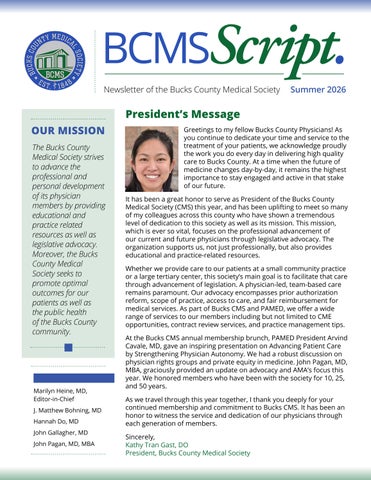
Greetings to my fellow Bucks County Physicians! As you continue to dedicate your time and service to the treatment of your patients, we acknowledge proudly the work you do every day in delivering high quality care to Bucks County. At a time when the future of medicine changes day-by-day, it remains the highest importance to stay engaged and active in that stake of our future. It has been a great honor to serve as President of the Bucks County Medical Society (CMS) this year, and has been uplifting to meet so many of my colleagues across this county who have shown a tremendous level of dedication to this society as well as its mission. This mission, which is ever so vital, focuses on the professional advancement of our current and future physicians through legislative advocacy. The organization supports us, not just professionally, but also provides educational and practice-related resources. Whether we provide care to our patients at a small community practice or a large tertiary center, this society’s main goal is to facilitate that care through advancement of legislation. A physician-led, team-based care remains paramount. Our advocacy encompasses prior authorization reform, scope of practice, access to care, and fair reimbursement for medical services. As part of Bucks CMS and PAMED, we offer a wide range of services to our members including but not limited to CME opportunities, contract review services, and practice management tips. At the Bucks CMS annual membership brunch, PAMED President Arvind Cavale, MD, gave an inspiring presentation on Advancing Patient Care by Strengthening Physician Autonomy. We had a robust discussion on physician rights groups and private equity in medicine. John Pagan, MD, MBA, graciously provided an update on advocacy and AMA’s focus this year. We honored members who have been with the society for 10, 25, and 50 years. As we travel through this year together, I thank you deeply for your continued membership and commitment to Bucks CMS. It has been an honor to witness the service and dedication of our physicians through each generation of members. Sincerely, Kathy Tran Gast, DO President, Bucks County Medical Society
Cutting Edge Issues in Critical Care Kathy Tran-Gast, DO, is a pulmonary, critical care, and sleep medicine physician in Doylestown.
pressure based on predicted mortality risk. This has been compared with static population guidelines and may help prevent overutilization of treatment or resources. More disease states are being subcategorized to different sub-phenotypes to better target treatments that may require specific immune modulators. Advanced biomarker monitoring may be able to test for specific genes or markers that show earlier predictable signs of cellular dysfunction to prevent patients from advancing to end-organ damage. These approaches may become more mainstream in the next few years. AI-based programs help focus on quality measures and metrics for conditions such as sepsis. AI-models are being used for medical record keeping helping to decrease the burden of documentation.
Several key advances in critical care medicine are driven by technology. Extracorporeal membrane oxygenation (ECMO) has been more readily offered in recent years as a result of early recognition of patients who may benefit and the presence of accessible treatment centers. Point-of-care ultrasound enables clinicians to rapidly evaluate cardiac function, fluid status or lung pathology at the bedside. Continuous renal replacement therapy (CRRT) is more widely available and is being assessed in patients with cerebral edema or ischemic heart disease to offer treatment without significant hemodynamic impact. Tele-ICU and remote monitoring allow access to critical care at more remote locations.
Care guidelines are updated to reflect better understanding. As an example, clinical criteria were established for the definition of refractory septic shock that allows for cautious use and de-escalation of IV fluids, early recognition of complications to prompt intervention, decreased length of stay and improved patient survival rates.
New treatment devices and hemodynamic monitoring in the intensive care unit include ventilators that may anticipate a patient’s airflow, noninvasive oxygen delivery devices, and noninvasive hemodynamic monitoring devices that do not require central venous access. These limit complications and excessive procedures on patients.
Extracorporeal membrane oxygenation (ECMO): blood is pumped out of the body to an artificial lung machine that oxygenates the blood and removes carbon dioxide, allowing the patient’s heart and lungs to rest and heal. Continuous renal replacement therapy (CRRT): 24-hour, slow-acting dialysis technique that maintains a stable blood pressure.
Since the COVID pandemic, our understanding of Acute Respiratory Distress Syndrome (ARDS) has changed. Early recognition is fundamental to the effective use of ECMO and CRRT in these patients, with studies demonstrating improved outcomes following these interventions. In cases of ARDS, noninvasive oxygen delivery may avert or delay intubation; thereby decreasing the use of sedation and paralytics. Prone positioning has also been utilized to encourage better oxygen delivery.
Personalized medicine (or precision medicine): utilizes a patient’s unique factors to target evaluation and treatment including genomics, where DNA data is used to predict disease risk or response to treatment; biomarkers, where care is guided through results of blood tests and imaging; psychosocial history; and phenotypic traits.
Personalized medicine and AI have enhanced critical care at certain centers. Genomics, biomarkers, and dynamic physiologic data help provide individualized care. Specific hemodynamic monitoring devices target heart rate and blood
BCMSScript.
2
Caring for Communities Near and Far telemedicine consultations to 15,000+ people in rural India.
Bindu Kansupada, MD, MBA, is a cardiologist from Lower Bucks County. He is the 2026 recipient of PAMED’s International Voluntary Service Award, being recognized for a career spent improving health care for global populations in real time by integrating medical technology with a holistic approach.
BCMS Script: In which health care initiatives in India have you participated?
BK: Studies show that 34% to 70% of Indian university students experience moderate-to-high psychological distress, anxiety, or depression. To help research address a successful WGF-supported BCMS Script discussed with Dr. Kansupada his Collaborative on newthis, drug molecules and metal science for cardiovascular products has begun and involves U.S. companies and IIT PhD students. We have connected U.S. Silicon Valley successful project is the introduction of AI-supported international voluntary service. entrepreneurs with bright students to benefit individuals who are less privileged. wellness and resilience training. This was delivered work with the charitable and humanitarian arms of SRMD (Shrimad Rajchandra Mission BCMS Script: When did you begin to be involved in I also to medical students in Pune, a premier hub for Dharampur), Satyasai Foundation (Sri Sathya Sai International Organization), and BAPS Swaminarayan activities to support health care initiatives in India? Sanstha foundation improve health care access andand improve medical education medical toeducation in India, students at and thewomen empowerment. Indian Institute of Technology (IIT) in Ropar. We BK: My wife, Neeta, and I have been supporting have used Indian Knowledge Systems (IKS)-based, health care activities in India for the past 40 years. AI-supported, PeakMind app-based teaching with More recently, this has been through participation the holistic wellness expert Dr. Ishan Shivanand in the WHEELS Global Foundation (WGF), https:// to conduct mental health training for frontline wheelsglobal.org. a nonprofit organization that medical students. applies technology-enabled philanthropy to solve challenges affecting rural and “rurban” populations globally, with a strong focus on underserved areas in India. The foundation’s six pillars are Water, Health, Energy, Education, Livelihood, and Sustainability. Endeavors involve more than 200 U.S. leaders who have individual expertise in these six domains. Dr. Rajnikant Shah – my uncle, fellow Bucks County cardiologist, WGF Health Council chair and member of the WGF (USA) board of directors – has inspired and supported our activities globally. Wellness and resilience training to prevent suicide and
I serve as vice chair for the WGF Health Council, substance use disorder, IIT Ropar chair for mental health and wellness, and Wellness and resilience training to prevent suicide and substance use disorder, IIT Ropar toparagraph lead inthe motivational after the first the section: BCMS Script: Ininteractive which health care initiatives in India member of the WGF (USA) board of directors. We CouldIgohelped have you participated? sessions, along with Dr Shivanand, members support mental health, women’s health, nutrition, of my WGF mental health team, Director of education, access to telehealth and medical Community Health Dr. Neeraj Kumar, Dr. Varsha devices, awareness and reduction of modifiable Vaidya, faculty professors, other physicians, and risk factors for non-communicable chronic psychologists. We have been able to reduce conditions. students’ suicidal thoughts, enhance scholastic During the Covid pandemic our activities performance, and improve interpersonal got supercharged. Rural India needed many relationships. I was honored to deliver keynotes ventilators and medicines. Through WGF we for army policy leaders on ways to improve mental arranged for many ventilators to be delivered. health, wellness, and resilience. This was a major, coordinated effort that engaged For the students, we have also introduced support from many physicians, other nonprofit lifestyle medicine-based programs to promote organizations, and volunteers in India and the behavioral changes and student-led projects for U.S. WGF physicians provided complimentary
3
BCMSScript.
BCMS Script: What have been the results of health care initiatives in India that you have supported?
which we provide tools to measure impact. We plan to expand these initiatives to many of IIT’s 23 campuses. In the community, students and villagers use the MySmartCareDoc app to collect data on health conditions, identify social drivers of health, and facilitate telehealth care, helping to identify when in-person management is needed that involves a mobile unit.
BK: Our pilot project for wellness and resilience at IIT Ropar had “no suicide by our students.” Our program is liked by students and improves their acceptance of mental health as a disease. Early intervention with AI-supported in-house help has reduced suicidal burden and has zero documented suicides unlike other IIT institutes.
Dr. Rupal Dalal leads another successful initiative that is supported by the WGF Health Council and the Indian government. Dr. Dalal is a pediatrician who is widely recognized for her research to remedy preventable newborn malnutrition in India. The program addresses newborn stunting in poor rural communities - impaired physical growth and cognitive development in children often caused by chronic malnutrition. The project aims to ensure healthy nutrition for the mother and baby during the first 1000 days of the antenatal, intranatal, and postnatal period and has significantly reduced newborn stunting.
With local students to support computer literacy, nursing student AI-based learning, senior education (mobile health care unit in background)
With local students to support computer literacy, nursing student AI-based learning, senior education (mobile health care unit in background) Could go after the third paragraph in the section: BCMS Script: In which health care initiatives in India have you participated?
The nutrition program results are astounding. There has been a 70-80% reduction of first 1000day newborn stunting among 17,000 Scheduled Castes and Scheduled Tribes - officially designated groups of historically disadvantaged and marginalized people in India. This group includes the very poorest women in tribal rural India where health care access is scant.
With local villagers and volunteers promoting women empowerment
We also promote women’s health with testing and treatment for iron deficiency anemia, With local villagers and volunteers promoting women empowerment Could go after the fifth paragraph section: BCMS Script: In which health care initiatives in India immunizations, eyein the checks, point-of-care blood have you participated? sugar measurement, and access to sanitary napkins. Our programs have led to improved digital literacy, clean water access, self-reliance, and improved earnings for women villagers. Our movement is supported by many like-minded volunteers, physicians, donors, legislators, and academicians. To help coordinate these With army policy leaders to reduce depression and suicide endeavors, I spend 4 months on ground with With leaders to reduce and suicide Could go after thearmy secondpolicy paragraph in the section: BCMSdepression Script: In which health care initiatives in India have you participated? villagers and volunteers.
BCMSScript.
4
BCMS Script: Are there other thoughts you would like to share?
of angiograms, histopathology samples, and other imaging data.
BK: We are expanding our pilot projects to other states in India, Guatemala, and Kenya. We have engaged Rotary International. We are reaching out for Corporate Social Responsibility donations that involve businesses supporting nonprofits or social causes through direct financial grants, matching employee gifts, or in-kind donations. An increased number of U.S. donors are coming forward.
Collaborative research on new drug molecules and metal science for cardiovascular products has begun and involves U.S. companies and IIT PhD students. We have connected U.S. Silicon Valley successful entrepreneurs with bright students to benefit individuals who are less privileged. I also work with the charitable and humanitarian arms of SRMD (Shrimad Rajchandra Mission Dharampur), Satyasai Foundation (Sri Sathya Sai International Organization), and BAPS Swaminarayan Sanstha foundation to improve health care access and improve medical education and women empowerment.
I was fortunate to engage the Mayo Clinic to partner with IIT Ropar, the academic medical university Era Medical College in Lucknow, and the globally recognized premium multi-specialty research center Hinduja Hospital in Mumbai, for AI-supported research utilizing review of millions
Bucks CMS Annual Meeting
The Physicians’ Voice in Politics
Pennsylvania Medical Political Action Committee
JOIN PAMPAC HERE: www.PAMPAC.org
In April, Bucks CMS members connected with colleagues at our Annual Membership Meeting and Brunch. Members were recognized for milestone years of medical service. Below: Christopher Hermann, MD and Peter Schwartz, MD (50 years); Elizabeth Spiers, MD (25 years); Mark Pappadakis, DO and Brandon Martin, MD (10 years).
5
BCMSScript.
Making Your Voice Heard on Social Media Mark Pappadakis, DO, is an emergency physician from Bucks County.
we were seeing in the ER, and following the latest developments from “Med Twitter.” Since then, I’ve found social media to be a way to stay updated on breaking medical news as well as engage with the public and fight back against misinformation. I also post on LinkedIn. It’s important to be aware of your audience on all platforms. For LinkedIn, you’re talking less to patients and more to healthcare decision makers and your colleagues. This is where advocacy can be highly effective.
BCMS Script discussed physician engagement on social media with Dr. Pappadakis.
BCMS Script: What are the platforms on which a physician can engage on social media?
BCMS Script: When did you become active on social media and why?
MP: Facebook, Instagram, Twitter/X, and TikTok are the highest profile big social media platforms. The social media landscape has changed dramatically even in just the last few years. Different platforms tend to be used more by different generations: for Generation Z usage, TikTok leads as well as Instagram and Snapchat. Millennials tend to favor Instagram and some Facebook, while Gen X and Baby Boomers lean more toward Facebook with some Instagram usage. Twitter/X, BlueSky, and Threads tend to have a variety of users.
MP: I’ve been involved on social media for years, initially with Xanga, an online website/blog, to spread my musings to a very small circle of friends, then Facebook for personal use since 2005. At the time, it was a way to connect to former friends from high school and then college and work, and it required a PC. Facebook then exploded along with other social media platforms. Right before medical school I got my first smartphone and a lot of my friends began using apps like Snapchat and Instagram. I joined as a curiosity, but never used it much until I downloaded Twitter in 2018. Back then, it was a great platform just to keep up with current events. I was a self-described “lurker” as opposed to someone who posted a lot.
If you want to reach the largest number of users possible, you’ll want to have some sort of presence on all of them, however it’s very time consuming for a physician with a full-time clinical load to do so. Each platform also calls for a very specific style of social media post. Brief videos called “Shorts” or “Reels” tend to have the most engagement and reach as opposed to a text-based post. Instagram and TikTok are the best-used when it comes to videos, whereas Facebook is a hybrid of both text and video format. If you prefer quick and short updates or thoughts, Twitter/X, BlueSky, and Threads is your go-to.
That changed back in 2019 prior to my graduation from residency when I saw a post on Facebook regarding the Administration’s initiative to change “Surprise Billing” laws and push Congress into action. If it wasn’t for social media, I would have never heard about it since legislation in Medicine isn’t exactly required reading in training. I became more active on Twitter/X fighting back against policy wonks who wanted in-network rates to be used as a benchmark rather than the arbitration policy we have today, and it led me down a path towards advocacy.
First, figure out your niche, and then try to collaborate with other physicians or influencers in the space to fill in the gaps where you tend to struggle. Don’t be afraid to try a medium you aren’t familiar with either, as you may grow to enjoy it!
In 2020 with Covid, yet again it was social media that sounded the alarms in the medical world before anything of substance hit the news cycle. I continued to increase my social media presence, trying to explain the science behind Covid, what
BCMSScript.
Physicians as a whole are a bit late to the party when it comes to being an “influencer”, although there are many prominent figures leading the way. Most notably is Dr. Will Flannery (Dr.
6
Glaucomflecken), Dr. Mike Varshavski (Dr. Mike), Dr. Meghan Martin (Dr. Beachgem), and Dr. Zachary Rubin. They have developed their online presence very carefully and famously through years of constant posting in various media forms across all content platforms.
guard. Being active on social media - especially focusing on content within your specialty - can better prepare you to understand what your patients are exposed to online and guard against misinformation. BCMS Script: Are there more tips you would like to share?
BCMS Script: What are the benefits of a physician engaging on social media?
MP: If a physician chooses to engage on social media, first get familiarized with the platforms of interest. To save time, cross-post - where you create one piece of content and post it on multiple platforms - and limit the frequency of your posts. The social media algorithm prioritizes posts that include key words, frequent reactions, images, video lengths, and topics that are relevant to the current news cycle. Each platform works slightly differently. Follow some of the more popular influencers and copy what they do.
MP: The biggest benefit is combatting the glut of misinformation on social media. Patients are increasingly getting their information from ChatGPT, TikTok, and Instagram. Attention spans are dwindling with an increasing emphasis on 90-second “Shorts/Reels” and people aren’t interested in traditional education vehicles like discharge paperwork or pamphlets that give generic information regarding treatment plans and conditions. Having an online presence can help engage your patients where they are. During your discussions with patients you can point to any content you generated so they may learn more about their diagnosis and treatment. Remember to protect patient privacy when posting online.
Engaging on social media takes patience. Learn from your mistakes. Physicians are the frequent target of the “wellness” industry, anti-vax groups, and people with a financial incentive to sow distrust against our profession. Social media is a place where everyone has an opinion, and you may be called “wrong” no matter how eloquently or generically you phrase your own view. As physicians we are held to a higher standard. Our posts on social media can potentially be used against us whereas the wellness influencer with one million followers can say things completely unhinged and get away with it. Be as respectful as possible, but never be afraid to call out people who want to make a buck by doing harm to our patients.
Social media also offers an outlet for people living with chronic medical conditions to find others with similar illnesses. While a sense of community can be good, many bad actors prey upon often-frustrated patients who seek Independent Practice Summit Sets treatments the Stage for Future Collaboration alternative when traditional methods sted its first-everhave Independent Practice Summit. Physicians attended from across Pennsylvania seemingly failed them. These bad actors sow f CME, collaboration, and conversations focused on strengthening independent practice. The as a priority initiative of PAMED President and Bucks CMSthe member,patient Arvind R. Cavale,and MD. distrust between their physician. said, "The Independent Summit represents an important first steppresent in introducing As aPractice result, patients may to the clinic with nt practice physicians to innovative models that strengthen the future of patient-centric, treatment expectations, supplement regimens, ed care in Pennsylvania. Seeing so many leaders in one room reaffirmed just how vital nt physicians can be for their communities." and questions that can catch physicians off-
learned about resources and services available to independent practices through a series of ry business presentations and participated in a lively CME panel discussion on “Ethical tions in Independent Practice – 2026 and Beyond.”
Independent Practice Summit Sets the Stage for Future Collaboration PAMED hosted its first-ever Independent Practice Summit with engaging CME “Ethical Considerations in Independent Practice – 2026 and Beyond,” introductory business presentations, and conversations focused on strengthening independent practice.
Arvind R. Cavale, MD
The Summit was a priority initiative of PAMED President and Bucks CMS member, Arvind R. Cavale, MD, who said this “represents an important first step in introducing independent practice physicians to innovative models that strengthen the future of patient-centric, physician-led care in Pennsylvania. Seeing so many leaders in one room reaffirmed just how vital independent physicians can be for their communities.”
John Pagan, MD, MBA, PA Clinical Network (PACN) Chair and CEO, and Bucks CMS Immediate Past President, presented how PACN – a physician-led, clinically integrated network sponsored by PAMED – provides resources and supports independent practices to succeed in value-based care.
n, MD, MBA, Pennsylvania Clinical Network (PACN) Chair and CEO, and Bucks CMS Immediate ent, presented how PACN – a physician-led, clinically integrated network sponsored by PAMED resources and supports independent practices to succeed in value-based care.
7
BCMSScript.
400 Winding Creek Blvd. Mechanicsburg, PA 17050-1885
Upcoming Events!
• SAVE THE DATE Bucks CMS Legislative Reception September 24, 2026 Newtown • REGISTER NOW PAMED Advocacy Day September 29, 2026 Harrisburg Scan Code to Register:
We thank you for your membership and welcome you to contact us anytime at buckscms@pamedsoc.org
PRSRT STD U.S. POSTAGE PAID HARRISBURG, PA PERMIT NO. 922