DIALOGUE DERM



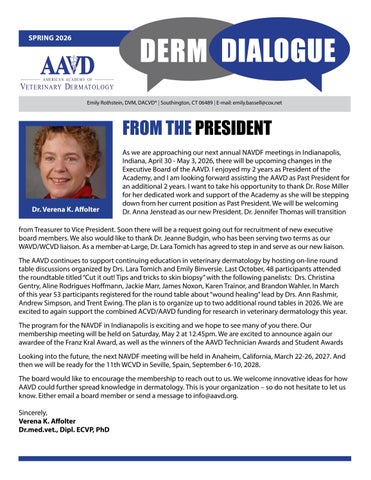
As we are approaching our next annual NAVDF meetings in Indianapolis, Indiana, April 30 - May 3, 2026, there will be upcoming changes in the Executive Board of the AAVD. I enjoyed my 2 years as President of the Academy, and I am looking forward assisting the AAVD as Past President for an additional 2 years. I want to take his opportunity to thank Dr. Rose Miller for her dedicated work and support of the Academy as she will be stepping down from her current position as Past President. We will be welcoming Dr. Anna Jenstead as our new President. Dr. Jennifer Thomas will transition
from Treasurer to Vice President. Soon there will be a request going out for recruitment of new executive board members. We also would like to thank Dr. Jeanne Budgin, who has been serving two terms as our WAVD/WCVD liaison. As a member-at-Large, Dr. Lara Tomich has agreed to step in and serve as our new liaison.
The AAVD continues to support continuing education in veterinary dermatology by hosting on-line round table discussions organized by Drs. Lara Tomich and Emily Binversie. Last October, 48 participants attended the roundtable titled “Cut it out! Tips and tricks to skin biopsy” with the following panelists: Drs. Christina Gentry, Aline Rodrigues Hoffmann, Jackie Marr, James Noxon, Karen Trainor, and Brandon Wahler. In March of this year 53 participants registered for the round table about “wound healing” lead by Drs. Ann Rashmir, Andrew Simpson, and Trent Ewing. The plan is to organize up to two additional round tables in 2026. We are excited to again support the combined ACVD/AAVD funding for research in veterinary dermatology this year. The program for the NAVDF in Indianapolis is exciting and we hope to see many of you there. Our membership meeting will be held on Saturday, May 2 at 12.45pm. We are excited to announce again our awardee of the Franz Kral Award, as well as the winners of the AAVD Technician Awards and Student Awards
Looking into the future, the next NAVDF meeting will be held in Anaheim, California, March 22-26, 2027. And then we will be ready for the 11th WCVD in Seville, Spain, September 6-10, 2028.
The board would like to encourage the membership to reach out to us. We welcome innovative ideas for how AAVD could further spread knowledge in dermatology. This is your organization – so do not hesitate to let us know. Either email a board member or send a message to info@aavd.org.
Sincerely,
Verena K. Affolter
Dr.med.vet., Dipl. ECVP, PhD
Administrative Assistant Jill Bennish, jbennish@pamedsoc.org
President
Verena Affolter, DVM, Dipl., ECVP, PhD Davis, CA
Immediate Past-President
Rose Miller, DVM, DACVD® Coeur d’Alene, ID
Vice President
Anna Jenstead, DVM Madison, WI
Treasurer Jennifer Thomas, DVM Boston, MA
Members At Large
Brian Scott, DVM, DACVD® Bradenton, FL
Lara Tomich, DVM, MS, DACVD® Madison, WI
Emily Binversie, DVM, PhD, MS Ames, IA
Derm Dialogue,
Editor
Emily Rothstein, DVM, DACVD®
Southington, CT
WAVD Representative
Jeanne Budgin, DVM, DACVD®
New York, NY
ADVT Representative
Chantelle Hanna, BS, CVT, VTS Charlotte, NC
Executive Secretary
Brendan Leahy, CAE
Association Coordinator Rhianna Zimmerman
Meeting Manager Jessica Winger
Program Chair
Co-Chair
Klaus Loft, DVM, MS
Amelia White, DVM, MS, DACVD®
Members At Large Cindy Bauer, DVM, MS, DACVD®
Paul Bloom, DVM, DACVD®
Alberto Cordero, DVM, DLACVD®
Valerie Fadok, DVM, PhD
Valerie Fadok, DVM, PhD, DACVD®
President Kristin Holm, DVM, DACVD®
Vice President & Program Chair
Klaus Loft, DVM, MS
Past President
Rose Miller, DVM, DACVD®
Treasurer Allison Kirby, DVM, DACVD®
Social & Sponsorship Chair
Allison Kirby, DVM, DACVD®
Members At Large
Heather Akridge, DVM, DACVD®
Melissa Eisenschenk, MS, DVM, DACVD®
Anna Jenstead, DVM
Chantelle Hanna, BS, CVT, VTS
Lindsay McKay, DVM, DACVD®
Alexis Borich, LVT, DACVD® (Hon.)
Moderator: Andrea Lam, DVM, DACVD
Summary:
Seven participants with backgrounds in academia, private practice, and industry attended the roundtable. Participants represented a range of roles including solo faculty, clinical educators, teaching-track faculty, and industry-based instructors. They shared reflections on their educational journeys and mentors who influenced their teaching philosophies. Common values included warmth, authenticity, accessibility, and a nurturing approach.
Discussion began with motivating adult learners, particularly students and technicians. Case-based learning was a recurring theme for enhancing engagement, especially during fourth-year rotations. Participants noted the importance of adapting teaching to individual motivations—whether intrinsic (love of learning) or extrinsic (financial gain). A key barrier to technician education was institutional pushback, with some practices objecting to the level of training being given. However, models were shared (e.g., Calgary, Pittsburgh, Ohio) where technicians play active roles in clinical care, including cytology and rechecks.
Feedback was a major topic. Participants emphasized timely, specific feedback in safe environments. Strategies included asking learners to self-reflect first, using structured questions like “What went well?” and “What could have gone better?” It was acknowledged that today’s learners often desire both formal and informal feedback and appreciate dedicated time for it. Mentor-mentee contracts, now being implemented at UC Davis, were discussed as a tool for setting clear expectations and fostering two-way feedback.
Challenges around repeated poor performance were raised, particularly regarding support staff. Discussion touched on cultural differences in management strategies (e.g., Japanese models of punishment over reward), and the importance of linking expectations to compensation.
When discussing mastery and prior knowledge, participants highlighted the difficulty in gauging baseline understanding, particularly when curriculum visibility is limited. There was agreement on the importance of transparent curricula to reduce redundancy and identify knowledge gaps. For large groups, surveys and direct questioning were suggested. For residents, case handling and observation were preferred.
Moderator Comments:
The discussion revealed shared values across diverse teaching environments and emphasized the need for intentionality, communication, and individualized approaches in veterinary education.
Moderator: Dana Connell, DVM, MPH, MS, DACVIM (Oncology)
A conversation between two veterinary dermatology residents, one veterinary oncologist, and three boardcertified veterinary dermatologists explored the challenges and strategies surrounding client communication in cases where a cancer diagnosis arises during dermatologic consultations. A central theme was the unique position veterinary dermatologists occupy in delivering unexpected oncology-related news, compared to oncologists whose clients typically arrive prepared for such discussions.
1. Emotional and Time Constraints:
Dermatologists feel confidence in their ability to discuss oncology with clients; however, they emphasized the emotional weight and time burden of delivering a surprise cancer diagnosis. Because owners typically do not expect such news during a dermatology visit, these conversations tend to be longer and require a higher degree of empathy. This unplanned emotional demand poses logistical challenges within tightly scheduled clinical days.
2. Strategic Communication Solutions:
The group discussed pragmatic strategies for managing these cases, including offering follow-up virtual consultations. These could be conducted by the dermatologist or a trained technician, allowing time to share detailed information after the initial visit. Offering these at a reduced cost—while still valuing the clinician’s time—was suggested as a balanced approach to extending care while preserving workflow efficiency.
3. Language and Clarity:
Many dermatologists acknowledged a tendency to soften their language around cancer, particularly when discussing euthanasia or prognosis. Terms like ‘euthanasia’ or direct acknowledgment of mortality were often avoided, leading to confusion or leaving clients to initiate difficult topics. The group identified this as a critical gap and resolved to adopt more direct yet compassionate language to ensure clarity and support client decision-making.
Takeaway Message:
Veterinary dermatologists often diagnose cancer, placing them in a critical communication role. To improve client understanding and emotional support, the group endorsed a twofold strategy: implementing time-conscious follow-ups for complex discussions and using clearer, more direct language around diagnosis and prognosis. These shifts aim to better prepare pet owners for next steps.
Moderator: Dominique Wiener, DVM, PhD, DECVP
15 people were present, including dermatology residents, a veterinary student, dermatologists and dermatopathologists from universities or dermatology clinics and general practitioners. We first discussed pseudolymphoma (PL), which is a lymphoproliferative problem in animals and humans. The name “pseudolymphoma” was discussed and if it is appropriate to use it as several people do not like this term and use “atypical lymphoid hyperplasia” instead, while others do not have a problem with using the term “pseudolymphoma”. Using a “hybrid” version using “atypical lymphoid hyperplasia (pseudolymphoma)” was suggested. We established that PL is a different entity than epitheliotropic lymphoma. In humans, PL is more benign, sometimes going away without therapy. The cause of PL is unclear, but a persistent antigen may play a role. PARR is helpful to differentiate but also could be false positive or false negative. Some cases are associated with tick bites at the bite location, which might be a sort of hypersensitivity. There is a case of PL in a horse associated with Borrelia infection. In some cases, only time will tell and a follow up is very helpful to get.
Then we discussed sterile nodular pyogranulomatous dermatitis and panniculitis. Cultures and special stains should always be the first step and, if all is negative, a sterile process is more likely. However, special stains are not very sensitive on paraffin-embedded, formalin- fixed tissue and culture also can be negative. In these cases, steroid treatment could lead to an aggravation of the lesions and the agents will multiply, giving an answer as well. The cause is still unclear. One participant did a study on this entity, but the cause could not be found (some bacteria were found, which were thought to be common inhabitants). Many cases responded to steroid and when treatment was stopped, the dogs relapsed. Some individual cases were discussed. In one case, fungi were found and the animal could be treated. In other cases, mycobacteria were found after doing PCR.
In some mycobacteria cases, GMS stains show many bacteria, whereas the acid-fast stains only showed a few organisms. We therefore discussed that mycobacteria could easily be overlooked in the acid-fast stains. The size of samples also plays a big role in finding infectious agents. Fungal infection usually shows larger numbers of organisms than mycobacteria and, if no fungi can be found in special stains, the possibility of a fungal infection is quite low. Also, the location of where the cases are coming from is important to have certain agents on the suspect list. A question about Bartonella testing came up, but most of the participants do not regularly test for Bartonella
A case of suspect juvenile cellulitis was discussed in an 8-week-old dog that had, in addition, erythematous plaque-like lesions on the abdomen with vasculitis in histology. One participant shared that he gets many nodular sterile nodular dermatitis and panniculitis cases and some of these cases also have chronic ischemic dermatopathy (in other locations than the nodules). A possible relation between the nodules and ischemic dermatopathy was discussed as apparently in some cases sterile nodular lesions were first and ischemic dermatopathy came later. Potentially an underlying cause could initiate both type of lesions.
Moderator: Dominique Wiener
A case in a cat was discussed with nodular lesions with a foreign body reaction and also a fungal agent was seen (believed to be a contaminant). Steroids and oral dexamethasone were given and new lesions developed. The new lesions came back as B-cell lymphoma. Not a lot of sterile lesions are seen in the cat. We discussed if sterile nodular dermatitis and panniculitis cases are seen in cats. None of the participants have seen this personally, but there are cases mentioned in the literature that got better with steroid medications.
PNOE (proliferative necrotizing otitis externa) in a cat was discussed that was treated with famciclovir and it got better. We discussed if PNOE could be caused by a viral infection and if herpesvirus could potentially trigger PNOE as in humans, erythema multiforme is frequently caused by herpesvirus infection. PCR is difficult to do as many cats will be herpesvirus-positive if they are stressed, and an in-depth evaluation for a viral cause is not present in the literature up to date. In hyperkeratotic erythema multiforme (EM) in dogs, electron microscopy was done, but no viral causes could be found. The causes of cytotoxic dermatitis/EM-like lesion can be very variable, and the diagnosis might not help the clinicians a lot. Therapy with immunomodulatory therapy usually should help.
We also discussed the need to get good biopsies in order to get a diagnosis. Biopsies should be taken from the center of the lesion and not from the margin, except if there are ulcers.
In horses, marginal biopsies in many cases show just telogen biopsies. Hair follicles in horses seem to be prone to shut down to telogen if there is an adjacent issue and then exfoliation and alopecia develop secondary to inflammation or almost anything. Therefore, the timeframe plays a big role in order to be able to make a diagnosis. The later in the course of the disease the biopsy is taken, the less diagnostic the biopsy will be. Three to five biopsies are recommended. Fewer biopsies will be less diagnostic.
A case of a 5-year-old female spayed mini Aussie was shared. The dog first had a history of two nodules that were diagnosed as histiocytomas and came back 2-3 months with multiple nodules, and the diagnosis came back as pleomorphic plasmacytoma. In the literature plasmacytosis in dogs is described with poorer outcome of regular plasmacytomas. MUM-1 has been recently described to overlap with other tumor types, such as melanomas. The IHC should be correlated with the histology. Maybe it was a case of multiple histiocytomas. But plasmacytomas look different from histiocytomas histologically and usually are quite easy to differentiate.
I found it very interesting to hear about the experiences of all the participants and how they deal with the large number nodular skin disease cases with many different causes. Inflammatory nodular skin disease can be quite frustrating, as the cause many times is not found in special stains or cultures.
Moderator: Flavia Clare, DVM, MSc, PhD
Three veterinarians were present, including two GPs and one GP/researcher from the United States and Brazil.
The roundtable began with a detailed case-based overview of sporotrichosis in Brazil, where a large zoonotic outbreak — originated in Rio de Janeiro in 1998 — has spread nationwide. The moderator highlighted the role of Sporothrix brasiliensis, a more virulent species than those typically found in the U.S. and Europe. Cats were emphasized as the primary transmission source due to their behavior and the high fungal burden in their lesions and exudates.
We discussed the difficulty in treating feline sporotrichosis, including the long duration of therapy with high doses of itraconazole and potassium iodide. Treatment success is limited — only ~37% of cats in one large cohort achieved clinical cure. Dogs, while less likely to transmit the disease, present diagnostic challenges due to the low number of organisms in lesions.
One participant shared a case of canine sporotrichosis that was challenging to diagnose. The dog presented chronic lesions and underwent multiple tests, including cytology and biopsy. Diagnosis was ultimately made based on cytology, histopathology, and fungal culture, but the Sporothrix species was not identified. Due to the high cost of treatment and limited response, euthanasia was chosen. This case underscored the diagnostic and therapeutic difficulties in canine sporotrichosis, particularly when molecular tools are unavailable. Diagnosis was a key topic: cytology, histopathology, fungal culture, and PCR were reviewed, with PCR being the most sensitive, especially in dogs. Morphological differences in resistant cases and lesion patterns were described, including cases misdiagnosed as neoplasias.
The moderator also highlighted recently published cases of Sporothrix brasiliensis sporotrichosis in the United Kingdom, where two people contracted the infection from a domestic cat. These reports raised concern about the international spread of this pathogen and the potential role of asymptomatic feline carriers.
The group also addressed public health implications, including human cases acquired via bites, scratches, or even licking. Participants emphasized the importance of using PPE when handling suspect animals and discussed cases of transmission in surgical settings despite standard autoclaving.
Treatment protocols were compared, and adjunct therapies like cryotherapy and photobiomodulation were mentioned. Discussions included treatment resistance, recurrent lesions, and when euthanasia might be considered due to zoonotic risk.
The roundtable concluded with a discussion on international surveillance and policy gaps. Brazil mandates disease notification, but most countries do not. Concerns were raised about the potential global spread of S. brasiliensis via asymptomatic carriers.
Moderator Comments:
This roundtable highlighted critical gaps in fungal disease awareness and surveillance outside endemic regions. Despite high virulence and zoonotic risk, international readiness remains limited. The discussion underscored the need for education, improved diagnostics, and global cooperation to combat Sporothrix brasiliensis as it spreads beyond South America.
Moderator: Galia Sheinberg, DVM, ESP, DLACVD
The discussion focused on the challenges and best practices for conducting diet trials in veterinary practice. Key points included the importance of detailed treatment plans, avoiding treats and canned food, and the need for strict adherence to diets like hydrolyzed formulas. Due to time constraints, the conversation highlighted the difficulties in implementing diet trials, especially in general practice. Techniques for managing client compliance, such as involving resistant family members in consultations, were also discussed. The use of technology, like apps and AI, for better client communication and monitoring was suggested as a potential improvement. The importance of clear guidelines and the role of parasite testing in diet trial success were also emphasized.
Discussion Dynamics:
Participants engaged in an in-depth conversation about the nuanced process of conducting diet trials, sharing experiences from different practice settings. The dialogue revealed significant insights into the practical challenges of diagnosing food allergies in veterinary medicine.
Participants emphasized the critical importance of selective patient assessment. The discussion highlighted that not all animals with year-round itching require a diet trial. Specialists stressed the need to look for specific markers and carefully consider the patient’s overall health, particularly for young animals.
The conversation revealed the significant difficulties in conducting diet trials. Practitioners shared frustrations about time constraints in consultations and the complexity of providing comprehensive instructions to pet owners. The group acknowledged that many diet trials fail due to poor implementation or lack of clear guidance.
Communication and Client Education
A major focus was the importance of clear, understandable communication. Participants discussed the need to create treatment plans that are accessible to pet owners, using simple language and detailed instructions. The group recognized the challenge of conveying complex medical information in a way that ensures client compliance.
Technological Support and Future Directions
The discussion explored potential technological solutions to improve diet trial processes. Participants considered the use of apps, videos, and digital tracking tools to support pet owners and veterinarians throughout the trial process.
Unique Perspectives Shared:
• Strict approaches to diet trials, avoiding treats and additional foods
• The importance of controlled food challenges
• Balancing medical needs with animal socialization and training
• Addressing family dynamics that might compromise diet trial success
Moderator: Galia Sheinberg
Practical Strategies Discussed:
Participants shared various approaches to diet trials, including:
• Creating detailed written treatment plans
• Using hydrolyzed protein diets
• Implementing careful monitoring processes
• Developing clear challenge protocols
Challenges Highlighted:
• Time limitations in veterinary consultations
• Client compliance and motivation
• Difficulty in differentiating between food and environmental allergies
• Managing owner expectations
Emerging Insights:
The roundtable revealed a collective desire for:
• More comprehensive diagnostic tools
• Better communication strategies
• Improved understanding of food allergies in veterinary medicine
Conclusion:
The discussion underscored the complexity of diet trials, emphasizing the need for a patient-centered, flexible approach that combines medical expertise with clear communication and support. Participants recognized that successful diet trials require a holistic approach, balancing medical precision with practical considerations and owner education.
The conversation demonstrated the ongoing challenges in veterinary diagnostics while also highlighting the collaborative spirit of professionals seeking to improve animal healthcare. Key points.
• Develop detailed treatment plans and include hydrolyzed treats or alternative snack options.
• Provide clear instructions and education for clients on what to look for during the diet trial and challenge process.
• Explore using technology, such as apps and videos, to facilitate weekly check-ins and improve client communication during the diet trial.
• Before starting the diet challenge, consider a brief, technical appointment to assess the pet’s skin and ears.
• Prioritize socialization and training for young dogs and potentially delay a strict diet trial if the skin condition is not severe.
• Invite the client’s spouse or other family members to the consultation to address any resistance or sabotage of the diet trial.
• Stop medications before the 4-week or 1-month re-check to evaluate itch control on the day of the appointment and increase the chances of a shorter diet trial and provocation at week five or six if skin is well controlled.
• Talk about administering medications, and teach how to medicate the patient.
• Review dietary options to adjust to the client’s wishes and capabilities
• Avoid mixing treats from another type of diets
Moderators: Anthea Schick DVM, DACVD and Rebecca Mount, DVM, DACVD
The specific didactic and clinical guidelines for developing a residency program are clearly outline in the American College of Veterinary Dermatology’s education guidelines. However, there are many challenges mentors will face from selecting the right candidate to intrapersonal communication with their residents that can impact the success of even the most well designed programs. The goal of this roundtable was to discuss the challenges of mentorship and strategies to improve the communication and connection between mentors and residents to promote successful program outcomes.
Factors that make great mentorship relationships are built on respect, empathy and open communication. Successful mentors embrace flexibility and can adapt their teaching style for each resident’s individual needs. Unfortunately, there is not one-size-fits-all mentorship style that is always successful.
Mentorship styles that are able to create psychological safety for the resident or intern promotes learning that allows for mistakes and builds trust. Mentees that feel safe to grow, ask, and fail are often more successful than learners who are afraid to make mistakes or provide or receive feedback. Mentorship should be considered a collaborative learning journey which pushes both the mentor and the mentee rather than just the transfer of knowledge to from the teacher to the student. Mentors can gain trust through consistency, active listening, transparency, and accountability.
A mentor’s influence shapes the mentees’ clinical judgement and their leadership development. Therefore, in addition to building trust, successful mentors must be able to model professional behavior, ethical standards, and decision making under pressure. This requires the mentor to have strong communication skills, a high emotional intelligence, and strong conflict resolution skills.
Great mentors are consistently curious and on their own learning journey. A growth mindset allows mentos to stay adaptable, curious, and humble. Additionally, it is important for mentors to reflect on their own education, personal, and clinical experiences to determine how they shape their biases and mentoring style. Consistent feedback from your mentee is imperative as it strengthens the relationship between mentors and mentees. Additionally, a mentor must be able to provide clear and consistent feedback to their residents. While it is important to have professional vulnerability to build trust, encourage authentic communication, and inspire connection in the mentor-mentee relationship, it is important that mentors do not overshare personal traumas, vent to the resident, or seek professional or personal validation from their students.
Ultimately, mentorship is a lot more than just teaching a resident or intern about dermatology. Communication is key and most roadblocks are the results of mismatched expectations or communication styles. Great programs are continually adjusting their curriculum and their teaching styles. Successful mentorship strategies require the mentors to constantly challenge their thought processes and mentorship approach as well as staying up to date with the newest research and best clinical practices.
Dermatology Programs (continued)
Moderators: Anthea Schick DVM, DACVD and Rebecca Mount, DVM, DACVDr
Resources that the moderators have found helpful in guiding the evolution in their mentorship style and overcoming new challenges within the mentor-mentee relationship include books, podcasts, research articles, and videos.
Books:
• The Fearless Organization – Amy Edmondson
Gold standard on psychological safety in the workplace and learning environments.
• Dare to Lead – Brené Brown
Powerful insights on vulnerability, trust, and courageous leadership, great for mentors-as-leaders.
• Leaders Eat Last – Simon Sinek
Emphasizes servant leadership and creating safe environments where teams (and mentees) can thrive.
• Thanks for the Feedback – Douglas Stone & Sheila Heen
A mentor’s must-read on giving constructive feedback and receiving it with grace.
• The Coaching Habit – Michael Bungay Stanier
Practical, quick-read guide to asking better questions and empowering mentees to grow.
• The Five Dysfunctions of a Team – Patrick Lencioni
Offers insights into trust-building and communication in leadership and mentorship groups.
• Radical Candor: Be a Kick-Ass Boss Without Losing Your Humanity – Kim Scott
Challenges the traditional notion of “nice” leadership, advocating for a style that combines caring personally with challenging directly.
Podcasts:
• WorkLife with Adam Grant
Especially the episode: “The Problem with All-Stars” (about safe learning cultures).
• Brené Brown’s Unlocking Us
Topics like trust, leadership, and personal growth—emotionally intelligent and thought-provoking.
• Mentoring Matters (by UCD School of Veterinary Medicine)
Vet-specific podcast series exploring mentor/mentee dynamics and development.
• The Doctor’s Mentor Show – Dr. Lori Barr
Focuses on mentoring in the medical field, with good parallels to veterinary medicine.
• Veterinary Viewfinder
Offers episodes on mentorship, leadership, and creating inclusive team cultures.
Dermatology Programs (continued)
Moderators: Anthea Schick DVM, DACVD and Rebecca Mount, DVM, DACVDr
Articles:
• “Mentorship in Veterinary Medicine: A Critical Review” – Journal of the American Veterinary Medical Association (JAVMA)
Looks at structured mentorship and outcomes in vet med.
• “The Role of Psychological Safety in High-Performing Teams” – Harvard Business Review
Short, practical article to explain why trust is essential.
• “Mentoring Millennials in Medicine” – Academic Medicine
Helpful cross-generational strategies for mentoring today’s trainees.
• “Perceptions of training, self-efficacy, and mentoring among veterinary clinical specialty trainees”
– Journal of the American Veterinary Medical Association (JAVMA)
• “AAVMC Guidelines for Veterinary Intern and Residents Wellbeing” - AAVMC.org
Videos:
• The Secret to Giving Great Feedback: https://www.youtube.com/watch?v=wtl5UrrgU8c
• The Power of Introverts: https://www.youtube.com/watch?v=c0KYU2j0TM4&t=1144s
• The Drama Triangle: https://conscious.is/video/understanding-the-drama-triangle-vs-presence
• Locating yourself: A Key to Conscious Leadership: https://conscious.is/video/locating-yourself-a-key-to-conscious-leadership
Malassezia
Moderator: Ross Bond, BVMS, PhD, DVD, MRCVS, DipECVD, FHEA Scribe: Valerie Fadok, DVM, PhD, DACVD
We learned we had a nice diverse group from different parts of the US, including one delegate from Hawaii and another from the UK. There was a mix of private practice dermatologists, academicians, and private practice generalists (first opinion practice).
Our goals were to exchange ideas about our experiences with Malassezia, both past and present, and how treatment options may be changing. We paid tribute to the redoubtable Ken Mason, who reintroduced the importance of Malassezia to us all, and who developed Malaseb® shampoo. The moderator thanks all the participants for their insightful comments and Dr. Fadok for her kind administration.
Discussion began with the comment that many of us are finding that topical miconazole does not seem to be working as well as we thought it did in the past; this was particularly true with regard to Malassezia otitis. There was some discussion around geographic variation, as some colleagues had not made this observation. One colleague observed that when underlying allergies were controlled, the presence of Malassezia seemed less pathogenic. We all agreed that Malassezia was most often secondary to an underlying disease. All of us agreed that we do not treat for yeast otitis or dermatitis in the absence of clinical signs.
One colleague from Texas shared his experiences with finding Malassezia yeast in the middle ear (more info below). Flushing of the middle ear to remove the exudate was helpful, and in these cases, topical miconazole was effective. He postulated that in some of these cases, biofilm may have played a role, and we all wondered if the perceived failure of miconazole might be associated with biofilm. To this end, the use of Tris NAC was suggested, along with topical or systemic steroids to reduce inflammation.
Another colleague from Hawaii made the comment that he is finding the simple case of Malassezia dermatitis or otitis to take longer to resolve than in the past. He has had some clotrimazole failures, and has had to go back to nystatin (in products like Panalog®). We all wondered if this observation could be related to increasing severity of underlying allergy.
A colleague at U. Illinois is very interested in Malassezia, and she brought up the topic of Malassezia resistance to the antifungal drugs we have used. She raised the question about whether what we are seeing is true genetic resistance, or perhaps the influence of other factors. She wondered if all the yeast we see are Malassezia pachydermatis, or whether other species could be involved. She described finding mycovirus associated with Malassezia in her studies. We don’t yet know what influence of these viruses will have on the yeast or the host response.
The concern about the source of miconazole was raised, and what influence the vehicle could have on this antifungal. Many of the delegates use miconazole lotion (e.g.Conzol™, 1% miconazole) to which we add a steroid; it seems effective.
We next moved on to Malassezia dermatitis, and what appears to be increasing difficulty in its management. We discussed the possibilities of true resistance, vs the potential for variable absorption of the drugs in individual patients, and also the influence of biofilm. We also discussed the impact of underlying disease, and how Malassezia dermatitis is more easily controlled if the underlying disease is controlled.
Moderator: Ross Bond Scribe: Valerie Fadok
Terbinafine was mentioned, and the evidence for efficacy is weak; however, the dose needs to be higher than most use. A minimum of 40 mg/kg/day has been suggested based on this study (Gimmler J et al. Vet Dermatol 2015; 26:411)
We discussed a role for Malassezia hypersensitivity. Many of us find that this is a phenomenon that is real, and needs more work. The elegant studies with passive transfer support this hypothesis. Many of us who do intradermal skin test do use Malassezia extract. In some areas, it is almost a positive control. The impact of adding Malassezia extract to immunotherapy is not clear. It is important to appreciate that not all dogs with Malassezia hypersensitivity will have positive serum tests, and that cell-mediated reactions in the absence of IgE can mediate disease.
The impact of geographic variation was next discussed, with regard to temperature and humidity in particular. Semi-tropical and tropical environments seem to promote yeast overgrowth in the ears and the skin. These patients can be quite difficult to manage.
We next discussed the impact of Malassezia in the nailbeds of dogs. This area is particularly difficult to treat, and many of us use systemic antifungal drugs. However, it was mentioned that topical therapy could be helpful for some patients. Using a soft toothbrush for nailbeds to help distribute shampoo is helpful, if dogs are amenable. Also, some of our colleagues are using clotrimazole/betamethasone cream in the nailbeds. This has been used as maintenance therapy 1-2X a week in some patients. It has also been helpful to treat the concave pinnae when they are affected. Others have found that low dose oral glucocorticoids given 2-3x a week has been helpful for some dogs. Another option is the use of injectable fluconazole 2 mg/ ml or 1% clotrimazole cream (Canesten®) used topically for ears and nailbeds. In the UK, the moderator’s team often uses (off-label) a 1% solution of Clotrimazole (Canesten®) in cases of otitis media or where TM is ruptured because this product is licensed for fungal otitis media in humans. In addition, some of us are using vinegar:water 50:50 in a spray bottle to help control yeast for those clients who like “natural” approaches.
For patients with otitis who are difficult to treat, some of us are using thermosensitive gels with miconazole and dexamethasone such as Poloxagel from Wedgewood or Thermavert-Otic from Best Pets Rx.
Because of emerging resistance of Malassezia to azoles, the use of antifungal drugs is being questioned. In some cases, topical steroids can be used to control yeast overgrowth in the ears and focal areas of the skin. Regrettably, hydrocortisone aceponate (Cortavance® spray) is not available to us in the U.S., so we use compounded dexamethasone preparations, or in some instances, triamcinolone sprays (Genesis®). The problem of geographic variation was discussed again, and severity of infection is worse in semitropical and tropical areas, where glucocorticoids alone may not be sufficient. Concerns about terbinafine were addressed again, with several of us reporting lack of efficacy for long-term otic products containing terbinafine; however, for those of us in second or third opinion practices, we may have a biased case load. The concern was raised that some of the inefficacy may be related to not cleaning the ears prior to instillation. Some of the group were dismayed to learn that a new otic product for yeast only contained terbinafine and a steroid, rather than an azole and a steroid. The use of oral terbinafine was discussed, and the daily dose of 40 mg/kg/day was recommended (see Gimmler et al, referenced above). Some colleagues are using terbinafine in combination with azoles orally for difficult infections; it was emphasized again how diagnosing and managing the underlying cause is of critical importance.
Moderator: Ross Bond Scribe: Valerie Fadok
We then discussed the mechanisms of resistance by which yeast can become resistant to antifungal drugs. There is no plasmid transfer, as is seen in bacteria; most are genetic events, such as mutations in the ERG11 gene that codes for the target enzyme of the azoles, or quadruplication of that gene, which are subsequently passed to daughter cells during asexual reproduction. To prevent spread from dog to dog, and from fomites to dog, basic hygiene such as disinfection of rooms, equipment, and hands remains important.
Unusual manifestations of Malassezia otitis such as suppurative otitis externa and Malassezia infection restricted to the middle ear were mentioned. These were observed in some cases to be associated with dogs who had ulcerative otitis externa associated with bacteria, and who had repeated bouts of otitis externa associated with alternating bacteria and yeast. These dogs were managed primarily with flushing of the middle ear and topical therapy with azoles. In some cases, anesthetic cleaning was repeated; in other cases, systemic azoles were used. Systemic azoles were used in all cases where otitis interna was present. There are some veterinarians in Brazil who are using auditory tubes (‘grommets’) in the tympanic membrane for dogs with otitis media. The consensus of the group was that these can be quite difficult to use.
With regard to Malassezia dermatitis, topical therapy was advocated by all. The consensus was that chlorhexidine/azole shampoos were most effective, and that 3% chlorhexidine was less effective in spite of one publication that advocated for it (Maynard et al, J Small Anim Pract 2011; 52:566). Most felt that the loss of climbazole from the DOUXO S3 Pyo™ line was problematic with regard to managing yeast dermatitis. The use of selenium sulfide (e.g. Selsun Blue®) is still recommended by some (although such products are steadily being discontinued in Europe).
We discussed the role of pulse antifungal therapy (topical or systemic) as a management tool for dogs with relapsing yeast and/or Malassezia hypersensitivity. This has been commonly done given the severity of Malassezia dermatitis in some parts of the world and lack of other management strategies. Immunotherapy using Malassezia extracts can be helpful, but not for all dogs. Steroids do not always control these dogs in some parts of the world.
There appeared to be great variation in how the azoles were dosed. For some of us, azoles were used at 5 mg/kg once daily. Others are using them (ketoconazozole) at 5-10 mg/kg twice daily. We have no evidence to tell us what is best, and we don’t know the impact of owner compliance and individual variation in drug absorption or distribution to the stratum corneum on perceived poor response to treatment. Furthermore, at least with ketoconazole, it is clear that adverse events increase in a dose-dependent fashion. Best evidence appears to be for itraconazole. Many veterinarians in the USA have not used it as frequently, given its expense. It is now generic, and wholesale distributors like Costco® provide excellent prices for pet owners in the USA. Formulation of itraconazole is critical for its proper absorption and efficacy.
Skin barrier repair and the use of LinkSkin® (a topical spray that contains heat-tyndallized lactobacilli) were brought up. No real experience shared for Malassezia dermatitis.
The issue of the use of fungicides in agriculture was brought up as a potential contributor to resistance. The situation is complex.
Moderator: Ross Bond Scribe: Valerie Fadok
Questions raised that we need to address:
How much of the perceived resistance we see clinically is due to true drug resistance?
What is the role of compliance and individual variation in absorption and/or distribution to the skin in perceived resistance?
If a patient fails to respond to ketoconazole, will itraconazole or voriconazole (now generic) be effective?
What is the role of immunotherapy in the management of Malassezia hypersensitivity?
If we could have molecular allergens rather than a whole yeast extract, would it work better?
What is the evidence that veterinary use of antifungals is a significant contributor to yeast resistance other than in an individual patient?
Given that there is no plasmid transfer in yeast or fungi, what do we know about transmission of yeast from one patient to another?
Drug resistance is being seen in other fungi as well. Do we understand how this develops?
How do the my coviruses detected at U Illinois contribute to resistance?
We eagerly await any further information about these viruses.
How do we control recurrent yeast/Malassezia hypersensitivity if only azoles used topically or orally work?
Do we appreciate geographic variation enough when guidelines for treatment are developed?
What is the role of environmental fungicide use in the potential resistance to pathogenic yeast/fungi in humans or animals?
Moderator: Zach Meyers, DVM
The session commenced with an introduction to the overarching theme of AI in veterinary medicine, framed as an open discussion. The moderators, with a background in both clinical practice, dermatology, and AI developments underscored the significance of the topic and the intention to document the shared insights for future reference through recording and transcription. The collaborative and informal nature of the discussion was emphasized.
Following the initial framing, attendees were invited to introduce themselves and share any existing experiences with AI in their veterinary practices.
One participant, an oncology specialist, acknowledged limited direct engagement with a specific AI-driven diagnostic platform but recognized the long-standing integration of AI in areas such as radiology image interpretation and hematology analysis. The seemingly ubiquitous nature of AI, even in basic information retrieval, was noted.
A technical service representative from a major animal health company shared their awareness of AI-powered imaging platforms within their organization. They expressed a strong interest in understanding the broader impact of AI on veterinary practices, acknowledging both its potential benefits and possible drawbacks, drawing parallels to the complexities of algorithmic systems in other domains.
A dermatologist in private practice voiced a clear need for tools that could enhance practice efficiency.
A dermatologist with an academic background and an upcoming faculty position expressed a particular interest in the application of AI in veterinary education, citing positive personal experiences using large language models for generating educational materials and challenging exam questions.
A general practitioner with a focus on dermatology expressed a desire to learn more about this evolving area, noting the growing familiarity of younger generations with AI technologies.
Another dermatologist in private practice shared their anticipation of an AI component being integrated into their new practice management software, with the primary goal of improving the efficiency of documenting clinical findings.
Building upon the initial introductions, the facilitator highlighted the often-underappreciated history of AI within veterinary medicine, noting that AI has been quietly powering diagnostic tools for years before the recent surge in public awareness driven by advancements in large language models. The evolution of AI capabilities in these tools was also discussed, with a hopeful outlook for future improvements in areas like image analysis.
A generational shift in information-seeking behavior was observed, with younger individuals increasingly relying on generative AI platforms over traditional search engines, potentially impacting their engagement with diverse sources and critical evaluation skills.
A more cautious perspective on technology adoption was shared, advocating for a measured approach to implementing new software and allowing time for initial issues to be identified and resolved.
Moderator: Zach Meyers, DVM
The discussion then shifted to envisioning the future integration of AI in veterinary medicine across areas such as diagnosis, communication, and administration.
One participant with an academic background emphasized the potential of AI to accelerate diagnostic processes, particularly in dermatopathology, with the hope of achieving faster turnaround times for histopathology results. They also initiated a conversation on AI’s role in revolutionizing veterinary education through adaptive learning technologies and asynchronous learning opportunities.
The moderator echoed the enthusiasm for AI in education, highlighting the potential to move away from traditional lecture-based formats towards more efficient and engaging digital learning experiences. However, a counterpoint was raised regarding the potential negative impact of over-reliance on AI on the development of critical thinking skills in students, emphasizing the importance of the learning process and the value of intellectual struggle.
A technical service representative acknowledged these concerns, drawing parallels to the potential for AI to create an “open-note exam” scenario. The importance of educating both students and practitioners on the responsible and critical use of AI to avoid simply taking shortcuts and bypassing genuine understanding was stressed. The inherent “art” of veterinary medicine, which extends beyond algorithmic processes, was also highlighted.
Concerns were raised about AI potentially “stealing” original ideas in academic settings and the risk of hindering the generation of new knowledge if AI becomes the primary source of content creation.
An alternative perspective suggested that AI could effectively handle routine and time-intensive tasks, thereby freeing up both students and practitioners to focus on more complex problem-solving and critical analysis. Examples included drug interaction checks and the analysis of complex imaging data. The current pressure on students to produce work quickly using AI prompts was contrasted with the deeper learning that comes from genuine engagement.
The idea that the value derived from using AI, like any learning experience, is directly proportional to the effort invested was supported.
The challenges of patient and client consistency in multi-doctor practices, particularly in specialties like dermatology with frequent rechecks, were discussed. The lack of a comprehensive understanding of a patient’s history when cases are frequently transferred was highlighted. The potential for AI to integrate patient data and identify trends, similar to its application in laboratory diagnostics, was seen as a significant benefit for improving diagnostic efficiency and preventing missed details.
The facilitator concurred with this vision, expressing the hope that AI could automate less desirable and time-consuming tasks, allowing clinicians to focus on more engaging and intellectually stimulating aspects of their work. The analogy of AI automating tedious tasks like tumor contouring in radiation oncology was used to illustrate this potential. The application of this principle to veterinary education, freeing up time for more in-depth case discussions and knowledge application, was also emphasized.
Moderator: Zach Meyers, DVM
The existence of AI-powered medical record summarization tools was noted as a current solution for improving efficiency, particularly in navigating disparate approaches between different practitioners within the same practice. The burden of reviewing lengthy and sometimes illegible hand-written medical records was highlighted as a significant time constraint.
The discussion then delved into the specific challenges and concerns associated with the adoption of AI in veterinary practice. The ability of AI to process and summarize handwritten medical records and integrate data from external sources was questioned. While upload functions for external notes exist in some scribe services, the reliable processing of handwritten notes was identified as a current limitation. The immediate need to quickly access critical patient information, such as pre-existing diagnoses, was highlighted.
A specific challenge related to the inclusion of voluminous and often repetitive non-clinical information within medical records from referring veterinarians, hindering the efficient extraction of relevant clinical details, was discussed. The current reliance on manual search functions within these documents was noted as inefficient.
Returning to the topic of critical thinking, the potential for AI to be used in educational settings with certain limitations (e.g., a cap on AI-generated content in essays) was mentioned. The importance of applying a similar principle in practice, emphasizing the need for clinicians to always exercise their own judgment and critically evaluate AI-generated information due to the inherent biases present in AI models trained on human data, was underscored. The current state of AI in veterinary medicine was characterized as being in its early stages, with a focus on medical record tools, emerging diagnostic applications (image analysis), and novel technologies like handheld skin tumor scanners. The potential implications (good and bad) of such technologies were noted. The moderator emphasized the importance of a critical and cautious approach to AI adoption, even while acknowledging its potential benefits.
A hypothetical scenario was then posed, inviting attendees to ask key questions they would want answered before adopting a new AI product in their practice.
The need to understand the training data and methodology of AI models was raised, with concerns about potential biases arising from skewed or limited datasets and the expertise of the individuals involved in the training process. The desire for objective information rather than AI-generated opinions was emphasized.
A crucial question regarding the handling of sensitive patient data was posed, focusing on data privacy, storage, security, and potential secondary uses of the information inputted into the AI system. Concerns were raised about AI systems that might passively record owner-veterinarian conversations - unrelated to medical aspects (personal asides).
The facilitator offered a perspective based on experience with medical scribes, noting their ability to filter out irrelevant conversational content. The underlying technology of many veterinary AI chatbots, often based
Moderator: Zach Meyers, DVM
on large language models with specialized veterinary prompting, was explained. While acknowledging the effectiveness of these systems, the potential lack of deep veterinary-specific knowledge beyond the prompts and the non-veterinary leadership of some AI companies were noted.
A contrasting viewpoint highlighted the potential importance of seemingly irrelevant contextual information for understanding patient compliance and tailoring treatment plans. The risk of losing valuable nuances if AI systems are too aggressive in filtering information was discussed.
The tendency of AI summarization tools to be concise and condense large amounts of text was noted as a potential mitigation for information overload.
The discussion then returned to the hypothetical evaluation of a new AI software, prompting further questions from the remaining attendees.
Concerns were raised about the potential for AI to inadvertently solidify and propagate incorrect information if the training data or initial inputs contain errors. The question of whether user-inputted data would be used to train future iterations of the AI model and potentially shared was also raised, drawing an analogy to the cautionary practice of not sharing full discharge instructions with referring veterinarians.
The importance of understanding the efficiency and performance metrics of AI models was emphasized, with a desire for quantifiable data on their accuracy and reliability. The potential for AI models to exhibit biases based on their training data was reiterated.
The critical question of liability in cases where AI provides incorrect information leading to patient harm was raised, distinguishing between legal and moral responsibility. The difficulty in assessing the “critical thinking” capabilities of AI and the need for demonstrable proof of their reliability were also discussed.
The concept of performance metrics for AI software was introduced, explaining that AI models, which fundamentally process numerical data, are evaluated using mathematical measures of accuracy, sensitivity, and specificity. However, the challenge of generalizing the performance of AI models across different clinical settings and the potential for even minor variations in hospital layouts or protocols to impact their accuracy were highlighted. The importance of transparency regarding these performance metrics was stressed.
Skepticism regarding the trustworthiness of performance statistics provided by AI companies was voiced, with examples of potentially misleading statistics in related fields. The ease with which seemingly high-performing AI models can be developed with flawed underlying logic, which may not translate to real-world clinical accuracy, was discussed.
The point was made that the issue of potentially misleading statistics and biased data is not unique to AI but exists in traditional research as well, emphasizing the ongoing need for critical evaluation regardless of the technology involved. The transformative potential of AI as a major economic force was acknowledged, alongside the importance of maintaining a critical perspective on its implementation.
Moderator: Zach Meyers, DVM
4. Concluding Remarks:
The session concluded with a general consensus that AI is still in its early stages of integration within veterinary medicine. The anticipation of more sophisticated AI tools across various aspects of practice, from medical record management to advanced diagnostics, was evident. A balanced perspective, acknowledging both the significant potential benefits and the inherent risks and challenges associated with AI adoption, was maintained throughout the discussion. The importance of ongoing critical evaluation, transparency from AI providers, and a focus on ethical considerations were highlighted as crucial for the responsible and effective integration of AI into veterinary practice.