THE MAGAZINE OF SCHECHTER BOSTON SPRING/SUMMER 2026
Just Right: Upper Elementary Makes Its Move
In the Hard Hat Zone: Stein Circle Renovations
Class Notes
2016
Contents
Schechter Stories Spring/Summer 2026
Just Right: Upper Elementary Makes Its Move
Jason Bryer (and parents, Arlene and Hal Bryer) and Josh Finkel (and his father, Rob Finkel) discovered coincidentally that they would be staying at the same lodge in Zimbabwe last March while they were there to visit the famous Victoria Falls and planned dinner altogether. Ruth Debora Leifer
2017 Benjamin Leifer and his wife, Miriam Zawadzki, welcomed a baby girl, Ruth Debora Leifer, on December 28, 2025.
2008 Noah Singer married Danya Ravid, on November 15, 2025, at Temple Emanuel. Many friends from Schechter and Camp Grossman were there. Noah and Danya met while working at camp. They now live in West Roxbury.
2010 Jacob Seidel lives in Worcester and works for the Massachusetts Department of Conservation and Recreation as a Service Forester. He tells us, “Generally I spend my time outside, reading, or with friends.”
Danya Goldstein graduated from Washington University in Saint Louis in 2025. Danya shares, “I recently graduated college and am now a consultant at Accenture by day and a stand-up comedian by night, based out of New York City. I did my first open mic when I was 18 at a dive bar in St. Louis Missouri in front of roughly 10 65−yearold men. Now, I perform at shows all over the city and hope to spend the rest of my life spreading laughter. “It's never too young to start. If your kid is funny, but more likely weird, super loud in class, have them do a mic! I often think about how teachers always put me at a circular table in the corner of the room by myself because of my tendency to talk to students during class. I once asked a teacher why she put me alone at a desk and she said ‘because you will talk to whoever you're sitting next to.’ I still talk to everyone: on the subway, at pizza shops, cafes, waiting in long lines, and in elevators. This trope has stayed with me throughout my life and is a core part of my identity.”
We’d love to hear from you!
Writing
Arnold Zar-Kessler Outstanding Alumni Award: Tovah Lazaroff ’78
Contributing Photographers
28
2 LIFE AT SCHECHTER
Stephanie Fine Maroun AP ’09, ’11, ’12, ’14 Assistant Director of Admission
Heidi Aaronson ’96, AP ’24, CP ’27
Faculty and Staff Notes
Charlotte Aaronson ’27 Ted Borgman, Bright Spot Film Diana Levine CP ’27, ’30
30
Stephanie Fine Maroun Aviram Shahal CP ’27, ’30, ’34
Class Notes
Letter from Rebecca Lurie This Is Schechter Schechter Scoop
Design
10
We have made every effort to ensure accuracy. Please contact schechterstories@ssdsboston.org.
Joel Sadagursky Printing Puritan Press
Construction at Stein Circle
12
FEATURE
Just Right: Upper Elementary Makes Its Move
Scan the QR code to share an update with us!
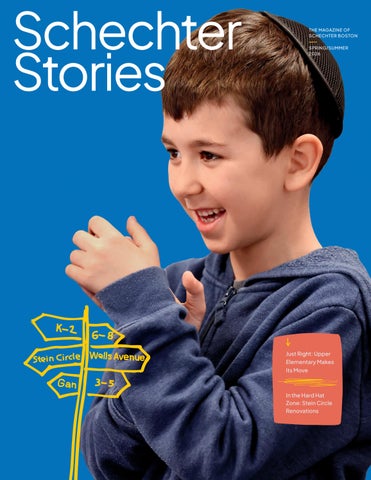
On the Cover Grade 3 joins Grades 4 and 5 to complete the Upper Elementary division at the Wells Avenue Campus. See page 12.
Left: Noah Singer ’08 with wife, Danya Ravid, Right: Josh Finkel ’16 and Jason Bryer ’16 in Zimbabwe
32 "Schechter Stories
26
Schechter BOSTON
125 Wells Avenue Newton, Massachusetts 02459 617−928−9100 ssdsboston.org
Class Notes
Letter from Rebecca Lurie
— Ariele Sherman ’00
“About a year ago, I received a call from a recruiter about MJFF, then in the second year of its first-ever comprehensive campaign. It felt like everything up until that moment was leading me here. Beyond the science. I am inspired by Michael J. Fox himself—by his humor and refusal to let Parkinson’s diminish his spirit. He often says that ‘[if] you’ve met one person with Parkinson’s, you’ve met one person with Parkinson’s,’ a reminder that every story is singular and sacred. That ethos mirrors my Jewish values: to see each person fully and honor their dignity. “Today, I work on MJFF’s Principal Giving team, partnering closely with leadership to fund the most fragile stages of Parkinson’s research—the ‘valley of death,’ where promising therapies often stall. Since its founding in 2000, MJFF has helped expand available treatments to more than forty, with over 500 therapies in development. In 2023, its Parkinson’s Progression Markers Initiative validated a biological test identifying Parkinson’s with 93% accuracy, ushering in a new era for research and therapeutic development.
“
“
Schechter remains the throughline of my story, shaping a career and life defined by thoughtful risk-taking, purpose, and impact.
support one another and raise children grounded in both responsibility and hope. My day school education taught me to ask hard questions and think critically,” she says, “skills that continue to guide me in all aspects of my life.” Now, alongside her husband Joey, Ariele watches her children—Jake ’30 and Zoe ’34—form the same lasting friendships she built at Schechter. “I can look at them and think, you might still have these friends in your 30s. That’s rare. And beautiful. Schechter remains the throughline of my story, shaping a career and life defined by thoughtful risk-taking, purpose, and impact—and proving that education rooted in values can influence a lifetime.”
Ridgewood, Queens with their boys, Jacob and Charlie. “I recently joined the board of Tkiya, an organization dedicated to creating joyful Jewish connections through music. Happy to chat with anyone in the Schechter community who would like to learn more or get involved. Check out https://www.tkiya.org!”
2006 Alanna Wolf and her husband, Herschel Singer, welcomed a baby girl, Alma Dodi.
2007 2002 Rachel Silverman Fusfeld works in public relations at Ketchum. She and her husband, Adam, live in
Talia Greenberg and Gideon Katsh ‘01 were married in November 2025. They share, “We had many Schechter alumni (and one current student!) in attendance!”
“Since October 7, I have reflected more deeply on what it means to be a Jew in the world—how we
Rebecca shares a laugh with a Grade 7 student
Ariele with husband Joey, children Jake ’30 and Zoe ’34
2 "Schechter Stories
Ari Singer ’28, Sarah Singer ’23, Abby Singer ’23, Alan Lipchin ’07, Rozzie Levine ’01, Gideon Katsh ’01, Talia Greenberg ’07, Pnina Hirsowitz ’08, Micah Greenberg ’13, Rachel Lecker ’08, Jonah Lecker ’14, Liora Lebowitz ’07, Elana Ben-Akiva ’07, Rachel Sandalow-Ash ’07, and Morris Greenberg ’08
Spring/Summer 2026 "31
Class Notes Ariele Sherman works as Lead Philanthropy Director for The Michael J. Fox Foundation for Parkinson’s Research (MJFF). “MJFF is an organization bold enough to hold the dream that our work will one day be obsolete. There is no endowment. Everything we raise—minus operating costs—goes back out the door to accelerate science. Our mission is to help find a cure for Parkinson’s and close our doors. That philosophy resonates deeply with me because I have often chosen meaning over convention.
1986 Anat Sagi lives in Warren, Rhode Island and works as a restaurant consultant.
2000 Becca Leffell Koren lives in St. Louis with her husband, Raphael Koren. Becca received her MFA in Graphic Design from the Rhode Island School of Design in 2016. She is an independent graphic designer and Senior Lecturer at Washington University in St. Louis. Becca shares, “In April 2025, we welcomed a third boy, Lavi Yehuda, who joins big brothers, Eliya and Noah.”
Ariele and her “Scheckys” at Ariele’s wedding, 2014
30 "Schechter Stories
“I grew up in New York City, and attended SAR in Riverdale through fifth grade. In 1996, my newly blended family relocated to St. Louis, and then to Newton in 1998, when my stepfather, Rabbi Dov Bard, was hired to lead Schechter Boston. Entering seventh grade as the new Head of School’s daughter alongside my three stepsiblings, I expected to feel like an outsider, but I didn’t. Friends from Camp Yavneh, many also Schechter students, helped make the experience positive. Walking into a new school with familiar faces felt less like starting over and more like returning somewhere I was known. “At Newton North, it was my Schechter friends who grounded me. At a time when I was figuring out my own connection to Judaism outside of my family’s, my Schechter community kept me connected. After high school, I spent a gap year
in Israel on Young Judaea’s Year Course—again joined by Schechter friends. Returning to the U.S., I attended the University of Hartford but soon made the unconventional choice to graduate early with an associate’s degree and begin working. “I had a temporary role as a student tour operator at Explorica which introduced me to creating meaningful experiences. When I learned of an opening at Combined Jewish Philanthropies (CJP), I jumped at the chance to work on behalf of the community that shaped me. At CJP, I supported missions to Ukraine, Cuba, and Israel before moving into annual giving, managing a large donor portfolio while also completed my bachelor’s degree part-time at the Harvard Extension School. In 2014, I moved into major gifts fundraising at Hebrew SeniorLife, a Harvard Medical School affiliate, partnering with clinicians and researchers to support Alzheimer’s and dementia care. In 2015, I completed my bachelor’s degree in psychology just two weeks before welcoming my first child, Jake.“Soon after,” shares Ariele, “I felt pulled to test myself beyond the Jewish nonprofit world. I joined (W)GBH, Boston’s PBS affiliate, during a multiyear campaign raising funds on behalf of their national programming. I spent eight years at GBH growing under strong mentorship, and expanded my family during that time, welcoming my daughter Zoe.
Shalom chaverim,
Happy summer! It always seems like a whirlwind when we look back on the school year that just ended. This is even more true than usual as we are midway through a number of significant undertakings, signature programmatic shifts and expanded partnerships, each of which will make us a stronger school and even more dynamic hub in the Boston Jewish community. At Schechter, we prize collaboration, intentionality and thoughtful change. Many of you have followed updates on the redevelopment of our facilities since we broke ground earlier this year. The work continues and grows more exciting and real by the day. First, the construction on the Stein Circle Campus is on track to ready our new Pucker Family Early Childhood Center for September. Pages 10−11 give you a look into the bright and airy classrooms and community spaces that are rapidly taking shape.
At the same time, we eagerly await having Grade 3 on the Wells Avenue Campus in September to join Grades 4 and 5, rounding out the Upper Elementary division. Meanwhile, heavy remodeling will begin this summer in the space vacated by Gan Shelanu, as we prepare for the January 2027 opening of our two-story, 10,000−square foot Philip and Bernice Krupp STEAM Center. There is a lot happening and, piece by piece, each phase is unfolding according to the plans and our timeframe for reimagining how we teach, live and be together at Schechter. In the midst of these grand redesigns, we are thrilled to announce a beautiful and extraordinary new partnership as we welcome Gateways: Access to Jewish Education to the Wells Avenue Campus. We will remain two distinct organizations, yet united in the mission to make Jewish education accessible to everyone. Gateways has long ensured that children and teens with disabilities, diverse learning, and mental health challenges can access Jewish life and learning.
For Gateways, this partnership will provide a permanent home for their administrative offices, post-school day and Sunday programming within a Jewish educational setting. For Schechter, this move bolsters our vision of prioritizing inclusive Jewish education and enhancing opportunities for thought partnership. This development is made possible through the generosity of Myra Musicant and Howard Cohen, and the support of our boards, professional teams and extended communities. We know that we are better together as we celebrate the continued advancement of Jewish life and learning and the power of clal Yisrael. Bivracha,
Rebecca
Class of ’00: The “Scheckys” weekend on Cape Cod, 2025
Spring/Summer 2026 "3
Learning Specialist Jami Zolotor completed the Lindamood Phoneme Sequencing® Program for Reading, Spelling, and Speech (LiPS®). “The LiPS training helped deepen my understanding of the sensory and cognitive processes that support language and literacy development, complementing my Orton-Gillingham training/certification. By exploring how auditory, visual, motor, and language systems work together in reading and spelling, I am better equipped to support diverse learners in a more integrated and responsive way. Additionally, the practical strategies for building phonemic awareness, sequencing, syllabication, and self-correction will enhance my instruction and help students become more independent, confident readers and writers.”
Building Community
Krissy Wolff CP ‘26, ‘29, ‘32, Lauder Impact Initiative Transformation Manager, is currently participating in the Kehillot M² Community Fellowship through the Institute for Experiential Jewish Education, a program that brings together Jewish educators from across North America to focus on building thoughtful, values-driven communities. The fellowship creates space for deep learning, reflection, and collaboration with a diverse cohort of peers who are all working toward strengthening Jewish communal life through education.
“Now about halfway through the experience,” Krissy shares, “I’ve found it to be both energizing and meaningful. The fellowship has already given me new language and frameworks for thinking about community building, along with practical ideas I’m excited to bring into my work at Schechter. I’m especially looking forward to upcoming gatherings in Washington, D.C. and Toronto, which will continue to build on this learning and connection and help me further explore ways to deepen engagement and strengthen our community.”
Krissy Wolff CP ’26, ’29, ’32 Lauder Impact Initiative Transformation Manager
Jami Zolotor Learning Specialist
This Is Schechter We salute and bid farewell to Manuel Alvizures after 24 years as Stein Circle Campus Custodian.
Dr. Mor-Li Hartman and Talia Ambar at the Northeast Conference on the Teaching of Foreign Languages in February
The CivicSpirit Educator Program in Summer 2025 attended by Ilyse Ehrenkrantz and Alexa Grasfield
4 "Schechter Stories
Spring/Summer 2026 "29
Faculty and Staff Notes Civic Spirit
Ilyse Ehrenkranz, Grade 8 Social Studies Teacher, and Alexa Grasfield, Grade 7 Social Studies Teacher, took part in a cohort from CivicSpirit last summer focusing on bringing civic spirit to the classroom. They are incorporating what they learned into a unit on local government and taking action.
Ilyse Ehrenkranz Grade 8 Social Studies Teacher
Alexa Grasfield Grade 7 Social Studies Teacher
Language Acquisition for All
This past February, Hebrew Learning Specialists Dr. Mor-Li Hartman and Talia Ambar presented at the annual Northeast Conference on the Teaching of Foreign Languages (NECTFL) to share inclusive pedagogical strategies developed right here at Schechter Boston. Their session, "Win-Win: Strategies for Every Student and Every Teacher" focused on low-prep, low-stress methods to support neurodiverse learners in the world language classroom. By grounding their work in academic background, they demonstrated how small shifts in worksheet design and classroom activities can enhance executive functioning and the three modes of communication (Interpretive, Presentational and Interpersonal). These strategies will help students of all ages and profiles thrive in any language environment.
Dr. Mor-Li Hartman Hebrew Learning Specialist
Professional Development
Aviva Summers, Grades 1 and 2 Jewish Studies Teacher, took part in professional development at The Jewish Theological Seminary (JTS) Standards and Benchmarks program run by The William Davidson Graduate School of Jewish Education. Gabrielle Vinocoor, Gan Teacher, started a master’s program at Framingham State University in Early Childhood Education. Rabbi Rebecca Weinstein CP ‘33, ‘36, Associate Rav Beit Sefer and PreKindergarten-Grade 3 Jewish Life, was selected to be a fellow of the Shomer Collective Fellowship, a national cohort of educators and communal leaders engaging deeply with Jewish wisdom around death, dying, grief and end-of-life care. Through this fellowship, Rabbi Weinstein has been developing a thoughtful, values-driven project that reflects both Jewish tradition and the real emotional needs of families and educators today. She is excited to bring this work to the Schechter community.
Aviva Summers Grades 1 and 2 Jewish Studies Teacher
“It has been a pleasure working for Schechter all these years because the people here have treated me with respect and I respect them. Another
Talia Ambar Hebrew Learning Specialist
blessing about working here has been to strengthen my English. I will miss you very much because I loved working here. But now I am starting Gabrielle Vinocoor Gan Teacher
another chapter of my life. I’m moving to Florida to be closer to one of my daughters and my wife wants better weather.”
Rabbi Rebecca Weinstein CP ’33, ’36 Associate Rav Beit Sefer and Pre-Kindergarten-Grade 3 Jewish Life
28 "Schechter Stories
Spring/Summer 2026 "5
Schechter Scoop A Pop-Up “Booktique”
Schechter Style
In early February, Board of Trustees members Rachel Chiel Katz ’97, CP ’26, ’28, ’31 and Alison Judd AP ’22, ’24, CP ’27, delighted faculty and staff members on both campuses with Book Look, a novel (!) idea to gift each person with a book of their choice. In each Teachers Lounge, happy chatter filled the room as faculty and staff members browsed the selection offered, munched over snacks, compared notes on books they had read and vowed to swap books after they had finished. In partnership with Hummingbird Books in Chestnut Hill, Rachel and Alison placed a custom order, then delivered dozens of bestsellers, mysteries, page-turners, biographies and feel-good romps a few weeks later.
Words We Carry
In preparation for the Grade 1 milestone when students receive their first siddur, first-graders studied the Shema, Judaism’s central and abiding affirmation of faith. With their teachers, they learned why Jewish homes have mezuzot and the meaning of the Shema. Students focused on the opening call to action—Hear, O Israel, the Lord is our God, the Lord is One—that the prayer elicits. First-graders then contemplated the intentionality of listening deeply and carrying through on a pledge.
6 "Schechter Stories
The students continued by reflecting on a list of three words that are important to them, and which they carry with them, such as kindness, honesty, tzedakah, joy or Torah. Teachers worked with students to write about these personal choices and to explain how they had identified the short list of words most central to them. Everyone finished by writing their own Shema that reflected their choices. One student shared that the word “helpfulness” makes her happy because she likes helping people in need. Another student wrote “tzedakah” because he likes to give back to his community.
Browse our online store for our new T-shirts, hats, hoodies and more. https://store.ssdsboston.org/ Use coupon code STORIES20
for 20% off your entire purchase.
Spring/Summer 2026 "27
Arnold Zar-Kessler Outstanding Alumni Award
Tovah Lazaroff ’78 Tovah Lazaroff is a journalist who lives in Jerusalem and is the former deputy managing editor of The Jerusalem Post, where she worked as a correspondent from 2000 to 2024. Her expertise includes settlements, diplomacy, the United Nations, hostage swaps, the southern and northern borders under fire, and terror victims. Before arriving in Israel in April 2000, Tovah spent eight years as a local reporter in the Boston area, where she earned 12 awards from the New England Press Association and seven from the Massachusetts Press Association for her work. She has a BA in history from Brandeis University.
The Arnold Zar-Kessler Outstanding Alumni Award is presented to a Schechter alumna/us each year who embodies Schechter’s values in their professional, academic and/or volunteer roles.
26 "Schechter Stories
Your memories of Schechter are very powerful. Can you talk about that? My mother, Elona Lazaroff z”l, was the 6th-grade Language Arts teacher at Schechter from 1968−1970, then again when I was in second and third grades. I grew up in the hallways there. My mother was an intensely creative person who believed deeply in Jewish education and felt that every student has an innate ability to write. When I received this alumni award, I saw my mother’s face. She would have been so thrilled. What was your path to working in journalism? I am the child of natural born storytellers. When I was five, I would interview people to get their life stories. One of the things that I think defines journalists early on is that they have an ear for noting what is news. I grew up in a very news-conscious household. I remember watching Nixon’s resignation when I was at Camp Ramah! My father always saw it as a strong career potential for me because I love to write. After watching the movie All the President’s Men, I understood that I could make change by finding out information and providing people with information. It is also very important to me that journalism is the fourth estate, namely a pillar of democracy. My family fled Europe before the Holocaust and they felt an acute connection between America, democracy, and how critical that was for Jews. I saw journalism as a safeguard of that democracy.
What was your first experience like living in Israel? We lived there for a year in first grade. I dove into Hebrew and it became home. Later I realized I could move to Israel when I was an adult and be a journalist. I spent half a year in Israel during college, and went again after graduating. How did you get your start? I didn’t write for my high school or college newspapers, which may seem strange, but I took a lot of creative writing classes. After graduating, I worked on an oral history on the city of Waltham for a project called Waltham Rediscovered, and eventually worked for the TAB. I wanted to get back to Israel, so I took a leave from what had become Community Newspaper Company and got a job at The Jerusalem Post in 2000. What is your area of focus? I specialize in the West Bank and the Israeli/ Palestinian conflict. I have an ability to personalize tragedy. After writing about funerals of terror victims and reporting on kidnappings, I stayed with that area of coverage for a while. I also flitted between writing and editing which is how I became the Deputy Managing Editor. What happens next for you? I have been freelancing for the past year and half, and I just accepted a position as the Israel Bureau Chief for the Jewish Telegraphic Agency, where I hope to help people better understand the story of Israel and the Jewish people at this critical juncture.
Solly Goes to Israel
Danielle Schweitzer '33 with Solly in Israel during February break
Schechter’s beloved mascot, Solly the Panther, gets around! Every student receives a Beanie Bag Solly stuffed toy when they are new to Schechter. This year, Grade 1 Hebrew Teachers Shani Swartz and Liron Turgeman invited parents to share photos of Solly on family trips to Israel during February break or Pesach as a whimsical way to highlight different places in Israel and to bring students’ adventures back to their peers. The travel photos provided meaningful discussions about Israel for the first-graders. Solly was a very busy stowaway!
Spring/Summer 2026 "7
Schechter Scoop
Feature
The Fest of All February 11, 2026 Some students take the stage with mic in hand. There are high-energy drummers and vocalists, fine-tuned ensembles and passionate soloists. Others lay out their brilliantly glazed ceramic mezuzot. Some students prop up 3D corrugated cardboard masks. Others stand back to admire their tiled hamsas, each over a foot high, propped up on display easels. This is ArtsFest, the moment when
parents and family members stroll through the gallery of student work in the Wells Avenue Campus lobby and later stomp their feet to the sounds of rock bands in the ulam. Joy, pride and purpose are written on every student’s face. This is the moment when months of practice are rewarded with clapping and cheers, and when visions are a reality for the world to view.
The 2023 invention of a 13-sided polygon, aptly named an Einstein Hat, solves a longstanding mathematical conundrum of creating a single tile that never repeats.
“It was so cool,” recalls Amanda, “that, again, the kids wanted to share what they had learned with everyone else. We talked about what other people who were not in Quest might like to hear or learn about the process. The kids created a presentation with slides that explained the process of baking a cake for 100 people. It was their job to figure out how to bake a cake that would serve the entire fifth grade, all the teachers and anyone else who wanted a piece during the presentation.” The catering-size cake also required a budget proposal, a discussion with the school nurse about allergies, ordering the correct size cake pan and planning out the ultimate cake cutting to ensure identical pieces for everyone. Tasty results aside, the kitchen adventure served as a prime example of math in everyday life.
Democratizing math enrichment and unique out-of-the box projects is a focus for faculty members. Michelle Folickman, Team Lead for Grades 4−5, was presented with a perfect opportunity when no fourth-graders tested out of a particular unit in geometry. She partnered with Amanda on Tessie Tuesdays, a series of activities on geometry and symmetry through which students created their own tile tessellations. “We learned about non-periodic tiling which is when an entire floor is tiled without any repeats in the pattern. It’s hard to do mathematically!” notes Michelle. “It was a very different kind of Quest because the purpose was not to test students on their calculation skills, although we care about that and it’s an important life skill. We know they can calculate, but there is more to math than just being quick and accurate. The challenge here is to invent something new or to have to be creative to tackle a problem.” The 2023 invention of a 13−sided polygon composed of only kits and darts, and aptly named an Einstein (“one stone”) Hat, solves a longstanding mathematical conundrum of creating a single tile that never repeats. The
8 "Schechter Stories
whimsy and science of the Einstein Hat, Amanda notes, “added a lot of fun to the tessellations unit because it shows that everything is patterns really. The kids saw that something scientists deemed impossible was ultimately possible because people kept trying.” Michelle agrees, “I never want kids to say, ‘Why are we doing this?’ and I never want them to start with all the answers.” Amanda adds, “math can be this big, gaping maw which is a tough pill to swallow for kids. Honestly, in research, you know you've asked a really good question if your answer begets even more questions. If you always have an answer at the end, you have to wonder if the process was worthwhile.” Teachers are quick to tell the kids that they do not always have the answers either. The quest behind Quest is to sharpen skills, think creatively and flexibly, and use math. On their way out of class each day, Amanda assesses students’ soft skills with a scaled exit ticket. “We talk about the anchors of the scale being whether kids were careful with reasoning or not so careful. We talk about the metrics of collaboration, perseverance and reasoning. Everyone comes to do things differently, but that's what I want to see,” says Amanda. “I don't actually care if one kid figured this answer out quickly or how many right answers someone got before their friends.” Amanda continues, “I say to the kids: tell me where you feel you were on the scale, honestly. Anywhere on the spectrum and there are no rights or wrongs. I just want to see that you’re thinking and trying, because that is what will propel you forward when you try to make your mark outside of Schechter. If you want to go into astrophysics or you decide you want to be a mathematician or you decide you don't want to use math in any way, I don't care what you do with it, but I want to see you grow as a person with this amazing skill set that you have.” So, do Martians have Leap Years, too? Seems like a good proposition for Quest.
Spring/Summer 2026 "25
“
Feature
Schechter Scoop
The whimsy and science of the Einstein Hat added a lot of fun to the tessellations unit because it shows that everything is patterns really. The kids saw that something scientists deemed impossible was ultimately possible because people kept trying. — Amanda Strawhacker, STEAM Curriculum Coordinator
foundations by leaning into the complexity, breadth and depth of topics they have already mastered. If we push them ahead, we’re shortchanging the foundation they need for Middle School. A student might know how to cross multiply fractions, and want to move on, but if you know an algorithm for something, can you flip it on its head or find a tricky use for the formula in a different situation? The whole purpose of Quest is taking skills we already know and thinking about them in interesting, new ways.” Interestingly, though, Amanda observes that students who place into a Quest unit are often surprised, even confused, that the work is so open-ended. “For these students, doing well in math is often an identity marker and it shapes a large part of their personality. They are usually able to plow through mathematical gymnastics, but Quest requires puzzling through a problem or concept. It can be unsatisfying for them to leave the end of class without an answer to a question, but the question is viable even if you can't figure it out. Perseverance can be a struggle for kids who typically find a subject area easy, but they get so invested in solving for the answer that they really rise to the challenge. I'm always impressed by their intuitiveness.”
Developmentally, Grades 4−5 are knee deep in methods of multiplication and division, which is laborious content for some students, and rich in extensions for others. Earlier this year, roughly halfway through a six-week Quest workshop on multiplication and division of fractions, it was clear, Amanda says, that the group had become adept enough for her to reconsider how to spend the remaining three weeks of the unit. “The kids and I had a discussion and they wanted to highlight what they had learned for their classmates who were not part of this Quest program. They voted and came up with using the Makerspace to build a game involving marbles and probabilities.” Makerspace safety is paramount. In order to use the bevy of implements that await—whether for a Quest
24 "Schechter Stories
”
project, classroom unit or during drop-in periods— students face a number of “licensing tests” to demonstrate responsible mastery. Anyone who has worked with a glue gun has faced the bedeviling strings that stick to the project, the mouth of the gun and generally make a mess. First things first, students make ID name badges for themselves. The name tags are high tech—well past a peel-off name tag sticker!—as they involve the cardboard cutter, laminating machine and glue gun serving the dual purpose of identification and demonstrating care and skill around tools. True to the sophistication of Quest, the students then turned to the Makerspace equipment at hand, and devised an elaborate system of homegrown, spray painted, glue-gunned paper towel marble chutes that defied random chance. For every branch and juncture in the marbles’ descent, the students wrote multiple choice questions on fractions, addition and subtraction for their peers. Each person taking a chance on the maze would face multiple mini quizzes. Eventually, the students sought out a larger audience for the marble run which was featured in SteamFest, an integral component of February’s ArtsFest. “The kids each developed two really tricky questions such as a problem in which all the denominators had to agree. A few of the adults had to grab a pencil to work it out!” laughs Amanda.
Next came teeny tiny pies, cake for a hundred and a quasi catering gig. An enterprising group of fifth-graders undertaking a Quest challenge in multiplication, division, fractions and volume sunk their teeth into scaling recipes, up to a hundred people or down to miniature personalized pies. A quarter cup to a twelfth of a cup to a hundredth of a cup, the kids measured and weighed and calculated on paper until they announced, “We want to bake a cake. A real cake.”
Spring/Summer 2026 "9
Feature
Construction on the Stein Circle Campus
In the Hard Hat Zone Construction on the Gan on the Stein Circle Campus has moved swiftly along this year, taking shape and on track in time for the grand opening this fall. There is now more drywall than dust as classrooms, community spaces and hallways are clearly defined and easy to imagine. The smell of freshly cut wood permeates the air bringing the excitement and promise of the fall.
Scan for more information on the construction including a virtual walk-through of the new Pucker Family Early Childhood Center.
10 "Schechter Stories
At the beginning of every single math unit, teachers give their students a pre-test. Students who demonstrate mastery of the materials that will be covered by the close of the unit, merge into a Quest challenge which is a meatier, thornier offshoot of the same content. It’s not skipping ahead, it’s not tracking nor is it plunging into a separate topic. Each time, it may be a different group of students who segue into Quest based on skill-based, data-driven instruction that is extremely fluid and individualized. STEAM Curriculum Coordinator Amanda Strawhacker differentiates between Upper Elementary division versus Middle School students who essentially place out of an upcoming unit with the pre-test. “Older students might accelerate and look to higher grade level math, but for fourth- and fifth-graders, there is so much content packed into the curriculum that we want them to stretch their
On a Quest Cake for a hundred, writing your name with a glue gun and tessellation Tuesday
Spring/Summer 2026 "23
Feature
Construction on the Stein Circle Campus
Choice & Voice
The students are at that magical middle age of not too young and not too old, and these little bits of preteen autonomy are thrilling.
Upper Elementary students are gung-ho and ready for the budding independence that Upper School life promises. This new frontier awaits their departure from the Lower School as they hear about many of the choices ahead of them from electives to drop-in opportunities in the music and art studios to Student Council. The mid-morning break morphs from play time in the elementary classrooms of the Lower School to having the freedom at the Upper School to walk and talk with a snack or go to the fieldhouse. The students are at that magical middle age of not too young and not too old, and these little bits of preteen autonomy are thrilling. This is a juncture in the Schechter experience when more choices emerge for students, and when they begin to voice their opinions, pitch ideas or assume leadership roles more regularly and with greater self-reliance. For the first time, Grades 4−5 congregate for a HaKel (gathering) community block. During this time, the whole division assembles for announcements and other grade-level
programming, all of a precursor to HaKel in the Middle Division (Grade 6−8) which is led by Student Council. During each weekly HaKel, a 5th-grader presents a d’var (a short talk on the weekly Torah portion) to the grade, written expressly for the purpose of this grade-level gathering. In essence, the practice of writing this d'var is a warm-up to one of the seminal experiences in 8th-grade, Ani Ma’Amin, when students share a personal core belief with the entire Upper School community during a Friday morning Ruach Minyan.
If You Build It, They Will Come On April 16, Stein Circle students gathered outside for the official groundbreaking of the new playground. The construction crew has already cordoned off the black top and begun to dig in (pun intended!) to the reimagining of our outdoor space. Every student received a child-size hard hat from Kaplan Construction, the firm at the helm of the remodeling project. When school opens in September, upgraded play structures and new green spaces will be ready for recess!
One of the crowning “choice and voice” moments for fourth-graders began earlier this year, when they plunged into a multi-disciplinary, full scale project for which they became an expert on a region of the United States. The product of their research was a travel guide written in their own voice, replete with cherry-picked suggestions for vacations and vivid hand-drawn maps with useful legends detailing a region’s culture and hot spots. Based on their area of expertise during this unit—from the perspective of either historian, culture connector, geographer or information specialist— students designed a regional day trip for tourists. Ultimately, teachers revealed the surprise highlight: the kids would actually plan their own final field trip of the year as long as it was drivable during a school day somewhere in New England. After voting as a grade, the final choice was a day in Fall River at the marine museum Battleship Cove, home to the world’s largest collection of World War II-era naval vessels and the USS Massachusetts battleship. Off they go on their field trip, and in life.
Applications from Grade 4 students for the Field Trip Committee
22 "Schechter Stories
Spring/Summer 2026 "11
Feature
Feature
The Upper Elementary division is at the heart of it all, midway through the Schechter experience. Third-graders have long been the seniors on the Stein Circle Campus, and the little siblings of fourth- and fifth-graders down the road on the Wells Avenue Campus. Every year, Grade 3 departs the Lower School in June with the educational and foundational building blocks of early childhood firmly in place. They have been on the brink of “Upper Schoolhood” for months, ready for something bigger. This fall, that developmental jump becomes a different, heady reality for the first time. As Grade 3 moves to the Wells Avenue Campus in September, the Upper Elementary division will be rounded out, composed of Grades 3−5, together as a natural cohort, matching the structure of the Lower Division (Kindergarten through Grade 2) and the Middle school (Grades 6−8).
This age group is fully, complexly preteen. Independence begins to flourish in every way from personal responsibility to social dynamics and academic growth, all in the safe and steady setting of Schechter. Writing blooms from one paragraph to five, tefillah is increasingly student-led, and the makerspace is an integral cross-disciplinary hub for projects and self-directed design ideas. Differentiated instruction goes even further than the classroom with disciplines such as Hebrew and math siphoning into leveled classes, and small group learning for support or enrichment. Students make their mark on each other in learning communities and within the Upper Elementary division with more opportunities for independence and leadership. In these pages, we focus on the uniquely special sweet spot of this trio of grades. They’re not the youngest, not the oldest. They’re just right.
12 "Schechter Stories
up as the character featured in their paragraph, then parents made the rounds to greet the characters. “Opal and Gloria Dump, two characters in the book, throw a party and make their own punch. At the Character Breakfast, we served a cute twist on that idea by mixing grapefruit seltzer with orange juice which made it fun for the kids.” The themed showcase of the students’ achievements was the best staycation any parent could imagine. No queuing at Disney, just coffee and costumes, a little bit of fizzing punch and budding young writers.
After the successful introduction to writing paragraphs, third-graders were poised to tackle a more nuanced, cross-disciplinary writing unit in preparation for the Grade 3 milestone on Colonial America in May. “We studied the American Revolution by learning all about the different jobs people had during that time. In order to understand the Boston Tea Party, we read about an errand boy who worked for the patriots and we looked at this history from his perspective. As he delivers messages to people in the community, there is a poem about each person and their opinion on the Revolution.” After choosing a Revolutionary-era profession, students created their own historical figure including formulating the character’s stance on the revolution. Next, they created fictional diary entries by stepping into the mindset and milieu of their character. “Students have chosen to be a milliner or the headmistress of a school,” Anna says. “Others decided to be a blacksmith or general. One student decided to be
Anna Gurvis teaching the Grade 3 milestone on Colonial America
King George in order to embody the opposing side’s view of the war. Two students came up with a whole story about being best friends, and they wrote about their children, and their pretend husbands who were in the war. Because students get to develop their own characters from scratch, they become super excited and create intense backstories for their alter egos. The concept of a personal narrative in a paragraph form is really high level for this grade.” The Writing Revolution curriculum has been a creative catalyst for both the expansion and the refinement of the students’ ideas. “Many of the exercises in the Writing Revolution curriculum allow for a lot of interpretation,” shares Anna, which has provided ample building blocks for the third-graders’ opening foray into paragraph writing that is nonetheless engagingly personal. Longer, more complex writing assignments are merely a few years away in Middle School. “At the crux of what we do is to help kids become competent writers,” says Anna. “I teach them proper spelling and handwriting, but they can do the rest. The point is to take the reins off because they’re ready.”
Spring/Summer 2026 "21
Feature
Feature
coffee and costumes, a little bit of fizzing punch and budding young writers
Just Right
Scenes from the Character Breakfast
20 "Schechter Stories
Spring/Summer 2026 "13
Feature
Feature
כ 14 "Schechter Stories
Students write on their own as they move their big thoughts and hypotheses onto paper. Spring/Summer 2026 "19
Feature
Feature
“
One student said that reading The Babysitter’s Club showed her she can be herself. I love that moment when a character really speaks to a student and shows who they are.
”
— Anna Gurvis, Grade 3 General Studies Teacher
18 "Schechter Stories
Ifs, Ands and Buts
Hebrew Life
The mechanics of writing
Hebrew lies at the very center of the Schechter experience
Writing takes off in third grade when students segue for the first time to something that can seem daunting: constructing a full, multi-layered paragraph. Crafting a catchy topic sentence, including descriptive adjectives, deploying pivotal transition words and landing a concluding sentence that hooks the reader are tools students acquire as part of the Writing Revolution curriculum. Grade 3 General Studies Teacher Anna Gurvis explains, “The objective is for the kids’ topic sentence to be followed by at least three details with sentences that are completed by subordinating conjunctions such as after, before, whenever, even though, since and if.” Before arriving at the conclusion of the paragraph, students also learn to combine sentences with compound subjects using pronouns and conjunctions such as and, but, because and so, as well as appropriate transitions. “Everything is scaffolded and we practice a lot,” says Anna. “I start by introducing the concept of character traits throughout the study of Because of Winn-Dixie which we read as a class. We practice identifying traits as we meet the characters in the book. Then when we prepare for this assignment by matching character traits with the characters in the book based on the kids’ opinions. They learn how to structure their assignment by reading an excerpt from the book and identifying the character trait that connects to the evidence.” Next, students write on their own as they move their big thoughts and hypotheses onto paper. Ultimately, everyone conferences individually with Anna to develop their work and solidify the technical components of the paragraph. “For example, a first, short essay on Because of WinnDixie could open with a sentence like, ‘Opal is kind.’ Then we add an example to prove this thesis and end with a sentence about what we can learn from this character,” notes Anna. “One student wrote that Elphaba in Wicked taught her that it is OK to be different from your community. Someone else said that reading The Babysitter’s Club showed her she can be herself. I love that moment when a character really speaks to a student and shows who they are.” In February , students expanded their audience beyond teachers and classmates and invited parents to school for a Character Breakfast. Taking off on the idea of Disney-style dining when beloved characters visit tables of diners and pose for pictures or bestow autographs, students dressed
For the Gan and soon-to-be grads alike, the rhythm and soundtrack of daily life at school is Hebrew: ivrit b’ivrit (Hebrew taught in Hebrew), music, Jewish Studies and text analysis, signs on doors and posters on walls, student artwork, conversations in and out of classrooms and in every nook and cranny, student projects, vocabulary around Israel and holidays and Judaism, tefillot, in short, everything. Hebrew is our language and our life at Schechter. For students with a language-based learning challenge, the acquisition of Hebrew as a second language alongside English literacy and general studies, represents a worthy puzzle: how do we make sure these students are receiving the necessary support in a way that does not sacrifice either subject area, the requisite skillbuilding in both or the sense of community among learners? Hebrew Life, a two-year track in Grades 4−5, reflects the uncompromising value of inclusivity and an endemic pedagogical philosophy at Schechter, namely that we strive holistically to accommodate broad and varied learning styles. Dr. Mor-Li Hartman, Grades 4−8 Hebrew Support Specialist, is one of the driving forces behind Hebrew Life. “One of the missions of our school is for students to continue with Hebrew at a sophisticated, appropriate level throughout their years at Schechter. We bring our curriculum to the student, and not the student to the curriculum. For some students, being in the main classroom for Hebrew has been a struggle. Hebrew Life is designed to improve reading accuracy and fluency so that students with different language-based learning styles are making progress through materials that are designed for their profiles. It has to feel sophisticated, appealing and challenging in a good way, rather than being overwhelming.” Grades 4−5 Team Lead and Learning Specialist Michelle Folickman and Team Lead for Support Services Josh Bock collaborated with with Mor-Li and Learning Specialists Heather Budd and Jami Zolotor to examine the daily and weekly schedule. Typically, students in these grade levels receive eight 45−minute blocks of Hebrew instruction per week. The question they considered was whether less could be more: if less time in Hebrew could be coupled with an extra block in Language Arts, all in a specially curated format for students with language-based learning profiles. “Less” would actually translate into so much more.
“
We bring our curriculum to the student. It has to feel sophisticated, appealing and challenging in a good way, rather than being overwhelming. — Dr. Mor-Li Hartman, Grades 4−8 Hebrew Support Specialist
” Spring/Summer 2026 "15
Feature
Feature
“
We are the type of school that sits and figures out how to make Hebrew accessible so that it would never be a barrier to a Jewish education for a student.
”
— Josh Bock, Team Lead for Support Services
16 "Schechter Stories
With a B.S., M.A. and Ph.D. in biology from Tel Aviv University, and an M.A. in Teaching Hebrew as a Second Language from Middlebury College, Mor-Li brings a fascinating, scientific approach to unlocking access to Hebrew for students with dyslexia. “Every student needs something different, so I am not afraid to experiment. I’m very open-minded about using visuals or body language or changing the appearance of text. There is research that shows how making the letters and spacing between letters bigger and wider helps students. There is such elasticity in the brain that repetition with a variety of visuals and clues, drawing comic strips in Hebrew, listening to songs and short Israeli videos are all ways students grasp material that is hard for them. The kids practice conversational Hebrew with each other to reinforce what they are reading. My dissertation was on the collaboration between scientists and teachers who build curriculum.” Historically, even with in-class differentiation, students with this learning style received additional support in Hebrew that was often outside of the main classroom. “The kids wanted to be in their class and felt as if they were missing out,” Josh shares. “There are kids who are proficient with spoken Hebrew, but really have trouble with reading and writing Hebrew. There are other kids who just struggle significantly across the board. By creating a separate cohort for Hebrew Life, there is no stigma, just the idea that this is their class community.” Josh explains that the genesis of the Hebrew Life class was twofold as Schechter continues to shift in the direction of being able to support more diverse student learning profiles. “The group of kids who have a specific languagebased learning disability have a hard time picking up Hebrew. The traditional model for teaching Hebrew wasn’t working for them. They need a multi-sensory approach that really strips Hebrew down to the beginning. At the same time, to make progress in English and general studies, they need a different, specialized style of instruction and a double dose of it. We can’t just create time. It has to come out of some other part of the day.” Now, students are in their Hebrew Life class four hours a week, instead of the typical eight hours for Hebrew instruction. The remaining four hours are reallocated according to each student’s learning plan so that they are able to meet with Michelle, Heather or Jami for extra help in their growth areas. Mor-Li notes that Hebrew Life students are buoyed by the sense of community and routine, both of which reduce anxiety. “They really get what they need, but also work beautifully together. I leave a lot of time for the kids to check in with each other and teach their peers. If there is a gradewide activity such as the Maccabiah during Hanukkah, the small cohort joins in.
“They are set up for success even though the material is hard. I assess the level of each student so that I can take them further and offer them enough challenges so they are learning, without having them shut down. There is a concept in the teaching of foreign languages called ‘i + 1’ which means you always teach a little bit above the student’s level. A very bright student came to me recently and said, ‘I finally understand what I’m reading!’ This was the real prize for me as a teacher because it means the level is right. Nothing is compromised and the language is clicking for the kids. They are so full of motivation.” As for the name “Hebrew Life”? Well, of course, says Mor-Li, we want Hebrew to be part of life. Josh adds, “We infuse literacy skills so that students can decode and
write, but the emphasis is more cultural with a goal of functional language.” The vision of this track from the get–go—to utilize and redistribute time more flexibly and productively and to address dyslexia or language-based challenges specifically—has resulted in cognitive leaps that are self-affirming for students and teachers alike. “We are the type of school that sits and figures out how to make Hebrew accessible so that it would never be a barrier to a Jewish education for a student,” says Josh. “That’s why we’re investing in this model. It requires having highly qualified learning specialists to provide instruction. For Hebrew, Mor-Li has piloted incredible instruction and is doing professional development with the teachers. Other schools are looking to us to learn more.”
Spring/Summer 2026 "17
A whole new year of family programming is coming this fall! Scan to check out the line-up.
Spring/Summer 2026 "33
Schechter B O S TO N
125 Wells Avenue Newton, Massachusetts 02459 617−928−9100 ssdsboston.org
Visit us online at ssdsboston.org
See page 8
34 "Schechter Stories