THE MAGAZINE OF SCHECHTER BOSTON WINTER 2025–2026
Every Student Makes a Mark
Inspiration and Creativity: Schechter's New Look
Contents
Schechter Stories Winter 2025–2026
Every Student Makes a Mark
29
Just In: New Spiritwear!
30
Class Notes
32
Expanded Opportunities at Gan
Schechter B O S TO N
Expanding Fall 2026
2 Letter from Rebecca Lurie This is Schechter Schechter Scoop
10
more classrooms more possibilities same heart
Every Student Makes a Mark
Stephanie Fine Maroun AP ’09, ’11, ’12, ’14 Assistant Director of Admission Contributing Photographers Heidi Aaronson ’96, AP ’24, CP ’27 Ted Borgman, Bright Spot Film Diana Levine CP ’27, ’30 Stephanie Fine Maroun Aviraham Shahal CP ’27, ’30, ’34 Design Joel Sadagursky Printing Puritan Capital We have made every effort to ensure accuracy. Please contact schechterstories@ssdsboston.org.
FEATURE
20
ALUMNI PROFILES
The Whole Point Claire Shoyer ’11 The Best Things in Life Jace Yawnick ’12
32 Schechter Stories
Hanukkah 2026
LIFE AT SCHECHTER
12 months through PreK
To learn more, visit ssdsboston.org/gan
33
Writing
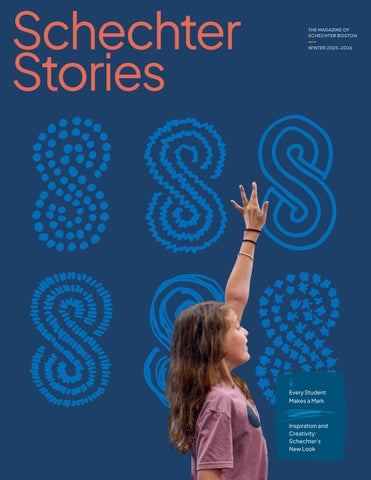
On the Cover A fresh new look inspired by the creativity of our students, faculty, and staff at Schechter. See page 9.
Schechter BOSTON
125 Wells Avenue Newton, Massachusetts 02459 617−928−9100 ssdsboston.org
Class Notes
Letter from Rebecca Lurie
2010 Emily Farbman Kadish and and her husband, Zakary, welcomed a baby boy, Elliot Zev Kadish, on October 10, 2025.
2011 Matthew Wolfman shares, “My wife, Dani Lefkowitz, and I were married last fall in California by one of our few mutual connections prior to meeting, and fellow Schechter Class of 2011 alumna, Rabbi Claire Shoyer. We live in Palo Alto.” Matt graduated from the University of Pennsylvania in 2019 and is currently an MBA student at Stanford University.
2024 Abby Aaronson was selected as a 2025 CJP Jewish Teen Initiative (JTI) Fellow. She will help to create a more connected and inclusive community for teens throughout Greater Boston while working to reduce the stigma surrounding mental health and promote overall wellness.
Join us in celebrating recent graduate, Dalia Marshall ’25, who earned first place in the first ever Hebrew Olympiad hosted by Tel Aviv University in partnership with The Hebrew Consortium at Brandeis University. This event celebrates Hebrew language learning with nearly 6,000 participants worldwide. Dalia was the winner of the international track which included participants from the United States, the United Kingdom, Brazil, Hong Kong, Germany, Switzerland and more.
Class of 2012 get-together: front row (l–r): Geoffrey Cole, Veronica Leifer, Geoffrey's wife and son, Julia Techler and Elliot, Dan Rosenzweig-Ziff and wife, Carol Silber; middle row (l–r): Hillel Maroun, Golda Pinals, Ava Shaevel, Sabrina Stacks; stairs front row (l–r): Lev Grossman and girlfriend, Audrey; stairs middle row (l–r): Jace Yawnick and fiancé, Sarah; stairs back row (l–r): Jarryd Nissenbaum, Yoni Offit.
We'd love to hear from you! Scan here to share an update with us!
2
Schechter Stories
Winter 2025-2026
31
Class Notes Adeline Lake Berg.
1990
1998
Ari Bessendorf lives in Singapore and shares, “After seven years in Jakarta, Indonesia, last September I relocated to the island city-state of Singapore. Singapore has a robust Jewish community with Reform, Orthodox and Chasidic congregations. It boasts two pre-World War I synagogues, both designated as national monuments, and the oldest dating from 1878. The Jewish population before World War II was primarily of Iraqi descent, including David Marshall (anglicized from Mashal), the first Chief Minister of Singapore as it negotiated its independence from Britain. Singapore has had security cooperation with Israel since the mid-1960s, viewing themselves in a strategically similar position, and there is a strong Israeli contingent here. Please feel free to reach out if you are in town.”
On Thursday, October 16, 2025, Benji Ludmir ‘29, son of Jona Ludmir, read Torah communally for the first time at Grade 5 tefillah where he received a tikkun to mark the occasion. “It was incredibly meaningful to have all teachers and students together!” shares Jona. David Wolf, Grades 4-8 Tefillot Coordinator, taught Jona how to read Torah when Jona was a student and, now, fifth-grader Benji has David as his tefillah leader.
1996 Elan Babchuk has been selected as a Fellow for the inaugural cohort of the Faith & Media Initiative! He tells us, “I look forward to learning from my new colleagues, and to helping to balance the ways that faith is portrayed in the public square.”
2001 Jesse Wolf tells us, “Some of my classmates and I went out to ice cream with our third- and fourthgrade teachers, Mrs. Banks and Esti Cohen! Mrs. Banks ‘graduated’ Schechter with our class when we graduated eighth grade.”
2002 Lee Levin and his wife, Liana, welcomed a baby boy, Caleb, in July.
David Micley and his wife, Molly, welcomed their fourth child, Emma. She joins older siblings Lily, Zoe and Eitan.
Shalom Friends,
2003 Emily Jaeger tells us, “I’m thrilled to share that I have stepped into a new role at the Rabbinical Assembly. I am honored to serve as the inaugural Director of Social Justice and Public Policy for the Conservative/Masorti Movement. Excited for this new chapter!”
2005 Alison Gluck Berg and her husband, Jonah, welcomed their daughter, Adeline (Addie) Lake Berg on August 10. “We are so grateful and loving our family of 4!! Brody’36 is an amazing big brother already!!”
2007 Aaron and Becca Karas welcomed a baby boy, Lavi Yuval, on October 14.
We’ve all heard the expression “keeping it real.” It’s simple, straightforward and does not require much analysis most of the time. What does it look like in practice at Schechter, though, if we slow down and (really) think about being authentic, honest and true to each member of the community and each other as a collective? It is beautifully complicated and completely personal. We keep it real by understanding that everyone’s experience is, always has been and always will be different from anyone else’s. We are a community of enormous diversity in Jewish practice, identities, interests, strengths and growing edges. Everyone makes a unique and individual mark on the whole and is, in return, changed and influenced by others’ marks. The Schechter experience rests on learning, relationships and self-expression that have real-world significance now and in the future for all of us. As I write, the full-scale remodeling of the Stein Circle Campus is in progress and we are paving the way for the expansion of the Gan, the relocation of Grade 3 to Wells
Avenue Campus next fall and the grand opening of the Grades 3−8 STEAM Center in early 2027. We are redefining ourselves in other ways as well. This past August, we launched our new website with refreshed branding and a kinetic energy that shows our dynamic program in action. The pages have a bold and playful attitude that is all about who we really are as a student-centered school. To that end, the website design incorporates our very own doodles, scribbles, handdrawn images and contributions. We invite you to contribute your own, real scribbles and simple sketches to our design bank. Go to page 9 to learn how and, yes, we really will use your work because you are part of what makes Schechter who we are. Bivracha,
Rebecca
Rebecca working on 100 Big Words, during a weekly read-aloud and activity with PreKindergarten students. The list is compiled from words students bring to Rebecca.
Jona Ludmir ’98 with son, Benji ’29 and David Wolf AP ’01, ’03, ’06, GP ’30, ’33, Grades 4–8 Tefillot Coordinator.
30
Schechter Stories
Matthew Wolfman and Dani Lefkowitz.
Winter 2025−2026 3
Schechter Style
This is Schechter Eighth-graders joined our Gan learners to read stories, play games and forge the special bonds that exist among all our students.
Browse our online store for our new T-shirts, hats, hoodies and more. https://store.ssdsboston.org/ Use coupon code STORIES20
for 20% off your entire purchase.
4
Schechter Stories
Winter 2025−2026 29
Jace Yawnick ’12
and really challenging, but I got a crash course in life.”
O
n day one, Jace decided to record his story and share it on social media in order to keep friends and family informed, and potentially meet other people battling cancer. “I made a promise to myself not to sugarcoat my experience or hide my tears and fears.”
“I am grateful to be alive, but even more grateful to feel alive.”
Jace’s community ballooned to a reach of almost 20,000,000 people a month across TikTok, Instagram and Facebook alongside 750,000 followers. “I had my answer from the universe,” Jace says.
“Many people need financial help, and I wanted to channel donations to this new nonprofit,” Jace explains. “I developed a board and went through the learning curve of the nonprofit sector. We've raised six figures and given away a lot of money. Good Morning America did a segment about my battle and People Magazine wrote a piece about me. I’m positioning myself to be a leader in cancer advocacy.”
Schechter Stories
ace has walked back from the cliff of cancer, but is on a bigger, better precipice. He divides life into three phases: before, during and after. “This is my bashert,” he says. “I have been able to maintain my two other companies and jobs, and now I've added something that fills my cup. I do a lot of work with the American Cancer Society and the Leukemia & Lymphoma Society as well as companies emerging in multi-cancer early detection.
Jace’s TikTok following soared almost immediately to 30,000 people. “I started “Speaking to a thousand people in a posting on Instagram as well and it just ballroom is incredible,” Jace adds, “but the exploded,” Jace says. “I was recording and thing that I never get away from is sitting posting every day about this battle that with a guy who's throwing up in a bucket, just I'm having with my life and people were like I did, and letting him know that I'm there resonating with it. People with cancer kept for him, and he can call me anytime. When I DMing me and saying, ‘I can't begin to tell stand up in front of Congress, this is who we you how nice It is to know that I'm not alone.’” are helping.”
Sitting in his hospital bed tethered to the chemo drip, Jace built his website “Jace Beats Cancer.” He started a 501(c)(3), working with attorneys to file paperwork and set up bank accounts. On the off days from treatment, Jace made the rounds from one hospital branch to another—“bald head and all,” as he describes himself—to promote his nonprofit.
28
J
J
ace will be monitored closely for the next five years through bloodwork and scans, but he is cancer free today. He feels right again. “My white blood cells are coming back. There's no evidence of disease. I still have a non-cancerous mass because it was too large to remove completely.” He stresses that beating cancer is not about being done. “Survivorship is often neglected and overlooked. My body is healing, and I feel amazing. I don't let anything limit me.”
When calamity hit, Jace had to make end-of-life decisions, but it was then that he started living. Really living, as he sees it and understands it now. The horrifying reality of Jace’s illness was an unexpected prescription for purpose and true fulfillment. “When I was diagnosed, I asked my rabbi to come over and hang mezuzot in my home. I say the Shema in the mornings now and I have my moments with Hashem.” Cancer has given Jace a hard-won, precious clarity. “I am grateful to be alive,” he reflects, “but even more grateful to feel alive.”
Winter 2025-2026
5
Jace Yawnick ’12
Schechter Scoop Big Learning!
L to R: Gan Teacher Judi Boviard, PreKindergarten Teacher Sharon Perkulis, PreKindergarten Team Lead and PreK– Grade 3 Director ofStudent Experience Jen Kaplan and PreKindergarten Teacher Jillian Kachinsky Montana soaked up professional development and some rays at the National Association for the Education of Young Children Conference in Orlando, Florida in November. Speaking on a panel at the Eudemonia Conference in West Palm Beach Florida in 2024.
like crazy and burning cash.” In four years’ time, GRYT employed six full-time salaried employees. “We are thriving and have grown 80 percent year over year which is mindblowing.”
Shabbaton at Camp Ramah
This year, for the mifgash between Schechter's Grade 8 and their sister school, the Reali School in Haifa, almost 80 students partook in a weekend Shabbaton at Camp Ramah New England during Chol Ha'Moed Sukkot in October. The teens created memories and established lasting bonds that will be reinforced with Schechter's Grade 8 Israel Study Tour visit to Israel in April.
Jace was 25 and basking in “sky’s-the-limit” type of success, yet an emptiness gnawed at him. “I felt purposeless and disconnected from Judaism.” The Jewish student community at FGCU had been small, leading Jace to drop in to Chabad for occasional doses of Jewish life. “Now that I was earning money, I started to donate to Chabad. The Boston Jewish community and Schechter had done so much for me, I thought, ‘man, I want to fortify that here because it’s so important. I remember distinctly asking the universe to help me find some sort of purpose. I was diagnosed with cancer less than three months later.”
I
t was 2023 and Jace had been firing on all cylinders between work, his company, traveling for business and working out. It was easy to blame his strange, aggressive
6
Schechter Stories
Celebrating a day of hiking and climbing with a friend and guide on Mt. Kilimanjaro in 2018.
cough and pervasive fatigue on a draining, unforgiving schedule. It made sense. Right? But it was more than that. “Look at all these hours I’m working,” thought Jace. “Maybe this is what it feels like to be an adult. Maybe you just get tired. My elders are always talking about being tired. The nagging cough was different from a cold cough, though. It was progressing and starting to snowball into other symptoms like severe back pain.” Something was not right. “I was seeing specialist after specialist, and being prescribed things like proton pump inhibitors, muscle relaxants and medications that were not helping. I had an agonizing pain in my shoulder that would jolt me awake in the middle of the night. I had night sweats and significant weight loss, but everyone just thought I was crazy,” Jace recounts. “My chiropractor suggested a possible hiatal hernia and a chest X-ray. I was so excited to have some sort of answer that I practically skipped into the imaging facility.”
Instead, Jace received an urgent message: the imaging showed a mediastinal mass and two large, unidentifiable shadows. A subsequent CAT scan revealed a volleyballsize serpentine tumor around Jace’s heart and in his chest. “The tumor was pressing on my spine and back, my esophagus and organs. It was everywhere. The cystic part of the mass was draining fluid and my heart was virtually drowning. You get news like this and your life just stops. Cancer was the furthest thing from my mind and now I am told that I have very aggressive NonHodgkin's Lymphoma.” Jace’s youth and health enabled him to undergo an intensive regimen of chemo called EPOCH-R. Every other Monday for six months, Jace checked into the hospital and remained there for days, ultimately receiving almost 100 hours of nonstop chemotherapy alongside numerous other procedures. “There was a 20 percent chance that it would spread to my nervous system. I was getting weekly lumbar punctures into my spine. It was terrifying
Winter 2025-2026
27
Jace Yawnick ’12
Schechter Scoop
Family Feeling
Jace believes that Schechter taught him “to turn challenges into superpowers.” Jace after speaking and participating in a Yoga Cancer Fundraiser in Naples Florida in 2024.
designed for incoming students to find or switch roommates efficiently. “We just kept pitching the idea, taking rejection, getting wins, doing competitions, really anything and everything.” By graduation, Jace had business success under his belt and spending money in his pocket. “Nickels and dimes compared to real life,” he says, “but as a college kid, I thought, ‘Wow.’ I can make money doing something I built myself.” There were failures as well which Jace prizes as a propellant to persisting. He sunsetted his college start-ups and moved to his uncle’s organic plant-based sweetener company, Pyure Brands. Imagine a hectic mailroom overflowing with sample products, packaging equipment and shipping materials because that’s where Jace began. “My uncle was very generous with me, and also quick to say that nepotism is very real, and to expect extra eyes on me. Throw me in an environment in which I’m being judged and I can't wait
26
Schechter Stories
to show everyone I'm excited to work with them and try to make everybody better.” During every free moment, Jace went office to office, learning what other people did. “I got my sampling done as fast as possible, then I would insert myself into somebody else's area and take whatever I could off their plate so they could focus on something else. In learning their lowest leverage activity, I was able to work my way up to supporting them with higher leverage activities.” Jace found that his numerous college public speaking courses were a natural bedfellow with sales. He followed up on customer complaints with phone calls, taking the time to listen and understand, then record issues and track patterns which he shared with the e-commerce department. “Entrepreneurs talk about success being the action taken, not the result. I just started showing up and I wasn’t afraid. How many roadblocks do people put in front of themselves because they are worried about the result or what
Back in July, eight former and two current faculty members gathered for lunch at Seasons 52 in Chestnut Hill. Shosh Levi, Rhoda Bronstein, Yakov Dov, Shelly Levy AP ’07, ’11, Susan Bloom, Evie Weinstein-Park AP ’02, ’05, ’08, Susan Banks, Esti Cohen, Susan Weiss GP ’24, ’26, and David Wolf AP ’01, ’03, ’06, GP ’30, ’33 enjoyed seeing each other, catching up, and celebrating former faculty member Susan Banks’ 80th birthday. “We all worked with fourth- and fifth-graders together at Schechter at some point in time and still consider ourselves part of the family,” shares David.
someone else might think? Nothing was too low for me and it helped me get my first promotion.” Jace moved from e-commerce to the B2B (business to business) side of Pyure’s commercial products as National Account Manager. He began flying around the country to nurture relationships with customers and meet potential clients. He sought the mentorship of the vice presidents and remained steadfastly coachable. “Being proud of myself is one thing, but everyone has something to teach me. Even the new person.” Several years in, Jace’s methods landed him the wellearned position of Director of Commercial Ingredients Division.
J
ace’s love of puzzling out a fledgling project, and even flirting with failure, prompted him to explore a novel venture with a college friend. “We started GRYT Media, a performance marketing media company. We had zero idea what we were doing except that we were working
Winter 2025-2026
7
Schechter Scoop
Jace Yawnick ’12
Chill of Fall…and the Warmth of Gratitude
At the Stein Circle Festival Stav (autumn) the day before Thanksgiving break, there were no rakes or leaf bags, just lots of autumnal activities and a focus on incorporating gratitude into our everyday lives. Organized by Kindergarten–Grade 2 Team Lead Marla Quinn, PreKindergarten–Grade 3 Physical Education Teacher James Wheeler, Team Lead for PreKindergarten and Stein Circle Director of Student Experience Jen Kaplan, the first ever festival was chock full of science, Jewish learning, art and nature. Classroom teachers partnered to design mini workshops and projects that engrossed students throughout the day.
A
t 25 years old, Jace Yawnick owned his first home in Florida. He tooled around town in his dream car. Professionally, he had rocketed to a national-level role in his first job out of college. He had even colaunched several profit-yielding companies of his own. And, at 25 years old, Jace had the unthinkable: a diagnosis of Non-Hodgkins Lymphoma.
Just Some of the Festival Stav Activities! making pumpkin slime
“I sat down with my dad to write my will,” Jace says. “I was writing my will at 25 years old. Who would get my house? My car? Who would take over my business? I realized it’s all just ‘stuff.’ Cancer is terrifying. It’s also the best thing that ever happened to me.”
autumn sensory bottles watercolor and fall leaf painting designing a corn maze in the STEAM lab Harvest Hustle on the field! Running, jogging and power walking! Gratitude Gallery and Heroes & Helpers thank you notes
When calamity hit, Jace had to make end-of-life decisions, but it was then that he started living.
J
ace was on a journey long before the unwelcome odyssey of cancer.
Never complacent, Jace opted for Needham High School after Schechter, a slightly unnerving choice after being with many of his Schechter friends since preschool. “I had an IEP at Schechter and got a lot of help from my teachers. I wondered if a big public high school would support me the same way, but the Schechter community did such a great job teaching me how to advocate for myself and connect with others.”
Day two of climbing Mt. Kilimanjaro in 2018.
8 Schechter Stories
The satisfaction of pioneering his way through a fresh milieu captivated Jace. He ripped off his comfort zone Band-Aid and
jumped eagerly into an eclectic variety of clubs and activities. “I was so open to figuring things out as I went. I signed up for lacrosse despite the fact that I'd never played before. I signed up for other clubs despite the fact that I may have not known anybody. I started my own guitar club despite the fact that I had no social value in this new ecosystem. I joined the theater class as an elective and ended up being the lead role in that play. I really just put myself out there and learned to navigate the dynamic of being in a new environment with a very different social hierarchy.” Jace believes that Schechter taught him “to turn challenges into superpowers.” By senior year in high school, he was enrolled in AP and honors classes. “I was creative with my skillset, using good habits and executive function principles to keep lists or organize my emails or my finances. Education is a cornerstone in my family and I realized that I had been ‘gifted up’ in life because my parents made Schechter happen for me.”
C
ollege offered another mint opportunity for Jace to dig in and embrace the unknown. At Florida Gulf Coast University, there were no familiar faces, just boundless possibilities. Jace got involved in the Entrepreneurship Program which led not only to first place in a statewide competition against every other university in Florida, but ultimately a degree in entrepreneurship. He was hooked. “I love the feeling of not being boxed in. My great-grandfather, grandfather and uncle all started companies. I admired what they had done and craved that sort of success for myself, for my future, for my family one day.” Jace studied the methods of other people who had started businesses and, with a fellow student, founded Roomdig, a prize-winning software program and app
Winter 2025-2026
25
For You and By You: Our New Website Have you seen our new website? We’d love you to take a look! After a fresh redesign this summer, we are eagerly and proudly showing it off. The website is more than a portal to our mission and purpose, curriculum or school calendar. All of those critical components are there, of course, but the website speaks even more to who we are as a community and how we embrace the sacred work of educating and helping to form the hearts and minds of young Jewish people. The homepage zooms right into the action, much the way kids step off the bus, full of energy and ready to go. Pictures and images from everyday life at Schechter mirror
The Best Things in Life An Interview with
Jace Yawnick ’12
the exuberant enthusiasm of the community from faculty at work to students on the playground, Parent Association activities to tefillah, arts or sports. You will notice a fresh, playful attitude in how we describe life at Schechter, while still providing high level information on the excellence and depth of learning and teaching that is our hallmark. The hues are fresh, modern takes on red, yellow and blue because Schechter itself is more nuanced than “old school” primary colors. More than anything, the website represents the very people who make up the extraordinary Schechter community. The website abounds with real artwork— whimsical doodles, simple sketches, happy musings, touching scribbles—supplied and inspired by the creativity and curiosity of our youngest students to the oldest, teachers to parents.
This project came to life through our participation in the Lauder Impact Initiative. We’re deeply grateful for this support, and to the team at Small Ocean Design for helping us bring the new brand identity and website to life.
We invite you to submit your own designs and drawings The website is not just a window to the world of Schechter, it is Schechter and by adding your artwork, we can continue to show off who we are in unique, ever-evolving ways.
Scan to upload your doodle!
24
Schechter Stories
Winter 2025−2026 9
Claire Shoyer ’11
tapped to support synagogue events. She admits that she did not predict heading a Hebrew school, but witnessing students’ burgeoning and blossoming connections to Judaism have been immensely gratifying. She recounts playing “telephone charades” with sixth- and seventh-graders on Pirkei Avot, an exercise modeled after the classic game of telephone. “Instead of whispering a message, participants pass along a hand motion. We talked about the transmission of the oral tradition from rabbi to rabbi, and how things might get lost along the way. It gives kids a chance to be playful with the tradition.” Moving through life cycles and generations with families provides Claire with the lovely continuity and multi-year relationshipbuilding that were part of her original motivation to be a rabbi. “I like being with people as they go from one stage to the next. The importance of communication with people during different times and events in their lives is something I love. I recently found out a congregant was having surgery, and it made such a difference for them when I called to check in.”
Y
ears before, as an undecided freshman at Penn, Claire had gravitated towards communications classes which ultimately proved to be as essential to her eventual career as they were fascinating to her as a student. “The most interesting class I ever took was on political satire and cartoons, so I enrolled in more communications prerequisites. It wasn’t a media or journalism program because it was not about hard, technical skills, but much more theoretical. We studied communication styles and trends such as nonverbal and unconscious communication. How do we say what we are communicating with our words and with everything else that we do? How do we apply code switching and with whom?”
Claire notes, “The thing that stuck with me the most were the findings of a study about online communication platforms. Everybody goes online for different reasons and motivations. When I'm online, I assume that my motivation is the same as everyone else’s. Some people are online to lurk, some people are there to shop. Some people are
10 Schechter Stories
there to connect with friends, some people are there for news. We tend to project our own ‘stuff’ on others, so we communicate online as if everyone else wants the same things that we want. That has had an impact on me in not assuming I know what other people’s needs and motivations are.” Getting to the heart of what people seek in and from spiritual practice or Jewish life is a critical aspect of Claire’s job, and she relies on her affinity for listening objectively and openly. “Personalizing rituals for people is a really important piece of what I do, for example. When I was at JTS, a more advanced student was a mikveh guide and led a ritual for my class over Zoom, then I took the online training course through Mayyim Hayyim, a mikveh I was already familiar with from a sixth grade trip there and pre-bat mitzvah immersion, on how to be a Mikveh guide. It is now a big part of my own spiritual life. I went before the High Holidays and a bunch of my friends who have gotten married in the last several years asked me to go with them.” Last summer, Claire guided a friend who wanted to immerse in Crystal Lake in Newton where she grew up. “I framed the rituals based on the things that I know about her and that I know she cares about. This friend loves being in nature so it was meaningful for her to be outside and with her sisters. The language I used for the ritual was all based on how she wanted to experience the moment.”
Claire with Rabbi Craig Scheff and Rabbi Ami Hersh at the Orangetown Jewish Center "Back to Shul" event in September 2025.
When Claire reflects on a “grand plan” as a rabbi, she sees herself right where she is, at the center of congregational work. “I want to be somewhere for 30 years and be with people as they grow up and add new people to their family, and as they have to mourn the passing of loved ones. I want to be a constant throughout the many experiences people have in life. Building history with people and understanding what makes them who they are and figuring out what they need is very powerful for me.” “A rabbi’s job is everything,” reflects Claire. That’s the whole point and Claire will be there for all of it.
Winter 2025-2026
23
Claire Shoyer ’11
Feature
I was golden. I was back into it. Then, COVID hit that March and I flew home.”
role models. I turned to my childhood rabbi with whom I have a very good relationship. She really wanted me to pursue this, but also wanted to be open about what it really means. After talking to her, I thought, Nope, I'm never going to do this. I'll just be a very involved lay person. I didn't keep Shabbat or kashrut outside the house at that point and it was a major lifestyle switch.” Claire adds, “I also began to understand that being a rabbi means always being ‘on.’ If people see you at the supermarket, you're ‘on.’ My rabbi also explained that she had to miss a lot of things in her children's lives because someone had died in the community, for example. These were very intimidating concepts to me. My rabbi explained that the first two years of rabbinical school are text study which I had not done at all in college, so again, I thought, Nope, I'm not going to do this. It's too much. I'll keep doing communications and then be an involved community member.” Still, rabbinical school gnawed at Claire. In 2019, as a senior, she applied to the Jewish Theological Seminary which offered the perfect balance between its alignment with the Conservative movement and scholarship, especially around Talmud and Midrash. After being accepted, Claire followed sage advice from a number of people to take a year’s break. That summer, she worked retail jobs, played Frisbee and was slated to study at Pardes in Jerusalem to beef up her text skills and dust off her Hebrew. “My plan was that I would move to Israel that January, start keeping Shabbat and kashrut. I was going to stay there for the summer after and volunteer with Ultimate Peace, an organization that brought together Arab and Jewish children through Ultimate Frisbee.” “Pardes was an amazing place for me and it was also really hard. I came in halfway through and everyone else had already been there for the whole year. They were thinking and speaking a certain way, but I hadn't been in that headspace since Gann. I was assigned to the highest Talmud class which was overwhelming at first, but I was part of an incredible hevruta and by the second month
22
Schechter Stories
“Building history with people and understanding what makes them who they are and figuring out what they need is very powerful for me.”
Back in the States, Claire moved in with strangers in an Upper West Side sixth-floor walk-up with rooftop access. Claire’s JTS class of 18 students organized themselves into a schedule of one-onone conversations over Zoom. A sort of Shabbat oasis formed on the roof where Claire’s local classmates would venture on Friday nights, with cups of hot tea when the weather turned colder. “Sometimes, I would go to someone else’s balcony, and we would take our computers, sitting on opposite sides of the balcony, and Zoom into class together. We did a really good job of building strong connections. I would have preferred to be in person, but I got the best cohort in the world. I thought I'd be lucky if I had two friends in the class, but these are my favorite people.” During her third year in rabbinical school, Claire was finally able to return to Israel where she joined a few of her classmates to undergo training as a shochet in the ritual slaughter of animals. “In the US, there is a very eclectic group of people who are non-orthodox shochetim. The rabbi that we studied with in Israel was so thoughtful and genuinely cares for the dignity of life. It was powerful to be a part of the process of kashrut and food production, and the holiness that goes into it.”
A
s the Education Director and one of three rabbis at the Orangetown Jewish Center in Orangeburg, New York, Claire is part of a team with whom she was eager to work including Rabbi Craig Scheff, a 30-plus-year veteran at the center and Rabbi Ami Hersh. “I divide my time between primarily running the religious school and leading adult education, and commuting out from Manhattan to Rockland County during the week for minyan and life cycle events like funerals or other pastoral care.” Claire’s days are filled with different people and an ever-changing schedule. From bigger education projects to pure logistical planning, she appreciates “just being around” as congregants stop by or she is
Every Student Makes a Mark It’s a little bit chaos theory, a little bit “a butterfly flaps its wings,” a little bit “it’s never the same river twice” and it’s everything about who we are as a school. Every student—in fact, every member of the Schechter community—changes the experience of everyone else. Beautifully, unpredictably and indelibly.
We each leave our imprint and legacy by bringing our own personalities and individuality to the Schechter ecosystem. Sometimes we know it when it happens. Other times, only hindsight reveals someone’s impact. The mark can be concrete, abstract, temporary or lasting. The mark can be quick and quiet or profound and powerful. Sometimes, a mark cannot be seen, heard or touched, but deeply felt.Everyone creates a ripple effect that touches everyone else today or tomorrow. The conditions at Schechter are rife and open for students to make their mark from individual expression to relationships, hevruta-style learning to the empty bulletin boards and walls on the first day of school that await student work. Students are agents of their own learning, and teachers build flexibility into the curriculum to allow for the deep pursuit of student-driven exploration.
Winter 2025-2026
11
Feature
So much of our “Schechterspeak” and so many of our communal rhythms and traditions were once an idea or an inspiration, a pilot program or one person’s way of doing things that simply worked and improved how we do things, and stuck. The Schechter experience orbits around each person‘s individual, authentic truth, while honoring, balancing and respecting the communal norms of a diverse community. This means give and take, mutual understanding and cooperation. In this way, each person’s mark is a voice that adds to the Schechter story. Perhaps someone who was here a long time ago or perhaps someone who is here right now will leave a mark that becomes part of us or the world beyond our doors. In September, we cannot predict what June will look like. And in 1961, we could not have predicted what 2026 would look like except that we are still here, stronger than ever, gloriously marked and changed and affected by everyone who has come before us. Who will make their mark today or tomorrow? Read on for some windows into the Schechter elixir that makes this possible.
Claire Shoyer ’11
How to Get Your Shovel Back and Other Life Lessons A Conversation with Jen Kaplan PreKindergarten Team Lead and PreK–Grade 3 Director of Student Experience
Schechter Stories
rom a young age, Claire Shoyer wanted more immersive Jewish learning and a fuller spiritual experience than she felt she was receiving in Hebrew school. She might not have used these words when she expressed this desire to her parents, Debbie Horwitz and Steve Shoyer, because Claire was only eight years old. They followed her lead and Claire started third grade at Schechter the following year in the fall of 2005.
Jen Kaplan describes a typical day in Schechter’s two PreKindergarten (PreK) classrooms with both affection and awe in her voice for the students who are, for one last year, the youngest on our Stein Circle Campus. “The PreK classrooms are really a model for the expansion of our early childhood program when it opens next fall and we bring our preschoolers and toddlers over from Wells Avenue Campus. The rooms are set up to create an environment that facilitates small group work. Everything is at the children’s height so they can reach materials and so we can follow their interests. Everything is labeled with pictures and words so that kids learn how print connects to the real world,” Jen explains. In spaces so intentionally designed, the four-yearolds acquire skills by exploring and caring for classroom supplies. Replacing caps on markers and putting them back where they belong is a daily task in this community of learners. Job charts posted at eye-level reflect multiple student responsibilities that help the classroom function including coveted roles such as line leader or turning off classroom lights. The fresh design of the current PreK wing incorporates a separate door to the playground for each of the two classes, and eventually the third classroom which is now under construction. “If one class wants to head outside, our teachers, Amelia Haddad, Jillian Kachinsky Montana, Rachel Kornreich and Sharon Perkulis, can bring them right out. We build on what the kids want to do. Oftentimes, one child’s questions or interests pique the interest of others, and the whole class can explore a topic together in a manner that is really student-driven. In this way, everyone makes their mark on the classroom experience.”
Jen recalls a fall project. “We cut open pumpkins to see what was inside. What do they smell like and feel like? They used fine motor skills to hammer golf tees into the pumpkins. They extracted the seeds which we cooked in both salty and sweet versions to taste the differences. They really gutted the pumpkins,” says Jen chuckling at the apt parallel between the small-scale classroom activity and the cordoned-off half of Stein Circle’s first floor, equally gutted in September, but quickly evolving for next September’s grand opening.
12
F
Two decades later, Claire—now Rabbi Claire Shoyer—sits in her office at Orangetown Jewish Center in Orangeburg, New York where she is less than a year into her first job after graduating from the Jewish Theological Seminary as an ordained rabbi with a Master’s Degree in Midrash. On Claire’s shadow day at Schechter as a prospective student, she remembers a few teary, wobbly moments because everyone else knew Hebrew. “That was the whole point,” she says. “My parents got me a tutor and I worked very hard because I really wanted this.” Claire quickly acclimated to the day school environment she had sought. “Schechter was really good for me. I was pushed in the direction of learning how to read Torah and be part of a service. Between trope with David Wolf in fifth grade, learning the weekday and Shabbat morning services, going to synagogue and spending summers at Camp Ramah New England, all of these things were happening and I was just really comfortable. My Bat Mitzvah preparation was so easy although my parents might remember it differently!”
Claire officiating at a wedding in 2023.
Claire’s calling was making itself known and perhaps there were early hints at her future career even if she had not recognized them as such just yet. With Middle School came the opportunity to be a gabbai, the member of a service who handles coordination and
tasks such as calling up people for Torah readings. Claire eagerly embraced the seemingly tailor-made responsibility. “I loved being a gabbai because I could talk to everyone, move around the Beit Tefillah and assign honors and roles. I liked having some command over the service.” As a freshly minted bat mitzvah, Claire became a regular Torah reader at her home synagogue, Or Atid in Wayland. “Besides incredible friendships, Schechter gave me fantastic synagogue skills which I also took with me to Ramah. I was reading Torah constantly at camp from the time I was in sixth grade. Any time someone was asked to lead at the last minute, I would jump at it. Then, as a counselor, I could teach other people the same skills.” Claire segued to Gann Academy for high school. “The muffins were delicious,” she jokes, then adds, “More importantly, I got to know my teachers well and there was a lot of trust between us.” Her time there was characterized by involvement, collaboration and leadership. “Some friends and I tried to start a partnership minyan. Because Gann is pluralistic, when we had the class Shabbaton, there were a lot of discussions about doing different services and what it means when people with different values and practices are in prayer together. It was important learning to think about how everybody can be a little bit uncomfortable together, but be willing to be a little bit uncomfortable for the sake of being in this kind of community.”
M
idway through college at the University of Pennsylvania, the idea of pursuing the rabbinate began to germinate and gel in Claire’s mind. “Around the end of sophomore year, I was in a bar mitzvah service, and it occurred to me, Oh, this is a job that I could be doing. I had many rabbi
Winter 2025-2026
21
The Whole Point An Interview with
Claire Shoyer ’11
Jen marvels at the students’ ingenuity and capacity to learn throughout the day through play, and to observe how they see the world or interact with the people around them. “As teachers, our job is to facilitate or to expose kids to ideas, then take a step back and watch them run with it. For instance, the kids love Play-Doh. We make it every week now instead of buying it which teaches them how to follow a recipe and think about the math involved in measuring or the physical skills it takes to pour and stir. They are grasping how the ingredients come together and change to make this thing they want to be able to use.” In many instances, the teachers entwine the fouryear-olds’ questions into the Jewish learning that is core to Schechter. How the moon changes leads to a discussion of lunar phases and Rosh Chodesh. Retelling the story of Jonah and whale dovetails with exploration around sea creatures and the oceans. “Every year, we hatch chicks in an incubator in the classroom,” Jen shares. “The kids might not have thought they were interested in it, but the teacher's job as a facilitator is to put out an ‘invitation’ and see where it goes. Sometimes it goes nowhere, but sometimes you put something out, and it's going to go much further than you ever expected it to.” At Hanukkah, Jen hooks up a projector to talk about light and shadows. “We take out our light table with plastic translucent, colored tiles. Kids take different tiles and stack them. One student put red and yellow tiles together on the light table and was delighted to see that she had created orange. A child asked me yesterday, ‘Well, how would I make purple?’ Another child jumped in and said, ‘Well, blue and red would do that!’ The question of how to make purple might never come up in another year with another group of kids, but this is how they all help each other learn.” Jen adds, “We don't always need to give kids the answers, right? They might need us to help guide them and extend their learning, but we do that by providing them what they need to go deeper or broader or higher.” English and Hebrew are laced together throughout the day along with phrases and the daily counting of 1-10 in Spanish, the native language of Mexican-born teacher Sharon Perkulis. Teachers present familiar books such as The Very Hungry Caterpillar in English and in its Hebrew counterpart, הזחל הרעב. The caterpillar is just as brightly colored, just as famished and just as beautifully transformed into a butterfly in both books, providing students with very visual connections in order to grasp the correspondence between English and Hebrew words. The many native Hebrew speakers in the PreK classes delight in listening to the familiar Hebrew alongside their classmates.
their first year in these newly remodeled classrooms. “We are figuring things out as we go which helps us model for the Gan’s larger space next year. I am particularly excited about our community space which we will be calling our living room. We want more opportunities for parents to come to school whether it’s for a Shabbat celebration, celebrating birthdays or preparing a special recipe with the kids. Maybe parents just want to hang out and help with an art activity for a few hours. We have a lot of grandparents who love volunteering. This will make it possible for family members to be woven into what we do and feel like they're part of what's happening every day.” The Gan’s living room is further envisioned as a community place in which families can gather for programming, Shabbat celebrations and community events, not just as individual classes. “There is always something to teach and always something to learn,” observes Jen. “I see this as a new way to come together. How can older students help the younger, and how can the younger teach the older to be patient? How can we work with someone who needs more help?” The intentionality of the Gan’s redesign and remodeling will trickle up and trickle through the second floor as well, making its mark on the Kindergarten through Grade 2 students upstairs who will participate in intergrade programming. The living room will also serve as an indoor gross motor space in which kids can climb and move their bodies in a safe way during the day.
The Gan expansion means a larger teaching team, and Jen is eager for faculty members to feel empowered to collaborate. “A house doesn’t function without a foundation,” she says, “and the Gan is where we start to establish and solidify social/emotional skills. ABCs, 123s, alef, bet, gimel are all important in life, but learning how to function and put your stuff away, get your shoes on, go to the bathroom and wash your hands, all of these things need to happen first.” Jen stresses that the primary goal of early childhood education is for children to grow in their independence and be kind in their interactions. “Knowing how to write your name is important,” says Jen, “but no one wants to hang out with an adult who never learned to ask for his shovel back nicely.”
As Jen looks ahead to next fall, she notes that this year has offered enormous insights and learning for everyone as it is
20
Schechter Stories
Winter 2025-2026
13
Feature
Feature
Tuning In A Conversation with Rabbi Ravid Tilles Director of Jewish Life and Learning
For decades now, Fridays on the Wells Avenue Campus have featured Ani Ma’Amin or Ani Ma’Amina (I believe), a special talk delivered to the student body during Ruach Minyan, our weekly, dynamic, all-school tefillah. Modeled after NPR’s legendary “This I Believe” series, Schechter speakers share a profoundly personal experience that touches on anything from a watershed life realization, the tackling of an obstacle, Jewish identity or a cherished belief. In its inception, speakers ranged from parents to alumni to local community members. Over time, however, there has been an extraordinary shift and the person at the podium each week is one of our eighth-graders. It is nothing short of remarkable that our early teens stand to share a personal, sometimes very vulnerable, part of themselves. Hundreds of their peers, faculty and staff, and a growing number of parents come to Ruach Minyan to listen and learn from the eighth-graders. Rabbi Ravid Tilles recently shared his thoughts on Schechter’s uniqueness in being a school in which a community tunes in each week to hear a student volunteer to speak so openly, disarmingly and eloquently, often about the deepest part of their soul.
CAN YOU TALK ABOUT THE HISTORY OF ANI MA’AMIN AT SCHECHTER? I came to Schechter in 2017 and the talks had been happening for at least a decade before then, so they predate me. Faculty members would periodically arrange for a thoughtful, interesting adult to speak to the middle school. When I started, I used it as a tool to bring local rabbis to school. In 2019, three or four eighth-graders asked me if they could deliver an Ani Ma’Amin. I immediately realized, ‘Gosh, it is so meaningful to hear the kids talk about their time at Schechter or about growing up or something they have learned.’ They were incredible and we’ve never looked back. IS THERE A PROMPT OR FRAMEWORK FOR THE TALKS? The students are asked to reflect on something they have learned about themselves or something they wish someone had told them when they were younger. My favorite thing about working in a school after having served previously as a pulpit rabbi, is that I can tell the kids things I wish I had known
14
Schechter Stories
when I was their age. Their speeches really highlight how much they have matured even in just the few years before they are set to graduate. When eighth-graders give their Ani Ma’Amin or Ani Ma’Amina, they have such gravitas for the younger kids listening. HOW SOON DID IT HAPPEN THAT THE FRIDAY MORNING TALKS WERE ONLY GIVEN BY STUDENTS? Once the first kids presented, we realized they were by far the best talks. We’ve gotten to the point now that there are no slots for adults. It’s totally optional because if it were mandatory, it would not be nearly as great as it is. It is a true highlight of being in eighth grade. Dan Savitt, the Grade 7 Jewish Studies Teacher, signs up the students when they are in seventh grade so they have plenty of time to think about their talk and refine it. HOW DOES SCHECHTER CREATE THE CONDITIONS FOR STUDENTS TO BE ABLE TO DO SOMETHING LIKE THIS? I take that as such a given around here and I give a lot of credit to our Head of School, Rebecca Lurie, who has created a culture in which if kids say things in a respectful way, we're going to listen to them about anything and they can ask anything. That’s a no-brainer especially when they want to do more because then we’re going to do everything we can to make it work. It all really points to the meta success of a school in which kids come up to the adults and say, ‘We want to do this.’ Another example is Schechter’s Got Talent for Grades 4-8, a show that happens twice a year when students take the stage. They sing, play instruments, perform in music groups, and they are so vulnerable. A colleague of mine who had taught elsewhere said she could not imagine another school in which students would perform in front of over 150 other kids, teachers and parents. Often, the kids who are least polished or seasoned get the most applause. HOW DO THE YOUNGER STUDENTS AND ADULT COMMUNITY MEMBERS REACT? At this point, they only know a world in which Ani Ma’Amin and Ani Ma’Amina are delivered by eighth-graders. Now, they start thinking in their seats about what they are going to say when it’s their turn. They ask very thoughtful questions. The parents have gotten wise to how phenomenal this is and they have started coming to Ruach Minyan. The way the scenario has flipped—we used to bring in adults to talk to our kids and now adults come in to listen to the kids—is just so powerful. Earlier this year, my wife, Yaffa Garber Tilles, and I were sitting at dinner with our fifth-grader, Micah. Yaffa had been at Ruach Minyan and heard a really great talk by an eighthgrader named Louis. He spoke about being overwhelmed by tasks and breaking them down into small pieces to make
months first on building skills. Sometimes right now, there are projects the kids want to do and it’s about acquiring STEAM skills: planning to finishing to doing. Other times it’s about physical limitations in the lab.” Penina recounts the variety of undertakings just this year alone. “A few kids wanted to focus on painting, so we examined their style, which was sort of pop art, and I showed them different painters who represent a variation of their styles. They did a study of these artists as a jumping off point, then created original works and set up a gallery. There
were other kids who developed apps or kids interested in robotics who programmed their bots to follow mazes they had designed. There were kids who created short animation films. When I asked them if they needed any help, they said, ‘Nope, thank you! We’ll figure it out ourselves.’” Penina conferences with students whose projects sputter or get stuck. She solicits feedback such as Where did you have a hard time? Choosing an idea or staying with an idea? If it’s challenging to choose an idea, can you commit to what you are doing and see it through? How? “It’s different for every single student. What they can do is astounding. I showed kids a TED Talk in which the speaker said that if an adult tells them they are not able to do something, it’s wrong. They can do anything.”
Schechter’s “be who you are” and intentionally student-centered environment is designed for maximum individuality and impact on kids’ imagination and effect on their education. Penina shares, “In the makerspace and electives arenas, it is less about a concept and framework and much more about letting kids pursue something that matters to them. They can make something huge happen that will have an impact on them, but also potentially other people or the world.” During afterschool at Stein Circle, second- and thirdgraders have used the ever-favorite artistic medium of cardboard to build houses which soon multiplied enough to qualify as a cardboard village. From there, faculty members and students studied villages around the world, how different types of buildings are constructed and what they are called. “I’m just lucky enough to pretzel myself around these kids,” Penina adds. “I always ask myself what the advantage of my help will be. What do I offer them that they couldn't just go do by themselves? I have one rule in the room which is that everyone has to be kind. I expect kids not listen to me sometimes, and we work it out, but making their mark starts with being good to their friends.” Penina often reflects that the only certainty is that the students will continue to hatch ideas, invent contraptions and see their brainstorm become a reality. What we do not know is what, when, where and how they will leave a lasting imprint on the people and world around them, and that is right where Penina wants to be as an educator. “I always think about whether the materials I give the kids or what I teach them has an impact on what they are able to do. We might lead what we think is a great lesson, but if what we show students is not connected to what they are doing or care about, it does not have the same value. It’s so important to offer kids resources that support their ideas because that is how they become visionaries.”
Winter 2025-2026
19
Feature
Feature
By Design A Conversation with Penina Magid Director of Innovation and Enrichment
Words like passion, idea, imagination, care, try, choice and learn pop up in Penina Magid’s vocabulary again and again. The most prevalent phrase of all is the kids because Penina sees everything through the lens of students and how our role, as adults, is to help, facilitate, support and consult, but mostly, to take a step back and get out of the way. “We have an incredible visual arts program which is based on certain artistic frameworks and challenges through which kids explore different media and techniques in a really individualized way. Our makerlab and elective programs are different from that and are designed so that every student can find out what they believe in, to develop their idea and bring it into the world,” says Penina. Within the boundless parameters of the makerspace and electives, students’ visions are wholly sui generis and open-ended. The process of bringing an idea or concept to its realization is iterative, requiring an industrious, can-do attitude which is buttressed by Schechter’s strong fail forward mentality. “The kids are the drivers,” says Penina. “Last year, two kids wrote, directed and produced original plays. They auditioned their classmates and built incredible sets from cardboard. This year, I have half a dozen kids working on shows that they will premiere on the Wells Avenue Campus stage. My role is to help them craft a script, to be their scribe, provide resources or supplies, and to guide them through the things they don’t know yet. But, there will come a point when the kids are deep into the process and they’ll come to me and say, ‘We’re all set. We can do it ourselves.’ I want the kids to leave their own mark on the play, the other kids—and their own learning—with as little of me in it as possible.”
The current makerlab at Wells Avenue Campus is bursting with students’ ideas as well as the kids themselves, halfway completed 3D-printer projects, a LEGO robotics track, packed workspaces, laptops, electric scissors, glue guns, cardboard creations…the list goes on, but the space does not. Faculty and students alike dream of the new reimagined, vastly expanded STEAM Center, set to open in early 2027. “The kids’ ideas are confined by what we have now,” explains Penina, “and they have a lot of ideas. Some come in with ideas and some find ideas, but either way, we focus for a few
18
Schechter Stories
“When I asked them if they needed any help, they said, ‘Nope, thank you! We’ll figure it out ourselves.’” — Penina Magid
“It is nothing short of remarkable that our early teens stand to share a personal, sometimes very vulnerable, part of themselves. Hundreds of their peers, faculty and staff, and a growing number of parents come to Ruach Minyan to listen and learn from the eighth-graders.” — Rabbi Ravid Tilles
Louis delivering his Ani Ma’Amin talk.
them manageable. Micah was talking about how much homework he had and I said, ‘Oh, it's just like what Louis said. You should break it down.’ Yaffa turned to me and said she thought Louis was sharing a different message. The three of us had a conversation on our opinions of the content of Louis’ talk and we were really grappling with his message. His Ani Ma’Amin became a text study for us around the dinner table. CAN YOU SHARE A BIT ABOUT THE NATURE OF THE TALKS? I find that hearing what the students say is so pure. They are very soul-bearing. One student opened up about being on the autism spectrum which helped other kids understand there are people just like them at school. Kids have reflected on anxiety or depression. Another student spoke about the
importance of thinking out of the box, and someone else emphasized the importance of trusting yourself. One student spoke about his parents’ divorce which resonated so much with a fifth-grader going through the same thing that the eighth-grader became a mentor for him. They became a sort of small subculture at school of kids who had this same bond and supported each other. The kids remind each other not to overthink things sometimes, but just to go to a friend and talk it out. WHAT IS YOUR BIGGEST TAKEAWAY FROM THE EVOLUTION OF ANI MA’AMIN AND MA’AMINA? We’ve created a system that shows kids we are going to celebrate and be proud of them. They feel our support, and this is one of the beautiful examples of how that shows.
Winter 2025-2026
15
Feature
Feature
Full Circle A Conversation with Hallie Boviard PreKindergarten–Grade 3 School Counselor
Just as there is no “one size fits all” approach to learning at Schechter, there is no standard social/emotional curriculum that is exactly right for our community. Everything we do is intentional, Jewish and Schechterized. Talk to Hallie Boviard and she will tell you how our students are embodying the concept of Circle Talk and running with it. “We began Circle Talk as a pilot last year in Grade 3 as a way to try social/emotional learning (SEL) in a different way. Boxed curriculums are not quite right for us. We are still teaching students the Zones of Regulation, but the older grades are shifting to the Circle Talk model because it really reflects back on who the class is, and is really directed by what they need.” Midway through the year, Hallie explains, third-graders began to suggest Circle Talk topics on their own. “A third grader came up to me and said, ‘Hey, I'm noticing that my friends are whispering, and I always think it's about me. I know that it's not, but I don't like when they whisper.’ We were able to use that in a circle, in a scenario, and that girl shared how this behavior was having an impact on her. It was a scenario in which the student could separate someone else’s actions from herself, but then directly connect it to herself. Other students were able to share about it as well.” Based on the success of the pilot, Hallie presented to all faculty and staff members during August back-to-school meetings. Circle Talk has been proven to be an effective way to communicate class and schoolwide expectations at the beginning of the year. Faculty members have also harnessed what they learn from students during Circle Talk to have helpful insights into the dynamics of a given grade. This, in turns, allows teachers to tweak SEL topics and content to be reflective of current needs. Hallie adds that each grade has a unique karma, and what students have on their minds in one class may be wholly different from another group of students. “Circle Talk can change from teacher to teacher, grade to grade. It’s really a way for teachers to problem solve. We want students to have the opportunity to build relationships in all of their classes.” The middot (values) of kindness, productive dialogue and respect are essential for the healthy functioning of Schechter’s large, diverse student community. In addition, these skills comprise a portable toolbox that our students will use throughout their lives as they make their mark on the world. In Anna Gurvis’ Grade 3 General Studies class, each week winds down with an activity called Rose, Bud, Thorn. “Thorn” represents a student’s low point, “bud” is something
16
Schechter Stories
to which the student is looking forward and “rose” is the positive highlight in the past five days. The speaker holding the talking piece, in some cases, a marker or ball, can choose to stay quiet. “That’s another big piece of this exercise,” explains Hallie. “It’s not forced. Kids can raise their hand and someone can pass them the talking piece, so that no one is talking over each other. That’s a really big rule.” Through Circle Talk, students learn to disagree respectfully, a concept that was initially introduced with an age-appropriate game. One person would begin with a clearly true statement such as the sky is blue to which the responder would say I don’t think so and then offer either logical or illogical reasons. Hallie lauds the process for teaching students how to react when they agree with someone or, conversely, when they disagree with someone. “The kids were able to have fun with it,” she says, “but also make the connection that it is fine to disagree with someone and that there are appropriate ways to do that.” The dynamic, iterative nature of Circle Talk fosters closeness and honesty among members of a class and their teacher. “If someone shares something about themselves, everyone learns a new fact about them which might be true of someone else as well. Part way through last year, the kids were advocating for Circle Talk when they felt as if they needed to work something out. They would come up to me and say, ‘I think we need a circle about what happened at recess.’ It was so great to see because that's the goal. Kids practice dealing with intense feelings. I love it.”
There is mutual impact and value in the sharing as listeners often realize they are experiencing the same feelings or are thinking about similar things. When the speaker has the floor, other members of the circle use a hand signal to indicate me, too. “Sometimes we just go around and list our favorite pizza toppings. Other times, kids reveal what’s on their minds. It is very encouraging in these moments because kids feel a little bit safer saying, ‘that happened to me, too’ or ‘this is how I handled the same situation’ or ‘wow, someone else feels that way also.’ Students feel less alone or overwhelmed when they understand how many things are not isolated to them. It is such a nice way to build classroom culture.” Ultimately, says Hallie, she cannot quite put her finger on the environment at Schechter that makes such openness possible. “The teachers are really bought into spending time establishing relationships. There is such a high reward that comes from having these conversations with kids. It’s really part of who we are at Schechter.”
“The middot (values) of kindness, productive dialogue and respect are essential for the healthy functioning of Schechter’s large, diverse student community.” —Hallie Boviard
Circle Talk is a process in which participants sit in the
round facing each other and express ideas or feelings without interruption. The speaker holds a ball, a plush toy or other item to signify that it is their turn to open up. Rooted in this practice is the goal of creating respectful listening, honest communication and a shared language.
Zones of Regulation is a cognitive behavioral curriculum that uses four different color-coded zones to represent emotional states and teach self-regulation. The goal for individuals is to be able to recognize and identify how they are feeling and develop helpful strategies. Ultimately, tools for managing emotions and behavior can lead to stronger social/emotional wellbeing and more successful relationship building. Blue Zone: low energy, sad, tired, bored Green Zone: calm, ready, happy, engaged Yellow Zone: heightened energy, anxious, silly, fidgety Red Zone: intense, out of control, angry, frightened
Winter 2025-2026
17
PreKindergarten students ready to serve hot latkes to classmates during Hanukkah.
Winter 2025−2026 33
Schechter B O S TO N
125 Wells Avenue Newton, Massachusetts 02459 617−928−9100 ssdsboston.org
Visit us online at ssdsboston.org
34 Schechter Stories