S T U DY A B R O A D
Celebrating 25 years of EcoQuest: Aotearoa A legacy of field-based learning and cultural exchange
W
hen you think of the UNH College of Life Sciences and Agriculture, what comes to mind? Exploring nature in College Woods? Conducting experiments in Spaulding Hall?
What about traveling nearly 9,000 miles to Aotearoa — the Māori name for New Zealand — to study conservation ecology alongside local experts? Every year since 1999, students from UNH and other universities have gone to Aotearoa to participate in the Ecology in Action program. In partnership with UNH, the EcoQuest Centre for Indigeneity, Ecology and Creativity (formerly the EcoQuest Education
19 • University of New Hampshire
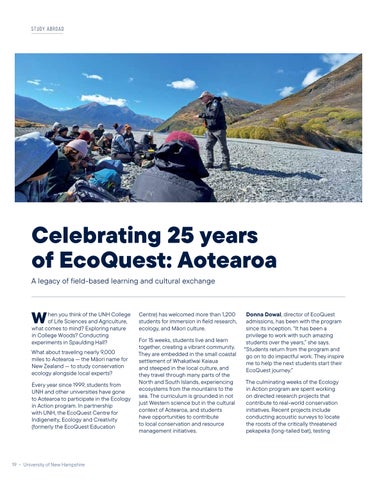
Centre) has welcomed more than 1,200 students for immersion in field research, ecology, and Māori culture. For 15 weeks, students live and learn together, creating a vibrant community. They are embedded in the small coastal settlement of Whakatīwai Kaiaua and steeped in the local culture, and they travel through many parts of the North and South Islands, experiencing ecosystems from the mountains to the sea. The curriculum is grounded in not just Western science but in the cultural context of Aotearoa, and students have opportunities to contribute to local conservation and resource management initiatives.
Donna Dowal, director of EcoQuest admissions, has been with the program since its inception. “It has been a privilege to work with such amazing students over the years,” she says. “Students return from the program and go on to do impactful work. They inspire me to help the next students start their EcoQuest journey.” The culminating weeks of the Ecology in Action program are spent working on directed research projects that contribute to real-world conservation initiatives. Recent projects include conducting acoustic surveys to locate the roosts of the critically threatened pekapeka (long-tailed bat), testing