“Ever since I was a kid, I’ve been interested in the natural world. All of that is reflected in the programs at COLSA."
agricultural land use specialist for COLSA Dean Harold Keener. In this role he completed a full inventory of agricultural, forest, and related land uses in New Hampshire, a project funded by the NH Agricultural Experiment Station. “When I finished my coursework and research, the degree still hadn’t been approved, so I didn’t graduate,” says Coppelman. “I stayed and worked for Dr. Keener. During that time the degree did get approved, and in December of ’76 I graduated.” He then joined UNH Cooperative Extension as an energy agent. In the middle of an oil embargo that sent
energy prices in the U.S. soaring, Coppelman worked on a new program created to promote the virtues and rewards of conserving energy. After that program concluded he pivoted to the private sector, drawn by the emerging field of digital imaging technology. Over the next two decades he worked in marketing and business development for Optronics International, Eastman Kodak, and Intergraph Corporation. “The private sector fulfilled me in many ways,” says Coppelman. “It was fascinating work, and it afforded me a lifestyle that I probably wouldn’t have had if I’d started in the public sector.” In 1985 Coppelman started Evergreen Farm in Kingston, where he grows cut-your-own Christmas trees, to reconnect with his interest in natural resources. He describes the enterprise as “a rewarding labor of love that’s deeply rooted in my time at UNH.”
A return to his roots
Coppelman had an opportunity to return to public service in 2001, first with the New Hampshire Office of State Planning and then, two years later, with the New Hampshire Community Development Finance Authority. There he met fellow COLSA alumni Pauline Ikawa ’77, who eventually chaired the college’s development board. That relationship got Coppelman thinking more about ways he could support his alma mater and its students. “Ever since I was a kid, I’ve been interested in the natural world,” he says. “All of that is reflected in the programs at COLSA. I live it day to day because the Christmas tree operation keeps me connected to the land, keeps me connected to agriculture, and keeps me connected to what COLSA is all about.” To his fellow alumni, Coppelman has this advice: “Invest in higher education. The environmental and technological challenges we face today are greater, in many respects, than ever before. It has been incredibly gratifying to support COLSA’s work and mission — to provide knowledge and assistance that improves the quality of our collective lives and to produce graduates who are informed, active stewards of the planet. You might say that our very existence depends on it.”
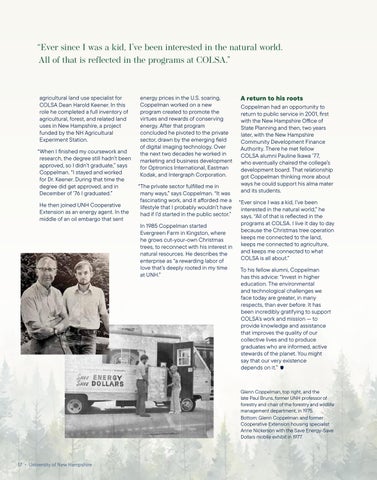
Glenn Coppelman, top right, and the late Paul Bruns, former UNH professor of forestry and chair of the forestry and wildlife management department, in 1975. Bottom: Glenn Coppelman and former Cooperative Extension housing specialist Anne Nickerson with the Save Energy-Save Dollars mobile exhibit in 1977.
17 • University of New Hampshire