RESEARCH BRIEFS
Securing our energy future Building a resilient food system Only about 3 percent of the food consumed in New Hampshire is produced within the state. Analena Bruce, assistant professor of agriculture, nutrition, and food systems, led research funded by the NH Agricultural Experiment Station that explored the perceived obstacles to local food acquisition and consumption and developed strategies for engaging stakeholders and the public to address the issues. The team surveyed more than 2,000 New Englanders and conducted 35 in-depth interviews with New Hampshire residents about food-shopping habits and attitudes. The findings, released in a series of research briefs, provide information about what local people prioritize when purchasing food and the obstacles that must be overcome to help local food producers attract more consumers. The briefs offer timely insights into how communities, institutions, and individuals can help create stronger, more sustainable food systems within New Hampshire. “We are excited to release the briefs, which offer actionable findings grounded in real-world applications,” says Bruce. “We welcome feedback from anyone involved with the food system or who simply cares about where their food comes from.”
05 • University of New Hampshire
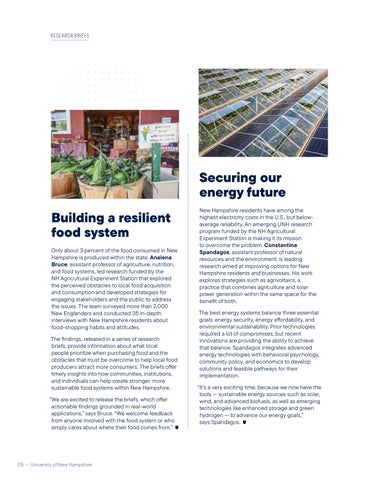
New Hampshire residents have among the highest electricity costs in the U.S., but belowaverage reliability. An emerging UNH research program funded by the NH Agricultural Experiment Station is making it its mission to overcome the problem. Constantine Spandagos, assistant professor of natural resources and the environment, is leading research aimed at improving options for New Hampshire residents and businesses. His work explores strategies such as agrivoltaics, a practice that combines agriculture and solar power generation within the same space for the benefit of both. The best energy systems balance three essential goals: energy security, energy affordability, and environmental sustainability. Prior technologies required a lot of compromises, but recent innovations are providing the ability to achieve that balance. Spandagos integrates advanced energy technologies with behavioral psychology, community policy, and economics to develop solutions and feasible pathways for their implementation. “It’s a very exciting time, because we now have the tools — sustainable energy sources such as solar, wind, and advanced biofuels, as well as emerging technologies like enhanced storage and green hydrogen — to advance our energy goals,” says Spandagos.