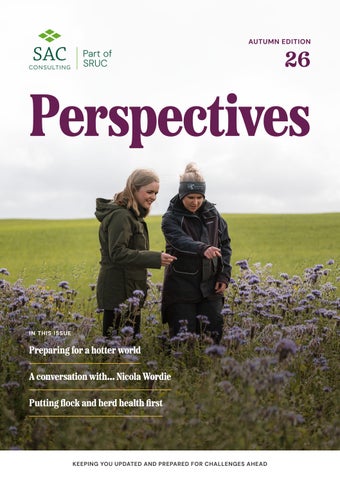
AUTUMN EDITION
26
Perspectives
IN THIS ISSUE
Preparing for a hotter world A conversation with... Nicola Wordie Putting flock and herd health first
KEEPING YOU UPDATED AND PREPARED FOR CHALLENGES AHEAD
Contents
3 6 10 14 18 22
Introduction CHLOE MCCULLOCH
The case for Scotland’s common grazing NIALL CAMPBELL
A conversation with Nicola Wordie Agritourism is transforming Scotland’s farms CALUM JOHNSTON
Putting flock and herd health first DAVID WILSON
Staff Spotlight KENNY MACLEOD
PERSPECTIVES | AUTUMN 2026
4 8 12 16 20 23
Preparing for a hotter world IAIN BOYD
Agritech in practice at Titaboutie Farm DAVID ROSS
Regenerative agriculture or just good farming? CHLOE MCCULLOCH
The hidden value of cover crops KIERAN NOLAN
Building Scotland’s innovation ecosystem MALCOLM HOSIE
Staff Spotlight KATRINA COUTTS
Introduction CHLOE MCCULLOCH, HEAD OF SAC CONSULTING
Agriculture has always been an industry shaped by change, though our perspective is inevitably a snapshot in time and we tend to experience the conditions we know as normal and change as something new. However, the difference now is the number of things changing at once: climate, policy, technology, markets, consumer expectations, and global instability are all evolving rapidly. Climate change is no longer something we can park in the ‘tomorrow’ box. The effects are here, influencing the conditions in which Scotland’s farmers must continue to run productive and viable businesses - as we have seen following the extreme weather of summer 2026. Undoubtedly, it is broadly true that where there are challenges, there are opportunities too. The story is not solely one of increased risk. If we can find ways to adapt quickly enough; there is potential for competitive advantage. As climatic conditions make production less reliable in some parts of the world, the ability to consistently produce quality food becomes more valuable, and Scotland has some considerable advantages here. Our climate, water, soils, and naturally sustainable mixed farming systems provide a strong natural resource base, matched by the skills, ingenuity and entrepreneurialism of the people who farm and manage it.
That said, being relatively well placed and presented with opportunity does not automatically make us resilient, or guarantee that we benefit from it. We must use resources productively - investing in the soils, animal health, technology, infrastructure, and skills that will determine our ability to keep producing successfully in less predictable conditions. That thinking runs throughout this edition of Perspectives. What strikes me is the breadth of what adaptation looks like in practice. Sometimes it means adopting new technology or finding new sources of income; in other cases, it means improving the health and productivity of existing systems or recognising the continuing value of farming practices that have worked for generations. It shows us that resilience is not a single intervention or a new farming system; it is the capacity to keep making good decisions as the circumstances around us change. Perhaps we also need to think differently about natural capital. Often, it is discussed as something agriculture must protect alongside producing food. More and more, I think our competitive advantage will come from recognising that the two are interconnected. Healthy soils, resilient farming systems, good animal health, effective technology, and strong rural businesses are all part of our capacity to produce high quality, healthy food. In an increasingly uncertain world, that capacity is an asset worth investing in.
Get in touch Chloe.McCulloch@sac.co.uk
3
Preparing for a
hotter world IAIN BOYD, SENIOR CONSULTANT, SAC CONSULTING
The summer of 2026 has been a real lived experience of the climate change that science has been telling us about for decades. Across Europe, record-breaking temperatures, prolonged droughts, and widespread wildfires led to significant human, economic and environmental costs. While impacts varied from region to region, the extreme conditions and one of the warmest summers on record showed that no-one is immune to the wider implications and disruptions. For the UK, 2025 was the hottest summer on record, and 2026 has been steadily breaking records. July brought prolonged high temperatures and widely recorded heatwaves. Nationally, the UK received just 19% of its average rainfall for July, while England and Wales received only 4%. Scotland was the least dry nation, but even here, rainfall reached only 41% of average. Meanwhile, an estimated 22,850 hectares had burned across 70 wildfires in the UK by the beginning of August, highlighting how climate-related risks are becoming more widespread. Agriculture remains one of the sectors most exposed to climate change, with higher temperatures, changing rainfall patterns and more frequent weather extremes impacting production. Across the UK, harvest occurred earlier, many spring-sown crops experienced heat stress, and water levels declined rapidly. The Agriculture and Horticulture Development Board’s first harvest report also suggest cereal yields are below the ten-year average, but outlook varies considerably by crop, soil type, and location. In Europe, France is expecting its smallest maize harvest in half a century, while major rivers including the Rhine and Danube experienced exceptionally low flows, disrupting irrigation, power supplies, and transportation. Retailers are expecting an increase in food prices, which were already under pressure due to conflict around the 4 PERSPECTIVES | AUTUMN 2026
world disrupting key supply routes. Prices for key produce such as olive oil are expected to remain volatile and rise further due to the conditions faced by producers. Globally, on top of existing climate extremes, a potentially record-breaking El Niño (expected to peak in 2027) is forecast to again make next year one of the hottest on record. This could intensify drought in already vulnerable regions, worsening food insecurity for hundreds of millions of people, according to the UN World Food Programme (WFP) and could push the world’s climate crisis into ‘uncharted territory’. The impacts of extreme weather extend well beyond the farm gate. The June 2026 heatwave is estimated to have cost the UK economy more than £1.15 billion, resulting in approximately 24 million lost working hours. Outdoor sectors such as agriculture were among the hardest hit, with temperatures reducing labour productivity, shortening working days, and increasing health risks for workers. Farmers and crofters have adapted well. However, with financial pressures, global insecurity and climate variability increasing, investment in more resilient farming systems is ever more important. Building resilience is now just as crucial as reducing emissions.
Healthier soils that retain moisture, more diverse
The sector is increasingly trying to juggle how to
rotations, improved water management, nature-based
minimise its impact alongside how to continue producing
solutions, and climate-resilient crop varieties can all
affordable food in a changing climate. For brands, it
help farms adapt while delivering wider benefits for
means working collaboratively with suppliers,
biodiversity, carbon sequestration, productivity,
understanding climate risks across value chains, and
and long-term business resilience.
embedding resilience alongside decarbonisation. Preparing for a hotter world is not solely about managing
For food manufacturers, retailers and
risk. It is also an opportunity to build stronger, more
drink producers, climate risks within
resilient businesses. Those businesses already investing
agricultural supply chains are rapidly
in resilient supply chains, sustainable sourcing, and
becoming commercial risks. Reduced
collaborative partnerships are likely to be better
yields, water shortages, and changing availability of
positioned for the future. Building climate resilience
key ingredients all have implications for procurement,
requires long-term investment and planning, with
pricing, and long-term investment decisions. This only
adaptation embedded in every decision. It must be
compounds issues already facing industry because of
fair and equitable, placing people at the centre of the
wider geopolitics. Climate resilience and adaptation
solution. That fairness also means acting now, before
planning are now mainstream business strategy.
the impacts become more severe, costly, and difficult to reverse.
The UK Government increasingly recognises climate change and ecosystem degradation as national security
The summer of 2026 should not be viewed as an
issues. Around half of the UK’s food is imported, leaving
isolated event. Instead, it offers a glimpse of the
consumers exposed to climate impacts affecting
operating conditions that agriculture and the food sector
agricultural regions across the world that can quickly
are likely to encounter more frequently from now on.
translate into food price volatility and supply shortages.
Businesses that act now will be better placed not only
The Government’s National Security Assessment warns
to manage future risks, but to build stronger, more
that continued degradation of globally important
resilient food systems for a hotter world.
ecosystems could contribute to water insecurity, reduced crop yields, loss of productive agricultural land and increasing geopolitical instability. Climate resilience is an essential component of economic and national resilience.
Get in touch Iain.Boyd@sac.co.uk
For the UK, 2025 was the hottest summer on record, and 2026 has been steadily breaking records.
5
The case for Scotland’s common grazing NIALL CAMPBELL, HEAD OF REGION, SAC CONSULTING
Recently SAC Consulting took a Scotland’s Farm Advisory Service (FAS) group of common grazing clerks and committee members from all over Scotland down to the north of England to learn how their peers manage the fell commons there. The visit turned out to be very thought-provoking and provided us with some key lessons for the future In both countries, common land is an especially important national resource – both socially and environmentally. In England, only 3% of the total land area is classed for ‘common use’. There are just under 4,000 registered commoners out of a total of around 100,000 farm holdings. However, that small overall percentage includes over 33% of England’s total moorland area, contains 21% of England’s designated sites and 12% of its scheduled ancient monuments.
In Scotland on the other hand, 9% of all farmed land is common grazing, with over 1,000 individual common grazings and 21,000 crofts. They cover 13% of Scotland’s Special Protection Areas (SPAs) and 30% of all land with over 2m of deep peat. So common land throughout the UK punches well above its weight for public goods. Managing common land has its own distinct set of challenges, with the main one being the decision-making process. These are run by committee, with many stakeholders able to influence decisions – often making it a slow-moving process. But, if you get a group that has aligned, it is possible that, with many shoulders to the wheel, great things can happen. Farmers and crofters taking ownership of their common land and driving it forward in a sustainable (environmental, social, and financial) manner is surely a key aspiration for this country. We partnered with the Foundation for Common Land on this trip, a charity that is doing some really impressive work in this space. They are involved in lobbying government, carrying out practical project work on common land, and providing tools to help manage that
Common land throughout the UK punches well above its weight for public goods
6 PERSPECTIVES | AUTUMN 2026
land such as the Moorland Surveying app.
So, if we wish to avoid similar issues in Scotland over the next few years, what do policy makers and lobbying organisations really need to pay attention to? 1. It is essential that future farm support, Tier 1, 2 and 3, does not exclude common land. Policy makers need to consider the funding options and the application route for common land from the start and not view it as a bolt-on at the end.
2. Additional support to get common grazing committees up and running and those in office working more efficiently. The Crofting Commission should work in partnership with advisory bodies to deliver regular training and support to common grazing committees.
3. To develop the evidence that common land has high environmental and social value, obtaining hard facts and data are essential. NatureScot used to monitor designated sites on a rolling five-year period. Developing apps such as the Foundation for Common Land moorland app (to allow those on the ground to record what they see daily) is a powerful and effective method. It also provides more local ownership and buys in to management plans. William Dawson, who has been working with the Foundation for Common Land and farms at Bleak Bank in the Yorkshire Dales National Park, highlighted a point that resonated strongly throughout the visit. “It is vital to not overlook the importance of the Commons to the people who rely on them. In our determination to rewild and regenerate, let us not be blind to the good that low input farming is already doing and has done for generations. Regenerative farming is
4. Use that raw data, analysed independently, to support positive management change, working alongside the common graziers on the ground. Encouraging and rewarding common grazings to work at landscape scale will unlock even more potential. Again, this needs to be promoted through support for groups who work together – both financial and in terms of practical training.
nothing new to Commoners, neither is the sincere pleasure they have in seeing the wild intermingle with the farmed landscape.”
Common grazing land in Scotland is a valuable asset to both the local graziers and to the nation, playing a vital
England is much further ahead in its redesign of their
role of the social and environmental fabric of the
package of farm support and that was clearly throwing
country. The decisions policy makers are currently
up some challenges to those managing that common
debating will have a huge impact on this asset. It is
land. The average fell farmer’s Basic Payment Scheme
important we do not waste this opportunity.
(BPS) has fallen from £30,000 per year to just £600 in 2026. Some of the new English farm support schemes exclude common land from any options – you have to wonder; did they just forget about this high value natural resource?
Get in touch Niall.Campbell@sac.co.uk 7
Agritech in practice at Titaboutie Farm DAVID ROSS, PRINCIPAL CONSULTANT, SAC CONSULTING
After spending years studying and working in the agricultural engineering and agritech industry, Daniel Robertson is now maximising what he has learnt for the benefit of the family farm. Alongside dad Andrew, he has spent the last decade introducing various agritech innovations to Titaboutie Farm in Tarland, Aberdeenshire, to help his family improve the way they manage it. They became early adopters for Electronic Identification
In 2022, the Robertsons’ business became one of two focus farms for an innovative project through Opportunity North East (ONE), a private sector economic development body focused on growing the economy in the north east of Scotland. ONE partnered with SAC Consulting and Scottish Agricultural Organisation Society (SAOS) to allow progressive farmers to demonstrate innovative market-ready digital solutions to improve productivity and transform farming. With Titaboutie being an upland unit, the focus has been on the beef and sheep enterprises rather than arable. At the start of the project, the business was already using a range of technology, including EID for both cattle and sheep, cameras in the calving sheds, livestock records being kept digitally and GPS mapping for spreading fertiliser.
(EID) in cattle and sheep and have continued evolving ever since – benefiting from efficiency gains, streamlining of resources and a bank of reliable data as a result. The farmed area totals 384 hectares, with 100 owned by the family and the majority tenanted from the MacRobert Trust. It is run by Andrew, who has farmed at Titaboutie for four decades, and Daniel, who has returned home to make the most of his skillset and agritech experience and has a clear understanding of the suitability and robustness of the tech for a working farm. Their livestock enterprise includes 140 head of Simmental X and Angus X Autumn calving cows and 600 ewes of Highlander and Aberfield genetics. They also grow forage crops and some arable cropping.
8 PERSPECTIVES | AUTUMN 2026
The first step in the project was appraising and benchmarking the livestock enterprises with the assistance of livestock experts at SAC Consulting. Gaining the data for the benchmarking was made simple, through years of gathering computerised farm records. The analysis of this benchmarking allowed the business to understand areas that were not contributing as much as others and identify pinch points. Those key pinch points included autumn calving, which often results in higher risk of illness in housing the young cattle - though it fits the labour availability much better to avoid the spring peak.
“We found that asking ourselves three key questions was helpful in getting started - what currently takes too long, where is efficiency lost, and how are you going to use the data to make decisions? From there, finding workable solutions and testing them out is a much more straightforward process. For us, with various technologies in place, the business is seeing valuable benefits, such as efficiency gains and reduced labour.” Two items of technology invested in to aid the health of young calves in the shed during the winter include ScourCheck and SmartBell Health Tags. ScourCheck is a simple tool which, using a sample of faeces, can quickly Another area to address was finding passengers within
help to detect Rotavirus, Coronavirus, ‘E. coli’ F5 and
the sheep system – those only rearing 30kg lamb per
Cryptosporidium. SmartBell Health tags also assist with
year but going under the radar.
early identification of a health problem in the young calves by monitoring their temperature and movement.
The initial technologies deployed included, a LoRoWAN
Through this technology, they tackled the autumn calving
gateway, which enables network coverage across the
challenges by reducing the health risks associated with
entire farm. This meant additional technologies could be
housing, allowing them to make better use of available
deployed, for example weather stations or grain and soil
farm labour and reducing pressures on the spring peaks.
sensors. Various other technologies have also been invested in, As a result of the soil sensors, spring fertiliser was
including the Te Pari Autodrencher, which helps with the
applied three weeks earlier than normal, reducing feed
dosing of cattle and sheep, and ClipFitter, which has
costs for the sheep and increasing the volume of silage
been used successfully for castration and tailing of
harvested.
lambs.
The Robertsons were also able to save time through their
Peter Cook, ONE Agritech and Supply Chain Lead, said,
use of the Autodrafter and Combiclamp, supplied by
“This project is about testing ready-for-market
Ritchies. The kit, which is used to gather flock
technologies on real farms. At Titaboutie, the
information, is now used for 90% of the sheep
Robertsons embraced every aspect, and we are
management tasks and can automatically gather data
delighted that they are seeing tangible results which
without using labour to do so. This data enabled the
others across the industry can learn from too.
creation of A and B flocks - performance could be analysed so that the best ewes were put into one flock,
“Our evaluation showed tens of thousands of financial
and the others managed accordingly.
gains from modest but well-implemented investment. We are now looking forward to the next phase of the
For the cattle side, a beef monitor was also sourced from
project and working with more farmers who are keen
Ritchies. This automatically weighs cattle when they go
to see how they might test and find value in innovative
to the incorporated water trough and measures the
technology on farm.”
water intake. The benefits have included no overweight cattle and, subsequently, no penalties - which has alone
For more information on the ONE Agritech project, to
justified the cost of the machine.
view evaluations of the technologies used at Titaboutie, or to find out about the next phase of this project, please
Daniel Robertson said,
visit ONE Agritech Programme.
“Though there is no silver bullet to create efficiency in any farming system, we have found that appraisal and analysis of the areas needing improvement is always the first step to making progress. Integrating data collection into our everyday farming processes has been transformative.
Get in touch David.Ross@sac.co.uk 9
A conversation with
Nicola Wordie For Nicola Wordie, farming and storytelling go hand in hand. Whether she is lambing ewes, trialling new technology or speaking openly about mental health, she has built a platform that offers people an honest glimpse into modern farming. Through her social media channels, Nicola has earned a loyal online following, yet her focus has always remained on helping people better understand the work, care, and commitment behind food production.
“I’m only 27, so to be a partner is quite a big thing. My parents have been my biggest inspiration and I’m very grateful that my dad trusts me enough to give me that kind of responsibility in the business.” Having started her social media channels in 2021 under the name Livestock FarmHER, Nicola initially set out to tackle what she saw as a growing disconnect between farming, food and the public. What began as a way of documenting daily life on the farm has grown into a significant platform, offering thousands of followers a window into everyday farming. From lambing and calving to difficult days and hard decisions, Nicola deliberately shares both the highs and the lows. “It was 2021, just on the back of COVID-19. Farmers were being blamed for a lot of things, and I felt that the gap
A third-generation farmer based near Huntly in
between the consumer and the producer was getting
Aberdeenshire, Nicola farms alongside her father on the
bigger. I have always maintained that it is so important
farm her grandfather purchased in the 1950s. Today, the
to share the good and the bad. When I started on social
1,400-acre business is home to around 240 suckler cows
media, I really did not think it would grow like it has.”
and 1,000 breeding ewes. Alongside building a loyal online following, her work has While farming has always been part of her life, it was
also gained industry recognition. This year, Nicola won
never something she took for granted. When she was 11
SRUC’s Fordyce Maxwell Award for Agricultural
years old, her parents gave her the opportunity to have
Communications and, in 2025, she won the Sheep
an animal of her own on the farm. Nicola chose two pigs;
Farmer of the Year Award at the British Farming Awards
fully aware they would eventually become food.
- an achievement that came as a surprise.
“I remember Mum said that this would either make or
“I didn’t in my wildest dreams think that we would win
break the farmer in me - I’ve never looked back since.”
these awards, but to be recognised by my industry peers is really special. I’m so proud to be a farmer.”
Today, her role on the farm has evolved considerably. She has primary responsibility for the sheep enterprise and
Her willingness to be open online extends beyond
became a business partner this year.
farming itself. Over recent years, Nicola has spoken honestly about wellbeing, grief and mental health,
10
PERSPECTIVES | AUTUMN 2026
topics she believes deserve far more attention across
“If you have a dream and you have passion and you put
agriculture.
your mind to it, you can 100% do it. Back yourself is what I always say.”
“I think particularly in farming, it’s an extremely high-pressure, high-stress environment. It can also be
Looking ahead, Nicola remains focused on what brought
lonely for a lot of people. I’ve built a really supportive
her into farming in the first place: caring for livestock,
community for myself and other farmers, where we feel
growing the family business, and continuing to share her
safe to be able to speak about how we’re feeling.”
own experiences as part of her story.
Those conversations have also been shaped by her own experiences in recent years. Following the loss of her mum, Nicola found herself navigating grief whilst continuing to farm. “All I wanted to do was curl up in a ball and not leave the house, but you can’t because the livestock rely on you.” For Nicola, that responsibility is also one of the most rewarding parts of the job. “I’m most proud of being able to help my animals and new life come into the world, watch them grow and thrive, knowing exactly what has gone into each animal.” While the values behind livestock farming remain unchanged, the way farm operates is always evolving. The farm is increasingly embracing technology, from sheep management systems to cattle monitoring boluses that provide real-time health data. Nicola is often the one leading technology adoption on the farm, but she sees innovation as complementing, rather than replacing, stockmanship. “One thing you can’t do in farming is stand still.” With a growing profile and visibility in agriculture, Nicola is also helping to challenge perceptions about who belongs in farming. She recalls occasions when visitors would arrive at the farm asking to speak to ’the farmer‘ or ’the boss‘, assuming it could not be her. “There are a lot of people who are branded as the farmer’s wife or the farmer’s daughter. And they are doing every bit as much work, if not more. I can do the job, and I can do it just as well as anyone else..” Through her online presence, she hopes to engage the younger generation to show that farming is open to
I remember Mum said that this would either make or break the farmer in me - I’ve never looked back since.
anyone with the passion and determination to pursue it.
11
Regenerative agriculture or just good farming?
CHLOE MCCULLOCH, HEAD OF SAC CONSULTING
There is seemingly no bigger topic in farming currently than regenerative agriculture, and simultaneously few subjects which generate such a wide range of interpretations, combined with a very rapid development of diverse expectations.
In any area where we urgently want to see progress, it is natural to focus on what needs to be done, rather than on what has been achieved already. But, if you are measuring regenerative agriculture as farming that leaves land in consistently better condition each year with systems more resilient to climate change, then we are already making huge strides as an industry.
At SRUC, we are fortunate to have real experts who can speak with authority on enhancing biodiversity, soil health, greenhouse gas emissions, and a host of other areas that sit within ‘regenerative agriculture’. However, it is an area that necessarily must blend scientific knowledge, national ambition and adoption on the ground across the wider industry. With colleagues working daily with farmers and crofters across Scotland, I see the risk that this ambiguity brings in terms of the rate of implementation and change. There is good practice in evidence all around us. Many farmers are already delivering outcomes that would readily be described as regenerative but often seem overlooked because they were not adopted under the banner of regenerative agriculture. This seems at odds with genuine progress – if our objective is environmental improvement, then outcomes matter more than labels. The obvious challenge is agreeing on what we mean by ‘regenerative’. Asking industry colleagues for their own understanding of the term will get several different answers. The dictionary definition implies renewal or restoration, yet this suggests we are somehow seeking a return to a fixed point in our past, which is an overly simplistic objective amid a growing population. 12
PERSPECTIVES | AUTUMN 2026
Farming changes slowly - even 20 years is shortterm. In the early 2000s, dairy farms typically had just six weeks of slurry storage and spread it carelessly, often onto frozen ground. Today, slurry is valued as a nutrient source, with better storage and low-emission spreading reducing losses and cutting costs. This shift took decades of research, regulation, grant-funded investment and knowledge exchange between researchers, advisers and farmers.
Many of the environmental challenges we now seek to address have developed over decades and it is unrealistic to expect them to be solved instantly. Equally, it is rarely effective to motivate change by criticising previous generations for operating with the knowledge and expectations of their time, or for criticism of current generations for not immediately implementing an often complex investment requiring knowledge, time and capital.
Progress is most likely when people feel supported, rather than blamed, and valued for the role they can play. Today’s farmers are being asked to deliver more than ever before: food production, climate mitigation, climate adaptation, biodiversity enhancement, landscape management, animal welfare, rural employment and downstream jobs. These are legitimate societal ambitions, but it should not surprise us that delivering them simultaneously can be challenging. To achieve this, we must recognise that farmers are at different stages of the journey. Some businesses are already well advanced in adopting new approaches and should be recognised for the progress they have made, while others are only beginning to consider change.
Farmers must have confidence that the proposed solutions are practical, evidence-based and capable of delivering results with their land type, their livestock breeds and their own farming system. Building that confidence is every bit as important as providing information.
We must also recognise that regenerative practices often involve investment in infrastructure, machinery, skills or time. Changes create cost and introduce risk. Though farmers may want to change their systems or practices, the reality is that any long-term investment is only possible when short-term viability is secure. Adapting to future challenges is essential for long-term sustainability, but no business succeeds if the process of adaptation itself threatens its survival. Consumers increasingly demand sustainable food, retailers increasingly need to demonstrate environmental credentials and governments increasingly expect agriculture to deliver public benefits alongside food production. Farmers can - and should - play a leading role but expecting primary producers alone to absorb the costs of delivering varied and extensive public goods is unlikely to accelerate progress at the desired pace. If society requires more rapid adoption of different practices, we need serious conversations about how these costs are shared across the supply chain. Equally, narratives which portray farming as inherently damaging, even well-intended attempts to convey urgency for change, can be counterproductive. Beyond alienating the very people whose participation is essential, they risk undermining consumer confidence in Scottish produce and, in doing so, they impact the commercial feasibility of further environmental improvement.
Regenerative farming should not be defined by adherence to a particular philosophy. It is about farming in a way that ensures the next generation receives the farm in better condition than their predecessors inherited it. I have yet to meet a farmer for whom this does not resonate. At its heart, regenerative agriculture is simply modern agriculture: productive, environmentally responsible, resilient, high welfare and economically sustainable. The most successful farms of the future will not choose between food production, nature recovery and climate resilience – they will deliver all three, routinely, considering their methods to be ‘just good farming’. The real challenge is not persuading farmers to become regenerative. It is recognising that many already are and helping the rest of the industry move further and faster in the same direction.
Get in touch Chloe.McCulloch@sac.co.uk 13
Agritourism is transforming Scotland’s farms CALUM JOHNSTON, SENIOR CONSULTANT, SAC CONSULTING
Located on the outskirts of Strathaven in Lanarkshire is the family-run Nether Lethame Farm. With their herd of Jolly Jersey cows, they produce a range of dairy products on site that can be bought from vending machines from 7am to 9pm. Milk, eggs and ice cream are all on sale - fresh from the farm and ready to grab at the consumer’s convenience. Nether Lethame Farm is just one of around 900 farms across Scotland that are actively involved in the agritourism sector which is thriving across the country. The most recent figures reflect continued growth, with 2.5 million people visiting farms and crofts every year, and a combined sector value of almost £300 million
So, is agritourism an opportunity farmers are looking for and what effect will this diversification approach have on the sector as a whole? The overarching view of those visiting the conference from overseas was that Scottish farmers are extremely forward thinking, innovative, always looking for new ideas and opportunities. The shift is one I have watched play out in my own workload. Specialising in diversification, I’ve spent the past three years increasingly consumed with business plans and planning applications - for clients, funders, and planners navigating exciting change in the industry. Three years ago, this work made up perhaps a fifth of my time. Today, it is closer to 60%. The momentum behind consumer desire to know where their food comes from, its sustainability and heritage shows no signs of slowing down. Accommodation is vibrant and evolving too. Visitors now want immersive, personalised experiences that go further than just a room for the night. Farm tours, yoga retreats, saunas,
annually.
private dining experiences and wellness packages are
Earlier this year, the inaugural Global Agritourism
for farmers and crofters to share their unique stories,
Conference took place in Aberdeen with delegates descending on the Granite City from more than 50 countries around the world. It is well understood that rising costs and climate challenges continue to place financial pressures on traditional farming enterprises.
14
PERSPECTIVES | AUTUMN 2026
all on trend. These represent significant opportunities landscapes, and heritage, add value to their produce and capitalise on emerging wellness trends.
Growth is also not limited by competition within the sector because every farm and family is different. You can go to one farm, enjoy a quad bike tour where you are taken up the hills to see Blackface sheep, while, along the road, you can stay at a farm-based yoga retreat enjoying produce grown in an organic market garden. We know both domestic and international tourists want to escape into the countryside and experience real-life working farms, explore regional culture and heritage and sample a range of local produce on offer, and to explore local villages, towns, and cities during their stay.
Growth is also not limited by competition within the sector because every farm and family is different
There are always going to be challenges and administrative hurdles to overcome. Greater access to grant funding and a slicker planning system are examples that could catalyse further growth. As agritourism businesses grow and become more successful, they have a significant multiplier effect and benefit to the rural economy, bringing more jobs and prosperity to rural communities. At the farm gate, there is a more fundamental benefit from agritourism in bringing additional revenue and profitability to a farming business. Furthermore, agritourism can both support and secure succession. Encouragingly in Scotland, there is a growing trend of the younger generation coming back to the farm and driving forward new enterprises, with agritourism at their strategic heart. Farm retail, vending, sports activities, dog parks, private dining experiences, farm and croft tours, and wellness retreats, are just some examples of the opportunities. Marshall’s Farm Shop and Kitchen in Aberdeenshire is a fantastic example of the close ties between agriculture, agritourism, and succession. Farmer Kenny Marshall and his wife Moira have grown the business substantially since the late 1970s, and it now includes a large restaurant, butchery, drive-thru, dog park and gift shop, with farm produce at its core. As part of the farm’s evolution, daughters Christine, Julie and Shona each have responsibility for part of the operation, and it has been a resounding success. With clear roles and responsibilities, they can drive their own areas forward with enthusiasm, develop themselves, and their staff, their individual areas of the business while creating opportunities for future generations within the family enterprise. If you would like to discuss how agritourism can help to move your business (or your succession plans) forward – get in touch.
Get in touch Calum.Johnston@sac.co.uk
15
The hidden value of cover crops KIERAN NOLAN, AGRICULTURAL CONSULTANT, SAC CONSULTING
Greening measures have encouraged many Scottish farmers to establish green cover crops for the first time. As agriculture adapts to new environmental expectations, these crops are proving that their real value lies not in meeting compliance obligations, but in helping businesses become more productive and resilient. Scottish agriculture is entering a period of notable change. As agricultural support evolves, farmers are being encouraged to balance farm output and food production with climate action, biodiversity enhancement, and improvements to natural capital. Measures introduced through greening requirements as part of the Basic Payment Scheme (BPS), alongside the longer-term transition towards the Scottish Government’s ‘Vision for Agriculture’, are reshaping how land is managed. For many businesses, this has meant establishing green cover crops that may not previously have been a feature of their rotations. Initially, these crops were often viewed as another compliance requirement. Increasingly, 16
PERSPECTIVES | AUTUMN 2026
however, experience on farms is demonstrating that they can deliver far more than environmental credentials. Thus, the conversation is shifting from obligation to opportunity. As a result, many farmers are beginning to view cover crops as an opportunity rather than a requirement. For livestock businesses, cover crops can transform how land is utilised throughout the year. Species such as forage rape, kale, stubble turnips, and multi-species mixtures provide valuable grazing during autumn and winter when grass growth slows, helping reduce pressure on conserved forage and extending the grazing season. When integrated into the grassland renewal process,
they provide an effective break crop prior to reseeding,
by limiting the movement of sediment and nutrients into
improving sward performance while producing a valuable
watercourses. These are outcomes that extend well
source of home-grown feed. These crops can also help
beyond the farm gate, benefiting the wider rural
reduce reliance on purchased feeds, improving both
landscape and the communities that depend upon it.
business resilience and resource efficiency.
Their benefits, however, extend well beyond livestock nutrition.
Increasingly, farmers are recognising that environmental improvements and commercial performance can go hand in hand.
Healthy soils are fundamental to productive farming, and
Farmers across Scotland are increasingly recognising
cover crops can play a significant role in protecting and
that a well-planned cover crop can perform several roles
improving them. Deep-rooting species help relieve
simultaneously. The same field can produce winter
compaction, improve soil structure, and increase organic
forage, recycle nutrients, protect soils, support
matter, while living roots continue to support soil biology
biodiversity, and prepare the ground for the following
long after the main crop has been harvested.
crop. Rather than taking land out of production, these crops demonstrate how every hectare can contribute to
As weather patterns become increasingly unpredictable,
both business performance and wider public benefits.
these benefits are becoming ever more significant. Soils
Improved soil health, cleaner water, greater biodiversity,
that retain structure are generally better able to cope
carbon storage, and reduced flood risk all help create
with both prolonged wet periods and summer drought,
healthier, more resilient rural environments while
improving resilience across the farming system.
strengthening the long-term resilience of Scotland’s food production systems.
Nutrient management offers another compelling example. By capturing nutrients that might otherwise be
Future agricultural policy is expected to place greater
lost over winter and recycling them back into the soil,
emphasis on measurable outcomes, rewarding
cover crops improve nutrient-use efficiency by ensuring
businesses that demonstrate improvements in areas
plants absorb more nutrients by capturing and recycling
such as soil health, biodiversity, and carbon management
valuable nutrients that would otherwise be lost. This
alongside efficient food production. Farms already
reduces the risk of diffuse pollution. Success with cover
integrating multifunctional cover crops into their
crops still depends on good management. Soil testing,
rotations will be well placed to adapt because they are
appropriate fertiliser applications, and careful species
investing in the long-term resilience of their land, not
selection remain essential, but these crops demonstrate
simply responding to policy.
how production and environmental objectives can work together rather than compete with each other for
What began for many as a response to changing support
already-stretched farm resources.
mechanisms is increasingly becoming part of good farm business management. The most resilient farms of the
The wider environmental benefits are equally important.
future will not separate productivity from environmental
Flowering species can provide valuable forage for
stewardship - they will recognise that one depends on
pollinating insects, while diverse cover crops create
the other. Cover crops show that the same hectare of
habitats for birds, bees, earthworms, and other beneficial
land can produce food, strengthen natural capital and
species during periods when many arable fields would
support thriving rural communities. In a changing climate
otherwise remain bare. Protecting soils from
and policy landscape, the ability to deliver multiple
erosion and reducing surface runoff also
outcomes from the same parcel of land may prove to
contributes to healthier rivers and lochs
be one of Scottish agriculture’s greatest strengths.
Get in touch Kieran.Nolan@sac.co.uk 17
Putting flock and herd health first DAVID WILSON, VETERINARY MANAGER, SRUC LIVESTOCK HEALTH SCHEMES
When buying and selling sheep, performance figures, pedigree records, and visual appraisal have always been uppermost in buyers’ minds. Increasingly, health status matters just as much. Whether producers are breeding pedigree or commercial replacements, buyers want reassurance that they are not introducing costly disease into their flocks.
The commercial value of health status should not be underestimated. Many buyers now actively seek stock from flocks participating in recognised health schemes, which means breed societies and commercial buyers can view documented disease monitoring and accreditation as evidence of good flock management. For three decades, SRUC Vet Services has been helping livestock businesses through its nationally and internationally recognised health schemes, offering a range of disease-control programmes for sheep, goats, and cattle. These programmes are designed to help farmers improve herd and flock health, productivity, and marketability. Already well known as the UK’s largest supplier of cattle disease accreditation through the Premium Cattle Health Scheme (PCHS), SRUC also has a
Of course, disease control matters for animal welfare,
vital role to play in the sheep and goat industry.
but it is just as important from a business perspective. Chronic infectious diseases can quietly reduce flock
The Premium Sheep and Goat Health Scheme (PSGHS)
performance through lower fertility, poorer growth rates,
provides a structured framework for establishing flock
increased culling, and reduced longevity. Often, these
disease status and guiding disease reduction,
losses accumulate gradually and may be mistaken for
eradication, and certification programmes. Through
management or nutritional issues.
regular testing, expert interpretation, and clear biosecurity guidance, PSGHS accreditation and monitoring schemes can help producers understand their flocks’ health status and make more informed management decisions. Working closely with the farms’ own veterinary practices, the scheme provides a recognised certification that can be used to demonstrate flock health to prospective buyers. This matters because a number of infectious diseases can adversely affect sheep populations, including maedi visna (MV), Johne’s disease, enzootic abortion of ewes (EAE) and, for goats, caprine arthritis encephalitis (CAE).
18
PERSPECTIVES | AUTUMN 2026
Infected sheep may appear healthy (while still posing a risk) and often test negative in the earlier stages of disease. That means health declarations based solely on point-of-sale individual testing or visual assessment are of limited value. The PSGHS Johne’s Monitoring Scheme provides a structured method of disease surveillance, helping producers identify problems earlier and giving buyers confidence that health risks are being actively assessed. For breeders who are marketing replacement females or rams, monitored status can provide a valuable point of differentiation in an increasingly health-conscious
Maedi visna Maedi visna is a significant infectious disease affecting sheep breeding enterprises. SRUC data from the testing of non-accredited flocks suggest that 10% or more may
marketplace.
Monitoring or accreditation? PSGHS offers both accreditation and monitoring
harbour the MV infection.
schemes. Accreditation remains the highest recognised
MV is a chronic viral disease affecting the lungs, nervous
breeders, flocks selling through accredited sales, and
system, and overall productivity of infected sheep. There is no cure and no vaccine, and infected animals remain carriers for life. The disease can spread silently within flocks before clinical signs become obvious, making prevention and surveillance particularly important. For many producers, the greatest risk comes from buying apparently healthy breeding animals which turn out to be carrying infection. Once introduced, MV can be difficult and costly to eliminate. Participation in the PSGHS MV Monitoring Scheme demonstrates that a flock is undertaking annual targeted testing and following recognised biosecurity protocols. This provides confidence for buyers looking to minimise the risk of introducing disease through purchased rams or replacement females. Early detection through monitoring can also allow flock owners to act before
health status and is particularly important for pedigree businesses exporting stock. However, SRUC also recognises that many commercial producers want practical, affordable tools to manage disease risk without necessarily working towards full accreditation immediately - which is where the PSGHS Monitoring Schemes for maedi visna and Johne’s disease play an increasingly valuable role. Monitoring programmes involve regular targeted screening and biosecurity requirements that provide evidence of ongoing disease surveillance. Although monitored status is distinct from accredited status, it offers buyers valuable reassurance that flock health is being actively managed and that disease risks are being assessed on a continual basis.
infection becomes widespread.
Disease accreditation and monitoring should not be
Monitored status does not replace full MV accreditation,
wider flock improvement strategy.
but it offers a practical route for commercial breeders who wish to demonstrate a proactive approach to flock
viewed simply as a testing requirement, but as part of a
For sheep producers looking to safeguard performance
health.
while adding value to breeding stock sales, the message
Johne’s disease
bring greater market confidence and offer a clear path to
Johne’s disease presents a different, but equally
is clear: practical, proven routes to improve flock health long-term investment success.
important, challenge. Caused by mycobacterium avium subspecies paratuberculosis, Johne’s disease reduces an animal’s ability to absorb nutrients efficiently. The result can be poor body condition, reduced productivity, and increased culling rates. As with MV, the disease
Get in touch HealthSchemes@sruc.ac.uk
typically progresses slowly and may remain undetected for years within a flock. 19
Building Scotland’s innovation ecosystem MALCOLM HOSIE, HEAD OF COMMERCIALISATION AND INNOVATION, SRUC
Wherever I visit on my travels, it never seems to be far from a new innovation centre taking shape. Innovation centres have become a common vehicle for universities, private networks and public agencies to drive growth, foster collaboration, and accelerate new ideas. An innovation centre is best defined as a dedicated physical or virtual space where businesses, researchers and entrepreneurs collaborate to develop ideas, technologies, and products. The goal is to use centralised and focused resources to increase economic productivity and prosperity through commercialisation of innovation. SRUC already has several innovation infrastructure projects, and we are now facilitating a closer working relationship between these by combining them into an innovation ecosystem, built around six key thematic areas. This includes innovations in the fields of crop science, dairy, health and aquaculture, livestock, and food and drink. This innovation ecosystem, which connects existing and emerging components of SRUC, reflects our combined strengths in research, academia, and commercial business.
So, what sets our innovation offering apart? Three things: place, people, and capabilities. Each is a special component of SRUC and key to our vison of driving innovation to help shape the natural economy.
Place Rather than drawing activity to a single location, by joining our thematic innovation areas together, we are directing opportunities across multiple locations. This aligns with SRUC’s place-based strategy and can be seen in our Rural and Veterinary Innovation Centre in Inverness right down to our Dairy Nexus facility in Dumfries.
People The importance of skills is paramount, and this is the bedrock of our ambition to use the whole ecosystem to help bring skills and innovation together. SRUC’s innovation ecosystem draws on the expertise of consultants, researchers, academics and students, creating opportunities for collaboration, knowledge exchange and impact. It’s a big part of what makes us unique.
Capabilities Everything from our high throughput veterinary testing facilities and our farms, to our world-class global livestock research. Consultancy services in areas like food and drink are reflected and reachable in our innovation offering. These resources provide opportunities to develop, test, and scale new ideas. 20
PERSPECTIVES | AUTUMN 2026
One Health & Agriculture
Pigs & Poultry
Crops & Arable
The SRUC Innovation Centres Dairy
SRUC’s innovation centre network provides dedicated leaders who support collaboration across these key sectors, access funding, world-leading research, expertise, technologies, and facilities through a single front-door approach. By connecting needs with SRUC’s multidisciplinary capabilities, the innovation ecosystem will also support the commercialisation of research and broader institutional innovation, helping turn new ideas into real-world impact. They create opportunities for learners to innovate, test ideas, develop start-ups, explore AI, and tackle practical challenges, whilst working alongside initiatives like our Enterprise Academy to strengthen links between education and industry. In doing so, SRUC prepares students to lead change and contribute to innovation through engagement with established and emerging partners.
Beef & Sheep
Food & Drink
Our key themes working in unison provide an important platform for developing innovations and solutions. In this regard, our goal to address these challenges is also underpinned by entrepreneurial spirit and a deep desire to establish strong partnerships and collaborations on a national and global scale. So, whether your focus is skills development, new livestock management systems, data innovation, or progressing an emerging idea, the SRUC Innovation Centres and our wider innovation and research ecosystem offer a route to relevant expertise, resources, and collaborative opportunities for your business.
Get in touch Malcolm.Hosie@sruc.ac.uk 21
Staff Spotlight
Kenny Macleod AREA MANAGER AND SENIOR CONSULTANT
Specialist expertise • Crofting and rural development • Local government and public policy • Grants and funding applications
What was your career journey into this role? I have had a very varied career over the years. I worked as a reporter with BBC Radio nan Gàidheal in Inverness for eight years before moving into politics, working for Angus MacNeil MP and Alasdair Allan MSP. I have also served as a local councillor for the West Side and Ness ward since 2012 and have been Convener of Comhairle nan Eilean Siar since 2022. Between my work in broadcasting, politics, and local government, I have met and worked with people from all walks of life. It has given me a genuine appreciation of both the opportunities and challenges that come with living and working on the islands.
Why did you come to work at SAC Consulting? Having been a crofter for the past 25 years, I’ve always been familiar with the work of SAC Consulting and the support it provides to crofters and farmers across Lewis and Harris. I was a subscriber from my early crofting days and always thought highly of the work the organisation did. When the opportunity came up to join the team, it felt like a good fit. It brings together a lot of the things I’m interested in - crofting, supporting local communities and helping people look at ways to develop their businesses.
If you could do anyone else’s job here, who would it be, what is their role and why? Every day brings something new, but I am particularly interested in the specialist work being carried out across rural development and agricultural innovation, as these are areas with significant potential to benefit island communities.
What work (in your current role) are you most proud of and why? My biggest achievement so far has been successfully becoming familiar with the systems, processes and breadth of work involved. It has been challenging at times but equally rewarding. It’s still early days, but I am looking forward to working with colleagues and clients and doing what I can to support crofting across the islands.
If you had one wish, to be used to better the industry, what would you wish for? That is an easy one, more funding and less form-filling! Anything that gives farmers and crofters more time to focus on their businesses can only be a good thing. I would also like to see more young people coming into farming and crofting, because they are the future of our communities.
Get in touch Kenneth.Macleod@sac.co.uk 22
PERSPECTIVES | AUTUMN 2026
Staff Spotlight
Katrina Coutts AGRICULTURAL CONSULTANT
Specialist expertise • Carbon audits • IACS and grant applications • Livestock systems and nutrition
What was your career journey into this role?
What work (in your current role) are you most proud of and why?
I studied for an HND in Agriculture at SRUC Oatridge before continuing to do the BSc at SRUC Craibstone (slightly closer to home for me!). I graduated in 2025 with a firstclass honours in BSc Agriculture. Between my third and fourth year I took part in the SRUC Trainee Trust Scheme, completing a summer internship in the Lerwick SAC Consulting office. The internship allowed me to see the variety of work involved in a consultancy role and I was delighted to be offered a full-time position after finishing my studies.
I am most proud of the Preparing for Sustainable Farming (PSF) carbon audits I completed in 2025 when I first joined the business. I completed 163 audits in the first five months of joining SAC Consulting permanently. It is great to have been able to assist crofters and farmers in Shetland with receiving a funded carbon audit.
Why did you come to work at SAC Consulting? A consultancy role has always appealed to me because it allows me to support and advise crofters and farmers while helping them achieve positive outcomes for their businesses. The consultant role involves such a wide variety of work and continual opportunities to learn. One of the aspects I value the most about SAC Consulting is the wealth of expertise across the organisation, with colleagues and specialists who are always willing to share their knowledge and support you to develop professionally.
If you had one wish, to be used to better the industry, what would you wish for? My wish would be for agriculture to be recognised not just for what it produces, but for how it produces it. In Shetland, many crofting and farming businesses operate extensive systems that may appear less efficient when measured purely on output or carbon emissions, but they deliver significant environmental benefits and help maintain our unique landscapes and rural communities. I would like to see these wider benefits better recognised and rewarded, allowing rural businesses to remain productive, sustainable, and resilient for future generations.
If you could do anyone else’s job here, who would it be, what is their role and why? I really enjoy livestock related work, so I’d like the opportunity to work in one of the livestock specialist roles. I’ve been lucky to have opportunities to work alongside various specialists already through rationing work and writing livestock articles.
Get in touch Katrina.Coutts@sac.co.uk 23
Find your nearest SAC Consulting Team
Lerwick
Thurso Kirkwall Stornoway
Elgin Turriff Balivanich
Portree
Thainstone
SRUC Aberdeen
Inverness
Stonehaven
Perth
Forfar
Oban Cupar Stirling SRUC Edinburgh
Campbeltown
Ayr
Edinburgh Lanark
St Boswells
Dumfries
Stranraer
SAC Consulting, Peter Wilson Building, The Kings Buildings, West Mains Road, Edinburgh, EH9 3JG www.sac.co.uk @SACConSol
@sacconsulting
Perspectives is printed on a FCS accredited paper made from responsibly sourced virgin fibre wood pulp.