ENGAGING READERS THROUGH STORYTELLING WITH REGIONAL LEADERS
In
Conversation
TRENDS IN HIGHER EDUCATION IN SARASOTA AND MANATEE COUNTIES
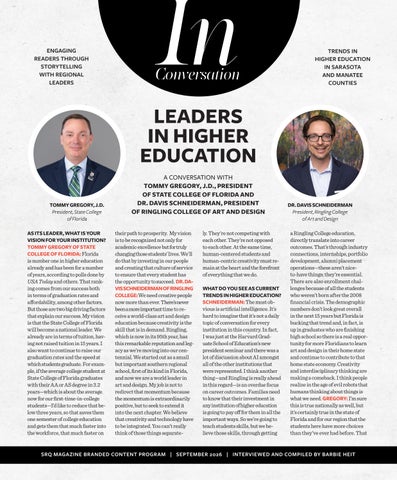
LEADERS IN HIGHER EDUCATION TOMMY GREGORY, J.D. President, State College of Florida
AS ITS LEADER, WHAT IS YOUR VISION FOR YOUR INSTITUTION? TOMMY GREGORY OF STATE COLLEGE OF FLORIDA: Florida is number one in higher education already and has been for a number of years, according to polls done by USA Today and others. That ranking comes from our success both in terms of graduation rates and affordability, among other factors. But those are two big driving factors that explain our success. My vision is that the State College of Florida will become a national leader. We already are in terms of tuition, having not raised tuition in 15 years. I also want to continue to raise our graduation rates and the speed at which students graduate. For example, if the average college student at State College of Florida graduates with their AA or AS degree in 3.2 years—which is about the average now for our first-time-in-college students—I’d like to reduce that below three years, so that saves them one semester of college education and gets them that much faster into the workforce, that much faster on
A CONVERSATION WITH TOMMY GREGORY, J.D., PRESIDENT OF STATE COLLEGE OF FLORIDA AND DR. DAVIS SCHNEIDERMAN, PRESIDENT OF RINGLING COLLEGE OF ART AND DESIGN their path to prosperity. My vision is to be recognized not only for academic excellence but for truly changing those students’ lives. We’ll do that by investing in our people and creating that culture of service to ensure that every student has the opportunity to succeed. DR. DAVIS SCHNEIDERMAN OF RINGLING COLLEGE: We need creative people now more than ever. There’s never been a more important time to receive a world-class art and design education because creativity is the skill that is in demand. Ringling, which is now in its 95th year, has this remarkable reputation and legacy as we’re moving into our centennial. We started out as a small but important southern regional school, first of its kind in Florida, and now we are a world leader in art and design. My job is not to redirect that momentum because the momentum is extraordinarily positive, but to seek to extend it into the next chapter. We believe that creativity and technology have to be integrated. You can’t really think of those things separate-
ly. They’re not competing with each other. They’re not opposed to each other. At the same time, human-centered students and human-centric creativity must remain at the heart and the forefront of everything that we do. WHAT DO YOU SEE AS CURRENT TRENDS IN HIGHER EDUCATION? SCHNEIDERMAN: The most obvious is artificial intelligence. It’s hard to imagine that it’s not a daily topic of conversation for every institution in this country. In fact, I was just at the Harvard Graduate School of Education’s new president seminar and there was a lot of discussion about AI amongst all of the other institutions that were represented. I think another thing—and Ringling is really ahead in this regard—is an overdue focus on career outcomes. Families need to know that their investment in any institution of higher education is going to pay off for them in all the important ways. So we’re going to teach students skills, but we believe those skills, through getting
DR. DAVIS SCHNEIDERMAN President, Ringling College of Art and Design
a Ringling College education, directly translate into career outcomes. That’s through industry connections, internships, portfolio development, alumni placement operations—these aren’t niceto-have things; they’re essential. There are also enrollment challenges because of all the students who weren’t born after the 2008 financial crisis. The demographic numbers don’t look great overall in the next 15 years but Florida is bucking that trend and, in fact, is up in graduates who are finishing high school so there is a real opportunity for more Floridians to learn art and design in their home state and continue to contribute to that home state economy. Creativity and interdisciplinary thinking are making a comeback. I think people realize in the age of evil robots that humans thinking about things is what we need. GREGORY: I’m sure this is true nationally as well, but it’s certainly true in the state of Florida and for our region that the students here have more choices than they’ve ever had before. That
SRQ MAGAZINE BRANDED CONTENT PROGRAM | SEPTEMBER 2026 | INTERVIEWED AND COMPILED BY BARBIE HEIT
V2_SRQ1161_SRQ_0926_InConversation_0805.indd 19
8/12/26 10:24 AM
IN C ON VERSAT I ON
TOMMY GREGORY, J.D. is the 7th President of State College of Florida, ManateeSarasota (SCF), the region’s first and largest public State College, serving students across campuses in Bradenton, Venice, Lakewood Ranch, Online and soon-Parrish. A native Floridian and retired U.S. Air Force Lieutenant Colonel, President Gregory has more than 30 years of leadership experience in military service, law and public office. He served three terms in the Florida House of Representatives, held senior executive roles, and is a lifelong champion of education, service and community. President Gregory’s mission is clear: graduate more students —and graduate them faster. He’s focused on removing barriers, accelerating pathways to degrees and building a college that powers Florida’s workforce and fuels upward mobility. He holds a degree in economics from the U.S. Air Force Academy and a law degree from the University of Texas. He and his wife, Erica, also a retired Lt. Colonel, met as cadets, served around the world and have three sons, including two SCF alumni and one currently at the Air Force Academy. A dedicated public servant and outdoorsman, President Gregory brings energy, discipline, and vision to the future of SCF.
SRQ M AGAZ I NE | T R E N D S I N H IG H E R E D U C AT IO N : : SE PTE MBE R 2026
continues to change, evolve and grow over time. And it’s not just in terms of the number of campuses. At State College of Florida, we have three campuses now, plus, in any given year, almost half of our students choose to take online courses in addition, so it’s almost a hybrid now. They’re not exclusively online or exclusively in-person, so they have that choice. We’re opening a fourth campus, but in addition to that, there’s a variety of higher education institutions in this region. So students have all of these choices. What we’ve discovered is that the students are expecting an education that fits their lives as opposed to the other way around. They’re looking for an education model that can adapt to the different technologies, have a flexible schedule to meet their working schedules and the rest of their life. Because of that and because of our increased relationships with the workforce in the area, our college has evolved to become as much an economic development partner as we are a higher education partner in this region. HOW IS AI INFORMING YOUR APPROACH TO TEACHING? GREGORY: No surprise to anyone that AI is one of the most significant technological changes that everyone will face in their lifetime. There are going to be lots of things that get built out and changed as a result of it, but what it then demands of an education institution like ours is a way to incorporate the tool that AI is in a way that helps the student understand how to use it responsibly while continuing to develop the skills that they need. They’re going to need the skill of using AI in any career field going forward. You have to use the tools that are there, but it can’t replace their critical thinking; it has to be incorporated into all of our higher education courses and programs in a way that’s reinforcing the ethical, responsible use of it and reminding them that we also have academic integrity. You have to give the proper citation, you have to explain where you’re getting the information and show what
tools you’re using to draft the papers or complete the projects. SCHNEIDERMAN: As an English professor, I’ve done a lot of work with artificial intelligence from a humanistic and ethical perspective– what I call AI studies. The study of AI is a cultural phenomenon. So, you don’t need to be a programmer. You don’t need to be a math person to think about it. In fact, you have a right and a responsibility to think about it if you don’t want to wake up in a world where evil robots are fire-whipping you. Sometimes it can be so confusing to even follow the news on artificial intelligence. Do they mean generative AI like ChatGPT? Do they mean facial recognition technology at the airport? Do they mean Google Maps? Do they mean Grammarly? Those are all AI processes. So Ringling’s position is that we want to teach you how to use the tools and technology appropriately and ethically without that technology using you in inappropriate ways. It’s not about cognitive offloading, but it’s about partnership. We have some wonderful activities happening here. We have an AI coordinator, one of our professors named Rick Dakan, who co-developed the 4D framework for AI fluency. He did this with a partner Professor Joe Feller at the University College Cork in Ireland, and it’s been adopted by colleges, universities and businesses around the world. In fact, Professor Dakan and Professor Feller have partnered with Anthropic to build a series of free open-license courses that use this framework and I’m delighted to say that more than 600,000 people have touched this thing already. Rick is also a steering committee member for the Florida AI Learning Consortium. There’s more, but all of this is to say that Ringling is a leader in training students for the appropriate and ethical use of AI. And my own background in that world, I think, is timely given everything else that’s going on here. The last thing I did before coming to Ringling at my previous institution was lead a large grant from the Mellon Foundation on exactly this topic. GREGORY:
I think the strongest and most successful programs are those that we develop in partnership with employers in the area. We have AA degrees, AS degrees and four-year bachelor’s degrees—BA and BS. In particular, our AS degrees are primarily in health sciences and education. Those two, as part of students getting their degree, have internships and clinical requirements just to graduate, and students are doing those at what is likely their future place of employment. We might have nurses doing clinical rotations at Manatee Memorial or Sarasota Memorial Hospital. Those are the two largest in the region and two likely places for our nursing students to do clinical rotations. Our education degree students are doing their internship work in the local classrooms, and we evaluate them to ensure they’re meeting the requirements to get the degree. At the same time, they’re getting hands-on, real-world experience. They’re developing a professional network; they’re meeting people that may serve as a reference and they may be meeting the person that’s doing the hiring. So, they’re being evaluated, forming relationships, learning the skill and getting an education all at the same time. Unsurprisingly, as a result of that, all of those health-science programs have 100% job placement before graduation, and that’s exciting for them, and it’s the best-case scenario for the local community. SCHNEIDERMAN: Ringling has always been great about being industry-aligned. Because of its long history and connection to the computer animation industry, it has always had faculty that are deeply in touch with what it takes to be an animator at Disney or Pixar. So we’re really excited about that alignment. Secondly, we believe that students need to come out of Ringling not only knowing their artistic area, but having skillbuilding through different minors, certificates and concentrations that are going to give them the professionally focused opportunities that will allow them to be the
20 | srq magazine_ SEPT26 live local
V2_SRQ1161_SRQ_0926_InConversation_0805.indd 20
8/12/26 4:39 AM
V2_SRQ1161_SRQ_0926_InConversation_0805.indd 21
8/12/26 4:39 AM
IN C ON VERSAT I O N
DR. DAVIS SCHNEIDERMAN Dr. Davis Schneiderman, PhD, began serving as President of Ringling College of Art and Design on June 1, 2026. Before coming to Ringling College, he spent more than two decades at Lake Forest College, a nationally-ranked, private liberal arts college in Lake Forest, Illinois, where he helped guide the institution through technological change, capital and enrollment growth and curricular reinvention—consistently centering creative practice as a core strength while contributing to sustained enrollment success and greater public recognition. For 10 years, Schneiderman served in senior leadership at Lake Forest, including five years as Provost and Dean of the Faculty, partnering with the Board of Trustees to guide academic strategy, long-range planning and resource allocation across all educational and co-curricular areas. Most recently, he served as founding Executive Director of the Krebs Center for the Humanities, a public-facing cultural institution that integrates exhibitions, symposia, artist residencies and community programs with artists and writers worldwide. Through the Krebs Center and three major Mellon Foundation grants, he built lasting partnerships with museums, libraries, schools and civic organizations. As Principal Investigator of HUMAN, a $1.2 million Mellon Foundation initiative, he has become a national voice on artificial intelligence in higher education and the arts.
SRQ M AGAZ I N E | T R E N D S I N H IG H E R E D U C AT IO N : : SE PTE MBE R 2026
ideal pick of employers as soon as they get out. Put another way, students often come in with astounding artistic talent. Our faculty grow and nurture that artistic talent, and Ringling College teaches them about being professionals. Whether that’s about intellectual property, negotiating contracts, the basics of resume building—there are special challenges for creative professionals to go out and be successful and we don’t want them to be confronted by an opportunity and not know how to negotiate a good position for themselves with that opportunity. So, it’s about the making of the art, but about learning how to be an entrepreneur for your own artistic practice. HOW IS YOUR INSTITUTION ADAPTING TO THE CHANGING EXPECTATIONS OF TODAY’S STUDENTS, INCLUDING FLEXIBILITY, AFFORDABILITY AND STUDENT SUPPORT SERVICES? SCHNEIDERMAN: I think one of the advantages of small colleges in general, where I’ve spent my entire career, is that they can be very nimble. They can be very adaptable. They can pivot. Many institutions had to do so during COVID, but how do you teach art and design online? Our faculty figured that out effectively, very quickly. We’re also interested in the near term in making more programs that can be transfer-friendly, both for current students who may decide that their interest in art and design has shifted a little bit. They thought they were coming in to be an illustrator, but they’ve become interested in photography. Are there easy ways for them to change those pathways? We also have to think about the cost of college and the amount of aid that is provided for students. Student scholarships are of supreme importance for the future of Ringling College and for all colleges. Also, I’d say what really makes Ringling stand out from other art and design colleges is that many of them are buildings in a city and they have a very urban campus feel, and that is delightful if that’s what a student is looking for. But we are much more
like a small liberal arts college in terms of the campus vibes that we offer to students. We have so many recreation and wellness activities, so many student-led clubs and really impressive internship and volunteering opportunities. We have a campus ministry. We have support for all of our students. That’s why 80% of our students choose to live on campus. That’s very unique for an art and design college. We also have programs for first-generation students and for veteran students. GREGORY: Number one, we keep education affordable, and we’ve done that by not raising tuition in 15 years and that forces us to be super efficient. The other way that we do it is by offering flexible course schedules. It could be morning, afternoon or evening. It just depends on what the student needs and where they are. For example, in our Bachelor of Science degree in nursing, the BSN, almost all of those nurses are working already. Many of them are graduates of our AS degree. They’re working fulltime, and they want to come back and get their BSN. Regardless of whether they came to us first, now they’re working on their BSN, and they have a job. We have to schedule those classes to accommodate their work schedules, and healthcare worker schedules can be challenging to say the least. We also provide personalized assistance, advice and support in the form of tutoring and what we call success coaches. WHAT PARTNERSHIPS WITH LOCAL INDUSTRIES, BUSINESSES OR COMMUNITY ORGANIZATIONS HAVE HAD THE GREATEST IMPACT ON STUDENT SUCCESS AND WORKFORCE READINESS? GREGORY: We’re constantly looking for internships for our students, whether or not they’re required, and there are several very helpful companies. We find that students are very successful when they’re given the opportunity, and plenty of businesses do, but we’re always looking for more. I pointed out healthcare and education earlier, but it’s also true in business and technology. Our business leaders are always looking for our
students who are majoring in any of the business programs. We have very strong partnerships and serve either on the board of directors or on several committees with all of our local chambers of commerce and all of our local economic development corporations. That allows us to get that high level of exposure and interaction with a lot of companies all at once and stay engaged in that economic development conversation. We also have a strong partnership with both of the local county school districts, Manatee and Sarasota Counties. In today’s world, a lot of high school students are choosing to take college courses while they’re there, which requires us to have a strong working relationship. We actually have high schools on our college campuses and both of those high schools are public charter high schools, which means we are interacting and working on that relationship with the two school districts. Both of those schools are A-rated and those students are graduating from high school on our campus on the same day or the same week that they’re getting their AA degree and off to college. SCHNEIDERMAN: Ringling College brings over 100 recruiters to campus each year. And those can be local companies, but they’re also Disney, Pixar, DreamWorks, Google, Meta, Microsoft, Nintendo, Cartoon Network, Hasbro, YouTube—all of the places that people think of when they think of folks going into this industry. But we also do quite a bit with local organizations. And one of the cool ways we do that both locally and more extensively is through our INDEX (industry experience) program. INDEX is the ability for businesses and employers, large or small, to come to us and say, “We’ve got an art and design issue. Do you have any students that can help us with that? Do you have any faculty that might be interested in helping us with that?” I’ll give you a couple of recent examples. Sarasota’s African-American Cultural Coalition worked on the Leonard Reid House right in Newtown. Our students helped in some of the
22 | srq magazine_ SEPT26 live local
V2_SRQ1161_SRQ_0926_InConversation_0805.indd 22
8/12/26 4:39 AM
V2_SRQ1161_SRQ_0926_InConversation_0805.indd 23
8/12/26 4:39 AM
IN C ON VERSAT I ON design work for that when it was getting off the ground. This isn’t quite local, but the Smithsonian American Art Museum has had a program called Drawn to Art: 10 Tales of Inspiring Women Artists, and Ringling Illustration students are providing content for that. Locally at the well-regarded Moffitt Cancer Center, we have a really interesting program where our students were working on virtual reality to try to demonstrate to cancer patients what they might be going through in the future before their treatment begins. We believe in helping our students get into the larger, wider ecosystem, but those local partnerships are part of what makes Sarasota special and we want to have our students contributing to the local economy and working with local businesses. WHAT DO YOU SEE AS THE BIGGEST CHALLENGES FACING HIGHER EDUCATION OVER THE NEXT FIVE TO TEN YEARS? GREGORY: We haven’t raised tuition in 15 years and Florida is a very affordable state to pursue higher education, but what some people don’t realize is that the state colleges like SCF, our tuition is half of the university tuitions in Florida. Florida’s already a great deal. All credits in Florida schools are transferable by law within the state system and that’s a huge advantage for Florida students. I know that’s not a challenge but it is a challenge to maintain the affordability that underlies the usefulness of having that. We’re going to continue to focus there, while of course, facing the challenge of public scrutiny. When you’re a public entity, you’re always under the microscope. Taxpayers in Florida, just like the rest of the country, contribute a lot of money toward higher education because they recognize that it’s a public good and we have to be good stewards of those taxpayer dollars. The public demands that we are producing graduates with degrees that are meeting workforce needs in the local community. We’re continually reviewing all of our
SRQ M AGAZ I NE | T R E N D S I N H IG H E R E D U C AT IO N : : SE PTE MBE R 2026
degree programs to ensure that it is a return on investment. SCHNEIDERMAN: There’s a challenge of fewer high school students in the country becoming college-going students, but there’s the larger question of what the value of higher education is. Do you remember the game of life when we were kids? You spin a little wheel and you move a car around, and at one point, you decide if you’re going to go to college or if you’re going to skip college right at the beginning. And if you skip college, you start to make more money right away in the game. And if you go to college, you don’t make as much money right away. But by the end of the game, the people who went to college have more money. That isn’t every college because we have to make sure that when our students come to us, we’re doing all the things I’ve talked to you about today so they can go out and have chosen the correct path in the game of life. We believe we have all those fundamentals. We’re happy about it. That ROI–why go, and why go to Ringling are questions that we believe we have a compelling suite of answers for. A separate topic is the challenging environment for international students coming to the United States right now, just because of the political situation, and those things can change and shift over time, but we’ve had a meaningful population of international students at Ringling over the decades; they are important to our community. We’re going to look for every opportunity to help them still come and thrive and study, but we also believe that we are serving all students and we know that a vibrant campus helps make students into well-rounded people when they can explore and experience other people. HOW ARE YOU MEASURING STUDENT SUCCESS BEYOND GRADUATION RATES? SCHNEIDERMAN: Because of the industry alignment, the cool things that students can do here are really impressive. They can do an internship or senior experience with
Disney as one of our students did recently. One of our alums works with Chance the Rapper. Our entertainment design students have internships at Mattel, Universal, places of that kind. But let me tell you a little bit about that alumni success because that’s what we’re talking about. I was astounded when I watched the Oscars this year to learn that 66 Ringling alums worked on Oscar-nominated films. Fourteen computer animation grads worked on KPop Demon Hunters. Twenty-one computer animation grads worked on Zootopia II. Six worked on Avatar: Fire and Ash. I would venture to guess that any movie that is being made right now has Ringling College alums engaged with in some meaningful way. HOW DOES YOUR INSTITUTION ENSURE EQUITABLE ACCESS TO EDUCATIONAL OPPORTUNITIES FOR STUDENTS FROM DIVERSE BACKGROUNDS? GREGORY: This has really been part of who SCF is and was from the beginning. We are your local open access institution. That’s part of the mission of being a state college, and so, you can’t get more equitable access than that. We want students to come from any background to pursue higher education at the State College of Florida. We like to say at SCF, we meet you where you are. We’re everyone’s college. That references whatever path they’re pursuing, whatever background they have, whatever capability they have to come in and take full-time or part-time classes. They may be 18 years old, 68 years old or anywhere in between; we’ll meet them where they are. In addition to doing those things, we keep tuition affordable by not raising the rates and by being half the tuition of universities in Florida, which are already very affordable comparatively across the country. We truly are living up to that open access to the greatest extent possible. We’re a place that people in this community should say is a high-quality, world-class education that’s affordable, and it’s right here at home.
SCHNEIDERMAN: Over 90% of our students receive some sort of financial aid and that includes both need-based and merit-based scholarship support. We believe very much in trying to provide as much scholarship support to students as we can. Our applications are reviewed holistically. It means that we equally weigh academic recommendations, and this is not the case for every college’s portfolio. To get into Ringling, you submit a portfolio and that portfolio has to demonstrate your potential. You don’t have to be a master of your field because you’re coming to learn that. But we want to make sure that if you come here, you’re going to be prepared to thrive in our very rigorous, practical, industryaligned ecosystem. At the same time, for a student who maybe comes from a place where they don’t have a lot of high school support to develop a portfolio, we provide all of that. We will help talk you through what we’re looking for. So, we don’t want to turn someone away just because they didn’t go to an art-aligned high school. Far from it. We want to make sure that anyone who has that spark can show us that spark in the most compelling way. Our on-campus community also is very inclusive and diverse. Twenty-two percent are international, and over 50 U.S. states and territories are represented. Students are coming to Florida from all over to go to this college. Of course, the beaches are a bonus along with all the wonderful aspects of Sarasota, but the training that has been demonstrated over decades at Ringling is really what the value proposition is. It’s a community of caring faculty and staff who are invested in your success. I have never been to a college where you can feel the passion so strongly from so many people everywhere you go. It’s infectious.
24 | srq magazine_ SEPT26 live local
V2_SRQ1161_SRQ_0926_InConversation_0805.indd 24
8/12/26 4:39 AM
FRIDAY, NOVEMBER 6, 2026 | 10:30AM – 1:30PM | MICHAEL’S ON EAST BALLROOM
11th Annual
WOMEN WHO ROAR LEADERSHIP AWARDS LUNCHEON
JOIN US FOR A MORNING OF INSPIRATION AS WE CELEBRATE WOMEN WHO LEAD WITH A ROARING SPIRIT 2026 trailblazer award recipient
ELYCE ARONS
co-founder of kate spade and ceo + founder of frances valentine A 35-year fashion veteran, Elyce knows a thing or two about business and style. She famously chased her passion for fashion all the way from Kansas to New York City alongside her best friend, Kate, and co-founded Kate Spade in 1993. Elyce shepherded the company from inception to international success, growing it into one of the most iconic brands in modern fashion history, and was instrumental in its 2006 sale to Neiman Marcus Group.
ONLINE TICKETS+TABLES | SRQMAG.COM/WWRLUNCHEON OUR SPONSORS
2026_SRQSEPT26_WWR.indd 25
8/12/26 6:35 PM