ENGAGING READERS THROUGH STORYTELLING
In
NONPROFIT INNOVATORS GUIDING OUR REGION
Conversation
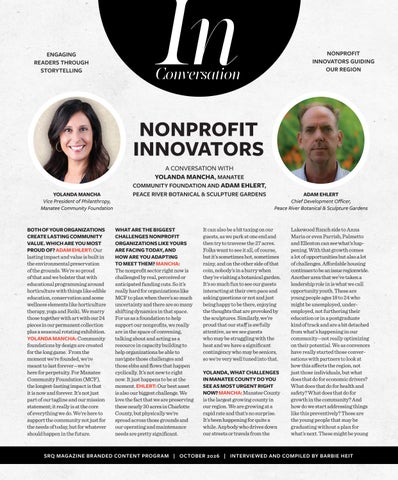
NONPROFIT INNOVATORS A CONVERSATION WITH YOLANDA MANCHA, MANATEE COMMUNITY FOUNDATION AND ADAM EHLERT, YOLANDA MANCHA Vice President of Philanthropy, Manatee Community Foundation
BOTH OF YOUR ORGANIZATIONS CREATE LASTING COMMUNITY VALUE. WHICH ARE YOU MOST PROUD OF? ADAM EHLERT: Our lasting impact and value is built in the environmental preservation of the grounds. We’re so proud of that and we bolster that with educational programming around horticulture with things like edible education, conservation and some wellness elements like horticulture therapy, yoga and Reiki. We marry those together with art with our 24 pieces in our permanent collection plus a seasonal rotating exhibition. YOLANDA MANCHA: Community foundations by design are created for the long game. From the moment we’re founded, we’re meant to last forever—we’re here for perpetuity. For Manatee Community Foundation (MCF), the longest-lasting impact is that it is now and forever. It’s not just part of our tagline and our mission statement; it really is at the core of everything we do. We’re here to support the community not just for the needs of today, but for whatever should happen in the future.
PEACE RIVER BOTANICAL & SCULPTURE GARDENS
WHAT ARE THE BIGGEST CHALLENGES NONPROFIT ORGANIZATIONS LIKE YOURS ARE FACING TODAY, AND HOW ARE YOU ADAPTING TO MEET THEM? MANCHA: The nonprofit sector right now is challenged by real, perceived or anticipated funding cuts. So it’s really hard for organizations like MCF to plan when there’s so much uncertainty and there are so many shifting dynamics in that space. For us as a foundation to help support our nonprofits, we really are in the space of convening, talking about and acting as a resource in capacity building to help organizations be able to navigate those challenges and those ebbs and flows that happen cyclically. It’s not new to right now. It just happens to be at the moment. EHLERT: Our best asset is also our biggest challenge. We love the fact that we are preserving these nearly 30 acres in Charlotte County, but physically we’re spread across those grounds and our operating and maintenance needs are pretty significant.
ADAM EHLERT Chief Development Officer, Peace River Botanical & Sculpture Gardens
It can also be a bit taxing on our guests, as we park at one end and then try to traverse the 27 acres. Folks want to see it all, of course, but it’s sometimes hot, sometimes rainy, and on the other side of that coin, nobody’s in a hurry when they’re visiting a botanical garden. It’s so much fun to see our guests interacting at their own pace and asking questions or not and just being happy to be there, enjoying the thoughts that are provoked by the sculptures. Similarly, we’re proud that our staff is awfully attentive, as we see guests who may be struggling with the heat and we have a significant contingency who may be seniors, so we’re very well tuned into that. YOLANDA, WHAT CHALLENGES IN MANATEE COUNTY DO YOU SEE AS MOST URGENT RIGHT NOW? MANCHA: Manatee County is the largest growing county in our region. We are growing at a rapid rate and that’s no surprise. It’s been happening for quite a while. Anybody who drives down our streets or travels from the
Lakewood Ranch side to Anna Maria or even Parrish, Palmetto and Ellenton can see what’s happening. With that growth comes a lot of opportunities but also a lot of challenges. Affordable housing continues to be an issue regionwide. Another area that we’ve taken a leadership role in is what we call opportunity youth. These are young people ages 18 to 24 who might be unemployed, underemployed, not furthering their education or in a postgraduate kind of track and are a bit detached from what’s happening in our community—not really optimizing on their potential. We as convenors have really started those conversations with partners to look at how this affects the region, not just those individuals, but what does that do for economic drivers? What does that do for health and safety? What does that do for growth in the community? And how do we start addressing things like this preventively? These are the young people that may be graduating without a plan for what’s next. These might be young
SRQ MAGAZINE BRANDED CONTENT PROGRAM | OCTOBER 2026 | INTERVIEWED AND COMPILED BY BARBIE HEIT
V2_SRQ1161_SRQ_0926_InConversation_0903.indd 103
9/15/26 12:06 PM
IN C ON VERSAT I ON YOLANDA MANCHA joined Manatee Community Foundation as the Foundation’s inaugural Vice President of Philanthropy in October of 2024. Before that, she was the Vice President of Advancement for Boys & Girls Clubs of Sarasota and DeSoto Counties, having joined the organization in 2016 as the agency’s Director of Advancement and named Vice President for Advancement in 2019. With over 25 years of professional experience, Mancha has led the execution of resource development strategies, marketing and communications, community engagement, and donor and corporate relations. At MCF, Mancha is part of the Executive Leadership team and leads the Philanthropy team - se ing strategy and priorities for growth and impact. She works closely with donors to discover what inspires them, explores how best they want to invest in the community, and works with stakeholders and partner organizations to amplify their impact. Professional Affiliations Charitable Gi Planners of Southwest Florida, Board Member, 2026 Harwood Institute Public Innovators, 2026 45 over 45, Sarasota Magazine, 2025 CHIEF, 2024 Boys & Girls Clubs of America, National Conference Steering Commi ee, 2023 The Greater Sarasota Chamber of Commerce, Alumni Commi ee, 2022, 2023 Lilly Family School of Philanthropy, Leadership Institute, 2020 Leadership Sarasota, Class of 2016 Sarasota Women’s Alliance. Member Association of Fundraising Professionals Southwest Florida Chapter, Member Charitable Gi Planners of Southwest Florida, Member
SRQ MAGAZINE | TRENDS IN NONPROFIT INNOVATORS GUIDING OUR REGION
people who are aging out of the foster care system, where when one service stops and the next one starts, there are gaps, and when there are gaps, things fall through. For us, it’s an important thing to be that community convenor and to be in that leadership space. It’s looking at the longevity and the tentacles that really are the fabric of the community. We bring partners together so that we can address these things preventatively, holistically and in the right sense of partnership, as opposed to solving problems that are already here. ADAM, TELL US ABOUT THE VISION OF INCLUDING SCULPTURES WITHIN THE GARDENS AND HOW THE TWO COMBINE TO ENHANCE THE BEAUTY OF THE PROPERTY. EHLERT: I’m still amazed at Roger and Linda Tetrault’s vision so many years ago in how it works, one for the guest experience and two, how it keeps us unique and ever-changing. We’ve had some world-class exhibitions like ZimSculpt, which brought a troop of sculptors from Zimbabwe over. They were on site creating, and it provided a neat interaction and really helped position us relative to our mission of world-class art. From that, we had a seasonal exhibition of the Charley Harper Gallery. Then again last year, Origami in the Gardens and this year with Jerzy Kędziora. It really helps that the botanicals keep changing each day and these sculptures keep changing each season. That provides a new experience for our guests, and programmatically we try to reinforce that and provide a new experience each time. It’s such fun to walk the grounds and see people smiling and recognizing a new plant or sculpture or seeing a new bird perched on a new sculpture. It’s just ever-changing. CAN YOU SHARE AN EXAMPLE OF A PARTNERSHIP THAT SIGNIFICANTLY EXPANDED YOUR ORGANIZATION’S IMPACT? EHLERT: We’ve got a beautiful boardwalk that juts out into the Peace River, about a hundred
yards and we’ve got a beautiful gazebo on that boardwalk. We have a new partnership with Advent Health and that gazebo is now called the Advent Health Tranquility Gazebo. It’s designed to reinforce that calm, safe space. The concept’s inception was to work with Advent’s ministerial staff for families going through tough transitions. We want to be able to provide a tranquil place for reflection and we have a beautiful new bench that’s being designed for that gazebo. Also, in February we had a fun partnership event at our first-ever Art in Bloom, which connected the floral and botanical garden with the sculpture element of our space. We reached out to local garden clubs and local florists and invited them to participate. They were each assigned a sculpture and then built or created a floral arrangement around that sculpture. We had about a dozen of those scattered throughout the gardens and we made a day of it. We added a fashion show with dresses designed with flowers or botanical elements and we had a wine walk where folks could purchase a cup and drink a glass of wine as they looked at the sculptures throughout. It was really a neat combination of what we do. It was totally mission-aligned, and we look forward to building upon this first one for the next year. And although this is more donorrelated, rather than a partnership, we also have a couple of capital projects underway. We received our first two $1 million gifts and those are funding an education center and a conservatory, which is coming online before that. That’s in the design stage right now—we hope to break ground in the next several months and that’s really helped in putting us on the map. MANCHA: Yes, it’s actually part of our origin story and every community foundation is always very proud of their origin story. For Manatee Community Foundation, it was through a partnership with the Knight Foundation. We were founded by the three Bobs— Bob Blalock, Bob Beall and Bob Christopher, who we lost this
:: OCTOBER 2026
year—together with Dot Ridings, who was the publisher of The Bradenton Herald. They all came together and thought that Manatee needed its own foundation, and they were invested in making it happen. Together with the Knight Foundation from the sale of the papers—Bradenton was one of the original 26 U.S. cities where the Knight brothers owned newspapers—there was an investment that really catapulted the whole idea, and that is how we came to be. We remain very close partners and friends with the Knight Foundation, which continues to support the work in this community. AS LEADERS, HOW DO YOU BALANCE PRESERVING YOUR ORGANIZATION’S LONG-TERM VISION WITH RESPONDING TO IMMEDIATE COMMUNITY NEEDS AND UNEXPECTED CHALLENGES? EHLERT: We’re an outside venue and we are ensconced in the environment, and that’s also kind of a liability. After hurricanes Ian and then Helene and Milton, we were hit really hard. We were flooded and lost thousands of plants and a whole bunch of infrastructure. But through, frankly, our ability to conduct events, we were able to rally and we opened the gardens as a local avenue for food, for medical care and for hygiene and we did it because it was necessary and because it was the right thing at the right time. We couldn’t even think about rehabbing our gardens yet. We made it accessible and folks could come in and through the course of those events we served almost 10,000 meals and provided resources that Punta Gorda didn’t have and so we were really proud of that. After each recovery, we then pivoted to replacing and replanting our plants and then launching fundraising drives to ensure our viability. That was three and four years ago and we were even younger then. I think it helped establish us further as a good community asset. MANCHA: MCF is exactly positioned to support current needs, but also to have the
104 | srq magazine_ OCT26 live local
V2_SRQ1161_SRQ_0926_InConversation_0903.indd 104
9/15/26 12:06 PM
V2_SRQ1161_SRQ_0926_InConversation_0903.indd 105
9/11/26 1:02 PM
IN C ON VERSAT I O N
ADAM EHLERT is Peace River Botanical & Sculpture Gardens’ Chief Development Officer. A er two decades in minor league baseball (as an owner, not an athlete), he’s combined his community engagement and small business promotion affinities toward philanthropy. He has vacationed in southwest Florida all his life and made the full-time move from the Midwest last year. Ehlert joined The Gardens on the cusp of a strong growth curve and enjoys continuing to improve the nonprofit’s donor processes and engagement. The author of two books, Ehlert appreciates the storytelling arc of The Gardens’ vision, inception and growth. Fulfilling Peace River Botanical & Sculpture Gardens’ mission through working with the board, volunteers and donors and the rest of the dedicated staff is his reward every day in this beautiful se ing.
SRQ MAGAZINE | TRENDS IN NONPROFIT INNOVATORS GUIDING OUR REGION
nimbleness and the flexibility to address uncertainty, and that’s really just built into the way that we do our work. We make grants for immediate needs when those happen. We really fill in that space of if not us, then who? We try to address community challenges that affect the region, that affect all the sectors, or a combination of sectors. That’s really the space that we’re meant to be playing in and that we’re uniquely positioned to do. Our nonprofit partners have to stay true to their mission. They need to continue to do the work that they are chartered to do, and our work is to support those things. So, we’re able to be flexible by design so that we can let them do the work that they need to do. HAVE YOU NOTICED A CHANGE IN LOCAL DONOR AND GENERAL GIVING DIRECTLY RELATED TO WORLD EVENTS? MANCHA: Absolutely. There’s an immediate need, an immediate concern and folks who are philanthropic and who are mindful of that will double down on support for things that are emerging and timely. I will share that we just recently surveyed our fund holders, and overwhelmingly, there’s a very solid commitment to those enduring things that really enhance quality of life. Our fund holders are prioritizing youth and education, animal and wildlife protection, our environment and health and human services. Those are the things that, regardless of what emerging issue happens, are the mainstays, and our fund holders are very well committed to ensuring that those things still receive the support that they need. They also know how human quality is at the core of anything that can happen. So if you take care of children, animals, the environment and the vulnerable with food and housing, then all the other things can be addressed. But if you shift too much too fast and just address the immediate need, then those other things start to suffer and crumble. EHLERT: We see more affinity with donors about the conservation issue and that helps reinforce our message. I think
we’re seeing a growing constituency of our donors who are committed to that, and then the additional fundraising opportunity really comes from the unique marriage of conservation with art. We’re able to tap into two different groups. We have some members and some donors who are art lovers and we have some members and donors who are conservationists. And it’s really fun to be able to identify those folks and hit their needs and meet them where they are. ARE TRADITIONAL FUNDRAISING EVENTS STILL EFFECTIVE? EHLERT: We are blessed to be able to conduct our two principal fundraising events on site each year. It keeps us out of the boring hotel ballroom gala events business. One of our two signature events takes place in the fall or early winter and that’s called an Orchid Ovation. It’s a luncheon right there on the lawn in front of our building and it’s a lovely event. We themed both events surrounding our rotating seasonal exhibition. Last year, that was called Origami in the Gardens, and we had 13 pieces of giant aluminum or steel origami pieces spread throughout. This year, the exhibition is called Elevate, and it’s by a Polish artist named Jerzy Kędziora and we will have 30 pieces. We’re just gushing as we talk about this because they are literally 30 pieces elevated on high wires. So it looks like they’re tailored to be in a botanical garden juxtaposed against the trees, the botanicals, the sky and the water. They are like circus or trapeze artists, athletes or just everyday people set in a unique position. Our theme for both Orchid Ovation and then our soirée in March, which is an evening event built around that. I wish I could say the name but we’ve got a significant local headliner committed for the March soirée, which will be moving, inspiring and thrilling all at the same time. MANCHA: Our local community is so socially philanthropic. I think it’s a beautiful thing. People love to celebrate their missions. People love to gather for good causes and it’s really in-
:: OCTOBER 2026
spiring. Some fundraising events have become really creative and innovative and it’s quite exciting to see, and it certainly builds a lot of momentum and buzz. But when we work with our nonprofit partners on capacity building and diversifying their revenue and making sure that they’re sustainable and strategic, it’s always a reminder that a fundraising event is not for the event, but it really is an opportunity to showcase a mission. It’s an opportunity to introduce people to who you are and what you’re doing and how important it is, but it’s what happens after the event that’s most important. It’s that follow up with those folks that came and showed interest. It’s the invitation to come learn more, come for a tour or a visit if appropriate. The fundraising event itself is awesome. It’s a great intro, but it’s what happens after that’s really where the magic happens. WHAT NEW TOOLS OR INNOVATIVE PROGRAMS ARE YOU EMPLOYING TO ENGAGE AND DEEPEN RELATIONSHIPS WITH DONORS? MANCHA: One of the things that MCF has launched this year that we’re excited about and getting wonderful feedback from our fund holders is The Giving Gallery. It’s an online catalog of opportunities and projects available for investment. It features nonprofit partners, capital projects, program related requests, and a variety of different things that are already vetted by MCF. These are things we’re investing in through competitive grants. We’re putting it out to our fund holders and also to the public at large to allow them to see the things that are happening in our community, not just needs-based, but some of them also very innovative in their approach, things that people might get excited about investing in and come alongside of us. We’ve vetted it. We know these are projects that are qualified, sustainable, important and impactful. We’re investing in it ourselves so it gives it the credibility to come alongside us and make these things happen for our community. We talk a lot
106 | srq magazine_ OCT26 live local
V2_SRQ1161_SRQ_0926_InConversation_0903.indd 106
9/15/26 12:08 PM
V2_SRQ1161_SRQ_0926_InConversation_0903.indd 107
9/11/26 1:02 PM
IN C ON VERSAT I ON about co-investing because we know that the needs are far greater than anyone’s asset ability. If we come together—foundations with donors with fund holders—we can really start checking some of these projects off and move on to the next thing, the next exciting, innovative and necessary thing to be able to sustain. Our giving gallery is really one of the things we’re proud of this year. Every quarter we’ll be updating the projects that are listed on there and we’ll have a rotation. We called it the gallery for that reason because we’re thinking of it as a rotating exhibit of opportunities for investment. EHLERT: Our best stewardship touch happens in early January. We create an annual impact report, and we celebrate our donors by describing how their gifts have helped impact the gardens or the community. For instance, subsidizing free field trips, but my favorite part of that is we don’t just mail that. We place it with a plant that we’ve created in the gardens and we hand-deliver it. It’s mission-oriented and it fosters conversations. We’re able to sit down with these donors, thank them for what they’ve done this past year and then, just as importantly, talk about our plans for the coming year. When donors are already invested to that level and love our mission, they want to hear what’s coming. They want to hear how they can help. I can’t tell you how many new projects or points of inspiration have come up from those conversations. It clicks with a donor and they say, “That’s something I’d like to be a part of. Let’s make it happen.” It’s meaningful, it’s fun and logistically, it’s a lot of work, but it’s absolutely invaluable for what we do. LOOKING AHEAD FIVE TO TEN YEARS, WHAT DO YOU HOPE YOUR ORGANIZATION WILL HAVE ACCOMPLISHED FOR THE COMMUNITIES YOU SERVE? EHLERT: We’d like to reinforce our position as being known for our botanicals. Beyond that, we hope to grow our educational programming, especially field trips. We’re really proud that we serve about
SRQ MAGAZINE | TRENDS IN NONPROFIT INNOVATORS GUIDING OUR REGION
3,000 students annually on field trips and we create programming for each built around our themes of ecology and/or art. In Charlotte County and neighboring DeSoto County, we’ve got a whole bunch of students who are Title I, and we are proud to be able to offer those field trips and programs and, hopefully, moving forward, summer camps and Christmas break camps that are built around such. We want to be the resource for that in the area. MANCHA: In five or ten years we would love to see our endowment continue to grow and that we are continuously able to address the current needs, and have the flexibility and nimbleness and possibility to address the things that come online. We want to continue to build that foundation for the future together with our donors and our fund holders and our nonprofit partners. ARE YOU UTILIZING AI TECHNOLOGY IN YOUR DEVELOPMENT PROGRAMS AND IF SO, WHAT HAS BEEN YOUR ROI? IF NOT, WHAT TECH ARE YOU EMPLOYING AND WHY? MANCHA: I think realistically, everybody’s using AI whether they intentionally mean to or not. So, yes, we have embraced AI. We are using AI in terms of efficiency and processes—things that help us automate the way that we do our work, calendar things, those kinds of technical pieces. AI also allows us to have more time outward-facing with our donors, fund holders, community partners and our nonprofits. It allows us to maintain transparency and compliance and it also allows us to get out and do the work that we really want to do and not be tied down to tasks. We encourage responsible, informed use of AI across all of our platforms, even with our nonprofit partners—being safe with the information they’re putting out. One of the things that we do for capacity building for our nonprofit partners is a learning series called Manatee Connects; using AI and amplifying the tools in your toolkit are definitely one of the sessions in that series. EHLERT: Not really in
programs, but we do use a significant amount of AI internally for structure and communications and capacity building, but really all of our programming and all of our external donor cultivation communications are 100% human-driven. We want to maintain that connection, and I think people can tell the difference. YOLANDA, HOW DO YOU MEASURE THE SUCCESS OR IMPACT OF THE PROGRAMS YOU FUND? MANCHA: As we continue to promote grant opportunities for our nonprofits and invest in their projects, ideas and mission, we really look at the trends of what we’re seeing. For example, we look at the issues that we’re trying to address. Different nonprofits are going to approach it in different ways, but collectively, are we moving the needle? Collectively, or are we making an impact? Several organizations may address literacy. They approach it differently, but if we’re collectively looking at reading outcomes and what the improvements are and what difference it makes, then we can say collectively, we’re moving the needle in the right direction. Funding and grant-making for us is much more than just the one time. It’s really looking at where all those cohorts are together. Where is that impact happening together? How it inspires further philanthropy, which is very important to us. We want to make sure that we continue to educate and inspire on philanthropy. HOW IS SOCIAL MEDIA IMPACTING YOUR ORGANIZATION AND IN WHAT WAYS ARE YOU EMPLOYING IT TO EXPAND YOUR DONOR BASE? EHLERT: We do use social media. Of course it’s growing and we’re trying to do a better job of engaging that. We have countless opportunities for world-class photography in our environment and we’ve got a really talented photographer on staff, and he makes a pointed effort to walk the grounds each day and he can produce museum-quality art, and that bolsters our social media quite a
:: OCTOBER 2026
bit. Everyday things like programming pictures, volunteers working in the gardens, pictures of kids on field trips, pictures of painters and sculptors working on the grounds—it’s just fun to be able to engage that way. MANCHA: We use social media just to make sure that people are aware of the impactful work that we’re doing and that our partners are doing, mostly to share stories about our fund holders who have left endowed funds and how their legacy lives on and how we are so honored and fortunate to be able to execute that on their behalf. We use it to share stories of our nonprofit partners and some of the things that we are really proud to invest in and help bring to fruition. We use it to invite our community partners to those learning sessions with Manatee Connects. Finally, we really use it as a way to invite people to understand who we are, to see the impact and to come and hang out with us and do this with us because it’s fun. ADAM, WHAT IS THE MOST IMPORTANT THING YOU’D LIKE VISITORS TO THE PEACE RIVER BOTANICAL & SCULPTURE GARDENS TO TAKE HOME WITH THEM FOLLOWING THE EXPERIENCE? EHLERT: We were founded by Roger and Linda Tetrault, and we are blessed to see their commitment to conserving the grounds in Charlotte County and also marrying their love of world travel and worldclass art into our experience. Part of their vision was that they wanted each guest to come away with five wow moments upon each visit and so our staff is committed to being able to showcase that, whether it’s a weekly member who visits or a first-timer coming from Naples or from Sarasota. Dayto-day, something new is always blooming here.
108 | srq magazine_ OCT26 live local
V2_SRQ1161_SRQ_0926_InConversation_0903.indd 108
9/15/26 12:09 PM