ENGAGING READERS THROUGH STORYTELLING WITH REGIONAL PHILANTHROPY LEADERS
In Conversation
TRENDS IN SERVING CHILDREN AND FAMILIES IN SARASOTA AND MANATEE COUNTIES

ENGAGING READERS THROUGH STORYTELLING WITH REGIONAL PHILANTHROPY LEADERS
TRENDS IN SERVING CHILDREN AND FAMILIES IN SARASOTA AND MANATEE COUNTIES
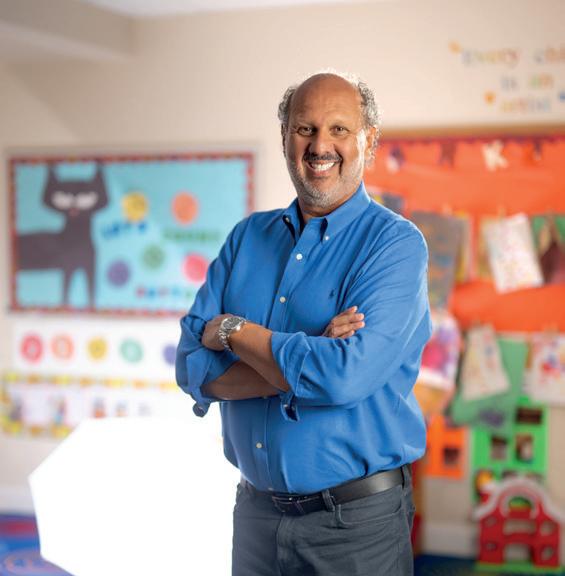
PHILIP TAVILL serves as President & CEO of Children First, Sarasota County’s exclusive Head Start provider, where he is celebrating 30 years of leading the organization. He obtained a baccalaureate degree in psychology from the University of Wisconsin–Milwaukee in 1989. He returned to Sarasota and was appointed Executive Director of the Loveland Center in 1991. Subsequently, at Case Western Reserve University, he earned a Master of Nonprofit Organizations from the Weatherhead School of Management and a Master of Science in Social Administration from the Mandel School of Applied Social Sciences. Mr. Tavill has worked in the human services field in both direct service and management capacities for more than 36 years. In 2022, Mr. Tavill received the Mandel School Alumni Association Nonprofit Leadership Award. Most recently, he was recognized with the Billy J. McCain, Sr. Excellence in Community Service Award from the National Head Start Association and the Sargent Shriver Community Service Award from the Florida Head Start Association for his impact in elevating excellence across the Head Start community.
THIS YEAR MARKS TWO REMARKABLE MILESTONES—65 YEARS OF SERVICE FOR CHILDREN FIRST AND YOUR 30TH ANNIVERSARY AS CEO. WHAT DOES THIS MOMENT MEAN TO YOU PERSONALLY, AND WHAT DOES IT SAY ABOUT THE ENDURING MISSION OF THE ORGANIZATION?
PHILIP TAVILL
I have this incredible opportunity to do such important and significant work with such an incredible agency and that is truly a gift for me. I believe that our celebration of a 65th anniversary is rooted in several things. The first one is that we are just extraordinarily true to mission. Everything that we do is through the mission lens. That’s from governance, to our staff, to our volunteers, to our community partners and to our donors. I have a little plaque on the windowsill behind me that says, “Many hands
make light work.” And it’s very clear that while I’m so fortunate to celebrate my 30th as the head of the organization, it’s many hands making light work of what, on some days, is incredibly heavy lifting.
And we’ve just been so consistent. We’ve been so persistent. We are all about the mission. We’re all about partnerships. When people choose to be involved with Children First, it really is with their whole heart. That means so much in terms of why we’ve had this longevity.
BACK OVER SIX AND A HALF DECADES, HOW HAS CHILDREN FIRST EVOLVED?
TAVILL I’ll start with what has stayed the same. Very simply, we began with a group of visionary women from what was then the Junior Welfare League—now the Junior League of Sarasota—an
all-volunteer group who asked a simple but powerful question: How do we help families with very young children so parents can work and support themselves? Their answer was to establish the Sarasota Day Nursery. That core mission hasn’t changed. We serve children well, we serve families well and we empower families—just as those women envisioned when they founded us in May of 1961. What has changed is the world around us. Life today is far more complex. Take social media, for example—the interconnectedness brings both opportunities and challenges. And when you think about Sarasota County today compared with when I moved here 47 years ago, the pace and complexity of life have grown dramatically. Now imagine navigating that world as a single parent—which describes nearly two-thirds of our families— trying to succeed economically,
sometimes pursuing education at the same time, while raising a very young child. In addition, early care and education have become significantly more expensive. Families certainly faced challenges in 1961, but the complexity today is different. We see single-parent households, grandparents raising grandchildren and rising expectations for what young children need to succeed. Because of that, our program has continually evolved. We adapt our planning every year— often month by month—to meet emerging needs. Over time, we’ve grown both broader and deeper in the services we provide. For example, we now have family advocates—what many organizations would call case managers—who work directly with families. When I first came to Children First, there were six staff members in those roles. Today we have eleven, all with












bachelor’s or master’s degrees in social work and additional family development credentials. We also provide on-site train-the-trainer certification. The level of professionalism, training and expertise has increased tremendously. Another example is our Families First Institute, which provides parenting and family-strengthening courses. It began in 1999 with our first Nurturing Dads class. Today, we o er programs for fathers, budgeting classes, English as a second language and parenting education. Each of these programs grew out of the same process: identifying a need, determining how best to meet it and partnering with others when appropriate to connect families with the right resources.


was created by Sarasota-based author, trainer and family mediator Mark Perlman, who worked closely with us to develop the program. At most parenting classes, you see a lot of moms—which is wonderful—but we realized that engaging fathers sometimes requires a space designed specifically for them.


OVER YOUR 30 YEARS OF LEADERSHIP, WHAT ARE SOME OF THE MOST PIVOTAL MOMENTS OR DECISIONS THAT SHAPED CHILDREN FIRST INTO THE NATIONALLY RECOGNIZED ORGANIZATION IT IS TODAY?









TAVILL When I first came to Children First, we began serving children at age two. Even then, there was significant demand for infant and toddler care in Sarasota County. I told the board that hired me, “This is something we’re going to have to consider seriously.” That was February 26, 1996. Then, in June of that same year—on a Wednesday—the Department of Children and Families called and said, “We’re closing a daycare where we have six foster babies because the quality is so poor. Can you take them?” We said yes. We opened the following Monday with those six babies. Sta and community members brought cribs from their attics and garages. We cleaned everything up and got ready. It was a pivotal moment for us. Today, about half of the children we serve are under the age of three. We accept babies as young as six weeks old—we begin working with families during pregnancy. Expanding our services from expectant families through age five was a major turning point. Another pivotal step was launching our Nurturing Dads class in 1999. The curriculum















Here’s a quick story. At the end of the first session, we’d say, “All right, guys, huddle up so we can say goodbye.” We did this with a football-style huddle, which felt comfortable for the guys. Then we’d say, “Okay, now we’re doing a hug.” At first, everyone sti ened up a bit. But by week five or six, those same guys were hugging each other goodbye without hesitation. We had created a safe space where men could learn how to become better fathers—whether they were already good dads who wanted to become great, not-so-good dads who wanted to be better or maybe they were becoming fathers or stepfathers for the first time. A third milestone came in 2003, when we were first designated a nationally recognized Program of Excellence by the National Head Start Association. Passing federal monitoring is one thing, but this review goes much deeper—it’s like being turned upside down and shaken by the ankles to see what falls out of your pockets. It’s exhaustive, but exhilarating. Fewer than one percent of Head Start programs nationwide receive that recognition.




slide, where kids go to school for 10 months, get a couple months o and come back forgetting how to read and write. You literally can experience an overnight slide in these very di cult circumstances. The critical nature of engaging the family, especially those families that have the highest risk factors or the most challenges, is that we are taking this comprehensive,

“EVERY





with you on, but what would you like to do given the opportunity?” And oftentimes, for our families, nobody’s necessarily asked them about that aspirational goal. We get answers like, “I didn’t finish high school. I need to get a GED, but math is killing me,” and we’ll find a volunteer who’s a math tutor to help them. And the reason we’re doing it here is not to duplicate anyone else;








holistic approach to working with that entire family–that’s the parent or guardian, the older siblings, sometimes the auntie, the uncle or the grand-parents who are involved—and we are incrementally working to help that family become more independent, more self-sucient, not just economically, but in how they function as a family. We embrace the family and have them engage with family advocates, take courses and they are all elevating how they function as a family.

CHILDREN FIRST IS KNOWN FOR ITS WHOLE-FAMILY APPROACH TO EARLY CHILDHOOD EDUCATION AND FAMILY STRENGTHENING. WHY IS IT SO IMPORTANT TO ADDRESS NOT JUST THE CHILD, BUT THE ENTIRE FAMILY UNIT? TAVILL The child’s primary environment is the home. The child comes to us for the day, which could be 6, 7 or 8 hours. We do a lot of work, and if that child goes back home and this is a family that’s struggling economically and has risk factors, everything we do that day literally could be for nothing. Most of us are familiar with what’s called the summer
CHILD IS BORN WITH POTENTIAL, BUT NOT EVERY CHILD IS BORN WITH OPPORTUNITY. IT’S OUR JOB TO PROVIDE THE OPPORTUNITY FOR EVERY CHILD’S POTENTIAL.”


— Philip Tavill



CAN YOU SHARE SOME EXAMPLES OF HOW CHILDREN FIRST REMOVES BARRIERS THAT MIGHT OTHERWISE PREVENT PARENTS FROM ACCESSING EDUCATION, JOB TRAINING OR PARENTING RESOURCES?






if you’re coming in to drop o your child and you’ve got transportation issues or work, we can accommodate your schedule here. We can work with you. This is like a second home for families.


TAVILL We work with many di erent partners who are doing great work. Women’s Resource Center, for example, is a wonderful organization. We can go through that list and talk about our many partners, but I’ll tell you what we’re doing inhouse. This is what we’ve developed over the years, through our family advocates, including our vocational family advocate. We’re talking with families about goal-setting. If you’re economically vulnerable, if you’re living in poverty, it can be really hard to think about aspirational goals. But when somebody’s sitting down with you and saying, “Hey, let’s take a few minutes to think about not only what some of your challenges are that I could work









WHEN YOU LOOK TOWARD THE FUTURE, WHAT IS YOUR VISION FOR CHILDREN FIRST OVER THE NEXT DECADE? TAVILL For the organization, our work is really driven by two things. First is the quality of our services. The second driver is unmet need, which really falls into two areas. The first connects to the changing population we serve. When I started here 30 years ago, the Spanish-speaking population among our families was very small. Today it’s probably around 35 percent. That shift requires us to continually adapt—to ensure we are culturally sensitive, that families feel comfortable in our environment and that we respect and reflect their cultural norms. Right now, more than 100 children from birth to age three are on our waitlist. They may be receiving services elsewhere, but our focus is on how we expand so we can reach them. And so, a message I have for your readers, and I know there are many, is very simple. It’s an invitation. Come visit us. Come take a tour. You will leave here feeling amazing about what is happening in our community. Come see us and learn more about what we do.