Week 5, Semester 2, 2026
4: NEWS
Referendum on USYD Boycotting Israel
Sebastien Tuzilovic and Tim Pudun
A referendum will be held concurrently with the SRC Elections, from 22nd to 24th of September. It calls on the University of Sydney to adopt “an academic boycott policy against Israeli Institutions complicit in apartheid and genocide”.
First Printed 1929
Your Weekly Student Newspaper
10–11: FEATURE
14–15: FEATURE
Anastasia Dale
Ava Broinowski
The words ‘Heidelberg school’ may not be immediately recognisable to most Australians, but its paintings (and the thousands of paintings that imitate or reproduce their qualities, which persist to the present and will undoubtedly continue into the future) are generally thought to constitute what ‘Australian’ ‘art’ ‘is’.
Absolute victimhood is an offensive. It is but one legible response to pain. The kind of intellect born of suffering is my subject. The long history of philosophy on the subject of reason has not considered the body, let alone suffering, as something that grounds it.
The ‘Australian’ Tradition
Investigators of the World
Acknowledgment of Country EDITOR-IN-CHIEF Anastasia Dale EDITORS Madison Burland Anastasia Dale James Fitzgerald Sice Kuyili Karthik
Honi Soit publishes on stolen Gadigal land. Sovereignty was never ceded. The University of Sydney is a colonial institution that upholds Western knowledge as superior to First Nations knowledge systems. We reject this hierarchy. As student journalists, we recognise that mainstream media has been complicit in silencing and misrepresenting
Indigenous voices since invasion. We commit to centring First Nations perspectives in our reporting, to challenging the colonial structures embedded in journalism, and to amplifying the voices of those resisting ongoing dispossession. We pay our respects to Elders past and present, and to all First Nations students and contributors. Always was, and always will be Aboriginal land.
Alastair Panzarino Firdevs Sinik Sebastien Tuzilovic Sophie Wishart Victor Zhang
WRITERS Anastasia Dale Ava Broinowski Emily E. James Fitzgerald Sice Sophie Grant Aayuka Panditharatne Alastair Panzarino Roman Plumb Elliot Priestman Ela Pradhan Timothy Pudun Sebastien Tuzilovic Victor Zhang ARTISTS
In This Edition: 4 Convocation on Palestine; Referendum on academic boycott of Israel 5 ‘Migrants are welcome, racists are not’: Sydney rallies against racism 6 Four presidential candidates vie for 99th SRC 9 $5 Meal Investigation 10–11 FEATURE: The ‘Australian’ Tradition 12 ‘Enemies’ in Politics 13 The Neo-colonial English Geezers
Sophie Wishart
14–15 FEATURE: Investigators of the World
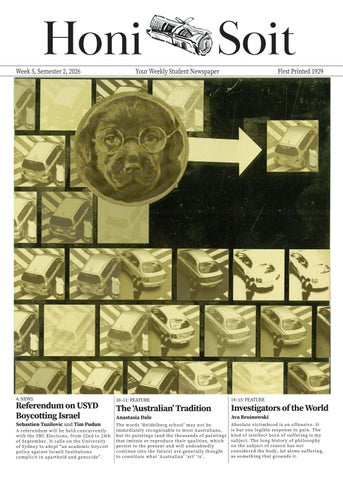
FRONT COVER
16 Misremembering a genocide
Georgie Rosenberg
BACK COVER Sophie Wishart
18 On Being Struck By Lightning 20–23 SRC Reports/Puzzles/Comedy
Contribute
Do you have a deep-rooted longing to be a contributor but have no idea how to get involved? Apply to be a reporter or artist via the link in our Instagram bio: @honi.soit Or if you have a one-off pitch, tip for a story, complaint, letter to the editors, or more, email us at editors@honisoit.com. Scan the QR code if you'd rather send an anonymous tip. Send mail to Honi Soit at PO Box 974 Broadway NSW 2007. ISSN: 2207-5593. This edition was published on Tuesday 1 September 2026. Disclaimer: Honi Soit is published by the Students’ Representative Council, University of Sydney, Level 1 Wentworth Building, City Road, University of Sydney NSW 2006. The SRC’s operation costs, space and administrative support are financed by the University of Sydney. Honi Soit is printed under the auspices of the SRC’s Directors of Student Publications (DSP): Dongchen Yue, Sholto Mirrlees-Black, Lucy Sullivan, Ying Huang, Damien Lee, Hamish Evans. All expressions are published on the basis that they are not to be regarded as the opinions of the SRC unless specifically stated. The Council accepts no responsibility for the accuracy of any of the opinions or information contained within this newspaper, nor does it endorse any of the advertisements and insertions. Please direct all advertising inquiries to publications.manager@src.usyd.edu.au. Email the editors at editors@honisoit.com.
2
Editorial
Hello there, Welcome to this, another fabulous edition of Honi Soit. I’ve themed this edition around memory. My lovely and very funny friend Georgie engraved this week’s cover. It’s one of my favourite images and it really captures how it feels to have a memory. My feature examines the ways in which Australia’s white bourgeoisie art tradition has inhabited cultural memory until today, and the revolutionary potentialities contained within the cemetery of the state gallery. The article is kind of funny and not like an art history essay, if that entices you. If it doesn’t, then I don’t know what to say, and I’m a little offended. My dear friend Ava’s feature looks at the age-old idea that one must look outside themself in order to see the world more clearly/‘objectively’, and provides counterarguments in favour of
integrating one’s suffering and merging with the world. The feature contains a really cool story about a crocodile attack, too. We have some urgent and important news pieces regarding the upcoming referendum on USyd cutting ties with Israeli universities, the convocation on Palestine, the recent rally against racism, and this year’s candidates for SRC President. Some of my co-editors have found out some crazy things about the Compass Group, the parent company of the $5 meal providers on campus. Key moments of the article, for me, were the possible bribing of the UN (?), feeding horse meat to Irish schoolchildren (?), and allegations that they bribed Kazakh government officials (?). Happy reading! Elliot Priestman’s article examines restorative nostalgia and its role in altright politics. Sophie Grant examines
her strange interactions with some neo-colonial English geezers. Aayuka Panditharatne discusses the denialism of the Tamil genocide. Ela Pradhan illustrates Australians’ responsibility to actively fight against the great Australian silence. Emily E. seeks to understand why the Fergs of the Labor Party are quite so powerful. Alastair Panzarino reflects on his experience of being struck by lightning on the Footbridge. What a good edition, wow. And I’d say that even if it wasn’t my edition. That’s how you know it’s good. Well, this is my last-ever EIC, unless someone in the team dies or gets struck by lightning again or something. We also laid this edition up on my literal actual birthday (real). Ava brought cake. I’ll remember this birthday, and this year, for a long time to come. Honi is hard, weird work. It’s worth it. And I wouldn’t do it again for the world. Love from Staz!
Vox Pops: What is your favourite USyd memory? M. Scott: I love a beer at Courty, short for Courtyard Cafe btw. Do you want to go get Moore beer with me? I really like beer. Friendship is a good bonus sometimes. Ha ha ha. Chuddy Chuckleson: I like crushing the hopes and dreams of my peers. When they go high, I go higher. #FirstInCourse #EatMyAss America Island: I am from UNSW btw but my favourite memory is following
my tutors on Linkedln because maybe we can all be friends one day. #Friendpol Charles P.N: I went to the aquarium. Pretty cool. Yay Sharks. I am the worst kind of liberal schill. I am a hack. Marc Cyst: I have no good memories here. I hate it here. Everyone is mean, everyone threatens to jump me, I don’t know why. Maybe I just have one of those faces. Maybe not.
Honiscopes Aries: Cerebellum. You’re kinda chopped. If Hannibal Lecter had you on his plate he might not touch you tbh. You come in clutch for remembering how to ride a bike. Taurus: Prefrontal cortex. You’re kind of the GOAT? You get all the hype, the fan favourite. AI might replace you in a couple years however if Sam Altman gets his way. Gemini: Synapse. You are truly electrifying and make me want to fuse my neurotansmitter vesicles with you. What that cleft do, apart from allow literally all single brain activity to occur? Cancer: Amygdala. Primitive desire, raw emotion, influencing every decision. You’re the og empath, but way too easy to ragegbait and scare. Take a leaf out of the rational Virgo’s book. Leo: Cerebral cortex. You make up half of the brain’s mass...greedy much? You’re also an egoist, creating the typically human inflated sense of self importance. Meditate a little this week.
Herman Manning: I love PUBS YIPPIE! I love going to pubs and drinking and maybe talking to my friends there. Sometimes. Archibald Walker: My favourite memory has to be when one of my lecturers showed photos of themself with political figures. Bit weird they were posted up with Bibi, but what can I say. I’m a centrist type.
Virgo: Dendrites. Ew ew ew ew. Why is this in my body. You’re a bit of a socialite these days, forming branching structures that connect neurons to each other. Libra: Scar. A living, cellular, form of memory. Fleshy, unashamed, sensual. Like Michael Ondaatje writes: “We remember the time around scars.” Scorpio: Hips. Apparently you store a lot of trauma. Give yourself some grace, as a certain famous Mormon wife likes to say. To remember and release is to heal. Sagittarius: Hippocampus. You’re tiny, just like a seahorse, but we’d all forgor without you. It’s called the neural Rosetta stone for a reason. Imagine not having long-term memories.
What's On Support USyd staff on strike! Wednesday 2nd September 6am-6pm @ The University of Sydney SLOWCUT Thursday 3rd September 7pm @ The Vanguard Rabid W/ Devaura [Live], Cherry Rype [Live], lammi, Phetamine, KISSES, Papa Paulie B2B Evy, Badbbgirl69, Baba Boubou Friday 4th September 6pm @ Goodspace at the Lord Gladstone Bero Block Party W/ Babe Rainbow, Bean Magazine, Cheeky Leash, Clay Western, DAWSON, KALI, Loods, Mel Blue, Reenie, Roxy Lotz, Tokyo Sexwale, Tseba Saturday 5th September 2pm @ The Beresford Stop Killing Us: Students stand against sexual violence Wednesday 9th September 11am–1pm @ Hyde Park for more, visit sydneymusic.net
Capricorn: Basal ganglia. You’ve a goofy name, and involve structures like the caudate nucleus, putamen, globus pallidus, subthalamic nucleus, and substantia nigra. Aquarius: Big Chungus. No one likes you. Do some desperately needed deep internal work, or die. Overused, smelly, and stinky. Pisces: Muscles. Hey handsome? Nice gains. You are synonymous with the term muscle memory, things come instinctively and easy for you this week.
3
| NEWS
Alumni and staff call for Referendum on academic University of Sydney to hold boycott of Israel to be held convocation on Palestine at SRC Election Victor Zhang reports. Hundreds of University of Sydney staff and alumni have signed a letter addressed to USyd Chancellor David Thodey calling for a convocation on Palestine, the University’s institutional ties to Israel, and the repression of free expression on campus. The letter, having reached 450 signatories, was sent to the Chancellor on 25th August. “In our view, the University’s refusal to respond meaningfully to the ongoing genocide in Gaza represents a profound moral failure — one that risks leaving a lasting stain on the institution’s reputation,” the letter reads. The letter said the University’s investment review and divestment policy “falls far short of what is required at a time like this”. The letter points out the hypocrisy of the University imposing a ban on collaboration with Russian institutions while refusing an institutional boycott of Israel. “At the same time, we have witnessed what appears to be an accelerating erosion of freedom of expression and the suppression of dissent across the University,” the letter continued. “We believe these twin issues represent nothing short of a crisis and warrant a gathering of members of Convocation. We therefore write to you in accordance with the procedures of Convocation to request such a meeting.” The Convocation, established by Section 14 of the University of Sydney Act 1989, consists of current and former fellows of Senate (the highest governing body of the University), alumni, and professors and full-time members of the academic staff. The University of Sydney (Amendment Act) Rule 1999 states that the “Convocation shall submit for the consideration of the Senate such suggestions as it thinks fit with respect to the affairs and concerns of the University, and the Senate may take all such suggestions into consideration and report to Convocation its determinations thereon.”
4
Emeritus Professor Stuart Rees, founder of the Sydney Peace Foundation and the Centre for Peace and Conflict Studies, served as a Senate fellow from 1993–97. Professor Rees spoke to Honi Soit about why he is supporting the call for a Convocation, citing his hope that a Convocation would “restore the collegial, human rights respecting culture” of the university. “I have been in Gaza and the West Bank many times and have witnessed Israeli violence, destruction and appalling cruelty. I have also had several face to face meetings with Israeli peace activists and academics who share my incredulity that in response to an Israeli/US genocidal slaughter — not a war — Australian politicians and leaders of universities would be so cowardly and complicit,” Professor Rees said. “Contributors to the convocation have a chance to insist on freedom of speech and on respect for international law. They can and should recommend that university management find courage sufficient to resist demands that staff and students must comply with intellectually dishonest definitions of anti-Semitism. “I find it morally repugnant to discover that while genocide continues in Gaza and on the West Bank, the university seems preoccupied with discussing claims about antiSemitism and the best means of controlling, disciplining and punishing staff and students who do not obey the latest rules. Such actions might be appropriate in running a jail but not a university.” USyd staff are striking on 2nd September. One of the issues the union is striking over is on protecting free expression for all staff. Staff have come under fire in recent years for expressing pro-Palestine views. Senior lecturer in history David Brophy told independent media outlet Deepcut a convocation would “give voice to the disquiet among staff and alumni and force the university to take this issue seriously. They can’t keep sweeping an ongoing genocide under the rug.”
Timothy Pudun and Sebastien Tuzilovic report. A referendum will be held concurrently with the SRC Elections, with polling in action from the 22nd to the 24th of September. The referendum calls for the University of Sydney adopt “an academic boycott policy against Israeli Institutions complicit in apartheid and genocide”. The proposed statement argues for the University of Sydney to sever ties with Tel Aviv University, Technion, and the Hebrew University of Jerusalem in particular. The policy proposes further cuts between USyd and research partners involved in supplying weapons to Israel. These research partners include Thales, who have maintained a professional relationship with USyd since 2017, and whose production of electronic components and communication systems have been covertly dispensed to the Israeli military since 2018. In two Australian factories, Thales produces M795 155mm artillery projectiles. The referendum occurs after a drive pushed by Students Against War, who collected student signatures in order to put the referendum to vote. As the referendum will be decided formally during the SRC elections, debate around the pursuance of the policy will be printed in the formal Election Honi edition, which will be published on 8th September. Contributions to the debate will be selected from submissions to an Expression of Interest form found on the official SRC page with details of the referendum. The form stipulates that “Individual
The letter calling for the convocation is still accepting signatories. Scan the QR code for the letter.
submissions shall not exceed 1500 words, and the total of all submissions for either side shall not exceed 4500 words.” Contributions to the debate will be published in the Week 6 edition of Honi. Priority will be given to contributions authored by SRC Office Bearers and Councilors, as well as Representatives of Student groups, and speakers with experience on the issues relevant to the referendum question. The Australian student body has been increasingly vocal about the genocide and illegal occupation of the Palestinian territories following the beginning of the Gaza war. A student encampment led by the SRC, Students for Palestine (SfP), Sydney Uni Muslim Students Association (SUMSA), and Australian Palestine Advocacy Network (APAN) ran from 24th April, 2024 until 21st June of the same year, and was noted as one of the longest running Pro-Palestine encampments to be held on university grounds globally. Continuous activism on and off campus has furthered the conversation between students and staff. Efforts such as the recent successful National Union of Students referendum on a call to “censure the Australian government for its complicity in the genocide in Gaza”, and to “call on all Australian universities to end their complicity in Israel’s genocide”, have established the student body’s desire to divest from Israeli institutions. Continuous rallies and demonstrations throughout the year also have demonstrated nationwide sympathy. The referendum will be held during the annual SRC elections period between the 22nd and the 24th of September.
NEWS |
‘Migrants are welcome, racists are not’: Sydney rallies against racism Victor Zhang reports. Hundreds of activists rallied against racism and fascism on 30th August at Hyde Park in response to the far-right ‘March for Australia’ rally. The counter-rally was organised by the Campaign Against Racism and Fascism (CARF). Shovan Bhattarai, NSW Socialists candidate for Newtown, chaired the rally and spoke of the need to organise against the far right. “We saw just two weeks ago tens of thousands of students, high school students, uni students, in their masses, walk out of class, walk out of school to protest against Pauline Hanson, to let her know she belongs in the dustbin of history, and to stand up for migrants against racism,” Bhattarai said. USyd Students’ Representative Council Education Officer and NSW Socialists candidate for Auburn in 2027 NSW state election Jasmine Al Rawi called out the hypocrisy of the farright protest, who are rallying for “free speech”. “These people have the most amount of free speech in this country. Everything that they say gets put on the front page of the media,” Al Rawi said. “Whether it’s demonising migrants, whether it’s denying the genocide in Gaza, whether it’s saying that they don’t think gay people should be allowed in civil society, these kind of talking points are what the media parrot time and time again. “They’re not the ones who are being attacked by Labor, like the Palestine movement has seen in the past couple of years, and we have been constantly under attack for standing up for justice and human rights.”
Yehuda Aharon, speaking on behalf of Jews Against the Occupation ‘48, said Australia must reckon with its past and reject the far right. “Australia’s past is not one that’s simple, but deeply complex. It’s one where we’ve displaced Aboriginal people from the land that have been on this, that have been here for time immemorial through rape, genocide, and lies,” Aharon told the rally. “It is a story of settler-colonisation, which has at times welcomed migrants as useful, but then at other times demonised them for its failings. “We will not accept the mainstream parties lurch to the right under the guise that they are responding to Hanson. Shame on them. And we will not accept the racists emboldened on our streets and attacking our First Nations groups, or people of color.”
Earlier in the day, activists from Stop the War on Palestine (SWOP), Jews Against the Occupation ‘48, Coalition of Women for Justice and Peace, rallied at Hyde Park against the presence of IDF soldiers at the Sydney Marathon. A former deputy commander in the infamous Golani Brigade was part of the Israeli delegation.
Nick Riemer, Vice-President of the University of Sydney National Tertiary Education Union branch, spoke to the role of unions and workers’ movements in combating racism and fascism. “Every progressive worker should be involved in union activism,” Riemer said. “Not just being a member of your union, but being a force inside your union to push it as far to the left as it will possibly let you go.” Current and former conservative politicians spoke at the far-right ‘March for Australia’ rally, including Members of the NSW Legislative Council Mark Latham and John Ruddick and former Parramatta MP Ross Cameron.
“Australia must cut ties with Israel and make it the pariah state it deserves to be. Like apartheid South Africa before it, Israel should face comprehensive boycotts, divestment and sanctions, including with regards to sporting events,” protest organiser and spokesperson for SWOP Adam Adelpour said. The Australian Palestinian Advocacy Network (APAN) and
the Australian Centre for International Justice (ACIJ) both called for the Government to investigate suspected war criminals. “As UN Commissioner and Australian human rights lawyer Chris Sidoti has stated, any member of the IDF who served in Gaza since October 7 should be treated as a suspect, investigated, and prosecuted,” APAN President Nasser Mashni said. “Yet instead of upholding these obligations, organisations like the Zionist Council of NSW, AIJAC [Australia/Israel & Jewish Affairs Council (AIJAC)], and the United Israel Appeal are sponsoring the arrival of up to 40 current and former Israeli soldiers, reportedly including members of the Golani Brigade, linked to the killing of humanitarian workers in Rafah, to run the Sydney Marathon in some Orwellian exercise in cultural exchange.” ACIJ Executive Director Rawan Arraf said the Government’s “negligent attitude to date of ignoring the risks associated with permitting entry to Israeli nationals without proper scrutiny of their conduct in Israel’s military operations, constitutes a failure by Australia to discharge its obligations under international law.”
Photography by Zizhuo Y
5
| NEWS
Four presidential candidates vie for 99th SRC Victor Zhang reports.
A piece of the pie
President-hopefuls
There will be 45 councillors on the 99th SRC. The representatives to council, serving one year terms, meet monthly to debate motions on student policy and politics. The councillors-elect will meet after the SRC elections to elect the executive and Office Bearers of the SRC.
Four candidates are contesting the presidency of the 99th SRC: Vieve Carsnew (Solidarity), Grace Street (Grassroots), Emma Searle (SAlt), and Ava Cavalerie (NLS). Vieve Carnsew is an activist from Solidarity and Students Against War. Carsnew does not currently hold any positions in the SRC. Grace Street (Grassroots), the current SRC President, has thrown her hat in the ring to run for an unprecedented second term. In another unusual shakeup, Socialist Alternative have nominated their own presidential candidate, Emma Searle, who currently serves as Councillor and Social Justice Officer. National Labor Students (NLS) are running Ava Cavalerie, the current SRC General Secretary.
Charmed? Honi Soit will not be contested this year with Charm for Honi being the only ticket to nominate for the editorship. Charm consists of Pia Curran, Ollie Hale, Audrey Hawkins, Karya Hincal, Max McDermott, Tim Pudun, Jessica Smith, and Shayla Zreika. They have collectively written 74 pieces for Honi, including two news pieces. Hale and Hincal have both written no pieces for Honi.
Presidential candidates, Emma Searle, Vieve Carsnew, Ava Cavalerie, and Grace Street (from left to right).
6
Candidates for representatives to council (and delegates to NUS) are elected on multimember ballots. Candidates in these elections are elected when they reach a quota. The quota for a candidate to be elected is: Total number of votes / (Candidates to be elected + 1) [Rounded down] + 1 Firstly, a count would occur to sum up all the primary votes each ticket / candidate receives. Candidates that reach quota are elected. The surplus is transferred down-ticket or to whom the voter indicates at a “transfer value”, a reduced value that is the ratio of the surplus to total number of votes. Eventually, we will run out of candidates elected and surpluses transferred. At this point, the candidates with the lowest number of votes are eliminated and their preferences transferred at value. This process is repeated until all available seats are filled. The campus broad-left stalwart Grassroots is
running 13 tickets under the ‘Grassroots’ and ‘Free’ branding. The ticket ‘Free from Exclusion’, while using the Grassroots branding is not part of Grassroots but the left-wing Chinese student group the CLSA or 悉尼思想学社.
Students (NUS) takes place each December at Federation University’s Mount Helen campus. Honi understands that Federation University is the only university that will tolerate the ruckus that the NUS brings.
Campus Trotskyist stalwart Socialist Alternative is running five tickets under Left Action and Palestine Action.
Socialist Alternative are running again under ‘Left Action 4 NUS’ and ‘Palestine Action 4 NUS’.
International student faction PENTA is running 11 tickets under the PENTA branding.
While Grassroots customarily trades their NUS delegates to SAlt in a pre-election deal, they have not done so this time as both camps are running a presidential candidate. Grassroots are running under ‘Free the NUS’ and ‘Grassroots for NUS’.
Student Unity is running four tickets, under the ‘Change’ branding and ‘Moore Beer’. NLS is reprising the ‘Impact’ branding, running six tickets including ‘Cannabis at Courtyard’. Solidarity is running on one ticket named ‘Globalise the Intifada’. The engineering student faction is running once again, running a full ticket under ‘Engineering for SRC’. The Conservatives have rallied under the ‘Activate’ branding.
December holiday in Mount Helen, Victoria The various factions have put up eight tickets contesting the race to secure a weeklong holiday in Mount Helen, Victoria. Honi does not see the appeal in such a masochistic activity. The national conference of the National Union of
The Labor factions are running once again under one banner (‘Impact for NUS’) with the two spots on the ticket filled by Labor Right candidates. Solidarity, PENTA, and the Conservatives are each running one ticket for NUS, under ‘Globalise the Intifada’, ‘PENTA for NUS’, and ‘Activate for NUS’ respectively.
The SRC elections will take place between 22–24th September in Week 8. The Election edition of Honi Soit, containing all candidate profiles, will hit stands on 8th September in Week 6. Physical campaigning begins in Week 7 on 14th September.
Students’ Representative Council, University of Sydney 2026 Elections
VOTE!
2026 SRC Elections & Referendum
2026 SRC Elections & Referendum will take place on 22, 23 & 24 September The 2026 referendum question is as follows:
‘The University must adopt an academic boycott policy against Israeli institutions complicit in apartheid and genocide and immediately end all exchange relationships with Israeli universities including Tel Aviv University, Technion and the Hebrew University of Jerusalem. The University must also end all research partnerships with weapons companies supplying Israel. The SRC will pursue this policy and support the struggle for Palestinian freedom.’ POLLING
TUE 22ND
WED 23RD
THURS 24TH
LOCATION
SEPT 2026
SEPT 2026
SEPT 2026
Jane Foss Russell
8:45 – 17:15
8:45 – 17:15
8:45 – 17:15
Fisher Library
No polling
8:45 – 17:15
8:45 – 17:15
Manning House
No polling
10:45 – 15:15
No polling
Conservatorium of Music
No polling
10:30 – 15:30
No polling
Susan Wakil Health Building
No polling
No polling
10:45 – 15:15
Peter Nicol Russell Building
No polling
No polling
10:45 – 15:15
All Sydney University undergraduate students who are currently enrolled are eligible to vote in the upcoming 2026 SRC Elections. For more info see: bit.ly/SRC-elections Authorised by K. Latty, 2026 Electoral Officer, Students’ Representative Council, University of Sydney p: 02 9660 5222 | w: bit.ly/SRC-elections
| NEWS
University opens $5 meal service for students
James Fitzgerald Sice reports.
A new student canteen serving subsidised $5 meals opened on campus last Monday. However, some staff have criticised the service for excluding workers from the cost-of-living relief, while its operator Compass Group Australia has faced union challenges over workers’ pay, conditions, and redundancy entitlements.
style dining hall” because most students did not live on campus.
The canteen is located on level two of the Electrical Engineering Building (J03) and is open Monday to Friday from 8am to 7pm throughout the semester.
Compass Group Controversy
Significant university investment over the next three years will cover the staffing costs and the cheap food. Students can purchase meals during set breakfast, lunch, and dinner times on a first come, first serve basis. The service is estimated to provide around 750 meals a day across 185 teaching days, amounting to approximately 130,000 subsidised meals annually. Vice-President (Operations) Nicole Gower said the canteen is part of a broader strategy to improve food and beverage offerings across the university. “Students told us they want more affordable food options on campus, and we listened,” she said. “Following a successful $5 meal pilot last year, we wanted to expand the offering to reach more students, extending to three meals a day and providing space for students to connect.
“The new canteen provides a high volume of nutritious and inexpensive meals so our students can focus on their studies instead of worrying when the next meal might be.” Sydney University Postgraduate Association (SUPRA) Education Officer Weihong Liang, SUPRA Co-President Yiman Wu, and SRC President Grace Street worked with the University through the Campus Canteen Advisory Working Group to identify ways to improve affordable food options on campus. Inspired by low-cost food programs in other universities in Australia and overseas, Liang raised the issue with senior university leaders in early 2025, leading to a collaborative trial. The trial served over 60,000 meals from August 2025 to May 2026. Liang said student feedback played a central role in shaping the design of the new space. “We hope the space can also host student events when the canteen isn’t serving food, for it to become a real social hub,” he said.
“One day, I hope students will tell their friends, ‘let’s meet at the canteen’.” In 2023, a University Advisory Group rejected SUPRA’s proposal for a “cafeteria
8
“This model works best when a large percentage of students live on campus, using the dining hall from morning to evening,” a University spokesperson told Honi Soit.
The student canteen is operated by Compass Group Australia, a subsidiary of the multinational corporation “Compass Group”, the world’s largest global contract food company. “Compass is committed to offering students and staff an exceptional dining experience that is safe, sustainable, and truly community-focused,” Compass’ State Operations Manager Adam Smogurzewski said. “We look forward to working side by side with the University of Sydney to deliver quality, value and innovation in this exciting new venture,” he said. “From classic favourites to globally inspired meals, we believe campus dining should be fresh, flavourful, and flexible — supporting student wellbeing and a vibrant campus life.” USyd NTEU Fightback caucus member Alma Torlakovic, who is running as the NSW Socialists candidate for Granville in the 2027 NSW state elections said the affordable meals should be extended to staff, who are also facing rising living costs.
“[Compass] has a history of anti-union tactics such as coercing its workforce to accept a pay cut, with threats of staff redundancies if they did not comply. As the world’s largest caterer, they profit from dubious sectors, including defence.” “The $5 meals on campus are an acknowledgment of the cost of living crisis facing students, but the option should be extended to staff,” she said. “Further, the university should listen to staff who have been complaining about the price hikes for parking over the last few years, as well as availability of spots, as many have no choice but to drive to campus.” Compass Group has been involved in several workplace and corporate governance controversies. The United Workers Union represented long-serving workers whose jobs ended in 2018 after Compass lost a contract at an aged-care facility. Compass argued the workers were not entitled to redundancy
pay because their employment was subject to the “ordinary and customary turnover of labour” exception. However, the Federal Court found the workers, some of whom had been employed for between two and 17 years, had a reasonable expectation of ongoing employment, despite Compass’ contractual arrangements. The workers did not receive approximately $180,000 in redundancy entitlements until 2023. Compass unsuccessfully sought to appeal the decision to the High Court. The subsequent proceedings resulted in the South Australian Employment Tribunal ordering Compass to pay a further $100,800 penalty in June 2024, six years after the workers were made redundant. In its submission to a federal inquiry, the United Workers Union argued that Compass had attempted to structure its contracts to avoid redundancy liability and warned that workers were increasingly forced into “costly and time-intensive litigation” to recover entitlements. In 2014, Compass Australia entered a proactive compliance partnership with the Fair Work Ombudsman (FWO) after concerns arose regarding workplace compliance. During the twoyear arrangement, the FWO received 40 requests for assistance involving Compass employees. Most concerned alleged underpayments, unpaid work, leave entitlements, and redundancy pay. Fourteen matters resulted in more than $51,000 being repaid to workers. In 2021, the Australian Workers Union (AWU) opposed a proposed variation to the enterprise agreement covering workers at Compass’ Cannington operations. The variation introduced pay cuts to employees hired after the change. AWU argued Compass pressured its employees to accept the variation by warning that rejecting the deal could lead to their termination. The Fair Work Commission ultimately approved the variation, rejecting the union’s claims of coercion. The University of Sydney was approached for comment.
INVESTIGATION |
USyd contracts company owned by multinational accused of bribing the UN to cater $5 meals James Fitzgerald Sice, Alastair Panzarino, and Sebastien Tuzilovic tuck in. USyd has contracted the subsidiary of a multinational outsourcing conglomerate ridden with scandals to cater its recent $5 meal program for students. Compass Australia is a wholly owned subsidiary of the UK based parent company ’Compass Group’. Compass Group has been accused of bribing the United Nations to win contracts, and another subsidiary allegedly bribed government officials of the Republic of Kazakhstan. Compass Group also sold meat labelled as beef which contained up to 30 per cent horsemeat to Irish school children. Since 2000, the total penalties imposed on companies owned by Compass Group for violations exceeds $40 million USD. Compass Group and its subsidiaries have also been found in breach of a comprehensive list of violations, not limited to non-compliance with Fair Work standards, consumer protection violations, privacy violations, and employment discrimination. While Compass Group has subsequently acted to correct historical failures, concerns continued to be raised regarding its food quality as recently as this year. Compass Group’s biggest shareholder, BlackRock, the world’s largest asset manager, holds a 10 per cent share of the company, according to a 2022 article by Corporate Watch. In 2025, a UN report on corporations complicit in the Gaza genocide named BlackRock as one of the main investors in tech and military companies such as Palantir, Lockheed Martin, and Amazon.
Alleged UN Bribery It was alleged in 2006 that Compass Group, through its subsidiary Eurest Support Services (ESS) had “corrupted the United Nations and defrauded the UN’s member states”. Compass Group ultimately agreed to pay up to £40 million to settle two £600 million lawsuits brought against the company alleging it had bribed a UN official. It assumed no legal culpability for the settlement. Two rival catering companies brought the case against Compass, saying that the company engaged in illegal conspiracy to fix the awarding of UN peacekeeping ration contracts. Compass Group won contracts with the UN throughout states with UN peacekeeper presence, supplying troops in active warzones operating in Syria, Sudan, East Timor, Liberia, Burundi, Eritrea, Lebanon, and Cyprus. It was also alleged that executives of ESS, a subsidiary of Compass Group, paid UN official Alexander Yakovlev hundreds of thousands of dollars, and gave Yakovlev’s son a job. Yakovlev pleaded guilty to unrelated criminal charges of wire fraud, and a separate UN investigation found that he had taken a further $1 million in bribes from other companies. In response, Compass hired law firm Freshfields Bruckhaus Deringer to conduct an investigation into the relationship between the UN and ESS. As a result, Compass fired its UK and Ireland chief executive Peter Harris in November 2005 and underwent a restructuring of ESS’ senior management.
They Fed Horse Meat to School Children In 2013, UK authorities revealed that the Compass Group fed Irish school children food containing up to 30 per cent horse meat at some sites. The Compass Group, which sold the meat as “beef” described the situation as “totally unacceptable”, and offered “unreserved apologies” to the affected sites. It subsequently recalled the affected products, and instituted testing procedures for all its processed meats products. The “shocking” and “devastating” news precipitated a Europe-wide overhaul of food quality testing, and led to several arrests and seizures across the UK. More recently New Zealand, Compass Group lost one third of its school catering contracts due to concerns around poor quality and service. This year, the “heavily criticised” Compass Group was not included in the list of approved contractors to deliver school lunches to New Zealand primary schools. The principal of a school in New Zealand which had used Compass Group for catering stated on eating their meatballs, which she described as “shocking”, that:
“I did finish my meal, but only because the kids were watching me.” “We’ve had days where we’ve had no lunch arrive, and no communication. We’ve had days when the wrong lunches have arrived.” In response to these developments, Compass said that it was developing “an expanded delivery fleet, more Auckland kitchens, a new special dietary meals supplier, reimbursements to schools that had to purchase their own meals and a significant increase to their contact centre team.” During the 2021 COVID-era school closures in the UK, the Compass-owned corporation Chartwells sent “poverty parcels” to British school kids including disadvantaged children who were eligible for free school meals. In some instances these packages, which claimed to be worth £30 (roughly $60), included just two carrots, two potatoes, a tin of baked beans, and a small range of other food items, calculated to be worth closer to approximately $10. These “woefully inadequate” “poverty picnics” were intended to last a child a whole school week. For reference, an American soldier fighting in the mortar-shelled trenches of the First World War in 1917 was provided daily with a pound of beef, pork, or fish, as well as bread, potatoes, beer, milk, butter, candy, and despite artillery bombardment, occasionally fresh fruit. The scale of the subsequent outcry from these “degrading” packages precipitated an intervention from Downing Street, which described Chartwell’s catering as “completely unacceptable”. In response, Chartwell’s stated that “we are very sorry the quantity has fallen short in this instance.” A spokesperson also said that they would enhance its food parcels in line with nutritional guidelines. In 2009, the University of Winnipeg prematurely cancelled its contract with the Compass Group subsidiary Chartwells, after constant student complaints of food quality led to criticism in a University Rankings article. The then president of the university was quoted as saying:
“We were at the very bottom. We were being hung in effigy by students. Even the poutine was bad.” In 2008 a Compass subsidiary, Eurest Dining Services, served food in Canada with traces of listeria bacteria in seven prisons in Ontario province. The subsidiary was ordered by the region’s Health Department to cease production and distribution of food at the facilities, and was instructed to develop a plan to sanitize the plant and equipment. Also in Canada, a Compass subsidiary was linked to regular Clostridium difficile in Canadian hospitals.
Kazakh Bribe Scandal An international subsidiary of the Compass Group “bribed government officials of the Republic of Kazakhstan” from an unspecified period up until 2011, according to documents from Karim Pabani, a former finance director of a Kazakh-based subsidiary. Pabani claimed that this Compass Group subsidiary paid for the university tuition of one government official’s son, while another official and his family enjoyed a $19,000 Dubai holiday courtesy of the company. He also claimed he was asked to “falsify accounting records”, and that profits were artificially inflated. A spokesperson for Compass Group insisted that Pabani’s claims were internally investigated and “found to be unmerited”.
Compass Australia Scandals In 2014, Compass Australia entered a proactive compliance partnership with the Fair Work Ombudsman (FWO) after concerns about workplace compliance. A proactive compliance partnership is an agreement between employers and the Fair Work Commission which allows employers to “publicly demonstrate their commitment to creating compliant and productive workplaces.” During the two-year arrangement, the FWO received 40 requests for assistance involving Compass employees. Most concerned alleged underpayments, unpaid work, leave entitlements and redundancy pay. 14 matters resulted in more than $51,000 being repaid to workers. In 2021, the Australian Workers Union (AWU) opposed a proposed variation to the enterprise agreement covering workers at Compass’ Cannington operations. The variation introduced pay cuts to employees hired after the change. AWU argued Compass pressured its employees to accept the variation by warning that rejecting the deal could lead to their termination. The Fair Work Commission ultimately approved the variation, rejecting the union’s claims of coercion. If, after reading this article, you are interested in sampling some of the culinary delights the new student canteen has on offer, then head on down to J03. Bon appétit! The University of Sydney was approached for comment.
9
| FEATURE
THE EXQUISITE CORPSE OF
Anastasia Dale visits the state cemetery.
“Perhaps no other local imagery is so much a part of an Australian consciousness and ideological make-up.” This is what Ian Burns, artist and art historian, said of the Heidelberg school. He was right.
The words ‘Heidelberg school’ may not be immediately recognisable to most Australians, but its paintings (and the thousands of paintings that imitate or reproduce their qualities, which persist to the present and will undoubtedly continue into the future) are generally thought to constitute what ‘Australian’ ‘art’ ‘is’. The late 19th century movement marked a perceived breaking-away from colonial painting, with there being much talk of seeing through Australian eyes, painting with Australian brushes, and the like. The works were typically painted en plein air, the white Australian artist in daring situ with the wild Australian bush. The Heidelberg school is also known as Australian Impressionism, with many works resembling the ‘mood paintings’ of tonal impressionism. The works are aware they are creating impressions of Australia. Now, at this point, you might be thinking this will be a laudatory (or mildly ‘critical’) look at an Aussie painting movement which I, the writer, largely am a fan of.
You are wrong. Fuck you. I hate the Heidelberg school.
Heidelbergian paintings are made for and by white city-dwelling Australians, either depicting purely natural scenes or incorporating figures of ‘innocent’ visitors to the Australian bush. It reflects the relationship the urban bourgeoisie had (and still has) to the bush; that it is an edifying, wild, uncomplicated place where one can escape and return to city life energised, tanned, and a little more in touch with the crazy place one calls home. The innocence and beauty of nature transfers onto the visitor, the viewer. But the Heidelbergians were not painting Australia. They were painting themselves. The viewpoint of every painting reflects
10
the way the white urban bourgeoisie saw Australia, the world, and themselves. Each Heidelbergian first paints his own eyes before he paints anything else; the settlercolonial bourgeoisie gaze is part of every brushstroke. I’m not the only one who hates the Heidelberg school. Perhaps the men who painted the pictures that became the Heidelberg school hated them, too. They wished to paint urban scenes, pictures of city streets, bridges, people walking, inspired by the American James Whistler and his Aesthetic ideals, primarily eschewing the sentimental, pointless meaning-making of beautiful images. Their Aesthetic paintings of inner-city Melbourne did not sell. Their paintings of the Bush with a capital B were what sold, so they kept painting them. In a small digression, because our time directly discussing the Heidelberg school is nearly coming to an end, the name ‘Heidelberg school’ is a misnomer. The first exhibition primarily showed works painted in Box Hill, and ‘Heidelberg’ was chosen by an American art critic, probably because it sounds more sophisticated, more European, and is also a place around Melbourne. But let’s return to the idea that it was the paintings of the Bush which depicted the Bush as seen by strangers to the Bush, as seen by those who do not live in or depend upon the Bush but rather visit it to paint it, which were what city-dwelling settler-colonialists of the epoch wished to purchase. Many purchased these works to decorate their homes or offices, in a manner of consumption comparable to the way romanticised countryside scenes of pastoral art captured the hearts and minds of the 18th century English aristocracy. It was, then, a tendency toward escapism which mobilised the purchasing power of the Melbourne bourgeoisie at the first-ever Heidelberg exhibition in 1889. However, the English upper classes were enchanted by pastoralism purely by virtue of their class; natural landscapes were features of holiday estates or of picturesque walks, places to visit, not places to work. Scenes of idleness abound in pastoralism, but so do scenes of romanticised field work or even relative poverty. Such things can be effectively romanticised and thus enchanting to a person for whom the reality of the working class would be unthinkable, even unimaginable. So this class line is one along which the 18th century English
aristocracy and the late 19th century Aussie bourgeoisie both straddle when looking at the pictures that made them so very happy. The English upper classes and the Australian upper classes are fundamentally different in the way in which their identity has formed. The Australian identity depends on the violent colonial actions which first originated the very idea of a state called ‘Australia’, and which continue today as a permanent social structure of the nation, with laws, economic rules, and social relations protecting the continued and extremely profitable ownership of stolen land. Australia, its identity, its class character, all exist under the conditions of settler-colonial capitalism, rather than just capitalism. And so, the Heidelberg pictures provided an escape for the Australian bourgeoisie not just along the lines of class, but along the lines of ownership and identity. To gaze upon a painting, painted by a painter who calls himself Australian, with eyes (a way of seeing) he calls Australian, one can convince oneself they are truly Australian, not (as the fact is) a settler-colonialist benefitting from the violent dispossession of an Indigenous population. One can feel a sense of ownership of the landscape, and then one buys and subsequently owns a painting of the landscape. Identity is constituted through many things, but it cannot be formed without, to some extent, a sense of security. Settler-colonial identity is necessarily and essentially insecure. It must keep restating itself, reconfiguring itself, finding new ways to place itself the owner of a country that does not (and will never) belong to it. It has no consistency or logic, and returns to times and places with abstract, feverishly defensive conceptions of time and place. Davia Stasiulis and Nira YuvalDavis note that settlers as “the offspring of European imperialism, refused to integrate with the indigenous population”, but the “sense of identification with the ‘mother country’ has not, however, mitigated the unevenness and the fragility of settler identities”.
The Heidelberg pictures reassured the settlercolonialist bourgeoisie with a closed loop of delusion: I am, you are, we are Australian. In the act of viewing these works the idea of Australian identity was again synthesised (as in constructed, and synthetic), settler-colonial insecurity was again reassured for the moment, and both painting and viewer nodded in a moment of shared ‘knowing’.
THE ‘australian’ TRADITION The Heidelberg school represents the very worst of modern Australian delusion, and I say modern to mean the epoch in which the Heidelberg school originated, and to mean the epoch of right now. The Heidelbergians told the rest of Australia that they were not colonialists, nor sentimental pastoralists, but Australians who knew Australia better than anyone. It is the Heidelbergian classed and colonial way of seeing (that is: a distortion that cannot be accepted or integrated as a distortion but must be categorised nearer to reality), which continues to permeate Australian art and visual culture. The Heidelberg pictures were (and still are) said to do much for Australian national and artistic identity. The impact of the Heidelberg school today, or perhaps we can even say, the way in which the cultural appetite for the works of the Heidelberg school has continued until today, is that it depicts, perpetuates, and flatters a delusional view of Australian history. It is a view, we will remember, that needs constant flattery. Rather than British subjects or settlers, there can be an identity that is Australian, separate and distinct from the former categories. Rather than ‘Australia’ beginning at colonisation, its origin story can be anchored to the land and the Australians’ relationship to it. Of course, the Heidelbergians did not invent the ahistorical mythos that flatters settler-colonial self-perception, but they appeared to provide an artistic and cultural basis for the claims. They are now far back in time enough that they also can be wielded to provide a historical basis, owing to the fact that the settler-colonial consciousness interacts with time and place in a way that seeks from both constant assurance and affirmation, rather than truth. While Australia’s art institutions often prominently platform Indigenous art, in the wake of centuries of erasure and then decades of dismissal, many times the remit of Australia’s public galleries and museums appears to be providing a smokescreen of representation through which society’s ills can be cured. As Peggy Phelan’s aphorism goes: “If representational visibility equals power, then almost-naked young white women should be running Western culture.” A group can be highly visible and appear to be ‘well-represented’ in a certain cultural sphere precisely because they are being consumed, scrutinised, or objectified — crucially, representational visibility cannot grant a group of people legal protection, land rights, institutional power, or a better position in a country’s class structure. The historic and continuing cultural influence of works belonging to and inspired by the Heidelberg school is reflective of the country’s settler-colonial
capitalist configuration. The majority of works displayed by and held in the collections of Australia’s art institutions are not by Indigenous artists. In 2022, Indigenous art comprised 7 per cent of major museums’ programming, and 26 per cent for that of university and state galleries. This brings me to the use of the word ‘prominently’ in the prior paragraph. I did not say, for example, Australia’s art institutions platform a lot of Indigenous art. These moments of representational visibility, which do nothing for the material or social reality faced by a group, are made very prominent by Australian art institutions (particularly those run by the state). I believe this is an effort by the state to wash its hands of what it owes Indigenous Australians; namely truthtelling and land rights. So, while Indigenous Australians remain underrepresented within our art institutions, state art institutions are able to pretend they are not, that Indigenous art is represented at similar rates to nonIndigenous art.
The state then pretends that representation means power, and pretends that the rights of Indigenous people have been furthered, for if they have not, then how could Indigenous art possibly appear in our public institutions? As Boris Groys states, museums and galleries are “much more of a cemetery than any real cemetery… [they] institutionalise the truly radical, atheistic, revolutionary violence that demonstrates the past as incurably dead. It is a purely materialistic death without return—the aestheticized material corpse functions as a testimony to the impossibility of resurrection.” In other words, the display of something as a static object in an institution is to display it as a corpse, is to say it now belongs to the past rather than the present and belongs on a wall in here rather than out in the dynamic, moving world. For the Heidelberg school, the Bush was aestheticised into dead past, accepting the reality of Australia’s colonial class character as a corpse that has already died and now festers as a commodity for the bourgeoisie to adorn their homes with. But also, for the Heidelberg painters, art was strongly associated with a movement toward perfection (though by then and within their context, no longer religious or moral perfection, just aesthetic, creative, fresh, new, ‘Australian’ clutching toward beauty, meaning, assurance). For contemporary Indigenous Australian artists, art is not and has
FEATURE |
never been a movement toward perfection or assurance of some insecure and erroneous identity. In their figuration, this country as depicted through their eyes, colonial notions of art as a vehicle for progression toward societal/aesthetic perfection are abolished. This brings me to the inverse point Groys makes: that the display of something in a gallery meaning it is now dead and belonging to the past thus gives rise to revolutionary potentials, for if the present has now been made the past, a radical new present can be created. To be clear, I don’t believe this is what the state galleries are doing, or, they do not know they are doing this. They are attempting to sanitise their image without taking any action, and in doing so are presenting images that, perhaps unbeknownst to them, present the social structure on which their existence relies as something already buried. Indigenous art shows us Australia from a position where, with the present placed in the past, a postcolonial present can emerge, an alternative to settlercolonialist capitalism can be imagined, a postrevolutionary standpoint can be taken when viewing the present. Groys again: “One can aestheticise the
world—and at the same time act within it.” The Heidelberg school presented the world as aestheticised, colonial, viewed from outside, fundamentally a status quo which suited them, a dead and permeating status quo that should be altered until perfection until the end of history. This was a world aestheticised without action. The total aestheticisation present in contemporary Indigenous art, rather, means that through their work we are able to see the status quo as something already abolished, an antiquated holdover from aeons ago. The work transmits the need for revolutionary action, that we must do away with the Australian present which has already (as we all know) passed.
11
| PERSPECTIVE
We Talk About Enemies More Than We Used To…? Elliot Priestman debunks nostalgia. “We talk about enemies more than we used to” is a quote from fictional White House Deputy Chief of Staff Josh Lyman in the award winning show The West Wing from… 1999. The quote offers a powerful reflection of the contemptuous political environment that is present within the show but also seen in real life; where too much time is spent ruminating about these ‘enemies’ rather than achieving actual progress and change. That being said, the quote is from over 25 years ago, and yet it still feels ever applicable. The datedness of the quote may just speak to how great the show was, or the timelessness of the concept it presents — but if it is timeless, then what or when is this utopian time of “we used to” that it speaks of? The idea of a civil political environment is one that may feel like a dream or something of the past. Polarisation has gotten considerably worse in recent years. In combination with this, levels of partisanship and tribal camaraderie have also been increasing, possibly leading to a more extreme ‘us vs them’ mentality in society. While the urgency of these statements that say unrest is happening at unprecedented levels may have truth to them, aspects of conflict have always been present throughout political history. Cultural theorist Svetlana Boym’s 2001 book The Future of Nostalgia explores the concept of nostalgia, examining its presence in society, and asks the core question “How can one be homesick for a home that one never had?” In her book, Boym separates nostalgia
12
into two distinct sections: restorative (nostos), talking of the idea of homecoming and attempting to rebuild the past, and reflective (algia), talking of the dissonance of knowing the past is gone, yet still feeling reminiscent. Boym also studies the danger of restorative nostalgia, revealing its habits of organising around conspiratorial ‘good vs evil’ narratives. The West Wing has been a victim of this restorative nostalgia too. People long for the perceived politics of The West Wing, which portrayed an idealised competence that, arguably, never existed even in the time the show was created. It was also a time of divisiveness — U.S. politician Newt Gingrich’s GOPAC memo from 1990 literally gave a template for what words Republican politicians should use in speeches; including descriptions of their opponents as cheats, disgraces, and pathetic. Moreover, the past which The West Wing mentions in its reminiscence of what politics used to be isn’t necessarily one to be nostalgic about either. Nixon’s prior attempts at instigating division in society through the ‘silent majority’, as well as the Watergate scandal, don’t exactly reflect the glamorised perception of politics that we are led to believe it was. The absence of a tangible ideal moment in political history has not stopped politicians from creating an illusion of nostalgia in their campaigns, claiming for a time that never existed to have been destroyed by their opponents. Most prominently, this is seen through Trump’s wellknown slogan, “Make America Great Again”, never stopping to ask if America was ‘great’ in the first place. This phrase itself
is also not new, originally popularised in 1980 during Reagan’s own presidential campaign, leading this supposed time of ‘greatness’ to become even more elusive and removed from modern history. This restorative nostalgia bait and the ideology that supports it often goes hand in hand with radical conservatism. The thought of the once ‘great’ country having lost its status due to foreign influences of immigration and multiculturalism leads to dangerous, fascist social environments. This is once again seen in the MAGA movement — they champion policies that claim they will return America to its ‘great’ state, to strengthen its economy, to finally put ‘America first’ but in fact their methods are rooted in xenophobic violence, mass deportation, and a pruning of multicultural roots. This idea of restorative nostalgia within politics isn’t just situated in the US. Brexit’s “Take Back Control”, and the Trumpet of Patriots’ blatant imitation of the MAGAborrowed slogan, promising to “make Australia great again”. This meagre attempt by Clive Palmer of using nostalgia bait completely broke down, with the party winning zero seats in the 2025 election. This result could be a consequence of Palmer’s imported aesthetic that ignores the unique issues embedded in the Australian context in its attempt to exploit mirages of greatness. This failure is contrasted by Pauline Hanson, whose party, in the same election, managed to double its amount of seats in the Senate. Hanson has been no stranger to inciting
polarisation and taking advantage of it. Her 30-year political career has seen her grow in terms of status, as well as notoriety, with her mawkish messages becoming popular. In her House of Representatives maiden speech, she claimed Australia was being “swamped by Asians”. Two decades later, her maiden speech in the Senate again claimed Australia was being “swamped by Muslims”. Hanson’s hateful rhetoric is meant to incite fear, fear for what the present is, fear that a golden-age that never existed is being taken away from us. Hanson’s tactics follow the idea of ‘nostalgic deprivation’, a term coined to help explain the movements of MAGA and Brexit, with the same logic plausibly extending to Hanson. Nostalgic deprivation originates from the feeling of the decline of the status and security of one’s ingroup. This decline and the comparisons that people make in measuring their present against an idealised past are subjective. Nonetheless, the gap between the present and past doesn’t need to be real for the responding emotions to be. The political atmosphere may be feeling worse than it used to be, it may be getting worse than it used to be, but the idea that a utopian political world used to exist is a fantasy. Feelings of longing for a past that didn’t exist aren’t dishonest, but political campaigns have pounced on these feelings and continue to do so. In acknowledging these feelings we need to consider what they truly are, are we reminiscing about the past and acknowledging its passing? Or are we stuck longing for a home that never existed?
PERSPECTIVE |
The Neo-colonial English Geezers Sophie Grant doesn’t think the customer is always right. Working in hospitality can often be an anthropological endeavour. It was the weekend following the Belfast riots. Men and boys stormed the street in balaclavas waving the Union Jack. Newly announced trillionaire Elon Musk had helped to incite what has been described as a “pogrom”, with black and brown people burnt out of their homes. I was yet again distressed at the chaos of today’s politics, overwhelmed with the horrible realisation that the same virulent nationalism is creeping home, with One Nation following suit by prodding, at the same, misplaced cultural anxieties. I was left contemplating the difference between the violence that is typified and rioted over versus the pernicious, structural kinds that many conveniently ignore. But the thirsty patron waits for no one. That Saturday evening, I was serving three English men. There was an elitist air to them — It was easy to imagine their faces and gelled hair featuring in an 18th century portrait beautified to cover smallpox scars, collars worn high, them looking haughtily down from their golden frame. Despite seeming slightly snobbish they remained friendly enough, drinking their bottle of French rosé, asking for advice on improvements for their under-liked dating profiles. I politely answered their questions as I poured their wine. Somewhere in the conversation the trio thought they had found one of their own in me, a white, English-born woman and finally felt comfortable enough to blow on the dog whistle: “London’s gone to shit. It’s just not English anymore.” Hatred was pungent between these words, the antiimmigrant subtext obvious. I have grown tired of the hospo sycophancies, especially the deferential attitude adopted toward men who have a penchant for bigotry. I replied saying how the rise of Reform (the UK’s far-right populist party headed by the notoriously racist Nigel Farage) was the more accurate symptom of the country’s degradation.
And so they spurted a stream of far-right rhetoric to which I carefully reminded them that they themselves are firstgeneration immigrants in Australia. The men responded smugly that it is, of course, different in their instance as they will ‘assimilate’. Assimilation, with its echoes of the White Australia Policy, is seemingly becoming a central consideration amongst the Australian Liberal party and One Nation. It treats Australian culture as a monolith. What culture are these men ‘assimilating’ to? An AngloAustralian hegemony. My hospo interaction stood out as an example of the sweep of neocolonialism across the world, fostered by digital nomads, Bali run-clubbers, and, in this case, entitled Brits moving abroad. These men become the contemporary mouthpieces of the empire. With no consideration or understanding of Australia’s past, they are completely blind to the fact that they stand on the site of the most violent instance of immigration in all of history which abused, sold and murdered millions of people, orchestrated largely by the British Empire. This fact is not only lost on the three Englishmen — my brother did not learn a single thing about the British Empire throughout his high school education in the UK. In a Vietnamese hostel, I met an English law student who didn’t even know what colonialism was. These are not singular instances — a study published this year by Oxford University and University College London found that one in three 14–18 year olds claimed they knew “nothing” or “very little” about England’s imperial history. While 94 per cent of UK teachers believe students should learn about the nation’s imperial past, there remain no mandatory modules on this history in the national curriculum. Over the past few years, contentious debates surrounding how England remembers the British Empire have entered Parliament and cultural institutions. The push towards the collective remembrance of colonialism has been assigned the label of fueling a ‘culture war’ when in actuality it is truth telling.
Which nations are required to bear the burden of remembering? How is Australia meant to rebuild beyond our colonial history if we remain so intimately connected to the colonising nation who are unwilling to address historical truth? According to a 2024 survey, one in three Britons believe the British Empire should be a source of pride. Unsurprisingly, this proportion increases amongst Conservative and Reform voters to one in two.This results in people like the neocolonial English geezers I had the pleasure of meeting who feel emboldened to migrate to a former colony like Australia and preach about “what the English have built”, entirely blind to the ironies embedded in their antiimmigrant rants. Not only have immigrants culturally built countries like England and Australia, but the exploitation of colonised peoples and the slave trade is widely considered to be the economic cornerstone of the UK’s industrialisation and resultant global power. When the slave trade was abolished in England in 1833, the British government borrowed £20 million (estimated to be at least £17 billion today) to compensate slave owners for the loss of their human property. This debt was so significant that British taxpayers were paying it off until 2015, meaning that anyone (including immigrants) who were taxed in the United Kingdom throughout those 150 years helped settle these debts. Among these English taxpayers were those descended from enslaved people who incurred the cost of freeing their own ancestors. It is a Britain populated by immigrants that helped heal the nation’s bloody image, while wilfully ignorant, privileged generations ride on the coattails of stereotypical English politeness, deflecting the atrocities of slavery to the Americans. Widespread historical amnesia is dangerous. It allows bad actors to distort the reality of contemporary immigration to distract from the real, material causes of social issues, deflecting the blame from the billionaires who reign over our increasingly unequal economic system.
Back to the geezers. With their argument marked by such fundamental structural falsehoods and miseducation, the three had no choice but to reproduce the typical beats of white supremacy. They assured me that they weren’t racist, playing the usual “I have friends who are [insert ethnicity]” card. They told me that they were trying to protect me and other white women from the threat of sexual abuse, a parroting of the patriarchal and racial anxieties of white supremacist men witnessed to justify segregation in the US. Something that bothered me on a humanistic level was their parroting of ‘suicidal empathy’, an idea that left-wingers are being too empathetic to the point of self-sacrifice and are thus succumbing to social threats. It’s a philosophy conveniently endorsed by billionaires and talked about in detail on Joe Rogan’s podcast. How callous of a world we are living in that the expression of empathy is considered a weakness? To pursue justice in a society built on such horrendous historical oppression requires not an empathy of empty platitudes, but one of rigour. In our post-truth world, harmful ideologies pretend to be covert, dressed up democratically. Despite my attempts to end our conversation, the men emphasised that “it’s important to keep the lines of dialogue open.” There are a few things that can stifle those lines of dialogue. Debating from an entirely juxtaposing understanding of historical truth and contemporary reality is one of them, having a man go red in the face as he yells at you is another. By operating under the guise of collective protection, people like these men pretend they aren’t racist. But if you prod these white nationalists even slightly, the righteous stories they tell themselves melt away. The unmediated nub of truth is revealed, and it is an illogical one, marked by cognitive dissonance, prejudiced generalisations and hatred. When I was distracted serving other tables the imperialist trio scurried out of the building, leaving their wine glasses empty and their bill unpaid. Who are the “criminal immigrants” now?
13
| FEATURE
Investigators Ava Broinowski is shocked.
“Aphoristically expressed: intellect is born exclusively of suffering”, says Ferenczi. You can’t say that though, because suffering is really bad. Many believe it ought to be purely regrettable. That good things may come from something is not and should not be confused with a reason to advocate for its perpetuation. Here, it is instead in pursuit of an adequate and reverent response to suffering. To glean even the possibility that, for instance, intellect arises in virtue of suffering militates against absolute victimhood: an antagonistic posture thereafter adopted by the sufferer towards reality itself. Perennially poised on the backfoot, the startled are prepared to strike with full force at even a slight, local, threat. Absolute victimhood is an offensive. It is but one legible response to pain. The kind of intellect born of suffering is my subject. The long history of philosophy on the subject of reason has not considered the body, let alone suffering, as something that grounds it. On the contrary, contemplation alone is supposed to be sufficient for entering omniscient states of reason, producing critical distance between the intellect and our spontaneous, appetitive, sensitive, bodily drives. Per this orthodoxy, intellect is understood as the capacity to understand things as they really are. Understanding things as they really are is to understand them absent of the limits of human cognition. So reason has usually been treated as the extent to which the inquirer is capable of exiting herself, leaving behind any of the fallibilities of flesh and context. Variations of the idea that objectivity requires the
14
evisceration of context and so of self altogether abound: the Platonic metaphysicaltherefore-perfect realm of the forms, Spinoza’s reason sub specie aeternitatis (trans. through the perspective of eternity), the Schopenhauerian moment of genius in which subject combines with object to become Pure Idea, even Rawls’ original position, which requires the subject to think herself out of the sullying effects of context to become a person before personhood: stripped of knowledge of her assigned sex, affluence, race, age, religion, social class, intellectual or physical abilities. When a dichotomy is set up between reason and unreason, a clever language game can be played to The Thinker’s sneaky advantage. The Thinker says: ‘If there is in a person two things: reason and unreason, then the person without unreason is pure reason.’ Dualistically, unreason is equated with the body, as the culminating objectification of existence through space and time. However, this slippery subtraction is only an artefact of language, for reason and unreason can just as easily be formulated as categories that exist in and depend on each other, to the extent that they might not be meaningfully different at all. So these above formulations are rationalist in that what is supposed to remain in states of context-deconstitution (whereby the influence and prejudice incurred by context is removed) is intellectual contemplation. It might be asked, without language, body, or ego, those ample provisions of historicity, what conceptions are left with which to contemplate? Try really really hard and you too can exit your body. It is quite hard to conceive of how a conceiving subject can still exist without its position in space and time.
Even if it can be conceived, it hasn’t been tried. Not quite yet. I don’t intend to strawman anyone. I would never do that. The ideas of the men above are not totally structurally or conceptually equivalent. However, it is a self-evident idea that intellect is the domain of thought. To say that it isn’t is at first received as a linguistic absurdity. Also, to my mind, it is a useful and compelling idea that there exists a momentary omniscience that separates the contemplating self from its own prejudgements and contextual influences. I don’t challenge the possible experience of omniscient states. I challenge the orthodoxy that presumes they can be entered through mere contemplation, and so neglects the critical import of a body’s unique position in space and time. It is an arrogant overestimation of our cognitive powers to suppose we can generate critical distance from our (largely unconscious) prejudices purely out of contemplation. How is distance from the prejudicial parts of the mind possible from within that same mind? A system can’t see or appraise itself from Within. It doesn’t know what to look for. To see from Without (as in Along With-theOut, including the embodied self, who is part of everything) requires interaction with the outside that ruptures the self outwards: through conflict and shock. Ferenczi’s formulation, which opened this piece, holds that omniscience is tied to suffering and therefore to the body, as something that can only be felt, rather than thought, into. Also as something that happens to someone (not necessarily something they alone are capable of bringing about, let alone predicting or even allowing).
Shock occurs when reality outruns our apprehension of it. Intellect born of suffering is one model of seeing from Without that is mediated not by pure contemplation but through the shock of the non-dual body. Val Plumwood, Australian philosopher and ecofeminist, was clinched between the undulating teeth of a crocodile while canoeing in Kakadu National Park. An un-obfuscatory piece of biological jargon describes what ensued: the death roll. By the anthropically ambivalent probabilities of the universe, she survived. She clawed up a mud bank and dragged herself and a ribonned leg to a clearing where a ranger happened to glimpse her. Plumwood testifies that “[f]ew of those who have experienced the crocodile’s death roll have lived to describe it. It is, essentially, an experience beyond words of total terror.” The death roll is an initiation, as in, an event in life that splices it into a before and an after, by virtue of being a radical first. Shock occurs when reality outruns our apprehension of it. In his notes On Shock, Ferenczi defines it as the “annihilation of self-regard-of the ability to put up a resistance, and to act and think in defence of one’s own self.” Apprehension is the self’s instinctual application of expectations that condition how the world is to be received. A moment of shock ruptures the expectations and narratives that usually cohere a sense of being a self with agency and purpose. The unconscious instinct to recapitulate the world into graspable terms cannot keep pace. In quotidian experience, the unconscious instinct
FEATURE |
towards prejudgement is immune to interception. Only a moment that habit is unfit to process can interrupt it. Beneath water roiling with the crocodile’s balletic violence, Plumwood fathomed the framework of usual human subjectivity precisely by being torn out of it. Usually, we view the world “‘from the inside’... we remake the world in that way as our own… The lack of fit between this subjectcentered version and reality comes into play in extreme moments… In that flash, I glimpsed the world for the first time “from the outside,” as a world no longer my own, an unrecognizable bleak landscape composed of raw necessity, indifferent to my life or death.” Ferenczi defines omniscience in similar terms as the “exact assessment of all given external factors, and grasping of the only correct or only remaining
possibilities, fullest consideration of one’s own and others’ psychological possibilities, both in their qualitative and quantitative aspects.” In the instance when reality outran apprehension, Plumwood recalls that “[f] or the first time, it came to me fully that I was prey.” The total vulnerability of preydom is only possible in the obliteration of anthropocentric prejudgements, including that animals are reducible to meat and can be eaten, but humans cannot possibly be. Without shock, there is no distance from which the anthropocentric prejudgements necessary for our habitual functioning can be clearly recognised and therefore challenged. Viewed from this distance, “the shock appears minimal or self-evident” (Ferenczi). At first, Plumwood’s self resisted distance through the comforting delusion that ‘maybe this isn’t really happening’. But from the omniscient distance, shock ceases to be shocking precisely because of its conformity to reality, the external reality, the fullness of reality, as opposed to our expectations of it. What happens to expectation is the total evisceration of its function as the causal model for comprehending the world. Change is unavoidable. “It was a shocking reduction,” Plumwood writes, “from a complex human being to a mere piece of meat.” Plumwood’s shock exposed anthropocentric prejudices of an easily unjust character, prompting her lucid reflection “that not just humans but any creature can make the same claim to be more than just food.” Despite her plight,
she expresses gratitude for an instant of omniscience. Though of course, not all unconscious prejudices (considered in the literal sense of the word: pre-judgements) warrant or deserve rupturing. We should warn against the terrifying disruption of any living being’s selfsustaining prejudgement that they are more than living meat. Both the perversity and the splendour of human personality emerges from this narrative. Perennially, shock is inflicted by humans, who could do otherwise. Plumwood protested her rescuers’ urges to return upriver the next day to shoot the crocodile. Those who cannot understand denying vengeance against the crocodile might find it again more difficult to understand denying it against a human being. Human beings, perhaps unlike crocodiles or lions, are capable of moral thought and therefore (assuming free will, as I’m wont to do) refrain from acting out of mere self interest. It could be said that the fact human beings are capable of moral thinking is what commits them to the duty of thinking morally. As soon as the reflective flash occurs to us: ‘I could do otherwise,’ it blanches through us, banishing ignorance, and so instantaneously obliges us to morality, so some have said. This aspect of human thought might not justify vengeance, but it surely grounds ascriptions of responsibility and accountability, and hence blame and reproach. There is no one way of responding to suffering. What is learned from an intellect of shock is not necessarily nor easily some kind of helpless enlightening. In that instantaneous moment of universalism, seeing with everything instead of from within, the membrane of habitual perception is split to let forth the oozing core of reality in toto. In these vulnerable moments of deconstitution, the subject’s relationship to reality itself is prone to reformation. For example, their relationship to reality thereafter may well become deeply antagonistic. From this back-foot posturing, they perceive everything as a threat, even where no clear
threat is encountered. This reaction refuses the visionary potential of the omniscient moment by restricting its bounds to the episode of shock. If a unique kind of intellect derives from the vulnerability of the body, then there is a shift in the stakeholder of omniscience from the loftiest minds to the shocked and suffering. Amia Srinivasan insists that “surely there is something to the idea that some people, by virtue of the place they are allotted in the world, do see things more clearly than others – indeed, sometimes see others more clearly than those others see themselves” (LRB, 2025). It is the place one is allotted in the world that so often determines suffering, and at whose hands. Shock that forces one to recognise their own preconceptions for what they are has a relativising effect. One realises that all others see through preconceptions that are similarly unconscious until ruptured. To take this realisation seriously is to be capable of world-empathy: whereby all action is a legible response to contingency, even if the other is unconscious of the contingency that explains their actions. It is therefore exceedingly generous to grant those Others their unconscious preconceptions and so interpret their formation, especially if they have acted cruelly. Indeed, it is surely still their burden to find ways of encountering the unusual and shocking in order to become aware of their contingency for themselves. Perhaps the choice of the sufferer mirrors that of the philosopher (at her most perceptive). A conscious and perpetual effort is made in the choice between: grasping the world according to prejudgemental modes of perception, or allowing an instant to present itself in its fullness and novelty. After suffering, it is an admirable feat of resistance to refuse to retreat back into oneself. Any act of being present requires a merging with the world.
15
| OPINION
Misremembering a genocide: how Sri Lanka and Aayuka Panditharatne refuses to misremember. Australia have failed Tamils “I am not worried about the opinion of the Tamil people…now we cannot think of them, not about their lives or their opinion…the more you put pressure in the North, the happier the Sinhalese people will be here…Really, if I starve the Tamil people out, the Sinhala people will be happy,” J.R. Jayawardene informed the London Daily Telegraph in an interview on 11th July, 1983. On 23rd July,1983, the Liberation Tigers of Tamil Eelam (LTTE) killed 13 Sri Lankan soldiers in an ambush in Jaffna, a city in the North of the country that was a stronghold of the LTTE’s. A day later, in response to these killings, Colombo erupted into what many remember as one of the bloodiest days in the nation’s history: an anti-Tamil pogrom led by primarily Sinhalese nationalistic bigots saw the governmentsupported extermination of close to 3,000 innocent Tamil civilians. Dubbed Black July, these events may have been the primary catalyst for the civil war and genocide that would engulf the country for the next 26 years. A linguistic test was used to distinguish Tamils from Sinhalese: entire families were killed over the Tamil pronunciation of the word “baldhiya” (meaning ‘bucket’ in Sinhala). Tamil civilians who had no affiliation with the LTTE were hounded simply for being Tamil. Men, women, and children were burnt, raped, and beaten publicly by civilians and security forces alike.
talking about 400,000 people cornered into a tiny area in Mullivaikkal, and one in three or one in four would have been murdered.” “We remember that all these atrocities were carried out with the support of Western governments,” he stresses, “including the government in Australia back then: It was the Labor government. Just like we’ve seen with the support that the Australian government is [now] giving to Israel.” Remembrance, then, takes on a most warped and complex form in Sri Lanka. Whilst the state government annually memorializes with pomp and praise the Sri Lankan soldiers who were killed in the civil war, in the North and East of the country,
police station for protesting the Office on Missing Persons’ process, insisting on an independent organisation to handle the inquiry. Mothers have been core protesters against this system — the video pictured them being dragged away by police officers, reproducing J.R. Jayawardene’s anti-Tamil rhetoric even after all these years. Justice is something of a joke in Sri Lanka. The LTTE has been declared a terrorist organization for committing violence against and the forced displacement of not just the Muslim minorities living in the North and East of the country, but also Tamil families who were additionally coerced into giving up their children for the ‘cause’. The state government of Sri Lanka, on the other hand, those political actors who were responsible for the mass-killing and raping of women and children of the Tamil minority — amongst other war crimes — remain unaccused of their war crimes. Recently uncovered mass graves in Chemmani are irrefutable proof of genocide, yet the progress of seeking justice on behalf of the families remains slow. There is virtually no effort made by the Sri Lankan state to remember or acknowledge the horrors that the Tamil people have endured. Few members of the public who belong to the majority Sinhalese are willing to learn of these atrocities. Members of the Tamil diaspora continue to seek justice in international courts, whilst many others engage in what Dr. Sharika Thiranagama calls the “political deification of Prabhakaran,” the late leader of the LTTE, revealing an animated glorification of his actions.
Black July, 1983
Whilst it is important to know that there were many Sinhalese and Muslims who sheltered Tamil families during the massacre, it is easy for Sri Lanka to remember only that, to mythologise this fact. In valorising this heroism, there is an attempt to forget the persecuted. Aran Mylvaganam is an ex-refugee and activist from the Tamil Refugee Council. He explains that pogroms continued from the ‘50s through the ‘70s, and were coupled with discriminatory state government legislations forcing thousands of people to flee Sri Lanka and seek refuge in Canada, Australia, and the United Kingdom.
Medical Center in Sri Lankan ‘No Fire Zone’ before massacre against Tamils, April
“I’m not here just as an activist. I’m also a survivor, a witness to horrible violence. My own school was bombed by the Sri Lankan Air Force. You won’t find any mainstream articles about what happened to my school, but [the] Sri Lankan government murdered 21 children in cold blood, including my family members, my own brother, my cousins, and so many others in that village.” Regarding the 2009 massacre of more than 40,000 Tamils at the hands of Sri Lankan forces that occurred in the coastal village of Mullivaikkal, Mylvaganam said: “we’re
16
Tamil families — during remembrance periods and otherwise — are surveilled severely, with multiple reports emerging of police and military raids of remembrances held by Tamil citizens. Pots of kanji are overturned by police officers and orders are issued in Sinhala, a language that those grieving do not understand. To deny the dignity of remembrance is to deny a people’s right to existence. Just last week, a video circulated on social media platforms depicting family members of those who were forcibly disappeared being unceremoniously evicted from the
Mylvaganam says distrust of the governments runs deep: “when it comes to genocide against Tamils… it’s not just the Rajapakse brothers who were responsible; all political parties from the South were complicit in that genocide. As far as we’re concerned, the current government has blood on its hands when it comes to what happened in 2009.” He also emphasises that “there was very little awareness” in Australia about the genocide against Tamils.
There is a long road to recognising Tamil genocide in the global and Australian community. In a current political climate where minorities are continually vilified in Sri Lankan media for their calls for acknowledgement of the brutalizing racism they have endured, it is instrumental to remain aware of political biases and remember Sri Lanka’s checkered history in all its complexity. To stand with and listen to the voices of survivors and those displaced is to join calls for transformative justice and recognition. Reconciliation, whatever that may look like, will perhaps emerge only then.
OPINION |
Swallowing Your Tongue Will Not Make Indigenous Ela Pradhan forces you to remember. Blood Less Bitter Through my time in this country, I have found that the trees bear strange fruits, and the shadows they cast along the white paved ground disguise a secret. I have stood beneath the sun’s rays, the heat beating against my back, and watched this beautiful tree of equality find the footings to grow. Australia has cleaned the black soot of generations of slavery and stolen wages from its porcelain white hands. It has taken whiteout to the fine print of our constitution; erased the days of the White Australia Policy, of the Stolen Generation, of legalised segregation. Australia tried to teach us that it is good, and it is the shackles of that manipulation which has created a new generation of slaves. Growing up alongside this tree, I had believed the light radiating from in between its branches was far too powerful to be dimmed by the hush and whisper of a time long before. It was only when I dipped my head beneath that tree’s shade, that I found that it was not progression we had achieved as a nation; it was not a deconstruction of our aversion to foreign culture; it was not an eradication of violent, systemic behaviour that infects every aspect of the Australian life. We had not become a singular, united nation; we had simply forgotten. This act of forgetting was first identified in the 1968 Boyer Lectures delivered by William Edward Hanley Stanner, where he argued that a purposeful occlusion of First Nations people from the documenting and archiving of our historiography was occurring at a national level. This manifested into “a cult of forgetfulness”, or a “great Australian silence”, where Indigenous Australians occupied no consequential space within our past and lacked scholarly study into their social and cultural affairs. Although this silence was rife prior to Stanner’s lectures, he believed it would be virtually unidentifiable post, stating that he hardly thinks this silence “will survive the research that is now in course.” However, the reality harbours a greater complexity, as what Stanner failed to foresee is that this extensive research wouldn’t make its way into the national curriculum. It wouldn’t enter spaces where it can be taught and shared, which has allowed for modern neglect towards the history of First Nations people to prevail. Despite significant national acknowledgement of historical atrocities through parliamentdelivered apologies and national dates of reconciliation, there is a simultaneous betrayal within the depth of historical education. This is evident to the degree that former Prime
Minister Scott Morrison could state with unfounded confidence and clarity that “there was no slavery in Australia.” These ignorant, blanket statements are not exclusive to the leaders of our country. They are widespread throughout our communities, and it is common misconceptions like these that obscure the realities of our history of labour exploitation. It festers into fallacies that feed the public’s condemnation of welfare payments, state housing, and alternate pathways to higher education specific to Indigenous people. It is only within our historic illiteracy that this national attitude is given the space to grow, whilst the impact of past atrocities quietly continues around us. Although slowly becoming a victim of our forgetfulness, it has certainly been reported. Confined to the unvisited corners of museums, or the dusty, fragile paper of old articles, there have always been academics with a personal incentive to understand, and it is within their disregarded work that an investigation into slave labour quietly blossoms. Between 1863 and 1904, 62,000 people from the Pacific Islands were kidnapped or coerced onto boats bound for Queensland. As the availability of convict labour decreased, trading ships became labour recruitment vessels, and the small communities of the Pacific Islands were culturally exploited. Many were onboard with no understanding of where they were going, and the majority did not survive the four-month journey. Upon arrival, they were segregated from society and denied access to health services, causing 30 per cent to die due to malnutrition and exposure to European diseases. They were executed for minor crimes and often buried where their bodies hit the ground, coming to confronting fruition in 2012, where amongst the weeping fig trees of an old plantation outside of Bundaberg, Queensland, 29 Islanders were found in an unmarked mass grave. It didn’t begin or end with blackbirding. I have come to understand that tree, and the strange fruit it bore that convinced me of a new, progressive stage in our narrative, was in fact rooted within slave labour. The current state of our economy and wealth exists because of the money British slave owners received following the abolition, provided by the government with compensation for the loss of their ‘property’. It exists because that money travelled to Australia, and was used to buy land to build infrastructure, communities, and industrial plantations. It exists because on those plantations, Indigenous Australians were sold like cattle, rounded together in a pen and priced between $5 and $19 for men, while women cost up to $32. It exists because unacknowledged slave labour built our country. As a result, Stanner’s presumptions of the eradication of our silence due to the extensive research of historians is rendered only partially true. Although there has
been an almost complete historical revision, where research has worked to rewrite the position of Indigenous people in both historical and social recollection, we have not been listening. With 50,000 to 60,000 years of Indigenous history to cover within high school education, numerous aspects are left untaught, causing students to “graduate with gaps in their knowledge,” as discussed by Natassia Chrysanthos in the Sydney Morning Herald. She shares a conversation with University of Sydney lecturer Lynette Riley, who explores how in “a class of 160 people training to be teachers”, only a minority possess a distinct knowledge of Indigenous studies, whilst others continue to claim that we do not have a history of slavery. Within the NSW curriculum, the stages of early settlement from European exploration to the First Fleet, alongside protest campaigns, freedom rides, and the 1967 referendum, are compulsory. The additional units into slave labour are subject to teacher choice, and when those teachers lack a fundamental understanding of what our history contains, the decades of scholarly research that worked to defy sentiments of silence and indifference begins to unravel. That is where our current national responsibility lies. We are not responsible for the content of our history, but we are responsible for how we move forward, for how we address our past. Stanner himself noted the need to incorporate Indigenous practices into the methodology of historical research, as “in Aboriginal Australia there is an oral history” that “has a directness and a candour which cut like a knife through most of what we say and write.” This identifies the necessity not only to increase the incorporation of Indigenous history into our education systems, but the work of Indigenous scholars, who are singularly able to produce uniquely critical insights and contributions into existing explorations of colonisation. The final step towards the eradication of our great silence is to utilise existing historical work to reconfigure the way we teach Indigenous history, and create the groundworks for a more complete incorporation of cultural studies into our curriculums. It is through this approach that we can correct historical omissions, fostering greater empathy amongst students and building a pathway to closing the gap of social division and disparity.
17
| COMEDY
POWE
R
Unmasking the fergs For 13 years, a formidable power has been guiding USyd Stupol from the shadows. The young fergs of the Sydney University Labor Club (SULC) come from a long line of political connivance beginning in the early ‘80s. Since 2013 however, when they ceded power (in name only perhaps) to Grassroots, they have opted to pull the strings from the shadows. For nearly 40 years the SULC enjoyed near constant control of the presidency of the SRC. Between the years 1999 and 2013 they enjoyed uninterrupted victory. In 2013 however, the dynasty came to an end as the faction decided to turn their gaze to the ever ineffectual branches of the Labor Party. The decision to depart followed a split between the Sydney Labor Students (now Socialist Labor Society, fergs, SLS, trots in the park) and the National Labor Students (now NLS, NSW Labor Students, Notional Labor Students, the Trade Union Society, maybe more, it’s hard to keep track). In that split, many grievances were aired, a list of which can be found in a 2013 article in this publication.
18
Soon, a clear distinction emerged from an otherwise identical cohort of hacks. The Head Office of the ALP backed the remainers in NLS. Ostracised from their party’s apparatchiks, and without a stake in student politics, SLS slunk into the shadows of the Enmore, Glebe, and Newtown branches of the ALP. At least that is how things seemed. While NLS continued the fight of presenting a progressive and reformist struggle within Labor, SLS turned to the backrooms. There, by presenting grand policy proposals and occasionally delivering on them through real political mechanisms, they built trust with various remaining stupol factions, including but not limited to the editorial board of Honi Soit. After Labor’s nominal return to power in the SRC in late 2024, members of SLS are alleged to have orchestrated a deal between Grassroots, SAlt, and PENTA, that neutered the executive capacities of said Labor president.
Emily E. investigates. In the following year, wielding the influence in the remaining factions, SLS orchestrated the collapse of Labor’s brief return to the presidency, in the election of this year’s SRC president. As recently as a few weeks ago, this shadow organisation orchestrated a coup of the editorship of Honi Soit with the goal of embedding one of their senior members in the team. They achieved this goal. The history books will remember this cadre of puppeteers as grand dupers of the 3,948 voters of the SRC elections. As pioneers of dishonesty and deal-making. As an organisation that wields power from the chancellor’s office to the janitor’s closet.
This is a faction of dedicated organisers with just one goal: the complete and utter destruction of progressive Labor politics at the University of Sydney. Whether or not they will succeed in this goal is yet to be seen, but one thing is certain; the curtain is finally being lifted.
CULTURE | On the 14th of January I was struck by lightning. I remember walking onto campus on the footbridge over City Road: I’m heading towards Fisher to study. There’s a decent downpour, and some thunder on the distant horizon. Mid-thought, my entire vision is claimed by unbroken, totalising light. It’s only comparable to closerange photography, except rather than an immediate blinding flash it stretches out forever.
Somewhere, behind the world, an aux cord I didn’t know was there is abruptly ripped from its socket. Sound stops working, and the world degrades into a starless pale sky.
The acrid rain, the sandstone, radio waves; all their geometry evaporates into space without an axis. Whatever kernel is left of my consciousness lives somewhere without coordinates in this great white empty now. I blindly try to grasp for something to hold on to but I don’t have arms. If I could take hold of a concept to think with, I’d probably have the terrible suspicion that even dialectical reasoning couldn’t save me now. It’s different from what I’d imagined. There’s no smell of sulfur, for one. I don’t get to meet Aristotle, Hegel, or the old man himself. Even some guidance from Virgil would be something. This is just absence, void. The cessation of consciousness. Somewhere not too far away under old iron beams people are dancing in the rain. You’ve really done it this time Alex. I’m drowning now. Time drifts. By chance, the tide shifts towards some outcast rock, and awareness washes up on shore again. Sensation is poured back into me all at once, the outline of the world reforming. The first feeling to rejoin me is bitterness. “Fucking overzealous campus security, so frantically overexcited to photograph me walking on my own campus that they blind me with a security camera,” I think. I squint and crane my head up, searching. Then I hear an electrical crackle and drone, like a tesla coil, whirring directly above my head. “Fucking Campus Access-” Titanic thunder collapses the sky on top of me.
Reflections On Being Struck By Lightning Limbic system back online, I find cover. Disoriented, I text my friends what I thought had happened; I had seen the lightning strike very close by, which temporarily blinded me. About nine hours after this I’ll be told by a doctor that this explanation was also incorrect. In fact, the electrical current from a nearby strike in conjunction with its force had likely temporarily overwhelmed my brain’s circuitry, leaving me concussed. I feel strange, but lack the frame of reference to put words to it. It’s like seeing a new colour. Suspecting I’m being overly cautious, I call a nonemergency helpline. It’s 7:50pm, and I estimate it’s been 10 minutes since I saw the lightning. Before the night ends, I will have seen close to a dozen medical staff, all of whom ask the same questions. I relay this version of the timeline to all of them but the last. In reality, after piecing together the events of the night from texts, I will discover the strike must have been closer to 6:50pm. This leaves almost an hour of my night unaccounted for by my blank memory. I’m referred to urgent care, where I am instructed to make my way to the ER immediately. My friends Leila and Sam rush me to RPA. I’m in the backseat, my eyes swimming in my skull.
“You’ll be fine,” they repeatedly tell me, and themselves. The weeks and months after forced many realisations, most of which I will not share with you, dear reader, either because they are too predictable and therefore banal, or because they are too personally particular and so likely equally uninteresting. Most people I tried to talk with about the experience only revealed their own psyches more than anything else. My friend who wants to believe in the miraculous tells me I was struck because my ‘energies were off’, and nature could tell. Another person anxiously relays an exhaustive list of injuries and life-long disabilities which can occur from lightning strikes. I politely tell him to shut the fuck up. At age 13, on Yom Kippur, the Polish Marxist Isaac Deutscher ‘tested god’ by consuming non-kosher food by the grave of a holy person. He wrote “I waited for a thunder that would strike me down. But nothing happened. All was quiet.” He was then convinced of the non-existence of god.
Alastair Panzarino gets smited. irreconcilable atheist and have been for some fifteen years. I was struck, glanced at nothing, and this affirmed my position. There was no long-awaited reunion with my grandfather’s familiar embrace. It’s one thing to be thoroughly intellectually convinced of atheism, the necessary corollary of an historical materialist worldview. Marx writes that “the criticism of religion is the prerequisite of all criticisms” whether they be philosophical, economic, or political. But it’s another thing to know atheism with sensecertainty. The fault line which broke the sky that night told me nothing. It didn’t know my name, it didn’t know I was there. Nobody was watching. “No saviour from on high delivers,” go the lyrics to The Internationale, the old anthem of the working class. Lightning has nothing to tell you. What matters is what you take from such a reminder of life’s fragility and transience.
“Life is beautiful”, Trotsky wrote in his Testament shortly before his death. “Let the future generations cleanse it of all evil, oppression, and violence and enjoy it to the full.” I feel confirmed in my life commitment to the project of Marxism, to the collective undertaking of the universal emancipation of humanity. When the only systematic alternative is the grey violence of a silent frogmarch towards civilisation decay, tell me of a more fruitful way to spend my life, I challenge you. What other enterprise demands so much and offers such totalising intellectual clarity and hope for us all? Conversely, what promise does capitalism have to offer me and my generation? A world in which a life squandered at a desk is a privileged opportunity, washing by in a semi-conscious haze? And then it’s over? What’s the point? I may as well have been incinerated in that case. It is not so much a question of personal desire to live as a Marxist but a necessity. I resonate fully with Deutscher’s statement in his lecture Marxism in Our Time:
“I cannot think otherwise than in Marxist terms. Kill me, I cannot do it. I may try; I just cannot.” Life is brief, and adolescence is over.
This was a rough inversion of the process. I was an
Art by Sophie Wishart.
19
| SRC OFFICEBEARERS’ REPORTS
President
Grace Street (Grassroots)
This week is a strike week, as I’m sure you will have seen. I want to offer a reminder that staff are not going on strike and casuals forgoing pay just for fun – they are doing it after months of the University not responding to the Union’s demands for better pay and working conditions for staff, and the University suggesting their own clauses for the Enterprise Agreement that are expected to reduce job security and increase exploitation. Staff are going on strike for all of us – the working conditions, staffing and resourcing of our professional and academic staff directly determines the student experiences and learning conditions. To find out more, check out the new explainer on @ src_usyd and our FAQ page(see the QR code)
the staff strike and organising activities for the day, I have also been working with the rest of the SRC on concurrent campaigns – the ‘Cut the Colleges Pipeline’ rally by WoCo at USyd Open Day, the Campaign Against Racism and Fascism rally to counter the racist ‘March for Australia’ one on Sunday, an emerging campaign of a ‘Student Strike Against Sexual Violence’, and the second ‘Students Say NO to Hanson’ rally in upcoming weeks. We also have an SRC REFERENDUM on ties to complicit Israeli institutions and weapons companies during this year’s SRC elections (September 22-24) and the National Student Safety Survey is out now. I have posted information on our Instagram and sent it out via our SRC newsletter - make sure to stay up to date with those for more.
While working hard to get the word out to students about supporting
Kafina (Grassroots) Education Officers Dana Jasmine Al-Rawi (SAlt) This week, we strike in solidarity with staff!!!!!!!!!! Don’t just stay home, JOIN US ON THE PICKET LINES this Wednesday, September 2nd. Staff working conditions are student learning conditions. We mean that in a way that’s more than just a slogan. Sydney Uni, time and time again, has chosen profit over people abd has become increasingly and increasingly corporatised, choosing to invest in fossil fuels and weapons and stand against free speech instead of in staff and in students.
We stand in full solidarity with staff striking. Strikes aren’t an “inconvenience to our learning” or whatever narrative USyd are trying to push to fearmonger about them. This is how we get a win. If you want to join the campaign and organise in solidarity with this topic, please message us on @usyd. education.action on Instagram and check out the variety of links we have in our bio! See you on the picket lines, Dana
Disabilities Officers
Kayla Hill (Grassroots) and Remy Lebreton (Grassroots) It’s been 3 months since our last report and, well, what haven’t we been up to? Firstly, you will have seen our incredible edition of Disabled Honi last week. Thank you to all the incredible writers, artists, and editors who contributed. Here is a not-so-quick rundown of what else DisCo has been up to. Kayla spoke at Covid Solidarity’s ‘No Return to Normal’ panel for Pride Month, we attended the Q2 Disability Inclusion Action Plan meeting, we helped found Protect Our NDIS Alliance, we organised 2 National Days of Action against the NDIS cuts, we received the ADCET ADCET Accessibility in Action Award, the SRC received Hidden Disabilities Sunflower training, we had meetings with the Centre for Disability Research and Policy, Remy stayed at the Waterloo encampment,
20
we authored a submission to the NSW Human Rights Act Inquiry, we authored a submission to the NDIS Bill inquiry, we organised our second COVID conscious crafternoon of the year, we held our Welcome Fest stall at the Disability Hub, Kayla met with DARI, a disability group from Korea to discuss supporting tertiary education transition programs for disabled students, Kayla appeared at the final NDIS Bill inquiry hearing alongside Curtin Student Guild, Remy helped organise and participated in two snap actions the day before the NDIS Bill passed, we attended meetings planning for various appearances at Disability Inclusion Month events, we spoke at SULS’ disabilities panel, and we had a joint event merging the Liberation Library reading group with our Disabled Honi launch party, bringing together over 40 students last Wednesday.
Women’s Officers Maxine McGrath (Grassroots) and Avin Dabiri (Independent) WoCo has started the semester off with another protest for the broader Abolish the Colleges campaign!! Every year, the Residential Colleges aim to recruit as many many new students as possible so they can continue furthering their own profits and institutional power. We established a demonstration opposite their Open Day stand, where we had informational placards highlighting the systemic power abuses and gendered violence known within the colleges. Furthermore, we reinstated our goals of repurposing the colleges into safe access accessible and affordable student housing. This protest featured speeches from Jenny Leong, a long time supporter of WoCo, as well as two first time speakers. We will reinstate that the beliefs of the collective are that the colleges have throughout the entire history of colleges, there has been an accompanying record of systemic gender and sexual violence. No matter how many reforms the colleges try to introduce, this never addresses the systemic root of these issues, and the institutional basis which this violence is built
upon. These are the same patterns that we see in recent cases of sexual violence which have swept the nation such as the sexual assault over 14-year-old girl at Scotts colleges and the sexual assault committed by players of Sydney Swans. All of these share the similarity of individuals protected by their privilege, and institutions which are financially incentivised to protect them. WoCo promises to stay committed to the fight against sexual violence within the university, and broader Gadigal land. Since our last report, Labor’s austerity measures to the NDIS have officially passed. This is utterly abhorrent, and will result in the deaths of disabled people who are no longer able to receive support. This will also have a gendered impact, due to medical misogyny resulting in folks who experience gender based marginalisation receiving less medical and disability support. We commend our comrades who have endlessly organised disability advocacy demonstrations, and condemn NSW Labor. In love and rage, Maxine and Avin
International Students’ Officers Aoyue Cao, Anu-Ujin Khulan, Lucas He, George Feng (PENTA) Recently, we have continued to progress our international student document translation initiative. At this stage, we are contacting translation companies, discussing service options, and comparing pricing in order to identify a suitable and sustainable provider for the project. We also successfully held an International Students Welcome Event, giving students an opportunity to meet new people, build connections, and become more engaged with the university community. At the same time, we
are continuing preparations for an International Students Career Forum and a range of upcoming social activities. These initiatives aim to create more opportunities for international students to develop professional networks, access career-related support, and strengthen connections within the student community. Moving forward, we will continue to focus on practical initiatives that respond to the needs of international students and contribute to a more supportive, connected, and representative campus community.
Global Solidarity Imane Lattab (Grassroots), Evan Costa (NLS), Starla Bilby (SAlt), William Ursu (SAlt) No report was submitted to Honi Soit by the Global Solidarity Officers.
SRC RESOURCES |
Dealing With Fines & Penalties
Ask Abe SRC Caseworker Help Q&A
Centrelink & Relationships
Dear Abe, Disclaimer: This information is current as at Aug 2026 and is intended as a guide to the law as it applies to people who live in or are affected by the law as it applies in NSW. It does not constitute legal advice.
Updated address Fines are posted to the address recorded on your licence and registration, and posting them there is enough to serve you. If you have Penalty notices moved and not updated your address, The most common types of fines are you will not get far arguing that penalty notices, also called infringeyou never received the notice, and ment notices, on-the-spot fines, failing to update it within 14 days tickets, or criminal infringement is an offence in its own right. If a notices. They can be issued in person, attached to a vehicle, or sent fine only catches up with you once to you in the mail, and contain details enforcement has started, come and of the alleged offence and the amount see us before you pay anything. you need to pay. Private fines LawAccess NSW has a great flowchart You may be sent a letter or given a on your options for dealing with your document that looks like a fine when penalty notice. you breach a rule that applies to private property or organisations. LawAccess NSW also provides This isn’t really a fine, although the detailed information about your private organisation might call it options for dealing with a penalty that. These notices commonly relate notice, including how to pay the to private car parks such as those fine, what to do if you disagree with found at shopping centres, clubs, or it, what happens if you decide to go on other private land. Private fines to court and what you can do if your can’t be referred to Revenue NSW driver’s licence is suspended. for enforcement, but the private If you’ve received a fine for a traffic organisation might take you to court infringement captured on camera, if you don’t deal with it, so you go to Revenue NSW to view the shouldn’t ignore their letters. camera images. Public transport If you think the fine should not have When using public transport in been issued you can ask Revenue Sydney, you need to “tap on” when NSW to review it. A review is not you board and “tap off” with the a way to argue the amount down. same card (Opal or credit card) when Saying the fine is too high will not you arrive at your stop. If you are get you anywhere on its own. Those transferring to another service, you arguments only run in extreme need to “tap on” again and “tap off” cases and you need to show serious at your destination. financial difficulty with documents behind it. Talk to us before you lodge. Court fines If you go to court and have a fine imposed by the magistrate, you’ll usually be ordered to pay it within 28 days. You’ll be sent a Notice of Penalty which tells you the amount you have to pay and the due date. Non-payment of a toll An unpaid toll now generates a Toll Payment Demand about eight days after your trip. That demand is not a fine. If you do not pay it by the due date you will be sent a penalty notice, which is a fine. You can use the information here to deal with this fine. Penalty notices If you don’t act to deal with any of these fines, Revenue NSW will add enforcement costs and you could have your licence suspended. Revenue NSW can also refuse to renew your registration once it expires. The additional costs and penalties for unlicensed driving or driving an uninsured or unregistered car are a lot higher and more severe than your original fine.
• When you “tap on” and “tap off” correctly with sufficient balance on your Opal card: • You’re charged the correct fare.
I’ve been seeing someone on and off for the last 14 months, but we’re mostly in an open relationship now. I’ve moved into their place this year, but we’re both still dating other people. Will this affect my payments? Will both my partners’ incomes by assessed? Thanks, Polli Amorie Dear Polli, Centrelink may treat your first relationship as de-facto, because of the social ties of the relationship and because you live together. They would suggest that you would
be sharing day-to-day household expenses, and dividing housework between (or among) yourselves. You have also been involved with each other for over 12 months, and now share living arrangements. So, you may be assessed as independent and your first partner’s income may be assessed as well, affecting your Youth Allowance payments. However, your newer partner’s income will not be assessed, as Centrelink no longer recognise polyamory. Check out the SRC website information on Effect of Relationships on Payments (Scan QR code) for more information. Thanks, Abe
Centrelink & relationships information: Go to bit.ly/centrelink-relationships
Guide to Living on Little Money for Students! bit.ly/living-on-little-money
Find out how to save on: Food • Accommodation Health Care • Transport • Services bills and more!
• You won’t be fined for travelling on an invalid ticket. • Your travel will count towards the daily and weekly caps. The weekly cap is $50 adult, $25 concession. • If transferring to another service within an hour of tapping off the previous trip, the trips will be combined into a single trip meaning you’ll be charged a lesser fare for your combined travel. If you’re caught travelling without a valid ticket, not paying the correct fare, or using a concession ticket without being in possession of your proof of entitlement card (usually this will be your student card), you may be issued with a penalty notice of $200. $550 is the maximum a court can impose if the matter goes to court. SRC Legal Service Call 02 9660 5222 and ask to be referred to our Legal Service.
contact a caseworker bit.ly/contact-a-caseworker
srcusyd.net.au 02 9660 5222
21
| PUZZLES
Quick Crossword
Across:
Down:
1. Completely crazy (7) 2. Romantic and melancholy (7) 3. Late 007 (6,5) 4. Sense of self (3) 5. Singer Rita (3) 6. Nowhere near the norm (7) 9. Little rascal (3) 10. Fucked up economic policy from demon US prez (11) 11. Brute (5) 15. Country, capital Kabul (11) 19. Poetry movement of Ezra Pound (7) 20. Designer Lauren (5) 22. Sense of completeness (7) 23. Explanatory tool (7) 26. Chowed down (3) 29. Norse war god (3) 30 Napoleonic Wars marshal (3)
2. 007’s introduction (4,5,4) 7. Whichever (3) 8. Destroy (4) 10. Self-moving vacuum (6) 12. ___-mo (3) 13. Computer clickers (4) 14. Back of the neck (4) 15. Mystery writer Christie (6) 16. Stratagem (6) 17. “Scram!” (3,3) 18. Dressing choice (5) 19. Spain and Portugal (6) 21. Mimosa family tree (6) 24. Not digital (6) 25. “Othello” villain (4) 27. Anatomical sac (4) 28. Animation frame (3) 29. Supervillain in the Avengers movies (6) 31. China-based online marketplace (4) 32. Part of a journey (3) 33. Famed Pop Art subject (7,6)
The People Want Answers! Here are the answers for all previous crosswords from this semester.
Dusting Off The Cobwebs
Quiz 1. Where are the new $5 meals at USyd sold? 2. Which animal is on the Sri Lankan flag? 3. What was the last formal convocation at USyd done for? 4. When did The West Wing first air? 5. Who won the Sydney Marathon ?
22
Answers: 1. Faculty of Engineering, 2. Lion, 3. It was a welcome for Robert Menzies, Pig Iron Bob in the flesh 4. 1999 5. Who gives a fuck
Motions on notice from a SRC meeting in October 1993. Students coming up with creative solutions for outrageous costs.
UNETHICAL SATIRE SINCE 1929
Libel
Slander
Defamation
Proudly hateful
BARNABY JOYCE COMES OUT AS DEEPLY CLOSETED
One Nation’s reddest, splotchiest individual has gained nationwide attention for his comments on his and his party’s sexuality. In a televised interview, Joyce stated he wished to do away with the idea that One Nation was a “homophobic” party, saying they are actually “really gay on the low, which not many people know, but you know, that’s by design”. Sources close to One Nation have confirmed that many of those in the ranks are “DL”. The interviewer asked Joyce if he was “coming out” to her, to which he replied, “I don’t have to do that”. Joyce later clarified to Honi that his comments were in reference to the fact that he is “deeply closeted” and “self-hating”, so his sexuality would not interfere with his actions as a politician. “I am fully prepared to scale back the rights of gay people, trans people, and anyone who looks anything like David Bowie or KD Lang, because I deeply hate myself and am unable to accept who I am”, Joyce said. One Nation has announced a policy which will create a Grindr-like app for deeply closeted individuals who can get together and discuss their right-wing beliefs. “We are really keen to get this off the ground, you know, it will just be really great for those sad people in the party who’ve got limp wrists and weirdo haircuts, make them a bit more trigger-happy”, Pauline Hanson commented.
Dividing the USyd student community
O3 SPACE OFFERING GOLD CARDS FOR PERMANENT CITIZENSHIP
Inspired by US President Donald Trump’s scheme to offer ‘Gold Cards’ of US citizenship to people who give the US government $1 million, o3 Space in Newtown has announced they will be offering Citizenship Gold Cards for the low price of $2 million. “We were really inspired by Trump, we think it’s a really beautiful scheme, and definitely a way to get rich quick rather than wasting time with costly long-term processes.” o3 Space’s representatives told Honi. When asked about the high price tag, as one would assume US citizenship would be somewhat more valuable than o3 Space citizenship, reps were quick to clarify: “Our deportation procedures are actually a lot more violent than ICE or DHS, and track people down to the second. We’ve unfortunately had to kill quite a few people who were already making their way out of the space. It’s just the rules. So we really want to emphasise that this will lead to a lot more safety and a lot less deaths.” Honi inquired if the ‘Gold Card’ program gave clients the option to sleep overnight in o3 Space. Reps responded that this would be “ew” and “people should have $2 million to buy a home, and have another $2 million set aside for o3”. We were unable to find anyone who has taken o3 up on this offer yet, but we did loiter around the entrance of the Space long enough to witness someone’s ankle be cut by the lasers at the entrance.
NO SUCH THING AS A $5 MEAL While the new $5 Meal thing seems to be kicking off with a bang, Honi has seen documents proving that white rhino meat has been used in the $5 Nacho dish.
This raises serious concerns as white rhinos are critically endangered, not usually for human consumption, and probably would cost way more than $5. We have additionally heard reports of shady deals being done in the backrooms with foreign diplomats. We ask: where did this rhino meat come from? Why? The people want answers.
As within, so without .