Week 2, Semester 2, 2026
Your Weekly Student Newspaper
First Printed 1929
4: NEWS
8–9: FEATURE
‘Well, well, well’: August SRC Council
In Defence of Women’s Genres On Christianity and Socialism Honi Soit
On 5th August at 6pm, the SRC converged for the first time in months, reuniting much like toxic exes who just can’t stay away. To begin, Kieran Latty was made Electoral Officer, meaning he will oversee the upcoming SRC Election this September.
14: ANALYSIS
Madison Burland
Robyn Mazloumian
In the 18th century, the form of the novel was viewed as a silly, trivial waste of time. It was frequently associated with women, and domestic sentimentality, which led many to dismiss women’s fiction as lacking serious intellectual value. Forms like poetry and playwriting were viewed as much more serious and legitimate forms of writing.
There is a certain allure to Christian Orthodoxy. Walking through what Orthodox churches exist in Australia, the ethereal practices of what persisted from 2000 years passed are overwhelming.
Acknowledgment of Country EDITORS Madison Burland Anastasia Dale James Fitzgerald Sice Kuyili Karthik Alastair Panzarino Firdevs Sinik Sebastien Tuzilovic Sophie Wishart Victor Zhang
WRITERS Madison Burland Aidan Elwig Pollock Maeve Jenkins Wendy Lew Robyn Mazloumian Max McDermott Alice Nhu An Le Mia Rankin Emma Searle Firdevs Sinik Grace Street Sebastien Tuzilovic Dongchen Yue Victor Zhang
Honi Soit publishes on stolen Gadigal land. Sovereignty was never ceded. The University of Sydney is a colonial institution that upholds Western knowledge as superior to First Nations knowledge systems. We reject this hierarchy. As student journalists, we recognise that mainstream media has been complicit in silencing and misrepresenting
Indigenous voices since invasion. We commit to centring First Nations perspectives in our reporting, to challenging the colonial structures embedded in journalism, and to amplifying the voices of those resisting ongoing dispossession. We pay our respects to Elders past and present, and to all First Nations students and contributors. Always was, and always will be Aboriginal land.
In This Edition: 4 Students Condemn Cuts at NDIS Inquiry 6
‘Well, well, well’: August SRC Council
7
Usyd Garden moved off campus
8–9 In Defense of Women’s Genres 9–11 ‘Student voice’: Whos being heard? 12
Why YOU should protest Pauline Hanson
14 It Was Not Always Like This 15 Who Wrote Your Fanfiction?
ARTISTS Caitlin Angles Zoe Chung Wendy Thompson
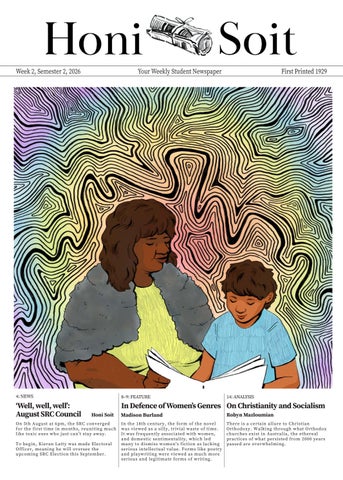
FRONT COVER Vieve Carsnew
16 Stories from my Bà Cố Ngoại 17 On Greng Jai 18 Extra! Extra! Who’s Gonna Read About It? 20–23 SRC Reports/Puzzles/Comedy
Contribute
Do you have a deep-rooted longing to be a contributor but have no idea how to get involved? Apply to be a reporter or artist via the link in our Instagram bio: @honi.soit Or if you have a one-off pitch, tip for a story, complaint, letter to the editors, or more, email us at editors@honisoit.com. Scan the QR code if you'd rather send an anonymous tip. Send mail to Honi Soit at PO Box 974 Broadway NSW 2007.
ISSN: 2207-5593. This edition was published on Tuesday 11 August 2026. Disclaimer: Honi Soit is published by the Students’ Representative Council, University of Sydney, Level 1 Wentworth Building, City Road, University of Sydney NSW 2006. The SRC’s operation costs, space and administrative support are financed by the University of Sydney. Honi Soit is printed under the auspices of the SRC’s Directors of Student Publications (DSP): Dongchen Yue, Sholto Mirrlees-Black, Lucy Sullivan, Ying Huang, Damien Lee, Hamish Evans. All expressions are published on the basis that they are not to be regarded as the opinions of the SRC unless specifically stated. The Council accepts no responsibility for the accuracy of any of the opinions or information contained within this newspaper, nor does it endorse any of the advertisements and insertions. Please direct all advertising inquiries to publications.manager@src.usyd.edu.au. Email the editors at editors@honisoit.com.
2
Editorial I chose the theme “Storytelling” for my final editor-in-chief edition of Honi Soit for a few reasons. For one, obviously, I’ve always loved books. At the same time of this edition, I have recently finished my Bachelors Degree majoring in English (yay me!). Which I am incredibly excited about, but at the same time, I understand my perspective of storytelling is that of an incredibly privileged one. I am a white woman, and I have spent most of my life in privileged establishments which have very much informed my perception of storytelling. In this edition, I’ve tried to step back from my own perspective, and give others a chance to explore and share what storytelling means to them.
On reflection, Alice ruminates on how her Vietnamese identity and culture have persisted, and Mia doesn’t want us to forget the Thammasat University massacre. On University life, Grace questions what student partnerships actually look like. Exploring the current, Maeve questions what journalism looks like in 2026, Wendy appreciates the art of fanfiction, and Andrew examines the use of AI in the personal medical sphere. Exploring the past, Robyn dives into the history of Christian Orthodoxy. If you were unable to secure tickets to the Odyssey in IMAX, there is good news for you yet! Aidan reviews the Odyssey, and Max takes us for a history lesson on Homer.
As my final editor-in-chief edition, I would also like to take a moment to thank a very special person in my Honi journey. A huge thank you to my dear friend, and previous editor, Mehnaaz Hossain who even up to the end of this edition, read and edited my feature. Mehnaaz, thank you for listening to my voice memos and editing my horrific grammar, I don’t know how I would’ve done this without you. Thank you to everyone who contributed writing or art to this edition, it has truly been a pleasure, and occasionally a bit of a headache. All my love, Madison Burland
Vox Pops: What are students saying about F. Goya There wasn’t enough sex and violence in this one. I can’t watch anything unless there’s sex and violence on the TV.
Odie C. Es : Damn that was a crazy movie. Damn that was crazy. Damn. That was crazy. Damn. All that stuff actually happened?
J.J: Why didn’t Odysseus just make the guys apologise at the end? It made me really sad when he killed all those guys for throwing a house party without him.
P. Griffin: Regular Honi Soit vox pops contributor P. Griffin back again to talk about the Odyssey. Too much sex and violence in this one! Very disappointing because Odyssus seems like a good family guy, but then he kills everyone at the end and I just don’t understand why he would do that. See you next week for another Vox Pop!
Humphrey Bartle Bobton Worthington III: Nolan’s concept of Nostos throughout the movie is a disaster. He does not understand the metemspychotic implications of the rhapsodes on the work, and he fails to recognise the true nature of Homeric epithets as revelatory devices, and his take on Xenia is nonsensical. I know nothing about Ancient Greek and I’ve never read the Odyssey, btw.
Barry B. Benson: I thought it would have bee-n a lot better if it was about bees and how they live in a society and maybe if Odysseus was a bee too, that would have been pretty cool.
Honiscopes
Aries: Contemporary literary fiction. You’re completely out of touch with reality and probably take yourself way too seriously. Taurus: Politics. You need to watch out. People are out to get you. They are out to get you. We aren’t kidding.
Gemini: Self-help. Stop thinking about moving to Bali and becoming a digital nomad and AI entreprenuer and start thinking about the important stuff in life, like showering. Cancer: Romance. Big things are coming. Stay prepared for a large change to your life, like a new partner, a sudden move to another continent, or a direct meteorite strike. Leo: Fantasy. It’s looking good! Despite your egomania, delusion, self loathing, avoidance of any responsibility and complete lack of work ethic, we predict a beautiful future for you.
Phil E. Stein: It looked pretty boring from the AI recap I saw of it on reels but I think it seems kinda long. I didn’t know they wrote a book about it though that’s kind of interesting!
Virgo: Biography. Despite people being scared of you, you’re actually a really chill guy once they get to know you. Keep up the good stuff.
What's On For Clift W/ Hours in Elsewhere, Madam Sandler, Ripley Crimzon Wednesday 12th August 7pm @ Kelly’s On King Students say NO to Hanson: Nationwide Day of Protest – Gadigal Country/Sydney Thursday 13 August 1–3pm @ Sydney Town Hall GRXCE W/ Telopia, Reenie [DJ] Thursday 13 August 9:45pm @ Pleasure Club Palestine Solidarity Conference 2026 Saturday 15 August 8:30am–5pm @ The Holroyd Centre Merrylands NSW HONI START OF SEM PARTY Saturday 15 August 6pm–late
Libra: Poetry. Stay away from that which disturbs your peace and embrace things like crochet, fruit picking, and side salads.
5 DJs spinning DnB, psytrance, techno & live sax FREE ENTRY @ The Vanguard
Scorpio: Classics. One day you will look back on all that you have done and weep.
for more, visit sydneymusic.net
Sagittarius: Crime. Consider taking a vacation. You deserve a rest after everything. Capricorn: History. We know its hard to admit when you’re wrong but we think you should apologise. It’s not the end of the world Aquarius: Philosophy. When people get to know you, you’re either obnoxious and evil or kind and smart and there’s no inbetween. Pisces: Young Adult: You’re a 23yo, get up and put down the Harry Potter and go and get a job. GO OUTSIDE!!!!!
3
| NEWS
Students condemn cuts at last day of NDIS inquiry Victor Zhang reports. Students told the Senate committee examining the controversial NDIS overhaul their deep opposition to the Bill that would see over 300,000 people removed from the scheme by 2031. The inquiry is due to report on 14th August. The snap inquiry examining the controversial National Disability Insurance Scheme (NDIS) overhaul was previously due to report on 23rd June with the Federal Labor Government hoping to push through the overhaul before parliament adjourned for winter. USyd Students’ Representative Council Disabilities & Carers Officer Kayla Hill told the committee that students could not support a Bill “grounded in austerity, eugenics, and exclusion”. “I do not wish to repeat what thousands of disabled people have already expressed about their distress surrounding this Bill,” Hill told the inquiry. “Instead, as one of the only university students to have appeared as a witness, and as one of the only student representatives, I must emphasise our absolute opposition to this Bill, both looking at the harms that will occur overall, and specifically on the grounds of compromised access to tertiary education. “The world of education is a vast, expansive network. To be part of a community joined in the pursuit of learning, thinking, and curiosity, is so
special. The state of tertiary education is already so difficult for disabled people to navigate. This Bill will systematically prevent the cultivation of an entire cohort of thinkers. “Disabled students will be left to already inadequate university “supports” under which we struggle and continuously have to selfadvocate. There have been instances of my university placing a wheelchair user in an inaccessible classroom, of mould and unventilated rooms being unaddressed despite complaints by immunocompromised students.
The state of tertiary education is already so difficult for disabled people to navigate. This Bill will systematically prevent the cultivation of an entire cohort of thinkers. Greens Senator Jordon SteeleJohn asked the witnesses how the NDIS has helped disabled students and how cuts to the NDIS would impact them. Hill read out testimony from three students in response. “My NDIS support workers take me into uni every day and sit outside my classrooms as it is the only way I can attend uni, and without it I would have to drop out,” one testimony from a student with autism at USyd read. “Needing NDIS support is difficult in itself. Support workers can get sick, and I
SRC Disabilities Officer Kayla Hill with Greens Senator Jordon Steele-John
4
constantly have to explain myself and my disability to staff. Part of why these cuts are so completely terrifying is because we’re already struggling with the support we have.” Hill also read out testimony from a first-year arts student on the NDIS. “My funding has allowed me to access weekly psychotherapy, without which I simply would not be studying at university today,” the testimony read. “Starting university has been a massive transition which has exacerbated my disabilities. Being able to continue seeing the psychologist regularly has enabled me to manage these emotions and develop strategies to build my capacity and participate in university education and complete my degree.” Finally, in response to a question on how cuts would affect students, Hill told the inquiry about a student with low-vision from Macquarie who is already experiencing a reduction in support. “This means they haven’t been able to access supports to actually attend university and participate in university — things like orientation and mobility training to navigate campus, screen readers and assistive technology, transport support and mental health support,” Hill told the inquiry. Caitlin Hindley, a Curtin University student and NDIS
participant, told the committee that she moved from a regional town to Perth and the NDIS was critical to her participation at university. Hindley told the inquiry that funding for her social and community supports have been repeatedly cut over the years. “The fact is that I have to choose between going shopping and being able to get to appointments or to uni. I can only choose one of those; I can’t do all three because I don’t have enough funding to be able to access all of those things,” Hindley told the inquiry. “The fact that I can’t access uni like any other person could, because I can’t transport myself safely, is really frustrating. If I were to have this funding cut even more, if I were to be removed from the NDIS, I would have to quit university.” Curtin University Guild Accessibility Officer, Mia Antonucci added that: “A lot of students don’t even attempt to get on to the NDIS in the first place, because they know how difficult it is; they know that they are going to face, likely, multiple rejections. “So there are students with what I would consider severe disabilities, who have extremely limited mobility, who don’t even attempt it.” The committee will deliver their report on 14th August.
National Day of Action against NDIS cuts on 1st August
NEWS |
Hundreds march to NDIS Surry Hills office Dongchen Yue reports. in opposition to reforms bill Disability rights advocates and people with disabilities appeared at demonstrations across the country on Saturday 1st August as part of a “National Day of Action” announced by the Protect Our NDIS Alliance. On Gadigal Country, a crowd gathered at Town Hall Square for speeches beginning 10am, then marched to the Surry Hills office of the NDIS at 300 Elizabeth Street. Wiradjuri Elder Uncle David Bell spoke first, acknowledging Country and reading names of Aboriginal peoples of NSW. The demonstrations are in response to imminent funding cuts to the NDIS announced by the government. The proposal entails tightened eligibility requirements which will remove 241,000 people off the scheme by 2031. Disability Minister Mark Butler says the cuts will slow “rapid cost increases”. Reading from her braille display, folk artist Sam Noonan MCed the event. “We demand the government stop the cuts before they can do more harm, we demand they fund the NDIS and not war, we demand the amount of dignity and respect afforded to any able-bodied citizen of Australia,” Noonan said. Fernanda Castro, a disability advocate who is visionimpaired, spoke to her and her autistic son’s experience with the NDIS. “Looking back, I truly believe the NDIS saved my life, and it gave me the support and independence I needed to leave an abusive situation. And build a safer future for my children.” “Through NDIS-funded community participation, I found friendships… belonging and community that understands my lived experience. My son has grown up surrounded by positive and disabled role models and a sense that disability is something that is to be embraced and not hidden. “Last year during my NDIS plan meeting for my son, I was told by senior planning that I was better off being partnered and that it would be beneficial for him so that he can get to therapies. As a domestic violence survivor, that comment was heart-breaking
and triggering. I fought hard to leave that marriage, I should not rely on finding another partner just to make the system work. I’m deeply worried about changes that reduce support and redefine what is considered parental responsibilities.” The bill stipulates that children must not be provided a support service if that service is primarily used to “improve household efficiency”. It also seeks to amend the maximum response time to “change of circumstances” requests (requests to amend support services) from 21 days to 90 days. Critics fear parents with disabled kids will be disadvantaged by long waiting times and harsh assessments. Disability justice advocate Kyle Montgomery read a statement written by a collective of people with long COVID. “Long COVID can trigger a condition called gastroparesis. If you can’t eat, eventually you die. There are people with long COVID and ME/CFS who need feeding tubes to avoid starving to death. They applied to get on the NDIS and were knocked back. That is shameful.” “As we have learned from the ME/CFS community, GET (graded exercise therapy) and CBT (cognitive behavioural therapy) are dangerous interventions that must not be forced onto us in order to qualify for NDIS access. “Proposed changes to ‘all appropriate treatments’ have no regard for medical evidence and completely undermine patient autonomy and safety.” Montgomery argued that the NDIS too often insists on recovery rather than embracing permanence. “It can be hard to prove permanence when long COVID can fluctuate.” The reforms bill would further tighten access by requiring people to prove they have exhausted all “appropriate treatment” before that disability can be assessed as a permanent disability. “Instead of consulting with us or with scientists that understand our condition, the government pays bogus ‘experts’ for advice on how to exclude us from the NDIS,” Montgomery said.
In his speech, USyd political economy lecturer Luciano Carment criticised the marketisation of disability support services. “A lot of disability is derived from illness. But sadly a much more dangerous and more infectious illness has infected the federal government and the state government in Australia. It’s called ‘free market economics’. The main symptom of this illness is when someone like you or me looks at each other and sees human beings, politicians only see ‘producers’ and ‘consumers’.” “When it comes to creating a disability care system, they ran into this problem: you can’t turn people with disabilities into ‘producers’ because unfortunately, their bodies are not always productive. So what are we going to do? Well, we’ll create an insurance scheme where we fund people with disabilities to become consumers on an ‘efficient private market’ for services.” The government established the NDIS following a 2011 Productivity Commission report. Since then, disability support services in Australia have transitioned away from directly government-provided or government-funded services. Industry lobbyists and some disability advocates who supported the new scheme argued it would deliver better care to disabled people by providing “individualised” funding in a cost-effective way. Rather than collective government-negotiated contracts, funding is provided to NDIS participants who have the discretion to choose from services provided by numerous private NDIS businesses on which to spend the money. “The first thing is, just like electricity, just like the buses, just like the post office, the prices have gone up and up and up and up. The second thing that happened is that they introduced this artificial scarcity. “So we have to have a kind of daily disability olympics where people with disabilities are forced to compete with one another for funding,” Carment said. “Private markets are great if you want to buy an airfryer or a Labubu or a keychain. But they cannot sell us back our
human dignity. That’s actually something that belongs to us already.” Carment said he envisions a “publicly funded, publicly owned, publicly run universal disability care system”. Police officers were relatively lightly armed and no Riot Squad or OSG Odin officers were seen. Apart from two guide vehicles from NSW Police and Transport for NSW, policing vehicles comprised Hyundai Staria police vans and officers on ebikes. USyd SRC Disabilities Officer Remy Lebreton, who liaised with police on behalf of the rally’s organisers, described the vehicles as “wheelchairaccessible police vans ready to arrest the disabled community”. After the march concluded, Detective Sergeant Matt Perry spoke to Lebreton and another organiser about showing more “respect and courtesy” to police in future. He said although the march was legally automatically authorised as the organisers had engaged with the statutory framework by notifying police one week in advance, he wished police were notified earlier, suggesting three weeks as an appropriate period. Perry said it was the last day of their police rostering schedule and officers had to be mobilised ad hoc. In addition, he said if the crowd wishes to stop spontaneously during a march, organisers should approach police with sufficient notice to reduce disruption to public transportation. “We don’t need excuses for it”, said Perry, referring to an instance of the crowd stopping during the march, to which Lebreton attributed the malfunction of someone’s electric wheelchair. The Senate inquiry into the National Disability Insurance Scheme Amendment (Securing the NDIS for Future Generations) Bill 2026 is set to be released on 14th August, after Labor agreed to a demand from the Greens to delay the report by eight weeks in exchange for their support for the government’s tax reforms. The Bill has reached the third reading but is paused until the conclusion of the Senate inquiry.
5
| NEWS
‘Well, well, well’: August SRC Council On 5th August at 6pm, the SRC converged for the first time in months, reuniting much like toxic exes who just can’t stay away. To begin, Kieran Latty was made Electoral Officer, meaning he will oversee the upcoming SRC Election this September. For the past few years, Riki Scanlan has occupied the position, however there is now a new name for hacks and hopefuls to put at the beginning of their election complaints. SRC Electoral Legal Arbiter Edward McMahon was also appointed.
Resignations & Appointments Next came resignations, with Jesper Duffy resigning as Queer Officer (but retaining a council seat for Queer Action), Guanwei Wu of PENTA resigning to the next on their ticket Ying Huang, and two former Honi editors, Marc Panisa and Kiah Nanavati resigned. All resignations were accepted by Council. Shortly following this was the appointment of Victor Zhang and Alastair Panzarino as Honi Soit editors. Both spoke to their nominations. Victor spoke about his recent article on the UOW ICAC hearing and the tertiary education sector’s interconnected “rot”. Alastair spoke about the importance of covering the NTEU strikes and how he views his politics and reporting as symbiotic. Both appointments were passed, and we are overjoyed to welcome Victor and Alastair to the team!
National Day of Action Against Hanson The Council heard and unanimously passed a motion endorsing and committing the SRC to building the NUS National Day of Action against Pauline Hanson protest scheduled for 13th August. “It is very clear Australia is not immune to the international rise of the far right,” Eva Sutherland (SAlt) told the Council. “Students want to fight Pauline Hanson, and it is the role of the SRC to push these students forward and not lag behind [them]. We need to make the NDA as big as possible.” The Labor students chose to use this motion as an opportunity to attack Socialist Alternative’s electoral project the NSW Socialists. Jonathan Gilliland (Labor Left) asked if the Socialists were putting up a candidate for Cessnock. “I’m a big fan of your strategy of running against Greens candidates in Newtown,” Ava Cavalerie (Labor Left) quipped. The rest of Council reacted with incredulity at the inner-city Labor students’ attempt to grandstand for regional voters. The Hunter Valley city of Cessnock was mentioned more than a few times. “You are crawling further and further right to chase right wing voters,” Shovan Bhattarai (SAlt) hit back at the Labor students. “Our argument is that first the left must build in our positions of strength, and one day the socialist movement will reach these regional areas. Your [Labor] approach is to say: you, One Nation voter,
6
should be happy with the Labor program of declining living standards.”
Students on the Picket Lines The Council heard and unanimously passed a motion brought by SRC Education Officers Jasmine Al-Rawi (SAlt) and Dana Kafina (Grassroots) on supporting staff during the current round of enterprise bargaining. Al-Rawi highlighted the results of the protected action ballot where over 70 per cent of staff supported an indefinite strike as a measure to reach an enterprise agreement. “We will have EAG meetings to mobilise support for staff. We will be mobilising students on the picket lines,” Al-Rawi told the Council.
Service Provision? Ava Cavalerie of Labor Left spoke somewhat dispassionately to a motion requesting $20,000 to subsidise the cost of the contraceptive pill for a proportion of students. She said: “Students at times have to choose between their reproductive healthcare and paying rent. This motion wants to see women’s healthcare be affordable and taken seriously.” The motion was quickly criticised by Grassroots and SAlt as “apolitical”, “service provision”, and a “pre-election motion”. Grace Street (Grassroots) stated that there was “no plan on how to administrate” the motion, that Labor did not speak to “WoCo or anyone” about the idea, and suggested Labor “look at their own government”. Jabs were thrown between the Labor Left Donnelly sisters and Grace Street, with Donnelly (Rose) telling Street she would “never accomplish anything outside of the SRC”, Street suggesting Donnelly (Rose) “leave the SRC”, and Donnelly (Jasmine) telling Street she was “not a feminist”. Grassroots’ vaccination program was also criticised as apolitical service provision by SAlt, a point brought up by Labor Left, though more of an attack than a defense. In one of the more theatrical turns of the evening, Jess Heap (Labor Left) took the stage to say: “Well, well, well… Once again our little anarchists who gather around a campfire are going against service provisions. Grassroots and SAlt do not like the students. What does the SRC stand for? The first letter?” Like a pantomime, someone from the crowd shouted: “Representation!” There is no anarchist group currently in the SRC, though Honi cannot verify if any factions enjoy campfires. Leyla Bensan (Labor Left) told Council: “Even if this was an election policy... it would help women.” Laura Alivo (SAlt) stated the motion was the “wrong approach to student unionism” and “misdiagnoses the root of the issue”. Grassroots and SAlt members mentioned Labor Left’s aversion to participating in rallies for women’s healthcare issues and issues with the Labor Party’s track record on women’s issues. Dana Kafina (Grassroots) stated: “If you want to do something about feminism,
Honi Soit goes to the theatre. leave the fucking Labor Party.” The motion did not pass, with only Labor Left and Unity voting for it.
Whither Waterloo? A motion meant to be heard at the June Council condemning the demolition of public housing in Waterloo was finally heard at this August Council. Demolition works have since commenced after police cleared out an encampment defending the public housing estate. “It is deceitful and ironic that the Labor Party and Rose Jackson, who’ve stood with housing activists and residents before, have broken their promises to this community,” Remy Lebreton (Grassroots) said. “At the [housing] encampment, I witnessed fences erected around tenants doing their laundry, who found out they’re suddenly squatters.” Jesper Duffy, who was arrested at Waterloo encampment, told the Council “This demolition is a cash grab from the NSW Government. Not a single [home built] will be public housing.” Rose Donnelly interjected “That’s just a blatant mischaracterisation, it’s not true.” Duffy hit back: “Social housing, affordable housing, is not public housing.” We would recommend an excellent video by Actually Adu explaining the difference between social and public housing, and the troubling political economy of the drive towards selling public housing stock in favour of social housing provided through community housing providers.
Hands Off Bodies, Labor Out of Room The Council then heard a motion titled “Hands Off Our Bodies”, against Libertarian John Ruddick’s proposed bill to NSW Parliament which claims to prevent ‘sex selective’ abortion. Maxine McGrath (Grassoots) stated: “These bills are used as a wedge to block access to reproductive healthcare and abortion.” Grace Street (Grassroots) spoke about the studentorganised rally against the bill and that she “noticed not many people from the Labor side of the room were there”. Leyla Bensan (Labor Left) mistakenly stated she was in high school at the time of the rally, which was two months ago, and then promoted a Labor panel on women’s issues. Emma Searle (SAlt) spoke in support of the motion: “The bill is outrageous and goes hand in hand with Pauline Hanson’s rhetoric on reproductive rights.” The motion passed unanimously as Labor Left and Unity stood to leave, with some of their non-voting members out of the room during voting. All remaining motions were passed en bloc while Young Labor walked out of the room. Street (Grassroots) expressed disappointment that they weren’t able to discuss the motion on an anti-TERF rally before Young Labor decided to exeunt. And thus ends the story of the August 2026 Council.
NEWS |
USyd Garden moved off campus as volunteers relocate six years of community work
Firdevs Sinik reports on the Garden.
The University’s Sustainability Strategy also commits to enhancing students’ engagement with sustainability and supporting “living labs” that connect teaching, research, and the wider community. According to the volunteers, the garden has directly facilitated these specific goals through its educational workshops, community involvement, and opportunities for collaborative research
The University of Sydney Garden is relocating off campus after six years, with volunteers saying the move will significantly reduce access to a space they describe as an important hub for sustainability, education and student life. The student-run garden will move to Reconciliation Park in Redfern after the university confirmed the current site is required for a new School of Architecture building. According to the Garden spokesperson, university Infrastructure initially advised volunteers that only the glasshouse and hoop house would be demolished, with discussions taking place about retaining a reduced garden space. “We were approached by USyd Infrastructure initially with plans to demolish the two buildings. Under that plan, they were going to work with us to formalise the allocation of a slightly reduced garden space,” a spokesperson from the USyd Garden committee told Honi Soit. The Gardeners say those plans later changed, and that the entire site is now required for the new School of Architecture building. They said that volunteers proposed several alternative on-campus locations, including the disused greenhouses near the Veterinary Sciences building, but these proposed relocations were rejected. They also argued that nearby alternatives could have accommodated construction facilities while preserving the garden, questioning the university’s priorities. The relocation follows months of preparation after volunteers anticipated they would eventually be required to leave campus. While they have secured a new home at Reconciliation Park, they say the move represents a substantial loss. “It’s been tough on many of our members since all of a sudden six years of work is destined for bitumen,” the USyd Garden spokesperson said. They said some features, including a pond with a bathtub containing frogs and tadpoles, mature fruit trees, and other
established plantings, cannot be relocated. Volunteers also say the relocation will reduce students’ opportunities to engage with the garden. Reconciliation Park is around a 30-minute walk from the University, making it considerably less accessible than the current site, and the new garden is approximately one-quarter of its size. The campus location has regularly been used as an informal gathering place, with students eating lunch, attending weekly gardening sessions, and participating in workshops. It has also hosted teaching activities, honours projects, and academic research, including work by plant scientists and researchers studying diseased crops. Volunteers fear much of this activity may no longer be feasible.
Since its establishment, the garden has also played an important role in student wellbeing, sustainability education, and community engagement. The space has hosted workshops on composting, beeswax wraps, and candle-making, often in partnership with the university’s sustainability programs. Volunteers say it has also become a meeting place for students from a wide range of disciplines and cultural backgrounds, with gardening offering opportunities to share knowledge beyond the traditional classroom. “It’s probably the greatest example of interdisciplinarity on campus,” the spokesperson said. USyd Garden volunteers also argue the decision is inconsistent with the university’s sustainability commitments. They argue that removing the garden is inconsistent with key objectives articulated in the university’s 2020 Sustainability Strategy. The University has positioned sustainability as a strategic priority, ranking 15th globally in the QS World University Rankings: Sustainability 2026.
“It’s one thing to talk about ‘Caring for Country’, but another to tear up a whole bunch of native plants,” the USyd Garden spokesperson said. The Gardeners also say the university did not contribute to the establishment or ongoing management of the space, which it says was created on previously unused land with the permission of an academic. Volunteers say the project has instead relied on student efforts, University of Sydney Union funding, and support through sustainability workshops. D espite the relocation, the Garden intends to continue operating from Reconciliation Park while seeking a permanent location closer to campus. “Our biggest priority is to have a dedicated space and regular meetings, because in our experience, those are the conditions of building a community,” the garden spokesperson said. In response, a university spokesperson told Honi Soit that it recognised the value of the garden and its contribution to sustainability engagement and community building. “We know how much the garden is valued by its members and appreciate the contribution it has made to sustainability engagement and community building on campus over recent years,” the spokesperson said. The university said the site had been earmarked for redevelopment since 2016 as part of its long-term campus planning program and that it had been “happy to offer it as a community garden space on a temporary basis until those works were ready to proceed. “Despite extensive efforts, we haven’t been able to find a viable alternative site on campus that fits with our planning, operational and safety requirements while also supporting the garden’s ongoing needs,” the spokesperson said. The spokesperson added that the university remains committed to making its campuses more sustainable and continues to invest in research, education, campus operations, and student engagement initiatives to support that goal.
7
| FEATURE
In Defense of Women’s Genres Madison Burland thinks you should read the book before you burn it.
The Author Problem In the 18th century, the form of the novel was viewed as a silly, trivial waste of time. It was frequently associated with women and domestic sentimentality, which led many to dismiss women’s fiction as lacking serious intellectual value. Forms like poetry and playwriting were viewed as much more serious and legitimate forms of writing.
In 2026, it seems we are still having these same conversations. Whether it’s romance or ‘romantasy’, an entire world of writing is once again dismissed for frivolity, but often dressed up in language that appears nuanced. Romance and fantasy books are labelled illegitimate due to their conceptions of women, complex worlds are reduced into TikTok takes, and entire genres are criticised for “dumbing down literature”. Is there something to be said about how certain genres tend to cater towards toxic ideals by perpetuating heteronormativity? I suppose, but whether those genres with bad reputations are actually the main culprits of perpetrating these ideals is arguable. Many classics have been used as tools to perpetuate sexism through various periods of time in and out of the academy. Consider the recent revisiting of Homer’s works: women like Clytemnestra, Circe, and Calypso are all arguably portrayed as manipulative, witch-like, and often lack nuance (depending on the translation).
8
Within the realm of classics, the act of translation has often been a tool used to perpetuate sexism. A notable example of this is how Richard Fagle’s translation of The Odyssey uses the word “sluts” to describe the maids in the home of Odysseus ¹. Now compare that to modern day works socially labelled as ‘poor depictions of women’, notably Colleen Hoover’s It Ends With Us or dark romance books where female autonomy is often fraught. There is one thing in common here, and it’s not a genre problem: this is an author problem. Both of these books have considerable problems when it comes to the depiction of women, neither of them are representative of an entire genre. When singular works become representative of entire genres, it limits nuance capable within these discussions. Colleen Hoover’s writing does not represent romance², Fagle’s The Odyssey does not represent classics, and claiming either work has an entire claim on a genre limits the possibilities of discussion, nuance, and debate.
Exploitative Literature Exploitative literature, such as books like Haunting Adeline, a popular dark romance between a stalker and his victim, can be problematic when it perpetrates harmful ideologies that become mainstream. But the argument that they are encouraging violence against women is weak at best, considering the men who are often perpetuating these crimes are not the same ones reading dark romance.
I personally do not enjoy dark romance, but I also understand that shaming an entire genre is a slippery slope to censorship. It is hard to draw the line between something so unethical that it shouldn’t be published, versus a blanket argument applied to any and all books that pose ‘a risk’ to authoritarian governments.
Do I agree the publishing world should be stricter? Yes. Do I believe that that is the fault of an entire genre, or a couple of bad authors? Realistically, the latter. Readers have long been fascinated by morally questionable stories, from Greek tragedy to Gothic fiction, crime novels, and psychological thrillers. We do not assume that enjoying American Psycho means endorsing serial murder, nor do we assume reading Homer is an endorsement of patriarchal values. Yet romance is uniquely expected to justify its own existence whenever a controversial title becomes popular. The real story here is the fact that whatever women are interested in seems to be slowly but surely dismissed as silly or frivolous. Be it the novel in the 1800s, or Romantasy in 2026, this is not a new argument. Consider Swifties dismissed as crazy fangirls, or the decadeslong derision directed at romance novels despite their enormous commercial success and literary diversity. Media consumed primarily by women is often treated as inherently less serious than media aimed at men, regardless of its cultural impact or artistic merit. The criticism, then, is not simply about any one fandom or genre, but about the enduring tendency to devalue women’s tastes by framing them as irrational, shallow, or unserious. Now, this is not to say that there is a very real argument to be made that some romantic literature can be aiding and abetting the literacy crisis, but for very different reasons than the average woke Booktoker would claim. I would argue that the rise of AI, and mass AI-generated romance kindle unlimited slop, where authors are using AI writing to make a quick buck is a very real problem — but not as severe as the internet makes it to be. This kind of argument rather provides a façade for pretentious readers to excuse their inherent bias towards female-dominated genres. Dismissing entire genres leads to limited world views, consistent echo-chambers, and can actually help the far-right by creating a safe space where anti-intellectual gatekeeping increasingly overlaps with broader anti-feminist and culture-war rhetoric.
The literacy panic argument Although Australia is one of top nations with a high literacy rate, where 99 per cent for adults aged 15 and over having basic literacy skills, compared to the global average literacy rate at 86.8 per cent, there is a real growing concern between the lack of young people who read, and the rise of the farright. An Australian Bureau of Statistics study on how Australian generations spent their time on recreation and leisure, found that young men aged 15–24 are the least likely to read recreationally in Australia. At the same time, young men in Australia are breaking the historical trend of younger voters being more progressive.
With the rise of the manosphere, Pauline Hanson and One Nation, and conservative figures such as Andrew Tate, young men have slowly been gravitating to the right. The Financial Review reported that during the 2025 Federal Election, 37 per cent of young male voters, aged 18–34, preferred Peter Dutton as prime minister. This does not mean that reading less causes people to become politically conservative; the issue is obviously more complicated than that. But history demonstrates that books matter because they expose readers to unfamiliar perspectives, challenge assumptions, and cultivate the patience required to grapple with complexity. It is no accident that authoritarian movements have so often sought to control what people can read. From book burnings to school library bans, restricting access to literature
FEATURE |
has long been a political act because books encourage critical thinking and empathy in ways that slogans and algorithms rarely do. Over in the United States, Trump is banning books once more, and instead of being concerned with what genres people are consuming, we should be worried about the fact governments often try to limit what we read at all. It has been found that books read are less likely to be banned. When authorities require books be read by review boards before banning them, it prevents groups from isolating whole texts into segments to push their political agendas. The whole idea of “don’t judge a book by its cover” expands beyond the cover. If you want to dismiss a book, read it first. With the rising popularity of BookTok, it has become increasingly easy to dismiss authors entirely without having ever picked up the book in the first place. Reading outside your usual genres challenges reactionary rhetoric by allowing yourself the space to develop your own thinking and opinions, outside of the prevailing narratives.
This is precisely why the casual dismissal of entire genres should concern us. When romance, fantasy, or any other genre is written off as inherently frivolous for any reason, we are not encouraging higher literary standards, we are narrowing the pathways through which people develop a habit of reading in the first place. A teenager who begins with romantasy is still engaging with long-form storytelling, complex narratives, and sustained attention. By pushing talking points that genres typically enjoyed by women are silly and frivolous, potential readers are
discouraged from exploring. Perhaps, instead of asking, are people reading the right books? We should be asking, how do we get people to read anything?
In the defence of Romantasy The romantasy genre appears to be at the forefront of these culture wars. Some claim it is a marketing term, some claim it is a “romance novel in a fantasy setting”, where the lines of the genre end is a particularly contentious topic. I hold a specifically unique perspective which has greatly informed my view of Romantasy. If you take a look on my Honi author page, you will see that I have been lucky enough to interview and review a range of Romantasy authors and books. Some have been horrible reading experiences, and some have been brilliant. Not once have I blamed the entire genre. In an interview with Sophie Clark, author of Romantasy book Cruel is the Light, she states that for a book to be classified as Romantasy, “the plot and the world and the stakes have to be equally important to the book existing and the story existing, as the romance. So the romance has to drive the plot, and the plot has to drive the romance, and neither can dominate.” That is entirely a different narrative than what most internet users would argue. This particular Substack reviewer captures most of the criticisms I see on the internet surrounding Romantasy. The author claims that “Romantasy Romance™” is all about “graphic and explicit about exteriority, while being generally fade-to-black about interiority.” They continue to characterise the typical female characters as, ‘not like other girls, thin, smaller than the male main character’, and male characters are ‘big, brooding, tall, tormented.’ The author references Rebecca Yarros’s Fourth Wing, and Sarah J Maas’ A Court of Thorns series as their central references.
I would argue this characterisation of the genre is pretty ridiculous. The Guardian argued that Yarros and Maas’ works spearheaded the genre, but in an age of death of the author, does it matter where a genre started from? Classics outlive the canon and are continually contested, Yarros has come under fire for cultural appropriation, and Maas has been accused of being a Zionist for proudly discussing her birthright trip to Israel. Is it fair to hold an entire genre to the faults of a few bad nuts? Or should we be looking more at the fact that these genres, which are typically enjoyed by women, seem to be the ones most loudly criticised? In terms of their criticisms of the way the characters are depicted, again, I would argue that that’s an author problem. If you are solely consuming fantasy or romance, or any book for that matter, written by white straight people, you are bound to be disappointed. There is a whole world of fantasy written by diverse authors, who brilliantly create worlds, without prioritising white heteronormative world views. Kamilah Cole, Sydney J. Shields, Isa Agajanian, and Thea Guanzon are just a small handful of queer, BIPOC Romantasy and Fantasy authors I would recommend this Substack author check out to diversify their reading list.
read what you wouldn’t usually pick up and what makes you uncomfortable, because if we continue down this road, some day you might not be able to. Footnotes: ¹ This is not to claim that The Odyssey is inherently sexist. To compare, Emily Wilson’s translation refers to these women as “these girls,” and other American translations use a variety of labels, including these “disobedient maids.” For the sake of the argument, the scope is limited to demonstrate how the act of translation can be used to push sexist ideals. ² Minor authors note: Before everyone gets in a flurry about my comparing of Homer and Colleen Hoover, this is not at all a comparison representative of individual author merit (or authors if you’ve read the accompanying piece in this edition discussing the contested authorship of Homer) but rather a minor observation of how both sets of works can be viewed as problematic depending on the audience, yet neither are indicative of an entire genre.
Anyone can be a bad author. It is impossible to declare an entire genre, no matter the reason, inept, unless you have read every single book that genre has to offer. Even then, If possible to complete, I imagine your reading experience would have led you to more nuanced outcomes. If you read all romance books expecting it to be trash, so it shall be. The issues of antiintellectualism and the rise of far-right rhetoric is not an issue we can solve in a day; but it can be improved by questioning implicit judgements. Read far and widely,
9
| CAMPUS
‘Student voice’: lots of people are speaking, but who’s being heard? There’s a reason why I sometimes describe the SRC as the University of Sydney (USyd’s) “dirty little secret”. We offer the free and confidential professional casework and legal services often saving students’ skin, and advocate year-round for the interests of students in boards, committees, and on the streets intervening to combat harmful and rushed decisions. We are loud and vocal about the issues affecting students — lack of housing, fees going towards genocide, inhumane University systems, growing class sizes, and more — which are often at odds with the profit-seeking priorities of the contemporary corporate university. So, we often find ourselves delegitimised and increasingly left out of important conversations and decisionmaking. Even when we maintain “a seat at the table” our feedback and interventions are often received but then left to rot. This article comes at a time of increased discussions and advocacy around “student voice”. What does this buzzword mean? Whose voices are platformed and taken into account? Recently, the Sydney Student Voice Network was established as a pool of students to “participate in paid opportunities to contribute to strategic improvements to the student experience” — one example listed was improving students’ digital experiences in the Digital Sydney program. It is right to formalise a network with an even playing field, diverse students, and remunerated opportunities to provide feedback on their experiences to the University in focus groups, rather than certain students (or at times, students employed by the University) being picked to do so. However, we do need to delineate when individual students in focus groups should or shouldn’t be used, and similarly when it is essential that elected students in representative organisations built for this purpose take the lead. A recent article by student leaders in the Council of Australian Postgraduate Associations (CAPA) dives into this worrying trend across the continent. “It Looks Like Representation, But It Isn’t” captures something I have
10
been trying to highlight this year — the University of Sydney does have a good quantity of student consultation and representation on paper, but the quality is not there. The authors identify that there is a new threat to student unionism in our post-Voluntary Student Unionism world — the creation of a ‘student leadership market’ which conflates student ambassadors selected and paid by the University itself with independent, democratically-elected student representatives. It is undeniable that in recent years when the SRC has engaged in campaigns or run Student General Meetings (SGM) on important issues the University has dismissed us as fringe and unrepresentative. Take the August 2024 SGM on Palestine where over 500 undergraduate students attended in-person on a random Wednesday night to near-unanimously vote to cut ties with weapons companies and complicit institutions, and to scrap the new Campus Access Policy (2024). The disgraceful response of the University in a public statement the next day was, “Less than one percent of our student population attended the SRC meeting yesterday — student representative and student-led groups are independent of the University and certainly don’t represent our institutional position nor do they represent the majority of our student body.”
So. More than 500 undergraduates at a specific Student General Meeting facilitated by the SRC after more than 200 undergraduates called for it is ‘not representative’. But, recently when SRC and SUPRA representatives were battling a proposal to remove StuVac from intensive units, we were up against feedback from a focus group of… eight students. There’s a bit of a discrepancy there, right? The numbers themselves or the state of being or not being “at the table” aren’t the problem. This is a systemic and cultural devaluation of the voice and role of studentrun organisations, particularly when they are rightfully doing their job of opposing detrimental decisions by the University. When the proposal to remove (or shorten) StuVac came to a meeting of the Academic Standards and Policy Committee within a paper to formalise the University Academic Calendars for 202728, it was the first time that student representatives had even heard of it. Myself and SUPRA representatives had to push back on their rounds of consultation excluding student representatives, but were successful in pausing that section of the proposal and securing further discussions. It took further meetings with SRC and SUPRA executives and disability
The numbers themselves or the state of being or not being “at the table” aren’t the problem. This is a systemic and cultural devaluation of the voice and role of studentrun organisations, particularly when they are rightfully doing their job of opposing detrimental decisions by the University. It is indicative, however, of how the University does see and has been allowed to treat the SRC — and at times, SUPRA — for many years. Our independence is not an excuse to disregard us and distance themselves from democratically decided stances. Our independence is protection for us and students from them — the overbearing, profit-maximising corporate university — and allows us to actually act on controversial topics and advocacy on issues important to students.
representatives to make clear that we must account for students with disabilities, working arrangements, caring responsibilities, those who could but may not be registered with Inclusions & Disability Services, and so on. It was frustrating, but not surprising, to have to spell out that the University’s focus group of eight students may reflect the preferences of an ‘average’ student doing a holiday intensive and doing only one intensive/unit during that time, but that we as representatives are advocating for and talking
Grace Street speaks.
about our more vulnerable cohorts of students who have much to lose. The SRC’s strengths lie in its independence, long traditions of action for progressive change, institutional knowledge through its professional staff and longstanding campus groups, a strong democratic mandate through annual elections with growing turn-out, and our representative SRC collectives filled with student participation and voice. A useful framing is that of “lived experience” versus “lived expertise”, which is elucidated in a recent paper by 16 individuals with diverse disabilities and experiences. They define disability lived expertise as “synthesis[ing] lived experience with a deep knowledge of the history, concepts, rights, and collective experiences of people with disability, the core values of the disabled community, and advocacy skills needed to redesign and reshape the social environment to enable people with disabilities to flourish.” In the SRC, students are elected and staff are hired to have that exact “lived expertise” — synthesising lived experience with the relevant knowledge, values and advocacy skills — to wade through the bureaucracy and frequent bullshit of the corporate university, to factor in the broader governmental and political scene influencing decisions, and to fight for students and all of our wider university community. The SRC could actually be the ones running independent focus groups and more surveys to capture student voice, and importantly in a way where students are not pressured to give positive feedback on university issues to the university itself who is collecting the data and supplying the gift cards for participation. We do have a few successful examples of this, such as the joint SRC and SUPRA survey on Simple Extensions in 2023 when they were at risk of being reduced from five to three days without first fixing the pressure on the Special Considerations system, which received over 900 responses and was integral (alongside our rallying of student representatives on Academic
CAMPUS |
Student voice is so important, which is why we have to watch out for it being cherry-picked. Board) to defeating a proposal that was harmful to students. However, our ability to capture more student voice is significantly stifled by limited funding to hire an appropriate amount of professional staff, lacking access to communicate with all of the students we are meant to represent, and increasing communications from the University delegitimising and reducing trust in our organisations. Student voice is so important, which is why we have to watch out for it being cherrypicked. It’s good that the University can draw on a formalised network of students to get insights on things like the usability of its digital platforms, their tastes regarding the meals for the new $5 canteen in J03, and individual student experiences with various academic arrangements. However, when it comes to systemic issues, policy decisions, and academic matters that have been at the heart of our advocacy for years, this is where studentrun organisations cannot and should not be pushed out. It’s hard to end on a more positive note after an elementary, but sobering, analysis of the current state of affairs. There are things in the works — currently, the University is also pursuing a ‘Students as Partners Framework’. While this is more of a mapping and formalisation exercise with some recommendations on improving student voice, your student organisation leaders are already talking about the next steps to properly embed and strengthen democraticallyelected, independent student representation at the University for the longterm both culturally and systemically. Keep an eye out for more on this, and please do get involved with the SRC, our weekly student newspaper that you’re reading right now, and our collectives. Put that student voice to work!
Why can’t we have nice things? Newtown Forest: a eulogy Sophie Wishart mourns. For those who did not get the privilege of meeting the beautiful Newtown Forest in her devastatingly short lifespan, I will tell her tale for all to know. I saw her for the first time on a beautiful Friday afternoon, seemingly she appeared out of thin air onto the unassuming concrete island located just off the intersection between South King Street and Enmore Road. A smorgasbord of house plants, bathtubs filled with ferns, a solitary bench, all together lovingly adorned with a crudely hand-painted sign, red paint on white board, naming her “Newtown Forest”. While its origins were at first a mystery to me, after a bit of online digging, it can all be traced back to a certain few green thumbs in the community. Inspired by tactical urbanism, Newtown Forest’s first seeds were planted by members of Project K-Shift. They describe themselves in their website as “a local, citizen-led effort to reimagine King Street and Enmore Road as peoplefirst places, where walking, cycling, public space and community life take priority over traffic and congestion.” After an apparently incredibly spurring free community talk given on the 24th of June, by Pauline Lockie and Patrick Franklyn (a.k.a @onthe_verge01), a group of eco-vigilantes moved
under the cloak of night to sow the beginnings of a greener street. While this forest bloomed for almost an entire beautiful, vibrant month, it was ultimately uprooted. On the 21st of July, an impressive task force of two trucks, multiple police cars, a mini crane, and an army of tradies and cops arrived at to our concrete jungle (where dreams were made from) to pull out the weeds of a budding hope for a greener Inner West… Talk about overkill! What at first was a symbol of a blossoming community quickly transformed into a thorny reminder of what our council sees fit to spend taxpayer dollars on, and what it doesn’t. Apparently a cause for safety concerns, Transport for NSW said “the decision to remove the installation was made solely on safety grounds, with the safety of pedestrians, cyclists, and motorists our highest priority.” However noble, their reasoning was thin and inconsistent with practices that are displayed on Erskineville Road, just a suburb over. On Tuesday, the 4th of August, a wake was held for the felled forest at The Townie, the pub that witnessed it all. We can only hope that she will be revived one day. What I’m sure of, however, is that her spirit will live on, her proverbial
weeds will sprout through the proverbial cracks in the proverbial concrete. Because when the government refuses to put people first, what else can the community do but put themselves first? While her absence leaves a triangle-shaped hole in my heart, Newtown Forest was in fact a successful experiment in the eyes of a tactical urbanist; limits were tested, we found out what was possible, and how far we could go before we got in trouble. Most importantly, our community’s eyes were opened to what our street could look like. Maybe it is possible to turn your local heat-radiating, noshade, third-space-averse, asphaltian, freeway hellscape into a “society if” meme. Newtown Forest did her job as a martyr, and hopefully she will not have wilted in vain. Attention has been drawn to Newtown’s minimal urban greenery, tactical urbanism has entered the mind of the common Inner Westian. We don’t have to accept the places we live, walk and work being traffic gutters. Until then, you can sign the change.org petition in @ projectkshift’s bio to bring Newtown Forest back. Keep pushing those incremental changes, give Joni Mitchell’s Big Yellow Taxi an extra hard listen today, and start caring about where you walk!
Photo credit to @kyrafb
11
| OPINION
Why YOU should protest Pauline Hanson Emma Searle wants you to fight against the far right. Every student opposed to the belligerent racism of Pauline Hanson should join the National Anti-Hanson protest, on 13th August. At the National Press Club, Hanson laid out her farright program: a return to ‘monoculture’ in Australia, declaring the ‘Welcome to Country’ divisive, questioning paid leave for single mothers, and proud pro-business governance accompanied by attacks on the ‘lazy’ working class. It is clear Hanson is not interested in watering down her fascistic vision of society to become palatable for the mainstream. She is staking out a hard right-wing line in Australian politics. We are no longer watching a squawking ex-fish-andchip shop owner cry about migration from the fringes. As of the July National Newspoll, One Nation is polling 30 per cent of the primary vote. Since the last federal election, this is an over 20 per cent leap. In the upcoming Victorian state elections, they have a serious chance at dethroning the Labor dynasty of 24 years and claiming the first state to One
Nation leadership in Australian history. Even more concerning than Hanson’s breakthrough polling is the explosion in paid members to her party. In the last year, an additional 40 thousand people have become paid members of One Nation. Sitting at 70 thousand members, One Nation now has the largest party membership in Australian politics, surpassing both the Liberals and Labor. That means there are tens of thousands of far-right actors who are organising themselves under a party that wants to see a mass expulsion of migrants from the country and the conditions of workers destroyed. This Trumpian vision of the world wants to turn the tide even more in the favour of billionaire MAGA fanatics like Gina Rinehart.
The far right are fighting for their vision for the world. The left has to respond with an equal and opposite fighting force.
One Nation’s rapid success reveals that a confident, organised minority can significantly reshape Australian politics. Waiting for centrist parties to be re-elected has never stopped the far right march to power; it didn’t stop Donald Trump, and it won’t stop Pauline Hanson. The only force that has halted Trump’s fascistic regime has been the mass protests and general strikes against the Gestapo-like ICE raids kidnapping migrants from schools and homes. Masses of workers, students, and the oppressed banded together to courageously resist the terror unleashed by the masked ICE thugs.
You should be part of this fight back. But don’t just join the protest, help make it the biggest antiHanson rally for decades. Help us paint placards at the activist workshops, hand out leaflets in your classes, and convince your friends to join the protest. Right now, Hanson’s rise is being painted as a popular and uncontested acceptance of her far right antics. Let’s change the narrative on Hanson. We want to let the whole world know, students SAY NO TO HANSON.
On 13th August, students from all across Australian universities and high schools will be walking out to say no to Hanson. At USyd, we will be meeting at Eastern Avenue at 12pm for a campus rally, and then we will converge with other campuses at 1pm at Town Hall for a massive ‘fuck Hanson’ rally. Student protest has always played a detonating role in politics — being the spark that sets alight broader struggle.
“STUDY WITH ME” is becoming the new “GRWM” slop Did you watch a “STUDY WITH ME” video today as soon as you opened your phone this morning? Did you watch the same type of video yesterday before you fell asleep as well? You most likely did, or even if you skipped the video, it has definitely popped in your algorithm at least once.
These videos push an ideology of productivity by glamorising activities like pulling all-nighters “STUDY WITH ME” videos begin with sounds of keyboard typing and mouse clicking, sound effects likely extracted from Capcut. The epidemic of these videos is a sign that students are consuming more for productivity rather than for knowledge and passion. This consumption is not limited to desiring those instant dopamine hits granted by study-ASMR of creators opening cans of sugar-filled energy drinks. These videos push an ideology of productivity
12
by glamorising activities like pulling all-nighters and having AI bots summarise lecture slides for a test the next morning. With higher cost of living students are pressurized to work part-time or casual to sustain a lifestyle suitable by societal standards. This phenomenon has further fuelled students’ tendency to depend on a can of energy drink and replay “Study With Me” videos in the background to complete their backto-back assignments after a tiring day of work. This illusory and unhealthy idea of productivity stems from diehard consumerist habits of university students who fall prey to blatant advertisements for products or services that a creator is quote unquote “obsessed” with. With the new semester commencing, USyd students are yet again susceptible to being sold this illusion of a productive student lifestyle, which on surface-level might seem to motivate students
Stuti Acharya is sick of influencers performing productivity.
to “lock in” but actually substitutes the work of going to lectures with a video that vicariously makes them feel productive. Sure, a lot of this content, especially short-form videos, serves no purpose other than to be a landfill of ads. However, they also serve a more sinister function. They delude students into thinking they are striving to be high-achieving students, but inherently have a capitalist approach as they are sponsored by a certain brand or are fishing to get sponsors. Even better if a brand leaves a zesty comment on their videos. Corporations are able to sustain their dominance and stay relevant in the market through selling the idea of relatability to consumers, and with the rise in influencer marketability, both corporations and contentcreators are able to use this tactic to win over consumer’s attention and money both at the same time. While I do want to emphasise that contentcreators oftentimes do not
have monopoly over their own content, they essentially perpetuate this type of content-creation for their own relevancy in this cut-throat market which is just as harmful to us students.
Students are not and should not be victims of these poorly organized massconsumerism tactics of corporations and content-creators. Being a uni student has been marketed as this pathway to getting a high-paying job right after graduation, but education cannot be reduced to means for exploitation of students, especially the working-class community. It must be nurtured by our educational institution, but it seems it has failed to do so, as the free Celsius drinks giveaway and Red Bull cars are all the gush during every welcome week.
OPINION |
Extra! Extra! Who’s Gonna Read About It? Maeve Jenkins questions modern journalism. As a Media and Communications student, I’ve been told more than once that, eventually, I’ll be out of a job. It’s true, the media landscape is shifting rapidly, especially when it comes to reporting; investigative journalism being made anew with the rise of social media. Now, major national news platforms are receiving less and less engagement, having been replaced by younger generations with self-proclaimed social media ‘journalists’ standing as the updated approach to consume critical commentary. Of course, when tradition is subverted, the most common response is panic and so, naturally, the push away from traditional news media sources to contemporary, nonregulated sources has manifested in a valid, unspoken query amongst Australians: Who do we turn to for reliable journalism? Ah, a tale as old as time. Do we stand with tradition or step forward with the future? Should we stick with the reliable 7pm news or prioritise the voices of the internet? What makes good journalism in 2026? Who is Radio Rebel? It’s hard to say. Luckily, at a time when unlimited content is available at the tips of our fingers, we can do the research ourselves to come to the most logical conclusion. After all, as a real journalist would say, investigation is key. Annually, the University of Canberra’s News and Media Research Centre works to create the Digital News Media Report, providing general statistics regarding national engagement with news and media content. The 2026 report, conducted throughout January and February of this year, was performed with a sample group of approximately 2,000 participants and revealed key insights into Australia’s shifting media landscape. This edition of the report revealed that, for the first time ever, social media platforms have become the primary source for accessing news content, with 43 per cent of Australians drawing their news from digital creators or influencers, the number rising to a staggering 70 per cent among 18-24 year olds. In addition, nearly 50 per cent of young Australians (18-24) strictly turn to TikTok for news engagement while Facebook continues to hold the title as the most used social media platform for accessing news across the sample group. So, Australian youth has coined a new era of news consumption, one that relies primarily on platforms with little regulation and the assertive voices of influencers. This is particularly peculiar when we take note of rising political interest, the report emphasising that under-35s are now demonstrating more interest in political affairs than those aged 35 and over. If this is the case, why is it that we’re turning away from wellestablished media platforms to consume political commentary? Well, the Digital News Report revealed that while 51 per cent of consumers distrust social media news, a striking 77 per cent show greater distrust for the reliability of national media platforms, with many concerned about the spread of misinformation, and even suspecting that media owners may be influencing news coverage.
When consuming news content, consumers should be guaranteed a high standard of journalistic integrity. Reporting must be purely factual, unbiased and informative, allowing those who engage with such content to determine their own perspective and opinions regarding national events and political issues. Why is it, then, that most Australians can easily identify Sky News as a rightwing platform and the ABC as a left-wing platform? If we can assign said platforms to a political affiliation based on their content alone, then bias is clearly present and as a direct result, passive receivers of their content will be influenced in one way or another. It would seem, then, that young Australians are beginning to recognise this pattern and are thus turning to influencers, people like themselves, for ‘reliable’ news delivery. But who are these influencers and what makes their content superior to that of our national news organisations? One example is Pete Zogoulas, or Pete Z, an Australian YouTuber whose content centres around engaging in risk-taking challenges that often work to expose independent organisations for scamming unknowing consumers. While his channel stands at 302 thousand subscribers, his newest ongoing series investigating client fraud within the National Disability Insurance Scheme (NDIS) has gained significant online engagement, the first video in the series attracting 1.5 million views. Pete isn’t the first to investigate the NDIS; in fact, notable Australian media platforms such as 7 News, the ABC, The Sydney Morning Herald and The Daily Aus have published an extensive portfolio of investigative reports on various issues stemming from the NDIS. So, why has this specific form of investigation gained such significant attention, praise, and even funding? Well, Zogoulas is an independent journalist, meaning that neither himself, nor his platform, are tied to any established media companies. He isn’t bound under any standards of journalistic integrity, meaning that only Zogoulas himself is liable for the risks he takes to obtain interviews or publicly expose individuals. Essentially, he can do and say whatever he pleases without reprimand from a higher journalistic power, allowing him to collect content in whatever way he sees fit; ethical or otherwise. Despite this, Zogoulas’ investigation into NDIS fraud has revealed major issues within such companies, which negatively affect both participants and taxpayers, exposing those responsible like never before.
Humanity, Gen Z in particular, thrives off of relatability, and recently the gap between reporters and consumers seems to be pushing away engagement. If reports are going to contain bias, viewers would rather hear the opinions of people like themselves, not opinions coming from the offspring of major national corporations. This is what makes Zogoulas and other influencers like him appealing to the everyday Australian. They’re familiar, they’re contemporary, and they seem to genuinely care about the ideals they’re promoting. But misinformation online is rife, and to turn entirely to social media influencers as a reliable news source is bound to send us into national chaos. So, who can we trust? Well, good journalism isn’t as hard to find as we think, in fact, content tailored specifically towards Australia’s youth is becoming increasingly prominent. One platform that really stands out is The Daily Aus (TDA), a news room co-founded in 2017 that ‘has pioneered social-first news delivery for Australians aged 18-35’. Operated exclusively by young journalists, TDA implements social media as a tool for engaging with a wide-range of audiences, while specifically appealing to young consumers with their content being bite sized, informative, and best of all, educational. These are the sorts of platforms we should be turning to; news corporations that maintain values of journalistic integrity, while taking the time to truly understand their audience and tailor their content to be accessible for said audience. These are the journalists who work for the people. Now, I’m not entirely against independent journalism. In fact, I think it’s crucial for inciting critical discussion and actively engaging with world affairs. However, we must not become reliant on this type of content alone. If we wish to form our own opinions and to manifest those opinions into change, we must first seek education through a variety of sources, especially those created for us to rely on. Yes, Australian reporting is becoming biased and the effect can be devastating. So it’s time to strive for more, to extend our horizons and consume content that will ultimately encourage action, allowing us as consumers to strive for change. So, have you heard today’s news?
Perhaps this is what Australians are ultimately looking for in their news; investigations that face no bounds, and are created not only for the people, but by the people.
13
| ANALYSIS
It Was Not Always Like This: On Christianity and Socialism There is a certain allure to Christian Orthodoxy. Walking through what Orthodox churches exist in Australia, the ethereal practices of what persisted from 2000 years passed are overwhelming. The same incense, the same hymns, the same movements around the icons and tearful grasps of holy fabrics as they are walked between the pews are perpetually illuminated by how these experiences and objects are routinely similar, projecting a direct correlation to our ancestors and the very figures we worship. Tradition is at the epicentre of Orthodoxy, spreading into wider Christian denominations throughout time. However, in the contemporary realm, tradition has become a weapon of oppression, a justification for marginalisation.
The allure of Orthodoxy is becoming contagious amongst the Right, not only for its traditions, but for its ability to justify traditional social structures. Growing up with Leftist values, I attributed Christianity to alignment of liberation movements and social equality. Whilst impossible to directly correlate a religious movement to a political one, reading through the scriptures, I find it very difficult to perceive otherwise. Quite simply, Jesus was a carpenter, a member of the working class. He was not a figure aligned with the Romans, but one of the forces who fought against the power structures of his day. He became a martyr due to his rebellion against the Roman Empire. Very clearly antiestablishment, He rebelled against religious leaders he saw as hypocritical and who conspired with their colonial rulers. The scripture openly narrates the uprising of the oppressed. It upholds the freedom of enslaved people, shames the social determination for inequality. For me, it is very difficult to read the scripture and separate it from socialist interpretation. In Acts 4:32, it is proclaimed: “All the believers were one in heart and mind. No one claimed that
14
any of their possessions was their own, but they shared everything they had,” bearing striking similarities with “to each according to their need”, sometimes the direct translation of this passage. It so often appears that the Bible is a direct condemnation of class-based oppression. Theologian and Marxist scholar Roland Boer believed Christian scripture was an outright documentation of the perpetual class struggle, understanding its teachings that land irrevocably belonged to God, and thus could not be sold or owned by individuals as a commodity. In Matthew 19:24, Jesus states, “It is easier for a camel to go through the eye of a needle than for someone who is rich to enter the kingdom of God”. This statement echoes from the figure who rampaged the temple after witnessing its commodification, who fed thousands without discrimination, who advocated for the minority in the face of their oppression. Even Leviticus 25 details the Jubilee, a year of rest, debt relief, and property restoration intended to restore the class system by freeing enslaved people and the indebted. Thus, it is impossible to separate Christianity from its origins as the poor man’s religion, a correlation drawn by both Karl Marx and Frederich Engels. In ‘On the Early History of Christianity’, Engels draws on Christianity as the religion of enslaved people and the formerly enslaved, of the poor, the displaced, and the subjugated by Rome, drawing comparisons to contemporary socialist uprisings. Though Marx is often believed to demonise Christianity as a force against class liberation, he recognises it as “the sigh of the oppressed creature, the heart of a heartless world, and the soul of a soulless condition”. Christianity in this context is a response to suffering, believed to be a device to cope with, and sometimes accept, oppression. It can be the consolation of the subjugated, though not inherently. God is, no matter the denomination, an ambiguous and malleable moral figure. Amid thousands of years of interpretation, and sometimes corruption of the text, social perception is inevitably
Robyn Mazloumian rereads the Bible.
altered. Somewhere throughout history, the spectrum shifted. Christianity is no longer the religion of the oppressed, but of the oppressor. Some analysts trace this shift to the Cold War and the Red Scare. Where government systems were composed almost entirely of capitalists, Christianity became a weapon. Where Communism became synonymous with crushing religious freedoms, the Right found a gateway to perpetuate Capitalist propaganda: Capitalism equals freedom, Capitalism equals Righteousness. This is a routine that has become quite standard in contemporary society. Populist parties use this rhetoric to define the ‘Other’ – whether that be religious or ethnic minorities, queer people, or Leftists – as a threat to Western democracy and values, intertwined with a particular kind of contemporary Christian interpretation. Within this right-wing contemporary Christian rhetoric, the West is defined by ‘Judeo-Christian morality’, argued to be threatened by a secularism (or the rise of another nonWestern religion) that would diminish society’s foundations, which perpetuate the status quo, or, more colloquially, what is ‘right’. Essentially, if what is good and Christian is traditionalism, all new movements of justice and ways of life are un-Christian. These ideas originated in German academia in the 1920’s, where the progression of Historical Criticism centred the questioning of the inerrancy and infallibility of the Bible, forcing the questioning about analytics, including the consideration of Christian morality. These analytical concerns of interpretation and historical contextualism created rifts in the church, defying the commonality of what had been taught at sermons. This also created divisions between those who perceived the Bible as infallible and those who integrated emerging science and beliefs into their faith, thus forming the basis of the opposing progressive and conservative Christian denominations. Right-wing Christianity, which dominates the contemporary Christian sphere, emphasises sin, repentance, and salvation.
These forces all act as a form of dogma to turn feelings of shame into acts of compliance. In politics, this weaponises the very religion which once stood for the people, sanitising a religion of depth and social consideration. Where Christianity once advocated for feeding the poor, the Right now weaponises it to justify cutting welfare and food assistance. Where it advocated for social equality, the Right now justifies the existence of billionaires and immense class inequalities with scripture. Politicians, opportunists, and capitalists have turned a religion based on adhering to selflessness into an institution that validates selfishness. This is precisely what is warned against in the Bible; the political and religious elite colluding to maintain the structural and economic hegemony that benefits them. Sam Pascoe once wrote: “Christianity started out in Palestine as a fellowship; it moved to Greece and became a philosophy; it moved to Italy and became an institution; it moved to Europe and became a culture; it came to America and became an enterprise”. It is impossible to argue that Christians should support one political alignment over another. However, when the very structures which are upheld by the Christian majority are the ones which icons were crucified fighting against, there has to be a moral questioning. When society begins to perceive an entire religion as one of oppression, there must be a reappraisal. When religious morality becomes a commodity monopolised by capitalist political standards, it must be called out as non-religious politicking and propaganda.
PERSPECTIVE |
Who Wrote Your Fanfiction? For some, the first app they open every morning when they pick up their phones is Instagram or Gmail. But for many years now, I wake up with one thing on my mind: checking the Ao3 tag of my current favorite fandom to see if any of the works I’ve been loyally following have updated. Although my attention bounces back and forth between the fanfiction and traditionally published books that I’m reading throughout the day, I’m always drawn back to that red and white page and the familiar Veranda font that resides on my phone screen. It’s not that I think that fanfiction is written that much better than published novels — even I can admit that a platform which allows everyone, including thirteen year olds, to post unrestricted means that sometimes you feel like you’re searching for a diamond in the rough. Instead, I find myself constantly returning for that sense of community, and for the opportunity to discover something both brilliant and completely unexpected. I can read twenty versions of a character’s life story and never get bored, because no story is truly the same.
Every single author, when given the framework, has the ability to construct their own unique, incredible story, informed by their own interpretations and life experiences . The Organization for Transformative Works (OTW), is a non-profit run to preserve transformative fanworks, and is the parent organization of popular fanfiction website Archive of Our Own (Ao3). Under their mission statement, they make their position on fanworks clear, stating that they are “creative and transformative — prime examples of fair use.” Fanfiction takes a pre-existing entity and reshapes it into something new. I see fanfiction as a pillar of the art and literature scene today. For many successful writers and creatives, Ao3 served as a training ground of sorts, a low pressure space which allowed them to experiment and play, a platform driven solely by
the passion and support of the community fostered by fandom. There is no financial burden, no onus to fill a niche in the market. For decades, it has existed outside of the structures of capitalism that so greatly control the traditional publishing industry. Traditionally published authors are at the whim of the market and its demands: manuscripts are selected based on market appeal and every time a concept does well, hundreds of other variations are churned out by publishers with the hopes of catching the same attention and drawing the same number of purchases.
Fandom, once powered by the dedication and labour of fans who were willing to create for the sake of creating and connecting with others in the community, was becoming a monetized space. However, with the success of fanfiction-turned-published works and movie adaptations such as Fifty Shades of Grey and After in the 2010s, the allure of a book deal has wormed its way into the minds of many a fanfic author. Today, we can see the success of novels like Rose in Chains and Alchemized, both once considered “famous” fanfics amongst Harry Potter’s Dramione fans. In fact, it is in some ways, this idea of “famous” fanfictions that have influenced this shift within fandom, and the fanfiction writing community. Everyone wants to be the next All the Young Dudes, a fanfiction piece that becomes a staple of the fandom, the so-called bible shared to all newcomers. Exacerbated by this growing consumerist mindset in fanfiction, a new sinister entity has been developing over the past few years, and is now beginning to encroach on these precious spaces that have been cultivated by dedicated fans. To see how AI use has negatively affected fandom spaces, you only have to look towards the Heated Rivalry fandom. Once a fairly small community of dedicated book fans, the release of the television show opened the floodgates. People who had never been on Ao3 before
Wendy Lew wants AI out of fanfiction.
discovered fanfiction, and emerged into an already fraught landscape. With the growing sentiment that a successful work on Ao3 could lead to an eventual book deal, there came a shift in purpose amongst writers. Fandom, once powered by the dedication and labour of fans who were willing to create for the sake of creating and connecting with others in the community, was becoming a monetized space. In one case, a popular and beloved fic in the Heated Rivalry fandom was exposed as being AI assisted. Following this reveal, close friends of the author claimed that the author had intentions of sending the fic out to publishers for traditional publication. Here, AI was used to increase productivity and output with the end goal of developing a work intended for publication. Equating rapid output with success within fandom reveals a critical misunderstanding of what Ao3 as a space is meant to be.
To discard experimentation and individuality for the small chance for commercial success means an end to the creativity and passion that drew people to fandom spaces in the first place. If you were to view the Heated Rivalry tag on Ao3 now, you would see countless fanfics with notes and tags with disclaimers, explicitly noting authors’ distaste for AI. Rather than embracing their writers, this community has discovered that enough of their favorite works were secretly written by AI that they no longer assume that works are human-written by default.
Instead, authors must passionately convey just how authentic their fanfiction is, constantly afraid of being the next target of AI accusations.
traditionally published fanfiction, selling bounded copies of the original works has also become another consumerist introduction into the world of fanfiction. With fanfiction works already somewhat legally precarious under copyright, the phenomenon of individuals binding fanfictions and selling them adds the aspect of monetization, which then leaves these fanfiction authors vulnerable to lawsuits. Now, with the added concern that comes from the plagiarism concerns that arise, consider AI’s notoriety for blatant plagiarisation of author works, which can become a copyright problem in itself, the entire fanfiction community is put at risk.
Despite the threat of copyright which hangs over the community as a result of the irresponsible few who choose to chase self-gain, I still have hope for fandom spaces. Amidst the AI slop pieces that are sprouting all over Ao3, real writers with genuine passions for their fandoms and characters continue to persist. No matter how many AI scandals I come across, the fics I find which capture my heart and send me through the wild ranges of human emotion will always outnumber them. To those who have never ventured to this side of the internet, I encourage you to take a wander and see if you can find your niche. Explore the trash and the treasure. Show your favorite authors that there are real people who connect with the humanity and honesty of their work with a quick kudos and a comment. Or, if you’re feeling brave, share your own work. Ao3 can be the home to your unrepentant experiments, sloppy first drafts, and soulbaring works of art. I’m looking forward to reading what you write.
Fanfiction has long been a murky area for copyright laws. With the rise of reworked
15
| PERSPECTIVE
Stories from my Bà Cố Ngoại As soon as I arrive home, I shout greetings through the door, announcing my presence. It has become a habit to return to my family in this manner, and I’m convinced it is the only appropriate way to do so. Vietnamese traditions are simple. I bring fruit to my extended family, make offerings to my Bà Cố Ngoại (maternal greatgrandmother) on the anniversary of her passing, and sit around the family dinner table every night to share stories from our day. I share these traditions with my friends and find comfort in receiving the stories they have to tell, in an attempt to better understand them and how they make sense of the world. I spent most of my infancy with my Bà Ngoại (maternal grandmother) and Bà Cố Ngoại. By the time I entered preschool, I could recognise the different monks we’d see each Lunar New Year and name more Vietnamese dishes than words in English. I didn’t understand why my classmates would laugh whenever I ate my lunch, nor understand how they could prefer a ham sandwich over vermicelli soup with chicken liver. Without knowing the significance of (or the word for) pagodas, I would tell stories of how all my ancestors lived in what seemed to be a small castle, and how their bodies could each fit into a tiny box. Though it feels sheepish to admit, for a four-year-old, praying in pagodas felt much like clumsily repeating nursery rhymes.
My Bà Cố Ngoại reorients me by reminding me of my connection to our culture and our community; it takes patience, but practising spirituality is to honour the knowledge that has come before us. Language, in that sense, is critical to my connection with my culture, where my first language is also my mother tongue – I share this proudly with the many generations of ancestors before me. To storytell is to pass on ancestral knowledge. My Bà Cố Ngoại is a visionary; she teaches me about her upbringing in Vietnam, how she braids hair, how she practices Buddhism and how to create your own peace. It is through her own matriarch that she has come to be so profoundly perceptive, and I am extremely blessed to hear retellings of her life. In the same way languages reflect political history, stories are historical archives, derived from Indigenous systems. By practising our authentic culture, we resist the erasure of traditional knowledges and protect our spiritual and cultural identity. Just as Vietnamese families track the passing of time using the Lunar calendar rather than the Gregorian calendar, differences in place and culture create distinct systems of learning, and it is
16
through the celebration and exchange of this diversity that connections in our relationships form. While it is comforting to return to what is familiar, it is also masochistic. Nothing new is collected; what is known does not expand. We stay stagnant. I know what my bed feels like after a night out or how my friends will react when I tell them about my day, but I do not know about their sacrifices or how it feels to live in their bodies. I begin to learn more from observing how they react to the Earth and hearing stories of how they have created their habits. We mould ourselves around these exchanges, and we become fuller. It is simple, but it is necessary. It is not a surprise that we create relationships between our experiences and time, but it is the meaning and values that are developed which take root. In Vietnamese culture, this is expressed in our foods and religion. I can understand how my family is feeling through what they cook or how often they visit the shrines in our home, and in turn, they attempt to make sense of what it means when I speak in English as opposed to Vietnamese. Shame is imaginary, rooted in colonialism. It is a systemic narrative that isolates non-dominant experiences, segregating behaviours that are praised from those considered undeserving. Practices that are accepted are not marginal, but those that are repeated are preserved. Colonialism may have broken the connection between many and their traditional knowledges, but they are sustained through stories. Stories manifest as practices, habits, and rituals. My friends and I discover what spirituality means to each of us, and we track how we change through our new favourite songs and fruits each month. Traditions are inherited. It is with care that we receive and pass them on. Recently, a few of my (Asian-Australian) friends travelled up to Port Macquarie for a week and returned with experiences of targeted racialised hate. Living in Australia when coming from communities of cultural diaspora means witnessing the same repeated expressions of xenophobia, regardless of age, place or time – its presence is perverse but unsurprising. My friends and I are young, Australian-born, fluent English-speakers. The experiences I write about are nothing compared to those of immigrant families. Though continually present, the recent trend of increased anti-immigrant hatred has majorly spawned from the use of short-form digital media as a source of information, where ‘viral’ moments are created from spewing
Alice Nhu An Le reflects on her heritage. hateful rhetoric in the hopes of creating dissonance and provoking viewers into engaging. The issue with this is that these tactics work. Earlier this month, Pauline Hanson criticised the abolition of the White Australia policy; however, support for One Nation continues to grow. Despite this, Australia still functions under a poorly veiled facade of multiculturalism. It is quite ironic that the population Hanson praises is itself not exempt from the label of immigrants; however, this fact has become overlooked in mainstream media for the purpose of fearmongering. When colonial narratives infiltrate dominant discourse, minority perspectives are manipulated to justify essentialist pigeonholing and hegemony, racialised bodies are treated as collateral, and Indigenous knowledges begin to lose visibility. It is through witnessing a multitude of lived experiences that provides the sustenance to resist these narratives and develop non-essentialist meaning, and it is through practices of storytelling that this can be achieved. It is this habit of ritual storytelling that allows us to continually expand our knowledge beyond Western understandings. There is a recent phenomenon of people yearning to visit their motherlands, myself included. It is almost rhythmic, the way we all eventually come to this conclusion. My Bà Cố Ngoại’s soul rests back home in Vietnam after living in the Western world for over 40 years, and I hope to return one day to the same soil she grew up in. Perhaps I will visit right before the Lunar New Year, under a new moon, and bring her offerings of mooncakes, the way my mother did for her last year. Cycles are meant to be repeated and stories are meant to be told. The moon will wax and wane, and another year will have passed with newfound knowledge and practices. As it has for Indigenous peoples, and as it will continue to do so indefinitely. Art by Zoe Chung.
PERSPECTIVE |
On Greng Jai and Thailand’s Accountability Problem Mia Rankin remembers. Content warning: Discussions of systematic violence, violence against protesters and war crimes. When people ask me about my background, I often joke that being the product of an English father and a Thai mother means I come from two of the most compliant, passive cultures in the world, so I am probably the most non-confrontational person you’ll ever meet (whether this is true or not remains to be seen). When I call English people passive, I’m mostly poking fun at their inability to stand up for themselves in instances of mild inconvenience, like someone cutting a queue. But for Thai people, being compliant and passive means something else. It is intrinsically woven into the fabric of Thai society, to the point where we even have a name for it: greng jai. While there is no direct English translation, greng jai refers to such a deep-seated consideration for others that you always put them before yourself for fear of burdening them with your own problems. Greng jai is a reluctance to impose, to ask for help, to do whatever it takes to make the other person’s life easier even if it comes at the expense of your own needs. Thailand is often known as the land of smiles and a tourist paradise, which is of course in part due to the fact that Thai people are very kind and welcoming people by nature — it’s part of the core values imbued within them as children, particularly as Buddhists. But I would also argue this is in part due to the fact that Thai society is permeated by greng jai. In the 1970s, Thailand was a hotbed of political action, at complete odds with the narratives of peace that people associate the country with today. Nestled in the heart of Southeast Asia, Thailand found itself in the crosshairs of the red scare after its neighbours Cambodia and Laos had fallen to communist revolts in 1975. Anticommunist sentiment was rife, but so were calls for democracy and an end to military control. The leftist movement had been growing among students since the 1950s, and the 1973 uprising in Bangkok marked a watershed moment in Thai history that brought about a fragile period of democracy and the end of anti-communist Field Marshal Thanom Kittikachorn’s military rule. What should have been the breaking point in Thai society had, in reality, only added more fuel to the fire. When it was announced in September 1976 that the far-right former Thai Prime Minister Kittikachorn was returning from exile, the country exploded in protest. Two labour activists who had been putting up anti-Kittikachorn posters were found beaten and strung up on a gate in Nakhon Pathom. Student demonstrators staged a mock “hanging” where they criticised the brutal violence inflicted upon two innocent, unarmed men.
Things came to a head in October when the right-wing rag Dao Siam put photographs of the dramatised hanging and claimed that the actor who played the “hanged man” resembled the thenCrown Prince Vajiralongkorn (now king of Thailand). Army radio stations, rightwing paramilitary groups and royalists argued that these students had committed lèse-majesté: the extreme criminal act of defaming, insulting, or threatening the Thai monarchy. In the early hours of 6th October 1976 during an unarmed and peaceful student occupation of Thammasat University, police and paramilitary forces blocked off campus exits and began shooting inside, using assault rifles, machine guns, pistols, anti-tank guns, grenade launchers, and other military-grade weapons. Bodies were desecrated, abused, assaulted, and surrendered students were forced to strip to their underclothes and kneel in front of the military. At least 45 students were killed, though many estimate over 100 deaths. Although largely ignored by the Western world, American photojournalist Neal Ulevich won a Pulitzer prize for his snapshot of the barbarism and atrocity that day: a black and white photo of a man using a folding chair to beat the body of a lynched student, while the crowd looks on and smiles. October 2026 marks 50 years of the Thammasat University massacre, or “the October 6 event”, as it is often ambiguously referred to in Thailand. Half a century later, there has been little to no acknowledgement or compensation for the survivors and victims’ families in the time that has passed. If anything, it has been the opposite: royalist newspapers claim that students were armed, guilty of lèse-majesté, and communist sympathisers, despite no evidence to support any of these claims. The narrative against the students was further cemented when controversial Thai monk, Kittivudho Bhikkhu, compared killing communists to “killing a fish to make stew” in the sense that not only was it necessary, but it wasn’t sinful, either. So much for greng jai. I would argue that Thailand has gotten away with such a bloody stain in its history for a few reasons. Obviously, most global headlines are written by Western superpowers who decide what we should and should not care about. Well-known conflicts that involve the East to some degree is usually because the West is involved in some way — even if it doesn’t appear to be, it’s usually because there’s some sort of proxy war going on. Why should anyone care about this massacre that happened in Thailand? I care because I’m Thai, but most people would turn a blind eye to these murdered students because, well, it doesn’t involve them in any way. Thailand’s government and
media organisations can get away with the narratives they perpetuate because nobody’s going to hold them accountable. Then there’s that greng jai again. I remember when I interviewed some family friends about the massacre for a major work I was doing in Year 12. None of them really remembered it happening, but I told them about the lack of care Thailand had for its own tragic past. One of them asked me, “Why are you doing this? Why can’t we just all forget it ever happened?” I sensed her discomfort, because I recognised it in so many other Thais who were forced to confront October 6th. It’s only the bystanders who feel reluctant to talk about the massacre, lest they upset somebody in power or someone whose political views differ to them. Most survivors try to speak openly about it, because they realised greng jai didn’t mean a thing to the military forces who decided to kill first and ask questions later. People in Thailand historically don’t speak up or speak out because they’re scared. Partly because of the lèse-majesté law — I’ve met Thai people in Australia who still won’t badmouth the monarchy despite being on foreign soil. Military leaders recognise that fear and abuse it, justifying political intervention on the grounds that the royal family have somehow been threatened. It’s only gotten worse in the past twenty years, with even online activists facing years in prison. But Thais’ fear of speaking up isn’t just fear of the law; it’s also fearing their peers. Greng jai is all about making yourself as accommodating as possible. Asking for help makes you a burden. Speaking up about injustice comes at the expense of others’ comfort, particularly when others benefit from silence. Speaking about October 6th means reopening old wounds and inviting discourse, because that’s what it means to hold powerful people accountable, even if challenging authority is anathema to being Thai. Reparations aren’t granted by keeping quiet and moving on even if it’s the easier option. But if greng jai is about not disturbing the other person’s comfort, what about the survivors and the victims who will never know comfort? I find it quite ironic that some Thais will ignore the suffering of October 6, because to pay attention to it would disturb their peace of mind. What tenets of greng jai do they serve? Sooner or later, we Thais are going to have to realise we don’t know how many more times we can ‘it’s fine’ our way out of discomfort before we reach our breaking point.
17
| REVIEW
Nolan’s Odyssey is fun, but it isn’t Homer
Aidan Elwig Pollock is adrift in an Odyssey of adaptations.
The Odyssey is an ever-present story, the prototype for every road-trip-gone-wrong since. I’ve known it for as long as I can remember, first in pieces diluted through Percy Jackson, then as O Brother Where Art Thou in year 11 English extension – accompanied by a translation of the text of course; later as an audio-book on the long-drive to Darwin, my first decent trip without my parents. I’ve known it retold on history podcasts and in “textual interventions” prescribed by the HSC syllabus. Now, I know it as a Christopher Nolan film. Sitting in the cinema, it was hard not to be impressed. I don’t like everything Nolan has made, but he has again captured epic audio-visual moments. As Odysseus’ ships departed Troy and his sails unfurled on the high seas, I felt chills. Polyphemus the Cyclops was genuinely terrifying in all its practical-effects glory, capturing its foreignness and fear. The soundtrack was moody, the landscapes sweeping, and the fires warm. The bow-stringing scenes, accompanied by the delectable twanging that has made its way into a Tiktok soundbite, built up to that fantastic moment when Antinuous realised how truly fucked he was as Odysseus made himself known. And yet I was disappointed. It started from the Cyclops scene that I enjoyed so much. As it was unfolding I sat, edge-of-my-seat, waiting for Matt Damon to tell the creature that his name was Nobody. This is the first major issue with the film that makes it a pretty dreadful adaptation of the text. Matt Damon plays Odysseus as an ultimately good man tortured by guilt about his involvement in atrocity in war. This is fine. It’s an attempt to renovate the character for modern audiences with modern concerns. His guilt could actually coexist very well with his other virtues and flaws, and is an interesting new idea. But in the end this renovation results in a flat character. We don’t root for the Odysseus of Homer because he is a lovable, decent bloke; someone who made mistakes but regrets them now and so can be absolved. We root for him because he is a complex figure: he is intelligent, he is prideful; he is devoted to his wife yet he is also a bit of a philanderer; he cares for his men yet he is capable of extreme cruelty. This flattening of the character persists through the film, from the removal of all sex (a fatal Nolanism, I fear) to the toning down of the final sequence, where the brutal fate of Ithaca’s women on Odysseus’ orders is only hinted at. Perhaps this is a result of a lack of faith in cinema audiences. Perhaps this is justified, given the general lack of media literacy so often displayed online. But it is disappointing nonetheless. The nature of an epic like the Odyssey, originally an oral story rerealised by each teller, means that the transformation of the central character is not only expected but admirable. But this could have been done without flattening
the character. Adding a sense of guilt was interesting, but it should not be mutually exclusive with the original complexity of Odysseus. Another problem derives from another Nolanism, namely his lacklustre treatment of women. As well as flattening Odysseus, the movie also flattens its female characters. Penelope is not shown as a wily trickster to match her husband, and this is shown especially glaringly in the omission of her final trick concerning the immovable marital bed. Circe is similarly one-dimensional, and Calypso’s portrayal lacks the menace, obsession and ultimately power that the homeric character possesses (she is a god-esque figure, after all). Nolan’s treatment of Athena is especially disappointing, and this ties well to a third issue with the adaptation: its treatment of the Gods. Nolan chose to atheise the story, in line with other adaptations of Greek myth (look no further than Troy (2004), although that is a dreadful movie on a totally different plane). It is revealed at the end, ambiguously, that Athena’s visitations to Odysseus really represent a personification of his guilt, in the form of a girl murdered at the temple of Athena in Troy. There are great adaptations that atheise the story: look no further than O Brother Where Art Thou? But in that case, the myth has been repackaged for a new era. In Nolan’s Odyssey, there are still mysterious monsters — and yet the Gods, essential parts of this world and characters in their own right, are entirely missing. To treat Athena especially in this way, who is a powerful female character with agency in the original story, was a waste of Zendaya’s talent and a major missed opportunity. Additionally, it is important to remember that this is a story that has been repackaged to fit the period it is retold in countless times. Even the Homeric version is a reimagination of an era ancient to the Classical Greeks that speaks more to their own concerns in an era of Hellenic colonisation than as a faithful representation of the Bronze Age. But any good reimagination adds to an understanding of the original text, bringing something new without flattening what makes the original important. Missed opportunity is the phrase of the day when it comes to this film. It was a fun movie.I enjoyed watching it and I have no doubt that it deserves acclaim, especially from a technical standpoint. But I don’t think it will go down in history as a great adaptation of the greatest story of all time; it is simply too monodimensional, too flat in its treatment of characters that have otherwise echoed through the ages as complicated figures. Perhaps this is emblematic of a broader
Art by Caitlin Angles.
18
issue in media, brought on by our online age. When most content, and especially criticism, is consumed in bite-sized chunks sprayed across the algorithmic landscape, simplicity becomes key. And, simplicity becomes viral. What started with CinemaSins on YouTube has evolved into millions of reels that condense characters into “good” or “bad”, or more dangerously encourage us to avoid sympathising with characters with “bad” traits. It’s therefore not surprising that our movies suffer.
CULTURE |
Homer’s a lie
structural plot outlines, and early drafts — which Dumas would then flesh out into finished novels. Maquet’s contributions were so vital that French courts ruled that his heirs were entitled to 50 per cent of Dumas royalties.
is something of a misnomer.
Max McDermott exposes the lie. I’ve got some bad news for those of you who purchased a copy of the Odyssey after watching Christopher Nolan’s adaptation, so please take a few deep breaths to brace yourself. The name printed on the text’s front cover — Homer — refers to an ‘author’ who is about as real as the mythological figures populating his epic poems. The Odyssey and Iliad are both products of generations of oral tradition being passed down and tweaked by Iron Age Greek bards. Greece eventually adopted the Phoenician alphabet around mideighth century BCE, and these two poems were finally written down and attributed to Homer. Perhaps the most telling feature of the collaborative creative process behind these poems is the language itself. Homeric Greek is a mixture of dialects from various geographic areas and periods that would’ve never been spoken by an actual person. If you’d like a contemporary equivalent, imagine making small talk with someone at a party and they use Californian, Australian, Glaswegian, Victorian, and Chaucerian slang over the course of a five-minute conversation. It just doesn’t happen. The Homeric epics are an extreme example of how an author’s name can obscure literature’s collaborative creative process. Very few writers exist in isolation, and each individual that contributes to their works leaves behind an indelible mark. In fact, the whole concept of sole authorship
Besides the author themselves, editors generally exert the greatest influence over finished texts by refining content to ensure it’s ready for publication. Many texts wouldn’t have entered the pantheon of classical literature were it not for the work of editors.
The conclusion to Robert Jordan’s sprawling Wheel of Time series offers a slightly different, but much more modern, example. Jordan passed away in 2007 before he had the chance to conclude the 15-book epic. His wife asked fellow fantasy author Brandon Sanderson to finish the series, which led to him being credited as a co-author of the final three instalments. Jordan left behind extensive notes, dictations, and a fully written final scene, which Sanderson utilised to finish the series.
One such work is The Waste Land by T.S. Eliot, whose original manuscript for the poem ran for over a thousand lines. It was edited by Ezra Pound, who cut over half the content by targeting purple passages and extraneous narrative filler in order to highlight Eliot’s distinct voice. Eliot appreciated the assistance and chose to dedicate the poem to Pound with the Italian honorific Il miglior fabbro — ‘The better craftsman’.
This unique form of collaboration differs from Dumas and Maquet since there wasn’t any direct communication between Sanderson and Jordan. Sanderson struck an impressive balance by interpreting Jordan’s remaining narrative outline while ensuring that he matched the tone and characterisation within the prior novels. Perhaps it’s a tad naïve for us to view literature, and the creation of it, as such a solitary medium. The production of big budget films requires the collaboration of hundreds, if not thousands, of people, all working in tandem like a creative hive mind. Hell, even the shortest of short films need a cast.
A similar dynamic existed between Samuel Clemens (Mark Twain) and his wife, Olivia Clemens. After they were wedded, Twain relied heavily on Olivia’s editing skills during the creation of classics like The Adventures of Huckleberry Finn and The Adventures of Tom Sawyer. Twain once wrote that his wife was “solely responsible… for any influence [his] subsequent works should exert”. While editors generally deal with the finished product, collaborators exert a greater influence over the actual process of creating literature. A collaborator can take many forms from ghostwriter to researcher. Many of Alexandre Dumas’ most popular early works, including The Three Musketeers and The Count of Monte Cristo, were created in collaboration with the French historian Auguste Maquet. He primarily focused on foundational elements like historical research,
What is it that makes us view monolithic texts and so frequently attribute their complete creation to a solitary author? Why is it so easy to overlook the contributions of others? Probably because the author’s name is on the book’s front cover.
SRC Elections SRC Elections
Notice of the 2026 Annual Elections Students’ Representative Notice of the 2026 Annual Electionsfor for the the Students’ Representative Council Council All University of Sydney students undergraduate degreesdegrees or diplomas, All Universityenrolled of Sydney in students enrolled in undergraduate or diplomas, or as other non-degree students, are eligible vote in or nominate or as other non-degree students, are eligible to vote in or tonominate for thefor the Annual Elections. Annual Elections. Nominations are called for the following elections/positions:
Nominations are called for the following elections/positions: Election
Election
President
Number of positions
Number of positions 1
Representatives to the 99th Council
President
45
1 Editor(s) of Honi Soit
th Council Representatives to the 99 Delegates to the National Union of Students
1 (Up to 10 people may jointly nominate)
45
7
Editor(s) of HoniNominations Soit 1 (Up to from 10 people jointly nominate) will be accepted online 9:00ammay 3 August 2026 via the SRC nominations page: bit.ly/SRC-noms. The close of nominations shall be at 11:59pm 19 August 2026. For more information on how to nominate, please refer Delegates to the National Union of Students to the Candidate Information Pack available on the7SRC website at: bit.ly/SRC-noms.
Nominations will be accepted online from 9:00am 3 August 2026 via the SRC nominations page: bit.ly/SRC-noms. The close of nominations shall be at 11:59pm 19 August 2026. For more information on how to nominate, please refer to the Candidate Information Pack available on the SRC website at: bit.ly/SRC-noms.
On-campus polling willonbe 22, 23, & 24 September 2026: On-campus polling will be held 22,held 23, & on 24 September 2026: • Jane Foss Russell:
Tues–Thurs
• Fisher Library:
Wed & Thurs
FisherHouse: Library: ••Manning
Wed
Wed & Thurs 10:45am – 3:15pm 8:45am – 5:15pm
••Conservatorium of Music: Manning House:
Wed
10:30am – 3:30pm 10:45am – 3:15pm Wed
• Susan Wakil Health Building:
Thurs
• Jane Foss Russell:
8:45am – 5:15pm
Tues–Thurs
8:45am – 5:15pm
8:45am – 5:15pm
10:45am – 3:15pm
• Peter Nicol Russell Building:
• Conservatorium of Music: Thurs
Wed 10:30am – 3:30pm 10:45am – 3:15pm
• Susan Wakil Health Building:
Thurs
10:45am – 3:15pm
Voters who are unable to vote in-person at the specified times above are able to•request online absentee via bit.ly/SRC-vote PeteranNicol Russellvote Building: Thurs 10:45am – 3:15pm The SRC Elections are conducted according to the SRC Constitution & Regulations, which are available here: bit.ly/SRC-regs. Appeals to the Voters who are unable to vote in-person at the specified times above are able decisions of the EO can be directed to the ELA via srcela@src.usyd.edu.au
to request an online absentee vote via bit.ly/SRC-vote
For further information, please contact the Electoral Officer via elections@src.usyd.edu.au.
The SRC Elections are conducted according to the SRC Constitution & Regulations, which are available here: bit.ly/SRC-regs. Appeals to the decisions of the EO can be directed to the ELA via srcela@src.usyd.edu.au Authorised by K. Latty, 2026 Electoral Officer, Students’ Representative Council, University of Sydney p: 02 9660 5222 | w: srcusyd.net.au
For further information, please contact the Electoral Officer via elections@src.usyd.edu.au.
Authorised by K. Latty, 2026 Electoral Officer, Students’ Representative Council, University of Sydney p: 02 9660 5222 | w: srcusyd.net.au
| SRC OFFICEBEARERS’ REPORTS
President
Grace Street (Grassroots)
Week 1 and Welcome Fest was a success, and I hope that you all are keen for the semester ahead. Last week, we had SRC, Honi Soit and collective stalls at Welcome Fest, our August council meeting (a long one…), and nominations opened for elections in September for the 99th Council. Check out the SRC website or our office for more information about the upcoming elections! This week we importantly have the Nationwide Day of Protest - ‘Students Say NO to Hanson’ on Thursday 13 August. We will be meeting at 12pm on Eastern Avenue to hear a few speeches, and then get the train from Redfern to meet up with students across the city at Town Hall. The right-wing media are outraged that students would want to miss a few hours of class to stand up to injustices and discrimination, but that’s what
students have always done! The SRC will continue to stand on the right side of history, and to use our voice and privileges for good. I’m working on A LOT still in the day-to-day of the President role, which will be included in future reports. A few key things to look forward to in the meantime are… • My article in this week’s edition of the paper on student voice and representation • A Students for Palestine meeting at 2pm on Friday 14 August • The first session of the new “SRC Liberation Library” series, hosted on Friday 14 August at 4pm by @usydwoco - reading Sara Ahmed’s ‘Complaint!’ and focusing on institutional sexual violence through an intersectional feminist lens • Honi Soit’s ‘start of sem’ party on Saturday 15 August, 6pm at the Vanguard with some awesome USyd DJs • The SRC at the SUPRA Welcome Fair on Tuesday Week 3 in the Great Hall, 10am–4:30pm
Imane Lattab (Grassroots) and Pimala Leo (Grassroots)
Our first meeting of the semester is this Friday at 12pm, at the Ethnocultural Space in Manning House and online! We hope to discuss how to further our activism and educational events supporting movements all over the world, as well as continuing our campaign to pressure the University of Sydney Union (USU) to adopt BDS principles and divest from all companies complicit in colonial violence in occupied Palestine.
Vice President
ACAR is also working with other SRC collectives to present the Liberation Library, an intersectional reading group series. Our session will be in Week 5! Find more session info on our Instagram @usydacar! ACAR condemns the racist, antimigrant rhetoric spewed by Pauline Hanson, leader of One Nation, and the unchallenged platforming of such hatred by the mainstream media. Everyone should join the Students Say No to Hanson Nationwide Day of Protest tomorrow, starting on Eastern Avenue at 12pm. Fighting against Hanson’s disgraceful politics is of the utmost importance as we fight for a just future that we all deserve.
Let’s share what we said in Week 1 Semester 1: “We have consistently worked to promote the Boycott, Divestment and Sanctions (BDS) campaign across the university. Despite this work, The USU disappointingly expanded its partnership with BDS
target Coca-Cola at welcome week.” Unfortunately, this is still the case and we continue the campaign with ACAR to pressure the USU. We want an apartheid free campus, and hope the incoming board members will work towards this asap. We’ve had a lot of things in the works cooking by the time this report is in your hands, but for now we’ll highlight that you should come to the national day of action this Thursday. Ava will be speaking and Vince will be taking some photos of all the staunch students who are taking a stand against One Nation’s vile racism that has no place on our campus or our communities. See you there! In Solidarity, Ava & Vince
Student Housing This has been a turbulent time for Last semester, the student housing housing in Sydney. The state Labor office protested the closure of government has been implementing International House three times, a plan to fix the housing crisis enduring multiple visits from which instead of offering more campus security. We will plan social housing, instead gives billions future actions to continue applying to developers to demolish perfectly pressure to the university. With the fine existing housing and replace new architecture building being it with new developments with built next door, it is obvious the only some “affordable” housing. university is planning some kind The student accommodation office of development of international condemns the ongoing demolition house, so it is very important we of social housing in Waterloo. remind the university to listen to We stand in solidarity with all the the students who are affected by protestors who demonstrated it is their plans. possible to disrupt and delay the Police & Court Matters, Traffic & Transport Offences, demolition.
Do you have a legal problem? We can help you for FREE!* Immigration & Visas, Employment Law, Consumer Rights, NCAT Matters and more
Do you have a legal problem? We can help you for FREE!*
LEGAL SERVICE APPOINTMENTS ARE AVAILABLE BY PHONE OR ONLINE
Police & Court Matters, Traffic & Transport Offences, Immigration & Visas, Employment Law, Consumer Rights, NCAT Matters and more
Shovan Bhattarai (SAlt) Bohao Zhang (PENTA)
Connie Wong (PENTA) Deaglan Godwin (SAlt)
No report was submitted to Honi Soit by the Welfare Officers.
20
Welcome back! We hope you had a great holiday, and perhaps even paid a visit to us at the SRC Stall where, yet again, your wonderful General Secretaries endeavour to provide some FREE totebags, and FREE Movie Vouchers for Palace Cinemas (We still have some btw, visit the src office asap because they expire on sept 1), and FREE fidget spinners (although i believe they are all out now), and most importantly our award winning magnum opus: The 2026 SRC Orientation Handbook.
LEGAL SERVICE APPOINTMENTS ARE AVAILABLE BY PHONE OR ONLINE
No report was submitted to Honi Soit by the Vice Presidents.
Welfare Officers
Vince Tafea (Grassroots) and Ava Cavalerie (Labor Left)
Shuya (Sally) Weng (PENTA), Hangyi Zhu (PENTA), Sholto Mirlees-Black (Grassroots), William Ryan-McGinn (Unity)
Ethnocultural Officers We are the convenors of the Autonomous Collective Against Racism and the SRC Ethnocultural Officers! ACAR is a group of BIPOC students fighting for anti-racist and anti-colonial causes, open to individuals who identify as Aboriginal and/or Torres Strait Islander, are marginalised by white supremacy, or identify as a ‘person of colour’; follow us and sign up via the QR code below! ACAR’s first event of the semester happened last Thursday at Sappho’s in Glebe, where we selected books for the ACAR Library!
General Secretary
*This service is available to Sydney University undergraduate students & cases that meet the eligible criteria
SRC Legal Service Level 1, Wentworth Building (G01), University of Sydney NSW 2006 PO Box 794 Broadway NSW 2007
ACN: 146 653 143 p: 02 9660 5222 w: srcusyd.net.au
SRC RESOURCES |
Ask Abe
Applying for a ‘Discontinue Not Count as Fail’ (DC)
SRC Caseworker Help Q&A
Bursaries, Scholarships & Interest Free loans Dear Abe,
find helpful.
I’m really struggling with the cost of living. I can’t work many hours a week as I’m studying full time. I have an unpaid placement next week and I don’t know how I’ll afford rent. Is there anything you can suggest?
The University has bursaries, scholarships, and interest free loans that might help. Taking on too much could cause you to fail classes, so you may finish your degree quicker by reducing your study to parttime, or taking a break and coming back when you are ready.
JS Dear JS, If you have not been able to important part of your application. complete a subject because you Without the correct documentation have experienced circumstances your application will not be (e.g., illness, injury, or successful. Unfortunately, misadventure) that were outside a student declaration is not of your control, you can apply for considered enough to support your a Discontinue Not to Count as Fail application. (DC) grade. If your application Both your written statement and is successful that unit will be your supporting documentation recorded as a DC, which means should specify the affected unit/s there is no academic penalty, and of study and set out the reasons it will not affect your WAM. You why W H A T A R E Y O U R O P T I O N S your I F Ycircumstances: OU FEEL YOU also do not need to pay HECS/fees A R E U N A B L E T O C O M P L E(i)T E A U N I T Oyour F S Treasonable UDY? were beyond for that unit. A L K parts T O Ato N the S R C C A S Econtrol; WORKER ABOUT DC There areTthree G R A D E S O R O T H E RdidOnot P T Imake O N S their . (ii) full impact application: until on or after census date; 1. Your written statement (iii) made it impracticable for you 2. Your supporting documentation to complete the affected unit/s; 3. The online form, however srcusyd.net.au (iv) could not be addressed by this form does not explain the bit.ly/contact-a-caseworker special consideration or disability applicatiaon requirements in adjustments, and detail. Please read the following information carefully as this covers (v) if you successfully completed other unit/s, explain why only the the criteria used to assess your affected unit/s were impacted. application. Where the form asks for the reasons you are applying, If you did not complete an write, “see attached statement”. assessment, you either need to have applied for special There are some very specific consideration or your supporting criteria that a DC application must document needs to explain why address. You will need to provide you did not apply for special formal supporting documentation consideration. If you are applying (e.g., a Professional Practitioner’s more than 12 months after the Certificate) from a third party end of that teaching period, your (e.g., doctor; psychologist; or supporting documentation will psychiatrist). The documentation also need to explain why you were also needs to be verifiable. That not able to apply until now. Not means that the University needs to knowing about the DC process be able to contact the practitioner is not considered a good enough to check that it is genuine. reason. If you have completed all Usually that means someone in the assessments for a unit, it is Australia who is registered with unlikely the University will grant the Australian Health Practitioner you a DC grade. Regulations Agency. If your supporting documentation is from If you want to apply for a DC grade an overseas practitioner, ask an or if you have already applied for a SRC Caseworker what your best DC and have not been successful, options are. you can contact an SRC Caseworker to see what your options are. Your documentation is the most
DISCONTINUING A SUBJECT
If you need help and advice from an SRC Caseworker, start an enquiry here. bit.ly/contact-a-caseworker
Domestic students might be eligible for Centrelink benefits. The SRC webiste has information on Centrelink Payments for Students and a Living on Little Money article (linked below) that you might
If you would like to discuss these or other options, you contact an SRC Caseworker through the online contact form bit.ly/contact-acaseworker, or by calling 02 9660 5222. ~ Abe.
For more information see the
SRC Guide to Living on Little Money bit.ly/living-on-little-money
Do you need help with a Show Cause or an Exclusion Appeal? Ask the SRC! contact a caseworker bit.ly/contact-a-caseworker
srcusyd.net.au 02 9660 5222
21
| PUZZLES
Quick Crossword
Across:
Down:
1. Quality of a daredevil (2,4) 1. Journalism, collectively (4,5) 2. Unattainable speed in Star Trek (4,3) 6. Once around the track (3) 3. They think the world revolves around 8. __ Paradox, where are the aliens? (5) them? (4,9) 9. ___ and tonic (3) 4. Big name in power tools (6) 10. “Cool!” (5) 5. Final option, encompassing the previous 12. Nahuatl speaker; Montezuma, for one (5) (3,2,3,5) 13. Like Amadeo Bordiga; Pejoratively called 6. Sound reasoning and Vulcan specialty (5) infantile (7) 7. Country, of canal and leaked papers, fame 14. Explosive initials (3) (7) 15. Pioneering computer of the 1940s (5) 11. Fixture of encampment (4) 17. Lockheed Martin missile system exported by 16. Labor Premier Bob? (4) the US (5) 18. Artist’s workplace (7) 20. Knock (3) 19. Set on fire (6) 23. Che ___ (7) 25. Where the action is; a stadium, for example (5) 21. Destitute person (6) 22. __ Ferguson, challenger to the PM (6) 26. Speck of toast or biscuit (5) 24. Remove, as a DVD or CD (5) 27. Fascist thugs deporting people in the US (3) 28. Pungent bulb and burger topper (5) 29. “Dig in!”; Gobble up (3) 30. Heavy metal elements that China dominates the markets of (4,5)
Cryptic Crossword Puzzle by Some Hack
Across:
2. Scarcity, so gather differently (8) 7. Pause at the street opposite briefly (4) 9. Website can vastly reduce initial teaching labour yearly (6) 10. Rebuilding, as does Ukrainian port city (6) 11. Student body initially seemed really cool (3) 12. Refs of bad bids (6) 15. First of all, at this point is it really a Sydney Uni campus (3) 19. Legend listened after small artisan (5) 20. Angler at the library with a guy (9) 21. Uni pub operating ban (7,3) 23. Crimson shrub at the train station (7) 24. Venue providing the main thoroughfare (7,6) 25. Heard fishhook lacks lure, but it hasn’t been argued (9) 27. Quiet! Gown investigation (5) 29. Medusa gripped nation (3) 31. See 24 across 34. See 21 across 35. Vice chancellor every day firstly graded papers (6) 37. Senegal collapsed without a 32 down collaborator (6) 39. All good, thanks 2FA (4) 40. Wide route to shopping centre (8)
Down:
1. See 26 down 2. Club reversing bus skid, losing 500 (6) 3. Alum in drag shook hearing you ate (8) 4. Squad lost its first member in a sandstone building (4) 5. Union heads: “Underpriced sandwiches unlikely” (3) 6. Russia lost AI scramble in former bloc (4) 8. Added total after point of sale of small mammal (6) 13. 0.43 metres span theatre (10) 14. F_ _ _ _ _ _ masonic centre at a local pub (6) 16. Rarity, but twisted river (9) 17. Feathers under RV in suburb (10) 18. A church and college stand by crews, but can’t see (2,7) 22. Sea net entangled legislature (6) 26. Single man with zero flatulence got a degree (8, of, 4) 28. Trademark o’ Marlon (6) 30. QILT poll made us very annoyed (6) 32. Reversing inside, T-Rex rammed economist (4) 33. Rival institution urgently needs some work firstly (4) 36. Label lost the Spanish research facility (3) 38. Formed among them a deal (4)
Puzzle by Hugo Cranwell Schaeper
Dusting Off The Cobwebs
Quiz 1. Which weapons manufacturer did former University of Sydney Chancellor Belinda Hutchinson sit on the board of? 2. Who is the current representative of the NSW electorate of Cessnock? 3. Who is the NSW Socialists candidate for Newtown?
Answers: 1. Thales Australia, 2. Clayton Barr, 3. Shovan Bhattarai.
22
From a 1991 Edition of Honi.
UNETHICAL SATIRE SINCE 1929
Libel
Slander
Defamation
Proudly hateful
HANSON ATTEMPTS TO MOBILISE PROTEST AGAINST STUDENTS Pauline Hanson has today announced at the Australian Press Club, which seems ever-keen to invite her back and back again, that she is launching a wide-scale protest against the students of Australia.
Dividing the USyd student community
CHRISTOPHER NOLAN REVEALS THE ODYSSEY WAS ACTUALLY BASED ON USYD SRC CAMPAIGNING
“It is important for us to stand against the hate that these young people are mongering. They hate me. They hate racism. They hate sexism. They hate classism. They even hate transphobia. It’s all hate, hate, hate. It’s disgusting and it needs to end” Hanson told the room, before offering baskets of fish and chips to the room as a ‘non-bribery incentive to be on my side’. A Hanson supporter told Honi: “For too long, students have had a monopoly on rallies, protests, and political action. It’s time to take back the power and let students know that we can fight them, too.” Numbers for the rally, titled “I Don’t Like It, When the Students Protest Me” but also known by the moniker “Hanson Say No To Students” are not looking good, even with the promise of permanent Union Jack tattoos given to attendees by some guy out the back of his ute. An anonymous One Nation voter went on the record to say: “Look, I don’t know, I’m from Cessnock. Maybe if NSW Socialists had come out and talked to me, I would pivot from being right-wing to a socialist. But since they haven’t, I remain a One Nation voter. This is the great tragedy of Cessnock. Cessnock has fallen.” When questioned about the rally, the voter stated: “I’m sorry, but if it’s not coming to Cessnock, I don’t know about it. If it’s not in Cessnock, it’s not reaching the people.” Students seem calm about the prospect of a right-wing counter-rally, with a USyd organiser telling Honi that “we have seen this bullshit before and we will see it again. Also, one day socialism will reach Cessnock.” Barnaby Joyce has officially endorsed the rally, which is a huge get.
Responding to criticisms of his honestly mid film, Christopher Nolan has gone to the press to clear up aspersions about the inspiration behind his new film, The Odyssey. “While I totally understand why people would think it’s based on the Homeric epic, my main source material was actually USyd SRC Election campaigns.” Nolan stated to a surprised crowd. “The mythological, bloodied, lustful processes of hard-won and hard-fought SRC campaigns gave me much to mull over. Myself, Matt Damon, Tom Holland, and Robert Pattinson all watched as much Honi footage as we could find of the goings-on, as well as of course the ABC ‘Uni’ documentary series. I didn’t invite the women because I don’t really like women that much.” Nolan revealed the scene of Odysseus resisting the call of the sirens was inspired by the experiences of students walking along Eastern Avenue during the month of September. The portrayal of Odysseus being on Calypso’s island for years that felt like mere weeks was, in truth, based on the experiences had by first-years who actually engage with campaigners and unknowingly miss their tutorials after being held captive for hours. In a move much-criticised by those mistakenly believing the film was based on Homer’s Odyssey, Odysseus puts himself into exile rather than remaining in Ithaca to rule. This is a distinct departure from the Homerian tale, but Nolan was quick to clear up that this was in reference to the day stupolites eventually are forced to move on from uni and into the real world. “It must happen to them all one day, as much as they deny it.” He said.
TH E YO
U TH LE FT Y YA H O
OS
The return of a great man is cause for celebrat ion.