

Honi Soit publishes on stolen Gadigal land. Sovereignty was never ceded.
The University of Sydney is a colonial institution that upholds Western knowledge as superior to First Nations knowledge systems. We reject this hierarchy.
As student journalists, we recognise that mainstream media has been complicit in silencing and misrepresenting
Indigenous voices since invasion. We commit to centring First Nations perspectives in our reporting, to challenging the colonial structures embedded in journalism, and to amplifying the voices of those resisting ongoing dispossession. We pay our respects to Elders past and present, and to all First Nations students and contributors. Always was, and always will be Aboriginal land.

James
Kuyili
Aayuka
Alastair
Simone
William


Hello and welcome back to another fabulous semester at the happiest place in the world, the University of Sydney! Let’s have some fun.
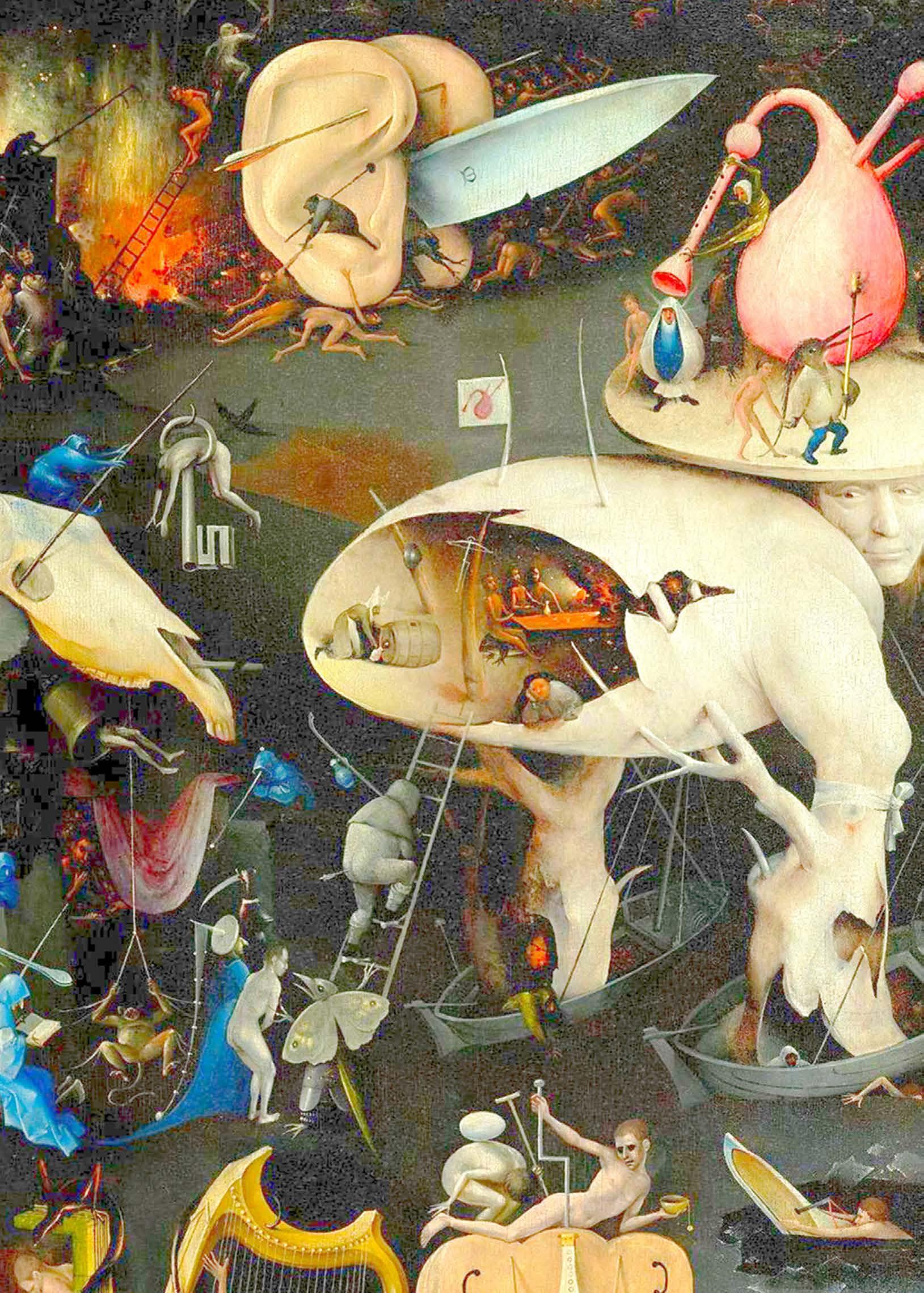
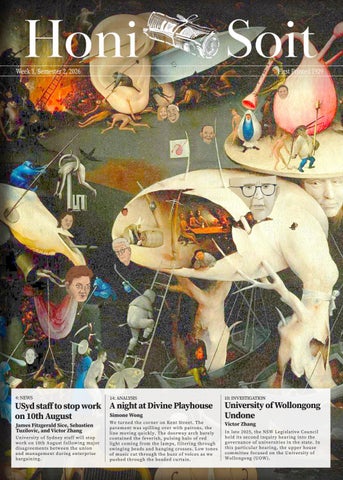
As we see pro-Palestine activists brought before the Royal Commission, the University of Wollongong ICAC shitshow, Vertigo ceasing publication (albeit temporarily), and queer space Divine Playhouse being shut down before it even really opened, we wonder: are we in a Heironymous Bosch triptych?
We’ve put together a handy dandy
stupol explainer for you all which aims to divine the mysteries of the SRC.
SRC Elections will be held on the 22nd, 23rd, and 24th of September this year.
StuJoCon will be happening on October 10th-11th!
Both equally exciting. We can’t wait!
USyd staff are planning to stop work on August 10th due to disagreements with university management. Show solidarity to our staff. Staff working conditions are student learning conditions.
Also in this edition, William Yang gives his perspective on the ALP Conference as someone who attended, Calista Burrowes analyses Australian political memes, Aayuka Pandithartne questions whether Vishnu suits Western institutions like AGNSW, and Kuyili Karthik takes a look at the ‘cockroach’ student movement in India.
Overall, we’re confident you’ll find this edition edifying, elevating, and entertaining. We wish you the best of luck with the beginning of Semester 2. It’s just getting started.
Karlie: I truly believe Taylor Swift is gay. I am what they call a “Gaylorist”. Have you heard Hits Different?! It screams gay. The wedding was a fucking sham.
Rex Chudley: Alex Jones orchestrated 9/11 in collaboration with Barack HUSSEIN Obama along with the popular secretly Korean group LMFAO, writers of the hit single “Party Rock Anthem”.
Craig Netanyahu (no relation): My mate had a cat that was really fat. It was so scared of everyone that it met, which






was sort of odd. One day, I came up to my mate on a cold saturday morning and asked her “why is your cat so scared of people?”. She said that it was because my other friend constantly threw it down the stairs. Not really a conspiracy theory but I had to get that off my chest, thank you so much for your time, Craig.
Joe M. Ama: Jeffery Epstein killed himself.
Jichael Mackson: MJ never died and is currently living in Korea as a part-time Elvis impersonator. I saw him when I
Aries: Beelzebub. You have been put aside for Galileo according to Mr Mercury.
Taurus: Gaap. You were mid in that one episode of Black Mirror season 6 bruh.
Gemini: Keith Rupert Murdoch. The most demonic of all Holy fuck please die already.
Cancer: Buer. Lowkey as far as demons go you are pretty chill actually so yeah nice work dude.
Leo: Furcas. You will ride a cool-ass horse pretty soon and look sort of unc doing it, sorry man.







went on a bender in the DMZ with my BFF Rex Chudley.
Barry B. Benson: According to all known laws of aviation, there is no way a bee should be able to fly. Its wings are too small to get its fat little body off the ground. The bee, of course, flies anyway because bees don’t care what humans think is impossible.
Peter Griffin: I think all of these conspiracy theories are completely made up by somebody, or some PEOPLE that are trying to make it seem like people actually talk to Honi
Virgo: Baal. You go hard actually but are very scary and eat kids.
Libra: Mammon. Your ego is taking over. Time to get in touch with your humble side and start being more kind.
Scorpio: Mephistopheles. Someone is going to try and shoot you for delivering bad news. Be on guard.
Sagittarius: Lucifer. Fallen angel on that emo shit. Better to reign in hell than serve in heav’n.
Capricorn: HIM. Don’t let it get to your head. Avoid little girls.
Aquarius: Muzan. You are killing it at the moment. Looking super stylish. Maybe rein it in a bit with the eating families.
Pisces: Jinn. Stop riffling through peoples toe nails and hair clippings PLEASE!!!!!

James Fitzgerald Sice, Sebastien Tuzilovic, and Victor Zhang report. University of Sydney staff will stop work on 10th August following major disagreements between the union and management during enterprise bargaining.
Members of the University of Sydney branch of the National Tertiary Education Union (NTEU) voted at a members meeting on the 21st of July for a stop work action following the results of a protected action ballot where an overwhelming majority of members supported taking industrial action in the current round of enterprise bargaining.
“A strategic campaign of industrial action, with strike action as its central pillar, is now necessary to advance our claims at the table,” the motion resolving the branch to industrial action read.
“If agreement on the key issues noted above is not reached, a campaign of escalating actions will be undertaken.”
The first action the branch will undertake is a two-hour stop work meeting on Monday the 10th of August where members will consider the current bargaining situation and deliberate on further action.
“All options for industrial action will be considered at the meeting,” the motion read.
The motion passed with 235 votes for, 66 against, and 19 abstentions. A significant portion of the votes against, came from members who agreed on the need for strike action but wished to vote for a different motion proposing a 24 hour strike on 20th August.
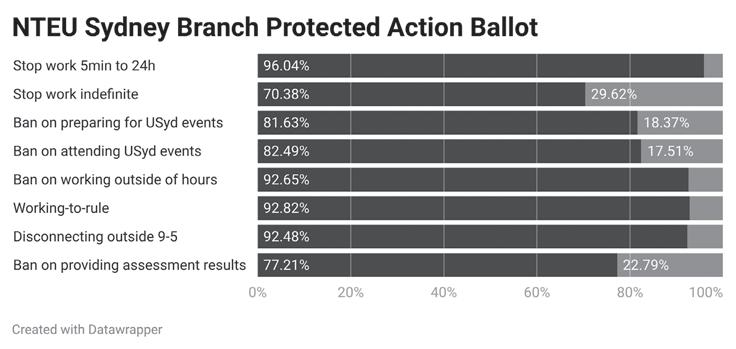
NTEU members voted overwhelmingly to take industrial action as part of the bargaining process in a protected action ballot held from the 1st of July to the 10th.
Over 75 per cent of members responded to the ballot.
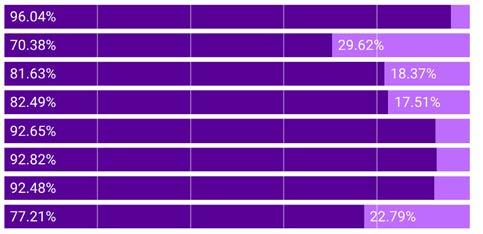
96 per cent of respondents supported stopping work for a duration between five minutes and 24 hours. 70 per cent of respondents supported a strike for an indefinite duration.
Other industrial measures such as refusing to prepare or attend events hosted or endorsed by the University, refusing to work outside designated work hours, refusing to work outside of duties as put forth in a person’s position description, disconnecting from workplace correspondence outside of working hours, and banning the transmission of assessment results also received overwhelming approval from staff.
The motion endorsing industrial action noted several concerns arising from bargaining that compelled the branch to take industrial action.
“Management’s latest bargaining response has raised serious concerns for the union, particularly around academic freedom, job security, and workplace change,” University of Sydney NTEU Branch President Peter Chen told Honi
The motion proposing industrial action noted the University rejecting claims around safeguarding academic and intellectual freedom, the proposed Secure Academic Employment Package that they warned would “break the research-teaching nexus”.
Chen described management’s support for expanding the use of AI, the rejection of no forced redundancies, and the University’s change management proposal as a “broader threat to job security”.
“While some elements of the union’s proposed protections against adverse action for staff exercising academic and intellectual freedom have been accepted, the union argues that new provisions relating to workplace health and safety and speech, combined with the rejection of campus use rights, would weaken rather than strengthen existing protections,” Chen said.
The union argues that including workplace health and safety language in clauses on protecting academic and intellectual freedom represents a potential limitation on free expression.
“While the NTEU supports — indeed the Union movement is the progenitor of workplace safety laws — WH&S protections, these are general protections and the inclusion specifically within the area of academic and intellectual freedom represents a further potential limitation of these core values of free inquiry,” a NTEU bargaining update newsletter read.
A University spokesperson said the University remained committed to intellectual freedom and free speech. The University said the inclusion of workplace health and safety language served to “improve the readability and usefulness of the clause for staff who may not be aware of their existing duties under that [Work Health and Safety] Act”.
and proceed directly to the final change plan in cases of forced redundancies, among other changes.
When asked about the justification for such a change proposal, a University spokesperson told Honi their “proposed approach to workplace change acknowledges the process has sometimes been too drawn out in the past, and the negative impact this can have on wellbeing”.
The University spokesperson said the proposal that allows a majority vote to fast-track a change proposal in the case for a forced redundancy would “shorten the process and therefore minimise the potential psychosocial impacts of protracted processes and provide staff with stability and certainty more quickly”.
In a bargaining update newsletter, the union slammed the change management proposal saying it would “strip workplace protections and job security from the Agreement” and described management’s justification for the proposal as an “exercise in corporate wellness washing”.
The NTEU said that the proposal to allow a majority vote to expedite a change process involving forced redundancies was particularly pernicious and would be a “recipe for a toxic process of change”.
“This would unjustly restrict the procedural protections that would otherwise be afforded to affected staff, possibly result in staff being pressured to vote for an expedited change process, and create divisions and antagonism amongst colleagues in the workplace,” a NTEU bulletin on the change management proposal read.
In an all staff email on the 1st of July, University management announced their workplace change management proposal. The proposal was framed as a streamlining of change management processes to “reduce the impact of workplace change on staff wellbeing and support desirable cultural shifts through changes to the Enterprise Agreement”.
The University’s proposal expands a fast-track process for organisational change to apply to change processes affecting five or fewer staff members, rather than only individual staff. It also proposes allowing a majority of affected staff to agree to bypass a stage of consultation
Chen stated that the union supports reforming and improving change processes and agreed there should be flexibility in the process but could not support changes that undermined job security.
“The union views its approach as constructive rather than resistant to change, arguing that change management can be made more flexible and effective through genuine consultation, simplified processes where no forced redundancies are involved, and locally tailored arrangements
agreed to by staff and management,” Chen said.
The NTEU tabled a proposal during bargaining that sought to define AI, mandate the use of AI in the public interest, safeguard AI from replacing jobs, retain human oversight over AI, ensure consultation with staff on AI, and to protect the moral rights of staff. The union says university management rejected their substantive proposal in favour of a leaner framework.
The NTEU said management displayed “an aggressive position from the outset” on the matter.
“It is clear that management wants to retain maximal freedom of action to introduce new AI systems, as when, and how they see fit (their favourite word for the session was “agile”), and exclude unions and staff from the process of development and introduction,” read the NTEU’s bargaining newsletter.
A University spokesperson said that “AI governance should remain primarily framework and policy-based rather than being extensively prescribed within the EA”.
“Our Responsible AI Framework was developed as a risk-based governance model capable of adapting to this rapidly evolving technology and we believe we should use this Framework to guide our ethical and responsible adoption of AI,” the spokesperson said.
While discussions will continue in bargaining around the adoption of AI, the University said they would not agree to “union veto rights on AI or mandatory AI implementation waiting periods”. The NTEU noted “this issue will be an ongoing and important fight”.
Earlier in the year, the University announced the “Secure Academic Employment Package”, a proposal that introduces three new employment categories as a measure to reduce casualisation. The proposal would create “teaching associates” and “senior teaching associates”, “Industry Education Specialists”, and “Postgraduate Fellows”.
The “teaching associate” roles involve tutorial delivery, marking, and administration, work currently performed by casual tutors.
The NTEU expressed scepticism at the proposal, writing in a bargaining update newsletter that the proposals “cannot be properly assessed without workforce modelling” and cautioned that the roles could “weaken the research–teaching nexus and existing acwademic career structures”.
A University spokesperson told Honi that the package would “improve the student experience while providing secure employment for educators who are currently in precarious work”.
“Our Teaching Associates proposal also represents a genuine investment in professional development for these staff,” they said.
The spokesperson said the university sought to uncap the number of education-focused roles, but recognised the NTEU opposed such a change.
“The union also is concerned that management remains committed to introducing new employment categories and has not meaningfully engaged with proposals aimed at reducing casualisation,” Chen told Honi
The employment package was of particular concern to Finola Laughren, a sessional lecturer in Gender and Cultural Studies, and member of Rank and File Action (RAFA). Laughren told Honi that the creation of uncapped teaching-focused roles is an “outright attack, not just on casuals, but on academic work as we know it”.
“If management is serious about ending casualisation in a way that takes seriously the important role of research in producing high quality education for students, they can and should be doing so by employing more 40:40:20 academics,” Laughren said.
“Maintaining 40:40:20 roles as the standard academic job isn’t about privileging research over education — that’s management’s argument. It’s about avoiding further entrenching the already twotiered structure of academic work, which, if left unchecked, will only make it harder and harder to maintain quality teaching and research.”
“Offensive

On the 25th of July, a sunny Saturday, activists, queer folk, allies, and community members gathered at Hyde Park’s Archibald Memorial Fountain for a snap protest in honour of Divine Playhouse, a queercentric arts space designed for music and cultural events, being forced to close its doors for good.
Housed at 420 Kent St in a building that has, across its life, been a church (originally St John the Evangelist), a school for the disadvantaged, a theatre and a hostel, the venue was taken up by the Heaps Gay collective, run by founder Kat Dopper. Previously named Unholy Playhouse, it drew scrutiny from Christian groups in Sydney almost immediately, and after weeks of controversy, it was deemed to be running an “offensive trade.”
Billed as a “Sing In Protest,” the rally was hosted by community organiser, Aunty Jonny, and theatremaker and artist, Victoria Falconer. The rally featured an impressive breadth of speakers: Deputy Lord Mayor Jess Miller; NSW Greens MP Cate Faehrmann; Reverend Jon Owen, pastor and CEO of Wayside Chapel; Charley Allanah, co-chair of the MEAA diversity committee; drag performer Etcetera Etcetera; a statement read on behalf of independent MP Alex Greenwich; and writer and broadcaster Benjamin Law. A good number of attendees were wearing shirts, and many more carrying signs, branded with the phrase “offensive trade”, reclaiming the very phrase used to close the venue down.
Speeches were split up by a collection of queer anthems. Attendees were handed a printed program with the lyrics, and Victoria Falconer conducted the choir. (Opening number: You’re the Voice by John Farnham, Song Two: Like a Prayer by Madonna, Song Three: Nothings Gonna Stop Us Now by Starship, Song Four: Pink Pony Club by Chappell Roan, three bonus tracks, Absolutely Everybody by Vanessa Amerosi, Together Again by Janet Jackson, and I Wanna Dance With Somebody by Whitney Houston, and of course, the finale Freedom! ‘90 by George Michael)
Sophie Wishart reports.
NSW Greens MP Cate Faehrmann was among the first to speak. She spoke to the telling selectiveness that the government has displayed in intervening with Sydney’s social issues: “It wasn’t lost on me that… this has happened just weeks after the police blitz on Universal nightclub. The outrageous harassment of patrons and staff and drag queens and performers, just a couple of weeks ago by police officers that night. And I have to say, where was the government then? Where was the government saying that is unacceptable?”
She singled out John Graham, Minister for the Arts, Music and the Night-time Economy, saying, “there is nothing vibrant or global, or world-class about a city that allows its queer community to be targeted.” Faehrmann also called on the government not to let Dopper and the Heaps Gay team “fight billionaire developers alone,” urging emergency relief funding and help finding a new venue as well.
In reference to the protesters, she dubbed them “a loud and organised extreme minority” that we should not allow to divide our city. Similarly, Reverend Jon Owen, who spoke next, assured rally-goers that the majority of the Christian faith stands with Sydney’s queer community, condemning the separation of art and religion and the weaponising of this false dichotomy.
Drag performer Etcetera Etcetera spoke to the importance of freedom of expression and creative control: “I do not endorse a way of life, but describe one. And the audience is left to make its own decisions and judgement. This is what I consider freedom of speech, freedom of expression, and freedom of thought. To prevent us from performing, you are saying that you do not believe in these freedoms. If you do not believe in these freedoms, you are imprisoning everyone’s mind.
Read the full coverage online at honisoit.com.
Alastair Panzarino reports.
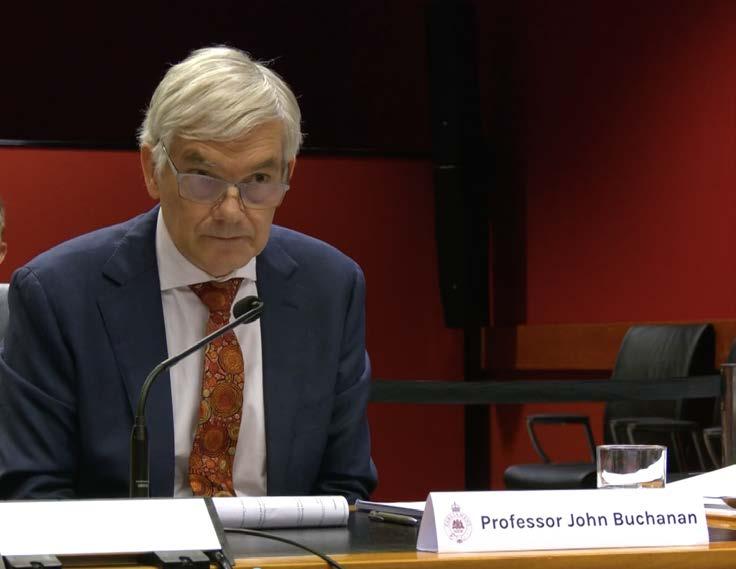
Professor John Buchanan from the University of Sydney’s (USyd) Business School has been elected unopposed as the President of the USyd Branch of the National Tertiary Education Union (NTEU). He will begin his term, along with the incoming Branch Committee members, currently being elected, in mid-October 2026. Buchanan has been provisionally elected while the branch is engaged in enterprise bargaining agreement (EBA) negotiations with University management. The outcome of the agreement will determine employment conditions for the next three years.
Buchanan is a Professor from the School of Strategy, Innovation, and Technology in the Business School, Chair of the NTEU Business School Workgroup Representatives Committee, Branch Committee Member, and was an NTEU Representative on the USyd Enterprise Bargaining Team from 2021 to 2023. His academic background is in industrial relations, with some of his most recent scholarship concerning the impacts of AI on the labour market.
Speaking in a personal capacity to Honi Soit , the incumbent branch President Peter Chen commented that “it’s important to note that John has run unopposed, which talks to the role of Branch President being a difficult one, and his character.”
“John’s an impressive figure with both a strong analytical mind in industrial relations
“John’s industrial relations background and history of organising the Business School makes us hopeful for his support in developing a militant and mass-mobilising industrial action campaign.
“It is essential that our incoming branch committee supports a strong industrial campaign against management, and does not cave at minor resistance or set-backs. However, we are unsure how John will navigate centrist and conservative objections to industrial action from within the union. Likewise, we worry that some Renewal candidates are opposed to intellectual freedoms, free speech, and especially political campaigning on Palestine.”
in their capacity as NTEU reps on the 2021–2023 round of enterprise bargaining, Renewal caucus members had not forefronted demands for wage increases, and argued against additional strikes.
Responding to these claims, Buchanan told Honi that “[o]n wages policy in 2021–2023 I argued strongly for maintaining real wages. The reality of enterprise bargaining is that there is another side sitting opposite you at the table.”
“I did not hold back a wage increase — rather this was the result of (a) hard-line management and (b) poor industrial campaigning by a Branch leadership in which I was in a minority.”
— his academic field — and someone who’s done real organising and growth in the Business School.”
Speaking on his election, Buchanan told Honi that “[t]wo visions are currently shaping the future of Australian universities. The dominant one is perpetuated by the upper reaches of managerial circles within universities.
“[This dominant vision] is committed to the further centralisation of power and control by management over the workforce… The rival vision values the public role of universities as distinctive domains for the production and sharing of knowledge.
“Management should be facilitator — not dominator of this enterprise.
“As the newly elected President of the NTEU at USyd, my priority is to nurture a broad alliance of staff, students and those beyond the University committed to creating what Raewyn Connell calls ‘the good university.’ This is one that takes the quality of education seriously (and not as a cost to be minimised) and that involves staff, students and wider community in decisionmaking.”
Branch member Riki Scanlan from the Rank-and-File-Action (RAFA) caucus told Honi , “RAFA members look forward to constructive and democratic organising with John Buchanan as the incoming unopposed President.
Buchanan himself is a member of the NTEU branch’s ‘Renewal’ caucus, which describes itself as a grouping of progressive unionists.
However, Alma Torlakovic from the ‘Fightback’ caucus, which describes itself as “formed by and dominated by socialists”, contested this description, arguing that Renewal represented the “conservative wing of the union”. Torlakovic said Renewal has previously run on a “platform arguing for fewer strikes, decrying social justice issues as divisive, and denigrating open debate within the union.
“Members of this grouping have argued the union should be less oppositional to management, opposed industrial action, dismissed the seriousness of wage theft and job security for casuals, and vocally opposed the union supporting Palestine.”
Responding to Torlakovic’s claims, Buchanan contended that “I am not more conservative industrially… I am committed to mindful not mindless militancy.
“[Renewal is] a broad alliance of independent democratic socialists as well as ALP, Green and small ‘l’ liberal unionists committed to what Professor Raewyn Connell refers to as the good university.”
Torlakovic, who is running as the NSW Socialists candidate for Granville in the 2027 NSW state elections, told Honi that
Torlakovic continued to say that “Renewal caucus members were among the minority who voted against Fightback’s motion to increase our pay claim to 25 per cent in the current bargaining round, and did not back the call to overturn the wage claim cap imposed by NTEU national.”
This is in reference to the contentious cap of a maximum of 20 per cent for wage claims set by the NTEU National Council. At a mass meeting of USyd branch members this year, a motion demanding the National Council reconsider this position passed with 61 per cent support.
Torlakovic went on to say that “[t]hose of us who want to fight for pay and not sell off conditions should be active in the enterprise bargaining campaign, come to meetings and vote for strike action.”
“Victorian teachers just voted to reject a 28% wage increase twice and struck last Thursday in their thousands.
“Socialists in Schools have played the leading role in this fight, and there is nothing mindless about their militancy. They are not prepared to bow down to conservative officials reluctant to strike. We are inspired by their fight and want to win big pay rises here.”
According to research from 2025 by the Australian Council of Trade Unions (ACTU) on behalf of the NTEU, a plurality of NTEU members declared
“winning higher pay” as their number one concern. Since 2021, USyd staff on HEO6.4 wages have lost over $31,000 to inflation.
In response, Buchanan argued that “wages policy is not simply a matter of passing motions at union meetings. Within the NTEU there has been an extended debate about the wage claim across Branches, within State Divisions, and at National Council.”
“A democratic decision across the entire membership has been made — and it is to improve our real wage position. Subsequently moving motions breaking this position demonstrates splits within the Union. A union’s strongest asset is its solidarity.
“This is not a matter of being ‘left’ or ‘conservative’: it [is] a matter of being effective in a situation of industrial conflict.
“A tiny minority of members constantly call for strike action. This is not only industrially immature — it is not something many members will instantly embrace. It is the responsibility of leadership to build support at workplace level over an extended period of time.”
A protected action ballot from July of 2026 found that more than 70 per cent of NTEU members supported an indefinite stop work in order to win their demands, while 96 per cent favoured a stop work of up to 24 hours.
Buchanan went on to say that “I have no trouble with taking industrial action. Indeed, I’ve participated in every strike endorsed by members.
“Through the change process in the Business School in 2024 and 2025, I and other workplace union reps organised 19 mass meetings which consistently drew strong turnouts. We prevented nine highly respected professional staff from being made redundant. We also supported them gaining a reclassification.”
Buchanan concluded his comments to Honi by stating that “[t]here are no easy solutions to the problems we face. Building a strong union presence at the workplace level and building links with partners in the student and broader communities will be vital for renewing our University.”
honisoit.com
The UTS Students’ Association voted in favour of removing their publication, Vertigo , from its constitution, cancelling the Vertigo elections for 2026 and temporarily ceasing publications operations for 2027.
The motion also calls for the incoming 2027 UTSSA executive team to establish a new framework for student publications back into its constitution which would see the re-establishment of not only Vertigo , but its predecessor Newswit
Should this new framework be established by the 2027 UTSSA by September, Vertigo would return in 2028 without a news service. The news service would be taken up by Newswit , following a similar model seen at the University of Wollongong where the Tertangala was split into both a magazine and a newspaper at the start of this year.
Speaking to Honi Soit , UTSSA President Neeve Nagle said the overwhelming support for the constitutional change shows that the UTSSA has recognised the issues surrounding the structure that governs Vertigo were neither isolated nor short term.
“The current model has been the subject of years of attempted reform through governance changes, bylaw amendments and other interventions, yet the same structural issues continued to emerge,” she said.
“By the time the motion came to Council, there was a broad view that incremental reform had been exhausted.”
Some of the key issues that faced Vertigo over the past few years included dwindling readership, lack of recognition from the student body, as well as lack of campus news reporting, according to one former Vertigo editor who spoke to Honi under the condition of anonymity.
Regarding the dual student media model, Nagle said the separation of creative work from student journalism would “give the publications “a clearer purpose, more achievable expectations and stronger accountability, while ensuring students continue to have an independent media outlet.”
“In that context, I think replacing the current model was the right approach,” she said.
Nagle also clarified that this wasn’t the UTSSA abolishing student media at UTS nor was it in response to “any one editorial team”.
With the motion passed, the UTSSA also passed a motion on creating a student media fund which would serve as a news service for the UTSSA. The student media fund would trial different forms of student media for 2028 to see what works for the UTSSA.
This major shakeup in the student media sphere comes at a tumultuous time for Vertigo , with eight editors and two designers resigning from the team over the past nine months. Under the previous UTSSA constitution, the
Tyberius Seeto
reports.
minimum number of editors and designers required to form a team is six.
Honi understands that the 2026 editorial team were left with five editors and two designers in mid July.Weeks ahead of the motion to remove the publication from the UTSSA constitution, two additional editors and the two designers tendered their resignations in, leaving Vertigo non operational for the rest of this year.
This year has also marked a sudden collapse in the relationship between the UTSSA and Vertigo , with the 2026 Editor-in-Chief Emanie (Eman) Samira Darwiche taking the UTSSA to the Fair Work Commission over alleged bullying.
In an anonymous article published in Vertigo , the anonymous author, understood to be Darwiche herself, accuses the UTSSA of spending $40,000 in total for lawyers in response to her case against the student union.
The article received fierce backlash from readership to former student politicians and student journalists alike, with the article misleading readers that the UTSSA had approved spending of $40,000 for lawyers rather than the UTSSA passing a motion to spend an upper spending limit, failing to reach out to the UTSSA for comment and failing to declare a conflict of interest in the story.
Emanie Samira Darwiche was contacted for comment for this story but did not respond at the time of publication.


‘Never again anywhere’:
Jewish pro-Palestine student activist Yasmine Johnson told the Royal Commission on Antisemitism and Social Cohesion that her Jewish identity demands her “to say never again anywhere, and right now that means opposing the genocide in Gaza.”
The Royal Commission is holding its fourth hearing block in Melbourne from Monday, 13th July 2026 to Friday 17th July 2026. The hearing block examines the lived experience of Jewish staff and students, the response of universities in combating antisemitism, and reports and surveys on the nature of antisemitism at universities.
Yasmine Johnson is a Jewish pro-Palestine activist and the national co-convenor of Students for Palestine, a set of collectives across campuses in Australia instrumental in organising the first encampment in Australia at USyd. Johnson studied at the University of Sydney from 2018–24.
Johnson played a role in organising university encampments, including the first one on an Australian campus which took place at the University of Sydney. The encampment lasted from 23rd April to 24th June, 2024.
Johnson told the commission
and noticeable demonstration of our opposition to these crimes.”
Commissioner Virginia Bell AC SC asked Johnson if she felt “some strong identification with Israel as the nation state of the Jews.”
Johnson said that she did not and clarified that neither did her parents.
“My mother went to Israel as a younger person, and at the time felt that what Israel was doing was not right,” Johnson said. “She witnessed its oppression of the Palestinians and so, no, I didn’t feel this was connected to my background.”
Prior to Johnson taking the stand, the commission heard from Liat, a former student at the Australian National University. Liat told the commission that she was “called a baby killer and a genocide supporter” when she passed by the ANU encampment and that she felt “physically unsafe”.
Counsel assisting the commission Zelie Heger
Johnson however clarified that “to say that somebody is a genocide supporter is not an antisemitic attack if that person indeed supports a genocide.”
In 2025, the UN Independent International Commission of Inquiry on the Occupied Palestinian Territory found that Israel had committed genocide against Palestinians in Gaza. In June 2026, the UN commission tabled a further report, concluding that Israel had continued to commit genocide and deliberately targeted children in the process.
Slogans defended
Johnson was probed by both Heger and Bell on her views regarding the slogans “from the river to the sea”, “globalise the intifada”, and “there is only one solution, intifada revolution”. Heger suggested that ‘from the river to the sea’ could be interpreted as the “forced removal of Jewish people from Israel or even genocide” and could cause “deep hurt and even fear”.
Johnson criticised this interpretation of the chant. She told the commission that she interpreted the chant as a call for freedom from all forms of oppression.
“I find it offensive, when there is actually a genocide going on
— something which is regularly forgotten — that our side are the ones calling for a genocide,” Johnson said.
Johnson added that she did not think “the legitimacy of social justice movements rests on them never offending anyone.”
Bell put to Johnson that the Second Intifada “involved a series of suicide bombings within Israel that put the community in terror.” Defending the use of the word ‘intifada’, Johnson said she didn’t “hold movements for the justice of the oppressed to a standard that says there can never be any violence.”
Heger asked Johnson if the Palestine movement would consider adopting alternative slogans. Johnson resisted such a suggestion, telling the commission that it would lead to a slippery slope of other phrases and words being policed.
“I’m not sure if we can say that, given that every other phrase that we do use is turned into a controversy.”
Johnson cited the use of the word genocide being contentious, which she said “is not even a call for resistance. It’s just a description of what is happening, which the UN has found to be happening.”
Union of Jewish Students, Gabi
Alternative’s 2025 Socialism conference, where Johnson oppressors, and that





In late 2025, the NSW Legislative Council held its second inquiry hearing into the governance of universities in the state. In this particular hearing, the upper house committee focused on the University of Wollongong (UOW). Former Chair of the University of Wollong WHS committee and CPSU delegate Lisa Simmons revealed to the committee that the NSW Independent Commission Against Corruption (ICAC) was investigating UOW after she had made a disclosure to the corruption watchdog.
Throughout this segment of the hearing, the Chair of the committee Labor Member of the Legislative Council Sarah Kaine conferred in hushed tones with committee staff on how to proceed given the extraordinary evidence tabled. Eventually, the committee took a brief sidebar as they sought advice on what questions could or could not be asked.
Independent media outlet Michael West Media revealed that a week prior to the parliamentary hearing, ICAC officers seized laptops at the University of Wollongong as part of the investigation.
Half a year later on 2nd June, the corruption probe announced a public inquiry as part of their investigations against the top brass of UOW — an investigation the watchdog dubbed Operation Scandi.
At the heart of this investigation are three figures. Chancellor Michael Still, businessman turned one-
time University chief; Interim Vice-Chancellor John Dewar, who is also a partner at the consultancy firm KordaMentha; and governance chief Alyssa White.
The first allegation the ICAC is investigating is whether Chief Governance Officer and Secretary to UOW Council Alyssa White intentionally and repeatedly subverted recruitment processes to benefit her friends and associates, including previous colleagues from the University of Sydney and her high school friends.
A related allegation is her role in creating a new executive position earmarked for herself, Vice-President (Strategy & Executive Affairs). This promotion would have come with a $50,000 pay rise while hundreds of UOW staff were sacked.
However, the cronyism of a university bureaucrat pales in comparison to the second and third allegations which Chancellor Still and Interim Vice-Chancellor Dewar play an integral role.
The second allegation is whether Still, White, or any other university staff, influenced the award of work to consultancy firm Aspirall, and bypassed proper procurement processes in the process.
UOW engaged Aspirall in 2024 to facilitate focus groups in their search for a new ViceChancellor, an engagement that cost the university $49,600. In 2025, UOW once again engaged Aspirall to conduct a workshop for university leadership costing $74,450.
Aspirall founder Tanya Diesel met Still in 2004 and were suggested by the ICAC to be by all definitions friends. However, they would each contest this and describe their two-decade long association as being a “friendly professional relationship of, you know, a high-level kind” by Still and a “long-term business association” by Diesel.
The consultancy work was funded through UOW’s $2 million “Council Discretionary Fund”, a fund that Still himself set up. UOW procurement policies required any work that would cost more than $20,000 to undergo a tender process, which was not followed.
Most egregious is the third allegation concerning KordaMentha partner and interim Vice-Chancellor John Dewar.
Concurrently to Dewar being recruited as interim ViceChancellor, UOW sought to conduct an enterprise-wide review of their operations putting a call for tender to three consultancy firms of which KordaMentha was ultimately successful in securing. Over 2024–25, KordaMentha was awarded over $3.8 million worth of consultancy work.
As a condition of his employment as VC, Dewar signed a secondary employment letter that prohibited him from influencing the university to engage KordaMentha, and if KordaMentha was engaged for consultancy work, he would not be involved in the process.
The NSW ICAC is Australia’s oldest, most powerful, and feared, anti-corruption body. Compared to Victoria’s
Independent Broad-based Anticorruption Commission (IBAC) — a corruption watchdog often described as a “toothless tiger” — NSW’s corruption probe has broad powers and the power to obtain evidence often inadmissible in court.
A key tool of the NSW ICAC is its ability to hold public inquiries, which attract considerable media attention. The NSW ICAC has felled multiple premiers, including the Liberal Premier Nick Grenier that introduced the ICAC.
The investigation comes after UOW suffered from devastating rounds of job cuts as part of the UOW Transformation program. In January 2025, UOW sacked 90 academic staff and disestablished four disciplines, to achieve $21 million in savings. Two months later, following the conclusion of KordaMentha’s review, UOW proposed culling 185 full-time equivalent positions for further savings of up to $26 million. In August, this proposal was revised down to only culling 100 full-time equivalent positions for savings of $15.8 million.
After Operation Scandi held its opening hearing, the UOW NTEU branch questioned the validity of the Transformation program. The branch said the “timeline of the allegations made during today’s ICAC hearing overlaps significantly with these job losses”.
“Amidst all the allegations we heard at today’s ICAC hearing, I was reminded of the story underneath it all, the stories of staff who have suffered, who have lost their jobs under chaotic restructures and processes,” NTEU UOW Branch President Dr Susan Engel said.
Dec 2023
Michael Still commences as Chancellor.
April 2024
Vice-Chancellor Patricia Davidson resigns.
May 2024
John Dewar appointed as interim Vice-Chancellor
June 2024
John Dewar’s term as interim VC commences.
UOW sends a request for proposal on an operational review to KordaMentha, Deloitte, and Partners in Performance.
Later in the month, KordaMentha is awarded the consultancy work.
July 2024
KordaMentha commences work at UOW.
The scope of work would later be expanded beyond an operational review.
The engagement cost UOW over $910,000.
December 2024
KordaMentha engaged again to develop and implement a revised operating model.
The engagement lasted until October 2025 and cost UOW over $2.9 million.
January 2025
UOW sacks 90 academic staff and axe four courses.
March 2025
UOW announces another round of cuts, proposing up to 185 redunancies. This is later revised down to 100 full-time equivalent positions.
December 2025
NSW parliament university sector inquiry holds its second hearing. It is revealed at the hearing that the ICAC is investigating UOW.
June 2026
Public hearings for Operation Scandi commence.
Following the extraordinary revelations over three weeks of hearings, held from 22nd June to 10th July 2026, at the corruption watchdog, the Illawarra Mercury reported that the National Tertiary Education Union (NTEU) called for workers sacked to be offered their jobs back and for UOW’s Council to be dissolved.
NTEU General Secretary Dr Damien Cahill described the situation as “the biggest crisis in the history of the university” and said UOW’s governance required a “complete overhaul”.
“All staff who were made redundant as a result of the tainted KordaMentha review should be offered their jobs back,” Dr Cahill said.
“The current university council needs to be dissolved and replaced with an interim body with a majority of staff, students, and alumni — people who understand the university and are invested in its success.”
KordaMentha’s Vice-Chancellor
John Kinley Dewar began his career as a law lecturer in the United Kingdom, followed by a string of Australian university executive roles at Griffith University, the University of Melbourne, and La Trobe University.
Dewar told the commission that he joined KordaMentha in February 2024 as a partner to develop KordaMentha’s nascent higher education consultancy practice. Later in 2024, former Chief Operating Officer of RMIT Dionne Higgins would join KordaMentha as a partner.
Following former ViceChancellor Patricia Davidson’s abrupt departure from UOW in April 2024, UOW sought to hire Dewar as an interim ViceChancellor for the remainder of the year until they could find a permanent ViceChancellor.
When John Dewar fronted the NSW parliamentary inquiry into the university sector in his capacity as a KordaMentha partner on 1st April, 2026, he faced a barrage of questions from the parliamentary committee about his time as Wollongong’s interim ViceChancellor.
At the parliamentary hearing Labor MLC Sarah Kaine asked what involvement Dewar had in UOW’s decision to award work to KordaMentha. “None
whatsoever,” Dewar told the committee.
In his answers to supplementary questions the upper house committee put to him, Dewar denied having any input into the proposal KordaMentha submitted to UOW. He also said he “did not provide advice in relation to KordaMentha’s engagement with UOW”.
As it would turn out, the truth that emerged from the ICAC hearings was not so clean and tidy.
On 9th May, 2024, Dewar sent Chancellor Still a document where he outlined a proposal where Dewar would step into the role of interim VC and also facilitate work undertaken by KordaMentha.
Dewar wrote to Still saying “I propose that, linked to my appointment as Interim VC, KordaMentha be engaged to conduct a rapid diagnostic” of UOW that would be used to inform cost-saving measures including an “operating model redesign”, “reshaping the university’s course offerings”, a “cultural reset”, and a review of the University’s real estate holdings.
Counsel assisting the ICAC Emma Bathurst asked Dewar during the hearings if he had considered such an arrangement “could give rise to a conflict of interest between KordaMentha’s interests and the interests of the university?”
Dewar responded that he “thought that they could be managed… if they were declared properly”.
A few weeks later on 21st May, Still emailed Dewar, following a phone call, outlining the necessary requirements for Dewar to be employed as interim VC and for the award of work to KordaMentha.
Still suggested that Dewar be employed nine days a fortnight with one day allocated for his work at KordaMentha. Still also said that UOW would need to undergo a “proper procurement process” where KordaMentha would be included in a “small group” of firms invited to tender.
Dewar forwarded the “Strictly Confidential” email to his KordaMentha colleague Henriette Rothschild.
“It’s disappointing we have to go through a procurement process for the diagnostic,” Dewar wrote to Rothschild.
“There’s no mention of continuing support after the initial work. There’s no mention of eligibility to tender for further work.
“There’s a risk that this would become just a secondment to UOW with no benefit to KM, which I’m not interested in.”
On the substance of the emails, Bathurst put to Dewar “You considered it disappointing because it was different to what you’d originally proposed, being the package deal of you as the Interim ViceChancellor?”
Dewar answered in the affirmative. Dewar told the commission that he thought the procurement “would be a light touch process” and Still’s proposed process “felt a lot more than light touch”.
In another email Dewar sent Rothschild later in the day on 21st May, Dewar wrote “Michael says they have to go through a procurement process to avoid any probity concerns about the awarding of the diagnostic to KM. He says they are running it in a way that makes it very likely we will win it”.
“He suggests that the continuing support work could be done as an extension of the diagnostic engagement,” Dewar wrote.
When Michael Still fronted the commission, he denied ever having such a conversation with Dewar. Under questioning from counsel assisting Emma Bathurst and Commissioner Paul Lakatos SC, Still’s replies amounted to “I don’t recall”.
Still told the probe he spoke to Dewar prior to 21st May about the need for a procurement process.
When the commission pressed on whether Still did not recall having a conversation with Dewar on the 21st or if Still had no such conversation, Still remained equally evasive.
“My evidence is I didn’t say it,” Still told the ICAC.
Three days later on 24th May, Dewar wrote an email to his KordaMentha colleagues saying “Max [Rivadera] and I have put together a draft scope for a tender to be issued by the Uni of Wollongong at the request of the Chancellor Michael Still”.
Dewar told the commission that writing the scope of work that a consultancy would tender for was “less common in the public
sector” but “not uncommon for clients to seek advice about the scope of work” in the private sector.
Bathurst asked Dewar if he ever sought out advice from consultancies on the scope of work that a university would put out to tender while he was an executive at other universities.
“No,” Dewar replied.
When asked if this gave KordaMentha an unfair advantage in the procurement process, Dewar told the commission “there may have been a modest, small advantage but I, I wouldn’t say it was significant [advantage]”.
On 27th May, Dewar sent the draft scope of work to Chancellor Still. Commissioner Paul Lakatos SC pressed Still on whether it was appropriate for a KordaMentha partner to draft a scope of work that they would then tender for.
Lakatos suggested to Still: “Professor Dewar speaking to you via email and sending a draft scope of work was behind the scenes not a transparent or independent process, was it?”
“I think the process was completely independent. The fact that he’s sent that, I don’t, well, I don’t know what to make of it. I can’t recall reading it,” Still answered.
From 28th May to 3rd June, Dewar and Still negotiated the terms of Dewar’s employment including the wording of the secondary employment letter that managed Dewar’s conflict of interest as a KordaMentha partner.
The letter stipulated two conditions for Dewar’s employment as interim VC. First that Dewar would “not be involved in any consulting work to regional NSW universities or that would create a conflict with UOW” and that he would “not play a role in seeking to have the University [of Wollongong] engage KM to provide any services to the University, and that if KM is so engaged through any separate procurement process, you will not be involved in the management of those services”.
Evidence tendered at the ICAC showed that Dewar signed and emailed the employment documents at 11:25am on 4th June. Half an hour later, Dewar emailed Still asking “How’s the procurement process going?”
On 7th June, UOW sent the request for proposals for an enterprise-wide review to KordaMentha, Deloitte, and Partners in Performance.
Emails tabled at the commission showed that on 13th June Dewar offered his colleagues assistance in preparing KordaMentha’s response to UOW’s request for tender.
“It might be an idea to give you and the team a verbal briefing on what I am picking up as part of my induction,” Dewar wrote to his colleague Dionne Higgins.
An email showed that after KordaMentha finished preparing their draft response to UOW’s request for proposal on 19th June, Dewar’s colleague forwarded him an email containing KordaMentha’s draft.
Counsel assisting the ICAC Emma Bathurst asked Dewar if it was appropriate for him to have been sent KordaMentha’s draft proposal after he accepted the position of interim VC.
Dewar replied: “If I did I wouldn’t have accessed it. I did not play a role in putting together this proposal.”
“I don’t recall accessing the proposal, and I’m actually surprised that this would have come to me,” Dewar added.
Bathurst then showed the public inquiry emails that showed that Dewar made several comments on the draft proposal. Bathurst asked if the email shown refreshed his memory that he indeed had access to KordaMentha’s draft.
“I had completely forgotten. I have no, no recollection of this,” Dewar told the commission.
Dewar accepted that he did in fact review the proposal and make suggestions, but suggested that his feedback was “more cosmetic than anything”.
Dewar admitted to the commission that his feedback to KordaMentha on their draft proposal violated the terms of his secondary employment letter.
“I suggest to you that this mechanism was ignored by you in circumstances where you assisted KordaMentha in the preparation of its response to the RFP,” Bathurst suggested to Dewar.
“That’s an ungenerous way of putting it, I think,” Dewar responded.
KordaMentha ultimately won the tender, as a meeting on 2nd July of UOW’s tender evaluation panel determined. KordaMentha’s review began in earnest shortly after on 22nd July.
John Dewar’s term as interim Vice-Chancellor officially commenced on 22nd June, 2024. Evidence showed that over his term as interim VC, Dewar notified his KordaMentha colleagues of potential future consultancy work and sent UOW documents to his KordaMentha email account before forwarding it to KordaMentha colleagues.
Dewar emailed a KordaMentha colleague on 1st July notifying him of potential work, including a “HR capability review, a review of staff complaints handling, and some real estate advisory”. Four days later, Dewar sent the draft scope of work for the UOW human resources review from his personal to KordaMentha email, before forwarding it to his colleague Henriette Rothschild.
Counsel assisting the ICAC Emma Bathurst asked Dewar why he had sent the email. Dewar replied: “I must say, I don’t recall sending it but it’s clearly there.”
When Bathurst put to Dewar that this was an example of him influencing the award of work to KordaMentha, Dewar answered “It could be seen that way, yes”.
On 9th July, a KordaMentha analyst sent Dewar the finalised proposal in response to UOW’s request for an enterprise-wide diagnostic. Dewar replied the next day asking for the files to be sent as attachments as he could no longer access the KordaMentha sharepoint.
In September 2024, when UOW drafted an initial proposal for the “FutureUOW Change Management Proposal”, Dewar forwarded the draft paper to his KordaMentha email before relaying it to another KordaMentha colleague.
Dewar once again told the commission he could not recall why he had forwarded the email to his colleagues at KordaMentha and admitted this was another example of a breach of his secondary employment letter.
The hearings for Operation Scandi adjourned on 10th July, 2026. Counsel assisting the ICAC Emma Bathurst is expected to produce her report by 7th August with other parties given a chance to reply in the weeks following. The commission’s final report is expected to be due next year.
It never occurred to Michael Still that he could be a university chief until his associate David Gonski, the then Chancellor of UNSW, tapped him on the shoulder in late 2023.
During his appearance at the NSW parliamentary inquiry in late 2025, Labor MLC Anthony D’Adam probed Still on how he became Chancellor of UOW. “What kind of recruitment process leads to someone from finance being appointed to one of the leadership positions in a higher education institution?” D’Adam asked Still.
Still was taken aback by this question replying: “Is there something wrong? You sound like you think there’s something amiss.”
Still told the parliamentary committee that Gonski encouraged him to apply for the role of Chancellor of UOW. When D’Adam asked if Gonski was part of the recruitment panel, Still told the committee he did not recall but admitted that Gonski was present at his interview, albeit “at the end of the table, quite separate from the other two [panelists]”. In his answers to the committee’s supplementary questions, Still revealed that Gonski was indeed a member of the selection panel.
John Dewar was introduced to Michael Still through Attila Brungs, Vice-Chancellor of UNSW. While Dewar had actual credentials as a university executive, he told the NSW parliamentary inquiry he had no connection to UOW or the Illawarra region until his appointment as interim ViceChancellor.
While this ICAC hearing exposes the rot at the top of one university, parliamentary inquiries at the state and federal level have laid bare the true extent of how our universities across the country have withered from their original purpose.
Before descending into Hell, Virgil leads Dante to a gateway above which reads the warning ‘lasciate ogne speranza voi ch’intrate’: abandon all hope ye who enter here. At least Satan had the decency to offer a heads up.
Welcome to the world of USyd student politics, or stupol Stupol gravitates like a dying star around the Students’ Representative Council, or SRC. Formally, it’s a representative body for USyd undergraduates, which provides free legal and advocacy services, academic advice, and funds the student collectives such as the Women’s Collective, the Autonomous Collective Against Racism, the Queer Action Collective, as well as this newspaper.
It is distinct from the misleadingly named University of Sydney Union (or USU), which rather than a union, is a corporate board which manages the amenities and outlets on campus.
At its best, the SRC organises radical student activism around social and education issues. For instance, in the past it has rallied students against degree deregulation by the Liberal Party, or more recently for political issues like Palestine. In the 1960s, it played a role in mobilising students against the Vietnam War, harbouring draft dodgers in its halls. It has also overseen a number of Student General Meetings (or SGMs); mass assemblies for students to discuss and vote on political issues. Historically, these have included SGMs against the Springbok rugby tour, the team of then-apartheid South Africa, and more recently in 2024 in favour of USyd cutting ties with the genocide in Gaza.
At its worst, it functions to help ambitious student politicians stack their CVs, network for their future
careers, and construct patronage networks by providing handsomely paid makework and no-show jobs for their mates. As the radicalism of the 60s and 70s has receded, this approach has become increasingly prevalent. Its practice is therefore contested, and shaped by the political groups (known as factions/caucuses) which make up this body. The USyd SRC has a particular reputation as one of the most politically radical and activism-oriented SRCs in the country.
Every year, the council and its president are elected in a bruising multi-day contest, pitching their visions for how the SRC should function for the coming year. These are often fought over diverging proposals for how focused the SRC should be on providing services, as opposed to how much it should engage in activism. Different factions spend weeks promising everything from the apolitical cry of “more beer on campus” and “cheaper food and textbooks”, to demands for a more activist-oriented SRC.
Though ordinarily less contested, the editorial team for Honi Soit is also up for election during this vote. Alongside council and president elections to the SRC, concurrent elections take place to the National Union of Students, or NUS. This is the peak representative body of all tertiary education students in Australia. It has historically been dominated by Student Unity, ordinarily associated with the right wing of the Labor Party, which almost always holds the position of General Secretary. As such, it is regarded as a largely demoralising space.
After the votes for SRC are in, the various factions stitch together deals to allocate the officer bearer (or OB) positions amongst each other, many of which are paid. These include such positions as the Vice President, General Secretary, alongside a number of
Information Information Information
Name: NLS/NSWLS
Political Views: Social Democracy, self-described Democratic Socialism

smaller ones. These positions are elected at the annual Representatives Elect (or RepsElect) session.
The elected councillors typically convene once a month to debate and vote on a number of motions about funding and political positions that the council should endorse. Councillors are usually elected on a factions’ ticket, and typically vote in alignment with their faction.
Previous occupants of the coveted role of SRC President have included such notorious figures as former Liberal Prime Minister Tony Abbott, former Liberal Treasurer Joe Hockey, as well as former High Court Justice Michael Kirby, and a host of middling Labor Party politicians. Given its position as a launch pad for various political careers, the position is much sought after by aspirant student politicians, sometimes with prime ministerial ambition. The current president is Grace Street from the Grassroots faction.
Since the 1980s, the SRC Presidency has mainly been occupied by Labor Party aligned factions or independent left wing groupings. No Liberal Party aligned President has held the position since 1997.
This year, the elections will be held on the 22nd, 23rd, and 24th of September, with more information about the candidates forthcoming.
Should you decide to brave the descent into the air without a star, hopefully this explainer can act as a humble guide.

Interests: Hackery, Defending Moderate Politicians, Hanging With Disgraced NDIS Ministers, Getting Jobs From Their Parents
Relationship Status: It’s Complicated
About Me: Nominally two different factions, NLS and NSWLS experienced a fraught breakup early last year, where they disaffiliated due to criticism from NSWLS of the Labor party’s positions. Despite this extremely confusing tangle of acronyms, word on the street is that they’re back together. Most notably this year, the faction has been the subject of scathing criticism over their attendance at a pub event with the NDIS minister, Jenny McAllister, one day after backing a motion in the SRC condemning the Federal gutting of the NDIS program in the 2026 Budget. Politically, they often self describe as the left wing of the Labor party, which is a nice way of avoiding a coherent answer about concrete beliefs in policy. They are as nominally left-wing as the senior party lets them be. You can find out more by following @ usydlaborleft on Instagram
Mutual Friends: Redmond Tilly, Ava Cavalerie, Zayed Tabish
Name: PENTA
Political Views: International Student Particularist
Interests: Concession Cards, Subbing Out Their Elected Delegates, International Students
Relationship Status: Situationship with Grassroots
About Me: The current iteration of PENTA rose ascendant out of an acrimonious split that occurred at the 2024 SRC Reps-Elect meeting. That year, NLS candidate Angus Fisher secured the presidency, but no factional grouping had the majority needed to secure a winning ticket for the SRC executive and paid office bearers. Bohao Zhang led an internal revolt that purged the old leadership and brokered a deal with Grassroots and Socialist Alternative breaking the stalemate and locked the Labor factions out of core executive positions and paid major paid office bearer positions. PENTA’s focus as a faction is almost exclusively on international student welfare, with their members running a campaign to extend transport concession fares to international and part-time students. While previous versions of PENTA have supported the Young Liberals in the SRC, for the time being this faction has formed an electoral friendship with Grassroots, making them a key pillar in delivering Grassroots the Presidency.
Mutual Friends: Bohao Zhang, Bob Song, Anu-ujin Khulan
Send the SRC a
You are in a relationship with the SRC.
You have 0 friends in common with the SRC
Name: Grassroots
Political Views: Broadly Left Wing
Interests: Film Screenings, Vaccinations, Service Provision, Bake Sales
Relationship Status: Situationship with PENTA

About Me: At present, Grassroots’ chief function is to manage the SRC, the world’s smallest bureaucracy, of which they hold the Presidency. Having now ejected their former politically moderate evil twin ‘Switch’ from the faction, this iteration of Grassroots is a kinder if less tough one. With their current orientation towards service provision, their main group activity this year was running a vaccination campaign, while a few of their members have played a leading role in organising activism around public housing and against the NDIS cuts. Traditionally, their base of influence has been in the collectives, which are today largely atrophied. Their main appeal is their general, if undefined left- wing politics, outlined mainly as ‘Not Being Labor or the Trotskyists’. For the last couple of years they have formed an electoral alliance with PENTA, the international student- focused faction. Having held the SRC Presidency for seven of the last ten years, they are now faced with the challenge of retaining it. You can find out more by following @usydgrassroots on Instagram.


Name: Unity
Political Views: Liberalism
Interests: Hackery, Defending Right-Wing Politicians, Getting Jobs From Their Parents, “Dig It Up And Ship It Out”
Relationship Status: Single
About Me: Unity. Student Unity. Young Centre Unity. The youth-wing of NSW Labor Right. Whatever. YCU does not hold much power at all, or indeed does much at all at USyd, while they are factionally dominant in student politics on other campuses and in NSW Young Labor. Year after year, Unity received a dwindling share of seats on the SRC, and notably failed to secure a USU Board Directorship in 2025 (though they managed to secure one this year). At NUS they’re known for collectively chanting “dig it up and ship it out” and “HECS is best” when other factions raise concerns about climate change and advocate for free tertiary education. During SRC elections they largely campaign on such bold and transformative programs as “cheaper food on campus”. Yippee. What do they believe in? Much like their senior faction counterparts: Nothing it would seem. If you’re an uncritical apologist for every betrayal and act of moderation the Labor Party has conceded on, you can find out more by following @ usydlaboralp on Instagram.
Mutual Friends: Leo Moore, Fionn Burke, Harry Beer
Name: Socialist Alternative
Political Views: Trotskyism
Interests: Leafleting, Postering, Warming Up To Film Screenings, Barking At First-Years
Relationship Status: Divorced from Solidarity
About Me: Your classic campus Trotskyists, often found leafleting on Eastern Avenue every Monday to Thursday. For the last several years, their main activism has been through playing a leading role in the Students for Palestine (SfP) club, which organises much of the Palestine activism on campus, including a large part in the encampment in 2024. In one of their most notable moments on campus several years ago, two of their members were suspended for protesting former Prime Minister Malcolm Turnbull’s appearance at a USyd Law Society event. Two of the club’s most prominent members, Shovan and Jasmine are running as candidates for the NSW Socialists in the State election next year. Known for their combative campaigning style during elections and multi-decade intra-Trotskyist blood feud with Solidarity Student Club, Socialist Alternative (commonly called SAlt) is a mainstay of student politics. You can find out more by following @ socialistalternativesydneyuni on Instagram.
Mutual Friends: Shovan Bhattarai, Deaglan Godwin, Jasmine Al-Rawi
Name: Solidarity
Political Views: Also Trotskyism
Interests: Hating SAlt, Getting Suspended, Warming Up To Barking At First-Years
Relationship Status: Divorced from SAlt
About Me: The Other slightly smaller Trotskyist group on campus also commonly referred to as “Bizarro SAlt”. Closely affiliated with activist groups such as “Stop the War on Palestine” and “Students Against War”. They have historically harassed first-year students a little less than SAlt; for the average punter this is their primary differentiation from SAlt. However, they seem to be warming up to the aforementioned activity. You have to get new members somehow. In semester 1 2026, two of their members faced potential disciplinary action for putting up a poster on campus after a complaint alleged the poster contained “antisemitic material”. The poster called for “No Exchange with Israeli Apartheid” and pictured the Handala symbol, a well-known cartoon figure of a Palestinian child. The complaint was resolved shortly after an open letter calling for the “investigation [to] be dropped and an apology be issued” gained more than 800 signatures. You can find out more by following @solidaritystudents on Instagram.
Mutual Friends: Angus Dermody, Vieve Carnsew, Maeve Larkins



Simone Wong was in the presence of the divine
of church choirs. To figures like Nave and other protesting organisations, the art and space seemed to directly attack and criticise their beliefs. The fact that it was a former church, despite its official deconsecration decades ago, ignited the
One of Divine’s events that garnered attention from many news outlets was ‘Australia’s first live exorcism’, scheduled for October. The Noticer, an independent platform that is frequently associated with far-right and white-supremacist ideologies, reported on the situation with the headline, “Christians protest outside church-turnedLGBT live exorcism venue”. However, the exorcism event is an example of the creative aims of Divine Playhouse’s artists; to reframe and reclaim practices that have historically oppressed them.
Senthorun Sunil Raj discusses the imposition of shame upon the queer community in his book, The Emotions of LGBT Rights and Reforms. “They range from invasive physiological interventions like electroshock aversion and chemical aversion to targeted psychotherapeutic activities like talking and role playing, to spiritual practices like prayer and exorcisms. While these interventions are historically and culturally variable, what unites them is their shared focus on pain
I wonder if the protesters really consider who was the intended audience of the months-long calendar of events. Events showcasing the ballroom scene, local drag artists, singers, and comedians. A queer audience craving recognition on a raised stage and a seat amongst a group of people who have cried at the same things and loved with the same brutal honesty. Art has always been an outlet of expression, to release suppressed anger and fear and trauma that is otherwise unrecognised through conventional channels and platforms. Reclamation is personal. It is
Divine Playhouse was only open for three days. What was a temporary closure, became an official termination of lease on the 20th of July. Protests demanding the reopening of the space and freedom of queer expression are ongoing, and a sense of community amongst queer Australians is strong. What is concerning is how swiftly Divine was shut down due to the influence of these religious groups. Particularly in a time where the arts need to be nourished more than ever, the events in mid-July feels a lot like censorship.
I feel lucky to have experienced the space at its brightest and busiest, glowing scarlet.

Set against a bright, bold yellow backdrop, the largeness of the sculpture feels as though Vishnu himself is reeling you in. The grand phyllite sculpture that greets you when you first enter the exhibition Avatar: Forms of Vishnu is so intricately carved that the only correct response is to lean in dangerously close and examine the craftsmanship of the piece. As a Sri Lankan, it was impossible to avoid these sorts of sculptures depicting gods and deities, be it in the public space of temples or in the intimacy of homemade shrines. Back home, Vishnu, like other gods, was ubiquitous, easily accessible, and accordingly his visual idol form was easily taken for granted despite being venerated at the same time. This new exhibition at the Art Gallery celebrates what was once mundane to me, presenting historically significant iterations of Vishnu’s form alongside contemporary creations. This celebration feels like a homecoming of sorts for migrants and diaspora, but not without its problems.
Co-curated by Dr. Chaitanya Sambrani, Associate Professor of Art History and Curatorial Studies at the Australian National University, and Melanie Eastburn, Senior Curator of Asian Art at the Art Gallery of New South Wales, Avatar offers a fresh and provoking perspective on the Hindu god Vishnu to those foreign and native to his world of mythologies. Vishnu’s descents to Earth are well-documented in mythology. When he appears – he does so in times of great discord and chaos – he takes the forms of avatars to restore order to the universe, fulfilling his role as the divine preserver of balance. Themes of morality, power, storytelling, and cosmos link each of the pieces that constitute the exhibition, with the first section of the exhibition being reserved almost entirely for much older pieces whilst the second section featured newer pieces by contemporary artists who were inspired by the mythological tales about the cosmos that visitors saw in the first half.
After perusing the exhibits on my own, enraptured by the richness of the heritage I had once found banal, I joined the free 12 p.m. guided tour, excited to learn more about the stories depicted by the pieces in greater depth. My excitement enjoyed a short life, murdered quickly by a guide who had more interest in comforting the predominantly white tour group saying that it’s quite fine if they didn’t understand the pronunciation of the names of the gods in the artwork because – and I write verbatim – “they don’t roll off the tongue
consequential stories that each piece depicted and the meanings they held in the cultures from which they emerged.
What further surprised me was that the guide viewed the artworks simply as commodities as opposed to windows into nonmonolithic, living spiritual practices for over a billion people. The guide often illuminated the physical artistic technique of each piece but reduced the stories to binary, goodgods versus bad-demon struggles, despite the nuanced nature of some of the stories depicted in chosen pieces. Several times in the short duration of the tour, the guide also made mindless mistakes when re-telling the mythologies behind each piece, often expectantly turning to one of the members of the group – who revealed himself to be Indian – to verify the details of each story.
I am not so infuriated at the guide themself. Instead, I strongly feel the curatorial team should be responsible for appropriately training their guides so they could genuinely learn and respectfully re-tell mythologies. Truly, what was the point of a guided tour if an Indian man of the tour group was made to pick up the guide’s slack, whilst the white members of the group were soothed and excused for their inability to pronounce names correctly? Clearly, the guide I encountered acknowledged their lack of knowledge. Intentional or not, this dismissiveness connotes a disinterest in engaging with culture and mythologies in a meaningful way. The guide exhaled long, exasperated sighs before recounting a mythology, hinting at how the length and complexity of the mythology made the ordeal irksome. Seeking verification from a culturally-versed exhibition visitor isn’t culturally sensitive, it suggests that gallery guides and critics need not learn troublesome, complicated syllables or mythologies at all.
Aayuka Panditharatney was guided.

recreation of a temple in lace, functioning as a threshold, draws heavily on the complex architecture of the thirteenthcentury Sun Temple at Kornak, with a thirteenth-century Lakshmi Narasimha sculpture as her piece’s anchor.
In this sense, whilst the exhibition’s design sometimes oversimplifies a corporeal way of life, the contemporary pieces exhibited resist said oversimplification, made evident through the process behind each work.

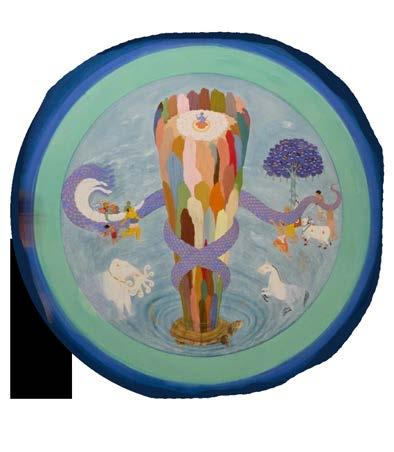
The exhibition soars, however, in providing the space for the work of contemporary artists like Sumakshi Singh and Desmond Lazaro that acknowledges and rejoices the complex mythologies surrounding Vishnu and his avatars. Lazaro, despite hailing England, spent years learning miniature art from a traditional master in Rajasthan before working on his piece ‘Samudra Manthana, Churning of the Ocean of Milk’ which reinterprets the legend of the Churning of the Ocean of Milk wherein
Avatar: Forms of Vishnu does not present an aporia: there exists a very real way forward, one that includes extensive consultation with researchers from communities from which these artefacts and artwork are borrowed for the purpose of the exhibition. Most importantly, galleries must ensure that this cultural awareness comes forth in experiences of the exhibition, especially in guided tours. It is important that whilst the exhibition attempts to celebrate South and Southeast Asian heritage, it does so in an informed manner, for misrepresentation through oversimplification of any magnitude, especially in a political climate as the current one in Australia, runs the risk of renewing racism.
I implore you: consider the stories that are not so visible in the exhibition when experiencing each piece, remembering that each artwork carries stories that many around the world center their lives around with devotion and tenderness. Resist the trap for cultural oversimplification that can sometimes emerge with affairs of this kind.
Avatar: Forms of Vishnu is on till the 5th of October at the Art Gallery of New South Wales, and for all its executional failures, is a must-visit.
William Yang reports from the Conference.
Straight after landing in Adelaide Airport on the 22nd of July, I headed to The Hotel Metropolitan, where a senior Government Minister, Tony Burke, and the Prime Minister’s speech writer, thought the best use of their time the night before the ALP’s 50th National Conference was to host a ticketed pub gig. I later found out the Financial Review reported pre-booked tickets to this gig were initially being sold online at an absurd price of $1,000. Disappointingly for Minister Burke’s band, it seemingly had to reduce ticket prices gradually to fill the venue, dropping the cost of entry to just $50 later that night.
The ALP National Conference is a triennial event where 400 delegates from trade unions and Labor Party branches across states and territories come together to elect the party’s National Executive and shape its National Platform.
On the first day of the Conference, attendees were greeted in the early morning by rows of protesters that the South Australian Police moved into a neatly organised space running alongside the main walkway into the entrance of the Adelaide Convention Centre. Some protesters gave out stubby holders with “Tax Gas Not Beer” printed on them, which I made sure to take a few.
was truly “all about Ed”. The only resolution on Palestine the party machine wanted on the conference floor was one ticked off by Foreign Minister Wong’s office, which Bassem Abdo MP and Josh Burns MP spoke to. The joint statement by a MP of Palestinian descent from the Left, and a Jewish MP in the Right was meant to display to the public a veneer of unity the party machine desperately wanted to show off. Husic’s renegade motion threw a spanner in the works.
As is standard with most Labor Party conferences, the final day was a half day. Attendee numbers usually drop through a hole on the final day with the casualties most visible the hours ahead in the morning caucus rooms. I had never seen a caucus room as packed as the Left caucus at 8am on the final day of this conference. Husic’s motion did better turnout than any apparatchik could. The Right’s caucus room was similarly impacted reportedly, despite the noticeable absence of Husic himself.
(MUA) addressed the Left caucus. The MUA reiterated its view on the moral obligation of the labour movement in standing up against injustice and genocide. Which only added to the surprise when at the end of his speech, the MUA announced they will withdraw their second-ing of Husic’s motion. A few minutes later, we were informed Husic’s motion would not make it to conference floor.
In the process of writing this article, I ended up in contact with a number of surprisingly senior sources. One senior source that directly contacted this writer oversaw the campaign to support Husic’s motion from the perspective of the Unions, and their insight expanded upon the question of why wasn’t Husic’s motion debated?
not a single ‘heavyweight’ or Government Minister tried to pressure the Left Unions, and not a single one of their deals or member issues were threatened.
This source instead claims, the Left Unions were only approached by senior ‘proPalestine’ figures, allegedly including LFOP figures, which lobbied them to withdraw their support for Husic’s motion. The Unions were led to believe that LFOP was divided on the issue and Husic’s push did not have support in LFOP outside of NSW. Consequently, this source claims the Unions withdrew their support out of respect for what was believed to be the wishes of LFOP delegates in Victoria and Queensland.

In the Right’s caucus, delegates were told the only resolution that would have the support of their caucus was the joint statement from Burns and Abdo. According to one source, Defence Minister Richard Marles proclaimed to the Right’s delegates “There will be no mention of the G-word”.
The short answer to the question is that by Saturday morning, just prior to the Conference discussing its foreign policy chapter, Husic’s motion no longer had a seconder due to the Unions withdrawing. An alternate seconder could not be obtained as the deadline to register a seconder for motions was Friday midday.
The Conference proper was far less interesting, starting with speeches by the party organisation’s executive, South Australian Premier Peter Malinauskas and then Prime Minister Anthony Albanese.
Barely an hour after the Conference commenced — around the time Albo finished speaking and before Deputy Prime Minister Marles even got the chance to walk up to the podium — about a third of the attendees left. As much as I wish I could say people walked off in protest against Marles or AUKUS, it would be more accurate to say that most people weren’t interested in hearing the Government praise itself for another hour.
‘All about Ed’
On the third and final day, Albanese complained to the media room that the press would make the conference “all about Ed”. The reality was, for everyone there, the final day
The contents of Husic’s motion summarised was a call to “withdraw defence cooperation” with Israel, establish “full diplomatic ties” with Palestine and acknowledge UN and ICJ findings on the genocide. The motion (which can be found in full on Labor Tribune) cannot be considered radical by any sensible means.
Compared to the Right, the Left took a lighter hand approach. Abdo spoke to the caucus, noting he personally believes Husic is acting in “‘good faith” before implying that voting for Husic’s motion would undermine all the work put into getting agreement on the joint statement.
Around 9am, a representative of the Maritime Union of Australia
Husic’s strategy, which Labor Friends of Palestine (LFOP) supported, was to have a Left Union second the motion to demonstrate an institutional and broad level of support for the push to recognise the genocide. However, this strategy had limitations as it was expected any union that seconds Husic’s motion would be opening themselves up to significant pressure. To reduce this vulnerability, two copies of the motion were submitted and seconded by the MUA and Electrical Trades Union (ETU) respectively, the two unions are considered amongst the most politically militant Left Unions.
Most onlookers have come to the reasonable conclusion that the MUA and ETU withdrew their support due to pressure from the ‘factional powerbrokers’ and ‘heavyweights’ Husic spoke of in the presser he did moments after it was confirmed his motion was scuttled. While that is likely true for Husic’s lack of support in the Right, the senior union source claimed
When LFOP was contacted by the SMH about the Conference, they declined to comment. Nonetheless, an anonymous senior source in LFOP told this writer, delegates in the LFOP group met the afternoon before Husic’s motion was due to be debated and unanimously resolved to support the motion and campaign to convince undecided delegates. Furthermore, it was denied there were any internal divisions in LFOP between state branches on Husic’s motion. Additional sources in Victoria and Queensland LFOP said their delegates would have supported Husic’s motion should it have been debated on the conference floor.
I’m inclined to believe that the Left Unions weren’t directly threatened by Ministers or factional powerbrokers. The outlined account of the Union’s perspective is believable considering multiple senior figures told the Guardian they “denied a coordinated effort by factional leaders to block the resolution”, no factional leaders were directly involved per the account I received. The account also mirrors the lighter hand approach taken in the Left caucus room. The one point that doesn’t add up is the conflicting accounts of LFOP’s supposed internal divisions on the issue, which LFOP themselves did not help by refraining to comment. When speaking to sources in LFOP, most indicated a level of uncertainty in the positions of LFOP members from different states. However, all were united in their independent support for Husic’s motion.
Was it disorganisation or conspiracy that left Husic out to dry? I believe it to be a combination of both in this case. While some delegates who are also involved in LFOP may have had reservations, the leadership of LFOP were united on the issue. It is likely that the Left Unions were partially misled by certain actors claiming to represent LFOP and partially mistook the reservations of individual delegates to represent the wider views of LFOP and other supposedly ‘pro-Palestine’ figures. It wouldn’t have helped that the only person of Palestinian descent in Parliament expressed a clear preference for Husic’s motion not getting debated.
If anything, this Conference has shown that factional divides are not based on ideological lines, and haven’t been for some time. The modern ALP is ruled by a group transcending factions that is philosophically authoritarian and Neo-Keynesian in the best of times. The current top down culture is embodied by the party’s National Executive, which in theory has near limitless power over preselections and state branches. That being said, the subgroups within the ALP’s elite are not stagnant: people fall in and out of favour constantly. The catch is, change within the ALP currently requires permission from its elites and any exception is more a miracle or fluke rather than anything else.
However, there is hope for change. Albeit with limitations, LFOP has demonstrated it is possible for those in the Labor Party to create evergrowing, long lasting, and institutionally democratic coalitions. Such a project faces two ultimate tests. Firstly, whether those against the current ALP establishment seek to transformatively change the party’s culture and governance as opposed to just replacing those in control. Secondly, if it is capable of overcoming the ideological variability that allows even a credible doubt to exist when it comes to, for example, LFOP’s position on a motion as moderate as Husic’s.
Calista Burrowes doomscrolls.
Australians cannot take a single thing seriously. In a world where it feels like we are totally devoid of control even over our own lives, a sense of humour seems to be all we have left. Like Guido in Life Is Beautiful, we proudly use our sense of humour, oftentimes self-deprecating, to continue to find moments of unity in a world that is collapsing. That collapse seems to be currently on an accelerated course in Australia.
Trust in the traditional LaborLiberal two-party system is decreasing, and for good reason. An inflamed far-right spearheaded by One Nation is capturing the support of many let-down Australians who are being sold, by figures like Hanson, what seem like ludicrous lies designed to scapegoat the marginalised. The centre cannot hold and we are floundering. Are we really capable of making jokes at a time like this?
The answer is not simple. Beyond the question of capacity, we must ask ourselves: what end are these jokes achieving? Are we internally giggling and scrolling away, or do we feel some true sense of fervour?
The online world of Australian Political (AusPol) humour is an entirely different world from the so-called edgy stylings of Charlie Pickering’s The Weekly or Rita Panahi’s Lefties Losing It, often irreverent and enveloped within layers and layers of satire. Without a knowledge of the language these accounts use, it can often be difficult to access certain parts of what it is communicating. This post from @bobkatterscloset on Instagram, depicting John Howard in the backrooms, which only up until this year would require an education in 4chan and Creepypasta Wiki to explain, is not funny.
It is slop, and unfunny at that. It isn’t even a dig at Howard’s legacy, one that leaves much to be desired, but more so just an absurd and inoffensive image. Is it making a statement? No. In fact, it’s rather apolitical and non-divisive for what poses to be a ‘satirical’ page. Should it make a statement? Neil Postman’s Amusing Ourselves to Death can give us some insight into this post, which is an example of what he considers
part of “a perpetual round of entertainments” that inches us closer to culture-death, a state where discourse collapses and we don’t go beyond the surface level of superficial humour and amusement.
From the bizarre way Harambe the gorilla became adopted as a righteous absurd bit to “comedic” hasbara in Israel which mocks global solidarity with Palestinians amidst the genocide, humour is beyond superficial. It shapes our political understandings.
All humour comes with an agenda, even those seemingly innocuous Instagram pages that come up in your feed. Even with this inoffensive content, it’s important to ask: who and what is this promoting? Who and what are they partnering with? @the_ political_compass on Instagram has an ongoing partnership with the service Ground News. Ground News does not take money from corporate sponsors or money from Big Tech, which already places them in a higher category of integrity than many mainstream networks. Still, they offer a subscription costing almost $12 a month which essentially pays for a breakdown of biases in news sources, as analysed by the people at Ground News. It does little beyond that.
It doesn’t allow you to access said articles, instead reinforcing a left-right binary of mainstream news. When sponsorships become involved, posting becomes more explicitly about growing an audience and political ‘humour’ becomes tainted by a desperate need for constant growth driven by ragebait and engagement. But does ragebait transport itself to the real world rage of political engagement?
Political humour can actually use its nature for good. Humour disarms people, allowing political messages to infiltrate the close-mindedness engendered by algorithmic echo chambers. Memes intentionally position the presenter of the joke as a civilian, amateur poster, inclining audiences to be receptive to their messaging @toiletpaperaustralia on Instagram can make an objectively funny reel about Barnaby Joyce yelling at his dog during a live broadcast of 7.30 and then remind us of the reality of the situation we are facing, saying: “[if] only he had the same energy towards the rapist Pauline hired.” Humour
cuts through tension we all feel. Even though Hanson, Joyce, and One Nation are simply a joke to many, people will still support and vote for them.
Even the account @australian_ child_labor, a meme account that is a satire of the Labor Party, despite its absurdist nature, does actually platform real issues through ironic memes, such as its coverage of the overly aggressive police response to Labor Friends of Palestine at a 4th July party conference.
Where some accounts use their clout to earn commission from making so-called jokes and reposting Tweets posted by Polymarket, others do their best to speak truth to power, even if that information is at times layered beneath levels of absurdism.
Are AusPol memes making us dumber in our political literacy? No, they are not. Are they potentially cloaking important messages behind the veneer of humour that can easily cloud certain realities of our political climate? Yes. Humour plays an important role in cutting through divides that have been staked in Australian politics, and so it’s important to be a critical scroller.
In addition, your political literacy should not come from one singular voice, and this is true not only for social media, but for news – independent or mainstream – books, podcasts, family, friends, everywhere. To be aware of the world around you is not to shut off voices, but to hear them and become aware of the tactics that breed rabid and dangerous politics. Maybe you should still check your screentime though.
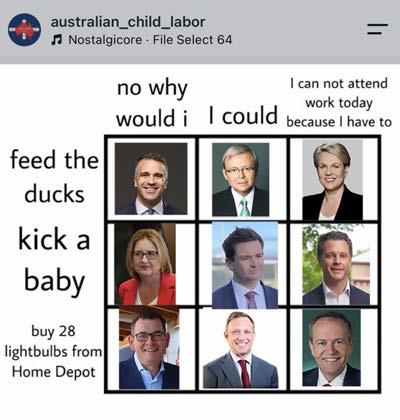
The Jantar Mantar observatory in New Delhi was recently the site of a major sitin led by the Cockroach Janta Party (CJP). From the 6th of June, Indians have been protesting their education system at large, and calling for the resignation of their education minister, Dharmendra Pradham. On the 25th of July, The CJP was successful, Pradhan resigned, putting an end to the hunger strike of Sonam Wangchuk, an education reformer from Ladakh.
Self-described as the “voice of the burntout youth,” the CJP is a satirical youthled movement sparked in the aftermath of Supreme Court Justice Surya Kant’s remarks which likened unemployed young activists to “cockroaches”.In May, Abhijeet Dipke, then a master’s student in Boston, tweeted: “What if all the cockroaches come together?” Not long after Dipke’s tweet, the CJP’s protest, unprecedented in its scale and volume, took to the streets of Delhi, Pune, Bengaluru, and Lucknow, fueled by the NEET Scandal. The National Eligibility cum Entrance Test (Undergraduate) (NEET) is an annual exam held for students seeking admission to medical and dental school. 2.27 million candidates sat the May 2026 exam round before investigators found its questions were leaked in a sample ‘guess paper’ circulated before the exam.
After a replacement exam was announced in June, at least twelve students — whose efforts and financial investment in taking the NEET had come at great cost to their families and themselves — committed suicide. “You sacrificed everything for me, and I failed,” Ankita Sangle wrote before taking her life.
As the most populous country in the world, for citizens education remains one of the only hopes of class mobility and even basic liveable wage survival. 65 per cent of the population is under the age of 35, making competition for university seats and jobs higher than ever before.
The CJP protest has brought into sharp focus the corruption and fascism of the Bharatiya Janata Party, PM Narendra Modi’s right-wing government. Videos posted by protesters, celebrities, and BJP MPs themselves have flooded social media, showing the quotidian threats and uses of force exploited by the government to stifle political dissidence.
The incredibly well-documented protest has seen the best of the BJP’s ideology on display. BJP MP and actor Kangana Ranaut, known for her role as Rani in one of the more progressive, feminist Bollywood movies out there, Queen , posted a rant to her story: “Here is a new generation of so called westernised Indian women. I call them generation gutter…they are so ugly and corrupt that they can’t be home makers either but they proudly flaunt their freedom to have drugs, drinks or endless body counts.”
Ouch. Ironically, Ranaut’s character in Queen was a heartbroken solo-traveller who abandoned her conservative ways in Europe after befriending a sexuallyliberated French girl and a Pakistani pole dancer.
The CJP claims it’s a “political party for the people the system forgot to count.” In all of
Kuyili Karthik interrogates the movement.
based on their birth, oppression won’t be rooted out if protest doesn’t centre this issue specifically.
“NEET is very difficult for poor and rural students,” said Tamil Nadu activist S. Anitha in 2017. Only two people she knew from her village wrote the exam and they didn’t pass. Anitha, a Dalit student of Kuzhmur village, filed a case against NEET at the Supreme Court. When the verdict was given that NEET would continue to be a mandatory admission criteria for medical school, Anitha committed suicide. She studied at a Tamil language school, was a top scorer, and would have been admitted to medical school if she hadn’t missed the NEET cutoff, which is based on percentile.
No free government-sponsored coaching initiatives for the nationwide NEET are offered to people in Anitha’s situation, whereas private coaching centres charge exorbitant fees for specialised tutoring in entrance exams, privileging the rich. In response to protests across Tamil Nadu after Anitha’s death, the BJP called her suicide a “conspiracy”. “Don’t test our tolerance,” Tamil Nadu’s BJP President tweeted. The past few months have tested the BJP’s tolerance and resulted in the ousting of a union minister.
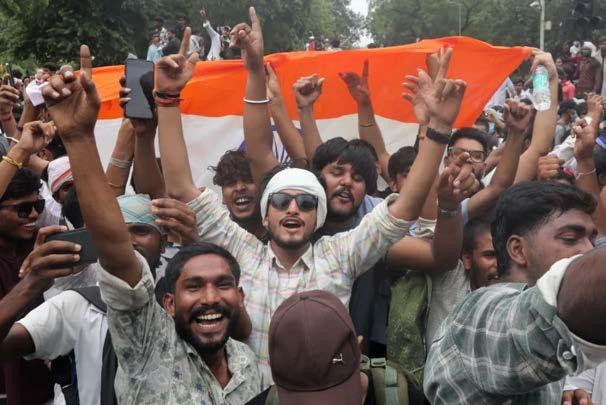
For many students, success at the NEET and the Joint Entrance Examination (JEE) for prestigious universities, like the Indian Institute of Technology (IIT), are tickets out of the fate of daily-wage-labouring and housewifery that await them. Even young people who achieve dreams of attending these prestigious schools are subject to the immense pressure of the academic system. 65 students have committed suicide over the last five years across IIT institutions.
One woman at the Jantar Mantar sitin, frequented by fluctuating crowds of students every day, dressed as a bride in silver-zari-adorned red complete with a veil and jewellery. Her sign resignedly read: “RIP Career, Shaadi.com here I come.” She said the May NEET was her only chance at not being betrothed in an arranged marriage without financial independence.
The NEET leak exposed gaping cracks in a system that has been broken for as long as Indians can remember.
the coverage, the main conflict emerging is one between the far-right, Hindutva conservatism of the BJP and a youth class fighting against a structure they deem deeply rigged against them. Broadly, there is an unemployment and education crisis in India affecting Gen Z and Millennials the most. According to a recent study, almost 40% of India’s graduates below the age of 25 are unemployed.
In the media, the protests are portrayed as an uprising of disenfranchised, chronically-online youth who speak in Gen Z riddles like “delulu”, “clock it”, and “waste-guna-huiya”, according to reporting from the BBC.
Coverage which portrays the protests as a diametric opposition between the BJP fascist government and progressive youth risks obscuring the fact that India’s education system has always been unfair, even before Modi’s government.
When India’s ever-present caste system specifically denies education to people
But although Pradham has resigned, mass arrests of student protesters are fueling calls to restart the protest. According to the CJP, at least 100 people have been arrested on nonbailable charges. The BCC reported that police were seen “brutally attacking the crowds with wooden sticks, batons and tear gas,”and that pellet guns were used.
In the aftermath of the resignation, Modi has announced a panel to overhaul exam systems and a measure, recently introduced in Parliament, that seeks higher penalties for exam leaks.
But simply changing who is occupying the education minister’s seat won’t address India’s casteist structure, Dalit activists warn. Farmers and Dalit people are some of the most politically dissident groups in India and have defined cultures of protest. Recently, thousands of villagers in Madhya Pradesh have been protesting the Ken-Betwa project, a multi-million-dollar initiative to link rivers that will submerge at least ten villages to build a dam and displace eleven more.
The first NEET protests in Tamil Nadu, spurred by Anitha’s suicide, centred issues of poverty, caste, and rural disadvantage. It is necessary that the CJP’s protests be contextualised as more than just discontent with a NEET leak. It must be a protest against the consistent reality that exams like the NEET will always price out rural, poor, and Dalit students.
Ideological developments in the Cockroach movement bring sharply into question what the limits are of a youth-led reform of the education system and politics at large.

All University of Sydney students enrolled in undergraduate degrees or diplomas, or as other non-degree students, are eligible to vote in or nominate for the Annual Elections.
Nominations are called for the following elections/positions:
Nominations will be accepted online from 9:00am 3 August 2026 via the SRC nominations page: bit.ly/SRC-noms. The close of nominations shall be at 11:59pm 19 August 2026. For more information on how to nominate, please refer to the Candidate Information Pack available on the SRC website at: bit.ly/SRC-noms.

On-campus polling will be held on 22, 23, & 24 September 2026:
• Jane Foss Russell: Tues–Thurs 8:45am – 5:15pm
• Fisher Library: Wed & Thurs 8:45am – 5:15pm
• Manning House: Wed 10:45am – 3:15pm
• Conservatorium of Music: Wed 10:30am – 3:30pm
• Susan Wakil Health Building: Thurs 10:45am – 3:15pm
• Peter Nicol Russell Building: Thurs 10:45am – 3:15pm
Voters who are unable to vote in-person at the specified times above are able to request an online absentee vote via bit.ly/SRC-vote
The SRC Elections are conducted according to the SRC Constitution & Regulations, which are available here: bit.ly/SRC-regs. Appeals to the decisions of the EO can be directed to the ELA via srcela@src.usyd.edu.au
For further information, please contact the Electoral Officer via elections@src.usyd.edu.au.

Welcome to Semester 2! For those new to the University, welcome and I hope you are settling in well. For those returning, I hope you had a restful break. There’s no break for the SRC over the holidays, so here’s a few updates of my last two months for you – check out my full reports in our monthly council coverage!
- I attended and spoke at Sydney Staff for Palestine’s symposium Free Palestine, Free Speech: Political Expression and the Contemporary University on 4 June 2026
- I have done some media following the Wom*n’s Collective’s prochoice counter-protest against Joanna Howe and Barnaby Joyce on 2 June 2026
- I conducted SRC staff consults with the VP, Bohao
- The SRC Publications Committee passed our new SRC / Honi Soit Code of Practice
- SUPRA and I submitted more thorough feedback on the proposed Students As Partners framework to ensure that it is actually identifying student representatives
Welcome back everyone!! I hope you had a restful and relaxing holiday, and are now ready for another semester. Remember to join us at WoCo this week for our screening of Eva Victor’s Sorry, Baby, a very important debut feature of recent years, exploring themes of how victim-survivors are treated in the context of a university setting.
Last Friday, WoCo supported the ANU Women’s Department in their demonstration, demanding for accountability and proper action to be taken regarding sexual violence at ANU. Shamefully, ANU management has refused to properly engage with the ANU Women’s Department’s calls for appropriate action taken towards sexual violence on campus. This demonstration had seven demands:
1. Compliance with the National Code
2. Commitment to Student Engagement
3. Addressing intersectional drivers
4. Accountability and transparency
5. Changes in Residential Halls
6. Trauma informed support and disclosure
7. Improving uni governance and leadership
as partners and differentiating between lived experience and lived expertise
- While on leave, I arranged for SRC reps to present and stall at the International, FASS and ADP welcome events
- Our new SRC Enterprise Agreement for staff has finally been approved by the Fair Work Commission and is in effect!
- I am continuing to work with the International Student Officers on finalising a provider for our free NAATI-certified document translation service
- We are analysing feedback from our vaccination program and creating a final report
- With the Casework team, I am providing feedback to and collaborating with the University’s team responsible for rolling out the National Code on Gender-based Violence Prevention
There’s lots more happening, but I hope that gives a good overview for now. Stay tuned with the SRC Instagram and newsletter for upcoming events and updates, such as information about the new $5 meal canteen and upcoming industrial action by USyd staff!
Avin Dabiri (Independent)
USyd WoCo promises to continue to remain dedicated to fighting justice and systemic feminist change at other universities, and collaboration with other Women’s Collectives.
During Semester One StuVac, WoCo held a pro-choice counter-rally at Martin Place against anti-abortion activists supporting Joe Ruddick’s Bill. A strong stance fighting the far right and religious interference in healthcare by demanding bodily autonomy and access to medicare covered abortions for all. This event saw collaboration and support by Socialist Alliance, Socialist Alternative, Solidarity, Pride in Protest and the NSW Greens and saw a turnout of close to 200 individuals. This rally was a clear demonstration of the continuous fight for free and legal abortions and we hope to continue to have similar powerful and community-building events to display our strength in numbers.
Here’s to a semester filled with more feminist advocacy across all of our communities, and a continued fight towards systemic change. Thank you to everyone who got involved during the first semester!
In love and rage, Maxine and Avin
Aoyue Cao, Anu-Ujin Khulan, Lucas He, George Feng (PENTA)
Over the past month, we have focused on welcoming new international students and helping them feel connected to the wider university community. Over two consecutive days, we delivered speeches and hosted promotional stalls at the International Students Welcome. We introduced our roles, highlighted available support, spoke directly with students about our work, and distributed welcome gifts. These activities allowed us to engage with students in person and create a welcoming first impression of campus life.
We also continued advancing our free document translation initiative, which aims to make essential information and services more accessible to students from
Wendy Thompson (QuAC)
The Queer Action Collective is back for semester 2!! We’re diving right into the semester with lots of events and queer campaigns to build:
- Every Thursday — 1:30pm: Weekly QuAC meetings, in the Queerspace and online
- Friday of Week 1 — 7 August, 7pm: Queer Beers at the Rose Hotel
- Tuesday of Week 3 — 18 August, 4pm: Liberation Library and sausage sizzle, reading “Punks, Bulldaggers, and Welfare Queens,” in Victoria park
We’ll be busy this semester with lots to do for queer rights in the face of the rising far-right here and across the world. We hope to see you at these events and more!
This semester, the NTEU are also in bargaining to fight for better staff conditions at USYD. Staff
diverse linguistic backgrounds.
In preparation for Welcome Fest, we purchased promotional gifts and arranged for them to be transported by air. We also promoted the event on Xiaohongshu and recruited student volunteers to support its delivery.
Through these initiatives, we have sought not only to provide practical support, but also to foster a more inclusive community where international students feel welcomed, represented, and empowered to shape their university experience.
working conditions are student learning conditions, so it’s crucial we stand with the NTEU in this period. Further, one of the demands on the table is increasing the time and accessibility of gender affirmation leave for staff. Keep an eye out for the stop work meeting on August 10th, and we’ll see you on future picket lines!
Trans Day of Remembrance and the accompanying Trans Day of Resistance rally are also coming up later this year in November. We’ll be part of a nation-wide push to demand an end to transphobia and antitrans violence, immediate and necessary anti-discrimination reforms, and access to the spaces and services that trans people need to survive and thrive. Keep an eye out for organising information, coming soon.
Follow us on Instagram @ usydqueer or join our mailing list for more info, and stay gay!
Dana Kafina (Grassroots) Jasmine Al-Rawi (SAlt)
No report was submitted to Honi Soit by the Education Officers.
Max Fischhof, Jaehyun Kim Shuqing Yang, Lanlan Huang
Honi did not receive a report from the Intercampus Officers.

Do you remember that bit on The Tinder Swindler, where Simon encourages Cecile to take out some quick-loans to help him escape his enemies? That didn’t work out well for her, and chances are that it won’t for you.
Payday loans feed off your desperation. They try to block your access to better ways of accessing financial help. The lure of getting cash as quickly as an hour after you apply should be considered in the sobering light of the interest rates or charges. Different loans have different conditions. Some promote that they have no charges but charge an interest rate of up to 48%. Others do not charge interest, but instead charge an account management fee that is equivalent to at least 48%. Debt consolidation loans are almost as bad. There are many fees and charges that are imposed, with little opportunity for your repayments to actually reduce your loan. Debt consolidation companies have been known to sign people into an act of bankruptcy, which can have profound effects on your financial health for many years.
Buy Now Pay Later doesn’t quite cut it either.
It is great to have interest free periods on loans, and partial payment schemes such as Afterpay, and Ezipay, but the penalties for late repayments can be very high. If you are going to use one of these services, calculate when you will be able to complete the payment, and how much this will actually cost you.
Payday loans feed off your desperation. They try to block your access to better ways of accessing financial help. The lure of getting cash as quickly as an hour after you apply should be considered in the sobering light of the interest rates or charges.
There are better alternatives. Your energy provider (electricity and gas) is part of the Energy Accounts Payment Assistance (EAPA) scheme which gives $50 vouchers to people in need. You could also ask your telephone and internet companies if they have a similar voucher scheme, or if they can put you on a payment plan. You might be able to get a bursary or an interest free loan through the University’s Financial Assistance Unit. If you are on a Centrelink payment you might be able to get an advance payment. There may also be ways to spend less money each week. For example, there are many services around the University that provides cheap or free food, medical services, and other similar types of services.
The SRC has a Guide to Living on Little Money (QR code below) that has lots of helpful cost-saving tips, that might be helpful or contact an SRC caseworker.

Show Good Cause Appeals: What to do if you are late?
Hi Abe,
I only just noticed that I was asked to Show Good Cause. It’s just that I don’t check my emails often, and I have been overwhelmed. Can I still submit a response?
Late
Hi Late,
Show Good Cause is an opportunity for you to explain how you will pass all your future subjects. If you’ve missed the deadline for your Show Good Cause letter, unfortunately the

Faculty may have excluded you. You should still contact the Faculty and ask them if you are still able to submit a late Show Good Cause letter. If they have already excluded you, you can submit an exclusion appeal instead. You should start your letter by explaining why you did not submit your show good cause letter, then follow the suggestions in the SRC’s Exclusion Appeal information ( linked below) .
An SRC caseworker can help you with your Show Good Cause letter or your exclusion appeal. Abe
If you need help from an SRC Caseworker start an enquiry. Scan the QR Code


Collect from the box in the reception area of the SRC office, open Tuesday–Thursday, 9am–5pm. No questions asked.


Dusting Off the CObwebs

From the 13 August, 1999 Edition of Honi.
1. When will USyd staff stop work in industrial action?
2. How were SAlt and Solidarity formed? UTS’ student publication, still publish next
4. Who came third in the 2026 FIFA World Cup?
5. Who is the USyd NTEU Branch President?
6. What is the rival city of Springfield in The Simpsons?
7. Who won the Tour de France? Answers: 1. August



Weary of the cutthroat and at times unkind environment of student politics (commonly referred to as stupol), a coalition of ambitious little SRC-obsessed cuties have set up ‘FriendPol’, which they describe as “stupol if it was kind”. On FriendPol, the main actions a person can take is to have respectful dialogue with someone of a differing viewpoint, befriend someone, and be kind to someone.
FriendPol features many stupol mainstays and fan favourites, such as Friendland Dawgwin, Joymine Dearnelly, Lover Moore, Grace Support, Ava Comradely, Vince Togetherness, Zayed Teammate, Jolly Schmidley, and many others.
Brisk, happy greetings are heard from every corner of the FriendPol sphere, regardless of factional alignment, past history, sectarianism, or any other reason stupolwonks find to scream down each other’s necks. FriendPol is an immersive virtual reality experience, offering USyd students an alternate campus.
“Hey, friend! Did you say ‘alternate’? More like Alternative, am I right?” Friendland Dogwin hooted amicably, somehow breaching containment of the FriendPol VR and entering this Honi article.
“Good one, friend. We may differ on a few key issues, but I’ll always have respect and love for you personally.” Said Joymine Dearnelly warmly.
“Hey guys, how are two of my favourite people?” Asked Grace Support.
Before they could answer, Ava Comradely and Vince Togetherness cannonballed into the crystalline blue water of the Jamberoo erected on the USyd Quad, an example of what stupol could do if everyone remembered to be kind.
“What fun, friends!” They said in unison.
“Got room for one more? I brought fairy bread!” Came the voice of Jolly Schmidley.
“Room for you? Always.” Replied Friendland, embracing Jolly.

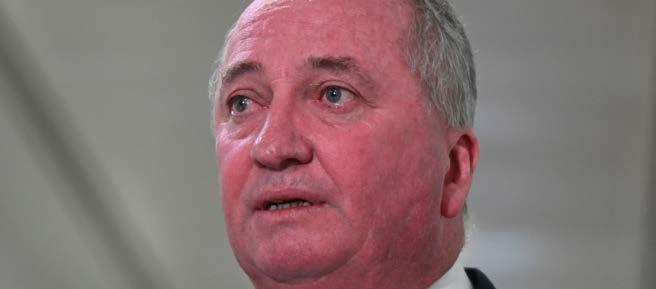
Barnaby Joyce defends himself once again.
I don’t know how many times I need to say this, blokes are red. The fact that my whole body is extremely red from head to toe is a completely normal, unremarkable part of life. Now, can everyone get off my fucking back and quit asking if I’m okay? I’ve never felt better in my whole bloody life. In fact, the redder I get, the better I feel.
Alright? Now piss off.

As Kyle and Jackie O are both embroiled in separate Federal Court lawsuits with their old employer, seeking over $80 million for their ‘talents’, Australia is collectively searching for ways to imprison both radio presenters permanently. While it does not currently appear that either of them are on trial for anything, rather lodging civil suits, many of the nation’s top lawyers are researching this issue.
“There may be a way forward for a class action lawsuit, with regard to long-term disturbing of the peace, or perhaps disorderly conduct”, advised a top Silk who wishes to remain anonymous.