I broke my arm at the corner near the convenience store and the little woodchip park in Bronte, where I used to live. It is 2011 and I am seven years old. I’m scootering with unbelievable velocity down the footpath. There are two runners in front of me and I have it in my little head that I simply must overtake them.
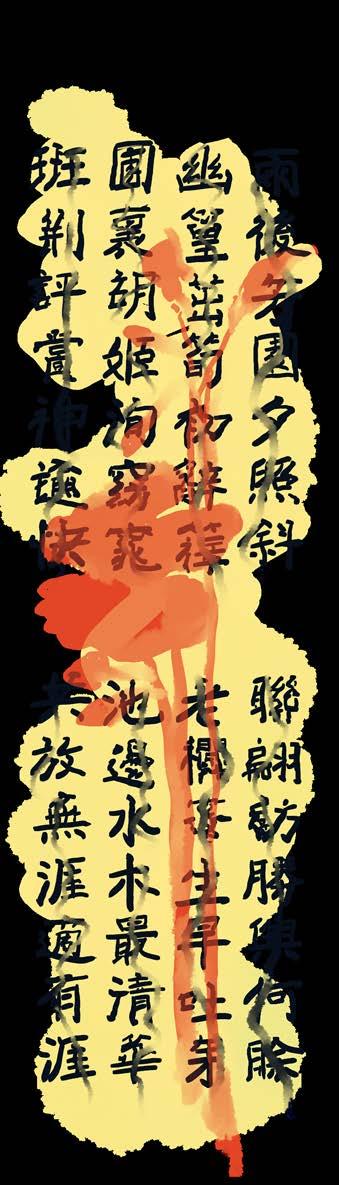
The path is filled with fluttering blossoms, falling catkins fly past the curtain. I bid farewell to spring, yet still ask spring; is there any way to take away this sorrow? In Singapore, where eternal summer persists throughout the year, there is no such thing as spring. Where, then, did Lau Gong’s sorrow stem from?
19: PERSPECTIVE
Clara Tan
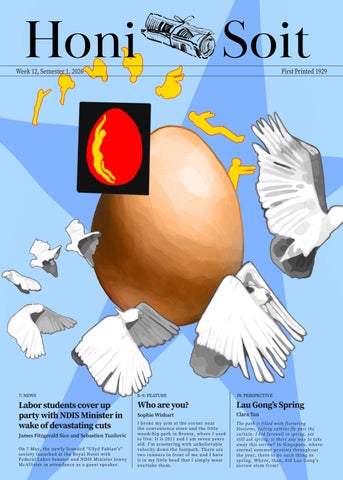
8–9: FEATURE Who are you? Sophie Wishart Lau Gong’s Spring
7: NEWS
James Fitzgerald Sice and Sebastien Tuzilovic
Labor students cover up party with NDIS Minister in wake of devastating cuts
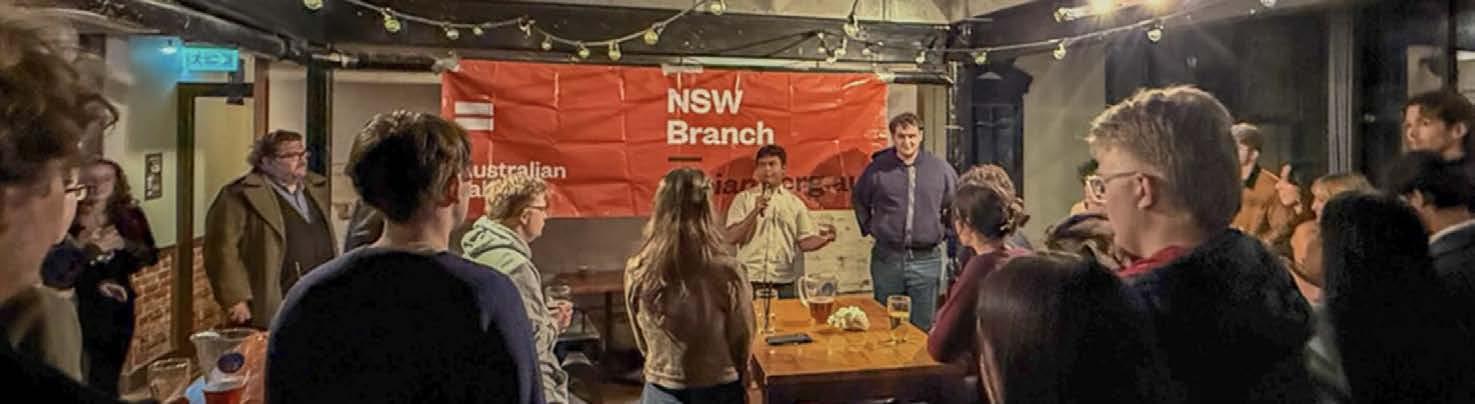
On 7 May, the newly founded “USyd Fabian’s” society launched at the Royal Hotel with Federal Labor Senator and NDIS Minister Jenny McAllister in attendance as a guest speaker.
EDITOR-IN-CHIEF
Sophie Wishart
EDITORS
Madison Burland
Anastasia Dale
James Fitzgerald Sice
Kuyili Karthik
Kiah Nanavati
Marc Paniza
Firdevs Sinik
Sebastien Tuzilovic
Sophie Wishart
WRITERS
Sebastien Tuzilovic
James Fitzgerald-Sice
Iris Brown
Sophie Wishart
Meijie Ureta
MacKenzie Johnson
Anastasia Dale
Sofia Dillon
Elliot Priestman
Max McDermott
Hashwitaa Maynoor
Kuyili Karthik
Clara Tan
ARTISTS
Yasodara Perera Phil
Acknowledgment of Country
Honi Soit publishes on stolen Gadigal land. Sovereignty was never ceded. The University of Sydney is a colonial institution that upholds Western knowledge as superior to First Nations knowledge systems. We reject this hierarchy.
As student journalists, we recognise that mainstream media has been complicit in silencing and misrepresenting Indigenous voices since invasion.
We commit to centring First Nations perspectives in our reporting, to challenging the colonial structures embedded in journalism, and to amplifying the voices of those resisting ongoing dispossession. We pay our respects to Elders past and present, and to all First Nations students and contributors.
Always was, and always will be Aboriginal land.
The seasons are coming and going. It’s getting colder. As exams and the end of semester approach with a voracity and velocity that manages to shock me every half-year, I cannot help but look backwards.
There are cycles I seem to be caught in. I keep forgetting to put my retainer in. I ate the 99¢ instant chicken noodles from ALDI three nights in a row last week. I am writing this editorial at the same hour of night as I tend to write all my assignments. And my cup of tea has gone cold, the way it always does! Everything stays,
everything changes.
My feature discusses the everfragile concept of the self (or maybe it’s robust? You’ll have to read to find out!) James and Sebastien, after their decadeslong-feeling venture to Canberra, take us regular folk through the big scary national budget — everyone better say thank you! Elliot exposes YOU, you little populist, Meijie thinks we should all go analog, Hashwitaa encourages you all to steal (do it!!!) (only joking haha) (unless…?), and the whole edition is sure to make you spiral!
Letter to the Editor
Dear editors,
I refer to the article ‘On AI “Artists”: Music and Mechanical Reproduction’ in Honi Soit Week 9 Sem 1 2026.The author states / quotes that “Humanity begins to “distinguish themselves from animals as soon as they begin to produce their means of subsistence.””
False. Farming one’s own food, or creating conditions that attract them, is not an activity unique to humans.
Honiscopes
Terrestrial invertebrates: The life cycles of some termites, leafcutter ants and ambrosia beetles involve using the right type of plant to create a substrate on which to cultivate their desired fungi species. A salt marsh snail in America (Littoria irrorata) cuts cordgrass and deposits faeces on the wounds, which contains spores of a specific fungus. The fungus then infects the plant and grows. In all these cases, the fungi become the main food source for these invertebrates. Some ants ‘ranch’ aphids in the same way that a farm worker may herd, protect and milk their cows.
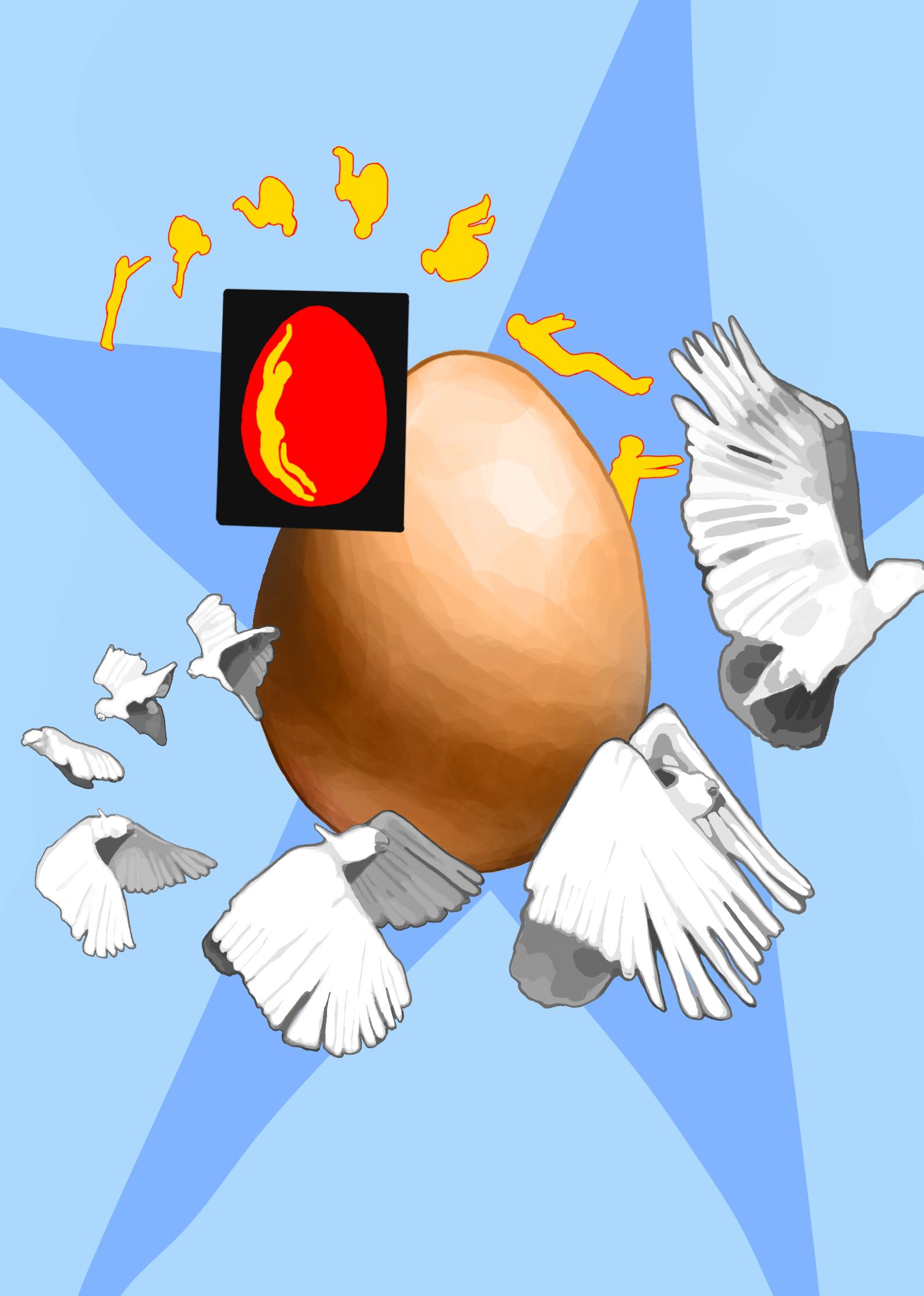
Aries: A vegan hard-boiled egg. More like a negg. noegg. Looks a bit off.
Taurus: A common murre’s egg, offspring of a penguinlike waterbird. You’re a work of art baby.
Gemini: You are cassowary egg. Like your parent you are hostile sometimes but interesting. You do bite.
Cancer: Quail egg hatched in an ashtray. You are an identical twin (spiritually if not literally).
Breakfast at Tiffany’s anyone? Van Cleef & Arpel’s heiress, luxurious on a budget. Robin egg and a bagel. mmm.
Libra: A Fabergé egg passed down in a Hapsburg lineage. Baroque, Belvedere, Klimt, Secessionist.
But do not fret — a cycle is not a circle; it moves slightly each time it comes around. Have fun spiralling, get nostalgic, notice the versions of yourself that come around again and wave! This edition asks contributors to participate in the cycles, not just witness them.
I’m so honoured to have had the opportunity to join this team. Please enjoy the Week 12 edition of Honi Soit!
All my love,
Sophie
Marine invertebrates: Giant clams and corals host zooxanthallae algae in their body structures; in return for shelter the algae produce food via photosynthesis. The Yeti Crab (Kiwa hirsuta) cultivates bacteria on its peculiar hairy arms which then becomes its main food source...
- Matthew Huan
Editor’s note: Fish, bird, and mammal examples were omitted as they exceeded the allowable word count.
Virgo: Organic AND Free range. Since when did you get so ethical? Did you just buy these to impress your trade with in the morning?
Scorpio: Just the egg whites. You must really hate yourself. I bet you drink these by the carton huh.
Sagittarius: Teal emu egg. So 2016 and so y2k. This would look so good in your teal Balenciaga city bag.
Capricorn: Simple, soft, sumptuous. Sucker for the golden yolk. Tiny and precious quail egg.
Aquarius: You are a regular egg in an egg cup. Crack that shell open. Enjoy a trivial delicacy. With some English Breakfast.
Pisces: You are an ostrich egg. You would look really shapely bald. Unlike a golf ball, your skull is undivoted and smooth. you know what they say about smooth skulls.
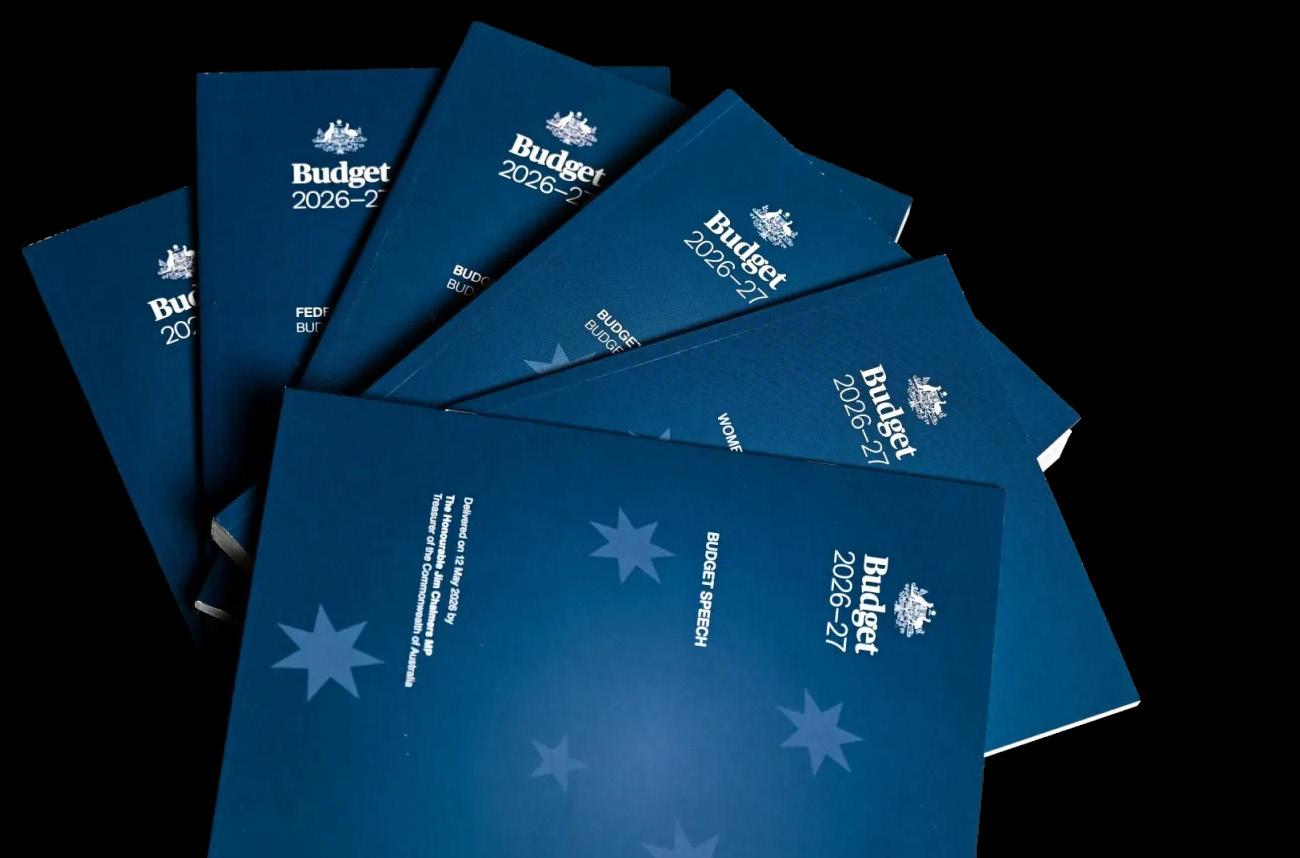
“Five budgets in one” but little help for students: 2026 Budget Guide
Students and young people are often neglected in the federal budget. The Labor Party’s fifth consecutive budget, released today, reiterates this neglect. The cost of living continues to put pressure on the lives of students and young people. Labor’s budget this year is primarily a budget focused on housing, targeting both supply and demand.
Honi , as a representative of the student body, is reporting to you from the federal budget lock-up in Canberra to bring you the news about how this budget will impact you. The following will detail changes that will impact the lives of students.
NDIS
Last month, the Albanese government announced sweeping cuts to the National Disability Insurance Scheme (NDIS), framing the reforms as a return to the scheme’s “original intent” of supporting people with “permanent and significant disability.” This is the government’s largest single savings measure as the reforms are expected to reduce growth in NDIS payments by $37.8 billion over four years, with the scheme’s annual expenses expected to sit around $56.1 billion in 2026–27.
The proposed changes will remove more than 160,000 people from the scheme. As of late 2025, the NDIS had 761,442 active participants. According to the latest ABS data, 5.5 million Australians, or 21.4 per cent of the population, have a disability, meaning the scheme already supports only a fraction of disabled people. Under the proposed overhaul, access will shift away from diagnosisbased entry and toward “standardised, evidence-based assessments” of functional capacity, while the government will tighten unscheduled plan reassessments and reset budgets for social and community participation.
Professor of Health and Social Policy at the University of Sydney and former Director of the Centre for Disability Research and Policy, Jennifer Smith-Merry, told Honi that the NDIS cuts will mean people with a disability are “less likely to be able to participate in society in an equitable way with other Australians… this directly impacts the people with disability that you sit with in
University classes and mix with in social settings”.
“The NDIS is designed to meet individual participant needs – those needs will not be fully met if you cut them by 30-40% across the board. This matters for individuals but also for how we provide equitable social inclusion in Australian society and fulfil our obligations under the United Nations Convention on the Rights of Persons with Disabilities. Meeting people’s needs for community and social participation helps to even out the social and community barriers disabled people face in their everyday lives.
“This would matter less if there were other supports available outside the NDIS for people with disabilities, but those supports do not currently exist. There is a lot of fear in the community about these changes.”
SRC Disability Officers Remy Lebreton and Kayla Hill told Honi “We are extremely angry (though unsurprised) by Labor’s cruel, eugenicist policies cutting $37.8B from the NDIS while at the same time investing $53B into defence. The Labor Government is committed to a mass-disabling project across the world, complicit in bombings, medical blockades, and mass-starvation in Palestine and Lebanon, and simultaneously denying disabled people here of basic supports crucial to any sense of livelihood.
“That disabled people were barely mentioned for five seconds in the Budget delivery highlights how little care the Labor government has for our lives. The Albanese government has left more than 160,000 people and generations moving forward bereft of any hope of a stable and dignified life. For all their claims of malpractice, Labor has done nothing to touch the profit, which fundamentally inflates costs, instead shifting responsibility onto disabled people.
“Thousands will die as a result of Labor’s funding into mass disablement and the further destruction of our planet.
“A budget centred around
Eugenics and genocide is not ‘an opportunity to be seized’, as the Albanese government so desperately wants to claim. We will not let this go ahead without a fight
HOUSING
The Treasurer, Jim “Jimflation” Chalmers, has positioned the 2026-2027 budget as principally concerned with housing reform. This reform targets entry into the housing market specifically, attempting to support 75,000 additional Australians buying their first home. Despite a reform which sees the downsides of negative gearing attempted to be stemmed for the first time in years, the Budget provides major caveats which will still ensure continuing difficulties for first-time buyers’ entry into an increasingly isolated market.
The budget tries to tackle negative gearing, a tax arrangement that allows property investors to deduct rental losses from their taxable income. This will be attempted through a replacement of the 50 per cent Capital Gains Tax (CGT) discount, a tax on money made outside of income, usually applied to sellers of property, with a discount that the Federal Budget states will be “based on inflation”. The exact equation which the treasury is developing to see this through has not been revealed.
The 50 per cent CGT will be replaced on the 1st of July 2027 with a 30 per cent CGT. This will likely see the contraction of investing within the housing market temporarily, especially alongside inflationary pressures, which will see the inflation rate rise to 5 per cent in the middle of the year.
This reform, however, will not be applied to new builds, which will still be able to choose either the 50 per cent CGT discount or the new arrangements. This has been done to swell the supply of newer houses within the markets, disincentivising already established property owners from selling their own, older properties, in an attempt to let a newer class of first-time homeowners manifest.
This will be in tandem with a $2 billion local housing infrastructure funding package, which seeks the construction of 65,000 homes.
The housing budget sees attempts at a reform of the housing sector, which will manifest as reform targeted at those with enough established capital to enter the housing market. The reforms do not target the fundamental barriers that preclude those who are economically disadvantaged from meaningfully being able to enter such a market. This is not to say that the reform is not a step in the right direction with housing; however, some issues must be addressed in order for an issue that affects so many young Australians to be comprehensively altered for the better.
An area of the budget relevant to students, one which will see aid and reform targeted towards the youth of the country, is the investment of $59.4 million to help Community Housing Providers provide social housing for young people at risk of homelessness. This reform will, however, not see the construction of more social housing or further developments of schemes to aid youth who struggle to find accommodation.
RENT
The Budget offers little immediate relief for renters. Rather than announcing a new increase to Commonwealth Rent Assistance, the government points back to its 2023 and 2024 increases, claiming that the maximum CRA rates are now over 50 per cent higher than in March 2022 and support more than 1.4 million renters.
This Budget will do little to address a system that is increasingly condemning the youth of Australia to an existence purely of subsistence, an existence that cannot meaningfully see them save money, expand their income, or enjoy their lives.
This also extends to student accommodation, which the Budget once again ignores. In an era of expansion of this insidious form of extracting profit from young people, a system that preys overwhelmingly on international students, the Labor Budget has no answer. Indeed, this Budget does not appear to consider it an issue worthy of a single cent.
ARTIFICIAL INTELLIGENCE
AI was one of the Budget’s stranger productivity fixes.
James Fitzgerald Sice and Sebastien Tuzilovic report.
The government is providing up to $70 million for “AI Accelerator” grants, launching AI.gov.au as a governmentbacked guide for organisations using AI, and expanding AI across the public service through the APS AI Plan and GovAI Chat. AI will also play a role in “improving service delivery and efficiency across the public sector”, including the acceleration of environmental and medicine approvals, veterans’ claims, tax returns, trademark checks and National Library transcriptions. The Government has also provided more than $100 million in funding to the Department of the Environment to use AI to accelerate project approvals.
When Honi asked an official what specific environmental and medical decisions AI would be used for, we were told that
decisions would be based on previous information and decision-making processes. When asked which AI model would be used, we were told that it was still in the process of being tested.
COUNTER-TERRORISM
In the wake of the Bondi terror attack, the Government will spend $604.2 million over five years to “address hate speech, violent extremism and terrorism”. This includes $80 million to respond to violent extremism, prevent youth radicalisation and establish the Counter-Terrorism Online Centre, $69 million for AFP National Security Investigation teams, $70 million for the High Risk Terrorist Offender regime, and $36.1 million for stronger hate crime and firearms laws, alongside continued work on a National Gun Buyback Scheme.
Chalmers can’t charm us: A very political budget
Despite Jim Chalmers saying in the leadup to the release of this budget that it is “not a political document” and that it has “a lot of economic strategy, not political strategy”, this budget has extensive political implications. The very framing of the budget as economic rather than political contains a plucky political dodge from accountability.
From Artificial Intelligence, to defence, to NDIS cuts, to changes to Visa acceptance, to counter terrorism, this budget contains an extensive political treatise that outlines a direction for the nation increasingly hostile against the most disadvantaged of this country, an outline which will see massive expansions of AI usage, and of a trade of funding of disabled healthcare for funding of armaments of war.
Most obvious is the budget’s significant expansion of defence sector funding. An additional $53 billion will be spent on defence over the next decade, seeing funding funnelled towards the controversial AUKUS nuclear-submarine programme. The spending will also see the expansion of the development and acquisition of new weapons, like drone technology, and long-range strike missiles, technology which will inevitably end up being used in the genocide in Gaza, in the war in Iran, in the brazen initiatives of an increasingly authoritarian and imperialist US government.
Such expenditure comes at the cost of the NDIS. This is the barest, the clearest example of a political decision. Clearly unafraid of the political backlash that would result from cutting the NDIS, the Albanese government has looked at funding for disabled people, funding which humans depend on to live, which people depend on for their basic dignity and their right to life, and decided it would be better in use in conflicts thousands
The package also includes community recovery measures:$21.7 million with NSW under Disaster Recovery Funding Arrangements, $42.9 million for mental health support, $46.7 million in financial support for Jewish community security and infrastructure, and $131.1 million to establish the Royal Commission on Antisemitism and Social Cohesion. Universities are also drawn into the response as the Tertiary Education Quality and Standards Agency (TEQSA) will receive $9.4 million over four years to strengthen enforcement powers, partly to respond to the Special Envoy’s Plan to Combat Antisemitism.
Read full coverage online.
of miles away, in conflicts which kill citizens indiscriminately in an attempt to systematically annihilate entire cultures. Disability advocates state that the NDIS cuts will inevitably cause deaths, too.
This is a budget that sees a massive expansion in Labor’s funding of AI at a time when automation is poised to destroy livelihoods and decrease jobs. As stated in our general overview of the budget for students, the government is providing up to $70 million dollars in individual “AI Accelerator” grants. This will greatly accelerate the spread of AI throughout Australian industries, and, with the encroachment of AI in the public sector as a method of assistance in assessing applications, also announced by the budget, we will (unfortunately) see the continued growth and integration of AI usage in of AI into our lives. The most egregious of these examples is a more than $100 million investment into the Environmental Ministry to accelerate approval for housing projects.
This is a political decision. The Albanese government’s decision to increase AI usage condemns Australia to further embeddedness within the technocapitalist AI sector. This treatment of AI and its concerning expansion in the federal Government of Australia is not simply an economic decision but also a political one, pushing Labor further into the pockets of big business. Not to mention the Albanese government’s refusal to properly tax the gas industry at a measly 25 per cent, leaving windfall profits largely untouched while the budget asks students, renters and disabled people to tighten their belts.
The decision to break the election promise is one born out of a political decision. This coverage has allowed the more egregious parts of the budget, the AI and military expansion and their ramifications to slip by almost completely unnoticed.
Chalmers’ framing of the budget, too, is a political move. He calls this budget “the hard road to reform”, but these reforms are too little, and they are delivered too late. The housing crisis is already entrenched and deepened by the dominance of landlords and the struggles of renters. His decision to frame the cuts to the NDIS as a reform, rather than a gutting of an essential service for disabled individuals, is a political move.
This is a budget that clearly outlines the political agenda of the Albanese government, an agenda that seeks to disenfranchise those most at risk in this current economy, while providing boons to those who are already swaddled in relative economic safety, a budget that seeks to drastically increase corporate influence in Australian politics. Labor plays to a base of voters who are easy to win with pledges of slightly lower taxes and slightly more housing, and with that, almost entirely ignores those living in untenable situations, who struggle day in and day out to find housing, who are at the mercy of exploitative landlords, who are working in unstable casual jobs with little protection to make their rent each week. The Labor government has still not gotten rid of the Job-Ready Graduates scheme despite extensive criticism, despite it being a Liberal government policy that has massively increased debt and massacred the humanities.
This is a budget delivered with supreme political tact, a political budget which, while promising “a fair go”, undermines this already fraught principle at every turn, and sells Australia again to multinational corporations who care nothing for the wellbeing of you.
James Fitzgerald Sice and Sebastien Tuzilovic report.
PROTEST MARKS 78 YEARS OF ISRAEL’S OCCUPATION OF PALESTINE
May 15th 2026, marked 78 years since the ‘Al-Nakba’, the catastrophe, the beginning of Israel’s genocide and displacement of Palestinians by Zionist settler colonialists. Protesters gathered at Town Hall to show solidarity with those historically displaced, and with the Palestinians and Lebanese people who continue to be forced out of their homes.
Al-Nakba, or “The Catastrophe”, refers both to the ethnic cleansing of Palestinian people in 1948 following the partition of the land and to the ongoing genocide of the Palestinian people. In 1948, between 750,000 and 1,000,000 Palestinians faced violent dispossession, murder, sexual assault, and the military and political suppression of their culture. Zionist militias massacred villages and claimed large cities such as Haifa, declaring the conquered territories as the new state of Israel. There was no way for the displaced Palestinians to return to their homes.
Palestine Action Group organised the rally at Town Hall, held in the courtyard where, months before, a police riot saw the mass brutalisation of innocent protestors.
The chair of the protest, Yasmin Johnson, a Jewish Palestine Action Group activist, began with an acknowledgement of country. Yasmin introduced the first speakers, Lisa Jarrett and Jordan Ryan Hennessy from Blak Caucus.
Jarrett emphasised the unity of the struggle of the victims of colonial and imperialist nations, and demonstrated the intersection between Aboriginal and Palestinian selfdetermination. Her voice booming through
literally brutalised. It’s important that we take this space back. We must make sure we stand together strong and know that fake, illegally earned authority has no power over us. That authority has no power over the love of humanity.”
Jarrett also criticised attempts of the Minns government to criminalise the usage of words such as “intifada”, a change which the Crisiafuli government has enacted and used against protestors.
Jarrett stated; “When they try to tell us we’re speaking hate speech, what language are we speaking? How have we all learned this language? It was beaten into my own people.”
She concluded with a message of solidarity with the Palestinian people. She asked the audience to “think to yourself what solidarity means to you. Solidarity is love in action. It’s refusing to let the empire write the story alone. It’s turning together even when the truth makes you uncomfortable. And just like people have survived massacres, missions, stolen generation and cultural genocide, Palestine still stands.”
The next speaker, Fouad Shriedy, is a Palestinian man who survived the Nakba. Fouad is older than the state of Israel. He was born in Al-Jalil, a village in Northern Palestine, and was forced to leave his home at 9 years old when the Israeli military attacked.
Fouad stated that: “We were told it was temporary. We thought we would return in a few days. We took our keys, and we locked our doors, hoping to come back, but
Sebastien Tuzilovic and Iris Brown report.
“I will give it to my children and grandchildren to carry on. The Palestinian dream will never die. I have lived in Australia since 1971. I love this country, but my heart, or part of my heart, is still in Palestine.”
Fouad emphasised that “the Nakba did not end in 1948. It is still happening today, and the genocide is still going on in Gaza.”
“I am very old now, but I still hold the memory of my home in my heart. We are strong people. We will never forget Palestine. Our roots in Palestine run too deep to be forgotten. And our demand for justice is too strong to be silenced. I pray for peace and justice in my heart. Palestine will be free because of you. Palestine will be free because of you. Thank you very much.”
The next speaker was Mehreen Faruqi, deputy leader of the Australian Greens and federal senator for NSW.
Faruqi remarked on the complicity of the Australian government throughout the genocide. Referring to the genocide, she said, “This is happening with the support of an immoral, craven, gutless and sold-out Albanese government. But then what can you expect from a government that is so callous that it has pulled the rug from under disabled people.”
Labor students cover up party with NDIS Minister in wake of devastating cuts
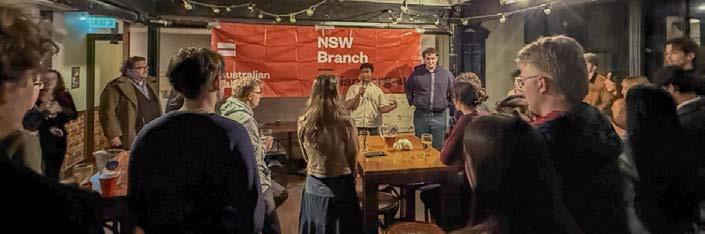
On 7 May, the newly founded “USyd Fabian’s” society launched at the Royal Hotel with Federal Labor Senator and NDIS Minister Jenny McAllister in attendance as a guest speaker.
Honi Soit can confirm that over 40 members from the National Labor Students (NLS) and NSW Labor Students (NSWLS) factions were present at the party.
The pub night was held the day after Labor representatives helped pass a motion at the USyd Student Representative Council (SRC) condemning the Albanese government’s devastating cuts to the NDIS.
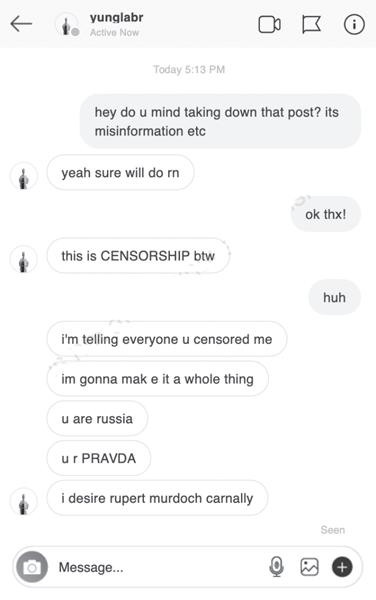
Social media accounts publicising the launch, including the USyd Fabians’ own account, conducted a mass-blocking campaign online to prevent those who might raise criticism from seeing the event.
Members in attendance blocked the accounts of the SRC and autonomous collectives, most notably the USyd Disabilities Collective. Other societies, such as the Political Economy Society, were blocked alongside a host of factional members.
The post celebrating the event was taken down from the USyd Fabians account a week after the event.
The post’s removal followed SRC General Secretary Vince Tafea’s week 11 office bearer report, wherein Tafea called the event an act of “moral and political cowardice” and a “slap in the face to disabled students and carers alike across the University and our communities” USyd Disabilities and Carers Officers Kayla Hill and Remy Lebreton told Honi “It is absolutely outrageous that Labor students were gleefully hanging out with Jenny McAllister over drinks only two weeks after the announcement that 160,000 disabled people are going to be kicked off the NDIS. Neither genocide nor austerity is evil enough for Labor students to have some shame in smiling next to the ministers who enact it.”
SRC President Grace Street told Honi that “I’m not surprised, but am sorely disappointed. It’s a slap in the face for disabled students, and also worrying — just 24 hours [prior] these students had spoken and voted for condemning the Albanese government for their actions regarding the NDIS.”
“This is an issue of integrity, transparency, and representation. I think the Labor group(s) involved know this, or they wouldn’t have
blocked myself and the SRC accounts to stop us seeing it.” This news comes after unclear and often divided reactions from young Labor to the sweeping NDIS cuts.
At the recent USyd SRC meeting, NSWLS members sat silent for minutes while other factions heavily criticised them over their failure to take a stance on NDIS cuts. The faction members looked at their laptops, some even playing solitaire or looking at assignment information. After being asked to speak about the cuts by multiple council members, members of NSWLS finally took the floor and made a statement in opposition to NDIS cuts.
In response to questions from Honi , the USyd Fabian’s denied the event was covert, stating that it was “open to the public” and “attended by lots of different groups of people.” The society said it “operates independently from the Labor party and any other faction” and is “not in any way associated with the USU.”
When approached for comment, the Fabian’s Society did not directly answer Honi ’s questions about which faction members attended the event, the factional composition of its executive, or why accounts belonging to other factions and societies were blocked before posts about the event were made. However, it said there were “concerns some interactions via social media would not reflect constructive engagement.”
The USyd Fabian’s said McAllister was invited as “a long-standing associate of the Fabian’s Society” with “a real track record of progressive achievement,” and that the event was organised before the recent NDIS cuts. The society acknowledged “rightful concerns” about the Federal Government’s gutting of the NDIS, stating that the NDIS is “a crucial support for many.”
A NSWLS spokesperson told Honi the faction’s “position on the NDIS is clear and unchanged,” saying it opposed “any cuts or reductions that undermine access, quality or adequate funding for disability support.” They said the Federal Government’s reductions were “a serious concern” and “represent a backwards step for the integrity of the NDIS,” adding that NSWLS remained committed to the condemnation motion passed at May Council.
Responding to questions about the faction’s attendance at the USyd Fabian’s event with Senator Jenny McAllister, the spokesperson said “engagement with public officials and attendance at public events featuring ministers and representatives across all levels of
Sebastien Tuzilovic and James Fitzgerald Sice investigate.
government is a normal part of student political life.” They said attendance “should not be construed as endorsement of the speaker or broader government policy,” but as an attempt to “influence or contest policy decisions.”
The spokesperson said NSWLS “is not affiliated with the USyd Fabian’s society,” and understood the society was not registered with the USU.
“Looking forward, NSWLS will be advocating for the continued funding of NDIS supports, including protections for social participation supports, as well as the need for government transparency in how new assessment models will be implemented,” the spokesperson said.
“This includes clarity on how state-based community organisations will be funded under the ICF, and how they will be able to continue delivering current levels of support. Mia Williams (of NLS) has separately raised this argument in NUS’ discussions with Minister McAllister.” NSWLS did not directly answer questions about which faction members attended the event, whether accounts were blocked before posts about the event, or the faction’s position on USyd Fabians’ deleted Tony Blair post.
The day after the Fabians event, Senator McAllister made a Facebook post about it, which received over 50 comments, in which many heavily criticised McAllister for the recent NDIS cuts.
“It must be nice to access the community Jenny! Sadly the disabled community won’t be able to when social civic community participation funding is cut. You know, that same funding that helps them to access work, medical appointments, shopping, social support, communication outside of the home, group activities. The things non disabled people take for granted”, one commenter said.
Another comment read:
“I’m glad YOU get to leave the house, Jenny, while my kids and I will be stuck at home and unable to access the community or contribute to it in any meaningful way.”
NLS were approached for comment but did not respond.
Who are You? The Self and Its Continuum
I broke my arm at the corner near the convenience store and the little woodchip park in Bronte, where I used to live. It is 2011 and I am seven years old. I’m scootering with unbelievable velocity down the footpath. There are two runners in front of me and I have it in my little
It arrives with us each morning, seamless and unearned, as if the person waking up is self-evidently
remembering is itself generative. Each retrieval edits the trace, and the edited version is what gets stored for next time. The memory I have of breaking my arm is not the event; it is the most recent in a long chain of rememberings, each one slightly recomposed by the person I was
persistence of memories, intentions, personality, the threads of mental
Ultimately he concluded
that personal identity is not what matters. There is no extra fact beyond the continuity itself, no soul-pellet being passed forward, no thread of identity running underneath. The self is not a thing that persists; it is a pattern of overlapping connections — or ‘Relation R’ — denser in the short term, thinning out over decades until the person at one end has little in common with the person at the other. The seven-yearold on the scooter and the person writing this sentence are connected by such a thinning chain. We share a name. We share, apparently, a corner in Bronte. But how much else exists beyond that overlap?
Where Loftus showed that memory is a poor witness to the self, Parfit shows that the self was never the right defendant. Faced with this dismantling, intuition retreats to the body. Whatever happens to memory and continuity, surely the self has at least this: a bounded organism, one set of cells, one genome, one me. But then again, maybe not.
THE BIOLOGICAL SELF
During pregnancy, cells cross the placenta in both directions and persist in both bodies for decades. Diana Bianchi recovered male foetal cells from the blood of women up to 27 years after they had given birth to sons. Subsequent work has found foetal cells integrated into maternal blood, skin, liver, thyroid, and brain tissue — and, more strikingly, has shown them functioning as repair cells, migrating to sites of injury in the mother and contributing to wound healing, tissue regeneration, even the formation of new blood vessels. The traffic runs both ways. Maternal cells colonise the foetus and remain into adulthood, where they help educate the developing immune system to tolerate the mother’s antigens.
This phenomenon is called foetal microchimerism, from the Greek chimera, the mythological creature made up of the parts of different beings. A woman who has carried a child is, at the cellular level, a chimera, and so is the child she carried. If she has carried more than one, she carries fragments of each.
And it goes further back than that. Women are born with all the eggs they will ever have, already formed inside them at birth. The egg that became me was made inside my mother while she was still inside mother. My grandmother, at some point, was carrying the cell that would become half of me. The egg that will become my child was grown by my mother. The body’s borders are porous not just between contemporaries but across generations.
How the analog trend quietly rejects digital capitalism
This trend is not new, exactly, as going analog has long been understood as a tangible form of digital detox, but it has made a stronger comeback now.
A study about an analog lifestyle among children and teens in the Journal of Medical Internet Research recalled that flip phone sales in the United States increased in 2023, and subsequently highlighted the growing “chronically offline” in
But beyond these benefits, there comes a bigger revelation and purpose in living the analog lifestyle, which is pushing back against digital capitalism.
This kind of capitalism, according to the CFA Institute Research & Policy Center, utilises collecting personal data and compulsory online upgrades in managing our economy.
Therefore, ownership of a product becomes temporary, warranting a discussion on human agency and digital ownership.
Taking individual ownership
The digital world provided a larger means for capitalism to dominate. With this came barriers, particularly subscriptions and premiums needed to access services, information, and even hobbies. Nearly everything is behind a paywall: music and video streaming, video games, and even journal articles and tool softwares.
Less common is the practice where for example, we could collect DVDs and keep them indefinitely to watch our desired movies at any time.
More than the financial concerns, a more humanistic issue of this matter is that there is little to no ownership in the digital world.
Once we stop paying the subscription fee or the platform shuts down, we lose the service. Much of what we “own” is actually impermanent in this day and age; we can accumulate as many digital possessions as we desire, but we are not actually owners in the digital realm.
This is not just an issue for consumers, but also for creators. Digital capitalism comprises centralised economies such as gig, platform, and shared economies. In this context, they become commodities over time.
From how Spotify calculates artists’ royalties and payouts to how YouTube’s algorithm affects viewership, creators surrender to metrics and analytics they can not control, which goes under the profit-driven systems of capitalism.
It remains true that there is much better access and even personalisation in digital platforms, but the above arguments hope to raise certain illusions when it comes to “access.”
Therefore, going analog would mean to challenge the capitalist system of impermanence and commodities, where humans are seen beyond as tools in a system that does not serve them. And in that process, analog living revitalises humanity in our activities and possessions.
Setting the intentions
Besides the material aspect, the analog trend spotlights the importance of
Heavy digitalisation and capitalist control over our choices and how we make them bring another illusion, this time when it comes to ‘choice’. This is due to choice architecture, wherein AI and algorithms—not human actors—automate preferences into predetermined choices.
In the analog trend, we see more clearly what our actions and possessions actually mean, from the quality of our belongings to the
quality of our connections.
On the topic of connections, there are interesting findings of not just social interaction in the online world but
Meijie Ureta is in her grandma era.
also how systems like digital capitalism can affect them.
For one, an analysis of digital capitalism and friendship in the Journal of Digital Social Research found that capitalism in social media “quantifies and bureaucratises friendship” for the sake of achievement, leaving effects of alienation, self-exploitation, and lack of relatedness.
When we break the barrier of digital capitalism in our connections, we can see and build something that lasts. A popular example would be purchasing from local artists; conversing about common interests and feeling their talent and effort in our own hands would bring a profound feeling.
Besides finding communities with the same analog interests, we can also find a deeper connection with ourselves.
In picking up an analog hobby, we engage with our talents and perspectives. When reading a book, we learn to absorb and question perspectives; when we crochet, we examine our dexterity; when we develop the rolls in film cameras, we get
interventions to be aware of such as overconsumption of analog products.
Regardless, the analog trend is now filling the void that social media bore into our psyches, breaking paywalls inhibiting our opportunities, and seeking to reclaim human agency and ownership which capitalism is trying to take away.
Going analog, then, would mean not surrendering to control but to living in control.
It is amusing that 2026 is tagged as a year of nostalgia. Maybe the nostalgia that we have been feeling signifies more than going back to the past, but yearning for something sincere.
The Culture of Control: Why Spiritual Practices and Reactionary Traditionalism are Rising Together
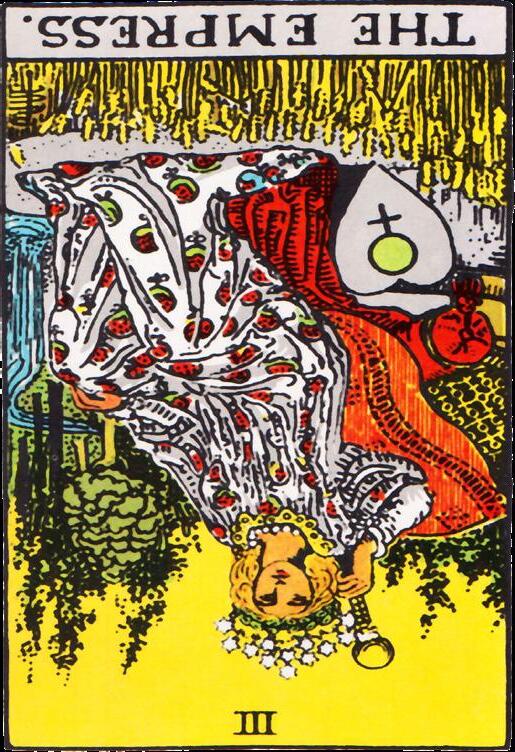
As distrust in institutions has risen, so too has the desire for personal control. Some pull tarot cards to interpret the future or look to the stars for answers. Others make the pivot back to traditional values and hyper-femininity to establish a social order. One looks inward, the other backward – yet, both reflect two sides of the same coin.
Newton’s Third Law of Motion tells us every action has an equal and opposite reaction – culture is no different. The dual rise of two cultural trends reflects a moment marked by political and economic instability. Uncertainty rarely just shapes institutions; it also shapes individuals.
Certainty has become a luxury that Gen Z is attempting to manufacture, as Australians stare down rising economic pressures and political instability on a global stage.
A recent report by DemosAU found that 48% of Australians say they trust public institutions, down from 55% in January 2025. Institutional trust is eroding by the minute. Forget the 1920’s; the 2020’s have been marked by political instability and a decline in trust in the media. The 2024 Edelman Trust Barometer reported that more than half of Australians are concerned that leaders are intentionally misleading the public. People are not just disillusioned with individual politicians but are finding a collective distrust in public institutions. When times are tough and there is no one to put your faith in, where do you turn? When the institutions that are supposed to provide guidance stop delivering, people build alternatives.
Identity has previously been shaped through institutions, religion, political affiliation, and community organisations. For many young people now, these structures feel inaccessible or fractured. Belief systems have not disappeared; they have just been decentralised, sometimes by choice, sometimes by the algorithm. Often that move is a conscious decision, to opt out of long withstanding structures that feel unsound. Occasionally, it is the algorithm that lands an astrocartography reading on your feed or an aesthetic cooking video.
Historically, spiritual resurgences follow periods of instability. The need to turn inward and reflect is not new. Prayers, church, worship – they offer a sense of ritual meaning. What is new is where young people are turning. This goes beyond a casual interest, with a staggering 38% of Gen Z Australians identifying as spiritual, and close to a third admitting to looking at a person’s star sign before a date. Divination and spirituality are deeply rooted within history, with the twelve zodiac signs dating back to the fifth century BCE. As Gen Z transitions away from organised religion, spirituality fills the space, enabling greater self-direction.
Spirituality is a reaction that turns inward, offering personal reflection and consideration in a world that feels increasingly unsteady. Astrology and tarot cards have found widespread cultural acceptance in
MacKenzie Johnson doesnt trust the vibes.
recent years, less as a superstition but more as a private guidance system. The Co-Star app sits on over 30 million phones worldwide, acting as a personalised, inpocket horoscope. Have a look at ‘your day at a glance’, check out the ‘do’s’ and ‘don’ts’ for the day. Guided by intricate symbolic imagery, tarot cards offer an alternative way to work through emotions. The practices are self-directed; the faith no longer lies in the institution, but in the individual.
As with religion, this is not a new response to instability, just an increasingly popular option. The 2008 financial crisis saw a spike in sales of self-help and spiritual guidance by about 11.4% - books, readings, courses - anything to help people reinforce a framework during a period marked by bank failures and a global credit freeze. In 2008, people bought books. In 2026, the algorithm delivers it directly to your feedthe desire for personal meaning in periods of instability is not only of this generation, but the speed, scale and infrastructure is more pervasive. In periods of chaos, when issues of the environment, housing, and politics feel increasingly beyond individual control, spiritual practices create a sense of agency.
While spirituality demands an inner shift, reactionary traditionalism steps backwards. It is a movement often associated with the right, characterised by a pushback against the status quo. It demands a return to past social and traditional orders, countering modern society. Here the asymmetry between spirituality and reactionary traditionalism becomes clear - Newton’s law can only stretch so far. Both trends are reactions to the same pressure, but they are not equal in weight. Spirituality is a personal reflection, while reactionary traditionalism holds greater political consequence.
“The tradwife trend isn’t nostalgia - it’s a warning sign,” says Professor Heejung Chung, Director of the Global Institute for Women’s Leadership. Rising sourdough, a sparkling kitchen and maybe even a polka dot apron, this culture leans into a retro femininity of a past era. The rise of the tradwife aesthetic across social media has promoted and glamorised this concept of reactionary traditionalism to a younger audience. Research published by King’s College London questions whether the return to domesticity is born purely of nostalgia, or rather of increasing societal pressures. Finding that simplicity, leisure, and escape are the motivating factors for women aged 18-34 in an increasingly insecure job market. The rise of the tradwife has been equally fascinating and horrifying to outside observers. While the aesthetic is not inherently political, it romanticises female submission while ignoring the actual reality of domestic labour.
The content is largely produced by women, to be consumed by women, framed as an aesthetic lifestyle choice, yet it rarely depicts the economic dependency nor the work to keep a household running. The videos capture the soft, curated moments, not the hours of unpaid work. Shown are slow morning routines, rather than a lack
of superannuation fund or career trajectory. Domestic labour does not build retirement savings. The trending aesthetic builds a disproportionate gap between the reality of being a traditional wife and an idealised image of it. The cultural phenomenon is rooted in the appeal of certainty: clearly defined gender roles, domestic routines, and a slower lifestyle in periods where life feels economically and socially unstable.
Two trends, opposite directions, yet the same starting point. The horoscope reader and the tradwife appear to have nothing in common on the surface, yet both exist at the same cultural nexus: instability, distrust, and the need for certainty. “We have a tendency as a culture to overcorrect”, writes Rob Marco in an article on traditionalism. The size of the push dictates the reaction. The bigger the push, the bigger the correction.
Both cultural trends share an implicit rejection of the idea that existing public institutions will course-correct. They reflect wider public sentiment on the institutions. 45% of Australians reportedly feel the country is more divided today, driven by a general distrust of government, concerns about systemic unfairness, and a lack of shared identity. These methods of control are transformed into consumable aesthetics, accelerated online by algorithms. Social media rewards repetition and individual identity, making both cultural trends incredibly popular online. Taking complex belief systems and flattening them into digestible, enjoyable, lifestyle content; morning tarot pulls, and hyper-feminine domestic routines packaged into a scrollable format. Personal choices become cultural performances shaped for engagement.
Private formulas for control, however compelling, cannot replace institutions. A tarot pull cannot foresee stability in a tumultuous job market, nor can a domestic aesthetic act as a substitute for economic security.
Culture rarely reacts as neatly as physics. The reactions do not always match the push; sometimes they overshoot. What begins as a quiet ritual or coping mechanism can quickly become the new normal before anyone has time to decide what they actually want.
The question worth sitting with isn’t whether mapping out your future through tarot cards is rational or whether wanting to live in a traditional bubble is regressive. The question is, what does it mean when a generation has stopped looking to public institutions and what will ultimately replace them?
The People of Stucco
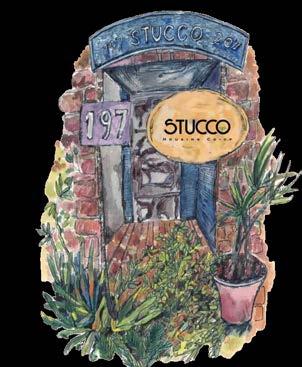
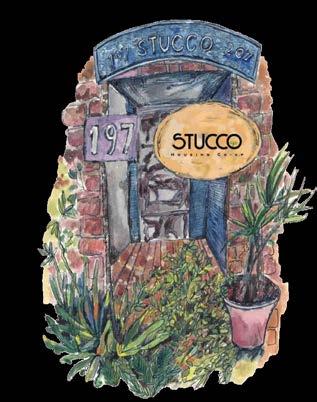
Stucco Housing Co-operative is one of few student co-operatives in Australia. Stucco offers rent well below average Newtown prices for its eight sharehouse-style dwellings with no landlord. It was founded in 1991 by USyd students.
The co-op is managed by the residents through four committees which deal with administration, maintenance, finances, and membership. The entire co-op meets fortnightly to discuss co-op business such as approving events and passing money.
While many are familiar with Stucco’s hall space which regularly hosts events like fundraisers, gigs, poetry readings, and recently a Battle of the Bands, few are as familiar with Stucco as a housing provider. At a recent Stucco event, someone said to me, “Wait, people live here? I thought the hall was it.”
Yes, people live here! I sat down with a few of them to talk about life in Sydney’s only student housing co-op.
Name: Chelsea
Degree: Economics Honours
Time at Stucco: Over two years
On Housing Before Stucco
I lived in Indonesia my whole life, and then I had to move for uni. I was able to find a place in Camperdown, but it was $325 per week, and I was on the couch in the living room. It was rough. I have citizenship by descent, but applying for Medicare took months, and you can’t apply for Centrelink until you have Medicare. So I was paying $325 per week with no assistance and studying full time. Then the person I was living with was moving, so I had to try to find housing again.
At first I looked at accommodation at uni, but everything was already full. I tried looking at other rental places, but they were crazy expensive. I was stressing out, and I was just Googling cheap places, cheap, cheap, cheap. Then I found a Reddit post that talked about Stucco, and it said rent is like $100 per week. The Reddit post also said, but they’re really annoying communists. Well, I’m socialist, so I thought it was close enough.
I got the biggest culture shock going to the meetings, though. At the GM they said the dinner was shepherd’s pie, but there was no meat. It was mushrooms, vegan, and
gluten free. The main meeting discussion was about this person asking to keep a cat in her room. Right before the meeting started, I saw this couple just making out. So it was a very big culture shock at first.
First Impression of Stucco
Stucco felt really big when I first moved in. There were a lot of people, a lot of big personalities, and I was like, I don’t know how I’m gonna do this. But now, I definitely feel like I have ownership over my place here. Also, even though I’m fluent, I didn’t walk around speaking English in Indonesia. When you move, everything is in English, you’re like, wait, maybe I don’t know the language as much as I thought I did.
I used to have selective mutism, so that really affected me when I first moved in here. I was scared of saying the wrong thing and of not fitting in. I thought you had to have a certain look, like the Inner West look.
But then you learn that you can still be true to yourself, and people don’t actually care if you look a certain way or fit a certain mould.
What has living at Stucco enabled you to do?
It’s given me financial freedom. When I was paying $325 a week, once that week is gone, it’s like, Okay, I need to prepare for the next week. I felt like I was wasting time whenever I wasn’t working.
I know for a fact I wouldn’t be able to finish my bachelor’s without Stucco, let alone be able to do an honours. And I know that if there was a rough patch, the people in Stucco would be understanding of it as well because we can set up rent payment plans. It’s like a sandbox. It’s a very soft place to fall if things go wrong.
What Stucco Means to You
Stucco has been one of the most pivotal parts of my life. There was a before Stucco and after. I’ve had the freedom to build my identity, have hobbies. I had the space to find love for my degree again, when before it was just a way to get out, and get a job.
Favourite Thing About Stucco
Australia is an individualist society, so it’s nice to have this more collectivist space within that. People do care about each other here in Stucco, because we’re all part of the same community. There’s less of that sense outside of Stucco, in broader Sydney.
It’s a little safe haven. I feel very indebted to the entity that is Stucco. That’s why I enjoy doing Stucco work, because I’m keeping it alive for the next people who need it.
Anastasia Dale explores the co-op.
Name: Naz
Degree: History & Archaeology III
Time at Stucco: Two and a half years
On Housing Before Stucco
I lived in Melbourne for six months for uni, paying $150 a week for rent because I lived in a blocked-off balcony. It was glass all around, it was cold as fuck. But I was like, at least it’s cheap rent. Then right before I left I found out that all my housemates who had actual rooms with real walls were paying the same amount as me. That pissed me off.
Anyways, when I started uni again I decided to go to USyd because I didn’t want to be really far away from my family, who live in Newcastle. While I was applying to Stucco I was living in a sublet in Stanmore. It was $300 a week. It used most of my savings, but it was a beautiful house. After the sublet ended I lived in Newcastle. I think I did six Stucco interviews before I finally got in, because it’s needs-based and I had the sublet, I had family.
First Impression of Stucco
Ages ago my sister and I went on a trip to Sydney from Newcastle, and she was like, we’ll stay at this place called Stucco. She knew people who lived here. We stayed in a temp room for one night and I was like, wow, this is a really cool place. So I kept it in mind for if I wanted to go to USyd.
What has living at Stucco enabled you to do?
Live in Sydney, and have a social life. When I lived in my sublet I would be working three or four days a week, which I know is not a crazy amount, but it is a lot when you’re a full-time uni student. I really struggled with that. I would just go to work, go to uni and then go to sleep basically. I didn’t have money or time to do anything social.
Living in Stucco gave me that money and time, but it also added to my social life just by being here, because I was meeting and living with so many people. I would hear about and do so many cool things that I wouldn’t have otherwise.
What does Stucco mean to you?
Sometimes you feel really hopeless about the world and you’re like, wow, everything’s capitalist hellscape and they’ll monetise everything. It’s kind of like a miracle that Stucco has survived this
long. It’s like what you imagine university to be when you’re a kid. It’s this little window into the possibility of what the world could be like.
There’s still stuff to complain about. People are still people. But there’s this understanding and space that we have, where we just want the best for our community and each other. And it just makes every decision a bit less soulsucking, because you don’t feel like you’re being scammed just paying to live.
I’m leaving soon, which is sad. It feels like I’ve only been here six months. In Australia we live such isolated lives from each other, we don’t have big families and we don’t have these big communities. It’s something that you can rarely get in Australia.
Favourite Thing About Stucco
A lot. There’s always someone to hang out with. Whenever you’re out of an ingredient someone will have it. It’s the biggest room I’ve lived in in Australia. And my favourite prank was when Astrid pranked us that she had a baby. It was a very wellexecuted prank. The name “Fern” was like just believable enough, and she teased it the night before being like, oh I feel weird and stuff. Even though it was literally April Fool’s, people still fell for it.
Name: Alex
Degree: Gender Studies & English III
Time at Stucco: Year and a half
On Housing Before Stucco
It was pretty grim. I was living in uni accommodation straight after high school, which sort of sucked all the joy from my life. I found it really hard to acclimate to the vibe of the place. I was at the Queen Mary Building. My room had bugs. It was pretty disgusting. It had shared bathrooms. On every floor, half the rooms were done in lime green, like bright neon lime green, and then the other half was orange.
Not just a statement colour, like your door’s orange. No bitch, all of my furniture was bright motherfucking orange. The shared kitchen was pretty intimidating, with everyone there and they already had friends. I didn’t make that much of an effort, because I didn’t feel like I connected with anyone there. The space felt very straight, pretty masculine, not my type of people. It was $360 per week for a tiny matchbox bedroom filled with orange furniture.
First Impression of Stucco
The first time I ever came to Stucco, we were doing rehearsals for this play for the
Palestine fundraiser. I genuinely thought it was the most incredible place I’ve ever been. Everyone was just so swag. Being in the hall, I felt, and I still feel this, just so inspired being at Stucco. And having this really sick physical space to like contribute to, it’s what we make of it.
I was really unhappy with where I was living, so I was really keen to apply. I felt like I desperately needed more of a sense of community, a like-minded community. My mental health was at an all time low, and I didn’t have my family as a support system because they live overseas. Stucco was really appealing because you have a little sharehouse and then a bigger community.
What does Stucco mean to you?
It has taught me so much about how to be a member of a community. It’s actually made me think about karma a lot, like for example my housemate gives me some of their food, then I do something for someone else, it all gets passed along. and then I’ll know that they’ll do that to someone else and it kind of gets passed all down. It’s inspired me to bring the things that I’ve learned here into wherever I move next, and other parts of my life.
Favourite Thing About Stucco
I just love that it’s also a venue space. Like the events that I’ve put on and you’ve put on, they have been such incredible learning experiences for me like the fundraiser I did last year, it teaches you that you just can take initiative.
Name: Jeremy
Degree: Architecture & Environments II
Time at Stucco: About a year
On Housing Before Stucco
I’ve been living in sharehouses since I was 18 when I moved out of home, in Fairy Meadow and Wollongong. Then I moved to Glebe when I was 20. A lot happened there. A lot of good stuff, also some bad times and weird roommates. But it was a very formative experience. One time I left to go get a coffee and I came back and my little set of drawers that I had next to the window was gone, someone lifted it through my window from outside and took everything in it.
I was just kind of scraping by cooking really cheap food. My rent was always such a gigantic proportion of what money I had. It’s definitely challenging to just pay rent
in a regular house, even in a sharehouse in Sydney.
First Impression of Stucco
I found out about it through my best friend, sometimes I would crash on the couch at Stucco. So I got a little bit acquainted with it from that. From the moment I stepped in, I was a little bit mesmerised. It just seemed so interesting and unique. I’m really drawn to novelty, I’m really drawn to different ways of living. In sharehouses I hated when there was no sense of family. I really feel that with Stucco. It feels like its own little neighborhood, which I really enjoy.
What has living at Stucco enabled you to do?
I’m able to afford to go to a good therapist, which is what I’ve been spending a lot of my money on. I can afford to eat good food, which is so massive for my quality of life. So Stucco has enabled me to enjoy my life to the fullest.
I’m able to focus on my studies, which is such a gift because I’m so passionate about what I’m studying. I struggle a lot with time management and executive function because of my ADHD. If I had to live in a regular sharehouse and pay Sydney rent and work and study, I think I’d have a lot of trouble keeping on top of all of that.
What does Stucco mean to you?
I always think about how strange it is that there aren’t more places like Stucco, that there aren’t more housing cooperatives in Sydney or just in Australia, because it just makes so much sense as a type of living for a lot of people. For students it makes so much sense, for so many young people. I don’t like how many high-rise apartments there are in Sydney, really individualistic little boxes that have no sense of community. Like, what if you just took that increased density and actually opened it up into a communal space. It feels like that’s how a lot of people are meant to live.
Favourite Thing About Stucco
Probably walking outside of my unit and just waving to people, smiling, saying hi. That’s really nice. Chill neighbourly social interaction is not really the vibe of Sydney at all. So it’s a nice little treat.
For more information about Stucco, go to their Instagram @stucco_newtown, or their website stucco.org.au
Diagnosing a spotted turtle dove
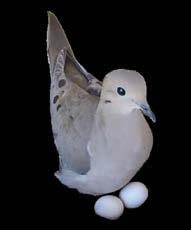
In the “typical pigeons” section of Simpson and Field Guide to the Birds of Australia , there are beautiful watercolours of doves. Doves with spotted necks, doves with speckled tails, doves the colour of cinnamon, pearls and rosemary. On the particular afternoon I picked up my old dog-eared copy, I was looking for the spotted turtledove. I’d seen one that morning, when I was late for my bus. I very much needed to study for an exam taking place the next day, but as I sped past—attempting to focus on folios and quartos—its blushing feathers caught my eye. The timid round thing was all curled into itself; a palmful of dawn perched on an electrical wire. I couldn’t help but think “What sort of dove is that?”
I feel as though I do not birdwatch in the proper way. My grandmother will email me digitised pages filled with notes on all the birds in her garden, comprehensive and detailed. She is able to account for each and every one of them, keeping track of their diets and routines. She’s like a headmistress to the birds, or an ethnographist.
I, on the other hand, am more of a semicommitted groupie. I can sort through little corellas, long-billed corellas, and sulphurcrested cockatoos, but the illustrations and character quirks have always been far more enticing to me. There’s a lot of joy to be had in watching a raven pilfering through trash, its floppy hackles blowing in the wind. I’ve never liked that meticulous notekeeping. It makes me feel further away from the bird right in front of me.
Head grey, tinged pink. Back brown with mauve-pink tinge. Size : 31.5cm. Habitat : cities, suburban gardens, parks.
When I look at my blood test results, I feel unsettled in the same way. This is the numerical summary of my flesh, broken down into potassium, lipids, and haemoglobin. Or my psychologist’s account of my mental health history, fragmented into prescriptions of sertraline, isotretinoin and now a new agomelatine-based antidepressant. In her 2023 study, Changes in antidepressant use in Australia , Juliana de Oliveira Costa noted that girls are prescribed antidepressants at a much higher rate than boys: 45.9% of girls were undergoing new antidepressants in comparison to 21.6% of boys. Antidepressants have been a naturalised, relatively mundane part of reality for a while now. Medication, for me, was the first response before therapy, cognitive treatments, or general support. As long as you were meeting the baseline, materializing yourself appropriately, they were successful. As long as you were doing things.
The issue is I don’t believe I’m very good at doing things. I do them all the same, but it isn’t easy. I cannot birdwatch and write down long accounts of every bird I know, instead, I find myself spouting out lists of information at odd times. This happened
the other day when I diverted my friends from the bus stop to observe a flock of little corellas, making everyone watch how they waddled across the grass like bow-legged old ladies. They bickered and squabbled amongst themselves in pairs. Corellas mate for life. Like other cockatoos, they can live for up to 60 years (the sulphur-crested cockatoo that Steve Irwin kept is still alive, and has been passed down to Robert Irwin!).
White. Short crest; small whitish bill. Bluish bare skin around eye. Salmon pink lores. Size : 36–39 cm. Habitat : semi arid, monsoonal woodlands, shrublands.
When I picture myself wildly gesticulating towards those birds on the front-lawn, I think about how a lot of my life is spent trying—and failing—to fit my thought process into something articulate. Oftentimes, the thoughts sort of bulge out at weird angles. Academic writing has been a process of beating myself back. I’ve had to pavlov my brain into accepting punishment. Inherently, if I find myself wanting to do something or enjoying it, I am skeptical. What is worthwhile should be extremely, mind-numbingly, difficult.
But the available documentation of my life says something different. It depicts a second version of a child who excels. She comes in with the second highest ATAR at her high school, she maintains a distinction and high distinction average, she works two jobs and glides through her endeavours like an arctic tern.
Ginger hair, dark roots. Well groomed and respectful. History of anxiety and social anxiety. Says she is struggling, but her grades are strong. Must be doing well. Just anxiety and/or depression. Size : 5’7” Habitat : Lebanese bakery making minimum wage, or Marrickville library.
My psychologist identified the first version, the version that is forgetful, and overworked and incredibly burnt out. The version that sits on the floor of my bathroom at ten pm and stares at the wall. The version that cannot sleep, and takes hours to read ten pages of text. The version that has been told her whole life she is lazy or distracted because she cannot get her mind to stay in one place, and is the version he said very likely had ADHD.
But my psychiatrist saw the second version. Whatever intricate and personal story I am living is at odds with how I am on paper: haemoglobins and high distinctions.
So now I am trialing a new pill called Valdoxan—even though I spent six months trying to wean myself off antidepressants when I became dependent on them, when they didn’t help me focus but numbed both the good and the bad emotions— because the version that is more reliable is the one on paper. This is not a unique case: Patricia Quinn of the National Center for Girls and Women with ADHD writes that in comparison with 5% of boys being prescribed antidepressants before being treated for ADHD, 14% of girls undergo antidepressant
Sofia Dillon goes bird-watching.
treatment before ADHD diagnosis. Women often have to fight to be diagnosed properly. They are deemed an unreliable source. “Warped perceptions,” my psychiatrist explained when he told me he didn’t believe me. Whether it’s chronic pain or mental health issues, women are stuck in a perpetual cycle of being medically contested. They are hysterical, overreactive, and exaggerative. This is why I have to frame my inconvenientlylived story through old teachers notes and previous psychiatrist referrals. This is how he says I will convince him I actually have experienced what I told him I am experiencing. Paper is what gets you recognition.
It is so much easier to believe something unimpressive or ordinary—like I am exaggerating my symptoms—rather than it was hard and I did it anyway. Documented, researched, and approved information will always trump the anecdotal. Paper is the truth. Paper is reality.
But what happens when paper lies? Because Simpson and Day’s Field Guide to the Birds of Australia is wrong. In their section on cockatoos, they map the little corellas’ residence in Australia with little orange splotches. There are splotches across the middle sections of Australia, and the northern tips, and even the most western coast. But the coast of New South Wales is blank. According to this book there should be no little corellas in Sydney. I cannot have pointed them out to my friends, I cannot have ranted about them, I cannot have written any of this.
Now, this isn’t an intentional lie. It’s outdated. Little corellas were forced to adapt to new environments after being displaced from their mainland-habitats. But nonetheless, if the paper contests this cockatoos’ existence on this particular land, my experience must all be fabricated, hallucinated, or otherwise jumbled. Paper is the only clear thing in this world. I must be a fraud, and those little corellas were some spectre of my subconscious. I must be having “warped perceptions”.
But then again, you always get a choice. In the end, it is up to you to decide which version you believe, even if that version may topple our origami towers. Paper, or people?
What
Trump, Mamdani, and You All Have in Common
Elliot Priestman has fallen for advertising. Who is your favourite foreign politician? What is your favourite political speech? Why are they your favourites? You probably didn’t say some run-of-the-mill backbencher or talk about policy detail. I would venture to guess it was instead someone who commands a room and does the unexpected, or a speech that showed character and emotion, that made you feel understood . Yes, we want our politicians to be implementing policies that we agree with and fighting for issues we support, but more than that, we want authenticity; we want them to be human.
Populism is a political style that has recently experienced a significant rise, a style that, some may say, is being rapidly adopted by the right-wing and to great effect—but what is it? You may quote tutors or look back in your lecture slides to find a description of populist politicians as being those who separate society into two groups: the good and the bad, and many dictionaries would agree with you. But again, I ask you, what does that mean? Are there many politicians you can think of who don’t advocate for their ‘good’ policies and degrade their opponents ‘bad’ ones? If you were arguing with someone on matters of politics, would you not instinctively feel that they are one of the ‘bad’ ones?
But we’re talking about much more than a simplistic choice between their bad and your good. Populism isn’t just a political buzzword that can be thrown around this easily; there is no way it could have become so
mainstream if that is all it is… right? Populism, for all intents and purposes, could be without meaning. In the same way that if you asked a conservative politician if they are aware of and attentive to important societal issues, they would (hopefully) say yes, but under no circumstances would they call themselves ‘woke’. Fear not, like ‘woke’, populism can still have meaning, and just as we can pick out woke politicians, we can spot those who are populist.
Figures such as Trump, Milei, and (closer to home) Pauline Hanson could comfortably be described as populist, sharing a distinctive willingness to break from the political norm. This defiance is commonly met with its own
criticism: the emphasis on personality, rather than typical campaigning based on the promise of policies, creates an image of a pseudopolitician. However, this criticism overlooks the genuine impact they have, with many being among the most influential politicians of their era. What’s striking is that this form of populism is not exclusively right-wing; however, Bernie Sanders, Chávez, and Whitlam could all be put into this same camp, yet that is nowhere near as frequently cited as their right-wing contemporaries. These individuals are commonly being put into the camp of socialism or progressivism instead, perpetuating and enabling the demonisation of the term populism, hardening it into a term reserved for the right.
Another such case of left-wing populism is evident through Zohran Mamdani’s recent mayoral campaign in New York, undoubtedly a massive success. Mamdani’s campaign transcended the typical barriers of politics in a way that is reminiscent of populist movements. Reaching further than just the boroughs of New York, social media became a weapon in his campaign—a weapon that is becoming increasingly prominent within politics, reaching audiences that have never before been this involved or interested. You might well have seen something from him on social media during his campaign, maybe even still. You would most likely see content from the right wing as well. The algorithmic structure of social media loves these populist ideas; its appetite for short-form, emotionally charged content puts populist messaging at the forefront. Previous forms of political messaging, once favoured by traditional media sources, become outdated and less influential. By the time it has weighed in, opinions have already been formed.
Although the recent surge in populism’s popularity is greater than we have seen before, the concept itself has a longstanding history, even though it was only given a name relatively recently. Even Julius Caesar has been described as a populist, positioning himself as an antiestablishment ‘pro-people’ leader. As we all know, this led to great success for him, albeit temporarily. His downfall comes about in the very same style that enabled his success. We know this, and yet here we are, just as drawn to this political style, latching onto the next political figure who we genuinely think is different—but they will be this time, right?
In this way, we like populism as a style because it’s satisfying. Perhaps not when it’s employed by those we consider ‘bad’, but when it’s on our side, it feels nice. There’s nothing irrational about enjoying populism; mainstream politics has genuinely failed us in many cases, seeking out an alternative is only logical. Maybe its success is just because it’s better?
Populists seem to be achieving real change too, once again look at Mamdani—he was only sworn in at the start of this year and you probably know more about his policies than you do about anything the Mayor of Sydney has done over her past 22 years. In this political climate of polarisation, internal strife, and global crises, conventional politicians are losing their appeal. What do they do for us? What can they do for us when they are just an extension of their party?
This is not to say that populist politicians will lead us to tyranny and need to be assassinated like Caesar; they may even be good politicians. Contrary to what the moniker implies, some of the most impactful populist politicians in fact represent the establishment that they’re perceived to oppose, yet somehow evade this association. Trump and Mamdani’s beliefs may differ from those of the organisations to which they are affiliated, but figures such as these are both still a part of the two leading political parties in the US. If they’re still a part of the establishment and their party, what exactly are we being liberated from?
The frustrating truth is that understanding populism doesn’t make you immune to it. Even if you recognise every pattern, see every instance of history repeating itself, and decipher every social media algorithm, when the right person makes a speech, you can still feel that pull. Populism hasn’t gained its success from the naivety of people; it’s gained it because of its truth in causing change. The desire for authenticity, for our politicians to display their humanity, is legitimate, and populism knows how to embody that desire better than anything else.
Go back to the politician that you thought of at the start. Do you think of them the same way? Do you still like them for the same reasons? That’s not the important part, though. The question isn’t whether populism is working; it clearly is. The question is whether it’s working for you, or only on you.
The fair go hasn’t been fairly distributed
The ‘fair go’ is a rusted signpost of twentyfirst century Australian capitalism. It claims that every man, woman, and child irrespective of their status at birth should be able to succeed in our society. The USA has their ‘American dream’, promising that every citizen has the opportunity for upward mobility and success. Permutations of these concepts can be seen globally. From the day that you and I are born, we should both have an equal chance to pull ourselves up.
Generational poverty is the antithesis of the ‘fair go’. It’s used to categorise families who’ve experienced poverty for two or more successive generations, meaning it differs from short-term, situational poverty caused by crises like illness or job loss.
Generational poverty can become a cyclical state that’s incredibly difficult to escape. It’s a setback from birth, with children who grow up in poverty being 3.3 times more likely to end up in poverty as adults. The longer a child spends in poverty, the worse their future outcomes will be.
To say that generational poverty is simply caused by a lack of income overlooks the multitude of compounding factors that trap families in cyclical poverty. It is more realistic to view low-income as the root from which all other factors stem.
A lack of financial resources makes it harder for parents to support their children’s education. Textbooks, tutors, and even basic writing supplies like paper and pencils can become unaffordable. This makes it harder for students to acquire knowledge, often leading them to fall behind and lose motivation to study. The World Bank claims that every additional year of schooling a student participates in raises their average lifetime income by approximately 10 per cent. Therefore, children who have their education disrupted by poverty are much more likely to get trapped in cyclical poverty.
example, the 2019-20 Black Summer bushfire season disproportionately impacted lower-income communities. It will become harder for disadvantaged families in rural areas to rebuild and move forward as climate change exacerbates the risk of natural cataclysms.
Generational poverty cannot just be overlooked as a plight for some unlucky few. While those who suffer from it experience life-altering effects, it also negatively impacts broader society.
On an individual level, generational poverty can disrupt the critical brain development that occurs during a child’s first six years. They might experience lower white and grey matter volume, which play vital roles in neurological functions such as memory, movement, emotions, and cognitive information processing.
Max McDermott believes in a fair go.
connections, a sense of social justice, and trust in institutions. Thus, the existence of generational poverty isn’t merely a financial issue for Australia; it also affects the very fabric of our society.
Generational poverty is a plague that needs to be eradicated for the sake of every human on earth. It will take immediate relief coupled with long-term strategies to address the confluence of factors that trap families in cycles of poverty.
One of the most critical factors that needs to be resolved is education. UNESCO estimates that if all adults received two or more years of schooling, approximately 60 million people would be lifted out of poverty. Simple policies, such as subsidised textbooks and greater teaching flexibility, could be introduced for students who’ve become disengaged from mainstream education due to their families’ financial circumstances. This is easier said than done in a globally divided political climate in which many decisions seem to favour the wealthy instead of those in need. Yet if these changes could be made, educational outcomes for disadvantaged children would improve, providing them with the foundations to free themselves from generational poverty.
There’s a range of organisations working towards eradicating generational poverty globally. The strategic goal of the Organisation for Poverty Alleviation and Development (OPAD) is to help people in poverty attain self-sufficiency by promoting sustainable development, human rights, and action on climate change. Oxfam is another NGO with similar intentions; a confederation consisting of more than 20 member organisations dedicated to reducing inequality.
Disadvantaged families also have a harder time accessing adequate health care. This makes it harder for children to recover from illness and return to school, further harming their education. Additionally, it’s likely that parents will have to stay home and care for them, keeping them from working and earning an income.
Furthermore, there is a correlation between poverty and obesity, especially in Western countries. This is a structural consequence of generational poverty, which makes cheap, highly processed food more affordable, while reducing available time and resources for exercise.
A report by the Victorian Health Promotion Foundation found that obesity rates are 20-40 per cent higher for individuals who are food insecure. Since obesity is the second-leading risk factor contributing to sickness and death, this further diminishes the health outcomes of individuals living in poverty, keeping them out of school and work.
Despite natural disasters occurring less frequently than other factors, they still contribute to generational poverty. For
Children raised in poverty are also three times more likely, on average, to develop psychiatric conditions. This includes both externalising disorders like ADHD and conduct disorder, as well as internalising disorders like depression and anxiety. As mentioned above, educational and health outcomes will also be significantly worse than those of their peers.
The most humanising perspective on the impacts of generational poverty comes from Dr Cassandra Goldie, CEO of the Australian Council of Social Services. She said that it “places people in impossible situations where they must choose between eating or getting essential medical care.”
On a macro level, generational poverty is accompanied by a raft of economic costs. It is estimated that child poverty and preventable health conditions related to poverty cost the Australian government approximately $40 billion in 2025. That’s two per cent of the year’s GDP, meaning government funding is diverted from other parts of the economy, such as infrastructure. This illustrates the scale of government savings if generational poverty could be eradicated.
There is also a clear link between income and social cohesion. Better financial well-being correlates with stronger social
Yet much more needs to be done. A recent policy brief from the Australian Council for International Development (ACFID) critiqued the distribution of our financial aid. It found that even though children make up 50 per cent of the world’s poor less than one quarter of Australia’s aid budget directly targets them.
ACFID suggests that the Australian government needs to realign their perspective on international aid, keeping “children at the heart of this endeavour.” The council’s major recommendation was to introduce a target that at least 80 per cent of aid investments, regardless of their primary objective, effectively support and protect children. Alongside this, they argued for a strategic development policy centred on rights-based approaches to social inclusion, with dedicated initiatives for marginalised groups.
It doesn’t make sense to sit down and play a game of chance if the odds are stacked against you. But for the estimated 750 million people living in generational poverty about 10 per cent of the world’s population that’s what they have to do. Children born into this category have an innately tougher life. At best, it’s unfair; realistically, it’s cruel. It’s time to rejuvenate the idea of the ‘fair go’, not just for Australians, but for everybody.
I don’t trust people who don’t steal
Once, in the throes of a midterm season, I scribbled on a napkin a conversation overheard at the Campus Village Café.
“Do you drink?”
“Yeah, of course I do.”
“Okay good, I don’t really trust people who don’t drink, they’re always so boring.”
There was laughter. Someone got up to collect a coffee.
“You know, I don’t really trust people who don’t steal.”
Now, there is something to be said for the absurdity of our confessions in friendship, but this was a statement whose strangeness could be distinctly felt. It registered as a paradox, but was delivered casually, with the conviction of a moral law.
Typically, in matters of trust, it is said that your polite neighbour is not your activist; that revolution is scarcely embodied by a bundt-cakebearing suburbanite. There is, perhaps, too great a need to be “liked” there. But can we truly swing in the opposite direction and claim that it is the criminals who will show up for us in the end?
After all, there is no country on Earth where stealing is legal, and often there is nothing noble in the act itself. Most thieves, as we perceive them, are not Jean Valjean.
However, the universal illegality of theft suggests one important thing:
irrespective of why one steals, they are aware that the act being done is unlawful.
To know this, and to partake in the act regardless, requires shrugging off what is deemed good (permissible) and what is deemed evil (forbidden). One must have some capacity to act on a dissent and to rationalise the cost of doing so — for better or worse. It is this intentionality, this mens rea (guilty mind), that is the minimum condition of crime.
Yet this intentionality is also the minimum condition for moral agency, for revolution, if put at its highest. It is the same muscle flexed.
In fact, it was only in February of this year, that the protest against Isaac Herzog took place illegally in Town Hall, rendering the 6,000 attendees, in theory and in treatment, no better than thieves. They had decided the boundaries of authority for themselves, and in doing so, subordinated the legal to the moral.
Nevertheless, the situation diverged in April, when the Supreme Court of New South Wales struck down the antiprotest legislation, and all illegality vanished with it. The thieves were said to not be thieves at all, rather, it was the State who was guil ty.
This sanctioning of the criminal act had an effect akin to revisionism, to legerdemain. As once an act is absolved, its friction is permanently neutralised. Like goldfish, we forget that there was a defiance in the moral reasoning there, that an unlawful act was committed at the time. What remains in our minds as “crime”, then, are only those acts deemed too heinous, too perverse to justify. By adopting this threshold, we instinctively adopt
illegality as a moral indictment. The system becomes a structure of hard lines that cannot be questioned, much less crossed.
Although, it is true that trusting the system, embodying it, largely keeps us safe. By operating in accordance with convention — whether legal, social or cultural — we often remain the bundt-cake-bearing suburbians, without even trying. Yet, the presumption that being lawful in the absolute makes you “good”, “honest” or “kind”, is one that is incorrect.
Being lawful, without thought, merely guarantees that one is passive, and passivity is an act of force.
Force, as Simone Weil defined it, is “that x that turns anybody who is subjected to it into a thing.” At its limit, it is to make a corpse out of man while he is still alive. Consider, for example, the mass production of any garment. The lines to hem and sew are so precisely defined that all vestiges for thought are thoroughly stamped out. The result being that the body, in doing the hemming and sewing, is merely an appendage to the machine. To inherit a moral framework is no different.
This being said, it is understandable that, on any given day, you would rather live next door to a friendly face than a criminal.
Trust relies on predictability being guaranteed, and predictability relies on a convention being in place.
But this objection only applies so long as the convention is in your favour. Otherwise, you may wish that your neighbour was someone with an independent moral spine.
Such was the case with Adolf Eichmann, the “mediumsized, slender” man with the “receding hair, ill-fitting teeth and nearsighted eyes”, who was tried in Jerusalem in 1961 for his war crimes. His defence for facilitating the logistics of
Hashwitaa Maynoor defies the laws of morality.
the Holocaust, was the same as that used in Nuremberg trials: that he had been “just following orders” without any thought to their effect. His actions, now criminalised, were the expected, lawful response in Nazi Germany at the time. He had subordinated the moral to the legal, as any lawful citizen would.
In contrast, Victor Kugler and Johannes Kleiman, the two men arrested and detained for sheltering Anne Frank, acted consciously as criminals. Mirroring the thieves of the Herzog Rally, they elevated the moral in the face of the legal.
The conclusion here is not that we can trust all criminals as a Kugler or a Kleiman simply because they have demonstrated a capacity for defiance. It is not the mere possession of this capacity for defiance that earns trust, rather, it is at what cost defiance is carried out.
The threshold can be found in Dostoyevsky’s Crime and Punishment , particularly in Marmeladov’s regret. Early in the novel, a drunken Marmeladov confides in Raskolnikov that his daughter, Sonya, has gone into prostitution to support the family through their poverty. Overcome by guilt, Marmeladov fixates on the “special cleanliness” Sonya must maintain to do the job and asks “do you realise? do you realise what that kind of cleanliness involves?” — before answering, “it’s expensive, expensive, that kind of cleanliness!”. Criminality operates in the same vein. The only trustworthy thieves are those for whom the crime comes at an expensive cost.
In the end, it may be that the correct conclusion is not that we shouldn’t trust people who don’t steal, but that we shouldn’t trust those who, in an absolute, won’t.
Drusilla Modjeska on Biography, Beauvoir, and her book “A Woman’s Eye, Her Art”
Drusilla Modjeska is a novelist and writer born in London and raised in Hampshire. Modjeska lived and studied in Papua New Guinea before moving to Australia. Her celebrated works include Poppy, a ‘fictional biography’ of her mother, and Stravinsky’s Lunch, an exploration of Grace Cossington-Smith and Stella Bowen, Australian artists with radically different trajectories. Her work combines memoir, biography, art history, and criticism. Her newest 2025 book A Woman’s Eye, Her Art looks at the works of Paula ModhersenBecker, Dora Maar, Claude Cahun, and contemporary artists like Julie Rrap and Chantal Joffe.
Kuyili Karthik : I thought this would be a good motif to start on, the tension between being seen and seeing as a female artist. In your most recent book, you write about Paula Modhersen-Becker and Dora Maar, artists who have often occupied the position of a muse for themselves and for other male artists.
Drusilla Modjeska : Paula ModhersenBecker was born back at the end of the 19th century. Her family, who really loved her, said: “You can’t possibly be an artist, you’re not going to be able to support yourself, you’re so willful and difficult, you probably won’t be able to get married.” And she just said, “I cannot. I have to paint.” That’s one of the reasons I find her so very fascinating, that she said “No, I want to live my own life,” even when it was an impossible thing.
One of the things that really drew me to her was that when she paints self portraits, her eyes are enormous. Her eyes are really, really large. You see her looking at us, and you see how much she saw. You also see how little she was seen.
KK: How did you undertake the project of really ‘seeing’ Paula Modhersen-Becker?
DM : I became interested in her because she kept a diary and she wrote a lot of letters. The letters are very interesting, because she’s trying to persuade people. But in the diaries, she’s just writing for herself. You can see that she’s trying to work out what I call the ‘grammars’ of gender.
KK: Yes, absolutely. Diary-writing for women remains such a powerful outlet. You say you stumbled into novel writing or fiction writing sort of accidentally. I think a lot of women writers describe something similar. So many women keep diaries, or are academics and biographers, and stumble into fiction through autofiction or memoir mediums. Annie Ernaux really comes to mind. Do you think an autobiographical foray is something that’s telling about being a female writer?
DM: Yes, I definitely do.
You can look at a lot of women’s writing and women’s art in terms of trying to find a language, those grammars of gender.
One of the things that’s so fascinating about writing A Woman’s Eye is that a lot of these women who were doing incredible things in the first half of the 20th century disappear after the second world war, and we don’t know them until the 70s, 80s, sometimes not until the 90s.
Annie Ernaux is a really good example. When she’s young, she’s having to deal with those same questions. There is that half a century of women finding a language, either a visual language or a written language, to give some kind of voice to this question.
KK: You wrote once of Clarice Beckett’s work, in an essay: “With women painters particularly, it’s often difficult to know how much to allow the condition of their lives to intrude into our view of their paintings.”
As an art biographer, do you think that a biographical reading of a woman’s art could rob it of the same claim to objectivity or universality that comes so easily to male artists? Or is there some necessity about a biographical reading that’s enriching for women especially?
DM: That’s a really, really good question. I don’t think there’s a simple answer to it. I’ve increasingly come to think that women do write about their conditions, and biographies with the understanding of what they’re up against are really important.
I certainly got that criticism when I was starting in the 80s, of being too personal and using the first person. The first person was considered lesser. You needed to rise and be transcendent and mythic. So for a long time, I was trying to prove that I could write in the first person and not be caught in circumstance, and yet I’ve always written about circumstance.
A biographical eye is really important to recognise what it was artists were up against, what Paula Modhersen-Becker called “the barricades.”
KK: In your work, when you discuss the work of an artist, how do you deal with projections of your own experience onto the works? These self-identifications and your experience form very valuable parts of your writing as well.
DM : It is possible to be, and I probably have been, too closely aligned. When I was younger, I was reading Christina Stead — in my twenties or even earlier — and those certain books made me suddenly sense
Kuyili Karthik interviews.
something in my own life. I also think that’s true when you read diaries, which is one of the reasons I am fascinated by women artists.
When you read their diaries, you see them writing some of the same things. What I’ve done in this book is what I call the contemporary echo. For example Chantal Joffe is very influenced by Paula Modhersen-Becker, and said she was like a lodestar. And Julie Rrap I could actually talk to and write about how their ‘discovery’ of those women artists, when they were starting out, made an enormous difference. Suddenly they saw that these women were doing some of the same things that they were doing.
Becker painted that extraordinary, large, almost life-size portrait of herself, pregnant, in 1904, when we know that she wasn’t pregnant. And Chantal Joffe, a century later, has a daughter born in 2004. She wanted to have a child, but her then husband, who is a painter, wasn’t very keen on it in case it interrupted his painting.
And [Joffe] said the reason why Paula Modhersen-Becker was so incredibly important was she showed her that it could be done. Because when [Joffe] was at Glasgow Art School in 1989 that if you had a child, you could not also have a career. If you painted children, that would be the end of your career. You cannot paint with a pram in the hall, your career as an artist would be over. Chantal Joffe is saying that it was in a way looking into [Becker’s] eyes that gave her strength and courage. She thought the eyes were talking to her, in a very personal interpretation, I think that’s what women often do.
KK: What’s on your bookshelf currently?
DM: Anne Berest is very good, Maggie Nelson, Sigrid Nunez, but Annie Ernaux is a favourite. Deborah Levy has also been very influential.
Drusilla Modjeska’s book, A Woman’s Eye, Her Art, was published in 2025. Her event at the Sydney Writer’s Festival is sold out.
The sitter (Drusilla Modjeska), 2001, Jo Bertini.
Lau Gong’s Spring
餞春
滿徑鬧飛花,一簾翻落絮。
餞春還問春,可有將愁去。
Farewell to Spring
The path is filled with fluttering blossoms, falling catkins fly past the curtain.
I bid farewell to spring, yet still ask spring; is there any way to take away this sorrow?
In Singapore, where eternal summer persists throughout the year, there is no such thing as spring. Where, then, did Lau Gong’s sorrow stem from?
The English stanzas above are a rough attempt at translating my late paternal great grandfather’s poetry – pieced together with the help of Google Translate, ChatGPT, and my own limited understanding of Mandarin.
Lau Gong, which translates to great grandfather in Teochew (my family’s regional dialect), immigrated to Singapore from Guangdong, China, back in the 1920s. Although I never met him, my father occasionally tells me stories about him, describing his grandfather as an “authoritative but benign figure in a traditional Chinese household.” Following the cumulation of chaos after the downfall of the Qing dynasty, Lau Gong saw the lucrative value in doing business in Singapore and eventually seized the opportunity to sail south alongside many other Chinese migrants. However, words were his true passion since childhood. He eventually delved into Chinese poetry in his twilight years. In 1957, he was one of the founders of the Xin Sheng Poet Society – a Mandarin poetry society that no longer bears much significance in Singapore’s dominantly colonial history, but still has a physical address somewhere in Chinatown.
I only came to know about Lau Gong’s literary background a few years ago. Ever since then I have found myself randomly probing my father for more answers on my family’s ancestry. However, it was only when I studied a Chinese Literature unit (in English) last semester that I took the initiative to ask my father if he still had any copies of Lau Gong’s poetry. To my relief, he did.
My father promptly forwarded
me images of the pieces of poetry left behind by Lau Gong. Scrolling through these images, miles away from their original hard copies in Singapore, was fascinating. Yet it was also a reality check for my depleted understanding of my ethnic tongue.
The yellowing pages were adorned with the black ink of traditional Mandarin characters, many of which I could not recognise. The lines of poetry sprawled vertically downwards, an indicator of how many generations it had withstood. The sight struck me as simultaneously foreign and familiar. Foreign, because I had to rely on Google Translate and ChatGPT to read the poems, but nonetheless familiar because like my grandfather, I am a lover of words.
Before writing this article, I scoured the internet and found a copy of another poem written by Lau Gong, tucked away in a digital archive of a university library.
This poem was much longer, titled “星洲十二 景 ”, meaning “The Twelve Scenes of Singapore”. Some of the twelve places Lau Gong details in his poem no longer exist in contemporary Singapore. The Singapore that Lau Gong depicted in his poems was one he witnessed through transitional phases: from the Japanese Occupation in World War II, to the British returning after the war, and finally the post-independence era which set the grounds for rapid industrialisation.
was its underlying sense of displacement, which Lau Gong seemed to hint at through various literary twists and linguistic connotations. In the eleventh stanza, he describes an Island scene with an explicit focus on fishermen – perhaps an ode to Singapore’s origins as a fishing village but also a subtle hint towards his own journey south:
十一、漁歌唱晚(海島)
岑樓縱目數征鴻,遠望漁舟逐晚 風。
帆影依依隨碧浪;歌聲 嫋嫋破晴空。
得魚收網催歸檝;沽 酒到家學醉翁。
遺世忘機堪自樂,人生 何必計窮通。
Eleventh, Fisherman’s Song at Dusk (Island)
From the tower, I gaze upon the migrating geese,
Watching fishing boats chase the evening breeze
Shadows drift along the blue waves; lingering songs pierce the clear sky.
Fish in net, they hasten the oars homewards
Once home, they buy wine and learn the ways of drunken men
Leaving the world behind, free of schemes and worldly calculations, they find contentment in themselves.
Why must one spend a lifetime worrying over success or failure?
Lau Gong ends off this poem with the following line:
民樂政通邦郅治,四方賓至恣遨 遊。
With the people happy, the government efficient, and the country well-governed, guests from all directions come to roam freely.
Clara Tan translates.
actively taking
a risk. It was a risk that carried the baggage of an unbalanced unknown: a loss of his own cultural identity that would likely swallow him but potentially save future descendants.
The older I get and the further I am from home, the more the gaping distance between my native and ethnic tongues seem to grow. Technology and attempts at self-translation can only do so much. Originality fades through generations, mirroring the way Lau Gong uses imagery of ‘migrating geese’ to embody a sense of pivotal loss. Geese usually migrate in flocks and are highly symbolic in classical Chinese poetry, often seen as metaphors of alienation and transience. When Lau Gong sailed off to Singapore, he had to accept both a geographical displacement as well as the broader diaspora he was now a part of. Whatever the latter would bring him was not without the loss of belonging –when he arrived in Singapore, a Malay archipelago, the unpredictable promise of economic opportunities were rooted in the need for survival in a foreign island.
Needless to say, there is a tinge of comfort in knowing that the universal thread that binds us all lies in the shared human experience of emotion. Writing has always been an outlet for me, and I am certain it was the same for Lau Gong.
When the seasons of Lau Gong’s life changed, was he plagued by the sorrows of loss, or fuelled by a new direction? Did he enjoy being part of a collective that benefitted from a rising nation, or did he feel his individuality dissipate into the southern winds? Regardless, I now formulate my own interpretation of what Lau Gong meant when he wrote these words.
What struck me as I analysed this poem’s translation
I wonder if Lau Gong ever regretted getting on that boat. When he made the decision to sail southwards, he was also
In classical Chinese poetry, spring usually connotes both renewal and melancholy. As the stepping stone in my family’s story, spring’s promise of renewal never belonged to him – at least not in the unbridled way he described spring’s fluttering blossoms in the poem he titled “ 餞春” – which translates to Farewell to Spring.
Art by Yasodara Perera
President Grace Street (Grassroots)
This is my second last Honi report for this semester – how time flies! You will all be busy preparing for the end of the semester and deciphering who is who (extra hard this year) in the USU elections running this week, so I’ll keep it brief. Here’s a few things you need to know about what’s happening and what the President and SRC are doing about it:
Two students are reported to have received a University complaint regarding a poster featuring the Handala image, which the SRC stands against – this is a pattern of intimidation and targeting of proPalestine activism. Join the rally on campus this Wednesday at 1pm.
The cost-of-living and fuel crisis impacts continue to crush students, and I am continuing to follow up on projects in the works which include a free period product dispenser on campus, the new $5 meal canteen in Semester 2, and further publishing the SRC’s ‘Guide to Living on Little Money’
Last week was the commemoration of the Nakba, marking 78 years of the dispossession and ethnic cleansing of Palestinians. Students for Palestine and the SRC led an on-campus protest to spotlight the institutional complicity over decades.
This week, a meeting of the Academic Standards and Policy
Committee will be discussing a proposed change to University calendars which includes removing the STUVAC period for non-semester intensive units. Students have already shown they are against this proposal – students shouldn’t have to have more condensed units and less study time just because the University has over-enrolled and is lacking enough rooms and teachers. It is a quality of education, disability and carer justice, and student welfare issue. I’ll provide an update to this as soon as I can.
Make sure to follow @src_usyd and sign up to our newsletter to get all the news of what’s happening and what campaigns are coming up!
In solidarity, Grace
Environment Officers
Aria Nadkarni (Grassroots) Lucas Pierce (SAlt)
With a Federal Budget that clearly spells out that destruction is profitable, the Labor Government reveals its hand. When consumers pay more tax on beer than gas conglomerates which plunder stolen land and decimate entire ecosystems, it becomes clear that the crime that Labor seeks to punish is poverty. Disabled people, Aboriginal people, students, working-class people and the environment at large will suffer so that AUKUS, mega-corporations, and politicians can continue to fill their pockets by profiteering off war. The massive cuts on the NDIS in the same week that gas conglomerates would not be taxed exposes the candid cronyism of this government that favours
Interfaith Officers
Yibo Pei (PENTA) Shiya Liu (PENTA)
Jaseena Al-Helo (Grassroots) Eleanor Low (YCU)
profit over the lives of disabled people. Climate change is a disabling epidemic that threatens the lives of every human being. It is shocking and terrifying to know that the provisions available are only getting less and less available at a time when more people are vulnerable to illness than ever.
Running off the back of these depressing and bleak truths, the Enviro Collective is plotting an upcoming event for the end of this semester. The time to get involved in community is now, because we need each other more than ever. Stay tuned on our Instagram @usyd_ enviro to keep posted!
Women’s Officers
Maxine
McGrath (Grassroots) Avin Dabiri (Independant)
WoCo are pleased to announce that Feminist Action Week was incredibly successful! We are so happy that the vigil meant a lot to participants, and it was lovely to form this kind of community. Furthermore, during our fundraiser on the Friday, we raised $877.50 for a mutual aid fund organised by Black People’s Union. We sincerely thank everyone who attended this fundraiser, both for the lovely night, and for helping us raise money to support the community.
However, we would like to encourage people to stay safe and aware of upcoming anti abortion demonstrations at the NSW parliament. Legislative councillor John Ruddick is aiming to pass a bill restricting abortion access, and Sydney “pro life” groups are planning mass action on the 2nd of June. We are incredibly disgusted
by this organised action to attempt to remove bodily autonomy from people seeking abortions. WoCo is assembling a coalition of leftist groups to counter the growing anti abortion movement, so please keep up to date with our Instagram for more details regarding this action.
As well as this, last Friday, we observed the 78th anniversary of the Palestinian Nakba. Nakba, translated as ‘catastrophe’, refers to when more than a million Palestinians were violently forced from their land. Members of WoCo joined Palestine Action Group in their Town Hall demonstration, raising awareness of the ongoing impacts of the Nakba, and condemning our government for its continued complicity in the most recent stage of genocide.
In love and rage,
Maxine (she/they) and Avin (she/her)
Education Officers
78+ YEARS OF NAKBA.
Shame on the Labor government for continuing to be complicit in the ongoing genocide of Palestinian peoples.
The recent budget has revealed the priorities of the Australian government, choosing to cut NDIS, barely reforming any property taxes
to truly help working people,and students, all while boosting the weapons and defence industry. We attended the rally to call out the hypocrisy of our government, and to commemorate the anniversary of the Nakba.
Free Palestine. Shame on the ALP.
International Students Officers
Aoyue Cao, Anu-Ujin Khulan, Lucas He, George Feng (PENTA)
The International Student Officers have recently focused on providing practical support for international students at the University of Sydney. The department published a rental guide for international students, including housing tips, precautions, and information about common rental issues in Sydney. In addition, practical resources introducing
useful university services were shared with new students to help them adapt more smoothly to campus life. The department also continued responding to student emails and enquiries, providing support regarding university services, accommodation, and student life.
Interfaith Officers did not submit a report.
Dana Kafina (Grassroots) Jasmine Al-Rawi (SAlt)
Work & Study: What are Your Rights as a Worker?
In Australia, all workers have rights, even if they are citizens of another country, e.g., international students. Trade unions support workers to protect workers’ rights and together with the Fair Work Ombudsman, makes sure workers are treated fairly.
Each job has an agreement or an award that outlines the pay and conditions you should expect. Make sure you read it carefully before signing up as an employee. Some students accept being paid less than their award or being treated unfairly as they are afraid to lose their job. No matter what conditions you agree to or how you get paid, your boss cannot arrange for you to be deported, just because you did not do something they wanted you to do at work, or just because you have been working outside of the law while studying.
If you are a casual worker (not permanent) check your agreement to know how much notice you are entitled to before getting a shift or having one cancelled. Even if you are casual and do not get paid sick leave, if you are too unwell to attend work, you are entitled to have that time off. Most employers will require you to give them a doctor’s certificate. Some employees are paid a penalty loading (extra money) if they work on weekends, after normal hours, or public holidays. Check your agreement to see if this applies to you. Keep a record of all the hours you work and check them against your payslip to ensure you have received the correct pay.
Employers pay tax on any money you earn, which is then assessed at the end of the financial year (30th June). You will need to complete a tax return to have that assessed so you can receive a refund of excess taxes paid, or repay any that you owe. If you are over 18 years old, employers must pay 12% superannuation to full time, part time, and casual employees. Some international students can get a refund of superannuation when they have permanently left Australia. This is called the Departing Australia superannuation payment.
Some employers avoid their responsibilities by “hiring” people as “contractors”; e.g., delivery riders, ride share operators, tutors; for roles in the “gig economy”. There are many difficulties for people working within these roles, including no sick leave, no insurance or workers compensation, and complex tax requirements. Consider these conditions before engaging one of these roles.
The best protection you have as a worker is through your trade union. They protect you as an individual and as part of a group of workers. They have in the past fought for conditions such as fair pay, lunch breaks, penalty rates, and protected workers from unfair dismissal. The small joining fee is tax deductable and gives you protection while you are working. Different jobs have different trade unions, so start by joining the Australian Council of Trade Unions, then they will let you know which specific Union you will move to for the following month.
Ask Abe
SRC Caseworker Help Q&A Discontinue Fail (DF)
Dear Abe,
My semester started really well, but then things started piling up, and I stopped submitting assessments for one of my units so I could focus on passing the others. I think I’m going to fail this unit, and I’m worried about what that means for my WAM. My friend told me it’s too late to withdraw from a unit, is that true? Is there anything I can do about this?
Snowed Under
Dear Snowed Under,
If you withdraw from the unit now your grade will be DF –Discontinue Fail. You still have to pay fees, and it will count as a fail on your transcript. This may affect your academic progression status
and in a few courses will affect your Weighted Average Mark (WAM).
If you are an international student, you will need to apply for a reduced study load and provide the necessary supporting documents.
If dropping a subject makes you a part time student, it will affect your Centrelink payments, student visa status, and Opal card concession.
Domestic students who are waiting on a decision about an application for Late discontinuation under special circumstances (DC grades), should apply for a DF in the meantime. That way, if your DC application is not successful, at least you will have a DF grade rather than a fail or absent fail. Abe
Dusting Off the CObwebs
1. Whale food (5)
3. Nonsense syllables one might say in a tub (7)
6. Read all about it (5)
7. Measure of chess skill (3)
9. Bolshevik opponent (7)
10. Russian Revolution leader (5)
12. Largest continent (4)
14. Held the Nakba day rally, acronym (3)
16. King of Skull Island (4)
18. Australian Railway Association, acronym (3)
20. Li-__, Chinese Poet (2)
21. Council area near USYD (5,4)
24. Joints (7)
26. Fourth member of musketeer trio (9)
28. Hesitant sound (2)
29. Training to serve alcohol, abbrev. (3)
30. Litter box users (4)
33. King or queen resting place (3)
35. Succession character, stabbing tool (4)
37. Object of a moth’s fatal attraction (5)
39. Actor who steals the Declaration of Independence (3,4)
40. Weep (3)
41. Two-footer (5)
42. Most wicked (7)
43. Egypt’s capital (5)
From the Sem 2, Week 2, 2017 Honi’s comedy page.
1. Eucalyptus eater (5)
2. Revolutionary Trotsky (4)
3. Russian composer and piano virtuoso (12)
4. Major artery (5)
5. Key part of Bruce Wayne’s wardrobe (7)
7. “Call Me by Your Name” name (4)
8. Tilt (4)
11. Biggest debts on earth (8,4)
13. Czech car company (5)
14. 3.26 light-years (6)
15. “Golly ___ whillikers !” (3)
17. Pretentious french filmmaker (6)
19. Rare Earth Element, acronym (3)
22. Basketball league, acronym (3)
23. “Pardon me,” in Italy (5)
25. Originators (3)
26. Australian government is increasing funding to this by $53 Million (7)
27. Bone in a cage (3)
31. Whispery YouTube genre, acronym (4)
32. Nonbinary pronoun (4)
34. Spreadsheet nightmare program (5)
36. Responsible for Radio Star’s death (5)
38. Electrical current letters, acronym (4)
Quiz
1. Which Labor PM did current Treasurer Jim Chalmers write his PhD about?
2. What hacker group was responsible for holding Canvas ransom?
3. What year did the Nakba start?
4. Which book was the first Penguin classic?
5. Which two journalists were instrumental in establishing that, beyond the standard required in Australian defamation law, Ben Roberts-Smith had murdered cilivians?
6. Which element is named after the Greek word for green/yellow?
7. What cycling race is currently happening in Italy?
Answers: 1. Paul Keating, 2. ShinyHunters, 3.1948, 4. E.V. Rieu’s translation of the Odyssey,
5. Nick McKenzie and Chris Masters, 6. Chlorine, 7. Giro d’Italia
“YOU WILL NEVER BE GOOD ENOUGH” FATHER TELLS JOB-READY
GRADUATE
24-year-old Fregley Scott recently celebrated his graduation ceremony with his close family members. Scott graduated from a Bachelor of Economics and has sorted a very low paying entry-level job through incessantly emailing everyone in the faculty of Economics and applying for every job on LinkedIn and Seek.
Scott told Honi: “Am I happy? No. But I do have a job lined up out of uni, which is more than a lot of people can say. That’s what uni is all about, right? Being job-ready. And on the plus side, my Dad will finally be proud of me because I’m making something of myself and taking life seriously.”
Scott’s father Greg Scott laughed at this and interjected, stating: “Whatever you say, mate.”
When asked to elaborate, Scott Senior said: “If you’re thinking like that, you will never be good enough for me. I didn’t raise you to be a careerist Econ major who would work for Lockheed Martin if they gave you a free pen with the contract. Back in my day, we went to university for a rigorous education, to broaden our horizons. To smoke a little bit of weed, do some LSD, and have some empathy for your common man. Until my son does that, I have no sense of fatherly pride.”
YOUNG LABOR ATTENDS EVENT TO “CHANGE FROM WITHIN THE CROWD”
Young Labor has defended their recent attendance at a controversial event by stating they were attempting to “change” the event “from within the crowd”.
“If enough people attend who are just slightly more left-wing than the centre-right speaker, over time the event will actually shift to the left. I don’t get what’s so fucking hard to understand about that.” Poppy Flaherty barked before ripping an Honi stand to pieces.
“I have actually seen this multi-pronged praxis at work. Myself, Poppy, and some others attended an event where Penny Wong was speaking. Just through our attendance there, the next day, her foreign policy was more left-leaning. She paid lipservice to Palestine without actually doing anything. It was powerful to see our influence at work.” Anal Fissure mansplained to Honi.
Fuzzball Shirk declined to comment, as he was busy planning a trip to the Labor Friends of Israel summit.
Pink Blunt told Honi to delete their tweets on the topic, and then called their Mum.
Poppy Flaherty later cold DM’d an Honi editor to express her distaste for French people, which in fairness we agree with, however we question its relevance to attending events honouring Ministers who have approved cuts that will kill disabled people.