Honi Soit publishes on stolen Gadigal land. Sovereignty was never ceded. The University of Sydney is a colonial institution that upholds Western knowledge as superior to First Nations knowledge systems. We reject this hierarchy.
As student journalists, we recognise that mainstream media has been complicit in silencing and misrepresenting Indigenous voices since invasion.
We commit to centring First Nations perspectives in our reporting, to challenging the colonial structures embedded in journalism, and to amplifying the voices of those resisting ongoing dispossession. We pay our respects to Elders past and present, and to all First Nations students and contributors.
Always was, and always will be Aboriginal land.
Crime and punishment, unified together, are almost the necessary recources of the state towards a description of the processes of its own form of justice. These concepts have been enshrined in the earliest legal codes we have found, in Babylon and China, and have seen their metamorphosis in societies throughout history.
The concept does not end with the state’s conception and execution of its being, but rather it is embedded socially throughout our world, in our actions, our literature, our thought.
If an injustice is committed, it must often be rectified through some punishment of its perpetrator.
Is crime and punishment necessary within our world still (or was it ever)? Must suffering be meted out after the calculus of a deed’s evil? What urges us towards seeing these as indispensable aspects for societal functioning? And what are the consequences?
This edition asks contributors to consider the structure of crime and punishment as it is constituted both through the discourse and the governance of society.
Tim Pudun examines the injustice of the cuts to the NDIS, Iris Brown analyses how states use conceptions of justice to their own end, Emily Skipper looks at representations of crime and punishment in the media.
I won’t spoil the rest of the articles for you.
We hope you enjoy week 11 of Crime and Punishment, and I hope that this semester has been kind to you so far. Sebastien Tuzilovic
Vox Pops: What is your favourite meal on campus?
L.F: I like going to Subway on a Sunday and awkwardly waiting to order for twenty minutes while they laugh at me and ignore me.
M.B: I pack my lunch because I am frugal.
L.W: The new burger place in Manning is pretty good.
S.T: Whatever I can scrounge off those around me.
Honiscopes
A.D: Sumbway... hng... cookie. Sandwich.
M.P: Free packed lunches.
C.V: 5 DOLLAR MY MUSCLE CHEF BRING IT BACK #JUSTICEWILLBESERVED
E.F: Where am I?
S.S: I doordash to Fisher.
R.S: Carslaw learning hub if I’m feeling frisky.
Aries: Pre-Raphaelite beauty. Everyone loves your hair. You love nature. What’s not to love?
Taurus: How Romantic. You’re in touch with your emotions. That’s important.
Gemini: Cubism, very avant garde. Non traditional. Your idol is an abuser. Awkward.
Cancer: Nouveau, gorgeous, marketable, consumable. Not confronting. Not everything needs to be.
Leo: Hi pop. Bold. Massproduced. Thought-provoking. Art for non-artists. Get your 5 seconds now!
Libra: How Baroque. Very dynamic, dramatic, grandiose. Probably a Liberal Club member.
M.B: HELP SOMEONE JUST STOLE MY PACKED LUNCH!
F.L: I refuse to eat on Campus. I go to Newtown.
P.Z: Other people’s leftovers.
Z.T: Courtyard pastries.
L.T: I exclusively eat from vending machines and flying turtle.
Virgo: You’re Impressionism; radical, open, visible. You switch it up. Things aren’t the same after you. You’re vibrant, if a little unblended.
Scorpio: High Renaissance, high drama, high fashion. Very gaggy. You change every room you’re in. Intimidating perhaps. Reductive sometimes.
Sagittarius: So surreal. You looove Freud. You love dream analysis and improvising. You’re a lil weird, but you can still hang.
Capricorn: Neoclassic, you reject ornamentation, fluff, and aestheticism. You enjoy order and restraint. Typical.
Aquarius: Hello Rococo! You are exuberant, light, decorative, basically everything Capricorn isn’t.
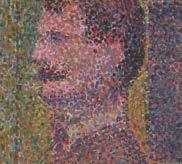
Pisces: Okay pointillism! You’re very fun. People hated you at first, now you’re iconic. You look different up close.
Audrey Hobert Wednesday 13 May 8:30 pm @ Enmore Theatre
Orpheus and the Underworld W/ Tabloid, Locke Thursday 14 May 7pm @ Lazybones Lounge
Queer Revue: Dungeons and Drag-Ons 14 – 16 May @ Seymour Centre
Protest: 78 Years of NAKBA – Stop the Genocide! Free Palestine! Friday 15 May 6pm @ Sydney Town Hall
ACRUX National Collective Presents: A Night of Light W/ Vanessa Turnbull Roberts and Abed Al Kadiri. Saturday 16 May @ Carriageworks for more, visit sydneymusic.net
Canvas hacked: USyd students among 275 million users impacted by data breach, learning platform inaccessible
Canvas learning management system (LMS), developed by American company Instructure, was recently subjected to a hack which led to a data breach affecting around 9,000 institutions worldwide. Australian education institutions became aware of the breach, which occurred on Saturday, May 2, on Wednesday May 6. ShinyHunters, the hacker group responsible, claims to have accessed 3.65 terabytes of personal data related to 275 million Canvas users, and are threatening to release the data publicly unless paid a ransom.
University of Sydney students have been unable to log in to or access Canvas since this morning, meaning they are unable to access assessment information, course content, or assessment submission portals.
The University of Sydney published a statement at 2:00 pm, stating: “Our online learning management system Canvas has been experiencing a global outage since around 6:00 am AEST this morning. Instructure, the vendor of Canvas, has placed Canvas into maintenance mode while they investigate a global cybersecurity breach.
“We are one of approximately 9000 institutions around the world that are impacted by this outage, and we are still awaiting clear advice from Instructure.
“We understand this situation is impacting the ability of our students and staff to access some learning materials and assessments including examination activities, and appreciate how disruptive this is at a critical time in the semester.”
USyd students are advised not to attempt to log in to Canvas until the university confirms that Canvas access is restored. USyd’s statement says students “will not be penalised for any assessments due during the duration of the outage, and “examinations impacted by the outage will be re-scheduled.” Further, students “will automatically be granted an extension, provided a mark adjustment or alternative arrangements for any assessment impacted by the outage.” USyd warns students to “be alert for phishing attempts and scam emails,” report suspicious activity, and consult materials to help identify and avoid scams.
President of the Student Representative Council (SRC) Grace Street expressed concern for “another cyber and data breach to occur in just a matter of months” after an incident in December 2025 where the personal information of 22,500 current and former USyd staff and affiliates were accessed. Historical records containing personal information of 5000 alumni and students were also breached.
Street said, “Canvas is used universally and daily by students. We deserve better than this. I urge students to keep an eye out for
communications from the University and to be aware of any scams or phishing that may arise from the data breach.
“The University’s Student Wellbeing and counselling services are available to those that need it, and both the free SRC and SUPRA Casework and Legal services are too if it impacts your studies, finances, or anything else.”
Instructure confirmed the software is “under maintenance.” Their status page updated: “We anticipate being up soon, and will provide updates as soon as possible.” Their investigations into the data breach have revealed that the breached data included “certain identifying information of users” such as names, email addresses, and student identification numbers, and messages sent between Canvas users. Instructure chief information security officer Steve Proud said the company found no evidence of other sensitive information like passwords, dates of birth, government identifiers, or financial information being breached, and claimed on Thursday the incident was ‘contained’.
However, ShinyHunters alleged it accessed “billions of private messages among students, teachers, and other staff, which may contain other additional information like phone numbers and home addresses.” The exposure of names, student IDs, and chats makes users “prime targets for phishing scams,” which involve attempts at deceiving victims into volunteering personal information such as bank details and passwords by impersonating trusted organisations, with ruses such as employment offers made to students.
A University of Sydney spokesperson confirmed the university is still investigating to assess whether any personal data of students and staff has been compromised: “If a breach of personal data has occurred, we will notify affected individuals and work closely with the National Office of Cybersecurity to manage the impact of the incident,” they said.
ShinyHunters is a high-profile criminal extortion group known for targeting major companies and services like Microsoft, Cisco, and Ticketmaster. In April 2026, the company attacked Rockstar Games, threatening to leak data from the video game Grand Theft Auto VI and cause “several annoying (digital) problems” unless the company entered ransom negotiations by a set deadline. After the ransom was not paid, data from this breach was released online.
ShinyHunters are a group loosely linke to the Com, a network of cybercriminals. The group shared a list of 8,809 institutions impacted by this recent hack, with accessed record counts per institution ranging from tens of thousands to several million. Students accessing Canvas this morning in Australia saw a message from ShinyHunters before it was replaced by
Kuyili Karthik reports.
a Canvas notice stating the platform was undergoing “scheduled maintenance”:
“ShinyHunters has breached Instructure (again). Instead of contacting us to resolve it they ignored us and did some ‘security patches.’ If any of the schools in the affected list are interested in preventing the release of their data, please consult with a cyber advisory firm and contact us privately at TOX to negotiate a settlement. You have till the end of the day by 12 May 2026 before everything is leaked.”
Canvas LMS has had a large Australian user base since the COVID-19 pandemic. State schools, universities, and TAFE institutions across Australia are affected. Several other universities, including the University of Melbourne, Flinders University, University of Newcastle, University of Technology Sydney, and Western Sydney University have published statements regarding the cyber incident. Globally, universities like Oxford, Cambridge, Stanford, and Columbia find themselves on ShinyHunters’ list.
Technology publication Information Age stated the breach was a “word of warning for schools and universities, since education providers are a prime target for cybercriminals. A writer for Microsoft News wrote that education platforms and networks are built like “Swiss cheese by design,” since many schools and higher education institutions in the United States have reported consistent data breaches and ransomware attacks, which have rendered servers inaccessible and shut down school internet for weeks, disrupting learning and communication by locking staff out of their emails.
In February, ShinyHunters leaked confidential files from Pennsylvania State University after a ransom went unpaid. The university’s data was released on the dark web after the university’s failure to respond despite “multiple attempts” to negotiate a “reasonable $1M to prevent the release.”
Identifiers and personal information gained from attacks are lucrative, since they can be sold and used for identity theft and fraud, for example, to open lines of credit that may go undetected. When university email addresses are used for banking and social media purposes, there’s a risk of sensitive information being accessed.
No data from Canvas LMS has been publicly released at this stage. Students are encouraged to seek the following services if they are impacted:
Student Wellbeing Services are available to all students and 24/7 counselling services and wellbeing support are available for any staff or their immediate family members. The SRC provides free legal services to USyd undergraduates, and the Sydney University Postgraduate Research Association (SUPRA) provides free advocacy to postgraduates.
Eight Motions Pass at May SRC as Labor Walkout Triggers Inquorate Close
The May meeting of the Students’ Representative Council saw eight motions on the agenda carried, the appointment of Sophie Wishart as the editor of Honi Soit for 2026, and sustained pressure placed on NSW Labor Students (NSWLS) came under sustained pressure from both Socialist Alternative (SAlt) and Grassroots. The meeting was ultimately declared inquorate at 9:26 pm following the withdrawal of the Labor contingent.
Quorum was met at 6:16 pm, with Honi observing several councillors working on Canvas assignments and a game of solitaire being played at the back of the room. Josh Oldham, having been absent from two prior meetings, was suspended for the rest of the year and forfeited his voting rights on a motion moved by Grace Street (SRC President) and seconded by Dana Kafina (Grassroots).
A bloc of resignations followed, moved by Street and seconded by Vince Tafea (Grassroots). Hongyuze (Ethan) Cao and Shuqing Yang resigned from their joint positions as Intercampus Officers. Aron Khuc resigned from the Executive Committee with the position to be filled by Aria Nadkarni. Bohao Zhang resigned and was replaced by Yuanbo (Bob) Song, while Evan Costa resigned with the position to be filled by Junfei (Jay) Yu. George Feng also resigned from the Standing Legal Committee.
Honi Soit takes this moment to farewell outgoing editor Ramla Khalid, whose resignation from the masthead was accepted in the same bloc, and to thank her for her work on the 2026 paper. We love you, Ramla.
Aria Nadkarni was elected to the Executive Committee, Bob Song to Council, Jay Yu to the Standing Legal Committee, and Shuqing Yang and Lanlan Huang jointly as Intercampus Officer, all unopposed. No nominations were received for First Nations Officer or Mature Aged Students Officer.
Sophie Wishart’s appointment as the tenth editor of Honi Soit for 2026, moved by Marc Paniza and seconded by Madison Burland, was carried with all current editors’ signatures attached. Wishart joins the masthead after her time as editor of PULP, the USU’s magazine. Emma Searle (SAlt) asked aloud, “who is that,” to which Wishart introduced herself to the room.
The President’s report, which was accepted without question, detailed recent activities and initiatives like the SRC’s vaccination scheme, snap rallies organised in response to the kidnapping of members of the Sumud Flotilla, and the launch of an SRC newsletter. Vice President Shovan Bhattarai (SAlt) followed with a report on the nationwide week of solidarity for Palestine and the situation of Ethan Floyd, a USyd student intercepted off the coast of Crete while participating in the flotilla, stating that “a lot of the activism was frankly carried by this half of the
room,” while gesturing toward the SAlt contingent.
Motion 7, “NSW nurses and midwives deserve more than a measly pay deal,” set the tone for the evening’s responses to NSWLS. The motion concerned the Labor government’s pay deal scheme offered to nurses and midwives, who are the least paid workers in Australia, according to (Insert Name). Movers MiniQ Lin and Georgia Murphy were joined in support by Maxine McGrath (Grassroots), who stated that “nurses deserve better, women deserve better, and fuck the police,” and Mahir Ghetia, who described the pay deal as “absolutely backstabbing by Chris Minns” and “6.4% behind inflation.”
When Bhattarai asked Leyla Bensan (NSWLS) who she blamed for the deal, if not the Labor party at large, Bensan named Chris Minns. Zayed Tabish (NSWLS) responded to SAlt’s questioning by offering to “call Albanese real quick.” Searle asked whether Young Labor “thinks this is a fucking joke.” The motion was carried.
During McGrath’s speech, members of NSWLS were observed reading a Marxist critique of the Labor Party, prompting Max Dao (SAlt) to ask, “what chapter are you up to?”
Motions 3 and 4, concerning cuts to the National Disability Insurance Scheme (NDIS) and disability services, placed the NSWLS bench under sustained pressure. When NSWLS councillors expressed that it was unnecessary to come to the microphone and make a statement concerning the Labor government’s cuts to NDIS, Bhattarai asked Labor councillors directly: “what is the point of being Labor Left? Go join Unity. Go join the Liberal Party for that matter.” Eva (SAlt) added that NSWLS members were abstaining from making a statement because they “wouldn’t want to jeopardise [their] future careers as Labor Left hacks.” Tafea observed that “Albanese was way more radical than you, and look at him now,” adding: “this isn’t funny, this is fucked.” Searle followed with criticism: “the history of your faction is taking selfies with Albanese.”
After repeated requests for a Labor speaker on Motions 3 and 4, Tabish responded: “we all fully agree with everything that has been said, but, clarification, we agree that all the cuts are bad and are actively campaigning against them.” Asked how the faction was campaigning, Tabish answered “change from within.” McGrath spoke in response: “If change from within was truly the viable political strategy you say it is, it would’ve worked by now…we will never be liberated by another party like Labor.”
Edu Setiawan (NLS) added:”we went up there, there you go.” Both motions were carried, accompanied by an action item committing to a solidarity group photograph.
Marc Paniza reports.
Motion 2, on funding student healthcare through a university-initiated vaccination program, prompted extended debate over what the SRC’s appropriate strategy should be. Hill described the university as “complicit in making us sick.” Jasmine Al-Rawi (SAlt) argued that the SRC’s student volunteer-run vaccination program would not put pressure on the university: “demonstrating that you can run a service doesn’t encourage the uni to take it up,” while Deaglan Godwin (SAlt) characterised Grassroots as having done “barely anything” in the way of activism, adding that he would “say hallelujah, it would be a fucking miracle” if he saw a Grassroots member putting up a poster. Remy LeBreton (Grassroots) offered FoodHub as an example of SRC student-led action, which was “later incorporated into different bodies.” The motion was carried.
Motion 5, on the independence of the student union from university management, moved by Lucas Pierce and seconded by Searle, addressed the use of “undemocratic confidentiality clauses to muzzle student unionists” and a pattern of complaints targeting Palestine activism. The motion was carried. Motion 8 expressed solidarity with the Indian trans community after an amendment to India’s Transgender Protection Act, which denies the right of transgender and gender-diverse people to self-identify. The motion was moved by S. Afroza and seconded by Vridhi VJ Jain. The motion was carried after the proposers struck action point three, which involved writing to Foreign Minister Penny Wong, following debate concerning Albanese’s previous descriptions of Modi as “dear friend” and “the boss.”
Motion 6, demanding the University condemn Israel for the abduction of Ethan Floyd, was moved by Jill McInnes and seconded by William Ursu. The motion was carried after Calvin Yu (SAlt) addressed Grassroots officebearers, criticising their lack of attendance at recent Palestine snap rallies, pointing at councillors and stating “you’re paid” before contrasting them with Students for Palestine members who “do this shit for free.” After a brief break, members filtered back to find the Labor Left had left. “Labor left,” Street remarked, before initiating a quorum count which confirmed the meeting inquorate at 9:26pm and brought the May SRC to a close.
“We are not your alibis!”:
Thousands protest NDIS cuts
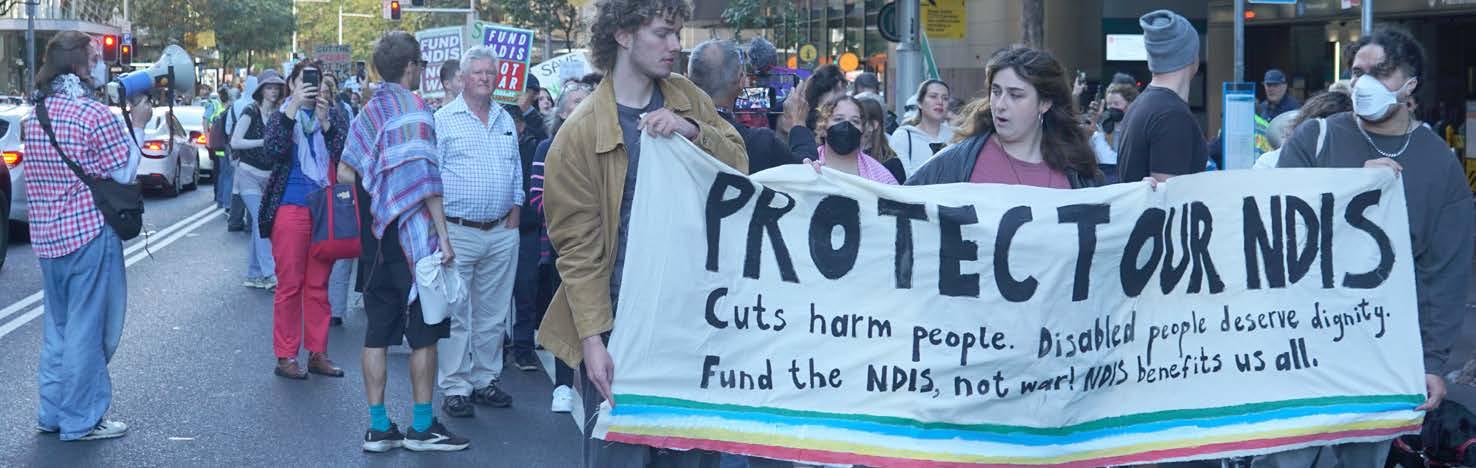
On Saturday May 9, an estimated 400 people attended the National Day of Action against NDIS cuts at Town Hall, making it the largest disability protest in NSW since the ‘Make it Real’ protests in 2012, when up to 10,000 people with disabilities campaigned to accelerate the introduction of the NDIS.
Protests across different states were organised by the Protect Our NDIS Alliance, a grassroots activist group that emerged following the Health and NDIS Minister Mark Butler’s announcement of kicking over 160,000 NDIS participants as a ‘costcutting measure’, with thousands of people attending nationally, demanding no cuts to the NDIS and expanding disability services to all.
Auslan interpreters, chairs,blankets, and masks were provided onsite to accommodate the diverse needs of the disabled community attending the National Day of Action.
The protest opened with a Welcome of Country by Daniel McDonald, a Gadigal and Wonnarua artist. The meeting was cochaired by USyd Disabilities and Carers Officers Kayla Hill and Remy Lebreton, leading chants such as
“Money for dignity, not for war! This is what we are fighting for!” The first speaker was Kyle Montgomery, a disability activist, who pointed out the hypocrisy of the so-called NDIS crisis: “Because let’s be clear about what a crisis means to this government. 617 [bla(c)k] deaths in custody — not a crisis. The same week they announced NDIS cuts, the Defence Minister confirmed 53 billion dollars towards AUKUS. Towards weapons, submarines and alliances with nations actively engaged in state terrorism – not a crisis.”
Montgomery emphasised the importance of intersectionality: “There is no disability justice without decolonisation. There is no disability justice without First Nations sovereignty, treaty and self-determination. There is no disability justice without economic justice, housing justice and healthcare justice.”
Representative of the Australian Neurodivergent Parents Association (ANPA) Heidi La Plagia drew attention to the reality of the consequences these cuts will have on
Aron Khuc reports.
thousands of families and caregivers.
“Families know what happens when support disappears because many have already lived through it,”she stated. “They wait years for a diagnosis. Sit on therapy waitlists. They fight schools just to keep their children enrolled in mainstream education. They reduce work hours to pick up the endless hours of unpaid care. They burn through savings. They often collapse and fall into mental health systems, homeless services and child protection,” she said.
La Plagia also gave a scathing critique of ‘Thriving Kids’, the alternative government program that many neurodivergent children, cut off from NDIS funding, will be reallocated to as a “generalised statefunded program that already exists” and “won’t even come close to the individualised supports that the NDIS offers”.
“A supported playgroup is not going to help when a child is so dysregulated they cannot safely leave the house to get to the playgroup in the first place, and doesn’t have the support to do so”,she stated.
Former Greens Senate candidate Jane Scott said: “We will not go back to a society where disabled people with high support needs are isolated and forgotten”. Scott likened the potential social and physical isolation the cuts will bring to “imposing a COVID lockdown that never ends”, stating it will deteriorate the mental and physical wellbeing of disabled people.
Sam Nooman echoed the concerns of the cuts leading to isolation, arguing that disabled people deserve the same rights and autonomy as everyone else. Nooman concluded her speech with a pointed remark: “The Labor government does not have the right to treat us as second-class citizens, or burdens, or fraudsters, or something to be ‘cut’.”
Greens MLC Abigail Boyd pressed for accountability of the Labor Party and rejected Butler’s framing of ‘lower support needs’ taking advantage of the scheme: “Instead of looking at the actual providers who are taking the piss, who are putting costs up and up, instead of dealing with any of that really difficult reform work, they decided to punch down on [the disabled community]”.
Following Boyd’s speech, protesters marched towards NSW Parliament House with chants from the crowd, “Cuts Kill!” and “We are not your alibis!” heard throughout the march.
At Parliament House, former support worker Charlotte described the systemic injustices within the disability sector they witnessed: “I was a support worker for five years, and I loved it. But I’m not a support worker anymore. Without any sign of justice, abuse from providers, poverty, neglect, communication barriers, deaths of friends from medical neglect, and the exacerbation of disability through funding cuts, it was too hard to watch.”
Charlotte attributed these injustices to the underpayment of disabled workers, stating: “One of this country’s largest providers [Afford], with over 700 disability employment services, pays disabled workers $3.12 per hour to package goods for huge companies such as Colgate, Palmolive, and Emirates. The workers in these sites are mostly intellectually disabled, but they are doing the same work that pays 26.50 per hour to the abled”, which was met with cries of outrage by the crowd.
Responding to Mark Butler’s justification for cutting NDIS participants to rein in government spending and fraud, Charlotte spoke about “an Afford manager” who “spent $1,500 of company money, in one night, at a Gold Coast nightclub. That is double what I earned in a week as a support worker”. She stated that NDIS board members and executives “altogether raked in a collective 5 million dollars salary”.
The last speaker, Socialist Alliance member and disability support coordinator Gabrielle McCutcheon, gave a solemn and personal speech about how a close friend chose to end her life earlier this year, “not because she wanted to. But because she was in pain, she was exhausted, and after three years of fighting the NDIS for basic nursing care, she didn’t want to fight anymore”.
Read full article online.
Photo credit: Dongchen Yue
Penny Sharpe censured from upper house amid weakening of Legislative Council
Penny Sharpe, NSW Energy and Environment Minister and Labor leader in the Legislative Council, was censured from the upper house for seven days on May 5. This is the longest suspension from the Legislative Council in decades.
Sharpe’s suspension followed a motion introduced by Mark Latham calling for the release of police and government documents in relation to allegations of sexual harassment made by former Labor staffer Stefanie Jones against controversial former NSW Labor Secretary Jamie Clements.
The documents include statements made by NSW Premier Chris Minns to police at the time. Minns is known to be a close friend of Clements, and Latham’s motion comes amid a longrunning feud between Latham and Minns.
The allegations first became known in June 2015. Following the claims, Clements signed an out-of-court agreement to not approach Jones for 12 months, though he denied the allegations.
The government has refused to release the
requested documents, citing legal advice from the NSW Crown Solicitor and NSW Police. The advice has not been made public or provided to parliament.
Sharpe has been held in contempt on two other instances over the same issue due to her position as government leader of the house.
Sydney Morning Herald NSW Political Editor Michael McGowan described the situation as a furthering of the deterioration of “the relationship between the government and the upper house” since the crossbench (including the Greens and Mark Latham) and the Coalition formed an unlikely team to block the government’s proposed cuts to NSW workers’ compensation.
A prime example of this deterioration was when Chris Minns’ Chief of Staff sued parliament to avoid giving evidence to an inquiry regarding the leaking of confidential minutes about the proposed sale of Rosehill Racecourse.
The lawsuit was successful, thus providing precedent for ministerial staff to avoid
Anastasia Dale reports.
punishment for not attending committee hearings. Prior to this, the usual punishment was arrest.
Since this decision, more witnesses are declining to appear at inquiries, including three witnesses who failed to attend an inquiry regarding the Director of Public Prosecutions.
In addition, the government has the power to classify documents related to inquiries and investigations as “privileged”. In McGowan’s analysis, the lengthy suspension of Penny Sharpe is not entirely about the specific documents relating to the Clements scandal, but indicative of “a broader Legislative Council rebellion.”
Concerns have been raised by many journalists and experts that the Legislative Council’s ability to fulfil its role of scrutinising government legislation and holding the government to account has been hampered by this legal precedent. The decision is now being appealed by the High Court.
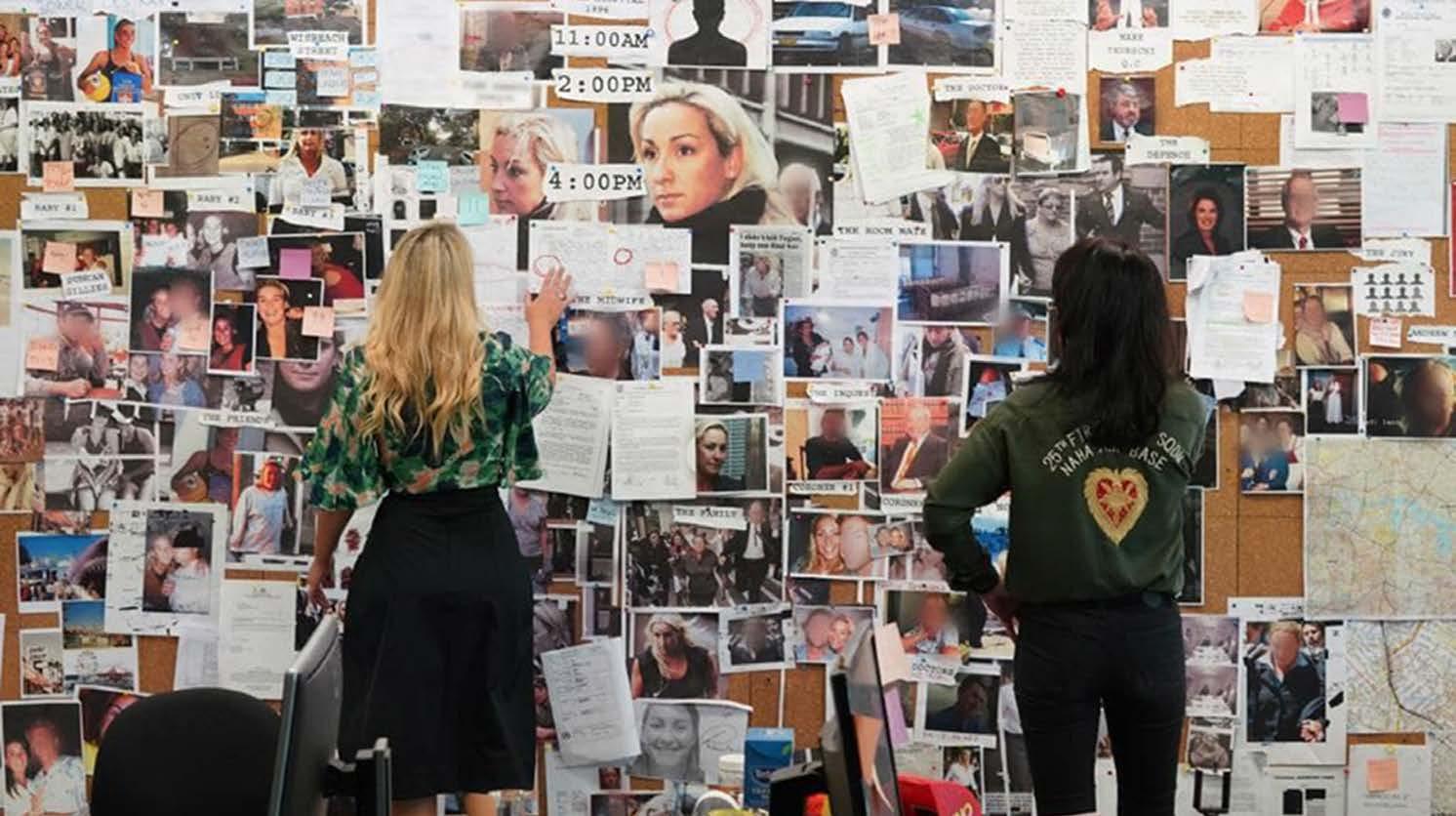
“Something is so wrong with the government’s priority”: Wom*n’s Collective vigil
Content Warning: This article contains descriptions of gender-based violence.
“If this was instead 79 men killed by sharks, I would venture to guess the outrage, media coverage, and the level of political unity on the issue would look wildly different.” SRC Sexual Violence Co-Officer Leyla Bensan said to a crowd of approximately 53 people gathering on the lawn in front of the Quadrangle to honour victimsurvivors of domestic, family, and sexual violence. The Tuesday vigil organised by the SRC Wom*n’s Collective was attended by Senator Mehreen Faruqi and UNSW SRC Women’s Officer Amelie Marquette.
In 2025, there were 79 recorded instances – on average more than once per week – of women in this country being killed by an intimate partner or family member, according to Australian Femicide Watch.
“At what point do we start naming misogyny as an extremist ideology? It radicalises men into believing women and gender minorities are an existential threat… and that their bodies are ultimately vessels of male power and control.” Bensan referred to femicide as “the final wrong” in “a ladder of escalating misogyny”.
SRC Women’s Co-Officer Maxine McGrath began her speech by stating:”Yesterday, Hind Rajab, a Palestinian girl, would have turned eight. When she was five years old, she was killed by the IDF, shot 335 times while entrapped in a car crying on the phone to ambulances who were on the way trying to rescue her.”
“When acknowledging femicide and patriarchy, we must acknowledge that this is a global system.” McGrath said.”It’s not just contained to a singular country. We see this from rape used as a weapon of
war internationally. From the horrific reports from IDF prisons. Mass suicides from women in Sudan who would rather die than be sexually assaulted.”
“On the February 9th protest at Town Hall against Isaac Herzog, a protest which we attended, we saw lone female protestors getting beaten up by the police and Muslim women being assaulted. This violence does not end here. This is evidenced by the disproportionate rape by domestic and intimate partner abuse reported from police officers. And much of the time when a woman does end up getting murdered, there are many cases where she submits a report of her abuse or a feeling that her life is in danger, yet the police refuse to act on this.”
McGrath mentioned the 2020 incident of Hannah Clarke as an example of failed institutional prevention of violence. As Clarke was about to drive her three children to school, her ex-husband approached her residence and killed Clarke and their children, despite Clarke having been in ongoing contact with police and her killer already having breached a court-authorised domestic violence protection order.
Queensland’s deputy coroner Jane Bentley stated in 2022 that it was “unlikely that any further actions taken by police officers, service providers, friends or family members could have stopped Baxter from ultimately executing his murderous plans”.
An investigation published by The Guardian in November 2025 contradicts the official claim. New disclosures from the Queensland Coroners’ Court indicate that the police officer assigned to Clarke’s case received reports of stalking and sexual violence but did not record them into their QPRIME police database. When notifying Clarke’s killer
about restrictions imposed by the protection order, officers gave him legal advice and disabled the bodycam mid-conversation.
McGrath said, “Both major political parties fail to prevent gendered violence, instead funding the military and defence, and their ally is America.”
Greens Senator Mehreen Faruqi said, “some of the solutions to gendered violence are really not a mystery… We need sustained funding for frontline services, for shelters, for crisis accommodation”.
“If the government can find almost 400 billion dollars for nuclear subs in the AUKUS pact and another 53 billion dollars to fund a war machine, the very war machine that is killing women and children around the world. And they can’t find funds of a few million dollars for frontline services, and they cut billions from the NDIS support for disabled people. Then something is so wrong with the government’s priority.”
UNSW SRC Women’s Officer Amelie Marquette addressed the crowd, saying: “Aboriginal and Torres Strait Islander women are disproportionately represented among victim-survivors and yet their experiences and their deaths are often overlooked.”
SRC President Grace Street said that the University of Sydney “has a long way to go”, referring to the university’s response to the Red Zone Report. She called on people to “harness” their anger and fear by joining the Wom*n’s Collective.
The vigil was one of several events during WoCo’s “Feminist Action Week”.
Read the full article online. reports.
When writing holds power to account
When can writing be used as an instrument of justice, a method of holding crime within society to account, a deliverance of punishment? A survey of modern literature does not endow its reader with much hope concerning those platitudes so often touted about the power of writing. But writing has changed the world and confronted injustice in the past. It will achieve this again. It has historically been through sustained research and a willingness to critically and systematically examine the society that the figure of the writer finds themselves with, rather than the writer themselves.
Literature today
Trends in literary fiction today tend towards the confessional, the personal and the revelatory. The individual is increasingly a supreme focus of the novel. This is not a particularly unique observation, simply another aspect of the reality of reading in the 21st century. It accords with the methods of experience which the modes of production proliferate, experiences which are constantly inward, uninvolved in the direct engagement with the social world, within a social world mediated through an algorithm owned by a corporation.
Many novels of today are nearly solipsistic in their inward turn, with a consideration of the lives of their protagonists as something totalising, the world viewed as a construct of their self, managed and mediated by their thoughts, the stories closely aligned to the individual and personal experiences of the authors themselves. These are often entertaining narratives, ones full of life and character, immaculately executed.
They are not the instrument of justice that writing can be, but this is fine. They have no pretensions to it. Where this becomes egregious is when these sorts of novels become so totalising that it seems as if the novel as a form for the achievement of change has been forgotten.
Walk now to a bookstore, read the synopsis of the novels upon the shelves and see this trend. A consideration of the catalogues of the major publishers reiterates this, alongside the novels voted the best of the 20th century by the New York Times, a list which indicates with some authority trends both popular and literary. Within both, one immediately comes upon autofiction.
This is true too of the trend within literature towards the self-referential, towards historical literature, gesturing at it as an indication of meaning.
The Last Samurai by DeWitt, quite a quaint novel about a young boy, Ludo, attempting to find his father, is a novel so saturated in a system of references that the reader must be prepared often to do research on a variety of topics that stems from ancient Greek literary critics to modern mathematics themselves while reading. The same goes for other darlings
of modern literary writer wannabes. Roberto Bolaño frequently references obscure novelists and poets which the average reader has little hope of really ever knowing or understanding and the experience of reading his novels is isolating. William T Vollman is complicit in this too, alongside the big postmodern authors like William Gaddis and Thomas Pynchon.
Australia is, as ever, often too slow to catch these trends while they happen, and we catch up a little too late, and by that time whatever fresh concept was being explored is now old and there is a new, bigger trend. Why this is, is perhaps due to the nature of the Australian publishing industry’s slow but steady buy-up by large publishing companies, who allocate less resources to the country than other countries easier to ship large books to, like those in Europe or the Americas.
Modern novels here which prop themselves up as serious literary fiction are increasingly dependent too on referentiality and self-exploration, traits which condemn the novel to a vehicle essentially only of narrow self-exploration, which narrow the experience of the world into one small subjective corner of its experience, rather than embrace its polyphony. No matter how important that corner is, it cannot contend individually with the enormous pressures upon society today that decimate the ability of the common person to find dignity in their existence, much less experience the sort of spiritual enlightenment so central to narratives of intense personal examination.
Literature is on the retreat from the domain of reality.
Elsewhere social criticism is played out in the milquetoast novels of mediocre fantasists like China Mieville, whose political messages ring like the loudest and most annoying of the participants of University undegraduate politics classes, full of easy platitudinous observations bore their listeners half to death.
The author of today who wishes to write to affect change must contend with these pressures not by the retreat into the world of their self, or the realm of the fantastical to impart didactical messages, by the exploration of the corner of infinity which the self attempts to understand itself within. In the same manner, literature cannot atrophy through its incessant self-examination.
The writer must look to the example of those writers before who have effected change. Fiction might take the example of nonfiction once more, as it has in the past.
Robert Caro and Methods of Investigation
Journalist and biographer Robert Caro’s masterpiece, The Power Broker, details the life and times of the New York urban planner and public official, Robert Moses. It is not a novel, rather a biography, nearly 1300 pages long, an exhaustive expose on Moses’ misuse of his power in unelected positions in New York City to radically alter the fundamental infrastructural structure of New York, in ways that saw large swathes of housing for disadvantaged groups and minorities completely levelled, with highways built in their place. Moses, despite not driving a car himself, completely revolutionised urban transport, entirely neglecting public transit in favour of often grotesquely massive expansions of the roads. Moses
accumulated power in unelected positions, as an appointee of the Mayors of New York and the governors of the state and city of New York. Moses appears in Caro’s biography to accumulate power for its own sake, extending his influence in the state to a ridiculous degree. A staffer reported that Moses kept the temperature of pools lower in Black neighbourhoods as a result of his completely unsubstantiated belief that “African Americans didn’t like to swim in cold water”.
Aside from this, what is astounding to me about the work is Caro’s research process. Caro is exhaustive, and his notes are extensive to an obsessive degree.
Caro interviewed almost every major person who had ever interacted with Moses to any degree, talking with minor staffers, college friends and mayoral assistants. Caro read hundreds of thousands of pages of governmental reports and books on city planning, books written by and about Robert Moses.
Caro’s series of biographies on President Lyndon Baines Johnson has seen him allegedly move to Vietnam to research the impact of Johnson’s decisions in the Vietnam War. Caro’s process is famous and has been repeated by biographers.
Caro’s writing also meaningfully altered discourse surrounding Moses, his investigation processes. Moses’ control of New York had an indelible effect not only upon the city of New York, but on all
cities. His favour towards roads and cars completely transformed the relationship between cars and cities. Moses stamp is on each major city in the world in the form of the arterial highway, in the form of modern gentrification. His tactics are the textbook for an urban renewal which sees the systemic erasure of minorities from their own neighbourhoods, and Caro’s documentation exposed this to a world. Moses’ reputation was widely reevaluated, and the book has influenced generations of city planners, investigative journalists and civil servants.
Caro stated his method is born out of an attempt to get readers to understand the scale and effect of this phenomenon, a phenomenon that was obscured by layers of obfuscation. He writes in his book, Working, that when he kept reading “in textbook after textbook, some version of the phrase “the human cost of highways” with never a detailed examination of what
the “human cost” truly consisted of or of how it stacked up against the benefits of highways, I found myself simply unable to go forward to the next chapter. I felt I just had to try to show—to make readers not only see but understand and feel—what the “human cost” truly consisted of or of how it stacked up against the benefits of highways, I found myself simply unable to go forward to the next chapter.
I felt I just had to try to show—to make readers not only see but understand and feel—what “human cost” meant.
It is this attempt to demonstrate human cost, to show, through careful and detailed investigation, through research, what is not readily known and available, those forces of society which move and arrange the lives of people without substantial care for wellbeing.
There is nothing that meaningfully prevents the novel from adopting these investigation tactics, from using them to craft a narrative. It has been done before, in perhaps the most famous social novel, Upton Sinclair’s The Jungle.
Sinclair and The Social Novel
Sinclair’s novel The Jungle is by no means a perfect novel, it is a lumpy and inconsistent mess, with a baffling ending, and a strange narrative, and sections of prose which read as strangled attempts to wrest some form of emotion from a reader.
The main characters act in convoluted ways and often come off as contrived efforts at characterisation rather than comprehensive realisations of humans. Sections of the novel are also, like many novels of the early 20th century, saturated in a sort of blithe and cruel racism that men raised in wealthy settings in the American Northeast found to be their natural right.
Sinclair was a self-described socialist, and the novel is a comprehensive examination of the meatpacking industry within America in the early 1900s. Sinclair actually worked as a meatpacker for months to research the novel, gaining a firsthand experience of the industry to write about it effectively. Sinclair details the brutal working conditions within the factories, the quite physical process in the production of sausages and other processed meats. He describes workers’ fingers being caught in machines and ending up in the meat products, the bodies of rats and vermin falling into the machines, the rot of meat, the exhaustion of the workers, the pay and the cruelty. Sinclair collates this together in a story which, for its intense flaws, does have an intense effect on the reader.
Sebastien Tuzilovic reads. Again.
He wrote the book to actually raise awareness for the conditions of the workers in the factories, however the novel was received as an expose on the processes of the meatpacking industry rather than about worker conditions. It inspired heavy reforms in the food industry, and saw sweeping changes in how food was processed and monitored. Sinclair famously stated that “I aimed at the public’s heart, and by accident I hit it in the stomach.”
The Social Novel Today
But Sinclair’s method has not often been imitated within novel writing in modern times. Perhaps this is because the research needed to achieve this, months of working within an exploitative industry, is extremely difficult within contemporary legal frameworks. Undercover reporting is almost impossible, and there are a slew of legal issues in doing such reporting today. But Caro’s method is one that can be imitated in the creation of a novel, one that has not yet been achieved, one that, through both the power of investigation at uncovering unknown aspects of society, and the ability of the novel to select aspects of that reality specifically to demonstrate, to collate disparate events together to effect the reader, might shake society itself.
As Stendhal states in The Red and the Black,
“Sir, a novel is a mirror carried along a high road. At one moment it reflects to your vision the azure skies, at another the mire of the puddles at your feet. And the man who carries this mirror in his pack will be accused by you of being immoral! His mirror shows the mire, and you blame the mirror!
Rather blame that high road upon which the puddle lies, still more the inspector of roads who allows the water to gather and the puddle to form.
Australia is ripe for a novel of such a type. Journalists constantly uncover abuse of power, and report on abuse in all sections of society. The social novel of today is often not created of rigorous investigation, instead more akin to thought experiments.
It is in investigation in writing that wrongdoers might be brought to account, that society might be altered. Caro and Sinclair are evidence of this. Writing must examine the world in its totality, not flinch and retreat back into examinations of the self in order to bring justice, otherwise it will waste in facile self-examination, endlessly condemned to muse upon its past and greater achievements.
The Arrest of Amjad Youssef and the Nature of Justice
Thirteen years ago, there was a massacre in the city of Tadamon, a suburb of the Syrian capital, Damascus. Only now is one of the perpetrators being brought to justice.
Tadamon is a neighbourhood in the southern centre of Damascus. It has a makeshift character, home to many people displaced from the Golan Heights after Israel’s occupation in 1967, where they built new homes and communities there. The Syrian revolution began in early 2011, following the detention and torture by Syrian security forces of teenage boys who graffitied on their school wall anti-regime slogans, inspired by revolution activity in Egypt and Tunisia. The Assad government responded with violent repression of demonstrators. By 2012 the communityled uprising had morphed into a full proxy war. There were multiple atrocities committed by government forces and militant groups who took advantage of a destabilised Syria.
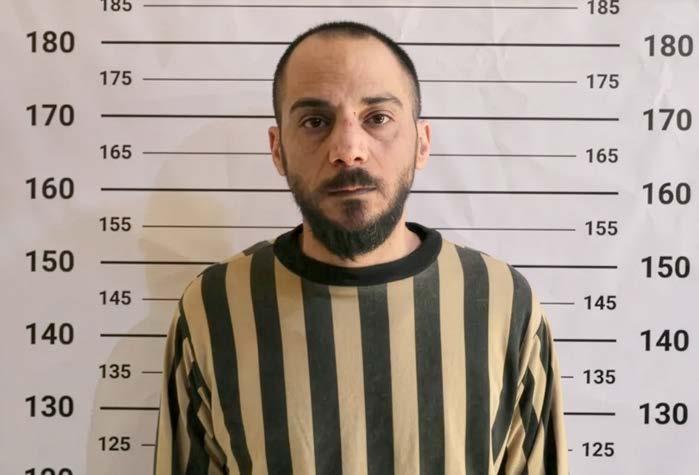
One such war crime was the Tadamon massacre. In April 2013 members of government-backed forces killed 288 civilians. The main perpetrator, identified by two war crime academics years later, is Amjad Youssef. Youssef coldly and casually executed blindfolded and tied civilians by gunshot, and then burned the bodies to destroy the evidence.
Yet, despite his identification in 2021, Youssef was only arrested late April of this year, and until the fall of the Assad government in 2024 it seems he worked in a security role. For many, the arrest of Ajmad Youssef is the arrival of justice finally. But it reveals the selectivity of justice under a state system.
What constitutes a right is an elusive question. The early philosophical thinking on human rights viewed rights as derived from natural law, a theory that espouses an objective set of ‘laws’ that govern reality, usually with a theological undertone that proposes a god or cosmic will as setting these rules. Proponents of this theory believe that natural laws can be deduced through reason. Yet of course, the problem arises that assumptions and context informs the reasoning of people, which in turn allows for the dictation of what constitutes a right to be manipulatively conjured, or set aside.
Rights are largely claimed by individuals through states in the modern world. States, ideally, are to enforce laws within their borders that ensure people act in such a way as to not violate the rights of other people, to use their resources to proactively
provide rights like access to education and basic necessities.
As a more recent development in human rights thinking, states also possess a duty to protect inhabitants, meaning they must not use their monopoly of power to deprive individuals of rights through mass atrocities such as genocide and ethnic cleansing. In this Burkenian conception of rights, a person can only claim individual rights that their government recognises. The state provides social services that determine whether a person receives rights such as education, and to what degree and quality, and it dictates an interpretation of what constitutes a right legally.
The state is the ultimate authority. In this sense, it becomes God, or the cosmos, in deciding what is or is not a right. Further, it decides, with its judiciary branch, what violations of rights are worth prosecuting, and which are justified.
The case is clear with Syria. Under the logic of the Assad regime, military and intelligence officers were justified in massacring innocent people to reduce opposition, spread fear, enacting a higher level of compliance through that fear, replacing propaganda and surveillance with physical violence. There is, of course, also a level of senselessness to the violence enacted by Amjad and his collaborators.
Under the new Syrian government, currently headed by Ahmed Al-Sharaa, there is a different conception of rights and execution of justice. Once Amjad Youseef was located, he (and members of his family) were arrested. Amjad’s trial has since started, but no further arrests have been made, and the accepted confession of Youssef that he acted alone has angered some, who perceive the trial to be a mechanism of the new government to gain legitimacy through the perception they are conducting justice. There is anger from family members of Syria’s forcibly disappeared that the government is not doing enough to uncover the full scale of atrocities. Yassin Al-Haj Saleh, whose wife was kidnapped as part of the Douma Four in 2013, has claimed this is because the abductions were
Iris Brown questions authority.
likely carried out by Jaysh al-Islam. AlSharaa, formally known as Al-Julani, has an interest in not revealing the extent of militant Islamic group’s crimes because of his own involvement (and many other highranking state officials) in them.
The state is not neutral. Its perceptions on justice and rights are informed by the individuals who maintain its power.
The new Syrian government not only refuses to investigate the kidnappings of multiple Alawite women, but actively dismisses the abductions of them by claiming they ran away to get married. Alawites are a minority sect in Syria, and perceived to be supporters of the Assad government. The new Syrian state, then, is not interested in prosecuting Youssef because they have deduced from natural law a series of rights that apply universally to all humans, and have decided Youssef violated those. Instead, they are interested in prosecuting him to demonstrate the consolidation of their power, and enact/ ignore acts of revenge against innocent women for the old regime.
Australia acts no differently. The colonial state has a vested interest in upholding the law of the Commonwealth, which conveniently incarcerates Indigenous people at ten times the rate of nonIndigenous people, and is used to suppress protest and dissent against powerful military alliances like Israel. There is an insistence on asylum seekers, people experience complex trauma and language barriers, following English the law to a tee, or they lose even more of the limited rights that the Australian government grants them, yet Australians who join the IOF and who may be involved in war crimes face no consequences or even questions raised. The Australian state, like all states, dictate the interpretation and distribution of rights, and thereby the enactment of justice, leaving those who hold little structural power or who work against the interests of the state vulnerable.
The Normalisation of Sexual Assault
My friend was recently sexually assaulted while walking to her local train station. It was 11am, the sun bright, the streets fairly packed. After my friend’s multiple attempts of distancing herself and rejecting a man’s innuendos, he decided to put his hands on her backside and pull her forcefully towards him. As she retold the experience, I noticed her expressions were exaggerated, as if to mimic the horror she felt when he crossed her boundaries, her tone uplifted and theatrical as she described the difference in their height and strength. She, as I did, tended to keep up her bubbly persona when recounting traumatic events, so as not to have to succumb to the painful depth of the recollection of details.
“The
fear of sexual assault kinda hangs throughout your whole life as an inevitable threat, so that when it happens, it is almost expected,” she commented. “I
remember thinking ‘it finally happened,’ like some sort of test every woman had to go through had finally come.”
My friend said her assault registered “as an annoyance common to the female experience” rather than a “trauma unique to [her] life.” Whenever the memory randomly resurfaces, she feels a “surge of dread” at both the fact of her having been sexually assaulted and the “prospect of it happening again.”
Feaim Alkozai keeps her keys between her fingers.
that decides whether to take victims of sexual assault seriously. My friend, having responded by trying to appease the man rather than fight back, felt that her experience was less shockworthy than other sexual assault testimonies and thus her trauma less real. Because her situation was so… mundane, so common, she dismisses it as quickly as larger society does.
The normalisation of sexual assault does not simply exist in some indivduals’ minds, however. In fact, much of the media consumed today systemically presents sexual assault as part of the female experience, the most vulgar of this content being pornography.
the age of 13 and almost half of girls have seen it by the age of 15. Distressingly, the inquiry linked consumption of violent porn content to real-life cases of sexual violence, concluding that boys exposed to violent porn were 2–3 times more likely to report sexual and physical dating violence perpetration against girls in their age group (15-20 year olds). The man who assaulted my friend was a young, twentiessomething university student. Statistically, he at one point or another viewed pornography that most likely validated the predatory behaviour he displayed.
As of March 2026, the federal government amended the Online Safety Act to now require social media apps, search engines and websites to take reasonable steps to prevent children under 18 from being exposed to pornographic material. In many countries, standard practice for adult websites has been asking users to check a box verifying they are over 18 before entering the site. Now, more stricter measures have to be in place, like facial recognition technology, digital IDs, and credit card details. Websites that do not comply can be
Art by Sophie Wishart
What my friend experienced is upsettingly a traumatic experience many women face: an estimated 1 in 5 women have gone through sexual violence since the age of 15. However, as my friend’s testimonial suggests, sexual assault should not be treated as just a statistic. Situating each experience as only one in a myriad of like others and not treating each as a very distressing and life altering experience risks normalising sexual assault more broadly.
When asked if she’d report the experience to the police, my friend simply commented that most women had it worse and still were not believed. In society, there seems to exist a sort of point hierarchy
A large majority of mainstream pornography centres violence or aggression towards women, associating men’s pleasure with the direct disregard for women’s comfort and consent.
In January 2025, Headspace National Youth Mental Health Foundation submitted an inquiry into the harms of pornography on young people’s health. It found that almost half of boys have seen pornography by
It is still unclear whether this increased stringency requirement could even begin to address the deeply rooted gendered constructs associated with sexual predator and prey. An immediate worry is that more stringent age verification could see the proliferation of new illegal sites on the dark web which publish even more harmful
Further, since major porn sites are usually international and the verification amendment only applies to Australians, it’s not hard to imagine youth bypassing these barriers by simply using VPNs to change countries.
Simply regulating who can produce or consume porn cannot change the gendered dynamics underpinning porn, the dynamics of objectification and subjugation of women that lead to sexual assault and rape.
Instead, a global effort to change perceptions of sexual assault from a typical, womanly experience to a gross infringement on women’s rights is necessary.
Rather than appraising and comparing one sexual assault encounter to the other, victims need to be taken seriously. Every story is unique and valid in its own right.
Wandering Souls in Lebanon
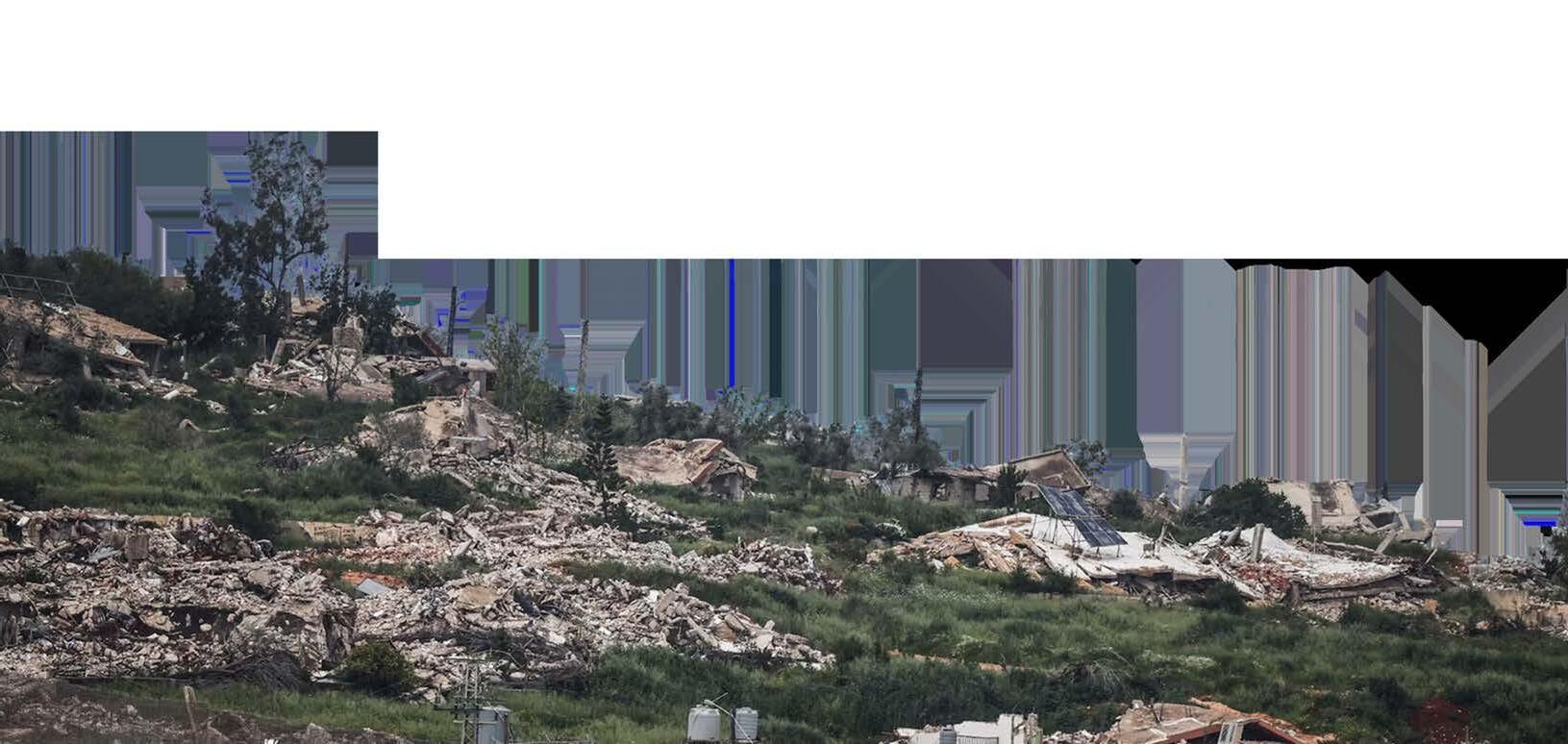
Over the last few weeks, disturbing stories surfaced among a deluge of information about Israel’s war on Lebanon, sourced from WhatsApp group chats between people in their homeland to families and friends dispersed throughout the diaspora.
There have been multiple accounts of Israeli drones broadcasting recorded voices wailing and intoning in Arabic: “Where are you?” and “help me, I’m injured!”
These stories, to my knowledge, have not been covered in the mainstream press, but the lived experience of Lebanese civilians should not be written off as unsubstantiated and therefore not credible. Certainly not when this tactic of psychological warfare was so widely documented in Israel’s genocide of the Palestinian people.
One human rights group testified to the IDF’s deploying of artificial voices — women screaming, babies crying — to lure civilians out from the rubble or temporary settlements, refugee camps, and then target them in drone strikes or with snipers. Civilians in Gaza’s Nuseirat refugee camp spoke to this ineffable cry without a source in April of 2024.
Enter Lebanese-Australian poet Omar Sakr, author of The Nightmare Sequence , a poetic reckoning with the act of bearing witness to what a UN special commission has found to be a genocide — and is the subject of an ongoing case in the ICJ to determine whether it meets that standard under international law.
Haunted by these spectral voices, real and imagined, Sakr set pen to paper. The following is an excerpt from Human in the Genocide , from Sakr’s Substack:
To the drone flying above, replaying a man’s cry, “Help, I’m injured”
are most likely fictional traps to get one to crawl out of rubble and into a sniper’s scope-you are asking, who will die for the chance to be human?
I had not read about this particular torment afflicting civilians in Lebanon. I found out about this story not in the news, but in Sakr’s poem.
And I was struck by its immediacy, by the sheer horror of this beautiful and primal human instinct to care about others, to reach out to someone in distress or to commune with them in the throes of death, and comfort them in their final moments — this distinctly human impulse being weaponised to kill.
I was also struck by the fact that this horror is not unfamiliar. It has its precedent in global conflicts across history, from the US war on Vietnam to CIA anti-communist intervention in the Philippines.
It is an echo of Operation Wandering Soul.
Up until the early 1970s, the US army recorded the voices of South Vietnamese soldiers acting as the angered spirits of dead Viet Cong soldiers, reading from virtually the same twisted playbook of US PSYOPs past. In the Philippines, CIA operatives would leave puncture marks in
Ella McGrath hears voices.
family. Tragic. How tragic! My friends, I come back to let you know that I am dead.
I am dead. I am in hell… Friends, while you are still alive…go home! … Go home my friends, before it is too late.”
In Vietnamese culture, respect for the dead is shown in burial rituals. It is believed that if the dead are improperly buried, their souls are condemned to wander the earth as ghosts or spirits.
One of the most infamous of these recordings, Ghost Tape Number Ten, sets a strangulated little girl’s voice to the soundtrack of Buddhist funeral music: “come home daddy.”
Decades later, writing from the diaspora, Cecile Pin pens Wandering Souls , a kind of poetic justice. An omniscient narrator, unnamed and unknown until the novel’s end, follows a Vietnamese family from wartorn Vietnam as they flee to Hong Kong and then the UK. Pin reimagines and reclaims the “wandering soul” concept from the annals of US military history and, poignantly, envisions a wandering soul watching over his family, living on in t heir memory.
It is this same reclamatory logic at work in the Australian humanitarian project launched in 2012 by UNSW, in collaboration with veterans and academics, to locate the burial sites of Vietnamese soldiers killed by Australian forces during the Vietnam War, and repatriate cultural artefacts and personal items such as diaries and letters to loved ones that were stolen from the bodies of the combatant and civilian dead. A project that knowingly bears the same name: Operation Wandering Souls
As an artist, Sakr, like Pin, is trying to restore empathy and humanity in a time mired by such inhumanity, and as the world courts are investigating grave crimes against humanity.
Sakr wrote on his Substack: “Over and
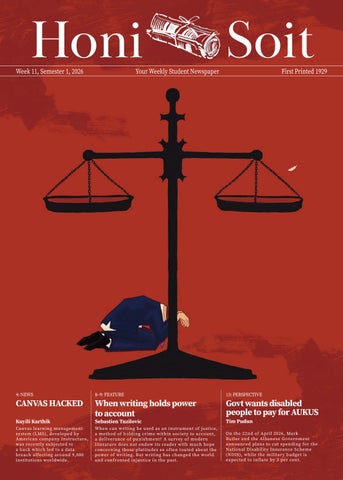
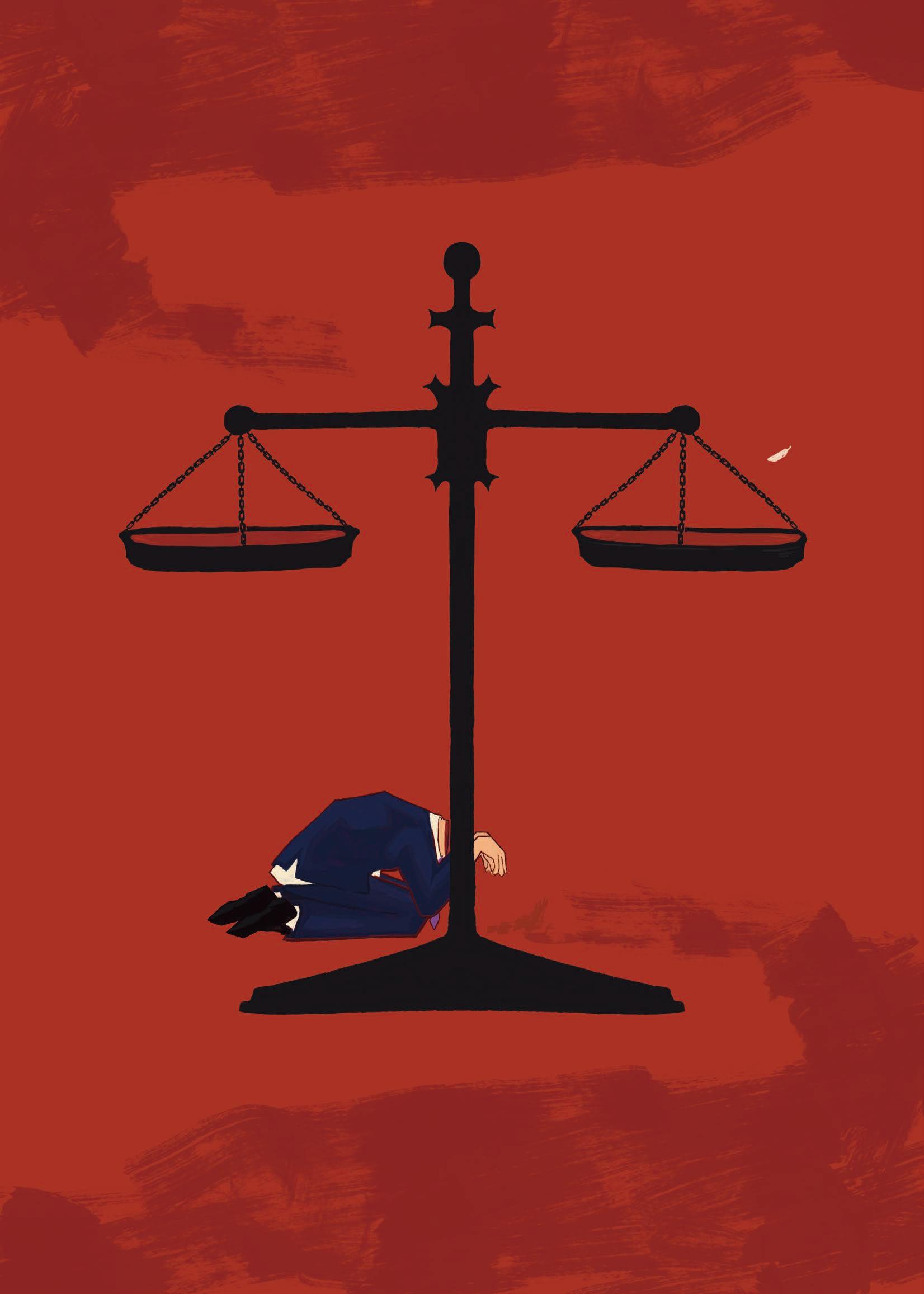
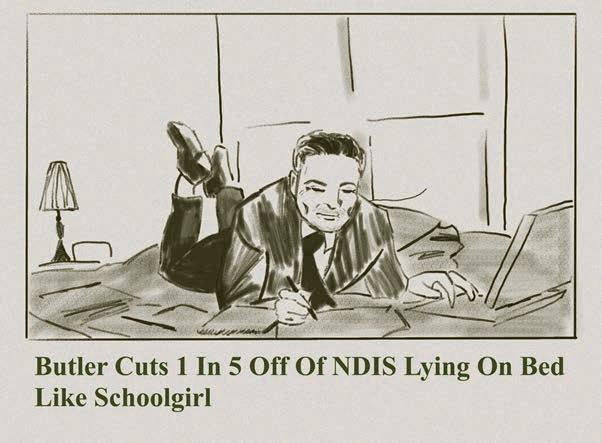
The Government Wants Disabled People to Pay for AUKUS
On the 22nd of April 2026, Mark Butler and the Albanese Government announced plans to cut spending for the National Disability Insurance Scheme (NDIS), while the military budget is expected to inflate by 3 per cent. Citing the growing expenses and expected increase in disabled patrons getting on the scheme (of which 760,000 Australians are currently on), the cut hopes to curb the NDIS growth rate to a measly 2 per cent per year, from the annual 6 per cent measured from 2020 to 2024. Additionally, new eligibility assessments are expected to reduce the number of covered individuals from 760,000 to 600,000, effectively cutting one in five people from their current compensation.
In the coming months, further details will be released identifying the scope and extent of these cuts. The full bill, expected during the May budget week, will also outline a budget cut of 30 per cent for third-party plan managers, as well as a $7000 reduction to community program funding per average participant. Mandatory registration of NDIS service providers and a unified digital payment system are also expected.
Simultaneously, Australia expects to inflate the military budget to 3 per cent of the national GDP by 2033, with a presumed $14 billion boosting the War Machine’s current spending in the next four years, and $53 billion funneled in the incumbent decade. Labor not batting an eye at the funds funneled into the bottomless wallets of NATO and AUKUS merely highlights the Australian’s government’s demands to its disabled citizens:
RELINQUISH ALL HOPES OF HEALTH, AUTONOMY, AND DIGNITY SO WE CAN BUILD NUCLEAR SUBMARINES.
about my new dinosaur plush. What idylls! If I had, by some manner of time travel, heard and understood Ocean Vuong’s ever clowned question: What is a country but a life sentence? , I would have yippee’d and hooray’d at the prospect of it!
Transitioning out of the Children’s Hospital and getting onto the NDIS was an entirely different affair. As the healthcare system buckled under the weight of a global pandemic, I didn’t return to the Royal Children’s hospital ever again. In that time, any sort of specialist input in relation to my disability failed to materialise, and I faced an onslaught of UTIs from catheters that are now considered out of date. With extortionary prices of private specialists (e.g. that terrible podiatrist who made the shoddiest orthotics ever and charged me like $500), I thought that getting on the NDIS would be the best way to ensure I didn’t die early from infection or be relegated to a colostomy bag by my 40s.
After all, I was not Nidhi Shekaran, an Indian born migrant whose family moved
Tim Pudun disagrees.
Even when one is approved, one then has to find appropriate service or product providers, and avoid being scammed or overcharged by those providers who abuse the system. For those suffering from a neurocognitive disability, it can be significantly harder to navigate this.
Representation for service providers is also unequal, as Indigenous Australians make up 8 per cent of NDIS participants, but are drastically underrepresented as service providers.
I was a male Australian Citizen who spoke and understood English, who lived in permanent housing with an able-bodied family, who was in tertiary education, who worked and paid my taxes and drove my own car, who had non-traumatic experiences with hospitals and was well read enough to self advocate. Who could schedule calls and write emails to the Spina Bifida Adult Resource Team (SBART), to help me navigate the system. Who was able to waste two hours in a waiting room for that $300 urology appointment. Who could stomach the walk to the windowless rooms of the Westmead Hospital’s Allied Health Department where a beleaguered neurogenic physio lubes up an ultrasound machine to paint my taint — just try to relax . All these privileges, and it took me seven months to apply.
I agree that the system is flawed. But the rhetoric surrounding these flaws often scapegoats the disabled community, instead of the government for their continued mismanagement of the NDIS and their inability to stop disabled individuals from getting scammed. I also wanted to explain who in the disabled community still is not getting the compensation that they deserve.
At birth I was diagnosed with Spina Bifida Meningocele, a birth defect of varying detriment to bodily function. For me, this meant a less developed right leg and foot (causing a limp), the atrophy of my right glute and calf, persistent and brutal issues with continence and a lifetime reliance on catheterisation (more on that later). As a child, I attended the Royal Children’s Hospital in Randwick where I aced a bunch of fun tests; in the jungle themed clinic where I flexed my foot against the pediatrician’s palms, or when I pointed earnestly to the stool diagrams when asked to pick anywhere between 1 (Rabbit Turds) and 7 (Puddle of Tea). I was tickled by the cold ultrasound gel that helped to undress and project my kidneys and bladder, great blobs on the screen to be divined and discussed by all these well meaning and wonderful adults. In the large waiting area, a model train ran. And there were hot chips and gravy at the canteen. And the nurses all wanted to hear
Art by Zoe Chung
to Australia in 2000, and who lives with vision impairment and cerebral palsy. She lived for 10 years on pension before being able to get support, and is one of the 9 per cent of people from a Culturally and Linguistically Diverse (CALD) background on the NDIS. With nearly 25 per cent of Australians speaking more than one language at home, there’s a clear mismatch of access.
The National Disability Insurance Agency (NDIA) demands from applicants the following: Proficiency in English and Australian bureaucracy, Long-Term Housing, Digital Literacy, Access to Technology and Transport, and Letters of Diagnosis and Functional Assessments from Medical Professionals. And a partridge in a pear tree.
To complete the application, one needs to apply online, and sit with a GP to fill out one set of forms, before setting off on an odyssey to all sorts of specialists (who charge privately). Financial, linguistic and geographical barriers swarm like storms and deep sea monsters, and swallow up underprivileged applicants. Poor Australians, rural Australians, CALD Australians and Indigenous Australians all struggle to paddle to shore and send that final email, with attached PDFs.
I was accepted on minimal funding and put my case to the ART. 16 months after my initial application, I still have not seen an appropriate funding plan. All the while, paying nearly $7000 per year for the same kinds of poor catheters that threaten infection (the ‘good’ ones are closer to $15,000 per year). Add another $1000 for medication that NDIS does not cover.
Despite these costs, I’m lucky. I have been able to travel to school and work, to compete in sport, to find friends and meaningful relationships. By the generosity of psychologists in social support like Headspace, I have been able to navigate these turbid bouts of anger and depression. With all this in mind, I am still not immune to the fear of being taken off the scheme, and forcing myself into debt over the right to live in my own body comfortably.
I truly hope that Labor succeeds in standardising registration practices for service providers. But it needs to be clearly stated that the reason the NDIS has bled so much money is because of poor governance and management. Applying to the NDIS should be made more accessible in order to support those who need it. Bluntly cutting funding to the disabled community without warning or constitutional support is a disgrace, as is Labor’s consistent complacency when faced with the ever increasing cases of disability in Gaza, in Iran, wherever Western imperialism has continued to raze and destabilise.
To the government, the disabled body in Australia and the global bodies of resistance share a devastatingly similar quality. It is cheaper to kill us than to pay us our dignity.
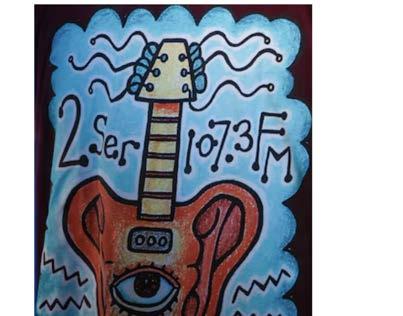
2SER Volunteer on the Value of Community Radio
On Saturday, May 9th, Honi sat down with William Lyttle, host of the Community Armchair on 2SER Breakfast. We discussed his experience volunteering at 2SER, what he believes the value of the station is, and how he feels about its uncertain future.
Dana: Tell me a little bit about 2SER.
Will: 2SER is a historic radio station. It’s one of the longest serving community radio stations in Sydney. It’s been an institution since 1979 and has fostered so much talent and growth in the Australian media landscape, so much quality story telling from all walks of life, all different angles. The fact that we’re at this position now, for long time volunteers, staff at the station, folks who have left the station… it’s not all too surprising to them, but it’s the way it’s happened that has got to people.
D: How did you get involved with 2SER?
W: I started at 2SER in September of 2022. I still remember the day I came in to start volunteering on Monday Breakfast. I’m still on Monday Breakfast, doing my thing there. I got involved in just producing stories. I came in at a time where there weren’t a whole lot of volunteers, it was just after the COVID lockdown. It was myself and Eleanor Godley scraping and scratching to find stories every week. As 2022 became 2023, I started doing the sports thing, doing the NBA playoffs, and then in May I started the weekly community yarn chair with the support of my Breakfast
involved with some community events and fundraising. It’s been an amazing place to learn, grow, and as a journalist I can say with a 100 per cent certainty I would not be where I am without 2SER.
D: Why does 2SER matter to you? What opportunities does community radio provide for people?
W: First and foremost, 2SER provides a community. It provides a very relevant community creating amazing stories for the passion of it. We don’t make money at the station, we are a NFP entity, for public good. We have very few people at the station who even receive any sort of remuneration for their work. I am not one of these people. I have contributed the equivalent of 100s and 100s of hours over the past 3, coming up on 4 years. But that’s not the point.
The point is coming in and telling amazing stories and the community around that.
The second thing it provides is a training ground for university students who are studying media, who are studying journalism, who are studying radio. They’re trained to come in and get confident on a professional broadcast. We have a broadcast schedule, program timing, panelling, all the equipment there ready for people to train themselves and get comfortable with putting their stuff out there and themselves out there. Whether that’s a producer, presenter, an interviewer, or anyone who’s at the station, it provides them a training ground to build their skills in journalism and media. There’s nothing like 2SER, especially in radio.
look forward, prepare, and get the word out that this is a place that we cannot lose. This is a place that’s too important to too many people. This is almost 50 years of history just being ripped away from us. I’ve said this before on many times and many platforms, and I’ll continue to say it: this is a conversation about value and it has been a conversation about value for the longest time now.
I knew this is going to be a potential situation that we’re going to have to face, coming up now that Macquarie University, which I graduated from, is dropping the radio major and I am one of the last radio majors for the foreseeable future coming out of MQ. When word got out, I knew they were going to pull funding from 2SER and lo and behold, they have. Right now, everyone’s bunkering in and trying to organise to look forward, to see how we can keep this place and the value of this place alive because it’s too important to too many people. I think right now that’s the feeling across the station.
D: It’s been a couple weeks since it was announced that MQ stopped funding 2SER. Have there been any major updates?
W: As of right now, no. Apart from the rumours that UNSW was considering us or might still be considering us, we haven’t heard anything as of right now. So no, no news of any funding, individual, or any entities is looking to fund us.
D: What has it been like for you to see 2SER being defunded? How has the team reacted?
W: It’s been 3 weeks since the Town Hall meeting we had [to discuss the defunding]. There was definitely some frustration, and there still is, but it’s simmered down now. We are now starting to try to
400,000 dollars a year for some of these entities, especially universities like MQ, is chump change. To you and me, it’s life changing money, but to these institutions, that’s money that they make back. But for MQ, the thoughts around the community is they have had individuals tell them where to save money, as a result of that they’ve looked at us, an entity which does not make any money. That’s the conversation about value. We are not seen as valuable in terms of money.
D: How should people rally around this issue?
W: The value that we provide is not monetary. Money is not even a discussion, outside of fundraising to keep us on air every year without a radio fund.
Dana Kafina interviews.
The value we provide is a public good. We come together to create stories for the Sydney community, that’s not covered by the mainstream media because we’re passionate, so passionate about it. That’s the value that we provide.
To see that value being flipped around and turned into something that doesn’t matter because a uni wants to save money is extremely disappointing. In my view, it’s not all surprising given MQ’s recent cuts.
D: What kind of future do you see for everyone at 2SER?
W: I’ve had talks with people who have departed the station and those who are helping to keep us on the air. There have been talks of us potentially merging, or staying as 2SER but on a smaller scale. There’s a lot of people around that believe the station will stick around regardless of what happens. Personally, I am not sure. It really comes down to how we can get our message out there, which is one of the big reasons I’ve been pushing so hard to get this message out. It really comes down to how we can find any partners to fund us yearly. Those are still discussions that are happening behind the scenes.
The Double Standard of Violence: Why Abuse Victims Slip Through the Cracks
When I first heard the phrase “I support women’s rights and wrongs!” as a TikTok audio a few years ago, it tickled that misandrist part of my teenage girl heart, and I found it agreeable enough to give it a like before scrolling. Now this phrase is more widespread. You can find these words often used to respond to internet discourse; in the case of Chappell Roan’s multiple scandals, yelling at photographers and paparazzi, or worn on baby tees that you can buy on Etsy. It’s a throwaway line, a performative statement proliferated around the internet for laughs.
But where do the boundaries on the use of this phrase sit? This type of rhetoric fits into the niche of choice feminism blanket statements, alongside sister phrases on TikTok like “I’m just a girl.” It’s an easy way to tangentially signal your woke feminist leanings without having to actually say anything of substance regarding the issues that many women face at the hands of a patriarchal world. What would happen if we actually took this idea seriously, rather than adding it to the pile of nondescript box-ticking to show our feminist identity?
When we live in a society where men’s
wrongs are often ignored and accepted, women are often held to a much higher moral and ethical
Consider the previous example of Chappell Roan, who is labelled as rude and “insufferable” for her interactions with people. In comparison, Justin Bieber, who has also expressed disdain for the paparazzi, has been praised or enjoyed for similar actions that Roan has been criticised for. In a world where women, especially women of colour, consider how Lizzo has been treated online in the past for the mere crime of being plus-size, in the media are often tone-policed, and criticised, for things that haven’t even been considered to be issues for men, it is not a surprise that in the criminal world, this idea only grows.
In many cases, femaleperpetrated violence is closely connected to histories of domestic abuse and psychological trauma.
Wendy Lew empathises.
In matters of crime, male and female perpetrators are both treated very differently. Socially, women are viewed as weak and subservient; consider the gender essentialist idiom that refers to women as “the fairer sex”, which suggests that women are inherently more tender, beautiful, and tolerant. So when women kill, they are vilified for daring to exist outside of these expectations, while male killers continue to receive positive attention on social media. Compare public reactions to serial killer Ted Bundy with those of the “Mushroom Killer” Erin Patterson. While Bundy is romanticised to this day, Patterson faced a media circus and mockery. Despite his horrific acts, Bundy simply acted in accordance with societal views on men — “boys will be boys” after all. In the eyes of the media and the public, Patterson committed the worst crime by defying her role as a woman and wife. Although Patterson’s actions should not be excused, they serve as an example of the diversion for the persistent double standards that pervade women even in the realm of crime: an attractive white man who kills is one to be adored, whilst a conventionally unattractive woman is a monster. While Patterson’s motivations remain unknown, her case highlights a broader tendency to condemn women who commit violence without examining the circumstances that often precede it.
In a national review of intimate partner homicides with a documented history of domestic violence between 2010 and 2014, there were 28 cases of women killing male partners. Of those cases, 61% of the women involved were identified as the primary domestic violence victim in the relationship. Domestic abuse among intimate partners is disturbingly prevalent in Australia. One woman was killed every eleven days compared to one man killed every twenty-six days by an intimate partner on average in 2024-2025. However, when women kill male intimate partners, it is most commonly a reaction to prolonged domestic abuse, and the majority of these women demonstrate extreme psychological duress.
In these cases of self-defence, the question arises: who is the perpetrator, who is the victim? Is it the woman caught in an inescapable situation? The intimate partner who created the situation but bore the final physical consequences? Both parties caused great harm. Both committed crimes. But it is the woman who is left to deal with the aftermath of speculation and a trial which will dissect her past traumas to determine whether her actions were truly selfdefence. Every step of the way, these women have been failed. First by an intimate partner, next by inadequate police responses to domestic violence, and then by social discourse and the Australian courts of law. Through this victimisation built through long-standing structures of social patriarchy, it becomes clear that the only person who is going to protect a woman is herself. Not out of choice, but through deemed necessity.
When justice is not served by any of the systems meant to protect them, these women who kill believe they have no choice but to carry out justice on their own.
Jody Gore was convicted of killing her former partner in a drunken altercation after facing nearly two decades of abuse. Rebecca Payne was found guilty of murder for drugging her husband and locking him in the freezer, after years of financial, emotional, and physical control, keeping her trapped in her marriage. Instead of focusing on the trauma endured by these two women, their cases revolved around the spectacle of their murders, Gore’s drunken state and the premeditated nature of Payne’s crime. Suddenly, the exact depth and truth of abuse they faced is a debated topic, and empathy becomes reserved only for men.
In a world where male serial killers and serial rapists are turned into TikTok edits and face communities of support, where do women who kill their abusers sit? Consider the prior examples in the context of the Menendez brothers, two men who killed their parents after years of sexual violence. The Menendez brothers have been hailed online as victims who deserve to be released — where is this attitude towards women who have been victims of similar circumstances?
Ultimately, women who kill their abusers are in the minority. Far more women face intimate partner violence as a daily reality and are unable to escape their situations. To fight back or to cower, both options often lead to more suffering for these victims, and in a system that is consistently failing women, it is not hard to see why victims can feel their only option is to take power into their own hands.
So yes, I do support women’s rights and wrongs, and I think at the very least, you should try to as well. This isn’t a call to celebrate all violent women — women are just as capable of committing despicable acts as men are, and this is not to excuse that. Instead, I encourage nuance and empathy in viewing cases where women seemingly have no choice. These women, both victims and perpetrators in their own right, are still deserving of support. When domestic violence is allowed to exist so prevalently in our society, there is no such thing as a perfect victim, only an imperfect system.
The Staging of Judgment
Crime’s contemporary saturation is often attributed to fascination with violence or the mechanics of investigation. Yet the proliferation of true crime fundamentally exposes a crisis of interpretation, in which wrongdoing is not encountered as a stable, legible event but as something opaque and resistant to fixed meaning. Crime appears first as fragments. A headline, a clip, a partial timeline. Motive remains uncertain. Consequences are rarely clarified.
The forms through which crime circulates intensify this condition. TikTok breakdowns, podcast serialisations, and episodic reconstructions do not resolve events but reorganise them, assembling sequences and assigning motive to create coherence. Each retelling offers a new structure and an attempt at intelligibility. Meaning is constructed rather than discovered. Art withholds justice yet offers something else: it draws the opaque into a pattern, making what resists sense momentarily graspable.
Earlier narrative forms treat justice as something external, authoritative, and ultimately legible. In works such as The Oresteia , and specifically in Eumenides , the final play of the trilogy, crime disrupts both familial and cosmic order, and resolution is achieved through the institutionalisation of civic justice. This is most explicit in the trial of Orestes, where cycles of blood vengeance are reconfigured through a formal juridical process, as Athena establishes the Areopagus and convenes a citizen jury. Judgment is transferred into a civic space. Yet it remains dependent on the interplay of competing claims, divine and human, rather than a single stable authority.
Meaning is imposed, not discovered. It is structured through law, ritual, and judgment into a form that
can be stabilised.
The significance lies not in the act’s opacity but in its placement within an intelligible order. This structure depends on the frameworks’ authority and their ability to transform disorder into coherence. When that authority
weakens, meaning fragments, and the act exceeds the structures meant to contain it.
The movement away from externally imposed justice becomes explicit in Crime and Punishment , written in the context of a rapidly changing nineteenth-century Russia marked by urban poverty, the aftermath of serf emancipation, and the emergence of new intellectual movements that privileged reason, individualism, and radical social theory. Within this environment, crime no longer resolves into a stable moral framework. It produces instead a sustained condition of psychological instability, in which the meaning of the act cannot be fixed through institutional judgment alone. Raskolnikov murders a pawnbroker, whom he regards as parasitic and morally expendable, justifying the act through a theory that certain ‘extraordinary’ individuals possess the right to transgress conventional moral laws in pursuit of higher ends. His attempt to rationalise the crime through abstract reasoning reflects the broader intellectual climate of the time, yet the novel exposes the insufficiency of such logic. The act resists containment. It remains opaque, even to the subject who commits it.
Punishment in this context is internally demanded. It arises from the subject’s inability to reconcile thought and action or restore coherence to a fractured self. This inward turn signals a broader shift between individual and society, where external structures no longer guarantee meaning, and moral authority grows unstable. Resolution remains elusive. Suffering and confession do not restore order as in earlier juridical models; Instead, they highlight the persistence of ambiguity. Narrative organises guilt, consequence, and interpretation into a graspable form, even as instability persists.
Today, this instability proliferates across new forms of media that invite continual reinterpretation. The stability that earlier forms of justice relied upon becomes increasingly difficult to sustain. Shared moral frameworks no longer hold with the same force, and institutional authority no longer guarantees a single, coherent interpretation of wrongdoing. Law remains, but its capacity to produce meaning appears diminished. Through
Madeleine Carter is reframing modern judgement.
increasingly ‘tough on crime’ responses, expanding preventive measures, and a shift away from moral culpability toward risk management, wrongdoing is less clearly understood as a moral failure than as something to be predicted and contained.
This shift reaches both offender and victim. Experience risks being flattened into procedure, into technicality, instead of being held within a shared moral frame. Judgment remains, but floats, untethered. As the law’s normative force grows thin, decisions and penalties no longer settle meaning or demand moral recognition as before.
Within this context, platforms such as TikTok, Reddit, and true crime podcasts transform audiences from passive recipients into active participants in meaning-making. Crime appears as fragments: footage, timelines, speculation. These are circulated and rearranged across platforms. Comment sections act as informal juries. Each iteration produces a provisional account of motive and consequence. This diffusion of judgment disperses authority without restoring coherence, shifts responsibility, and intensifies the demand to interpret. The result is a continual re-narration of wrongdoing, leaving both accountability and meaning suspended in an ongoing process of reconstruction.
If earlier forms of justice sought to resolve wrongdoing, and modern narratives internalised its instability, contemporary crime narratives operate differently again. As institutional frameworks appear less coherent and shared moral structures fragment, crime narratives are no longer engaged as mechanisms through which justice is delivered, but as sites in which meaning can be imposed upon events that resist clear interpretation. Art does not resolve the act. It arranges it. Guilt, consequence, and responsibility are organised into a sequence that can be followed, even where no definitive account is possible.
Consider a public allegation of wrongdoing met with an ambiguous or contested institutional response. Official statements are limited or inconclusive, offering only procedure without a clear moral account. As trust in authority fades, uncertainty grows. Judgment is deferred, meaning becomes elusive, and the event
circulates across platforms. TikTok videos reconstruct sequences and assign motives. Podcasts revisit material and offer different perspectives. With institutional judgment less present, people gravitate toward their own interpretations. Each account is less a discovery of truth than a way of navigating uncertainty, a tentative attempt to find coherence where certainty is hard to locate.
These practices are not merely voyeuristic. They reflect a deeper instability in the location of moral authority.
In this context, art assumes a substitute function, operating as a parallel space in which judgment is staged and wrongdoing rendered intelligible when formal systems fail to provide a satisfying account.
Return to the familiar image of the late-night viewer: headphones in, screen lit, moving from case to case. Here, engagement with crime is less about answers than about the restless process of interpretation. What looks like passive consumption is often an attempt to find order, or at least its semblance, in stories that refuse to settle. In the absence of stable moral authority, these narratives become spaces where wrongdoing can be arranged and, for a moment, made intelligible.
The persistence of crime narratives does not signal faith in justice, but a recognition of its limits. Each retelling stages judgment without resolving it, producing only provisional coherence before ambiguity returns. The appeal lies not in closure, but in the act itself: the repeated effort to make sense of what resists it. Crime narratives endure because they keep this process in motion by sustaining the search for meaning without ever allowing it to conclude.
On May Day 2026
On May 1, 2026, hundreds of unionists and supporters began their day marching in the annual May Day rally. Beginning at Belmore Park, the rally was led by Maritime Union Secretary Paul Keating. Several singing political organisations marched their way through Elizabeth Street before meeting at NSW Parliament to hear from other union officials such as Vanessa Seagrove, Assistant Secretary of Unions NSW, and Patricia Fernandez, State Secretary of the Meat Industry Employees’s Union.
In Australia, the origins of May Day were pioneered by Victorian stonemasons in 1856, who won the right to an eight hour work day. May Day rallies began to be nationally orchestrated in the late 1890s, and since then have continued to be an integral part of the union movement throughout Australia.
Compared to previous years, the relatively diminished presence of the Construction, Forestry and Maritime Employees Union (CFMEU) contingent was notable. This is likely owing to the current attacks against organisers being carried out by the state-appointed administrator.
Many speakers criticised policies being enacted by the NSW state and federal governments. These included AUKUS, the recent changes making worker’s compensation more difficult to access, Australia’s support for the war against Iran, and its complicity in the genocide in Palestine, and the attacks against the CFMEU. “It’s a shame”, Keating said, “but when it comes to paying nurses, or teachers, they can’t find the money, but they can always find the money for war!”
Keating further encouraged the crowd to “stand up” and “get involved in the struggles.” against these issues. However, observers noted that these speakers neglected to directly identify the Labor Party, Chris Minns, and Anthony Albanese as directing these attacks against the working class.
Rather, Trump and American imperialism were identified as the principal culprits, while Australia was described as merely a “lackey”. Instead, Keating advocated for Australia to take an “independent foreign policy thats not linked to the US and fucking Israel!” This position is reminiscent of the 1960s New Left and overlooks the relative autonomy Australia
has as a minor imperial power in its own right, acting as a willing participant under the auspices of the U.S., and exercising power in its own sphere of influence in the South Pacific.
Other speeches made at the rally also lacked political fibre. Freddie Barbin of the Electrical Trades Union thanked his union and other fellow unionists for coming out and supporting the day, noting that May Day was a public holiday in other countries such as Italy and France. Barbin also extended his solidarity towards the CFMEU and spoke of the CFMEU’s ongoing “construction agreement” where the union was fighting towards five weeks annual leave. Barbin said: “It’s our construction workers who work 58 hours, 60 hours a week, 12 hour days… so we support construction workers, so we wanna go for that.”
Barbin gave further regards to the CFMEU and reminded the crowd that his union would always support “CFMEU members on the ground… it’s a complete disgrace how they’ve gone through the New South Wales branch.” However, Barbin did not clarify just who ‘they’ were. When finished, Barbin thanked the crowd on a
Love’s performative nature: The River, a Sydney Theatre Company production
The Sydney Theatre Company’s newest production of Jez Butterworth’s play The River , directed by Margaret Thanos, has a chilling intensity. Horrifying sound design, sudden thunder, and claustrophobic lighting transported me to the scene of a lonely and remote cabin. The cabin shines like a jewel out of the shadow of the main character’s memory, an antique woodfurnished structure surrounded by fronds falling from the ceiling.
The cabin forms the scene of the entire play’s staging, though the river running by it is described in numerous monologues. It is within its walls that the memory of an unnamed man (Ewen Leslie) scurries back, as he recalls his relationships with the several women he brought to the cabin, which his uncle passed down to him, over the years. The play features a clear cycle: to each woman, the man insists she is the only girlfriend who has ever entered the cabin. The man’s consciousness is preoccupied with love, lust, guilt, avoidance, and
most saliently, fishing.
We realise throughout the course of the play that what we are witnessing is entirely the construction of memory in the man’s mind. He’s someone who loves speaking florid, grandiose, prosaic descriptions of fishing, sunsets, and the landscape.
When spoken aloud in dialogue, this seems contrived and artificial in a way that disconcerts the audience. Perhaps this is the point. The man is unable to form genuine connections with women. His experience of the world is mediated through poems, and strikingly, Maurice Ravel’s composition Ondine
The man comes across as pathetic and pitiable, just like a fish that, once caught, lies on the ground flat and flopping about, waiting to die. He is continually widowed of love, doomed to repeat the futile cycle of commencing another theatrical production of fake love with another woman.
more apolitical note - “have a good day, and have a beer with all your friends.”
For the trade union movement in this country to move forward, it needs to be prepared to identify the Labor Party as a political barrier to industrial militancy, and be prepared to stridently criticise and fight it.
Ending with a chant of “Union, power!” led by Keating, the crowd of unionists dispersed into Martin Place.
The river is described exclusively in dialogue that feels ekphrastic. The descriptions conjure cold landscapes of knotted oak and yew trees, silver fish in pools, and wild swans darting overhead. The play references a poem from Ted Hughes’s collection River called After Moonless Midnights in the opening scene, where the man tries to convince his new girlfriend (Miranda Otto) to come fishing for trout at neap tide on the night before the new moon. The woman couldn’t care less, bemoaning that she’d rather read her book than pull on hideous Wellington boots, to make knots.
There are a lot of monologues where characters describe those special and intimate moments in romantic relationships (we are not shown these moments; they are mere descriptions). Butterworth’s psychology of love is methodical and fascinating. The man describes watching his new girlfriend strip naked atop a cliff before diving into a pool of cold water. The man is absolutely dripping with millennial joie de
vivre (a reclamation of sexuality emerging as a counteraction to boomer conservatism) while recounting this moment. The play leans much into a sort of decidedly millennial crassness in its humour. One of the man’s older girlfriends (Andrea Demetriades) says “fuck” a lot because she’s “so stoned” after smoking a spliff on the riverbank with a guy who’s in a band.
The man’s girlfriends often hesitate to respond to his verbose declarations of love, which repeat hackneyed mantras like: “I’ll never love anyone else, and if you do see me with another woman, I’m pretending. It’s a lie. Because there can never be another truth after you.” When a man starts speaking to you like that in an isolated cabin in the dead of night, it’s time to run. You can see the ‘ick’ flickering in both his girlfriends’ eyes.
Read the full review online at honisoit.com.
Tara Marocchi and Alastair Panzarino were underwhelmed.
Kuyili Karthik reviews.
Infanticide: How One Woman’s Crime is a Podcaster’s Treasure
There is something intensely irresistible to us about a woman who does not behave the way she should. It is not just when a woman is accused of doing something horrible, but also when she fails numerous times to perform the kind of femininity expected of her.
A
woman who lies. A woman who seems detached and distant. A woman who does not cry enough, or explain herself enough, or grieve enough. A woman like Keli Lane.
The Keli Lane case was a huge deal in Sydney. She was found guilty in 2010 of murdering her baby daughter, Tegan, who disappeared in 1996 and was never found. The case against Keli Lane was based completely on circumstance. Prosecutors argued Lane killed Tegan to preserve the life she had carefully curated for herself. Lane was an elite water polo player, attended one of the biggest private schools in Sydney, and was a successful university student. Over the years, the public fixation on the case has only intensified. It has been examined extensively in a Netflix documentary, podcasts, and online forums.
To be honest, I completely understand why people became obsessed with it. The story feels almost too narratively perfect. Multiple secret pregnancies were somehow hidden from her closest friends and teammates. A baby was recorded to have been born, then went missing without a trace. A glamorous Northern Beaches
athlete and her image juxtaposed against accusations of infanticide. Every single aspect of her case slots perfectly into the storyline of a murder mystery film, ‘based on a true story’.
That is exactly what unsettles me about it.
Because
somewhere along the way, the
“story” of Keli Lane became bigger than any of the actual evidence.
The public did not just consume the case; they began to participate in constructing it. The media built a version of her to push — a cold and ambitious mother who was willing to dispose of her baby to protect herself and her career. Once that caricature became widespread, every part of her behaviour became intensely scrutinised and examined through it. Her secrecy became sinister. Her composure became evident. Her lies became proof of murder itself. However, lying is not the same as killing someone.
That distinction matters a lot more than we like to admit.
I believe the Keli Lane case brings to light something unsettling about how the media and their narratives operate alongside the legal system. Many of us get to live a privileged life, where we imagine courts as the epicenter for delivering true justice, as a place isolated from public opinion and fact-based. Unfortunately, highprofile cases such as this one do not exist in this space. Everyone in the courtroom is a person who lives in the same media ecosystem as the rest of us.
Emily Skipper ruminates.
They absorb the same headlines and the same framing of what a “guilty woman” looks like. And Keli Lane looked wrong. The elite private school athlete angle made the case delectably irresistible. Historically, Australians have loved nothing more than the collapse of a polished image. The idea that someone who appeared so privileged and successful could simultaneously hide three pregnancies and allegedly murder her newborn was treated almost as a piece of evidence alone. The contradiction became the fascination.
The podcasts and documentaries about the case that are still made today have only made things worse. True crime fanatics often claim to be in pursuit of the truth, but it also depends on whether the character is compelling and whether the narratives make sense. Ambiguity is annoying.
A mystery without definitive answers is uncomfortable, so people start to fill in
the gaps with their ideas, and
that can be
misleading.
If Keli Lane lied about one thing, maybe she lied about everything.
Maybe that is what bothers me the most about this case. It’s not whether she is innocent or guilty, but how easily the constructed story of the case can be utilised as hard evidence.
Honi in Conversation with Dr Kerry Jewell: Nuclear Medicine, Medical Myths and A Little Unwell
Dr Kerry Jewell is a writer and nuclear medicine (nucl. med) physician, originally from Wodonga in North East Victoria, and currently lives in Melbourne. Her shortfiction has been published in a variety of anthologies and publications. In 2020, she was shortlisted for the Richell Prize for emerging writers. Most recently, her debut novel A Little Unwell was published at the end of April by Hachette Australia.
A Little Unwell follows junior resident Amy, as she navigates the challenges of the Australian public health system. Amy is overworked, constantly dealing with challenging patients, and barely gets time to see her boyfriend of seven years, Chris. The novel presents the good and bad truths of the medical industry, through dark comedy, complicated relationships, and memorable moments.
A Little Unwell is both emotionally gripping and darkly hilarious. Jewell’s medical experience shines through, and makes the novel read like a memoir, both brutal and enthralling. Jewell’s storytelling is honest and emotional, and creates an almost irresistible urge to keep reading.
Dr Kerry Jewell sat down with Honi to discuss all things medicine and A Little Unwell.
Madison Burland: How are you feeling about the book coming out? It’s coming out next week!
Kerry Jewell: I obviously am excited, it also feels a bit surreal, because I’ve been working on this for so long, and I had accepted at multiple points along the way that might have just been a private project for me that would never see the light of the rest of the world. I’ve got to get over that, though, because the book is out there now and it’s for the readers. I’ve just got to send it off!
MB: I actually just finished it yesterday! I think so great.
KJ: Oh you’ve read it?
MB: Yes! I got sent an early copy, so I’ve just finished it. It was a great read.
Thank you. You’re still talking to me so
No, no, it was great! I did have strong emotions throughout the book on characters like Chris… but I’ll leave him alone for this interview so people can read the book and make their own opinions. But yeah, Chris sucked… but anyway.
What’s your background? Are you medical or nonmedical?
MB : I’m nonmedical. Well,
I work in the doctor’s office for reception, but other than that, non-medical. I did go into the book with some kind of understanding of medical environments, but not to the degree of what’s in the book, like the emergency department. At the General Practice (GP), we dont really see patients who need emergency attention – I mean, you know how a GP works.
KJ: You say that, but actually, when I was in high school, one of my I had a few jobs in year 12, I worked as a cleaner and a GP clinic in Wodonga. I’m the first person in my family to get a bachelor’s degree at University. I had no one medical in my family, and so I was like, oh, how do I get a little bit of an insight into the medical world before I apply for medical school, to see if it’s even for me.
So, fortunately for me, one of the local GPs was like, “Well, I need my room scrubbed every Friday night,” and I was like, “I can do that!” Being in the GP clinic at like, 1718 years old, and just kind of seeing what’s happening, I still feel like you do see some wild things at times.
MB: I don’t know, actually.
KJ: Unless it’s like a really calm clinic and it’s all chill.
MB: It’s pretty calm, it’s mainly just like dealing with difficult people, which is the way I found the book relatable, dealing with people like Dr Armand. He was interesting. I’ve definitely seen characters like him. I think you did a really good job of showing the like truths of the medical industry, whilst also, like showing the doctor’s life outside of the medical industry. I think if a reader is going into this book not knowing anything, it’ll be pretty easy for them to understand what’s going on. I think, if that makes you feel better. It’s written in a way where you can understand, even if you don’t have medical knowledge, pretty well.
KJ: Aw, thank you, yeah, there probably are some universal truths in there that it doesn’t matter what sort of job or role or, you know, stage of your life, you’re in those relatable human interactions.
MB: Definitely, and the cover as well, it’s just awesome.
KJ: That was not me at all. Full credit for that goes to Christa, @christabella_designs. I like, I come from like a slightly artyinterested background, and I remember at the start being like, I’m really keen to see and happy to help if I can, and Hachette are very professional, and they say, we’ll let you know, and then they presented me the cover. I’m like, thank you for not involving me, it looks great.
MB: That’s so fair. I think I would be in the same boat. Do not worry.
KJ: Yeah, I don’t know if it’s what I would have picked, but it’s so universal, and just the colours and just everything, I couldn’t be happier.
Madison Burland interviews.
MB: Yeah, and the whole like, Doctor pouring the coffee, it’s a good, good message about how understaffed healthcare is.
KJ: Yeah, you know how we talk about judging a book by its cover. I think you can look at that and be like, oh, I know what the story is going to be.
MB: Definitively! I think as much as people do like to say they don’t judge books by their covers, a lot of people do. I think your cover is one that’s very easy to go, “I want to read that” at it. You know, because when Hachette first showed us the book, I was like, That’s a great cover, and then I read the blurb, and I was like, This sounds awesome. We would love to cover this.
KJ: I could not be more thrilled, because, yes, even just having it up on the bookshelf as a pretty ornament, yeah, even if it goes only that far for people, I’m super happy because Christa just knocked it out of the park.
MB : I keep going on tangents, I apologise! On the actual book… You were both a nuclear medicine physician and an author, which, first of all, can I just ask? What is a nuclear medicine physician? That sounds crazy.
KJ: I’m so glad that you asked! I actually feel like I’m going to be doing a bit of a public relations campaign for the specialty of nuclear medicine, because it’s not a shadowy, spooky part of medicine. It’s just not that well broadcast, partly because there’s only 500 of us in Australia, and partly because it just falls in this weird space between radiology and physicians like internal medicine.
So if you go to a medical imaging department and you have a CT or an MRI or X-ray, something like that, you’re having anatomic imaging or structural imaging. It’s looking at your bones, your muscles, like all the bits and pieces that make up your body. When you go to the medical imaging department, that’s the radiology side of things, but a lot of medical imaging departments also have a nuclear medicine side of things. We do medical imaging. We’re mainly looking at function and physiology in the body. So, like a good example is the kidney scans that we do. We can inject, like a little bit of radioactive tracer, into the bloodstream that’s specific for the kidneys, so it goes through, finds the kidneys, and comes out. Then we can make a picture to see how the kidneys drain, which is really helpful if they’re blocked or if they’re not functioning so well, because they’re things that you can’t really see, like on a CT level, necessarily. You can’t necessarily see tiny blockage, but if you’ve got a picture of radioactivity and you can see where it stops streaming, you’re like, oh, okay, this is blocked. So that’s what we do.
Read more online.
Happy Week 11 everyone, we’re almost there!
I hope all those impacted by the Canvas outage and data breach are receiving the help they need from the University. Please see the recent Honi Soit coverage (bit.ly/42s495u) and an email from ‘University Communications’ on what you need to know and do.
Over the last week, there have been many SRC events and important other campaigns that the SRC has been part of. I helped run our sixth and final SRC vaccination day on Monday, and am now working on the wrap-up report and helping students get their immunisation records.
The Wom*n’s Collective held their ‘Feminist Action Week’, including a beautiful vigil on Tuesday for victims of gender-based violence that I was honoured to speak at. I attended the vigil on Thursday for Kumanjayi Little Baby with other students to pay our respect and show up for First Nations people in this time of sorry business, from Gadigal Land to Walpiri. I also attended the Students for Palestine meeting to plan for this week’s Nakba Day protests both on and off campus. Importantly, we also had our May council meeting! I will be posting the passed motions of that meeting very soon.
I was excited to have two meetings last week with some great news for
students following advocacy from student representatives. An issue I raised about long processing delays for academic integrity cases (which impacted students enrollment and visa requirements) has now resulted in a report on the Academic Integrity Case Resolution Timeline across all faculties by the Academic Registrar. This includes detailed statistics, analysis and recommendations about how to centralise, better staff, and improve these processes to help students. A meeting of the Canteen Working Group with myself and SUPRA representatives provided positive updates about the planned University Canteen in the J03 Engineering Building which will serve low-cost breakfasts, lunches and dinners to students from Semester 2. More information will be available soon!
In solidarity, Grace
Disabilites & Carers
The free flu vax program has officially come to a close, with over 1054 undergraduate students getting their jab ahead of flu season and learning about the SRC. Many students were shocked to hear that the university isn’t running this program themselves, and were grateful for the SRC for filling this gap for students who wouldn’t have otherwise accessed the vaccine! It was made explicitly clear by talking to students just how vital the fight for healthcare on campus is. DisCo will continue its efforts to hold the university to account in providing its own program.
Vice President
Kayla Hill (Grassroots)
Remy Lebreton (Grassroots)
Two weeks ago, Kayla spoke alongside SRC President Grace Street and SRC Caseworker Jazzlyn Breen at NSW Parliament for the inquiry into the NSW university sector. Check out the Honi Soit article for the full rundown.
Finally, you may have noticed on the weekend that both of us chaired the rally for the National Day of Action against the NDIS cuts. We’ll also be at the post-budget rally at Parliament House in Canberra on Wednesday.
— Kayla Hill & Remy Lebreton
Bohao Zhang (PENTA)
Shovan Bhattarai (SAlt)
Vice President Office Bearers have not submitted a report.
Ethnocultural Officers
Pimala Leo (Grassroots)
Imane
Lattab (Grassroots)
The Autonomous Collective Against Racism (ACAR) stands in solidarity with the brave activists who were kidnapped off the boats of the Global Sumud Flotilla by Israeli forces. This illegal interception is a clear violation of international law by Israel, and DFAT’s lack of support for the Australian victims was simply abhorrent. ACAR attended the snap rally in response to the illegal abductions of the flotilla activists by the IDF, including USyd student Ethan Floyd.
ACAR attended the May Day march at Belmore Park on May 1, celebrating the proud tradition of the labour movement. We went to some of the brilliant events for Feminist Action Week organised by the Women’s Collective, including their social event which raised over $850 to assist Mob! By the time this
General Secretary
What a sheer act of moral and political cowardice for USyd Labor Left students and their new ‘Fabians Society’ to host Labor Minister for the NDIS (Jenny McAllister) and then block the SRC Disabilities Collective (@usyddisabilities), NDIS Campaign (@protectourndisgadigal), me (@vincetafea), and the SRC page (@src_usyd) to avoid accountability. As a former support worker, as the 2025 SRC Disabilities Officer, and as a disabled person, I will not be silenced. You had 40+ members show up to the Jenny McCallister event held at The Royal on May 7, but strangely I only saw 3 at the National Day of Action against NDIS cuts on May 9. If only disabled people’s dignity was as important as sucking up to the minister who has shown callous disregard for it. What a slap in the face to disabled students and carers alike across the University and our communities.
— Vince (USyd Grassroots)
Refugee Rights
was published, ACAR attended the Protect Our NDIS National Day of Action on 9 May, MC’d by our very own Disabilities & Carers Officers. We are approaching Nakba Day which commemorates the mass expulsion and displacement of the Palestinian people in 1948, ‘Nakba’ meaning ‘catastrophe’. We encourage everyone to attend the rally at ‘sydney’ Town Hall on 15 May, 6pm, as remembering the violence that occurred in 1948 is so important as another genocide occurs in Palestine today. On campus, there will also be a rally the day before, at 1pm on Eastern Avenue.
Everyone should sign up for the symposium on free speech run by USyd Staff for Palestine, on June 4 on campus and online. Check out the @ usydacar Instagram for updates and event announcements!
Vince Tafea (Grassroots) Ava Cavalerie (NSWLS)
Hey guys,
It was an honour to see everyone, including those from labor left marching side by side at the rally to stop the cuts to NDIS on May 9th. This is a pivotal time for students to rally, scream, and stand together in opposition to the cuts to the NDIS. We have always, and will always stand against government cuts that undermine individuals’ dignity and their ability to live a life of equal freedom and opportunity. Don’t believe everything you read, stay critical, remain thoughtful.
Last week was Feminist Action Week, which saw transformative justice workshops, first responders training, and a vigil for the 79 Australian women lost to violence this year alone. The longstanding existence of sexual violence, rape culture, elitist misogyny, and casual sexism that festers on this university’s ground, is often swept away, and neglected. I won’t stand for this bullshit any longer.
— Ava
Tiana Moore (SAlt), Laura Avilo (SAlt), Cathy Chen (PENTA), Pimala Leo (Grassroots)
Refugee Rights Office Bearers have not submitted a report.
HOUSE RULES: Occupancy Principles for Boarders & Lodgers
Some renters are considered boarders or lodgers, and do not have the same rights and responsibilities as people who are considered tenants. This includes people who stay in registerable boarding houses, or people who share a house with their landlord, or landlord’s agent. There are some “principles” that outline your rights and responsibilities.
1. State of premises
Your home should be clean, in good repair, and be reasonably secure.
2. Rules
There may be rules, e.g., how much notice you have to give to move out, when you can have visitors, or how noisy you’re allowed to be. You should know what the rules are before you move in. Consider these carefully when you decide if you want to live there.
3. Penalties prohibited
You cannot be fined for breaching the rules of the house. This does not mean you do not have to pay to repair something you have broken.
4. Quiet enjoyment of the premises
The landlord cannot stop you from occupying and “enjoying” your room or using the common areas of the house as long as you do not interfere with the same rights of others. This does not mean that others in the house cannot make noise.
5. Inspections and repairs
The landlord must maintain the home in good repair, which includes being able to inspect your room. This can only happen at a “reasonable” time. For example, they cannot clean your room at 3am. However, if the landlord thought your room might be on fire, e.g., they could see smoke or feel heat, the landlord can enter your room without notice.
6. Notice of increase of occupancy fee
The landlord can increase the cost of your room if they give you at least eight weeks’ notice.
7. Utility charges
The landlord can charge you for utilities (electricity, gas, water and oil), if you were told when you moved in that you would be charged, and the charge is based on the actual cost with a “reasonable” approximation of your share of the bill. For example, if the bill for your four person apartment was $200.
8. Payment of security deposit
The landlord can ask for a security deposit, sometimes called a bond, of not more than the equivalent of two weeks occupancy fee (rent). Make sure you get a written receipt, even if you paid by bank transfer. When you move out they must return this deposit, minus the cost of repairing any damage you or your guests caused, within 14 days. To avoid paying for someone else’s damage, make sure that you take photos of any damage present when you move in, and lots of photos of the room in good repair when you move out.
9. Giving notice to move out
Check your agreement to see how much notice you need to give to move out. Make sure to take lots of photos of your room, the bathroom, floors, walls, etc, after you move your things out, then email these photos to yourself, in case you need to prove that you left the property in clean, working order.
10. Notice of eviction
The landlord cannot evict you without “reasonable” notice, in writing, explaining why you are being evicted. Reasonable notice can be different amounts of time depending on why you are being evicted. For example, if you are a threat to the wellbeing of the other residents you might only get a couple of days notice, but if you are being evicted because the landlord wants to renovate your room, that notice period should be much longer.
11. Use of alternative dispute resolution
If you have a dispute with your landlord you both should use a “reasonable” dispute resolution mechanism, e.g., a Community Justice Centre or the NSW Civil and Administrative Tribunal.
12. Written receipts
The landlord must give you written receipts for any money you pay, including occupancy fees (rent), security deposit (bond), or bills. Get this in addition to any record you get from your bank for electronic bank transfers. Take a photo of each receipt and email it to yourself, so you always have a copy.
If you have any questions about your rights and responsibilities as a boarder/lodger or tenant, please contact an SRC Caseworker via our contact form
Ask Abe
SRC Caseworker Help Q&A DC Documentation Requirements
Hi Abe,
I want to apply for a DC and I need supporting documentation. What does this mean?
Thanks, ~MD
Dear MD,
The supporting documentation is the most important part of your DC application. You will need a certificate or letter from your doctor, psychologist, or psychiatrist, that shows a period of impact that starts after the census date and is long term in nature.
Check with an SRC Caseworker if your practitioner is overseas. If you did not apply for special consideration for any missed assessments, your document will also need to state why special consideration or disability adjustments were not appropriate for your circumstances. If you were able to complete other units in that semester, it will also need to say why you were able to complete those units. It is a good idea to ask an SRC Caseworker to check your application before you submit it.
Thanks Abe
If you need help from an SRC Caseworker, start an enquiry on our Caseworker Contact Form: bit.ly/contact-a-caseworker
CONTACT AN SRC CASEWORKER.
Dusting Off the CObwebs
ACROSS:
From the July 20, 1966 edition of Honi.
2. Big Thief songwriter (6)
3. “Fathers and Sons” novelist (8)
4. Fancy word for lack of concern (11)
5. Footnote word, often abbreviated (6)
6. Maker of municipalities (4,7)
8. Mexican muralist, Frida Kahlo hubby
9. “Who’s Afraid of Virginia Woolf” playwright (11)
12. Supreme power (11) 18 Elementary fellow? (6)
20. Fancy word for offensive smells (8)
23. Stand against (6)
24. Author of Wolf Hall, Hilary ______ (6)
30 Play with Shakespeare’s whiniest Prince
Quiz
1. Which party was Mark Latham part of before he joined
2. How many positions are up for grabs in the USU elections?
3. How many people will be cut off from accessing NDIS services under Labor’s cuts?
4. What is Dostoevsky’s first name?
5. What is the Adobe program used to lay up every Honi and PULP edition?
LIBERAL PARTY DEFENDS ONE NATION: RACISTS ARE PEOPLE TOO
David Farley has acquired the seat of Farrer in One Nation’s first Federal victory.
Farley was assisted in the close race against Independent Michelle Milthorpe through Liberal Raissa Butkowski giving her preferences to him.
Liberal preferences accounted for roughly 10% of Farley’s votes.
Butkowski told Honi: “Look, I might get some flack for this, but racists are people too. And I’m sure we’d all prefer a ruddy-faced bloke to some Indie Greenie with white hair telling people about hospitals and the environment. I mean, who cares about that shit?”
Notorious Pauline Hanson stated: “I was so happy to wear my screensaver blazer. Today is an epic day. A small step for racists everywhere, hey?”
Victorious Farley said: “Yeah, I don’t know much about politics and stuff like that, but what I do know is agriculture, agribusiness, and so on. I care about the people of Farrer. I do. Oh, and Chinese people are a bit weird, aren’t they? Weird language and all that. Their food smells bad. I like steak and chips. Now that’s a good smell.”
DING DONG, THE WITCH IS DEAD
Former politician, former Chancellor, current witch Julie Bishop announced her resignation from ANU to muted and somewhat fearful applause.
Rumours have swirled regarding Bishop’s routine hexing, cursing, and jinxing of those who she believes have wronged her across her time at the university.
“Have you seen that movie Weapons?” Said a prominent member of ANU staff who would like to remain anonymous. “Well she’s kind of like that... um... woman from Weapons.” She stated before rushing off, her fingernails noticeably blackening.
“The allegations of witchcraft are utterly laughable!” Repudiated Bishop. “I mean, I wouldn’t even know where to buy pentacles, let alone an athame or besom.”
Following the press conference, Bishop walked into the misty night. Cheers and song erupted from the town centre of Canberra, while strange sounds could be heard emanating from the woods.
hiiiii
Hi guys. Me Albo here! Just wanting to say hi and basically just see how everything is going and stuff. Haha. You guys must be pretty chuffed to be hearing from the PM, right?
Haha. Right? Right!
Um, yeah, so, anyway. I won’t be taking any questions or anything but I just wanted to say “Hello”, straight up.
That’s the kind of guy I am. No nonsense. Just a guy. What you see is what you get. Believes in the Fair Go. Believes in regular Aussies. Believes in family. Believes in just everyone having a go. Believes in all of us working together as Australians. Believes in Australia. Believes in hard work. Believes in young people, middleaged people, and old people.
And those are strong beliefs. You’d be hard pressed to find a pollie with stronger beliefs. Yep, those are policies basically. No mate, not here to talk about NDIS or Israel. Here to just say “hey” and connect with people.