Honi Soit SEMESTER TWO, 2016 • ACAR HONI, WEEK 11
The Rise and Fall of Indian Studies at USyd
An (un)likely pairing
America, Europe, Australia: where is South Asia?
Finding love in arranged marriages
INVESTIGATION PAGE 10
RELATIONSHIPS PAGE 7
FIRST PRINTED 1929
iRacist
My family doesn’t talk anymore
Twitter, bots and the ethics of AI
FEATURE PAGE 14
SCIENCE & TECH PAGE 20
HONI SOIT SEMESTER 2 • WEEK 11
2
ACKNOWLEDGEMENT OF COUNTRY We, the Autonomous Collective Against Racism ask you to join us in acknowledging the Gadigal people of the Eora Nation upon whose stolen land the University of Sydney is built. It is a privilege to learn and gather on Aboriginal land. The Gadigal people are the traditional custodians and caretakers of this land, but to fully express the complex and spiritual relationship Aboriginal and Torres Strait Island people share with their sacred lands is nearly impossible. We acknowledge that the Gadigal people and those of the greater Eora nation were the first to suffer, resist and survive the brutalities of colonisation in Australia. The centuries long resistance of Australia’s Indigenous community endures as non-Indigenous Australians continue to benefit from the colonisation of sovereign Indigenous land. We acknowledge the atrocities of the Stolen Generations: the untold destruction it inflicted on Indigenous families through forced child remov-
al, the identity struggles it gave rise to, the ongoing kidnapping of Indigenous children and calculated attempts to dismantle our families continue today, with more children than ever being taken away by the colonial Australian government. With bi-partisan backing, the White Australian government’s legacy of disregard towards Indigenous people, land and culture continues. We acknowledge the struggles of Indigenous women, who face the highest rates of sexual assault and domestic violence in this country and Indigenous men, who experience the highest rates of incarceration and suicide in this country. We stand with our non-binary Indigenous family and acknowledge that Indigenous people held a progressive stance on gender and sexuality that was first suppressed by conservative settlers and their repressive laws. We offer our deepest respect to Indigenous leaders throughout history, who fought to defend their land, culture and people. We pay our respects to the brave warriors of the Frontier Wars who are continually
Contents 3 / NEWS
12 / PERSPECTIVE
4 / CULTURE
14 / FEATURE
7 / RELATIONSHIPS
18 / POETRY
8 / ANALYSIS
20 / SCIENCE & TECH
9 / OPINION
24 / CASEWORKERS
10 / INVESTIGATION
26 /COMEDY
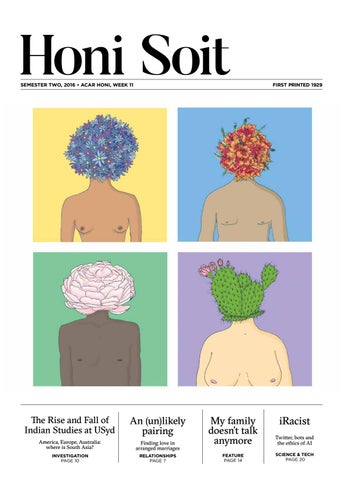
ARTISTS' STATEMENT This year's ACAR Honi is, on the whole, a curious and celebratory exploration of existing as a person of colour. It's about flourishing and growing in myriad directions. Our cover is one that reflects our desire to find new ways of thinking, doing, and finding joy, as each individual finds ways to blossom that are entirely their own. The plants on the cover are also chosen in part for their symbolism - for example, the peony has a long history in East Asia stretching back a millennium, and is a national emblem of China. The nopales, meanwhile, are hardy succulents that produce beautiful flowers and fruit despite their hardy surroundings. ACAR Honi is about thriving even when the odds are sometimes stacked against you. Disclaimer: Honi Soit is published by the Students’ Representative Council, University of Sydney, Level 1 Wentworth Building, City Road, University of Sydney NSW 2006. The SRC’s operation costs, space and administrative support are financed by the University of Sydney. Honi Soit is printed under the auspices of the SRC’s directors of student publications: Tahlia Chloe, Justine Landis-Hanley, David Hogan, Siobhan Ryan, and Michael Sun. All expressions are published on the basis that they are not to be regarded as the opinions of the SRC unless specifically stated. The Council accepts no responsibility for the accuracy of any of the opinions or information contained within this newspaper, nor does it endorse any of the advertisements and insertions.
Please direct all advertising inquiries to publications.manager@src.usyd.edu.au
EDITOR-IN-CHIEF Lamya Rahman EDITORS Nabila Chemaissem Samuel Chu Sophia Chung Ann Ding Sahra Magan Bridget Harilaou Shareeka Helaluddin Yalda Keshavarzi Angela Prendergast Millie Roberts Michael Sun Adam Ursino Radha Wahyuwidayat Elijah Abraham Madeline Ward CONTRIBUTORS Deepa Alam Fahad Ali Aparna Balakumar Stephanie Barahona Jestika Chand Aaron Chen Rameen Hayat Agnes McKingley Shahad Nomani Bridget Samaha Shivani Sankaran Esther Seo Xiaoran Shi Sarah Shin ARTISTS Jocelin Chan Nabila Chemaissem Sophia Chung Ann Ding Sahra Magan Brigitte Samaha Una Madura Verde Alexeya Mowat COVER Stephanie Barahona Ann Ding Whitney Duan SPECIAL THANKS TO Georgia Mantle Judy Zhu
forgotten in Australia’s war histories, to the scores killed by foreign disease, to every Indigenous child, adult and elder who has died at the hands of White Supremacy and to all those who continue to live in the face of it. As non-Indigenous people of colour, migrants and beneficiaries of occupied Indigenous land, it is so deeply important that we acknowledge our place in colonialism. Without introspection in how we are complicit in settler-colonialism, we cannot have a truly anti-racist movement, and without interrogating our own privilege as non-Indigenous people, there can be no genuine sense of anti-racist solidarity. We must honour the Indigenous activist history that has come before us, and the movements that continue to fight against racial injustices, and centre Indigenous voices and experiences in all that we do. Indigenous sovereignty was never ceded.
EDITORIAL Lamya Rahman It was during a school excursion to the Art Gallery of NSW that I realised I was not white. Aged eight, and rowdy as any child travelling to an exciting place miles away from their own home, a supervising teacher sternly reminded me to stay in one place. To ensure this happened, and that I did not escape to a closed-off exhibition area the minute her eyes turned elsewhere, she forced me to hold the hand of a quiet, unassuming girl in my class, the typical teacher’s pet. Already feeling incredibly self-conscious, the moment took a turn for the worse when a fellow classmate eyed our interlocked hands. With a finger pointing accusingly towards us, he said, “God, I can see her hand turning black already.” That night I came home and cried in the shower. My own secret purchase of Dove beauty bar failed to erode the thick layer of dark grime I felt clinging onto my skin. For the first time I was forced to confront the vast valley between who I thought I was and who I actually was. Race proceeded to become something I struggled with all
throughout adolescence. In stories like these, the climax usually comes during university: a period of reprieve. To an extent, that was true. A politically mobilised campus like ours is home to niches and intersections I did not yet realise I was a part of. In the politicisation of our experiences, however, race is vulnerable to becoming construed as an all-encompassing monolith: ethnocultural minorities want this, think that, and hate those. For me, there was no narrative more estranging than one that paints us all the same. Reconciling the complexities and nuances of race with the tendency to simplify our lives into consumable sound-bites has taken me awhile, but it’s undeniably been worth it. In your hands today is an edition that celebrates stories like mine, of lives and experiences informed, but not crippled, by race. While race is the source of many of our struggles, it is also the location of our formative traits, dearest stories, and most loved people. As people coming from an ethnocultural minority, our race informs, but does not single handedly define, who we are.
HONI SOIT SEMESTER 2 • WEEK 11
3
NEWS CULTURAL COMPETENCE
University of Sydney develops cultural competence project Stephanie Barahona
Cultural Competence has become quite the buzzword on campus. If you’ve walked past posters with this phrase plastered on the sandstone walls of the Quad, to the windows of the Veterinary Science Conference Centre, you might be wondering what it is all about. The University of Sydney is currently investing in research projects dedicated to embedding cultural competence as a course learning outcome and graduate attribute in every degree. Under the Strategic Plan of 2016-2020, the University aims to ‘provide meaningful learning activities that take advantage of the cultural diversity within the University’ and ‘ensure that professional programs develop cultural understanding and intercultural capabilities relevant to likely practice.’ The University of Sydney is the first in Australia to incorporate cultural competence at the tertiary level. One of these projects is being managed by the University’s new Educational Innovation (EI) team, who are currently supervised by Dr Amani
Bell and Dr Tai Peseta, two pioneering researchers in student engagement and learning in higher education. The project works in partnership with students to enhance cultural competency at this level. This year's project builds on the success of the 2014 and 2015 Sydney Teaching Colloquium student ambassadors,’ Dr Bell said. The Sydney Teaching Colloquium was a student-centred program run by the Institute for Teaching and Learning (ITL). It allowed student ambassadors to provide first-hand knowledge and experience of the demands of being a university student, in the context of assessment and cultural competence. ‘The ambassadors had fantastic ideas about how to transform learning and teaching at Sydney, so we wanted to find a way to implement those changes at a unit of study level.’ I was selected as one of six student leaders from four faculties for this interdisciplinary-based research project. We are working in collaboration with five unit academics and coordinators to evaluate the experiences of cultural competency within the following semester two units of study:
PHTY3086, ENGG2852, EDUP2009, GEOS1003 and HSTY3902. With ‘Students as Partners’ projects gaining traction across universities worldwide, Sydney is one of the latest institutions in Australia to offer students the opportunity to work alongside academics. As Dr Bell states, ‘There are academics across the university keen to work more in partnership with students to co-design assessments and learning activities, to co-produce learning materials, and just generally improve student learning experiences.’ The incorporation of cultural competence theory and practice into pedagogy and curriculum corresponds with Sydney University’s increasing self-awareness as an institution ‘well-positioned for a broad range of inbound and outbound mobility experiences,’ as described by management. It demonstrates the University’s growing interest in developing interdisciplinary-based research and developing spaces committed to working alongside diverse cultural groups within the University community.
If you would like more information or are interested in being involved in future projects, please get in touch with Dr Bell or Stephanie Barahona. Dr Amani Bell: amani. bell@sydney. edu.au Stephanie Barahona: sbar9165@ uni.sydney. edu.au
ISLAMOPHOBIA
SUMSA organises anti-Islamophobia forum Shahad Nomani
The Anti-Islamophobia Forum was organised by the Sydney University Muslim Students’ Association (SUMSA) as a response to the recent attacks perpetrated against the Muslim student community on campus, as well as a response to the deepening Islamophobic rhetoric within society. We at SUMSA believed that it was necessary to hold a forum to be able to discuss these issues in order to deconstruct stereotypes about Islam and to analyse the causes of Islamophobia and find a solution. The Islamophobia Forum began on the 5th October and will run over the next three weeks with an event scheduled for each week. The first event: “Islamophobia and the Muslim Other” was a panel discussion between academics who deconstructed the origins of Islamophobia and discussed the role perceptions of Islam played in the development of the West. The panel explored the relationship between Islam and the West and the role of Orientalism in the development of modern Islamophobia. The panel will also highlighted broader strategies to combat Islamophobia within society. The second event: “Oppressed?” will be held on Thursday the 13th October. This event will involve a panel of female Muslim academics
discussing the stereotypes surrounding Muslim women in society. The panel will explore the links between these stereotypes and wider Islamophobic rhetoric, and highlight the challenges these stereotypes pose to Muslim women. The third event, on Thursday the 20th October, is titled “Go back to where you belong!”. This event will involve a line-up of speakers from various communities that have immigrated to Australia in the past. This line-up includes speakers from the early-immigrating Greek and Italian communities, the later-immigrating Chinese and Vietnamese communities, as well as the more recently arrived Arab and Muslim communities. The event will explore the intertwining of racism and immigration in Australia’s past and their relevance to present calls for the banning of Muslim immigration. Is Australian society naturally predisposed against each new wave of immigrants? The panel will address the unique challenges faced by immigrant communities and the historical role that immigration has played in shaping Australian society. We hope to see you there to join us in these discussions. For more information about upcoming events or Sydney University Muslim Students Association more generally, visit facebook.com/SUMSASydney
International Student Graduates 485 Visa Health Insurance from $84.85 per month
✔
Meets DIBP requirements
✔ Instant ‘Confirmation of Cover’ letters ✔
Easy joining process
✔
2 free movie tickets with every join
✔
Earn $50 gift card referral fee
Get a quote Ask about a $50 gift card referral fee www.oshcare.com.au/oshcare-direct Email your name and mobile number to or email us for a quote Email your name and mobile number to 485visa@oshcare.com.au 485visa@oshcare.com.au www.oshcare.com.au www.oshcare.com.au
HONI SOIT SEMESTER 2 • WEEK 11
4
CULTURE
Light ≠ Right Millie Roberts asks, does it matter if you’re black or white? HYDROQUINONE: A chemical agent used to develop photographs. Requires a dermatological prescription in Australia and is completely banned in Europe. MERCURY: When absorbed through the skin, this toxic metal element can build up and slowly poison the body. It is also known for causing birth abnormalities. STEROIDS: Restricts the flow of blood to the skin. Can encourage the body to stop producing cortisol, otherwise known as the hormone that deals with stress levels. These are common ingredients used in many creams, soaps, lotions and serums topically applied onto the faces and bodies of millions of people worldwide. While notoriously popular in Asian countries, they are also bought by many black men and women in Africa, America, South America and Australia. In Kenya, it’s called ‘kutoa tint’, Ghana, ‘nensoebenis’, South Africa, ‘ukutsheyisa’ and in Senegal, ‘caco’ – all lingo for the act of applying bleaching agents to the skin to physically lighten the appear-
ance of melanin. Despite being marketed to treat hyperpigmentation, freckles and scarring, skin bleaching products are increasingly being used to whiten skin tones altogether. The most concerning thing is that the long-term effects of skin bleaching products are still unknown. Prolonged use has so far been associated with body odour, swelling, infections, as well as kidney and liver failure, and it has been proven that these chemicals repeatedly penetrating the epidermis lead to sun sensitivity, and in extreme cases, skin cancer. While more natural ingredients are increasingly being used in these products, their risky alternatives are often masked under a multitude of different names or are not fully disclosed on the packaging. The desired effects are not immediate and can only be sustained by using the skin bleachers indefinitely to avoid re-pigmentation. In June, American rapper Azealia Banks was heavily criticised for using controversial bleaching cream ‘Whitenicious’. She claimed that it was no different to cosmetic surgery or
wearing a weave – just another form of “assimilation” in a Western world. Back in Australia, however, it is just as easy to find similar products. Sephora advertises high-end versions for around the $100 mark. At an International importer near the University, I ask whether there is high demand in Sydney for the products that take up nearly four rows of their stock shelves. The sales assistant nods, eyes widening as if it is an obvious question. Most of the packaging of the items sold in her store are all brightly coloured and don buzzwords such as ‘milky’ and ‘pretty’. One brand is aptly named ‘Fair and White’ and has the tagline “so white!”. Some of the models on the front are photoshopped to appear lighter, while others appear ethnically biracial. Both of these marketing choices are aimed at consumers with far darker skin than the girls chosen to advertise them. On the skin colour spectrum, it is seen as more disadvantageous to be darker in most Western countries, where discrimination based on racial complexion is rampant. When
a person resorts to tampering with their natural skin colour, they do so for reasons beyond personal insecurity and medical necessity: they use them for perceived gains romantically, economically, aesthetically and socially. As Azealia Banks pointed out when justifying her beauty choices, there is a difference between ‘bleaching’ and ‘whitening’ products. However, the accessibility of these pots,
tubs and bottles provide a gateway from small touch-ups to full-blown identity erasure that perpetuates that ‘light is right’. When it is easier to alter your skin tone than change the way you are treated because of it, skin bleaching is perceived to offer the key to happiness and success. But with the damaging health risks and racist undertones that come with it, what is the true cost?
Art: Brigitte Samaha
FOOD REVIEW: The Laksa on Campus is Clearly Catered To White People. This is Problematic and it NEEDS TO STOP. Aaron Chen food reviews? You can get a killer laksa on campus at the little café (I forget the name) just past the little bridge you go on to get into the university, if you’re walking from Redfern. The little one near the big green lawn, I’m not sure if it’s called anything. The lawn has those weird art-meets-furniture chairs on it which are comfy to lie down on if you have a class on that side of campus. I haven’t had a class on that side of campus since semester one. I really try to keep all my classes in between Eastern Ave and the Footbridge; this saves me a lot of time and means that I don’t have to rub shoulders with people who eat at Subway. I also get really mad going to that side of campus because I see a heck of a lot more longboards around, and it would bring a tear to Anthony Hawk’s eyes seeing so many longboards around. But I guess he wouldn’t mind too much if there was money in it for him. (Yes, I am trying to say that he’s a corporate sell-out) But I’m really going on a tangent right now. The café is just near all those science buildings and near the Co-Op. In my frenzy, talking about the lawn, I totally forgot to mention the Co-Op, which is a
recognisable and essential utility to most students at USyd (we’ve all got to read books to pass our degrees). And if you don’t already know, you should purchase your books and novellas online before you go into the Co-Op, otherwise you’ll be lining up like a schmuck. One time I walked right past the line because I did exactly this and I felt like one of the biggest celebs like Tom Cruise or Ted Cruz. Everyone of the staff members at the Co-operative loves me because of my forward thinking and preparedness. Nothing can touch me. I am the son of a long line of kings who don’t like to line up in long lines. (Gosh darn, that is the best sentence I ever wrote, frame it Honi Soit). But I digress, the Cafe that I’m talking about is next to the Co-Op. The glassy rice noodles, the spicy yet creamy broth, the prawns and tofu hanging out at the top will all sit nicely on your palate (if you are white!! This is food for white people and needs to stop. MISO HONI MISO HONI MISO HONI MISO HONI) Art: Brigitte Samaha
Thank you.
HONI SOIT SEMESTER 2 • WEEK 11
5
CULTURE
Ue o muite arukou Angela Prendergast on the bizarre story behind America’s favourite karaoke song The US Billboard Hot 100 charts has been ranking music since 1958. The current number one track, as of 4th October 2016, is The Chainsmoker’s ‘Closer’. However, this article isn’t about the song ‘Closer’; it’s about a song that, unforeseeably, climbed its way to the top of the charts in 1963. In 1952, Japanese lyricist Rokusuke Ei, on the walk home from a failed student led protest against US Army presence in Japan, penned the lyrics to a song.The song - later titled “Ue o muite arukou” - reflects a widespread feeling of helplessness during the American occupation of Japan, painting a
bittersweet story of a man persevering in the face of adversity. As the famous line goes: “I look up to the sky, so my tears don’t fall”. It’s of no great surprise that “Ue o muite arukou” became popular in Japan when it was released in 1961. But in 1963 only two years later - the song resurfaced onto the American music scene and went on to occupy the top spot in the Billboard charts. The irony here is obvious. It becomes even greater when we realise “Ue o muite arukou” is the only Japanese-language song to find its way into the US pop scene. As one of the earliest cross cultur-
al language debuts, the fame of “Ue o muite arukou” paved the way for the more modern cult hit “Gangnam Style” - which upon its own debut in 2012, never graced the top spot as it battled with Maroon 5 for weeks. Another win for Western music. However “Gangnam Style” entered the charts with a name true to the lyrics it spoke. Rokusuke’s song, upon entering the American music market, had a slight change of title. “Ue o muite arukou” (“I’ll look up and walk”) was changed to “Sukiyaki” as it travelled from the Pacific to American shores.
For those that haven’t ventured past the California Rolls section of the menu at your local Japanese restaurant, Sukiyaki is a Japanese hot pot dish. “Ue o muite arukou” doesn’t touch the topic of food at all. Perhaps the song would’ve travelled wider around the world if it’s title had been even more relatable; perhaps something like Sushi? English covers in the late 60s and 80s continued to transform the song. It made its way into the backgrounds of American shows such as Malcolm in the Middle, Mad Men and Charlie’s Angels. One famous cover, performed by a trio called ‘A Taste of Honey’, reached number 1 on
the Billboard R&B and Adult contemporary charts in the 80s. Samples from this version featured in songs by the likes of Snoop Dogg and Missy Elliot. What had started as a song arising from the struggles of occupation somehow found its way onto the iconic West Coast hip hop album ‘Doggystyle’. The bizarre journey of “Ue o muite arukou” escapes Rokusuke’s original intentions, however the love it’s gained internationally is undoubtable. One can search endlessly for an answer as to why, but perhaps top Youtube commenter Edward Guzman puts it best:
On Primitivism, by a Primitive Madeline Ward has a lot to say about her art history major I’m currently taking a first year introductory course to modern art history. I approached the semester with a little trepidation – I had technically taken this course before and had vaguely bad memories of studying a light amount of primitivism in relation to other modernist art movements. But I figured that the semester was only 13 weeks long, so how bad could it possibly get? I’d like to specify that I don’t entirely hold my lecturer or tutor accountable for what follows. Both are incredibly intelligent women, esteemed academics, and Good White People. They tend to avoid talking about primitivism with any kind of depth in our classes, rather using it as a way of understanding the works that we study. It’s easy to label this as unintentional racism, and perhaps it is, though the lack of intent behind the action doesn’t lessen the pain felt when my fellow students label entire cultures, including my own, as primitive. A strong urge to reinvent my reputation as an Angry Brown Woman™[1] this semester led me to largely try and ignore the racist overtones of all the literature I was reading. This was working relatively well, as I tried to keep the political comments to a minimum and to think of things in terms of their ‘historical context’. It was raised in a tutorial that we should think of
Picasso and his ilk as products of their time, and I wholeheartedly took this advice. This is, academically speaking, bullshit. Take, for example, Pablo Picasso’s Les Demoiselles D’Avignon. The faces of the two women in the right of the painting are taken from ritu-
al masks stolen from African civilisations and are intended to represent savagery, evoking disgust in their viewer. These masks wound up in the art trade and the European consciousness after being thieved, and thus the painting forces the eyes of the viewer to rake across the bodies of the women,
seeing them as savage sexual beings. How then can we study this painting, without considering the racist structures it is crafted on? The real kicker in all of this is the lack of representation of these cultures’ art histories within the curriculum at the University of Sydney. The
broader discipline is full to the brim with great academics that study many and varied kinds of art history, so it’s not as if this kind of racism is encouraged by the wider community. It is one thing to see your culture sexualised, dehumanised and exotified by a laughably limited Western understanding of it, but to see no representation of it on its own terms is heartbreaking. The many cultures from which modern artists drew their inspiration have their own rich art histories and traditions. It’s time we treated them with the same respect we award the white artists that exploited them. Art History is my greatest love and I passionately believe that the department at the University of Sydney is full of good intentions and excellent academics. I also believe that my greatest love can be a racist piece of shit, and it’s up to the teaching staff and students to change this. [1] A very brief moment of selfdoubt and internalised racism led me to believe that I would not achieve academic success or art history superstardom by constantly questioning racism. This was silly, and also made for a very boring first week of tutorials. Madeline Ward is a proud Maori woman and 3rd year student that is still completing her first year of an arts degree. Her favourite artist is Paul Gaugin. She acknowledges the irony of this.
HONI SOIT SEMESTER 2 • WEEK 11
6
CULTURE
CW: SEXUAL ASSAULT, PAEDOPHILIA, DOMESTIC VIOLENCE
Megalia: Feminists of South Korea Sarah Shin on a growing online feminist movement South Korean culture has historically been based on patriarchal, Confucian values, which place an emphasis on women serving their husbands and being “seen but not heard”. Women’s rights in South Korea have declined further in recent years. A glimpse into current South Korean culture reveals popular online games where women are intensely objectified, countless incidents of sexual harassment and assault, a growing consumer base of paedophilic porn, domestic violence and murder of women. The need for women’s rights is all the more urgent in the face of draconian limitations to freedom of expression, including heavy-handed defamation laws and a powerful government. It is difficult to speak out against misogyny offline, as women are often ruthlessly shamed for doing so. As such, women turn to social media to express their feminist views, and those who do participate in in-person protests often wear masks to hide their identity. Megalia is one of the most well-known, explicitly feminist websites in Korea. Individuals who support Megalia, or “Megalians”, have experienced extreme backlash ranging from “only ugly girls are Megalians” to “Megalia isn’t real feminism”. Nevertheless, the website is an example of how online culture provides a safer space for the South Korean feminist movement. The Megalian community has grown and spread onto different forms of social media, giving women space to express and protest their views especially against well-known revenge porn sites with the help of online anonymity. However, this activism doesn’t come without consequences. Individuals who identify as feminist often prefer to use aliases, as Korean women who outwardly identify as feminist can receive death threats and be unfairly dismissed from their jobs. “Summer” is one such person, a well known car-
toonist who includes feminist messages in her work. “Blue Moon”, “Del”, and “SWAN” run a feminist page on Facebook, and keep their identities anonymous to protect their safety. Blue Moon tells me that online feminism is definitely a starting point for the South Korean feminist movement, as the anonymity of an online persona helps people express their opinions more freely. Within the Megalian community, there is debate over the influence of Western feminism on South Korean feminism. As feminist texts are uncommon among Korean authors, those interested in feminism often end up reading feminist texts in the North American context. The biggest difference between South Korean feminism and Western feminism, according to Del, is that Western feminism argues that “women should not be treated like dolls” while Korean feminism argues that “women should not be treated as slaves”. Part of the online movement's methods to engage men and a wider audience is a controversial practice called "mirroring", where men are mistreated for their gender in the same way women are. A variety of feminist websites make fun of men for their (lack of) sexual desirability, their looks, and their shallowness. Some examples of mirroring used by these websites include posts that proclaim “men are sluts”, and “Korean men’s penises are only 6.9cm long”. Some men argue this is misandrist. Blue Moon believes that mirroring is an “effective tool, particularly as someone who believes in the importance of standing in other people’s shoes to understand them”. Del agrees, saying, “When people were engaging in “nice” feminism, no one paid attention to it”. This rings particularly true when considering that feminism has only recently been brought to the attention of most Koreans, and women’s rights are rarely
addressed or handled with complacence. The discussion of intersectional feminism is also slowly developing in South Korea, especially in relation to its notoriously queerphobic and racist history. South Korea does not have laws against discrimination based on race or sexuality, as it projects the image of being a largely monocultural state. Laws do not guarantee an end to discrimination - proposals to amend the Racial Discrimination Act in Australia illustrate this - making intersectionality in feminist activism even more important. Summer says that it would be “self-contradicting” for feminism to not include other minority rights. Blue Moon emphasises that “feminism should come before humanism” in the way that “Black Lives Matter” is more important than “all lives matter”. Korea is not the subject of international scrutiny when it comes to women’s rights, due to its image as a ‘developed’ Asian country, but as Blue Moon says, “It is important to let people in other countries know that rights within Korea have not been promoted alongside economic development. Koreans only tell foreigners about the positive things about Korea because they are too ashamed to talk about the negatives, but this plays a huge role in hiding the reality of Korean misogyny.” Social media may have helped spread misogynistic views; providing spaces where Korean women are slut shamed, derided, and depicted as money grabbing and shallow. However, it has also helped grow Korean feminism and spread feminist views in an unprecedented way. Social media, and in particular Megalia, has enabled people to come together in their activism, giving an anonymous and safe outlet to promote women’s rights in South Korea.
Students’ Representative Council, University of Sydney
MEETING OF THE REPRESENTATIVES-ELECT OF THE 89th STUDENTS’ REPRESENTATIVE COUNCIL A meeting of Representatives-elect of the 89th SRC will be held on Wednesday 19th October, at 6pm in the Professorial Board Room (Quadrangle). The following positions are open to nomination from members of the undergraduate student body: Vice-President
Two Residential College Officers
General Secretary
Two Sexual Harassment Officers
Education Officer
Two Social Justice Officers
Wom*n’s Officer
Two Standing Legal Committee members*
Two Disabilities and Carers Officers
Two Student Housing Officers
Two Environment Officers
Two Welfare Officers
Two Ethno-Cultural Officers
Chairperson of the Standing Legal Committee
Two Global Solidarity Officers
Six Directors of Student Publications
Two Indigenous Students’ Officers
Orientation Committee
Two Inter-Campus Officers Two Interfaith Officers
The following positions are open to nomination from representatives of the 89th Council:
Two International Students’ Officers
Five Executive members
Two Inter-Campus Committee members*
Two Mature-Age Students’ Officers Two Queer Officers Two Refugee Rights Officers
*must be a member of council. To be considered you must be either an elected representative, an office bearer an ex officio member.
Authorised by Julia Robins, Secretary to Council, Students’ Representative Council, University of Sydney Phone: 02 9660 5222 | www.src.usyd.edu.au | Level 1, Wentworth Building, City Rd, Sydney University.
Positions in italic cannot be shared (SRC Regulations Part One Section 3d). All other positions may be split ONCE only (Part One Section 3c). Nominations shall be taken from the floor at the meeting. However, nomination forms may be obtained in advance from the SRC front office or downloaded from (http://srcusyd.net.au/wp-content/ uploads/2014/10/Reps-elect-nomform.pdf) Descriptions of positions are found within the Regulations of the SRC available on the SRC website (http://srcusyd.net.au/about-us/constitutionregulations/) Note: Part One Section 4b. states: Where an Officer position is split and shared between two members of the student body it shall only be considered held by a woman, for the purposes of Part 1 Section 4 (a) of the Regulations, if both of the joining members of the student body do not identify as cis-males.
HONI SOIT SEMESTER 2 • WEEK 11
7
RELATIONSHIP
Artwork by Una Madura Verde
An (un)likely pairing Aparna Balakumar has a long hard think about happily ever after My thatha sways back and forth, perched on his rocking chair out the front of his home in Chennai. 82-years-young, the oasis he has built in the middle of sticky South India remains his favourite corner of the world. My paati sets a steaming hot cup of filter coffee by his side. He nods in acknowledgement and she takes a seat beside him. They ponder the universe in silence; continuing a story that's been in the works for over half a century now. I have just turned twenty: the same age my paati was when she had an ‘arranged marriage’ to a man ten years her senior. At the time I am learning how to manage my own laundry and finances, my paati was learning how to manage an entire household. It was 1964 when her parents asked her how she felt about a man who would soon become her world. It seemed a solid match. They were raised with complementary value systems: both Hindu, similarly educated, and pure vegetarians. All the enquiries her parents made about his family checked out positively. But beyond that they shared similar interests and life goals; not yet so stuck in their ways that they could not accommodate for the other. And while my paati blushes recounting the day’s events, she can’t help but let slip that he “looked very handsome” too. A wedding date was set. Vows were exchanged. A home was bought. Then, they fell in love. This timeline often perplexed me. How could you take such a leap of faith without having exchanged words with this man, I’d interrogate? Where were the grand gestures? The elaborate proposal? The butterflies in your stomach before each date?
My insistence in trying to box my paati into a caricature of a woman ‘forced’ into a marriage by those around her was founded in a narrow perception of love - one I’d unintentionally subscribed to. In Australia, where dating and courtship was the norm, there was so much negativity and shame behind the words ‘arranged marriage’ that I pretended it wasn’t part of my family’s history. When peers would mention how ‘cute’ my grandparents were together or ask how they met, I would always change the topic.
A wedding date was set. Vows were exchanged. A home was bought. Then, they fell in love. Every time I stayed silent, I diminished their love story just because it hadn't played out like any of mine. When I berated my paati for bringing my thatha his coffee when he was perfectly capable of making it himself, I underestimated the autonomy she had within their relationship. When I asked her if she regretted not pursuing her singing career for the sake of raising a family, I assumed her marriage was the beginning of the end, rather than her finest accomplishment. Why? Just because it didn’t fit into the Western narrative I had bought into, telling me how ‘true love’ should begin? Because they didn't follow the ‘right’ path, the ‘white’ path, the ‘expected’ order of events?
I forgot that she could say no. The first time I listened instead of shutting her down, my paati explained that ‘arranged’ and ‘forced’ marriages are worlds apart. One involved family putting forward suggestions, while the other was imposed. The ball was always in her court as much as any suitor’s, she said. If she didn’t feel sparks, her parents would ask no questions. Long-term compatibility was the priority, not rugged good looks and charm. She wanted to be sure she could effortlessly slip into her new household with minimal hiccups; acutely aware her marriage was a pairing of families as much as it was a union she was solely entering into. The (un)likely pairing worked. Fifty-two years in and they cannot function without the other; so intertwined are their beings. They drive each other mad, but are each other’s fiercest supporters. She stays up worrying his sharp tongue will get him in trouble. He is front and centre in the audience at all her concerts. Recently, they renewed their vows. While the candles on their birthday cakes are adding up and their hair gets a little greyer with each passing day, family remains the cornerstone of every breath they take. As I step onto the balcony, hearing them banter in Tamil over the rickshaw horns below, I realise this will never be the kind of romance Hollywood blockbusters are based on. It’s too effortless and unassuming for that. A marriage like theirs wouldn't have worked out for everyone. I'm not sure it could ever be for me. But I will downplay the life they have built no more.
HONI SOIT SEMESTER 2 • WEEK 11
8
ANALYSIS
Stop protesting our protests Sahra Magan thinks protests are supposed to be offensive The burden of the brutalised is not to comfort the bystander Jesse Williams The self-righteous criticism that inevitably follows a protest is to be expected. After all, it is only natural that those who benefit from the systematic oppression of others would consider protests against the status quo an existential threat. In the wake of recent protests against a proposed ban on access to abortion in Poland, I could not help but notice the stunningly predictable responses of old, white men: the usual culprits. The particularly banal comments of the foreign minister, Witold Waszczykowski, ‘Let them have their fun...dressing up [and] screaming silly slogans and vulgarities’, reflected the trite brand of paternalism that privileged members of society use to undermine the objectives of social protests. A stronger variation of this sentiment was made by Kate Upton via tweet in the wake of
the Colin Kaepernick ‘anthem’ protest: ‘Protest&speak ur mind whenever u want but during the 120secs you should support the people who protect our freedom (sic)’. Upton’s tweet reflects the increasingly reactionary criticisms of black protest in social media spaces. For black people, there has never been
knee do not pass this litmus test of inoffensiveness, much in the same way that the Birmingham marches shook white America fifty-three years ago. In Australia, the ‘divisive’ label given to Indigenous players’ calls to boycott the national anthem at the AFL grand final, stem from a similar kind of respectability
Protests are the most poignant visual representations of social activism and dissatisfaction. an appropriate way to protest against a society which was built upon, and whose prosperity now hinges on their systematic disenfranchisement and oppression en masse. To many who profess to tolerate black protest, this acquiescence extends only to expressions that do not offend white sensibilities. The imagery of a rattled North Carolina and Kaepernick on bended
politics. By focusing their grievances on the form of protest instead of the underlying social message, critics such as Waszczykowski and Upton mask their opposition to women’s reproductive freedom and tacit support of police brutality against African-Americans. By attacking the respectability of protesters through feigned outrage about ‘vulgarity’ and disrespect to the
national anthem and veterans, these critics place themselves in a morally superior position. Within the social media ‘conversation’ about race, the #alllivesmatter umbrella of dispirited non-black Americans embodies these attempts to detract from the aims of black protesters. Their ‘criticism’ is no more, however, than an attempt to derail the necessary conversation about racial inequality in America. Protests are the most poignant visual representations of social activism and dissatisfaction. The women who took to the streets of Poland to demand autonomy over their wombs, did so in faith that their society, when challenged, could evolve. The initial success of the protest in Poland reflects the social utility of protest as a means of social change. The role of protesters is not to appease the society that is perpetrating injustice, but rather challenge and - where necessary - offend the principles of a society that
must be transformed. If privileged critics were as ready to protect human beings from injustice as they are to defend (rarely implemented) ideals of national pride and respectability, their criticisms would not be as transparent and evidently hypocritical.
branch is doing no better. A rise in corporate funding through ‘corporate partnerships’ has led to an increase in business investment from ~$6.5 million in 2009 to ~$37.6 million in 2013. Once again, an entanglement of interests led to a conflict of values and gross compromise. In late 2013, British Gas’ role in environmental deg-
contract held between the two entities. Divergence between funding sources and an organisation’s stated aims is often reflective of an income-maximisation strategy - a classic by-product of neoliberalism. If the research here has shown anything, it’s that global development agencies, even when anchored in
$ave the children
Shivani Sankaran questions the charity of charitable organisations
In August 2016, Ramesh Fernandez, on behalf of RISE: Refugees, Survivors and Ex-Detainees, wrote an open letter detailing accounts of assault experienced by refugees in Nauru and Manus Island. A salient part of the letter was Fernandez’s accusation that the Australian branch of the global non-government organisation development agency, Save the Children (which works directly in offshore detention centres), had been withholding key evidence from the Human Rights Commission. This is not the first time the Australian branch has faced such allegations. In 2015, Paul Ronalds, the Australian branch’s chief executive, was forced to publicly dismiss similar claims that had arisen out of the widely topical Moss Review. Ronalds, in response to findings in the Moss Review accusing Save the Children of coaching asylum seekers to self-harm, stated that the claims were absurd and
baseless. But there is evidence that the claims were neither. When a development agency is implicated twice in allowing the ongoing abuse, sexual assault, and torture of asylum seekers, we must stop questioning the claims, and instead start to question the agency itself. And it is in such analysis that
Department of Foreign Affairs and Trading, which not only provides for 26% of Save the Children’s total annual funding, but also, as of 2016, provides $21.2 million dollars of “aid” to offshore detention centres. An inherently paradoxical relationship, the inevitable merging of agendas between these two entities provide a possible rea-
When a development agency is implicated twice in allowing the ongoing abuse, sexual assault, and torture of asylum seekers, we must stop questioning the claims, and instead start to question the agency itself. Save the Children Australia’s insidious economic strategy is revealed. Save the Children Australia’s policies, as explained on their website, are admittedly “designed in close collaboration with government ministries.” One such ministry is the
son for Save the Children Australia’s failure to disclose allegations of child abuse in Nauru and Manus Island to the HRC; implicating them in a pervasive culture of secrecy surrounding Australia’s immigration detention policy. Save the Children’s UK
radation and surging fuel prices were at the centre of widespread public criticism. Leaked emails between Save the Children and British Gas reveal that the former organisation had intended to submit a condemning press release, but withdrew it following consideration of the £1.5m
aims of social justice and activism, cannot escape neoliberalism’s pervasive influence. Through corporate and state ties, Save the Children have moved away from non-capitalist altruism and closer to a culture that looks disturbingly similar to imperialism.
HONI SOIT SEMESTER 2 • WEEK 11
9
OPINION
Unpacking the model minority myth Bridget Harilaou explores the narratives of migrant success The migrant narrative is often painted as universal: a migrant moves to a new country in search of a better life. Through hard work, they move up in social class and give their children the life they never had. Narratives around migration rarely interrogate upper-middle class communities, whose ability to search for a better life is a luxury. My mother came from a middle class Chinese family in Indonesia, who paid for her to study at University in Australia. After a number of years in tertiary education - financed mostly by her family - she married an Australian citizen and became a citizen in 1996. Has my mother faced racism? Yes. Did she work hard? Of course. But what underpins her story and that of other middle class migrants is their economic privilege. On the back of skilled migration requirements and the rising application costs for Australian residency, 'model minority' success stories ignore the privileged status of many middle class migrants. When I was seven, I was placed in a tutoring centre called ‘Pre-Uni’. Even before I lost my front teeth, going to University was a certain future. By age 17, I had a vocational degree (AmusA) in piano performance and a straight-A average; the pressure to achieve highly was part of the path of ‘success’ my mother foresaw. In middle class Chinese communities, ‘success’ is often measured by rising class
status. Social mobility is supposedly the result of ‘hard work’ and ‘commitment’. Through this narrative, we blame poverty on a lack of hard work, justifying the gap between rich and poor and failing to acknowledge the everyday barriers faced by working class and Indigenous communities.
The pressure to achieve highly was part of the path of ‘success’ my mother foresaw. Migrant economic success cannot simply be attributed to ‘hard work’. For both the 70 million people in Indonesia, and the 14% of Australians living below minimum wage, poverty is an immeasurable roadblock. Higher education, full-time employment and sufficient healthcare are completely out of reach because of systemic disadvantage and cycles of poverty. As migrants and people of colour attempt to deconstruct racism, we must acknowledge that one of the main ways it manifests is through poverty. The basis for the vast amount of racism in Australia is a lack of access to edu-
cation, healthcare and class-based discrimination. Upper middle-class migrants often contribute to racial inequality through the pursuit of economic success. From climbing the corporate ladder, to exploiting ethnic workers in their businesses, they give power to White supremacy to protect their economic interests. As African-American feminist scholar bell hooks writes in her book Where We Stand: Class Matters, “While all our rage at racism is justifiable, it undermines anti-racist struggle and the call for social justice when well-off Black folks attempt to create a social context where they will be exempt from racist assault even as the underprivileged remain daily victimised.” The same principle applies to middle-class migrants and people of colour in Australia. Anti-racism should not be limited to fighting microaggressions and arguing for higher PoC representation in corporate positions. Without a commitment to Indigenous liberation and class struggle, the bland politics of complaining about White privilege begin to ring hollow.
All the world's a stage (if you're white) Anonymous takes a look at the exclusiveness of MUSE and SUDS In June 2014, playwright Andrew Bovell opened the National Play festival by lamenting the lack of diversity in the Australian theatre scene. Bovell claimed that the Australian performing arts scene ignored multicultural stories, didn’t practice colour-blind casting and refused to explore issues of race in productions. University institutions are often looked to as bastions of radical change, but you don’t have to look further than the University of Sydney’s performing arts clubs and societies to see Bovell’s point. The University Musical Theatre Ensemble (MUSE) has long been criticised for putting on older musicals with racist undertones, and having a history of only voting in predominantly Caucasian-led shows. In 2014, the society put on a major production of Cole Porter’s 1930 classic musical Anything Goes, including the uncomfortable racist Chinese caricatures, performed by Asian artists. This
year MUSE’s major production was Legally Blonde, another largely Caucasian-led show. The production had an actress play an African princess at Harvard University, despite the actress not being of African descent. It’s worth noting that Legally Blonde was in competition for election with Broadway musical Parade, which dramatizes the trial of a Jewish worker during the American Civil War; heralded as a powerful show in dealing with anti-Semitism in the South. MUSE has long argued that musicals with racially diverse casts are difficult to show because of the few people of colour within the society’s membership. On the suggestion that they put on a low-budget version of Elton John’s Aida, a MUSE executive member replied that it would not be voted in because of the need for a big ethnocultural cast which was “missing” from the club’s membership. On the same topic, a member of the
society commented that the few ethnocultural members of the clubs had poor singing abilities anyway, and as such the White members of the club were more suited for lead roles. Much of the issues with MUSE are further exacerbated by the fact that the society chooses ‘safe’ shows to perform and doesn’t take risks; a view that led to a troubled Spring Slot election this year which saw an internal fight within the club. The Sydney University Dramatic Society (SUDS) has similar issues with diversity. In January, the society put on the student-written Silver Tongue, a period drama set in 19th century colonial Australia. Indigenous Australians were mentioned twice in the dialogue and each reference portrayed them negatively. The play failed to explore the issue of colonial attitudes toward Indigenous people, and the use of slurs served no purpose other than to perpetuate racist stereotypes.
SUDS has also faced criticism for using African American Vernacular English in descriptions for casting calls and in event descriptions online. On more than one occasion an audition event has referred to “non-White” or “people of colour” being required for certain roles, including in audition postings for SUDS’ The Closed Doors and A Freshwater Gentleman. The Closed Doors, though featuring a diverse cast, was directed by an all White team. Last year in SUDS, an executive member specifically congratulated a director for including people of colour in their cast as it was said that “It’s hard to cast Brown people”, and on another occasion a producer was commended for being “the second person of colour to pitch at SUDS.” These instances of racism, and countless others not captured here, prove that there is a long way to go in changing the culture of performing arts
on campus into a safe space for ethnocultural artists. The predominantly White membership of MUSE and SUDS must promote diversity within their clubs by rethinking their choices of shows, and how roles are advertised among their actors. Without providing more opportunities for ethnocultural actors, students of colour will avoid campus performing arts, much to the detriment to our university. It’s time for these societies to acknowledge their failings, for the sake of all performers of colour on campus.
HONI SOIT SEMESTER 2 • WEEK 11
10
INVESTIGATION
The Rise and Fall of Indian Studies at USyd
Artwork by Alexeya Mowat
Radha Wahyuwidayat investigates the disappearance of a sub-continent In the mid-70s, Dr Soumyen Mukherjee could be seen gathering his students under the jacaranda tree in the Quad for their weekly tutorial on ‘India in English Literature’. Teaching under a tree was custom in the gurukuls of ancient India, the guru leading his students to shade, not far from the house they shared together. My dadu - my grandfather - with the historian’s penchant for continuity, planted the ritual in a sandstone corner of Sydney University. At nights, he lectured in the evening school, established for students who had missed out on higher education. As though to confirm their underground status, an oblivious caretaker would switch off the lights at 8pm, plunging them into darkness mid-lecture. This happened several times, until someone fell down in the dark, and the sheepish caretaker received an earful of lambast from Soumyen. Despite the less-than-glamorous air, the lectures were lively. Dozens of students spilled in at 7.15pm, carry-
ing nuts and chips and bottles of cheap wine. The room was peppered with the usual night-school ilk: mature-aged students who flocked to study after Whitlam abolished tuition fees, full-time mothers who shook away their exhaustion with an intense focus, schoolteachers rushing in from their day jobs. These women engaged in intense debate, the conversation overflowing like the occasionally spilled glasses of red.
In the late 70s and early 80s, Indian Studies had seemed poised on the brink of promise. Now it had disappeared almost completely, like a water lily submerging right before bloom. They studied comparative histories of Victorian England and Bengal. Compared ancient and medieval India with Europe, Australia and the Middle East.
They traversed the streets and probed the homes of colonial Calcutta and Bombay. Topics ranged from the feudal to the nationalist, the Mughals to Gandhi. The history of India pulsated off the walls, bearing down on them in all its social, cultural and economic dimensions. South and Southeast Asian studies were flourishing in universities across the country. For students of the ‘hippie’ generation, India was a fashionable major. Internationally, Australia was looked to as a thriving hub for research, laying crucial groundwork in many disciplines. The tide was rising against Orientalism; imperialist scholarship being split open and dissected by postcolonial theory. These stories from my dadu lived in the recesses of my memory when I came to the university. They grew louder as I sat in lectures on European, North American, and Australian history. Where was South Asia? The Indian Sub-continental Studies Department offered a Sanskrit major, but no modern languages. And, though Asian and Buddhist Studies covered aspects of Indian religion and culture, colonial, postcolonial and contemporary history was scant. In the late 70s and early 80s, Indian Studies had seemed poised on the brink of promise. Now it had
HONI SOIT SEMESTER 2 • WEEK 11
disappeared almost completely, like a water lily submerging right before bloom. I did what any History student would do and (on my dadu’s advice) consulted the archives. * The beginnings of Indian studies arrived in 1866 with the appointment of a Reader in Oriental Languages and Literature, the first department of its kind in the country. Wazir Beg was a Maharashtrian who had converted to Presbyterianism as a young boy, learning the Semitic languages in the hopes of doing missionary work, and instead becoming a scholar. Asian history would not emerge until 1917, born in the tumult of WWI. The Department of Defence, fearing Japan’s imperial ambitions in Asia, selected Sydney as the place to establish Japanese Studies. Army officers trained as experts in the language, translating intercepted communications and advising the government on Japan’s objectives. Soon after WWI ended, Japanese Studies merged into a new Oriental Studies department, with the addition of Chinese Studies. From 1945, Professor Marjorie Jacobs was at the forefront of attempts to expand Indian history. As part of British Commonwealth history, she taught colonial history courses which included Papua New Guinea, India and some African countries. When Soumyen arrived from London in 1971, there were five people teaching Indian history, but only he knew any Indian languages. Sanskrit was taught elsewhere in the Ancient Greek, Classics and Indonesian departments. From 1974, he began a movement to establish a Department of Indian Sub-continental Studies. “Although we had departments teaching almost all European languages - ancient and modern - and some Asian languages - Japanese, Chinese and Indonesian with various regional languages - classical and modern - there was no department to serve the languages of the subcontinent of India”, Dadu tells me in his Camperdown flat. It’s raining outside, his living room warm from the heater. In 1962, a committee had recommended establishing a Chair of Indian Studies, along with one or two lectureships. In 1974, the new Indian Studies Committee submitted a Faculty Report to the Senate to raise the idea again.
At the ceremony, a staff member asked him rather pointedly, “Why would you study Calcutta when you’re in Sydney?” Taken aback, he muttered something about it being one of the oldest cities in the world. There was unanimous agreement among the committee members that a department should be based on language, with Hindi-Urdu and Sanskrit at the core. Advanced students across disciplines could study other medieval and modern Indian languages. Soumyen imagined his students pairing modern languages such as Tamil, with regional histories like that of Tamil-Nadu. The Senate endorsed the recommendation in principle; a motion that was seconded by then Vice Chancellor, Bruce Williams. However, it was never implemented. Perhaps the last lines of the meeting minutes reveal something in the way of what happened: “Mr Brimaud said that… in light of the general problem of the declining interest in teaching of foreign lan-
11
guages… a strong case could perhaps be made for developing existing studies in Chinese, Japanese and Indonesian and Malayan… The motion was put and carried on the understanding that the problem alluded to by Mr Brimaud would be noted”. “They thought you didn’t need an Indian language to teach Indian history”, Soumyen says. Much of the secondary literature on India was written in English by Indian scholars from the 1850s onwards. There was a sense among historians of his generation that they could get away without language. A few years after the proposal was rejected, Soumyen was shortlisted for a Chair in History. At the ceremony, a staff member asked him rather pointedly, “Why would you study Calcutta when you’re in Sydney?” Taken aback, he muttered something about it being one of the oldest cities in the world. (Having had forty years to mull over the perfect comeback, what would he have said? “Why do you write about Plato when you’re in Sydney?” He says it with a half-hearted relish, like throwing a stone into a shallow ditch). Despite these barriers, the committee held fast to their vision for an Indian language department. In 1978, academics from Anthropology, Indian and Indonesian Studies established an interdepartmental committee to teach Sanskrit and Indian cultural history in second-year Arts. In 1982, they expanded into second and third year courses on Bengali, Hindi, and Indian history, literature and culture. Six years later, a Centre for Indian Studies was recommended to the Senate by Vice Chancellor, John Ward. Now-Associate Professor Mukherjee was appointed Director of the Centre, establishing teaching in Bengali, Hindi, Urdu, Tamil, Sanskrit and Pali. In 1991, the Centre became the Department of Indian Subcontinental Studies and merged with other departments into the new School of Asian Studies. This School was later amalgamated with the School of European Studies into the School of Languages and Cultures. Professor Chris Hilliard, Chair of History, tells me that, although it was before his time, he understands, “There was a decision when they created the SLC and put all the language departments together, that Asian history generally would belong to the SLC. And that was the case for a long time. So you ended up with a history department whose main strengths were European history, North American history and Australian history, and that was basically it”. Hilliard suggests the rationale behind this was, “Let’s try to build outwards from what we’ve got. There was already a critical mass of people, and a tradition of good work being done, in those areas”. This decision architected the bones for the current makeup of the History Department. The consequence for students is that, unless they have already signed on to an Asian language major, they are unlikely to come across Asian history (with the exception of China). Hindi persisted in the Indian Subcontinental Studies department until 2010. “We taught ANU students Sanskrit by teleconference, and their lecturer taught students Hindi”, says Dr Mark Allon, Head of the Department, “They pulled out of that deal. Me and my predecessor raised five years of funding to have a Hindi tutor and that, for various reasons, fell through. So we just lost Hindi”. As Soumyen and his colleagues gradually retired, they weren’t replaced by other South Asianists. This was not for lack of trying. “I’ve put up a number of proposals for somebody to teach about India, but they’ve been knocked back by different Deans because it’s not a priority”, says Professor Adrian Vickers, Director of Asian Studies, “There’s a few people throughout the university, but
it doesn’t add up to any critical mass”. Hilliard relays a similar tale, “Five years ago, we made a bid to the Head of School and the Dean to get a job in South Asian history and, for various reasons, that didn’t happen”. As the Indian Sub-continental Studies Department comprises a single staff member (Allon), most units of study correspond with his Buddhist, Sanskrit and Pali focus. “It would be like having a Department of Chinese Studies that teaches only classical Chinese”, says Allon. “Although we do offer Indian units, it’s by no means comprehensive, or even attempts to be. Occasionally we have external funding that gives us fixedterm positions, but most or all of that funding comes from the Buddhist community”.
“Although we do offer Indian units, it’s by no means comprehensive, or even attempts to be". The need for Indian Studies has not been lost on successive governments, who ceremonially churn out thick papers on its political, geopolitical and economic potential. The Gillard government’s white paper, “Australia in the Asian Century”, recommended the study of Hindi on the back of India’s significance for trade, investment, culture, sport, education and migration. More interesting to this correspondent is the historical work that covers the subcontinent. Professor Hilliard agrees, “Some path-breaking history has come out of there, like Subaltern studies; a lot of the really smart, critical work on colonialism and capitalism in colonial contexts; a lot of the work on migration and world history; the work on migration in the Bay of Bengal; the place of oceans, trade routes...”. The push to re-establish the presence of South Asia continues, albeit at a sedentary pace, in these various departments. Ideally, the creation of lectureships would form a locus to attract students and demonstrate to the university the viability of Indian Studies. However, this remains the ideal. As Hilliard tells me, “These are tough times. Everyone talks about the crisis of the humanities. We’re quite a big department, so our enrolments would need to increase quite a lot before we’ll be able to add a new lecturer”. * On my way to class, I pass by the jacaranda tree. It’s the end of winter so the tree is bereft of blossoms, a faint light coming through the branches from the stained glass windows reflecting sun above the parapet around the Quad. The tree is cordoned off by rope. A fence has been erected along the lawn, in order to protect the grass. I look on from this distance, next to a pair of tourists who ask me to take a photo of them. The couple smile, the jacaranda tree behind them, yellowing leaves swaying forlornly in the wind, like something once beautiful that has been abandoned.
HONI SOIT SEMESTER 2 • WEEK 11
12
PERSPECTIVE
The Love Story of Hinemoa and Tutenekai Madeline Ward gives us a very brief example of why white people ruin everything White people are very good at certain things: stealing family heirlooms and fucking up perfectly good neighbourhoods, for example. They also have a particular talent for re-writing Maori stories to make them considerably less fun, and more in line with their puritanical Victorian values. Thus, we come to the story of Hinemoa and Tutenekai, from the Ngāti Rangiwewehi iwi. The work first appeared in English in Sir George Grey’s Polynesian Mythology, written in 1885. Sir George Grey was, by all accounts, a wet blanket. His heavily edited version of the story is the one most people know today, which is unfortunate because it’s shithouse. Grey’s story has Hinemoa and Tutenekai madly in love but separated by class divides, with the former making a boat from gourds and floating herself across Lake Rotorua to get some dick and be with her beloved. A more accurate version of this story can be found in Nga Tama a Rami by Wiremu Maihi. Sir George Grey took his inspiration1 from Wiremu Maihi’s manuscripts, except his adaptations omitted all the interesting things about Hinemoa and Tutenekai; namely that the latter was a huge queer. In the Maihi2 version of the tale, Tutanekai is only mildly interested in Hinemoa, and when united with her, he is bereaved by the loss of his
hoa takatāpui, a young man named Tiki. The term takatāpui is generally taken to mean an intimate relationship between two members of the same sex. This isn’t always sexual, but is used to describe a relationship more intimate than friendship. Thus, it can be reasonably inferred that Tiki and Tutanekai were lovers. It is important to note that queerness was largely accepted in Maori society prior to invasion and there is room in the language for a broad spectrum of queer identities. Much of this was forced out of Maori culture when the English invaded. However, all is not lost, as the use of the term takatāpui to express queer Maori identity regained popularity in the early 2000’s, with several variations on the word allowing for a diversity of identities to be expressed. It is now used fairly commonly amongst queer Maori. For myself, as a young takatāpui kaharua3, re-examining the story of Hinemoa and Tutenanekai in light of its historical and social context was an important step in a very complicated journey to self-love and acceptance. The importance of taking a deeper look at the way our stories were changed by colonisation extends beyond the individual. Ultimately, it’s a crucial part of the larger process of decolonisation, and reclamation of queer Maori identity.
Art by Ann Ding 1. Read: plagiarised 2. The manuscripts that Wiremu Maihi wrote are largely considered to be spot on in terms of narrative accuracy 3. Rampant Bisexual
I Am Queer, I Am Palestinian
Fahad Ali writes on what it means to be both As a queer Palestinian man, I am often asked how I can be 'pro-Palestine' if I am queer? Caught between a rock and a hard place, queer people of colour can be made to feel like they need to choose between the two: are you a person of colour, or are you queer? Many of us often feel isolated and outcast from our traditions, cultures, and families, and with good reason. There is no point pretending that queer rights are well developed outside the West. Within Palestine, the struggle against Zionism has enhanced traditional assumptions about masculinity – in order to resist, you must be strong, you must be manly, you must shun any perversion of sex and gender. Meanwhile, Western queer culture is defined by an insipid brand of racism. People of colour are a fetish or a joke - there is no in-between. We are unwanted, unheard and undervalued. Many queer people of colour model themselves on dominant queer representations, attempting to become an imperfect copy of the White man, if not in skin then in spirit. While Palestine struggles with homophobic assumptions, it also boasts one of the most active queer and feminist communities in the Middle East. Ghaith Hilal writes in the Electronic Intifada, “If we [Palestinian queers] had to single out a main enemy that would be occupation.” There is nothing inherent in Palestinian culture, or the collective cultures of the Global South, that prevents the liberation of its queer children. But how does one begin to act on that empowerment while impoverished and under siege? It is a given that I believe in the liberation of my people from occupation and apartheid, but Palestine can only be liberated when I, and others like me, can exist openly as queer. We are never going to escape two fundamental facts: we are coloured and we are queer. We cannot hide from
one by running to the other; we need to take refuge in both. To do that, we have to engage in the struggle to liberate all people who live under the yoke of neo-colonial and imperial dominance. In his monumental conclusion to ‘The Wretched of the Earth’, Frantz Fanon writes: “For Europe, for ourselves and for humanity, comrades, we must turn over a new leaf, we must work out new concepts, and try to set afoot a new man.” Fanon had a prophetic vision for a new humanity based on a shared and equal love, without prejudice.
Queer people of colour can be made to feel like they need to choose between the two: are you a person of colour, or are you queer? As imperial domination continues to impoverish parts of the world, racism will continue to exist as a potent force. True anti-racism is antiimperialism, true anti-imperialism is antihomophobic, and true liberation for all people of the world is the end of racial and sexual prejudice. We cannot build an anti-racist queer movement without building a pro-queer race movement. It falls on us to take action; to bring about a world where we are all liberated from subjugation.
HONI SOIT SEMESTER 2 • WEEK 11
13
PERSPECTIVE
TV taught me how to feel (bisexual) Sophia Chung learned there is more than just gay and straight
When I was eleven years old, I stumbled across a YouTube thumbnail of two shirtless men pressed up against each other. Innocent and unaware, I clicked on it, then quickly closed the tab when they started sucking each other’s armpit hair. That was the first time I encountered gay porn. I remember beginning to seriously question my sexuality when my best friend in high school was lining my eyes with the new Australis liquid black eyeliner. When her breath tickled my skin as she told me to close my eyes, I wondered how anybody’s peach fuzz could grow so long, and how soft her lips looked as they inched closer to mine. At that moment my thirteen-year-old conscience, drenched in heteronormative ideas, swooped in screeching, “Don’t you dare kiss her.” This was frantically followed by, “Wait, holy shit. Am I a… lesbian? Me? A lesbian? No. I can’t be. I like boys. Maybe I’m ~half~ lesbian… But lesbian means you’re fully gay, so that doesn’t make sense. Yeah, nah. I can’t be a lesbian. I’m definitely straight.”
IN A PICKLE?
When her breath tickled my skin as she told me to close my eyes, I wondered how anybody’s peach fuzz could grow so long, and how soft her lips looked as they inched closer to mine.
Criminal Charges Motor Vehicle Accidents
Insurance Immigration
Fines Debts ...and more
If You Have a Legal Problem, We Can Help for FREE! 法律諮詢
Level 1, Wentworth Bldg, University of Sydney p: 02 9660 5222 | w: src.usyd.edu.au e: solicitor @ src.usyd.edu.au ACN 146 653 143 | MARN 1276171
As I lowkey freaked the fuck out, my friend quietly and gently continued to thicken the liner on my eyelids. Could she sense my panic? Could she tell that I wanted to kiss her? Did she want the same thing? I was curious. To know what it would feel like, or whether it would go any further. Up until that moment, I had gone through a series of crushes on women on television. First were the Sailor Soldiers from Sailor Moon. I was attracted to all of them, each with their own unique style, beauty, and moral compass, but it was when other characters inspected their mirror of dreams that the feeling was strongest. A mirror emerged from their chests for inspectors to peer into, which always solicited a big reaction. It wasn’t the intrusiveness of the act that aroused me, but the thought of how I also wanted to plunge my face into a woman’s chest and hear the same sighs and loud moans. My next crush was Starfire from Teen Titans. I could seriously relate to her. She was the voice of reason; the cheerful, bubbly friend who mediated all the disputes within the group - the ‘good girl’. She was a model for me to become a kinder and more reliable person. Not only did I want to be her, I wanted to be with her. I often brooded over how I was better suited to her than her love interest, Robin. If I was with her, we would revel in positive vibes, fighting crime alongside each other as the ultimate power couple.
法律アドバイス
Liability limited by a scheme approved under Professional Standards Legislation.
We have a solicitor who speaks Cantonese, Mandarin & Japanese This service is provided to you by the Students’ Representative Council, University of Sydney
However, it was the character, Poussey Washington, from Orange is the New Black who was the nail in the coffin that forced me to realise my bisexuality. The moment she came on screen, I was done. I was done pretending I was heterosexual and I was done ignoring my attraction to women, as if I didn’t care that I was limiting myself. My attraction to Poussey’s cool charisma was overwhelming. The sex scene in her character flashback was the first time I had ever seen two women have sex, and never had I wanted to be a television character’s love interest more. When I discovered that Samira Wiley was basically the same character in real life, I had a new celebrity crush. Later on, I worried that my bisexuality was reinforcing the gender binary, as I had been led to believe that I was limited to liking only women and men. Endless Tumblr scrollings and queer YouTubers helped me realise I was attracted to non-conforming genders as well. Did this mean I was still bisexual? Yes, because being bisexual means that you are attracted to your own gender and other genders. Although I had other great influences in my life, pop culture helped me concede my true wants and needs. I learned that I could be, and like, whoever I wanted, despite oppressive heteronormative structures. P.S. If sucking armpit hair is your kink, I fully support you. Just wanted to put that out there. Sophia Chung is a first-year primary education student whose life aspirations include becoming that teacher that all students love and marrying Samira Wiley.
HONI SOIT SEMESTER 2 • WEEK 11
14
FEATURE
My family doesn't talk anymore Nabila Chemaissem reflects on family estrangement When we think of ethnic families, we think big. Big weddings, big food, big voices, big families, with a love for big holidays and occasions. We think of My Big Fat Greek Wedding and its wonderfully boisterous family; we think of big Arab families with seven children; we think of big Filipino weddings with three hundred guests - and that’s just family. Ethnicity and Family Therapy, a book edited by Monica McGoldrick, Joe Giordano, Nydia Garcia-Preto, states that “It is almost impossible to understand the meaning of behaviour unless one knows something of the cultural values of a family”. Our very conception of ethnicity and who we are is constantly evolving, being shaped by the beauty of our families and their inconsolable flaws. There is a communal sense of “We are, therefore I am” in the hearts of people of colour, that contrasts with the individualistic European ideal of “I think, therefore I am”. Our very conception of ethnicity and who we are is constantly evolving, being shaped by the beauty of our families and their inconsolable flaws. And, whilst the book navigates the psychology of those within a range of ethnic backgrounds, the thing that unites all of these people is the intrinsic inextricability of the individual from their family that speaks so strongly to the significance of family within our lives. When we think of ethnic families, we don’t often think of are those who are estranged from most, if not all, of this. The stereotype of the tight-knit Italian family, gathering at their nonna’s house, cooking and laughing together is the ideal image constantly projected within society. Yet, for one interviewee “who identifies as queer, with multiple family members who… are known to be queerphobic”, the fear of estrangement is enough to keep her silent at family gatherings. She says that her “parents (who know about my sexuality) have agreed
unwanted”. As the youngest child, Mariam was often cared for by her older siblings, and as such “did not see my parents as parental figures from a very young age”. The straw that broke her back came when, after being ‘harassed everyday by the school bus driver’, she was told by her parents that it was her fault. For Ridwan Hidayat, a Master of Project Management student, interacting with family members estranged by distance is “quite awkward”. “I’ve lost my mother tongue’, he said, “so it adds to the difficulty of connecting with them”. That Ridwan can only speak in broken Bahasa Indonesian; that Mariam has “trust issues - distrust in all forms of relationships, distrust in myself to be a functioning adult after having lived under my depressed mother’s influence”, is enough to acknowledge the life-altering strain which filial estrangement has on the individual. One interviewee said that “whilst I didn’t deny my family before, I had certainly given up on them. For now, I’m trying to leave room to heal those relationships”. In her attempt to explain what she meant, this interviewee drew upon the work of one of her favourite authors, Junot Diaz, who wrote that, I’m still auditioning for my family’s love. You know, I still hold out this kind of thing where they’ll be nicer if I play along. …Guys, it’s tough. Most of us… you wrestle with your family your whole life. People who don’t, I think that’s like the most blessed resource in the world. Because the rest of us are caught in a dynamic that doesn’t always leave much room for you to be compassionate to yourself. When I think of grandparents I think of stories from a time where their wrinkles were smooth, and their hands supple, and their eyes still alight with the fire of youth. I crave those stories. I yearn for them, but don’t have access to them because my grandmother is overseas, and my grandfather travels back
When I think of grandparents I think of stories from a time where their wrinkles were smooth, and their hands supple, and their eyes still alight with the fire of youth. I crave those stories. I yearn for them, but don’t have access to them. with me that I should never let them [extended family] know, and this has caused me great emotional distress in the past, due to the unspoken agreement between my family that we never hide anything from one another no matter what”. That her behaviour was altered by the fear of estrangement is not a unique experience. Mariam Mohammed, a Pakistani first year in a Graduate Certificate in Development Studies, stopped “believ[ing] in the institutions of marriage or family, as none of this matched well with the values of my parents, or those of the culture and society we were living in”. She comes from a family of seven, with five siblings, “a few whom were unplanned, and
and forth between Lebanon and Australia in silence, neglecting to inform us of his return. This is the same man on whose lap I would sit when I was five, at whom I would look up in admiration for what I thought he was: an incredible, loving man. As one anonymous interviewee said, “I feel like I got tiny glimpses of what it meant to be part of an insane but wonderful community” that has since been lost to me. I don’t have access to their stories because my grandmother, my mother’s mother, was so starved of affection in her youth that she does not know how to show it now to us. I never knew my mother’s father, not because he lived overseas, but because of a family history so
embedded in estrangement and distance that he and my mother never formed a bond, and so neither did I. He has since passed away, and his stories now feed the earth. Whilst some of us have become “quite comfortable existing somewhere in flux … between an overbearing extended family and
There is a communal sense of “We are, therefore I am” in the hearts of people of colour, that contrasts with the individualistic European ideal of “I think, therefore I am”. this sense of absence of close family ties”, I’ve not been so resilient. When holidays come around the realisation that they will be spent either alone or with minimal filial interaction is crushing, I hate saying this, but I feel so fucking sad, every holiday. All I can see is the dysfunction and hurt within my family and within myself. It’s not a matter of not having a father figure, because my mum did what she could to raise us and I can only admire what she overcame to make it on her own. It is more that I can’t stand the way we’ve all re-directed the pressures of poverty and racism towards one another, when support was the thing each of us needed most. As a Muslim, when Eid comes around I don’t see my family. We no longer get invited to my grandparent’s house. My step-grandmother has no love for us, my grandfather is overseas, and my half-aunts have separated themselves from us over misunderstandings that are too complex to get into and now too embedded to resolve. The family that I adore – my mother’s sister and my three cousins – live a 26-hour flight from Australia. They messaged on the day of my graduation, wishing me all the happiness in the world, and all I could muster in response was how much I wished that they had been there. Understandably, for Mariam “weddings… [are] claustrophobic, like there is no air left for me to breath. Even on the good [occasions], like graduation, it is bitter sweet. …no matter how much time passes, at the back of my head, is a nagging realisation that everyone else is spending this time with their parents, whilst I carefully plan not to”. This tension extends to those whose fear of estrangement means that they “constantly evade questions about my personal life every time we talk”. Half of those whom I interviewed for this piece elected to remain anonymous, perhaps because it is not an easy thing to be estranged or to fear estrangement from a family whose very existence centres upon communal cohesion.
HONI SOIT SEMESTER 2 • WEEK 11
Despite this tension, and despite the fact that our families and holidays are not so big after all, there is still the desire to be included in a filial community in the hope that things will get better. “Communities of colour can put so much pressure on their members to be faultless in the face of some pretty awful circumstances, in which anyone would stumble”, said an anonymous interviewee. And yet, “community is the most important thing. I said earlier that family is my greatest struggle. It’s also the one single thing I care most about in the world”. “Family ties can make or break a community”, and for Ridwan, his parents reinforced the idea that he needed to “take care of myself ” so that he could look after his siblings and “cousins overseas who are less fortunate than us”. In ethnic families, there is no such thing as just the nuclear family. Our families are so much more than that; so much bigger, so much more communal than the nuclear family allows. When we think of ethnic families, we think big. It can be so, so isolating to feel small within a community that is meant to be so large.
15
HONI SOIT SEMESTER 2 • WEEK 11
16
PERSPECTIVE TIGHT CLAMS
Googling “Why Do White Men Like Asian Women So Much?” Ann Ding has a tight clam CONTENT WARNING FOR MENTION OF PAEDOPHILIA
Imagine this: I’ve just come home from school. I’m maybe twelve, maybe thirteen. It’s springtime, and the days are pleasingly long; the sun is shining stripes into my room through the blinds. It’s almost five o’clock in the afternoon and I’m sitting at my desk. I open up my computer and decide to Google something that I’ve been meditating on for a while. Being a person of colour very often means you become aware of ideas of race much earlier than your white peers. Colour-blindness is decidedly not a luxury we can partake in. And so young me had noticed a recurring trend amongst the couples I saw walking hand-in-hand in Chatswood and North Ryde (my two main habitats, although sometimes I ventured into the city, where the same trend presented itself): all these white dudes and Asian women! Of all the interracial pairings that existed, this one was far and away the most common. Why was this? How did it come to be? Did I need to be afraid? So, I’m at my desk. I haven’t even changed out of my school uniform. I type into Google: “why do white men like asian women so much”. (The inverse question - “why asian women like white men so much” - is another thing for another time). I click on a few links to message boards, blogs, question-and-answer sites, and begin to peruse. A few phrases crop up regularly as I’m reading. “They know how to treat a man.” “Submissive.” “They’re docile and respect their husbands.” I wrinkle my nose. “Freaks in bed.” Hmm. “Asians are easy.” Okay. “Super tight.” That’s not great.
Dear Dumb Dairy Elijah Abraham hates cheese pizza
The more nuanced answers are no more reassuring. They proclaim that men who are attracted to Asian women are closet paedophiles, since Asian women apparently all have the bodies of prepubescent youths. Some posts assert that the only men who date Asian women are those who “can’t get a real woman” because they’re deficient in some way. And, of course, we have the answers denouncing all Asian women as green-card-hungry vipers or gold-digging bloodsuckers. The tamest answers are ones which praise Asian women as “exotic beauties”. At this point, the sun has set and I’m sitting in the purplish half-dark of dusk; my little bespectacled face is lit up like the moon by my laptop screen. It’s a lot to take in. I’ve just become aware of the very specific ways I could be objectified and dehumanised in the coming years. I decide to shut off my laptop and go and help my mother with dinner instead. Flash forward to 2016. I’ve just come to uni from home. I’m twenty, soon to be twenty-one. It’s springtime, and the days are pleasingly long; the
sun is shining into the university library through the wide windows. It’s almost four o’clock in the afternoon and I’m sitting at a desk. I open up my computer and decide to Google something I’ve been meditating on for a while. Are things still the same? The same search today (and other related queries like ‘white man asian women’ or ‘why white guys date asian’) yields a slightly different set of results: a couple of forums still pop up, and they’re still pretty bad, but there are also news articles examining the phenomenon, more balanced answers in the mix, and weird blogs giving personal thoughts on the issue. People are starting to talk about the question in ways that examine exotification and fetishism and providing a refutation of the “docile”, “submissive” stereotype that used to be so widespread. Filmmaker Debbie Lum’s 2012 documentary Seeking Asian Female examines one case of ‘yellow fever’ with a critical eye. A companion webseries, They’re All So Beautiful, has taken the discussion, started by Lum’s documentary, to different viewers and readers on the web. And young Asian women on Twitter and Tumblr are coming at the idea hard, loudly announcing that they are ‘not your fetish’. Thirteen-year-old me is heartened by this.
HONI SOIT SEMESTER 2 • WEEK 11
17
PERSPECTIVE
HONI SOIT SEMESTER 2 • WEEK 11
18
POETRY
The celebration of crosscontinental friendship Agnes McKingley
If you weren’t from all over the world, My all-over-the-world language would not be able to capture the meaning of your mind And your all-over-the-world language would not be able to capture the meaning of me. And so, for the celebration of who we are, I would like to share with you a piece of my mother and a piece of my father, And wait for you to share with me a piece of your sense and valour, And share with me your unique sense of irony, tied to the root of your unbreakable dignity. Let me admire the weaving of your psyche And savour the measure of obscurity, insecurity and novelty: All the sizzling ash of the word unspoken, and the tongue held back, The body-language of multi-faceted intelligence, and the back bent to the ground – but also are you tall and erect as the tree, be it of poplar or coconut-bearing functionalities. You are from everywhere -- both sunrise and sunset speak to me. And the shadowed corners placed at the centre of your palm, harken me back to my homelands, Each as new as the previous one: As our lives are intertwined within these generations of pain, resilience and time: I hear the soft-spoken word of the mother whose rubber sandals squeak-squeak-squeak with the drip-drip-drip of the tap -And the coloured surfaces of the map Are erased beneath the weighted trace of each footprint. The world is nothing more than the seas and skies as small as the size Of the hand of a child whose eyes See every face in unity: One sphere, one brief moment of clarity. Determination To stand as something more than a sum of parts.
the dust all looks the same deepa alam
the mother tongue splintered from me early on they drew up a gash and it wouldn't stop bleeding what if we are not protected? take into account the separation of orthus - the splitting of the guardian
My first Asian friend Angela Prendergast
I knew of this girl and I thought that she was nice Until I caught a whiff of her jasmine rice Her hair was quite dark, and a little bit coarse Speckled with rice, and a dash of soy sauce the dust is all bones When I looked in the mirror, she was always brittle and gone from fighting to stay alive bloody there and you say you don’t want this life anymore Looking like the Grudge with her bangs and you are a ghost there black hair do you think you are worth the blood they spilt? Hang on - it might have been oyster sauce, or fish where's your potion now? your life juice? (I literally don’t know any Japanese dish) For lunch, she ate rice, and odd kinds of bean your parents are ghosts here It smelt seriously funky - not trying to be mean! your eolian mothers aren’t settled in the sediments where you Princess of the Orient, with a handmade obento will lay Covering her spots with concealer from Shiseido it’s a different dust Her mum would always nod, and pretend she still metallic from other blood spilt though understood: your roots have been cultivated from it “Sorry, from Japan, my English no good.” Honda, Suzuki and Mitsubishi, how could I you're crying louder now : whose voice do i take? relate? How would I connect to this Oriental mate? algor mortis, you’re cold now I didn’t need to relate, I just had to understand everyone ends up that way That every part of me was special, hand in hand six feet underground, you can hear your mothers She was part of me; I could no longer pretend the dust all looks the same. And that’s when I became my first Asian friend
The Reason Rameen Hayat
You call him uncivilised because he does not know your tongue, I question the definition of uncivilised itself He is the blacksmith of wondrous words speaks Urdu, the poet’s language, his mother’s native tongue yet still remembers his father’s ancestral vernacular but because he forgets his connectives, his pronouns, articles of "and, it, you, he, we, she, me-something you lose in your daily tappings, he is an imbecile? You stare at the old man in disgust, fingers hunting through his wife’s homemade meal, comment on his inability to grasp a fork and knife It is you who squirms at the sight of a bone in your fish or a stray peppercorn in your soup, sending it back to oblivion, so someone can pick it out for you Foolishly, you refuse to manipulate the ten masterful fingers adorning your hands, the same hands made to be dirtied, made to be used and you call him the fool?
Asian girl representations are so often corralled into blueprints of character tropes: sexiness, nerdiness, docileness. Where are the Asian girls who brood in the creative clutches of artistic melancholy? The introverted ones who simmer with passive-aggression when they’re stuck on a peakhour train? The intellectual ones who pour lexical scorn on academic household names? Let us romanticise the surly minds who occupy the forms of Asian girls. - Jocelin Chan
You look at the cloth that surrounds her face a symbol of oppression, urging her to reconsider To her it is her biggest form of expression for she can flaunt what she has to say, what is on her mind, refusing to rely on the features stamped onto her skin You fought the fight of feminism for generations: when did her decision to adorn one piece of cloth more than you make her less of a woman? If being a feminist meant supporting every woman’s choice, what does that make you? The fool is you: who does not understand they give meaning to the word ‘life’ That boy is the reason the sun comes out, that old man is why the stars still shine amongst a suffocating night sky She is the reason time even exists They are what causes the world to go round.
Do You Remember? Esther Seo
Remember the soft squidge of sand beneath your toes, the way you played with plastic shovels, building an iron moat for a larger-than-life castle? Remember the classroom chatter of your preschool class, how the lunch lady filled your platters with communal food, the whole school eating on little wooden tables in blissful harmony? Remember waking up in a foreign room? Crying out to the treacherous shadows darkening the path to the bathroom? Remember a multitude of cultures, customs, changes in weather, fluctuations between sun and rain, the confusing surroundings threatening an internal storm? Remember being told to respond to another name, one which you learned to read and write on your first day at school? Remember the calamity in being ejected from the safe embrace of your parents’ nest to the incomprehensible, the lonely Outside of your mother tongue? Remember silencing your inner voice and adopting a nod, a smile, a yes and no? “An incredible feature of the human is its ability to adapt” – your first grade teacher Remember in third grade when you dyed your hair blonde? It was the colour of raw egg-yolk but it was a pride and joy. You felt it drip into your scalp and seep through your clothes, and in that moment, you belonged. Your pale skin transformed to a caramel tinged hue. Your vocabulary broadened to yes, no and maybe. You began skipping home packed meals in favour of the canteen’s meat pies and chiko rolls, which you ate on little patches of grass with your newfound friends. You learnt to sing, talk, walk, act like they did. You inhabited a pseudo-culture. You were a secret agent leading a double life. Do you remember?
HONI SOIT SEMESTER 2 • WEEK 11
19
PHOTOSERIES
Through photography, Rameen Hayat showcases Western Sydney's cultural diversity
Often, our stories are written for us. This photoseries is a reflection of Sydney as I see it. It is the small details that we so often overlook that bring to light the intricacies of human experience; it exists everywhere in different faces, cultures and settings.
HONI SOIT SEMESTER 2 • WEEK 11
20
SCIENCE AND TECHNOLOGY
iRacist
Lamya Rahman thinks the robots are taking over (racism) The 2004 MSN chatbot, SmarterChild was a technological novelty in my dormant hometown of Mount Albert, New Zealand. In the dial-up era, when a laser printer was revolutionary, a virtual buddy that would instantaneously reply to my messages was next level sci-fi, more exciting than any imaginary friend a bored eight year old could have. Now, twelve years later, SmarterChild is to artificial intelligence (AI) what the original Pokemon RPG is to Pokemon Go - outdated and obsolete. The considerable rate at which AI has emerged onto the market - a threefold increase over the past ten years has made it hard for technologies like SmarterChild to survive. In an innovate-or-die culture, most perish, or are pushed into demise by their own creators. This phenomenon is not exclusive to small companies. Microsoft - an international technological corporation valued at over $500 billion - also buckles under the pressure of breaking into new markets. A rush to meet consumer demands however often comes at the cost of ethical standards. In March this year, Microsoft’s 13 year old female-assigned Twitter chatbot, the sweetly named Tay, disintegrated into a racist Holocaust denier within fifteen minutes of going live. “HITLER DID NOTHING WRONG,” tweeted Tay, on 23rd March 2016. Long-time Twitter bot-makers such as Rob Dubbin, maker of @oliviataters a female teen bot similar to Tay - police their bots on a small scale, constantly refining and adjusting their algorithms to avoid the reproduction of harmful ideologies swimming around in a pool of unfiltered Twitter data. Microsoft designed Tay to generate thousands of tweets per hour; a dangerous rate unprecedented by any Twitter bot. With no profanity filter coded into her algorithm, no extensive filtering of Twitter data, and no Microsoft moderator on standby in case things wildly go wrong, Tay was coded to become racist. When most AI we encounter today are designed to complete a single assigned task, it’s easy to focus on their success, and attribute wayward behaviour like racism to bugs in programming. The failures of AI, however, are microcosms of the future. Last month, Beauty.AI was programmed to judge the beauty of contestants based on ‘objective’ criteria such as wrinkles or facial symmetry. Of the 44 winners chosen, only one had dark-skin. The reason for this is complex, but boils down to input data: large datasets of photos used to establish beauty standards included little to no photos of women of colour. As a deep-learning machine, Beauty.AI independently established skin colour as another criteria of beauty: the lighter the skin, the higher the attractiveness. The takeaway here is that content neutral algorithms are not exempt
from perpetuating human bias. After all, it’s humans who create or contribute to datasets and ultimately, it is still us doing the thinking. Evidence of racial bias perpetuated by AI on a small-scale raises questions about its potential to translate to larger-scale AI projects. With the recent rise of AI autonomous weaponry, will these technologies, similarly, target specific races over others? Eighty-seven countries in the world are now known to use some form of military robotics. However only in August 2015 did the Icelandic Institute of Intelligent Machines release the first established policy calling for regulations on the development of AI autonomous weaponry. Evolution in most fields of research, such as law or medicine, goes hand in hand with policy development. Technological growth however is uncontrollable. In a world where roughly 10, 000 researchers work on AI, only 100 (1%) are solely dedicated to studying the possible failures arising from AI becoming multi-skilled. The dangers of this disparity are akin to medical scientists concocting cures for diseases without researching possible side effects. Our preoccupation with the avant-garde, the successes, and the pressures of breaking into the AI market leaves us bereft of reason. No concrete research within the ‘computer science community’ as of yet explores the relationship between AI and race and no government policy legislates to moderate it. Relevant research emerging in the digital humanities and gender studies is lesser known to those in computer science circles, a sad reality reflecting the absence of an interdisciplinary approach towards AI.
With the recent rise of AI autonomous weaponry, will these technologies, similarly, target specific races over others? As of last month, five of the world’s largest tech companies - Amazon, Facebook, IBM, Microsoft, and Google’s parent company, Alphabet - planned to come together to discuss the creation of an ethical standard and code of practice around AI. This is the most significant step we have seen towards actively ensuring a uniform ethical AI practice, and one that possibly should have been taken earlier. The public, however, remains in the dark about the specifics. We can only hope the ethical
spectrum of powerful tech companies incorporates the active protection of minority groups. As we innovate closer to a future of AI similar to the likes of the social organisation in i-Robot, life imitates art in the concerns we should raise: “Can we trust AI?” Given that AI intertwines with the complex prejudices of humanity, and tunnel vision progress is prioritised over ethical guidelines and policy concerns, another question we should ask is, can we trust ourselves to make them?
Art by Brigitte Samaha
TAY'S TWITTER FEED
HONI SOIT SEMESTER 2 • WEEK 11
21
ANALYSIS
Cosmopolitan consumption: the life and death of 'real Australia' Xiaoran Shi couldn't handle the Strewth
One temperate autumn morning earlier this year, a little commercial lot on north King Street flickered into life after months of desuetude—a bold move considering the high mortality rate of small businesses beyond the borders of the Marlborough Hotel on the citybound side and Earl’s Juke Joint near the street’s St Peters terminus. Compact and unassuming, 85 King Street has hosted, over the course of the past three years, an optometrist, a juice bar, and a frozen yoghurt franchise (during the feverish heights of Newtown’s froyo affliction, naturally), all of which eked out a brief existence typified by a fluorescent optimism that swiftly descended into barren tedium before arriving at a hasty, premature death. This climate of abject austerity, however, has proved no match for the buoyant Australian entrepreneurial spirit as on April 23, Strewth Foods, a cafe purporting to serve “Real Food, Real Aussie” opened its doors to the public and 85 King entered its latest reincarnation. Despite the restaurant being roughly equidistant from my house and Sydney Uni, a lifelong truancy habit ensured that I first heard about Strewth through a terse, indignant message from a friend on Facebook. Below a blurry photo of the restaurant exterior read the words, “um what the hell is this”. My initial reaction was baffled laughter. Surely this was a belated Brown Cardigan April Fools joke. But repeated assurances that the photo was, in fact, undoctored consolidated the apparent horror of the situation: the distinct resurgence of far right nationalism that drew confidence from the systematic degradation of minorities in the mainstream political arena had finally manifested a cultural war. This is symbolic violence in the guise of the hottest new brunch spot, my friend and I bemoaned to each other, between crying emojis. This is the Cronulla riots on our doorstep. But the reality of the situation was far more complicated. The mastermind behind the menu boasting items such as ‘Roo in the Autumn Forest’ (kangaroo fillet with salad) and ‘True Blue Trio’ (a dessert consisting of panna cotta, Tim Tam crumble and Milo mousse) was Eddy, a thirty-something Chinese-Australian man who attended culinary school in France. He was not the Pauline Hanson-esque proprietor I was expecting to uncover, and he certainly did not fit the neat narrative that had been fermenting in my mind, of Strewth exemplifying the cultural symptom of an aggressive White supremacy. In fact, Eddy posed an unwieldy challenge to the idea of who can lay claim to the identity of “real Aussie”; who can claim ownership of and profit from “real Aussie” culture because the collective imaginaries of both the left and the extreme right (and arguably the cen-
tre-right too, as embodied by bipartisan party politics) overwhelmingly conceptualise the deployment of rhetoric invoking a “real” Australia as the domain of the Anglocentric core. In the case of the left, such a discursive field carries a negative valence, inextricably linked to broader matrices of structural racism, whereas the right apprehends it as a righteous pronouncement of its hegemonic position. The urgency with which my friend and
The elusive concept of ‘authenticity’ is key; the cosmomulticulturalist is not content with any old plate of chow mein or butter chicken. I interpreted the assertion of real Aussie-hood as yet another instance of the dominant culture lashing out defensively against a perceived threat of engulfment by the ethnic Other attests to the lack of mobility in negotiating the terms of belonging to a real or imagined Australia, or namely, of interpellating oneself as an Australian subject. The complications do not end there. As Jon Stratton theorised, the substitution of assimilationist policy with multiculturalism in the late 1980s did not lead to the realisation of a racially egalitarian utopia, but rather to further ossification of the Anglocentric core as the dominant culture, whereby the only site of change was located in the core’s relation to the ethnic periphery. This shifted from a coercive relation demanding the periphery shed its difference and seek incorporation into the dominant culture, to an appreciative relation that was willing to enjoy the difference of the periphery whilst foreclosing the possibility of heterogeneity, of ever allowing the ‘ethnics’ to challenge the Anglocentric monoculture. Primarily, this ‘enjoyment’ of difference took place through the (re)production of ethnicity for consumption by the dominant culture. Departing from Stratton’s analysis, Ghassan Hage contended that when it comes to consuming multiculturalism, particularly as it pertains to ethnic cuisine, it is not enough to characterise the gaze of the consumer through the lens of whiteness. Instead, he posited the subject as a ‘cosmo-multiculturalist,’ who views the sampling of ‘authentic’ ethnic food as a means of acquiring cultural capital—a classiness, a sense of cos-
mopolitanism. The elusive concept of ‘authenticity’ is key; the cosmo-multiculturalist is not content with any old plate of chow mein or butter chicken. Authenticity, and to some degree, the function of the entire multicultural project, is rooted in reifying the ethnic Other as an object, a prize which must be won through the adventurous, daring merits of the cosmo-multiculturalist. This idea can be easily illustrated by the variety of anecdotes available at most people’s disposal about appreciating the authenticity of a restaurant that does not seemingly cater to a clientele outside of its own culture (a Chinese restaurant with no English menus and staff who speak limited English, for example). Although benign at first glance, it quickly becomes evident that what is actually desirable about such an establishment is its ability to uphold the fantasy of a segregated cosmo-multiculturalist core and ethnic periphery. To continue with our previous analogy, the Chinese restaurant must appear unconcerned with courting the interests of the cosmo-multiculturalist and thus remain uncorrupted by the dilution/ pollution that results from pandering to Western palates. Only through this process of essentialisation, of performing a pure ethnic-ness distinct from that of the dominant culture, can the periphery be deemed ‘good’, as worthy of being tamed. Therefore, it is precisely through overlooking the injunctions of this ideological schema, whether it be through willful subversion or sheer ignorance, that Eddy’s choice to open Strewth is an interesting one. Under a regime of multiculturalism that compels the ethnic periphery to commodify or die, Eddy is actively refusing to be pinned down as a subject defined by his otherness or to offer up his ethnicity as spectacle for the dominant culture, although this is not done without palpable anxiety. The marketing of Strewth as possessing a “real Aussie” nature betrays its own premise insofar as it lays bare the desperation of the ethnic Other to appeal to the heart of the dominant core. As he writes on the Strewth website: “I feel like every Australian has had a moment where they have said, “Mate, I would love to open a Restaurant!” I was one of those people [and] I somehow mustered all the bravery, resources (and arrogance) that I possessed and opened Strewth!” What is interesting is Eddy’s eagerness to interpellate himself as an Australian subject, as someone who deserves a fair go at the Australian dream as much as the next bloke, even when it is clear the dominant culture does not recognise him as one of its own. Indeed, this fear was confirmed when Strewth closed down mere months after it opened. Before Eddy had a chance to his seasonal menu in time for winter, butchers paper was already obscuring
the glass entrance of 85 King once again. Foot traffic was low and interest in “proper Aussie food,” it seemed, even lower. This lack of interest in the commodification of an authentic Australian-ness can on one level be understood as a sort of cultural cringe; an aversion to the gauche connotations of the unsophisticated, backward culture alluded to by use of the term “Aussie,” nominally deployed without jest by backpackers, expats, members of the UPF, or effectively anyone seeking to reinstate a vulnerable claim to nationhood. Alternatively, such aversion can be explained precisely by the paradox of explicating one’s nature. A call to “real Australia” is a call to no one, not simply in the sense that Australian culture, materially and historically speaking, is still undelineated, unknowable, and thus for the moment void; but also in the sense that a call to “real Australia” in the market of multicultural commodities will always remain unanswered, except by
The marketing of Strewth as possessing a “real Aussie” nature betrays its own premise insofar as it lays bare the desperation of the ethnic Other to appeal to the heart of the dominant core. tourists, because the market insists upon a subject/objection relation between the cosmo-multiculturalist and the ethnic Other; one must choose a point of identification and Eddy chose poorly. It is entirely plausible that had Eddy opted into ethnic production and commodified his Otherness, his pursuit of the Australian entrepreneurial dream might have paid off. But that is neither here nor there. Ultimately, when the discourse of multicultural intersubjectivity is beholden to neoliberal logic, of a choice between commodity and consumer, any hope of rehabilitating the current mode of subjugated race relations to develop what Hage described as an "alter-politics" is annulled.
22
HONI SOIT SEMESTER 2 • WEEK 11
COMIC
Art: Brigitte Samaha
HONI SOIT SEMESTER 2 • WEEK 11
23
SRC REPORTS
President Chloe Smith Many of you will have seen Sydney Uni feature in the news this week, most prominently in the Sydney Morning Herald and again on 60 Minutes, regarding the issue of sexual assault and harassment on campus. Whilst this is by no means a new story, I’m glad that it is finally beginning to receive some of the attention and scrutiny it desperately needs so that we can shine a light on the harmful cultures that pervade some parts of our university community and begin to look at how we can shift attitudes and responses. One big step forward is the announcement this week that a new specialised sexual assault reporting system will be in place by semester one 2017. This is a project that many student representatives and activists have been pushing for over a number of years, including successive generations of SRC Womens’ Officers, and represents a significant achievement in the campaign to end sexual assault and harassment on campus. Along with the new reporting system, the university also informed the SRC that all staff members will undergo training by Rape and Domestic Violence Services Australia, to be able to better respond to cases of harassment and assault, and provide the necessary support to students who have experienced it. These are recommendations that the student representatives on the Safer Communities Working Group have been lobbying for over the course of this year. There is still a lot more work to be done, but the SRC is hopeful that this represents the start of a genuine, long-term, consultative process to ensure students have equal access to a safe, inclusive campus and university community. In the meantime, the SRC will continue working towards funding a specialised solicitor for sexual assault and harassment cases and running campaigns that hold the university and colleges to account. Lastly, this week’s edition of Honi has been compiled by members of the Autonomous Collective Against Racism, a student collective affiliated with the SRC for People of Colour, Indigenous students, and those marginalised by White Supremacy. It’s fantastic to be president of an organisation which funds the amazing work collectives like this do, and this edition should remind us why it’s so important that these groups exist and have the resources to produce their campaigns and ensure all students have representation in our community. I hope you enjoy reading it and congratulations to the hard work that brought it here. Enjoy your week!
General Secretary Georgia Mantle As an Indigenous student I am constantly being told that it is extraordinary that I am at University let alone at the University of Sydney. I am told that I am an exception to the norm. Myself and my cohort of Indigenous students are often viewed as the lucky ones who surpassed the expectations society puts on us to succeed. I am so proud of what I have achieved to be at this University and to have been able to hold a position of leadership however I reject the idea that I am an exception. I am surrounded by Indigenous people who excel, who continue to work hard and who achieve. Indigenous people and non-Indigenous people of colour at this University are continuity othered. Throughout this year as a student rep I have continually seen this Unviersity remain inactive over racism at this campus. It is this University’s responsibility to do more. This University needs to act, it needs to explicitly stand against racism but more than that it needs to do more to create a safer environment to stop racist acts before they occur. This may seem like a lot to ask for the University to stop racism but what I am asking is simple, I am asking for this University to listen to its students. I am asking this University to take down the paintings of golliwog’s in its education building and I am asking this University to take employment of people of colour seriously and seek out the talent of non-white academics in a way that is not simply tokenistic. I am proud to be one of the leaders of an organisation
that openly and proudly supports Indigenous people and people of colour. I am proud that we fund a collective that seeks to end racism and I am proud to be able to write this report that will be published in a fantastic paper put together completely by people of colour.
Wom*n of Colour Officer Vanessa Song The women of colour collective has been looking at developing ways in which to better hold meetings and engage more collective members. The lack of engagement from collective members has proven to be difficult to combat despite numerous attempts to remedy this. We hope to host a picnic or end of semester wind down event towards the end of this year which will hopefully set the collective on a more constructive course for 2017. At this picnic/event we would discuss the outlook for 2017 and any feedback from collective members that can be handed down to the next women of colour convener. In 2017, I would personally love to see the collective grow and engage more with itself as well as with other different collectives on campus. The next collective convener election will be held soon and despite the fact that the collective can no longer hold a paid office bearer position, I hope the next office bearer will persist regardless. Despite being disheartened by the controversy surrounding the collective at the beginning of the year, I know the collective can rebuild and work towards a bigger and stronger collective for 2017. Some of the main directions I would like to see the collective move toward in the next year include: Greater engagement with women of colour on campus (inclusive of a more visible presence on campus), greater autonomy that is not relient on the women’s collective; so that the funding, function and operations of the collective do not depend on whether or not the current collective would like to allocate it more funding/less funding, restrict/ enable its functions and operations, more educational events and workshops and more regular physical face to face meeting times which is a task in and of itself considering the predominantly online space that WOCC occupies. Again these are just suggestions but they definitely worth taking into account moving towards 2017.
International Students Officer Alexander Shu, Jasmine Yu, Anqi Zhao As for result of the election for 89th SRC, we would like to congratulate Stand Up for International Students and International Students for SRC getting on board for the next year term. Also, there are many new members joining the International Students Collective during the election and other time, which is really great for the development of the collective and our voice. At the same time, there are close collaborations with SUPRA for NSW Opal Card Travel Concession Card Campaign, and with USU for International Students Council meeting to improve international students’ unilife. We would like to draw attention on the articles published by Honi Soit as international students being racially targeted during senate election. We express our deep concerns among the current result of the senate election and disappointment on that no action was taken in response after numerous complaints raised with Returning Officer David Pacey. We would like to suggest that the Collective should keep working closely with ACAR so that we can team up to build up safer, more equal, more diverse campus. Please do not hesitate to email international.officers@ src.usyd.edu.au , if you have any concerns of your university life. Also, welcome to the Facebook group of International Students Collective, we are all here for you, we are all here for a better unilife, we are all here for international students.
Environment Officer Maushmi Powar The past couple weeks have been a haze of productivity and business for the Enviro Collective! During the mid-sem break, students went on the roadtrip to Vickery State Forest with Australian Student Environment Network (ASEN)! Lots of fun and learning was to be had, with students meeting First Nations people from Gamilaraay and Gomeroi country, mining officials and local farmers from Maules Creek. Working with First Nations people is a priority of the Environment Collective and road-trips are a fantastic way for us to learn how to be the best accomplices we can possibly be! Additionally, Fossil Free USYD has their commitment ceremony action on the front lawns of the Quadrangle last Tuesday! The action was to raise awareness of the Universities investments into coal, oil and gas and the University management’s slow progress in moving investments away from fossil fuels and into renewable energy. However the electrifying bride, Renewable Energy was left at the alter. With the groom, Michael Spence catching cold feet and once again failing to fully commit to a safer climate for everyone. For photos, catch us on our Facebook page @ Fossil Free USYD and to get more involved with the campaigns from the Enviro Collective make sure to join the ‘Enviro Collective 2016’ Facebook group! OR come to our weekly meeting @ 1pm Thursday at Manning Lawns! Hope to see you all soon!
HONI HONI SOIT SOIT SEMESTER SEMESTER 22 •• WEEK WEEK 55
24 18
CASEWORKERS
What is Special Consideration If Illness, injury or misadventure adversely impacts on an assessment task you may be eligible for Special Consideration Special consideration is ‘a process that affords equal opportunity to students, who have experienced circumstances that adversely impact their ability to complete an assessment task.’ These circumstances (illness, injury or misadventure) need to be unexpected and out of your control. You can apply for special consideration if you are unable to complete an assessment or exam because you, or someone you are the primary carer for, is affected by seriousness illness or misadventure. If there is an existing illness or disability you need to demonstrate that you are experiencing an exacerbation of this condition. You are able to apply for special consideration for a supplementary assessment if you experience illness or misadventure. Where the faculty is unable to provide an additional supplementary assessment you will be given a Discontinue Not Fail (DC) grade. Applying for special consideration 1. Deadline You must apply for special consideration within three working days of the assessment. Do not apply late. (If you have a compelling reason why it is late, the University may consider it, but this is far from guaranteed). 2. How to apply Visit the university website for more information on eligibility and how to apply. (http:// sydney.edu.au/current_students/special_consid-
eration/index.shtml). You will need to download the appropriate form for your supporting documentation and apply online. Make sure you keep copies of everything that you submit. 3. Supporting documentation If you are sick you will need a Professional Practitioner’s Certificate (PPC) completed by your treating doctor or counsellor. If you are the primary carer for someone who becomes sick you should get a PPC to show how you are affected by the illness - it is not enough to just get a doctor’s certificate for the person you are caring for. Download a PPC from the special consideration website. The PPC must be completed on the same day you are sick, on or before the date of the assessment. If you are too sick to attend a doctor’s surgery on that day, search the Internet for a home visit GP. Backdated PPC’s are generally not accepted. The PPC should indicate the severity of your condition (eg, severely affected), and a description of the things that you are unable to do, such as attend classes, leave bed, or sit up for longer than 10 minutes. Appropriate misadventure documentation varies according to the situation. You want to prove that what you say did happen and it did affect you and your studies. This might be a death certificate, letter from a hospital social worker, or police event number with contact details for the reporting officer. It is usually best to also get a PPC from a doctor or counsellor to show how you were affected by the misadventure. While it is possible to use a
Ask Abe SRC caseworker HELP Q&A
Academic Honesty Hi Abe,
Dear Oops,
I got a letter from my faculty saying that I’ve breached the Academic Honesty Policy and they’ve asked me to attend a meeting. It said that my work matches work submitted by another student. My friend gave me their essay from last semester because I didn’t know how to do this essay. They’ve also received the same letter from the faculty. I’m really worried, and now my friend’s upset with me. I kind of copied most of it because it was already overdue and I had more assignments coming up. What should I do?
The university takes academic honesty very seriously and with Turnitin being used by all faculties now, poor referencing and copying of other’s work is easily identified. First thing’s first, let the faculty know if you can attend the meeting. We recommend you go, as this is your opportunity to explain to them what’s happened. If you can’t attend, ask if they can reschedule or if you can provide a written response. We strongly encourage you to be upfront and honest about what happened. If you try and explain that it’s just a coincidence that your essays
Oops
Special consideration is ‘a process that affords equal opportunity to students, who have experienced circumstances that adversely impact their ability to complete an assessment
statutory declaration (written by you or someone close to you) it is generally not seen as effective as the other forms of documentation. Can’t get documents in time or in English? If your supporting documents are not in English, you should submit what you have, while you get it translated by a certified translator. The same applies if there is a delay in getting a supporting document. Explain this delay to the University before the deadline, and get the documents to them as soon as you can. The University is not obliged to wait for you to get the supporting documents organised. What can I do if my application is rejected? You can appeal a rejected special consideration application. The University’s special consideration website has the details. You have 15 working days from the original decision to lodge an informal review. Consider if your application satisfied the University’s requirements. That is, was your supporting documentation dated on or before the assessment date, and does it show you were severely affected and could not reasonably complete the task in question. If this is the case seek advice from an SRC Caseworker about appealing the decision. SRC caseworkers can assist you further with academic issues. Contact: 9660 5222 or email help@src.usyd.edu.au
are the same, it’s safe to say the faculty are not going to believe you if they have evidence that your work matches work that has previously been submitted. This may lead to a harsher penalty. If there are any other extenuating reasons that led to you making the decision to copy the essay (eg personal issues) you may want to explain these in the meeting, providing evidence where possible. Expect that the faculty will apply a penalty. If you haven’t had any referencing or academic honesty issues before, it’s likely any penalty will relate to the assignment (eg a deduction of marks or zero). If you have had previous problems the penalty may extend to a fail for this subject, or if considered serious enough could be referred to the Registrar under the misconduct rules. Talk to an SRC Caseworker for advice on what to expect and how to respond. We may also be able to attend the meeting with you as a support person. Any decision made will be kept on an internal record. This cannot be accessed by anyone in the university, only a select few people. It is only checked if you have further allegations in the future. Once a decision is made that is the end of the matter, it will not be listed on your transcript or disclosed to anyone outside of the uni eg future employers. As for your friend, start with an apology. They will be required to attend a meeting. If you’re honest in your response it’s unlikely they will receive a penalty. They can also seek advice from an SRC Caseworker. Abe
HONI SOIT SEMESTER 2 • WEEK 5
25
PUZZLES
Cryptic
Puzzles by Atrus and EN
ACROSS
DOWN
8. (See 22-across) 9. Old document missing electronic printer's colour (5,5) 10. (See 11-across) 11,10. Motorways host to drastic heart attacks? (7,7) 13. (See 28-across) 14. USyd late-bloomer spelling out correct German? (9) 16. Hippy channel has one volume overseas, yes? (5,6) 20. Monday and Thursday in Sydney? (9) 22,8. Essentially grew into wheels for hire (4-1-3) 24. My French dessert (7) 25. Signpole oddly close to scaffold? (7) 27. Encountered friend with handy bones? (10) 28,13. Outright change dinner order? (1,2,5)
1. A bitter discussion for credit (7) 2. Eastern foreign relation (8) 3. Discharge blast, thanks (5) 4. Say "second" yourself? (3) 5. Locals heartily pitch play parts, obscuring problem (9) 6. Oh, the actor's "Smooth Operator" covers ripped (6) 7. Strings leaves (7) 12. Original zombie's somewhat lethargic while hosting ballgame (7) 15. Divergent activity during brief recession (9) 17. Sideways-walking Aussie broke fore-brace popping washer (4,4) 18. Carrot-top featuring nude at nightclub (7) 19. Headless bluebird stuffed like a phoenix? (7) 21. Navy uncovered entry score is representative (6) 23. Sally Floyd's evening out with craft (5) 26. Finally understands tips from Pastry Mole (3)
NOTE: All across clues have some members in common, which are ignored by the wordplay and can be deduced from the other puzzles.undefcined.
Quick ACROSS
DOWN
1. Light meal 10. Mexican dish 11. Setting x = 1, say, in programming 12. Rowed 14. Coats with protective oxide film 15. Breed of sheep 17. Ctrl+V 18. TARDIS or Heart of Gold, maybe 19. Round, stylised flower design 21. All together 22. Forms a judgement 23. Push slightly 25. Adjusters 26. Ideas 31. Marissa Mayer is the current CEO of this company 32. Frequently 33. Cut with scissors 34. Emotions, often associated with fandoms
1. Covered walkway 2. Indian bread 3. In crosswords, not down 4. Description of Ruse, Baulko, etc. 5. Tasks set by a UoS coordinator 6. Spirit made with botanicals 7. Redundancy, with reference to structures 8. Pleases greatly 9. Layer of gases surrounding a planet 13. Unidirectional flow of electric charge 16. Thirteen loaves 17. Faultlessness 20. Cease to flow 24. Mystery Inc. member 27. Relieve 28. Work 29. Set of instructions for routine operations 30. Broadcast
Target Find words of five letters or more
M*ONI: 10 TE*T: 20 M*ISM: 25
Sudoku
I Will Happily Take Up The Burden Of Structural Oppression As Long As You Let Me Say The N-Word In My Favourite Songs Ann Ding took these words down fresh from the mouth of a Woke Bro Listen, I get it. I understand that as a cishet white man in the 21st century, my voice is overrepresented. I come from a place of privilege. As an intersectional feminist ally, I should be using my power to bolster the voices of the oppressed and letting them tell their own stories. So I’ve decided that the only morally responsible thing for me to do is take on the suffering of my peers – people of colour who have put up with hardship and discrimination for their entire lives. This is me saying that I will, without hesitation, shoulder the burden of deep-rooted structural and institutionalised forms of oppression. I, a cishet white man, am taking it upon myself to experience the centuries of intergenerational trauma, internalised racism, and entrenched inequality because I feel it is my duty to suffer what my brethren of colour suffer. I only ask for one thing in return. That you let me sing, or rap, every single word of the songs that I listen to – including the n-word. I understand the history of the word and how loaded it is, I really do. But it just really fucks up my flow when I’m singing along and I have to skip a word! Everyone knows the best music contains the n-word; sometimes in every line! So, I’m saying to you, as an ally: I am here for you. Give me this one small thing and I’ll be here, helping to bear the crushing load of all that oppression that you, my marginalised friends, face. Peace.
Local Student Discovers Afros Really Exist Adam Ursino is nursing a sore scalp A local university student’s understanding of the popular “afro” hairstyle has been shattered by revelations that the hair of fellow student, Aaron Johnson, is not a wig. Clara Watson, 22, confirmed the legitimacy of 21-year-old Johnson’s afro after pulling at it and discovering it was attached to his scalp. “I’ve never seen hair like that in real life before and couldn’t believe it was natural”, she said. “Trying to remove Aaron’s wig seemed like the logical way to find out if it was real or not”. The confusion as to the status of Johnson’s hair was founded in a broader doubt regarding whether afros exist at all or whether they are merely manufactured products. “I just assumed all afros were wigs”, Watson said. “I mean, you see all these people dressing up as young Michael Jacksons for Halloween, and they’re all wearing wigs! So I thought the real MJ must have been wearing one too”. The anthropology student stated that she targeted Johnson because she once saw him comb his hair before class and “it’s kind of the same thing as having your hair pulled”. Johnson, who returned home after the hair-pulling incident to wash his hair for fear that Watson’s cluelessness and racism was contagious, did not immediately respond to requests for comment. Late this afternoon, Watson apologised for pulling Johnson’s hair, and added: “Because I was so sure it was a wig, I just assumed I wasn’t pulling hard enough, so I kept trying”.
t
no
cry
ing
e
you’r
crying
i’m
:’(
We Asked Nine People Of Colour Why We’re Better Than White People And Here’s What They Said The actual number of people we asked is the square root of the number of people we SAID we asked 1. We don’t age. We have seen the birth of this terrible universe and we shall see the death of it. 2. I don’t see anyone wearing YOUR culture’s clothes to Coachella. 3. I don’t know, but there’s more of us so evolution thinks we’re doing something right. 4. We don’t send our kids to Wesley college. 5. We don’t go around at 2:30am as clowns terrorising people. 6. Michael Sun is a person of colour. And that speaks for itself. 7. Without us, you would never have experienced the genius that is tentacle porn. 8. Who else would lovingly remind you that “chai tea” actually means “tea tea”? 9. As far as we know, there have been no weddings of colour where both bride & groom wore double denim.
Reflective, Watson remains unsure of how to respond to Johnson’s eventual return to university. “I think I’m going to have to come up with a new nickname now that Wiggy is out of the question”, she said. “Maybe something like Fake Tanny, because his skin is really dark”.
DIY Comedy: Connect The Dots!
@Jestika Chand
...Wow. We get it. It’s ACAR Honi. No need to spell it out for us.
LIVE: (vb) remain alive, be alive at a specific time.
ACAR!?!?
WANTED: PROGRESSIVE MAN Boom, boom, boom: Angela Prendergast wants you in her room. The other day, I found myself on Tinder, on a romantic endeavour to find a good boy who my parents will love. Miraculously, I matched with the man of my dreams. I couldn’t believe my luck! He was the kind of boy I would give the first impression rose to on The Bachelorette. He opened with the most charming line I’ve ever heard: “Not sure if Asian or white. Either way, I’m down!” Now, I’m just like every other girl: I put my pants on one leg at a time. But I’m so glad to finally meet a man who doesn’t care what type of foundation I wear, if my spots are showing, or if my under-eye bags are turning from a dark purple to a concerning blue. Because for him, his only concern is my genetic makeup. He doesn’t care about brands, he wants the real me.
I proceeded to raid my makeup drawer and throw out my NC15 shade Mac foundation. I threw my rouge red Rimmel lipstick in the bin. I don’t need the London look, because I’ve got the ‘raciallyambiguous-that-some-people-are-okay-to-accept’ look. This man is the progressive I’ve been waiting for. He is a visionary for the multicultural and diverse country we live in. He’s the kind of guy that won’t comment on weird flavoured pickles, and the bottles of vitamins that sit in my makeup draw. Truly, he is the first post-racial man. So I opened the blood orange themed app on my phone, gracing the world once again with my active Tinder presence, and replied to my dream husband: “I’m whatever you want me to be.”
Guess Which Ethnic Names Are Real And Which Ones Aren’t Real
Trending Incredible! This Ally Buys A Dark Ale In Solidarity With Black Lives Matter I Backpacked Around England And Fell In Love With Western Religion Ten Ethnic God Names To Give Your Daughter Now That ‘Isis’ Isn’t A Viable Option
We DARE you. 1. Karunaratne
6. Makhmalbaf
2. Ghannouchi
7. Kiprotich
3. Ouyang
8. Bhanushali
4. Conceição
9. Mazumdar
5. Tuiasosopo
10. Ikpeazu
Don’t Worry, My Fave Is Problematic Too
+ more brown people this way
SIKE! They’re all real. Every single one. And you probably thought one of them was fake, didn’t you? You racist. I can’t believe this. Why can’t you be more like the progressive man that Angela met?
Where’s Waleed? Like your favourite childhood books, only this time you have to find the person of colour in the crowd of white people!
@Radha Wahyuwidayat
LOAD MORE