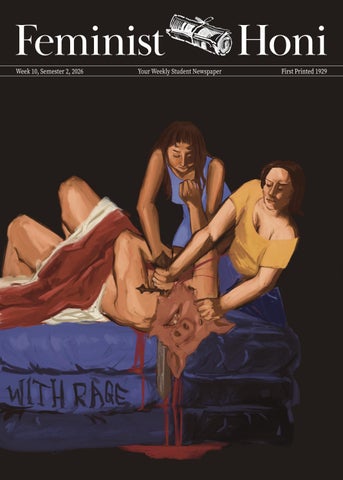
Feminist Week 10, Semester 2, 2026
Your Weekly Student Newspaper
Honi First Printed 1929
Acknowledgement of Country EDITOR-IN-CHIEF Maxine McGrath (she/they)
EDITORS Annis Chan (she/her) Calista Burrowes (she/her) Hester O’Donnell (she/her) Leyla Bensan (she/her) Sahiba Tasnia Tanushree (she/her) Simone Scohel (she/her) Ydie Ladillier (they/them) WRITERS Alex Ma (she/they) Alice Nhu An Le (she/her) Anastasia Dale (she/they) Avin Dabiri (she/her) Calista Burrowes (she/her) Daria Karpenko (she/her) Freya Hill (she/her) Hester O’Donnell (she/her) Kuyili Karthik (she/her) Maliyah Arnold (she/her) Shayla Zreik (she/her) Simone Scohel (she/her) Zoe Huang (she/her)
The Feminist Action Bloc (FAB) predominantly organises on the Gadigal land of the Eora nation. Sovereignty was never ceded, and this land always was, always will be Aboriginal land. As a collective, we must recognise that the land rights movement is intertwined with feminist justice. There is no feminism without decolonialism, and there is no decolonialism without feminism. As we reside in a settler colony, our feminism must be intersectional and radically inclusive, keeping First Nations justice at the forefront of our fight.
dispossession of Indigenous peoples around the world. This October marks three years of the escalation of genocide in Palestine. Our tuition fees fund partnerships with weapons manufacturers and Apartheid Israeli Universities; continuing the brutal history of USyd as a genocidal, settler institution. All the while, USyd management uses student resistance to this complicity to try and remove the independence of our student union. The Feminist Action Bloc will keep fighting for an end to genocide, for a free Palestine, and for Usyd lands to be returned to the Gadi people.
Rather than being in the hands of the rightful First Nations communities, this land on which USyd exists is instead used to continue this
In This Edition: 4–5 A Closer look at SRC election results 6–7
It’s Not Just Cornell: ‘Decades’ of Sexual Assault at the University of Sydney
8 How Climate Change Worsens a Climate of Inequality 10 Don’t Stop the Baby Machine 11 Lifting the (sur)veil(lance) on pervert glasses 12 Until Mum Wakes Up 13 Migrant Women and Their Labour 15 The Phantom Limb of Violence 16 Phenomenologies of Being
ARTISTS Astrid Armiger (she/her) Emma Foley (she/her) Michelle Tatiana Gronich (she/her) Zoe Chung (she/her)
17 On the Radical Act of Queer Love in Leviticus 18–19 Creative Works 20–23 SRC Reports/Puzzles/Comedy
What is FAB?
FRONT COVER
Sophi e Wisha rt (she/h er)
BACK COVER Astrid Armiger (she/her)
We have recently changed the name of the Women’s Collective to the Feminist Action Bloc (FAB!), not just because we are FABulous, but because we understand that the fight against misogyny and interlinked systems of power is one that must be fought by all of us. This name change reflects our commitment to being a collective which represents all students who experience gender based marginalisation, including transmasc and non-binary students. In the face of increasing femicide, we would be narrow in our resistance to treat womanhood and sexism as fixed and natural phenomena disconnected from the capitalist mode of production. Instead, feminism must be an analysis of power and find solidarity with all those it oppresses.
The Feminist Action Bloc (FAB) is a group of student activists fighting for feminist liberation on unceded Gadigal country at the University of Sydney.
Our most long-standing campaign is our call for the USyd residential colleges to be abolished, since the rape and murder of Annette Morgan.
We organise around reproductive rights, student housing, ending to sexual violence, and the intersectional fight for liberation.
We don’t demand that these buildings be burnt down or demolished, but that they be repurposed to become public student housing for vulnerable students in need, who would otherwise drop out or become unhoused.
Earlier this year we rallied against an antiabortion bill proposed by far-right bigots in NSW Parliament, which was afterwards voted against in Parliament. We also rallied against the ‘Day of the Unborn Child’ earlier in the year, and held a vigil for victims of genderbased violence during our Feminist Action Week.
FAB holds regular meetings both online and in the Manning House Women’s Space (for anyone who has experienced marginalisation on the basis of gender, including trans and nonbinary people) where we organise these resistances to patriarchy both on and off campus.
Follow our instagram page @usydwoco for updates!!
ISSN: 2207-5593. This edition was published on Tuesday 13 October 2026. Disclaimer: Honi Soit is published by the Students’ Representative Council, University of Sydney, Level 1 Wentworth Building, City Road, University of Sydney NSW 2006. The SRC’s operation costs, space and administrative support are financed by the University of Sydney. Honi Soit is printed under the auspices of the SRC’s Directors of Student Publications (DSP): Dongchen Yue, Sholto Mirrlees-Black, Lucy Sullivan, Ying Huang, Damien Lee, Hamish Evans. All expressions are published on the basis that they are not to be regarded as the opinions of the SRC unless specifically stated. The Council accepts no responsibility for the accuracy of any of the opinions or information contained within this newspaper, nor does it endorse any of the advertisements and insertions. Please direct all advertising inquiries to publications.manager@src.usyd.edu.au. Email the editors at editors@honisoit.com.
2
Editorial Hi folks!! Thank you for picking up this edition of Feminist Honi (Formerly Women’s Honi)! More than ever, student journalism has proven to be a major component in the struggle for feminist justice. In 2024, Cornell University management silenced Jane Doe’s reports of her sexual assault. This story parallels the countless cases of This story was only reopened in September 2026, due to the months of reporting by student journalists Cereese Qusba and Sophia Dasser in The Cornell Sun. We aim to use student journalism as a vessel to disrupt this corporate university power which has constantly denied us justice. Similarly, the feature article of this edition exposes USyd’s complacency in the face of sexual violence within our own university. Anastasia and Kuyili explores how the reporting system and Student Affairs Unit fail victim survivors again and again.
Corporatised universities internationally are designed to protect profit and reputation, as demonstrated at Cornell University and on our own campus. In this edition, the theme is our central mantra: In Love and Rage. This phrase has been associated with USyd feminist organising for approximately 20 years now, we aim to unpack what it means to us and our community. In rage, we look upon the violence of capitalism and its ever growing death count, from Gadigal land to Gaza. In horror, we see our Universities domestically and internationally fund genocide, whilst silencing the countless and ongoing victimsurvivors of rape on campus. At the time of writing this, 55 women have been murdered across Australia in 2026. As we were laying up this edition, this number increased, and will no doubt continue to in the
coming months. In love, we know that a better world is possible. Despite Albanese’s and Mark Scott’s boot on the neck of USyd feminists, we will resist. While we see members of our community unhoused, we will fight for the Residential Colleges to be repurposed into safe, affordable and accessible student housing. When we are silenced, we will fight for an end to bigoted corporate management and their violent use of gagorders on victim survivors. While we watch our tuition fees being used to fund genocide, we will fight for a free Palestine and a student and staff run university. To everyone who has gotten involved in the collective over the course of the year: I truly thank you. Keep up the good fight !! In love and rage, Maxine McGrath (she/they)
Sexual Violence Support Services Safer Communities Office The Safer Communities Office offers Trauma-informed support for those who have experienced sexual misconduct, domestic/family violence, bullying/ harassment and issues relating to modern slavery. They provide one-on-one support for students. Hours: 8:30am–5:30pm Mon–Fri Phone: (02) 8627 6808 Email:safer-communities.officer@syney.edu.au Confidential helpline: +61 2 8627 6808 SRC The SRC’s Caseworkers can help guide and direct you to support resources and through any reporting processes you wish to undergo. The SRC office also has free condoms at the front desk. Hours: 9am–5pm Mon–Fri Email: Help@src.usyd.edu.au Phone: (02) 9660 5222 1800 SYD HLP The confidential helpline for the University of Sydney, connecting students and sometimes staff to crucial support for emergencies, safety threats, sexual assault/harassment reporting, misconduct complaints, and general student concerns, offering 24/7 emergency contact and
business-hour support for various issues, including linking to external crisis services like the NSW Rape Crisis Centre. Hours: 24/7 Phone: 1800 793 457 - for sexual assault support, press 2 and then press 1 Counselling and Psychological Services The university offers free counselling and psychological services that can help you come to terms with an assault, and help you with your mental health throughout the reporting process. Hours: 9am–5:00pm Mon–Fri Phone: (02) 8627 8433, and after hours and 24/7 by calling 1300 474 065 or by texting 0488 884 429. In-Person location: Jane Foss Russell Building Royal Prince Alfred Hospital Community Health and Sexual Assault Service Provides free and unlimited counselling and responds to the needs of individuals aged 14+ who have experienced sexual assault. Hours: 8:30am–5pm Mon–Fri Phone: (02) 9515 9040 NSW Sexual Violence Helpline 24/7 telephone and online crisis counselling service for anyone in NSW who has
experienced or is at risk of sexual assault, and loved ones of victims of sexual violence. They provide professional trauma specialist counsellors, telephone and online support, and information and referral to other services. Hours: 24/7 Phone: 1800 424 017 Rainbow Sexual, Domestic and Family Violence Helpline For Australians from the LGBTQIA+ community who have recently or in the past experienced sexual, domestic or family violence, and the loved ones of these individuals. They provide professional trauma counselling provided by counsellors who have completed LGBTQIA+ specialist training, and information and referral to other services. Hours: 24/7 Phone: 1800 497 212 LifeLine If you are experiencing extreme distress, Lifeline operates 24/7 to provide urgent support and care to anyone in need. Hours: 24/7 Phone: call 13 11 14 or text 0477131114
Contribute
What's On Feminist Honi launch party Dinner provided!! <3 Wednesday 14 October 6pm @ Hermann’s Bar Save Our Student Union Rally Thursday 15 October 1pm @ University of Sydney, outside Fisher Palestine, Repression & Resistance teach-in Saturday 10 October Thursday 15 October 2pm @ University of Sydney, outside F23 NTEU 24HR STRIKE!!! Thursday 22 October All day @ All USyd entrances The Wall of Tears 15m installation memorialising 18,457 Palestinian children killed in Gaza 10 to 28 October @ Pitt Street Uniting Church Trans and Gender Diverse Swim Night Friday 23 October 7pm to 10pm @ Annette Kellerman Aquatic Centre
Do you have a deep-rooted longing to be a contributor but have no idea how to get involved? Apply to be a reporter or artist via the link in our Instagram bio: @honi.soit Or if you have a one-off pitch, tip for a story, complaint, letter to the editors, or more, email us at editors@honisoit.com. Scan the QR code if you'd rather send an anonymous tip. Send mail to Honi Soit at PO Box 974 Broadway NSW 2007.
3
| NEWS
2026 SRC Elections: Who to lock out now? Honi Soit reports. Grace Street (Grassroots) has been provisionally elected as the 99th Students’ Representative Council president. Street won 40 per cent of the primary vote (1,627 students). After Vieve Carnsew (Solidarity) and Emma Searle (SAlt) were eliminated in the first and second counts, Street held 2,425 votes to Ava Cavalerie’s (NLS) 1,300. 5 per cent of the votes were informal, and 3 per cent of the votes exhausted by the third count. Remarkable voter discipline for an optional preferential voting system. “I’m very excited to have been elected as SRC president for another year and am looking forward to keeping my promise to continue to fight hard for students,” Street told Honi Soit. “Higher education, the corporate university, our government, and society more generally are currently making life hell for young people and marginalised groups in our community right now. “Students have said “enough is enough,” that they stand against these oppressive systems and institutions, and that they are fed up with our university’s complicity in apartheid and genocide. We need collective action and a strong student movement, and that’s exactly what students have voted for.” Street won the polling booths at Jane Foss Russell on first and third polling days, Fisher Library on the second and third polling days, and Manning House. Street won an outright majority of votes at the Fisher Library polling booths on both days. Not counting the absentee votes, Street delivered a striking two candidate preferred result (against Cavalerie) of 72.66 per cent and 73.7 per cent on Fisher Library Wednesday and Thursday respectively. By contrast, Cavalerie’s most
impressive candidate preferred result was at the Peter Nicol Russell booth. The Engineering for SRC ticket declared Cavalerie as their preferred presidential pick on their how-to-votes.
Council This year, no Liberal or Liberalaligned candidates were elected to Council. The three tickets run under the ‘Activate’ brand did not secure a single seat. PENTA once again secured 11 seats on council. Socialist Alternative secured 10 seats, and Grassroots secured 9 seats. Solidarity came in just under one quota, securing a spot for their presidential frontrunner. The combined Labor factions gained 12 seats with seven of those delivered to Labor Left and five to Unity. The Engineering faction polled at precisely two quotas giving them two seats on Council. One of the more interesting metrics to look at is how efficient a faction’s primary vote is for securing a seat on Council. To secure a seat on Council, a candidate must be either elected over quota, where the quota is determined by the following formula: [Ballots cast / Vacancies + 1] + 1. This year, the quota was 82 votes. Candidates may be elected from having secured enough votes in the primary count, by having their quota ‘filled’ from preferences from candidates already elected or other candidates eliminated, or be elected under-quota by virtue of not being eliminated by having a higher progressive vote (i.e. after distribution in each count) than other candidates. 27 candidates were elected on primary votes. 4 candidates were elected in counts 28 to 31 by filling their quotas. 14 candidates were elected underquota. Socialist Alternative delivered an impressive eight candidates elected over-quota and only two candidates elected under-quota.
PENTA, Grassroots, and Labor Left each delivered a roughly even mix of candidates elected over and under-quota. Unity gained five council spots, with four candidates elected overquota and one under-quota.
The Looming Reps-Elect Meeting With the meeting of Representatives-Elect looming, factions are in the process of negotiating a suitable deal. We can only hope that a deal will be secured before the beginning of the meeting. In 2024 and 2025, a deal between the various factions allocating the composition of office-bearer positions was only signed hours after the intended opening time of the Reps-Elect meeting. The process of electing the various OB positions also uses an optional preferential voting system. Under the regulations, up to two people may jointly
hold one position unless otherwise specified (in the case general executives and the chair of the standing legal committee). 23 councillors form a majority, enough to secure the stipended positions of vice-presidents, general secretaries, and education officers, where there is only one position to be elected. The quota for OB portfolios where up to two positions (therefore up to four people) may be elected is 16, meaning a majority bloc of 32 is required to secure every non-autonomous OB position. That being said, the configuration of Grassroots, PENTA, and Socialist Alternative that existed at the last Reps-Elect now holds a total of 30 seats. The combined Labor factions and Engineering hold 14 seats. Should Grassroots, PENTA, and Socialist Alternative operate as a bloc as they did in 2024 and 2025, they may still be able to secure every non-autonomous OB position despite not being able to reach two quotas, with a voting configuration of 15-1514 (Left bloc 1, Left bloc 2, and Labor bloc). The quota to secure one general executive position is 9 votes.
4
Students’ Representative Council, University of Sydney
SRC Elections
Declaration of Provisional Results 2026 Annual Elections I hereby declare the following candidates elected:
President Grace Street
Editors of Honi Soit Charm For Honi: Audrey Hawkins, Jess Smith, Max McDermott, Shayla Zreika, Pia Curran, Kayra Hincal, Tim Pudun, Ollie Hale
Delegates to the National Union of Students Order Of Election
Code
Candidate Name
Quota Elected At
1 2 3 4 5 6 7
E1 B1 C1 H1 E2 G1 B2
Harry Beer Bob Song Emma Searle Grace Street Saskia Morgan Eva Sutherland Sherry Yuan
472.25 471.787771 470.962833 469.927835 468.7230154 393.802312 386.4650462
Representatives to Council Quota = 54 Code
Name
Ticket
Primary
Final
Transfer Value
A1 A2 P1 B1 A3 S1 P2 B2 N1 Q1 H1 AA1 AF1 K1 V1 A4 S2 J1 P3 AI1 Q2 B3 N2 AA2 H2 AD1 AL1 AF2 F1 AN1 P4 K2 A5 AQ1 E1 I1 AO1 Z1 AG1 Y1 U1 AE1 T1 V2 AH1
Grace Street Aron Khuc Lucas Pierce Ava Cavalerie Johnson Suhana Kapoor Emma Searle Tiana Moore Alex Marucci Jasmine Al-Rawi Raphael Carrasco Max Bowen Fionn Burke Alice Mo Leyla Bensan Jay Yu Mariam Rehman Siddiqui William Ursu Sherry Xiyue Yuan Laura Alivio Sky Or Michael Hibbard Zayed Tabish Devansh Julka Neel Erande Xanthe Huxtable Shovan Bhattarai Orlando Yang Sophia Zhou Vieve Carnsew Dana Kafina Mahir Ghetia Sarah Furlan Feaim Alkozai Serena Chen Bob Song Aria Nadkarni Eva Sutherland Suryansh Tomar Taylah Hunter Louise Zhang Felicity Errington Cyrus Fung Imane Lattab Sally Weng Niko Jing
GRASSROOTS FOR SRC GRASSROOTS FOR SRC LEFT ACTION FOR FREE EDUCATION IMPACT FOR SRC GRASSROOTS FOR SRC LEFT ACTION FOR RENTERS LEFT ACTION FOR FREE EDUCATION IMPACT FOR SRC PALESTINE ACTION FOR SRC Engineering for SRC Change for You Change Your SRC PENTA for VIVA IMPACT FOR WOMEN PENTA Forward GRASSROOTS FOR SRC LEFT ACTION FOR RENTERS PENTA for YOU LEFT ACTION FOR FREE EDUCATION PENTA for ALL Engineering for SRC IMPACT FOR SRC PALESTINE ACTION FOR SRC Change Your SRC Change for You LEFT ACTION AGAINST HANSON PENTA for Student First PENTA for VIVA Globalise the Intifada FREE EDUCATION FOR ALL LEFT ACTION FOR FREE EDUCATION IMPACT FOR WOMEN GRASSROOTS FOR SRC FREE HOUSING FOR ALL PENTA for SRC GRASSROOTS FOR CLIMATE ACTION LEFT ACTION AGAINST SEXISM IMPACT FOR INTERNATIONALS IMPACT FOR CAMPUS LIFE PENTA for NEXT Change your Campus PENTA for CHANGE FREE PALESTINE & BDS PENTA Forward PENTA For PROSPER
368 0 270 260 0 191 0 1 178 175 173 171 148 143 141 0 0 107 0 105 5 1 0 2 0 84 82 0 80 39 0 0 0 50 68 35 65 67 59 67 47 62 45 0 56
82 82 82 82 82 82 82 82 82 82 82 82 82 82 82 82 82 82 82 82 82 82 82 82 82 82 82 82 82 82 82 85.915 83.025 81.412 81.024 80.991 75.437 70.447 69.095 69.032 67.845 67.203 62.913 59.902 56.036
0.777 0.707 0.696 0.685 0.584 0.571 0.564 0.537 0.539 0.531 0.526 0.52 0.446 0.427 0.418 0.288 0.244 0.234 0.226 0.219 0.168 0.141 0.136 0.099 0.088 0.024 0 0.025 0.003 0.095 0.001 0.046 0.012
This notice shall be taken to be the Declaration of Final Results unless otherwise notified to candidates and on the SRC website. Pending matters include submissions of expenditure reports, which may result in disqualification if unattended to.
Authorised by K.Latty, 2026 SRC Electoral Officer, Students’ Representative Council, University of Sydney p: 02 9660 5222 | w: srcusyd.net.au/elections
At count 74 there were 12 remaining posiitons and 12 remaining candidates, all were elected without redistribution.
| FEATURE
It’s Not Just Cornell: ‘Decades’ of sexual
Content Warning: This article contains discussions of sexual assault.
of students ripping up a copy of The Red Zone Report at an SRC meeting.
Almost a decade ago, the Red Zone Report was released, documenting 90 years of sexual assault, abusive behaviour, and criminal activity at Australian university residential colleges. The Report uncovered historical and recent incidents of sexual harassment, predatory behaviour, sexual assault, and rape at the University of Sydney colleges. The Report got its name from the fact that O-Week is known to sexual assault services as the “Red Zone”, due to a marked spike in sexual assaults on campus during O-Week.
The University has set up different complaints processes and implemented new policies. They have made an online consent module compulsory, which takes around fifteen minutes to complete, and must only be completed once at the start of a student’s degree. They changed the name of ‘O-Week’ to ‘Welcome Week’.
The Red Zone Report found that students living in residential colleges were seven times more likely to be sexually assaulted on campus than other university students, and that one in four women at USyd colleges experience sexual harassment or assault. The Report found that female USyd students were 66 per cent more likely to experience sexual assault on campus compared to the national average. Five years ago, the National Student Safety Survey was released. It found that one in six students had experienced sexual harassment since starting university, and that more than one in four reported being sexually harassed in their student accommodation. The 2021 Survey did not mark an improvement from the 2018 Red Zone Report; in fact, rates of sexual harassment at student accomodation had increased. Last year, national regulatory body the Tertiary Education Quality and Standards Agency (TEQSA) issued a Compliance Assessment Notice to USyd management, requesting that the University provide evidence of their compliance with national standards for addressing sexual and genderbased violence on campus. USyd was served this notice after two high-profile incidents in late 2024. First was the suspension and expulsion of numerous St Paul’s College students following “sexual degradation” of a student. The second was the instance
But the rates of sexual assault reported to USyd have not been decreasing. In 2025, the University received 247 reports of sexual misconduct. In 2024, there were 231 cases of misconduct reported. In 2023, there were 246. In addition, many victim-survivors never report their assault due to stigma, fear, or trauma. Lack of awareness and lack of faith in university reporting processes also plays a role in whether an assault is reported. Whatever steps the University is taking, it has not led to a meaningful decrease in rates of sexual harassment, sexual assault, or rape on campus. For almost 10 years, there has been a national spotlight on the high rates of sexual assault at USyd, particularly at the colleges where sexual assault on campus is most prevalent. The data, personal testimonies, and brave victimsurvivors who have come forward has proven time and time again that the rape culture embedded in the tradition of the colleges make them unsafe places for young women to live. Countless protests have been held and countless articles have been written demanding stronger action. Since the Red Zone Report was released in 2018, we estimate that over 1,500 students have experienced traumatic sexual misconduct on campus. The university has a responsibility to not only treat survivors of sexual assault with compassion and empathy, and to punish perpetrators, but to prevent sexual assault on campus from being perpetrated in the first place. Incremental reform will not bring about meaningful change, and will not protect young people on our campus.
Lily’s Story Honi Soit spoke to a female international student who recently experienced sexual assault at one of the USyd residential colleges. Names and identifying details have been changed. When Lily initially disclosed the incident to the Safer Communities Office (SCO), the first point of contact at the university for reporting sexual and gender-based violence, she didn’t expect that the rest of the process would make her feel so ‘defeated’. As an international student, Lily returned home for her wellbeing. In its 2025 Annual Report on Sexual Misconduct, USyd clarified its 2026-2028 institutional strategy, which centres on “trauma-informed, person-centred, and evidencebased principles.” The report claims that the university follows a “trauma-informed care and support model” for victim-survivors, specifying that the Safer Communities Office (SCO) prioritises “safety, trustworthiness, choice, collaboration and empowerment”. Lily stated that the SCO officers managing her case were ‘supportive,’ but that her dealings with the Student Affairs Unit (SAU), left her feeling “hopeless”. The SAU is composed of “specialist staff within the Office of the Deputy ViceChancellor (Education and Students) who assist with the resolution of student complaints and reports of student misconduct in accordance with University policies and procedures.” Complaints are handled by the SAU, and if they meet the threshold for misconduct, the University of Sydney (Student Discipline) Rule 2016 is considered in the complaint’s progression. Lily told Honi: “When I would talk to the USyd student affairs office, just to learn what the process of reporting would be like, I didn’t feel like it was very victim friendly.” After speaking to them three times, she says she felt “more scared” to pursue formal action: “I didn’t think that they were really going to give me the outcome I wanted.” “When I first went to student affairs, I really felt like my assault was severe. Out of ten, I thought my assault was
6
a nine or a ten. But when I talked to them — they’re just not very warm people. They’re more cold. It made me ask myself, ‘Am I the one who’s overreacting here? Maybe I’m the stupid one here.’ The person I talked to repeated [that outcomes of sexual assault reports are] on a case by case basis [and that] it really depends. I didn’t feel that it’d really go anywhere.” Regarding the action the university could take against the alleged perpetrator, Lily alleges that while SAU informed her that expulsion and suspension were possible disciplinary actions which could stem from a formal complaint, they seemed to ‘prefer’ assisted resolution, an outcome where the victim-survivor resolves the disclosure through a mediated ‘talk’ between the parties. The Student Complaints Procedures 2025 states that if the SAU decides after preliminary assessment that assisted resolution is appropriate, resolution may include any or all the following actions: “clarifying a misunderstanding; an apology; facilitated discussion, including mediation or conciliation; an agreed plan of action to avoid further incidents; and awarenessraising or educational sessions about behaviour” (clause 9). “They clarified that if you do assisted resolution, the other party that you accuse does not admit any guilt,” Lily says.
An international student, Lily’s only residence in Sydney was the specific building in which she was allegedly assaulted. When searching for new accommodation, Lily found that other rooms in her college were full. “One of things I wanted was to have him kicked out [of the building],” she said. She alleges that the SAU, however, was uncertain whether they could remove the alleged perpetrator from the building before a complaint was resolved. The University of Sydney (Student Discipline) Rule 2016 specifies in Part 6, Temporary Suspension and Removal of Students, that the Registrar may, in their absolute discretion, temporarily suspend a student under emergency powers or “pending
assault at the University of Sydney the outcome of disciplinary proceedings” under the Rule. Lily says the SAU offered hypothetical ‘arrangements’ if she continued to live in Sydney in the college, but she alleges that the officers emphasised that separation of her and the accused was a ‘theoretical possibility’ to be determined on a case by case basis. The ‘arrangements’ offered were limited in nature, Lily alleges, including scheduling separate 30-minute windows for lunch hour in the dining hall and making timetable modifications. This meant the alleged perpetrator would still continue living in the residential college with Lily. Lily attests to the evidentiary burden of a sexual assault complaints framework that she alleges demands ‘hard proof’. For victim-survivors of sexual assault, there is a barrier to evidence that can be gathered, and evidence that exists — medical reports, psychologist reports, lived trauma — can still be deemed insufficient by institutions and authorities. According to Lily, the SAU only needs to establish the ‘possibility’ of assault having happened in order to impose consequences. In practice, however, Lily alleges that “hard, irrefutable proof” is still necessary in order for consequences proportionate to the perpetrator’s violence to be meted out, such as expulsion from a college or from the university. Lily alleged that one of the Safer Communities officers she talked to told her that they have seen a few students approach the office “with lots of evidence,” including “photos and videos” of assault, but that these instances resulted in little to no consequences for the perpetrator. Despite the fact that the events Lily alleged were tantamount to crimes, she says the SAU had a “merciless” attitude: “There’s no belief, really. It’s just all evidence that they have to look at.” Lily told Honi that if she hadn’t consulted a legal opinion external to USyd’s services, it is likely that she would have given up on lodging a complaint due to her experience with the SAU, believing that a complaint would not be “worth pursuing”. “Student affairs triggered me a lot. I just stopped asking questions from them, because
it makes you feel hopeless. You don’t feel any encouragement to report, because you’re kind of like, ‘What’s the point?’” There are two kinds of reports a victim-survivor can make to the university: a disclosure and a complaint. The 2025 Annual Report defines a complaint as “a report of University-related sexual misconduct by a person who wants the university to investigate or to take specific action” while a disclosure is made by a person seeking “trauma-informed support” but not wanting the university to investigate or take action. According to the Student Sexual Harm and Gender-based Violence Response Procedures 2026, if the SAU determines that the investigation of a complaint about a student is appropriate, it will notify the complainant and the respondent (the accused) of the investigation on the same day. “That made me really uncomfortable,” Lily says “because… I’m scared of him, of what he might say to others, how he could twist the story”. When Lily asked the SAU about the likelihood that a potential complaint would succeed, they allegedly told her that this “depends on who’s going to review your case and how they’ll see it.” Lily says she is disillusioned with USyd, an institution she believes is incapable of acting appropriately on her assault. Lily told us: “I loved it when I first came here. I was so happy. I can’t love USyd the way I did before.” International students face compounded difficulties in accessing sexual violence support services, and are often represented inaccurately in reports and statistics on sexual violence on Australian campuses.
Author of Red Zone Report Weighs In Honi Soit spoke to Nina Funnell, a Walkley Awardwinning journalist, co-author of The Red Zone Report, and ambassador for End Rape on Campus Australia. She says the term ‘trauma-informed’ has become a “poorly understood buzzword” that is “even more poorly implemented”.
FEATURE |
Kuyili Karthik and Anastasia Dale investigate. to the individual. Institutions are notoriously bad at doing that because they expect individuals to fit within their own processes, rather than looking at how processes themselves can be adaptive to the needs of individuals”.
This has been going on for decades… It’s not as though the university has not been on notice for an extraordinarily long time now, that this is a problem.” Funnell highlighted a lack of transparency about the complaints process, saying that information including potential disciplinary actions and the investigation should be public and easily accessible outside of policy documents, so that the victim-survivor “doesn’t have to self-disclose” and appear in front of the office or affairs unit in order to “gather that information first”. Funnell spoke to the evidentiary burdens placed on victim-survivors throughout complaints processes: “We know with most sexual violence, the survivor’s account is the key evidence. That is the evidence. So to put this sort of evidentiary burden back on someone who is in trauma, to essentially conduct their own investigation as well, because you’re asking them to evidence-gather, is profoundly inappropriate. “For any victim-survivor who has found the courage to seek out that information and to find out their options and to contact the university, to then hear that there is very little chance of an outcome is completely demoralising, and it contributes to this overwhelming sense of powerlessness in that in that situation, which we know compounds trauma”. “These are the standard questions that most survivors have if they’re thinking about making a complaint to a university: What are the
likely outcomes? How long is the process going to take? What can I expect during that process? What should I be prepared for? What are the timeframes around this? How will I be communicated with throughout this? What might happen to the other person? They shouldn’t have to actually physically front up or go through the process of telling their story yet to find out that sort of information. That right there is not trauma informed.” Funnell stated: “For international students, there are so many more barriers to healing, justice, and accountability… English may be their second, third, or even fourth language. They may not know the laws while they’re here. The criminal justice system moves notoriously slowly, so if an international student were to make a criminal complaint to police, by the time that that goes through the system, often they will have graduated and gone back home anyway. “On top of that, many are here carrying their family’s hopes and dreams on their shoulders, and at huge expense and cost to their family. Many actually won’t tell their family back home what’s happened… and they don’t want to disappoint their family. Many will actually try and tough it out and that will impact their access to education. “We we know that sexual violence against international students is very, very common, but it is very, very rare for them to even lodge a complaint because there are so many barriers to being heard, believed, and supported.” Funnell underlines the specific onus placed on college residents when the accused is still permitted to reside in the same buildings or spaces. “It is an incredibly passive, nonproactive response that puts all of the onus of responsibility onto the shoulders of the victim-survivor. Not only to keep themselves safe, but to keep the entire community safe. It prioritises obviously the rights of the offender or the accused.” Read the full article online.
“To be trauma informed requires extreme specialist training, but also an overhaul of processes and procedures… you need to look at ways in which you can restore agency, dignity, choice, and control
7
A statement from the University of Sydney regarding the article “It’s Not Just Cornell: ‘Decades’ of sexual assault at the University of Sydney” on Page 6: “The University has no tolerance for sexual harm or gender-based violence and will take serious action,including disciplinary action, where misconduct is established. Lily’s story is profoundly distressing and concerning. We acknowledge the concerns she has raised about her experience of the reporting process and the impact she reports it had on her wellbeing. We want every student who has experienced sexual harm or gender-based violence to feel heard and supported, and to be able to access the help they need. We know that coming forward can be deeply challenging, and we do not take the trust placed in the University lightly. Our teams work closely with victim-survivors every day, providing support through a traumainformed approach that prioritises choice, safety and wellbeing. Over several years, the University has worked to reduce barriers to seeking help and to strengthen prevention initiatives, reporting pathways and support services. Anyone in our community affected by gender-based violence or sexual harm, whether in Australia or overseas, can have a confidential conversation with our Safer Communities staff. Staff will take the time to understand each student’s circumstances and support needs and connect them with appropriate support. We will continue working with our community to foster a culture of respect and inclusion, challenge harmful attitudes and behaviours, and support people affected by harm.” See page 3 for support services.
SRC Women’s Office
SRC Women’s Officer and co Maxine McGrath told Honi: “L victim-survivors reporting se is typically determined by the navigating existing systems, systematically bars many inte who do not speak English as a and support… This is a comm internationally treat victim-su failing to account for their we source of their trauma.
“This is why I have been so st the colleges, and replace the housing. This campaign has b this time, we have seen the b Furthermore, many of these r sexual violence from occurrin assault have occurred. We ha reforms can bring about prev to reimagine how student hou
niversity of Sydney ’s Not Just Cornell: ault at the University
sexual harm or gender-based including disciplinary action,
and concerning. We acknowledge er experience of the reporting t had on her wellbeing. We want sexual harm or gender-based d, and to be able to access the
e deeply challenging, and we do not y lightly. Our teams work closely iding support through a traumahoice, safety and wellbeing.
s worked to reduce barriers evention initiatives, reporting one in our community affected by m, whether in Australia or overseas, with our Safer Communities staff.
d each student’s circumstances m with appropriate support.
mmunity to foster a culture of mful attitudes and behaviours, m.”
SRC Women’s Officer Statement: SRC Women’s Officer and convenor of the Feminist Action Bloc Maxine McGrath told Honi: “Language is used as a weapon against victim-survivors reporting sexual assault. Whether action is taken is typically determined by the prowess which individuals have with navigating existing systems, and reciting the perfect script. This systematically bars many international students, or many students who do not speak English as a first language from receiving justice and support… This is a common pattern with how justice systems internationally treat victim-survivors: ignoring their demands, failing to account for their wellbeing, and exposing them to the source of their trauma. “This is why I have been so steadfast in leading the cause to abolish the colleges, and replace them with safe, affordable and accessible housing. This campaign has been ongoing for decades, and during this time, we have seen the bare minimum of incremental reforms. Furthermore, many of these reforms do not seek to actually prevent sexual violence from occurring on campus, and only aim to act after assault have occurred. We have decades of proof no amount of reforms can bring about preventative change, and we must seek to reimagine how student housing can look.”
| ANALYSIS
How Climate Change Worsens a Climate of Injustice
Zoe Huang explores how climate change exacerbates gender inequality.
As anthropogenic, or humandriven climate change intensifies, global natural disasters have become increasingly severe and frequent, particularly in the Global South as the physical repercussions of climate change exacerbate existing economic vulnerabilities.
been fuelled by historical exploitation by the Global North and ongoing acts of neocolonialism.
These economic vulnerabilities affect the most marginalised in communities, and often, those people are women and girls. In 2022, Northwest Kenya experienced their worst drought in decades. The drought raised acute food insecurity by 80% and led to significant displacement as the dry conditions affected the livelihoods of people and their livestocks, of which their economy relied on. Amongst them was Susan Akal, a woman in her thirties who was forced to walk almost 250 kilometres in search of food, water, and safety with her children. What Susan experienced is an example of climate- induced migration: the forced permanent or temporary relocation of a group or individuals in response to the stressors of climate change — a phenomenon becoming alarmingly common in a rapidly changing climate. Climate-induced migration is prevalent in the Global South, where the extremities of climate change not only heavily dilapidate the already vulnerable socioeconomic structures, but also place immense pressure on the limited local infrastructure — both of which have
As a result, a growing number of people are forced to relocate. The Institute for Economics and Peace predicts that by 2050, roughly 1.2 billion people will be involuntarily displaced due to climate change. However, this statistic fails to capture the 1.2 billion different lived experiences, clinicalising the immense feeling of grief when a familiar place unexpectedly changes. Glenn Albrecht, an environmental philosopher, calls this feeling ‘solastalgia’ — a term with origins in ideas such as ‘desolation’ and ‘solace’. Differing from nostalgia, solastalgia is the process of losing the present that manifests in a feeling of dislocation driven by factors that take away the possibility for someone to find solace in their current place. Albrecht himself has said that “Solastalgia is the pain or sickness caused by the loss or lack of solace and the sense of isolation connected to the present state of one’s home and territory … In short, solastalgia is a form of homesickness one experiences when [they are] still at ‘home’”, Glenn Albrecht. Susan is only one of the 2.7 million people in Kenya displaced from 2008 to 2024 — a finding from the Internal Displacement Monitoring Centre. And she is not alone in her place. Though climate-induced migration affects everyone,
it disproportionately affects women and girls. As societal norms that dictate the expected roles of women traditionally emphasise domestic labour over employment, women face structural barriers when accessing education and paid employment. Across the world, 122 million girls continue to remain out of school, though there has been a 39 percent decrease in girls out-of-school over the last two decades. This is especially prevalent in the Global South where additional pressures from climate change exacerbate pre-existing socioeconomic vulnerabilities which disproportionately impact women and girls. For example, girls aged 15-19 are three times more likely than boys of the same age to be out of education in South Asia. This lack of education limits the agency and employment outcomes for women, while enabling the continuation of socio-economic vulnerability and traditional, oppressive gender roles.
Due to this structural inequality, women are overwhelmingly underrepresented in paid employment and overrepresented in unpaid domestic labour. As damage to infrastructure and school closures from extreme weather events caused by climate change continues, the existing gender inequality in accessing education worsens.
While some women and girls are forced to involuntarily migrate, others who are bounded by domestic work and remain in their communities face persistent daily struggles. Unable to migrate in search of better working conditions, women and girls are often left behind with additional domestic workloads and little to no economic compensation. For example, Indigenous women in East Bolivia are traditionally expected to gather water for their families but rising temperatures and increasingly severe extreme weather events like droughts complicates this. Severe droughts directly introduce additional difficulties, such as women needing to walk longer distances more often to collect water and other resources for essential household needs, which exposes them to additional risks. These vulnerabilities are perpetuated by the failure in applying statistical reporting to policies that address the gender inequality of climate migration. This leads to institutional invisibility and a subsequent lack of protection for women and girls. Though climate change has worldwide impacts, they are intensely felt in the Global South where economic vulnerabilities and gender inequality intersect strongly due to a history of exploitation and violence. This manifests in barriers to accessing education and employment faced by women and girls. When faced with external environmental stressors, women unfairly take on the increasing burden and risks of domestic labour.
While climate change is an exigent environmental issue, it is equally a social justice one. As it exacerbates, it becomes increasingly important to shed light on individual and communal lived experiences and their stories of immense loss and pain.
8
Photography by Zebedee Parkes
CREATIVE |
[Artwork by Zoe Chung]
9
| ANALYSIS
DON’T STOP THE BABY MACHINE Alex Ma unpacks how capitalism has seized the means of (re)production. Australia and China are both countries with decreasing births and increasingly aging populations. This is a threat to the current patriarchal and capitalistic system that demands infinite growth.
Under this system, wombs are (re) productive assets that can be manipulated to produce infinite workers. A feminist analysis shows how population panic fuels policy that ignores people with reproductive systems and perpetuates gendered beliefs. It is important to note that official government data referenced conforms to the male-female binary. This article uses the terms “men” and “women” as a reflection of these sources. Data collection and presentation uphold existing values of a gender binary, especially from the lens of population and births. It further demonstrates a broader erasure of trans and gender-diverse people from datasets that inform our understanding of the world. Reporting from both countries have framed this decrease in births as an economic disaster. It means less workers, less taxes, less money to support pensions. Peter Costello, the father of the “baby bonus”, a cash payment offered to parents, believes Australia should adopt the incentive again to boost births. This parallels the current financial incentives offered by Asian countries like China, South Korea, Japan, and Singapore. At the personal level, the Australian Bureau of Statistics (ABS) reports that Australian women on average spend 4 hours 53 minutes a day on unpaid work, compared to men’s 3 hours 52 minutes a day. The values show the ingrained gender imbalance of labour. Another factor overlooked by data is that women often perform unpaid labour while suffering abuse, tolerating weaponised incompetence — that being the phenomenon of mostly men utilising a targeted or unaware ignorance of household chores to their advantage — navigating mental health struggles, or working full time. Cash subsidies cannot solve the gendered aspect of necessary
10
and repetitive unpaid labour and how it is culturally embedded. The Australian government has rectified this problem to an extent by expanding paid parental leave to 6 months for eligible families. As discussed above, unpaid work is deeply gendered and unequal. Paid parental leave is not ultimately beneficial if gender expectations are still upheld in the domestic sphere. This is coupled with the Government’s serious lack of allocation of funds towards domestic violence services and prevention strategy, with what little is already provided acting as a band-aid solution. China does not have uniform parental leave policies and carries stronger traditional beliefs around gender roles, causing women to unfairly undertake domestic tasks while working and childrearing. The Chinese government aggressively promotes heterosexual marriage and family values. In 2023, President Xi Jinping stated that China and women in China need to “actively cultivate a new culture of marriage and childbearing”. A state-owned news publication featured women discussing the benefits of marriage and parenting while studying at university.
and cultural issues. Merely paying cash or subsidising childcare does not address the deeper issue around feminist justice and reproductive rights. Patriarchal governments are demanding women to be loyal workers while raising multiple children. This cannot be told by raw data; these are the thoughts, feelings, words accepted by society that shape the treatment of women. The concept of a woman being able to “do it all” does not hold when the government nor society supports her to do so. Misogyny is embedded in the politics of Australia. The Albanese government has proclaimed that Australia is in a “domestic violence crisis” yet fails to address the male violence that has killed 52 women and counting this year. We have also witnessed the rapid rise of One Nation, a party that wants to recriminalise abortion, alongside party leader Pauline Hanson claiming that domestic violence is a “two way street.” Further, domestic violence and intimate partner violence in Australia is an issue embedded
in the law enforcement and judicial systems. Reports of male perpetrators are ignored, and even if charged, are often given very lenient punishment for their crimes. Mainstream media stories also use passive framing, which blames the women victims and removes the actions of men. This political climate signals to us the volatility of our rights and existence.
In a capitalist society, women’s reproductive decisions are intrinsically economic decisions. Both the Chinese and Australian government employ superficial and temporary incentives to increase births instead of addressing the embedded issue of feminist inequality. The prevailing system uses data to deliver a narrative of population doom. Ultimately, upholding the idea of infinite growth and (re)production benefits the patriarchal, capitalist system; enforcing gender roles which enable a perpetually expanding workforce.
These are significant ideas because in China, marriages are a cultural requisite for childbirth. Single parenthood is very stigmatised, and eggfreezing and non-heterosexual fertility supports are not permitted. Women in China are thus forced to enter an unjust and unequal institution to start a family. These patriarchal laws and customs further reduce women to being (re)productive assets for the country. Such measures show that patriarchal values often reinforce capitalistic values. Women are dehumanised in both systems for the sake of (re)production and growth. From the 1st of January 2026, the Chinese government has imposed a 13 per cent tax on condoms and contraceptives. Materially, this means paying a few extra dollars for a pack of condoms. But beyond that, this is a policy that attempts to influence peoples’ reproductive decisions without addressing embedded social [Art by Michelle Tatiana Gronich]
ANALYSIS |
Lifting the (sur)veil(lance) on pervert glasses Freya Hill snaps your pervert glasses in half . Surveillance is invading every aspect of our lives. Just the other day, our own university introduced a video surveillance policy allowing protection services to use AI facial recognition on students and staff. Surveillance technologies are not neutral. They are materialisations of systemic power imbalances, cultural assumptions and socioeconomic contexts.
We must ask ourselves, who has the power to look? And who is being looked at? As more and more instances of gender based violence emerge in relation to invasive surveillance technologies, we can no longer ignore the uniquely gendered harms that these technologies facilitate and encourage. The increasing popularity of smart glasses has launched this important conversation in national discourse. Smart glasses at their simplest are wearable audio and visual recording devices. Features vary across brands but can include AI integration, augmented realities, live streaming, and audio description. The ability to covertly record individuals in public blurs the boundaries surrounding filming and the capacity for people to consent. This has a disproportionate effect on women and feminised bodies as we occupy a space of exaggerated visibility, where our bodies are constantly subjected to a voyeuristic societal gaze. Surveillance technologies exacerbate and accelerate this dynamic. Many smart glasses offer live streaming and integration with social media platforms, streamlining the ability to upload covertly recorded videos, which are then spread and the unconsenting, unknowing subject is
vulnerable to further abuse from anonymous users. Feminised bodies being seen as an object of society’s gaze and subject to surveillance is nothing new. These technologies are not producing harm but rather act as facilitators and accelerants for the abuse women have historically been subject to. Therefore, it is no surprise that these devices are increasingly being weaponised by misogynistic groups. USyd researchers recently studied over 350 videos from the pick up artist community, finding that over 60% of videos contained behaviour that could be classified as harassment. It is important to recognise how this harm is exacerbated for groups that already face increased surveillance and policing of their bodies. The proposed release of AI-enabled smart glasses with facial recognition technologies, that would allow users to see the social media accounts of those in their line of vision, has raised significant concerns regarding the impact on sex workers. Surveillance and policing of sex workers is nothing new. Sex work disrupts hegemonic cultural norms that understand sex as private and the market as public, meaning what blurs these boundaries is subject to state control and systemic violence. Furthermore, even in places where sex work is decriminalised, sex workers remain subject to increased scrutiny and “regulation” due to the perception that all sex workers are victims and that sex work is not a legitimate form of work. Therefore, many sex workers go to significant efforts to remain anonymous to protect their physical and physiological safety. Being outed unconsciously as a sex worker is a direct threat to the autonomy as well as the physical and emotional safety of sex workers, which can lead to loss of job and financial security. The loss of anonymity holds significant risks for
stalking, doxxing and instances of violence. USyd is no exception to this, and in 2016 a group of first year Wesley College students stormed Kings Court Massage on Broadway as part of an orientation week hazing ritual and captured unsolicited photographs of the staff. Despite the harm caused by instances such as these, it remains sex workers’ responsibility to protect their own anonymity and the act of pulling out a phone or a camera may allow a worker enough time to protect themselves from being recorded.
Therefore, smart glasses’ ability to covertly record and connect to worker’s social media profiles is incredibly problematic and must be addressed as a direct threat to the safety of sex workers. As these glasses are increasingly used in harmful and malicious ways, lawmaking efforts are failing to match the evolution of these technologies. Australia’s privacy laws do not currently cover the filming of someone with smart glasses. Whilst there are meant to be mechanisms in place to alert individuals the user is recording, such as a flashing LED light on the frames, these tools are easily disabled or covered with a simple piece of tape, and those without the knowledge of this signal cannot recognise it. Responding to the increasing use of smart glasses for harm, the eSafety commissioner has recommended measures like face blurring, delayed live streaming, and automatic shut off. However, recommendations remain voluntary, and companies have little financial incentive to implement them. To allow Australia’s privacy laws to catch up, a 12-month import ban was recently proposed by the
Greens and supported by members of the crossbench. This was struck down in the name of trade and foreign affairs. It is no surprise that the government has chosen profit over the safety of women once again. The burden has instead fallen on local councils and businesses to respond as they see fit. A key argument against the regulation of smart glasses is the undeniable benefits for people with accessibility needs. Many of these smart glasses provide audio description or live captions. However, wearable devices purposefully built for accessibility purposes and not for recording and social media engagement already exist. Instead of popularising and deregulating the use of smart glasses under the guise of accessibility, it is these wearable devices that should remain accessible and low cost.
As more and more people find covertly recorded videos of themselves uploaded and shared across social media platforms, it is time for the government to act and for the institutions meant to keep us safe to take a stand. In the meantime, we must continue to call for change. We do have power. Recent community protests against Kmart’s smart glasses were powerful enough that they were removed from the shelves. But the burden should not fall solely on us. Our government has repeatedly failed to respond to the crisis of gender based violence in this country. Its refusal to address concerns regarding increased surveillance can only be seen as further evidence of their willingness to sideline women’s safety in the name of profit.
11
| PERSPECTIVE
Until Mum Wakes Up Shayla Zreika journeys throughthe generations. Every minute motion we take is inherited, either through kin or elsewhere. It can’t be that a human is singularly inventory, and we are not capable of being programmable clones. We exist in the middle of it all: an intuition, both consciously and unconsciously. It has a stickiness to it – intuition – like when syrup gets stuck between your knuckles and lingers over the day even after you’ve tried to wash it out. The scent of orangeblossom extract gets preserved between your fingertips and so you leave a kiss of hileu on everything you touch. It smells like the cabinet above the stove in Teta’s kitchen, and the sweet store around the corner. As a child of the diaspora, I could never truly understand where I stood with the discrepancies of the inbetween. It’s an existence in constant incohesion of values we are either born into, or adapt from our locality. As such, the diaspora is a riddle that fiddles on the fate of either having to constantly explain your cultural boundaries if you choose the former, or tread on internal cultural backlash if you choose the latter. However to find blue in the grey requires a deep sense of intuition: selftrust, resilience.
I find intuition to be best embodied by the women of my kin: all the mothers and kholtos and sisters and Tetas whose blood pumps in the same rhythm between here, where my feet are planted on foreign soils, to there, where cedar trees find home. Ironically, the foundations of my understanding of the value of women as an Arab-Muslim, was taught to me by my father. He would say it first in Arabic, and let rhythm of it linger before he would translate it in English:
Your mother, your mother, your mother. Growing up, the hadith itself was planted in the singular resilience of women. When a companion asked the Prophet
12
Muhammad (PBUH) who one must treat most dearly on this planet, he answered, “Your mother.” And when asked in follow-up, “Then who?”, The Prophet replied, “Your mother.” Once again, the man asked, “Then who?” to which the Prophet affirmed, “Your mother.” It was only after the fourth repetition, “Then who?” the Prophet said, “Your father.”
Your mother. Mum would weave my hair into a braid every night before bed, a hue of dark brown I could have only inherited from her because I see it in her high school albums. The way she parted it to the side like I do, and how it had a slight frizz to it. Its pattern is not entirely a coiled curl, nor a gentle wave, but something in between. She still reminds me to continue the habit – to braid my hair before bed – to keep my curls from growing tangled, to tame the frizz. I wonder if my mother had her hair braided by her own mother. Perhaps, Teta brushed Mum’s hair while it was still damp from the shower, and lathered the ends with a rosescented hair cream. Perhaps, intuition lingers in the scent of roses.
Your mother. Teta Nadmiah migrated to Sydney before she had the chance to complete her childhood – at least by contemporary standards. She lived on a farm in the North of
Lebanon amongst the spruces and songbirds. Her story was one common amongst women of her time, departing from the French colonial rule over Lebanon. In the Shire, she raised four children – she spoke to them in Arabic just like she did back home. She was the embodiment of nature itself; the rustling pines and feathers of chickens littering the yard, and the honey-like saps of amber dripping between ancient tree trunks. I believe it was her intuition that makes my memory of her so visceral. I remember how she would pinch my cheeks between her thumbs and the way she called my name when the car reversed out of the driveway. I remember how the same thumbs fiddled with prayer beads resting on her lap, and the way she hummed beneath her breath. She existed in this air of contentment and grace as though she held all the wisdom of the world inside a rosewater-filled bottle in her heart.
Your mother. There is a mother in Lebanon that brightens her face with cherry-red rouge and twirls her hair into pin curls every morning. The ground shakes with the murmurs of her neighbours, recounting the home next to her being reduced to rubble under another imperial attempt to break down a border,an affront to the land and never a true reflection of its grounds. A foreign man with bloodied hands drew that line in pencil and built that paper wall. There is a woman in the mirror and her features reflect light with strong similarity to her daughters. It refracts between them, almost like a chanted prayer, a refrain.
It was Kahlil Gibran who said, “All houses are dark until the mother wakes up,” and it bears the same tact of intuition. It lingers between my knuckles and stains the scent of my mothers.
PERSPECTIVE |
Migrant Women and Their Labour Betty Friedan never spoke for my γιαγιά. Germaine Greer never spoke for her, either. Dolores Huerta did, Maria Pozos did, Toula Nikalou did. But you have probably never heard of them. Or you have, but the way you have has felt disconnected. It is a Problem With A Name. You have been spoken at, these women have been paternalised by the state, made into helpless women who spoke in broken English with not much knowledge of what they were going on about. This has been my experience. I have been spoken at. I have been told what to make of us wog women, who we are, what we do. I have been lectured at by Anglo men and women about the struggles of migrant women. I have seen the state pacify them, take them out of context, remove every part of them until they fit some mold of a grand narrative that they have decided is nice and neat and clean: women weren’t in the workplace, then they were, thanks to some nice white women, and now they are in charge. This has and never will be the truth. But for so long it was all I heard. So I sat down, and I just let my γιαγιά, Asimoula, talk. She was working in the garage of her house. At this point she had one daughter and another on the way. Her job was to sew large and heavy souvenir koalas, an animal she had never seen even when she first arrived in the country, in rural South Australia. The other women and her who spent hours a day making these koalas were paid by the bear – pieceworkers – so it was constantly a race against the clock to bring home a liveable wage for her growing family. Toilet breaks were a luxury, not a given, she was told by the boss, to maximise output. So Asimoula sat there, pregnant, and aching to go to the bathroom, but she couldn’t because she was already behind. That was until the ache became a burn she could no longer ignore, so she got herself on the bus and rushed to St. Margaret’s Hospital in Darlinghurst. There, she was told by a doctor that the excess of water that had built up had almost killed the baby she was carrying and that she would need to rest. She was not only scared about her job – would it be there when she returned – but she was also scared because she could not understand the language. The only other person who spoke Greek in the hospital was a member of the kitchen staff, who was her carer, her cook, and her translator.
type of labour, pieceworking, that has been traditionally much easier to exploit. She was also expected to bear the responsibilities of homemaking, figuring out how to stretch a few measly paycheques. More than a book or a lecture, she needed a revolution. A radical solution to this fucked up attack on all fronts of her being.
Second wave feminism has paved the way for much we currently enjoy as women, but to view it as the wave to end all waves is dishonest, and pushes women like Asimoula into the shadows. On one side, were liberal, predominantly white feminists who rightly pointed out that they were discriminated against as women, but rarely – if ever – spoke to the fact that there was an additional element of discrimination, one that came from being unable to speak English or the runoffs of the White Australia Policy. And then there were men in the labour movement, who spoke to their condition as workers but, in the words of these migrant women themselves, could not effectively communicate with these women who wanted to be involved in the union. So migrant women adapted to these conditions imposed on them. They began welfare centres of Greek and Turkish and Yugoslavian persuasions. They analysed their conditions through the lens of intersectionality before the term was conceived. They compiled their findings in a report, ‘But I wouldn’t want my wife to work here: a study of migrant women in Melbourne industry’ in 1975 to express to the Anglophone world that yes, they were being exploited but no, they would not let anyone describe their plight for them. Second wave feminism does not give these women their flowers. They become marginalised against
Calista Burrowes listens to her γιαγιά. the backdrop of privileged women, women who in some cases had a hand in oppressing them. But that does not mean their cries for better or their demands for change did not ring out. And those sidelined voices continue to persist.
Migrant women still take on intense labour but, like the migrant women of years gone by, they continue to push for their voices to be heard amidst economic hardship and an intensified xenophobic culture. The Sweatshop Literacy Movement, like the report of the 1970s, brings together people from non-Anglophone and Indigenous backgrounds, with women featured prominently and without apology. In times like these, especially at this inflection point of anti-migrant sentiment that is being pushed as legitimate and reasonable, highlighting these voices over pushing them aside, or even speaking over them, is paramount. In that way, I know that I will never fully understand what it is like to be Asimoula. I will never understand abject poverty and arranged marriage as a teenager. I will never understand being shipped off to a foreign country where you don’t speak the language. I will never understand piecework and my hands bleeding from being stabbed by industrial size needles on a sewing machine. I will never understand the factory floor. But I’ll be damned before I let any institution tell me what the experience of a wog woman is. So, for as long as she is alive, I’m going to listen to my γιαγιά, she is my school. She is my scholar. And I fight with her.
Asimoula did not need some ivory tower scholar to tell her what was happening. She was being mistreated in a
13
| PERSPECTIVE
The Ugly Side of PMOS Maliyah Arnold examines the shame surrounding PMOS and hyperandrogenism. I am 16 and in the doctor’s office alone for the first time. My hands are clammy, and my stomach aches after a fourth week straight on my period, all while the doctor is trying to confirm whether I have PCOS. She tells me there are three diagnostic criteria: •
Irregular periods
•
Hyperandrogenism
•
Polycystic ovaries
You only need to meet two out of the three for a diagnosis. I get my ultrasound back, and there aren’t enough cysts on my ovaries to count as polycystic. Only one criterion is left: hyperandrogenism. “Do you suffer from any excess facial hair?” the doctor asks as I feel her eyes burning through the mask on my face. At this moment, I am selfishly grateful for Covid-19 and its regulations. “No,” I lie. Polyendocrine metabolic ovarian syndrome (PMOS), formerly known as polycystic ovary syndrome (PCOS), is a hormonal condition that affects 1 in 8 women and people assigned female at birth (AFAB). PMOS comes with major health concerns, including increased risks of uterine cancer, type 2 diabetes, cardiovascular disease, and infertility. Despite these associated issues, my main concern has remained how PMOS affects my appearance. Lying to my doctor resulted in not getting a proper diagnosis until my first year of university.
At 16, I had incorrectly thought PCOS was a condition caused by fatness, and I knew there was nothing worse for a teenage girl to be. Even though I had experienced a monthlong period, immense pain, and iron deficiency from the excess blood loss, I was too embarrassed by the extra weight on my stomach to be diagnosed with a “fat condition.” So I lied about the stray black hairs scattered on my neck, thinking they were divine punishment for not being skinny, fully knowing it would prevent confronting a correct diagnosis. It’s hard not to feel like my body is a failure when I see women with similar eating habits and lifestyles to mine appear to be effortlessly feminine and slim, whilst I’m screwed if I don’t remember to pluck the dark hairs on my body every morning. The psychological impacts of PMOS, including body dysmorphia and self-esteem issues,
14
are significantly underresearched, despite having caused me far more pain than any menstrual cramp I’ve experienced (and trust me, I’ve experienced bad cramps). Even my tuberous boobs, which I always thought looked odd compared to the ideal perky, rounded breasts I had seen on models and actresses, are caused by hormonal imbalances associated with PMOS. I had been so excited about getting boobs as a kid, seeing it as the ultimate signifier of becoming a woman, but PMOS ruined that “becoming”. Nobody can see the pain associated with the condition, but the physical symptoms of PMOS affect my entire body and how I show up as a woman in the world. I have drunk so much spearmint tea recommended for excess hair management, and plopped far too many supplements the TikTok #pcosweightloss tag has endorsed into my mouth, knowing nothing about what I’m consuming. All while watching countless self-proclaimed “experts” contradict each other on the best ways to mitigate symptoms. At first I felt validated from discovering why my body was “wrong.”
The ugly side of PMOS has nothing to do with appearance, excess hair, or weight. It’s an ugliness caused by a lack of conversation, research, and a society that has created an unattainable, definitive version of what femininity and beauty should look like. When pitching for Feminist Honi, I felt a desire to put this tension into words. However, when the piece was accepted, my first thought was Great, now I have to write about my biggest insecurities. But I imagine another young girl, sitting in a doctor’s office, wishing her symptoms away. I wish that, despite being 1 in 8, I had not felt so alone and disconnected from other women when I was the one in that chair. It is something that no one should ever have to go through alone, even if their one bit of company is this edition in their hands.
However, the more I saw women who had healed their physical PMOS symptoms, the more guilty I felt that I hadn’t done the same. I scrolled past the posts about boosting fertility. You could attribute that to my age or a lack of interest in motherhood, but it came from a more sinister belief that improving my fertility was meaningless. Not because of my messed-up period, but because of my messed-up body that I cannot find it in myself to love, let alone believe anyone will want to reproduce with. The biggest stress of my life is thinking about my appearance — except, wait! PMOS TikTok says you should never stress because stress increases cortisol, which makes every symptom ten times worse! It’s a vicious cycle of symptoms that create even more symptoms (let’s hope the ouroboros does not get a hairball eating me). It feels like no matter what, I’m doing something wrong that signals I’m bad at being a woman. I know the beauty standards that dictate femininity are rooted in colonial, patriarchal ideals of antifatness and hairlessness. Billion-dollar weight loss and hair removal industries have created a capitalistic standard of gender norms that cultivated a fickle definition of what’s perceived as beautiful. However, as much as I can attempt to unpack these norms, I still can’t help but feel my hyperandrogenism restricts my ability to meet the golden standard of femininity.
[Art by Emma Foley]
PERSPECTIVE |
The Phantom Limb of Violence Daria Karpenko writes. My intricately complex and borderline perverted fascination with violence starts when the rule of law approves of it. Not only through passing bodies of law that determine people’s lives, taking away their freedom and taking away their land, but also when I get to witness law’s inaction — its lack and its silence are violent in themselves. I was fourteen when I first encountered instances of displacement and migration. Back then, the war had just started for us, yet its effect, despite being “mild” at that time, lingered in my life until the full-scale invasion took place. It was the silence and rare, if any at all, acknowledgement that bothered me. I knew that there was a law that forbade all of this: I grew up on WWII tales of my grandmother, cementing ‘never again’, never was there to be another war. My grandmother — born into the war, and eighty years later, living through another one.
I wondered if our lives weren’t grievable enough for the law to matter. Judith Butler explains the mechanism by which grievability gets structurally denied: why are there some people whose lives we render invisible? They examine various pillars of what makes us human, arguing that legal and political frameworks which coordinate our lives do not encompass the rage, grief, and all the feelings that “tear us from ourselves and bind us to others,” connect us, and implicate us with one another. Those deeply human emotions and experiences are left outside of these structural governing frameworks. This is not to suggest that these systems should incorporate this dimension, but when one’s suffering is not registered nor acknowledged within these apparatuses, since law has no place for it, this silence turns into violence of its own. When this violence remains unmetabolised, where does it go? If Butler’s analysis points to the lack of modes existing in our political and legal spheres to incorporate the full human experiences, Hagar Kotef explains what this unaddressed violence becomes. Kotef dissects how violence turns into the very medium through which identity coheres: “[m]uch like the injury that cannot be disentangled from the ‘I,’ so will be the violence in contexts of social identities based on domination (patriarchy, white supremacy, settler-colonialism).” Before the war, not many people abroad recognised my country’s independent existence outside the empire we once belonged to. It was only after the invasion that the rest of the world finally learned our full name. Are we to be known not for who we are, but for the oppressor’s inflicted violence against us? In other words, who would we be
without the war that gave us visibility in the first place? When I tell people where I am from, I know what they are thinking. I see it in their eyes: my oppressor’s violence that forms a part of my identity — my ‘self’ is attached to it. Yet this violence does not only register on the external level of social recognition. It penetrates my sense of identity on a deeper, more intimate level. Kotef continues: violence pervades our beings and is a definable factor in our modes of desire and attachments.
I desire my oppressor’s death — does this make me a violent person? This desire shows the lack of my “self” since it is set and defined by my oppressor. My self is violated as the oppressor becomes a part of me forcefully, desperately trying to jeopardise my “self.” In this sense, violence becomes intrinsic: it is not something separate from me that I can simply remove or renounce. The unmetabolised violence, caused by the lack of the system’s capacity to address it, lodges in me instead with no clear way out. I both like and dislike talking about the war. Paradoxically, I am compelled to discuss and dissect the issue that has affected me, but at the same time I remain speechless. What can my words do if the death of people in my home country is not self-explanatory enough of the tragedy that torments us? This destruction — both physical and psychological — undoes me: it leaves me wordless in my attempt to grasp its power; a part of me is permanently destroyed. I am drawn to its subject because its presence in my life lingers, because I am affected by it; and yet I am utterly outraged by the influence it has over me. I have a phantom limb.
When modes of government, the social structures, the legal and political frameworks that posit and control us and that we use to orient ourselves in a society fail to encapsulate what makes us human — these experiences of grief, rage, pain, love — they also fail to account for violence that exists beyond the material realm, the one that occurs ontologically. I am not a violent person, but if this violence lives in me now, if I carry the capacity for it and if it has no way of being expelled, what separates me from the ones who enacted it in the first place?
| PERSPECTIVE
Phenomenologies of Being Alice Nhu An Le is I pick at my pimples in the mirror until they form scabs and contemplate whether I should shave off my eyebrows. I won’t, I tell myself, but I will have this conversation again soon. The last time I had no eyebrows, I was 15, and I had covered them with concealer before committing to taking them off. I decided against it; it wouldn’t be the gender-bending statement I wished it was. Though I was still realising myself, I had come to an understanding that androgyny was not something I could easily achieve. I present myself quite femininely — I have long hair, my lashes and nails are done, and I gravitate towards women’s clothing. For all intents and purposes, I am a girl. What would I have to change to not be? The way gender is socially defined has always been contested (and while I do not agree with this), hegemonically we are told that female identities are associated with femininity, whereas male identities are associated with masculinity, typically ‘in line’ with their biology. Under this definition, gendered understanding is conflated with sex, and so gender identification is reduced to a binary of selfexpression. But what happens to identities that are rendered invisible? Both femininity and masculinity are socially understood to be linked to different patterns of practice, where differences in structural behaviours, such as labour and violence, are linked with identity. Ways we are told to live are categorised, so what does it mean to be anything else? If there are constructs that surround existence as one gender or another, there should be identifiable confines to denote the boundary experiences and the in-between, right?
But when gendered divisions are maintained through the sheen of biology, it rejects and excludes identities that fall outside these hegemonic lines, creating systemic violence and personal stagnation. Virginia Woolf’s novel Orlando: A Biography (1928) follows Orlando’s life across four centuries as he navigates his gendered identity and work as a poet, after waking up one day as a woman in her thirtieth year. She
wakes up, and physically she has changed. She recognises her womanness and does not contest it, but other than her sex, her identity remained the same. Orlando stays rooted to herself, her relationships, her passion for poetry, and her ways of living. I note this is not the typical transgender experience, and sex transitions do not just magically happen overnight, however the sentiment is the same. Conflating genetic makeup with gendered identity does not account for the influence of personal differences. There is no real set of behaviours that differentiates gendered differences, and assuming so reproduces bioessentialist ideals that render individuality insignificant. Personal identities exist outside the binaries of sex and have the potential to be fulfilling regardless of these made-up terms – Orlando is Woolf’s manifestation of this fulfilment. Iris Marion Young (1980) conceptualises gender as a performance, where bodily comportment, motility, and spatiality as pinnacles of social gendered assignment. Gender is assumed from the way an individual conducts themselves, and subsequently, a product of where they are socially and historically situated, where perceived conformity is not a birthright, but an expectation of how to behave. We attach these actions to insignificant labels to reference systems of knowledge, and we weave truths from these systems to homogenise experiences under the guise of communal meaning. However, there is no rulebook that denotes practices as belonging to one identity over the other, nor is there awareness of the harm caused when resistance is framed as abnormal and unnatural. When blanket ‘truths’ are created, gendered identities are forced into institutionalised boxes, with no room to change or hold personal meaning. When I think about how I belong in a greater context, as I often do, I find there is no definitive answer. When I think about others, there always seems to be. We reference others through a gendered lens, and so, we create worlds for them to exist in without really knowing them at all. When we speak of what it means to be non-binary, we don’t speak of a third gender but rather the boundaries of not being. In this sense, nonbinary identities are reframed in reference to gendered binaries; even the language itself does.
Derived from gendered binaries, hierarchies of existence frame identification as a man as the desired and natural state, and attempts at resistance are rejected to maintain structures of power. I’ve always struggled with the notion of identifying myself in relation to a particular gender. I don’t particularly feel like a woman, despite being quite a feminine person, nor do I feel like I am able to identify as anything else. It feels odd to ascribe a label to something I don’t fully understand, and I feel confused about myself on more days than not. I used to believe I was non-binary; even now I sometimes do. I find myself existing in a limbo between fitting into what is expected of me, where it is easy, and wanting more for myself, but I have never been able to decide where I belong. My personal experiences are crucial to how I understand gendered dynamics. What I know about myself is ever-changing, as it is for billions of others — we are proof gendered experience exists on a continuum. By conceptualising gender as a performance, we delegitimise social roles associated with gendered hierarchies and reinstate personal uniqueness to individual experiences. Clarissa Pinkola Estés’ (1989) analogises women as anlagen, a cell which, at birth, has not yet been fully realised, and requires time to develop. In a similar vein, the process of developing one’s identity, outside what has been socialised, is an active process, where gendered identity continually changes as understanding of oneself grows. I don’t define myself as non-binary for the same reasons I don’t disagree when people refer to me as a woman. There are parts of my cis identity that I hold dear to me, but there are other parts which I try to push away to make space for newfound personal meaning. I exist in an undefined space, where what is expected of me cannot reach me, and I am not obligated to make myself palatable. My loved ones understand me in a way that is unique to them, outside structural confines, and it is this vulnerability that continually feeds understandings of myself and helps me map how I change over time. Identities bleed into each other and become a culmination unique to individual experiences, where homogeneity is nothing more than a myth to restrict personal freedoms. I flourish in the in-between, and I find it oddly settling to know my experiences are solely my own. There is nothing I can call myself that feels truly me, other than a combination of half-baked ideas that I spout out without much thought. Gendered concepts are the same half-baked creations, where they seem coherent enough to hold inherent meaning, but do not hold any at all. We exist on a continuum, with madeup power systems, narratives, and languages. Words only hold meaning if they communicate something true about yourself and the world. Binaries won’t have to if you don’t let them.
16
[Art by Zoe Chung]
OPINION |
I Am Me Because of What Is Cast Out Out: On the Radical Act of Queer Love in Leviticus codes as a disruption to the symbolic order
Daria Karpenko dissects the heteropatriachy. (13). In other words, it is not just femininity When I look in the mirror, I take some time to observe my reflection. Sometimes, all I see are my physical features. I recognize that I am still myself; my reflection is staring back at me. But, more often than not, what I do not see is somebody who fits in, who is not ‘the other.’ I am me because of what I am not: not straight; not “traditionally feminine,” not weak, not submissive. It is that unsettling threshold when the image both belongs to me and resists me, — the movement between self-recognition and selfalienation — when I am at once familiar and foreign to myself. This dynamic is close to what Julia Kristeva traces as “the abject.” Julia Kristeva, a French psychoanalyst, defined the abject as “neither subject, nor object” — the in-between state, something that exists outside of ‘self’ borders yet neither is present in the object of another — “that being opposed to I.” In other words, the abject cannot quite be seen, but it can be felt: as revulsion in the one who expels, and as exclusion in what is expelled. Kristeva uses the example of a corpse — the nausea, the repulsion of encountering a dead human body. Our mind registers a dead body, registers that we too are a body, and it is this recognition that undoes us, that collapses the boundary between self and other. But what does this all have to do with queerness and horror movies? Before we proceed, I want to be clear that what I’m describing isn’t a literal parallel: I’m not claiming queerness is a corpse, or that being queer is death. What I’m pointing to is structural.
Growing up queer in a secluded, heterosexual environment produced its own kind of alienation, its own experience of being partly acknowledged — here I am a human being — and partly erased — my queerness is what gets effaced. Doesn’t that follow Kristeva’s structure exactly? Society casts out, negates, “others” as we become the minority not because we are fewer, but because we are excluded from the category of the fully recognized. Horror here serves as the vehicle that helps to depict this experience of being expelled: the abject is neither subject nor object. Barbara Creed, a feminist writer, applies Kristeva’s framework to showcase how the genre depicts feminised bodies as abjects: bleeding, birthing, anything connotative to the feminised body — from toothed vaginas to ‘disgusting’ body hair — are all treated as threats to the patriarchy. However, this monstrous-feminine isn’t always inherently female, it is whatever patriarchal ideology
that is persecuted and acted out as an opposition, but it can appear as anything that destabilises this patriarchal system. Here, horror monsters are defined less by what they stand for or what they are, but rather by what they threaten: the boundary between the ‘proper’ and ‘improper,’ the outsider, the non-belonger. Queerness, just like femininity, can be cast as abject because it exposes the demarcation that patriarchy
constructs to install the heteronormative framework. This phenomenon is illustrated by Leviticus, an Australian horror movie about the queer love between two boys and the monstrous (literally!) shape it takes. This is a movie where two teenage boys grow up in suburban Australia, a place filled with rigid religious norms and expulsion towards homosexuality. It is evident as upon discovery of a relationship between Naim and Ryan, both of their families decide to call for an ‘exorcism’ of their out-of-line, outside of the heterosexual behavior. Upon the religious act, boys are no longer able to recognize each other as the monster emerges and takes shape of them, trying to hunt and kill them two. The predominant heterosexual society deems gay relationships as abominable, trying to get rid of them, trying to cast it out. The figure serves as the horror aspect of the movie: the product of the exorcism, the expelled returning in a form no one can name, “neither subject nor object,” one that makes our bones chill and skin crawl. But, to queer viewers, it is not foreign at all. It is a straight people’s phantasm — the amalgamation of all the fears they project onto us. More so, the name of the movie itself, Leviticus, signifies abomination, expulsion as it refers to the Old Testament’s book of the same name — “Do not have sexual relations with a man as one does with a woman; that is detestable” (Leviticus 18:22). But the book itself is more than just
condemning homosexual relationships as it draws a binary line by exemplifying what is deemed to be pure and clean and what is not. Mary Douglas in Purity and Danger dedicates an entire chapter to resolving this puritanical dilemma: “[h]oliness means keeping distinct the categories of creation. It therefore involves correct definition, discrimination and order.”
The community perceives the love between two boys as dangerous because it violates the well-established heteropatriarchal border, so it
responds with a purification ritual, the exorcism, that is meant to separate not only the boys from each other but the ‘abnormal’ from ‘normal,’ restoring the safe boundary and the order. Against the heterosexual norms, ideas, and traditions; against its homophobic presuppositions and stereotypes, which take on monstrosity in the film, the two boys choose each other. Despite being alienated, ostracized, and “othered,” their love survives the ritual that was meant to end it. This survival is the film’s most radical act — more radical than anything a heterosexual film could stage. Has straight love ever been condemned to exile simply for being straight? Not only does the boys’ love withstand and defeat the monster; choosing each other is the gesture itself. It isn’t resistance in the sense of a fight against the figure on screen. It’s something bigger than that: acceptance, even embrace, of the very entity meant to be expelled. Queer love, here, endures the unnamable: in the face of nauseating danger, the boys stay together because each is who he is through the other, unsettling the heteropatriachal framework. What other acts of love are capable of transgressing it?
17
| CREATIVE
But He’s a Nice Guy! The word ‘feminism’ conceptualises itself as a monstrous, power-hungry, revengeseeking entity that seeks to gain vengeance through the spilled blood of men. Or, at least, that’s how feminism is interpreted by those who still believe its sole purpose is to aid in women world domination. We stay clear of those guys, but we still see the inconspicuous
Simone Scohel and Hester O’Donnell ruminate on casual misogyny. forms of everyday misogyny committed by the seemingly normal or good men, who often facilitate environments of violence and benefit from simply not being as bad as the others. Being that boys as young as 13 are increasingly inclined toward misogyny, with Melbourne University finding that 13.8% of boys aged 13-17 believe that feminism has
‘gone too far’, it is no wonder that by the time they reach adulthood, this reinforced worldview informs their every action and importantly, their every inaction. Take the case of Jack and Tom or Jaiden. They’re good guys! They always have been, right?
Case 1: The Peace Keepers EXT. BEER GARDEN - EVENING. JACK, TOM and CHARLOTTE sit waiting for their other friends.
CHARLOTTE I’m not acting like that Tom.
JACK looks up, slamming his phone on the wooden bench.
JACK raises his hands in surrender, laughing.
JACK It’s so fucked what happened with the Swans.
JACK Woah, back down Tom!
TOM Yeah, right? I can’t believe it.
CHARLOTTE What I’m saying is, well, what I think is that there’s clearly a misogynistic culture that normalises misogyny and gendered violence.
CHARLOTTE I can. JACK Yeah, whatever, sure, but it’s crazy.
JACK It was one event, we don’t need to like, make it a thing. TOM Yeah, obviously what happened is cooked but-
CHARLOTTE Yeah, but I’m not that surprised. The culture in male sports is kind of fucked I reckon. Did you see that one of them won some award a few days ago?
CHARLOTTE I’m not making it a thing. It’s already a thing! A male athlete can commit a sexual crime then win an award! Hey, what about Luca?
CHARLOTTE sips her beer.
TOM’s smile drops and his voice lowers. TOM It’s not about-
TOM Come on.
CHARLOTTE swallows her beer and cuts in. CHARLOTTE I mean, it’s just not that surprising anymore! Shocking, yeah, but not surprising.
CHARLOTTE What, you’re still friends with him. JACK It’s not that simple.
TOM It’s not about the sport though. He probably shouldn’t have won the Skilton, that was slack.
CHARLOTTE It is. JACK It fucking isn’t.
CHARLOTTE hits the bench. JACK and TOM exchange a weary look. CHARLOTTE Slack? Jesus, Tom, don’t get too riled up! It is about the sport. They’re high profile famous athletes who sexually assaulted a woman, it’s in the news because of their sport, whatever, you get what I mean.
TOM Jack, chill. Charlotte, you know we both don’t like him, but he’s on the team. It’s tricky, everyone knows he’s a creep, we make fun of him for it.
TOM Everyone on our footy team said it was fucked what they did.
CHARLOTTE That’s really comforting Tom, well done. You guys are really doing your part, hey?
CHARLOTTE You’d hope so. TOM I’m just saying, you don’t wanna act like all AFL players are like that.
I think we all know these guys. The oh yeah, he’s a good guy men, whose vague misogynistic dismissal and disagreement is overshadowed by the bloke whose behaviour is generally more important to tackle. The guy who sticks up for the working class, the guy who liked a progressive infographic on Instagram, the guy who agreed that, yeah it was fucked what the Swans guys did – these are the men who’s socialised misogyny goes overlooked, be it intentionally because there is more urgency toward the ‘worse’ men, or inadvertently because their contribution to
18
JACK Luca’s a dick. I don’t see why it’s our issue to go all activist on him. I’m getting a drink.
good causes makes us think that surely they must be feminists too. This group, the good guys, are the direct beneficiary of the bad guys: because of their abhorrent behaviour, which is then expected of the general man, the guy who simply mentions his progressive stance is immediately shot to the top of the pedestal. Then, after pledging his allegiance to egalitarianism, he’ll say something like “I haven’t really studied feminism, that’s more your thing” to his girlfriend, categorising feminism as a hobby rather than the status of philosophical prestige that he ascribes
to his own politics. It is not that these men don’t believe in feminism, they often do. They get it when a woman explains it to them, and they see it in the experiences of women around them, but when it comes to choosing feminism and cutting off the ‘creepy’ friend or standing up to their casually bigoted friend, they abandon it. Ironically, this is a pillar of what feminism aims to counter: this culture of masculine self-image preservation that motivates their inaction around their offensive friends, and ultimately excuses misogyny to safeguard their comfort.
OPINION |
Case 2: The People Pleaser Jaiden and I had become friends at 13 in year 7 and now we were both 23, trapped in the same friend group with a shared dependence on nostalgia and familiarity. He was always nice. He habitually passed off disagreements with dismissive scoffs, but I was used to it, it was just the way he was, and anyway, he had always been nice. We were sitting on two crates haphazardly strewn around a makeshift fire in our friend’s backyard when Jaiden’s knuckle nudged my knee and I turned to him as he offered up his cigarette. I took it with a smile and as I exhaled, I saw Cooper and coughed. “What is he doing here?” I used the butt to point to Cooper. “I think some of the guys invited him.” “Yeah, but who? Like, he’s not a nice person, he’s a fucking cunt.” The loudness of my voice surprised even me. “Yeah, I guess.” Jaiden maintained indifference, attempting to be the guy everyone was chill with. He nudged me, trying to shut me up. “Nah, it’s really not like ‘I guess’. You’re defending an abusive cunt that liked to hit his girlfriend.” “Woah, Mira, I’m not defending that. I never said I liked him. It’s just, Aaliyah didn’t report him.” He paused, taking a heavy drag, feet shifting on the ground. A layer of icy cynicism settled over his tone. He looked so fucking sure that he was thinking like a normal person.
It is absurd that we exist in a world that celebrates men for what they have not done – for not encouraging sexual assault, for not saying slurs, for not being like the guys we are taught and learn to fear. We are tired of having to defend feminism as though it’s
Parenthetical
“I saw her afterwards, Jaiden. Her eye barely opened. He did that to her because she wouldn’t fuck him.” Jaiden hunched over himself. His eyes darted across the people around us, coming back to those who were staring at us, daring them to say anything. He let out an angry whisper, “I know Mira. What do you want me to do? I keep telling you I’m not really his friend, he’s just still friends with the guys. They’re not really friends with Aaliyah.” “Are you taking the piss? Because your friends want to be friends with an abuser, you have to as well? Grow up.” “All the guys think it’s wrong what he did and stuff, but it’s just awkward. I mean, Beau has known him for years. Aaliyah isn’t here anyway, nobody’s getting hurt, right?” He gave me this face of pretend understanding. I let out a scoff, “You know what? If he does anything to another girl, then you can have that on your conscience. You’re one of the reasons he thinks doing shit like that is fine. And somebody did get hurt Jaiden, Aaliyah did. Have a good night with your mate.” I stood up and threw the cigarette to the ground, stomping out the orange before turning quickly and walking away, ignoring the blurred noise Jaiden made in my direction. I couldn’t tell if it was an attempt to apologise or to stop me from leaving, but when I turned around hoping it was either, I realised he was calling out to Beau who walked over with a grin and fell in the seat I’d given up.
some far-fetched doctrine. We are tired of garnering empathy by saying “imagine if it was your sister”. We are especially tired when the men we engage with clearly understand, but won’t sacrifice their comfortability. Our response, like Charlotte and Mira, often
How do we come to know a home - through the verses we’re taught or the weight of what’s buried beneath our feet?
takes the form of tired frustration which we tame as to not be perceived as overreactive, and it seemingly always ends in inconclusive dismissal. Whatever form it takes, in story or script, this covert misogyny through inaction must be addressed.
| SRC OFFICEBEARERS’ REPORTS
President Grace Street (Grassroots)
Tafea (Grassroots) General Secretary Vince Ava Cavalerie (Labor Left)
This past weekend, I attended the Honi Soit Student Journalism Conference and led a session speaking with activist Violet Coco on ‘protest and liberation for all’. There were also protests around the continent marking three years of the current genocide in Gaza.
(Vince’s Report)
(Ava’s Report)
We need a fight back against the rising racism in our society. You may know me as a member of @usydgrassroots but I’m also a member of NSW Socialists who I believe you should get involved with over the next year or so. I also believe that we should elect an undergraduate senate fellow who is principled, left-wing, and is willing to stand up to the widespread racist attacks on BIPOC students.
Hi Slayers,
CHECK UR EMAIL NOW AND VOTE
Management has also threatened our union. We won’t be intimidated. Attempts to silence student organising only show how much power we have together. Help defend our right to organise on campus.
Our University remains complicit in its genocide, despite multiple student general meetings, referenda, and protests against it. Rather than interrogating their own partnerships and commitment to human rights, they come after activists and the SRC for challenging them.
This week, we have a rally on Thursday saying to “save our student union – opposing genocide is not a crime.” It is really important for our community to show up and say that they will not stand for the government and university management’s incessant attacks on student unionism and activism. On top of all of this, I submitted our big 2027 SSAF application, am reopening discussions with the University to install some free period product dispensers from On the House, am weighing in on proposed policies regarding academic integrity, special considerations, and preparing a forum on AI at the University of Sydney. Keep an eye out for more updates on the SRC Instagram and website soon!
FASS ACADEMIC BOARD REP • MARC PANESA
Vice President
Shovan Bhattarai (SAlt) and Bohao Zhang (PENTA) The vice-presidents did not submit a report.
Deaglan Godwin (SAlt) and Connie Wong (PENTA) The welfare officers did not submit a report.
Student Housing
Shuyu (Sally) Wang (PENTA), Hangyi Zhu (PENTA), Sholto Mirlees-Black (Grassroots), and William Ryan-McGinn (Labor Right) business, government, the university. But the land of these colleges is not theirs, it is granted and sub-granted to them from crown land, and from the university. Their governance is set up in legislation like the Saint Paul’s College Act 2018. So it is we, the electorate of NSW, who control these institutions. We, by fighting for our NSW government to hear our voices, can turn the colleges into accessible, safe, affordable student housing.
Hands off the SRC! Sign the petition now!
20
P.S. None of the above are in Grassroots, and this is purely about being principled and showing solidarity as there is so much at stake right now. It only takes 5 mins. In Solidarity, Vince Tafea @vincetafea
Welfare Officers
You’ve done it! You’ve read an excellent edition of Feminist Honi Soit and made it to your favourite section, the reports. As your housing officers, we know that the fight for housing is intertwined with the feminist struggle: access to housing is crucial for allowing women to flee abusive domestic situations; the campaign to abolish the institutions of the USyd Colleges is both a feminist and housing campaign. It may feel impossible to end these institutions, as their graduates are everywhere in
UNDERGRADUATE SENATE • BENJAMIN DENNIS • VICTOR ZHANG
On 22 October, NTEU members at USyd are striking again, and students should stand with them. Staff working conditions are our learning conditions, and our education keeps suffering. Come down to the picket lines and oppose the corporatisation of our university.
Senate elections have begun! Damien Lee is a compelling candidate. Students deserve a Senate member who will listen, take them seriously and fight for them, and I know Damien will. With exams approaching and summer close, stay healthy, stay informed, and look after your friends and yourselves <3 In Solidarity, Ava
Ethnocultural Officers
Imane Lattab (Grassroots) and Pimala Leo (Grassroots)
Hello everyone! Our undergraduate student body came together to vote overwhelmingly in support of Palestine and BDS on campus. With over 4000 students participating with 92% voting in favour of cutting ties with Israel, our community has once again shown university management the power of collective action and what it truly means to side with humanity. We look forward to pushing for the adoption of Boycott, Divestment, and Sanctions principles throughout the university and furthering our work this year with bringing BDS to the USU, who unfortunately continue to be silent on the Gaza genocide and on Israel’s apartheid and occupation of Palestine. We are proud to be part of a growing movement in support of Palestinian liberation and ACAR will continue to be active organisers in our communities. These SRC elections have forced management to reckon with its deep complacency and complicity in Israel’s crimes against humanity, such that they have now resorted to attacking the foundations of democracy and free
speech on campus. In response to the massive pro-Palestine sentiment from our SRC elections, management has unashamedly attacked our SRC with threats of funding withdrawals and election restrictions (see @src_usyd Instagram post for more details). It is an understatement to say that we are appalled and disappointed in our university, as they have given us nothing but motivation to keep fighting for an end to the unprecedented power they hold over our university. Scan the QR Code to follow our socials and keep up with updates!
SRC RESOURCES |
International Students: Superannuation & the DASP
Ask Abe SRC Caseworker Help Q&A
Plagiarism Allegation
Dear Abe,
Dear Rushed,
I was really pushed for time, so I used something I found online without putting it in the bibliography. Now I’m in trouble for breaching academic integrity. My friend told me that if I tell them I didn’t mean to do it that I wouldn’t get into trouble. I wanted to check what you thought.
The best way to deal with allegations is to be honest. Explain how you wrote the assignment, what parts you took without referencing, and why you did not correctly reference it. The Faculty will consider your explanation of what happened and apply the penalty they feel appropriate. This might be a reprimand, a percentage reduction of marks, a fail (0%) for the assignment, or a fail (0 FA) for the subject. It is a good idea to re-do the Academic Honesty Education Module before going to the meeting to show them that you are serious about not plagiarising in the future.
Rushed
If you have worked and earned super while visiting Australia on a temporary visa, you can apply to have this super paid to you as a Departing Australia Superannuation Payment (DASP) after you leave What is superannuation? When you work in Australia, generally you should be receiving superannuation (also known as “super”) from your employer. This is paid into a “super fund” account by your employer and needs to be paid each payday. Superannuation is intended to help people in Australia pay for their retirement; the money in the super fund account is invested and usually you cannot withdraw it. However, if you have worked and earned super while visiting Australia on a temporary visa, you can apply to have this super paid to you as a Departing Australia Superannuation Payment (DASP) after you leave.
Do I get superannuation? Under the superannuation guarantee, employers must pay superannuation contributions of 12% of an employee’s ordinary time earnings if the employee is either 18 years or older or is under 18 years and works over 30 hours a week. The superannuation guarantee applies to full-time, part-
time and casual employees, including temporary residents.
How can I get the money from my super when I leave Australia?
Abe
If you need help and advice from an SRC Caseworker, start an enquiry here. bit.ly/contact-a-caseworker
Generally, you can claim a Departing Australia Superannuation Payment (DASP) if all of the following apply: • you accumulated superannuation while working in Australia on a temporary resident visa issued under the Migration Act 1958 (excluding Subclasses 405 and 410); • your visa has ceased to be in effect (for example, it has expired or been cancelled); • you have left Australia and you do not hold any other active Australian visa; and • you are not an Australian or New Zealand citizen, or a permanent resident of Australia. For more information or to get a DASP application form, go to the Australian Tax Office website.
For more information or to get a copy of the form go to the Australian Tax Office website: ato.gov.au
ARE YOU TOO SICK TO COMPLETE AN ASSESSMENT? IF YOU ARE TOO SICK TO COMPLETE AN ASSESSMENT, EXAM OR REPLACEMENT EXAM, FIND OUT HOW TO APPLY FOR SPECIAL CONSIDERATION CONTACT AN SRC CASEWORKER
srcusyd.net.au bit.ly/contact-a-caseworker
21
| PUZZLES
Crossword
Across:
1. Not forever, abbr. (4) 3. Philosophy of meaninglessness and indifference (9) 8. Borough in the Empire City (9) 9. Pop song, “Thank you for the ____” (5) 10. Planet of Tolkien’s Middle Earth (4) 12. A collection of governments or people working together (5) 13. Film character who discovers that reality is a computer simulation (3) 15. Operation Neptune (1-3) 16. Visual representation (5) 18. Democratic Socialist in U.S. Congress, abbr. (3) 20. It’s the word (3) 21. From this time (5) 22. Respond to an invite (4) 24. A way to enter cyberspace (3) 26. Seaweed wrap (5) 28. Small and mischievous folk creatures (4) 30. City of Lights (5) 31. 2006 social satire film about anti-intellectualism (9) 33. Ethos behind the World Council of Churches (9) 34. Hebrides isle (4)
Down:
1. Enough of this at last (4) 2. Relative of 9 down (3) 3. Relating to knights of Camelot (9) 4. Peninsula bridging Africa and Asia (5) 5. 19th century father of modern drama (5) 6. Cellular tool (10) 7. A secret group (5) 9. Simian (6) 11. Monarch’s kingdom (5) 14. Body part owned by a prelapsarian man (5, 5) 17. Radioactive yanks (9) 18. Ancient Greek storyteller (5) 19. Inhabitants of the paranormal world (6) 23. 1930s neo-pagan movement (5) 25. In search of time described like this, in France (5) 27. Futuristic fiction (3-2) 29. Funereal fire (4) 32. No room for the dinosaurs on this big boat (3)
Crossword by Harper Boon
Dusting Off The Cobwebs
The People Want Answers! Here are the answers for all previous crosswords from this semester.
[SRC Women’s Collective (1978) ‘Women, sexism, and the colleges’, Honi Soit, 2 May 1978, p.4.]
Quiz 1. How many women have received an Academy Award for Best Director? 2. Who wrote crime thrillers Sharp Objects and Gone Girl? [The confidential St Paul’s magazine, Yakai, is published in Honi Soit, March 1992, p.5]
3. Which English newspaper did Johnny Depp attempt to sue in 2020 for describing him as a “wife beater”? 4. What is the name of Tupac Shakur’s godmother, a leader of the Black Liberation Army? 5. In what year was the first female Doctor introduced? Answers: 1. Three: Kathryn Bigelow, Chloe Zhao, Jane Campion 2. Gillian Flynn 3. The Sun, 3. Brisbane, 4. Assata Shakur 5. 2017
22
UNETHICAL SATIRE SINCE 1929
Libel
Slander
Defamation
Proudly hateful
Dividing the USyd student community
USYD MEN CALL SNAP RALLY OUTSIDE HONI OFFICE DEMANDING “MEN’S HONI”
GERMAINE GREER MAINTAINS SHE IS NOT FUNDED BY CIA, SIMPLY BIGOTED FOR “LOVE OF THE GAME”
“Women’s Honi has gone on for too long!” A man yelled at the Wentworth Building.
Germaine Greer has recently come under the microscope following renewed speculation about the depth of Gloria Steinem’s ties to the CIA.
Was this a deranged individual? Perhaps another of those religious antiabortion zealots who camp right outside campus whenever they want? No, this was a member of a new student group called ‘USyd Men for USyd Men’.
Steinem worked for a CIA-funded research body, spoke in favour of the CIA, and stated they were important allies in fighting Soviet influence. This has led to a reappraisal of her feminist legacy, with allegations made that she was a CIA operative designed to keep the class struggle out of mainstream feminist discourse.
“Women have had it too good for too long. I mean, a USyd collective, an autonomous edition, a female SRC President. The list goes on and on.” The man stated. “Where’s MeCo? And I’m not talking Media and Communications, lady. I’m talking Men’s Collective”, another USyd man told Honi. The men were seen plastering ‘USyd Men for USyd Men’ posters around campus, which were adorned with photos of Jon Hamm in Mad Men, Leonardo DiCaprio in The Wolf of Wall Street, and Christian Bale in American Psycho. Honi believes these men would benefit from a MeCo class or two, as their media literacy is evidently lacking. “That looks like a good place to meet men.” A passerby was heard commenting.
Don’t Call Them Bro
Greer has been quick to debunk these theories, telling Honi: “I am in this transphobia shit for pure love of the game. I genuinely do not like trans people. I would hate for anyone to think my bigotry was not from the heart.” JK Rowling also weighed in, saying, “Same goes for me too, although it’s also boredom and a bit of black mould poisoning. Stream Harry Potter the Book the Movie the Series this December. I want more money.” When the pair left our meeting, however, Honi observed the two women entering a black sedan with darkened windows, and emerging with comically large sacks with dollar signs on them.
Have fun at the meeting, boys.
In Next Week’s Edition...
Greer’s current career as a transphobe has been placed under new scrutiny, with many wondering if the ‘feminist’ culture war about trans women is CIA-backed controlled opposition.
Bitches,
Fre
ak Bob spea ks out. I Hate Len a Dunham not in an internalis but in a woke way, definitely ed misogy ny way Emily E. is a
Girls’ girl.
So All of A Sudden Men Can’t Say Anything Any More
Mal Mendom crashes the fuck out.
The colleg es will burn.