Disabled Week 4, Semester 2, 2026
Your Weekly Student Newspaper
Honi First Printed 1929
4: NEWS
6–7: FEATURE
10: ANALYSIS
NDIS Cuts Legislated
Everything is Eugenics
‘Rights’ Won’t Save Us
Victor Zhang
Dana Kafina
Remy Lebreton
The Federal Labor Government has passed legislation that will enact cuts to the National Disability Insurance Scheme aimed at removing 241,000 people from the scheme, a move the disability community has described as “devastating”.
Despite being so embedded and inseparable within our society, culture, politics, economy, and everyday life, eugenics resides in most people’s minds as a remnant of distant totalitarian history. This could not be further from the truth.
The recent cuts to the National Disability Insurance Scheme (NDIS) represent some of the worst austerity cuts seen in decades. However, alongside these eugenicist austerity cuts, a troubling rhetoric has arisen once more in the contested political responses among the disabled community.
Acknowledgment of Country Honi Soit operates and publishes on the land of the Gadigal, where sovereignty was never ceded.
Remy Lebreton
The University of Sydney is a colonial institution that upholds Western knowledge as superior to First Nations knowledge systems. We reject this hierarchy.
EDITORS
The fight for disability justice cannot be untangled from the fight for First
EDITORS-IN-CHIEF Kayla Hill
James Fitzgerald Sice Tiffany Henson Kayla Hill Dana Kafina Ydie Lardillier Remy Lebreton Aria Nadkarni Eleni Papahatzis-Dagias Vince Tafea Victor Zhang
WRITERS Julia Disaffinity Ben Dominish Akee Elliot Kayla Hill Maeve Jenkins Ydie Lardillier Remy Lebreton Robyn Mazloumian Dana Kafina Aron Khuc Charles Reeves Red Ricketson Grace Street Victor Zhang @vincetafeamemes
Nations justice. Not only has disability been imposed on First Nations people by the colonial state, but disabled First Nations people have been neglected of access to culturally-safe healthcare. This will be deepened by the gruelling NDIS cuts. We pay our respects to Elders past and present, and to all First Nations students and contributors. Always was, and always will be Aboriginal land.
Editorial
Reading Suggestions
We are crippled. We are fatigued. We are sore. Welcome to Disabled Honi Soit!
Necropolitics Achille Mbembe
This edition embodies the beautiful complexity of disability. It speaks to the inseparable nature of class and disability politics. We explore the ubiquity of eugenics, abandonment by both institutions and our loved ones, crip tips, disabled happenings on campus, and love forged on the margins. We reflect on our historical and recent political struggles, and what is to be done in the fight against austerity, towards true liberation.
Disability Visbility Alice Wong
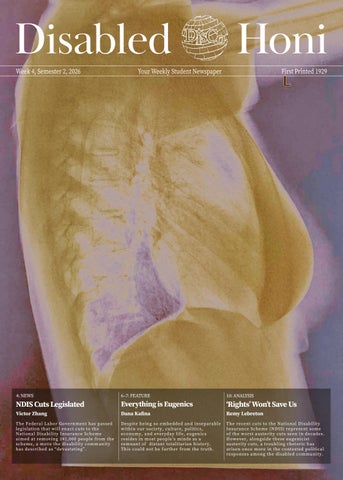
The cover of this edition features a DisCo comrade’s chest x-ray investigating chronic illness at Royal Prince Alfred Hospital. It is an incredibly heavy time after a tireless campaign to stop the NDIS cuts. Never could there be a more pressing time to reflect on the state of struggle and solidarity for disability justice. To rest and recuperate, recover our spoons, before tackling this system harder than we ever have before. So, we invite you to sit with us and share in our rage, our grief, our solidarity, and our hope. We would like to dedicate this edition to all those comrades and community members who have lost or will lose their lives to the violence of this eugenicist, capitalist system, and in the struggle against it. Lastly, we would like to remember and honour Khanh Tran, the 2023–2024 Disabilities Officer. We do this work in your honour, to continue the proud legacy you left of fighting for disability justice, each according to our abilities. Vale Khanh, at every moment of our struggle, your presence is missed dearly. Kayla Hill and Remy Lebreton, your 2026 SRC Disabilities Officers
In This Edition:
Disability Intimacy Alice Wong Feminist, Queer, Crip Alison Kafer Health Communism Beatrice Adler-Bolton & Artie Vierkant Beyond Goodwill: The Materialist View On Disability Brendan Gleeson The Architecture of Disability: Buildings, Cities, and Landscapes beyond Access David Guissen “The Ruse of Analogy:” Blackness in Asian American and Disability Studies Hyo K.Kim Everything is Tuberculosis John Green Care Work: Dreaming Disability Justice Leah Lakshmi Piepzna-Samarasinha Capitalism & Disability: Selected Writings Marta Russell & Kieth Rosenthal Moving Toward The Ugly Mia Mingus
3
Tips and Tricks
4
NDIS Cuts Legislated
Remy Lebreton
6-7
Everything is Eugenics
Eleni Papahatzis-Dagias
8
Solidarity Not Charity
10
Towards Emancipation & the NDIS
13
On ‘Work’
14
Perspectives on Disability
16
On Love
Crip Colony Sony Coráñez Bolton
18
Fighting Necropolitcs
The Ugly Laws: Disability in Public Susan Marie Schweik
19
Poetry
ARTISTS
Conor Parkinson-Brown Sahar Tejani Red Ricketson
FRONT COVER Tiffany Henson Eleni Papahatzis-Dagias Victor Zhang
20–23 SRC Reports/Puzzles/Comedy
Dear Elia Mimi Khúc Bodies That Do Not Matter Nirmala Ervelles Crip Theory: Cultural Signs of Queerness and Disability Robert McRuer Everybody Needs A Sick Comrade Sick Comrades
The Viral Underclass: The Human Toll When Inequality and Disease Collide Steven W. Thrasher
ISSN: 2207-5593. This edition was published on Tuesday 25 August 2026. Disclaimer: Honi Soit is published by the Students’ Representative Council, University of Sydney, Level 1 Wentworth Building, City Road, University of Sydney NSW 2006. The SRC’s operation costs, space and administrative support are financed by the University of Sydney. Honi Soit is printed under the auspices of the SRC’s Directors of Student Publications (DSP): Dongchen Yue, Sholto Mirrlees-Black, Lucy Sullivan, Ying Huang, Damien Lee, Hamish Evans. All expressions are published on the basis that they are not to be regarded as the opinions of the SRC unless specifically stated. The Council accepts no responsibility for the accuracy of any of the opinions or information contained within this newspaper, nor does it endorse any of the advertisements and insertions. Please direct all advertising inquiries to publications.manager@src.usyd.edu.au. Email the editors at editors@honisoit.com.
2
WTF is DisCo? The Disabilities Collective, or DisCo, is an autonomous collective of disabled students at the University of Sydney connected to the Students’ Representative Council. We organise for disability justice within education and beyond.
• Running the flu vaccination drive for over 1100 students
Some of our initiatives this year include:
• Campaigning against the removal of stuvacs in intensive units
• Organising the campaign against the NDIS cuts
• Organising a panel discussion about the intersection of queerness and COVID • Running a mask bloc
• Holding crafternoons
• Writing submissions to, and appearing at parliamentary inquiries highlighting impacts of policy (or the lack thereof) on disabled students
• Working with other disability justice groups like Protect Our NDIS Alliance, Covid Solidarity ‘Syd’, and UNSW DisCo
Masking 101
Kayla Hill masks up.
So you wanna get back into masking, but it’s kind of uncomfortable as hell (and no, I don’t mean the autism kind). Here are some tips and tricks from a seasoned masker!
1. Choose which mask you want to wear
Any mask is safer than no mask, but KN95 and N95 masks offer higher protection than surgical ones! Masks usually come in two main shapes: bi-fold and trifold. These will have either earloops or headstraps. Factors like your face shape, your face size, the sensitivity of your ears, and if you wear glasses all have a factor in what mask will be the most comfortable for you!
2. Get a good seal Before putting on your mask, flatten the nose wire. Once you’ve put it on, mould the wire to the shape of your nose. For extra comfort, find a mask with a foam nose! For masks with earloops, tighten them by making a small knot. WellBefore sells masks with silicone adjusters, but you can also buy your own adjusters and reuse them! My lazy way to check my seal is by having a mint or lozenge and taking a few exhales. If I can feel the minty or menthol-y air, I tighten the seal around my nose and repeat!
3. Find your confidence! For some people, minimising attention by wearing a black or white mask is the most comfortable option. Others feel most confident masking when it is colour coordinated and becomes an intentional part of an outfit! Mask chains are another really cool way to dress
up while masking, plus you can DIY them! Another key to feeling confident about masking is knowing your ‘why’. Whether it’s to avoid getting that nasty flu that’s travelling around before your holiday, or to protect your immunocompromised grandma, reminding yourself why you’re masking will help boost your confidence in what can otherwise be a daunting act! Remember as well that many people do not get to choose whether or not to mask, because it is literally life or death for them. Hanging out with people who regularly mask is also a helpful way to mask confidently! Find friends and events through Refresh Connections, @covidconscioussydney, the Disabilities Collective, and @c0vidsolidaritysyd (coverage on these guys further in the edition!).
4. Find affordable masks! There are two mask blocs in Sydney which distribute masks to the community for free upon request. DM @usyddisabilities and check out covidsolidaritysyd.com. Some brands offer good sales and discounts, such as Aussie Pharma Direct and Planet of Kind. If your preferred mask brand is from overseas, buy with friends so you can split those EXXY shipping costs.
5. Brand recommendations • Soft Med (single packs available at Chemist Warehouse) • Kf94.au (Aus based) • WellBefore (US based) • Kind Masks (Canada based)
• Sitting on the Disability Inclusion Action Plan Implementation Group • Organising and speaking at events for USyd’s Disability Inclusion Month. If you wanna get involved, come to our hybrid meetings which run every Friday fortnight! Details on our Instagram @usyddisabilities.
DisCo Linktree
Tips for waiting out NSW’s mental health system Ydie Lardillier goes to the ER. Mental health waiting times in NSW emergency departments are long. Really long. At Westmead hospital alone, patients presenting for mental health repeatedly experience 80+ hour waits. NSW has the lowest funding per capita in the country for mental health. The mass resignation of 200+ public psychiatrists last year came after years of ongoing and unanswered calls for greater funding, and now psychiatric wards are dropping like flies, with those remaining running at overcapacity, with limited beds, and dwindling staff. If you present to an emergency department (ED), you will be waiting for a long time. Here are my tips for waiting:
1. Bring a device and a portable charger
Sometimes charging stations are available, as well as precarious few plugs in the walls, but a portable charger is best.
2. Bring food with you, or ask the staff for food
Food not provided by the hospital itself is expensive. Food provided by the hospital is solid and free, but in my experience, if you are waiting in the ED rather than behind triage or in a bed, you won’t get the meals provided to others. Asking the staff if there’s any food available will get you varied results, but it’s still worth asking.
3. Make good use of the NSW Health blankets
The one grace you will get in an ED is a lovely, NSW Health, cotton blanket. Grab as many as you need. They work as
pillows, back support, and eye masks. The woven pattern is quite good if you need some texture to focus on.
3. Be free, lay down on the chairs if there is space
You can become quite sleep deprived waiting in the ED for mental health support, which can exacerbate your reason for being there in the first place. ED seating is often made up of connected chairs for upright sitting. Instead, lay across the connected chairs which will now serve as a padded bench. Free your ego! Be one with the bench, the beeps, and the bright lights, and try to get some one-eye-open sleep. Avoid getting jumpscared when nurses come to check your vitals at weird hours.
5. Tell the nurses if you are really freaking out
Depending on the hospital (and how recently the last nurse was stabbed), you may get some Valium, a comfy chair, and taken behind triage. Regardless of how fucked the system is, the staff are there to help.
Westmead Hospital specific: USyd free Wi-Fi!
Huzzah! Thank you to the USyd Westmead Clinical School, every time I go to Westmead hospital my Wi-Fi automatically connects to the USyd Wi-Fi. YAY!
Sandwich fridge Behold and weep the sandwich fridge! Not too far from the entrance, the fridge is stacked with basic yet glorious sandwiches, so no need to bring food with you. If you’re unsure, ask for directions.
3
| NEWS
‘We are devastated’: NDIS cuts legislated Victor Zhang reports.
NDIS,” Steele-John said.
The Federal Labor Government has passed legislation that will enact cuts to the National Disability Insurance Scheme aimed at removing 241,000 people from the scheme, a move the disability community has described as “devastating”.
“The passage of this bill is a betrayal, particularly of the people who trusted Labor to protect them and maintain the supports they rely on.”
The National Disability Insurance Scheme Amendment (Securing the NDIS for Future Generations) Bill 2026 passed the Senate on the evening of 18th August with 32 amendments. The Bill returned to the House of Representatives on 19th August and received Royal Assent on 20th August. 241,000 NDIS participants are expected to be removed from the scheme by 2031, with an additional 100,000 to be diverted from accessing the scheme in the same time frame. The Government says this will achieve savings of over $37 billion. The Federal Labor Government secured the support needed in the Senate from the Coalition after making concessions on tax policy. The disability community condemned the cuts with People With Disability Australia (PWDA) Acting CEO Megan Spindler-Smith describing the passage of the overhaul as a “devastating day” for people with disabilities.
Fronting a press conference on 18th August hours before the Bill passed the Senate, both Health Minister Mark Butler and NDIS Minister Jenny McAllister, again framed the rationale of the overhaul as addressing fraud and costblowouts. “Costs have grown far too quickly and, frankly, it has become a soft target for shonks and for fraudsters,” Butler said, with McAllister adding that the Labor Government worked “with the Coalition to strengthen the bill further in relation to fraud.”
“We are grieving the lives we have had, the opportunities we will lose and the impossible choices we will now need to make,” PWDA CEO Megan Spindler-Smith Earlier in the year, the upper house held a snap inquiry examining the Bill. The probe received over 4,000 submissions and held six days of hearings, with the disabled community, human rights experts, health professionals, lawyers, and academics slamming the measures introduced in the Bill. Despite the overwhelming evidence presented against the Bill, the upper house committee’s recommendation was simply that the Bill be passed.
The blood and the lives of those who will suffer and die will be on your hands and will live in your consciences forever. Greens Senator Jordon Steele-John
Greens Senator for WA and Greens NDIS spokesperson Jordon Steele-John said the cuts to the scheme were a betrayal of the disability community. “What is clear now is that the major parties have come together behind closed doors in Canberra and signed away the rights, security and lives of people who depend on the
4
Community responds in rage and grief “We are grieving the lives we have had, the opportunities we will lose and the impossible choices we will now need to make,” PWDA Acting CEO Megan Spindler-Smith said. PWDA criticised the Government for pushing through the cuts without building adequate alternative support structures in states and territories. “Those supports do not exist today and will take time to build, and states and territories have categorically said they will not be like-for-like supports,” Spindler-Smith said.
“We need to know what will actually be there, when they’ll be up and running and how they will replace the 94 million hours of paid care that are being taken away.” The NDIS overhaul faced strong criticism on how it would impact women. Rosemary Kayess, Disability Discrimination Commissioner of the Australian Human Rights Commission warned the inquiry examining the Bill in June that the legislation was introduced without a proper analysis of how it would affect women. After the cuts were legislated, Women With Disabilities Australia (WWDA) CEO Sophie Cusworth said that the Bill makes “those [gender] inequalities worse.” “Women will be less safe. Less supported. More isolated,” Cusworth said. “When support is cut, the need does not just disappear. It falls back onto women and families. The Government has chosen to make women with disability, mothers, daughters, partners, and carers carry the cost of these reforms on their backs.” Carers Australia CEO Joanna Cave said carers across the country were “dismayed” at the passage of the Bill. Cave said unpaid carers would be left to fill in the gap left by cuts to NDIS supports. “Carers tell us they are already at the end of their tether. Knowing the important supports the people they care for rely on will be reduced will only add to the strain, and risk accelerating carer burnout,” Cave said. The Australian Council of Social Services also slammed the changes saying the government “rushed deep and lasting changes without proper collaboration, and without listening to the people most affected,” calling out in particular the introduction of automated decision-making. ACOSS CEO Dr Cassandra Goldie warned that “The Robodebt disaster looms large over these changes. Seeking to make large scale budget savings in a short time frame, by relying on automated decisionmaking to deliver services to people who rely on them for life sustaining support, is a recipe for a potential disaster.”
“When support is cut, the need does not just disappear. It falls back onto women and families.” WWDA CEO Sophie Cusworth
Questions remain unanswered When NDIS Minister Jenny McAllister appeared on ABC Insiders on 16th August, David Speers questioned her on what would happen to current NDIS participants if they are moved off the scheme before alternative supports are in place. Speers pointed out that Queensland had not committed to the Thriving Kids program, aimed at supporting children eight or under with developmental needs and autism. Speers repeatedly asked if the Government would delay the changes, pointing out that Queensland has not committed to the Thriving Kids deal. Speers asked McAllister no less than eight times if the Government was prepared to move children off the scheme should Queensland not adopt the Thriving Kids program and other alternative supports. “I don’t think we need to contemplate delay at this point,” McAllister replied.
Senate amendments Greens Senator for WA Jordon Steele-John blasted the Bill in the Senate. “How do you expect a disabled person to live with dignity and confidence if they must first prostrate themselves before their own government to pass a series of randomly decided tests as to whether they’ve done enough to cure themselves before they can access the NDIS? Where is the dignity in that?” Steele-John asked the Senate. “I don’t think people in this place understand what is on the line for disabled people and our families, despite the 4,500-odd submissions made by the community and despite the six hearings. This is not a joke
NEWS |
to the disabled community. This is not a political moment. This is our lives on the line. These cuts are not needed.” David Shoebridge, Greens Senator for NSW condemned Labor for seeking a deal with the Coalition to pass the cuts. “Labor and the Coalition, cheered on by One Nation, have been meeting in dark rooms in this place to cut the deal to drive 160,000 [sic] people off the NDIS, and to take billions and billions of dollars away from support that the people with disability use,” Shoebridge said. Greens moved eight amendments to the effect of scuttling the Bill and noting pernicious consequences of the Bill. The amendments also noted that the Government had not modelled the economic impacts of the Bill. The amendments failed 32 against and 11 for, with the Greens Senators and Independent Senators David Pocock and Lidia Thorpe voting for. Senator Lidia Thorpe’s amendment to reject the Bill and note that the NDIS cuts would disproportionately impact First Nations people with disability, and Senator David Pocock’s amendment to pause the roll-out of automated decision-making were also voted down in the Senate. In the second reading debate, NDIS Minister Jenny McAllister reiterated her support for the Bill citing the need to combat “fraud” and ensure the “sustainability” of the scheme. “We should not, in this place, unnecessarily stoke fear in the community while debating, in the robust way that is our tradition, in an appropriate way, the measures that are in the bill,” McAllister told the Senate, underplaying the fears expressed by the crossbench and disability community.
Disability community stages ‘die-in’ in response to NDIS overhaul Julia Disaffinity reports.
On 17th August, Protect Our NDIS Alliance held a snap rally ahead of the Senate debate on the Federal Labor Government’s NDIS overhaul. The National Disability Insurance Scheme Amendment (Securing the NDIS for Future Generations) Bill 2026 was then before the upper house with the Labor and Coalition negotiating a deal to pass the legislation. Around 30 people, mostly young and some visibly disabled, gathered outside the Sydney NDIS office under the rain in a gathering to express the rage and grief felt in the community. Chants sang around the building, “Budget cuts equal death! We’ll fight them with every breath!” One of the MCs told the crowd on a megaphone: “The disability community is the only community you can actually join. You could need the NDIS tomorrow and yet the threshold is becoming so high you might not even get in!”. The rally started off with an intimate crowd, surrounded by a heavy police presence, with nine police already in front of the office more than 30 minutes before the starting time, and a riot squad car parked across the road. Nearing the advertised start time cops outnumbered the group. Eventually protesters to cops became a ratio of 2:1 then peaked at roughly 3:1. People continued to trickle in throughout the action. Attendees had hoped to enter the NDIS office to drop off letters from disabled people concerned about the cuts and how funding cuts would affect
From 27th August this year, legislation limiting plan reassessments and legislation empowering automated decision-making will come into effect. Support budgets for social, civic, and community participation supports will be cut from October 2026.
their or the community’s NDIS plans. Police refused protestors access because they “pose a safety risk to workers”, additionally blocking entry to disabled people separate to the rally with appointments, and NDIS staff from leaving. Everyone watched in disbelief as the sergeant negotiated with the protesters and evaded questions of how protestors would pose a threat and if a die-in was illegal. “What threat do I pose in a wheelchair” one of the MCs asked the sergeant on the megaphone. “Can you look at me, I’m talking to you, what risk do I pose?”. To which the sergeant replied hand on hips “I don’t know”. At a stalemate the MCs opened the mic for the crowd to speak, a deaf wheelchair user pulled up, in a leather jacket and motorcycle helmet, getting the person next to them to read out what they had written for today, “we stay together to fight for freedom… I have NO fear, NO pity, NO regret TO DIE IN”, the deaf protestor thrusting their fist upwards. Despite being locked out, rallygoers slid letters and inquiry submissions under the door of the NDIS office. “This isn’t life or death for these politicians but it is for people like me. These laws don’t protect Australians — they protect the wealthy,” one letter read. “The fact that any government, like your Labor government, can manipulate a system of rights for so-called “savings” is atrocious! You are responsible for the suffering of hundreds of thousands,” another letter read.
Following this, rally-goers chalked messages on the ground, including “You’re killing us”, and “this is murder”. Multiple attendees then staged a die-in at the locked doors of the NDIS office, the outlines of their bodies chalked on the pavement. Towards the end of the rally, several police pulled aside a protester. The officers said that they may detain the person for “malicious damage”, referring to the red chalk that had been written on a column, “RESIST”. After some investigation, and pressure from the crowd, the protester was let go.
Community snubbed from Minister’s office Eager to be heard, eight individuals went to NDIS Minister Jenny McAllister’s office after the snap rally. The group was informed that McAllister along with her senior staff were in Canberra for the sitting week. Behind a glass plane, intercom in hand, McAllister’s staff informed the group they could leave their details and messages for the Minister. Disabilities Officer and Grassroots member Remy Lebreton said “there have already been thousands of [inquiry] submissions…it’s fallen on deaf ears of our so called representative. It’s just frankly not good enough that on the day before this bill is passing [sic], there is nobody to speak to the community about this.” The group wrote letters to McAllister and staged a die-in to reflect all the lives already lost and will continue to be lost as a result of cuts and mishandling of the NDIS. Bodies and letters laid on the carpet, as a banner with a smiling McAllister and “working for a just society”, juxtaposingly loomed over.
From January 2028, new eligibility requirements and a new definition of permanence will come into effect. Existing participants will have their plans re-assessed over 2028–31.
Photography by Toyo White
5
| FEATURE
Everything is Eugenics! Dana Kafina fucking hates eugenics. Despite being so embedded and inseparable within our society, culture, politics, economy, and everyday life, eugenics resides in most people’s minds as a remnant of distant totalitarian history. This could not be further from the truth. Eugenics as a political project did not end (nor start) with the Nazi regime. Eugenics is rooted in pseudoscience, bigotry, and supremacy; prevailing through continual systemic and industrial structures, shaping inclusion and exclusion. Its bioessentialism is a background figure to the majority, repackaged and influencing everything from our belief systems, to our interpersonal-relationships and communities.
wellness movements and notions of healthiness — as well as who even gets to define what health looks like — is eugenics in itself. But disability is a natural part of humanity and its diversity. Almost everyone will experience disability at some point in their lifetime, and this can occur at any moment. The idea that disabilities are inherently ‘defects’ is eugenicist social construct. Which lives are less worthy?
Eugenics was made clearest during the COVID-19 pandemic, when the thenMorrison government pushed policy founded in a eugenicist ideology of “survival of the fittest”; its idea of a “return to normal” symbolising a supposed end to the pandemic. Yet there never was a return to normal. To date, the COVID-19 pandemic continues to disable people en masse, whilst eugenics continues to propel injustice, such as the recent cuts to the NDIS. Today, red flags signaling a rise in eugenicist ideals are abundant in almost every single aspect of our culture, such as through the re-popularisation of ableist slurs, or trends, like Sydney Sweeney’s unapologetic “I have great jeans/genes” euphemism. The fight against eugenics must include the everyday. If we are to truly fight the farright, we have to reckon with the pervasiveness of eugenics in all spheres of our life.
Origins Of Eugenics
What Is Eugenics? Simply put, eugenics is the notion that some people’s lives are more valuable than others. Robustly discredited, eugenics uses fallacy and pseudoscience to justify a forceful curation of our world. It exists as a false authority on what is in the best interest of value, like through health, productivity, or social worth. This dictates things like who gets to have a child, who gets to be born, and who gets to love, who gets to live happily. It’s not as simple as ‘improving’ humanity. In fact, the rise of pseudo-
6
Eugenics, as we know it today, originated not just with Charles Darwin’s notion of natural selection, but with his cousin, Francis Galton. Eugenics to Galton was his solution for those who weakened his idealist master race. His inquiries ranged from “criminals and the insane”, to the “caprice and coyness of females”, “intellectual differences”, “slavish instincts”, “selection and race”, and “races and subraces”, including “barbarous tribes”. From its core and origins, the idea of eugenics as a tool to “better humanity” was deeply racist, misogynistic, and of course, ableist. Galton himself cared for neither ethics nor morality, insisting that moral concerns should be excluded from considerations of eugenics. Eugenicist propaganda surged rapidly and globally from here, resulting in the funding of a mass supremacist movement. In 1920s Amerikkka, ‘Fitter Families’ competitions were held in Kansas. Historian Daniel J. Kevles describes “winning families… were awarded a Governor’s ‘Fitter Family’ Trophy…. a brochure [that] noted ‘health is wealth and a sound mind in a sound body is the most priceless of human possessions.’” With that emerged the trend of “eugenic marriage”, so too rewarded with prizes and
scoring. Billboard adverts would declare the allocated amount of taxpayers’ money for the care of supposed “mentally deficient” people. Unsurprisingly, these ideals were likewise at the core of amerikkka’s history of enslavement, racism, and Indigenous genocide.
the German state. Victims were kidnapped, systematically transported to camps, and murdered. The 1935 Nuremberg Laws made it mandatory for couples to test for genetic diseases, defended as maintaining the ostensible/self-styled Aryan race. Nazi Germany’s ‘final’ manifestation of eugenics, as it is most commonly associated with now, is through the mass genocide of Jewish and Roma people, who were transported to concentration camps and murdered in gas chambers.
It is critical to note there is nothing scientific about eugenics. Eugenics is a pseudoscience, deeply immoral, and unable to ever be disintertwined with Almost everyone will experience white supremacist, disability at some point in their ableist, anti-human lifetime, and this can occur ideology. Despite this, the academic work that at any moment. The idea that succeeded Galton’s disabilities are inherently ‘defects’ original works has is eugenicist social construct. been instrumental Which lives are less worthy? to the growth of eugenics, with universities and colleges still rewarding Contemporary Examples eugenicists and their of Eugenics frameworks. Disturbingly, the contemporary academy A long history of eugenics is still regularly responsible precedes us. These very for platforming and gratifying programs, policies, and ideas such disinformation. At which we supposedly condemn the University of Sydney, have not vanished with the the School of Medical turn of the century, but Sciences building is named are rather still carried over after a eugenicist who also today. Eugenics, again, perpetuated many whitepervades every aspect of our supremacist policies — society, a haunting legacy for Anderson Stuart. both right as well as left-wing spaces — a legacy that is still Germany and ‘amerikkka’ largely unrecognised. became intertwined through the collaborative study of The most blatant eugenics. Hitler’s Nazi party contemporary example is in the 1930s was founded and the COVID-19 pandemic. built on the eugenic ideals Responses to the pandemic of a “racial state”, leading to were revelatory of a deep reduced social support and disregard for disabled lives the ultimate sterilisation of and brought many eugenicist disabled and other peoples beliefs to light, particularly justified under the label of within the bio-politics of “sub-human”. public health initiatives both local and worldwide. When Hitler came to power Notions of the “public in 1933, the Nazis introduced good” became weaponised. a “Hereditary Health Law” Rather than serving as a call which mandated sterilisation for collective care towards for disabilities, leading to the those most vulnerable in our mass-sterilisation of 400,000 communities, the term was disabled people. By 1939, two used to segregate disabled and years before the Holocaust and vulnerable people further their vile “Final Solution”, the from society, arguing that Nazis introduced a euthanasia their safety could not program which murdered be prioritised over this erroneously defined “public thousands of institutionalised good”, thereby excluding patients, to mass-exterminate disabled people from public those they considered life. unworthy of life, who ‘burdened’
FEATURE |
Unsurprisingly, notions of “fitness”, societal contribution, and “social cohesion” have spiked since the pandemic, with those most vulnerable left behind. Many focused on the inconvenience of the pandemic, rather than its tragedy, resulting in forgoing safety measures and restrictions early, risking the health safety of everyone, not just the immuno-compromised. Whilst the government falsely adopted and continues to claim a “post-pandemic” era, preventative measures like masking or regular testing have dramatically decreased. Free eligibility for COVID vaccines are currently being reconsidered and COVID is no longer something most people isolate from/for. Individualism and apathy proceeded, revelatory of the ideological state apparatus of capital: violence is placed upon the disabled, against the working class, against the marginalised, hegemonic and normalising eugenics in every facet of our society, a tool of its elite. Of course, there is a racial oppression element as well. Palestinians during the peak of the pandemic faced (and continue to face) a vaccine apartheid, clearly designed to eliminate the Palestinian population. Health Minister of the genocidal state of Israel, Yuli Edelstein said “we can’t deny an Israeli citizen a vaccination because we want to help someone else.” During the supposed “return to normal”, Palestinians still face effects substantially worse than settlers — in 2026, there have been 5,708 (recorded) total deaths for Palestinians from COVID-19. The pandemic was never over and the harmful effects of COVID infections continue to impact everyone. This legacy persists with a death toll in the thousands, many of whom were disabled in addition to the mass disabling of many more. In August 2026, the NDIS ‘reform’ Bill’s gruelling austerity cuts were legislated and received ‘royal’ assent. One of the many inexcusable reasons provided for these cuts were claims that the NDIS was too burdensome an economic cost. In a horrific parallel, Mark Butler and other ‘labor’ flunkies have echoed the very same eugenicist talking points, stating disabled individuals, or those who were ‘hereditarily ill’ placed a burden upon society, both financially and genetically. The lives of disabled people — who depend on the NDIS
for the most basic of needs, often only partially met — in any case have been deemed unworthy to live. Disabled people aren’t considered part of the public, and their lived experiences and expertise are discounted or devalued consistently in comparison to the able-bodied/ non-disabled. The Bill proposing the NDIS cuts was bi-partisan, supported and voted up by both the Labor government and the Coalition. These parties purportedly represent the interests of the majority of the ‘australian’ public. Currently, estimates state over 20 per cent of the ‘australian’ population lives with disability, with up to 60 per cent living with at least one chronic health condition.
So, where to from here?
We have to reckon with the idea that capitalism disables us. We have to reckon with the idea that what is deemed ‘disability’ is everywhere reflect and a natural part of human ‘australia’s’ diversity, that this is beautiful settler-colonial system and does not necessarily doom — the idea that people anyone to a life of suffering. who occupy this stolen We have to learn that suffering land should be able to (real or assumed) itself is participate in and make a not incompatible with a more productive use of it. worthwhile life. Fighting Moreover, the eugenicist eugenics starts with breaking framework of the “White down our own internalised and Australia Policy” remains reified beliefs. It starts with present today, shaping the challenging myths like our treatment of refugees (see: immune systems determining offshore detention centres); our safety and superiority. It and modern ‘australian’ starts by stopping fatphobic politics through the farjokes or calling yourself a right and its notion of white speck of dust or air jokingly. monoculture peddled by Eugenics is really, truly, Pauline Hanson and One everywhere. This discourse is Nation. part of the material as it is not just ideology — it affects relationships to To make it very clear: disability our one another and to our justice is a working class struggle. system. We have to kill It is only through class war that we the eugenicist inside can move out to a world that honours our head.
The NDIS itself does not even account for the entire disabled population of ‘australia’, with its incredibly strict and exclusive disability and supports it rather than Theory has to move qualification criteria. treating it as a burden on labor. into praxis, too. You If the remaining nondisabled members must understand There are countless additional of the public will eventually eugenics and ableism, as it is examples of eugenicist experience disability as they intertwined with capitalism. rhetoric embedded in our live and age, who is this Lean into your discomfort everyday lives. Leftist ideas of ‘majority’ the government and stand proudly with your “staying/keeping healthy for the claims to be prioritising? disabled comrades. Understand revolution”; feminist spaces that accessibility and disability perpetuating bioessentialism At a recent ‘die-in’ staged advocacy is advocacy for all, with phrases like “men are by the disability community regardless of their disabled inherently bad” or supposedin response to the (thenstatus. Explore and analyse the spiritual ideas of the “divine proposed) NDIS cuts, a ways in which accessibility and feminine”; people arguing protester rallied to the accessible utilities show up in for legalised euthanasia of crowd, saying “the disability your everyday life. disabled people because “it community is the only will lessen suffering”, or the oppressed community you can To make it very clear: disability idea of “quality of life” defined actually join”. Yet eugenicist justice is a working class solely by ones productivity; notions of survival of the struggle. It is only through the idea that a disabled life is fittest make people think class war that we can move one of inherent suffering; antiotherwise, normalising ableism out to a world that honours natalism and people choosing in our society and economy, disability and supports it not to have children because and entrenching it into our rather than treating it as a “the state of the world is so public discourse. burden on labor. Disabled fucked right now”, or because people should be able to be of climate change (climate ‘australia’s’ immigration active agents in undoing doomerism/ecofascism!); policy itself is highly capitalism, instead of confined fatphobia and wellnesseugenicist, with migration law or left at the sidelines. And exempt from the Disability while we work towards a movements with phrases like Discrimination Act 1992. In class insurrection, in the “obesity is not natural”; even order to seek an ‘australian’ meanwhile: ensure ALL your our pop culture and media visa, you have to undergo a events are accessible, build plotlines (remember Avengers: strict health examination to crisis houses and spaces, Infinity War? Thanos was ensure you won’t “burden” the unionise and demand fair literally just arguing for ‘australian’ medical system. pay for workers disabled and eugenics). Like it or not, After screenings such as blood otherwise, call out wage theft, disability exists. Everyone tests and chest X-rays, your as well as join and support is sick or will become sick. eligibility to come in on a visa disability justice groups in Marginalisation disables you. is determined. Conditions that activism! Show up and fight The concept of suffering is get flagged can include HIV everyday for a revolutionary itself subjective. And yet or Hepatitis, diabetes, heart struggle, one led by us, for us, within suffering there is disease, kidney failure, and including disabled people. Or, joy, friendship, community, any intellectual or mental as the tenth principle of the aspirations, resistance! health disabilities; all of disability justice framework Eugenics reveals itself by which would then lead to a states: “no body or mind can imposing putative notions of strict review determining be left behind — only moving suffering — value of life — onto the outcome of your visa together can we accomplish the people, bleeding into our application. These ideals revolution we require”. collective unconscious.
7
| CAMPUS
Solidarity Not Charity: The SRC’s Flu Vaccination Program Grace Street gets vaccinated. In April and May 2026, your SRC and its Disabilities Collective was hard at work bringing you the 2026 SRCled influenza vaccination program. It was a huge feat but with a big pay-off, where we provided vaccinations for over 1,200 students over six on-campus sessions and with a limited number of vouchers for students to get vaccinated in their own time. Here’s how it went!
Why did the SRC run this program?! While there are free universal influenza vaccinations for all Australian residents in Queensland and Western Australia, New South Wales lacks such a program. Additionally, while UNSW offers free flu vaccinations via the UNSW Health Service for all current students and staff, the University of Sydney only offers a flu vaccination drive for staff. They do offer influenza vaccinations for students at the singular University Health Service, but it is notoriously overbooked and can take up to or more than a week to get an appointment. Recent years have seen rising influenza tolls and mortality rates paired with decreasing vaccination rates. This means higher costs for students retroactively going to the doctor and dealing with illness or doctor’s certificates, and other students becoming scared to engage with campus life due to the risk of infection. This isn’t a simple program to give ‘free stuff’ to students or to do the University’s job for them. It runs along the lines
of mutual aid — solidarity not charity, community-based initiatives, sharing resources with and protecting those who need it most, and increasing political education and action. When our University, government, and public health systems routinely abandon medically vulnerable and disabled people, it is up to us to offer these services and model how to take care of one another. The SRC in 2025 ran a pilot program to run an influenza vaccination drive, and then received funding to run it at a larger scale in 2026. The goal, however, is that the government and University eventually take over this program with their own funds, rather than leaving it for student representatives and volunteers to run with Student Services and Amenities Fee (SSAF) money that could be going towards other projects or more casework and legal staff in the SRC and SUPRA.
What did students have to say? The 2026 SRC/DisCo-led free flu vax program was overwhelmingly well received by the University of Sydney students who used it. Across 673 valid survey responses (around half the amount of recipients), participants were wholeheartedly supportive of this program. 41.6 per cent of respondents said they probably would not have, or were unsure if they would have, otherwise gone to get a flu vaccination this year — meaning the program is not simply subsidising vaccinations students would have obtained anyway, but is measurably increasing vaccination uptake
and awareness, which has flow-on effects for the whole community. In our current context, the program has an added benefit of cost-of-living relief: students rated its financial impact at 4.43 out of 5, and saving money was the single most commonly cited reason the program matters (87 per cent of respondents). “A flu vaccine isn’t that expensive but for a uni student those extra $20-40 makes a difference, especially for someone saving up to undertake placement,” one student said. The program also boosted awareness of respiratory and contagious illness issues (mean 3.73 out of 5), which has been an ongoing campaign of DisCo and the SRC. On the question of who is best placed to run the program, 63 per cent gave a clear “yes” to a University-run model and a further 5 per cent supported a hybrid SRC–University model. That adds up to a combined 68 per cent favouring greater University involvement, against only 14 per cent who preferred the SRC-run model to stay as is. The students who preferred an SRC-run model liked that we “did a great job”, were trustworthy, and had friendly student representatives, but don’t worry — those aren’t going anywhere! The most common feedback and constructive criticism was: wider promotion through official University channels; guaranteed and appropriate room bookings; more seating and better logistics on the day; and, more available timeslots. These are all precisely the structural constraints that point to the need for a University-run program with the right institutional resourcing and infrastructure. 648 of 673 respondents (96.3 per cent) received an oncampus vaccination, with the remaining 3.0 per cent using a voucher. Students preferred and benefited from the oncampus model which was accessible, easy, and visible. This year, we ran additional sessions at the Conservatorium of Music and Westmead campuses. However, there are still students at satellite campuses or with scheduling conflicts which means the vouchers remain a valuable option.
8
Who is the program supporting? Disabled students, student carers, students undertaking placement who require mandatory vaccinations, and international students (who may be unfamiliar with the Australian healthcare system) are the groups our program has supported the most. In student responses to the program, praise for the cost-ofliving relief and time savings were dominant, but more than half of respondents also frame the program in public-health terms and valuing the herdimmunity effect of a more vaccinated student population. Students undertaking placements said the program was invaluable. “I think this program made life a lot easier as a nursing student who struggles to find an accessible booking for vaccination in the short window available before placements,” another student told the SRC. “It meant a lot being able to get a vaccine that prevents me from getting a flu that significantly impairs my health,” one student with severe asthma said, commenting on the benefits of this program for students with disabilities.
What’s next? Unfortunately, it is not sustainable for the SRC with limited resources to continue running this program at the necessary scale. While it is a great way for the SRC to reach students and build engagement and trust (before taking part, only 43.1 per cent of respondents said they already knew about the SRC), our goal is to make the University and government better serve the needs of students and our community. Our aims are to expand the program (particularly to postgraduate students, other campuses, and across more sessions) and to transition to a University-resourced program. The University is already running the exact same program with the same company for staff, so why not for students too? Grace Street is the President of the SRC
CAMPUS |
From Uni2beyond with Williams Syndrome Life with Williams Syndrome from age two till now has been complex, rough, and misunderstood. There were times where I would be faced with discrimination by people both in and out of home. I endured abuse mentally, physically, and emotionally in a way that a lot of people would be shocked and disappointed to know about. People probably wonder why I am the way I am. In saying this, here is a little information about Williams Syndrome (WS). For those who don’t know what Williams Syndrome is, it’s a neurodevelopmental disorder that makes people who have WS naturally social, empathetic, and caring. This is from the missing of 26-28 strands of DNA from Chromosome 7. People with WS contend with internal and external health problems such as early ageing, which leads to curiosity at an early age from walking, talking, people, and a plethora of other curiosities that most people don’t think about or are able to control. Because of these health problems as well as the limited knowledge about how universities can support people with intellectual Abilities/ Disabilities, many people with Williams Syndrome never
end up being able to study in university. It is unfair that we are excluded from education because we also want to learn and have a community. This has changed thanks to Uni2beyond. Uni2beyond is an awardwinning program that is not well known at the University of Sydney. It is a social inclusion initiative that started in 2012. It allows students with Intellectual Abilities/ Disabilities to participate in the program after year 12. The program allows students to study under audit, which means that they don’t have to participate in exams and assessments. A lot of the students have succeeded because of this program!
The students also have a group class where they learn different skills each week with two facilitators and private one-on-one classes. After two years, the alumni students can choose to either do a paid internship or not and do volunteer work, if they wish, with one of our partners.
When it comes to working at the Centre for Disability Studies program, Uni2beyond is something that I am very proud of being in. As an alumni student, it provided me and many others with an opportunity to study and enjoy university life, and the atmosphere that comes with it. I also have the privilege of working with Uni2beyond as a social inclusion officer and an advocate for the program. As I said in an interview with the university, “What the program demonstrates, and what all other programs around the world demonstrate, is that people with intellectual disability have potential, they have capacity, desire and ambition and can achieve great things with the right structure, support and pathway. But we have to create the pathway. It’s not happening naturally.”
“People with intellectual disability have potential, they have capacity, desire and ambition and can achieve great things with the right structure, support and pathway.”
The students get to choose their subjects. The selection must go through the unit coordinator, and if the student is accepted, they can then go into the class of their choice. There is also a mentor system that we use in the program so that the students feel safe in class and have a friend to socialise and bond with. Additionally, we have a program called FUNCH. Funch is another way for us
What happens when we lose? When Mark Butler announced cuts to the NDIS at the National Press Club in April, we immediately rushed to put together an article reporting on it, simultaneously beginning to organise the first steps of what an activist fightback would look like; whilst also continuing to assist dozens of people at the flu vaccination drive, and attend the Save Waterloo Picket.
marshalled and marched. We organised two national days of action, protested outside the Sydney NDIS office, and participated in a die-in at Jenny McAllister’s office. We converged on Parliament the day following the Federal Budget, we made submissions to the NDIS Bill Inquiry, and we even appeared at the NDIS Bill inquiry in the tertiary education session.
Within 48 hours, a grassroots collective of disabled people and allies had formed nationally, creating the Protect Our NDIS Alliance. A motley crew of activists and community members from all walks of life, united around the singular goal of opposing these austerity cuts, however and wherever we could across the continent.
The Disabilities Collective has historically been regarded as one of the less politically active collectives. So why is it, then, that we took the lead on the largest national disability mobilisation in many years, against our largest austerity cuts in decades, mostly alone?
We facilitated and minuted the local meetings, we delegated and oversaw many of the tasks, we flyered and postered, we were harrassed by police, we
to say ‘fun lunch’, where the facilitator, students, mentors and anyone who is willing to engage in an inclusive atmosphere are welcomed.
Benny Dominish advocates.
To ask more broadly, where is the left? This is not an issue of identity politics. Thousands are set to lose their jobs, be plunged into poverty, or far worse, socially murdered by these cuts — cuts that have been mobilised to fund war,
Uni2beyond is important because it gives people with Intellectual Abilities/ Disabilities the chance to make the impossible-possible by gaining their confidence but also gaining new skills they can take in the working world and in general. In saying that, people should support this award-winning program because not only is it one of the two soon to be three inclusive programs in all of Australia.
Supporting access to education for people with Intellectual Abilities/Disabilities is an important task that requires all of our help. We should all learn more and do more to make programs like Uni2beyond possible for anyone who needs it.
Kayla Hill and Remy Lebreton call in the socialist left. and sustain the profits of the rich and powerful. This is class war 101. This is a socialist issue. So why are almost all of our comrades on the front lines of this struggle also disabled comrades? Why have so many socialist and left organisations not organised their own actions or marches? Let alone attended ours in any force, made a single post, reel or even comment on the state of things? Let alone offered or reached out to collaborate on or help build any of ours? If the argument is it is more critical to fight the rise of one nation and the far right, we contest that the fight against eugenicist austerity is not only inseparable from, but key to the fight against fascism. Nevertheless, It couldn’t be argued that if we can participate in both of these
struggles, surely national and mass leftwing organisations can as well. If disability politics is class politics, it remains that we cannot win this fight if it remains fought primarily by those who are disabled. We need a mass movement, but this is only possible if the left shows up and organises. If it shows its solidarity.
Why is disability so often the afterthought of the class struggle? We have never really lost, so long as resistance is still possible. The time is now for the broader socialist left to take this fight seriously, and throw its weight behind it. What happens when we lose, is we fight back harder.
9
| NDIS
Fighting for ‘Rights’ Won’t Save Us Remy Lebreton seeks complete emancipation. The recent cuts to the National Disability Insurance Scheme (NDIS) represent some of the worst austerity cuts seen in decades. As part of Labor’s 2026 Federal Budget, 340,000 people are projected to be kicked off the NDIS by 2031, while defence will receive a $53 billion boost. The situation, particularly for those who depend on care the most, could not be more dire. However, alongside these eugenicist austerity cuts, a troubling rhetoric has arisen once more in the contested political responses among the disabled community. In response to calls for “welfare not warfare”, a common objection received is “We aren’t fighting for welfare, we’re fighting for rights”. Public welfare is seen as conditional charity and irredeemably stigmatising, in contrast with forefronting the rights based model which is lionised as empowering and equalising. This perplexing politic rests on the all too pervasive perspective that ableism and disabled oppression result simply from prejudicial individual attitudes, or inadequate legislative frameworks. That by seeking to prevent discrimination and formally guarantee accessibility, through either legislation or education, equality can be achieved for the disabled community. Similarly, exclamations that “Cuts kill” are anxiously moderated to a more ambiguous and less offensive “Cuts harm people”. This suppressed messaging fatally sanitises the dark reality of eugenicist austerity. In the very campaign to stop the NDIS cuts, we cannot downplay these material facts.
flawed strategy for reform, and at worst a form of bourgeois ideology”, obscuring the reality that disability and ableism are not only socially manifested from, but are in fact critical to the contradictions of capitalist social relations and capital accumulation. Under capitalism, people are only valuable to the extent that they can conform to a standard of workplace productivity which can consistently generate profits. All others are reduced to a social problem and thereby excluded on this basis of being unprofitable. Those with disabilities therefore always face inherent systemic discrimination and poverty in a system where employers expect accommodations will impact their bottom line.
Thus rights ‘victories’ can be won and enforced while leaving capital’s inherent requirement to sort people by their capacity to generate surplus value, and to exclude ‘unproductive’ bodies completely intact.
We must be clear from the outset — this distinction between welfare and rights is not merely incorrect or arbitrary, but more dangerously has utterly stifled any possibility for genuine resistance and liberation of people with disabilities. We should not be afraid to speak truth about our own lives and deaths. As Marta Russell so eloquently stated, a disability politics that ignores the political economic question “is at best a fundamentally
10
The systemic impoverishment and exclusion of disability so too functions as a disciplinary mechanism to instill the fear of acquiring disability. Rights and social safety nets under capitalism then can never be sufficient. If workers were ever adequately protected from unemployment caused by disability (or unemployment otherwise for that matter) through rights, or legislation, they would then gain the security by which they could negotiate the conditions of their employment from much stronger ground, and in doing so threaten the dominance of the capitalist class. Capitalism as such requires workers to conform to productivity and accessibility standards which are conducive to profit, or be classified as disabled and excluded from society. Disability then likewise provides a convenient cover by which employers can justify
the exclusion of all those they deem unprofitable. Thus rights “victories” can be won and enforced while leaving capital’s inherent requirement to sort people by their capacity to generate surplus value, and to exclude “unproductive” bodies completely intact. Legislation such as so-called Australia’s Disability Discrimination Act 1992 and the Americans with Disabilities Act, for example, which were and are seen by many as historic victories, have in many ways served instead to demobilise political struggle, towards their so called equalising “ends”, rather than genuine systemic change. They have proved woefully inadequate to address this systemic discrimination and provide equal opportunity.
Disability politics must not and cannot stop at rights, or any existing model of welfare we have seen under capitalism for that matter. There can be no equal opportunity in a society where this opportunity is controlled by a select few whose class interest is to withhold it. The basis of disabled exclusion requires us to dare to fight and dream for an entirely new system which values human beings intrinsically, rather than productively. For this reason, we must challenge and disrupt capitalist property relations that enable this exclusion here and now.
Pretending our liberation should be primarily based in fighting discriminatory discourse, rather than fighting our material oppression in the class war, which we are a part of whether we like it or not, certainly will never save us.
Exemplifying this tendency, the NDIS has insidiously framed its equality in the right of people with disabilities to satisfy their care through the free market, socialising their purchasing power so that capitalists may generate profit from disabled exclusion, commodifying disabled bodies whilst socialising the costs. We can see in these recent cuts its very inadequacy, as an economic crisis narrows the categories of who is considered legitimately disabled according to the needs of capital accumulation (through farces such as the new flawed “functional capacity” test). Austerity is then not incidental, or a mere lapse in correct perspective from the Labor government. So long as the state is committed to managing the collective affairs of the capitalist class, austerity cuts will inevitably happen again and again.
Ergo: Rights will never save us. Formalistic equality will never save us. Pretending, however hard and scary it very reasonably may be, that we can return to the previous status quo of an already flawed model of privatised care, will never save us. Platforming political positions and voices that express fighting for rights as an end in itself, or purely towards discussing disabled experiences, also will never save us, irrespective of disabled identity. Pretending our liberation should be primarily based in fighting discriminatory discourse, rather than fighting our material oppression in the class war (which we are a part of whether we like it or not) certainly will never save us. Arbitrability withdrawing our solidarity from those whose struggle is against the same rotten system will never save us. The master’s tools will never save us in dismantling this house. A robust, publicly owned and run, universal, welfare, disability, and health care system will save us. A system where rights are materially based, rather than contingently, formally or symbolically will save us. To this end, class consciousness is what must and what will save us. To be more direct: we will save us.
NDIS |
The Cuts in Context: Unpacking the Rationale of the NDIS cuts Charles Reeves pieces together the corpse of the NDIS. I was one of many people who was outraged when I heard of the NDIS cuts in April of this year, and even more so with the budget announcement a few weeks later that gave me a further glimpse of where that money was going. I remember just days after hearing from people I knew on the NDIS complain that what they had needed to live had just been uprooted from under them. Watching people remark that if they wanted to still be able to exist and function properly as a disabled person, they would need to cut down on other expenses in order to afford private coverage instead. For many disabled people, including myself, it seemed a complete betrayal from our government, an act that refused us our dignity once again. What cannot be overstated is that this is a consequence of how disability is fundamentally a product of how a capitalist society operates. Marta Russel and Ravi Malhotra lay this out most strikingly in their paper, Capitalism and Disability. As opposed to the social model of disability, they argue that disability formed as a product of industrialisation. People live in tandem to how much they can work in order to provide for themselves. In doing so, the standard is set that how we do this work has to be efficient, mechanical, and
repetitive to be able to provide consumers with products as quickly as possible and keep up with the ebb and flow of a market economy. To be disabled is to be impaired in a way that breaks the expectation of what a worker should be able to accomplish. This is the principle that disability care, in some form, begins by running on — to be disabled is to be incapable of meeting the profit margins our society so happily demands. This turns them into both a ‘useless’ class, but also separates them from the regular ‘worker’ and ‘unemployed’ dichotomy. Instead, disabled people are viewed as people in need of ‘specialised’ care, which leads to the formation of a market specifically for disability care. The primary term for this is ‘handicapitalism’. Any disabled person who has made the jump to achieve supports for any reason will eventually encounter this. Being disabled comes with the need to fork up money for medication, wheelchairs, therapy, a carer, and many more services. One could argue that these should be placed under the scope of Medicare and public health, as we will all be disabled one way or another, but the machinations of disabled people as a class contradict this.
could. The supposed “social wage” of superannuation is a benefit we aren’t entitled to. As far as the state is concerned, we are in perpetual retirement. The result of this is that our care is placed under the reins of a private service, who is supposed to deal with this and take care of our “specialised” needs. This loops back into where this paragraph started — disability care is expensive. The NDIS was created as an attempt to remedy this issue. Its existence is a product of a lineage of disability activists who noticed the unfairness of the system. Workplace compensation claims are measured in how ‘disabled’ one becomes due to the workplace accident, we have superannuation and pension programs expressly for the purpose of accommodating the fact that disability is inevitable. So what about those who don’t meet those thresholds? We can’t be expected to cough up money for healthcare, much less our families. The NDIS, in attempting to pay credence to these concerns, was formed to act as something which would challenge this unfairness. Make it easier for us to live as people. In turn, it made disability care into some form of a state responsibility. This finds itself at the heart of what we see now as we watch these cuts. What defines any welfare system is the question of how much should the state be intervening? The nature of capitalist constructions of the state argues that the state should only intervene when absolutely necessary. As a libertarian would argue, the state is simply there to keep things in order, it only comes in under special circumstances.
Handicapitalism is very alive and well — the government is not going to stop that Our status puts us at a unique position of needing a specialised form of care because we cannot ‘work our share’ throughout our lives in the way a non-disabled person
Disability is a special circumstance, but where the bar itself is drawn without breaking the construction of the state meets an interesting line. In the same strain, the state also has an obligation to
maintain a free market going within its borders if it wants to be a part of the greater world economy. In other words, the question is how this can be done without the state overstepping its boundaries, and how can it be done while still retaining what Australia holds so dear? The solution came in two ways. The first was that the NDIS does not actually stop private enterprise all together, it just covers the cost disabled people need in order to access services from private enterprises. The government isn’t providing wheelchairs and free therapy to us at no extra cost, it’s giving us money to get these services without hurting ourselves in the process. Handicapitalism is very alive and well — the government is not going to stop that. The other factor is the hesitancy by which disability care is given. Even before our cuts, a scroll through Reddit threads from over three years ago, or just an attempt to get on the NDIS itself, will witness someone have to list all the possible ways in which they are incapable of fulfilling the task of an actual worker. Funding is allocated on the basis of who is still able to present the mirage of being a normal worker, and who can’t. All of which finds itself in the fact that the government does not want to overstep its bounds. As such, the exact definition of disability is something the government holds discretion to pick and choose. People can be pruned off it, or placed back in, as the government sees fit to have more or less workers. In so doing, the nature of the NDIS cuts should not necessarily shock as we should see them as reflective of how our society is constructed to begin with. If we, as disabled people, wish to be treated with dignity, it remains crucial we look beyond the bounds of our capitalist society to be given the support we truly need.
11
| NDIS
The Human Cost of the NDIS Cuts, from an NDIS Participant The Labor Government is set to cut more than 241,000 people from the National Disability Insurance Scheme (NDIS) over the next few years. Whilst there are already rudimentary plans to redirect people, such as the Thriving Kids program, these systems are nowhere near equipped to provide support to those who need it. Many, among many others, are set to lose financial support for allied health assistance we need, and cannot otherwise afford. Currently, Level 2–3 autistic people are eligible for the NDIS, but many Level 2 autistic people are at risk of being deemed “too high-functioning” to continue. Around 240,000 participants on the NDIS (autistic and allistic) are considered “high functioning” which is an ableist and misleading view, only considering the person’s outward presentation and not their actual support needs. I was diagnosed with “Aspergers” at 3, which at the time was considered “high-functioning autism”. When the levels replaced the Aspergers-autism divide in my early teenage years, I was re-evaluated and placed as Level 2, as my support needs are more moderate than ‘mild’. However, without continuous support, I likely wouldn’t have reached the independence I have today. I currently receive support from the NDIS for psychology and speech pathology, and my mother receives a carer’s allowance which subsidises
my medication at a reduced price. Without support from the NDIS, psychology and therapy sessions can cost $200–300 out of pocket, which most people, and especially students, would struggle to spend as an additional weekly or fortnightly cost. Similarly, under the PBS or private billing, a packet of a hundred 100mcg clonidine tablets costs $18.99, while under a concession it costs $7.10. This may not seem like a large difference initially. When you take multiple different medications over long periods of your life, however, discounted medication can help disabled people budget money towards other supports, daily necessities, and enjoying their life.
While the NDIS is flawed, many people currently rely on it for survival. Even with ‘alternatives’ such as Thriving Kids being built, these are not currently equipped to support the majority of people being taken off the NDIS. Of greater importance is the fact that Thriving Kids is only approved to support autistic kids up until the age of eight, and offers no support for teenagers or adults in the system who will have their support fully cut. Thriving Kids will primarily provide parent training, peer support, and so-called “practical strategies”,woefully devoid of the in-home material supports available under the NDIS. Additionally, no alternative has been provided for the allistic disabled people who will be
Red Ricketson counts the cost of the NDIS cuts.
cut. The government claims that they need to “cost-save” by cutting participants from the NDIS, but what they aren’t cutting from shows their true colours. In 2023, Australia spent approximately $45.76 billion on defence, with $1.7 billion of this amount being invested in the genocidal state of Israel. Wars and genocides are mass disabling events, which means that instead of helping already disabled people, the Labor Government is instead causing further disability in Gaza, Lebanon, and Iran by funding weapons projects. In 2024–25, the Labor government gave fossil fuel producers $14.9 billion in funding and tax breaks. Instead of saving money by divesting from colonial genocides and planetdestroying corporations, they have chosen to punish disabled Australians for simply existing. This is not neutral cost-saving, but rather a political statement on how they value profit and power over disabled people’s lives. This is a classic move in the eugenics playbook, where disabled people are starved of the funding they need to survive and, as a result, many are at risk of death.
1975: Medibank is established
12
While the NDIS is flawed, many people currently rely on it for survival. Taking it away with zero preparation only reifies the eugenicist idea that disabled lives have less worth than multi-billion fossil fuel companies alongside immoral and illegal wars. If we ever want fully subsidised and universal care and health services, we need to stand up and fight for our rights, before there’s no-one left to defend them. This includes any nondisabled people reading this article: the Labor and Liberal governments will come for you too, if they haven’t already. If you are too late to act, they will take your rights too. So stand with us, and help us not just defend the NDIS, but fight for more!
In the Bill itself, it is stated that where “comparable supports are available at a lower cost than
An Incomplete Disability History 1908: Invalid and Old-Age Pensions Act passes, providing pension to people “permanently incapacitated for work”
the support”, they will take precedence. For example, with this Bill, a wheelchair user may be forced to use a lower quality wheelchair that others have to push rather than a motorised one that they can control themself, forcefully rending their agency and independence, and further placing burdens on carers over taxing the rich for this goal of “cost cutting”.
1978: One hundred disabled people protest outside Federal Parliament to condemn proposals to tax their government allowances 1986: Disability Services Act passes
Kayla Hill & Remy Lebreton look back. 1993: Thousands of people protest across NSW over cuts to disability services including Adult Training, Learning and Support (ATLAS) and other programs for disabled school-leavers(DSP)
1981: 300 people with intellectual 1992: Disability 1974: Whitlam proposes a national disabilities protest outside NSW Discrimination Act is passed disability insurance scheme Parliament to demand autonomy over their accommodation and 1994: People with intellectual 1941: Vocational Training Scheme living conditions disability and their families for Invalid Pensioners created protest outside NSW 1991: The Disability Support Parliament to demand Pension (DSP) is established, better funding for supported replacing the Invalid Pension accommodation
ANALYSIS |
Why does working break us down? When talking with my neurodiverse friends about our experiences at work, we always come to the same conclusion: working causes us to break down. The rising anxiety the night beforehand, the stress of masking to both customers and co-workers, the persistent drain of physical and mental energy which causes us to burn out long after our shift is over. For the many autistic people who have concurrent disabilities or chronic health conditions , this strain is further multiplied. Working places a compounding toll on our bodies and psyche which makes it difficult to hold down employment for even short periods of time. The prospect of working a fulltime, 38-hour-a-week job over a lifelong career then seems like an impossible demand for many of us to meet. To be clear, this isn’t just an issue that a handful of neurotic young people face. The Australian Bureau of Statistics estimates that one in five people in Australia have a disability, and of those of working age, nearly two-thirds face limitations working due to the impacts of their disability, restricting the types of jobs or the number of hours they can work. In the absence of an adequate and expansive pension system (since being disabled is not the same as being able to prove your disability to the government), the end result is a median weekly income for people with disability being nearly half that of the general population, with the Australian Human Rights Commission indicating that
Akee Elliot breaks it down.
16.5 per cent of adults with a disability live in poverty. Given this context of pervasive economic disadvantage facing people with disability, we have to ask: what is wrong with the structure of work, and why does it break us down?
unhappy, does not develop freely his physical and mental energy but mortifies his body and ruins his mind ... [labour] is therefore not the satisfaction of a need; it is merely a means to satisfy needs external to it.
In beginning to answer this question, we need to look at the underlying economic logic which shapes our labour under capitalism. When an employer hires a worker, they are not buying the worker herself, but instead her abstract capacity to labour; to act as an input in the process of making or selling a product. The distinction here is subtle but important: all our unique qualities, the way we move, think and act, are sidelined when we enter the workplace. The fact that you might find working to be less painful while sitting down or talking to customers easier (and in the context of long COVID, safer) while wearing a face mask holds little weight to an employer who sees you as akin to that of a cog in a machine. In return for a paycheck, we surrender our labour power to the dictatorial authority of our employer.
While alienation impacts all workers (as it is inherent to all work under capitalism), the effects on those with disability are particularly pronounced. For those of us who already face significant barriers to our activity and divergent capacities for said activity, the homogenised expectations and loss of autonomy within the workplace is like trying to fit a square peg through a round hole.
The German critic Karl Marx described this partitioning between the worker and her work as the ‘alienation of labor’. I wonder for whom does this excerpt from Marx’s Economic and Philosophical Manuscripts of 1844 not resonate with? [In his] work, therefore, [the worker] does not affirm himself but denies himself, does not feel content but
Alienation isn’t merely a choice of moral conduct made by companies, it is a phenomenon that emerges out of the requirement to constantly increase productivity undergirding capitalist production. This drive can be seen on the macro scale, through the increasing division of labour, in which work is broken down into monotonous and mechanical tasks which give little room for deviation. On the micro scale, performance metrics and overzealous managers who closely discipline our activity at work. This continuous growth of productivity and output accumulates in an ever-growing hoard of capital returns; the key cycle to capitalism’s economic engine. This engine produces a normative standard of productivity (such as the culturally predominant 38-
hour work week) which becomes expected of any employee, regardless of what her actual capacities are. In this context, disability can be seen as emerging out of the intersection of one’s own qualities against the economically defined requirements of profitable production. This is because at the heart of it, alienation is an issue of power. For Marx, ‘labour’ described the way humans worked on and changed the world to meet their needs. Under capitalism the means to meet your needs outside of the workplace are limited — for the most part, people need to earn a wage to live. Yet the requirements of the workplace are shaped almost exclusively by the interest of business owners, and the profit motive which so enriches them. The unique minds and bodies of the workers broken down in production need not apply to the equation. But there is no iron law of nature (or economics) which makes this so. It is completely possible for production to be organised around the needs of people instead of contorting people to fit the logic of capitalism. We can see that a more humane — and accessible — structure of work would be one in which the economy is collectively and consciously organised around human need, in which workers have genuine control over their work shaped to each person’s capacities, interests and strengths. Hence the infamous communist slogan, “from each according to her ability, to each according to her needs”.
1997: Members of Disability 2010: 2000 disabled people and support Liberation Front gatecrash workers protest at the Opera House 2025: Disabled People Against Cuts is founded the launch of the Disability forecourt for the NSW Government to Services Directory, demanding guarantee service funding full service funding 2005: NSW government creates the 2013: The NDIS Act launched under 2026: Parliament passes Lifetime Care and Support Scheme Prime Minister Julia Gillard, moving to the ‘Securing the NDIS to cover ongoing care for people individualized, consumer-led funding. for Future Generations’ severely injured in motor accidents. Pilot programs begin in selected regions austerity Bill of Australia
2011: Every Australian Counts is founded 2003: Members of the Totally and Permanently Incapacitated Disabled Soldiers Association protest outside Parliament House against changes to Centrelink rules
2020: Full national rollout of the NDIS is achieved
2008: Australian Government adopts the United Nations Convention for the Rights of Persons with Disabilities (CRPD)
2026: Protect Our NDIS Alliance is created
2024: Parliament passes the Getting the NDIS Back on Track Act to curb rising expenditures.
13
| PERSPECTIVE
A Hand and Heart at Odds: A Mediation on Thoracic Outlet Syndrome Robyn Mazloumian emerges from paralysis. Thoracic Outlet Syndrome (TOS) is a disorder which arises as a byproduct of nerve and blood vessel compression in the lower neck and upper chest. For most, the thoracic outlet, spanning all the way from the neck to the chest, is wide enough to allow passage for nerve signals and blood to flow unabated.
For a long time, I silenced myself, preferring the isolation of my bedroom amid a persistent, agonising pain trickling down my arms and into the tips of my fingers, slowly washing hope out to the corner of my mind. Much of this led to a gradual estrangement from those around me.
However, stress and trauma, mingled with unfortunate congenital anomalies, can make this passage too narrow, thus pressing on the nerves or blood vessels, creating the world in which I have lived for the previous two years.
I was meant to be a writer. I could not write and possessed no knowledge about how to use my voice; I was paralysed. Amid every moment of depression, I became inarticulately angry about how nobody was forced to experience the same fate as me. What infuriated me most was how I did not even know what my fate was. I existed merely within the incremental passage of my adolescence, in hospital gowns, needles pricked deep into skin and persistently gazing at the inside of my body while diagnoses evaded me.
It first introduced itself in high school, during an early morning exam in the middle of winter. Sat inside a small classroom, surrounded by old brick walls and students avidly scratching pens against paper, my hand, suddenly incapable of movement, curled, paralysed, around my pen. My mind consistently urged my body to move the hand in the formation of familiar letters as the time on the clock passed faster than anticipation, my body horrifyingly refusing compliance. Later, as it turned purple in the cold air, I flaunted my still-curled, numbed hand to my friends between classwork, laughing as I held it up to those who would see, almost akin to a circus trick: Look before you, the grotesque and slowly swelling hand, not ceasing in its pain. Hours later, my mother rushed me to the hospital. Eyes swelling and blurring the passage of cars, the panic of an unknown pain did not fail me. From the moment I sat outside the doctor’s office, my adolescence shifted. I awaited the acceptance that my life would never again be the one I once knew. The doctor observed my marvel of a hand beneath the white light of his office, disregarding it as nothing new to be concerned about. I returned home that night and prayed until the marks of the carpet engraved themselves in the skin of my knees. My fingers, incapable of overlapping one another in a clasp, curled up in balls as I prayed for salvation for a sin I could not identify. It appeared my prayers were not enough to save me.
14
Where the healthcare and education systems disregarded equity and denied me basic respect, the only outcome was the creation of an immensely distrustful individual. Shuttled from hospital to hospital, to little avail or clarification, my mother pleaded with doctors, begging for some recognition about what was wrong with her child. Fatefully, after a final teared call to a chiropractor, everything which constituted me began to align. We could not identify the root cause, perhaps a cruel byproduct of my overt ambition and overzealousness toward writing. However, we finally knew the reason for this pain: the nerves crumpled beneath the tightness of muscles, or perhaps by a misplaced rib, possibly in the formation of a circle or some other contorted shape. After witnessing these complications within me, it became apparent that the pain was not wholly circular — it was not an ouroboros of suffering; the exit was right there. With this period came the sudden approach of high school graduation, and with it, the all-encompassing period of study and piles of
textbooks. The public education sector was not one of support. Teachers belittled me for illegible handwriting borne of pain, holding my essays up to the class as a representation of how to fail the Higher School Certificate exams. Confronted with my inability to write, the school administration refused compassion, perhaps presuming an attempt to seek unneeded equity in my testing, despite records of perfect grades. After months of bureaucratic hurdles, acquiring doctor’s notes and hospital records, even the NSW Education Standards Authority seemed unable to accommodate my needs. Appeals were written and eventually, I was granted a scribe — a tool of very little use to a student with such a strong degree of struggle verbalising thoughts and coherent ideas. Ultimately, with blue hands and swollen fingers curled into one another, I held my graduation certificate marking amongst the highest in my cohort. However, this win was in spite of everyone the world instructed me to believe was trustworthy. No government system saved me, nor any teacher or peer. Where the healthcare and education systems disregarded equity and denied me basic respect, the only outcome was the creation of an immensely distrustful individual. I could have been capable of holding a pen once more if I was diagnosed that winter. Instead, I was not granted any understanding about my body until the late summer. I could have graduated high school with more memories outside of my room, independent of reciting textbooks until I lost my voice. There could have been so much more for me. Two years later, the pain has not ceased. I have since forgotten how a pen feels in my grasp, how the letters curl when I write. I have found that approaching these issues often feels demeaning and futile. I have become so isolated by the thought of never meeting another person who has had the same experience as me, but can only consider that they have been bludgeoned into silence. Two years later, I have only now begun to voice my pain. I have only now learned how to be wholly myself despite my contorted architecture.
PERSPECTIVE |
ADHD? I Hardly Know Her! Navigating A Neurological Disability As A Woman Maeve Jenkins is not an eight-year-old boy. Nine years old, sitting criss-cross on the carpet with your peers. Fractions, that’s what you’re being taught. Numbers stacked one after the other and a line that splits them in the middle. Your friends examine the symbols from the floor; you do the same. Some begin to answer the equations themself and you realise that you can’t. You don’t know how. You haven’t been listening. You focus on your teacher. Her lips are moving but you can’t grasp what she’s saying. Your mind has drifted, leaving behind a vague consciousness in its place. Sit up straight, eye contact, focus… It doesn’t matter, your brain won’t work how you want it to. Nine years old, the only one in your class who can’t solve a fraction. — ADHD, or Attention Deficit Hyperactive Disorder, is a neurodevelopmental condition that is medically dismissed and, consequently, socially misrepresented, particularly for minority groups such as women, people of colour, and First Nations peoples. The disorder impacts one’s ability to self regulate, predominantly affecting dopamine levels, that being, the brain’s chemical messenger responsible for motivation, mood, memory, and attention which manifest in symptoms including poor executive function and memory, lack of motivation, difficulty maintaining focus and attention, hyperactivity, impulsivity, and even trouble with social cues. ADHD is often associated with one image: Disruptive boys known for running rampant around classrooms, testing their teacher’s patience, and growing up to be risk-taking teenagers. Thus, a criteria for identifying ADHD has been clearly established for generations, leaving women to suffer a childhood marked by socialdifference and an adult-hood where daily expectations simply can’t be met; never understanding why. These narrow views of what ADHD and who is affected do not encompass the broad spectrum of the disorder. Most, for example, are diagnosed in early childhood, but I myself gained my own diagnosis at 19, my symptoms being attributed to childhood quirks until they became increasingly debilitating in adulthood. Symptoms of ADHD present differently between women and men (shocker). While boys tend
to struggle with heightened symptoms of hyperactivity and poor impulse control, often prevalent in their school years, girls are often inattentive, lack motivation, and suffer from poor memory. Neurodivergent women tend to mask their social discrepancies from a young age to survive in a neurotypical society. Such disguises, paired with little research on women with the disorder until the late ‘90s (again, shocker), have directly manifested in a social stigma that challenges the legitimacy of women with ADHD, with 32 being the mean age of diagnosis in Australia. This trend of gender-based diagnoses’ is not embedded in scientific commonalities, but rather, it reveals the systematic medical misogyny that continues to run rampant within our healthcare system, particularly neglecting disparities between female and male neurological responses. My own differences became apparent in adolescence and little aspects of my life became unique challenges. In class, I always thought I was attentive, sitting quietly and watching my teacher; behaviour I thought was conducive to listening, but I could never recall class content. Over time, my frustration morphed into a deep-seated embarrassment. I couldn’t keep up in class, my memory failed me every day. Completing assignments, or even simple tasks felt utterly unachievable. ADHD? There was no evidence. I had top grades, appeared attentive in class, and even held student leadership positions. But I was suffocating. Doctors hardly considered the possibility of a neurological disability. Horrific executive function? It must be your ovaries. I underwent extensive testing under the suspicion that I may have PCOS. I don’t. Nonetheless, I was put on the pill to regulate my symptoms. Nothing changed. Tired of guessing, I sought a psychiatrist.
For the first time, someone had seen me. Now, I’m the best version of myself, all because someone chose to believe that what I was telling the truth; that my suffering wasn’t a mere by-product of being a woman. My story is only one of many. Worldwide, accessible medical assistance for neurological disorders and mental health issues is entirely dependent on one’s gender, race, and even class. Historically, ADHD is significantly underdiagnosed in women from racially minoritised groups. One study conducted in the United States citing that women of colour seeking an ADHD diagnosis were often told that their symptoms and behaviours were a reflection of cultural norms, rather than neurological differences. Additionally, our own national community faces major systematic barriers, our fragmented medical system limiting First Nations peoples from obtaining legitimate access to mental health care. Yes, we are improving, but a rising rate of diagnoses across the nation does not render the broader issues of living with ADHD solved. If you’re lucky enough to be treated legitimately despite your lack of resemblance to a hyperactive eightyear-old boy, your pockets best be full. Once you’ve poured your life savings into several appointments with different GPs and psychiatrists, you’ll finally gain access to the medication you need to function day-to-day... except, only one type of ADHD medication is listed on the Pharmaceutical Benefits Scheme. One type of medication for a disability that responds to many. This is a classist structure and we are, quite literally, paying the price. ADHD is a disability. It’s time we treat it as such.
Unfortunately, primary school reports that described a “bright, hard-working, and well-behaved” student left little sympathy for a young woman seeking a diagnosis, and so, I was informed that there was no evidence of a neurological disorder and that mild anxiety was the real culprit.
ADHD should not only be normalised, but understood. It is not a ‘trend’ being popularised by women. Women are now choosing to advocate for their own mental health, to educate others, and encourage both medical and social recognition. If we could only do the same: move beyond external perceptions, move beyond blatant ‘quirky’ representations, move beyond the outdated images that continue to illegitimise the hardships of disabled women, tangible change may be possible.
Of course… I’m not a hyperactive little boy.
So, do I have your attention?
When I finally received my diagnosis, it was like a lifeline. For the first time, I had an answer for every moment of frustration, confusion, guilt and loneliness.
15
| LOVE
In sickness and in health Anonymous and Banonymous converse. During the lonely months of disabilityinduced bedrest, I spent hours scrolling shamefully on Hinge. There’s nothing quite like perusing a catalogue of simultaneously uninterested and desperate people to sate your boredom! When date invitations inevitably followed my half-hearted likes, I was troubled by the secret of my disability. ‘Casual’ doesn’t really account for becoming profoundly disabled at 19. Every date began with a concession of all accommodations, safety protocols, and comfort levels I had established to avoid their rejection of my needs being too demanding, too arduous, too sad.
for both of us, being candid. You know, sometimes I don’t know what’s wrong with you and you don’t know what’s wrong either, so I don’t know what I’m doing. Or I might be tired or antsy and it’s difficult to put in more effort to care for you when you need it more than me in that moment. But it’s difficult just because humans are difficult.
By some stroke of luck, I somehow met my now-partner, who has stayed by my side through every single complaint of soreness, every flare, and every lamentation over the ceaselessness of disability. Here is our conversation about love on the margins.
A: What is dating a disabled/ chronically ill person like?
It also assumes that care is one directional which, in a relationship, it necessarily isn’t.When I’m caring for you, I’m caring for us as a relationship.
B: It’s not usually something that’s at the forefront of my mind. Things that we do on a day to day basis are prosaic: texting throughout the day, calling, chilling at home — that’s no different to other couples. We’re just a couple, and the fact of your disability or your chronic illness is just one factor, in the same way you’re a woman, or that you may be sick on a day, independent of your chronic illness. The biggest difference to someone who’s not disabled is that there is a more deliberate way I think about things we do that I wouldn’t have otherwise. There are fewer things we can do off the cuff or with spontaneity. We might leave somewhere early, or we might just not go somewhere despite our original plans. And that’s before thinking about the broader inaccessibility of society. I’ve become far more aware than I already was previously of how grim, in a physical grossness sense, the world is.
B: It might be difficult in a given situation. Sometimes things go wrong
B: I can’t think of things you’ve asked me to do that involve any imposition on my life…the things we’re talking about are not difficult!
It also assumes that care is one directional which, in a relationship, it necessarily isn’t. When I’m caring for you, I’m caring for us as a relationship. This ostensible unevenness isn’t necessarily something that I think changes my perception of this relationship. In any instance, or globally, it doesn’t have to be a 50/50 game, and it’s not zero sum. That assumes it has to be even in the first place and it has to be even all the time.
A: What do you make of the notion that disability in a relationship is ‘burdensome’, and often ‘uneven’ in the care provided?
A: In saying this, you have demonstrated from very early on your willingness and enthusiasm to take precautions — such an act many others do not and would not. Why do you?
A: On one of our first calls, I was overexplaining how my wish to be cared for was not in a ‘carer’ way. You assured me it wasn’t wrong to want to be cared for, and everyone deserves care. What does it mean to you to care for me? B: Caring for you is maximising your comfort, minimising your discomfort, and ensuring to the maximal possible extent, you can go through life notwithstanding the other issues that may come up physically and emotionally, such that you feel seen and capable of getting through challenges. So, checking in on you, ensuring you can talk about what’s going on with your life at any particular moment (particularly when it has to do with your disability), stopping, feeding you, buying you food or water, sitting with you, laying down and not doing anything together. Caring for you and being cautious for you has also made me cautious for others and myself in a way I don’t think about anymore. I’m always thinking about how might my participation in this space potentially impact your life. I don’t go anywhere where you’re not there and don’t think about how my actions have an immediate consequence on you.
Long Covid has pushed me to adopt practices that in my heart of hearts I already wanted to do. I don’t know what mental block I was putting on myself, but prior to meeting you I was so hesitant to mask on public transport even though I knew I wanted to do it. Being with you has made it much more instinctive. A: Do you have any words of wisdom for chronically ill/disabled baddies and/or those dating said baddies? B: Obviously as someone who is not chronically ill and disabled this should be taken with a grain of salt: There are people out there who will care for you. It’s difficult and it sucks to live in a world that’s so inaccessible. It sucks to live in a world where so many people are unwilling to make caring commitments and accommodations you require to have a fun dating life. But, I choose to take the optimistic approach that those people exist, they’re out there. How you find them, I don’t know, considering that I met my partner on a dating app (clearly, some of us exist on the apps!).
It’s just important to remember that you’re valid and for that reason, don’t settle merely because you think you have to. There are people out there who will be willing to take life in partnership with you. They may be difficult to find, they may be rarer than one would hope for. But they exist, and it’s important to stand up for yourself even in this tiny sliver of your life.
And thus sets the stage for my fairytale ending in which we live happily ever after in an otherwise unforgiving world. We all deserve recognition of our realities, and care for our full selves. Embodying Mimi Khúc’s promise in dear elia, “I will stay by your side at the edge of the abyss, and I will not leave you. You and I, we deserve no less.”
17
| COVID
“We’re not just talking about a virus, we’re talking about Aron Khuc listens. power”: The Fight Against COVID Necropolitics On 27th June, the USyd SRC Disabilities and Carers Collective and COVID Solidarity ‘Syd’ held a community panel on the intersection of COVID, disability justice, and queerness at Newtown Pride Centre. Danielle from COVID Solidarity facilitated the discussion between panellists: USyd SRC Disabilities Officer and Convenor of Rainbow Cumberland, Kayla Hill; community activist and Retail Worker unionist, Phobia; and former nurse Jonathan. Danielle gave an Acknowledgement of Country that emphasised how “so-called Australia was built through invasion, dispossession, confinement and disease” and that “First Nations peoples have endured generations of statesanctioned neglect, medical violence and policies that have treated some lives as more valuable [than others]”. “When we talk about COVID, we’re not just talking about a virus, we’re talking about power,” Daneille continued. “We’re talking about whose deaths are treated as acceptable, whose suffering is rendered invisible and whose exclusion is considered unfortunate but necessary in keeping things running [in society].” Q: How does [the] framework of disposability inform the current moment and your understanding of the current moment as the pandemic continues but the normalisation of it rises? Kayla: We exist in a world where our lives are completely disposable through legislation, through media endorsing this narrative and through cultural refusal to relearn the realities of the pandemic, viruses spreading rampant, and billions of dollars being cut from the NDIS while billions more go into weapons that will disable and kill thousands of Palestinians. Infrastructure goes underfunded or abolished [that would] protect our health or treat the disabilities we gain from the pandemic. Everything is essentially to render us disposable and invisible. Q: How do you each understand COVID consciousness politically? I want to hear a bit more about what brought you to that practice. Did it stick the whole way through since 2020? Or have you had periods of reckoning with this?
18
Kayla: I feel masking signals that I love you, therefore, I want you to live. It feels quite ridiculous to say that such a simple thing signals wanting someone to survive. But when your life is literally on the line, when it comes to perhaps one person masking or not, it really does mean that much. For me, masking is both simultaneously an act of care, as well as a refusal of death. I was 14 when the pandemic started. And from there until about 2022, 2023, I remained passively vigilant. I was still masking on public transport, wrestling with uncertainty and anxiety once I got to university about whether people would think I was weird if I would wear a mask to class. But then in January last year, I got COVID, and that was my second infection… As the weeks went on, I was passing out from exhaustion by 12pm, and I couldn’t recall basic words. I was forgetting my friends’ names. Those weeks turned into months, and my entire life was suddenly uprooted. I couldn’t work, I couldn’t study, and every waking moment, I was in profound pain and fatigue. So it was a really life-changing moment. Phobia: Yeah, my relationship to masking has been a bit different. During the first lockdowns, I was working in an electronics retailer, and we were considered essential, and people needed their iPhones [laughter in the audience]. I think it changed me forever to understand that I was being sent in to sell Nintendo games and I could die. So my first political engagement with COVID was as a workers’ rights issue: fighting for the right to wear masks at work. But my manager actually pushed back on it initially, [saying] that it impacted the ‘customer experience’, that people would not feel comfortable around us if we wore masks, before the mask mandates came into effect. I’ve not yet managed, unfortunately, to unionise a shop in my nine years in retail, but the closest I got was during the lockdowns there. When we were able to get Personal Protective Equipment in from head office, we were able to keep the perspex glasses at the counter up longer than
other shops as well. Jonathan: I was working in what was quite a scary time [the pandemic]. We were only allowed two surgical masks per shift, so we were caring for people who were highly affected and [patients] who were very vulnerable, and we weren’t protected. So I think my experience as a nurse has definitely shaped my choice to mask… The fact that I can access quality masks in some ways is a relief from those early days, and [I am] aware that it’s a privilege. Q: We witnessed, particularly in organising spaces and leftist political spaces, [those] who embrace radical politics but not necessarily collective health practice. How do you make sense of that tension? Kayla: It’s been really hard being an activist… I’ve been involved in organising since about 2019 and it’s really weird going to organising meetings, workshops, and protests and being the only masked person in the room. Because everything that we do is grounded in recognition of and resistance to violence or
politics...so there has been a glimmer of hope for me.
Phobia: I’m really glad that you have hope. Someone’s got to. For me, lockdowns in particular represented a really significant social rupture that leftists should have taken every opportunity to capitalise on. It’s my opinion that society should be organised around the most vulnerable […] not only is that just the right thing to do, but then the roll-on effect is that things are great for the rest of us. [During the COVID lockdowns] we were doing things like organising events in a way that was accessible with online attendance and things like that, and the readiness with which leftists on this continent and all around the world in general kind of just let go of that was really jarring for me. For me to look back on, to realise that, if we had fought to keep these things that were basically handed to us, things might look very, very different. So I consider ableism to be, along with actual true sovereignty on these lands, the two biggest blind spots of the so-called Australian left.
“It’s a very blatant ignorance of how we ourselves are reproducing violence and eugenics against each other.” death that is enacted by states or institutions. It can be really uncomfortable, because these are my comrades. These are the people I’m fighting for and building a better world with. So it can be a bit awkward at times as well, having that sort of internally tense relationship with everyone… [particularly when people] see masking in these spaces as something performative or something that’s solely to avoid surveillance at a direct action. In saying all this, though, I’ve personally actually seen a bit of a shift, at least in some of the organising spaces, especially student
Jonathan: I just want to add, for a lot of the spaces I’ve been in, particularly mad spaces, there is a tension that comes up that is not uncommon in disabled spaces [regarding] different access needs. Some of us need masks to protect from infections; other people might need to be able to see faces to lipread, or someone needs to use loud vocal stims while someone else needs [the space] to be quiet so they can participate. So it’s clear that we have an opportunity and invitation to tap into disabled wisdom on how other [disabled activists] have navigated this in the past. It’s not always going to be perfect, but we can be flexible, meet the specific needs of our space and communities, and be responsive.
Read full article online.
CREATIVE |
Poem by Conor Parkinson-Brown
Art by Leila Mangos
19
| SRC OFFICEBEARERS’ REPORTS
President Grace Street (Grassroots)
General Secretary
Week 4 is here, which means we are getting closer to our annual SRC elections and that your SSAF payment is due this week. Check out our SRC social media and website for more information about both of these, including a breakdown of how your SSAF is allocated and spent!
Hey divas,
It is also the week of Disabled Honi being published, which you may be reading right now. I am excited to have an article in this edition with some of the data, responses and future plans relating to our 2026 SRC Flu Vax program, and am so proud to be a member of our SRC Disabilities & Carers Collective.
in a review of the SSAF allocation process at the University, which is a welcome opportunity to rethink how we apply, use and acquit SSAF each year across our student organisations, and whether the University should be using it for things they could otherwise fund themselves. I have also been busy preparing the SRC to stand in solidarity with University staff next Wednesday 2 September – the SRC will now officially be closed on this day, and you can read more about supporting the strike or what it will look like at our page (scan the QR code below). Hopefully I will see you all there, and feel free to reach out with any questions or ideas.
Last week, I and the SRC participated in the SUPRA Welcome Fair in the Great Hall, which was a great success and a way to meet new students who didn’t make it either to us or at all to Welcome Fest. I have been also participating
Liberation Library with the USYD collectives has also been in full swing! QuAC held our session last Tuesday, after reading “Punks, Bulldaggers, and Welfare Queens,” and we discussed what intersectionality means, how queer people are impacted by current policy, and the need to view queer activism through a class lens. On Sunday, we joined the fight against the far-right by attending the ‘TERFs Off Our Turf’ rally, countering a transphobe rally on the same day, to demand no right to discriminate! Queer and trans teachers can still be fired at religious schools, and sex workers are discriminated against in employment, housing, and banking. Anti-discrimination law must be reformed!
You may also have heard about the upcoming staff strikes on the 2nd of September, mentioned in some of your lectures and tutorials. We’ve been working closely with the NTEU on this campaign, and
We also held a banner and placard paint to support the NTEU strikes! USYD staff will striking on September 2nd. Staff are demanding better pay, protections from AI and job insecurity, and expanded access to gender affirmation leave. Staff teaching conditions are student learning conditions, so students must support them in this struggle against management and to shut the uni down until their demands are met. DO NOT GO TO CLASS SEPTEMBER 2ND - JOIN US ON THE PICKET LINE!!! At 11am on the 29th of August (USYD open day), the Women’s Collective will be holding a ‘Cut the College Pipeline’ rally in the Quadrangle, calling for the USU and USYD to divest from the violent and elitist colleges and open more public student housing. The colleges are expensive hotbeds of rape culture and queerphobia, all while too many students are denied secure housing, and must be replaced. We will see you there!
The Ethnocultural Officers were appalled at the appearance of fascists on the night of 20 August holding a banner over the Footbridge that promoted future iterations of ‘Marches for Australia’ and promoted the white supremacist conspiracy of mass migration. These cowards who come out to promote their hateful views do not deserve the protection of the night’s dark and must be shown that their abhorrent beliefs will not be tolerated by the community. We condemn USyd management for refusing to obey the wishes of the Budjiti people and return an elder that was stolen from Country 56 years ago. Her skeleton has been caged since and is held hostage in the J.L. Shellshear Museum collection. We call on the University to return the ancestor so she can rest on Country, publicly apologise for stealing the remains from a burial site, and adequately compensate the Budjiti people for the theft of the elder’s skeleton.
As always stay tuned for the exciting things happening this semester, and remember, we are here to represent you! If you have any questions, ideas, or challenges email us at General.secretary@src. usyd.edu.au
ACAR attended the Students Say No to Hanson Nationwide Day of Protest on 13 August. It was great to see students from high schools and universities across so-called Sydney unite to show that Pauline Hanson’s hateful rhetoric will not be accepted by the youth on this continent. Everyone is invited to a free screening of the documentary ‘The Redfern Story’ tomorrow from 5pm! ACAR will be hosting the showing at Haydon Laurence Lecture Theatre 217, with food and drink provided. Scan the QR code below for more information, and to get involved and follow our socials!
AKAR Report Kayla
I’m honoured to be writing my final report as AKAR Officer before the end of my term. I anxiously await for the next Kayla to take up the mantle. Some rogue thoughts for the recent months past: • Just reached my 2 month streak studying Indonesian yayyy • I’ve been making a MEAN vegan ice cream sundae • Shoutout to the pandan waffles at my local cafe
20
It’s worth remembering that our learning conditions are directly tied to staff working conditions — when university management undermines one, it undermines the other. To help make sense of all this, we’re encouraging everyone to come along to the SRC’s Strike School this Thursday, 27/08, at 2pm. It’s a great opportunity to understand why students should support staff, how the bargaining process works, and how enterprise agreement outcomes affect every single one of you.
Imane Lattab (Grassroots) and Pimala Leo (Grassroots)
Ydie Lardillier and Wendy Thompson
Queer Beers was a blast, with a full venue and a great kick-off to the sem for queers on campus. We are looking to go even bigger and better for the start of next year…
Last Thursday, students from across Sydney came together to protest Pauline Hanson’s One Nation. The turnout demonstrated that the youth of Australia unequivocally reject her platform of division and racist rhetoric. We’re proud to have stood alongside you, and we’re already planning our next Anti-Hanson student strike, on the 17th of September. Keep an eye out for more details.
we’re hoping to see many of you down on the picket line supporting our teachers.
Ethnocultural Officers
Queer Officers The Queer Action Collective has been busy for the first few weeks of semester two!
We hope you’re all well and truly settled into this semester. It’s been a busy few weeks for us, with plenty more to come.
Ava Cavalerie (Labor Left) Vince Tafea (Grassroots)
• Shoutout to ACAR, the staunchest ally of AKAR • Just got a job and it’s the most relaxing thing in my life rn (stupol sure sets the bar in hell) • DisCo should get a $1M budget and stipend increase • Shoutout LDN • Vale Oakberry USyd Ok love some of you! byeeeeeee
SRC RESOURCES |
Student Misconduct What is student misconduct? Student misconduct encompasses both academic and non-academic conduct, as outlined in the University of Sydney (Student Discipline) Rule 2016. Many students confuse academic integrity allegations with misconduct allegations; however, they are different processes and are investigated in different ways. A misconduct allegation could be academic in nature; however, it could also be related to student behaviour. Differentiating between academic integrity and misconduct allegations: If you’ve received an allegation from the University, take note of who the allegation letter is from. If your allegation letter is from your faculty (e.g. Science, or FASS) and says you have potentially breached the Academic Integrity Policy 2022, it is an academic integrity allegation. If your letter is from the Registrar or the Student Affairs Unit and says “Notice of Alleged Misconduct”, it is a misconduct allegation. What does it mean if I have received a misconduct allegation letter? How should I respond? If the University believes you may have engaged in behaviour that constitutes misconduct, they will send an allegation letter to your university email address. It will outline the alleged misconduct and invite you to a preliminary meeting. You can give your initial response to the allegations at the preliminary meeting. The meeting will be conducted by a staff member from the Student Affairs Unit; they will explain the misconduct process, the allegations, the range of possible penalties, and then ask whether you admit or deny the allegations. You can also explain any mitigating circumstances and provide supporting documents, such as medical documentation or a written apology. Final decisions are not made at this meeting. If you admit to the allegations, your case will go to the Registrar for a decision about what, if any, penalty will be imposed. If you deny or partially deny the allegations, your case will go to an investigation. If you plan to deny the allegations, you do not have to provide a full response at the preliminary meeting, you can do this during the investigation. An investigator should contact you within a few weeks after the preliminary meeting to explain the process, however there have been very long delays (many months) in this happening. If you have received a misconduct allegation letter, you should talk to an SRC Caseworker. SRC Caseworkers can provide independent and confidential
advice to help guide you through this process of responding to the allegation. How can I get the best possible outcome? The SRC recommends that you do not seek assistance from external agents or paid services for advice on University processes such as misconduct, appeals and late discontinuation grades. While these services may seem helpful, they often provide inaccurate, misleading or harmful information. Some external providers may encourage students to submit false or misleading documentation, which can lead to serious consequences, including suspension from the University. In some cases, students have been victims of dangerous scams, such as blackmail or identity theft, after paying for these services. The SRC is deeply concerned about the risks these services pose, as students may unknowingly be harmed when accessing what they believe to be helpful support. The SRC Casework service provides professional and specialised advice on University of Sydney policies and procedures. We are a free service, which is funded by undergraduate SSAF fees. The SRC is independent of the University of Sydney, and all our conversations are confidential. Our advice is to be as honest as possible in your response to a misconduct allegation. Where you have breached any rules, admitting this as early as possible, apologising, and demonstrating remorse will show the University you understand the seriousness of your conduct and are unlikely to engage in further misconduct in the future. What will the penalty be? Will they kick me out of uni? Expulsions are rare, however they do happen. Penalties often include one or two semesters where you are suspended from study. If misconduct is proven to have occurred in a specific unit of study, a fail grade for that unit is also likely. The Registrar has the discretion to suspend a penalty, meaning it will not be enforced unless you have future instances of misconduct. When considering whether to suspend a penalty, the Registrar considers the seriousness of the misconduct, your past conduct, your cooperation during the investigation, your level of remorse, and any compelling mitigating circumstances. Where to go for help? SRC Caseworkers provide free, professional advice, that is independent of the University and confidential. For more information, contact an SRC Caseworker: bit.ly/contact-a-caseworker or phone 9660 5222.
Ask AskAbe Abe SRC Caseworker Help Q&A
Discontinuing a subject? Semester 2 Census Date is August 31 Hi Abe, I’m enrolled in four subjects this semester, but I just got a new job, and I don’t think I can keep studying four subjects. Can I drop one? Overwhelmed Dear Overwhelmed, If you withdraw from a subject before the census date (31 August for semester 2), it won’t appear on your transcript, and you won’t have to pay for it. If you drop a subject after the census date, you will receive a DF (Discontinue
– fail) grade, which means you will have to pay for it but, in most circumstances, it won’t affect your WAM. You can apply for a DC (Discontinued not to count as failure) grade if you have an illness, injury, or misadventure after census date that is stopping you from being able to pass your subjects. It is unlikely that a new job would be viewed as a legitimate reason for a DC grade. Before dropping subjects, check how it will impact on Centrelink payments, visas, and travel concession cards. Abe
More information about discontinuing a subject: Go to srcusyd.net.au/src-help/caseworker-help/ academic-issues/discontinue-not-fail/ or bit.ly/DC-not-fail
To discontinue a subject and avoid a fail grade the Semester 2 CENSUS DATE is 31 August
August
31
Make sure you know the rules for discontinuing a subject. Contact an SRC Caseworker if you need help.
contact a caseworker bit.ly/contact-a-caseworker
srcusyd.net.au 02 9660 5222
21
| PUZZLES
Themed Crossword
Across:
18. A social and political theory coined by Achille Mbembe (13)
1. What we sell to our capitalist overlords (6) 4. A way you can protect yourself and others from the spread of disease (7) 8. 19th century ableist pseudo-science (8)
23. Could be an MRI, could be an X-ray; these are all ___ (5)
11. Name of the non-spoken language used by deaf Australians (6)
25. most fowl (read 27A, then 25A) (5) 26. Vaccination program run by the SRC 2025-26 (3)
12. ___ Disability (7)
27. ___ media (read 27A, then 25A) (6)
13. Acronym for non-allistic neurodivergence (3)
28. A way chronically ill people measure the energy expenditure of different day-to-day tasks (6)
Down:
1. Freedom (10)
14. Like Centrelink for Disabilities (3)
2. Acronym for a measurement of the force with which blood is pressed against artery walls (6)
15. Rivals of Bloods (singular) (4) 16. Acronym for the organisation that runs the Uni2Beyond program (3)
3. Women doctors are always mistaken for this (acronym) (2) 4. Abbr. immune syndrome relating to mast cells? (4)
17. The acronym for the government scheme currently being cut by the Labor Government (4)
5. One of the two organisations involved in running the 2026 flu vax drive (see 7D) (3)
19. Acronym for a scan that takes cross-sectional scans of the body’s bones, blood vessels and soft tissues (2)
6. Australia’s lost, disabled fish (4)
20. Acronym for medication you can get without a script (3)
7. One of the two organisations involved in running the 2026 flu vax drive (see 5D) (5)
Puzzle by Tiffany Henson
Quick Crossword
21. Provides you with an academic plan... theoretically (3)
9. A sleep condition that impacts rest quality, accompanied by snoring (5)
22. Recently renamed medical condition concerned with ovarian and pancreatic complications (4)
10. Abbreviation for medical classification of people with Autism and ADHD (2)
24. The primary Amerikkkan agency that conducts significant biomedical research (3)
Across:
1. Place for peaks; plotters aid (5)
10. NASA super-heavy rocket (3)
4. Conviction; belief (5)
11. “I’m cold, turn up the heat!” (3)
7. “I’m on my way” (2,5)
13. Grads (6)
8. Gut, like they did to the NDIS (6)
16. Governor-General’s nod (7)
Down:
18. Place person doing 2D might be in? (5) 19. PM’s home (5)
1. Political party on the left in Australia (6)
5. Thought; notion (4)
14. Cessnock MP Clayton ___ (4)
2. What someone in 12-step might do? (6)
6. Mister in Germany (4) 9. Exists only in theory (7)
15. “Brandenburg Concertos” composer (4)
3. Likely damaging (7) 4. Annual vaccine target (3)
11. Partial (6) 12. Stop working; Call it a day? (6)
17. Abbr. of building west of Holme/ Courtyard (3)
Puzzle by Some Hack
Scan for answers and past puzzles!
Quiz 1. Who is the current ‘Health’ Minister? 2. Which SRC President was the Disabilities Collective established under? 3. Which Pacific Island nation neighbouring ‘australia’ just renamed themselves? 4. How much is the Federal Government expected to ‘save’ from gutting the NDIS? 5. When are the submarines from the AUKUS deal expected to arrive? Answers: 1. Mark Butler, 2. Joe Hockey, 3.Naooreo, 4.$37.2bn, 5. Never
22
ELECTION WORK AVAILABLE Do you like elections? Have you worked on recent state and federal elections? The University of Sydney SRC is hiring casual polling booth attendants to administer its Annual Elections and count the votes. The elections run 22–24 September 2026 and counting continues for up to two weeks afterwards.
$44.62/hour apply here: bit.ly/electionpba Authorised by K.Latty, 2026 Electoral Officer, Students’ Representative Council, University of Sydney
NEW DIAGNOSES SINCE 1952
DSM Austerity Cuts
CHRONICLER Unaffordable Specialists
Accessible F-35s
PALANTIR Consultations
POLICE CALL FOR BAN OF ‘DANGEROUS’ WHEELCHAIRS NSW Police have announced their intent to ban wheelchairs after a fiery confrontation at a demonstration protesting cuts to the NDIS. Police say they were “assaulted by a horde”. Wheelchair-rocket bound protestors said their mobility aids were multifunctional and appropriate for the demonstration.
USYD YOUNG LABOR THROWS ONE LAST PARTY WITH NDIS MINISTERS In what has become an apparent pattern for National Labor Students — the notional student ‘left’ grouping of Young Labor — another party has been thrown with the NDIS Minister Jenny McAllister a day after the NDIS cuts were passed in parliament. This time, Health Minister Mark Butler also was a featured guest to the allure of all five members of USyd Centre Unity. This time the Labor students didn’t even bother to block disability activists from the event notification this time around, in alignment with their similar displays of laziness not attending the protests against the cuts. “Look what’s the point, we just have a different way of doing things as Labor Left,” Poppy Flaherty said in response to angry grassroots disability organisers. Anal Fissure seconded Poppy, highlighting that “the two-pronged approach of sucking up to Labor ministers and pretending to protest them at the same time has always worked for me.”
“Look, when the pigs line up and block you from moving, you have to take matters into your own hands. That’s why we strapped rockets to our wheelchairs,” a representative of the wheelchair-rocket association said. “Another reason wheelchair has a rocket strapped to it is for cooking,” they said. “When I’m done you’ll be saying, ‘I smell bacon, I smell grease’.” Police Commissioner Lal Manyon said the NSW police were “assaulted by a horde of mobility-mechanised and bloodthirsty people.” Police Minister Casmine Yatley announced the State Government would seek to pass the Crimes Amendment (Wheelchair Terrorism) Bill 2026 in response. The Premier Mhriss Cinns said the wheelchair users were a disgraceful threat to social cohesion. “You simply can’t have these wheelchair-riding menaces on our streets, so they’ll have to be loaded up and brutalised in the new wheelchair accessible cop van I’ve set aside money in the budget for” he said.
PALANTIR Harry The Consultant (Independent) Following an extended hiatus, I would like to acknowledge recent developments concerning the National Disability Insurance Scheme.
McAllister spoke to the bright-eyed Labor students “don’t worry, with all the cuts to the NDIS, I’ll be picking up the bar tab tonight!”
Over the past several weeks, Harry and Hermann Consulting Firm has monitored the remarkable ability of Labor, the Liberal Party, and One Nation to set aside their differences when presented with the opportunity to reduce support for disabled Australians.
Fuzzball Shirk shouted fresh from his trip from Tel Aviv “Why don’t we do austerity cuts like this more? These parties are fuckin’ awesome, up the fabians, up the rabbitohs.”
As SRC’s first and only Palantir Officer, I have reviewed parliamentary voting records, stakeholder feedback, media reporting, and several graphs. The findings are troubling. While elected representatives have described these measures as necessary reforms, the firm has determined that making life more difficult for disabled people should not constitute sound public policy.
One disabled Labor student regrettably could not attend due to being kicked off her NDIS plan, having no one to help her get to medical appointments let alone the party. However, in a selfless display of caucus solidarity she conceded that cutting access to community for people with disabilities like her was worth it Scan the QR code above to to stop the three people in Lakemba committing read about the last party, and NDIS fraud. She said “at least comrades made follow @usydlaborleft for future parties with ministers! the party accessible by allowing me to zoom in.”
I have also established a working group to investigate how three otherwise disagreeable political parties independently arrived at the same conclusion. The working group remains concerned. With SRC elections approaching, pre-selection for the position of SRC Palantir Officer will commence shortly. All applicants will be subject to a thorough background check and predictive behavioural analysis. — Harry the Consultant, SRC Palantir Officer