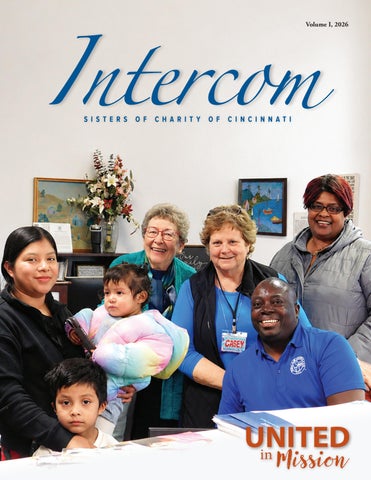
Intercom
SIS TERS OF CHARITY OF CINCINNATI
Intercom
Spring/Summer Volume I, 2026
Intercom, the official magazine of the Sisters of Charity of Cincinnati, is published twice yearly.
Editorial and Design Team
Erin Reder
Michelle Bley
S. Georgia Kitt
S. Barbara Hagedorn, Leadership liaison
The staff reserves the right to edit for space and readability. Please send address changes or any comments or questions you may have about the content of Intercom to:
Communications Office 5900 Delhi Road
Mount St. Joseph, OH 45051
Phone: 513-347-5447
Email: erin.reder@srcharitycinti.org
Subscriptions: $15 per year
The information contained in Intercom is intended for general information and educational purposes only. Opinions expressed herein are the views of individual authors and do not necessarily reflect the opinions or policies of the Sisters of Charity of Cincinnati.
A Letter From Our Sister in Leadership
Dear Sisters, Associates, and Friends,
As I recently shared with graduates at Mount St. Joseph University’s commencement ceremonies, the legacy of the Sisters of Charity has always called people to be courageous, intentional, and willing to “risk a caring response.” That spirit continues to unite us today, and it is the inspiration behind this issue of Intercom
In these pages, we celebrate the many ways Sisters, Associates, colleagues, volunteers, and partners in mission continue to carry forward the Charism of Charity together. The stories gathered here reflect a living mission rooted in compassion, courage, and love in action.
For generations, the Sisters of Charity have responded to the needs of the times with humility, courage, and deep care for others. The women who came before us dared to ask difficult questions: Why are some left behind? How do we respond to poverty, violence, trafficking, environmental harm, and discrimination? And most importantly, how do we respond with love?
Throughout these pages, you will read about ministries serving people experiencing poverty and homelessness, efforts to address human trafficking and social injustice, outreach rooted in holistic health and education, and communities strengthened through service, advocacy, and relationship. You will also find stories of intergenerational wisdom, faith-filled leadership, and everyday acts of kindness that quietly transform lives and foster hope.
What unites all of these stories is mission. Mission is never carried by one person alone. It is shared. It grows through relationships. It flourishes when people choose to listen fully, show up when it matters, and treat one another with dignity and compassion. The Charity Charism continues because people across generations and vocations continue saying “yes” to that call.
Our world today remains both beautiful and broken. It needs people willing to care deeply, to act with integrity, and to bring quiet courage into ordinary moments. It needs communities united in mission.
As you read this issue of Intercom, you will recognize the many ways love is already at work among us. May these stories strengthen our hope, and encourage each of us to continue building a more compassionate, just, and hope-filled world together.
Blessings,

S. Monica Gundler, SC
Sisters of Charity Mission Statement
Urged by the love of Christ and in the spirit of our founder, Elizabeth Ann Seton, we Sisters of Charity of Cincinnati strive to live Gospel values. We choose to act justly, to build loving relationships, to share our resources with those in need, and to care for all creation.
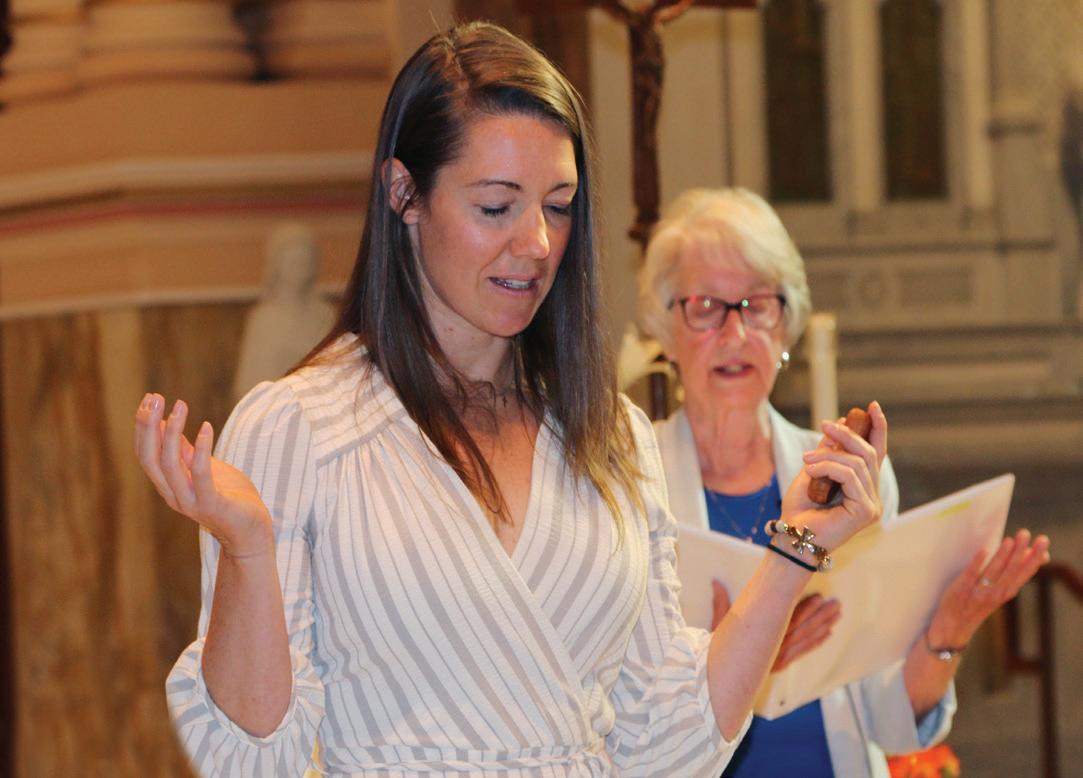
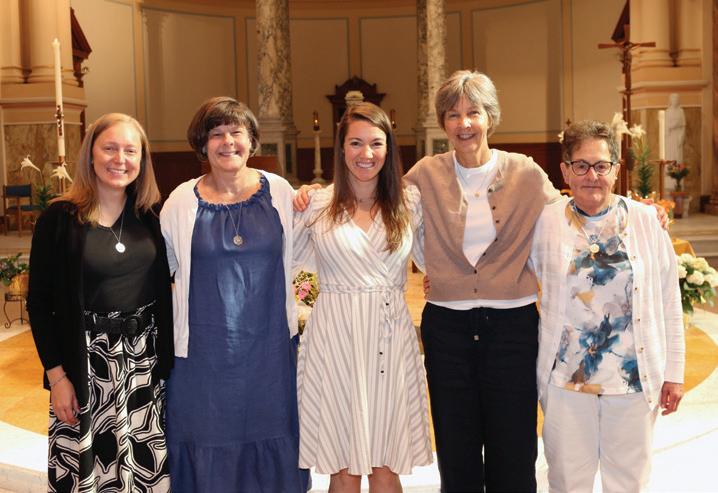
Members of the Community welcomed Cassady Allen as an Affiliate during a ceremony in April.
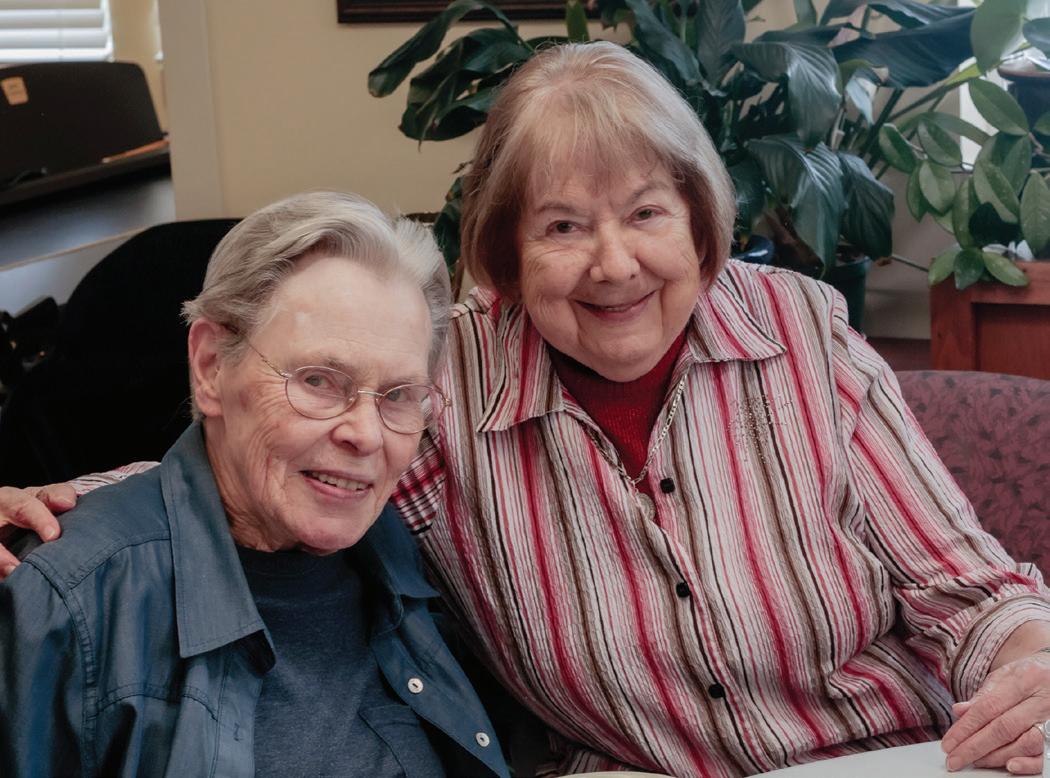
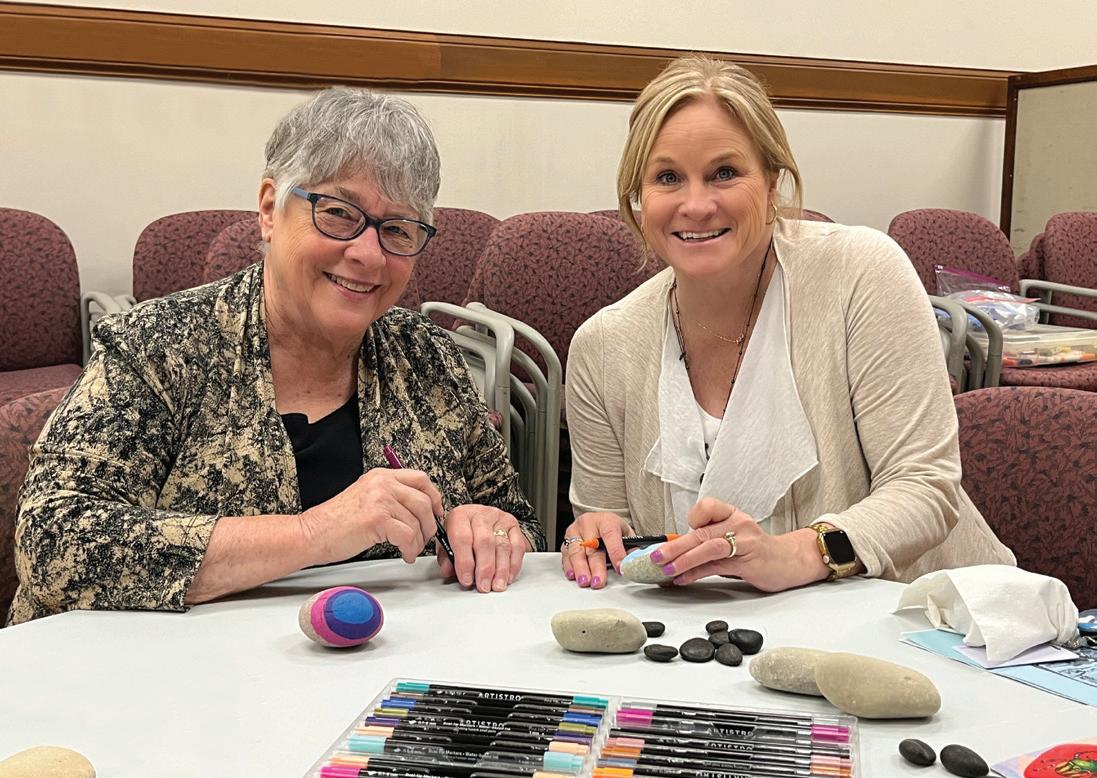
EarthConnection honored Earth Day with presentations, activities, and prayer at the Motherhouse.
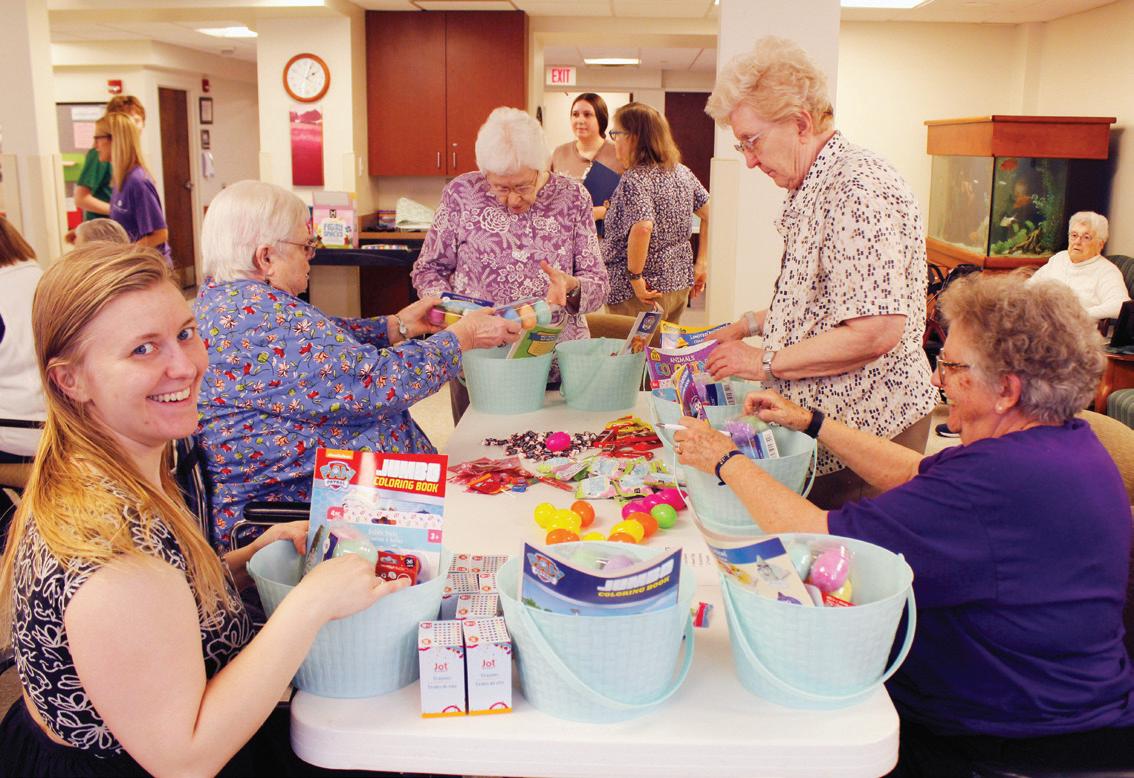
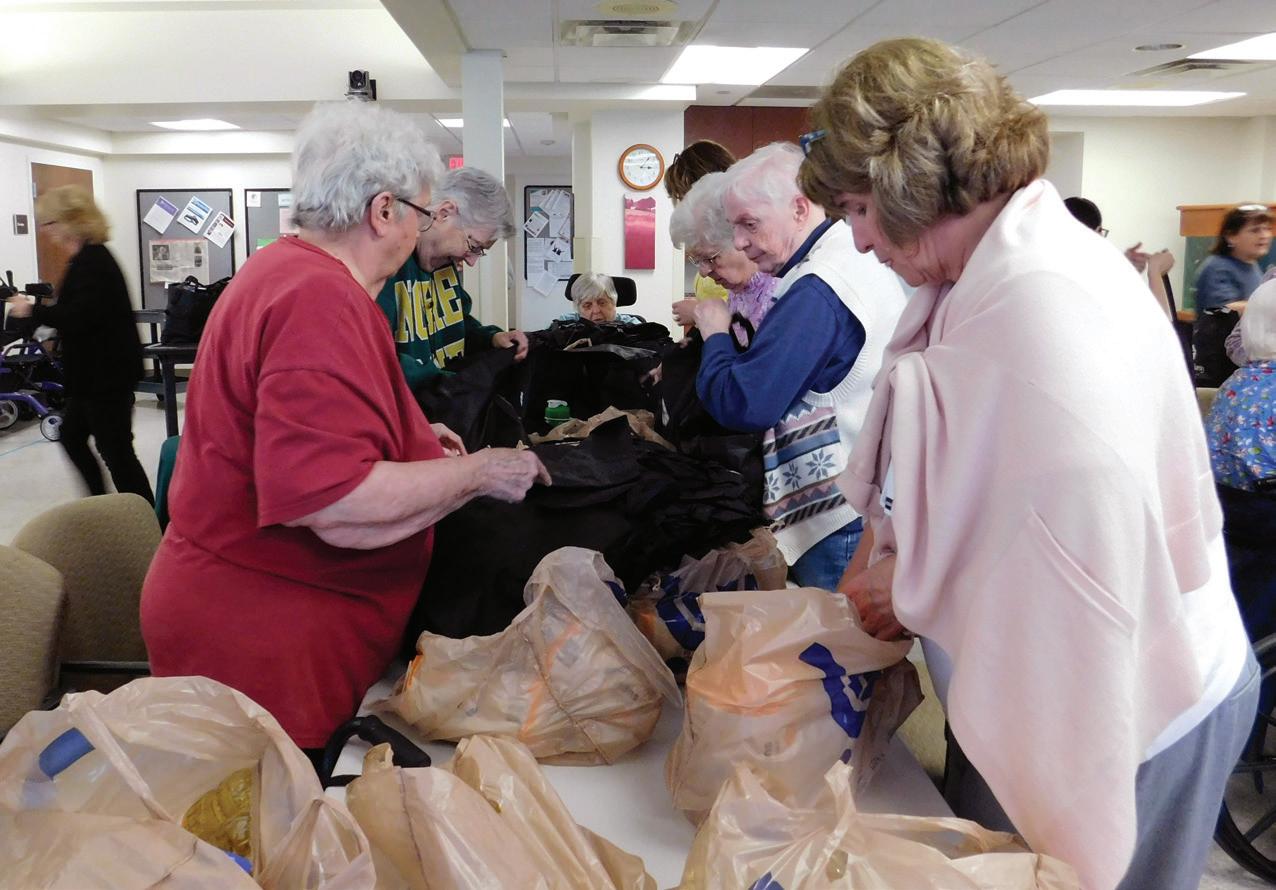
Sisters and employees join together during Catholic Sisters Week for a service project supporting Santa Maria Community Services.
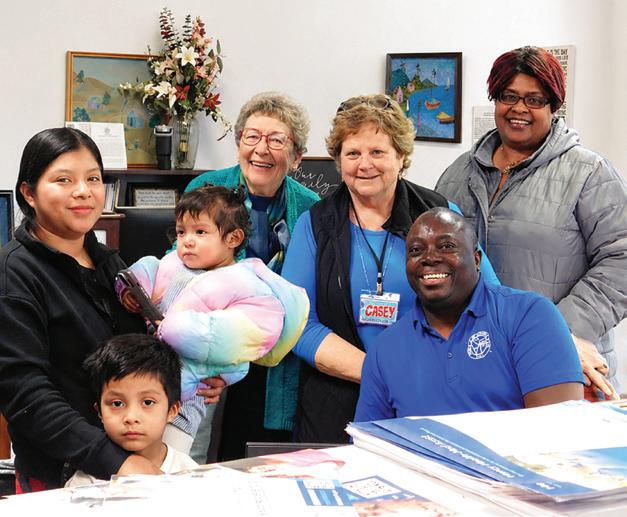
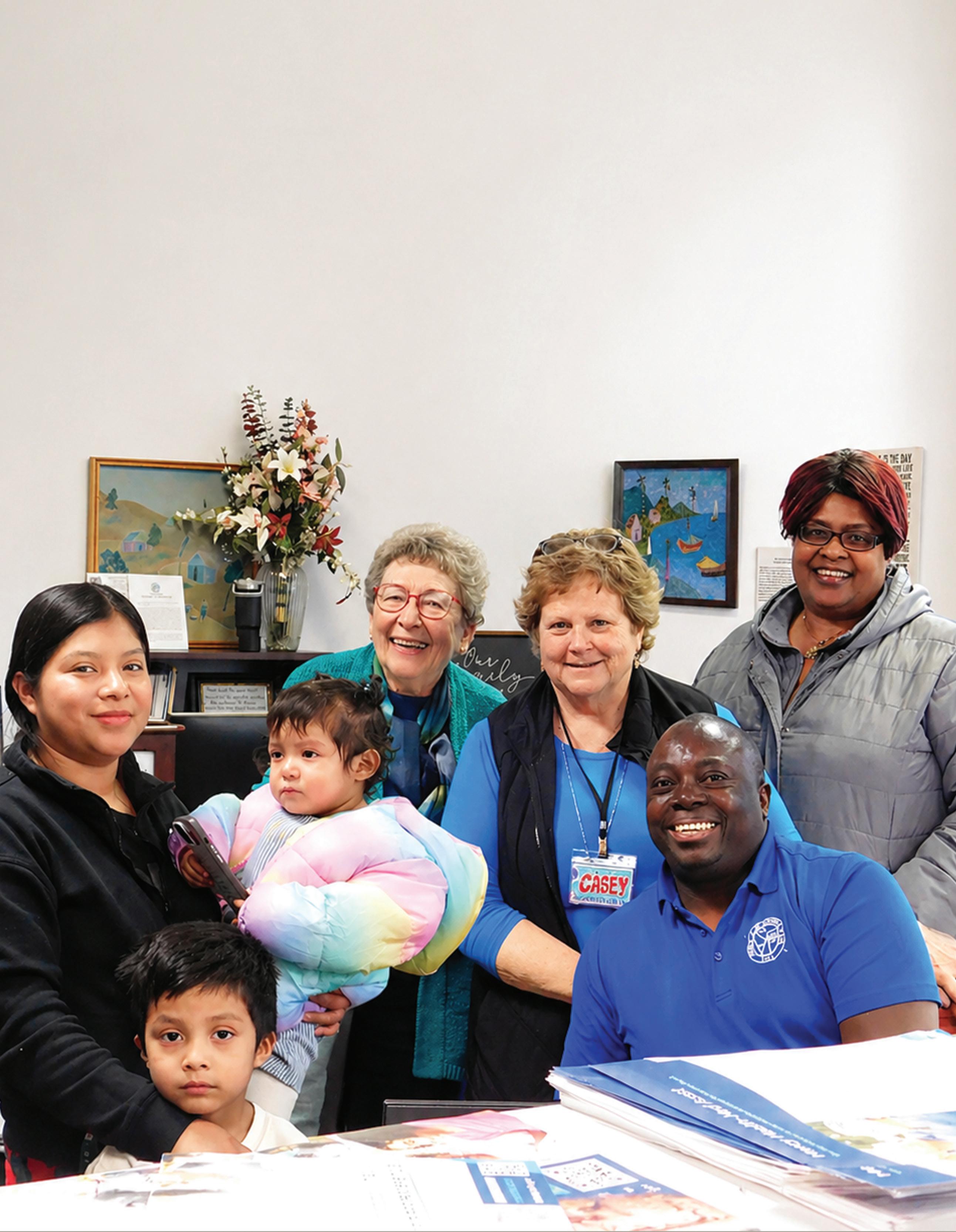
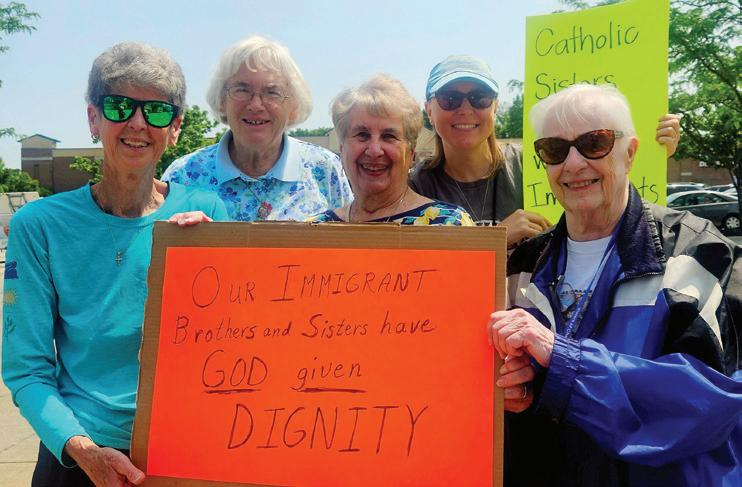
On the Cover: S. Georgia Kitt (back, left) unites in mission with Casey Rollins (third from right), executive director of the Springfield District Council St. Vincent de Paul Society, to respond to the needs of the city’s growing immigrant population. Read more on Page 8.
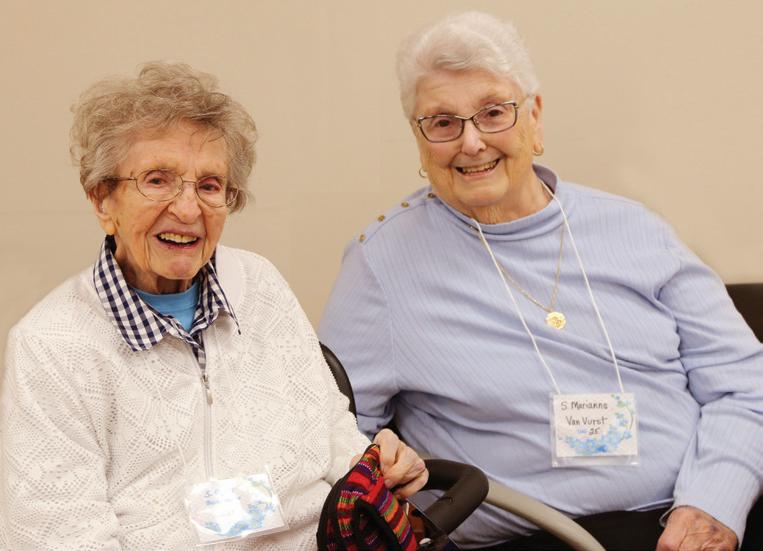
Jubilarian S. Nancy Hoffman (left) celebrates
service.
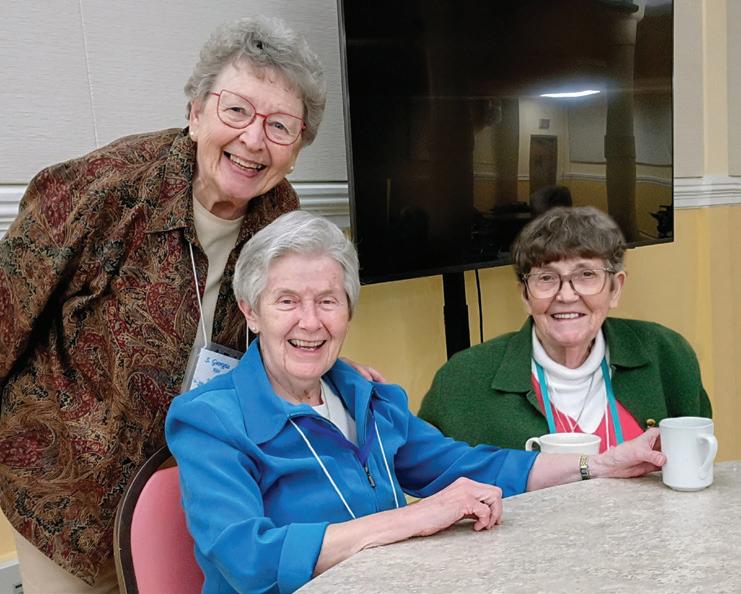
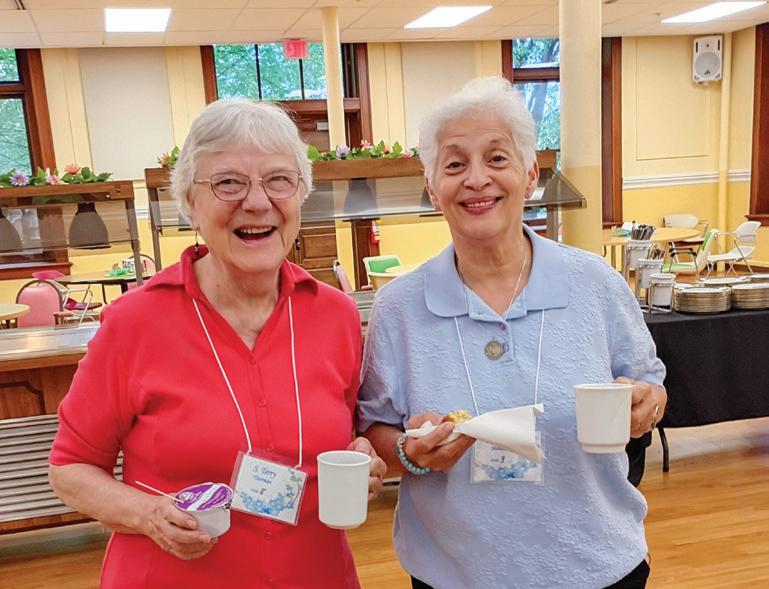
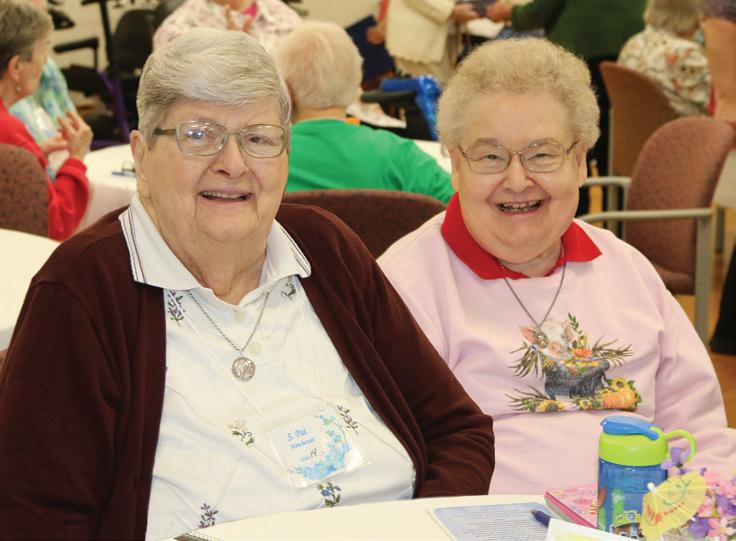
Sisters Come Together for Spring Gathering
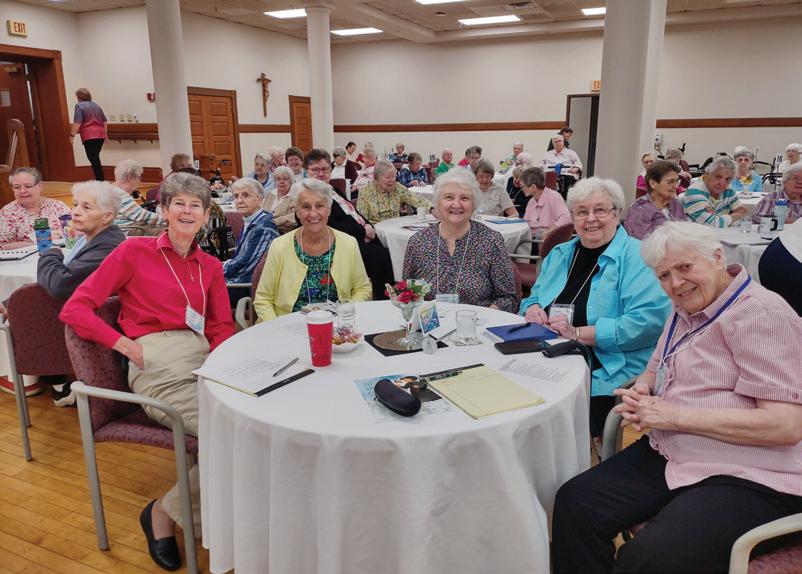
Sisters of Charity gathered April 17-19, 2026, for their Spring Gathering, a grace-filled weekend of prayer, reflection, and community. The time together offered Sisters an opportunity to renew relationships, listen deeply, and attend to the movement of the Spirit in their lives and in the world around them.
The gathering opened Friday evening in the Motherhouse chapel with prayer inspired by Hope Unbroken: Journeying in God’s Promise, a reflective journal from the Leadership Conference of Women Religious, inviting Sisters to reflect on the call to focus on what is most essential for the journey ahead. The prayer concluded with the moving refrain, “Oh, may all who come behind us find us faithful,” by Jon Mohr.
Saturday’s sessions combined prayer, updates, and meaningful conversation. Sisters participated in a video reflection reminding them that, “God needs us because the world needs God,” followed by updates from Leadership Team members on Community ministries and initiatives. A synodal process for group dialogue encouraged thoughtful listening and shared discernment, setting the tone for ongoing conversations.
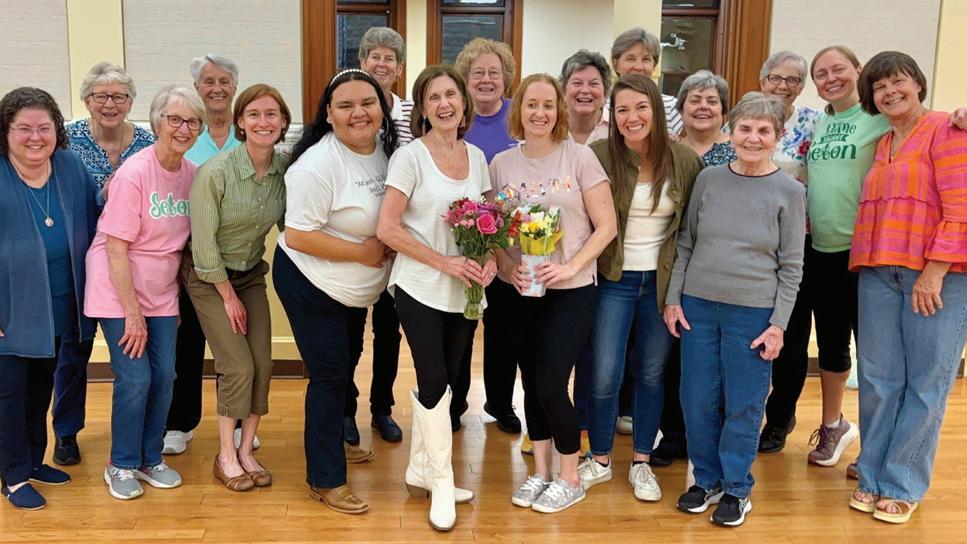
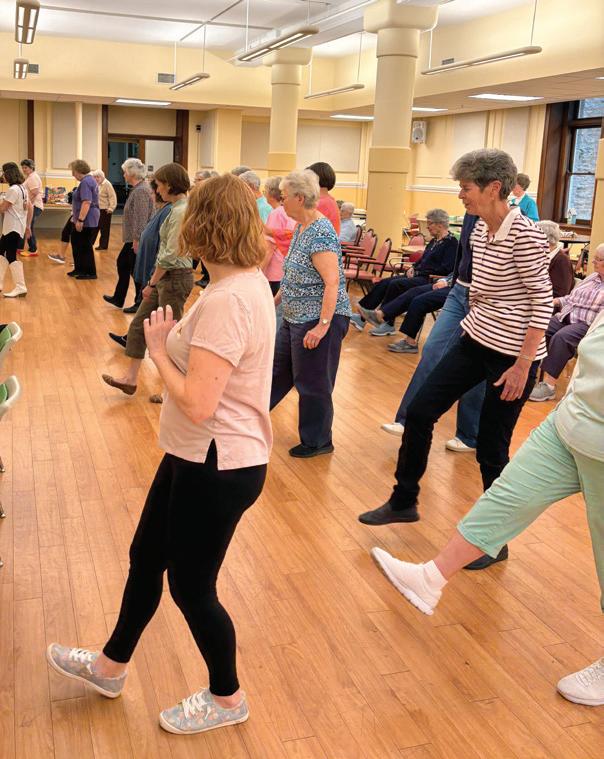
Attention also turned toward preparation for the 2027 Chapter, with discussion centered on the evolving needs of the Community. The day balanced reflection with joy, as Sisters gathered for an evening of fellowship and lighthearted line dancing.
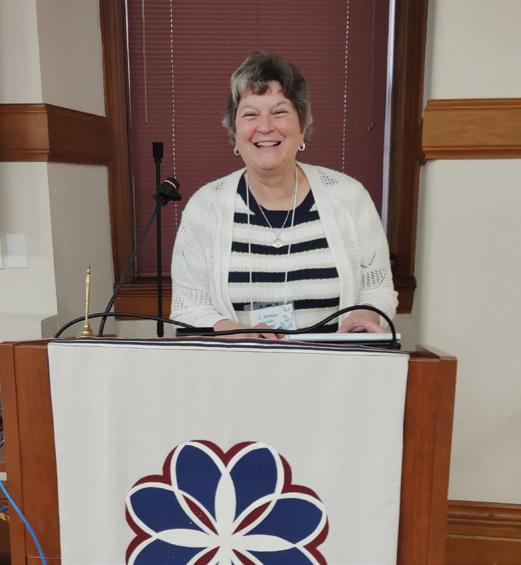
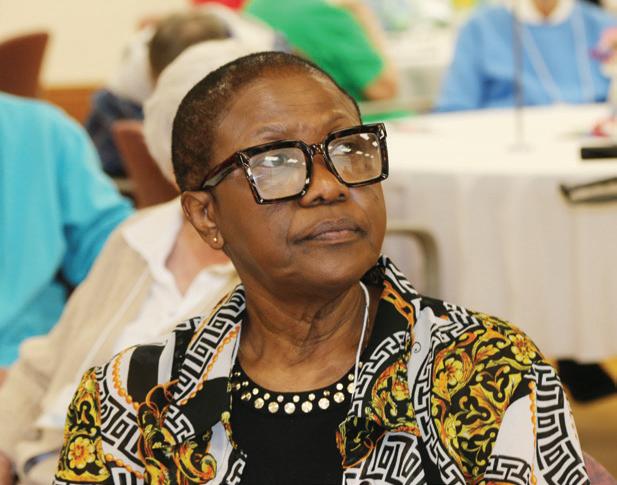
On Sunday, before Mass, the Community joyfully welcomed Cassady Allen as an Affiliate, a hopeful sign for the future. The gathering concluded in gratitude for the time shared and with a renewed sense of unity and purpose.
Sisters of Charity of Cincinnati Welcome Cassady Allen
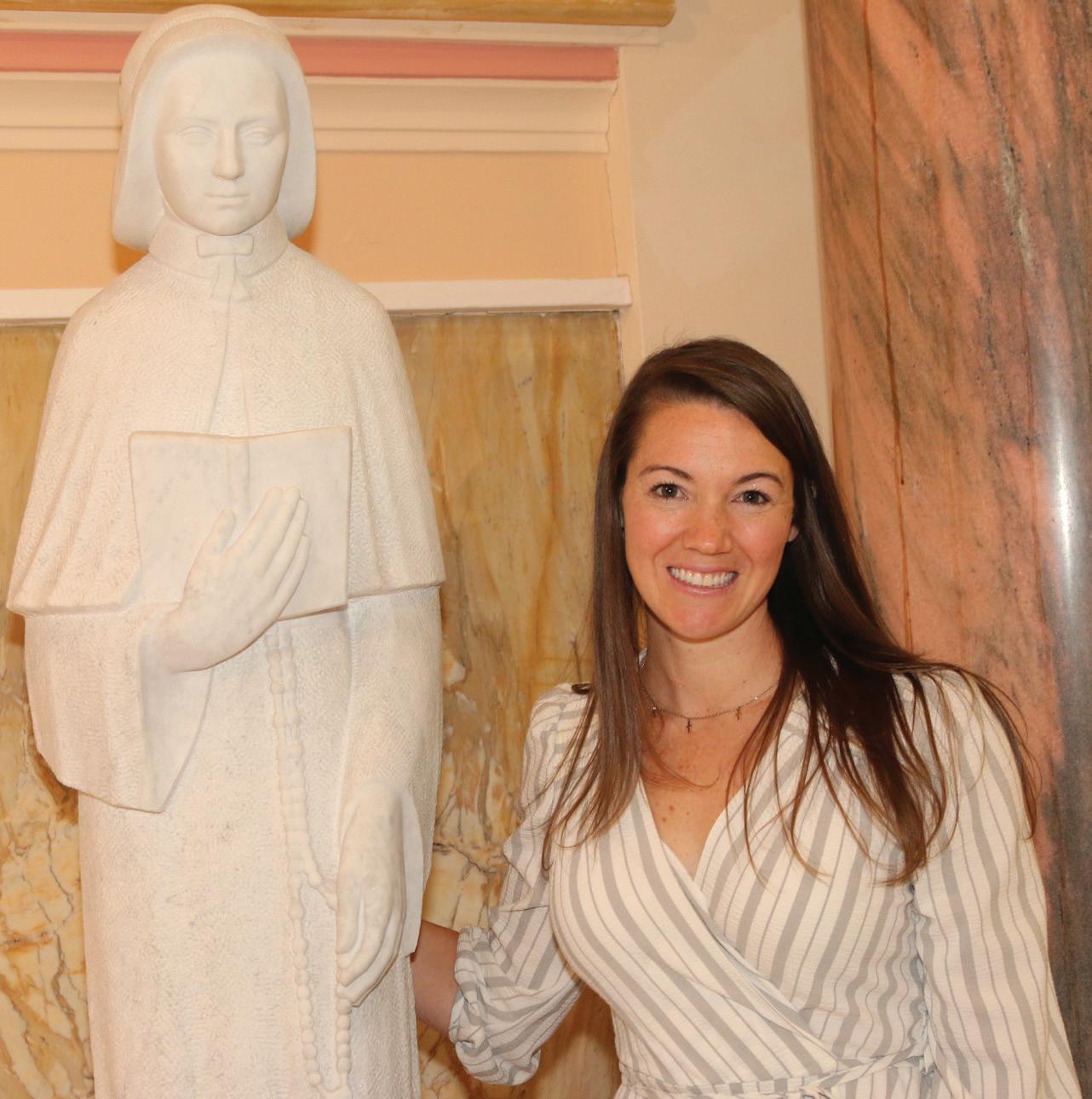
Members of the Sisters of Charity of Cincinnati welcomed Cassady Allen as an Affiliate during a ceremony April 19, 2026, in the Immaculate Conception Chapel at the Mount St. Joseph Motherhouse.
Affiliation is the first step in formation for vowed membership. During this time, a woman lives in a Sisters of Charity community while continuing to work and discerning her call to vowed life. As an Affiliate, Cassady will deepen her understanding of the charism of Saints Vincent de Paul, Louise de Marillac and Elizabeth Ann Seton, while sharing in community life and the Sisters’ mission of love and service.
With the prayerful support of the Sisters of Charity Community, S. Barbara Hagedorn formally welcomed Cassady, saying, “I accept your request to become an Affiliate with the Sisters of Charity of Cincinnati. May this be a year of growth in understanding our charism, mission and vowed life as our way of living the Gospel.”
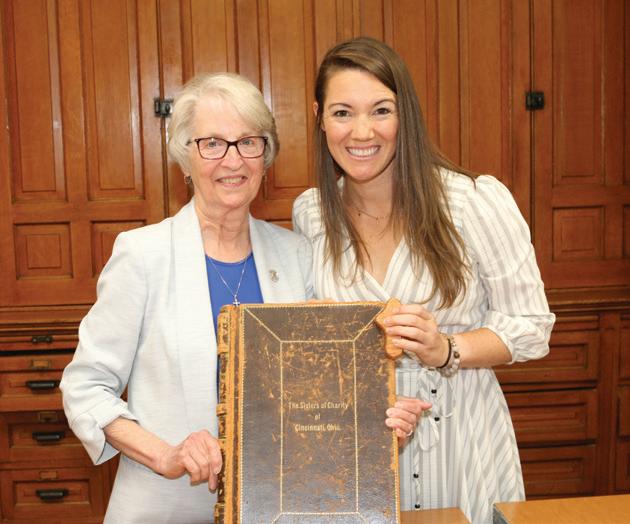
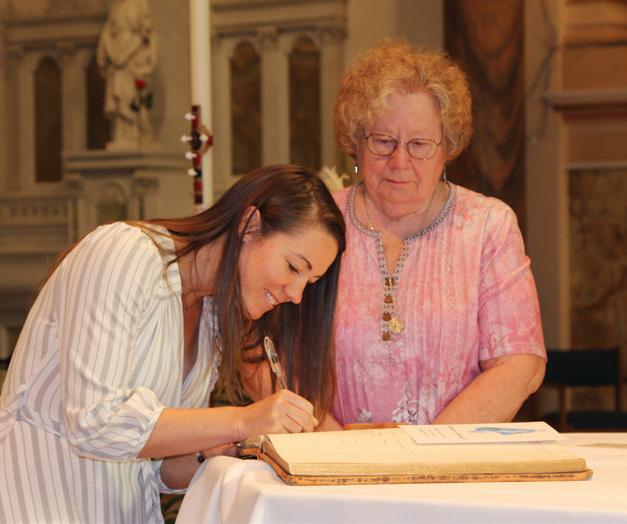
Cassady was then invited to sign her name in the archival book that holds the names of all women who have entered the Community, a tradition that began with Mother Margaret George.
Cassady Allen grew up in the Fort Worth, Texas, area and earned a degree in health promotion and biology from the University of Texas at Austin, followed by a doctorate in physical therapy from the University of Texas Medical Branch in Galveston. With a deep desire to serve others, she was a Colorado Vincentian Volunteer and spent several months in Peru on a medical mission trip. She has also served with refugee centers at Annunciation House in El Paso, Texas, and worked at Proyecto Santo Niño alongside the
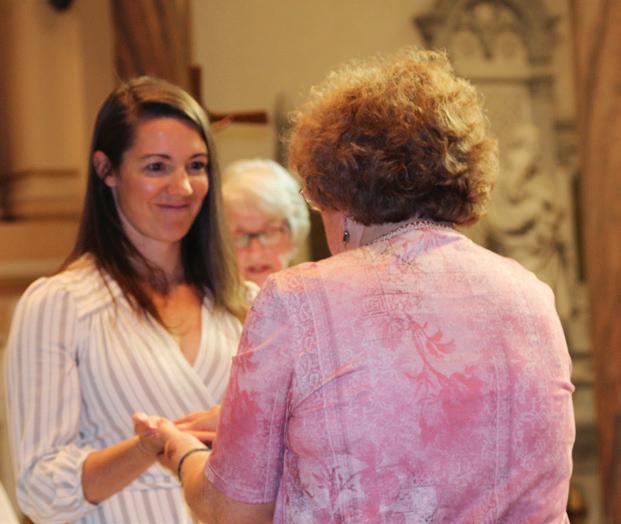
During the Signing of the Senses, S. Lois Jean Goettke traces the sign of the cross on Cassady’s hands, symbolizing that Christ may be known through her work.
Following the Rite of Welcome, Cassady Allen (center) will move to the U.S.-Mexico border to live in community with the Sisters of Charity at Casa de Caridad (pictured).
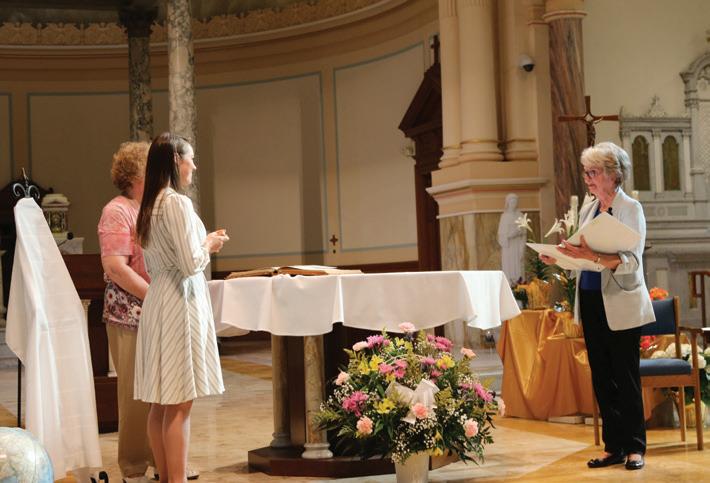
Sisters Lois Jean Goettke and Barbara Hagedorn lead the Rite of Welcome for Cassady Allen on April 19, 2026.
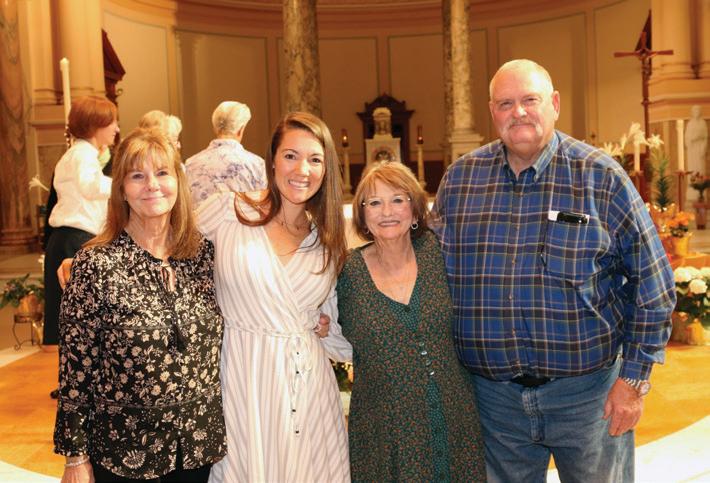
Affiliate Cassady Allen (second from left) shares a special moment with family members.
Affiliate Cassady Allen signs her name in the archival book recording all who have entered the Sisters of Charity Community.
S. Barbara Hagedorn (left), vocation and formation liaison, with new Affiliate Cassady Allen.
From Generation to Generation
What does it mean to be a member of a community?
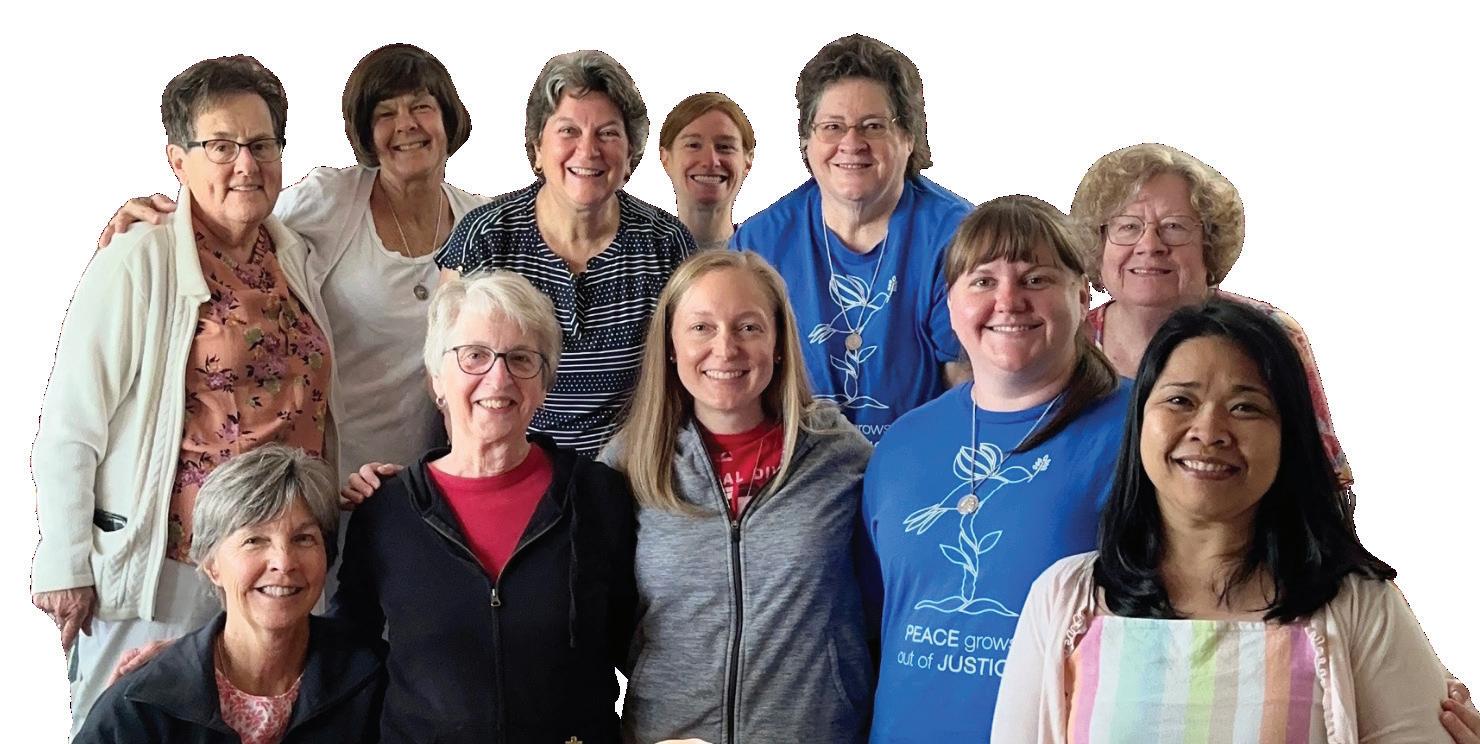
For Sisters of Charity, from the oldest Sister in Mother Margaret Hall to the newest Novice or Affiliate, it means accompanying one another and traveling together on the road of life. Each Sister has a gift to give to the Community – a unique way of living and sharing its charism at every stage of life.
In interviews for this article, Sisters Marge Farfsing, Mary Bookser, Carol Brenner, Maureen Heverin, Andrea Koverman, Romina Sapinoso, Annie Klapheke, Whitney Schieltz, Tracy Kemme, and Karina Montes-Ayala shared what these connections have meant to them.
Community is, first of all, a relationship of love. S. Carol says it means wanting what is best for each other and finding joy in being together. S. Annie says, “Any time I visit the older Sisters, it’s like my own cheering team giving me encouragement, and unconditional love and support.”
S. Karina says that even when she was 300 miles away participating in the Intercommunity Novitiate in Chicago, she felt the presence and love of the Community through the cards and notes the Sisters sent her, as well as the interest and concern they continue to show for her family. S. Mary says accompaniment involves this sense of presence – being “sideby-side for the rest of our lives, no matter where we live.”
In showing love for one other, Sisters grow in their awareness of God’s love. “Accompaniment,” says S. Tracy, “means walking together in mutual care. It means sharing life, helping each other find the thread of the Divine running through it all.” In the love of the Sisters, she says, “I have found Christ’s love incarnate.”
S. Marge says she tells younger Sisters “to trust in God’s love and you will never go wrong.” S. Mary adds, “In all of my mutual relationships, I experience loving kindness. This leads me to a deeper centeredness in God.”
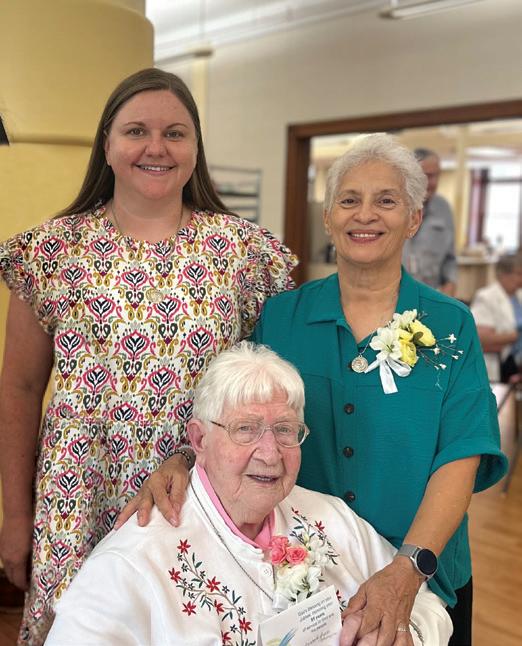
How to show this love? The older Sisters consistently emphasize the importance of listening – “the greatest gift we can give to each other” according to S. Mary. “Basically,” says S. Maureen, “people just want to be listened to, if you just sit down and listen.”
S. Andrea recalls that whenever she felt overwhelmed by her own reflections and disappointments, she knew she could go to S. Marge, “a night owl,” who was always there to listen – “almost like she was waiting for me.” S. Marge’s listening presence and reassurance “always helped me regain my footing and hold onto my joy in community.”
In addition to the listening presence, younger Sisters report being inspired by the stories and example of the older Sisters. S. Karina cites S. Judith Metz’s efforts to connect her with Sisters in Mother Margaret Hall to hear about their experiences and ministries. As she starts a new ministry, she hopes to continue meeting with them and sharing their stories.
Sisters Andrea and Annie note that these stories reflect how Sisters throughout the Community’s history have responded to the needs of their time – often serving marginalized people in challenging environments. Some ministries were highly visible; others were quiet acts of love. Still
others involved navigating life’s inevitable painful experiences or discerning new paths amid uncertainty.
“It was deeply meaningful to hear about the challenges they faced, especially around the time of Vatican II, and how they navigated these challenges,” notes S. Annie.
The older Sisters also say they are inspired by the younger Sisters’ stories. S. Maureen says their perspectives make her “look at life and think about life in a different way.” S. Carol notes that younger generations tend to be more open about their feelings, whereas, she was taught otherwise.
S. Mary emphasizes the importance of being honest with one another and the ability to challenge one another with love, something S. Romina says she values. Underlying these differences is a common ground. Still, it is important, S. Mary notes, to be open to even small nuances of difference in largely similar experiences. Listening deeply is necessary in order not to assume that any experience is identical when felt across generations.
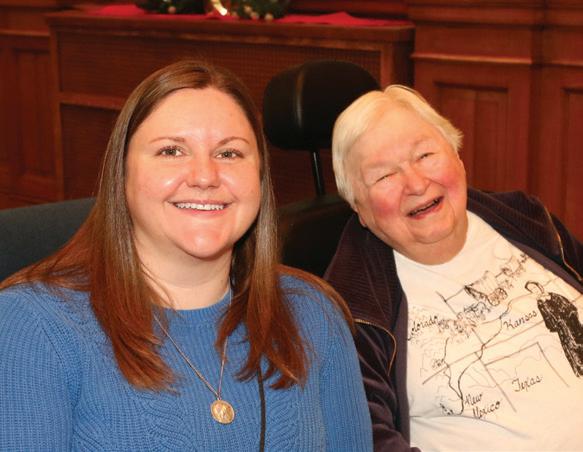
All of the Sisters describe this intergenerational sharing as a gift. S. Tracy says, “I am often deeply touched that even when a Sister has decades more life experience than I do, she is eager to listen to and learn from me, just as I am from her. I think we each give and receive something essential and precious for our distinct life stages. And despite the years between us, we feel indelibly connected in our hearts and souls.”
S. Carol appreciates the energy and joy of the younger Sisters. S. Mary is inspired by their commitment to mission, community, social justice, and multiculturality. S. Maureen admires their courage and initiative.
Younger Sisters uniformly say their relationships with older Sisters help them recognize the legacy they are called to carry forward. S. Annie says that when she looks around the chapel during celebrations and liturgies, she sees generations who came before and feels she is “standing on their shoulders.”
S. Andrea describes the Charity Charism as a “seamless garment,” with each Sister woven into it.
Younger Sisters also value the messages of self-love and self-acceptance they have received. S. Andrea remembers S. Marge telling her, “Don’t try to be somebody else; try to be your own best person.” S. Whitney adds that “rather than trying to fix someone’s problems, accompaniment means being with them in the messiness.”
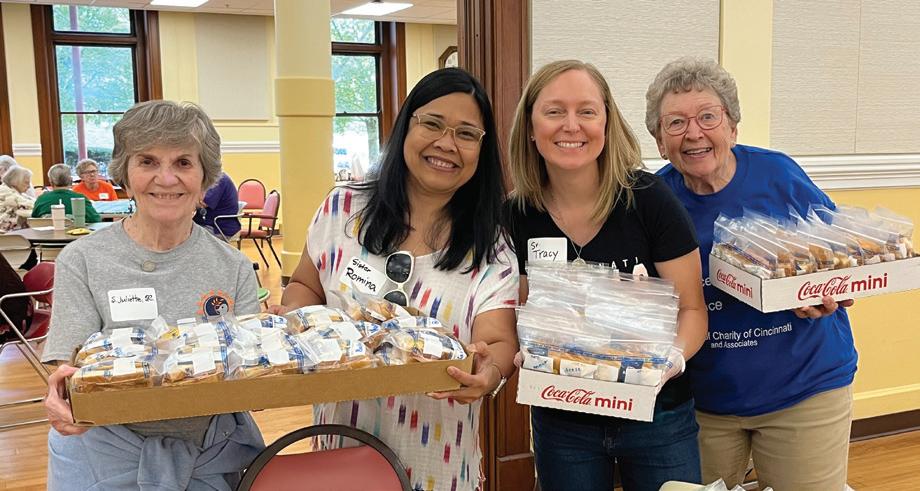
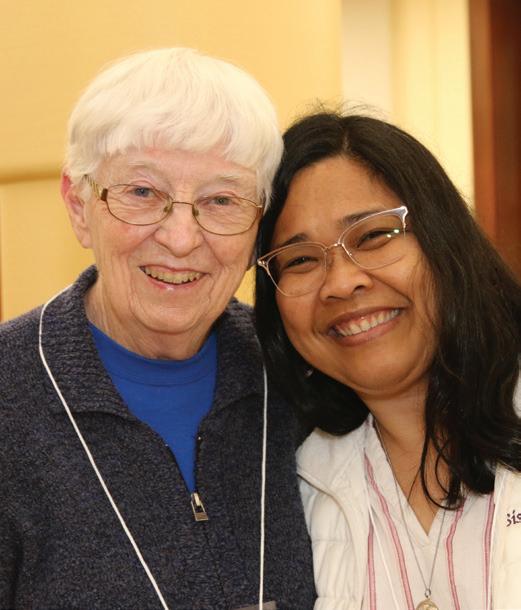
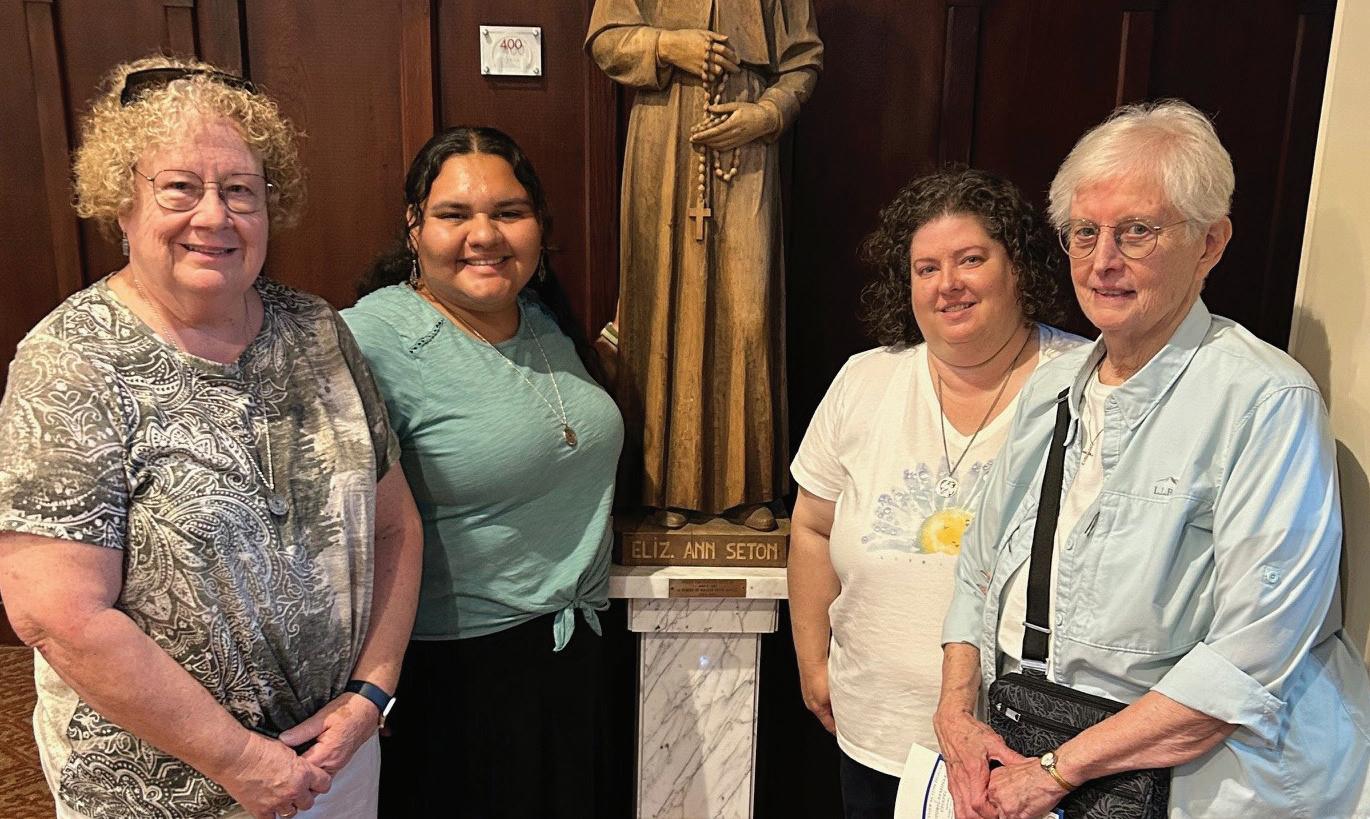
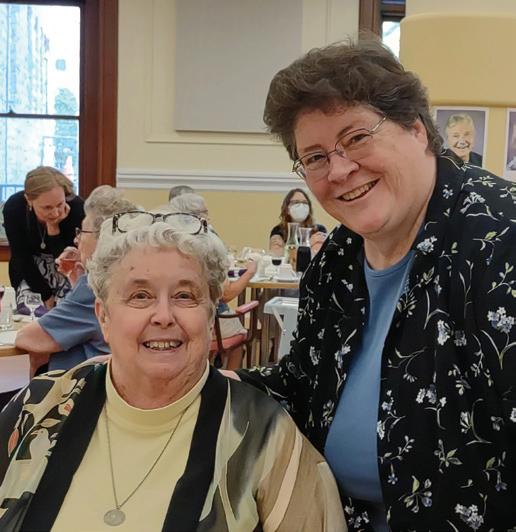
They also deeply appreciate the prayers of older Sisters. “I hope they never underestimate the importance of their prayers,” S. Annie says. She recalls S. Pat Hill telling her that every time her bus passed S. Annie’s community house, she prayed for them.
Mentoring and accompaniment is a chain of charism that is recreated in each generation. S. Mary remembers being surprised several Chapters ago when Sisters were grouped by age and she realized she was now called to mentor younger Sisters. Seeing S. Annie nod in affirmation confirmed that call.
Today, that role is being passed to the next generation. S. Marge encourages, “I tell the younger Sisters not only to look at others as examples, but to be examples to others.” S. Andrea recounts that before her death, S. Janet Gildea asked her to take responsibility for the After Volunteer Experience (AVE) program. She felt honored and empowered by the trust placed in her.
Since then, several young people have participated in the program, and S. Andrea remains in contact with them as their journeys unfold.
In this and in so many other ways, the Charity Charism continues to flow from generation to generation. In listening and laughter, in prayer and presence, in story and service, Sisters continue to find themselves accompanying one another along the same sacred path, united in mission and in love.
Immersed in Call, United in Mission
By S. Georgia Kitt

Iwant to share a glimpse of the “hundredfold” that has enriched my life in recent years through a renewed relationship – one that has filled me with joy and a deep sense of pride in a shared call. It has reminded me that the dignity of every person is essential to our vocation and that this truth unites us in mission.
What more could one ask than to look back on a life of service – trusting in God’s guidance, striving to make a difference – and to feel reassured that you have been on the right path? Recently, I have experienced that reassurance in a profound way. It has come through reconnecting with someone very special: my former student and now friend, Maureen “Casey” Kelly Rollins, a wife, mother, grandmother, devoted Vincentian, and director of the St. Vincent de Paul Center in Springfield, Ohio.
When I first met Casey in 1971 on the playground of St. Teresa School in Springfield, she was an energetic red-haired child from a large Irish Catholic family. Little did I know that, 50 years later, our paths would cross again; both of us living out similar calls rooted in faith, service, and a desire to build a more just world.
Today, Casey serves as executive director of the Springfield District Council of the St. Vincent de Paul Society, which includes eight Catholic parishes in the Archdiocese of Cincinnati. Vincentian members commit themselves to spirituality, friendship, and service through acts of charity and justice, forming personal relationships with those in need. How familiar this sounds to us as Sisters of Charity, who
also are called to live Gospel values, act justly, build loving relationships, and care for all creation in the spirit of St. Elizabeth Ann Seton.
Our shared mission has deep historical roots. Since 1833, the Society of St. Vincent de Paul has served those in need around the world. Similarly, the Sisters of Charity, founded in 1809 by Elizabeth Seton, drew inspiration from the rule of Saints Vincent de Paul and Louise de Marillac. These parallel beginnings continue to shape how we respond to the needs of our time.
It is clear to me that God was forming Casey from a very young age. Influenced deeply by her parents, especially her mother, Rosemary, she learned early on to recognize and
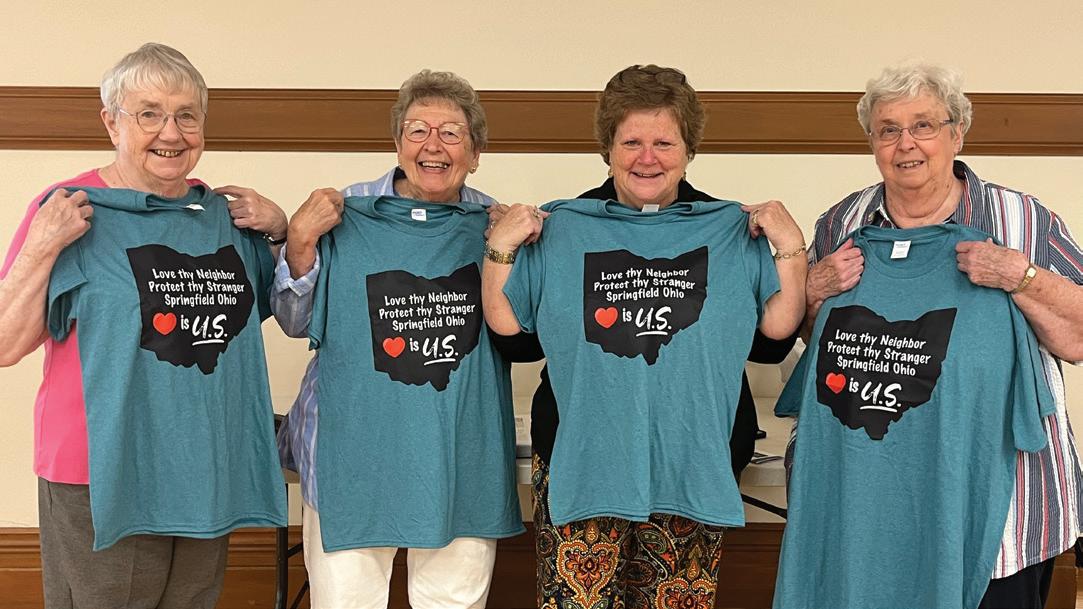
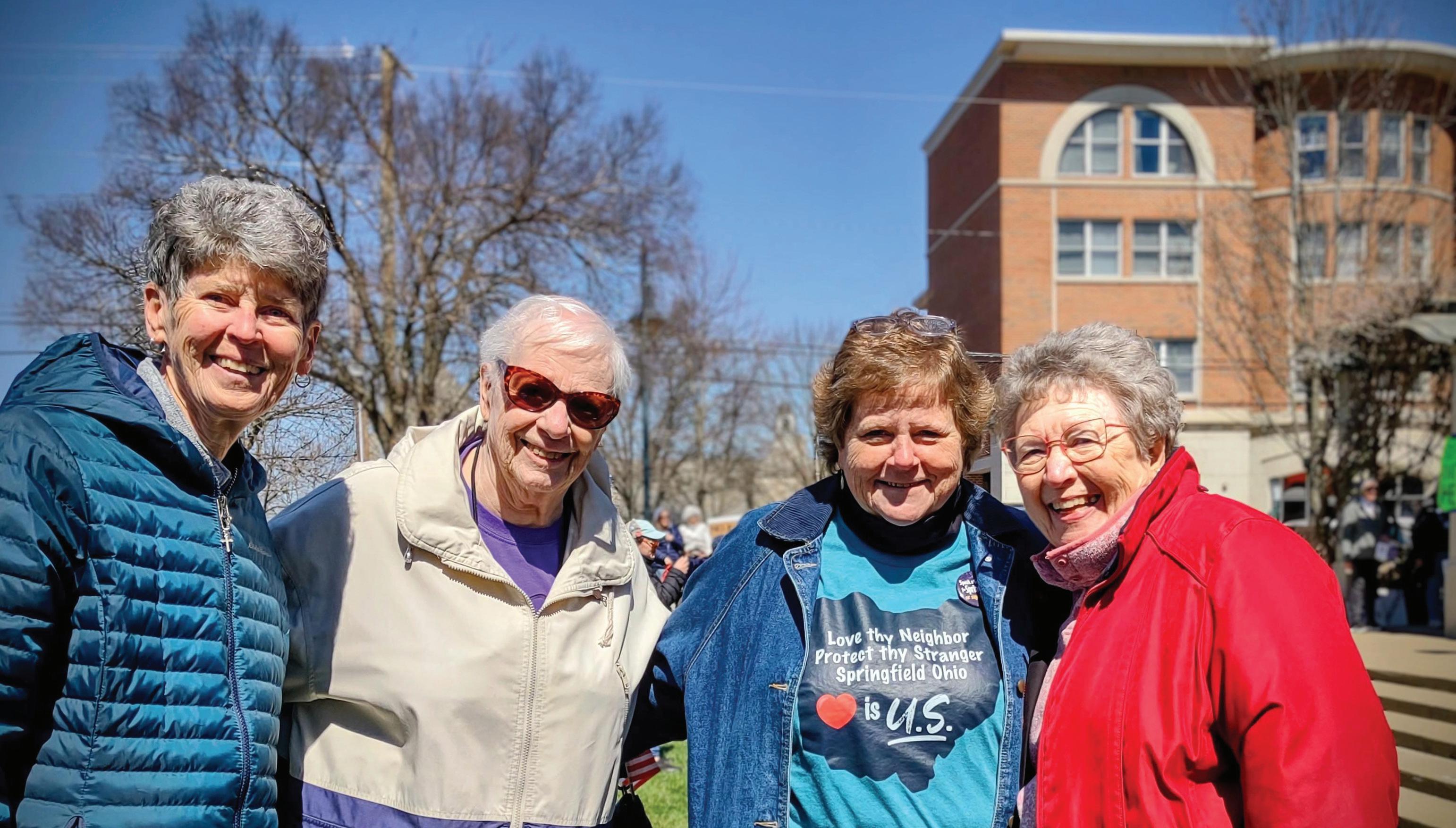
(From left) S. Teresa Laengle, S. Georgia Kitt, Casey Rollins, and S. Mary Bookser display their “Love Thy Neighbor” T-shirts, gifted to Sisters during Casey’s 2025 presentation at the Motherhouse.
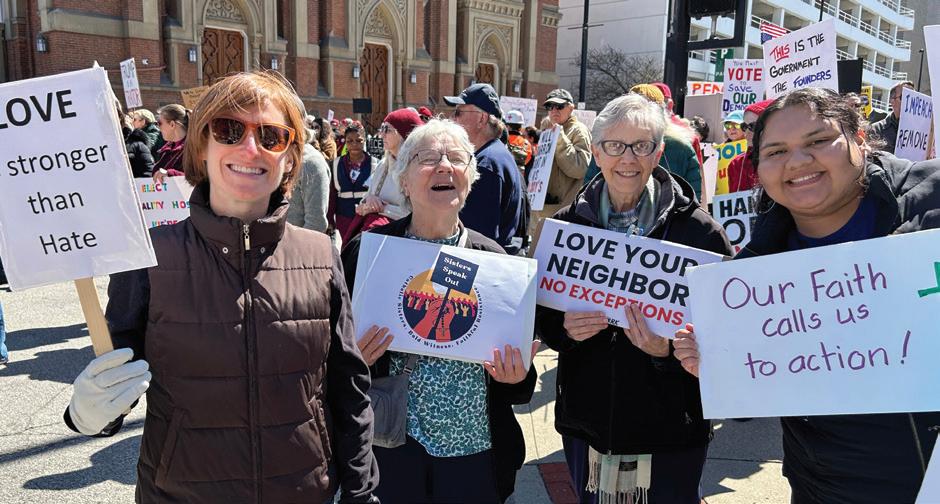
Sisters Sally Duffy, Jean Miller, and Georgia Kitt show support for Haitian immigrants at a No Kings event at Miami University in Oxford, Ohio, where Casey Rollins (second from right) served as the featured presenter.

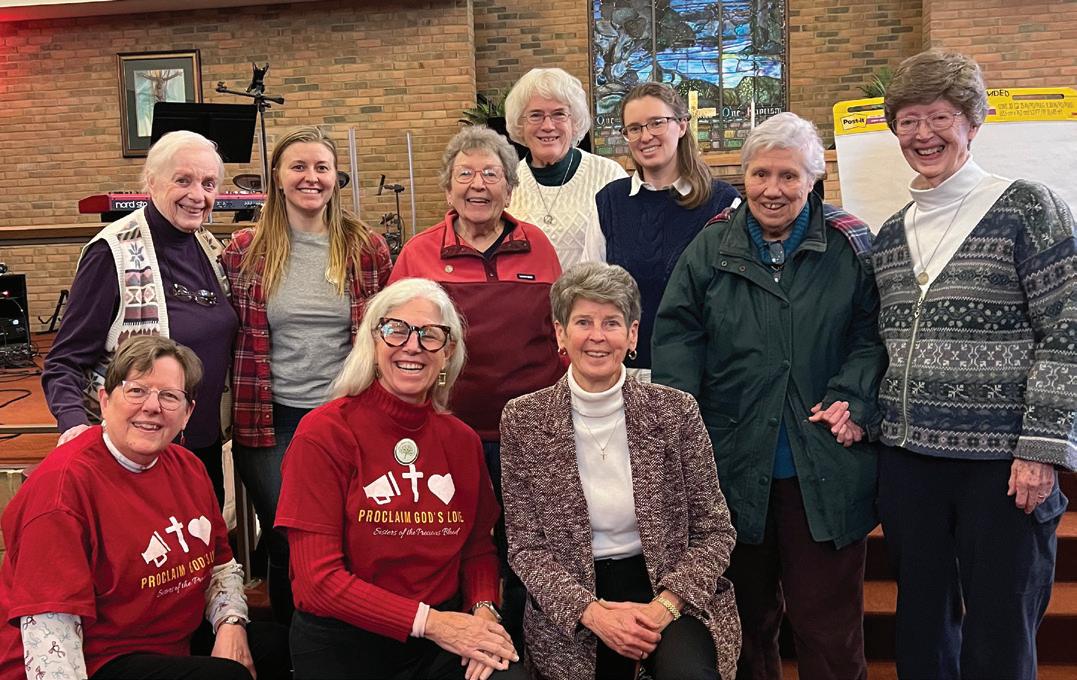
A National Day of Prayer, Solidarity, and Advocacy was held in Springfield on Feb. 2, 2026, as a public demonstration of faith-rooted solidarity with Haitian families and all immigrants facing uncertainty. Morning presenters at St. John Missionary Baptist Church included Casey Rollins and S. Sally Duffy.
respond to the needs around her. At just 9 years old, Casey accompanied her mother to a St. Vincent de Paul meeting in the basement of St. Teresa Church, where she listened as parish Vincentians shared urgent needs: help with rent, utilities, and food. Even then, seeds of compassion were being planted.
By age 16, Casey was already responding in concrete ways. Using a car her dad had given her, she delivered cribs to young mothers – often traveling to remote or unfamiliar neighborhoods, long before GPS made such journeys easier. These deliveries frequently included stops to pick up groceries, especially milk for the families. Accompanied by a classmate for safety, she was already living the Gospel values she would later fully embrace. Her mother’s guiding words “always protect the children” remain central to her life and work.
That call to serve has been a constant thread throughout Casey’s life – woven through her experiences at home, school, parish, and community. At St. Teresa School, she learned to care for others through small daily acts, such as helping younger students in the cafeteria. At Catholic Central High School, her gifts continued to unfold through service opportunities and outreach. The Sisters of Charity who taught and mentored there reinforced a message of faith and resilience, often reminding students “God will never allow you to be tested beyond your strength” (St. Vincent de Paul).
During Casey’s freshman year, her family faced a profound trial when her sister Colleen was diagnosed with cancer. The Springfield Catholic community united in prayer, asking for the intercession of St. Elizabeth Seton. While the prayers were heard but in God’s way, the experience deepened the community’s faith and strengthened bonds, a reminder that God’s answers are not always what we hope, but always part of a larger mystery.
Casey’s journey continued through college and into a career in art education. She married her high school sweetheart, Rob, they raised their young son, and together they built a life rooted in faith, family, and service. From the early days of their
marriage, they were active in their parish St. Vincent de Paul conference, making home visits and attending weekly meetings.
In 2015, Casey retired from teaching after a fulfilling career that included time at both St. Teresa School and Catholic Central High School. Soon after, she accepted the role of secretary for her parish conference. It was a turning point – a moment when the many strands of her life began to align.
Just a year later, she was asked to serve as president of the Springfield District Council. Saying “yes” meant stepping into leadership with both vision and humility. Casey understood that a strong mission required strong collaboration. She intentionally built a team with diverse skills (volunteer coordination, finance, technology, and outreach), creating a foundation that has allowed the organization to grow and respond effectively to community needs. They encouraged faith-based volunteers to be part of the mission. There is no fundraising; only generous spirits who know the needs are real. For the past nine years, only the use of weekly Church bulletins and an electronic newsletter have kept persons informed.
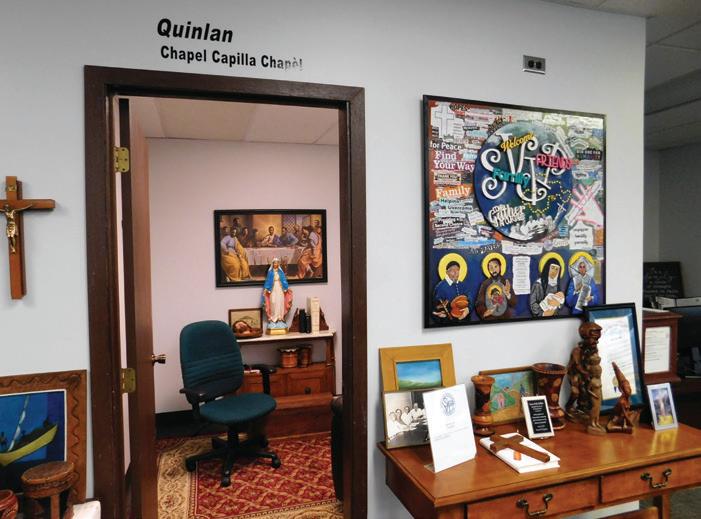
The St. Vincent de Paul Center in Springfield has evolved significantly under her leadership. Located just off High Street, it is a place of welcome and dignity. Casey’s artistic gifts are evident in the bright, inviting space that immediately puts visitors at ease. Volunteers greet each person warmly, offering not only material assistance but also a sense of belonging. A shared cup of coffee, a listening ear, and even a quiet chapel –dedicated to her mother – communicate a powerful message: You are welcome here.
In recent years, the center has responded to the needs of a growing immigrant population, particularly Haitian families who have come to Springfield seeking work and stability. As local companies called for workers, many Haitians answered, bringing with them resilience, dedication, and hope.
The center has become a vital resource for these families, offering assistance with immigration processes, work permits, and legal documentation such as Temporary Protected Status
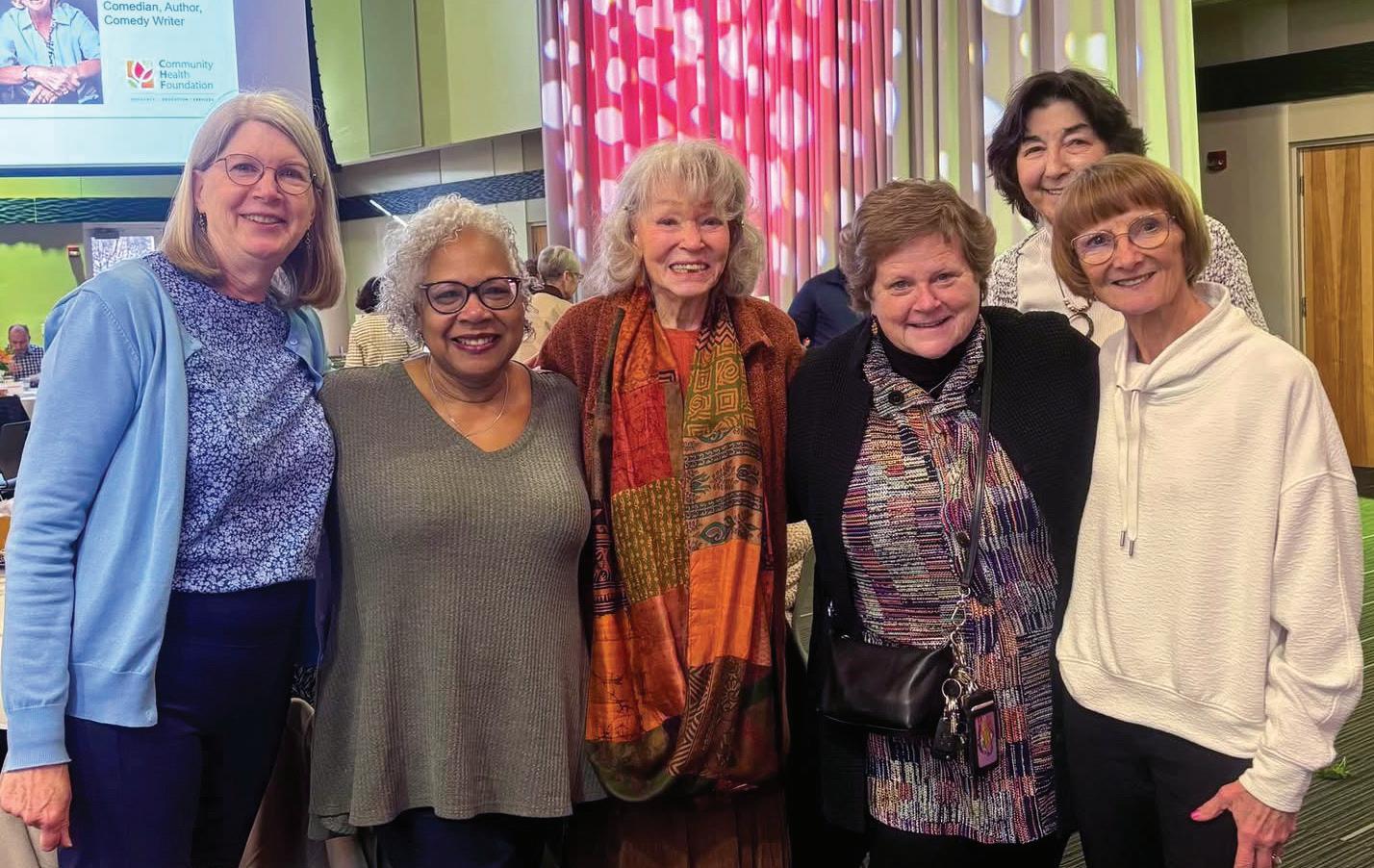
Casey Rollins joins Vincentian volunteers at the Community Health Foundation’s “Finding the Funny” feel-good event, supporting one another in their shared call to serve.
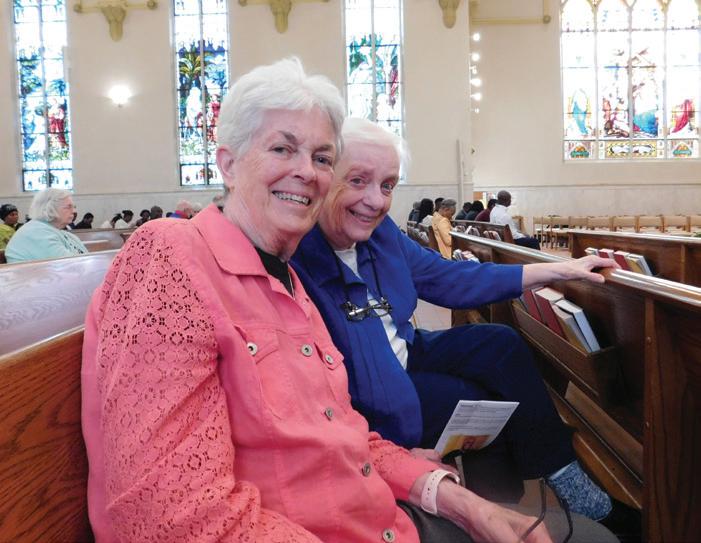

(TPS), asylum applications, and humanitarian parole. Services have expanded to include interpreters, English language classes, job training, resume assistance, and connections to employers and local agencies.
As demand has increased, so too have the challenges. Casey has found herself called into situations she never could have imagined, advocating publicly for immigrant communities, responding to misinformation, and working with media outlets to share the truth. Her clarity, compassion, and conviction reflect a deep commitment to the dignity of every person.
This commitment has been especially evident in moments of crisis. As immigration enforcement intensified, Casey and her team took proactive steps to protect vulnerable families. More than 1,300 children in Clarke County have been born to Haitian parents in the last few years, meaning all of them would be citizens. They encouraged Haitian parents to secure U.S. passports for their children – documents that could serve as critical protection in uncertain times.
In one particularly sobering instance, several children arrived at the center after their parents had been detained, leaving them in urgent need of care and legal support. Situations like these underscore the complexity of the work and the importance of community response. For Casey and her colleagues, children remain the highest priority. “The work we do is done for the mission,” Casey often says. “I believe in the power of community.” That belief is evident in every aspect of the center’s work – from partnerships with local organizations to the dedication of volunteers who give their time and talents so generously.
During my visit to the center, I was deeply moved to encounter former students – now adults and retired from their careers – serving others with the same spirit they had learned years earlier. One volunteer helped a mother searching for contact information for her husband, who had been sent back to Mexico; another prepared food baskets for families in need. Their actions reflected the enduring impact of a faith-centered education and a commitment to service.
Looking ahead, I see many opportunities for continued collaboration between Casey’s work and the mission of the Sisters of Charity. Already, we are sharing resources through our Justice Circles, particularly in areas of immigration, human trafficking, and poverty. We have stood together in solidarity at public gatherings, advocating for justice and supporting immigrant families. In February, we participated in a national gathering in Springfield, publically demonstrating solidarity with Haitian families and all current immigrants. Casey has also shared her insights with our Community through presentations at the Motherhouse, helping us better understand the realities facing those we serve. These connections strengthen our collective response and deepen our shared commitment to Gospel values.
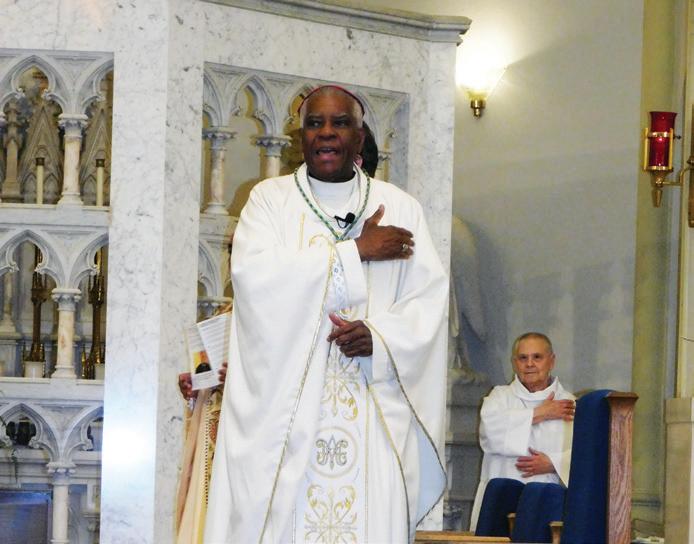
We have worshipped together as well, most recently at a Haitian Mass at St. Raphael Church in Springfield, celebrated in their native Creole by Haitian Bishop Jacques Fabre-Jeune, CS, from Charleston, South Carolina. It was a beautiful expression of faith and cultural unity, reminding us that the Church is truly universal. Casey shared, “I was thrilled for this opportunity for our Catholic Haitian neighbors.”
As Casey and I have rekindled our friendship after 50 years, I am struck by the thread that has remained constant: a shared call to serve, rooted in faith and sustained through community. It is a call that continues to invite, challenge, and inspire. The same holds true as graduates of Catholic Central (1970-1988) have also reconnected with me. Thank you. You bring me joy. It warms my heart to learn of the contributing adult persons you have become.
I invite you to learn more about the ongoing mission of the Sisters of Charity and to follow the work of the Springfield St. Vincent de Paul Center. Catch the spirit Casey has set in motion!
Most of all, I ask that we continue to pray for dignity, for justice, and for all those affected by uncertain futures, especially as the TPS decision expected in June or July 2026 approaches. May we each respond, in our own way, to the call before us, doing, as St. Vincent de Paul urged, “whatever God inspires us to do.”
Haitian Bishop Jacques Fabre-Jeune, CS, speaks from the heart to Springfield’s Haitian Catholic community during Mass at St. Raphael Church on April 19, 2026, encouraging them to remain strong amid continued uncertainty.
(From left) Sisters Louise Lears and Jean Miller await the start of Mass celebrated by Bishop Jacques Fabre-Jeune, CS.
The small chapel at the Springfield St. Vincent de Paul Center offers a welcoming space for immigrant visitors and is dedicated to Casey Rollins’ mother. Casey’s artistic depiction of the Vincentian saints, displayed on the wall to the right, warmly welcomes all who enter.
Acting Together for Gospel Justice
By Mackenzie Doyle, justice promoter
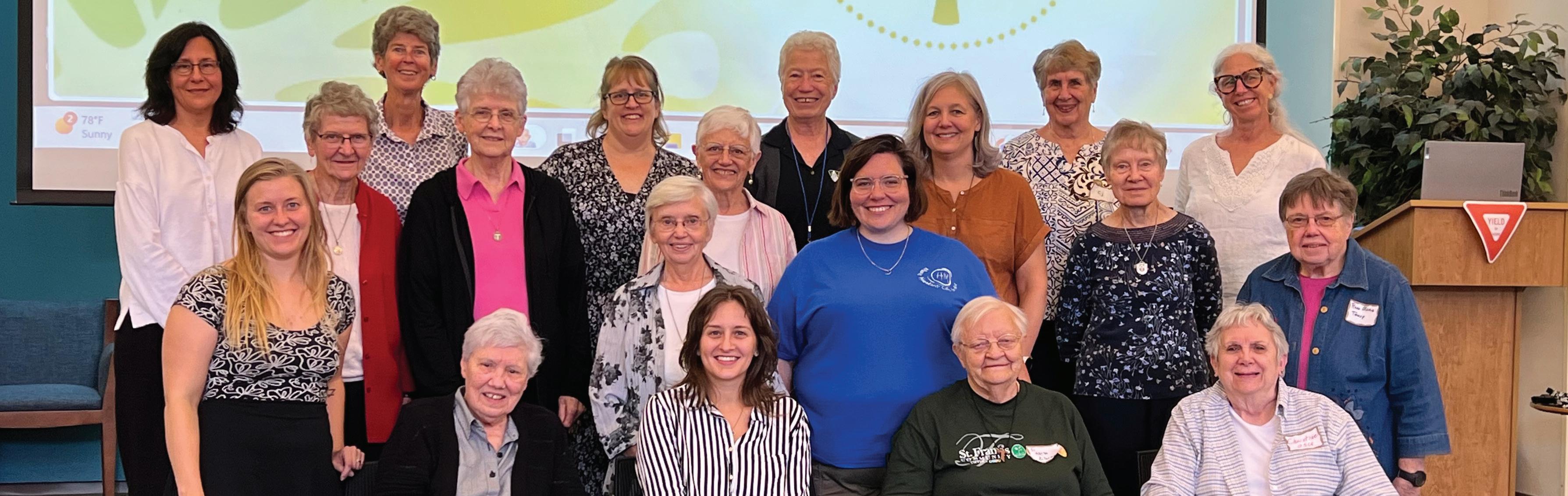
What does it look like to be united in mission? For a growing number of women religious living in or near Ohio, it means showing up – together.
The Ohio Sisters Justice Network (OSJN), once known as “Nuns on the Bus,” began simply as a way for Sisters from different congregations to stay informed. They gathered regularly to hear federal policy updates from NETWORK, the Catholic social justice lobby founded by Sisters in the 1970s. Over time, something deeper has taken root. What began as shared learning has become shared action.
Today, OSJN brings together congregations from across the state, uniting diverse charisms into a collective voice for justice. While we continue to stay informed on national issues, the group has increasingly turned its attention closer to home. Together, we respond to the needs of Ohio communities with collaboration, creativity, and conviction.
The issues we engage are wide-ranging: democracy, ending the death penalty, human trafficking, immigration, integral ecology, peace and nonviolence, and racial justice. While each congregation brings its own focus, I have seen how deeply we are united in our commitment to justice.
That shared commitment is captured in OSJN’s mission: “Moved by the pain of inequities among peoples and environmental degradation, the Ohio Sisters Justice Network collaborates across the state to strengthen the moral voice as we advocate and act for a just and peaceful Earth community.”
Each month, we gather on Zoom to listen, to learn and to discern the most critical needs of the moment. Actions
are both practical and prophetic: writing and delivering letters to legislators, organizing statewide letter-writing campaigns, educating ourselves on issues like gerrymandering, and encouraging civic participation through initiatives like #OhioSistersVote.
In recent years, our work has expanded beyond conversation into coordinated advocacy. We have supported ballot initiatives, responded to policies affecting vulnerable populations, and addressed urgent concerns such as threats to democratic processes and the dignity of immigrants across Ohio.
Local subgroups deepen this impact. In Southwestern Ohio, we meet monthly to focus on issues specific to Cincinnati and Dayton, grounding our advocacy in the realities of our own communities.
OSJN is not only about action, it is also about sustenance. Through in-person gatherings, we pray together, reflect on the Gospel, and renew our shared commitment. These moments remind us that connection strengthens the relationships that make our work possible.
In a time of significant change in religious life, OSJN is a powerful witness to what collaboration can look like. It is a hopeful model, grounded not in individual efforts, but in collective action – where each voice matters and, together, our impact is stronger.
United in mission, OSJN is not only responding to the needs of today, it is helping to shape a more just future.
As a member of the Ohio Sisters Justice Network, the Sisters of Charity join with communities and faithbased organizations across the state to collaborate and advocate for Gospel justice.
Human Trafficking: A Crime Against Humanity
By S. Louise Lears
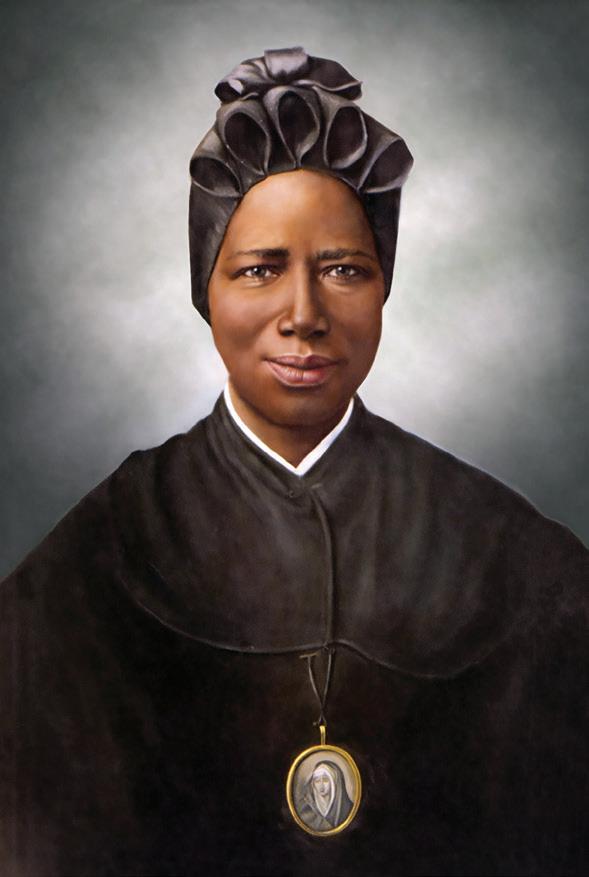
St.Josephine Bakhita, born in 1869 in southern Sudan, was kidnapped as a very young girl and sold and resold in the markets of El Obeid and Khartoum. The name Bakhita, which ironically means “fortunate one,” was given to her by the traffickers because she could not remember her own name. Eventually freed, she entered the Canossian Sisters and was canonized in 2000 as the patron saint of victims and survivors of human trafficking.
Sadly, St. Josephine Bakhita’s traumatic experiences of slavery still exist in the form of human trafficking, modern-day slavery. Every year, tens of millions of women, children and men fall into the hands of traffickers in their home countries and abroad. Trafficking does not discriminate; it affects people of all ages, races, educations, and backgrounds.
Women’s religious congregations have long recognized that human trafficking is not only a serious crime but also a rejection of the God-given dignity of every human being. In 2013, 15 Sisters from different congregations met to share their anti-trafficking resources. They created a national network, the U.S. Catholic Sisters Against Human
Trafficking. As the network grew to include others, it became the Alliance to End Human Trafficking. Today, members of the Alliance include 200-plus women’s religious congregations, coalitions working against human trafficking, men’s religious congregations, and individuals who share the mission to end human trafficking.
The Sisters of Charity of Cincinnati are actively engaged in the efforts to end human trafficking. In 2015, a small group of Sisters proposed that the congregation take a public stand to abolish human trafficking. They pointed to the congregational Charism Statement, which calls us to “dare to risk a caring response” and the 1990 Vision Statement, which challenges us to “risk being prophetic in church and society.” In October 2015, after a period of education, discernment and prayer, the Sisters approved a public congregational stand: “The Sisters of Charity believe that the practice of human trafficking should be abolished in law and in practice.” Sisters and Associates have been living out this stand in a number of ways.

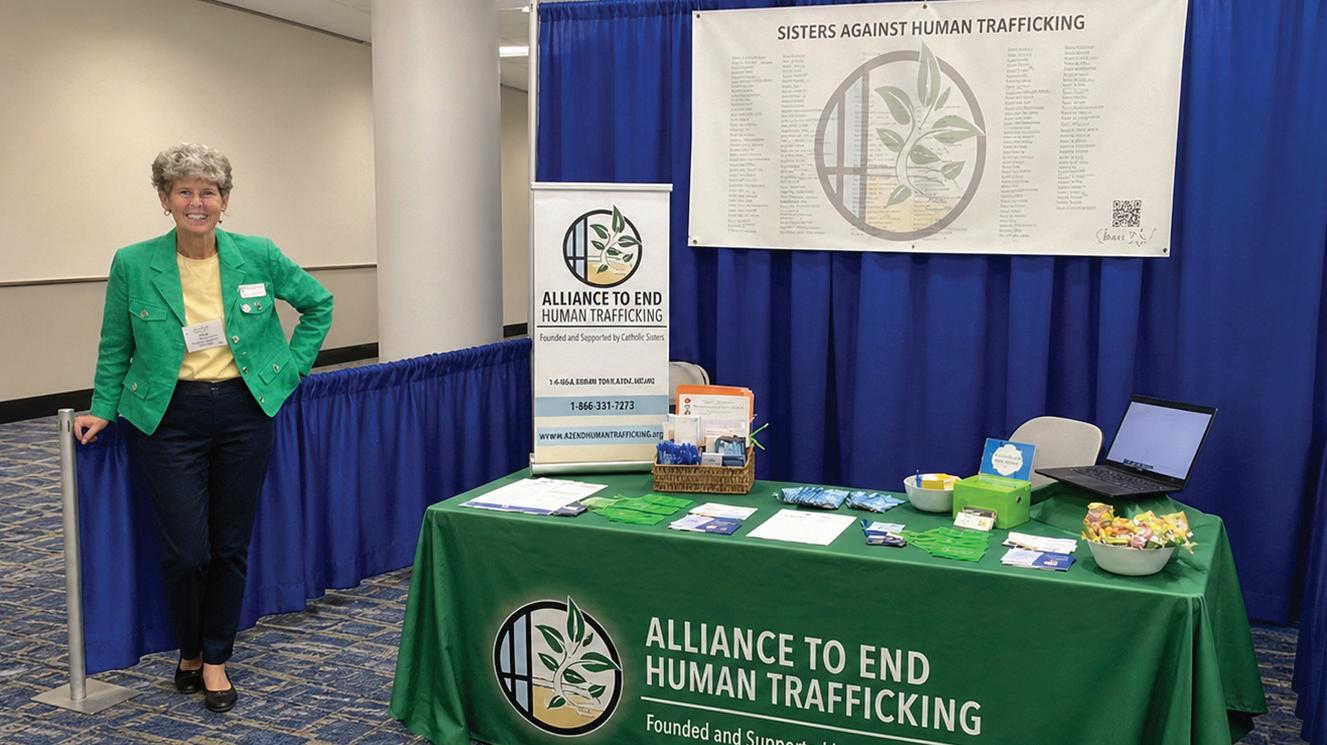
S. Sally Duffy originally became involved with efforts to end human trafficking because of her work with immigrants. She saw that the vulnerability of immigrants – wary of legal authorities; forced into shadows; economically dependent; dehumanized – lends itself to human trafficking. Estimates are that 70 percent of those who are trafficked are immigrants. The intersection between immigration and human trafficking compels her to co-lead a congregational Justice Circle that engages Sisters and Associates through education, prayer services, webinars, newsletters, and legislative advocacy.
St. Josephine Bakhita is the patron saint of human trafficking victims and survivors of slavery.
S. Sally Duffy serves on the Board of the Alliance to End Human Trafficking.
4
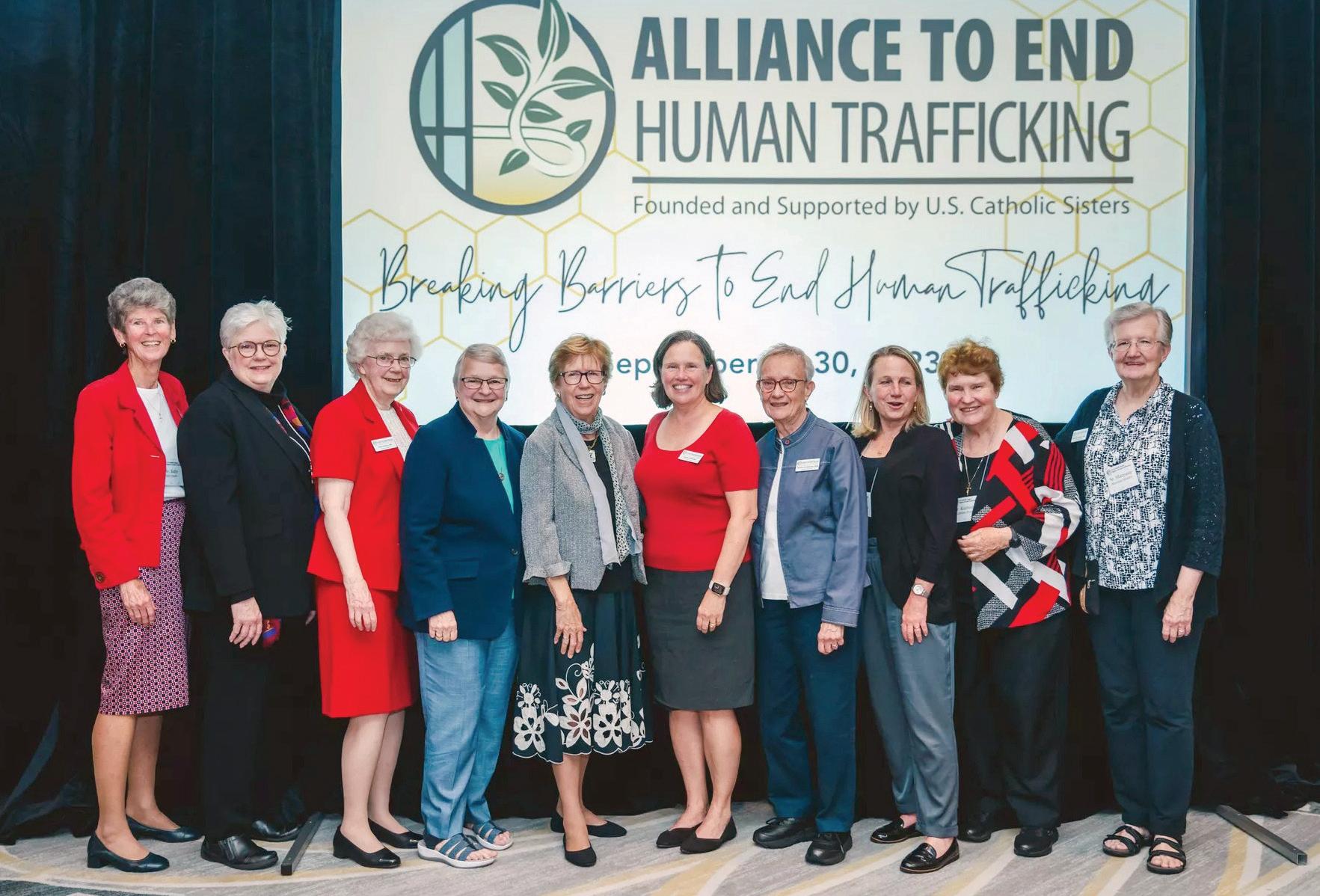
With more than 200 member congregations of Catholic Sisters, the Alliance to End Human Trafficking is a collaborative, faith-based national network that offers education, supports access to survivor services, and engages in advocacy to end human trafficking.
In 2020, S. Sally was asked by the Ohio Justice and Policy Center to organize religious congregations to write letters on behalf of Alexis Martin, a survivor of human trafficking. Alexis had served almost 12 years in prison, incarcerated since she was 15, accused of being an accomplice to the murder of her alleged abuser. S. Sally’s in-person meeting with Alexis began a long journey of accompaniment with Alexis, who now lives in her own apartment, works full-time, and is one course away from an associate degree.
S. Sally remains committed to ending human trafficking because of her firm belief that everyone has a God-given dignity that must be protected. She continues to serve on the Board of the Alliance to End Human Trafficking, most recently as the president.
After S. Patricia Sabourin returned to the United States from seven years abroad in Malawi and England, she met with Sisters from different congregations to address human trafficking in Cincinnati. She committed to a six-week program led by End Slavery Cincinnati at the Salvation Army. S. Pat learned that entire families and children can be trafficked as well as adult women and men.
“Where safeguards weaken, exploitation follows; where communities strengthen safety and opportunity, trafficking is reduced.”
- S. Sally Duffy, SC
These learnings compelled her to engage in multiple activities to promote awareness of the harms of human trafficking and the availability of services for victims and survivors. She posted information in community rooms and elevators on the Mount St. Joseph campus; traveled to parishes at night to offer educational sessions; and placed bars of soap in hotels and motels with a hotline number on the bottom. She continues to disseminate information about human trafficking on a regular basis.
S. Pat believes that “human trafficking will be with us always.” Yet, we cannot close our eyes and ears. We cannot become complacent about the evils of human trafficking. As she demonstrates, everyone can do something to raise awareness.
S. Marcel DeJonckheere heard S. Pat talk about human trafficking and could not believe that sex trafficking was happening in plain sight, in her own city. She learned that End Slavery Cincinnati needed volunteers for night outreach to women who were prostituted. The volunteers would go out twice a week between 10 p.m. and 2 a.m. to deliver small bags of personal care items and snacks to the women.
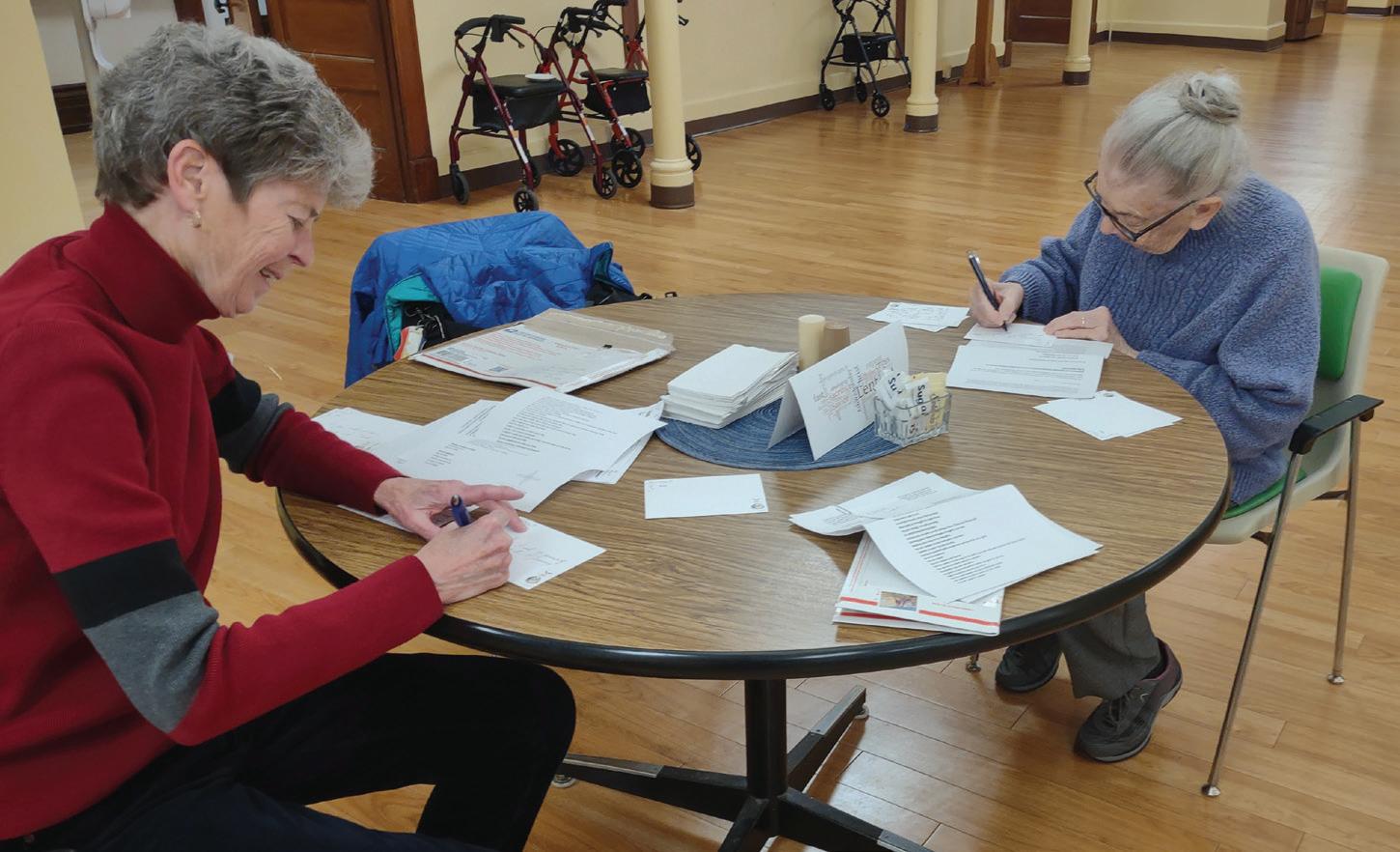
S. Pat Sabourin (right) has been faithful to promoting awareness of the harms of human trafficking and the availability of services for victims and survivors.
In her orientation, S. Marcel learned that “pimps,” usually male, controlled five to six prostituted women in a specific geographic area. One woman, called the “bottom,” kept the other women in line; otherwise, she or her family suffered consequences. The pimps were always close by and sometimes chased the van.
One night, S. Marcel delivered a personal care bag to a young woman who remembered S. Marcel as her sixth grade teacher. S. Marcel remembered the woman’s first name; the young woman did not want to share her last name – perhaps ashamed?
S. Marcel continued in this ministry for about five years, involving other Sisters in preparing the personal care bags. What kept her going? She wanted the women to know they are not invisible; someone knows they are there. “I still feel those experiences in my bones,” she says. “I pray for these women every day.”
Modern-day slavery may seem too overwhelming for any one person or group to make a difference; yet, as these
Sisters and others demonstrate, there are steps each of us can take to make a difference. One immediate step is to urge our elected officials to pass the Trafficking Victims Protection and Prevention Reauthorization Act (H.R. 1144), a bipartisan bill that reauthorizes anti-trafficking programs through FY2029.
Most importantly, we can pray each day to abolish this crime against humanity. We can ask St. Josephine Bakhita to intercede with God on behalf of those who are victims and survivors of human trafficking.
4
“Ultimately, the violence of human trafficking can be overcome only through a renewed vision that beholds every individual as a beloved child of God.”
Pope Leo XIV, Feb. 6, 2026, prior to the 12th International Day of Prayer and Awareness against Human Trafficking
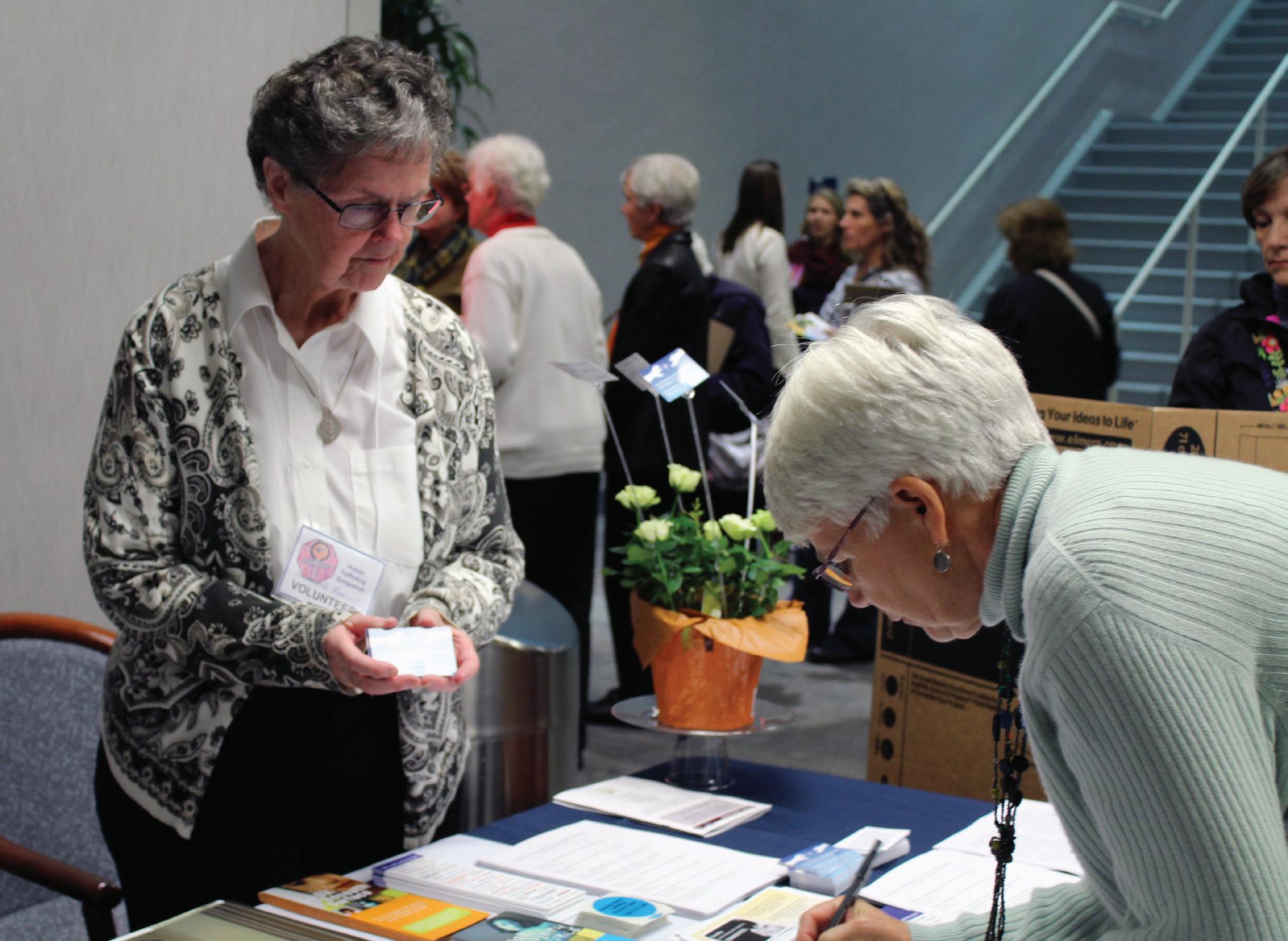
S. Marcel DeJonckheere (left) has been actively involved in raising awareness and supporting human trafficking victims for years.

A Shared Call
By S. Caroljean Willie
Ajoint Earth Day 2026 reflection from the Catholic Climate Covenant and the Laudato Si’ Movement urged us to heed both Pope Francis’ and Pope Leo’s “call for an integral ecology – one that connects care for the environment with care for the poor and recognizes that everything is interconnected.”
The reflection reminds us that “the climate crisis is not distant; it is already affecting communities through extreme weather, rising costs, and growing inequality.” As Catholics, we are called to remember that “creation is not a resource to be used without thought, but a sacred gift entrusted to our care.”
At the same time, the reflection points to signs of hope around the world as schools, parishes, dioceses, clergy and laity take concrete action by reducing emissions, divesting from fossil fuels, restoring ecosystems, educating communities, and advocating for climate justice. Its message calls us to a faith that is not passive, but creative, courageous, and active in love, reminding us that “small actions, when joined together, become a powerful witness of hope.”
EarthConnection is a center for learning and reflection about living lightly on Earth. We strive to foster awareness of the interconnectedness of all creation and to integrate spirituality and sustainability through on-site programs, monthly webinars, our website (scearthconnection.org), quarterly newsletters, and Facebook page.
This year’s webinars have included: “Army Ants, Bromeliads, Toucans … Enter the Rainforest World” presented by S. Caroljean (Cj) Willie; “Science, Religion, the Universe, and YOU!” by Mary Ellen Dillon of the University of Dayton; and “Untangling Plastics: The Missing Link in Mitigating Climate Change” by Xavier University adjunct professor and author Bob Gedert.
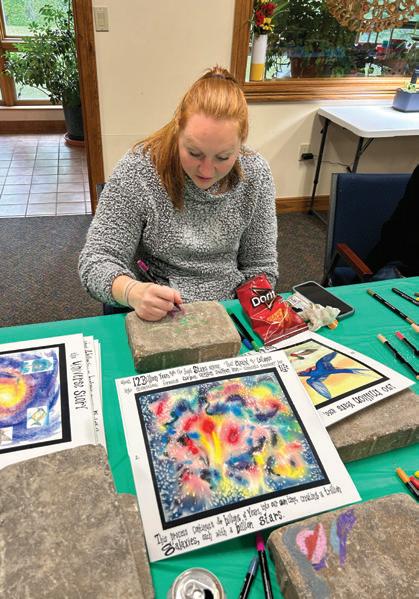
EarthConnection has welcomed multiple classes from Mount St. Joseph University (MSJ) and students from Cincinnati Tech for educational programs. MSJ students and faculty are also painting stones for a cosmic trail through the woods.
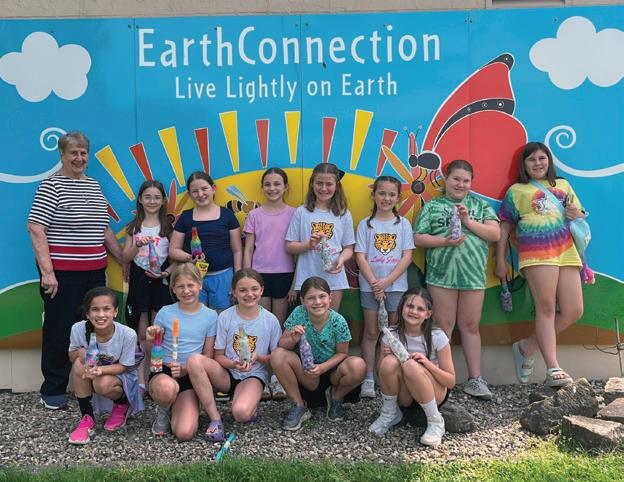
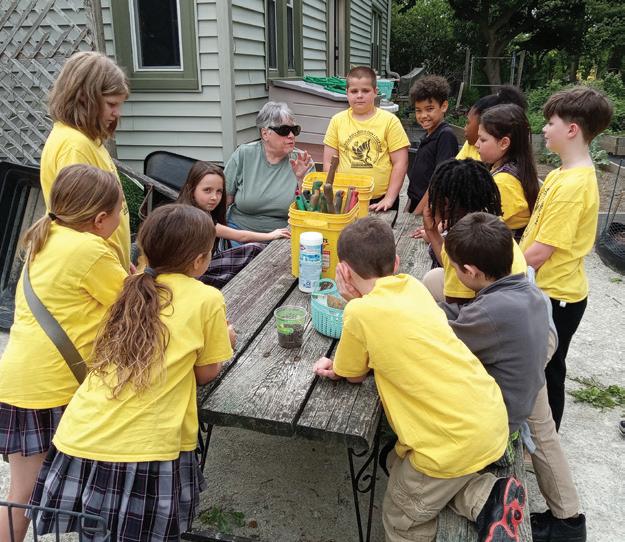
Girl Scouts from several locations, the Lady Jags from St. Antoninus and third graders from St. Dominic School, have visited for Earth-focused programs and activities.
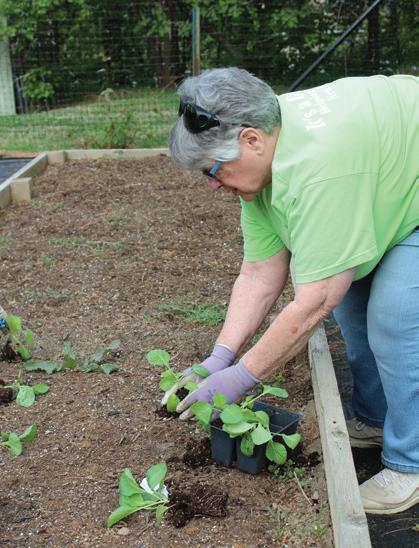
As warmer weather arrives, S. Winnie Brubach and the “Garden Ladies” are preparing garden beds and planting seeds. All produce will be donated to the Good Samaritan Free Health Center in Price Hill for distribution to clients.
Outreach continues through monthly programs for Sisters in Mother Margaret Hall, a presentation for Good Shepherd
parish, programs with Faith Communities Go Green, and participation in the Archdiocesan Creation Care Task Force. EarthConnection also marked Earth Day with presentations, activities, and prayer at the Motherhouse.
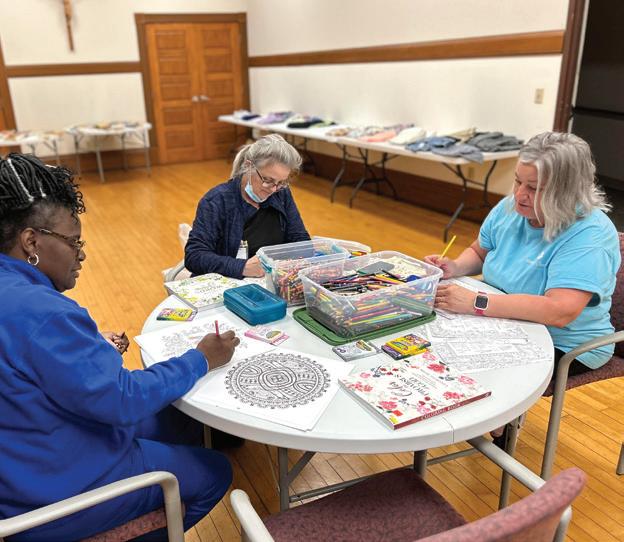
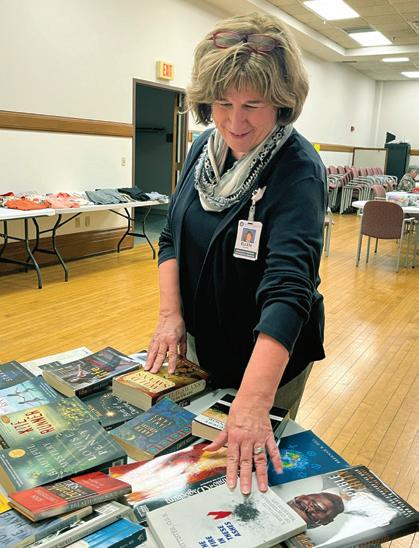
A clothing and book swap offered during the Earth Day celebration provided a practical way to live sustainably.
Third-grade students from St. Dominic School visited EarthConnection, rotating through gardening, art and nature activities.
The St. Antoninus Lady Jags visited in April to learn about sustainability efforts at EarthConnection.
S. Winnie Brubach and the “Garden Ladies” prepare EarthConnection’s garden beds for the growing season.
Mount St. Joseph University students and faculty paint stones for placement along the trail behind EarthConnection.
During Earth Day celebrations at the Mount, Sisters and employees participated in ecoart projects.
Meeting the Need in Unique Ways
By Angela Anno, Associate
“As pilgrims, we pray for the wisdom to know the needs of our sisters and brothers and dare to risk a caring response.”
Following this part of their Charism Statement has led Sisters of Charity Montiel Rosenthal, Annie Klapheke and Carol Wirtz to go beyond the usual scope of their ministries to find methods that will better help the persons they work with – and it has been a mutual blessing.
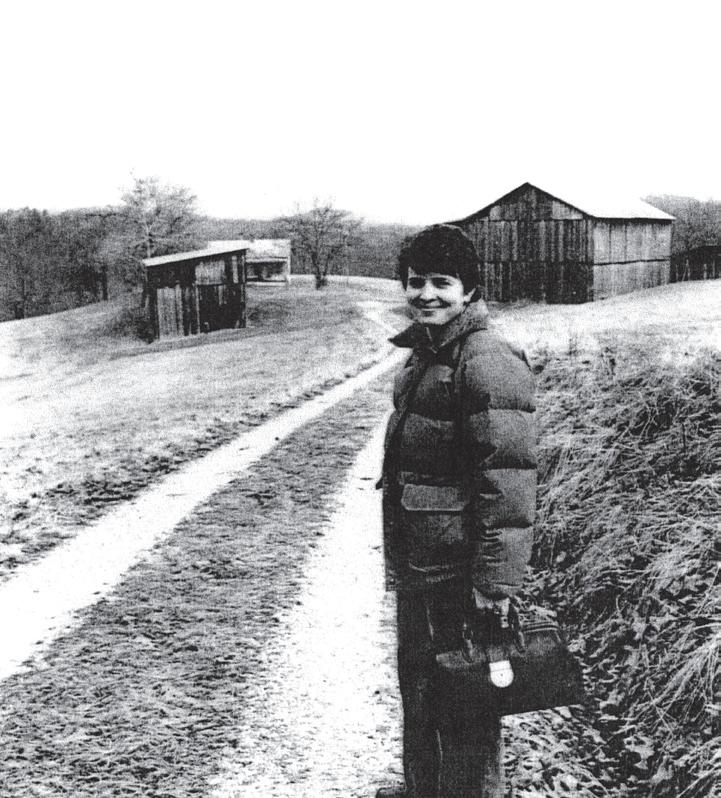
When she was studying to become a doctor, S. Montiel Rosenthal, MD, was also considering a religious vocation and wondered if the two calls were compatible. She trusted that God would lead her in the right direction and found “God made it obvious that I was called to both vocations. They fit together and I began to learn about other Sisters, priests, and religious brothers who were following the same path.”
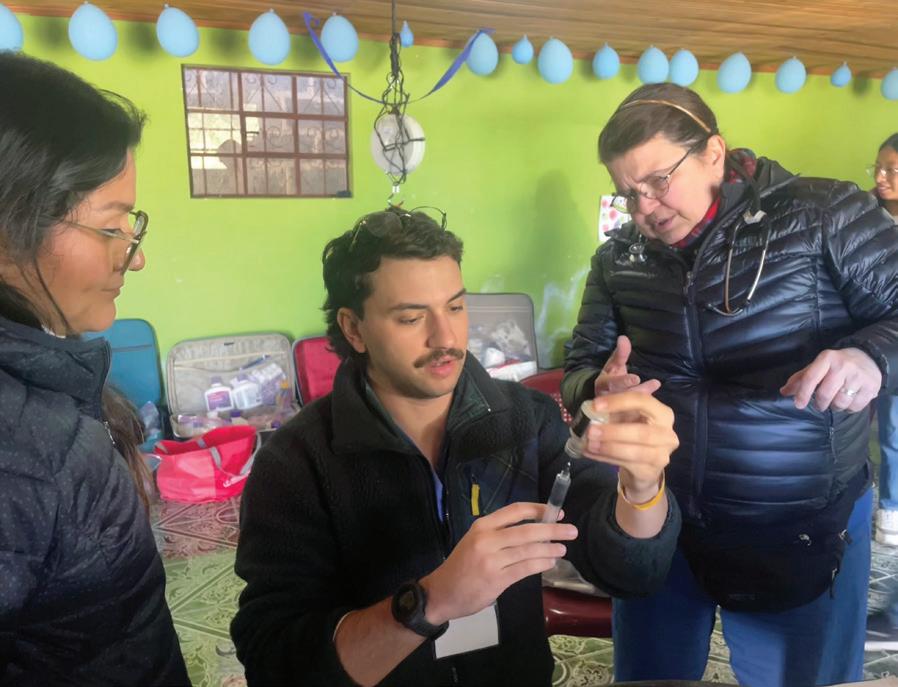
Her dual journey has led her to places where she had to be creative in providing medical care to underserved people in Armenia, Appalachia and remote areas of Guatemala, where she takes medical students with her to experience working with people who rarely get to see a doctor. Each of these settings requires collaborating with a network of people who help provide the medical supplies and support needed.

Though S. Montiel has had a wide range of roles in medicine and was once named “doctor of the year,” what matters most is her daily living out of both her religious and medical vocations, and that begins and ends each day with prayer. For her, it is about being tuned in to where God might be leading, like following an interest and getting trained in acupuncture, a skill practiced by Sister of Charity Rose Chang in her ministry in China. She now offers it as an adjunct to traditional medicine.
In addition to competence, teamwork, evidence-based treatment, and good communication skills, “humility” is a word she uses often to describe what makes an effective physician. “I need to be humble enough to be open to continuing to learn, letting myself be treated by another physician, and working myself out of a job by empowering others, and knowing when it’s time to let go,” she said.
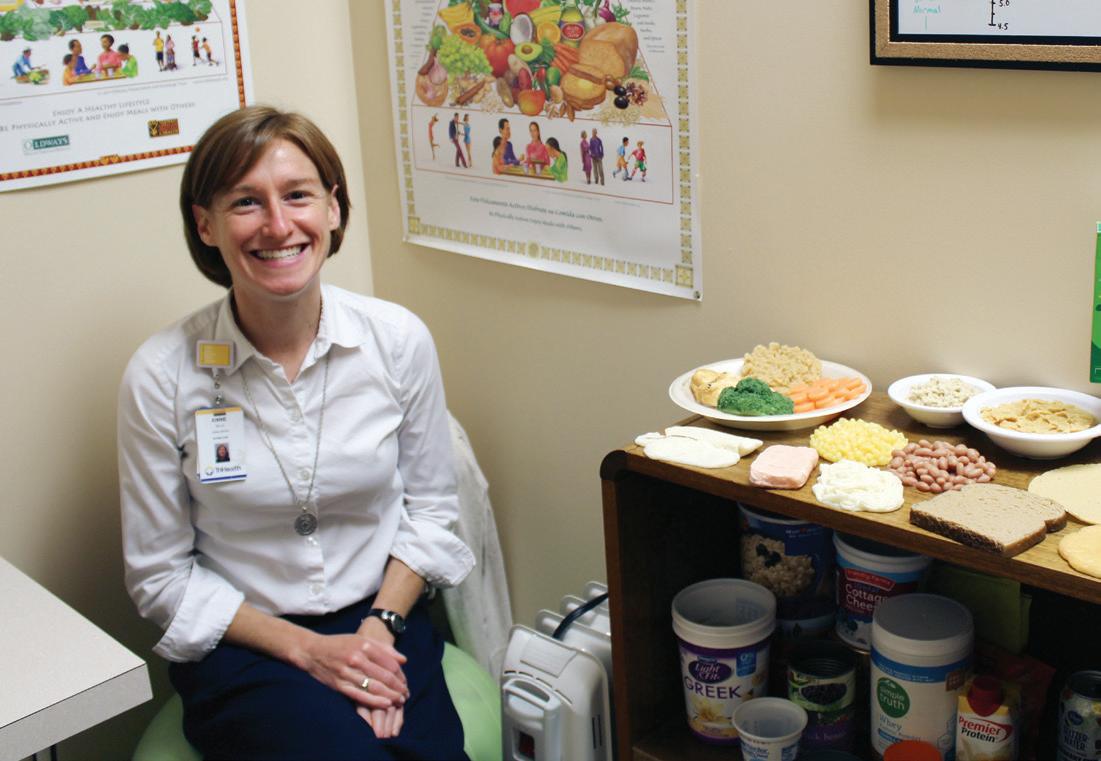
Like S. Montiel, S. Annie Klapheke was discerning her religious vocation at the same time she was preparing for her career as a dietitian and discovered that she was called to both. “Health care has always been a part of the mission – a continuation of Jesus’ own healing ministry,” she said.
“My role as a dietitian very much reflects my spirituality. Jesus gave us the Eucharist, a communal meal that gives us nourishment for the journey. I am aware of the sacredness of food as I talk with my patients. I want it to help them build a healthy relationship with food and celebrate how it can be a joyful part of life even while managing a diet-related disease.”
S. Annie ministers at the Good Samaritan Free Health Clinic in East Price Hill (Cincinnati), a primary care setting,
A medical doctor, S. Montiel Rosenthal, MD, has provided care to underserved communities in Armenia, Appalachia and remote areas of Guatemala.
Committed to empowering the next generation of physicians, S. Montiel Rosenthal, MD, (right) accompanies residents on medical mission trips to Guatemala.
S. Annie Klapheke ministers as a dietitian at the Good Samaritan Free Health Center.
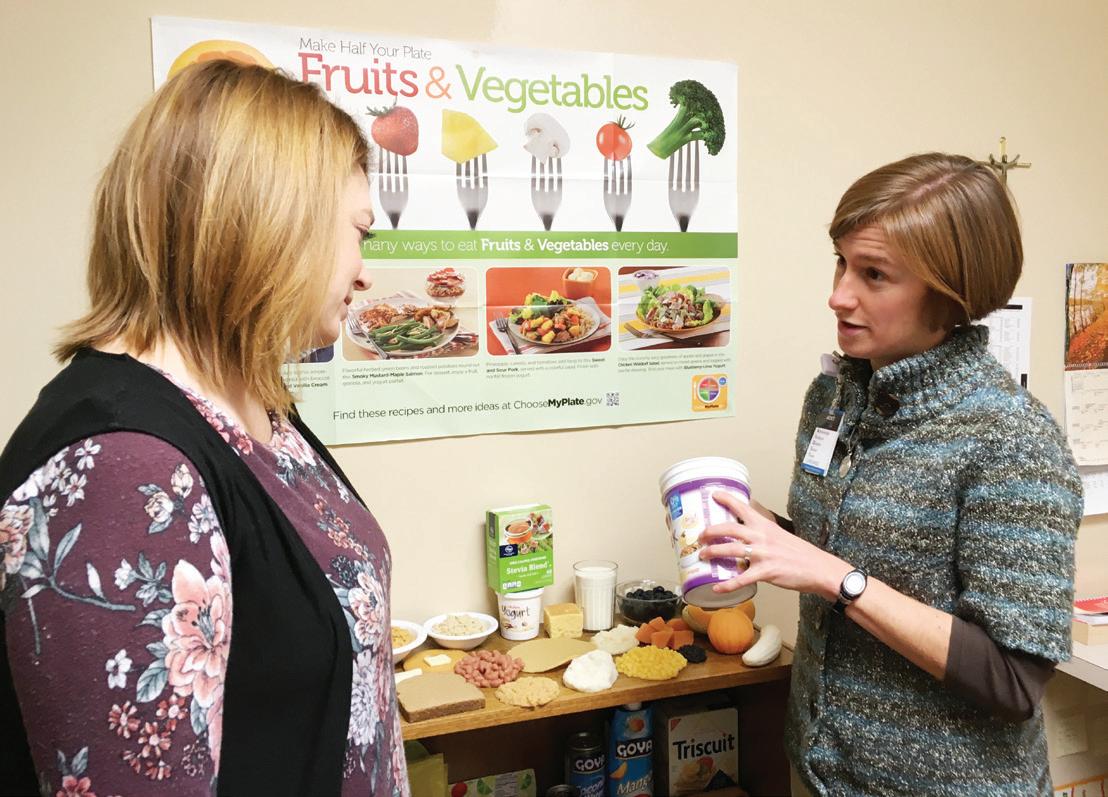
which allows her to see patients for long-term follow-up. “I try to focus on their overall wellbeing, not just on the medical diagnosis. Although we mostly talk about food, patients often share so much more about their lives – their families, their joys, their struggles, and their culture,” she said.
The pressure of competing priorities, such as paying bills, family and work obligations, how you can pay for rent or care for your children, can be a major barrier to managing disease, S. Annie believes. “I try to focus on affordable food options, such as dry whole grains, beans, canned fish, frozen vegetables and some plant-based proteins, and easy to prepare meals, as well as the benefits of caring for one’s health.”
Being a dietitian fits right in with her vocation. “I love that I get to walk closely with God’s people and hopefully bring them to a place of better health and wholeness of life,” she said.
For S. Carol Wirtz, it was a quiet attentiveness to God’s whisperings that led her to religious life – and ultimately her ministry with children with special needs in Anapra, Mexico.
After graduating from college in Montana, she taught at St. Anthony Indian Mission School in Zuni, New Mexico. There, she met S. Rose Marie Hewitt, who was the principal. Witnessing S. Rose Marie’s joyful spirit and the bond she shared with the other Sisters spoke to S. Carol’s heart, inspiring her to discern becoming a member of the congregation.
While teaching in Santa Fe, S. Carol studied multiple disciplines in alternative healing. This led to extensive study of lymphatic drainage therapy, a skill she used for several years, primarily working with cancer patients.
Her ministry later took a new turn when she joined a team of Sisters crossing the border into Anapra, Mexico, to provide basic health care to those with little or no access. During that time, one mother gave birth to a child with Down syndrome. “At that time,” she said, “moms felt they were being cursed for having a special needs child.”
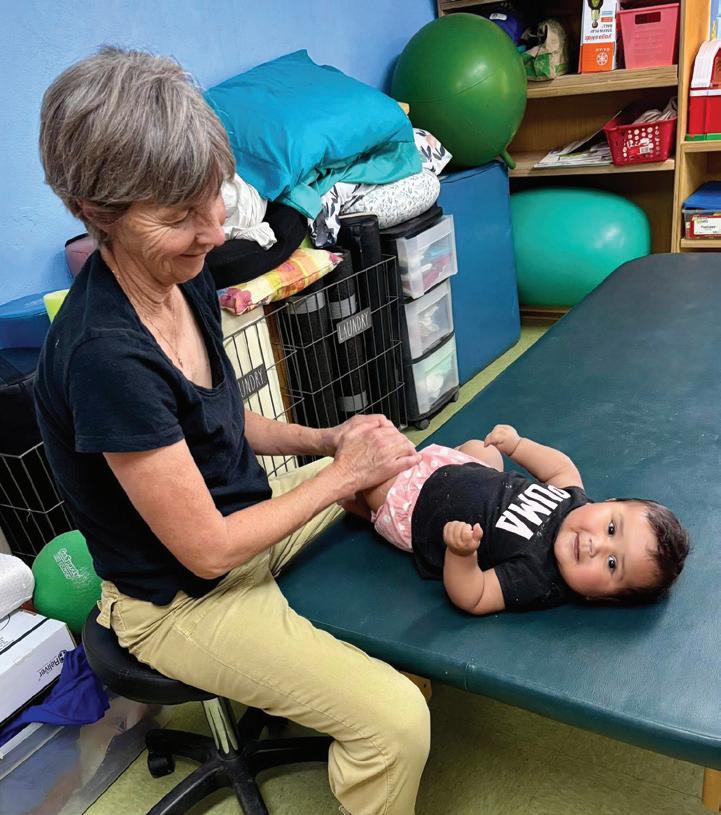
There were no services available for these children so she began to see what she could do to help. S. Carol learned about the Anat Baniel Method® Neuromovement® that focuses on what is possible rather than the limitations.
“The brain can make new connections if given the right environment and support,” S. Carol said. “The method provides the brain with what it needs to learn through gentle movement, unlocking the natural potential for learning and growth.”
In time, the Sisters established Proyecto Santo Niño, where S. Carol continues to provide services for the children who come there.
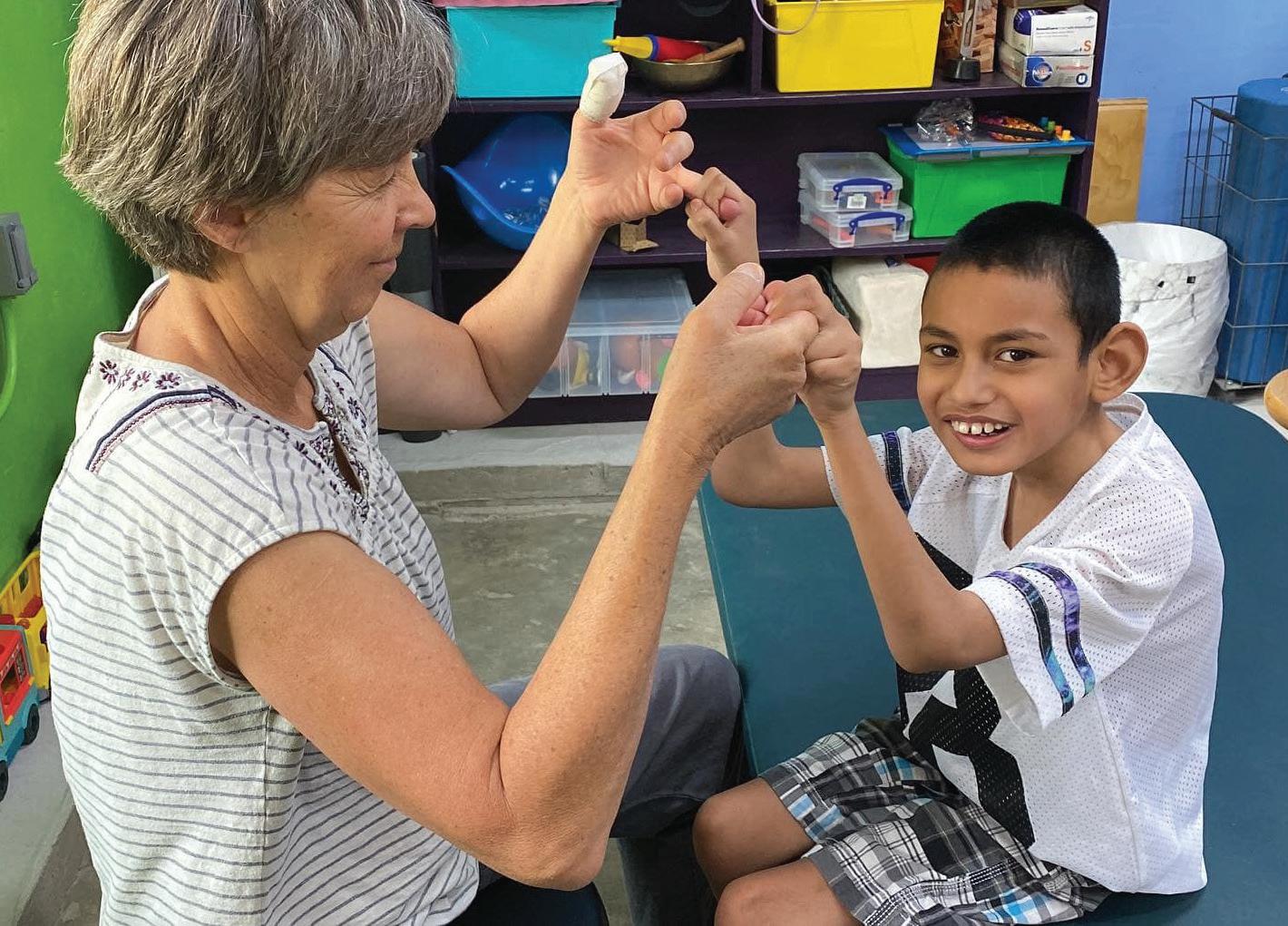
“In living conditions that are often difficult and sometimes violent, a child needs to feel welcome, safe and loved before they can learn,” she says. “Feeling loved is more important than anything else and by trying to do that for people, we put our charism into tangible practice. Through all the difficulties, every day brings joy and the awareness that God is always present.”

“I’m always amazed by how God plants seeds of inspiration that come to fruition later,” she reflected. She recalls how her early experience teaching swimming lessons to special needs children opened her eyes to alternatives beyond traditional methods.
Each of these three Sisters faces unique challenges in their ministries, and while the approaches may be different, they continue to live out the charism of Mother Seton in their response.
As a dietitian, S. Annie Klapheke (rigt) helps clients focus on affordable foods, simple meals and the benefits of a healthy lifestyle.
In her ministry at Proyecto Santo Niño, S. Carol Wirtz uses the Anat Baniel Method® Neuromovement® to support learning and growth through gentle movement.
S. Carol Wirtz believes a loving, safe and welcoming environment is essential for children to thrive.

Rooted in Culture,
Rising in Hope
When S. Tricia Cruise first arrived at Red Cloud Indian School (known in Lakota as Mahpiya Luta), she wasn’t sure she would stay.
“I’m an East Coast girl,” she admits with a laugh. “I had no idea what I was walking into.”
What she encountered on the Pine Ridge Reservation in South Dakota was unlike anything she had known –geographically isolated, shaped by generations of hardship and injustice, and yet deeply rooted in culture, family, and resilience. What began as a reluctant visit slowly became a ministry that shaped her life in profound ways and connected her to people and stories she still carries with her today.
As Father Peter Klink, who has spent decades at Red Cloud, reflects, stories like S. Tricia’s are part of something much larger – a long relationship between the mission and the Lakota people that continues to grow and evolve.
S. Tricia’s path to Red Cloud began through an unexpected invitation. After studying at the Jesuit School of Theology in Berkeley, California, she received a call in the mid-1990s from a former classmate, Father Bill McKinney, who had become president of Red Cloud Indian School. “He said, ‘We could use you to raise money,’” she recalls. “And, I thought, this is in the middle of nowhere.”
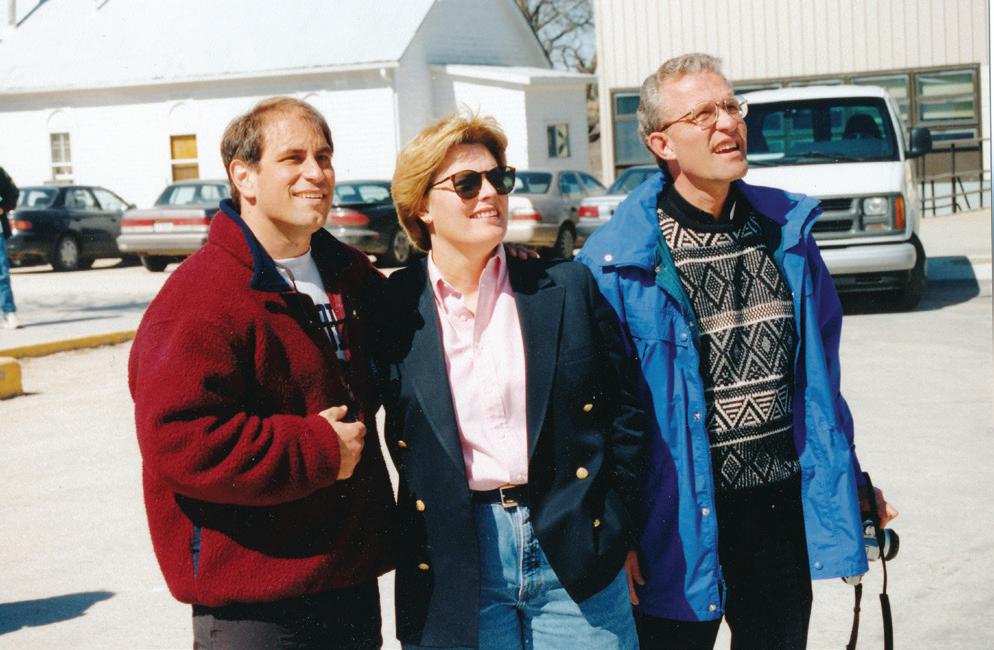

She visited once. Then again. Still hesitant, she returned home unconvinced until her mentor, the late S. Elizabeth Cashman, encouraged her: Go. Try it. You don’t have to stay. So, she went and stayed.
Within two years, after the sudden death of Fr. Bill, S. Tricia found herself leading the school, an unexpected responsibility in an unfamiliar place. For nearly one decade, she helped guide Red Cloud through growth, transition, and challenge, while learning what it truly meant to walk alongside a community.
Father Peter remembers her presence well. She came, he says, with both “head and heart,” bringing intellectual strength as well as compassion to the ministry.
Founded in 1888, Red Cloud School traces its beginnings to the vision of Lakota leader Red Cloud, who petitioned the U.S. government to bring Jesuit missionaries (known as the “Black Robes”) to educate his people. Over the years, the mission has continued to evolve, seeking to honor both Catholic faith and Lakota identity.
Today, Lakota language and culture remain central to the life of the school and community. S. Tricia describes that work as beautiful, important, and ongoing.
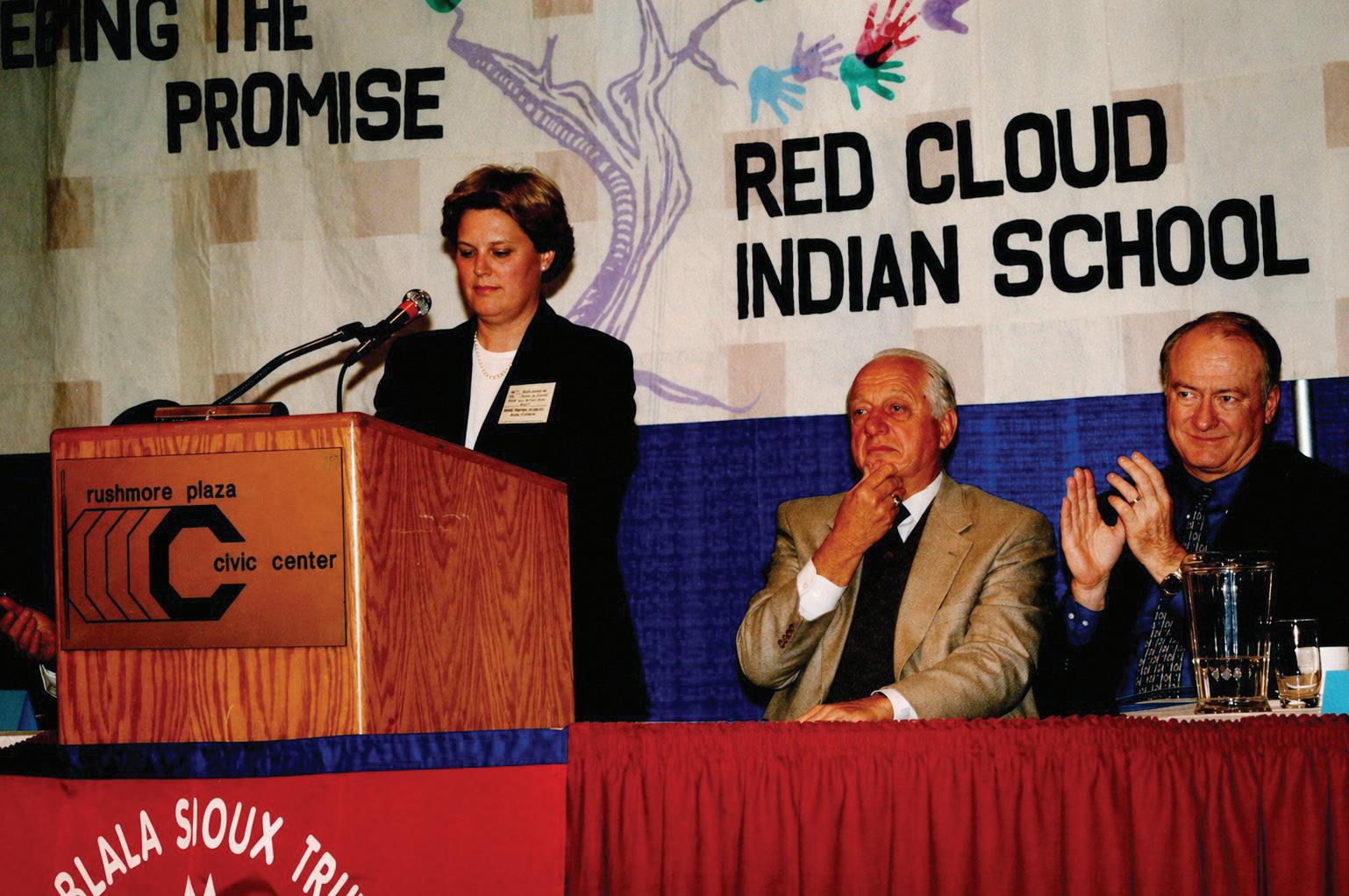
For nearly one decade, S. Tricia Cruise helped guide Red Cloud Indian School on the Pine Ridge Reservation in South Dakota through growth, transition, and challenge.
S. Tricia Cruise worked closely with Fr. Tom Merkel (left) and Fr. Peter Klink (right) during her time as president of Red Cloud Indian School.
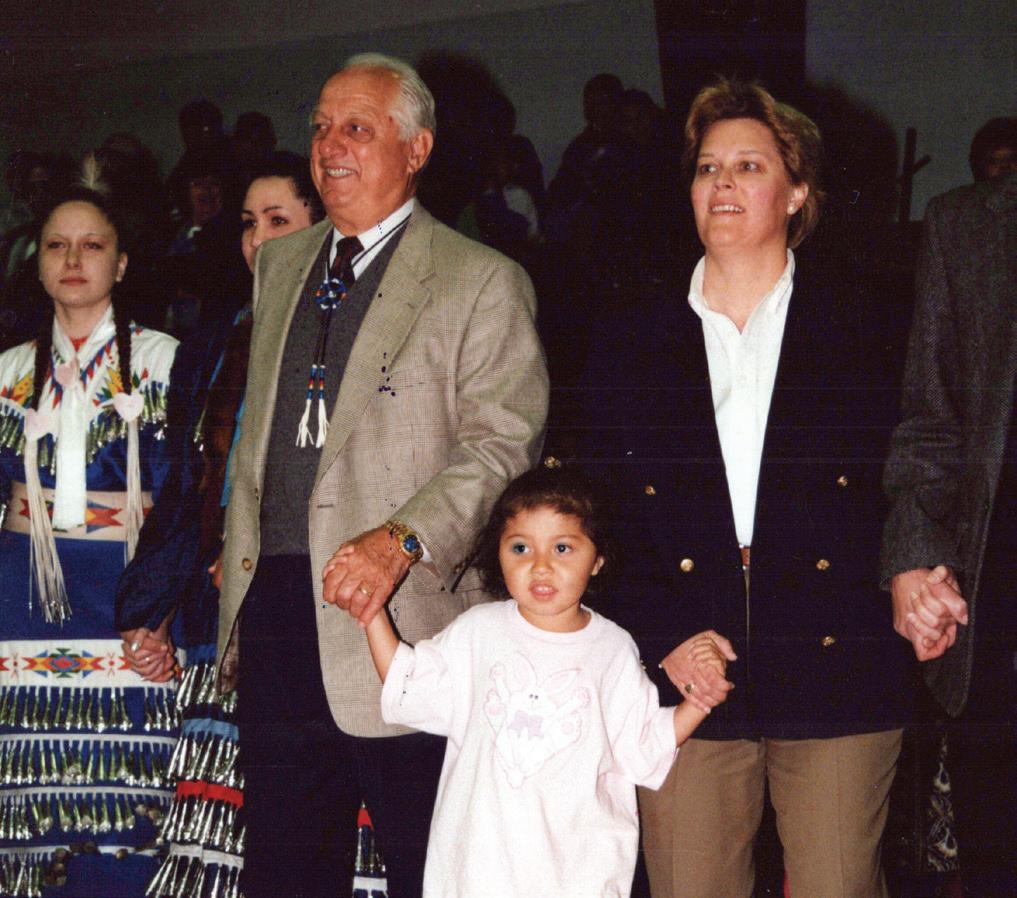
Learning Through Relationship

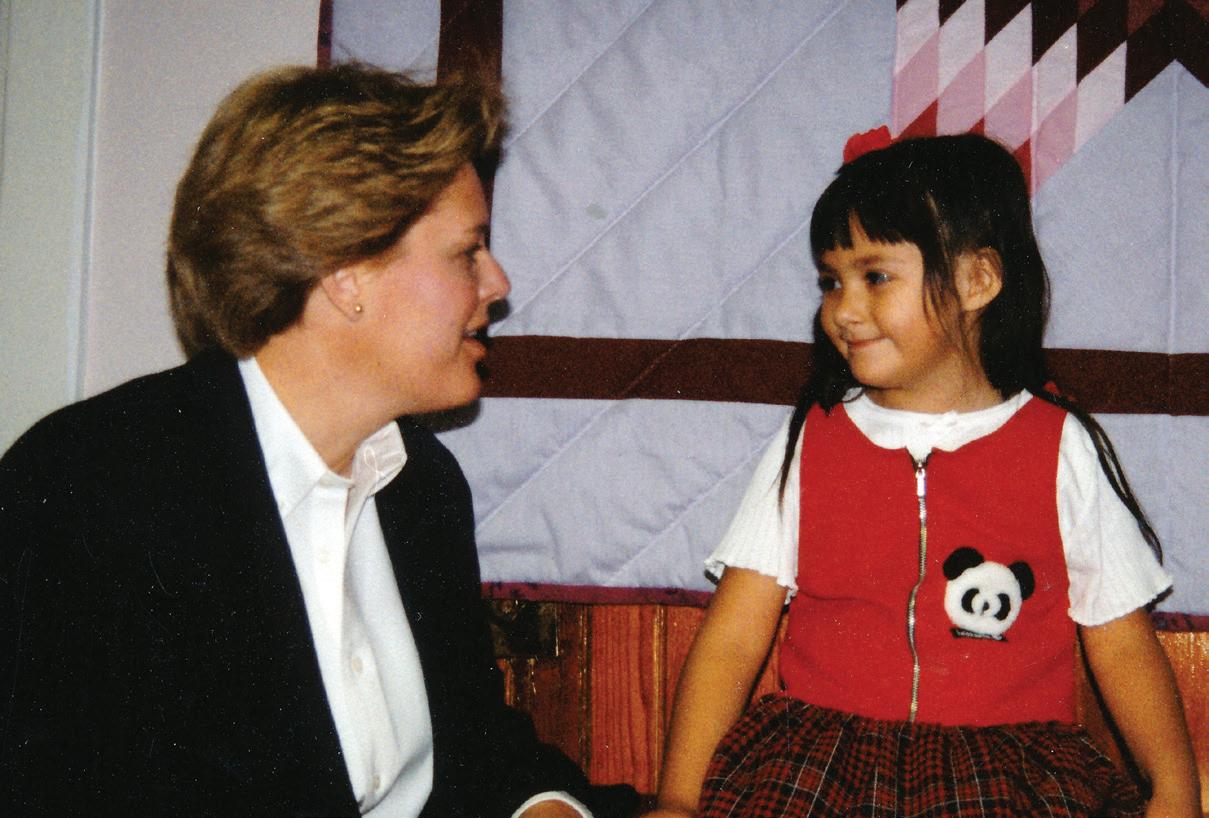
Through the years, S. Tricia Cruise has cultivated relationships rooted in mutual respect and care, forming deep bonds.
Understanding the history of Red Cloud was only one part of the experience. Living and ministering within the community required something deeper: relationship.
From the beginning, S. Tricia understood that trust had to be earned. “Who’s this other white woman?” she remembers people wondering.
Relationships formed slowly through shared meals, visits to families, funerals and community gatherings. Over time, she was welcomed into homes and into stories, becoming, as one friend later introduced her, “family.”
The experience gradually changed her understanding of community and belonging. She witnessed the strength of Lakota women, many of them matriarchs holding families together through hardship, loss and change. She learned about the significance of star quilts, lovingly handmade and given during moments of birth, death, celebration, and honor. Over time, she came to better understand a culture where identity is deeply connected to family, history, and relationship.
Fr. Peter says ministry at Red Cloud is rooted not simply in service, but in mutual love and respect, “not only loving, but recognizing that you are loved.”
For S. Tricia, that understanding came slowly and changed the way she saw the world.
Life on the reservation also revealed realities many people never see. Pine Ridge remains one of the poorest regions in the United States. Access to basic resources is limited. A trip to a grocery store or doctor can mean traveling 100-plus miles. Fresh food is scarce. Health care is
inconsistent. Many families rely on government commodities for survival. “You don’t hear about what’s happening out there,” S. Tricia says. “People just don’t know.”
She recalls a moment that changed her perspective. After commenting on the poor nutritional quality of government food supplies, an elder responded: “You’ve never been hungry, have you?” The question stayed with her. “It changes how you see everything,” she says.
Despite generations of hardship stemming from government policies that displaced and isolated Native communities, the Lakota people endure. “They often say, ‘We’re still here,’” S. Tricia notes. “And that matters.”
Longtime Los Angeles Dodgers manager Tommy Lasorda made a special visit to Red Cloud Indian School in support of its educational and community efforts.
S. Tricia Cruise’s connection to Red Cloud Indian School and Holy Rosary Mission in South Dakota began in the mid-1990s and continues to this day.
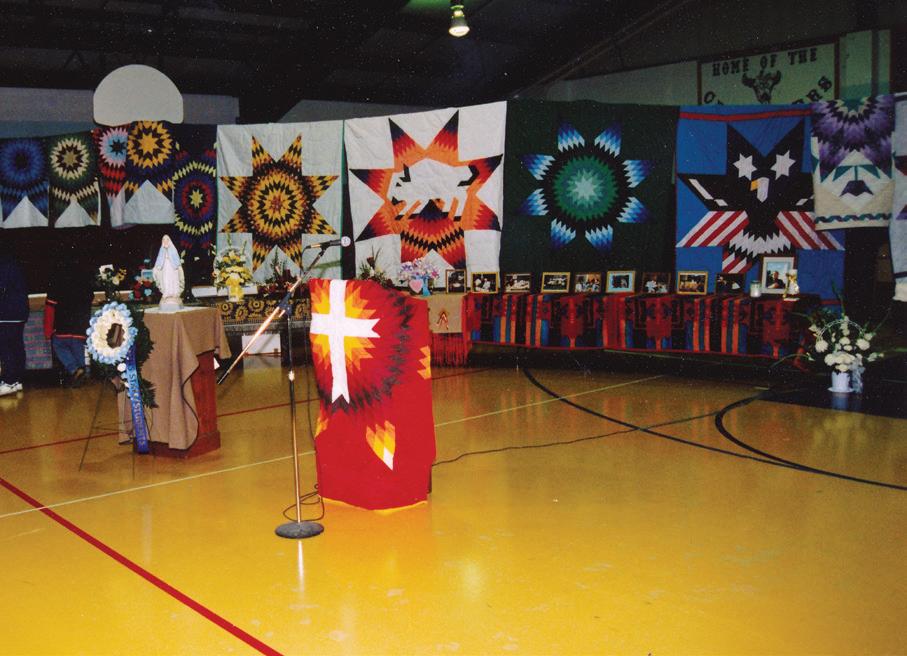
Star quilts, in the Lakota tradition, are closely associated with end-of-life rituals. Women often gather to sew a quilt within a matter of hours, which is then draped over a casket or displayed behind a loved one during memorial services.
She speaks with hope about the younger generation – students graduating from Red Cloud, attending colleges and universities, and returning home to serve their communities. Programs focused on sustainability and local agriculture are growing. The Lakota language, once at risk of being lost, is being taught and spoken more intentionally among students.
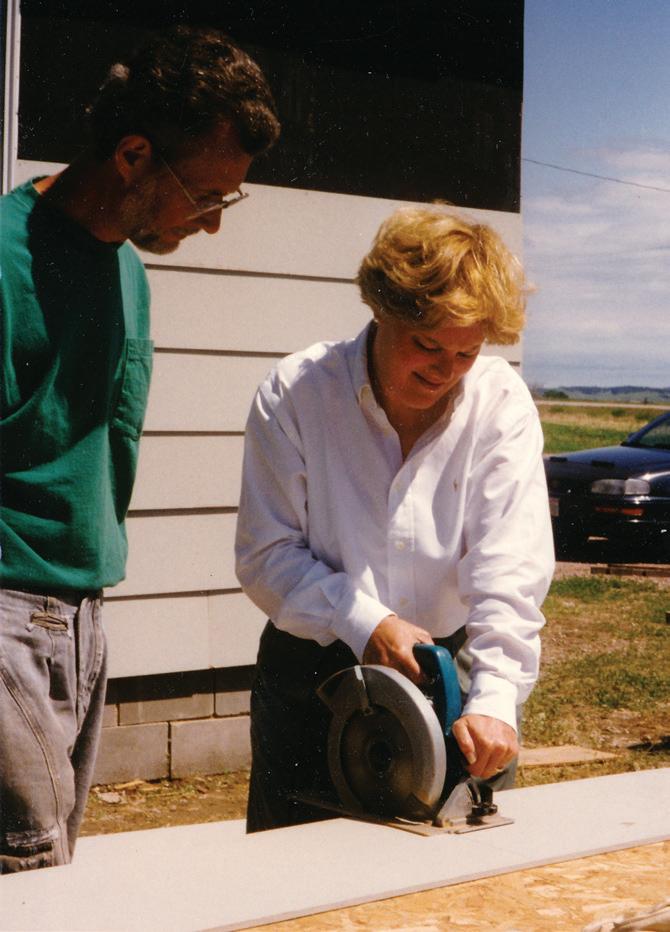
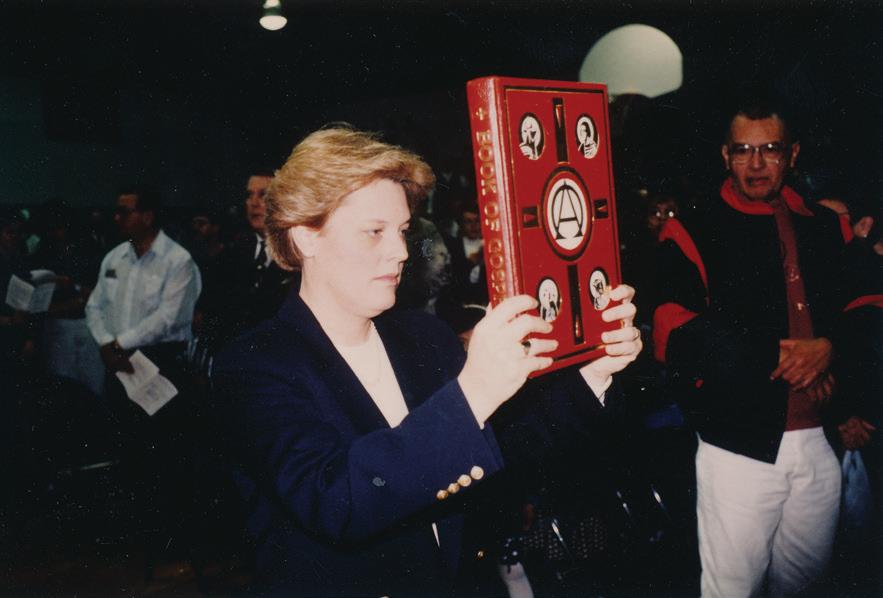
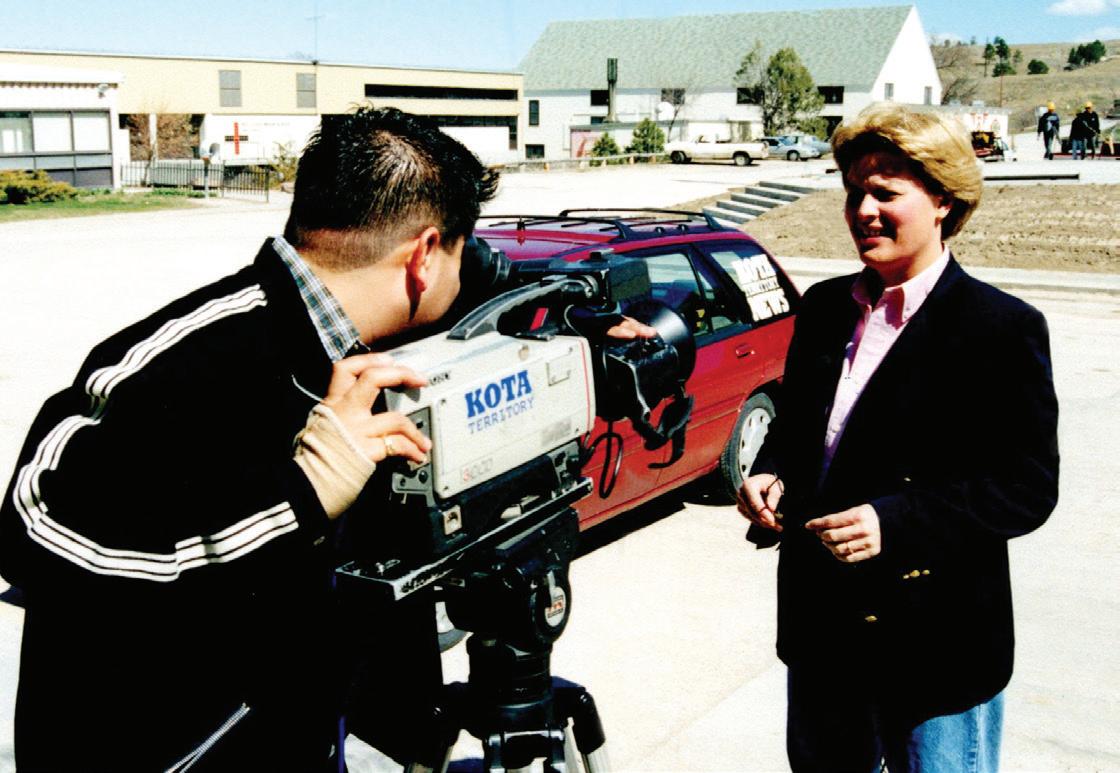
throughout her ministry, engaging deeply in shared meals, family visits, and community gatherings.
S. Tricia Cruise is committed to helping others move beyond assumptions and to recognize both the injustices faced by Native communities and the strength and resilience within them.
“This next generation is bringing skills back,” she says. “That gives me hope.”
A Ministry That Continues
Though she no longer lives on the reservation, S. Tricia’s connection to Red Cloud remains strong. Today, she continues to support the mission through grant writing, fundraising, and mentoring. She works closely with local leaders, many of whom were once students themselves, as they continue building opportunities within their own communities.
Her approach remains grounded in a lesson she learned early on from a Lakota colleague: “White people come and go from here. If you want to help us, don’t forget us.” She hasn’t.
S. Tricia’s ministry is not only about what she has given, it is about what she has received. “I’ve had the opportunity to walk with people I never would have met otherwise,” she says. “That changes you.”
Her experience invites others to look beyond assumptions and to recognize both the injustices faced by Native communities and the strength within them. It is also a call to awareness. Because the story of Red Cloud – and of the Lakota people – is not just history, it is still unfolding.
The mission of Red Cloud Indian School continues today, rooted in education, culture, and the enduring strength of
the Lakota people. And for S. Tricia, the experience remains a reminder that real ministry begins by listening – by being willing to learn from people whose stories and experiences may be very different from your own.
As S. Tricia reflects, one truth remains clear: “Education is essential, but so is understanding who you are. And they are holding onto that in a powerful way.”
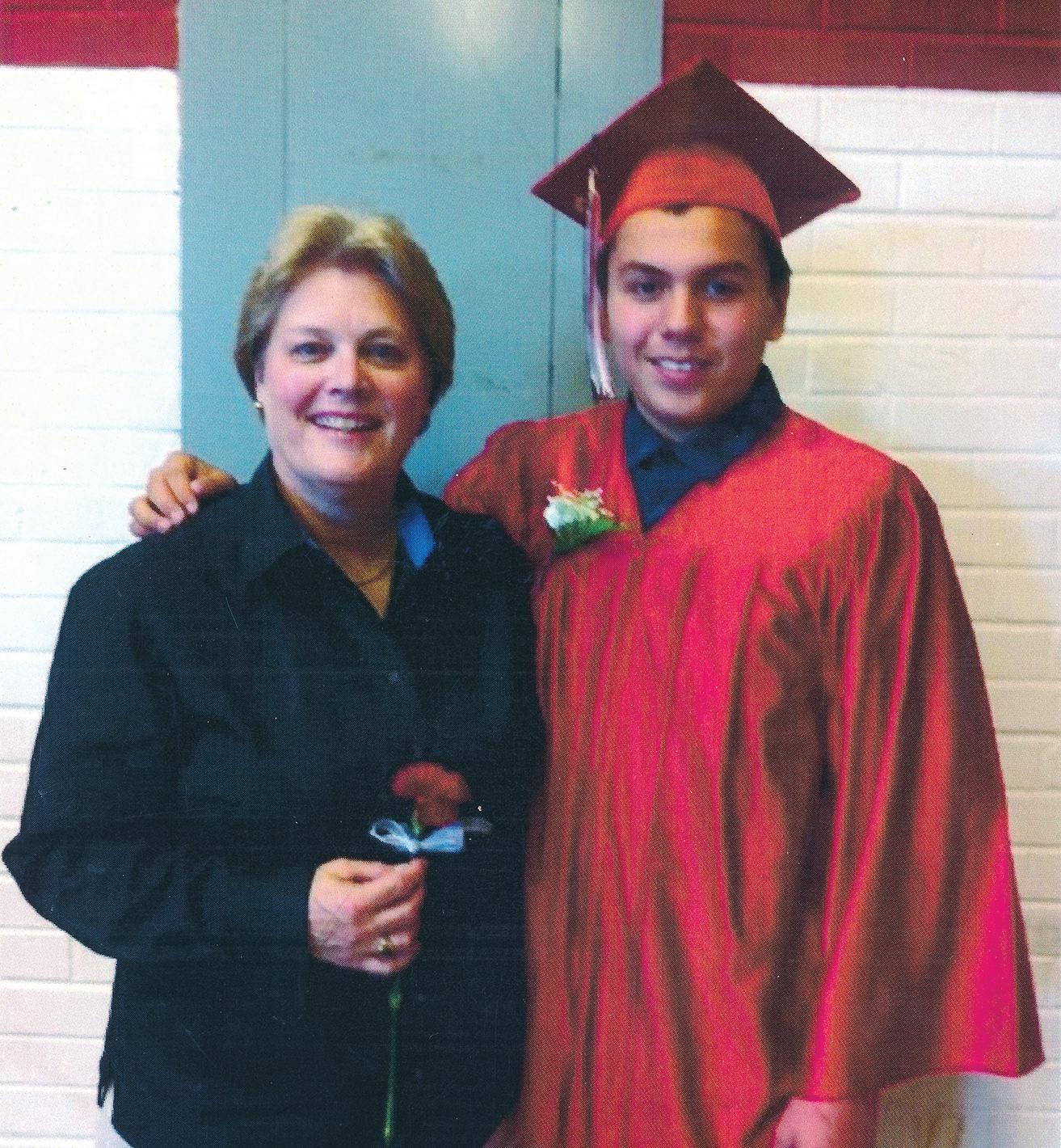

S. Tricia Cruise has valued relationships
S. Tricia Cruise with her godson, Patrick Clifford, following his graduation from Red Cloud Indian School.
Formed in Faith and Learning
By Sebastian Isaacs, Communications intern
Having taught at Mount St. Joseph University for 22 years, Dr. Michael (Mike) Sontag knows firsthand how deeply the mission of the Sisters of Charity of Cincinnati permeates the college (now university) they founded in 1920. Their faithful dedication on campus has inspired Mike throughout his own journey as an educator and administrator.
“My thinking, my faith, my values, and the course of my life have all been fundamentally shaped through my friendships and interactions with the Sisters,” he reflects. Though he was not taught by Sisters in his primary education, his connection to the Sisters of Charity began early. The late S. Rosanna Barker was his great-aunt, and both his grandmother and mother attended Mount St. Joseph for college.
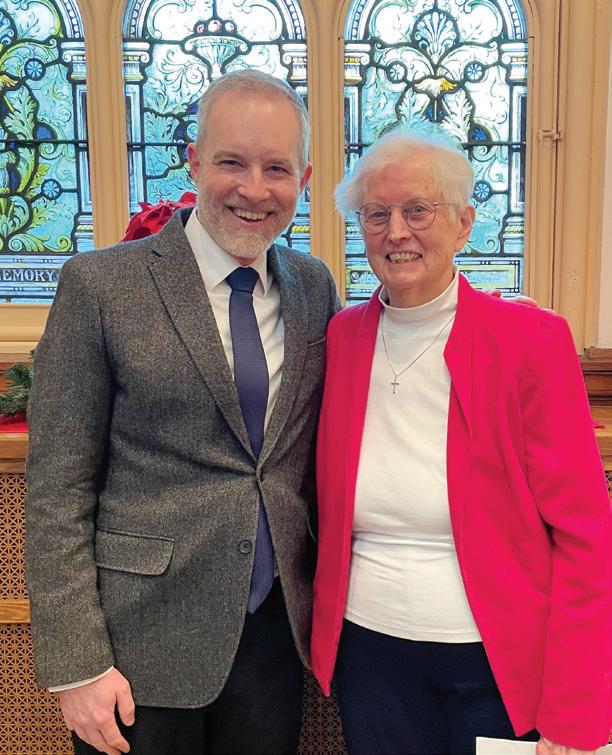
Sisters of Charity Community Historian S. Judith Metz (right) has had a profound influence on Dr. Michael Sontag’s life as an educator, generously sharing the rich history and enduring mission of the SC congregation.
When Mike began teaching at the Mount, these early connections to the congregation and the university provided a strong foundation for forming meaningful relationships with his Sister colleagues.
“Many Sisters of Charity have had lasting impacts on me,” Mike says as he considers the influences they have had on his life and work. He credits the history of the Sisters of Charity – learning about St. Elizabeth Ann Seton, Mother Margaret George, and Servant of God S. Blandina Segale – as especially formative in shaping his approach to teaching. “Most of that history I learned from S. Judith Metz,” he adds. “She is a treasure.”
A close relationship with S. Judith, the Community historian, deepened Mike’s understanding of the Sisters’ enduring presence and purpose at the university. Now serving as dean of the School of Arts and Sciences, he reflects on how various Sisters helped guide the institution and continue to influence its mission today.
“I learned how to engage in a community from S. Barbara Davis, and I learned how to be an administrator from S. Marge Kloos,” he says. “My first understanding of mission came from S. Monica Gundler,” who now serves as president of the Sisters of Charity.
Like many Sister educators and administrators who mentored him early in his career, Mike sees both teaching
and leadership as vocational callings. “Teaching is certainly a calling, and administrative work is, too,” he says. “Elizabeth Seton and Margaret George were both teachers and administrators. I’ve found them inspiring as I’ve tried to balance those roles myself.”
As a philosophy educator, Mike also values Mount St. Joseph University’s commitment to integrating faith and learning. “Professors are often eager to keep religion out of the classroom,” he notes. “It is so freeing to teach at the Mount, where students don’t have to leave their faith at the door.”
Drawing on insights from Sisters Annette Muckerheide and Mary Bookser, he continues, “Philosophical and ethical questions shouldn’t be kept separate from faith perspectives. Letting faith and reason interact is part of educating the whole person.”
Although education continues to face new challenges and evolving formats, Mike believes the fundamentals of teaching remain constant for all educators – laypeople and Sisters alike. While Mount St. Joseph University no longer has full-time Sister faculty, the Sisters’ mission of living Gospel values endures through the dedication of the university’s staff and faculty.
Mike remains grateful to teach at the Mount with the continued support of the Sisters of Charity and says he is “so proud to be part of carrying the Charity legacy into the future.”
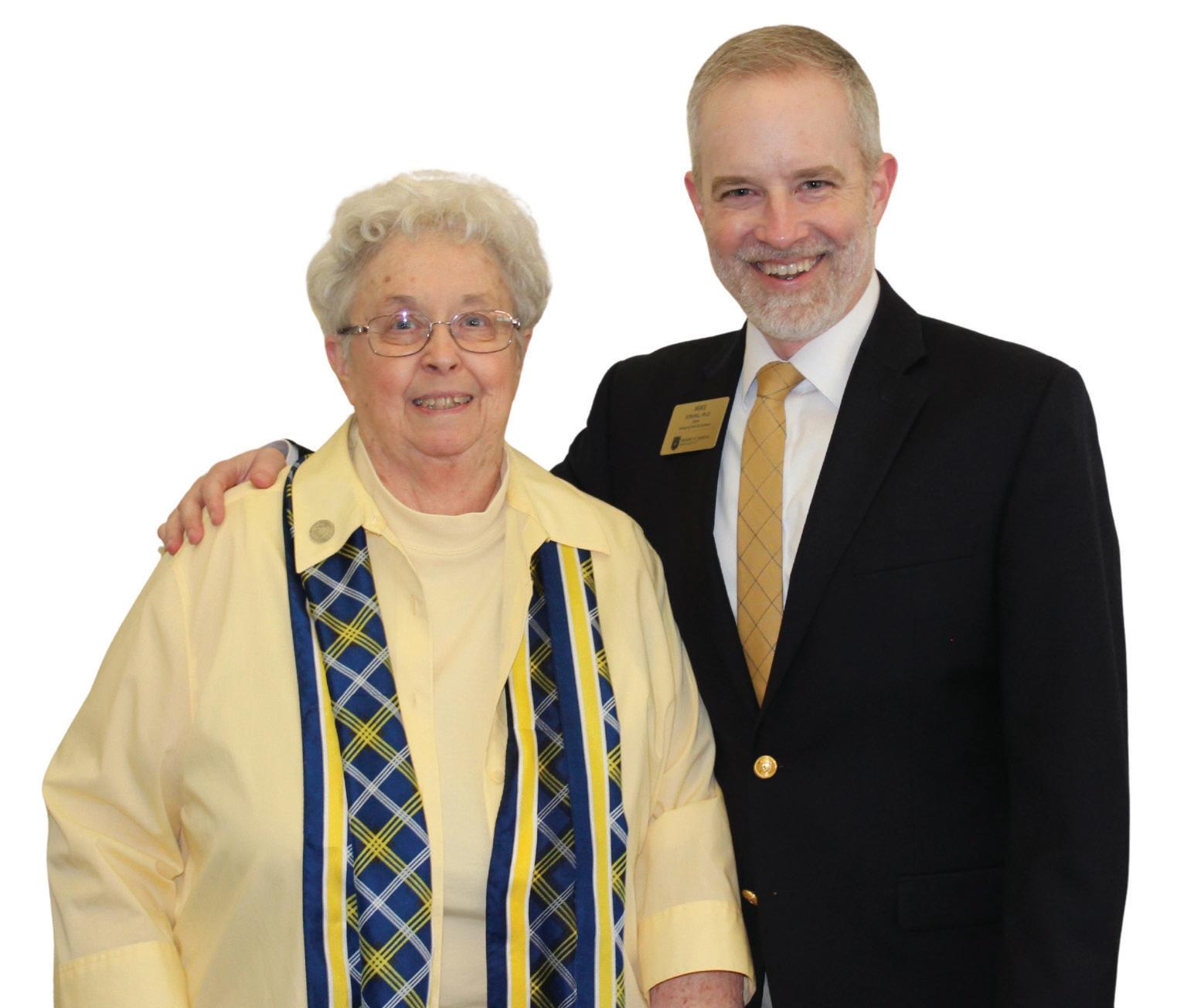
Sister Mary Bookser (left) taught at Mount St. Joseph University for 20 years, consistently offering her faithful support and encouragement to both her students and fellow faculty members.
Stewarding the Future with Faith
By Sebastian Isaacs, Communications Intern
For the past 33 years, Chief Financial Officer Vicki Humphrey has helped the Sisters of Charity of Cincinnati build a strong foundation for the future. As vowed religious communities across the U.S. increasingly invite trusted lay people to share their gifts in executive and leadership roles, the Sisters of Charity of Cincinnati have relied on Vicki’s steady guidance in navigating financial decisions within the congregation.
Most recently, Vicki advised Sisters of Charity leadership as they discerned the decision not to relicense Mother Margaret Hall as a nursing facility in the state of Ohio. While the standard of care for Sisters remains unchanged, the choice to operate independently – rather than continue under government regulations and risk losing their Ohio Medicaid waiver – had long been anticipated. Having accompanied this process for years, Vicki found the transition both affirming and energizing in her role as a lay leader in the Community.
From the beginning, Vicki has understood that careful stewardship of resources must be paired with strong, trusting relationships. Across changing leadership teams, she has worked to ensure that decisions are made through a spirit of shared faith, understanding, and respect.
S. Barbara Hagedorn, current leadership councilor and former president, believes, “Vicki is grounded in the Sisters
of Charity’s charism and mission. She integrates these as she leads and coordinates the Finance Office and its services. She never loses sight of the ‘why’ of her work.”
Vicki began her journey with the Sisters of Charity of Cincinnati in December 1993 as director of corporate accounting, overseeing the payroll and finances for Mother Margaret Hall and Bayley. Her decision to apply to a “Help Wanted” ad in the former Delhi Press was surmised as “divine intervention.” She wasn’t raised Catholic, and having only recently converted to Catholicism, she knew very little about the Sisters of Charity when she accepted the position.
In those early years, the Finance Office was primarily staffed by Sisters. “There were two, maybe three lay people,” Vicki recalls, noting that many Sisters served in executive and administrative roles across the Motherhouse. She worked closely with as many as 20 Sisters in areas including finance, health insurance, and investments. Among them, Sisters Rita Margaret Kroger, Rita Schmutte, Francis Clare Pavioni and Marion Agnes Boeddeker became important mentors, shaping both her faith and her approach to ethical financial leadership.
As the Sisters ministering in leadership and administrative roles began to retire, Vicki says, “I was one of the people that was slowly introduced to congregational finances. It’s been an honor to walk
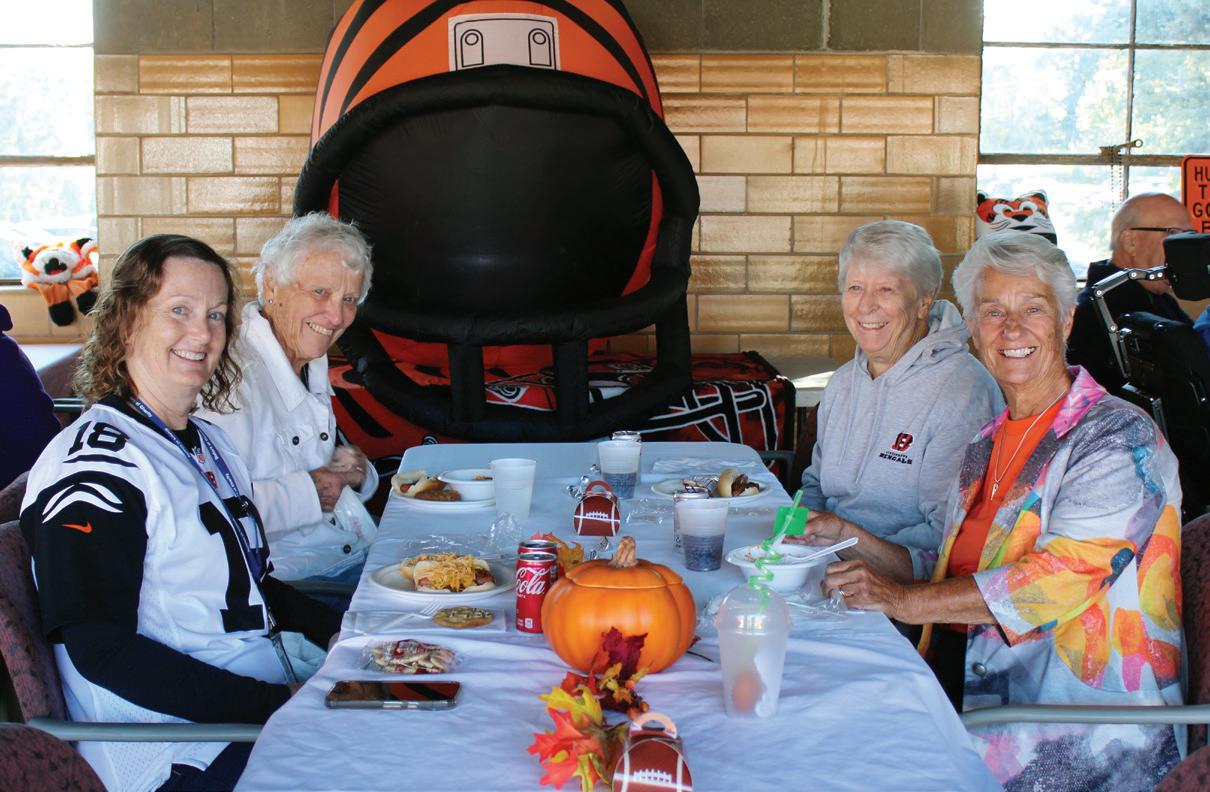
Throughout the years, Chief Financial Officer Vicki Humphrey (front, left) has built meaningful relationships with many Sisters of Charity.
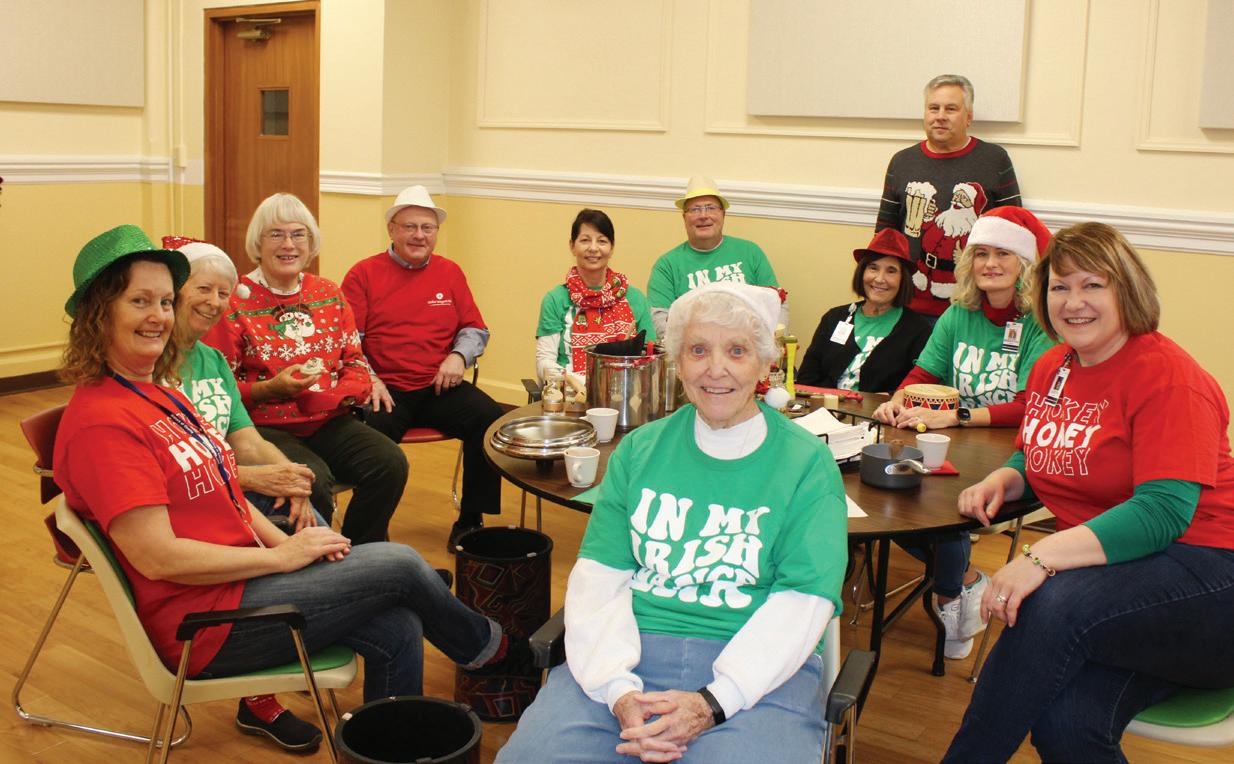
Members of the Finance Office staff enjoy participating together in the many activities and team-building opportunities around the Motherhouse.
beside the Sisters and help in any way I can.” With the reality of Sisters aging becoming an increasing factor in decisionmaking, the choice to utilize the gifts of lay leaders like Vicki remains essential in discerning the path forward.
For Vicki, earning this type of trust with the congregation is deeply meaningful. She attributes the Community’s thoughtful decision-making to the wisdom of the Sisters who came before and to a guiding sense of God’s presence.
“I’ve had some outstanding leaders to work with and guide, and they’re always open to hearing what I have to say,” Vicki reflects on the mutual respect present. “They may not always make decisions in alignment with what I think should happen, but I feel like God does play a hand in all of it. Even if I don’t see how [a plan] is going to work out, it does.”
As the Community examines each prospect and risk that the future may bring, Vicki believes that people must be placed at the forefront of decision-making. While facing uncertainty, she places strong faith in God and the Sisters she serves to assure that every transition benefits the Community and laity.
Vicki explains, “We want to take care of our people, but we also need to steward the congregation’s resources. It’s a fine line.” One that has required meticulous shaping.
One emerging vision reflects that balance. Currently, Sisters live independently in the Motherhouse or receive assisted living and nursing care at Mother Margaret Hall. As the congregation’s numbers decline, leadership has discerned a plan to bring all Sisters into the
Motherhouse. While such a transition brings understandable hesitation, Vicki sees promise in the unity it offers. “For all the Sisters and employees to be together, fostering a sense of community, focused on serving our aging Sisters, it’s going to be phenomenal,” she says.
For the past 33 years, Vicki considers the Sisters to be “truly no different” from family. She approaches her work with the same care and commitment, honoring both the mission and the people she serves.
S. Barb affirms, “Her talents and perspectives are greatly appreciated, and her dedication to the mission of the Sisters of Charity is unwavering. There is no doubt Vicki is united in mission with us.”
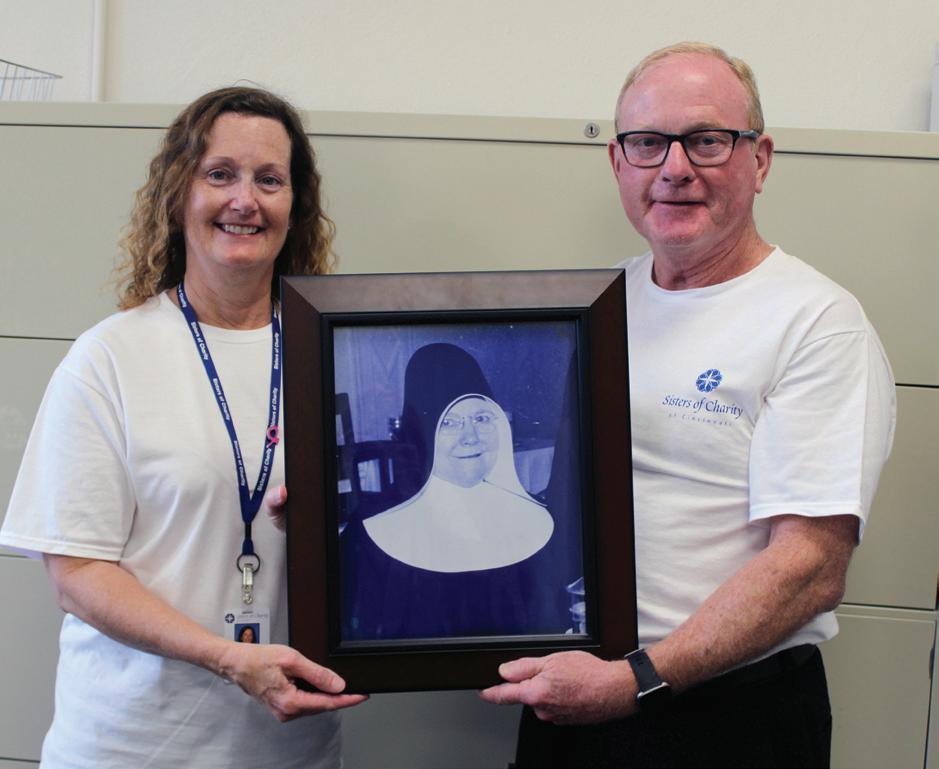
CFO Emeritus Tim Moller and current CFO Vicki Humphrey have each embraced their roles with a commitment to stewarding the long-term financial well-being of the Sisters of Charity, continuing a legacy of financial leadership exemplified by the late S. Elise Halloran, treasurer from 1944 to 1965.
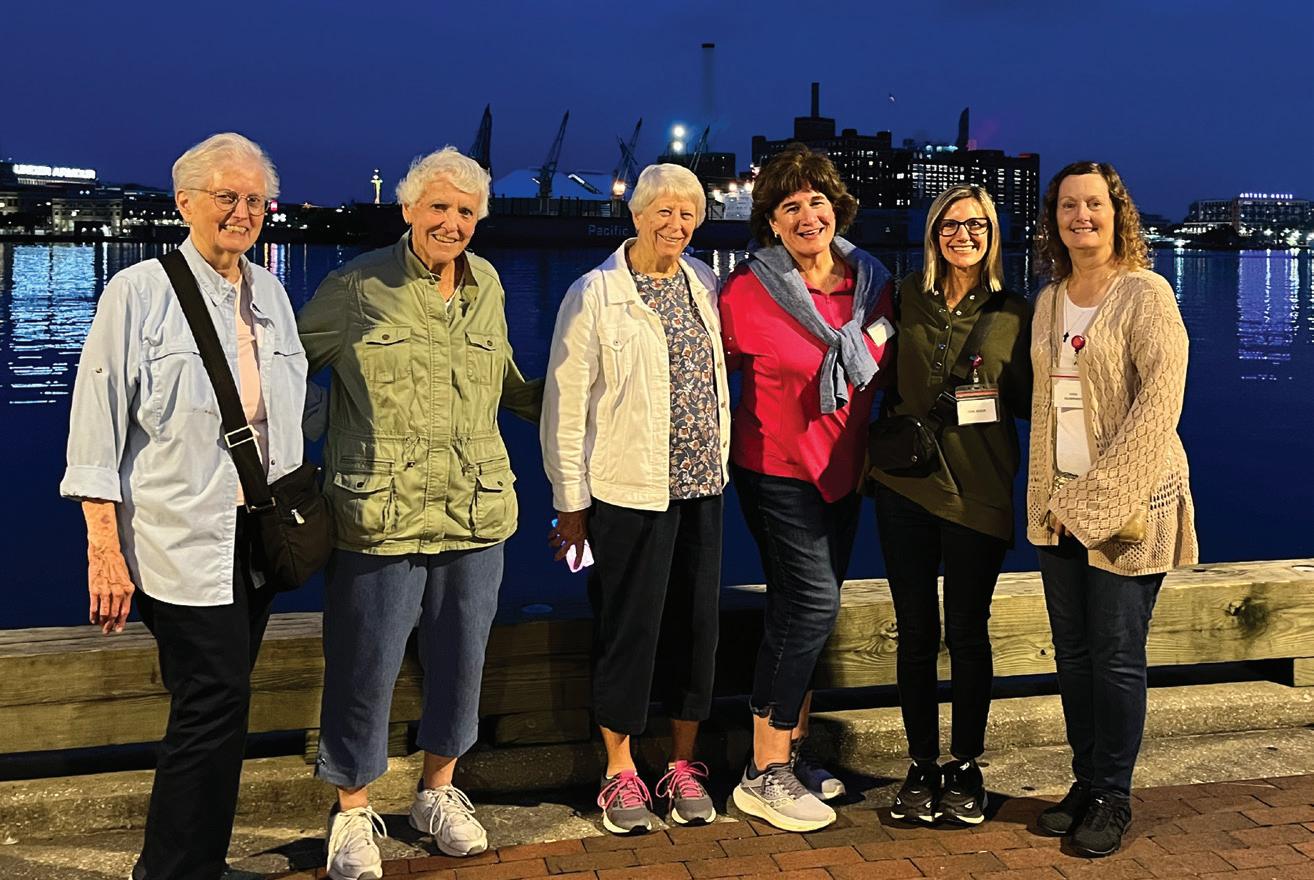
In 2024, Vicki Humphrey (right) joined a small group of Sisters and lay employees on a pilgrimage to Emmitsburg and Baltimore, Maryland, to learn more about the life of St. Elizabeth Ann Seton.
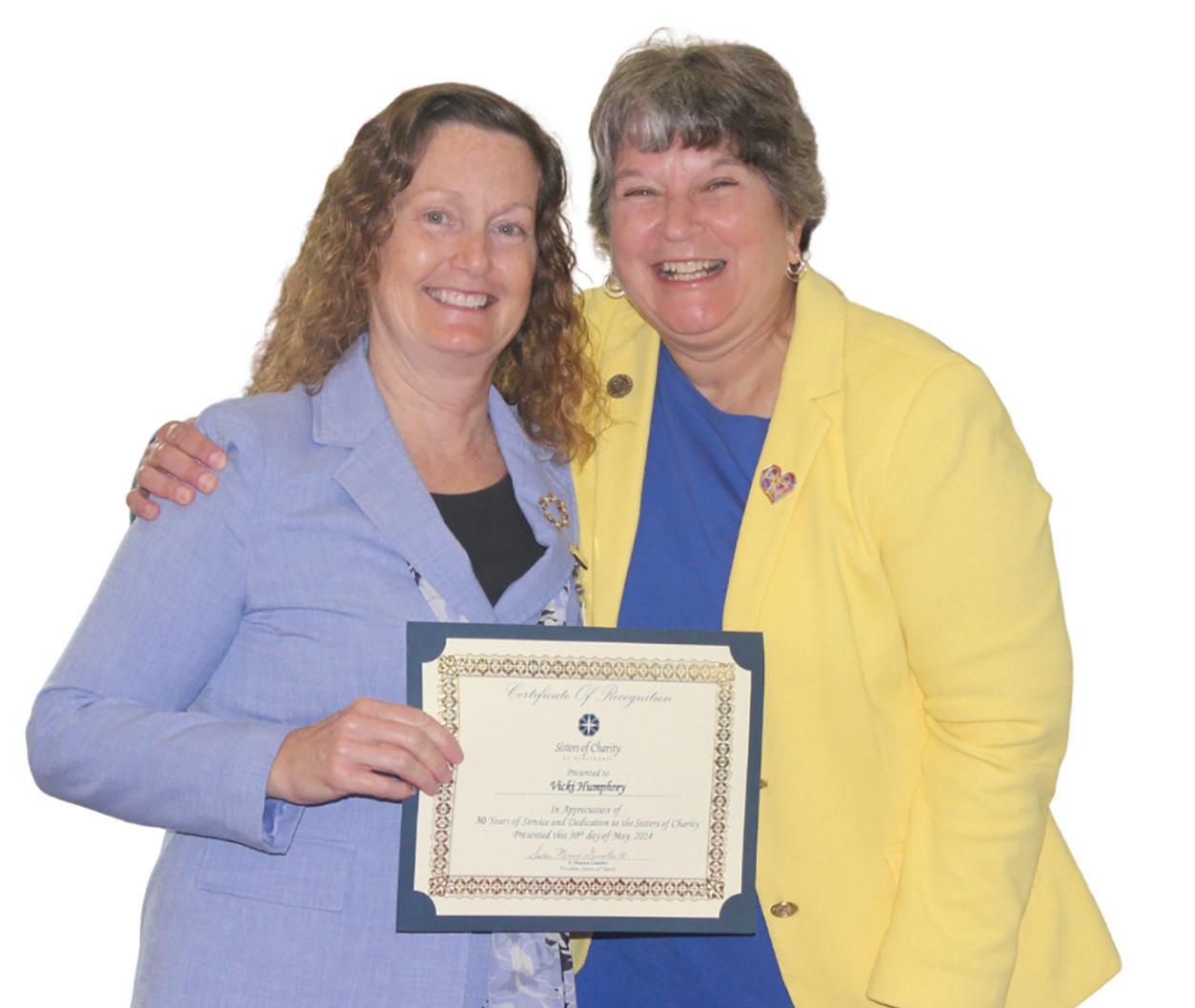
In 2024, Vicki Humphrey (left) was recognized for 30 years of dedicated service to the Sisters of Charity by Community President S. Monica Gundler (right).
S. Nancy Hoffman: 70 Years of Faithful Service
By S. Joan Elizabeth Cook
S.Nancy Hoffman describes herself as a “Price Hill kid,” whose early years were centered on neighborhood, parish and school life in Cincinnati, Ohio. Raised by her Irish Catholic parents, Albert and Lillian, longtime members of Holy Family Parish, Nancy grew up alongside her brother, Al, and her half-sister, Patricia. The children attended Holy Family Elementary School, and Nancy later graduated from Seton High School.
During her years at Seton, she formed close friendships with several classmates who would become lifelong companions. After graduation, several of them entered the Sisters of Charity together, making their First Vows two years later. Among them was S. Barbara Counts; she and S. Nancy remained dear friends throughout their lives, until S. Barbara’s death in 2025.
Following First Vows, S. Nancy spent two years in the Juniorate while studying mathematics at the College of Mount St. Joseph-on-the-Ohio. At the time, few could have anticipated the many ways she would later be called upon to facilitate her congregation’s growth, renewal, and evolution –service deeply shaped by the spirit and vision of Vatican Council II.
S. Nancy began her education ministry teaching intermediate, junior and senior high school students at St. Leo in Detroit, Michigan; Pauline Memorial in Colorado Springs, Colorado; St. Vincent Academy in Santa Fe, New Mexico; St. Michael in Findlay, Ohio; and St. Louis in Mount Clemens, Michigan. She later served as parish religious education coordinator at St. Louis for three years.

Vatican Council II ended in 1965 amid significant social, political and religious change. In the document Perfectae Caritatis, council delegates called upon members of religious congregations to examine their spirit, life and ministries in light of the Gospel and the signs of the times. For the Sisters of Charity, this call led to a formal process of renewal named Process 74, inviting all members to discern how best to be faithful to the Gospels and to their founder, St. Elizabeth Ann Seton, while adapting to the realities of the 1970s and beyond.
S. Nancy was asked to coordinate the congregational process. She and committee members planned small group sessions where Sisters could reflect together on the impact of Vatican II and the changing role of women in the world and the Church. She also guided the process through a series of reflection papers, setting a thoughtful and prayerful tone for communal discernment. She wrote in A Challenge to Continue Creation, “Creation is a choice… a freedom. A freedom to dialogue… It is so because creation is not forced. It is not an effort at self-identity, but an expression of love, of gift.”
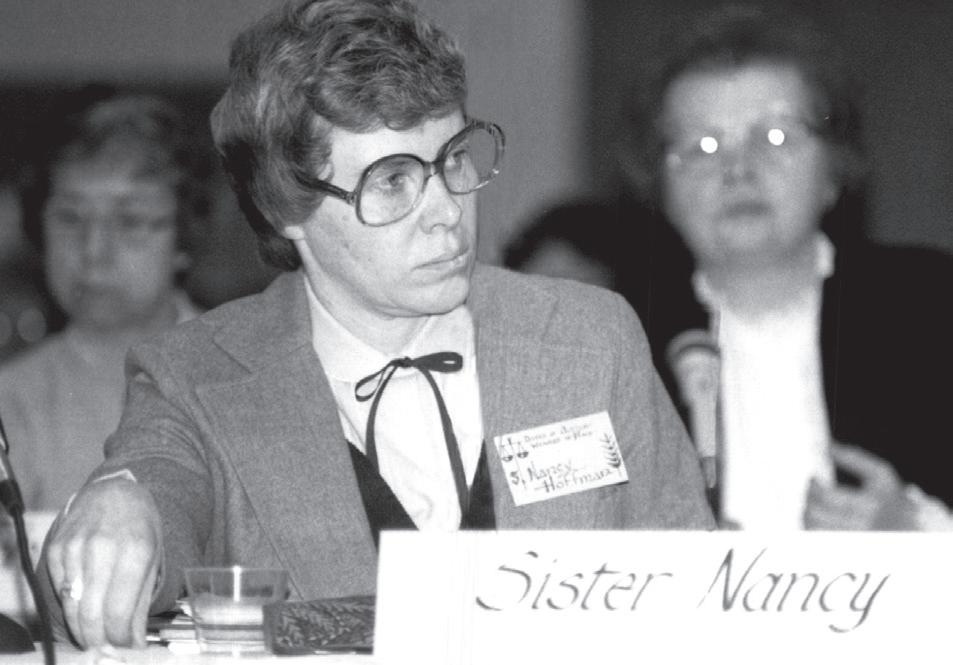
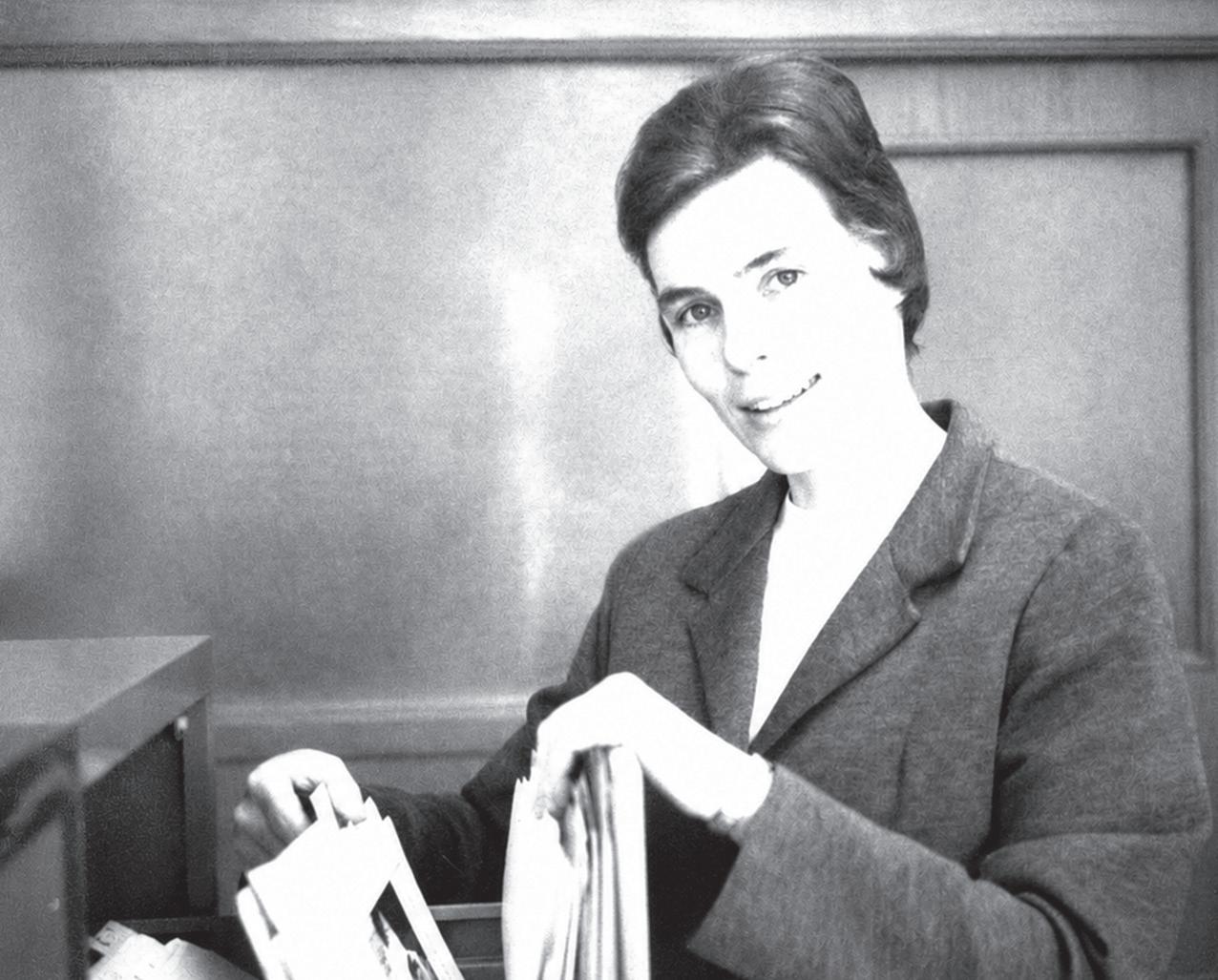
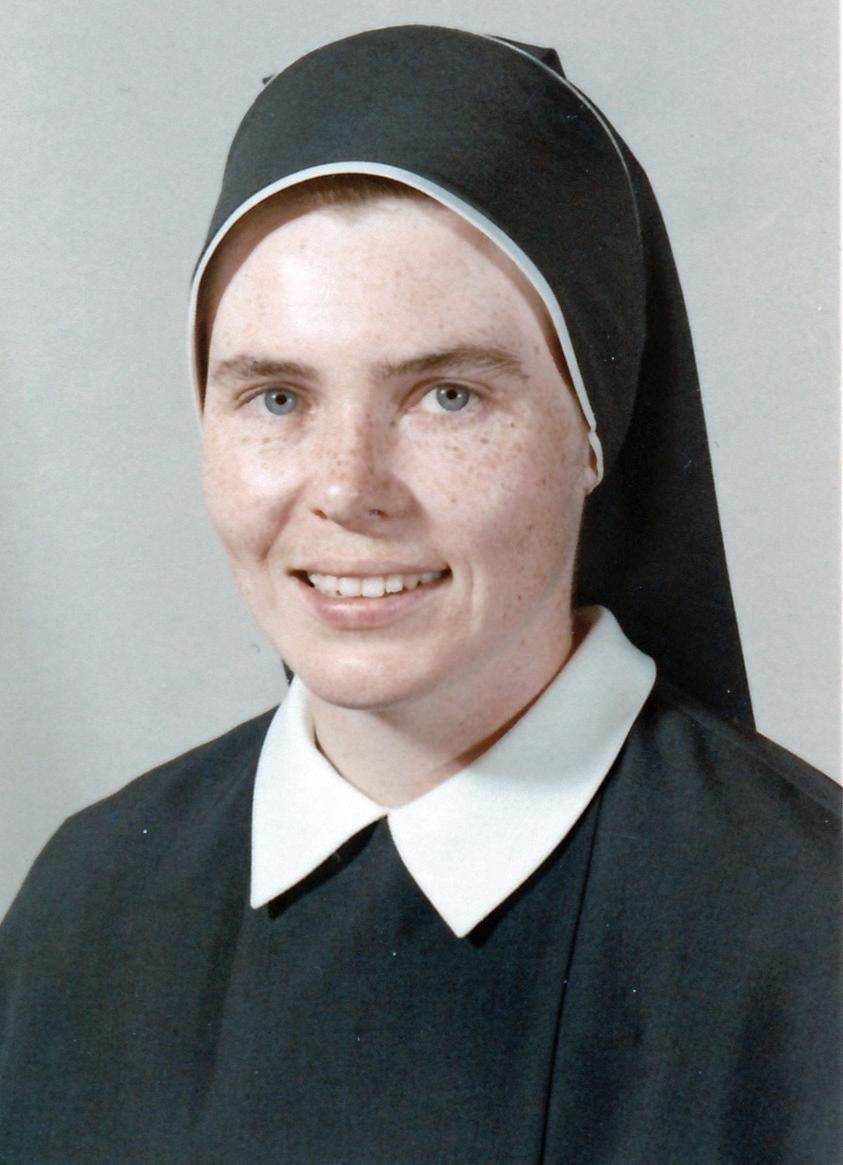
S. Nancy Hoffman entered the Sisters of Charity of Cincinnati in 1956.
S. Nancy Hoffman helped guide a transformative shift from Roberts’ Rules of Order to a consensus-building model of discernment for future Chapters of Affairs.
In the 1970s, S. Nancy Hoffman served as provincial of the Community’s Cincinnati Province.

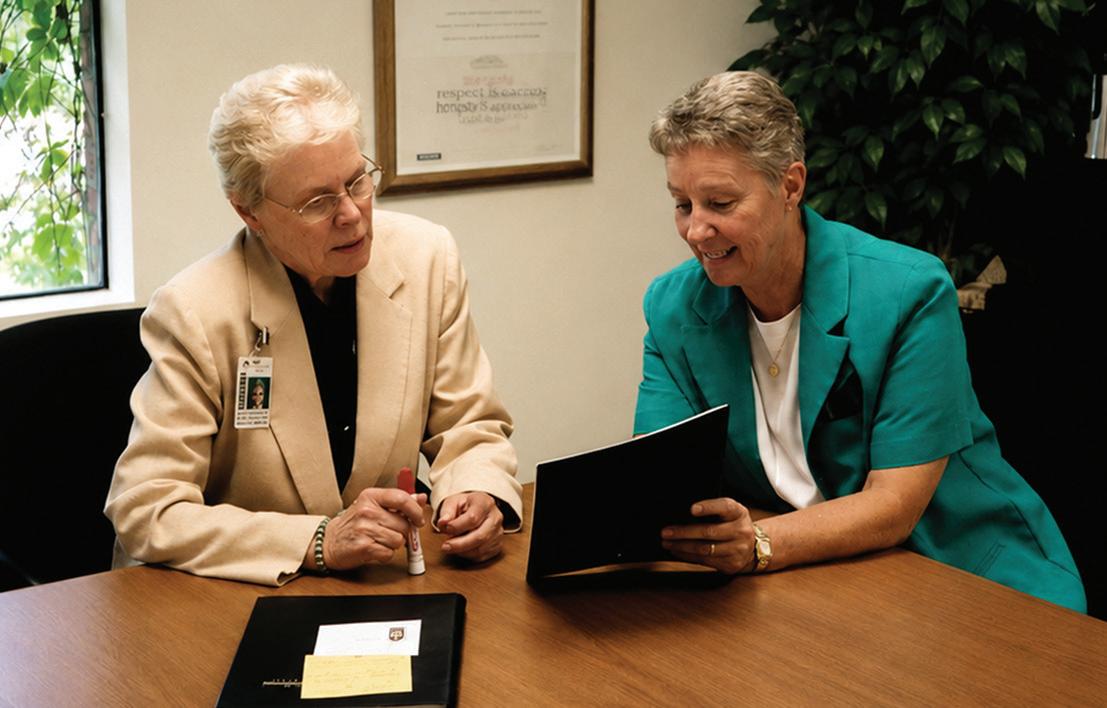
The culminating Chapter marked a significant turning point. For the first time, instead of following Roberts’ Rules of Order, Sisters learned a process of consensus-building that set the collegial tone that continues to shape their discussions and decision-making today.
Following this important work, S. Nancy served as the provincial of the Cincinnati Province for three years. She then joined an innovative initiative co-founded by Sisters Elizabeth Cashman, SC, and Mary Ann Barnhorn, SNDdeN: the Active Spirituality for a Global Community (ASGC) program. Initiated for Sisters from different congregations who had been serving in traditional ministries and were eager to update their understanding of themselves, religious life, and the evolving needs of the world, ASGC offered a transformative nine-month experience. They asked S. Nancy to serve as a process consultant for one year, after which she became the program director, a position she held until the program ended in 1988. ASGC provided an opportunity to continue the personal and professional growth and renewal encouraged by Vatican II, engaging approximately 450 Sisters in this shared journey of growth.
After these groundbreaking and creative opportunities, S. Nancy took time for personal renewal, studying life-cycle learning and conflict management. She then moved to Denver where she served as a chaplain in the Pastoral Care Department at Presbyterian/St. Luke’s Medical Center. She later ministered at St. Anthony Hospital, eventually becoming the director of Spiritual Care.
The 1990s saw rapid expansion and innovation in many aspects of health care delivery, medical care, government involvement, and financial matters. It was becoming clear that health care facilities would be more effective if they pooled resources and created larger systems. As religious congregations faced a decline in available personnel for hospital leadership, the Sisters of Charity entered into a partnership with the Seventh Day Adventist Church to establish Centura Health, serving hospitals in Colorado and New Mexico. S. Nancy served as senior vice president
of mission and ministry at Centura Health for 12 years, headquartered in Denver. She noted, “Mission and values are not about me. I like to turn the spotlight on our employees, because they are the living, breathing, daily expression of our mission and core values.” When she retired, Centura established a scholarship in her honor, for minority students in health administration.
The Sisters of Charity also collaborated with other congregations to found Catholic Health Initiatives, which later merged with Dignity Health to form CommonSpirit Health in 2019, further extending their mission in Catholic health care.
After her years in institutional ministry, S. Nancy was eager to transition to a focus on individual people. In 2007, she partnered with a lay colleague to create One Simple Voice Retreat Ministry. S. Nancy explains lay people were eager to live their own personal spirituality and “to teach people how to hear God’s voice.” Large numbers of people were immediately attracted to the program. Many potential retreatants were interested in spirituality, not necessarily organized religion – a trend that continues to grow today. S. Nancy described her contribution this way: “If you want to talk about God, I’ll be happy to talk with you.”
In the past decade, S. Nancy served on the board of EarthLinks, a service in Denver that provides a place for unhoused people to stay while they identify job possibilities for themselves. She continues to serve in an advisory capacity.
Since returning to the Motherhouse this past year, S. Nancy has enjoyed renewing longtime friendships with the people she knew in Cincinnati before going West in the 1970s. She remains grateful for the opportunity to form new friendships with Sisters and Associates she had not known before. This summer, she looks forward to celebrating her 70th Jubilee as a Sister of Charity with the members of her Band of 1956 – a milestone marking a lifetime of faithful service, leadership, and accompaniment.
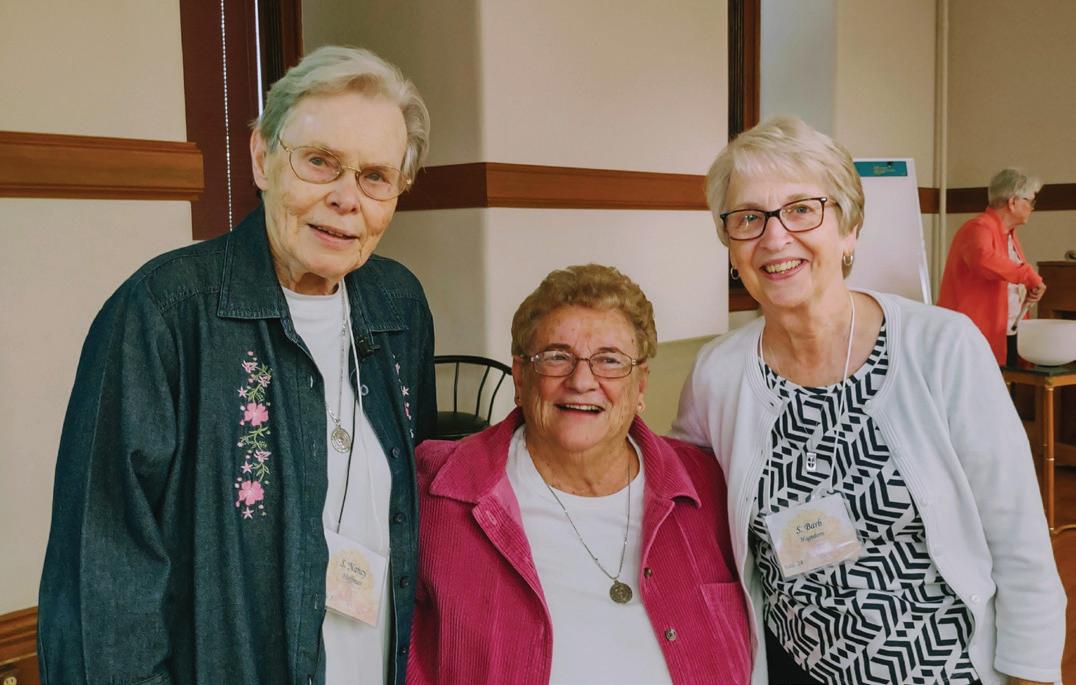
For 12 years, S. Nancy Hoffman (left) served as senior vice president of mission and ministry at Centura Health in Denver, Colorado.
For S. Nancy Hoffman (left), returning to the Motherhouse has been a wonderful opportunity to reconnect with Sisters in the Cincinnati area.
In the Spirit of Charity: Service
Day Celebrates Catholic Sisters Week
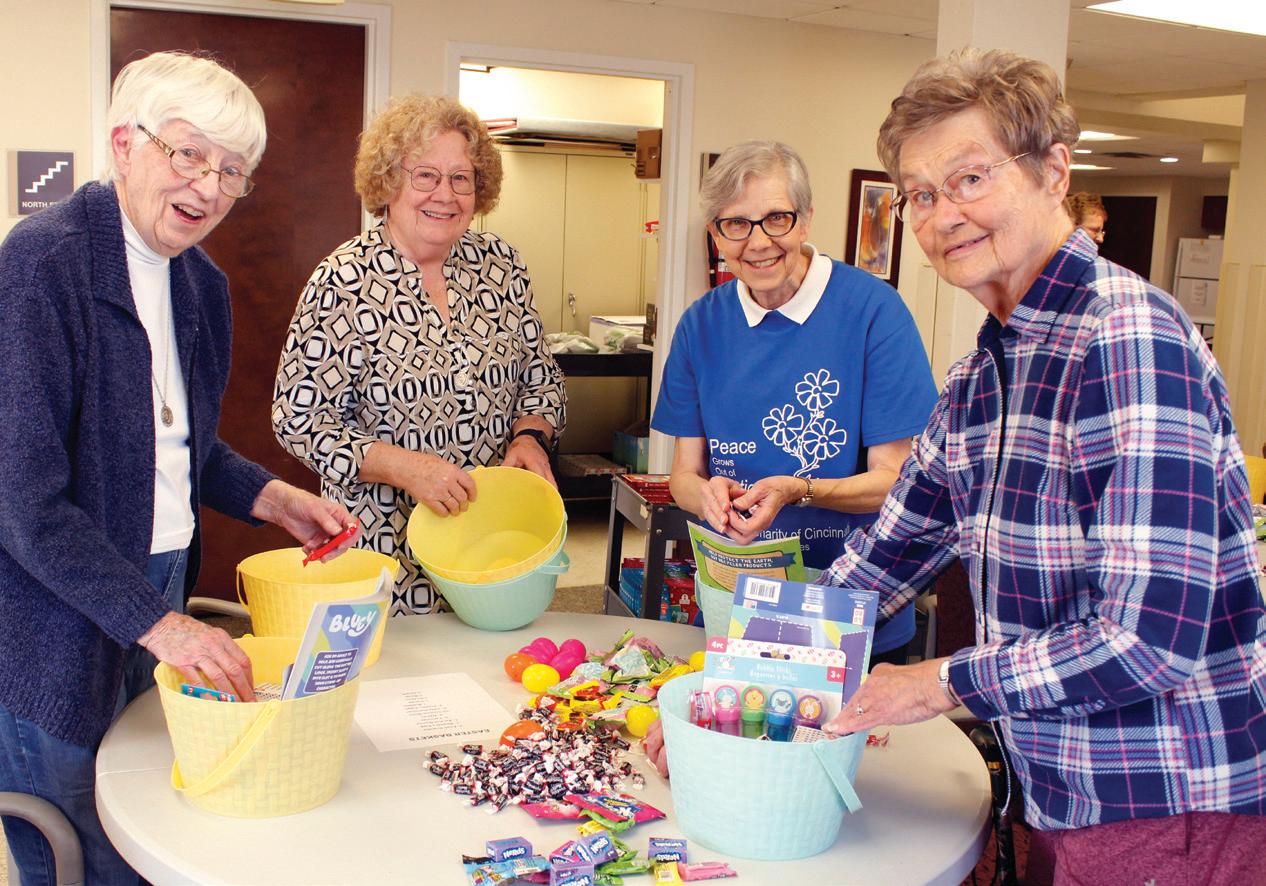
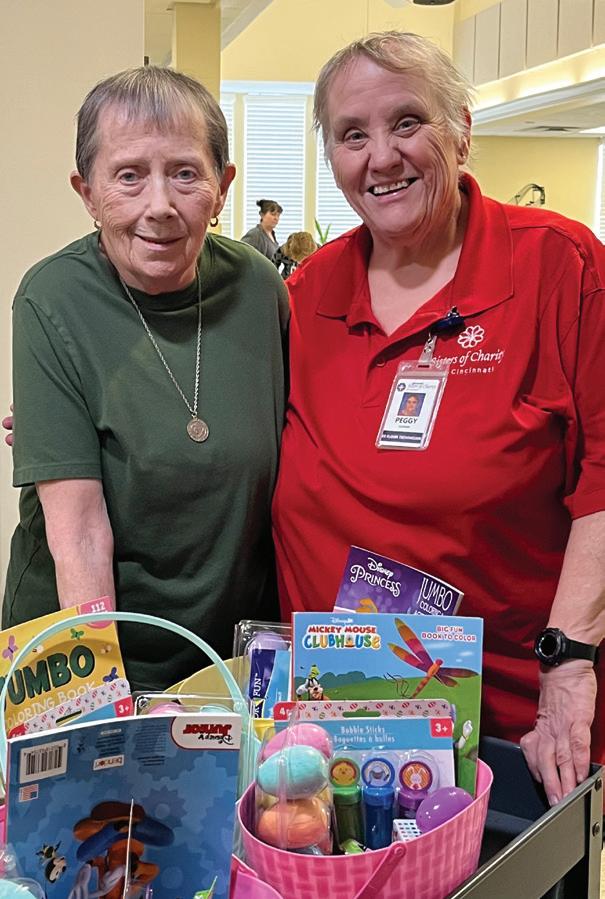
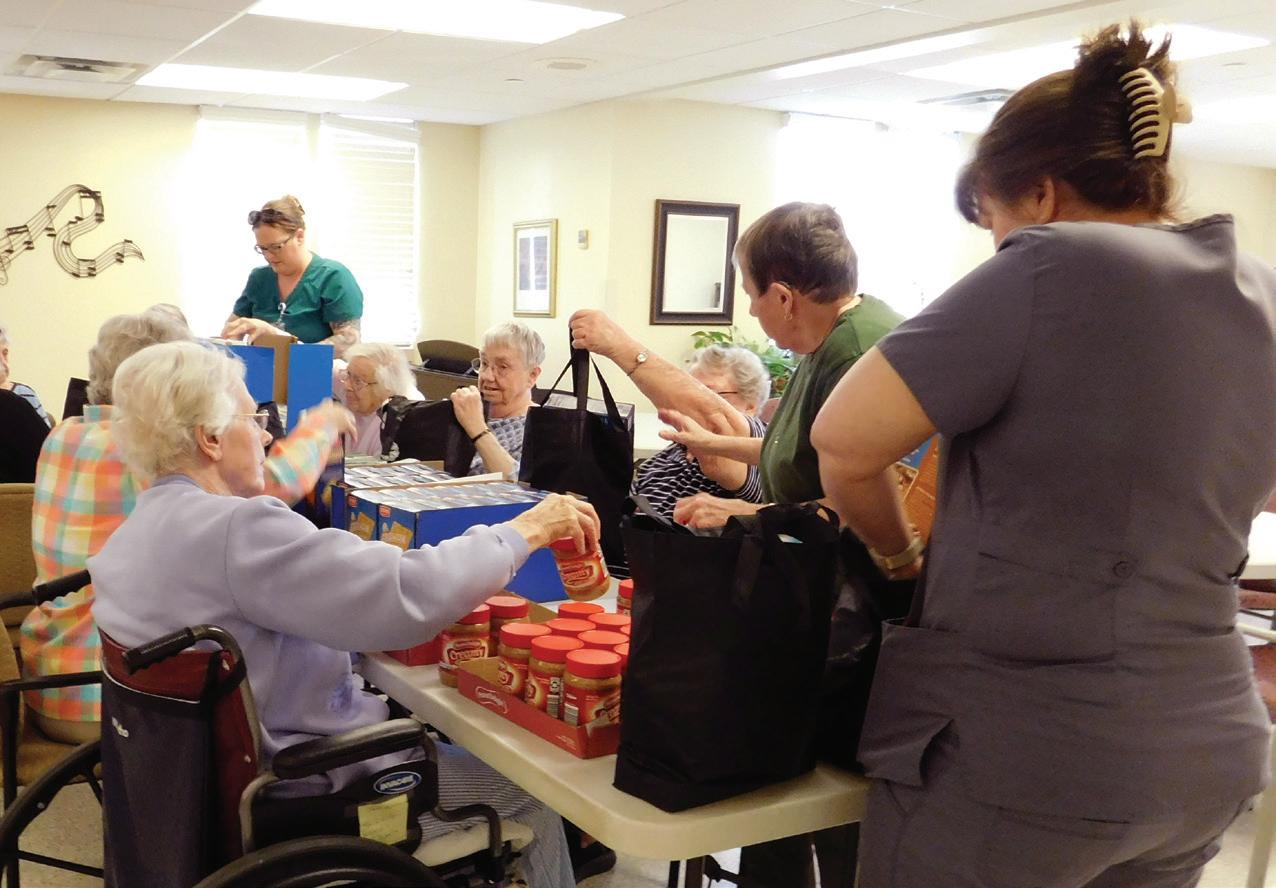
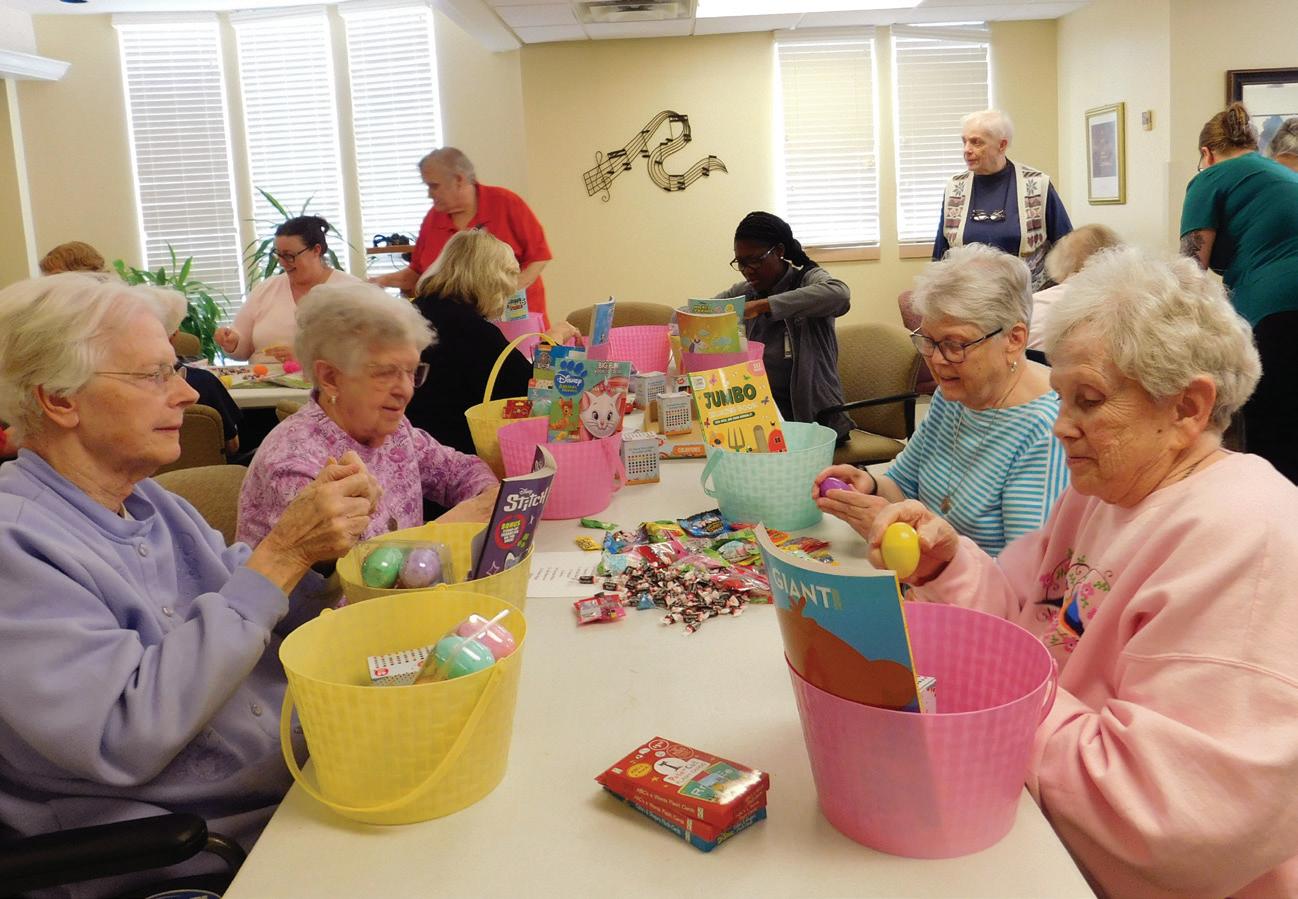
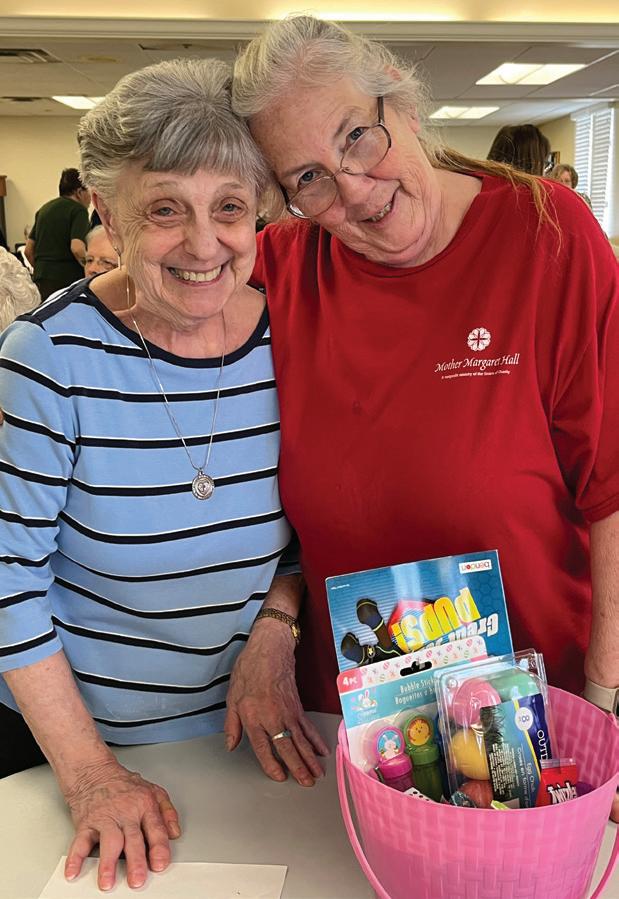
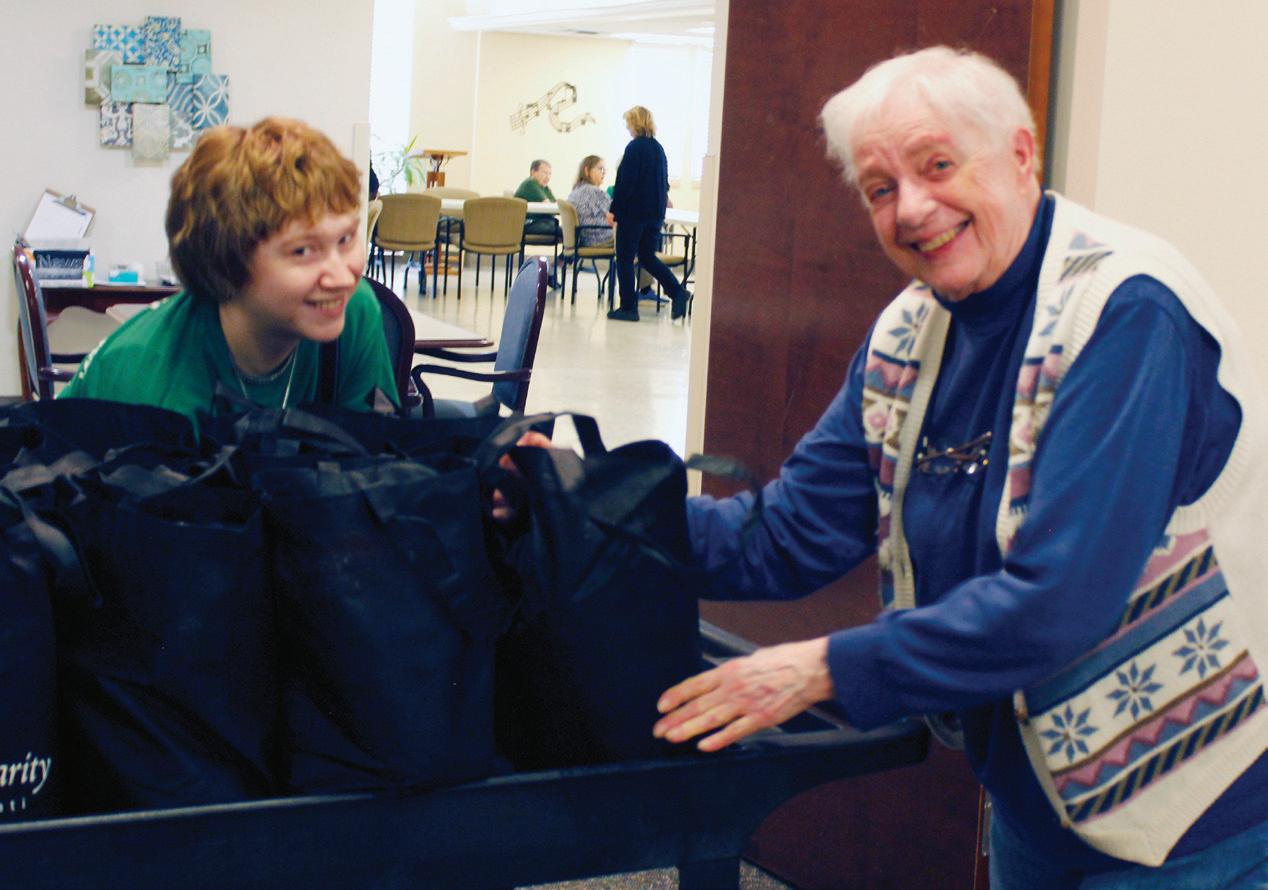
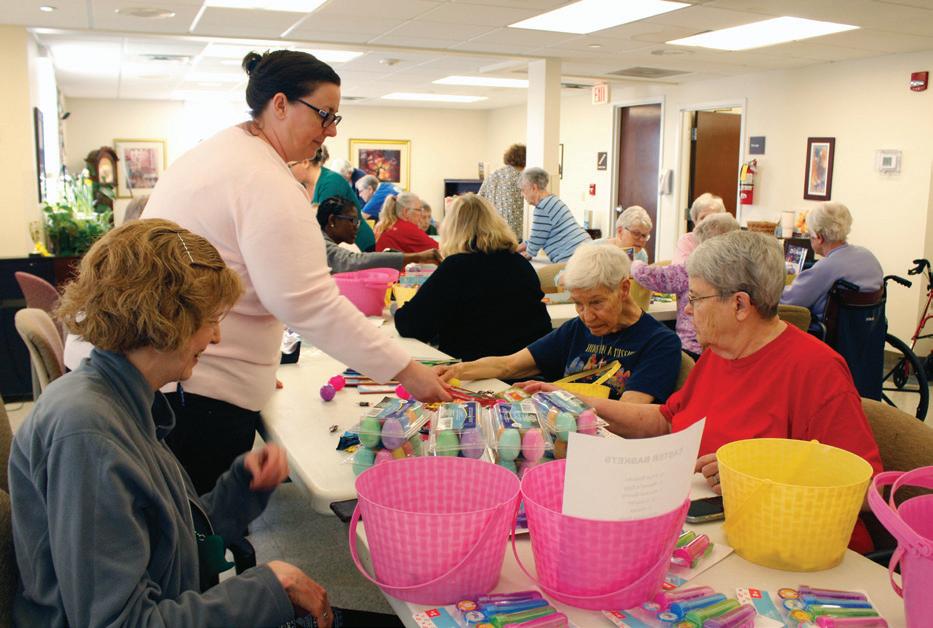
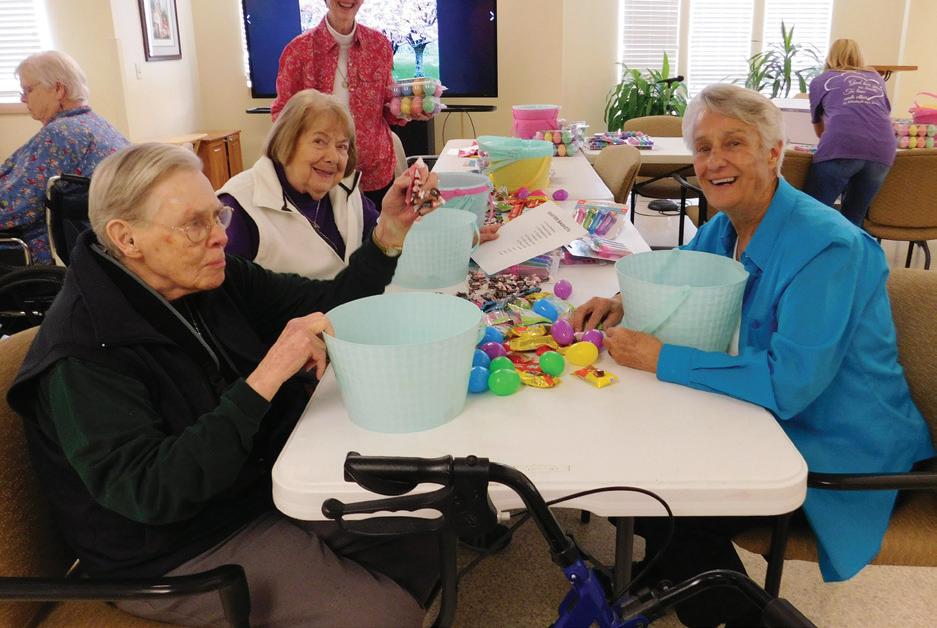
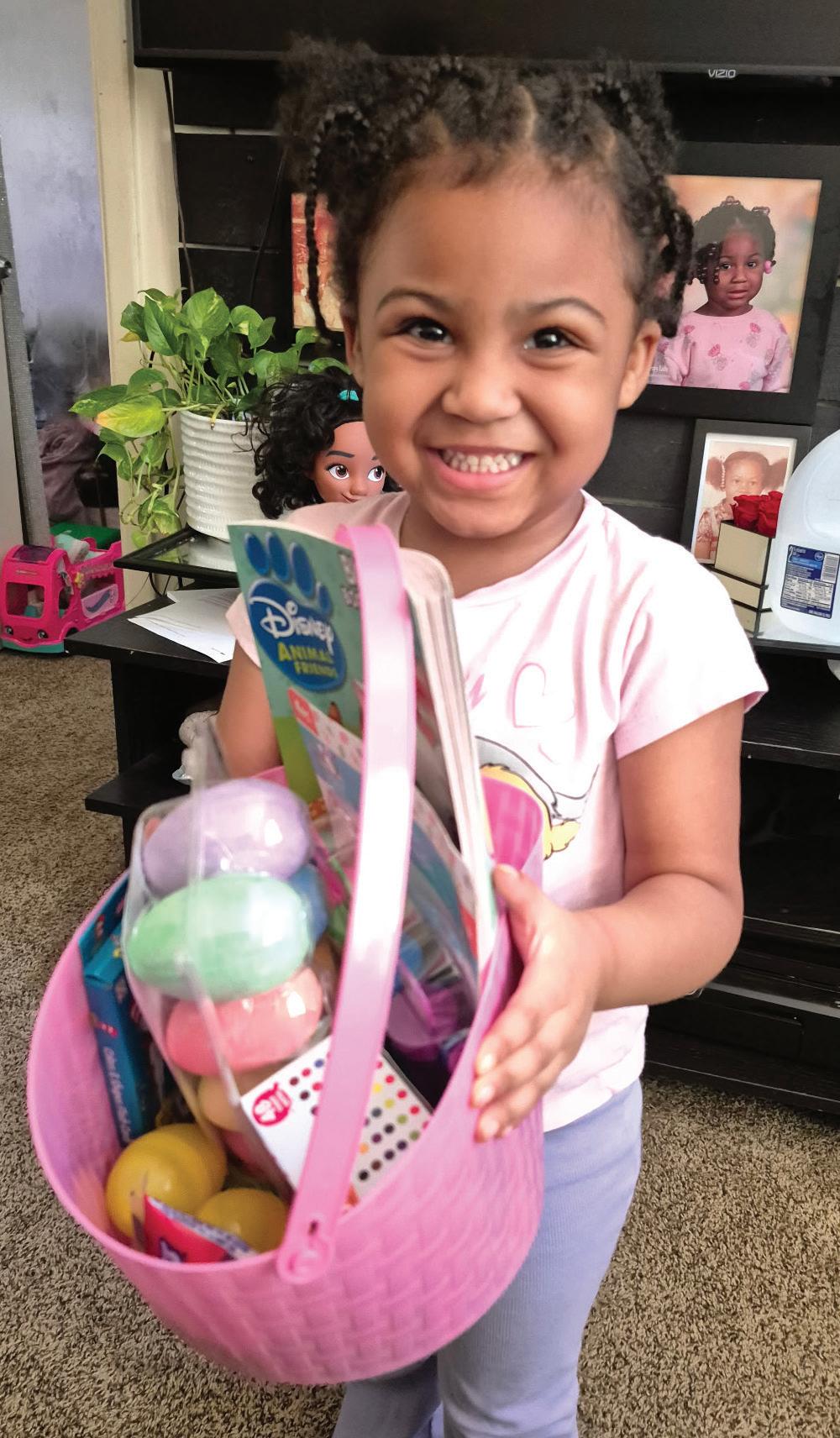
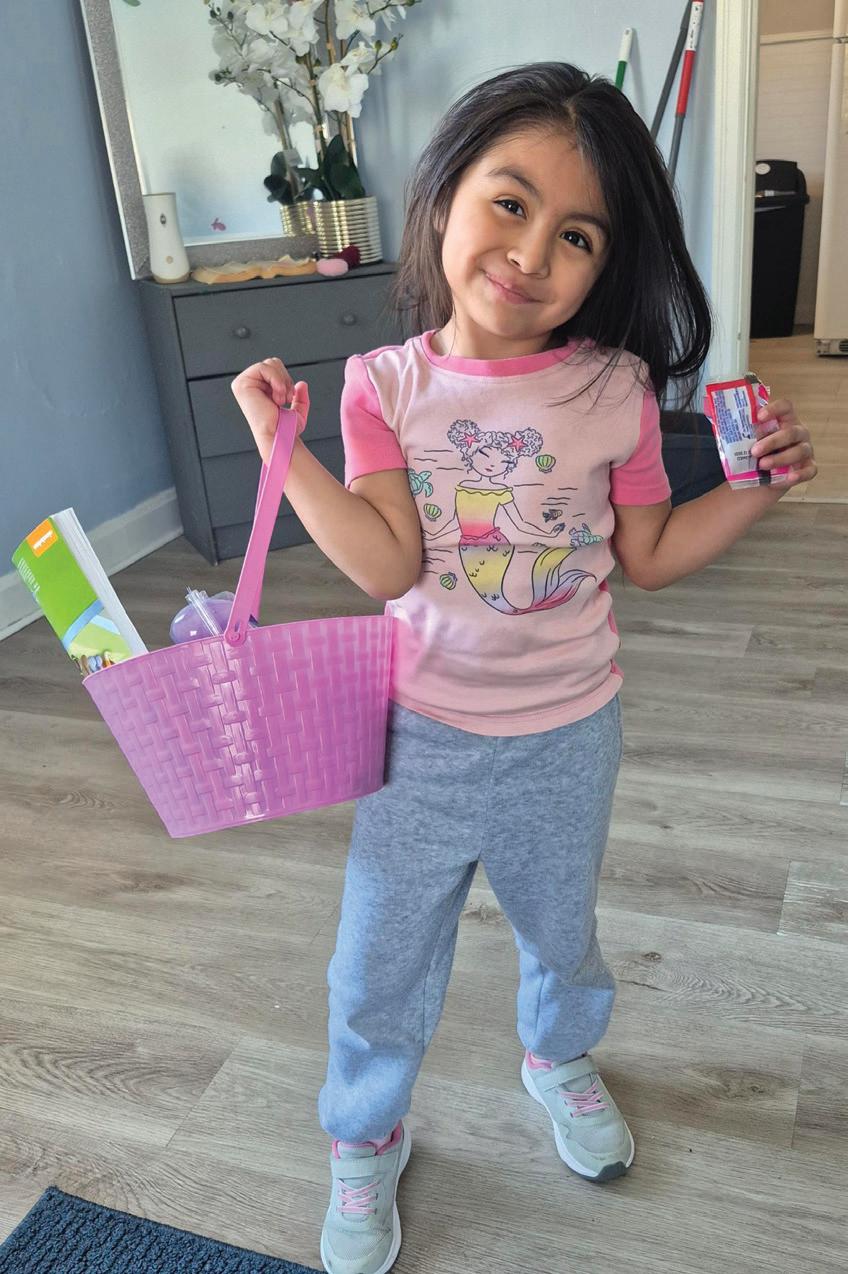
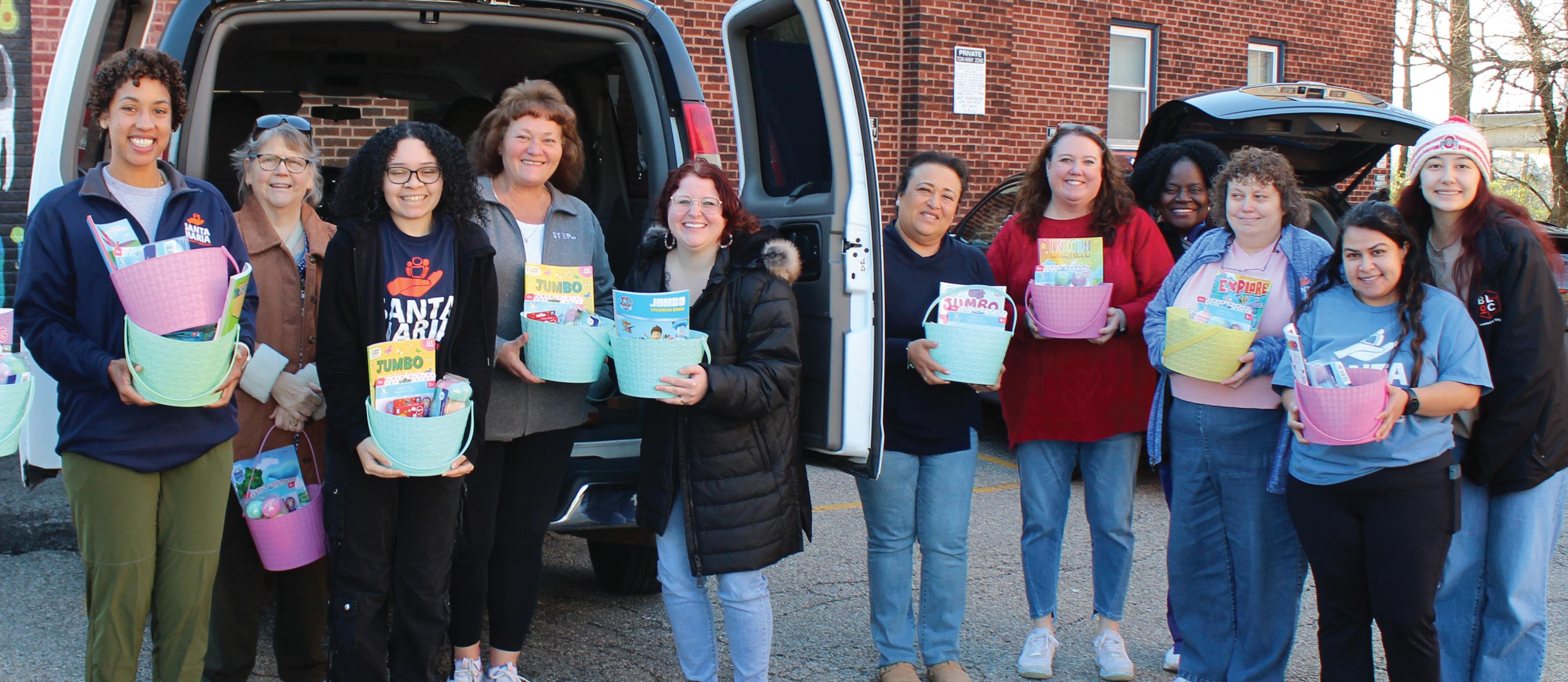
Sisters of Charity and employees gathered March 10, 2026, for a hands-on service project celebrating Catholic Sisters Week. During the two-hour event, participants assembled Easter baskets for children in Santa Maria Community Services’ Promoting Our Preschoolers (POP) program, along with meal kits for their families.
The Sisters of Charity share a long history with Santa Maria, founded in 1897 by Sisters Blandina and Justina Segale to serve Italian immigrant families. Today, the organization supports more than 3,000 individuals each year through education, family support, and neighborhood revitalization programs.
On behalf of the POP families, Elsy Morales, program supervisor, shared her gratitude:
“I extend our deepest thanks for your generous donation of Easter baskets and food. Your kindness has made a profound impact, and we are incredibly grateful for your support. The families were deeply touched by this thoughtful gesture. Many were unfamiliar with the tradition of Easter baskets, and it was heartwarming to witness the joy it brought to their children. One child, in particular, was so overjoyed that she kissed every toy as she took it from her basket.”
The Service Day offered a meaningful opportunity to step away from daily routines, serve others, and live out the heart of the Sisters of Charity mission.
Helping Families Help Themselves
By Sebastian Isaacs, Communications intern
For more than one century, Santa Maria Community Services has helped families in Greater Price Hill build stronger futures – one relationship, one home visit, and one child at a time.
Founded in 1897 by Sisters of Charity Blandina and Justina Segale, the organization continues to adapt to the evolving needs of the Cincinnati community, “providing services that honor the dignity of our people,” according to President and CEO H.A. Musser Jr.
What began as a settlement house serving Cincinnati’s poor Italian immigrant population has grown into a multifaceted organization addressing changing social, educational, and health needs. As new communities have made their home in Greater Price Hill, Santa Maria has remained a vital resource for individuals and families with limited resources.
Since becoming president and CEO in 1989, Musser has emphasized this enduring adaptability. “While there’s always change, we’ve always been able to adapt,” he said.
Sisters of Charity Associate Maureen Maxfield met Musser through the Sisters of Charity of Cincinnati Health Care System (now SC Ministry Foundation) while supporting an event for Santa Maria’s Day Care Center children. She joined the Board of Directors in 2017 and has long championed the philosophy of “helping families help themselves.”
This family-centered approach continues a legacy rooted in Santa Maria’s earliest days, when Mother Mary Blanche Davis
Promoting Our Preschoolers serves children ages 3 to 5 and their families by preparing them for kindergarten while empowering parents as their child’s first teacher.
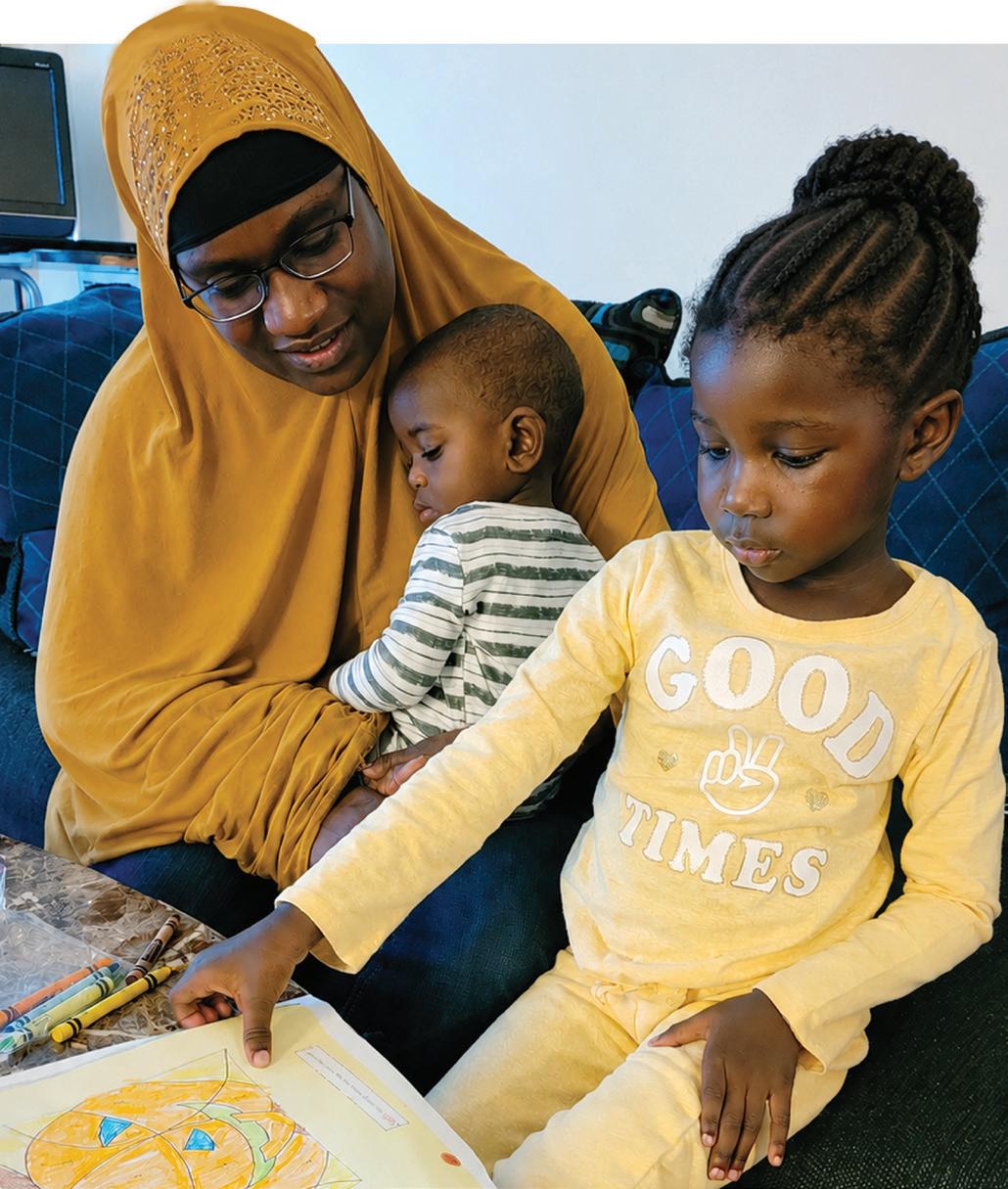
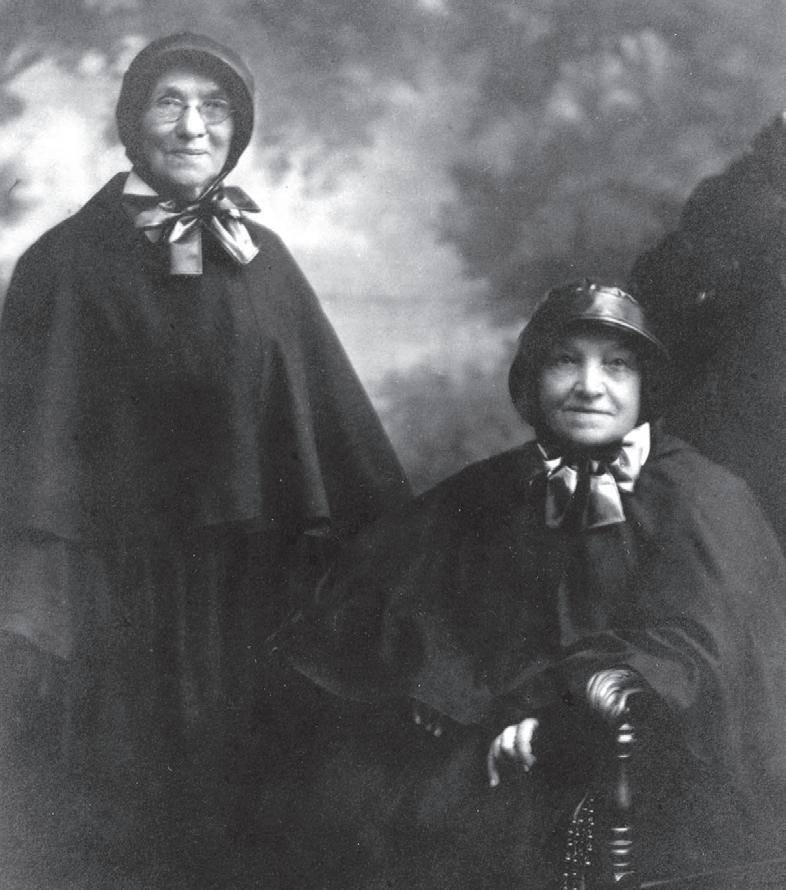
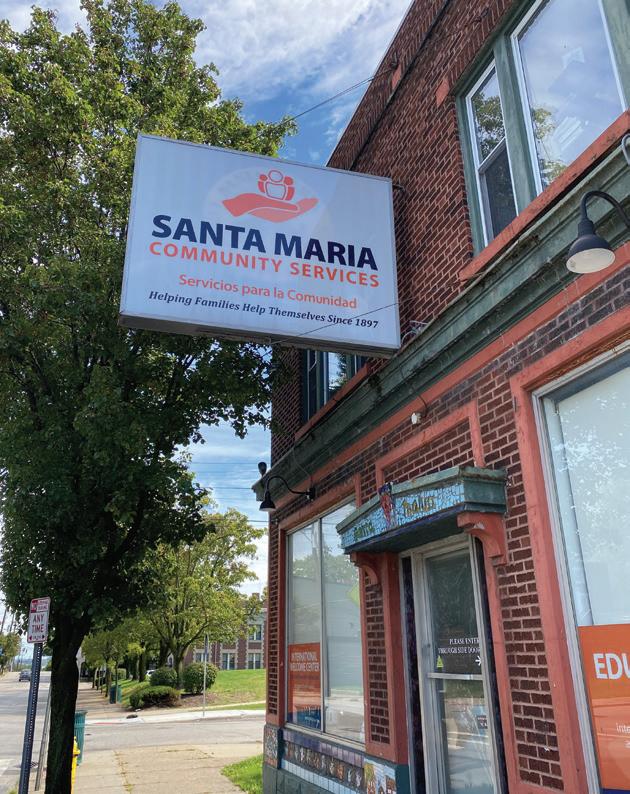
asked S. Justina if she and S. Blandina “could do anything for the poor Italian children of the city.” In response, the Sisters established a nursery, a kindergarten, and children’s clubs at Santa Maria’s first house on West 7th Street, laying the foundation for more than a century of service to children and families.
Today, one of Santa Maria’s signature programs is Promoting Our Preschoolers (POP). Founded with the support of the Sisters of Charity, POP serves children aged 3-5 and their families by preparing them for kindergarten and encouraging parents in their role as their child’s first teacher. Through trained home visitors, the program meets families where they are, offering guidance, encouragement, and practical support in the home.
Director of Early Childhood Home Visitation Jaime Mutter believes POP has a lasting impact by building parents’ confidence. “Many families, especially with their first child, aren’t sure what to do or if they’re doing things right,” she explains. “We go in and give positive reinforcement and show them things they can do.”
By assigning each family a dedicated home visitor, Santa Maria fosters meaningful, trust-based relationships. Home visitors support parents in nurturing early childhood development and literacy while helping them to set goals and connect them with additional resources, whether that means assistance for food access, employment, or other essential needs.
POP also partners with early childhood schools in Cincinnati to help families navigate the school system. Staff accompany them through enrollment, assist with paperwork, and remain a consistent presence with six- and 12-month check-ins after a child begins kindergarten to ensure continued support.
“We’re trying to change the narrative,” Mutter says of the young parents POP serves, many of whom have experienced
(From left) Sisters Blandina and Justina Segale founded Santa Maria Community Services in 1897 to serve Cincinnati’s poor Italian immigrant population.
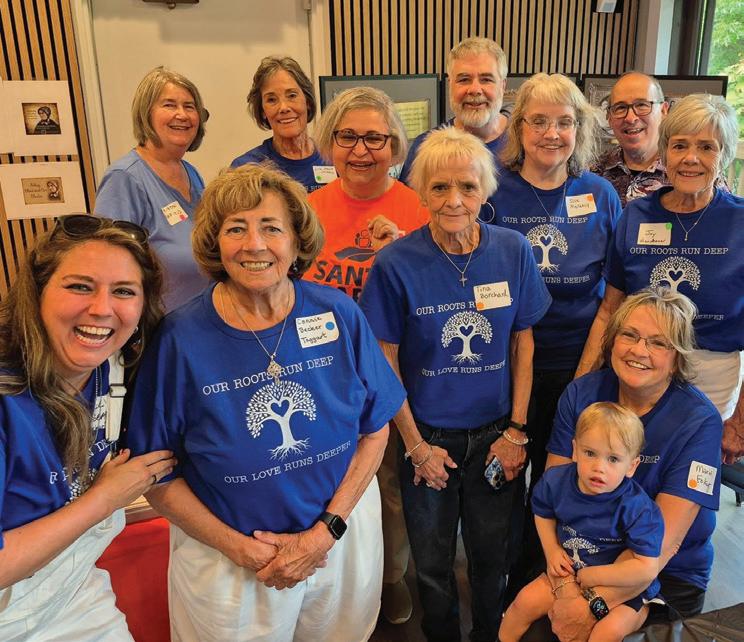
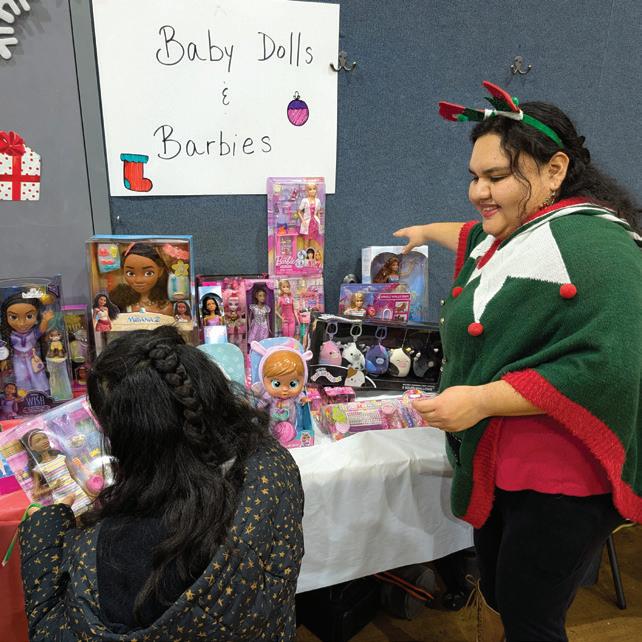
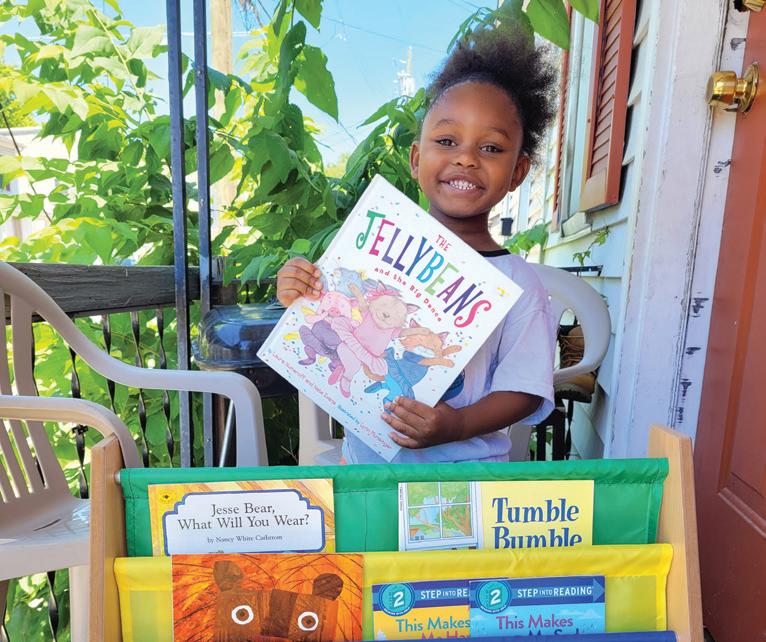
trauma and negative school experiences themselves. “We’re trying to change the way they view the school system, to see it as a partnership and a friend rather than an enemy.”
Mutter brings 18 years of experience at Santa Maria, having served as a home visitor and supervisor before becoming director of early childhood programs, including POP and Every Child Succeeds (ECS). ECS supports mothers prenatally through their child’s third birthday, focusing on healthy development and helping parents understand key milestones.
Rooted in the legacy of Sisters Blandina and Justina, the Sisters of Charity Community continues to support the organization and its early childhood programs as they evolve to meet the needs of the times.
This June, Santa Maria will begin construction on a new, consolidated campus designed to bring its multiple locations together into a one-stop service hub. The facility, projected to open in late 2027 on Considine Avenue, represents a significant step forward in making services more accessible for families in Greater Price Hill.
The new property is the former home of Mount St. Mary’s Seminary of the West, a historic building dedicated by Archbishop John B. Purcell in 1848 that was occupied until 1904. Musser has spent time learning about the seminary’s history, with the hope that Santa Maria will honor the legacy of the new site just as it has faithfully carried forward the mission of its founders – to “do what needs to be done” no matter how challenging.
As Santa Maria continues its mission in 2026, the need for a unified space has become increasingly clear. Serving families across multiple locations has created barriers, particularly for those relying on public transportation. Maxfield notes that it is often not feasible for families to travel between sites to access multiple services.
The new facility will not only improve access but also create opportunities for growth. Programs such as Promoting Our
Preschoolers and Every Child Succeeds will be able to expand their reach and deepen their impact within a centralized, familyfocused environment.
Through the “One Building, Thriving Families” initiative, Musser and the Santa Maria staff are thrilled to introduce “a place where people can come for whatever they need” in Greater Price Hill.
He says, “We believe coming together is going to benefit lots of people, because we believe serving families holistically is best.”
One key addition is a dedicated food pantry where families will be given the opportunity to shop and individually select items that best meet their needs, rather than receiving prepackaged food distribution during set times of the week.
The expanded space will also welcome new community partnerships. For example, Head Start plans to build and operate a neighboring facility, working alongside ECS and POP to support children with disabilities, promote family well-being, and foster early learning from birth through age 5.
Amid these exciting developments, Musser emphasizes his gratitude for the enduring support of the Sisters of Charity Community. Their continued involvement – through leadership on Santa Maria’s Board of Directors and active engagement in its mission – remains vital. He pointed to leaders such as S. Sandy Howe, current Santa Maria board member, whose work with Price Hill
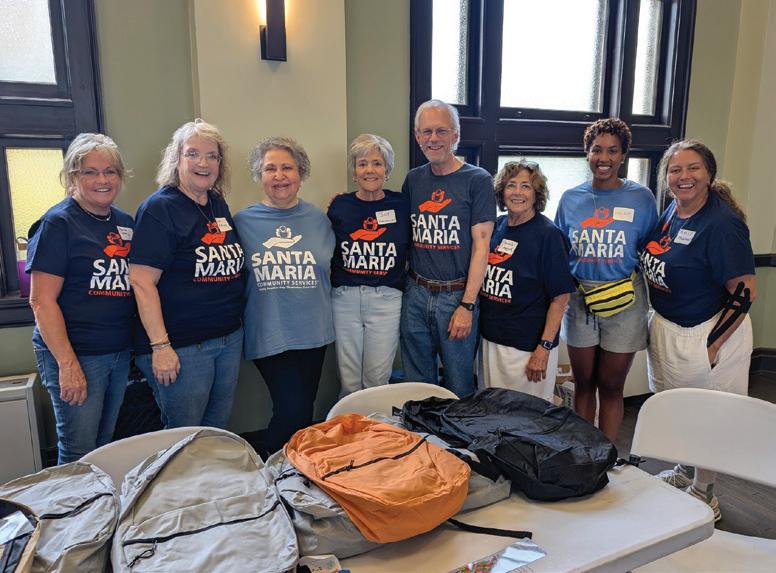
Will has strengthened community impact, as an example of this lasting commitment.
As Santa Maria Community Services looks to the future, its work remains firmly rooted in the enduring Charism of Charity first exemplified by Sisters Blandina and Justina Segale. What began as a simple response to the needs of immigrant children continues today in a broader, more complex world – but with the same spirit of compassion, courage, and adaptability.
This past December, S. Karina Montes-Ayala volunteered with Santa Maria Community Services, helping distribute toys at the organization’s annual holiday party.
Associate Maureen Maxfield (back, left) joined the Board of Directors of Santa Maria Community Services in 2017.
Santa Maria Community Services offers a vibrant Early Childhood program serving families in Greater Price Hill, providing support from the prenatal stage through a child’s transition to kindergarten.
H.A. Musser, president and CEO of Santa Maria Community Services (fourth from right), believes the mission of its founders continues to guide and inspire the organization’s work today.
Love in Action: Meet Our New Associates
On Jan. 4, 2026, the Feast of St. Elizabeth Ann Seton, the Sisters of Charity of Cincinnati welcomed three new Associates in Mission. During a ceremony at St. Francis Xavier Cabrini Church in Spring Hill, Florida, Marianne Bacon, Rachel Kopp, and Elizabeth Ann Wright made their commitments to live out the mission and spirit of the Community.
Though each woman’s journey is unique, all three were drawn by a shared desire to deepen their faith and serve others more intentionally.
Rachel Kopp first encountered the Sisters of Charity through parish connections and quickly felt at home among their spirit of compassion and service. Grateful for the warm welcome she received, Rachel was especially inspired by the Community’s commitment to helping others. Raised by a single mother who instilled resilience and compassion, Rachel brings those same values to her work as an insurance claims adjuster, handling complex and often difficult cases with care.
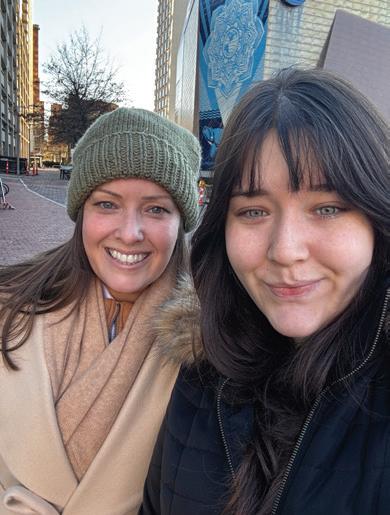
Service is already central to her life. Alongside her husband, Eric, Rachel volunteers weekly at the St. Vincent de Paul food pantry in Spring Hill, assisting with food distribution and outreach to those experiencing homelessness. For Rachel, becoming an Associate is an invitation to grow. “I see it as an opportunity to deepen my love for others and learn new ways to serve,” she shares.
Marianne Bacon’s path to the Sisters of Charity began with an invitation from a fellow parishioner, though her life had long reflected the Community’s mission. A retired special education teacher and mother of three, Marianne has dedicated herself to caring for those most in need – from children to the elderly.
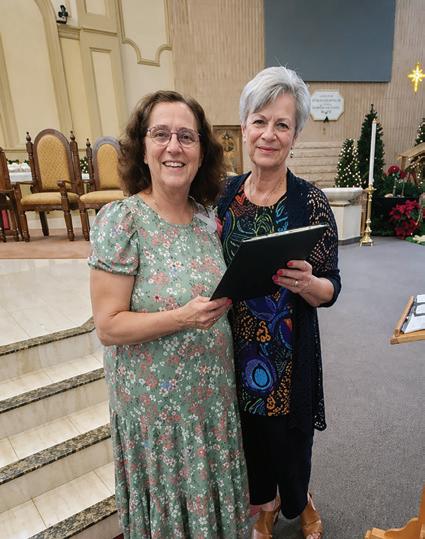
Since moving to Florida, she has embraced volunteer opportunities in her local community, visiting homebound residents and leading a Senior Support Committee that provides monthly donations
to low-income assisted living facilities. Her leadership has inspired generous responses, including a parish-wide collection and a Christmas “Giving Tree” that provided gifts for dozens of nursing home residents.
Grounded in the belief that “when you see a need, you have to address it,” Marianne looks forward to deepening relationships within the Associate community and growing in the shared values of peace, kindness, and faith.
Elizabeth Ann Wright’s journey to becoming an Associate is marked by perseverance and grace. Although raised Catholic, her faith journey took unexpected turns before ultimately leading her back to the Church. A chance encounter at her parish introduced her to the Sisters of Charity, sparking an immediate sense of belonging.
Elizabeth now serves actively in her parish as a catechist and facilitator for adult faith formation. She and her husband, Jim, who joined the Catholic Church in recent years, have built a life centered on faith and family. She also cares for her young goddaughter, finding joy in nurturing the next generation.
Reflecting on her journey, Elizabeth shares, “I feel like God led me to this path.” As an Associate, she is eager to continue growing in faith through prayer, community, and service.
Together, Rachel, Marianne, and Elizabeth embody the living legacy of St. Elizabeth Ann Seton – responding to God’s call with open hearts and a commitment to love in action.
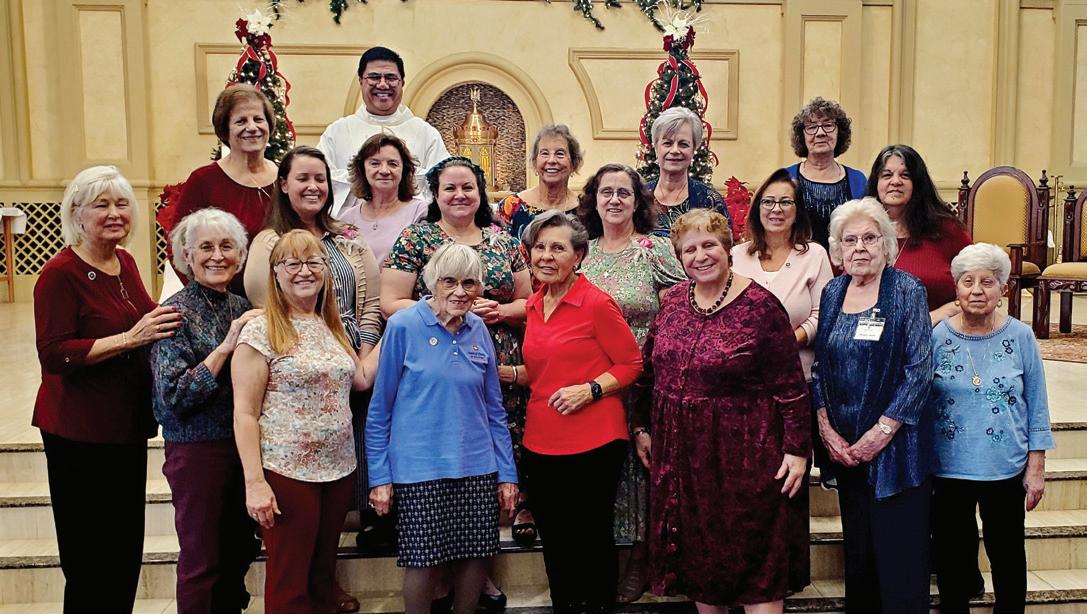
The Florida community of Associates continues to expand with the welcoming of three new Associates in Mission in January: Rachel Kopp, Marianne Bacon and Elizabeth Ann Wright.
Rachel Kopp (left) was inspired by the Sisters of Charity’s commitment to helping others.
Marianne Bacon looks forward to relationshipsdeepening within the Associate community.
Elizabeth Ann Wright (center) is eager to continue growing in faith through prayer, community, and service.

Snapsh ts of Charity
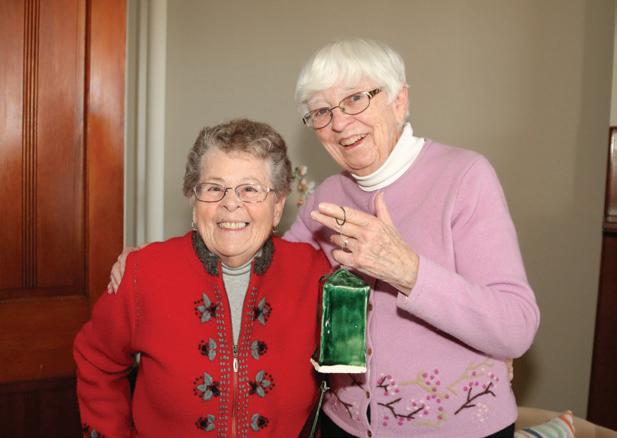
Sisters and Associates celebrated the Feast of St. Elizabeth Ann Seton on Jan. 4 with Mass in the Motherhouse chapel.
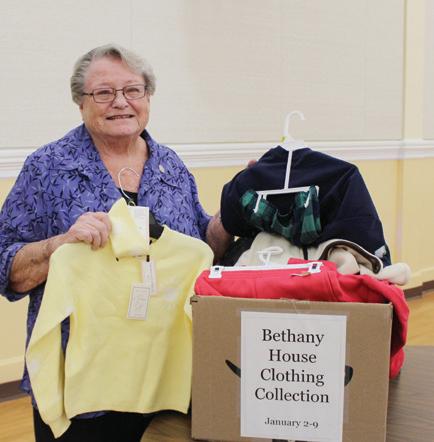
As part of LCWR’s Days of Prayer, Fasting, and Advocacy, the Community hosted a winter clothing collection for Bethany House Services.
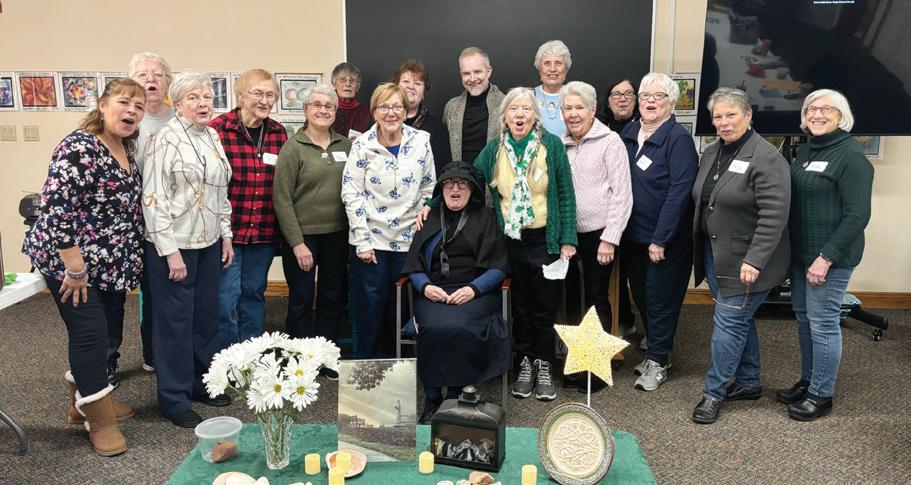
In January, SC Associates took part in the “Spirit of Mother Margaret George” retreat.
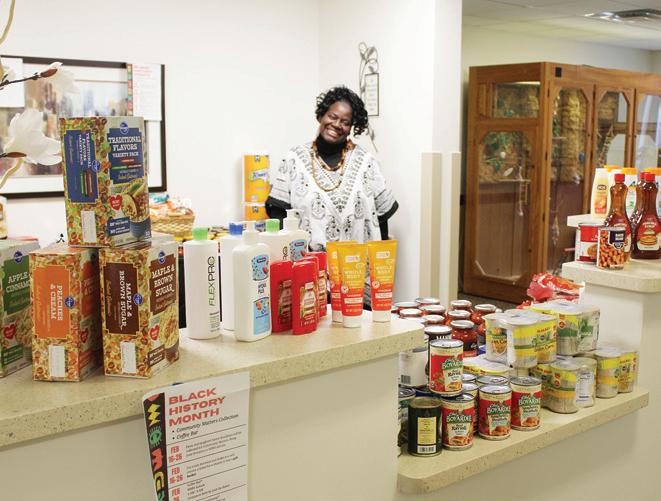
In honor of Black History Month, Sisters and employees donated items to the Community Matters Food Pantry through a collection organized by employee Mary Thomas.
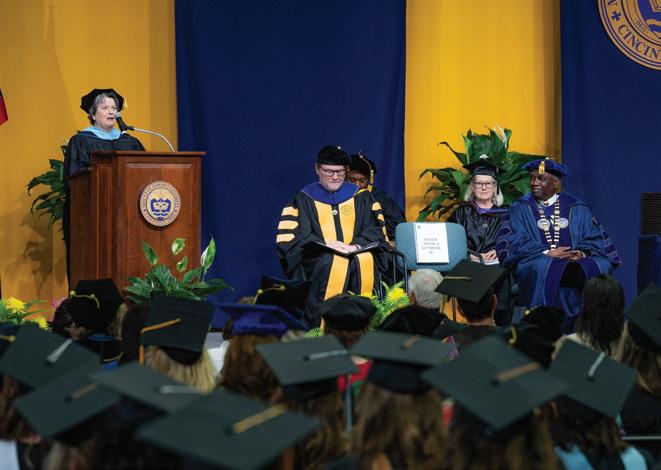
Sisters of Charity President Monica Gundler delivered the commencement address at Mount St. Joseph University in May.
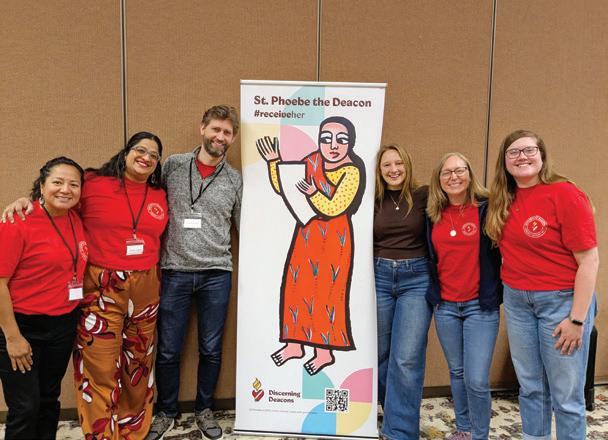
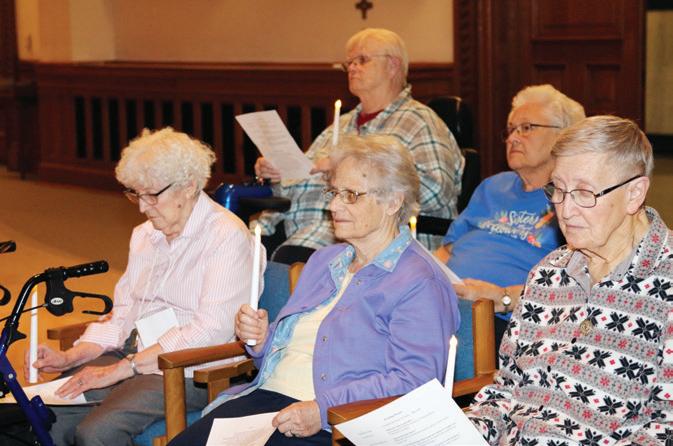
Sisters of Charity gathered at the Motherhouse in January for a congregational retreat centered on storytelling, hope, and the Charity charism.
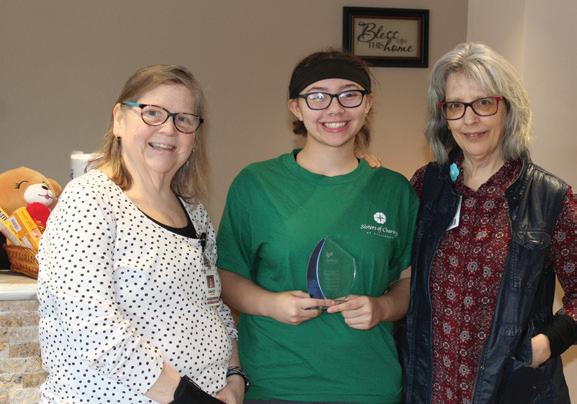
DePaul Cristo Rey High School honored the Sisters of Charity as a Pioneer Partner of its Corporate Work Study Program.
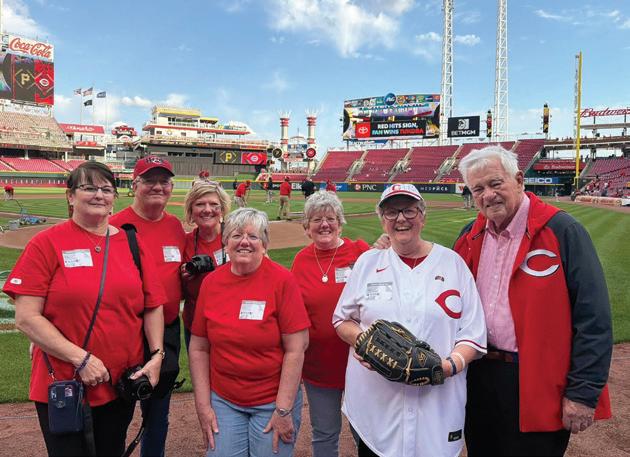
S. Marty Dermody threw out the ceremonial first pitch at the March 30 Cincinnati Reds vs. Pittsburgh Pirates game in celebration of her retirement.
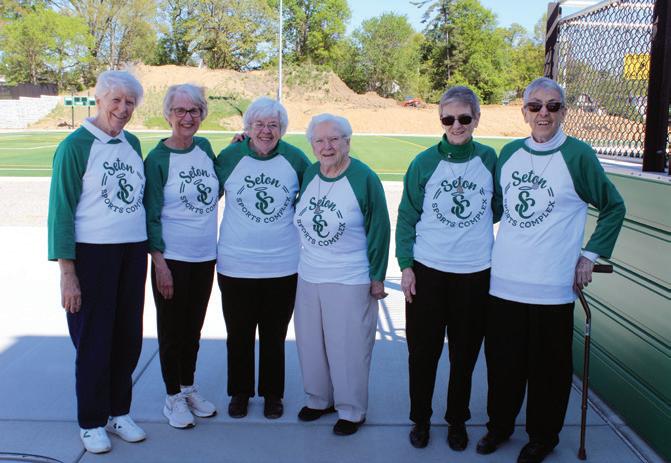
Seton High School welcomed former educators and alumna to the construction site of its all-girls sports complex.
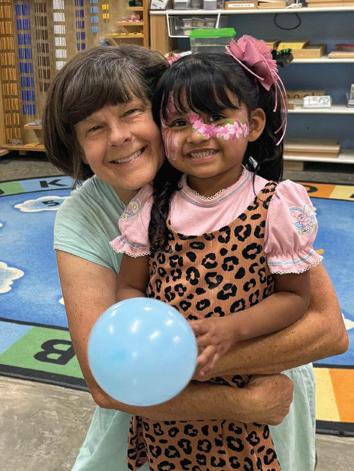
Proyecto Santo Niño honored its students during a Children’s Day celebration in April.
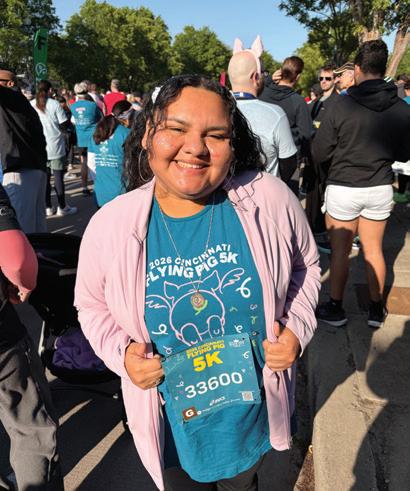
Sisters and Associates participated in Cincinnati’s Flying Pig weekend as members of Team Ignite Peace, raising funds for peace and justice initiatives.
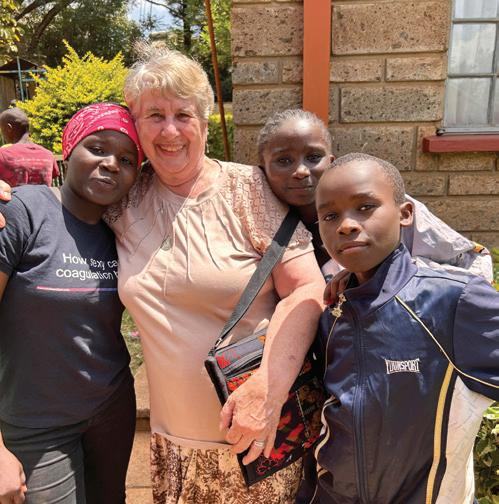
S. Cj Willie returned from a fiveweek journey to Africa, where she visited microfinancing projects and witnessed the transformative impact of the ministry.
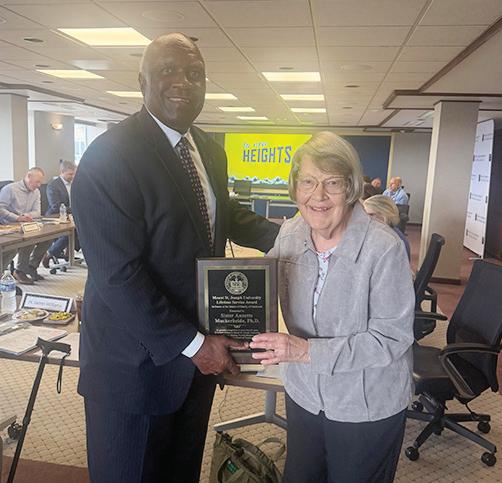
S. Annette Muckerheide received Mount St. Joseph University’s Lifetime Service Award in recognition of her 34 years of leadership and dedication to the university’s mission.
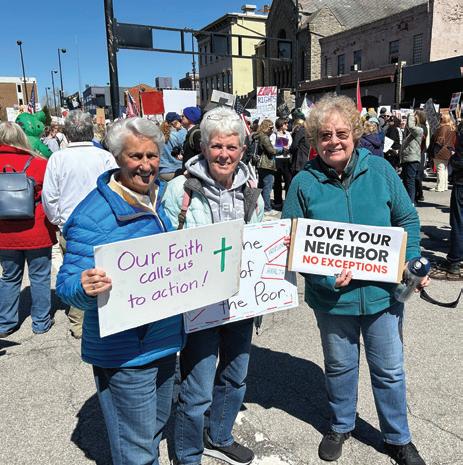
Sisters of Charity and SC Associates joined peaceful No Kings marches and rallies across Ohio and near the U.S.-
Mexico border on March 28.
S. Tracy Kemme joined more than 130 pastoral leaders at the Discerning Deacons Assembly of Hope in Indianapolis.
5900 Delhi Road
Mount Saint Joseph, OH 45051
http://www.srcharitycinti.org www.facebook.com/sistersofcharityofcincinnati
Sister of Charity of Cincinnati Betty Jane Lillie
Celebrates 100th Birthday
The Sisters of Charity of Cincinnati celebrated the life of S. Betty Jane Lillie on April 10. Marking an extraordinary milestone, she turned 100 years old on April 11, 2026.
A Sister of Charity for 81 years, S. Betty Jane’s love of learning began in childhood, when she would visit the library, sit on a step beside the shelves, and “take one book, read it, put it back, and take another.” That early curiosity blossomed into a lifelong ministry in education, spanning decades and reaching students from preschool through graduate studies.
Her longest and most influential ministry began in 1982 at the Athenaeum of Ohio/Mount St. Mary’s Seminary of the West, where she taught biblical studies in both seminary and lay pastoral ministry programs, forming generations of students in faith and scholarship.
Following her retirement, S. Betty Jane moved to the Mount St. Joseph campus. In this chapter of her life, she enjoys reading, quiet reflection, and cherishing memories of the many students and colleagues who enriched her journey. With deep gratitude for a life devoted to learning and teaching, she continues to greet each day with grace and a warm smile.
To learn more about S. Betty Jane’s life and ministry, scan the QR code.