OCTOBER 2026
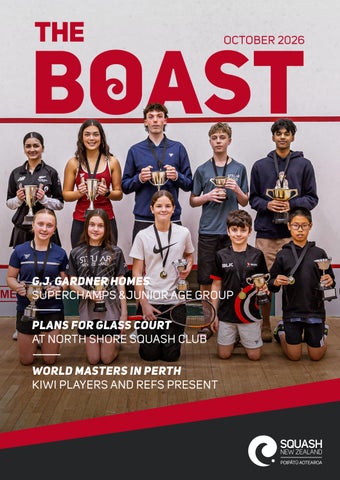
G.J. GARDNER HOMES SUPERCHAMPS &JUNIOR AGE GROUP PLANS FOR GLASS COURT AT NORTH SHORE SQUASH CLUB WORLD MASTERS IN PERTH KIWI PLAYERS AND REFS PRESENT
CONTENTS 6. Auckland to Host 2028 PSA Squash World Champs 8. World Club Championships 10. Dame Susan Devoy Launches Squash For Life 12. HEAD Extends Commitment to New Zealand Squash 14. Squash Stars - Growing the Next Generation 16. Plans for glass court at North Shore Squash Club 18. NZ Inter-District Team Championships 20. G.J. Gardner Homes Superchamps 22. Masters Club Team Championships 24. Junior Trans Tasman 26. World Masters Squash Champs 28. G.J. Gardner Homes Junior Nationals - Individuals 32. G.J. Gardner Homes Junior Nationals - Teams 40. Peak Performance with Kemp 44. Coach Profile - Tyler Duberly 52. Referee - World Masters Perth 2026 56. Volunteer of the Month - Simon Flett
10
Stay updated with our other channels
14
26
11 22
28
Chief Executive Update Tēnā koutou There are moments in sport when an idea becomes reality. Moments when lots of ambition, planning and collaboration come together, creating opportunities that will shape the future for generations to come. Over the past few weeks, squash in New Zealand has experienced one of those moments. It was incredibly exciting to announce to the world that Auckland will host the largest squash event ever staged globally in February 2028. For the first time, the Men’s and Women’s World Championships will be held together, bringing the world’s top 64 men and 64 women to New Zealand. Alongside this, we will host the World Club Championships, an event that could welcome more than 1,500 players, supporters, officials and fans from around the globe. The scale and opportunity are extraordinary, and registrations for the World Club Championships will open on 30 November, with team numbers capped. This achievement belongs to many people. Thank you to everyone who has helped bring this vision to life, particularly the eight Auckland clubs that have committed to hosting these events. Their belief, energy and collaboration have been outstanding.
While planning for 2028 gathers momentum, squash continues to thrive at every level today. Across the country, SuperChamps once again showcased what makes our sport special. Few sporting events in New Zealand offer the opportunity for players from any club, in any grade, to travel, compete and chase a national title. That pathway, from local courts to national honours, is something truly unique. To every club, volunteer, official and player who contributed to this year’s event, thank you for creating such memorable experiences. This past weekend, I spent time at Henderson Squash Club for the Junior Age Group Championships. Watching close to 200 young players fill the courts with skill, determination and enthusiasm was a powerful reminder of the bright future ahead. Squash New Zealand is fortunate to have Anneka and her passionate team of volunteers from Henderson delivering such an outstanding event. From our youngest players to the world’s best, there is real momentum across our sport. The future of squash in New Zealand is bright, and the journey ahead is incredibly exciting. Ngā mihi Martin Dowson
Upcoming events Event
Date
Venue
G.J Gardner Homes NZ Masters Individual Championships
16 - 18 October
Whanganui Squash Club
G.J Gardner Homes NZ Masters Inter-District teams Championships
19 - 20 October
Whanganui Squash Club
Don’t miss any upcoming events. Click HERE to access the full tournament calendar
4
rd The notice boa in What’s happening
our community
Thank you Terry Manuatu
Thank you Terry for your 18 years as National referee, who after a long deliberation has decided to retire, you will be missed and we will welcome you back to referee squash anytime and anywhere. The sport thrives because of people like you.
Become a LA28 Volunteer We are excited to share news from the LA28 Volunteer Program presented by Delta Air Lines: Games-time volunteer applications are now open! Click HERE to view. Games-time volunteering through the LA28 Volunteer Program will see a crew of 60,000 set the stage and keep it running smoothly for the biggest Olympic and Paralympic Games in history. We’re happy to share an exclusive code to use in the Games-time volunteer application. This code will help LA28 identify a member of the Squash community. It is intended for personal use only and should be entered in the indicated field on the application.
Did you Know?
For those that visited the Titantic exhibition in Auckland recently would have seen the illustration of the squash court that was on the boat!
Please note, codes do not guarantee receiving a role, nor are they required to apply. VOLUNTEER CODE: ZTI48UGZ People of all abilities who meet the following requirements are encouraged to apply: •
Be 18 years or older at the time of your application
•
Be proficient in English (reading and writing)
•
Be available for a minimum of 10 nonconsecutive shifts (of approximately eight hours each) during the 2028 Olympic or Paralympic Games periods
For more information about Games-time volunteering with LA28 and to start your application, visit the LA28 volunteer portal.
5
AUCKLAND TO HOST 2028 PSA SQUASH WORLD CHAMPS The best squash players in the world are set to compete in Auckland in 2028, with Squash New Zealand Poipātū Aotearoa announcing it has secured hosting rights for the 2028 PSA Squash World Championships. The World Championships will be the biggest squash event ever held in New Zealand, and will take place just four months before the sport makes its Olympic debut at the LA 2028 Games. The event will be contested on a glass court at the New Zealand International Convention Centre in Central Auckland, giving spectators a fantastic view as the world’s best go head to head.
The competition is scheduled for 19 to 27 February 2028, and will run concurrently with the inaugural World Club Championships, a new competition which will allow club players from around the world to compete in their own tournament, alongside the World Championships. Together the two events are expected to be the largest squash event ever held. Nearly 40 courts across Auckland clubs will be in use, all within 30 minutes of the championship glass court at the NZICC. “This is the biggest thing to happen to squash in New Zealand in my lifetime,” said Martin Dowson, Chief Executive of Squash New Zealand Poipātū Aotearoa. “We are a small country with a deep squash history. To bring the world championships here, in the year squash finally reaches the Olympics, is going to be extremely special. “What will make it even more special is the World Club Championships running at the same time. You will have a club team from Whangārei playing in the morning and the world number one on the glass court that night.” Squash makes its Olympic debut at Los Angeles 2028 with 16 men and 16 women in each singles draw. Eight of those places per draw go to the highest-ranked players on the PSA world rankings as at 22 May 2028, putting Auckland squarely inside the qualifying window. Paul Coll, the first New Zealand male to reach World No. 1, said he’s thrilled to have the opportunity to compete at a home World Championships. “I’ve spent most of my career playing in front of crowds on the other side of the world,” said Coll. “To have the world championships in New Zealand, in the same year squash finally gets to the Olympics, is unreal. I want as many Kiwis as possible in that arena while I give it everything I have to become world champion at home.”
The event leadership group behind the Festival of Squash – Road to LA 2028, left to right Dave Mee, Anneka Weterman, Wayne Werder, Hon Grant Smith and Martin Dowson 6
The event will be staged with support from the Government’s Major Events Fund and Auckland Council Events through Tātaki Auckland Unlimited.
I want as many Kiwis as possible in that arena while I give it everything I have to become world champion at home Major sporting events are an important driver of visitor activity and economic growth, attracting international competitors, support crews and fans while showcasing New Zealand as a world-class destination, says Tourism and Hospitality Minister Louise Upston. The Championships will also shine a spotlight on women’s squash and inspire future generations of athletes while supporting high-performance sport outcomes. “The PSA Squash World Championships will bring the world’s best players to Auckland and create a valuable opportunity for New Zealand athletes to compete against elite international talent on home soil,” Louise Upston says. “Major international events bring visitors and spend and showcase New Zealand to the world. Squash’s Olympic debut makes 2028 a landmark year, and Auckland will be part of that story.” Mayor of Auckland Wayne Brown welcomed the announcement. “We’re delighted to support the 2028 PSA Squash World Championships through Auckland Council Events and bring another world-class sporting event to Tāmaki Makaurau,” said Mayor Wayne Brown. “Auckland has fantastic venues, a proud history of hosting successful major events and passionate sporting communities. With the championships expected to contribute around $2.5 million to regional GDP and nearly 20,000 visitor nights, there’s a real benefit for the region too. “It will be great to see the event come to life at the NZICC and across the city, building excitement as squash heads towards its Olympic debut at LA28.” PSA Chief Executive Alex Gough said: “I am thrilled that Auckland will host the PSA World Championships. The tournament will bring the world’s very best squash players to one of the most spectacular sporting cities on the planet. “New Zealand has done incredible things in the world of squash in recent years, bringing the Nations Cup, the World Teams, and most notably, the New Zealand Open to the people of Aotearoa. We’re extremely excited to bring the World Championships to Auckland in 2028 and we can’t wait to watch the action unfold.” The World Club Championships will run over at least four days during the second week, with divisions from high performance through to social. The competition will be scheduled so club competitors can attend the evening sessions of the world championships. “If you are a club player in New Zealand, you can put a team in and compete at a world event in your own country,” said Dowson.
7
World Club Championships Set to Unite the Global Squash Community in Auckland Clubs from across the world are being invited to make history in Auckland in 2028, with registrations for the inaugural World Club Championships, endorsed by World Squash, opening on 30 November 2026 Staged alongside the 2028 PSA Squash World Championships, the World Club Championships will provide a unique opportunity for club players of all ages and abilities to compete on the world stage while watching the world’s best athletes chase world titles and ranking points for Olympic qualification. Capped at 300 teams from around the globe, the event will run during the second week of the World Championships, with scheduling designed to ensure club competitors can attend evening sessions featuring the sport’s biggest stars. Every team will be guaranteed at least four ties, with team contests made up of four individual matches and squads of up to seven players.
Representatives from Auckland host clubs
Built on New Zealand’s proud club team tradition and endorsed by World Squash, the World Club Championships is a completely new international sporting property, bringing together local legends, social players and elite club teams for the first time. Martin Dowson, Chief Executive of Squash New Zealand Poipātū Aotearoa, said: “The World Club Championships is about giving every squash player the chance to be part of something special. For nine days Auckland will become the epicentre of world squash, bringing together club players from across the globe alongside the world’s best professionals.” “Where else can you represent your club in a world event during the day, connect with players from around the world, and then watch the world’s best on the glass court that night? Play. Connect. Watch. That’s what this event is all about.” 8
With nearly 40 courts expected to be in use across eight clubs in Auckland, all within 30 minutes of the championship venue, the World Club Championships promises a festival atmosphere unlike anything previously seen in squash. William Louis-Marie, Chief Executive of World Squash, said: “World Squash is proud to endorse the upcoming World Club Championships. Club squash is one of our sport’s great traditions and is part of what makes squash such an incredible social sport. I wish the best of luck to all teams competing in what will surely be an incredible event.” Squash New Zealand looks forward to welcoming clubs from every corner of the globe to New Zealand for a world-first celebration of club squash. Learn more about the competition format HERE
Promote Your Brand in
Want to reach thousands of squash fans across New Zealand? The Boast is Squash NZ’s digital magazine, shared with over 22,000 subscribers and across 11 Districts and International followers. Connect with players, coaches, and fans who live and breathe squash. With clickable ads, sponsored content, and multi-issue discounts, it’s a smart way to get noticed.
Interested? Email admin@squashnz.co.nz or visit www.squashnz.co.nz to learn more.
Order our cool
Squash tops Choose between hoodie, mid-layer top and a standard T-shirt. Check out the colour options and place your order by clicking the link below. CLICK HERE TO ORDER 9
Dame Susan Devoy Launches Squash For Life Kiwi squash legend Dame Susan Devoy has launched Squash for Life, a charitable trust set up to enable more New Zealand children to play and enjoy squash.
The Trust will help to promote the sport by reducing financial barriers for children and young people to get into squash, with a particular focus on kids who have no connection to the game. “The aim is quite simple, we want to get more kids into squash and to provide support to those young athletes looking to represent New Zealand on the world stage,” said Dame Susan Devoy, Chair of Squash for Life. “We want to make squash as affordable as possible and give every young New Zealander an opportunity to play. There are kids out there who would love this game and will never find it, because nobody in their family has played and nobody has put a racquet in their hand.” Dame Susan says what a child gets out of squash goes well beyond the court. “Squash clubs are some of the best communities in this country,” said Dame Susan.
10
“Kids turn up to hit a ball around and they walk away with a lot more than that. Confidence, discipline, how to win well and how to lose well, and a group of people who look out for them. “Most of them won’t go on to play for New Zealand, and that’s absolutely fine. What they will take with them are the friendships and the habits, and those last a lifetime.” The Trust will also support promising young players financially as they pursue the sport. Squash For Life was launched at an event at Auckland’s North Shore Squash Club, with Malaysian squash great Nicol David attending as a guest speaker. David, an eight-time world champion who held the world number one ranking for 108 consecutive months, runs her own foundation in Malaysia using sport to reach young people. “Nicol has built something remarkable in Malaysia. If we can learn from her and take some of the lessons she’s implemented, we’ll be a long way ahead. “This is about building momentum and ensuring that squash has a proud and exciting future in this country,” Devoy said. The launch comes as squash prepares for its first Olympic Games, debuting at Los Angeles 2028.
THANK YOU
for supporting MySquash and Coach development 11
Extends Commitment to New Zealand Squash Through 2028
Squash New Zealand Poipātū Aotearoa is delighted to announce that HEAD, through Sportco Limited, has extended its partnership for a further two years as naming rights sponsor of the HEAD NZ Pro Tour and the HEAD New Zealand Championships and National Graded Championships.
The renewed agreement builds on a highly successful first year of the partnership, highlighted by the launch of the HEAD NZ Pro Tour, a national series that brought together host clubs from around the country and created new opportunities for New Zealand’s emerging talent. The Tour has quickly established itself as an important part of the player pathway, providing young athletes with regular opportunities to compete against many of New Zealand’s leading senior players while also earning valuable world ranking points from home. Those opportunities are helping aspiring professionals progress towards higher level international competition while strengthening the domestic game. The partnership has also played a significant role in supporting the HEAD New Zealand Championships
12
and National Graded Championships, which delivered one of the most sucessful national events seen in recent years. Bringing together players from grassroots through to elite level, the championships showcased the strength of the squash community and reinforced the value of having a committed long-term partner invested in the sport’s future. Chief Executive of Squash New Zealand Poipātū Aotearoa, Martin Dowson, said the extension provides certainty and momentum at an exciting time for the sport. “HEAD has been an outstanding partner and shares our vision for growing squash in New Zealand. The HEAD NZ Pro Tour created a fantastic atmosphere at clubs around the country and has quickly become an
important initiative for our upcoming talented players to develop. It has provided meaningful opportunities for the next generation of players to test themselves against the country’s best, gain valuable experience and enhanced rankings to pursue opportunities overseas. We are thrilled to have HEAD continuing its support through to the end of 2028 as we build towards a very exciting future for our sport.”
throughout the country, and seeing players compete and earn world ranking points right here at home has been fantastic. Supporting squash from grassroots graded championships through to the professional level aligns perfectly with HEAD’s philosophy, and we look forward to continuing to work alongside Squash NZ to build even more momentum for the sport over the next few years.”
Grant Williams, National Sales and Marketing Manager at Sportco Limited, said the success of the inaugural Pro Tour demonstrated the depth of talent and passion that exists within New Zealand squash. “We are thrilled to extend our commitment to Squash New Zealand through to 2028. The inaugural HEAD NZ Pro Tour showed just how much talent and enthusiasm exists
The partnership extension comes at a pivotal period for squash, with increasing opportunities for New Zealand players and growing excitement around the sport’s future. Together, Squash New Zealand Poipātū Aotearoa and HEAD remain committed to supporting players, clubs, coaches and volunteers while continuing to strengthen the game at every level across Aotearoa.
13
Squash Stars
Growing the Next Generation Fun, friendship and a great first experience are bringing hundreds of young people into squash. Every squash player has a first experience of the sport. For hundreds of young New Zealanders in 2026, that first experience has come through Squash Stars. Designed to give children a fun and welcoming introduction to squash, the programme is helping clubs bring new players and families through their doors, while creating an environment where children can build confidence, learn new skills and, most importantly, enjoy being on court.
each week and developed the confidence that comes from mastering new skills. They spoke about the satisfaction of watching children progress from struggling to make contact with the ball to sustaining rallies and beginning to play games.
The 2026 results show the impact. Across 36 reporting clubs, 681 children participated in Squash Stars, with 346 experiencing squash for the first time. That means more than half of all participants, were newcomers to the sport.
Parents are noticing too with positive feedback about how much children were enjoying the programme, while some participants were already asking to return for another term or continue at their club. Families have also become more involved, extending the impact beyond the children taking part.
Behind those numbers are hundreds of positive first experiences and the opportunity for clubs to create lasting connections with children and their families.
Creating a love of squash Club feedback paints a particularly positive picture of what happens when Squash Stars comes to life on court. Fun, laughter, smiles and excitement was a common theme from clubs, as children enjoyed playing alongside their friends, looked forward to returning
r e t h g lau s e l i m &s 14
That is important because a child’s first experience can shape whether they want to continue with a sport. Squash Stars gives clubs an opportunity to make that introduction enjoyable, achievable and positive.
From first hit to playing the game While Squash Stars provides an introduction to squash, the feedback shows that for many young players it can also be the start of something more.
Clubs saw children progressing from introductory activities to rallies and games, with some moving into interclub, in-house competitions and junior tournaments. Participants have developed enough confidence and skill to compete, demonstrating how an enjoyable introduction can become a pathway into wider participation. There are benefits beyond the participating children too. Parents are becoming involved and older junior players taking opportunities to help coach younger participants. This can strengthen connections within the club while giving young coaches opportunities to develop their own leadership skills. It means Squash Stars has the potential to achieve much more than filling a junior coaching session. It can provide a starting point for players, families, volunteers and future coaches to become part of the club community.
Reaching new players The programme is also introducing squash to both boys and girls. Of the 681 participants reported in 2026, 414 were male and 267 female, representing approximately 61 per cent male and 39 per cent female participation. Most significantly, 51% of participants were experiencing squash for the first time. For clubs wanting to grow their junior base, that represents a significant opportunity. Every child experiencing squash for the first time is also potentially introducing a new family to the club and creating an opportunity for an ongoing relationship with the sport. Clubs are positive about the programme too. The average satisfaction rating in the 2026 reporting was 4.1 out of 5, with 72 per cent of reporting clubs rating Squash Stars either four or five out of five. The feedback also highlighted the value of the programme resources, game cards, assessment levels, activator development and support available to help clubs deliver an engaging experience for young players.
Why should your club get involved? The 2026 experience demonstrates what Squash Stars can offer clubs. It is an opportunity to bring new children through the door, engage new families, build a stronger junior community and provide a pathway into ongoing participation. But perhaps its greatest impact is much simpler. It gets children on a squash court, gives them the chance to experience the sport in a fun and welcoming environment and leaves them wanting to play again.
Squash Stars Shines in Napier More than 320 students from Porritt Primary School got their first taste of squash through Squash Stars. Each class enjoyed two sessions packed with games and skill-based activities, giving students the chance to learn the basics, experiment and, most importantly, have plenty of fun along the way. A fantastic opportunity to introduce a new generation to squash!
15
It Takes More Than a Glass Court
NORTH SHORE SQUASH CLUB IS PREPARING TO WELCOME THE WORLD IN 2028
North Shore Squash Club based on Shea Terrace in Takapuna has hosted national, junior, school and PSA-level competition. In February 2028, North Shore will be tested on a world stage. Auckland will host the 2027–28 PSA Squash World Championships from 19 to 27 February, alongside the inaugural World Club Championships. Across the city, nearly 40 courts at Auckland clubs are expected to be in use, bringing club players into the same event as the world’s best. Five months later, squash makes its Olympic debut in Los Angeles. North Shore has been confirmed as a key host venue for the Auckland championships and has launched an ambitious redevelopment project for the Championships. It is a remarkable prospect for New Zealand squash. It is also a deadline with a purpose. North Shore does not want to dress up its existing building for a few days and return to business as usual when the visitors leave. North Shore plans to use the event to accelerate improvements, which the wider game can use for years afterwards.
Seven courts, sixty-odd years and a lot of squash North Shore was founded in 1961 and began as a two-court club. Today it is a seven-court facility and has more than 400 members, with many more people using the facility from schools, for coaching, casual play and events. For the 2028 Championships, North Shore Squash Club plans to turn its seven-court facility into an integrated eight-court venue, centred on installing Auckland’s only permanent, PSA-specification all-glass court. Refurbished to support Auckland’s 2028 World Squash Championships, the reimagined North Shore is intended to remain available for everyday use for coaching, schools, members and tournaments, while giving New Zealand squash a permanent club-based setting capable of hosting future major national and international events.
16
Why North Shore? Because much of what a major squash venue needs is already there: seven courts, engagement programmes, tournament experience, and a secure site owned by the Club. The project is the opportunity to install Auckland’s missing permanent squash infrastructure: club-based glass court.
The show court, and everything around it The centrepiece of the plan is a permanent, PSAspecification all-glass Court 8 in an extension at the front of the existing building. Auckland currently has no permanent all-glass court within a club available for professional competition and major-event use. Court 8 would give it one, integrated with seven conventional courts rather than standing apart as a temporary event installation.
NORTH SHORE SQUASH CLUB | SPECIAL GENERAL MEETING
Around the court, the design provides formal spectator accommodation, with approximately 250 court-level seats. Above, a mezzanine will offer a different informal vantage point and connect to the existing Balcony Bar. The front-of-site location is intended to bring the new court into the club’s entrance, player routes and social spaces. Those connections matter. A big match needs a crowd close enough to feel involved; a tournament needs other courts and room for people to move. North Shore’s plan brings those elements together in one venue. It should also make a club final, a junior event or a busy interclub evening more enjoyable to watch. The refurbishment reaches beyond the spectator experience. Improved changing and bathroom facilities are part of the programme.
What New Zealand squash gains Picture a future national tournament in Auckland: a feature match on Court 8, warm-ups and other grades on the other courts alongside it, and spectators following the action from courtside and the mezzanine. This is the opportunity: a glass court with a working venue around it. For developing players, it would mean the chance to play on glass. That is a meaningful addition to New Zealand’s squash infrastructure. It fills a particular gap in the country’s largest city by putting a permanent allglass court inside an established, club-owned venue.
What happens after the World Championships? After the World Championships, the Glass Court is intended to join squash’s ordinary booking and programme capacity. Members will play on it. Coaches will teach on it. Juniors and school groups will use it. The same venue that can present professional squash will remain open to the people whose regular participation gives a club its life. Squash New Zealand chief executive Martin Dowson:
10 SEPTEMBER 2026
“The project is not simply about upgrading infrastructure for a single event. It represents a strategic investment in the future of racquet sports on Auckland’s North Shore and across New Zealand.” Squash Auckland board chair Tim Marshall likewise writes that the redevelopment would “create a legacy that will grow squash participation for many years to come.” There will be plenty to celebrate when the world’s best arrive in Auckland.
Take your seat Take Your Seat invites supporters to fund a recognised place associated with Court 8. The working target is around 250 recognitions at $1,000 each, contributing towards a $250,000 campaign goal. It is an opportunity for members, former members, families, businesses and squash supporters beyond North Shore to help put permanent club-based infrastructure behind a remarkable moment for the sport. “We’re building Court 8 at North Shore, but we’re building it for a game much bigger than our club. We want players from around New Zealand to use the facility, compete, and know they helped make it happen. If you’d like to be part of it, Take Your Seat.”
TAKE YOUR SEAT Help build Auckland’s permanent all-glass club court. Recognition places are $1,000. Scan the QR code to find out more about the campaign.
17
NZ Inter-District Team Championships HAWKES BAY SQUASH RACKETS CLUB / 14 - 15 AUG Hawkes Bay hosts thrilling interdistrict showdown as Bay of Plenty claims both national team titles, capping off a high quality weekend of competition. Bay of Plenty completed a remarkable clean sweep at the 2026 NZ Inter-District Team Championships in Napier, capturing both the men’s and women’s national titles. The event brought together 80 players representing 16 teams from across New Zealand for two days of intense team competition. In the men’s final, Bay of Plenty overcame a strong Wellington side to secure the championship, while the Bay of Plenty women defeated Canterbury to complete a memorable double. Hosted by Hawke’s Bay Squash Rackets Club, the championships showcased the depth of talent within New Zealand squash and highlighted the passion and pride that district team competition continues to inspire. The event delivered high quality matches, strong team spirit, and an outstanding hosting effort from the Hawke’s Bay club.
18
Winners: BOP WOMEN & MEN
Congratulations!
19
Club pride, unforgettable road trips, fierce rivalries and outstanding team spirit combined as the 2026 G.J. Gardner Homes Superchamps crowned champions across New Zealand. The 2026 G.J. Gardner Homes Superchamps once again showcased everything that makes club squash special, bringing together hundreds of players, volunteers and supporters from throughout New Zealand for a week of competition, camaraderie and club pride. The national finals were hosted across five venues, with Hamilton Squash & Tennis Club (B Grade), Devoy Squash & Fitness Centre (C Grade), Tawa Squash Club (D Grade), Squash City Invercargill (E Grade) and Kerikeri Squash Club (F/J Grade) welcoming teams from every corner of the country. From the opening rounds to Finals Day, players produced countless close contests, dramatic five set battles and memorable team performances. Beyond
20
the court, Superchamps celebrated the friendships, road trips and shared experiences that have made the event one of the most anticipated fixtures on the squash calendar. A huge thank you goes to our host clubs, tournament officials, referees, volunteers and supporters whose dedication created an outstanding experience for competitors. Special recognition must also go to naming rights sponsor G.J. Gardner Homes, whose continued support helps make this iconic national club championship possible. Congratulations to all finalists and particularly the clubs that claimed national titles in 2026. Their achievements reflect the depth, passion and strength of club squash throughout Aotearoa.
GRADE-BY-GRADE RESULTS B Grade 1. Men’s: Papakura Squash Club
2. Men’s: Christchurch Squash Club 1. Women’s: Hamilton Squash & Tennis Club 2. Women’s: Havelock North Squash Club
C Grade 1. Men’s: Kawaroa Park Squash Club 2. Men’s: Mana Squash Club
1. Women’s: Royal Oak Racquets Club
2. Women’s: Hamilton Squash & Tennis Club
D Grade 1. Men’s: Surf City Squash Club
2. Men’s: Hamilton Squash & Tennis Club 1. Women’s: Otago Squash Club
2. Women’s: Geyser City Squash Club
E Grade 1. Men’s: Te Puke Squash Club
2. Men’s: Henderson Squash Club 1. Women’s: Surf City Squash Club
2. Women’s: Henderson Squash Club
F/J Grade 1. Men’s: Cambridge Squash Club
2. Men’s: Henderson Squash Club 1. Women’s: Surf City Squash Club
2. Women’s: Geyser City Squash Club 21
Masters club team Championships
21 - 23 August Whangārei Squash Club
By Martin Dowson
If squash events were judged purely on enjoyment, the Masters Club Team Championships would sit at the top of the list of national events. Competition on court is fierce, but it is the camaraderie, laughter and lifelong friendships that make this event special. This year marked my fourth Masters Club Team Championships, and once again it reinforced why this event holds such a special place on the squash calendar. While every team arrives determined to compete, the tournament has evolved into something much bigger than results on a draw sheet. For many participants, the experience starts well before the first ball is struck. Teams often organise their own adventures before the tournament begins, with activities becoming part of the tradition. This year, my teammates headed to Poor Knights for a scuba diving excursion, although unfortunately I was unable to join them. It is a great example of how the event combines sport, travel and friendship. Once play begins, the competition is as tough and passionate as any event in the country. Yet there is a 22
unique culture at Masters Club Champs. If a player occasionally gets a little carried away challenging a referee’s decision, there is every chance their own teammates will be the first to tell them to “pull their head in”. Saturday night’s function once again delivered plenty of memorable moments, with fancy dress feeling less like an option and more like a requirement. The real entertainment, however, comes the following morning when some teams are scheduled for 8am matches and somehow make it onto court regardless of how much sleep or hydration they may have sacrificed. A huge thank you to the team at Whangārei Squash Club, including Shelley, Neil, Gaye, Cindy and Edwina, for delivering another outstanding event and creating a lasting legacy for their club and community.
JUNIOR
trans tasman TRANS-TASMAN SINGLES CHALLENGE Day 1 NZL 14 NSW 6 NZL 14 QLD 6 QLD 14 NSW 6 Day 2 NZL 12 NSW 8 NZL 10 QLD 10 QLD 9 NSW 11 Day 3 NZL 15 NSW 5 NZL 9 QLD 11 QLD 11 NSW 9 Day 4
TRANS-TASMAN DOUBLES
QLD 6 NSW 4 NZL 7 QLD 3 NZL 6 NSW 4 Day 5
TEST MATCH NZL 18 - AUS 12 24
Anticipation was high as the New Zealand Secondary Schools squash team arrived in Sydney. Unfortunately, influenza had also booked a place on tour. Opening 14–6 wins over New South Wales and Queensland promised plenty, before illness, injury (and several broken racquets) turned team management into a medical service. The singles Challenge Trophy was secured, although considerably more nerves were shredded than usual. Thursday saw the Kiwis show resilience to win the doubles competition, sharing the court as effectively as their germs as the sick and injured returned to play. Friday offered redemption. After last year’s hiding from Australia, the team wanted the test trophy back. A 6–4 doubles lead and gutsy singles comebacks delivered an 18–12 victory. Cue celebrations: The team had emptied the medicine cabinet and filled the trophy cabinet. A fair exchange.
ROAD TO LA28
Tickets On Sale now! 2027 NZ Squash Open PALMERSTON NORTH’S REGENT ON BROADWAY
FEBRUARY 16 - 21
Tickets for the 2027 New Zealand Squash Open are on sale now, with the world’s best squash players set to compete on a glass court on the stage of Palmerston North’s Regent on Broadway Theatre.
CLICK HERE TO BUY TICKETS
Thank You to Our Lottery Supporters & Congratulations to Our Winners Together, we helped bring the PSA Squash World Championships to New Zealand. A heartfelt thank you to everyone who supported Squash New Zealand’s 2028 Lottery Funding Campaign. Your contribution helped demonstrate the passion, strength, and commitment of our squash community in securing the right to host the PSA Squash World Championships Auckland 2028.
Congratulations to our winners: Heather McLean (Wellington), winner of the Main Prize Pack, along with Andrew Green, Mark Parker, Nathan George, and Ros Smith, who all won exclusive World Championship experiences. While only a handful of entrants could take home a prize, every ticket purchased played a part in making this once-in-a-generation opportunity possible.
Thank you for helping bring the world’s greatest squash event to New Zealand 25
world masters squash champs The World Squash Masters Championships was played 30 August - 6 September in Perth, with a strong contingent of Kiwis making the trip across the ditch to take on the world! With almost 1,000 competitors from around the globe coming together, it’s an incredible celebration of squash Photo credit: Rogue Gun Photography & Media 26
and a fantastic opportunity to compete against some of the best age-group players on the planet. We’re proud to see so many Kiwis flying the flag on the international stage and taking part in such a special event.
27
Junior Nationals Individuals
What a fantastic weekend of squash at the 2026 G.J. Gardner Homes Junior Nationals Individuals!
28
With a huge 192 players from across New Zealand taking part, the event showcased the incredible depth of junior squash talent around the country. The standard of play was outstanding, with countless matches turning into tough four and five-set battles, highlighting the determination, resilience, and skill of our young players.
friendships, and embracing everything that makes junior squash so special.
Just as impressive was the camaraderie on and off the court, with players supporting one another, making new
Well done to all 192 players, the future of New Zealand squash is in great hands!
A huge congratulations to every player who took part. Whether you were battling for a title, playing your first Nationals, or cheering on your fellow competitors, you helped make this an unforgettable event.
RESULTS / INDIVIDUALS G.J. GARDNER NZ JUNIOR AGE GROUP CHAMPIONSHIPS U19 Girls 1. Brooke Valois
U19 Boys 1. Maximus Mathews
2. Charlee Neilson
2. Brodie Bennett
U17 Girls 1. Amalia Ricketts
U17 Boys 1. Vihan Chathury
2. Liberty Jones
2. Eamon Gannon
U15 Girls 1. Yusra Rashid
U15 Boys 1. Levi Casey
2. Julia Chen
2. Harry Murfitt
U13 Girls 1. Addison Rouse
U13 Boys 1. Jayden Zhang
2. Shelby Duncan
2. Caleb Smith
U11 Girls 1. Violet Casey
U11 Boys 1. Nikos Michalakis
2. Hapina Tipu
2. Caedyn McMurchy
29
G.J. Gardner Homes Junior Nationals Individuals
30
31
JUNIOR NATIONALS TEAMS RESULTS G.J. GARDNER JUNIOR NATIONAL TEAMS Girls Winner: Canterbury Runner Up: Auckland Third: Waikato
Boys Winner: Central Runner Up: Bay of Plenty Third: Auckland
Gifford Cup Team Winner Canterbury Boys Winner: Central
Gifford Cup Team Winner: Canterbury 32
Girls Winner: Canterbury
G.J. Gardner Homes Junior Nationals teams
After an unforgettable five days of competition, we’ve reached the conclusion of the G.J. Gardner Junior Nationals 2026. From the Individual Championships through to the Interdistrict Teams Event, we’ve seen an incredible standard of squash, outstanding sportsmanship, and plenty of memorable moments. After two days of team competition and some fiercely contested finals, our champions have been crowned. The week showcased
Girls Runner Up: Auckland
Boys Runner Up: BOP
not only the depth of junior squash across the country, but also the friendships, resilience and team spirit that make this tournament so special. Thank you to everyone who was part of the journey. We look forward to seeing what this talented group of players achieves over the next 12 months.
Girls Third: Waikato
Boys Third: Auckland
33
There have been some huge battles, with every team leaving it all out there as districts fight for valuable points. The energy, sportsmanship, and team spirit on display have been outstanding from all our players.
34
G.J. Gardner Homes Junior Nationals teams
35
PSA Squash tour Coll Retains London Squash Classic Title
“I think it’s the best I’ve ever struck it consistently”
New Zealand’s Paul Coll has retained his title at the London Squash Classic following a strong win over France’s Victor Crouin at Alexandra Palace. Coll produced a dominant performance to claim his third successive London Classic trophy, winning 11-6, 11-5, 11-3. The win was the 34th title of Coll’s career, with the West Coaster not dropping a single game during this season’s tournament. Coll looked a cut above from the outset, with the No.1 seed controlling the pace and flow to win the first game. It was more of the same in the second and third, with Coll in control as he comfortably secured victory in straight games. “I’m stoked, I was really happy with my length hitting and ball striking,” Coll said.
36
“I think it’s the best I’ve ever struck it consistently. Victor was putting the backhand drops in really well and he was solid, so I impressed myself with that today. “Having Nele [wife and World No.11] on tour with me, she’s got her own career to focus on, but she’s given me so much support this week after a tough week for her. It shows her character and having her with me here all week made it so much more enjoyable for me.” Result – Men’s Final: 2026 London Squash Classic [1] Paul Coll (NZL) bt [2] Victor Crouin (FRA) 3-0: 11-6, 11-5, 11-3 (44m)
SMTP2GO Backs New Zealand Men’s Team for World Championships Squash New Zealand Poipātū Aotearoa is delighted to announce SMTP2GO as the Naming Rights Sponsor of the New Zealand Men’s Team competing at the 2026 World Squash Team Championships in Korea from 14 to 19 December. The sponsorship will provide vital support towards the costs of sending New Zealand’s top male players to compete on the world stage, helping offset travel, accommodation, entry fees and other expenses associated with international competition. Squash New Zealand Chief Executive Martin Dowson said the support from SMTP2GO comes at a crucial time for the sport. “Representing New Zealand is a career highlight for many athletes, but competing internationally comes at a significant cost. As Squash New Zealand receives no dedicated high performance funding for campaigns such as this, sponsorship support is essential to ensure our athletes can take advantage of these opportunities. Competing at World Championships exposes players to the very best in the game, helping build resilience, confidence and belief. These experiences can be transformative, and New Zealand has a long history of athletes who have used them as a springboard to grow, develop and achieve success on the international stage.” As part of the partnership, Squash New Zealand and SMTP2GO will also work together to deliver a girls’ development camp in Christchurch in early 2027, providing young players with opportunities to learn, grow and be inspired by the sport. “We sincerely thank SMTP2GO for their commitment to our athletes and the development of young female players. Their support will have an impact well beyond this year’s World Championships and will help strengthen the future of squash in New Zealand.” 37
Achieving a World-Class Mindset:
THE PATH TO IMPROVEMENT FOR CLUB SQUASH PLAYERS
Squash is a sport that demands skill, precision, physicality, and mental fortitude, this is why it continues to produce many world-class athletes who push the boundaries of performance. While club squash players may not attain the same level as these professionals in terms of skill and physicality, they can match their mindset by approaching each practice session with a clear purpose and focused attention to detail. In this article, we will explore how adopting a worldclass mindset can improve the game of club players and contribute to the overall development and enjoyment of squash.
Practicing with Purpose
The world-class squash players we come to admire, didn’t reach the pinnacle of the sport by merely going through the motions during practice. Instead, they approach each training session with a clear purpose in mind. Club players can emulate this mindset by setting specific goals for every session. Whether it’s improving a particular shot, working on footwork, or enhancing game tactics, having a purpose gives direction and focus by adding quality to the session. Regularly evaluating and adjusting these goals is equally important. By tracking progress and making necessary changes to the focus of a session, a player can enhance their development which will in turn help them to stay motivated throughout the journey.
Attention to Detail
Elite performers understand the value of attention to detail. Every aspect of their game is thoroughly analysed and optimised, from their technique to their conditioning. For club players, this level of scrutiny may seem daunting, but it is an essential aspect of improvement. Club squash players can benefit greatly from paying close attention to their technique, position, conditioning, and shot selection. It is important
38
that we understand our strengths, as well as our weaknesses. Seeking guidance from an experienced coach or using available resources can provide valuable insights and corrections that can make a significant difference to performance on the court.
Quality Over Quantity: Time is Valuable
Of course, professional players can dedicate their lives to their performance while they engage in hours of demanding training. Club players, in contrast, may not have the luxury of such time commitments. Time is valuable and it is essential to remember that the key to improvement lies in the quality of practice rather than its quantity. Focusing on executing each shot correctly, even during shorter practice sessions, can lead to more significant improvements over time. Prioritising quality over quantity ensures that any player makes the most of the time they have available and prevents the development of bad habits due to careless repetition. Accumulating many smaller gains will lead to significant improvements down the line.
Mindfulness and Mental Toughness
World-class performers possess exceptional mental fortitude that allows them to stay focused and composed even in high-pressure situations. Club players can match this mindset by cultivating mindfulness during practice. Being fully present during training and concentrating on every shot as if it were a match-point can improve concentration and decision-making during actual games.
Click HERE for the original article
SOURCE: SquashSkills Blog article.
Additionally, club players should work on developing mental resilience, by learning to bounce back from setbacks and seeing these moments as opportunities to learn and understand areas to develop. This will help in maintaining a positive attitude throughout the squash journey. Mental strength can make a substantial difference, especially during those closely contested matches.
FREE VIDEO
Transform your serve for FREE with Lee Drew’s top 5 tips! From mastering your stance and grip to nailing ball placement and adding variety, this series has everything you need to dominate from the very first shot. Whether you’re a beginner or a seasoned player, Lee’s practical advice will give your game a winning edge. Ready to level up?
Conclusion While club squash players may not reach the same level as world-class athletes in terms of skill, adopting a world-class mindset can significantly elevate a player’s game and overall enjoyment of squash. By approaching practice with a clear purpose, paying attention to detail, and cultivating mental toughness, club players can maximise their potential and constantly strive to improve. Emulating the mindset of world-class players ensures that every step on the squash court becomes an opportunity for development. Begin taking this approach consistently and watch how your game develops.
Click HERE to create your free account to watch now and make your serve unstoppable!
THANK YOU
for funding to engrave our National Trophies
39
HIGH PERFORMANCE Peak Performance with Kemp
THE HIDDEN COST OF CHASING RESULTS TOO EARLY Winning is an important part of sport. It provides feedback, motivation, and memorable moments. But when immediate results become the primary focus of development, they can quietly limit long-term potential. Many players, parents, and coaches assume that early success is always a sign of future success. In reality, the relationship is often more complicated. The habits that help a player win today are not always the habits that help them reach their highest level tomorrow.
Why Early Success Can Be Misleading
Junior sport is full of examples of players who achieve strong results early by relying on the things they already do well. They use their strongest shot more often than they should. They avoid taking risks. They compete in familiar ways because those approaches deliver immediate rewards. The problem is that improvement often requires players to spend time being less effective before they become more effective. Learning new tactical options, developing weaker areas of the game, and experimenting with different solutions all introduce mistakes and inconsistency. In the short term, the performances might suffer. When results become the only measure of success, players naturally resist this process. They protect what currently works instead of developing what will be needed later.
How Fear of Losing Shapes Behaviour
Most players say they want to improve. But when competition arrives, many choose behaviours that protect outcomes rather than accelerate development. They play safely instead of making better decisions. They avoid using newly developed skills. They return to familiar patterns whenever the score becomes important. This is understandable. Losing is uncomfortable. It creates doubt and invites judgement. However, improvement rarely occurs inside comfort zones.
40
The challenge for developing players is learning to tolerate short-term discomfort in service of long-term growth. This is not about ignoring results. It is about understanding their place. Results tell us what happened. They do not always tell us what should happen next.
Why Development Sometimes Looks Like Stagnation
One of the most frustrating parts of improvement is that progress is rarely linear. Players expect development to look like a steady climb. Better training should lead to better performances, which should lead to better results. In reality, growth is often messier.
JONATHAN KEMP National Performance Coach
When players expand their skills, decision making, or tactical awareness, performance can temporarily become inconsistent. New behaviours require attention. Old habits compete for space. Mistakes increase. From the outside, it can look as though nothing is improving. In many cases, the opposite is true. The player who is learning to attack more aggressively may lose matches while refining that skill. The player developing better technique may go through a period where they are uncertain of how they are hitting the ball. The player training to make better decisions may not immediately execute them consistently. Development often becomes visible internally before it appears externally.
Looking Forward
Understanding the hidden cost of chasing results too early changes how we view development. Success is not just about what a player can do today. It is about what they are preparing themselves to do in the future. The best development environments recognise this. They create space for learning, experimentation, and temporary setbacks because they understand that longterm growth often demands short-term sacrifice. And when that mindset becomes part of a player’s journey, the focus shifts from chasing isolated performances to building something much more valuable: sustained excellence.
Focusing on Progress Rather Than Validation The most successful long-term performers learn to separate validation from development.
Validation comes from outcomes. Development comes from adaptation. The players who continue improving are usually those who can evaluate themselves beyond the scoreboard. They pay attention to the quality of their decisions, the consistency of their behaviours, and their ability to solve increasingly complex problems. This perspective creates resilience. Instead of asking, “Did I win?” they begin asking, “What did I learn?” Instead of judging a performance by the final score, they assess whether they executed the skills and behaviours they are trying to develop. This shift does not reduce competitiveness. If anything, it strengthens it. Players who commit to development give themselves the best chance of achieving meaningful results in the future.
The Long Game
The highest-performing athletes rarely build careers around protecting short-term success. They continually place themselves in situations that challenge their current abilities. They accept periods of discomfort. They understand that growth and performance do not always move in parallel. This requires patience. Not passive patience, but active patience. The willingness to keep investing in development even when immediate rewards are not obvious. That patience allows players to build a higher ceiling rather than simply protecting their current level.
41
Growing the Game:
SQUASH REACHES A NEW GENERATION IN HAWKE’S BAY Interest in squash is spreading in Hawke’s Bay as it is introduced in primary schools and secondary schools. As a lesser-known sport, the children questioned fairly, ‘Where is the pumpkin?’ It’s hard to say if they were disappointed when I didn’t pull out a pumpkin from my bag but an orange ball. The ball was passed around so that they could have a squeeze and know what they’ll be playing with. This was followed by a blue dot ball to understand that this is the kind of ball we “actually” use on a squash court. The ball safety lesson was this: the orange ball is soft, but not when you get hit by it, so don’t do anything stupid. I told them about the time I once saw a woman get a broken nose by being hit with the racquet. So, then came the racquet safety lesson: don’t break any noses and watch your own. Porritt School in Napier was up for term three with over 320 kids to get through...twice, as they all got two lessons. It was something between a dream and a nightmare where I rejoiced, knowing all these kids would learn what squash is, but at the same time my head spiraled as I wondered if I could do it. Balls ended up on the roof and on the road, kids did indeed go on to get hit by the ball, and they tired so much that they lay on the ground trying to catch their breath. But as I reflected on my time at Porritt School, I saw beyond all of the craziness. All the teachers who supported me as I tried to run multiple activities at once. I remember the kids that would sometimes help me set up the rally walls. They said things that reminded me why it was all worth it, like: ‘Squash is so much fun,’ ‘how long does it take to be a professional?’ and ‘this is so much better than being in class.’ Most of all, it was watching them improve their focus, racquet and ball skills, reaction times, and spatial awareness. The Squash Stars program was hugely enjoyed by the students of Porritt School, and I believe that many children in the future will continue to benefit from it. It is an opportunity we, as districts, can offer kids as we hope for a better future for squash in New Zealand. As my time at the school came to an end, I was given a lasting memory of the children performing a haka and waiata for me. I stood there trying not to cry as I was humbled and felt appreciated. I knew then they were grateful I never brought a pumpkin. Eden Le Comte Squash Eastern
42
Growing the Game
From the Classroom to the Squash Court The schools programme has also extended to secondary students, with Give It a Go session held at a local squash club during school time. The sessions give students the opportunity to step onto a squash court, try the sport for themselves and experience it in a relaxed and social environment. For many students, it was simply the chance to try something different that appealed. One described the best part as “giving something new a go,” while another enjoyed “the experience and me getting better.” The social side came through strongly in the feedback too. Students talked about enjoying “socialising and playing for fun” and “being able to improve and learn new skills and having fun with my friends.” Another summed up the environment particularly well, saying they enjoyed “being in a judge-free environment to improve and play with friends.” The feedback also showed students were keen for more. Suggestions included learning more skills, more support for beginners, longer sessions, and even mini competitions. Some preferred the casual Give It a Go format, while others were interested in inter-school competition.
For Squash Eastern, these sessions are about creating an easy first step into squash, getting young people onto a court, giving them a positive experience, and showing them there are opportunities to keep playing if they enjoy it.
43
Coach Profile:
tyler duberly For Tyler Duberly, squash was never something she decided to take up. She was simply raised around it. Now, more than two decades after sitting behind the courts at North Shore with a colouring book, she is building a career around helping the next generation fall in love with the game. Long before she was a coach, administrator, team manager or development officer, Tyler was the little girl sitting behind a squash court watching her dad play. Her father, Gary, was a high-level player and North Shore Squash Club was effectively a second home. “At first, I would just sit behind the courts, colouring in or doing whatever I could to entertain myself,” Tyler laughs. As she got older, the colouring book was replaced by a racquet. She would get a few minutes on court after her dad finished, or hit on the court next door while he played. Occasionally, when dad was too tired to play higher-level players like Martin Knight had finished their own games, she would get the opportunity to hit with them too. She was watching, absorbing and, perhaps without realising it, learning. At around 11, Tyler started attending junior club night, run by Mark Waldin. Tournaments followed, initially as a spectator alongside her dad and then as a player herself. Her dad had one rule: he wouldn’t coach her until she reached B Grade. “So I just mimicked his tricky stuff,” Tyler says. There was no private coaching or carefully constructed development plan. Much of her early squash education came simply from being at the club, watching better players and making the most of whatever opportunities were available. It was also where her coaching journey quietly began.
A coach in the making
While still at school, Tyler started helping with social Westlake Girls Squash teams and assisting Mark with junior club nights. “I just wanted to be on court more.” That simple motivation became something much bigger. At Westlake Girls High School, Tyler played in the Premier team throughout all five years. Through school squash she travelled around New Zealand, experiencing opportunities and friendships that extended well beyond the court. She also became involved in the Millenniums Athlete Development Academy and continued coaching after leaving school. An injury during her junior years provided another unexpected turning point. Unable to play as much, Tyler coached to stay involved in the sport. She discovered that she didn’t miss playing as much as she expected. She enjoyed helping others. “I’ve been involved in coaching in some shape or form since I was about 13 or 14.” From there, one opportunity seemed to lead to another. She studied Sport Science at university, coached at Westlake, worked with North Shore development players, supported representative teams and became involved with New Zealand Secondary Schools and Trans-Tasman teams. She also spent time as North Shore’s club manager, gaining an appreciation for the business and operational side of running a club. A role with Squash New Zealand as Promotion and Competition Manager opened another door, giving Tyler opportunities to work at national events, support initiatives to grow the game and observe highperformance environments from a different perspective. But throughout it all, coaching remained the constant. Eventually, Tyler knew she wanted to stop doing it “on the side”. “I always wanted to be involved in coaching full-time. I wanted to give it my full attention.” Today, she is Development Officer and In-House Coach at North Shore, helping players across the club and supporting the development of the sport from the grassroots up.
44
The coach she wished she’d had
For Tyler, coaching is about much more than teaching someone how to hit a better length. Her own playing journey has strongly influenced the coach she wants to become. As a young player, Tyler struggled with the mental side of competition. She put pressure on herself, compared herself with others and sometimes responded by simply training more. Managing training and tournament loads was another challenge. Looking back, she recognises that what she needed wasn’t necessarily another session on court. She needed someone to talk to. “A coach, mentor or support person to talk to, to do it better or work through the process.” That experience has become central to her coaching purpose. “I want to give that support to the players who want and need it now.” It is why Tyler wants to develop herself across technical, tactical and physical areas – while also understanding the person behind the player. “I want to support a full, well-rounded person, not just a player.” For Tyler, the greatest coaching moments aren’t necessarily wins or trophies. They’re the moments when something clicks. “The ‘ah-ha’ moments are huge. When you see someone unlock a skill, or when you see someone fall in love with the sport – when you’ve been part of their journey.”
Growing the game from the base
Tyler’s ambition extends beyond individual players. She sees the success of New Zealand’s leading players, including Joelle King and Paul Coll, as an opportunity to showcase what squash can offer and inspire more people to pick up a racquet. But she believes the growth of the game starts much closer to home. At the club. With juniors. With new players. With coaches. “I’ve loved the game forever. I want to share the love of the game with others.” That passion is also what motivates Tyler to become involved in coach development. She sees enormous potential in supporting entry-level coaches and helping them build the confidence and skills to create positive experiences for the next generation. The potential impact, she believes, is enormous.
Making coaching a career
Building a sustainable career in coaching has brought its own challenges. Full-time coaching means long days, early mornings, late nights and weekends. It is physically demanding, and Tyler admits she didn’t fully appreciate just how much her body would be asked to do. “I didn’t realise how sore I would be. I am in more pain now than I have ever been in my life!”
I want to infect as many people as I can with the love of squash. Then there is family life. Tyler is now a mum to Violet, and balancing motherhood with the realities of selfemployed coaching has added another layer to an already busy life. There are plenty of ideas and opportunities – perhaps too many. Learning which ones to pursue, and which ones to say no to, has become an important part of her development. “People are 100% correct when they say there aren’t enough hours in the day, days in a week and weeks in a year.” She is learning that not everything has to happen immediately. And that sometimes saying no is the thing that allows you to do the things you say yes to properly.
Infectious passion
Tyler’s journey has come full circle. The little girl who once sat behind the court while her dad played is now the person creating those same opportunities for others. Her father remains her biggest inspiration. “He is the reason I fell in love with the game, and why I still love it to this day.” Now, Tyler wants to make coaching her career for the long term. She wants to keep learning, develop her own coaching capability and help more people experience the game that has given her so much. Her advice to younger coaches is simple. “If you have the passion for it, just do it. The plan will come, the logistics will come. Just make it work.” Her own career is proof. One opportunity led to another. A player became a helper. A helper became a coach. A coach became a developer. And somewhere along the way, Tyler realised that coaching wasn’t simply the thing that kept her involved in squash. It was where she belonged.
45
Building Confidence and Growing Capability Great player experiences often start with sessions provided by confident, capable deliverers, and a recent weekend of activator and coach development in Wellington showed just how valuable investing in the people delivering squash can be. Squash New Zealand’s Emma Millar delivered Activator and Foundation workshops at Red Star Squash Club and Club Kelburn, with 28 coaches attending across the weekend. The sessions combined theory with practical, on-court learning, giving attendees tools and ideas they could put into practice straight away to deliver Squash Stars or Squash Squad programmes. Feedback following the weekend highlighted how much participants valued this approach, describing the tools as practical, easy to apply and adaptable across different ages and ability levels. Participants also appreciated being able to come together as a coaching community, with plenty of fun alongside the learning. Importantly, the workshops were not only about developing technical knowledge but developing confidence for participants to recognise the contribution they can make, regardless of their own playing background or previous coaching experience. One participant described leaving the workshop feeling much more confident that they did not need to have played at an elite level to make a valuable contribution to coaching social and competitive players at club level. Feedback on the Squash Stars resources was also positive, being described as detailed while still being broken into manageable, easy-to-follow steps that coaches and players could understand. Their accessibility means coaches at different stages of their own development can confidently use the resources and progressively introduce them as their players develop. That combination of knowledge, practical learning, quality resources and increased confidence is at the heart of effective coach development.
46
Just as importantly, weekends like this help connect activators and coaches with each other, creating opportunities to share experiences and build stronger local coaching communities. A huge thank you to Emma, all 28 coaches who invested in their development, and Red Star Squash Club and Club Kelburn for hosting the workshops. Stronger activators and coaches create better experiences for players. Better experiences build stronger clubs, and ultimately, a stronger future for squash.
FIT
FOR LIFE Every new policy arranged gives back to Squash New Zealand and your local squash club. Long Burroughs is proud to introduce Fit for Life, a Life & Health insurance initiative supported by Squash New Zealand Poipātū Aotearoa. Whether you're not yet covered, already have insurance, or haven't reviewed it in years, Fit for Life gives every Squash NZ member access to a free insurance review to help make sure your cover fits your life today.
HOW IT WORKS: 1. Book a no-obligation Life & Health insurance review, with Bryce. 2. Receive expert advice tailored to your circumstances.
SCAN TO BOOK
YOUR FREE
REVIEW
3. If a new Life & Health policy is arranged through Fit for Life, Long Burroughs will contribute one month's premium to both Squash New Zealand Poipātū Aotearoa and your local squash club.
CONTACT Bryce Wilson | 021 211 4957 | Bryce@longburroughs.co.nz 47
P44
AL AHRAM MEMORIES
‘It was like being in Gladiator!’
BY MIKE DALE
Chris Walker recalls his role in the ‘riotous’ first Al-Ahram International and how it sparked a seismic power shift from England to the Land of the Pharaohs Chris Walker was warming up courtside ahead of his semifinal at the inaugural Al-Ahram International in the shadow of the Pyramids of Giza in 1996 - but his opponent was nowhere to be seen. Eventually, a tingle went round the expectant 3,000 crowd as a fleet of black Chevrolets arrived in the arena. A bodyguard opened the door of one of the vehicles and out leapt Ahmed Barada, raising an arm to his worshippers. ‘Barada! Barada! Barada!’ they chanted in response. Squash had not seen the like of this before. An entrance worthy of a world heavyweight championship boxing bout, a clamouring footballstyle audience and set against a staggering backdrop of the only remaining Wonder of the Ancient World. “As I watched it all, I was a bit bemused,” said Walker, then world no.7 and the inconvenient obstacle in the way of the local hero’s destiny. “It was very surreal and gladiatorial. It was a riot, really.” Barada, then aged 19, had won four British Junior Open titles and the World Junior Open and was heavily
48
supported by then Egyptian President Hosni Mubarak, who was a big squash fan. Al-Ahram, Egypt’s oldest and most widely circulated newspaper, had dutifully whipped up hype for the event in its role as the tournament’s title sponsor (these being the days when newspapers still had societal influence). “I was in a good frame of mind and had plenty of experience playing against local crowds,” remembers Walker. “I wasn’t intimidated by it. It actually fired me up. I was expecting to have everything against me and that was fine.” Back and forth the momentum of the match swung late into the Cairo evening until it reached the ultimate clutch point, 13-15, 15-11, 17-14, 9-15, 13-13. Both players two points from victory. Walker recalls: “The refereeing was mostly very good in these matches, except when it was a critical decision. Their timing of giving a terrible, unfair decision, you could just see it coming. It was uncanny. “Ninety-five per cent of the time when there were obstructions,
EXCTRACT FROM PLAYER MAGAZINE
the ref saw what was going on and played a let, but at 13-13 in the fi!h when it was extremely tight, there were two slight openings which Barada took advantage of and literally shut me out of two points. “Don’t get me wrong, Barada played some great shots, no matter what position his legs and hips were in. At that point, I was as quick as I’d ever been, but at the end of the fi!h, the ball is a bit spongier, it’s later in the evening and cooler. Those tiny details make the big di#erence. “It was punch for punch right to the end. He squeezed it out with a couple of great shots which I wasn’t able to get to cleanly and the ‘yes lets’ didn’t come.” Heading back to the Mena House Hotel just a short distance away, Walker didn’t get to bed until 3am and, as usual a!er late-night matches, found it very di#icult to sleep. “Thank goodness that hotel always had the thickest curtains, so your room was pitch black whatever time of day it was,” chuckles Walker. “You can sleep from 5am til 1 in the a!ernoon. That’s the
All MySquash members gets free access
BY NATHAN CLARKE
AL AHRAM MEMORIES
Egyptian lifestyle. It’s a weird schedule. You live like a hermit for the week.
Elborolossy and Shabana) but it would be another 10 years until they won it again.
“One night I decided to run back to the hotel late at night. There was absolutely nothing there apart from the Pyramids, a camel and lots of sand. I couldn’t see anything. It was like going back 2,000 years. If I didn’t have Nike shoes on, I could have been a Pharaoh!”
Australia, spearheaded by David Palmer, won in 2001 and 2003, and England won the next two, including what must be one of the strongest squads that’s ever played in the event, in Islamabad in 2005: James Willstrop, Peter Nicol, Lee Beachill and Nick Matthew, all of whom had been, or would go on to be, world no.1.
Barada, who was unseeded at the Al-Ahram International, went on to lose in straight games to Jansher Khan in the final the following day. Most instructive is a glance at the event’s first round draw. Out of 32 players, only four were Egyptian and Barada was the only one who didn’t lose (the others were a 16-year-old Amr Shabana, Karim El Mistikawi and Ahmed Faizy). At that point, Egypt had some great players, but never the depth or consistency of the era’s superpowers Pakistan, England and Australia. But the hype around Barada, turbo-boosted by the 1996 AlAhram International in front of the Pyramids (an event which he won two years later), was to be the trigger for a generation of young Egyptians picking up a racket and the rise of Egypt’s remorseless quest for success on the squash court. “The pictures circulated around the world. It was a great pedestal for our sport, but it undoubtedly had the most lasting impact in Egypt,” states Walker. With tongue lodged firmly in cheek, the 58-year-old adds: “If I’d won that match, is it possible the curse of the Egyptian Gods would never have gained momentum, Barada would not have done what he did and Egypt would still be battling it out for 5-8 positions in the World Teams Championships?” We’ll never know, but 1996 is without doubt where the roots of the current Egyptian squash hegemony were planted. The power shi! therea!er wasn’t immediate. True, three years later Egypt did win their first ever Men’s World Team Championship title (Barada beating Wales’ Alex Gough in the final, plus wins for Omar
P45
But from 2009 onwards (barring an astounding England win in Mulhouse in 2013 against an Egyptian team of Ramy Ashour, Karim Darwish and Tarek Momen), it’s been Egypt all the way. The pattern is the same in the women’s game, with their famous World Team Championship breakthrough in 2008 in Cairo, and a progressing level of domination ever since. David Pearson was England’s national coach from 1995-2010 and so witnessed the shi!ing of squash’s tectonic plates firsthand. “We were panicking,” he admits looking back. “We could see that shi! was going to come, it was just a matter of when. “We started to lose the World Junior Championship, then inevitably that filtered into the seniors. All of a sudden, our generation of world class players - Peter, Nick, James, Laura [Massaro], Jenny [Duncalf], who had given us 15 years of being competitive, was starting to disappear. “We knew a!er that generation, we were done. Unfortunately, those that came a!er were as so! as sh*t.” Although that sounds like a rather savage comment, it was meant as a comparison with the battlehardened, street-wise kids that the o!en brutal Egyptian system was starting to produce at scale. Pearson tells the story of a trip to Cairo for a PSA event while coaching Nick Matthew. A!er a morning training session, 30 local children entered the club accompanied by coaches and parents. “I watched for an hour,” recalls Pearson. “The parents were screaming at their kids and the coaches were literally whacking
EXCTRACT FROM PLAYER MAGAZINE
the kids over the head! If you do that to 30 kids, the ones who come out the other end will be tough enough to thrive in any competitive environment. “There’s no political correctness at all. Coaches can brutalise these young players. It produces a system that is so intensely competitive. “The Egyptians don’t have a signature technique. They’re not clones. The di#erence between them and the rest of the world is all about mentality.” The blocking, nudging hips, intimidation of opponents and referees, baying arenas of fans and intense competitiveness; Barada was the unwitting architect of an entire culture and the Al-Ahram International stage in the middle of the desert was where it all began.
All MySquash members gets free access
49
surf city Squash Club / EASTERN By Daniel Newman
At Surf City Squash Club, we have always believed that growing squash is about more than getting people through the front door. It is about making the sport accessible, creating connections within our community and removing barriers that might stop people from giving squash a try. members of another code. This gives existing sporting participants an affordable and straightforward pathway into squash, while also encouraging families to become involved in multiple activities.
This year, Surf City took an exciting step in that direction through our collaboration with the Tūranga Tauhinu Sports Hub and the other sporting codes based at the facility. A key part of this has been moving our membership and financial management onto Hello Club, the club management platform recommended by Squash New Zealand. Hello Club provides a centralised system for memberships, payments, bookings and access, making it easier for clubs to manage their operations while providing a simpler experience for members. For Surf City, the real opportunity has come from using that system alongside other sports at the Hub. Our membership systems are now connected with tennis, pickleball, netball and basketball, allowing people and families involved in multiple sports to manage their memberships through the same environment. Rather than joining each sport through a completely separate process, members can more easily add another activity to their existing sporting life.
50
For Surf City, this is about much more than administration. Shared systems reduce the workload involved in managing memberships and payments, allowing our volunteers to spend more time on coaching, competitions, junior development and creating a welcoming club environment. More importantly, collaboration between sporting codes gives squash greater visibility. We know that many families are already involved in several sports. By working together rather than operating in isolation, we can make it easier for those families to discover another sport, try something different and become part of the squash community. This approach also fits strongly with the wider direction of Squash New Zealand. Growing participation is not simply about attracting people who already play squash; it is about creating accessible pathways for new participants and building strong relationships within our communities. The technology is simply the tool that makes this possible.
That creates a significant opportunity for squash.
For Surf City, the bigger opportunity is to be part of a genuinely connected sporting community — one where different codes can share infrastructure, introduce their members to new activities and work together to make participation easier.
The shared booking environment means people who are regularly booking courts or facilities for other sports can also see and access squash. A tennis player, for example, may already be familiar with the Hub, its facilities and booking system. Adding squash becomes a much simpler step.
Our collaboration with the Tūranga Tauhinu Sports Hub is still developing, but we believe it provides a great example of how community sports can work together to create new opportunities.
We can also use the system to create discounted membership options for people who are already
For us, the goal is simple: make squash easier to access, easier to discover and easier to become part of. And sometimes, growing our sport starts by looking beyond the squash court.
Looking to do an upgrade to your club or give it a facelift? On our facilities page you can get more information about: • • • • • • • • • •
Floor cleaning Wall cleaning Wall maintenance and repair Squash court floor sanding Squash court floor replacement New court lights Court heating and ventilation Changing room and bathroom facilities Lounge facilities Kitchen / Bar facilities Click here for our facilities page
Looking to build a new facility or expand your existing club? • • • •
Needs assessment Feasibility Facility guidelines Design and consent
For information contact our Facility Advisor Jamie Archibald jamie@squashnz.co.nz
Special deals Click HERE to see special deals for affiliated squash clubs
51
referee
WORLD MASTERS PERTH 2026 Referee Recognition on the World Stage
The recognition for our referees continues to grow internationally, with three of our WSO Tour Group officials selected for duty at the World Masters in Perth at the end of August. Nicky McNaught, Allan Bailey, and Paul Kennett joined a large New Zealand playing contingent heading across the ditch, each of them taking the hot seat for around 55 matches over eight days of competition.
A Massive Global Event
Masters squash is statistically the largest age group demographic in New Zealand, and this event reflected that on an even bigger scale. More than 900 competitors from around the world took part, ranging in age from 35 to nearly 90. From a refereeing perspective, it was a standout event. Yes, players were competitive — medals and world titles were on the line — but the atmosphere was
grounded in the right reasons: connecting with like minded people, having fun, and simply getting on court to do their best. Winning wasn’t the main priority.
Spirit of the Game
This spirit showed up everywhere: • Players conceding stroke decisions and opting to play a let • Friendly banter throughout matches • Applause for an opponent’s effort to reach the ball • Genuine hugs or handshakes at the end
By the time the finals began, there was no space left around the court or on the balcony above — a fantastic advertisement for squash Allan Bailey
52
Hey Ref!
Q A
Why wasn’t I given a warning for a foot fault?
Because in squash, a foot fault doesn’t come with warnings - it is an execution error on the serve. A serve that violates the foot placement rules is an immediate “fault.” Simply, a serve is either GOOD or a FAULT. The requirements for a GOOD serve are set out under Rule 5 (The Serve) of the World Squash Singles Rules 2025 v1.2:
Rule 5. The Serve 5.7. A serve is good if:.. 5.7.2. at the time the server strikes the ball, one foot is in contact with the floor inside the service-box with no part of that foot touching any boundary of that box. .....
Nicky McNaught
All of this made for a memorable refereeing experience. There were still rules to apply and decisions to explain, but doing so in such a friendly, world class environment made the job less stressful and helped us feel like part of the event rather than outsiders.
Finals Day Spotlight
On finals day, the NZ referees were front and centre, officiating several age group finals and 3/4 playoffs. Nicky and Allan took charge on the glass court set up in the middle of Karrinyup Shopping Centre, drawing crowds of everyday shoppers who stopped to watch. By the time the finals began, there was no space left around the court or on the balcony above — a fantastic advertisement for squash.
5.8. A serve that does not comply with Rule 5.7 is a fault and the receiver wins the rally. ..... A ‘foot fault’ is just like serving into the tin or out of court. None of these carry warnings because they simply fail to meet the definition of a good serve, so you lose the rally.
Do you have a refereeing question or a situation you are not sure about? Chances are others may have the same query. Send your query to Brett Simôn: brett.squash@outlook.co.nz and we will share the answers with the squash community each month.
Looking Ahead
The next World Masters will be held in South Africa in 2028. As a referee, I’ll be putting my name forward without hesitation. And if you’re a player, I’d highly recommend the experience — it’s squash at its most inspiring
Please note – every situation is different and without seeing the exact context (player skill, direction of movement etc) we are giving our responses based on the rules and some guidance on how to apply them.
53
REFEREEING AT THE WSF WORLD JUNIOR CHAMPIONSHIPS – CANADA 2026 Written by Janet Udy
In July, Nicky McNaught and I travelled to Niagara-onthe-Lake, Canada, to referee at the WSF World Junior Individual and Team Championships. It was a 30+ hour journey that took us from the middle of the New Zealand winter to the warmth of a Canadian summer. The tournament was based at the White Oaks Resort, which has eight squash courts as part of the hotel complex. A glass court was installed in the resort’s indoor tennis facility especially for the tournament, providing a great showcase court for the major matches. The alternative venue was the private Ridley College, whose squash facilities are only two years old. The school has four ASB courts and a glass court, and it was fascinating to see such modern facilities within a school that was established in the late 1800s and now caters for students from age four through to senior school. Nicky and I both had the opportunity to referee at this venue, as well as enjoy lunch in the school dining hall, which could have come straight out of the pages of a Harry Potter story! It was a very busy two weeks, with long days of refereeing and plenty happening behind the scenes. While a referee’s work is most visible when a match is underway, there is a significant amount of preparation
54
and review that takes place away from the court. Daily meetings provided an opportunity to review matches, discuss decisions and share experiences. Referees are also appraised on selected matches, which are then rewatched and reviewed in detail with an experienced appraiser. One of the great attractions of officiating at this level is the opportunity to receive feedback from professional referees and continue developing your skills. One of my highlights was the opportunity to referee some of the top junior players in the world. I was fortunate to referee World No. 7 Mohamad Zakaria in the team quarter-final between Egypt and Pakistan. I also refereed the semi-final between Whitney Wilson of Malaysia and Helen Tang of Hong Kong, China, as part of their respective team semi-final clash. Being involved in matches at this level was a fantastic experience and a great opportunity to put my refereeing skills into practice on the international stage. Another highlight was working alongside referees and players from such a wide range of countries and cultures. Our refereeing team included officials from Hong Kong, the Czech Republic, Iran, England, Venezuela, Mexico, Jamaica and, of course, Canada.
Working alongside people from such different backgrounds was a great experience and reinforced what an international sport squash is. We were also fortunate to watch several of our New Zealand players in action. It was a real pleasure to see them competing on the international stage, and we were particularly pleased to receive positive feedback about the sportsmanship and conduct of the New Zealand players. Overall, it was a fantastic experience and a valuable opportunity to develop my refereeing skills, learn from some very experienced officials and be part of a truly international squash event.
Janet Udy first on the top row from the left, and Nicky McNaught 8th on the top row.
55
Simon Flett
October Squash City have just wrapped up running another National event, with E Grade SuperChamps teams travelling from clubs all across NZ to compete in the National Finals, and Simon Flett was once again in the Tournament Controller hot seat. Squash City have consistently delivered first class National events for a number of years, with Simon leading from the front in the TC position. Simon would be the first to say that running a National event is definitely not a one man band, but someone has to be the front person for when any issues arise, and Simon is that person at Squash City – always with a smile on his face (and every now and then with a drink in his hand!). Simon has total support from the well-known Red Shirt 56
brigade – none more so than from his wife Karyn who works away tirelessly behind the scenes on all of the tournament admin [pre, mid and post event]. Squash Southland are confident to nominate Squash City for any National events allocated to our District, knowing that the players and clubs involved will be well looked after, that everything will run smoothly – and that everyone will have a great time while they’re in Southland, despite our sometimes not fantastic weather outside!! Simon’s best playing days may be behind him due to ongoing injuries but we’re thrilled to have him and the Squash City red shirts in our District to call on when National events come our way!
EARLY DAYS OF REFEREEING Players today would hardly believe how their counterparts once dealt with umpires and referees. In the early years, New Zealand adopted an independent attitude to the rules. There was no appeal for a let, with the decision entirely at the marker’s discretion. Nor was the international rule awarding a point against an obstructing player followed when introduced in 1948. Influenced by strong English traditions, dignity and decorum were important. Asking for a let was considered poor form; instead, an opponent was expected to offer one. At a 1947 New Zealand association meeting, concern was raised about players deliberately obstructing opponents without offering lets. Clubs were instructed to direct umpires to issue penalty points when necessary. For the 1947 national championships in Palmerston North, a referee and two umpires were appointed for the major matches. In 1951, umpires were given the power to award a let even when one had not been offered. Following the 1953 New Zealand men’s tour of Australia, Roy Haddon reported that Australians asked for their own lets, while New Zealanders asked on behalf of their opponents.
Extract from: Long or Short? the Story of New Zealand Squash, written by Joseph Romanos.
Penalty points were not introduced in New Zealand until 1959.
View full copy in MySquash (Free Features). Anyone can register free as a Digital subscriber
57
MOST IMPROVED / SEPTEMBER 2026
MOST IMPROVED FEMALE
congratulations
MIRIAMA BROWN/ Titirangi & Rackets
47.8%
MOST IMPROVED MALE
congratulations
HOHUA PUHIPI-CLARK / Henderson
58
44.4%
2026
SQUASH NEW ZEALAND POIPĀTŪ AOTEAROA
National tournament calendar
Month
Date
Event
District
Club
March
3rd - 8th
New Zealand Open
Canterbury Isaac Theatre Royal, Christchurch
4th - 7th
Oceania Masters
Canterbury Christchurch SC & Richmond SC
5th - 8th
New Zealand Junior Open
Canterbury Burnside SC / Christchurch Football
April
24th - 25th New Zealand Doubles Championships
Central
May
29th - 31st Mitchell Cup & Cousins Shield
Canterbury Christchurch Squash Club
July
3rd - 5th
BOP
Devoy Squash & Fitness Centre
10th - 12th North Island Junior Age Groups
Eastern
Hawkes Bay Squash Rackets Club
17th - 18th South Island Junior Age Groups
Canterbury Waimea Squash Club
7th - 9th
Canterbury Christchurch Football Squash Club
August
HEAD New Zealand Championships + National Graded Champs
NZ Secondary Schools Squash Nationals
SquashGym Palmerston North
14th - 15th NZ Inter-District Team Championships
Eastern
Hawkes Bay Squash Rackets Club
21st - 23rd Masters Club Team Championships
Northland
Whangarei Squash Club
B Grade Superchamps
Waikato
Hamilton Squash and Tennis Club
C Grade Superchamps
BOP
Devoy Squash & Fitness Centre
D Grade Superchamps
Wellington
Tawa Squash Club
E Grade Superchamps
Southland
Squash City Invercargill
F/J Grade Superchamps
Northland
Kerikeri Squash Club
1st - 4th
G.J. Gardner Homes NZ Junior Age Group Championships
Auckland
Henderson Squash Club
5th - 6th
G.J. Gardner Homes NZ Inter-District Junior Team Championships
Auckland
Henderson Squash Club
16th - 18th G.J. Gardner Homes NZ Masters Individual Championships
Central
Whanganui Squash Club
19th - 20th G.J. Gardner Homes NZ Inter-District Masters Team Championships
Central
Whanganui Squash Club
September 16th - 19th G.J. Gardner Homes National Superchamps Finals
October
59
Want to be featured in The Boast?
Email admin@squashnz.co.nz with stories from your club or district to be featured in the next edition of The Boast.
MAJOR PARTNERS
STRATEGIC FUNDERS
FUNDERS
SUPPORTING PARTNERS
Subscribe to The Boast here