The dreadful problems at the civil service pension scheme, as administered by Capita, persist despite initial forecasts from Capita that all would be well by June. The Public Accounts Committee and the Public Administration and Constitutional Affairs Committee will now join forces to question Capita bosses in July.
For some civil servants who expected to enjoy their first summer in retirement, life may not be as they had hoped. CSPA staff have again been busy helping many people who have called the office in the hope they can make progress with their claims.
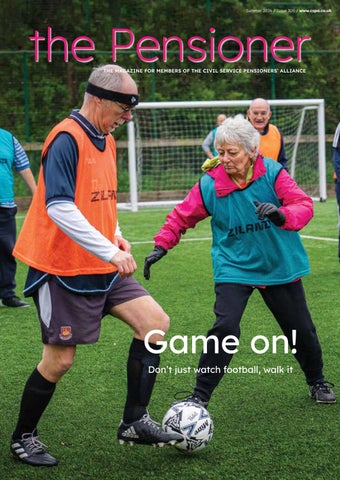
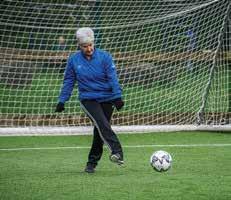
For those lucky enough not to be in this predicament, the summer’s warmer weather and longer days lie ahead. This year it’s a chance to watch the World Cup, especially if you like stopping up late. Our cover feature looks at the rise of walking football and other sports for older participants.
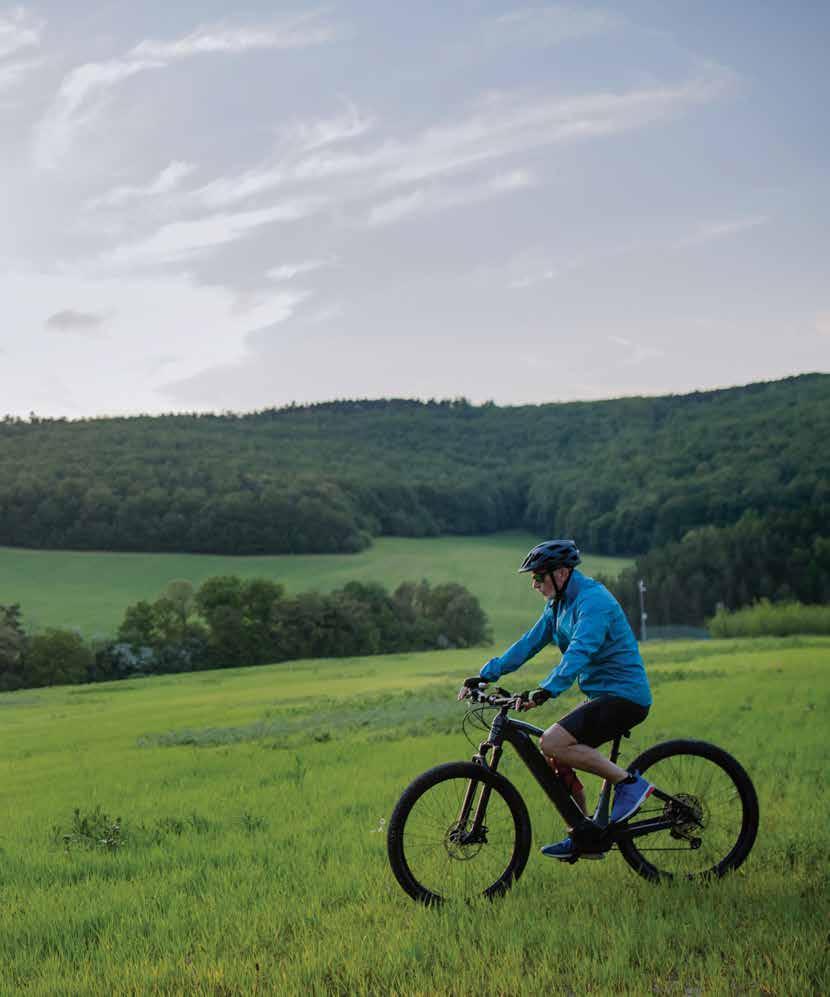
And for those who prefer two wheels to walking, we look at the benefits of cycling in later years.
Lots of people love having a pet around the home when they have more time to be there. However, Chris Proctor sets out why pets only belong in other people’s homes in Something else that annoys me...
I hope you enjoy the summer and this edition of your magazine.
Changes of address or other information enquiries@cspa.co.uk or 020 8688 8418
Scotland changes of address: Michael Kirby Michael.Kirby@cspa.co.uk or 07969 405263 Freepost RUHB-AGAL-SSUA
Editorial
TED BERROW
1932 – 2026
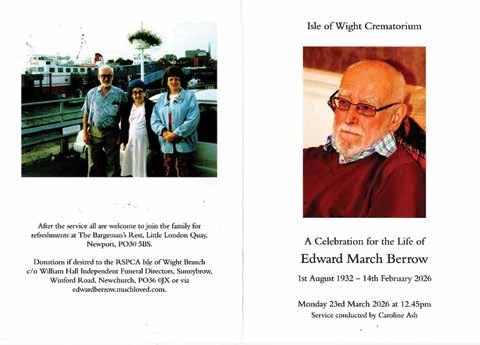
Many members attending our AGM, or the conferences of the Society of Civil and Public Servants (SCPS) and the National Union of Civil and Public Servants (NUCPS), will remember the larger-than-life Ted Berrow. Once seen, never forgotten. Ted passed away on 14 February and will be fondly remembered. He was a political campaigner all his adult life, after joining the youth wing of the Labour Party. He worked at Ordnance Survey in Southampton and became a trade union activist in the SCPS in the 1970s. Rising through the ranks there, he was elected to the National Executive Council and later become a Vice President, a post he held for 10 years. While in the role, the union merged with the Civil Service Union to become the NUCPS.
Ted was a servant of the people, a campaigner for others all his life
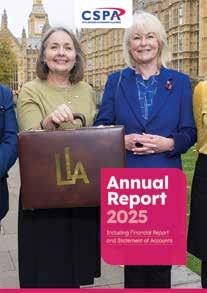
CSPA Annual Report 2025
Last year, we made several efficiency savings to ensure that members’ subscriptions were best used. These included reducing the number of magazine supplements –the Annual Report and AGM Report are now being made available to members in other ways, including online and in the post on request. This has worked well and saved the organisation several thousands of pounds, so we are doing the same again this year, still providing a report produced to professional standards, but with a much smaller print run.
This year’s Annual Report is available online or can be sent by post
We were full-time officials with the union and knew Ted well. He was an extremely knowledgeable, dogged and determined campaigner, but also warm and empathetic – somebody you could always approach for advice and guidance, which he would gladly give.
Ted retired in 1992. He had moved to the Isle of Wight and immediately became active in the CSPA, becoming Secretary
The CSPA Annual Report 2025 is now available to members at www.cspa.co.uk/annual-report or you can ask for a printed copy to be sent in the post by emailing enquiries@cspa.co.uk or by calling us on 020 8688 8418.
of the Isle of Wight Group and attending the AGM while he could. He continued in the role of Secretary, supporting our campaigns, until he died.
The CSPA was represented at his funeral by Regional Representative John Clarke. Ted was a servant of the people, a campaigner for others all his life and will be sorely missed. May he rest in peace. Mike Sparham and John Clarke
Do you want to go to the AGM?
The CSPA’s rules permit any member to attend the AGM, but usually at their own cost. The Executive Council recognises that, as a residential event, the cost is not insignificant and that many members aren’t based in areas covered by active groups or branches.
We are offering up to 12 subsidised places for members this year. The CSPA will meet the full cost of food and accommodation, excluding travel costs but with free shuttle buses to and from Coventry rail station.
Any member interested in the opportunity to take up a supported place at the AGM should contact CSPA HQ by emailing enquiries@cspa.co.uk or calling 0208 688 8418 before the end of August.
The way to incorporation
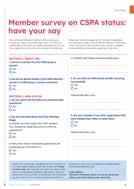
Last year, an AGM motion called on the Executive Council to investigate the costs, risks and benefits of changing the CSPA’s legal status and to consult with all members, groups and branches on it.
The EC had no pre-determined outcome in mind, but the most obvious was to become incorporated as a company limited by guarantee, as many of our partner organisations have done.
Charitable status has proved unviable as the CSPA is unlikely to meet the Charity Commission’s criteria for acting in the wider public interest. Becoming a charity is also likely to limit our ability to campaign on matters deemed ‘political’.
We sought your views in the last issue of The Pensioner via a questionnaire. Meetings in Glasgow, Belfast, Reading, London and Manchester were also held to consult CSPA groups and branches.
We were pleased to receive survey responses from 780 readers and would like to thank all those who took time to do this. More than half (55%) of the responses were from members who are not part of an active CSPA group or branch, and more than 90% are not postholders in any of the CSPA’s democratic structures.
There was a clear majority view that the CSPA should become incorporated, as expressed by 91.5% of respondents.
The EC is considering this feedback, alongside discussion points from the meetings with group and branch representatives, and will look at how to take things forward. Any final decisions will be made at the forthcoming AGM.
If you would like a copy of the full report on the member survey and the round of meetings, please contact CSPA HQ on 020 8688 8418 or email enquiries@cspa.co.uk and we will email or post one to you.
Capita faces more questions from MPs
The Public Accounts Committee (PAC) and the Public Administration and Constitutional Affairs Committee are to jointly question Capita’s administration of the civil service pension scheme.
The two watchdogs have been separately investigating the execution of the scheme, which has seen many pensioners not paid or given inadequate information. And CSPA HQ has continued to deal with many calls from recently retired civil servants wanting help. The CSPA was recognised for its work at a PAC meeting earlier this year.
It is hoped the joint meeting will go ahead in July before Parliament breaks for the summer recess.
Capita took over administration of the scheme from MyCSP in December after an 18-month preparatory period. However, the PAC warned that Capita was not sufficiently prepared before it took over the contract.
In April, Capita’s contract for the Royal Mail pension scheme was terminated
In January, HMRC Deputy Chief Executive Angela MacDonald was brought in to lead an urgent recovery plan, adding 150 extra staff and offering short-term financial support for people suffering hardship.
In April, the government terminated Capita’s contract for managing the Royal Mail pension scheme after it “failed to deliver numerous milestones”, said Cabinet Office minister Nick Thomas-Symonds.
The minister told the Commons that the decision followed repeated concerns over delays and a lack of confidence in Capita’s ability to deliver the new operating model.
Former minister at NI CSPA AGM
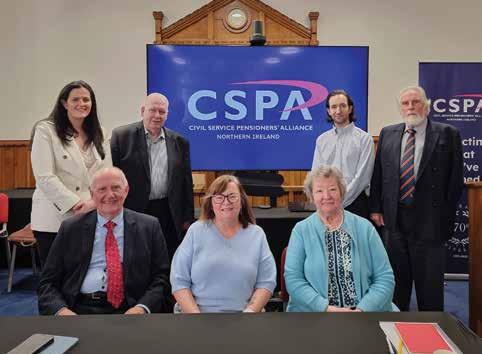
MLA and former Northern Ireland justice minister Claire Sugden spoke at the CSPA NI’s AGM in April, highlighting CSPA NI’s work. “The role you play in representing retired civil
servants is incredibly important. You have not just the lived experience but a real understanding of how government works, how decisions are made, or not made, and how those decisions actually affect people’s lives,” she said.
She spoke of long hospital waiting lists, delays in accessing GPs, transport barriers and isolation for older people, and finished with a call for action.
“Progress will not happen on its own,’ she said. ‘It will happen because people continue to make the case, challenge where needed and work together... That is why your voice matters so much.”
Finance Report for 2025
Mike Sparham, CSPA National Treasurer, highlights the key financial points
The financial statements for the year ending 31 December 2025 are now available to members, including the balance sheet and profit and loss account. This report is a summary of the outturn. For the year ending 31 December 2025, the CSPA made a gross loss of £31,773 after depreciation. When taking into account an increase in the value of the CSPA investment in the aberdeen MyFolio Multi-Manager fund, the net loss for the year was £7,920 before taxation. Corporation tax due is calculated as £3,207, thus giving a loss for the financial year of £11,127.
Comparative figures for 2025 and 2024 are set out in the table. A small loss was expected in 2025, following two years in which a profit was made. The main reason for this is the loss of subscription income, but there are other factors.
Key points to note from the financial results are:
• Total income for the year was £956,342 compared with £989,311 in 2024. Subscription income fell and the VAT payment increased due to a change in the formula for apportionment (the amount of the subscription that is zero rated). Income from advertising in The Pensioner remained broadly the same, whilst income from CSIS commission on
travel insurance policies sold increased.
• The aberdeen investment performed well and the valuation rose from £444,835 to £478,669 (the historical cost of the investment was £380,000).
• The largest item of expenditure (apart from salaries and PAYE) remains The Pensioner, but the cost fell in 2025 as only one supplement was produced.
• The contract with Parliament Hill was not renewed, leading to a significant drop in membership support costs.
A small loss was expected in 2025, following two years in which a profit was made
• There was a significant saving in the cost of the AGM. The gross cost fell from £50,469 to £39,104.
• HR fees rose from £3,150 to £7,450 because two members of staff left during the year and agency support was needed to find replacements for them.
• Office rental and service charge costs are higher following the move to Falcon Road. However, this is partly offset by savings in accommodation costs elsewhere as items previously paid for (for example, cleaning) are now included in the rent.
• Travel and subsistence expenditure fell by £4,618.
• The cost of group newsletters rose due to increased postage rates and the increasing size of groups which have enlarged their geographical area of coverage.
• Total expenditure for the year was £987,112. The depreciation assessment was £1,003.
Finally, the balance sheet shows that total reserves stood at £1.15 million.
If there are any questions, please email me at M.Sparham@cspa.co.uk
Watch out for hackers
David Owen, our tech savvy London Regional Rep, offers
some advice
Relaxing one Sunday, one of our smartphones pinged thrice. Puzzled, I picked it up. The messages started to reveal a wide attack on accounts with financial, retail and subscription services. Four intense days of telephone calls followed. It then took more than two months to resolve follow-up attacks and re-establish near normal activity.
So how did the hack succeed? Most services require password reset processes, but if you use an email or phone number that’s publicly available, you have a potential weak spot. Hackers use this public information to attack those service providers, which may have lower security than a bank.
If they succeed in compromising the account, they can glean further data, as well as using the account to reset passwords on higher security services. Gaining access to Microsoft and Google accounts, which can synchronise with many devices and the cloud, can be particularly useful to hackers.
Don’t be unnerved
Try to stay calm in this stressful situation. Hackers exploit panic. In many cases, the bank is obliged by the Financial Conduct Authority to reimburse losses. It is unlikely the hacker will ever appear in person.
Promptly contact the organisations messaging you using the genuine phone number that you will have on your card or records. Never rely on any number in the message. Hackers generate false alerts with fake contacts to trick you.
Hackers spoof banks’ contact numbers. So look at the message: if it requests
personal or security details, it is the hacker not your bank.
Accounts that the hacker appears to have missed? Alert the relevant organisations to protect accounts in advance of a possible future attack.
Unexpected authorisation or mobile PAC codes received? Do not reveal them to anybody but alert the provider on their genuine number. Consider joining Cifas, a not-for-profit membership organisation that works to eliminate fraud and financial crime (£30 for a two-year registration). More than 750 UK lenders use Cifas to see if additional checks are needed before credit approval. Hackers hate Cifas.
Try to stay calm in this stressful situation. Hackers exploit panic
Compromised email? Check settings with provider before resetting your password. Remember, some email accounts will not prevent simultaneous multiple log-ins.
If your devices have been disabled, or they work but may still be insecure, give BC Technologies a call in office hours, stating that you are calling from the CSPA (see Helpdesk, page 41). They may be able to establish whether you need a simple tweak or the support of your local IT specialist. And when possible, warn your personal contacts to be alert.
In England, Wales and Northern Ireland, get in touch with Report Fraud – https:// www.reportfraud.police.uk/ – if you have a clear understanding of what has
happened. If not, get clarification first. In Scotland, call 101.
Look out for communications from lenders or retailers that have dealt with the hackers and promptly respond where appropriate.
Reduce your exposure
Avoid using your public numbers or emails as account recovery contacts. Avoid using your name in a recovery email address. See my introduction!
Never disable two-factor authorisation on account log-ins, even on your own home devices. Leave any ‘trust this device’ box unticked.
Avoid saving card details to website accounts unless mandated. Retailers love saved cards because you buy more. No saved card makes it less useful to hackers.
Paying online? Use credit cards rather than debit cards whenever possible, and avoid using Faster Payments, particularly to a new and unknown party.
Use the default robotic voice on your voicemail. A personalised message could be copied, AI-processed and used to fool voice ID.
Smartphones use wifi Bluetooth and near-field communication in addition to a mobile signal. Multiple apps enable data transfer. We rarely use some functions. Consider turning unused items off.
Finally, be aware of the potential security implications of passkeys, which bypass traditional passwords on an increasing number of websites, and AI assistants, which may require access to all areas of your device.
• See also Letters, pages 38-39
General Secretary's
Report
Sally Tsoukaris
Hello! As I write, still contemplating the English local election results, and those of the Scottish and Welsh parliaments, I am enjoying some welcome rays of sunshine across my desk.
I am so proud of our dedicated team at CSPA HQ, who have worked very hard, with passion and empathy, over the first half of this year to help CSPA members affected by the chaos since the transition of pensions administration to Capita.
An unprecedented number of new members have joined recently, and we welcome them with open arms, but all too many have needed our help, support and advice to resolve pension-related issues.
It’s shameful that after decades of service, so many retiring civil servants have been let down and had to endure hardship while waiting for their pensions, often with no communication from Capita.
The word ‘unacceptable’ has been uttered time and again – by Capita, Cabinet Office, ministers and MPs,
After decades of service, so many retiring civil servants have been let down
even those chairing the influential Public Accounts Committee and Public Administration and Constitutional Affairs Committee. But all this is cold comfort for those trying to make ends meet.
We also have members in the process of retiring, or planning retirement, who have no access to the online tools needed to estimate what their pension income might be or any of the paperwork they need from the administrators.
I salute CSPA members who have shared their stories with the media, enabling us to maintain pressure on Capita, the Cabinet Office and ministers to get members’ issues resolved.
The end-of-June deadline to which Capita is committed for delivering its contractual service obligations is fast approaching. If this cannot be achieved, questions must be asked about how the service can be retrieved, delivered by others or brought in-house, with the latter option the obvious longer term solution.
These issues cut to the core of the CSPA’s reason for being – “protecting what you’ve earned”. So be assured: we will not rest until an acceptable solution has been found, however long that may take.
Collaborative efforts
We continue to work closely with and support our partners the Charity for Civil Servants, the Civil Service Retirement Fellowship (CSRF) and the Civil Service Insurance Society (CSIS).
This mutual support was demonstrated recently when we collaborated with the Charity and the CSRF to get our income streams from member payments from pensions flowing again. These had ceased for a couple of months after the Capita transition in December – causing our national Treasurer to have sleepless nights!
CSPA Annual General Meeting 2026
Our CSPA HQ team is hard at work preparing for the 2026 AGM. The event, to be held again at the Chesford Grange Hotel in Warwickshire (pictured) on 7-8 October, gives members a chance to make and renew friendships, hear updates and participate in debates. Each year, groups and branches submit motions, suggest rule amendments and enter nominations to Executive Council posts for their members. Under our rules, individual members who are not part of active
local groups or branches can also attend the AGM, make nominations and submit motions for debate. Please get in touch if you would like to be involved, as support and advice is always available.
The deadline for submission of all AGM motions, constitutional amendments and
nominations is Friday 3 July, with our AGM delegate lists finalised in early September. Please contact us if you would like the forms for submitting nominations, motions or amendments to be sent to you in the post or by email. This year, for the first time, it is possible to make these submissions easily online if you wish to.
Ballot papers for any contested EC posts will be issued with the September edition of The Pensioner, so please look out for these and return your votes.
Campaigning on AGM priorities
The CSPA, along with our Later Life Ambitions partners, continues to campaign vigorously and to be quoted in the press in support of:
• The state pension
• The need to maintain the triple-lock to increase it in line with the cost of living and average earnings
• The differences between the basic and full ‘new’ state pension
• The need to combat the erosion of pensioners’ income through taxation – particularly for those on lower incomes – due to the frozen personal income threshold.
In a recent report, the Tony Blair Institute called for the state pension to be abolished and replaced by a new system – known as the Lifespan Fund
The Tony Blair Institute has called for the state pension to be replaced
– which would require some people to work an additional five years to receive the same payout. Sir Tony Blair has called the current system “outdated, rigid and increasingly unaffordable”.
Whilst the CSPA stands resolutely in support of the state pension, official figures show that the number of retirees is set to rise from 12.6 million today to nearly 19 million by 2070, potentially increasing the cost of pensions to 8% of GDP.
However, campaigners have warned political parties that they face being “annihilated” at the ballot box if they fail to commit to the state pension triple-lock, with polling showing that only one in 20 people would contemplate scrapping it.
There is a clear generational divide, with more than two thirds of babyboomers (68% of those aged 62 to 80) supporting the triple-lock, compared with just 14% of those aged 18 to 29.
Support the WASPI cause
There has been no change in the government stance – that women were adequately informed of the rising state pension age all along, and that any form of compensation would be unaffordable. Constituents contacting their MPs can have an impact, however. If this matters to you and you haven’t done so already, we encourage you to write to your MP to
ask them to take up the issue with work and pensions minister Pat McFadden.
The WASPI (Women Against State Pension Inequality) website – www. waspi.co.uk – has resources to assist you, including details of WASPI women in your constituency, to help you point out the potential impact in terms of votes cast in future elections.
Social care reform: the wait continues
Our hopes for prompt government action on a national social care framework integrated with the NHS were lowered by the announcement of the Casey Review’s terms of reference, suggesting a phase 1 report to be delivered this summer and a phase 2 report in 2028.
The CSPA is one of more than 60 organisations affiliated to the Care and Support Alliance (CSA), which aims to raise the profile of social care on the political agenda. On 2 March, the CSA published an open letter to Baroness Casey to share its priorities, aspirations and insights on adult social care, feeding into phase 1 of the Adult Social Care Commission’s work.
The Commission is expected to launch its “national conversation” in late spring. We understand this will involve a series of events over a year, gathering insights to shape the final report.
The Commission is expected to publish a “0.5 report” this summer, expanding on the priorities identified in Baroness Casey’s set of recommendations announced in March. This interim report is separate to the full phase 1 report, which is expected to be published later this year.
The CSPA is also involved in the Carer Poverty Coalition of more than 100 organisations campaigning to end carer poverty, improve support for unpaid carers and end Carer’s Allowance overpayments.
The CSPA was a co-signatory to its Allowance 50th anniversary open letter to the secretary of state on 2 April, to which social security minister Sir Stephen Timms responded. We are pleased the minister recognises the need to modernise the benefit and is exploring options for reform.
He said: “As we celebrate the 50th anniversary of the introduction of CA, the next few years will see some of the most significant reform since it was introduced, reflecting the importance we attach to supporting unpaid carers.”
We will monitor progress on this and call for a comprehensive review of the benefit.
The
Care
and
Support Alliance aims to raise the profile of social care
NPC: end of an era
Mike Sparham looks back at the history of the National Pensioners Convention
The National Pensioners Convention (NPC) was formed in 1979, the inspiration of Jack Jones, former General Secretary of the Transport & General Workers Union. While he saw the TUC as a campaigning organisation for workers bringing together trade unions, there was no similar body for pensioners. His vision was to link various pensioner movements and charities with the TUC in one body, to stop ministers playing off one organisation against another and to lobby for improved conditions for older people.
The TUC supported the creation of the NPC, providing it with financial, research and administrative support in its early years. Many trade unions showed their support by attending the Convention’s first meeting in Central Hall, Westminster, on 14 June 1979. More than 2,000 people came to the event, which was chaired by Tom Jackson, General Secretary of the Communication Workers Union.
Pensioner groups also supported the NPC and the CSPA was involved from the start, sending four representatives to the inaugural meeting and recognising that there was a need for an organisation run by pensioners for pensioners.
Together, the unions and pensioner
groups made the NPC a success. The CSPA has participated in NPC campaigns at a national and local level, with many local groups affiliating to their local NPC region.
The annual Pensioners Parliament/ Convention provided a forum at which CSPA representatives, along with other pensioner groups and individual pensioners, would listen to presentations from experts and discuss matters of interest to pensioners.
We hope that the transition of the NPC to a limited company is a success
CSPA President Brian Sturtevant played a key role in chairing sessions at the Parliament/Convention on pensioner income and poverty, and other CSPA representatives have been active in many NPC regions and on working parties.
Successful NPC campaigns have included the restoration of the link to earnings for the state pension, the introduction of the winter fuel payment in 1997 and its restoration last year, the national free bus pass in England, and the reduction in VAT on fuel.
There remains a need for an NPC, but the landscape has changed since 1979 and the financial situation has deteriorated.
The NPC was an unincorporated association and, last February, the decision was taken to wind it up and transfer its remaining assets into a company limited by guarantee that had been established by the NPC in 2025 to protect its legacy.
The company had been dormant but became active on 1 April 2026 and its first task is to put in place a democratic structure and rebuild the NPC.
There are campaigning objectives still to be achieved and attacks on pensioner benefits to be continually resisted. The pensioner movement is made stronger by having the NPC.
The CSPA supported the winding up of the unincorporated association and its transition to a company limited by guarantee. The Executive Council hopes the transition will be a success and that the NPC can continue to honour the vision of Jack Jones 47 years ago.
BELOW: Jack Jones in action; and Central Hall, Westminster, the inaugural meeting place of the NPC
Making the case for cycling evokes strong feelings among some drivers and pedestrians. I don’t defend bad cyclists, but I refrain from responding to all the usual accusations levelled at cyclists, as it will prevent me from getting to the purpose of this article.
There is a perception that cyclists cause the most accidents to pedestrians. I accept there is a serious issue for pedestrians of cyclists riding illegally on footways, but Department for Transport statistics reveal that more than 99% of fatalities to pedestrians on footways are caused by motor vehicles. For minor and serious injuries, the figure is 98-99%.
It doesn’t excuse the cyclists – even if they don’t cause accidents, thoughtless riding is frightening for pedestrians – but an informed perspective is important.
Since May 2014, the charity Cycling UK (CUK), which I represent, supported by pedestrians organisation Living Streets, the AA and RAC, has called for a review of the traffic laws for all road users.
We accept that includes cyclists – for example, there is no clear definition of what constitutes careless or dangerous cycling – but we maintain it is unclear for driving too. The review has been continually promised but delayed. So it’s galling for us when politicians keep raising issues about cyclists, who cause the fewest injuries and fatalities by massive margins.
My reason for this article is because it’s
tragic that the issue of illegally adapted e-bikes (which effectively become e-motorbikes) overshadows the great good done by legal e-bikes (whose motors cut out at 15.5mph).
Positive pedalling
First let’s look at the advantages of cycling generally, then I’ll explain how e-bikes fit in. One obvious benefit of more cycling and less driving is the colossal reduction in carbon emissions. Less traffic congestion also makes life easier for everyone.
Most people accept that cycling has significant health benefits, but it represents a highly beneficial, low-impact exercise for adults over the age of 65, offering a mix of physical, mental and social advantages that can improve the quality of life and increase independence.
Regular cycling helps manage agerelated physiological decline, strengthens muscles and joints, and offers substantial cardiovascular benefits without the impact on joints of running or jogging.
Anyone of any age who cycles regularly potentially saves the NHS money. The Walk Wheel Cycle Trust (formerly Sustrans) reports that active travel (cycling, walking and wheeling) saved the NHS £2 billion in 2025, and Bristol’s cycling infrastructure saved the local NHS £15 million.
On your bike!
John Thompson enthuses about the many benefits of riding a bicycle – especially as we get older
It would be interesting to know how many CSPA members own legal e-bikes, as they are popular with older people.
CUK has many reports of older people with mobility issues who have found a new lease of life using e-bikes. An unassisted bike would be too much for them but an e-bike is manageable.
There are reports of many older people using e-bikes to aid recovery from
Anyone of any age who cycles regularly potentially saves the NHS money
serious illness or operations – see https:// electricbikeblog.com/case-studies-3seniors-electric-bikes/. Of course, many older people use them simply because they’re not as young as they were, so find hills and headwinds more difficult.
Economic benefits
Cycling helps the economy too. Those who shop by bicycle spend less on individual trips than those shopping by car, but
make more trips, so spend more overall. In London and Newcastle, where car parking spaces are being reduced to enable cycle paths, retailers found business improved. This is partly because those on bicycles are able to stop and window-shop.
Shopping by bike is not as limiting as is often assumed. Much can be carried in panniers, and even more in a cargo trailer. Some people do their weekly food shop by bike and trailer.
Studies in London have found that walking and cycling improvements have increased retail sales by up to 30% –because cyclists carry less, they tend to spend more in shops than other tourists.
Supermarket chains Co-op, Asda and Sainsbury’s and online retailer Amazon use e-cargo bikes for deliveries in high-density urban areas because they’re quicker –which means better customer service –and cheaper than using vans. This might also contribute to a healthier workforce.
And two NHS ambulance trusts –London and East of England – send out paramedics on e-bikes, reaching incidents in congested areas more quickly.
I hope this article has persuaded some readers to consider cycling. And if you feel you aren’t fit enough to cope with an unassisted bike, perhaps you’ll invest in an e-bike. The initial outlay may be expensive, but good models are available for less than £1,000.
And consider what you’ll save in the long run by not nipping to the shops in your car – no petrol or parking charges, no hassle finding a parking space, less wear and tear on your car. As one motor mechanic told me: “Cars don’t like short journeys.”
CUK offers comprehensive advice on choosing the right e-bike, so take a look at our website – cyclinguk.org – and enter “electric bikes” in the search.
Floating bus stops
You might feel daunted by the thought of cycling in today’s traffic conditions. That is why good cycling infrastructure is important. This leads us to the issue of floating bus stops.
CUK believes they can be safe, including for the blind and partially sighted, if they are sensibly designed, as they have
been in several European countries. It’s important that such facilities are safe for pedestrians too.
It was CUK that started the campaign for the new Highway Code rule for a hierarchy of road users. We accept that pedestrians should be at the top.
Our only quibble is that we would have preferred a hierarchy of responsibility, which, ironically, would put pedestrians at the bottom – but for the same reason they are at the top of a road user hierarchy.
If you feel you would need some help returning to cycling, CUK provides a ‘buddy’ scheme. And in some areas there are affiliated Community Cycle Clubs that are dedicated to helping those who have never cycled, or have not been on a bike for a long time, to become confident.
In his article in The Pensioner Spring 2026 edition, David Luxton commented that it’s great the Rolling Stones are proving there can be an active life after 80. Well, Mick Jagger likes cycling.
So, if any readers enjoy the benefits of better health as a result of this article, I will be very happy.
Fast forward
Jonathan Safir on a busy introduction to his job
Since beginning in my role in February, it has been a frenetic but rewarding few months. I’ve had the privilege of meeting CSPA members across the country, attending group and branch AGMs and working with partner organisations on shared campaigns.
Alongside this, the CSPA has been holding weekly meetings with the Cabinet Office to advocate on behalf of members experiencing difficulties with the civil service pension scheme, particularly following the transition to Capita. These are vital in ensuring members’ concerns are heard at the highest levels.
Significant progress has also been made behind the scenes. We have been reviewing our approach to member recruitment and assessing the range of benefits we offer, ensuring they remain relevant and valuable. None of this would be possible without the dedication of colleagues at headquarters, whose professionalism and commitment underpin everything we do.
These early months have unfolded against a backdrop of political and
economic uncertainty, with intense public debate and cost of living pressures affecting many of our members, particularly those on fixed incomes.
On 7 May, voters across Great Britain took part in elections for the Scottish Parliament, Senedd Cymru and local authorities across England. In England, results from more than 130 councils showed a clear shift in voter sentiment, with notable losses for Labour and the Conservatives and significant gains for Reform UK. The Liberal Democrats and Greens also increased their representation.
In Scotland, the SNP remained the largest party but fell short of a majority, with smaller parties gaining ground. In Wales, the Senedd election produced a dramatic shift, with Labour losing ground after decades of dominance and Plaid Cymru and Reform UK emerging as the leading parties, but neither with a majority.
We have been reviewing our approach to member recruitment and benefits
The results show growing electoral fragmentation and increased support for parties outside the two-party system.
Later Life Ambitions’ election toolkit explained why these elections mattered and how devolved and local decisions affect issues such as social care, housing and transport. Its Budget for Later Life also outlined priorities and provided tools such as template letters to help members raise concerns with candidates.
The toolkit emphasised the importance of ongoing engagement, offering guidance on contacting newly elected representatives, reinforcing priorities and contributing to wider discussions through media and social platforms.
Pension rises
In April, civil service pensions increased by 3.8%, reflecting CPI inflation from September 2025. This brings the average pension to about £10,478 a year in 2026/27. In Northern Ireland, the average civil service pension is higher, at £12,415.
With inflation currently around 3.3% and potentially rising, this increase compares favourably with last year’s 1.7% uplift, which lagged behind inflation. Even so, rising everyday costs continue to erode financial security. Food inflation has slowed but remains well above historic norms, adding strain on households where essentials form a large share of spending.
The Bank of England’s base rate was held at 3.75%, but policymakers have been clear that this position depends on global developments. Escalation in the Middle East and sharp rises in oil prices have introduced significant uncertainty. With oil briefly reaching $126 a barrel, the Bank has modelled scenarios ranging from inflation easing later this year to exceeding 6% and substantial interest rate rises.
The risks are clear. Higher energy and food costs would disproportionately affect lower income households where finances are already stretched.
Energy bills fell by around 7% in April, reducing average household annual costs
Jonathan with the CSPA in Northern Ireland
to £1,641 under Ofgem’s price cap. This respite may be brief. Analysts expect a sharp rise from July, with the price cap potentially rising by almost £300 as wholesale prices feed through. In Northern Ireland, where no equivalent cap exists, typical combined electricity and gas bills are nearing £1,900 a year.
Other household bills are rising too. With water bills in England and Wales up by an average of 5.4%, the CSPA is supporting Independent Age’s petition on social water tariffs. Many councils are raising council tax close to the maximum permitted level, with some permitted to go further. For millions of households, these increases compound existing financial pressures.
Housing costs are one of the biggest pressures on household budgets. From 1 May, England’s Renters’ Rights Act marks a significant overhaul of private renting. Fixed term tenancies are abolished in favour of rolling agreements, ‘no fault’ evictions ended, rent rises restricted and discrimination against tenants on benefits or with children outlawed.
While council enforcement powers have been strengthened, concerns remain about court capacity and housing supply. Reports suggest that the Chancellor is considering a one-year rent freeze as part of a wider cost of living package. Supporters see this as urgent relief; critics warn it could deter new supply unless matched by large-scale housebuilding.
Looking ahead
During these first few months in post, I have been struck by the commitment, insight and support that run through the CSPA and I look forward to building on this. There’s no doubt there will be challenges, but I’m confident in the difference we can make by focusing on what matters to members.
Above all, I hope to ensure that members’ experiences and concerns are listened to and understood, and I look forward to working with many more of you as we do just that.
Pensions issues
The future of the state pension and triple-lock have again been in the headlines. Proposals range from means-testing to scrapping the triple-lock, but the government has committed to maintaining the policy for the remainder of this Parliament.
For the CSPA, this reinforces the importance of campaigning, as many people approaching retirement rely on the state pension.
Age UK has highlighted the scale of the issue. More than three million pensioners are struggling financially, with 28% reporting difficulty making ends meet. At the same time, frozen tax thresholds mean rising pensions are drawing more pensioners into income tax. In 2023/24, 8.16 million taxpayers were aged over 66, a million more than the previous year.
Another area under scrutiny is the gender pension gap. The civil service pension scheme does not report on this, though mandatory reporting is being introduced in the local government pension scheme in England and Wales. In Northern
More than three million pensioners are struggling financially
Ireland, the average civil service pension is £12,415 but with stark differences. Retired male civil servants receive on average £15,382, women £9,613, a gap of about 37.5%.
Prospect research shows the average gender pension gap across schemes was 32.9% in 2023/24, down from 44.9% in 2011/12. While this is encouraging, the UK still has the second highest gap in the OECD, equivalent to £7,200 per year.
This varies widely, ranging from 60.5% in the NHS pension scheme (England and Wales) to 44.5% in the UK civil service pension scheme, and 26.5% in the teachers’ pension scheme (England and Wales).
The phased increase in the state pension age from 66 to 67 is under way. While this saves public finances billions, previous increases have been linked to sharp rises in poverty among those just below pension age, especially those with ill health.
People in the UK now spend fewer years in good health than a decade ago, with stark disparities between affluent and deprived areas. Healthy life expectancy for men and women fell by two years in the last decade, with poor health increasingly forcing people out of work.
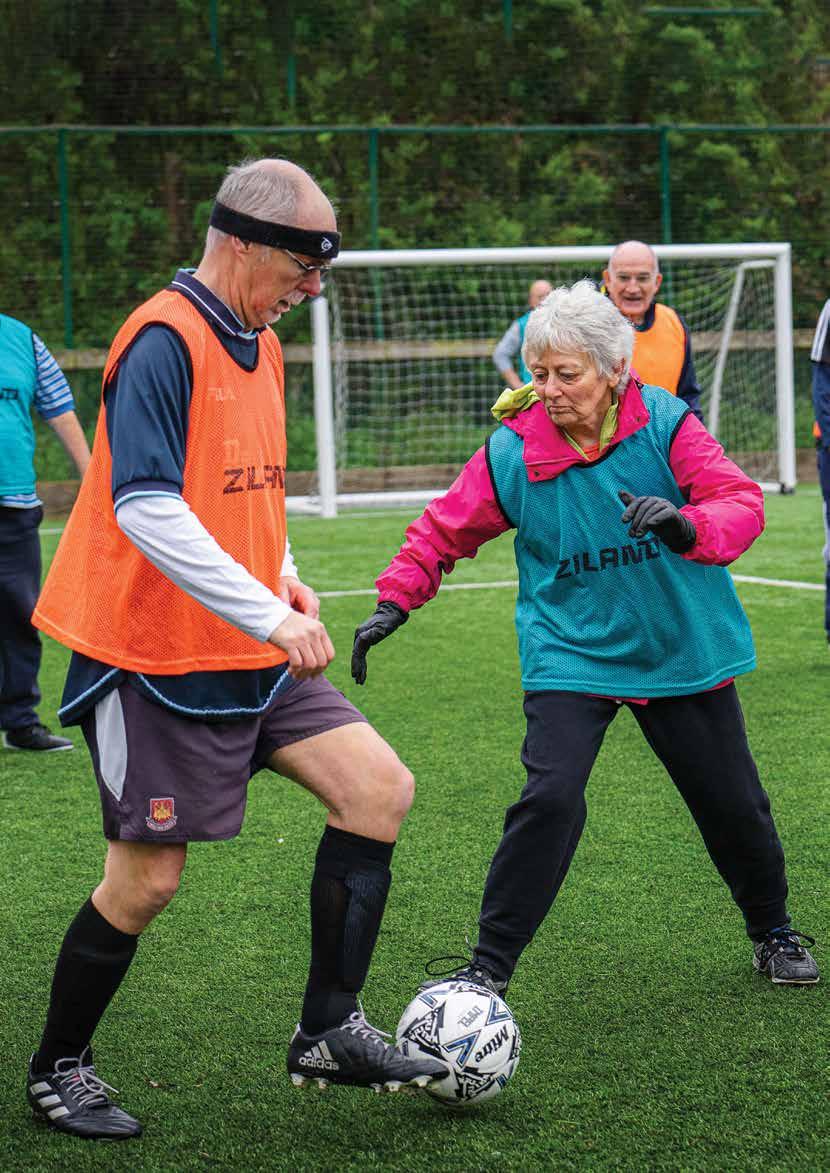
Fifteen years ago, it didn’t exist. Now more than 100,000 people play walking football at clubs across England. And the sport’s World Nations Cup is now held every two years.
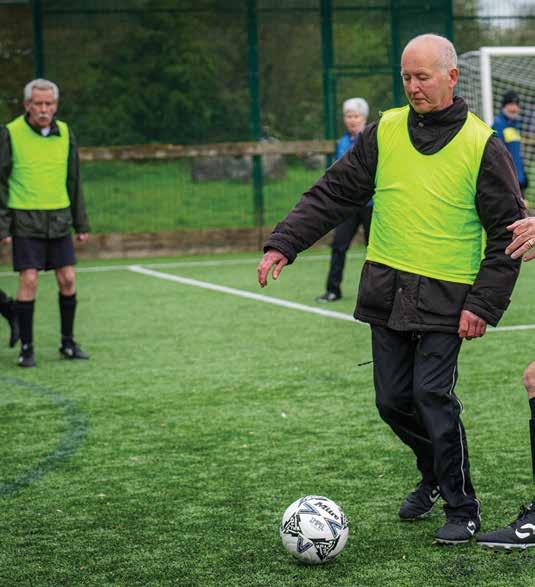
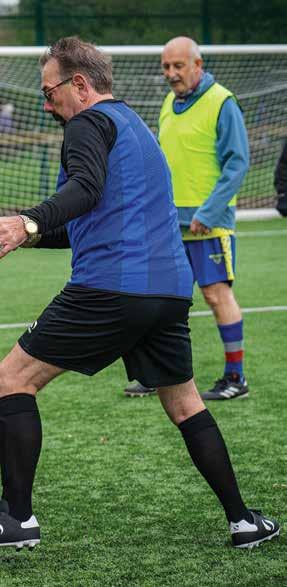
While football fans will be glued to the FIFA World Cup this summer, there won’t be any headers or sliding tackles in walking football matches. Physical contact is prohibited, the ball must remain below head height, and running is not allowed.
Stuart Langworthy is the England manager for the over-60s walking football team and a director at the Walking Football Association. He says the rules are built for safety, including no tackling from behind, because most players are over 50, many with long-term health conditions.
“Most of it is played for fun and friendship at local clubs,” he says. “People turn up, put their money in a pot, grab a bib and play. There’s a cup of tea or coffee afterwards, which is just as important as the game. It’s the mental health and the sense of belonging to a group.”
In its current format – six-a-side on a smaller pitch, about 20 minutes each way – walking football is played in more than 80 countries. It was invented by John Croot in 2011. “John Croot was a director for Chesterfield Football Club [he is currently CEO],” Langworthy explains. “His older members in the community went to him and said they wanted to carry on playing a version of football, and they came up with walking football.”
Today, there’s a multitude of walking football England teams – over-40s, 50s and 60s for women, and over-50s, 60s, 65s, 70s, 75s and 80s for men. There is also a Parkinson’s England team, as well as a Kicking Cancer team, for men and women.
Langworthy, a retired teacher, is a double World Nations Cup winner. “The over-60s England team won the World Nations Cup last year and in 2023. We have the European Championships in
Walking into fitness
Helen
Nugent hears about the
many
benefits of staying active in older age
November this year and the next World Nations Cup the following year.”
Langworthy’s passion for the sport is clear, as is his gratitude for trips to Hong Kong, Malaysia, Singapore, Rwanda and Brazil. “Sometimes you have to remind yourself how lucky we are to still be playing the incredible game at our age,” he says. “Fifteen years ago it didn’t exist.”
Pace of change
Other walking sports have sprung up too – rugby, netball, cricket, tennis and hockey. It’s not surprising older people want to continue to play the sport they love, albeit at a slower pace. Just witness the demand for activity in later life with u3a, one of the UK’s largest membership organisations. With more than 400,000 members, u3a offers groups and activities for people in retirement or semi-retirement. This includes a wide range of sports, from walking football, table tennis and yachting to netball, archery and laughter yoga.
A u3a spokesperson says: “The benefits of exercise are obviously physical, but mentally the benefits are off the scale. A lot of people have been widowed or they’re divorced and they’ve moved to an area on
their own. With u3a, they get a social life and a group of friends they can tap into when they need to.”
A report by u3a in 2024, Learn to Live, said social isolation and loneliness have become increasingly widespread among older people, shortening lives and harming mental and physical health.
James Hilton understands the importance of exercise and wellbeing as people age. He founded Jim’s Gym, an online gym and community for over-55s, offering live online classes for a monthly fee of £12.99. At present, a wide variety of classes include seated fitness and pilates.
Jim’s Gym is mainly aimed at older people who know they should be doing something to keep fit and healthy but don’t know where to start.
Hilton explains how classes are tailored to the over-55s. “The most powerful thing is helping people build confidence in what they’re able to do. That’s really important. So, the classes have varying degrees of intensity levels to suit all members. In a lot of my classes, I do seated options. But it’s also about putting emphasis on getting people to take part and do what they can.
“The most important thing about
“How lucky we are to still be playing the incredible game at our age”
keeping active is trying to work out why it’s important to the individual. This might be enjoying as much time as they can with their grandchild or pursuing their passion for gardening. If you can stay active, the health benefits are a knock-on effect.”
Glenys Adkinson, a member of Jim’s Gym, recently celebrated her 80th birthday. “It’s important for me to stay fit and healthy to maintain my independence and keep up with my interests, which include walking. Doing James’s selection and variety of classes means I’m at the front of walking groups, my stamina has improved, and I feel stronger and fitter.”
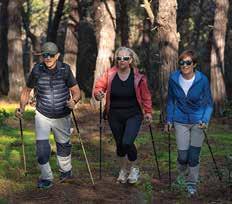
Ivan Baxter is also aware of the importance of staying fit. At 86, he leads hikes for two walking groups in Northern Ireland. One of his favourite walks is a sixmile route in Crawfordsburn Country Park, County Down, which takes in a waterfall and the shoreline among other things.
“You get withdrawal symptoms if you can’t get out,” he says. “Apart from the
exercise, you have the social aspect. Normally we go for a meal or a coffee afterwards, or we bring our own lunches and have a chat. People talk to each other when they’re walking. It’s important you don’t get isolated in your own home.”
Health benefits
NHS guidelines suggest adults over 65 should aim to be physically active every day, completing at least 150 minutes of moderate activity each week or 75 minutes of vigorous activity for those already active.
If running rather than walking is more appealing, ease in gently with a slow jog. Many people use lamp posts as a guide, jogging between two, then walking between two, and slowly increasing the number.
Tina Chantrey, running coach and fitness editor of Women’s Running magazine, highlights the many benefits of running as you age. “They include improving bone density, which can decline as you age, helping to protect yourself
from fractures. You will also be boosting your cardiovascular [heart and blood vessel] health. If you start to run regularly, you may find you start to lose weight, too. Running and strength work can also improve your mobility and balance, which reduces the risk of falls.
“As important are the mental health benefits: exercise may boost your brain function and improve your sleep. And getting outside to run may massively impact your sense of wellness, reducing anxiety.”
Back on the football pitch, 63-year-old David Hodgson says walking football makes him feel 19 again. Hodgson retired from work “after a bout of bowel cancer”. He’d heard of walking football, searched the web for local groups, and now plays for the Whitehaven Strollers.
“It’s great fun,” he says. “The spin-offs are making new friends and physical and mental fitness, but more importantly, being in a group who can talk about being old. On the pitch, we can forget our ailments or sorrows and be 19 again.”
England Men’s Over-60s World Nations Cup winners 2025 THE WALKING FOOTBALL ASSOCIATION
We must shift to prevention
International Longevity Centre chief warns that the UK’s health is going in the wrong direction. Jenny Sims reports
Action is urgently needed to confront the huge challenges of ageing populations and to embrace the opportunities of long lives. So said policymakers, healthcare professionals and other experts at the International Longevity Centre (ILC)’s Future of Ageing conference in London in March.
ILC Chief Executive David Sinclair had called for a “decisive shift towards prevention” when the Office for National Statistics (ONS) published its bulletin, Healthy life expectancy, UK: between 2011 to 2013 and 2022 to 2024 weeks before the conference – but it couldn’t have been more relevant on the day.
He had said the “shocking” ONS figures showed clearly that “despite rising NHS spending, the UK’s health is going in the wrong direction”. “We’ve long warned that people in the most deprived communities are living shorter lives in good health – in some cases on a par with, or worse than, people in low-income countries.”
Comparing the latest ONS data with the ILC’s Global Healthy Ageing and Prevention Index, he concluded it should “stop us in our tracks”.
The conference consensus was that good health in later years cannot be addressed by doing more of the same.
Additional support should be given to communities as needed, with targeted investment “so the system helps people stay well rather than simply treating them once they become ill”.
Sinclair warned: “Living
in poor health removes people’s wider chances of a good life – and impacts on those around them. So, if we are serious about achieving better, longer lives, we must tackle the social, economic and health barriers that hold people back –and make sure that every place has the conditions for people to age well.”
Creating communities
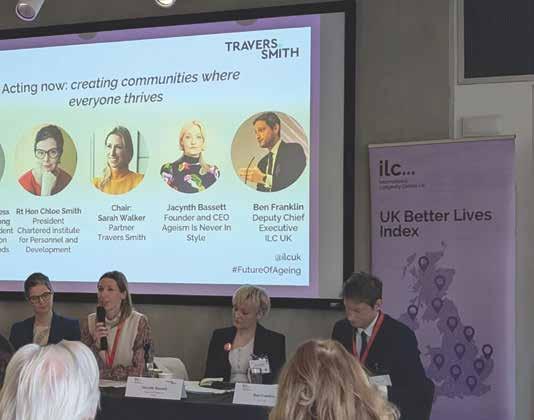
During the first session on ‘creating communities where everyone thrives’ panellists were asked: “With populations ageing rapidly and resources stretched, how can policymakers, workplaces and learning centres urgently collaborate within their communities to tackle deepening inequality and rising isolation – so all people and places can experience longer, better lives?”
Two words were key here –“engagement” and “empowerment” – as was ensuring local people are asked about their experiences and views before policies are decided in communities or nationally.
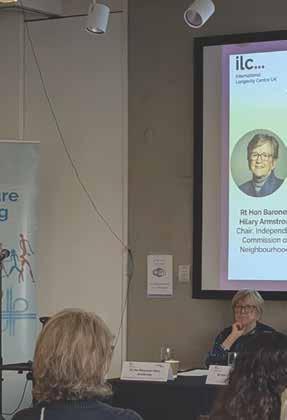
Baroness Hilary Armstrong, 80, is chair of the Independent Commission on Neighbourhoods (ICON), which believes thriving communities are built through longterm investment in social infrastructure as opposed to short-term fixes. She began by asking: “How many of you live and work outside London?” Quite a lot of hands shot up. “That’s good,” she said. “And how many of you live and work
50 miles outside London?” More hands went up, seemingly to her surprise. “That’s good, because things are very different in London from the rest of the country.”
She explained: “In our work at ICON, we identified early the 613 most disadvantaged neighbourhoods where investment was needed – and none were in London. That is largely, I think, because in London, opportunities are always different because of transport routes.”
She said her “other big job” was chairing an independent committee for the Department for Science, Innovation and Technology on digital inclusion. “The neighbourhood work and digital inclusion go side by side,” she added.
Chloe Smith, former work and pensions secretary and now President of CIPD, has extensive experience in technological change and workforce transformation. Asked to suggest how we should support people working into their 80s and continuing to contribute to community projects, she said human resources should be promoted in businesses and training offered to older people in Jobcentres.
In a session on ‘shifting from sickness service to prevention for healthier lives’, chair Arunima Himawan, an ILC researcher, said: “With multimorbidity rising and health systems under growing pressure, we need to improve how we approach prevention. That means learning from models around the world and adapting them closer to home. One example is the Brazilian community health model, elements of which are now being explored in parts of the NHS in London. “
Costs and savings
One delegate asked: “Prevention and co-ordination are important, but what will it cost – and what will it save? If we prevent people dying today, what will they die from later?”
Adrian Hayter, a GP at Partner Runnymede Medical Practice and a director at the Royal College of General
“If we only focus on older people, we are already intervening too late”
In perspective
The average healthy life expectancy of people in Afghanistan is more than two years longer than people living in Blackpool and Sandwell – among the worst places to be born in the UK, according to the ILC and the Office for National Statistics.
• ILC Global Healthy Ageing and Prevention Index (flagship international barometer of health ageing) – https://ilcuk.org.uk/ preventionindex/
• ONS statistical bulletin Healthy life expectancy, UK: between 2011 to 2013 and 2022 to 2024, published 19 February 2026 –https://tinyurl.com/2zsfe9kh
Practitioners, answered: “If we increased spending on prevention in primary care from around 5% to 6%, we could save around £42 billion.
“Even small changes in consultation time can make a difference. For example, increasing appointments from 10 minutes to 15 minutes would mean seeing around 40 patients instead of 60, but it would create more space for prevention.”
The voluntary sector was a crucial partner in prevention, he added. There was strong evidence showing the impact of voluntary programmes, “although the outcomes are often measured in terms of wellbeing rather than hard clinical outcomes”.
He warned: “Integration will not be effective unless investment in the voluntary sector is recognised as genuine investment rather than simply expenditure.”
One of the most effective investments in his 35 years as a GP, he said, was a voluntary sector falls prevention programme that significantly reduced fall risks and admissions to A&E.
“The key issue is how partnerships
operate,” he said. “They need to be well coordinated, synergistic and sustainable. End-of-life care and the hospice sector also present important opportunities for partnership and preventive approaches.”
Karen Glaser, professor of gerontology at King’s College London, cited a 2025 GP Voice Survey that found 75% GPs do not have enough time to offer preventive health advice – for example, on vaccinations and healthy lifestyles.
“That is not a failure of GPs; it is a failure of the system,” she said, stressing that a lifelong perspective is crucial. “If we only focus on older people, we are already intervening too late,” she added.
Dr Hayter agreed: “We know that some diseases begin developing in people’s 30s, which means we have to act much earlier.”
The chair asked panellists: “If you could redesign one part of the health or local government system to prioritise prevention, what would it be and why? “
Professor Glaser pointed to “social care”, which critically needed reform.
“Reform would support independence and strengthen communities, but it would also have wider knock-on effects through better integration between health and social care systems,” she said.
The conference was a full and fulfilling day. At the start, delegates were told rising health and pension costs, alongside mounting national debt, make the status quo unsustainable, but healthier, longer working lives could deliver a powerful economic dividend.
Few at the end of the conference were left in any doubt: acting now on ageing is not an option; it is essential.
Hanging on the telephone
In 1978, when many of us were in the early years of our civil service careers, Debbie Harry and her band Blondie had their first hit with Hanging on the telephone. Some 48 years on, that song has become the lived experience of so many civil servants trying to contact pension administrator Capita, which took over the running of the pension scheme from 1 December.
Since then, many CSPA members have been left waiting over four hours for the phone to be answered, only to be told no information is available on the progress of their delayed pension. And no alternative parallel lines been given to call.
Tens of thousands of retired civil servants, and the widows of deceased pensioners, have suffered stress and financial hardship due to delayed payment of lump sums and pensions – made worse by inadequate communications from Capita and system failures in the roll-out of the new pension portal.
How we’ve helped
The CSPA has been supporting hundreds of members affected by the delays. One such case is James Fenny MBE, who had worked in the Ministry of Justice for 25 years as a Solicitor Advocate. Following a period of ill health, James was given a terminal prognosis in October last year and so applied for early medical retirement from the end of October, agreed with the Ministry of Justice.
His lump sum and pension payment was due at the end of November. But James and his family were left with no income from November to mid-February this year, when a partial pension payment was made but no information on when his arrears would come. Despite spending hours on the phone, he was told for months his case “had been escalated”, causing James and his family huge distress on top of worries about his health.
The CSPA took up his case with the Cabinet Office, and raised it with the
Pensions Manager David Luxton been helping members cope with the Capita meltdown
Parliamentary Public Accounts Committee (PAC), which highlighted James’ experience at a televised hearing on 26 March at which the PAC questioned the leaders of Capita. Within days of that, James received the pensions arrears and expressed his thanks to the CSPA.
PAC Deputy Chair Clive Betts said at the hearing: “I give great credit [to the CSPA] for the work they have done in being the port of call for many distressed people who just don’t know where to turn. They are getting sensible, proper advice from them, which is really helpful.”
Another member’s case we highlighted to the PAC was on behalf of Virginia West, the widow of Colin West, a retired HMRC tax officer who died in September 2025. Virginia applied for the widow’s pension on 17 September and supplied all the necessary documentation. She was informed that the pension would follow around Christmas.
By late March, Virginia was still waiting for the first payment. Following the case being taken up by the CSPA, and highlighted by the PAC in their questioning of Capita, Virginia received her widow’s pension with arrears in April – six months after the loss of her husband.
We have received hundreds of calls from members who have had their retirement plans thrown into chaos by the failures in administration which began months before the transition to Capita in December.
We have been arranging pension updates for members through webinars, as well as providing telephone support in the CSPA office.
Applications backlog
A backlog of more than 8,000 retirement applications to MyCSP from last September to November had not been processed prior to the transfer of administration to Capita in December and,
one way or another, these cases have only just been paid and resolved by the end of May.
The bigger issue now is the backlog of over 26,000 requests for a pension quote, which are not due to be cleared until the end of June, with payments following later this summer. This has disrupted the retirement plans of so many civil servants who had hoped to retire with their pensions in payment during the summer.
This unacceptable level of service has been made worse by the failure to have a working pensions modeller on the website that would allow individuals to work out their likely pension benefits prior to the quote being received.
In addition to the delayed pension quotes has been delayed implementation of the McCloud remedy choice for retired members. More than half of the 74,000 Immediate Choice remedial service
The bigger issue now is the backlog of 26,000 requests for a pension quote
statements had not been issued by the time the work was paused for retired scheme members last October, prior to the transfer to Capita. This will not affect ongoing pension quotes, which include the remedy choice within the quotes issued.
The Cabinet Office expects the 56% of outstanding Immediate Choice cases to have been issued by the end of March 2027 – five years from the end of the remedy period.
Risks of change
The chaos and distress caused by the backlog and transition to Capita raises important policy lessons about the risk of procuring a change in administrator to run the pension scheme. This is an avoidable risk to service continuity, which the CSPA has been highlighting to the Pensions Regulator, the Cabinet Office and
the PAC. It has taken a recovery team of 150 civil servants, supported by additional Capita staff and led by HMRC Deputy Chief Executive Angela MacDonald, to get normal service resumed for civil service pensions by the end of June. That in itself is a lesson to be learned from this whole sad saga. Picture this – the civil service pension administration taken back in-house? Now that would be Atomic.
In Politics
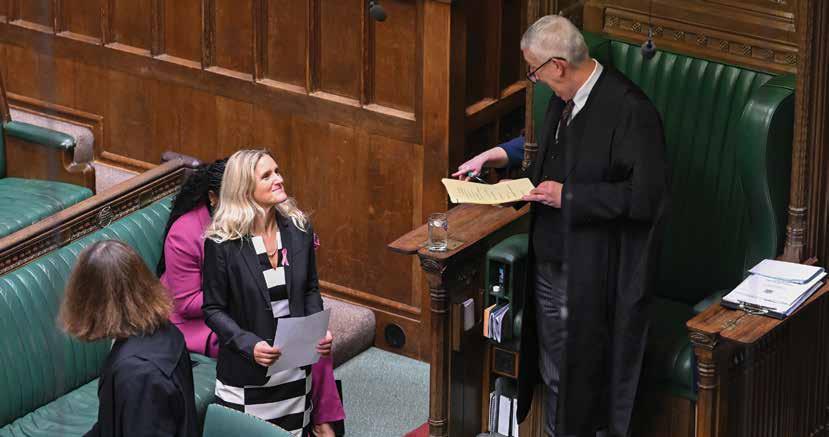
Kim Leadbeater presenting the Assisted Dying Bill, 2024
WESTMINSTER
by Jenny Sims
Unsurprisingly, the Assisted Dying Bill was derailed by parliamentary procedures. As predicted in our last column, it ran out of time and did not complete all stages in the House of Lords by the 24 April deadline.
Despite the Terminally Ill Adults (End of Life) Bill in England and Wales succeeding in the Commons, more than 1,200 amendments tabled in the Lords, which prevented final approval within the parliamentary session. And because it was a Private Member's Bill, it could not be carried over into the next session.
Introduced by Kim Leadbeater MP, it aimed to allow terminally ill adults with six months or less to live to access assistance to end their lives, subject to safeguards. Opponents argued the bill lacked sufficient safety checks and was rushed, while supporters claimed the "extraordinary" number of amendments was a deliberate delay tactic. Supporters say they may bring back a similar bill.
In the final session, several debates and bills touched on issues affecting older people. But King Charles in his speech before the parliamentary session ended, made no direct reference to issues directly relevant to older people’s lives – except pensions. He said: “To provide greater security for those in retirement, measures were passed to consolidate pension funds so that people should receive better outcomes from their pension savings.”
Also reported in our last issue,
WASPI (Women Against State Pension Inequality) women warned they were "not going away” after the government failed to comply with the ombudsman’s recommendation for compensation.
And, true to promise, supportive MPs continued to call for answers and government action up to the end of the session – at a session on 27 April on state pension age changes, for instance, MPs
WASPI protestors have warned that they are "not going away"
criticised the government for previously promising support for the affected women but later refusing compensation.
But they got little satisfaction from pensions minister Torsten Bell. While acknowledging Labour had previously opposed the 2011 pension-age acceleration, he said: “Our manifesto was clear that it did not make a commitment to bring forward compensation.”
During the same session, the minister restated the government’s commitment to keeping the triple-lock, which guarantees annual pension increases by the highest of inflation, wage growth, or 2.5%. (Some policymakers and thinktanks argue the triple-lock is becoming financially unsustainable due to an ageing population and rising pension costs).
Bell said: “We are increasing the state pension… and we will be continuing to do that over the course of this Parliament via
the triple-lock, which is set to increase it by up to £2,100.”
Adult social care and healthcare pressures are still high on the government’s agenda, as evidenced in both houses through questions, debates, and committee-related discussions.
Recent examples include a 14 April Commons session at which MPs discussed performance, funding and system pressures, including workforce and waiting list challenges. The government highlighted its increased investment and measures to reduce waiting lists, while acknowledging the ongoing strain on services.
This system strain was also acknowledged in the Lords during a discussion on the independent commission on adult social care.
Peers described the system as fragile and expressed the need for integration and workforce reform – in effect, urging long-term structural pressure rather than short-term fixes.
Baroness Merron, Minister for Adult Social Care, said in the Lords on 9 March: “We have three core foundations in place in our government objectives for adult social care, one of which is strengthening the join-up between health services and social care services, because people need to experience more integrated, personcentred care.”
It seems that both houses agree that better joined up NHS and social care workforces are needed and that people should experience more integrated, person-centred care!
SENEDD CYMRU
By Martin Shipton
Age Alliance Cymru, a coalition of 26 voluntary organisations, produced a manifesto in the run-up to May’s Senedd election, calling for a range of measures to make older people’s lives better. It said: “Older people in Wales deserve to age safely, positively and with dignity. We urge the next Welsh government to commit to the following priorities:
• Implement a systemic approach to tackle ageism and abuse, including a dedicated ministerial lead, mandatory professional training and national ageism awareness campaigns – a public awareness campaign on what constitutes abuse of older people. Ensure older people’s rights are recognised, enforced and embedded across health, social care, housing and communities.
• Expand and safeguard communitybased services such as transport and social activities, to reduce isolation and promote independence. Mandate coproduction with older people in service design, ensuring diverse voices and inclusive solutions – and recognising that older people are not a homogeneous group.
• Provide equitable access to mental and physical health support for older people, regardless of age, condition or communication need. Invest in the social care workforce through fair pay parity with the NHS, training and career development. Strengthen identification
and support for older unpaid carers through clear national leadership and robust monitoring of local delivery to ensure statutory compliance.
• Guarantee accessible advice and income maximisation services, with proactive outreach for benefits, and integrate poverty reduction and financial resilience into a strategy for an ageing society.
• Commit to multi-year funding for statutory and third sector services that directly support older people’s health, wellbeing, housing and independence. Ensure resources are available for age-friendly initiatives and community provisions. Embed measures that enable co-design, long-term sustainability and compliance with the Welsh government’s Third Sector Scheme.
The manifesto said Wales is one of the UK’s fastest ageing nations: by 2030, over a quarter of the population will be 65 or older (StatsWales forecast approximately 778,800 people out of 3.29 million). It stated: “Longer lives are a success, but they bring challenges and opportunities that demand action. Older people contribute as carers, workers, volunteers and community leaders, yet many face barriers to health, housing, social connection and financial security, especially in rural areas with poor access to services.
Older people contribute as carers and volunteers, yet many face barriers
“Policy and services must adapt through long-term planning, investment and coordinated action to ensure dignity, independence and equal opportunity. Ageism remains a systemic issue, shaping treatment and outcomes across health, social care and community life. It is the invisible thread running through:
• Prevention – older people need access to services and support to maintain good physical and mental health, as well as independence.
• Unequal access – services offered urgently to younger groups are delayed or denied to older people.
• Poorer outcomes – older adults experience unnecessary hospitalisations, avoidable deterioration and neglect due to harmful assumptions on ageing. Too often, older people are not treated with the same urgency or empathy as others. Tackling embedded ageism must be a central pillar of all strategies for health, care, safeguarding and wellbeing.
• Financial poverty – rising living costs are forcing many older people to cut back on essentials, even heating in winter. Around 70,000 older households in Wales miss out on Pension Credit, which unlocks other key entitlements. Low, fixed incomes limit access to healthy food, warm housing and transport, while rural isolation and poor digital access deepen inequalities."
The manifesto added: “The cost-of-living crisis, combined with cuts to community services, is worsening health and leading to social exclusion. Strengthening advice and income maximisation services is vital. Clear information on rights and benefits should be available well before retirement to prevent poverty and isolation.
“High-quality social care enables older people to live independently and age with dignity, yet access remains a major challenge. Prevention must be central: early support sustains independence and avoids crises, but services often intervene only at breakdown.
“Workforce shortages and lack of pay parity with the NHS threaten care quality. A real living wage and fair conditions are essential to recruit and retain staff and deliver safe, consistent care. Unpaid carers need recognition and support through respite, emotional and practical support services, and clear information on rights and services. Older people are diverse, and services must reflect individual needs rather than generic approaches.”
SCOTTISH PARLIAMENT
By Christine McGiveron
Funding is to be made available to strengthen emergency response and tackle health inequalities. First Minister John Swinney announced a £2.5 million investment to improve community capacity to respond to cardiac arrests with up to 1,240 additional defibrillators over three years. The funding will support:
• A new Cardiac Arrest Rescue (CARe) initiative to strengthen the community response to cardiac arrests, such as increased CPR training in schools. Areas with the greatest inequalities prioritised.
• Creation of first responder networks that can respond to emergencies quickly in remote areas.
• Promotion of the GoodSAM app, supported by the Scottish Ambulance Service, which alerts registered users to nearby cardiac arrests so they can provide first response.
About 3,700 people a year experience a cardiac arrest outside hospital and defibrillators can help restart the heart before emergency service arrives.
The First Minister met Scottish Ambulance Service staff and cardiac arrest survivor John Sinclair, who received CPR from a responder using the GoodSAM app. Mr Swinney said: “Surviving a cardiac arrest often depends on what happens in the minutes before an ambulance arrives. That is why we are investing to deliver more defibrillators into communities, strengthen local response networks and ensure more people have the skills and confidence to act.”
In March, social care minister Tom Arthur welcomed the Scottish Parliament’s unanimous approval of new measures
enshrining the right of care home residents to contact family and friends. The regulations establish that homes must allow and support visiting unless suspension is essential to prevent serious risk to life, health or wellbeing.
Even then, care homes are still required to facilitate visits for those nearing end of life or where the harm caused by suspension outweighs other risks. Those most important to a care home resident will be named in personal care plans as essential care supporters – with a legal presumption that suspending their visits is likely to harm their health and wellbeing.
The minister said: “Meaningful activity and social connections are important for the wellbeing and quality of life of [people
The GoodSAM app alerts registered users to nearby cardiac arrests
living in adult care homes]. For many residents, family members or friends build on the support provided by care home staff. These regulations enshrine the right to direct contact in law and recognise the vital role family, friends and others play in providing essential care, support and companionship to loved ones in adult care homes. In developing the legislation, I am pleased we were able to work closely with Natasha Hamilton, whose petition first highlighted the issue during the pandemic. It is another important landmark in improving and reforming the social care system and I thank Care Home Relatives Scotland and others for their continued work and support.”
Meanwhile, a programme giving dedicated support to cancer patients
throughout their treatment is to be rolled out nationwide. Following the success of 12 pilot projects, which received more than £5 million in funding between 2022 and March 2025, an additional £1 million will be provided annually to expand the Single Point of Contact (SPOC) programme.
As assessment by Healthcare Improvement Scotland found that over a 12-month period, SPOC services had more than 30,000 interactions with people affected by cancer.
The SPOC makes life easier for patients with cancer, providing easy access to clinical teams providing information and advice about appointments, tests and results, and explaining what clinical and non-clinical support is available for them and their family.
Patient feedback from the pilots highlighted reduced stress around appointments, quicker access to blood results, more time for questions, and greater emotional support. Staff reported improved wellbeing and more time for professional development and clinical care.
Announcing the expansion at Forth Valley Royal Hospital, where the SPOC navigation team has supported patients since 2023, health secretary Neil Gray said: “I am very pleased to roll out this invaluable initiative, which gives people with cancer a consistent contact throughout their treatment, enabling specialist staff to focus on complex clinical care. The Single Point of Contact service ensures cancer patients know exactly who they can turn to when they need advice about their diagnosis or care.
"The expansion of this programme means more people can benefit from this type of one-to-one support, which is truly making a difference.”
GoodSAM app
NORTHERN IRELAND
By Tony McMullan
The Northern Ireland Assembly Commission is to host an Older Person’s Parliament in the autumn. I have been invited to join the preparatory committee that will help draft the structure, decide its content and consider what happens afterwards to the many likely issues that will be raised.
There will be a range of colleagues from other pensioner/older persons organisations on the committee. For the CSPA, I will advance the following issues:
• Health, hospital waiting lists and GP accessibility
• Travel and transport issues, with a low level of public transport services outside major towns and cities
• Work and education opportunities for those who need them
• Loneliness and isolation – there is no strategy to deal with this within our current government.
• Poverty – the draft Northern Ireland Executive anti poverty strategy did not offer any additional resources.
• Digital exclusion and safety – many older people who are not IT-savvy feel excluded by today’s world, in which nearly every transaction is online,
Free digital skills courses
should be delivered within communities
and they feel particularly targeted by scammers.
• Housing and support – most older people don’t want to go into institutional care but for many there is no alternative. More pensioner villages where older people can live largely independently are a must.
• Rights of older people – it is intolerable that discrimination against older people around goods and services is lawful yet has been outlawed in England, Scotland, Wales and the Republic of Ireland.
• Domestic violence against older people is dramatically rising and takes many forms – emotional, financial, physical and physiological.
The topics I will be suggesting for consideration include the following:
• Many older people find the 8am/8.30am struggle to get through to a GP exhausting and demoralising, especially when finally getting through and being told all appointments have gone and to try again the next day.
• Public transport needs to better
address the concerns of older people. It’s not good enough to give a ‘free’ rail/bus pass; there should be an older persons transport plan looking at rural routes.
• Sheltered bus stops with seats – well set out timetables at bus stops would be great, rather than the tiny text even younger people find hard to read.
• Work and education – many older people do not know how to access these. While many retirees do not want to go back to work under any circumstances, others find it either financially essential or want to work as a volunteer. Issues to be looked at include access to work or training courses. Some venues might not be fully accessible for older people with disabilities. Should there be free or at least discounted rates for education for older people?
• Loneliness strategy – Northern Ireland desperately needs this. Many older people live at home on their own after the loss of a lifelong husband or wife, and many in residential care never get a single visitor.
• Rates relief – older people living on their own can access a lone pensioner allowance that gives a 20% discount off their annual rates bill. Why not put that up to 30%?
• Winter fuel payment – if it is to be capped at £35,000, it needs to be annually updated or it will lose value over time.
• Digital exclusion and safety – there need to be free digital skills courses, delivered in communities.
• Housing – planners need to listen to older people’s priorities.
Another issue that is much talked about but is not one for the Older People’s Parliament is the question of government support to citizens during the Middle East crisis in March/April.
While the Labour government has made the decision to allocate £53 million to people struggling to cope with the rapidly escalating costs of home heating oil, this was rather tame compared with our near neighbours’ offering to their citizens in the Republic of Ireland. The UK government granted £53 million to its 69.1 million population, £17 million of which was allocated to the 1.9 million people living in Northern Ireland. The Irish government allocated £203 million to its 5.6 million population.
Making systems work
Matthew Boyd, Senior Account
Executive at the CSPA’s public affairs consultancy Connect, on putting policy into practice
Governments of all stripes are often better at announcing change than delivering it. Last month’s King’s Speech gave Westminster its latest setpiece moment, with ministers keen to show purpose and direction. But for pensioners, and for those representing them, the more important question at such times isn’t what is announced but whether it works.
Many pressures facing older people are no longer about grand political arguments. They’re about whether essential systems function properly, support is accessible, and public institutions deal fairly and competently with those who rely on them.
In that respect, the period between the King’s Speech and summer recess is less about political theatre than about delivery. Cost-of-living pressures remain. Older people, particularly those on fixed incomes, continue to feel the effects of higher household costs and energy prices. The conflict in Iran has reinforced concerns about how quickly global instability feeds through to bills and living costs.
The government’s response is likely to focus on growth, energy security and public service reform. But for many pensioners, the issue is more immediate. Can essential costs be met confidently? Can services be accessed without undue stress? Financial security in later life isn’t just about the headline value of a pension; it’s also about whether systems are reliable, comprehensible and fair.
Pensions issues
That sense of uncertainty doesn’t stop with day-to-day bills. Pension taxation fears remain in the background too. Even without a defining announcement, concern about how pensions and retirement income may be treated by the tax system can be unsettling for those trying to plan with confidence in later life.
That is one reason why the problems surrounding the civil service pension scheme (CSPS) have been so damaging. The difficulties linked to the transition to Capita have persisted long enough now to become more than an administrative embarrassment. Delays, poor
communication and uncertainty have caused real frustration and, for many, genuine distress and hardship.
Pension administration shouldn’t be an abstract matter of process. It’s about whether payments arrive when they should, whether questions are answered clearly, and whether people who have given years of public service are treated with efficiency and respect. When those standards aren’t met, trust suffers. Once that’s lost, it isn’t easily restored.
Older people don’t need constant declarations; they need services that work
The same concerns can be seen well beyond the CSPS. The CSPA and its Later Life Ambitions (LLA) partners have continued to campaign on access to banking services, digital exclusion and the return of winter fuel payment concerns through HMRC’s recovery programme. Different issues though these are, they all raise the same practical question: are older people being expected to navigate increasingly complex systems without proper support?
Access to banking is an obvious example. As branches close and services move online, many older people are left with fewer options for managing their money in the way that suits them. For those who rely on cash, face-to-face contact, telephone support or trusted local provision, this isn’t a question of nostalgia. It’s about independence, confidence and security. LLA has been right to keep pressing this issue: access to cash and banking shouldn’t be a partisan issue; it’s a practical one.
Digital exclusion raises much the same
challenge. Too often, “digital by default” becomes “digital or nothing”. That may look efficient to a large organisation, but it can be alienating and unfair for those who aren’t online, don’t feel confident using digital services, or just prefer another way.
Whether the issue in question is banking, healthcare or council services, the principle should be straightforward: modernisation can never mean exclusion.
The same applies to the winter fuel payment. It has returned to attention because the government is proceeding with the recovery of payments from those above the income threshold. Where recovery, entitlement or communication become muddled, anxiety follows. A policy that may be defensible in theory can still create problems if administration is poor.
Reasons for optimism
There have, however, been encouraging signs. LLA’s engagement with the Welsh government and the Greater London Authority shows older people’s concerns are being heard in a variety of settings. That matters because the issues affecting later life include housing, transport, digital access, community services and health.
The question isn’t whether the government has a new slogan or a fresh dividing line; it’s whether the systems older people rely on are becoming more dependable, accessible and humane.
For the CSPA and its partners, that’s what matters. Older people don’t need constant declarations; they need services that work, institutions that communicate clearly, and policymakers who understand that administration is how policy is felt.
In politics, announcements are often the easy part. For pensioners, what counts is what’s next.
Your member benefits
Here are some of our most popular benefits – find out more in the members’ area of the website at members.cspa.co.uk
• Help and support with your pension
Our pensioner case worker can help if members have problems with their civil service or related occupational pensions. How to claim: email enquiries@cspa.co.uk with a brief outline of your query and your membership ID
• Free initial legal advice Consultation for 30 minutes maximum, membership number must be provided. England and Wales: Lyons Davidson Solicitors, 01752 300 584 quoting CSPA. Northern Ireland: McCartan, Turkington & Breen, 02890 329801
Scotland: Thompsons Solicitors, email advicecentre@thompsons-scotland.co.uk or call 0800 801 299
• Discounted conveyancing Gordon Brown Law Firm offers discounts in England and Wales. How to claim: email sales@gblf.co.uk or call 0191 389 5160
In Scotland: Thompsons Solicitors, email advicecentre@thompsons-scotland.co.uk or call 0800 801 299
• Pet insurance
CSIS, in association with ManyPets, is offering a range of lifetime vet fees
cover from £3,000 to £20,000 – one of the UK’s highest. For more details, visit https://csis.co.uk/additional-insuranceproducts/pet-insurance
• Free initial consultation on wills, trusts and powers of attorney
Solicitor Harvey Howell is offering members a free private consultation by phone or video. View the Harvey Howell video podcast by logging on to the CSPA website and members’ area. How to claim
In England and Wales: email cspa@ harveyhowell.co.uk or call 0330 175 9959 quoting CSPA
In Scotland: email advicecentre@ thompsons-scotland.co.uk or call 0800 801 299
In Northern Ireland: email marie-anne.mcveigh@ mtb-law.co.uk or call her at McCartan, Turkington & Breen on 02890 329801
• Financial services you can trust Free initial consultation with an expert from Quilter Financial Advisers to find out how you can benefit from financial advice. How to claim: Members can book their free, no-obligation initial consultation by calling 08000 858590 quoting CSPA or find out more on our website www.quilter.com/cspa
• IT help and support
Free help and support on personal computer problems. How to claim: call BC Technologies on 01369 706656 quoting CSPA
TRAVEL INSURANCE FROM CSIS
•
Designed specifically for members
This annual travel insurance plan from the Civil Service insurance Society (contact details below) offers a European or worldwide option for an individual, couple or family. You must be medically fit to travel, UK resident and a CSPA member (and remain so for the life of the policy) aged between 50 and 79 at the time of joining (thereafter no upper age limit will apply) and comply with the eligibility criteria.
• Home and motor insurance*
CSIS offers a 10% discount to members taking out a home insurance policy over the phone and 10% off car insurance for
those in England, Wales and Scotland.
• For details on all insurance offers from CSIS, including travel insurance above, visit: csis.co.uk/partners/cspa
New benefit from APT CSPA members can enjoy an exclusive bonus saving of 10% on all APT and Travelmarvel cruises and tours on 2026 and 2027 departures, whether it’s a cruise through Europe, Asia or Egypt, an escorted tour across Canada or a yacht adventure along Croatia’s coastline. How it works
• Quote CSPA10 when booking
• Travel window: 2026 and 2027 departures
• Book by: 31 December 2026
• Fred. Olsen We have teamed up with Fred. Olsen Cruise Lines for up to £200pp free on-board spend. How to claim: call 0800 0355 108 quoting CSPA26A. For details visit fredolsencruises.com/ affinity/cspa
• Wendy Wu tours Wendy Wu tours and cruises cover Asia and the Far East. We have a 5% discount on all trips and up to 10% off Mekong River cruises.
How to claim: visit www. wendywutours.co.uk or call 0800 035 5091 quoting CSPA5
SAVINGS HUB
• For great deals on shopping discounts, motoring, travel, lifestyle and discounts on the high street, visit our Savings Hub via members.cspa.co.uk/discounts/
FIND OUT MORE
• Have a listen to our podcasts with guest speakers from CSIS and Harvey Howell by visiting cspa.co.uk/listen
* Only available when calling CSIS for a quotation. Discount only applies when cover is offered with provider Salvation Army General Insurance Corporation.
In Your Area
MIDLANDS REGION
Coventry and Warwickshire
As the Regional Representative for the Midlands, I wish to thank you for your membership of the CSPA. As well as campaigning to protect the value of the pension you have earned, we are keen to ensure you have your views heard. One of the ways we do this is through local groups. But the area you are in does not have a functioning local group. We want to put that right. Birmingham & District Group has offered to extend their work to you. The aim will be to provide opportunities to have your voice heard, including the possibility of me coming to Coventry or other localities in Warwickshire to meet and listen.
If you are content with this, you don’t need to do anything. If you have objections, please get in touch with me before 15 July (contact details below). If you would like to get involved in re-establishing a group in your area, perhaps with my help, that will be especially helpful. Please do not hesitate to contact me.
Kevin Billson Email: kevinbillson@ntlworld.com Tel: 07827 320413
Gloucestershire
The group held its AGM in March, with General Secretary Sally Tsoukaris as guest speaker. We also welcomed Regional Representative Kevin Billson. The usual AGM business was conducted, with the same committee re-elected unopposed. The Chairman emphasised that fresh blood was needed for the committee, and the group was asked to think about this in time for next year’s AGM.
Sally updated us on pension matters, notably the transition from MyCSP to Capita. The transfer has not gone smoothly, but CSPA pressure with the Cabinet Office, MPs and other groups has led to improvements. Phone calls are being answered within 30 seconds (though I have yet to test this), more staff have been recruited, temporary loans offered to new pensioners and cases prioritised. The McCloud remedy has had to be paused to allow Capita to focus on priority cases.
Sally also filled us in on other matters, including digital exclusion and inclusion –how do you prove who you are without a passport or driving licence, for example?
Kevin Billson didn’t speak, but his
There is no functioning group in your area.
However, I will be at The Picture House, Bridge Street, Stafford ST16 2HL at 11am on Tuesday 7 July to
meet any members who would like to chat about CSPA issues. If the venue or date is not convenient, please contact me; I’m happy to consider alternatives. And if you’d like to get involved in re-establishing a
excellent summary of HQ business had been circulated to members before the meeting. We now look forward to future meetings:
• 10 September – Nicola Potter on vintage transport in Gloucestershire
• 8 December – Ian Boskett on the Great Train Robbery in 1963 and its surprising connections with Gloucestershire.
Meetings are at the Civil Service Club, Tewkesbury Road, Cheltenham GL51 9SL at 10am for 10.30am.
Chairman: Alastair Goldie
Nottinghamshire & Derbyshire
The next informal meeting in the Nottinghamshire & Derbyshire area will be Tuesday 23 June at 10.30am in The Roebuck Inn, Nottingham NG1 6FH (back room). If any members in the Derby area would prefer a meeting closer to home, please contact me, Kevin Billson, and I will do my best to arrange a meeting for you.
Oxfordshire
There is currently no functioning local group in your area, but a few members meet at least twice a year in the Wig & Pen, George Street, Oxford OX1 2AU. For any members who would prefer a meeting in an alternative venue, please contact me and I will do my best to arrange a meeting for you.
Kevin Billson Email: kevinbillson@ ntlworld.com Tel: 07827 320413
group, perhaps with my help, do not hesitate to contact me.
Kevin Billson Email: kevinbillson@ntlworld.com Tel: 07827 320413
Neptune fountain, Cheltenham
NORTH WEST REGION
Greater Manchester
The next meeting, on Wednesday 17 June, will consider motions to send to the annual conference. We will also be able to nominate officers and Executive Council members and decide which delegates from Manchester will be attending the conference. All members very welcome.
Group meetings take place at the Methodist Hall, Oldham Street, Manchester, commencing at 11am and finishing at 1pm. You will be made very welcome. There will also be meetings on Wednesday 30 September to mandate our delegates to conference, and Wednesday 7 October to hear a report from the event.
We also have a social lunch at the Old Rectory in Stockport every three months. The next three lunches are on Thursday 4 June, Thursday 2 September and Thursday 10 December, all commencing at noon, and everyone from the Greater Manchester Group is welcome.
I have organised a boat trip along the River Dee in Chester for Monday 15 June, leaving at noon. The price, £20, includes tea and coffee, but bring your own picnic. Anyone interested, please contact me using the details below.
Thank you for all the kind donations, which allow the group to function effectively; we ask for donations this year. We also run a monthly 200 Club (£12 per year), which commenced in March. Anyone who wishes to join should send me £9 for the remainder of the cycle, either to me at 46 Severn Way, Holmes Chapel, Crewe CW4 8FT, or via BACS to CSPA Manchester: sort code 16-12-11, account 10177528. For more details, contact me. Harry Brett, Regional Representative Email: h_brett@sky.com Tel: 07999 874864
Liverpool & District
The next three meetings will be Monday 28 September, when we will discuss and mandate our delegates to conference, and Monday 7 December, which will be the Christmas lunch – all members welcome.
Meetings are held at Lime Street Central, Lime Street, Liverpool, commencing at 12.15pm. The regional meeting will be held this year in April. Full details will appear in the next newsletter.
We have organised a boat trip from Chester on Monday 15 June. The £20 cost includes tea or coffee, but bring your own
picnic. Please contact me if you would like to join us.
We are again asking for donations to help run the local group. It allows us to pay any expenses, such as travel costs for your committee or room hire if necessary.
We have also started a 200 Club in which members contribute £12 for the year with a first prize of 50% of total donations, a second prize of 25% of donations, with 25% going to group funds. If you would like to join, please send £9 for the remainder of the cycle.
To donate and/or join the 200 Club, either send me a cheque at 46 Severn Way, Holmes Chapel, Crewe CW4 8FT or pay direct to Manchester & District Group’s bank account: sort code 16-12-11, account number 10177528.
Harry Brett, Regional Representative Email: h_brett@sky.com Tel: 07999 874864
We have enjoyed talks on the Manchester Ship Canal and town crier duties
Chester
We continue to meet on the second Monday of the month. We’ve enjoyed a variety of guest speakers over the years, ranging from local church history, the Manchester Ship Canal and town crier duties, to national and local charities.
We have a full programme for 2026/27. Why not join us? We meet at Festival Church, Queen Street, Chester CH1 3LG from 2.15pm to 4pm (except for August).
Meeting dates for this year include:
• 8 June – meal at The Mill, Chester, 12 noon
• 15 June – regional get-together for trip on the River Dee, 12 noon
• 13 July – John Walker on Chester: what’s in a name?
• 14 September – AGM agenda discussion
• 12 October
• 9 November
• 14 December – Christmas lunch at The Mill, Chester, 12 noon
• 11 January 2027 – quiz
• 8 February 2027
• 8 March 2027 – AGM
More details from Paul Wilks Email: pwilks47@gmail.com Tel: 07367999885
Wirral
A reminder to all Wirral Group members that our quarterly meetings are held at Upton Victory Hall, Salacre Lane, Upton, Wirral CH49 0TL. It is a pleasant venue with plenty of parking on site.
At our last meeting – our AGM on 10 March – our Chair of 10 years, Mike Lawler, stood down. Our new Chair is Tina Haslam (currently Group Secretary) and she has agreed to double up as Chair/Secretary.
The next meeting will be on 9 Tuesday June at 10am, when we will discuss any motions we wish to put forward for conference in October.
The remaining quarterly meetings for 2026 are Tuesday 8 September and Tuesday 8 December. It would be great to see more members at these meetings. Watch out for further group news and information via newsletters.
Chester
West Yorkshire
West Yorkshire members, we need you! Many issues face civil service pensioners, as everyone knows. Keeping active in the CSPA is one way of keeping informed and making sure concerns are represented nationally. Like many groups, West Yorkshire found it hard to return to activity after the pandemic. We’ve reached a point where its viability is in question.
The AGM of the West Yorkshire Group was held on Thursday 19 March. Only the committee and our Regional Representative attended. But as there is no set quorum, the AGM could proceed.
A motion to cancel all future meetings of the group until next year’s AGM was discussed. Instead of doing so immediately, this was amended to 30 June to allow us to discuss and submit motions to the national AGM in October.
The committee was concerned about the declining democratic legitimacy of the group, but felt that this was outweighed by the need for the group to have a presence at the national AGM, where delegates have long made your voices heard.
West Yorkshire members can communicate their views in person and discuss motions at the next group meeting – Thursday 11 June at 2pm in the PCS HQ in the Merrion Centre, Leeds. Alternatively, please email relaxpaul@btinternet.com.
A newsletter will be sent out prior to the meeting containing any draft motions put forward by the committee.
We would love to see you in June. We would love it even more if there was a desire for the autumn and winter meetings to go ahead – and ecstatic if there was new blood on the committee at the 2027 AGM next March. The current committee, all of whom have agreed to carry on until next year, want to see the group survive and thrive. We hope at least some of you feel the same, or the group will close next March. Chair: Paul Laxton Email: relaxpaul@btinternet.com
SOUTHERN REGION
Crawley & District
The group had a successful AGM in March, when national Treasurer Mike Sparham brought us up to date on CSPA issues. After an enjoyable and informative meeting, we adjourned to the Toby Carvery for an excellent lunch. All officers were re-elected but we are without a Social Secretary, so if anyone is interested in filling this vacancy, please let us know.
As I write, we are planning a discussion at our April meeting on the proposal to move the CSPA to limited liability status, so our delegate will be informed of our concerns before October’s national AGM. It will be a continuing item of discussion until then.
Our meetings continue at Crawley Community Action Offices, Gleneagles Court, Brighton Road, Crawley, about 200 yards south of the level crossing. We commence with tea or coffee and biscuits at 10.30am and you will be assured of a warm welcome.
After our local business we have a guest speaker – speakers are listed on the Crawley Group section of the national website – and we adjourn to the Toby Carvery for lunch.
Our next meetings are scheduled for 10 June and 8 July, with a summer lunch at a venue yet to be decided on 12 August. Details will be posted on the national website.
As summer approaches, I am buoyed by the increase in members this year, thanks mainly to the Membership Secretary placing ads in local free magazines. Also helpful is HQ resuming the practice of notifying us of recently retired members in the area.
We have some interesting speakers lined up: the Sussex Inshore Fisheries and Conservation Authority on 29 May and National Coastwatch on 26 June. There will be an outing on 17 July, to be confirmed, and tea at the popular Highdowns Hotel on 21 August. On 25 September, Bob Turner will explain how Britain became an island. And on 30 October, our own Sylvia Chapman is addressing us on Food for Thought. It gets harder every year to find good speakers who charge little or nothing, so if anyone knows someone or would like to speak in 2027, please let me know. We are a friendly group and meet at 10.15am on the last Friday of most months in the Durrington Community Centre.
We warmly welcome new members or one-off visitors, who just pay a £3 attendance fee. Any general queries, contact the Chairman below, or on membership email Marion Tarbuck at marion.tarbuck@gmail.com or by calling 07904 14184.
Chairman: Frank Jones, 19 Saltings Way, Upper Beeding, West Sussex BN44 3JH Email: francisjgjones@ hotmail.com Tel: 07500 478097
Worthing beach
NORTH EAST REGION
Scarborough & District
Now we are enjoying summer days, our group will have held its AGM. We hope the current committee of four will have been increased. Members of the group plus friends enjoyed another Christmas lunch at the Park Manor Hotel in November 2025 and our 2026 one is already booked. The January meeting had to be postponed until February because wintry conditions hit Scarborough with a vengeance. Full details of group activities, discussions and information disseminated at our meetings are given in the group newsletters issued shortly after each meeting. Items of interest from the last meeting included: £5 group subscription and methods of payment; pensioner identification; digital exclusion; pension fraud; and the use of AI by criminals to clone people’s voices for bank and other password hacking purposes.
Committee members are happy to help with any issues you may have or to point you in the direction of help if they can. Our contact details are:
• Treasurer: James Howie Email: jpearsonhowie@gmail.com Tel: 01751 475659
• Newsletter Secretary: Richard Kilsby Email: richkilsby@live.co.uk Tel: 07783 941589. Future meetings are scheduled for 22 June and 21 September, starting at 11am, in Belle Vue Room, Westborough Methodist Church, Scarborough YO11 1TS. We look forward to seeing you there. Committee member Sheena O’Connell Email: oconnellsheena@gmail.com Tel: 07702 060063
Committee members are happy to help with any issues you have
WESSEX REGION
East Solent
Starting in January, the group is meeting at The Stubbington Baptist Church, 4 Jay Close, Stubbington PO13 3TA. The church is on the corner of Titchfield Road/B334 and Cuckoo Lane. As you turn into Cuckoo Lane from Titchfield Road, take the first left into Jay Close and follow the signs to the church car park.
Meetings are from 10am to 12 noon on the second Wednesday of each month. We have a range of talks, usually with a musical interlude at Christmas and a choir. Talks this year include: A History of Winchester Prison, Quakers at War, the Trans-Siberian Express, Winchester Talking
SOUTH WEST REGION
As South West Regional Representative, you may recall previous articles in which I outlined proposals to offer more inclusion to some members who no longer live in an active group area in the South West, particularly the now closed Weymouth & District Group and DT postcode areas.
I asked members in these areas to send me their views. I am glad to say no adverse comments were made regarding the possible reallocation of members to remaining groups operating in the South West or Wessex regions.
That being the case, the following has been agreed in relation to the closed Weymouth Group and outstanding DT postcodes. The two groups assisting are:
• Bournemouth & District Group (Wessex)
Newspaper, and A History of Windmills. We also arrange a summer lunch and a Christmas lunch each year, and trips to gardens and Christmas markets.
After our monthly meetings, some of us adjourn to a local pub or restaurant for lunch, to which everyone is welcome. In March, we held our AGM and were pleased to welcome new CSPA Deputy General Secretary Jonathan Safir. After the meeting we adjourned to The Queen’s Head in Titchfield (pictured) for lunch. We welcome members new and old.
Secretary: Alan Shepherd Email: shepherdalan23@yahoo.co.uk Tel: 07895 787704
will add postcodes DT1-5 and DT9 (former Weymouth & District Group) to the DT10-11 already held.
• Devon Central Group (former East Devon Group, South West) has added postcodes DT6–8 (former Bridport Group) to its existing EX and TQ areas. By redistributing members to open active groups – whose meetings they may attend and have local contact and newsletters –we hope this will enhance representation. Details of both groups can be found on the CSPA website. South West members who have any concerns may contact me. My details can be found on the Contact Us section of this magazine (page 46).
Les Calder, EC South West Regional Representative
The Queen’s Head, Titchfield
SCOTLAND BRANCH
Meetings are now held in the Maldron Hotel, 50 Renfrew Street, Glasgow G2 3BW. For those who are unable or do not wish to attend in person, a virtual option is available on request. Contact me, Michael Kirby, using the contact details below.
Meetings for the rest of the year will be on the first Thursday of September and November, starting at 1:30pm. The branch 2026 AGM was held in April, and details will be in the next newsletter in July.
If you have any membership matters to update, such as a change of address, please contact me.
Branch newsletters have helped keep
NORTHERN IRELAND
As reported in the last issue, the branch had written to the Civil Service Pensions Branch (CSP) of the Department of Finance to ensure that Northern Ireland civil servants retain pension parity with the UK civil service. In November, the Chancellor had confirmed that members of the UK’s civil service pension scheme would see a 3.8% uplift in pensions from April. We are pleased to report that in late March, CSP wrote to us to confirm that members of the Northern Ireland civil service pension scheme would also see their pensions rise by 3.8% from April.
CSPA legal status
A series of branch/group meetings in April discussed the possibility of the CSPA becoming a company limited by guarantee or a charitable incorporated organisation. A small number of members also attended a special branch meeting on 14 April, addressed by General Secretary Sally Tsoukaris, national Treasurer Mike Sparham and legal specialist Bernard Ingram.
Alastair Hunter
Branch President Alastair Hunter stood down from the branch committee at the AGM on 22 April. It was an emotional day as Alastair has been on the committee for more than 25 years and has been the most dedicated, committed CSPA activist. For many years, he served as Treasurer and
members informed of matters of interest, especially those in remote areas or with no internet access. Word of mouth is one of the best ways to recruit new members, so if you know anyone who’d like to join, please contact me to see if they are eligible. Please also check out the branch website at www.cspascotland.org.uk.
If any members reading this know of anyone not receiving communication from the CSPA, please ask them to contact head office on 020 8688 8418.
Membership Secretary: Michael Kirby Email: Michael.Kirby@cspa.co.uk Tel: 07969 405263
Free legal advice
Please note: this service is provided by Scottish solicitors for Scottish CSPA members. For information and assistance contact Thompsons Solicitors by email: advicecentre@thompsonsscotland.co.uk or call 0800 801 299. Consultation is for a maximum of 30 minutes and members must provide their membership number prior to advice. As there is a new national database, please contact Michael Kirby, who can verify your membership number.
Membership Secretary, two very busy posts. When Alastair started, computer banking and joining an organisation online hadn’t been thought of – he sent endless application forms, visiting the bank with cheques for membership fees and so on, without complaint. We owe the most enormous thanks. Thank you Alastair.
Key communications
The latest newsletter (pictured), with its lead story on gold plated civil service pensions, was sent to all members in early April. The annual meeting with Civil Service Pensions Branch was planned for May/June. Among the issues to be discussed were the McCloud and Goodwin judgements, civil service pension statements and overpayments. More details on the branch website.
Pensions administration
We are the only area of the CSPA to have members in two separate but similar pension schemes. In England, Scotland and Wales, all retired civil servants’ pensions are administered by a private company. But all Northern Ireland civil servants employed by government departments in Northern Ireland continue to have their pensions administered by
the Department of Finance. However, some civil servants who worked for nondevolved departments such as HMRC or the Passport Office, had their pensions administered by MyCSP until December 2025. The contract has now been taken over by Capita, but despite having two years to plan the handover, it has been a disaster, with members failing to receive their pension on time, sometimes not at all. Members have reported lengthy phone waits and being unable to access the pension portal. Northern Ireland MPs Gregory Campbell, Claire Hanna and Jim Shannon raised the issues in Parliament. We offered all three our support, and have held meetings with Jim’s and Claire’s staff.
Specsavers vouchers
This continues to be a very popular benefit among members. If you would like a £20 Specsavers voucher (to be used for the Specsavers £99+ range) for yourself, family members or friends, please contact Tony McMullan at tony.mcmullan@outlook.com, providing the names of the people requesting a voucher.
Your views
GET IN TOUCH
Write to us at CSPA head office, 160 Falcon Road London SW11 2LN or email editor@cspa.co.uk
… inviting letters, comments or contributions, which may be edited to fit the space available
CARS ARE ESSENTIAL
I read with interest ‘Something else that annoys me...’ about driving in the Spring issue. A motor vehicle is essential
the bus terminal. After nearly an hour’s shopping, on returning to the car park the same faces are still waiting for buses.
PENSIONS MINEFIELD
In late spring this year, one of our broadsheets yet again decided it was time to attack public sector pensions – the civil service in particular. As usual, the problem is said to be cost.
This is astonishing when you consider what money is found –for example, the bat tunnel above an extremely costly but pointless railway, and failed IT projects too numerous to list.
It occurs to me that some aspects of this issue are never stated. First, there is the myth that civil servants do not contribute towards their pensions. This is not only a hardy annual for the media; successive governments have been only too
Government has failed to ensure its share is available when needed
To use the railway station, there is no bus from Seal to Otford station, so the car is needed again to catch a train. This speaks for itself by the number of cars in the station car park and in the road nearby, mostly owned by commuters.
Some bus services that do operate finish early. Occasionally I use the bus, it’s quite enjoyable and relaxing. But in the back of my mind I’m wondering if there will be a problem when I’m returning. Like many my age, I have a free bus pass. But that just gathers dust in my pocket. Throughout my life I’ve loved all forms of transport – buses, trams, trains, ships, aircraft, cars, motorbikes. Now… I must go out. Where’s that car?
JE
Horton, Seal, Kent
willing to allow the myth to perpetuate.
For the PCSPS scheme, the contributions from civil servants were taken by a convenient (for the employer) overall deduction from the wage bill. This is a ‘real world’ contribution from civil servants. That the money was taken but actually spent elsewhere, rather than invested in a real fund, and cannot now help to meet the cost of pensions, is not the fault of civil service pensioners.
But what of the employers’ contributions? For decades, we have accepted that the government paid contributions on our behalf, but in fact they never existed. Again, no fund was built up and instead the government pays our pensions from general taxation.
If this is proving awkward, once more that is not our fault, but it is an irony that,
UNDERMINING VALUE
In The Pensioner Spring issue, the article on the triple-lock mentions that the value of the state pension had reduced over the years as it was only linked to inflation figures.
Well, of course, it was the Conservatives who removed the civil service pension link with wages/salaries, hence the civil service pension is now only linked to CPI. This has meant that the civil service pension has lost and continues to lose value.
The other reduction the Conservative government did was to change pension increases from RPI to CPI! But what is being done about upping the civil service pension to restore its value?
Greg Baker, Bradford on Avon
for us, the scheme is indeed contributory and it is the government that has failed to ensure its share is available when needed.
If the press, and others, have to complain about the contributions made by people towards their pensions, they might have a look at pension credit. I do not wish to appear hard-hearted towards genuine claimants but it provides an income to those who made insufficient NI contributions. Not only that but, once awarded, it ‘passports’ other benefits, such as winter fuel payments, help with housing costs and a free TV licence, which are not available to many who made full NI contributions.
Second, because civil service salaries saw a general deduction for employees’ contributions, the pensions which derive
CREDIT WHERE IT’S DUE
I would like to say a big thank you to The Pensioner on two counts. First, in a recent edition you mention the IAM’s Mature Driver Assessment.
I am 79 and passed my test when I was 18, so felt it was about time I had a professional, independent review of my driving. This recently took place and I am extremely glad it has – I have a number of poor driving habits and I must make changes if I want to drive as safely as possible on our busy roads.
In the same edition, you mention the Civil Service Club. I never knew it existed but followed up your article and have now joined. Thanks again. Richard Young, Bracknell
from them are calculated on a reduced ‘gross’ salary. This results in a pension that is less than half salary, as follows:
Imagine the pay advice note of a person in another scheme who once earned £108 per week. A typical 8% superannuation deduction is shown, followed by others for tax, NI etc. That person would anticipate a weekly half salary pension of £54.
A civil servant, whose gross earnings have already been reduced centrally, would have received an advice note with £100 as gross pay. A half salary pension for them would be only £50.
I know this subject is a minefield and that public sector schemes vary. For instance, MPs receive a full pension for only 25 years’ service. Perhaps the media could mention that every so often.
John Davidson, Armadale
SCAM SCARE
I am ashamed to say that earlier this year I was scammed out of more than £250 by scammers pretending to be from Microsoft and Halifax Bank. Thankfully, I was eventually refunded by PayPal, but I wanted to warn other members about this type of scam.
First, my laptop screen froze and the cursor vanished as a message popped up on screen to say my Facebook account was suspended due to illegal activity. I could accept or ignore, but if I ignored, my system could be impacted and crash.
To the right of this was a pop-up ad saying I could ring for support from Microsoft, with a free phone number. It was my mistake to ring the number. It was not Microsoft and I later found out they don’t use these ads. It was a trojan horse virus and my network was infected. They gained remote access to both my laptop and mobile phone and said they were removing it. I lost phone contact and phoned again. A woman answered this time and carried out work, presented me with a £258.98 bill for the repair, and the installation of anti-virus software. I paid it. They emailed me an agreement they signed with my signature. The original man phoned me and said this was a scam and they would get on to PayPal to get a refund (a lie) and the scam was from Calgary, Canada. They then asked me to check my online banking and transferred
I hope I can raise awareness of how these clever scammers operate
me to someone in fraud at Halifax Bank (also a scammer), who tried to persuade me to transfer my balance to an HM Treasury account for safety (ie their account). It was scary as the scammer knew one of my balances.
I refused to move my money and he said he’d freeze my account and ring me the next day, as did the Microsoft man.
By this time, I was feeling uneasy and later that day I phoned the police and an officer visited me the next day. While he was with me, the Microsoft scammer rang twice and was answered both times by the police officer. Later, the bank scammer rang twice and I ignored them; I had 10 voicemails from the scammer on my landline from the previous day.
The computer firm that made my laptop and phone safe said there was never a virus and they’d installed no anti-virus software as none is needed. I’ve been made to feel very vulnerable and unsafe. I always said I would never fall for a scam and I have. I hope that in sharing my experience, I can raise awareness of how these clever scammers operate.
In retrospect, I’d have been better off taking my laptop to the computer firm for help. But hindsight is a wonderful thing.
Judith Haire, Ramsgate
CAPITA CALAMITY!
OMG! I don’t believe it! Surely the Cabinet Office is not entrusting the administration of our pensions to C*APITA again! Surely they must remember the hash they made of it last time! Joan Parry, Isle of Wight
WELL, STONE ME!
Thank you for David Luxton’s amusing article in the Spring 2026 issue. I enjoyed the Stones references (I counted nine, including duplicates). I suppose it’s better to laugh about the MyCSP/Capita fiasco than to have one’s 19th nervous breakdown!
Brian King, Worthing
Employment rights
Bernard Seymour looks at workplace changes over the coming year
In 2026 and 2027, major legislation will come into force that will affect many current practices in the employer/ employee relationship. Those of you who are retired will see how employee rights have improved since your retirement. You may also have children or grandchildren who will now benefit from the changes.
HARASSMENT AT WORK
In 2025, Unite, which has almost 300,000 women members, polled women on whether they had experienced sexual harassment while at work or travelling to or from work, including in or out of work hours. The survey revealed that 25% said they had been sexually assaulted.
What are the changes?
• Tightening the duty on the employer to take reasonable steps to prevent sexual harassment in the workplace.
• Whistleblowing protection extended to cover sexual harassment complainants.
• A ban on confidentiality preventing discussions of discrimination or harassment.
• Protection from third-party harassment – such as from customers. When will this happen? October 2026.
ENFORCEMENT
Most claims have a three-month time limit from the date of an act complained about for bringing it to an Employment Tribunal.
What are the changes?
• The time limit for Employment Tribunal claims will be increased to six months. When will the changes happen? April 2026.
Contact Affinity Resolutions
Affinity Resolutions offers a helpline/signposting service on legal matters, which is free to members. The helpline is operational during normal business hours.
FAMILY RIGHTS
The law will extend the protection given to new mums and dads. Those who have suffered a bereavement of a family member will also be entitled to time off.
What are the changes?
• Paternity leave and unpaid parental leave will become a day one right.
• There will be protection from dismissal during pregnancy, maternity, adoption or shared parental leave or within six months of returning to work.
• A new right to bereavement leave. When will the changes happen?
• April 2026: day one paternity and unpaid parental leave.
• 2027: dismissal protection and bereavement leave.
SICK PAY
If you are unwell, there is a three-day waiting period to be eligible for statutory sick pay (SSP), and SSP is only available to those who have a certain level of earnings.
What are the changes?
• SSP available to all employees – no waiting period, no earnings threshold. When will the changes happen? April 2026.
UNFAIR DISMISSAL
If an employer terminates an employee’s contract without a fair reason (such as conduct or redundancy) or fails to follow correct procedures, this could mean the employee has been unfairly dismissed.
What are the changes?
• Currently, an employee needs to have worked for two years before they can
bring a claim. This will be reduced to six months.
• The cap on compensation for unfair dismissal claims will be removed. At present, compensation for unfair dismissal is capped at the lower of one year’s pay and £118,223 (the figure is revised each year). With the new law, the cap will be removed so there will be no limit on the amount awarded.
When will the changes happen? January 2027.
FLEXIBLE WORKING
Since Covid, there has been an increase in the number of employees requesting more flexible working arrangements, such as working from home or job sharing.
What are the changes?
• It will be harder for employers to refuse requests for flexible working. When will the changes happen? 2027.
WORKING HOURS
Zero-hours – or casual – contracts are usually for ‘piece work’ or ‘on call’ work and give very little protection as the worker is not an employee.
What are the changes?
• Zero/low-hours workers will have a right to be offered a contract reflecting regular hours.
• Zero/irregular-hours workers will be given a right to notice of shifts and compensation for cancellation. When will the changes happen? 2027.
To access the service, the member first needs to register online at www.affinityresolutions.co.uk/join/ We are aware that a number of members do not have internet access, and in those situations we will always help without registration. The link takes members to the joining page and to our FAQs. If a member needs further advice, we work with a number of organisations who can provide this. Helpline tel: 03300 55 25 30 or email: hello@affinityresolutions.co.uk
Helpdesk
Finlay Anderson looks at cloud storage and how it works
Technology is ever evolving, with new terms appearing out of nowhere. One phrase many people hear today is ‘cloud storage’. It may sound complicated or mysterious, but once you understand it, it becomes a very practical and helpful idea.
Cloud storage is a way of saving your files on the internet instead of keeping them only on your PC or phone. These can be photos, documents, videos or notes.
Rather than storing everything on a single device in your home, cloud storage lets you save your files in secure online spaces managed by well known companies. Although it’s called ‘the cloud’, your files aren’t floating in the sky; they are stored on powerful computers in special buildings. You can reach them through the internet whenever you need them.
How does it differ?
Cloud storage has several advantages. One of the biggest is safety. If something happens to your computer – it breaks, gets lost or stops working – your files are not lost because they are stored online.
Cloud storage also makes it easy to view your files from different devices and to share photos or documents with others.
Another advantage of the cloud setup is that many services automatically back up your files for you.
Traditional storage also has benefits. It works without needing an internet connection, for example, and some people prefer having their files stored on a device that they can physically see.
You also don’t have to pay a monthly subscription to store files on your own computer or USB stick.
However, cloud storage does have a few downsides. You need an internet connection to reach your files, and some services may charge extra if you need a lot of storage space.
Some people also feel more comfortable having their files stored locally rather than online, even though cloud services take security very seriously.
Traditional storage has its limitations too. If your device fails unexpectedly, you could lose your files unless you have
Understanding cloud storage gives you more confidence with technology
Free computer support
To contact BC Technologies for free advice and support, telephone 0330 800 1010, 9am to 5pm Monday to Friday, or email cspa@bc-group.co.uk at any time.
Please quote ‘CSPA’ when contacting BC Technologies to assist them in dealing with your query.
a backup. The storage space on physical devices can also fill up quickly, especially when storing photos or videos.
Good cloud storage options
There are several cloud storage services that many people find easy to use. Google Drive and Google Photos offer a simple way to store documents and pictures and include free space to start with. Microsoft OneDrive is built into most Windows computers, which makes it convenient for PC users. Apple iCloud works very smoothly with iPhones and iPads and can automatically save photos, contacts and other information. Dropbox is another service known for being clean, simple and easy to understand.
All of these services are widely trusted and designed to make storing files online secure and convenient.
Conclusion
Cloud storage might sound complicated at first, but once you understand the basics, it becomes much clearer. It is a safe online space where you can keep your photos, documents and other files. It can protect important items, help you stay organised and allow you to access everything from different devices.
Whether you choose to use the cloud, traditional storage or a mix, knowing how cloud storage works gives you more control and confidence when using technology. With a little understanding, it becomes a practical and helpful tool.
WIN £50
SUDOKU
Closing date: 7 August 2026. The judge’s decision is final. The winner will be notified by phone and announced in the next issue. If you don’t want your name published please let us know.
Complete the sudoku and send with your contact details to: Prize Competition, CSPA, 160 Falcon Road, London SW11 2LN.
You can enter the prize draw for both the sudoku and the crossword (overleaf) if you wish.
The winner of last issue’s sudoku is Brian Morris, Wanstead, London
Name
Address
The CSPA may wish to send you membership-related information by email in the future. If you are happy to hear from us for this purpose, please tick this box: You can change your mind at any time. We will not pass on your data to third parties. To view our privacy policy visit: https://www.cspa.co.uk/privacy-policy/
CROSSWORD
Closing date: 7 August 2026. The judge’s decision is final. The winner will be notified by phone and announced in the next issue. If you don’t want your name published please let us know.
Complete the crossword and send with your contact details to: Prize Competition, CSPA, 160 Falcon Road, London SW11 2LN.
You can enter the prize draw for both the sudoku (previous page) and the crossword if you wish.
The winner of last issue’s crossword is Mr J Callaway Liverpool The CSPA may wish
___ Biles: US gymnast (6)
___ Salonga: singing voice of Disney’s Mulan (3)
Title held by Macbeth before he became King of Scotland (5)
Recurring opponent of Wonder Woman (7)
City on the River Aire (5)
Supporter of Bonnie Prince Charlie (8)
Sir Hans ___ : Irish collector whose bequest formed the core of the British Museum (6)
Tin alloy (6)
Jousting target (8)
___ Ocean: US singer (5)
Spanish or Portuguese prince (7)
Final section of the small intestine (5)
The Matrix protagonist (3)
Robert ___ : author of I, Claudius (6)
Narrator of Moby-Dick (7)
Expanded form of NB (4,4)
___ Pogba: French footballer (4)
Young hare (7)
___; or The Spirit of Solitude: Percy Shelley poem (7)
Egyptian god of knowledge (5)
___ Saunders: English actress and comedian (8)
Spice derived from Crocus sativus (7)
Most populous province of Canada (7)
Letter, e.g. to the Corinthians (7)
Jewish festival (5)
Site of the 1918
(4)
Something else that annoys me…
Cat owners should be less selfish, grumbles Chris Proctor
Not enough people have cats. My perfect cat is friendly, likes sitting on laps, does stretching tricks, rubs herself against my leg – and lives in a house down the road, not mine.
See, I really like cats’ dignity, confidence and independence. But I don’t want one living with me. The moment they share your address, you’re occupying space in their house – a food-providing tenant.
The ideal solution is for more people to have a cat I can befriend. Retired people are in pole position for this task. Sadly, however, grandmothers these days spend their time running marathons, climbing mountains and swimming in chilly ponds. They increasingly ignore their cat ownership responsibilities.
Years ago a neighbour moved out of our block of flats, taking all their belongings with them apart from a cat named Karli, who, despite resistance, moved in with us. She proved an ungrateful guest, prone to hissy fits and scratching, prowling the premises like a malignant prison guard.
She finally left when another neighbour enticed it into her home with John West salmon on a china platter. For a time, a battle ensued. My daughter outbid the JW tins with home-made poulet à la grecque, organic cat treats and eclairs, eventually giving up when she realised Karli was costing her more than her fare to work.
I was delighted. I could coax Karli into the house at times I desired, chat to her as I passed her in the street and sleep soundly knowing she wouldn’t physically attack me in bed. It was ideal.
A cautionary tale of cat ownership was related to me by another neighbour, Charlotte, whose cat Felix disappeared
over a year ago. The family had affixed signs to trees and lampposts but without response. Eventually they reconciled themselves to their loss. Then she received a phone call from immigration at Heathrow: they’d apprehended a cat attempting to enter the UK from Bulgaria, located an identification chip and discovered it belonged to Charlotte. Would she like it back?
The fact is that after a 12-month absence, our neighbours had adjusted to life without Felix. They’d replaced him with Tiddles for one thing.
And what was it doing trying to enter the UK from Bulgaria? It seems when it left home it was taken in by a family of Bulgarian origin about a mile away. They became so attached to Felix they took him on holiday to Sofia with them. They were in the process of repatriating it when Heathrow discovered the chip.
Once you get a cat, it seems, you can’t get rid of it, confirming my view that the best cats belong to someone else.
This story encouraged my friend Marissa to report on her husband’s recent trauma. He is, as a rule, a man who defines stoicism. Marissa says he is a stranger to emotion, a man
Once you get a cat, it seems, you can’t get rid of it – confirming my view that the best cats are the ones that belong to someone else
whose face sets but whose eyes do not moisten. But what happened when their cat took ill and expired? He changed utterly as, overcome with grief, he passed the day dampening the sofa his tears. She says it went on so long that she became involved, resulting in the two of them sitting sobbing until the early hours.
Their habit of dying is actually my main reason for not wishing to give house space to a feline. I can just about cope with pee on the carpet (I mean, we all do it), hairs on the settee, even occasional breeding with unsavoury passers-by. But all in all, cat ownership is folly.
This is why I urge others to do it. Why should I be excluded from cat company just because others are not prepared to make some sacrifice? In fact, their failure to do so is only one aspect of a growing selfishness I detect in modern society. I often notice bus seats taken up by pensioners, so I have to stand. And why do people have to position themselves in front of me in Post Office queues? None of them thinks of queuing behind me where they would be more convenient.
I have no time for the ‘Me’ society. More thoughtfulness and I would have a ready-tostroke cat on every doorstep. And don’t start me on house cats, which means I don’t get to see them at all. Sometimes I think the whole country’s just going to the dogs.
Contact us
CSPA head office
160 Falcon Road, London SW11 2LN 020 8688 8418 www.cspa.co.uk
General secretary
Sally Tsoukaris sally.tsoukaris@cspa.co.uk
Deputy general secretary
Jonathan Safir jonathan.safir@cspa.co.uk
Digital campaigns manager
Verity Morrish verity.morrish@cspa.co.uk
National treasurer
Michael Sparham m.sparham@cspa.co.uk
Pensions manager
David Luxton david.luxton@cspa.co.uk
Editor, The Pensioner
Christine Buckley editor@cspa.co.uk
PRESIDENT
Brian Sturtevant
1 Harmans Drive, East Grinstead RH19 3XY 01342 325245 chairmanbrian70@gmail.com
VICE-PRESIDENT
Mike Lawler
7 The Creek, Wallasey CH45 3NW 0151 345 7207 mike.lawler@live.co.uk