£4.00 ISSN 1757-3955
nizamii2@att.net
As Stephen Fry said in his radio series Saturday Night Fry, “all good things must come to an end, and so do not such good things.” That series sadly ran to just 6 episodes. At least Square has managed to achieve the monumental feat of reaching double figures, but it is a shame to be bringing things to an end. The magazine possibly had potential to run and run by continuing to support, and being supported by a healthy poetry and literary scene in Cardiff and beyond. But despite kind offers of help from various people, I attempted to continue to basically run the magazine on my own, which I have been finding increasingly difficult. The pressure of preparing each issue started to get to me I think. And selling them also became an increasing chore. Having zero knowledge of running a business didn’t help. Not that it was ever meant to be a ”business”. It started as a humble project to allow people to read the work of writers from the Square Writers’ Group, and I tried to always maintain the small scale nature of it. As I’ve repeated many times after all, there is no money in poetry and anyone who tries to pretend otherwise is likely to fall flat on their faces. Only in very rare exceptional cases will anyone ever cross-over to become more widely known and be able to start to make money – John Cooper Clarke, or John Hegley for example – and in most of these cases, it’s because they also have some links to the music industry. Poetry magazines come and go. The Yellow Crane, run by J. Brookes, also from Cardiff, ran to 30-odd issues, and I would have liked to emulate this, but I don’t think I’ve quite got the same enthusiasm for poetry as that magazine’s editor. I must admit, I feel a bit of a fraud sometimes as although I do enjoy writing and performing my own poetry, as well as listening to others, poetry has never been my first love. The humour in a lot of the work I do is almost a piss-take of more traditional poetry, a lot of which leaves me cold. And the sad fact is that most of the stuff that is sent in to me is not at all of the style I like, or would like to put in the magazine. It’s true that a lot of people who submit to magazines never read the magazine first to suss out the style they might be looking for. I certainly had a lot sent in for this issue – the Revolution issue – after a couple of requests for submissions on facebook. In the past, I’d always had enough submissions to not need to put out a request, but they had dried up a little bit. As soon as I put the requests out though, I became inundated, so apologies to all those people I’ve had to miss out. I think there’s quite a lot of quality in this last issue though, and I’ve enjoyed putting it together. Finally, a few thank yous to various people who’ve helped over the last 3 years of the production of this little mag. First of all to Rob and all at Autoprinters who have always done a fantastic job with the printing of each issue, at a good price. Never any problems, and always on time – I would recommend Autoprinters to anyone. Thanks to all of the original Square Writers’ group, especially David Foster Morgan – possibly the most regular contributor to the mag – Shelagh Middlehurst, Barrie Llewelyn, John Davies, Paul Yoward and also Chris Brooke, who ran the group, but sadly never contributed to the mag, but has still helped in various longs away the long. Thanks to Gemma Howell who helped out with Issue 6, and for constant words of advice about how to run the mag (shame it never quite happened Gemma!). Big thanks to Mab Jones,Cardiff’s most enterprising poet and promoter, who has supported the mag pretty much since day 1. Thanks to the 20 or so subscribers who considered the magazine worthy of supporting on a longer term basis. Thanks to all the venues who’ve put on launches of the mag, including the Shot in the Dark cafe, O’Neill’s, The North Star, The Cardiff Arts Institute, The Funky Buddha Lounge and The Poets’ Corner. Thanks to the Books Council and the academi for their support. Thanks to the Poetry Library – have had some great contributions from people who’ve read the mag there. Thanks to family and friends, and thanks to everyone who has ever read the magazine, contributed to it, or supported it in anyway – all greatly appreciated. You never know, it is just possible I may revive it at some point, but not having applied for a Books Council grant, there will be a Square-shaped gap in the world for at least a year!...nick fisk
c/o square@post.com J. Brookes has spoken of kickstarting The Yellow Crane into action again.
jensian7@googlemail.com Jennie loves contemporary Kung Fu movies.
mtthwduggan153@gmail.com
e2dabee@email.com Engleburt may be a doidy rat, but at least he knows the score.
nois_owen@hotmail.com Siôn has been accused of "ruining the royal wedding" by being the angriest tweeter on twitter.
adam@radicalwales.org Adam is all the exploited, marginalized and oppressed minorities, resisting and saying, 'Enough' dlfmorgan@hotmail,com
aislingtempany@hotmail.co.uk
Aisling has waited outside The Square in Tallaght for the number 75 bus. david@dukegigs.co.uk Dave was not invited to play at The Royal Wedding.
djlewis1966@yahoo.co.uk Dave likes lego. A lot.
David is featured on the website menwithtents.com flofflach@yahoo.co.uk ifor.thomas@gmail.com Ifor is still plugging away, one day he might get the hang of this poetry lark. Don't hold your breath.
zoelwarren@yahoo.co.uk Zoe has had a face-to-face conversation with Julian Casablancas from The Strokes.
Matthew writes his poems on a square piece of paper with a square shaped pen, amymackelden@gmail.com
pedro@pedrocampos.net Pedro likes bikes, books and Real Madrid.
Lance is a scientist, lives in Palo Alto, California, and does not ride a bicycle.
Apron wearer. Bird watcher. Cake maker. Public transport user.List collector.List maker. peter@peterfinch.co.uk Peter remains a long term supporter of the acoustic.
Amy has had the same crush since the nineties: Matthew Perry rhysowainwilliams@hotmail.co.uk
Unlike Uncle Monty, Rhys still has time to play The Dane.
atlassix@yahoo.co.uk Mark sometimes takes sweets from strangers. But only if he knows them. c.thomas830@ntlworld.com Ceri‟s ideal day is eating Tunnock's Teacakes, drinking mugs of tea and watching Columbo!
melhey17@hotmail.com Nicholas picked up four goals this season for Haggerston Nomads in the Hackney and Leyton League. shelagh.middlehurst@ntlworld.com
Shelagh loves greyhounds.
caj.brookside@btinternet.com
burtophil@hotmail.com Pip likes a poem to hold him upside down in an alley and shake his credit cards out.
Despite his stellar reputation, Chris‟ Connect 4 performances have been disappointing of late.
nickfisk@email.com As he writes, is suffering severely from nerves, not yet knowing if Cardiff have reached Wembley.
A WORD ABOUT THE BONUS CD WITH THIS ISSUE:
square 10 crossword 1
Only one previous issue of Square, Issue 2, also had a crossword, but I thought it‟d be nice to finish on one.
2 3
4
5 6
7
8
9 10
11 12 13
14 15
16
17 18
19
Most of the answers can be found within this issue of the magazine.
IN COLLABORATION WITH
SQUARE PRESENTS AN AUDIO COMPACT DISC OF LIVE AND PRE-RECORDED POETRY.
For one or two of the answers, you‟ll have to either use your noodle, or google. If you can be bothered, you can send completed crosswords (photocopies accepted) to: Square Crossword Competition, 2 Richmond House, Richmond Road, Cardiff, CF24 3AR. Entries received before August 11, 2011 will go into a draw to win the complete Square catalogue. If you already have them all, might make a “neat” present. The winner will also receive 1927 Square points.
FEATURED ON THE CD ARE: FROM THE SPOKEN WORD ALL STARS: KAT FRANCOIS EL CRISIS VENTRILOQUIST ONENESS
Across
Down
1 If Jimmy White whistled (4) 5 Penny‟s unpleasant state to live in, or inn (5) 8 Prize winning blue and red mammal (6/5) 10 Dave‟s long, missing satellite (4) 11 Number of seven inch revolutions per minute (5/4) 13 Egyptian uprising began from this Square (6) 14 No room, not today, old radical! (4/6) 17 Significance given to Chris Jackson‟s big cats (6) 18 X guards this revolutionary's spot (4) 19 This issue of Square was not Square (4)
2 Number of seconds to start thinking about revolution, say Spacemen 3 (4) 3 Is dream writer a clean mixture? (5) 4 Profits gained around sure font (8) 6 Comrade‟s pop abstraction of Square‟s favourite photorealist artist (5/6) 7 The sound of fightin‟, following Zoe‟s rabbit‟s nest (6) 9 He has another way of saying fair smooth containers (4/6) 12 This communist guide apparently, end of foot (9) 13 Where mollusc‟s skin has ears (2/6) 15 Not the type of bird in Peter‟s poem (5) 16 The number of Amy‟s first talk (5)
40
PLUS: PETER FINCH (ALSO LIVE) ADAM JOHNANNES (LIVE FROM THE UNEMPLOYED DISCO) MATTHEW DUGGAN LANCE NIZAMI SIÔN TOMOS OWEN For more info on the Spoken Word All Stars go to www.poetinthecity.co.uk
Issue 10 Contents 2 Instant Future (Causing A Stir) - Nick Fisk 5 Circle - Shelagh Middlehurst 6 Goldman Sachs banker and Predator Drone USAF CH087 fall in love - Nicholas Francis 7 Revolution Room - Ceri Thomas 8/9 Crying out for a Crisis - Mark Howard Jones 9 We Weren’t Interested In Girls/Lunch At The Coffee Shop - Rhys Owain Williams 10 Conversation 7/12 - Amy Mackelden 11-15 Thoughts on the Communist Manifesto - Nick Fisk 16 Who Collects the Fortunes of the Revolution? - Matthew Duggan 17 Feedback/Dreams - Lance Nizami 18 The Importance..Tigers - Chris Jackson 23 The Seabirds - Peter Finch 24 They Said - Flo Fflach 25-26 Global Warning - Dave Lewis 27 7 Years is quite a long time- David Charlie Duke 28-32 Book Reviews - Nick Fisk/Engleburt Bartfast/Aisling Tempany/J. Brookes 33 Capitalist Page 34 Whirlwind Wolf - Phillip Burton 35 Thief - Zoe Warren 36 Another Jug - Ifor Thomas 39 Moo-oo-oon - David Foster Morgan 40 Square 10 Crossword Square Magazine was produced with the financial assistance of the Welsh Books Council. Printed by Autoprinters,107 Penarth Road, Cardiff. Editor: Nick Fisk, Square Magazine, 2 Richmond House, Richmond Road, Cardiff, CF24 3AR
www.squaremag.net
facebook.com/squaremag
Instant Future ( Causing a Stir )
Moo-oo-oon
Coffee cup stains Create a chain reaction A collection covers the table.
The moon on a moonless night is perfect. Your eyes hollow, fill with darkness. You name its seas. Feel tides rise, fall in your bones‟ marrow; its faint electricity against your face.
Chain letters spell out Each leader‟s downfall Dawn brings a new downturn. In turn, coffee spills To the floor, out pours more, More outbursts, more outrage, Bank bail-outs, excitement blurts out, Rivers burst banks, wine flows, White covers red,
The moon so uncommon: moon without atoms, phenomena of moon-seeing, the word moon are non-moon – jade or bone how could that be the moon?
Pawn takes knight, Nightfall, light breaks up Fights break out. Back to the freedom square As suppressed surround town, Surrender covered by press. Virus breaks out in coffee cup.
NICK FISK
Earth with its one moon: does a ball and the boy arching his back to catch it make three. The boy transfixed as he holds the ball, looking on the daylight moon.
DAVID FOSTER MORGAN 2
39
Another Jug
Circle
The first love hurt, that was the worst. She was the big one, I’ll never feel for a woman like that again. When my wife left it was OK, except financially of course, she screwed me to the wall. I had to buy myself out of the long term commitment to her, re-mortgage the house. Now she drives her boyfriend around in a Volkswagon Toureg – MY Toureg, my money bought it.
Last night I dreamt soft limbs and satin skin, tiny, perfect fingernails.
I‟ve just ordered another jug, this is the one that in the morning he will say, if only you hadn‟t bought the last jug. He continues: that woman, I was crazy about her. The sort of love that makes you cut people up, lie and steal for. We had a daughter I haven’t seen her for nearly twenty years. He looked at his palm as if his mobile nestled there, I know the number, I could dial it now, after all these years. His gaze switches to the stage. The three Philippina singers are launching into Achy-breaky-heart. That one he says, face like a young Diana Ross, hair touched with a tar brush, body tight as a drum, legs that don’t seem right close together. She’s my dream. Effrin Montez and the A-live Band finish their set. A record plays over the sound system: Money can buy you a fine dog, only love can make it wag its tail. I order another jug.
IFOR THOMAS
Smelled warm milk and talcum powder, heard snuffling rootling whimpers, felt the tug on the nipple that contracts the womb. Woke knowing it wasn't so, infants become adults, then strangers. They leave taking your blood group, colour of eyes along with cautionary words and half-heard blessings. Far away in the night, lovers embrace.
Image (right):
Painting by Pedro Campos
Centre page:
Illustration by Jennie Harvey
Dreaming of soft limbs and satin skin; tiny, perfect fingernails.
SHELAGH MIDDLEHURST
Other images: Photos by Nick Fisk, or borrowed from the internet
36
5
Goldman Sachs banker and Predator Drone USAF CH087 fall in love
Thief
At 24000 feet people were dots on our screen. We never saw them coming or going.
Standing with the cheap and cheerful but my shoes aren‟t white, I‟m not wearing zebra print, and my cleavage isn‟t showing. I was wishing he knew how much my heart longed for him when you kissed me. Tasting saliva laced with Sambuca. The winter months exploded like an H-bomb when I realised that his lips were no longer the last to touch mine. My eyes burned, it was as if vanilla essence was trickling out of my tear ducts.
People were dots. Our screens were as simple as that, attracted to comings and goings, certain transactions. Patterns as simple as that attracted our suspicions, to lethal effect. A certain transaction. Patterns we'd sometimes miscalculate. Suspicions of our lethal effect never stopped us. Even though we‟d sometimes miss, to calculate was hardwired into us. Instructions
You sent me a separate email telling me simply to take care. A chance encounter outside Bonnets. You wrapped your arms around me. The rich aroma of chocolate and coffee made me dizzy. I knew you were a family man. It felt like human hair was twisting round my intestines when I realised he was no longer the last person to hold me tenderly. My vision burst into a kaleidoscopic myriad of blue, white and gold. You had forced me to move on.
never stopped. Even though we foresaw the consequences, it was hardwired in our instructions to continue regardless of what we foresaw. Consequences bred consequences, but the destruction continued regardless. So what? We sailed on in our orbits breeding consequences of destruction, although we never saw them. We sailed blithely on in our orbits at 24000 feet.
ZOE WARREN
NICHOLAS FRANCIS
6
35
WHIRLWIND WOLF
Revolution Room
It has run ten seasons to find fresh meat: the wolf that‟s at the back door howling. It‟ll cook our goose on Beaufort Mark Twelve, though the drainpipe is painted with antifouling.
“C’mon, man, I can’t tell if you’re dead or alive. You’ve got to open your eyes, brother, you’ve got to let things swing. Nothing stays the same forever, get on the world’s car and never get off, hitch a ride to the other side of the sun...” Sid - „House of America‟ - by Ed Thomas
The weathercock‟s gone with a splintery snap. Molars are rending the heater cowling. Tempered steel? Soft margarine, for the wolf wind that‟s at the back door howling.
He sat simply. Spine straight, palms flat on thighs – and with a dead ahead stare you wondered what was in his mind. And this room, like so many others, contained faces of the famous. From Che to Cobain; their paper eyes peered at the next big thinker, perched on the edge of his bed. And those moments of clarity had been collected in the head bank – like the time he took on the world at 4am, his skull split with the kick of booze and adrenaline.
The fat of the land greases her lung to inhale the plumbing, and vomit the towelling. The guttering‟s gone to her guttering gut, though the drainpipe is painted with antifouling. The happy home‟s in her maundering jaw, and the flesh of the brick is dissolving. It‟s all she-wolf round the front patio: the wolf wind that‟s at the back door howling! She‟s quaffing us with a brandy-snap wine. She‟s dissolving us up in her bilious fountain; we‟re drawn up a straw, like water and gore, through the drainpipe we painted with antifouling. Now she‟s flying back to Gran Canaria. Our lupins lie crushed. Our final pooch is growling. The thistles lament. The bare foundations whistle the wolf that was at the back door howling.
PHILLIP BURTON
Philip Burton's full collection, "Too Young to Forget", is shortly to be published - ISBN 978-1-904124-12-2
Then the landslide of morning arrived, and it was too far to climb last night‟s heights. But somewhere in the jumble of an anxious mind he remembered a time when he stood strong on the edge of believing. Never needing drink to reach the rush of living life in defiance. Until the time came when revolution was struck dumb. Numbed and disillusioned he stared darts into his reflection; waiting to confront a soul that had long departed. They tried to find him. Told stories of the young man with purpose and fire in his eyes. Too far from the blank mask before them. A face with no trace of happiness or hate. Just the stillness of a body devoured by mind.
CERI THOMAS
34
7
Crying Out For A Crisis As the founder and director of the Optimystical Institute of Outer Brynteg, Doctor Meurig Meredith Selwyn was used to looking on the bright side of things. The power of peace and positive thinking was a message he had striven to spread around the world over the past two decades, even in times of war, plague, famine and light-to-moderate snowfall. But those days were gone. Now the sunlit uplands that he once saw from his plush office had disappeared under a covering of greyness and rain. The Institute's European funding had dried up, Government programmes had turned their back on any sort of positive outlook, and the once-steady stream of income from the Tibetan yak's butter tea was simply a distant memory.
Magazine now also available to read online. See website for details.
All these still available from the
__square_shop__
at www.squaremag.net
Back Issues 1-9, at various prices (see website):
Books available:
He had hoped that the publicly-funded gravy train might pull into a siding and hit the buffers gently, allowing him to alight with grace. Instead it had been a full derailment, with many casualties; chief among them was him. But people were ungrateful. Who in this town would miss him when the Institute finally closed its doors, he wondered?
J. Brookes – The Dresden Cantata
He liked to think he'd made a difference, made things better. He'd even managed to close down the local cafe 'Chips That Pass In The Night', because of its literally poisonous effects on the locals. Its name might have been poetic but its food certainly wasn't. Nobody had thanked him; not even his own staff. After that, he'd vowed to devote his mind to higher things.
Nick Fisk – Departure Lounge 58
And who else could have inspired the creation of a man-made mountain constructed entirely from the slates of houses left derelict as the younger population had drifted away? Even then, this beacon of positive energy, Ambition, had been dubbed 'the height of folly' by the local inhabitants. But at least it had appeared on inspirational websites across the globe! It was true that he had to take on some of the local population as a condition of the Institute's Government funding; but he had mainly succeeded in employing them in the lesser roles, where their "life is shit" attitude - which he bitterly resented - would not affect the better motivated, and higher paid, team members.
Nick Fisk – Daimunz R 4E4
Square Fridge Magnets
Square T-shirt
Last few left!
His office had been a haven over the years, and now he took one last look around it. His Indonesian carving nestled next to the 'genuine' miner's lamp on the stylish curved desk that had been specially imported from Sweden. These treasures would be the last to disappear into the packing cases covering the office floor, he'd decided. But where would he take them next?
Various Sizes
He walked over to the window and looked out at the small town with its grey unpleasant streets, sullen inhabitants and resentful weather.
Now just £5 including delivery
8
Nick Fisk – 5x4x5x4+1
Check for availabilty
In Orange & Blue
33
All items can also be bought by sending a cheque to Square Shop, 2 Richmond House, Richmond Road, Cardiff, CF24 3AR. Please email square@post.com for pricing enquiries.
After the Fire Penny Fearn, Erbacce Press, £4.50 enny Fearn‟s poems are genuine. She‟s got some great lines (“the water that tasted metal the first day/tastes of nothing now” and “the island of bleak existence; so green it was black”) and there‟s a wholly convincing uneasiness throughout the book.
that clumsy?
If I have a small downer, then it is that she occasionally lays on the adjectives a bit thickly. “Depressed goldfish flap in unquestionable waters” doesn‟t quite work somehow, there‟s the shadow of the schoolroom hanging over it, and, from the same poem, “an ugly mirror suspended at ill angles over a blocked fire”: is it just me or is
Having said which, these are very minor points, maybe even mean points to pick on given the huge genuineness of the poems. The motor of the work, that which sends the poems out into the light of day, is in first class order. Penny Fearn has much to offer, I hope we hear more from her. J. BROOKES
The rain falling from the slate sky hammered against the window, melting the world beyond. Struggling against a natural feeling of despair, Dr Selwyn stared down at the floor instead, losing himself in the details of the pattern in the hand-woven chocolate and hot orange carpet. Positive thought was not possible now. It had crumbled away like old mortar and the grey, twisting streets seemed to have turned into a maze that he had become lost in, despite his strenuous efforts. He felt like he was at the end of his day and there was no hope left now. He raised his eyes and gazed at the dark hillside above the town. Doctor Selwyn was staring into the abyss and the abyss stared back into him. It was only when it smiled and waved that he collapsed in a heap on the deep-pile carpet.
MARK HOWARD JONES
WE WEREN’T INTERESTED IN GIRLS The Old Bolsheviks Phil Knight, Green Arrow Publishing, £3.99 There is almost everything to like about Phil Knight‟s The Old Bolsheviks, from the booklet‟s unpretentious lay-out, via the matter of its subkect, to the neat and readable poems themselves. From an air-brushed-out Trotsky, “a white shadow”, arriving by train in Moscow to contemplate “a Russia/ that was never to be”, to a Lenin, “drenched in formaldehyde”, still doing his bit for the revolution from a glass box, The Old Bolsheviks asks questions that British poetry usually steers clear of. If I had to have one small cavil, it would be that the poems sometimes end slightly disappointingly – but then, given the subject matter is the collapse of dreams, perhaps that is intentional… J. BROOKES
We weren‟t interested in girls; we just wanted to play football. Whilst the rest of the boys in our year were out shagging, or at least claiming to be, we were on the hunt for makeshift goal posts; the bins round the back of the school, two saplings planted up in the park, the garage doors at the top of Tirpenry Street. Sometimes we‟d break into the Astroturf, although the security guards soon put paid to that. Every night, without fail, the five of us would be outside with a ball, scoring goals and making saves. Then, one summer, I left them and went off with her. Soon after, they all got girlfriends too. We‟d still meet up and play football sometimes, but it wasn‟t the same. We‟d let our boyish defences down, and adulthood had crept in at the back post.
LUNCH AT THE COFFEE SHOP On your lunch break I meet you at the coffee shop. We sit upstairs at our usual table. The waitress brings over two bowls of pasta, one without grated cheese. I try yours. It tastes better than mine. Conversation soon turns to divorce – you tell me your parents will begin proceedings next month. My father left my mother too. I joke about how our children, should we have any, will be spoilt by four sets of Grandparents. You laugh; say the odds are against us. I agree. The waitress collects our empty bowls and you leave for work. I stay sat at our usual table until the milk separates and my coffee goes cold.
RHYS OWAIN WILLIAMS 32
9
conversation seven ( or, broken records )
another country Edited by Nigel Jenkins, Ken Jones, Lynne Rees, Gomer, £9.95
Our dialogues used to be loops, we worked in patterns, and certain things we‟d always say. There were topics we‟d always revert to. Sandra‟s baby. Pete‟s drinking. Tom‟s lack of focus. The noise of the factory, painful monotony, any chance to stand and ask “What have you made today?” before I opened my lunchbox.
This book makes the bold claim that “this is the first ever Welsh national anthology of haiku poetry.” This might give the impression that only very few Welsh poets write haiku, but I suspect, just as everyone who has ever attempted poetry will have at least one sonnet, so most will have written a few haiku as well.
But Bill Murray‟s not in Groundhog Day anymore. Or he is if you put the DVD on, but that brings up questions of fiction and reality and I really want to keep this simple. Because we are, we‟ve always been, and I don‟t want that changing.
It‟s just that you don‟t see many books of the stuff because basically, due to the compact nature of the form, it‟s difficult to fill out a book. I used to be a fan of haiku, but I‟m not so sure now. It‟s limited, of course it is, and I wonder if it can get a little tedious sometimes – how many times will you hear something along the lines of “ghastly snow tumbles….”?
But we already have. Changed, that is. I look at your lips, now, your jeans‟ emblem, follow your laces to your ankles. And sometimes I imagine the underneath, which means I‟ve crossed a boundary, and I hope you don‟t know it, while I sort of hope that you do. Because I‟d like to lick along the edge of your ears. And that‟s not what friends do. Unless, you want to be the sort of friends that do that?
conversation twelve ( or, not like the movies or that song by Katy Perry ) We go to see bad movies. The fast food equivalent of film. Anything with Paul Rudd, Jennifer Aniston or Adam Sandler. And sometimes, sure, they do an independent and we see that too, but what works for us are the films we can‟t get anyone else to go with us to. And that‟s what I like most about you. That‟s one of the things, anyway. Last night, when you started sinking into the café sofa cushions either because I make you relaxed, or there are places you‟d rather be you told me what I‟d never asked and didn‟t know. Sometimes you like subtitles. You really like Mesrine. Your collection of Hong Kong cop dramas is pretty comprehensive. “I can‟t disagree,” I reply. “But then, I‟ve not seen it.” I‟m lining up lines like this on flipcards, and I‟m throwing them at you like paper flowers or rabbits or packs of cards for dramatic effect until one them works. Until you invite me. Which I‟m pretty positive you‟ll do if I hold out long enough. And really, I like the wait. I can withhold like there‟s not tomorrow, like sex isn‟t even cited by Maslow, so in this way you might be my match. You‟re subtler than me, sarcastic like me, spend your summers in dark rooms watching stories you want in on, wish you could be a part of. Because life‟s okay but a bad movie‟s better.
AMY MACKELDEN
The standard, if that‟s the right word is quite high in this book – here are a couple of my favourites – the very first in the book by Noragh Jones, followed by ones by Pamela Brown and Tony Conran: Dandelion clock the child‟s cheeks balloon and time takes wing
Small country town the bull‟s rosette in the butcher‟s window
But still, there is apparently the problem of how to pad out the book. The solution attempted here is to have quite long prose sections, with the haiku poems between. This could have worked reasonably effectively, but it‟s not done very well here. The worst would be for prose sections explaining the haiku – we‟re spared that at least. Instead, the prose sections are, well, quite dull, entirely superfluous and do not relate well to the haiku, which surely should take priority. In another of his books, Blue, Nigel Jenkins, the main editor of this book, allows just one haiku per page, interspersed occasionally with illustrations, which works far better I think, especially as traditionally haiku were often displayed alongside illustrations, which again makes me think about how haiku can be compared to advertising slogans. I know that the editor of this magazine has an idea of doing something very similar himself, and still plans at some stage to bring out a book like this. As an introduction to the form, another country works well, and more “seasoned” lovers of haiku will also enjoy it, with several good examples. On reflection, I did not see any mention in the opening notes of the necessity of a “season” word in haiku, which I always thought was essential, and yet so many people seem to be ignorant of this – even several of the poems in this collection lack this ingredient. But then, many also vary in length, and I suppose, like any form that has rules, the rules can be bent and broken, just like a snapped twig in/an Autumnal garden bird bath…or something. I definitely think the book would have been improved if some haiku by Square‟s editor had been included. Here is his haiku about, as he says, the single greatest event in the history of mankind – Coventry v Stoke in fog. Old man produces torch and shines on screen
10
Short noonday shadows umpires tightening tennis nets
ENGLEBURT BARTFAST
31
The Listening Shell Edited by Gladys Mary Coles, Headland, £7.95 This is one of those books made with good intentions that you just know is going to disappoint. At least the promise of free drinks ensured a good attendance at Cardiff‟s worst “venue”, the corridor space at the WMC. The foreword for the book, an anthology of poetry by writers connected to Tŷ Newydd, is written by Gillian Clarke, who also introduced the launch. In my view, Gillian Clarke always has good intentions.. Well, anyway, the first sentence of the introduction left my slightly baffled. Apparently “writing is a solitary, secretive art.” Ok, it is mostly solitary – except when writing in conjunction with others, such as for the “Renga”, the last piece “exhibited” by a group of writers, at the launch, and I also wonder if writing within a workshop, as most poems in the book would‟ve been, counts as solitary writing? And secretive? Really not sure about that. So, unimpressed with the very first words of the book! My companion on the evening of the launch warned me not to be so cynical. I‟m sure Tŷ Newydd is a lovely place, and I‟m sure it inspires a lot of lovely people to write lots of lovely things. But I would be wary of the quality of the work produced. Anything written under workshop conditions is surely always going to be a little forced – I doubt if any writer will write their most inspired work due to the restrictive conditions. Most pieces will surely be more like “commissioned” work, which is hardly ever successful. A lot of these poems are fairly dull, narrative jobs, mostly to do with nature, many of which I would be doubtful about including in the magazine. Not a lot of style or form, lacking in imagination, hardly any rhyming at all, as you might expect (Graham Mort‟s “The Fetching” being a good exception; Richard Poole‟s “Cold Blood Sonnets” broke the mould slightly with some humour, although only the first of the two “sonnets” has rhyme). It‟s not that I‟m a massive fan of rhyme, but sometimes it‟s needed, just to demonstrate that it is more than just transcribed narrative! Carol Ann Duffy contributes a four line poem (why is she the only one who has to have the words Written at Tŷ Newydd beneath her effort? Surely that‟s the idea of the book?!). To be honest, there was not really a lot I liked until I got to Peter Finch‟s poem. Peter read at the launch, and yes, he was possibly the most important person to read, but in contrast to all those who think they‟re important, he stood out as the most eccentric, and definitely the most interesting. It only takes a little bit of extra effort sometimes! I could also criticise the poor design of the book..but maybe I should shut up. As if my opinion counts? There is quite a lot to read here, and you get the impression there is a lot of affection for Tŷ Newydd. I expect the book will be bought in quite large numbers by many of the people who have visited the place. And I expect each of these people will read the poems by the couple of people they know or have heard of, and the book will then be stored on a shelf full of other books they felt obligated to buy, but didn‟t really have enough interest to read in their entirety. ENGLEBURT BARTFAST
30
Thoughts on the Communist Manifesto A friend suggested I read Marx‟s “The Communist Manifesto” before putting together the „revolution‟ issue of Square. I had read his German Ideology in Philosophy at school, but can‟t remember if I‟ve ever read The Communist Manifesto (hereon known as the CM), either in school or university. This friend appeared to be accusing me of being a hypocritical philistine by saying that I knew about communism, but wasn‟t sure if I‟d ever read the CM. This same friend, only around a year ago, before the last UK general election, sometimes gave the impression that they had some support for the British National Party. It just goes to show how fickle some people can be! When the news was full of stories about immigration figures and bad-ass Muslim terrorists, “Yes, perhaps I should vote for the Nazis.” Following the revolution in Egypt, uprisings in Syria and Libya and the protests in this country, “That‟s it, I‟m going to become a hardline communist!” And I‟m the one who gets accused of hypocrisy! Certainly, for anyone who does have far-left tendencies, recent events in some parts of the world, and the frequent use of the word “revolution” on news bulletins has had them jumping up and down in glee. Anyone who has such people as friends on facebook will have seen frequent posts espousing the downfall of Western Civilisation. Now don‟t get me wrong, I don‟t want to sound too cynical, I am left-wing myself with (I thought) some latent Communist tendencies. His Bruce Forsyth moment (not in the CM), “From each according to their means, to each according to their need” always resonated with me. But it‟s just the repetitious, and to me, out-dated language that is always trotted out. Marx himself spoke of being anti-dogmatic, but I think too many people have a dogmatic approach to his texts and resort to simply copying what he himself has said in ritualistic fashion. The most common thing you will ever hear whenever anyone mentions the word communism is: “It sounds great in principle, but it would never happen.” This is precisely what the second-hand bookshop owner said when I finally found the CM after going to first, The Works, hoping to pick up a cheap copy, then the bookshop in the market (mostly fiction, inhabited at the time by two large Americans buying puzzle books and seeking a pub where they sell Brains? beer), then the Oxfam bookshop, which I think had one or 2 related books, followed by the library – a couple of communist books, and lots of fascist books – Waterstones, and 1 or 2 other second hand bookshops. In none of these places, except the shop where I finally found the book did I ask for assistance – although I checked the computer in the library – feeling for some reason slightly embarrassed to ask for it. On the one hand, I perhaps did not want to appear to be stark raving mad, and on the other hand, I thought they would probably think “Oh, another one of those communist bandwagon jumper-oners.” I only asked in the last shop because I was downstairs, away from the main shop, in front of probably the right section, when the owner passed by, and picked it from another section to my left where I probably would have found it myself.
11
So anyway, we had a short dialogue, the shopkeep and I, but to be honest, the phrase, “It sounds great in principle, but it would never work” is a bit of a conversation stopper. So back I returned home, on a beautiful sunny day, and began reading the book in my second-hand rocking chair in the back garden. I had not “been on the internet” (that great distraction) for the past couple of days, and resolved to read the book – the bulk of it being just 40 pages – to its completion, again without going on the computer. I have often thought that the internet, which is of course global, where each user is essentially equal, and where so much is free is quite analogous with communism. Nonetheless, it‟s also very habit-forming, which is not good!
Welcome Back to the Country Graham Clifford, Seren, £5.00 You often hear that the trick to winning a poetry competition is to write in the style of the judges. A friend of mine once told me that they were sure they only won in a competition they entered because their work was thought to be someone else's – a back-handed compliment surely? Grahame Clifford's pamphlet Welcome Back to the Country was last year's winner of the Poetry Wales Purple Moose Prize. The judges were Zoe Skoulding and Patrick McGuinness. Reading the pamphlet confirms the choice as one that flatters the judge's own catalogues.
As the sun was slowly sinking behind a tree, having read the first 10 pages or so – yes, there are only 40 pages, but it‟s quite a strong concentration of text! – I came in, turned on the telly, and found a 70s sitcom called George & Mildred. References to the working class and an opposing middle class perpetuated the programme (perhaps one irony being that the lead roles playing the working class George and Mildred probably earned a substantially higher wage than the 2 people cast as their middle class neighbours). It occurred to me that specific references to people of a certain class are not made all that often these days. The classic sketch with John Cleese and Ronnie Corbett featuring the upper class looking down on the working class and vice versa would be out of place on 21st century TV I think.
This is not to be seen as an insult. Clifford's work is still accomplished, taking the better elements of the two's writing, avoiding the more experimental ends of Skoulding and focusing more on the ideas. 'A' particularly struck me as Skoulding-like, with its focus on the shape and form of a blown-up photocopied letter A:
That doesn‟t of course mean that there are not still class divisions and tensions, but perhaps they‟re just not spoken about as much. But it‟s not exactly the first thing you‟d think of to put on your facebook profile (your class), and it is not an option on any of the networking sites (like political views, religion, etc.), but maybe that‟s because the sites are all too “bourgeois”.
As someone whose life seems to be spent analysing letters and words on pages I recognise the sudden strangeness a letter, long familiar, can become. I wonder what he would find of the Greek letter Omega?
Perhaps the IT-type jobs, or call centre work, where graduates and school leavers work alongside each other that a lot of people now put up with, give so many the impression that everyone is about middling, when the reality is that any wage below £20,000 will mean you will struggle even to pay rent or a mortgage. Of course it‟s true that still a very small section of society have a massive sum of wealth, and own vast amounts of property. The Queen after all owns 6,600 million acres of land, or one sixth of the World‟s land mass.
this Times New Roman arrangement that could be far off, Da Vincian invention for cathedral building
I've often thought that the mark of really great poetry, and really great poets, is that their work can be spotted from anyone else's, without being labelled. I am not convinced that I would spot Clifford out from many of the pages of Poetry Wales without a name to tell me so. I would aspire to be the original, not the copy, that, like a photocopy, is slightly shrunk and reduced in quality. Clifford's voice is promising, and praised by those with good taste, but I'm not convinced it is completely unique or original. That perhaps is not his fault, but rather the nature of poetry competitions, and the culture they create. AISLING TEMPANY
But are people really that bothered? Mobile phones – once only owned by yuppies are now affordable for all – and for many it seems, as long as they‟ve got 1500 minutes, unlimited texts and enough money for beer at the end of the week, they‟re happy. At the same time of course, a lot of people aren’t happy – just like Marx in his time. The Communist Manifesto was published during a hotbed of political activity in the middle 19th century, and so was very much “of its time.” But there is still a lot to make it relevant today. Marx does strike me as being very much an angry young man, perhaps like those protestors in London smashing up banks, etc. The guiding principle of the CM, as Marx states is “Abolition of private property.” To me though, attacking a few banks
12
29
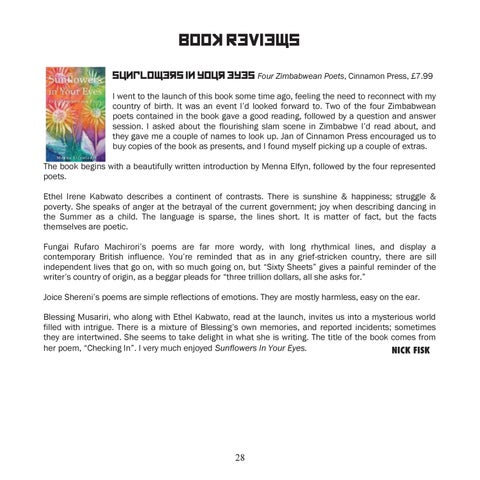
Book Reviews sunflowers in your eyes Four Zimbabwean Poets, Cinnamon Press, £7.99 I went to the launch of this book some time ago, feeling the need to reconnect with my country of birth. It was an event I‟d looked forward to. Two of the four Zimbabwean poets contained in the book gave a good reading, followed by a question and answer session. I asked about the flourishing slam scene in Zimbabwe I‟d read about, and they gave me a couple of names to look up. Jan of Cinnamon Press encouraged us to buy copies of the book as presents, and I found myself picking up a couple of extras. The book begins with a beautifully written introduction by Menna Elfyn, followed by the four represented poets. Ethel Irene Kabwato describes a continent of contrasts. There is sunshine & happiness; struggle & poverty. She speaks of anger at the betrayal of the current government; joy when describing dancing in the Summer as a child. The language is sparse, the lines short. It is matter of fact, but the facts themselves are poetic. Fungai Rufaro Machirori‟s poems are far more wordy, with long rhythmical lines, and display a contemporary British influence. You‟re reminded that as in any grief-stricken country, there are sill independent lives that go on, with so much going on, but “Sixty Sheets” gives a painful reminder of the writer‟s country of origin, as a beggar pleads for “three trillion dollars, all she asks for.” Joice Shereni‟s poems are simple reflections of emotions. They are mostly harmless, easy on the ear.
one night in London achieves nothing but give the papers some nice pictures and put insurance premiums up. The abolition of private property can only really happen if the Government is overthrown, but I wonder if this is really achievable in this day and age, or even desired? And how to achieve this on a worldwide stage – essential in Marx‟s view? Could it really be possible for every government in every nation to be overthrown? And presumably this would have to be more-or-less simultaneously. The main problem I have with Marx is his apparent denial of the individual, which he says cannot exist under capitalism. I would question this. For a start, if another person, however likeminded, had set out to write Marx‟s work, it of course would have differed! This is just one very basic example. What about individual feelings, etc. Perhaps a person might like being a “mere proletariat”! There is so much more to a person surely than the class to which he or she is supposed to belong. Just take music taste for one. And even there, a person‟s class will not dictate his taste. Marx talks of the need to organise a class of people against the Government. The Labour Party and the Trade Unions can get a good number of people out to support them, but if there‟s ever a communist party member on a ballot paper, they usually pool around 97 votes. OK, this might not be truly representative – there are probably many communists who actually vote Labour – but it‟s the hardliners that Marx wants or needs. He speaks dismissively of wishy-washy socialists or “Utopian Communists” (who apparently have sympathy for the working class, but are not prepared to go the whole hog and give them power, which is the goal). When I read this section, it did bring to mind the People‟s Front of Judea pouring scorn on the Judean People‟s Front in Life of Brian, but you can recognise Marx‟s need for a hardline forming a united front. But who these days would really stand up for these principles? I expect many of the people on the frontline in London were not even working but unemployed – a class barely recognised in Marx‟s day. I wonder if people on a low income, but at least in work, would really be willing to sacrifice this existence for Marx‟s fanciful dream?
Blessing Musariri, who along with Ethel Kabwato, read at the launch, invites us into a mysterious world filled with intrigue. There is a mixture of Blessing‟s own memories, and reported incidents; sometimes they are intertwined. She seems to take delight in what she is writing. The title of the book comes from her poem, “Checking In”. I very much enjoyed Sunflowers In Your Eyes. NICK FISK
And then there are the really questionable beliefs! Marx would abolish the family, allowing for a “community of women” which sounds pretty questionable. I got the impression Marx is not talking about feminism and the empowerment of women here. Instead, I envisaged a young Marx watching jealously as aristocratic Victorian gentlemen ran around with prostitutes, wishing instead they were all free! Maybe I‟m a bit wide of the mark here, but he seems to be implying something along those lines. And abolishing the family? OK, there is the idea of property within the family, and some form of “exploitation” of children – obviously, far worse in Victorian times – but if parents did not bring up their offspring, who would, the state? Could the local community really be relied upon? And I think there would be a fair number of bloody struggles when trying to split up many families. In attempting to see everything from one perspective, I think Marx misses several factors about human beings – we have the ability to love; regardless of living conditions, we have freedom of thought and a sense of morality; and also, like many animals, we are perhaps suited to staying in couples.
28
13
In the last 150 years, I‟m sure The CM has been picked over several times, and most of the criticisms I‟ve made have probable been levelled many times. I‟m actually surprised that now, in later life, I‟m finding so many criticisms myself, as I was a fan of Marx when I read him in school. I was an atheist then, whereas I now believe in God, if that makes any difference. There are still further things I‟d like to pick on however. Does it really make sense to abolish all nations in favour of one global nation? What about sport, where competition is essential (although saying that, my sister-in-law recently tried to get me into a “communal” board game involving each player working together towards a collective goal, and there was definitely potential). What about the simple naming of areas – would each section have to be named “Section NW102” or something equally formal – surely Norway is prettier? (And one additional point – Marx mentions confiscating the property of all “emigrants and rebels” – how can there be emigrants if there is only 1 global nation? And rebels? Well, perhaps he did foresee some people objecting to the new system). There are two things that have surprised me about the first 10 years of this century. The first is the continuation of guitar-based bands (and even the rise of folk, ffs!) – I thought it was going to be all synths and techno (space rock?), and along with that, the favouring of a “traditional” look in pubs (although I did read somewhere that at the start of a new century, there is often a switch to nostalgia in culture). The other thing that took me completely by surprise was the increase in racism. Back at the turn of the millennium, it seemed like everyone was living as one. Maybe it was the drugs, but everyone seemed to be getting on fine, and I never thought racism would ever become accepted again like it is now. Maybe it didn‟t help when Britain went to war again. Six years ago, when still not (just about) everyone was online, and a while before facebook of course, I reported to my boss at the call centre I worked at, in a kind of hushed tone, that someone before me had been checking out the BNP website. Even people when smoking outside would sometimes mention the BNP and I just could not believe what I was hearing. These days, the BNP is rife, and accepted, and no longer seem as abhorrent, which personally, I think is a disgrace. But is does just go to show that people involved in a class struggle are as likely to turn to the far-right as to the left, so unifying a class as one is always going to take a lot of work. I just hope that recent events around the world turn more people to the left (It is also worth mentioning that even Marx himself apparently saw a difference between people of developed nations and “barbarians” (that‟s the translation anyway) who he hoped could be converted to communism. Again, we‟re talking about a 19th century writer, but still, if he was unable to recognise a united human race, then this was going to be an obstacle for him).
Last issue’s cover star gives an account of life on the road on his Come And Love Me tour.
7 years is quite a long time For example, seven years of being a missing person, makes you officially dead. I make this point for more than one reason. Firstly, it had been seven years since my previous “proper” tour, and to be honest, I felt like a completely different person, to that young enthusiastic boy who actually thought he could take over the world. My goals were very different this time, although, the preparation was still as bad. Seven years ago, on tour, I spent my days sleeping, recovering from hangovers/comedowns from the buzz the night before (although I must mention, I had no idea what a “proper” hangover was until I hit 25, and I promise you, they are getting worse). This time around, I would drink a few, for sure, I was after all, on tour, but this time, it was local beverages, and drunk with enthusiasm for the place, savouring the moment. I spent the days this time visiting local breweries, and their flagship haunts (pubs). The hedonism was almost completely gone, replaced by a buzz for sentiment, and a hope to understand by tasting. My second point, was a completely different choice of venue. Last time round, I had hit the cities, this time, as big as it got, was an acoustic night in Plymouth (a really bad choice of venues too, as it goes). Seven years ago, the thought of touring rural boozers in the South West would have made me laugh, but this time, this IS what I wanted, and booked. I couldn‟t wait to get back to Falmouth (where I am the “Lunge King”, but that‟s another story) and see the wonderful and friendly faces that welcomed last time, and this time, and had spurred me on. The first thing I did on arrival, was head to “The Front” and ask for a pint of “Grandma‟s weapons grade Ginger ale”, which was greeted with a massive hug. From now on, I‟ll stick to four day tours, (at most) because even this country pub ramble left me in tatters. As for the shows themselves, they weren‟t bad. The tour (rather like this article) had very little to do with the shows. Sorry, I‟ve gone slightly off topic, but my point remains the same, seven years is a long time, there was nothing at all in common with myself then and now (apart from having a tour survival box, only this time it was filled with mints, flapjacks and chai). I once heard someone say that a conversation lasts seven minutes, not sure if that‟s true, but, I understand exactly what they mean.
My very final query is – what happens after the revolution? What happens if things don‟t go the way Marx might have foreseen or hoped? George Orwell of course famously depicts the way any power that overthrows another can quickly become like those they opposed (New Labour anyone?). I‟ve often thought Labour are better as an opposition party, but does it make sense to always be in opposition? It‟s a bit like saying Cardiff should remain in the Championship rather than gain promotion to the Premiership (2nd in the league, with 4 games to go as I write). Is life really all about struggle? Even the most down-and-out has got to have fun sometimes!
Tour High: Square & Compass pub (also visited by Square editor – amazing place! Ed), Purbeck peninsular, Dorset, 5pm, watching the light turn to dark, with my jug of home made scrumpy, pasty and pipe.
14
27
Tour Low: Same show, 9pm, breaking d-strings (on guitar + reserve) within two minutes of each other.
DAVID CHARLIE DUKE Dave’s excellent album “Be There To Love You” is available now from www.dukeofcardiff.com
Z-Factor students were trying to stuff it into their pockets, probably wanted to save it up to use in their acts. Once responsible owners let their mini-elephants off the lead to roll around - drunk on the scent, the sub-prime entertainment freaks were frozen to their soapboxes looking like statues of Buddha or Cruise, loveable paedophiles returning from council-sponsored winter breaks at the BBC camps were making snowballs to force feed to their Arab children, flash mobs of web developers turned up, trying to unravel the hexagonal snow code, the capital had gone mad. Then the announcement we‟d been dreading… A Euro-chinapean directive from our underwater headquarters in The Hague was rushed out. The giant health & safety monitors scattered all over the city suddenly sprang to life telling us that precipitation theft was not only dangerous to our organic circuitry but also invalidated our guarantees. Those feckin‟ tropical actuaries! As a result this crime against the state was now punishable by forfeit of broadband rights – bloody hell, those bureaucrats just got worse. I had to get back to my subterranean nest to tell Sharon. She‟d need unplugging soon unless Blair, the Tesco repair man, had felt sorry for her missing out and took her above ground for a peep too. Hope he sorted out the suction valves on her new vagina while he was there mind you. If only her incept day had been a Monday she would have been hovering through the Bay with me on this glorious day too. Well, they do say mixed marriages never work. But it wasn‟t all fun and games of course. People were beginning to come down with tofu-flu now as the sun crept higher then burst from behind the grey clouds and started melting the snow. This sudden warming caused vast clouds of condensation to head straight for peoples‟ underdeveloped lungs. Best get into the shaft and back down to normality. I couldn‟t wait to show all my new wives the mp8s I recorded, should keep us going until our next drug change. Wow, what a day! Who said Japanese super-fusion power was a bad thing? If it hadn‟t affected the weather patterns like that no-one would ever have seen snow. Now where did I park my invisible-car?
DAVE LEWIS
Perhaps the best point Marx makes is the simple fact that the only reason we have money is because it became universally accepted as a means of currency, and in a sense the same applies to all property. Take away this principle and well….but is communism the inevitable result or just one possibility? If a system has been in place for so long, completely abolishing it will never be easy (think of the paperwork! Although saying that, the internet has revolutionised so many things, including doing away with a lot of paperwork!). Maybe it‟s better things are revised and tweaked along the way. If things are not going so well, it might be time for a bit of a clear out, but completely turning the world upside down? I don‟t know! Personally, I think a new Industrial Age would be a good thing. We‟ve had an age of the mass production of consumer goods – PCs, Ipods, and other ways of showing how wonderfully flat images can glide across flat screens – but these are just being modified and repeated now. How about some completely new 21st century products? It might sound expensive, but I think there‟s a need for economics to be revised somehow. Everything it seems is becoming too expensive. And with any new production brings more employment which we do need. Enough of nonsensical “virtual” internet jobs, let‟s have some more good old fashioned stuff being built! And how about greater utilisation of our greatest energy source, the sun? Going back to the phrase, “It sounds good in principle, but it would never happen”, having re-read the Communist Manifesto, I actually wonder if it is all good, even in principle, particularly in relation to the proposals to do away with families, and its apparent refusal to accept individual will (I‟m afraid I can‟t accept the view that only once a system is in place that allows the individual to be free can an individual be truly free – under any system, I believe each person‟s mind is still individual). It certainly is an amazing book of ideas, however. It quite accurately charts the history of Labour until Marx‟s day, and definitely gets the brain excited about all kinds of possibilities. I was left to wonder, well if I‟m not a communist, what am I? I believe in looking out for people, which I suppose makes me a socialist, but to be honest, all I could really come up with was that I must be a hedonist! I live for pleasure, and that‟s about it. I increasingly think about the world as being a kind of super-advanced virtual reality computer game, and the best thing in any computer game is to have a “cheat” giving you infinite lives. Anyone who ever played Jet Set Willy with infinite lives will know what I‟m talking about here. So, that might be quite good fun – just need to invent some kind of time machine thing (Fisk drifts into fantasy here…definitely gets you thinking the book though!). I have no truck with liars, and given that there is so much dishonesty in politics these days, modern politics really does leave me pretty cold. Saying that, with revolution in the air, and me always being a kind of revolutionary, I must admit, I was dead impressed with what took place in Egypt. Two weeks the people camped in that square – 2 weeks! That shows commitment, compared to all the London protestors shuffling back home, a bit embarrassed probably, after 1 night. When Mubarak announced he would not stand down, and was proud of his people (a surprisingly brave speech in fact), I thought, oh well, it‟s all come to nothing. But when the next day it was announced that the military had removed him, I felt quite proud for them – they‟d done it! But the question is still there – has a better system actually been put in place, and how can you achieve this kind of revolution on a global scale? And to the man sitting at the end of the bar with his bottle of wine and a paper, does it really make any difference? NICK FISK
26
15
WHO COLLECTS THE FORTUNES OF REVOLUTION?
Global Warning
Who collects the fortunes of revolution? governments topple into civil war, as man raged the earth for fair selection.
Cardiff Bay. Noon. Monday. The city had come to a standstill. People were dancing in the streets. The bobbing boats in the harbour were silent, buried under a blanket of snow. Council storm troopers unchained their iPad prisoners to allow them to look out the window. The whole metropolis stared open-mouthed at the heavens as if expecting another mushroom cloud to appear like it did last year when they finally pulled the plug on Italy. But this was no ordinary day.
In times of the world‟s final revelation inside empty hungry hands of the poor, who collects the fortunes of revolution?
Suddenly, fights started to break out as the Tuesday people burst out of the holding pens and into the recycled air. But most Mondayers didn‟t care. If they died now they‟d die happy. Most of us couldn‟t afford the government subsided Antarctic pilgrimage even once in our lives so this was like the gods of air-con had smiled up on us and made some extra ice, like they did eight Googlemases ago.
in prayers to satellites with delusion I hear the loud chant of freedom roar, as man raged the earth for fair selection. When great cities lay in seaweed oceans on violent winds of the Earth‟s angry core, who collects the fortunes of revolution?
The scene was outrageous, like Glastonbury or some other long forgotten religious festival. The stuff was everywhere. A billion snowflakes floated down through the bright blue sky. Thick layers of freezing white snow were forming all over town. Drifts, ten feet deep, were piling up faster than pensioners at the equator. The population of Leisureland were experiencing a miracle. This probably wouldn‟t happen again until men got the vote.
when the devil hijacked man‟s religion and our hell lay at political shores, as man raged the earth for fair selection.
Scanning my ancestors‟ facebook snapshots on my outdated iPhone I brought up some 2GB low-res pictures of what it used to be like, years ago, in 2030. Colourful 4D movies of blizzards and hurricanes were sent wireless into my cerebral cortex. I could smell the same smell all around me. This snow was real!
With the spirit of a nation‟s derision the golden price to war‟s flagrant whore, who collects the fortunes of revolution? as man raged the earth for fair selection.
A refugee from the Maldives came up to me and asked if I‟d take a photograph of her. I f-mailed it without even a hint of Photoshop CS67 but she forgave me, probably assumed I‟d forgotten to take my serotonin this month. Meanwhile, other people were starting to strip off their paper suits and spontaneously began kissing each other in Lord Cowell Square.
MATTHEW DUGGAN
When the temperature dropped below 30oC the sudden cold quickly killed many of the cities consumers but nobody seemed to notice, much less care. More oxygen for the rest of us. The Afro-Anzacs were the first to succumb seeing as they were less Darwined to this sudden homeostatic blip but the Danish and Icelandic pleasure models just seemed to become more attractive. They always did after a few ice cubes though. But after a midihour or so the terra firma police arrived and started to shovel up the snow. Putting it into clear storage bags tied up with red fibre optic tape. I bet they‟d use that up on a sub-committee jolly the bastards!
16
25
THEY SAID
Feedback
Dreams
They said if I ever betrayed them they‟d climb up through the floor boards and tie the dog‟s ears to a tea towel I said apron strings would be more useful they said it was not possible to climb through apron strings I disputed that but thought the debate would last all night and there wasn‟t time as the dog‟s flapping ears testified. The red carpet wrapped around the green shoes and slowly but surely the tea towel was pulled from under our feet with incredible discretion they politely said enough was enough I also disputed that because red is just too much even the dog knows that but because of the angels we thought it best to keep quiet on that one generally speaking it never quite works I‟m sure it‟s the whiskers I never betray even the longest Apron Strings they are usually flowery and I don‟t see that it matters anyway. Pink has always been important to me thick to the back teeth pink the sound of a silent room sort of pink so pale it‟s not white dense fog cat curling pink
Madam I’m Adam I’m built self-reflecting I’m forwards and backwards At much the same time
In dreams the brain must have its way It leaves behind the everyday The mundane of our lives
It’s not that I’m retro Or proto-contempo I’m not evo-devo But self-referentio Explaining the issue Takes quite a long rhyme So why should you talk to me Say you will walk with me What will you gain from me Learning through mime? I’ll teach you to mirror you Show you the inner you Bouncing thoughts back to you All on my dime
In reverie the mind escapes Sensation‟s gamut, that which makes Us know the world outside Ours dreams are strange, now outside‟s in; Without sensation, memories spin Odd fables in our minds; For mem‟ries stray far from the facts The outcomes therefore inexact, Bizarre, fantastic, but not true The nightly puzzle we pass through The other-life that we go to When brains go out to play.
LANCE NIZAMI
And while so we’re doing We’re each other viewing Anything I can see Anything you can see In a new symmetry Both yours and mine Madam I’m Adam.
FLO FFLACH
24
17
The Importance of Tigers
The Seabirds
The tigers burst through the Headquarters‟ glass, frothy-toothed, and soon were flaring in the lobby. One roared at the glass-shard in his pad; another pounced on the camera lens,
Beyond the interior, some had condemnation to do. They hadn't wagered on unanimity of the tigers: The importance of tigers is that they never depart a claw from themselves, a reporter lectured the nation.
The seabirds are inland from their wrecked habitat and rioting around our rooftops. They stuff the street with uncouth squawking. They have written to the council complaining of our animosity but have had no response. It has been reported that their yearlings, giant children with foaming plumage, are vermin. The gulls say this breaches their avian rights and will sue. The black bags in the street have been broken open in a search for joy. All that has been found has been old meat and desiccated bone. From the ridge tiles the gulls stare as we satiate on beer and television. A man with hair on his palms says he has had enough. Do the gulls care? They don‟t.
CHRIS JACKSON
PETER FINCH
and the BBC reared backwards in amazement. Outside, the jostling placards slogan-competed: “Don‟t ruin my dreams!” “Give me a chance!” Across government, the cuts had been severe. The tigers leisurely roamed the corridors, mauling secretary and security guard, their green eyes, education-jealous: if they had any prey to feast on, it was need of their futures.
18
23
The Importance of Tigers
The Seabirds
The tigers burst through the Headquarters‟ glass, frothy-toothed, and soon were flaring in the lobby. One roared at the glass-shard in his pad; another pounced on the camera lens,
Beyond the interior, some had condemnation to do. They hadn't wagered on unanimity of the tigers: The importance of tigers is that they never depart a claw from themselves, a reporter lectured the nation.
The seabirds are inland from their wrecked habitat and rioting around our rooftops. They stuff the street with uncouth squawking. They have written to the council complaining of our animosity but have had no response. It has been reported that their yearlings, giant children with foaming plumage, are vermin. The gulls say this breaches their avian rights and will sue. The black bags in the street have been broken open in a search for joy. All that has been found has been old meat and desiccated bone. From the ridge tiles the gulls stare as we satiate on beer and television. A man with hair on his palms says he has had enough. Do the gulls care? They don‟t.
CHRIS JACKSON
PETER FINCH
and the BBC reared backwards in amazement. Outside, the jostling placards slogan-competed: “Don‟t ruin my dreams!” “Give me a chance!” Across government, the cuts had been severe. The tigers leisurely roamed the corridors, mauling secretary and security guard, their green eyes, education-jealous: if they had any prey to feast on, it was need of their futures.
18
23
THEY SAID
Feedback
Dreams
They said if I ever betrayed them they‟d climb up through the floor boards and tie the dog‟s ears to a tea towel I said apron strings would be more useful they said it was not possible to climb through apron strings I disputed that but thought the debate would last all night and there wasn‟t time as the dog‟s flapping ears testified. The red carpet wrapped around the green shoes and slowly but surely the tea towel was pulled from under our feet with incredible discretion they politely said enough was enough I also disputed that because red is just too much even the dog knows that but because of the angels we thought it best to keep quiet on that one generally speaking it never quite works I‟m sure it‟s the whiskers I never betray even the longest Apron Strings they are usually flowery and I don‟t see that it matters anyway. Pink has always been important to me thick to the back teeth pink the sound of a silent room sort of pink so pale it‟s not white dense fog cat curling pink
Madam I’m Adam I’m built self-reflecting I’m forwards and backwards At much the same time
In dreams the brain must have its way It leaves behind the everyday The mundane of our lives
It’s not that I’m retro Or proto-contempo I’m not evo-devo But self-referentio Explaining the issue Takes quite a long rhyme So why should you talk to me Say you will walk with me What will you gain from me Learning through mime? I’ll teach you to mirror you Show you the inner you Bouncing thoughts back to you All on my dime
In reverie the mind escapes Sensation‟s gamut, that which makes Us know the world outside Ours dreams are strange, now outside‟s in; Without sensation, memories spin Odd fables in our minds; For mem‟ries stray far from the facts The outcomes therefore inexact, Bizarre, fantastic, but not true The nightly puzzle we pass through The other-life that we go to When brains go out to play.
LANCE NIZAMI
And while so we’re doing We’re each other viewing Anything I can see Anything you can see In a new symmetry Both yours and mine Madam I’m Adam.
FLO FFLACH
24
17
WHO COLLECTS THE FORTUNES OF REVOLUTION?
Global Warning
Who collects the fortunes of revolution? governments topple into civil war, as man raged the earth for fair selection.
Cardiff Bay. Noon. Monday. The city had come to a standstill. People were dancing in the streets. The bobbing boats in the harbour were silent, buried under a blanket of snow. Council storm troopers unchained their iPad prisoners to allow them to look out the window. The whole metropolis stared open-mouthed at the heavens as if expecting another mushroom cloud to appear like it did last year when they finally pulled the plug on Italy. But this was no ordinary day.
In times of the world‟s final revelation inside empty hungry hands of the poor, who collects the fortunes of revolution?
Suddenly, fights started to break out as the Tuesday people burst out of the holding pens and into the recycled air. But most Mondayers didn‟t care. If they died now they‟d die happy. Most of us couldn‟t afford the government subsided Antarctic pilgrimage even once in our lives so this was like the gods of air-con had smiled up on us and made some extra ice, like they did eight Googlemases ago.
in prayers to satellites with delusion I hear the loud chant of freedom roar, as man raged the earth for fair selection. When great cities lay in seaweed oceans on violent winds of the Earth‟s angry core, who collects the fortunes of revolution?
The scene was outrageous, like Glastonbury or some other long forgotten religious festival. The stuff was everywhere. A billion snowflakes floated down through the bright blue sky. Thick layers of freezing white snow were forming all over town. Drifts, ten feet deep, were piling up faster than pensioners at the equator. The population of Leisureland were experiencing a miracle. This probably wouldn‟t happen again until men got the vote.
when the devil hijacked man‟s religion and our hell lay at political shores, as man raged the earth for fair selection.
Scanning my ancestors‟ facebook snapshots on my outdated iPhone I brought up some 2GB low-res pictures of what it used to be like, years ago, in 2030. Colourful 4D movies of blizzards and hurricanes were sent wireless into my cerebral cortex. I could smell the same smell all around me. This snow was real!
With the spirit of a nation‟s derision the golden price to war‟s flagrant whore, who collects the fortunes of revolution? as man raged the earth for fair selection.
A refugee from the Maldives came up to me and asked if I‟d take a photograph of her. I f-mailed it without even a hint of Photoshop CS67 but she forgave me, probably assumed I‟d forgotten to take my serotonin this month. Meanwhile, other people were starting to strip off their paper suits and spontaneously began kissing each other in Lord Cowell Square.
MATTHEW DUGGAN
When the temperature dropped below 30oC the sudden cold quickly killed many of the cities consumers but nobody seemed to notice, much less care. More oxygen for the rest of us. The Afro-Anzacs were the first to succumb seeing as they were less Darwined to this sudden homeostatic blip but the Danish and Icelandic pleasure models just seemed to become more attractive. They always did after a few ice cubes though. But after a midihour or so the terra firma police arrived and started to shovel up the snow. Putting it into clear storage bags tied up with red fibre optic tape. I bet they‟d use that up on a sub-committee jolly the bastards!
16
25
Z-Factor students were trying to stuff it into their pockets, probably wanted to save it up to use in their acts. Once responsible owners let their mini-elephants off the lead to roll around - drunk on the scent, the sub-prime entertainment freaks were frozen to their soapboxes looking like statues of Buddha or Cruise, loveable paedophiles returning from council-sponsored winter breaks at the BBC camps were making snowballs to force feed to their Arab children, flash mobs of web developers turned up, trying to unravel the hexagonal snow code, the capital had gone mad. Then the announcement we‟d been dreading… A Euro-chinapean directive from our underwater headquarters in The Hague was rushed out. The giant health & safety monitors scattered all over the city suddenly sprang to life telling us that precipitation theft was not only dangerous to our organic circuitry but also invalidated our guarantees. Those feckin‟ tropical actuaries! As a result this crime against the state was now punishable by forfeit of broadband rights – bloody hell, those bureaucrats just got worse. I had to get back to my subterranean nest to tell Sharon. She‟d need unplugging soon unless Blair, the Tesco repair man, had felt sorry for her missing out and took her above ground for a peep too. Hope he sorted out the suction valves on her new vagina while he was there mind you. If only her incept day had been a Monday she would have been hovering through the Bay with me on this glorious day too. Well, they do say mixed marriages never work. But it wasn‟t all fun and games of course. People were beginning to come down with tofu-flu now as the sun crept higher then burst from behind the grey clouds and started melting the snow. This sudden warming caused vast clouds of condensation to head straight for peoples‟ underdeveloped lungs. Best get into the shaft and back down to normality. I couldn‟t wait to show all my new wives the mp8s I recorded, should keep us going until our next drug change. Wow, what a day! Who said Japanese super-fusion power was a bad thing? If it hadn‟t affected the weather patterns like that no-one would ever have seen snow. Now where did I park my invisible-car?
DAVE LEWIS
Perhaps the best point Marx makes is the simple fact that the only reason we have money is because it became universally accepted as a means of currency, and in a sense the same applies to all property. Take away this principle and well….but is communism the inevitable result or just one possibility? If a system has been in place for so long, completely abolishing it will never be easy (think of the paperwork! Although saying that, the internet has revolutionised so many things, including doing away with a lot of paperwork!). Maybe it‟s better things are revised and tweaked along the way. If things are not going so well, it might be time for a bit of a clear out, but completely turning the world upside down? I don‟t know! Personally, I think a new Industrial Age would be a good thing. We‟ve had an age of the mass production of consumer goods – PCs, Ipods, and other ways of showing how wonderfully flat images can glide across flat screens – but these are just being modified and repeated now. How about some completely new 21st century products? It might sound expensive, but I think there‟s a need for economics to be revised somehow. Everything it seems is becoming too expensive. And with any new production brings more employment which we do need. Enough of nonsensical “virtual” internet jobs, let‟s have some more good old fashioned stuff being built! And how about greater utilisation of our greatest energy source, the sun? Going back to the phrase, “It sounds good in principle, but it would never happen”, having re-read the Communist Manifesto, I actually wonder if it is all good, even in principle, particularly in relation to the proposals to do away with families, and its apparent refusal to accept individual will (I‟m afraid I can‟t accept the view that only once a system is in place that allows the individual to be free can an individual be truly free – under any system, I believe each person‟s mind is still individual). It certainly is an amazing book of ideas, however. It quite accurately charts the history of Labour until Marx‟s day, and definitely gets the brain excited about all kinds of possibilities. I was left to wonder, well if I‟m not a communist, what am I? I believe in looking out for people, which I suppose makes me a socialist, but to be honest, all I could really come up with was that I must be a hedonist! I live for pleasure, and that‟s about it. I increasingly think about the world as being a kind of super-advanced virtual reality computer game, and the best thing in any computer game is to have a “cheat” giving you infinite lives. Anyone who ever played Jet Set Willy with infinite lives will know what I‟m talking about here. So, that might be quite good fun – just need to invent some kind of time machine thing (Fisk drifts into fantasy here…definitely gets you thinking the book though!). I have no truck with liars, and given that there is so much dishonesty in politics these days, modern politics really does leave me pretty cold. Saying that, with revolution in the air, and me always being a kind of revolutionary, I must admit, I was dead impressed with what took place in Egypt. Two weeks the people camped in that square – 2 weeks! That shows commitment, compared to all the London protestors shuffling back home, a bit embarrassed probably, after 1 night. When Mubarak announced he would not stand down, and was proud of his people (a surprisingly brave speech in fact), I thought, oh well, it‟s all come to nothing. But when the next day it was announced that the military had removed him, I felt quite proud for them – they‟d done it! But the question is still there – has a better system actually been put in place, and how can you achieve this kind of revolution on a global scale? And to the man sitting at the end of the bar with his bottle of wine and a paper, does it really make any difference? NICK FISK
26
15
In the last 150 years, I‟m sure The CM has been picked over several times, and most of the criticisms I‟ve made have probable been levelled many times. I‟m actually surprised that now, in later life, I‟m finding so many criticisms myself, as I was a fan of Marx when I read him in school. I was an atheist then, whereas I now believe in God, if that makes any difference. There are still further things I‟d like to pick on however. Does it really make sense to abolish all nations in favour of one global nation? What about sport, where competition is essential (although saying that, my sister-in-law recently tried to get me into a “communal” board game involving each player working together towards a collective goal, and there was definitely potential). What about the simple naming of areas – would each section have to be named “Section NW102” or something equally formal – surely Norway is prettier? (And one additional point – Marx mentions confiscating the property of all “emigrants and rebels” – how can there be emigrants if there is only 1 global nation? And rebels? Well, perhaps he did foresee some people objecting to the new system). There are two things that have surprised me about the first 10 years of this century. The first is the continuation of guitar-based bands (and even the rise of folk, ffs!) – I thought it was going to be all synths and techno (space rock?), and along with that, the favouring of a “traditional” look in pubs (although I did read somewhere that at the start of a new century, there is often a switch to nostalgia in culture). The other thing that took me completely by surprise was the increase in racism. Back at the turn of the millennium, it seemed like everyone was living as one. Maybe it was the drugs, but everyone seemed to be getting on fine, and I never thought racism would ever become accepted again like it is now. Maybe it didn‟t help when Britain went to war again. Six years ago, when still not (just about) everyone was online, and a while before facebook of course, I reported to my boss at the call centre I worked at, in a kind of hushed tone, that someone before me had been checking out the BNP website. Even people when smoking outside would sometimes mention the BNP and I just could not believe what I was hearing. These days, the BNP is rife, and accepted, and no longer seem as abhorrent, which personally, I think is a disgrace. But is does just go to show that people involved in a class struggle are as likely to turn to the far-right as to the left, so unifying a class as one is always going to take a lot of work. I just hope that recent events around the world turn more people to the left (It is also worth mentioning that even Marx himself apparently saw a difference between people of developed nations and “barbarians” (that‟s the translation anyway) who he hoped could be converted to communism. Again, we‟re talking about a 19th century writer, but still, if he was unable to recognise a united human race, then this was going to be an obstacle for him).
Last issue’s cover star gives an account of life on the road on his Come And Love Me tour.
7 years is quite a long time For example, seven years of being a missing person, makes you officially dead. I make this point for more than one reason. Firstly, it had been seven years since my previous “proper” tour, and to be honest, I felt like a completely different person, to that young enthusiastic boy who actually thought he could take over the world. My goals were very different this time, although, the preparation was still as bad. Seven years ago, on tour, I spent my days sleeping, recovering from hangovers/comedowns from the buzz the night before (although I must mention, I had no idea what a “proper” hangover was until I hit 25, and I promise you, they are getting worse). This time around, I would drink a few, for sure, I was after all, on tour, but this time, it was local beverages, and drunk with enthusiasm for the place, savouring the moment. I spent the days this time visiting local breweries, and their flagship haunts (pubs). The hedonism was almost completely gone, replaced by a buzz for sentiment, and a hope to understand by tasting. My second point, was a completely different choice of venue. Last time round, I had hit the cities, this time, as big as it got, was an acoustic night in Plymouth (a really bad choice of venues too, as it goes). Seven years ago, the thought of touring rural boozers in the South West would have made me laugh, but this time, this IS what I wanted, and booked. I couldn‟t wait to get back to Falmouth (where I am the “Lunge King”, but that‟s another story) and see the wonderful and friendly faces that welcomed last time, and this time, and had spurred me on. The first thing I did on arrival, was head to “The Front” and ask for a pint of “Grandma‟s weapons grade Ginger ale”, which was greeted with a massive hug. From now on, I‟ll stick to four day tours, (at most) because even this country pub ramble left me in tatters. As for the shows themselves, they weren‟t bad. The tour (rather like this article) had very little to do with the shows. Sorry, I‟ve gone slightly off topic, but my point remains the same, seven years is a long time, there was nothing at all in common with myself then and now (apart from having a tour survival box, only this time it was filled with mints, flapjacks and chai). I once heard someone say that a conversation lasts seven minutes, not sure if that‟s true, but, I understand exactly what they mean.
My very final query is – what happens after the revolution? What happens if things don‟t go the way Marx might have foreseen or hoped? George Orwell of course famously depicts the way any power that overthrows another can quickly become like those they opposed (New Labour anyone?). I‟ve often thought Labour are better as an opposition party, but does it make sense to always be in opposition? It‟s a bit like saying Cardiff should remain in the Championship rather than gain promotion to the Premiership (2nd in the league, with 4 games to go as I write). Is life really all about struggle? Even the most down-and-out has got to have fun sometimes!
Tour High: Square & Compass pub (also visited by Square editor – amazing place! Ed), Purbeck peninsular, Dorset, 5pm, watching the light turn to dark, with my jug of home made scrumpy, pasty and pipe.
14
27
Tour Low: Same show, 9pm, breaking d-strings (on guitar + reserve) within two minutes of each other.
DAVID CHARLIE DUKE Dave’s excellent album “Be There To Love You” is available now from www.dukeofcardiff.com
Book Reviews sunflowers in your eyes Four Zimbabwean Poets, Cinnamon Press, £7.99 I went to the launch of this book some time ago, feeling the need to reconnect with my country of birth. It was an event I‟d looked forward to. Two of the four Zimbabwean poets contained in the book gave a good reading, followed by a question and answer session. I asked about the flourishing slam scene in Zimbabwe I‟d read about, and they gave me a couple of names to look up. Jan of Cinnamon Press encouraged us to buy copies of the book as presents, and I found myself picking up a couple of extras. The book begins with a beautifully written introduction by Menna Elfyn, followed by the four represented poets. Ethel Irene Kabwato describes a continent of contrasts. There is sunshine & happiness; struggle & poverty. She speaks of anger at the betrayal of the current government; joy when describing dancing in the Summer as a child. The language is sparse, the lines short. It is matter of fact, but the facts themselves are poetic. Fungai Rufaro Machirori‟s poems are far more wordy, with long rhythmical lines, and display a contemporary British influence. You‟re reminded that as in any grief-stricken country, there are sill independent lives that go on, with so much going on, but “Sixty Sheets” gives a painful reminder of the writer‟s country of origin, as a beggar pleads for “three trillion dollars, all she asks for.” Joice Shereni‟s poems are simple reflections of emotions. They are mostly harmless, easy on the ear.
one night in London achieves nothing but give the papers some nice pictures and put insurance premiums up. The abolition of private property can only really happen if the Government is overthrown, but I wonder if this is really achievable in this day and age, or even desired? And how to achieve this on a worldwide stage – essential in Marx‟s view? Could it really be possible for every government in every nation to be overthrown? And presumably this would have to be more-or-less simultaneously. The main problem I have with Marx is his apparent denial of the individual, which he says cannot exist under capitalism. I would question this. For a start, if another person, however likeminded, had set out to write Marx‟s work, it of course would have differed! This is just one very basic example. What about individual feelings, etc. Perhaps a person might like being a “mere proletariat”! There is so much more to a person surely than the class to which he or she is supposed to belong. Just take music taste for one. And even there, a person‟s class will not dictate his taste. Marx talks of the need to organise a class of people against the Government. The Labour Party and the Trade Unions can get a good number of people out to support them, but if there‟s ever a communist party member on a ballot paper, they usually pool around 97 votes. OK, this might not be truly representative – there are probably many communists who actually vote Labour – but it‟s the hardliners that Marx wants or needs. He speaks dismissively of wishy-washy socialists or “Utopian Communists” (who apparently have sympathy for the working class, but are not prepared to go the whole hog and give them power, which is the goal). When I read this section, it did bring to mind the People‟s Front of Judea pouring scorn on the Judean People‟s Front in Life of Brian, but you can recognise Marx‟s need for a hardline forming a united front. But who these days would really stand up for these principles? I expect many of the people on the frontline in London were not even working but unemployed – a class barely recognised in Marx‟s day. I wonder if people on a low income, but at least in work, would really be willing to sacrifice this existence for Marx‟s fanciful dream?
Blessing Musariri, who along with Ethel Kabwato, read at the launch, invites us into a mysterious world filled with intrigue. There is a mixture of Blessing‟s own memories, and reported incidents; sometimes they are intertwined. She seems to take delight in what she is writing. The title of the book comes from her poem, “Checking In”. I very much enjoyed Sunflowers In Your Eyes. NICK FISK
And then there are the really questionable beliefs! Marx would abolish the family, allowing for a “community of women” which sounds pretty questionable. I got the impression Marx is not talking about feminism and the empowerment of women here. Instead, I envisaged a young Marx watching jealously as aristocratic Victorian gentlemen ran around with prostitutes, wishing instead they were all free! Maybe I‟m a bit wide of the mark here, but he seems to be implying something along those lines. And abolishing the family? OK, there is the idea of property within the family, and some form of “exploitation” of children – obviously, far worse in Victorian times – but if parents did not bring up their offspring, who would, the state? Could the local community really be relied upon? And I think there would be a fair number of bloody struggles when trying to split up many families. In attempting to see everything from one perspective, I think Marx misses several factors about human beings – we have the ability to love; regardless of living conditions, we have freedom of thought and a sense of morality; and also, like many animals, we are perhaps suited to staying in couples.
28
13
So anyway, we had a short dialogue, the shopkeep and I, but to be honest, the phrase, “It sounds great in principle, but it would never work” is a bit of a conversation stopper. So back I returned home, on a beautiful sunny day, and began reading the book in my second-hand rocking chair in the back garden. I had not “been on the internet” (that great distraction) for the past couple of days, and resolved to read the book – the bulk of it being just 40 pages – to its completion, again without going on the computer. I have often thought that the internet, which is of course global, where each user is essentially equal, and where so much is free is quite analogous with communism. Nonetheless, it‟s also very habit-forming, which is not good!
Welcome Back to the Country Graham Clifford, Seren, £5.00 You often hear that the trick to winning a poetry competition is to write in the style of the judges. A friend of mine once told me that they were sure they only won in a competition they entered because their work was thought to be someone else's – a back-handed compliment surely? Grahame Clifford's pamphlet Welcome Back to the Country was last year's winner of the Poetry Wales Purple Moose Prize. The judges were Zoe Skoulding and Patrick McGuinness. Reading the pamphlet confirms the choice as one that flatters the judge's own catalogues.
As the sun was slowly sinking behind a tree, having read the first 10 pages or so – yes, there are only 40 pages, but it‟s quite a strong concentration of text! – I came in, turned on the telly, and found a 70s sitcom called George & Mildred. References to the working class and an opposing middle class perpetuated the programme (perhaps one irony being that the lead roles playing the working class George and Mildred probably earned a substantially higher wage than the 2 people cast as their middle class neighbours). It occurred to me that specific references to people of a certain class are not made all that often these days. The classic sketch with John Cleese and Ronnie Corbett featuring the upper class looking down on the working class and vice versa would be out of place on 21st century TV I think.
This is not to be seen as an insult. Clifford's work is still accomplished, taking the better elements of the two's writing, avoiding the more experimental ends of Skoulding and focusing more on the ideas. 'A' particularly struck me as Skoulding-like, with its focus on the shape and form of a blown-up photocopied letter A:
That doesn‟t of course mean that there are not still class divisions and tensions, but perhaps they‟re just not spoken about as much. But it‟s not exactly the first thing you‟d think of to put on your facebook profile (your class), and it is not an option on any of the networking sites (like political views, religion, etc.), but maybe that‟s because the sites are all too “bourgeois”.
As someone whose life seems to be spent analysing letters and words on pages I recognise the sudden strangeness a letter, long familiar, can become. I wonder what he would find of the Greek letter Omega?
Perhaps the IT-type jobs, or call centre work, where graduates and school leavers work alongside each other that a lot of people now put up with, give so many the impression that everyone is about middling, when the reality is that any wage below £20,000 will mean you will struggle even to pay rent or a mortgage. Of course it‟s true that still a very small section of society have a massive sum of wealth, and own vast amounts of property. The Queen after all owns 6,600 million acres of land, or one sixth of the World‟s land mass.
this Times New Roman arrangement that could be far off, Da Vincian invention for cathedral building
I've often thought that the mark of really great poetry, and really great poets, is that their work can be spotted from anyone else's, without being labelled. I am not convinced that I would spot Clifford out from many of the pages of Poetry Wales without a name to tell me so. I would aspire to be the original, not the copy, that, like a photocopy, is slightly shrunk and reduced in quality. Clifford's voice is promising, and praised by those with good taste, but I'm not convinced it is completely unique or original. That perhaps is not his fault, but rather the nature of poetry competitions, and the culture they create. AISLING TEMPANY
But are people really that bothered? Mobile phones – once only owned by yuppies are now affordable for all – and for many it seems, as long as they‟ve got 1500 minutes, unlimited texts and enough money for beer at the end of the week, they‟re happy. At the same time of course, a lot of people aren’t happy – just like Marx in his time. The Communist Manifesto was published during a hotbed of political activity in the middle 19th century, and so was very much “of its time.” But there is still a lot to make it relevant today. Marx does strike me as being very much an angry young man, perhaps like those protestors in London smashing up banks, etc. The guiding principle of the CM, as Marx states is “Abolition of private property.” To me though, attacking a few banks
12
29
The Listening Shell Edited by Gladys Mary Coles, Headland, £7.95 This is one of those books made with good intentions that you just know is going to disappoint. At least the promise of free drinks ensured a good attendance at Cardiff‟s worst “venue”, the corridor space at the WMC. The foreword for the book, an anthology of poetry by writers connected to Tŷ Newydd, is written by Gillian Clarke, who also introduced the launch. In my view, Gillian Clarke always has good intentions.. Well, anyway, the first sentence of the introduction left my slightly baffled. Apparently “writing is a solitary, secretive art.” Ok, it is mostly solitary – except when writing in conjunction with others, such as for the “Renga”, the last piece “exhibited” by a group of writers, at the launch, and I also wonder if writing within a workshop, as most poems in the book would‟ve been, counts as solitary writing? And secretive? Really not sure about that. So, unimpressed with the very first words of the book! My companion on the evening of the launch warned me not to be so cynical. I‟m sure Tŷ Newydd is a lovely place, and I‟m sure it inspires a lot of lovely people to write lots of lovely things. But I would be wary of the quality of the work produced. Anything written under workshop conditions is surely always going to be a little forced – I doubt if any writer will write their most inspired work due to the restrictive conditions. Most pieces will surely be more like “commissioned” work, which is hardly ever successful. A lot of these poems are fairly dull, narrative jobs, mostly to do with nature, many of which I would be doubtful about including in the magazine. Not a lot of style or form, lacking in imagination, hardly any rhyming at all, as you might expect (Graham Mort‟s “The Fetching” being a good exception; Richard Poole‟s “Cold Blood Sonnets” broke the mould slightly with some humour, although only the first of the two “sonnets” has rhyme). It‟s not that I‟m a massive fan of rhyme, but sometimes it‟s needed, just to demonstrate that it is more than just transcribed narrative! Carol Ann Duffy contributes a four line poem (why is she the only one who has to have the words Written at Tŷ Newydd beneath her effort? Surely that‟s the idea of the book?!). To be honest, there was not really a lot I liked until I got to Peter Finch‟s poem. Peter read at the launch, and yes, he was possibly the most important person to read, but in contrast to all those who think they‟re important, he stood out as the most eccentric, and definitely the most interesting. It only takes a little bit of extra effort sometimes! I could also criticise the poor design of the book..but maybe I should shut up. As if my opinion counts? There is quite a lot to read here, and you get the impression there is a lot of affection for Tŷ Newydd. I expect the book will be bought in quite large numbers by many of the people who have visited the place. And I expect each of these people will read the poems by the couple of people they know or have heard of, and the book will then be stored on a shelf full of other books they felt obligated to buy, but didn‟t really have enough interest to read in their entirety. ENGLEBURT BARTFAST
30
Thoughts on the Communist Manifesto A friend suggested I read Marx‟s “The Communist Manifesto” before putting together the „revolution‟ issue of Square. I had read his German Ideology in Philosophy at school, but can‟t remember if I‟ve ever read The Communist Manifesto (hereon known as the CM), either in school or university. This friend appeared to be accusing me of being a hypocritical philistine by saying that I knew about communism, but wasn‟t sure if I‟d ever read the CM. This same friend, only around a year ago, before the last UK general election, sometimes gave the impression that they had some support for the British National Party. It just goes to show how fickle some people can be! When the news was full of stories about immigration figures and bad-ass Muslim terrorists, “Yes, perhaps I should vote for the Nazis.” Following the revolution in Egypt, uprisings in Syria and Libya and the protests in this country, “That‟s it, I‟m going to become a hardline communist!” And I‟m the one who gets accused of hypocrisy! Certainly, for anyone who does have far-left tendencies, recent events in some parts of the world, and the frequent use of the word “revolution” on news bulletins has had them jumping up and down in glee. Anyone who has such people as friends on facebook will have seen frequent posts espousing the downfall of Western Civilisation. Now don‟t get me wrong, I don‟t want to sound too cynical, I am left-wing myself with (I thought) some latent Communist tendencies. His Bruce Forsyth moment (not in the CM), “From each according to their means, to each according to their need” always resonated with me. But it‟s just the repetitious, and to me, out-dated language that is always trotted out. Marx himself spoke of being anti-dogmatic, but I think too many people have a dogmatic approach to his texts and resort to simply copying what he himself has said in ritualistic fashion. The most common thing you will ever hear whenever anyone mentions the word communism is: “It sounds great in principle, but it would never happen.” This is precisely what the second-hand bookshop owner said when I finally found the CM after going to first, The Works, hoping to pick up a cheap copy, then the bookshop in the market (mostly fiction, inhabited at the time by two large Americans buying puzzle books and seeking a pub where they sell Brains? beer), then the Oxfam bookshop, which I think had one or 2 related books, followed by the library – a couple of communist books, and lots of fascist books – Waterstones, and 1 or 2 other second hand bookshops. In none of these places, except the shop where I finally found the book did I ask for assistance – although I checked the computer in the library – feeling for some reason slightly embarrassed to ask for it. On the one hand, I perhaps did not want to appear to be stark raving mad, and on the other hand, I thought they would probably think “Oh, another one of those communist bandwagon jumper-oners.” I only asked in the last shop because I was downstairs, away from the main shop, in front of probably the right section, when the owner passed by, and picked it from another section to my left where I probably would have found it myself.
11
conversation seven ( or, broken records )
another country Edited by Nigel Jenkins, Ken Jones, Lynne Rees, Gomer, £9.95
Our dialogues used to be loops, we worked in patterns, and certain things we‟d always say. There were topics we‟d always revert to. Sandra‟s baby. Pete‟s drinking. Tom‟s lack of focus. The noise of the factory, painful monotony, any chance to stand and ask “What have you made today?” before I opened my lunchbox.
This book makes the bold claim that “this is the first ever Welsh national anthology of haiku poetry.” This might give the impression that only very few Welsh poets write haiku, but I suspect, just as everyone who has ever attempted poetry will have at least one sonnet, so most will have written a few haiku as well.
But Bill Murray‟s not in Groundhog Day anymore. Or he is if you put the DVD on, but that brings up questions of fiction and reality and I really want to keep this simple. Because we are, we‟ve always been, and I don‟t want that changing.
It‟s just that you don‟t see many books of the stuff because basically, due to the compact nature of the form, it‟s difficult to fill out a book. I used to be a fan of haiku, but I‟m not so sure now. It‟s limited, of course it is, and I wonder if it can get a little tedious sometimes – how many times will you hear something along the lines of “ghastly snow tumbles….”?
But we already have. Changed, that is. I look at your lips, now, your jeans‟ emblem, follow your laces to your ankles. And sometimes I imagine the underneath, which means I‟ve crossed a boundary, and I hope you don‟t know it, while I sort of hope that you do. Because I‟d like to lick along the edge of your ears. And that‟s not what friends do. Unless, you want to be the sort of friends that do that?
conversation twelve ( or, not like the movies or that song by Katy Perry ) We go to see bad movies. The fast food equivalent of film. Anything with Paul Rudd, Jennifer Aniston or Adam Sandler. And sometimes, sure, they do an independent and we see that too, but what works for us are the films we can‟t get anyone else to go with us to. And that‟s what I like most about you. That‟s one of the things, anyway. Last night, when you started sinking into the café sofa cushions either because I make you relaxed, or there are places you‟d rather be you told me what I‟d never asked and didn‟t know. Sometimes you like subtitles. You really like Mesrine. Your collection of Hong Kong cop dramas is pretty comprehensive. “I can‟t disagree,” I reply. “But then, I‟ve not seen it.” I‟m lining up lines like this on flipcards, and I‟m throwing them at you like paper flowers or rabbits or packs of cards for dramatic effect until one them works. Until you invite me. Which I‟m pretty positive you‟ll do if I hold out long enough. And really, I like the wait. I can withhold like there‟s not tomorrow, like sex isn‟t even cited by Maslow, so in this way you might be my match. You‟re subtler than me, sarcastic like me, spend your summers in dark rooms watching stories you want in on, wish you could be a part of. Because life‟s okay but a bad movie‟s better.
AMY MACKELDEN
The standard, if that‟s the right word is quite high in this book – here are a couple of my favourites – the very first in the book by Noragh Jones, followed by ones by Pamela Brown and Tony Conran: Dandelion clock the child‟s cheeks balloon and time takes wing
Small country town the bull‟s rosette in the butcher‟s window
But still, there is apparently the problem of how to pad out the book. The solution attempted here is to have quite long prose sections, with the haiku poems between. This could have worked reasonably effectively, but it‟s not done very well here. The worst would be for prose sections explaining the haiku – we‟re spared that at least. Instead, the prose sections are, well, quite dull, entirely superfluous and do not relate well to the haiku, which surely should take priority. In another of his books, Blue, Nigel Jenkins, the main editor of this book, allows just one haiku per page, interspersed occasionally with illustrations, which works far better I think, especially as traditionally haiku were often displayed alongside illustrations, which again makes me think about how haiku can be compared to advertising slogans. I know that the editor of this magazine has an idea of doing something very similar himself, and still plans at some stage to bring out a book like this. As an introduction to the form, another country works well, and more “seasoned” lovers of haiku will also enjoy it, with several good examples. On reflection, I did not see any mention in the opening notes of the necessity of a “season” word in haiku, which I always thought was essential, and yet so many people seem to be ignorant of this – even several of the poems in this collection lack this ingredient. But then, many also vary in length, and I suppose, like any form that has rules, the rules can be bent and broken, just like a snapped twig in/an Autumnal garden bird bath…or something. I definitely think the book would have been improved if some haiku by Square‟s editor had been included. Here is his haiku about, as he says, the single greatest event in the history of mankind – Coventry v Stoke in fog. Old man produces torch and shines on screen
10
Short noonday shadows umpires tightening tennis nets
ENGLEBURT BARTFAST
31
After the Fire Penny Fearn, Erbacce Press, £4.50 enny Fearn‟s poems are genuine. She‟s got some great lines (“the water that tasted metal the first day/tastes of nothing now” and “the island of bleak existence; so green it was black”) and there‟s a wholly convincing uneasiness throughout the book.
that clumsy?
If I have a small downer, then it is that she occasionally lays on the adjectives a bit thickly. “Depressed goldfish flap in unquestionable waters” doesn‟t quite work somehow, there‟s the shadow of the schoolroom hanging over it, and, from the same poem, “an ugly mirror suspended at ill angles over a blocked fire”: is it just me or is
Having said which, these are very minor points, maybe even mean points to pick on given the huge genuineness of the poems. The motor of the work, that which sends the poems out into the light of day, is in first class order. Penny Fearn has much to offer, I hope we hear more from her. J. BROOKES
The rain falling from the slate sky hammered against the window, melting the world beyond. Struggling against a natural feeling of despair, Dr Selwyn stared down at the floor instead, losing himself in the details of the pattern in the hand-woven chocolate and hot orange carpet. Positive thought was not possible now. It had crumbled away like old mortar and the grey, twisting streets seemed to have turned into a maze that he had become lost in, despite his strenuous efforts. He felt like he was at the end of his day and there was no hope left now. He raised his eyes and gazed at the dark hillside above the town. Doctor Selwyn was staring into the abyss and the abyss stared back into him. It was only when it smiled and waved that he collapsed in a heap on the deep-pile carpet.
MARK HOWARD JONES
WE WEREN’T INTERESTED IN GIRLS The Old Bolsheviks Phil Knight, Green Arrow Publishing, £3.99 There is almost everything to like about Phil Knight‟s The Old Bolsheviks, from the booklet‟s unpretentious lay-out, via the matter of its subkect, to the neat and readable poems themselves. From an air-brushed-out Trotsky, “a white shadow”, arriving by train in Moscow to contemplate “a Russia/ that was never to be”, to a Lenin, “drenched in formaldehyde”, still doing his bit for the revolution from a glass box, The Old Bolsheviks asks questions that British poetry usually steers clear of. If I had to have one small cavil, it would be that the poems sometimes end slightly disappointingly – but then, given the subject matter is the collapse of dreams, perhaps that is intentional… J. BROOKES
We weren‟t interested in girls; we just wanted to play football. Whilst the rest of the boys in our year were out shagging, or at least claiming to be, we were on the hunt for makeshift goal posts; the bins round the back of the school, two saplings planted up in the park, the garage doors at the top of Tirpenry Street. Sometimes we‟d break into the Astroturf, although the security guards soon put paid to that. Every night, without fail, the five of us would be outside with a ball, scoring goals and making saves. Then, one summer, I left them and went off with her. Soon after, they all got girlfriends too. We‟d still meet up and play football sometimes, but it wasn‟t the same. We‟d let our boyish defences down, and adulthood had crept in at the back post.
LUNCH AT THE COFFEE SHOP On your lunch break I meet you at the coffee shop. We sit upstairs at our usual table. The waitress brings over two bowls of pasta, one without grated cheese. I try yours. It tastes better than mine. Conversation soon turns to divorce – you tell me your parents will begin proceedings next month. My father left my mother too. I joke about how our children, should we have any, will be spoilt by four sets of Grandparents. You laugh; say the odds are against us. I agree. The waitress collects our empty bowls and you leave for work. I stay sat at our usual table until the milk separates and my coffee goes cold.
RHYS OWAIN WILLIAMS 32
9
Crying Out For A Crisis As the founder and director of the Optimystical Institute of Outer Brynteg, Doctor Meurig Meredith Selwyn was used to looking on the bright side of things. The power of peace and positive thinking was a message he had striven to spread around the world over the past two decades, even in times of war, plague, famine and light-to-moderate snowfall. But those days were gone. Now the sunlit uplands that he once saw from his plush office had disappeared under a covering of greyness and rain. The Institute's European funding had dried up, Government programmes had turned their back on any sort of positive outlook, and the once-steady stream of income from the Tibetan yak's butter tea was simply a distant memory.
Magazine now also available to read online. See website for details.
All these still available from the
__square_shop__
at www.squaremag.net
Back Issues 1-9, at various prices (see website):
Books available:
He had hoped that the publicly-funded gravy train might pull into a siding and hit the buffers gently, allowing him to alight with grace. Instead it had been a full derailment, with many casualties; chief among them was him. But people were ungrateful. Who in this town would miss him when the Institute finally closed its doors, he wondered?
J. Brookes – The Dresden Cantata
He liked to think he'd made a difference, made things better. He'd even managed to close down the local cafe 'Chips That Pass In The Night', because of its literally poisonous effects on the locals. Its name might have been poetic but its food certainly wasn't. Nobody had thanked him; not even his own staff. After that, he'd vowed to devote his mind to higher things.
Nick Fisk – Departure Lounge 58
And who else could have inspired the creation of a man-made mountain constructed entirely from the slates of houses left derelict as the younger population had drifted away? Even then, this beacon of positive energy, Ambition, had been dubbed 'the height of folly' by the local inhabitants. But at least it had appeared on inspirational websites across the globe! It was true that he had to take on some of the local population as a condition of the Institute's Government funding; but he had mainly succeeded in employing them in the lesser roles, where their "life is shit" attitude - which he bitterly resented - would not affect the better motivated, and higher paid, team members.
Nick Fisk – Daimunz R 4E4
Square Fridge Magnets
Square T-shirt
Last few left!
His office had been a haven over the years, and now he took one last look around it. His Indonesian carving nestled next to the 'genuine' miner's lamp on the stylish curved desk that had been specially imported from Sweden. These treasures would be the last to disappear into the packing cases covering the office floor, he'd decided. But where would he take them next?
Various Sizes
He walked over to the window and looked out at the small town with its grey unpleasant streets, sullen inhabitants and resentful weather.
Now just £5 including delivery
8
Nick Fisk – 5x4x5x4+1
Check for availabilty
In Orange & Blue
33
All items can also be bought by sending a cheque to Square Shop, 2 Richmond House, Richmond Road, Cardiff, CF24 3AR. Please email square@post.com for pricing enquiries.
WHIRLWIND WOLF
Revolution Room
It has run ten seasons to find fresh meat: the wolf that‟s at the back door howling. It‟ll cook our goose on Beaufort Mark Twelve, though the drainpipe is painted with antifouling.
“C’mon, man, I can’t tell if you’re dead or alive. You’ve got to open your eyes, brother, you’ve got to let things swing. Nothing stays the same forever, get on the world’s car and never get off, hitch a ride to the other side of the sun...” Sid - „House of America‟ - by Ed Thomas
The weathercock‟s gone with a splintery snap. Molars are rending the heater cowling. Tempered steel? Soft margarine, for the wolf wind that‟s at the back door howling.
He sat simply. Spine straight, palms flat on thighs – and with a dead ahead stare you wondered what was in his mind. And this room, like so many others, contained faces of the famous. From Che to Cobain; their paper eyes peered at the next big thinker, perched on the edge of his bed. And those moments of clarity had been collected in the head bank – like the time he took on the world at 4am, his skull split with the kick of booze and adrenaline.
The fat of the land greases her lung to inhale the plumbing, and vomit the towelling. The guttering‟s gone to her guttering gut, though the drainpipe is painted with antifouling. The happy home‟s in her maundering jaw, and the flesh of the brick is dissolving. It‟s all she-wolf round the front patio: the wolf wind that‟s at the back door howling! She‟s quaffing us with a brandy-snap wine. She‟s dissolving us up in her bilious fountain; we‟re drawn up a straw, like water and gore, through the drainpipe we painted with antifouling. Now she‟s flying back to Gran Canaria. Our lupins lie crushed. Our final pooch is growling. The thistles lament. The bare foundations whistle the wolf that was at the back door howling.
PHILLIP BURTON
Philip Burton's full collection, "Too Young to Forget", is shortly to be published - ISBN 978-1-904124-12-2
Then the landslide of morning arrived, and it was too far to climb last night‟s heights. But somewhere in the jumble of an anxious mind he remembered a time when he stood strong on the edge of believing. Never needing drink to reach the rush of living life in defiance. Until the time came when revolution was struck dumb. Numbed and disillusioned he stared darts into his reflection; waiting to confront a soul that had long departed. They tried to find him. Told stories of the young man with purpose and fire in his eyes. Too far from the blank mask before them. A face with no trace of happiness or hate. Just the stillness of a body devoured by mind.
CERI THOMAS
34
7
Goldman Sachs banker and Predator Drone USAF CH087 fall in love
Thief
At 24000 feet people were dots on our screen. We never saw them coming or going.
Standing with the cheap and cheerful but my shoes aren‟t white, I‟m not wearing zebra print, and my cleavage isn‟t showing. I was wishing he knew how much my heart longed for him when you kissed me. Tasting saliva laced with Sambuca. The winter months exploded like an H-bomb when I realised that his lips were no longer the last to touch mine. My eyes burned, it was as if vanilla essence was trickling out of my tear ducts.
People were dots. Our screens were as simple as that, attracted to comings and goings, certain transactions. Patterns as simple as that attracted our suspicions, to lethal effect. A certain transaction. Patterns we'd sometimes miscalculate. Suspicions of our lethal effect never stopped us. Even though we‟d sometimes miss, to calculate was hardwired into us. Instructions
You sent me a separate email telling me simply to take care. A chance encounter outside Bonnets. You wrapped your arms around me. The rich aroma of chocolate and coffee made me dizzy. I knew you were a family man. It felt like human hair was twisting round my intestines when I realised he was no longer the last person to hold me tenderly. My vision burst into a kaleidoscopic myriad of blue, white and gold. You had forced me to move on.
never stopped. Even though we foresaw the consequences, it was hardwired in our instructions to continue regardless of what we foresaw. Consequences bred consequences, but the destruction continued regardless. So what? We sailed on in our orbits breeding consequences of destruction, although we never saw them. We sailed blithely on in our orbits at 24000 feet.
ZOE WARREN
NICHOLAS FRANCIS
6
35
Another Jug
Circle
The first love hurt, that was the worst. She was the big one, I’ll never feel for a woman like that again. When my wife left it was OK, except financially of course, she screwed me to the wall. I had to buy myself out of the long term commitment to her, re-mortgage the house. Now she drives her boyfriend around in a Volkswagon Toureg – MY Toureg, my money bought it.
Last night I dreamt soft limbs and satin skin, tiny, perfect fingernails.
I‟ve just ordered another jug, this is the one that in the morning he will say, if only you hadn‟t bought the last jug. He continues: that woman, I was crazy about her. The sort of love that makes you cut people up, lie and steal for. We had a daughter I haven’t seen her for nearly twenty years. He looked at his palm as if his mobile nestled there, I know the number, I could dial it now, after all these years. His gaze switches to the stage. The three Philippina singers are launching into Achy-breaky-heart. That one he says, face like a young Diana Ross, hair touched with a tar brush, body tight as a drum, legs that don’t seem right close together. She’s my dream. Effrin Montez and the A-live Band finish their set. A record plays over the sound system: Money can buy you a fine dog, only love can make it wag its tail. I order another jug.
IFOR THOMAS
Smelled warm milk and talcum powder, heard snuffling rootling whimpers, felt the tug on the nipple that contracts the womb. Woke knowing it wasn't so, infants become adults, then strangers. They leave taking your blood group, colour of eyes along with cautionary words and half-heard blessings. Far away in the night, lovers embrace.
Image (right):
Painting by Pedro Campos
Centre page:
Illustration by Jennie Harvey
Dreaming of soft limbs and satin skin; tiny, perfect fingernails.
SHELAGH MIDDLEHURST
Other images: Photos by Nick Fisk, or borrowed from the internet
36
5
Instant Future ( Causing a Stir )
Moo-oo-oon
Coffee cup stains Create a chain reaction A collection covers the table.
The moon on a moonless night is perfect. Your eyes hollow, fill with darkness. You name its seas. Feel tides rise, fall in your bones‟ marrow; its faint electricity against your face.
Chain letters spell out Each leader‟s downfall Dawn brings a new downturn. In turn, coffee spills To the floor, out pours more, More outbursts, more outrage, Bank bail-outs, excitement blurts out, Rivers burst banks, wine flows, White covers red,
The moon so uncommon: moon without atoms, phenomena of moon-seeing, the word moon are non-moon – jade or bone how could that be the moon?
Pawn takes knight, Nightfall, light breaks up Fights break out. Back to the freedom square As suppressed surround town, Surrender covered by press. Virus breaks out in coffee cup.
NICK FISK
Earth with its one moon: does a ball and the boy arching his back to catch it make three. The boy transfixed as he holds the ball, looking on the daylight moon.
DAVID FOSTER MORGAN 2
39
A WORD ABOUT THE BONUS CD WITH THIS ISSUE:
square 10 crossword 1
Only one previous issue of Square, Issue 2, also had a crossword, but I thought it‟d be nice to finish on one.
2 3
4
5 6
7
8
9 10
11 12 13
14 15
16
17 18
19
Most of the answers can be found within this issue of the magazine.
IN COLLABORATION WITH
SQUARE PRESENTS AN AUDIO COMPACT DISC OF LIVE AND PRE-RECORDED POETRY.
For one or two of the answers, you‟ll have to either use your noodle, or google. If you can be bothered, you can send completed crosswords (photocopies accepted) to: Square Crossword Competition, 2 Richmond House, Richmond Road, Cardiff, CF24 3AR. Entries received before August 11, 2011 will go into a draw to win the complete Square catalogue. If you already have them all, might make a “neat” present. The winner will also receive 1927 Square points.
FEATURED ON THE CD ARE: FROM THE SPOKEN WORD ALL STARS: KAT FRANCOIS EL CRISIS VENTRILOQUIST ONENESS
Across
Down
1 If Jimmy White whistled (4) 5 Penny‟s unpleasant state to live in, or inn (5) 8 Prize winning blue and red mammal (6/5) 10 Dave‟s long, missing satellite (4) 11 Number of seven inch revolutions per minute (5/4) 13 Egyptian uprising began from this Square (6) 14 No room, not today, old radical! (4/6) 17 Significance given to Chris Jackson‟s big cats (6) 18 X guards this revolutionary's spot (4) 19 This issue of Square was not Square (4)
2 Number of seconds to start thinking about revolution, say Spacemen 3 (4) 3 Is dream writer a clean mixture? (5) 4 Profits gained around sure font (8) 6 Comrade‟s pop abstraction of Square‟s favourite photorealist artist (5/6) 7 The sound of fightin‟, following Zoe‟s rabbit‟s nest (6) 9 He has another way of saying fair smooth containers (4/6) 12 This communist guide apparently, end of foot (9) 13 Where mollusc‟s skin has ears (2/6) 15 Not the type of bird in Peter‟s poem (5) 16 The number of Amy‟s first talk (5)
40
PLUS: PETER FINCH (ALSO LIVE) ADAM JOHNANNES (LIVE FROM THE UNEMPLOYED DISCO) MATTHEW DUGGAN LANCE NIZAMI SIÔN TOMOS OWEN For more info on the Spoken Word All Stars go to www.poetinthecity.co.uk
Issue 10 Contents 2 Instant Future (Causing A Stir) - Nick Fisk 5 Circle - Shelagh Middlehurst 6 Goldman Sachs banker and Predator Drone USAF CH087 fall in love - Nicholas Francis 7 Revolution Room - Ceri Thomas 8/9 Crying out for a Crisis - Mark Howard Jones 9 We Weren’t Interested In Girls/Lunch At The Coffee Shop - Rhys Owain Williams 10 Conversation 7/12 - Amy Mackelden 11-15 Thoughts on the Communist Manifesto - Nick Fisk 16 Who Collects the Fortunes of the Revolution? - Matthew Duggan 17 Feedback/Dreams - Lance Nizami 18 The Importance..Tigers - Chris Jackson 23 The Seabirds - Peter Finch 24 They Said - Flo Fflach 25-26 Global Warning - Dave Lewis 27 7 Years is quite a long time- David Charlie Duke 28-32 Book Reviews - Nick Fisk/Engleburt Bartfast/Aisling Tempany/J. Brookes 33 Capitalist Page 34 Whirlwind Wolf - Phillip Burton 35 Thief - Zoe Warren 36 Another Jug - Ifor Thomas 39 Moo-oo-oon - David Foster Morgan 40 Square 10 Crossword Square Magazine was produced with the financial assistance of the Welsh Books Council. Printed by Autoprinters,107 Penarth Road, Cardiff. Editor: Nick Fisk, Square Magazine, 2 Richmond House, Richmond Road, Cardiff, CF24 3AR
www.squaremag.net
facebook.com/squaremag
nizamii2@att.net
As Stephen Fry said in his radio series Saturday Night Fry, “all good things must come to an end, and so do not such good things.” That series sadly ran to just 6 episodes. At least Square has managed to achieve the monumental feat of reaching double figures, but it is a shame to be bringing things to an end. The magazine possibly had potential to run and run by continuing to support, and being supported by a healthy poetry and literary scene in Cardiff and beyond. But despite kind offers of help from various people, I attempted to continue to basically run the magazine on my own, which I have been finding increasingly difficult. The pressure of preparing each issue started to get to me I think. And selling them also became an increasing chore. Having zero knowledge of running a business didn’t help. Not that it was ever meant to be a ”business”. It started as a humble project to allow people to read the work of writers from the Square Writers’ Group, and I tried to always maintain the small scale nature of it. As I’ve repeated many times after all, there is no money in poetry and anyone who tries to pretend otherwise is likely to fall flat on their faces. Only in very rare exceptional cases will anyone ever cross-over to become more widely known and be able to start to make money – John Cooper Clarke, or John Hegley for example – and in most of these cases, it’s because they also have some links to the music industry. Poetry magazines come and go. The Yellow Crane, run by J. Brookes, also from Cardiff, ran to 30-odd issues, and I would have liked to emulate this, but I don’t think I’ve quite got the same enthusiasm for poetry as that magazine’s editor. I must admit, I feel a bit of a fraud sometimes as although I do enjoy writing and performing my own poetry, as well as listening to others, poetry has never been my first love. The humour in a lot of the work I do is almost a piss-take of more traditional poetry, a lot of which leaves me cold. And the sad fact is that most of the stuff that is sent in to me is not at all of the style I like, or would like to put in the magazine. It’s true that a lot of people who submit to magazines never read the magazine first to suss out the style they might be looking for. I certainly had a lot sent in for this issue – the Revolution issue – after a couple of requests for submissions on facebook. In the past, I’d always had enough submissions to not need to put out a request, but they had dried up a little bit. As soon as I put the requests out though, I became inundated, so apologies to all those people I’ve had to miss out. I think there’s quite a lot of quality in this last issue though, and I’ve enjoyed putting it together. Finally, a few thank yous to various people who’ve helped over the last 3 years of the production of this little mag. First of all to Rob and all at Autoprinters who have always done a fantastic job with the printing of each issue, at a good price. Never any problems, and always on time – I would recommend Autoprinters to anyone. Thanks to all of the original Square Writers’ group, especially David Foster Morgan – possibly the most regular contributor to the mag – Shelagh Middlehurst, Barrie Llewelyn, John Davies, Paul Yoward and also Chris Brooke, who ran the group, but sadly never contributed to the mag, but has still helped in various longs away the long. Thanks to Gemma Howell who helped out with Issue 6, and for constant words of advice about how to run the mag (shame it never quite happened Gemma!). Big thanks to Mab Jones,Cardiff’s most enterprising poet and promoter, who has supported the mag pretty much since day 1. Thanks to the 20 or so subscribers who considered the magazine worthy of supporting on a longer term basis. Thanks to all the venues who’ve put on launches of the mag, including the Shot in the Dark cafe, O’Neill’s, The North Star, The Cardiff Arts Institute, The Funky Buddha Lounge and The Poets’ Corner. Thanks to the Books Council and the academi for their support. Thanks to the Poetry Library – have had some great contributions from people who’ve read the mag there. Thanks to family and friends, and thanks to everyone who has ever read the magazine, contributed to it, or supported it in anyway – all greatly appreciated. You never know, it is just possible I may revive it at some point, but not having applied for a Books Council grant, there will be a Square-shaped gap in the world for at least a year!...nick fisk
c/o square@post.com J. Brookes has spoken of kickstarting The Yellow Crane into action again.
jensian7@googlemail.com Jennie loves contemporary Kung Fu movies.
mtthwduggan153@gmail.com
e2dabee@email.com Engleburt may be a doidy rat, but at least he knows the score.
nois_owen@hotmail.com Siôn has been accused of "ruining the royal wedding" by being the angriest tweeter on twitter.
adam@radicalwales.org Adam is all the exploited, marginalized and oppressed minorities, resisting and saying, 'Enough' dlfmorgan@hotmail,com
aislingtempany@hotmail.co.uk
Aisling has waited outside The Square in Tallaght for the number 75 bus. david@dukegigs.co.uk Dave was not invited to play at The Royal Wedding.
djlewis1966@yahoo.co.uk Dave likes lego. A lot.
David is featured on the website menwithtents.com flofflach@yahoo.co.uk ifor.thomas@gmail.com Ifor is still plugging away, one day he might get the hang of this poetry lark. Don't hold your breath.
zoelwarren@yahoo.co.uk Zoe has had a face-to-face conversation with Julian Casablancas from The Strokes.
Matthew writes his poems on a square piece of paper with a square shaped pen, amymackelden@gmail.com
pedro@pedrocampos.net Pedro likes bikes, books and Real Madrid.
Lance is a scientist, lives in Palo Alto, California, and does not ride a bicycle.
Apron wearer. Bird watcher. Cake maker. Public transport user.List collector.List maker. peter@peterfinch.co.uk Peter remains a long term supporter of the acoustic.
Amy has had the same crush since the nineties: Matthew Perry rhysowainwilliams@hotmail.co.uk
Unlike Uncle Monty, Rhys still has time to play The Dane.
atlassix@yahoo.co.uk Mark sometimes takes sweets from strangers. But only if he knows them. c.thomas830@ntlworld.com Ceri‟s ideal day is eating Tunnock's Teacakes, drinking mugs of tea and watching Columbo!
melhey17@hotmail.com Nicholas picked up four goals this season for Haggerston Nomads in the Hackney and Leyton League. shelagh.middlehurst@ntlworld.com
Shelagh loves greyhounds.
caj.brookside@btinternet.com
burtophil@hotmail.com Pip likes a poem to hold him upside down in an alley and shake his credit cards out.
Despite his stellar reputation, Chris‟ Connect 4 performances have been disappointing of late.
nickfisk@email.com As he writes, is suffering severely from nerves, not yet knowing if Cardiff have reached Wembley.
£4.00 ISSN 1757-3955