
Saltman
Volume 31 | Spring 2026
:ErinChickering

CoverIllustrationby
Layoutby:HimangiSharma


Saltman
Volume 31 | Spring 2026
:ErinChickering
Hospitals regularly use blood transfusions to help trauma patients, support surgeries, and treat chronic illnesses Still, most of the world’s blood supply depends on one fragile source: donated human blood Unlike many medicines that can be made and stored for a long time, blood needs to be replaced often According to John R Hess in a 2019 review, red blood cells (RBCs) expire after about 42 days, must be matched between donor and recipient, and must be kept cold In emergencies or disasters, keeping enough blood on hand is even harder The World Health Organization reported in 2023 that many areas struggle to maintain a steady blood supply because they rely on voluntary donors
Written by: Charanvenkata Kanchana
Layout by: Sarah Lim, Patsy Hsiao
Illustration by: Catherine Xu
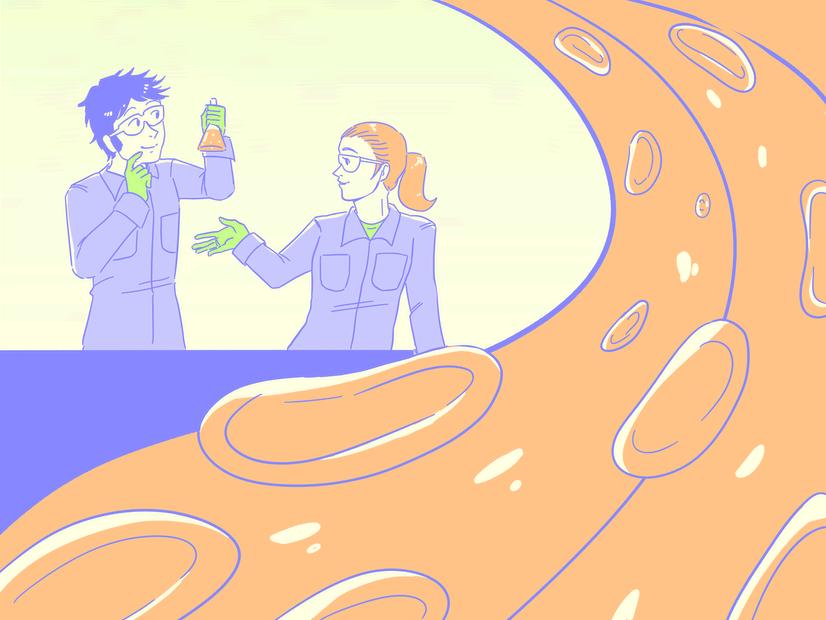
To address these problems, researchers are exploring ways to produce blood in the lab rather than relying solely on donations Recent progress in stem cell science and biotechnology has made labmade blood more feasible, and researchers are now working to grow RBCs outside the body or to turn donated blood into a universal type. While these methods are still being developed, they could revolutionize how transfusions are done in the future
One promising method is to generate RBCs from hematopoietic stem cells, which are multipotent adult stem cells. Douay and Andreu described CD34+ stem cells as the starting point for all blood cell types in the body
In the lab, scientists add specific growth factors such as erythropoietin, stem cell factor, and interleukin-3 to these stem cells These help guide cells through erythropoiesis, the process by which stem cells become RBCs As the cells mature, they undergo enucleation, expelling their nuclei, giving RBCs the unique biconcave shape that helps them carry oxygen efficiently By adapting these steps into a robust lab protocol, scientists hope to produce functional RBCs outside the body

A major milestone in this field occurred when researchers at the University of Pittsburgh Medical Center (UPMC), where the Paris and Saint Antoine Research Center reported the first successful transfusion of laboratory-generated RBCs into a human volunteer
In the 2011 study by Giarratana et al , the lab-made cells acted much like natural RBCs About 90 percent underwent enucleation and produced adult hemoglobin After transfusion, between 41 and 63 percent of these cells remained in the bloodstream for up to 26 days, similar to levels observed in regular
donor blood This experiment was the first evidence that lab-grown RBCs can function well in the human body However, there was a major challenge accompanying this breakthrough: one unit of transfused blood contains about 2 trillion RBCs, but current lab methods yield much sparser results Producing enough cells to meet real-world needs remains a critical hurdle.

Another approach to address blood shortages is to try to turn donated blood into a universal donor type specifically type O rather than making new RBCs from scratch Type O blood does not have A or B antigens, which are sugar-based markers on the surface of RBCs that can cause immune reactions if the wrong blood type is given Because type Onegative blood can be used in many emergency situations, it is very valuable, but this blood type is rare and often hard to get
In 2019, Bayley et al showed that bacterial enzymes can remove A antigens from RBCs These enzymes are a type of glycosidase, meaning they break specific sugar bonds This matters because A and B blood group antigens are made from sugar structures attached to the surface of red blood cells By cutting away the sugar pieces that make a cell “type A” or “type B,” the enzymes can make the RBCs act more like type O cells
More recently, Jensen et al (2024) showed that enzymes from the gut bacterium Akkermansia muciniphila may be able to remove more complex A and B antigen structures from RBCs These enzymes are called exoglycosidases, a class of glycosidase enzymes that remove sugar units from the ends of carbohydrate chains Their original function in the gut is to help break down mucus, which contains sugar structures that are similar to some blood group antigens Because of this, researchers are studying whether these enzymes can be used to make donated blood more broadly compatible
This method could increase the supply of universal donor blood by reusing previously donated blood For example, if a hospital has enough type A blood but not enough type O blood, enzyme conversion could one day make that supply more flexible However, converted blood would still require careful testing to ensure the antigens are fully removed and that the RBCs function normally in the body So, while enzymatic conversion does not replace blood donation, it could make donated blood more useful and easier to match in emergencies

While these advances are promising, several major challenges remain to be solved before synthetic blood can be used everywhere
Making RBCs in the lab requires expensive growth factors, specialized equipment, and strict quality checks to ensure safety and cleanliness Still, making enough for regular medical use is one of the biggest challenges
These technical hurdles highlight a bigger problem: accessibility. Early synthetic blood products will likely be expensive, raising questions about fair access in global health If only advanced hospitals can use these new options, clinics that already struggle with blood shortages might not benefit right away
Even with these challenges, synthetic blood could be very helpful in emergencies and surgeries Trauma centers need quick transfusions for severe bleeding, and surgeons rely on having the right blood during tough operations In these situations, delays can be life-threatening New technologies that provide universal donor blood or lab-grown RBCs could speed up treatment, especially during disasters, in war zones, or in remote areas where donor blood is hard to find

For over a hundred years, transfusion medicine has depended on a simple but fragile system: people donate blood, and hospitals give it to patients Research on synthetic blood is a big change from this old system Instead of relying solely on donations, scientists are now working to design and produce the cells needed for transfusions
Making RBCs from stem cells and using enzyme conversion both show that lab-based blood production is possible While these technologies are still being developed, they give us a new way to think about the future of transfusions Lab-generated RBCs have already been transfused into humans and shown proof-of-principle survival in the bloodstream The next big step is to make these methods work on a larger scale, so lifesaving transfusions are not limited by donor supply If this succeeds, transfusion medicine could depend more on engineered blood than on traditional donations

Editors-in-Chief: Gabbi Basa, Esha Bhattacharya
Executive Editor: Mark Davis
Editor-at-Large: Erin Jang
Head Production
Editors: Himangi Sharma, Sanji Kumar
Head Technical Editor: Shreya Abhijit
Head Illustrators: Leo Harris, Jenna Hughes
Staff Illustrators: Erin Chickering, Catherine Xu
Head Photographer: Inaya Nicholls
Staff Photographer: Natalie Labatia
Staff Tech Editors: Carmen Molina, Neha Roy Karintholil

Written by: Himangi Sharma
Photography by: Inaya Nicholls
Layout by: Madeleine Park
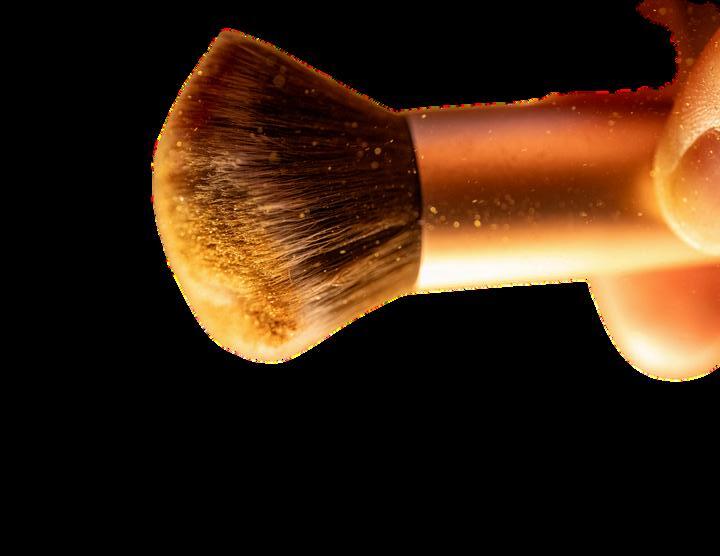
“All that glitters is not gold” This aphorism has long been used to warn young children that not everything that looks precious turns out to be so. Yet to most people, sparkly things naturally seem precious and alluring This appeal lies in the captivating nature of glitter: simultaneously blinding yet eye-catching, we just cannot look away For years, glitter has been used as decoration, yanking our attention towards whatever art it adorns
Glitter began long ago, with its earliest records dating back to the Upper Paleolithic period, around 40,000 to 10,000 BCE, when prehistoric humans used mica flakes to create a shimmering effect in cave paintings Fifty thousand years ago, prominent ancient civilizations such as the Egyptians and the Mayans used crushed beetles to decorate their ceremonies The story of glitter mostly lulled until 1934, when German-American inventor, Henry Ruschmann, accidentally invented modern-day plastic glitter in New Jersey. He was developing a machine to cut photo paper and photographic film at high speeds, but the machine sometimes produced tiny, shiny scraps Ruschmann recognized their reflective quality and began synthesizing these pieces intentionally, later founding Meadowbrook Inventions, a company that continues to be a major player in the glitter industry Since then, glitter has become both culturally significant and ubiquitous
the queer community to “feel the rainbow”, encouraging people to not only see, but also rejoice, in the queer community and beyond. Dr. Seymour added that in a moment of history where lawmakers and politicians enact policies that endanger queer people and the environment, zero-impact, sustainable glitter is actually even more striking and disruptive than its traditional, plastic predecessor As exciting as this prospect is, biodegradable glitters still only break down under very specific industrial composting conditions, or are simply coated in plant-based materials while still containing a plastic core Instead, scientists at UC San Diego turn to more imaginative solutions: synthesizing biodegradable plastics with the help of unlikely partners.
These small pieces of finely-cut plastic amass to sparkles that bring unmatched aesthetic glee, but with that euphoric wave comes an unfortunate environmental cost Traditional glitter frequently slips through water filtration systems and ends up in the ocean, accumulating over eight million metric tons of microplastic waste Simply banning glitter in hopes of helping the environment ignores its cultural importance; though glitter is often dismissed as frivolous or "tacky," it holds massive significance as a queer activist tool, a symbol of joy, and a staple in camp culture
Popular modern altern Dr Nicole Seymour, a Glitter, this substance historically been used During an interview w synthesis, has been use way for foundation environmentalism mov involving two environ Tower, Oklahoma City fracking and the Keys pipeline that would b Mexico When unfurle concerns about an “u “biochemical assault,” was quickly discovere illustrates how glitter d
Additionally, since the visually mirroring the LGBTQIA+ community
A 2024 article published in Nature delved into the synthesis of biocomposite thermoplastic polyurethanes (abbrv TPUs), where scientists engineered plastics to include bacterial spores from Bacillus subtilis that can facilitate plastic disintegration In an interview, Dr Jonathan “Jon” Pokorski, one of the researchers on the project, elaborated on the choice to use B subtilis, explaining that this bacterium is commonly used in bioherbicides, which are weed control products derived from living organisms, and probiotics The key element is B subtilis’s spore-forming capabilities, meaning the bacteria remain dormant until an environmental trigger (such as moisture) awakens the bacteria to digest the plastic Due to its robust survivability and cue-based mechanisms, B subtilis is an ideal candidate for biodegrading work. The team tested the spore-forming bacteria in poor compost conditions to ensure that only the experimental bacteria were responsible for any plastic degradation. In the end, they were able to successfully engineer the bacteria to be incredibly heat-tolerant, such that they could be synthesized into plastics
As exciting as this idea is, Jon mentioned that there are still a few angles to

Written by Stephania Miranda
Photography by Inaya Nicholls, Natalie Labatia
Layout by Tiffany Liang
One major challenge in biology is that gene expression is difficult to predict and control fully Even in genetically identical cells, the same gene may be expressed at different levels or times because gene regulation depends on complex molecular interactions, biochemical signaling, and changing cellular conditions These interactions are not entirely random since they are influenced by thermodynamics and environmental stimuli, but they can still create variability, often called “gene expression noise,“ as reported in a study done by Elowitz and colleagues at the California Institute of Technology in 2000 While this variability can help organisms adapt to changing environments, it also makes it difficult for scientists to reliably control how the cells behave Precise control is crucial because researchers want engineered cells to respond consistently in applications such as biosensors, medical therapies, and engineered bacteria
Synthetic biology addresses this challenge by designing biological systems that behave in more predictable ways A clear example of this is the synthetic gene toggle switch, a humandesigned genetic circuit that reshapes the biological constraint of noisy gene regulation into a controllable system
The synthetic gene toggle switch is an engineered genetic circuit designed to function like an on/off switch First developed by researchers including James J Collins and colleagues and published in Nature in 2000, the system demonstrated that cells could be programmed using engineering principles rather than relying only on trial and error approaches The circuit is made up of two genes that repress each other When one gene is active, it produces a protein that blocks the expression of the other gene Because each gene prevents the other from being expressed, the system remains locked in one of two stable states until an outside signal causes the switch to flip
In the eleventh annual High School Essay Contest, the SQ Community Outreach team asked students to write an essay about synthesis: the ways scientists today are inventing new biological systems SQ hopes to inspire science communication interests in younger students, while also providing them a platform to think about biology in new ways This year’s winner is a current high school junior at Fallbrook High School
In practice, scientists connect this circuit to genes that produce measurable outputs, such as fluorescent proteins or therapeutic molecules Once applied to these output genes, the toggle switch can regulate a specific, engineered pathway dictated by researchers These genes are useful because they act on clear output signals that can be easily measured, allowing scientists to track whether the system is on or off For example, fluorescence can show when a gene is active, and therapeutic genes can be used to trigger biological responses only under certain conditions This makes the system practical for applications like biosensors, where cells detect environmental toxins and respond with a visible signal, or in engineered immune cells that activate only when they encounter disease markers
This system takes advantage of natural biological processes, such as transcriptional repression, but organizes them in a simplified and intentional way Natural gene regulation networks are extremely complex, involving many genes, feedback loops signaling molecules and environmental inputs Although these interactions are not completely random, their complexity can still create unpredictable variation in gene expression, often called gene expression noise The toggle switch reduces this complexity by focusing on two regulatory genes that control a single engineered output pathway This simplification allows scientists to more easily model, predict, and manipulate cellular behavior
One of the most important ways the toggle switch reshapes biological behavior is by reducing the impact of gene expression noise In natural systems, small fluctuations in molecular concentrations can influence protein production In the toggle switch, however, once one gene becomes dominant, it continuously suppresses the other, stabilizing the system into one state Only a strong external signal, such as the addition of a specific chemical inducer, can flip the switch into the opposite state According to Gardner et al in their 2000 study, this creates a more reliable and stable system than many naturally occurring regulatory networks
This design resembles digital electronics because it relies on two discrete states rather than continuous variation This stability makes the system more resistant to noise and easier to control By applying engineering principles to biology, scientists created living cells capable of storing simple biological “memory,” meaning the cell retains information about its previous state even after the initial signal is removed Scientists can observe this memory through measurable outputs like fluorescence or protein production, which indicate whether the system is currently in the on or off state
The synthetic gene toggle switch demonstrates how synthetic biology can reshape biological constraints instead of simply working around them By applying an engineering framework to genetics scientists were able to convert variable gene regulation into a stable and programmable system This approach has enabled applications such as programmable biosensors, engineered microbes, and early-stage cell-based therapies As synthetic biology continues to develop, systems like the toggle switch may allow scientists to control cellular behavior with increasing precision in medicine, environmental monitoring, and biotechnology