CASE STUDY
OraQuick™ HIV Self-Test Expands Sexual Health Access in Tribal Communities
In the heart of Indian Country, public health is being reshaped through innovation and community. Southern Plains Tribal Health Board (SPTHB) — serving the 43 federally recognized tribes located in the states of Oklahoma, Kansas, and Texas — is leading the charge with a groundbreaking rapid testing initiative: Native Test, featuring the OraQuick™ HIV Self-Test. Southern Plains Tribal Health Board, the parent organization of the Oklahoma Area Tribal Epidemiology Center, serves as public health support for Tribal nations, offering resources and guidance to improve health outcomes for entire communities. Native Test stands out as an innovative, inclusive response to a critical need: accessible, culturally sensitive STI testing.
Challenge Native communities face many obstacles in accessing traditional venue-based HIV and STI testing, including geographic isolation, limited transportation, financial constraints, and underfunded healthcare infrastructure. Cultural stigma and privacy concerns also play a major role, especially in close-knit American Indian and Alaska Native (AI/AN) communities, where seeking care may mean being seen by a relative or neighbor working at the local clinic.
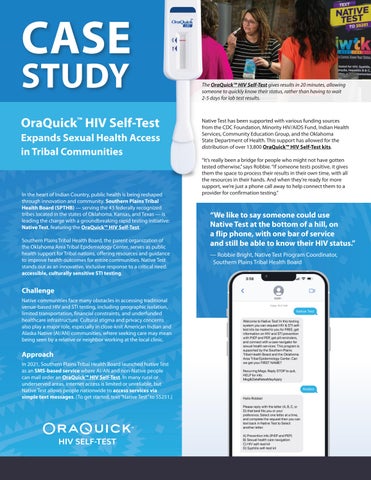
Approach In 2021, Southern Plains Tribal Health Board launched Native Test as an SMS-based service where AI/AN and non-Native people can mail order an OraQuick™ HIV Self-Test. In many rural or underserved areas, internet access is limited or unreliable, but Native Test allows people nationwide to access services via simple text messages. (To get started, text “Native Test” to 55251.)
The OraQuick™ HIV Self-Test gives results in 20 minutes, allowing someone to quickly know their status, rather than having to wait 2-5 days for lab test results.
Native Test has been supported with various funding sources from the CDC Foundation, Minority HIV/AIDS Fund, Indian Health Services, Community Education Group, and the Oklahoma State Department of Health. This support has allowed for the distribution of over 13,800 OraQuick™ HIV Self-Test kits. “It’s really been a bridge for people who might not have gotten tested otherwise,” says Robbie. “If someone tests positive, it gives them the space to process their results in their own time, with all the resources in their hands. And when they’re ready for more support, we’re just a phone call away to help connect them to a provider for confirmation testing.”
“We like to say someone could use Native Test at the bottom of a hill, on a flip phone, with one bar of service and still be able to know their HIV status.” — Robbie Bright, Native Test Program Coordinator, Southern Plains Tribal Health Board
Takeaways • 26.9% of urban residents versus 21.5% of rural residents report testing for HIV in their lifetime, contributing to an urban-rural gap in health disparities and outcomes.1 • Native Test — featuring the OraQuick™ HIV Self-Test — provides a bridge to HIV and STI services for rural persons nationwide. • OraQuick™ HIV Self-Test is a proven HIV self-testing intervention strategy that supports the goals of the Ending the HIV Epidemic in the United States initiative (EHE).2 • Meeting people where they are — geographically and technologically — alleviates barriers and increases participant uptake in prevention and treatment services. A low-tech, high-impact approach ensures that fewer people are left behind, regardless of their location or device.
Community Partnerships
Wraparound Services
Southern Plains Tribal Health Board (SPTHB) works alongside over 100 community partners to build trust and engage Tribal communities, increase participation, reach target populations, and serve Tribal nations. The Native Test Program is truly community-driven — Tribes and communities promote it, distribute supplies, and make it their own, while SPTHB serves as the home base and provides support and coordination. Many Tribal nations lead their own marketing and co-marketing efforts, helping strengthen trust in the program by showing their communities that it is endorsed and promoted by their Tribal nation.
Native Test kits include a variety of sexual health resources, including information on PrEP/PEP, STI prevention and testing, and more. Beyond the materials in the kit, SPTHB connects individuals directly with vetted providers for PrEP and other sexual health services within 48 business hours. People can request a conversation through the SMS-based system, online website (nativetest.org), or at an in-person testing event.
While SPTHB does not conduct point-of-care field testing alone due to regulatory constraints — namely the lack of a CLIA waiver — it serves as a bridge, actively supporting field testing in partnership with Indian Health Service (IHS), Tribal nations, urban sites, and state health departments. “It’s important to highlight that the OraQuick™ HIV Self-Test kit can serve as a tool for communities to help members know their HIV status without the barrier of needing a CLIA waiver, supporting community-led testing and engagement,” says Robbie.
Through community outreach partnerships, more than 9,100 OraQuick™ HIV Self-Test kits were distributed in person — either at outreach events or through Tribal partners within SPTHB’s service area, who then shared the kits directly with their communities.
“One time I sat on the phone with someone as they took the test in their car before a doctor’s appointment,” says Robbie. “They wanted to start PrEP but didn’t feel comfortable learning their HIV status with someone right in front of them, but they didn’t want to be alone either. We walked through it together; they found out they were negative and went straight into their appointment and got started with PrEP. That’s really what this work is about — meeting people where they are and supporting them in taking the next steps based on their results."
More than 4,780 OraQuick™ HIV Self-Test kits have been mailed through online and text-based requests since launching over-the-counter distribution in June 2021.
Syphilis self-test kits were launched in January 2025 through the system. Of the 283 individuals who ordered syphilis kits, 198 also requested OraQuick™ HIV Self-Test kits.
Conclusion Native Test demonstrates that a community-driven, culturally informed approach using tools that meet people where they are can transform public health outcomes — not just for Native communities, but for all underserved populations seeking sexual healthcare services.
References 1 Henderson ER, Subramaniam DS, Chen J. (Dec 2018). Rural-urban differences in human immunodeficiency virus testing among US adults: findings from the Behavioral Risk Factor Surveillance System. Sex Transm Dis. 45(12):808-812. doi: 10.1097/OLQ.0000000000000888 2 MacGowan RJ, Chavez PR, Borkowf CB, et al.; eSTAMP Study Group. (2020). Effect of internet-distributed HIV self-tests on HIV diagnosis and behavioral outcomes in men who have sex with men. JAMA Intern Med 180:117–25. https://doi.org/10.1001/jamainternmed.2019.5222
Additional HIV resources Explore our latest resources on HIV, including educational webinars and case studies. Click or scan the QR code to learn more.
www.orasure.com OraQuick is a trademark of OraSure Technologies, Inc., registered in various jurisdictions. © 2025 OraSure Technologies, Inc., all rights reserved. MK-3193 v1 • OTI0762 rev. 11/25