You have to hold on to the rope when the wind blows hard
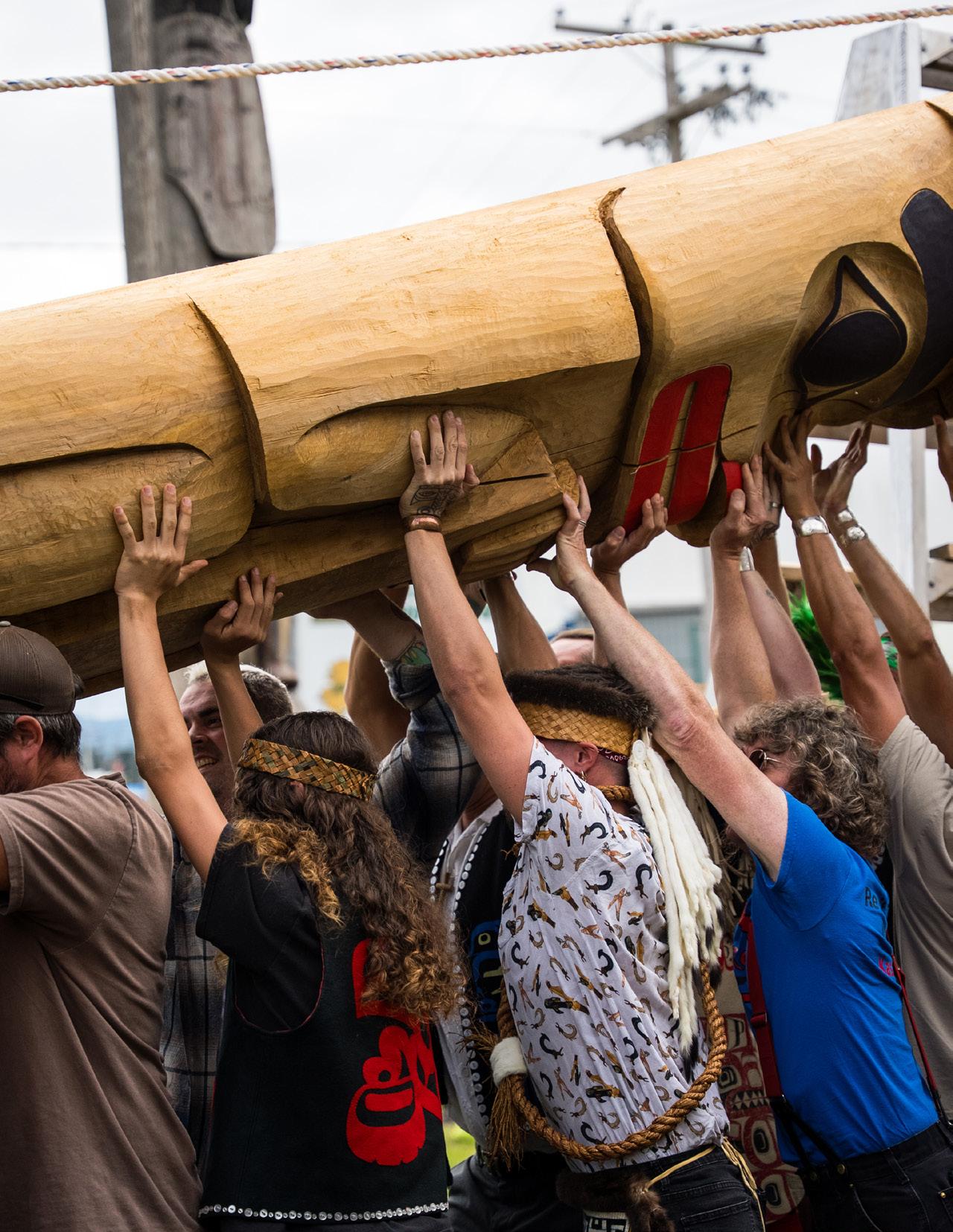
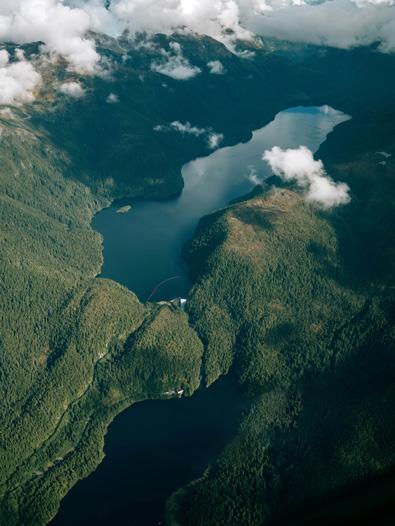
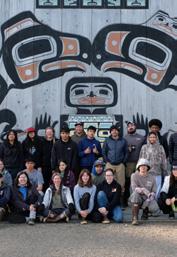
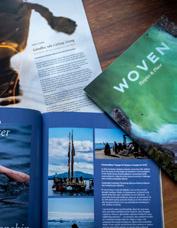
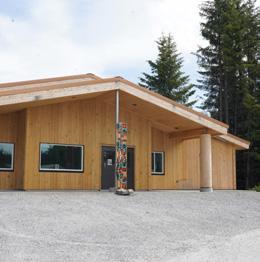
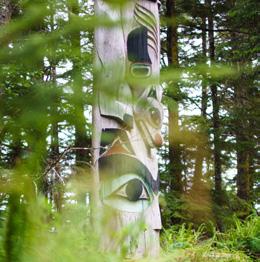
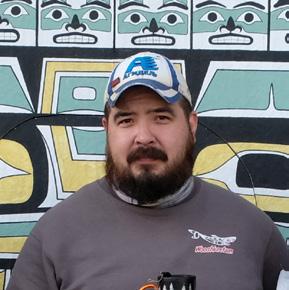
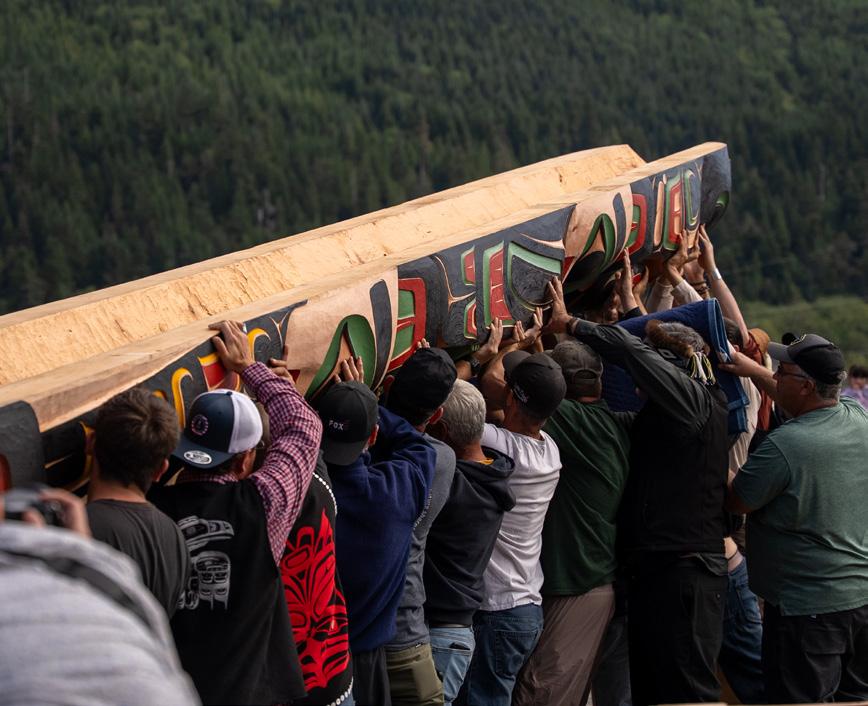
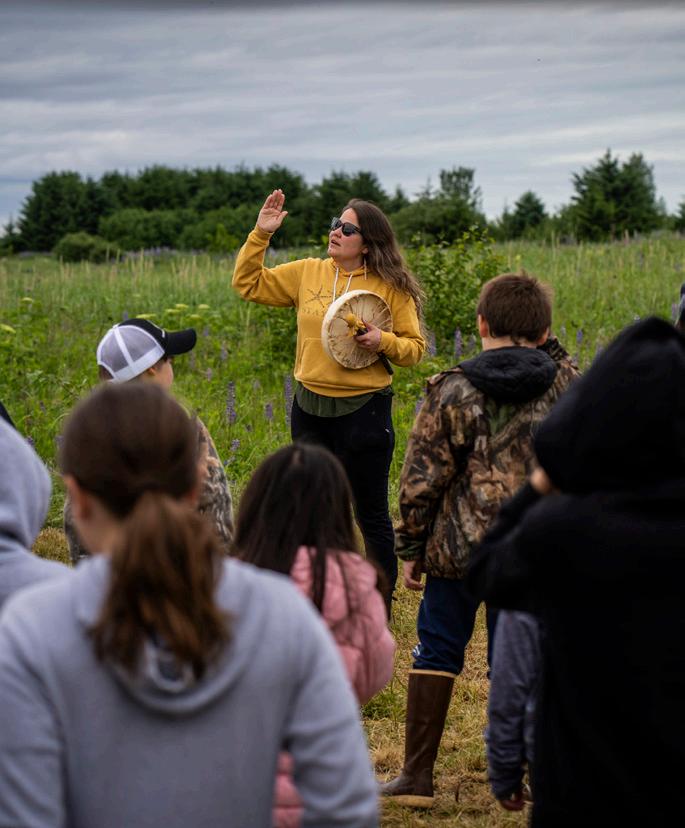
Cover Photo: For the first time in 38 years, the Wrangell Cooperative Association and Shtax'héen Kwáan clans hosted a kootéeyaa totem pole raising for four poles and one house post. The Kadashan kootéeyaa (pictured) was carved by lead carvers TJ Young, Joe Young, and Tommy Joseph and apprentice carvers Mike Hoyt, Tony Harding, Linda Churchill, and Susie Beebe. It was the sole kootéeyaa raised by hand with the collective support and witness of relatives from all over the region, including Sustainable Southeast Partnership Partners. Photo: Lee House
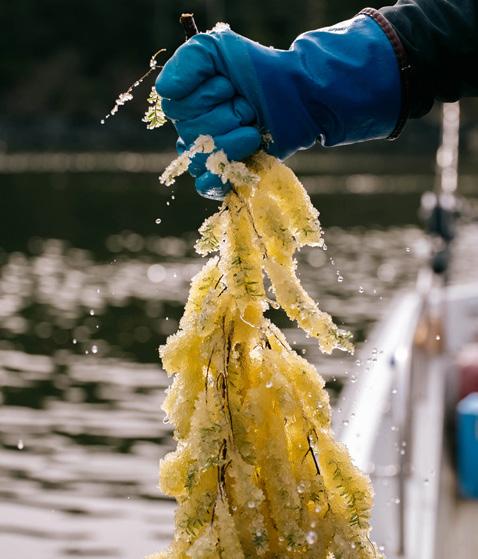
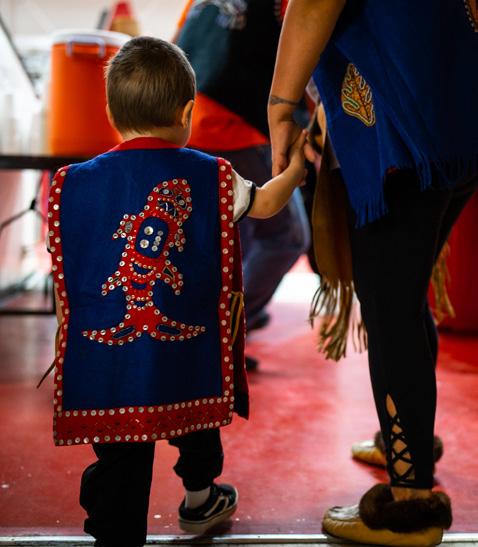
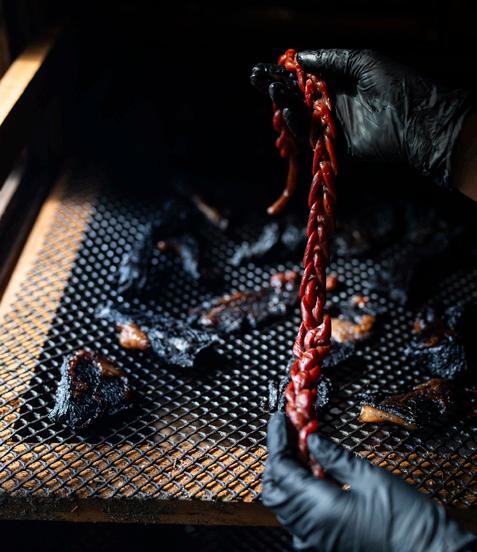
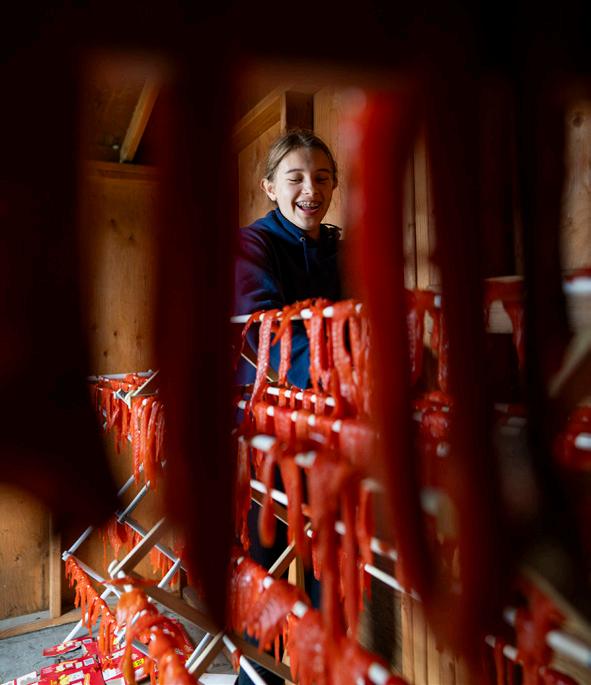
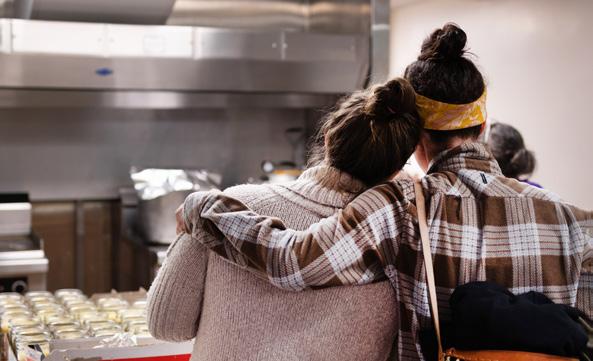
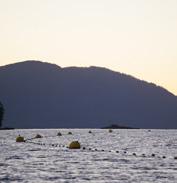
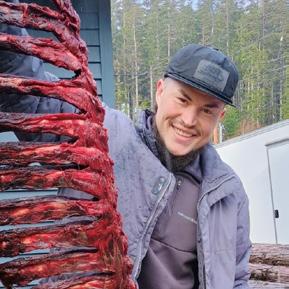
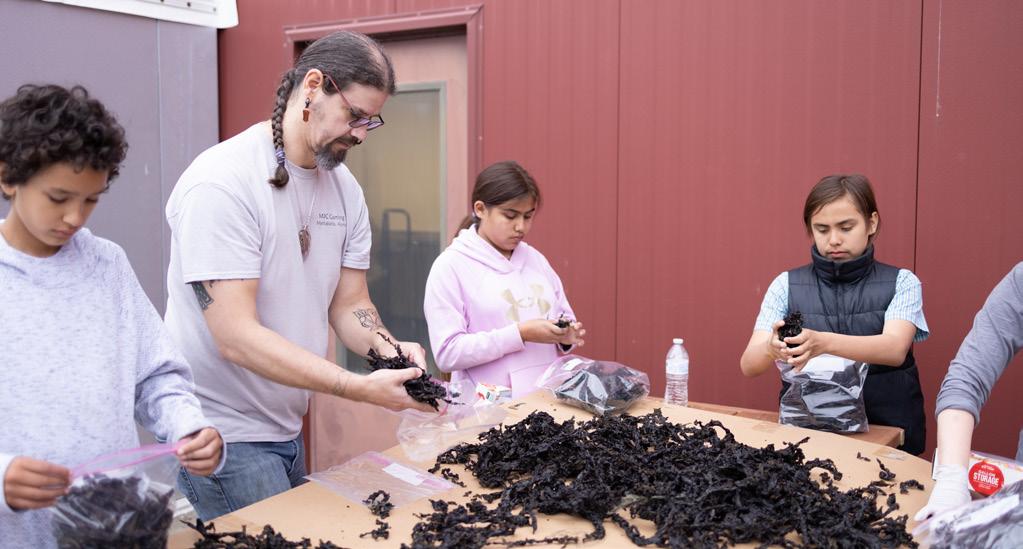
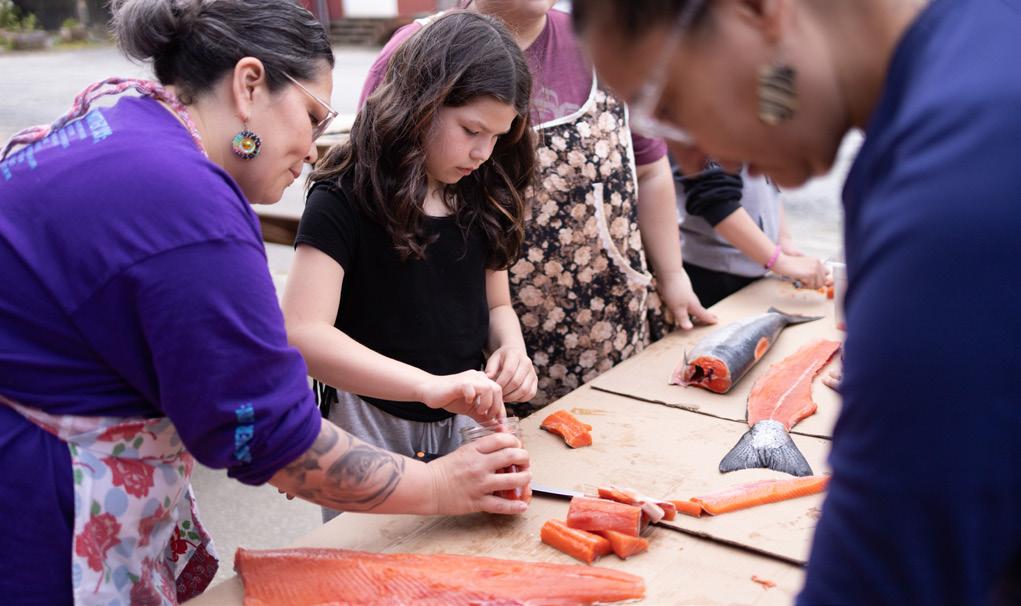
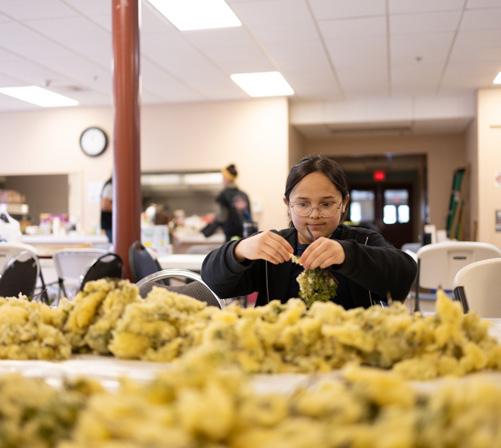
Top left: Herring eggs on submerged hemlock branches set by harvesters each spring. Photo: Lee House. Middle left: Generations potluck together. Photo: Bethany Goodrich. Bottom left: Braided seal intestines and meat are turned in the smoke house during Kake Culture Camp. Photo: Bethany Goodrich
“Imagine a society where we tried to outgive each other. What kind of world would we live in? We would be here taking care of each other. And everybody would have enough.”
— George Nix, Food Security Specialist, Organized Village of Kasaan (pg 55)
Peoples & Place
ISSUE 3 / 2026
Shguu mdm dackya'wa hagwilhoo dsihla 'dsuu baashg
You have to hold on to the rope when the wind blows hard
While you can not control the wind, you can control your anchor.
We chose our third theme, a Shm'algyack phrase borrowed humbly from the Dictionary of Shm'algyack by Donna May Roberts, as a reminder of the power held in interlocking communities — in weaving the rope — through relationships, shared experiences, successful projects, and unsuccessful attempts. To honor the significance of threading together generations, disciplines, and geographies. That rope, carefully tethered to the shores of Southeast Alaska like a holdfast, is what we rely on when the weather shakes us. We can be blown, but we won’t be uprooted.
The stories held in these pages show how the people, partners, and communities of Southeast Alaska, remain steady in tumultuous times, fortifying our anchor and tending the rope that locks us to each other, and to our home.
Nt'oyaxsn thank you to Shuguyna Donna May Roberts for your guidance on this year’s theme.
letter from the editor
Stories are an Anchor
it's been windy. Locally, a stormy winter with gusts of 65 knots knocked trees down, rattled our windows, and kept us in tight orbit to our fireplaces. Globally, we find ourselves bombarded by big blows, seemingly hour to hour. Communities choose: do we let storms fracture us, or, do they knit us together? In Southeast Alaska, we almost always choose the latter.
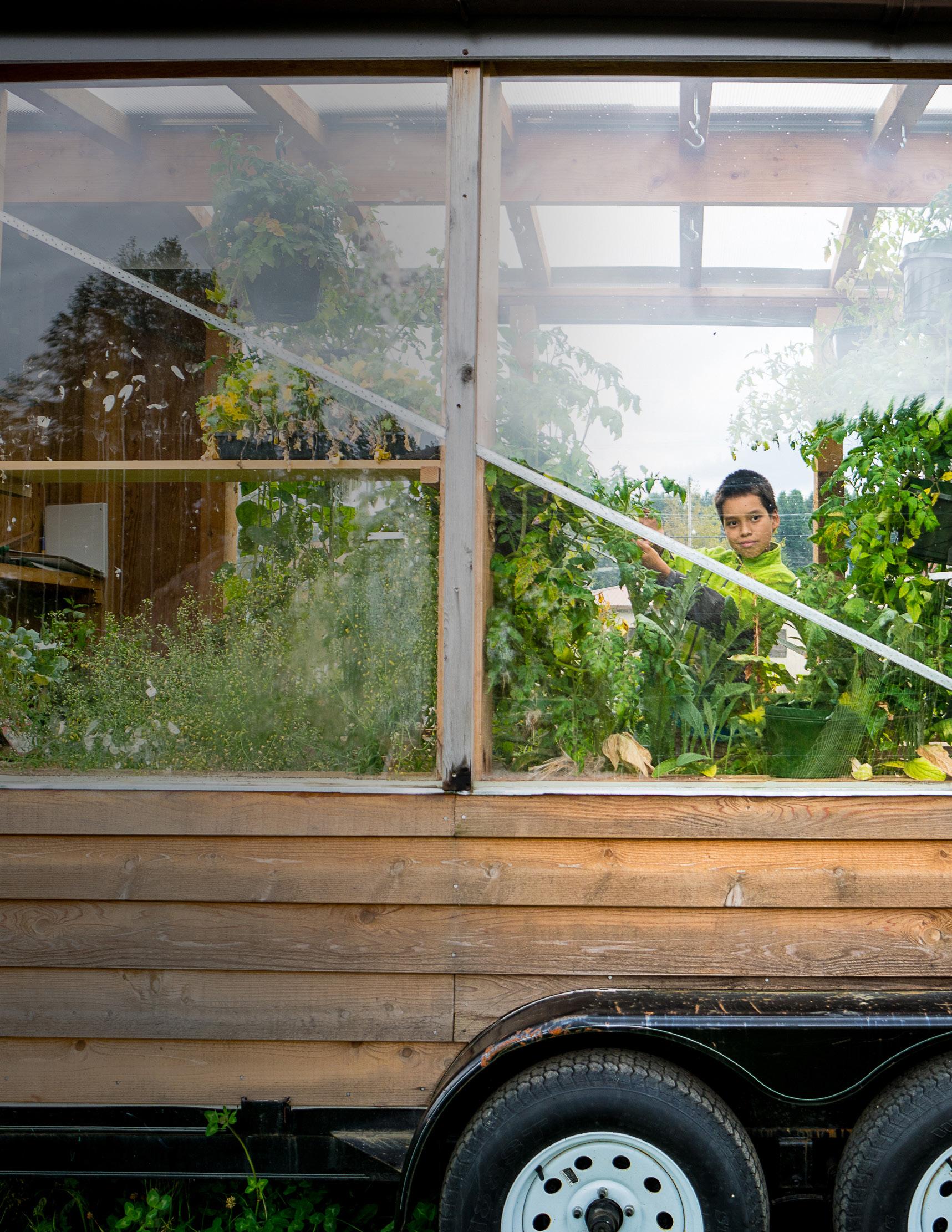
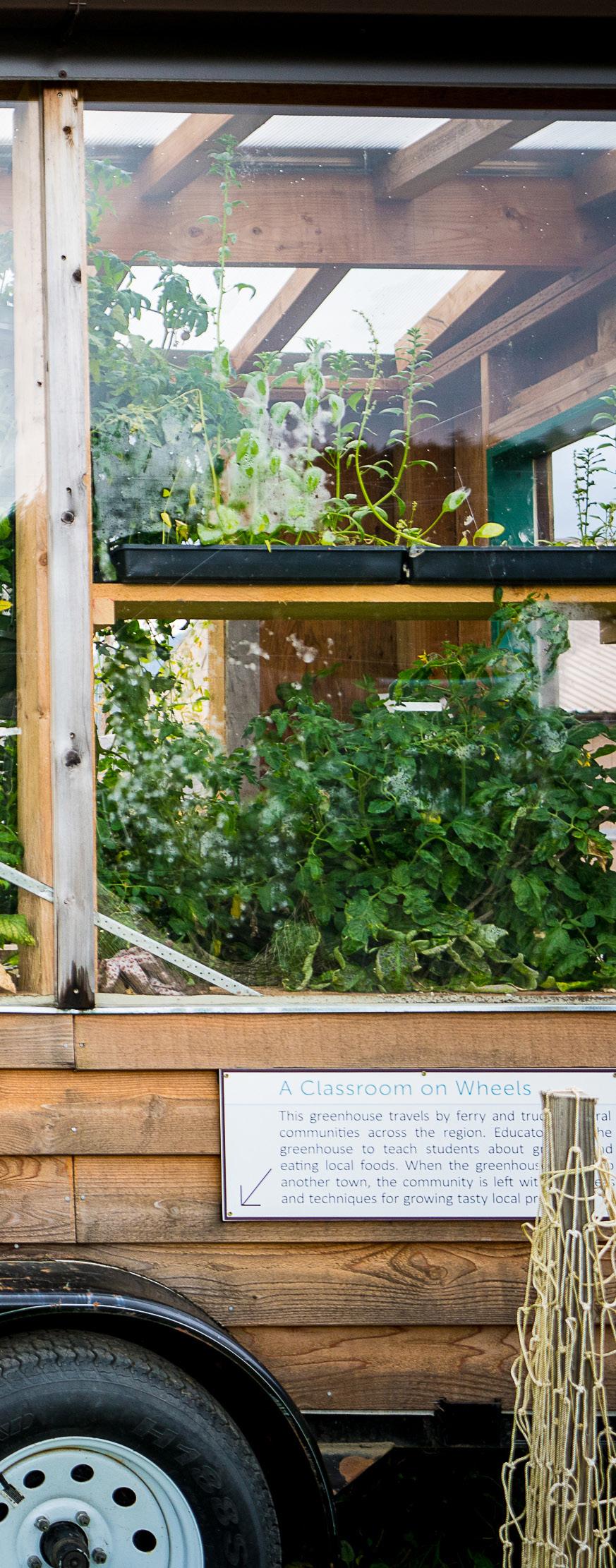
When a wind is hitting you in the face, it’s hard to focus on anything else. Between gusts, it’s natural to take cover and focus on urgent needs. It’s hard to think generationally. But the work of the Sustainable Southeast Partnership is generational. Stories help us see how the incremental steps we take dayto-day add up over time. In this issue, you’ll read about Moby, a little mobile greenhouse constructed ten years ago by students using sustainable local wood, wheeled onto the Alaska ferry, and shipped off on a regional journey with a lofty goal: to help local leaders realize big dreams in food sovereignty. A decade later, you’ll meet three community champions, whose local food movements have since blossomed.
Individuals caught in a storm become exhausted. Fight or flight becomes the norm. Shoulders tighten, jaws clench, and decisions are often short-sighted. Stories give us resources. In this issue, summer storytelling interns offer recipes and reminds us how self care is community care
Society in a storm tends to snowball. One storm kicks up another and mainstream media rages with shocking clickbait designed to shrink our attention spans and drive rifts between us. Thoughtful storytelling can help us see solutions. In this issue, you’ll read how when faced with budget cuts and shifted federal priorities, Partners got creative in their support for one another. With increased addiction, suicide, systemic racism tearing through communities, Partners orchestrated a healing camp. Tired of a forest management regime defined by conflict, Partners are trailblazing a young growth timber industry that puts community and long-term forest health first. Through culture camps, innovative curricula in schools, and even a fly-fishing academy, Partners are ensuring that the next generation inherits the skills, relationships, humor, and resilience to navigate windy weather, and build brighter, stronger communities.
Stories are part of the rope we weave and grip together. Stories are an anchor that keeps us connected and grounded to place. When the winds are blowing, it can be hard to remember that all storms pass, the sea settles, the windsock will rest, and the clouds always clear. Now, spring is here, it’s time to pull anchor, and paddle forward.
Wie Wa! Wiedsadup mun she'eka gga-deelpg* listen up, let’s pull the anchor!
Happy reading,
Bethany Goodrich
Storytelling Catalyst Sustainable Southeast Partnership Sitka Conservation Society
*Nt'oyaxsn thank you to Shuguyna Donna May Roberts for this translation
In late 2025, Marina changed position in our collective canoe canoe from Program Director to collaborator. As a steadfast believer in our work since the early days, Marina’s leadership, humor, love, and community-first perspective has shaped the Sustainable Southeast Partnership indefinitely. She shared these words:
“In reflection, I can earnestly say that spending time with our villages and working to support them in actualizing their priorities has fed my spirit in a good way — like fresh king salmon in February. My future plans include the SSP and continuing to stay engaged. I will just be in a different seat in the canoe paddling in the direction that the new steersman takes us in.”
WOVEN 5
Marina Keli'ikuli pulls in a halibut skate during Haa Tóo Yéi Yatee Culture Camp in Xunaa. Photo: Bethany Goodrich
The Sustainable Southeast Partnership
We envision self-determined and connected communities where Southeast Indigenous values continue to inspire society, shape our relationships, and ensure that each generation thrives on healthy lands and waters.
Founded in 2012, the Sustainable Southeast Partnership (SSP) is a dynamic collective impact network uniting diverse skills and perspectives to strengthen cultural, ecological, and economic resilience across Southeast Alaska.
Our Structure
SSP Steering Committee
With balanced representation of regional and village organizations, the SSP Steering Committee is composed of 9–15 individuals who provide program oversight and help with policy development, fundraising, partner relations, and network priority setting. Quarterly meetings are open to all SSP partners and Committee Members serve 3-year terms.
Backbone Organization: Spruce Root
As the sponsor of the SSP, Spruce Root employs central support positions including the Program Director, Deputy Director, and Communications Catalyst. They manage the SSP budget and expenses, ensure compliance with laws and regulations, convene in-person and remote gatherings, and provide inspirational leadership to partners.
Regional & Community Catalysts
Catalysts are core to the SSP, representing different communities and regional focus areas. They are hosted by organizations, Tribal governments, municipalities, or Alaska Native corporations. Catalysts gather in-person during 2+ annual gatherings and twice per month remotely, while working together to realize meaningful projects for their communities and region.
Wider Partners & Collaboration
Beyond formal Catalysts, the SSP includes land managers, schools, interested individuals, entrepreneurs, and countless collaborating partners. The only requirement for joining the SSP is having interest in supporting the SSP vision and mission and participating in network activities.
Collective Impact
The Sustainable Southeast Partnership supports 8 Community Catalysts hosted within village level organizations, Tribal governments, or Native corporations. Community catalysts work to identify and meet the needs of their hometown. The SSP supports 10 Regional Catalysts who represent areas of expertise that are critical for building regional resiliency.
Catalysts, spread across Southeast Alaska, are ambassadors for our shared values and mission. They are thoughtful change-makers who connect resources, people, ideas, and networks to impact our communities and region.
Supporting the Network 2025 Metrics
COLLABORATIVE PARTNERS REGION-WIDE PROJECTS JOBS CATALYZED COMMUNITIES CONNECTED TO OUR WORK 26 122 132 77 19 SSP CATALYSTS
Seacoast Trust is being developed as the long-term funding source for the SSP
Spruce Root is the backbone organization for SSP
As directed by the SSP, Spruce Root created Seacoast Trust as a funding mechanism
2025 Impact by Regional Focus Area
The Sustainable Southeast Partnership’s Regional Catalysts represent areas of expertise that are critical for building community health and sustainability throughout the region.
CLIMATE ADAPTATION / ALASKA CLIMATE ADAPTATION SCIENCE CENTER
Worked to build relationships and facilitate information exchange between communities, Tribes, the University of Alaska, and agency partners to support holistic climate adaptation. Key initiatives include co-hosting Southeast Alaska Food Web Meetups, supporting the Keex' Kwáan Climate Adaptation Plan, and helping to develop community geohazard preparedness
Recorded 2-episodes for the Alaska Voices podcast.
REGENERATIVE TOURISM / SPRUCE ROOT
Hired a new catalyst in 2026 who will work towards a holistic approach to tourism that improves ecosystems, elevates local economies, and promotes meaningful and responsible visitor experiences. This includes authentic local representation, deep community involvement, and practical and innovative steps for conserving and enhancing the environment.
ENERGY SECURITY / RENEWABLE ENERGY ALASKA PROJECT
Facilitated 5 community education events and engaged 500+ students during classroom visits. Through partnerships with utilities, Sealaska Heritage Institute and University of Alaska Fairbanks, supported 25 teachers and 1 preservice teacher in energy education. Strengthened partnerships between schools and local utilities to support energy education in classrooms. Gave 40+ hours of technical support to Alaskan organizations on renewable energy.
ALASKA YOUTH STEWARDS / TLINGIT & HAIDA
Hosted 2nd annual all-crew training in Glacier Bay with 4 coordinators, 2 crew leaders, 20 crew members, and 4 partners. Alaska Youth Stewards (AYS) crews completed 50+ field days of conservation work, cultural learning, and community engagement. Crews maintained trails, planted native cedar and spruce seedlings, assisted totem-pole raisings, conducted greenhouse and garden maintenance, rebuilt salmon habitat, harvested for communities, conducted water sampling, learned skills in storytelling, and participated in numerous safety and skill trainings with 5 becoming certified as Wilderness First Aid Instructors. Prince of Wales crew cleared 1,000+ pounds of marine debris.
MARICULTURE / ECOTRUST
Established regular monthly coordination meetings with Tlingit & Haida. Conducted community engagement in Ketchikan, Saxman, Kasaan, and Craig. Delivered presentations at Southeast Forum and Native Conservancy’s Immersion Training in Metlakatla. Provided direct, individualized technical assistance to 2 Tribal citizens pursuing mariculture permits.
Alaska
COMMUNITY FORESTRY / THE NATURE CONSERVANCY
Community Forest Partnerships including in Kake, Hoonah, Angoon, and on Prince of Wales, restored 1200 acres of forest and 4,000 feet of streams, and fixed 120 miles of roads. Crews opened and inventoried roads on Kuiu and Chichagof Island and launched a cedar inventory project on Kupreanof. 24 jobs created or maintained, and $1MM revenue spent on local workforce, 95% spent in-region. Community outreach on Tongass National Forest co-management, subsistence conservation, young growth timber, and non-timber forest products conducted with 12+ maps and reports produced and shared during 30+ regional and community meetings.
Published 2nd Woven magazine, launched at the 2025 Spring SSP Retreat with 150 attendees across 80+ organizations. Completed Speed of Trust: A Story of Collaboration, Healing, and Systems Change in Southeast Alaska. Published 15+ stories across regional, state, and national publications. Launched Sea Pony Press, a community art program and remote creative residency located outside of Pelican, with the Sitka Conservation Society. Hosted 2 Storytelling and Engagement interns through the Sealaska Intern Program in Petersburg and Klukwan.
FOOD SOVEREIGNTY AND SECURITY / ECOTRUST
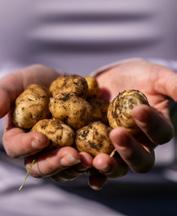
Established the monthly Southeast Alaska Food Web Meetups. Supported a growing Mariculture industry and conducted 10+ community interviews to integrate local priorities into a regional Mariculture Evaluation Assessment. Visited the communities of Hoonah, Pelican, and more, and supported culture camps in Kake and Prince of Wales. Completed a Tlingit Potato report for Tlingit & Haida to better understand and expand regional cultivation.
HEALING / HAA TÓOCH LICHÉESH
Held an online 6-month energy healing training course with the Four Winds Society. Held Áa yei kunéxch yé, a 5-day family event to facilitate passage through grief, celebration, and connectedness in Ketchikan with 41 participants. Hosted the 3rd annual University of Alaska restorative justice symposium with 73 guests, and 14 hosts and circle keepers in attendance. Hosted a free online Lingít language class with 160 registrants. Hosted a Juneau Community Healing event on Orange Shirt Day with 60 participants. Successfully completed restoration efforts for three historic cemeteries.
2025 Impact by Community
The Sustainable Southeast Partnership works across Southeast Alaska, including in communities not listed below. The following statements of impact are representative of communities where we currently hold a Community Catalyst position with a host partner.
JILKAAT, CHILKAT VALLEY / JILKAAT KWAAN HERITAGE CENTER
Perpetuated traditional land use activities through ooligan fishing, seaweed gathering, and salmon camp. Cared for and supported community engagement in the Klukwan Community Garden. Worked with partners to help host 50+ hours of workshops in carving, song, and dance. Promoted cross-cultural understanding through coordination of teacher and student visits. Collaborated with Klukwan Library to increase student and community access to a unique collection of locally-developed resources and services.
SHGAGWÉI, SKAGWAY / SKAGWAY
Sponsored Skagway’s participation in the Upper Lynn Canal Local Foods Challenge by hosting 5 events and 1 potluck. Supported 2 Ethical Wildcrafting workshops including plant identification for common dangerous, edible, and invasive species, organized 2 business mixers and multiple workforce development events. Facilitated community visits and tours including with cruise line public relations teams and SSP partners.
XUNAA, HOONAH / HOONAH INDIAN ASSOCIATION
The Hoonah Native Forest Partnership (HNFP) extended its employment season by processing 45+ cords of firewood for local households. HNFP built a 1000 ft local trail and completed a large salmon stream restoration. Hosted Huna Stewardship meetings with the City and Kuti Project partners on landslide risk and planning. Supported 2 internships and partnered with Sealaska to fund and host a Greenhouse Assistant specializing in marketing and operations. Launched a weekly Farmers Market with SEARHC funding, that helps finance greenhouse operations while creating space for local vendors. Hosted fall SSP Workplanning Retreat.
Strengthened partnerships with Sealaska, Tlingit & Haida, and Angoon Community Association for local art classes with 10+ participants. The artist workshop was open to visitors, with tourists engaging with local creatives and art pieces that included tables made by high school students and a sign by Taryn Kookesh for a new visitors center.
SHEET´KÁ, SITKA / SITKA CONSERVATION SOCIETY
Partnered with the City and Borough of Sitka to launch the Technical Internship Program, a summer work experience opportunity for high school and postsecondary students interested in exploring careers in energy. Revitalized the Fish to Schools program — in its 15th year — to boost local salmon in school lunches. Worked with Pacific High School’s Farm to Table program to produce 925+ pounds of food while educating nearly 300 children. Continued working with Sitka Tribe of Alaska to archive, understand, and increase local knowledge around community smokehouse history. Through expansive community partnerships, co-hosted Splash Mountain Camp where 21 youth explored the 7 steps of survival.
K ÉE X ´, KAKE / ORGANIZED VILLAGE OF KAKE
Kéex' Kwáan Community Forest Partnership partnered with the Kootznoowoo Stewardship Crew on Cube Cove stewardship activities near Angoon and Hoonah Native Forest Partnership on trail construction and stream restoration in Hoonah. Conducted invasive plant removal, culvert and salmon stream surveys, and maintenance on locally-loved trails.
SHÁAN SÉET, CRAIG / SHAAN SEET INCORPORATED
Supported 4 local youths employed through the Alaska Youth Stewards Program in collaboration with Klawock Indigenous Forest Partnership (KISFP). Installed 2 in-stream restoration structures in Jon’s Creek. Delivered 30+ cords of firewood to local households. Joined KISFP, Sealaska staff, and community culture bearer Debbie Head, to harvest ~200lbs of Cedar Bark for cultural arts.
GASA´ÁAN, KASAAN / ORGANIZED VILLAGE OF KASAAN
Provided traditional foods to local households in need and Prince of Wales senior centers, with a goal to expand distribution to local schools. Taught youth harvesting, hunting, and local food processing techniques. Winter Culture Camp had +300 youth in attendance. Sent traditional foods to Western Alaska disaster relief centers during flooding and Alaska Native Tribal Health Consortium, Alaska Native Medical Center, and Anchorage Neighborhood Health Center for patient foods programs — including 800lbs of seal meat.
“In Southeast Alaska, we understand that abundance has never meant accumulation for its own sake. Our teachings remind us that wealth is measured by what we give, how we care for one another, and whether our next generation can live well. Potlatching, redistributing resources so that the whole community is taken care of, is an enduring system of shared prosperity.”
—
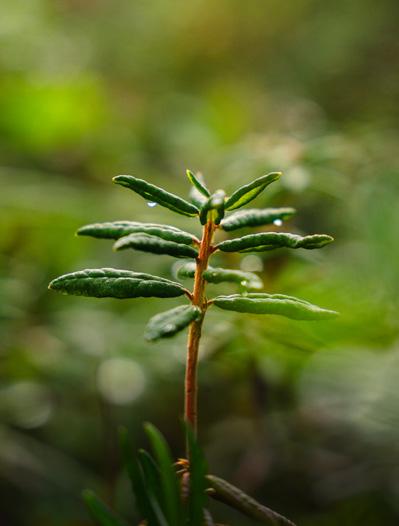
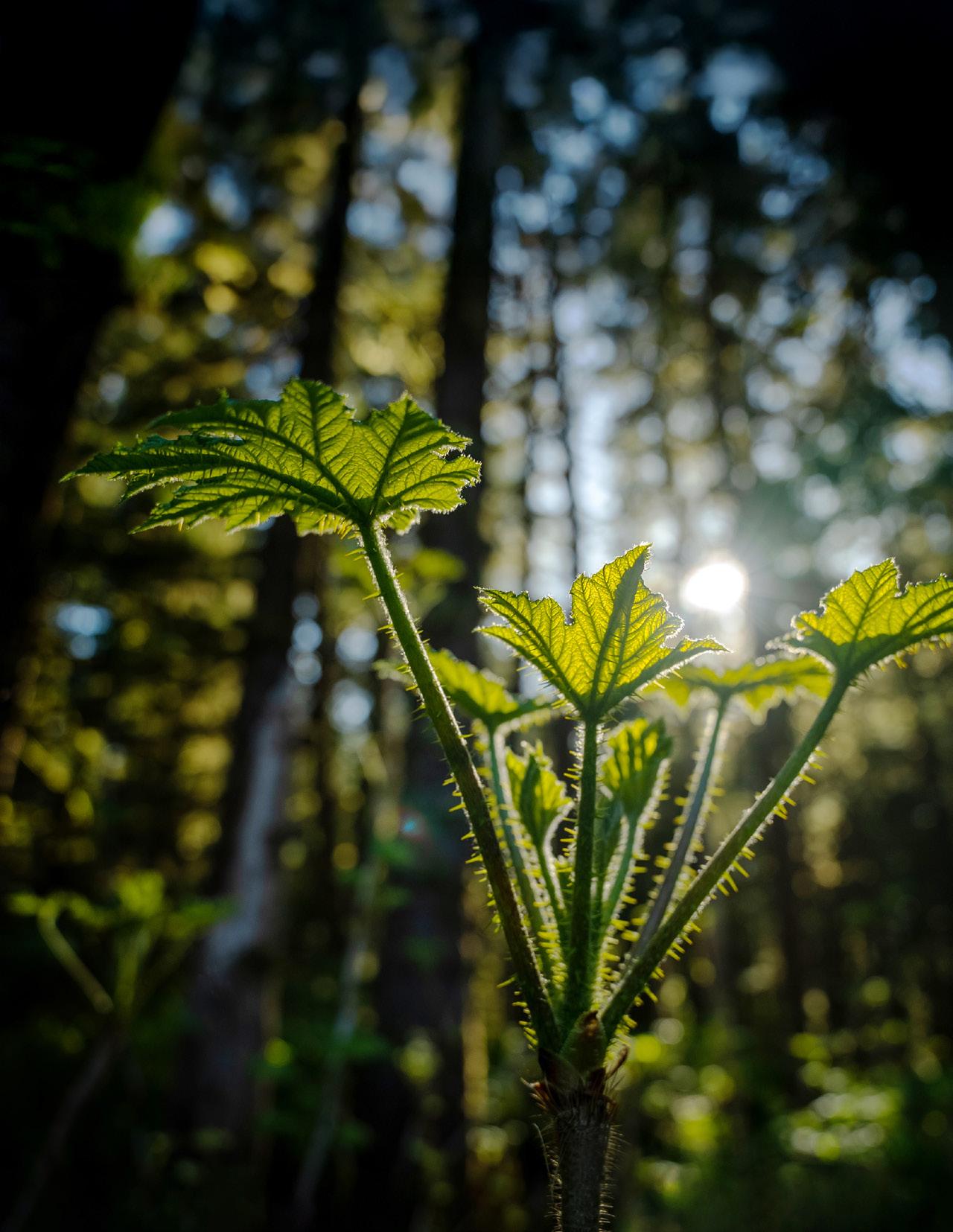
S�áxt�, Lingít for devils club, is a culturallyrevered medicinal plant. Photo: Lee House
S'eiltín Kaylah Duncan, Spruce Root Development Manager
Resourcing a Movement
there is light on my face for more than six hours for the first time in months. My fingers are oily from the herring eggs I pop into my mouth, and water surfaces in my eyes as I stand on a beach that my ancestors stood on 14,000 years ago. My Lingít name is S'eiltín, my English name is Kaylah, I am Dakl’aweidí yedi, raised in Áak'w Kwáan territory.
In Southeast Alaska, we understand that abundance has never meant accumulation for its own sake. Our teachings remind us that wealth is measured by what we give, how we care for one another, and whether our next generation can live well. Potlatching, redistributing resources so that the whole community is taken care of, is an enduring system of shared prosperity.
The Sustainable Southeast Partnership (SSP) is a network of Tribal governments, community organizations, regional partners, business owners, caring individuals, and more, who are working together to improve the well-being of their home communities. For over 12 years now the SSP has advanced economic stability, environmental stewardship, and cultural vitality, demonstrating what is possible when communities set priorities and funders listen. With a goal of raising $100 million, the Seacoast Trust was established to fund the SSP in perpetuity.
Since the 1880s, Southeast Alaskans have been reminded daily that government priorities shift. Administrations change. Public funding can be reduced or redirected overnight. If we want durable solutions, we must lead efforts ourselves. We created the Seacoast Trust as an investment in long-term sustainability, Tribal Sovereignty, and the self-determination of Alaska Native Tribes and rural communities. It allows us to respond quickly to urgent needs, strengthen local economies, and empower swift decision-making.
To date, the Seacoast Trust has helped fund critical community work in Angoon, the Chilkat Valley, Craig, Hoonah, Kasaan, and Skagway through salary support of SSP Community Catalysts (pg 10). It has helped support Tlingit & Haida’s Seacoast Indigenous Guardians Network through salary matches to help strengthen long-term stewardship, monitoring, and the protection of cultural and ecological resources. Funds have supported SSP Catalyst-led projects in community arts, salmon camp, and more.
Funding through the Seacoast Trust is catalytic. Flexible capital allows local people to invest in what they know is needed, whether that is workforce development, food security,
small business support, or energy initiatives. It allows us to redistribute resources in a way that honors and adapts with local priorities rather than imposing external agendas. This is impact investing in its truest sense. You may or may not see immediate financial return, but you will see impact in people’s lives, in strong communities, and in a place where our natural resources are cared for with intention.
We are honest about the challenges we face in rural and isolated Alaskan communities. At the same time, we are demonstrating that locally-led solutions are underway. If I put myself in the position of a funder right now, I want to invest in a working, breathing model. I want to see collaboration across sectors, clear regional priorities, strategic stewardship of funds, and a long-term plan that reduces dependence on unpredictable sources of capital. The Seacoast Trust and the SSP offer that model.
The power held in fundraising, structuring long-term investments, and distributing resources has implications that extend far beyond our lifetimes. I want to see this fund succeed because I care deeply about the people who will benefit. I care about the next seven generations and their ability to experience healthy forests, returning sockeye runs, sun on these shores and a belly full of herring eggs.
This year, we celebrate the fifth anniversary of the Seacoast Trust. We are $70 million away from reaching our goal and we have a long road ahead. The stories shared across these pages, the projects brought to life, and the ways communities care for themselves and their neighbors demonstrate that we are fully capable of realizing this fund, and its vision for increased regional sovereignty and sustainability.
Resourcing this movement is an invitation. It is an opportunity to participate in a long-term commitment to Southeast Alaska. It is a chance to align capital with community-defined needs and to practice a form of philanthropic potlatching: redistributing wealth so that everyone has the ability to prosper.
Gunalchéesh Thank you,
S'eiltín Kaylah Duncan Development Manager Spruce Root
Generational Abundance
By shifting power and resources directly to local communities, the Seacoast Trust supports a future where ecological stewardship and economic prosperity go hand-in-hand.
The Seacoast Trust envisions a new economic model for Southeast Alaska, one in which access to capital and a strong foundation of Indigenous values is the basis for healthy communities. With investments guided by an majority Indigenous committee of financial experts and community leaders, the Seacoast Trust is reshaping traditional investment models. This funding mechanism supports communities, uplifts traditional stewardship, and creates lasting, systemic change.
Governed by the Spruce Root Board of Directors, the Seacoast Trust Investment Committee oversees the investment portfolio. With recommendations made by the Sustainable Southeast Partnership Steering Committee, the annual interest earned on investments
can be made available for initiatives that recognize the deep connection between lands, waters, and the well-being of those who call Southeast Alaska home.
In perpetuity, the Seacoast Trust will break down barriers historically limiting rural and Indigenous communities’ ability to shape their own futures. By ensuring regenerative economic opportunities and restorative environmental stewardship, we are building a legacy of abundance for generations to come. We will know that the Seacoast Trust has succeeded when our forests and waterways are abundant and Indigenous peoples and cultures continue to thrive.
Guiding Principles
Respect community voices and uphold Indigenous governance and leadership
Envision the next 100 years by planning with the next generation
Balance economic, social, and environmental wellbeing
Collaborate with empathy, generosity, and purpose
Value the integrity of all knowledge systems, including those anchored in 10,000+ years of Indigenous history, traditions, and stewardship
With Gratitude to Our Investors & Partners
The Seacoast Trust was stood up by a $10 million challenge from Sealaska, which urged funders to match its pledge. The Nature Conservancy answered with an $8 million contribution. This groundbreaking partnership between an Alaska Native corporation and the world’s largest conservation nonprofit has since attracted additional support from organizations and individuals, including the Rasmuson Foundation, Edgerton Foundation, Home Planet Fund, the William and Flora Hewlett Foundation, Wilburforce Foundation, Chorus Foundation, and numerous individual donors.
$100mm Long-term goal
Our Funding Goal
$50mm 2026 goal
$30.9mm Current value
As of January 2026, the Seacoast Trust’s market value was $30.9 million. Our immediate target is to reach $50 million, bringing us halfway toward our ultimate goal of $100 million. Achieving our ultimate goal will provide long-term support for the estimated $3.2 million annual budget of the Sustainable Southeast Partnership, ensuring lasting impact for all Southeast Alaska communities.
At $100 million, a fully funded Seacoast Trust would mean:
• Empowering Indigenous-led stewardship –Supporting forest management practices that reflect traditional knowledge and sustainable resource use.
• Preserving one of the most crucial carbon storage solutions - Protecting the Tongass National Forest in the fight against climate change.
• Building common ground – Reducing conflicts and offering a replicable model for regions grappling with the balance between conservation and economic development.
• Fostering reconciliation – Providing a framework for healing through empowerment and self-determined prosperity.
• Demonstrating what’s possible – Showcasing how community-led initiatives can drive environmental and economic prosperity.
“Like a healthy watershed, the Seacoast Trust doesn’t just store resources; it ensures these resources flow where needed, when needed, at the pace of healing rather than harm. The money moves slowly, intentionally, creating a constructive alternative for communities independent of any political or philanthropic shifts that may occur.”
— Shaelene Grace Moler
Sustainable Southeast Partnership Communications Catalyst in “Speed of Trust: A Story of Collaboration, Healing, & Systems Change in Southeast Alaska”
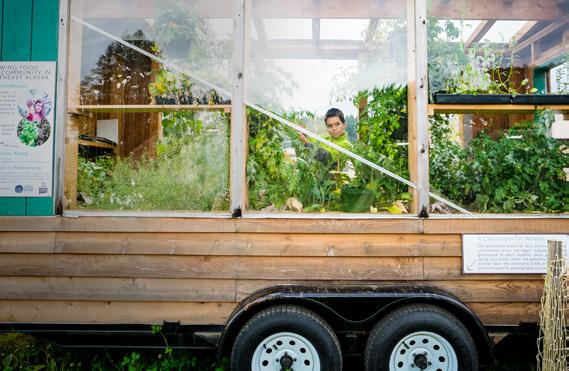
Moby’s Legacy
Traveling Greenhouse Supports Local Food Movement
Moby the Mobile Greenhouse was built thanks to the Sustainable Southeast Partnership, Nature Conservancy, Sitka Conservation Society, University of Alaska Southeast, Juneau School District, Spruce Root, Grow Southeast, AK ReUse, Icy Strait Lumber and Milling, Renewable Energy Alaska Project, Juneau Douglas High School Construction Class, Lia Heifetz, and countless individuals. Jo Dahl and Paul Berg wrote the accompanying curriculum. Southeast Alaska Watershed Coalition and Ecotrust hosted the program. The SSP Regional Food System Catalysts provided support to community partners who hosted Moby in Kake, Hoonah, Sitka, Yakutat, and Pelican.
Photo: Bethany Goodrich
STORY BY JENNIFER NU
Since time immemorial, the rich lands and waters of Southeast Alaska have provided an abundance of seasonal wild proteins, traditional foods, and plants that continue to sustain communities. Yet as lifestyles shift and access to wild foods grows more restricted, rural Alaskans also rely heavily on supply chains that depend on barges bringing food from thousands of miles away. While grains have a long shelf-life, fresh produce does not. Even canned and frozen vegetables can be seriously delayed to communities during major disruptions such as after the 9/11 terrorist attacks and during the Covid-19 pandemic.
The Sustainable Southeast Partnership (SSP) has long supported community-based approaches to selfreliance and access to affordable, healthy, local foods. In 2015, Moby the Mobile Greenhouse was dreamed up as a catalyst to support community-led efforts in building local food systems by providing hands-on experience, fostering collaboration, and facilitating knowledge exchange among local leaders.
While Moby traveled across rural Alaska, the real work of cultivating food security was led by each community, who adapted strategies to local conditions and priorities and assembled a unique mosaic of partners, volunteers, and funders to suit their town’s strengths.
Ten years since Moby hit the Alaska Marine Highway, we look to three isolated communities whose journeys to building place-based food systems were helped along by this humble vagabond greenhouse. For each, a community champion shares how a long-held vision for holistic food production became a reality in their town.
Hear from each community
Yakutat Tlingit Tribe Community and Market Gardens
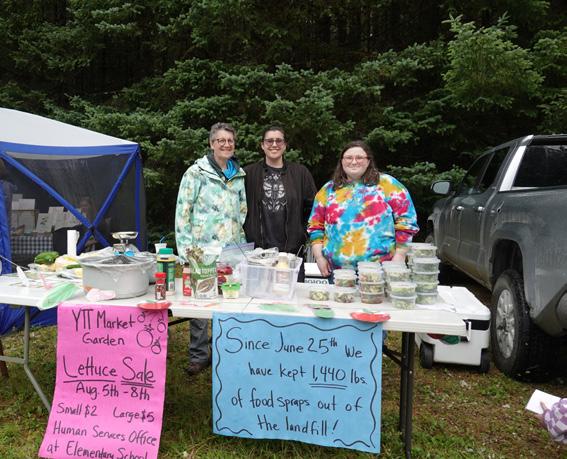
The Yakutat Tlingit Tribe’s (YTT) local foods program includes a community garden for the public to grow produce for their own household and a market garden campus where Tribal staff grow produce on a larger scale. YTT also hosts a compost facility manager and a food security manager, whose focus is on wild subsistence foods. These holistic efforts grew from the Tribe’s deep commitment to building food security, bolstered by partnerships and collaborations from across the state. When Moby the Mobile Greenhouse visited in 2018, it helped catalyze a small group of community leaders to imagine and plan an expansion of the local community garden. The Covid-19 pandemic further accelerated YTT’s commitment to fundraising, planning, and constructing broader food system infrastructure and programming.
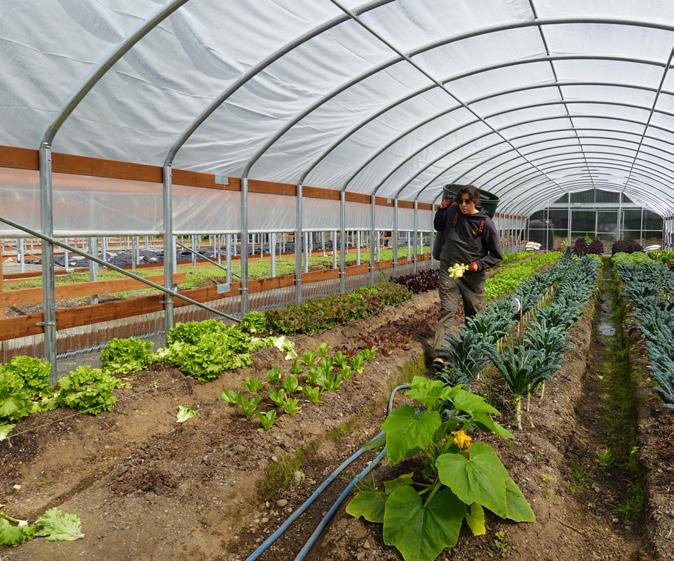
Today, the market garden includes a large greenhouse, five 96’ x 20’ hoop houses, fruiting rows of berry shrubs, and a community-scale composting operation.
The community garden is a bustling shared space. The City & Borough of Yakutat manages the land, while YTT oversees the garden itself. Over the years, the site has expanded to include 44 raised beds (4’ x 20’), each named for a virtue — love, loyalty, hospitality, resilience, benevolence, patience, honesty — along with two 10’ x 20’ greenhouses and an 8’ x 20’ compost house. The garden also offers classes throughout the year for both aspiring and experienced gardeners.
Penney James
Former Human Services Director, Yakutat Tlingit Tribe
Core Partners: Yakutat Tlingit Tribe, City of Yakutat, Alaska Village Initiatives, Alaska Community Foundation, USDA Southeast Alaska Sustainability Strategy Initiative, UAF Cooperative Extension Service.
What is it?
The infrastructure at the market garden campus is unique and designed specifically for Yakutat’s climate, especially our heavy wind and snow loads. The main greenhouse is south facing and includes a ground to air heat transfer system that circulates hot air and regulates temperature.
Although we are not certified organic, we follow organic principles. Our growing season starts with preparations in February and runs from March through October. Outside, we start in mid-May with potatoes and June for leaf vegetables. Plants like kale can be overwintered in the greenhouse. In February, the greenhouse functions as a nursery for seed starts for the greenhouse, hoop houses, and community garden. We grow zucchini, summer squash, tomatoes, basil, cucumbers, bok choy, herbs, and a wide variety of greens.
Last year, the first operational hoop house was planted entirely in greens — three types of kale, green and rainbow chard, five kinds of lettuce, and bok choy. This year with three going into production, we want to expand to include squashes, cabbage, peas, garlic, and carrots.
Produce is sold directly to community members and the senior center, and the Yakutat Seafoods lunchroom has purchased from us in the past. Our goal between the market and community gardens is to feed local people, not to export food out of the community. Alongside growing food, we focus on education — helping people understand the benefits of fresh produce and how to prepare and preserve it.
Photos this spread: Jennifer Nu
Why does it matter?
We are last on the barge route. Covid-19 was a wake-up call. During the pandemic, our stores were not getting food. We realized that when systems don’t work down south, we can’t rely on getting our food from there.
Gardening is a long-haul thing. Nurturing the soil takes time. Historically, there was a rich gardening culture in Yakutat. Residents were gardening on the islands and near rivers. They grew potatoes, turnips, and other root vegetables and had “kitchen gardens” with greens. Using seaweed for nutrients, they would put alder branches over the top to keep the animals off it. You didn’t have to tend to it. Colonialism and the forced movement of families from their homes, fish camps, and grow sites into Yakutat disrupted that culture. We want to build opportunities for people to participate in their own food security, reclaim food knowledge, and life skills.
The garden fosters collaboration. Different departments within YTT work closely to make it work. The Natural Resources Department operates the composting program to reduce food waste in the landfill, while Human Services and Education departments focus on feeding people and increasing knowledge. Community members with relevant skills are invited to share them. In the winter, gardener gatherings focus on food preservation and storage. In the growing season, people learn by doing. It strengthens both individual households and the broader community.
The YTT Human Services Department also contributes through a program designed to help people who are underemployed or unemployed build skills, get something on their resume, and have income. Interns built the community garden and have worked at the market garden and compost. All along the way we are building capacity. We now need to make the transition from program development to being selfsustaining.
What are some ingredients for success?
Collaboration has been essential — across Tribal departments, with the City, and with outside partners. We’ve also had to be willing to learn as we go, designing systems that work for our community and climate.
Another key ingredient is shared leadership. I see myself as a facilitator. Community members, gardeners, and staff do the hands-on work and teach one another. That shared ownership is what keeps the program going.
The composting program is also a critical piece. Community members and businesses contribute food scraps, which are processed using an in-vessel composter housed in a shipping container, along with conventional compost bins. The goal is to return compost to the people who provided the scraps so they can use it in their own gardens, closing the loop.
We have a lot of blessings here in Southeast. We have this amazing local ecosystem that fed people for thousands of years. We can garden and we can eat wild foods.
What’s next?
We want to continue expanding local food production and strengthening the connections between growing, composting, and education. That includes refining what we grow based on what people in the community want to eat, exploring culturally relevant foods, and increasing opportunities for hands-on learning. We need funding to pay the labor. We are planting berries with the plan to propagate them for community members. At some point, we hope to do a subscription based Community Supported Agriculture program. I love to say, ‘these vegetables were harvested this morning.’
The long-term vision is a resilient, community-centered food system where people have the skills, infrastructure, and confidence to grow, prepare, preserve, and share their own food.
Pacific High School
Greenhouse and Gardens
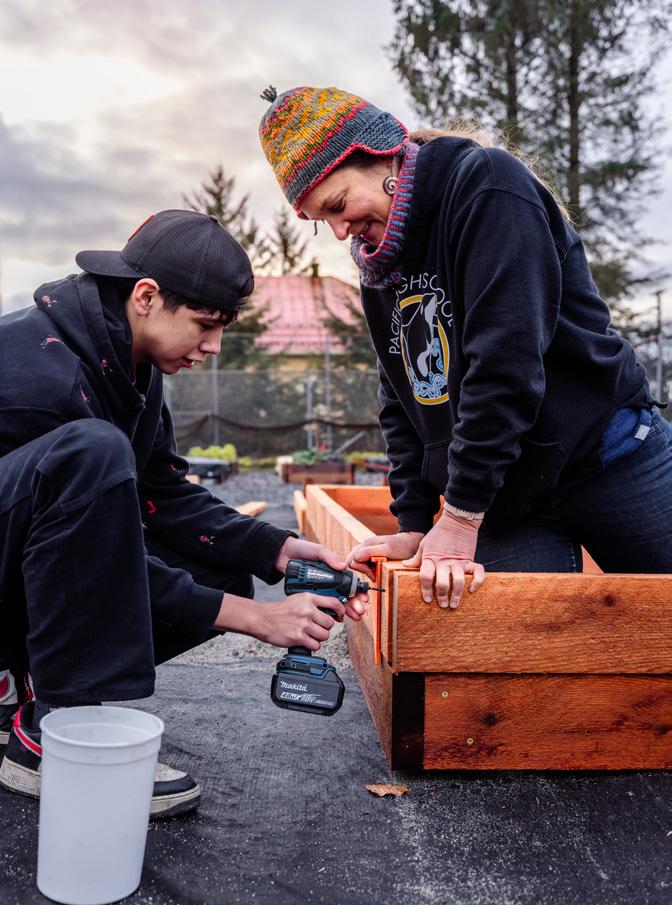
Pacific High School (PHS) is an alternative high school that supports authentic, experiential, and place-based learning with an emphasis on community and culture. For many years, the campus has grown vegetables in raised beds for school lunches. In 2019, Moby the Mobile Greenhouse arrived at Pacific High School, helping to catalyze local efforts. After years of fundraising, construction, and coordination with partners and volunteers, PHS celebrated several major milestones in 2026: the completion of a 24’ x 48’ greenhouse, the addition of more than 22 raised beds built with locally milled lumber, and expanded composting capacity. Pacific High Garden produce is now being used in-from scratch school meals district wide.
Core Partners: Sitka School District, Pacific High School, Sitka Conservation Society, Sitka Native Education Program, Outer Coast, Sitka Tribe of Alaska, Crossett Foundation, Patrick Leahy Farm to School (USDA), DNR micro-grants for food security (via USDA), AgWest, Philanthropy Northwest Thriving Communities grant, Whole Kids Foundation, and special recognition to Mandy Sumner, Chandler O’Connell, and many dedicated volunteers
What is it?
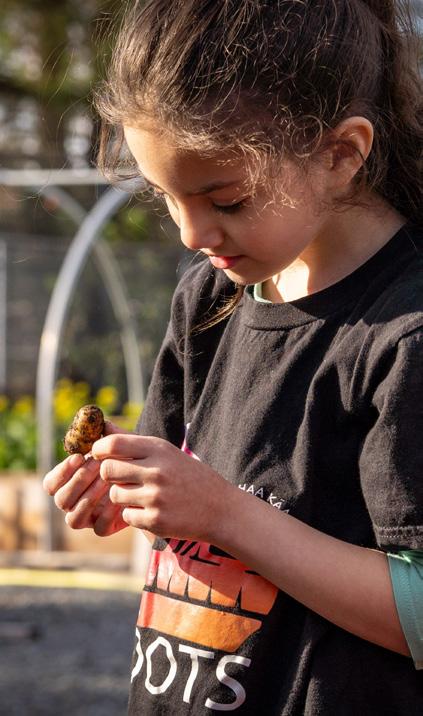
The garden is designed to maximize learning space so it can fit groups of people as an outdoor classroom. Spring garden classes run from March through May. In the fall, weekly stewardship activities run every Friday through November. Younger kids get involved too — neighboring Xóots Elementary kindergarteners plant Lingít potatoes, then return as first graders to harvest. Pacific High students also mentor preschoolers in gardening activities.
Part of the spring garden class includes constructing something each year — greenhouse benches, sifting tables, garden beds — simple projects that teach valuable skills while leaving youth proud of their work.
In the summer, there’s garden maintenance, volunteer contributions, and programs hosted by Sitka Native Education Program and Sitka Conservation Society, with plans to expand programming in the future once construction is complete.
Each year, the school hosts a big spring plant sale for the wider community. Last year, nearly 300 people attended, and approximately 1500 seedlings were sold. It’s a fundraiser and public service since we don’t have many garden centers in Sitka. sheet'ká | sitka
Photos this spread: Ryan Morse
Why does it matter?
At PHS, a guiding principle is to teach students life skills they can use outside of school. The garden teaches handson healthy food cultivation, simple wood construction, and from-scratch cooking. But it’s also inspiring and cultivates leadership. Students get a lot of choice — they helped design the garden site and continue to help plan what we grow and align it with what they want to eat.
We grow staples like kale, cabbage, potatoes, beets, carrots, garlic, herbs, and even broccoli raab and edible flowers. We like to try new things and for there to be variety to keep the kids interested. We also grow kúnts' (Lingít potatoes) in partnership with the USDA Forest Service and Sitka Tribe of Alaska. Students learn the origin story and Lingít language from Elders and participate in planting and harvesting at both on-site and off-site patches.
Produce is used in the culinary program for school lunches and distributed to students, families, and volunteers. It’s about connecting students to their food, culture, and community.
What are some ingredients for success?
Having a dedicated community partner has been key. Sitka Conservation Society plays an important role in looking out for funding opportunities, handling grant reporting and budgeting, managing the project, and employing the garden staff.
We also rely on volunteers, from Outer Coast College students to AmeriCorps members and community gardeners.
We have worked to build a simple and easy to maintain program and infrastructure. If you have specialized, complicated equipment that’s expensive to run, it’s accessible to less people.
Supportive school leadership has made a big difference, and strong volunteer engagement keeps the program thriving.
What’s next?
We hope to one day be able to provide summer employment opportunities for youth in the garden. There are also plans to build beds around the learning shelter for traditional and medicinal plants, and to expand the reach of our program across the district. There’s plans to build beds for raspberries the public can eat.
Currently, the school is constructing a 24’x 30’ open air pavilion, using local young growth wood (pg 56) to serve as a learning shelter and cultural space for community gatherings to butcher deer, fillet and smoke fish, and host a variety of other educational activities.
We want to keep growing both food and learning opportunities for youth of Sitka.
Hoonah Indian Association Greenhouse, Gardens, and Farmers Market
The Hoonah Indian Association’s (HIA) greenhouse and gardens is the result of long-term planning and partnership focused on strengthening local food systems in Hoonah, a community of about 800 people. Early groundwork began in 2016, when community members traveled to Prince of Wales Island to visit innovative, place-based, community greenhouses. While initial funding attempts were unsuccessful, momentum grew through engagement with the Sustainable Southeast Partnership and philanthropic partners.
Demonstration visits from Moby the Mobile Greenhouse in 2017, and again several years later helped build local interest and provided hands-on learning opportunities for students.
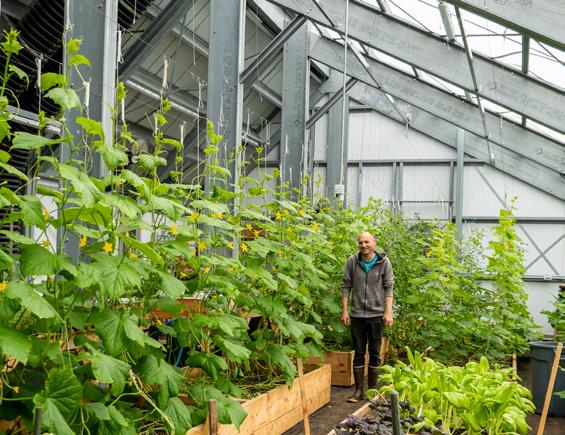
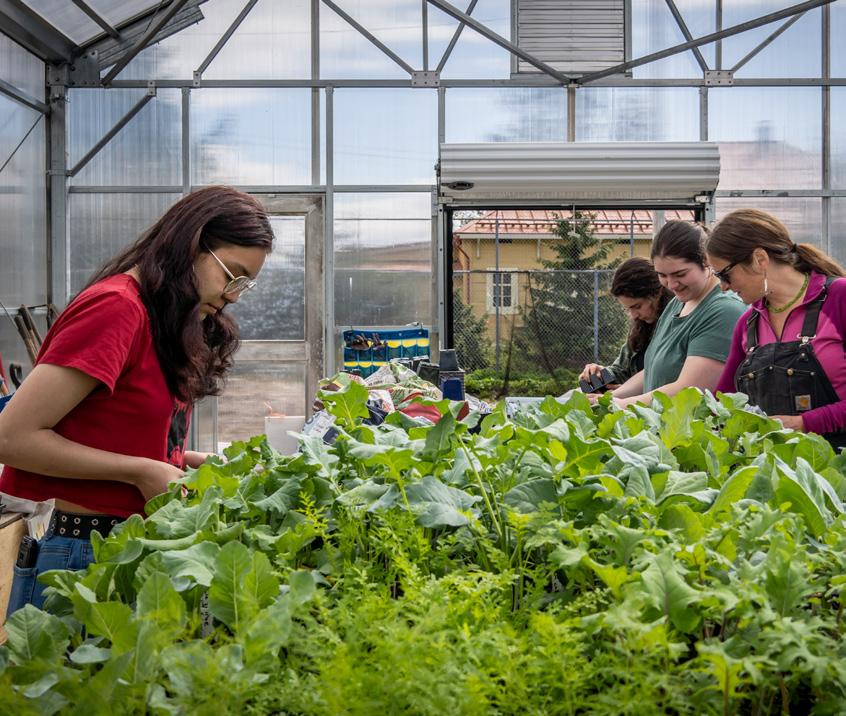
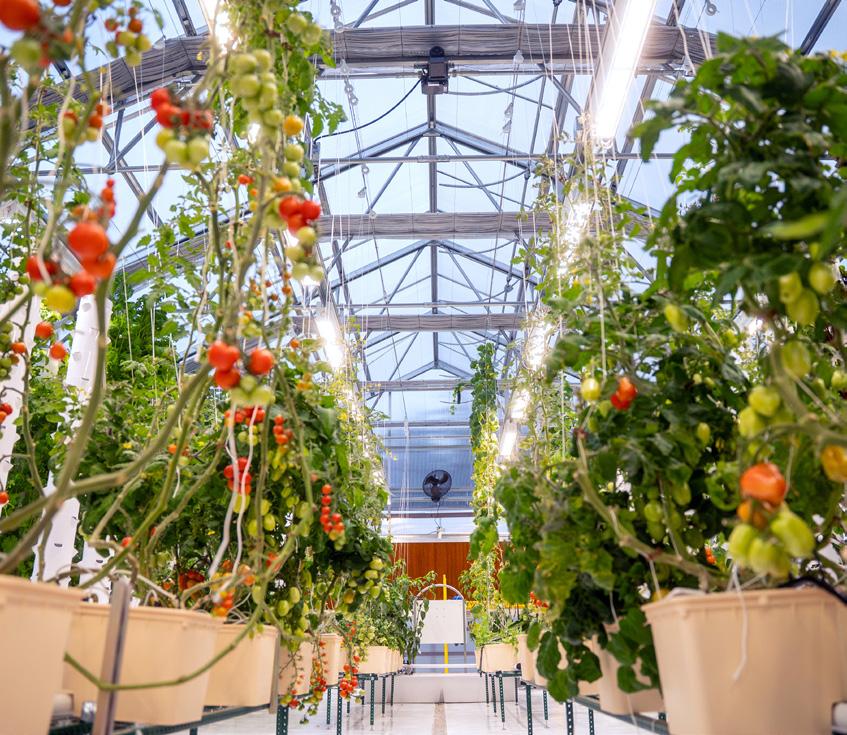
Completed in 2025, the 30’ x 60’ heated greenhouse is massive. It includes 90 hydroponic towers capable of producing up to 4,680 heads of lettuce, leafy greens, or herbs at a time, along with space for approximately 100 vine crops.
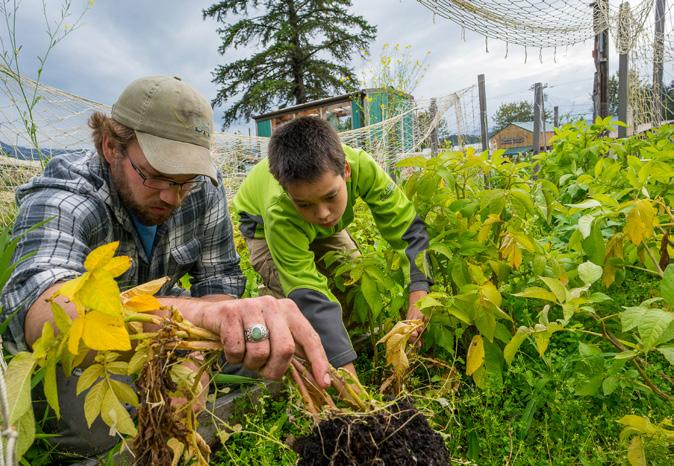
The greenhouse adds to the strength of HIA’s existing growing programs, which includes a community garden with raised beds for the public. For many years, HIA has grown kúnts' (Lingít potatoes) and hosted planting, harvesting, and other community engagement events with the school and the community. Seed potatoes are saved each year, expanding the patch. HIA has a hoop house for extending the season of outdoor soil crops. Also in the works are a community kitchen and a shipping container buried in the ground to become a root cellar for winter food storage.
Ian Johnson
Hoonah Indian Association, Hoonah Community Catalyst
Core Partners: Hoonah Indian Association, Ecotrust, Southeast Alaska Watershed Council, Renewable Energy Alaska Project, Hoonah City School District, The City of Hoonah, Mott Foundation, Rasmuson Foundation, The National Park Service, SEARHC, Newman’s Own Foundation, Bureau of Indian Affairs, US Forest Service, Spruce Root, Southeast Conference and more.
What is it?
We’re growing for the community of Hoonah, including through a formal partnership with the school, increasingly with the senior center, through restaurants and local businesses. Once a week we sell directly to local families through a Farmers Market we started, which is serving as a new opportunity for other entrepreneurs to participate in as well.
The greenhouse operates year-round and is structured like a business, even though we run it as a service to the community. We have one fulltime manager overseeing production. Sealaska, the regional Alaska Native Corporation, is sponsoring a marketing position to help connect our produce with buyers. Students are regularly in the greenhouse. High school interns are paid to work there. Elementary classes help harvest or assemble grow towers. It’s a working facility, and it’s also a learning space.
Why does it matter?
The first piece is cost of living, community health, and food security. We can provide healthy produce cheaper and more reliably. In winter, we might go weeks without lettuce or spinach. Two winters ago, I paid $18 for a head of cabbage. That’s the reality in
Photo below: Bethany Goodrich
rural Alaska. We’re strong in wild protein from deer and local fish, but for fresh greens, vegetables, and produce, you need to supplement your harvest with what you grow or buy.
COVID really laid bare how vulnerable our food system is. You can talk about supply chain risk all day, but when shelves are empty for months — when refrigerators were shut down because there was nothing to stock — it changes how people think. By 2021 it was clear: we can’t go through that again. We need to fortify Hoonah and have actual food security.
The second piece is economic. Every job matters in a town of 800. We’re hiring youth, creating management and marketing roles, and giving students workforce experience. Through the Farmers Market, we’re also creating space for other entrepreneurs to show up — selling prepared foods, like jams, or even crafts. We have one local family who is selling really top quality Chinese food in that space. In a lot of ways, this greenhouse is helping start a whole new industry in Hoonah.
What are some ingredients for success?
This greenhouse is a really strong example of how continued investments from a collective impact network like Sustainable Southeast Partnership can add up. From early efforts like sponsoring interested community members to tour innovative greenhouses on Prince of Wales Island, to resource guides that compiled best practices from across the state, to years hosting Moby the Mobile greenhouse, facilitated philanthropic visits,
and the support for my position as Community Catalyst, all of that was huge.
This took eight years. Not having turnover in my role mattered — just being able to keep championing it. Strong grant management behind the scenes was huge — piecing together multiple funding sources and separating the project into fundable components. Local contractors willing to work within our budget made construction possible.
And ultimately, continued community support, reignited during COVID, pushed it across the finish line.
What’s next?
We’re exploring renewable energy options to reduce reliance on a majority diesel-powered grid. In Hoonah, we pay five or six times the national average for energy. A greenhouse is energy intensive. If we can figure out a solar or small-scale, fish-friendly, hydro option, we could grow all year round while decreasing the vulnerabilities of shipping energy in.
We hope to expand the Farmers Market to twice a week and explore a subscription produce box. A greenhouse-linked recipe book is in development to help families use what’s grown. Youth engagement will continue to grow as we refine year-round operations and build on lessons from our first year of full production.
Left & right photos: Lee House
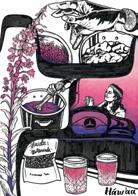
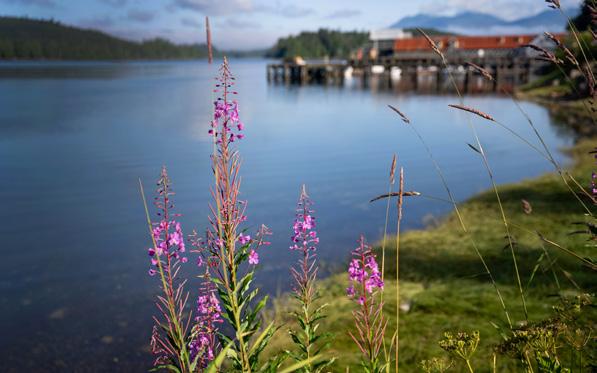
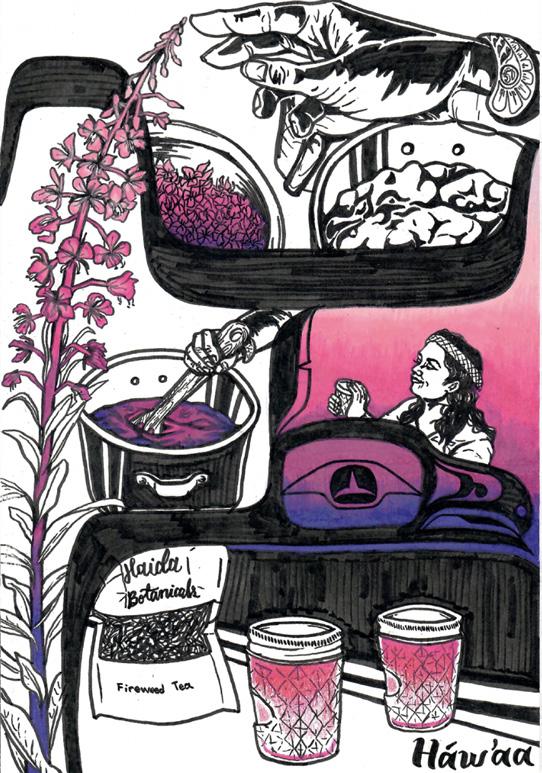
Fireweed Jelly with Haida Botanicals
STORY
& ILLUSTRATION BY SUMMER STORYTELLING INTERN CLARA MOONEY recipe
Among dew dripping ferns and cascades of hemlock and spruce, lay intricately woven reminders of the passage of time and our connection to the land. Salmon spawn keeps us rooted in cycles of reciprocity and balance, while fireweed buds mark the swift changes in season. The land guides us in lessons if we lend our eyes and ears to hear it.
It’s been about twenty years since Jennifer Mooney had the idea for Haida Botanicals, an Indigenous, womanowned business that highlights sustainable harvesting practices, values of reciprocity, and Jennifer’s own creative foods made from locally harvested plants. Born and raised in Hydaburg on Prince of Wales Island, Jennifer grew up surrounded by an abundance of her traditional plants, foods and medicines.
Jennifer’s business marks a continuation of her sharing traditional foods with friends and family. She often gives to family members who are unable to harvest themselves or live away from their traditional homelands. “Auntie Sister Dolly probably hasn’t been to Hydaburg in over 20 years,” says Mooney who sends her an annual package of traditional foods. “Just to have that reminder of home means so much. It keeps me connected to her, through our food and seeing the importance of it to her.”
In 2025, Haida Botanicals was recognized as a finalist in Spruce Root’s Path to Prosperity Business Competition —an annual business development competition for entrepreneurs who contribute to a positive economic, environmental, and community impact on Southeast Alaska.
Another undeniable quality of Haida Botanicals is connecting with the land in respectful ways. For Jennifer Mooney, her understanding of the land comes from generations of growing alongside its forests. “When I was in grade school I lived with my Naan and so a lot of what I have learned came from her and the teachings that she got from her mother. Growing up, one of the things she had us do during the summer was harvest berries every day. So, that helped foster this love of plants and berries that I have today.” Through buckets of wild huckleberries and salmonberries, Jennifer learned a sense of responsibility and connection to the land, her ancestors, and her traditional foods.
“I feel blessed because so many of the plants that we traditionally have are medicinal. For example, fireweed, even as a tea or a jam, you’re still getting all the medicinal benefits and that’s awesome because it’s so delicious.” With gratitude for the abundance of gifts that the land has to provide, it is important to be mindful and respectful of the plant’s limits. As Jennifer describes “It’s important to stress that you never want to take all of any plant; whether it’s flowers or berries that you’re getting, be mindful of the life of the plant. I’ve seen horrible practices caused by people harvesting haphazardly. So when I go to gather my fireweed, I go with the intention that I want to also be able to come back later or that I want somebody behind me to still be able to have enough to gather.”
An important ingredient to any recipe is the positive intentions you hold while picking — your commitment to being a caretaker of the resource and the abundance for your community.
Fireweed Jelly Recipe
INGREDIENTS
• 6 quart pot
• 9 eight ounce jars (or jar sizes of your choosing)
• 8 cups of fireweed blossoms
• 1 tablespoon of lemon juice
• 1 package of sure jell (~1.75 oz pectin)
• 7 cups sugar
INSTRUCTIONS
1. Only take what you need from one spot. When I’m harvesting fireweed, I start as the plant begins to bloom and wait till it gets a couple inches up in its blossoms. I reach out my hand towards the fireweed and close my fist, not tightly, just around the blossoms. So that way when I pull away, I don’t pull every one of them off. I do that twice on each plant on the front side and backside and then I move on to the next plant so that I’m never taking too much.
2. Add six cups of water in a six quart pot with the eight cups of fireweed flowers. Bring that to a low boil. Once it begins to boil, turn it down to medium-low and simmer for 45 minutes. You want to simmer until all the color is gone from your flowers. It is common to expect varying brown shades of tea or even purple. After it’s done simmering, with all the colors gone from the flowers, cool it down to room temperature.
3. Once cooled down, strain the mixture into your pot using a cheesecloth by hanging it until it stops dripping. After that you can give the mixture a gentle squeeze if needed. You’re looking for four cups of finished tea for your jelly.
4. With the four cups of tea, add one tablespoon of lemon juice.
5. Using a whisk, mix in 1 package of Sure-jell. Turn the pot on high, stirring constantly until it comes to a full rolling boil.
6. Mix in sugar, continuously stirring until the fireweed mixture reaches a full rolling boil again. Set a timer for one minute and then remove from heat.
7. Scoop off any foam and pour quickly into clean jars, sealing the jars at once. This recipe will make nine eight-oz jars.
Please
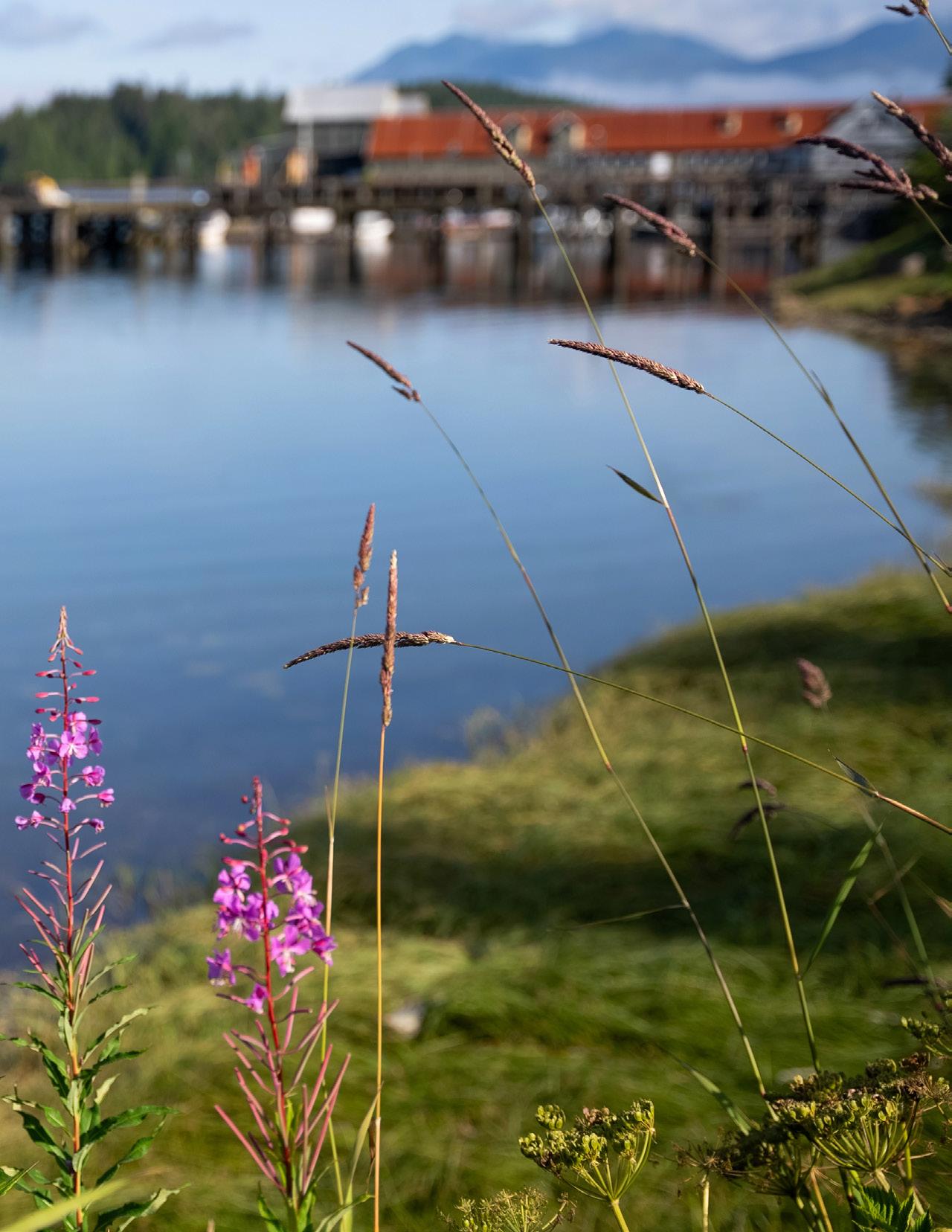
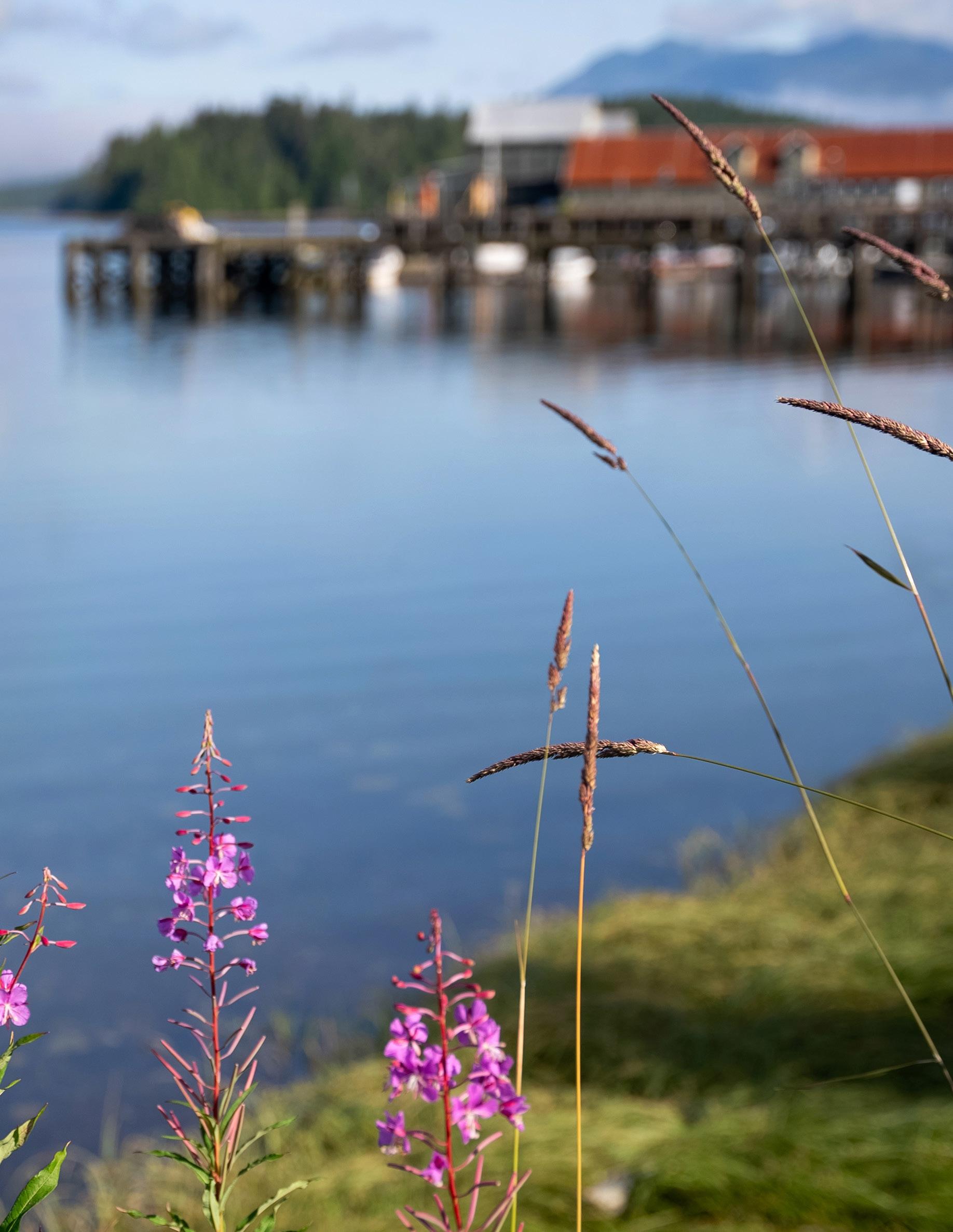
Photo: Lee House
Local Solutions
Southeast Alaska Responds to Federal Funding Cuts
WRITTEN
BY
MICHAEL MAUSBACH & ERIN O’FARRELL
INTERVIEWS BY
HALEY GOODMAN
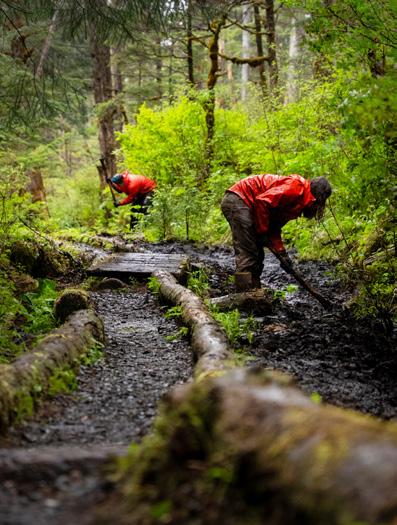
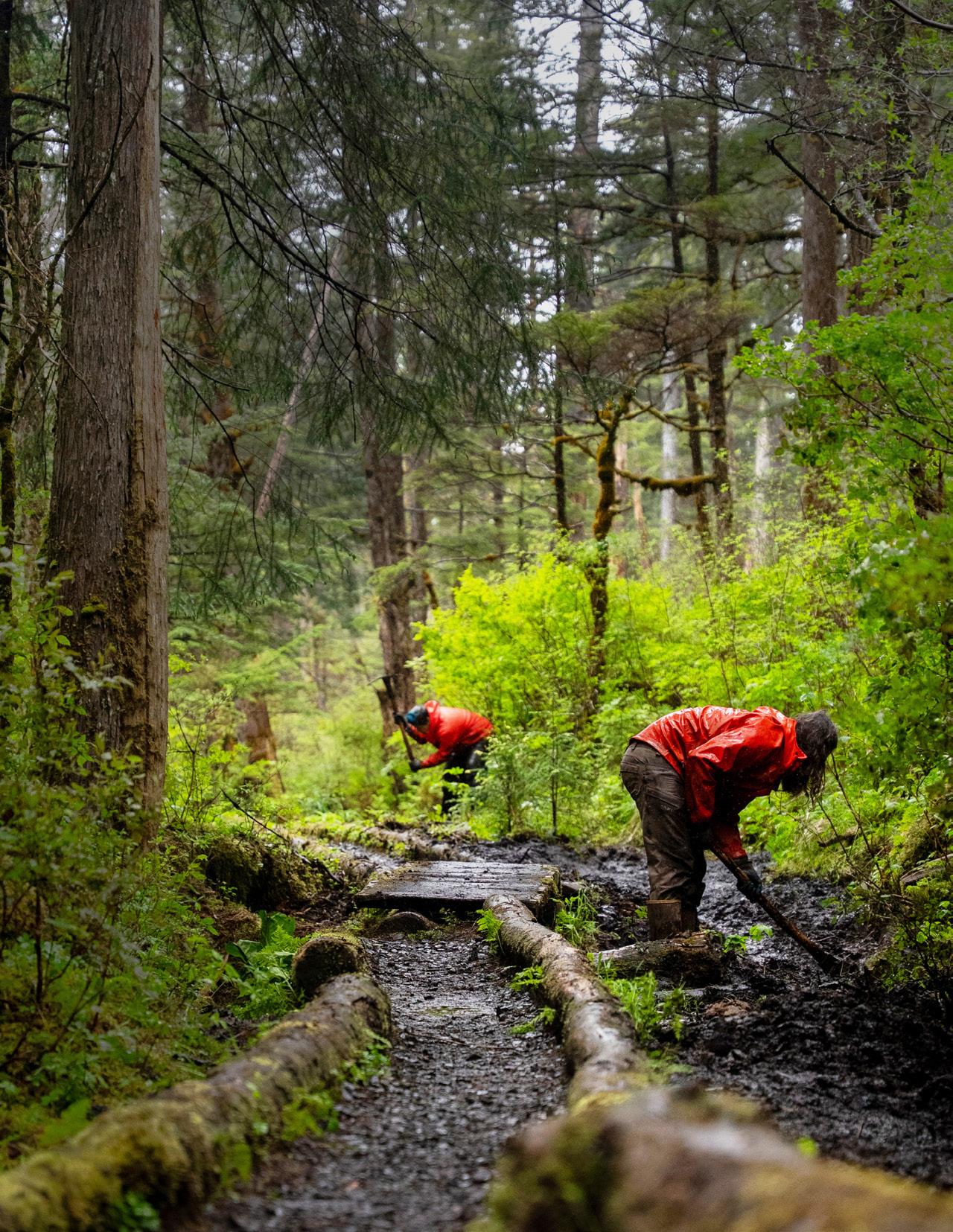
Sitka Trail Works trail crew members clear a drainage trench alongside the popular Mosquito Cove Trail. Keeping drainage alongevity and usability of Southeast Alaska trails. Photos this spread: Lee House
The people of Southeast Alaska have always built livelihoods deeply rooted in place. Whether harvesting and trading wild foods, building businesses from local materials, or teaching youth how to best steward their lands — work here has always been community-minded, relational, sustaining, and shaped by the region’s abundance and challenges.
Across this archipelago, economies are fueled by ingenuity and interdependence. Federal investments often reinforce local priorities, supporting infrastructure, research, fisheries, forests, and rural services. Yet that support is not static. Shifting administrations and changing national priorities can ripple quickly through Alaska’s communities. With roughly 20,000 federal workers in 2024, the third-highest proportion in the nation after Maryland and Washington, D.C., Alaska’s rural communities and their economies are especially sensitive to federal change.
Federal funding, when combined with community input, cultural understanding, and long-term planning, has been vital for Southeast Alaska’s progress in workforce development, land stewardship, and local and Tribal capacity. With shifts in federal priorities over the past year, community partners sustained critical programs by navigating the ebbs of national economic forces through their established networks of deep relationships, cultural knowledge, and shared responsibility. While federal dollars are necessary to fund community-driven workforce initiatives across the region, the need for financial sovereignty, catalyzed by support from private funding sources, has never been clearer.
Across Southeast Alaska, communities are showing that weathering change, and building prosperity, requires an allhands approach linking federal, state, private, and community institutions.
“Federal Cuts Have Created a Whirlwind”: Rural Alaska Feels the Blow
“If we want to do the best we can to steward these lands and waters, we need to be hiring teenagers whose birthright it is to steward them,” says Eloise Peabbles of Alaska Youth Stewards (AYS) in Kake. “If it’s not in line with the values of this land and the people who have lived here for so long, it’s not going to serve the people or the place well.”
AYS, a Central Council of Tlingit and Haida Indian Tribes of Alaska (Tlingit & Haida) program, has become a cornerstone of regional workforce development by employing rural and Indigenous youth for projects on the lands and waters. When federal funding cuts hit in 2024, programs like AYS felt the impacts acutely.
“News of the federal cuts was a huge blow, since two of the primary agreements supporting AYS are with the USDA Forest Service,” explains Regional Sustainable Southeast Partnership (SSP) AYS Catalyst Gabe Sjoberg. “2024 had been an abundant year: hosting our first in-person, all-crew training, hiring more crew members and leaders than ever, and seeing alumni graduate to new roles as assistant crew leaders, interns, and members of Community Forest Partnership crews.”
In 2025, scaled-back resources hindered that momentum. “Due to the federal unknowns, we were forced into contingency planning,” Sjoberg says. “Every community scaled back its crew and projects. We were scrambling to find funding we could rely on, and that set us back.”
The strain of that uncertainty, explains Alana Peterson, is deeply felt across communities and the organizations that work within them. “Federal funding cuts have created a whirlwind for us and the communities we support.”
Peterson is the Executive Director of Spruce Root, an Indigenous-led Community Development Financial Institution. “In 2025, our staff, who were fully funded and ready to deliver on critical programs, instead spent countless hours reacting to sudden changes in funding streams. This shift pulled our attention away from proactive, community-driven work and pushed us into a constant state of response,” she says.
Peterson points to a workforce initiative training electricians and mechanics, trades desperately needed across the region, that stalled in 2025 due to disrupted funding. This set back nearly a year of progress before work resumed. “That program is essential for supporting our rural communities and keeping critical services running. Now our team is working overtime to meet the demands of both new and delayed projects.”
“We’ve seen skilled local people burned out by the scramble,” adds Kaylah Duncan, Spruce Root’s Development Manager. “These are folks who are rooted here, who want to serve their communities. But they’re tired of doing three jobs on two contracts.”
“It’s
More Than Frustrating; It Erodes Trust”: Cumulative Impacts Ripple Out
The Sustainable Southeast Partnership (SSP), a Spruce Root program and collective impact network, has collaborated with federal agencies for over a decade to shift resources and decision-making power toward Indigenous, community-led approaches focusing on relationships and long-term stewardship. Initiatives like the USDA’s Southeast Alaska Sustainability Strategy and AYS demonstrate the success of public agencies fostering relevant and culturallygrounded solutions by listening to and being guided by local leadership.
When federal cuts are made without regard for these evolving relationships, programs are delayed. Positions go unfilled. People who have spent years strengthening community-rooted systems are forced to do more with less, or stop. That slow, hard-earned shift toward shared governance and trust frays.
“When you’re doing the kind of workforce development that matters here, place-based, culturally grounded, relational — it takes time,” says Sitka Conservation Society Executive Director Andrew Thoms. “When funding drops out halfway through a cycle, it’s more than just frustrating. It erodes trust.”
That erosion shows up when youth commit to summer programs that suddenly lose funding, when community partners are forced to scale back promises, and when crew leaders are left without contracts or clarity. It interrupts the relationships that these programs are built on. These cuts shape whether people can stay in their communities or are forced to leave in search of opportunity. They determine whether a trail crew gets another season, a small business can take on apprentices, or if an Elder can be paid to teach traditional knowledge. Dramatic federal cuts hurt more than the workforce; they harm cultural and community vitality.
Our Flourishing Is Mutual: Cultivating a Culture of Abundance
Even in the face of federal funding scarcity, Southeast Alaska is a place of abundant solutions. The people here have built programs that prepare young people to steward their homelands. They’ve fostered partnerships that reflect shared responsibility and mutual respect. They’ve established systems of care that are rooted in culture, place, and mutuality. Even as programs have lost footing, partners across the region have stepped up in powerful ways. When one organization loses funding, its partners open their doors, share staff time, or offer letters of support. When a training is canceled, mentors step in to share their knowledge. People are finding ways to hold each other up, filling gaps by sharing resources and time.
Alaska Youth Stewards crew members work on trail projects during the 2025 all-crew meetup in Glacier Bay National Park. Photo: Heather Hintze
“The role of federal funding is to make investments that catalyze other things that help our society and economy grow and take care of our communities, our environment, and our resources. It is an investment that keeps our country running, and done well, it is an investment that creates a manifold return.”
— Andrew Thoms,
Conservation
Executive Director
“It’s not just about finding new funding,” explains Sitka Trail Works’ Ben Hughey. “It’s about keeping each other going. Sharing templates, writing letters of support, offering our stories and strategies — that’s what gets us through this.”
When the entire cabins and trails crew from the Sitka Ranger District of the U.S. Forest Service lost their jobs in February 2025, Sitka Trail Works launched a fundraiser to create trail maintenance positions. Through their grassroots campaign, the organization raised over $130,000, allowing them to offer temporary positions to the impacted federal workers and hire a full professional trail crew for their summer season. This kind of cooperation and mutual care has become a defining feature of the region’s workforce in recognition that all of these endeavors are ultimately intertwined toward shared goals of community flourishing.
In many ways, the challenges of this past year have helped clarify what Southeast Alaska’s workforce vision truly is. It is not a one-size-fits-all model imported from elsewhere. It is not limited to youth pipelines or narrowly defined, singleindustry training tracks. It is about building a regenerative economy where anyone, at any stage of life, can find or create meaningful work.
A Vision of Generational Abundance
When federal funding — a traditional cornerstone of national support — decreases, communities are forced into reaction instead of growth. This is where philanthropy and private funders can step in, upholding the value that all communities deserve to thrive. However, public investment alone is not enough. Our region requires new funding mechanisms governed by people whose well-being is anchored here and who will center Indigenous sovereignty and local priorities. In 2021, the Seacoast Trust was created in response to that need.
When fully endowed, Seacoast will serve as a perpetual funding source for the SSP, supporting initiatives that promote the collective well-being and economic prosperity of Southeast
Alaska. Seacoast envisions a new economic model, one where access to capital rooted in Indigenous values lays the foundation for a more just and sustainable future. At its core, Seacoast embodies the values that have defined this region for generations and represents the enduring continuation of our traditions, thoughtfully adapted for the present day.
“The Seacoast Trust was established to provide long-term, stable funding for community and stewardship efforts of SSP members for moments like this when quick action is needed to sustain critical work and livelihoods,” says Alana Peterson.
In 2025, Seacoast experienced a milestone when it made its first distribution, and the timing could not have been more meaningful. As federal funding stalled, the SSP relied on its unrestricted funding from the Seacoast Trust to support partner organizations who kept vital work moving forward across the region.
In a time of government shutdowns, shifting political priorities, and economic uncertainty, the Seacoast Trust promises stability, vision, and a model of investment designed by and for the region. It is not a crisis response; it’s moving our rural and Indigenous communities toward generational abundance and financial sovereignty.
Catalytic Federal Investment
The Seacoast Trust cannot do this work alone. Local organizations must continue to seek out federal funding and private investments that meet the needs of our communities and enable them to do sustaining work.
When done properly, federal funding is not charity; it’s catalytic. “The role of federal funding is to make investments that catalyze other things that help our society and economy grow and take care of our communities, our environment, and our resources,” said Thoms. “It is an investment that keeps our country running, and done well, it is an investment that creates a manifold return.” In Southeast Alaska, that
Sitka Trail Works volunteers at a trail building and maintenance training event. Photo: Lee House
Sitka
Society
“We will need to put our heads, hearts, and hands together to do the big lift of building communities and a region we want our kids to grow old in.”
— Gah Kith Tin Alana Peterson, Spruce Root Executive Director
return looks like thriving communities, well-stewarded lands, and a robust economy that reflects the values and strengths of the region.
This is more than a budget issue; it’s about defining value and investment. These disruptions in Southeast Alaska mirror national priorities, testing the future we are collectively building.
Our region has long been viewed by outsiders as a place of potential in terms of what could be taken. But its real potential lies in its people. Everyone in this region, shaped by its landscapes, cultures, and lived experience, has something powerful to contribute to their communities as well as the development of this country. The knowledge and skills present here are needed to meet today’s social, ecological, and economic challenges. Honoring and leveraging that potential requires investment in people and place and a shift from short-term extraction to sustained engagement.
“The impacts of federal shifts and cuts are really going to be felt hardest in this region and in this network in 2027, when the impact settles and catches up,” fears Thoms.
Meeting the needs of rural Alaska will become increasingly difficult due to less federal investment, political instability, funding scarcity, and the capacity strains these issues place on our smallest communities. But this isn’t the first time we have faced challenges as a region. Stewarding these lands and waters for the future will require ingenuity and innovation, long-term economic models like the Seacoast Trust, immediate private capital, creative cost-sharing, and philanthropic investments.
“We will need to lean on the relationships we’ve built between Tribal governments, non-profits, land managers, funders, Native Corporations, schools, with youth, with Elders, with municipalities, and more, and put our heads, hearts, and hands together to do the big lift of building communities and a region we want our kids to grow old in,” says Alana Peterson.
“Part of that will be leading the work on the ground and building local capacity. Part of that will be continuing to work with our state and federal governments to recognize our rural priorities and uplift that vision through policy shaping. Part of that will be leading with kindness toward one another and showing up to help plant community gardens, build trails, write letters of support, or bring smoked fish to a neighbor.”
Below: Sitka Trail Works trail crew members at work. Photo: Lee House
A Sacred Trust
THOMAS MILLS
Hoonah Crew Lead Alaska Youth Stewards
“For the crew, these experiences were more than fieldwork — they were acts of cultural reconnection. By walking the same lands and waters their grandparents once did, the youth gained a deeper understanding of what has been lost, and more importantly, what must be preserved.
This understanding is at the heart of stewardship. The crew came to see that caring for the land is not simply environmental work — it is a sacred trust passed down from their ancestors. As young Tlingit people, they carry the responsibility to protect and nurture the ecosystems that sustain both culture and community.”
Alaska Youth Stewards
Despite unexpected federal funding cuts and reduced partner capacity, Alaska Youth Stewards crews across Southeast Alaska had a remarkably successful season, combining cultural learning, land stewardship, scientific exploration, and community engagement.
Crews restored historic graveyards in Angoon. They restored trails and campsites and monitored fish habitats in Hoonah. Youth on Prince of Wales planted cedar saplings, conducted marine debris clean-up, and participated in crab molt surveys. In Kake, youth engaged in Culture Camps, stream mapping, and invasive plant management, ensuring that both ecological and cultural knowledge were preserved for the future.
This season’s achievements were made possible by the continued dedication of program host Tlingit & Haida, as well as local partners — including Tribal governments, school districts, USDA Forest Service, Southeast Alaska Watershed Coalition, Forest Partnerships, Sitka Trail Works, Spruce Root, Sealaska and numerous Elders and community mentors — who stepped up to support youth in spite of reduced resources.
Top & bottom photos: Heather Hintze, Middle photo: Thomas Mills
Fish, Flies, and Story
Remembering the 2nd Annual Tongass Guide Academy
PHOTOGRAPHY & WRITING BY SHAELENE GRACE MOLER
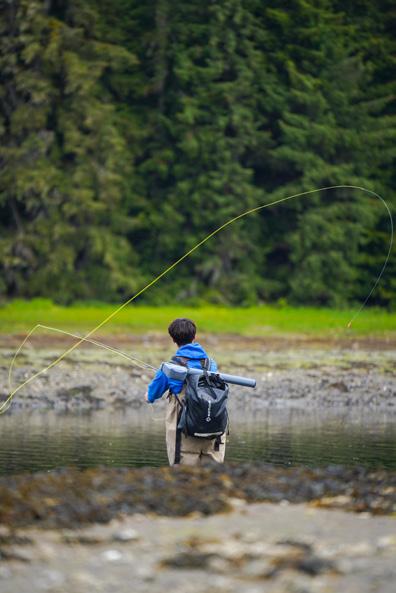
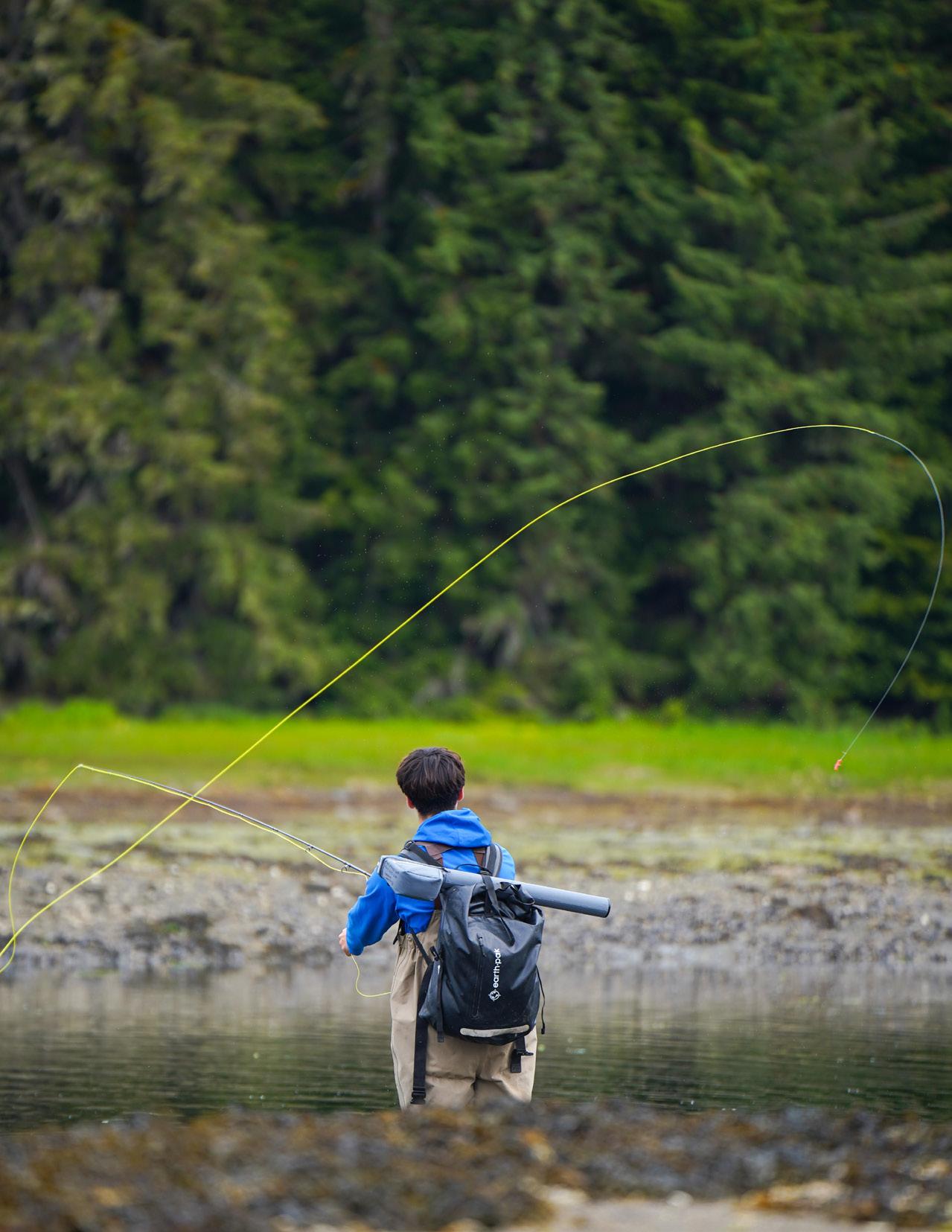
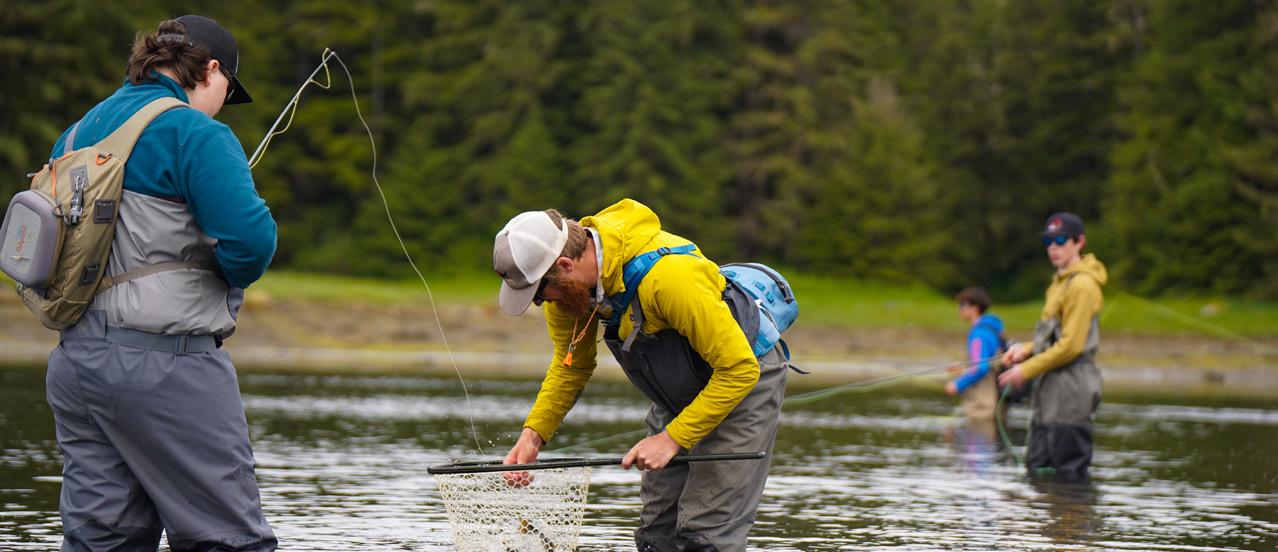
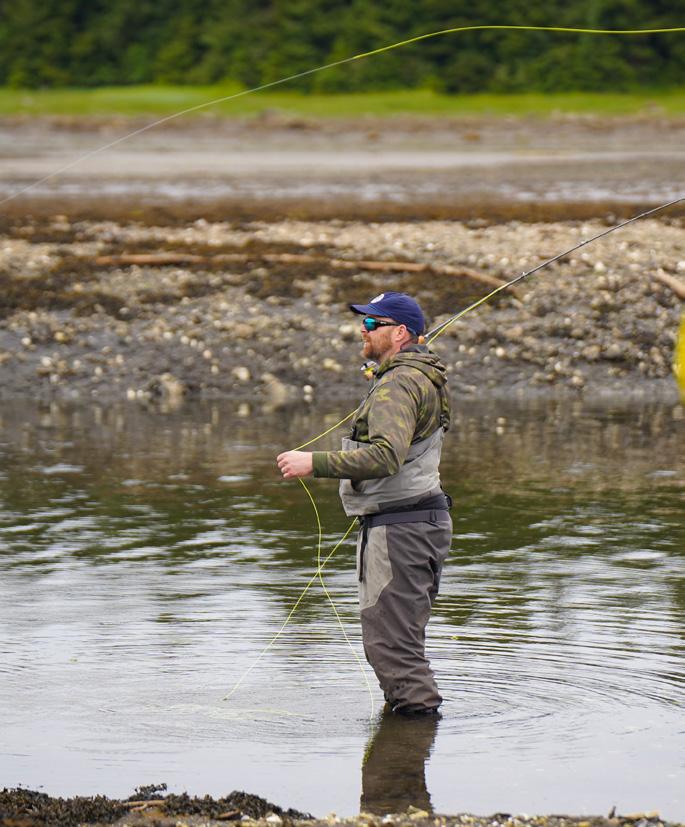
Student Beebuks Kookesh practices his casting technique. After the course, he continued on with Favorite Bay Lodge as a guide.
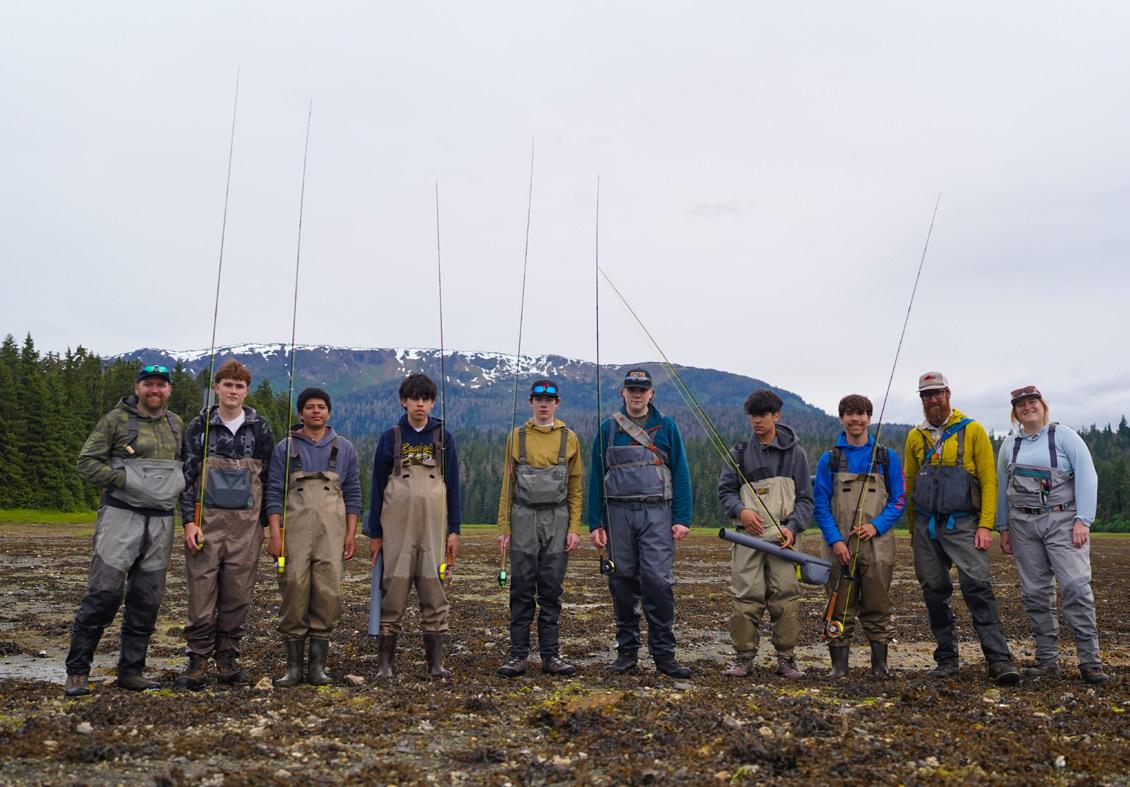
The 2025 Tongass Guide Academy, held in Angoon at Favorite Bay Lodge from June 15–21, brought together seven high school students from across Southeast Alaska for a culturally-grounded, place-based learning experience. Designed to be a beginner-friendly program, the Academy supported student growth in both technical and academic areas, serving as a stepping stone for students to explore career pathways in natural resources, recreation and guiding, while simultaneously gaining dual-credit with University of Alaska Southeast (UAS) and essential employability skills. Students learned not only the physical skills of fly fishing and guiding, but also how to think critically about tourism’s impacts on small coastal communities, and how to shape its future from within.
The line whisps through the afternoon air as Justice, a Tongass Guide Academy student watches the fly he tied hours ago settle on the glassy surface of Mitchell Bay. Beside him are his classmates, cousins and friends. Feeling the weight of the rod balanced in his hand, he takes a deep breath of salt and spruce pollen mingling in the air, the same scents that greeted him each summer before, and he thinks about his younger siblings or cousins, who might stand here next season.
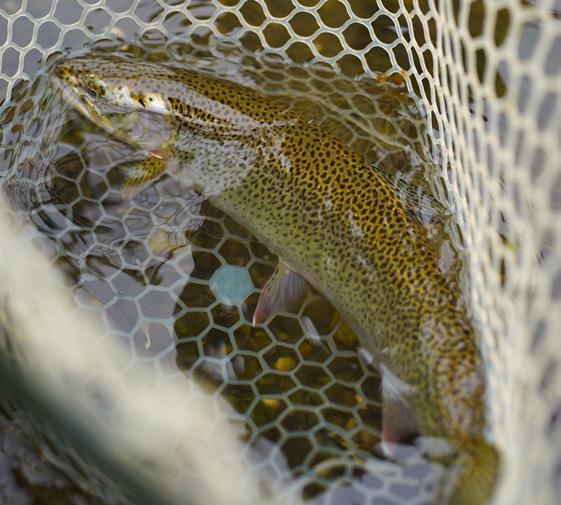
Suddenly, his line zips taut, and a silver fish leaps. In that moment between fisher and fish, he understands what his instructors meant about regenerative tourism: visitors won’t just pass through Angoon, they’ll carry home stories about place and culture, and move differently through the world. When it’s reeled in, he holds the largest trout he has seen for a moment at the water’s surface, careful not to handle it too long. Already, he’s imagining himself as a guide.
What it Entailed
Over the course of the week, Tongass Guide Academy students learned about tying flies, flycasting, fishing, and skills in work readiness and customer service, while exploring the cultural, political, and ecological dimensions of tourism in coastal Alaska. The curriculum combined practical skill-building with reflective writing, digital storytelling, and geospatial technology, culminating in student-created StoryMap entries: a web-based GIS tool that combines interactive maps, multimedia content, and text to create, share and publish digital stories that document their learning.
At its core, the Academy addresses regional workforce needs and shapes the future of Southeast Alaska’s tourism economy by preparing Alaska Native and local youth to be leaders in that space. With strong partnerships across Tribal, educational, nonprofit and private sectors, and core funding provided by the Sustainable Southeast Partnership (SSP) and Sealaska Heritage Institute (SHI), the program reflects a shared commitment to building a culturally-informed, locally-rooted workforce.
How the Academy Came to Be
The Bristol Bay Fly Fishing and Guide Academy caught the attention of other Alaska regions searching for the same education and employment opportunities for their youth. Within the last fifteen years of operation, the Bristol Bay academies produced 180+ graduates, with nearly 15% now holding full-time seasonal employment. In 2024, Kootznoowoo, Inc., Angoon’s Alaska Native Village Corporation, brought that proven model to Southeast Alaska, partnering with Trout Unlimited to launch the Tongass Fly Fishing Guide Academy.
Rooted in their commitment to both economic development and traditional values, Kootznoowoo implemented the Academy to ensure Angoon residents have the training needed to pursue sustainable employment that honors ancestral lands and waters.
Instructors represented diverse fields of expertise. Kevin Maier, a UAS professor, co-led sessions on fly fishing, environmental studies and digital storytelling. Matt Boline, Trout Unlimited’s Southeast Alaska Community Engagement Manager, focused on fly fishing, conservation, employability skills and industry insights, while Anna Petersen, the Alaska Education Coordinator for Trout Unlimited, cofacilitated career and communication skills. Matt Kookesh of Kootznoowoo Inc. led sessions on cultural history and traditional ecological knowledge, helping students identify how to intentionally center ancestral knowledge, harvesting practices, and stewardship ethics in fly fishing and guiding.
Together, this team equipped students with essential technical skills, such as fly tying, various casting techniques, understanding fishing regulations and tide tables, fish biology, and habitat awareness, alongside critical soft skills like teamwork, customer service, time management, public speaking and effectively sharing and integrating cultural and ecological knowledge.
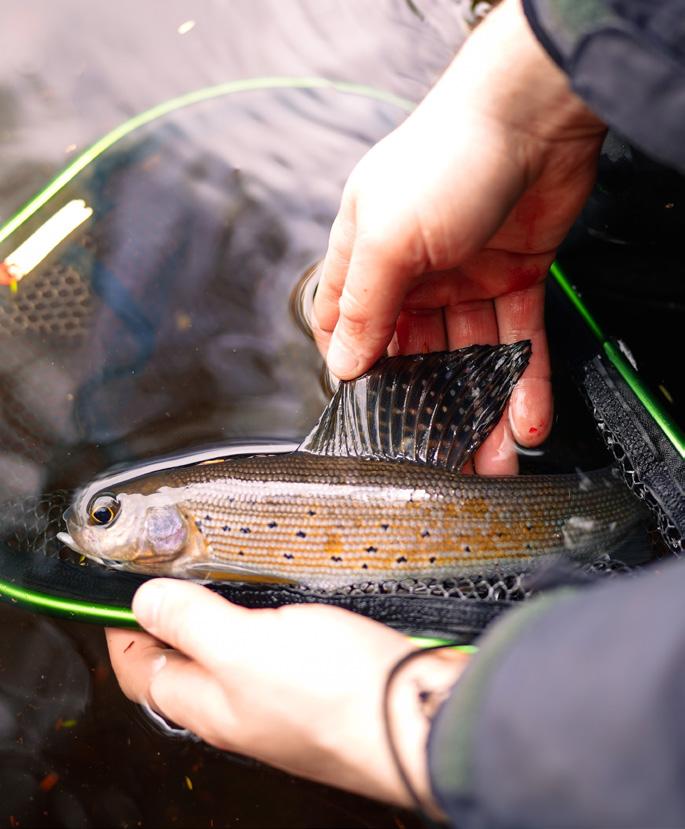
Justice’s large trout he caught.
Instructor Kevin Maier handles fish to teach proper etiquette.
Guides have a Role in the Future of Regenerative Tourism
Amid the distant hum of boat motors, the Academy students, despite being full of anticipation to participate in the ongoing local King Salmon Derby, studied from 9 am well into the evening so they had time to fish the morning tides. One day ended with a film screening of Cruise Boom, a documentary produced by Sitka videographer Ellen Frankenstein. Cruise Boom shows the myriad positive and negative impacts the burgeoning cruise ship presence is having on the rural community of Sitka.
A primary aspect of the Tongass Guide Academy asked students to think critically about tourism opportunities and impacts in small coastal communities, exploring how curated experiences could address the challenges of a rapidly growing sector. In doing so, the program encourages a more holistic and regenerative approach to tourism. A regenerative tourism approach centers the needs and values of the region and community alongside the interests of the visitors. It seeks to improve ecosystems, elevate local economies, and promote meaningful visitor experiences guided by locals who know the land, history, and culture.
With a growing contingent of visitors eager to travel with a lighter footprint to protect the vitality of choice destinations for future generations, this approach to development is a natural fit for Southeast Alaska.
Inherently, fly fish guiding integrates sustainability ethics through a commitment to catch-and-release fishing while advocating for habitat protection and offering ecological education. Additionally, respectful guides use barbless hooks, minimize handling time, and follow fishing regulations. Through this work and practice, they foster environmental stewardship while encouraging a love for the waterways that support their livelihood.
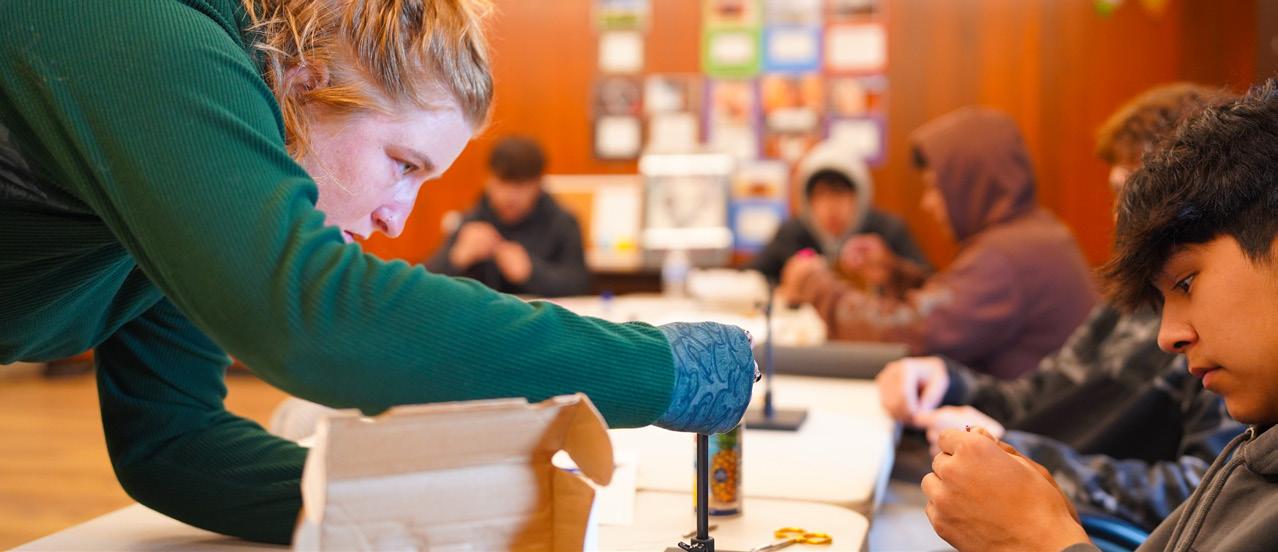
Instructor Anna Petersen checks students’ fly tying techniques.
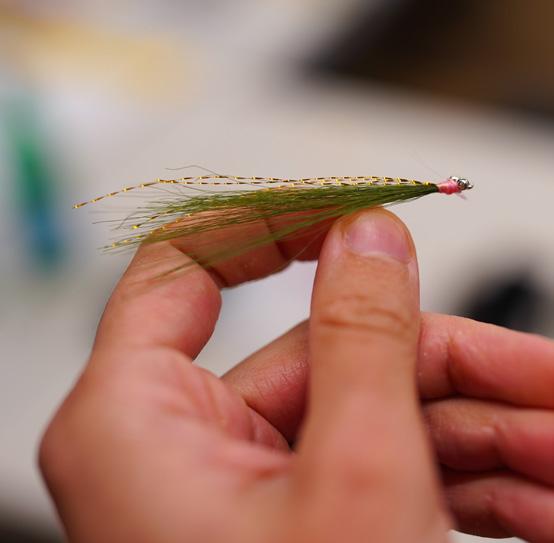
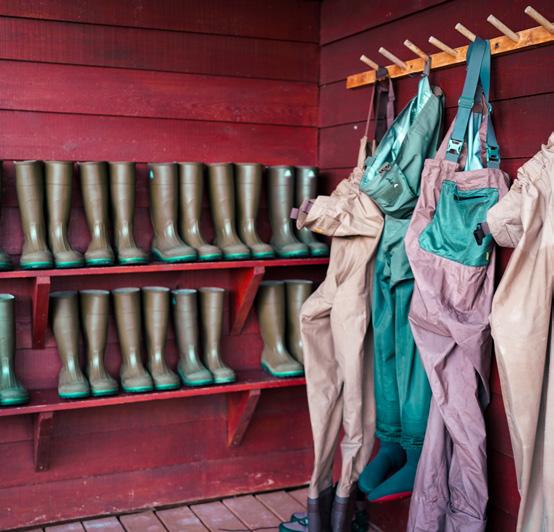
Top right: Fly tied by student after first tying lesson. Bottom right: Waders and boots provided by Favorite Bay Lodge, where the class took place.
Angoon’s Tourism Future
As the community develops tourism operations, Angoon plans to expand offerings for small cruise ships in the future, including educational walking tours, freshwater fly fishing, bear viewing, saltwater fishing, and tours of important cultural sites and activities.
Simultaneously, the Kootznoowoo Stewardship Crew, a community-based restoration initiative that partners locally and regionally, began habitat restoration projects in Cube Cove. Their work has included removing incidental barriers to fish passage, such as broken or debris-filled road culverts, allowing trout and salmon to reach the full range of their habitat. This will positively impact local fish populations and residents, while expanding fish guiding opportunities in the future.
The Tongass Guide Academy encouraged rural and Indigenous youth to not only reflect on the ways a growing tourism industry could shape their home communities, it also empowered them to recognize the roles they hold as leaders in that development.
The Tongass Guide Academy was a collaborative effort led by the University of Alaska Southeast, Kootznoowoo Inc., and Trout Unlimited, with key support from regional and community partners, including Spruce Root, Sealaska Heritage Institute, Bear Creek Outfitters, the Alaska Youth Stewards, Alaska Fly Fishing Goods, Orvis, USDA Forest Service and Favorite Bay Lodge.
Sealaska Heritage Institute and Tlingit & Haida anticipate launching one or two academies this coming summer.
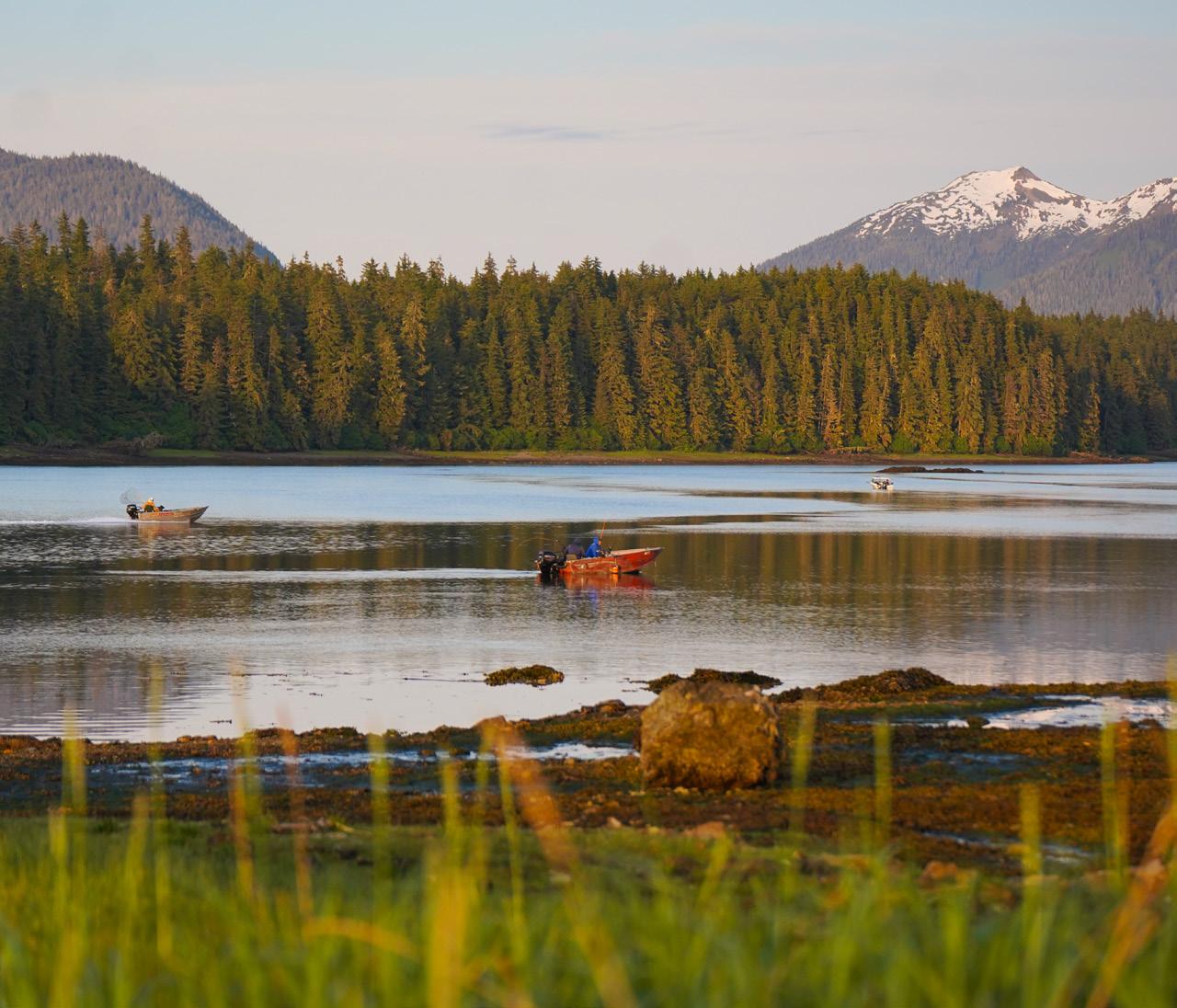
Angoon community members returning from fishing for the local king salmon derby.
Juneau, AK
Career & Technical Education Specialist
Sealaska Heritage Institute (SHI)
Workforce Development
“I was aware of Bristol Bay academy through my previous role, and knew it was something with a lot of interest and opportunity here in Southeast Alaska. Through the dedication of many community and regional partners, we were able to create and bring the Guide Academy to Angoon by developing what a Tongass Academy could look like — keeping community needs and interests at the forefront. It is important we work closely with community leaders to develop these intensives because each community is different.
Since last summer, we have had one student work as an assistant fishing guide at Favorite Bay Lodge. Multiple other students continue to reach out to partners and instructors for guidance on things from flies to fishing locations. Whether or not they choose that as a career, having a healthy option to explore their home and nature and connecting them with healthy leaders makes these programs worth it. It strengthens their support systems and not only do they enjoy fishing more, but they do it safely.
Since the Academy, interest from school superintendents and school boards has grown. In fact, we will be in Yakutat this April to offer the Guide Academy to grades 6-12 with Hoonah sending students to participate. Spear-headed by the Yakutat superintendent, it will be supported by the original regional partners, SHI, Tlingit & Haida, and Trout Unlimited.
I am excited to take over the monthly Sustainable Southeast Partnership Workforce Development calls through my new role at SHI. I found these calls critical for connecting with regional partners who share goals and ambitions. These calls happen virtually on the 3rd Wednesday of every month from 11am–12pm. Visit sustainablesoutheast.net to register and learn more.”
Register for the monthly SSP Workforce Development calls https://sustainablesoutheast.net/ announcement/ssp-monthly-workforcedevelopment-hangout/
All it takes is one morning walk along a salmon stream, one dance at a Culture Camp where the box drum thumps your core, one glance of aurora borealis dancing across the sky, to know that Southeast Alaska is spectacular. Our rainforest is healthy. Our communities are strong. By caring for our home, we help care for the world.
Photo of Xunaa Hoonah by Community Catalyst Ian Johnson.
Where are Our Future Energy Leaders?
WRITTEN BY ADRIANA NORTHCUTT
They’re sitting in our high school classrooms — curious, capable, and ready to shape Alaska’s energy future — if we give them the opportunity.
Sitka’s Green Lake Hydroelectric Project from the air.At the front of the valley, access roads lead up to the dam with outflow running down to the ocean. Beyond the clouds, small remnant glaciers are visible — critical sources of water in addition to rain. Photo: Lee House
This year, students from Yadaa.at Kalé Juneau Douglas High School participated in the first ‘Energy, Policy, and Looking to the Future’ dual enrollment class with the University of Alaska Southeast as an opportunity to explore energy solutions in Alaska.
As a community educator for more than 15 years, I believe stewardship is more than a lesson — it is a way of being. It is a responsibility to our place, to one another, and to future generations.
That belief was shaped by mentors, like Clay Good, who saw potential in me before I saw it in myself. As my high school oceanography teacher — and later as the Regional Energy Catalyst with the Sustainable Southeast Partnership (SSP) and Renewable Energy Alaska Project (REAP) — Good modeled curiosity, integrity, and deep respect for our coastal ecosystems. When I returned to Juneau to begin my career as a Science, Technology, Engineering, and Math (STEM) educator, he stood beside me with guidance and encouragement. As I considered new professional directions, his steady mentorship gave me the confidence to step into leadership and imagine broader possibilities for community-based education.
When Mr. Good retired in 2025, I stepped up to take on those same responsibilities as the next Regional Energy Catalyst. Today, my work reflects the values he modeled: humility, reciprocity, and communitycentered leadership. I strive to create for youth the same
kind of spaces he created for me — where students feel seen, challenged, and empowered to pursue futures they may not yet envision for themselves or for their communities.
Alaska faces complex energy decisions that affect our lands, waters, and communities. At this moment, young people need more than information; they need mentorship, encouragement, and opportunities to see themselves as leaders in this increasingly important and dynamic field.
Through place-based energy education across Southeast Alaska, I work to help students and community members expand their understanding of energy in ways that strengthen their local communities, our region, and our state. In many ways, this work is an extension of the mentorship I received — a living legacy of stewardship passed from one generation to the next.
This year, our partners’ commitment to energy leadership for Southeast Alaska’s youth came to life through a dual enrollment course designed specifically for high school students. Dual enrollment courses are established with partnerships between high schools
Adriana Northcutt is the Sustainable Southeast Partnership (SSP) Regional Catalyst for Energy, hosted with the Renewable Energy Alaska Project. She is passionate about energy education at all ages. Pictured, she asks Hoonah youth to imagine themselves as energy leaders during the 2025 SSP Fall Retreat. Photo: Bethany Goodrich
Alaska faces complex energy decisions that affect our lands, waters, and communities. At this moment, young people need more than information; they need mentorship, encouragement, and opportunities to see themselves as leaders in this increasingly important and dynamic field.
— Adriana Northcutt, SSP Regional Energy Catalyst
and colleges or universities. These programs allow students to enroll in college-level courses while still in high school, earning dual credit while building momentum toward future education and careers. In partnership with STEM teacher Kristen Wells at Juneau-Douglas High School, The Nature Conservancy, the Inside Passage Electric Cooperative, Annika Ord with the Alaska Climate Adaptation Center (Climate Adaptation SSP Catalyst), and the University of Alaska Fairbanks Bristol Bay Campus, the REAP education team created a course that bridges classroom learning with realworld energy challenges.
The ‘Energy, Policy, and Looking to the Future’ course was designed to go beyond introducing renewable energy technologies. Its purpose was to help students understand the broader landscape of Alaska’s energy future — including projects currently under construction, proposals under consideration, and the policy decisions that shape them.
Students conducted an in-depth analysis of Angoon’s Watkasate’ (Thayer Creek) run-of-river hydroelectric project, which broke ground in summer 2025. They examined the potential benefits and challenges of developing hydroelectric power in a rural, micro-gridded community and utility system. This active project served as a case study and was compared to the proposed Alaska Energy Authority’s Susitna-Watana Dam, as presented to the Alaska House Energy Committee in 2023. Located in Southcentral Alaska, the Susitna-Watana proposal has been the subject of extensive environmental and economic research, providing students with substantial data to evaluate.
Through this comparison, students explored how energy policy intersects with marine and terrestrial conservation, analyzed the tradeoffs inherent in large- and small-scale energy development, and examined how community values influence decision-making. To conclude the unit, students presented policy recommendations from the perspective
of specific stakeholders, supporting their positions with research, data, and evidence-based analysis.
A key component of the course was active participation. Students took part in a mock committee meeting, representing a wide range of stakeholder perspectives — from utilities and renewable energy professionals to climate adaptation specialists, conservation advocates, and community members. Through this process, they experienced firsthand how collaboration, compromise, and communication are essential to effective energy planning. The course culminated in a solutions workshop, where students proposed sustainable, community-informed energy plans.
Throughout the course, students engaged with renewable energy professionals from across Alaska — representing everything from city utilities to non-profits and universities. These conversations brought real-world context into the classroom, exposing students to both the promise and the challenges of energy development in rural and urban communities alike. By working through hands-on, criticalthinking activities and hearing directly from practitioners, students developed a deeper understanding of why inclusive stakeholder engagement is vital at both the community and state levels.
This course is more than a class — it’s a starting point. By investing in dual enrollment opportunities like this, we are building pathways for young people to see themselves as leaders, problem-solvers, and stewards of Alaska’s energy future. REAP has committed to building these pathways with our UAF Bristol Bay campus and school district partnerships to provide dual enrollment courses in ‘Home Energy Basics,’ ‘Renewable Energy in Alaska Communities’ and ‘Energy, Policy and Looking to the Future’ courses.
Our future energy leaders are already here. Our job is to invite them to the table.
Sitka Electric Utility Technical Internship Program
City & Borough of Sitka / Sitka Conservation Society
Energizing the Next Generation
“I’m going to school at the University of Alaska Fairbanks for electrical engineering and this internship helped apply my theoretical academic understanding of energy systems back in my home community. What’s unique about the utility in Sitka is that we’re isolated on an island. We generate our own power, so there’s everything that goes with that including the environment, the hazards, and what we do to mitigate all that. Learning about how a municipally owned utility operates is unique and everything that goes into keeping the system running was pretty cool.
Going into my first year with the program I didn’t know hardly anything about utilities. I was a first-year engineering student and you’re mostly learning the basics of theoretical electrical work. I was pretty worried going in, but once you start getting into it and people are explaining things, you learn a lot very quickly. That one summer, I learned information that actually helped me in my schooling the next year. When I came back to university and we started working more on power systems, I could connect it to the real world. Having hands-on experiences to draw from makes it much more valuable. That’s still happening now as I get further into my classes.
I also think it’s important to introduce younger students to this kind of work. When I was younger we didn’t have the Renewable Energy Camp that’s hosted in the summer with Sitka Conservation Society, the City, and Renewable Energy Alaska Project, and I think that’s a pretty cool program that helps expose people to the idea that these systems even exist early on. These buildings around town aren’t just buildings — they’re part of how the community functions, and how they are powered matters.
Getting that exposure early is good for everyone. A student might realize this is something they want to come back and do, or they might discover another role like becoming an electrician or mechanic. There are a lot of moving parts in the energy industry, and getting rural kids exposed early helps them figure out where they might fit in this growing and important industry.”
Top photo: Ryan Morse. Bottom photo: Caitlin Blaisdell
RecipesStressforReduction Rooted in Indigenous Knowledge
S'ikshaldéen (also known as Hudson Bay Tea or Labrador Tea) is one of the most common medicinal plants traditionally harvested across Southeast Alaska. Photo: Lee House
Our diet is more than what we eat. How we spend our time, the people we connect with, and the media we consume, all contribute to our health and wellbeing. We often operate on the belief that time is not ours.
Our busy lives promote overwork, anxiety, and detachment when things like self care, hobbies, and relaxing are sidelined. In Southeast Alaska, where many of us are also leading subsistence lifestyles, putting up fish for winter, freezing berries, and drying tea, it can be challenging to balance work, school, and childcare while reserving time for upholding traditional ways of life.
Yet, maintaining a healthy mind and spirit is critical and influences how we show up for ourselves, our loved ones, work, and community. We must choose to live intentionally and learn to commit to our wellbeing as much as we do to our work.
These five practices, collected with the help of Sustainable Southeast Partnership (SSP) partners, are recipes rooted in traditional knowledge and science that can be squeezed into a busy schedule to help promote wellness, reduce stress, and encourage connection to ourselves and one another.
1. ACTIVATE
Cold Water Dipping
Cold water and ocean dipping has been practiced by Alaska Native peoples for millenia to strengthen physical and spiritual endurance. Stepping into the cold water is a way to find strength within yourself, connect to your ancestors, and fortify your mind against difficulties faced in everyday life. The spiritual and cultural aspect of this practice heals the mind and body, and scientific evidence supports the positive impacts of dipping for stress reduction. Cold water activates your vagus nerve, alerting your parasympathetic nervous system and creating a calming effect. Dipping also carries other benefits, such as boosting circulation, releasing endorphins, improving the immune system, and burning calories.
The Sustainable Southeast Partnership incorporates cold water dipping into gatherings with the intention of fostering a stronger sense of community while providing a grounding to the lands and waters that sustain us.
2. CREATE
Art and Expression
Art therapy, combining psychological principles with the power of self-expression, is practiced worldwide. Creative activity has proven stress-reduction benefits such as lowering cortisol levels, promoting relaxation, and improving mood. When this idea is combined with traditional arts such as weaving, carving, beading, or drawing, it offers a culturally centered outlet for emotional release and personal expression.
Chilkat Valley Community Catalyst Katrina Hotch, hosted by Jilkaat Kwaan Heritage Center, often leads workshops in Pacific Northwest Coast art in her home community of Klukwan and beyond. This year she organized multiple beaded fringe earring classes for village participants as part of her cultural revitalization work. The class offered a chance for individuals to learn new artistic skills and connect with the community. Katrina shared that it is important to be mindful of your emotional state while creating because that energy transfers to the outcome of your work.
Whether you sign up for a local art class, learn a new technique, or carve in more time for a creative hobby you already love, integrating creative expression into your life is a great way to let your busy brain rest, reset, release heavy negative energy, and find joy through hands-on making.
Top right: Form line is a complex artform unique to Indigenous peoples of the Pacific Northwest. Photo: Bethany Goodrich
Bottom right: Cold water dipping is a centuries old stress reduction technique still practiced today. Photo: Raven Hotch
Community Care and Wild Harvesting
“Tlél {du yá-} ch'áaguyay woocheen yei jiduné yeedat kaa éesh 'éix dus.aax. Yá dáanaa áwé kaa y'anaa yéi yatee yeedát. Kaa éesh, kaa káak, kaa léelk'wéet wudusheeyi, neech káx' áwé du éex dusheeyin ch'áakw. Yeedát kwá, «Dáanaa gé as jeedé kakgeetée iéet wadasheeyi?» Ách áwé a gunáa wtuwaát yá kusti. Dáanaa tlákw shududzitee. Ch'áakw kuaa yéi s y'ayakáayin, «I at yaayí yan keeylagaayí táakw niyís, dáanaa yáx yatee. Ch'a dáanaa yáx áwé yatee.» Yéi áwé haa ée wdudlitóow uháan.”
“Not like a long time ago, do people work together now (or) listen to people’s fathers. It is this money, it’s people’s way now. Somebody’s father, somebody’s uncle, somebody’s grandparent, when they would help them, they used to help them for nothing long ago. Now, though, “Are you going to give me money if I help you?” That is why we have started to veer away from this way of life. Money is always expected. Long ago, however, they used to say, “When you have all your food ready for winter, it’s like money. It’s just like money. That is the way it was taught to us.”
This story, shared in Lingít by the late Klukwan Elder Joe Hotch, emphasizes the importance of community care over competition and capitalism. Across Southeast Alaska, people are working together to protect the health of our generational
lands, resources, and the strength of our bonds and cultures. It can feel overwhelming to imagine how we can accomplish systematic change so great, but finding small moments, actions, and steps when we come together as a community to uphold these values can keep us grounded.
We are stronger together, and engaging with and caring for community lowers stress by fostering feelings of belonging, support, and purpose. Traditionally, harvesting has always been a community effort. Finding local groups, people, and places where you can gather fish, berries, healing plants and more, will not only lower your grocery bill and cut down on time and labor, but brings you together with friends and neighbors while combating feelings of stress and detachment. By harvesting responsibly and sharing with Elders and those in need, you help carry on a ten thousand year tradition of collective care.
Across the region, Tribal governments and community partners are leading efforts to host Culture Camps, Fish Camps, and more, that foster safe and respectful harvesting practices while teaching language, arts, and cultural values. These events transfer love and knowledge between some of our community’s oldest and youngest members.
Sip and Gather Tea
Simple daily rituals can introduce more stability, productivity, and mindfulness into your life. A favorite of ours is a daily cup of loose leaf tea. Not only do tea bags take hundreds of years to decompose in nature, but new research in the International Journal of Surgery shows that teabags release billions of toxic micro and nano plastics into your sweet drink. In Alaska, we have an abundance of wild plants with health benefits that can be harvested, plastic free!
Warm beverages can help soothe muscles and tension in the body. Putting mindful, intentional focus into engaging all your senses while sipping, translates to a calming, meditative distraction from your stressors.
Kaasei Naomi Michalsen, is Wooshkeetaan, Eagle/Wolf of the Shark House, and the owner of Kaasei Training & Consulting. She believes that through the sharing of knowledge and cultural value systems, Alaska Native peoples can reclaim the forefront of health and wellness. Naomi was a winner of Spruce Root’s 2020 Path to Prosperity competition and is a practitioner with Resilience Circles (more below).
Traditional knowledge of the healing properties of local plants, as well as respectful harvesting practices, are a valuable resource when safely seeking teas and medicines to ease stress. “We believe that everything is connected. We are all interconnected with the plants, lands and each other. By further developing ways of protecting our resources, we are also healing ourselves and our lands,” shares Michalsen.
Local plant suggestions from Respectful Harvesting Guidelines*:
• Elderflower: calms anxiety
• Rhodiola: helps with stress, depression, and fatigue
• Fireweed: both leaves and flowers are good for gut health
• Salmonberry, huckleberry, and blueberry leaves & branches: good for heart health and diabetes prevention
• Nettles & mint: good for energy, focus, and clarity
*The Respectful Harvesting Guidelines resource is available at kassei.com and should be referred to before any wild herb harvesting.
Opposite: During Keex' Kwaan Culture Camp, youth gather Shaaw or gumboot chitons during low tide to pickle. Photo: Bethany Goodrich
Top right: Fireweed tea in various stages of preparation by Kaasei during a plant teachings symposium. Photo: Lee House
Bottom right: Harvesting in community helps lower stress by fostering feelings of belonging, support, and purpose. Photo: Raven Hotch
Dikéex' Wooch Gayilsháat
Dikéex' wooch gayilsháat — hold each other up — is a core Southeast Alaskan Indigenous value. Yet too often, when we find ourselves in shared spaces, we start to believe there isn’t room for all of us. When competition replaces collaboration over things like space, resources, or titles, it creates unnecessary burdens, adds stress, and limits meaningful relationships and shared possibilities. The Sustainable Southeast Partnership centers intentional collaboration as a critical ingredient to a healthy region. Building networks of shared ideas, resources, and solutions lightens the burden on any one person and allows us to hold each other up, while achieving stronger outcomes.
Spruce Root’s Resilience Circles program embodies Indigenous leadership and the value of Dikéex' wooch gayilsháat. Each year, ten Indigenous entrepreneurs join the year-long program to strengthen personal and business skills while deepening cultural connection. By its end, participants emerge with a clear strategy to align Indigenous values with their work, creating ripples of resilience as stronger leaders, decision-makers, and contributors to community well-being.
Beyond formal programs, everyone can practice Dikéex' wooch gayilsháat in daily life. In local communities and small partnerships, it can look like sharing knowledge and skills, lending a hand without expectation of payment, hosting postwork gatherings to strengthen collaboration, or sharing a story to create connection when no one else speaks up. Life becomes easier and less stressful when support is shared.
By embracing Indigenous values like Dikéex' wooch gayilsháat, prioritizing our well-being, and fostering collaboration over competition, we strengthen ourselves as individuals — creating healthier, more resilient communities and a region where shared prosperity and connection replace scarcity and unnecessary stress.
Raven Hotch comes from the Gaanaxteidí Raven Frog people of Klukwan and was raised with the Jilkaat Kwáan. She's currently enrolled at the University of Alaska Southeast, pursuing an Indigenous Studies major. She worked as a summer Sealaska Intern, working with the Sustainable Southeast Partnership in Storytelling and Engagement, hosted by the Sitka Conservation Society.
In 2024, Craig Tribal Association hosted a two-day event raising a new pole carved by Master Carver Reg Davidson of Haida Gwaii. This marked Craig’s first pole raising in nearly 30 years, bringing together culture and community members through celebration, song, dance, and food. Photo: Lee House
caring for our relations
Red and yellow cedar are a critical cultural resource used for weaving and carving totem poles, canoes, bentwood boxes, and other sacred objects. Across the Southeast, Partners are working to ensure that cedar forests are inventoried, carefully managed, and cared for so that future generations can continue to practice traditions, art forms, and culture that goes back to time immemorial. Photo: Bethany Goodrich
From Yaakwdáat With Xáat
PHOTOGRAPHY & WRITING BY BETHANY GOODRICH
First published in February 2025 in Edible Alaska issue #39
Tory Jacobson laughs with friends will delicately turning xáat salmon in the smokehouse.
Each year, salmon fight their way home, traveling ocean currents, moving with tides, and returning with remarkable precision to the silty waters of the S'itak Situk River. Locals launch small skiffs to greet them, gillnetting the same river their families have fished for thousands of years. This steady work feeds the community of Yakutat, offering physical sustenance and spiritual grounding.
“I appreciate how respectful you are around the fish. I know it’s fun to play, but when we’re working on fish we are working on food, right?” says Góos'k' Ralph Wolfe to a group of fidgeting kids gathered around a fish cutting station at Yakutat Culture Camp.
The sound of drums carries across the water and echoes against the mountains. Alder smoke rises from the smokehouse, fed by ancient brine recipes passed down through countless generations. This is the first Culture Camp hosted by Yakutat Tlingit Tribe (YTT) in two years. YTT, whose mission is “to empower [their] tribal community to thrive for generations to come, by contributing positively to Haa Shagoon, [their] legacy as the People of Yaakwdáat”, supports its tribal citizens in myriad ways, including cultural food distributions. Enthusiasm for the return of Culture Camp is thick, bringing locals and partners from across the region together to celebrate abundance and cultural vitality with young leaders along the S'itak.
“It’s important to have fun and bring good energy into the work, but it’s also important to be careful not to waste the fish. I need you guys to have your game face on,” adds Ralph. Most
know Ralph as Uncle, but he’s also the Director of Indigenous Stewardship Programs at Central Council of the Tlingit & Haida Indian Tribes of Alaska (Tlingit & Haida).
At the table, Ralph is joined by members of Tlingit & Haida’s Traditional Food Security team, Helene Bennett from Juneau and Anthony Christianson of Hydaburg. Christianson — or Tony — is an unforgettable mentor: big and boisterous, unserious and serious all at once. He’s the kind of person who can take the words ‘Food Security’ out of a program title and make them relevant to a group of teenagers.
“We don’t have money, right? Well, this is your security,” he says, motioning to the coolers of fish waiting to be processed. “This could last you ten years. Today, we’re putting this fish into a form that can be preserved and conserved, so you can have salmon to look forward to even when there’s less available — maybe the weather changes, or the climate is different. You need food.”
Adaptation to environmental and social change requires communities to know where their food comes from, and how to handle it. Tony reminds the kids of a time not so long ago when those systems were tested.
“Like when we went through the pandemic — what happened? You got locked up, stayed out of school, and had to eat Rice Krispie treats, right? That’s what aid they sent you in those food boxes — a bunch of sugar and garbage. That’s when we woke up and said, ‘We’ve got to do better.’”
Since 2022 Tlingit & Haida’s Traditional Food Security Program has distributed over two hundred thousand pounds of traditional foods including black cod, salmon, and roe on kelp to shareholders. The team also shows up eagerly when invited to events like Culture Camp, teaching skills in hunting, fishing, and processing alongside local leaders.
“We want our kids to be fluent in the wind, the tide, and the sequence of fish. So when the time comes for them to advocate on behalf of the waters and the lands, they’ve been part of it. They’ve felt the energy of the river. They know the cycles and the systems. They know how to treat the fish. They know where they came from, and they’ll have a wealth of passion and familiarity to pull from.”
—
X'aal Eex' Tláa Gloria Wolfe , Yakutat Culture Camp Director
Around the tables, youth share their experiences working on fish. Some have been slicing salmon practically since birth; for others, this is their first exposure. Regardless, everyone needs help mastering knife strokes that can take thousands of fish before they settle into muscle memory. X'aal Eex' Tláa Gloria Wolfe is the Culture Camp Director. She explains that camps create safe environments where kids can shamelessly practice, practice, practice. Young learners move with care and excitement, tending fish under the watchful eyes of aunties, uncles, and Elders.
On the second day of camp, Gloria asks campers how their first fish compared to their last. “My first fish, I was not that confident, but by the last one I was pretty confident,” says Greg Converse.
“Let’s just say everyone’s first cuts are pretty rough to start,” she laughs, before turning serious again. “We thank the fish for swimming out of the ocean and coming back to this river so our grandkids, our nephews, and our nieces can learn how to process them. Those fish chose you. Those fish love you back.”
Generations come together, each playing their part, all grounded in the steady rhythms of Lingít cultural values that continue to hold and connect the community. Hand over hand, practicing slippery cuts, campers work over sockeye in an atmosphere that welcomes mistakes but isn’t without guidance — Elders peeping over shoulders, sneaking little bites, and offering suggestions. The Yakutat Senior Center directed with care by Tiffany Bemis, with support from Mark, Mayan and Uncle Ronnie bussed more than 15 Elders, daily. Most sit on folding chairs under tents, avoiding the rain while soaking in the pure joy of kids rich in their culture. Giggles drift through the air, feeding the fire. Compassionate cooks pile up mountains of food, and respectful children make sure Elders receive their plates first.
Everyone is well fed by auntie Karrina Bell. It’s clear this community is wealthy.
“Wealth is about knowing who you are,” says Gloria. “Wealth is having a regulated nervous system and knowing where your clan is from and your migration history. It’s having a network of people you can lean on. Having abundance is being able to
hunt and fish, knowing when and how. It’s knowing how to treat fish with respect and knowing the stories and songs that go along with the land. It’s having your family’s recipes.”
And not just one recipe. “Some people leave bark on the alder they use to smoke. Some only gather alder by rivers, because the water moving through the roots affects the flavor. Others harvest alder near the ocean and sand, where salty air kisses its growth. Abundance is our kids knowing the many recipes and the ‘why’s’ behind them.”
Participants cherish that abundance at Culture Camp and acknowledge their wealth with gratitude. Cathy Wasillie, an Elder who grew up north on the Yukon, shares stories of her
childhood smokehouses, full of hanging king salmon — since shuttered due to collapsed fisheries.
“Our smokehouse used to be as big as that,” she says, pointing. “But three stories tall,” the kids gasp. “The strips were really big. Those kings were really big. They don’t have fishing open down at the river anymore, because there’s hardly any fish going up.”
“And I’m the guy who has to tell them to stop fishing,” Tony adds. In addition to his role with Tlingit & Haida, Tony serves as chair of the Federal Subsistence Board, helping craft balanced policies and make difficult decisions that protect the long-term health of resources and the communities tied to them.
“So while I’m here, I’m not just working the camp,” he says. “Yesterday, I went all the way up the Situk to the weir to talk with local managers and understand the landscape. That way, if issues from here hit our table, I have a general understanding.”
Tony, who’s been engaged on the Federal Subsistence Board for over twelve years, encourages campers to participate in the public process, engaging with a structure that may feel complicated and bureaucratic, but whose decisions have real impact around the dinner table. Partners including non profits like the Sitka Conservation Society, Tribal governments, and universities across the state are working together to help community members and youth navigate the state’s regulatory processes — helping bring up the next generation of resource managers and leaders. “Last year, we had a really strong cohort of youth get involved in meetings, and some are now serving in positions on their local boards.”
“At camp, we instill values of being part of the ecosystem,” Gloria says. She explains how caring for lands and waters is a lot like caring for our family and community: It begins with establishing a deep foundational understanding.
“We want our kids to be fluent in the wind, the tide, and the sequence of fish. So when the time comes for them to advocate on behalf of the waters and the lands, they’ve been part of it. They’ve felt the energy of the river. They know the cycles and the systems. They know how to treat the fish. They know where they came from, and they’ll have a wealth of passion and familiarity to pull from.”
“If you ever feel like one person can’t make a difference,” Gloria adds, “have you ever been in a tent with one mosquito?” Everyone laughs before heading to the river.
Matt Anderstrom and Eli Hanlon III, Food Sovereignty Program Coordinators with YTT, greet their nieces and nephews by a folding table on the river’s edge. Salmon knock the net, anchored perpendicular to the current and Eli and Matt take turns teaching Jackson Wolfe how to patiently pick hundreds of sockeye before delivering them onshore. George, Ellaina, Carson, Chris and Seth unload, head, gut, backbone
and carefully add salmon roe to a nearby bucket for more than five hours with their uncle’s steady watchful eye and guidance. Elders onlook, beaming with pride beside dozens of eagles perched like sentinels on massive spruce washed ashore by past storms. The sun slips through a crack in the clouds like a curtain being pulled back on a stage. A spotlight falls on the cutting table. The Situk laps at the kids’ ankles. George puts on a playlist to “set the right vibe.” The cousins and friends assume an ancient rhythm, set to contemporary beats.
“Many times this cycle has happened — many, many times,” Ralph says. “Maybe in different smokehouses, and everybody says something a little different, but it’s all the same in the end, right? Catch, brine, dry fish, seal oil, smiling and laughing around the table through good times and bad times — this is what heals us.”
Ensuring these rhythms continue for another ten thousand years is a heavy responsibility today’s teachers feel tugging on their shoulders.
“The responsibility of sharing Lingít culture is far more than passing along stories or skills. It is the work of carrying forward thousands of years of refined brilliance, systems of emotional intelligence, balance, and reciprocity that differ profoundly from Western frameworks,” says Gloria.
Across the region from Kasaan to Yakutat, Culture Camps teach much more than skills.
Camps teach patience — kids learning to turn each piece of dry fish, feeling for tiny bones and removing them one by one. They teach respect — little ones carry plates to Elders, making sure they eat first. They teach intentionality — ensuring at least one piece of belly meat finds its way into every jar for richness, fat, and protection against overcooking.
“This process is something we’ve been doing on this land for thousands of years,” Ralph tells the kids. “It’s something we’re going to keep doing for thousands more. But it’s got to be you guys who pick it up and carry it. We aren’t going to be here forever. When we’re all on Ankhau (local gravesite), it’s going to be you.”
From the outside, it can be easy to see Culture Camp as a series of workshops — adults teaching children. But if you look closely, you can feel the weight and responsibility of leadership starting to settle onto the shoulders of older campers.
During a break in instruction, one of the cabins is shaking with drums and singing — so loud and confident you’d assume an adult was leading. Instead, Jackson, George, Kylie, and Chooneit hold little Henry and practice songs alone on the skin drums they just stretched. Kylie scoops up baby Julian, the littlest camper, and pulls him into the circle. “Maybe someday I’ll be a mentor to him, too”, Jackson says. Kylie lifts him to her hip and all four generations drum and sing — the wide-eyed babies soak it all in.
These young people are beginning to grasp the weight and beauty of what is being entrusted to them. One day soon, they will be lead ambassadors of this way of life and the cultural values embedded within, champions for the lands and waters that sustain them, and caretakers of one another, as relatives, in a shared future.
Yakutat Culture Camp is an event of Yakutat Tlingit Tribe, supported in 2025 by Sealaska, Central Council Tlingit Haida Indian Tribes of Alaska, Tlingit & Haida Head Start, Ocean Conservancy, Yakutat Seafoods, Senior Center, Yakutat Kwaan, City and Borough of Yakutat, Yakutat School District, and Yakutat Community Corporation
GEORGE NIX
Food Security Specialist
Organized Village of Kasaan
The Work of Being Ourselves
Alaska Voices is a podcast supported by the Alaska Climate Adaptation Science Center, where community members, friends, and scientists share stories and place-based knowledge to build a better tomorrow for Alaskans and the world. During the 2025 spring Sustainable Southeast Partnership retreat in Sitka, Climate Adaptation Catalyst Annika Ord recorded the episode “The Work of Being Ourselves: Following the Tides from Yakutat to Kasaan.” In it, Nang K'adangáas Eric Hamar, George Nix, and Khaaswóot Gloria Wolfe (bottom left) discuss teaching the cultural traditions of their respective Haida and Lingít communities. The following is a paraphrased excerpt from Kasaan Community Catalyst George Nix:
“A true leader, a true person of power was someone who was willing to sacrifice almost all for his people or for their people.
When we’re talking about honoring the generations before us and after us, that’s the most important part of all of this. That’s why we’re sitting here at these retreats, that’s why we go to all these conferences, because guess who was doing it before us?
The only reason I have the opportunity to sit here and have these conversations is because of the ancestors that were fighting for my rights before this.
Understanding that and trying to change that Americanized way of thinking, of take and take and take. Could you even imagine if you could try to outgive me?
I’m going to give better than you. What kind of world would we live in? We would be here taking care of each other, everybody would have food security…
I always like saying you can’t have the word community without unity in it, right? So whenever we’re hosting [cultural] events, it’s bringing all the aunties together and they’re in the kitchen and they’re laughing and they’re making things happen in there, and then the uncles are out harvesting and taking the littles out and getting slimy and bloody and stuff. That’s what it’s about.”
Top photo: Lee House
Bottom photo: Bethany Goodrich
If We Choose It
The Path to Southeast Alaska’s Forest Stewardship Economy
PHOTOGRAPHY & WRITING BY
LEE HOUSE
The Tongass National Forest stands ready to usher in a new forest stewardship economy, turning the page to manage the region holistically, broadly benefitting salmon, deer, traditional ways-of-life, recreational use, timber harvest, commercial fishing, and a growing visitor industry. To do so, Southeast Alaskans will need to take steps forward together to align values and visions for how a working forest can serve the next generation of rural communities and pursue a timber paradigm that produces broad social and ecological benefits.
The region can sustainably produce a wide range of Alaska wood products utilizing young-growth trees — trees that have regrown naturally in areas of past logging — to stimulate local economies, support rural communities, reduce housing construction costs, and meet Southeast Alaska’s needs with less reliance on materials shipped in. Responsible young-growth harvest can also improve forest health, support wildlife habitat, bolster salmon streams, and reduce pressure on the region’s globally significant ancient old growth forests.
Making the transition to young-growth doesn’t come without challenges. To be economically viable, younggrowth stands must hit the sweet spot of being highly productive, accessible and close to infrastructure, have been previously managed and thinned, and have the support of land owners and communities to manage for wood products. In a lot of places logging might not pencil out economically or make sense from an ecological standpoint due to proximity to salmon streams. Despite these challenges, land owners, Tribes, management agencies, mills, and partners across the region are putting in the work, developing solutions, and taking the steps to support a forestry transition in Southeast Alaska that puts communities and ecosystems first.
Active Forest Management
Walking through roadside stands of young-growth trees in the Thorne Bay basin on Prince of Wales Island, Ken Ostrom, Deputy Ranger for the Tongass National Forest’s Craig and Thorne Bay Ranger District, explains, “One of the challenges with this area is that it was all harvested in the late ‘60s and ‘70s for pulp wood and we have a single age class [of tree] that is coming in.
We want to remove some stems and break up the monotony to bring in some sunlight.”
Like most young-growth stands in the region, the spruce and hemlock trees grew back too close together, growing slowly, competing for sunlight, nutrients, and water. This leads to small trees that are not as suitable for timber harvest. Additionally, forest stands with a dense canopy lack understory vegetation, creating poor wildlife habitat, including for deer.
“What is a better indicator than wildlife?” asks Ostrom, “Wildlife needs all sorts of things to survive here, so having different ages of stands around for different purposes such as rearing habitat and winter forage habitat. We want to create that diversity. ”
Some stands of this dense young growth forest have already been selectively thinned by land managers to improve productivity, space trees out, and improve overall forest health. The results are visible. Trees are taller and wider. The understory is vibrant with sunlight, plants, and moss. Open corridors allow wildlife to move more freely. Tiny stumps and stems at the ground mark where this earlier thinning occurred. “These trees could be ready to harvest in as little as five years,” says Ostrom. He adds that the quality of the existing road system in the area makes access to the stands easier while also allowing the active management to include road maintenance and improvements to culverts and passages that fish use to move upstream and spawn.
Managing young-growth stands offers many benefits. It improves wildlife habitat, accelerates tree growth, sets a course towards old growth characteristics, and in riparian areas, allows dominant trees to protect stream banks, shade stream temperatures, and eventually fall
Left: Young-growth forest in the Thorne Bay basin. Above: Old stumps and stems indicating past thinning treatments in young-growth stands. Right: Ken Ostrom, Craig & Thorne Bay Deputy Ranger, looks up into the canopy of a stand of healthy young-growth trees.
into the water to create natural fish habitat. As Ostrom puts it, “Our goal is to help everything that’s out here and manage our forests for future generations.”
Building Momentum
To ease challenges in the manufacturing and use of wood products, the USDA Forest Service runs nationwide programs like the Wood Products Infrastructure Assistance and Wood Innovations grant to provide investments and technical assistance to the forest products industry. Over the past three years, nearly $2 million has gone to Southeast Alaska with an eye towards advancing young-growth utilization.
“These programs aim to solve critical pinch points in the manufacturing of wood products, promote the sustainable use of forest resources, and provide financial assistance for the industry to invest in newer and more efficient equipment,” says Priscilla Morris, Forest Management Staff Officer for the Tongass National Forest.
A major obstacle in Southeast Alaska is that many mills are set up to process large old growth trees, making it necessary to retool for smaller young-growth timber. With a 2023 Wood Innovations Grant, Petersburg’s Alaska Timber and Truss mill installed a single-pass mill capable of producing dimensional lumber from logs as small as three inches in diameter, wood that would previously be left on the forest floor as waste.
A second Wood Innovations Grant awarded in 2024, supported the Alaska Lumber Grading Training hosted by the State Division of Forestry & Fire Protection and University of Alaska Fairbank’s Cooperative Extension Service.
“This program allows local sawmills to certify to grade their lumber for sale to the end user and to sell their products to additional markets they would not have been able to previously access,” says Morris. “These investments ease the financial burden of processing wood products, lessen the cost for consumers, create jobs, and increase the sustainable manufacturing of our nation’s natural resources.”
For Alaska Timber and Truss, the new equipment and grading pathway creates a throughline for small young-growth logs to be milled and sold locally for home building and other construction applications. Using innovative funding from the USDA and local initiatives, Alaskans are working together to expand markets for young-growth forest products, lower building costs, and stimulate rural economies.
Advancing Solutions
“We need to figure out how to do forestry right on the Tongass. There are important areas on the forest that need to be left alone, areas that need to be stewarded to produce salmon, deer, clean air, and water — and also support our commercial fishing and tourism industries,” says Andrew Thoms, Sitka Conservation Society (SCS) Executive Director. “Then we need to find where on the Tongass we can responsibly manage for timber supply and local forest products to sustain a stable and long-term young-growth timber industry.”
For the past two decades, SCS has worked to help connect the pieces of a young-growth timber economy across the Tongass from inventory and harvest to milling, transport, and construction. In Sitka, young-growth timber has already been used in many prototype projects completed by
Above: Brett Martin of Alaska Timber & Truss in Petersburg mills a younggrowth post for the learning shelter in Sitka. Right: young-growth posts and beams arrive in Sitka on the Alaska Marine Highway ferry from Petersburg.
Above: The learning shelter in Sitka nearing completion. Construction by local contractor, Hard Rock Construction. Top right: The Starrigavan public-use cabin on the Sitka Ranger District built using 95% Sitka Spruce and Western Hemlock from nearby restoration treatments. Bottom right: A bike shelter built by high schoolers using young-growth wood.
community partners with SCS. These include the Sitka Sea Walk bike shelter, the Tongass Tiny Home sold in 2021, sheds built by Sitka High School students each semester, and the Starrigavan USDA Forest Service cabin built in 2008. Each project demonstrates how local young-growth wood can be turned into durable, useful structures for the community.
“And then we need to focus on the supply chain, from local logging and wood product manufacturing to transportation solutions and getting this lumber into the hands of buyers who otherwise would be paying for it to be barged up from down south,” says Thoms.
Recently, SCS purchased young-growth posts, beams, rafters, and tongue-and-groove cardecking from Alaska Timber & Truss (the USDA Wood Innovations grantee). The wood was shipped by truck on the Alaska Marine Highway ferry from Petersburg to Sitka and is being used to build a large outdoor learning shelter at Pacific High School. This structure will provide students with a covered space for multidisciplinary educational activities, including working with garden-grown veggies and processing local and traditional foods. “This shelter is an investment in youth, the regional economy, and a demonstration of what is possible with sustainable forest management that supports both people and place,” says Thoms.
Holistic Stewardship
Local forest partnerships across Southeast Alaska are leading the way with collaborative, community-driven forestry. Bringing together Tribes, local, state, and federal governments, Alaska Native Corporations, and regional organizations, these
partnerships steward forests holistically across ownership boundaries. Guided by community priorities, they balance wildlife habitat, salmon streams, food security, cultural values, timber, tourism, recreation, and climate resilience to ensure healthy forests and thriving communities for the long term.
The flagship forest partnership in Southeast Alaska, the Hoonah Native Forest Partnership (HNFP), has successfully brought together ten major partners to work in strong collaboration and Tribal co-stewardship for a decade to actively manage the lands around Hoonah to meet community need and direction, while responding to impacts from previous management decisions such as old-growth logging through the ‘60s–‘80s. Along with the changes in the forest from logging there is a large network of roads which need to be maintained to ensure continued access for Hoonah residents and adequate fish passage for salmon. The HNFP works to restore salmon streams, manage road crossings, improve deer habitat, and strengthen young growth stands across over 200,000 acres that span seven watersheds.
From the beginning, the Partnership chose to focus time, resources, and collective effort on restoring the close-totown Spasski Creek Watershed for the highest impact and benefit to the community. The Spasski Creek Watershed is a critical community resource utilized by tourism operators for wildlife viewing and by local residents for harvesting fish, deer, and berries.
“Over 90% of Hoonah residents rely on the landscape for food,” says Hoonah Indian Association Environmental Director Ian Johnson. “Achieving our goals in restoration ensures we are doing our part to create a healthy and abundant
landscape that feeds our community.” Harvesting from the land supports local food security, traditional ways of life, and alleviates reliance on cost prohibitive groceries. In other words, supporting wild food production is essential.
President and Chief Executive Officer of Huna Totem Corporation Russell Dick says the restoration is, “work that enriches both the land and the people who depend on it. Our land has been more than a home; it is the source of our strength and the bond that ties generations together.”
Additional benefits of the Spasski Creek Watershed restoration include improved brown bear habitat and wildlife viewing, downstream fisheries benefits for the commercial fishing industry, 24 annual jobs through the Hoonah Indian Association forestry crew and Huna Totem tourism operations in the watershed, and forest health improvements across 1,311 acres through thinning and slash treatments that support deer habitat and long-term timber production.
“These investments create lasting opportunities, resources, and stability for our communities, ensuring that future generations benefit from the actions we take today,” says Dick.
Ch'u tleix áwé kugaagastee is the guiding vision for the partnership: ‘let it exist forever.’ As the HNFP has led by example to steward their lands for future generations,
similar holistic forestry efforts have been established across the region including in Kake, Angoon, Ketchikan, Yakutat, Metlakatla, and Prince of Wales Island — strengthening local economies, improving forest health, and supporting co-stewardship of ancestral lands.
Sustainable timber management on the Tongass National Forest and surrounding lands depends on the full picture: balancing the many industries, uses, and ways of life tied to the forest. Success is possible when partners align knowledge, decision-making, and on-the-ground management to deliver broad economic, ecological, and social benefits. “It’s thanks to the last decade of collaborative network building through the Sustainable Southeast Partnership that we have moved as a region from a place of conflict and polarization to a place where we can truly work together to seek solutions and do what is best for our communities.” Andrew Thoms says, “It’ll be thanks to the many more decades of this work that generations yet to come can continue to thrive.”
Developing young-growth timber solutions and defining the next generation of the forest stewardship economy in Southeast Alaska means coming together to holistically care for and use forest lands in accordance with community priorities, while building a culture of forest management rooted in balance, collaboration, and shared pride.
Above: Crew members for the Hoonah Native Forest Partnership set out in the Spasski Creek Watershed to conduct fish monitoring. Right: The Hoonah Native Forest Partnership Crew in 2024.
The public is encouraged to engage in the Tongass Forest Plan Revision Process that is occurring from 2025 – 2027 through public meeting participation and public comment. Visit sitkawild.org to stay up to date on opportunities to participate. stay engaged !
KATIE RILEY
City Assembly Member
Deputy Director, Sitka Conservation Society
Commercial Fisherman
The Future of the Tongass
“The USDA Forest Service is rewriting the Tongass Land Management Plan, which will guide management decisions for the next 20+ years. Throughout the process, the agency has been asking: how do you use the Tongass and what should it be managed for?
A lot has changed in the last 25 years since the last plan was written. Growing up in Southeast Alaska, I’ve had a front row seat to witness those changes including more extreme weather events, explosive growth in the tourism industry, and a slow-going but necessary transition from old-growth clearcutting toward a young-growth timber industry. As a commercial fisherman, I’ve also seen changes to our salmon runs. More than a quarter of all salmon harvested in the Pacific Northwest begin their lives in the Tongass.
Despite the changes, many of the things that I and my community depend on remain constant. I visit the same cabins and trails I grew up on and feel an overwhelming gratitude to my parents for having raised me here. I, along with so many others, harvest food to fill my freezer and share. I dip-net for sockeye and hunt for deer, pick berries on mountain tops and shorelines, and explore the woods looking for secret stashes of mushrooms. These foods are critical in rural Alaska where the cost of groceries is exorbitant. But the Tongass is more than a grocery store; these seasonal harvesting cycles strengthen my relationships to my community and the natural world.
For my Indigenous friends and neighbors, a balanced relationship to the Tongass stretches back over ten thousand years. The magic of this national forest is also part of our collective identity and heritage as Americans. There’s a reason why more than two million people visit the Tongass every year.
Getting management right on the Tongass matters. There is a way to manage this forest for long-term community benefit and make investments that support existing industries and catalyze new ones. We need to focus on building local capacity, engaging a broad range of stakeholders, anticipating future needs, and truly managing for multiple uses — not just the loudest voices in the room. The future we want to see will not create itself and a balanced plan needs all of us to contribute.”
Top photo: Lee House, Bottom photo: Bethany Goodrich
Healing is Collective
Reflections on a Family Healing Camp
PHOTOGRAPHY & WRITING BY K AA YAHAAYÍ SHKALNEEGI MURIEL REID
In recent years, the communities of Ketchikan, Saxman, and Metlakatla have faced the great pains of suicide, systemic racism, and addiction. This deep grief led Haa Tóoch Lichéesh coalition partner Heather Evoy to a call to action: bring an intergenerational space for healing directly to community. The goals of Áa yei kunéxch yé, a family day-camp held in Saxman June 14-18th 2025, were to facilitate passage through grief, celebrate cultural strengths, and foster inter-community connectedness. Attendance was free to participants, with travel stipends and transportation assistance available. Established partners and new connections supported with donations of food, facilitation, and knowledge. Participants and their families walked away with boxes of food and medicines, grounded in the good work of healing and upholding each other.
“You’re
only as rich as you can give away”: Preparing for Camp
In the sun and rain of early summer, 12 families from Ketchikan, Saxman, Metlakatla, and Juneau gathered in the Saxman Community Center. Embraced with care by Haa Tóoch Lichéesh, partners, and volunteers, they processed fish, herring eggs, seaweed, and grief.
Heather Evoy has lived in Juneau for 14 years, and dreamed up the camp to bring energy they’ve experienced in Juneau back to her home communities Ketchikan and Metlakatla. She noticed a gap in opportunities across the region, and felt the impact of the opioid epidemic, mass incarceration, and colonization on Ketchikan. “We really wanted to provide a safe place and catch people, just share with them that giant, loving, auntie-uncle embrace.”
As Heather pitched the camp to Haa Tóoch Lichéesh, Hana'ackm Ggoadm `Tsoal Naomi Leask was stepping back from her work as a teacher.
“When my son passed away, I just kept on going.” Hana'ackm Ggoadm `Tsoal shared with me, “I kept on going and drowning myself in work and creating more opportunities for my community which came at the expense of my family. When I realized this is not healthy, that's when I stepped away and tried to re-evaluate everything.”
Hana'ackm Ggoadm `Tsoal was born and raised in Metlaktala, and in 2024, she was raising her family there with the same principles her grandmother instilled in her. To her, healing is reconnection: reconnection to self, others, and the land. “It existed before,” she shares, “it was built into the culture.” When she stepped away from teaching, Hana'ackm Ggoadm
`Tsoal found more opportunity. “To teach my girls about cultural coping, grief, fire dish, ceremony, ocean dipping. And not just talk about it, but create space and time for it so that they know that it's just as important as other forms of healing.”
“Food is medicine.” Hana'ackm Ggoadm `Tsoal shares.“It’s more than just putting food on a plate and feeding yourself. It’s protocol, it’s ceremony, it’s values, it’s traditions that either foster or reinforce those connections to ourselves, to each other, to the land. Your first harvest of the season, you can’t keep any of it to yourself. Your first deer, your first salmon, even your first salmon berries, you’re supposed to gift it away. That’s taking care of each other. That’s reciprocity and also practicing restraint.”
Heather Evoy was working to embed those same values into camp. Born and raised in Ketchikan, Heather was able to lean on her network. In total, 12 organizations and 14 individuals donated or partnered with Haa Tóoch Lichéesh. The one challenge: finding fish. “I felt that working on fish was important to do across generations and families. There was so much abundance in all other ways, but every avenue I tried with salmon was a hard no.” All salmon were out of season other than chinook, and with the impacts of climate change, over fishing, and high cost of living, none of Heather’s contacts were able to donate king salmon. “It wasn’t for a lack of wanting to help,” Heather explained.
And then, Heather went to the airport.
“I saw all of the outside sport tourism people at the airport, pushing pallets of boxes, and I broke down, I really did. I’m thinking, how wrong are things if I’m seeing hundreds and thousands of pounds of our salmon being taken out of here? I’ve got 20 families. I need 20 fish. Why can’t I get 20 fish?”
It was with one of the camp participants where she found the answer. “She said, ‘Well, why don’t you ask Albert? That’s my brother.’ And my jaw just dropped to the floor.” Albert Smith is the Mayor of Metlakatla, a community that owns its own fish processing facility, Annette Island Packing Company, and partners with another, Circle Seafood.
“To me, it shows an exercise in Metlakatla’s sovereignty. Mayor Smith didn’t even bat an eye, he got back to me within 30 seconds and said, ‘What do you need?’ To have a request answered like that was everything. Our food is our way of life,” says Heather, who cried when she got the news.
“You’re only as rich as you can share and give away. One of my prized possessions is my grandmother’s giant metal mixing bowl that still has a piece of tape with her name written on the bottom of it. I’m just thinking about how much food she put up, how much love went into that bowl over the years, how many mouths were fed, and how much of an honor it is for me to be able to pass down those values and those traditions.”
Áa Yei Kunéxch Yé, Ha'li Moatk: Place Where the People Heal
The first two days of camp brought bright sun. Heather spoke to the vision for the camp and the name given by Xunei Lance Twitchell, Áa yei kunéxch yé — Place Where the People Heal. Hana'ackm Ggoadm `Tsoal spoke up and offered a Shm'algyack name: Ha'li Moatk. The group gathered around plantain and hemlock trees to learn from Hana'ackm Ggoadm `Tsoal. When everyone arrived at the beach for an ocean dip, Seiltin Jamiann Hasselquist shared a new tea blend, Standing
Tall, that she created to remind us of our strength and honor our endurance. A group entered the water together.
Tony Christianson of Central Council of the Tlingit & Haida Indian Tribes of Alaska (Tlingit & Haida) Traditional Foods Department began the second morning activity, moving salmon and seaweed into the hands of campers. Together, they filleted and canned 60 salmon, scraping backbones and separating skin to make fish loaf and salmon leather, using the whole of our relatives. Seaweed dried on the tables beside them, tended to by careful hands and a warm sun. Inside, more campers picked hemlock out of herring eggs, sharing stories along the way. Hana'ackm Ggoadm `Tsoal loved all of it. “Those are all the things that my grandmother taught me, working on seaweed, keeping her hands busy, and then fileting the fish, and teaching people how to filet fish.” By the end of the day, each table was covered with salmon scales, drying seaweed, or jars of salmon and herring eggs.
As the week moved on, campers tended to grief, made art, and ran outside with the kids. Using medicine gathered in Juneau and Ketchikan, they made salve, oil rollers, and sprays; and steamed themselves with cedar. They sang and danced their joy. Local language leaders shared introduction and clan information. Adults walked through a ‘gates of grief ceremony’, shared experiences in talking circles, and created an altar of plants for ancestors and self. Youth made art from the flowers on the altar, signifying new growth into future generations. Together they crafted wooms, or protection sticks, to gift to loved ones. Throughout their time together, community young and old came together to play, teach, and wonder. Older children looked out for the young, and parents were given the opportunity to rest.
As she remembers the week, Hana'ackm Ggoadm `Tsoal emphasizes the sense of community she felt, “I think that’s traditionally how things were held. The clan system, your house group, everything was collective. And coming together like that was really neat, because it reminded people that they don’t have to carry loss and grief and all those heavy things alone.”
Camp came to a close on a cloudy morning. As facilitators and campers circled up and shared experiences, a wall of gifts stood behind them, enough for each family to take home — cases of salmon, salmon loaf, herring eggs, black seaweed, salve, rose spray, and wooms protection sticks.
“It was just really, truly an honor for me to have that opportunity to be able to bring some of this work home,” Heather says when asked what she took from the camp. “I think that people really appreciated what we brought to the community, it wasn’t a space that I feel like people always experience in Ketchikan. I think they’re very eager for more opportunities like that. I heard a call from multiple folks in particular who came over from Metlakatla, who said, ‘Hey, next time do it over our way.’”
Hana'ackm Ggoadm `Tsoal shares a similar sentiment. “It reaffirmed that turning to my culture for the past year after losing my son, was good, important and healing. And also, gosh, how do we keep this going? How do we keep providing these opportunities for other communities and people who might need that experience?”
Repairing Disconnect: Hana'ackm Ggoadm `Tsoal Becomes a Catalyst for Healing
Just a couple months after saying goodbye at camp, Hana'ackm Ggoadm `Tsoal accepted an offer to become the Sustainable Southeast Partnership’s Regional Healing Catalyst hosted with Haa Tóoch Lichéesh in Juneau. When her kids visit the office, they fill the space with light, and she often visits Juneau’s schools to share plant medicine.
“Remember our connections to each other, know that we need each other, and remember our shared histories. Healing isnʼt an individual project, it’s collective.”
“Some of my very first childhood memories were of grief and trauma, and it hasn’t seemed to really stop. We still have suicides and substance abuse, all of these things that are a manifestation from multi generational trauma. I think that’s what drew me into being a culture and language teacher, because I know culture and language is healing. A lot of the Regional Healing Catalyst work, and Haa Tóoch Lichéesh mission, tie into things that are near and dear to my heart: to shift that multi generational trauma into multi-generational healing opportunities by creating culture camps and harvesting classes, and becoming a teacher. I think it’s just a really good opportunity to repair all the disconnections that have happened through colonization.”
There’s lots of hope out there, and Hana'ackm Ggoadm `Tsoal sees it in reconnection.
“I see all these things like singing and dancing that used to be, well, outlawed, on my Canadian side, through the Indian Act, now normalized by my previous students. When I went home to the high school where I was a teacher, they have this no cell phone policy now, and the kids, instead of grumbling and being mad about it, what they do is they sing songs during the passing periods, Shm'algyack songs, really loud in the hallways. Hearing that gives me hope.”
Today, and through many moments of our lives, we can find it difficult to hold onto hope. When the path ahead becomes unclear, our Regional Healing Catalyst Hana'ackm Ggoadm `Tsoal has a message:
“Remember our connections to each other, know that we need each other, and remember our shared histories. Healing isn’t an individual project, it’s collective.”
Kaa Yahaayí Shkalneegi Muriel Reid assisted in the facilitation of Áa yei kunéxch yé and is a Storyteller with Haa Tóoch Lichéesh
The winds may be blowing. But this house has a solid foundation.
For the past several years, I’ve been slowly building a house in Deishú Haines, Alaska. Not hiring it out. Not rushing it. Learning as I go.
Truthfully, a project like this could not happen without community. A neighbor lending a tool I didn’t know I needed. A friend stopping by after work to help lift a beam into place. Someone I don’t always agree with offering a different approach that ultimately makes the structure stronger. Here, houses rise because people show up.
The more time I spend working on that home, the more I realize it is not so different from building a partnership like ours. The Sustainable Southeast Partnership (SSP) has never been the product of one organization, one leader, or one funding stream. It is a collective effort with hands offering resources, ingenuity, time, and heart to realize something complex and deeply rooted in place. Like a house, this network stands because of the relationships that hold it together.
We stand rooted in our foundation: relationships first. Trust built through patience. Reciprocity practiced over time. A commitment to showing up as our honest, complex selves.
We often use the Lingít word wooch.éen: working together in harmony and balance. The SSP recognizes that none of us builds alone, and that our strength comes from moving in rhythm with one another and with the lands and waters that sustain us.
Shguu mdm dackya'wa hagwilhoo dsihla 'dsuu baashg is Shm'algyack for “You have to hold on to the rope when the wind blows hard.” Right now it feels like these winds are blowing 60. Funding landscapes are shifting. Programs across our region have felt uncertainty. And yet, what I have noticed is not fragmentation, but people leaning closer and holding one another tightly. Partners finding new ways to support workforce pathways, food systems, youth leadership, language revitalization, regenerative tourism, and community-driven stewardship.
The Seacoast Trust exists for moments like this — a longview investment in stability so that when the weather
turns, the work does not stop. As we look toward future distributions, we want guidance from you. This Partnership has always been member-driven. Where should we focus? What does our region most need in the years ahead? Charting the course is something we must do together.
Our network is growing. New partners are coming into the fold who may not have seen themselves reflected in this work before. Others have shifted roles, yet remain integral threads in this ecosystem. We have welcomed a new Community Catalyst in Kasaan to bring youth and Elders together through harvesting traditional foods. We are welcoming a Regional Regenerative Tourism Catalyst to explore a visitor industry shaped by community priorities.
The strength of this Partnership has always been about inclusivity and alignment. If you share our values, you are a part of this work. You belong here. What you carry — your experience, your culture, your perspective — is essential.
As we expand, we are also returning to the basics that made this Partnership strong from the beginning: trust, humility, patience, and a willingness to listen. We continue to learn from communities across Alaska and First Nations who are advancing community-driven models and placebased systems change. The community forest partnership models built in Hoonah, Prince of Wales, and Kake are now being replicated throughout the region. We learn. We share. We adapt.
When I look at the house I am building, I see every hand that helped shape it. Every conversation that altered its design. Every moment of doubt weathered because someone else believed it was worth continuing.
This partnership is no different. The winds may be blowing. But this house has a solid foundation.
Thank you for continuing to build, offer, reciprocate, share, and shape.
With respect and gratitude,
Shannon Stevens Deputy Director Sustainable Southeast Partnership
In gratitude to the following Sustainable Southeast Partnership Catalysts and their partner organizations:
Hiring
Sustainable Southeast Partnership Program Director Spruce Root
Shannon Stevens
Sustainable Southeast Partnership Deputy Director Spruce Root
Katrina Hotch Chilkat Valley Community Catalyst Jilkaat Kwaan Heritage Center
Ian Johnson
Hoonah Community Catalyst Hoonah Indian Association
Hank Copsey
Kake Community Catalyst Organized Village of Kake
Frank Nix
Kasaan Community Catalyst Organized Village of Kasaan
Chandler O'Connell
Sitka Community Catalyst
Sitka Conservation Society
Alanna Bagdon
Skagway Community Catalyst Skagway Development Corporation
We’d also like to thank and acknowledge the contributions of the following Catalysts who transitioned out of their positions in the past year: Mackenzie Stout and Dan Goheen (Craig), Wade Hulstine (Klawock), Wooshkeeká Brooke Leslie (Rural Economic Development), S´eiltín Jamiann Hasselquist (Healing), Jen Nu (Food Systems), and Michael Mausbach (Workforce Development).
ENGAGE WITH US
ISSUE 03 / 2026 Peoples & Place
The Sustainable Southeast Partnership is a network of partners including Tribal governments, Alaska Native corporations, non-profits, economic development organizations, land managers, local businesses, and individuals that unite diverse skills and perspectives to strengthen Southeast Alaska culturally, ecologically, and economically.