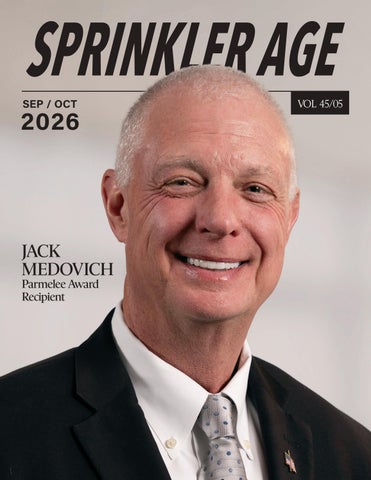
SEP / OCT
2026
JACK MEDOVICH Parmelee Award Recipient
VOL 45/05
UL Listed Flexible Sprinkler Assemblies Make Retrofit a Breeze cULus Listed for installations in accordance with NFPA 13 and 13R
No friction loss is required to be calculated through the length of the hose
Available in hose lengths of 48” (1.2m) and 60” (1.5m)
Packaged in boxes of five
2” minimum bend radius and may have up to four bends
Offered in a variety of temperature ratings and finishes to meet design requirements Features a pre-calibrated K-factor of 5.6 (80.6 metric)
Learn more about our flexible sprinkler assemblies by scanning the QR code, or visiting vikinggroupinc.com
VK971 QR VK972 SR
Our NEW plant in Sinton, Texas produces 5 , 6 , 8 , and 10 SPRINKLER PIPE. Our new mill expands our overall product capabilities, giving us the most comprehensive range of sprinkler pipe in the industry:
Plants located coast-to-coast...
• Diameters from 1” to 10” NPS. • Schedule 10, 30, 40, and Eddy Flow (size dependent) • Lengths up to 25’, with custom lengths available Plus a variety of finishing options — not to mention our exclusive EddyGuard II® MIC antimicrobial coating to help ensure reliable flow for years. It’s all available to you from a single, responsive supplier…making your pipe selection job much easier.
for fast delivery anywhere!
BullMooseTube.com | 800.325.4467
C O N T FEATURES
34
MAKING A DIFFERENCE FOR VETERANS
12
16 MEET THE SEVEN NAC FINALISTS
36
CORROSION AND MIC TESTING
20 THE MODERN STORAGE BUILDING
40 WHY SOME CONTRACTORS GROW
28 BUILDING THE FUTURE ON PURPOSE
42 HFSC CELEBRATES MILESTONE
MEDOVICH RECEIVES 2026 PARMELEE AWARD A Legacy of Leadership, Service, and Giving Back
Apprentices Take the National Stage
It’s Not the Typical Warehouse
Why the NextGen Committee Exists
30 PROTECTING THE COLD SUPPLY CHAIN Utilizing Performance-Based Sprinkler Design
4
SPRINKLER AGE | SEP/OCT 2026
Chapter Members Answer the Call
NFPA 13 and NFPA 25 Requirements Explained
And Some Don’t
Three Decades of Home Sprinkler Education
E N T S 6
CHAIR’S MESSAGE
53
ASSOCIATION NEWS
8
PRESIDENT’S REPORT
54
AFSA CHAPTERS
10
FLASH POINT
55
NEW MEMBERS
46
HIGHER STANDARDS
56
U.S. CONSTRUCTION
48
UNCLE RUSS
58
INDUSTRY NEWS
50
#MEMBERSMATTER
61
PRODUCT NEWS
52
AFSA NEWS
61
INDEX OF ADVERTISERS
52
CALENDAR
62
PEOPLE IN THE NEWS
53
CHAPTER NEWS
Jack Medovich, P.E., is the 2026 recipient of AFSA’s highest honor, the Henry S. Parmelee Award. Also in this issue: storage in warehousing and distribution centers.
OUR MISSION AFSA is the voice of the merit shop fire sprinkler contractor. We educate and train the industry while promoting fire protection systems to save lives and property.
OUR VISION To be a relentless force for a world free from the devastation caused by fire in commercial and residential structures.
SPRINKLER AGE (ISSN 0896-2685) is published bimonthly for $33.95 per year by the American Fire Sprinkler Association, Inc., 1410 East Renner Road, Suite 150, Richardson, Texas 75082. Periodicals postage paid at Dallas, Texas and additional mailing offices. POSTMASTER: Send address changes to SPRINKLER AGE, 1410 East Renner Road, Suite 150, Richardson, Texas 75082.
SPRINKLER AGE | SEP/OCT 2026
5
CHAIR’S MESSAGE
W
elcome to AFSA45 in San Antonio! On behalf of the AFSA Board of Directors, our Convention Committee, staff, exhibitors, sponsors, and volunteers, I am pleased to welcome you to this year’s convention, exhibition, and apprentice competition in the heart of Texas. This gathering is always one of the most important times of the year for our association and our industry. It is where fire sprinkler professionals come together to learn, share ideas, strengthen relationships, and celebrate the essential work we do every day to protect lives and property. This year’s convention offers an outstanding mix of technical education, business management sessions, product innovation, networking opportunities, and
PAUL DELORIE AFSA BOARD CHAIR
memorable events. Whether you are here to earn continuing education, explore the exhibit hall, connect with manufacturers and suppliers, support the National Apprentice Competition finalists, or simply reconnect with friends and colleagues, I encourage you to take full advantage of everything AFSA45 has to offer. The National Apprentice Competition is one of AFSA’s signature traditions and one of the most exciting events of the convention. This year, seven outstanding apprentices from across the country will compete in San Antonio, demonstrating the knowledge, craftsmanship, and safety practices that define excellence in our trade. Their live installation competition under the eyes of many people in the exhibit hall is more than a contest—it is a powerful reminder of the talent entering our industry and the importance of developing the next generation of sprinkler fitters. We also extend our sincere appreciation to the companies sponsoring and supporting these apprentices. By investing in training, mentoring, and encouraging their employees to compete on a national stage, these companies demonstrate a true commitment to workforce development and to the long-term future of the fire sprinkler industry. The success of each apprentice reflects not only individual dedication, but also the leadership and support of the employer, instructors, supervisors, colleagues, and family who helped them reach this level. Our convention also gives us the opportunity to honor those whose leadership, advocacy, and service have made a lasting impact on fire sprinkler protection. During AFSA45, we will recognize the recipients of the association’s most meaningful honors, including the prestigious Henry S. Parmelee Award, AFSA’s highest honor for long-term dedication to the professional advancement of the fire sprinkler industry; the Fire Sprinklers Save Lives recognition, celebrating individuals whose advocacy has helped
6
SPRINKLER AGE | SEP/OCT 2026
advance fire sprinkler awareness and public safety; and the Joe Heinrich Young Professional of the Year Award, which highlights a rising leader who represents the future of our profession. These awards remind us that progress in our industry is built by people who lead, serve, mentor, advocate, and inspire others to carry the mission forward. AFSA’s strength has always come from its members. Contractors, designers, manufacturers, suppliers, Authorities Having Jurisdiction, educators, and industry partners all play a vital role in advancing fire sprinkler protection. When we come together, we do more than attend a convention—we invest in the future of our trade and the safety of the communities we serve.
Our sponsors do much more than make financial contributions at convention. They support our association’s programs and initiatives year-round financially, provide in-kind donations for charities such as Homes for Our Troops, host membership events, provide program instructors, and supply labor for the National Apprentice Competition. Donation fatigue comes to mind, but they are gracious. We are fortunate for their support. Enjoy your time in San Antonio. Learn something new, meet someone new, visit the exhibit hall, cheer on our apprentices, and leave energized for the year ahead. Thank you for being part of AFSA45 and welcome to a TEXAS-sized celebration of our industry.
I want to thank everyone who helped make this event possible, including our Convention Committee, National Apprentice Competition Committee, AFSA staff, seminar presenters, exhibitors, sponsors, and the many volunteers whose commitment makes this convention such a valuable experience. Your work reflects the professionalism and dedication that define AFSA.
Need Backflow Repair Parts? YOUR SOLUTION IS . . .
Your Complete Source for Backflow Parts & Accessories • Complete Inventory • Product Knowledge • Same Day Shipping V isit Us On-Line www.bavco.com • www.bavcostore.com West Coast - Long Beach, CA (800) 458-3492 • info@bavco.com Central - San Antonio, TX (866) 318-0274 • txinfo@bavco.com East Coast - Charlotte, NC (844) 202-1618 • ncinfo@bavco.com
SPRINKLER AGE | SEP/OCT 2026
7
PRESIDENT’S REPORT
W
BOB CAPUTO, CFPS AFSA PRESIDENT
elcome back to San Antonio, Texas, and AFSA45! If this is your first opportunity to attend AFSA’s annual convention, you’re in for an awesome experience! Whether you’re a competitor in this year’s apprentice competition, a new member, associate, guest, or just here for the CEUs, this convention and its opportunities for training and education, parties, and networking promise to be the best ever.
So, how do we minimize our risks? Where do we start? Well, the first thing is to teach your inspectors and technicians to document everything as if you were going to trial. The more documentation you have in the files, the less likely you are to end up participating in one. Lawyers love ambiguous data and easy targets with deep pockets. The more prepared your firm is to answer questions and defend your actions, the smaller you become as a target.
If you know me, or you’ve seen me anywhere near a soapbox, you’ve heard me banging the drum on the importance of inspection, testing, and maintenance of the systems we design, install, and service. We can all agree that any mechanical system requires some level of care to ensure its reliability and functionality. Beyond the obvious, let’s talk about liability and exposure to serious losses associated with the potential for a non-functioning fire protection system or just the plain old scourge of our industry… water damage claims.
Most of us know that two-thirds of water-based system failures result from a closed control valve, and we touch them all the time. Were we the last ones to touch that valve? Did we leave it open? Can we prove we left it open? We recommend that numbered valve seals be used every day, with the number recorded on the work order or inspection report. Something as simple as a zip tie with your company’s name or acronym and a unique number can be your best friend when someone asks if your tech left a valve open or closed.
Even if your company didn’t design or install a system, but you were the last company to touch it in the form of an inspection cycle or evolution, and especially where your sticker is on the riser, you’ll be named in time-consuming, often expensive litigation. Okay, so your insurance company covered the loss, and your premium rates only went up 10% from last year. The problem is that overhead expenses go straight to the bottom line, so you can either raise your prices or take a haircut on margins. By the way, you think that riser sticker says, “IN CASE OF EMERGENCIES: CALL 1-800-XXXXXXX,” but what it really says is, “PLEASE SUE ME,” and they will.
Training your people to avoid water damage claims is worth the investment in time and energy. Starting with avoiding pulling a sprinkler head from a live sprinkler system, and managing discharging water during main drain tests, flowing inspectors test connections, forward flow testing back flow valves, and annual flow testing fire pumps are all opportunities to cause problems with customer relationships or ways to meet your legal team and insurance reps. All these opportunities for losses are things we can train on to limit and eliminate completely. These topics and more are just a small part of the training your people receive when they attend one of AFSA’s ITM training programs. We stress the
8
SPRINKLER AGE | SEP/OCT 2026
EDITORIAL 214-349-5965 BOB CAPUTO, CFPS, Publisher, ext. 124 | bcaputo@firesprinkler.org D’ARCY G. MONTALVO, Editor, ext. 115 |dmontalvo@firesprinkler.org
ADVERTISING 214-349-5965 CLARISSA RIOS, Communications Coordinator, ext. 134 crios@firesprinkler.org
CIRCULATION 214-349-5965 D’ARCY G. MONTALVO, Editor, ext. 115 |dmontalvo@firesprinkler.org
importance of customer service and communication to ensure that customers understand what the identified deficiencies mean and why we write them up. Pre-planning appointments and mapping routes to minimize windshield time and maximize profit margins starts with technicians. Stewardship of tools and vehicles, along with professional appearance and good driving habits, are all contributors to your company’s success or failure. As more fire sprinkler companies diversify their services, AFSA is here to help you grow and increase your value. We have procured an additional 11,000 ft² of lab and classroom training space for fire alarm ITM, special hazards, kitchen hoods, portables, e-lights, and other lines to cross-train your inspection and testing teams. We’re still developing a DOL-approved apprenticeship program specific to inspection and testing, and working with certification organizations to broaden their offerings to serve your expanding business. Lastly, a reminder that your membership benefits include a free 30-minute consultation with the nation’s leading labor law firm, for use when your company is under attack from unwelcome advances from outside influences. Reach out to us if you need that phone number. You don’t want to deal with those issues alone… this is an opportunity to work with an attorney who is on your side! If you’re attending AFSA45, please come shake my hand and say hello!
AFSA BOARD OF DIRECTORS PAUL DELORIE, Chair, Region 10, 603-432-8221 JAY STRICKLAND, First Vice Chair, Region 6, 301-474-1136 CHRIS JOHNSON, Second Vice Chair, Region 7, 727-581-9339 TOMMY CLEMENTS, Treasurer, Region 9, 804-459-2218 JEFF PHIFER, Secretary, Region 8, 803-438-2994 LINDA M. BIERNACKI, Immediate Past Chair, Region 5, 318-688-8800 BROOKS BAYNE, Region 1, 503-692-3284 HUNTER BRENDLE, At-Large, 334-270-8571 MINDY BUCKLEY, At-Large, 770-925-9099 R. DONALD (DON) KAUFMAN, Region 3, 505-884-2447 MICHAEL F. MEEHAN, At-Large, 804-459-2200 WAYNE WEISZ, Region 2, 209-334-9119
AFSA LEADERSHIP BOB CAPUTO, CFPS, President, ext. 124 MATT KLAUS, Executive Vice President & COO, ext. 139 MELISSA ATHENS, Vice President, Finance, ext. 112 LESLIE CLOUNTS, Vice President, Education Services, ext. 130 JOHN AUGUST DENHARDT, P.E., FSFPE, Vice President, Engineering & Technical Services, ext. 121 MEDA MERRITT, CAE, Vice President, Membership & Chapter Development, ext. 133 Sprinkler Age is devoted to the professional development of the fire sprinkler industry. Deadline is 1st of the month preceding publication. Published by American Fire Sprinkler Association, 1410 East Renner Road, Suite 150, Richardson, TX 75082. Call (214) 349-5965, FAX (214) 343-8898, or email sprinklerage@firesprinkler.org for information. Copyright © American Fire Sprinkler Association, Inc. All rights reserved. PRINTED IN USA. Unless expressly stated otherwise, all editorial and advertising material published is the opinion of the respective authors and/ or companies involved and should not be construed as official action by or approved by Publisher or the Association.
Sprinkler Age is a membership benefit, provided free of charge to AFSA members. For information on non-member and/or foreign subscription rates, call (214) 349-5965.
ABOUT AFSA MEMBERSHIP AFSA annual membership dues are a sliding scale for Contractors and Associates and a flat fee for Authorities Having Jurisdiction. (Members receive a free subscription to Sprinkler Age.) Write or call AFSA for membership information. See AFSA’s website at firesprinkler.org.
SPRINKLER AGE | SEP/OCT 2026
9
FLASH POINT
L
et us go down memory lane for a bit. I remember driving in my father’s 1962 Buick Skylark, his 1969 Volkswagen Beetle, and his 1974 Ford Country Squire Station Wagon (yes, it had the plastic wood-grain siding). The first car I drove was the station wagon. I looked so cool as a 16-yearold teenager driving Dad’s wagon. Wow, times have changed, and over my 60 years, the automobile has changed substantially. Usually, change is for the good, but sometimes we look back and say, “What were they thinking?” Just look at the AMC Pacer, the Chevrolet Vega, the Ford Pinto, and the Plymouth Prowler. Just like everything else, storage warehouses have evolved over the years. Modern warehouses are being designed to maximize every cubic foot of space while minimizing the labor effort needed to move products. The goal is to reduce cost and maximize efficiency. Our sprinkler protection schemes have also had to change because today’s and tomorrow’s storage arrangements will push the sprinkler protection to its limits. The days of using control mode density/area (CMDA), control mode specific application (CMSA), and early suppression fastresponse (ESFR) sprinkler designs directly out of NFPA 13 are becoming limited. The NFPA standard development process is slow to keep up with technology changes, and the adoption by the local government agencies can take several more years. This leads to inadequate design criteria for modern technology storage warehouses. My next statement might not be well received. If you are not a design professional with experience in sprinkler protection criteria, do not touch proving the criteria for these systems. Follow the Society of Fire Protection Engineers’ (SFPE) Position Statement 2020-1, The Engineer and the Engineering Technician Designing Fire Protection Systems.
JOHN AUGUST DENHARDT, P.E., FSFPE AFSA VICE PRESIDENT OF ENGINEERING & TECHNICAL SERVICES
10
SPRINKLER AGE | SEP/OCT 2026
Section 4.2 of NFPA 13 clearly states this is the responsibility of the owner or their designated representative, which should be the design professional in a storage warehouse design. AFSA and many other organizations, including NICET, have endorsed the SFPE Position Statement. The selection of design criteria is difficult at best. Specifically determining the owner’s storage arrangement, including products, packaging, type of pallet, rack type, height of the building, height of storage, and environmental factors are just some of the variables. In many instances, changing one variable could change the design criteria. I have been involved in many situations where the client changed variables during the design phase without informing the others on the design team. This issue of Sprinkler Age includes two articles discussing storage appliances. The cold storage article describes the challenges of and a method to protect these storage arrangements. The other article discusses two of the modern storage challenges our industry is facing. The NFPA Fire Protection Research Foundation has had several projects looking at the issues, and the research will continue. Some owners and insurers, along with sprinkler manufacturers, have been at the testing labs trying to find the best solutions. Just like every other challenge our industry faces, we will figure this out. However, in the meantime, make sure a design professional is providing the design criteria. As in medicine, engineering involves professional practice and judgment. It is not an exact science where everything is known. Sometimes, engineers need to base guidance on the best available data at the time, their experience, and judgment. Even then, something could go wrong. We do not want to see sprinkler system failures.
Up to 45' | 13.7 m
Up to 40' | 12.2 m
Up to 30' | 9.1 m
Up to 20' | 6.1 m
SERIES FL-QR/DRY SERIES FL-SR/DRY
SERIES FL-QR/DRY/ST SERIES FL-SR/DRY/ST
with Style AB6 Assembly
with Style AB6 Assembly
K5.6 | 8.1 or K8.0 | 11.5
K11.2 | 16.1
SERIES FL-QR/DRY/ESFR with Style AB6 Assembly
SERIES FL-SR/ST/CMSA
K16.8 | 24.25
Versatility:
Value:
• Customized protection to fit every height — 45' | 13.7 m and under
• Trusted Victaulic technology, including visual installation verification and a conforming rubber seal
• Configurable options to fit your specific needs: • Barrel length • Sprinkler type
• Finish options • Connection type
SCAN TO VIEW OUR COMPLETE DRY SPRINKLER OFFERING © 2026 VICTAULIC COMPANY. ALL RIGHTS RESERVED.
K25.2 | 36.8
• Increased efficiency on the job site with pre-assembled solutions and reduced joint connections
MEDOVICH RECEIV 2026 PARMELEE A A LEGACY OF LEADERSHIP, SERVICE, AND GIVING BACK
F
D’ARCY MONTALVO | AMERICAN FIRE SPRINKLER ASSOCIATION
or more than four decades, Jack Medovich, P.E., has dedicated his career to protecting lives, advancing the sprinkler industry, and serving the people within it. From his early days as a volunteer firefighter and fire protection engineer to building a successful sprinkler company, shaping codes and standards, leading the American Fire Sprinkler Association (AFSA), and advocating for burn survivors, Medovich has approached each chapter of his career with the same philosophy: serve others and leave the industry better than he found it. That lifetime of service has earned Medovich AFSA’s highest honor, the 2026 Henry S. Parmelee Award. FINDING HIS CALLING Medovich grew up around the fire service. His father was a firefighter in New York state, and Medovich hoped to follow in his footsteps. His father, however, had other plans for him. But the suggestions made by high school counselors—computer science, vet school, mechanical engineering—didn’t appeal to him. One day, while talking with his dad 12
SPRINKLER AGE | SEP/OCT 2026
in the firehouse about his future, a trainer for all New York firefighters was there. “Ogden Clark heard our conversation and asked if I’d ever heard of fire protection engineering,” Medovich remembers. Curious, he reached out to the program at the University of Maryland. He and his
“I’VE ALWAYS THOUGHT I WAS PUT ON THIS EARTH TO SERVE AND NOT BE SERVED.” dad met with Dr. John Bryan, aka “Prof,” and his future was set. “It fed my soul,” recalls Medovich. During school, Medovich lived in a nearby firehouse as a volunteer firefighter. Studying by day and an-
swering calls by night gave him a 360-degree view of fire protection. He graduated in 1983. Medovich’s first job after college was as a plans examiner in the Fairfax County, Va., Fire Marshal’s Office. He eventually oversaw all plan reviews and inspections. He then entered the sprinkler industry, working for a residential sprinkler company called Lifesaving Systems, Inc. (LSI). “I truly felt that for us to really save lives from fire, we needed to put sprinklers where people died… where they slept,” Medovich notes. After time with LSI and Virginia Sprinkler Company (now VSC Fire & Security), Medovich and his partner decided to start their own business. “We started East Coast Fire Protection (ECFP) in 1997 so I could protect firefighters,” Medovich says. “If you can protect those going in, you certainly could protect those inside.” After acquiring a company in Texas, ECFP was renamed Fire & Life Safety America (FLSA). Over the next few years, they continued to grow and eventually sold to Summit Fire & Security in November 2021.
VES AWARD
Medovich decided to retire in September of last year. “I hold a very special place in my heart for Summit and miss being with them way more than I ever thought I would,” he says. “I’ve been blessed in so many ways in my career. The main reason any of this happened was due to the great people with whom I had the privilege of working. It was an honor to work with all of them.” After a bit of downtime with family and making up for lost time on the golf course, Medovich will start a consulting business in January to remain connected to the industry he loves. “I’ll mostly be helping Summit on an as-needed basis,” he says, “but also continuing to volunteer.” SERVICE IN ACTION In 1983, AFSA created its highest honor, the Henry S. Parmelee Award, to recognize an outstanding individual who has dedicated himself or herself to the sprinkler industry and the goal of fire safety through automatic sprinklers. Medovich has served at all levels and across all sectors to benefit the industry. “I’ve always thought I was put on this Earth to serve and not be served,” Medovich comments. That is evident in all facets of his career, volunteerism, and work ethic.
From l to r: Medovich, Jason SchechtErle, Skeeter Heath, and Allan Strange formed a team for the 2022 BSF golf tournament benefiting burn survivors.
As an Authority Having Jurisdiction (AHJ), Medovich drew on his fire protection engineering education and volunteer firefighting experience to improve the Fairfax County Fire Marshal’s Office’s sprinkler plan review and inspection procedures. “It’s great that AFSA offers training for AHJs and the inspector development program to show people the right way to inspect sprinkler systems. Every system we inspect could end up saving a life.” While an AHJ, Medovich joined NFPA and went on to serve on numerous code-writing committees for more than four decades, including committees for NFPA 13, NFPA 20, NFPA 25, and other major fire and life safety standards. He received an NFPA lifetime membership certificate in 2025. “I was so honored to serve on NFPA code-writing committees throughout my career,” he says. “I was a little nervous attending my very first meeting in 1984 [NFPA 101, Chapter 6]. I ended up, by accident, sitting between Rolf Jensen and Chet Schirmer. They went back and forth on every topic, and
the rest of the committee just kept looking at me with a smirk. Kind of like an understood initiation rite that I fell into. I never sat between them again!” Medovich laughs. Medovich’s involvement with AFSA began with the Chesapeake Bay Chapter in the late 1980s, where he eventually served as chair. He also became active in the Virginia Chapter, serving as its president for many years. The Virginia Chapter also started an annual golf tournament. “I played in the very first tournament and have been involved ever since,” he comments. The tournament, now in its 33rd year, benefits the Burn Survivors Foundation (BSF), a 501(c)(3) non-profit organization specializing in the treatment and care of burn survivors. Medovich was the founding chairman of its board of directors until his retirement in 2023. “You donate your time because you want to give back, and then you see how it helps so many people,” says Medovich. “You can’t even plan what all this does. I’ve gotten so much back from all the volunteer SPRINKLER AGE | SEP/OCT 2026
13
Medovich is blessed with children and grandchildren: Left photo: RACHEL, Andrew, SHANNON, and DANIELLE. Right photo: Medovich With JO DEE.
time I’ve spent through the BSF, Common Voices, and AFSA. It just comes back and feeds your soul.” The BSF supports the Central Virginia Burn Camp, a free summer camp for children who have sustained serious burn injuries, and the Evans-Haynes Burn Center of VCU/MCV in Richmond. “It is so great to get to know these kids and see where life leads them,” Medovich says. “I have known Jack for more than 30 years and respect him deeply,” comments George Wagner, BSF co-founder and director. “As a former Parmelee Award winner, I know what this award means, and I can think of no one in the industry more deserving. I know that Jack is a dedicated, hardworking professional in the industry, with the highest level of integrity and honesty.” Medovich has served on nearly every national AFSA committee. He was elected to the Board of Directors in 2008, served as Chair of the Board from 2021 to 2023, and retired from his seat last year. “Being 14
SPRINKLER AGE | SEP/OCT 2026
on the Board and leading as Chair was a really good way to give back to our industry that I love passionately with every bone in my body,” says Medovich. “It was a humbling role for me to serve the industry in a way that our Directors do, but it’s time to let some of the younger industry members get involved.” Another organization to which Medovich is committed is Common Voices, a coalition dedicated to creating a fire-safe America. “We aim to turn tragedy into advocacy,” he says. Medovich sits on the Board of the organization, which supports pro-sprinkler legislation and advocates for sprinklers in jurisdictions across the country. INVESTING IN THE FUTURE Medovich supports the next generation of fire protection engineers through the Medovich Endowed Scholarship in Fire Protection Engineering at UMD, providing merit-based scholarships to undergraduate students in the program. “I wanted to give back to the department that gave me so much when I was a student. Phil DiNenno, Prof,
Dr. Milke, and many others supported and mentored me.” In 2019, the UMD FPE Department’s Board of Visitors named Medovich one of its Distinguished Alumni. Dr. James A. Milke, P.E., Professor Emeritus of the FPE Department, says, “I have known Jack for over 40 years, dating back to his time as a student at the University of Maryland. He has always made time for me whenever I had questions about the sprinkler industry or technical questions involving sprinklers. In all the time that I’ve known him, he has demonstrated his total commitment to the fire safety industry.” THE NEXT CHAPTER Semi-retirement has also given Medovich more time for family. He has four children—Andrew; Danielle Stone and her husband, Justin; Shannon Temple and her husband, Troy; and Rachel Lambright and her husband, Jeff—and six grandchildren: Kaila, Tommy, Dominic, Alina, Giovanni, and Jo Dee. Medovich stays busy traveling back and forth to see them all. “They are the light of my life!” he says. “No
Medovich’s favorite time is family time (from l to r): Giovanni, TOMMY, [Medovich], Alina, Kaila, [Medovich], and Dominic.
more 70–80-hour work weeks. I’ve got six grandkids to enjoy!” AFSA’S HIGHEST HONOR AFSA will present this year’s award to Medovich during the general session at AFSA45: Convention, Exhibition, and Apprentice Competition, to be held Sept. 27-30 in San Antonio, Texas. “I was speechless when I heard I received this award. I didn’t do any of this to be recognized. I like to do things under the radar!” he jokes. “I’m very humbled and honored.” “No one ever worked for Jack. They worked with him, and you were glad to do so. He’s the type of guy who puts everyone else first,” says Jason Gill, operations manager at Crews & Gregory Fire Sprinklers, Inc. “Jack’s also the guy who sees potential and encourages others to reach higher. He’s the whole reason I got involved with AFSA and began to serve on NFPA committees.” “Sprinkler Age will list all of Jack’s accomplishments, accolades, successes, and services, but that’s not why I’ve nominated Jack every year
for the past eight years in a row,” Gill notes. “I nominated him because he’s been an inspiration in my career, and someone whose integrity, professionalism, service, and dedication are deserving of this award.” “It was my good fortune to serve with Jack on the AFSA Board of Directors for many years,” comments Paul DeLorie, AFSA Chair of the Board and senior vice president, Hampshire Fire Protection, Inc., Londonderry, N.H. “He is thoughtful, confident, and deliberate. His leadership has been transformational for our association, and he is most deserving of the Parmelee Award.” “Jack has served as a role model, friend, colleague, mentor, and leader. Throughout most of my 35-plusyear career, he has always treated me as a peer, even though he had more experience and stature,” says Mark Hopkins, P.E., engineering director at Summit Fire Consulting. “He leads by example and treats everyone with the utmost respect.” “I could not imagine a more worthy recipient of our industry’s high-
est recognition,” states AFSA President Bob Caputo, CFPS. “Jack’s many years of selfless dedication have earned him this honor, but behind the scenes, he has encouraged, promoted, and supported dozens of younger and up-and-coming fire and life safety professionals. Jack is a man of character and absolute integrity, always doing what is right, regardless of the cost and no matter who is watching.” Medovich accepts the accolades but emphasizes the responsibility that comes with working in the fire protection industry. “We can’t forget that we save lives. We can’t cut corners or save a nickel because a future life might be in jeopardy.” From wanting to follow in his father’s footsteps to protecting people from fire in a different way, Medovich has made a difference. “What I love most about this industry is that we save lives. Why our systems aren’t in every single structure boggles my mind.” EDITOR’S NOTE: Nominations for AFSA’s awards are accepted year-round at firesprinkler.org/awards.
SPRINKLER AGE | SEP/OCT 2026
15
MEET THE SEVEN NAC FINALISTS APPRENTICES TAKE THE NATIONAL STAGE CLARISSA RIOS | AMERICAN FIRE SPRINKLER ASSOCIATION
S
even of the nation’s top fire sprinkler apprentices are headed to San Antonio, Texas, to compete in the 33rd Annual National Apprentice Competition (NAC) to be held during AFSA45: Convention, Exhibition & Apprentice Competition, Sept. 27-30. After earning their place as a finalist, they’ll face a series of written and hands-on challenges designed to test what they’ve learned in the classroom and in the field. National recog-
then chair of the Apprenticeship & Education Committee. The NAC was created to promote apprentice training and recognize apprentices who are actively enrolled in AFSA’s apprenticeship program. “The competition puts on display what top-scoring apprentices nationwide learn and put into practice,” says Heinrich. “This curriculum not only develops skilled fitters, but also develops the skills needed for successful
must have at least one year of field experience with a minimum of six months combined handson experience in cutting, threading, and installing steel pipe and CPVC pipe. The first competition phase consists of a 100-question multiple-choice exam provided by AFSA. The test is proctored online, making it accessible to contestants from all 50 states. The results of this test will determine who will advance to the live competition at AFSA45.
“THE RELATIONSHIPS FORGED IN THESE TYPE OF EVENTS WILL BENEFIT SOMEONE THROUGHOUT THEIR ENTIRE CAREER.” – STEVE COOK nition and thousands of dollars in prize money are on the line in this annual event.
careers in fire protection, developing future industry leaders and mentors.”
“This is such an exciting and rewarding time of year because we get to witness the results of the planning and hard work by so many dedicated volunteers and apprentices at AFSA45,” comments Competition Organizer Brett Heinrich, president of Bamford Fire Sprinkler Co., Inc., Salina, Kan.
APPRENTICESHIP REQUIREMENTS The road to the competition floor begins well before AFSA45. Eligibility for apprentices to compete is based on the following criteria: their employer must be a member of AFSA in good standing, the apprentice must actively be participating in the AFSA apprenticeship courses or enrolled in the NCCER/AFSA Sprinkler Fitting Training Series, and they
The National Apprentice Competition was started in 1994 by the late Robert (Bob) L. McCullough, 16
SPRINKLER AGE | SEP/OCT 2026
The top seven apprentices in Phase I receive a full registration to the convention and a second full registration for their employer, an expense-paid trip to AFSA45, hotel accommodations, and a brand-new set of hand tools to use in Phase II. Phase II entails a more thorough written exam given at the convention, followed by a live practical installation in the exhibition hall. The Phase II exam is based on all four levels of the AFSA/NCCER Contren® Learning Series Sprinkler Fitting curriculum. For the installa-
From l to r: ROBERT BARRY, ANTHONY CASTILLO, MASON CASTLE, SKYLAR GREGOR, JIMMY GRIGGS, EVAN LARSON, AND TREVOR SWEET ARE THIS YEAR’S FINALISTS for AFSA’s 33RD Annual National Apprentice Competition, to be held during AFSA45 in SAN ANTONIO, TEXAS.
tion, apprentices must cut, thread, and install a steel and CPVC piping system with sprinkler heads and perform a water pressure test. Participants are graded on accuracy, craftsmanship, and safety. The combined results of the Phase II written and hands-on tests determine the winner. Prizes are awarded based on finishing rank: first place takes home a $10,000 cash prize, second place receives $7,500, third place receives $5,000, and all other finalists receive $2,500. “The relationships forged in these types of events will benefit someone throughout their entire career,” says Steve Cook, Impact Fire Services, LLC, who has an apprentice in this year’s competition. “I encourage all the apprentices to try their best and enjoy the process at the same time.” MEET THE FINALISTS The seven finalists are heading to San Antonio, where they’ll compete on a national stage at AFSA’s annual convention. Before the tools come out and the clock starts, Sprinkler Age caught up with each finalist to learn a little more about their path into the trade, what they’ve learned along the way, and where they hope to go next. Robert Barry, Impact Fire Services, LLC, Southborough, Mass. What advice would you give someone thinking about enter-
ing the fire protection trade? It’s a great opportunity for anyone who is willing to work hard. If you’re going to go for it, put down your phone and always pay attention. Learn anytime you can, even if it’s a time you have nothing to do, watch the guy you’re with. What’s the key ingredient to your success? I’m a hard worker and always try to be the best that I can be.
Anthony Castillo, Pye-Barker Fire & Safety, Pleasanton, Calif. Tell us about yourself. I was introduced to the industry by a friend who was already in the trade. Outside of work, I’m a sports enthusiast and enjoy downtime. I also pick up different languages with ease. What’s something you’ve learned in this trade that surprised you? Not everything is the way blueprints show. There are a lot of onsite corrections and calculations
BIG PERFORMANCE. HALF THE BURDEN. • Lightweight aluminum legs make transport easier without sacrificing jobsite durability.
lbs.
Nearly HALF the weight of competitive tripod stands
R450PAL #04456
CARRY LIGHT ™ TRIPOD VISE • Built for utility crews who work out of the truck and on the move all day.
26.4
Reversible jaws for plastic or metal pipe
Balanced point padded handle
• Flip reversible jaws for plastic or metal pipe; neoprene protects while steel grips securely. Capacity 1/8" – 6" nom. Plastic Pipe (10-178 mm)
Aluminum legs
1/8" – 2" nom. Conduit (10-51 mm)
Tool-safe raised sides
Reed Manufacturing | Erie, PA USA reedsales@reedmfgco.com | www.reedmfgco.com
SPRINKLER AGE | SEP/OCT 2026
17
needed to make things work in the field. Mason Castle, Castle Sprinkler & Alarm, Inc., College Park, Md. What’s your favorite part about the work that you do? Seeing everything come to fruition from the plans and being able to take part in the process. It’s rewarding to see the evolution of a project take shape. What’s next for you after your apprenticeship ends? I am planning on pursuing an engineering certificate for water-based layouts through NICET. Skylar Gregor, Hiller Companies, LLC, Los Angeles, Calif. What does the future of the industry look like to you? The future of the industry looks like it’s growing; there’s always work to be done. We just need people who are willing to learn and don’t want to give up when things get hard. There are a lot of opportunities out there. What advice would you give someone thinking about entering the fire protection trade? My advice would be to join a company where you can learn and grow. I learned fast because I was willing to learn, and because they were willing to teach and let me do more. Jimmy Griggs, Brendle Sprinkler Co., Montgomery, Ala. Why did you choose to pursue a career in fire protection? I chose to pursue a career in fire protection because I love how hands-on everything is. Also, what I’m doing could truly save lives. It’s a puzzle, and every piece has to be touched and put in just right for it to work 18
SPRINKLER AGE | SEP/OCT 2026
properly and efficiently. Especially in new construction, seeing a structure start from nothing and what it looks like when it’s finished. If you had a superhero power on the jobsite, what would it be? My job site superhero power would be super strength without a doubt. Evan Larson, Total Fire Protection, Inc., Brandon, S.D. What advice would you give someone thinking about entering the fire protection trade? Keep up routines, integrity, and make a plan to get the job done. Tell us about yourself. I love having fun with my son and fiancée; we draw, bike, and play games. I got into this industry through my dad, who works for the same company and offered me a job. I joined and really enjoyed it. Trevor Sweet, Pye-Barker Fire & Safety, Denver, Colo. What’s next for you after your apprenticeship ends? To have a state and city license, which will allow me to run my own job. If you had a superhero power on the jobsite, what would it be? The ability of metal manipulation. INVEST IN THE NEXT GENERATION Quality training is more than required coursework. It means giving apprentices meaningful field experience, encouraging questions, providing strong mentors, and challenging them to improve their skills. Jason Martin of Castle Sprinkler & Alarm, Inc. says, “The minimum standard may satisfy a requirement,
but it does not define professional excellence. We challenge our team to ask questions, study applicable codes and standards, learn from experienced techs, and take ownership of the quality of their work.” Gene Taylor of Brendle Sprinkler Company describes the benefits of investing in training, “We’ve seen increased knowledge, confidence, and motivation from workers. It’s also a helpful tool to identify who really wants to stick around and make this job work.” The NAC gives employers another way to support the team they’re building. Encouraging apprentices to participate provides an opportunity to test their knowledge, challenge themselves against other apprentices, and see how far their training has taken them. Employers see value in the NAC experience. “What we hope our apprentice gains from competing at the national level goes far beyond the competition itself,” says James Moss of Total Fire Protection, Inc. “We want him to build confidence in his skills, strengthen his problemsolving abilities, and gain valuable experience working under pressure.” WHO WILL RISE TO THE TOP? See the 33rd National Apprentice Competition live! The finalists will put their training to the test in the AFSA45 exhibit hall, which provides four days of education, networking, and fun. There’s something for everyone! For more details and to register, visit firesprinkler.org/AFSA45.
Same team. New name. One partner for the whole system.
NOW AVAILABLE ASC Engineered Solutions and Reliable Automatic Sprinkler are now Reliable Safety & Flow Corporation, uniting two American-made foundations under one name. From connection through operation, we support the people who specify, build, operate, and protect the systems that have to work. The complete system. One accountable partner.
Learn more about Reliable Safety & Flow Corporation
https://qrto.org/VSDgM4
Fig. C9-CL CenterLOK Pressure Responsive Gasket with Sabertooth Technology
THE MODERN STORAGE BUILDING IT’S NOT THE TYPICAL WAREHOUSE
MARK HOPKINS, P.E. & BRANDON INGRAM, P.E. | SUMMIT FIRE CONSULTING TRACY BELLAMY, P.E. & PAUL SEIFERT, P.E. | TELGIAN CORP.
D
esigning a warehouse today is very different from how it was several decades ago. Using the term “warehouse” does not have the same context as it once did. Historically, most people perceived a building that was designed and constructed for the storage and processing of materials arranged in piles on the floor, pallet loads stacked on the floor, or on racks. This generally has not changed, but how materials are moved into and out of the storage arrays, the size and configuration of storage arrays, the types of racking or shelving used, load sizes, and the types of material-handling equipment used are very different. It is quite common to have one or more automated or robotic features incorporated into the facility. The material handling industry continues to develop new processes and methods for maximizing storage density, increasing throughput, and improving inventory management. We expect and enjoy improvements that affect our lives in productive ways. The introduction of automated storage and retrieval systems (ASRS) and their application in the contemporary warehouse allows for next- or same-day delivery. The concept and implementation of ASRS started in the 1960s but
20
SPRINKLER AGE | SEP/OCT 2026
has dramatically increased in application over the past couple of decades. With this innovation, a challenge has arisen for fire protection practitioners, as the pace of warehousing technology has dramatically outpaced the ability to identify, test, develop, and list fire protection
schemes were characterized by a group of topical areas and incorporated into the NFPA 231, Standard for General Storage; NFPA 231C, Standard for Rack Storage of Materials; and other related documents. However, a decision was made to incorporate and consolidate storage requirements
An Example of a Modern Storage Facility.
equipment and methods. This article identifies some of the challenges facing fire protection engineers, fire protection contractors, inspectors, and the fire service when protecting a modern-day warehouse. STORAGE PROTECTION HISTORY AND BASICS The protection of traditional or legacy warehouses was based on large-scale testing. The protection
into the 1999 edition of NFPA 13, Standard for the Installation of Sprinkler Systems. Protection schemes are continuously developed as storage methods and practices evolve, commodities change, and fire protection technologies are developed. However, both innovation and practical needs have driven such changes. Through the course of the last several decades, the sprinkler industry has seen the development of quick-and-
fast-response elements, large-orifice sprinklers (now CMSA), and ESFR sprinklers. There has also been a push-pull relationship between ceiling sprinklers and in-rack sprinklers. Warehouse operators want to maximize storage space and minimize opportunities for collisions with in-rack sprinklers. For these reasons, there was a push to develop sprinklers that could protect large piles and pallet configurations, as well as large racks used for the storage of plastics without the assistance of in-rack sprinklers. However, the pendulum has shifted in the other direction, mostly due to the inability to limit horizontal fire spread and aisle jumping, but also to drive towards fire extinguishment. Many design concepts require the use of inrack sprinklers, with some in-rack design schemes now functioning independently from the ceiling-level sprinkler systems. ROLES, RESPONSIBILITIES, AND COMMUNICATION OF STAKEHOLDERS The successful design and construction of a modern warehouse relies on open and forthright communication between the different stakeholders involved. Having clear, consistent communication across all parties is critical in the construction of these facilities. The owner (or the owner’s representative) is in pursuit of a warehouse that fits their needs and their equipment, while allowing for high throughput with little to no downtime. From this perspective, they want something that “works” and will not be the source of major headaches in the future. To this end,
having an owner who can provide timely, detailed information on their intended storage commodities, storage methodology, storage handling, and risk tolerance is critical. Additionally, for the duration of ownership, it will be the owner’s responsibility to maintain the integrity of fire protection systems. With this in mind, early discussions on the types of systems to be used, materials to be stored, equipment installation locations, and accessibility of fire protection system equipment are important and can provide tangible benefits over the lifetime of the systems.
the owner, integrator, and engineer is essential for weighing the pros and cons of potential solutions, as well as any future concerns for inspection, testing, and maintenance (ITM), changes in storage or use, changes in material handling, etc. The engineer is responsible for considering how human behavior, active life safety systems, and passive features will interoperate and perform during a fire event. The engineer must work with the project team to ensure proper practical fire protection solutions for the building, contents, and occupants are implemented.
The integrator works with the owner to identify the needs for the facility. The integrator typically identifies the type and configuration of systems to be used, and the speed at which they operate to meet the facility’s goals. In some cases, the integrator is the person or entity that oversees the installation of the material-handling equipment for proposed or existing processes occurring within the warehouse. The integrator typically determines how the warehouse management system functions, traveling from site to site, overseeing the installation of the warehouse management systems and material handling systems. Their objective is to get a system installed to an acceptable standard as quickly and accurately as possible, so they can move on to the next project.
The technician develops shop (working) drawings, product data sheet packages, and hydraulic calculations based on the design documents (drawings, reports, specifications) produced by the engineer. The submittal documents produced by technicians are required for securing permits, fabrication, and installation of fire protection systems. Technicians usually have multiple projects underway simultaneously and are looking for the quickest and most
The fire protection engineer is in “responsible charge” of the fire protection and life safety systems’ design for the project and must be involved throughout the design process. As both prescriptive and performance-based solutions should be considered, communication among
“HAVING CLEAR, CONSISTENT COMMUNICATION ACROSS ALL PARTIES IS CRITICAL IN THE CONSTRUCTION OF THESE FACILITIES.” SPRINKLER AGE | SEP/OCT 2026
21
efficient way to complete a project. Work performed by the technician is typically done under the supervision of the engineer. As such, the engineering review and approval of shop drawing submittals is essential in ensuring that design specifications and intent are followed. The interaction and communication between the engineer and the technician become even more critical in performance-based designs since the exact design and its intent are not prescriptively defined. The operator is typically (but not always) the warehouse tenant or occupant. They are the folks who ensure stored commodities are accounted for, and that said commodities arrive and depart from the facility in a timely manner. They may make modifications to material handling or storage arrangements in the pursuit of more efficient operations, which may or may not be communicated to other parties. The primary concerns of the operator are the operational stability, throughput, and downtime of the facility. To this end (and similarly to the integrator), they may not be aware of life safety requirements, nor the impact that changes in operations can pose to them, as it is not their responsibility. It is important that the operator understands that the protection of stored commodities in warehouses is engineered, and that changes in the location, storage arrangement, storage type, and handling of storage can be majorly impactful to the performance of fire protection and life safety systems, potentially to the extent that they may not be permitted to operate. In some instances, the operator may also be responsible for scheduling, and maintaining 22
SPRINKLER AGE | SEP/OCT 2026
the records resulting from ITM. For these reasons, it is important for the engineer to communicate to the operator the responsibilities they have in maintaining the operational capabilities of the provided fire protection and life safety systems, and the potential risk exposure associated with the inoperability of said systems. The owner should be included in these conversations as they may have delegated these responsibilities to other parties (property management, facilities group, etc.), and they also may not be apprised of the aforementioned risks associated with deferred or overlooked ITM activities. Facilitating conversations between the operator and the fire service may also be beneficial to the overall success of the project, as they will likely need to coordinate and communicate in the future, and the fire service may have concerns about site operations that the operator would be best suited to answer. The fire service is responsible for a variety of activities throughout the design and construction of a building. However, there are two separate groups (fire prevention and operations) that typically need to be involved. The fire prevention group is typically responsible for evaluating the design solutions proposed by the engineer, as well as the documentation produced by technicians, and installation compliance in the field. The shop drawing submittals reviewed by fire prevention are usually reviewed through a compliance lens, evaluating whether the design meets the requirements adopted within their jurisdiction, not whether they adhere to the design documents or
specifications set forth by the engineer. Additionally, fire prevention groups are not usually tasked with the review and approval of passive fire and life safety systems, which may be under the purview of the building department. Though some overlap between these groups and what they review can and does occur, it is important to understand and identify where gaps may or may not exist, as the efficacy of fire protection and life safety systems depend on the performance of all active and passive systems. Communication among the engineer, technician, and fire prevention personnel are essential throughout the duration of a project. Fire prevention groups are typically more familiar with, and correspondingly more comfortable with, prescriptive solutions. When performance-based solutions are proposed, extra communication, time, and effort should be anticipated as the approval of a given solution rests on their shoulders, and they must understand the intent and justification for such solutions. Additionally, proposed solutions may not align with operational capabilities or may not have accounted for other considerations (environmental, cultural, availability of resources, etc.). Open communication with fire prevention personnel can help to identify these concerns early, when resolutions may be less impactful to the overall project success. Fire service operations or the fire suppression group are “The firefighters!” The guys who go into the burning, unlimited area warehouse filled with “who knows what” and operated by robots. Firefighters are running into burning buildings;
Shop Fire System Solutions TODAY.
The shortest, lightest and only all-stainless steel backflow preventer in the industry. Free shipping on ALL valves and 24-hour shipping on select orders.
Only at BackflowDirect.com AD-BFD-PHCPro 2212
they don’t want to be exposed to other unknown hazards beyond what they have trained for. They depend on the fire prevention group to ensure building construction and features align with what they train for. In modern warehouses,
which can provide additional efficiencies, cost savings, and competitive advantages. Correspondingly, when tailored specifically for a particular business, the built environment can provide the same advantageous opportunities. As a result,
not to extinguish it. Extinguishment was left as a task to be accomplished by the arriving fire department personnel. As our facilities have grown larger, there has not been a commensurate consideration for the ability of the
“COMMUNICATION AMONG THE ENGINEER, TECHNICIAN, AND FIRE PREVENTION PERSONNEL ARE ESSENTIAL THROUGHOUT THE DURATION OF THE PROJECT.” it is not only mutually beneficial but essential for owners and fire service operations to perform preincident planning. This reduces the risks posed to firefighters by the building and also ensures that they can respond efficiently and effectively and utilize the building’s fire protection and life safety features to the benefit of all parties. CONVENTIONAL WAREHOUSE Much of the conventional warehousing has typically been built as “spec construction,” with the design of large storage and distribution spaces to meet the needs of most potential occupants using standardized storage methods. As the types of commodities stored, storage methods, and material handling methods have become increasingly sophisticated, this “one-size-fitsall” approach has had greater impacts on the operational usability of these spaces. These impacts are felt more greatly by businesses in the ecommerce sector, where throughput is critical to their success. The fundamental changes in how society does business and in the scale of businesses have resulted in increasing emphasis on the vertical integration of distribution and logistics, 24
SPRINKLER AGE | SEP/OCT 2026
this build-to-suit approach is becoming increasingly more common and is likely to become more of the “norm” in the warehousing sector. MULTIPLE-ROW RACK With the ever-increasing need for more efficient use of storage space and real estate, warehouses began to use as much of the available floor area as possible by introducing multiple-row racks with narrower aisles and no practical limit on the overall depth of such systems. Additionally, the typical material handling methods utilized with these arrays did not allow for maintenance of flue spaces between adjacent loads in both directions (longitudinal and transverse). At the same time, storage heights within these facilities continued to increase, exceeding 100 ft. All of these were being done, even though the available testing might not be available to validate such large arrays. Little to no consideration was given to one of the fundamental premises of fire sprinkler designs provided by NFPA 13: final extinguishment. One of the fundamental objectives of NFPA 13 has always been to control or suppress the fire, but
arriving fire department personnel to accomplish this task. While some changes within NFPA 13 were enacted to address a lack of flue spaces within multiple-row racks, and ongoing research is being conducted to provide needed technical data, there is still no definitive guidance on the design development of final extinguishment in such storage rack arrangements. AUTOMATED WAREHOUSES The rise of e-commerce has driven the increase in warehouse automation in two significant ways: order fulfillment speed and load size. Modern consumers increasingly expect fast shipping times, putting pressure on warehouses to minimize the time an order takes to fulfill. To achieve this, individual items are handled within the warehouse and shipped directly to the consumer, rather than entire pallets of goods being distributed to retails stores for consumer purchase. Without automated material handling, stocking a huge variety of products in a single warehouse and shipping individual items at speeds that the e-commerce industry demands would simply not be possible.
While ASRSs have been around for decades, the trend from handling pallet-sized loads to smaller loads (in some cases, individual items) has led to significant changes in how products are stored and retrieved. Many new warehouses utilize “mini-load” systems, where goods are stored in small bins that are moved in and out of storage by robots. To keep track of where products are and to coordinate the movement of the material handling robots, software-based warehouse management systems are used, which often integrate the material handling flow in the warehouse with the order placement and shipping processes. All aspects of the ASRS (the warehouse management software, the product handling robots, the product storage bins, the rack structures, etc.) are highly proprietary, resulting in a wide variety of storage arrangements and handling processes. CHALLENGES IN DESIGNING, INSTALLING AND MAINTAINING SYSTEMS The scale of the facility and the complexity of the systems within modern warehouses can present challenges throughout the lifespan of the facility. The design of fire protection and life safety systems in modern warehouses can present unique
sideration of these challenges, the expenditure of additional time and care during the design and coordination phases should be anticipated. Due to the water supply demands posed by storage protection schemes, large diameter piping and gridded systems may be unavoidable. Additionally, the number of risers required, the necessity of fire pumps, and supporting equipment (fuel tanks, corrosion mitigation, sources of air for dry/pre-action systems, etc.) should be considered and communicated to other stakeholders as early as possible, as the location and footprint of this equipment must be accounted for. The installation of fire protection and life safety systems in modern warehouse facilities can also present major challenges in the field. Large areas, high ceilings, mezzanines, obstructions, large diameter piping, limited clear space, etc., can all be sources of frustration and delays in the field. In some ASRS systems, the clear space afforded for fire protection and life safety equipment can result in exacting dimensions that must be followed, and this must be communicated to the field. Field coordination above and beyond the norm may be a re-
must be determined. For example, if a given project is 2 million square feet, considerations must be made concerning building access during construction. Inspections during installation by the fire service should also be considered; will access and visibility of installed equipment be maintained throughout the duration of construction, or only during certain phases? Additionally, it is critical that good as-built drawings be produced at the completion of the system installation, and that the importance of the as-builts be communicated to responsible parties. In addition to being required, ITM is critical for successful operation, and therefore protection of the built environment writ large. Due to the size and complexity of modern warehouses, storage arrangements, and varied hazards presented by modern storage, the performance of ITM requirements should be a consideration throughout the engineering, design, construction, and operational stages of warehouse projects. To ensure the feasibility of ITM performance for the warehouse’s life span, equipment needs to be welldocumented and accessible. In some cases, it may be beneficial to educate relevant stakeholders on the importance of ITM requirements and the
“THE INSTALLATION OF FIRE PROTECTION AND LIFE SAFETY SYSTEMS IN MODERN WAREHOUSE FACILITIES CAN PRESENT MAJOR CHALLENGES IN THE FIELD.” challenges in a multitude of ways: water supply capabilities, coordination with other trades, coordination with the structure and installed equipment, obstructions, trapped water, freeze exposure, etc. In con-
ality as well. Phasing of construction, access, material delivery, and laydown should also be considered. When the ASRS also constitutes the structure, an order of operations
potential impact of deferred or overlooked ITM. The creation of a schedule detailing the NFPA 25 intervals and requirements, and/or an ITM equipment map, can help illustrate the frequency and impacts of ITM SPRINKLER AGE | SEP/OCT 2026
25
activities, foster discussion between the relevant parties, and ultimately be beneficial in the performance of ITM activities going forward. TURNOVER AND CERTIFICATE OF OCCUPANCY With the rapid change in warehouse technology in recent years and the variety of systems that may be used, it’s not practical to expect firefighters to know the best methods for firefighting in a facility that they are not familiar with. More than ever, pre-incident planning is
critical to ensuring the safety of a modern warehouse. A warehouse containing an ASRS will likely have energized moving equipment, unfamiliar storage layouts that can be difficult or even impossible to navigate safely, and an unpredictable variety and distribution of commodities. Contact with the fire service should begin during the planning phase of the project, so that the owner and engineer have an accurate and realistic view of the fire service’s capabilities and limitations.
This will also give the fire service an opportunity to develop procedures for any unique equipment or hazards in the building. Before final occupancy of the building, the fire service should be trained on the operation of any proprietary equipment or systems that they would need to be familiar with in fighting a fire. In particular, any lock-out tagout (LOTO) procedures needed to gain access to restricted areas must be clearly communicated. CONCLUSIONS The modern warehouse requires the involvement of a variety of stakeholders, and communication is essential. Protection of these facilities may or may not be possible through prescriptive design concepts and, in many instances, will require a performance-based design. The idea of using the sprinkler system to achieve fire extinguishment has also become a reality in many cases, since it might not be possible for firefighters to locate and extinguish a fire in a large storage array. The requirements and protection of modern warehouses could also necessitate large-scale testing and other measures to determine appropriate fire protection and life safety features to be included. The specific details of the storage arrays and material handling equipment must also be considered to evaluate whether there is adequate space provided for installation, inspection, and access for fire extinguishment. ABOUT THE AUTHORS: Both Summit Fire Consulting (Summit) and Telgian Engineering and Consulting (Telgian) have conducted research on a variety of storage or warehouse-related topics through the Fire Protection Research Foundation. Tracey Bellamy and Paul Seifert of Telgian have conducted research and large-scale fire testing to identify how to appropriately protect multiple-row racks. Mark Hopkins and Brandon Ingram of Summit have conducted research on ASRS and the challenges posed to the fire service in response to storage facilities.
26
SPRINKLER AGE | SEP/OCT 2026
PROVEN. Vapor Corrosion Inhibitors Outperform 98% Purity Nitrogen in Mil Loss Testing.
Test Results
• Less Expensive • More Effective • Easier Install Read the White Paper
generalairproducts.com
BUILDING THE FUTURE ON PURPOSE WHY THE NEXTGEN COMMITTEE EXISTS JOSIAH BERGEN | HERITAGE FIRE PROTECTION
T
he fire sprinkler industry sits at a quiet but consequential crossroads. We all know about the labor shortage in our industry, and if you’re reading this, you’ve probably seen the statistics: more fire protection engineers are retiring than graduating; 25% of our workforce is nearing retirement; and so on. Labor is a major topic across all the trades. Yet, in my experience as a small business owner, I’ve had no issues hiring young talent that is new to our industry. Now, do I sometimes have to pay the good ones a higher starting wage than I would like? Absolutely. The next generation will enter this industry one way or another—that’s the beauty of the free market. The real question is whether the good ones will stay, grow, and eventually lead—or whether they will find clearer pathways and stronger support in another industry. That is the gap the American Fire Sprinkler Association’s (AFSA) NextGen Committee was created to close. Getting the next generation in the door is only the beginning. The harder and more important work is helping them see a future in this industry, connecting them with people who can teach them, and giving them opportunities to grow into leadership. I know firsthand how much that kind of support can matter. This industry and AFSA have given me so much purpose and meaning as a NextGen leader. I was 22 years old when I attended my first AFSA convention. I was newly married and had just been given the title and responsibilities of CEO of our family fire sprinkler contracting company after my father had to step down abruptly for health reasons. I was in over my head, and I knew it. I had two options: figure out how to lead and grow a company or watch it crash and burn. So, I attended my first AFSA convention with a full page of networking goals and questions I intended 28
SPRINKLER AGE | SEP/OCT 2026
to find answers. I knew precisely zero people there. But, by what I can only describe as divine providence, I happened to sit at the table of George Wagner, a former AFSA Board member, Henry S. Parmelee Award winner, and industry titan. As the evening progressed, George began introducing me to other conference attendees as “My friend Josiah.” It was a never-ending stream of people who wanted to talk to George! Through George’s kindness and introductions, I connected with the people who would eventually answer every question I had written down, along with many more I didn’t know I needed answered. I still reach out to many of them on the regular. Those first conversations also led to my being asked to serve on the NextGen Committee and, eventually, to chair the committee this year. Why do I share this story? Because it is a story of people investing in the future of our industry. In the five years since that interaction, I’ve learned there are many more people like George who are willing to take a few moments of their time to invest in the next generation of leaders. Through George’s introductions, directly or indirectly, I met the person who would eventually help me become chair of the NextGen Committee, the consultant who would guide my family through succession to the second generation, the key people who would advise me on starting our fire alarm division, and many other important connections and mentors. These are exactly the kinds of high-impact connections AFSA’s NextGen Committee exists to facilitate and continue. We focus on creating opportunities for continuing education, networking, and leadership development so NextGen members can help create a vibrant future for our industry. In practice, we do this through initiatives such as our FirstTime Attendee Scholarship, which gives five randomly selected winners under 40 the opportunity
to experience the amazing learning and networking environment of AFSA’s convention without placing a financial burden on them or their employers. Many scholarship recipients are only a few years into the industry and would not otherwise have the opportunity to attend a convention, since those opportunities are often reserved for upper management. We also host seminars designed for people earlier in their careers, provide support and education to local AFSA chapters, and have many more initiatives in the works—all with one goal in mind: building a better future for our industry and our communities. But the committee’s work can only go so far without industry leaders leaning into shaping our future as well. As a small business owner, I know how easy it is to stay focused on the day-to-day demands of running a company. Yet the long-term health of our businesses and our industry depends on the people coming up beside and behind us. If you don’t invest in your people, someone else will! Company owners and managers can create space for NextGen employees to attend events, take on challenging assignments, and connect with peers and mentors in the industry. Chapter leaders can make intentional room for new voices in leadership and planning meetings. Experienced professionals can take the time to invest in someone earlier in their career. None of these things require massive programs or big budgets—but they do require intentionality and a willingness to open doors for our future leaders. The next generation will enter this industry. The free market will see to that. The question before us is whether we will help the good ones stay, grow, and eventually lead. NextGen exists to make that outcome more likely. If you are an owner, a manager, a chapter leader, or someone who still has a lot of runway left in your own career, there is a place for you in this work. Step forward, get involved, and help build the kind of industry the next generation will be proud to inherit. Let’s leave this industry better than we found it and be intentional about its future! ABOUT THE AUTHOR: Josiah Bergen is CEO of Heritage Fire Protection in Newton, Kan., a second-generation fire protection contracting company. He serves as chair of AFSA’s NextGen committee and is a member of its ITM, Membership, Public Education & Awareness, and Site Selection committees.
SMALL CONTRACTORS, BIG CONVERSATIONS Running a small fire sprinkler contracting business is rewarding, but it can also be lonely. When you own or lead a small company you wear every hat there is. You build a team, chase work, watch your margins and try new technology, all while still answering the phone when something goes wrong. Sometimes the best resource isn’t another manual, class or webinar. It’s a conversation with another contractor who understands what you’re dealing with. That is what I have come to appreciate about the AFSA Small Contractors Collaborative Group. Once a month, small contractors from across the industry get together for an open conversation. There are no competitors in the room and no formal presentations. It’s contractors helping contractors. We talk about what’s working and what isn’t. We share wins, challenges, resources, technology, business strategies, and lessons learned. One month the topic might be finding and developing good people. The next it might be estimating, software, operations, profitability, or the changes reshaping our industry. And sometimes someone just brings a problem to the group and says, “Here’s what I’m dealing with. What would you do?” What I value most about this group is the honesty. We talk about what’s going well, but we also talk about what isn’t. There’s usually someone in the room who has been through it before. Our companies may look different, but many of the challenges we face are surprisingly similar. There is a lot we can learn from each other. If you are an AFSA small contractor looking for a place to ask questions, share what you’ve learned and build real relationships with other contractors, check out the Small Contractors Collaborative Group. One good conversation really can change the way you run your business! – Beckie Bortner, president North American Fire Protection
SPRINKLER AGE | SEP/OCT 2026
29
PROTECTING THE COLD SUPPLY UTILIZING PERFORMANCE-BASED SPRINKLER DESIGN MELISA RODRIGUEZ, P.E., SET | JOHNSON CONTROLS
A
s consumers increasingly expect temperature-sensitive goods to arrive faster and fresher, cold storage facilities have become critical infrastructure for the global economy. Protecting these facilities from fire is about more than life safety; it is essential to supply chain resilience, business continuity, and food security. The growth of e-commerce and on-demand delivery is driving unprecedented demand for warehouse and distribution capacity. According to CBRE, nearly 1.2 billion square feet of new industrial space has been added to the U.S. market between 2022 and 2024,1 while research from Prologis says that U.S. e-commerce penetration will reach 30% by 2030.2 As operators build larger facilities and store goods at greater heights, fire protection strategies must evolve alongside these changing operational requirements. Sprinkler technology has advanced to keep up with the demands of warehouse spaces, mostly through designs intended to protect increasingly taller warehouses. This has been particularly challenging for the cold storage arena, where sprinkler options have been limited in the past. 30
SPRINKLER AGE | SEP/OCT 2026
UNDERSTANDING COLD STORAGE FACILITIES Warehouses that are utilized for the transient storage of refrigerated and frozen goods are typically one of two types of buildings: fully cold buildings or box-in-box warehouses. A cold building has exterior insulated panels that enclose the space so the entire building can be kept cold enough for food storage. There are typically ambient or heated spaces for mechanical equipment and staff in these buildings. Box-in-box refers to a building that is ambient or heated like a typical warehouse with a cooler or freezer nested within. These coolers can still be quite large, both in footprint and height. COLD STORAGE FIRE PROTECTION CONSIDERATIONS When wet-pipe systems are subject to freezing in cold storage environments, NFPA 13, Standard for the Installation of Sprinkler Systems, requires that these areas be protected with dry-pipe or preaction sprinkler sprinkler systems, with the incoming water supply and valve assemblies located in heated spaces. These dry-type systems must account for additional design requirements (or “penalties”) compared with wet-
pipe systems, like increased design areas, water delivery time limits, and, in some cases, a lower coefficient of friction for calculating pressure loss through the pipes. A box-in-box cooler or freezer should either have a separate dry sprinkler system inside of the freezer or, more typically, dry-barrel pendent sprinklers that penetrate through the roof of the cooler and are supplied by a wet-pipe overhead sprinkler system located outside of the cold box. The benefit of a wet-pipe system with in-cooler dry-barrel sprinklers is that they can be calculated without the penalties imposed on a dry system. Additionally, not having sprinkler piping in the freezer itself eliminates the potential for water freezing in the pipes. To accommodate higher ceiling and storage heights for box-in-box coolers, dry-barrel early-suppression fast-response (ESFR) sprinklers are used. These come in sizes of K14, K17, and K25, with lengths ranging from 20 in. to 36 in., depending on the manufacturer. Dry-barrel ESFR sprinklers make it possible to protect storage spaces with up to 45-ft rack heights and 50-ft ceiling heights, including areas housing cartons of unexpanded plastic.
CHAIN While box-in-box cold storage is starting to become more commonplace in the U.S., cold buildings remain the most common. As previously noted, cold buildings that are subject to freezing must use a drypipe or preaction system. In addition to the previously mentioned design penalties, there are also limitations as to what can be protected with ceiling-only sprinklers within a dry-pipe or preaction system. COLD STORAGE SPRINKLER LIMITATIONS Many factors need to be considered when choosing the protection method of design, but typically, we are limited to a height of 25 ft to 30 ft when protecting Class I-IV commodities with ceiling-only protection, per NFPA 13. These heights are even further limited when plastic commodities are introduced. When protecting commodities above these heights, designers are required to use in-rack sprinklers to help control any potential fire. Inrack sprinkler protection is extremely effective at controlling rack storage fires, but there is always some concern that the sprinklers and other system components will be damaged by forklifts or falling materials. This damage can be costly to repair, often interrupts daily operations,
AS operators build larger facilities and store goods at greater heights, fire protection strategies must evolve alongside them.
and causes additional complications if the dry valve trips and floods the system with water. For deep freeze environments, there are only two choices when this happens: either bring the entire building up to above freezing so the water can drain, or remove the pipes and reinstall. Traditional dry-pipe valves tend to be a less desirable option for the end users because of this possibility. Sometimes, even pressure fluctuations due to changes in temperature on the outside of the cold space can cause the dry valves to open and introduce water into the system. COLD STORAGE PROTECTION OPTIONS Because of these challenges, designers often select double-interlock preaction systems to protect freezers and coolers that are subject to freezing. These systems require two separate detection methods to be triggered before the valve will permit water into the pipes. Only damaging a pipe or sprinkler would not result in a system being filled with water.
However, repair and maintenance are still required if that preaction system includes in-rack sprinklers. Damage to the pipe or to the secondary triggering system, such as linear heat detection, can put the sprinkler system out of service until someone repairs the damage. Because of this, ceiling-only systems are the preferred option, even when utilizing double-interlock preaction systems. In these cases, ESFR sprinklers are not a viable option, primarily because they are not listed for use in a dry-pipe or preaction system. You are either limited to a 35-ft building height while using control-mode specific-application (CMSA) upright sprinklers, or you can go the route of a performance-based design (PBD) option. PERFORMANCE-BASED DESIGN FOR COLD STORAGE Traditional sprinkler system approaches can effectively protect many cold storage facilities, but they may become increasingly difficult to implement as buildings grow SPRINKLER AGE | SEP/OCT 2026
31
larger and storage configurations become more demanding. As operators seek to maximize storage density while minimizing operational disruption, engineers have begun exploring performance-based approaches that extend the capabilities of conventional designs. One performance-based approach is the Quell design methodology, which leverages a specially-designed double-interlock preaction system that relies on strict rules for the timing of water delivery. The approach uses special large K-factor upright CMSA sprinklers to protect Class III commodities at ceiling heights up to 55 ft with 50-ft-high storage racks. For owners and operators, this approach can provide a path to protect larger cold storage facilities while reducing reliance on in-rack sprinklers, helping minimize maintenance concerns, potential equipment damage, and operational disruptions. The Quell approach was developed as a specific means of designing a sprinkler system using already available components and technologies to provide better water delivery. The design method’s primary goal is to strictly control when water is applied to a fire. When applied too early, water droplets from the first activated sprinklers can be carried back up to the ceiling by the fire plume and cool the adjacent sprinklers enough to prevent them from activating. When applied too late, more sprinklers will activate than ideal for an effective density of water from each sprinkler. With full-scale fire testing, it is clear that when the onset of water discharge is kept within this ideal 32
SPRINKLER AGE | SEP/OCT 2026
time window, the sprinkler system is able to suppress the fire and contain it to the area of origin. The Quell design methodology utilizes a means of early detection as one of the preaction trigger events, typically in the form of linear heat detection. This also allows for preliminary measures to be automatically deployed, such as pre-starting the fire pump to avoid the delay in providing a full flow of water to the sprinklers.
trained contractors have access to this type of technology.
The signal from the linear heat detection will also function to shut down any mechanical ventilation systems. Air flow from these systems can impact where the hot gases from a fire collect at the ceiling and can potentially activate sprinklers that are not directly above the fire. To provide the best level of control, the goal is to open a set number of sprinklers directly over the fire where they can be the most effective at cooling and wetting the at-risk commodities to prevent spreading the fire.
SUPPORTING A SAFE SUPPLY CHAIN As cold storage facilities expand and become increasingly essential to the movement of temperature-sensitive goods, fire protection must evolve with them. Performance-based sprinkler system design gives engineers and building owners a proven path to overcome common challenges and help protect valuable cold storage assets. Effective cold storage fire protection can safeguard these structures while preserving the resilience of the entire cold supply chain.
Another key piece of the Quell design method is the use of proprietary large-orifice upright CMSA sprinklers that are high-temperature rated to ensure the heat detection signals the control panel prior to sprinkler activation. The large water droplets from these sprinklers can penetrate to the base of the fire, where smaller water droplets might be vaporized by heat before they are able to reach the fire source. Fluid delivery calculation software can be used to properly size the system and ensure water delivery to the activated sprinklers is achieved within the required time limit to suppress and contain the fire. System design is a critical aspect, and proper training is necessary. Because of this, only
All the various aspects that make up this specific performance-based design are well documented in test reports and data sheets. This documentation allows a fire protection engineer to present the solution to an Authority Having Jurisdiction (AHJ), knowing it is already well supported and peer reviewed.
REFERENCES: 1. cbre.com/insights/briefs/higher-vacancy-andinterest-rates-contribute-to-less-industrial-construction 2. prologis.com/insights-news/research/e-commerceboom-isnt-over-implications-logistics-real-estate ABOUT THE AUTHOR: Melisa Rodriguez, P.E., SET, is senior manager, industry relations with Johnson Controls. She is a licensed fire protection engineer with over 20 years of experience in the industry. Rodriguez is also NICET certified Level IV in Water-Based Systems Layout. She earned her Bachelor of Science degree in Mechanical Engineering and MBA from the University of Minnesota. Rodriguez serves as chair of the Minnesota board of licensure (AELSLAGID), vice chair of the Minnesota Governor’s Council for Fire Prevention and Control, NFSA Future Leadership Committee vice chair, SFPE Virtual Learning Subcommittee chair, and president of the SFPE Minnesota Chapter. She is a principal member on the technical committees for NFPA 14, NFPA 13D/R, NFPA 88A, and is an alternate member of the NFPA 13 Discharge Criteria committee.
Some would call that unstoppable. We call it
SSG BRIAN PEARCE AND HIS WIFE (left photo) and SGT DUNCAN MATHIS (right photo) RECENTLY RECEIVED THE KEYS TO THEIR NEW HOMES.
MAKING A DIFFERENCE FOR VETERANS CHAPTER MEMBERS ANSWER THE CALL
I
JASON GILL | CREWS & GREGORY FIRE SPRINKLERS
f you are reading this, chances are you have heard about some of the community projects and exciting opportunities the Virginia Chapter of the American Fire Sprinkler Association (AFSA) has had the privilege of taking part in. Some have been featured in articles, convention seminars, and events across the nation. Make no mistake, these projects require many hours of labor and extremely generous donations from our manufacturer members to get them over the finish line. Our board and members have gone far beyond any reasonable expectation, and the results make me truly grateful to be part of this chapter. This past year proved even more meaningful for the work we do. The Virginia Chapter received notice that a home was being built and needed a sprinkler system. This was not your average home, though. It was being built by Homes For Our Troops (HFOT), an organization I had not heard of before AFSA national alerted us to the project and its needs. Paulene Norwood, executive director of the Sacramento Valley Chapter, brought us up to speed on the partnership AFSA and HFOT have forged. Of course, we quickly agreed to take part in this opportunity for a veteran in need. Nat34
SPRINKLER AGE | SEP/OCT 2026
urally, we then found out the house was already under roof, which meant we needed to move very quickly. Within only a few days, General Air Products provided its H2hOme residential pump/tank system for the water supply, since the home would be located in a rural area and served by a domestic well. Reliable Automatic Sprinkler Co. provided the sprinklers and miscellaneous materials, and Spears Manufacturing provided the CPVC pipe and fittings. A quick call to the building official helped get the permit in hand expeditiously, but our challenges continued. A nasty stomach bug found its way to our volunteer install crew. I’m sure I’m not the only one who feels that every time we have a good plan in place, a hurdle pops up out of nowhere. This project, like so many others, was no different. We had to bring out our own water for hydrostatic testing. That was not too big a problem, considering the system was only about 15 gallons in capacity, but Mother Nature did not want to participate. Temperatures were hovering right around freezing, so filling the system the day before the inspection meant relying heavily on the forecast, which is never wrong… Despite the challenges, the rough-in and inspections were completed on time. These projects conclude with a Key Ceremony and ribbon-cutting planned months in advance and coordinated with special guests and dignitaries, so any construction delays can have a significant impact. After the inspections, we had time to breathe. I began to feel just how much of an honor and a privilege
it was to be part of this project. When the stomach bug made our installation crew unavailable, there wasn’t time to recruit another crew, so my son and I installed the system. I can’t remember if I asked him whether he wanted to help or told him he had to, but working together on such a meaningful project felt more like a privilege than a responsibility. One evening, while reflecting on all of this, I realized I had not even had a chance to learn what HFOT was, or about the veteran for whom this home was built. A quick internet search led me to their website, where I learned about Staff Sergeant Brian Pearce, his tremendous bravery, and his unimaginable road to recovery after the blast from an improvised explosive device. I encourage you to read his story for yourself, because it is truly inspiring. A short while later, the home was ready for us to install plates, tie in the pump/tank, and prepare for final inspection. Then, I met Staff Sergeant Pearce, his wife, their son, and daughter-in-law while conducting owner training. I expressed what an honor it was to be part of the project and how much it meant to give back to someone who had given so much. We shook hands, and I welcomed them home. I drove away with a renewed appreciation for our veterans, this industry, HFOT, AFSA, and everyone who helped get this project over the finish line. A few days later, on May 2, my wife and I attended the Key Ceremony on an abnormally chilly day with misty rain. The Pearce family cut the ribbon and officially took possession of their new home. The event was filled with family, friends, trade partners, media, elected officials, and his unit commander, who told the story of the day Staff Sergeant Pearce began a very difficult path in life. Until then, I did not know that Staff Sergeant Pearce had volunteered to stay back with his unit for the difficult mission that would alter his life. I also did not know he had the choice to go home. He did not want to leave his unit, and as if staying was not enough, he volunteered to man one of the most exposed positions in their mission.
The author and his son Gray after completing the rough-in and testing.
eran and another opportunity to partner with HFOT, a short distance away in another county. We didn’t hesitate. On August 1, we celebrated another Key Ceremony, this one for Army Sergeant Duncan Mathis, who fell into a booby-trapped well. Once again, we had the opportunity to watch a disabled veteran take possession of his home, which was sprinklered using the same products, generously donated by the same members, and installed by BJ Breeden of Central Virginia Fire Protection and me. A special thanks goes to Paulene. She is the AFSA liaison in the partnership with HFOT, and her support was crucial, especially when timing was critical. HFOT builds 20 to 30 of these homes across the country each year, so there is a chance one is being built in your area. I look forward to hearing the stories from others who have had or will have the privilege of participating in the program.
As always, we hope our systems are never called upon, but no one who has suffered as much as these veterans should also have to suffer the impact of a fire in their home. With that in mind, I am not asking anyone reading this to get involved with HFOT; I am challenging you to answer the call. Whether you install a sprinkler system, contribute financially, or participate I’m pretty sure there is very little any of us could do in in a Volunteer Day, there is a way to help. Whatever it our line of work as fire protection professionals that would is, answer the call. These veterans certainly did. even slightly mirror Staff Sergeant Pearce’s sacrifice or his bravery. However, just as he volunteered to do the job, ABOUT THE AUTHOR: Jason Gill is operations manager with Crews & Gregory Fire Inc., in Midlothian, Va. He also serves as second vice president of the chapter members had an opportunity to volunteer to do Sprinklers, AFSA Virginia Chapter. His extensive experience in design, management, sales, and a job, and that’s just what we did. As it turned out, we re- training spans over 25 years. Gill is NICET Level IV certified and a member of the ceived another call to volunteer. There was another vet- NFPA 13 committee for Sprinkler System Installation. SPRINKLER AGE | SEP/OCT 2026
35
CORROSION AND MIC TESTING
NFPA 13 AND NFPA 25 REQUIREMENTS EXPLAINED GRANT LOBDELL | DYNE FIRE PROTECTION
C
orrosion occurs in all fire protection sprinkler systems. Corrosion damage/products and mineral deposits can restrict water flow and impair mechanical operation, leaving facilities vulnerable. For these reasons, the 2025 edition of NFPA 13, Standard for the Installation of Sprinkler Systems, requires the following during system installation:
CORROSIVE PROPERTIES For further guidance on this matter, we need to look at other industry standards and white papers. Among them, FM Global’s Research Technical Report from 2014, Corrosion and Corrosion Mitigation in Fire Protection Systems, is one of the most in-
Dissolved Gases. Dissolved oxygen (DO) concentration in sprinkler water is one of the biggest factors when determining corrosivity in sprinkler systems, according to FM Global. Corrosion is fundamentally a chemical reaction, involving metal, water, and oxygen. The
5.1.4.1 Water supplies and environmental conditions shall be evaluated for the existence of microbes and conditions that contribute to microbiologically influenced corrosion (MIC). 5.1.4.2 Water supplies and environmental conditions shall be evaluated for conditions that contribute to unusual corrosive properties. The 2026 edition of NFPA 25, Standard for the Inspection, Testing, and Maintenance of Water-Based Fire Protection Systems, also requires an assessment of the internal condition of the piping at a minimum of every five years. As part of this assessment: 14.2.1.3 Tubercules or slime, if found, shall be tested for indications of microbiologically influenced corrosion (MIC). 36
SPRINKLER AGE | SEP/OCT 2026
NFPA requires the sampling of water, tubercules, and/or slime (if present) from fire sprinkler systems.
depth. According to this report, “The corrosivity of sprinkler water in [a fire protection system] is significantly influenced by water quality and chemistry parameters, such as concentration of dissolved gases (O2, CO2), dissolved anions (chloride, sulfate, etc.), pH, alkalinity (HCO 3- and CO 32-), solids (hardness and deposits), and microorganisms.”
higher the concentration of dissolved oxygen in the water, the higher the corrosion rate for steel sprinkler pipe. Dissolved Anions. Chloride (Cl-) and sulfate (SO42-) are two particularly aggressive anions, increasing metal corrosion. They can adsorb onto the metal surface, interfere with passive film formations, and lower solu-
tion pH in pits, crevices, and/or tubercules. pH. pH is a measure of how acidic or basic (alkaline) a solution is. The pH of water in most sprinkler systems varies from a weak acid (pH 5-7) to a mild basic solution (pH 7-10) according to FM Global. Alkalinity. Alkalinity, that is, the measure of bicarbonate (HCO3-) and carbonate (CO32-), can act as a buffer, resisting changes in pH and stable water chemistry. It can also help to form a protective film (scale), inhibiting corrosion. Hardness. Dissolved calcium and magnesium in sprinkler systems (if hard water is used) can react with bicarbonate to form a film (scale) of calcium carbonate or magnesium carbonate in neutral or alkaline environments. This scale forms a protective barrier between the metal piping and the dissolved oxygen. This scale can also be detrimental (constricting) if excessive. MICROBIOLOGICALLY INFLUENCED CORROSION Microbiologically influenced corrosion (MIC) is corrosion caused by the presence and activities of microorganisms and/ or the products produced by them. According to FM Global, MIC is only responsible for 10-20% of the damage caused by corrosion. MIC can form tubercules (a mound) and deposits that can lead to the obstruction of water and/or blockage of valves and sprinklers. MIC can
also lead to localized metal loss (or pitting) underneath these tubercules (anerobic environment), leading to leakage. Some common culprits of MIC include, but are not limited to: • Sulfate-reducing bacteria (SRB). Anaerobic (do not need oxygen) bacteria that consume sulfate as part of their metabolism, producing hydrogen sulfide (H2S). These bacteria are widely recognized as primary contributors to MIC, particularly through sulfide production, iron sulfide formation, and pitting corrosion mechanisms. • Sulfur-oxidizing bacteria (SOB). Aerobic (need oxygen) bacteria that consume sulfur compounds (e.g., the H2S produced by SRB) as part of their metabolism, converting reduced sulfur compounds into sulfuric acid (H2SO4). These organisms typically act as part of a two-stage corrosion mechanism, where SRB generate H₂S under anaerobic conditions, and SOB subsequently oxidize these compounds under aerobic conditions, resulting in localized acidification and accelerated corrosion. • Iron-reducing bacteria (IRB). Anaerobic bacteria that consume iron as part of their metabolism, specifically converting protective (scale), insoluble ferric iron (Fe3+) to a more soluble ferrous iron (Fe2+). This process destabilizes protective oxide layers, increasing susceptibility to corrosion.
SAMPLING NFPA requires the sampling of water, tubercules, and/or slime (if present) from fire sprinkler systems. For NFPA 25, consider sampling from the most problematic area(s) of the system identified during the 5-year internal inspection, as well as the water supply. While not explicitly required, comparing the water supply to the conditions currently in the system can provide a more complete picture—helping to pinpoint what may have happened but also what may be about to happen when the system, if flushed/refilled. When shipping samples to the laboratory, note that changes in environmental conditions (e.g., temperature) during shipping can significantly impact the microbes in solution. Some microbes may like the different environment and multiply in transit (false positive), others may not and die out (false negative). One way to com-
“ ... COMPARING THE WATER SUPPLY TO THE CONDITIONS CURRENTLY IN THE SYSTEM CAN PROVIDE A MORE COMPLETE PICTURE ... ” SPRINKLER AGE | SEP/OCT 2026
37
bat this is to ship water samples overnight on ice. Another way is to use a provided buffer solution to simply suspend the microbes in the condition in which they were sampled.
✓ Beam Clamps ✓ Swivel Loop Hangers ✓ Clevis Hangers ✓ Riser & Pipe Clamps ✓ Split Ring Hangers ✓ Roller Supports ✓ Saddles ✓ CPVC Hangers ✓ Seismic Solutions Mention this Ad for 10% off your next order
PROUDLY MADE IN THE USA
*********** ½” Silverhawk Now Available! *********** (216) 362-6300 sales@GlobePipeHanger.com www.GlobePipeHanger.com 38
SPRINKLER AGE | SEP/OCT 2026
TESTING Chemical properties are tested using a variety of specific handheld (if in the field) or benchtop (if in the laboratory) meters, with benchtop models typically being more accurate. MIC is typically tested by either monitoring the sample over a series of days/weeks in specialized test tubes or by quantitative polymerase chain reaction (qPCR), with qPCR typically being more accurate (and much quicker). Results are not typically given as pass or fail, but more of an index (low, medium, high) of aggressiveness or risk. Note that an evaluation of a single water/tubercule/slime sample does not represent the conditions of an entire system. Results from such samples should be considered preliminary. Additional activities (e.g., internal inspection) are required (e.g., internal inspection) to fully evaluate overall system performance and identify any additional issues (e.g., excess scaling) or concerns that could be localized in specific areas of the system (e.g., pockets of trapped air in a wet system). Furthermore, the selected biological panel is not intended to capture every organism/functional group possible, but rather to represent dominant corrosion mechanisms. This approach provides actionable insight while main-
taining operational practicality when interpreted alongside water chemistry parameters. OUTCOMES If/when the corrosivity risk is determined to be unacceptable, either by the building owner or Authority Having Jurisdcition (AHJ), there are several solutions on the market today to try and address the issue. Nitrogen, biocide, chemical barriers, etc., each come with their own pros and cons. Partnering with the providers of these products and/ or an independent corrosion consultant can help you identify which solution is right for you based on your results. While not explicitly required, these specialists can also dive deeper (e.g., ultrasonically gauging pipe wall thickness, microscopically analyzing cut-out sections of pipe, etc.) if desired. Once a mitigation strategy is in place, internal inspections and periodic testing are still required to ensure that whatever solution is chosen remains effective. ABOUT THE AUTHOR: Grant Lobdell is the President of Dyne Fire Protection Labs, an NFPA Global Solutions Company, which is an ISO 9001 certified and 17025 accredited laboratory that specializes in the periodic analysis of a variety of fire protection products to help building owners and/or their designated representatives fulfill various inspection, testing, and maintenance (ITM) standard requirements. Dyne now offers a full suite of laboratory services for NFPA 25, including corrosion and MIC. Visit dyneusa.com.
WHY SOME CONTRACTORS GROW AND SOME DON’T EDWIN FRIEDEN | EMBER SOFTWARE
E
very fire protection contractor I talk to wants to grow. The ambition is never the problem. What holds most companies back isn’t a lack of effort. It’s the absence of the operational infrastructure that makes growth possible without everything falling apart. After working with hundreds of fire protection companies across North America, I’ve seen the same bottlenecks surface at the same growth stages. Here’s what actually separates the companies that scale from the ones that stall, and what you can do about it.
PRICING WORK PROFITABLY Build a job costing model before you price another contract. Most fire protection contractors price on instinct: a rough mental model of what it should take, adjusted for what they think the customer will accept. That works well enough when you’re small. It becomes a liability when you’re running 10 trucks, and your instincts are based on what things cost three years ago. A basic job costing model needs four things: fully loaded labor cost per hour (wages plus burden, including taxes, benefits, insurance, and workers’ comp), drive time allocated to the job, realistic time on-site based on system size and type, and your overhead allocation per billable hour.
“IF YOUR BUSINESS STOPS WHEN YOU STOP, YOU DON’T OWN A BUSINESS. YOU OWN A JOB WITH OVERHEAD.”
SCALING BEYOND THE OWNER Document the 10 decisions you make every day. The most common version of this problem: the owner is the only one who knows how to price a job, handle a difficult customer, or decide when to escalate a compliance issue. Everyone else waits. The business has a single point of failure, and that point of failure is you. The fix isn’t hiring. It’s documentation. Spend one week writing down every decision you make and every question your team brings to you. You’ll find that 80% of them follow a pattern. Those patterns become your operating procedures. RECRUITING AND RETAINING TECHNICIANS Stop hiring for certification. Start hiring for coachability. The technician pipeline in fire protection is thin, and it’s not getting thicker. Companies that wait for a perfectly credentialed candidate available on short notice spend months understaffed. Companies that hire coachable people with mechanical aptitude and invest in training consistently outperform them. 40
SPRINKLER AGE | SEP/OCT 2026
The number most contractors get wrong: overhead per billable hour. Take your total annual overhead, including rent, insurance, vehicles, admin salaries, and software, then divide it by your total annual billable hours. That number belongs in every job estimate. Most contractors either ignore it or significantly underestimate it. Run that calculation on your last 10 completed jobs using actual hours, not estimated. If you find jobs where the margin collapsed, identify whether it was an estimating error, scope creep, or unbilled time. Each has a different fix. AVOIDING THE LOW-BID TRAP Quantify what your documentation quality is actually worth. The low-bid trap isn’t just about price. It’s about not having a clear answer when a customer asks why you cost more. “We do good work” isn’t an answer. Specific, demonstrable operational advantages are.
Here’s what actually moves procurement decisions at facilities that have been burned before: faster report turnaround (if you can deliver a completed, compliant report within 24 hours of inspection, say so and prove it), Authority Having Jurisdiction (AHJ) submission accuracy rate (if you track your rejection rate and it’s low, that’s a number worth sharing), and deficiency documentation quality (proposals that include photos, clear descriptions, and code references get accepted at higher rates and reduce back-and-forth). BUILDING SYSTEMS, NOT HEROICS Map your workflow from scheduled inspection to collected payment. Most fire protection companies have at least three or four points in their workflow where work stalls waiting on a specific person. The job gets done in the field and then sits waiting for office review. The report gets approved and then sits waiting for the AHJ submission. The invoice gets generated and then sits in a queue.
A BETTER WAY TO
TRIP TEST
The exercise that surfaces this fastest: map every step from the moment an inspection is scheduled to the moment payment is collected. Write down who is responsible for each step, what triggers the handoff, and how long each step typically takes. Then look for the steps with the longest or most variable duration. Those are your bottlenecks. None of the necessary operational changes requires expensive software or a large team. Most of it requires sitting down and writing things out: your processes, your pricing assumptions, your decision criteria. The companies that scale aren’t smarter or better funded. They’ve done the unglamorous work of building infrastructure before they needed it, which means it’s there when the growth comes. ABOUT THE AUTHOR: Edwin Frieden is the vice president of sales at Ember Software, where he works with fire protection companies across North America to modernize inspection workflows and build scalable operations. With nearly 20 years as an operator in the fire protection industry, Edwin has extensive experience growing, scaling, and uncovering process gaps that limit growth and building the systems to close them. Connect with Frieden at embersoftware.com.
The AGF DRYTEST Model 5600 combines the test connection valve and the orifice manifold into a single, compact valve. It features a brass insert with the system’s specified orifice size and a sight glass for water flow validation. It eliminates system connections, reduces installation time, and allows the Inspector to test at the valve.
www.agfmfg.com SPRINKLER AGE | SEP/OCT 2026
41
HFSC CELEBRATES MILESTONE
THREE DECADES OF HOME SPRINKLER EDUCATION PEG PAUL | PEG PAUL & ASSOCIATES
T
hirty years ago, the American Fire Sprinkler Association (AFSA), the National Fire Protection Association (NFPA), and the National Fire Sprinkler Association (NFSA) pooled their resources to create the Home Fire Sprinkler Coalition (HFSC), a single entity for the sole purpose of educating on the value of home sprinklers. Representatives from the three founding organizations, along with other fire service leaders, celebrated at the Hall of Flame Museum in Phoe-
nix, Ariz. One hundred guests attended the special dinner event, which also commemorated the 40th anniversary of Scottsdale’s groundbreaking passage of an ordinance requiring fire sprinklers in all new homes. The event featured leaders from the fire service and fire sprinkler industry; HFSC, International Association of Fire Chiefs (IAFC) board members; and leaders from the Scottsdale Fire Department, the City of Scottsdale and the Arizona fire service.
Unveiled at the celebration was a dynamic new home fire sprinkler exhibit displaying all the components of an NFPA 13D system. It includes messages about how fire sprinklers work and a monitor with HFSC educational videos. The exhibit features key information from research conducted by the UL Research Institute that demonstrates the effectiveness of residential fire sprinklers on e-scooter fires caused by lithium-ion batteries. Highlights from Scottsdale’s 40 years of home fire sprinkler protection are also showcased in the exhibit. Lorraine Carli, HFSC president and NFPA vice president of outreach and advocacy, said the display will serve as a lasting way to enhance the mission of HFSC in acknowledging the trailblazing work of Scottsdale. “It’s fitting that we’re unveiling it at this event to celebrate the 30th anniversary of HFSC,” Carli said.
The full 40-year scottsdale, Ariz. report is available online.
42
SPRINKLER AGE | SEP/OCT 2026
“We have made tremendous progress. More people know about home fire sprinklers, and more communities require them, more fire departments are engaged in our work. We have created new and innovative resources and leveraged digital technology to spread information more quickly and easily,” she added.
Same team. New name. One partner for the whole system.
NOW AVAILABLE ASC Engineered Solutions and Reliable Automatic Sprinkler are now Reliable Safety & Flow Corporation, uniting two American-made foundations under one name. From connection through operation, we support the people who specify, build, operate, and protect the systems that have to work. The complete system. One accountable partner.
Learn more about Reliable Safety & Flow Corporation
https://qrto.org/VSDgM4
Fig. C9-CL CenterLOK Pressure Responsive Gasket with Sabertooth Technology
AFSA’s John August Denhardt, P.E., FSFPE, spoke at HFSC’s 30-year celeBRATION, which included unveiling A NEW HOME FIRE SPRINKLER EXHIBIT AT THE HALL OF FLAME MUSEUM in Phoenix, Ariz.
John August Denhardt, P.E., FSFPE, AFSA’s vice president of engineering and technical services spoke at the event. He said AFSA is proud to be a founding member of HFSC. “I come from the great state of Maryland. Since 1990, every condo, apartment, and townhouse has been fully sprinklered. Since 2015, every single house has been sprinklered. Since 1990, every single-family home in Prince George’s County has been sprinklered. That’s 36 years. Not one fatal fire has happened in a Prince George’s County sprinklered house,” Denhardt said. SCOTTSDALE RECOGNIZED FOR 40 YEARS OF PROTECTING HOMES Carli presented a plaque to Jim Ford, retired fire marshal, and Kerry Swick, retired assistant fire chief of the Scottsdale Fire Department, honoring their crucial roles in promoting Scottsdale’s long-running record of fire sprinkler success. When Scottsdale passed an ordinance mandating sprinklers in all new homes in 1986, Ford had the 44
SPRINKLER AGE | SEP/OCT 2026
foresight to collect and maintain data of all house fires after the requirement was enacted—laying the groundwork for the creation of “The Original Scottsdale Report: Automatic Sprinklers A 10Year Study,” prepared with HFSC. The report detailed the requirement’s benefits. In addition to the life and property-savings data, the report documented a $7.5 million infrastructure savings for the water distribution system and compared fires and their losses in homes with and without sprinklers. The report also detailed design freedoms that drove savings to both developers and the city. The report provided HFSC with the framework to develop vital educational resources. For years, fire departments throughout the country used the report to support home fire sprinkler requirements in their own communities. HFSC worked with Green Builder magazine to release “Scottsdale: The Case for Residential Fire Sprinklers,” a 20-page eBook that highlights the long-term benefits,
design freedoms, and other benefits Scottsdale has experienced since the ordinance was passed. Today, 53,944 single-family homes are protected with fire sprinklers in Scottsdale, 62% of the housing stock. According to Swick, that 40-year history has resulted in conserving water supplies since sprinklers attack the fire in its incipiency. It has resulted in a lower fire loss per capita that is below national and regional averages. As hazards for firefighters have increased, fire sprinklers protect firefighters, and they protect residents. For a copy of the 40-year report, visit HomeFireSprinkler.org. ABOUT THE AUTHOR: Peg Paul is the founder/ president of Peg Paul & Associates (PPA), a marketing communications firm that specializes in fire and life safety education and awareness programs. Paul has been the communications manager for HFSC since 1997, where she oversees the development and implementation of educational programs for members of the fire service, local officials, consumers, home building industry, real estate and insurance agents, water purveyors, and other targeted groups. Paul and her team have secured more than $10 million in Federal and corporate foundation grants. Paul serves on the board of the NFPA Research Foundation and the IAFC Life Safety Section. She served on the Phoenix Society for Burn Survivors board for 10 years. In 2023, Paul received the CFSI/IFSTA Dr. Anne W. Phillips Award for Leadership in Fire Safety Education. She was named AFSA’s 2014 Fire Sprinkler Advocate of the Year.
PROGRAMMED FOR
PRODUCTIVITY
We offer a variety of digital tools and services for fire protection pros on the go. From real-time access to associate expertise with Text-2-Counter to precision fabrication schedules and quotes from Firelist, you’ll benefit from all our technology when you partner with us.
VISIT US ONLINE AT FERGUSON.COM/FIRE
©2026 Ferguson Enterprises, LLC 0426 9026945
HIGHER STANDARDS
A
FSA staff represented the association and AFSA’s Technical Advisory Council (TAC) at the 2026 NFPA Technical Meeting in Las Vegas. In addition to the results of the 2026 NFPA Technical Meeting, a summary of the discussions during the meeting and future action plans will be discussed in this issue’s column. NFPA 101, Life Safety Code® CAM 101-11 – Required Sprinkler Systems in Small Board and Care Conversions Reject Second Correlating Revision No. 15 Vote of NFPA Membership: PASSED CAM 101-11 sought to reject SCR-15, which reinstated an exception allowing certain small board and care conversions with eight or fewer residents to remain unsprinklered where occupants could reliably relocate to a point of safety within three minutes. Based on this action, the sprinkler exception would be removed, and these facilities would be required to be protected with an automatic sprinkler system. The Technical Committee originally removed the exception by a vote of 20-0, concluding that conversions should provide the same level of safety as new facilities and that the three-minute evacuation criterion was no longer appropriate. The Correlating Committee reinstated the exception because it believed insufficient technical substantiation had been provided regarding fire-loss experience and economic impacts. A task group has been established to further evaluate those issues. During the floor discussion, supporters also questioned relying on an evacuation test that cannot be conducted until residents occupy the facility. The membership ultimately sided with the Technical Committee and rejected the Correlating Committee action.
46
SPRINKLER AGE | SEP/OCT 2026
CAM 101-2 – Valet Trash Reject Second Correlating Revision No. 20 Vote of NFPA Membership: FAILED CAM 101-2 sought to remove the new sprinkler requirement associated with valet trash collection in existing apartment buildings. Since the CAM failed, the proposed NFPA 101 language requiring sprinkler protection as a condition of permitting valet trash service remains. The discussion focused on whether the sprinkler provision is an appropriate safeguard or effectively prohibits valet trash in existing unsprinklered buildings. Industry representatives argued that fire-resistant containers, limited collection periods, and management controls provide an acceptable level of protection. They also cited the lack of reported fires attributed to valet trash operations and argued that most owners would discontinue the service rather than retrofit an existing building with sprinklers. AFSA opposed the CAM. Bob Caputo noted that sprinkler requirements are intended to prevent and control potential fire hazards and should not depend solely on whether fires have previously occurred. Other opponents emphasized the additional combustible loading introduced into corridors and its potential impact on occupant egress and firefighter safety. NFPA 55, Compressed Cryogenic Fluids Code
Gases
and
CAM 55-4 – Sprinkler Discharge Criteria for Flammable Pyrophoric Gases Reject Second Correlating Revision No. 15 Vote of NFPA Membership: FAILED CAM 55-4 sought to return the sprinkler design criteria for areas containing flammable or pyrophoric compressed gases and flammable cryogenic fluids from Extra Hazard Group 1 (EH1) to Ordinary Hazard Group
AFSA TECHNICAL ADVISORY COUNCIL E. PARKS MOORE, P.E., CHAIR (National Scope) Pye-Barker Fire & Life Safety Alternate: Phillip Clemen, Rapid Fire Protection Group ROBERT ANDERSON (Region 6) Silco Fire & Security
2 (OH2). Since the CAM failed, the EH1 criteria established by SR-24 remain, with an allowance for OH2 protection under certain conditions involving Type I or Type II construction.
CHRIS CAMPION (Region 9) Eastern Fire and Safety Alternate: Thomas Carlock, Eastern Fire and Safety KEVIN GALLIGAN (National Scope) Johnson Controls Fire Protection JASON GILL (Region 8) Crews and Gregory Fire Sprinkler, Inc. Alternate: Griff Brinkley, Old Dominion Fire Co. CHRIS JOHNSON (Region 7) Piper Fire Protection Alternate: Steven Helkin, Piper Fire Protection
Supporters argued that sprinkler protection in these areas is primarily intended to control exposure fires and cool compressed gas cylinders rather than extinguish a flammable gas fire. They maintained that OH2 provides sufficient discharge and expressed concern that excessive sprinkler discharge could extinguish a gas jet flame and allow unburned gas to accumulate.
CHRIS KACHURA (National Scope) VSC Fire and Security Alternate: Andrew Hafner, VSC Fire and Security
The Technical Committee concluded that OH2 was insufficient for the broader flammable gas hazard and noted that EH1 protection has historically been required. AFSA opposed the CAM, noting that the NFPA 13 definition of Extra Hazard includes occupancies involving flammable or combustible gases. AFSA also noted that the density/area curve terminology referenced in support of the CAM is no longer applicable under NFPA 13.
CHRIS RUSSELL (Region 1) Security Solutions NW Alternate: Cody Sharp, Security Solutions NW
ADAM LEVINE (Region 9) Capitol Fire Sprinkler Alternate: Chris Ribando, Approved Fire Protection JEFF LEWIS (Region 8) VSC Fire and Security Alternate: David Victor, VSC Fire and Security DALE LINDH (Region 4) Summit Companies Alternate: Paul Szafranski, Summit Companies ERIC RIEVE (Region 10) Rieve Fire Protection Alternate: Connor Rieve, Rieve Fire Protection
STEVEN SCANDALIATO (Region 5) SDG, LLC Alternate: Michael Newell, Belvedere JOHN SCHOTZ (National Scope) Davis Ulmer Sprinkler Co. (APi Group) Alternate: Noah Koski, Reliance Fire Protection (APi Group) TAYLOR SCHUMACHER (Region 4) Security Fire Sprinkler Alternate: Calen Schumacher, Security Fire Sprinkler BYRON WEISZ (Region 2) Cen-Cal Fire Systems, Inc. Alternate: Erik Weisz, Cen-Cal Fire Systems, Inc. JASON WILLIAMS (Region 3) Telgian Corporation Alternate: Tracey Bellamy, Telgian Corporation KEVIN HALL, M.Eng, P.E., ET, CWBSP, PMSFPE (Staff Liaison) AFSA
EX-OFFICIO MEMBERS AFSA MANUFACTURERS/SUPPLIERS COUNCIL CHAIR Andy Kaempfer, Safe Signal Alternate: AFSA Manufacturers/Suppliers Council Vice Chair Dave English, General Air Products JOHNSON CONTROLS Melisa Rodriguez RELIABLE AUTOMATIC SPRINKLER CO. Cary Webber Alternate: Brandon Telford UL SOLUTIONS Kerry Bell Alternate: Jeff Hebenstreit VICTAULIC Kevin Kelly Alternate: Alaina Schwall VIKING CORPORATION Martin Workman Alternate: Josh Overholt
ABOUT THE TAC TAC meetings are open to all AFSA members in good
KEVIN HALL, M.ENG, P.E.,ET, CWBSP, PMSFPE AFSA DIRECTOR OF ENGINEERING
standing. Contact your regional representative to discuss any issues that the TAC should hear. While the number of voting members on the TAC is currently restricted to 20 contractor companies, there are other opportunities for interested AFSA members. If you are interested in serving on an NFPA or UL technical committee, email technical@firesprinkler.org. All technical committee appointments are made by the TAC.
SPRINKLER AGE | SEP/OCT 2026
47
UNCLE RUSS
O
ur company has a research and training committee. One of its responsibilities is to schedule instructors and develop material for seminars and webinars that are conducted internally and for outside organizations. In the past, most of the instruction was done by a small group of senior associates. We recently expanded the teaching pool and invited others to join our team of presenters. Many jumped at the chance even though they had little or no experience teaching. They overcame their fears and trepidation and stepped up to try something new. I find it amusing when I hear someone say they do not like something only to find out that they have never tried what they purport to dislike. A friend recently told me that he would never visit New York City because he knows he would not like it. What? A young adult granddaughter informed me that she doesn’t eat Indian food because it is too spicy. On further inquiry, it came out that she has never tried Indian cuisine. She told me that she does not need to try it because she just knows she would not like it. Really? With this in mind, ask yourself, “When was the last time I did something for the first time?” It is easy to find ourselves in routines that do not vary day to day. We end up in a rut and can even become fearful of anything new. Along these lines, Eleanor Roosevelt once said, “Do one thing every day that scares you.” Sounds right to me. Trying new things can be invigorating and an awesome way to grow in our professional and personal lives. Learning a skill, taking on a challenging project, or tackling a new hobby may take us out of our comfort zone, but it can lead to terrific positive consequences. I recognize that doing something for the first time can bring both excitement and apprehension. 48
SPRINKLER AGE | SEP/OCT 2026
RUSS LEAVITT, CFPS, S.E.T. TELGIAN HOLDINGS EXECUTIVE CHAIR AFSA COMMITTEE MEMBER & SPEAKER
That is OK. The key is to embrace the opportunity, learn from it, and apply any lessons we learn to future endeavors. Doing new things can increase our self-confidence, make us more creative, and enable us to better accept change. Mistakes will undoubtedly happen, but that should not stop us from trying new things. Missteps are a part of life and learning. Keep in mind that trying new things need not be complex. It can be as simple as driving a new route to work, eating strange food, or listening to a different type of music. Experiment a little. It will add spice to your life. When it comes to our careers, business guru Harvey MacKay suggested the following: •Learn a new skill by taking an online class or participating in a workshop about something completely different from your job. •Attend an industry event or join a professional group to expand your network. •Take advantage of company-sponsored wellness programs. •Meet and collaborate with someone outside your team or department. •Become a mentor for a new associate or a teammate. •Volunteer to take on a project that is outside your usual responsibilities. Add anything you want to the list. As you think about what you might do, take a moment to remember what it was like as a child and the thrill that came from trying and learning new things. It was a daily part of our lives. We had no fear of failure. What happens to the desire to try stuff as we age? So, let’s not stop doing new things just because we are older. In fact, I can think of no better way to stay young, and that is definitely something I am on board with.
Fight the Fire, Not the Connections!
#MEMBERSMATTER
MEDA MERRITT, CAE AFSA VICE PRESIDENT OF MEMBERSHIP & CHAPTER DEVELOPMENT
Y
ou’ve registered for an annual convention; now what? Whether this is your first convention or your tenth, it’s natural to feel a little overwhelmed. Which education sessions should you attend? Will you know anyone there? How to be efficient with your time? With so many options and opportunities, it’s easy to feel like your head is spinning. Don’t worry! A little planning goes a long way. Below are a few tips to help you maximize your convention experience, whether you’re attending AFSA45 or any other industry event. Let’s start by determining why you’re attending. Most attendees come for one (or more) of these reasons: •To earn continuing education credits (CEUs) or fulfill professional licensing requirements. •To expand their professional network and connect with peers and industry leaders. •To learn from subject matter experts (SMEs) and stay current on industry trends. •To present as a speaker, facilitator, exhibitor, or industry expert. Knowing your primary objective serves as your roadmap and helps you make intentional decisions throughout the event. Convention schedules often include dozens of educational sessions, making it difficult to decide which ones to attend. Rather than trying to fit everything into your schedule, focus on selecting sessions that answer these questions, and you’ll create a balanced educational experience that provides immediate value: •What knowledge will help me succeed in my current role? Choose courses that directly relate to your dayto-day responsibilities. •What skills will help me grow professionally? Select sessions that prepare you for the next stage of your career or expand your leadership capabilities. •What trends, changes, or emerging challenges should I understand? Stay informed about industry developments that could impact your organization or profession.
50
SPRINKLER AGE | SEP/OCT 2026
If building your professional network is one of your goals, don’t leave it to chance. Review the convention schedule in advance and identify networking receptions, social gatherings, committee meetings, or special-interest events that align with your interests. These settings often provide the best opportunities to build meaningful relationships. Come prepared with a few conversation starters or thoughtful questions. A little preparation can make introductions much easier and help conversations flow naturally. If you have the opportunity to meet a respected industry leader or SME, make the most of your time together. Ask meaningful questions, exchange contact information, and follow up after the convention. Lasting professional relationships are often built through simple, intentional follow-up. Once you’ve registered, take a few minutes to organize your schedule before you arrive. Having a personal itinerary allows you to spend less time figuring out where to go and more time enjoying the experience. Whether you’re attending an AFSA convention or another industry event, preparation is the key to having a great experience. Consider creating a quick reference cheat sheet that includes: •The education sessions you plan to attend, including times, locations, and room numbers. •Networking receptions, chapter meetings, parties, and other special events. •Transportation details, including pickup times and locations for off-site events. •Easy access to the convention mobile app or a printed program for quick reference throughout the event. If you’re planning to attend AFSA45, we hope you’ll stop by the AFSA booth (#507) to introduce yourself. If this is your first AFSA convention, I invite you to join us for the First-Time Attendee Reception the afternoon of September 27. We look forward to seeing you in San Antonio!
NFPA 25 FULL-SERVICE TESTING LAB NEW SERVICES Corrosion & MIC Diesel Fuel Water Mist Nozzles Fire Sprinklers Firefighting Foam Antifreeze Solution Dry Chemical Agent
Order your FREE sample kit today! dyneusa.com
800-632-2304
AFSA NEWS AFSA WELCOMES WORTHINGTON AFSA is pleased to welcome Mckinley Worthington to the team as office generalist. With approximately 13 years of experience in office and customer service roles, Worthington brings a strong background in organizaWORTHINGTON tion, multitasking, and supporting day-to-day office operations. As office generalist, Worthington serves as a welcoming first point of contact for visitors and callers. Her responsibilities include managing phone calls, coordinating supplies, mailing, catering, and assisting with general office support. Worthington describes her approach to the role as a balance of being both professional and personable. Whether greeting visitors, providing directions, or assisting staff, she strives to make every interaction friendly and helpful. FIRE SPRINKLER LAB RESERVATIONS Facility requests for AFSA’s fire sprinkler playground are rolling in, with many users requesting regular training throughout the year. If you are interested in renting the facility or providing customized training to support your organization’s educational and training needs at the sprinkler playground, complete the request form at firesprinkler.org/facility-request-form. SCHOLARSHIPS EDUCATE STUDENTS AFSA’s High School Senior Scholarship Essay Contest is now open for the Class of 2027! The contest was created by AFSA’s Public Education & Awareness Committee to raise awareness about fire sprinklers, the fire protection industry, and its careers. Eligible high school seniors can enter to win one of five $1,000 scholarships for a college or trade school education. For more details and to enter, visit afsascholarship.org/ high-school-scholarships.
52
SPRINKLER AGE | SEP/OCT 2026
CALENDAR OCTOBER 2026 12-14 Sprinkler Hydraulic Calculations Workshop Charlotte, NC Police and Fire Training Academy firesprinkler.org/calculations 15-16 Advanced Hydraulic Calculations Workshop Charlotte, NC Police and Fire Training Academy firesprinkler.org/acalculations 19-21 NFPA 25 Essentials Workshop AFSA Headquarters, Richardson, TX firesprinkler.org/essentials 22-23 NFPA 25 Fire Pump Workshop AFSA Headquarters, Richardson, TX firesprinkler.org/firepump 27-NOV. 20 Beginning Design School AFSA Headquarters, Richardson, TX firesprinkler.org/design NOVEMBER 2026 2-13 Intermediate Design School AFSA Headquarters, Richardson, TX firesprinkler.org/nextlevel 18 Protecting Cloud Ceilings Virtual Event at 11:30 a.m. CT firesprinkler.org/webinars DECEMBER 2026 16 Updates to NFPA 20, 2028 Edition Virtual Event at 11:30 a.m. CT firesprinkler.org/webinars
CHAPTER NEWS COSTA RICA AFSA welcomes its first Latin American Chapter—Costa Rica! Officers have been elected: Chair Mario Amador, Vice Chair Victor Romero, Secretary Andrea Zuniga Montero, and Treasurer Rolando Bustos. The first official meeting will be held in November 2026. For more information on chapter events, email mario@decsacr.com. FLORIDA The AFSA Florida Chapter will hold its annual golf tournament on October 9, 2026, at ChampionsGate Golf Club in ChampionsGate, Fla. For more details and to register, visit member.afsafl.org/event-6592041/Registration. GEORGIA The Georgia Fire Sprinkler Association will hold its annual golf tournament at The Chateau Elan Golf Club in Braselton on October 23, 2026. Visits golfinvite.net/gfsa26 for more information. NEW JERSEY Chapter members are planning an outing at Topgolf in Parsippany on October 15, 2026. Fore more details, visit square.link/u/vpGVJwZ1. GREATER BAY The Greater Bay Chapter is hosting a bowling tournament on October 16, 2026, at Earl Anthony’s Dublin Bowl in Dublin, Calif. For more information, visit afsa-gba.org/ event-6531946. NORTH CAROLINA Chapter Member Bernie Parsons, Wayne Automatic Sprinklers, Inc., Concord, N.C., has been sworn in to serve a seven-year term on the North Carolina Licensing Board. In this position, he will represent the North Carolina Fire Sprinkler Association (NCFSA) as a licensed fire sprinkler contractor and member of the NCFSA. The North Carolina Statute provides that the NCFSA will have one seat on the Board and will nominate a potential Board member to be appointed by the Governor of North Carolina. Parsons is
BERNIE PARSONS (CENTER) WAS WELCOMED TO THE NC LICENSING BOARD BY EXECUTIVE DIRECTOR Dale Dawson (LEFT) AND CHAIRMAN Joel Long (RIGHT).
NICET Level III Certification in Water-Based System Layout, and has been an active participant in AFSA both locally and nationally. His is committed to professional development and industry advancement and staying current with evolving fire protection standards and best practices. For more details about the chapter, visit ncfiresprinkler.com. SCHUYLKILL Join the chapter its largest fundraiser of the year— Casino Night! This fundraiser will be held Nov. 6, 2026, and benefits the Burn Foundation. Tickets are $75 and include buffet dinner, open bar and casino chips. Join members at the Crowne Plaza in King of Prussia. Hotel rooms are available. For tickets and more information, email mwills@sciensbuildingsolutions.com.
ASSOCIATION NEWS FSCATX The Fire Sprinkler Contractors Association of Texas (FSCATX) invites you to tee off for a great cause at the 37th Annual Scottish Rite Charity Golf Classic on October 5 at Trophy Club Country Club. Registration is open now. Join industry professionals for a day of golf, networking, and giving back. Not a golfer? You can still be part of the event with a dinner-only ticket featuring dinner and a live auction. Visit fscatx.org.
SPRINKLER AGE | SEP/OCT 2026
53
AFSA CHAPTERS ILLINOIS-INDIANA
ALABAMA
Gene Taylor – Pres. 334-270-8571 Greg Willis – Exec. Dir. 334-567-4257
ARIZONA
Jason Williams – Chair 480-421-8411 Denniece Cooper - Exec. Dir. 480-282-5393
ARKANSAS
Randy Gilliam – Chair 479-391-4523 Stephen Bitely – Exec. Dir. 501-605-3495
CHESAPEAKE BAY
Jason Martin – Chair 240-848-2710 Danielle Fowler – Exec. Dir. 410-972-1122
COLORADO
Roger Wallace – Chair 719-337-6550 Kim Cook – Exec. Dir. 704-213-4368
DALLAS-FORT WORTH
Talon Hernandez – Chair 214-575-2000 Merle Hittle – Vice Chair 214-282-0350
FLORIDA
Aaron Jones - Chair 813-695-1082 Jessica Cox – Exec. Dir. 813-784-3624
GEORGIA
Allen Cagle – Chair 770-554-5285 Tracy Williams – Exec. Dir. 770-355-0774
Skyler Bilbo – Chair 217-342-2242
LOUISIANA
Randy Laguna – Chair 504-464-6236 ext 224 Ellen Ballard – Exec. Dir. ellenmballard@att.net
MICHIGAN
Doug Irvine, Jr. – Chair 616-784-1644
MINNESOTA-DAKOTAS
Marc Haug – Chair 701-232-7008 Tina Hoff – Exec. Dir. 701-709-1899
NEW ENGLAND
Daniel Berry – Chair 978-729-9977 Alison Desmond – Exec. Dir. 774-278-3260
NEW JERSEY
Thomas Bowlby, Jr. – Chair 908-226-5313 Victor Lugo – Exec. Dir. 201-635-0400
NEW MEXICO
Paul Chavez – Chair 505-898-9197 Renee Nix - Exec. Dir. 505-690-0913
NORTH CAROLINA
Drew Jester – Chair 336-469-0382 John Turnage – Exec. Dir. 919-624-3456
OHIO
Mike Hiatt – Chair 937-859-6198
GREATER BAY AREA
ORANGE COUNTY/INLAND EMPIRE
GREATER KANSAS CITY
PACIFIC NORTHWEST
David Lewandowski – Chair 209-652-3243 Angelica Ramirez – Exec. Dir. 408-680-1875
Mark McKenzie – Chair 913-432-6688 Brett Heinrich – Exec. Dir. 785-825-7710
54
SPRINKLER AGE | SEP/OCT 2026
Henry Fontana – Chair 914-497-6316 Michelle Rossmann– Exec. Dir. 951-644-9247
Brandon Stewart – Chair 971-235-9608 Cameron Kammers – Exec. Dir. 425-343-9793
SACRAMENTO VALLEY
Holly Gray Salmon – Chair 916-296-9913 Paulene Norwood – Exec. Dir. 916-296-0635
SAN DIEGO
Jonathan Joseph – Chair 619-588-6364 Rhonda Gudger – Exec. Dir. 951-326-4600
SCHUYKILL
Dan Hinkle - Chair 215-778-5484 Kasey Golden – Exec. Dir. 817-276-7060
SOUTH CAROLINA
Tyler Blume – Chair 803-624-4146 Kari Miller – Exec. Dir. 843-415-5452
TENNESSEE
Justin Smith – Chair 901-664-5930 David Pulliam– Exec. Dir. 901-484-0605
UTAH ROCKY MOUNTAIN
Mark Winder, Jr. – Chair 385-630-6064 Brent Heiner – Exec. Dir. 801-544-0363
VIRGINIA
Timothy “Hooper” Loscomb – Chair 804-620-3735 Danielle Fowler – Exec. Dir. 410-972-1122
OKLAHOMA FIRE SPRINKLER ASSOCIATION (AFFILIATE) Tim Hollon – Pres. 918-851-2416
FIRE SPRINKLER CONTRACTORS ASSOCIATION OF TEXAS (AFFILIATE) Paul McKenna – Pres. 281-741-1006 Sarah Kiefer – Exec. Dir. 512-844-6632
LATIN AMERICA CHAPTERS COSTA RICA
Mario Amador – Chair mario@decsacr.com Victor Romero – Vice Chair vromero@arcol-cr.com
AFSA NEW MEMBERS New members as of August 27, 2026
FACILITY MANAGERS Kiley Goff, Cozad, NE Mike Lazar, Mojave, CA Russell Overby, Lake Charles, LA Jameson Wendell, Malvern, PA Phillip Whitfield, Sulphur, LA Martin Zdrojeski, Port St Lucie, FL
ASSOCIATES Fairway Partners, LLC, Rapid City, SD Firedesign.ai, Wayne, NJ Liberty Company Insurance Brokers, LLC, Rocklin, CA Quaker Houghton, Conshohocken, PA
CONTRACTORS
AHJS
All Digital Acquisitions, Ft Myers, FL Ignis Saftey Group, Phoenix, AZ JE Richards, Lanham, MD Lee Industrial Contracting, Pontiac, MI New England Safety Systems, Inc., Taunton, MA North Texas Fire LLC, Fort Worth, TX Pavion Connect and Protect, Burlington, MA Sciens San Antonio, Inc., San Antonio, TX Thompson Fire Protection, Houston, TX
Mario Amador, San Jose, CA Brian Barnes, Albuquerque, NM Robert Bartels, Kennewick, WA Jeff Haines, Wilmington, OH Steve Hamilton, Beavercreek, OH James Jiron, Laurel, MD Brad Johnston, Bonita Springs, FL Adam Lembrich, Chaska, MN Crystal Maddox, Wheaton, MD Eli Maile, Sparks, NV William Matlock, Chattanooga, TN Bart Meinhardt, Anchorage, AK Robert Nevarez, Albuquerque, NM Victor Romero, San Jose Thomas Sabelhaus, Mount Airy, MD Eric Schumann, Jersey City, NJ Brian Sloat, Ocean Springs, MS Joshua Stacy, Hanover, WV Quinn Steffy, Seattle, WA Carlos Tibbs, Chattanooga, TN Jeremy Trahan, Austin, TX Jae Yu, Seattle, WA
MANUFACTURERS/SUPPLIERS A&E DESIGN FIRM SP Engineering, Inc., Mobile, AL
Kidde Commercial Bradenton, FL Solberg Company LLC, Green Bay, WI
DESIGNER Align Fire Design Group, Miami Beach, FL
AFSA REGIONAL MAP Region 1 Region 4 Region 2
Region 3
Region 6
Region 10 Region 9 Region 8
Region 5
Region 7 SPRINKLER AGE | SEP/OCT 2026
55
U.S. CONSTRUCTION REPORTS CONSTRUCTION STARTS REBOUND 25.6% IN JULY Total construction starts popped 25.6% in July to a seasonally adjusted annual rate of $1.79 trillion, according to Dodge Construction Network. Nonresidential building starts jumped 57.7%, residential starts increased 4.9% over the month, and nonbuilding climbed 2.2%. On a year-to-date basis, total construction starts were up 16.9% through July. Nonresidential starts were up 21.9%, nonbuilding starts improved by 29.8%, and residential starts were down 1.7% over the same period. For the 12 months ending July 2026, total construction starts were up 14.4% from the 12 months ending July 2025. Residential starts were down 2.7%, nonresidential starts were up 14.8% and nonbuilding starts were up 32.1%. CONSTRUCTION STARTS RECEDE 20% IN JUNE Total construction starts declined 19.9% in June to a seasonally adjusted annual rate of $1.42 trillion, according to Dodge Construction Network. Nonresidential building starts fell back 9.1%, nonbuilding starts decreased 37.7%, and residential starts decreased 2.2% over the month. On a year-to-date basis, total construction starts were up 11.1% through June. Nonresidential starts were up 6.2%, nonbuilding starts improved by 33.8%, and residential starts were down 3.5% over the same period. For the 12 months ending June 2026, total construction starts were up 10.6% from the 12 months ending June 2025. Residential starts were down 3.6%, nonresidential starts were up 4.9% and nonbuilding starts were up 34.3%.
MONTHLY CONSTRUCTION STARTS
MONTHLY CONSTRUCTION STARTS
Billions of Dollars, Seasonally Adjusted Annual Rate Prepared by Dodge Data & Analytics
Billions of Dollars, Seasonally Adjusted Annual Rate Prepared by Dodge Data & Analytics Jul 2026 $ 917 $ 386 $ 485 $ 1,788
Nonresidential Building Residential Building Nonbuilding Construction Total Construction
Jun 2025 $ 581 $ 368 $ 474 $ 1,424
% Change 57.7 4.9 2.2 25.6
THE DODGE INDEX
Jul 2025 $ 488 $ 384 $ 358 $ 1,230
(2000=100, Seasonally Adjusted) June 2026.............................301 July 2026..............................378
56
SPRINKLER AGE | SEP/OCT 2026
May 2026 $ 642 $ 372 $ 758 $ 1,772
% Change -9.1 -2.2 -37.7 -19.9
Unadjusted Moving Totals, in Billions of Dollars
Unadjusted Moving Totals, in Billions of Dollars Jul 2026 $ 560 $ 374 $ 473 $ 1,407
Jun 2026 $ 584 $ 363 $ 473 $ 1,420
RECENT 12 MO CONSTRUCTION STARTS
RECENT 12 MO CONSTRUCTION STARTS
Nonresidential Building Residential Building Nonbuilding Construction Total Construction
Nonresidential Building Residential Building Nonbuilding Construction Total Construction
% Change 14.8 -2.7 32.1 14.4
Nonresidential Building Residential Building Nonbuilding Construction Total Construction
Jun 2026 $ 511 $ 372 $ 468 $ 1,350
THE DODGE INDEX
Jun 2025 $ 487 $ 385 $ 348 $ 1,220
(2000=100, Seasonally Adjusted) May 2026...............................375 June 2026.............................300
% Change 4.9 -3.6 34.3 10.6
Complete Fire Protection for Storage Occupancies When it comes to protecting storage facilities, Viking has you covered. From high-performance sprinklers to innovative valves and systems, we deliver a safety solution you can trust. Whether you are protecting a warehouse, a freezer or manufacturing plant, we have products that are FM Approved and/or UL Listed to just that. •
ESFR & Storage Sprinklers – Complete storage protection solutions, include control-mode and suppression sprinklers, with K-factors from 5.6 to 28
•
Valves & Systems – Customize a valve & system solution to meet your specific needs
•
Accessories – Sprinkler guards and shields, cold storage brackets and insulating boots, wrenches and more, we got them
•
Expert Support – Our team is here to help tailor a solution to meet your storage needs
Learn more on our website at vikinggroupinc.com.
Viking’s revolutionary Sprinkler Selector ensures that you can find the right sprinkler for the job — every time. Get started by visiting webtools.vikingcorp.com/sprinklerselector.
INDUSTRY NEWS FREE HEALTH INSURANCE QUOTE FROM MMIC AFSA members can receive a group health insurance quote from Mass Marketing Insurance Consultants, Inc. (MMIC). Currently, there are many unknowns regarding the state of health insurance in the United States. Based on MMIC’s expertise, they can assist AFSA members by answering questions on both group and individual health insurance plans on a no-cost, noobligation basis. MMIC can provide competitive health insurance options to AFSA members who own small businesses and need a group plan or for individuals. Obtain a free, no-obligation quote and compare the benefits and rates to current health insurance plans. Visit mmicinsurance.com to complete the proposal request form. MMIC also offers PPO, HMO, and HSA from traditional health insurance companies. For more information, call 1-800-349-1039 or email mmic@mmicinsurance.com. SERVICETRADE, INC. ACQUIRES MURA ServiceTrade, Inc. has announced its acquisition of Mura, the agentic AI platform that automates field service billing and collections. The acquisition extends ServiceTrade’s Stella suite through to cash collection. Mura connects directly with any field service management system and automates the entire post-job order-to-cash process with agentic AI, delivering faster cash, reduced headcount dependency and measurable improvement in contractor profitability. Visit servicetrade.com. 58
SPRINKLER AGE | SEP/OCT 2026
FIRE TECH systems, inc. recently donated to the nltcc foundation.
FIRE TECH SYSTEMS DONATES TO NLTCC FOUNDATION Fire Tech Systems, in partnership with Northwest Louisiana Technical Community College (NLTCC), is proud to announce a $27,000 donation from Fire Tech Systems, Inc. to the NLTCC Foundation in support of Project Rebuild to Rise, a campus development initiative for the Shreveport campus. The initiative was created to renovate the college’s 90-year-old Shreveport campus and eventually add a new building. Linda Biernacki, founder of Fire Tech Systems, Inc. and an NLTCC alumna, shared that her own experience at the college helped shape her career and the future of her company. “I’m just honored to be able to give back to the school that has given me so much,” Biernacki said. “I’m a living, breathing example of what you can do with a technical college degree.” NFPA RELEASES REPORT NFPA has released its “Fatal Firefighter Injuries in the U.S. in 2025” report, which showed that a total
of 83 U.S. firefighters died while on-duty, or as a result of heart attacks, strokes, or medical conditions within 24 hours of duty, in 2025. This number reflects a 17 percent increase over the 69 fatalities reported in 2024, with the majority of the on-duty fatalities (65, or 78 percent of the total) resulting from traumatic injuries, heart attacks, or medical conditions. The remaining 18 fatalities involved heart attacks while firefighters were off duty but occurred within 24 hours of on-duty activity. (Prior to 2022, deaths that occurred within 24 hours of duty were not included in this study unless the injury occurred while the victim was on duty or indicated not feeling well while on duty.) Visit nfpa.org. SFPE FOUNDATION ANNOUNCES WUI COURSE The SFPE Educational & Scientific Foundation (SFPE Foundation) announces the availability of a new Wildland-Urban Interface (WUI) training course for the fire service. This marks the conclusion of a Federal Emergency Management
More Than Pipe.
It’s Peace of Mind .
SCH 7-EZ FLOW
SCH 10
SCH 40
When lives and property are on the line, you need pipe that you can trust. Fayette Pipe delivers with 100% hydrotested, American-made and melted pipe crafted by a veteran-founded and family-owned company.
Protection Inside and Out –
Domestic Nipples 9 60- and 66-piece Nipple Kits 9 Schedule 40 – Black & Galvanized 9 Schedule 80 – Black
Fayette Pipe is a proud Gold Sponsor of AFSA45. San Antonio, TX | September 27-30 | Booth 707
FayettePipe.com
60
SPRINKLER AGE | SEP/OCT 2026
Agency Fire Prevention & Safety Grant (Fiscal Year 2023) to develop an Advanced WUI fire risk assessment and mitigation curriculum. Grounded in fire science, the new Advanced WUI curriculum addresses unmet WUI fire service training needs to reduce community risks. Developed over 18 months, the Advanced WUI Fire Risk Assessment & Mitigation Curriculum offers engineering tools and resources on three topics, each presented in a fourhour module. Visit sfpe.org. WINSUPPLY INC. AREA LEADER TEAM GROWS The Winsupply Family of Companies is growing its national area leader team with several new appointments responsible for coaching and recruiting entrepreneurs in wholesale distribution. Winsupply Inc. has grown its Area Leader team to 13 members to better support strategic growth across all Winsupply local companies. In the last year, Winsupply opened 11 new local companies and acquired four companies. Visit winsuply.com. SFPE PUBLISHES 6TH EDITION OF HANDBOOK SFPE announces the publication of the 6th edition of the SFPE Handbook of Fire Protection Engineering—the most comprehensive and authoritative reference ever developed for the fire protection engineering profession. Since its first edition in 1988, the SFPE Handbook has profoundly shaped the profession, becoming the go-to global resource for fire safety engineers, researchers, code officials, and students. This edition continues that legacy with significant updates, expanded content, and vital new chapters reflecting the latest developments in fire protection engineering, science, and technology. Visit sfpe.org.
PRODUCT NEWS shareable credential built around the workflows each role owns. The program includes three rolebased tracks: Office Professional: Covers the platform knowledge needed to support daily ServiceTrade operations, built for team members who use the platform consistently and need to operate it with confidence across office workflows; Office Administra-
tor: Expands on foundational office skills, designed for those who act as the definitive authority on ServiceTrade on behalf of their organization; Technician: Focuses on mastering field tools such as the ServiceTrade mobile app, documentation workflows and field-to-office communication for team members executing service work. Visit servicetrade.com.
ADVERTISERS AGF MANUFACTURING, INC.
41
ARGCO
26
AGF DRYTEST MODEL 5600 AGF Manufacturing has launched its DRYTEST Model 5600, a compact valve designed to simplify trip testing for dry and preaction fire sprinkler systems. The DRYTEST Model 5600 combines the test connection valve and orifice manifold into a single, purpose-built assembly. By replacing a traditional arrangement of multiple components and field installed connections, DRYTEST can help contractors shorten installation time, reduce potential leak points, and create a cleaner system layout. It also provides ITM teams with a convenient and accessible point for performing required trip tests. Visit agfmfg.com.
ASC ENGINEERED SOLUTIONS
43
BACKFLOW DIRECT
23
BAVCO
7
BULL MOOSE TUBE COMPANY
3
DYNE FIRE PROTECTION LABS
51
EASYFLEX
IBC
ENGINEERED CORROSION SOLUTIONS, LLC
59
FPC MAGAZINE
62
FAYETTE PIPE
60
FERGUSON FIRE & FABRICATION
45
GEMLOCK
33
GENERAL AIR PRODUCTS, INC.
27
GLOBE PIPE HANGER PRODUCTS, INC.
38
SERVICETRADE LAUNCHES CERTIFICATION PROGRAM ServiceTrade, Inc. announces the ServiceTrade Certification Program, available through ServiceTrade Academy, provides administrators, office professionals, and field technicians a way to demonstrate platform mastery and earn a
HARRINGTON STORZ CONNECT
49
KIDDE COMMERCIAL
39
REED MANUFACTURING COMPANY
17
RELIABLE AUTOMATIC SPRINKLER CO.
19
VICTAULIC
11
VIKING CORPORATION
IFC, 57 SPRINKLER AGE | SEP/OCT 2026
61
PEOPLE IN THE NEWS MILHORN JOINS FIRE TECH PRODUCTIONS, INC. Fire Tech Productions, Inc. announces that Casey Milhorn has joined the company as vice president of learning and development. Milhorn will oversee the develop-
ment and delivery of Fire Tech’s training programs for fire protection professionals nationwide. Milhorn joins Fire Tech Productions after serving as vice president of education and apprenticeship at Pye-Barker Fire & Safety, where he
Read FPC. See What’s Working. Know What’s Changing. Fire Protection Contractor magazine keeps industry professionals connected to the news, products, projects, technical insights, and business ideas shaping fire protection.
Stay informed. Stay connected. Subscribe at: www.fpcmag.com
Fire Protection Contractor magazine The Most Widely-Read Spr inkler Industr y Publication
Inside every issue: • Industry news • Technical insights • Code and Standards awareness • Business growth ideas • Product innovation • Contractor stories and connections
Serving the Fire Sprinkler Industry since 1978 FPC/Fire Protection Contractor magazine PO Box 370 | Auburn, CA | 95604 | (530) 823-0706
info@fpcmag.com | www.fpcmag.com
62
SPRINKLER AGE | SEP/OCT 2026
led education and workforce development initiatives. Previously, he was owner and CEO of Allstar Fire Protection, Inc. He also served as president of the AFSA Tennessee Chapter. His combination of industry and leadership experience will support the Fire Tech mission to help fire protection professionals master industry standards, pass exams, and advance their careers. Visit firetech.com. SCHAAD APPOINTED SERVICETRADE CTO ServiceTrade, Inc. has appointed Brian Schaad as chief technology officer (CTO). He brings more than 20 years of experience building and scaling software engineering organizations across vertical SaaS, healthcare and fintech. As CTO, Schaad will lead ServiceTrade’s engineering organization, spanning architecture, software development, quality assurance, data science, information security, site reliability and DevOps. Visit servicetrade.com. SFPE ANNOUNCES ANNUAL AWARDS RECIPIENTS The SFPE Foundation celebrates the seven recipients of its 2026 awards: Professor Beth Weckman, P.Eng; Jason Floyd, Ph.D., FSFPE; Jonathan Hodges, Ph.D.; Gülşah Ataş, PhD Candidate; Tadele Mekuriaw Getu, PhD Candidate; Maria Binte Mannan, Ph.D Candidate; Mahadev (Dev) Rokade, PhD Student. Visit sfpe.org.
FIRE • SPRINKLER • FABRICATION
FIRE PROTECTION LABS ™
Eaton TOLCO and Fire Pump Firedesign.Ai
Inspect Point Kidde Commercial
LAW Technical Services, LLC Metraflex Company
Reed Manufacturing Company Senju Fire Protection Corp.