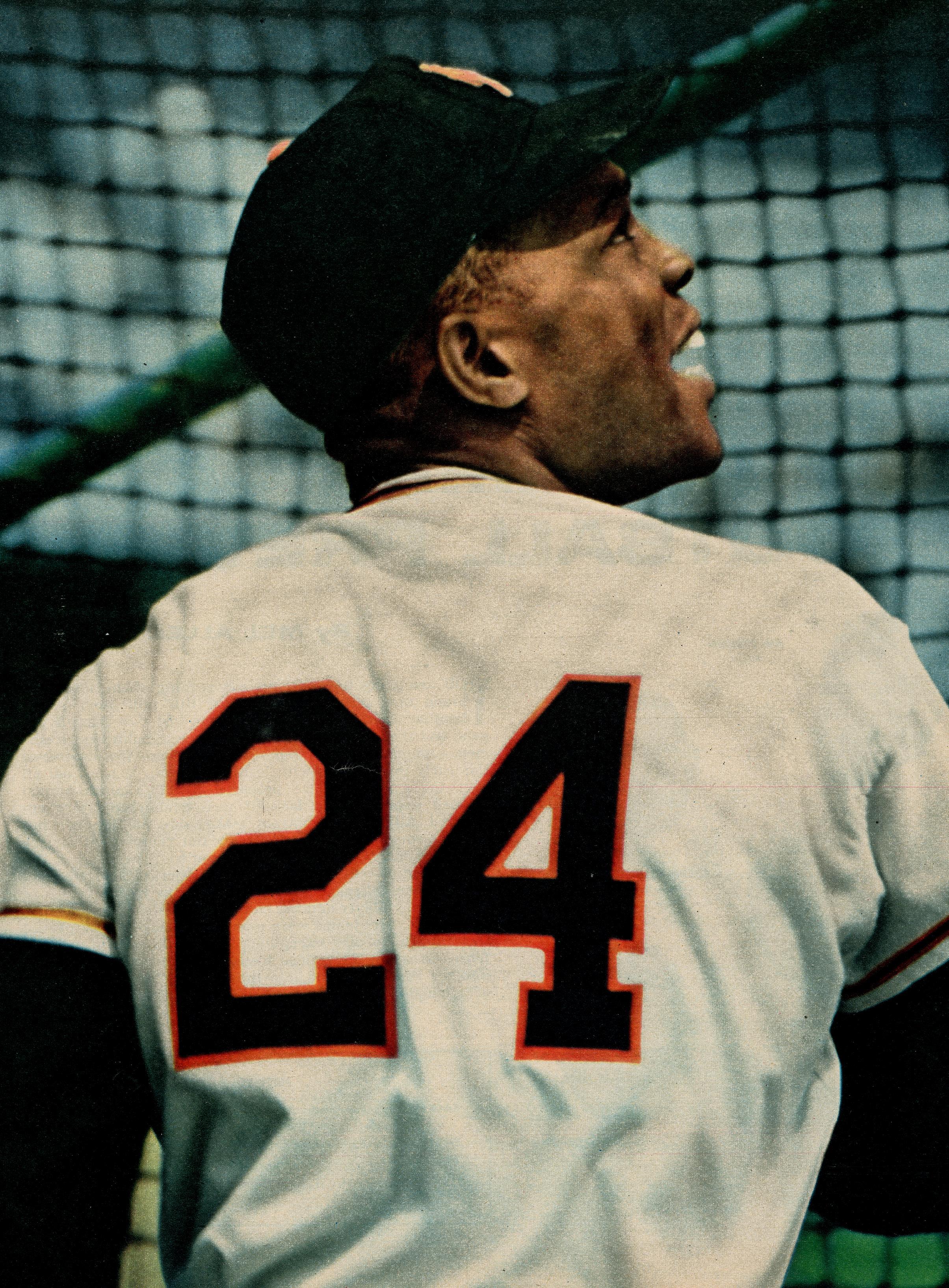
08 A Legacy of Character and Grace by John Shea Chapt 2
16 Amazin’ Willie Mays by Ed Fitzgerald, SPORT, November 1951
20 Is There a Willie Mays? by Irv Goodman, SPORT, October 1954
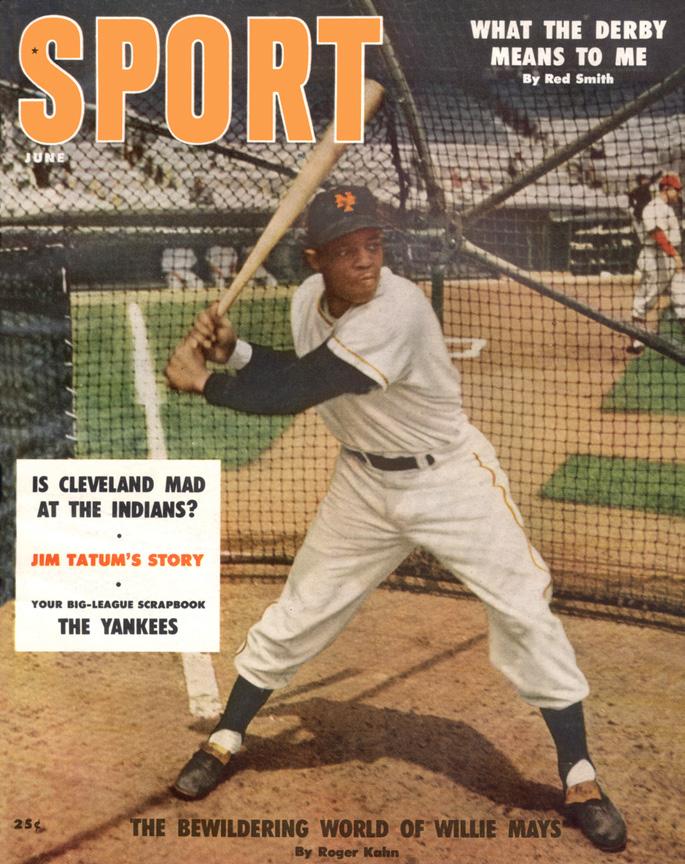
28 The Bewildering World of Willie Mays by Roger Kahn, SPORT, June 1956
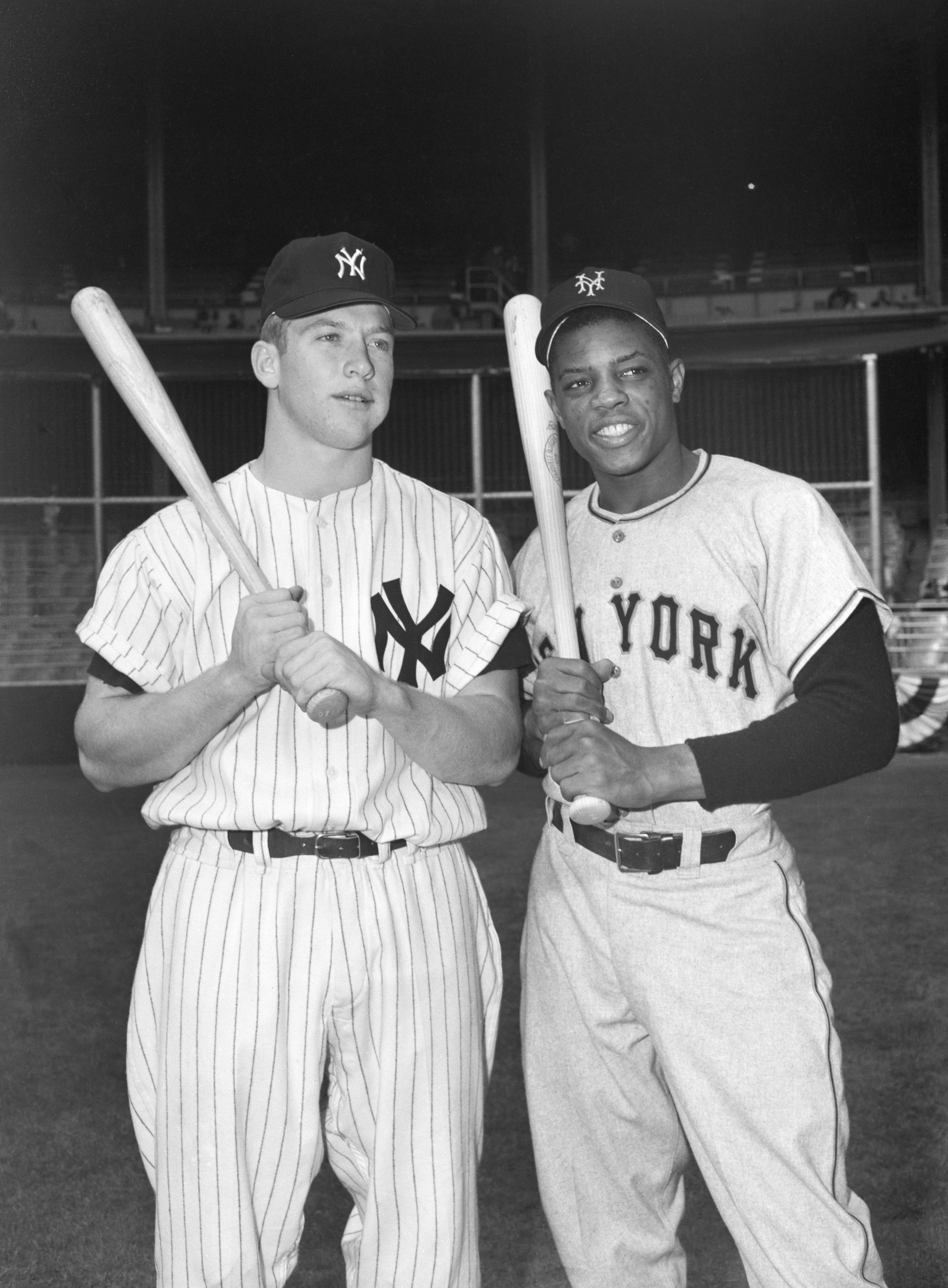
38 Baseball’s Hottest Argument: Mantle or Mays? by Tom Meany, SPORT, December 1957
Chapt 3
WESTWARD, HO!
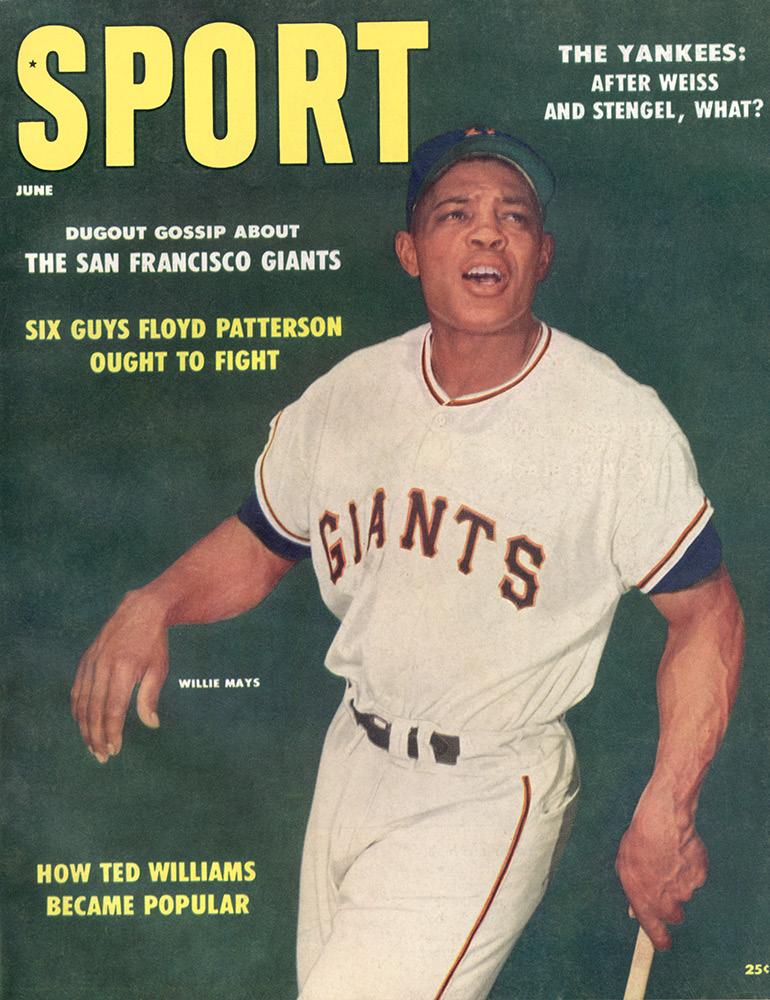
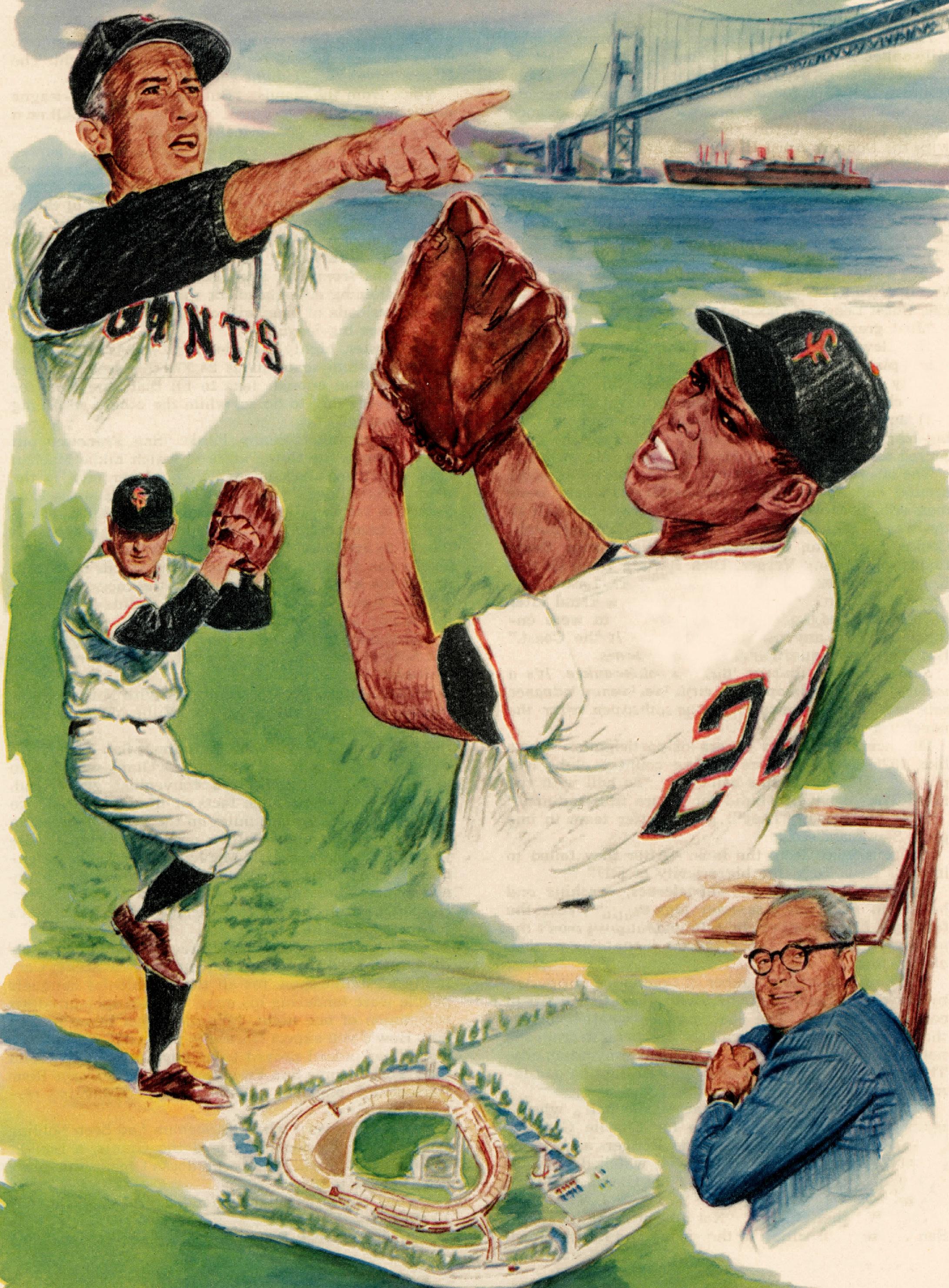
44 What they Say in the Dugouts about the San Francisco Giants by John Wesley Noble, SPORT, June 1958
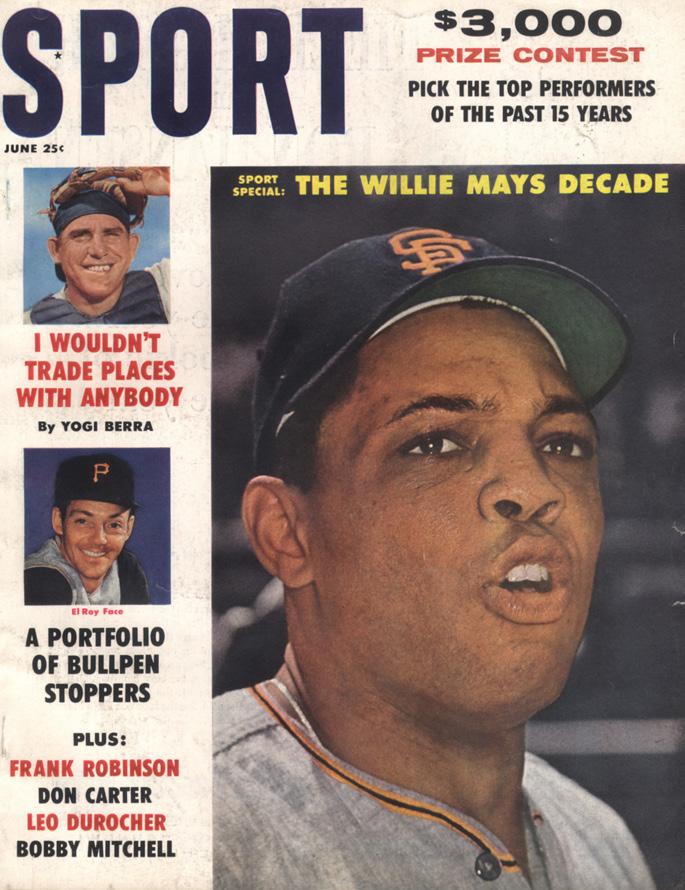
46 The Willie Mays Decade by Arnold Hano, SPORT, June 1961
54 Willie Mays May Be The Best Ever by Milton Gross, SPORT, December 1961
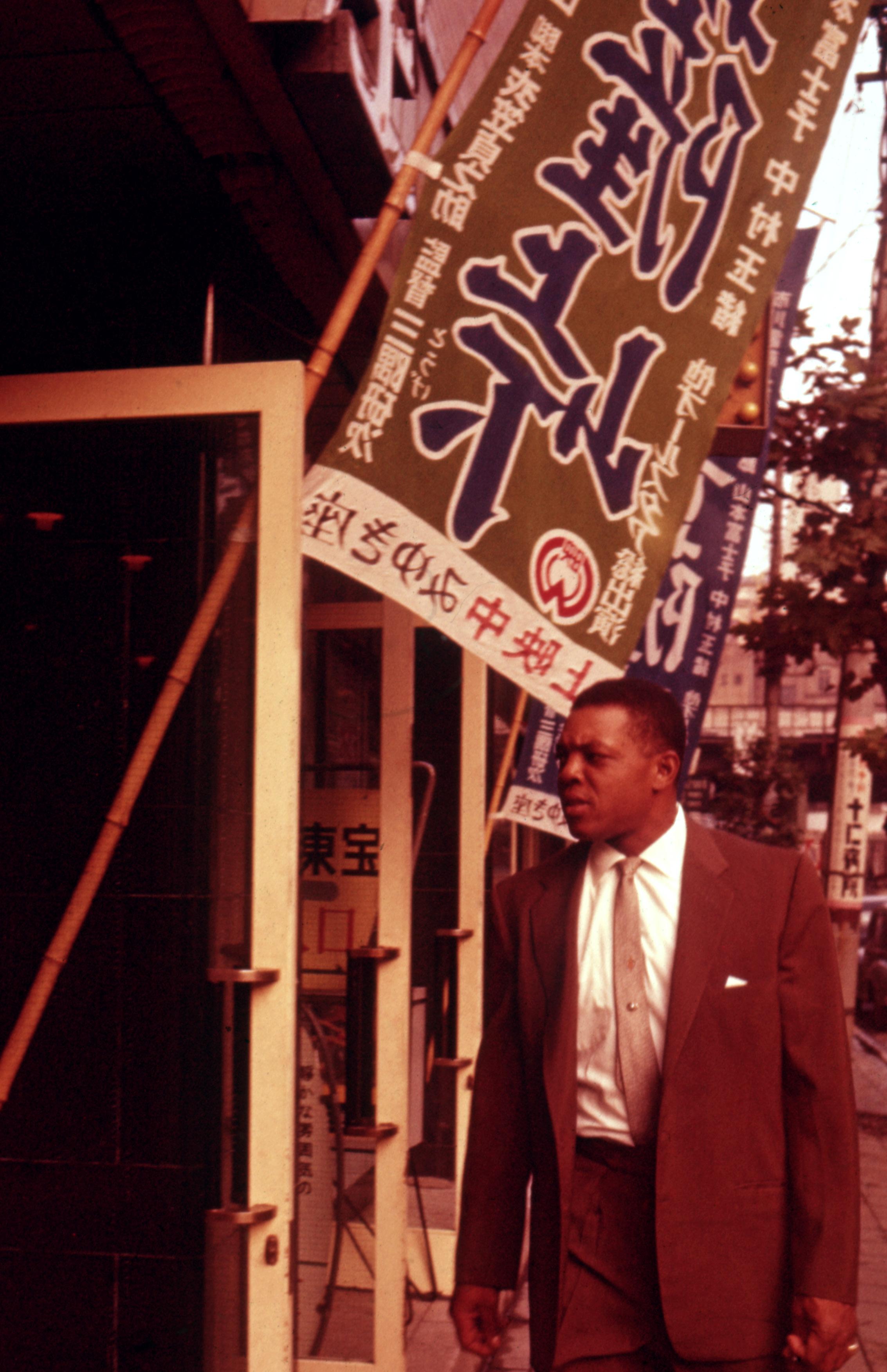
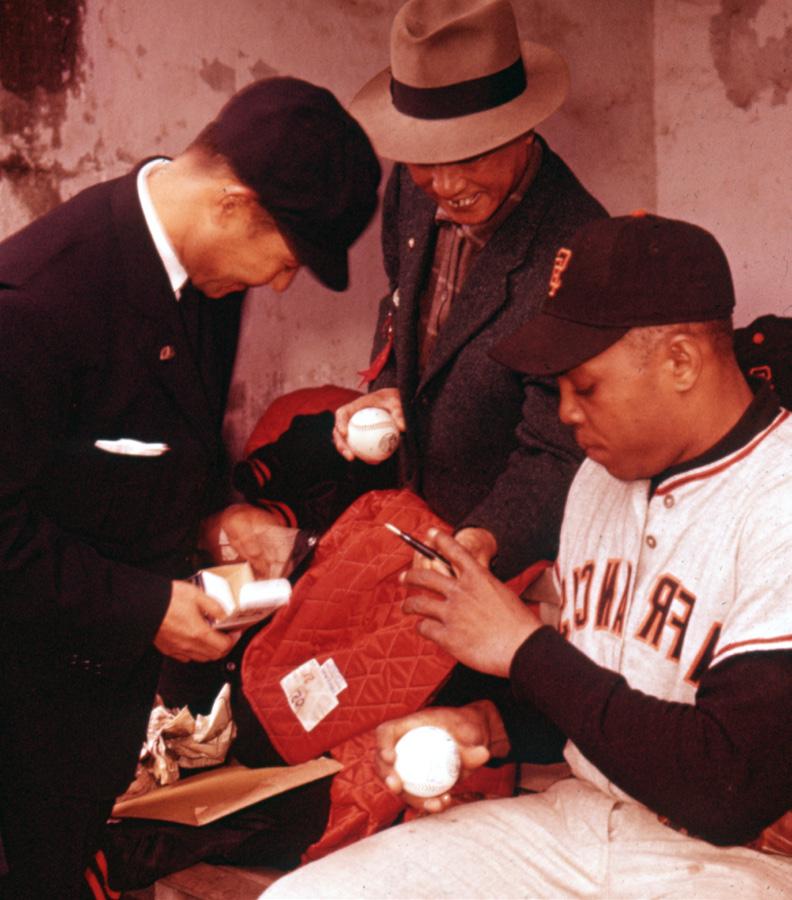
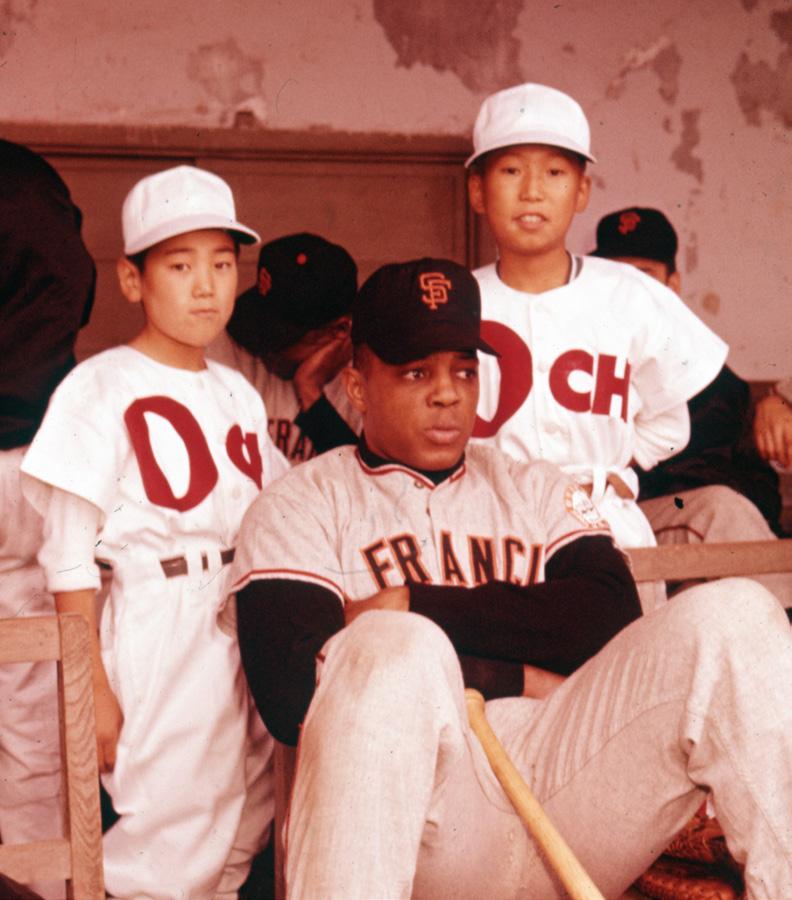
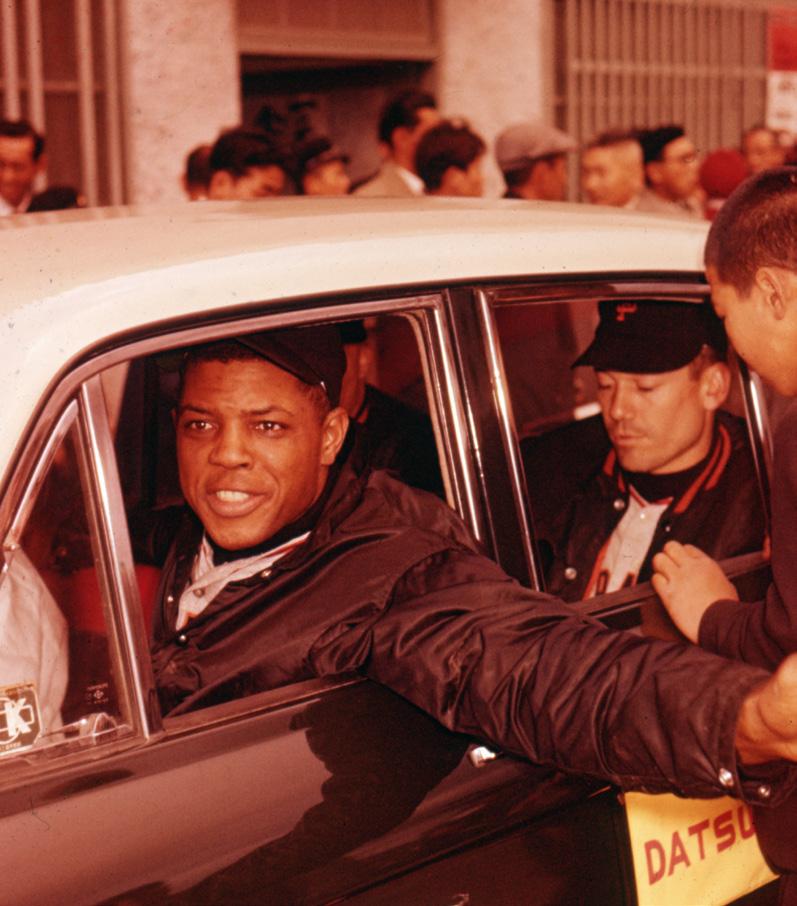
58 Willie Mays in Japan Photo Essay, SPORT, January 1962
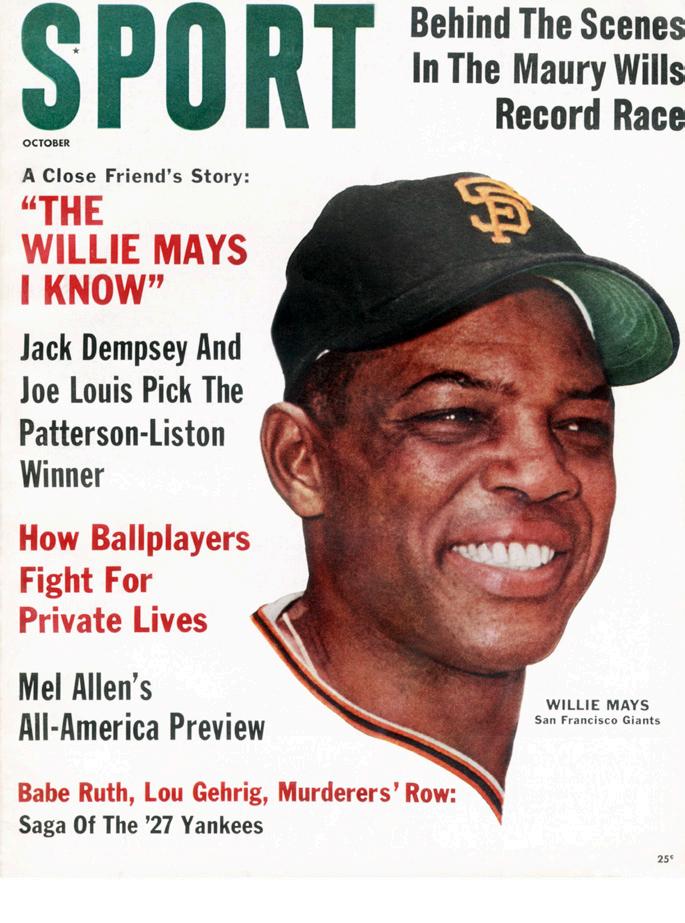
60 The Willie Mays I Know by Charles Einstein, SPORT, October 1962
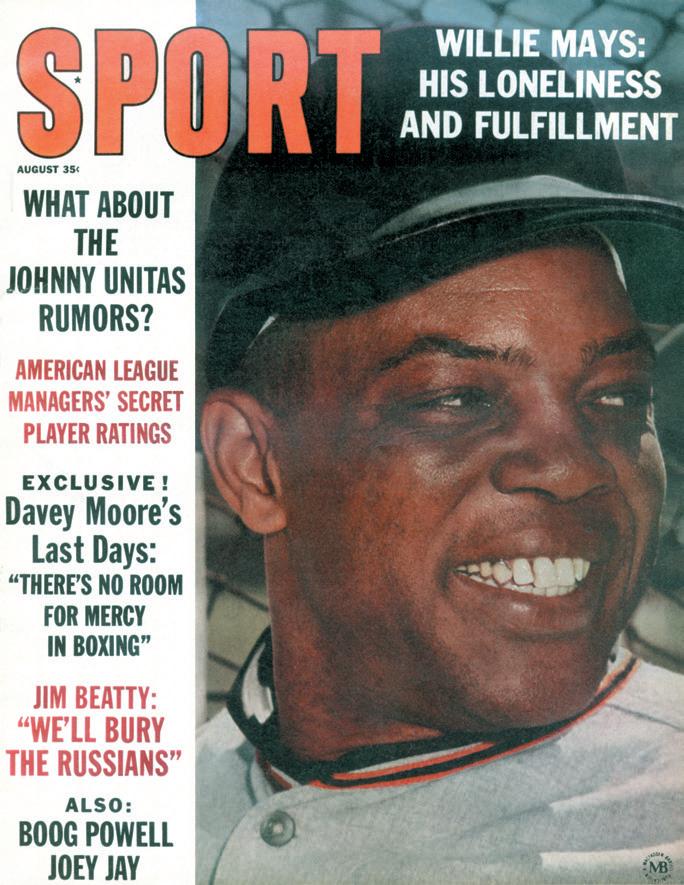
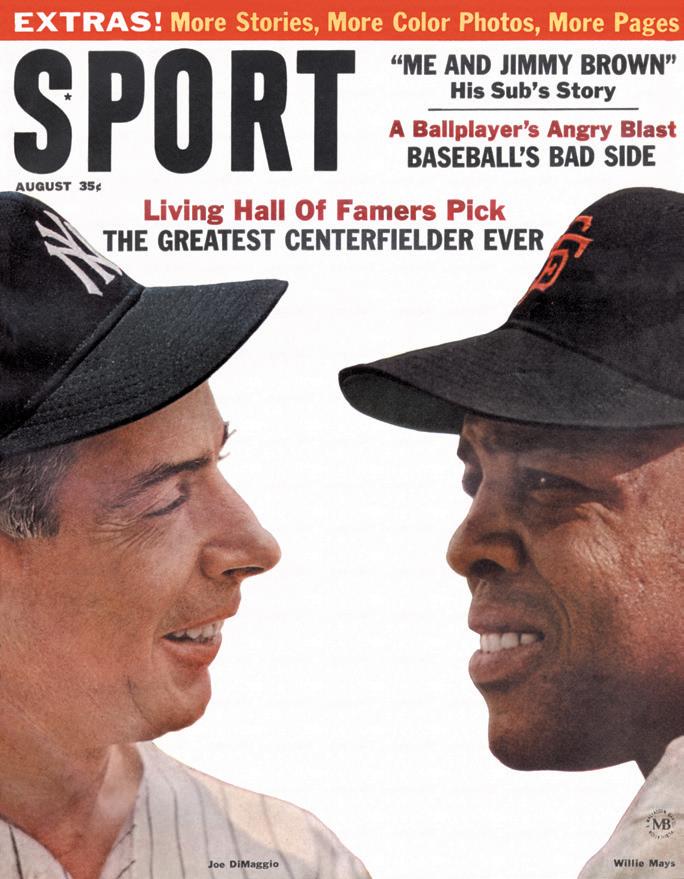
66 Willie Mays: His Loneliness and Fulfilment by Arnold Hano, SPORT, August 1963
72 Willie Mays’s Changing Role by Charles Einstein, SPORT, June 1964
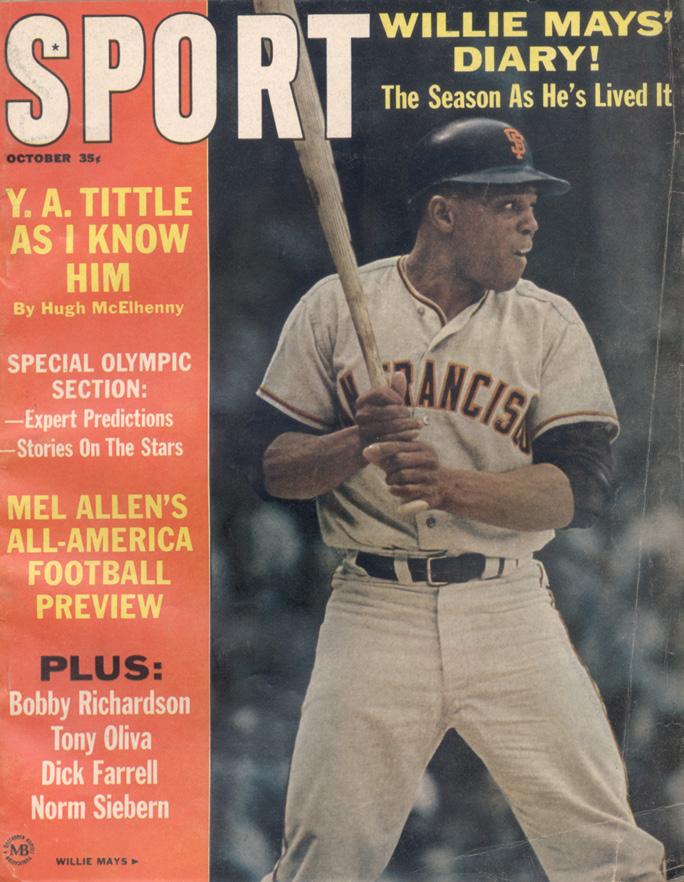
76 Willie Mays's Diary by Willie Mays with Ray Robinson, SPORT, October 1964
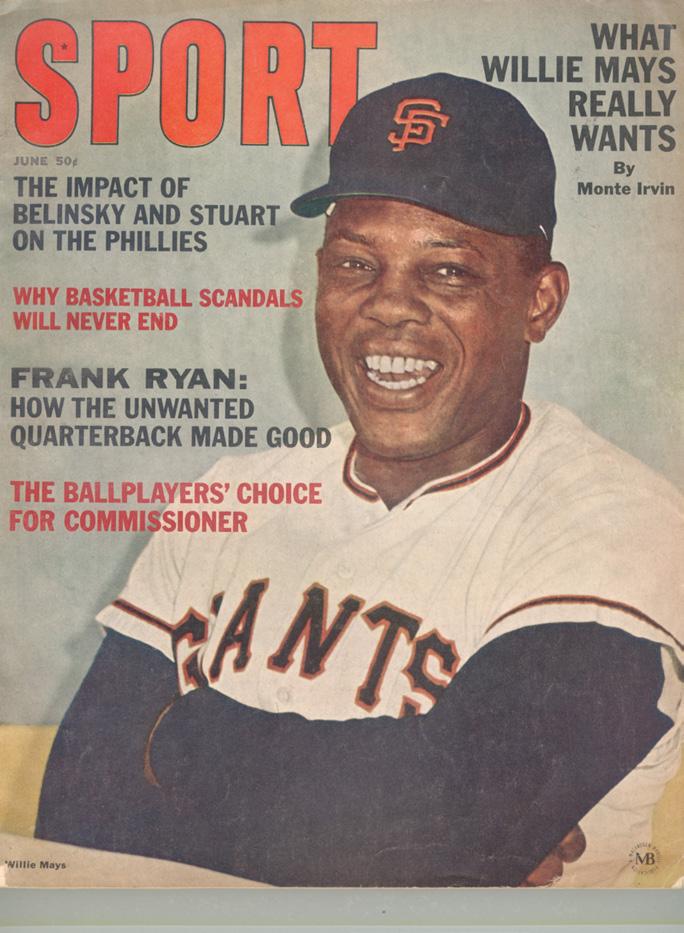
78 What Willie Mays Really Wants by Monte Irvin, SPORT, June 1965
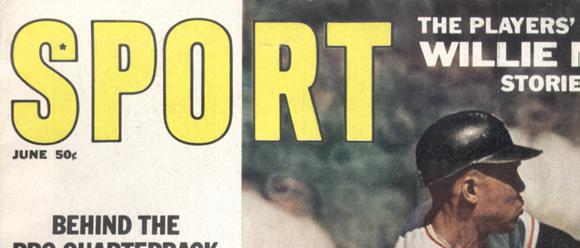
80 The Players Tell Their Favourite Willie Mays Stories by Harry Jupiter, SPORT, June 1967
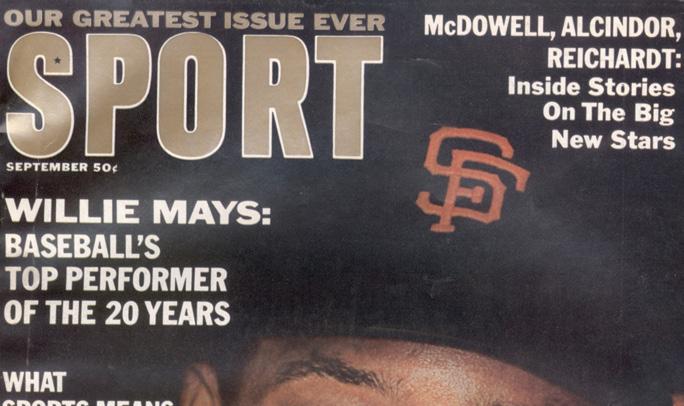
83 Catching Up With Willie Mays by Roger Kahn, SPORT, August 1969
Chapt 4
COMING HOME
88 Willie Mays Comes Home by Jeff Greenfield, SPORT, October 1972
94 The 40 Best Athletes of SPORT’s 40 Years: Willie Mays by Joe Klein, SPORT, December 1986
It has always struck us as vaguely regrettable that when an athlete—or an entertainer, politician or any other famous (or infamous) individual, for that matter—passes on, that the nal words to sum up a life are o en dra ed only in that precise moment.
Lives and careers dutifully nurtured over thousands of days and games and moments are o en consolidated into a handful of generalities and broad tropes—this person was controversial and married ve times, that once a great athlete but couldn’t make a wise business decision to save his life, another a three-time MVP and by all accounts a great father who also reportedly doted on his grandchildren.
Lost in that inevitable snapshot in time, particularly at the end of a long and deeply rich life like the one Willie Howard Mays Jr. lived, are so many of the nuances and subtleties and critical context that truly shaped the arc of the early years and, eventually, decades.
Here at SPORT magazine, our solution to that dilemma is to not only provide the moment-in-time summary, but to reach back into our storied archive to draw upon a wide range of stories that almost certainly, when perused together and with a reader’s openness to appreciating the very di erent eras in which they were told, tell a more profound and ultimately more complete albeit complex story. Not only does this move the reader past the solitary viewpoint and perhaps inherent biases of the traditional obituary writer, it conjures up the mostly-forgotten and unique contours of a career and life that at some point galvanized and held in thrall so many of the subject’s fellow citizens.
In these pages, we learn from John Shea—the San Francisco Chronicle’s baseball writer and most recent of several Mays biographers—something of the great centerelders’ post-playing days, the ones that began in late 1973 when he played his last major league game with the New York Mets and consumed well over half his life. But we also learn, via the contemporaneous words of more than a dozen other writers, about the forces and moments and details that made him the ballplayer he was, as well as the man he became.
For some, the ballplayer Willie Mays was, is quite simply the greatest who ever lived. For almost any other living soul for whom the sharp crack of bat on baseball is one of the universe’s most profound and satisfying sounds, he’s in the top two or three. From a statistical perspective, his WAR (Wins Above Replacement, a sabermetric baseball measure of a player’s total contributions to his team), Mays ranks third among position players, but if not for his missing almost two full seasons while serving in Korean War he would surely be at the top of the list.
In these pages, we trace his life and career, from the
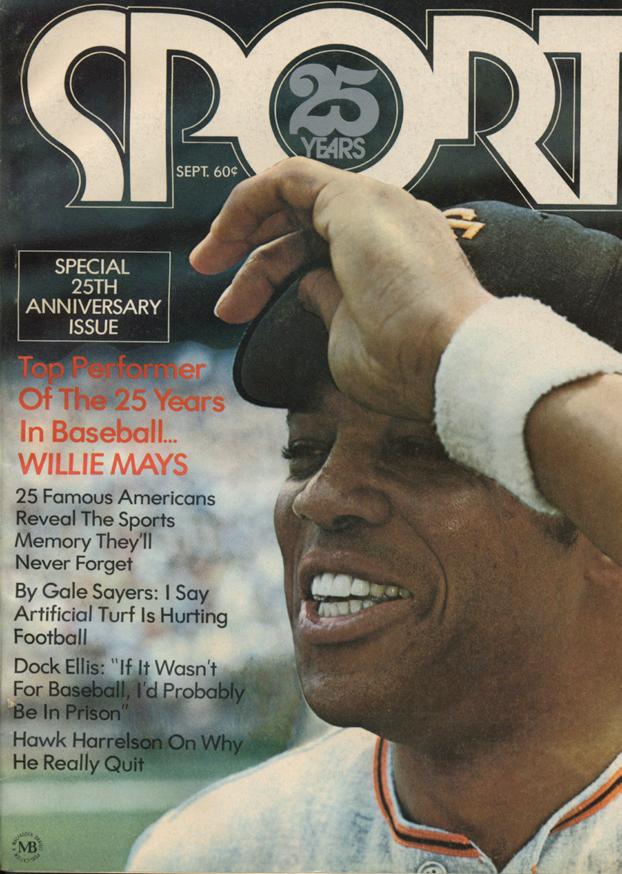
earliest days in Alabama through his Negro League debut with the Birmingham Black Barons at age 17 in 1948, on to his major league debut a few days past his 20th birthday and the halcyon years in New York with the Giants, through his superstardom in San Francisco and, then, past 40 and breaking down, back in the town that made him, in that nal, poignant and brief run with the Mets. Across all those years, Mays was featured on the cover of SPORT magazine an incredible 18 times, second most only to Michael Jordan’s 20—with many of those covers featured in this special edition of SPORT.
One important note about the real-time telling of Mays’s stories during his baseball career—some of the references, especially in referring to black athletes as Negro athletes, may seem outdated or anachronistic in today’s world. So please—be careful in your reading of them in order to re ect on the language in the context of the time it was written, and appreciate that only the deepest respect is intended toward Mays and all others depicted herein. Finally, so many factors—his race set against the era in which he came of athletic age, his stint in Korea early in his career, his sunny-yet-not-always nature, the years of losing in the chill of Candlestick Park—made assessing Mays’s career on-the- y a signi cant challenge (but did not deter legions of writers from taking a stab at it), and lent a complexity and depth to his story that we trust all you long-time, died-in-the-orange Willie fans out there—and perhaps a few new ones—will cherish.
Wayne Parrish & Marc Appleman Executive Editors
(Wins Above Replacement) is a sabermetric baseball term developed to rank players according to each’s total contributions to his team, representing the number of incremental wins his play represented compared to a replacement-level player. Mays missed almost two full seasons due to serving in the Korean War, or he would almost certainly have ranked No. 1 for his career.
Chapt 1
T H E L E G E N D, T H E M A N
Arguably the most boisterous, joyful on-field presence baseball has ever seen, Willie Mays grew to become perhaps the game’s greatest player.
A Legacy of Character and Grace— and Baseball’s Firmest Handshake
If anything, the legend of Willie Mays has grown over the half century since he played his last game, testament to the exuberance with which he played, and a growing sense that he may just be the greatest player to ever don a major league uniform.
By John Shea
AT FIRST, the plan was for Willie Mays to make a quick, one-hour visit to the San Francisco Giants’ clubhouse at Oracle Park. It was his 92nd birthday, and he didn’t gure to sit around too long. He didn’t want to wear out his welcome, either, which is ridiculous because who wouldn’t want to hang out all day with the Say Hey Kid?
With the limited time, a couple of people in Mays’s circle thought it would be best to have him meet with just two or three players in the family room across the hall from the clubhouse. Someone suggested inviting the local guys who grew up in the Bay Area and best understand Mays’s decorated resume. Brandon Crawford, Joc Pederson, Mitch Haniger.
Well, the plan didn’t quite work out. Mays stayed a couple of hours, and the line of players waiting to greet him went out the door. Word had ltered throughout the clubhouse that the legend of legends was in the house, and everyone wanted to pay respects.
Blake Sabol, a big, athletic rookie catcher, hurried to be rst in line. He saw Mays in a wheelchair—the mobility and eyesight no longer in peak form—and
when introduced, Sabol put out his hand somewhat passively and quickly learned a valuable lesson.
Never o er anything less than a rm handshake to Willie Mays. Or he’ll crush you with his mighty grip. And playful razzing.
“ at all you got?” Mays said in his familiar high voice, cracking up everyone in the room. “You sick?”
A bit embarrassed and much more motivated, Sabol tried it again albeit much rmer. is handshake was acceptable. Mays smiled and welcomed him. Sabol felt like he belonged. All was right with the world.
Mays, who celebrated his 92nd birthday on May 6, 2023, remains an iconic and inspirational American hero who touches lives, warms hearts and serves as a role model for anyone trying to take the right path in life. rough his Say Hey Foundation, Mays helps many needy kids by o ering positive opportunities including with the Willie Mays Scholars program, which o ers college preparation and scholarships to Black youth in San Francisco. In the past year, he had elds dedicated to him in Richmond, Calif., honored for the work he did in the community decades earlier. Also, Mays was featured in the HBO documentary Say Hey, Willie Mays! (full disclosure: I was a consulting producer for the lm), cut new deals to have his image used on Topps and Panini baseball cards and in MLB e Show 23 and Super Mega Baseball 4 video games and had his number 24 retired by the New York Mets.
e Giants’ ballpark is Mays’s second home, and not just because the address is 24 Willie Mays Plaza. Sadly, he was forced to stay clear during much of the pandemic, and a hip surgery in the spring of 2022 kept him away longer. He recovered well enough to make a surprise visit to the park in late September, and his 92nd birthday gathering was a festive occasion attended by his godson, Barry Bonds, California’s governor, Gavin Newsom, and other friends and family.
If there’s an opportunity to visit with the greatest player of all time, you take advantage of it, right?
What’s that? You say Babe Ruth is the greatest?
OK, let’s have that discussion.
First o , Ruth wasn’t up to par with Mays’s ve tools. He didn’t run like Mays. He didn’t defend like Mays. He didn’t throw like Mays, at least from the out eld. Yes, Ruth pitched and pitched extremely well and relished the opportunity. Mays never got the opportunity but certainly could have excelled if given the chance—when the New York Giants signed him out of high school, two Birmingham-area newspapers projected he’d be a pitcher in the majors, not a hitter.
One more important note of comparison between Ruth and Mays. Ruth played with and against only white players. He didn’t face all the best available talent of his day because Major League Baseball was a whites-only league. As a result, Ruth never stepped up to the plate against Satchel Paige. Never had a long
drive in the gap chased down by Oscar Charleston. Paige and Charleston played when Ruth played. But because of the color of their skin, they were relegated to the Negro Leagues while the Babe compiled historic numbers facing only whites.
When Mays played, debuting just four years a er Jackie Robinson broke the color barrier, Major League Baseball was more inclusive. Roster spots were occupied by African Americans and Latinos, not just whites.
And how about this? Ruth hit 714 home runs, Mays 660. Mays missed most of two seasons because he was dra ed into the Army during the Korean War in the early 1950s. When he came out of the service, he crushed 90 home runs in his rst two seasons. Had he not served in the military and hit, say, 60 homers in those two years, conservatively speaking, it would have been Mays, and not Hank Aaron, who broke the Babe’s cherished record.
In his fabulous 2021 book, e Baseball 100, author Joe Posnanski breaks down with great detail the top 100 players in the game’s history, from 100 to 1. Let’s cut straight to the nal 10. Here goes: Satchel Paige 10, Stan Musial 9, Ty Cobb 8, Walter Johnson 7, Ted Williams 6, Oscar Charleston 5, Hank Aaron 4, Barry Bonds 3 …
Babe Ruth 2…
And Willie Mays 1.
Of course, this is a judgment call. Comparing legends from separate eras is tough. It’s easy to say Ruth is the best ever as the rst great home run hitter, but the conversation needs to get deeper and include segregation as a talking point. Mays lived it growing up in the Jim Crow South amid the Great Depression. He was born in West eld, Alabama, and settled in Fair eld, just outside Birmingham, which Dr. Martin Luther King Jr. called in the 1960s America’s most segregated city.
We could hardly imagine what the conditions were like decades earlier during Mays’s childhood when it was against the law for him to play with white kids. He did anyway, and the cops came to break them up. When the cops le , the kids resumed playing. In retrospect, Mays didn’t complain and always made the best of every situation, a trait he learned from his father and carried throughout his life.
Young Willie might have lived in poverty but recalls he had all he needed: a roof over his head, food on the table, friends in the neighborhood and nearby elds to play ball. Most of all, he had Willie Howard Mays Sr., who worked in the mills and as a porter and introduced his son to baseball. Young Willie grew up in a home with his two aunts. His father wasn’t always at his side but enough to leave an impression that helped shape his life and make him an invaluable uniter, peacekeeper and mentor.
Mays changed lives. He changed minds. He “made it
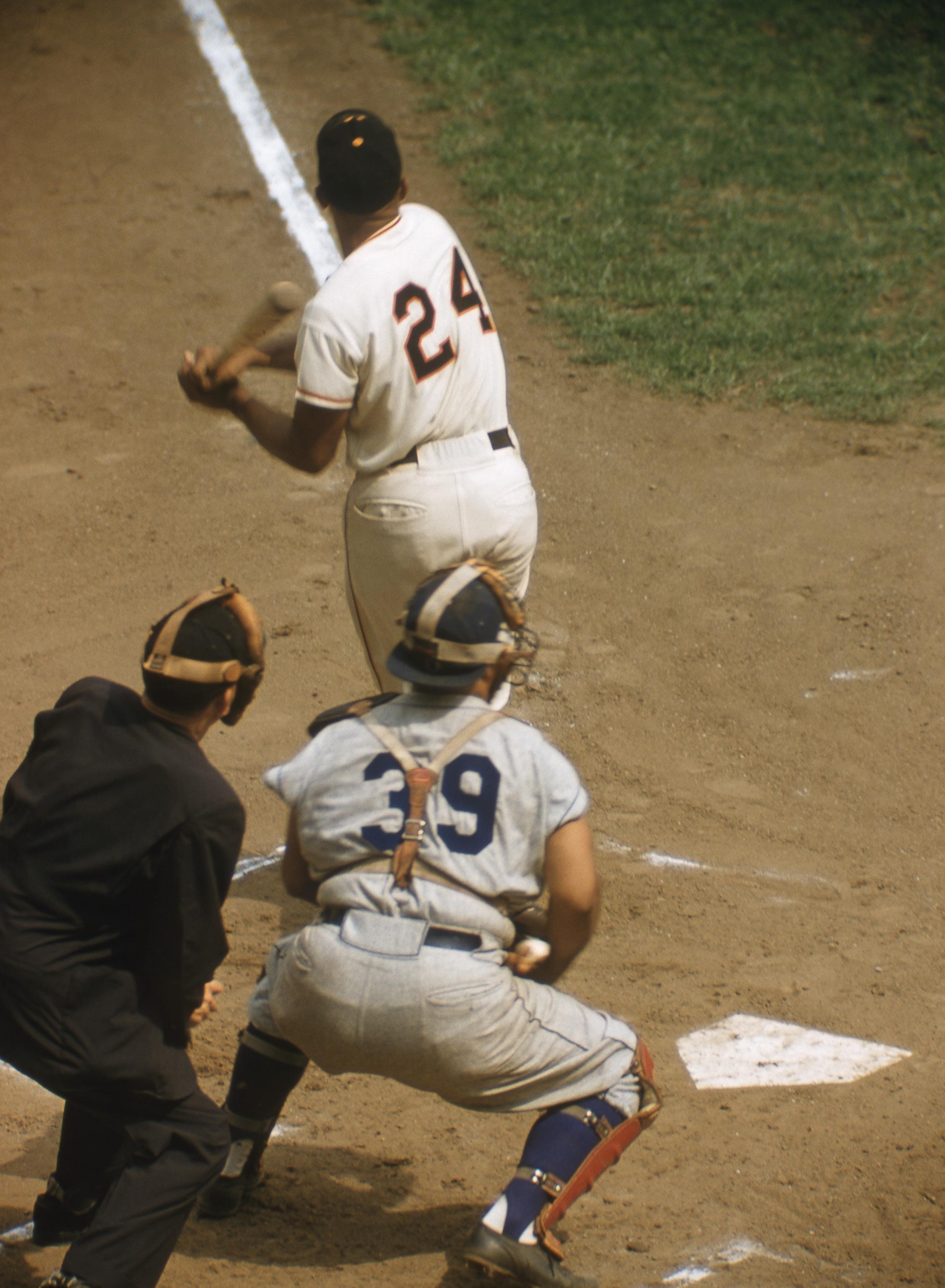
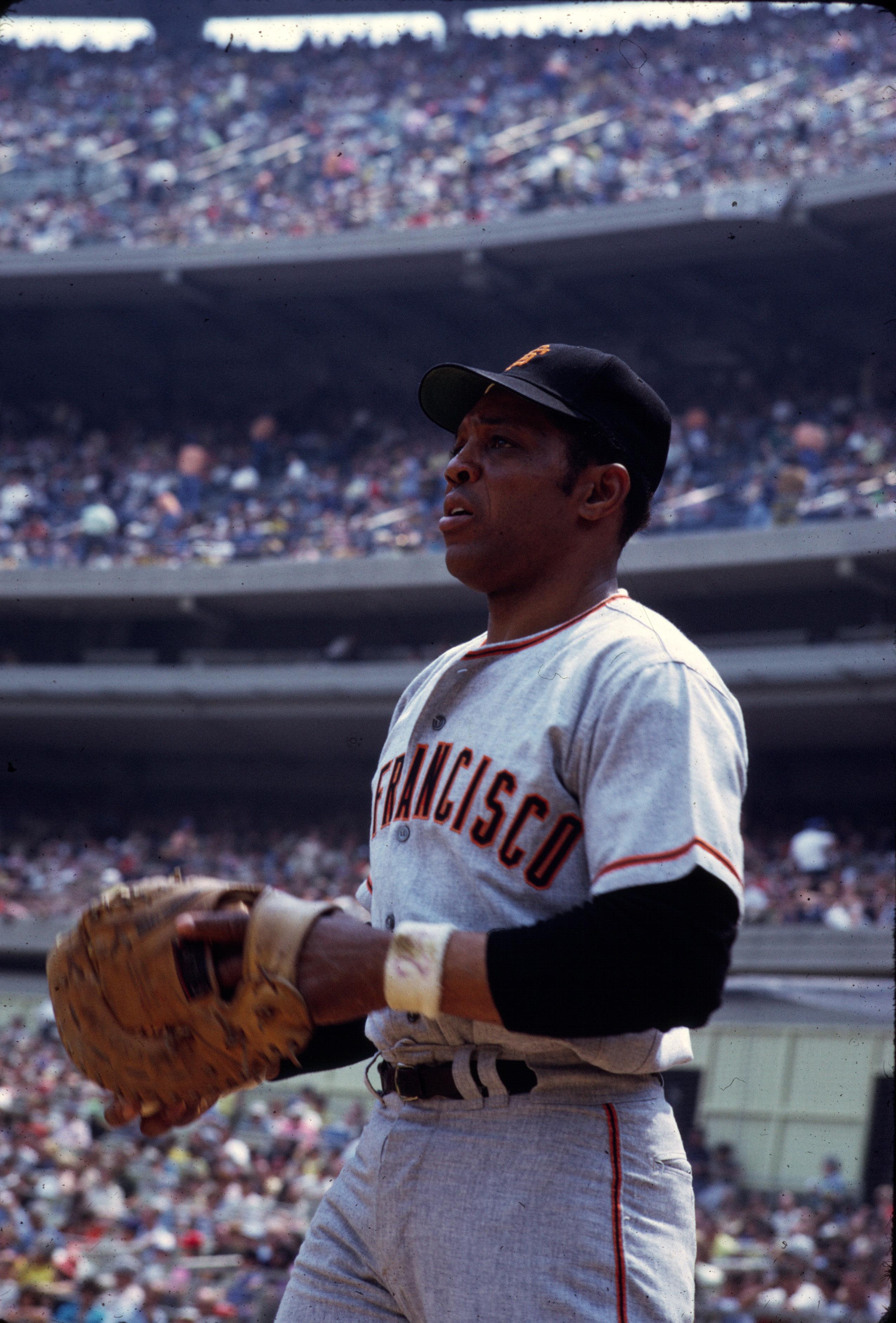
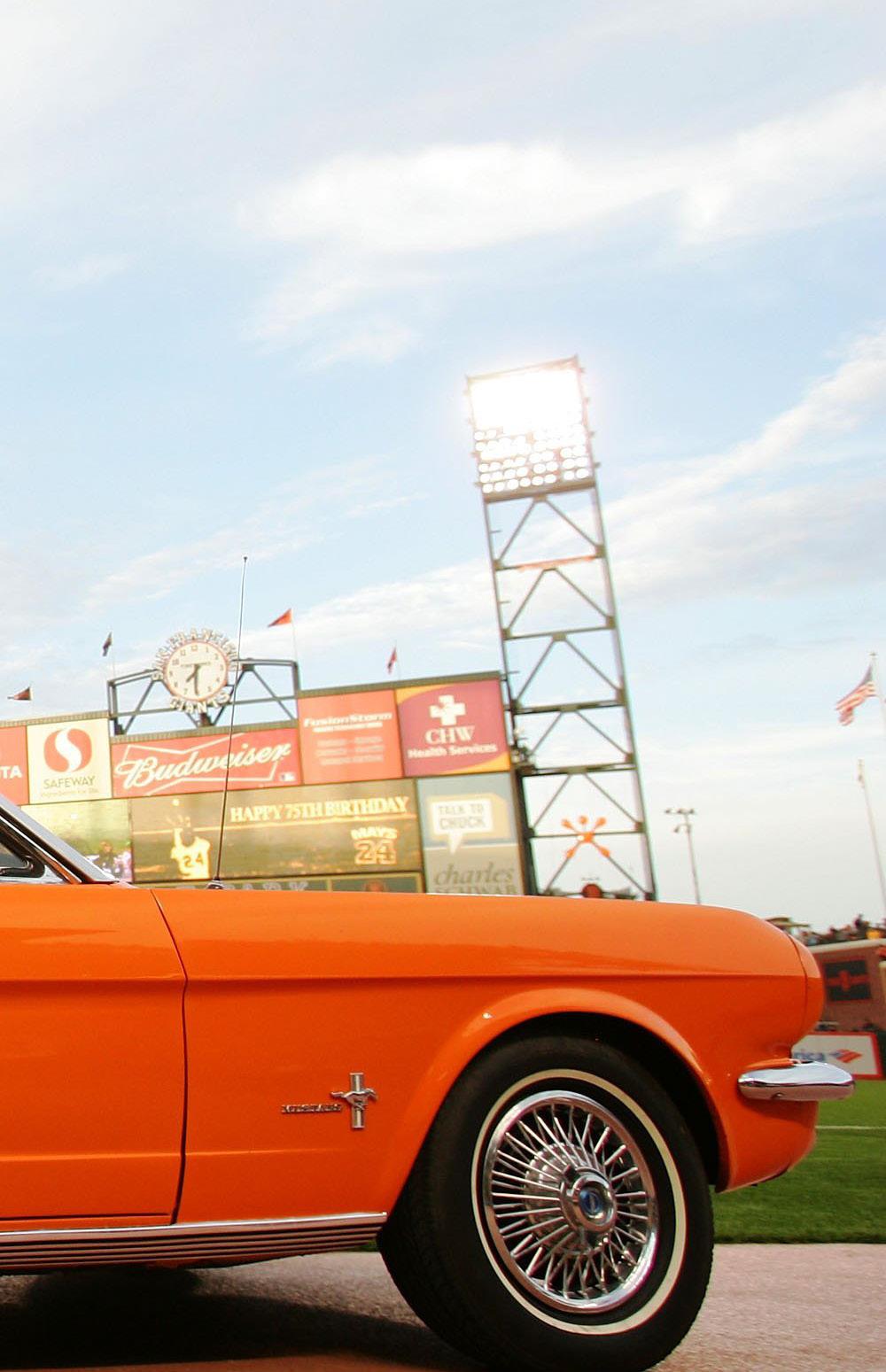
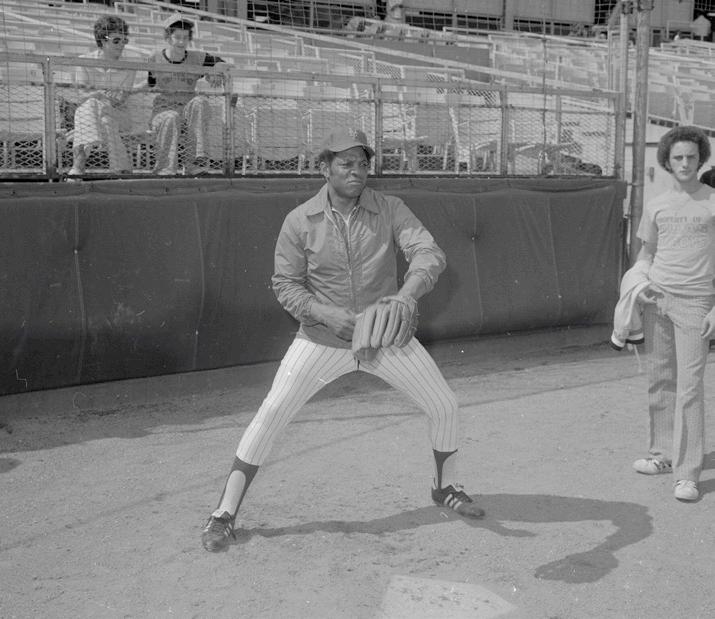
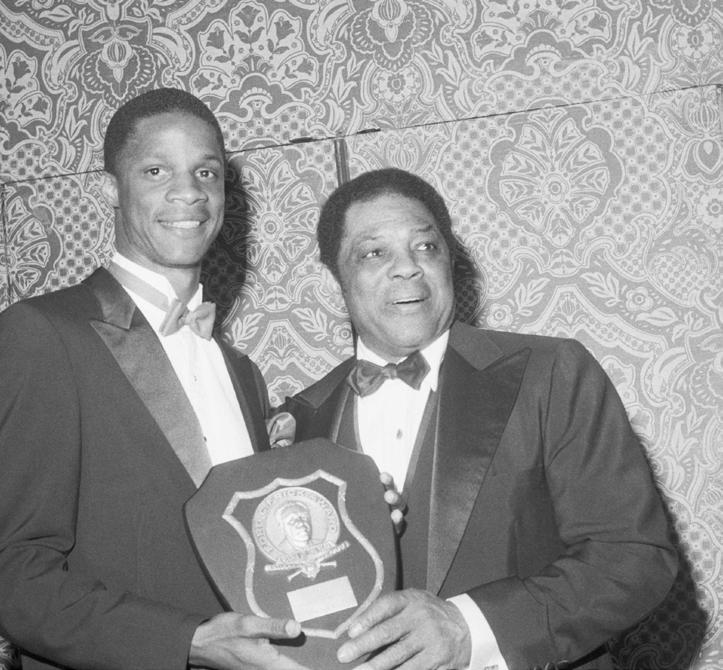
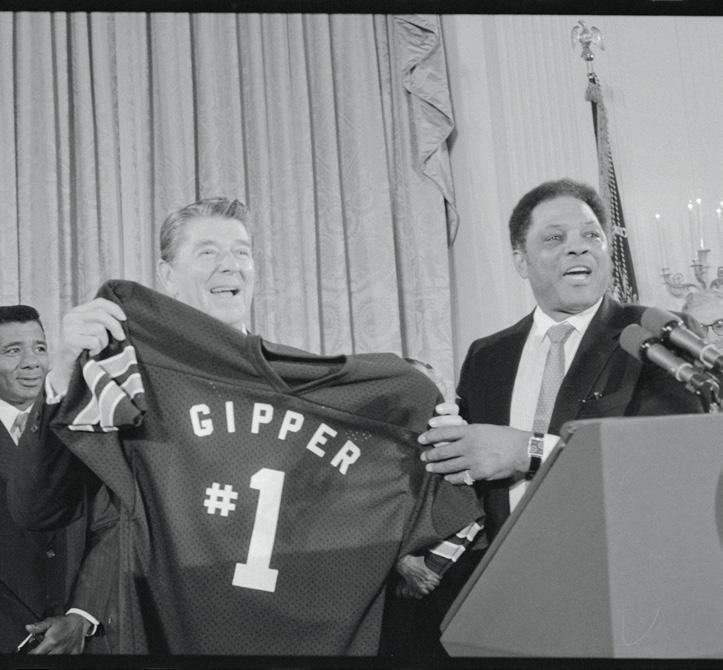
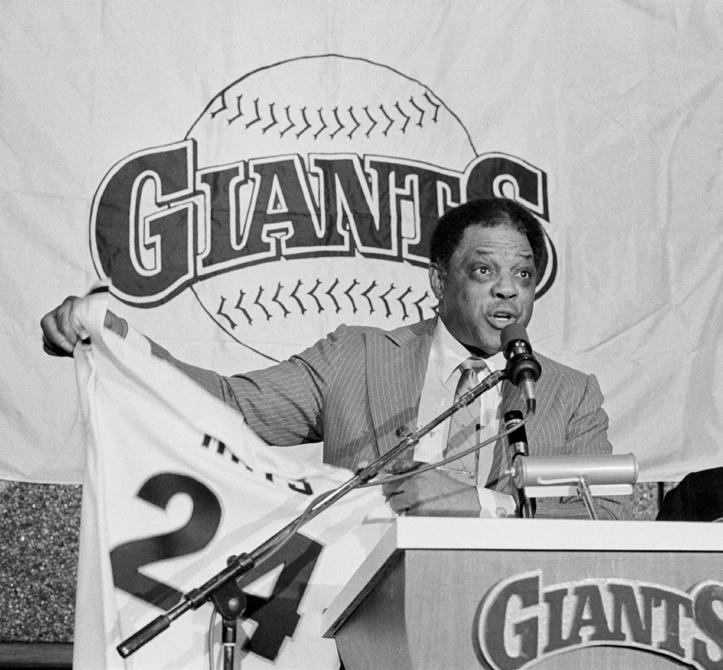
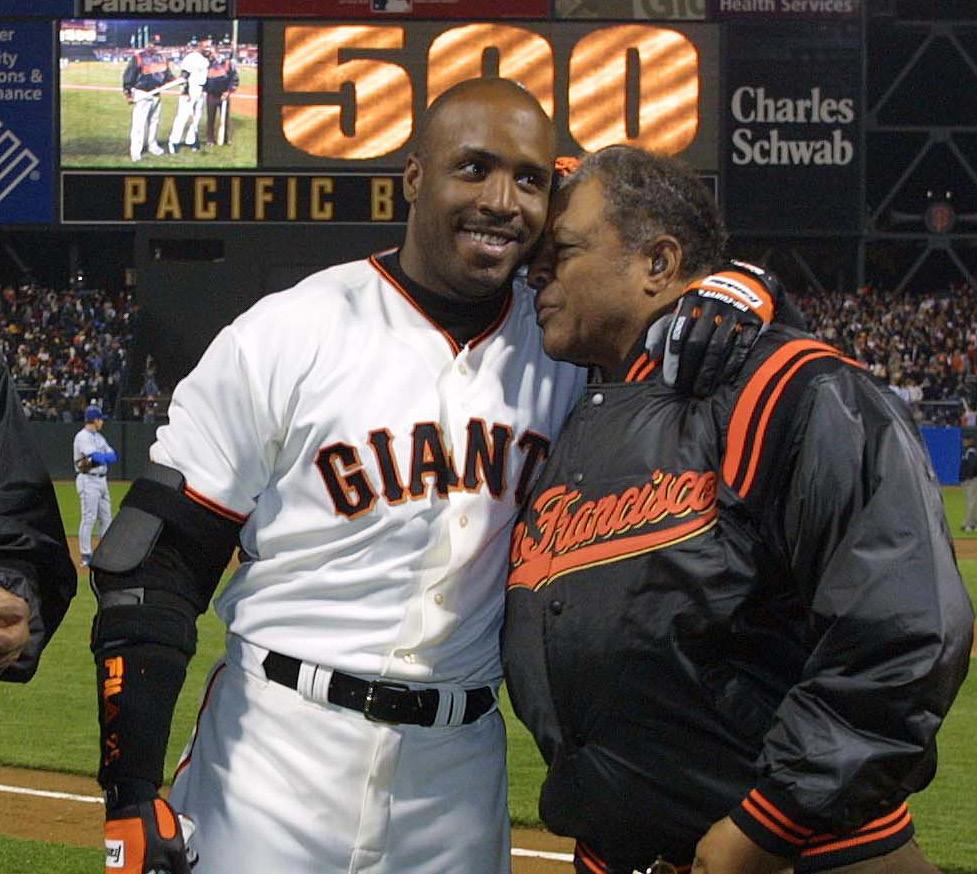
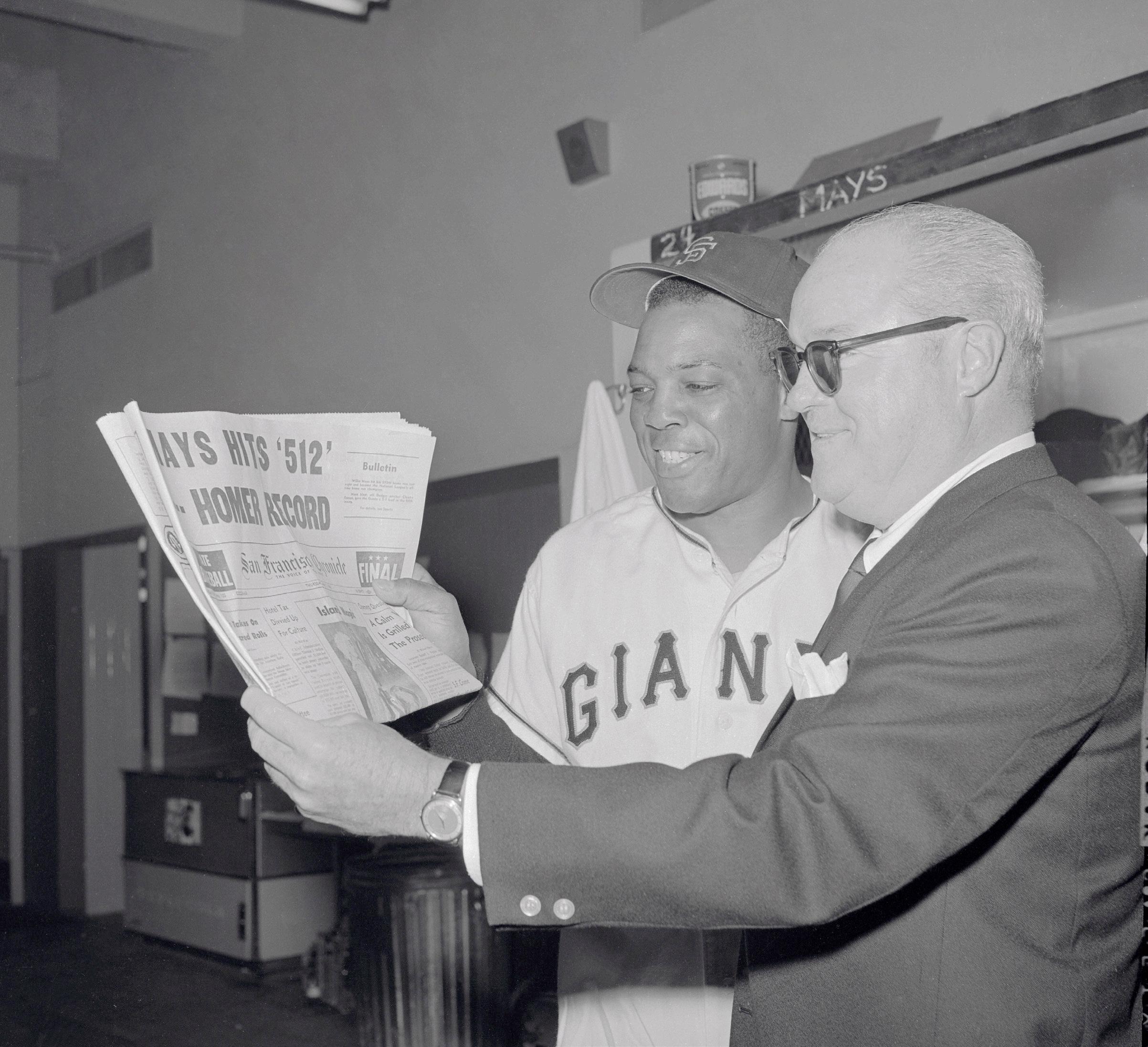
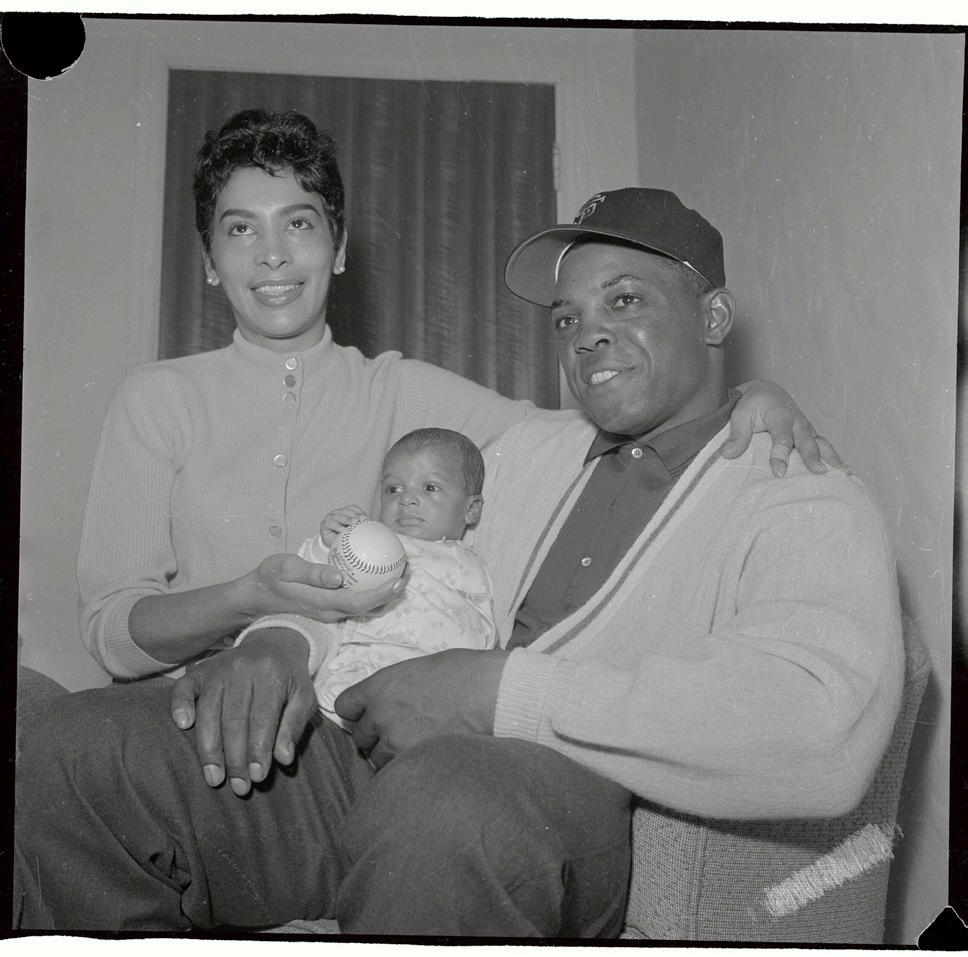
From top to bottom: As a Mets coach, 1976; presenting Darryl Strawberry with the Sporting News 1983 Rookie of the Year award, 1984; at the White House with Ronald Reagan, 1984; Returning to the Giants, 1986; Barry Bonds with his godfather, 2001.
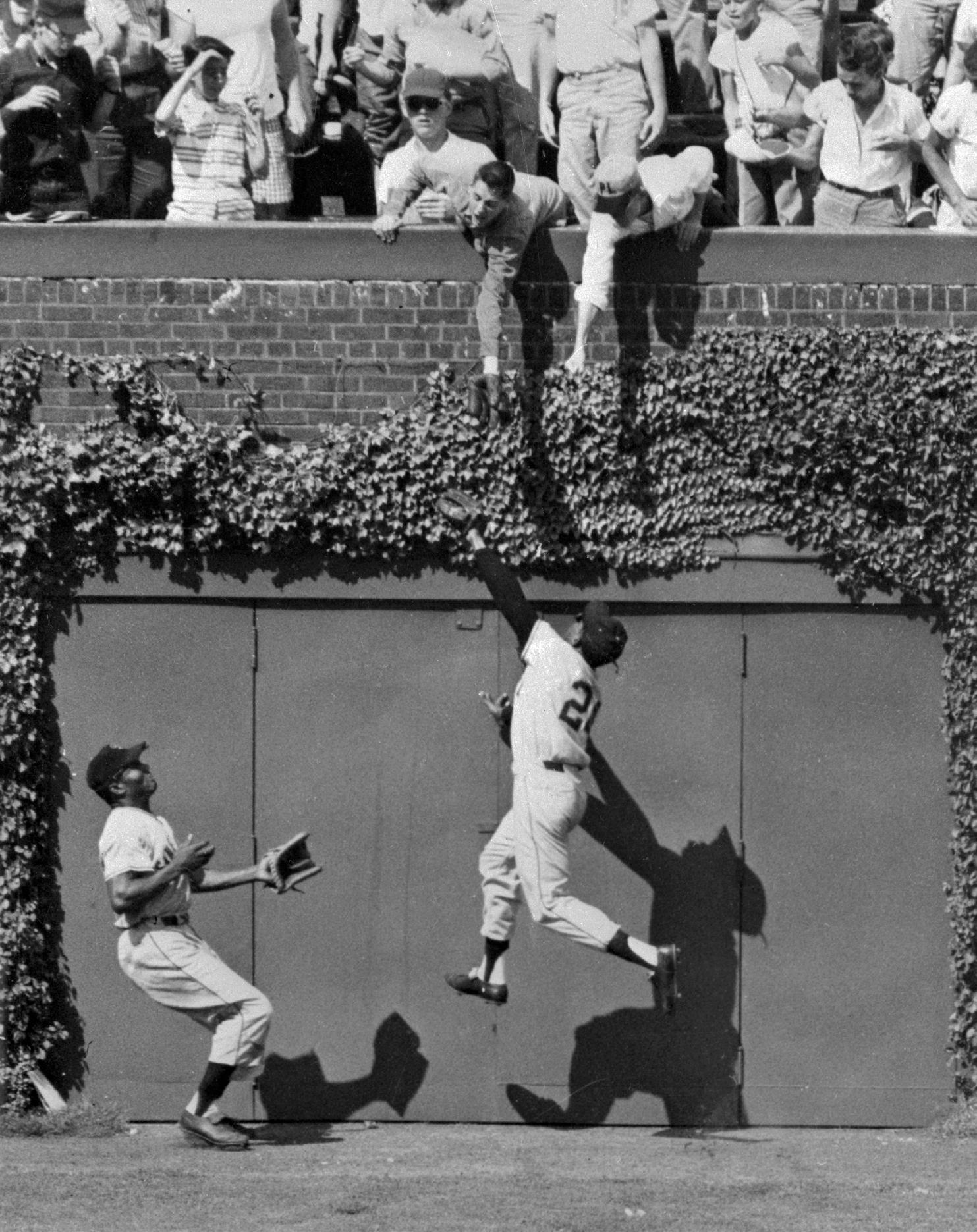
absurd to be a racist,” according to former President Bill Clinton, who spoke of Mays’s powerful indelible images— not just his patented basket catches or his cap ying o as he caught a ball in the gap or legged out a triple—in the book I co-authored with Willie: 24: Life Stories and Lessons om the Say Hey Kid, which was published in 2020 and dispels the myth that Mays didn’t do enough to champion the Black cause during the Civil Rights Movement and beyond.
Anecdotes shared by many younger African American players including Joe Morgan, Maury Wills, Willie McCovey and Reggie Jackson tell the story of Mays making an impact on others by ghting racism on his terms. He didn’t march or preach like Robinson because that wasn’t his personality, and that’s not what his father taught him. But Mays did take countless players under his wing and taught them what he learned from his father and Negro Leagues teammates who guided him on the Birmingham Black Barons. When the Giants signed Mays in 1950, he moved from an all-Black league to an all-white league and heard the same racial slurs that Robinson had heard, but Willie refused to let the bigots win and overcame all obstacles, fortunately for us all.
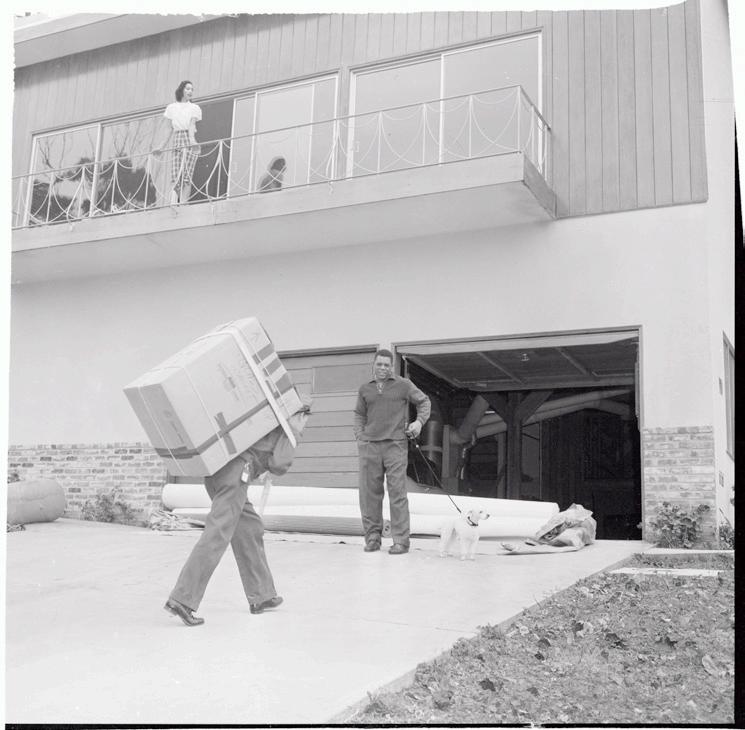
When the Giants moved west from New York, Mays tried to buy a house in an upscale San Francisco neighborhood and was denied because he was Black. e mayor and real estate agent asked if he’d consider living elsewhere in town, and he said no. Not just because this is where he and his wife wanted to settle but because he wanted to make it easier for the next minority to move in. Mays got the house and was instrumental in integrating the neighborhood, and his well-publicized ght against racial housing discrimination led to a law forbidding such discrimination in selling or renting private dwellings.
Mays didn’t drink. Didn’t smoke. Didn’t charge the mound. Didn’t get ejected. Didn’t start ghts. But, oh, he helped break up quite a few especially involving the Giants and Dodgers, the bitter rivalry dating to the franchises’ early New York years but also extending to California. A er Juan Marichal infamously clubbed Dodgers catcher Johnny Roseboro over the head with a bat, it was Mays who grabbed Roseboro’s bloodied jersey and escorted him back to the Dodgers’ dugout, a single Giant in a sea of blue who consoled the enemy and ended any chance of a riot breaking out at Candlestick Park.
When manager Alvin Dark’s racist quotes about Latinos went public and Orlando Cepeda and others were planning a mutiny, ready to walk out on the team, it was Mays who gathered his younger colleagues at his hotel room and told them to keep playing for their team, for themselves, not their manager, arguing such a demonstration would back re. His teammates showed their respect and listened. Dark was red a er the season.
When Mays’s 1973 New York Mets were in the play-
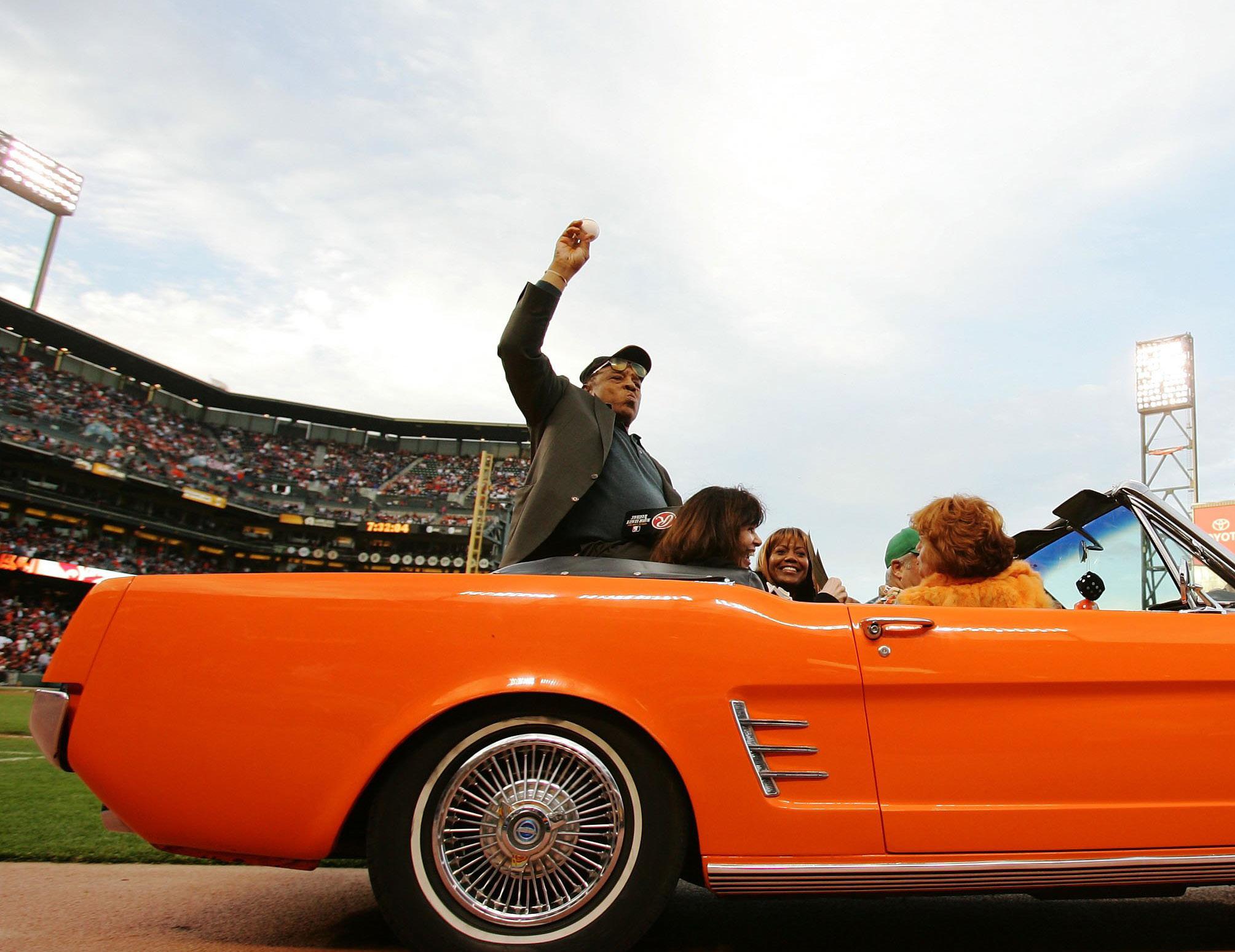
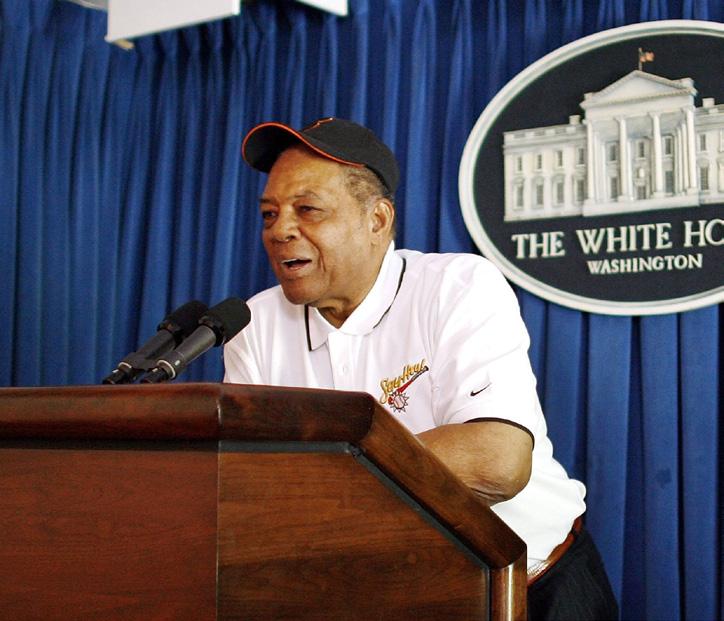
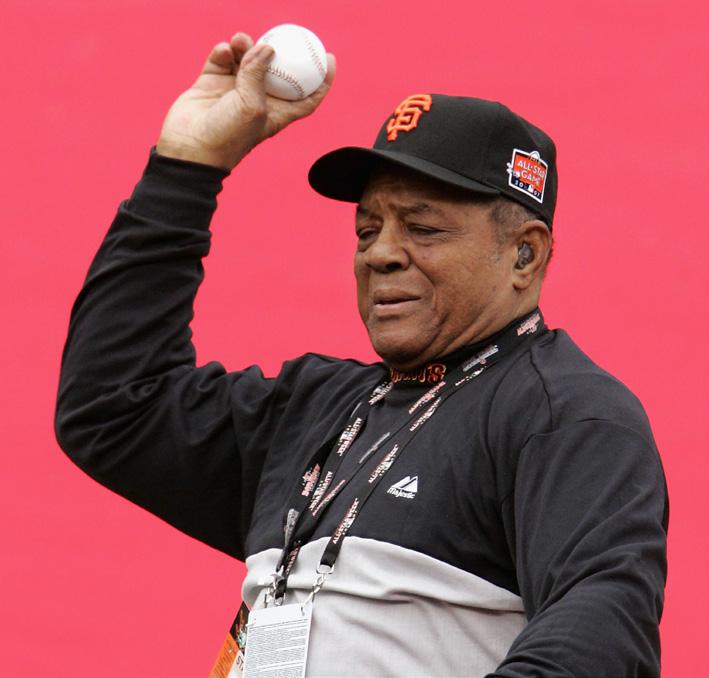
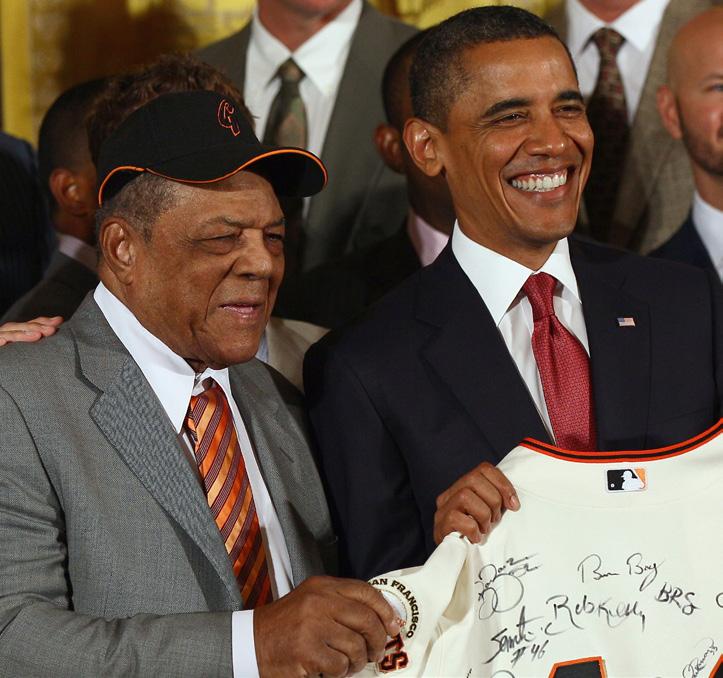
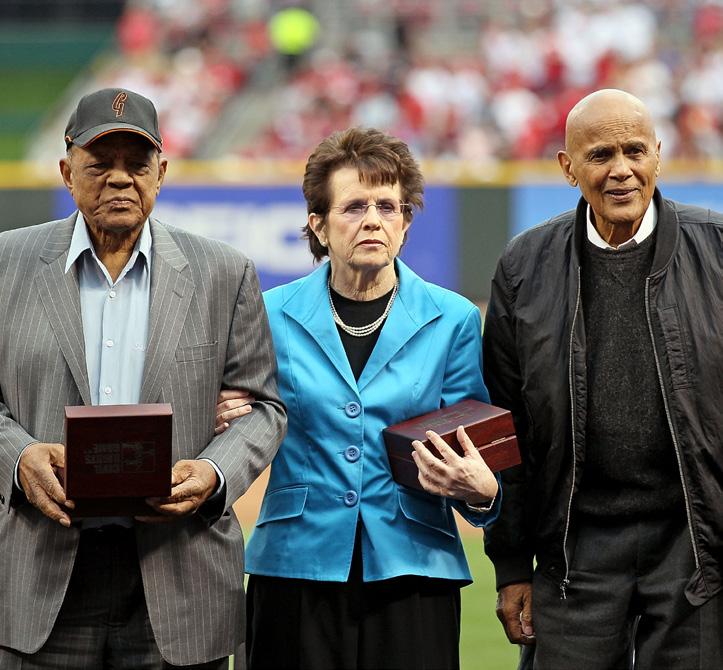
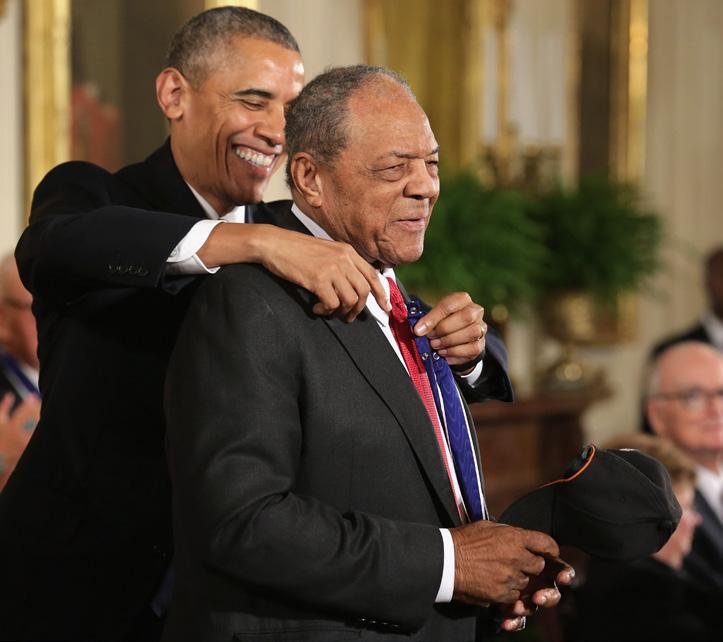
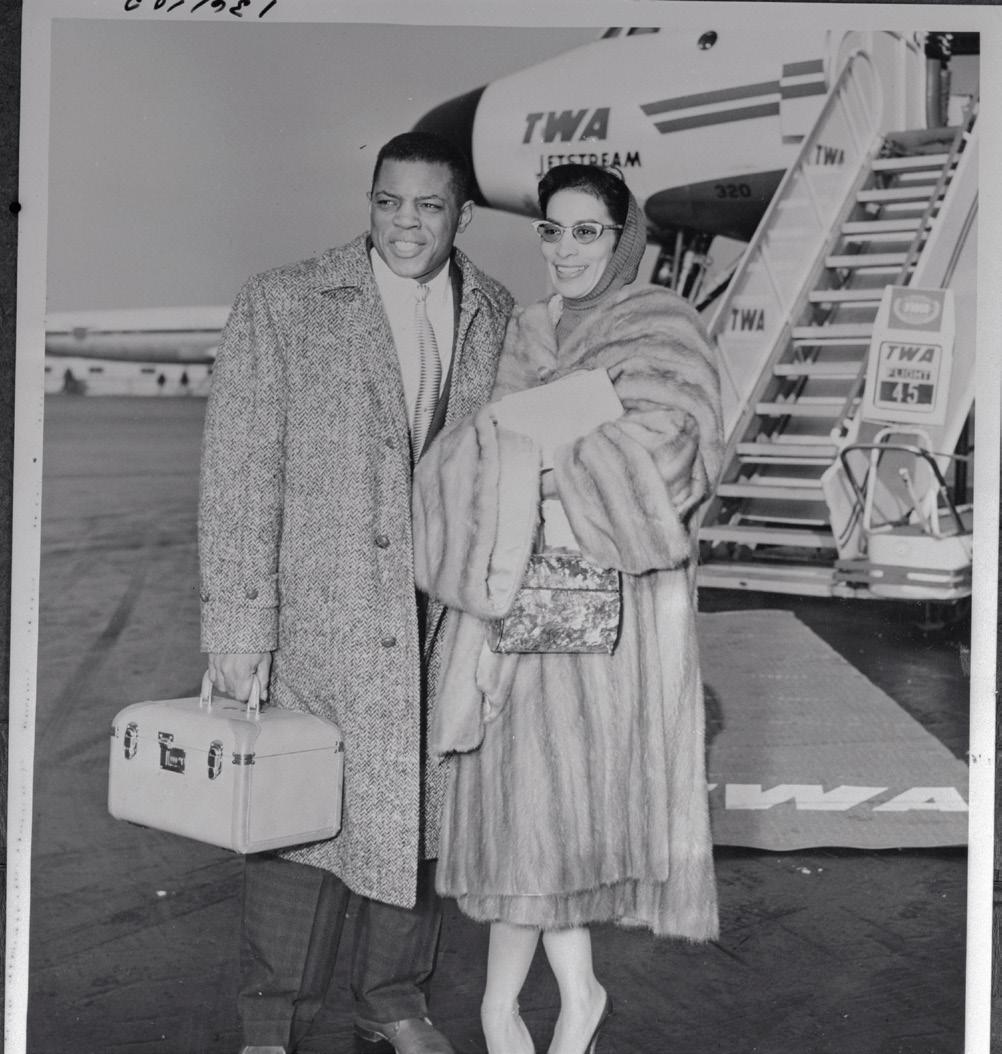
From top to bottom: Speaking at the White House, 2006; honored at the All-Star Game, 2007; with President Obama, 2010; with Billie Jean King and Harry Belafonte, 2010; receiving the 2015 Medal of Freedom.
o s against the Cincinnati Reds and Shea Stadium fans were throwing debris and insults at le elder Pete Rose—whose legendary ght with shortstop Bud Harrelson followed his hard slide into second base—it was Mays, with a couple of other Mets, who walked out onto the eld to tell fans to cool it. Calmer heads prevailed, and the threat of a Mets forfeit was averted, thanks to the fans trusting and respecting Mays.
In retirement, Mays continued looking out for people. Including his godson, Barry Bonds. Mays played with Bonds’ father, Bobby, a friend and incredibly gi ed ve-tool player himself. When the elder Bonds was dying of cancer and other ailments in 2003, he asked Mays to watch over his son. Mays took that to heart. When the younger Bonds was chasing home run records and target-
ed in baseball’s steroid scandal, Mays was at his side and always willing to provide support and guidance, ful lling a promise he made to his friend years earlier.
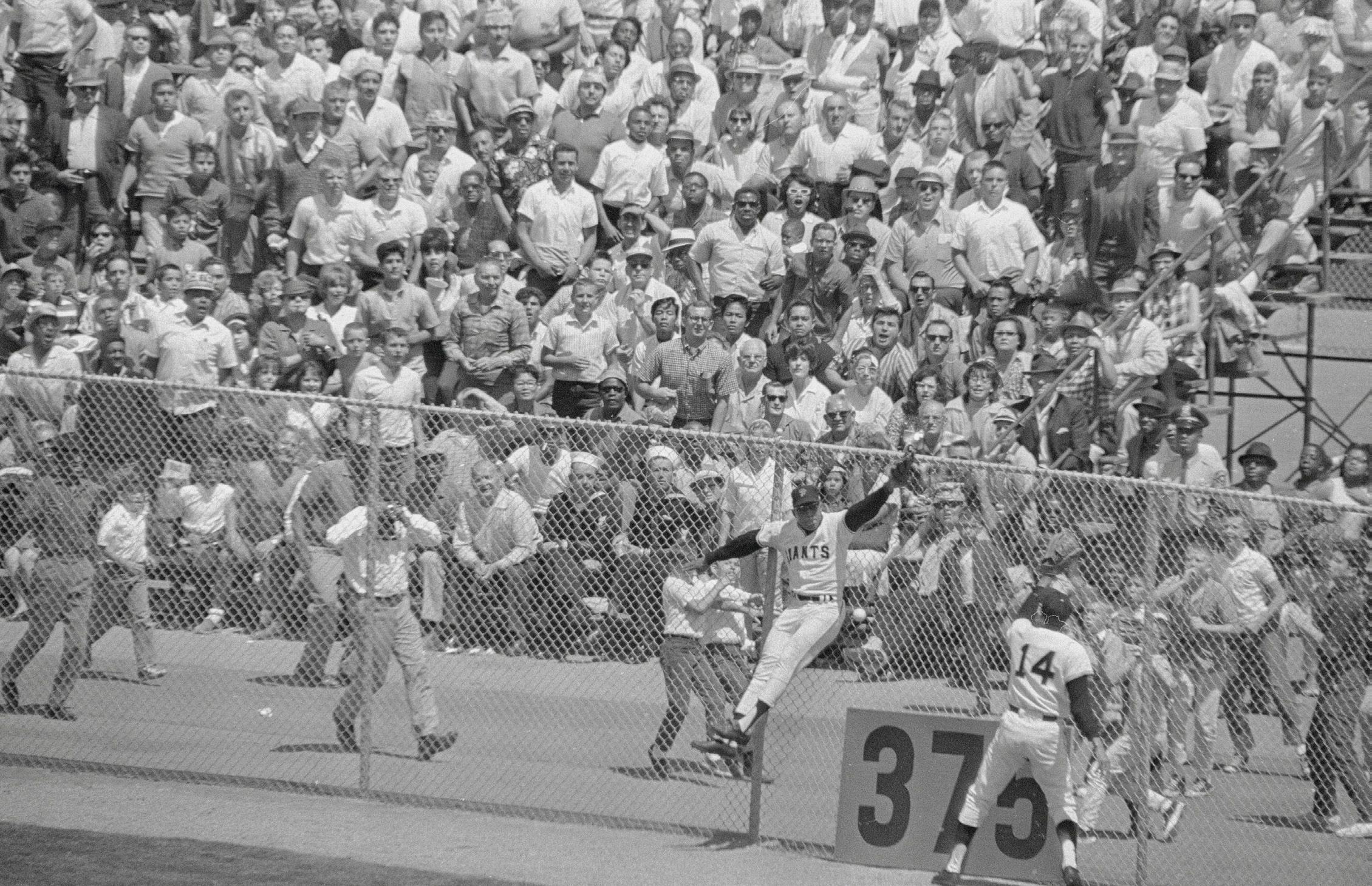
We could have spent this entire space glorifying the many on- eld accolades: the 660 home runs, the 338 stolen bases, the 12 Gold Gloves, the 7,095 out eld assists, the 24 All-Star Games, the famous catch of Vic Wertz’s tremendous drive in the 1954 World Series, the four-homer game, the 16th-inning homer that ended the incredible Marichal-Warren Spahn pitchers’ duel. On and on and on. But Mays is de ned by so much more than his numbers, which by the way would have garnered him far more than his two MVPs based on how players are valued nowadays. Consider the modern-day stat Wins Above Replacement, which measures a player’s overall
contributions. A 10-WAR season is dynamite. In fact, in the 2000s, only six position players amassed a 10-WAR season, and only two of those did it more than once: Barry Bonds (2001, 2002, 2004) and Mike Trout (2012, 2016). By comparison, Mays averaged a 10-WAR season over a seven-year stretch in the 1960s.
More than the stats, Mays’s legacy is his story of character and grace that has inspired millions, his athletic brilliance and joyful exuberance on the eld, his charitable causes and goodwill endeavors o the eld, his love of children, baseball and life, his honorable and exemplary life that makes him a treasure for all generations to cherish and embrace.
And, yes, his handshake, forever the rmest in the league.
TOP BASEBALL PLAYERS OF ALL -TIME 1
WILLIE MAYS
Source:TheBaseball100,2021
1. BABE RUTH 3.
WILLIE MAYS 2
MUSIAL
Source:ESPN,2022
John Shea is the national baseball writer for the San Francisco Chronicle, co-author with Willie Mays of 24: Life Stories and Lessons from the Say Hey Kid, a New York Times bestseller, and consulting producer of the HBO documentary, “Say Hey, Willie Mays!”
N E W Y O R K , Chapt 2
N E W Y O R K
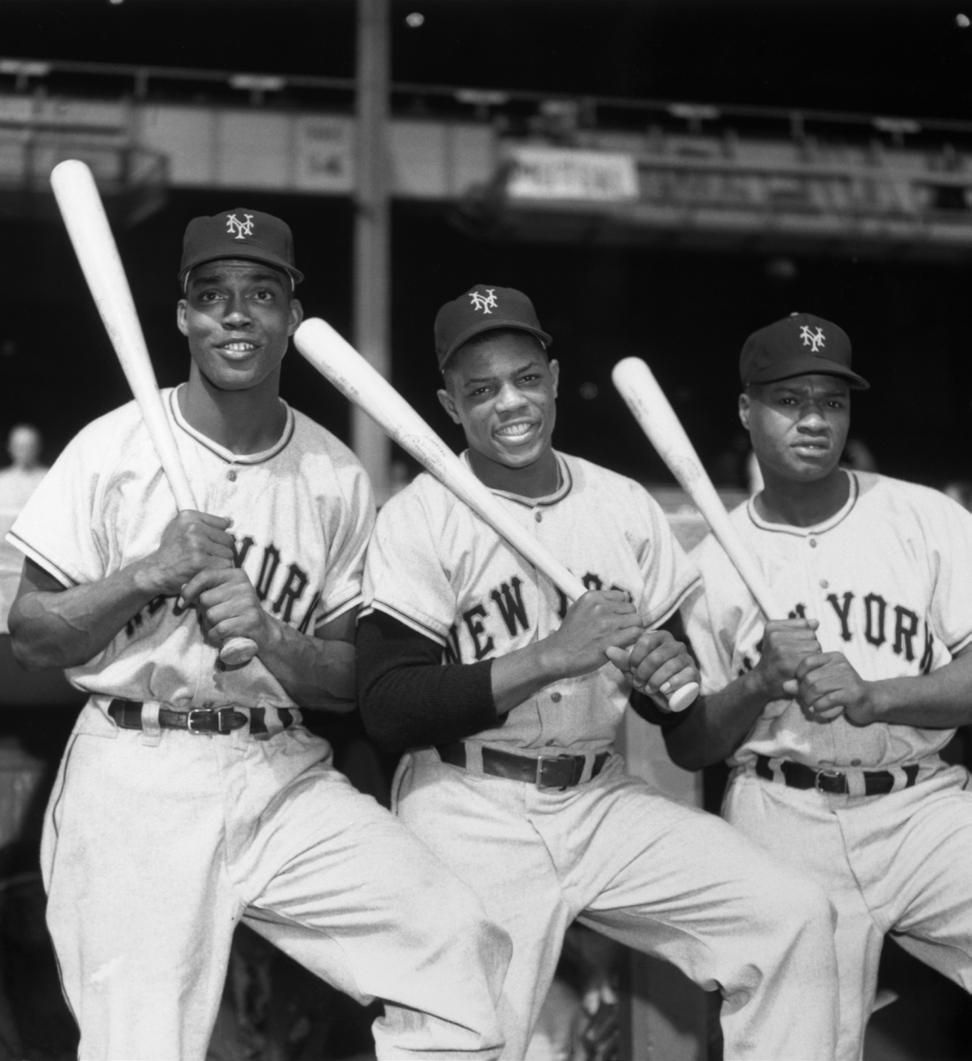
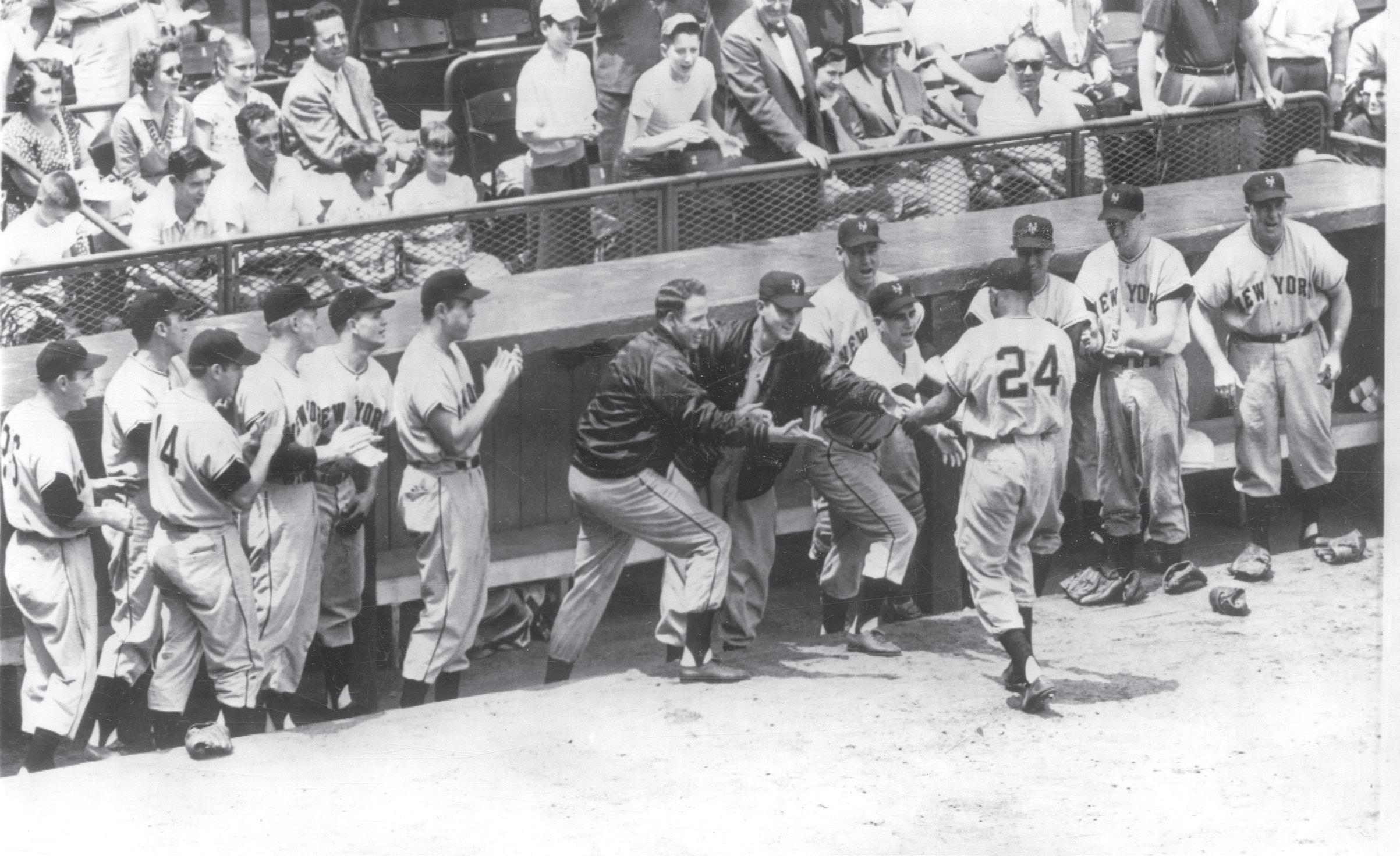
The darling of New York fans from the moment he smacked a towering home run into the Polo Grounds’ left-field stands for his first major-league hit in his first home game on May 28, 1951, Willie Mays’s mutual love affair with New York never waned.
WILLIEMAYS Amazin’
TNOVEMBER 1951
By Ed Fitzgerald
HE HARDEST THING for a writer covering sports to put his nger on is the quality that makes one athlete appeal excitingly to the instincts of the crowd while another of equal ability is accorded nothing more than the quiet respect which his talent automatically commands. It’s always easy to observe the gleeful responsiveness of the fans to the slightest action of a Dizzy Dean or a Mickey Cochrane or a Babe Ruth or a Ted Williams, and to say that the man is just naturally colorful. But it’s hard to explain why.
An exception to this common rule is the kid center elder of the New York Giants, 20-year-old Willie Mays. Yanked up to the Polo Grounds last spring after only one year and a month of experience in organized
Excitement trails this Giant rookie sensation as surely as thunder follows lightning. He’s armed with all the skills of a real superstar.
baseball, young Willie successfully blasted not only the out eld fences but also the blanket of boredom which had hung over the bitterly disappointed Giant fans for so long. e reason for Amazin’ Willie’s instantaneous and electric appeal to the crowd can be stated with marvelous simplicity.
He does everything the hard way.
One of the sensational rookie’s specialties is roaring in for those wicked low liners that so often skip o an eager out elder’s shoes for extra bases. Willie doesn’t miss many of them; he’s fast and he has good hands. But he gives everybody in the park heart failure before he nally collars the ball. Willie never catches anything. He grabs the ball, traps it, surrounds it. He
just naturally can’t do anything the easy way. But— and this is why the Polo Grounds customers think he’s going to be another Mel Ott—regardless of his technique, there isn’t anything he can’t do. Instead of knocking him for his lack of DiMaggio-type polish, they love him for it.
Take the day the Giants played the Cubs at Wrigley Field last June. Willie sizzled a single into the out eld and barreled down the line, rounding rst base in a cloud of dust, his cap blowing o (it’s always blowing o , and that’s part of the Mays legend, too) as he made the turn and put on the brakes. A good throw-in caused rst-base coach Freddie Fitzsimmons to screech for Willie to hustle back to the bag. Willie was willing but he insisted on pausing to retrieve his lost cap enroute, and he missed being tagged out by inches. at may have been rookie-foolish baseball, but the fans ate it up. It’s a sample of the kind of thing that has everybody talking about a Giant youngster for the rst time since Clint Hartung was over-ballyhooed into the league in 1946.
Everybody knows that Leo Durocher, the Giants’ manager, has a weakness for building up untried kids to the skies. But nobody even cracks a smile anymore when Leo declares aggressively that “ is is the best-looking rookie I’ve seen in 25 years of baseball. I look at Willie and you know what I think of? Pete Reiser when he rst came up. What could Reiser do then that Willie can’t do? Run? Okay, but that’s all. ere’s nobody in the league got a better arm than this kid. ere’s nobody got more power. ere’s nobody can go and get them any better than he can.” e tipo on Willie’s class is that Leo can make a statement like that unchallenged in a league that can boast of Ralph Kiner’s power, Carl Furillo’s throwing and the elding of such as Richie Ashburn and Duke Snider.
Leo isn’t the only member of the Giant family who likes Willie. e ballplayers are tickled with him, too. ey like his odd mixture of boyish naivete and brash con dence. ey laugh at his habit of opening every conversation with the words, “Say, hey!” Coach Herman Franks never calls him Willie, always refers to him as “Say, hey!” ey like, too, his utter fearlessness at the plate, where he has been tested by the toughest sharpshooters in a bean balling league. Willie hits the dirt as violently as anybody when the high and tight fast ball “gets away from the pitcher” and soars at his curly thatched skull, but he’s up in a second and back over the plate, waving his bat ominously and o ering no word of complaint. His teammates recognize that as the mark of a real professional, which Mays unquestionably is.
He ought to be since he hasn’t done much but play ball since he reached his growth. Willie comes from Fair eld, Alabama, a suburb of the steel city of Birmingham. His father earned his bread and butter working in one of the steel mills but spent all his spare time playing semi-pro ball. For a couple of years, he was good enough to play in the out eld for the fast
Birmingham Barons of the Negro National League and thus had the contacts to help Willie get a tryout with the big club when he began spattering base hits all over the neighborhood sandlots. Willie was a hot basketball and football player in high school, but the school didn’t have a baseball team. So, while he was still a schoolboy, the Mays kid did his ballplaying for the vaunted Barons. Until school closed, he played only the home games. en, for the rest of the summer, he played full time. In 1948, his rst year with the club, 17-year-old Willie got in 100 games and hit a solid .312. e next year, he proved it was no uke by belting the ball at a .311 pace. His father could hardly be blamed for regarding him fondly as a chip o the old block. His three brothers and ve sisters idolized him.
e next step in the youngster’s remarkable career was taken quite by accident. Two Giant scouts, Ed Montagne and Bill Harris, trailed the Barons in search of a good rst-base prospect. ey decided that the rst baseman was hardly worth any fuss but excitedly insisted that there was a baby center elder on the team who should be grabbed without delay. On the strength of that recommendation, and other supplementary reports equally favorable, the Giants paid Willie a bonus of $6,000 to sign a contract with their Trenton farm club. He was on his way.
Mays reported to Trenton in late June of 1950, moved into center eld right away, and hit a rousing .353. He didn’t appear to be a distance slugger, totaling only four homers, but his line drives over the ineld were stinging smashes frequently good for extra bases. He looked a little unpolished at times in the eld, which was only natural for a 19-year-old boy, but all the Giant experts were satis ed that he had the instincts of a born y-chaser. ere never was any doubt about his arm. When Willie rears back and pegs that ball in from the pasture, it doesn’t pay to get in the way. He can match the best in the majors—the Furillos and Kennedys and Marshalls—in that regard.
On the strength of that .353 batting average, Willie was noti ed that he would be promoted to Minneapolis of the Triple-A American Association for 1951. Pleased at the prospect, but eager to improve himself and hungry for a few extra dollars, Mays laid plans to play winter ball with the Almendares club in Cuba.
“Except,” he says, “when I got over there, a couple of fellows from the Giants got on Mike Guerra, the manager, and me, and said I couldn’t play. I guess they didn’t want me to get hurt or anything. I asked Guerra to send me home, if that’s how it was going to be, but he kept thinking maybe his boss could talk the Giants out of it. e way it wound up, I never played but I got a two-and-a-half-month vacation. It sure was nice there.”
It was nice for Willie in Minneapolis, too. He knocked the cover o the ball practically every time he got up. When the Giants agged him for the expectedly sudden jump to the big time, in late May,
he was the proud owner of a spectacular .477 batting average. No wonder Horace Stoneham and Leo Durocher, their bright pennant hopes of the spring dragging in the dust kicked up by the high- ying Dodgers, were willing to take a chance on Mays. Willie was playing in Sioux City, Iowa, when the summons came. He boarded a plane in a matter of hours and was whisked to a meeting with the Giant brain trust at the Polo Grounds.
Owner Stoneham grins when he recalls that serious session. “I said to him, ‘Willie, they’re going to try to nd out about you fast up here. ey’re going to try you out with pitches at your cap.’ And he looked right at me and said, ‘Mister Stoneham, when I played in the Negro league, they threw at me, too. Only it
didn’t count when they missed hitting me.’” It’s easy to tell from Horace’s expression that he thinks the Alabama boy is the real thing.
ere was the expected amount of disbelief in the press when Mays promptly entered upon a long period of frustration at bat. He didn’t get a hit for the Giants in his rst 13 times up. at was in a series with the Phillies at Shibe Park. en the ball club returned to New York and, after getting one home run in his next 13 at bats, Willie began to sight the range at the Polo Grounds. It wasn’t a strange place to him; he had played there many times with Birmingham. Despite the growing note of skepticism, there had been a great deal of copy about him in the newspapers and
the anxious Giant fans were rooting for him to show them something. What he showed them, in his rst game at home, was a towering home-run blast into the left- eld stands for his rst major-league hit. As he sped around the bases in his busy fashion, they stood up and shouted their heads o . ey had been waiting for Willie. It was a case of love at rst sight and the a air has grown hotter ever since. e parents point out Willie to their kids when they spot him on the eld during practice before the game. ey speak of Willie’s youth and his raw power. ey chuckle over his furious tackling of y balls. ey spin tall tales about the ferocious strength of his throwing arm and sit back smugly as Willie makes them look good by exploding a bullet peg to nip a foolhardy baserunner daring enough to try for the extra base on him. Willie is their boy, their one big hope to revenge the bitter humiliations that have been heaped upon them by the hated Dodgers.
When you consider the number of times the long-su ering Giant supporters have been disappointed in touted rookie phenoms, hopefuls like Johnny Rucker and Bill Ayres and Clint Hartung, Monte Kennedy and Jack Harshman and Tookie Gilbert, you can understand the tremendous a ection they have for Mays. He didn’t let them down. He has made it possible for them to borrow a page from Brooklyn’s old book and “wait till next year” with a reasonable amount of con dence.
It’s a good thing for his future prospects that Mays hasn’t let all the applause go to his head. e ve-foot, ten-and-a-half inch, 175-pound Negro is all ballplayer. He’s no playboy. During the season, Willie lived quietly with a family in Harlem. He shies away from the spotlight. “I don’t like being asked to make appearances,” he says. “I can’t go to a airs and play ball, too.” Willie’s idea of a good time on a day o is to go down in the street, nd a bunch of kids, and play a pick-up basketball game in the nearby schoolyard. He thinks the Giants have treated him ne but he wishes they would let him play a little pro basketball during the winter. He loves the game. e Giants, however, love Willie and they don’t want to take any chances with the soundness of his limbs. ey want him back in one piece when it’s time for the big get together at Phoenix in the spring.
Good-looking and amiable, Willie would be a great catch for some nice girl but he claims he isn’t even thinking of getting married yet. He may change his mind after he spends some time around his old hometown, where he is certain to be a hero with a capital H. Willie still lives at home, in the middle of the large Mays family group.
He feels deeply indebted to his father for the helping hand that got him started on his career, and it was a source of much satisfaction to him that both his father and mother were able to drive the 500 miles from Birmingham to Cincinnati (in Willie’s new car) last July to see him play for the Giants. Asked what kind
of a day he had, Willie mumbled, “All right. I hit Ken Ra ensberger for a home run and a couple of singles.” You could hardly call Willie the silent type because he’s the life of the party around the Giant dugout. But he’s still new enough in the majors, and shy enough, to be anything but free with conversation about himself. It’s obvious that he doesn’t want to be labeled a popo , which he certainly is not. He was accused, o and on during the season, of showboating in the out eld. But there is good reason to reject this theory in favor of the simpler one that Willie is constitutionally incapable of making a play the easy way. It’s a sight to watch him circle under a y ball, making up his mind how he ought to attack the problem of bringing it back alive. Few of the writers traveling with the team seriously thought that Willie was deliberately making his chances look hard. Willie is too smart to fall for that. He likes it up in the big league, he likes the people and the pay and the food and the game itself. He wants to make sure he stays there. at he will stay up seems a foregone conclusion. After he nishes barnstorming with Roy Campanella, Monte Irvin, Larry Doby, Don Newcombe and some other colored ballplayers this fall, he’ll take a good rest in Alabama and get in shape for an all-out e ort in his rst full year with the Giants in 1952. He ought to be in line for a pleasant raise from owner Stoneham, who can hardly overlook Willie’s dynamic combination of baseball skill and drawing power. You can be sure
Willie won’t overlook it. He may be only a youngster but he has his feet on the ground. Leo Durocher tells of a day at the Polo Grounds last June when an advertising agency representative was signing up all the Giants for an endorsement deal. Each of the players was to receive an expensive clock for cooperating in the scheme.
“I called him over after he had signed a paper for the fellow from the agency,” Leo recalls, “and I said, ‘You know, Willie, you have to give that clock to me.’ Willie cocks his head to one side the way he does and says, ‘Who say that?’
“‘Why, Willie,’ I told him, ‘Don’t you know all rookies have to give those things to their managers?’
“But Willie stopped me fast. He didn’t pay any attention to me at all, just turned to the agency fellow and asked him, ‘ at in the contract?’” Leo laughed, remembering. “So don’t you worry about him,” he said. “He can take good care of himself. ere’s no doubt about that.”
e main thing the Giants’ rooters are interested in is Willie’s ability to take care of himself with a bat in his hands, and they are counting on him to make it clear next season that there isn’t any reason to worry on that score. Characteristically, Willie himself is loaded with con dence.
“It’s not hard,” he said earnestly. “When I’m not hittin’, I don’t hit nobody. But when I’m hittin’, I hit anybody!”
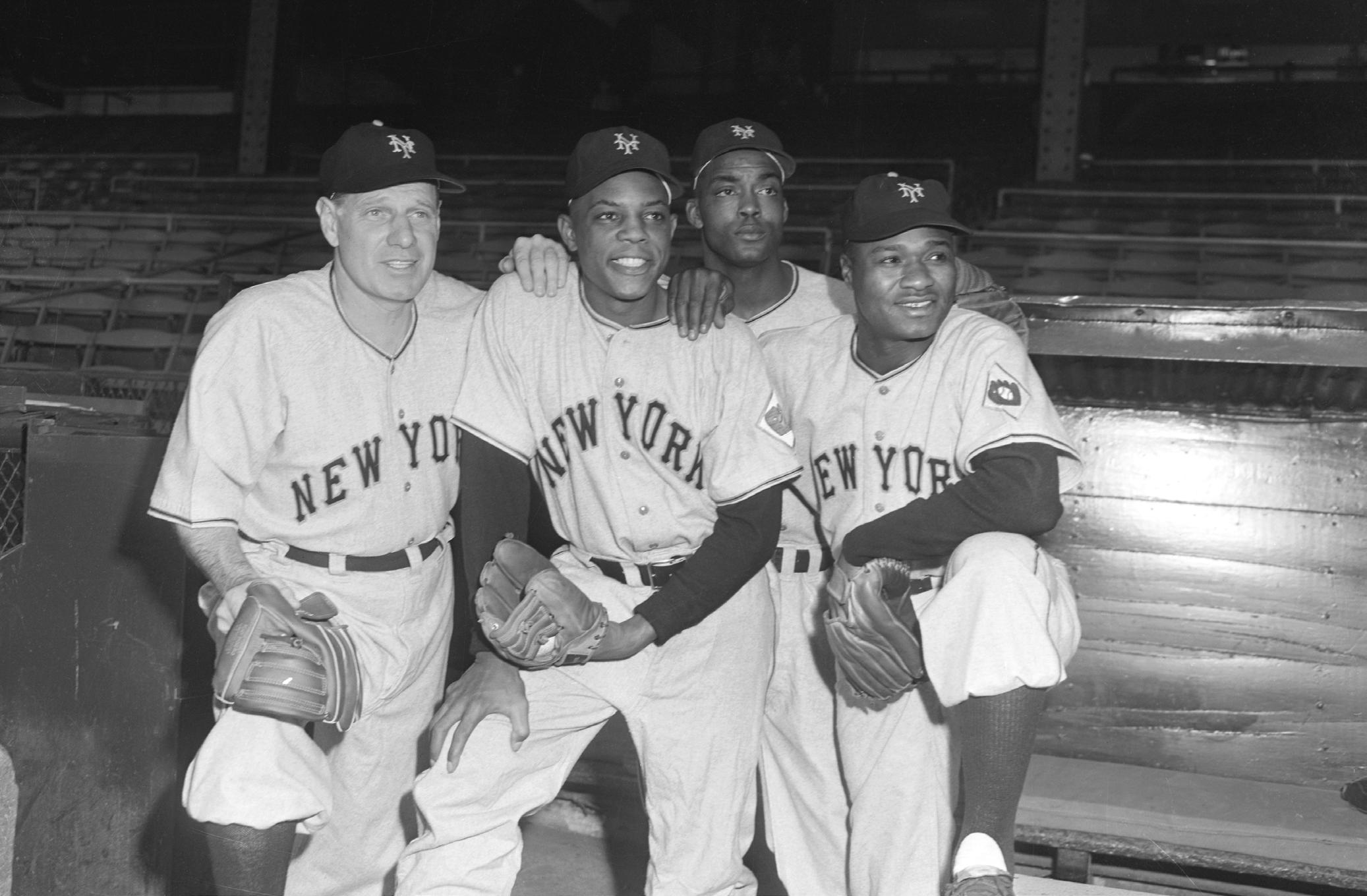
With Horace Stoneham and Leo Durocher.
IS THERE A WILLIE MAYS? IS THERE A WILLIE MAYS?
The Giants’ laughing boy is already a full-blown legend, the gaudy hero of such a fantastic build-up it’s hard to believe he really exists. Here’s the truth about the hottest name in the game.
GOCTOBER 1954
By Irv Goodman
ARRY SCHUMACHER , the Giants’ public relations man, tells a story about Willie Mays returning to the Giants last March right a er his discharge from the Army. Willie ew into Phoenix, where the Giants were training, and Schumacher was at the airport to meet him. A er the young out elder got o the plane and they exchanged greetings, Garry picked up Willie’s two identical suitcases. One was heavy, as a packed bag should be; the other was so light Schumacher thought it was empty.
“Willie, what the hell you got in these bags?” Schumacher says he asked him.
“In the heavy one I got all my clothes,” Mays told him. “In the other just my glove and jock strap.”
Schumacher swears this is a true story, and he tells it to show that Willie had “come to play,” to use Leo Durocher’s overworked pet phrase. It helps to point up, Garry said, what kind of a kid Willie is.
But Willie Mays, who is only 23 years old and several weeks away from completing his rst full major-league season, has already been pointed up in hundreds of stories and what must be thousands of newspaper and magazine articles, all “showing” the kind of kid he is, the wonders he performs, the grip he has on the baseball public. He has been pointed up and built up and encased in so many personal shrines that who knows, once you tote it all up, who and what Willie Mays is? He is so very young to be a man and legend both that you
keep forgetting—or just plain don’t know—whether he is fact or ction. If ever there was one, this is a tall tale of baseball heroics told in many parts and played to many di erent tunes. But when you stop long enough to think about it, you have to ask yourself if this playful, laughing boy from the steel-mill country of Alabama can possibly be all that the stories say he is?
Most everybody—expert, fan or Ladies Day visitor—ends up saying yes, he can be, and certainly is. And each has a story or two to prove it.
If it is his elding or his arm that is up for review, there is always the story of the impossible catch and throw he made to nail Billy Cox at home plate the season before he went into the Army. (“ at was the perfectest throw I ever made,” Willie says.) Or the time this season in St. Louis when Stan Musial belted one into right center—more to right than center, actually—and Don Mueller, making the play, ran along the base of the wall and took a leaping stab at the ball and missed. But Willie somehow got between Mueller and the wall and caught the ball. New York sportswriter Harold Rosenthal called this (and several of his other catches) the sort of thing that should be expected only from a young mountain lion.
Only Joe DiMaggio, says Jimmy Cannon of the New York Post, “had more natural grace and superior instinct to anticipate a ball’s ight by a system of calculation that can’t be de ned and never taught.” Willie’s skills at running down y balls have done well in comparisons with the talents of all the great defensive out elders—Terry Moore, Dominic DiMaggio, a long list of old-timers, and Johnny Cooney, who, some people still remember, used to climb walls at Ebbets Field.
When it comes to hitting we have the word of Leo Durocher that someday Willie is going to hit one into the center- eld bleachers at the Polo Grounds, a drive from start to nish, of some 500 feet or more. Until then, we can always settle for Tom Sheehan’s favorite Mays shot. It was in Pittsburgh, and Leo told Willie to go up there and hit.
But a er the pitcher, who was very wild, gave him three balls, Herman Franks, coaching at third, waved Mays the take sign. “One man tell me to hit and the other man tell me to take,” Willie said when he got back to the bench. “I didn’t know what to do.”
“He knew what to do all right,” Sheehan says. “He swung on the next pitch and hung it on the right- eld wall for three bases.”
Or, if you like, how about the shot he unloaded on Opening Day to the upper deck in le eld just over the 447-foot sign at the Polo Grounds? at one beat the Dodgers. e ball was hit so hard, says veteran columnist Frank Graham, that it was still roaring when it crashed into the seats. Frank, who usually takes the old school’s let-him-have-ten-years-
or-so-to-prove-it view of young upstarts who are trying to beat the time of the masters of the Roaring Twenties, has called Willie “the most exciting and the ablest ballplayer” to come along in a long time.
e endless and varied praise poured on the handsome head of Willie Mays has not been only for his hitting and elding and running. Words have tried to capture his qualities as a good-luck charm for his team, a drawing card for his bosses, an inspiration for his teammates, a tonic for his manager and a St. George for his fans. Sportswriters, working hard to explain—or at least pin down—the dynamic quality of the boy that has set him apart from and above the rest, have called him the glue of the Giants, the spark, the magnet, the breath, the heart. Some say he has the color and spark to be the greatest drawing card since Babe Ruth. Others say he is the very meaning of baseball, the unbounding joy, the innocent muscled youth that makes the game a constant American theme. Whatever the words they use, they all seem to be infatuated with Willie. Such a condition, linked as it is with actual heroics, makes it easy to build a myth but di cult to get to know the man behind the myth.
To get to know Willie Mays, to nd out in fact if there is a Willie Mays behind the swelling legend, you should arrange to sit down with him in the Giants’ clubhouse. e place is old and wooden, and liniment oils seem to clear the air of unbounded hero-worship. Willie, sitting in front of his locker, wearing only shorts, shower slippers and his baseball cap, makes you remember that he is only 23 and just beginning to nd his way through to manhood. He is easy to talk to, if the subject is baseball or the Giants, but he is not communicative. He doesn’t tell you much, he has no
anecdotes to pass along, he can’t remember all the details of his more stirring exploits. You get to know him and learn things about him because his emotions are on the surface, showing through his face and eyes and quick smile. You look at him and you can almost tell what he is thinking. You ask him to tell about a recent great play and he starts talking, then suddenly stops as if he is thinking the rest of it to himself. He can’t get to nish the experience for you.
He tells you he always wanted to be a ballplayer, as long as he can remember. “My father was a player,” he says, “and he wanted me to be, too. His name was Willie Mays, just like me.” Yes, he says, he sends money home regularly to his father, who works in a Birmingham steel mill (the family lives in Faireld, Alabama, where Willie was born). e money is for Willie’s nine younger brothers and sisters. eir mother died a year and a half ago giving birth to the youngest. “My oldest sister, she nished school and now she’s the mother.”
Willie can never get far enough in a conversation to tell you but his father was a competent sandlot out elder. ere was for Willie from the time he was seven the steady baseball instruction that has become such a commonplace in baseball biography. “I never played anywhere but center eld,” Willie says. “You can relax out there. In the in eld there are too many problems to worry about. I like room.”
As you are talking the clubhouse man comes over to ask if it is okay to give one of Willie’s bats, autographed, to an invalided youngster.
“Man, what’s the di erence,” Willie says to him. “I can only use one of those things at a time.”
You watch as he signs the bat because you are curious about his handwriting. You remember in early 1952,
when he took his service exam, he unked the aptitude test. He was a high school graduate and, you learned later, nished in the top half of his class. He passed the exam when they made him take it again but much of the libel that Willie “was no Einstein” remained. Here, watching over his shoulder as he wrote on the ash in a series of rm, swi strokes, you saw a legible and handsome signature.
You ask Willie how the Giants are going and all he says is, “Man, they’re goin’ good,” but he has a big smile on his face and you can tell he’s thinking about speci c moments that prove to him they are going good. But, again, he doesn’t tell you. It is something he enjoys but can’t pass along.
You ask him who he thinks is the best center elder in the league and he says, “How can you ask me a question like that? I can’t answer it.” e way he says it and the sparkle on his face as he tries to scold you for putting him on the spot tells you that he is thinking he is—but he’s not about to admit it out loud in public.
Whitey Lockman walks by and Willie yells at him in his scratchy boy’s voice, “What time we batting?”
“I don’t know,” Lockman answers.
“Why not? You’re leado man.” ey smile at each other.
is rapport between Willie and his teammates goes on continually. Willie will yell across the clubhouse, something like, “Hey, you big banjo hitter” or “What are you doing still hanging around in here?” en he’ll roar a big, infectious laugh and his teammate will laugh back.
Sal Maglie, who is the day’s starting pitcher, is reading a paper in the outer room that might be called a lounge if it had anything besides hard-back chairs to lounge in. Willie comes dashing through the room, half-naked and laughing. Sal hears him and his grayblack face breaks into a so smile.
You learn later on, if you ask around, part of what Willie means to these teammates of his. ey don’t tell you themselves, not in words. Maybe it is because they are grown men and feel slightly self-conscious in public about taking an emotional lead from a boy. And maybe it is because their athlete’s temperaments and minds aren’t suited to emotional language. Physical action expresses their feelings better. e Giants use their muscles to express their a ection for Willie. ey snap at his bare body with towels, wrestle with him, bear-hug him from behind.
Sometimes, when he is taking a shower a er a particularly good win, they wait for him to nish drying o , then squirt him with cans of instant-shaving lather. Willie will scream with laughter, then dash back to the shower, swearing that they better not try it again. When he comes out and dries himself, they spray him all over again. Willie thinks this is great fun.
Once, a er a great Mays catch saved a ball game, Monte Irvin, his closest friend on the team, grabbed Willie in the shower room and scrubbed his butt with a coarse-haired oor brush. Willie roared with laughter throughout the ordeal, and the rest of the team, witnessing the byplay, ate it up.
Laughing with manager Leo Durocher, 1954.
Willie, the Giants players tell you, is good for what ails you. Whether he is the butt of their jokes, which is o en, or working a gag of his own, he never fails to break up the clubhouse.
Whenever he goes on the road, Willie takes along a portable phonograph and his teammates always hide it on him. Once, at the airport, coach Herman Franks hid it, expecting Willie to explode into a frenzied search, which he usually does. is time, though, Willie matter-of-factly noted its absence and quietly boarded the plane, apparently content to take o without it. A er everyone was on board and the plane was about to leave, Franks came running across the eld and onto the plane, lugging the music box.
is was for Willie and his teammates the best possible joke. Franks’ trick had back red. e twist brought down the house.
Most of the players and Durocher like to play pepper games with Willie. ey bet Cokes on who will make the most errors and Willie always loses. It never fails. e batter, who is in on the gag, hits hard, slashing grounders to Willie, easy one-hoppers to his opponents. e game has become something of a daily ritual. Willie owes Durocher alone several thousand Cokes but he keeps playing and losing and enjoying every minute of it.
No Giant player tries to argue the validity of the proposition with you. ey know that it is superstition and that it is fed by the experienced hand of Leo Durocher. But whatever it is, it holds up, they say. In the rst nine games that Willie hit homers, the Giants came up with eight victories. en there is the signi cant point that from the day Willie joined the club in 1951, it caught re. e day he le in 1952, the Giants were in rst place by three games. Without Willie, they lost three in a row to Philadelphia and never got back on the beam.
“While Willie was away,” a member of the Giant front o ce said, trying to explain the superstition, “not a ball dropped that a pitcher didn’t say Willie would have had it. It’s easy to go from the con dence they have in him to a formula of victory based on Willie’s coming through.”
“Being without Willie,” Durocher says, “is like the old Gas House Gang without Pepper Martin. Willie’s the heart and soul of the ball club.”
"Being without Willie is like the old Gas House Gang without Pepper Martin. Willie's the heart and soul of the ball club."
Another common stunt the Giants pull on him is the “silent treatment.” He’ll come into the dugout a er making a spectacular catch and squeal to Durocher, “Did you see that, Skip? Did you see it?” And nobody will answer him. Willie will turn on a brief look of hurt and amazement, then suddenly burst into laughter.
Late in the summer of 1953, a er he had hurt his ankle playing service ball, Mays came into New York on furlough. He walked into the Giant dressing room for the rst time in over a year and the players looked at him, then turned away. Someone nally yelled out, “Where you been?”
“You know where I been—in the Army.”
“Oh.” And they turned away again. Willie’s shriek of joy at the joke blew a few cobwebs from what was by then a slumping ball club going nowhere.
Behind the slapstick and the playing, though, is a strong feeling that Willie makes the team win. If he hits a home run that puts the Giants ahead during a game, the team feels that the red board will stay lit. If Willie makes a great catch or throw, it means ultimate victory.
But Willie Mays is more than the heart and soul of a baseball team—or a magnet or glue. Willie’s a boy, and to nd out about this boy, try visiting Harlem, where he rooms with an elderly couple whom he has adopted as “my godparents.” Go to the neighborhood around St. Nicholas Avenue where he plays ball with the kids. Here you learn that Willie prefers most the company of people his own age.
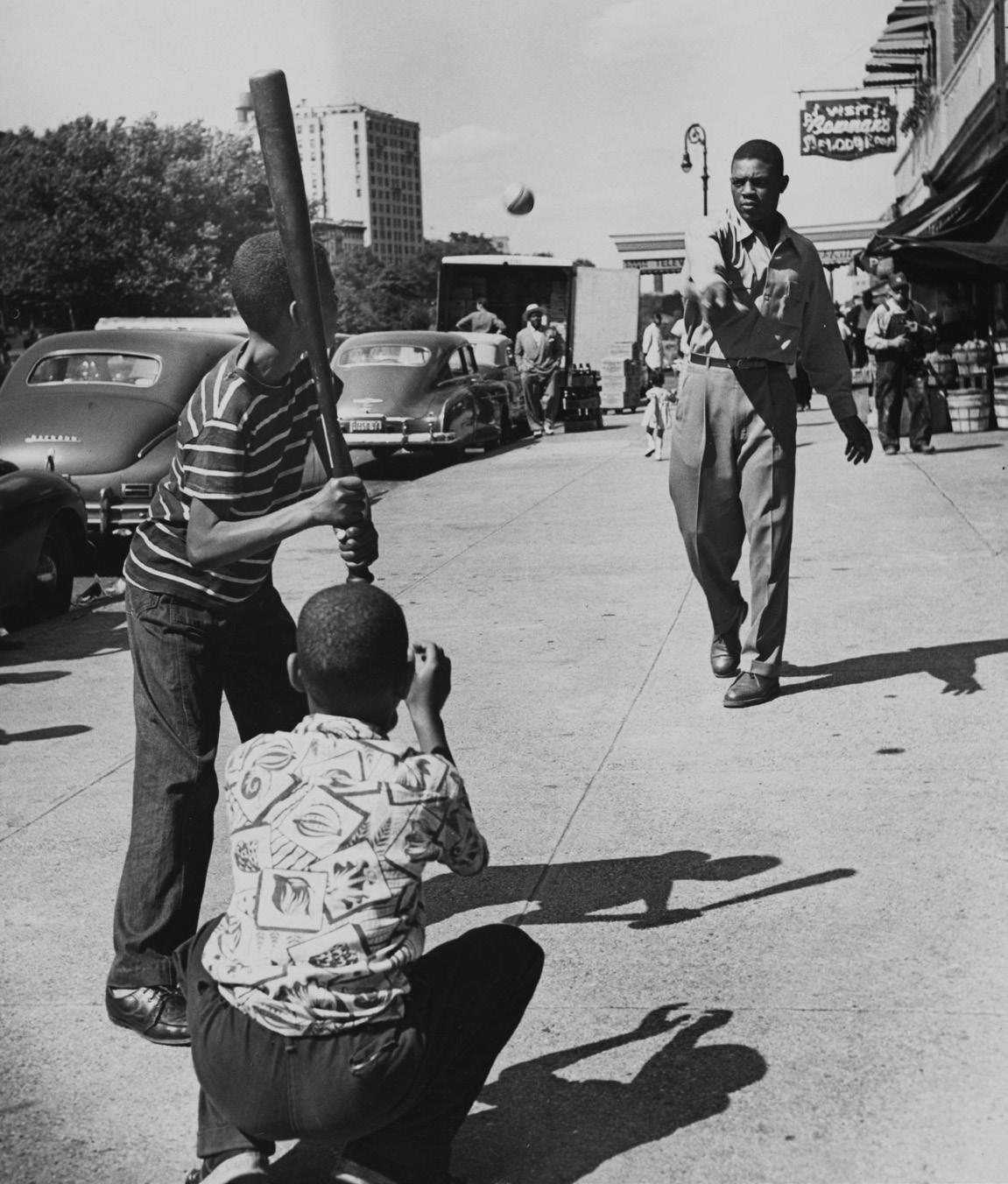
When he rst joined the Giants, there were stories about him leaving the Polo Grounds a er a game and playing stickball with the kids on his block. “I still do,” Willie says. “It’s good for my batting eye. If you can hit that little ball with a thin stick, you can sure hit a baseball with a big bat.”
ere’s more to it than that. Willie likes to play in the street, whether it’s stick-ball or hop-scotch or, for fun, follow the leader. One time the kids were playing on the street when a cop came along and chased them, all except Willie, who just stood there. e corner bootblack asked the cop why he chased the kids.
“I have to,” the cop answered.
“But they were playing with Willie,” the bootblack said.
“You’re kidding,” the cop said. “I thought he was just watching them. I’m sorry, Willie.”
When the cop le , the bootblack bawled Willie out. “All I do is shine your shoes. You play a little, I shine. You play some more, I have to shine them again. Why can’t
you keep a clean shine?”
Willie didn’t answer him. e kids were back by then and he went out into the street to play some more.
Before he went into the Army, Willie would take the batboy out into center eld and play “bat and ball” while the benchwarmers were taking batting practice. Or he’d play with Larry Jansen’s young boy Dale or Chris Durocher or any of the other youngsters around.
One of the changes in the young man is that he doesn’t do this anymore. You have to keep up certain appearances in the majors, he says, and he wouldn’t look like a major-leaguer to the fans if they saw him playing with the kids.
Today Willie makes about $15,000 a year, drives a yellow Lincoln convertible, and owns some expensive clothes. But there aren’t many other changes. He still goes to bed between 10 and 10:30 p.m. a er a day game. His only interest is baseball. He still eats only “good food” and listens to mamba records.
ere is a bit of the ham in Willie. At least, he has an appreciation for the dramatic air. Whenever he has been on TV, he has been loose and smiling. e cameras don’t frighten him. And neither do reporters. During an interview with him, you can’t shake the feeling that he is playing up to you. He’ll jump up suddenly to whisper something to Hank ompson and they’ll both laugh. Or he’ll lean over and give Don Mueller, who dresses nearby, a whack on the back. You could call it showing o , except that on a boy it looks both innocent and
good.
is boy you meet and like, whether it is in a baseball clubhouse or a Harlem street, means most to real, dayin, day-out Giant fans. e Willie Mays that exists for them is part Prince Valiant, part the dead Giant heroes of the past and part Peter Pan. Giants fans, as those who have been around them long enough know, are di erent. ey root for their team di erently, they su er, plan and dream di erently. ey go to the Polo Grounds and sit and dream of John McGraw. ey live in the past and it is the Meal-Ticket and Matty and Master Melvin for them. For some time now, they have been in dire need of a hero, someone to give them what Brooklyn has had in Jackie Robinson, what the Yankees had in Joe DiMaggio, what Cleveland had in Lou Boudreau.
Willie Mays lls this need. Nothing he does fails to excite them. Running in his loping way, slightly bowed at the knees, his shoulders swaying from side to side, he stirs the crowd. A simple catch of a routine y, made only the way Willie can make it, at the belly with a ick of the glove, moving only at the last moment to snare the baseball—this provokes loud cheers from Giant fans. at he has bobbled a few of these one-hand catches doesn’t seem to bother them. Probably no other player in the game today attracts as much concentrated attention as Willie does while he’s at bat. Baseball purists watch every move of Stan Musial or Ted Williams in the batter’s box. Mickey Mantle and Duke Snider can excite with a bat in hand. But none of them are as constant as
Willie. Frank Graham probably explained it best of all when he wrote last summer, “ ere’s no such thing as getting used to the guy.”
One very special Willie Mays exists in the head of Leo Durocher, but it isn’t easy to discover just what this one is made of. Building a baseball myth is something Leo does well. His enthusiasms run hot and cold, and he has heaped extravagant praise on so many that you can never be sure how much of it he believes himself.
Yet, armed with a wary approach to the balding but dandy little manager, you still get the feeling that Leo has a strong sentimental attachment to Willie. It is doubtful if Durocher has ever had the feeling before. He’s not the type for it. But in many little ways he indicates that Willie is his favorite. He always kids with him in the clubhouse, plays catch with him during practice, talks to him on the bench. Players tell you that Willie can get a smile out of Durocher even in his darkest moments. Leo will come back to the bench a er a blasting session with the umpires and Willie will ask him, “What did you tell them, Skip?” And through the burning red face and seemingly frozen scowl comes a smile.
To the other Giant players this is perfectly understandable. Not only do they display no rancor at Leo’s obvious preference for Willie, but they take the reasonable attitude that since the boy is their favorite, why shouldn’t he be Leo’s, too?
the greatest.” ere was to Durocher no contradiction in these statements. On strictly baseball terms, he was giving Snider the nod. To Leo, Willie’s value can’t be measured in standard baseball terms.
“Look, his arm is the best. (Carl) Furillo’s is probably as strong but nobody gets the ball away as fast as Willie. e only thing you have to wait on with this kid is his batting average. We can wait.
“No, he’s no threat to Ruth’s 60 home runs. Willie pulls but not down the line like (Mel) Ott did or Dusty Rhodes does now. He hits them to le center, even center, and they go a mile.”
When Mays came up to the Giants in May of 1951, he had a reputation as a line-drive hitter with no apparent home-run tendencies. He hit 20 homers in 1951 in 121 games. is season he hit his 20th in his 62nd game, and had 31 by the All-Star game break. Some people think that Willie’s home run hitting might eventually hurt him. He is swinging too hard, they say. But some people said he couldn’t hit to right eld and Willie has been spraying hits in that direction all season.
“Willie can do everything. He is absolutely the greatest. I know there’s (Duke) Snider and (Stan) Musial but I admit nothing. Duke is having his greatest year and is probably the best player in the game right now. But Willie is the greatest.”
Durocher was asked how good Mays really was, what aws, if any, there were in his baseball. “I won’t criticize any of my players,” Leo said, “only praise them. But I’ll tell you how good Willie is. He’s the best since Joe DiMaggio.”
“Since?”
ere was a studied pause. “Yes, since. Joe was a great player, too.”
“Would you trade him?”
“Not for anyone playing the game today. Willie can do everything. He is absolutely the greatest. I know there’s (Duke) Snider and (Stan) Musial but I admit nothing. Duke is having his greatest year and is probably the best player in the game right now. But Willie is
e biggest criticism about his batting was that Mays showed a strong tendency toward streakiness. is was true in the records in ’51 and it was true early this season. He hit two homers o Carl Erskine in the rst week of the season, then got only one in the next 14 games. He hit ve in the next nine, followed by none in the next six. Back on the beam, he homered eight times in nine games only to go blank in the next nine. On a hot streak again, he hit six in his next ve games.
His batting average followed the same pattern. When he was on his rst homer streak, his average went from .280 to .330. en, during the homer drought, it dropped to just below .300, only to go up 25 points in the next two weeks.
It was during a hot streak in June and just before a big series with the Dodgers that Willie hit a two-run homer (his 24th) to give the Giants the lead over the Cubs. at same night the Dodgers, who were a game behind the Giants, were playing St. Louis at Ebbets
Field. When the two runs for New York were posted on the scoreboard, the public address announcer said: “I think you’d like to know that it was Willie Mays who hit that homer.” e announcement brought a roar from the fans but a er the game the Dodger players revealed that they were slightly annoyed with the announcement.
“What do we care what Mays is doing?” Robinson said.
“I wonder if they announced over at the Polo Grounds that Snider had extended his hitting streak to 16 games or that Erskine won his eighth?” Pee Wee Reese asked. It was later learned that the announcement was made on orders from Dodger president Walter O’Malley, who is both a baseball fan and a keen business man. It was an obvious build-up to the coming Dodger-Giant series.
It also added fuel to a Mays vs. Snider debate that burned furiously but brie y in June. ere had been, all during the early months of the season, complaints by Dodger writers that Mays was being praised for catches that Snider made as a matter of course. Some even said that if Snider played on a team as void of stars as Mays does, he would be called better than DiMaggio. e June fury, however, lasted only a few days, or until the interborough series was concluded. e result of the heavy debate was general agreement that (1) Snider had much more poise than Mays, (2) that Duke couldn’t be the spark that Willie is, even if he had the temperament for it, and (3) that compared on a basis of comparable points in their careers, Willie was ahead of the Duke.
A more appropriate debate, according to some baseball observers, was Mays vs. Clint Hartung.
When Hartung’s name was mentioned to Durocher, he blew up. “How can you compare the two? Talent makes the di erence. Hartung had none. Willie’s loaded with it. ey ballyhooed Clint into a position where he had to be fritzed because he couldn’t really play ball. No publicity in the world can hurt Willie. He’s got too much talent.” is referred to the large amount of publicity that Mays has been subjected to since his return from service. He had to come through, the papers said last spring. Many people wondered if the Giants hadn’t built him up too much. Were they expecting too much from him? e build-up, as far as the Giant front o ce was concerned, was a must. A er the foldup in 1953 and the serious slump in attendance, they needed a big publicity campaign. ey had to get the crowds back somehow. ings were so bad this spring that people close to the management insisted that Durocher would have to win, would have to at least start fast, to keep his job. At the season’s half-way point, Giant attendance was way ahead of 1953, thanks to two Dodger series that drew 100,000 each—and thanks to Willie Mays.
Whatever it did for the Giants, the build-up didn’t hurt Willie. Of course, he was a ected some by the ballyhoo. Anyone would be. But it is fair to say that the limelight hurt Willie less than it would most athletes.
Essentially, Willie is a kid who plays baseball for fun. Take the Giant uniform o his back and send him back to Fair eld, Alabama, and you won’t change him. He’ll still express happiness by catching a y or hitting the ball. He’ll still love playing, and the people who know him will still love him. What more can you ask of any human being?
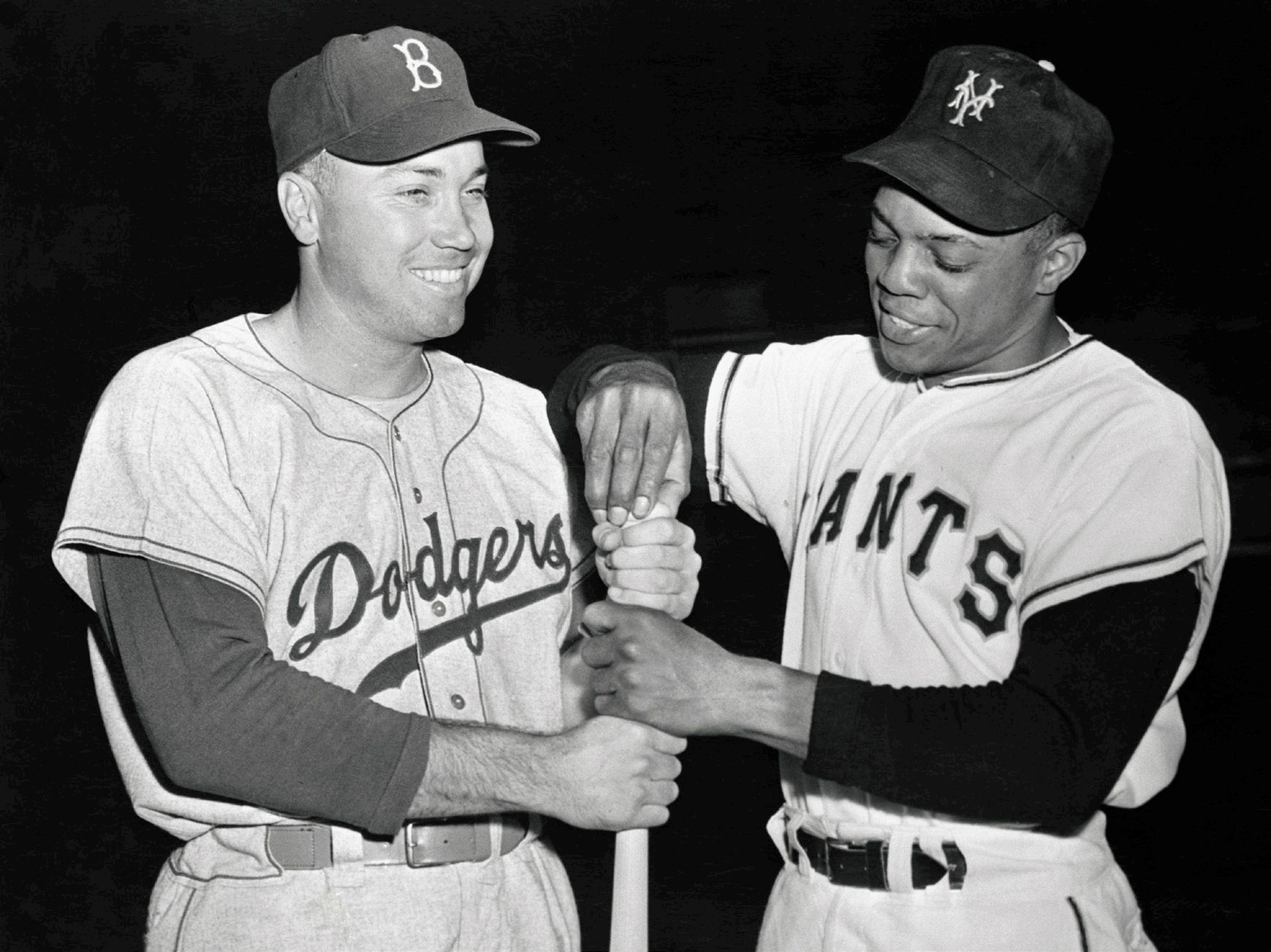
With Duke Snider, 1954.
W I L L I E M A Y S I L E A S THE BEWILDERING WORLD OF
It’s been a hectic five years for Mays. He’s had it all— sudden stardom, unbridled worship, bitter raps. The wonder of Willie is that he’s done so much so well.
MJUNE 1956
By Roger Kahn
OSTLY, this is for people who have seen Willie Mays play baseball. People who haven’t can only begin to sense, in some vague, cloudy way, what all the excitement is about. When you’ve said Willie Mays is an exciting ballplayer, you’ve said it all. Except you really haven’t said a thing.
Joe Louis was a hard puncher. Winston Churchill was a smoothie with a speech. Jascha Heifetz plays a nice violin. Franklin Roosevelt was a hard man to beat. at’s what it means to say Willie is exciting. It means everything and nothing.
“Listen,” a Giant fan will tell you, “Willie can run and throw and catch better than anyone who ever lived and he’s the guy who’s gonna break Babe Ruth’s record.” You nod, gure the fan’s been eating opium and hurry on your way to the ballpark. If the uptown tra c is light, you arrive in time to see Willie slam a rst-inning homer that carries 450 feet. So you’re still in shock when he steals a base in the fourth inning, and you’re groggy when he throws a man out at home in the sixth, and when he makes that catch in the ninth, you want to look up the Giant fan and apologize, even if you were born and bred in Brooklyn.
By Roger Kahn
But you don’t have to apologize. When Willie Mays is right, he is a Giant fan’s implausible dream come to life.
is month (May), it is ve full years since Willie rst hit the majors. He was just 20 when he arrived, and almost unlettered. Willie has learned rapidly in the intervening time. He has married and grown well-to-do. But explaining and understanding him now is no easier than it was when he arrived, mute, nervous and confused.
e private world of Willie Mays o en looks like the most bewildering canvas in baseball. Of course, it depends upon how carefully you care to look.
“Willie,” reports one Giant teammate, “is great with the jokes when he’s going good. at’s when everybody starts guring he’s a great guy. But anybody can joke when he’s hitting. I’ve seen Willie when he doesn’t go good. He isn’t laughing then. He’s crying.”
“Willie,” says Barney Kremenko, a New York baseball writer who travels with the Giants, “is a genius. What Einstein was in his eld, Willie is in baseball. at’s all. He’s a genius.”
“Willie,” says Tris Speaker, one of the nest centerelders of all time, “has a lot of ability, and a lot to learn.”
“Willie,” says Duke Snider of the Dodgers, “is a helluva center elder.”
“Willie,” says Leo Durocher, “is the greatest outelder I’ve ever seen.”
Seems fairly clear, doesn’t it? Mays has occasional
moods which trouble a teammate, has occasional lapses which trouble a perfectionist, but for the most part, in the eld, he is above reproach.
“But I can handle him at bat,” a Cincinnati pitcher once boasted. “I’ve been throwing at him and that’s done it. I’ve got him ducking high outside pitches.” ( e pitcher is no longer in the majors.)
“Say,” argues Roy Campanella, “you maybe gonna stop Willie sometimes, but you ain’t gonna stop him all the time, no matter what you try to do.”
“ e book on the kid is murder,” a scout reports. “Pitch him high and you’re pitching to his power. He hits a lot of homers o high pitches. Pitch him low and you’re pitching to his average. He gets a piece of the low ones most of the time. He makes most of his singles o low pitches.”
Again, there should be no confusion. Willie at the plate is formidable. e occasional rumors that a batting weakness has been discovered have always been greatly exaggerated.
“Willie is wonderful to me,” Mrs. Sara May, an aunt who raised Mays, conded before her death in 1954. “He’s always sending me money and things. Only trouble he ever gave me raising him was when he used to run o and play ball and leave the dishes he was supposed to wash and dry. At night, if I told him to be home, he was never late.”
“Willie is a really nice boy,” says Mrs. Ann Goosby, a matronly widow who was a virtual foster mother to Mays in New York. “When he was living with me, he liked what I cooked and he was cheerful and he stayed around home quite a lot.”
“People have asked me,” reports Marghuerite Wendelle, who became Mrs. Mays last February, “what I thought about marrying a famous ballplayer. But I didn’t feel I was marrying a ballplayer. I know Willie. I was marrying a man.”
Now a third image of Mays begins to come clear. He
is a young man of matchless kindness and virtue. Obviously, it is not that simple. Controversy seems to be the handmaiden of success. Assuredly, Willie has been successful. Among the negative results: a New York lawyer says Willie is thoughtless, a magazine editor says he is money-mad, and an out elder says he is pig-headed. e three have reasons which they sometimes cite at length.
Perhaps Mays's kindness and virtue are not really matchless, but neither is he thoughtless, money-mad or pig-headed. He is, rst of all, a pleasant youngster with good instincts. How much more he will become in 15 years is a ne question because his potentialities—o the eld as well as on it—are so vast. In ve years, he has had so much to learn, so many situations to handle, so many
people to meet, that the real wonder of Willie is that he has done so much so well. Of all the great and little characters in the bewildering world of Willie Mays, it is Mays himself who o en seems to be the clearest thinker.
A trip into this other world begins most properly at the o ce of Art Flynn, a New York advertising man who is Mays's agent and business manager.
“Willie,” Flynn said, at the start of one trip not long ago, “is out in East Elmhurst in Queens. Give him a call out there.”
I spent a spring covering Mays's daily routine for a newspaper once, but names are not Willie’s strong suit. So on the phone there was the customary problem. “Who?” Willie asked. “Who? What you wanna see me ’bout?”
“A story.”
“What kind of a story?” Willie asked. He was on his guard.
“A story about you.”
“Well,” Willie said, suddenly genial, “I’d like to see you but I ain’t dressed, so I can’t pose for no pictures.”
“I just want to talk,” I said. at knocked the props out from under Willie’s case. An hour later, I was tapping on the door of an upstairs bedroom at the East Elmhurst house into which Willie moved soon a er his marriage. e cab driver had gotten lost, running up the meter, during the trip out, and what with Willie’s lack of enthusiasm on the phone, an expensively-wasted day loomed as I stood there in the hall. But as soon as Willie shouted, “Come in,” and I opened the door, the situation brightened. “Hey,” he said, “I didn’t know that was you on the phone. at your name? How you been?”
I congratulated Willie on his wedding, sat down and looked around the room. It was a memorable sight. Mrs. Mays was out shopping and Willie, sitting alone in the center of a large bed, seemed almost regal. He was wearing pale ivory pajamas as he rested lightly against a red satin headboard. A half- nished glass of orange juice was on the night table. At Willie’s feet, a big television set boomed unnoticed.
“Man, I been busy,” Willie said. “But it’s time for me to be settling down. I’m 24 years old.” He was 25 on May 6.
For some reason, I thought of cold cash. “You’ll make a fortune,” I found myself saying, “if you don’t get hurt.”
“I won’t get hurt,” Willie said. “You can bet on that.”
“What if they throw at you?”
“ ey can throw at me,” Willie said, “but I ain’t gonna be where they’re throwin’ when the ball comes.” Willie giggled. His voice is generally a respectable tenor but it goes up an octave when Willie is excited about something, or when he giggles.
“What about running into fences?”
“I practice,” Willie said. “I practice not running into ’em. It ain’t easy. I bet you never seen me do it.”
He paused, then continued. “First couple of weeks of training, I go out to the out eld and run at the fences fast as I can. en I stop. at way, I get used to running near the fences, know what I mean, but I get used to stopping just in time.”
By reputation, Mays is a natural, which means baseball comes naturally to him. e value of running at fences as a training maneuver may be questionable, but it illustrates another fact: Willie’s basic attitude toward the game.
“You got to practice,” he said. “First you got to love the game, so’s you’ll want to practice, but you got to go out and try to do di erent things like I did and you got to practice doing them.”
Mays naturally realizes that natural ability, in itself, is not enough. It may be su cient for a Mickey Mantle
“You got to love the game. Otherwise nobody can teach you nothin’. But I wish there was someone around who every time I made a mistake come to me and said, ‘Willie, you done this wrong. Do it this other way the next time.’”
to hit 30 home runs; it is not su cient for Willie to hit 50. Like all great baseball “naturals,” Mays studies the game with more than natural intensity.
“Take grounders,” he said. “You got to charge ’em if you’re an in elder, so you ought to charge ’em in the out eld, too. But man, that ain’t real easy. I mean it ain’t catching no pop y.” (Mays is easily the best out elder of the last decade in charging grounders.) “I practice running in on ’em,” he said. “I practice that all the time. ’Course, once in a while, one gets by me, but that’s a chance you got to take if you want to charge ’em like you should.”
When Mays broke in, he had the face of a small boy. Now, as he sat in bed and talked about his profession, what looked almost like the beginnings of jowls were
visible. But more apparent was the face-splitting smile and the uniquely eager expression that he had from the day he joined the Giants. A bell tolled so ly and Willie answered a stylish tan telephone that rested on the night table.
“Newsreel pictures?” he said. “What kind of newsreel pictures?”
Willie listened intently. “Well,” he said, “I don’t know nothing about newsreel pictures in the house. You better arrange it with my agent, Art Flynn.”
Again Willie listened hard. “Is there money in it?” he said.
e voice on the other end talked quickly.
“Well,” Willie said, “like I say, I don’t know nothing about newsreels. You call Art Flynn. Yeah, right, ’bye.”
As Willie hung up, he seemed embarrassed. “Hey,” he said, “I know about newsreels. I was just telling him I didn’t know.”
“ ere’s no money in newsreels, Will,” I volunteered. “ ey can take pictures of you on the eld any time they want.”
“I know,” Willie said, “but this is di erent. If they come to the house and take up a day and maybe want to use the pictures for advertising, it’s di erent. Art Flynn, he tells me if they use my picture for advertising, there should be something in it. I don’t know. I just let him handle it for me, things like this.”
Once a famous theatrical agent was bellowing about the actors he represented. “ ey’re all too damn proud,” he said, “to admit that there is anything in heaven or earth they don’t know. So they keep getting themselves involved in dumb deals and I keep having to get them out.” Willie may not be much at recitations from Macbeth, but he is wise enough to know when to plead ignorance. ere is a little native shrewdness in him, yet it is almost totally concealed by his basic naivete. To this day, in some ways, he is innocent beyond belief.
When the conversation dri ed to contracts, Willie said he disapproved of ballplayers who worried about salary. “You shouldn’t ght about how much you gonna get,” he said. “You love the game and practice it and play it good and you don’t have to worry. e money, it’ll come.”
To Willie’s le was an open closet door that revealed a vast assortment of suits. “I been lucky,” Willie said. “Mr. Stoneham is my friend. I don’t know about anybody else. I mean I don’t know if they’s not my friend. It’s just Mr. Stoneham who signs me. We never argue how much I’m gonna get. Whatever he says is right is okay with me, because he’s my friend.”
When Willie was discharged from the Army in 1954, Leo Durocher reported that he signed without even bothering to look at the gure in the contract.
“I showed him where to sign and he signed,” Durocher told an audience at a Phoenix hotel that included, if memory serves, four sportswriters, two actors, one insurance man, and Zsa Zsa Gabor. “What a kid. I yelled
what the hell was he doing signing without looking at the gure and Willie says, ‘I trust you, Mr. Durocher. You say sign, I sign. You say don’t sign, I don’t sign.’ What a kid.”
Because of Durocher’s tendency to exaggerate, particularly in the presence of Hungarian blondes, the story seemed worth further checking. But at the time, it withstood all tests, except that Willie called his manager “Leo,” or “Skip,” not “Mr. Durocher.”
“I’ll tell you about that,” Willie o ered as he sat straight up in his bed. “Sure I signed without looking. I was getting out of the Army and when you get out, you always get the same pay you got before you went in. at’s one time they ain’t gonna cut you. But they ain’t gonna give you no raise, neither. I knew the money was gonna be the same. What was the sense of looking?”
ere is, of course, a law against reducing the salary of a returning serviceman but Mays's continuing faith in the fairness of baseball club owners is both a compliment to Horace Stoneham and a symptom that causes alarm. His wife, older than he and twice-divorced, has been judged by some as a woman whose chief marital aim may be to help Willie spend money. According to this picture, Willie is a child in the hands of a femme fatale. As delicately as possible, I mentioned this impression. Willie’s answer was instantaneous and frank.
“Look,” he said, “I don’t know what’s gonna be for sure, but I think Marghuerite can help me and I can help her so we can help each other. Sure, they’re gonna talk about her and me. Same people was talking and writing columns last summer about how I was gonna marry this girl and that girl. Well, they was wrong then like they is wrong now. Oh, I don’t know for sure, but I think I know and I think it’s gonna work out.” He pointed to his chest. “I’m the only guy knows what’s in here,” Willie said, gallantly.
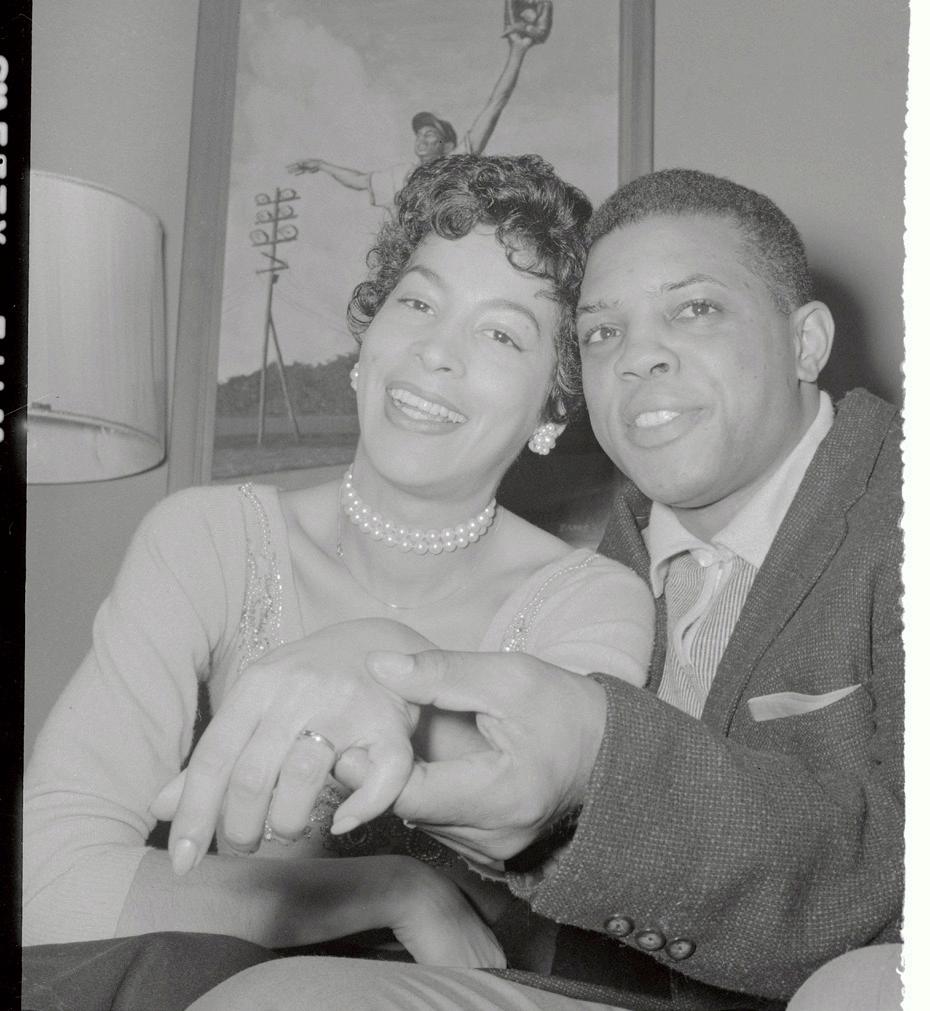
With new bride, Marguerite.
When we parted, Mays leaned forward in bed and extended one of his large, strong hands. e pajamas were carefully tailored and a monogram stood out from the ivory. “Anytime you wanna talk, you call me up,” Willie said. “Good luck to ya, buddy.” At that moment, we were great friends. Future phone calls probably will present the same problems as calls in the past.
Charles Einstein, a writer who collaborated with Willie on the book, Born To Play Ball, spent countless hours with Mays during the two weeks he probed for material for the book. e sessions were held in a yellow Lincoln, Mays's car that year, and while Willie drove fast Einstein labored tirelessly to keep his subject talking. is is a soul-searching sort of relationship and one in which two people can become very close very quickly.
Less than a week a er the Mays sessions had ended, Einstein found himself stuck at one point in the story. He needed a fact and so he telephoned Willie.
“Hi, Willie,” Einstein began, expansively, “this is Charley.”
“Who?” Willie said.
“Charley. Charley Einstein.”
“Oh,” Willie said, so atly that it was obvious the name had not registered.
“Willie,” Einstein shouted. “Charley Einstein. Two weeks in the car—the book.”
“Oh yeah,” Willie said. “How ya doin’, Charley?”
is was in the second month of Willie’s second season in organized ball and he had played 35 games for Minneapolis. Willie was doing ne but the Giants were doing very little, or so it seemed. (Actually, they were jockeying for position with the Dodgers, cra ily moving 13 1/2 games behind in order to set up their late-season drive.) When the call came, Willie was at a movie house, one of his favorite haunts, and a er getting no answer at his hotel, the telephone operator traced Willie to the theater. Mays was already a big man in Minneapolis and there was no question what the call was about. So the theater manager stopped the lm and walked on to the stage.
“Call for Willie Mays,” he announced.
Mays, who was with a date, sheepishly le his seat and took the call in the theater o ce. He had been happy in Minneapolis and, at the moment, playing for the Giants seemed a little beyond him.
“I showed him where to sign and he signed. What a kid. I yelled what the hell was he doing signing without looking at the figure and Willie says, ‘I trust you, Mr. Durocher. You say sign, I sign. You say don’t sign, I don’t sign.’ What a kid.”
I thought of this going down the stairs. As I passed the living room, I looked in and there, poised gracefully on a window seat, Mrs. Mays sat, doing her nails. We had not been introduced, but she nodded, with a kind of gracious aloofness. en I passed out of the bewildering world of Willie Mays into a quiet street in East Elmhurst. It took a long time to nd a cab.
Whatever clues exist to Mays's future, as he continues to grow and continues to learn, probably lie in the immediate past. ere is a lot to be found in places like Powderly, Ala., where Willie’s stepfather and mother live, in a bleak house on a dusty, unpaved street. ere is more to be found in Fair eld, Ala., a steel-mill town where Willie’s Aunt Sara lived and where Willie grew up. But the rst hints of what’s ahead for Willie lie in bigger towns, like Minneapolis and New York.
For one thing, it is doubtful if he will become overly impressed with himself. at became apparent on the day in 1951 the Giants pried Willie loose from Minneapolis.
“Willie,” Leo Durocher was roaring over the long-distance lines, “pick up your ticket, hop a plane and I’ll see you here tomorrow.”
Willie didn’t want to go. He thought fast. “You’re making a mistake,” he said. “You don’t want me.”
“Course I want you,” shouted Durocher, who has been known to compare even Class D ballplayers with Charlie Gehringer when under a full head of enthusiasm. “You’re just the man I want, Willie.”
“No,” Mays pleaded. “You’re making a mistake.”
“What do you mean?”
“You don’t want me,” Willie said, “’cause I’m not good enough.”
Now it was Durocher thinking quickly. “Willie,” he said. “What are you hitting?”
“.477,” Mays confessed.
“So,” Durocher said, “you pick up your ticket, hop a plane and I’ll see you here tomorrow.”
From a somewhat cynical point of view, Durocher’s relationship with Mays is not hard to fathom. Durocher saw a good thing and moved in. Such is his way. Nor is Willie’s fondness for Leo puzzling. “He never yelled at me,” Willie recalls, “and if I did something wrong, he’d come tell me nice and quiet. He was a good manager and he was my friend.” Almost from the rst, in fact, Durocher made Mays his private project.
Leo has hands as quick as a pickpocket’s. As a result, he could battle Willie in pepper games—one man throws, the other hits grounders—and almost hold his own. e two played for so drinks, o en bringing in Monte Irvin as a third man, and Durocher ad-libbed the rules as the game went along. eoretically, a elding mu cost a bottle of soda but Durocher, usually with one eye on the crowd, made great shows of racking up soda bottles whether or not Willie had mu ed anything.
“ at’s eight Cokes you owe me,” he would yell.
“No,” Mays would squeal, “that wasn’t no miss.”
“Eight Cokes.”
“Monte,” Willie would plead. “He’s cheating.” Irvin, a digni ed player and a man of great reserve, usually said nothing, o ered only a smile.
“C’mon,” Durocher would bark and Mays, his face twisted like a sorry clown’s mask, would resume the game.
e pepper game was the showpiece. Behind it there grew a personal relationship that was a prominent factor in Willie’s development. Mrs. Goosby remarked about it before the 1951 season was over. “Willie takes that man’s word for just about everything,” she said. “He almost won’t make a move unless he’s talked to him rst.”
During Willie’s rookie big-league season, as he opened eyes all around the National League, Leo Durocher must have been an eye-opener to him. Here, a er all, was a man who had started out almost as humbly as Willie, with no money and precious little education. He had come a long way. His wife was a movie actress and he was a terri c dresser, always wearing ashy clothes, and he drove a nice car. Besides, he liked Willie. He never gave it to Willie the way he gave it to some of the other
guys on the club. All you have to do for him is hustle and he looks out for you and tells you things and helps you get so’s you can make it big like he did.
One unfortunate aspect of the Durocher success story is its hallmark: ruthlessness. A great manager, an able promoter, Durocher still owes a great deal of what he has achieved to his rst rule: Don’t clutter your brain with ethics. If Leo Durocher had been the only force brought to bear on 20-year-old Willie Mays in 1951, Mays might today have a great many odd ideas. But happily, Durocher was only one of his close friends. Another was Monte Irvin.
What Irvin was to Willie is probably best illustrated by an incident that occurred three years later when the Giants were playing an exhibition game in Las Vegas. After the game, the team was scheduled to y out of town immediately, which would give the players no more than a brief chance to lose money at the gambling tables. But one of the engines on a chartered DC-3 developed bugs and as a result the team was unable to get away until a scheduled airliner, with space available, came through at midnight.
One Las Vegas hotel owner, aware of a lively promotion, invited the Giants en masse for a dinner party and promised them the courtesy of the house up to, but not including, the one-armed bandits. A er dinner, Mays headed for the oor show which on that particular night featured an operatic tenor of some talent, who poured out his woes through Vesti la Giubba , the most dramatic of all the arias in Pagliacci
In case you haven’t been spending your spare time at the Metropolitan Opera House, the pitch of Vesti la Giubba is that the show has to go on, even when a clown
feels like crying, which, by the way, he does, three-quarters of the way through the song. At any rate, Willie listened, enraptured by the aria, announced that it was “real nice” and, a er the tenor was through, moved along to the gambling room. He checked a dime slot machine, where Whitey Lockman and Irvin were striving frantically to keep even, then walked over to the dice table.
“You going to play dice?” a reporter in the Giant party asked him.
“No,” Willie said, with that inevitable mixture of wisdom and boyishness. “I’m just learnin’ the game.”
Willie had not been standing at the table for two minutes before a hotel ofcial walked over to the reporter. “Tell your friend to move away from the dice table,” the o cial said.
“Why?”
“You know why. ey can go anywhere they want, but we don’t want ’em mixing with white folks at the tables.”
e conversation grew steadily uglier until the reporter pulled a press card and the hotel, not eager for the sort of publicity it was courting, sent out fresh o cials to counter the demands of the rst. e reporter sought out Irvin, who by this time had run out of dimes and was awaiting the start of the second oor show.
“When did this happen?” Irvin asked.
“Right now,” the reporter said.
“Where’s Willie?”
“Still at the dice table, I guess.”
spect him. Monte was fun to kid with because he always looked so serious, but once in a while he would get real glum and there was no sense horsing around. Anyway, it was a terri c year. It was a good thing he had come up from Minneapolis. e Giants won the pennant with the most exciting drive in history and everybody, Leo mostly, said they couldn’t have won it without Willie.
But the next year made up for the good one. Irvin shattered his ankle during spring training and all of a sudden there was an Army call for Willie, despite his dependents back in Alabama. In the Army, Willie matured a good deal.
Others have had rougher Army hitches, but Mays, like any other private, simply did what he was told. Principally, he was told to play baseball for the Fort Eustis Wheels. He batted .420 for the Wheels in 1952, .389 in 1953 and covered so much of the out eld that the other elders complained about his poaching. But for the most part Willie was a popular soldier. He was not wildly enthusiastic about military life but a rumor that he went AWOL for a week wasn’t fair.
“Willie suddenly stopped being just another good ballplayer. He became the hottest thing since Babe Ruth. DiMag was extremely popular. Musial and Williams are consistently big. But no one gets the concentrated rush for appearances and everything else that Willie got when he got hot in 1954.”
“He’ll only get hurt,” Irvin said. “I’m going to get him.”
Without another word, Irvin turned, sought out Mays and led him toward the nearest exit.
“Plane ain’t gonna leave for two hours, roomy,” Willie protested. “What we gotta go for?”
“Come on, Willie,” Irvin said. “We’ll get the bus lights on and you and me can play some cards.”
How much the incident would rankle a man of Irvin’s intelligence can be guessed, but rather than make Willie, who was then not emotionally mature, the center of a nasty scene, Irvin avoided a scene altogether. When it came to Willie, Irvin was always gentle.
It must have been puzzling for Mays, at 20, to compare his two friends, Durocher and Irvin. Leo was a lot of fun but Monte was quiet and everybody seemed to re-
He le his company a er getting permission from someone further up the chain of command, who neglected to tell the company commander until a few days had passed. By that time there was speculation that Willie had sneaked back to the Polo Grounds.
On his Army discharge, Willie made a quick and remarkable impression. “I hope to bat maybe .300,” he told reporters, “but I never been no .300 hitter in the majors before and that big-league pitching is a lot di erent from what I been seeing.”
A er his two years in the Army, Willie was bound for greater stardom than he ever suspected. Everything seemed to mesh at once: the basket catch, seven more pounds of home-run muscle, more consistency against curveballs. Before spring training ended, he was being billed as the star from outer space. Before the season ended, he had locked up the Most Valuable Player award. But he had also run into a sort of personal crisis.
“Willie,” Art Flynn once explained it, “suddenly stopped being just another good ballplayer. He became the hottest thing since Babe Ruth. DiMag was extremely popular. Musial and Williams are consistently big. But
no one gets the concentrated rush for appearances and everything else Willie got when he got hot in 1954.”
Frank Forbes, a New York state boxing judge who is one of the Giants’ numerous liaison men to Willie, hinted at another aspect of the problem. “When he rst came to New York, he was nothing but a kid,” Forbes said, “but he had a likeable, wonderful personality. He was a little bewildered because you don’t get much sophistication in a southern state, but by 1954 I don’t think anything scared him.
“But I remember one week when reporters started asking him a lot of statistical things like will he break Babe Ruth’s record and things like that. He didn’t come out and say anything but these questions put things in his head and I noticed that week he was trying for the long ball more o en and so he was striking out more than usual.”
e transformation to superstar was not painless.
e better Mays got, the greater the fuss Durocher made about him. By mid-season there were resentments on the club so obvious that even casual observers noticed.
Once a er one of Willie’s best days, two newspapermen sought exclusive interviews at the same time.
“I’ll talk to Willie when you’re through,” the rst one said.
“ e hell with that,” said the second. “I won’t talk to him with you around.”
Pretty soon, the journalism seminar turned rough and Willie scooted o to Durocher in honest distress. “I’ll talk to ’em, I’ll talk to ’em,” he said. “What they ghting about me for?”
“Don’t worry about the writers,” Durocher said, generously. “ e hell with them. Get dressed and go home.”
e tableau was enacted before most of the Giant squad. Willie wasn’t the only man on the team but to some of the players it seemed that impression was spreading. “Look,” Willie said, “when I worry I don’t play good and when I read the papers too much I worry, so I don’t read the papers, ’cept once in a while.” is sort of talk struck some of the Giants as a little precious; particularly those Giants who were getting their names into newspapers only in ne print.
ere was a coterie of Mays detractors on the club, small but bitter. What prevented them from getting more numerous was Willie’s wonderful talent.
What helped him with the press was his odd charm. A er the rst game of the World Series, when Willie saved the Giants victory by catching a drive Vic Wertz hit from home plate at the Polo Grounds into the shadow of Yankee Stadium, photographers ringed the steps that lead down from the shower room in the Giant clubhouse. When Willie emerged from the showers, the photographers began to shout in their traditional babel, “Heykidlookaheregimmeasmilewillya.”
e gibberish was deafening and Willie wanted time to size up the situation. He had a towel draped around his waist and with a big grin he let it slip o to the oor.
A platoon of photographers screamed more babel meaning, “Listen, Willie, put the damn towel back on. How can I take a picture of you when you’re naked? Please put the towel back on.”
With careful modesty, Willie gathered the towel about him again. en the rst ash bulbs began to pop and he let it fall. Willie laughed his high-pitched laugh, put the towel on once more and kept it there while the photographers snapped away. It had been a pleasant enough joke, even the photographers admitted. Willie just liked to have a little fun.
When the 1954 season was over Mays had batted .345, but when he started slowly last season a er a winter of Caribbean baseball, he was put under continuing pressure.
A er the Giants shipped Irvin to Minneapolis, Mays roomed alone last year, but by then the initial threat of his learning the wrong things from Durocher appeared to have passed. When Willie was benched during a slump, he said simply, “Leo knows more ’bout me than I do,” which was a gracious way of handling a touchy question. And he did hit 51 home runs, so that he hardly staggered through a lost season. Willie now can take care of himself.
“I know (Bill) Rigney,” he said, when someone asked him about the new Giant manager, “and he’s a smart man, a lot like Leo in some ways. I mean people think he’s careful all the time, but they’re gonna get a surprise. Rigney plays the game a lot like Leo.”
With Babe Ruth, the image everyone recalls is a trot, pigeon-toed and mincing, around the bases a er each prodigious home run. With Stan Musial, it is the uncoiling of a swing, beautiful to everyone but pitchers. But with Willie, the image is a little more involved.
To begin, there is a faceless batter slamming a long drive to center eld. Willie sprints, loses his cap, twists, turns, stumbles, pats his glove impatiently and nally, with a graceful little shrug, he catches the ball at his waist. No one ever caught y balls quite like Willie Mays and few have caught them anywhere near as well. He has a ferocious swing and, of course, a great arm, but the thing that has set him apart from other erce swingers and great throwers is his y-catching. It is unique.
Mays feels much more sure of himself now than he did when he rst hit the majors. “I think,” he says, “there is still things I got to learn, but nowhere near as much as there was.” In his dealings with people, too, he has grown more worldly. “I been learning how to get along and I got a lot of friends,” he says almost proudly. “I mean not baseball friends. Fellows I met up ’round Harlem in the ‘Y’ and all up there who really likes me.” But as he is developing talent, Willie is a developing person. It’s a long time since anyone has heard him say “say-hey.”
“You got to love the game,” he still insists. “Otherwise nobody can teach you nothin’. But I wish there was someone around who every time I made a mistake come to me and said, ‘Willie, you done this wrong. Do it this other way the next time.’ I never had much whatchucall
coaching. I mean most of the things I had to learn myself. But I learned them ’cause I know that no matter how good you get there’s always somebody can help you get better.”
Mays still may antagonize people this season, as he did in others, by shrewdly wondering about money and naively playing practical jokes, even on teammates who are caught in grave batting slumps. He’ll kid a few times when he should be serious and be serious a few times when the occasion cries for humor. But then Willie is only 25 years old.
Like anyone else, Willie falters once in a while, only it usually costs him more than it does the other fellow. One day last summer, Duke Snider hit a shot that squirted through Willie’s hands and bounced toward the distant center eld fence in the Polo Grounds. Willie realized Snider would be home before he could even reach the ball, so he let it roll. But somebody has to chase a loose ball, and right elder Don Mueller made the long trot while Willie watched, his hands on his hips. Any player is scolded for standing around, but the storm that fell about Mays was fearful. When a hero gives up, the drums always roll.
No matter how far he goes, it’s doubtful if Willie
will ever quite accept what is happening to him as entirely true. e dreams he had as a boy in Alabama could not begin to approximate the life that he has actually found with the Giants.
Back when Willie received his Army discharge and ew across the country to join the Giants at Phoenix, Leo Durocher hugged him repeatedly for joy and for the news photographers. When the hugging was over, Monte Irvin walked over and gave Willie his hand.
“He’s shaking hands with the pennant,” a Giant fan proclaimed in the wild enthusiasm of the moment.
“Hi, roomy,” Irvin said, quietly.
“Hey, Monte,” Willie said.
Irvin smiled at Mays, then said, “Roomy, how’s your game?”
Willie shook his head. “What you mean my game, Monte? You talking about pool?”
“No, Willie,” Irvin said. “I’m talking about your game, about baseball.”
“Oh yeah,” Willie said, a little surprised. “My game baseball. I’m ready any time.”
Of such is made the bewildering world of Willie Mays.
Mickey and Willie are the two best ballplayers in the game today. But which one is better? Here is an expert’s pick.
TDECEMBER 1957
By Tom Meany
HE SAN FRANCISCO GIANTS (it still sounds strange) and the New York Yankees have two of the best center elders in modern baseball. Or, to put it more boldly, Willie Mays of the Giants and Mickey Mantle of the Yankees are the two best ballplayers in the game today. at doesn’t mean as sluggers or elders or runners. ese two are best all-around. You can start an argument with Hank Aaron and Al Kaline and Frank Robinson, but when the smoke clears you’re le with Mantle and Mays as the best. But which one is better?
Mantle or Mays? Mays or Mantle? is is the argument that keeps baseball fans busy (and happy) these days. And there is so much to be said for both that anybody who picks one over the other is not sticking his neck out too far. Okay, consider my neck stuck out—and go gently with the ax.
I’ve had unusual opportunities to know both boys. Back in 1951, I wrote the rst national magazine article on Mantle in the late, lamented Collier’s. Actually, it wasn’t the rst, since SPORT was on the stands two days earlier with a piece on Mickey by Arch Murray, written from the Phoenix, Ariz., training camp of the Giants, but mine was the rst in a weekly magazine.
And twice I did o eat articles for Collier’s on Mays, one covering his stickball activities with the kids in the Harlem streets and then accompanying him to Puerto Rico when he tried his hand at Caribbean baseball a er the 1954 World Series.
Knowing the personalities of the two is a considerable
help in any attempt to pass judgment or make comparisons, since when you know the individual you know not only what he can do, but why he can do it. And Mantle and Mays have personalities far more involved than they seem on the surface.
Willie looks as if he enjoys the game more than Mickey does, and he seems more spontaneous and natural in his actions. And this is quite possibly so. For Mays, baseball is the alpha and omega of his existence. Mantle is fast becoming a businessman as well as a great ballplayer.
e foregoing isn’t to imply that Mickey is a mercenary ballplayer. Far from it. Mantle, however, has had far more extracurricular business opportunities than Willie and, a er a faltering start in which he seemed to have more business managers than business opportunities, Mickey now is in full command of all his outside activities.
Mays has his share of endorsements, personal appearances and all the sideline pro ts which accrue to the established star, but they are not nearly as pro table as Mantle’s. It, therefore, is only natural that Willie’s prime, almost sole interest is in baseball. He is a far happier warrior than Mickey, although he can sink into the dumps as deeply as Mantle when he is in a slump. Both are alike in that characteristic. And why not since it is common to most players.
Mantle has been booed so o en, and so unreasonably, by his home fans at Yankee Stadium that the chances are he is better equipped to take a prolonged slump in stride than Willie is—although that is debatable. Mickey, matured as he has become, still will blow up more quickly and try to bull his way out of a slump more stubbornly than Mays will. So far Willie has never burst into tears nor kicked at the water cooler while in a slump or a er striking out, as Mickey has done. Mantle has overcome much of this self-condemnation, but Willie still seems the more resilient.
In elding and throwing, you must take Willie. He can range farther than any out elder in modern times and he has surer hands than Mantle. Mays remains an undisciplined thrower, however. He frequently throws behind a runner but his arm is so strong that he more than balances his mental mistakes by making “impossible” throws to nail runners.
Mantle, perhaps because of the strict manner in which Casey Stengel runs the Yankees, will not make as many bad throws as Willie nor, conversely, will he make as many great ones. Over the last three full seasons of play (1954-56), their assists run remarkably even, 50 for Mays, 46 for Mantle.
Assists are no reliable barometer for a strongarmed out elder, since opposing runners take no daring chances with them. Actually, no sane runner would take a chance against Willie or Mickey. Mays's arm, however, is so strong that he frequently
throws out runners who don’t believe they are gambling. Strong-armed as he is, Mantle doesn’t make the tough throw as instinctively as does Mays, perhaps because he is not a natural out elder. In position, Mantle can throw with the best, but Willie throws without thinking. He doesn’t have to stop, he doesn’t have to get into position, he just let’s y. Mays will make a poorly judged throw from time to time, but he’ll see (and take) many a throwing opportunity that the average—and even the better-than-average—out elder will overlook.
While Mantle has made his share of spectacular catches, catches which have been cheered around the American League and duly recorded by witnesses as being noteworthy, his bag of headline grabs runs far behind Willie’s. Mays has made great catches in every park in the league, including Ebbets Field, which is much like making a great catch in a furnished room.
Joe DiMaggio, himself better than a green hand at robbing hitters, placed a high evaluation on the catch Willie made in the rst game of the 1954 World Series against Cleveland’s Vic Wertz, a catch, by the way, which Mays himself relegates to a lesser category. As any fan will remember, Willie practically went into the right-center- eld bleachers at the Polo Grounds to take Vic’s drive over his shoulder.
I was “ghosting” that Series for DiMaggio and sat alongside him in the press box. “As remarkable as the ground Willie had to cover to get the ball—and he just did reach it,” explained Joe, “I thought even more
remarkable was the judgment he showed in not letting the fence scare him. ere is no trick to catching a ball in an open eld, no matter how far it is hit, as long as it stays in the air long enough. e test of an out elder’s skill comes when he has to go against the fence to make the catch.”
A Cleveland pitcher, who for obvious reasons prefers anonymity, pointed out one big batting di erence between Mantle and Mays. e Indian inger knows whereof he speaks, because of the long, transcontinental spring barnstorming trips Cleveland used to make with the Giants. ese trips gave the Indians a good chance to study Mays. e American League schedule, of course, puts Mantle against the Tribe in 22 games a season. “We found out that we could strike out Mantle if we pitched to him properly,” the pitcher explained. “It’s no sucker pitch and you have to have plenty on the ball, but he can be struck out. Of course, if the ball isn’t pitched just so, Mickey’s liable to knock it up into the seats on you. On the other hand, we couldn’t strike out Willie. We’d get him to go at bad pitches, sometimes, but we never did come up with a pitch to Mays that we could guarantee would be a strike.”
Mays has a batting weakness, of course, but it is one of his own making. As might be expected of a player of his ebullience and exuberance, he can be made to chase a bad pitch. is is particularly true of a rst pitch. Mays
is anxious for action and frequently will go a er the rst o ering if it is anywhere near the plate.
In the 1954 World Series, Mays went to the plate 18 times and eight times o ered at the rst pitch. Once he hit it safely, twice he missed it entirely and ve times he went out. Tom LaSorda, a personable southpaw who once was in the Brooklyn organization and who pitched for Kansas City in 1956, was able to capitalize on this over-anxiousness. In the Puerto Rican League in the winter of 1954, LaSorda was pitching for Mayaguez when Willie was tearing the league apart for Santurce. Tommy, having read about Willie’s rst-ball itch during the World Series, decided to capitalize on it and he put the horse-collar on Willie for the rst time in winter league play.
Mays is really a two-way hitter. He alters his stance when he’s going for bust. Or rather he goes back to the stance he rst used with the Giants when he came up from Minneapolis. Willie then batted from a full spread and a semi-crouch. It was great for distance but it le him vulnerable to strikeouts.
Leo Durocher made his one and only batting suggestion to Mays in the middle of the 1954 season. Leo got him to bring his feet closer together and to stand more erect. e results were amazing, even for Willie. at year Willie hit his 36th home run o Alpha Brazle of the Cardinals in his 99th game, a pace which was faster than that of Babe Ruth when he blasted his 60 in 1927. Although Mays, with the modi ed stance, played in 55 games, he hit only ve more home runs, one of them an inside-the-park job.
If that sounds as though the new stance hobbled Willie, don’t kid yourself. He had been hitting .326 when he altered his stance, and in the remaining games he batted .379 to wind up leading the majors with a nal mark of .345.
Willie’s power is against high, inside pitches, and pitchers tried to keep the ball away from his strength and pitched him low and outside. With the new stance, Mays was ripping hits into right and right-center. It is because of these two stances of Mays's that I nd it impossible to rate him as a hitter. He is as good as he has to be. Since the glory year of 1954, Willie has had to carry a sagging Giant team on his broad shoulders. When he goes for the home run, as he so o en is forced to do, Mays has to sacri ce points on his batting average. And when he goes for the batting average, he has to sacri ce distance.
Next year at San Francisco, Willie may very well return to his glory days—or even beyond. He has a talent (or a air, or whatever you want to call it) for rising to the occasion. At times, this touch has been described as show-boating, but that is immaterial. Willie does like the spotlight, and he is a bit of a ham, but these are the ingredients that make a great ballplayer into a great attraction. Especially when, like Willie, he does his best work with the bright kliegs beating down. It seems perfectly reasonable to predict that in his new surroundings, with new fans certainly cheering him wildly (the
way it was in New York in 1954), Willie will unleash the full blast of his remarkable talents and turn the game upside down.
Willie’s base-running is as undisciplined, and as e ective, as his throwing. ere were raised eyebrows one night in Cincinnati when Mays stole second with an eight-run lead. What if he had broken his leg in an unnecessary steal, the writers wanted to know? “It’s up to Willie,” Bill Rigney said. “It was a new catcher,” Mays said, “and I wanted to try him out.”
A month or so later, at the Polo Grounds against Milwaukee, Mays stole second with two out and then was thrown out trying to steal third. For all practical scoring purposes, a man on second with two out is as valuable as a man on third and Willie’s try for third must be classed as fool-hardy. Unless, of course, he then planned stealing home, too, and with Willie anything is possible.
Perhaps the biggest thing to remember in judging Mays and Mantle is that Mickey has been on a succession of pennant winning clubs, from 1951 through 1956, with 1954 being the only exception. Willie, like Mickey, was on a pennant winner when he came up in 1951, then put two years in service and came back to play on the 1954 pennant winner. Since then, it has been all downhill for the Giants.
Willie is not a second-division ballplayer. And that’s a compliment. You must recall countless trades in the majors when a player who stood out with losing clubs suddenly was traded to a contender. “Ah!” everybody said, “if he could stand out with a bunch of humpty-dumpties, what will he do now that he’s with a winning team?” Too o en the answer turned out to be—nothing.
Mays plays for the sheer joy of playing and there’s no joy in it for Willie when his team is getting the daylights clobbered out of it for days on end. It would be unfair to judge how Mantle would react to a second-division club, for Mickey never has been in that situation.
No matter how badly he may slump from time to time, Willie will come out of it at the sight of a Dodger uniform. e crowds and the general hysteria attendant to the ancient rivalry serve as a tonic to Willie. He plays against the Dodgers like a man from outer space. e cross-country move shouldn’t a ect the rivalry, or Willie’s pounding the Dodgers.
What are the prime assets by which a ballplayer is judged? Batting, power, running, elding and throwing, to generalize. As I read back over what I’ve written, I’ve got to answer the Mays or Mantle question by saying “Mays.” Willie can do more things better, but that’s no knock at Mickey. Willie can do more things better than most any ballplayer you ever saw.
MAYS.
Chapt 3
W E S T W A R D
The Giants’ shift west for the 1958 season brought the game’s greatest ambassador with it, and Willie Mays seldom disappointed over 14 ½ seasons hittin’ by the dock of the Bay.
WHAT THEY SAY IN THE DUGOUTS ABOUT THE SAN FRANCISCO GIANTS
TJUNE 1958
By John Wesley Noble
O HEAR THE CHATTER in San Francisco this spring, you would think the weary old Giants, a dead horse in the Polo Grounds last year, had had some sort of midwinter monkey gland operation. ey’ve sni ed the crab pots at Fisherman’s Wharf and heard an unaccustomed clanging of cash registers—which could mean nice fresh oats aplenty for a change—and they’re frisking like young colts in their new pasture. At least, that’s the way the fans and baseball folk are talking.
By John Wesley Noble
“Our people were starved for major-league baseball,” says Walter ( e Great) Mails of San
The Giants have worries in their new home. Will they support only a winner? Can Willie hit 61 homers? Is this a “changed” ball club?
Francisco, who may be prejudiced since he was carried over from the old Seals to the new club’s public relations sta . A hoarse voice from the stands retorts: “Once around the smorgasbord and the folks may have a belly full. How hungry can you get?”
Certainly the Giants are being talked about at the Golden Gate. Major-league ball, in fact, has taken its place alongside the famous fogs and the Earthquake of ’06 as a prime topic of conversation. Will the new climate li the Giants out of the second division? Or will it only chill them? Will San Francisco do for the Giants what Milwaukee did for the Braves? Can Willie Mays top Babe Ruth’s 60 homers in “cozy” Seals Stadium? Is it really so cozy? Can Johnny Antonelli win 20 again? How about Hank Sauer and his aging limbs? Can Horace Stoneham, far removed from Toots Shor’s, deliver on his boast of a “changed ball club?” What’s he going to use for material? And what about Bill Rigney? Just because he’s back in his home territory, can he survive another losing season as manager?
A few weeks before the start of the season Rigney addressed several hundred men and women at an advertising club luncheon. “I’m nervous,” he admitted. “I didn’t see a crowd this big in New York all last year.”
Everyone has a good word for Willie Mays, of course. He clearly is the “man” of the “one-man club.” San Franciscans other than baseball fans were talking about him last winter. When he reportedly had trouble buying a house because he’s a Negro, they helped him buy a mansion in St. Francis Wood, the ossiest part of the city. According to Ira Blue, the radio-TV commentator, “Willie made new friends every time the people saw him. He’ll be every bit the hero here that he was in New York, both as a ballplayer and a person.”
“He’s everything good they say,” said everyone from Cookie Lavagetto to Jackie Jensen and J. W. Porter, new catcher for the Cleveland Indians. Willie’s popularity wasn’t hurt a bit when Rigney, in a signed Sunday supplement article, predicted: “Willie will hit 61 homers, crack Ruth’s record, hit .380 and drive in 150 runs.” Of course, there were arguments. “He won’t do 60,” swears Bill Pauletich, a young White Sox property who played winter league ball in San Francisco, “not in Seals Stadium.” Ferris Fain says, “He’ll get his share of hits, but it won’t be easy. He’ll make more homers to center than he would at the Polo Grounds, but he won’t get the occasional ones to le . It’s
quite a bit longer here than in the Polo Grounds.” is led to deep studies of the two parks. Center eld at the Polo Grounds, they found, was 480 feet; 450 to le -center. At Seals Stadium, the deepest point is 412 feet away; 370-404 feet to le -center. It still is larger than many big-league parks. e new stadium, supposed to be ready next year, will have long foul lines, but only moderate center- eld walls. As Rigney said: “If not this year, then eventually, but Mays will get those 61 homers.” No one on the local scene was prepared to argue the point too hard.
“No matter how the Giants do,” say boys like Curtis Flood and Frank Robinson, “the colored people will turn out to watch Mays. ey’re all talking baseball, and it’s ‘Willie this’ and ‘Willie that.’” “Yeah,” a cab driver who once played for the Seals growled, “it’s too much ‘Willie this’ and ‘Willie that.’ ere’s too much emphasis on Mays. He isn’t gonna impress this town. A er all, this is the stadium where Joe and Dom DiMaggio started. Real fans remember them. e Giants should be sold as a club, not a one-man team.”
THE WILLIE MAYS
DECADE
Willie has brought a breathtaking excitement to baseball, set off by his unique, abundant skills. But along with the fun and glory, he’s had some problems.
JUNE 1961
By Arnold Hano
ON MAY 25, 1951 , Willie Mays appeared for the rst time as a major-league baseball player in a ball game played at Philadelphia’s Shibe Park (now Connie Mack Stadium). He joined a New York Giant ball club that had been favored by many to win the National League pennant. His teammates included such permanent stars as Sal Maglie, Larry Jansen, Monte Irvin, Bobby omson, Ed Stanky, Al Dark and Don Mueller. Willie Mays—in this distinguished company—was only 20 years old. Behind him was an unpretentious total of 116 ball games in organized baseball.
But when this relatively untried youngster stepped into the batting cage to take his swats at the ball, there was a sudden silence on the eld, as both Giants and Phils, stars and substitutes, looked on. In the words of Giant broadcaster Russ Hodges, Mays began to “comb” the ball. Line drives ew straight as spikes om his bat, and the silent awe deepened, until manager Leo Durocher said: “I swear, I’m going to marry him.”
at was ten years ago this May 25.
On the last day of February of this year, with Willie Mays clearly the biggest star in baseball, I walked into the neat little ballpark where the San Francisco Giants do their preseason training—Phoenix Municipal Stadium, a couple of miles south of downtown Phoenix—to see him. Ball parks
DECADE
during spring training are confusingly cluttered. ey swarm with ballplayers not only of di erent ages, styles, abilities and experiences, but sometimes of di erent uniforms, some white, some gray, some even without numbers.
If you walk into such a stadium and out onto the eld during batting practice, you nd the usual hitter inside the usual cage, and the usual next hitters around the cage. But because more than batting must be sharpened during the month and a half of practice, two or three fungo hitters are lo ing y balls to the out eld or slashing ground balls to the in eld. At every position there are two or three players. On the sidelines, engaged in pepper games or just having a catch, are many more. In short, the eld-full of 40 athletes is a massive mess of disconnected activity.
But there in center eld, alone, his cap tilted down and forward so that it sat precariously atop the crown of his head, his big bare hand so ly thumping the big brown pocket of his glove, stood Willie Mays.
He had arrived in Phoenix the day before, and now he was where he belonged, in center eld. A few weeks earlier, a er a spat with his wife, Marghuerite, Willie had grabbed his clothes and his television set and had walked out, to visit his family down in the Birmingham, Alabama, suburbs. en he had returned to his New Rochelle, New York, home. But now his wife and their boy, Michael, age two, and her daughter by a pre-
vious marriage, Billy, age 14, were also in Phoenix, and everything was ne again. But ne or not, Mays was neither in New Rochelle nor Alabama nor in the house he had leased for his family outside Phoenix. He was in center eld, and there, more than any place else, he looked as though he were home.
Let the other positions on the ball eld be trenches for internecine warfare between candidates for starting roles; let Cepeda and then Alou and then Kuenn take turns with Davenport at third; let Cepeda and McCovey and Kuenn try their luck at rst; let unknown rookies like Gil Garrido (“the new Aparicio”) or Charlie Peterson alternate with Eddie Bressoud and Jose Pagan at short. In center eld, Willie Mays stands alone.
Symbols are treacherous, ephemeral things, at best. Seconds a er I had spotted Mays, the center elder shattered the tableau. He walked over to le eld to chat with Felipe Alou, and to the sidelines where he occasionally practiced le hand basketball hook shots (with a baseball, of course, and no basket) while ostensibly having a catch with Joe Amal tano.
Still the symbol had been sharp and shining, pertinent to my theme: the greatness of Willie Mays.
Some players stand alone because that is their temperament; Joe DiMaggio is the great example. Aloof, proud, untouchable. Others stand alone because they are shunned. No names, please. Others are alone because circumstances and their talent have propelled
them to a top rung, the head of a pyramid, a platform in space. Ruth. Cobb. Mays.
A San Francisco sportswriter said to me a year ago, on the eld before a ball game, “Willie Mays spoke to me for the rst time in a month, today.” en he paused. “Of course I hadn’t asked him anything for a month.” You leave Mays alone. You ask your questions of others, you socialize with others, but you tend to leave Mays alone. ere he is, and there you are, and unless you’re Hemingway you understand the distance between you.
I am a Giant fan, as you may gather, and so I view Mays mostly with the warm, prejudiced eye of the fan. is world demands and deserves far more important loyalties, but I am reminded of something once said by actor Montgomery Cli when he tried to explain why he appeared to be a man torn apart emotionally by his work. He said that everybody knows that acting is all pretending; even the actor himself knows it. But the adrenal glands that pump his blood do not know it.
I too know that baseball is simply a game when weighed against the he y problems of the world. But my adrenal glands don’t know it. I remember quite clearly a moment in 1951—as a ball hit by Bobby omson ew toward the stands—that my heart stopped beating (literally). en the ball was in the stands, a home run winning the pennant for the Giants, and my heart beat again, and the animal scream that I heard was my own voice.
at is baseball to me, and that is my reaction to Willie Mays.
Ten years have gone by since Willie Mays came up, and in those ten years, my adrenal glands have worked double- and triple-time. ere is another game, called nostalgia, and I like to play it, thinking back on all those high-adrenal moments provided by Willie Mays.
ere is nobody in baseball today whose feats are so often brought to mind.
If you ask another fan, or a writer, to recreate some play by Mays that sticks in memory, there is never any hesitation. Russ Hodges, who has seen every game Mays has played, says instantly that it was a play Mays made on Roberto Clemente in Forbes Field, the ball headed for the light tower when Mays made the catch. Hodges says it was the greatest catch Mays ever made; he says it was the greatest catch any human being ever made.
Charles Einstein, who wrote Willie’s “autobiography,” says Mays’s greatest play was on a sinking line drive hit by Ed Bouchee in Candlestick Park in 1960; Einstein also recalls that in the second game of that day’s doubleheader Mays scored from rst on a single by Willie McCovey; given time, Einstein would have remembered other Mays feats of that day. Mays has that quality of indelibility about him.
I personally remember best the catch (usually spelled e Catch) Willie made on Vic Wertz in the rst game of the 1954 World Series.
Others vouch for the catch and throw Mays made on a line drive hit by Brooklyn’s Carl Furillo in 1951, one-handing the ball a er a tremendous run into right-center eld, and then pivoting to his le and ring to Wes Westrum to get the sliding Billy Cox at the plate. Mays himself says that was his best throw.
But Willie, who has been asked the question a few hundred times, votes neither for the Wertz catch nor the Bouchee nor the Clemente (nor a catch on Bob Skinner which so resembled the play on Wertz; nor a catch on Gil Hodges at the Coliseum last year, leaping into the murk of le -center eld and swinging his gloved hand into the seats, snatching out a baseball that for all intents and purposes was already gone; nor any of the oth-
With Marguerite and Michael.
ers I have heard nominated). Mays says the nest catch he ever pulled o was against Brooklyn’s Bobby Morgan, Mays running far to his right, into le -center eld, leaping through the air so that his body was stretched full out and parallel to the ground, catching the ball with the tip of his glove and then falling so heavily that his right elbow caved in his solar plexus, knocking him unconscious. But somehow, as he collapsed, he had brought the gloved hand and the ball up under his body, tucking it against his chest, so that at no time had the ball touched the ground. And when Leo Durocher ran to the out eld and turned Mays over, there was the ball cradled against the letters on Willie’s chest. Mays says it was the nest catch he has ever made, and from that description it seems almost superhuman.
And so it goes. Ten years of memory on the ball eld; the rememberer is richer for it all. e talents of Willie Mays have been consistently splattered over his full decade. Willie hit his longest home run in 1954, and his most home runs in 1955, and he stole his most bases in 1956 and hit his most triples in 1957 and hit for his highest average in 1958 and hit his most doubles in 1959. All before his 30th birthday (May 6, 1961), when a boy supposedly suddenly becomes a man. In all of baseball, only two fellows ever hit as many as 25 home runs and stole 25 bases in the same season. Ken Williams did it once; Willie Mays did it ve times running before his 30th birthday. (And Mays twice hit 30 home runs and stole 30 bases the same season.) Going into this season, Willie had a lifetime batting average of .318 and 279 home runs. ese days, Willie Mays is rated by almost everybody as the greatest ballplayer alive. He may be the greatest who ever lived. (I know, I know, you can’t compare John L. Sullivan with Dempsey, Jim Corbett with Joe Louis, Stanley Ketchel with Sugar Ray Robinson. So how can you compare Mays with, say, Ty Cobb?) Watch.
ority. ere is no sport, except perhaps one of the dying sports, that has not improved vastly in the past 30 or 40 years. I doubt that Bronko Nagurski was as good as Jim Brown; I doubt that Bobby Jones was as good as Arnold Palmer; we know by our watches that the nest race ever run by Paavo Nurmi would have le him a hundred yards behind Herb Elliott.
Men today are bigger, stronger, faster.
Baseball has to be far better today than it was in the good old days. e trio judged as the best double-play combine of the good old days—Tinker, Evers and Chance— made exactly eight double plays in their nest year. Willie Mays has to be just about as good as the best of those good old days. Maybe a little better. Enough said. ( e letters column is open, fellows, but watch your language.)
What Willie Mays has been: a great ballplayer, not only according to all the rules of the game and within the confines of the sport and the field, but one who overflows normal boundaries and escapes into the life and world about us, any shape, any form.
Statistical analysis probably will not make a case for Willie Mays, but statistics don’t always tell the story. In 1954, for instance, to sort out one piece of statistics, the fans (who voted the AllStar teams then) cast 325,000 more votes for Duke Snider than for Mays as the National League’s center elder. I have to believe that even in Brooklyn that summer they felt Mays was Snider’s superior. Remember the day the park announcer at Ebbets Field broke into a Dodger game to report: “Willie Mays has just hit another home run for the Giants”? It would have been unheard of for the Giants to have made such a report in the Polo Grounds about Snider. e aura about Mays was best re ected by his impact on society. Recently I went through some old New York Times Sunday Magazine sections and came across the following:
Cobb was surely the greatest ballplayer of his time; his time was 1905 through 1928. Mays is the greatest of his time: the 1950s and early 1960s. is simple di erence in time—that interval between Cobb and Mays— is the strongest argument as to Mays’s possible superi-
In the issue of July 11, 1954, there was an article by Gilbert Millstein about Willie Mays. Millstein compared Mays to the Natural Man of Jean Jacques Rousseau. e following month, in the issue of August 15, 1954, the Sunday Times magazine had further references to Mays. ere, on page 25, was an article about Ethel Barrymore in which Miss Barrymore irrelevantly says: “Isn’t Willie Mays wonderful?” On page 34, same date, same magazine, in an article satirizing the how-to-do craze, there is a sentence which lumps current topics for conversation as: “the weather, Faulkner, Willie Mays and children’s summer camps.”
On page 61, same date, same sedate old magazine, there is a brief piece on baseball superstitions; we see a picture of Willie Mays touching second base on his way out to the out eld. And two weeks later, the same magazine did an article about the Copyright O ce in Washington; the second paragraph of the piece has to do with two songs just written about Willie Mays.
Rousseau, Ethel Barrymore, how-to-do fads, superstitions, copyrighted songs and the New York Times
So you see, I hope, what Willie Mays has been: a great ballplayer, not only according to all the rules of the game and within the con nes of the sport and the eld, but one who over ows normal boundaries and escapes into the life and world about us, any shape, any form.
A small story, indicative not only of Mays’s passion for the game, but of another quality not o en hinted at: his chagrin that people had not waited for him, had not seen to it that he was on the bus, even though it had obviously been his fault that he wasn’t. Despite all of Mays’s geniality, his complete lack of a ectation, there is even in this down-to-earth person a touch of the aloofness— pride, if you will—that made DiMaggio so much a loner. Don’t get me wrong; Mays is not a thorough loner. e ribbing that ows both ways between Hank Sauer and Mays sounds almost like a nightclub act; Mays still will trip a player who isn’t looking or knock Sam Jones on the head with his knuckles when the players are in the air, between cities. But Mays is not the gregarious social creature he has o en been passed o as.
Perhaps a lengthy interruption here will prove it: At Phoenix, Willie and I talked about the hard time he and his wife had getting a house in San Francisco, because of objections by the pinch-chested white snobs of the St. Francis Wood section (my language, not Willie’s). He said it hadn’t bothered him much, that, as a matter of fact, he knew the score, that Negroes couldn’t live where they wanted to in New York, so why expect anything better in San Francisco? He hadn’t wanted the $37,500 house too badly (no, this was not sour grapes), but once the fuss got heated, and the mayor got involved, and other civic leaders, he wouldn’t back down: And yes, he was happy to be living in New Rochelle; yes, the people were nice; no, he didn’t know many of his neighbors. And then he said—and this is my belated point—
“I don’t pursue people.”
On the road, Mays rooms alone. He used to share a room with Monte Irvin, and later with Bill White, but now he prefers to be alone, and it is not because he is a great star with a star’s prerogatives. Not even because he likes to go to bed early and sleep late and enjoys having breakfast in bed and likes certain TV shows (westerns, lots of ghting) and doesn’t like wrinkles in his clothes, all of which add up to a person mildly nicky about his roommate. But mainly because he does not pursue others.
When Mays got married in February of 1956, and a few days later submitted to an interview, sitting in bed in ivory pajamas, he declared with a scarcely audible sni
that people had said he was going to marry this girl or that, or that he wasn’t going to marry that girl or this, but—touching his heart—“I’m the only guy who knows what’s in here.”
So the Say-Hey Kid, the a able, high-voiced kidder and practical joker, and butt of jokes, “the only ballplayer”—said Charlie Grimm, a er the 1954 All-Star game—“who can help a team simply by riding on the bus with it,” the bubbling, e ervescent, fun-loving sprite may be all that, but he is more too. He doesn’t pursue people, and he keeps his most important, most personal thoughts to himself.
is is a long detour from a bus in the Negro National League, and a longer distance from the too-pat and slightly patronizing theory of Nature Boy and Natural Man. Mays is deeper than that, and if ten years have shown anything, they have shown that, now more than ever because Willie in many senses has changed.
I watched Willie Mays take his licks at Phoenix one day this past March, while o to the right, near rst base, Orlando Cepeda was doing a little clowning. Tom Sheehan barked at Cepeda: “Don’t tear up the in eld!” and Mays, without missing a swing, said loudly: “I thought we had a new man this year!”
You couldn’t say for sure that Mays was putting Sheehan in his place, that he was reminding Sheehan he was out and a “new man”— a new manager, Al Dark— was in. Yet the words might have been interpreted that way.
And seconds later, still batting, Mays had to skip nimbly from an inside pitch that got away from batting-practice hurler Sherman Jones. Mays muttered: “Stick that knuckler up your butt.” You couldn’t imagine Mays talking that way (I’m not concerned with the so-called dirty word; I mean the outspokenness of it) ten years ago. He would have grinned and piped: “Say-hey, Jones, this is your friend Willie up here. Take it easy,” or some such chatter.
And later that day, he and I chatted about Candlestick Park and San Francisco and the dreary debacle of 1960. I asked him whether the wind had a ected his throwing, as has been widely advertised.
“Not too bad,” he said. “ e ones who were a ected by the wind mostly were the catchers.” “You mean the wind helped cause those throws into center eld?” (On 12 occasions at Candlestick, Giant catchers threw the ball away on attempted steals of second base, rival runners each time wheeling into third.)
Mays thought for a moment (he was out on a limb, and what he said could easily be construed as criticism of a fellow ballplayer), and then he said shortly: “You ask them. ey’re right over there,” pointing to Schmidt and Landrith.
“You mentioned it,” I said, stubbornly.
“Now, let’s not argue about it,” Mays said, and that was that. But you can see a small pattern emerge. is is Mays, an adult of 30, who does not have to sit still for interviewers any longer than is necessary, a man who is his own man.
So if the ten years have made a di erence, if Mays is riper, more mature, it is in his person, not in his playing, that the change is most evident.
I asked Mays what the big di erence was between today and 1951.
“ e big di erence is now I know how to play better, how to play more wiser.”
“What makes you play better?” I asked, and he quickly corrected my paraphrase:
“I didn’t say I play better. I said I know how to play better.”
He ticked o the ways. He knows the pitchers better. (“I didn’t know anything when I came up. I was scared to death.”) He knows the hitters better. He knows that Wilmer Mizell no longer kicks his leg so high and that Mays can’t run so freely. He remem-
bers—and gives full credit—how when he came up, Alvin Dark had to signal behind his back on every pitch so Mays would know where to play. (“Alvin was wonderful to me,” Mays says. “I like Alvin very much.” To which Dark says in turn: “I’m crazy about Willie Mays. He and I get along wonderfully.” is is the best relationship Mays has had with a Giant manager since the productive days of Leo Durocher.)
When he is feeling good, Mays says: “You know they can’t get you out. e best thing they can do is walk you.” He refuses to name pitchers who have been his cousins these past ten years, but a fair roster would have to include, beside Mizell and Harvey Haddix, Vernon Law and Ernie Broglio, among others, which makes it appear that Mays is not awed by reputation. In the past,
With manager Alvin Dark.
he used to hit Clem Labine so well that one day Labine admitted with relief that when Mays got a single, Clem felt he had achieved a signal triumph over the Giant slugger. Whitey Ford seldom gets Mays out in All-Star or exhibition appearances, and Danny McDevitt once gave up nine hits to Mays in nine consecutive times at bat in regular play. Only three of the hits were singles, all of the hits were walloped solidly.
e coin has another side. Just as Mays streaks white-hot sometimes, so too does he slump. en his attitude is: “ is guy I know I can’t hit.” When he’s cold—as seems to happen every year for a two- or three-week spell early in the season, and again at midseason—most pitchers are impossible to solve, but a few stand out as even tougher than that. Don Drysdale, Stan Williams, Don Cardwell and Glen Hobbie were the four Mays listed for me. “ ey are competitors,” Mays says, “and I would rather not face them.”
Nor is it a question of a single pitch throwing him.
“I’m a funny guy,” he says. “One time I miss a pitch. Next time I hit the same pitch real good.”
Nor does he pick the above four because each is a reballing right-hander, just as likely as not to knock Mays down. “Heck,” he says, “I don’t worry about them knocking me down. at just don’t bother me none.”
What is it, then, that brings on the periodic droughts? ( e Giant ocials wish they knew too. On occasion they trot out a camera and take pictures of Mays hitting high and Mays going hungry, searching for subtle shi s in his stance, a movement of his feet. “But,” said one Giant to me, “Mays doesn’t even look at the lms anymore.”) It had been said by some when Willie slumped lately, that troubles with his wife caused the slumps. But how come he slumped before his marriage?
would appear that Mays is not quite the total Nature Boy, that he is more like the rest of us, with our secret fears and doubts, our days when we’re up and our days when we’re down, that in a world that teeters on the edge, Willie Mays too is a ected. at instinct and afnity to play ball have made Mays a great athlete, but that the world around him has eaten at him as it has eaten at the rest of us, and the nibbling of spirit, the attrition of joy has made him—like the rest of us—susceptible to hot spells, cold spells.
He doesn’t play stickball on St. Nicholas Place in Harlem as he used to, back in 1951 and 1952 and 1954, nor does he yearn to. “You grow into a man,” Mays told me, talking about those stickballing days when he used to stand up there with a broomstick and hit a rubber ball three sewers. “I feel as a family man now.”
“He covers center like he had jet shoes / The other batters get the Willie blues / Anything hit his way is out / It just don’t pay them boys to clout!”
at’s the way Willie Mays talks today. He earns $85,000 a year, more money than has been paid to any other ballplayer as salary in the history of the game. He earns other money too, but not as much as you may have believed. In 1954, for instance, when Mays had a great year and the Giants blew down the Indians four straight, Mays earned close to $15,000 for his activities outside of baseball. In 1960, when Mays had a good year and the Giants blew up, he made not quite $5,000 in outside pay. Mays today is looking to other business commitments, to serve as a bu er for lean years, should they come in the future. Nothing is set as yet; he and his agent, Frank Scott, and Mays’s lawyer, Ed Rosiny, are looking around for something that would suit Willie.
Mays thinks he just gets tired, that he wears himself thin in June and July, and gets a second wind when it’s cooler in September. is may be true as rain, but it doesn’t explain those seasons in which Mays does not hit at all in the beginning. In his rst venture into the Giant organization, in 1950, class B Trenton, New Jersey, ball, Mays went 0 for his rst 22 at-bats. In 1951, when he joined the Giants, Mays went 0 for his rst 12, hit a home run o Warren Spahn and then went hitless 13 more times in a row.
ere is more to it than either getting tired or shiing his feet or getting a second wind in September. It
at is Mays’s nancial situation. He has the look of the a uent man. He owns a white 1961 Cadillac, which his wife drives mostly; he also owns a 1960 pink underbird, which is mainly his. In Japan in the winter of 1960, Mays was voted the most valuable player of the Giant exhibition tour, and for this he was to get a Datsun Bluebird, a Japanese car. e Datsun had not arrived as of March 1. ( e Japanese trip did not thrill Mays; “I was sick most of the time,” he says. “I don’t know if it was the change in climate, or what. My gums swole up and my stomach was upset.”) is is probably why Mays hit a mere .390, with eight home runs, and won the elusive Bluebird.
Mays makes no predictions about 1961, nor much comment about 1960. “It don’t pay to dig up the past,” he says. “Let it rest.” He—and all the Giants—obviously feel things will be much better in ’61; they could hardly be worse. Mays looks pretty much the same as he did back in 1954, when kids were singing Say-Hey, with its imperishable lyrics:
“He co vers center like he had jet shoes, e other batters get the Willie blues. Anything hit his way is out, It just don’t pay them boys to clout!
When Willie served his Uncle Sam, He le the Giants in an awful jam; But now he’s back, he’s Leo’s joy, And Willie’s still a growing boy!
Say-Hey, Willie . . .”
(Copyright, 1954, Tula Music Co.)
Willie Mays looks the same as he did then, in 1954; he hasn’t grown any, despite the lyrics. He weighs in at 187 before the season gets underway and falls o to about 183 by midseason. He looks the same, and even if the years have tapped his e ervescence, even if Willie Mays is today a family man who plays for pay, not love, a man who walks the family dog and on occasion indulges in the bickering squalor of marital debate, it seems to have made no di erence to him when he puts
on his uniform with the No. 24 and jogs to bat or jogs out to center eld.
He is the last of the Giant players le over from that 1951 pennant-winning team, his rst year, and some things remain just the same. In his decade, Mays has never been thrown out of a major-league ball game; he hasn’t really ever come close. He still would rather take his swings in batting practice than do anything else in the world, but he won’t any longer ght another man for his right to bat, as he literally did down in Santurce, Puerto Rico, in the 1954-55 winter, battling with his teammate Ruben Gomez, the one and only time Mays played winter ball.
Ten years have passed since that rst May day in Philadelphia, that Mays day, when Leo Durocher made his avowal of love at rst sight. Now Mays goes to work on his 300th home run, his 100th triple, his 250th double, his 900th run batted in. ey’ve moved the fences in a bit for Willie this year in Candlestick Park. ey’ve got a manager with whom there appears to be great and lasting rapport. ey’ve got a hitter in Kuenn, in front of Mays, a teammate for Willie to drive in. It all adds up to the makings of a great year statistically.
But even if it doesn’t end up that way, it won’t make much di erence. Willie will still be the best.
With All-Stars Ted Williams and Stan Musial.
Willie Mays May be the best ever
WTen years have passed since Willie broke into the big leagues, and he has proved, the writer says, that no player ever has been able to do so many things so well.
DECEMBER 1961
By Milton Gross
ILLIE MAYS had played 116 games in the minor leagues and 155 in the major leagues when the Army interrupted his baseball career. Over that short haul, however, he had ashed skills that stamped him as a budding superstar and it was inevitable that people should begin comparing him to baseball’s all-time greats. One of the more direct comparisons took place in Dallas, Texas, shortly a er Willie returned from military service in 1954.
e New York Giants were in town to play an exhibition game that spring day and Tris Speaker, the Hall of Fame out elder, had come to the park to visit with them. A young reporter, aware of Speaker’s stature, approached him.
“Does Mays remind you of yourself?” the writer asked.
“Son,” Speaker said, “this is the rst time I’ve ever seen Mays. I’d prefer not to answer that question for a while.”
Speaker is gone now. Willie is still very much with us. He is 30 now, about to become a ten-year man. eoretically the ten-year mark is the dividing line between baseball’s boys and its grown men. ere are many grown men. ere are few supermen. Tris Speaker was a superman. How does Willie Mays compare with Tris and others of such supreme rating? It is a reasonable question now, one which commands attention and argument. ere can be no question that Willie Mays is, hands down, the greatest all-round player in the game today. ere has been a reluctance by some San Franciscans to accept him as the best, but the rest of baseball has no reservations. Neither has Giant president Horace Stoneham. Last season Horace paid Mays a at $85,000, baseball’s biggest player salary, more than matching any salary ever paid a player in one lump. Willie didn’t ask for it. Stoneham gave it to him—out of unquali ed appreciation for what Willie has become.
“I sat with the man (Stoneham) maybe ve minutes,” Willie said, “and he quoted me the gure. I said to him, ‘You think I ought to have that much?’”
And Stoneham answered: “Yeah. I’m giving it to you because you’re the best.”
And Willie, happy but humble, answered: “If you’re giving it to me because I’m the best, then I’ll take it.”
“You deserve it,” Stoneham said.
When you discuss Willie’s ability with fellows around the league, their analyses are as basically simple as Stoneham’s reasoning.
“He’s great,” said Del Crandall, the Braves’ catcher. “I’d pay my own way into the ballpark to see Willie play. He does things nobody else does, and he does them regularly. He beats you every way imaginable. If there’s anything like a complete ballplayer, Willie is it.”
“ ere’s no doubt about it,” said Cleveland’s Harvey Kuenn. “Mays is the best player in the big leagues today.”
“He may be more than that,” said Johnny Temple, the demanding second-baseman of the Indians who has played in both leagues. “He may be the best who has ever played baseball.”
ese extravagant statements were o ered in the immediate a ermath of the 1960 All-Star games. In the games, Willie walloped a home run, triple, double and three singles in eight times at bat. His All-Star game lifetime batting average zoomed to .438. He was the All-Star of the All-Stars. His superb showing documented further his status as the best player in baseball.
For reasons of their own, the Los Angeles Dodgers’ scouting sta evaluated every player in the big leagues a while ago. Working under chief scout Alex Campanis, they set a point value on hitting, hitting for power, speed on the bases (stealing and going for the extra base), strength and accuracy of the arm and elding. e results of the analysis were led away until the Dodgers disclosed that they had been o ered an unprecedented $1,800,000 for Frank Howard (billed as the next Babe Ruth) and six other young players. It appeared to be a fantastic sum, even for youngsters of such unlimited potential.
In a subsequent conversation with Campanis, a newspaperman suggested that perhaps price-setting on ballplayers was getting out of hand.
“I don’t think so,” Campanis said. “Not for players with such talent.”
“I gure,” said the newspaperman, “that of the $1,800,000 that you have mentioned, a million of it had to be o ered for Howard. Would you say that there is really any ballplayer in the game today who is worth that much?”
“Only one,” the chief Dodger scout said. “Willie Mays.”
“How can you possibly gure that?”
“We did gure it,” Alex said. en he disclosed the Dodgers’ secret appraisal, which, of course, was based on the old Rickey system of judging a ballplayer.
“Of all the players we rated,” Campanis said,
“Mays is the only one judged to have a perfect score on every count. I know this. e Dodgers would be willing to pay $1,000,000 for Mays right now.”
Even in these in ated days, Al’s assessment of Willie is worth pause. It certainly serves as a springboard, not only for an evaluation of Mays in terms of dollars, but in comparison to such all-time greats as Ty Cobb and Honus Wagner.
Old-timers may be horri ed over the audacity of the suggestion, but there now seems to be a basis for such comparison. For one thing, Mays is without a weakness. For another, he is likely to be around for another six years and should in that time build upon the skills that have made him worth at least $1,000,000. He is the most superbly equipped player of our age, with the possible exception of Joe DiMaggio, to lend both the talent and the longevity to a baseball career.
A statistical survey of Mays’s accomplishments, as impressive as it is, scarcely tells the full story of his value. e full avor of the wonders Willie works on the ball eld cannot be expressed with cold numbers.
A simple catch, for instance, counts the same in the box score as the impossible ones Willie makes.
which reveals much about Willie.
e Giants had just completed a vital head-to-head meeting with the Braves, and with only eight games le in the pennant race, San Francisco held a two-game lead. It was one of Willie’s most satisfying days in a trying season. He had batted in ve runs, gone four-forfour and nally moved his average above .300. In the locker room a erward, a San Francisco writer said: “You’re playing ball now the way Willie Mays plays.”
“I don’t think that’s a fair remark,” Willie said. “I only know one way to play. It’s easy to say I’m playing like Willie Mays when I get four hits.”
“Of all the players we rated, Mays is the only one judged to have a perfect score on every count…the Dodgers would be willing to pay $1,000,000 for Mays right now.”
A simple throw which catches a runner taking an extra base is no di erent when recorded arithmetically than some of the super-specials Willie pulls o .
You can show in gures that Willie led the league in stealing bases from 1956 through 1958, but no mathematician has yet devised a system to show how many extra bases he’s taken by stretching a single’ into a double or a double into a triple or by scoring from second base on an in eld out.
ere is no measurement for his daring when he dees concrete walls as he leaps for a catch. Unfortunately a doctor cannot apply an instrument to the arm of such as pitcher Wilmer Mizell to determine how much his blood pressure rises and e ciency lowers when Willie is on base. Mizell, remember, is a le hander, who normally should be able to control a base-runner leading o rst. Willie, however, is no ordinary base-runner.
All of these are not so-called intangibles. ey can be seen, even if they cannot be recorded.
During the Giants’ 1959 pennant rush, which unfortunately faltered in the closing days of the season when Sam Jones alone couldn’t carry the pitching sta , a signi cant incident took place in the dressing room,
“What I mean,” the writer said, “is that you’re running into walls, making great catches and all that.”
“Listen,” Willie said, “I’ve been doing that every day for eight years. It didn’t just start.”
Only ten days before the game with the Braves in 1959, it had been disclosed that Mays had been playing for one month with the little nger of his right hand broken—another indication of his determination. He had kept it secret from his teammates. Manager Bill Rigney and trainer Doc Bowman of the Giants were the only ones who knew of the injury. I found out about it on September 10.
I had come into the dressing room to congratulate Mays a er he led the Giants to a 7-2 victory over the Pirates. Willie deserved congratulations. He had hit his 27th home run of the season and had scored another run by going from second to home on an in eld grounder. Mays’s running had been typical for him, but his inch at my handshake was not.
I turned his hand over and looked at his nger. It was grotesquely bent and badly swollen. “It’s broken or fractured,” Willie said simply. “Don’t say anything about it. I can’t swing right. I’ve been throwing myself at the ball, but I don’t want anybody knowing about it. I don’t want anybody to think I’m setting up an alibi.”
“What did the doctor say?” I asked.
“I haven’t seen a doctor,” Willie said. “ ey asked me to, but I didn’t want to. I want to stay in and play. I can help the club in the eld, even if I haven’t been helping them much at bat. ey need me. I know the old man (president Stoneham) would want me to play if he knew, and that man’s been as good to me as any man I’ve ever known. ere ain’t much more to the season and this is no time to be out. I don’t care if I hit .200, so
long as I do something about helping us win. If they put the nger in a cast, I wouldn’t be able to play.”
“Who knows the nger’s broken?” I asked.
“Doc and Rig, I guess,” Willie said, “but I only told Doc. I didn’t tell anybody else.”
It developed that the nger had been jammed into the ground a month earlier as Mays slid back into rst, beating a Cincinnati picko play.
“ e day a er he was hurt,” Bowman said, “we had a technician standing by all day for an X-ray, but Willie just refused to go. We haven’t said a word about it because Willie wanted it that way. He isn’t the kind to alibi. He just wants to play.”
“Willie doesn’t think I know about it,” Bill Rigney said. “Willie didn’t want anybody to know because he didn’t want anybody thinking he was looking for an excuse.” Willie never has sought an excuse. Nor has he ever sought praise. His nature is such that he does not believe any ball has ever been hit that he cannot catch. He doesn’t believe that broken bones should slow him or that walls should stop him. He has not been as gay or carefree since the Giants le New York for San Francisco, yet basically, he is the same Willie. In small Seals Stadium, where the Giants rst played a er their transcontinental shi , Mays had little roaming room in center eld. He adjusted. In Candlestick Park, where the Giants moved in 1960, the wind blows from le eld to right, making it almost impossible for a righthanded batter such as Mays to pull pitches for home runs. Willie adjusted again. He changed his swing, punching balls into center, right center and right, and all year he was up with the league’s leading hitters.
“Wouldn’t this break your heart?” he said, the rst day he realized the futility of trying to pit his power against the push of the Candlestick Park gales. It sounded like Willie was discouraged, but he really wasn’t.
“ e way I feel,” he said, “is that there are a lot of ways to win games. If I can go along and hit .300 and play defense, then I’m having a better year than if I hit .340. e club knows that. at’s why they gave me the raise. e game’s more than hitting. ey don’t pay me what I’m getting only because I’m a hitter.”
e last sentence of that quote is really the only way
to gauge Mays in the fullest, to see him in his proper perspective against Aaron, Mathews, Mantle, Banks, Musial, Williams and DiMaggio of this era and the immortals of yesteryear. Willie can do everything that can be asked of the perfect ballplayer. Twenty years from now, when time will have lent enchantment to today’s heroes, basic facts will not be altered. ey will have to say in the cold, brutal light of truth that Mathews was only ordinary in the eld and Mantle too inconsistent. Banks did not steal bases, and Musial could not throw. Williams could not run, and his elding was only adequate.
Only DiMaggio, when all the records are in, will honestly rate a mention in the same breath with Willie. And even Joe, although he had the speed, never was a base-stealer.
What applied in 1951 still applies a decade later. Mays can now be measured against the greatest. Superlatives, splurged recklessly on the sports pages, belong when they are used to describe Willie. He plays with superlative skills.
Leo Durocher once said of him: “Willie is everything that everybody’s ever been, all rolled into one.”
Rogers Hornsby, one of baseball’s most demanding judges, disagreed. “Can’t say anything yet,” Hornsby said. “Wait until the guy’s been around ten years and then we’ll see.”
Ten years have passed and people have seen. Willie, the experts agree, belongs with the greatest of all time. Before he is through, he may very well be the best.
willie mays
in Japan
JANUARY 1962
Once more a bigleague baseball team found fun and friends in the Far East. Willie, of course, wowed them everywhere.
AS THE PENNANT RACES and Roger Maris roared down the stretch this past season, men from the Japanese press were right in there among the brigades of baseball writers. Across the Paci c Ocean, their readers were waiting eagerly for on-the-scene reports, sending in requests for as much inside information as was available.
Japan is a baseball hot bed. e Japanese know the sport, follow it and play it. e big baseball boom began there in 1953 when the New York Giants took an exhibition-game tour of the country, showing o big-league skills. Since then, the Yankees, Dodgers and Cardinals have also played in Japan, making winter trips that have served as in uence and entertainment.
e in uence of United States’ teams upon Japanese baseball has been abundant. Several Americans play in the Japanese leagues these days and the brand of ball comes closer to ours every season. In 1956, when the Brooklyn Dodgers played a series of exhibition games there, Japanese baseball was marked by polite baserunning. A fellow would y into a base, see the ball had beaten him, and hold up so the elder could apply an easy tag. But a er watching the Dodgers pile into the bases, the Japanese caught on. In one of the last games Brooklyn played in Japan, a native ballplayer sent Roy Campanella sprawling on a play at the plate.
bition series played by the U.S. team. ey gave away a Datsun “Bluebird” passenger car, reminiscent of SPORT’s policy of awarding a Chevrolet Corvette to the outstanding player in the World Series.
e team on tour last winter was the San Francisco Giants, and the winner of the Datsun was Willie Mays. In their three-week tour of Japan, the Giants played 16 games and Willie had a batting average close to .400 and walloped seven home runs. As in previous years, the trip was a blend of goodwill, games and fun for the touring U.S. team. Willie and the Giants saw the sights, ate Japanese food, and lived the life of the Far East.
In Tokyo, Willie was measured by a local tailor for some made-to-order suits, met Crown Prince Akihito and Crown Princess Mishiko, visited the Sukiyabashi Shopping Center and ate in the Sukiyaki-Tempura Room of the Imperial Hotel. He toured the back streets of the Ginza section, examined the architecture of the Takarazuka eatre and greeted the members of the Little League team formed by sons of U. S. servicemen stationed at the Yokota Air Base.
In Shizuoka, where the Giants played their last game, he stayed at the Uzuki Hotel, ate his meals in a dining-room tokonoma (alcove) and was presented with the Datsun car. As always the American ballplayers had a ne time and the Japanese enjoyed the baseball show. Next season another U.S. team will be there following the new schedule of alternate-year tours.
Picking up their cues in other than actual on-theeld ways, the Japanese set up a special award last winter to be given to the outstanding player in the exhi-
Willie’s three weeks in Japan were filled with honors, sightseeing and endless autograph-signing and picture-posing. He was the No. 1 favorite of the youngsters, who flocked around him in the dugouts, and in the streets.
Iknow TheWillie Mays
Charles Einstein (right), the coauthor of Mays's autobiography and a friend for more than a decade, shares anecdotes, based on observation but also on close personal experience, he believes help define the man behind the legend.
OCTOBER
1962
By Charles Einstein
Afew years ago, when I was writing a general column called Top of the Town for the San Francisco Examiner, I did a radio interview with a disc jockey, and at one point he asked me, as disc jockeys do: “Who is the most unforgettable person you ever met?”
I said, “Willie Mays.”
ere was a silence, and then he said, “Well, I meant outside of sports. I mean, you know entertainers and Senators and doctors and . . .”
“Willie Mays,” I said.
“Why?” he said.
It was my turn to think for a minute. . . .
I met Mays casually from time to time when I was a baseball writer for the old International News Service in New York. is was beginning in 1951. But I was not assigned regularly to the Giants, and the rst time I got to begin to know him was late in the 1954 season, when we began to work together on his autobiography, Born To Play Ball .
Mays at the time was supposed to be all things great young center elders are supposed to be—including dumb.
I found him otherwise.
Far from being dumb, he was not only articulate, but, at the age then of 23, capable of whiplash sarcasm.
I will never forget a scene in the Giant clubhouse two days before the start of the 1954 World Series. It was a casual workout/picture-taking kind of day, and Mays was seated at his locker, momentarily clear of the swarm of newsmen and photographers who had plagued him all year long.
Willie had won the National League batting championship, beating out his teammate Don Mueller on the last day of the season. Willie had appeared on the Ed Sullivan show that night, and Sullivan had asked him: “How does it feel to beat out your own teammate for the batting title?” To which Mays had replied, “Well, it was good to know that if it hadn’t been me it would have been him.” Which isn’t much of an answer till you stop and wonder just what do you say when a question like that is put to you in front of 25 million people. Could Adlai Stevenson have formulated a better reply?
Right elder Mueller, though, was understandably disappointed. Playing side by side with Willie, Don was constantly overshadowed in the eld. And, despite his best season in the majors with his bat, Don had been overshadowed all-round again.
Now Don paused for a moment in front of Willie’s locker.
“Is it true,” he said, “you’re the greatest center elder in the game?”
Mays was tying a shoe. He looked up. “Yup,” he said. “Best right elder too.” He went back to the shoe.
From 1956 through the middle of 1960, Bill Rigney was manager of the Giants. “If you want to play for me,” Rigney would tell in elders when they joined the Giants, “you’ll have to learn one thing. If they hit the ball to the center elder, you go to a base. Never mind whether you think he’s going to throw it to you. Be there. He knows things you never thought of.”
“What things?” an in elder once asked.
“I don’t know,” Rig said. “I haven’t thought of them either. I’m just telling you one thing, and you’d better believe it—Willie knows.”
Modern-day baseball has seen only two occasions on which a man scored from rst base on a single to le eld.
Both times, it was Mays.
Once when he was 24, again when he was 30. Assuredly he had slowed up in those six years. But at 30, for being slower, he was a better base runner. Today, at 31, he has become possibly the fastest man in history going from second base to home plate.
“It isn’t just that he’s smarter, or has more experience,” coach Whitey Lockman has pointed out. “It’s that he harbors his speed now. ere was a time when he was all-out on every play. And don’t kid yourself, that had its advantages. e other clubs never knew when he’d be go -
ing on them.” Lockman became thoughtful. “Now they have a better idea of what situations will make him turn it on. In a way, though, that’s mentally worse on them than the old Mays, who’d run all the time. Because now they know what’s coming, and they still can’t stop him.”
Willie has really argued with an umpire only once. It happened in 1955, at Brooklyn, when Dodger catcher Roy Campanella had the ball ahead of Willie’s slide at home plate. So instead of sliding, Mays literally ran up one side of Campanella and down the other. e puzzled Campy followed this tractor-tank maneuver with astonishment. With hands locking ball in glove, he pursued the up-and-over Mays, whose body always was just enough suspended apart so Campy never tagged him. Mays came down head rst on home plate. e umpire refused to call him safe. He reasoned it was impossible for anybody to score on Campanella that way.
But Mays had done it. He and Leo Durocher, the Giant manager, stormed the umpire for that wrong call. Ninety-nine times out of 100 you argue with an umpire not for that call but for the next one. Not this time. ere wasn’t going to be a next one. Mays had introduced a amboyant new art form to the game and had had it rejected by the umpire, much as tradition and authority always reject any new art form when it is rst employed. Willie and Leo were ghting for that one. ey lost.
More routinely, Mays’s reaction to umpire decisions is pragmatic. I saw him in Pittsburgh on Memorial Day of 1956. He had stolen 14 bases so far that year in 14 attempts. is time he had his 15th stolen so cleanly he didn’t bother to slide. Jocko Conlan called him out at second.
Willie didn’t say a word. Later, he told me: “It ain’t nothing ’less you slide.” He valued the lesson he had learned.
Has anybody ever walked a hitter intentionally to get to Mays?
Once.
It happened last season, in Milwaukee, where Braves’ manager Charley Dressen, faced with Willie McCovey who was on an unbelievably hot hitting binge (.450 for 11 games), ordered him walked. It was a “tight extra-inning situation” and, as the strategy of intentional walks goes, Dressen had the book going for him—not only was McCovey hot, but the pitcher was righthanded, McCovey hits le handed, there were two out, and rst base was open. So he was working straight percentage.
Mays? He grounded out to short.
“You see?” Dressen said a erward. e next day the Braves red him.
Speaking of intentional walks, Gene Mauch of the Phillies ordered Mays put on base three times last season, each time with Orlando Cepeda coming to bat next. e result was a double, two home runs, and nine runs-batted-in for Cepeda.
Mauch was telling this story on himself at the World Series in Cincinnati. “You know,” he said, “they say once is an accident, twice is a habit, three times is a pleasure.”
He was asked if he’d ever care to try that tactic again. “Damn right I’ll do it again,” he said.
e Giants were no-hitted by Warren Spahn in Milwaukee on April 28, 1961. e next day they won, getting 15 hits, but Mays once again went hitless.
e Giants had been rooming Willie with McCovey, in hopes that Mays, who doesn’t drink or smoke, would prove the wisdom of early-to-bed. But this Saturday night, McCovey fetched some ribs to the room for a late snack, and they made Mays actively sick to his stomach.
By his own admission Mays was “weak as a cat” before the game of the following day. He was “down”, too. I sat next to him in front of his locker.
“You writing I’m in a slump?” he asked.
“Not the way you put it, no.”
“Everybody else is.”
“No, they’re not.”
“I’ll come out of it,” Willie said. “I always do.”
“You’ll come out of it faster,” I said, “if you’ll stop thinking you’re in it to begin with.”
Willie thought that was funny.
“I mean it,” I said. “ e worst thing about your streaks is you think they’ve got to happen. You go ohfor-six, you say to yourself, ‘I’m in a slump. I won’t get a hit the next 15 times at bat.’ ere’s no law says it has to be that way. You make them worse by talking yourself into them.”
“I know, I know,” he said, and somehow I got the
weird impression that he suddenly felt he had to cheer me up. en he asked me the most unusual, and one of the most perceptive questions I ever heard from any celebrity, let alone an athlete. He said to me: “What do you do when you get in a slump?”
“Me?”
“Come on,” he said. “What do you do?”
“I never have slumps.”
Mays went into a high peal of laughter. “I read you,” he said. “I know you get your slumps, same’s rest of us.”
“Sooner or later I come out of it,” I said. “ at’s the best I can tell you. I don’t know how.”
“Same’s with me,” he said. “Quit worrying. I’ll get me four hits in a game and be right back up there. Don’t you worry about nothing.”
“Damn it, I’m not worrying,” I said. “You make me sound like I got to go up there and hit Burdette today. I know you’re going to come out of it. And you’ll come out of it faster when you quit eating spareribs at midnight, that’s all.”
He was laughing again as I stalked away.
“Don’t go ’way mad,” he called a er me.
I said something obscene over my shoulder and kept going.
Mays decided he’d play that day.
And sure enough, he got four hits.
All four of them were home runs.
As this is written, one unbelievable statistic holds true:
Dating back to 1951, and excluding only his Army service from mid-1952 through 1953, the Giants have
With Alvin Dark, Monte Irvin and Wes Westrum, 1954.
never won a game in which Mays’s name did not appear in the box score!!! If he was resting, or hurt, they lost. Sometimes he made only a brief appearance, of no consequence, and o en, Lord knows, he went nine good innings and they lost anyway—or nine bad innings; he can do that too.
But if he didn’t play at all, they didn’t win.
Is it as simple as that?
Probably yes.
e angriest Willie ever got at me was this year. is is a personal story. One of my sons, Michael Einstein, was en route to leading his Little League in number of pitching victories and becoming the only 11-year-old named to the league’s 14-man All-Star team. At one point, Mike pitched a one-hit shutout, the only hit against him being a scratch in eld single. I told Willie about it. He and Mike are old friends. In fact Mike wore Willie’s glove in that game.
“Did you tell him he did good?” Willie asked.
“Hell, no,” I said, kidding.
“Or buy him a Coke a erwards?”
“Don’t have to,” I said. “He knows he did good.”
“No!! ” Willie Mays cried angrily. “You gotta show him! Let him know you’re proud!”
He was really mad.
Might have been right, too.
at speeds like that. It was unnerving and fantastic. But it happened.
ere’s supposed to be a feud between Mays and Orlando Cepeda.
is is not so, although San Francisco fans prefer to think it so.
“Willie,” Orlando told me privately this year, “has gone out of his way to teach me things. He has taught me more baseball than anyone else. He is the greatest player I ever saw.”
One day last year, Mays undressed Elio Chacon, then with the Cincinnati Reds, on a slide into second base. It was a clean play, but Chacon required a dozen stitches’ worth of repairs. is year, in a game at Candlestick Park, Chacon was playing second for the New York Mets, who were trying to pick Mays o (“Why?” manager Dark has asked—“No one ever picked Willie o second”). On one throw, Chacon started throwing punches at Willie. (“He tried to spike me,” was one version of what he said later, but how does a guy coming back head rst go about spiking somebody?)
“If you want to play for me, you’ll have to learn one thing. If they hit the ball to the centerfielder, you go to a base. Never mind whether you think he’s going to throw it to you. Be there. He knows things you never thought of.”
One time when Mays visited at our home we had deliberately not told our kids beforehand that he was coming. e word would have got around, and Willie would have been swarmed over by the whole neighborhood.
About ten minutes a er he le , there was a ring at the door.
We opened it, and there were about 20 kids standing there.
“Where’s Willie?” they wanted to know.
Nobody’d told them. Don’t ask me what the chemical process is. ey know
Last year we drove to New York from Philadelphia, and on the way back I drove while Willie slept, slumped down, in the front seat.
At 60 miles an hour on the New Jersey Turnpike, drivers passing us or going the other way would do a take and holler, “Hey, Willie!” Don’t ask me how they knew,
Anyway, pitcher Roger Craig started to move to Chacon’s assistance.
He didn’t get very far.
A man named Cepeda got between Craig and Mays and that ended Craig’s assistance for the day.
Willie himself
came closest to a ght, before the Chacon episode, in April of 1955, when a kid catcher for Pittsburgh started nding out how hard they slide in the big leagues. e kid took it out on Willie in a play at home, with an especially vicious tag. Mays jumped to his feet, his right st cocked. In an instant, though, he realized the situation for what it was, and in a gesture blended of scorn and pity turned his back and loped to the dugout. He never said another word about it. e kid catcher lasted half a season.
It was at Pittsburgh in 1958 that Mays threw a ying tackle on Cepeda when the latter took o a er Danny Murtaugh with a bat.
In the clubhouse a er the game, Cepeda took Mays aside and thanked him.
“I could have done something wrong,” Orlando said. “You keep me from doing it, Willie.”
One thing, though, is true. Cepeda, like any other human being, must view with awe the adulation Willie Mays receives when he plays in New York. He has seen it over the years when the ball park got to that neo-New York, Philadelphia—where the New York fans all rode the Pennsy down to cheer Willie. He saw it when they went into the Polo Grounds this year.
But the great moment was last year, when the club revisited the old home town for the rst time since leaving at the end of ’57. at happened on July 24, 1961, when the Giants went into Yankee Stadium for an exhibition game with the Yankees.
e way I wrote it for the San Francisco Examiner was the way I reproduced it in my new book, A Flag For San Francisco, published this July by Simon & Schuster:
. . . e Giants had come home, and in a driving, steaming summer rainstorm, the big town turned out to say hello.
ere was no pregame practice. It was raining. e pregame home-run contest (Cepeda and Mays for us, Mantle and Maris for them) was called o . It was raining.
Game time was held up half an hour past the scheduled 7: 55 p.m. start.
“We’ll never play tonight,” Alvin Dark said.
“Look outside and you’ll change your mind,” he was told.
He went down the runway and up into the visiting dugout along the third-base line and looked.
“Wow,” he said reverently.
ere in a driving rain sat the people. Waiting. ere were nearly 50,000 people there—this despite the weather and the fact that the game was being televised. ey sat there. Waiting.
And the game went on. . . . “Ladies and Gentlemen,” said the Yankee Stadium announcer, giving the lineup for the San Francisco Giants, “at second base, number 14, Joe Amal tano.”
e cheering started.
“Number 7, Harvey Kuenn, right eld. . . .” It got louder.
“Number 41, Matty Alou, le eld.. . .” Louder and louder.
“Number 24, Wil—”
You never heard the rest of the Giant batting order announced here tonight.
An unbroken, throat-swelling peal of adulation sprang om the hearts of Giant-starved New Yorkers. It rolled and volleyed o the great tiering of this triple-decked palace and against the vague outline of the Bronx County courthouse, looming in the gray-black mist out beyond the huge scoreboard in right-center eld.
ey rocked and tottered and shouted and stamped and sang. It was joy and lo ve and welcome, and you never heard a cascade of sound quite like it.
I meant that last part of it. I have covered political conventions, and the Eisenhower and MacArthur parades in New York. I never heard a roar of love—pure
Still beloved in New York, the Polo Grounds, 1962.
love—like that one.
Neither did Willie. He stood there and cried when he heard it. His teammates saw it. e tears spilled over his cheeks. He went out there and got the hit that won the game, but that was the least of it.
Maybe the most fun Mays and I ever had “collaborating” on a story was in the spring of ’61, at Phoenix, when, on a dull day, I did a piece saying Mays thought the Giants would win the pennant because there was “a feel in the air.” Which indeed he did say.
Just about that time, some out-of-town writers descended on the Giant camp, and Willie wondered what interesting information he could pass along to them.
“Tell ’em what you told me,” I said to Willie. He grinned and went out and told them the Giants were going to win the pennant. Why?
“Feel in the air,” he said mysteriously.
“You didn’t tell them the whole story,” I said. “You didn’t tell them that’s what you said last year, too.”
“Was a feel in the air last year,” he said. “And the year before.”
“Feel in the air then, too.”
“Matter of fact, you think this way every year around this time,” I said.
“I know it,” Mays said happily.
“You should have told them about those other years,” I said.
“ ey only asked about this year,” he replied.
Another time during that same spring training the weather turned suddenly cold before a game against the Red Sox at Scottsdale. Mays said to me: “You want my jacket?”
“Yes,” I said. “Where is it?”
“Inside,” he said, and I went into the visiting clubhouse at Scottsdale Stadium, a location I had managed never to visit before. A er a few minutes’ hunting, I found his jacket. As I turned to go back on the eld, Mays himself came in.
Doc Bowman, the trainer, looked up in surprise. e regulars weren’t due in the clubhouse at this particular moment. Doc said to Willie, “Trouble?”
“Yeah,” Willie said. “Eight to ve Einstein can’t nd my jacket. I got to help him out.”
Joe Gordon is one of San Francisco’s baseball favorites. He broke in as shortstop for the Oakland ball club, and a er years as a star with the New York Yankees and Cleveland Indians came back to manage the San Francisco Seals to the 1957 Paci c Coast League pennant.
With the Yankees, he got to play alongside San Francisco’s own Joe DiMaggio.
San Franciscans like to ask people like Gordon: “Who’s the greatest you ever saw?” Back comes the answer: “Joe D.”
It’s a straw-man question, but it’s fun for the natives. So last winter they threw a banquet for Gordon and popped the inevitable “Who’s the greatest ... ?”
Gordon knows what San Francisco wants to hear. So he told them: “Willie Mays.” en he added, “You’re not expected to like that, but it’s what I think.”
When the Dodgers rst went into New York this season to play the Mets, Duke Snider was asked how it felt to play again at the Polo Grounds.
“ e place is full of ghosts,” he said.
Dead ghosts?
“Live ghosts,” Snider said. “I keep looking up and seeing Willie catching a long one.”
Maybe San Francisco has started to see ghosts. e indications are that the fans there, this year for the rst time, have begun signi cantly to warm to their centerelder. If so, it would be attributable not only to what he is doing for them now, but what he had done before— the reputation that they were so slow to believe.
e best line is still Frank Conni ’s. e veteran newspaper executive visited San Francisco in 1959 and covered both Khrushchev’s visit there and the nal Giant-Dodger series that cost the Giants the pennant that year.
“It’s the damnedest city I ever saw in my life,” he reported later. “ ey cheer Khrushchev and boo Mays.”
ey booed him one day this spring, when he had had to go to court for a hearing over legal fees incident to his divorce and was late getting to the ball park. He got there as the second inning began, and manager Dark held him out until he needed a pinch-hitter in a late inning. Mays lined one just foul, with bases loaded. en he struck out. e Giants lost to the Dodgers, 8-7. e fans booed, and a erward Dodger coach Durocher said, “I don’t want to manage Dark’s ball club for him, but I gotta say that if I’ve got Mays in the ball park, I’ve gotta play him. ere were two balls we hit for extra bases that Willie would have caught. What do you want him on the bench for? ere are too many ways he can beat you.”
Alvin Dark was asked to comment on this, but refused. e fact is that Dark knew Mays was upset by the divorce thing. If he had known how upset, he wouldn’t have used him even as a pinch-hitter.
“I never thought I’d say this,” Mays told me, “but I think more of Cap than I did of Leo.” Cap is Alvin Dark.
“I’ll tell you about Mays,” Fred Hutchinson has said. “It’s something everybody overlooks—he enjoys his work!”
“Why?” said the disc jockey. “Why was Mays the most unforgettable person you ever met?”
“I guess,” I said at last, “because he’s the best in the world at what he does.”
“Oh,” the disc jockey said, and nodded. “I guess, at that, it’s a comfort to know a man like that.”
“Comfort is one word for it,” I said.
HIS LONELINESS & FULFILLMENT Willie Mays
Despite Mays’s stature and high salary, he is not yet a happy man. The reasons for his unhappiness—too deep to be offset by baseball success—are thoughtfully examined here.
By Arnold Hano AUGUST 1963
ON SATURDAY NIGHT, this past March 30 , I boarded the San Francisco Giant team bus outside the Travolator Motel in San Diego and rode out with the ballplayers to Westgate Park, prior to a spring-training game between the Giants and Cleveland.
My assignment had taken me to San Diego to see Willie Mays. Mays, however, was not on the bus. is was not surprising. Mays seldom rides the team bus. He arrived at the park that evening, alone. He and I spoke brie y in the Giant dressing room, and Mays— the highest salaried ballplayer in his league—refused to be interviewed unless he were to be paid for it.
“ ere’s a lot I could tell about loneliness and fulllment,” he said wistfully. “I’m not doing anything tonight. You could get the story in my motel room. If I got paid for it.”
I said I was sorry; maybe next time we could work together on a “by Willie Mays” story and he could be paid. is one, though, had to be written about Willie; it needed the perspective of an outsider. I spoke some more with Willie, then I went out into the brightly lit San Diego night. My wife and daughter were in San Diego with me, on this trip, and there was lots to do.
Willie Mays went back to his motel room, alone. Saturday night. e loneliest night in the week.
e story of Willie Mays is, on the face of it, the satisfying saga of an American boy struggling out of di cult conditions to a position of heroic eminence. Willie Mays is paid a salary of $100,000 for a year’s work. In Mays’s rst season in the major leagues, he was a vital member of a pennant-winning club. In his rst full season—1954—he was baseball’s most valuable player, and the leader of a World Series winner. ere is little need to go over Mays’s deeds; they are written into the record books: the four home runs in one game in 1961, the three triples in one game in 1960 (no player in the history of baseball has ever put together this twin accomplishment), the 30-or-more steals / 30-or-more home runs for two years running, the seven home runs in six consecutive games, his leadership in runs scored in All-Star Games, his triples in All-Star Games, his major-league home-run leadership, his slugging titles. In 1962 only one out elder made 400 or more putouts. It was Mays. Nobody else was close.
Nearly all of us set goals when we were young. Fulllment of these goals is usually at best a partial success. e pyramid we set out to climb is deliberately lowered, or else we decide the hill over there is really the hill we want to master, and so what if it’s not quite as high, and so what if we get only halfway up. at’s life. You can’t have everything.
Willie Mays has ful lled his own dream; he has reached the top of his pyramid, and it is the very pyramid he chose to climb. He accepted no substitutes. He is king of the hill, and it is his hill, and it is a very high hill at that. is is rare, heady ful llment, Paul Bunyanesque, Supermanish. ere are many who think Mays the greatest ballplayer now active; there are a few who think Mays the greatest ever to play ball.
What does it mean? It means—to Willie Mays— practically nothing. My mind wrestles in vain with this concept, this idea of setting out to be the greatest,
and achieving your goal, and nding it has the taste of pennies in your mouth. It is a depressing thought, and the Mays story—for all the Say-Hey bubbling e ervescence—is a depressing tale.
I sat in the press box at Westgate Park that chilly March evening, watching Mays and the Giants. It was a frustrating, saddening experience. In the rst inning, Willie McCovey hit a home run far over the right eld fence, a monstrous blow that surely exceeded 450 feet. e next hitter was Mays, and Jim Perry’s rst pitch was an ugly white bolt at Mays’s head, and Mays was knocked to the dirt. In the third inning, McCovey hit another home run, and Perry’s next pitch to Mays was another bolt at the skull, and Mays was again rolling in the dirt. Today, if you want to measure your great hitters, you look at the color of his uniform. If it is brown, he is a feared hitter. Hobie Landrith, who has been in both leagues, says, “ e man who is in the dirt more than any other is Willie Mays.”
ere was Mays climbing back out of the dirt and digging in. It is not in the record books, but this too is part of ful llment, and part of the Willie Mays story.
Ful llment is more than statistics. It means a sense of achievement, a sense of completion, and one wonders whether Mays actually senses what he has accomplished. It is fairly simple to judge Mays’s greatness and his accomplishments as an outelder, for the reason that one of the very nest of all elding out elders plays right next to Mays. Felipe Alou is a man with great speed, sure hands, a powerful, accurate throwing arm, deftness in judging y balls, a man who goes straight back to the fences or rushes in toward the in eld, and makes plays at either extreme, or in between. In short, the complete out elder.
I love him, but Michael lives with his mother in New York, and I get to see him only once or twice a year. I want a wife and children around me who will love me for myself, because I’m Willie Mays, a person, not Willie Mays, a good ballplayer.”
Willie Mays is a man of many small lonelinesses. I spent a few days at the Francisco Grande Motor Inn in Casa Grande this past February, watching the Giants train. Mays seldom ate in the team dining room, with the rest of the players. In the evenings, he did not sit in the lobby of the motel, with the rest of the players, either playing cards, or kibitzing, or chatting, or watching the big television screen, a group of men drawn together by a common experience, and shielding themselves from the nearly total drabness of their lives by the comforting knowledge that everybody else around them was living the same way. Not so Mays. Mays had a television set in his room—unlike most of the other Giants, Mays roomed alone—and he sat in his room and watched television, alone.
“There’s a lot I could tell about loneliness and fulfillment. I’m not doing anything tonight. You could get the story in my motel room. If I got paid for it.”
Loneliness has gradually come to be Mays’s natural state. On the road, he rooms alone, a star’s prerogative, yet other stars, preferring companionship, yield the prerogative. In the spring of 1961, Willie Mays had described for me his life as a ballplayer. It is a document of unwitting despair.
In Houston early this season, Felipe Alou spoke brie y of the wind that had sprung up during a ball game against the Colts, and Alou said, “If Willie was not out there to help me judge balls, I would have been lost.”
Felipe Alou, the complete out elder. In every aspect of play, Mays is his superior.
Yet one wonders how complete Mays feels. It does not appear to be very complete. In an interview this past spring at Casa Grande, in Arizona, where the Giants train, Mays revealed himself to Associated Press writer Joe Reichler.
“I’m lonely,” Mays said to Reichler. “I want to have a family of my own. I have a son (an adopted boy) and
“When I’m on the road,” Mays said, “I like to sleep late. Maybe till nine. en I order breakfast in my room. en maybe I go back to sleep a while. Sleep and breakfast are the most important things to me, keeping me strong. When I’m free, I take in lots of movies. Westerns, lots of ghting. When I’m home”—Mays was still married at the time—“my wife and I watch television. She likes love stories, mysteries. I like action.” So they watched television on separate sets, in separate rooms, separated by the length of a $125,000 house, and a while later they were divorced.
“On the road,” Mays continued, “if I have friends in the town, like Chicago, I might spend an hour with them. I like to get back to the hotel early after a game. If we win, I go to the hotel and relax a little and go to sleep. If we lose, the same thing.” is is more than loneliness; it is withdrawal, Mays slipping out of the group and into his own cocoon-like environment, where he is by himself, with himself, and the rest of the world is neatly shut out. Marghuerite Mays said in court: “He would come home in the evening, have dinner in his room, and then go out and play pool.” And when he went out to play pool, he went
out alone.
Still, Mays is not a hermit. His name pops up in the San Francisco gossip columns, linked with this beauty or that. “Willie has a stable of classy women,” a San Francisco reporter told me.
“ e public has the wrong impression of Mays,” says Leon Wagner, a former teammate of Mays. “He’s not just a country boy who doesn’t talk because he doesn’t know anything. He’s not stuck up either. I’ve gone out with the three Willies—McCovey, Kirkland, and Mays—and Mays was the life of the party.”
He is more than the life of the party. He is a decent, warm-hearted human being. Recently he threw an ice-cream party for the kids of his neighborhood. Unfortunately, there were grumbles that Mays was simply pulling a public-relations stunt, which is one of those cruel idiotic charges that keep cropping up. e charge overlooks the fact that Mays—all his ballplaying career—has been rounding up kids in whatever neighborhood he lived, and setting up the ice-cream sodas, whether a photographer happens to be present or not. During the World Series, Mays took time to go to a San Francisco hospital and spend some time visiting the sick kids. e fact that a photographer was there will never in any way delete one whit of pleasure from some child’s memory of that day. As a matter of fact, the physical
relic of the visit only enhances the day. Another incident of the 1962 Series may bury the grumbles. When the Giants and Yankees moved to New York for the third, fourth, and fth games, one of the writers covering the Series was a former Bronx boy, Harry Jupiter, of the San Francisco Examiner. Back in New York, Jupiter telephoned his mother—who still lives in the Bronx—and casually told her he had a head cold. After they had hung up, Mrs. Jupiter—as mothers will—worried over her son’s cold. She knew if she called Jupiter back the next morning, Jupiter would again treat the cold casually, and she would not know how bad it really was. So Mrs. Jupiter—who had once met Willie Mays through her son—called Mays and begged the ballplayer to telephone her son, nd out exactly how bad the cold was, and report back to her. Mays dutifully called Jupiter, invented an excuse for the call, skillfully ascertained the nature of the cold, and passed the information on to Mrs. Jupiter. It is a tiny moment in any man’s life, but I nd it glitters, somehow, with humanity. I think Mrs. Jupiter shrewdly sensed in Mays a common bond, a wistful yearning to be part of a family, a genuine yen not to live in a hotel room where sleep and breakfast and more sleep are the main ingredients of life.
You see other glimmers of this on the ball eld.
With Felipe Alou.
“The public has the wrong impression of Mays. He’s not just a country boy who doesn’t talk because he doesn’t know anything. He’s not stuck up either. I’ve gone out with the three Willies, and Mays was the life of the party.”
Mays will engage in pepper games—perhaps the most graceful legerdemain performed in public is Willie Mays handling a baseball in a brief pepper drill—and the practice will be spiced by Mays’s high-pitched voice in a medley of giggles and outraged mock protests that he is not hogging the ball or that somebody else is.
Or perhaps there is Mays slyly tripping Juan Marichal, or goosing Giant trainer Doc Bowman.
Yet these are the exceptions, these and the bubbling e ervescence which never was as bubbly as legend had it, and which is less bubbly today. is is the other side, and it is possible in the tug of war that exists between Mays, the bubbly kidder, and Mays, the loner, a man is being torn apart. He is lonely, and he would like not to be lonely.
e most critical moment in Willie Mays’s baseball life occurred last September, during the bitter pennant race, and for a brief few days it appeared that the tug of war had ended, and Mays had been ripped apart by it. Had not Giant manager Alvin Dark reacted with keen insight and a rare concern for one of his ballplayers, Mays might have been lost to the Giants for an indenite and perhaps permanent period. In the third inning of a ballgame in Cincinnati on the afternoon of September 12, 1962, Willie Mays collapsed to the dugout oor where he lay unconscious for ten minutes. He was carried to the Giant locker room, where he lay another ten minutes, awake, but unable to speak or move. Mays was removed to Christ Hospital in Cincinnati, and for the better part of three days doctors subjected Mays to a series of tests, to determine the cause of his blackout. Photographs of Mays taken in his hospital bed reveal the ballplayer’s plight—they show a drawn face, bags under the eyes, an expression of bewildered despair. Dr. George Ballou summed up the attitude of his colleagues at the time: “It is not normal for a nely tuned athlete to black out for ve or more minutes. It is cause for
concern.”
No “physical” ills cropped up during the test. Mays is—and was then—a nely tuned athlete, a man of incredible physical strength and vigor. He was badly fatigued, but other badly fatigued men—without Mays’s superb physical equipment—manage to drag their fatigue along with them, playing ball, or working at the lathe, or climbing a mountain. And with the pressure on to get Mays back into the lineup—after all (you kept hearing), he wasn’t physically sick—Al Dark insisted his center elder continue to rest until he had recovered from whatever it was that had induced his unconsciousness. Said Dark: “If a businessman blacks out over the stress and strain of his job, the doctors tell him to take a week o , and it works, invariably. But a ballplayer is di erent. He can’t hide.”
Mays couldn’t hide, which sums it all up. He couldn’t hide earlier that September, when the Giants came alive, winning six of seven, beating the Dodgers three of four, slicing the pennant lead—he couldn’t hide even though the stress and strain of his job were telling on Mays, sapping his strength, and his batting average was down to .297. e pressures were on the Giants, which means they were on Mays. “Willie is the Giants,” Al Dark once said, and he didn’t have to say it, so true is it. e pressures mounted, became intolerable, and Mays couldn’t hide, so his body came to his rescue, and he slipped into that state of withdrawal which is his necessary defense against a world he sometimes nds hostile and too much to bear. He drew the night around him, this man who says he does not like to play day ball, he does not come alive until nighttime, this man who says he likes to sleep late, eat breakfast in his hotel room, alone, and then go back to sleep. He escaped from the tension which Al Dark had called “inescapable.” Inescapable to the conscious state, yes, but when a man can no longer stand it, there is an escape, and the escape is what other people might call breakdown. You have to know Mays, and his life, to understand any of
With Juan Marichal, 1962.
this, and even then, it is surely in the realm of conjecture, where no man can be sure, and where facts are slippery as eels. In a ballgame in Mays’s youth, the boy pitched a sandlot team to an extra-inning win and won the game with a home run. As he crossed home plate, he became dizzy, and Mays’s father came out of the stands and put an arm around the boy, led him to the bench, spoke gently and comfortingly to his son, and pretty soon Willie was his exuberant self.
You have to know this, to understand the astonishing father-like instinct that guided Al Dark in a far worse situation nearly 20 years later. Willie Mays, the man, had to be comforted in just the same manner as Willie Mays, the boy, and had Al Dark not known the formula—the right words, and the refusal to rush his star back into the ugly, headhunting, shrieking fray— Mays might have had to reach for the pleasant comfort of night, and draw it over him again. Nights like these—when they come too close together—sometimes have no dawn.
You have to know all this, in any study of loneliness and ful llment, a la Willie Mays, because all his playing life Mays has su ered these dizzy spells. You also have to know that Mays comes from a broken home, that his folks were divorced before Mays entered grade school. at Mays’s mother died in 1953, that his aunt Sarah, who had raised Mays from the time of his parents’ splitup, died a few months later. You know of Mays’s marriage failure. He is a man lacking in close family bonds; when he had a spat with Marghuerite in December of 1960, and left the New Rochelle home, carrying his portable television set, Mays went back home to Birmingham, Alabama, but instead of staying with his family, he went to a motel, and spent a month alone.
Aloneness has become Mays’s natural state. Aloneness that circumstances have induced. Withdrawal— will-less, yet curiously willed.
You have to know these things, or at least think you know them, to understand the lonely days of Willie Mays and the true story of his fulllment. Mays rested those four days after his Cincinnati collapse, and in a state of physical weakness that was so vivid that it became a dull ache, Mays pulled the Giants together, and in a display of raw courage contributed key base hits in clutch ballgames against Houston and Los Angeles, and forced his team into one of the most tension- lled World Series of all.
You have to know all this, or sense some of it, but without another factor—an obvious, yet strangely neglected factor in most evaluations of Mays—we know nothing of Mays.
Mays is a Negro.
Willie Mays comes from a suburb of Birmingham, Alabama, a city Martin Luther King calls the most segregated big city in America. He lived in that southern state for 19 years. Later he moved to that mecca of liberality and sophistication, San Francisco, and some people told him they didn’t want him living near them. Mays and his wife moved in, but not a single white neighbor spoke to Marghuerite Mays for 18 months. On June 21, 1959, at 1:30 in the morning, somebody crashed a bottle through the Mays’s living-room window. e bottle contained an obscene anti-Negro message. I cannot tell you how this feels, because I am not a Negro, and nobody has ever thrown a bottle through my window in the middle of the night. But I can tell you of the time my wife and I drove across the country, and I was listening to a ballgame on the car radio as we entered the city of Omaha, Nebraska, in the summer of 1955, and the announcer gave the big-league scores, and mentioned that Willie Mays had hit another home run—this was the year he hit 51—and as I nodded in satisfaction, we drove past a housing development, where a sign read: “No Dogs or Negroes.”
Jackie Robinson broke the color barrier years before Mays came into baseball, but Robinson didn’t change too many minds.
You have to know this, and to know that when Mays was in the hospital in Cincinnati last September, anti-Mays, anti-Negro “jokes” suddenly popped up all over San Francisco. You have to know that it has been another “joke” to refer to the Giants of these past years as “Rigney’s jigs, Sheehan’s shines, and Dark’s darkies.”
You have to know this, when you say that Willie Mays is the rst Negro baseball player to be paid a salary of $100,000; it is ful llment enough for this strangely troubled, strangely alone man who has crested his peak and who will start downhill any year now, and whose success story is in many ways a horror tale, and in many other ways one of the brave sagas of our time.
Moving Day with Marghuerite, 1958.
Mays’s Mays’s Willie
JUNE 1964
By Charles Einstein
When Willie came up with the Giants, everyone looked after him. Now, at 32, the players come to him for all kinds of advice.
changing role
IT TOOK TWO world wars, an atomic bomb, 80 years and a park bench to make an elder statesman out of Bernard Baruch. Another world gure— Willie Mays—has achieved somewhat the same status in roughly one-quarter the time and without the support of wars, nuclear ssion, or—as any San Francisco Giant fan can tell you—a bench.
At 26 Mays was already the senior Giant player in point of continuous service with the club. Records might prove that to be the earliest attainment of such seniority in the history of major-league baseball. Now, at 32, he is old enough to t the role seniority requires: Fully a dozen rookies who reported this February to the team’s initial workouts at Casa Grande, Arizona, were pre-kindergarten toddlers when Mays rst joined the Giants in 1951.
Willie himself does not nd this particularly attering. e unparalleled wizardry contained in his eyes, legs, and throwing arm—let alone his bat, his glove, and his inordinate baseball instinct—do not stamp him as a candidate for Medicare. Inevitably, nonetheless, he has found himself ful lling the role of senior citizen on the Giants. e management does nothing to discourage this. Willie’s locker at Candlestick Park, for example, is at the crossroads of the clubhouse, the hub of pathways that take the other players to and from the main entrance, the showers, the training room, the bulletin board, the so -drink cooler and soup bar. is leaves Willie not only personally, but geographically, easy to talk to. ere is even room to stash a couple of extra benches next to his locker for the press. e role requires heavier responsibilities than the daily press interview, however. As the highest-salaried ($105,000 a year) player in history, Mays is the one most sought-a er, written-about, and relentlessly exposed to public view. His experience has proved useful to many younger players. Advice from Willie, who has been there and back, has saved many a Giant from many a huckster’s beanstalk.
“ is is a side to a ballplayer’s life,” one Giant ocial has said privately, “that few people consider, and there are no easy answers. Visiting a kid in a hospital is one thing. Being on hand to sign autographs so the owner of a new auto showroom can attract a crowd to his grand opening is something else. Yet both might take the same amount of the player’s time and travel expense. And in between, there’s an unbelievable spectrum of other kinds of personal appearances—charities, clubs, banquets, fund-raising drives, endorsements, etc.
regret.”
is may be, as the Giant front-o ce man insists, a little-considered yet important consequence of Willie’s elder statesmanship. It is by no means, however, the most important one.
“People showed me where to play when I first came up. Now it’s my turn to help out other players. But you can do it the wrong way. You don’t want to show them up.”
Late last season, Mays rode to Dark’s assistance in an embattled circumstance. e Giants were engaged in a bitter war of headhunting—as throwing at the other team’s batsmen is termed—against their National League rivals, and they were getting the worst of it. One a er another of the Giant sluggers was falling prey to enemy pitches. Rookie Jim Hart had had his shoulder broken by a pitch his second day in the majors. And manager Dark found himself under re—from his own fans—for what they thought was a too-gentle theory of counterattack. Dark’s theory was not to throw back at the other team’s hitters, but at the guilty pitcher himself, and only at him. is idea did not sit too well with the home fans, many of whom harked back to baseball’s version of the Old West—the rough-and-tumble Paci c Coast League days, where men were men and a game between Oakland and San Francisco that didn’t include at least one full-scale riot made your rain check good. It was le to Mays, who as the National League’s lifetime slugging leader gets brushed back o en and hard, to quiet the rumblings. Asked about it on a national telecast, before an audience estimated at upwards of 25,000,000 viewers, Mays said of Dark’s philosophy: “It’s the only way.” Dark’s critics on this subject haven’t been heard from since.
“Frankly, the best guide I can think of for our players is Willie Mays, because he’s been through so much of this. at doesn’t mean his experience matches every o er that may come to one or another of the other players. It certainly doesn’t mean they seek him out every time for advice, or that they can’t make up their own minds. But it’s good to know he’s there. When you stop to think about things like that, he’s a help even to a player who never seeks him out for advice. Put it this way: the knowledge that Willie Mays, with such known high levels of standards, experience, and earnings, is simply on the club is something that by itself goes a long way toward keeping the lowest grade of unscrupulous promoters from bothering our players, maybe even leading them into unwitting commitments that they might later
Sometimes Mays has used more direct means to put an end to controversy. In 1958, when then-rookie Orlando Cepeda went a er Pittsburgh manager Danny Murtaugh with a bat in his hand, Willie ended the dispute with a ying tackle of his teammate.
Mays has helped many Giants learn their defensive positions, out eld and in eld. Cepeda, now himself a $50,000-a-year man, has credited Mays’s help, more than that of any other single gure in baseball, for aiding his rise to stardom. “Willie showed me so many things,” Orlando said re ectively not so long ago. His choice of verbs was interesting: note he said showed. Mays favors doing things by example, whenever possible, rather than by talking about them.
One day in 1958, Orlando recalls, the Giants were
in the midst of one of their typical Arizona exhibition games against the Cleveland Indians, and, with a Cleveland runner on rst, the hitter stroked a sinking line drive into short center eld. Mays’s ability to handle this kind of a ball ranks with the instinctive jump he gets as the bat comes around. is gi is one of the talents that helps make Willie what Branch Rickey called “the greatest elder of all time.” e line drive hit directly toward an out elder cannot be viewed from the side, so to speak, and thus it is impossible for most out elders to gauge immediately whether the ball will sink or “sail.” Mays and a very few others have demonstrated the ability either to sense at once what the ball will do or, if fooled, recover so fast they can make the catch anyway. And so it was in this case. Willie charged in to make a dazzling shoe-top catch of the ball—so dazzling indeed that Cepeda, playing rst for the Giants, joined in the delighted cheer that went up from the crowd.
In so doing, Orlando came close to getting the ball in his mouth. Without an instant’s break in motion, Willie had red to rst base. e runner was trapped. e throw was so accurate that it hit the astounded Cepeda in the shoulder. us began Orlando’s schooling in the hidden di culties of playing rst base. “Like I say,” Cepeda was musing recently, “Willie showed me so many things.”
Teaching doesn’t come easy to Mays. Unlike Joe DiMaggio, Ted Williams or Stan Musial, each of whom reached the equivalent pinnacle of “elder statesman” with his own club, Mays nds it di cult to coach younger players. e reason for this is simply that the young-
sters are not equipped to do some things the way Willie does them, and nobody in his right mind wants them to try. e famous Mays “basket catch,” for example, or his completely unnerving ability to run full-steam from second to third while looking behind him, is nothing any baseball man with any sense—including Willie—recommends to anybody else. But what he can teach, fundamentals, taking position in the out eld, con dence, Willie teaches well.
One person did see them, in a unique experiment that took place in the Houston ballpark last season. Charley Metro, scouting for the Chicago White Sox, was watching a game between the Giants and the Colt .45s, and on a whim—born possibly of the notion that this particular game was not going to be a talent scout’s paradise—he decided to spend the entire evening with his glasses trained on Mays in center eld.
“You won’t believe what I saw,” Metro reported afterward. “ e man is never still out there—or, if he is, somebody else changes position. Mays out there in center eld looks like the signalman on the Yorktown.”
It is of course in this respect that Willie’s elder statesmanship asserts itself most profoundly. He not only knows the batting strengths and weaknesses of 13 years’ worth of opposing hitters, but he blends this information, a er the fashion of an IBM computer, with other constantly changing factors like the pitcher and his pitch, the wind, the score, the inning, the base-runners and their abilities, soil conditions, the capabilities of other Giants (particularly those in right and le elds).
“People showed me where to play when I rst came
With Orlando Cepeda, 1962.
up,” he said. “Now it’s my turn to help out other players. But you can do it the wrong way. You don’t want to show them up. You signal to them, give them signs, things like that, but you want to do it quiet-like, not making a big thing out of it.”
When Willie McCovey was rst assigned to le eld, as opposed to his accustomed rst-base spot then to be occupied by Cepeda, someone told him the best way to play the wall is with a cigarette and blindfold.
“But Willie gave me con dence,” said the le elding Willie of the center elding Willie. “He showed me where to play and he worked with me on my throwing.”
ough when last heard from, McCovey had yet to be signed by the Bolshoi Ballet, his arm—including all the factors of speed, range, accuracy and the ability to throw to the right base—is rated as the best the Giants have had in le eld since the heyday of Monte Irvin a decade ago. “But most of all," McCovey went on, “he gave me con dence. I knew I could shade the line a little more because he was playing to my other side. And there’s time and again where there’s a ball hit to le -center that he let me take!”
Second-baseman Charles Hiller has also acknowledged himself in Willie’s debt. When Hiller rst came to the Giants, he quickly earned the nickname “the professional witness” from sour observers who watched him time and again track back a er Texas Leaguers that the right elder or center elder was better positioned to handle. In such instances, Hiller served mainly to clutter up the scene, distract the other elders, and enlarge the
possibility of injury through collision. A patient Mays took him in hand, spoke to him privately and got him to check the positioned depth of his out elders before the pitch. By now, Hiller displays major-league judgment in this di cult maneuver.
Mays as elder statesman ful lls his role as spokesman for all of the players. It was Mays who was sought out to—and did—defend ex-manager Bill Rigney, in his death agonies as Giant pilot, from raw charges that the Giants “wouldn’t play for Rig.”
Sometimes Willie plays the seniority role for laughs. Leon Wagner recalls, from his days as a Giant in 1958 and ’59, how Mays used to strut around in the Giants’ dressing room when Horace Stoneham and the other front-o ce people were nearby.
“He always tried to impress the Giants’ brass,” Wagner says. “He’d say so they could hear, ‘I’m taking care of my colored ballplayers.’ en he’d pull a big bankroll from his pocket, and say, ‘Wagner, you don’t make but $7000. Here, take this $100.’” en, says Wagner, when the bosses le Mays would ask for the $100 back.
One day when Wagner was pulling out a big bill to return it to Mays, Stoneham walked by again. “No, no Leon,” said Mays quickly. “You don’t have to pay it back yet. Keep the money. You’re making nothing. You deserve it.”
Wagner says he jumped in his car and drove o . Mays, he says, hasn’t seen that $100 yet.
Important, too, is Willie’s elder statesmanship with
During what was to become a tumultuous 1964 season for the Giants, SPORT asked Willie Mays to keep a diary, with the help of writer Ray Robinson. An excerpt from that diary, dated May 29 but running in the October 1964 issue of SPORT, begins on this page, whereby Mays recounts the story of manager Alvin Dark appointing him the first black team captain in major league history, on May 21.
A few weeks later, on July 23, all manner of hell broke loose when Stan Isaacs of the newspaper Newsday reported that Dark had suggested the number of black and Hispanic players on the Giants was problematic; “They are just not able to perform up to the white player when it comes to mental alertness,” Isaacs reported Dark as saying. Dark said he was misquoted, considered suing the paper but backed away when, he later wrote in his autobiography, the paper threatened to expose an affair he was having with an airline stewardess.
Mays, in his role as team captain, called a player meeting in Pittsburgh to calm the team, essentially supporting Dark. But Dark had been living on borrowed time with Giants’ owner Horace Stoneham since the latter had learned the previous season of Dark’s affair, and, when the Giants finished three games behind the pennant-winning Cardinals, Stoneham fired the manager in the sixth inning of the season’s final game.
The following spring, Monte Irvin, Mays's roommate and mentor his first five years in the big leagues, was asked to write a piece for SPORT titled “What Willie Mays Really Wants”. That piece, in which Irvin disclosed Mays's ambivalence about Dark, as well as his desire to one day become a manager, follows the excerpt from Mays's diary.
Willie Mays'sDi y
OCTOBER 1964
By Willie Mays with Ray Robinson
Right now, the most noise in the papers is over something that happened in San Francisco last week. ursday of last week, just before our game with the Phillies, Cap held a clubhouse meeting and announced he was naming me team captain of the Giants—the rst captain our club has had since Dark himself in the mid-Fi ies.
I went out and hit two home runs as we beat the Phillies, and homered again the next night—Friday—as we beat Pittsburgh. en we lost on Satturday to the Pirates, and a pair of them on Sunday. Monday morning, the “reaction” broke in the papers.
One San Francisco columnist wrote:
Willie Mays has as much reason to be captain of the Giants, even in name only, as I have to be placed in charge of our space program.
Another wrote:
Possibly it is signi cant that the Giants’ troubles have worsened since Manager Dark appointed Willie Mays as team captain.
At the time, we thought it a strange thing for Dark to do. Only a few days earlier, Dark had benched Mays for two games because, as he said, Willie was tired and needed rest.
In view of that explanation, was it not inconsistent of Dark to burden his weary star center elder with extra responsibilities?
Granted, Mays discharged his duties well for the rst two games a er he had assumed o ce. As team captain, he handed the batting order to the plate umpire before each of the two games, with nary a slip, and helped to win the games themselves with key home runs.
But therea er, it was a di erent story. e next three games were lost and the fact that Willie hit no more homers might be taken to indicate that the added weight and cares of the captaincy had nally
caught up with him.
It isn’t an easy assignment. You try handing the umpire the batting order before each game and you’ll see how much it takes out of you.
Particularly, if you are already fatigued om your regular chore of playing baseball—as was Mays.
I quote these things here not to give examples of attacks against me, which are nothing new, but to point up what I rst said to the press when they learned I had been named captain. I said, “It took courage on Dark’s part.”
And it did. It wasn’t a question of saving me from a rap, because, like I say, they’re nothing new, and they’ll nd something anyway. But Dark could have saved himself. e captaincy, according to the rst columnist I quoted above, is a “ ctitious job” . . . and “the function and importance of the job of Giant captain can best be judged by the fact that the team has done without one for the past eight years.”
is columnist was saying that Dark was taking the heat o himself by naming me captain, to prove that he (Dark) isn’t anti-Negro. As a matter of fact, he began his column by saying that he wouldn’t have intended to discuss Dark’s views on the subject if Dark hadn’t gone and named me captain. So, if this columnist’s word is good, Cap could have saved himself a real savage attack in the papers by just going along and not naming me captain.
Actually, the truth of the matter is that being captain on the Giants is not a “ ctitious” job. Neither does it mean anything that we went without a captain for eight years.
e basic point is, who was the manager those eight years? How does he manage? How does he view things? What are his feelings? What is the ballclub like?
Five of those eight years were Rigney’s years. When Dark took over in 1961, he was, he told me a erward, thinking almost from the start about naming me team captain. I don’t think there’s anything wrong, or even strange, about his waiting for the right spot to do it. He couldn’t have done it right away, for a new manager taking over a second-division ballclub, like he did when he started managing, can’t name a captain right o the bat. He has to establish authority, not heap it on somebody else. Furthermore, the best thing to do was to pick a spot where both the team and I myself were going real good, and for it to have any meaning, there should be most of the season still le to play.
is combination of things didn’t happen till this year. As soon as it did happen, Dark made the announcement.
Cap believes in giving the players a say in, for in-
stance, nes for doing something wrong like missing a sign or quitting a play. About this time last year, he formed a player committee to judge such nes, and I was made spokesman for the committee.
Cap also believes that sometimes players would rather discuss their problems with one of their own than with the manager—not all their problems, certainly, but some of them.
Believing as he does, it’s logical for him to think about naming somebody team captain—the same as Leo (Durocher) named him team captain when we were in New York, Not all managers think the same way, and even those who do don’t always have the right circumstances and the right player to go ahead and name a captain. But this doesn’t mean there’s anything “ ctitious” about the job when it is assigned.
As for the Negro question, it’s true I am the rst to be named a team captain in major-league history, but if Cap was thinking that way, then he was thinking of me, not himself.
Taking out the lineups to the umpires before the game is the least of being captain, but it was a funny business the rst time I did it. Everybody was kidding and landing on me, and getting me to recite the ground rules, and nally Sudol points to back of the bleachers in right-center, something better than 500 feet away, and says, “If a ball hits the scoreboard there, what do you give them?”
“We give them the ballpark,” I said.
Delivering the lineup, May 21, 1964.
What Willie Mays
WantsReally WantsReally
AJUNE 1965
By Monte Irvin with Ray Robinson
man who was once Willie’s roommate a nd has remained his close friend through the years tells here of the Giant star’s ambitions.
One of them: to be a manager
e youngster playing center eld in the Birmingham ballpark, the youngster who made catches as if he had a kangaroo pouch at his belt line, was good. Indeed. ough he wasn’t much older than 18, he was playing better than most of the veterans of the Negro National League this day in 1949. I know. I was there, playing with Mrs. E a Manley’s Newark Eagles against the Birmingham Black Barons. e Birmingham center elder was Willie Mays.
I remember that day well for another reason, too. e fans presented Willie with a brand new Mercury car after the game, and he drove right down to a gas station and asked for $25 worth of gas.
Willie has learned a lot since then. He’s learned there’s more to life than just chasing a baseball. Even though I’d bet he’d play for one-tenth of that $105,000 he gets each year from Horace Stoneham, he knows now that baseball is just one part of his life.
I think I’m in a good position to talk about Willie because I know him about as well as anybody does. Willie is 34 now, and I’ve known him, as rival player, roommate, adviser, friend, for 16 of those years.
During those years I’ve seen him develop into baseball’s most exciting player, and also its highest paid. I’ve seen him become the rst Negro captain of a big-league baseball team. I’ve seen him face up to new troubles and responsibilities. And I think I know what he now really wants out of baseball and life.
I speak to Willie often. He calls me long distance from time to time. I call him. Almost every time the Giants come into New York from San Francisco, to play the Mets, I go to see the game or spend some time with him at lunch or supper.
e crises in his life—the bust-up of his marriage, for instance—have hurt him more than he can articulate. He is intensely fond of Michael, his adopted son, and loves the winter months when Michael comes to live with Willie in San Francisco. Willie loves all kids and understands them. He’d like to have more of his own—a houseful of them, if he could. He wants to remarry; he wants a full family life. He wants this very much.
Willie, as all Negroes, also cares deeply about the Negro’s struggle for equality and human dignity. Willie, because of temperament, perhaps, and lack of formal education, has never chosen to be a crusader. He has sometimes come under attack for this stand-o attitude from other Negroes, both inside and outside of baseball.
But even though he hasn’t been a joiner of any of the big organizations ghting bias and discrimination, he has contributed generous sums of money to some of them. And, in the 1964 Presidential campaign, he made known his support of Lyndon Johnson against Barry Goldwater.
I think he was truly shocked several years ago when some of his San Francisco neighbors expressed their open displeasure at his moving into their previously all-white neighborhood. As a result of their attitude, he packed up and moved to Forest Hill, a high-price area, where his white neighbors welcomed him and acted like decent human beings.
But the incident served as an eye-opener to Willie. His relationships with white people had previously been so good and so warm that he had mistakenly gotten to think that he was invulnerable to the problem that has a icted 20 million of his fellow Negroes. Now he knows no Negro is invulnerable.
Last year Willie was caught in a considerable tempest when his manager, Al Dark, was accused in a newspaper article, of uttering bigoted remarks about certain Negro players on the Giants. Dark, a southerner, had made Willie the rst Negro captain in major-league history. He also had exempted Willie and Jackie Robinson in his charges. But that hardly freed Willie from being drawn into the controversy.
In the past Willie stayed out of controversy. But with the Dark incident getting wide attention, Willie was forced to take a stand. He did. He backed Dark. He said Dark had never done anything or said anything, to his knowledge, that would lead him to believe that Dark was a bigot. He said he had never known Dark to treat a man unfairly because of his color or race.
Now I know how Willie felt about this unfortunate episode. We talked about it several times. I think he was determined to be loyal to a man who was his manager and former teammate. He was trying, too, as captain of the Giants, to act with prudence. However, deep down, in his heart, after honest re ection, he probably felt dif-
ferently about it. After it was all over, Willie said to me: “I tried to stay out of the middle of the thing. I didn’t want to say anything until it was all over. You know, I played with the guy all those years, and he was always nice to me.”
He also said he sensed the di erence between Al Dark’s Southern brand of paternalism and a mature, understanding treatment of Negroes as individuals. But he refused to indict Dark publicly for it.
Willie has been through another crisis, too. In the last three seasons he has su ered recurrent fainting spells, which have usually hit him near the end of an exhausting season. In 1962, during the Giants’ stretch drive for the pennant, Willie fainted in the dugout in Cincinnati. He was out for four games, which the Giants lost, then returned, after hospital rest, to lead the Giants to a pennant. In 1963, while batting in a Labor Day game against the Cubs, he started to faint again and he was sent to the hospital. Last year, at the end of the season, he seemed to be dragging himself to the plate.
Doctors have failed to come up with any adequate physical explanation for these collapses. I think Willie, who plays the game with an intensity rarely seen before, simply needs more rest during the course of a season. Almost every season he misses just a few games out of 162. He plays with a devotion that is bound to give him battle fatigue.
“I just need a little rest every now and then,” says Willie, who is as ba ed as everyone else about these spells.
Manager Herman Franks has said he’ll give Willie a day o , from time to time, this summer. I think he’s a
smart man if he really follows through on his promise. If Willie is treated properly, who knows what could happen? He might be able to last till 40 as a full-time star.
In recent years there’s been some talk in baseball about a rst Negro manager. ere are several men I know who could, I’m sure, do a rst-rate job. ere are George Crowe, Bill White of the Cardinals, Ellie Howard of the Yankees and Junior Gilliam of the Dodgers. All of them might qualify. At the risk of being immodest, I think I could do the job, too.
But there’s also Willie. Now I know he’s learning the insurance business from a San Francisco banker, who is a personal friend. But what Willie would like more than anything else in life is to remain in the game as coach or manager. He thinks about it, talks about it and yearns for it. Once he con ded he liked the coaching deal Joe DiMaggio has with the Yankees. But he’d like to do Joe’s kind of work over a whole season, rather than for just a few weeks each year during spring training.
If he can’t be in a top baseball job, Willie would like a baseball job recruiting and teaching kids. In that way he’d stay active and he’d be with youngsters, things he likes more than anything else in the world.
Willie now can get up before crowds and make acceptable speeches. He has poise and con dence. Willie Mays today is a mellowed, considerably more mature, less frivolous fellow than he used to be. He’s more budget-conscious and more income-tax conscious. He feels that his captaincy of the Giants has given him added stature, dignity and responsibility. He thinks it has made him a leader. And someday, among the things he wants, he wants to apply his leadership skill to the challenge of managing in the major leagues.
With Monte Irvin, 1954.
THE PLAYERS TELL THEIR FAVORITE WILLIE MAYS
They all have their own special memories about the man who “lights up everybody.”
Stories
JUNE 1967
By Harry Jupiter
Bob Schroder, a young infielder with the San Francisco Giants, doesn’t yet get many fan letters, so he was particularly pleased to read a letter from a youngster that came to him in Phoenix this spring. “You are my favorite ballplayer,” the boy wrote. “I know you are going to be one of the greatest. I want to wish you and the Giants the best of luck this year.” en there was a P.S. “Please send me Willie Mays's autograph.”
Today, at 36, Willie Mays still is something special, still is one of the two most popular ballplayers in the game (Mickey Mantle is the other). But Willie’s popularity isn’t just con ned to the public. Everyone who has come in contact with Mays on the playing eld—teammates and opponents—feels pretty much the way the Angels’ manager, Bill Rigney, does about Mays. “He lights up the ballpark,” says Rigney. “He lights up everybody.”
For the men who know him best, there are the memories, the very special memories—the stories they will be telling their children, and their children’s children, about the legend named Willie Mays.
Jack Sanford, now with the Angels, played with Willie. “All our kids,” says Jack, “mine, Harvey Kuenn’s, Ed Bailey’s, they’d all pester us every day to take ’em out to the ballpark. ey’d beg us to bring ’em out to Candlestick
with us in the morning.
“ en, when they’d get there, they’d forget all about their old dads. ey’d all be sitting at Willie’s locker every day, like a little classroom. e kids all love him.”
Sanford is 38 now, and his memories of Mays go back a long, long time. “I played against him at Trenton in 1950,” he recalls. “I was with Wilmington (Delaware) in the Interstate League. He hit a home run o me I couldn’t believe. It shocked me. I was thinking, ‘Holy smoke, if the ballplayers are like this in a B league, what can they be like in the majors?’”
Only nine men have ever hit four home runs in one game. Babe Ruth never managed to do it. Neither did Mel Ott, nor Ted Williams. Willie Mays did. So did Joe Adcock, now the manager of the Cleveland Indians. “ at was the greatest day I ever had,” says Adcock, “so I certainly remember the day Willie hit four homers at Milwaukee. I was playing rst base for the Braves.”
It was a sensational weekend in Milwaukee. e series began Friday night with Warren Spahn pitching a no-hitter against the Giants, beating Sam Jones, 1-0. Mays had spareribs for dinner Saturday evening and they didn’t agree with him. He was up all night with a stomach ache and felt awful when he got to County Stadium on Sunday. But he hit a home run o Lou Burdette in the rst inning and that
made him feel a little better. en he did it again in the third inning. at made Burdette feel terrible.
In the h inning, with Moe Drabowsky pitching, Mays hit a line drive that Henry Aaron caught a few feet from the fence in center eld.
In the sixth, with Seth Morehead pitching, Mays hit his third homer of the day.
In the eighth inning Don McMahon was the Milwaukee pitcher. “I called time,” says Adcock, “and walked over to the mound. I told McMahon: ‘Don’t let this guy hit the ball this time.’ McMahon says, ‘Don’t worry. I got him.’
“So I got back to rst base and on the next pitch Mays hits the darnedest screaming line drive you ever saw.”
Home run No. 4 for Willie H. Mays Jr.
Joe Amal tano is a coach with the Cubs today. He began his professional career with the Giants as a bonus baby in 1954 and, during his playing days, Joe was with the Giants three times. Amal tano remembers that day in Milwaukee too.
“I had been using Willie’s bat,” Joe recalls. “I told him he ought to be using it. It had real good wood. But it was a 33-ouncer and he had been using a heavier one, 35 or 36 ounces.
“Anyway, he comes to the ballpark that day and he’s really sick. He really felt weak. So he used the 33-ounce job.” Amal tano laughed at the memory. “Just imagine,” Joe said, “what might have happened if he felt good that day.”
Amal tano paused a moment, then recalled another Mays's story. “In 1955, my second year on the Giants, Al Dark cracked a couple of ribs running into Ted Kluszewski, so I played shortstop. We’re in Cincinnati and it’s the tenth inning and I’m leading o against Gerry Staley. I’ll never forget the game because it was the day I got my rst major-league hit. at was earlier in the game.
“As I’m going up to hit in the tenth, Willie calls me back to the bat rack. He tells me Staley will make me hit a curve ball, so I should be ready. e rst pitch was a sinker. Strike one. e second pitch was a curve, which I promptly hit o the le eld wall for a double. Whitey Lockman bunted me to third and then Willie hit a y ball. I scored and we won.”
Amal tano feels Mays helped him stay in big-league baseball. “I didn’t play much those rst couple of years,” Joey remembers, “but they had to keep me around because of the bonus rule. I used to sit down at the far end of the bench and Willie would always come and sit next to me when the Giants were hitting.
“He used to tell me things about the pitchers and I learned to read ’em. You know, the little tip-o s about what pitch was coming next. He’s the reason I always concentrated so much when I was on the bench. If I could read the pitchers and get a sign to Willie, he’d appreciate it.
“Sometimes the catcher would move up underneath him when Willie was hitting. Shucks, you knew it wouldn’t be a curveball. He’d hit a curve miles. It’s gotta be a fastball. I’d whistle or something and Willie would always hear me.
“Willie was always giving me something. One year, at the end of the season, he gave me a portable record play-
er. A real good one. And clothing. He always had a ton of stu . He’d get a batch in the clubhouse and he’d call me over and tell me to take whatever I wanted.”
It wasn’t just the gi s that impressed Amal tano, or Mays's marvelous ability. ere also was the evidence of Willie’s genuine concern for others. “I got hit in the head at Philadelphia one night,” Amal tano recalled. “John Buzhardt was pitching for the Phillies and he conked me a good one. Willie was right there. I think he was the rst guy I saw.”
“How ya feel?” Mays said.
“I don’t know.”
“Well, you just lay there,” said Mays. “Don’t move. We’ll take care of you.”
Ernie Banks and Mays have been friends a long time. “You know,” Banks says, “there have been times when he didn’t feel good. I’ve told him to go ahead and take the day o , but he wouldn’t miss a game in Chicago for anything. I wish he would at times. He’s certainly beaten us o en enough.” Of Willie’s 542 home runs at the start of this year, 49 had been hit in Wrigley Field. at’s more than he’s hit in any other foreign park. “If he had played for the Cubs,” Banks says, “he’d be a lot closer to Babe Ruth’s record right now. Willie could have had a few 60 home-run years in Chicago, what with all day games and the way he hits there.”
Bill Rigney was Mays's teammate in 1951 when Willie was a Giant rookie, later managed him in New York and San Francisco, and has seen him each spring in exhibitions as manager of the Angels. Rigney loves to talk about Mays.
“Bob Purkey used to deck Mays regularly when he pitched at Cincinnati,” Rigney recalls, “and it got to be brutal. It was really awful. Every time Willie went to the plate against Purkey the rst pitch would be right here,” and Rigney pointed at his ear.
“ is got very annoying a er a while and I was trying to gure out what we could do about it. Well, one year the All-Star Game was at Cincinnati and I’m there and I see Mr. Giles and Mr. Frick sitting together. Mr. Giles is the president of the league and Mr. Frick is the commissioner. Well, sir, I tell Mr. Giles and Mr. Frick that there is a pitcher on the Cincinnati ballclub who is having a great time throwing baseballs at my center elder.
“I say that apparently this doesn’t bother anybody else very much but it bothers me a great deal. Now, I’m not complaining, mind you, but I just want you gentlemen to know what’s going to happen the next time we play Cincinnati and this particular pitcher comes up to bat.
“My pitcher is going out to play center eld and I’m going to call my center elder in to pitch. at’s right. And I’m going to say, ‘Okay, my boy, he’s all yours. Here’s the ball. Now you get your turn.’
“Well, Mr. Giles and Mr. Frick didn’t think very much of my idea. ‘Oh, no,’ they say, ‘you can’t do that. Why, just imagine if everybody started doing that. ink what would happen.’ And I say, ‘ at’s exactly what I’m thinking.’
“Well, sir,” continued Rigney, “just two days later, they
got a directive out. It speci cally said that nobody could pitch unless they were designated on the roster as pitchers.”
Rigney paused a moment, then chuckled, recalling another memory.
“In ’58, the Giants’ rst year in San Francisco, we had a whole bunch of young kids . . . Jimmy Davenport, Orlando Cepeda, Willie Kirkland, Leon Wagner, Bob Schmidt.
“Wagner would give me heart failure in le eld,” Rig recalled. “ e ball would go to le center and I’d sit there saying, ‘All yours, Will . . . Take it, Will . . . Get outta there, Leon ... and Willie would back o and let Wag catch it. I’d tell Willie to take ’em and Willie would say, ‘He’s got to learn to catch the ball sometime.’ ‘Yeah,’ I’d say, ‘but, you’re going to make an old man out of me.’”
Leon Wagner is with the Indians now, but he remembers a day he was playing le eld in Chicago for the Giants.
“It was 1959 and Mays had told me I just have to guard the line,” said Wagner. “He told the same thing to Kirkland in right eld. So here’s Mays, playing practically the whole, entire out eld. Man, he had two blocks to cover.
“Anyway, this day Ernie Banks unloads a real blast and I start going back and going back and now I’m at the wall and I’m gonna run into the ivy out there and I gure this ball is going into the seats. I’m getting ready to jump and then I say to myself, forget it, there’s no chance of catching this ball, and then I hear footsteps. No kidding. I’m hearing footsteps in the out eld and here comes Willie.
“He came running up at me, full speed, and leaped on me. His feet went o my chest and he shot straight up in the air and he caught the ball. He caught that ball and he didn’t spike me. I still can’t gure how I didn’t get cut. He ran right up me. Scared me to death, man.
“He made the damnedest catch I’ve ever seen in my whole life and to this day I’m not sure how he did it and I was closer to him than anybody in the ballpark. I couldn’t
believe it. I told him I didn’t know if he was good or if he was crazy.”
Wagner has had his ups and downs, but 1962 was de nitely an up year. He had 37 homers and 107 RBI for the Angels. “You know,” Wags said, “when I had 20 home runs, Mays had about ten. I used to call him up and I’d say, ‘What’s goin’ on with you, Mays? What’s happening with you?’ A er all, here I was, a $15,000 ballplayer and here he is, No. 1. And Willie would say, ‘ at’s all right. Don’t worry. Next time you call me I’ll be all right.’
“Well, the next thing you know, I had 24 homers and he had 35 and now the telephone rings and it’s Willie. He said, ‘What’s wrong, man, you ain’t called me lately. You all right?’”
Wagner still remembers the day he met Mays. "He came over to me and he says, ‘So you’re Wagner, huh?’ I said, ‘ at’s right, that’s me.’ And then he sat down and looked at me a while and he laughed. And then he came over again and he said, ‘So you’re Wagner, huh?’ and I nodded again. ree times it happens and I’m wondering what’s going on with this guy.
“ en he comes over and he says ‘Watch me, I’m the leader. You get outta line, I might have to trade you.’ I told him, ‘I ain’t like those other rookies, I can pole.’ He says, ‘You can what?’ I says, ‘I can pole, I can pole . . . the ball.’ Mays laughed so hard he had tears in his eyes.”
Wagner had tears in his own eyes as he told the story. And he remembered more. “I always called him names. I’d call him ‘Lame’ or ‘Ham’ or ‘Chump’ or ‘Square,’ you know, things like that. He loved it. He was great to me. He used to give me his best stu . Man, he gave me three or four silk suits, eight or nine alpaca sweaters, $55 slacks. He’d get a batch of sweaters or something and I’d say I wanted a particular one and he’d scream and say, ‘No, no, that’s the best one, that’s the one I want, oh, no, you can’t have it.’ But he’d always end up giving it to me. He’s something, all right.”
Stealing second as Ernie Banks looks on, 1960.
catching up with
WillieMays
AUGUST 1969
By Roger Kahn
Catching up with
A decade and a half after his first meeting with Willie Mays and 13 years after his original SPORT Special on the superstar (flip back to page 29 of this magazine to peruse), author Roger Kahn returned to catch up— and found a proud, slightly world-weary man, but still a ballplayer through and through.
HE IS SITTING on the three-legged stool they give to ballplayers and milkmaids, and he looks enormous and supple and strong. He has a massive at chest and bulging arms and shoulders and the kind of muscled stomach I remember from comic-book drawings of Tarzan. Still, he is 38 years old.
“What do you do to stay in shape, Will?” I say.
“Nothin’ special,” Willie Mays says. “I walk a lot and I play golf now, ’sted of pool. And I don’t eat too much and I never did drink, except three times, when we won pennants.” A smile brie y lights the handsome brown face.
“Well, you look like you can go on forever.”
“I won’t lie to you,” Mays says. “It gets to be work. Sometimes when I get tired and all that pressure, it gets to be work. I knew when I was 16 years old, I never did want to work for a living.” Again the smile.
“You want to manage?”
“Yeah. I think I’d like to.”
“What about handling pitchers? Could you do that?”
“You’re a manager,” Willie says, “man, you get to hire help.”
It is 11 o’clock the morning a er a night game and Willie will play this a ernoon. e team is not going well and last night in the ninth inning, with the count three-and-two, he guessed curve. en Ron Taylor of the Mets threw a fastball by him. Willie is not playing for fun today, but from a sense of obligation. He has come out early so we can talk in an empty locker room, and the conversation sweeps across a broad range. We go back a way together and when Willie trusts you, he is warm and open and droll and humorously sly. Together,
we consider divorce and alimony and child raising andnancial security and how time, the subtle thief of youth, steals from you, me and even Willie Mays.
A spring, 15 years ago, comes back in a rush and I see again the wide pellucid sky, the baked hills wanting grass, and the desert winds blowing whirls of sand. e athletes were still playing catch, the intrasquad game had not started, when a trim gure in slacks and a dark open-collared shirt appeared in the dugout. He was blinking at the sunlight, mostly because he had not been to sleep, and seemed to be trying to hide, to be as unobtrusive as possible. “ ere’s Willie,” someone cried in ecstasy, and the sportswriters swarmed.
Mays stood next to Monte Irvin, probably the closest friend he has had among ballplayers in a curiously lonely life. Irvin was very poised, very strong, very sensible.
“Hey, Willie,” someone shouted, “what you got in that bag?” He had dropped o his large suitcase, but clung to a smaller one.
“Not much,” Willie said. “A couple things.”
“What?”
“Just my glove and my jock.”
Durocher hugged him repeatedly for joy and for the news photographers. Monte, who felt like hugging him, shook his hand.
“He’s shaking hands with the pennant,” Barney Kremenko, one of the baseball writers, proclaimed.
In the visitor’s locker at Shea Stadium 15 years later, the headline on a folded newspaper cries out: “City College Torn by Black and White Strife.” e times are different and I have heard a prominent Negro criticize Mays as self-centered. It was the job of every black to work for a free society, he said. To the militant—a Stokely Carmichael or a Rap Brown—Willie is the embodiment of the well-fed declawed Tom.
“ ey want me to go out on some campus?” Willie says. “Why should I lie? I don’t know nothin’ about campuses. I never went to college. I wanted to play ball.”
“Well, what about the whole black movement?”
“I help,” Willie says. “I help in my way.” His face becomes very serious. “I think I show some people some things. I do it my way.” He is a good fellow, serious and responsible, never in trouble, never drunk, never in jail.
“Do you speak out?”
“Like what?”
“On schools, or full employment or whatever?”
He eyes me evenly. “I don’t think I should. I don’t know the full value of these things. I’m not the guy to get on the soap box.” He pauses, then announces with great assurance and pride, “I’m a ballplayer.”
In Shea, we start talking about the old times. “New York was a good town for center elders,” I say, “when you were here with Mantle and Snider.”
“Yeah,” he says, “Mick and I broke in together, but he had a real bad body. Legs.”
“How do you feel being the only one le ?”
“Proud. Proud that I’m still playing.”
“Lonely?”
“ ere’s more new faces, but . . .” He turns his palms up and shrugs. “ at doesn’t bother me none.
“I worry, though,” he says. “I get worried now that I can’t do the job. ’Course I always was a worrier. I get the ball out, but I can’t get it out as o en as I used to.”
“About old friends,” I say.
“You know,” Willie says. “I don’t have many friends. People I know, people to say, ‘Hi, Willie,’ there’s a million of them. My friends, I could count them on a few ngers.”
In Shea before the game against the Mets, Willie is talking about the boy. “He’s with me, you know,” Willie says.
“How come?”
“He was with Marghuerite, but when he started gettin’ older I guess he missed me and we kind of worked something out.
“Michael is ten years old,” Willie says, “and there’s a lady who keeps house and she looks a er him when I’m away. A real nice boy. I send him to a private school, where they teach him, but they’re not too hard with him.”
I think of the iron worker’s son with a boy in private school.
“I’ve made a deal with him,” Willie says. “He needs a college degree in times like these, and the deal is I send him to good schools, put it all there for him, and a er that it’s up to him to take it.”
“You think he will?”
“He’s a real good boy.”
Two men have come into the Mets’ clubhouse to see Willie. Paul Sutton is a patent attorney and David Stern is a vice-president of Sports Satellite Corporation. Willie hopes that these men and a Salt Lake businessman named Ernie Psarras will build his fortune up to seven gures. For now Willie is concerned about lling the house he is building on an acre, in Atherton, down peninsula from San Francisco. He stands to greet Sutton and Stern and says, “Hey, what about the furniture?”
“We’re seeing about it,” David Stern says.
“Man,” Willie says. “I got to stay on you guys.”
“Willie doesn’t like to pay retail,” Stern explains.
“I don’t like to pay,” Willie says, and he laughs.
Larry Jansen, a coach who pitched for the old Giants, approaches and asks Willie about a doctor or a dentist. Willie gives him a telephone number. Willie owns the keys to the kingdom in New York.
Back at Shea, Willie is asking if he’d given me enough to write an article and I tell him I think so.
I nd his father sitting in the dugout. Kitty-Kat Mays has his son’s big grin and says sure, he’d like to talk about the boy. Kitty-Kat is smaller than Willie. He has a round belly. He was a semi-pro around Fair eld, near Birmingham, Alabama.
“I was down there, Mr. Mays, when Bull Connor was the police commissioner.”
“ ings are a lot di erent now,” Kitty-Kat says.
“You still live there?”
“No. I’m up here. I’ve got a good job.”
e man knows baseball and I ask when it rst struck him that his son was going to be a superlative ballplayer. Kitty-Kat screws up his face, and I can see that he is going backward in time. He says, “Well, you know we lived right across from a ball eld, and when Willie was eight he had to play with older kids.”
“I mean even before that.”
“Soon as he started walking,” Kitty-Kat says, “he’s about a year old, I bought him a big round ball. He’d hold that big round ball and then he’d bounce it and he’d chase it, and if he ever couldn’t get that ball, he’d cry.”
“I knew he’d be a good one, with those oversized hands.” Mr. Mays extends his own palms. “I was pretty good, but my hands are regular size. Willie gets those big hands from his mother.”
Willie emerges, taps his father’s shoulder, and goes out for batting practice. He does not take a regular turn in rotation. He hits for three or four minutes, then sits down. at way is a little gentler on the legs.
He doesn’t dominate the series. e Mets do. In one game Ron Swoboda hits a 430foot home run to le -center eld. Willie sprints back, the way he can, but this is not the Polo Grounds. He has to pull up short. He is standing at the fence when the ball sails out. In his time, and in his park, he would have agged it.
Later, he crashes one single to le so hard that a runner at second couldn’t score, and then he says he wished he’d hit it harder. He hits a long double to le that just misses carrying into the bullpen for a home run. He leads o the ninth inning of a close game with a liner to le that hangs just long enough to be caught. e Giants lose three straight and, in the way of losing teams, they look at.
When we say goodbye in the clubhouse, Willie seems more annoyed than depressed. e last game ends with the intense frustration of a Giant pitcher dgeting, scrambling and walking in the winning run. “What can you do?” Willie says. “You got to play harder tomorrow.”
For an aging ballplayer, he seems at peace with himself. He went through money wildly in the early days, borrowing from the team, spending August money by April. “You’re really okay nancially?” I say. “Oh, yes,” Willie says. “Very good.” His face was serious. “I ought to be, I’ve been working a long time.”
Chapt 4
O M I N G
H O M E
Traded a few days past his 41st birthday, Willie Mays returned to New York to finish his Hall of Fame career with the Mets—and play in his fourth and final World Series.
Willie mays comes
Home
OCTOBER
1972
By Jeff Greenfield
How does the fading superstar really feel, finding himself back in the city where his legend began, on a team that reflects all the changes that have come to baseball in the last two decades?
Andrea: “Unhappy is the land that breeds no hero.”
Galileo: No, Andrea. “Unhappy is the land that needs a hero.”
—Bertolt
Brecht, Galileo
ON MAY 28, 1951, a 20-year-old centerfielder from Fair eld, Alabama, came to bat for the rst time in the Polo Grounds as a New York Giant. Despite his advance notices—he’d been hitting .477 for the Minneapolis Millers when the Giants called him up—he’d gone hit-less on his rst road trip. Now, stepping in to face Boston Brave pitching star Warren Spahn, he was playing before a skeptically eager home crowd. e rookie swung and drove a home run into the left eld stands for his rst major-league hit.
Twenty-one years, 646 home runs, and $2 million later, Willie Mays stepped up to the plate at Shea Stadium on May 14, 1972, in his rst game as a New York Met, against his lifelong teammates, the San Francisco Giants. It was a 4-4 game; Mays had walked earlier, so this was still his rst o cial at bat as a Met. ere were 40,000 people at Shea, who had cheered Mays with a fervor nearing desperation when he was introduced. Now, as he stood at the plate with his old number 24 on the back of a new uniform, there were 40,000 people who wanted it to happen, who were trying by a collective act of will to make it happen, just this once. And Mays swung, and drove the ball out of the park for the home run that won the game, 5-4, and beyond the cheering and screaming at Shea, there was a sense of celebration and good cheer that day and the next and perhaps the next.
It went far beyond the winning of one game or the return of one hero named Willie Howard Mays, age 41. New York’s celebration was closer to the explosion of joy that surrounded the Mets’ winning of the World Series in 1969. And like that instant holiday, with confetti in the streets and spontaneous motorcades, we New Yorkers, myself among them, cheered Mays because we as a city needed him, in a way we never needed him when he arrived in the spring of 1951.
Columnist Pete Hamill, a confessed “New York chauvinist,” wrote of Mays’s home run as “a large gesture of repair, some peculiar sign that we might be able to erase what happened, eliminate the sense of cynicism that ooded the city in 1958 when the Giants and Dodgers left for the West. It was as if some forgotten promise had been kept. . . .”
It was this and more; for in understanding what Willie Mays means, we must remember what New York was and what it has become, so that his act of coming home and coming through could mean so much to so many.
When Willie Mays came to New York in 1951, three Essential Truths governed the city: First, New York was the center of the universe, the power source of ideas, tastes, money, trends, life itself. It was the city about which they still made those movies, those M-G-M lush color extravaganzas, with the three-sailors-with-24hour-passes-running-through-Central-Park-tap-danc -
ing-on-the-Statue-of-Liberty-necking-on-a-subway plots, the sound track a cacophony of blaring horns and furious tempos, underlining the urgent, joyous pace of e Big Apple.
Second, baseball was the sport, the unquestioned National Pastime, to be followed religiously from April through the World Series, chewed over in the bleak months of winter, until the snow turned to slush in the gutters and dispatches from the training camps in Florida signaled that life had begun again. Pro football? at was something they had to give away tickets for; college football was the opium of people whose names were on plaques and who read the front page of Jock Whitney’s Herald-Tribune
ird, New York was the capital of baseball. Not just the only city with three baseball teams, but three teams constantly ghting for the championship. From Mays’s rookie year until the Giants and Dodgers ed to California, a New York team was in the World Series every one of those seven years; ve times both teams were from New York, the Giants or Dodgers ghting each other for the right to challenge the invincible Yankees. e fans went from the castle on the Western border of the Bronx across the Harlem River to the Polo Grounds, or out to Flatbush Avenue to Ebbets Field, knowing that whoever won, the realm of baseball supremacy was securely within the realm bounded by the Atlantic Ocean, the Hudson River and
the Westchester County 50 line.
Into this city which exuded con dence in itself and a passionate love of great baseball, Willie Mays came like a conqueror, a physical embodiment of New York’s own exultant power and drive. He was all the unbridled strength of youth, touched with that unconscious arrogance of one who is great by instinct.
ere are numbers which coldly re ect Willie Mays’s stature as a baseball player: 3,200 hits, 650 home runs, 1,870 runs batted in, a lifetime batting average over .300, a slugging average close to .500, a place on every All-Star team since 1954, all 23 of them.
e numbers, however, cannot re ect the things that become instant legends, the stu of long, lazy conversations in a neighborhood bar or at a family dinner. He seemed in his rst years an amulet, a charm whose presence meant victory and whose absence harkened defeat. His rst year he was part of the Miracle of Coogan’s Blu , as the Giants erased Brooklyn’s August lead of 13 games, then won the pennant with Bobby omson’s ninth inning, one-out three-run homer o Ralph Branca. (Mays was on-deck when omson hit his drive, a symbol of his readiness to enter the world of sports legend.) He was in the Army in 1952 and 1953, and the Giants faltered; he returned in 1954 and they won their rst World Series in a generation, with Mays as the National League’s Most Valuable Player.
Nor can statistics capture an athlete’s style, his capacity to rise to greatness when the moment demands it. Mays’s rst home run in the Polo Grounds his rst time at the plate; his rst Met home run; these are examples. So are the two greatest plays he ever made, known to sportswriters as e row and e Catch.
e row: It is August 15, 1951, and the Giants have won four straight in their pursuit of the Dodgers. Now, as the rivals face each other, it is 1-1 in the eighth inning, with Billy Cox on third base, Ralph Branca on rst, one out, and Carl Furillo at the plate, Mays shading Furillo in left-center. Furillo hits a shot to right-center; as Mays races for the ball, Cox waits on third, to score on a hit or tag on a catch. Mays reaches the ball on the dead run. Cox tags. Mays slams his left foot into the ground, pivots completely around, hurls the ball like a discus thrower right into Wes Westrum’s glove on the y, and Cox is out at the plate.
e Catch: September 29, 1954, the rst game of the Giant-Cleveland Indians World Series at the Polo Grounds. e score 2-2, none out in the top of the eighth, Indians on rst and second, and Vic Wertz at the plate.
Connecting on a high curve, Wertz hits the ball to the deepest part of dead center eld, heading 450 feet away, a home run almost anywhere else. Mays wheels, puts his head down and runs. And runs and runs until he catches up with the ball, catching it with his back to the plate, over his shoulder in a basket catch, much as a split end might haul in a touchdown bomb. en he spins, cap ying o , and throws so hard and far that the man on rst could not even tag to second.
ese two plays are enshrined in the Mays legend. ere are hundreds of others, remembered by fans and those who played with and against him.
“I remember Mays's rst year, my last in the majors, with Cincinnati,” recalls Bob Sche ng, now the Mets’ general manager. “Kluszewski hit a line drive and Mays misjudged it. He had his glove out to make a basket catch, and as the ball ew by, he just reached out his bare hand and grabbed it.” He shakes his head. “I don’t know if Mays was the greatest player who ever lived, because there were many great ones. But I’ll tell you this—he was certainly the most exciting player who ever lived.”
en a lot of things started to turn sour; the comfortable traditions collapsed, the assumptions unraveled. In 1957, the Brooklyn Dodgers and the New York
Giants announced e Great Betrayal, following and reinforcing the ight westward for sunshine and gold; and the President of the National League, asked how the league could last without New York, replied, “Who needs New York?” And, it seemed, much of America and increasing numbers of New Yorkers were asking themselves the same question.
Its streets seemed less mysterious and more dangerous, its size less a challenge to talent and hope than simply oppressive, its sense of self-con dence and boisterous spirit drained; its ornate glitter began to look tarnished, as might a bejeweled potentate struck down by some disease which corroded him inside. Television and a fear of crime and the ight to the suburbs all helped kill the nightlife which was the electric current of New York, through which owed rumors, conspiracies, whispers of delicious scandals and great deeds. And then, like a lover scorned, New York seemed to turn on baseball itself. New York, after all, had always assumed that its passions became America’s obsessions, owing outward from the Media Machine of radio, tele-
“Mays never was to San Francisco what he was to New York. When the Giants and Dodgers moved to California, the San Francisco fans saw Mays as of New York.”
vision, books and magazines clustered through midtown Manhattan. If the big city was no longer to dominate baseball, it would nd other passions. It is more than coincidence that in 1958, the rst year without the Giants and Dodgers, New York discovered the New York Football Giants and its unsung defensive unit led by Sam Hu , Andy Robustelli, Roosevelt Grier and Dick Modzelewski, and made the intricacies of football strategy a national fascination. It was in this year, more than any other, that professional football began its climb to national preeminence that helped to threaten baseball—the sport that betrayed New York—as our principal national pastime.
Yet all through the next decade and a half, Willie Mays remained something special to New York. On July 24, 1961, Mays and the San Francisco Giants came home to New York for an exhibition game against the Yankees; 50,000 fans waited through an hour of rain, and when they read o Mays's name that was it for the lineups. en when the Mets were born, Mays came back with regularity; and New York was there.
“Mays never was to San Francisco what he was to New York,” says Dick Young, the New York Daily News’s veteran sportswriter. “When the Giants and Dodgers moved to California, the San Francisco fans saw Mays as of New York. And like any great city, they resent being followers. So they made a hero out of Orlando Cepeda, who they saw as one of their own. I think Mays him-
With Duffy Dyer.
self always felt closer to New York. Whenever the Giants came back, the banners were always there for Mays. Even for Koufax and Drysdale, it was never the same as with Mays. After a while, Willie was the last survivor from the New York days on either team; in a way, New York always wanted him to come home, but they’d about given up on that.”
One person, however, had never given up the
million home gate. But she knew that Mays belonged in New York; and she got him.
Willie Mays’s return was, according to the Mets’ Tom Seaver, due to “an owner’s love of an individual ballplayer . . . a wish to take care of him, in a sense, for what he’s done for the game.” “We’ve been interested in Mays ever since we had a franchise,” says general manager Sche ng. “But we also felt he could help us; perhaps play two or three games a week. But with all the injuries we’ve had this spring and summer, Mays has practically been a regular.”
dream: Mrs. Joan Payson, owner of the Mets and a baseball fan of the rst order. e 21 years since Willie Mays came to baseball have stripped away many illusions. We know that ballplayers are men, not gods, with their full share of lust, envy, avarice and other human shortcomings. We know that Babe Ruth was ned $5,000 not because he missed a game tending to a boy’s sick dog as the movie about him told us, but because he was aficted by an unpleasant consequence of dalliance. We know that baseball owners will abandon a city and half a century of tradition for a decimal point of pro t. Mrs. Payson, however, is an aristocrat blessed with a sense of grace and tness alien to the world of cost accountants. She did not “need” Mays to hype attendance; by 1972 her team was well on the way to its fourth straight two
And is Mays glad to be back? To a stranger, Mays reveals little. He has been burned too many times by the press, answered questions too often which have come out in print di erent from the way they sounded in a casual chat. Yes, he’s glad to be in New York. “If I had to go anyplace, it was good it was New York.”
Yes, he likes New York fans. “ ey know a lot about the game.”
Are the fans special in New York? “ e way you ask that question—I’m not going to knock anybody.”
Yes, he wants to stay with the Mets when his playing days are over. “I hope to. It’s not up to me. It’s up to them.” (According to Sche ng, Mays's contract guarantees him a place with the Mets when he is no longer an active player.)
From those around him, a stronger picture of Mays-as-Met emerges, of an athlete determined to marshal the skills he has left.
“On the rst trip back to San Francisco, Willie was supposed to play only on Sunday,” one writer recalls. “Mays went to (manager Yogi) Berra and asked to be put in the lineup Friday night. And, of course, he hit a home run that won the game.”
“I think Willie always liked New York,” says a teammate. “He always liked the people, and I think there was a sense that New York fans appreciated his talents more than people in San Francisco ever did. You see, New York is . . . it’s not a more sophisticated sports town, really, but it’s a lot more knowledgeable about its sport. You can’t fool the fans about e ort. You can be hitting .100, and if you’re trying, they’ll love you. But if you’re jaking, they’ll let you know. Well, Mays is a New Yorker’s kind of ballplayer. Of course he’s not 26 anymore, you’ve got to be realistic. But he’s still amazing at 41. He’s 100 percent e ort.”
“When Willie rst arrived in New York,” an observer remembers, “the press was asking him when he’d play, what he thought he could do for the team, and he kept explaining how he had to see what kind of shape he was in, how his legs were . . . it was like a kid that knows he has to go to the dentist and was trying to put it o as long as he can. And, of course, that rst home run, it was almost absurd it was so perfect.”
Romance, of course, has its limits. Willie Mays is not a 20-year-old kid; there is no more “say-hey!” excla-
mation, no more rooming house in Harlem, no more stickball with a gang of kids on St. Nicholas Place, none of the near-servility that marked the early Mays. (He used to call Giant manager Leo Durocher “Mr. Leo,” a phrase that seemed vaguely out of place even then and which would be unthinkable for a black athlete today.) In 1954, fresh out of the Army, Mays explained that “you shouldn’t ght about how much you gonna get. You love the game and practice it and play it good and you don’t have to worry. e money, it’ll come... It’s just [Giant owner] Mr. Stoneham who signs me. We never argue about how much I’m gonna get. Whatever he says is all right with me, because he’s my friend.” Today, no established ballplayer signs a contract blindly with “my friend, the owner,” and Mays’s own move to New York was carefully supervised by lawyers and taxmen.
Yet in one critical sense, Mays remains what he was in 1951, when SPORT’s editor then, Ed Fitzgerald, described him as a player who “does everything the hard way.” He is at the ballpark long before other players these days, shedding his tailored suits and color-coordinated shirts, ties and shoes for a towel and a place on the rubbing table, keeping his still superb physical machine ready, horsing around with players and clubhouse men. In the dark days of early summer, with the entire Mets power unit sidelined by injuries, Mays was good enough to come o the bench and play almost every day, strong enough to supply the winning hit in ve games, involved enough to hit two singles, a triple and a just-foul home run shot in one game against Montreal. He remains, in the phrase of all-star reliever Tug McGraw, “the essence of the athletic spirit. . . . A fan can’t ask more from a player than what Willie Mays has given baseball.”
And yet, precisely because the world and New York and baseball have all changed so much, we are asking one thing more of Willie Mays. We are asking him to give life to New York, and let the city give life to him, although in a way very di erent from that rst love affair 21 years ago. In those days, Mays gave to New York a re ection of its own sense of power, con dence and style. He performed feats of physical excellence with the boundless con dence of youth, and they became legend in a metropolis whose abrasiveness surrounds a wellspring of unabashed sentimentality. In return, New York gave wealth and fame to a black, high school dropout from a small town in Alabama.
Now he is back, his wealth and fame long-since secure, nding at the end of his career a kind of sanctuary, a certainty that his greatest deeds and his glories yet to come will be treasured by the people in whose presence he once performed and performs still. Mays knows that we New York fans will not forget. And in turn, Willie Mays is reminding New York of our own best moments, and our own best hopes. He is there to convince us that it was not a dream, that time when New York was secure in its own vitality. e city is an unhappy land that needs a hero—but we are less unhappy now that Willie Mays is back where he belongs.
I O U
L G E
Willie Mays's return to New York lasted 17 months, beginning with a go-ahead home run in his first game at Shea Stadium on May 14, 1972. He appeared in 88 games with the Mets that first season, batting .250 with eight home runs.
In 1973, he ran into issues early on with manager Yogi Berra, was hurt and struggled at the plate and in the field. He smacked his 660th—and final—home run on August 17 against Don Gullett and the Reds, and three weeks later let the Mets know he would be retiring after the season.
“I thought I’d be crying by now,” he said at his retirement media conference, “but I see so many people here who are my friends, I can’t. Baseball and me, we had what you might call a love affair.”
New York City mayor John Lindsay proclaimed a Willie Mays Night, the Mets threw a big party, and when the regular season ended, Mays had hit .211 with six home runs. But the Mets won the division and in the National League Championship Series, Mays helped calm their fans following a brawl initiated by the Reds’ Pete Rose. With Rusty Staub hurting his shoulder prior to the start of the World Series against the Oakland A’s, the Mets shifted Don Hahn to right field and started Mays in center. He struggled, stumbling several times over the first two games, and had a fielding error in the second game, before rebounding with an RBI single in extra innings that keyed the Mets’ victory.
That single would be Mays's last major-league hit, and the Mets lost the Series in seven games.
In January 1979, Willie Mays would be elected to the Baseball Hall of Fame in his first year of eligibility, named on 409 of the 432 ballots cast.
“What can I say?” the ‘Say, Hey’ kid said in his acceptance speech. “This country is made up of a great many things. You can grow up to be what you want. I chose baseball, and I loved every minute of it. I give you one word—love. It means dedication. You have to sacrifice many things to play baseball. I sacrificed a bad marriage and I sacrificed a good marriage. But I’m here today because baseball is my number one love.”
Nearly five decades after Mays's played his last game, respected baseball writer Joe Posnanski wrote a series of pieces for The Athletic—which later became the acclaimed book, The Baseball 100—counting down his carefully researched assessment of the game’s 100 greatest players, with his choice as No. 1 to be revealed on Opening Day of the 2020 season.
But the suspense was effectively ended a few days earlier, when Posnanski disclosed Babe Ruth as No. 2. That left only one man standing as Posnanski’s putative No. 1.
“Think for a moment about the most vivid baseball memory you have,” Posnanski finally wrote on Opening Day.
“What do you love most about baseball? (Willie) Mays did that. To watch him play is to be reminded why we love this odd and ancient game.”
was THE baseball player of SPORT’s first forty years. And, just maybe, all time… Willie Mays
DECEMBER 1986
By Joe Klein
The basket catch. The smile. The style. If you could play the game like anyone, who else would it be?
MY BROTHER, who is 35 years old and imports ceramics from ailand, still runs like Willie Mays. It is unmistakable: that sti -legged, shu ing, slightly pigeon-toed trot. I could spot it anywhere. Several years ago, a er playing ball with him for the rst time since childhood, I asked my brother if he realized what he was doing. “Of course,” he replied.
“Why do you do it?”
“Because of Willie,” he said, somewhat exasperated. “Because it’s fun to run like Willie.”
Yes, I imagine it would be. ere was a time in my youth—okay, it was just about every day—when I tried to copy the Mays trot; it seemed the easiest, most natural thing in the world, but I looked ridiculous doing it. Equally frustrating was my attempt to master Willie’s famed basket catch: the feigned nonchalance that was the hallmark of this maneuver required so much concentration that I’d lose track of the ball, which inevitably
Thegame’smostversatileplayer
would bounce o my chest or tick the edge of my glove. Nor was I very good at dangling my bat menacingly over the plate the way Willie did; I still struck out in Little League with embarrassing frequency.
Indeed, I could emulate Willie in only one area: By placing my cap rather precariously on the top of my head, I could get it to y o —just like Willie’s—when I chased a ball in the out eld. Running bareheaded a er a y ball was a rare moment of glory. If I closed my eyes, I could imagine myself patrolling the vast center eld in the Polo Grounds, home of the New York Giants. Unfortunately, if I closed my eyes, I could also lose track of the ball. My moments of glory were eeting.
Being a Giants fan in New York in the ies was something like being a Christian Scientist in Boston: It was a vaguely respectable choice, but somewhat kinky all the same. It also was quite irrelevant to the real rivalry in town in those years, between the Dodgers and the Yankees. ey were—it can be admitted now— much better, far more interesting teams; the Giants, by contrast, were a drowsy collection of journeymen pros, acceptable ballplayers but eminently forgettable. Do you remember Don Mueller or Whitey Lockman? But Willie was so compelling that I could forego the lovely blood feud between Brooklyn and e Bronx. I could endure long, somnolent a ernoons of chunky, white boys chasing line drives gracelessly ... because Willie always would do something to salvage the day. He never disappointed.
Willie: Slamming into walls, tearing around the bases, lashing out line drives and home runs—it was so easy to line one over the roof and out of sight at the Polo Grounds (he, not the dull Aaron, would have broken Ruth’s record had the Giants not abandoned us for that wind-swept mockery of a ballpark in San Francisco). He even was memorable dusting o his uniform a er stealing second. e uniform t perfectly, the hat looked just right, the batting stance appeared comfortable and not at all contrived. He seemed able to change the dimensions of a ballpark: when he was in the eld, the out eld seemed smaller; when he was at bat, the bases seemed closer.
And it didn’t really matter then, nor does it now, how many homers he hit or what his batting average was
or how many errors he made. Willie beggared statistics: it was the way he did everything—that was why it was so much harder than it should have been to argue his case against those who believed that Mantle, or even Snider, was the best center elder in town. How do you quantify style? How could you argue that Mays was “better” than Mantle because of the way he tossed a ball back to the in eld—underhanded, bored to the point of contempt—a er catching a routine y ball? ere are those—soulless, pedestrian sorts—who crunch numbers and then neglect Mays when compiling all-time all-star teams. ey don’t understand: He was the greatest ballplayer of our time because everything he did was distinctive.
When he le New York, it was a disaster beyond comprehension. e idea that both the Giants and Dodgers could leave simultaneously was unimaginable. ere was still a physical urge to go to the ballpark, sort of like an amputee feeling his leg twitch, and groups of us would visit the Stadium and root against the Yankees while watching the scoreboard for the latest from the Coast. It was a curious exercise in cynicism for 10-yearolds.
Of course, I could never root against the Giants as long as they had Willie, but the love a air became more abstract. I would listen, late at night with the radio under my pillow, to Les Keiter’s “recreations” of Giant games. He would sit in a studio in New York and read the ticker tape from San Francisco with a crowd-noise record and a machine that went thwack when there was a hit. And there, in the darkness, I could see Willie perfectly as Keiter announced: “ ere’s a long y ball, deep... deeeeeep into le -center. Willie’s racing over. He’s still going, he’s up against the wall ... He’s GOT IT!”
Willie passed the better part of his career out there, unhappy, embittered; he lost his youth in San Francisco. A generation seemed to pass before he came home to New York, a tired old man, no longer able to get around on a fastball. We were, putatively, adults by then. We had lived through the war, the assassinations, the spiraling cynicism that began with his departure in 1957.
It was painful, at times, to watch him that last year, 1973, with the Mets, a dim parody of what he’d once been, but still there were moments when he’d race for a ball in the out eld and put it away—e ortlessly—in the basket; there was still that distinctive, sti -legged, pigeon-toed trot. It was possible then to forget all the dark years, and to realize that as long as he was on a ball eld, we were still—almost by de nition—kids. Even now, years later, it is possible to recapture the unencumbered joy, the sweetness of childhood, simply by remembering him, how he looked and ran and hit and threw, how he loved the game.
REMEMBERING
W I L L I E M A Y S
A360 MEDIA
PRESIDENT & CHIEF MEDIA OFFICER
Doug Olson
EVP, CONSUMER REVENUE
Eric Szegda
CHIEF CONTENT OFFICER
amanda dameron
EVP, CHIEF REVENUE OFFICER carey witmer
SVP, MARKETING susan parkes
VP, CONSUMER MARKETING
Holly Oakes
Tom Maloney
SENIOR DIRECTOR, CONSUMER MARKETING
brian theveny
DIRECTOR, CONSUMER MARKETING
Melanie Piselli
CIRCULATION MANAGER
Bill Fiakos
SPORT MEDIA ENTERTAINMENT INC
PRESIDENT Marc Appleman
CREATIVE DIRECTOR
Cayleigh Parrish
PHOTO EDITOR
Greg Oliver
EXECUTIVE EDITORS
Wayne Parrish, Marc Appleman
PHOTO CREDITS
Cover: Martin Blumenthal, SPORT Magazine / 1-2: Bettmann / Contributor; 2-3: SPORT Magazine; 4: George Heyer, SPORT Magazine; 6: Martin Blumenthal, SPORT Magazine; 9; Jed Jacobsohn/Getty Images; 10 top to bottom: Bettmann / Contributor, Bettmann / Contributor, Bettmann / Contributor, Bettmann / Contributor, John G. Mabanglo/AFP via Getty Images; 11 top to bottom: Chip Somodevilla/Getty Images, Justin Sullivan/Getty Images, Chip Somodevilla/Getty Images, Win McNamee/Getty Images, Andy Lyons/Getty Images; 12: Bettmann / Contributor; 14: Bettmann / Contributor; 16: Ozzie Sweet, SPORT Magazine; 18: Bruce Bennett Studios via Getty Images; 19: Bettmann / Contributor; 20: Marvin Newman, SPORT Magazine; 22: Bettmann / Contributor; 23: Bettmann / Contributor; 25: Bettmann / Contributor (left), Photo by Ruth Sondak/Keystone/FPG/Archive Photos/Getty Images; 27: Bettmann / Contributor; 28: Marvin Newman, SPORT Magazine; 30: Bettmann / Contributor; 32: Bettmann / Contributor; 34: Bettmann / Contributor; 37: Bettmann / Contributor; 38: Bettmann / Contributor; 40: Bettmann / Contributor (Mantle), Michael Ochs Archives/Getty Images (Mays); 42: Illustration by J. George Janes, SPORT Magazine; 44: Bettmann / Contributor; 55: Bettmann / Contributor; 46: Bettmann / Contributor (all); 47: Bettmann / Contributor (all); 48: Bettmann / Contributor (all); 51: Martin Blumenthal, SPORT Magazine; 53: Bettmann / Contributor; 54: Hy Peskin/Getty Images; 57: Bettmann / Contributor; 58-59: Ray Falk, Globe Photos, SPORT Magazine (all); 60: SPORT Magazine; 62: Bettmann / Contributor; 64: Bettmann / Contributor; 66: Martin Blumenthal, SPORT Magazine; 69: Martin Blumenthal, SPORT Magazine; 70: Bettmann / Contributor; 71: Bettmann / Contributor (all); 72: SPORT Magazine; 73: Bettmann / Contributor; 75: Bettmann / Contributor; 77: SPORT Magazine; 79: Bettmann / Contributor; 80: Transcendental Graphics/Getty Images; 82: Hy Peskin/Getty Images; 83: Martin Blumenthal, SPORT Magazine; 85: Martin Blumenthal, SPORT Magazine; 86: Martin Blumenthal, SPORT Magazine; 88: Martin Blumenthal, SPORT Magazine; 89: Martin Blumenthal, SPORT Magazine; 90: Martin Blumenthal, SPORT Magazine; 91: Martin Blumenthal, SPORT Magazine; 92: Martin Blumenthal, SPORT Magazine; 94: ACME, SPORT Magazine; inside back cover: Bettmann / Contributor; back cover: Marvin Newman, SPORT Magazine
Published by A360 Media. All rights reserved. Reproduction in whole or in part without prior permission of the publisher is prohibited. Printed in the U.S.A.